WO2015174418A1 - 端末装置、サーバ装置及び通信制御方法 - Google Patents
端末装置、サーバ装置及び通信制御方法 Download PDFInfo
- Publication number
- WO2015174418A1 WO2015174418A1 PCT/JP2015/063656 JP2015063656W WO2015174418A1 WO 2015174418 A1 WO2015174418 A1 WO 2015174418A1 JP 2015063656 W JP2015063656 W JP 2015063656W WO 2015174418 A1 WO2015174418 A1 WO 2015174418A1
- Authority
- WO
- WIPO (PCT)
- Prior art keywords
- timer
- prose
- code
- application code
- identification information
- Prior art date
- Legal status (The legal status is an assumption and is not a legal conclusion. Google has not performed a legal analysis and makes no representation as to the accuracy of the status listed.)
- Ceased
Links
Images





Classifications
-
- H—ELECTRICITY
- H04—ELECTRIC COMMUNICATION TECHNIQUE
- H04W—WIRELESS COMMUNICATION NETWORKS
- H04W76/00—Connection management
- H04W76/10—Connection setup
- H04W76/14—Direct-mode setup
-
- H—ELECTRICITY
- H04—ELECTRIC COMMUNICATION TECHNIQUE
- H04W—WIRELESS COMMUNICATION NETWORKS
- H04W24/00—Supervisory, monitoring or testing arrangements
- H04W24/08—Testing, supervising or monitoring using real traffic
-
- H—ELECTRICITY
- H04—ELECTRIC COMMUNICATION TECHNIQUE
- H04W—WIRELESS COMMUNICATION NETWORKS
- H04W76/00—Connection management
- H04W76/10—Connection setup
- H04W76/11—Allocation or use of connection identifiers
-
- H—ELECTRICITY
- H04—ELECTRIC COMMUNICATION TECHNIQUE
- H04W—WIRELESS COMMUNICATION NETWORKS
- H04W76/00—Connection management
- H04W76/30—Connection release
- H04W76/38—Connection release triggered by timers
-
- H—ELECTRICITY
- H04—ELECTRIC COMMUNICATION TECHNIQUE
- H04W—WIRELESS COMMUNICATION NETWORKS
- H04W8/00—Network data management
- H04W8/005—Discovery of network devices, e.g. terminals
-
- H—ELECTRICITY
- H04—ELECTRIC COMMUNICATION TECHNIQUE
- H04W—WIRELESS COMMUNICATION NETWORKS
- H04W12/00—Security arrangements; Authentication; Protecting privacy or anonymity
- H04W12/60—Context-dependent security
- H04W12/61—Time-dependent
-
- H—ELECTRICITY
- H04—ELECTRIC COMMUNICATION TECHNIQUE
- H04W—WIRELESS COMMUNICATION NETWORKS
- H04W12/00—Security arrangements; Authentication; Protecting privacy or anonymity
- H04W12/60—Context-dependent security
- H04W12/69—Identity-dependent
- H04W12/71—Hardware identity
-
- H—ELECTRICITY
- H04—ELECTRIC COMMUNICATION TECHNIQUE
- H04W—WIRELESS COMMUNICATION NETWORKS
- H04W84/00—Network topologies
- H04W84/02—Hierarchically pre-organised networks, e.g. paging networks, cellular networks, WLAN [Wireless Local Area Network] or WLL [Wireless Local Loop]
- H04W84/10—Small scale networks; Flat hierarchical networks
- H04W84/12—WLAN [Wireless Local Area Networks]
Definitions
- the present invention relates to a terminal device, a server device, and a communication control method.
- Non-Patent Document 1 An access system connected to an EPS is considered including not only LTE but also a wireless LAN.
- ProSe Proximity based Service
- UEs User Equipment
- UEs User Equipment
- ProSe can communicate without going through the core network to which the base station or access network is connected, concentration of the access network and core network can be avoided (confusion avoidance), and an offload effect can be expected.
- ProSe needs a service for searching for and detecting a communication target UE for direct communication in order to establish a direct communication path.
- ProSe is examining two methods as this detection method. The first is a method in which the UE directly detects (hereinafter referred to as direct discovery). The second is a method of detecting via an access network or a core network (hereinafter, EPS discovery).
- direct discovery a method in which the UE directly detects
- the second is a method of detecting via an access network or a core network (hereinafter, EPS discovery).
- EPS discovery an access network or a core network
- the ProSe service is provided by a mobile telecommunications carrier and needs to be approved by the mobile telecommunications carrier for commercial use.
- ProSe it is considered to use two methods as a direct communication path between UEs.
- the first is a method using the LTE access technology.
- the second is a method using a wireless LAN (WLAN) access technology.
- WLAN wireless LAN
- non-public safety and public safety are defined.
- non-Public Safety a commercial service by a mobile communication carrier is assumed, and it can be used only when the UE is located in the LTE base station.
- public safety is expected to be used by disaster prevention radio and can be used not only when the UE is located in the LTE base station but also when the UE is not located in the LTE base station (eNB). it can.
- 3GPP TS 23.401 Technical Specialization Group Services and System Aspects General Packet RadioProfessionalReveredSevereSevereSevereRiverSeverSevereSevereRiverSevereSevereSevereSevereSevereSevereSevereSevereSevereSevereSevereSevereSevereSevereSevereSevereSevereSevereSevereSevereSevereSevereSevereSevereSevereSevereSevereSevereSevereSevereSevereSevereSevereSevereSevereSevereSevereSevereSevereSevereSevereSevereSevereSevereSevereSevereSevereSevereSevereSevereSevereSevereSevereSevereSevereSevereSevereSevereSevereSevereSevereSevereSevereSevereSevereSevereSevereS
- ProSe means for realizing a function for detecting UEs located in the vicinity (discovery) and a function for establishing direct communication between UEs without passing through a core network or a base station (direct communication) are being studied.
- the UE detects an adjacent function by receiving an announcement function for notifying the neighboring terminal of its own location or a notification based on the announcement function.
- an announcement function for notifying the neighboring terminal of its own location or a notification based on the announcement function.
- a monitoring function and a match report function that receives notifications based on the announcement function and confirms the content of the received notifications.
- the UE executes the announcement function and the monitoring function for a period based on the timer using the ProSe application code notified from the management server of the ProSe function.
- the UE when the UE is notified from the server device of a plurality of different ProSe application codes and timers for the same ProSe application, the UE stops using the old ProSe application code and starts using the new ProSe application code. Need to be determined.
- the present invention has been made in view of such circumstances, and an object of the present invention is to announce that a UE notifies a neighboring terminal of its location in order to realize a function of detecting a UE located in the vicinity.
- ProSe-based services such as monitoring functions that receive notifications based on announcement functions and announcement functions to detect neighboring terminals, and match report functions that receive notifications based on announcement functions and check the content of received notifications It is to provide a suitable means for carrying out stop and start timing under the management of the communication carrier.
- the first code and the second code are codes used for the announcement by the terminal device, are associated with the first code for the application ID, and the first code is valid.
- a receiving unit that receives a value of the first timer indicating the time and the first code, and the second code for the same application ID based on the reception of the value of the first timer
- a controller that stops counting a second timer indicating a time during which the second code is valid, and starts counting the first timer based on reception of the first code; It is characterized by having.
- the first code and the second code are codes for monitoring
- the first discovery filter includes at least the first code associated with the application ID, A first timer value indicating a time during which the first discovery filter is valid, and at least the receiving unit that receives the first discovery filter and the same value based on the reception of the first timer value Stop counting the second timer for the second code associated with the application ID of the first timer based on the reception of the first code and the value of the first timer. And a control unit that starts counting.
- the first code and the second code are codes used by the terminal device for the announcement, and the first timer count indicating the time during which the first code for the application ID is valid
- a request message including at least the same application ID, identification information of the terminal device, and a command indicating the announcement is received from the terminal device, and the second message associated with at least the same application ID is received.
- an interface unit that transmits a code and a value of a second timer indicating a time during which the second code is valid to the terminal device.
- the first code and the second code are codes for monitoring
- the second discovery filter includes at least the second code associated with the application ID
- a second timer value indicating a time during which the second discovery filter is valid, and before the first timer count indicating a time during which the first discovery filter for the same application ID is valid ends.
- An interface unit that receives a request message including at least the same application ID, identification information of the terminal device, and a command indicating monitoring from the terminal device, and transmits a control message including at least the second discovery filter to the terminal device And the control message is received by the terminal device Characterized in that it is a control information to start the counting of the second timer based on the reception of the two code values of the second timer.
- the first code and the second code are codes used for the announcement by the terminal device, and are associated with the first code for the application ID.
- the first code and the second code are codes for monitoring
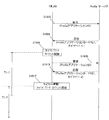
- the step of receiving at least the first discovery filter includes: , Including at least the first code associated with the application ID and a value of a first timer indicating a time during which the first discovery filter is valid, the first code and the first timer Starting the counting of the first timer based on the reception of the value of the first timer and the second code for the second code associated with the same application ID based on the reception of the value of the first timer And the step of stopping the counting of the two timers.
- the first code and the second code are codes used by the terminal device for the announcement, and the first code indicating the time when the first code for the application ID is valid.
- the first code and the second code are codes for monitoring, and the first timer count indicating the time when the first discovery filter for the application ID is valid.
- a control message including a filter is transmitted to the terminal device, and the second discovery filter includes at least the second code associated with the same application ID, and the second discovery filter.
- the time for which the discovery filter is valid The control message is a control for the terminal device to start counting the second timer based on the reception of the second code and the second timer value. It is characterized by being information.
- the present invention it is possible to update the expiration date under which the service based on ProSe can be executed under the management of the communication carrier.
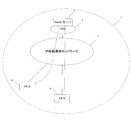
- FIG. 1 is a functional block diagram showing a schematic configuration example of a communication system 1 according to an embodiment of the present invention.
- the communication system 1 shown in FIG. 1 includes a UE_A8 that is a communication terminal (ProSe enabled UE) having a function related to ProSe, a PDN (Packet Data Network) 5, an IP mobile communication network 3, and a ProSe server 7.
- a UE_A8 that is a communication terminal (ProSe enabled UE) having a function related to ProSe, a PDN (Packet Data Network) 5, an IP mobile communication network 3, and a ProSe server 7.
- a plurality of communication terminals having a function related to ProSe may be included and configured like UE_B9.
- the PDN 5 and UEs such as UE_A8 and UE_B9 are connected via the IP mobile communication network 3. Furthermore, UE_A8 and UE_B9 are provided with services based on ProSe.
- the ProSe server 7 is a server device that manages the communication of the UE_A8 or the UE_B9, and performs authentication when providing the ProSe service or the like.
- the ProSe server 7 is configured to be included in the PDN 5 as shown in FIG. 1, but may be independent of the PDN 5.
- UE_A8 and UE_B9 may be connected to the same mobile carrier network, may be connected to different mobile carrier networks, or may be a broadband network operated by a fixed carrier.
- the UE_A 8 is connected to the IP mobile communication network 3 that is operated and managed by a first communication operator (Mobile Operator), and the UEA 9 is different from the IP mobile communication network 3 that is operated and managed by a second communication operator. It may be connected to an IP mobile communication network. In this case, the IP mobile communication network by the second communication carrier may be connected to the PDN 5. Moreover, since the internal structure may be the same as that of the IP mobile communication network 3, detailed description thereof is omitted.
- these IP mobile communication networks may be two IP mobile communication networks with which roaming contracts are made, or may be two IP mobile communication networks in the same country.
- the ProSe server 7 that manages the communication of the UE_A8 and the UE_B9 may be a ProSe server that is managed by the telecommunications carrier that the UE_A8 and the UE_B9 contract, and is managed by the telecommunications carrier that has a contract relationship with the telecommunications carrier that contracts. May be managed by a telecommunications carrier in the same country.
- the broadband network is an IP communication network operated by a telecommunications carrier that is connected by ADSL (Asymmetric Digital Subscriber Line) or the like and provides high-speed communication using a digital line such as an optical fiber.
- ADSL Asymmetric Digital Subscriber Line
- the network is not limited to these, and may be a wireless access network using WiMAX (Worldwide Interoperability for Microwave Access) or the like.
- Each UE such as UE_A8 and UE_B9 is a communication terminal that is connected using an access system such as LTE or WLAN, and is equipped with a 3GPP LTE communication interface, a WLAN communication interface, or the like to connect to an IP mobile communication network. 3 can be connected.
- connection is not limited to this, and other wireless systems such as WiMAX (Worldwide Interoperability for Microwave Access) may be used.
- WiMAX Worldwide Interoperability for Microwave Access
- the PDN 5 is a network that provides a network service that transmits and receives data in packets.
- the PDN 5 is a network that provides a specific communication service such as the Internet or IMS.
- the PDN 5 is connected to the IP mobile communication network 3 using a wired line or the like.
- a wired line or the like is constructed by ADSL or optical fiber.
- the present invention is not limited to this, and a wireless access network such as LTE, WLAN, or WiMAX (Worldwide Interoperability for Microwave Access) may be used.
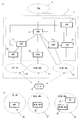
- FIG. 2 is a detailed configuration example of the communication system 1 shown in FIG.
- the configuration example of the system illustrated in FIG. 2 includes UE_A 8, IP mobile communication network 3, and PDN 5.
- UE_A8 IP mobile communication network 3
- PDN 5 IP mobile communication network 5
- a plurality of UEs can be connected to the IP mobile communication network 3.
- FIG. 2 shows an example in which UE_A8 is connected, UE_B9 can also be configured similarly to UE_A8.
- the IP mobile communication network 3 includes a core network 2 and radio access networks (LTE AN25, WLAN ANb27, WLAN ANa29).
- Core network 2 includes HSS (Home Subscriber Server) 11, AAA (Authentication, Authorization, Accounting) 15, PCRF (Policy and Charging Rules Function), PGW (Packet Data Gateway), PGW (Packet Data Gateway). , SGW (Serving Gateway) 21 and MME (Mobile Management Entity) 23.
- HSS Home Subscriber Server
- AAA Authentication, Authorization, Accounting
- PCRF Policy and Charging Rules Function
- PGW Packet Data Gateway
- PGW Packet Data Gateway
- SGW Serving Gateway
- MME Mobile Management Entity
- ProSe server 7 described with reference to FIG. 1 may be configured to be included in the PDN 5 as illustrated in FIG. 1 or may be configured to be included in the IP mobile communication network 3 independently of the PDN 5. Alternatively, it may be configured to be included in the core network 2.
- the radio access network may be composed of a plurality of different access networks. Each access network is connected to the core network 2. Furthermore, UE_A 8 can wirelessly connect to the radio access network.
- an LTE access network (LTE AN25) that can be connected by an LTE access system and an access network (WLAN ANb27, WLAN ANa29) that can be connected by a WLAN access system can be configured.
- LTE AN25 LTE access network
- WLAN ANb27, WLAN ANa29 WLAN access system
- the access network that can be connected by the WLAN access system includes a WLAN access network b (WLAN ANb27) that connects the ePDG 19 as a connection device to the core network 2, and a WLAN access network a (WLAN that connects the PGW 17, the PCRF 13, and the AAA 15).
- WLAN access network a WLAN that connects the PGW 17, the PCRF 13, and the AAA 15.
- ANa 29 can be configured.
- each apparatus is comprised similarly to the conventional apparatus in the mobile communication system using EPS, detailed description is abbreviate
- each device will be briefly described.
- PGW 17 is connected to PDN 5, SGW 21, ePDG 19, WLAN ANa 29, PCRF 13 and AAA 15, and performs user data delivery as a gateway device of PDN 5 and core network 2.
- the SGW 21 is connected to the PGW 17, the MME 23, and the LTE AN 25, and performs user data delivery as a gateway device between the core network 2 and the LTE AN 25.
- the MME 23 is connected to the SGW 21, the LTE AN 25, and the HSS 11, and is an access control device that performs access control of the UE_A 8 via the LTE AN 25.
- the HSS 11 is connected to the MME 23 and the AAA 15 and is a management node that manages subscriber information.
- the subscriber information of the HSS 11 is referred to when the access control of the MME 23 is performed, for example.
- AAA 15 is connected to PGW 17, HSS 11, PCRF 13, and WLAN ANa 29, and performs access control for UE_A 8 connected via WLAN ANa 29.
- the PCRF 13 is connected to the PGW 17, the WLAN ANa 29, the AAA 15, and the PDN 5, and performs QoS (Quality of Service) management for data delivery. For example, QoS management of the communication path between UE_A8 and PDN5 is performed.
- QoS Quality of Service
- the ePDG 19 is connected to the PGW 17 and the WLAN ANb 27, and delivers user data as a gateway device between the core network 2 and the WLAN ANb 27.
- each radio access network includes a device (for example, a base station device or an access point device) to which UE_A 8 is actually connected.
- a device used for connection a device adapted to a radio access network can be considered.
- the LTE AN 25 includes the eNB 31.
- the eNB 31 is a radio base station to which the UE_A 8 is connected in the LTE access system, and the LTE AN 25 may be configured to include one or a plurality of radio base stations.
- the WLAN ANa 29 includes a WLAN APa 35 and a GW (Gateway) 37.
- the WLAN APa 35 is a radio base station to which the UE_A 8 is connected in a WLAN access system that is reliable to the operator operating the core network 2, and the WLAN ANa 29 includes one or more radio base stations. Good.
- the GW 37 is a gateway device for the core network 2 and the WLAN ANa 29. Further, the WLAN APa 35 and the GW 37 may be configured by a single device.
- WLAN ANb27 includes WLAN APb33.
- WLAN APb33 is a radio base station to which UE_A8 is connected in the WLAN access system when a trust relationship is not established with the operator operating the core network 2, and WLAN ANb27 has one or more radio base stations. It may be configured to be included.
- the WLAN ANb 27 is connected to the core network 2 using the ePDG 19 which is a device included in the core network 2 as a gateway.
- the ePDG 19 has a security function for ensuring safety.
- UE_A8 being connected to each radio access network means being connected to a base station apparatus, an access point, etc. included in each radio access network. Also via a base station device or access point.
- UE_A8 and UE_B9 may have the same configuration.
- UE_A8 and UE_B9 only need to be wireless communication terminals including a ProSe function, and may be mobile phone terminals that transmit and receive data by wireless communication using the LTE access method, or may be configured as devices called machine-to-machine. May be communication terminals that mutually exchange information.
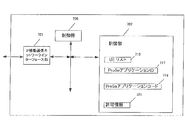
- FIG. 3 shows a functional configuration of the UE_A 8 in the present embodiment.
- the UE_A 8 includes a transmission / reception antenna 301, a switch 303, a direct transmission / reception unit 305, a transmission / reception unit 307, a control unit 309, and a storage unit 313.
- a direct transmission / reception unit 305, a transmission / reception unit 307, a switch 303, and a storage unit 313 are connected to a control unit 309 via a bus.
- the control unit 309 is a functional unit for controlling the UE_A8.
- the control unit 309 is a functional unit that reads and executes various programs stored in the storage unit 313.
- the switch 303 is a functional unit that connects the transmission / reception unit 307 and the direct transmission / reception unit 305 to the transmission / reception antenna 301 under the control of the control unit 309.
- the transmission / reception unit 307 is a functional unit that transmits / receives wireless communication data using the LTE access method.
- the transmission / reception unit 307 includes a transmission unit and a reception unit.
- the transmission unit can transmit control information via the LTE base station, and the reception unit can transmit data and control information via the LTE base station. it can.
- the direct transmission / reception unit 305 is a functional unit that can directly communicate with other UEs using data, control information, or the like without going through an LTE base station.
- the direct transmission / reception unit 305 includes a direct transmission unit and a direct reception unit.
- the direct transmission unit can transmit data and control information without going through the LTE base station, and the direct reception unit can receive data and control information without going through the LTE base station.
- the transmission / reception unit 307 and the direct transmission / reception unit 305 may be configured as one transmission / reception unit.
- the storage unit 313 is a functional unit that stores programs, data, and the like necessary for each operation of the UE_A8.
- the storage unit 313 includes, for example, a semiconductor memory, an HDD (Hard Disk Drive), or the like.
- the storage unit 313 may store a UE ID 315, a ProSe application ID 317, a ProSe application code 319, a timer 321 and the like.
- UE_A8 may be stored as a UE context including these pieces of information.
- the UE ID 315 is identification information for identifying the UE_A8, and may be identification information such as IMSI or MSISDN. Alternatively, it may be a ProSe UE ID acquired from the ProSe server 7 and associated with the UE_A 8 by a service authentication procedure described later. Further, the ProSe UE ID may be information for identifying UE_A8, which is assigned to UE_A8 by the core network in the UE_A8 attach procedure described later. Furthermore, as a specific configuration, it may be a link layer address of a transmission source when UE_A 8 transmits data using a direct communication path.
- the ProSe application ID 317 may be identification information used for ProSe direct discovery for detecting a neighboring terminal, and may be information for identifying an application executed by a communication terminal that detects a neighboring terminal by ProSe.
- the ProSe application ID may be a specific application name.
- the storage unit 313 may store a plurality of ProSe application IDs.
- the ProSe application code 319 may be a code associated with the ProSe application ID.
- the ProSe application code may be a code used for transmitting in an announcement signal for causing a nearby terminal to discover itself, or for monitoring an announcement signal transmitted by the nearby terminal.
- the storage unit 313 may store a plurality of ProSe application codes. A more detailed description of the ProSe application code will be described later and is omitted here.
- the timer is for indicating that the ProSe application code can be used properly, and the ProSe application code may be used properly until the timer is consumed. Further, when the timer is consumed, control such as not using the ProSe application code may be performed. Further, the ProSe application code may be deleted from the storage unit 313 when the timer is consumed.
- the UE_A 8 may store the ProSe application ID and the ProSe application code in association with each other. Further, the UE_A 8 may store a plurality of different ProSe application codes for one ProSe application ID.
- the ProSe application code and the timer may be stored in association with each other.
- a timer for the announcement and a timer for monitoring may be respectively held.
- a plurality of timers may be stored for one ProSe application code.
- the UE_A 8 may store the UE ID of the neighboring terminal.
- a plurality of neighboring terminals may be detected, and a plurality of UE IDs may be stored.
- the discovery filter may be stored.
- the discovery filter may be managed in association with a ProSe application ID 317, a ProSe application code 319, or a timer.
- the discovery filter ID is stored. May be.
- discovery filter ID and the discovery filter may be stored in association with each other.
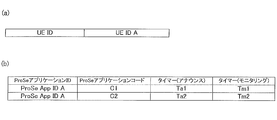
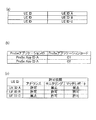
- FIG. 4A is an example of a UE ID stored in the storage unit 313. As shown in FIG. 4A, the UE_A 8 can store the UE ID.
- FIG. 4B is an example of an association table of the ProSe application ID 317, the ProSe application code 319, and the timer 321 stored in the storage unit 313.
- the UE_A 8 can store a plurality of application codes for the same ProSe application ID.
- different timers for announcement and monitoring can be stored for one application code.
- the announcement timer and the monitoring timer may be the same timer. In that case, one timer may be stored for the ProSe application code.
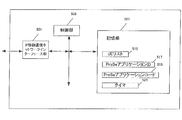
- FIG. 5 shows a functional configuration of the ProSe server 7 in the present embodiment.
- the ProSe server 7 is an authentication server managed by a mobile communication carrier that performs proximity detection by ProSe and communication by ProSe.
- the ProSe server 7 includes an IP mobile communication network interface unit 501, a control unit 505, and a storage unit 507.
- the IP mobile communication network interface unit 501 and the storage unit 507 are connected via a control unit 505 via a bus.
- the control unit 505 is a functional unit for controlling the ProSe server 7.
- the control unit 505 is a functional unit that reads and executes various programs stored in the storage unit 507.
- the IP mobile communication network interface unit 501 is a functional unit for the ProSe server 7 to connect to the IP mobile communication network 3.
- the storage unit 507 is a functional unit that stores programs, data, and the like necessary for each operation of the ProSe server 7.
- the storage unit 407 includes, for example, a semiconductor memory, an HDD (Hard Disk Drive), or the like.
- the storage unit 507 may store a UE list 515, a ProSe application ID 517, a ProSe application code 519, a timer 521, and the like.
- the ProSe server 7 may store the UE context including these pieces of information.
- the UE list 515 is identification information for identifying a UE that has permitted the ProSe service, and may be identification information such as IMSI or MSISDN. Alternatively, it may be a ProSe UE ID acquired from the ProSe server 7 and associated with the UE_A 8 by a service authentication procedure described later. Further, the ProSe UE ID may be information for identifying UE_A8, which is assigned to UE_A8 by the core network in the UE_A8 attach procedure described later. Furthermore, as a specific configuration, it may be a link layer address of a transmission source when UE_A 8 transmits data using a direct communication path.
- the ProSe application ID 517 may be identification information used for ProSe direct discovery for detecting a neighboring terminal, and may be information for identifying an application executed by a communication terminal that detects a neighboring terminal by ProSe.
- the ProSe application ID may be a specific application name.
- the storage unit 507 may store a plurality of ProSe application IDs.
- the ProSe application code 519 may be a code associated with the ProSe application ID.
- the ProSe application code may be a code used for transmitting in an announcement signal for causing a nearby terminal to discover itself, or for monitoring an announcement signal transmitted by the nearby terminal.
- the storage unit 507 may store a plurality of ProSe application codes. A more detailed description of the ProSe application code will be described later and is omitted here.
- the timer 521 is for indicating that the ProSe application code 519 can be used properly, and the ProSe application code may be used properly until the timer is consumed. Further, when the timer is consumed, control such as not using the ProSe application code may be performed. Furthermore, the ProSe application code may be deleted from the storage unit 507 when the timer is consumed.
- the ProSe server 7 may store the ProSe application ID 517 and the ProSe application code 519 in association with each other. Further, the ProSe server 7 may store a plurality of different ProSe application codes for one ProSe application ID.
- the ProSe application code 519 and the timer 521 may be stored in association with each other.
- each UE stored in the UE list 515 may hold a UE context.
- each UE is associated with permission information indicating that an announcement for allowing the neighboring terminal to detect is permitted and permission information indicating that monitoring for the purpose of detecting the neighboring terminal is permitted. You can remember.
- the timer 521 may be managed in association with the ProSe application. Also, a timer for announcement and a timer for monitoring may be held. In this way, a plurality of timers may be stored for one ProSe application code 519.
- the ProSe application ID 517 may be stored, and the UE that has authenticated the ProSe service registration may be stored in association with the ProSe application ID 517.
- the UE that has authenticated the ProSe service registration may be stored in association with the ProSe application ID 517.
- each UE is associated with permission information indicating permission for an announcement to be detected by a neighboring terminal and permission information indicating permission for monitoring for the purpose of detecting the neighboring terminal. You can remember.
- a discovery filter for monitoring may be stored.
- the discovery filter may be managed in association with a ProSe application ID 517, a ProSe application code 519, or a timer.
- a discovery filter ID for identifying the discovery filter may be stored.
- discovery filter ID and the discovery filter may be stored in association with each other.
- FIG. 6A is an example of the UE list 515 stored in the storage unit 507.
- the ProSe server 7 can store identification information for identifying the UE that has permitted the ProSe service.
- FIG. 6B is an example of a relation table in which the storage unit 507 associates the ProSe application ID 517, the ProSe application code 519, and the timer 521 stored for each UE.
- the ProSe server 7 can store a plurality of application codes for the same ProSe application ID for each UE stored in FIG.
- different timers for announcement and monitoring can be stored for one application code.
- the announcement timer and the monitoring timer may be the same timer. In that case, one timer may be stored for the ProSe application code.
- FIG. 7 shows a functional configuration of the HSS 11 in the present embodiment.
- the HSS is a server device that manages subscriber information. Further, it manages permission information and the like for the provision of communication services such as ProSe.
- the HSS 11 includes an IP mobile communication network interface unit 701, a control unit 705, and a storage unit 707.
- the IP mobile communication network interface unit 701 and the storage unit 707 are connected via a control unit 705 via a bus.
- the control unit 705 is a functional unit for controlling the HSS 11.
- the control unit 705 is a functional unit that reads and executes various programs stored in the storage unit 707.
- the IP mobile communication network interface unit 701 is a functional unit for the HSS 11 to connect to the IP mobile communication network 3.
- the storage unit 707 is a functional unit that stores programs, data, and the like necessary for various operations of the HSS 11.
- the storage unit 707 is configured by, for example, a semiconductor memory, an HDD (Hard Disk Drive), or the like.
- the storage unit 707 may store a UE list 715, a ProSe application ID 717, a ProSe application code 719, permission information 721, and the like. Moreover, you may manage these information as subscriber information for every UE.
- the UE list 715 is identification information for identifying a UE that has permitted the ProSe service, and may be identification information such as IMSI or MSISDN. Alternatively, it may be a ProSe UE ID acquired from the ProSe server 7 and associated with the UE_A 8 by a service authentication procedure described later. Further, the ProSe UE ID may be information for identifying UE_A8, which is assigned to UE_A8 by the core network in the UE_A8 attach procedure described later. Furthermore, as a specific configuration, it may be a link layer address of a transmission source when UE_A 8 transmits data using a direct communication path.
- the ProSe application ID 717 may be identification information used for ProSe direct discovery for detecting a neighboring terminal, or may be information for identifying an application executed by a communication terminal that detects a neighboring terminal by ProSe.
- the ProSe application ID may be a specific application name.
- the storage unit 707 may store a plurality of ProSe application IDs.
- the ProSe application code 719 may be a code associated with the ProSe application ID.
- the ProSe application code may be a code used for transmitting in an announcement signal for causing a nearby terminal to discover itself, or for monitoring an announcement signal transmitted by the nearby terminal.
- the storage unit 707 may store a plurality of ProSe application codes. A more detailed description of the ProSe application code will be described later and is omitted here.
- the permission information may be permission information indicating whether or not to allow ProSe service to be provided.
- the ProSe service may be permission information as to whether or not to allow provision for each function such as an announcement function, a monitoring function, and a match report function. Moreover, you may manage permission information for every UE.
- the permission information may be determined and updated by the operator at an arbitrary timing according to a user contract or the like.
- the HSS 11 may store the ProSe application ID and the ProSe application code in association with each other. Also, the HSS 11 may store a plurality of different ProSe application codes for one ProSe application ID.
- the ProSe application ID may be stored, and the UE that has authenticated the ProSe service registration may be stored in association with the ProSe application ID.
- each UE is associated with permission information indicating permission for an announcement to be detected by a neighboring terminal and permission information indicating permission for monitoring for the purpose of detecting the neighboring terminal. You can remember.
- a discovery filter for monitoring may be stored.
- the discovery filter may be managed in association with a ProSe application ID 717, a ProSe application code 719, or a timer.
- a discovery filter ID for identifying the discovery filter may be stored.
- discovery filter ID and the discovery filter may be stored in association with each other.
- FIG. 8A is an example of the UE list 715 stored in the storage unit 707.
- the HSS 11 is identification information for identifying the UE that has permitted the ProSe service, and can store identification information such as IMSI and MSISDN.
- FIG. 8B is an example of a relation table stored in the storage unit 707 and associated with the ProSe application ID 717 and the ProSe application code 719.
- the HSS 11 can store a ProSe application ID 717 and a ProSe application code 719 in association with each other.
- the UE that has authenticated the ProSe service registration may be stored in association with the ProSe application ID.
- FIG. 8C shows an example of permission information 721 stored in the storage unit 707 for each UE.
- the HSS 11 can store permission information for each UE and for each function such as “announcement”, “monitoring”, and “match report”.
- the UE ID A UE is allowed to announce, and monitoring and match reports are prohibited.
- the UE_A 8 performs an authentication procedure for proximity terminal detection (ProSe Direct Discovery) provided as a ProSe service and communication using a direct communication path (ProSe Direct Communication).
- the authentication procedure may authenticate each of the neighboring terminal detection and the communication using the direct communication path by different procedures, or may be authenticated by one authentication procedure.
- UE_A8 makes an authentication request
- UE_B9 may perform an authentication procedure in the same manner as UE_A8.
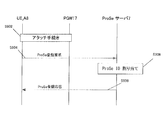
- UE_A 8 executes an attach procedure and connects to the core network (S902). As a result, the UE_A 8 establishes a PDN connection with the PGW 17.
- the PDN connection is a communication path for transmitting / receiving data to / from the PDN 5.
- the attach procedure may be executed as an initial procedure such as when the UE_A 8 is powered on.
- the attach procedure starts when the UE_A 8 transmits an attach request to the MME 23.
- the attach request may include UE identification information such as APN and IMSIG.
- the APN is not necessarily included in the attach request message, and may be notified from the UE_A 8 to the MME 23 by a control message in the attach procedure.
- the MME 23 selects the PGW 17 based on the received APN, and determines the end point of the PDN connection for the UE_A8. Furthermore, establishment of a PDN connection and connection to the core network are permitted, and an attach permission message serving as a response to the attach request message is transmitted to UE_A8.
- the attach permission message may be transmitted directly from the MME 23 to the UE_A 8 or may be transmitted via the eNB 31 included in the LTE AN 25.
- the MME 23 may notify that the UE_A 8 is permitted to connect to the core network by transmitting an attach permission message. Further, the MME 23 may notify that the PDN connection has been established by transmitting an attach permission message. Further, the attach permission message may be transmitted including the IP address associated with the PDN connection or the APN.
- the MME 23 may transmit the attach permission message including the ProSe UE ID. For example, the MME 23 may transmit including the attach permission message ProSe UE ID based on identifying that the APN transmitted by the UE_A 8 in the attach procedure is the APN associated with the ProSe service. At this time, the MME 23 may assign ProSe UE ID to the UE_A8. Moreover, you may acquire from HSS11. In this case, the HSS 11 or the like may store the ProSe UE ID in the subscriber information in advance.
- UE_A 8 transmits a ProSe registration request message to the ProSe server 7 (S904).
- the UE_A 8 may request permission of communication using a direct communication path by detecting a neighboring terminal by transmitting a ProSe registration request message. Further, it is possible to transmit information including information for identifying the neighboring terminal detection and the permission of communication using the direct communication path, and request permission for each of them.
- the ProSe registration request may be transmitted using the PDN connection established by the attach procedure. Further, the ProSe registration request message may be transmitted using the IP address acquired in the attach procedure as the transmission source address.
- the ProSe server 7 that is the transmission destination of the ProSe registration request message may hold in advance information about the ProSe server 7 associated with the home PLMN that is the contracted communication carrier and use it as the transmission destination.
- a list of communication carriers that can provide the ProSe service is held as a local PLMN, and further, a ProSe server 7 associated with the local PLMN may be held and used as a transmission destination.
- the local PLMN may be an arbitrary communication carrier determined based on a contract relationship with the Home PLMN, or may be a communication carrier operating in the same country as the Home PLMN.
- the UE_A 8 may hold the PLMN ID for identifying the PLMN and the ProSe server 7 in association with each other and request authentication using the transmission destination.
- the PLMN ID and the ProSe server 7 information may be acquired from the HomePLMN. For example, an inquiry may be made to the ProSe server 7 of Home PLMN, and a response to the inquiry may be acquired and retained.
- the ProSe server 7 may receive the ProSe registration request, execute detection of neighboring terminals and authentication of communication using the direct communication path, and transmit a ProSe registration response (S908).
- the ProSe registration response may be sent including the authentication result.
- the ProSe server 7 may store information for authentication in association with the UE_A 8, and may determine whether the authentication result is acceptable or not based on the information.
- the ProSe server 7 may execute the assignment of the ProSe UE ID based on the reception of the ProSe registration request (S904). Further, the ProSe UE ID may be included in the ProSe registration response and transmitted to the UE_A8.
- the ProSe UE ID may be an ID associated with UE_A8, and UE_A8 may be used as information for identifying a terminal when detecting a neighboring terminal or notifying the neighboring terminal of itself. More specifically, UE_A8 may transmit the ProSe UE ID included in the announcement signal.
- the UE_A8 receives the ProSe registration response and acquires the authentication result. Further, the ProSe UE ID included in the ProSe registration response may be acquired and held.
- UE_B9 may perform service registration by the same procedure.
- Announcement request procedure a procedure for requesting an announcement by the terminal will be described. Announcement means that a terminal notifies its presence to a terminal located in the vicinity.
- UE_A8 may perform the announcement based on the fact that the authentication is permitted by the service authentication procedure.
- the announcement procedure may be executed in the UE_B9 by the same procedure as the UE_A8.
- UE_A8 may hold a ProSe application ID corresponding to the Home PLMN as an initial state for executing the announcement (S1002).
- the UE_A 8 may request a ProSe application ID by transmitting a ProSe registration request to the ProSe server 7 in the service registration procedure. Further, the ProSe server 7 may transmit the response including the ProSe application ID. Thus, UE_A8 may acquire the ProSe application ID included in the ProSe registration response.
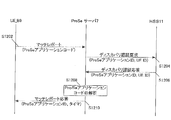
- the UE_A 8 transmits a discovery request to the ProSe server 7 (S1004).
- the discovery request transmitted by the UE_A 8 may be transmitted on condition that the service authentication procedure is completed.
- the ProSe server 7 of Home PLMN which is a contracted communication carrier, may be conditional on the UE_A 8 being authenticated to announce.
- the UE_A 8 may acquire the authentication information from the ProSe server 7 upon completion of the authentication and hold the authentication information.
- the discovery request may include a ProSe application ID, a UE ID, and a command indicating that an announcement is requested.
- the ProSe application ID may be an ID indicating an application for which UE_A 8 requests an announcement.
- the UE ID may be identification information such as IMSI or MSISDN. ProSe UE ID may also be used.
- the information indicating that the announcement is requested is not limited to the method of identifying by the command, but may be requested by transmitting the announcement request message by defining the announcement request message. More specifically, a message type for requesting an announcement may be defined, and a request message including the message type may be transmitted.
- the ProSe server 7 that is the transmission destination of the discovery request may hold in advance information related to the ProSe server 7 of the Home PLMN that is a communication carrier with which the UE_A 8 has a contract, and the ProSe server 7 of the Home PLMN may be the transmission destination.
- the discovery request may include identification information indicating a request for timer update by this request. Specifically, in the identification information, if a ProSe application code and a timer have already been assigned to the ProSe application ID included in the discovery request and the timer has started counting, the counting is ended, A timer may be assigned, or a new timer may be requested after the count is finished.
- the ProSe server 7 receives a discovery request from the UE_A 8. Further, if the ProSe server 7 does not hold the UE context associated with UE_A8, the ProSe server 7 may request authentication for making an announcement to the HSS 11 and authentication for generating the UE context (S1006). These authentication requests may be requested by transmitting a discovery authentication request to the HSS 11. Further, the discovery authentication request may be transmitted including the ProSe application ID and UEID.
- the ProSe application ID may be an ID indicating an application for which UE_A 8 requests an announcement.
- the UE ID may be identification information such as IMSI or MSISDN. Or ProSe UE ID may be sufficient.
- the HSS 11 receives the discovery authentication request.
- the HSS 11 holds subscriber information associated with the UE_A8, and the subscriber information includes information indicating that discovery is permitted, information that allows announcements, information that permits monitoring, and the like to the UE_A8. You may manage in association.
- these permission information may be managed different permission information for each application. That is, the permission information may be managed in association with the ProSe application ID.
- the HSS 11 performs authentication based on the received ProSe application ID and UE ID and the subscriber information. Further, the ProSe server 7 may transmit a discovery authentication response to the ProSe server 7 as a response to the discovery authentication (S1008). Here, the discovery authentication response may be transmitted including the authentication result.
- the information included in the discovery authentication request is compared with the subscriber information, and when allowing the UE_A 8 to execute the announcement, a discovery authentication response including information indicating that permission has been transmitted is transmitted. If not permitted, a discovery authentication response including information indicating not permitted may be transmitted.
- the HSS 11 may permit the announcement when the subscriber information holds the information permitted for the announcement.
- an announcement may be permitted when subscriber information holds information that allows discovery in ProSe.
- the ProSe server 7 receives the discovery authentication response transmitted by the HSS 11.
- the ProSe server 7 may generate a UE context based on the discovery authentication response.
- the UE context may include the ProSe application ID, the UE ID, and the information that permits the announcement, which are acquired by the discovery request transmitted by the UE_A 8 or the discovery authentication response transmitted by the HSS 11.
- Such UE context may be managed in association with UE_A8.
- the timer may be managed in association with the ProSe application code.
- the timer may indicate a time for allowing the announcement. Further, it may indicate that the ProSe application code is valid. In other words, since it is desired that the ProSe application code be operated so as to be used safely, the code value is not permanently usable, and safety can be ensured by updating with a timer.
- the initial value of the timer may be determined by setting by the communication carrier.
- the ProSe server 7 may hold a ProSe application code corresponding to the ProSe application ID and store it in the UE context.
- the ProSe application code is a code that is transmitted by a communication terminal included in a signal transmitted for discovery of a neighboring terminal, and is associated with a ProSe application ID.
- the communication terminal can announce that the corresponding application can be used by transmitting the ProSe application code to the neighborhood.
- the ProSe server 7 may hold the ProSe application code in association with the ProSe application ID. If not held, the ProSe application code may be generated in association with the ProSe application ID.
- the ProSe server 7 may transmit a discovery response to the UE_A 8 as a response to the discovery request (S1010).
- the discovery response may include information related to the UE context. More specifically, it may be transmitted including a ProSe application ID, UE ID, ProSe application code, and timer value.
- the discovery request includes identification information related to timer update
- a ProSe application code or timer may be assigned according to the request.
- the ProSe server 7 may start a timer count when a discovery response is transmitted.
- the ProSe server 7 determines whether to update the timer according to the remaining timer value. May be. More specifically, based on the timer count in the ProSe server 7, if the remaining timer is below a certain threshold, a new timer is assigned, and if the remaining timer is above a certain threshold, the remaining You may use a timer as a timer which notifies UE_A8.
- UE_A 8 receives the discovery response. Further, an authentication result, a ProSe application code, a timer value, and the like may be acquired.
- UE_A 8 determines whether or not the announcement is permitted based on information included in the discovery response.
- radio resources may be allocated (S1012), and a signal including the acquired ProSe application code may be transmitted to the neighborhood.
- Radio resource information such as frequency and time may be acquired from the ProSe server 7, or resources for announcement may be held in advance and assigned.
- the UE_A 8 may start counting the timer based on reception of the discovery response. Further, UE_A 8 may transmit a signal for announcement until the timer is consumed. Also, when the timer is consumed, such as when the timer value becomes zero, the announcement is stopped.
- the announcement signal may be transmitted including the ProSe application. Further, the announcement signal may be transmitted including the UE ID.
- UE_A 8 when it is notified in the discovery response that authentication is not possible, UE_A 8 does not perform allocation or announcement of radio resources.
- the UE_A 8 can perform an authentication procedure for executing the announcement. Furthermore, the UE_A 8 can acquire the ProSe application code corresponding to the ProSe application ID that performs the announcement.
- UE_A 8 may request announcing of multiple applications. In that case, a plurality of ProSe application IDs may be held, and an announcement request procedure may be executed for each ProSe application ID.
- UE_A8 may perform announcing on a plurality of ProSe application codes.
- UE_A 8 may execute an announcement if it has been authenticated based on reception of the discovery response. As a specific means of announcement, UE_A 8 may transmit the announcement signal using the allocated radio resource. In an authenticated state, an announcement signal may be transmitted at an arbitrary timing by a user operation, communication terminal setting, or the like. The announcement signal may be transmitted in a radial pattern around UE_A8.
- UE_A 8 may determine the intensity of the transmission signal based on the range glass and transmit it.
- the UE_A 8 may acquire and hold the range class from the ProSe server 7 and read the range class when transmitting the announcement signal to determine the transmission strength. In this way, the reach distance of the announcement signal may be determined.
- the range class may have a different range class for each application, the transmission strength of the announcement signal may be determined for each application based on the range class, and the announcement signal may be transmitted.
- the UE_A 8 may transmit the announcement signal using a direct radio signal (Direct Radio Signal) based on LTE, that is, E-UTRA technology.
- Direct Radio Signal Direct Radio Signal
- Monitoring is a procedure for detecting the presence of neighboring terminals. More specifically, it is a procedure for monitoring the announcement signal in order to receive the announcement signal transmitted by the neighboring terminal.
- the UE_B 9 may perform monitoring based on the fact that the authentication is permitted by the service authentication procedure.
- the monitoring procedure may be executed in the UE_A 8 by the same procedure as the UE_B 9.
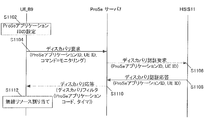
- the UE_B9 may hold a ProSe application ID corresponding to Home PLMN as an initial state for executing monitoring (S1102).
- the UE_B 9 may make a ProSe application ID request by transmitting a ProSe registration request to the ProSe server 7 in the service registration procedure. Further, the ProSe server 7 may transmit the response including the ProSe application ID. As described above, the UE_B 9 may acquire the ProSe application ID included in the ProSe registration response.
- the UE_B 9 transmits a discovery request to the ProSe server 7 (S1104).
- the discovery request transmitted by the UE_B 9 may be transmitted on condition that the service authentication procedure is completed.
- the ProSe server 7 of the Home PLMN that is the contracting communication carrier may be conditional on the UE_B 9 being authenticated for monitoring.
- the UE_B 9 may acquire the authentication information from the ProSe server 7 upon completion of the authentication and hold the authentication information.
- the discovery request may include a ProSe application ID, a UE ID, and a command indicating that monitoring is requested.
- the ProSe application ID may be an ID indicating an application for which the UE_B 9 requests monitoring.
- the UE ID may be identification information such as IMSI or MSISDN. Alternatively, it may be a ProSe application code associated with UE_A 8 acquired from the ProSe server 7 by a service authentication procedure or the like.
- the information indicating that the monitoring is requested is not limited to the method of identifying by the command, but may be requested by transmitting the monitoring request message by defining the monitoring request message. More specifically, a message type that requires monitoring may be defined, and a request message including the message type may be transmitted.
- the ProSe server 7 that is the transmission destination of the discovery request may hold in advance information related to the ProSe server 7 of the Home PLMN that is the communication carrier with which the UE_B 9 is contracted, and the ProSe server 7 of the Home PLMN may be the transmission destination.
- the discovery request may include identification information indicating a request for timer update by this request. Specifically, in the identification information, if a ProSe application code and a timer have already been assigned to the ProSe application ID included in the discovery request and the timer has started counting, the counting is ended, A timer may be assigned, or a new timer may be requested after the count is finished.
- the ProSe server 7 receives a discovery request from the UE_B 9. Further, if the ProSe server 7 does not hold the UE context associated with the UE_B 9, the ProSe server 7 may request authentication for making an announcement to the HSS 11 and authentication for generating the UE context (S1106). These authentication requests may be requested by transmitting a discovery authentication request to the HSS 11. Further, the discovery authentication request may be transmitted including the ProSe application ID and UEID.
- the ProSe application ID may be an ID indicating an application for which the UE_B 9 requests monitoring.
- the UE ID may be identification information such as IMSI or MSISDN. Or ProSe UE ID may be sufficient.
- the HSS 11 receives the discovery authentication request.
- the HSS 11 holds subscriber information associated with the UE_B9, and the subscriber information includes information indicating that discovery is permitted, information that permits monitoring, information that permits announcement, and the like to the UE_B9. You may manage in association.
- these permission information may be managed different permission information for each application. That is, the permission information may be managed in association with the ProSe application ID.
- the HSS 11 performs authentication based on the received ProSe application ID and UE ID and the subscriber information. Further, the ProSe server 7 may transmit a discovery authentication response to the ProSe server 7 as a response to the discovery authentication (S1108). Here, the discovery authentication response may be transmitted including the authentication result.
- the information included in the discovery authentication request is compared with the subscriber information, and when the UE_B 9 is permitted to execute monitoring, a discovery authentication response including information indicating that permission is transmitted is transmitted. If not permitted, a discovery authentication response including information indicating not permitted may be transmitted.
- the HSS 11 may permit monitoring if the subscriber information holds information that is permitted to be monitored. In addition, monitoring may be permitted if the subscriber information holds information that permits discovery in ProSe.
- the ProSe server 7 receives the discovery authentication response transmitted by the HSS 11.
- the ProSe server 7 may generate a UE context based on the discovery authentication response.
- the UE context may be stored including the ProSe application ID, the UE ID, and the information that permits monitoring acquired by the discovery request transmitted by the UE_A 8 or the discovery authentication response transmitted by the HSS 11.
- Such UE context may be managed in association with UE_B9.
- the timer may be managed in association with the ProSe application code.
- the timer may indicate a time for allowing the announcement. Further, it may indicate that the ProSe application code is valid. In other words, since it is desired that the ProSe application code be operated so as to be used safely, the code value is not permanently usable, and safety can be ensured by updating with a timer.
- the initial value of the timer may be determined by setting by the telecommunications carrier. Or, when another terminal such as UE_A8 requests an announcement, and the ProSe server 7 assigns a ProSe application code corresponding to the ProSe application ID, the timer associated with the ProSe application code is counted, The remaining value at the present time may be the initial value. In this case, a new timer initial value may be set. Further, the ProSe server 7 may hold a ProSe application code corresponding to the ProSe application ID and store it in the UE context.
- the ProSe application code is a code that is transmitted by a communication terminal included in a signal transmitted for discovery of a neighboring terminal, and is associated with a ProSe application ID.
- the communication terminal can use the corresponding application by transmitting the ProSe application code to the vicinity, and can monitor the terminal that performs the announcement.
- the ProSe server 7 may hold the ProSe application code in association with the ProSe application ID. If not held, the ProSe application code may be generated in association with the ProSe application ID.
- the ProSe server 7 may transmit a monitor request to the ProSe server 7 of the local PLMN.
- the monitor request may include a ProSe application ID and a UE ID. This is to make the mask values for masking a part of the ProSe application code equal when performing the monitoring function in the local PLMN.
- the ProSe server 7 of the local PLMN may transmit a monitor response as a response to the monitor request to the ProSe server 7 of the Home PLMN.
- the monitor response may include a mask and a ProSe application ID. This may mean that the local PLMN has authenticated the discovery request. Note that the timers may be synchronized with each other between the local PLMN and the Home PLMN.
- the ProSe server 7 may transmit a discovery response to the UE_B 9 as a response to the discovery request (S1110).
- the discovery response may include information related to the UE context. More specifically, a discovery filter and a discovery filter ID may be included for transmission.
- the discovery request includes identification information related to timer update
- a ProSe application code or timer may be assigned according to the request.
- the ProSe server 7 may start a timer count when a discovery response is transmitted.
- the ProSe server 7 determines whether to update the timer according to the remaining timer value. May be. More specifically, based on the timer count in the ProSe server 7, if the remaining timer is below a certain threshold, a new timer is assigned, and if the remaining timer is above a certain threshold, the remaining You may use a timer as a timer which notifies UE_A8.
- the discovery filter includes a ProSe application ID, a ProSe application code, and a timer.
- the discovery filter ID is identification information for identifying the discovery filter.
- the ProSe server 7 when another terminal such as UE_A8 requests an announcement, and the ProSe server 7 assigns a ProSe application code corresponding to the ProSe application ID, the timer associated with the ProSe application code is counted. . The ProSe server 7 may transmit the remaining value at the present time as the timer value.
- the ProSe server 7 may transmit a mask value for masking a part of the ProSe application code instead of transmitting the ProSe application code.
- the mask for example, there are coffee shops and restaurants that have many stores, and the ProSe application code is associated with a specific store, and the mask value is expanded in a chain such as the coffee shop name even if the specific store cannot be specified It becomes possible to specify the company.
- the same value may be assigned to arbitrary upper bits of the ProSe application code. Further, these common upper bits may be used as a mask value. Further, the mask value is not limited to the upper bits, and may be a partial bit string constituting the ProSe application code. Thereby, UE to monitor can detect the several Prose application code managed by the group based on the detection by a mask value. In this way, a plurality of ProSe applications can also be detected.
- the mask may be identification information that can identify a plurality of ProSe application IDs.
- the ProSe server 7 may manage the ProSe application code and mask value managed in association with the ProSe application ID, and further define the timer as a discovery filter. That is, the ProSe server 7 may transmit a discovery response to the UE_B 9, and the discovery response may include a discovery filter corresponding to the ProSe application ID that the UE_B 9 requests for monitoring. Further, a discovery filter ID for identifying a discovery filter may be included and transmitted.
- UE_B9 receives the discovery response. Further, an authentication result, a ProSe application code, a timer value, and the like may be acquired.
- UE_B 9 determines whether monitoring is permitted based on information included in the discovery response.
- radio resources may be allocated (S1112), and it may be monitored whether a signal including the acquired ProSe application code is transmitted.
- Radio resource information such as frequency and time may be acquired from the ProSe server 7, or resources for announcement may be held in advance and assigned.
- UE_B 9 may receive and detect an announcement signal transmitted using a direct radio signal (Direct Radio Signal) based on LTE, that is, E-UTRA technology.
- the UE_A 8 may start counting the timer based on reception of the discovery response. Further, the UE_B 9 may perform monitoring until the timer is consumed. When the timer is consumed, such as when the timer value becomes zero, monitoring is stopped.
- Direct Radio Signal Direct Radio Signal
- UE_B 9 does not perform radio resource allocation or monitoring.
- UE_B 9 can perform an authentication procedure for executing monitoring. Furthermore, the UE_B 9 can acquire a ProSe application code corresponding to the ProSe application ID for monitoring.
- UE_B 9 may request monitoring of a plurality of applications. In that case, a plurality of ProSe application IDs may be held, and a monitoring request procedure may be executed for each ProSe application ID.
- UE_B 9 may perform monitoring on a plurality of ProSe application codes.
- the match report is a procedure in which the terminal reports the monitoring result to the ProSe server 7 when the ProSe application code announced by the neighboring terminal is received by monitoring. Further, in the match report procedure, a ProSe application ID associated with the received ProSe application code or a timer value associated with the ProSe application code may be acquired.
- the UE_B 9 may execute the announcement based on the fact that the authentication is permitted by the service authentication procedure.
- UE_B9 performs the match report procedure
- UE_A8 may execute the match report procedure by the same procedure as UE_B9.
- UE_B 9 may hold a ProSe application ID corresponding to Home PLMN as an initial state for executing a match report.
- the UE_A 8 may request a ProSe application ID by transmitting a ProSe registration request to the ProSe server 7 in the service registration procedure. Further, the ProSe server 7 may transmit the response including the ProSe application ID. Thus, UE_A8 may acquire the ProSe application ID included in the ProSe registration response.
- the ProSe application ID may not be held.
- the ProSe application code may be acquired by monitoring, and it may be detected that the ProSe application ID corresponding to the acquired ProSe application code is not held, and the match report procedure may be started in response to the detection.
- the start of the match report procedure means that the UE_B 9 transmits a match report to the ProSe server 7 (S1202).
- the transmission of the match report by the UE_B 9 may be performed on the condition that the service authentication procedure is completed. More specifically, it may be conditional on the UE_B 9 being authenticated by the ProSe server 7 of the Home PLMN, which is a telecommunications carrier to which the contract is made. Or it is good also as conditions on not only monitoring but having authenticated based on the information of whether execution of a match report procedure is permitted.
- the UE_B 9 may acquire the authentication information from the ProSe server 7 upon completion of the authentication and hold the authentication information.
- the match report may include a ProSe application code, a UE ID, and a command indicating that a match report is requested.
- the UE ID may be identification information such as IMSI or MSISDN. Alternatively, it may be a ProSe application code associated with UE_B 9 acquired from the ProSe server 7 by a service authentication procedure or the like.
- the information indicating that the match report procedure is requested is not limited to the method of identifying by the command, but may be requested by transmitting the match report message by defining the match report message. More specifically, a message type for requesting a match report may be defined, and a request message including the message type may be transmitted.
- the ProSe server 7 that is the destination of the match report may hold in advance information related to the ProSe server 7 of the Home PLMN that is the communication carrier with which the UE_B 9 is contracted, and the ProSe server 7 of the Home PLMN may be the destination.
- the match report may include identification information indicating a request for timer update by this request. Specifically, in the identification information, if a timer has already been assigned to the ProSe application code included in the match report, and the timer has started counting, the counting is ended and a new timer is assigned. Or a new timer may be requested after the count is over.
- the ProSe server 7 receives the match report from the UE_B 9. Further, if the ProSe server 7 does not hold the UE context associated with UE_B9, the ProSe server 7 requests authentication for making an announcement to the HSS 11, authentication for performing monitoring, and authentication for generating the UE context. You may do it (S1204). These authentication requests may be requested by transmitting a discovery authentication request to the HSS 11. Further, the discovery authentication request may be transmitted including the UEID.
- the UE ID may be identification information such as IMSI or MSISDN. Or ProSe UE ID matched with UE_B9 may be sufficient.
- the HSS 11 receives the discovery authentication request.
- the HSS 11 holds subscriber information associated with the UE_B 9, and the subscriber information includes information indicating that discovery is permitted, information allowing an announcement, information permitting monitoring, and a match report. Information to be permitted may be managed in association with UE_B9.
- these permission information may be managed different permission information for each application. That is, the permission information may be managed in association with the ProSe application ID.
- the HSS 11 performs authentication based on the received UE ID and subscriber information. Further, the ProSe server 7 may transmit a discovery authentication response to the ProSe server 7 as a response to the discovery authentication (S1206). Here, the discovery authentication response may be transmitted including the authentication result.
- the discovery authentication response including the information indicating the permission is included. If it is transmitted and not permitted, a discovery authentication response may be transmitted including information indicating that permission is not permitted.
- the HSS 11 may permit the match report when the subscriber information holds the information for which the match report is permitted. Further, when the subscriber information holds information that is permitted to be monitored, the match report may be permitted. In addition, if the subscriber information holds information that allows discovery in ProSe, a match report may be permitted.
- the ProSe server 7 receives the discovery authentication response transmitted by the HSS 11.
- the ProSe server 7 may generate a UE context based on the discovery authentication response.
- the UE context may be stored including a UE ID acquired by a match report transmitted by the UE_B 9 or a discovery authentication response transmitted by the HSS 11, information permitting announcement, and information permitting monitoring.
- Such UE context may be managed in association with UE_B9.
- the ProSe server 7 analyzes the ProSe application code transmitted by the UE_B 9 in the match report (S1208). Specifically, the ProSe application ID corresponding to the ProSe application code is resolved.
- the ProSe server 7 may acquire and store a ProSe application ID corresponding to the ProSe application code in advance. Further, the ProSe server 7 may manage the ProSe application code and the ProSe application ID in advance when generating the ProSe application code.
- the ProSe application code when the ProSe application code is generated in association with the ProSe application ID transmitted by UE_A8 in the announcement request procedure by UE_A8, the ProSe application ID and the ProSe application code may be stored in association with each other. Furthermore, a match report may be received from the UE_B 9 and, based on the ProSe application code included in the match report, a stored ProSe application ID corresponding to the ProSe application code may be selected.
- the timer may be managed in association with the ProSe application code.
- the timer may indicate a time for allowing the announcement. Further, it may indicate that the ProSe application code is valid. In other words, since it is desired that the ProSe application code be operated so as to be used safely, the code value is not permanently usable, and safety can be ensured by updating with a timer.
- the initial value of the timer may be determined by setting by the communication carrier.
- the ProSe server 7 may confirm the PLMN to which the ProSe application is assigned from the ProSe application code received from the UE_B 9. At this time, if the PLMN is a local PLMN, the ProSe server 7 may transmit a match report to the ProSe server 7 of the local PLMN.
- the match report here may be composed of a ProSe application code and a UE ID.
- the ProSe server 7 of the local PLMN receives the match report from the ProSe server 7, and transmits a match report response to the ProSe server 7 when the ProSe application code is an authenticated code.
- the response of the match report may be composed of a ProSe application ID name (for example, a telephone number or URL) and a timer. This can mean that the ProSe server 7 of the local PLMN has authenticated the application.
- the ProSe server 7 may transmit a match report response to the UE_B 9 as a response to the match report (S1210).
- the match report response may include information related to the UE context. More specifically, it may be transmitted including a ProSe application ID, UE ID, ProSe application code, and timer value.
- a ProSe application code or timer may be assigned according to the request.
- the ProSe server 7 may start counting the timer when transmitting the match report response.
- the ProSe server 7 may determine whether to update the timer based on the remaining timer values. . More specifically, based on the timer count in the ProSe server 7, if the remaining timer is below a certain threshold, a new timer is assigned, and if the remaining timer is above a certain threshold, the remaining You may use a timer as a timer which notifies UE_A8.
- UE_B9 receives the match report response. Furthermore, an authentication result, a ProSe application ID, a timer value, and the like may be acquired.
- UE_B 9 receives the match report response, and monitoring of the ProSe application code is normally completed.
- the UE_B 9 may start counting a timer included in the match report response based on the reception of the match report response. Further, the UE_B 9 recognizes that the monitored ProSe application code can be normally used until the timer is consumed. When the timer is consumed, such as when the timer value becomes zero, monitoring is stopped.
- the UE_B 9 can resolve the ProSe application ID corresponding to the monitored ProSe application code and specify the application. For example, when UE_A8 announces a ProSe application code and a UE ID, and UE_B9 executes monitoring and receives a UE ID that identifies the ProSe application code and UE_A8, UE_B9 executes a match report procedure to execute UE_A8. Is located in the vicinity and UE_A8 can detect available applications.
- update means that a ProSe application code and a timer are acquired for the ProSe application ID, and the UE_A 8 that has started counting the timer uses a new ProSe application code for the same ProSe application ID. Indicates that the old ProSe application code and timer are invalidated and the new ProSe application code and timer are used.
- Non-updated means that the UE_A 8 that has acquired the ProSe application code and the timer for the ProSe application ID and has started counting the timer has a new ProSe application code for the same ProSe application ID. And the timer of the old ProSe application code is consumed, and then the new ProSe application code and timer are used.
- “parallel” means that the ProSe application code and the timer are acquired for the ProSe application ID, and the UE_A 8 that has started counting the timer sets a new ProSe application code for the same ProSe application ID. Get the timer and use both the old ProSe application code timer and the new ProSe application code and timer.
- the initial state of this procedure may be the state where the announcement request procedure described in 1.3.2 is completed.
- the UE_A 8 may have acquired “C1” as the ProSe application code and “T1” as the timer from the ProSe server 7 by the announcement request procedure described in 1.3.2. Details will be described below with reference to FIG.
- the UE_A 8 starts counting the timer “T1” based on the announcement request procedure, and validates the ProSe application code “C1” (S1306). Further, after transmitting the response message, the ProSe server 7 starts counting the timer “T1” and validates the ProSe application code “C1” (S1307).
- UE_A8 may execute the announcement by transmitting the announcement signal while the timer “T1” is being counted.
- the UE_A 8 may request the ProSe server 7 for the ProSe application code and the timer for the same ProSe application ID while the timer “T1” is being counted. In other words, the UE_A 8 may newly request the ProSe server 7 for a ProSe application code and a timer for the same ProSe application ID before the timer “T1” is consumed.
- Such re-request by the UE_A 8 may be executed when the remaining time of the timer has decreased. More specifically, the UE_A 8 may hold a threshold value in advance, and may make a re-request when the remaining time of the timer becomes equal to the threshold value or when it is less than the threshold value.
- the re-request trigger is not limited to these, and may be performed under other conditions, or may be executed at an arbitrary timing.
- UE_A 8 may transmit a request message to the ProSe server 7 in order to re-request the ProSe application code and timer for the same ProSe application ID (S1308).
- the request message may be a discovery request message for requesting an announcement.
- the discovery request message for announcement may be a discovery request message (S1004) transmitted by UE_A8 described in the announcement request procedure of 1.3.2. Since the processing related to the transmission of UE_A8, the configuration of the discovery request message, the information elements included in the request message, and the like may be the same, detailed description is omitted here.
- the ProSe server 7 receives the request message. Furthermore, a response message is transmitted to UE_A8 (S1310).
- the response message may be transmitted including the ProSe application code and a timer.
- condition for transmitting the response message may be transmitted based on reception of the request message or may be transmitted based on authentication.
- a specific method of authentication may be executed by the method described in the announcement request procedure of 1.3.2.
- the application code and timer included in the response message may include the old ProSe application code “C1” that has already been assigned and the remaining time of the timer “T1” corresponding to the old ProSe application code.
- the application code and timer included in the response message may include a new ProSe application code “C2” different from the ProSe application code “C1” and a timer “T2” corresponding to the new ProSe application code.
- the old ProSe application code “C1” and the new ProSe application code “C2” may be associated with a single application ID.
- Whether to send an old application code or a new application code may be determined based on the following conditions and processing.
- the ProSe server 7 may transmit the new application code “C2” and the timer “T2” together with the remaining time of the timer T1 being small. More specifically, the ProSe server 7 holds a threshold value in advance, and when the remaining time of the timer becomes equal to the threshold value or when the timer value becomes less than the threshold value, the new application code “C2” and the timer “T2” are set. "May be included.
- the ProSe server 7 may transmit the old application code “C1” and the remaining time of the timer “T1”. More specifically, the ProSe server 7 holds a threshold value in advance, and when the remaining time of the timer is greater than the threshold value or equal to the threshold value, the new application code “C1” and the timer “T1” It may be transmitted including the remaining time.
- the ProSe server 7 may determine based on the received request message.
- the UE_A 8 may transmit the request message including the identification information.
- This identification information may be identification information indicating an old application code request or a new application code request.
- the ProSe server 7 may transmit a new application code “C2” and a timer “T2” based on the identification information. Further, the old application code “C1” and the remaining time of the timer “T1” may be transmitted based on the identification information.
- the ProSe server 7 may be determined based on the presence or absence of identification information. That is, the identification information may be identification information indicating a request for a new application code.
- the identification information may be identification information indicating a request for a new application code.
- UE_A 8 may send a request message without including identification information and request an old application code.
- the UE_A 8 may transmit a request message including identification information and request a new application code.
- the identification information may be transmitted including the remaining time of the old application code “C1” and timer “T1”. Further, the ProSe server 7 may transmit a new application code “C2” and a timer “T2” based on the fact that the identification information is included in the request message.
- the identification information may be identification information indicating an old application code request.
- UE_A 8 may send a request message without including identification information and request a new application code. Further, UE_A 8 may request an old application code by transmitting a request message including identification information.
- the ProSe server 7 may transmit a new application code “C2” and a timer “T2” based on the fact that the identification information is not included in the request message. Further, based on the fact that the identification information is included in the request message, the old application code “C1” and the remaining time of the timer “T1” may be included.
- Such identification information may be an information element such as a flag included in the request message, or may be an information element indicating the message type of the control message.
- the ProSe server 7 may transmit the time including the remaining time of the timer “T1” to synchronize the timers of a plurality of UEs.
- this request message may be a discovery request message for requesting the announcement described in 1.3.2. Therefore, these pieces of identification information may be included in the discovery request message that requests the announcement described in 1.3.2.
- whether to transmit an old application code or a new application code may be determined based on the setting of the ProSe server 7 or the like.
- the setting of the ProSe server may be determined and set according to the policy (Mobile Operator Policy) of the telecommunications carrier operating the ProSe server 7 or the policy of the application provider.
- UE_A8 receives the response message. Further, the ProSe application code and timer included in the response message are acquired.
- UE_A8 When UE_A8 acquires a new ProSe application code “C2”, the UE_A8 supports the “update” such as stopping the use of the old ProSe application code “C1” and starting using the new ProSe application code “C2”. Processing may be performed (S1312).
- the specific “update” process in the UE_A 8 may execute, for example, invalidating the old ProSe application code “C1” and validating the new ProSe application code “C2”.
- timer “T1” corresponding to the old ProSe application code “C1” may be stopped and the timer “T2” corresponding to the new ProSe application code “C2” may be started.
- the old ProSe application code “C1” and timer “T1” may be deleted from the storage unit.
- the UE_A 8 may stop the transmission of the announcement signal using the old ProSe application code “C1”, and may make a setting such that the announcement using the ProSe application code “C1” is not performed thereafter.
- UE_A8 may transmit the announcement signal using the new ProSe application code “C2” until the timer “T2” corresponding to the new ProSe application code “C2” is consumed.
- the UE_A 8 may execute the “update” process based on the acquisition of the new ProSe application code “C2” from the ProSe server 7, or based on the reception of the response message transmitted by the ProSe server 7. May be executed.
- the UE_A 8 may execute an “update” process based on the identification information included in the response message.
- the ProSe server 7 may transmit a response message including identification information for requesting to execute the “update” process.
- the UE_A 8 may receive the identification information, and may execute the “update” process when the received identification information requests to perform the “update” process. In this way, the UE_A 8 may execute the “update” process based on the identification information included in the response message.
- identification information may be an information element such as a flag included in the response message, or may be an information element indicating a message type of the control message.
- identification information may be update identification information indicating “update”, “non-update”, or “parallel”. Further, the update identification information in this case may indicate “update”.
- this response message may be a discovery response message for requesting the announcement described in 1.3.2 (S1010). Therefore, these pieces of identification information may be included in the discovery response message for requesting the announcement described in 1.3.2.
- whether or not to execute the “update” process may be determined based on the setting of UE_A8 or the like.
- the setting of the UE_A 8 may be determined and set by a user policy, a policy of a telecommunications carrier operating the ProSe server 7 (Mobile Operator Policy), or a policy of an application provider.
- UE_A 8 may continue the announcement using the old ProSe application code when the “update” process is not performed. For example, when the UE_A8 acquires the old ProSe application code “C1” by receiving the response message, the UE_A8 announces using the old ProSe application code “C1” until the counting timer “T1” is consumed. May be continued. Note that the UE_A 8 may update the value of the timer received from the remaining time of the timer “T1” and continue counting.
- UE_A 8 may stop all announcements using the old ProSe application code and the new ProSe application code when the “update” process is not performed.
- UE_A 8 can continue the announcement corresponding to the ProSe application ID.
- the UE_A8 executes the ProSe application code update procedure has been described.
- the UE_B9 may perform the same procedure as the UE_A8.
- the initial state may be a state in which the monitoring request procedure described in 1.3.3 is completed.
- the UE_A 8 may have acquired “C1” as the ProSe application code and “T1” as the timer from the ProSe server 7 by the monitoring request procedure described in 1.3.3.
- the UE_A 8 starts counting the timer “T1” based on the monitoring request procedure, and validates the ProSe application code “C1” (S1306). Further, after transmitting the response message, the ProSe server 7 starts counting the timer “T1” and validates the ProSe application code “C1” (S1307).
- UE_A8 may perform monitoring for receiving the announcement signal while the timer “T1” is being counted, as described in the monitoring procedure of 1.3.3.
- the UE_A 8 may request the ProSe server 7 for the ProSe application code and the timer for the same ProSe application ID while the timer “T1” is being counted. In other words, the UE_A 8 may newly request the ProSe server 7 for a ProSe application code and a timer for the same ProSe application ID before the timer “T1” is consumed.
- Such re-request by the UE_A 8 may be executed when the remaining time of the timer has decreased. More specifically, the UE_A 8 may hold a threshold value in advance, and may make a re-request when the remaining time of the timer becomes equal to the threshold value or when it is less than the threshold value.
- the re-request trigger is not limited to these, and may be performed under other conditions, or may be executed at an arbitrary timing.
- UE_A 8 may transmit a request message to the ProSe server 7 in order to re-request the ProSe application code and timer for the same ProSe application ID (S1308).
- the request message may be a discovery request message for requesting monitoring.
- the discovery request message for monitoring may be a discovery request message (S1104) transmitted by UE_A8 described in the monitoring request procedure of 1.3.3. Since the processing related to the transmission of UE_A8, the configuration of the discovery request message, the information elements included in the request message, and the like may be the same, detailed description is omitted here.
- the ProSe server 7 receives the request message. Furthermore, a response message is transmitted to UE_A8 (S1310).
- the response message may be transmitted including the ProSe application code and a timer.
- condition for transmitting the response message may be transmitted based on reception of the request message or may be transmitted based on authentication.
- a specific method of authentication may be executed by the method described in the monitoring request procedure of 1.3.3.
- the application code and timer included in the response message may include the old ProSe application code “C1” that has already been assigned and the remaining time of the timer “T1” corresponding to the old ProSe application code.
- the application code and timer included in the response message may include a new ProSe application code “C2” different from the ProSe application code “C1” and a timer “T2” corresponding to the new ProSe application code.
- the old ProSe application code “C1” and the new ProSe application code “C2” may be associated with a single application ID.
- Whether to send an old application code or a new application code may be determined based on the following conditions and processing.
- the ProSe server 7 may transmit the new application code “C2” and the timer “T2” together with the remaining time of the timer T1 being small. More specifically, the ProSe server 7 holds a threshold value in advance, and when the remaining time of the timer becomes equal to the threshold value or when the timer value becomes less than the threshold value, the new application code “C2” and the timer “T2” are set. "May be included.
- the ProSe server 7 may transmit the old application code “C1” and the remaining time of the timer “T1”. More specifically, the ProSe server 7 holds a threshold value in advance, and when the remaining time of the timer is greater than the threshold value or equal to the threshold value, the new application code “C1” and the timer “T1” It may be transmitted including the remaining time.
- the ProSe server 7 may determine based on the received request message.
- the UE_A 8 may transmit the request message including the identification information.
- This identification information may be identification information indicating an old application code request or a new application code request.
- the ProSe server 7 may transmit a new application code “C2” and a timer “T2” based on the identification information. Further, the old application code “C1” and the remaining time of the timer “T1” may be transmitted based on the identification information.
- the ProSe server 7 may be determined based on the presence or absence of identification information. That is, the identification information may be identification information indicating a request for a new application code.
- the identification information may be identification information indicating a request for a new application code.
- UE_A 8 may send a request message without including identification information and request an old application code.
- the UE_A 8 may transmit a request message including identification information and request a new application code.
- the identification information may be transmitted including the remaining time of the old application code “C1” and timer “T1”. Further, the ProSe server 7 may transmit a new application code “C2” and a timer “T2” based on the fact that the identification information is included in the request message.
- the identification information may be identification information indicating an old application code request.
- UE_A 8 may send a request message without including identification information and request a new application code. Further, UE_A 8 may request an old application code by transmitting a request message including identification information.
- the ProSe server 7 may transmit a new application code “C2” and a timer “T2” based on the fact that the identification information is not included in the request message. Further, based on the fact that the identification information is included in the request message, the old application code “C1” and the remaining time of the timer “T1” may be included.
- Such identification information may be an information element such as a flag included in the request message, or may be an information element indicating the message type of the control message.
- the ProSe server 7 may transmit the time including the remaining time of the timer “T1” to synchronize the timers of a plurality of UEs.
- this request message may be a discovery request message for requesting monitoring described in 1.3.3. Therefore, these pieces of identification information may be included in the discovery request message that requests the monitoring described in 1.3.3.
- whether to transmit an old application code or a new application code may be determined based on the setting of the ProSe server 7 or the like.
- the setting of the ProSe server may be determined and set according to the policy (Mobile Operator Policy) of the telecommunications carrier operating the ProSe server 7 or the policy of the application provider.
- UE_A8 receives the response message. Further, the ProSe application code and timer included in the response message are acquired.
- the UE_A8 When the UE_A8 acquires the new ProSe application code “C2”, the UE_A8 stops the use of the old ProSe application code “C1” and performs processing corresponding to “update” to start using the new ProSe application code “C2”. You may go (S1312).
- the specific “update” process in the UE_A 8 may execute, for example, invalidating the old ProSe application code “C1” and validating the new ProSe application code “C2”.
- timer “T1” corresponding to the old ProSe application code “C1” may be stopped and the timer “T2” corresponding to the new ProSe application code “C2” may be started.
- the old ProSe application code “C1” and the timer “T1” may be deleted from the storage unit 313.
- the UE_A 8 may stop the monitoring using the old ProSe application code “C1” and may make settings such as not performing the monitoring using the ProSe application code “C1” thereafter.
- the UE_A 8 may perform monitoring using the new ProSe application code “C2” until the timer “T2” corresponding to the new ProSe application code “C2” is consumed.
- the UE_A8 may execute the “update” process when the new ProSe application code “C2” is acquired from the ProSe server 7, or may be executed based on reception of a response message transmitted by the ProSe server 7. May be.
- the “update” process may be executed based on the identification information included in the UE_A8 response message.
- the ProSe server 7 may transmit a response message including identification information for requesting to execute the “update” process.
- the UE_A 8 may receive the identification information, and may execute the “update” process when the received identification information requests to perform the “update” process. In this way, the UE_A 8 may execute the “update” process based on the identification information included in the response message.
- identification information may be an information element such as a flag included in the response message, or may be an information element indicating a message type of the control message.
- identification information may be update identification information indicating “update”, “non-update”, or “parallel”. Further, the update identification information in this case may indicate “update”.
- this response message may be a discovery response message for requesting monitoring described in 1.3.3 (S1110). Therefore, these pieces of identification information may be included in the discovery response message that requests the monitoring described in 1.3.3.
- whether or not to execute the “update” process may be determined based on the setting of UE_A8 or the like.
- the setting of the UE_A 8 may be determined and set by a user policy, a policy of a telecommunications carrier operating the ProSe server 7 (Mobile Operator Policy), or a policy of an application provider.
- UE_A 8 may continue monitoring using the old ProSe application code when the “update” process is not performed. For example, when the UE_A 8 acquires the old ProSe application code “C1” by receiving the response message, the UE_A 8 performs monitoring using the old ProSe application code “C1” until the counting timer “T1” is consumed. May be continued. Note that the UE_A 8 may update the value of the timer received from the remaining time of the timer “T1” and continue counting.
- the UE_A 8 may stop all monitoring of the old ProSe application code and the new ProSe application code when the “update” process is not performed.
- the UE_A 8 can continue monitoring corresponding to the ProSe application ID.
- the ProSe application code “C1” and the ProSe application code “C2” may be mask values for identifying a part of the ProSe application code as described in the monitoring procedure of 1.3.3.
- UE_A 8 may acquire the ProSe application code and the timer by receiving the discovery filter.
- the UE_A8 executes the ProSe application code update procedure has been described.
- the UE_B9 may perform the same procedure as the UE_A8.
- the initial state may be a state in which the match report procedure described in 1.3.4 is completed.
- UE_A 8 may have acquired “C1” as the ProSe application code and “T1” as the timer from the ProSe server 7 by the match report procedure described in 1.3.4.
- the UE_A 8 starts counting the timer “T1” based on the match report procedure, and validates the ProSe application code “C1” (S1306). Further, after transmitting the response message, the ProSe server 7 starts counting the timer “T1” and validates the ProSe application code “C1” (S1307).
- UE_A8 may execute announcements and monitoring while the timer “T1” is being counted.
- the UE_A 8 may request the ProSe server 7 for the ProSe application code and the timer for the same ProSe application ID while the timer “T1” is being counted. In other words, the UE_A 8 may newly request the ProSe server 7 for a ProSe application code and a timer for the same ProSe application ID before the timer “T1” is consumed.
- Such re-request by the UE_A 8 may be executed when the remaining time of the timer has decreased. More specifically, the UE_A 8 may hold a threshold value in advance, and may make a re-request when the remaining time of the timer becomes equal to the threshold value or when it is less than the threshold value.
- the re-request trigger is not limited to these, and may be performed under other conditions, or may be executed at an arbitrary timing.
- UE_A 8 may transmit a request message to the ProSe server 7 in order to re-request the ProSe application code and timer for the same ProSe application ID (S1308).
- the request message may be a match rate message.
- the match report message may be a match report message (S1202) transmitted by UE_A8 described in the match report procedure of 1.3.4. Since the processing related to the transmission of UE_A8, the configuration of the discovery request message, the information elements included in the request message, and the like may be the same, detailed description is omitted here.
- the ProSe server 7 receives the request message. Furthermore, a response message is transmitted to UE_A8 (S1310).
- the response message may be transmitted including the ProSe application code and a timer.
- condition for transmitting the response message may be transmitted based on reception of the request message or may be transmitted based on authentication.
- a specific method of authentication may be executed by the method described in the monitoring request procedure of 1.3.3.
- the application code and timer included in the response message may include the old ProSe application code “C1” that has already been assigned and the remaining time of the timer “T1” corresponding to the old ProSe application code.
- the application code and timer included in the response message may include a new ProSe application code “C2” different from the ProSe application code “C1” and a timer “T2” corresponding to the new ProSe application code.
- the old ProSe application code “C1” and the new ProSe application code “C2” may be associated with a single application ID.
- Whether to send an old application code or a new application code may be determined based on the following conditions and processing.
- the ProSe server 7 may transmit the new application code “C2” and the timer “T2” together with the remaining time of the timer T1 being small. More specifically, the ProSe server 7 holds a threshold value in advance, and when the remaining time of the timer becomes equal to the threshold value or when the timer value becomes less than the threshold value, the new application code “C2” and the timer “T2” are set. "May be included.
- the ProSe server 7 may transmit the old application code “C1” and the remaining time of the timer “T1”. More specifically, the ProSe server 7 holds a threshold value in advance, and when the remaining time of the timer is greater than the threshold value or equal to the threshold value, the new application code “C1” and the timer “T1” It may be transmitted including the remaining time.
- the ProSe server 7 may determine based on the received request message.
- the UE_A 8 may transmit the request message including the identification information.
- This identification information may be identification information indicating an old application code request or a new application code request.
- the ProSe server 7 may transmit a new application code “C2” and a timer “T2” based on the identification information. Further, the old application code “C1” and the remaining time of the timer “T1” may be transmitted based on the identification information.
- the ProSe server 7 may be determined based on the presence or absence of identification information. That is, the identification information may be identification information indicating a request for a new application code.
- the identification information may be identification information indicating a request for a new application code.
- UE_A 8 may send a request message without including identification information and request an old application code.
- the UE_A 8 may transmit a request message including identification information and request a new application code.
- the identification information may be transmitted including the remaining time of the old application code “C1” and timer “T1”. Further, the ProSe server 7 may transmit a new application code “C2” and a timer “T2” based on the fact that the identification information is included in the request message.
- the identification information may be identification information indicating an old application code request.
- UE_A 8 may send a request message without including identification information and request a new application code. Further, UE_A 8 may request an old application code by transmitting a request message including identification information.
- the ProSe server 7 may transmit a new application code “C2” and a timer “T2” based on the fact that the identification information is not included in the request message. Further, based on the fact that the identification information is included in the request message, the old application code “C1” and the remaining time of the timer “T1” may be included.
- Such identification information may be an information element such as a flag included in the request message, or may be an information element indicating the message type of the control message.
- the ProSe server 7 may transmit the time including the remaining time of the timer “T1” to synchronize the timers of a plurality of UEs.
- this request message may be the match report message described in 1.3.4. Therefore, these pieces of identification information may be included in the match report message described in 1.3.4.
- whether to transmit an old application code or a new application code may be determined based on the setting of the ProSe server 7 or the like.
- the setting of the ProSe server may be determined and set according to the policy (Mobile Operator Policy) of the telecommunications carrier operating the ProSe server 7 or the policy of the application provider.
- UE_A8 receives the response message. Further, the ProSe application code and timer included in the response message are acquired.
- the UE_A8 When the UE_A8 acquires the new ProSe application code “C2”, the UE_A8 stops the use of the old ProSe application code “C1” and performs processing corresponding to “update” to start using the new ProSe application code “C2”. You may go (S1312).
- the specific “update” process in the UE_A 8 may execute, for example, invalidating the old ProSe application code “C1” and validating the new ProSe application code “C2”.
- timer “T1” corresponding to the old ProSe application code “C1” may be stopped and the timer “T2” corresponding to the new ProSe application code “C2” may be started.
- the old ProSe application code “C1” and timer “T1” may be deleted from the storage unit.
- the UE_A 8 may stop the announcement or monitoring using the old ProSe application code “C1”, and may make a setting such that the announcement or monitoring using the ProSe application code “C1” is not performed thereafter.
- the UE_A 8 may perform announcement or monitoring using the new ProSe application code “C2” until the timer “T2” corresponding to the new ProSe application code “C2” is consumed.
- the UE_A8 may execute the “update” process when the new ProSe application code “C2” is acquired from the ProSe server 7, or may be executed based on reception of a response message transmitted by the ProSe server 7. May be.
- the “update” process may be executed based on the identification information included in the UE_A8 response message.
- the ProSe server 7 may transmit a response message including identification information for requesting to execute the “update” process.
- the UE_A 8 may receive the identification information, and may execute the “update” process when the received identification information requests to perform the “update” process. In this way, the UE_A 8 may execute the “update” process based on the identification information included in the response message.
- identification information may be an information element such as a flag included in the response message, or may be an information element indicating a message type of the control message.
- identification information may be update identification information indicating “update”, “non-update”, or “parallel”. Further, the update identification information in this case may indicate “update”.
- this response message may be the match report response message described in 1.3.4. Therefore, these pieces of identification information may be included in the match report response described in 1.3.4.
- whether or not to execute the “update” process may be determined based on the setting of UE_A8 or the like.
- the setting of the UE_A 8 may be determined and set by a user policy, a policy of a telecommunications carrier operating the ProSe server 7 (Mobile Operator Policy), or a policy of an application provider.
- UE_A 8 may continue announcement or monitoring using the old ProSe application code when the “update” process is not performed. For example, when the UE_A8 acquires the old ProSe application code “C1” by receiving the response message, the UE_A8 announces using the old ProSe application code “C1” until the counting timer “T1” is consumed. Alternatively, monitoring may be continued. Note that the UE_A 8 may update the value of the timer received from the remaining time of the timer “T1” and continue counting.
- the UE_A 8 may stop all announcements or monitoring of the old ProSe application code and the new ProSe application code when the “update” process is not performed.
- UE_A 8 can continue the announcement or monitoring corresponding to the ProSe application ID.
- the ProSe application code “C1” and the ProSe application code “C2” may be mask values for identifying a part of the ProSe application code as described in the match report procedure of 1.3.4.
- the UE_A8 executes the ProSe application code update procedure has been described.
- the UE_B9 may perform the same procedure as the UE_A8.
- the UE_A 8 may have acquired “C1” as the ProSe application code and “T1” as the timer from the ProSe server 7 by the announcement request procedure described in 1.3.2.
- the UE_A 8 starts counting the timer “T1” based on the announcement request procedure, and validates the ProSe application code “C1” (S1306). Further, after transmitting the response message, the ProSe server 7 starts counting the timer “T1” and validates the ProSe application code “C1” (S1307).
- UE_A8 may execute the announcement by transmitting the announcement signal while the timer “T1” is being counted.
- the UE_A 8 may request the ProSe server 7 for the ProSe application code and the timer for the same ProSe application ID while the timer “T1” is being counted. In other words, the UE_A 8 may newly request the ProSe server 7 for a ProSe application code and a timer for the same ProSe application ID before the timer “T1” is consumed.
- Such re-request by the UE_A 8 may be executed when the remaining time of the timer has decreased. More specifically, the UE_A 8 may hold a threshold value in advance, and may make a re-request when the remaining time of the timer becomes equal to the threshold value or when it is less than the threshold value.
- the re-request trigger is not limited to these, and may be performed under other conditions, or may be executed at an arbitrary timing.
- UE_A8 may send a request message to the ProSe server 7 in order to re-request the ProSe application code and timer for the same ProSe application ID (S1408).
- the request message may be a discovery request message for requesting an announcement.
- the discovery request message for announcement may be a discovery request message (S1004) transmitted by UE_A8 described in the announcement request procedure of 1.3.2. Since the processing related to the transmission of UE_A8, the configuration of the discovery request message, the information elements included in the request message, and the like may be the same, detailed description is omitted here.
- the ProSe server 7 receives the request message. Furthermore, a response message is transmitted to UE_A8 (S1410).
- the response message may be transmitted including the ProSe application code and a timer.
- condition for transmitting the response message may be transmitted based on reception of the request message or may be transmitted based on authentication.
- a specific method of authentication may be executed by the method described in the announcement request procedure of 1.3.2.
- the application code and timer included in the response message may include the old ProSe application code “C1” that has already been assigned and the remaining time of the timer “T1” corresponding to the old ProSe application code.
- the application code and timer included in the response message may include a new ProSe application code “C2” different from the ProSe application code “C1” and a timer “T2” corresponding to the new ProSe application code.
- the old ProSe application code “C1” and the new ProSe application code “C2” may be associated with a single application ID.
- Whether to send an old application code or a new application code may be determined based on the following conditions and processing.
- the ProSe server 7 may transmit the new application code “C2” and the timer “T2” together with the remaining time of the timer T1 being small. More specifically, the ProSe server 7 holds a threshold value in advance, and when the remaining time of the timer becomes equal to the threshold value or when the timer value becomes less than the threshold value, the new application code “C2” and the timer “T2” are set. "May be included.
- the ProSe server 7 may transmit the old application code “C1” and the remaining time of the timer “T1”. More specifically, the ProSe server 7 holds a threshold value in advance, and when the remaining time of the timer is greater than the threshold value or equal to the threshold value, the new application code “C1” and the timer “T1” It may be transmitted including the remaining time.
- the ProSe server 7 may determine based on the received request message.
- the UE_A 8 may transmit the request message including the identification information.
- This identification information may be identification information indicating an old application code request or a new application code request.
- the ProSe server 7 may transmit a new application code “C2” and a timer “T2” based on the identification information. Further, the old application code “C1” and the remaining time of the timer “T1” may be transmitted based on the identification information.
- the ProSe server 7 may be determined based on the presence or absence of identification information. That is, the identification information may be identification information indicating a request for a new application code.
- the identification information may be identification information indicating a request for a new application code.
- UE_A 8 may send a request message without including identification information and request an old application code.
- the UE_A 8 may transmit a request message including identification information and request a new application code.
- the identification information may be transmitted including the remaining time of the old application code “C1” and timer “T1”. Further, the ProSe server 7 may transmit a new application code “C2” and a timer “T2” based on the fact that the identification information is included in the request message.
- the identification information may be identification information indicating an old application code request.
- UE_A 8 may send a request message without including identification information and request a new application code. Further, UE_A 8 may request an old application code by transmitting a request message including identification information.
- the ProSe server 7 may transmit a new application code “C2” and a timer “T2” based on the fact that the identification information is not included in the request message. Further, based on the fact that the identification information is included in the request message, the old application code “C1” and the remaining time of the timer “T1” may be included.
- Such identification information may be an information element such as a flag included in the request message, or may be an information element indicating the message type of the control message.
- the ProSe server 7 may transmit the time including the remaining time of the timer “T1” to synchronize the timers of a plurality of UEs.
- this request message may be a discovery request message for requesting the announcement described in 1.3.2. Therefore, these pieces of identification information may be included in the discovery request message that requests the announcement described in 1.3.2.
- whether to transmit an old application code or a new application code may be determined based on the setting of the ProSe server 7 or the like.
- the setting of the ProSe server may be determined and set according to the policy (Mobile Operator Policy) of the telecommunications carrier operating the ProSe server 7 or the policy of the application provider.
- UE_A8 receives the response message. Further, the ProSe application code and timer included in the response message are acquired.
- the UE_A8 When the UE_A8 acquires the new ProSe application code “C2”, the UE_A8 continues to use the old ProSe application code “C1” until the timer “T1” corresponding to the old ProSe application code “C1” is consumed. After the use of the old ProSe application code “C1” is stopped, processing corresponding to “non-update” such as starting the use of the new ProSe application code “C2” may be performed (S1412).
- UE_A8 continues to validate the old ProSe application code “C1” even when the UE_A8 receives a new ProSe application code “C2” by a response message. Announcement processing such as transmitting an announcement signal including the old ProSe application code “C1” may be continued.
- the old ProSe application code “C1” may be invalidated.
- the ProSe server 7 may delete the old ProSe application code “C1” and the timer “T1” from the storage unit.
- UE_A8 stops the transmission of the announcement signal using the old ProSe application code “C1”, and thereafter performs the setting such that the announcement using the ProSe application code “C1” is not performed. Also good.
- the UE_A 8 may execute a new ProSe application code “C2” or the like.
- the UE_A 8 may start counting the timer “T2” corresponding to the new ProSe application code “C2”.
- the UE_A 8 may start counting the timer “T2” corresponding to the new ProSe application code “C2” upon reception of the response message transmitted by the ProSe server 7.
- UE_A8 may transmit the announcement signal using the new ProSe application code “C2” until the timer “T2” corresponding to the new ProSe application code “C2” is consumed.
- the UE_A 8 may execute the “non-update” process based on the acquisition of the new ProSe application code “C2” from the ProSe server 7, or may receive the response message transmitted by the ProSe server 7. May be performed on the basis.
- the UE_A 8 may execute “non-update” processing based on the identification information included in the response message.
- the ProSe server 7 may transmit a response message including identification information for requesting to execute “non-update” processing.
- the UE_A 8 may execute the “non-update” process by receiving the identification information and requesting the received identification information to perform the “non-update” process. In this way, the UE_A 8 may execute the “non-update” process based on the identification information included in the response message.
- identification information may be an information element such as a flag included in the response message, or may be an information element indicating the message type of the control message. Furthermore, the identification information may be update identification information indicating “update”, “non-update”, or “parallel”. Further, the update identification information in this case may indicate “non-update”.
- this response message may be a discovery response message for requesting the announcement described in 1.3.2 (S1010). Therefore, these pieces of identification information may be included in the discovery response message for requesting the announcement described in 1.3.2.
- whether or not to execute the “non-update” process may be determined based on the setting of UE_A8 or the like.
- the setting of the UE_A 8 may be determined and set by a user policy, a policy of a telecommunications carrier operating the ProSe server 7 (Mobile Operator Policy), or a policy of an application provider.
- the UE_A 8 may acquire the old ProSe application code “C1” by receiving the response message. In this case, the announcement may be continued using the old ProSe application code “C1” until the counting timer “T1” is consumed. Note that the UE_A 8 may update the value of the timer received from the remaining time of the timer “T1” and continue counting.
- the UE_A 8 may stop all announcements using the old ProSe application code and the new ProSe application code when the “non-update” process is not performed.
- UE_A 8 can continue the announcement corresponding to the ProSe application ID.
- the UE_A8 executes the ProSe application code update procedure has been described.
- the UE_B9 may perform the same procedure as the UE_A8.
- the initial state may be a state in which the monitoring request procedure described in 1.3.3 is completed.
- the UE_A 8 may have acquired “C1” as the ProSe application code and “T1” as the timer from the ProSe server 7 by the monitoring request procedure described in 1.3.3.
- the UE_A 8 starts counting the timer “T1” based on the monitoring request procedure, and validates the ProSe application code “C1” (S1306). Further, after transmitting the response message, the ProSe server 7 starts counting the timer “T1” and validates the ProSe application code “C1” (S1307).
- UE_A8 may perform monitoring for receiving the announcement signal while the timer “T1” is being counted, as described in the monitoring procedure of 1.3.3.
- the UE_A 8 may request the ProSe server 7 for the ProSe application code and the timer for the same ProSe application ID while the timer “T1” is being counted. In other words, the UE_A 8 may newly request the ProSe server 7 for a ProSe application code and a timer for the same ProSe application ID before the timer “T1” is consumed.
- Such re-request by the UE_A 8 may be executed when the remaining time of the timer has decreased. More specifically, the UE_A 8 may hold a threshold value in advance, and may make a re-request when the remaining time of the timer becomes equal to the threshold value or when it is less than the threshold value.
- the re-request trigger is not limited to these, and may be performed under other conditions, or may be executed at an arbitrary timing.
- UE_A8 may send a request message to the ProSe server 7 in order to re-request the ProSe application code and timer for the same ProSe application ID (S1408).
- the request message may be a discovery request message for requesting monitoring.
- the discovery request message for monitoring may be a discovery request message (S1104) transmitted by UE_A8 described in the monitoring request procedure of 1.3.3. Since the processing related to the transmission of UE_A8, the configuration of the discovery request message, the information elements included in the request message, and the like may be the same, detailed description is omitted here.
- the ProSe server 7 receives the request message. Furthermore, a response message is transmitted to UE_A8 (S1410).
- the response message may be transmitted including the ProSe application code and a timer.
- condition for transmitting the response message may be transmitted based on reception of the request message or may be transmitted based on authentication.
- a specific method of authentication may be executed by the method described in the monitoring request procedure of 1.3.3.
- the application code and timer included in the response message may include the old ProSe application code “C1” that has already been assigned and the remaining time of the timer “T1” corresponding to the old ProSe application code.
- the application code and timer included in the response message may include a new ProSe application code “C2” different from the ProSe application code “C1” and a timer “T2” corresponding to the new ProSe application code.
- the old ProSe application code “C1” and the new ProSe application code “C2” may be associated with a single application ID.
- Whether to send an old application code or a new application code may be determined based on the following conditions and processing.
- the ProSe server 7 may transmit the new application code “C2” and the timer “T2” together with the remaining time of the timer T1 being small. More specifically, the ProSe server 7 holds a threshold value in advance, and when the remaining time of the timer becomes equal to the threshold value or when the timer value becomes less than the threshold value, the new application code “C2” and the timer “T2” are set. "May be included.
- the ProSe server 7 may transmit the old application code “C1” and the remaining time of the timer “T1”. More specifically, the ProSe server 7 holds a threshold value in advance, and when the remaining time of the timer is greater than the threshold value or equal to the threshold value, the new application code “C1” and the timer “T1” It may be transmitted including the remaining time.
- the ProSe server 7 may determine based on the received request message.
- the UE_A 8 may transmit the request message including the identification information.
- This identification information may be identification information indicating an old application code request or a new application code request.
- the ProSe server 7 may transmit a new application code “C2” and a timer “T2” based on the identification information. Further, the old application code “C1” and the remaining time of the timer “T1” may be transmitted based on the identification information.
- the ProSe server 7 may be determined based on the presence or absence of identification information. That is, the identification information may be identification information indicating a request for a new application code.
- the identification information may be identification information indicating a request for a new application code.
- UE_A 8 may send a request message without including identification information and request an old application code.
- the UE_A 8 may transmit a request message including identification information and request a new application code.
- the identification information may be transmitted including the remaining time of the old application code “C1” and timer “T1”. Further, the ProSe server 7 may transmit a new application code “C2” and a timer “T2” based on the fact that the identification information is included in the request message.
- the identification information may be identification information indicating an old application code request.
- UE_A 8 may send a request message without including identification information and request a new application code. Further, UE_A 8 may request an old application code by transmitting a request message including identification information.
- the ProSe server 7 may transmit a new application code “C2” and a timer “T2” based on the fact that the identification information is not included in the request message. Further, based on the fact that the identification information is included in the request message, the old application code “C1” and the remaining time of the timer “T1” may be included.
- Such identification information may be an information element such as a flag included in the request message, or may be an information element indicating the message type of the control message.
- the ProSe server 7 may transmit the time including the remaining time of the timer “T1” to synchronize the timers of a plurality of UEs.
- this request message may be a discovery request message for requesting monitoring described in 1.3.3. Therefore, these pieces of identification information may be included in the discovery request message that requests the monitoring described in 1.3.3.
- whether to transmit an old application code or a new application code may be determined based on the setting of the ProSe server 7 or the like.
- the setting of the ProSe server may be determined and set according to the policy (Mobile Operator Policy) of the telecommunications carrier operating the ProSe server 7 or the policy of the application provider.
- UE_A8 receives the response message. Further, the ProSe application code and timer included in the response message are acquired.
- the UE_A8 When the UE_A8 acquires the new ProSe application code “C2”, the UE_A8 continues to use the old ProSe application code “C1” until the timer “T1” corresponding to the old ProSe application code “C1” is consumed. After the use of the old ProSe application code “C1” is stopped, processing corresponding to “non-update” such as starting the use of the new ProSe application code “C2” may be performed (S1412).
- UE_A8 continues to validate the old ProSe application code “C1” even when the UE_A8 receives a new ProSe application code “C2” by a response message. Monitoring processing such as receiving an announcement signal including the old ProSe application code “C1” may be continued.
- the old ProSe application code “C1” may be invalidated.
- the ProSe server 7 may delete the old ProSe application code “C1” and the timer “T1” from the storage unit.
- the UE_A 8 stops receiving the announcement signal using the old ProSe application code “C1”, and thereafter performs setting such as not performing monitoring using the ProSe application code “C1”. Also good.
- the UE_A 8 may execute a new ProSe application code “C2” or the like.
- the UE_A 8 may start counting the timer “T2” corresponding to the new ProSe application code “C2”.
- the UE_A 8 may start counting the timer “T2” corresponding to the new ProSe application code “C2” upon reception of the response message transmitted by the ProSe server 7.
- UE_A8 may receive the announcement signal using the new ProSe application code “C2” until the timer “T2” corresponding to the new ProSe application code “C2” is consumed.
- the UE_A 8 may execute the “non-update” process based on the acquisition of the new ProSe application code “C2” from the ProSe server 7, or may receive the response message transmitted by the ProSe server 7. May be performed on the basis.
- the UE_A 8 may execute “non-update” processing based on the identification information included in the response message.
- the ProSe server 7 may transmit a response message including identification information for requesting to execute “non-update” processing.
- the UE_A 8 may execute the “non-update” process by receiving the identification information and requesting the received identification information to perform the “non-update” process. In this way, the UE_A 8 may execute the “non-update” process based on the identification information included in the response message.
- identification information may be an information element such as a flag included in the response message, or may be an information element indicating the message type of the control message. Furthermore, the identification information may be update identification information indicating “update”, “non-update”, or “parallel”. Further, the update identification information in this case may indicate “non-update”.
- this response message may be a discovery response message for requesting monitoring described in 1.3.3 (S1110). Therefore, these pieces of identification information may be included in the discovery response message that requests the monitoring described in 1.3.3.
- whether or not to execute the “non-update” process may be determined based on the setting of UE_A8 or the like.
- the setting of the UE_A 8 may be determined and set by a user policy, a policy of a telecommunications carrier operating the ProSe server 7 (Mobile Operator Policy), or a policy of an application provider.
- the UE_A 8 may acquire the old ProSe application code “C1” by receiving the response message. In this case, the announcement may be continued using the old ProSe application code “C1” until the counting timer “T1” is consumed. Note that the UE_A 8 may update the value of the timer received from the remaining time of the timer “T1” and continue counting.
- the UE_A 8 may stop all monitoring of the old ProSe application code and the new ProSe application code when the “update” process is not performed.
- the UE_A 8 can continue monitoring corresponding to the ProSe application ID.
- the ProSe application code “C1” and the ProSe application code “C2” may be mask values for identifying a part of the ProSe application code as described in the monitoring procedure of 1.3.3.
- UE_A 8 may acquire the ProSe application code and the timer by receiving the discovery filter.
- the UE_A8 executes the ProSe application code update procedure has been described.
- the UE_B9 may perform the same procedure as the UE_A8.
- the initial state may be a state in which the match report procedure described in 1.3.4 is completed.
- UE_A 8 may have acquired “C1” as the ProSe application code and “T1” as the timer from the ProSe server 7 by the match report procedure described in 1.3.4. Details will be described below with reference to FIG.
- the UE_A 8 starts counting the timer “T1” based on the match report procedure, and validates the ProSe application code “C1” (S1306). Further, after transmitting the response message, the ProSe server 7 starts counting the timer “T1” and validates the ProSe application code “C1” (S1307).
- UE_A8 may execute announcements and monitoring while the timer “T1” is being counted.
- the UE_A 8 may request the ProSe server 7 for the ProSe application code and the timer for the same ProSe application ID while the timer “T1” is being counted. In other words, the UE_A 8 may newly request the ProSe server 7 for a ProSe application code and a timer for the same ProSe application ID before the timer “T1” is consumed.
- Such re-request by the UE_A 8 may be executed when the remaining time of the timer has decreased. More specifically, the UE_A 8 may hold a threshold value in advance, and may make a re-request when the remaining time of the timer becomes equal to the threshold value or when it is less than the threshold value.
- the re-request trigger is not limited to these, and may be performed under other conditions, or may be executed at an arbitrary timing.
- UE_A8 may send a request message to the ProSe server 7 in order to re-request the ProSe application code and timer for the same ProSe application ID (S1408).
- the request message may be a match rate message.
- the match report message may be a match report message (S1202) transmitted by UE_A8 described in the match report procedure of 1.3.4. Since the processing related to the transmission of UE_A8, the configuration of the discovery request message, the information elements included in the request message, and the like may be the same, detailed description is omitted here.
- the ProSe server 7 receives the request message. Furthermore, a response message is transmitted to UE_A8 (S1410).
- the response message may be transmitted including the ProSe application code and a timer.
- condition for transmitting the response message may be transmitted based on reception of the request message or may be transmitted based on authentication.
- a specific method of authentication may be executed by the method described in the monitoring request procedure of 1.3.3.
- the application code and timer included in the response message may include the old ProSe application code “C1” that has already been assigned and the remaining time of the timer “T1” corresponding to the old ProSe application code.
- the application code and timer included in the response message may include a new ProSe application code “C2” different from the ProSe application code “C1” and a timer “T2” corresponding to the new ProSe application code.
- the old ProSe application code “C1” and the new ProSe application code “C2” may be associated with a single application ID.
- Whether to send an old application code or a new application code may be determined based on the following conditions and processing.
- the ProSe server 7 may transmit the new application code “C2” and the timer “T2” together with the remaining time of the timer T1 being small. More specifically, the ProSe server 7 holds a threshold value in advance, and when the remaining time of the timer becomes equal to the threshold value or when the timer value becomes less than the threshold value, the new application code “C2” and the timer “T2” are set. "May be included.
- the ProSe server 7 may transmit the old application code “C1” and the remaining time of the timer “T1”. More specifically, the ProSe server 7 holds a threshold value in advance, and when the remaining time of the timer is greater than the threshold value or equal to the threshold value, the new application code “C1” and the timer “T1” It may be transmitted including the remaining time.
- the ProSe server 7 may determine based on the received request message.
- the UE_A 8 may transmit the request message including the identification information.
- This identification information may be identification information indicating an old application code request or a new application code request.
- the ProSe server 7 may transmit a new application code “C2” and a timer “T2” based on the identification information. Further, the old application code “C1” and the remaining time of the timer “T1” may be transmitted based on the identification information.
- the ProSe server 7 may be determined based on the presence or absence of identification information. That is, the identification information may be identification information indicating a request for a new application code.
- the identification information may be identification information indicating a request for a new application code.
- UE_A 8 may send a request message without including identification information and request an old application code.
- the UE_A 8 may transmit a request message including identification information and request a new application code.
- the identification information may be transmitted including the remaining time of the old application code “C1” and timer “T1”. Further, the ProSe server 7 may transmit a new application code “C2” and a timer “T2” based on the fact that the identification information is included in the request message.
- the identification information may be identification information indicating an old application code request.
- UE_A 8 may send a request message without including identification information and request a new application code. Further, UE_A 8 may request an old application code by transmitting a request message including identification information.
- the ProSe server 7 may transmit a new application code “C2” and a timer “T2” based on the fact that the identification information is not included in the request message. Further, based on the fact that the identification information is included in the request message, the old application code “C1” and the remaining time of the timer “T1” may be included.
- Such identification information may be an information element such as a flag included in the request message, or may be an information element indicating the message type of the control message.
- the ProSe server 7 may transmit the time including the remaining time of the timer “T1” to synchronize the timers of a plurality of UEs.
- this request message may be the match report message described in 1.3.4. Therefore, these pieces of identification information may be included in the match report message described in 1.3.4.
- whether to transmit an old application code or a new application code may be determined based on the setting of the ProSe server 7 or the like.
- the setting of the ProSe server may be determined and set according to the policy (Mobile Operator Policy) of the telecommunications carrier operating the ProSe server 7 or the policy of the application provider.
- UE_A8 receives the response message. Further, the ProSe application code and timer included in the response message are acquired.
- the UE_A8 When the UE_A8 acquires the new ProSe application code “C2”, the UE_A8 continues to use the old ProSe application code “C1” until the timer “T1” corresponding to the old ProSe application code “C1” is consumed. After the use of the old ProSe application code “C1” is stopped, processing corresponding to “non-update” such as starting the use of the new ProSe application code “C2” may be performed (S1412).
- UE_A8 continues to validate the old ProSe application code “C1” even when the UE_A8 receives a new ProSe application code “C2” by a response message. You may continue the announcement process which transmits the announcement signal containing old ProSe application code "C1”, and the monitoring process which receives the announcement signal containing old ProSe application code "C1".
- the old ProSe application code “C1” may be invalidated.
- the ProSe server 7 may delete the old ProSe application code “C1” and the timer “T1” from the storage unit 507.
- UE_A8 stops the transmission of the announcement signal using the old ProSe application code “C1”, and thereafter performs the setting such that the announcement using the ProSe application code “C1” is not performed. Also good.
- the UE_A 8 may execute a new ProSe application code “C2” or the like.
- the UE_A 8 may start counting the timer “T2” corresponding to the new ProSe application code “C2”.
- the UE_A 8 may start counting the timer “T2” corresponding to the new ProSe application code “C2” upon reception of the response message transmitted by the ProSe server 7.
- UE_A8 transmits the announcement signal using the new ProSe application code “C2” or uses the new ProSe application code “C2” until the timer “T2” corresponding to the new ProSe application code “C2” is consumed.
- the announcement signal received may be received.
- the UE_A 8 may execute the “non-update” process based on the acquisition of the new ProSe application code “C2” from the ProSe server 7, or may receive the response message transmitted by the ProSe server 7. May be performed on the basis.
- the UE_A 8 may execute “non-update” processing based on the identification information included in the response message.
- the ProSe server 7 may transmit a response message including identification information for requesting to execute “non-update” processing.
- the UE_A 8 may execute the “non-update” process by receiving the identification information and requesting the received identification information to perform the “non-update” process. In this way, the UE_A 8 may execute the “non-update” process based on the identification information included in the response message.
- identification information may be an information element such as a flag included in the response message, or may be an information element indicating the message type of the control message. Furthermore, the identification information may be update identification information indicating “update”, “non-update”, or “parallel”. Further, the update identification information in this case may indicate “non-update”.
- this response message may be the match report response message described in 1.3.4. Therefore, these pieces of identification information may be included in the match report response described in 1.3.4.
- whether or not to execute the “non-update” process may be determined based on the setting of UE_A8 or the like.
- the setting of the UE_A 8 may be determined and set by a user policy, a policy of a telecommunications carrier operating the ProSe server 7 (Mobile Operator Policy), or a policy of an application provider.
- the UE_A 8 may acquire the old ProSe application code “C1” by receiving the response message. In this case, the announcement may be continued using the old ProSe application code “C1” until the counting timer “T1” is consumed. Note that the UE_A 8 may update the value of the timer received from the remaining time of the timer “T1” and continue counting.
- the UE_A 8 may stop all announcements or monitoring of the old ProSe application code and the new ProSe application code when the “non-update” process is not performed.
- UE_A 8 can continue the announcement or monitoring corresponding to the ProSe application ID.
- the ProSe application code “C1” and the ProSe application code “C2” may be mask values for identifying a part of the ProSe application code as described in the match report procedure of 1.3.4.
- the UE_A8 executes the ProSe application code update procedure has been described.
- the UE_B9 may perform the same procedure as the UE_A8.
- the initial state of this procedure may be the state where the announcement request procedure described in 1.3.2 is completed.
- the UE_A 8 may have acquired “C1” as the ProSe application code and “T1” as the timer from the ProSe server 7 by the announcement request procedure described in 1.3.2. Details will be described below with reference to FIG.
- the UE_A 8 starts counting the timer “T1” based on the announcement request procedure, and validates the ProSe application code “C1” (S1306). Further, after transmitting the response message, the ProSe server 7 starts counting the timer “T1” and validates the ProSe application code “C1” (S1307).
- UE_A8 may execute the announcement by transmitting the announcement signal while the timer “T1” is being counted.
- the UE_A 8 may request the ProSe server 7 for the ProSe application code and the timer for the same ProSe application ID while the timer “T1” is being counted. In other words, the UE_A 8 may newly request the ProSe server 7 for a ProSe application code and a timer for the same ProSe application ID before the timer “T1” is consumed.
- Such re-request by the UE_A 8 may be executed when the remaining time of the timer has decreased. More specifically, the UE_A 8 may hold a threshold value in advance, and may make a re-request when the remaining time of the timer becomes equal to the threshold value or when it is less than the threshold value.
- the re-request trigger is not limited to these, and may be performed under other conditions, or may be executed at an arbitrary timing.
- UE_A8 may send a request message to the ProSe server 7 in order to re-request the ProSe application code and timer for the same ProSe application ID (S1508).
- the request message may be a discovery request message for requesting an announcement.
- the discovery request message for announcement may be a discovery request message (S1004) transmitted by UE_A8 described in the announcement request procedure of 1.3.2. Since the processing related to the transmission of UE_A8, the configuration of the discovery request message, the information elements included in the request message, and the like may be the same, detailed description is omitted here.
- the ProSe server 7 receives the request message. Furthermore, a response message is transmitted to UE_A8 (S1510).
- the response message may be transmitted including the ProSe application code and a timer.
- condition for transmitting the response message may be transmitted based on reception of the request message or may be transmitted based on authentication.
- a specific method of authentication may be executed by the method described in the announcement request procedure of 1.3.2.
- the application code and timer included in the response message may include the old ProSe application code “C1” that has already been assigned and the remaining time of the timer “T1” corresponding to the old ProSe application code.
- the application code and timer included in the response message may include a new ProSe application code “C2” different from the ProSe application code “C1” and a timer “T2” corresponding to the new ProSe application code.
- the old ProSe application code “C1” and the new ProSe application code “C2” may be associated with a single application ID.
- Whether to send an old application code or a new application code may be determined based on the following conditions and processing.
- the ProSe server 7 may transmit the new application code “C2” and the timer “T2” together with the remaining time of the timer T1 being small. More specifically, the ProSe server 7 holds a threshold value in advance, and when the remaining time of the timer becomes equal to the threshold value or when the timer value becomes less than the threshold value, the new application code “C2” and the timer “T2” are set. "May be included.
- the ProSe server 7 may transmit the old application code “C1” and the remaining time of the timer “T1”. More specifically, the ProSe server 7 holds a threshold value in advance, and when the remaining time of the timer is greater than the threshold value or equal to the threshold value, the new application code “C1” and the timer “T1” It may be transmitted including the remaining time.
- the ProSe server 7 may determine based on the received request message.
- the UE_A 8 may transmit the request message including the identification information.
- This identification information may be identification information indicating an old application code request or a new application code request.
- the ProSe server 7 may transmit a new application code “C2” and a timer “T2” based on the identification information. Further, the old application code “C1” and the remaining time of the timer “T1” may be transmitted based on the identification information.
- the ProSe server 7 may be determined based on the presence or absence of identification information. That is, the identification information may be identification information indicating a request for a new application code.
- the identification information may be identification information indicating a request for a new application code.
- UE_A 8 may send a request message without including identification information and request an old application code.
- the UE_A 8 may transmit a request message including identification information and request a new application code.
- the identification information may be transmitted including the remaining time of the old application code “C1” and timer “T1”. Further, the ProSe server 7 may transmit a new application code “C2” and a timer “T2” based on the fact that the identification information is included in the request message.
- the identification information may be identification information indicating an old application code request.
- UE_A 8 may send a request message without including identification information and request a new application code. Further, UE_A 8 may request an old application code by transmitting a request message including identification information.
- the ProSe server 7 may transmit a new application code “C2” and a timer “T2” based on the fact that the identification information is not included in the request message. Further, based on the fact that the identification information is included in the request message, the old application code “C1” and the remaining time of the timer “T1” may be included.
- Such identification information may be an information element such as a flag included in the request message, or may be an information element indicating the message type of the control message.
- the ProSe server 7 may transmit the time including the remaining time of the timer “T1” to synchronize the timers of a plurality of UEs.
- this request message may be a discovery request message for requesting the announcement described in 1.3.2. Therefore, these pieces of identification information may be included in the discovery request message that requests the announcement described in 1.3.2.
- whether to transmit an old application code or a new application code may be determined based on the setting of the ProSe server 7 or the like.
- the setting of the ProSe server may be determined and set according to the policy (Mobile Operator Policy) of the telecommunications carrier operating the ProSe server 7 or the policy of the application provider.
- UE_A8 receives the response message. Further, the ProSe application code and timer included in the response message are acquired.
- the UE_A8 When the UE_A8 acquires the new ProSe application code “C2”, the UE_A8 continues to use the old ProSe application code “C1” until the timer “T1” corresponding to the old ProSe application code “C1” is consumed. In addition, processing corresponding to “parallel” such as starting the old ProSe application code “C1” may be performed (S1512).
- UE_A8 continues to validate the old ProSe application code “C1” even when the new ProSe application code “C2” is received by the response message. Announcement processing such as transmitting an announcement signal including the ProSe application code “C1” may be continued.
- the old ProSe application code “C1” may be invalidated.
- the ProSe server 7 may delete the old ProSe application code “C1” and the timer “T1” from the storage unit.
- UE_A8 stops the transmission of the announcement signal using the old ProSe application code “C1”, and thereafter performs the setting such that the announcement using the ProSe application code “C1” is not performed. Also good.
- UE_A8 may validate the new ProSe application code “C2” while maintaining the validation of the old application code “C1” with the reception of the response message transmitted by the ProSe server 7.
- the UE_A 8 may start counting the timer “T2” corresponding to the new ProSe application code “C2”.
- UE_A8 may transmit the announcement signal using the new ProSe application code “C2” until the timer “T2” corresponding to the new ProSe application code “C2” is consumed.
- the UE_A 8 may execute the “parallel” processing based on the acquisition of the new ProSe application code “C2” from the ProSe server 7, or based on the reception of the response message transmitted by the ProSe server 7. May be executed.
- the UE_A 8 may execute “parallel” processing based on the identification information included in the response message.
- the ProSe server 7 may transmit a response message including identification information requesting to execute “parallel” processing.
- the UE_A 8 may execute the “parallel” process by receiving the identification information and requesting the received identification information to perform the “parallel” process. In this way, the UE_A 8 may execute “parallel” processing based on the identification information included in the response message.
- identification information may be an information element such as a flag included in the response message, or may be an information element indicating the message type of the control message. Furthermore, the identification information may be update identification information indicating “update”, “non-update”, or “parallel”. Furthermore, the update identification information in this case may indicate “parallel”.
- this response message may be a discovery response message for requesting the announcement described in 1.3.2 (S1010). Therefore, these pieces of identification information may be included in the discovery response message for requesting the announcement described in 1.3.2.
- whether or not to execute “parallel” processing may be determined based on the setting of UE_A8 or the like.
- the setting of the UE_A 8 may be determined and set by a user policy, a policy of a telecommunications carrier operating the ProSe server 7 (Mobile Operator Policy), or a policy of an application provider.
- the UE_A 8 may acquire the old ProSe application code “C1” by receiving the response message. In this case, the announcement may be continued using the old ProSe application code “C1” until the counting timer “T1” is consumed. Note that the UE_A 8 may update the value of the timer received from the remaining time of the timer “T1” and continue counting.
- the UE_A 8 may stop all announcements using the old ProSe application code and the new ProSe application code when “parallel” processing is not performed.
- UE_A 8 can continue the announcement corresponding to the ProSe application ID.
- the UE_A8 executes the ProSe application code update procedure has been described.
- the UE_B9 may perform the same procedure as the UE_A8.
- the initial state may be a state in which the monitoring request procedure described in 1.3.3 is completed.
- the UE_A 8 may have acquired “C1” as the ProSe application code and “T1” as the timer from the ProSe server 7 by the monitoring request procedure described in 1.3.3. Details will be described below with reference to FIG.
- the UE_A 8 starts counting the timer “T1” based on the monitoring request procedure, and validates the ProSe application code “C1” (S1306). Further, after transmitting the response message, the ProSe server 7 starts counting the timer “T1” and validates the ProSe application code “C1” (S1307).
- UE_A8 may perform monitoring for receiving the announcement signal while the timer “T1” is being counted, as described in the monitoring procedure of 1.3.3.
- the UE_A 8 may request the ProSe server 7 for the ProSe application code and the timer for the same ProSe application ID while the timer “T1” is being counted. In other words, the UE_A 8 may newly request the ProSe server 7 for a ProSe application code and a timer for the same ProSe application ID before the timer “T1” is consumed.
- Such re-request by the UE_A 8 may be executed when the remaining time of the timer has decreased. More specifically, the UE_A 8 may hold a threshold value in advance, and may make a re-request when the remaining time of the timer becomes equal to the threshold value or when it is less than the threshold value.
- the re-request trigger is not limited to these, and may be performed under other conditions, or may be executed at an arbitrary timing.
- UE_A8 may send a request message to the ProSe server 7 in order to re-request the ProSe application code and timer for the same ProSe application ID (S1508).
- the request message may be a discovery request message for requesting monitoring.
- the discovery request message for monitoring may be a discovery request message (S1104) transmitted by UE_A8 described in the monitoring request procedure of 1.3.3. Since the processing related to the transmission of UE_A8, the configuration of the discovery request message, the information elements included in the request message, and the like may be the same, detailed description is omitted here.
- the ProSe server 7 receives the request message. Furthermore, a response message is transmitted to UE_A8 (S1510).
- the response message may be transmitted including the ProSe application code and a timer.
- condition for transmitting the response message may be transmitted based on reception of the request message or may be transmitted based on authentication.
- a specific method of authentication may be executed by the method described in the monitoring request procedure of 1.3.3.
- the application code and timer included in the response message may include the old ProSe application code “C1” that has already been assigned and the remaining time of the timer “T1” corresponding to the old ProSe application code.
- the application code and timer included in the response message may include a new ProSe application code “C2” different from the ProSe application code “C1” and a timer “T2” corresponding to the new ProSe application code.
- the old ProSe application code “C1” and the new ProSe application code “C2” may be associated with a single application ID.
- Whether to send an old application code or a new application code may be determined based on the following conditions and processing.
- the ProSe server 7 may transmit the new application code “C2” and the timer “T2” together with the remaining time of the timer T1 being small. More specifically, the ProSe server 7 holds a threshold value in advance, and when the remaining time of the timer becomes equal to the threshold value or when the timer value becomes less than the threshold value, the new application code “C2” and the timer “T2” are set. "May be included.
- the ProSe server 7 may transmit the old application code “C1” and the remaining time of the timer “T1”. More specifically, the ProSe server 7 holds a threshold value in advance, and when the remaining time of the timer is greater than the threshold value or equal to the threshold value, the new application code “C1” and the timer “T1” It may be transmitted including the remaining time.
- the ProSe server 7 may determine based on the received request message.
- the UE_A 8 may transmit the request message including the identification information.
- This identification information may be identification information indicating an old application code request or a new application code request.
- the ProSe server 7 may transmit a new application code “C2” and a timer “T2” based on the identification information. Further, the old application code “C1” and the remaining time of the timer “T1” may be transmitted based on the identification information.
- the ProSe server 7 may be determined based on the presence or absence of identification information. That is, the identification information may be identification information indicating a request for a new application code.
- the identification information may be identification information indicating a request for a new application code.
- UE_A 8 may send a request message without including identification information and request an old application code.
- the UE_A 8 may transmit a request message including identification information and request a new application code.
- the identification information may be transmitted including the remaining time of the old application code “C1” and timer “T1”. Further, the ProSe server 7 may transmit a new application code “C2” and a timer “T2” based on the fact that the identification information is included in the request message.
- the identification information may be identification information indicating an old application code request.
- UE_A 8 may send a request message without including identification information and request a new application code. Further, UE_A 8 may request an old application code by transmitting a request message including identification information.
- the ProSe server 7 may transmit a new application code “C2” and a timer “T2” based on the fact that the identification information is not included in the request message. Further, based on the fact that the identification information is included in the request message, the old application code “C1” and the remaining time of the timer “T1” may be included.
- Such identification information may be an information element such as a flag included in the request message, or may be an information element indicating the message type of the control message.
- the ProSe server 7 may transmit the time including the remaining time of the timer “T1” to synchronize the timers of a plurality of UEs.
- this request message may be a discovery request message for requesting monitoring described in 1.3.3. Therefore, these pieces of identification information may be included in the discovery request message that requests the monitoring described in 1.3.3.
- whether to transmit an old application code or a new application code may be determined based on the setting of the ProSe server 7 or the like.
- the setting of the ProSe server may be determined and set according to the policy (Mobile Operator Policy) of the telecommunications carrier operating the ProSe server 7 or the policy of the application provider.
- UE_A8 receives the response message. Further, the ProSe application code and timer included in the response message are acquired.
- the UE_A8 When the UE_A8 acquires the new ProSe application code “C2”, the UE_A8 continues to use the old ProSe application code “C1” until the timer “T1” corresponding to the old ProSe application code “C1” is consumed. In addition, processing corresponding to “parallel” such as starting the old ProSe application code “C1” may be performed (S1512).
- UE_A8 continues to validate the old ProSe application code “C1” even when the new ProSe application code “C2” is received by the response message. Monitoring processing such as receiving an announcement signal including the ProSe application code “C1” may be continued.
- the old ProSe application code “C1” may be invalidated.
- the ProSe server 7 may delete the old ProSe application code “C1” and the timer “T1” from the storage unit 507.
- UE_A8 stops the transmission of the announcement signal using the old ProSe application code “C1”, and thereafter performs the setting such that the announcement using the ProSe application code “C1” is not performed. Also good.
- UE_A8 may validate the new ProSe application code “C2” while maintaining the validation of the old application code “C1” with the reception of the response message transmitted by the ProSe server 7.
- the UE_A 8 may start counting the timer “T2” corresponding to the new ProSe application code “C2”.
- UE_A8 may receive the announcement signal using the new ProSe application code “C2” until the timer “T2” corresponding to the new ProSe application code “C2” is consumed.
- the UE_A 8 may execute the “parallel” processing based on the acquisition of the new ProSe application code “C2” from the ProSe server 7, or based on the reception of the response message transmitted by the ProSe server 7. May be executed.
- the UE_A 8 may execute “parallel” processing based on the identification information included in the response message.
- the ProSe server 7 may transmit a response message including identification information requesting to execute “parallel” processing.
- the UE_A 8 may execute the “parallel” process by receiving the identification information and requesting the received identification information to perform the “parallel” process. In this way, the UE_A 8 may execute “parallel” processing based on the identification information included in the response message.
- identification information may be an information element such as a flag included in the response message, or may be an information element indicating the message type of the control message. Furthermore, the identification information may be update identification information indicating “update”, “non-update”, or “parallel”. Furthermore, the update identification information in this case may indicate “parallel”.
- this response message may be a discovery response message for requesting monitoring described in 1.3.3 (S1110). Therefore, these pieces of identification information may be included in the discovery response message that requests the monitoring described in 1.3.3.
- whether or not to execute “parallel” processing may be determined based on the setting of UE_A8 or the like.
- the setting of the UE_A 8 may be determined and set by a user policy, a policy of a telecommunications carrier operating the ProSe server 7 (Mobile Operator Policy), or a policy of an application provider.
- the UE_A 8 may acquire the old ProSe application code “C1” by receiving the response message. In this case, the announcement may be continued using the old ProSe application code “C1” until the counting timer “T1” is consumed. Note that the UE_A 8 may update the value of the timer received from the remaining time of the timer “T1” and continue counting.
- UE_A 8 may stop all monitoring of the old ProSe application code and the new ProSe application code when “parallel” processing is not performed.
- the UE_A 8 can continue monitoring corresponding to the ProSe application ID.
- the ProSe application code “C1” and the ProSe application code “C2” may be mask values for identifying a part of the ProSe application code as described in the monitoring procedure of 1.3.3.
- UE_A 8 may acquire the ProSe application code and the timer by receiving the discovery filter.
- the UE_A8 executes the ProSe application code update procedure has been described.
- the UE_B9 may perform the same procedure as the UE_A8.
- the initial state may be a state in which the match report procedure described in 1.3.4 is completed.
- UE_A 8 may have acquired “C1” as the ProSe application code and “T1” as the timer from the ProSe server 7 by the match report procedure described in 1.3.4.
- the UE_A 8 starts counting the timer “T1” based on the match report procedure, and validates the ProSe application code “C1” (S1306). Further, after transmitting the response message, the ProSe server 7 starts counting the timer “T1” and validates the ProSe application code “C1” (S1307).
- UE_A8 may execute announcements and monitoring while the timer “T1” is being counted.
- the UE_A 8 may request the ProSe server 7 for the ProSe application code and the timer for the same ProSe application ID while the timer “T1” is being counted. In other words, the UE_A 8 may newly request the ProSe server 7 for a ProSe application code and a timer for the same ProSe application ID before the timer “T1” is consumed.
- Such re-request by the UE_A 8 may be executed when the remaining time of the timer has decreased. More specifically, the UE_A 8 may hold a threshold value in advance, and may make a re-request when the remaining time of the timer becomes equal to the threshold value or when it is less than the threshold value.
- the re-request trigger is not limited to these, and may be performed under other conditions, or may be executed at an arbitrary timing.
- UE_A8 may send a request message to the ProSe server 7 in order to re-request the ProSe application code and timer for the same ProSe application ID (S1508).
- the request message may be a match rate message.
- the match report message may be a match report message (S1202) transmitted by UE_A8 described in the match report procedure of 1.3.4. Since the processing related to the transmission of UE_A8, the configuration of the discovery request message, the information elements included in the request message, and the like may be the same, detailed description is omitted here.
- the ProSe server 7 receives the request message. Furthermore, a response message is transmitted to UE_A8 (S1510).
- the response message may be transmitted including the ProSe application code and a timer.
- condition for transmitting the response message may be transmitted based on reception of the request message or may be transmitted based on authentication.
- a specific method of authentication may be executed by the method described in the monitoring request procedure of 1.3.3.
- the application code and timer included in the response message may include the old ProSe application code “C1” that has already been assigned and the remaining time of the timer “T1” corresponding to the old ProSe application code.
- the application code and timer included in the response message may include a new ProSe application code “C2” different from the ProSe application code “C1” and a timer “T2” corresponding to the new ProSe application code.
- the old ProSe application code “C1” and the new ProSe application code “C2” may be associated with a single application ID.
- Whether to send an old application code or a new application code may be determined based on the following conditions and processing.
- the ProSe server 7 may transmit the new application code “C2” and the timer “T2” together with the remaining time of the timer T1 being small. More specifically, the ProSe server 7 holds a threshold value in advance, and when the remaining time of the timer becomes equal to the threshold value or when the timer value becomes less than the threshold value, the new application code “C2” and the timer “T2” are set. "May be included.
- the ProSe server 7 may transmit the old application code “C1” and the remaining time of the timer “T1”. More specifically, the ProSe server 7 holds a threshold value in advance, and when the remaining time of the timer is greater than the threshold value or equal to the threshold value, the new application code “C1” and the timer “T1” It may be transmitted including the remaining time.
- the ProSe server 7 may determine based on the received request message.
- the UE_A 8 may transmit the request message including the identification information.
- This identification information may be identification information indicating an old application code request or a new application code request.
- the ProSe server 7 may transmit a new application code “C2” and a timer “T2” based on the identification information. Further, the old application code “C1” and the remaining time of the timer “T1” may be transmitted based on the identification information.
- the ProSe server 7 may be determined based on the presence or absence of identification information. That is, the identification information may be identification information indicating a request for a new application code.
- the identification information may be identification information indicating a request for a new application code.
- UE_A 8 may send a request message without including identification information and request an old application code.
- the UE_A 8 may transmit a request message including identification information and request a new application code.
- the identification information may be transmitted including the remaining time of the old application code “C1” and timer “T1”. Further, the ProSe server 7 may transmit a new application code “C2” and a timer “T2” based on the fact that the identification information is included in the request message.
- the identification information may be identification information indicating an old application code request.
- UE_A 8 may send a request message without including identification information and request a new application code. Further, UE_A 8 may request an old application code by transmitting a request message including identification information.
- the ProSe server 7 may transmit a new application code “C2” and a timer “T2” based on the fact that the identification information is not included in the request message. Further, based on the fact that the identification information is included in the request message, the old application code “C1” and the remaining time of the timer “T1” may be included.
- Such identification information may be an information element such as a flag included in the request message, or may be an information element indicating the message type of the control message.
- the ProSe server 7 may transmit the time including the remaining time of the timer “T1” to synchronize the timers of a plurality of UEs.
- this request message may be the match report message described in 1.3.4. Therefore, these pieces of identification information may be included in the match report message described in 1.3.4.
- whether to transmit an old application code or a new application code may be determined based on the setting of the ProSe server 7 or the like.
- the setting of the ProSe server may be determined and set according to the policy (Mobile Operator Policy) of the telecommunications carrier operating the ProSe server 7 or the policy of the application provider.
- UE_A8 receives the response message. Further, the ProSe application code and timer included in the response message are acquired.
- the UE_A8 When the UE_A8 acquires the new ProSe application code “C2”, the UE_A8 continues to use the old ProSe application code “C1” until the timer “T1” corresponding to the old ProSe application code “C1” is consumed. In addition, processing corresponding to “parallel” such as starting the old ProSe application code “C1” may be performed (S1512).
- UE_A8 continues to validate the old ProSe application code “C1” even when the new ProSe application code “C2” is received by the response message.
- An announcement process such as transmitting an announcement signal including the ProSe application code “C1” or a monitoring process such as receiving an announcement signal including the ProSe application code “C1” may be continued.
- the old ProSe application code “C1” may be invalidated.
- the ProSe server 7 may delete the old ProSe application code “C1” and the timer “T1” from the storage unit 313.
- UE_A8 stops the transmission of the announcement signal using the old ProSe application code “C1”, and thereafter performs the setting such that the announcement using the ProSe application code “C1” is not performed. Also good.
- UE_A8 stops the reception of the announcement signal using the old ProSe application code “C1”, and thereafter performs the setting such as not performing the monitoring using the ProSe application code “C1”. Also good.
- UE_A8 may validate the new ProSe application code “C2” while maintaining the validation of the old application code “C1” with the reception of the response message transmitted by the ProSe server 7.
- the UE_A 8 may start counting the timer “T2” corresponding to the new ProSe application code “C2”.
- UE_A8 may transmit the announcement signal using the new ProSe application code “C2” until the timer “T2” corresponding to the new ProSe application code “C2” is consumed.
- the UE_A 8 may receive the announcement signal using the new ProSe application code “C2” until the timer “T2” corresponding to the new ProSe application code “C2” is consumed.
- the UE_A 8 may execute the “parallel” processing based on the acquisition of the new ProSe application code “C2” from the ProSe server 7, or based on the reception of the response message transmitted by the ProSe server 7. May be executed.
- the UE_A 8 may execute “parallel” processing based on the identification information included in the response message.
- the ProSe server 7 may transmit a response message including identification information requesting to execute “parallel” processing.
- the UE_A 8 may execute the “parallel” process by receiving the identification information and requesting the received identification information to perform the “parallel” process. In this way, the UE_A 8 may execute “parallel” processing based on the identification information included in the response message.
- identification information may be an information element such as a flag included in the response message, or may be an information element indicating the message type of the control message. Furthermore, the identification information may be update identification information indicating “update”, “non-update”, or “parallel”. Furthermore, the update identification information in this case may indicate “parallel”.
- this response message may be the match report response message described in 1.3.4. Therefore, these pieces of identification information may be included in the match report response described in 1.3.4.
- whether or not to execute “parallel” processing may be determined based on the setting of UE_A8 or the like.
- the setting of the UE_A 8 may be determined and set by a user policy, a policy of a telecommunications carrier operating the ProSe server 7 (Mobile Operator Policy), or a policy of an application provider.
- the UE_A 8 may acquire the old ProSe application code “C1” by receiving the response message. In this case, the announcement may be continued using the old ProSe application code “C1” until the counting timer “T1” is consumed. Note that the UE_A 8 may update the value of the timer received from the remaining time of the timer “T1” and continue counting.
- UE_A 8 may stop all announcements or monitoring of the old ProSe application code and the new ProSe application code when not performing “parallel” processing.
- UE_A 8 can continue the announcement or monitoring corresponding to the ProSe application ID.
- the ProSe application code “C1” and the ProSe application code “C2” may be mask values for identifying a part of the ProSe application code as described in the match report procedure of 1.3.4.
- the UE_A8 executes the ProSe application code update procedure has been described.
- the UE_B9 may perform the same procedure as the UE_A8.
- the UE_A 8 explained an example in which the announcement using the old ProSe application ID is stopped by receiving the response message. However, monitoring may continue.
- the identification information transmitted by the ProSe server 7 included in the response message may be identification information for requesting to continue the monitoring using the old ProSe application code in addition to requesting the “update” process.
- the UE_A 8 waits until the timer “T1” corresponding to the old ProSe application code “C1” is consumed based on the identification information included in the response message. The monitoring using the old ProSe application code “C1” may be continued.
- UE_A8 has described an example in which monitoring using an old ProSe application ID is stopped by receiving a response message. However, the announcement may continue.
- the identification information transmitted by the ProSe server 7 included in the response message may be identification information for requesting to continue the monitoring using the old ProSe application code in addition to requesting the “update” process.
- the UE_A 8 waits until the timer “T1” corresponding to the old ProSe application code “C1” is consumed based on the identification information included in the response message in addition to the processing described in 1.3.5.2.
- the announcement using the old ProSe application code “C1” may continue.
- the identification information transmitted by the ProSe server 7 included in the response message may be identification information requesting to stop the announcement using the old ProSe application code in addition to requesting the “non-update” process.
- the UE_A 8 may stop the announcement using the old ProSe application code “C1” based on the identification information included in the response message in addition to the processing described in 1.3.5.5.
- the identification information transmitted by the ProSe server 7 included in the response message may be configured to include at least PLMN (Public Land Mobile Network), or may be the identification information of the PLMN itself.
- PLMN Public Land Mobile Network
- the PLMN may be information for identifying a communication carrier or a communication carrier network.
- UE_A8 is based on the reception of the identification information included in the response message transmitted by ProSe server 7, and the identification information included in the previously received response message is different from the identification information included in the newly received response message. From this, it detects the change of the managed carrier or the connected carrier network, and the “update”, “non-update”, which have been described through 1.3.5.1 to 1.3.5.9, Processing such as “parallel” may be performed.
- the ProSe server 7 transmits to the UE_A 8 including identification information that is different from the identification information previously transmitted in the response message, and notifies the management operator and the change of the connected carrier network.
- the "update”, “non-update”, “parallel”, etc. described through 1.3.5.1 to 1.3.5.9 may be requested.
- the ProSe server 7 transmits a response including a new ProSe application code and a timer corresponding to the ProSe application code in response to the discovery request or the match report from the terminal device has been described.
- UE_A8 sends a request to the ProSe server 7 and receives a ProSe application, a mask value, a ProSe application code, and a response including a timer from the ProSe server 7, and then starts counting the timer to announce or monitor UE_A 8 performing the process sends a request to include the same ProSe application ID or ProSe application code to the ProSe server 7 again before the timer is consumed, so that the ProSe server 7 associates with the same ProSe application code.
- a new timer is acquired will be described.
- UE_A8 executes the ProSe application code update procedure
- the timer may be updated in UE_B9 by the same procedure as UE_A8.
- the UE_A 8 transmits a request (discovery request or match report) to the ProSe server 7 (S1602).
- the request includes a ProSe application ID, a mask value, or a ProSe application code.
- the request may be a request including information elements similar to the discovery request or the match report transmitted in S1002 of FIG. 10, S1102 of FIG. 11, or S1202 of FIG.
- the ProSe server 7 receives a request from the UE_A 8. Based on the request, the ProSe server 7 performs an authentication process on the request, and transmits a response to the request to the UE_A 8 (S1604).
- the response may include a ProSe application code and a timer.
- the response may be a response composed of information elements similar to the discovery response transmitted in S1010 of FIG. 10 or S1110 of FIG. 11 or the match report response transmitted in S1210 of FIG.
- “C1” is included as the ProSe application code and “T1-1” is included as the timer.
- the ProSe server 7 is supposed to process an authentication request between the HSS 11 and the ProSe server of another PLMN, but is described in the explanation of the announcement request procedure, the monitoring request procedure, and the match report procedure. Therefore, the description is omitted.
- UE_A 8 receives a response from the ProSe server 7.
- UE_A8 starts an announcement or monitoring process based on the response.
- the timer T1-1 starts counting (S1606).
- UE_A8 transmits a request to the ProSe server 7 before the count of the timer T1-1 is consumed (S1608).
- the request includes a ProSe application ID, a mask value, or a ProSe application code.
- the request may be a request including information elements similar to the discovery request or the match report transmitted in S1002 of FIG. 10, S1102 of FIG. 11, or S1202 of FIG.
- an information element indicating a request related to timer update may be included in the request.
- the ProSe server 7 receives a request from the UE_A 8. Based on the request, the ProSe server 7 performs an authentication process for the request, and transmits a response to the request to the UE_A 8 (S1610).
- the ProSe server 7 can assign a new timer to the UE_A 8 without changing the ProSe application code.
- the ProSe server 7 may assign a value different from the timer T1-1 to the ProSe application code: C1 as a timer.
- T1-1 For example, a value longer than T1-1 may be assigned. This may require the UE_A 8 to extend the valid time of the ProSe application code. Alternatively, the remaining value of the T1-1 timer at the present time may be assigned. In the example shown in FIG. 16, T1-2 is assigned as a new timer.
- UE_A 8 receives a response from the ProSe server 7.
- the response includes at least a new timer: T1-2.
- the UE_A 8 updates the timer based on the response (S1612).
- the UE_A 8 can only update the timer when the ProSe application code reacquired from the ProSe server 7 has the same value as the ProSe application code before reacquisition.
- a program that operates in each device is a program that controls a CPU or the like (a program that causes a computer to function) so as to realize the functions of the above-described embodiments.
- Information handled by these devices is temporarily stored in a temporary storage device (for example, RAM) at the time of processing, then stored in various ROM or HDD storage devices, and read and corrected by the CPU as necessary. • Writing is performed.
- a recording medium for storing the program a semiconductor medium (for example, ROM, a non-volatile memory card, etc.), an optical recording medium / a magneto-optical recording medium (for example, DVD (Digital Versatile Disc), MO (Magneto Optical) Disc), MD (Mini Disc), CD (Compact Disc), BD, etc.), magnetic recording medium (eg, magnetic tape, flexible disk, etc.), etc.
- a semiconductor medium for example, ROM, a non-volatile memory card, etc.
- an optical recording medium / a magneto-optical recording medium for example, DVD (Digital Versatile Disc), MO (Magneto Optical) Disc), MD (Mini Disc), CD (Compact Disc), BD, etc.
- magnetic recording medium eg, magnetic tape, flexible disk, etc.
- the program when distributing to the market, can be stored in a portable recording medium for distribution, or transferred to a server computer connected via a network such as the Internet.
- a server computer connected via a network such as the Internet.
- the storage device of the server computer is also included in the present invention.
- each device in the above-described embodiment may be realized as an LSI (Large Scale Integration) which is typically an integrated circuit.
- LSI Large Scale Integration
- Each functional block of each device may be individually formed as a chip, or a part or all of them may be integrated into a chip.
- the method of circuit integration is not limited to LSI, and may be realized by a dedicated circuit or a general-purpose processor.
- integrated circuit technology that replaces LSI appears due to progress in semiconductor technology, it is of course possible to use an integrated circuit based on this technology.
- LTE and WLAN are described as examples of the radio access network, but they may be connected by WiMAX instead of WLAN.
Landscapes
- Engineering & Computer Science (AREA)
- Computer Networks & Wireless Communication (AREA)
- Signal Processing (AREA)
- Databases & Information Systems (AREA)
- Mobile Radio Communication Systems (AREA)
Abstract
Description
以下、図面を参照しながら本発明の実施形態による無線通信技術について詳細に説明する。
図1は本発明の実施形態による通信システム1の概略構成例を示す機能ブロック図である。
図1のUE_A8と、UE_B9と、ProSeサーバ7の装置構成について図を用いて簡単に説明する。
UE_A8とUE_B9は同じ構成であってよい。UE_A8とUE_B9はProSe機能を含む無線通信端末であれば良く、LTEアクセス方式により、無線通信によるデータの送受信を行う携帯電話端末であっても良いし、マシーンツーマシーンと呼ばれるような形態で機器同士が相互に情報交換する通信端末であっても良い。
図5は本実施形態におけるProSeサーバ7の機能構成を示す。ProSeサーバ7とは、ProSeによる近隣検出やProSeによる通信を行う移動通信事業者により管理される認証サーバである。ProSeサーバ7はIP移動通信ネットワークインターフェース部501と、制御部505と記憶部507により構成される。IP移動通信ネットワークインターフェース部501と記憶部507は制御部505を介してバスで接続されている。
図7は本実施形態におけるHSS11の機能構成を示す。HSSとは、加入者情報を管理するサーバ装置である。さらに、ProSeをはじめとする通信サービスのサービス提供に対する許可情報等を管理する。
以下に、本実施形態で説明する処理の概要について説明する。
UE_A8は、ProSeサービスとして提供される近隣端末検出(ProSe Direct Discovery)や直接通信路を用いた通信(ProSe Direct Communication)に対する認証手続きを実施する。認証手続きは、近隣端末検出と、直接通信路を用いた通信のそれぞれを異なる手続きで認証してもよいし、一つの認証手続きで認証してもよい。
次に、端末がアナウンスを要求する手続きを説明する。アナウンスとは、端末が自身の存在を近隣に位置する端末に対して通知することである。
次に、端末がモニタリングを要求する手続きを説明する。モニタリングとは、近隣端末の存在を検出する為の手続きである。より具体的には、近隣端末が発信するアナウンス信号を受信するために、アナウンス信号をモニタリングする為の手続きである。
ここで、UE_B9によるディスカバリ要求の送信は、サービス認証手続きが完了していることを条件に送信しても良い。より具体的には契約する通信事業者であるHome PLMNのProSeサーバ7において、UE_B9がモニタリングすることを認証されたことを条件としてもよい。また、UE_B9は認証完了に伴い認証情報をProSeサーバ7から取得し、認証情報を保持することを条件としても良い。
次に、端末がマッチレポート手続きを説明する。マッチレポートとは、近隣端末がアナウンスするProSeアプリケーションコードをモニタリングにより受信した際、端末がProSeサーバ7にモニタリングの結果を報告する手続きである。さらに、マッチレポート手続きでは、受信したProSeアプリケーションコードに対応づけられたProSeアプリケーションIDや、ProSeアプリケーションコードに対応づけられたタイマ値を取得してもよい。
次に、UE_A8がProSeアプリケーションコードを更新する手続きを説明する。UE_A8は、ProSeアプリケーションコードを更新し、アナウンスもしくはモニタリングを継続することができる。
1.3.5で説明した「更新」を行うための手続きの例を、図13を用いて説明する。
1.3.5.1で説明した「更新」によるProSeアプリケーションコード更新手続きの第1の手続き例では、1.3.2で説明したアナウンス要求手続きを完了した状態を初期状態として、UE_A8がアナウンスを継続する手続き例を説明した。
1.3.5.1で説明した「更新」によるProSeアプリケーションコード更新手続きの第1の手続き例では、1.3.2で説明したアナウンス要求手続きを完了した状態を初期状態として、UE_A8がアナウンスを継続する手続き例を説明した。
もしくは、応答メッセージに含めるアプリケーションコードとタイマは、ProSeアプリケーションコード「C1」とは異なる新たなProSeアプリケーションコード「C2」と、新たなProSeアプリケーションコードに対応するタイマ「T2」を含めてもよい。
1.3.5で説明した「非更新」を行うための手続きの例を、図14を用いて説明する。 本手続きの初期状態は、1.3.2で説明したアナウンス要求手続きを完了した状態であってよい。
もしくは、応答メッセージに含めるアプリケーションコードとタイマは、ProSeアプリケーションコード「C1」とは異なる新たなProSeアプリケーションコード「C2」と、新たなProSeアプリケーションコードに対応するタイマ「T2」を含めてもよい。
1.3.5.4で説明した「非更新」によるProSeアプリケーションコード更新手続きの第1の手続き例では、1.3.2で説明したアナウンス要求手続きを完了した状態を初期状態として、UE_A8がアナウンスを継続する手続き例を説明した。
1.3.5.1で説明した「非更新」によるProSeアプリケーションコード更新手続きの第1の手続き例では、1.3.2で説明したアナウンス要求手続きを完了した状態を初期状態として、UE_A8がアナウンスを継続する手続き例を説明した。
1.3.5で説明した「並列」を行うための手続きの例を、図15を用いて説明する。
1.3.5.7で説明した「並列」によるProSeアプリケーションコード更新手続きの第1の手続き例では、1.3.2で説明したアナウンス要求手続きを完了した状態を初期状態として、UE_A8がアナウンスを継続する手続き例を説明した。
1.3.5.1で説明した「非更新」によるProSeアプリケーションコード更新手続きの第1の手続き例では、1.3.2で説明したアナウンス要求手続きを完了した状態を初期状態として、UE_A8がアナウンスを継続する手続き例を説明した。
もしくは、応答メッセージに含めるアプリケーションコードとタイマは、ProSeアプリケーションコード「C1」とは異なる新たなProSeアプリケーションコード「C2」と、新たなProSeアプリケーションコードに対応するタイマ「T2」を含めてもよい。
ド「C2」をProSeサーバ7から取得したこと基づいて実行してもよいし、ProSeサーバ7が送信する応答メッセージの受信に基づいて実行してもよい。
1.3.5.1から1.3.5.9を通して、UE_A8がProSeアプリケーションコードを更新する手続きの例を説明してきたが、具体的な手続きはこの実施形態に限られるものではなく、この発明の要旨を逸脱しない範囲の設計や組み合わせ等も本発明に含まれる。
続いて第2の実施形態について説明する。第2の実施形態と第1の実施形態のシステムの機能構成は同様であり、第1実施形態と異なる処理フローを中心に説明する。
[2.1.1 ProSeアプリケーションコード更新手続き]
以下、要求(ディスカバリ要求またはマッチレポート)による、ProSeアプリケーションコード更新手続きについて、図16を用いて説明する。
以上、この発明の実施形態について図面を参照して詳述してきたが、具体的な構成はこの実施形態に限られるものではなく、この発明の要旨を逸脱しない範囲の設計等も本発明に含まれる。
2 コアネットワーク
3 IP移動通信ネットワーク
5 PDN
7 ProSeサーバ7
8 UE_A
9 UE_B
11 HSS
13 PCRF
15 AAA
17 PGW
19 ePDG
21 SGW
23 MME
25 LTE_AN
27 WLAN_ANb
29 WLAN_ANa
31 eNB
33 WLAN_APb
35 WLAN APa
37 GW
V
Claims (20)
- 端末装置であって、
第1のコード及び第2のコードは前記端末装置がアナウンスに用いるコードであり、
アプリケーションIDのための前記第1のコードに対応づけられ、前記第1のコードが有効である時間を示す第1のタイマの値と前記第1のコードとを受信する受信部と、
前記第1のタイマの値の受信に基づいて、同一のアプリケーションIDのための前記第2のコードに対応づけられ、前記第2のコードが有効である時間を示す第2のタイマのカウントを停止し、前記第1のコードの受信に基づいて、第1のタイマのカウントを開始する制御部と、
を有することを特徴とする端末装置。 - 前記制御部は、前記第1のタイマが消費された場合には、前記第1のコードのアナウンスを停止する、
ことを特徴とする請求項1に記載の端末装置。 - 前記制御部は、前記第1のタイマの値と前記第1のコードとの受信に基づいて、前記第1のコードのアナウンスを開始する、
ことを特徴とする請求項1に記載の端末装置。 - 少なくとも前記同一のアプリケーションIDと、前記端末装置の識別情報と、アナウンスを示すコマンドとを含む第1の要求メッセージをサーバ装置に送信する送信部を更に備え、
前記受信部は、前記第1の要求メッセージの応答であり、少なくとも前記同一のアプリケーションIDに対応づけられた前記第2のコードと、前記第2のタイマの値とを前記サーバ装置から受信し、
前記送信部は、前記第1のコードと、前記第1のタイマの値とを前記サーバ装置から受信するために、少なくとも前記同一のアプリケーションIDと、前記端末装置の識別情報と、アナウンスを示すコマンドとを含む第2の要求メッセージを前記サーバ装置に送信し、
前記制御部は、前記第2のコードと前記第2のタイマの値との受信に基づいて、前記第2のタイマのカウントを開始する、
ことを特徴とする請求項1記載の端末装置。 - 端末装置であって、
第1のコード及び第2のコードは、モニタリングするためのコードであり、
第1のディスカバリフィルタは、少なくともアプリケーションIDに対応づけられた第1のコードと、前記第1のディスカバリフィルタが有効である時間を示す第1のタイマの値とを含み、
少なくとも前記第1のディスカバリフィルタを受信する受信部と、
前記第1のタイマの値の受信に基づいて、同一のアプリケーションIDに対応づけられた前記第2のコードのための第2のタイマのカウントを停止し、前記第1のコードと前記第1のタイマの値との受信に基づいて第1のタイマのカウントを開始する制御部と、
を有することを特徴とする端末装置。 - 前記制御部は、前記第1のタイマの値が消費された場合には、前記第1のディスカバリフィルタを用いたモニタリングを停止する、
ことを特徴とする請求項5に記載の端末装置。 - 前記制御部は、前記第1のコードと前記第1のタイマの値との受信に基づいて、前記第1のディスカバリフィルタを用いたモニタリングを開始する、
ことを特徴とする請求項5に記載の端末装置。 - 少なくとも前記同一のアプリケーションIDと、前記端末装置の識別情報と、モニタリングを示すコマンドとを含む第1の要求メッセージをサーバ装置に送信する送信部を更に備え、
前記受信部は、前記第1の要求メッセージの応答であり、少なくとも前記同一のアプリケーションIDに対応づけられた第2のディスカバリフィルタを前記サーバ装置から受信し、
前記第2のディスカバリフィルタは、少なくとも前記同一のアプリケーションIDに対応づけられた前記第2のコードと、前記第2のディスカバリフィルタが有効である時間を示す前記第2のタイマの値とを含み、
前記送信部は、前記第1のディスカバリフィルタを前記サーバ装置から受信するために、少なくとも前記同一のアプリケーションIDと、前記端末装置の識別情報と、モニタリングを示すコマンドとを含む第2の要求メッセージを前記サーバ装置に送信し、
前記制御部は、前記第2のコードと前記第2のタイマの値との受信に基づいて前記第2のタイマのカウントを開始する、
ことを特徴とする請求項5記載の端末装置。 - サーバ装置であって、
第1のコード及び第2のコードは端末装置がアナウンスに用いるコードであり、
アプリケーションIDの為の前記第1のコードが有効である時間を示す第1のタイマのカウントが終了する前に、少なくとも同一のアプリケーションIDと、端末装置の識別情報と、アナウンスを示すコマンドとを含む要求メッセージを前記端末装置から受信する受信部と、
少なくとも前記同一のアプリケーションIDに対応づけられた前記第2のコードと、前記第2のコードが有効である時間を示す第2のタイマの値とを前記端末装置へ送信するインターフェース部と、
を有することを特徴とするサーバ装置。 - サーバ装置であって、
第1のコード及び第2のコードはモニタリングするためのコードであり、
第2のディスカバリフィルタは、少なくともアプリケーションIDに対応づけられた前記第2のコードと、前記第2のディスカバリフィルタが有効である時間を示す第2のタイマの値とを含み、
同一のアプリケーションIDに対する第1のディスカバリフィルタが有効である時間を示す第1のタイマのカウントが終了する前に、少なくとも前記同一のアプリケーションIDと、端末装置の識別情報と、モニタリングを示すコマンドとを含む要求メッセージを前記端末装置から受信する受信部と、
少なくとも前記第2のディスカバリフィルタを含む制御メッセージを前記端末装置に送信するインターフェース部を有し、
前記制御メッセージは、前記端末装置が前記第2のコードと前記第2のタイマの値との受信に基づいて前記第2のタイマのカウントを開始するための制御情報であることを特徴とするサーバ装置。 - 端末装置の通信制御方法であって、
第1のコード及び第2のコードは前記端末装置がアナウンスに用いるコードであり、
アプリケーションIDのための前記第1のコードに対応づけられ、前記第1のコードが有効である時間を示す第1のタイマの値と第1のコードとを受信するステップと、
前記第1のコードの受信に基づいて、第1のタイマのカウントを開始するステップと、
前記第1のタイマの値の受信に基づいて、同一のアプリケーションIDのための前記第2のコードに対応づけられ、前記第2のコードが有効である時間を示す第2のタイマのカウントを停止するステップと、
を有することを特徴とする端末装置の通信制御方法。 - 前記第1のタイマが消費された場合には、前記第1のコードのアナウンスを停止するステップを更に有することを特徴とする請求項11に記載の端末装置の通信制御方法。
- 前記第1のタイマと前記第1のコードとの受信に基づいて、前記第1のコードのアナウンスを開始するステップを更に有することを特徴とする請求項11に記載の端末装置の通信制御方法。
- 少なくとも前記同一のアプリケーションIDと、前記端末装置の識別情報と、アナウンスを示すコマンドとを含む第1の要求メッセージをサーバ装置に送信するステップと、
前記第1の要求メッセージの応答であり、少なくとも前記同一のアプリケーションIDに対応づけられた前記第2のコードと、前記第2のタイマの値とをサーバ装置から受信するステップと、
前記第2のコードと前記第2のタイマの値との受信に基づいて、前記第2のタイマのカウントを開始するステップと、
前記第1のコードと、前記第1のタイマの値とを前記サーバ装置から受信するために、
少なくとも前記同一のアプリケーションIDと、前記端末装置の識別情報と、アナウンスを示すコマンドとを含む第2の要求メッセージを前記サーバ装置に送信するステップと、
を有することを特徴とする請求項11記載の端末装置の通信制御方法。 - 端末装置の通信制御方法であって、
第1のコード及び第2のコードは、モニタリングするためのコードであり、
少なくとも第1のディスカバリフィルタを受信するステップと、
前記第1のディスカバリフィルタは、少なくともアプリケーションIDに対応づけられた前記第1のコードと、前記第1のディスカバリフィルタが有効である時間を示す第1のタイマの値とを含み、
前記第1のコードと前記第1のタイマの値との受信に基づいて前記第1のタイマのカウントを開始するステップと、
前記第1のタイマの値の受信に基づいて、同一のアプリケーションIDに対応づけられた第2のコードのための第2のタイマのカウントを停止するステップと、
を有することを特徴とする端末装置の通信制御方法。 - 前記第1のタイマの値が消費された場合には、前記第1のディスカバリフィルタを用いたモニタリングを停止するステップと、
を有することを特徴とする請求項15に記載の端末装置の通信制御方法。 - 前記第1のコードと前記第1のタイマの受信に基づいての受信に基づいて、前記第1のディスカバリフィルタを用いたモニタリングを開始するステップと、
を有することを特徴とする請求項15に記載の端末装置の通信制御方法。 - 少なくとも前記同一のアプリケーションIDと、前記端末装置の識別情報と、モニタリングを示すコマンドとを含む第1の要求メッセージをサーバ装置に送信するステップと、
前記第1の要求メッセージの応答であり、少なくとも前記同一のアプリケーションIDに対応づけられた第2のディスカバリフィルタを前記サーバ装置から受信するステップと、
前記第2のディスカバリフィルタは、少なくとも前記同一のアプリケーションIDに対応づけられた前記第2のコードと、前記第2のディスカバリフィルタが有効である時間を示す前記第2のタイマの値とを含むステップと、
前記第2のコードと前記第2のタイマの値との受信に基づいて前記第2のタイマのカウントを開始するステップと、
前記第1のディスカバリフィルタを前記サーバ装置から受信するために、少なくとも前記同一のアプリケーションIDと、前記端末装置の識別情報と、モニタリングを示すコマンドとを含む第2の要求メッセージを前記サーバ装置に送信するステップと、
を有することを特徴とする請求項15記載の端末装置の通信制御方法。 - サーバ装置の通信制御方法であって、
第1のコード及び第2のコードは端末装置がアナウンスに用いるコードであり、
アプリケーションIDの為の前記第1のコードが有効である時間を示す第1のタイマのカウントが終了する前に、少なくとも同一のアプリケーションIDと、前記端末装置の識別情報と、アナウンスを示すコマンドとを含む要求メッセージを前記端末装置から受信するステップと、
少なくとも前記同一のアプリケーションIDに対応づけられた前記第2のコードと、前記第2のコードが有効である時間を示す第2のタイマの値とを前記端末装置へ送信するステップと
を有することを特徴とするサーバ装置の通信制御方法。 - サーバ装置の通信制御方法であって、
第1のコード及び第2のコードはモニタリングするためのコードであり、
アプリケーションIDに対する第1のディスカバリフィルタが有効である時間を示す第1のタイマのカウントが終了する前に、少なくとも同一のアプリケーションIDと、端末装置の識別情報と、モニタリングを示すコマンドとを含む要求メッセージを前記端末装置から受信するステップと、
少なくとも前記同一のアプリケーションIDに対する第2のディスカバリフィルタを含む制御メッセージを前記端末装置に送信するステップと、
を有し、
前記第2のディスカバリフィルタには、少なくとも前記同一のアプリケーションIDに対応づけられた前記第2のコードと、前記第2のディスカバリフィルタが有効である時間を示す第2のタイマの値とを含み、
前記制御メッセージは、前記端末装置が前記第2のコードと前記第2のタイマの値との受信に基づいて前記第2のタイマのカウントを開始するための制御情報である、
ことを特徴とするサーバ装置の通信制御方法。
Priority Applications (4)
| Application Number | Priority Date | Filing Date | Title |
|---|---|---|---|
| EP15792133.9A EP3145225B1 (en) | 2014-05-12 | 2015-05-12 | Terminal device, server device, and communication control method |
| US15/310,747 US10674551B2 (en) | 2014-05-12 | 2015-05-12 | UE, server device, and communication control method, for performing ProSe service |
| JP2016519267A JP6698520B2 (ja) | 2014-05-12 | 2015-05-12 | Ue |
| CN201580024332.6A CN106465089B (zh) | 2014-05-12 | 2015-05-12 | 用户设备、服务器装置及通信控制方法 |
Applications Claiming Priority (2)
| Application Number | Priority Date | Filing Date | Title |
|---|---|---|---|
| JP2014098221 | 2014-05-12 | ||
| JP2014-098221 | 2014-05-12 |
Publications (1)
| Publication Number | Publication Date |
|---|---|
| WO2015174418A1 true WO2015174418A1 (ja) | 2015-11-19 |
Family
ID=54479955
Family Applications (1)
| Application Number | Title | Priority Date | Filing Date |
|---|---|---|---|
| PCT/JP2015/063656 Ceased WO2015174418A1 (ja) | 2014-05-12 | 2015-05-12 | 端末装置、サーバ装置及び通信制御方法 |
Country Status (5)
| Country | Link |
|---|---|
| US (1) | US10674551B2 (ja) |
| EP (1) | EP3145225B1 (ja) |
| JP (2) | JP6698520B2 (ja) |
| CN (1) | CN106465089B (ja) |
| WO (1) | WO2015174418A1 (ja) |
Families Citing this family (9)
| Publication number | Priority date | Publication date | Assignee | Title |
|---|---|---|---|---|
| CN105210401B (zh) * | 2014-05-16 | 2019-10-22 | 华为技术有限公司 | ProSe信息的传输方法、终端及通信设备 |
| US10080126B2 (en) * | 2014-09-16 | 2018-09-18 | Htc Corporation | Device of handling open direct discovery for device-to-device communication |
| FR3038480B1 (fr) * | 2015-07-03 | 2018-11-16 | Somfy Sas | Procede d’enregistrement d’une unite centrale de commande appartenant a une installation domotique |
| FR3038477B1 (fr) * | 2015-07-03 | 2018-07-06 | Somfy Sas | Procede de controle d’une installation domotique |
| FR3038478B1 (fr) * | 2015-07-03 | 2018-07-06 | Somfy Sas | Installation domotique et procede de constitution de la topologie d’une installation domotique |
| US11432257B2 (en) * | 2017-07-28 | 2022-08-30 | Thomas Lewis Griffin | User proximity discovery and data identification |
| US11570626B2 (en) * | 2018-06-26 | 2023-01-31 | Nokia Technologies Oy | Methods and apparatuses for dynamically updating routing identifier(s) |
| US11019467B2 (en) * | 2019-03-14 | 2021-05-25 | T-Mobile Usa, Inc. | Adjustable sip mute call and one-way communication detection and reporting systems and methods |
| JP7636575B2 (ja) * | 2021-03-31 | 2025-02-26 | テレフオンアクチーボラゲット エルエム エリクソン(パブル) | Prose発見無線デバイス識別子の更新 |
Citations (1)
| Publication number | Priority date | Publication date | Assignee | Title |
|---|---|---|---|---|
| WO2014034571A1 (ja) * | 2012-08-29 | 2014-03-06 | 京セラ株式会社 | 移動通信システム、ユーザ端末、通信制御装置及び通信制御方法 |
Family Cites Families (4)
| Publication number | Priority date | Publication date | Assignee | Title |
|---|---|---|---|---|
| US7444676B1 (en) * | 2001-08-29 | 2008-10-28 | Nader Asghari-Kamrani | Direct authentication and authorization system and method for trusted network of financial institutions |
| CN103546926A (zh) * | 2012-07-09 | 2014-01-29 | 中兴通讯股份有限公司 | 无线局域网邻居用户设备的确定方法及装置 |
| US9872162B2 (en) * | 2014-02-12 | 2018-01-16 | Telefonaktiebolaget Lm Ericsson (Publ) | Pre-configuration of devices supporting national security and public safety communications |
| US9655163B2 (en) * | 2014-03-11 | 2017-05-16 | Innovative Sonic Corporation | Method and apparatus for implementing a device-to-device (D2D) service in a wireless communication system |
-
2015
- 2015-05-12 US US15/310,747 patent/US10674551B2/en active Active
- 2015-05-12 EP EP15792133.9A patent/EP3145225B1/en active Active
- 2015-05-12 JP JP2016519267A patent/JP6698520B2/ja active Active
- 2015-05-12 WO PCT/JP2015/063656 patent/WO2015174418A1/ja not_active Ceased
- 2015-05-12 CN CN201580024332.6A patent/CN106465089B/zh active Active
-
2020
- 2020-04-28 JP JP2020079717A patent/JP6919018B2/ja not_active Expired - Fee Related
Patent Citations (1)
| Publication number | Priority date | Publication date | Assignee | Title |
|---|---|---|---|---|
| WO2014034571A1 (ja) * | 2012-08-29 | 2014-03-06 | 京セラ株式会社 | 移動通信システム、ユーザ端末、通信制御装置及び通信制御方法 |
Non-Patent Citations (3)
| Title |
|---|
| "Proximity-based services (ProSe); Stage 2 (Release 12", 3GPP TS 23.303 V12.0.0, February 2014 (2014-02-01), XP055237541, Retrieved from the Internet <URL:http://www.3gpp.org/ftp/Specs/archive/23_series/23.303/23303-c00.zip> [retrieved on 20150730] * |
| ALCATEL -LUCENT: "Cell ID announcement in ProSe UE-to-Network relays", 3GPP TSG-SA WG2#104 S 2- 142374, 1 July 2014 (2014-07-01), XP050836771, Retrieved from the Internet <URL:http://www.3gpp.org/ftp/tsgsa/WG2_Arch/TSGS2_104_Dublin/Docs/S2-142374.zip> [retrieved on 20150730] * |
| See also references of EP3145225A4 * |
Also Published As
| Publication number | Publication date |
|---|---|
| EP3145225A1 (en) | 2017-03-22 |
| EP3145225B1 (en) | 2023-07-26 |
| JP2020120413A (ja) | 2020-08-06 |
| JP6698520B2 (ja) | 2020-05-27 |
| CN106465089A (zh) | 2017-02-22 |
| CN106465089B (zh) | 2020-09-04 |
| US10674551B2 (en) | 2020-06-02 |
| JPWO2015174418A1 (ja) | 2017-04-20 |
| JP6919018B2 (ja) | 2021-08-11 |
| EP3145225A4 (en) | 2017-12-27 |
| US20170079086A1 (en) | 2017-03-16 |
Similar Documents
| Publication | Publication Date | Title |
|---|---|---|
| JP6919018B2 (ja) | サーバ装置 | |
| JP6773653B2 (ja) | UE、UEの通信制御方法、ProSe機能を備える装置及びProSe機能を備える装置の通信制御方法 | |
| JP6407859B2 (ja) | Ue、サーバ装置及び通信方法 | |
| JP6749905B2 (ja) | UEの通信制御方法、ProSe機能部の通信制御方法、UE及びProSe機能部 | |
| JP6486903B2 (ja) | 端末装置、ProSe機能を備える装置、端末装置の通信制御方法及びProSe機能を備える装置の通信制御方法 | |
| US20160143080A1 (en) | Communication control method, terminal device, and base station apparatus | |
| US20180014337A1 (en) | Base station device, terminal device, and communication control method | |
| US20170367031A1 (en) | Base station device, terminal device, and communication control method | |
| US20170310761A1 (en) | First terminal apparatus, server apparatus, and control method | |
| JP6524066B2 (ja) | 端末装置、ProSe機能を備える装置、端末装置の通信制御方法及びProSe機能を備える装置の通信制御方法 |
Legal Events
| Date | Code | Title | Description |
|---|---|---|---|
| 121 | Ep: the epo has been informed by wipo that ep was designated in this application |
Ref document number: 15792133 Country of ref document: EP Kind code of ref document: A1 |
|
| ENP | Entry into the national phase |
Ref document number: 2016519267 Country of ref document: JP Kind code of ref document: A |
|
| WWE | Wipo information: entry into national phase |
Ref document number: 15310747 Country of ref document: US |
|
| NENP | Non-entry into the national phase |
Ref country code: DE |
|
| REEP | Request for entry into the european phase |
Ref document number: 2015792133 Country of ref document: EP |
|
| WWE | Wipo information: entry into national phase |
Ref document number: 2015792133 Country of ref document: EP |