WO2015174485A1 - クロス共重合体とその製造方法 - Google Patents
クロス共重合体とその製造方法 Download PDFInfo
- Publication number
- WO2015174485A1 WO2015174485A1 PCT/JP2015/063873 JP2015063873W WO2015174485A1 WO 2015174485 A1 WO2015174485 A1 WO 2015174485A1 JP 2015063873 W JP2015063873 W JP 2015063873W WO 2015174485 A1 WO2015174485 A1 WO 2015174485A1
- Authority
- WO
- WIPO (PCT)
- Prior art keywords
- copolymer
- cross
- vinyl compound
- aromatic
- aromatic vinyl
- Prior art date
- Legal status (The legal status is an assumption and is not a legal conclusion. Google has not performed a legal analysis and makes no representation as to the accuracy of the status listed.)
- Ceased
Links
Classifications
-
- C—CHEMISTRY; METALLURGY
- C08—ORGANIC MACROMOLECULAR COMPOUNDS; THEIR PREPARATION OR CHEMICAL WORKING-UP; COMPOSITIONS BASED THEREON
- C08F—MACROMOLECULAR COMPOUNDS OBTAINED BY REACTIONS ONLY INVOLVING CARBON-TO-CARBON UNSATURATED BONDS
- C08F255/00—Macromolecular compounds obtained by polymerising monomers on to polymers of hydrocarbons as defined in group C08F10/00
- C08F255/02—Macromolecular compounds obtained by polymerising monomers on to polymers of hydrocarbons as defined in group C08F10/00 on to polymers of olefins having two or three carbon atoms
-
- A—HUMAN NECESSITIES
- A61—MEDICAL OR VETERINARY SCIENCE; HYGIENE
- A61L—METHODS OR APPARATUS FOR STERILISING MATERIALS OR OBJECTS IN GENERAL; DISINFECTION, STERILISATION OR DEODORISATION OF AIR; CHEMICAL ASPECTS OF BANDAGES, DRESSINGS, ABSORBENT PADS OR SURGICAL ARTICLES; MATERIALS FOR BANDAGES, DRESSINGS, ABSORBENT PADS OR SURGICAL ARTICLES
- A61L29/00—Materials for catheters, medical tubing, cannulae, or endoscopes or for coating catheters
-
- A—HUMAN NECESSITIES
- A61—MEDICAL OR VETERINARY SCIENCE; HYGIENE
- A61L—METHODS OR APPARATUS FOR STERILISING MATERIALS OR OBJECTS IN GENERAL; DISINFECTION, STERILISATION OR DEODORISATION OF AIR; CHEMICAL ASPECTS OF BANDAGES, DRESSINGS, ABSORBENT PADS OR SURGICAL ARTICLES; MATERIALS FOR BANDAGES, DRESSINGS, ABSORBENT PADS OR SURGICAL ARTICLES
- A61L29/00—Materials for catheters, medical tubing, cannulae, or endoscopes or for coating catheters
- A61L29/04—Macromolecular materials
- A61L29/041—Macromolecular materials obtained by reactions only involving carbon-to-carbon unsaturated bonds
-
- A—HUMAN NECESSITIES
- A61—MEDICAL OR VETERINARY SCIENCE; HYGIENE
- A61L—METHODS OR APPARATUS FOR STERILISING MATERIALS OR OBJECTS IN GENERAL; DISINFECTION, STERILISATION OR DEODORISATION OF AIR; CHEMICAL ASPECTS OF BANDAGES, DRESSINGS, ABSORBENT PADS OR SURGICAL ARTICLES; MATERIALS FOR BANDAGES, DRESSINGS, ABSORBENT PADS OR SURGICAL ARTICLES
- A61L31/00—Materials for other surgical articles, e.g. stents, stent-grafts, shunts, surgical drapes, guide wires, materials for adhesion prevention, occluding devices, surgical gloves, tissue fixation devices
-
- A—HUMAN NECESSITIES
- A61—MEDICAL OR VETERINARY SCIENCE; HYGIENE
- A61L—METHODS OR APPARATUS FOR STERILISING MATERIALS OR OBJECTS IN GENERAL; DISINFECTION, STERILISATION OR DEODORISATION OF AIR; CHEMICAL ASPECTS OF BANDAGES, DRESSINGS, ABSORBENT PADS OR SURGICAL ARTICLES; MATERIALS FOR BANDAGES, DRESSINGS, ABSORBENT PADS OR SURGICAL ARTICLES
- A61L31/00—Materials for other surgical articles, e.g. stents, stent-grafts, shunts, surgical drapes, guide wires, materials for adhesion prevention, occluding devices, surgical gloves, tissue fixation devices
- A61L31/04—Macromolecular materials
- A61L31/048—Macromolecular materials obtained by reactions only involving carbon-to-carbon unsaturated bonds
-
- B—PERFORMING OPERATIONS; TRANSPORTING
- B32—LAYERED PRODUCTS
- B32B—LAYERED PRODUCTS, i.e. PRODUCTS BUILT-UP OF STRATA OF FLAT OR NON-FLAT, e.g. CELLULAR OR HONEYCOMB, FORM
- B32B27/00—Layered products comprising a layer of synthetic resin
- B32B27/30—Layered products comprising a layer of synthetic resin comprising vinyl (co)polymers; comprising acrylic (co)polymers
-
- C—CHEMISTRY; METALLURGY
- C08—ORGANIC MACROMOLECULAR COMPOUNDS; THEIR PREPARATION OR CHEMICAL WORKING-UP; COMPOSITIONS BASED THEREON
- C08F—MACROMOLECULAR COMPOUNDS OBTAINED BY REACTIONS ONLY INVOLVING CARBON-TO-CARBON UNSATURATED BONDS
- C08F212/00—Copolymers of compounds having one or more unsaturated aliphatic radicals, each having only one carbon-to-carbon double bond, and at least one being terminated by an aromatic carbocyclic ring
-
- C—CHEMISTRY; METALLURGY
- C08—ORGANIC MACROMOLECULAR COMPOUNDS; THEIR PREPARATION OR CHEMICAL WORKING-UP; COMPOSITIONS BASED THEREON
- C08F—MACROMOLECULAR COMPOUNDS OBTAINED BY REACTIONS ONLY INVOLVING CARBON-TO-CARBON UNSATURATED BONDS
- C08F297/00—Macromolecular compounds obtained by successively polymerising different monomer systems using a catalyst of the ionic or coordination type without deactivating the intermediate polymer
-
- C—CHEMISTRY; METALLURGY
- C08—ORGANIC MACROMOLECULAR COMPOUNDS; THEIR PREPARATION OR CHEMICAL WORKING-UP; COMPOSITIONS BASED THEREON
- C08F—MACROMOLECULAR COMPOUNDS OBTAINED BY REACTIONS ONLY INVOLVING CARBON-TO-CARBON UNSATURATED BONDS
- C08F297/00—Macromolecular compounds obtained by successively polymerising different monomer systems using a catalyst of the ionic or coordination type without deactivating the intermediate polymer
- C08F297/02—Macromolecular compounds obtained by successively polymerising different monomer systems using a catalyst of the ionic or coordination type without deactivating the intermediate polymer using a catalyst of the anionic type
-
- C—CHEMISTRY; METALLURGY
- C08—ORGANIC MACROMOLECULAR COMPOUNDS; THEIR PREPARATION OR CHEMICAL WORKING-UP; COMPOSITIONS BASED THEREON
- C08F—MACROMOLECULAR COMPOUNDS OBTAINED BY REACTIONS ONLY INVOLVING CARBON-TO-CARBON UNSATURATED BONDS
- C08F4/00—Polymerisation catalysts
- C08F4/42—Metals; Metal hydrides; Metallo-organic compounds; Use thereof as catalyst precursors
- C08F4/44—Metals; Metal hydrides; Metallo-organic compounds; Use thereof as catalyst precursors selected from light metals, zinc, cadmium, mercury, copper, silver, gold, boron, gallium, indium, thallium, rare earths or actinides
- C08F4/60—Metals; Metal hydrides; Metallo-organic compounds; Use thereof as catalyst precursors selected from light metals, zinc, cadmium, mercury, copper, silver, gold, boron, gallium, indium, thallium, rare earths or actinides together with refractory metals, iron group metals, platinum group metals, manganese, rhenium technetium or compounds thereof
- C08F4/62—Refractory metals or compounds thereof
- C08F4/64—Titanium, zirconium, hafnium or compounds thereof
- C08F4/659—Component covered by group C08F4/64 containing a transition metal-carbon bond
- C08F4/6592—Component covered by group C08F4/64 containing a transition metal-carbon bond containing at least one cyclopentadienyl ring, condensed or not, e.g. an indenyl or a fluorenyl ring
-
- C—CHEMISTRY; METALLURGY
- C08—ORGANIC MACROMOLECULAR COMPOUNDS; THEIR PREPARATION OR CHEMICAL WORKING-UP; COMPOSITIONS BASED THEREON
- C08F—MACROMOLECULAR COMPOUNDS OBTAINED BY REACTIONS ONLY INVOLVING CARBON-TO-CARBON UNSATURATED BONDS
- C08F6/00—Post-polymerisation treatments
- C08F6/02—Neutralisation of the polymerisation mass, e.g. killing the catalyst also removal of catalyst residues
-
- C—CHEMISTRY; METALLURGY
- C08—ORGANIC MACROMOLECULAR COMPOUNDS; THEIR PREPARATION OR CHEMICAL WORKING-UP; COMPOSITIONS BASED THEREON
- C08F—MACROMOLECULAR COMPOUNDS OBTAINED BY REACTIONS ONLY INVOLVING CARBON-TO-CARBON UNSATURATED BONDS
- C08F6/00—Post-polymerisation treatments
- C08F6/06—Treatment of polymer solutions
- C08F6/08—Removal of catalyst residues
-
- C—CHEMISTRY; METALLURGY
- C08—ORGANIC MACROMOLECULAR COMPOUNDS; THEIR PREPARATION OR CHEMICAL WORKING-UP; COMPOSITIONS BASED THEREON
- C08J—WORKING-UP; GENERAL PROCESSES OF COMPOUNDING; AFTER-TREATMENT NOT COVERED BY SUBCLASSES C08B, C08C, C08F, C08G or C08H
- C08J5/00—Manufacture of articles or shaped materials containing macromolecular substances
- C08J5/18—Manufacture of films or sheets
-
- C—CHEMISTRY; METALLURGY
- C08—ORGANIC MACROMOLECULAR COMPOUNDS; THEIR PREPARATION OR CHEMICAL WORKING-UP; COMPOSITIONS BASED THEREON
- C08L—COMPOSITIONS OF MACROMOLECULAR COMPOUNDS
- C08L25/00—Compositions of, homopolymers or copolymers of compounds having one or more unsaturated aliphatic radicals, each having only one carbon-to-carbon double bond, and at least one being terminated by an aromatic carbocyclic ring; Compositions of derivatives of such polymers
-
- C—CHEMISTRY; METALLURGY
- C09—DYES; PAINTS; POLISHES; NATURAL RESINS; ADHESIVES; COMPOSITIONS NOT OTHERWISE PROVIDED FOR; APPLICATIONS OF MATERIALS NOT OTHERWISE PROVIDED FOR
- C09J—ADHESIVES; NON-MECHANICAL ASPECTS OF ADHESIVE PROCESSES IN GENERAL; ADHESIVE PROCESSES NOT PROVIDED FOR ELSEWHERE; USE OF MATERIALS AS ADHESIVES
- C09J151/00—Adhesives based on graft polymers in which the grafted component is obtained by reactions only involving carbon-to-carbon unsaturated bonds; Adhesives based on derivatives of such polymers
- C09J151/06—Adhesives based on graft polymers in which the grafted component is obtained by reactions only involving carbon-to-carbon unsaturated bonds; Adhesives based on derivatives of such polymers grafted on to homopolymers or copolymers of aliphatic hydrocarbons containing only one carbon-to-carbon double bond
-
- H—ELECTRICITY
- H10—SEMICONDUCTOR DEVICES; ELECTRIC SOLID-STATE DEVICES NOT OTHERWISE PROVIDED FOR
- H10F—INORGANIC SEMICONDUCTOR DEVICES SENSITIVE TO INFRARED RADIATION, LIGHT, ELECTROMAGNETIC RADIATION OF SHORTER WAVELENGTH OR CORPUSCULAR RADIATION
- H10F19/00—Integrated devices, or assemblies of multiple devices, comprising at least one photovoltaic cell covered by group H10F10/00, e.g. photovoltaic modules
- H10F19/80—Encapsulations or containers for integrated devices, or assemblies of multiple devices, having photovoltaic cells
- H10F19/804—Materials of encapsulations
-
- H—ELECTRICITY
- H10—SEMICONDUCTOR DEVICES; ELECTRIC SOLID-STATE DEVICES NOT OTHERWISE PROVIDED FOR
- H10F—INORGANIC SEMICONDUCTOR DEVICES SENSITIVE TO INFRARED RADIATION, LIGHT, ELECTROMAGNETIC RADIATION OF SHORTER WAVELENGTH OR CORPUSCULAR RADIATION
- H10F77/00—Constructional details of devices covered by this subclass
- H10F77/50—Encapsulations or containers
-
- C—CHEMISTRY; METALLURGY
- C08—ORGANIC MACROMOLECULAR COMPOUNDS; THEIR PREPARATION OR CHEMICAL WORKING-UP; COMPOSITIONS BASED THEREON
- C08F—MACROMOLECULAR COMPOUNDS OBTAINED BY REACTIONS ONLY INVOLVING CARBON-TO-CARBON UNSATURATED BONDS
- C08F4/00—Polymerisation catalysts
- C08F4/42—Metals; Metal hydrides; Metallo-organic compounds; Use thereof as catalyst precursors
- C08F4/44—Metals; Metal hydrides; Metallo-organic compounds; Use thereof as catalyst precursors selected from light metals, zinc, cadmium, mercury, copper, silver, gold, boron, gallium, indium, thallium, rare earths or actinides
- C08F4/60—Metals; Metal hydrides; Metallo-organic compounds; Use thereof as catalyst precursors selected from light metals, zinc, cadmium, mercury, copper, silver, gold, boron, gallium, indium, thallium, rare earths or actinides together with refractory metals, iron group metals, platinum group metals, manganese, rhenium technetium or compounds thereof
- C08F4/62—Refractory metals or compounds thereof
- C08F4/64—Titanium, zirconium, hafnium or compounds thereof
- C08F4/659—Component covered by group C08F4/64 containing a transition metal-carbon bond
- C08F4/65912—Component covered by group C08F4/64 containing a transition metal-carbon bond in combination with an organoaluminium compound
-
- C—CHEMISTRY; METALLURGY
- C08—ORGANIC MACROMOLECULAR COMPOUNDS; THEIR PREPARATION OR CHEMICAL WORKING-UP; COMPOSITIONS BASED THEREON
- C08J—WORKING-UP; GENERAL PROCESSES OF COMPOUNDING; AFTER-TREATMENT NOT COVERED BY SUBCLASSES C08B, C08C, C08F, C08G or C08H
- C08J2323/00—Characterised by the use of homopolymers or copolymers of unsaturated aliphatic hydrocarbons having only one carbon-to-carbon double bond; Derivatives of such polymers
- C08J2323/02—Characterised by the use of homopolymers or copolymers of unsaturated aliphatic hydrocarbons having only one carbon-to-carbon double bond; Derivatives of such polymers not modified by chemical after treatment
- C08J2323/04—Homopolymers or copolymers of ethene
- C08J2323/08—Copolymers of ethene
-
- C—CHEMISTRY; METALLURGY
- C08—ORGANIC MACROMOLECULAR COMPOUNDS; THEIR PREPARATION OR CHEMICAL WORKING-UP; COMPOSITIONS BASED THEREON
- C08L—COMPOSITIONS OF MACROMOLECULAR COMPOUNDS
- C08L2203/00—Applications
- C08L2203/20—Applications use in electrical or conductive gadgets
- C08L2203/204—Applications use in electrical or conductive gadgets use in solar cells
-
- Y—GENERAL TAGGING OF NEW TECHNOLOGICAL DEVELOPMENTS; GENERAL TAGGING OF CROSS-SECTIONAL TECHNOLOGIES SPANNING OVER SEVERAL SECTIONS OF THE IPC; TECHNICAL SUBJECTS COVERED BY FORMER USPC CROSS-REFERENCE ART COLLECTIONS [XRACs] AND DIGESTS
- Y02—TECHNOLOGIES OR APPLICATIONS FOR MITIGATION OR ADAPTATION AGAINST CLIMATE CHANGE
- Y02E—REDUCTION OF GREENHOUSE GAS [GHG] EMISSIONS, RELATED TO ENERGY GENERATION, TRANSMISSION OR DISTRIBUTION
- Y02E10/00—Energy generation through renewable energy sources
- Y02E10/50—Photovoltaic [PV] energy
Definitions
- the present invention relates to a cross copolymer having a small content of a catalyst component used when synthesizing the cross copolymer and a method for producing the same.
- a cross copolymer resin which is a block copolymer having a branched structure having an olefin-aromatic vinyl compound-aromatic polyene copolymer chain and a polystyrene chain, has been proposed (Patent Documents 1 and 2).
- This resin is an elastomer that is soft and has good heat resistance.
- This resin also includes a coordination polymerization process for obtaining a macromonomer olefin-aromatic vinyl compound-aromatic polyene copolymer chain, and a cross-linking process for producing a polystyrene chain in the presence of the macromonomer and bonding it to the macromonomer.
- a method for removing a lithium catalyst component from a styrene-butadiene block copolymer obtained by living anionic polymerization or a hydride thereof has been disclosed.
- a method in which acidic water is added to a polymerization solution obtained by anionic polymerization and washing, or a polymerization solution obtained by adding alcohol and / or acid to a polymerization solution containing a conjugated diene polymer in advance together with water is used for a specific rotating disperser.
- a method is known in which a lithium component is removed from a polymerization solution by dispersing it through high shear (Patent Documents 3 and 4).
- Patent Documents 1 and 2 an aluminum promoter component used in the metallocene catalyst used in the coordination polymerization step and a lithium component that is an anionic polymerization initiator used in the cross-linking step are in a considerable amount in the cross-copolymer. To remain. Further, these remaining catalyst components may cause yellowing of the resin due to the interaction with the stabilizer added to the resin. Furthermore, when the content of the catalyst remaining in the resin is large, there is a concern from the viewpoint of improving safety and improving performance when used for medical materials, specific electronic materials, and power materials.
- Patent Document 3 describes only washing a polymerization solution containing a specific block copolymer and residual catalyst with acidic water, and does not describe an industrially advantageous washing method.
- Patent Document 4 describes a method of industrially advantageously removing lithium by washing a polymerization solution containing a conjugated diene polymer with water under specific high shear conditions. Further, it is described that the removal efficiency is increased by adding an acid or alcohol to the organic layer in advance. However, these known methods do not have sufficient removal efficiency, and a more efficient removal method is desired.
- the present invention has been made in view of the above circumstances, and an object thereof is to provide a cross copolymer in which residual catalyst components are reduced and transparency, medical material suitability, and yellowing resistance are improved, and a method for producing the same. .
- the coordination polymerization step copolymerization of an olefin monomer, an aromatic vinyl compound monomer, and an aromatic polyene is performed using a single site coordination polymerization catalyst, and an olefin-aromatic vinyl compound-aromatic polyene copolymer is obtained. It is obtained by synthesizing a polymer and then polymerizing using an anionic polymerization initiator in the presence of the olefin-aromatic vinyl compound-aromatic polyene copolymer and aromatic vinyl compound monomer as an anionic polymerization step.
- a cross-copolymer, A cross copolymer is provided in which the total mass of aluminum and lithium as residual catalyst components contained in the cross copolymer is 200 ppm or less.
- a step of obtaining a polymerization solution containing a cross copolymer Creating a liquid containing the polymerization liquid, water and an organic acid, and emulsifying and dispersing the liquid; After the step of emulsifying and dispersing, a step of separating and removing water from the polymerization solution, a step of recovering a cross copolymer from the polymerization solution, Including In the cross-copolymerization, an olefin-aromatic vinyl compound-aromatic polyene copolymer is prepared by copolymerizing an olefin monomer, an aromatic vinyl compound monomer and an aromatic polyene using a single site coordination polymerization catalyst as a coordination polymerization step.
- a copolymer, The organic acid has a pKa of 1 or more and 7 or less, The organic acid has a solubility of 5 g or more with respect to 100 g of water at 20 ° C., A method for producing a cross-copolymer is provided.
- the present invention it is possible to provide a cross-copolymer having a residual catalyst component reduced to a specific amount or less. Since this cross copolymer has a reduced residual catalyst component, it is excellent in suitability as a medical material, for example, yellowing due to addition of an antioxidant is suppressed, and transparency is improved.
- the metal catalyst can be removed from the polymerization solution with high efficiency which is industrially advantageous, a method for producing a cross copolymer with reduced residual catalyst components can be provided.
- the cross-copolymer in this embodiment is a copolymerization process in which an olefin monomer, an aromatic vinyl compound monomer, and an aromatic polyene are copolymerized using a single site coordination polymerization catalyst to produce an olefin-aromatic vinyl compound-aromatic.
- An aromatic polyene copolymer is synthesized and then polymerized using an anionic polymerization initiator in the presence of the olefin-aromatic vinyl compound-aromatic polyene copolymer and aromatic vinyl compound monomer as an anionic polymerization step.
- the total mass of aluminum and lithium, which are catalyst components contained in the cross copolymer is 200 ppm or less.
- the cross-copolymer and the production method thereof in the prior art are described in WO2000 / 37517, USP65559234, WO2007 / 139116, and the like.
- a catalyst comprising an alumoxane such as methylaluminoxane (or methylalumoxane or MAO) as a transition metal compound and a co-catalyst is used as a single-site coordination polymerization catalyst used in coordination polymerization, such a single site
- the coordination polymerization catalyst is characterized by its high polymerization activity and polymerization stability, but it is necessary to use a relatively large amount of catalyst. Therefore, a relatively large amount of residual catalyst, particularly aluminum, is present in the finally obtained polymer. Will be included.
- the alumoxane used in the coordination polymerization reacts with an anionic polymerization initiator used in the next anionic polymerization step. Therefore, in the anionic polymerization step, an extra amount of the anionic polymerization initiator consumed by the reaction with the alumoxane must be added. That is, when alumoxane is used in coordination polymerization, a relatively large amount of anionic polymerization initiator must be used in the anionic polymerization step. In addition, since lithium compounds, such as butyl lithium, are used as an anionic polymerization initiator, there existed a problem that comparatively much lithium was contained in the polymer finally obtained.
- the present inventors tried using various polymerization methods and catalyst component removal methods, but the cross-copolymer obtained from the coordination polymerization step and the anion polymerization step has a considerable amount. Since it has a catalyst component, even if the conventional catalyst component removal method is used, the removal amount thereof is relatively small, and as a result, a large amount of the catalyst component remains in the cross-copolymer. However, as a result of intensive studies, the present inventors have found that the catalyst can be efficiently removed from the polymer solution by treating the polymer solution containing the cross-copolymer with an emulsifying disperser.
- the inventors of the present invention for the first time, in the cross-copolymer obtained from the coordination polymerization step and the subsequent anionic polymerization step, the mass of aluminum and lithium that are catalyst components contained in the cross-copolymer are as follows.
- the present inventors have succeeded in producing a cross-copolymer having a total residual amount of 200 ppm or less and having extremely reduced residual catalyst components.
- the total mass of aluminum and lithium, which are catalyst components contained in the cross copolymer in the present embodiment, is preferably 100 ppm or less. More preferably, it is 50 ppm or less.
- the cross copolymer in this embodiment is a cross copolymer in which the residual catalyst component is reduced, it has a feature that is more excellent in suitability as a medical material, for example.
- a medical material for example, it is suitable for use as a material for medical tubes and medical bags.
- the standard as a medical material defines the range of pH change of water after extraction with boiling water. That is, when there are many catalyst components extracted, it may become impossible to use as a medical material.
- the cross copolymer in the present embodiment can satisfy the standard range of medical materials without performing catalyst removal. Since it is natural that a smaller pH change and an amount of extraction catalyst are desirable in medical applications, the cross-copolymer in the present embodiment can be suitably used for medical applications.
- the cross copolymer in this embodiment is a cross copolymer in which the residual catalyst component is reduced, it has a feature that transparency is improved. Since the cross-copolymer itself exhibits various levels of transparency depending on its structural parameters, it is not possible to uniformly define the standard of transparency in performing catalyst removal. It was also found for the first time that the transparency of the cross-copolymer from which the catalyst was removed to a residual catalyst amount with a total mass of lithium of 200 ppm or less was improved. Specifically, it is possible to improve the total light transmittance by 1% or more and to reduce the haze value by 3% or more as compared with before removing the catalyst. Therefore, the cross copolymer in the present embodiment is suitable for applications that require a high degree of transparency, such as solar cell encapsulants.
- the cross copolymer in this embodiment is a cross copolymer in which the residual catalyst component is reduced, there is a feature that yellowing due to addition of a specific antioxidant is suppressed.
- a phenolic antioxidant is added to a conventional cross copolymer, there is a problem that yellowness increases after kneading or after a weather resistance test.
- the phenolic antioxidant is an antioxidant having one or more phenol skeletons or quinone skeletons in the molecule.
- various hindered phenolic antioxidants and BHT can be illustrated.
- the cross copolymer of the present embodiment in which the amount of residual catalyst is reduced can suppress yellowing after kneading or after a weather resistance test even if a phenolic antioxidant is added. Therefore, the cross-copolymer in the present embodiment can suppress yellowing even if a phenolic antioxidant is used, particularly in solar cell encapsulant applications and various skin material applications.
- materials for lithium ion secondary batteries for which demand has been increasing in recent years, such as lamination packages and separators, require materials having a reduced lithium ion content. Furthermore, a material that does not substantially contain a lithium ion content, specifically, a material having a content of 50 ppm or less is desired. Since the cross copolymer in this embodiment is a cross copolymer in which the residual catalyst component is reduced, it can be suitably used for a member for a lithium ion secondary battery.
- the cross copolymer in the present embodiment is a copolymer obtained by anionic polymerization in the presence of an olefin-aromatic vinyl compound-aromatic polyene copolymer and an aromatic vinyl compound monomer obtained by coordination polymerization.
- the total mass of aluminum and lithium, which are polymers and are catalyst components contained in the cross-copolymer is 200 ppm or less.
- the aromatic vinyl compound is not particularly limited, but styrene and various substituted styrenes such as p-methyl styrene, m-methyl styrene, o-methyl styrene, ot-butyl styrene, mt-butyl styrene. , Pt-butylstyrene, p-chlorostyrene, o-chlorostyrene, and the like.
- Industrially preferred are p-methylstyrene and p-chlorostyrene, and particularly preferred is styrene.
- the olefin is not particularly limited, and examples thereof include ethylene and an ⁇ -olefin having 3 to 20 carbon atoms, that is, propylene, 1-butene, 1-hexene, 4-methyl-1-pentene, and 1-octene.
- cyclic olefins are also included in the category of olefins. Examples of the cyclic olefin include vinylcyclohexane, cyclopentene, and norbornene. Further, the olefin used in the present embodiment may be one type or two or more types.
- the olefin used in the present embodiment is preferably ethylene or ethylene and a mixture of ⁇ -olefin (ie, propylene, 1-butene, 1-hexene, 1-octene, etc.), more preferably ethylene. .
- the aromatic polyene used in the present embodiment is not particularly limited, but has a carbon number of 10 or more and 30 or less, has a plurality of double bonds (vinyl group), and one or a plurality of aromatic groups.
- One of the double monomers (vinyl group) used in coordination polymerization is a possible monomer, and the double bond remaining in the polymerized state is an aromatic polyene capable of anion polymerization.
- any one or a mixture of two or more of orthodivinylbenzene, paradivinylbenzene and metadivinylbenzene is preferably used.
- the most preferred cross copolymer is an ethylene-aromatic vinyl compound (hereinafter referred to as styrene) -aromatic polyene (hereinafter referred to as divinylbenzene) copolymer obtained by coordination polymerization, and A copolymer obtained by anionic polymerization in the presence of an aromatic vinyl compound (representatively referred to as styrene) monomer, and an ethylene-styrene-divinylbenzene copolymer chain (sometimes described as the main chain)
- a copolymer having a soft component) and a polystyrene chain (which may be described as a side chain, sometimes a hard component), and the total mass of aluminum and lithium, which are catalyst components included in the cross copolymer, is 200 ppm or less.
- the softness of the cross-copolymer includes the styrene content of the ethylene-styrene-divinylbenzene copolymer chain, which is the soft polymer chain component (soft segment), the ratio of the present soft component to the hard component, the soft component chain
- the content of the divinylbenzene component that binds the hard component chain, the molecular fluidity (MFR value) of the entire cross-copolymer defined by the molecular weight of the ethylene-styrene-divinylbenzene copolymer chain or polystyrene chain and the divinylbenzene content Determined by various parameters.
- the storage elastic modulus mainly includes the ethylene-styrene-divinylbenzene copolymer chain having a higher styrene content and a lower ethylene chain crystallinity, or a soft component of ethylene-styrene-divinylbenzene copolymer chain. Decreases with increase.
- the cross-copolymer of the present embodiment is used by those skilled in the art in combination with the information described in the above-mentioned sources (WO00 / 37517, WO2007 / 139116, etc.) regarding the cross-copolymer.
- softness, storage elastic modulus, and the like can be adjusted.
- a cross-copolymer discloses a preferable physical property for each application and a structure for giving it.
- transparent and soft medical members such as medical tubes, medical bags, sheets, and multilayer sheets are described in WO2007 / 139116, WO2013 / 137326, WO99 / 45980, and JP2001-316431, pamphlets.
- the solar cell sealing material and the back sheet are described in JP 2010-150442 A, JP 2012-081732 A, JP 2012-084842 A, and JP 2013-032425 A.
- the cross copolymer of the present embodiment can have these disclosed structures.
- the cross copolymer of this embodiment is not particularly limited as long as the total mass of aluminum and lithium, which are catalyst components contained in the cross copolymer, is 200 ppm or less, but is preferably described in WO2013 / 137326. It is a cross copolymer that satisfies all the following conditions (1) to (4). By doing so, the cross copolymer of this embodiment can be used suitably for a medical tube.
- an anionic polymerization step it is obtained by polymerization using an anionic polymerization initiator in the presence of this ethylene-aromatic vinyl compound-aromatic polyene copolymer and an aromatic vinyl compound monomer.
- the ethylene-aromatic vinyl compound-aromatic polyene copolymer obtained in the coordination polymerization step has a weight average molecular weight of 30,000 to 200,000 and a molecular weight distribution (Mw / Mn) of 1.8 to 4 is there.
- the sum of heats of crystal melting ( ⁇ H) observed from 0 ° C. to 150 ° C. of the cross-copolymer is 25 J / g or less.
- the content of the ethylene-aromatic vinyl compound-aromatic polyene copolymer contained in the cross copolymer is in the range of 70% by mass to 95% by mass.
- the cross copolymer of the present embodiment is not particularly limited as long as the total mass of aluminum and lithium, which are catalyst components contained in the cross copolymer, is 200 ppm or less, but is preferably disclosed in Japanese Patent Application Laid-Open No. 2010-150442. It is a cross-copolymer that satisfies all the following conditions (a) to (e). By doing so, the cross copolymer of this embodiment can be used suitably for a solar cell sealing material.
- A As a coordination polymerization step, copolymerization of an ethylene monomer, an aromatic vinyl compound monomer and an aromatic polyene is performed using a single site coordination polymerization catalyst, and the aromatic vinyl compound unit content is 10 mol% or more and 35 mol% or less.
- an ethylene-aromatic vinyl compound-aromatic polyene copolymer macromonomer having an aromatic polyene unit content of 0.01 mol% to 0.2 mol% and the remainder having an ethylene unit content is synthesized.
- polymerization is performed using an anionic polymerization initiator in the presence of the ethylene-aromatic vinyl compound-aromatic polyene copolymer macromonomer and the aromatic vinyl compound monomer.
- the ethylene-aromatic vinyl compound-aromatic polyene copolymer macromonomer obtained in the coordination polymerization step has a weight average molecular weight of 30,000 to 150,000 and a molecular weight distribution (Mw / Mn) of 1.8 to 3 It is as follows.
- (D) TUS of the ethylene-aromatic vinyl compound-aromatic polyene copolymer macromonomer (the sum of polymerizable unsaturated groups contained in the macromonomer, double bond + terminal double bond derived from divinylbenzene unit) The relationship between DOU (content of divinylbenzene unit of macromonomer) and 1.3 ⁇ TUS / DOU ⁇ 10.
- the method for producing a cross copolymer in the present embodiment is as follows. Obtaining a polymerization liquid containing a cross-copolymer; Creating a liquid containing the polymerization liquid, water and an organic acid, and emulsifying and dispersing the liquid; After the step of emulsifying and dispersing, a step of separating and removing water from the polymerization solution, a step of recovering a cross copolymer from the polymerization solution, Including In the cross-copolymerization, an olefin-aromatic vinyl compound-aromatic polyene copolymer is prepared by copolymerizing an olefin monomer, an aromatic vinyl compound monomer and an aromatic polyene using a single site coordination polymerization catalyst as a coordination polymerization step.
- a copolymer, The organic acid has a pKa of 1 or more and 7 or less, The organic acid has a solubility of 5 g or more with respect to 100 g of water at 20 ° C., It is a manufacturing method of a cross copolymer.
- the step of obtaining a polymer solution containing a cross copolymer in the production method of the present embodiment includes, for example, obtaining a polymer solution containing a cross copolymer by polymerization in which an anionic polymerization step is performed after the coordination polymerization step. , Adding a solvent to the cross copolymer to obtain a polymerization solution containing the cross copolymer.
- the solvent is not particularly limited as long as the cross copolymer dissolves.
- a known solvent used for polymerization can be used.
- ⁇ Coordination polymerization step in the production method of the present embodiment> an olefin monomer, aromatic vinyl compound monomer and aromatic polyene are copolymerized using a single site coordination polymerization catalyst to synthesize an olefin-aromatic vinyl compound-aromatic polyene copolymer.
- the single-site coordination polymerization catalyst used in the coordination polymerization step is not particularly limited, and examples thereof include a catalyst composed of an alumoxane such as a transition metal compound and a promoter, methylaluminoxane (or methylalumoxane or MAO). .
- Such a single-site coordination polymerization catalyst is characterized by its high polymerization activity and polymerization stability, but it is necessary to use a relatively large amount of the catalyst. Residual catalyst, especially aluminum, is included. Furthermore, the alumoxane used in the coordination polymerization step reacts with the anion polymerization initiator used in the next anion polymerization step. Accordingly, an extra amount of the anionic polymerization initiator consumed in the reaction in the anionic polymerization step must be added, and therefore, a relatively large amount of the anionic polymerization initiator must be used.
- the anionic polymerization step in the present embodiment is an anionic polymerization step in which polymerization is performed using an anionic polymerization initiator in the presence of the olefin-aromatic vinyl compound-aromatic polyene copolymer and the aromatic vinyl compound monomer.
- an anionic polymerization initiator of this embodiment Lithium compounds, such as butyl lithium, are mentioned. In general, when a lithium compound is used as the anionic polymerization initiator, a relatively large amount of lithium is contained in the finally obtained polymer.
- a known method can be used for the coordination polymerization step and the anion polymerization step in the present embodiment.
- the polymerization method described in JP2013-032425A can be used.
- the coordination polymerization step in this embodiment may be a coordination polymerization step and an anionic polymerization step described in WO2013 / 137326.
- the coordination polymerization step in this embodiment may be a coordination polymerization step and an anion polymerization step described in JP 2010-150442 A.
- the polymerization liquid obtained by the polymerization in which the anionic polymerization step is performed after the coordination polymerization step usually contains a solvent and a polymer of about 10 to 50% by mass.
- a solvent known solvents usually used for polymerization can be used, and preferred are cyclohexane, methylcyclohexane, toluene, xylene, mixed alkanes of about C6 to C12, and the like.
- the emulsification dispersion is not particularly limited as long as a liquid containing a polymerization solution, water and an organic acid can be emulsified and dispersed, but an emulsification disperser is preferably used.
- Emulsification dispersion includes, for example, a rotary emulsification disperser that performs emulsification dispersion using a rotor (rotor) that rotates at high speed and a stator (stator) that meshes with the rotor, and can be purchased from, for example, the trade name CAVITRON; ) And Supraton (Krupp, Germany).
- the shape of the rotor / stator is arbitrary and may be a comb or a hole.
- Other rotary emulsifying and dispersing machines include a rotary wet pulverizer and a rotary homogenizer.
- a homogenizer is mentioned as an emulsifier disperser other than a rotary type.
- Examples of the homogenizer include a high-pressure homogenizer and an ultrasonic homogenizer.
- the polymerization liquid and water (hereinafter referred to as washing water) are treated with the above emulsifying disperser.
- the organic acid may be added to the washing water in advance, or may be added to the polymerization solution in advance.
- the liquid containing the polymerization solution, water, and organic acid only needs to contain the polymerization solution component, water component, and organic acid component.
- a liquid including a polymerization solution and an organic acid aqueous solution or a liquid including a polymerization solution and an organic acid suspension corresponds to a liquid including a polymerization solution, water, and an organic acid.
- the organic acid used has pKa of 1-7.
- An organic acid having a pKa of 1 or more and 4 or less is preferable.
- pKa in the present specification means pKa1, which is the lowest pKa value.
- the removal efficiency of the catalyst is further improved, and even when a specific phenol-based stabilizer is added to the finally obtained cross-copolymer, it is yellowed. There is also a merit that can be suppressed.
- the organic acid is not particularly limited as long as the pKa is 1 or more and 7 or less and the solubility in 100 g of water at 0 ° C. is 5 g or more, but citric acid, tartaric acid, malic acid, acetic acid, lactic acid, aconitic acid, itaconic acid And citric acid and tartaric acid are preferable.
- the amount of the organic acid used is an amount corresponding to a molar equivalent of 0.5 to 20 times the total of the molar equivalents of metals contained in the polymerization solution containing the cross copolymer. If it is lower than this, the removal efficiency of the catalyst metal is lowered, and if it is higher than this, the amount of the organic acid remaining in the obtained polymer is increased and the transparency of the polymer may be lowered. There is. When the obtained polymer is used for medical use, there is a possibility that a change in water pH due to a boiling water test becomes large due to elution of an organic acid from the polymer.
- the amount of the organic acid used is preferably an amount corresponding to a molar equivalent of 1 to 5 times the total of the molar equivalents of metals contained in the polymerization liquid containing the cross copolymer.
- a catalyst deactivator such as water, alcohol, carbon dioxide or the like may be added to the obtained polymerization solution in advance.
- an organic acid is added to the polymerization solution, or an organic acid is added to the washing water, and both are processed and washed with an emulsifying disperser.
- a step of separating and removing water from the polymerization solution, and a step of recovering the cross copolymer from the polymerization solution After the step of emulsifying and dispersing in the production method of the present embodiment, residual catalyst components were reduced by performing a step of separating and removing water from the polymerization solution and a step of recovering the cross copolymer from the polymerization solution.
- a cross-copolymer can be obtained.
- the step of separating and removing water from the polymerization solution is not particularly limited as long as a known method can be used and water (washing water) can be separated and removed from the polymerization solution.
- separation / removal includes an operation of removing the washing water phase by separating the polymer solution / washing water mixture into a polymerization liquid phase and a washing water phase by means such as standing, heating, and centrifugation.
- the emulsification dispersion and the washing water may be separated once or plural times depending on the degree of catalyst removal. Preferably it is 2 times or more.
- the polymerization liquid from which the washing water phase has been removed is preferably sent to a step of recovering the cross copolymer from the polymerization liquid.
- the step of recovering the cross copolymer from the polymerization liquid is not particularly limited as long as the cross copolymer can be recovered from the polymerization liquid. For example, operations and methods used for polymer recovery such as solvent removal can be included.
- a process of recovering the cross copolymer from the polymerization liquid a known process can be used.
- steam stripping for example, steam stripping, crumb forming, degassing by a degassing extruder, or vacuum degassing is preferably employed.
- the steam stripping method and the crumb forming method methods described in publicly known documents, for example, JP-A Nos. 6-136034 and WO2007 / 139116 are preferably used.
- the raw material resins used in the experimental examples are as follows.
- the following cross copolymer was produced by the production method described in WO2000 / 37517, WO2007 / 139116, WO2013 / 137326, and JP2010-150442A, the entire contents of which are incorporated herein by reference. Similarly, it was determined by the method described in these publications.
- These cross copolymers include an ethylene-styrene-divinylbenzene copolymer chain obtained by anionic polymerization in the presence of an ethylene-styrene-divinylbenzene copolymer obtained by coordination polymerization and a styrene monomer. It is a copolymer having a polystyrene chain.
- divinylbenzene metal, para-mixed product, 70 mmol as divinylbenzene
- ethylene a polymer formed from polystyrene
- Tosoh Akzo, MMAO-3A / hexane solution 50 mmol of triisobutylaluminum and methylalumoxane (manufactured by Tosoh Akzo, MMAO-3A / hexane solution) were added in an amount of 60 mmol based on Al (indicated as MAO in the table), and the system was immediately purged with ethylene.
- a small amount (several tens of ml) of the polymerization solution was sampled and mixed with methanol to precipitate a polymer, thereby obtaining a polymer sample for the coordination polymerization step. From this sampling solution, the polymer yield, composition and molecular weight in the coordination polymerization step were determined.
- the supply of ethylene to the polymerization can was stopped, the pressure of ethylene was quickly released, and the internal temperature was cooled to 60 ° C.
- 250 mmol of n-butyllithium was introduced from the catalyst tank into the polymerization can with nitrogen gas. Anionic polymerization started immediately, and the internal temperature rose from 60 ° C to 75 ° C temporarily. The temperature was maintained at 70 to 80 ° C.
- polymerization liquid A a polymerization liquid (hereinafter referred to as polymerization liquid A) was obtained.
- This polymerization liquid A was used for each experimental example.
- a small amount (several tens of ml) of the polymerization liquid A was sampled, air-dried in a draft, and further vacuum-dried at 60 ° C. for 8 hours to obtain a sample of the cross copolymer A. From this sample, the cross-copolymer yield, composition, molecular weight, residual catalyst amount and the like were determined.
- the content of the ethylene-styrene-divinylbenzene copolymer, the molecular weight (Mw) of the polystyrene chain, the molecular weight distribution (Mw / Mn), the heat of crystal melting by DSC, the aluminum content and the lithium content are shown.
- the ratio of the ethylene-styrene-divinylbenzene copolymer obtained in the coordination polymerization step contained in the cross-copolymer is to compare the styrene content of each of the cross-copolymer and the ethylene-styrene-divinylbenzene copolymer.
- the weight average molecular weight (Mw) and the number average molecular weight (Mn) in terms of standard polystyrene were determined using GPC (gel permeation chromatography). The measurement was performed under the following conditions. Column: TSK-GEL Multipore HXL-M ⁇ 7.8 ⁇ 300 mm (manufactured by Tosoh Corporation) was connected in series. Column temperature: 40 ° C Detector: RI, UV (wavelength 254 nm) Solvent: THF (tetrahydrofuran) Liquid feed flow rate: 1.0 ml / min.
- Sample concentration 0.1 mass / volume% Sample injection volume: 100 ⁇ L
- the molecular weight of the polymer that is insoluble in the THF solvent at room temperature was determined as the weight average molecular weight in terms of standard polystyrene using high temperature GPC (gel permeation chromatography).
- GPC gel permeation chromatography
- HLC-8121GPC / HT manufactured by Tosoh Corporation
- the column was TSKgelGMHHR-H (20) HT, ⁇ 7.8 ⁇ 300 mm, and orthodichlorobenzene was used as a solvent, and measurement was performed at 140 ° C.
- Detector RI Sample concentration: 0.1 mass / volume% Sample injection volume: 100 ⁇ L Liquid feed flow rate: 1.0 ml / min.
- the aromatic vinyl compound homopolymer obtained by solvent fractionation is assumed to be the same as the molecular weight of the aromatic vinyl compound homopolymer not cross-copolymerized in this specification.
- ⁇ Crystal melting heat ( ⁇ H)> The crystal melting heat was measured using a differential scanning calorimeter “DSC6200 manufactured by Seiko Denshi Co., Ltd.” under a nitrogen stream. That is, 10 mg of resin was used, 10 mg of alumina was used as a reference, an aluminum pan was used, the temperature was raised from room temperature to 240 ° C. at a temperature rising rate of 10 ° C./min in a nitrogen atmosphere, and then cooled to ⁇ 120 ° C. at 20 ° C./min. Thereafter, differential scanning calorimetry was performed while raising the temperature to 240 ° C. at a rate of temperature increase of 10 ° C./min, and the melting point, heat of crystal melting, and glass transition point were determined.
- DSC6200 Different scanning calorimeter
- TUS is the sum of polymerizable unsaturated groups contained in the macromonomer, and indicates the sum of double bonds derived from aromatic polyene (divinylbenzene unit) + polymer terminal double bonds, and is determined by 1H-NMR measurement of the macromonomer. be able to.
- DOU is the divinylbenzene unit content of the macromonomer. It can also be determined according to US6096849 and WO94 / 10216. When the TUS / DOU value is larger, the aromatic polyene unit content is too small and the properties as a mixture become high, so that its physical properties, particularly transparency, are lost.
- the aromatic polyene unit content is too high, and the function derived from the main chain (macromonomer), for example, softness tends to be lost.
- the moldability of the obtained cross copolymer may deteriorate, or a gel content may be generated in the cross copolymer.
- ⁇ Total light transmittance, haze> The transparency was measured by measuring the total light transmittance and haze using a turbidimeter NDH2000 manufactured by Nippon Denshoku Industries Co., Ltd. according to the optical property test method of JIS K-7375 plastic after forming a sheet with a thickness of 1 mm by a hot press method.
- the homogenizer and conditions used are as follows. Homogenizer: TK Homomixer Mark II 2.5 type (manufactured by Primics Co., Ltd.) Stirring section: Turbine diameter 30 mm Commutation plate diameter: 50 mm Container used: 300ml ( ⁇ 80 x height 100mm) Stirring section installation position Liquid depth: 50 mm Turbine installation position (15 mm from the bottom of the container) Commutation plate installation position: 8000 rpm cleaning speed just below the liquid level Dispersion time After dispersion for 3 minutes, the liquid was allowed to stand and the washing water layer was separated. The polymerization liquid layer and the washing water layer were separated by centrifugation as necessary.
- the polymerization liquid layer was thinly spread on a vat and air-dried in a fume hood, and then dried in a vacuum dryer at 60 ° C. for 10 hours to recover the polymer.
- the Li and Al contents in the obtained polymer were quantified. The results are shown in Table 1.
- Example 2 The conditions and results are shown in Table 1.
- Experimental Example 2 the test was performed in the same manner as in Experimental Example 1, except that citric acid was added directly to the polymerization liquid A instead of the washing water, and then the dispersion treatment was performed with water (100 ml) using a homogenizer.
- Experimental Example 3 the test was performed in the same manner as in Experimental Example 1 except that the dispersion time was changed to 6 minutes.
- Experimental Example 4 the test was performed in the same manner as in Experimental Example 1 except that the amount of citric acid was changed and a 0.57% by mass aqueous solution of citric acid (pH about 2.9) was used as washing water.
- Example 5 The conditions and results are shown in Table 1.
- Experimental Example 5 a test was performed in the same manner as in Experimental Example 1 except that the washing water was changed to a tartaric acid 0.21% by mass aqueous solution.
- Experimental Example 6 the test was performed in the same manner as in Experimental Example 1 except that the washing water was changed to a tartaric acid 0.42% by mass aqueous solution.
- Experimental Example 7 the test was performed in the same manner as in Experimental Example 2 except that the organic acid was changed to tartaric acid (0.21 g).
- Experimental Example 8 a test was performed in the same manner as in Experimental Example 1 except that the washing water was changed to a 0.18% by weight aqueous solution of malic acid.
- Example 9 The test was performed in the same manner as in Experimental Example 1 except that the simulated polymerization solution B was used. The conditions and results are shown in Table 1.
- Example 10 A test was performed in the same manner as in Experimental Example 1 except that the simulated polymerization solution C was used. The conditions and results are shown in Table 1.
- Example 13 The conditions and results are shown in Table 1.
- the test was performed in the same manner as Experimental Example 1 except that the washing water was changed to a 0.4% by mass suspension of benzoic acid.
- the test was performed in the same manner as in Experimental Example 2 except that the organic acid was changed to benzoic acid (0.4 g).
- the test was performed in the same manner as in Experimental Example 1 except that the organic acid was changed to stearic acid (0.78 g). Since benzoic acid and stearic acid are hardly soluble in water, they were used in the form of a suspension.
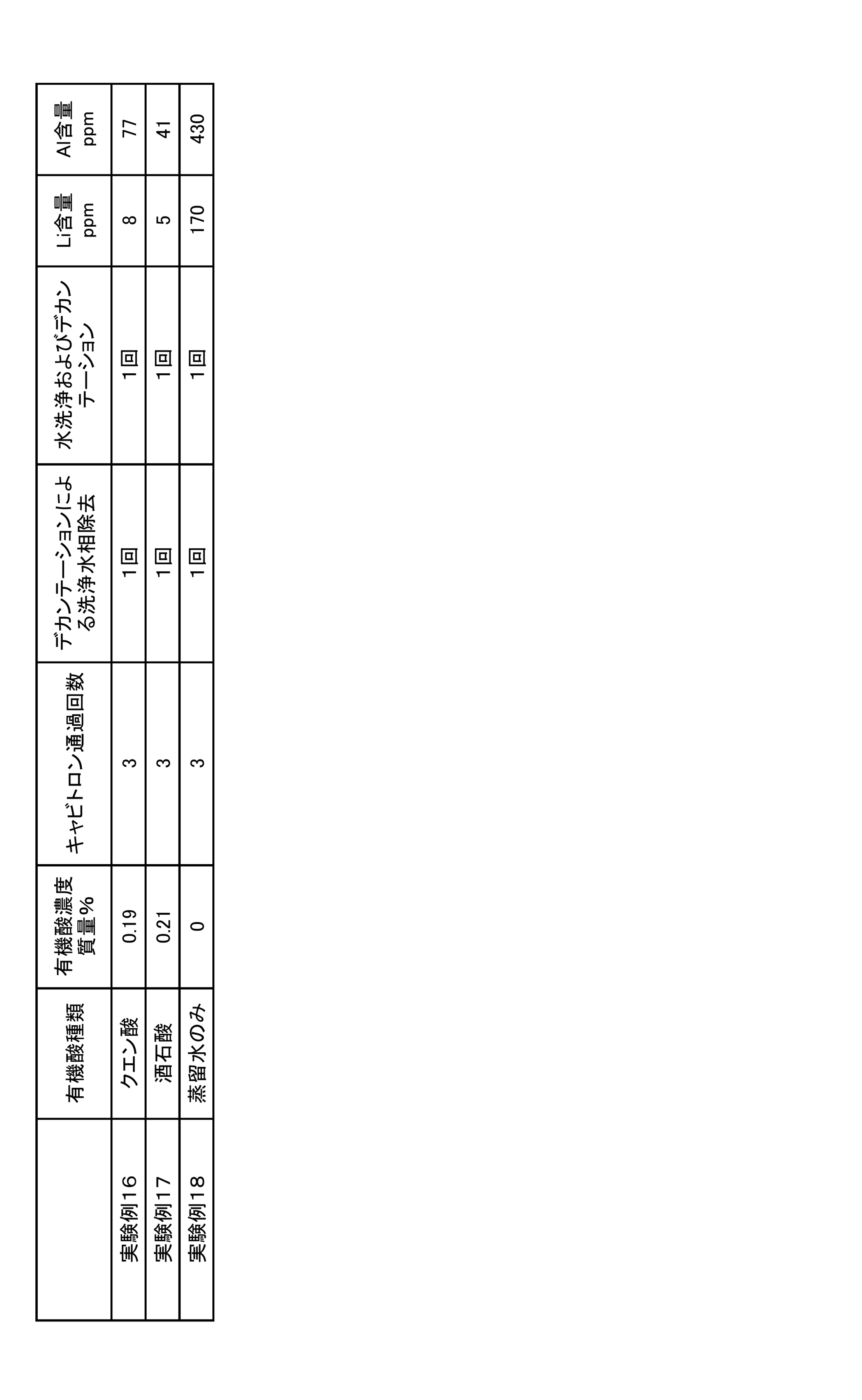
- Experimental Examples 1-8 and 13-15 have a smaller catalyst content in the polymer. Furthermore, in Experimental Example 1-8, it can be seen that the catalyst content is smaller.
- Example 16 A rotary emulsion disperser Cavitron CD1010 type was used.
- This disperser is a type in which an emulsifying dispersion effect is obtained by impacting the liquid by a rotor rotating at high speed and a stator meshing with the rotor. Under the conditions of a rotational speed of 112,000 / min and a back pressure of 0.15 MPa, the above-mentioned polymerization solution A5L and 0.19% by mass aqueous citric acid solution 5L were flowed through the Cavitron at a rate of 2 L / min.
- the cavitron was further passed twice under the same conditions at a rate of 2 L / min while stirring and preventing phase separation (the number of times the cavitron passed in Table 2 indicates the number of times the cavitron has passed through the cavitron).
- the liquid was passed through the cavitron three times and allowed to stand in the tank, and the aqueous phase was removed after the organic phase and the water tank were separated (corresponding to cleaning water phase removal by decantation in Table 2).
- the organic phase and 3 times its amount of pure water are passed through the Cavitron under the same conditions at 2 L / min and 6 L / min, respectively, and the mixed liquid accumulated in the receiving tank is stirred to prevent phase separation and then 2 L
- the Cavitron was passed twice under the same conditions at a speed of / min.
- the liquid was passed through the cavitron for a total of 3 times and left in the tank, and the aqueous phase was removed after the organic phase and the water tank were separated (corresponding to water washing and decantation in Table 2).
- a part of the organic phase was sampled, and the copolymer was recovered by air drying and vacuum degassing.
- the Li and Al contents in the obtained polymer were quantified. The results are shown in Table 2.
- Example 17 The treatment was performed in the same manner as in Example 11 except that a 0.21% by mass aqueous solution of tartaric acid was used instead of the 0.19% by mass aqueous citric acid solution. The results are shown in Table 2.
- Example 18 The treatment was performed in the same manner as in Example 11 except that distilled water was used instead of the citric acid 0.19% by mass aqueous solution. The results are shown in Table 2. Compared with Experimental Example 18 and Experimental Examples 16 and 17, it can be seen that Experimental Example 16 and 17 have a lower catalyst content in the polymer.
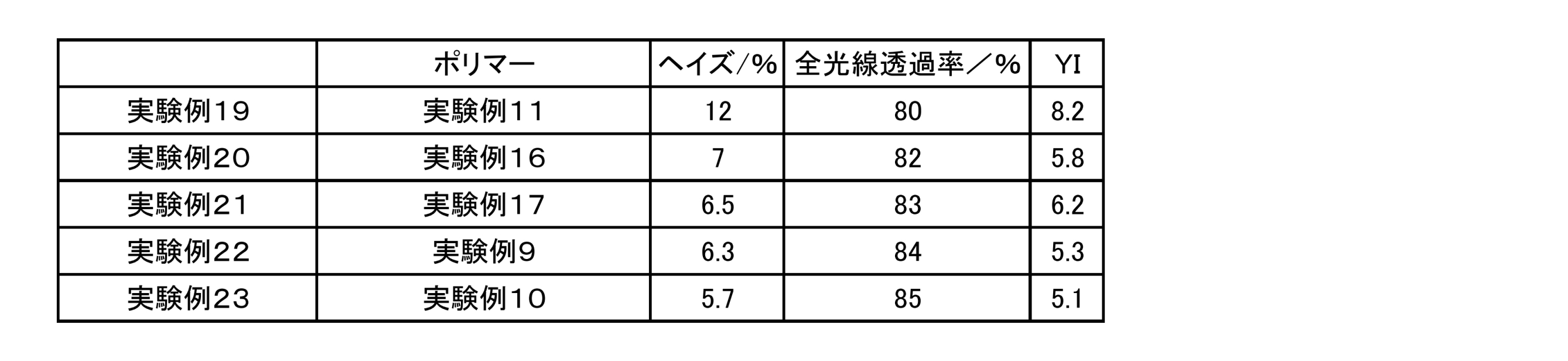
- the sheets of Experimental Examples 20, 21, 22, and 23 had higher total light transmittance, lower haze value, and lower YI than the sheet of Experimental Example 19.
- Example 25 A medical tube (diameter 4 mm) made of a commercially available non-vinyl chloride resin was cut into a width of about 2 mm, and an extraction test was performed in the same manner as in Comparative Example 7 to determine the amount of pH change and the amounts of Li and Al in the extract. Separately, when the amount of residual catalyst (Li, Al) in the medical tube was determined by quantitative analysis of the amount of residual catalyst, Li was 20 ppm and Al was 120 ppm.
- the cross-copolymer with a reduced amount of residual catalyst of the present invention is suitable for solar cell encapsulant use because of improved transparency and reduced yellowing resistance. Furthermore, since it is a cross copolymer with a reduced amount of residual catalyst, safety is further improved and it is suitable for a medical resin material.
Landscapes
- Chemical & Material Sciences (AREA)
- Health & Medical Sciences (AREA)
- Chemical Kinetics & Catalysis (AREA)
- Organic Chemistry (AREA)
- Medicinal Chemistry (AREA)
- Polymers & Plastics (AREA)
- Engineering & Computer Science (AREA)
- Public Health (AREA)
- Veterinary Medicine (AREA)
- Epidemiology (AREA)
- Life Sciences & Earth Sciences (AREA)
- Animal Behavior & Ethology (AREA)
- General Health & Medical Sciences (AREA)
- Inorganic Chemistry (AREA)
- Manufacturing & Machinery (AREA)
- Materials Engineering (AREA)
- Vascular Medicine (AREA)
- Surgery (AREA)
- Heart & Thoracic Surgery (AREA)
- Crystallography & Structural Chemistry (AREA)
- Transition And Organic Metals Composition Catalysts For Addition Polymerization (AREA)
- Addition Polymer Or Copolymer, Post-Treatments, Or Chemical Modifications (AREA)
- Microelectronics & Electronic Packaging (AREA)
- Materials For Medical Uses (AREA)
- Graft Or Block Polymers (AREA)
Abstract
Description
この樹脂は、軟質で耐熱性が良好なエラストマーである。またこの樹脂は、マクロモノマーであるオレフィン-芳香族ビニル化合物-芳香族ポリエン共重合体鎖を得る配位重合工程と、本マクロモノマー存在下でポリスチレン鎖を製造しマクロモノマーに結合させるクロス化工程により製造される。
また従来、リビングアニオン重合により得られるスチレン-ブタジエンブロック共重合体またはその水素化物からリチウム触媒成分を除去する方法が開示さている。たとえば、アニオン重合により得られた重合液に酸性水を加えて洗浄する方法や、共役ジエン系重合体を含む重合液にあらかじめアルコール及び/又は酸を添加した重合液を水と共に特定の回転分散機を通し高剪断分散させることで重合液中からリチウム成分を除く方法が知られている(特許文献3、4)。
特許文献1、2は、配位重合工程において用いられるメタロセン触媒に使用されるアルミニウム助触媒成分と、クロス化工程において用いられるアニオン重合開始剤であるリチウム成分とが、相当量クロス共重合体中に残留する。また、残留するこれら触媒成分は、樹脂に添加される安定剤との相互作用により樹脂の黄変を引き起こす可能性がある。
さらに、樹脂に残留する触媒含有量が多い場合、医療用材料や特定の電子、電力材料に用いる際に、安全性向上や性能向上の観点から懸念が残る。
特許文献3は、特定のブロック共重合体および残留触媒を含む重合液を酸性水で洗浄することのみ記載され、工業的に有利な洗浄方法に関する記載はない。
特許文献4には、共役ジエン系重合体を含む重合液を特定の高剪断条件下で水洗浄することで、工業的に有利にリチウムを除去する方法が記載されている。さらに有機層にあらかじめ酸、アルコールを添加することで除去効率が高まることが記載されている。
しかしこれら公知の方法ではその除去効率は十分とはいえず、より効率的な除去方法が望まれている。
本発明は、上記事情に鑑みてなされたもので、残留触媒成分が低減され、透明性や医療材料適性、耐黄変性が向上したクロス共重合体およびその製造方法を提供することを目的とする。
前記クロス共重合体に含まれる残留触媒成分であるアルミニウムおよびリチウムの質量の合計が200ppm以下であることを特徴とするクロス共重合体が提供される。
前記重合液と水と有機酸とを含む液体を作成し、前記液体を乳化分散する工程と、
前記乳化分散する工程後に、前記重合液より水の分離除去を行なう工程と、前記重合液よりクロス共重合体を回収する工程と、
を含み、
前記クロス共重合体は、配位重合工程として、シングルサイト配位重合触媒を用いてオレフィンモノマー、芳香族ビニル化合物モノマーおよび芳香族ポリエンの共重合を行いオレフィン-芳香族ビニル化合物-芳香族ポリエン共重合体を合成し、次にアニオン重合工程として、このオレフィン-芳香族ビニル化合物-芳香族ポリエン共重合体と芳香族ビニル化合物モノマーの共存下でアニオン重合開始剤を用いて重合して得られるクロス共重合体であり、
前記有機酸は、pKaが1以上7以下であり、
前記有機酸は、20℃の水100gに対して溶解度が5g以上である、
クロス共重合体の製造方法が提供される。
また、本発明によれば、工業的に有利な高い効率で重合液から金属触媒を除去することができるため、残留触媒成分が低減されたクロス共重合体の製造方法を提供することができる。
本実施形態におけるクロス共重合体は、配位重合工程として、シングルサイト配位重合触媒を用いてオレフィンモノマー、芳香族ビニル化合物モノマーおよび芳香族ポリエンの共重合を行いオレフィン-芳香族ビニル化合物-芳香族ポリエン共重合体を合成し、次にアニオン重合工程として、このオレフィン-芳香族ビニル化合物-芳香族ポリエン共重合体と芳香族ビニル化合物モノマーの共存下でアニオン重合開始剤を用いて重合することで得られるクロス共重合体であって、クロス共重合体に含まれる触媒成分であるアルミニウムおよびリチウムの質量の合計が200ppm以下である。
配位重合において用いられるシングルサイト配位重合触媒として、遷移金属化合物と助触媒であるメチルアルミノキサン(またはメチルアルモキサンまたはMAOと記す)等のアルモキサンからなる触媒を用いた場合、このようなシングルサイト配位重合触媒は、その高い重合活性と重合安定性故が特徴であるが比較的多量の触媒を用いる必要があるため、最終的に得られるポリマー中には比較的多くの残留触媒、特にアルミニウムが含まれてしまう。
さらに、配位重合で用いられるアルモキサンは、次のアニオン重合工程で使用するアニオン重合開始剤と反応する。従って、アニオン重合工程において、アニオン重合開始剤をアルモキサンとの反応で消費する分を余分に添加しなければならない。つまり配位重合において、アルモキサンを用いた場合、アニオン重合工程で比較的多くのアニオン重合開始剤を用いなければならない。
なお、アニオン重合開始剤として、ブチルリチウム等のリチウム化合物が用いられるため、最終的に得られるポリマー中には比較的多くのリチウムが含まれてしまう問題があった。
しかし、本発明者らは、鋭意検討した結果、クロス共重合体を含む重合液を乳化分散機で処理することで、重合液から効率的に触媒除去できることを見出した。
そして、本発明者らは、初めて、上記の配位重合工程とこれに続くアニオン重合工程から得られるクロス共重合体おいて、クロス共重合体に含まれる触媒成分であるアルミニウムおよびリチウムの質量の合計が200ppm以下であるという、残留触媒成分が極めて低減されたクロス共重合体を製造することに成功した。
本実施形態におけるクロス共重合体は、触媒除去を行わなくても医療用材料の基準の範囲を満足することができる。医療用途においてはより少ないpH変化および抽出触媒量が望ましいことは当然であるので、本実施形態におけるクロス共重合体は、医療用途に対して好適に用いることができる。
クロス共重合体自体は、その構造的パラメーターにより様々なレベルの透明性を示すために、触媒除去を行うことでの透明性の基準を一律に規定することはできないが、本発明者は、アルミニウムおよびリチウムの質量の合計が200ppm以下の残留触媒量まで触媒除去されたクロス共重合体の透明性が向上することを初めて見出した。具体的には、触媒除去前と比較し、全光線透過率で1%以上向上し、ヘイズ値で3%以上低下させることが可能である。そのため、本実施形態におけるクロス共重合体は、高度の透明性が要求される用途、例えば太陽電池封止材に適する。
従来のクロス共重合体にフェノール系酸化防止剤を添加すると、混練後に、あるいは耐候性試験後に黄色みが増すという課題があった。ここでフェノール系酸化防止剤とは、分子内に単数または複数のフェノール骨格、あるいはキノン骨格を有する酸化防止剤である。例えば、各種のヒンダードフェノール系酸化防止剤やBHTが例示できる。
しかし、残留触媒量が低減された本実施形態のクロス共重合体は、フェノール系酸化防止剤を添加しても混練後、あるいは耐候性試験後の黄変を抑制できる。そのため、本実施形態におけるクロス共重合体は、特に太陽電池封止材用途や各種表皮材用途において、フェノール系酸化防止剤を用いても黄変を抑制することが可能となる。
本実施形態におけるクロス共重合体は、配位重合により得られるオレフィン-芳香族ビニル化合物-芳香族ポリエン共重合体及び芳香族ビニル化合物モノマーの共存下でアニオン重合を行うことにより得られる共重合体であり、オレフィン-芳香族ビニル化合物-芳香族ポリエン共重合体鎖(主鎖と記載される場合もある)と芳香族ビニル化合物重合体鎖(側鎖と記載される場合もある)を有する共重合体であって、クロス共重合体に含まれる触媒成分であるアルミニウムおよびリチウムの質量の合計が200ppm以下である。
本実施形態おいて用いられるオレフィンとして好ましくは、エチレンまたはエチレンと、α-オレフィン(すなわちプロピレン、1-ブテン、1-ヘキセン、または1-オクテン等)の混合物である、更に好ましくは、エチレンである。
貯蔵弾性率は主に、エチレン-スチレン-ジビニルベンゼン共重合体鎖のスチレン含量が高くなりエチレン鎖の結晶性が下がるほど、あるいは軟質成分であるエチレン-スチレン-ジビニルベンゼン共重合体鎖の含量が増加するほど低下する。
以上から、本実施形態のクロス共重合体は、クロス共重合体に関する前記出典(WO00/37517号公報、WO2007/139116号公報等)に記載されている情報も併せて、当業者らは用途に合わせて、軟質性や貯蔵弾性率等を調整することができる。
(1)配位重合工程とこれに続くアニオン重合工程からなる重合工程からなる製造方法により得られ、配位重合工程として、シングルサイト配位重合触媒を用いてエチレンモノマー、芳香族ビニル化合物モノマーおよび芳香族ポリエンの共重合を行い、芳香族ビニル化合物ユニット含量15モル%以上30モル%以下、芳香族ポリエンユニット含量0.01モル%以上0.2モル%以下、残部がエチレンユニット含量であるエチレン-芳香族ビニル化合物-芳香族ポリエン共重合体を合成する。次にアニオン重合工程として、このエチレン-芳香族ビニル化合物-芳香族ポリエン共重合体と芳香族ビニル化合物モノマーの共存下、アニオン重合開始剤を用いて重合することで得られる。
(2)配位重合工程で得られるエチレン-芳香族ビニル化合物-芳香族ポリエン共重合体の重量平均分子量が3万以上20万以下、分子量分布(Mw/Mn)が1.8以上4以下である。
(3)クロス共重合体の0℃~150℃までに観測される結晶融解熱(ΔH)の総和が25J/g以下である。
(4)クロス共重合体中に含まれるエチレン-芳香族ビニル化合物-芳香族ポリエン共重合体の含量が70質量%以上95質量%以下の範囲にある。
(a)配位重合工程として、シングルサイト配位重合触媒を用いてエチレンモノマー、芳香族ビニル化合物モノマーおよび芳香族ポリエンの共重合を行い、芳香族ビニル化合物ユニット含量10モル%以上35モル%以下、芳香族ポリエンユニット含量0.01モル%以上0.2モル%以下、残部がエチレンユニット含量であるエチレン-芳香族ビニル化合物-芳香族ポリエン共重合体マクロモノマ-を合成する。次にアニオン重合工程として、このエチレン-芳香族ビニル化合物-芳香族ポリエン共重合体マクロモノマ-と芳香族ビニル化合物モノマーの共存下、アニオン重合開始剤を用いて重合する。
(b)配位重合工程で得られるエチレン-芳香族ビニル化合物-芳香族ポリエン共重合体マクロモノマ-の重量平均分子量は3万以上15万以下、分子量分布(Mw/Mn)は1.8以上3以下である。
(c)本エチレン-芳香族ビニル化合物-芳香族ポリエン共重合体マクロモノマ-の0℃~150℃までに観測される結晶融解熱(ΔH)が30J/g以下である。
(d)本エチレン-芳香族ビニル化合物-芳香族ポリエン共重合体マクロモノマ-のTUS(マクロモノマ-に含まれる重合性不飽和基の総和であり、ジビニルベンゼンユニット由来の二重結合+末端二重結合の総和を示す)とDOU(マクロモノマ-のジビニルベンゼンユニット含量)の関係が、1.3≦TUS/DOU≦10の範囲である。
(e)最終的に得られるクロス共重合体に占める、エチレン-芳香族ビニル化合物-芳香族ポリエン共重合体マクロモノマ-の質量割合が40質量%以上90質量%以下である。
本実施形態におけるクロス共重合体の製造方法は、
クロス共重合体を含む重合液を得る工程と、
前記重合液と水と有機酸とを含む液体を作成し、前記液体を乳化分散する工程と、
前記乳化分散する工程後に、前記重合液より水の分離除去を行なう工程と、前記重合液よりクロス共重合体を回収する工程と、
を含み、
前記クロス共重合体は、配位重合工程として、シングルサイト配位重合触媒を用いてオレフィンモノマー、芳香族ビニル化合物モノマーおよび芳香族ポリエンの共重合を行いオレフィン-芳香族ビニル化合物-芳香族ポリエン共重合体を合成し、次にアニオン重合工程として、このオレフィン-芳香族ビニル化合物-芳香族ポリエン共重合体と芳香族ビニル化合物モノマーの共存下でアニオン重合開始剤を用いて重合して得られるクロス共重合体であり、
前記有機酸は、pKaが1以上7以下であり、
前記有機酸は、20℃の水100gに対して溶解度が5g以上である、
クロス共重合体の製造方法である。
本実施形態の製造方法におけるクロス共重合体を含む重合液を得る工程は、例えば、配位重合工程の次にアニオン重合工程が行われる重合によって、クロス共重合体を含む重合液を得ることや、クロス共重合体に溶媒を加えてクロス共重合体を含む重合液を得ることが挙げられる。
クロス共重合体に溶媒を加えてクロス共重合体を含む重合液を得る場合、溶媒はクロス共重合体が溶解すれば特に限定しないが、例えば、重合に用いられる公知の溶媒が使用可能である。好ましくは、シクロヘキサン、メチルシクロヘキサン、トルエン、キシレン、C6~C12程度の混合アルカン等である。
配位重合工程は、シングルサイト配位重合触媒を用いてオレフィンモノマー、芳香族ビニル化合物モノマーおよび芳香族ポリエンの共重合を行い、オレフィン-芳香族ビニル化合物-芳香族ポリエン共重合体を合成する配位重合工程である。
配位重合工程において用いられるシングルサイト配位重合触媒は、特に限定しないが例えば、遷移金属化合物と助触媒であるメチルアルミノキサン(またはメチルアルモキサンまたはMAOと記す)等のアルモキサンからなる触媒が挙げられる。このようなシングルサイト配位重合触媒は、その高い重合活性と重合安定性故が特徴であるが比較的多量の触媒を用いる必要があるため、最終的に得られるポリマー中には比較的多くの残留触媒、特にアルミニウムが含まれる。
さらに、配位重合工程で用いられるアルモキサンは、次のアニオン重合工程で使用するアニオン重合開始剤と反応する。従って、アニオン重合開始剤をアニオン重合工程における反応で消費する分を余分に添加しなければならず、それ故比較的多くのアニオン重合開始剤を用いる必要となる。
本実施形態におけるアニオン重合工程は、このオレフィン-芳香族ビニル化合物-芳香族ポリエン共重合体と芳香族ビニル化合物モノマーの共存下でアニオン重合開始剤を用いて重合するアニオン重合工程である。
本実施形態のアニオン重合開始剤としては、特に限定しないが、ブチルリチウム等のリチウム化合物が挙げられる。なお、一般的にアニオン重合開始剤としてリチウム化合物を用いた場合、最終的に得られるポリマー中には比較的多くのリチウムが含まれる。
従来では、重合液の水洗浄により金属触媒成分例えばリチウムやアルミニウムを除去する場合、これら有機溶媒と水は相分離してしまうため、通常の攪拌方法では除去効率を高めることは困難であった。
しかし、本実施形態における製造方法では、有機相と水相の分散を良好なものとし、触媒除去効率を高めるために乳化分散処理を行うため、金属触媒成分の除去効率を高めることができる。
上記液体を乳化分散する工程において、乳化分散は、重合液と水と有機酸とを含む液体を乳化分散できれば特に限定しないが、乳化分散機を用いることが好ましい。乳化分散は、例えば、高速回転する回転子(ローター)と、それに噛み合う固定子(ステーター)により乳化分散を行う回転式乳化分散機があり、例えば商品名キャビトロン(CAVITRON;株式会社ユーロテックから購入可能)やスープラトン(ドイツ、クルップ社)がある。本ロータ-/ステータ-の形状は任意であり、くし歯であっても穴型であってもよい。またその他の回転式乳化分散機としては、回転式の湿式の微粉砕機や、回転式のホモジナイザーがあげられる。回転式以外の乳化分散機としては、ホモジナイザーが挙げられる。ホモジナイザーとしては、例えば高圧ホモジナイザーや超音波ホモジナイザーがあげられる。乳化分散機を用いることで乳化分散処理効率が向上する。残留触媒成分が低減されたクロス共重合体を製造することにおいて、この乳化分散処理が重要であり、クロス共重合体の残留触媒成分量に関して一つの要因となる。
用いられる有機酸はpKaが1以上7以下である。好ましくはpKaが1以上4以下の有機酸である。有機酸が多価酸である場合には本明細書におけるpKaは、最も低い方のpKa値であるpKa1を意味する。
有機酸のpKaが上記条件を満足することで、触媒の除去効率がより向上し、また、最終的に得られるクロス共重合体に特定のフェノール系安定剤を添加しても黄変することを抑制できるメリットもある。
さらに、20℃での水100gに対する溶解度が5g以上、好ましくは10g以上の有機酸を用いることが好ましい。有機酸の溶解度が上記条件を満たすことで、触媒金属の除去効率がより向上し、クロス共重合体に混入する有機酸の量を減らすことができる。
有機酸は、pKaが1以上7以下であり、0℃での水100gに対する溶解度が5g以上であれば特に限定しないが、クエン酸、酒石酸、リンゴ酸、酢酸、乳酸、アコニット酸、イタコン酸が挙げられ、好ましくはクエン酸、酒石酸である。
有機酸の使用量は、クロス共重合体を含む重合液に含まれる金属のモル当量の合計の0.5倍以上20倍以下のモル当量に相当する量である。これより低い場合には触媒金属の除去効率が低下し、またこれより高い場合には得られる重合体中に残留する有機酸量が増加してしまい重合体の透明性等が低下してしまう恐れがある。得られた重合体を医療用途に用いる場合、重合体から有機酸の溶出により沸騰水試験による水pH変化が大きくなる恐れがある。
有機酸の使用量は、好ましくは、クロス共重合体を含む重合液に含まれる金属のモル当量の合計の1倍以上5倍以下のモル当量に相当する量である。
<乳化分散する工程後に、前記重合液より水の分離除去を行なう工程と、前記重合液よりクロス共重合体を回収する工程>
本実施形態の製造方法の乳化分散する工程後に、前記重合液より水の分離除去を行なう工程と、前記重合液よりクロス共重合体を回収する工程を行うことで、残留触媒成分が低減されたクロス共重合体を得ることができる。
重合液より水の分離除去を行なう工程は、公知の方法を用いることができ、重合液より水(洗浄水)の分離除去を行うことができれば特に限定しない。例えば、分離除去は、重合体溶液/洗浄水の混合液を静置、加熱、遠心分離等の手段により重合液相と洗浄水相に分け、洗浄水相を取り除く操作が挙げられる。乳化分散と洗浄水の分離は、触媒の除去の度合いに応じて1回でも複数回の実施でもよい。好ましくは2回以上である。洗浄水相を除去した後、さらに有機酸を含まない洗浄水と重合液を同様に乳化分散機で処理、水相の分離を行うことで、さらに重合液からの触媒や有機酸を除去することができるため好ましい。
洗浄水相を取り除いた重合液は、重合液よりクロス共重合体を回収する工程に送られるのが好ましい。
重合液よりクロス共重合体を回収する工程は、重合液からクロス共重合体を回収することができれば特に限定しないが、例えば、脱溶媒等のポリマー回収に用いる操作や方法も含むことができる。
重合液よりクロス共重合体を回収する工程としては公知の工程を用いることが可能で、例えばスチームストリッピング、クラムフォーミングや脱気押出機による脱気、減圧脱気が好適に採用される。スチームストリッピング法、クラムフォーミング法については公知文献、例えば特開平6-136034号公報、WO2007/139116号公報に記載してある方法が好適に用いられる。
下記クロス共重合体は、出典明示により全内容をここに援用するWO2000/37517、WO2007/139116号、WO2013/137326、特開2010-150442号公報記載の製造方法で製造したもので、下記組成は、同様にこれら公報記載の方法で求めた。
これらのクロス共重合体は、配位重合により得られるエチレン-スチレン-ジビニルベンゼン共重合体とスチレンモノマーの共存下でアニオン重合を行うことにより得られる、エチレン-スチレン-ジビニルベンゼン共重合体鎖とポリスチレン鎖を有する共重合体である。
触媒としてrac-ジメチルメチレンビス(4,5-ベンゾ-1-インデニル)ジルコニウムジクロライドを用い、以下のように実施した。
容量50L、攪拌機及び加熱冷却用ジャケット付のオートクレーブを用いて重合を行った。
メチルシクロヘキサン(丸善石化社製スワクリーン)21kg、スチレン(電気化学工業社製)3kg及び新日鉄住金化学社製ジビニルベンゼン(メタ、パラ混合品、ジビニルベンゼンとして70mmol)を仕込み、内温60℃に調整し攪拌(220rpm)した。乾燥窒素ガスを30L/分の流量で10分、液中にバブリングして系内及び重合液の水分をパージした。次いで、トリイソブチルアルミニウム50mmol、メチルアルモキサン(東ソーアクゾ社製、MMAO-3A/ヘキサン溶液)をAl基準で60mmol(表中ではMAOと記載)加え、ただちにエチレンで系内をパージした。十分にパージした後、内温を90℃に昇温してエチレンを導入し、圧力0.34MPaG(3.4Kg/cm2G)で安定した後に、オートクレーブ上に設置した触媒タンクから、rac-ジメチルメチレンビス(4,5-ベンゾ-1-インデニル)ジルコニウムジクロライドを100μmol、トリイソブチルアルミニウム1mmolを溶かしたトルエン溶液約50mlをオートクレーブ中に加えた。さらに、内温を90℃、圧力を0.34MPaGに維持しながら100分間重合を実施した(配位重合工程)。重合液の少量(数十ml)をサンプリングし、メタノールに混合してポリマーを析出させることにより配位重合工程のポリマーサンプルを得た。本サンプリング液より、配位重合工程でのポリマ-収量、組成、分子量を求めた。
重合缶へのエチレンの供給を停止し、急速にエチレンを放圧すると共に内温を60℃まで冷却した。次いで、n-ブチルリチウム250mmolを触媒タンクから窒素ガスに同伴させて重合缶内に導入した。直ちにアニオン重合が開始し、内温は60℃から一時75℃まで上昇した。そのまま60分間温度を70~80℃に維持し、攪拌を継続し重合を続けた(アニオン重合工程)。
重合終了後、重合液(以下重合液Aと記す)を得た。この重合液Aを用いて各実験例に使用した。
なお、重合液Aの少量(数十ml)をサンプリングし、ドラフト中で風乾し、さらに60℃で8時間真空乾燥させることによりクロス共重合体Aのサンプルを得た。本サンプルより、クロス共重合体収量、組成、分子量、残留触媒量等を求めた。
クロス共重合体B:エチレン-スチレン-ジビニルベンゼン共重合体のスチレン含量17モル%、ジビニルベンゼン含量0.04モル%、Mw(重量平均分子量)=91000、Mw/Mn=2.2、エチレン-スチレン-ジビニルベンゼン共重合体の含量88質量%、ポリスチレン鎖のMw=30000、Mw/Mn=1.2、DSCによる結晶融解熱(ΔH)の総和が10J/g以下、アルミニウム含量620ppm、リチウム含量350ppm。
これはWO2013/137326号公報に記載された原料樹脂クロス共重合体1である。
<模擬重合液Bの作製>
クロス共重合体Bを加温したシクロヘキサンに攪拌溶解し、共重合体濃度20質量%の模擬重合液Bを作製した。
クロス共重合体C:エチレン-スチレン-ジビニルベンゼン共重合体のスチレン含量28モル%、ジビニルベンゼン含量0.08モル%、Mw(重量平均分子量)=90000、Mw/Mn=2.4、エチレン-スチレン-ジビニルベンゼン共重合体の含量69質量%、ポリスチレン鎖のMw=23000、Mw/Mn=1.2、DSCによる結晶融解熱(ΔH)の総和が10J/g以下、TUS/DOU=1.7、アルミニウム含量700ppm、リチウム含量250ppm。
これは特開2010-150442号公報に記載された製造例1のクロス共重合体である。
<模擬重合液Cの作製>
本クロス共重合体Cを加温したシクロヘキサンに攪拌溶解し、共重合体濃度20質量%の模擬重合液Cを作成した。
<共重合体の組成>
共重合体中のスチレンユニット含量の決定は、1H-NMRで行い、機器は日本電子社製α-500及びBRUCKER社製AC-250を用いた。重1,1,2,2-テトラクロロエタンに溶解し、測定は、80~100℃で行った。TMS(テトラメチルシラン)を基準としてフェニル基プロトン由来のピーク(6.5~7.5ppm)とアルキル基由来のプロトンピーク(0.8~3ppm)の面積強度比較で行った。
クロス共重合体中に含まれる配位重合工程で得られるエチレン-スチレン-ジビニルベンゼン共重合体の割合は、クロス共重合体とエチレン-スチレン-ジビニルベンゼン共重合体それぞれのスチレン含量を比較することで算出した。
分子量は、GPC(ゲルパーミエーションクロマトグラフィー)を用いて標準ポリスチレン換算の重量平均分子量(Mw)と数平均分子量(Mn)を求めた。測定は以下の条件で行った。
カラム:TSK-GEL MultiporeHXL-M φ7.8×300mm(東ソ-社製)を2本直列に繋いで用いた。
カラム温度:40℃
検出器:RI、UV(波長254nm)
溶媒:THF(テトラヒドロフラン)
送液流量:1.0ml/min.
サンプル濃度:0.1質量/体積%
サンプル注入量:100μL
室温でTHF溶媒に不溶であるポリマーの分子量は、高温GPC(ゲルパーミエーションクロマトグラフィー)を用いて標準ポリスチレン換算の重量平均分子量を求めた。東ソー社製HLC-8121GPC/HTを用い、カラムはTSKgelGMHHR-H(20)HT、φ7.8×300mm3本、オルトジクロロベンゼンを溶媒とし140℃で測定した。
検出器:RI
サンプル濃度:0.1質量/体積%
サンプル注入量:100μL
送液流量:1.0ml/min.
結晶融解熱の測定は、示差走査熱量計「セイコー電子社製DSC6200」を用い、窒素気流下で行った。すなわち樹脂10mgを用い、アルミナ10mgをレファレンスとして、アルミニウムパンを用い、窒素雰囲気下、昇温速度10℃/分で室温から240℃まで昇温した後に20℃/分で-120℃まで冷却した。その後240℃まで昇温速度10℃/分で昇温しながら示差走査熱量測定を行い、融点、結晶融解熱及びガラス転移点を求めた。
TUSはマクロモノマ-に含まれる重合性不飽和基の総和であり、芳香族ポリエン(ジビニルベンゼンユニット)由来の二重結合+ポリマー末端二重結合の総和を示し、マクロモノマーの1H-NMR測定で求めることができる。
DOUはマクロモノマ-のジビニルベンゼンユニット含量である。US6096849号公報、WO94/10216号公報に従って求めることもできる。
TUS/DOU値がより大きい場合、芳香族ポリエンユニット含量が少なすぎ、混合物としての性質が高くなるため、その物性、特に透明性が失われてしまう。
また、TUS/DOU値がより低い場合、芳香族ポリエンユニット含量が多すぎて主鎖(マクロモノマ-)に由来する機能、例えば軟質性が失われやすくなる。また、得られるクロス共重合体の成形加工性が悪化したり、クロス共重合体中にゲル分が生成してしまう場合がある。
共重合体中の残留触媒量について、分解法はRoHS、BS EN1122:2001「プラスチック-カドミウムの定量-湿式分解法」、RoHS指令分析方法:IEC62321に準拠し定量分析を行った。
具体的には、サンプル1gを硫酸、硝酸存在下で加熱分解しICP発光分析(SPECTORO社 CIROS)にて定量分析を行った。
透明度は加熱プレス法により1mm厚にシートを成形しJIS K-7375プラスチックの光学的特性試験方法に準じて日本電色工業社製濁度計NDH2000を用いて全光線透過率およびヘイズを測定した。
JIS K 7105に従い、日本電色工業(株)製のZE-2000を用いて測定した。
重合液A100mlに、洗浄水としてクエン酸0.19質量%水溶液(pH約2.9)100mlを加え、乳化分散機としてホモジナイザーを用い室温雰囲気下で所定の時間分散を行った。
なお、クエン酸0.19質量%水溶液100ml中のクエン酸の等量数は、重合液A100ml中に含まれるリチウムとアルミニウムの等量数の合計に対し1.53倍となる。
ホモジナイザー:TK ホモミクサーMarkII 2.5型(プライミクス株式会社製)
攪拌部:タービン直径30mm 転流板直径:50mm
使用容器:300ml(φ80×高さ100mm)
攪拌部設置位置 液深:50mm タービン設置位置(容器底から15mm)
転流板設置位置:液面直下
洗浄回転数 8000rpm
分散時間 3分
分散後、液を静置し洗浄水層を分離した。必要に応じて遠心分離により重合液層と洗浄水層を分離した。重合液層はバットに薄く広げドラフト内で風乾しその後、真空乾燥機中で60℃、10時間乾燥を行い、ポリマーを回収した。得られたポリマー中のLi、Al含量を定量した。結果を表1に示す。
条件および結果を表1に示す。
実験例2では、クエン酸は洗浄水ではなく重合液Aに直接添加し、その後水(100ml)と共にホモジナイザーにより分散処理を行った以外は、実験例1と同様に試験を行った。
実験例3では、分散時間を6分間に変更した以外は、実験例1と同様に試験を行った。
実験例4では、クエン酸量を変更して洗浄水としてクエン酸0.57質量%水溶液(pH約2.9)を用いた以外は、実験例1と同様に試験を行った。
条件および結果を表1に示す。
実験例5では、洗浄水として酒石酸0.21質量%水溶液に変更した以外は、実験例1と同様に試験を行った。
実験例6では、洗浄水として酒石酸0.42質量%水溶液に変更した以外は、実験例1と同様に試験を行った。
実験例7では、有機酸を酒石酸(0.21g)に変更した以外は、実験例2と同様に試験を行った。
実験例8では、洗浄水としてリンゴ酸0.18質量%水溶液に変更した以外は、実験例1と同様に試験を行った。
模擬重合液Bを用いた以外は、実験例1と同様に試験を行った。条件および結果を表1に示す。
模擬重合液Cを用いた以外は、実験例1と同様に試験を行った。条件および結果を表1に示す。
参考例で得られたクロス共重合体Aそのものである。結果を表1に示す。
有機酸を添加しなかった以外は、実験例1と同様に試験を行った。条件および結果を表1に示す。
条件および結果を表1に示す。
実験例13では、洗浄水として安息香酸0.4質量%懸濁液に変更した以外は、実験例1と同様に試験を行った。
実験例14では、有機酸を安息香酸(0.4g)に変更した以外は、実験例2と同様に試験を行った。
実験例15では、有機酸をステアリン酸(0.78g)に変更した以外は、実験例1と同様に試験を行った。
安息香酸及びステアリン酸は水に難溶性であるため、懸濁液の状態で用いた。

回転式乳化分散機キャビトロンCD1010型を使用した。本分散機は高速回転する回転子と、それに噛み合う固定子により液に衝撃を与え乳化分散効果を得る形式である。回転数112000/分、背圧0.15MPaの条件で、上記重合液A5L、クエン酸0.19質量%水溶液5Lを、共に2L/分の速度でキャビトロンに流し、受けタンクに溜まった混合液は攪拌し相分離しないようにしながら次ぎに2L/分の速度で同条件下キャビトロンをさらに2回通過させた(表2におけるキャビトロン通過回数は上記混合液に対してキャビトロンに通過した回数を示す)。
キャビトロン通過回数計3回の液を受けタンクで静置し、有機相と水槽が分離するのを待って水相を除去した(表2におけるデカンテーションによる洗浄水相除去にあたる)。しかる後に有機相と、その3倍量の純水をそれぞれ2L/分と6L/分で同条件下キャビトロンを通過させ、受けタンクに溜まった混合液は攪拌し相分離しないようにしながら次ぎに2L/分の速度で同条件下キャビトロンを2回通過させた。キャビトロン通過回数計3回の液を受けタンクで静置し、有機相と水槽が分離するのを待って水相を除去した(表2における水洗浄およびデカンテーションにあたる)。有機相の一部をサンプリングし、風乾と真空脱気により共重合体を回収した。得られたポリマー中のLi、Al含量を定量した。結果を表2に示す。
クエン酸0.19質量%水溶液の代わりに酒石酸0.21質量%水溶液を用いた以外は実施例11と同様に処理を行った。結果を表2に示す。
クエン酸0.19質量%水溶液の代わりに蒸留水を用いた以外は実施例11と同様に処理を行った。結果を表2に示す。
実験例18と実験例16、17と比べると、実験例16、17の方が、ポリマー中の触媒含量が少ないことがわかる
ブラベンダープラスチコーダー(ブラベンダ-社製PL2000型)を使用し、本参考例1で得られたクロス共重合体A(アルミニウム含量750ppm、リチウム含量400ppm)を以下に示す配合(質量部)で、合計45g(100質量部)を200℃、100rpm、5分間混練しサンプルを作製した。光安定剤はLA57(株式会社ADEKA製)を0.3質量部、紫外線吸収剤はUvinul3035(BASF社製)を0.1質量部使用し、酸化防止剤はチバ・ジャパン株式会社製Irganox1010を0.1質量部用いた。
得られた組成物から上記加熱プレス法により成形した厚さ0.5mmのシ-トを用い、透明性(全光線透過率、ヘイズ)、黄色度(YI)の測定を行った。得られた結果を表3に示す。
実験例16、17で得られたクロス共重合体(残留触媒成分を低減させたクロス共重合体A)を用い実験例19と同様にして、組成物、シートを作成し同様の評価を行った。条件および結果を表3に示す。
[実験例22]
実験例9で得られたクロス共重合体(残留触媒成分を低減させたクロス共重合体B)を用い実験例19と同様にして、組成物、シートを作成し同様の評価を行った。条件および結果を表3に示す。
[実験例23]
実験例10で得られたクロス共重合体(残留触媒成分を低減させたクロス共重合体C)を用い実験例19と同様にして、組成物、シートを作成し同様の評価を行った。条件および結果を表3に示す。
[実験例24]
実験例19のクロス共重合体Aのシート(厚さ0.5mm)を幅約2mm、長さ約6mmに裁断した。
環流器付きのフラスコに裁断したクロス共重合体Aを10g、蒸留水200ml(初期pH6.8)を入れ、沸騰水浴100℃で8時間抽出を行った。得られた抽出液のpHを測定し、pH変化量を求めた。また、ICP発光分析により抽出液中のLiとAlの定量分析を行った。
市販の非塩ビ樹脂からなる医療用チューブ(直径4mm)を幅約2mmに裁断し、比較例7と同様に抽出試験を実施し、pH変化量と抽出液中のLi,Al量を求めた。別途、本医療用チューブの残留触媒(Li、Al)量を上記残留触媒量の定量分析により求めたところ、Liは20ppm、Alは120ppmであった。
実験例20(残留触媒成分を低減させたクロス共重合体A)のシート(厚さ0.5mm)を用いた以外、実験例24と同様に抽出試験を行い、pH変化量と抽出液中のLi,Al量を求めた。
[実験例27]
実験例22のシート(厚さ0.5mm)を用いた以外、実験例24と同様に抽出試験を行い、pH変化量と抽出液中のLi,Al量を求めた。
[実験例28]
実験例23のシート(厚さ0.5mm)を用いた以外、実験例24と同様に抽出試験を行い、pH変化量と抽出液中のLi,Al量を求めた。
実験例24~28の結果を表4に示した。

つまり、実験例26、27、28の結果から、実験例16、実験例9、実験例10のクロス共重合体は、医療用材料に好適に用いることができることがわかる。
Claims (7)
- 配位重合工程として、シングルサイト配位重合触媒を用いてオレフィンモノマー、芳香族ビニル化合物モノマーおよび芳香族ポリエンの共重合を行い、オレフィン-芳香族ビニル化合物-芳香族ポリエン共重合体を合成し、次にアニオン重合工程として、このオレフィン芳香族ビニル化合物-芳香族ポリエン共重合体と芳香族ビニル化合物モノマーの共存下でアニオン重合開始剤を用いて重合することで得られるクロス共重合体であって、
前記クロス共重合体に含まれる残留触媒成分であるアルミニウムおよびリチウムの質量の合計が200ppm以下であることを特徴とするクロス共重合体。 - 以下の(1)~(4)のすべての条件を満たすクロス共重合体であることを特徴とする請求項1記載のクロス共重合体。
(1)前記配位重合工程は、シングルサイト配位重合触媒を用いてエチレンモノマー、芳香族ビニル化合物モノマーおよび芳香族ポリエンの共重合を行い、芳香族ビニル化合物ユニット含量15モル%以上30モル%以下、芳香族ポリエンユニット含量0.01モル%以上0.2モル%以下、残部がエチレンユニット含量であるエチレン-芳香族ビニル化合物-芳香族ポリエン共重合体を合成する配位重合工程である。
(2)前記配位重合工程で得られる前記エチレン-芳香族ビニル化合物-芳香族ポリエン共重合体の重量平均分子量は、3万以上20万以下であり、分子量分布(Mw/Mn)が1.8以上4以下である。
(3)前記クロス共重合体の0℃~150℃までに観測される結晶融解熱(ΔH)の総和が25J/g以下である。
(4)前記クロス共重合体中に含まれるエチレン-芳香族ビニル化合物-芳香族ポリエン共重合体の含有量が、70質量%以上95質量%以下である。 - 請求項1または2に記載のクロス共重合体を用いた医療用チューブ。
- 請求項1または2に記載のクロス共重合体を用いた医療用多層シート。
- 以下の(a)~(e)のすべての条件を満たすクロス共重合体であることを特徴とする請求項1記載のクロス共重合体。
(a)前記配位重合工程は、シングルサイト配位重合触媒を用いてエチレンモノマー、芳香族ビニル化合物モノマーおよび芳香族ポリエンの共重合を行い、芳香族ビニル化合物ユニット含量10モル%以上35モル%以下、芳香族ポリエンユニット含量0.01モル%以上0.2モル%以下、残部がエチレンユニット含量であるエチレン-芳香族ビニル化合物-芳香族ポリエン共重合体を合成する配位重合工程である。
(b)前記配位重合工程で得られるエチレン-芳香族ビニル化合物-芳香族ポリエン共重合体の重量平均分子量は、3万以上15万以下であり、分子量分布(Mw/Mn)は1.8以上3以下である。
(c)前記エチレン-芳香族ビニル化合物-芳香族ポリエン共重合体の0℃~150℃までに観測される結晶融解熱(ΔH)が30J/g以下である。
(d)前記エチレン-芳香族ビニル化合物-芳香族ポリエン共重合体のTUS(共重合体に含まれる重合性不飽和基の総和であり、ジビニルベンゼンユニット由来の二重結合+末端二重結合の総和を示す)とDOU(共重合体のジビニルベンゼンユニット含量)の比の値が、1.3≦TUS/DOU≦10である。
(e)前記クロス共重合体に占める、エチレン-芳香族ビニル化合物-芳香族ポリエン共重合体の含有量が40質量%以上90質量%以下である。 - 請求項1または5に記載のクロス共重合体を用いた太陽電池封止材。
- クロス共重合体を含む重合液を得る工程と、
前記重合液と水と有機酸とを含む液体を作成し、前記液体を乳化分散する工程と、
前記乳化分散する工程後に、前記重合液より水の分離除去を行なう工程と、前記重合液よりクロス共重合体を回収する工程と、
を含み、
前記クロス共重合体は、配位重合工程として、シングルサイト配位重合触媒を用いてオレフィンモノマー、芳香族ビニル化合物モノマーおよび芳香族ポリエンの共重合を行いオレフィン-芳香族ビニル化合物-芳香族ポリエン共重合体を合成し、次にアニオン重合工程として、このオレフィン-芳香族ビニル化合物-芳香族ポリエン共重合体と芳香族ビニル化合物モノマーの共存下でアニオン重合開始剤を用いて重合して得られるクロス共重合体であり、
前記有機酸は、pKaが1以上7以下であり、
前記有機酸は、20℃の水100gに対して溶解度が5g以上である、
クロス共重合体の製造方法。
Priority Applications (6)
| Application Number | Priority Date | Filing Date | Title |
|---|---|---|---|
| US15/310,403 US20170145135A1 (en) | 2014-05-15 | 2015-05-14 | Cross-copolymer and method for producing same |
| EP15792655.1A EP3144329B1 (en) | 2014-05-15 | 2015-05-14 | Cross-copolymer and method for producing same |
| JP2016519301A JPWO2015174485A1 (ja) | 2014-05-15 | 2015-05-14 | クロス共重合体とその製造方法 |
| CN201580025282.3A CN106459327A (zh) | 2014-05-15 | 2015-05-14 | 交联共聚物和其制造方法 |
| KR1020167034842A KR20170008263A (ko) | 2014-05-15 | 2015-05-14 | 크로스 공중합체 및 그 제조 방법 |
| US16/460,723 US20190330402A1 (en) | 2014-05-15 | 2019-07-02 | Cross-copolymer and method for producing same |
Applications Claiming Priority (2)
| Application Number | Priority Date | Filing Date | Title |
|---|---|---|---|
| JP2014-101130 | 2014-05-15 | ||
| JP2014101130 | 2014-05-15 |
Related Child Applications (2)
| Application Number | Title | Priority Date | Filing Date |
|---|---|---|---|
| US15/310,403 A-371-Of-International US20170145135A1 (en) | 2014-05-15 | 2015-05-14 | Cross-copolymer and method for producing same |
| US16/460,723 Division US20190330402A1 (en) | 2014-05-15 | 2019-07-02 | Cross-copolymer and method for producing same |
Publications (1)
| Publication Number | Publication Date |
|---|---|
| WO2015174485A1 true WO2015174485A1 (ja) | 2015-11-19 |
Family
ID=54480022
Family Applications (1)
| Application Number | Title | Priority Date | Filing Date |
|---|---|---|---|
| PCT/JP2015/063873 Ceased WO2015174485A1 (ja) | 2014-05-15 | 2015-05-14 | クロス共重合体とその製造方法 |
Country Status (6)
| Country | Link |
|---|---|
| US (2) | US20170145135A1 (ja) |
| EP (1) | EP3144329B1 (ja) |
| JP (1) | JPWO2015174485A1 (ja) |
| KR (1) | KR20170008263A (ja) |
| CN (1) | CN106459327A (ja) |
| WO (1) | WO2015174485A1 (ja) |
Cited By (2)
| Publication number | Priority date | Publication date | Assignee | Title |
|---|---|---|---|---|
| WO2017056946A1 (ja) * | 2015-09-28 | 2017-04-06 | デンカ株式会社 | クロス共重合体及びその製造方法 |
| WO2017122295A1 (ja) * | 2016-01-13 | 2017-07-20 | デンカ株式会社 | オレフィン-芳香族ビニル化合物系共重合体の製造方法及びクロス共重合体の製造方法 |
Families Citing this family (1)
| Publication number | Priority date | Publication date | Assignee | Title |
|---|---|---|---|---|
| KR102878844B1 (ko) * | 2019-12-03 | 2025-10-30 | 덴카 주식회사 | 경화성 조성물 및 그 경화체 |
Citations (4)
| Publication number | Priority date | Publication date | Assignee | Title |
|---|---|---|---|---|
| JP2010043232A (ja) * | 2008-08-18 | 2010-02-25 | Denki Kagaku Kogyo Kk | 熱可塑性樹脂組成物 |
| JP2011213843A (ja) * | 2010-03-31 | 2011-10-27 | Denki Kagaku Kogyo Kk | 新規導電性ポリマーおよびその製造方法 |
| WO2013018839A1 (ja) * | 2011-08-03 | 2013-02-07 | 電気化学工業株式会社 | 封止材 |
| JP2013202133A (ja) * | 2012-03-27 | 2013-10-07 | Denki Kagaku Kogyo Kk | 医療用チューブ |
Family Cites Families (7)
| Publication number | Priority date | Publication date | Assignee | Title |
|---|---|---|---|---|
| JPH0764889B2 (ja) | 1992-10-26 | 1995-07-12 | 旭化成工業株式会社 | 共役ジエン系重合体から残存触媒を除去する方法 |
| JP4057735B2 (ja) | 1998-03-23 | 2008-03-05 | 株式会社クラレ | アクリル系ブロック共重合体の製造方法 |
| DE69942460D1 (de) | 1998-12-22 | 2010-07-15 | Denki Kagaku Kogyo Kk | Cross-kopolymerisierte olefin/styrol/dien kopolymere, ihre herstellungsverfahren und verwendung |
| US8722831B2 (en) * | 2006-05-29 | 2014-05-13 | Denki Kagaku Kogyo Kabushiki Kaisha | Process for production of cross copolymers, cross copolymers obtained by the process, and use thereof |
| JP5100630B2 (ja) * | 2008-12-26 | 2012-12-19 | 電気化学工業株式会社 | 太陽電池封止材 |
| CN104203296B (zh) * | 2012-03-14 | 2017-06-09 | 电化株式会社 | 医疗用多层管 |
| EP2842973B1 (en) * | 2012-04-26 | 2016-12-28 | Asahi Kasei Kabushiki Kaisha | Method for producing polymer |
-
2015
- 2015-05-14 US US15/310,403 patent/US20170145135A1/en not_active Abandoned
- 2015-05-14 CN CN201580025282.3A patent/CN106459327A/zh active Pending
- 2015-05-14 JP JP2016519301A patent/JPWO2015174485A1/ja active Pending
- 2015-05-14 WO PCT/JP2015/063873 patent/WO2015174485A1/ja not_active Ceased
- 2015-05-14 KR KR1020167034842A patent/KR20170008263A/ko not_active Withdrawn
- 2015-05-14 EP EP15792655.1A patent/EP3144329B1/en not_active Not-in-force
-
2019
- 2019-07-02 US US16/460,723 patent/US20190330402A1/en not_active Abandoned
Patent Citations (4)
| Publication number | Priority date | Publication date | Assignee | Title |
|---|---|---|---|---|
| JP2010043232A (ja) * | 2008-08-18 | 2010-02-25 | Denki Kagaku Kogyo Kk | 熱可塑性樹脂組成物 |
| JP2011213843A (ja) * | 2010-03-31 | 2011-10-27 | Denki Kagaku Kogyo Kk | 新規導電性ポリマーおよびその製造方法 |
| WO2013018839A1 (ja) * | 2011-08-03 | 2013-02-07 | 電気化学工業株式会社 | 封止材 |
| JP2013202133A (ja) * | 2012-03-27 | 2013-10-07 | Denki Kagaku Kogyo Kk | 医療用チューブ |
Non-Patent Citations (1)
| Title |
|---|
| See also references of EP3144329A4 * |
Cited By (4)
| Publication number | Priority date | Publication date | Assignee | Title |
|---|---|---|---|---|
| WO2017056946A1 (ja) * | 2015-09-28 | 2017-04-06 | デンカ株式会社 | クロス共重合体及びその製造方法 |
| WO2017122295A1 (ja) * | 2016-01-13 | 2017-07-20 | デンカ株式会社 | オレフィン-芳香族ビニル化合物系共重合体の製造方法及びクロス共重合体の製造方法 |
| JPWO2017122295A1 (ja) * | 2016-01-13 | 2018-11-01 | デンカ株式会社 | オレフィン−芳香族ビニル化合物系共重合体の製造方法及びクロス共重合体の製造方法 |
| CN108779206A (zh) * | 2016-01-13 | 2018-11-09 | 电化株式会社 | 烯烃-芳香族乙烯基化合物系共聚物的制造方法和交叉共聚物的制造方法 |
Also Published As
| Publication number | Publication date |
|---|---|
| CN106459327A (zh) | 2017-02-22 |
| US20190330402A1 (en) | 2019-10-31 |
| EP3144329A1 (en) | 2017-03-22 |
| JPWO2015174485A1 (ja) | 2017-04-20 |
| KR20170008263A (ko) | 2017-01-23 |
| US20170145135A1 (en) | 2017-05-25 |
| EP3144329A4 (en) | 2017-05-03 |
| EP3144329B1 (en) | 2018-02-28 |
Similar Documents
| Publication | Publication Date | Title |
|---|---|---|
| JP7094603B2 (ja) | ブロック共重合体組成物 | |
| Kashiwa et al. | Functionalization of polyethylene based on metallocene catalysis and its application to syntheses of new graft copolymers possessing polar polymer segments | |
| JP5890408B2 (ja) | 弾性及び加工性に優れたエチレン共重合体 | |
| Matsugi et al. | Synthesis and morphology of polyethylene‐block‐poly (methyl methacrylate) through the combination of metallocene catalysis with living radical polymerization | |
| CN111511785A (zh) | 制备官能化乙烯和丙烯共聚物的方法 | |
| JP6914334B2 (ja) | ポリエチレン組成物 | |
| WO2013039152A1 (ja) | 末端二重結合含有ポリオレフィンとその製造方法 | |
| WO2015152343A1 (ja) | クロス共重合体及び樹脂組成物 | |
| JPWO2017056946A1 (ja) | クロス共重合体及びその製造方法 | |
| WO2012099443A2 (ko) | 올레핀 블록 공중합체 | |
| US20190330402A1 (en) | Cross-copolymer and method for producing same | |
| JP7288505B2 (ja) | 水添スチレン・共役ジエン共重合体及びその発泡材料並びに使用 | |
| US20100249328A1 (en) | Ethylene based polymer composition and film | |
| CN112154159A (zh) | 用于在反应器级联中制备乙烯共聚物的悬浮方法 | |
| Zhu et al. | Core–shell particles of poly (methyl methacrylate)‐block‐poly (n‐butyl acrylate) synthesized via reversible addition–fragmentation chain‐transfer emulsion polymerization and the polymer's application in toughening polycarbonate | |
| CN105377912A (zh) | 聚合物及聚合物的制造方法 | |
| CN101273072B (zh) | 嵌段共聚物及其制备方法、树脂改性用组合物、以及改性树脂组合物及其制备方法 | |
| Mohajery et al. | Synthesis of functional polyethylene graft copolymers by nitroxide‐mediated living radical polymerization | |
| JP5362790B2 (ja) | 耐熱性に優れる重合体の製造方法 | |
| US9328180B2 (en) | Free-radical processes to make ethylene-based polymers using alklyated phenols | |
| CN116194494A (zh) | 改善性能特征的乙烯-辛烯共聚物 | |
| JP6795917B2 (ja) | クロス共重合体及びその製造方法 | |
| JP2014189664A (ja) | 水素化ブロック共重合体の回収方法および樹脂組成物 | |
| JP6959724B2 (ja) | 樹脂組成物及びその製造方法 | |
| JP2014189665A (ja) | 水素化ブロック共重合体の回収方法および樹脂組成物 |
Legal Events
| Date | Code | Title | Description |
|---|---|---|---|
| 121 | Ep: the epo has been informed by wipo that ep was designated in this application |
Ref document number: 15792655 Country of ref document: EP Kind code of ref document: A1 |
|
| ENP | Entry into the national phase |
Ref document number: 2016519301 Country of ref document: JP Kind code of ref document: A |
|
| WWE | Wipo information: entry into national phase |
Ref document number: 15310403 Country of ref document: US |
|
| NENP | Non-entry into the national phase |
Ref country code: DE |
|
| REEP | Request for entry into the european phase |
Ref document number: 2015792655 Country of ref document: EP |
|
| WWE | Wipo information: entry into national phase |
Ref document number: 2015792655 Country of ref document: EP |
|
| ENP | Entry into the national phase |
Ref document number: 20167034842 Country of ref document: KR Kind code of ref document: A |