WO2015182780A1 - タイヤトレッド用ゴム組成物及びそれを用いた乗用車用空気入りタイヤ - Google Patents
タイヤトレッド用ゴム組成物及びそれを用いた乗用車用空気入りタイヤ Download PDFInfo
- Publication number
- WO2015182780A1 WO2015182780A1 PCT/JP2015/065695 JP2015065695W WO2015182780A1 WO 2015182780 A1 WO2015182780 A1 WO 2015182780A1 JP 2015065695 W JP2015065695 W JP 2015065695W WO 2015182780 A1 WO2015182780 A1 WO 2015182780A1
- Authority
- WO
- WIPO (PCT)
- Prior art keywords
- rubber
- mass
- resin
- parts
- tire
- Prior art date
- Legal status (The legal status is an assumption and is not a legal conclusion. Google has not performed a legal analysis and makes no representation as to the accuracy of the status listed.)
- Ceased
Links
Classifications
-
- C—CHEMISTRY; METALLURGY
- C08—ORGANIC MACROMOLECULAR COMPOUNDS; THEIR PREPARATION OR CHEMICAL WORKING-UP; COMPOSITIONS BASED THEREON
- C08L—COMPOSITIONS OF MACROMOLECULAR COMPOUNDS
- C08L7/00—Compositions of natural rubber
-
- B—PERFORMING OPERATIONS; TRANSPORTING
- B60—VEHICLES IN GENERAL
- B60C—VEHICLE TYRES; TYRE INFLATION; TYRE CHANGING; CONNECTING VALVES TO INFLATABLE ELASTIC BODIES IN GENERAL; DEVICES OR ARRANGEMENTS RELATED TO TYRES
- B60C1/00—Tyres characterised by the chemical composition or the physical arrangement or mixture of the composition
- B60C1/0016—Compositions of the tread
-
- C—CHEMISTRY; METALLURGY
- C08—ORGANIC MACROMOLECULAR COMPOUNDS; THEIR PREPARATION OR CHEMICAL WORKING-UP; COMPOSITIONS BASED THEREON
- C08L—COMPOSITIONS OF MACROMOLECULAR COMPOUNDS
- C08L9/00—Compositions of homopolymers or copolymers of conjugated diene hydrocarbons
-
- C—CHEMISTRY; METALLURGY
- C08—ORGANIC MACROMOLECULAR COMPOUNDS; THEIR PREPARATION OR CHEMICAL WORKING-UP; COMPOSITIONS BASED THEREON
- C08L—COMPOSITIONS OF MACROMOLECULAR COMPOUNDS
- C08L2205/00—Polymer mixtures characterised by other features
- C08L2205/03—Polymer mixtures characterised by other features containing three or more polymers in a blend
Definitions
- the present invention relates to a rubber composition for a tire tread and a pneumatic tire using the same, and particularly to a pneumatic tire for a passenger car.
- a rubber composition comprising 10 to 80 parts by mass of at least one selected from a terpene homopolymer resin and a terpene-phenol copolymer resin and 10 to 200 parts by mass of a liquid styrene-butadiene copolymer.
- the present invention has been made under such circumstances, and a rubber composition capable of simultaneously improving dry road safety and bad road durability of a pneumatic tire, and a pneumatic tire using the rubber composition, particularly a passenger car It is an object of the present invention to provide an industrial pneumatic tire.
- the present inventor has determined that a predetermined amount of a specific resin and a fatty acid metal salt is contained in a rubber component containing a certain amount or more of natural rubber and / or synthetic isoprene rubber. It discovered that the rubber composition which can solve the subject was obtained by mix
- a rubber composition capable of simultaneously improving dry road handling and bad road durability of a pneumatic tire, and a pneumatic tire using the rubber composition, particularly a pneumatic tire for a passenger car. it can.
- the rubber composition of the present invention comprises (A) a rubber component containing 30% by mass or more of isoprene-based rubber selected from one or more of natural rubber and synthetic isoprene rubber, and 100 parts by mass of (B) rosin acid resin. And 5 to 50 parts by mass of at least one resin selected from C9 petroleum resin, alkylphenol formaldehyde resin and terpenephenol resin, and 0.5 to 10 parts by mass of (C) fatty acid metal salt. And
- the rubber component (A) a rubber component containing 30% by mass or more of isoprene-based rubber selected from one or more natural rubber and synthetic isoprene rubber is used.
- isoprene-based rubber selected from one or more natural rubber and synthetic isoprene rubber.
- synthetic isoprene rubber those having a weight average molecular weight of 4 ⁇ 10 5 or more and a cis bond content of 95% or more are preferable. This weight average molecular weight is a value in terms of standard polystyrene measured by a gel permeation chromatography method (GPC method).
- the content of at least one isoprene-based rubber selected from natural rubber and synthetic isoprene rubber in the rubber component (A) exhibits good low temperature characteristics, wet grip performance and dry grip performance in a balanced manner. From the viewpoint of obtaining a rubber composition to be obtained, it is required that it is 30% by mass or more in the rubber component (A), preferably 50 to 100% by mass, more preferably 70 to 100% by mass, and further preferably 80 to 100%. % By mass, particularly preferably 100% by mass.
- rubber component (A) in addition to the isoprene-based rubber, if desired, other rubber components other than the isoprene-based rubber may be 70 mass% or less, preferably 50 to 0 mass%, more preferably 30 to 30 mass%. They can be used together in a proportion of 0% by mass, more preferably 20 to 0% by mass.
- synthetic diene rubbers other than synthetic isoprene rubber are preferable.
- Preferable examples include one or more synthetic diene rubbers selected from rubber, chloroprene rubber and mixtures thereof. Further, a part thereof may be a modified diene rubber obtained by using a modifier such as tin tetrachloride, silicon tetrachloride, or an alkoxysilane compound.
- the styrene-butadiene copolymer rubber is preferably 1 to 40% by mass, preferably 1 to 30% by mass in the rubber component (A) from the viewpoint of improving the rough road durability of the pneumatic tire. % Is more preferable, 1 to 10% by mass is further preferable, and 1 to 5% by mass is even more preferable.
- (B) Resin At least one resin selected from (B) rosin acid resin, C9 petroleum resin, alkylphenol formaldehyde resin and terpene phenol resin used in the rubber composition of the present invention ⁇ hereinafter abbreviated as “(B) resin”.
- (B) Resin rosin acid resin is a residue that remains after collecting balsams such as pine sap, which is a sap of a pine family plant, and distilling turpentine essential oil. , Isopimaric acid and the like), and modified resins and hydrogenated resins obtained by modifying or hydrogenating them.
- Examples thereof include natural resin rosin, polymerized rosin and partially hydrogenated rosin; glycerin ester rosin, partially hydrogenated rosin and fully hydrogenated rosin and polymerized rosin; pentaerythritol ester rosin, partially hydrogenated rosin and polymerized rosin.
- natural resin rosins include gum rosin, tall oil resin, and wood rosin contained in raw pine crabs and tall oil.
- Specific examples of the rosin acid resin include trade name “Neotor 105” (manufactured by Harima Chemicals Co., Ltd.), trade name “SN Tac 754” (manufactured by San Nopco Co., Ltd.), trade names “Lime Resin No. 1,” And “Pencel AD” (manufactured by Arakawa Chemical Co., Ltd.), trade names “Polypel” and “Pentalin C” (manufactured by Eastman Chemical Co., Ltd.), and the like.
- the C9 petroleum resin which is (B) resin according to the present invention is, for example, vinyltoluene or alkyl which is a C9 fraction produced as a by-product with petrochemical basic raw materials such as ethylene and propylene by thermal decomposition of naphtha of petrochemical industry.
- Examples include styrene, indene, ⁇ -methyl styrene, ⁇ -methyl styrene, ⁇ -methyl styrene, o-methyl styrene, p-methyl styrene, vinyl toluene, and the like.
- Indene, 1,3-dimethylstyrene, etc., as well as naphthalene, vinylnaphthalene, vinylanthracene, p-tert-butylstyrene, etc. are used as raw materials, and these C8 to C10 fractions are used as a mixture, for example, Friedel Crafts. It is obtained by copolymerization with a mold catalyst.
- Examples of the unmodified C9 petroleum resin include “Neopolymer L-90”, “Neopolymer 120”, “Neopolymer 130” (manufactured by JX Nippon Oil & Energy Corporation), and the like.
- the C9 petroleum resin described above may be a modified petroleum resin modified with a compound having a hydroxyl group, an unsaturated carboxylic acid compound, or the like.
- the C5 / C9 petroleum resin which is a petroleum resin selected from an aromatic modified aliphatic petroleum resin and an aliphatic modified aromatic petroleum resin, is excluded from the (B) C9 petroleum resin according to the present invention.
- the C5 / C9 petroleum resin is a solid polymer obtained by polymerizing a C5-C11 fraction derived from petroleum.
- the resin having more aliphatic fractions than the aromatic fraction is referred to as an aromatic modified aliphatic petroleum resin.
- Resins in which there are more aromatic fractions than fractions, or equal amounts of aliphatic fractions and aromatic fractions are referred to as aliphatic modified aromatic petroleum resins.
- the alkylphenol formaldehyde resin which is the (B) resin according to the present invention is obtained by a condensation reaction under a catalyst of alkylphenol and formaldehyde.
- the product name “Hitanol 1502P” (manufactured by Hitachi Chemical Co., Ltd.)
- the product name “Tacchi Roll 201” manufactured by Taoka Chemical Co., Ltd.
- the product name “Tacchi Roll 250-I” bromine having a bromination rate of 4% Alkylphenol formaldehyde resin (produced by Taoka Chemical Co., Ltd.)
- trade name “Tacquirol 250-III” brominated alkylphenol formaldehyde resin, produced by Taoka Chemical Co., Ltd.
- trade names “R7521P”, “SP1068”, “R7510PJ” examples thereof include “R7572P” and “R7578P” (manufactured by Schenectady).
- the terpene phenol resin which is the resin (B) according to the present invention, can be obtained by a method of reacting terpenes with various phenols using a Friedel-Crafts type catalyst or further condensing with formalin.
- the starting terpenes are not particularly limited, and monoterpene hydrocarbons such as ⁇ -pinene and limonene are preferable, those containing ⁇ -pinene are more preferable, and ⁇ -pinene is particularly preferable.
- a terpene-phenol resin having a high phenol component ratio is preferred.
- product names “Tamanol 803L”, “Tamanol 901” (manufactured by Arakawa Chemical Industries Ltd.), product names “YS Polystar U” series, “YS Polystar T” series, “YS Polystar S” series, “YS” Polystar G ”series,“ YS Polyster N ”series,“ YS Polystar K ”series,“ YS Polystar TH ”series (manufactured by Yasuhara Chemical Co., Ltd.), and the like.
- one type of (B) resin may be used alone, or two or more types may be used in combination.
- the content is required to be 5 to 50 parts by mass with respect to 100 parts by mass of the rubber component (A) described above. If the content is less than 5 parts by mass, the object of the present invention to simultaneously improve dry road handling and bad road durability of the pneumatic tire cannot be achieved, and if it exceeds 50 parts by mass, the workability is reduced. To do. Therefore, the content of the resin is preferably in the range of 10 to 50 parts by mass, more preferably 20 to 50 parts by mass.
- the amount of (B) C5 / C9 petroleum resin is preferably 10 to 20 parts by mass with respect to 100 parts by mass of the aforementioned (A) rubber component.
- the metal used for the fatty acid metal salt is at least one selected from Zn, K, Ca, Na, Mg, Co, Ni, Ba, Fe, Al, Cu, and Mn.
- the metal include Zn.
- the fatty acid used in the fatty acid metal salt (C) includes fatty acids having a saturated or unsaturated linear, branched or cyclic structure having 4 to 30 carbon atoms, or a mixture thereof. Is done. Of these, saturated or unsaturated linear fatty acids having 10 to 22 carbon atoms are preferred.
- Examples of the saturated linear fatty acid having 10 to 22 carbon atoms include capric acid, lauric acid, myristic acid, pentadecylic acid, palmitic acid, margaric acid, stearic acid, and arachidic acid.
- Examples of the unsaturated linear fatty acid having 10 to 22 carbon atoms include undecylenic acid, oleic acid, elaidic acid, cetreic acid, erucic acid, brassic acid, linoleic acid, linolenic acid, and arachidonic acid.
- a reinforcing filler can be further blended as the component (D) as necessary.
- one or more reinforcing fillers selected from carbon black and silica are preferably used.
- carbon black there is no restriction
- SRF, GPF, FEF, HAF, ISAF, and SAF are used, and HAF, ISAF, and SAF that are particularly excellent in wear resistance are preferable.
- This carbon black may be used individually by 1 type, and may be used in combination of 2 or more type.
- silica examples include wet silica (hydrous silicic acid), dry silica (anhydrous silicic acid), calcium silicate, aluminum silicate, and the like. Among these, wet silica is preferable.
- the BET specific surface area (measured based on ISO 5794/1) of this wet silica is preferably 40 to 350 m 2 / g.
- Silica having a BET specific surface area within this range has an advantage that both rubber reinforcement and dispersibility in a rubber component can be achieved. In this respect, silica BET specific surface area in the range of 80 ⁇ 300m 2 / g is more preferable.
- silica commercially available products such as “Nipsil AQ”, “Nipsil KQ” manufactured by Tosoh Silica Co., Ltd., “Ultrasil VN3” manufactured by Degussa Co., Ltd. can be used.
- This silica may be used individually by 1 type, and may be used in combination of 2 or more type.
- the content of at least one reinforcing filler selected from carbon black and silica is 20 to 120 parts by mass with respect to 100 parts by mass of the (A) rubber component.
- the amount is preferably 35 to 100 parts by mass. If the content of the reinforcing filler is 20 parts by mass or more, the reinforcing effect is exhibited. On the other hand, if the content is 120 parts by mass or less, the rolling resistance is not excessively increased.
- the mass% of silica is preferably 50% by mass or more, more preferably 70% by mass or more, and further preferably 90% by mass or more with respect to 100% by mass of the reinforcing filler described above. .
- silane coupling agent In the rubber composition of the present invention, when silica is used as the reinforcing filler, a silane coupling agent can be blended for the purpose of further improving the reinforcing property.
- the silane coupling agent include bis (3-triethoxysilylpropyl) tetrasulfide, bis (3-triethoxysilylpropyl) trisulfide, bis (3-triethoxysilylpropyl) disulfide, and bis (2-triethoxy).
- Silylethyl) tetrasulfide bis (3-trimethoxysilylpropyl) tetrasulfide, bis (2-trimethoxysilylethyl) tetrasulfide, 3-mercaptopropyltrimethoxysilane, 3-mercaptopropyltriethoxysilane, 2-mercaptoethyl Trimethoxysilane, 2-mercaptoethyltriethoxysilane, 3-trimethoxysilylpropyl-N, N-dimethylthiocarbamoyl tetrasulfide, 3-triethoxysilylpropyl-N, N-dimethylthiocarbamo Yl tetrasulfide, 2-triethoxysilylethyl-N, N-dimethylthiocarbamoyl tetrasulfide, 3-trimethoxysilylpropylbenzothiazolyl tetras
- bis (3-trieth Shi silyl propyl) polysulfide and 3-trimethoxysilylpropyl benzothiazyl tetrasulfide are preferable.
- One of these silane coupling agents may be used alone, or two or more thereof may be used in combination.
- the preferable amount of the silane coupling agent varies depending on the type of the silane coupling agent, but is preferably selected in the range of 2 to 20 parts by mass with respect to 100 parts by mass of silica. The If this amount is less than 2 parts by mass, the effect as a coupling agent is hardly exhibited, and if it exceeds 20 parts by mass, the rubber component may be gelled. From the viewpoints of the effect as a coupling agent and the prevention of gelation, the preferable amount of the silane coupling agent is in the range of 5 to 15 parts by mass with respect to 100 parts by mass of silica.
- (Function) In the rubber composition of the present invention, (A) a rubber component containing at least 30% by mass of an isoprene-based rubber selected from natural rubber and synthetic isoprene rubber is used as the rubber component, resulting in a low Tg. It is possible to ensure low temperature characteristics. Further, by blending the (A) rubber component with the (B) resin and fatty acid metal salt according to the present invention, a rubber composition capable of simultaneously improving dry road safety and bad road durability of a pneumatic tire. A thing is obtained.
- toughness (TF) is mentioned as an index of rough road durability.
- Toughness (TF) is an integral value of a stress-strain curve measured based on JIS K6251: 2010 until the test piece breaks.
- a vulcanizing agent In the rubber composition of the present invention, various chemicals usually used in the rubber industry, for example, a vulcanizing agent, a vulcanization accelerator, an anti-aging agent, an anti-scorch agent, as desired, as long as the object of the present invention is not impaired , Zinc white, stearic acid and the like.
- the vulcanizing agent include sulfur, and the amount thereof used is preferably 0.1 to 10.0 parts by mass, more preferably 1.0 to 5.5 parts by mass with respect to 100 parts by mass of the rubber component. 0 parts by mass. If the amount is less than 0.1 parts by mass, the rupture strength, wear resistance, and low heat build-up of the vulcanized rubber may be reduced. If the amount exceeds 10.0 parts by mass, the rubber elasticity is lost.
- the vulcanization accelerator that can be used in the present invention is not particularly limited, and examples thereof include M (2-mercaptobenzothiazole), DM (dibenzothiazyl disulfide), and CZ (N-cyclohexyl-2-benzothiazyl).
- Sulfenamide) and other guanidine vulcanization accelerators such as DPG (1,3-diphenylguanidine) can be used, and the amount used is 0.
- the amount is preferably 1 to 5.0 parts by mass, and more preferably 0.2 to 3.0 parts by mass.
- examples of the anti-aging agent that can be used in the rubber composition of the present invention include 3C (N-isopropyl-N′-phenyl-p-phenylenediamine), 6C [N- (1,3-dimethylbutyl) -N ′. -Phenyl-p-phenylenediamine], AW (6-ethoxy-2,2,4-trimethyl-1,2-dihydroquinoline), high-temperature condensate of diphenylamine and acetone, and the like.
- the amount to be used is preferably 0.1 to 6.0 parts by mass, more preferably 0.3 to 5.0 parts by mass with respect to 100 parts by mass of the rubber matrix.
- the rubber composition of the present invention can be prepared by kneading the above-described components using a kneader such as a Banbury mixer, a roll, or an internal mixer. Since the rubber composition of the present invention thus prepared can greatly improve the bad road durability of a pneumatic tire, it is preferably used as a member for a tread of a pneumatic tire.
- a kneader such as a Banbury mixer, a roll, or an internal mixer. Since the rubber composition of the present invention thus prepared can greatly improve the bad road durability of a pneumatic tire, it is preferably used as a member for a tread of a pneumatic tire.
- the pneumatic tire of the present invention is characterized by using the above-described rubber composition of the present invention as a tread member.
- the pneumatic tire of the present invention is manufactured by a usual method. That is, if necessary, the rubber composition of the present invention containing various chemicals as described above is extruded into a tread member at an unvulcanized stage and pasted on a tire molding machine by a usual method.
- the green tire is molded. The green tire is heated and pressed in a vulcanizer to obtain a tire.
- As the gas filled in the tire normal or air with a changed oxygen partial pressure, or an inert gas such as nitrogen can be used.
- the “passenger car tire” evaluated in the examples and comparative examples is a tire having a tire size of 195 / 50R15 and a road index of 120 or less.
- “truck / bus tires” (hereinafter also referred to as “TB tires”) evaluated in the examples and comparative examples are tires having a tire size of 245 / 70R19.5 and a road index of 134.
- the “road index (load index)” is defined according to the provisions set forth in the “Notification of the Safety Standard Details for Road Transport Vehicles” (as of March 31, 2015) (Technical Standard for Pneumatic Tires for Passenger Cars). This means an index that represents the maximum load that can be supported per tire under the conditions of.
- the weight (load capacity) supported by each size of the tire is defined by the standard, and this load capacity is indicated on the tire by an index called a load index (LI) (for example, http: // tire. bridgestone.com/about/tire-size/size-indication/index.html#anc01).
- LI load index
- Examples 1 to 17 and Comparative Examples 1 to 17 Based on the blending contents shown in Tables 1 to 3, rubber compositions of Examples and Comparative Examples were prepared. Each rubber composition obtained was used in a tread in a conventional manner, and a pneumatic radial tire for passenger cars having a tire size of 195 / 50R15, a tire size of 195 / 50R15, a pneumatic tire for trucks and buses for testing, and a tire size of 245 /70R19.5 was produced. Using the obtained tire, the toughness (index) after heat deterioration, the bad road durability appearance score of the pneumatic tire, and dry road safety were evaluated. The evaluation results are shown in Tables 1 to 3.
- Vulcanization accelerator CZ Ouchi Shinsei Chemical Co., Ltd., trade name “Noxeller (registered trademark) CZ-G” * 17: Vulcanization accelerator DM: Ouchi Shinsei Chemical Co., Ltd., trade name “Noxeller (registered trademark) DM-P” * 18: Styrene-butadiene rubber: Product name “JSR1500” manufactured by JSR Corporation
- the rubber compositions of Examples 1 to 10 were prepared by blending a rubber component containing 30% by mass or more of isoprene-based rubber, (B) resin, and (C) fatty acid metal salt. It can be seen that the dry road handling and bad road durability of the pneumatic tire can be improved at the same time.
- the rubber composition of the present invention can greatly improve the bad road durability of pneumatic tires, it is used for passenger cars (including light passenger cars), light trucks, trucks / buses and off-the-road tires (construction vehicles). It is suitably used for tread members for various pneumatic tires (for use in mining vehicles), and particularly suitable for tread members for passenger car pneumatic tires.
Landscapes
- Chemical & Material Sciences (AREA)
- Health & Medical Sciences (AREA)
- Chemical Kinetics & Catalysis (AREA)
- Medicinal Chemistry (AREA)
- Polymers & Plastics (AREA)
- Organic Chemistry (AREA)
- Engineering & Computer Science (AREA)
- Mechanical Engineering (AREA)
- Compositions Of Macromolecular Compounds (AREA)
- Tires In General (AREA)
Abstract
Description
[1](A)天然ゴム及び合成イソプレンゴムから1種以上選ばれるイソプレン系ゴムを30質量%以上含むゴム成分と、その100質量部に対して、(B)ロジン酸樹脂、C9系石油樹脂、アルキルフェノールホルムアルデヒド樹脂及びテルペンフェノール樹脂から選ばれる少なくとも1種の樹脂5~50質量部、及び(C)脂肪酸金属塩0.5~10質量部とを配合してなるタイヤトレッド用ゴム組成物、及び
[2]上記[1]に記載のタイヤトレッド用ゴム組成物を、トレッド用部材に用いたことを特徴とする乗用車用空気入りタイヤ
を提供するものである。
[ゴム組成物]
本発明のゴム組成物は、(A)天然ゴム及び合成イソプレンゴムから1種以上選ばれるイソプレン系ゴムを30質量%以上含むゴム成分と、その100質量部に対して、(B)ロジン酸樹脂、C9系石油樹脂、アルキルフェノールホルムアルデヒド樹脂及びテルペンフェノール樹脂から選ばれる少なくとも1種の樹脂5~50質量部、及び(C)脂肪酸金属塩0.5~10質量部とを配合してなることを特徴とする。
本発明のゴム組成物においては、(A)ゴム成分として、天然ゴム及び合成イソプレンゴムから1種以上選ばれるイソプレン系ゴムを30質量%以上含むゴム成分が用いられる。
この天然ゴム及び合成イソプレンゴムに特に制限はなく、従来公知のものの中から適宜選択することができる。合成イソプレンゴムとしては、重量平均分子量4×10⁵以上でシス結合含有量が95%以上であるものが好ましい。この重量平均分子量は、ゲルパーミエーションクロマトグラフィー法(GPC法)により測定される標準ポリスチレン換算の値である。
また、当該(A)ゴム成分において、上記イソプレン系ゴムに加えて、所望により、上記イソプレン系ゴム以外の他のゴム成分を70質量%以下、好ましくは50~0質量%、より好ましくは30~0質量%、さらに好ましくは20~0質量%の割合で併用できる。他のゴム成分としては、合成イソプレンゴム以外の合成ジエン系ゴムが好ましく、例えば、ポリブタジエンゴム、スチレン-ブタジエン共重合体ゴム、エチレン-プロピレン-ジエン三元共重合体ゴム、アクリロニトリル-ブタジエン共重合体ゴム、クロロプレンゴム及びこれらの混合物から選ばれる1種以上の合成ジエン系ゴムが好適に挙げられる。また、その一部が、例えば四塩化スズ、四塩化珪素、アルコキシシラン化合物のような変性剤を用いて得られた変性ジエン系ゴムであってもよい。
当該(A)ゴム成分において、スチレン-ブタジエン共重合体ゴムが、空気入りタイヤの悪路耐久性の向上の観点から、(A)ゴム成分中、1~40質量%が好ましく、1~30質量%がより好ましく、1~10質量%がさらに好ましく、1~5質量%がよりさらに好ましい。
以下に、本発明のゴム組成物において用いられる(B)ロジン酸樹脂、C9系石油樹脂、アルキルフェノールホルムアルデヒド樹脂及びテルペンフェノール樹脂から選ばれる少なくとも1種の樹脂{以下、「(B)樹脂」と略称することがある。}を説明する。
(B)樹脂であるロジン酸樹脂は、マツ科の植物の樹液である松脂(まつやに)等のバルサム類を集めてテレピン精油を蒸留した後に残る残留物で、ロジン酸(アビエチン酸、パラストリン酸、イソピマール酸等)を主成分とする天然樹脂、及びそれらを変性、水素添加等で加工した変性樹脂、水添樹脂である。例えば天然樹脂ロジン、その重合ロジンや部分水添ロジン;グリセリンエステルロジン、その部分水添ロジンや完全水添ロジンや重合ロジン;ペンタエリスリトールエステルロジン、その部分水添ロジンや重合ロジンなどが挙げられる。天然樹脂ロジンとして、生松ヤニやトール油に含まれるガムロジン、トール油レジン、ウッドロジンなどがある。
ロジン酸樹脂の具体例としては、商品名「ネオトール105」(ハリマ化成株式会社製)、商品名「SNタック754」(サンノプコ株式会社製)、商品名「ライムレジンNo.1」、「ペンセルA」及び「ペンセルAD」(荒川化学株式会社製)、商品名「ポリペール」及び「ペンタリンC」(イーストマンケミカル株式会社製)等が挙げられる。
上述のC9系石油樹脂は、水酸基を有する化合物、不飽和カルボン酸化合物等で変性された変性石油樹脂であっても良い。
なお、芳香族変性脂肪族系石油樹脂及び脂肪族変性芳香族系石油樹脂から選ばれる石油樹脂であるC5/C9系石油樹脂は、本発明に係る(B)C9系石油樹脂から除外される。C5/C9系石油樹脂は、石油由来のC5~C11留分を重合して得られる固体重合体である。ここで、C5~C11留分の内、芳香族系留分より脂肪族系留分の方が多い樹脂を芳香族変性脂肪族系石油樹脂といい、C5~C11留分の内、脂肪族系留分より芳香族系留分の方が多いか又は脂肪族系留分と芳香族系留分とが等量である樹脂を脂肪族変性芳香族系石油樹脂という。
本発明においては、(B)樹脂を、前記のような量で用いることにより、空気入りタイヤの乾燥路操安性と悪路耐久性とを同時に向上し得るゴム組成物を得ることができる。
一方、耐摩耗性や転がり抵抗の向上の観点から、前述した(A)ゴム成分100質量部に対して、(B)C5/C9系石油樹脂は、10~20質量部が好ましい。
本発明のゴム組成物において、(C)脂肪酸金属塩に用いられる金属としては、Zn、K、Ca、Na、Mg、Co、Ni、Ba、Fe、Al、CuおよびMnから選ばれた少なくとも1種の金属が挙げられ、特にZnが好ましい。
また、本発明のゴム組成物において、(C)脂肪酸金属塩に用いられる脂肪酸は、炭素数4~30の飽和又は不飽和の直鎖、分岐もしくは環状構造を有する脂肪酸、あるいはそれらの混合物が包含される。これらの内、炭素数10~22の飽和又は不飽和の直鎖脂肪酸が好ましい。炭素数10~22の飽和直鎖脂肪酸としては、カプリン酸、ラウリン酸、ミリスチン酸、ペンタデシル酸、パルミチン酸、マルガリン酸、ステアリン酸、アラキジン酸が挙げられる。また、炭素数10~22の不飽和直鎖脂肪酸としては、ウンデシレン酸、オレイン酸、エライジン酸、セトレイン酸、エルカ酸、ブラシジン酸、リノール酸、リノレン酸、アラキドン酸が挙げられる。
[(D)補強性充填材]
(D)補強性充填材としては、カーボンブラック及びシリカから1種以上選ばれる補強性充填材が好ましく用いられる。
前記カーボンブラックとしては特に制限はなく、従来ゴムの補強性充填材として使用されているものの中から、任意のものを適宜選択して用いることができる。例えば、SRF、GPF、FEF、HAF、ISAF、SAFなどが用いられ、特に耐摩耗性に優れるHAF、ISAF、SAFが好ましい。
このカーボンブラックは、1種を単独で用いてもよく、2種以上を組み合わせて用いてもよい。
一方、シリカとしては、例えば湿式シリカ(含水ケイ酸)、乾式シリカ(無水ケイ酸)、ケイ酸カルシウム、ケイ酸アルミニウムなどが挙げられるが、中でも湿式シリカが好ましい。
この湿式シリカのBET比表面積(ISO 5794/1に基づき測定する。)は40~350m2/gであるのが好ましい。BET比表面積がこの範囲であるシリカは、ゴム補強性とゴム成分中への分散性とを両立できるという利点がある。この観点から、BET比表面積が80~300m2/gの範囲にあるシリカが更に好ましい。このようなシリカとしては東ソー・シリカ(株)社製「ニプシルAQ」、「ニプシルKQ」、デグッサ社製「ウルトラジルVN3」等の市販品を用いることができる。
このシリカは1種を単独で用いてもよく、2種以上を組み合わせて用いてもよい。
前述の補強性充填材100質量%に対して、シリカの質量%は、ウェットグリップ性能の向上の観点から、50質量%以上が好ましく、70質量%以上がさらに好ましく、90質量%以上がさらに好ましい。
本発明のゴム組成物においては、補強性充填材としてシリカを用いる場合、その補強性をさらに向上させる目的で、シランカップリッグ剤を配合することができる。
このシランカップリング剤としては、例えばビス(3-トリエトキシシリルプロピル)テトラスルフィド、ビス(3-トリエトキシシリルプロピル)トリスルフィド、ビス(3-トリエトキシシリルプロピル)ジスルフィド、ビス(2-トリエトキシシリルエチル)テトラスルフィド、ビス(3-トリメトキシシリルプロピル)テトラスルフィド、ビス(2-トリメトキシシリルエチル)テトラスルフィド、3-メルカプトプロピルトリメトキシシラン、3-メルカプトプロピルトリエトキシシラン、2-メルカプトエチルトリメトキシシラン、2-メルカプトエチルトリエトキシシラン、3-トリメトキシシリルプロピル-N、N-ジメチルチオカルバモイルテトラスルフィド、3-トリエトキシシリルプロピル-N、N-ジメチルチオカルバモイルテトラスルフィド、2-トリエトキシシリルエチル-N、N-ジメチルチオカルバモイルテトラスルフィド、3-トリメトキシシリルプロピルベンゾチアゾリルテトラスルフィド、3-トリエトキシシリルプロピルベンゾリルテトラスルフィド、3-トリエトキシシリルプロピルメタクリレートモノスルフィド、3-トリメトキシシリルプロピルメタクリレートモノスルフィド、ビス(3-ジエトキシメチルシリルプロピル)テトラスルフィド、3-メルカプトプロピルジメトキシメチルシラン、ジメトキシメチルシリルプロピル-N,N-ジメチルチオカルバモイルテトラスルフィド、ジメトキシメチルシリルプロピルベンゾチアゾリルテトラスルフィドなどが挙げられるが、これらの中で補強性改善効果などの点から、ビス(3-トリエトキシシリルプロピル)ポリスルフィドおよび3-トリメトキシシリルプロピルベンゾチアジルテトラスルフィドが好適である。
これらのシランカップリング剤は、1種を単独で用いてもよく、2種以上組み合わせて用いてもよい。
本発明のゴム組成物において、(A)ゴム成分として、天然ゴム及び合成イソプレンゴムから1種以上選ばれるイソプレン系ゴムを30質量%以上含むゴム成分を用いることにより、そのTgの低さに起因する低温特性を確保することができる。さらに、該(A)ゴム成分に、本発明に係る(B)樹脂及び脂肪酸金属塩をブレンドすることにより、空気入りタイヤの乾燥路操安性と悪路耐久性とを同時に向上し得るゴム組成物が得られる。
ここで、悪路耐久性の指標としてタフネス(TF)が挙げられる。タフネス(TF)とは、JIS K6251:2010に基づき測定される、試験片が破壊するまでの応力-歪み曲線の積分値である。
本発明のゴム組成物には、本発明の目的が損なわれない範囲で、所望により、通常ゴム工業界で用いられる各種薬品、例えば加硫剤、加硫促進剤、老化防止剤、スコーチ防止剤、亜鉛華、ステアリン酸などを含有させることができる。
上記加硫剤としては、硫黄等が挙げられ、その使用量は、ゴム成分100質量部に対し、硫黄分として0.1~10.0質量部が好ましく、さらに好ましくは1.0~5.0質量部である。0.1質量部未満では加硫ゴムの破壊強度、耐摩耗性、低発熱性が低下するおそれがあり、10.0質量部を超えるとゴム弾性が失われる原因となる。
このようにして調製された本発明のゴム組成物は、空気入りタイヤの悪路耐久性を大幅に向上し得るので、空気入りタイヤのトレッド用部材として好適に用いられる。
本発明の空気入りタイヤ、特に乗用車用空気入りタイヤは、前述した本発明のゴム組成物をトレッド用部材に用いたことを特徴とする。
本発明の空気入りタイヤ、特に乗用車用空気入りタイヤは、通常の方法によって製造される。すなわち、必要に応じて、上記のように各種薬品を含有させた本発明のゴム組成物が未加硫の段階で、トレッド用部材に押出し加工され、タイヤ成形機上で通常の方法により貼り付け成形され、生タイヤが成形される。この生タイヤを加硫機中で加熱加圧して、タイヤが得られる。
タイヤ内に充填する気体としては、通常の或いは酸素分圧を変えた空気、又は窒素などの不活性ガスを用いることができる。
(1)熱劣化後のタフネス(指数)
熱劣化条件100℃、48時間、大型ギアオーブン中(空気中)で熱劣化させた各空気入りタイヤのトレッドの表層から1mm深さから2mm深さまでの所定位置でスライサーにより切り出したゴムサンプルからDIN-53504 タイプS3Aの切抜刃で試験片を作製し、JIS K6251:2010に基づき、試験片が破壊するまでの応力-歪み曲線の積分値で表わされるタフネス(TF)を測定し、次式により熱劣化後のタフネスを評価した。タフネスの指数値が大きい程、悪路耐久性に優れる。
熱劣化後のタフネス指数=[{熱劣化後の実施例1~14又は比較例1、3~12、14及び参考例の空気入りタイヤのトレッドゴム組成物のタフネス(TF)}/{熱劣化後の比較例2の空気入りタイヤのトレッドゴム組成物のタフネス(TF)}]×100
熱劣化後のタフネス指数=[{熱劣化後の実施例15の空気入りタイヤのトレッドゴム組成物のタフネス(TF)}/{熱劣化後の比較例15の空気入りタイヤのトレッドゴム組成物のタフネス(TF)}]×100
熱劣化後のタフネス指数=[{熱劣化後の実施例16の空気入りタイヤのトレッドゴム組成物のタフネス(TF)}/{熱劣化後の比較例16の空気入りタイヤのトレッドゴム組成物のタフネス(TF)}]×100
熱劣化後のタフネス指数=[{熱劣化後の実施例17の空気入りタイヤのトレッドゴム組成物のタフネス(TF)}/{熱劣化後の比較例17の空気入りタイヤのトレッドゴム組成物のタフネス(TF)}]×100
(2)空気入りタイヤの悪路耐久性外観評点
供試ゴム組成物をトレッド用部材に用いたタイヤサイズ195/50R15の乗用車用空気入りラジアルタイヤ、及び、試験用のトラック・バス用空気入りタイヤ、タイヤサイズ245/70R19.5を試作し、悪路(砂利道)走行による実車試験を実施し、走行後の空気入りタイヤについて、以下のトレッド表面の外観評点で、悪路耐久性を評価した。
実施例及び比較例において評価する「乗用車用タイヤ」は、タイヤサイズ195/50R15であって、ロードインデックスが120以下のタイヤである。
また、実施例及び比較例において評価する「トラック・バス用タイヤ」(以下「TBタイヤ」ともいう)は、タイヤサイズ245/70R19.5であって、ロードインデックスが134のタイヤである。
ここで、「ロードインデックス(荷重指数)」は、「道路運送車両の保安基準細目を定める告示」(2015年3月31日現在)(乗用車用空気入りタイヤの技術基準)に定めるところによる、規定の条件下で、タイヤ1本あたりが支えることのできる最大荷重(負荷)を表す指数を意味します。また、タイヤはサイズごとに支えられる重さ(負荷能力)が規格で定められており、この負荷能力はロードインデックス(LI)という指数でタイヤに示されています(例えば、http://tire.bridgestone.co.jp/about/tire-size/size-indication/index.html#anc01)。
a: 肉眼で見える程度の亀裂はほとんどなかった。
b: 肉眼で見える程度の亀裂が少数存在した。
c: 肉眼で見える程度の亀裂が多数存在した。
(3)乾燥路操安性
タイヤサイズ195/50R15の乗用車用空気入りラジアルタイヤ、及び、試験用のトラック・バス用空気入りタイヤ、タイヤサイズ245/70R19.5を試作し、それぞれ乗用車及びトラックの前輪に装着して、乾燥路を走行し、以下の基準で乾燥路操安性を、テストドライバーのフィーリングにより評価した。
a: 乾燥路操安性が非常に良好であった。
b: 乾燥路操安性が許容できるレベルであった。
c: 乾燥路操安性が不足していた。
表1~3に示す各配合内容に基づき、各実施例及び比較例のゴム組成物を調製した。得られた各ゴム組成物をトレッドに用い常法によって、タイヤサイズ195/50R15の乗用車用空気入りラジアルタイヤ、タイヤサイズ195/50R15、及び、試験用のトラック・バス用空気入りタイヤ、タイヤサイズ245/70R19.5を製造した。得られたタイヤを用いて、熱劣化後のタフネス(指数)、空気入りタイヤの悪路耐久性外観評点及び乾燥路操安性を評価した。評価結果を表1~3に示す。


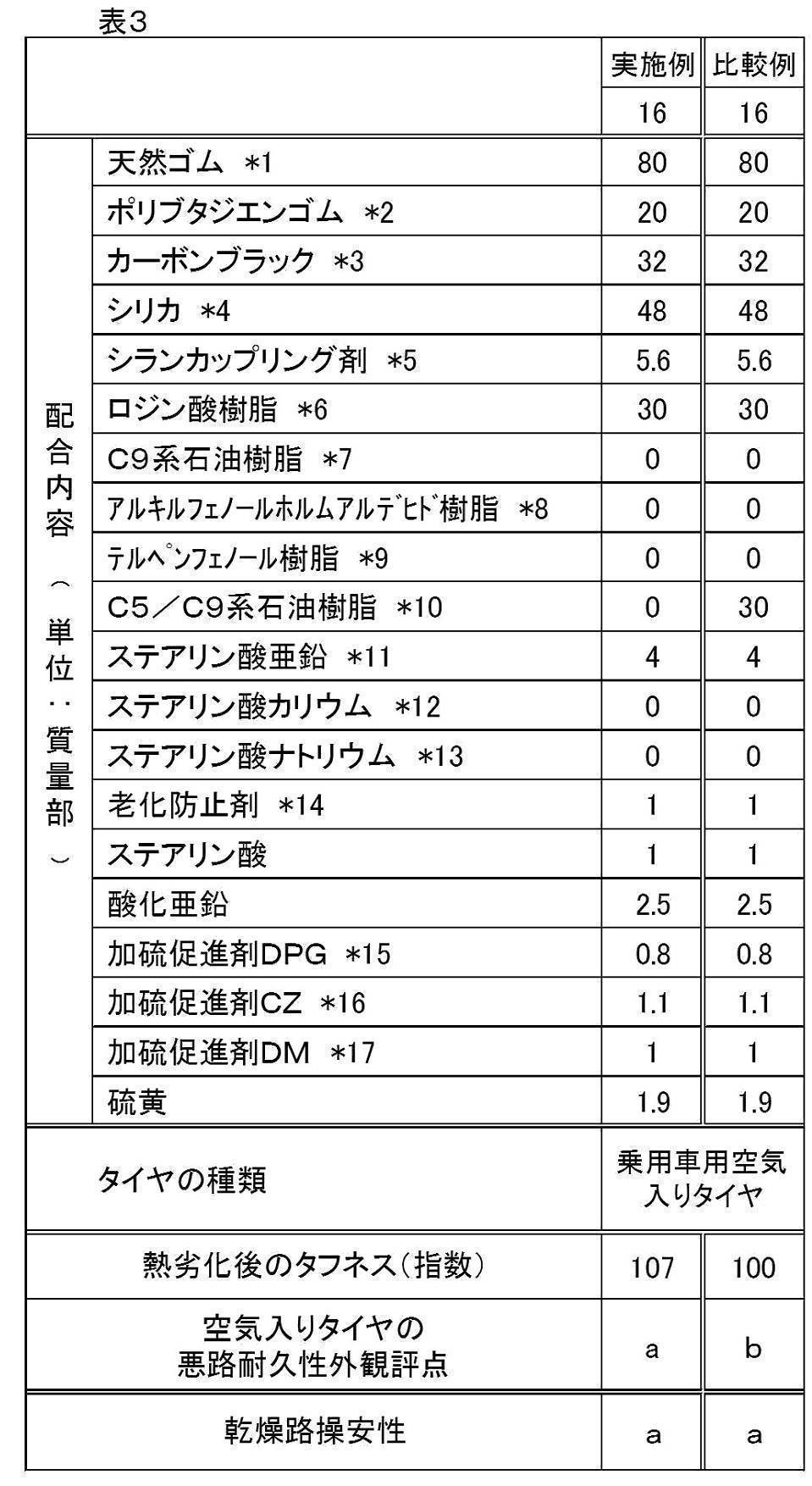
*1: 天然ゴム: インドネシア製「SIR20」
*2: ポリブタジエンゴム: JSR株式会社製、商品名「BR01」
*3: カーボンブラック: N220(ISAF)、旭カーボン株式会社製、商品名「#80」
*4: シリカ: 東ソー・シリカ工業株式会社製、商品名「ニプシルAQ」(BET表面積= 205 m2/g)
*5: シランカップリング剤: ビス(3-トリエトキシシリルプロピル)ジスルフィド、(平均硫黄鎖長:2.35)、Evonik社製シランカップリング剤、商品名「Si75」(登録商標)
*6: ロジン酸樹脂: 大社松精油株式会社製、商品名「ハイロジン(登録商標)S」
*7: C9系石油樹脂: JX日鉱日石エネルギー株式会社製、商品名「日石ネオポリマー(登録商標)140」
*8: アルキルフェノールホルムアルデヒド樹脂: SI GROUP INC.製、商品名「R7510PJ」
*9: テルペン-フェノール樹脂: ヤスハラケミカル 株式会社製、商品名「YSポリスター(登録商標)S145」
*10: C5/C9系石油樹脂: 日本ゼオン株式会社製、商品名「クイントン(登録商標)G100B」
*11: ステアリン酸亜鉛: Sigma-Aldrich社製、製品番号「307564」
*12: ステアリン酸カリウム: Sigma-Aldrich社製、製品番号「24-5570」
*13: ステアリン酸ナトリウム: Sigma-Aldrich社製、製品番号「S3381」
*14: 老化防止剤: N-(1,3-ジメチルブチル)-N’-フェニル-p-フェニレンジアミン、大内新興工業株式会社製、商品名「ノクラック(登録商標)6C」
*15: 加硫促進剤DPG: 住友化学株式会社製、商品名「ソクシノール(登録商標)D-G」
*16: 加硫促進剤CZ: 大内新興化学工業株式会社製、商品名「ノクセラー(登録商標)CZ-G」
*17: 加硫促進剤DM: 大内新興化学工業株式会社製、商品名「ノクセラー(登録商標)DM-P」
*18: スチレン-ブタジエンゴム: JSR株式会社製、商品名「JSR1500」
Claims (6)
- (A)天然ゴム及び合成イソプレンゴムから1種以上選ばれるイソプレン系ゴムを30質量%以上含むゴム成分と、その100質量部に対して、(B)ロジン酸樹脂、C9系石油樹脂、アルキルフェノールホルムアルデヒド樹脂及びテルペンフェノール樹脂から選ばれる少なくとも1種の樹脂5~50質量部、及び(C)脂肪酸金属塩0.5~10質量部とを配合してなるタイヤトレッド用ゴム組成物、
- (A)ゴム成分が、前記イソプレン系ゴムを50~100質量%の割合で含む、請求項1に記載のゴム組成物。
- (A)ゴム成分が、スチレン-ブタジエン共重合体ゴムを、1~30質量%の割合で含む、請求項1又は2に記載のゴム組成物。
- さらに、補強性充填材を含み、かつ、前記補強性充填材が、シリカを50質量%以上の割合で含む、請求項1~3のいずれか1項に記載のゴム組成物。
- (B)ロジン酸樹脂、C9系石油樹脂、アルキルフェノールホルムアルデヒド樹脂及びテルペンフェノール樹脂から選ばれる少なくとも1種の樹脂の含有量が、(A)ゴム成分100質量部に対して、10~50質量部である、請求項1~4のいずれか1項に記載のゴム組成物。
- 請求項1~5のいずれか1項に記載のゴム組成物を、トレッド用部材に用いたことを特徴とする乗用車用空気入りタイヤ。
Priority Applications (4)
| Application Number | Priority Date | Filing Date | Title |
|---|---|---|---|
| JP2016523599A JP6702860B2 (ja) | 2014-05-29 | 2015-05-29 | タイヤトレッド用ゴム組成物及びそれを用いた乗用車用空気入りタイヤ |
| EP15799541.6A EP3150660B1 (en) | 2014-05-29 | 2015-05-29 | Rubber tire-tread composition and passenger-vehicle pneumatic tire using same |
| US15/313,587 US20170190887A1 (en) | 2014-05-29 | 2015-05-29 | Rubber tire-tread composition and passenger-vehicle pneumatic tire using same |
| CN201580027522.3A CN106414585A (zh) | 2014-05-29 | 2015-05-29 | 胎面用橡胶组合物以及使用其的乘用车用充气轮胎 |
Applications Claiming Priority (2)
| Application Number | Priority Date | Filing Date | Title |
|---|---|---|---|
| JP2014-111307 | 2014-05-29 | ||
| JP2014111307 | 2014-05-29 |
Publications (1)
| Publication Number | Publication Date |
|---|---|
| WO2015182780A1 true WO2015182780A1 (ja) | 2015-12-03 |
Family
ID=54699097
Family Applications (1)
| Application Number | Title | Priority Date | Filing Date |
|---|---|---|---|
| PCT/JP2015/065695 Ceased WO2015182780A1 (ja) | 2014-05-29 | 2015-05-29 | タイヤトレッド用ゴム組成物及びそれを用いた乗用車用空気入りタイヤ |
Country Status (5)
| Country | Link |
|---|---|
| US (1) | US20170190887A1 (ja) |
| EP (1) | EP3150660B1 (ja) |
| JP (1) | JP6702860B2 (ja) |
| CN (1) | CN106414585A (ja) |
| WO (1) | WO2015182780A1 (ja) |
Cited By (3)
| Publication number | Priority date | Publication date | Assignee | Title |
|---|---|---|---|---|
| CN109415548A (zh) * | 2016-06-27 | 2019-03-01 | 横滨橡胶株式会社 | 轮胎用橡胶组合物 |
| JP2019131648A (ja) * | 2018-01-29 | 2019-08-08 | 住友ゴム工業株式会社 | タイヤ用ゴム組成物およびタイヤ |
| JP2021046124A (ja) * | 2019-09-19 | 2021-03-25 | 住友ゴム工業株式会社 | 重荷重用タイヤ |
Families Citing this family (5)
| Publication number | Priority date | Publication date | Assignee | Title |
|---|---|---|---|---|
| EP3321099B1 (en) * | 2016-11-09 | 2019-04-03 | Sumitomo Rubber Industries, Ltd. | Pneumatic tire |
| US10793719B2 (en) | 2017-09-29 | 2020-10-06 | Kraton Polymers Llc | Elastomeric compositions providing improved wet grip |
| EP3725828A4 (en) * | 2017-12-14 | 2021-09-01 | Bridgestone Corporation | PNEUMATIC |
| DE112019006232B4 (de) * | 2019-01-31 | 2026-01-29 | The Yokohama Rubber Co., Ltd. | Kautschukzusammensetzung für einen Reifen, vulkanisiertes Produkt und Verwendung des vulkanisierten Produkts in einer Protektorlauffläche eines Luftreifens |
| US10626254B1 (en) * | 2019-01-31 | 2020-04-21 | The Goodyear Tire & Rubber Company | Pneumatic tire |
Citations (8)
| Publication number | Priority date | Publication date | Assignee | Title |
|---|---|---|---|---|
| JPS5974135A (ja) * | 1982-10-22 | 1984-04-26 | Yokohama Rubber Co Ltd:The | 鉄との接着性に優れたゴム組成物 |
| JP2006249230A (ja) * | 2005-03-10 | 2006-09-21 | Bridgestone Corp | トレッド用ゴム組成物及びそれを用いた空気入りタイヤ |
| JP2007099868A (ja) * | 2005-10-03 | 2007-04-19 | Yokohama Rubber Co Ltd:The | ゴム組成物、並びにそれを用いたゴム−金属複合材及び空気入りタイヤ |
| WO2008084860A1 (ja) * | 2007-01-11 | 2008-07-17 | Bridgestone Corporation | ゴム組成物及びそれを用いたタイヤ |
| JP2009235274A (ja) * | 2008-03-27 | 2009-10-15 | Bridgestone Corp | ゴム組成物及びそれを用いたタイヤ |
| JP2009256540A (ja) * | 2008-04-21 | 2009-11-05 | Bridgestone Corp | 冬用タイヤ |
| JP2010285112A (ja) * | 2009-06-12 | 2010-12-24 | Sumitomo Rubber Ind Ltd | トラック・バス用又はライトトラック用スタッドレスタイヤ |
| JP2014009300A (ja) * | 2012-06-29 | 2014-01-20 | Sumitomo Rubber Ind Ltd | タイヤ用ゴム組成物及び空気入りタイヤ |
Family Cites Families (11)
| Publication number | Priority date | Publication date | Assignee | Title |
|---|---|---|---|---|
| CA1140843A (en) * | 1979-03-14 | 1983-02-08 | Wiliam E. Egan | Pneumatic tire having puncture sealing feature |
| JP2000186170A (ja) * | 1998-12-21 | 2000-07-04 | Toyo Tire & Rubber Co Ltd | タイヤ用ゴム組成物及びこれを用いたタイヤ |
| JP4708207B2 (ja) * | 2006-02-21 | 2011-06-22 | 株式会社ブリヂストン | ゴム組成物及びそれを使用した空気入りタイヤ |
| JP5306576B2 (ja) * | 2006-03-17 | 2013-10-02 | 住友ゴム工業株式会社 | ゴム組成物およびそれを用いたタイヤ |
| JP5265114B2 (ja) * | 2007-01-11 | 2013-08-14 | 株式会社ブリヂストン | ゴム組成物及びそれを用いた空気入りタイヤ |
| JP5659594B2 (ja) * | 2009-08-12 | 2015-01-28 | 横浜ゴム株式会社 | タイヤトレッド用ゴム組成物 |
| WO2011158509A1 (ja) * | 2010-06-18 | 2011-12-22 | 横浜ゴム株式会社 | タイヤ用ゴム組成物およびそれを用いた空気入りタイヤ |
| JP5679798B2 (ja) * | 2010-12-20 | 2015-03-04 | 住友ゴム工業株式会社 | サイドウォール若しくはベーストレッド用ゴム組成物、及び空気入りタイヤ |
| JP2012201702A (ja) * | 2011-03-23 | 2012-10-22 | Sumitomo Rubber Ind Ltd | タイヤ用ゴム組成物及び空気入りタイヤ |
| JP5351220B2 (ja) * | 2011-07-26 | 2013-11-27 | 住友ゴム工業株式会社 | タイヤ用ゴム組成物及び空気入りタイヤ |
| JP5249449B2 (ja) * | 2011-08-26 | 2013-07-31 | 住友ゴム工業株式会社 | タイヤ用ゴム組成物及び空気入りタイヤ |
-
2015
- 2015-05-29 US US15/313,587 patent/US20170190887A1/en not_active Abandoned
- 2015-05-29 JP JP2016523599A patent/JP6702860B2/ja active Active
- 2015-05-29 CN CN201580027522.3A patent/CN106414585A/zh active Pending
- 2015-05-29 EP EP15799541.6A patent/EP3150660B1/en active Active
- 2015-05-29 WO PCT/JP2015/065695 patent/WO2015182780A1/ja not_active Ceased
Patent Citations (8)
| Publication number | Priority date | Publication date | Assignee | Title |
|---|---|---|---|---|
| JPS5974135A (ja) * | 1982-10-22 | 1984-04-26 | Yokohama Rubber Co Ltd:The | 鉄との接着性に優れたゴム組成物 |
| JP2006249230A (ja) * | 2005-03-10 | 2006-09-21 | Bridgestone Corp | トレッド用ゴム組成物及びそれを用いた空気入りタイヤ |
| JP2007099868A (ja) * | 2005-10-03 | 2007-04-19 | Yokohama Rubber Co Ltd:The | ゴム組成物、並びにそれを用いたゴム−金属複合材及び空気入りタイヤ |
| WO2008084860A1 (ja) * | 2007-01-11 | 2008-07-17 | Bridgestone Corporation | ゴム組成物及びそれを用いたタイヤ |
| JP2009235274A (ja) * | 2008-03-27 | 2009-10-15 | Bridgestone Corp | ゴム組成物及びそれを用いたタイヤ |
| JP2009256540A (ja) * | 2008-04-21 | 2009-11-05 | Bridgestone Corp | 冬用タイヤ |
| JP2010285112A (ja) * | 2009-06-12 | 2010-12-24 | Sumitomo Rubber Ind Ltd | トラック・バス用又はライトトラック用スタッドレスタイヤ |
| JP2014009300A (ja) * | 2012-06-29 | 2014-01-20 | Sumitomo Rubber Ind Ltd | タイヤ用ゴム組成物及び空気入りタイヤ |
Cited By (6)
| Publication number | Priority date | Publication date | Assignee | Title |
|---|---|---|---|---|
| CN109415548A (zh) * | 2016-06-27 | 2019-03-01 | 横滨橡胶株式会社 | 轮胎用橡胶组合物 |
| CN109415548B (zh) * | 2016-06-27 | 2021-05-25 | 横滨橡胶株式会社 | 轮胎用橡胶组合物 |
| JP2019131648A (ja) * | 2018-01-29 | 2019-08-08 | 住友ゴム工業株式会社 | タイヤ用ゴム組成物およびタイヤ |
| JP7331332B2 (ja) | 2018-01-29 | 2023-08-23 | 住友ゴム工業株式会社 | タイヤ用ゴム組成物およびタイヤ |
| JP2021046124A (ja) * | 2019-09-19 | 2021-03-25 | 住友ゴム工業株式会社 | 重荷重用タイヤ |
| JP7338349B2 (ja) | 2019-09-19 | 2023-09-05 | 住友ゴム工業株式会社 | 重荷重用タイヤ |
Also Published As
| Publication number | Publication date |
|---|---|
| JP6702860B2 (ja) | 2020-06-03 |
| EP3150660B1 (en) | 2019-02-27 |
| CN106414585A (zh) | 2017-02-15 |
| JPWO2015182780A1 (ja) | 2017-04-20 |
| US20170190887A1 (en) | 2017-07-06 |
| EP3150660A1 (en) | 2017-04-05 |
| EP3150660A4 (en) | 2017-05-31 |
Similar Documents
| Publication | Publication Date | Title |
|---|---|---|
| JP5998310B1 (ja) | ゴム組成物及びその製造方法、並びに、タイヤ | |
| EP3466719B1 (en) | Pneumatic tire | |
| JP7000319B2 (ja) | ゴム組成物、ゴム組成物の製造方法、及びタイヤ | |
| JP6702860B2 (ja) | タイヤトレッド用ゴム組成物及びそれを用いた乗用車用空気入りタイヤ | |
| EP3467020B1 (en) | Rubber composition and tire | |
| JP5737324B2 (ja) | タイヤ用ゴム組成物 | |
| JP6732652B2 (ja) | タイヤトレッド用ゴム組成物及びそれを用いた乗用車用空気入りタイヤ | |
| EP3854610B1 (en) | Pneumatic tire | |
| EP3467017A1 (en) | Rubber composition and tire | |
| JPWO2016194386A1 (ja) | タイヤ | |
| JP5415813B2 (ja) | ゴム組成物及びそれを用いた空気入りタイヤ | |
| JP7692335B2 (ja) | ゴム組成物、トレッド及びタイヤ | |
| JP6628367B2 (ja) | タイヤトレッド用ゴム組成物及びそれを用いた乗用車用空気入りタイヤ | |
| JP2026011905A (ja) | タイヤ |
Legal Events
| Date | Code | Title | Description |
|---|---|---|---|
| 121 | Ep: the epo has been informed by wipo that ep was designated in this application |
Ref document number: 15799541 Country of ref document: EP Kind code of ref document: A1 |
|
| ENP | Entry into the national phase |
Ref document number: 2016523599 Country of ref document: JP Kind code of ref document: A |
|
| REEP | Request for entry into the european phase |
Ref document number: 2015799541 Country of ref document: EP |
|
| WWE | Wipo information: entry into national phase |
Ref document number: 15313587 Country of ref document: US Ref document number: 2015799541 Country of ref document: EP |
|
| NENP | Non-entry into the national phase |
Ref country code: DE |