WO2015185781A1 - Síntesis de sapo-18 y sus aplicaciones catalíticas - Google Patents
Síntesis de sapo-18 y sus aplicaciones catalíticas Download PDFInfo
- Publication number
- WO2015185781A1 WO2015185781A1 PCT/ES2015/070438 ES2015070438W WO2015185781A1 WO 2015185781 A1 WO2015185781 A1 WO 2015185781A1 ES 2015070438 W ES2015070438 W ES 2015070438W WO 2015185781 A1 WO2015185781 A1 WO 2015185781A1
- Authority
- WO
- WIPO (PCT)
- Prior art keywords
- sapo
- synthesis
- range
- synthesis method
- metal
- Prior art date
- Legal status (The legal status is an assumption and is not a legal conclusion. Google has not performed a legal analysis and makes no representation as to the accuracy of the status listed.)
- Ceased
Links
Classifications
-
- B—PERFORMING OPERATIONS; TRANSPORTING
- B01—PHYSICAL OR CHEMICAL PROCESSES OR APPARATUS IN GENERAL
- B01J—CHEMICAL OR PHYSICAL PROCESSES, e.g. CATALYSIS OR COLLOID CHEMISTRY; THEIR RELEVANT APPARATUS
- B01J29/00—Catalysts comprising molecular sieves
- B01J29/82—Phosphates
- B01J29/84—Aluminophosphates containing other elements, e.g. metals, boron
- B01J29/85—Silicoaluminophosphates [SAPO compounds]
-
- B—PERFORMING OPERATIONS; TRANSPORTING
- B01—PHYSICAL OR CHEMICAL PROCESSES OR APPARATUS IN GENERAL
- B01J—CHEMICAL OR PHYSICAL PROCESSES, e.g. CATALYSIS OR COLLOID CHEMISTRY; THEIR RELEVANT APPARATUS
- B01J37/00—Processes, in general, for preparing catalysts; Processes, in general, for activation of catalysts
- B01J37/0009—Use of binding agents; Moulding; Pressing; Powdering; Granulating; Addition of materials ameliorating the mechanical properties of the product catalyst
- B01J37/0018—Addition of a binding agent or of material, later completely removed among others as result of heat treatment, leaching or washing,(e.g. forming of pores; protective layer, desintegrating by heat)
-
- B—PERFORMING OPERATIONS; TRANSPORTING
- B01—PHYSICAL OR CHEMICAL PROCESSES OR APPARATUS IN GENERAL
- B01J—CHEMICAL OR PHYSICAL PROCESSES, e.g. CATALYSIS OR COLLOID CHEMISTRY; THEIR RELEVANT APPARATUS
- B01J37/00—Processes, in general, for preparing catalysts; Processes, in general, for activation of catalysts
- B01J37/009—Preparation by separation, e.g. by filtration, decantation, screening
-
- B—PERFORMING OPERATIONS; TRANSPORTING
- B01—PHYSICAL OR CHEMICAL PROCESSES OR APPARATUS IN GENERAL
- B01J—CHEMICAL OR PHYSICAL PROCESSES, e.g. CATALYSIS OR COLLOID CHEMISTRY; THEIR RELEVANT APPARATUS
- B01J37/00—Processes, in general, for preparing catalysts; Processes, in general, for activation of catalysts
- B01J37/04—Mixing
-
- B—PERFORMING OPERATIONS; TRANSPORTING
- B01—PHYSICAL OR CHEMICAL PROCESSES OR APPARATUS IN GENERAL
- B01J—CHEMICAL OR PHYSICAL PROCESSES, e.g. CATALYSIS OR COLLOID CHEMISTRY; THEIR RELEVANT APPARATUS
- B01J37/00—Processes, in general, for preparing catalysts; Processes, in general, for activation of catalysts
- B01J37/08—Heat treatment
- B01J37/10—Heat treatment in the presence of water, e.g. steam
-
- C—CHEMISTRY; METALLURGY
- C01—INORGANIC CHEMISTRY
- C01B—NON-METALLIC ELEMENTS; COMPOUNDS THEREOF; METALLOIDS OR COMPOUNDS THEREOF NOT COVERED BY SUBCLASS C01C
- C01B39/00—Compounds having molecular sieve and base-exchange properties, e.g. crystalline zeolites; Their preparation; After-treatment, e.g. ion-exchange or dealumination
- C01B39/54—Phosphates, e.g. APO or SAPO compounds
-
- C—CHEMISTRY; METALLURGY
- C07—ORGANIC CHEMISTRY
- C07D—HETEROCYCLIC COMPOUNDS
- C07D211/00—Heterocyclic compounds containing hydrogenated pyridine rings, not condensed with other rings
- C07D211/04—Heterocyclic compounds containing hydrogenated pyridine rings, not condensed with other rings with only hydrogen or carbon atoms directly attached to the ring nitrogen atom
- C07D211/06—Heterocyclic compounds containing hydrogenated pyridine rings, not condensed with other rings with only hydrogen or carbon atoms directly attached to the ring nitrogen atom having no double bonds between ring members or between ring members and non-ring members
- C07D211/08—Heterocyclic compounds containing hydrogenated pyridine rings, not condensed with other rings with only hydrogen or carbon atoms directly attached to the ring nitrogen atom having no double bonds between ring members or between ring members and non-ring members with hydrocarbon or substituted hydrocarbon radicals directly attached to ring carbon atoms
- C07D211/10—Heterocyclic compounds containing hydrogenated pyridine rings, not condensed with other rings with only hydrogen or carbon atoms directly attached to the ring nitrogen atom having no double bonds between ring members or between ring members and non-ring members with hydrocarbon or substituted hydrocarbon radicals directly attached to ring carbon atoms with radicals containing only carbon and hydrogen atoms attached to ring carbon atoms
- C07D211/14—Heterocyclic compounds containing hydrogenated pyridine rings, not condensed with other rings with only hydrogen or carbon atoms directly attached to the ring nitrogen atom having no double bonds between ring members or between ring members and non-ring members with hydrocarbon or substituted hydrocarbon radicals directly attached to ring carbon atoms with radicals containing only carbon and hydrogen atoms attached to ring carbon atoms with hydrocarbon or substituted hydrocarbon radicals attached to the ring nitrogen atom
-
- C—CHEMISTRY; METALLURGY
- C30—CRYSTAL GROWTH
- C30B—SINGLE-CRYSTAL GROWTH; UNIDIRECTIONAL SOLIDIFICATION OF EUTECTIC MATERIAL OR UNIDIRECTIONAL DEMIXING OF EUTECTOID MATERIAL; REFINING BY ZONE-MELTING OF MATERIAL; PRODUCTION OF A HOMOGENEOUS POLYCRYSTALLINE MATERIAL WITH DEFINED STRUCTURE; SINGLE CRYSTALS OR HOMOGENEOUS POLYCRYSTALLINE MATERIAL WITH DEFINED STRUCTURE; AFTER-TREATMENT OF SINGLE CRYSTALS OR A HOMOGENEOUS POLYCRYSTALLINE MATERIAL WITH DEFINED STRUCTURE; APPARATUS THEREFOR
- C30B29/00—Single crystals or homogeneous polycrystalline material with defined structure characterised by the material or by their shape
- C30B29/10—Inorganic compounds or compositions
- C30B29/14—Phosphates
-
- C—CHEMISTRY; METALLURGY
- C30—CRYSTAL GROWTH
- C30B—SINGLE-CRYSTAL GROWTH; UNIDIRECTIONAL SOLIDIFICATION OF EUTECTIC MATERIAL OR UNIDIRECTIONAL DEMIXING OF EUTECTOID MATERIAL; REFINING BY ZONE-MELTING OF MATERIAL; PRODUCTION OF A HOMOGENEOUS POLYCRYSTALLINE MATERIAL WITH DEFINED STRUCTURE; SINGLE CRYSTALS OR HOMOGENEOUS POLYCRYSTALLINE MATERIAL WITH DEFINED STRUCTURE; AFTER-TREATMENT OF SINGLE CRYSTALS OR A HOMOGENEOUS POLYCRYSTALLINE MATERIAL WITH DEFINED STRUCTURE; APPARATUS THEREFOR
- C30B7/00—Single-crystal growth from solutions using solvents which are liquid at normal temperature, e.g. aqueous solutions
- C30B7/10—Single-crystal growth from solutions using solvents which are liquid at normal temperature, e.g. aqueous solutions by application of pressure, e.g. hydrothermal processes
-
- B—PERFORMING OPERATIONS; TRANSPORTING
- B01—PHYSICAL OR CHEMICAL PROCESSES OR APPARATUS IN GENERAL
- B01J—CHEMICAL OR PHYSICAL PROCESSES, e.g. CATALYSIS OR COLLOID CHEMISTRY; THEIR RELEVANT APPARATUS
- B01J29/00—Catalysts comprising molecular sieves
- B01J29/04—Catalysts comprising molecular sieves having base-exchange properties, e.g. crystalline zeolites
- B01J29/06—Crystalline aluminosilicate zeolites; Isomorphous compounds thereof
- B01J29/70—Crystalline aluminosilicate zeolites; Isomorphous compounds thereof of types characterised by their specific structure not provided for in groups B01J29/08 - B01J29/65
- B01J29/7015—CHA-type, e.g. Chabazite, LZ-218
-
- B—PERFORMING OPERATIONS; TRANSPORTING
- B01—PHYSICAL OR CHEMICAL PROCESSES OR APPARATUS IN GENERAL
- B01J—CHEMICAL OR PHYSICAL PROCESSES, e.g. CATALYSIS OR COLLOID CHEMISTRY; THEIR RELEVANT APPARATUS
- B01J29/00—Catalysts comprising molecular sieves
- B01J29/04—Catalysts comprising molecular sieves having base-exchange properties, e.g. crystalline zeolites
- B01J29/06—Crystalline aluminosilicate zeolites; Isomorphous compounds thereof
- B01J29/70—Crystalline aluminosilicate zeolites; Isomorphous compounds thereof of types characterised by their specific structure not provided for in groups B01J29/08 - B01J29/65
- B01J29/72—Crystalline aluminosilicate zeolites; Isomorphous compounds thereof of types characterised by their specific structure not provided for in groups B01J29/08 - B01J29/65 containing iron group metals, noble metals or copper
- B01J29/723—CHA-type, e.g. Chabazite, LZ-218
-
- B—PERFORMING OPERATIONS; TRANSPORTING
- B01—PHYSICAL OR CHEMICAL PROCESSES OR APPARATUS IN GENERAL
- B01J—CHEMICAL OR PHYSICAL PROCESSES, e.g. CATALYSIS OR COLLOID CHEMISTRY; THEIR RELEVANT APPARATUS
- B01J29/00—Catalysts comprising molecular sieves
- B01J29/04—Catalysts comprising molecular sieves having base-exchange properties, e.g. crystalline zeolites
- B01J29/06—Crystalline aluminosilicate zeolites; Isomorphous compounds thereof
- B01J29/70—Crystalline aluminosilicate zeolites; Isomorphous compounds thereof of types characterised by their specific structure not provided for in groups B01J29/08 - B01J29/65
- B01J29/72—Crystalline aluminosilicate zeolites; Isomorphous compounds thereof of types characterised by their specific structure not provided for in groups B01J29/08 - B01J29/65 containing iron group metals, noble metals or copper
- B01J29/74—Noble metals
- B01J29/743—CHA-type, e.g. Chabazite, LZ-218
-
- B—PERFORMING OPERATIONS; TRANSPORTING
- B01—PHYSICAL OR CHEMICAL PROCESSES OR APPARATUS IN GENERAL
- B01J—CHEMICAL OR PHYSICAL PROCESSES, e.g. CATALYSIS OR COLLOID CHEMISTRY; THEIR RELEVANT APPARATUS
- B01J29/00—Catalysts comprising molecular sieves
- B01J29/04—Catalysts comprising molecular sieves having base-exchange properties, e.g. crystalline zeolites
- B01J29/06—Crystalline aluminosilicate zeolites; Isomorphous compounds thereof
- B01J29/70—Crystalline aluminosilicate zeolites; Isomorphous compounds thereof of types characterised by their specific structure not provided for in groups B01J29/08 - B01J29/65
- B01J29/72—Crystalline aluminosilicate zeolites; Isomorphous compounds thereof of types characterised by their specific structure not provided for in groups B01J29/08 - B01J29/65 containing iron group metals, noble metals or copper
- B01J29/76—Iron group metals or copper
- B01J29/763—CHA-type, e.g. Chabazite, LZ-218
Definitions
- the present invention relates to a new method of synthesis of the SAPO-18 molecular sieve in its silicoaluminophosphate and metalosilicoaluminophosphate form (Me-SAPO-18), using cyclic quaternary ammoniums as structure directing agents.
- This procedure involves the combination of the various sources that are required for the preparation of a silicoaluminophosphate (SAPO), such as silicon, aluminum, and phosphorus; next to a cyclic quaternary ammonium, and a source of a metal, in the case of the preparation of Me-SAPO-18.
- SAPO silicoaluminophosphate
- the present invention in addition to referring to the method of synthesis, also refers to the application of said materials as catalysts.
- This substitution can take place through two different mechanisms: a) replacement of an atom of P by an atom of Si, generating a negative charge on the structure (isolated silicon), or b) replacement of an atom of Al and an atom of P for two atoms of Si, leading to the formation of domains rich in silicon (silicon islands).
- a) replacement of an atom of P by an atom of Si generating a negative charge on the structure (isolated silicon)
- b) replacement of an atom of Al and an atom of P for two atoms of Si leading to the formation of domains rich in silicon (silicon islands).
- SAPOs Only when silicon is isolated, do SAPOs exhibit excellent cation exchange capacity that allows the presence of different active species, suitable for various catalytic applications. Possibly, the most common SAPOs are in protonated form.
- the organic structure directing agent (ADEO) used in the preparation of SAPOs not only influences the crystallization of a certain structure, but also the positioning and coordination of silicon atoms in the crystalline structure of the molecular sieve.
- SAPO-18 silicoaluminophosphate is a three-dimensional molecular sieve with a small pore (8-channel channel openings with pore diameters of about 3.8A) with large cavities inside.
- ADEO the organic molecule ⁇ , ⁇ -diisopropylethylamine
- This SAPO-18 synthesis procedure allows to obtain silicoaluminophosphates with mixtures of isolated silicon and silicon islands.
- the presence of silicon islands confers a lower acidity to said SAPO-18 (Chen et al. J. Phys. Chem., 1994, 98, 10216; Hunger et al., Catal. Lett., 2001, 74, 61; Wragg et al. J. Catal., 201 1, 397).
- the synthesis of SAPO-18 using tetraethylammonium as ADEO has been described, but this synthesis procedure also shows large silicon environments forming islands (Fan et al., J. Mater. Chem., 2012, 22, 6568), and therefore, lower acidity Brónsted.
- Me-SAPO cationic metal species in SAPOs
- SAPO hydrothermal synthesis calcination, transformation in the ammonium form (if required), cationic exchange of the metal, and finally, calcination to achieve the final Me-SAPO. All this number of intermediate steps translates into an increase in the cost of synthesis of the corresponding Me-SAPO.
- the present invention relates to a synthesis procedure of SAPO-18, which may comprise at least the following steps: i) Preparation of a mixture containing at least water, at least one source of silicon, at least one source of aluminum, at least one source of phosphorus, one or more ADEOs where at least one of them is a cyclic quaternary ammonium and where the final synthesis mixture has the following molar composition:
- a is between the range of 0.01 to 0.3, preferably between
- b is in the range of 0.2 to 0.49, preferably between
- c is in the range of 0.001 to 2, preferably between
- d is in the range of 1 to 200, preferably between 2 to
- the main objectives of the present invention will be to carry out an efficient synthesis procedure that allows on the one hand the synthesis of the silicoaluminophosphate form of SAPO-18 with a good distribution of silicon in isolated positions to improve its acidity. Bronsted, and on the other hand , the synthesis in a single stage (direct synthesis) of the metalosilicoaluminophosphate form of SAPO-18 (Me-SAPO-18) with metallic cationic species in extra-net positions and isolated silicon in the crystalline network. In this way, it will be possible not only to reduce the high number of stages required for the synthesis of Me-SAPO-18, but also to improve the hydrothermal stability of the cationic metallic species, and therefore, the hydrothermal stability of the material.
- This synthesis procedure is carried out using the different sources required in the preparation of a conventional SAPO such as any source of silicon, aluminum and phosphorus, together with at least one ADEO, at least one of them being a preferably selected cyclic quaternary ammonium between N, N-dimethyl-3,5-dimethylpiperidinium (DMDMP), N, N-diethyl-2,6-dimethylpiperidinium (DEDMP), N, N-dimethyl-2,6- dimethylpiperidinium, N-ethyl-N-methyl-2,6-dimethylpiperidinium and combinations thereof, as well as any variation thereof.
- DMDMP N-dimethyl-3,5-dimethylpiperidinium
- DEDMP N-diethyl-2,6-dimethylpiperidinium
- N-dimethyl-2,6- dimethylpiperidinium N-ethyl-N-methyl-2,6-dimethylpiperidinium and combinations thereof, as well as any variation thereof.
- the other ADEO may be another cyclic quaternary ammonium or any other organic molecule, such as, for example, any amine, quaternary ammonium, phosphine, phosphonium, phosphazene and combinations thereof.
- the crystallization step described in (ii) can be carried out in autoclaves under both static and dynamic conditions.
- the temperature of the crystallization process may preferably be in the range of temperatures between 100 and 200 ° C, more preferably between 130 and 190 ° C, and more preferably between 150 and 190 ° C and the time of Crystallization may be between 1 hour and 50 days, preferably between 1 and 10 days, and more preferably between 2 and 8 days. It is important to keep in mind that the components of the synthesis mixture can come from various sources, and depending on this, the time and crystallization conditions may vary.
- SAPO-18 crystals can be added to the final synthesis mixture of "i" as sowing, being able to reach up to 25% by weight of the total oxides introduced in the synthesis.
- the crystals of the SAPO-18 material are separated from the mother liquors, and recovered.
- the solid can be washed and separated from the mother liquors by different techniques, preferably the technique of decantation, filtration, ultrafiltration, centrifugation, or other solid-liquid separation techniques and combinations thereof can be used.
- the objective may be to produce the calcined crystalline material.
- the process described according to the present invention further comprises a step of eliminating the occluded organic matter inside the material, which can be performed by a technique selected from extraction, heat treatment and combinations thereof at temperatures above 25 ° C, for periods between 2 minutes and 25 hours.
- the material produced through the present invention can be pelletized according to known techniques.
- the synthesis procedure described above may further comprise at least one metal source, where the final synthesis gel would have the following molar composition:
- a is in the range of 0.01 to 0.3; preferably between
- b is in the range of 0.2 to 0.49; preferably between
- c is in the range of 0.001 to 2; preferably between 0.1 to 1, and more preferably between 0.2 to 0.7;
- d is in the range of 1 to 200, preferably between 2 to
- e is in the range of 0.00 to 0.6; preferably between 0.01 to 0.4, and more preferably from 0.015 to 0.2.
- Me is a metal.
- said metal is selected from Cu, Ni, Fe, Pt, Pd, Mn, Ca, Mg, Zn, Cd, Co, Ti, Sn, and combinations thereof.
- said metal is Cu.
- the present invention also relates to the product obtained according to the procedure described above which can have the following molar composition:
- the product obtained according to the process of the present invention may have the following molar composition:
- X is a metal selected from Cu, Ni, Fe, Pt, Pd, Mn, Ca, Mg, Zn, Cd, Co, Ti, Sn and combinations thereof, and according to a particular embodiment X is Cu .
- the metal source can be any precursor thereof, such as, for example, nitrates, oxalates, sulfates, organometallic complexes as well as combinations thereof among others.
- the direct synthesis procedure of the Me-SAPO-18 described above uses Cu as a metal for the direct synthesis of the Me-SAPO-18.
- any source of copper can be used for the preparation of Cu-SAPO-18, including the use of Cu organometallic complexes.
- any amine or mixtures of amines capable of forming organometallic complexes with copper, can be used independently of the number of N atoms they have in their structure, regardless of their form (cyclic, linear, branched ...) , and regardless of the nature of the amine (primary, secondary, tertiary).
- Some examples of amines may be tetraethylene pentamine (TEPA), triethylenetetramine (TETA), 1, 4,8, 11-tetraazacyclotetradecane or 1, 4,8, 11-tetramethyl-1, 4,8,1 1-tetraazacyclotetradecane and combinations of the same among others.
- the product obtained presents the metal in extra-net positions directly and in a single stage, avoiding the use of successive post-synthetic stages.
- the combination of the ADEOs described, at least one cyclic quaternary ammonium allows an excellent distribution of the silicon centers in isolation in the structure of the SAPO-18, allowing to compensate and stabilize the positive charges of the cationic or extra-net metals.
- the present invention also relates to the use of the materials described above and obtained according to the process of the present invention as catalysts for the conversion of feeds formed by organic compounds into products of higher added value, or for their removal / separation of the reactive current contacting said feed with the material described in its active form.
- Me-SAPO-18 can be used as catalysts in selective catalytic reduction (RCS) reactions of NOx (nitrogen oxide) in a gas stream. It has been proven that Cu-SAPO-18 gives very good results in this type of reactions.
- molecular sieves Cu- SAPO-18, in accordance with the present invention are used as catalysts in the NOx RCS in the presence of a reducer such as ammonium, urea and / or hydrocarbons.
- Figure 1 X-ray diffraction patterns of the solids synthesized in examples 3 and 6 described in the present invention.
- Figure 3 UV-Vis spectra of the sample synthesized in Example 6 of the present invention in its uncalcined form, and of the Cu-TETA complex in aqueous solution.
- the sample is characterized by X-ray diffraction (DRX), observing the formation of the characteristic DRX pattern of SAPO-18 (see Figure 1).
- DRX X-ray diffraction
- the synthesized SAPO-18 exclusively shows the presence of Si isolated in its structure (see the band centered at -90 ppm in the sample Example 3 of Figure 2).
- the gel is transferred to a Teflon coated autoclave, and heated at 190 ° C for two days in dynamic conditions. After the hydrothermal crystallization process, the sample is filtered and washed with plenty of distilled water and finally dried at 100 ° C.
- the sample is characterized by X-ray diffraction, to determine the structure obtained after the crystallization process, observing the characteristic diffraction pattern of SAPO-18.
- the sample is calcined at 550 ° C in air to remove fractions of organic matter occluded inside the microporous material during the crystallization process.
- the gel is transferred to a Teflon coated autoclave, and heated at 190 ° C for two days in dynamic conditions. After the hydrothermal crystallization process, the sample is filtered and washed with plenty of distilled water and finally dried at 100 ° C.
- the sample is characterized by X-ray diffraction, to determine the structure obtained after the crystallization process, observing the characteristic diffraction pattern of SAPO-18.
- the sample is calcined at 550 ° C in air to remove fractions of organic matter occluded inside the microporous material during the crystallization process.
- Example 6 Direct synthesis of Cu-SAPO-18 material using Cu-triethylenetetramine (Cu-TETA) as a precursor to Cu and DMDMP as ADEO.
- Cu-TETA Cu-triethylenetetramine
- the first step is the preparation of the Cu-TETA copper complex.
- 405.9 mg of a 20% by weight aqueous solution of copper (II) sulfate (98% wt, Alpha) are mixed with 74.5 mg of triethylenetetramine (TETA, 99% wt, Aldrich), keeping it under stirring for 2 hours.
- TETA triethylenetetramine
- 2700 mg of distilled water and 1035.8 mg of orthophosphoric acid (85% wt, Aldrich) are added, maintaining the solution resulting in stirring for 5 minutes.
- 8840 mg of a 17.1% by weight aqueous solution of DMDMP hydroxide is added, and it is kept under stirring for another 5 minutes.
- the gel is transferred to an autoclave with a Teflon coating, and heated at 175 ° C for 6 days under dynamic conditions. After the hydrothermal crystallization process, the sample is filtered and washed with plenty of distilled water and finally dried at 100 ° C.
- the sample is characterized by X-ray diffraction, to determine the structure obtained after the crystallization process (see DRX pattern in Figure 1).
- the uncalcined sample is characterized by ultraviolet-visible spectroscopy (UV-Vis) to verify that the copper atoms are in extra-net positions.
- UV-Vis ultraviolet-visible spectroscopy
- the UV-Vis spectrum of the sample in its uncalcined form has a single band centered at -260 nm, which demonstrates the presence of the intact organometallic complex in the solid in extra-net positions (see Figure 3).
- the synthesized SAPO-18 exclusively shows the presence of Si isolated in its structure (see the band centered at -90 ppm in the sample Example 6 of Figure 2).
- the sample is calcined at 550 ° C in air to remove fractions of organic matter occluded inside the microporous material during the crystallization process.
- Example 7 Direct synthesis of Cu-SAPO-18 material using Cu-triethylenetetramine (Cu-TETA) as a precursor to Cu and DMDMP as ADEO.
- Cu-TETA Cu-triethylenetetramine
- the first step is the preparation of the Cu-TETA copper complex.
- 799.2 mg of a 20% by weight aqueous solution of copper (II) sulfate are mixed (98% wt, Alfa) with 145.5 mg of triethylenetetramine (TETA, 99% wt, Aldrich), keeping it under stirring for 2 hours.
- TETA triethylenetetramine
- 2800 mg of distilled water and 1043.2 mg of orthophosphoric acid (85% wt, Aldrich) are added, keeping the resulting solution under stirring for 5 minutes.
- 8405 mg of a 17.1% by weight aqueous solution of DMDMP hydroxide is added, and it is kept under stirring for another 5 minutes.
- the gel is transferred to an autoclave with a Teflon coating, and heated at 175 ° C for 6 days under dynamic conditions. After the hydrothermal crystallization process, the sample is filtered and washed with plenty of distilled water and finally dried at 100 ° C.
- the sample is characterized by X-ray diffraction, to determine the structure obtained after the crystallization process, observing the characteristic diffraction pattern of SAPO-18.
- Example 8 Direct synthesis of Cu-SAPO-18 material using Cu-triethylenetetramine (Cu-TETA) as a precursor to Cu and DMDMP as ADEO.
- Cu-TETA Cu-triethylenetetramine
- the first step is the preparation of the Cu-TETA copper complex.
- 1591.4 mg of a 20% by weight aqueous solution of copper (II) sulfate (98% wt, Alpha) are mixed with 296.4 mg of triethylenetetramine (TETA, 99% wt, Aldrich), keeping it under stirring for 2 hours.
- TETA triethylenetetramine
- 1056.0 mg of orthophosphoric acid 85% wt, Aldrich
- 10031 mg of a 12.2% by weight aqueous solution of DMDMP hydroxide is added, and it is kept under stirring for another 5 minutes.
- the gel is transferred to an autoclave with a Teflon coating, and heated at 175 ° C for 6 days under dynamic conditions. After the hydrothermal crystallization process, the sample is filtered and washed with plenty of distilled water and finally dried at 100 ° C.
- the sample is characterized by X-ray diffraction, to determine the structure obtained after the crystallization process, observing the characteristic diffraction pattern of SAPO-18.
- Example 9 Direct synthesis of Cu-SAPO-18 material using Cu-triethylenetetramine (Cu-TETA) as a precursor to Cu and DMDMP as ADEO.
- Cu-TETA Cu-triethylenetetramine
- the first step is the preparation of the Cu-TETA copper complex.
- 400.8 mg of a 20% by weight aqueous solution of copper (II) sulfate (98% wt, Alpha) are mixed with 72.9 mg of triethylenetetramine (TETA, 99% wt, Aldrich), keeping it under stirring for 2 hours.
- TETA triethylenetetramine
- 1076.8 mg of orthophosphoric acid 85% wt, Aldrich
- 8692 mg of a 17.4% by weight aqueous solution of DMDMP hydroxide is added, and it is kept under stirring for another 5 minutes.
- the gel is transferred to a Teflon coated autoclave, and heated at 190 ° C for 3 days in dynamic conditions. After the hydrothermal crystallization process, the sample is filtered and washed with plenty of distilled water and finally dried at 100 ° C.
- the sample is characterized by X-ray diffraction, to determine the structure obtained after the process of observing the characteristic diffraction pattern of SAPO-18.
- Example 10 Direct synthesis of Cu-SAPO-18 material using Cu-triethylenetetramine (Cu-TETA) as a precursor to Cu and DMDMP as ADEO.
- Cu-TETA Cu-triethylenetetramine
- the first step is the preparation of the Cu-TETA copper complex. To do this, 799.2 mg of a 20% by weight aqueous solution of copper (II) sulfate (98% wt, Alpha) are mixed with 145.4 mg of triethylenetetramine (TETA, 99% wt, Aldrich), keeping it under stirring for 2 hours. Next, 1061.6 mg of orthophosphoric acid (85% wt, Aldrich) is added, keeping the resulting solution under stirring for 5 minutes. Subsequently, 8244 mg of a 17.4% by weight aqueous solution of DMDMP hydroxide is added, and it is kept under stirring for another 5 minutes.
- TETA triethylenetetramine
- the gel is transferred to a Teflon coated autoclave, and heated at 190 ° C for 3 days in dynamic conditions. After the hydrothermal crystallization process, The sample is filtered and washed with plenty of distilled water and finally dried at 100 ° C.
- the sample is characterized by X-ray diffraction, to determine the structure obtained after the crystallization process, observing the characteristic diffraction pattern of SAPO-18.
- the sample is calcined at 550 ° C in air to remove fractions of organic matter occluded inside the microporous material during the crystallization process.
- Example 11 Chemical analysis of different Cu-SAPO-18 materials obtained in the present invention
- Table 1 Molar ratios of the synthesized solids according to examples 7, 8 and 9 of the present invention.
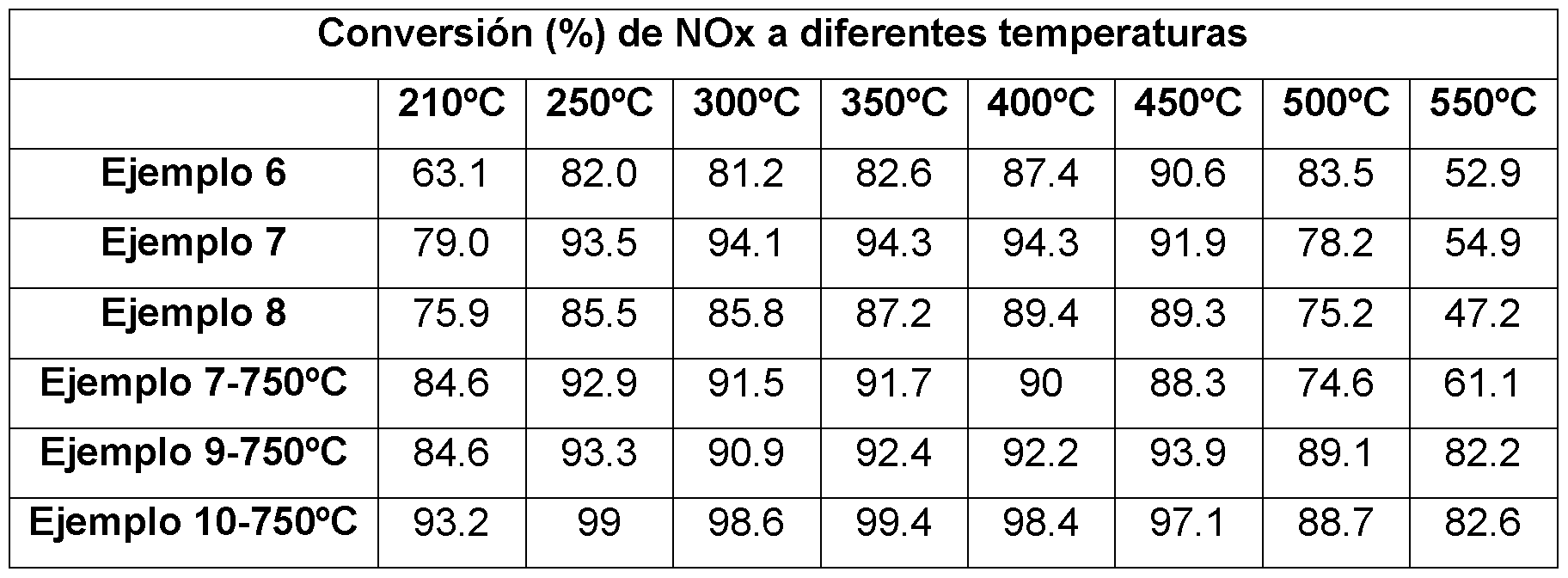
- Example 13 Catalytic test for the RCS reaction of NOx using different Cu-SAPO-18 materials synthesized according to the present invention.
- the activity of these samples for the selective catalytic reduction of NOx is studied using a fixed bed quartz tubular reactor 1.2 cm in diameter and 20 cm long.
- the catalyst is compacted into particles between 0.25-0.42 mm in size, introduced into the reactor, and the temperature is increased to 550 ° C (see reaction conditions in Table 2); subsequently, that temperature is maintained for one hour under a flow of nitrogen. Once the desired temperature has been reached, the reaction mixture is fed.
- the NOx RCS is studied using NH 3 as a reducer.
- the NOx present at the outlet of the gases from the reactor is analyzed continuously by means of a chemiluminescent detector (Thermo 62C).
- Table 3 Conversion (%) of NOx at different temperatures (200, 250, 300, 350, 400, 450, 500 ° C) using different Cu-SAPO-18 materials synthesized by the synthesis methodology described in the present invention.
Landscapes
- Chemical & Material Sciences (AREA)
- Organic Chemistry (AREA)
- Engineering & Computer Science (AREA)
- Materials Engineering (AREA)
- Chemical Kinetics & Catalysis (AREA)
- Inorganic Chemistry (AREA)
- Crystallography & Structural Chemistry (AREA)
- Metallurgy (AREA)
- Life Sciences & Earth Sciences (AREA)
- General Life Sciences & Earth Sciences (AREA)
- Geology (AREA)
- Thermal Sciences (AREA)
- Physics & Mathematics (AREA)
- Silicates, Zeolites, And Molecular Sieves (AREA)
- Catalysts (AREA)
- Exhaust Gas Treatment By Means Of Catalyst (AREA)
Abstract
Description


Claims
Priority Applications (5)
| Application Number | Priority Date | Filing Date | Title |
|---|---|---|---|
| US15/315,200 US10005076B2 (en) | 2014-06-03 | 2015-06-03 | Synthesis of SAPO-18 and the catalytic applications thereof |
| BR112016028250A BR112016028250A2 (pt) | 2014-06-03 | 2015-06-03 | procedimento de síntese do sapo-18, produto obtido de acordo com referido procedimento e uso do referido produto |
| JP2017516212A JP2017521349A (ja) | 2014-06-03 | 2015-06-03 | Sapo−18の合成およびその触媒用途 |
| EP15802461.2A EP3153471B1 (en) | 2014-06-03 | 2015-06-03 | Synthesis of sapo-18 |
| CN201580039140.2A CN107074570A (zh) | 2014-06-03 | 2015-06-03 | Sapo‑18的合成及其催化用途 |
Applications Claiming Priority (2)
| Application Number | Priority Date | Filing Date | Title |
|---|---|---|---|
| ESP201430852 | 2014-06-03 | ||
| ES201430852A ES2555804B1 (es) | 2014-06-03 | 2014-06-03 | Síntesis de sapo-18 y sus aplicaciones catalíticas |
Publications (1)
| Publication Number | Publication Date |
|---|---|
| WO2015185781A1 true WO2015185781A1 (es) | 2015-12-10 |
Family
ID=54766200
Family Applications (1)
| Application Number | Title | Priority Date | Filing Date |
|---|---|---|---|
| PCT/ES2015/070438 Ceased WO2015185781A1 (es) | 2014-06-03 | 2015-06-03 | Síntesis de sapo-18 y sus aplicaciones catalíticas |
Country Status (7)
| Country | Link |
|---|---|
| US (1) | US10005076B2 (es) |
| EP (1) | EP3153471B1 (es) |
| JP (1) | JP2017521349A (es) |
| CN (1) | CN107074570A (es) |
| BR (1) | BR112016028250A2 (es) |
| ES (1) | ES2555804B1 (es) |
| WO (1) | WO2015185781A1 (es) |
Cited By (4)
| Publication number | Priority date | Publication date | Assignee | Title |
|---|---|---|---|---|
| CN106315617A (zh) * | 2016-08-24 | 2017-01-11 | 合肥神舟催化净化器有限公司 | 高水热稳定性的Cu‑SAPO‑18分子筛催化剂的制备方法 |
| CN106914273A (zh) * | 2017-02-23 | 2017-07-04 | 华中科技大学 | 一步法原位合成Cu‑SAPO‑18分子筛催化剂的制备方法及其用途 |
| JP2019534838A (ja) * | 2016-09-30 | 2019-12-05 | ジョンソン、マッセイ、パブリック、リミテッド、カンパニーJohnson Matthey Publiclimited Company | AEI及びCu−AEIゼオライトの合成 |
| WO2019246339A1 (en) * | 2018-06-22 | 2019-12-26 | Uop Llc | Crystalline metallophosphates, their method of preparation, and use |
Families Citing this family (3)
| Publication number | Priority date | Publication date | Assignee | Title |
|---|---|---|---|---|
| CN113318782B (zh) * | 2021-05-28 | 2022-05-17 | 江西农业大学 | 一种富锰的Mn-SAPO-18分子筛催化剂的制备方法及其用途 |
| CN113522232B (zh) * | 2021-06-28 | 2022-05-03 | 东风商用车有限公司 | 一种被动式NOx吸附剂及其制备方法和应用 |
| CN119349596A (zh) * | 2024-12-30 | 2025-01-24 | 洛阳建龙微纳新材料股份有限公司 | 一种多级孔sapo-18分子筛及其合成方法和应用 |
Citations (3)
| Publication number | Priority date | Publication date | Assignee | Title |
|---|---|---|---|---|
| US5324493A (en) * | 1991-09-20 | 1994-06-28 | Basf Aktiengesellschaft | Preparation of aluminophosphates and silicoaluminophosphates having the AEL structure using 1,2-bis-(4-pyridyl)-ethane |
| US6685905B2 (en) * | 2001-12-21 | 2004-02-03 | Exxonmobil Chemical Patents Inc. | Silicoaluminophosphate molecular sieves |
| US20090238745A1 (en) * | 2008-03-21 | 2009-09-24 | Machteld Maria Mertens | Synthesis and Use of AEI Structure-Type Molecular Sieves |
Family Cites Families (6)
| Publication number | Priority date | Publication date | Assignee | Title |
|---|---|---|---|---|
| US5958370A (en) * | 1997-12-11 | 1999-09-28 | Chevron U.S.A. Inc. | Zeolite SSZ-39 |
| US6537941B2 (en) * | 2001-01-04 | 2003-03-25 | Exxonmobil Chemical Patents, Inc. | Rejuvenating SAPO molecular sieve by freeze drying |
| WO2007130231A1 (en) | 2006-04-25 | 2007-11-15 | Exxonmobil Chemical Patents Inc. | Method of synthesizing molecular sieves |
| JP5831367B2 (ja) * | 2011-06-27 | 2015-12-09 | 三菱樹脂株式会社 | 遷移金属含有ゼオライトの製造方法 |
| CN104271240B (zh) | 2012-04-27 | 2017-03-08 | 赫多特普索化工设备公司 | Cu‑SAPO‑34的直接合成法 |
| CN103706394B (zh) * | 2014-01-06 | 2015-08-05 | 神华集团有限责任公司 | 一种亚微米sapo-5/sapo-18复合分子筛及其制备方法 |
-
2014
- 2014-06-03 ES ES201430852A patent/ES2555804B1/es not_active Expired - Fee Related
-
2015
- 2015-06-03 JP JP2017516212A patent/JP2017521349A/ja active Pending
- 2015-06-03 WO PCT/ES2015/070438 patent/WO2015185781A1/es not_active Ceased
- 2015-06-03 US US15/315,200 patent/US10005076B2/en not_active Expired - Fee Related
- 2015-06-03 BR BR112016028250A patent/BR112016028250A2/pt not_active Application Discontinuation
- 2015-06-03 EP EP15802461.2A patent/EP3153471B1/en active Active
- 2015-06-03 CN CN201580039140.2A patent/CN107074570A/zh active Pending
Patent Citations (3)
| Publication number | Priority date | Publication date | Assignee | Title |
|---|---|---|---|---|
| US5324493A (en) * | 1991-09-20 | 1994-06-28 | Basf Aktiengesellschaft | Preparation of aluminophosphates and silicoaluminophosphates having the AEL structure using 1,2-bis-(4-pyridyl)-ethane |
| US6685905B2 (en) * | 2001-12-21 | 2004-02-03 | Exxonmobil Chemical Patents Inc. | Silicoaluminophosphate molecular sieves |
| US20090238745A1 (en) * | 2008-03-21 | 2009-09-24 | Machteld Maria Mertens | Synthesis and Use of AEI Structure-Type Molecular Sieves |
Non-Patent Citations (2)
| Title |
|---|
| MARTÍNEZ-FRANCO, RAQUEL; ET AL.: "Direct synthesis design of Cu-SAPO-18, a very efficient catalyst for the SCR of NOx.", JOURNAL OF CATALYSIS, vol. 319, pages 36 - 43, XP029082389 * |
| MATHISEN, KARINA; ET AL.: "The influence of silicon on the catalytic properties of CuSAPO-5 towards the selective reduction of NO x in the presence of propene.", MICROPOROUS AND MESOPOROUS MATERIALS, vol. 84, no. 1, 2005, pages 261 - 274, XP027704909 * |
Cited By (5)
| Publication number | Priority date | Publication date | Assignee | Title |
|---|---|---|---|---|
| CN106315617A (zh) * | 2016-08-24 | 2017-01-11 | 合肥神舟催化净化器有限公司 | 高水热稳定性的Cu‑SAPO‑18分子筛催化剂的制备方法 |
| JP2019534838A (ja) * | 2016-09-30 | 2019-12-05 | ジョンソン、マッセイ、パブリック、リミテッド、カンパニーJohnson Matthey Publiclimited Company | AEI及びCu−AEIゼオライトの合成 |
| JP7076435B2 (ja) | 2016-09-30 | 2022-05-27 | ジョンソン、マッセイ、パブリック、リミテッド、カンパニー | AEI及びCu-AEIゼオライトの合成 |
| CN106914273A (zh) * | 2017-02-23 | 2017-07-04 | 华中科技大学 | 一步法原位合成Cu‑SAPO‑18分子筛催化剂的制备方法及其用途 |
| WO2019246339A1 (en) * | 2018-06-22 | 2019-12-26 | Uop Llc | Crystalline metallophosphates, their method of preparation, and use |
Also Published As
| Publication number | Publication date |
|---|---|
| EP3153471B1 (en) | 2019-08-07 |
| US10005076B2 (en) | 2018-06-26 |
| EP3153471A4 (en) | 2018-01-03 |
| BR112016028250A2 (pt) | 2017-08-22 |
| EP3153471A1 (en) | 2017-04-12 |
| ES2555804B1 (es) | 2016-10-13 |
| ES2555804A1 (es) | 2016-01-08 |
| US20170259253A1 (en) | 2017-09-14 |
| CN107074570A (zh) | 2017-08-18 |
| JP2017521349A (ja) | 2017-08-03 |
Similar Documents
| Publication | Publication Date | Title |
|---|---|---|
| ES2555804B1 (es) | Síntesis de sapo-18 y sus aplicaciones catalíticas | |
| CN104271240B (zh) | Cu‑SAPO‑34的直接合成法 | |
| Martín et al. | Cage-based small-pore catalysts for NH3-SCR prepared by combining bulky organic structure directing agents with modified zeolites as reagents | |
| Martínez-Franco et al. | Rational direct synthesis methodology of very active and hydrothermally stable Cu-SAPO-34 molecular sieves for the SCR of NOx | |
| CN104812469B (zh) | 用于合成Cu‑SSZ‑13的一锅法、通过该方法获得的化合物及其用途 | |
| Martínez-Franco et al. | Direct synthesis design of Cu-SAPO-18, a very efficient catalyst for the SCR of NOx | |
| US10526208B2 (en) | Method for preparing the silicoaluminate form of the AEI zeolite structure with high yields, and its application in catalysis | |
| ES2589059B1 (es) | SÍNTESIS DIRECTA DE Cu-CHA MEDIANTE LA COMBINACIÓN DE UN COMPLEJO DE Cu Y TETRAETILAMONIO, Y APLICACIONES EN CATÁLISIS | |
| US9868116B2 (en) | Direct incorporation of iron complexes into SAPO-34 (CHA) type materials | |
| Yamasaki et al. | Synthesis of phosphorus-modified small-pore zeolites utilizing tetraalkyl phosphonium cations as both structure-directing and phosphorous modification agents | |
| ES2586770B1 (es) | Método de síntesis directa del material cu-silicoaluminato con la estructura zeolítica aei, y sus aplicaciones catalíticas | |
| Kim et al. | Improvement of Lifetime Using Transition Metal‐Incorporated SAPO‐34 Catalysts in Conversion of Dimethyl Ether to Light Olefins | |
| ES2829385B2 (es) | Sintesis del intercrecimiento cha/aei, procedimiento de sintesis y su uso en aplicaciones cataliticas | |
| CN106276945B (zh) | 一种具有中、微孔复合孔道结构的rho-sapo分子筛 | |
| ES2698700B2 (es) | Sintesis de la zeolita cha en su forma nanocristalina, procedimiento de sintesis y su uso en aplicaciones cataliticas | |
| Peta et al. | Synthesis and characterization of zinc aluminophosphate for catalytic applications. |
Legal Events
| Date | Code | Title | Description |
|---|---|---|---|
| 121 | Ep: the epo has been informed by wipo that ep was designated in this application |
Ref document number: 15802461 Country of ref document: EP Kind code of ref document: A1 |
|
| ENP | Entry into the national phase |
Ref document number: 2017516212 Country of ref document: JP Kind code of ref document: A |
|
| NENP | Non-entry into the national phase |
Ref country code: DE |
|
| REG | Reference to national code |
Ref country code: BR Ref legal event code: B01A Ref document number: 112016028250 Country of ref document: BR |
|
| REEP | Request for entry into the european phase |
Ref document number: 2015802461 Country of ref document: EP |
|
| WWE | Wipo information: entry into national phase |
Ref document number: 2015802461 Country of ref document: EP |
|
| WWE | Wipo information: entry into national phase |
Ref document number: 15315200 Country of ref document: US |
|
| ENP | Entry into the national phase |
Ref document number: 112016028250 Country of ref document: BR Kind code of ref document: A2 Effective date: 20161201 |