WO2015192939A1 - Materialien für organische elektrolumineszenzvorrichtungen - Google Patents
Materialien für organische elektrolumineszenzvorrichtungen Download PDFInfo
- Publication number
- WO2015192939A1 WO2015192939A1 PCT/EP2015/001059 EP2015001059W WO2015192939A1 WO 2015192939 A1 WO2015192939 A1 WO 2015192939A1 EP 2015001059 W EP2015001059 W EP 2015001059W WO 2015192939 A1 WO2015192939 A1 WO 2015192939A1
- Authority
- WO
- WIPO (PCT)
- Prior art keywords
- group
- formula
- radicals
- aromatic
- substituted
- Prior art date
- Legal status (The legal status is an assumption and is not a legal conclusion. Google has not performed a legal analysis and makes no representation as to the accuracy of the status listed.)
- Ceased
Links
- 0 Cc1c(*)c(*)c(*)nc1* Chemical compound Cc1c(*)c(*)c(*)nc1* 0.000 description 5
- UJBKDBFJVACCSW-ARJAWSKDSA-N C/C=C\C1=NN=[I][IH]N=C1C Chemical compound C/C=C\C1=NN=[I][IH]N=C1C UJBKDBFJVACCSW-ARJAWSKDSA-N 0.000 description 1
- QZEDMHAMGIYVML-UHFFFAOYSA-N CC1(C)OB(c(cc2c3ccc(C4(c5ccccc5-c5c4cccc5)c4c-5cccc4)c-5c33)ccc2[n]3-c2ccccc2)OC1(C)C Chemical compound CC1(C)OB(c(cc2c3ccc(C4(c5ccccc5-c5c4cccc5)c4c-5cccc4)c-5c33)ccc2[n]3-c2ccccc2)OC1(C)C QZEDMHAMGIYVML-UHFFFAOYSA-N 0.000 description 1
Classifications
-
- C—CHEMISTRY; METALLURGY
- C07—ORGANIC CHEMISTRY
- C07D—HETEROCYCLIC COMPOUNDS
- C07D405/00—Heterocyclic compounds containing both one or more hetero rings having oxygen atoms as the only ring hetero atoms, and one or more rings having nitrogen as the only ring hetero atom
- C07D405/14—Heterocyclic compounds containing both one or more hetero rings having oxygen atoms as the only ring hetero atoms, and one or more rings having nitrogen as the only ring hetero atom containing three or more hetero rings
-
- C—CHEMISTRY; METALLURGY
- C07—ORGANIC CHEMISTRY
- C07D—HETEROCYCLIC COMPOUNDS
- C07D209/00—Heterocyclic compounds containing five-membered rings, condensed with other rings, with one nitrogen atom as the only ring hetero atom
- C07D209/56—Ring systems containing three or more rings
- C07D209/80—[b, c]- or [b, d]-condensed
-
- C—CHEMISTRY; METALLURGY
- C07—ORGANIC CHEMISTRY
- C07D—HETEROCYCLIC COMPOUNDS
- C07D209/00—Heterocyclic compounds containing five-membered rings, condensed with other rings, with one nitrogen atom as the only ring hetero atom
- C07D209/56—Ring systems containing three or more rings
- C07D209/96—Spiro-condensed ring systems
-
- C—CHEMISTRY; METALLURGY
- C07—ORGANIC CHEMISTRY
- C07D—HETEROCYCLIC COMPOUNDS
- C07D403/00—Heterocyclic compounds containing two or more hetero rings, having nitrogen atoms as the only ring hetero atoms, not provided for by group C07D401/00
- C07D403/02—Heterocyclic compounds containing two or more hetero rings, having nitrogen atoms as the only ring hetero atoms, not provided for by group C07D401/00 containing two hetero rings
- C07D403/04—Heterocyclic compounds containing two or more hetero rings, having nitrogen atoms as the only ring hetero atoms, not provided for by group C07D401/00 containing two hetero rings directly linked by a ring-member-to-ring-member bond
-
- C—CHEMISTRY; METALLURGY
- C07—ORGANIC CHEMISTRY
- C07D—HETEROCYCLIC COMPOUNDS
- C07D403/00—Heterocyclic compounds containing two or more hetero rings, having nitrogen atoms as the only ring hetero atoms, not provided for by group C07D401/00
- C07D403/02—Heterocyclic compounds containing two or more hetero rings, having nitrogen atoms as the only ring hetero atoms, not provided for by group C07D401/00 containing two hetero rings
- C07D403/10—Heterocyclic compounds containing two or more hetero rings, having nitrogen atoms as the only ring hetero atoms, not provided for by group C07D401/00 containing two hetero rings linked by a carbon chain containing aromatic rings
-
- C—CHEMISTRY; METALLURGY
- C07—ORGANIC CHEMISTRY
- C07D—HETEROCYCLIC COMPOUNDS
- C07D403/00—Heterocyclic compounds containing two or more hetero rings, having nitrogen atoms as the only ring hetero atoms, not provided for by group C07D401/00
- C07D403/14—Heterocyclic compounds containing two or more hetero rings, having nitrogen atoms as the only ring hetero atoms, not provided for by group C07D401/00 containing three or more hetero rings
-
- H—ELECTRICITY
- H10—SEMICONDUCTOR DEVICES; ELECTRIC SOLID-STATE DEVICES NOT OTHERWISE PROVIDED FOR
- H10K—ORGANIC ELECTRIC SOLID-STATE DEVICES
- H10K50/00—Organic light-emitting devices
- H10K50/10—OLEDs or polymer light-emitting diodes [PLED]
- H10K50/11—OLEDs or polymer light-emitting diodes [PLED] characterised by the electroluminescent [EL] layers
-
- H—ELECTRICITY
- H10—SEMICONDUCTOR DEVICES; ELECTRIC SOLID-STATE DEVICES NOT OTHERWISE PROVIDED FOR
- H10K—ORGANIC ELECTRIC SOLID-STATE DEVICES
- H10K85/00—Organic materials used in the body or electrodes of devices covered by this subclass
- H10K85/60—Organic compounds having low molecular weight
- H10K85/631—Amine compounds having at least two aryl rest on at least one amine-nitrogen atom, e.g. triphenylamine
- H10K85/633—Amine compounds having at least two aryl rest on at least one amine-nitrogen atom, e.g. triphenylamine comprising polycyclic condensed aromatic hydrocarbons as substituents on the nitrogen atom
-
- H—ELECTRICITY
- H10—SEMICONDUCTOR DEVICES; ELECTRIC SOLID-STATE DEVICES NOT OTHERWISE PROVIDED FOR
- H10K—ORGANIC ELECTRIC SOLID-STATE DEVICES
- H10K85/00—Organic materials used in the body or electrodes of devices covered by this subclass
- H10K85/60—Organic compounds having low molecular weight
- H10K85/631—Amine compounds having at least two aryl rest on at least one amine-nitrogen atom, e.g. triphenylamine
- H10K85/636—Amine compounds having at least two aryl rest on at least one amine-nitrogen atom, e.g. triphenylamine comprising heteroaromatic hydrocarbons as substituents on the nitrogen atom
-
- H—ELECTRICITY
- H10—SEMICONDUCTOR DEVICES; ELECTRIC SOLID-STATE DEVICES NOT OTHERWISE PROVIDED FOR
- H10K—ORGANIC ELECTRIC SOLID-STATE DEVICES
- H10K85/00—Organic materials used in the body or electrodes of devices covered by this subclass
- H10K85/60—Organic compounds having low molecular weight
- H10K85/649—Aromatic compounds comprising a hetero atom
- H10K85/657—Polycyclic condensed heteroaromatic hydrocarbons
- H10K85/6572—Polycyclic condensed heteroaromatic hydrocarbons comprising only nitrogen in the heteroaromatic polycondensed ring system, e.g. phenanthroline or carbazole
-
- H—ELECTRICITY
- H10—SEMICONDUCTOR DEVICES; ELECTRIC SOLID-STATE DEVICES NOT OTHERWISE PROVIDED FOR
- H10K—ORGANIC ELECTRIC SOLID-STATE DEVICES
- H10K2101/00—Properties of the organic materials covered by group H10K85/00
- H10K2101/10—Triplet emission
-
- Y—GENERAL TAGGING OF NEW TECHNOLOGICAL DEVELOPMENTS; GENERAL TAGGING OF CROSS-SECTIONAL TECHNOLOGIES SPANNING OVER SEVERAL SECTIONS OF THE IPC; TECHNICAL SUBJECTS COVERED BY FORMER USPC CROSS-REFERENCE ART COLLECTIONS [XRACs] AND DIGESTS
- Y02—TECHNOLOGIES OR APPLICATIONS FOR MITIGATION OR ADAPTATION AGAINST CLIMATE CHANGE
- Y02E—REDUCTION OF GREENHOUSE GAS [GHG] EMISSIONS, RELATED TO ENERGY GENERATION, TRANSMISSION OR DISTRIBUTION
- Y02E10/00—Energy generation through renewable energy sources
- Y02E10/50—Photovoltaic [PV] energy
- Y02E10/549—Organic PV cells
Definitions
- the present invention relates to materials for use in electronic devices, in particular in organic Elektrolum- neszenzvorraumen, and electronic devices, in particular organic electroluminescent devices containing them
- OLEDs organic electroluminescent devices
- OLEDs organic electroluminescent devices
- WO 98/27136 The emissive materials increasingly used are organometallic complexes which exhibit phosphorescence instead of fluorescence. For quantum mechanical reasons, up to four times energy and power efficiency is possible using organometallic compounds as phosphorescence emitters. In general, OLEDs, in particular OLEDs, show triplet emission (phosphorescence) but still need to be improved, for example with regard to efficiency, operating voltage and service life.
- the properties of phosphorescent OLEDs are not only determined by the triplet emitters used.
- the other materials used such as matrix materials, of particular importance. Improvements in these materials and their charge transport properties can thus also lead to significant improvements in OLED properties.
- Spirobifluorene derivatives e.g. B. according to WO 2012/074210, used as matrix materials for phosphorescent emitter in organic electroluminescent zenzvortechniken.
- WO 2012/074210 used as matrix materials for phosphorescent emitter in organic electroluminescent zenzvortechniken.
- the object of the present invention is to provide compounds which are suitable for use in an OLED, in particular as a matrix material for phosphorescent emitters.
- Another object of the present invention is to provide further organic semiconductors for organic electroluminescent devices so as to enable those skilled in the art a greater choice of materials for the production of OLEDs.
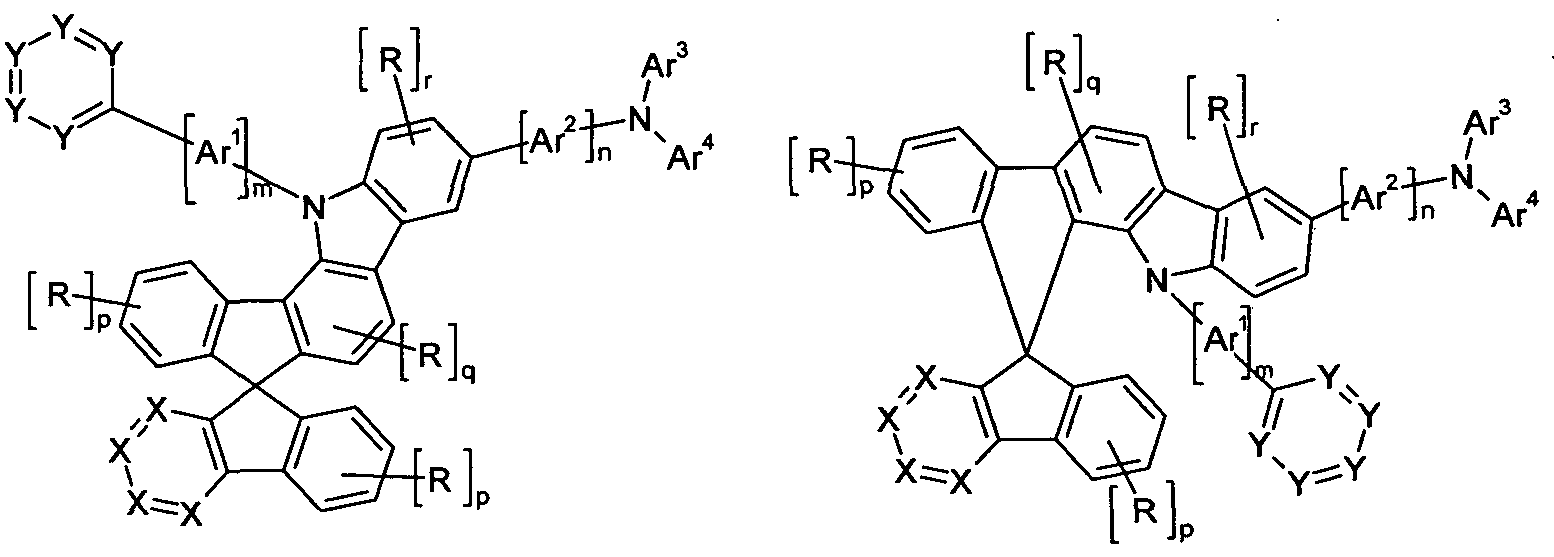
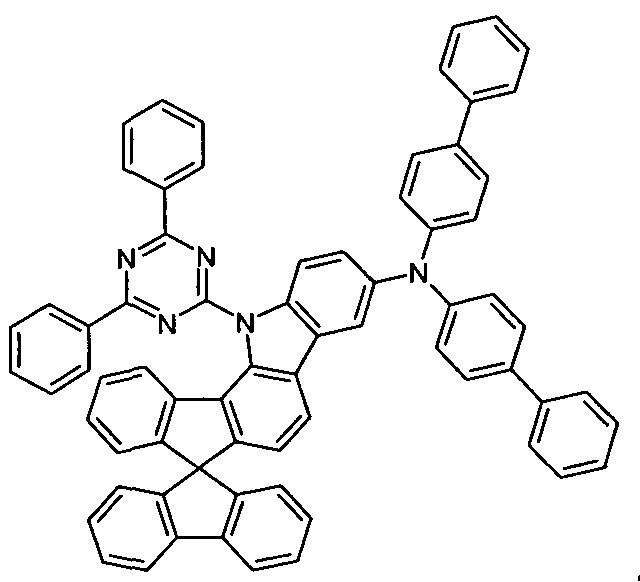
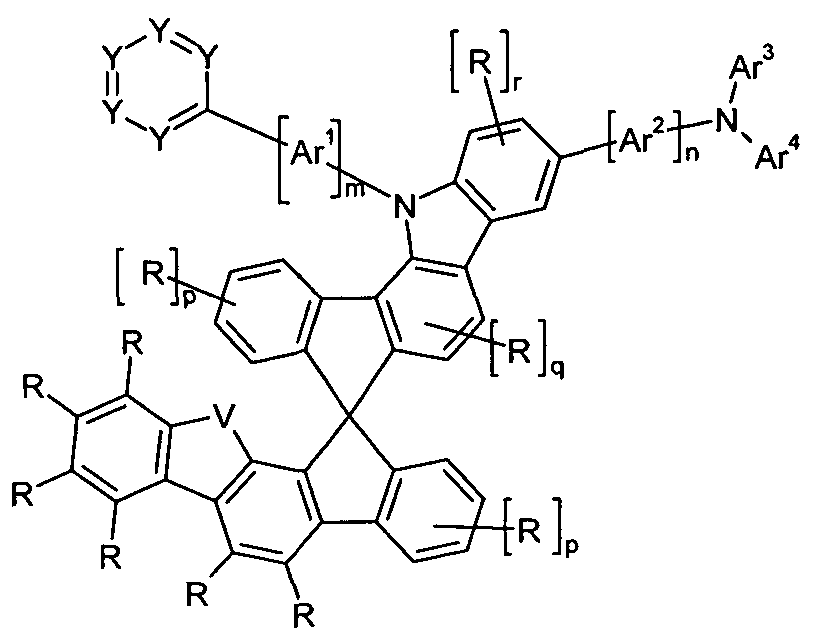
- the present invention relates to a compound according to formula (1) or formula (2)
- Formula (1) where for the symbols and indices used is the same or different CR or N at each occurrence, with the proviso that at least one Y is N; is the same or different CR or N at each occurrence, with a maximum of two groups X representing N; or two adjacent Xs stand for a group of the following formula (3) or (4) and the other Xs are identical or different for CR or N,
- An aryl group in the sense of this invention contains 6 to 60 C atoms;
- a heteroaryl group contains 2 to 60 C atoms and at least one heteroatom, with the proviso that the sum of C atoms and heteroatoms gives at least 5.
- the heteroatoms are preferably selected from N, O and / or S.
- the heteroaryl preferably contains a maximum of three heteroatoms, of which at most one is selected from O or S and the other heteroatoms are N.
- an aryl group or heteroaryl group is either a simple aromatic cycle, ie benzene, or a simple heteroaromatic cycle, for example pyridine, pyrimidine, thiophene, etc., or a fused (fused) aryl or heteroaryl group, for example naphthalene, anthracene, Phenanthrene, quinoline, isoquinoline, etc., understood.
- aromatics linked to one another by single bond such as, for example, biphenyl or bipyridine, are not described as aryl or heteroaryl radicals. group, but designated as aromatic or heteroaromatic ring system.
- An aromatic ring system in the sense of this invention contains 6 to 60 carbon atoms in the ring system.
- a heteroaromatic ring system in the sense of this invention contains 2 to 60 C atoms and at least one heteroatom in the ring system, with the proviso that the sum of C atoms and heteroatoms gives at least 5.
- the heteroatoms are preferably selected from N, O and / or S.
- the heteroaromatic ring system preferably contains per heteroaryl group, which is contained in the ring system, a maximum of three heteroatoms, of which at most one is selected from O or S and the other heteroatoms are N.
- an aromatic or heteroaromatic ring system is to be understood as meaning a system which does not necessarily contain only aryl or heteroaryl groups, but in which several aryl or heteroaryl groups are also bound by a nonaromatic moiety, such as.
- a C, N or O atom can be connected.
- systems such as fluorene, 9,9'-spirobifluorene, 9,9-diarylfluorene, triarylamine, diaryl ether, stilbene, etc. are to be understood as aromatic ring systems in the context of this invention, and also systems in which two or more aryl groups, for example are linked by a short alkyl group.
- an aliphatic hydrocarbon radical or an alkyl group or an alkenyl or alkynyl group which may contain 1 to 40 carbon atoms, and in which also individual hydrogen atoms or CH 2 groups are substituted by the abovementioned groups prefers the radicals methyl, ethyl, n-propyl, i-propyl, n-butyl, i-butyl, s-butyl, t-butyl, 2-methylbutyl, n-pentyl, s-pentyl, neo-pentyl, Cyclopentyl, n-hexyl, neo-hexyl, cyclohexyl, n-heptyl, cycloheptyl, n-octyl, cyclooctyl, 2-ethylhexyl, trifluoromethyl, pentafluoroethyl, 2,2,2-
- alkoxy group having 1 to 40 carbon atoms preference is given to methoxy, trifluoromethoxy, ethoxy, n-propoxy, i-propoxy, n-butoxy, i-butoxy, s-butoxy, t-butoxy, n-pentoxy, s-pentoxy, 2-methylbutoxy, n-hexoxy, cyclohexyloxy, n-heptoxy, cycloheptyloxy, n-octyloxy, cyclooctyl oxy, 2-ethylhexyloxy, pentafluoroethoxy and 2,2,2-trifluoroethoxy understood.
- a thioalkyl group having 1 to 40 carbon atoms methylthio, ethylthio, n-propylthio, i-propylthio, n-butylthio,
- alkyl, alkoxy or thioalkyl groups may be straight-chained, branched or cyclic, wherein one or more non-adjacent Chb groups may be replaced by the above-mentioned groups;
- one or more H atoms can also be replaced by D, F, Cl, Br, I, CN or NO 2, preferably F, Cl or CN, more preferably F or CN, particularly preferably CN.
- aromatic or heteroaromatic ring system having 5-60 aromatic ring atoms, which may be substituted in each case with the abovementioned radicals R 2 or a hydrocarbon radical and which may be linked via any position on the aromatic or heteroaromatic, are understood in particular groups derived are benzene, naphthalene, anthracene, benzanthracene,
- Phenoxazine pyrazole, indazole, imidazole, benzimidazole, naphthimidazole, phenanthrimidazole, pyridimidazole, pyrazine imidazole, quinoxaline imidazole, Oxazole, benzoxazole, naphthoxazole, anthroxazole, phenanthroxazole,
- adjacent radicals or adjacent substituents are to be understood as meaning substituents which are bonded to carbon atoms, which in turn are bonded directly to one another, or substituents which are attached to the same C, Si, N, P or B Atom are bound.
- X is the same or different at each occurrence as CR or N, with at most one group X per cycle being N; or two adjacent groups X represent a group of formula (3), wherein Z is the same or different at each occurrence as CR and V is NR, C (R) 2, O or S, preferably NR or C (R) 2 , stands, and the remaining Xs stand for CR. More preferably, X is the same or different at each occurrence for CR.
- Preferred embodiments of the compounds according to formula (1) are the compounds of the following formulas (5), (6) and (7), and preferred embodiments of the compounds of formula (2) are the compounds of the following formulas (8), (9) and (10)
- q is preferably 0 or 1, particularly preferably equal to 0.
- r is preferably 0 or 1, particularly preferably 0.
- Preferred embodiments of the structures of the formulas (5) to (10) are the structures of the formulas (5a) to (10a)
- Particularly preferred embodiments of the structures according to the formulas (5) to (10) are the structures of the formulas (5b) to (10b), where the symbols and indices used are those mentioned above
- R is the same or different at each occurrence selected from the group consisting of H, NiAr 5 ⁇ , a straight-chain alkyl group having 1 to 6 carbon atoms, in particular having 1 to 4 carbon atoms, or a branched or cyclic alkyl group with 3 to 8 C atoms, in particular having 3 to 6 C atoms, each of which may be substituted by one or more radicals R 1 , but is preferably unsubstituted, or an aromatic or heteroaromatic ring system having 5 to 24 aromatic ring atoms, each with a or a plurality of R 1 may be substituted.
- R is an aromatic or heteroaromatic ring system
- R is the same or different each occurrence selected from the same groups as given below as suitable groups for Ar 1 to Ar 4 .
- the alkyl groups preferably have not more than five carbon atoms, more preferably not more than 4 carbon atoms, most preferably not more than 1 carbon atom.
- the compounds according to formulas (1) and (2) contain a six-membered heteroaryl group of the following formula
- group (Het-Ar) at least one group Y stands for N.
- one, two or three symbols Y stand for N and the remaining symbols Y stand for CR.
- Preferred embodiments are the groups of the following formulas (Het-Ar-1) to (Het-Ar-10),
- Het-Ar-1 Het-Ar-2) (Het-Ar-3) (Het-Ar-4)
- R is preferably identical or different at each occurrence for H, D or an aromatic or heteroaromatic ring system having 5 to 24 aromatic ring atoms, which by one or more radicals R 1 may be substituted, in particular especially for H or for phenyl, biphenyl, in particular ortho, meta or para biphenyl, terphenyl, in particular ortho, meta, para or branched terphenyl, quaterphenyl, in particular ortho, meta, para or branched quaterphenyl, Fluorenyl, in particular 1-, 2-, 3- or 4-fluorenyl, spirobifluorenyl, in particular 1-, 2-, 3- or 4-spirobifluorenyl, dibenzofuranyl, in particular 1-, 2-, 3- or 4-dibenzofuranyl or carbo- zolyl, in particular 1-, 2-, 3- or 4-carbazolyl, which may each be substituted by one or more radicals R 1 may be substituted, in particular especially for H or for phenyl
- the substituents R are preferably an aromatic or heteroaromatic ring system having 5 to 24 aromatic ring atoms, which may be substituted by one or more radicals R 1 , in particular Phenyl, biphenyl, in particular ortho, meta or para biphenyl, terphenyl, in particular ortho, meta, para or branched terphenyl, quaterphenyl,
- Fluorenyl in particular 1-, 2-, 3- or 4-fluorenyl, spirobifluorenyl, in particular 1-, 2-, 3- or 4-spirobifluorenyl, dibenzofuranyl, in particular 1-, 2-, 3- or 4-dibenzofuran or carbazolyl, in particular 1-, 2-, 3- or 4-carbazole, which may each be substituted by one or more radicals R 1 , but are preferably unsubstituted.
- Ar 1 is an aromatic or heteroaromatic ring system having 5 to 24 aromatic ring atoms, preferably an aromatic ring system having 6 to 24 aromatic ring atoms, more preferably having 6 to 12 aromatic ring atoms, each by a or more radicals R may be substituted.
- Suitable groups Ar 1 are selected from phenylene, in particular ortho, meta or para-phenylene, biphenyl, in particular ortho, meta or para-biphenyl, terphenyl, in particular ortho, meta, para or branched terphenyl, quaterphenyl, in particular ortho, meta, para or branched quaterphenyl, fluorene, in particular 2,7-linked fluorene, spirobifluorene, in particular 2,7- or 2,2'- or 4,4'-linked spirobifluorene, naphthalene, in particular 1, 4- or 2,6-linked naphthalene, indole, benzofuran, benzothiophene, Carbazole, in particular 2,7- or 3,6-linked carbazole, dibenzofuran, dibenzothiophene, indenocarbazole, indolocarbazole, pyridine,
- Ar 1 particularly preferably represents an aromatic ring system selected from the group consisting of phenylene, in particular ortho, meta or para-phenylene, biphenyl, in particular ortho, meta or para biphenyl or terphenyl, in particular ortho, meta , para- or branched terphenyl.
- the group (Het-Ar) is attached to Ar 1 at any point.
- n 0, and the group Ar 1 is absent.
- the aromatic groups in the group Ar 1 are not para-linked, ie it is preferably not para-phenylene, para-biphenyl, para-terphenyl or para-quaterphenyl, but for example to the respective ortho or meta-linked structures.
- the compounds of the formula (1) and (2) in para-position to the nitrogen atom of the spirocarbazole unit contain a group of the formula
- the linking of Ar 2 and Ar 3 with each other or of Ar 3 and Ar 4 is carried out in each case ortho to the position of the linkage with the nitrogen atom.
- n 1, and Ar 2 and Ar 3 are bonded together by a single bond.
- Ar 2 is preferably an aromatic or heteroaromatic ring system having 6 to 24 aromatic ring atoms, preferably having 6 to 12 aromatic ring atoms, each of which may be substituted by one or more radicals R.
- Ar 2 is particularly preferably selected from among
- Ar 2 is an unsubstituted phenylene group. This is especially true when Ar 2 is connected to Ar 3 through a single bond.
- Ar 3 and Ar 4 are preferably identical or different at each occurrence, an aromatic or heteroaromatic ring system having 6 to 24 aromatic ring atoms, each of which may be substituted by one or more R radicals.
- Particularly preferred groups Ar 3 or Ar 4 are identical or different at each occurrence selected from the group consisting of phenyl, biphenyl, in particular ortho, meta or para biphenyl, terphenyl, in particular ortho, meta, para or branched terphenyl, Quaterphenyl, in particular ortho, meta, para or branched quaterphenyl, fluorenyl, in particular 1-, 2-, 3- or 4-fluorenyl, spirobifluorenyl, in particular 1-, 2-, 3- or 4-spirobifluorenyl, naphthyl, in particular 1- or 2-naphthyl, indolyl, benzofuranyl, benzothiophenyl, carbazolyl, in particular 1-, 2-, 3- or 4-carbazoly
- Pyrimidinyl in particular 2-, 4- or 5-pyrimidinyl, pyrazinyl, pyridazinyl, triazinyl, phenanthrenyl, triphenylenyl or combinations of two, three or four of these groups, which may each be substituted by one or more radicals R.
- Ar 3 and Ar 4 are the same or different each occurrence of an aromatic ring system having 6 to 24 aromatic ring atoms, which may be substituted by one or more radicals R, in particular selected from
- Particularly preferred groups of the formula are the groups of the following formula (CARB),
- CARB where Ar 3 and Ar 4 have the abovementioned meanings and in particular the abovementioned preferred meanings, and the dashed bond the binding of the group (CARB) to the spirocarbazole basic skeleton in formula (1) or formula (2) represents.
- CARB Preferred embodiments of the formula (CARB) are the groups of the following formulas (CARB-1) to (CARB-5),
- CARB-1) CARB-2) (CARB-3)
- Ar 4 has the abovementioned meanings and the structures may be substituted by one or more radicals R.
- the radicals R explicitly depicted in formula (CARB-2) and (CARB-4) are preferably selected from alkyl groups having 1 to 4 C atoms or aromatic ring systems having 6 to 12 aromatic ring atoms, in particular methyl.
- the compounds of the formula (1) or (2) or the preferred embodiments are used as a matrix material for a phosphorescent emitter or in a layer directly adjacent to a phosphorescent layer, it is further preferred that the triplet energy of the compounds be the same is higher or higher than that of the phosphorescent emitter.
- radicals R, R 1 and Ar 1 to Ar 4 contain no condensed aryl or heteroaryl groups in which two or more six-membered rings are directly fused together.
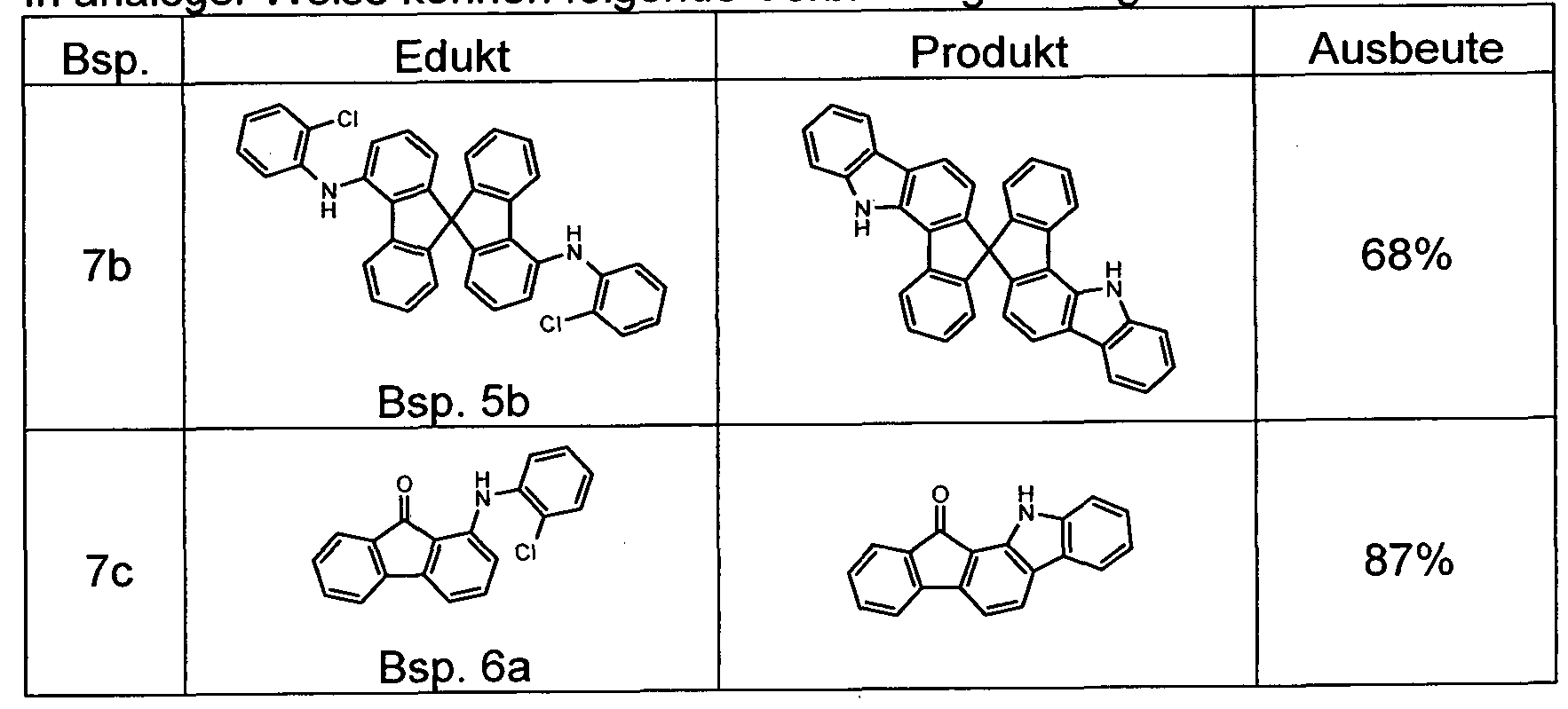
- the synthesis of the compounds of the formula (1) is usually carried out starting from the compounds known from the literature 4-bromo-9,9'-spirobifluorene (Org. Lett. 2009, 11, 2607) or 4,4'-dibromo-9, 9'-spirobifluorene (Org. Lett. 2010, 12, 5648) or correspondingly substituted derivatives. These are reacted in a C-N coupling reaction, for example under Pd or Cu catalysis, with an ortho-haloaminobenzene, wherein the halogen is preferably Cl, Br or I. Subsequent ring closure by an intramolecular Pd-catalyzed coupling reaction leads to compounds of the formula (1).
- the synthesis of the compounds of the formula (2) is usually carried out starting from the compound known in the literature 1-iodo-9-fluorenone (Tetrahedron Lett. 2002, 43, 8347) or correspondingly substituted derivatives. This is reacted in a CN coupling reaction, for example under Pd or Cu catalysis, with an ortho-haloaminobenzene, wherein the halogen is preferably Cl, Br or I. Subsequent ring closure by an intramolecular Pd-catalyzed coupling reaction leads to the indolo- carbazole derivative. In the last step, a ring closure reaction to the spirobifluorene derivative is carried out by reaction with a biphenyl derivative lithiated in the 2-position and finally acid cyclization.
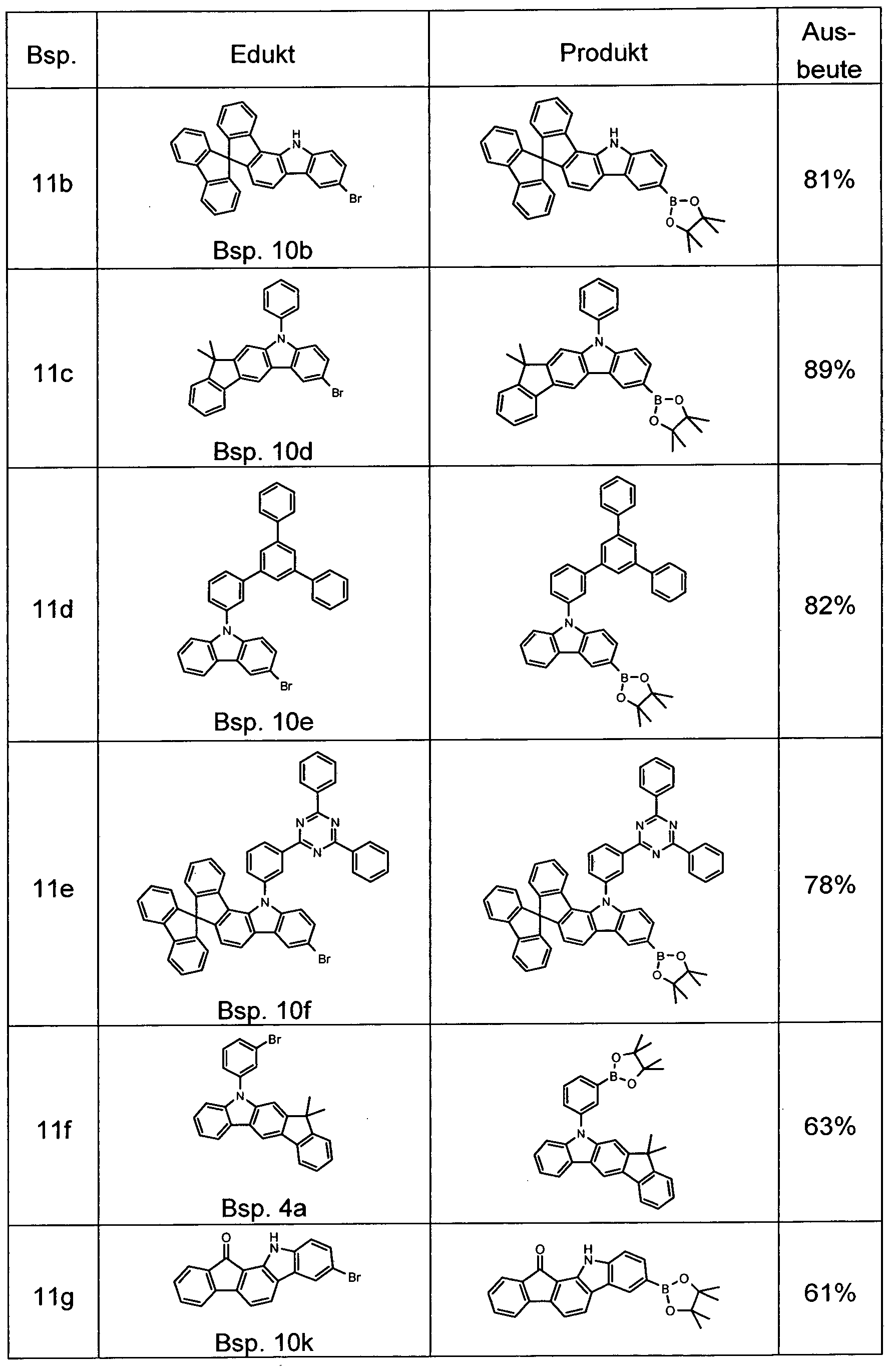
- the further derivatization can be effected by bromination of the carbazole derivatives, for example by reaction with A / bromosuccinimide or elemental bromine.
- formulations of the compounds according to the invention are required. These formulations may be, for example, solutions, dispersions or emulsions. It may be preferable to use mixtures of two or more solvents for this purpose.
- Suitable and preferred solvents are, for example, toluene, anisole, o-, m- or p-xylene, methyl benzoate, mesitylene, tetralin, veratrol, THF, methyl THF, THP, chlorobenzene, dioxane, phenoxytoluene, in particular 3-phenoxytoluene, ( -) - fenchone, 1, 2,3,5-tetramethylbenzene, 1, 2,4,5-tetramethylbenzene, 1-methylnaphthalene, 2-methylbenzothiazole, 2-phenoxyethanol, 2-pyrrolidinone, 3-methylanisole, 4-methylanisole, 3 , 4-dimethylanisole, 3,5-dimethylanisole, acetophenone, ⁇ -terpineol, benzothiazole, butylbenzoate, cumene, cyclohexanol, cyclohexanone, cyclohexylbenzene, decal
- a further subject of the present invention is therefore a formulation containing a compound according to the invention and at least one further compound.
- the further compound may be for example a solvent, in particular one of the abovementioned solvents or a mixture of these solvents.
- the further compound may also be at least one further organic or inorganic compound, which is also used in the electronic device, for example, an emitting compound and / or another matrix material. Suitable emissive compounds and other matrix materials are listed in the background in the context of the organic electroluminescent device.
- This further compound may also be polymeric.
- the compounds according to the invention are suitable for use in an electronic device, in particular in an organic electroluminescent device.
- Another object of the present invention is therefore the
- Yet another object of the present invention is an electronic device containing at least one compound of the invention.
- An electronic device in the sense of the present invention is a device which contains at least one layer which contains at least one organic compound.
- the component may also contain inorganic materials or layers which are completely composed of inorganic materials.
- the electronic device is preferably selected from the group consisting of organic electroluminescent devices (OLEDs), organic integrated circuits (O-ICs), organic field effect transistors (O-FETs), organic thin-film transistors (O-TFTs), organic light-emitting transistors ( O-LETs), organic solar cells (O-SCs), dye-sensitized organic solar cells (DSSCs), organic optical detectors, organic photoreceptors, organic field quench devices (O-FQDs), light-emitting electrochemical cells (LECs), organic laser diodes (O Laser) and "organic plasmon emitting devices", but preferably organic Lumineszenzvorettiffle devise (OLEDs), particularly preferably phosphorescent OLEDs.
- OLEDs organic electroluminescent devices
- O-ICs organic integrated circuits
- O-FETs organic field effect transistors
- OF-TFTs organic thin-film transistors
- O-LETs organic light-emitting transistors
- O-SCs organic solar cells
- the organic electroluminescent device includes cathode, anode and at least one emitting layer. In addition to these layers, they may also contain further layers, for example one or more hole injection layers, hole transport layers, hole blocking layers, electron transport layers, electron injection layers, exciton blocking layers, electron blocking layers and / or
- interlayer may be introduced between two emitting layers which, for example, have an exciton-blocking function. It should be noted, however, that not necessarily each of these layers must be present.
- the organic electroluminescent device may contain an emitting layer, or it may contain a plurality of emitting layers. If multiple emission layers are present, they preferably have a total of several emission maxima between 380 nm and 750 nm, so that overall white emission results, ie. H.
- various emitting compounds are used which can fluoresce or phosphoresce.
- the organic electroluminescent device according to the invention may also be a tandem OLED, in particular also for white-emitting OLEDs.
- the compound of the invention according to the embodiments listed above can be used in different layers, depending on the exact structure.
- Preferred is an organic electroluminescent device comprising a compound according to formula (1) or the preferred embodiments set out above as matrix material for phosphorescent emitters in an emitting layer.
- the organic electroluminescent device may contain an emitting layer, or it may comprise a plurality of emitting layers. hold, wherein at least one emitting layer contains at least one compound of the invention as a matrix material.
- the compound according to the invention is used as the matrix material for a phosphorescent compound in an emitting layer, it is preferably used in combination with one or more phosphorescent materials (triplet emitters).
- phosphorescence is understood as meaning the luminescence from an excited state with a higher spin multiplicity, ie a spin state> 1, in particular from an excited triplet state.
- all luminescent complexes with transition metals or lanthanides, in particular all iridium, platinum and copper complexes are to be regarded as phosphorescent compounds.
- the mixture of the compound according to the invention and the emissive compound contains between 99 and 1% by weight, preferably between 98 and 10% by weight, more preferably between 97 and 60% by weight, in particular between 95 and 80% by weight the compound of the invention based on the total mixture of emitter and matrix material. Accordingly, the mixture contains between 1 and 99 wt .-%, preferably between 2 and 90 wt .-%, more preferably between 3 and 40 wt .-%, in particular between 5 and 30 wt .-% of the emitter based on the total mixture of Emitter and matrix material.
- a further preferred embodiment of the present invention is the use of the compound according to the invention as a matrix material for a phosphorescent emitter in combination with a further matrix material. If the compound according to the invention is used in combination with another matrix material, its proportion is preferably from 20 to 50% by weight, based on the total mixture.
- Suitable matrix materials which can be used in combination with the compounds according to the invention are aromatic ketones, aromatic phosphine oxides or aromatic sulfoxides or sulfones, eg. B. according to WO 2004/013080, WO 2004/093207, WO 2006/005627 or WO 2010/006680, triarylamines, carbazole derivatives, z. B. CBP ( ⁇ , ⁇ -biscarbazolylbiphenyl) or in WO 2005/039246, US
- azaborboole or Boronester z. B. according to WO 2006/117052, triazine derivatives, z.
- a further phosphorescent emitter which emits shorter wavelength than the actual emitter may be present as a co-host in the mixture or a compound which does not or does not participate in a significant extent in the charge transport, such as in WO
- co-matrix material in combination with the compound according to the invention as a co-matrix material are compounds which have a large band gap and do not participate themselves or at least not to a significant extent in the charge transport of the emitting layer.
- Such materials are preferably pure hydrocarbons. Examples of such materials can be found, for example, in WO 2009/124627 or in WO 2010/006680.
- Suitable phosphorescent compounds are, in particular, compounds which emit light, preferably in the visible range, with suitable excitation and also contain at least one atom of atomic number greater than 20, preferably greater than 38 and less than 84, particularly preferably greater than 56 and less than 80, in particular Metal with this atomic number.
- Preferred phosphorescence emitters are compounds comprising copper, molybdenum, tungsten, rhenium,
- the compounds of the invention are also particularly suitable as matrix materials for phosphorescent emitters in organic electroluminescent devices, as z.
- an additional blue emission layer is vapor-deposited over all pixels, even those with a different color from blue. It has surprisingly been found that the compounds according to the invention, when used as matrix materials for the red and / or green pixels, together with the deposited blue emission layer, continue to lead to very good emission.
- the organic electroluminescent device according to the invention does not contain a separate hole injection layer and / or hole transport layer and / or hole blocking layer and / or electron transport layer, ie the emissive layer directly adjoins the hole injection layer or the anode, and / or the emissive layer directly adjoins the electron transport layer or the electron injection layer or the cathode, such as for example in WO 2005/053051.
- a metal complex which is the same or similar to the metal complex in the emitting layer, directly adjacent to the emitting layer as a hole-transporting or hole-injection material, such as.
- WO 2010/053051 hole-transporting or hole-injection material
- an organic electroluminescent device characterized in that one or more layers are applied by a sublimation method.
- the materials in vacuum sublimation systems become smaller at an initial pressure
- an organic electroluminescent device characterized in that one or more layers are applied with the OVPD (Organic Vapor Phase Deposition) method or with the aid of a carrier gas sublimation. The materials are applied at a pressure between 10 "applied 5 mbar and 1 bar.
- OVPD Organic Vapor Phase Deposition
- a special case of this method is the OVJP (organic vapor jet printing) method in which the materials are applied directly through a nozzle and patterned (eg. BMS Arnold et al., Appl. Phys. Lett., 2008, 92, 053301).
- an organic electroluminescent device characterized in that one or more layers of solution, such. B. by spin coating, or with any printing process, such.
- hybrid processes are possible in which, for example, one or more layers are applied from solution and one or more further layers are vapor-deposited.
- the compounds of the invention used as a matrix material for phosphorescent emitters, lead to long lifetimes.
- the compounds of the invention lead to high efficiencies.
- the compounds of the invention When processed from solution, the compounds of the invention have very good film-forming properties, characterized by good solubility and high glass transition temperatures. These advantages mentioned above are not accompanied by a deterioration of the other electronic properties.
- Edukten specified numbers are the appropriate CAS numbers.
- Example 1a Synthesis of A / - (9,9-dimethylfluoren-2-yl) -4-aminobiphenyl
- the reaction mixture is expanded with 300 ml of toluene and 1200 ml of water.
- the organic phase is separated, washed three times with 250 ml of water and dried over sodium sulfate.
- the solvent is removed on a rotary evaporator.
- the remaining oil is mixed with 50 ml of ethyl acetate and slowly in 800 ml of a heptane / ethyl acetate mixture (20: 1).
- the solid formed is filtered off, washed twice with about 50 ml of heptane and dried in vacuo. There remain 29.2 g (80 mmol, 69% of theory) of the product with a purity of 99% by HPLC.
- Example 2a Synthesis of V- (biphenyl-2-yl) - / V- (biphenyl-4-yl) -4- (4,4,5,5-tetramethyl- [1,3,2] dioxaborolan-2-one -yl) -phenylamine
- Example 4a Synthesis of 10- (3-bromophenyl) -12,12-dimethyl-10,12-
- Example 8a Synthesis of / V-phenyl-spiro [9H-fluorene-9,7 '(1'H) -
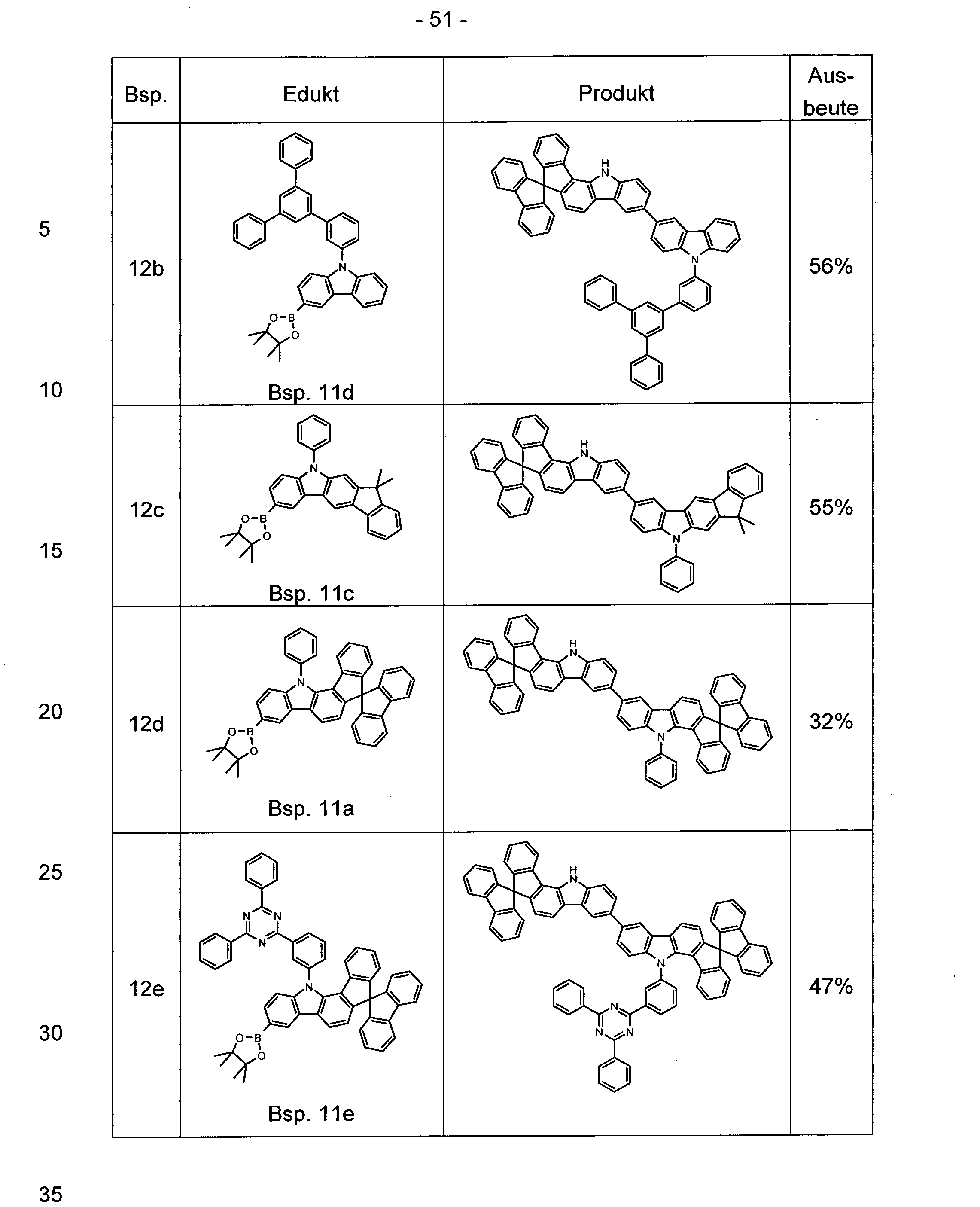
- Example 12a Synthesis of spiro [9H-fluorene-6 '- (/ V-phenylcarbazole-3-one]
- the residue is slurried with 150 ml of heptane and the resulting solid is filtered off with suction, which is hot-extracted with about 250 ml of cyclohexane over alumina (basic, activity level 1), if appropriate, the extraction solution is added by about one Dri reduced.
- the formed solid is sucked off, and after
- starting material product For example, starting material product
- Example 13a Synthesis of 12 '- [3- (4,6-diphenyl-1-1,3,5-triazin-2-yl) phenyl] -3' - (9-phenylcarbazol-3-yl) spiro [fluorene -9,7'-indeno [1,2-a] carbazole]
- the product is purified by column chromatography on silica gel with a toluene / heptane solvent mixture (2: 1). After drying in vacuo, 10.8 g (12 mmol, 36% of theory) of the product remain as a pale yellow solid with a purity of 99.8% by HPLC.
- Example 14a Synthesis of 12 '- (4,6-diphenyl-1-1,3,5-triazin-2-yl) -3' - (9-phenylcarbazol-3-yl) spiro [fluoren-9,7'- indeno [1,2-a] carbazole]
- the remaining residue is hot extracted with toluene over alumina (basic, activity level 1); the resulting suspension is freed from the solvent on a rotary evaporator and the remaining residue is purified by column chromatography on silica gel with a heptane / THF solvent mixture (4: 1). After removal of the solvents on a rotary evaporator and annealing of the residue at 180 ° C and a pressure of about 10 ⁇ 5 mbar for 5 h remain 31.5 g (33 mmol, 31% of theory) of the product as a colorless solid with a purity of 99.9% after HPLC.
- the comparative examples AV2 and AV4 can be determined according to DE
- the comparative example AV6 can according to the in WO 2011/132683
- the materials according to the invention can be processed from solution
- the comparative materials 12m and 14o can not be dissolved in a concentration of 5 mg / ml in toluene, while this is easily possible with the materials 14a, 14g, 13b and 14e according to the invention (Table 1).
- the higher glass transition temperature of the matrix materials according to the invention allows the annealing at higher temperatures and thus provides a larger processing window than the comparison materials 12m and 14o.
- Emission layer of solution and in the subsequent layers was carried out from the vacuum.
- the general methods described above are adapted and combined as follows to the conditions described here (layer thickness variation, materials) and combined:
- the structure is as follows:
- HTL hole transport layer
- Emission layer (60 nm)
- HBL hole blocking layer
- Electron transport layer (ETL) (40 nm)
- the substrate used is glass flakes coated with structured ITO (indium tin oxide) 50 nm thick.
- structured ITO indium tin oxide
- PEDOTPSS poly (3,4-ethylenedioxy-2,5-thiophene): polystyrene sulfonate, obtained from Heraeus Precious Metals GmbH & Co. KG, Germany.
- PEDOTPSS is spun in air from water and subsequently heated in air at 180 ° C for 10 minutes to remove residual water.
- the interlayer and the emission layer are applied to these coated glass slides.
- the hole transport layer used is crosslinkable.
- a polymer of the structure shown below is used, which according to WO2010 / 097 55
- the hole transport polymer is dissolved in toluene.
- the typical solids content of such solutions is about 5 g / l, if, as here, the typical for a device layer thickness of 20 nm is to be achieved by spin coating.
- the layers are spin-coated in an inert gas atmosphere, in this case argon, and baked at 180 ° C. for 60 minutes.
- the emission layer is always composed of at least one matrix material (host material, host material) and an emitting dopant (dopant, emitter). Furthermore, mixtures of several matrix materials and co-dopants can occur.
- the mixture for the emission layer is dissolved in toluene or optionally chlorobenzene.
- the typical solids content of such Solutions is about 18 g / l, if, as here, the typical for a device layer thickness of 60 nm is to be achieved by spin coating.
- the layers are spin-coated in an inert gas atmosphere, in the present case argon, and baked at 160 ° C. for 10 minutes.
- Matrix materials used are listed in Table 2 - these are both compounds of the invention as well as to
- the materials for the hole blocking layer and electron transport layer are thermally evaporated in a vacuum chamber. It can be z.
- the electron transport layer consist of more than one material, which are admixed by co-evaporation in a certain volume fraction.
- An indication such as ETM1: ETM2 (50%: 50%) here means that the materials ETM1 and ETM2 are present in a volume fraction of 50% each in the layer.
- the materials used in the present case are shown in Table 4.
- the cathode is formed by the thermal vapor deposition of a 100 nm thick aluminum layer.
- the OLEDs are characterized by default.
- the electroluminescence spectra, current-voltage luminance characteristics (IUL characteristics) are determined assuming Lambert's emission characteristic and the (operating) life. Key figures are determined from the IUL characteristics such as the operating voltage U (in V) and the external quantum efficiency (in%) at a specific brightness.
- LD80 @ 8000 cd / m 2 is the lifetime until the OLED has dropped to 80% of the initial intensity, ie to 6400 cd / m 2 , at a starting brightness of 8000 cd / m 2 .
- ETM-1 was used as HBL and ⁇ 1 ⁇ 2 (50%: 50%) as ETL.
- Table 5 Results of solution-processed OLEDs with EML blends
- ETM-1 is used as HBL and ⁇ 1 ⁇ 2 (50%: 50%) as ETL.
- the OLEDs have in principle the following layer structure: substrate / hole transport layer (HTL) / optional intermediate layer (IL) / electron blocking layer (EBL) / emission layer (EML) / optional hole blocking layer (HBL) / electron transport layer (ETL) and finally a cathode.
- the cathode is formed by a 100 nm thick aluminum layer.
- the exact structure of the OLEDs and the resulting results are shown in Table 8.
- the auxiliary materials needed to make the OLEDs are shown in Table 7; Inventive materials and comparative materials are shown in Table 2.
Landscapes
- Chemical & Material Sciences (AREA)
- Organic Chemistry (AREA)
- Physics & Mathematics (AREA)
- Spectroscopy & Molecular Physics (AREA)
- Engineering & Computer Science (AREA)
- Materials Engineering (AREA)
- Optics & Photonics (AREA)
- Electroluminescent Light Sources (AREA)
- Plural Heterocyclic Compounds (AREA)
- Nitrogen Condensed Heterocyclic Rings (AREA)
- Indole Compounds (AREA)
- Heterocyclic Carbon Compounds Containing A Hetero Ring Having Oxygen Or Sulfur (AREA)
Abstract
Description







Claims





Priority Applications (5)
| Application Number | Priority Date | Filing Date | Title |
|---|---|---|---|
| CN201580032138.2A CN106488917B (zh) | 2014-06-18 | 2015-05-22 | 用于有机电致发光器件的材料 |
| KR1020177001415A KR102402729B1 (ko) | 2014-06-18 | 2015-05-22 | 유기 전계발광 소자용 재료 |
| EP15725232.1A EP3158597B1 (de) | 2014-06-18 | 2015-05-22 | Materialien für organische elektrolumineszenzvorrichtungen |
| US15/319,506 US11107994B2 (en) | 2014-06-18 | 2015-05-22 | Materials for organic electroluminescent devices |
| JP2016574103A JP6556761B2 (ja) | 2014-06-18 | 2015-05-22 | 有機エレクトロルミネッセント素子のための材料 |
Applications Claiming Priority (2)
| Application Number | Priority Date | Filing Date | Title |
|---|---|---|---|
| EP14002104 | 2014-06-18 | ||
| EP14002104.9 | 2014-06-18 |
Publications (1)
| Publication Number | Publication Date |
|---|---|
| WO2015192939A1 true WO2015192939A1 (de) | 2015-12-23 |
Family
ID=50979497
Family Applications (1)
| Application Number | Title | Priority Date | Filing Date |
|---|---|---|---|
| PCT/EP2015/001059 Ceased WO2015192939A1 (de) | 2014-06-18 | 2015-05-22 | Materialien für organische elektrolumineszenzvorrichtungen |
Country Status (7)
| Country | Link |
|---|---|
| US (1) | US11107994B2 (de) |
| EP (1) | EP3158597B1 (de) |
| JP (1) | JP6556761B2 (de) |
| KR (1) | KR102402729B1 (de) |
| CN (1) | CN106488917B (de) |
| TW (1) | TWI654185B (de) |
| WO (1) | WO2015192939A1 (de) |
Cited By (42)
| Publication number | Priority date | Publication date | Assignee | Title |
|---|---|---|---|---|
| WO2016129691A1 (ja) * | 2015-02-13 | 2016-08-18 | 出光興産株式会社 | 化合物、組成物、有機エレクトロルミネッセンス素子、および電子機器 |
| CN106749289A (zh) * | 2016-11-24 | 2017-05-31 | 上海道亦化工科技有限公司 | 一种具有螺结构的有机电致发光化合物及其发光器件 |
| JP2017114858A (ja) * | 2015-12-22 | 2017-06-29 | 三星電子株式会社Samsung Electronics Co.,Ltd. | 化合物、有機エレクトロルミネッセンス素子材料、有機エレクトロルミネッセンス素子製造用組成物および有機エレクトロルミネッセンス素子 |
| WO2017148565A1 (de) | 2016-03-03 | 2017-09-08 | Merck Patent Gmbh | Materialien für organische elektrolumineszenzvorrichtungen |
| WO2018050584A1 (de) | 2016-09-14 | 2018-03-22 | Merck Patent Gmbh | Verbindungen mit spirobifluoren-strukturen |
| WO2018050583A1 (de) | 2016-09-14 | 2018-03-22 | Merck Patent Gmbh | Verbindungen mit carbazol-strukturen |
| WO2018061421A1 (ja) * | 2016-09-28 | 2018-04-05 | 住友化学株式会社 | 組成物及び発光素子 |
| JP2018078295A (ja) * | 2017-11-21 | 2018-05-17 | 住友化学株式会社 | 発光素子および該発光素子に用いる組成物 |
| WO2018099846A1 (de) | 2016-11-30 | 2018-06-07 | Merck Patent Gmbh | Verbindungen mit valerolaktam-strukturen |
| WO2018104195A1 (de) | 2016-12-05 | 2018-06-14 | Merck Patent Gmbh | Stickstoffhaltige heterocyclen zur verwendung in oleds |
| WO2018138039A1 (de) | 2017-01-25 | 2018-08-02 | Merck Patent Gmbh | Carbazolderivate |
| WO2018166932A1 (de) | 2017-03-13 | 2018-09-20 | Merck Patent Gmbh | Verbindungen mit arylamin-strukturen |
| WO2018215318A1 (de) | 2017-05-22 | 2018-11-29 | Merck Patent Gmbh | Hexazyklische heteroaromatische verbindungen für elektronische vorrichtungen |
| WO2019052933A1 (de) | 2017-09-12 | 2019-03-21 | Merck Patent Gmbh | Materialien für organische elektrolumineszenzvorrichtungen |
| JP2019508427A (ja) * | 2016-03-14 | 2019-03-28 | エルジー・ケム・リミテッド | ヘテロ環化合物およびこれを含む有機発光素子 |
| JP2019523244A (ja) * | 2016-07-06 | 2019-08-22 | ヒソン・マテリアル・リミテッドHeesung Material Ltd. | ヘテロ環化合物およびこれを用いた有機発光素子 |
| WO2020053315A1 (de) | 2018-09-12 | 2020-03-19 | Merck Patent Gmbh | Elektrolumineszierende vorrichtungen |
| WO2020053314A1 (de) | 2018-09-12 | 2020-03-19 | Merck Patent Gmbh | Elektrolumineszierende vorrichtungen |
| WO2020064662A2 (de) | 2018-09-27 | 2020-04-02 | Merck Patent Gmbh | Verfahren zur herstellung von sterisch gehinderten stickstoffhaltigen heteroaromatischen verbindungen |
| WO2020064666A1 (de) | 2018-09-27 | 2020-04-02 | Merck Patent Gmbh | Verbindungen, die in einer organischen elektronischen vorrichtung als aktive verbindungen einsetzbar sind |
| WO2020094539A1 (de) | 2018-11-05 | 2020-05-14 | Merck Patent Gmbh | In einer organischen elektronischen vorrichtung einsetzbare verbindungen |
| WO2020099349A1 (de) | 2018-11-14 | 2020-05-22 | Merck Patent Gmbh | Zur herstellung einer organischen elektronischen vorrichtung einsetzbare verbindungen |
| US10722495B2 (en) | 2017-09-08 | 2020-07-28 | Incyte Corporation | Cyanoindazole compounds and uses thereof |
| US10745388B2 (en) | 2018-02-20 | 2020-08-18 | Incyte Corporation | Indazole compounds and uses thereof |
| US10752635B2 (en) | 2018-02-20 | 2020-08-25 | Incyte Corporation | Indazole compounds and uses thereof |
| US10800761B2 (en) | 2018-02-20 | 2020-10-13 | Incyte Corporation | Carboxamide compounds and uses thereof |
| US10899755B2 (en) | 2018-08-08 | 2021-01-26 | Incyte Corporation | Benzothiazole compounds and uses thereof |
| US10934288B2 (en) | 2016-09-09 | 2021-03-02 | Incyte Corporation | Pyrazolopyridine compounds and uses thereof |
| WO2021078831A1 (de) | 2019-10-25 | 2021-04-29 | Merck Patent Gmbh | In einer organischen elektronischen vorrichtung einsetzbare verbindungen |
| US11014929B2 (en) | 2016-09-09 | 2021-05-25 | Incyte Corporation | Pyrazolopyrimidine compounds and uses thereof |
| US11066394B2 (en) | 2019-08-06 | 2021-07-20 | Incyte Corporation | Solid forms of an HPK1 inhibitor |
| CN113195500A (zh) * | 2018-11-15 | 2021-07-30 | 默克专利有限公司 | 用于有机电致发光器件的材料 |
| WO2021170522A1 (de) | 2020-02-25 | 2021-09-02 | Merck Patent Gmbh | Verwendung von heterocyclischen verbindungen in einer organischen elektronischen vorrichtung |
| US11111247B2 (en) | 2018-09-25 | 2021-09-07 | Incyte Corporation | Pyrazolopyrimidine compounds and uses thereof |
| WO2021175706A1 (de) | 2020-03-02 | 2021-09-10 | Merck Patent Gmbh | Verwendung von sulfonverbindungen in einer organischen elektronischen vorrichtung |
| KR20220010598A (ko) | 2019-05-20 | 2022-01-25 | 미쯔비시 케미컬 주식회사 | 유기 전계 발광 소자용 조성물, 유기 전계 발광 소자와 그 제조 방법, 및 표시 장치 |
| US11242343B2 (en) | 2016-09-09 | 2022-02-08 | Incyte Corporation | Pyrazolopyridine compounds and uses thereof |
| US11299473B2 (en) | 2018-04-13 | 2022-04-12 | Incyte Corporation | Benzimidazole and indole compounds and uses thereof |
| US11406624B2 (en) | 2017-02-15 | 2022-08-09 | Incyte Corporation | Pyrazolopyridine compounds and uses thereof |
| WO2022243403A1 (de) | 2021-05-21 | 2022-11-24 | Merck Patent Gmbh | Verfahren zur kontinuierlichen aufreinigung von mindestens einem funktionalen material und vorrichtung zur kontinuierlichen aufreinigung von mindestens einem funktionalen material |
| US11515477B2 (en) | 2017-09-06 | 2022-11-29 | Sumitomo Chemical Company, Limited | Light emitting device having thermally activated delayed fluorescent (TADF) compound |
| KR20240132249A (ko) | 2022-01-13 | 2024-09-03 | 미쯔비시 케미컬 주식회사 | 이리듐 착물 화합물, 유기 전계 발광 소자용 조성물, 유기 전계 발광 소자와 그 제조 방법, 및 표시 장치 |
Families Citing this family (3)
| Publication number | Priority date | Publication date | Assignee | Title |
|---|---|---|---|---|
| KR102145655B1 (ko) * | 2017-02-13 | 2020-08-18 | 주식회사 엘지화학 | Oled 기능층 형성용 잉크 조성물 및 이를 이용하여 형성되는 oled 기능층 |
| CN107417676A (zh) * | 2017-07-04 | 2017-12-01 | 信阳师范学院 | 均三嗪螺环芳烃位阻型双极性发光材料及其合成方法 |
| US11367837B2 (en) * | 2018-07-20 | 2022-06-21 | Samsung Electronics Co., Ltd. | Organic light-emitting device |
Citations (2)
| Publication number | Priority date | Publication date | Assignee | Title |
|---|---|---|---|---|
| WO2013100467A1 (ko) * | 2011-12-30 | 2013-07-04 | 제일모직 주식회사 | 유기광전자소자용 화합물, 이를 포함하는 유기발광소자 및 상기 유기발광소자를 포함하는 표시장치 |
| US20130256645A1 (en) * | 2010-12-02 | 2013-10-03 | Soo-Hyun Min | Compound for organic optoelectronic device, organic light emitting diode including the same, and display device including the organic light emitting diode |
Family Cites Families (11)
| Publication number | Priority date | Publication date | Assignee | Title |
|---|---|---|---|---|
| DE102009014513A1 (de) | 2009-03-23 | 2010-09-30 | Merck Patent Gmbh | Organische Elektrolumineszenzvorrichtung |
| DE102009031021A1 (de) * | 2009-06-30 | 2011-01-05 | Merck Patent Gmbh | Materialien für organische Elektrolumineszenzvorrichtungen |
| KR20110100762A (ko) * | 2010-03-05 | 2011-09-15 | 덕산하이메탈(주) | 스파이로 골격을 포함하는 스파이로 카바졸 화합물 및 이를 이용한 유기전자소자, 그 단말 |
| JP5482736B2 (ja) | 2011-06-28 | 2014-05-07 | 株式会社デンソー | 電流センサ |
| KR102088637B1 (ko) * | 2011-07-29 | 2020-03-13 | 메르크 파텐트 게엠베하 | 전자 소자용 화합물 |
| KR20130015400A (ko) | 2011-08-03 | 2013-02-14 | 삼성디스플레이 주식회사 | 헤테로고리 화합물 및 이를 포함하는 유기 전계 발광 소자 |
| KR20140032823A (ko) * | 2012-09-07 | 2014-03-17 | 롬엔드하스전자재료코리아유한회사 | 유기 전계 발광 소자 |
| EP2935276B1 (de) | 2012-12-21 | 2017-11-01 | Merck Patent GmbH | Materialien für organische elektrolumineszenzvorrichtungen |
| WO2014129846A1 (en) * | 2013-02-21 | 2014-08-28 | Rohm And Haas Electronic Materials Korea Ltd. | Organic electroluminescent compounds and an organic electroluminescent device comprising the same |
| KR101556822B1 (ko) * | 2013-02-25 | 2015-10-01 | 주식회사 두산 | 유기 전계 발광 소자 |
| US20170062732A1 (en) * | 2014-02-21 | 2017-03-02 | Merck Patent Gmbh | Materials for organic electroluminescent devices |
-
2015
- 2015-05-22 KR KR1020177001415A patent/KR102402729B1/ko active Active
- 2015-05-22 JP JP2016574103A patent/JP6556761B2/ja active Active
- 2015-05-22 WO PCT/EP2015/001059 patent/WO2015192939A1/de not_active Ceased
- 2015-05-22 CN CN201580032138.2A patent/CN106488917B/zh active Active
- 2015-05-22 EP EP15725232.1A patent/EP3158597B1/de active Active
- 2015-05-22 US US15/319,506 patent/US11107994B2/en active Active
- 2015-06-15 TW TW104119289A patent/TWI654185B/zh not_active IP Right Cessation
Patent Citations (3)
| Publication number | Priority date | Publication date | Assignee | Title |
|---|---|---|---|---|
| US20130256645A1 (en) * | 2010-12-02 | 2013-10-03 | Soo-Hyun Min | Compound for organic optoelectronic device, organic light emitting diode including the same, and display device including the organic light emitting diode |
| WO2013100467A1 (ko) * | 2011-12-30 | 2013-07-04 | 제일모직 주식회사 | 유기광전자소자용 화합물, 이를 포함하는 유기발광소자 및 상기 유기발광소자를 포함하는 표시장치 |
| EP2799515A1 (de) * | 2011-12-30 | 2014-11-05 | Cheil Industries Inc. | Verbindung für eine organische optoelektronische vorrichtung, organische lichtemittierende diode damit und anzeigevorrichtung mit der organischen lichtemittierenden diode |
Non-Patent Citations (1)
| Title |
|---|
| SUMANT KOWSHIK ET AL: "Ensuring code safety without runtime checks for real-time control systems", PROCEEDINGS OF THE 2002 INTERNATIONAL CONFERENCE ON COMPILERS, ARCHITECTURE, AND SYNTHESIS FOR EMBEDDED SYSTEMS, 1 October 2002 (2002-10-01), pages 288 - 297, XP055198469, ISBN: 978-1-58-113575-6, DOI: 10.1145/581630.581678 * |
Cited By (70)
| Publication number | Priority date | Publication date | Assignee | Title |
|---|---|---|---|---|
| WO2016129691A1 (ja) * | 2015-02-13 | 2016-08-18 | 出光興産株式会社 | 化合物、組成物、有機エレクトロルミネッセンス素子、および電子機器 |
| JPWO2016129691A1 (ja) * | 2015-02-13 | 2017-11-24 | 出光興産株式会社 | 化合物、組成物、有機エレクトロルミネッセンス素子、および電子機器 |
| CN107428738A (zh) * | 2015-02-13 | 2017-12-01 | 出光兴产株式会社 | 化合物、组合物、有机电致发光元件和电子设备 |
| US10538514B2 (en) | 2015-02-13 | 2020-01-21 | Idemitsu Kosan Co., Ltd. | Compound, composition, organic electroluminescence element, and electronic device |
| JP2017114858A (ja) * | 2015-12-22 | 2017-06-29 | 三星電子株式会社Samsung Electronics Co.,Ltd. | 化合物、有機エレクトロルミネッセンス素子材料、有機エレクトロルミネッセンス素子製造用組成物および有機エレクトロルミネッセンス素子 |
| WO2017148565A1 (de) | 2016-03-03 | 2017-09-08 | Merck Patent Gmbh | Materialien für organische elektrolumineszenzvorrichtungen |
| WO2017148564A1 (de) | 2016-03-03 | 2017-09-08 | Merck Patent Gmbh | Materialien für organische elektrolumineszenzvorrichtungen |
| JP2019508427A (ja) * | 2016-03-14 | 2019-03-28 | エルジー・ケム・リミテッド | ヘテロ環化合物およびこれを含む有機発光素子 |
| JP2019523244A (ja) * | 2016-07-06 | 2019-08-22 | ヒソン・マテリアル・リミテッドHeesung Material Ltd. | ヘテロ環化合物およびこれを用いた有機発光素子 |
| JP7029820B2 (ja) | 2016-07-06 | 2022-03-04 | エルティー・マテリアルズ・カンパニー・リミテッド | ヘテロ環化合物およびこれを用いた有機発光素子 |
| US10934288B2 (en) | 2016-09-09 | 2021-03-02 | Incyte Corporation | Pyrazolopyridine compounds and uses thereof |
| US12516059B2 (en) | 2016-09-09 | 2026-01-06 | Incyte Corporation | Pyrazolopyridine compounds and uses thereof |
| US11542265B2 (en) | 2016-09-09 | 2023-01-03 | Incyte Corporation | Pyrazolopyrimidine compounds and uses thereof |
| US11795166B2 (en) | 2016-09-09 | 2023-10-24 | Incyte Corporation | Pyrazolopyridine compounds and uses thereof |
| US11891388B2 (en) | 2016-09-09 | 2024-02-06 | Incyte Corporation | Pyrazolopyridine compounds and uses thereof |
| US11242343B2 (en) | 2016-09-09 | 2022-02-08 | Incyte Corporation | Pyrazolopyridine compounds and uses thereof |
| US11014929B2 (en) | 2016-09-09 | 2021-05-25 | Incyte Corporation | Pyrazolopyrimidine compounds and uses thereof |
| US12384778B2 (en) | 2016-09-09 | 2025-08-12 | Incyte Corporation | Pyrazolopyridine compounds and uses thereof |
| WO2018050583A1 (de) | 2016-09-14 | 2018-03-22 | Merck Patent Gmbh | Verbindungen mit carbazol-strukturen |
| KR102468446B1 (ko) * | 2016-09-14 | 2022-11-18 | 메르크 파텐트 게엠베하 | 스피로바이플루오렌-구조를 갖는 화합물 |
| WO2018050584A1 (de) | 2016-09-14 | 2018-03-22 | Merck Patent Gmbh | Verbindungen mit spirobifluoren-strukturen |
| US11447464B2 (en) * | 2016-09-14 | 2022-09-20 | Merck Patent Gmbh | Compounds with spirobifluorene-structures |
| KR20190047720A (ko) * | 2016-09-14 | 2019-05-08 | 메르크 파텐트 게엠베하 | 스피로바이플루오렌-구조를 갖는 화합물 |
| JPWO2018061421A1 (ja) * | 2016-09-28 | 2018-09-27 | 住友化学株式会社 | 組成物及び発光素子 |
| WO2018061421A1 (ja) * | 2016-09-28 | 2018-04-05 | 住友化学株式会社 | 組成物及び発光素子 |
| CN106749289B (zh) * | 2016-11-24 | 2019-06-18 | 上海道亦化工科技有限公司 | 一种具有螺结构的有机电致发光化合物及其发光器件 |
| CN106749289A (zh) * | 2016-11-24 | 2017-05-31 | 上海道亦化工科技有限公司 | 一种具有螺结构的有机电致发光化合物及其发光器件 |
| WO2018099846A1 (de) | 2016-11-30 | 2018-06-07 | Merck Patent Gmbh | Verbindungen mit valerolaktam-strukturen |
| WO2018104195A1 (de) | 2016-12-05 | 2018-06-14 | Merck Patent Gmbh | Stickstoffhaltige heterocyclen zur verwendung in oleds |
| EP3978491A1 (de) | 2016-12-05 | 2022-04-06 | Merck Patent GmbH | Stickstoffhaltige heterocyclen zur verwendung in oleds |
| WO2018138039A1 (de) | 2017-01-25 | 2018-08-02 | Merck Patent Gmbh | Carbazolderivate |
| US11406624B2 (en) | 2017-02-15 | 2022-08-09 | Incyte Corporation | Pyrazolopyridine compounds and uses thereof |
| WO2018166932A1 (de) | 2017-03-13 | 2018-09-20 | Merck Patent Gmbh | Verbindungen mit arylamin-strukturen |
| WO2018215318A1 (de) | 2017-05-22 | 2018-11-29 | Merck Patent Gmbh | Hexazyklische heteroaromatische verbindungen für elektronische vorrichtungen |
| US11515477B2 (en) | 2017-09-06 | 2022-11-29 | Sumitomo Chemical Company, Limited | Light emitting device having thermally activated delayed fluorescent (TADF) compound |
| US10722495B2 (en) | 2017-09-08 | 2020-07-28 | Incyte Corporation | Cyanoindazole compounds and uses thereof |
| WO2019052933A1 (de) | 2017-09-12 | 2019-03-21 | Merck Patent Gmbh | Materialien für organische elektrolumineszenzvorrichtungen |
| JP2018078295A (ja) * | 2017-11-21 | 2018-05-17 | 住友化学株式会社 | 発光素子および該発光素子に用いる組成物 |
| US12466815B2 (en) | 2018-02-20 | 2025-11-11 | Incyte Corporation | Carboxamide compounds and uses thereof |
| US11731958B2 (en) | 2018-02-20 | 2023-08-22 | Incyte Corporation | Carboxamide compounds and uses thereof |
| US11492354B2 (en) | 2018-02-20 | 2022-11-08 | Incyte Corporation | Indazole compounds and uses thereof |
| US10800761B2 (en) | 2018-02-20 | 2020-10-13 | Incyte Corporation | Carboxamide compounds and uses thereof |
| US10752635B2 (en) | 2018-02-20 | 2020-08-25 | Incyte Corporation | Indazole compounds and uses thereof |
| US10745388B2 (en) | 2018-02-20 | 2020-08-18 | Incyte Corporation | Indazole compounds and uses thereof |
| US11299473B2 (en) | 2018-04-13 | 2022-04-12 | Incyte Corporation | Benzimidazole and indole compounds and uses thereof |
| US10899755B2 (en) | 2018-08-08 | 2021-01-26 | Incyte Corporation | Benzothiazole compounds and uses thereof |
| US11866426B2 (en) | 2018-08-08 | 2024-01-09 | Incyte Corporation | Benzothiazole compounds and uses thereof |
| WO2020053314A1 (de) | 2018-09-12 | 2020-03-19 | Merck Patent Gmbh | Elektrolumineszierende vorrichtungen |
| DE202019005924U1 (de) | 2018-09-12 | 2023-05-10 | MERCK Patent Gesellschaft mit beschränkter Haftung | Elektrolumineszierende Vorrichtungen |
| DE202019005923U1 (de) | 2018-09-12 | 2023-06-27 | MERCK Patent Gesellschaft mit beschränkter Haftung | Elektrolumineszierende Vorrichtungen |
| WO2020053315A1 (de) | 2018-09-12 | 2020-03-19 | Merck Patent Gmbh | Elektrolumineszierende vorrichtungen |
| US11111247B2 (en) | 2018-09-25 | 2021-09-07 | Incyte Corporation | Pyrazolopyrimidine compounds and uses thereof |
| US12441731B2 (en) | 2018-09-25 | 2025-10-14 | Incyte Corporation | Pyrazolopyrimidine compounds and uses thereof |
| EP4601449A2 (de) | 2018-09-27 | 2025-08-13 | Merck Patent GmbH | Verbindungen, die in einer organischen elektronischen vorrichtung als aktive verbindungen einsetzbar sind |
| WO2020064666A1 (de) | 2018-09-27 | 2020-04-02 | Merck Patent Gmbh | Verbindungen, die in einer organischen elektronischen vorrichtung als aktive verbindungen einsetzbar sind |
| WO2020064662A2 (de) | 2018-09-27 | 2020-04-02 | Merck Patent Gmbh | Verfahren zur herstellung von sterisch gehinderten stickstoffhaltigen heteroaromatischen verbindungen |
| EP4190880A1 (de) | 2018-09-27 | 2023-06-07 | Merck Patent GmbH | Verbindungen, die in einer organischen elektronischen vorrichtung als aktive verbindungen einsetzbar sind |
| WO2020094539A1 (de) | 2018-11-05 | 2020-05-14 | Merck Patent Gmbh | In einer organischen elektronischen vorrichtung einsetzbare verbindungen |
| WO2020099349A1 (de) | 2018-11-14 | 2020-05-22 | Merck Patent Gmbh | Zur herstellung einer organischen elektronischen vorrichtung einsetzbare verbindungen |
| US12035625B2 (en) | 2018-11-15 | 2024-07-09 | Merck Patent Gmbh | Materials for organic electroluminescent devices |
| CN113195500B (zh) * | 2018-11-15 | 2024-05-17 | 默克专利有限公司 | 用于有机电致发光器件的材料 |
| CN113195500A (zh) * | 2018-11-15 | 2021-07-30 | 默克专利有限公司 | 用于有机电致发光器件的材料 |
| KR20220010598A (ko) | 2019-05-20 | 2022-01-25 | 미쯔비시 케미컬 주식회사 | 유기 전계 발광 소자용 조성물, 유기 전계 발광 소자와 그 제조 방법, 및 표시 장치 |
| US11787784B2 (en) | 2019-08-06 | 2023-10-17 | Incyte Corporation | Solid forms of an HPK1 inhibitor |
| US11066394B2 (en) | 2019-08-06 | 2021-07-20 | Incyte Corporation | Solid forms of an HPK1 inhibitor |
| WO2021078831A1 (de) | 2019-10-25 | 2021-04-29 | Merck Patent Gmbh | In einer organischen elektronischen vorrichtung einsetzbare verbindungen |
| WO2021170522A1 (de) | 2020-02-25 | 2021-09-02 | Merck Patent Gmbh | Verwendung von heterocyclischen verbindungen in einer organischen elektronischen vorrichtung |
| WO2021175706A1 (de) | 2020-03-02 | 2021-09-10 | Merck Patent Gmbh | Verwendung von sulfonverbindungen in einer organischen elektronischen vorrichtung |
| WO2022243403A1 (de) | 2021-05-21 | 2022-11-24 | Merck Patent Gmbh | Verfahren zur kontinuierlichen aufreinigung von mindestens einem funktionalen material und vorrichtung zur kontinuierlichen aufreinigung von mindestens einem funktionalen material |
| KR20240132249A (ko) | 2022-01-13 | 2024-09-03 | 미쯔비시 케미컬 주식회사 | 이리듐 착물 화합물, 유기 전계 발광 소자용 조성물, 유기 전계 발광 소자와 그 제조 방법, 및 표시 장치 |
Also Published As
| Publication number | Publication date |
|---|---|
| TW201609703A (zh) | 2016-03-16 |
| JP2017521397A (ja) | 2017-08-03 |
| KR102402729B1 (ko) | 2022-05-26 |
| US11107994B2 (en) | 2021-08-31 |
| CN106488917A (zh) | 2017-03-08 |
| TWI654185B (zh) | 2019-03-21 |
| EP3158597A1 (de) | 2017-04-26 |
| JP6556761B2 (ja) | 2019-08-07 |
| US20170324044A1 (en) | 2017-11-09 |
| EP3158597B1 (de) | 2020-09-23 |
| CN106488917B (zh) | 2020-05-05 |
| KR20170015518A (ko) | 2017-02-08 |
Similar Documents
| Publication | Publication Date | Title |
|---|---|---|
| EP3158597B1 (de) | Materialien für organische elektrolumineszenzvorrichtungen | |
| EP3744155B1 (de) | Materialien für organische elektrolumineszenzvorrichtungen | |
| EP3180411B1 (de) | Materialien für organische elektrolumineszenzvorrichtungen | |
| EP3174954B1 (de) | Materialien für organische elektrolumineszenzvorrichtungen | |
| EP2935276B1 (de) | Materialien für organische elektrolumineszenzvorrichtungen | |
| DE112011103904B4 (de) | Materialien für organische Elektrolumineszenzvorrichtungen | |
| EP2773721B1 (de) | Organische elektrolumineszenzvorrichtung | |
| EP2714841B1 (de) | Organische elektrolumineszenzvorrichtung | |
| EP3016952B1 (de) | Spirokondensierte lactamverbindungen für organische elektrolumineszenzvorrichtungen | |
| EP3107977B1 (de) | Materialien für organische elektrolumineszenzvorrichtungen | |
| WO2018138306A1 (de) | Materialien für organische elektrolumineszenzvorrichtungen | |
| EP3110796B1 (de) | Materialien für organische elektrolumineszenzvorrichtungen | |
| WO2012143080A2 (de) | Materialien für organische elektrolumineszenzvorrichtungen | |
| WO2015197156A1 (de) | Materialien für organische elektrolumineszenzvorrichtungen | |
| WO2013139431A1 (de) | 9,9'-spirobixanthenderivate für elektrolumineszenzvorrichtungen | |
| WO2018166934A1 (de) | Materialien für organische elektrolumineszenzvorrichtungen | |
| WO2014056567A1 (de) | Materialien für organische elektrolumineszenzvorrichtungen | |
| EP3257093A1 (de) | Elektronische vorrichtung enthaltend cyclische lactame | |
| EP3803998A1 (de) | Organische elektrolumineszenzvorrichtungen | |
| WO2022229298A1 (de) | Materialien für organische elektrolumineszenzvorrichtungen | |
| WO2018104194A1 (de) | Materialien für organische elektrolumineszenzvorrichtungen | |
| EP4274827A1 (de) | Materialien für organische elektrolumineszenzvorrichtungen |
Legal Events
| Date | Code | Title | Description |
|---|---|---|---|
| 121 | Ep: the epo has been informed by wipo that ep was designated in this application |
Ref document number: 15725232 Country of ref document: EP Kind code of ref document: A1 |
|
| REEP | Request for entry into the european phase |
Ref document number: 2015725232 Country of ref document: EP |
|
| WWE | Wipo information: entry into national phase |
Ref document number: 2015725232 Country of ref document: EP |
|
| WWE | Wipo information: entry into national phase |
Ref document number: 15319506 Country of ref document: US |
|
| ENP | Entry into the national phase |
Ref document number: 2016574103 Country of ref document: JP Kind code of ref document: A |
|
| NENP | Non-entry into the national phase |
Ref country code: DE |
|
| ENP | Entry into the national phase |
Ref document number: 20177001415 Country of ref document: KR Kind code of ref document: A |