WO2015194152A1 - 光増感剤および光電変換素子 - Google Patents
光増感剤および光電変換素子 Download PDFInfo
- Publication number
- WO2015194152A1 WO2015194152A1 PCT/JP2015/002978 JP2015002978W WO2015194152A1 WO 2015194152 A1 WO2015194152 A1 WO 2015194152A1 JP 2015002978 W JP2015002978 W JP 2015002978W WO 2015194152 A1 WO2015194152 A1 WO 2015194152A1
- Authority
- WO
- WIPO (PCT)
- Prior art keywords
- group
- dye
- aldehyde
- hydrogen atom
- photosensitizer
- Prior art date
- Legal status (The legal status is an assumption and is not a legal conclusion. Google has not performed a legal analysis and makes no representation as to the accuracy of the status listed.)
- Ceased
Links
Images

Classifications
-
- C—CHEMISTRY; METALLURGY
- C09—DYES; PAINTS; POLISHES; NATURAL RESINS; ADHESIVES; COMPOSITIONS NOT OTHERWISE PROVIDED FOR; APPLICATIONS OF MATERIALS NOT OTHERWISE PROVIDED FOR
- C09B—ORGANIC DYES OR CLOSELY-RELATED COMPOUNDS FOR PRODUCING DYES, e.g. PIGMENTS; MORDANTS; LAKES
- C09B23/00—Methine or polymethine dyes, e.g. cyanine dyes
-
- C—CHEMISTRY; METALLURGY
- C09—DYES; PAINTS; POLISHES; NATURAL RESINS; ADHESIVES; COMPOSITIONS NOT OTHERWISE PROVIDED FOR; APPLICATIONS OF MATERIALS NOT OTHERWISE PROVIDED FOR
- C09B—ORGANIC DYES OR CLOSELY-RELATED COMPOUNDS FOR PRODUCING DYES, e.g. PIGMENTS; MORDANTS; LAKES
- C09B23/00—Methine or polymethine dyes, e.g. cyanine dyes
- C09B23/0066—Methine or polymethine dyes, e.g. cyanine dyes the polymethine chain being part of a carbocyclic ring,(e.g. benzene, naphtalene, cyclohexene, cyclobutenene-quadratic acid)
-
- C—CHEMISTRY; METALLURGY
- C09—DYES; PAINTS; POLISHES; NATURAL RESINS; ADHESIVES; COMPOSITIONS NOT OTHERWISE PROVIDED FOR; APPLICATIONS OF MATERIALS NOT OTHERWISE PROVIDED FOR
- C09B—ORGANIC DYES OR CLOSELY-RELATED COMPOUNDS FOR PRODUCING DYES, e.g. PIGMENTS; MORDANTS; LAKES
- C09B23/00—Methine or polymethine dyes, e.g. cyanine dyes
- C09B23/0075—Methine or polymethine dyes, e.g. cyanine dyes the polymethine chain being part of an heterocyclic ring
-
- C—CHEMISTRY; METALLURGY
- C09—DYES; PAINTS; POLISHES; NATURAL RESINS; ADHESIVES; COMPOSITIONS NOT OTHERWISE PROVIDED FOR; APPLICATIONS OF MATERIALS NOT OTHERWISE PROVIDED FOR
- C09B—ORGANIC DYES OR CLOSELY-RELATED COMPOUNDS FOR PRODUCING DYES, e.g. PIGMENTS; MORDANTS; LAKES
- C09B23/00—Methine or polymethine dyes, e.g. cyanine dyes
- C09B23/02—Methine or polymethine dyes, e.g. cyanine dyes the polymethine chain containing an odd number of >CH- or >C[alkyl]- groups
- C09B23/04—Methine or polymethine dyes, e.g. cyanine dyes the polymethine chain containing an odd number of >CH- or >C[alkyl]- groups one >CH- group, e.g. cyanines, isocyanines, pseudocyanines
-
- C—CHEMISTRY; METALLURGY
- C09—DYES; PAINTS; POLISHES; NATURAL RESINS; ADHESIVES; COMPOSITIONS NOT OTHERWISE PROVIDED FOR; APPLICATIONS OF MATERIALS NOT OTHERWISE PROVIDED FOR
- C09B—ORGANIC DYES OR CLOSELY-RELATED COMPOUNDS FOR PRODUCING DYES, e.g. PIGMENTS; MORDANTS; LAKES
- C09B23/00—Methine or polymethine dyes, e.g. cyanine dyes
- C09B23/02—Methine or polymethine dyes, e.g. cyanine dyes the polymethine chain containing an odd number of >CH- or >C[alkyl]- groups
- C09B23/06—Methine or polymethine dyes, e.g. cyanine dyes the polymethine chain containing an odd number of >CH- or >C[alkyl]- groups three >CH- groups, e.g. carbocyanines
-
- C—CHEMISTRY; METALLURGY
- C09—DYES; PAINTS; POLISHES; NATURAL RESINS; ADHESIVES; COMPOSITIONS NOT OTHERWISE PROVIDED FOR; APPLICATIONS OF MATERIALS NOT OTHERWISE PROVIDED FOR
- C09B—ORGANIC DYES OR CLOSELY-RELATED COMPOUNDS FOR PRODUCING DYES, e.g. PIGMENTS; MORDANTS; LAKES
- C09B23/00—Methine or polymethine dyes, e.g. cyanine dyes
- C09B23/02—Methine or polymethine dyes, e.g. cyanine dyes the polymethine chain containing an odd number of >CH- or >C[alkyl]- groups
- C09B23/08—Methine or polymethine dyes, e.g. cyanine dyes the polymethine chain containing an odd number of >CH- or >C[alkyl]- groups more than three >CH- groups, e.g. polycarbocyanines
- C09B23/083—Methine or polymethine dyes, e.g. cyanine dyes the polymethine chain containing an odd number of >CH- or >C[alkyl]- groups more than three >CH- groups, e.g. polycarbocyanines five >CH- groups
-
- H—ELECTRICITY
- H01—ELECTRIC ELEMENTS
- H01G—CAPACITORS; CAPACITORS, RECTIFIERS, DETECTORS, SWITCHING DEVICES, LIGHT-SENSITIVE OR TEMPERATURE-SENSITIVE DEVICES OF THE ELECTROLYTIC TYPE
- H01G9/00—Electrolytic capacitors, rectifiers, detectors, switching devices, light-sensitive or temperature-sensitive devices; Processes of their manufacture
- H01G9/20—Light-sensitive devices
-
- H—ELECTRICITY
- H01—ELECTRIC ELEMENTS
- H01G—CAPACITORS; CAPACITORS, RECTIFIERS, DETECTORS, SWITCHING DEVICES, LIGHT-SENSITIVE OR TEMPERATURE-SENSITIVE DEVICES OF THE ELECTROLYTIC TYPE
- H01G9/00—Electrolytic capacitors, rectifiers, detectors, switching devices, light-sensitive or temperature-sensitive devices; Processes of their manufacture
- H01G9/20—Light-sensitive devices
- H01G9/2059—Light-sensitive devices comprising an organic dye as the active light absorbing material, e.g. adsorbed on an electrode or dissolved in solution
-
- H—ELECTRICITY
- H10—SEMICONDUCTOR DEVICES; ELECTRIC SOLID-STATE DEVICES NOT OTHERWISE PROVIDED FOR
- H10K—ORGANIC ELECTRIC SOLID-STATE DEVICES
- H10K85/00—Organic materials used in the body or electrodes of devices covered by this subclass
- H10K85/60—Organic compounds having low molecular weight
- H10K85/615—Polycyclic condensed aromatic hydrocarbons, e.g. anthracene
-
- H—ELECTRICITY
- H10—SEMICONDUCTOR DEVICES; ELECTRIC SOLID-STATE DEVICES NOT OTHERWISE PROVIDED FOR
- H10K—ORGANIC ELECTRIC SOLID-STATE DEVICES
- H10K85/00—Organic materials used in the body or electrodes of devices covered by this subclass
- H10K85/60—Organic compounds having low molecular weight
- H10K85/649—Aromatic compounds comprising a hetero atom
- H10K85/656—Aromatic compounds comprising a hetero atom comprising two or more different heteroatoms per ring
-
- H—ELECTRICITY
- H10—SEMICONDUCTOR DEVICES; ELECTRIC SOLID-STATE DEVICES NOT OTHERWISE PROVIDED FOR
- H10K—ORGANIC ELECTRIC SOLID-STATE DEVICES
- H10K85/00—Organic materials used in the body or electrodes of devices covered by this subclass
- H10K85/60—Organic compounds having low molecular weight
- H10K85/649—Aromatic compounds comprising a hetero atom
- H10K85/657—Polycyclic condensed heteroaromatic hydrocarbons
-
- H—ELECTRICITY
- H10—SEMICONDUCTOR DEVICES; ELECTRIC SOLID-STATE DEVICES NOT OTHERWISE PROVIDED FOR
- H10K—ORGANIC ELECTRIC SOLID-STATE DEVICES
- H10K85/00—Organic materials used in the body or electrodes of devices covered by this subclass
- H10K85/60—Organic compounds having low molecular weight
- H10K85/649—Aromatic compounds comprising a hetero atom
- H10K85/657—Polycyclic condensed heteroaromatic hydrocarbons
- H10K85/6572—Polycyclic condensed heteroaromatic hydrocarbons comprising only nitrogen in the heteroaromatic polycondensed ring system, e.g. phenanthroline or carbazole
-
- H—ELECTRICITY
- H10—SEMICONDUCTOR DEVICES; ELECTRIC SOLID-STATE DEVICES NOT OTHERWISE PROVIDED FOR
- H10K—ORGANIC ELECTRIC SOLID-STATE DEVICES
- H10K30/00—Organic devices sensitive to infrared radiation, light, electromagnetic radiation of shorter wavelength or corpuscular radiation
- H10K30/10—Organic devices sensitive to infrared radiation, light, electromagnetic radiation of shorter wavelength or corpuscular radiation comprising heterojunctions between organic semiconductors and inorganic semiconductors
- H10K30/15—Sensitised wide-bandgap semiconductor devices, e.g. dye-sensitised TiO2
- H10K30/151—Sensitised wide-bandgap semiconductor devices, e.g. dye-sensitised TiO2 the wide bandgap semiconductor comprising titanium oxide, e.g. TiO2
-
- Y—GENERAL TAGGING OF NEW TECHNOLOGICAL DEVELOPMENTS; GENERAL TAGGING OF CROSS-SECTIONAL TECHNOLOGIES SPANNING OVER SEVERAL SECTIONS OF THE IPC; TECHNICAL SUBJECTS COVERED BY FORMER USPC CROSS-REFERENCE ART COLLECTIONS [XRACs] AND DIGESTS
- Y02—TECHNOLOGIES OR APPLICATIONS FOR MITIGATION OR ADAPTATION AGAINST CLIMATE CHANGE
- Y02E—REDUCTION OF GREENHOUSE GAS [GHG] EMISSIONS, RELATED TO ENERGY GENERATION, TRANSMISSION OR DISTRIBUTION
- Y02E10/00—Energy generation through renewable energy sources
- Y02E10/50—Photovoltaic [PV] energy
- Y02E10/542—Dye sensitized solar cells
-
- Y—GENERAL TAGGING OF NEW TECHNOLOGICAL DEVELOPMENTS; GENERAL TAGGING OF CROSS-SECTIONAL TECHNOLOGIES SPANNING OVER SEVERAL SECTIONS OF THE IPC; TECHNICAL SUBJECTS COVERED BY FORMER USPC CROSS-REFERENCE ART COLLECTIONS [XRACs] AND DIGESTS
- Y02—TECHNOLOGIES OR APPLICATIONS FOR MITIGATION OR ADAPTATION AGAINST CLIMATE CHANGE
- Y02E—REDUCTION OF GREENHOUSE GAS [GHG] EMISSIONS, RELATED TO ENERGY GENERATION, TRANSMISSION OR DISTRIBUTION
- Y02E10/00—Energy generation through renewable energy sources
- Y02E10/50—Photovoltaic [PV] energy
- Y02E10/549—Organic PV cells
Definitions
- the present invention relates to a photosensitizer and a photoelectric conversion element using the photosensitizer.
- Organic solar cells that have recently attracted attention as next-generation solar cells are roughly classified into organic thin film types and dye-sensitized types.
- Organic thin-film solar cells use a combination of organic materials to form a pn junction, and the operation mechanism is exactly the same as that of inorganic solar cells represented by silicon.
- dye-sensitized solar cells (Dye Sensitized Solar Cell: DSC) are characterized by the use of modified electrodes that combine organic dyes with inorganic semiconductors such as titanium oxide and zinc oxide as photosensitizers.
- the operating mechanism is also completely different from that of inorganic solar cells, rather it is close to photosynthesis.
- This solar cell that should also be referred to as an inorganic / organic hybrid molecular element is attracting attention as a low-cost solar cell (Non-Patent Document 1).
- the working electrode of the dye-sensitized solar cell is obtained by sintering and laminating an inorganic semiconductor such as titanium oxide or zinc oxide on a conductive substrate and adsorbing the sensitizing dye. It is easy to manufacture because it has a simple structure filled with In addition, special equipment such as a vacuum line is not necessary for manufacturing, and cost reduction is easier than conventional solar cells. In particular, a so-called Gretzell-type DSC has a high possibility of realizing a high cost reduction because a material such as an electrode is inexpensive and a special equipment investment is unnecessary.
- the electrode is made of porous titanium oxide with a high roughness factor made by high-temperature sintering of nanoparticles. By combining this with a ruthenium dye as a photosensitizer, it is now highly converted to over 12%. Efficiency has been achieved, and it is said that commercialization is imminent.
- the present invention has been made in view of the above problems, and is an inexpensive photosensitizer (a novel organic sensitizer) with high conversion efficiency, high durability, and abundant color variations for sensitization of a titanium oxide or zinc oxide electrode. (Pigment). Moreover, this invention aims at providing the photoelectric conversion element which has a light absorption layer containing this photosensitizer.
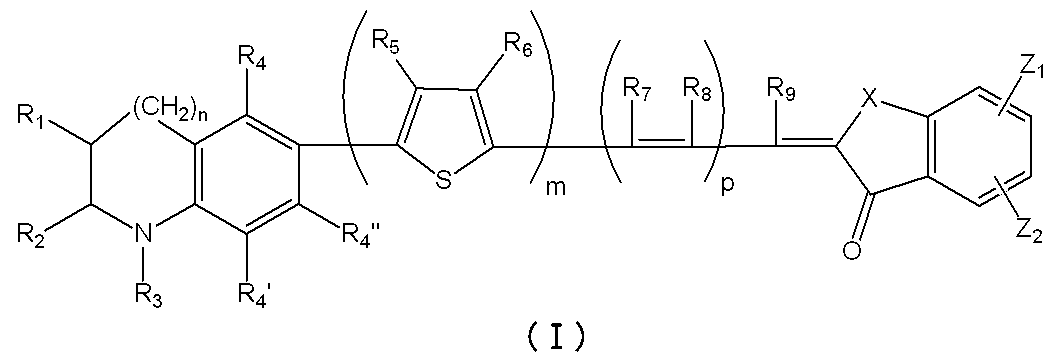
- the photosensitizer of the present invention is characterized by being a dye represented by the following general formula (I) or a salt thereof, and more specifically, having a novel enone structure at the electron acceptor site. It is a feature.
- m represents an integer of 0 to 4.
- n represents an integer of 0 or 1.
- p represents an integer of 0 to 2.
- R 1 and R 2 represent a hydrogen atom, an alkyl group or an aryl.
- R 3 represents an alkyl group, an aryl group, an aralkyl group, or a heterocyclic residue, and may be bonded to form an aromatic ring or an alicyclic ring, and R 4 , R 4 ′, R 4 ′′.
- R 5 and R 6 are A hydrogen atom, an alkyl group, an alkoxy group or an alkylthio group, which may combine with R 5 and R 6 to form a cyclic structure, where R 7 , R 8 and R 9 are a hydrogen atom, an alkyl group or an aralkyl group; , an alkenyl group or an aryl group, linked by R 7 and R 8 or R 8 and R 9 Optionally to form an aliphatic ring .
- X an oxygen atom, a sulfur atom, an alkylene group, a substituted amino group, a carbonyl group, .Z 1, Z 2 showing a sulfonyl group or an aliphatic spiro ring is a hydrogen atom, a hydroxyl group, A carboxyl group, an alkoxycarbonyl group, a sulfone group or a substituted amino group, provided that at least one of the substituents in the molecule has an acidic group.
- the photoelectric conversion element of the present invention is characterized by having a light absorption layer containing a photosensitizer of the dye represented by the above general formula (I) or a salt thereof.
- the dye represented by the above general formula (I) or a salt thereof, which is the photosensitizer of the present invention improves the photoelectric conversion efficiency and improves the adsorption stability of the dye as compared with conventionally known dyes. It is possible. Although its mechanism of action is not always clear, the efficiency of photoelectron transfer by the efficient push-pull action of ⁇ electrons between the donor part of the indoline skeleton or tetrahydroquinoline skeleton and the acceptor part of the novel enone structure is high conversion efficiency It is thought that it has influenced.
- the photosensitizer of the present invention is also advantageous in that the effect of increasing the wavelength by introducing a long linker is extremely high compared to existing dyes, and the hue can be finely adjusted by a substituent.
- the conventional blue dye was a cationic acceptor obtained by quaternizing nitrogen such as indolenine and benzothiazole, so it was strongly influenced by oxygen in the air.
- the dye of the present invention is a nonionic compound. It is considered that the durability was remarkably improved because the oxidation potential of the dye was high and it was difficult to be decomposed by air oxidation. By enhancing the push-pull effect by introducing this conjugated structure, the molar extinction coefficient can be increased, and at the same time, a longer wavelength can be achieved. Therefore, the photosensitizer can be optimal for a photoelectric conversion element.
- the photosensitizer of the present invention when used as a light absorption layer of a photoelectric conversion element, conversion efficiency at a practical level can be obtained.
- the photosensitizer of the present invention can improve the photoelectric conversion efficiency in a wide range of wavelengths, and is particularly effective for a dye-sensitized solar cell in which design is also important.
- the compound represented by the above general formula (I) of the photosensitizer of the present invention may be any of a free acid represented by the above general formula (I) and a salt thereof.
- the salt of the compound represented by the general formula (I) include alkali metal salts or alkaline earth metal salts such as lithium, sodium, potassium, magnesium and calcium of carboxylic acid, or tetramethylammonium, tetrabutylammonium, Examples thereof include alkylammonium salts such as pyridinium, piperidinium and imidazolium.
- R 1 and R 2 in the general formula (I) represent a hydrogen atom, an alkyl group, or an aryl group.
- the alkyl group include linear alkyl groups such as a methyl group, an ethyl group, and a propyl group, an isopropyl group, and an isobutyl group.
- a branched alkyl group such as a cyclopentyl group and a cyclohexyl group. These alkyl groups may be further substituted with a substituent described later.
- aryl group examples include phenyl, naphthyl, anthranyl, phenanthrenyl, pyrenyl, indenyl, azulenyl, and fluorenyl groups, which may further have a substituent.
- R 1 and R 2 may be bonded to each other to form an aromatic ring or an alicyclic ring.
- Examples of the cyclic structure formed at that time include benzene, naphthalene, cyclopentane, cyclopentanone, pyridine, piperidine, piperazine, Examples include pyrazole, pyrrole, imidazole, thiazole, indole, quinoline, carbazole and the like, which may further have a substituent, and may further have a cyclic structure as a substituent.
- substituents examples include cyano group, isocyano group, thiocyanato group, isothiocyanato group, nitro group, nitrosyl group, sulfo group, halogen atom, hydroxyl group, phosphate group, phosphate ester group, substituted or unsubstituted mercapto group, substituted or Examples include unsubstituted amino groups, substituted or unsubstituted amide groups, alkoxy groups, alkoxyalkane groups, carboxyl groups, alkoxycarbonyl groups, alkyl groups, aryl groups, acyl groups, etc. is not.
- the acyl group is preferably, for example, an alkylcarbonyl group having 1 to 10 carbon atoms or an arylcarbonyl group.
- the halogen atom include chlorine, bromine and iodine atoms
- the phosphate ester group include an alkyl phosphate (C1-C4) ester group.
- the substituted mercapto group include alkylthio groups such as methylthio and ethylthio.
- substituted amino groups include mono- or dialkylamino groups, mono- or diarylamino groups, mono- or dimethylamino groups, mono- or diethylamino groups, mono- or dipropylamino groups, monophenylamino groups, or benzylamino groups.
- substituted amide group include an alkylamide group and an aromatic amide group.
- alkoxy group include an alkoxy group having 1 to 10 carbon atoms.
- alkoxyalkyl group include (C1-C10) alkoxy (C1-C4) alkyl groups such as ethoxyethyl group.
- alkoxycarbonyl group examples include an alkoxycarbonyl group having 1 to 10 carbon atoms such as an ethoxycarbonyl group.
- Acid groups such as carboxyl group, sulfo group and phosphate group are metal salts such as lithium, sodium, potassium, magnesium and calcium, and ammonium salts such as tetramethylammonium, tetrabutylammonium, pyridinium, piperidinium and imidazolium.
- An organic salt may be formed.
- R 3 represents an alkyl group, an aryl group, an aralkyl group or a heterocyclic residue, and examples of the alkyl group and the aryl group are the same as those described above.
- the aralkyl group means an alkyl group substituted with an aryl group as described later, and examples thereof include a benzyl group, a phenylethyl group, a methylnaphthyl group, and the like, and these may further have a substituent.
- a heterocyclic residue means a group obtained by removing one hydrogen atom from a heterocyclic compound, such as pyridyl, pyrazyl, piperidyl, pyrazolyl, morpholyl, indolinyl, thiophenyl, furyl, oxazolyl, thiazolyl, indolyl, benzothiazolyl, benzo Examples thereof include oxazolyl, quinolyl, rhodanyl and the like, which may further have a substituent.
- R 4 , R 4 ′ and R 4 ′′ in general formula (I) represent a hydrogen atom, an alkyl group, an aralkyl group, an alkoxy group, a substituted amino group or a halogen atom, and examples thereof are the same as those described above. is there. R 4 ′ and R 4 ′′ may be bonded to each other to form a cyclic structure, and examples thereof are the same as those described above.
- R 5 and R 6 in the general formula (I) represent a hydrogen atom, an alkyl group, an alkoxy group or an alkylthio group, and examples thereof are the same as those described above.
- R 5 and R 6 may be bonded to each other to form a cyclic structure, and examples thereof are the same as those described above.
- R 7 , R 8 and R 9 in formula (I) represent a hydrogen atom, an alkyl group, an aralkyl group, an alkenyl group or an aryl group.
- alkyl group, aralkyl group and aryl group are the same as those described above. is there.
- alkenyl group include a vinyl group and an allyl group, which may further have a substituent. Examples thereof are the same as those described above.
- R 7 and R 8 or R 8 and R 9 may be bonded to each other to form an alicyclic ring, and examples thereof are the same as those described above.
- X in the general formula (I) represents an oxygen atom, a sulfur atom, an alkylene group, a substituted amino group, a carbonyl group, a sulfonyl group or an aliphatic spiro ring.
- alkylene group include a dimethylmethylene group and a dibutylmethylene group.
- aliphatic spiro ring include cyclopentane, cyclohexane, cyclohexene, cyclohexadiene, and the like, which may further have a substituent.
- Z 1 and Z 2 in the general formula (I) represent a hydrogen atom, a hydroxyl group, a carboxyl group, an alkoxycarbonyl group, a sulfone group or a substituted amino group, and examples thereof are the same as those described above.
- the compound represented by the general formula (I) has at least one acidic group as a substituent in the molecule.
- the acidic group is preferably a carboxy group, a sulfonic acid group, a phosphonyl group, a phosphoryl group, or a salt thereof.
- the acidic group may be a group bonded through a linking group.
- a carboxyvinylene group, a dicarboxyvinylene group, a cyanocarboxyvinylene group, a carboxyphenyl group, and the like can be mentioned as preferable examples.
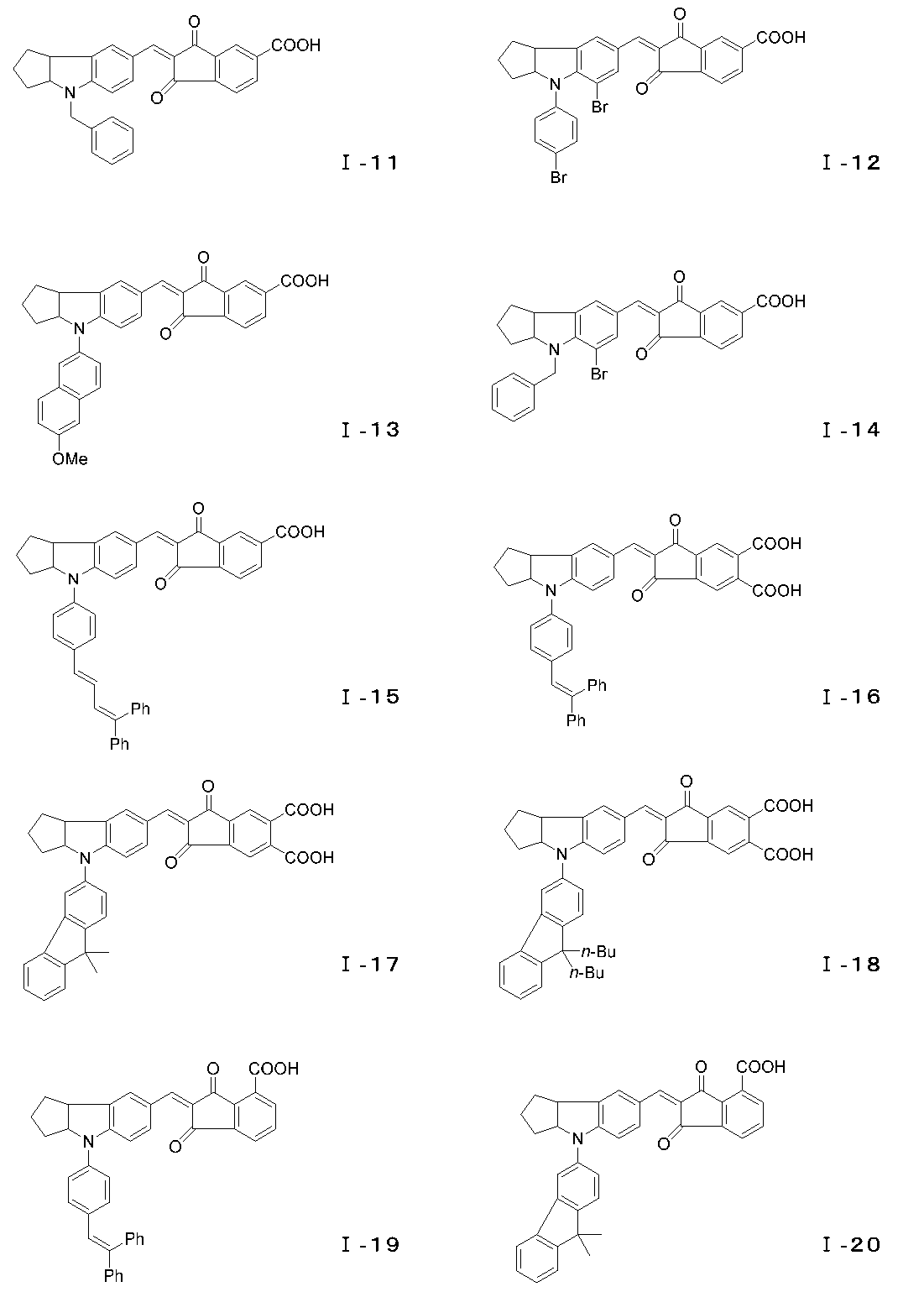
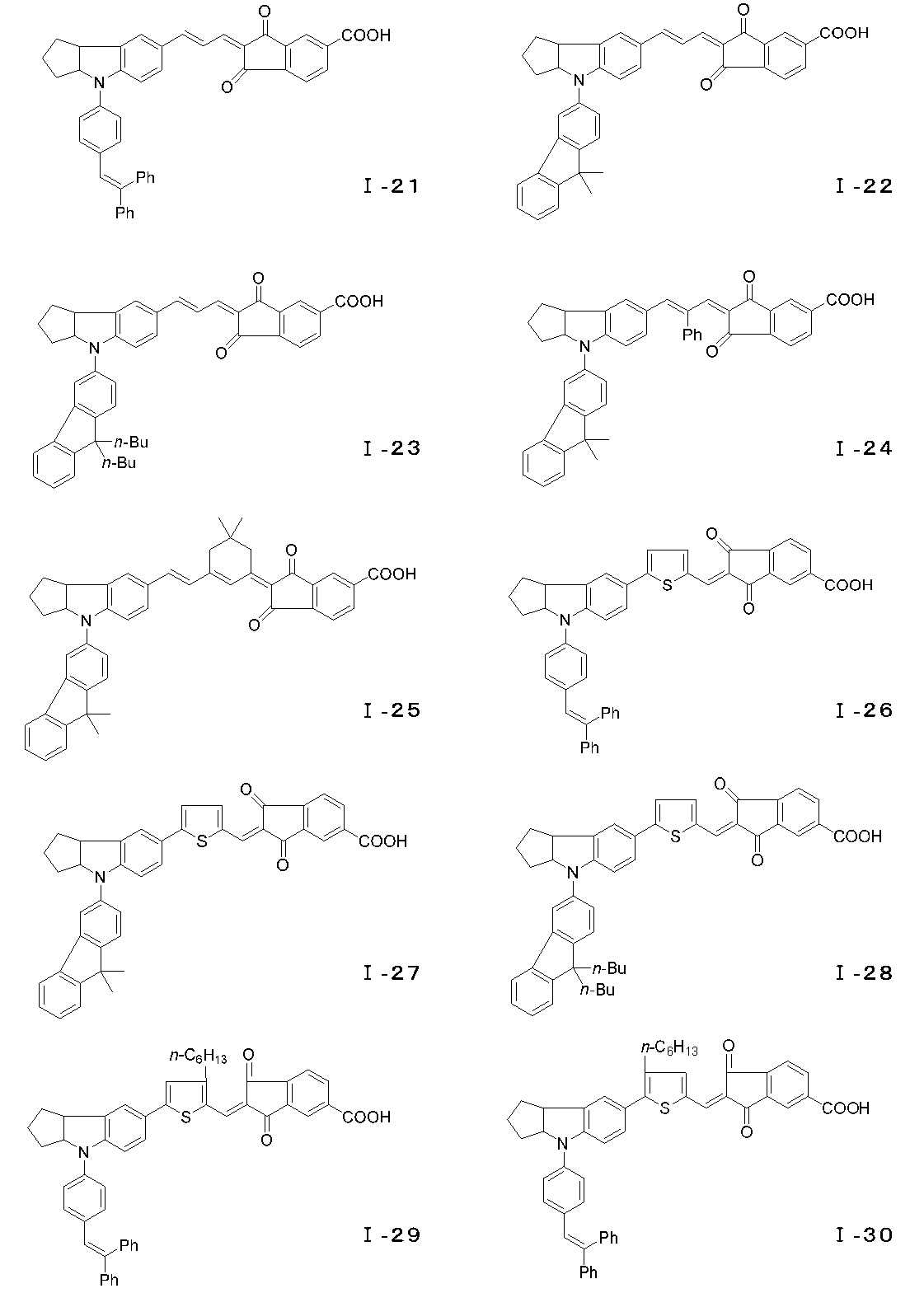
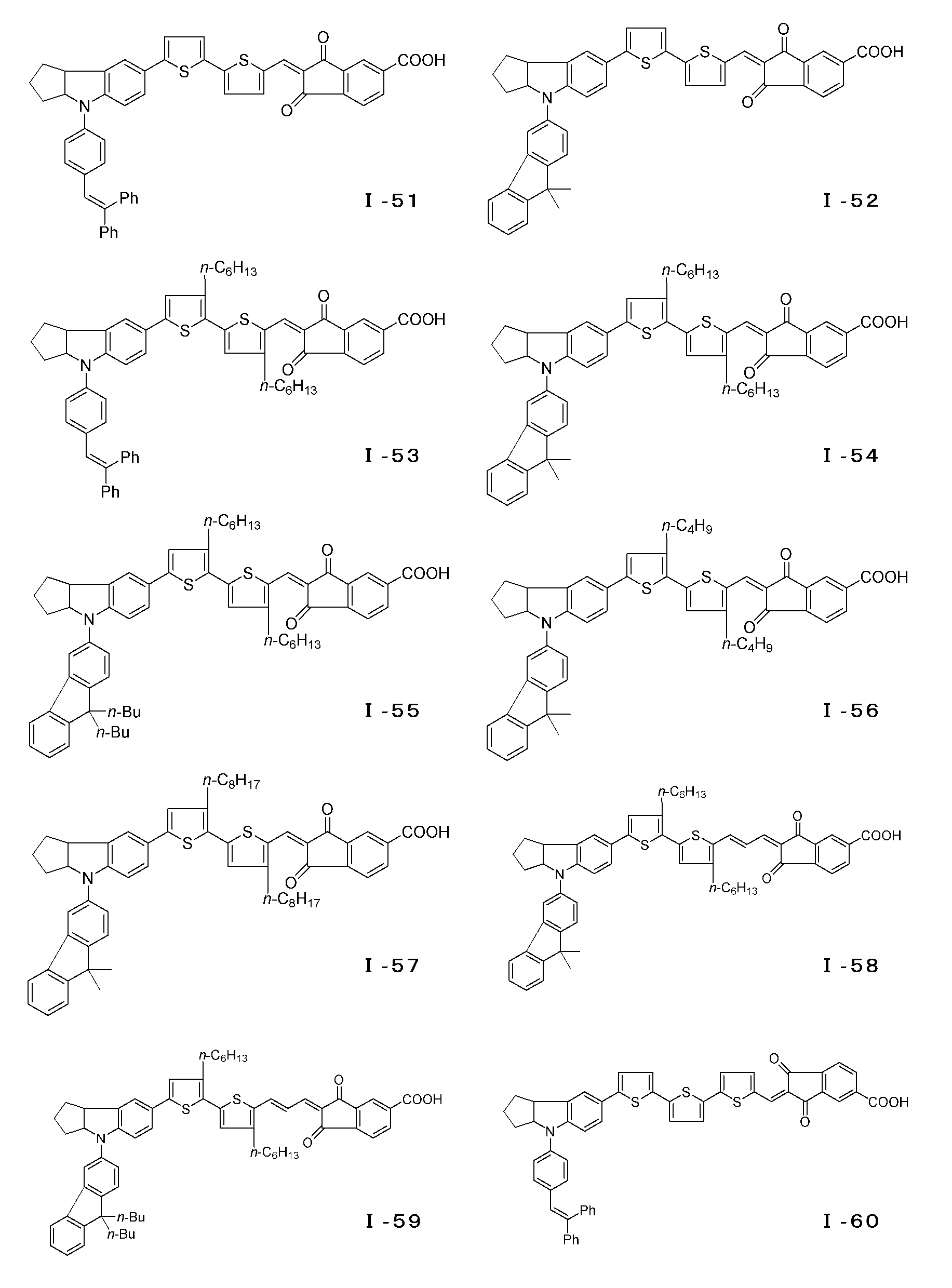
- the compound represented by the general formula (I) can have an E-type or Z-type geometric isomer at the conjugated chain site, and an optical isomer at the 3a position of the indoline skeleton or tetrahydroquinoline skeleton. Is also effective as a photosensitizer and can be used as the dye of the present invention. Examples of the compound of the general formula (I) are specifically shown below, but the present invention is of course not limited to these examples.
- a so-called Fischer indole synthesis method in which an aryl hydrazone formed from a ketone and an aryl hydrazine is heated under an acid catalyst such as sulfuric acid can be used.
- the Scrapup method can be used.
- These heterocycles can be reduced to the intermediate (1) by an appropriate method such as catalytic reduction.
- Intermediate (2) can be easily synthesized by a coupling reaction of intermediate (1) and intermediate (3) using a palladium catalyst.
- the intermediate (2) When introducing a conjugated chain (m ⁇ 0), the intermediate (2) is first made into a bromo-substituted product (5) with a halogenating agent such as NBS (N-bromosuccinimide), and then the conjugated chain is extended by Suzuki coupling or the like. Then, intermediate (4) can be synthesized through formylation by Vilsmeier reaction.
- a borate ester having a formyl group already at the time of Suzuki coupling it is possible to extend the conjugated chain and introduce the formyl group in one step.
- Suzuki coupling is a method in which an organic halogen compound and an organic boron compound are cross-coupled in the presence of a palladium catalyst, and is a useful method that is widely used because of relatively mild conditions and high functional group selectivity.
- Examples of the method of obtaining the dye (6) by condensing the intermediate (4) and the enone compound include a method of reacting a carbonyl compound and active methylene, such as aldol condensation and Knoevenagel condensation, and a method of olefin synthesis by Wittig reaction.
- FIG. 1 is a schematic diagram showing one embodiment of a photoelectric conversion element of the present invention.
- the photoelectric conversion element 1 includes a semiconductor layer 3 and an electrolyte layer 4 each having a light absorption layer formed by adsorbing a dye (photosensitizer of the present invention) to an oxide semiconductor layer on a substrate 2 having conductivity on the surface.
- the counter electrode 5 is laminated
- a support having a conductive property such as metal, or glass or plastic can be used as the support when the surface has conductivity.
- a conductive property such as metal, or glass or plastic
- the material of the conductive layer tin-doped indium oxide (ITO), fluorine-doped tin oxide (FTO), gold, platinum, or a combination of these can be used, and this can be applied to a substrate by vacuum evaporation, By forming the conductive layer directly by a method such as sputter deposition, ion plating, chemical vapor deposition (CVD), or by attaching a film on which these are formed to a substrate, A substrate having conductivity on the surface can be formed.
- oxide semiconductor examples include oxides such as titanium, tin, zinc, tungsten, zirconium, gallium, indium, yttrium, niobium, tantalum, and vanadium. Of these, oxides such as titanium, tin, zinc, niobium, and tungsten are preferable. Among these, (1) low cost, (2) easy formation of a porous body, and (3) conductivity as an electrode. From the viewpoints of properties, durability, stability and safety, and (4) compatibility of energy levels with the photosensitizer synthesized in the present invention, titanium and zinc oxides are preferable. These oxide semiconductors may be used alone or in combination of two or more.
- An oxide semiconductor can be formed porous on a substrate by applying fine particles of the oxide semiconductor on the substrate and then heat-treating or electrodeposition with an electric furnace or microwave.
- a method for adsorbing the dye to the oxide semiconductor layer a method such as immersing the substrate on which the oxide semiconductor layer is formed in a dye solution or a dye dispersion can be used. Can be formed.
- the concentration of the solution can be appropriately determined depending on the dye, and specific examples of the solvent that can be used for dissolving the dye include, for example, methanol, ethanol, acetonitrile, dimethyl sulfoxide, dimethylformamide, acetone, t-butanol and the like. Can be mentioned.
- a co-adsorbent may be added to the dye solution when adsorbing the dye on the thin film of oxide semiconductor fine particles.
- the co-adsorbent include steroidal compounds such as cholic acid, crown ether, cyclodextrin, calixarene, polyethylene oxide, etc., but deoxycholic acid, dehydrocholic acid, cholic acid methyl ester, sodium cholate and the like are more preferable. preferable.
- the electrolyte layer is a mixed liquid of acetonitrile and ethylene carbonate, a liquid electrolyte in which an electrolyte made of iodide such as metal iodine or lithium iodide is added using methoxypropionitrile as a solvent, a polymer gel electrolyte, etc. It can be formed using a solid electrolyte such as a solidified electrolyte, a p-type semiconductor, and a hole transport agent.
- the counter electrode may be prepared in the same manner as the conductive substrate when transparency is required, or it may be prepared using carbon, a conductive polymer, a general metal, etc. when transparency is not required. be able to.
- the photosensitizer of the present invention can also be used as a light absorption layer of an organic thin film solar cell.
- the present invention will be described in more detail with reference to examples.
- intermediates (A-01) to (A-03), intermediate aldehydes (B-01) to (B-13), and intermediate (C-01) in this example are represented by the following chemical formulas. Is.
- Aldehyde (B-02) was also synthesized by the same route as (Synthesis of aldehyde (B-01)) using the corresponding intermediate.
- the structure of the obtained aldehyde (B-02) was identified by NMR analysis.
- Aldehyde (B-03) was also synthesized by the same route as (Synthesis of aldehyde (B-01)) using the corresponding intermediate.
- the structure of the obtained aldehyde (B-03) was identified by NMR analysis.
- Aldehyde (B-05) was also synthesized by the same route as (Synthesis of aldehyde (B-04)) using the corresponding intermediate.
- the structure of the obtained aldehyde (B-05) was identified by NMR analysis.
- Aldehyde (B-06) was also synthesized by the same route as (Synthesis of aldehyde (B-04)) using the corresponding intermediate.
- Aldehyde (B-07) was also synthesized by the same route as (Synthesis of aldehyde (B-04)) using the corresponding intermediate.
- the structure of the obtained aldehyde (B-07) was identified by NMR analysis.
- Aldehyde (B-08) was also synthesized by the same route as (Synthesis of aldehyde (B-04)) using the corresponding intermediate.
- the structure of the obtained aldehyde (B-08) was identified by NMR analysis.
- Aldehyde (B-09) was also synthesized by the same route as (Synthesis of aldehyde (B-04)) using the corresponding intermediate.
- the structure of the obtained aldehyde (B-09) was identified by NMR analysis.
- Aldehyde (B-10) was also synthesized by the same route as (Synthesis of aldehyde (B-04)) using the corresponding intermediate.
- the structure of the obtained aldehyde (B-10) was identified by NMR analysis.
- Aldehyde (B-11) was also synthesized by the same route as (Synthesis of aldehyde (B-04)) using the corresponding intermediate.
- the structure of the obtained aldehyde (B-11) was identified by NMR analysis.
- Aldehyde (B-12) was also synthesized by the same route as (Synthesis of aldehyde (B-04)) using the corresponding intermediate.
- Example 2 ⁇ Synthesis of Example 2 (I-05)>
- the aldehyde intermediate (B-02) was used to obtain the dye (I-05) as a black solid.
- ⁇ max 541nm (CHCl 3).
- Example 3 ⁇ Synthesis of Example 3 (I-06)>
- the aldehyde intermediate (B-03) was used to obtain the dye (I-06) as a black solid.
- ⁇ max 546nm (CHCl 3).
- the structure of the obtained dye (I-06) was identified by NMR analysis.
- Example 4 ⁇ Synthesis of Example 4 (I-26)>
- the aldehyde intermediate (B-04) was used to obtain the dye (I-26) as a black solid.
- ⁇ max 607nm (CHCl 3).
- the structure of the obtained dye (I-26) was identified by NMR analysis.
- Example 5 ⁇ Synthesis of Example 5 (I-27)>
- the aldehyde intermediate (B-05) was used to obtain the dye (I-27) as a black purple solid.
- ⁇ max 616nm (CHCl 3).
- the structure of the obtained dye (I-27) was identified by NMR analysis.
- Example 6 ⁇ Synthesis of Example 6 (I-28)>
- the aldehyde intermediate (B-06) was used to obtain the dye (I-28) as a black solid.
- ⁇ max 619nm (CHCl 3).
- the structure of the obtained dye (I-28) was identified by NMR analysis.
- Example 8 ⁇ Synthesis of Example 8 (I-32)>
- the aldehyde intermediate (B-08) was used to obtain the dye (I-32) as a black solid.
- ⁇ max 621nm (CHCl 3).
- the structure of the obtained dye (I-32) was identified by NMR analysis.
- Example 10 (I-45)>
- the aldehyde intermediate (B-10) was used to obtain the dye (I-45) as a black solid.
- ⁇ max 647nm (CHCl 3).
- the structure of the obtained dye (I-45) was identified by NMR analysis.
- Example 11 ⁇ Synthesis of Example 11 (I-47)>
- the aldehyde intermediate (B-11) was used to obtain the dye (I-47) as a black solid.
- ⁇ max 655nm (CHCl 3).
- Example 12 ⁇ Synthesis of Example 12 (I-48)>
- the aldehyde intermediate (B-12) was used to obtain the dye (I-48) as a black solid.
- ⁇ max 661nm (CHCl 3).
- the structure of the obtained dye (I-48) was identified by NMR analysis.
- Example 13 (I-75)>
- the aldehyde intermediate (B-13) was used to obtain the dye (I-75) as a black purple solid.
- ⁇ max 595nm (CHCl 3).
- the structure of the obtained dye (I-75) was identified by NMR analysis.
- the photoelectric conversion efficiency was improved as compared with the comparative example using the dye of the corresponding hue.
- the photoelectric conversion efficiency could be improved in all the hues from magenta to blue-green.
- the conversion efficiency was greatly improved in the blue-violet to blue-green region of 600 to 700 nm, and a practical level dye capable of covering a wide range of hues was obtained.
- significant improvement in photoelectric conversion efficiency was also observed in zinc oxide.
- the photosensitizer of the present invention can improve the photoelectric conversion efficiency and the adsorption stability of the dye. Moreover, since it can cover a wide range of hues, it can be suitably used for a dye-sensitized solar cell in which design is also important. Furthermore, even with zinc oxide, which is a good electrode material, photoelectric conversion efficiency comparable to that of titanium oxide can be obtained.
Landscapes
- Engineering & Computer Science (AREA)
- Chemical & Material Sciences (AREA)
- Power Engineering (AREA)
- Organic Chemistry (AREA)
- Materials Engineering (AREA)
- Microelectronics & Electronic Packaging (AREA)
- Physics & Mathematics (AREA)
- Spectroscopy & Molecular Physics (AREA)
- Hybrid Cells (AREA)
- Photovoltaic Devices (AREA)
Abstract
Description
本発明の光増感剤の上記一般式(I)で表される化合物は、上記一般式(I)で示されるフリーの酸及びその塩のいずれでもよい。上記一般式(I)で表される化合物の塩としては、例えばカルボン酸のリチウム、ナトリウム、カリウム、マグネシウム、カルシウムなどのアルカリ金属塩又はアルカリ土類金属塩、又はテトラメチルアンモニウム、テトラブチルアンモニウム、ピリジニウム、ピペリジニウム、イミダゾリウムなどのアルキルアンモニウム塩を挙げることができる。
一般式(I)におけるZ1、Z2は水素原子、ヒドロキシル基、カルボキシル基、アルコキシカルボニル基、スルホン基または置換アミノ基を示し、それらの例としては前述の場合と同様である。
以下に一般式(I)の化合物の例を具体的に示すが、もちろん本発明はこれらの例に限定されるものではない。



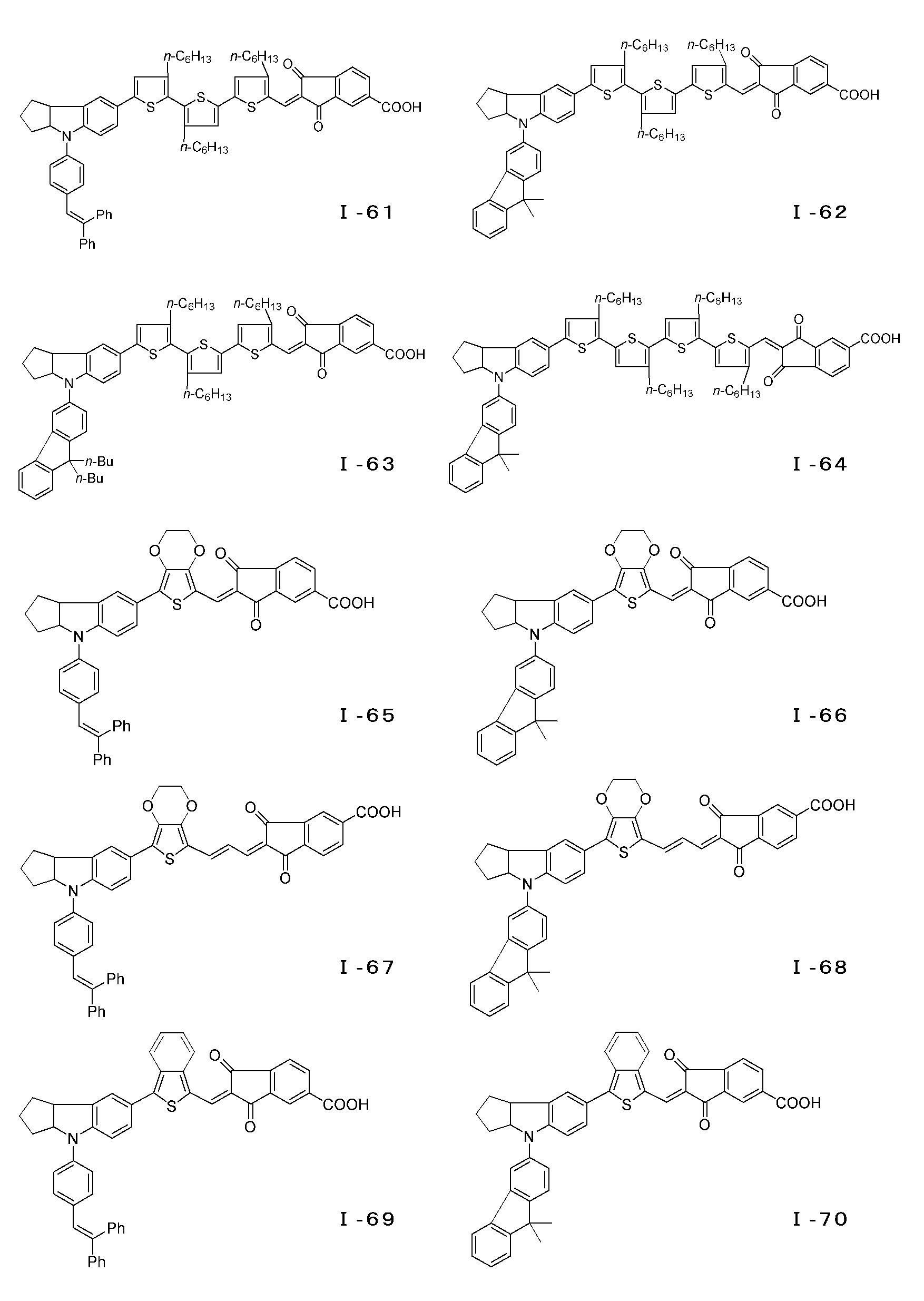

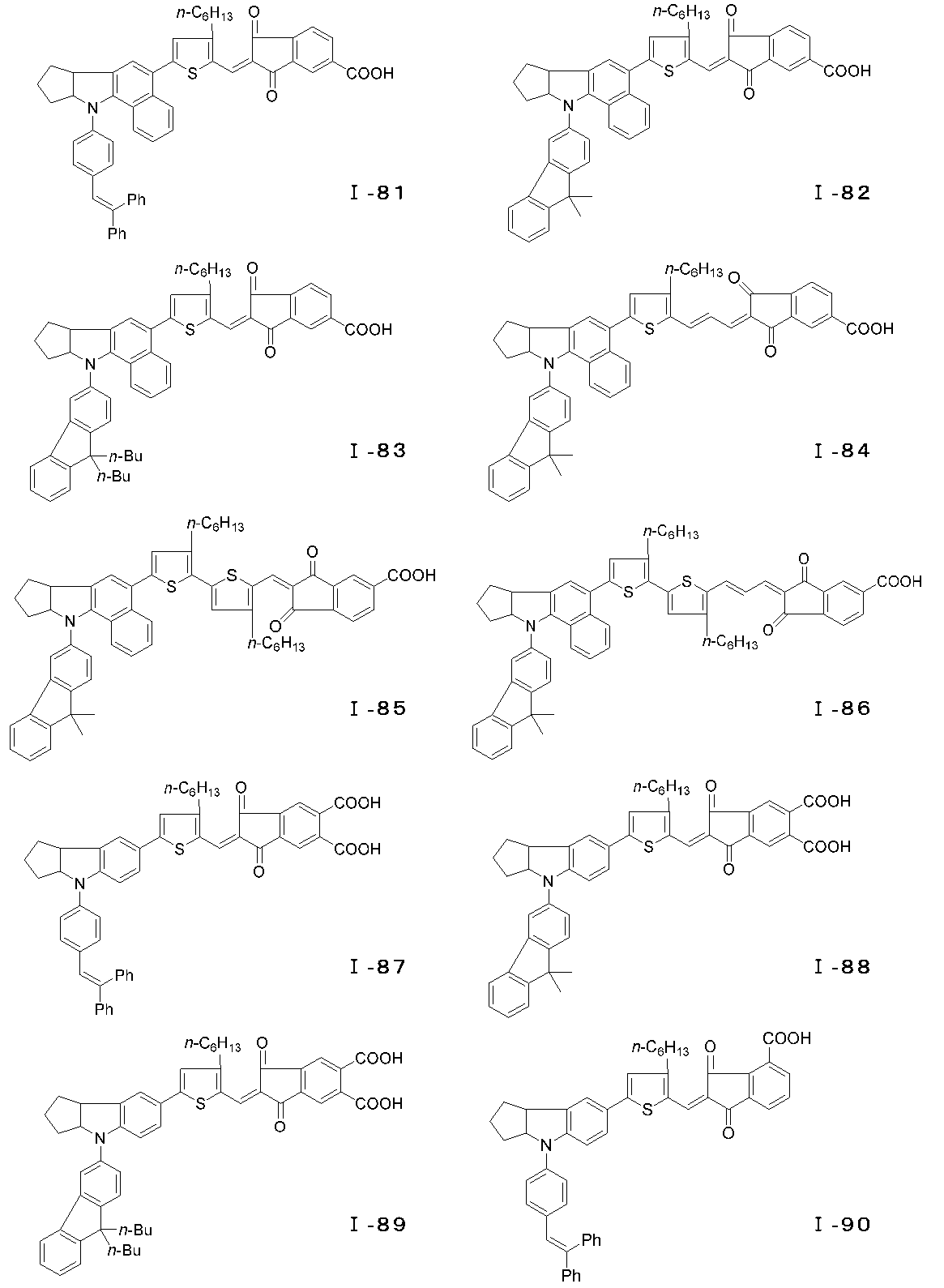
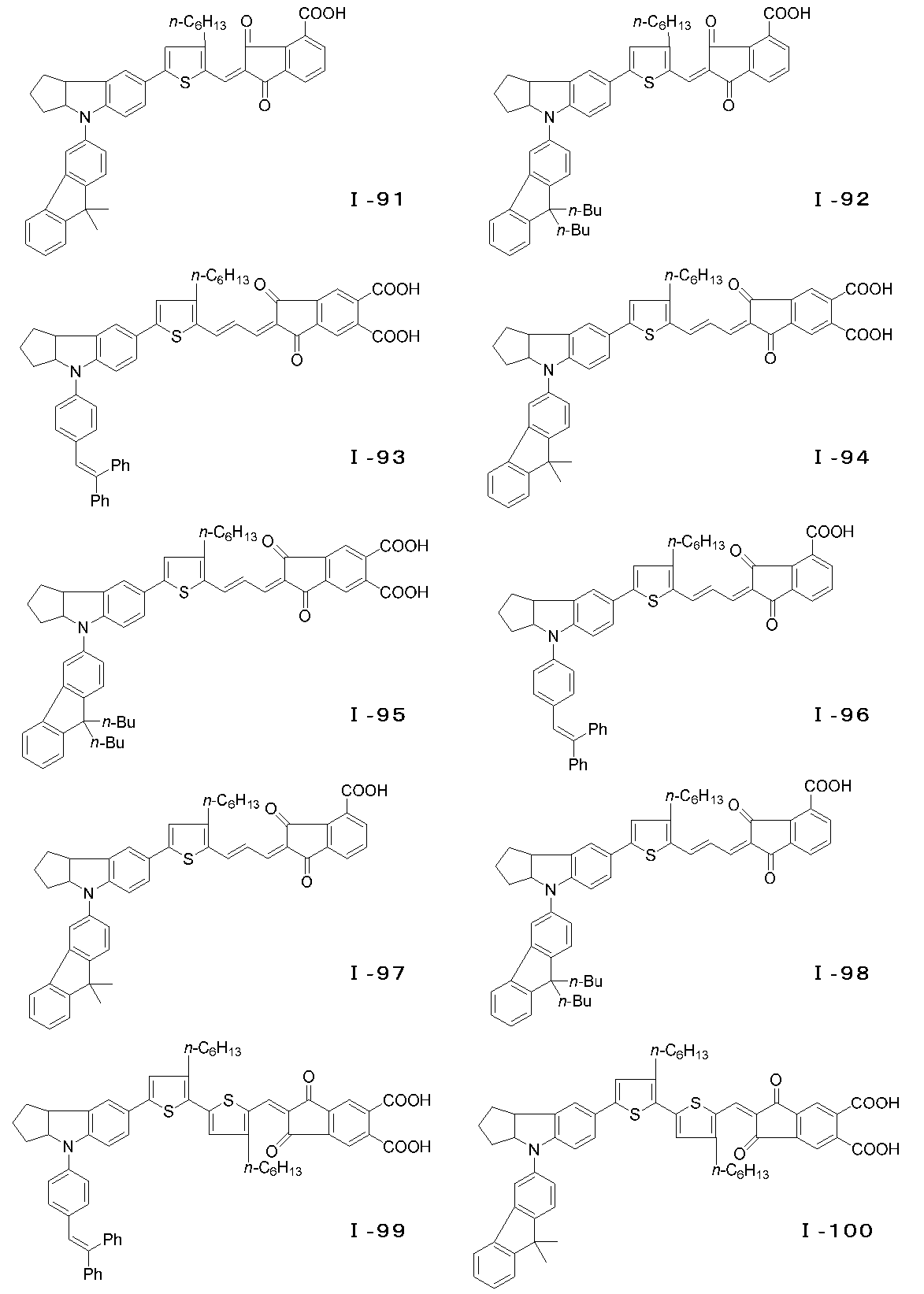


中間体(2)から中間体(4)を合成する方法(m=0)としては、Vilsmeier反応に代表されるホルミル化反応が挙げられる。
酸化物半導体層に色素を吸着させる方法としては、色素溶液中あるいは色素分散液中にこの酸化物半導体層を形成させた基板を浸漬するなどの方法を用いることができ、これによって、半導体層を形成することができる。溶液の濃度は色素によって適宜決めることができ、色素を溶解させるのに使用しうる溶媒の具体例としては、例えば、メタノール、エタノール、アセトニトリル、ジメチルスルホキシド、ジメチルホルムアミド、アセトン、t-ブタノール等が好ましく挙げられる。
以下に本発明を実施例を用いてさらに詳細に説明する。


(アルデヒド(B-01)の合成)
中間体(A-01)(5.2g)、中間体(A-03)(11.7g)、カリウムt-ブトキシド(5.5g)、酢酸パラジウム(74mg)、トリt-ブチルホスフィン(0.3g)をm-キシレン(40mL)に溶解し系内を窒素置換した後、120℃で8時間加熱攪拌した。反応混合物を室温まで冷却後、不溶物をろ過し、ろ液を水洗、無水硫酸ナトリウムで乾燥させた後、減圧濃縮し、褐色オイルを得た(15.0g)。次に氷冷下でDMF(25mL)に塩化ホスホリル(10.0g)を滴下し調整したVilsmeier試薬にこの褐色オイル(15.0g)を滴下し室温で3時間攪拌した。反応液に水(100ml)を加え、ついで25%水酸化ナトリウム水溶液を加えpH11とした。この反応液をクロロホルムで抽出、有機層を無水硫酸ナトリウムで乾燥後、減圧濃縮し、残渣をカラムクロマトグラフィー(シリカゲル、展開溶媒:CHCl3)で分離精製することによりアルデヒド(B-01)の黄土色固体を11.6g得た(収率80%)。
1H NMR(400MHz,CDCl3)
δ(ppm)=9.70(1H,s),7.61(1H,dd,J=1.6,1.2Hz),7.50(1H,dd,J=8.4,1.6Hz),7.24-7.41(10H,m),7.07(2H,d,J=9.2Hz),7.03(2H,d,J=8.8Hz),6.95(1H,s),6.85(1H,d,J=8.4Hz),4.83-4.87(1H,m),3.78-3.83(1H,m),2.00-2.10(1H,m),1.82-1.91(2H,m),1.73-1.80(1H,m),1.62-1.71(1H,m),1.40-1.52(1H,m)
アルデヒド(B-02)も対応する中間体を用いて、(アルデヒド(B-01)の合成)と同様のルートで合成した。
得られたアルデヒド(B-02)についてNMR分析により構造を同定した。
1H NMR(400MHz,CDCl3)
δ(ppm)=9.71(1H,s),7.72(1H,d,J=8.0Hz),7.68(1H, d,J=6.8Hz),7.66(1H,s),7.54(1H,dd,J=8.0,1.2Hz),7.43(1H,d,J=6.8Hz),7.36(1H,d,J=.2.0Hz),7.33(1H,dd,J=7.2,1.2Hz),7.31(1H,dd,J=7.6,2.0Hz),7.26(1H,dd,J=8.4,2.0Hz),6.85(1H,d,J=8.4Hz),5.00(1H,br.t,J=7.2Hz),3.87(1H,dt,J=8.4,2.4Hz),2.04-2.14(1H,m),1.88-1.99(2H,m),1.76-1.85(1H,m),1.67-1.75(1H,m),1.52-1.61(1H,m),1.51(3H,s),1.50(3H,s)
アルデヒド(B-03)も対応する中間体を用いて、(アルデヒド(B-01)の合成)と同様のルートで合成した。
得られたアルデヒド(B-03)についてNMR分析により構造を同定した。
1H NMR(400MHz,CDCl3)
δ(ppm)=9.71(1H,s),7.70(1H,d,J=8.1Hz),7.67(1H, d,J=6.3Hz),7.66(1H,s),7.54(1H,dd,J=8.3,1.4Hz),7.25-7.35(5H,m),6.83(1H,d,J=8.3Hz),5.02(1H,br.t,J=6.8Hz),3.87(1H,br.t,J=7.3Hz),2.05-2.14(1H,m),1.90-1.98(6H,m),1.69-1.81(2H,m),1.50-1.59(1H,m),1.09(4H,m),0.72(3H,t,J=7.3Hz),0.68(3H,t,J=7.3Hz),0.59-0.73(4H,m)
中間体(A-01)と中間体(A-03)を(アルデヒド(B-01)の合成)と同様の方法でカップリングさせた後、NBSでブロモ化し、ボロン酸類と反応させ、これをVilsmeier試薬と反応させることにより合成した。
得られたアルデヒド(B-04)についてNMR分析により構造を同定した。
1H NMR(400MHz,CDCl3)
δ(ppm)=9.82(1H,s),7.67(1H,d,J=4.0Hz),7.24-7.39(13H,m),7.05(2H,d,J=8.8Hz),7.00(2H,d,J=9.2Hz),6.95(1H,d,J=8.0Hz),6.94(1H,s),4.75-4.80(1H,m),3.81-3.86(1H,m),2.02-2.11(1H,m),1.77-1.93(3H,m),1.61-1.71(1H,m),1.43-1.54(1H,m)
アルデヒド(B-05)も対応する中間体を用いて、(アルデヒド(B-04)の合成)と同様のルートで合成した。
得られたアルデヒド(B-05)についてNMR分析により構造を同定した。
1H NMR(400MHz,CDCl3)
δ(ppm)=9.83(1H,s),7.66-7.70(3H,m),7.41-7.44(3H,m),7.23-7.36(5H,m),6.97(1H,d,J=8.0Hz), 4.92-4.95(1H,m),3.87-3.91(1H,m),2.07-2.13(1H,m),1.86-1.98(3H,m),1.58-1.62(1H,m),1.51(3H,s),1.50(3H,s)
アルデヒド(B-06)も対応する中間体を用いて、(アルデヒド(B-04)の合成)と同様のルートで合成した。
得られたアルデヒド(B-06)についてNMR分析により構造を同定した。
1H NMR(400MHz,CDCl3)
δ(ppm)=9.83.(1H,s),7.68(1H,d,J=4.0Hz),7.67(1H, d,J=10.0Hz),7.63(1H,dd,J=8.8,8.8Hz),7.44(1H,br.s),7.41(1H,dd,J=8.8,8.0Hz),7.33(1H,d,J=6.8Hz),7.31(1H,d,J=6.4Hz),7.26-7.28(3H,m),7.25(1H,s),6.94(1H,d,J=8.4Hz),4.94-4.98(1H,m),3.86-3.91(1H,m),2.06-2.16(1H,m),1.90-2.01(6H,m),1.79-1.88(1H,m),1.67-1.75(1H,m),1.52-1.63(1H,m),1.04-1.16(4H,m),0.72(3H,t,J=7.2Hz),0.69(3H,t,J=7.2Hz),0.61-0.71(4H,m)
アルデヒド(B-07)も対応する中間体を用いて、(アルデヒド(B-04)の合成)と同様のルートで合成した。
得られたアルデヒド(B-07)についてNMR分析により構造を同定した。
1H NMR(400MHz,CDCl3)
δ(ppm)=9.96(1H,s),7.69(1H,d,J=8.0Hz),7.67(1H, d,J=7.2Hz),7.43(1H,s),7.40-7.42(2H,m),7.36(1H,d,J=2.0Hz),7.33(1H,dt,J=7.2,1.2Hz),7.27(1H,dt,J=7.2,1.2Hz),7.24(1H,dd,J=8.0,1.6Hz),7.09(1H,s),6.96(1H,d,J=8.0Hz),4.91-4.95(1H,m),3.86-3.91(1H,m),2.93(2H,dd,J=8.0,7.6Hz),2.06-2.16(1H,m),1.82-2.02(3H,m),1.67-1.75(3H,m),1.53-1.63(1H,m),1.51(3H,s),1.50(3H,s),1.30-1.43(6H,m),0.90(3H,t,J=6.8Hz)
アルデヒド(B-08)も対応する中間体を用いて、(アルデヒド(B-04)の合成)と同様のルートで合成した。
得られたアルデヒド(B-08)についてNMR分析により構造を同定した。
1H NMR(400MHz,CDCl3)
δ(ppm)=9.96(1H,s),7.67(1H,d,J=8.0Hz),7.65(1H, d,J=8.8Hz),7.43(1H,s),7.40(1H,dd,J=8.4,1.6Hz),7.32(2H,dd,J=7.2,6.0Hz),7.26(2H,dd,J=7.6,7.6Hz),7.24(1H,s),7.09(1H,s),6.94(1H,d,J=8.4Hz),4.94-4.98(1H,m),3.86-3.90(1H,m),2.93(2H,dd,J=8.0,7.6Hz),2.06-2.15(1H,m),1.91-2.01(6H,m),1.79-1.88(1H,m),1.67-1.75(3H,m),1.52-1.62(1H,m),1.30-1.43(6H,m),1.04-1.16(4H,m),0.90(3H,t,J=6.8Hz),0.71(3H,t,J=7.2Hz),0.69(3H,t,J=7.2Hz),0.60-0.70(4H,m)
アルデヒド(B-09)も対応する中間体を用いて、(アルデヒド(B-04)の合成)と同様のルートで合成した。
得られたアルデヒド(B-09)についてNMR分析により構造を同定した。
1H NMR(400MHz,CDCl3)
δ(ppm)=9.60(1H,d,J=7.6Hz),7.68(2H,dd,J=8.8,8.0Hz),7.53(1H,d,J=15.6Hz),7.42(1H,d,J=7.6Hz),7.39(1H,s),7.37(2H,dd,J=8.4,7.6Hz),7.33(1H,dt,J=7.6,7.2Hz),7.27-7.29(2H,m),7.24(1H,dd,J=8.8,8.4Hz),7.17(1H,d,J=3.6Hz),6.98(1H,d,J=8.4Hz),6.44(1H,dd,J=7.6,7.6Hz),4.90-4.94(1H,m),3.86-3.91(1H,m),2.07-2.16(1H,m),1.83-2.01(3H,m),1.66-1.75(1H,m),1.55-1.64(1H,m),1.51(3H,s),1.50(3H,s)
アルデヒド(B-10)も対応する中間体を用いて、(アルデヒド(B-04)の合成)と同様のルートで合成した。
得られたアルデヒド(B-10)についてNMR分析により構造を同定した。
1H NMR(400MHz,CDCl3)
δ(ppm)=9.60(1H,d,J=8.0Hz),7.66(2H,ddd,J=9.6,9.2,7.2Hz), 7.53(1H,d,J=15.6Hz),7.40(1H,br.s),7.37(1H,dd,J=8.4,2.0Hz),7.33(1H,d,J=7.2Hz),7.32(1H,s),7.28-7.30(2H,m),7.24-7.27(2H,m),7.18(1H, d,J=4.0Hz),6.96(1H,d,J=8.4Hz),6.44(1H,dd,J=15.6,7.6Hz),4.93-4.97(1H,m),3.87-3.90(1H,m),2.06-2.16(1H,m),1.91-2.01(6H,m),1.80-1.89(1H,m),1.67-1.75(1H,m),1.53-1.63(1H,m),1.05-1.14(4H, m),0.72(3H,t,J=7.2Hz),0.69(3H,t,J=7.6Hz),0.61-0.69(4H,m)
アルデヒド(B-11)も対応する中間体を用いて、(アルデヒド(B-04)の合成)と同様のルートで合成した。
得られたアルデヒド(B-11)についてNMR分析により構造を同定した。
1H NMR(400MHz,CDCl3)
δ(ppm)=9.60(1H,d,J=8.0Hz),7.68(1H,d,J=8.0Hz), 7.66(1H,d,J=8.8Hz),7.61(1H,d,J=15.6Hz), 7.41(1H,d,J=7.2Hz),7.39(1H,s),7.35-7.38(2H,m),7.33(1H,dt,J=7.2,1.2Hz),7.27(1H,dt,J=7.2,1.2Hz),7.24(1H, dd,J=8.4,2.0Hz),7.05(1H,s),6.97(1H,d,J=8.0Hz),6.40(1H,dd,J=15.2,7.6Hz),4.90-4.94(1H,m),3.86-3.90(1H,m),2.72(2H,dd,J=8.0,7.6Hz),2.06-2.17(1H,m),1.83-2.03(3H,m),1.62-1.75(3H,m),1.51(3H,s),1.50(3H,s),1.47-1.55(1H,m),1.31-1.42(6H,m),0.90(3H,t,J=6.8Hz)
アルデヒド(B-12)も対応する中間体を用いて、(アルデヒド(B-04)の合成)と同様のルートで合成した。
得られたアルデヒド(B-12)についてNMR分析により構造を同定した。
1H NMR(400MHz,CDCl3)
δ(ppm)=9.61(1H,d,J=7.6Hz),7.67(1H,d,J=8.8Hz),7.63-7.66(1H,m),7.62(1H,d,J=15.2Hz),7.39(1H,s),7.36(1H,dd,J=8.0,1.6Hz),7.33(1H,d,J=7.2Hz),7.31(1H,d,J=6.4Hz),7.25-7.28(2H,m),7.24(1H,s),7.06(1H,s),6.95(1H,d,J=8.4Hz),6.40(1H,dd,J=15.6,8.0Hz),4.93-4.96(1H,m),3.86-3.90(1H,m),2.72(2H,dd,J=8.0,7.6Hz),2.06-2.15(1H,m),1.90-2.01(6H,m),1.80-1.89(1H,m),1.62-1.74(3H,m),1.51-1.61(1H,m),1.28-1.42(6H,m),1.05-1.14(4H,m),0.90(3H,t,J=7.2Hz),0.72(3H,t,J=7.2Hz),0.69(3H,t,J=7.2Hz),0.61-0.70(4H,m)
中間体(A-02)と中間体(A-03)を(アルデヒド(B-01)の合成)と同様のルートで合成した。
得られたアルデヒド(B-13)についてNMR分析により構造を同定した。
1H NMR(400MHz,CDCl3)
δ(ppm)=9.28(1H,d,J=8.0Hz),7.76(1H,s),7.49-7.54(1H,s),7.28-7.38(10H,m),7.23-7.25(2H,m),7.16-7.21(1H,m),6.97-6.99(3H,m),6.89(1H,d,J=7.3Hz),4.58(1H,ddd,J=8.9,6.7,2.5Hz),4.12(1H,dt,J=6.1,2.5Hz),2.03-2.14(2H,m),1.89-1.98(2H,m),1.63-1.72(1H,m),1.41-1.53(1H,m)
トリメリット酸無水物(東京化成工業株式会社製)(10.18g)の無水酢酸溶液(75mL)にアセト酢酸メチル(12.00g)とトリエチルアミン(33.78g)を滴下し100℃で1.5時間加熱撹拌した。反応混合物を室温まで冷却した後溶媒を留去し、カラムクロマトグラフィー(シリカゲル、展開溶媒:CHCl3/MeOH=10/1)で分離精製すると黒色液体を得た(12.65g)。次に、得られた黒色液体(12.65g)のメタノール溶液(150mL)に酢酸アンモニウム(6.49g)を加え75℃で3時間加熱撹拌すると固化した。粗結晶をろ別し、メタノールで洗浄することにより中間体(C-01)を黄色固体として5.76g得た(収率44%)。得られた中間体(C-01)についてNMR分析により構造を同定した。なお、カルボン酸の水素は観測されなかった。
1H NMR(400MHz,DMSO-d6)
δ(ppm)=7.92(1H,d,J=7.6Hz),7.80(1H,s),7.25(1H,d,J=7.6Hz),7.14(1H,br.s),3.49(3H,s)
アルデヒド(B-01)(0.88g)、中間体(C-01)(0.50g)を酢酸(10mL)に溶解し、100℃で4時間加熱攪拌した。反応混合物を室温まで冷却すると固化した。粗結晶をろ別し、カラムクロマトグラフィー(シリカゲル、展開溶媒:CHCl3/MeOH=100/1)で分離精製することにより色素(I-03)を褐色固体として0.85g得た(収率69%)。λmax=545nm(CHCl3)。
得られた色素(I-03)についてNMR分析により構造を同定した。
1H NMR(400MHz,DMSO-d6)
δ(ppm)=13.65(1H,br.s),8.67(1H,br.s),8.33(1H,dd,J=8.0,7.6Hz), 8.24(1H,d,J=11.6Hz), 8.20(1H,br.s),7.94(1H,dd,J=7.6,7.6Hz),7.65(1H,S),7.41-7.49(3H,m),7.30-7.38(5H,m),7.19-7.23(4H,m),7.11(1H,s),7.07(2H,d,J=8.4Hz),6.87(1H,d,J=8.8Hz), 5.07-5.11(1H,m),3.82-3.87(1H,m),2.03-2.12(1H,m),1.69-1.83(2H,m),1.59-1.67(2H,m),1.27-1.38(1H,m)
実施例1と同様の手法を用い、アルデヒド中間体(B-02)を用いることにより色素(I-05)を黒色固体として得た。λmax=541nm(CHCl3)。
得られた色素(I-05)についてNMR分析により構造を同定した。
1H NMR(400MHz,DMSO-d6)
δ(ppm)=13.63(1H,br.s),8.72(1H,br.s),8.35(1H,d,J=8.0Hz), 8.28(1H,br.s),8.25(1H,d,J=11.6Hz),7.95(1H,dd,J=8.0,7.6Hz),7.90(1H,d,J=8.4Hz),7.83(1H,d,J=7.2Hz),7.69(1H,s),7.67(1H,d,J=1.6Hz),7.56(1H,d,J=7.2Hz),7.41(1H,dd,J=8.0,1.2Hz),7.36(1H,dd,J=8.0,7.2Hz),7.32(1H,dd,J=8.4,7.2Hz),6.87(1H,d,J=8.4Hz),5.24-5.27(1H,m),3.90-3.94(1H,m),2.08-2.18(1H,m),1.74-1.88(3H,m),1.64-1.73(1H,m),1.50(3H,s),1.47(3H,s),1.37-1.53(1H,m)
実施例1と同様の手法を用い、アルデヒド中間体(B-03)を用いることにより色素(I-06)を黒色固体として得た。λmax=546nm(CHCl3)。
得られた色素(I-06)についてNMR分析により構造を同定した。
1H NMR(400MHz,DMSO-d6)
δ(ppm)=13.07(1H,br.s),8.17(1H,br.s),7.81(1H,dd,J=7.6, 7.2Hz),7.73(2H,d,J=9.6Hz),7.41(1H,d,J=8.0Hz),7.34(1H,d,J=8.4Hz),7.27(1H,d,J=7.2Hz),7.14(1H,s),6.99(1H,s),6.92(1H,d,J=6.8Hz),6.88(1H,d,J=8.0Hz),6.83(1H,dd,J=7.2,6.0Hz),6.80(1H,dd,J=7.2,6.4Hz),6.30(1H,d,J=8.4Hz),4.72-4.75(1H,m),3.36-3.40(1H,m),1.57-1.65(1H,m),1.43-1.56(4H,m),1.28-1.35(1H,m),1.11-1.26(3H,m),0.84-0.95(1H,m),0.45-0.59(4H,m),0.16(3H,t,J=7.2Hz),0.10(3H,t,J=7.2Hz),0.02-0.04(4H,m)
実施例1と同様の手法を用い、アルデヒド中間体(B-04)を用いることにより色素(I-26)を黒色固体として得た。λmax=607nm(CHCl3)。
得られた色素(I-26)についてNMR分析により構造を同定した。
1H NMR(400MHz,DMSO-d6)
δ(ppm)=13.62(1H,br.s),8.32(1H,dd,J=8.0,7.6Hz),8.23(1H,d,J=10.4Hz),8.17(1H,d,J=4.0Hz),7.95(1H,s),7.92(1H,d,J=8.0Hz),7.59(1H,d,J=4.4Hz),7.57(1H,s),7.45(1H,d,J=6.8Hz),7.42(1H,d,J=7.6Hz),7.39-7.52(2H,m),7.33(1H,d,J=6.8Hz),7.30(1H,s),7.29(1H,d,J=7.2Hz),7.26-7.36(3H,m),7.20(1H,d,J=7.2Hz),7.09(2H,d,J=8.4Hz),7.05(1H,s),7.00(2H,d,J=8.4Hz),6.94(1H,dd,J=8.4,3.2Hz),4.85-4.88(1H,m),3.80-3.84(1H,m),2.00-2.10(1H,m),1.76-1.86(2H,m),1.55-1.70(2H,m),1.27-1.39(1H,m)
実施例1と同様の手法を用い、アルデヒド中間体(B-05)を用いることにより色素(I-27)を黒紫色固体として得た。λmax=616nm(CHCl3)。
得られた色素(I-27)についてNMR分析により構造を同定した。
1H NMR(400MHz,DMSO-d6)
δ(ppm)=13.66(1H,br.s),8.35(1H,d,J=8.0Hz),8.25(1H,br.s),8.24(1H,d,J=8.4Hz),8.20(1H,d,J=4.4Hz),7.98(1H,s),7.94(1H,d,J=8.0Hz),7.81(1H,d,J=8.4Hz),7.76(1H,d,J=7.2Hz),7.62-7.63(1H,m),7.62(1H,s),7.58-7.61(1H,m),7.54(1H,s),7.53(1H,d,J=6.8Hz),7.33(1H,dd,J=8.0,6.8Hz),7.28(1H,dd,J=7.6,6.4Hz),6.98(1H,dd,J=8.4,8.4Hz), 5.04-5.07(1H,m),3.86-3.91(1H,m),2.05-2.16(1H,m),1.73-1.92(3H,m),1.60-1.70(1H,m),1.48(3H,s),1.47(3H,s),1.37-1.52(1H,m)
実施例1と同様の手法を用い、アルデヒド中間体(B-06)を用いることにより色素(I-28)を黒色固体として得た。λmax=619nm(CHCl3)。
得られた色素(I-28)についてNMR分析により構造を同定した。
1H NMR(400MHz,DMSO-d6)
δ(ppm)= 13.67(1H,br.s),8.34(1H,dd,J=9.2,8.4Hz),8.25(1H, d,J=10.4Hz),8.21(1H,d,J=4.0Hz),8.00(1H,s),7.94(1H,d,J=8.0Hz),7.80(1H,d,J=8.4Hz),7.74(1H,d,J=7.2Hz),7.67(1H,d,J=4.4Hz),7.65(1H,s),7.58(1H,d,J=8.4Hz),7.42(1H,d,J=7.2Hz),7.40(1H,s),7.30-7.33(2H,m),7.27(1H,dd,J=7.6,7.2Hz),6.94(1H,dd,J=8.4,2.8Hz),5.08-5.12(1H,m),3.86-3.90(1H,m),1.94-2.15(5H,m),1.72-1.88(3H,m),1.61-1.69(1H,m),1.35-1.46(1H,m),0.99-1.11(4H,m),0.67(3H,t,J=7.6Hz),0.63(3H,t,J=7.2Hz),0.50-0.57(4H,m)
実施例1と同様の手法を用い、アルデヒド中間体(B-07)を用いることにより色素(I-31)を黒色固体として得た。λmax=617nm(CHCl3)。
得られた色素(I-31)についてNMR分析により構造を同定した。
1H NMR(400MHz,DMSO-d6)
δ(ppm)=13.60(1H,br.s),8.28(1H,dd,J=8.0,6.4Hz),8.18(1H,d,J=3.2Hz),7.87(1H,dd,J=7.2,6.8Hz),7.80(1H,d,J=1.2Hz),7.80(1H,d,J=8.0Hz),7.75(1H,d,J=7.6Hz),7.59(1H,s),7.52-7.55(4H,m),6.95(1H,dd,J=8.4,3.6Hz),5.01-5.05(1H,m),3.83-3.87(1H,m),2.82(2H,t,J=7.2Hz),2.06-2.15(1H,m),1.73-1.90(3H,m),1.61-1.68(3H,m),1.48(3H,s),1.47(3H,s),1.40-1.46(1H,m),1.25-1.83(6H,m),0.86(3H,dd,J=6.8,6.4Hz)
実施例1と同様の手法を用い、アルデヒド中間体(B-08)を用いることにより色素(I-32)を黒色固体として得た。λmax=621nm(CHCl3)。
得られた色素(I-32)についてNMR分析により構造を同定した。
1H NMR(400MHz,DMSO-d6)
δ(ppm)=13.61(1H,br.s),8.28(1H,dd,J=7.2,6.4Hz),8.18(1H, d,J=6.0Hz),7.86(1H,dd,J=7.2,6.8Hz),7.79(1H,s),7.78(1H,d,J=9.2Hz),7.73(1H,d,J=7.2Hz),7.59(1H,br.s),7.52(1H,s),7.50-7.55(1H,m),7.41(1H,d,J=6.8Hz),7.38(1H,s),7.31(1H,dd,J=7.6,7.2Hz),7.29(1H,s),7.27(1H,dd,J=8.4,8.4Hz),6.90(1H,dd,J=8.4,8.4Hz),5.04-5.07(1H,m),3.81-3.85(1H,m),2.81(2H,dd,J=7.6,7.2Hz),1.94-2.13(5H,m),1.58-1.86(6H,m),1.19-1.46(7H,m),0.98-1.10(4H,m),0.85(3H,t,J=6.4Hz),0.66(3H,t,J=7.2Hz),0.62(3H,t,J=7.2Hz),0.46-0.48(4H,m)
実施例1と同様の手法を用い、アルデヒド中間体(B-09)を用いることにより色素(I-44)の紫色固体を得た。λmax=642nm(CHCl3)。
得られた色素(I-44)についてNMR分析により構造を同定した。
1H NMR(400MHz,DMSO-d6)
δ(ppm)= 13.61(1H,br.s),8.31-8.34(1H,m),8.23(1H,br.s),7.89-7.97(2H,m),7.85(1H,d,J=14.8Hz),7.79(1H,d,J=8.0Hz),7.74(1H,d,J=7.2Hz),7.61(1H,d,J=11.6Hz),7.48(1H,d,J=14.4Hz),7.45-7.55(5H,m),7.32(1H,t,J=7.2Hz),7.25-7.29(2H,m),6.94(1H,d,J=8.4Hz),4.99-5.02(1H,m),3.82-3.87(1H,m),2.04-2.14(1H,m),1.74-1.94(3H,m),1.60-1.70(1H,m),1.47(6H,m),1.37-1.52(1H,m)
実施例1と同様の手法を用い、アルデヒド中間体(B-10)を用いることにより色素(I-45)を黒色固体として得た。λmax=647nm(CHCl3)。
得られた色素(I-45)についてNMR分析により構造を同定した。
1H NMR(400MHz,DMSO-d6)
δ(ppm)=13.69(1H,br.s),8.34(1H,ddd,J=7.6,3.6,1.2Hz),8.23(1H,d,J=2.4Hz),7.90-7.94(2H,m),7.87(1H,d,J=14.8Hz),7.77(1H,d,J=8.0Hz),7.72(1H,d,J=7.2Hz),7.63(1H,dd,J=11.2,2.0Hz),7.57(1H,s),7.52(1H,d,J=4.0Hz),7.49(1H,d,J=4.0Hz),7.46-7.48(1H,m),7.41(1H,d,J=6.8Hz),7.36(1H,s),7.25-7.33(3H,m),6.91(1H,d,J=8.0Hz),5.03-5.06(1H,m),3.82-3.86(1H,m),1.94-2.11(5H,m),1.70-1.88(3H,m),1.60-1.68(1H,m),1.34-1.44(1H,m),1.01-1.09(4H,m),0.66(3H,t,J=7.6Hz),0.63(3H,t,J=8.0Hz),0.50-0.57(4H,m)
実施例1と同様の手法を用い、アルデヒド中間体(B-11)を用いることにより色素(I-47)を黒色固体として得た。λmax=655nm(CHCl3)。
得られた色素(I-47)についてNMR分析により構造を同定した。
1H NMR(400MHz,DMSO-d6)
δ(ppm)=13.61(1H,br.s),8.30(1H,ddd,J=7.6,1.6,1.6Hz),8.20(1H,s),8.02(1H,d,J=14.4Hz),7.83-7.90(2H,m),7.78(1H,d,J=8.0Hz),7.74(1H,s),7.72(1H,dd,J=6.8,1.6Hz),7.55(1H,s),7.52(1H,d,J=7.6Hz),7.49(1H,d,J=1.2Hz),7.45(1H,ddd,J=8.4,4.0,2.0Hz),7.38(1H,s),7.32(1H,ddd,J=7.2,7.2,1.2Hz),7.25-7.29(2H,m),6.93(1H,dd,J=8.4,1.2Hz),4.98-5.01(1H,m),3.81-3.86(1H,m),2.74(2H,dd,J=8.0,6.8Hz),2.03-2.13(1H,m),1.73-1.91(3H,m),1.57-1.67(3H,m),1.47(3H,s),1.46(3H,s),1.28-1.48(7H,m),0.87(3H,t,J=6.8Hz)
実施例1と同様の手法を用い、アルデヒド中間体(B-12)を用いることにより色素(I-48)を黒色固体として得た。λmax=661nm(CHCl3)。
得られた色素(I-48)についてNMR分析により構造を同定した。
1H NMR(400MHz,DMSO-d6)
δ(ppm)=13.62(1H,br.s),8.28(1H,d,J=8.0Hz),8.19(1H,s),7.99(1H,d,J=14.4Hz),7.81-7.89(2H,m),7.75(1H,d,J=8.0Hz),7.71(1H,d,J=8.4Hz),7.70(1H,dd,J=9.2,3.2Hz),7.52(1H,br.s),7.41-7.44(1H,m),7.40(1H,d,J=7.2Hz),7.36(1H,s),7.34(1H,s),7.30(1H,dd,J=7.2,6.4Hz),7.24-7.28(2H,m),6.87(1H,dd,J=8.8,2.4Hz),4.98-5.01(1H,m),3.78-3.82(1H,m),2.72(2H,dd,J=7.6,7.2Hz),1.93-2.11(5H,m),1.70-1.86(3H,m),1.56-1.65(3H,m),1.25-1.41(7H,m),0.98-1.10(4H,m),0.86(3H,t,J=6.8Hz),0.65(3H,t,J=7.2Hz),0.62(3H,t,J=7.2Hz),0.48-0.57(4H,m)
実施例1と同様の手法を用い、アルデヒド中間体(B-13)を用いることにより色素(I-75)を黒紫色固体として得た。λmax=595nm(CHCl3)。
得られた色素(I-75)についてNMR分析により構造を同定した。
1H NMR(400MHz,DMSO-d6)
δ(ppm)=13.60(1H,br.s),9.59(1H,s),8.54(1H,s),8.35(1H,d,J=7.2Hz),8.32-8.34(1H,m),8.24(1H,d,J=10.0Hz),7.93(1H,dd,J=8.4,7.6Hz),7.63(1H,dd,J=8.0,7.2Hz),7.43-7.47(2H,m),7.32-7.40(6H,m),7.19-7.25(4H,m),7.10-7.16(5H,m),4.87-4.90(1H,m),4.08-4.12(1H,m),2.10-2.20(1H,m),1.93-2.00(1H,m),1.83-1.90(1H,m),1.73-1.82(1H,m),1.63-1.72(1H,m),1.38-1.48(1H,m)
比較用色素一覧を以下に記載した。

(光電極層の作製)
電極基板として片面にFTO電極皮膜が形成されたFTOガラスを用いて、このFTOガラスの電極面に、酸化チタンペースト(日揮触媒化成株式会社製、PST-18NR)をスキージ法にて塗布した。125℃で6分乾燥後、325℃で5分、375℃で5分、450℃で15分、500℃で15分焼成し、膜厚10μmの酸化チタン膜を形成した。この酸化チタン膜が形成されたFTOガラスを、実施例1~13および比較例1~6で得られた各色素を濃度が200μMになるようにアセトニトリル/t-ブチルアルコール=1/1に溶解させ、この溶液に90分間浸漬し光電変換層を作製した。なお、添加剤としてこの色素溶液にコール酸濃度が0.4mMになるようにコール酸を加えた。
3-メトキシプロピオニトリル溶液に、1,2-ジメチル-3-プロピルイミダゾリウムヨージドとヨウ素とヨウ化リチウムと4-t-ブチルピリジンを1,2-ジメチル-3-プロピルイミダゾリウムヨージド(0.60M)、ヨウ素(0.05M)、ヨウ化リチウム(0.10M)、4-t-ブチルピリジン(0.05M)となるように混合し、電解質液とした。この電解質液を上記電極基材と同じFTOガラスを用いた対向基板と先述の光電極層との間に配し電解質層を形成した。
上記で作製した各光電変換素子(受光面積0.20cm2)に分光計器株式会社製「CEP-2000」を用いて100mW/cm2の照射強度で光を当てて、光電変換素子の短絡電流(mA)と開放電圧(V)を測定し、短絡電流と受光面積より短絡電流密度(mA/cm2)を求めた。次いで、光電変換素子の電極間に接続する抵抗値を変化させて最大電力Wmax(mW)を観測し、形状因子FFと光電変換効率(%)を下記計算式により求めた。酸化チタンを用いた場合の評価結果を表1に示す。また、光電極層の作製において酸化チタンを酸化亜鉛に変えた場合の評価結果を表2に示す。


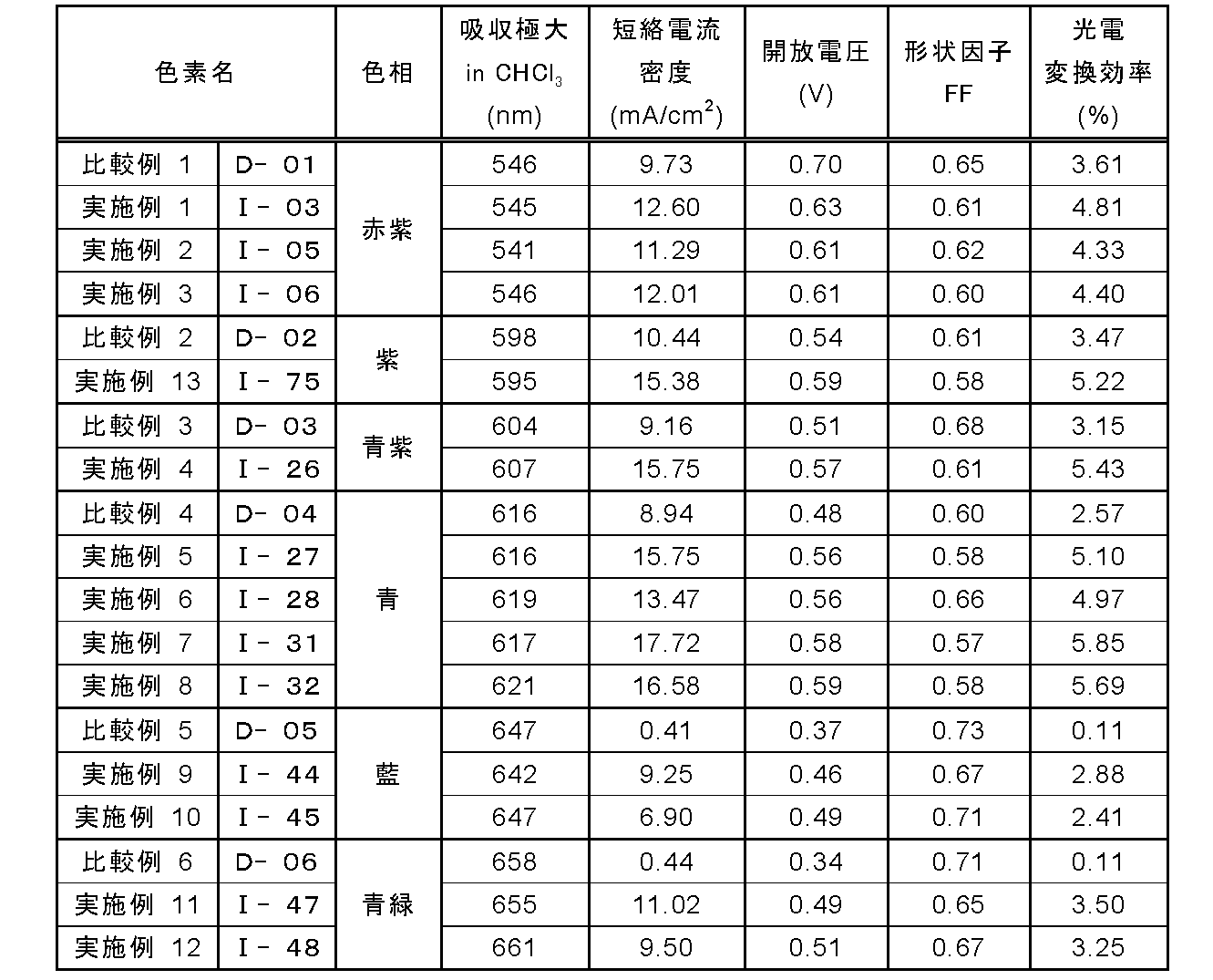

また、表2に示すように、酸化亜鉛においても光電変換効率の大きな改善が認められた。
Claims (2)
- 下記一般式(I)で示される色素またはその塩であることを特徴とする光増感剤。

- 請求項1記載の光増感剤を含む光吸収層を有することを特徴とする光電変換素子。
Priority Applications (4)
| Application Number | Priority Date | Filing Date | Title |
|---|---|---|---|
| CN201580031533.9A CN106463272B (zh) | 2014-06-20 | 2015-06-15 | 光敏剂及光电转换元件 |
| EP15809237.9A EP3159905B1 (en) | 2014-06-20 | 2015-06-15 | Photosensitizer and photoelectric conversion element |
| KR1020167035166A KR101802221B1 (ko) | 2014-06-20 | 2015-06-15 | 광 증감제 및 광전 변환 소자 |
| US15/378,875 US9748044B2 (en) | 2014-06-20 | 2016-12-14 | Photosensitizer and photoelectric conversion device |
Applications Claiming Priority (2)
| Application Number | Priority Date | Filing Date | Title |
|---|---|---|---|
| JP2014-126802 | 2014-06-20 | ||
| JP2014126802A JP5898725B2 (ja) | 2014-06-20 | 2014-06-20 | 光増感剤および光電変換素子 |
Related Child Applications (1)
| Application Number | Title | Priority Date | Filing Date |
|---|---|---|---|
| US15/378,875 Continuation US9748044B2 (en) | 2014-06-20 | 2016-12-14 | Photosensitizer and photoelectric conversion device |
Publications (1)
| Publication Number | Publication Date |
|---|---|
| WO2015194152A1 true WO2015194152A1 (ja) | 2015-12-23 |
Family
ID=54935158
Family Applications (1)
| Application Number | Title | Priority Date | Filing Date |
|---|---|---|---|
| PCT/JP2015/002978 Ceased WO2015194152A1 (ja) | 2014-06-20 | 2015-06-15 | 光増感剤および光電変換素子 |
Country Status (7)
| Country | Link |
|---|---|
| US (1) | US9748044B2 (ja) |
| EP (1) | EP3159905B1 (ja) |
| JP (1) | JP5898725B2 (ja) |
| KR (1) | KR101802221B1 (ja) |
| CN (1) | CN106463272B (ja) |
| TW (1) | TWI632427B (ja) |
| WO (1) | WO2015194152A1 (ja) |
Families Citing this family (6)
| Publication number | Priority date | Publication date | Assignee | Title |
|---|---|---|---|---|
| WO2016196318A1 (en) * | 2015-05-29 | 2016-12-08 | Wake Forest University | Thin-film pn junctions and applications thereof |
| WO2017067631A1 (en) | 2015-10-23 | 2017-04-27 | Merck Patent Gmbh | Blue optoelectronic device |
| JP6931654B2 (ja) | 2016-09-27 | 2021-09-08 | 保土谷化学工業株式会社 | 増感色素、光電変換用増感色素およびそれを用いた光電変換素子ならびに色素増感太陽電池 |
| TWI750333B (zh) * | 2017-03-29 | 2021-12-21 | 日商保土谷化學工業股份有限公司 | 增感色素、光電轉換用增感色素組合物及使用其之光電轉換元件以及色素增感太陽電池 |
| JP7653270B2 (ja) | 2020-02-28 | 2025-03-28 | 保土谷化学工業株式会社 | 増感色素、光電変換用増感色素組成物、光電変換素子および色素増感太陽電池 |
| JP7744776B2 (ja) | 2021-08-26 | 2025-09-26 | 保土谷化学工業株式会社 | 増感色素、光電変換用増感色素組成物、光電変換素子および色素増感太陽電池 |
Citations (6)
| Publication number | Priority date | Publication date | Assignee | Title |
|---|---|---|---|---|
| GB818639A (en) * | 1955-06-25 | 1959-08-19 | Agfa Ag | Anti-halation layers and filter layers for photographic materials |
| JPH09216907A (ja) * | 1995-12-05 | 1997-08-19 | Toyobo Co Ltd | 光重合性組成物およびそれを用いた感光性原版およびその露光方法 |
| JP2005019250A (ja) * | 2003-06-26 | 2005-01-20 | Mitsubishi Paper Mills Ltd | 光電変換材料、半導体電極並びにそれを用いた光電変換素子 |
| JP2006039355A (ja) * | 2004-07-29 | 2006-02-09 | Fuji Photo Film Co Ltd | 感光性組成物 |
| JP2007066690A (ja) * | 2005-08-31 | 2007-03-15 | Mitsubishi Paper Mills Ltd | 光電変換材料、半導体電極並びにそれを用いた光電変換素子 |
| JP2010169678A (ja) * | 2008-12-25 | 2010-08-05 | Canon Inc | 生物試料用標識剤並びに該標識剤を用いた標識方法及びスクリーニング方法 |
Family Cites Families (6)
| Publication number | Priority date | Publication date | Assignee | Title |
|---|---|---|---|---|
| US4162162A (en) * | 1978-05-08 | 1979-07-24 | E. I. Du Pont De Nemours And Company | Derivatives of aryl ketones and p-dialkyl-aminoarylaldehydes as visible sensitizers of photopolymerizable compositions |
| JPS57204550A (en) * | 1981-06-12 | 1982-12-15 | Fuji Photo Film Co Ltd | Electrophotographic receptor |
| GB9217811D0 (en) | 1992-08-21 | 1992-10-07 | Graetzel Michael | Organic compounds |
| JP4080288B2 (ja) | 2002-09-26 | 2008-04-23 | 三菱製紙株式会社 | 太陽電池用メロシアニン色素 |
| JP2013035936A (ja) * | 2011-08-08 | 2013-02-21 | Kemikurea:Kk | 光増感剤および光電変換素子 |
| JP5946652B2 (ja) * | 2012-02-28 | 2016-07-06 | 富士フイルム株式会社 | 光電変換素子、金属錯体色素、色素増感太陽電池用色素吸着液組成物、色素増感太陽電池およびその製造方法 |
-
2014
- 2014-06-20 JP JP2014126802A patent/JP5898725B2/ja active Active
-
2015
- 2015-06-15 WO PCT/JP2015/002978 patent/WO2015194152A1/ja not_active Ceased
- 2015-06-15 CN CN201580031533.9A patent/CN106463272B/zh active Active
- 2015-06-15 EP EP15809237.9A patent/EP3159905B1/en active Active
- 2015-06-15 KR KR1020167035166A patent/KR101802221B1/ko active Active
- 2015-06-17 TW TW104119487A patent/TWI632427B/zh active
-
2016
- 2016-12-14 US US15/378,875 patent/US9748044B2/en active Active
Patent Citations (6)
| Publication number | Priority date | Publication date | Assignee | Title |
|---|---|---|---|---|
| GB818639A (en) * | 1955-06-25 | 1959-08-19 | Agfa Ag | Anti-halation layers and filter layers for photographic materials |
| JPH09216907A (ja) * | 1995-12-05 | 1997-08-19 | Toyobo Co Ltd | 光重合性組成物およびそれを用いた感光性原版およびその露光方法 |
| JP2005019250A (ja) * | 2003-06-26 | 2005-01-20 | Mitsubishi Paper Mills Ltd | 光電変換材料、半導体電極並びにそれを用いた光電変換素子 |
| JP2006039355A (ja) * | 2004-07-29 | 2006-02-09 | Fuji Photo Film Co Ltd | 感光性組成物 |
| JP2007066690A (ja) * | 2005-08-31 | 2007-03-15 | Mitsubishi Paper Mills Ltd | 光電変換材料、半導体電極並びにそれを用いた光電変換素子 |
| JP2010169678A (ja) * | 2008-12-25 | 2010-08-05 | Canon Inc | 生物試料用標識剤並びに該標識剤を用いた標識方法及びスクリーニング方法 |
Non-Patent Citations (1)
| Title |
|---|
| See also references of EP3159905A4 * |
Also Published As
| Publication number | Publication date |
|---|---|
| EP3159905A1 (en) | 2017-04-26 |
| CN106463272A (zh) | 2017-02-22 |
| CN106463272B (zh) | 2018-06-08 |
| KR101802221B1 (ko) | 2017-11-28 |
| TW201602725A (zh) | 2016-01-16 |
| TWI632427B (zh) | 2018-08-11 |
| JP2016006811A (ja) | 2016-01-14 |
| US20170092436A1 (en) | 2017-03-30 |
| US9748044B2 (en) | 2017-08-29 |
| EP3159905B1 (en) | 2018-08-15 |
| JP5898725B2 (ja) | 2016-04-06 |
| KR20170002651A (ko) | 2017-01-06 |
| EP3159905A4 (en) | 2017-11-15 |
Similar Documents
| Publication | Publication Date | Title |
|---|---|---|
| JP5940089B2 (ja) | ナフタリンモノイミド誘導体、及び当該誘導体を、太陽電池及び光検出器における光増感剤として用いる使用 | |
| JP5898725B2 (ja) | 光増感剤および光電変換素子 | |
| WO2007100033A1 (ja) | 色素増感光電変換素子 | |
| JP2004095450A (ja) | 有機色素を光増感剤とする半導体薄膜電極、光電変換素子及び光電気化学太陽電池 | |
| Bolisetty et al. | Benzothiadiazole-based organic dyes with pyridine anchors for dye-sensitized solar cells: effect of donor on optical properties | |
| Maglione et al. | Tuning optical absorption in pyran derivatives for DSSC | |
| Shivashimpi et al. | Effect of nature of anchoring groups on photosensitization behavior in unsymmetrical squaraine dyes | |
| JP2013035936A (ja) | 光増感剤および光電変換素子 | |
| JP2014196283A (ja) | 新規化合物及びそれを用いた光電変換素子 | |
| KR101157743B1 (ko) | 염료 감응 태양전지용 유기염료 및 이를 포함하는 염료 감응 태양전지 | |
| WO2006126538A1 (ja) | 色素増感光電変換素子 | |
| JP5086807B2 (ja) | 新規アミノ基含有複素環誘導体および該複素環誘導体を含有する光電変換用増感色素 | |
| JP2016216663A (ja) | 光増感剤および光電変換素子 | |
| JP5378725B2 (ja) | 光増感剤および光電変換素子 | |
| JP2009173928A (ja) | ベンゾインドール系化合物及びこれを利用した色素増感太陽電池 | |
| JP6005678B2 (ja) | 金属錯体色素、光電変換素子、色素増感太陽電池および金属錯体色素を含有する色素溶液 | |
| CN102532121B (zh) | 罗丹宁衍生物及其用途 | |
| TW201604245A (zh) | 光電轉換元件、色素增感太陽電池、金屬錯合物色素、色素溶液以及三聯吡啶化合物或它的酯化物 | |
| JP2012007084A (ja) | 新規光増感剤 | |
| KR20120126498A (ko) | 신규한 유기염료 및 이를 포함하는 염료감응 태양전지 | |
| JPWO2006041156A1 (ja) | スクアリリウム化合物ならびにこれを用いた光電変換材料、光電変換素子および光電気化学電池 | |
| JP2016157837A (ja) | 光電変換用増感色素、その製造方法および該色素を用いた光電変換素子 | |
| Arslan | 5, 6, 7-Trimethoxy-2-(Methylthio) Quinoline with Different Anchoring Groups: Synthesis And Dye-Sensitized Solar Cell Applications | |
| WO2016136164A1 (ja) | 光増感剤および光電変換素子 | |
| JP6330553B2 (ja) | 色素増感型太陽電池用の増感色素、及び当該増感色素を備える色素増感型太陽電池。 |
Legal Events
| Date | Code | Title | Description |
|---|---|---|---|
| 121 | Ep: the epo has been informed by wipo that ep was designated in this application |
Ref document number: 15809237 Country of ref document: EP Kind code of ref document: A1 |
|
| REEP | Request for entry into the european phase |
Ref document number: 2015809237 Country of ref document: EP |
|
| WWE | Wipo information: entry into national phase |
Ref document number: 2015809237 Country of ref document: EP |
|
| ENP | Entry into the national phase |
Ref document number: 20167035166 Country of ref document: KR Kind code of ref document: A |
|
| NENP | Non-entry into the national phase |
Ref country code: DE |