WO2015194887A1 - 리간드 화합물, 유기크롬 화합물, 올레핀 올리고머화용 촉매 시스템, 및 이를 이용한 올레핀의 올리고머화 방법 - Google Patents
리간드 화합물, 유기크롬 화합물, 올레핀 올리고머화용 촉매 시스템, 및 이를 이용한 올레핀의 올리고머화 방법 Download PDFInfo
- Publication number
- WO2015194887A1 WO2015194887A1 PCT/KR2015/006199 KR2015006199W WO2015194887A1 WO 2015194887 A1 WO2015194887 A1 WO 2015194887A1 KR 2015006199 W KR2015006199 W KR 2015006199W WO 2015194887 A1 WO2015194887 A1 WO 2015194887A1
- Authority
- WO
- WIPO (PCT)
- Prior art keywords
- carbon atoms
- group
- substituted
- compound
- formula
- Prior art date
- Legal status (The legal status is an assumption and is not a legal conclusion. Google has not performed a legal analysis and makes no representation as to the accuracy of the status listed.)
- Ceased
Links
- 0 C**(*)CN(I*(C)*)IN(C*(*I)[*+]=C)*C Chemical compound C**(*)CN(I*(C)*)IN(C*(*I)[*+]=C)*C 0.000 description 3
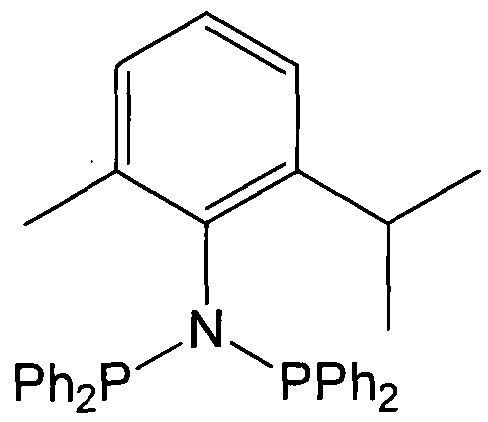
- OUHHPOKMWRYQLL-UHFFFAOYSA-N Cc(cc(Cc(cc1)cc(C)c1N(P(c1ccccc1)c1ccccc1)P(c1ccccc1)c1ccccc1)cc1)c1NP(c1ccccc1)c1ccccc1 Chemical compound Cc(cc(Cc(cc1)cc(C)c1N(P(c1ccccc1)c1ccccc1)P(c1ccccc1)c1ccccc1)cc1)c1NP(c1ccccc1)c1ccccc1 OUHHPOKMWRYQLL-UHFFFAOYSA-N 0.000 description 1
Classifications
-
- C—CHEMISTRY; METALLURGY
- C07—ORGANIC CHEMISTRY
- C07C—ACYCLIC OR CARBOCYCLIC COMPOUNDS
- C07C2/00—Preparation of hydrocarbons from hydrocarbons containing a smaller number of carbon atoms
- C07C2/02—Preparation of hydrocarbons from hydrocarbons containing a smaller number of carbon atoms by addition between unsaturated hydrocarbons
- C07C2/04—Preparation of hydrocarbons from hydrocarbons containing a smaller number of carbon atoms by addition between unsaturated hydrocarbons by oligomerisation of well-defined unsaturated hydrocarbons without ring formation
- C07C2/06—Preparation of hydrocarbons from hydrocarbons containing a smaller number of carbon atoms by addition between unsaturated hydrocarbons by oligomerisation of well-defined unsaturated hydrocarbons without ring formation of alkenes, i.e. acyclic hydrocarbons having only one carbon-to-carbon double bond
- C07C2/08—Catalytic processes
- C07C2/26—Catalytic processes with hydrides or organic compounds
- C07C2/32—Catalytic processes with hydrides or organic compounds as complexes, e.g. acetyl-acetonates
-
- B—PERFORMING OPERATIONS; TRANSPORTING
- B01—PHYSICAL OR CHEMICAL PROCESSES OR APPARATUS IN GENERAL
- B01J—CHEMICAL OR PHYSICAL PROCESSES, e.g. CATALYSIS OR COLLOID CHEMISTRY; THEIR RELEVANT APPARATUS
- B01J31/00—Catalysts comprising hydrides, coordination complexes or organic compounds
- B01J31/02—Catalysts comprising hydrides, coordination complexes or organic compounds containing organic compounds or metal hydrides
- B01J31/12—Catalysts comprising hydrides, coordination complexes or organic compounds containing organic compounds or metal hydrides containing organo-metallic compounds or metal hydrides
- B01J31/14—Catalysts comprising hydrides, coordination complexes or organic compounds containing organic compounds or metal hydrides containing organo-metallic compounds or metal hydrides of aluminium or boron
- B01J31/143—Catalysts comprising hydrides, coordination complexes or organic compounds containing organic compounds or metal hydrides containing organo-metallic compounds or metal hydrides of aluminium or boron of aluminium
-
- B—PERFORMING OPERATIONS; TRANSPORTING
- B01—PHYSICAL OR CHEMICAL PROCESSES OR APPARATUS IN GENERAL
- B01J—CHEMICAL OR PHYSICAL PROCESSES, e.g. CATALYSIS OR COLLOID CHEMISTRY; THEIR RELEVANT APPARATUS
- B01J31/00—Catalysts comprising hydrides, coordination complexes or organic compounds
- B01J31/16—Catalysts comprising hydrides, coordination complexes or organic compounds containing coordination complexes
- B01J31/24—Phosphines, i.e. phosphorus bonded to only carbon atoms, or to both carbon and hydrogen atoms, including e.g. sp2-hybridised phosphorus compounds such as phosphabenzene, phosphole or anionic phospholide ligands
-
- C—CHEMISTRY; METALLURGY
- C07—ORGANIC CHEMISTRY
- C07F—ACYCLIC, CARBOCYCLIC OR HETEROCYCLIC COMPOUNDS CONTAINING ELEMENTS OTHER THAN CARBON, HYDROGEN, HALOGEN, OXYGEN, NITROGEN, SULFUR, SELENIUM OR TELLURIUM
- C07F11/00—Compounds containing elements of Groups 6 or 16 of the Periodic Table
-
- C—CHEMISTRY; METALLURGY
- C07—ORGANIC CHEMISTRY
- C07F—ACYCLIC, CARBOCYCLIC OR HETEROCYCLIC COMPOUNDS CONTAINING ELEMENTS OTHER THAN CARBON, HYDROGEN, HALOGEN, OXYGEN, NITROGEN, SULFUR, SELENIUM OR TELLURIUM
- C07F9/00—Compounds containing elements of Groups 5 or 15 of the Periodic Table
- C07F9/02—Phosphorus compounds
-
- C—CHEMISTRY; METALLURGY
- C07—ORGANIC CHEMISTRY
- C07F—ACYCLIC, CARBOCYCLIC OR HETEROCYCLIC COMPOUNDS CONTAINING ELEMENTS OTHER THAN CARBON, HYDROGEN, HALOGEN, OXYGEN, NITROGEN, SULFUR, SELENIUM OR TELLURIUM
- C07F9/00—Compounds containing elements of Groups 5 or 15 of the Periodic Table
- C07F9/02—Phosphorus compounds
- C07F9/28—Phosphorus compounds with one or more P—C bonds
- C07F9/46—Phosphinous acids [R2POH], [R2P(= O)H]: Thiophosphinous acids including[R2PSH]; [R2P(=S)H]; Aminophosphines [R2PNH2]; Derivatives thereof
-
- C—CHEMISTRY; METALLURGY
- C08—ORGANIC MACROMOLECULAR COMPOUNDS; THEIR PREPARATION OR CHEMICAL WORKING-UP; COMPOSITIONS BASED THEREON
- C08F—MACROMOLECULAR COMPOUNDS OBTAINED BY REACTIONS ONLY INVOLVING CARBON-TO-CARBON UNSATURATED BONDS
- C08F10/00—Homopolymers and copolymers of unsaturated aliphatic hydrocarbons having only one carbon-to-carbon double bond
-
- C—CHEMISTRY; METALLURGY
- C08—ORGANIC MACROMOLECULAR COMPOUNDS; THEIR PREPARATION OR CHEMICAL WORKING-UP; COMPOSITIONS BASED THEREON
- C08F—MACROMOLECULAR COMPOUNDS OBTAINED BY REACTIONS ONLY INVOLVING CARBON-TO-CARBON UNSATURATED BONDS
- C08F4/00—Polymerisation catalysts
- C08F4/06—Metallic compounds other than hydrides and other than metallo-organic compounds; Boron halide or aluminium halide complexes with organic compounds containing oxygen
- C08F4/22—Metallic compounds other than hydrides and other than metallo-organic compounds; Boron halide or aluminium halide complexes with organic compounds containing oxygen of chromium, molybdenum or tungsten
-
- B—PERFORMING OPERATIONS; TRANSPORTING
- B01—PHYSICAL OR CHEMICAL PROCESSES OR APPARATUS IN GENERAL
- B01J—CHEMICAL OR PHYSICAL PROCESSES, e.g. CATALYSIS OR COLLOID CHEMISTRY; THEIR RELEVANT APPARATUS
- B01J2231/00—Catalytic reactions performed with catalysts classified in B01J31/00
- B01J2231/20—Olefin oligomerisation or telomerisation
-
- B—PERFORMING OPERATIONS; TRANSPORTING
- B01—PHYSICAL OR CHEMICAL PROCESSES OR APPARATUS IN GENERAL
- B01J—CHEMICAL OR PHYSICAL PROCESSES, e.g. CATALYSIS OR COLLOID CHEMISTRY; THEIR RELEVANT APPARATUS
- B01J2531/00—Additional information regarding catalytic systems classified in B01J31/00
- B01J2531/001—General concepts, e.g. reviews, relating to catalyst systems and methods of making them, the concept being defined by a common material or method/theory
- B01J2531/002—Materials
- B01J2531/007—Promoter-type Additives
-
- B—PERFORMING OPERATIONS; TRANSPORTING
- B01—PHYSICAL OR CHEMICAL PROCESSES OR APPARATUS IN GENERAL
- B01J—CHEMICAL OR PHYSICAL PROCESSES, e.g. CATALYSIS OR COLLOID CHEMISTRY; THEIR RELEVANT APPARATUS
- B01J2531/00—Additional information regarding catalytic systems classified in B01J31/00
- B01J2531/60—Complexes comprising metals of Group VI (VIA or VIB) as the central metal
- B01J2531/62—Chromium
-
- C—CHEMISTRY; METALLURGY
- C07—ORGANIC CHEMISTRY
- C07C—ACYCLIC OR CARBOCYCLIC COMPOUNDS
- C07C2531/00—Catalysts comprising hydrides, coordination complexes or organic compounds
- C07C2531/02—Catalysts comprising hydrides, coordination complexes or organic compounds containing organic compounds or metal hydrides
- C07C2531/12—Catalysts comprising hydrides, coordination complexes or organic compounds containing organic compounds or metal hydrides containing organo-metallic compounds or metal hydrides
- C07C2531/14—Catalysts comprising hydrides, coordination complexes or organic compounds containing organic compounds or metal hydrides containing organo-metallic compounds or metal hydrides of aluminium or boron
-
- C—CHEMISTRY; METALLURGY
- C07—ORGANIC CHEMISTRY
- C07C—ACYCLIC OR CARBOCYCLIC COMPOUNDS
- C07C2531/00—Catalysts comprising hydrides, coordination complexes or organic compounds
- C07C2531/16—Catalysts comprising hydrides, coordination complexes or organic compounds containing coordination complexes
- C07C2531/22—Organic complexes
Definitions
- Ligand compound organic cream compound, catalyst system for olefin oligomerization, and oligomerization method of olefin using the same
- the present invention relates to a ligand compound, an organochrome compound, a catalyst system for olefin oligomerization comprising the ligand compound or organochrome compound, and a method for oligomerization of olefins using the same.
- Linear alpha-olefins such as 1-nuxene and 1-octene are used as scrubber 1, lubricants, plasticizers, etc., especially comonomers for controlling the density of polymers in the production of linear low density polyethylene (LLDPE). It is used a lot.
- LLDPE linear low density polyethylene
- This linear alpha-lefin was produced mainly through the Shell Higher Olefin Process.
- the method synthesizes alpha-olefins of various lengths simultaneously according to the Schultz-Flory distribution, it is cumbersome to undergo a separate separation process in order to obtain specific alpha-olefins.
- the present invention is to provide a novel ligand compound that enables the expression of high catalytic activity and selectivity in the reaction of oligomerization of olefins.
- the present invention provides a high catalytic activity in the oligomerization of olefins. It is to provide a novel organochrome compound that allows the expression of selectivity. In addition, the present invention is to provide a catalyst system for olefin oligomerization comprising the ligand compound or organochrome compound.
- the present invention also provides a method for oligomerization of olefins using the catalyst system.
- the linker is composed of an aliphatic group having 5 to 20 carbon atoms, or an aliphatic group having 1 to 20 carbon atoms and an aromatic group having 6 to 20 carbon atoms combined;
- At least one terminal of the linker is substituted or unsubstituted with an aryl group having 6 to 20 carbon atoms;
- the linker consists of an aliphatic group of 5 to 20 carbon atoms, there is provided a ligand compound in which an aryl group of 6 to 20 carbon atoms is substituted at least at either end:
- N is nitrogen
- Each X is independently phosphorus (p), arsenic (As) or antimony (Sb),
- R1 to R 4 are each independently a hydrocarbyl group or a hetero hydrocarbyl group.
- the linker is composed of an aliphatic group having 5 to 20 carbon atoms, or an aliphatic group having 1 to 20 carbon atoms and an aromatic group having 6 to 20 carbon atoms combined;
- At least one terminal of the linker is substituted or unsubstituted with an aryl group having 6 to 20 carbon atoms;
- an organochrome compound is provided, in which an aryl group of 6 to 20 carbon atoms is substituted at least at one end:
- X are each independently phosphorus ( ⁇ ), arsenic (As) or antimony (Sb),
- R 1 to R 4 are each independently a hydrocarbyl group or a hetero hydrocarbyl group
- Cr is chromium
- ⁇ 1 , ⁇ 2 and ⁇ 3 are each independently halogen, hydrogen, a hydrocarbyl group having 1 to 10 carbon atoms, or a heterohydrocarbyl group having 1 to 10 carbon atoms.
- a catalyst system for olefin oligomerization is provided.
- a method for oligomerization of an olefin comprising the step of forming alpha-lepine by the oligomerization reaction of the olefin in the presence of the catalyst system.
- a ligand compound, an organic cream compound, a catalyst system for olefin oligomerization, and a method of oligomerization of urepin using the same according to embodiments of the present invention will be described in detail.
- 'catalyst system 1 ' is used herein to refer to three components including a crum source, a ligand compound and a cocatalyst, or alternatively, two components of an organic cream compound and a cocatalyst are added simultaneously or in any order to be active. It means that in a state that can be obtained with the catalyst composition. Three or two components of the catalyst system may be added in the presence or absence of a solvent and monomer, and may be used in a supported or unsupported state.
- the linker is composed of an aliphatic group having 5 to 20 carbon atoms, or an aliphatic group having 1 to 20 carbon atoms and an aromatic group having 6 to 20 carbon atoms combined;
- At least one terminal of the linker is substituted or unsubstituted with an aryl group having 6 to 20 carbon atoms;
- the linker consists of an aliphatic group of 5 to 20 carbon atoms, there is provided a ligand compound in which an aryl group of 6 to 20 carbon atoms is substituted at least at either end:
- N is nitrogen
- Each X is independently phosphorus (p), arsenic (As) or antimony (Sb),
- R 1 to R 4 are each independently a hydrocarbyl group or a hetero hydrocarbyl group.
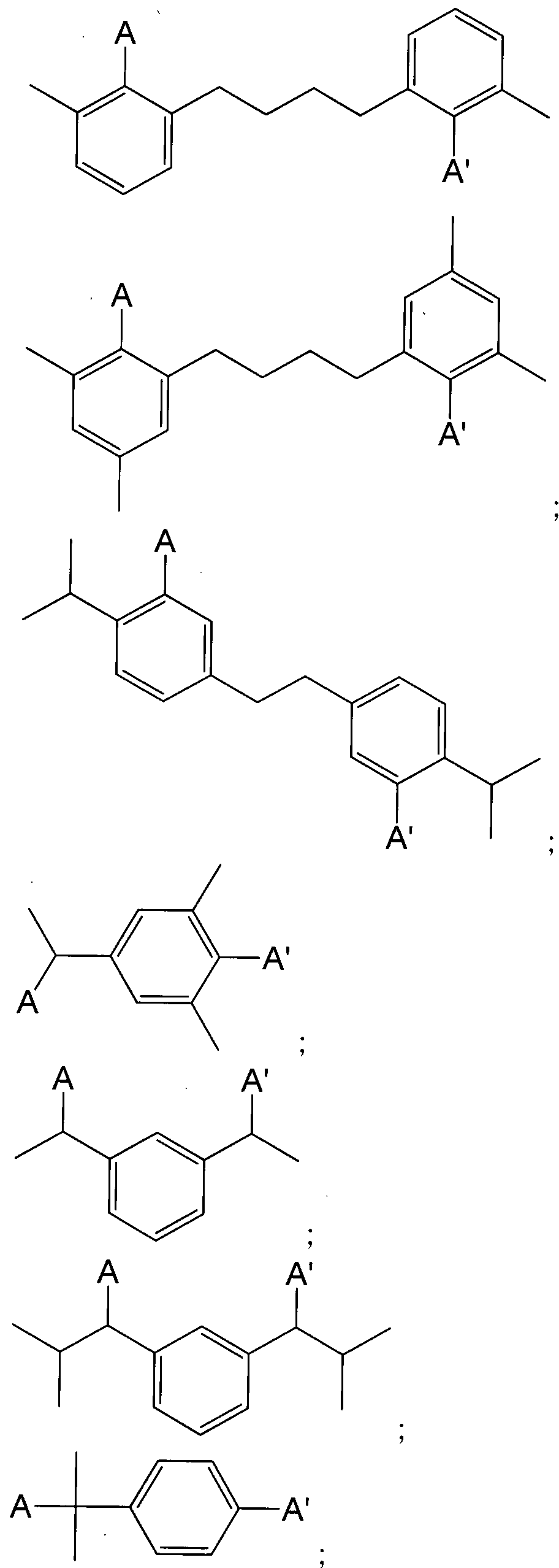
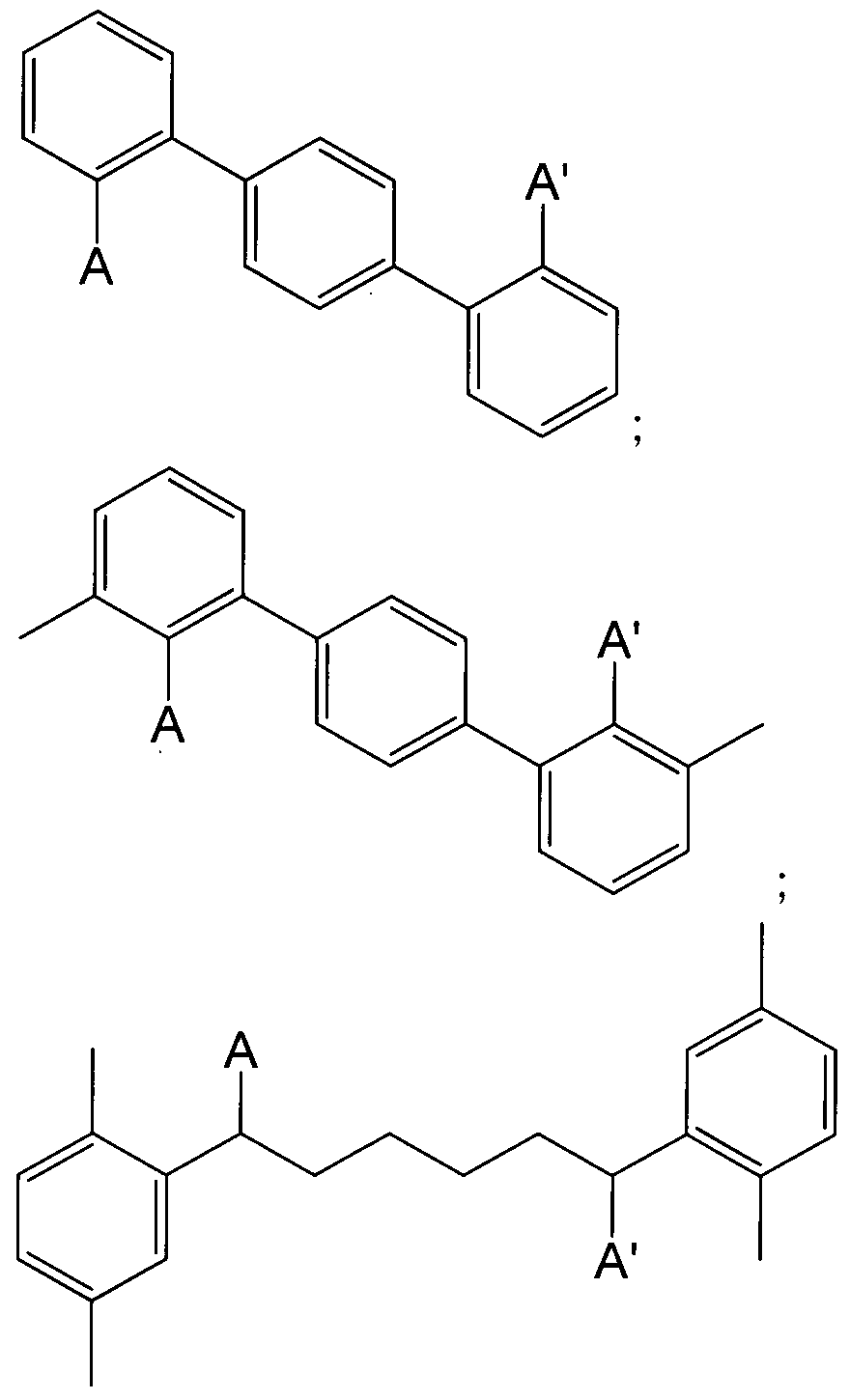
- the ligand compound includes at least two groups represented by Formula 1 (particularly, diphosphino aminyl moiety) in a molecule, and between each group represented by Formula 1 Has a linker connecting 4 to 7 consecutively, 4 to 6 black, 4 to 5 black, and 4 carbon-carbon bonds.
- each group represented by the formula (1) is connected by 4 to 7 carbon-carbon bonds, as shown in the following example, in the shortest distance from any group represented by the formula (1) to the other group It means that 4 to 7 consecutive carbon-carbon bonds (or 5 to 8 carbon atoms) are included.
- the carbon-carbon bonds may each independently be a single bond or a double bond.
- the group represented by Formula 1 is represented by A or A 'for convenience, and A and A' may be the same as or different from each other:
- Ligand compound that satisfies the structure is applied to the catalyst system for olefin oligomerization to enable the active interaction between each group represented by the formula (1) and the crack active point adjacent to it to achieve high oligomerization reaction activity and
- X in Chemical Formula 1 may be each independently phosphorus (P), arsenic (As), or antimony (Sb).
- the group represented by Formula 1 may be a diphosphino aminyl moiety in which each X is phosphorus (P).
- R 1 to R 4 may be each independently a hydrocarbyl group or a hetero hydrocarbyl group.
- each of R 1 to R 4 independently represents a substituted or unsubstituted alkyl group having 1 to 10 carbon atoms, a substituted or unsubstituted cycloalkyl group having 4 to 10 carbon atoms, a substituted or unsubstituted carbon group having 6 to 15 carbon atoms. It may be an aryl group, a substituted or unsubstituted arylalkyl group having 7 to 15 carbon atoms, or a substituted or unsubstituted alkoxy group having 1 to 10 carbon atoms.
- At least one hydrogen contained in the alkyl group, cycloalkyl group, aryl group, arylalkyl group, and alkoxy group may be substituted with an alkyl group having 1 to 10 carbon atoms, an alkoxy group having 1 to 10 carbon atoms, a halogen atom, or a cyano group.
- R 1 to R 4 are each independently methyl, ethyl, propyl, propenyl, propynyl, butyl, cyclohexyl ), 2-methylcyclohexyl,
- the ligand compound includes a linker connecting 4 to 7 carbon-carbon bonds between two or more groups of nitrogen atoms represented by Formula 1 above.
- two or more groups represented by Formula 1 are each connected by 4 to ⁇ carbon-carbon bonds, which means that 4 to 7 consecutive groups are formed at the shortest distance from any group represented by Formula 1 to the other group.
- Mean carbon-carbon bonds (or 5 to 8 carbon atoms) are included. That is, if there are 4 to 7 carbon-carbon bonds placed on the shortest distance, the overall structure of the linker is not particularly limited.
- the linker may be composed of an aliphatic group having 5 to 20 carbon atoms, for example, an alkylene group or an alkenylene group, and more specifically, a straight or branched chain alkylene group having 5 to 15 carbon atoms or 5 to 10 carbon atoms. Or alkenylene groups.
- the linker may be composed of a group in which an aliphatic group having 1 to 20 carbon atoms and an aromatic group having 6 to 20 carbon atoms are combined. More specifically, the linker may comprise one or more (eg, one or two alkylene groups) of straight or branched chain alkylene groups or alkenylene groups having 1 to 20 carbon atoms, or 1 to 10 carbon atoms, or 1 to 5 carbon atoms. Or an alkenylene group) and one or more (eg, one or two arylene groups) of 6 to 20 carbon atoms, or an arylene group having 6 to 10 carbon atoms, may be combined. The arylene group of 10 may be further substituted or unsubstituted with an alkyl group having 1 to 5 carbon atoms.
- At least one end of the linker may be substituted or unsubstituted with an aryl group having 6 to 20 carbon atoms or 6 to 10 carbon atoms.
- an aryl group having 6 to 20 carbon atoms is substituted at least at one end thereof.
- such an aryl group may be further substituted or unsubstituted with an alkyl group having 1 to 5 carbon atoms.
- Each X is independently phosphorus (P), arsenic (As) or antimony (Sb),
- R1 to R 8 are each independently a hydrocarbyl group or a hetero hydrocarbyl group.
- the ligand compound represented by Formula 2 is an example of a compound having two groups represented by Formula 1 in the molecule.
- X may be independently phosphorus (P), arsenic (As), or antimony (Sb), preferably phosphorus (P).
- R i to R 8 are each independently a hydrocarbyl group or a hetero hydrocarbyl group, and include, but are not limited to, a substituted or unsubstituted alkyl group having 1 to 10 carbon atoms, a substituted or unsubstituted carbon number 4 to 10 10 cycloalkyl groups, substituted or unsubstituted aryl groups having 6 to 15 carbon atoms, substituted or unsubstituted carbon atoms 7 to
- an arylalkyl group of 15 or a substituted or unsubstituted alkoxy group having 1 to 10 carbon atoms is an arylalkyl group of 15 or a substituted or unsubstituted alkoxy group having 1 to 10 carbon atoms.
- At least one hydrogen contained in the alkyl group, cycloalkyl group, aryl group, arylalkyl group, and alkoxy group may be substituted with an alkyl group having 1 to 10 carbon atoms, an alkoxy group having 1 to 10 carbon atoms, a halogen atom, or a cyano group.
- R 1 to R 8 are each independently methyl, ethyl, propyl, propenyl, propynyl, butyl, cyclohexyl ), 2-methylcyclonuclear chamber (2-methyIcycIohexyl),
- 0-methoxyphenyl 0-methoxyphenyl. (o-methoxy phenyl), 0-isopropoxyphenyl, m-methylphenyl, m-ethylphenyl, m-isopropylphenyl mt- Butylphenyl (m-butylphenyl), m-methoxyphenyl, m-isopropoxyphenyl, p-methylphenyl, p-ethylphenyl p-isopropylphenyl, pt-butylphenyl, pt-butylphenyl, p-methoxyphenyl, p-isopropoxyphenyl, cumyl ( cumyl), mesityl (mesityl), biphenyl (biphenyl), naphthyl, (naphthyl), anthracenyl (anthracenyl), methoxy (methoxy), ethoxy (eth
- Ligand compounds according to the present invention can be implemented in various combinations in the range satisfying the above conditions in addition to the above examples. And, the ligand compound can be synthesized by applying known reactions , and more detailed synthesis method is described in the Examples section. II. Organochrome compounds
- the linker is composed of an aliphatic group having 5 to 20 carbon atoms, or an aliphatic group having 1 to 20 carbon atoms and an aromatic group having 6 to 20 carbon atoms combined; At least one terminal of the linker is substituted or unsubstituted with an aryl group having 6 to 20 carbon atoms;
- an organochrome compound is provided, in which an aryl group of 6 to 20 carbon atoms is substituted at least at one end:
- X are each independently phosphorus ( ⁇ ), arsenic (As) or antimony (Sb),
- R 1 to R 4 are each independently a hydrocarbyl group or a hetero hydrocarbyl group
- ⁇ ⁇ , ⁇ 2 and ⁇ 3 are each independently halogen, hydrogen, a hydrocarbyl group having 1 to 10 carbon atoms, or a heterohydrocarbyl group having 1 to 10 carbon atoms.
- the organochrome compound is a complex compound of the above-described ligand compound, and has a form in which chromium atoms included in any chromium source form a coordination bond with the X moiety of the group represented by the formula (1).
- organochromium compounds can be applied to the oligomerization reaction system of olefins to exhibit excellent catalytic activity and high selectivity for 1_nuxene or 1-octene.
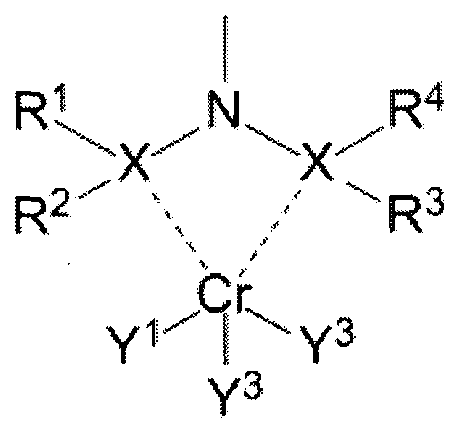
- Cr is chromium
- Y 1 , Y 2, and Y 3 are each independently halogen, hydrogen, a hydrocarbyl group having 1 to 10 carbon atoms, or a heterohydrocarbyl group having 1 to 10 carbon atoms.
- the organic cream compound of Formula 3 may be obtained by a conventional method for forming a cream complex compound of the ligand compound.
- a catalyst system for olepin oligomerization comprising:
- the olefin oligomerization catalyst system comprises: i) a three-component catalyst system comprising a crum source, the above-described ligand compound and a promoter; Or ii) a two-component catalyst system comprising the above-mentioned organic cream compound and a promoter.
- the chromium source has a oxidation state of chromium from 0 to
- an organic or inorganic creep compound that is 6 it can be, for example, a chromium metal or a compound in which any organic or inorganic radical is bound to the creme.
- the organic radical may be an alkyl, alkoxy, ester, ketone, amido, carboxylate radical, etc. having 1 to 20 carbon atoms per radical
- the inorganic radical may be a halide, sulfate, oxide, or the like.
- the chromium source is a compound that can exhibit high activity in oligomerization of olefins and is easy to use and obtain, and is chromium (III) acetylacetonate, chromium ( ⁇ ) chloride tetrahydrofuran, chromium (III) 2 Ethylnucleanoate, chromium (III) acetate, chromium (III) butyrate, chromium (III) pentanoate, chromium (III) laurate, chromium (III) tris (2,2,6,6-tetramethyl) 3.5-heptanedionate), and chromium (III) stearate.
- chromium (III) acetylacetonate chromium ( ⁇ ) chloride tetrahydrofuran
- chromium (III) 2 Ethylnucleanoate chromium (III) acetate, chromium (III) butyrate
- the cocatalyst is an organometallic compound including a Group 13 metal, and may be applied without particular limitation as long as it can be generally used when polymerizing leupine under a catalyst of a transition metal compound.
- the promoter may be at least one compound selected from the group consisting of compounds represented by Formulas 4 to 6 below:
- R 41 is the same as or different from each other, and each independently A halogen radical, a hydrocarbyl radical of 1 to 20 carbon atoms, or a hydrocarbyl radical of 1 to 20 carbon atoms substituted with halogen, (: is an integer of 2 or more,
- D is aluminum or boron
- R 51 is C1-C20 hydrocarbyl or halogen substituted by C1-C20 hydrocarbyl
- L is a neutral Lewis base
- [LH] + is a Bronsted acid
- Q is boron or aluminum in a +3 type oxidation state
- each E is independently at least one hydrogen atom is halogen, a hydrocarbyl having 1 to 20 carbon atoms, An aryl group having 6 to 20 carbon atoms or an alkyl group having 1 to 20 carbon atoms which is unsubstituted or substituted with an alkoxy functional group or a phenoxy functional group.
- the compound represented by Formula 4 may be alkyl aluminoxane, such as methyl aluminoxane, ethyl aluminoxane, isobutyl aluminoxane, butyl aluminoxane.
- the compound represented by Formula 5 is trimethylaluminum, triethylaluminum, triisobutylaluminum, tripropylaluminum, tributylaluminum, dimethylchloroaluminum, dimethylisobutylaluminum, dimethylethylaluminum, di Ethylchloroaluminum, triisopropylaluminum, tri-S-butylaluminum, tricyclopentylaluminum tripentylaluminum, triisopentylaluminum, trinuxylaluminum, ethyldimethylaluminum, methyldiethylaluminum, triphenylaluminum, tri-P- Aryl aluminum, dimethyl aluminum methoxy J dimethyl aluminum ethoxide, trimethyl boron, triethyl boron, triisobutyl boron, tripropyl boron, tributyl boron and the like
- the compound represented by Formula 6 is triethylammonium tetraphenylboron, tributylammonium tetraphenylboron, trimethylammonium tetraphenylboron, tripropylammonium tetraphenylboron, trimethylammonium Tetra (P-ryll) boron, tripropylammonium tetra (P-ryll) boron, Triethylammonium tetra ( ⁇ , ⁇ -dimethylphenyl) boron,
- Triphenylphosphonium tetraphenylaluminum Trimethylphosphonium tetraphenylaluminum, triphenylcarbonium tetraphenylboron, triphenylcarbonium tetraphenylaluminum, triphenylcarbonium tetra ( ⁇ -trifluoromethylphenyl) boron,
- Triphenylcarbonium tetrapentafluorophenylboron and the like Triphenylcarbonium tetrapentafluorophenylboron and the like.
- the promoter may be an organoaluminum compound, an organoboron compound, an organomagnesium compound, an organozinc compound, an organolithium compound, or a combination thereof.
- the promoter is preferably an organoaluminum compound, more preferably trimethyl aluminum, triethyl aluminum, triisopropyl aluminum, triisobutyl aluminum (triisobutyl aluminum), ethyl aluminum 1 selected from the group consisting of ethylaluminum sesquichloride, diethylaluminum chloride, ethyl aluminum dichloride, methylaluminoxane, and modified methylaluminoxane It may be a compound of more than one species.
- the content ratio of the components constituting the catalyst system may be determined in consideration of catalyst activity and selectivity for linear alpha-olefins.
- the molar ratio of diphosphino aminyl moiety: chromium source: promoter of the ligand compound is about 1: 1: 1 to 10: 1: 10,000, or about 1: 1 It is advantageous to adjust from: 100 to 5: 1: 3,000.
- the molar ratio of diphosphino aminyl residue: cocatalyst of the organochrome compound is 1: 1 to 1: 10,000, or 1: 1 to 1: 5,000, or 1: 1 to 1: It is advantageous to adjust to 3,000.
- Suitable solvents include heptane, toluene, cyclonucleic acid, methylcyclonucleic acid, 1-nuxene, 1-octene, diethyl ether, tetrahydrofuran, acetonitrile, dichloromethane, chloroform, chlorobenzene, methanol, acetone, and the like. Can be used.
- the catalyst system may further comprise a carrier. That is, the ligand compound of Formula 1 may be applied to ethylene oligomerization in a form supported on a carrier.
- the carrier may be a metal, a metal salt, a metal oxide, or the like applied to a conventional supported catalyst.
- the carrier may be silica, silica-alumina, silica-magnesia, and the like, and oxides, carbonates, sulfates, vaginas of metals such as Na 2 0, K 2 C0 3 , BaS0 4 , Mg (N0 3 ) 2, and the like. It may comprise a trisalt component.
- a method of ethylene oligomerization comprising the step of forming an alpha-lefin by the oligomerization reaction of olefins in the presence of the catalyst system.
- the process for the oligomerization of olefins according to the invention can be carried out by applying conventional equipment and contacting techniques with the catalyst system described above as the raw material of olefins (for example ethylene).
- the oligomerization reaction of the olefins is predominantly a homogeneous liquid reaction in the presence or absence of an inert solvent, or a slurry reaction in which the catalyst system is partially or completely undissolved, or the product alpha-ullepin.
- Bulk reaction, or gas reaction which acts as a medium.
- the oligomerization reaction of the olefin may be performed under an inert solvent.
- the inert solvent may be benzene, toluene, xylene, cumene, chlorobenzene, dichlorobenzene, heptane, cyclonucleic acid, methylcyclonucleic acid, methylcyclopentane, ⁇ -nucleic acid, 1-nuxene, 1-octene, etc. have.
- the oligomerization reaction of the relefin may be performed at a temperature of about 0 to 200 ° C, or about 0 to 150 ° C, or about 30 to 100 ° C, or about 50 to 100 ° C.
- the reaction may be carried out under a pressure of about 15 to 3000 psig, or 15 to 1500 psig, or 15 to 1000 psig.
- the olefin oligomerization catalyst system according to the invention exhibits high selectivity for 1-nuxene or 1-octene while having good catalytic activity, allowing for the production of more efficient alpha-olefins.
- chromium (III) acetylacetonate (1g 5 mg, 0.05 mmol) and ligand compound C-01 (0.025 mmol) according to Example 1 were placed in a flask, and then 100 mL of methylcyclonucleic acid was added thereto. Was added and stirred to prepare a 0.5 mM (Cr basis) solution.
- the reactor was cooled to 0 ° C. using a dry ice / acetone bath, slowly ventilated ethylene and 0.5 mL of nonane (GC internal standard) was added thereto. After stirring for 10 seconds, 2 mL of the liquid portion of the reaction was taken and quenched with water, and the obtained organic portion was filtered with a PTFE syringe filter to perform GC-FID analysis.
- GC internal standard nonane
Landscapes
- Chemical & Material Sciences (AREA)
- Organic Chemistry (AREA)
- Chemical Kinetics & Catalysis (AREA)
- Health & Medical Sciences (AREA)
- Engineering & Computer Science (AREA)
- Materials Engineering (AREA)
- Biochemistry (AREA)
- General Health & Medical Sciences (AREA)
- Molecular Biology (AREA)
- Life Sciences & Earth Sciences (AREA)
- Medicinal Chemistry (AREA)
- Polymers & Plastics (AREA)
- Inorganic Chemistry (AREA)
- Catalysts (AREA)
- Organic Low-Molecular-Weight Compounds And Preparation Thereof (AREA)
Abstract
Description







Claims


Priority Applications (4)
| Application Number | Priority Date | Filing Date | Title |
|---|---|---|---|
| US15/302,840 US10472302B2 (en) | 2014-06-18 | 2015-06-18 | Ligand compound, organic chromium compound, catalyst system for oligomerization of olefins, and method for oligomerization of olefins using the catalyst system |
| JP2016565684A JP6427205B2 (ja) | 2014-06-18 | 2015-06-18 | リガンド化合物、有機クロム化合物、オレフィンオリゴマー化用触媒システム、およびこれを用いたオレフィンのオリゴマー化方法 |
| EP15810282.2A EP3101039B1 (en) | 2014-06-18 | 2015-06-18 | Ligand compound, organic chrome compound, catalyst system for olefin oligomerization, and method for oligomerizing olefin using same |
| CN201580019068.7A CN106164103B (zh) | 2014-06-18 | 2015-06-18 | 配体化合物、有机铬化合物、用于烯烃低聚的催化剂体系以及使用所述催化剂体系的用于烯烃低聚的方法 |
Applications Claiming Priority (4)
| Application Number | Priority Date | Filing Date | Title |
|---|---|---|---|
| KR20140074370 | 2014-06-18 | ||
| KR10-2014-0074370 | 2014-06-18 | ||
| KR20140180749 | 2014-12-15 | ||
| KR10-2014-0180749 | 2014-12-15 |
Publications (1)
| Publication Number | Publication Date |
|---|---|
| WO2015194887A1 true WO2015194887A1 (ko) | 2015-12-23 |
Family
ID=54935796
Family Applications (1)
| Application Number | Title | Priority Date | Filing Date |
|---|---|---|---|
| PCT/KR2015/006199 Ceased WO2015194887A1 (ko) | 2014-06-18 | 2015-06-18 | 리간드 화합물, 유기크롬 화합물, 올레핀 올리고머화용 촉매 시스템, 및 이를 이용한 올레핀의 올리고머화 방법 |
Country Status (6)
| Country | Link |
|---|---|
| US (1) | US10472302B2 (ko) |
| EP (1) | EP3101039B1 (ko) |
| JP (1) | JP6427205B2 (ko) |
| KR (1) | KR101666172B1 (ko) |
| CN (1) | CN106164103B (ko) |
| WO (1) | WO2015194887A1 (ko) |
Families Citing this family (5)
| Publication number | Priority date | Publication date | Assignee | Title |
|---|---|---|---|---|
| KR101757369B1 (ko) | 2014-12-11 | 2017-07-12 | 주식회사 엘지화학 | 리간드 화합물, 유기크롬 화합물, 올레핀 올리고머화용 촉매 시스템, 및 이를 이용한 올레핀의 올리고머화 방법 |
| KR101768194B1 (ko) * | 2015-05-15 | 2017-08-16 | 주식회사 엘지화학 | 촉매 조성물 및 이를 이용한 폴리올레핀의 제조방법 |
| WO2016186282A1 (ko) | 2015-05-15 | 2016-11-24 | 주식회사 엘지화학 | 촉매 조성물 및 이를 이용한 폴리올레핀의 제조방법 |
| KR101761830B1 (ko) | 2015-10-21 | 2017-07-26 | 주식회사 엘지화학 | 리간드 화합물, 올레핀 올리고머화용 촉매계, 및 이를 이용한 올레핀 올리고머화 방법 |
| SG11202000016XA (en) * | 2017-07-06 | 2020-01-30 | Mitsui Chemicals Inc | Catalyst for olefin multimerization and method for producing olefin multimer in presence of said catalyst |
Citations (6)
| Publication number | Priority date | Publication date | Assignee | Title |
|---|---|---|---|---|
| KR20040089446A (ko) * | 2001-04-30 | 2004-10-21 | 더블유.알. 그레이스 앤드 캄파니-콘. | 크롬 지지체-응집물-전이금속 중합 촉매 및 이의 사용 방법 |
| KR20060002742A (ko) * | 2002-12-20 | 2006-01-09 | 사솔 테크날러지 (프로프라이어터리) 리미티드 | 올레핀의 사량체화 |
| KR20080074339A (ko) * | 2007-02-08 | 2008-08-13 | 에스케이에너지 주식회사 | 에틸렌 사량체화 담지 촉매 화합물 및 이를 이용한 에틸렌사량체화 방법 |
| US20110282016A1 (en) * | 2010-05-12 | 2011-11-17 | Nova Chemicals (International) S.A. | Oligomerization |
| KR20140063346A (ko) * | 2012-11-15 | 2014-05-27 | 주식회사 엘지화학 | 리간드 화합물, 유기크롬 화합물, 에틸렌 올리고머화용 촉매계, 이의 제조 방법 및 이를 이용한 에틸렌 올리고머화 방법 |
| KR20150058049A (ko) * | 2013-11-18 | 2015-05-28 | 주식회사 엘지화학 | 리간드 화합물, 올레핀 올리고머화용 촉매계, 및 이를 이용한 올레핀 올리고머화 방법 |
Family Cites Families (17)
| Publication number | Priority date | Publication date | Assignee | Title |
|---|---|---|---|---|
| GB0016895D0 (en) | 2000-07-11 | 2000-08-30 | Bp Chem Int Ltd | Olefin oligomerisation |
| ES2372474T3 (es) | 2004-06-18 | 2012-01-20 | Sasol Technology (Pty) Ltd | Oligomerización en presencia tanto de un catalizador de tetramerización como de un catalizador de oligomerización adicional. |
| EP1756024B1 (en) | 2004-06-18 | 2018-08-15 | Sasol Technology (Pty) Ltd | Oligomerisation of olefinic compounds in an aliphatic medium |
| CN1651142A (zh) * | 2004-12-27 | 2005-08-10 | 中国石油大庆石化分公司研究院 | 用于乙烯齐聚的催化剂组分、制备方法及其应用 |
| EP2420507A1 (en) | 2005-09-20 | 2012-02-22 | Takeda Pharmaceutical Company Limited | Diphosphine ligand and transition metal complex using the same |
| CN100443178C (zh) | 2006-03-10 | 2008-12-17 | 中国石油天然气股份有限公司 | 一种乙烯低聚的催化剂组合物及其应用 |
| US7706812B2 (en) * | 2006-05-19 | 2010-04-27 | Cisco Technology, Inc. | System and method for detecting locations of a customer premises equipment |
| US7378537B2 (en) | 2006-07-25 | 2008-05-27 | Chevron Phillips Chemical Company Lp | Olefin oligomerization catalysts and methods of using same |
| KR101057576B1 (ko) | 2007-08-16 | 2011-08-17 | 에스케이종합화학 주식회사 | 선택적 에틸렌 올리머고화 촉매계 |
| CN101450326B (zh) | 2007-12-05 | 2013-07-03 | 中国石油天然气股份有限公司 | 一种乙烯齐聚的催化剂组合物及其用途 |
| CA2639882C (en) | 2008-09-29 | 2016-07-12 | Nova Chemicals Corporation | Tetramerization |
| CN102107146B (zh) | 2009-12-29 | 2013-10-16 | 中国石油天然气股份有限公司 | 一种用于乙烯三聚合成己烯-1的催化剂及其应用 |
| US20120172645A1 (en) | 2010-12-29 | 2012-07-05 | Chevron Phillips Chemical Company Lp | Olefin Oligomerization catalysts and Methods of Making and Using Same |
| KR101471156B1 (ko) * | 2011-06-14 | 2014-12-10 | 주식회사 엘지화학 | 선택적 에틸렌 올리고머화 촉매계 |
| CN103044181A (zh) | 2011-10-17 | 2013-04-17 | 中国石油天然气股份有限公司 | 一种乙烯四聚反应制备辛烯-1的方法 |
| CN103285926A (zh) | 2012-03-01 | 2013-09-11 | 中国石油天然气股份有限公司 | 一种乙烯齐聚的催化剂组合物及其用途 |
| KR101638980B1 (ko) * | 2013-09-30 | 2016-07-12 | 주식회사 엘지화학 | 리간드 화합물, 유기크롬 화합물, 에틸렌 올리고머화용 촉매 시스템, 및 이를 이용한 에틸렌 올리고머화 방법 |
-
2015
- 2015-06-18 CN CN201580019068.7A patent/CN106164103B/zh active Active
- 2015-06-18 US US15/302,840 patent/US10472302B2/en active Active
- 2015-06-18 EP EP15810282.2A patent/EP3101039B1/en active Active
- 2015-06-18 KR KR1020150086454A patent/KR101666172B1/ko active Active
- 2015-06-18 WO PCT/KR2015/006199 patent/WO2015194887A1/ko not_active Ceased
- 2015-06-18 JP JP2016565684A patent/JP6427205B2/ja active Active
Patent Citations (6)
| Publication number | Priority date | Publication date | Assignee | Title |
|---|---|---|---|---|
| KR20040089446A (ko) * | 2001-04-30 | 2004-10-21 | 더블유.알. 그레이스 앤드 캄파니-콘. | 크롬 지지체-응집물-전이금속 중합 촉매 및 이의 사용 방법 |
| KR20060002742A (ko) * | 2002-12-20 | 2006-01-09 | 사솔 테크날러지 (프로프라이어터리) 리미티드 | 올레핀의 사량체화 |
| KR20080074339A (ko) * | 2007-02-08 | 2008-08-13 | 에스케이에너지 주식회사 | 에틸렌 사량체화 담지 촉매 화합물 및 이를 이용한 에틸렌사량체화 방법 |
| US20110282016A1 (en) * | 2010-05-12 | 2011-11-17 | Nova Chemicals (International) S.A. | Oligomerization |
| KR20140063346A (ko) * | 2012-11-15 | 2014-05-27 | 주식회사 엘지화학 | 리간드 화합물, 유기크롬 화합물, 에틸렌 올리고머화용 촉매계, 이의 제조 방법 및 이를 이용한 에틸렌 올리고머화 방법 |
| KR20150058049A (ko) * | 2013-11-18 | 2015-05-28 | 주식회사 엘지화학 | 리간드 화합물, 올레핀 올리고머화용 촉매계, 및 이를 이용한 올레핀 올리고머화 방법 |
Non-Patent Citations (1)
| Title |
|---|
| See also references of EP3101039A4 * |
Also Published As
| Publication number | Publication date |
|---|---|
| JP2017524650A (ja) | 2017-08-31 |
| CN106164103A (zh) | 2016-11-23 |
| EP3101039B1 (en) | 2019-07-31 |
| EP3101039A4 (en) | 2017-07-05 |
| KR20150145203A (ko) | 2015-12-29 |
| CN106164103B (zh) | 2018-05-25 |
| EP3101039A1 (en) | 2016-12-07 |
| JP6427205B2 (ja) | 2018-11-21 |
| US20170029346A1 (en) | 2017-02-02 |
| US10472302B2 (en) | 2019-11-12 |
| KR101666172B1 (ko) | 2016-10-13 |
Similar Documents
| Publication | Publication Date | Title |
|---|---|---|
| EP3260460B1 (en) | Ligand compound, organic chrome compound, catalyst system for olefin oligomerization, and method for olefin oligomerization using same | |
| JP6195994B2 (ja) | リガンド化合物、有機クロム化合物、エチレンオリゴマー化用触媒システム、およびこれを用いたエチレンオリゴマー化方法 | |
| WO2015194887A1 (ko) | 리간드 화합물, 유기크롬 화합물, 올레핀 올리고머화용 촉매 시스템, 및 이를 이용한 올레핀의 올리고머화 방법 | |
| JP6427266B2 (ja) | リガンド化合物、有機クロム化合物、オレフィンオリゴマー化触媒システム、およびこれを用いたオレフィンのオリゴマー化方法 | |
| WO2016200000A1 (ko) | 리간드 화합물, 유기 크롬 화합물, 올레핀 올리고머화용 촉매 시스템, 및 이를 이용한 올레핀의 올리고머화 방법 | |
| US10947256B2 (en) | Ligand compound, organic chromium compound, catalyst system for olefin oligomerizatin, and method for oligomerizing olefin using same | |
| KR20170032766A (ko) | 올레핀의 올리고머화 방법 | |
| KR102080285B1 (ko) | 리간드 화합물, 유기크롬 화합물, 올레핀 올리고머화용 촉매 시스템, 및 이를 이용한 올레핀의 올리고머화 방법 | |
| KR102086057B1 (ko) | 유기크롬 화합물, 올레핀 올리고머화 반응 또는 폴리에틸렌 중합 반응용 촉매 시스템, 및 이를 이용한 올레핀 올리고머 제조 또는 폴리에틸렌의 제조 방법 | |
| KR101676834B1 (ko) | 리간드 화합물, 유기크롬 화합물, 올레핀 올리고머화용 촉매 시스템, 및 이를 이용한 올레핀의 올리고머화 방법 | |
| WO2017099394A1 (ko) | 리간드 화합물, 유기 크롬 화합물, 폴리에틸렌 중합용 촉매 시스템, 및 이를 이용한 폴리에틸렌의 제조 방법 | |
| WO2016043463A1 (ko) | 올레핀의 을리고머화 방법 |
Legal Events
| Date | Code | Title | Description |
|---|---|---|---|
| 121 | Ep: the epo has been informed by wipo that ep was designated in this application |
Ref document number: 15810282 Country of ref document: EP Kind code of ref document: A1 |
|
| REEP | Request for entry into the european phase |
Ref document number: 2015810282 Country of ref document: EP |
|
| WWE | Wipo information: entry into national phase |
Ref document number: 2015810282 Country of ref document: EP |
|
| WWE | Wipo information: entry into national phase |
Ref document number: 15302840 Country of ref document: US |
|
| ENP | Entry into the national phase |
Ref document number: 2016565684 Country of ref document: JP Kind code of ref document: A |
|
| NENP | Non-entry into the national phase |
Ref country code: DE |