WO2016002379A1 - 転写装置、画像形成装置 - Google Patents
転写装置、画像形成装置 Download PDFInfo
- Publication number
- WO2016002379A1 WO2016002379A1 PCT/JP2015/064728 JP2015064728W WO2016002379A1 WO 2016002379 A1 WO2016002379 A1 WO 2016002379A1 JP 2015064728 W JP2015064728 W JP 2015064728W WO 2016002379 A1 WO2016002379 A1 WO 2016002379A1
- Authority
- WO
- WIPO (PCT)
- Prior art keywords
- sheet
- roller
- voltage
- toner
- image
- Prior art date
- Legal status (The legal status is an assumption and is not a legal conclusion. Google has not performed a legal analysis and makes no representation as to the accuracy of the status listed.)
- Ceased
Links
Images





Classifications
-
- G—PHYSICS
- G03—PHOTOGRAPHY; CINEMATOGRAPHY; ANALOGOUS TECHNIQUES USING WAVES OTHER THAN OPTICAL WAVES; ELECTROGRAPHY; HOLOGRAPHY
- G03G—ELECTROGRAPHY; ELECTROPHOTOGRAPHY; MAGNETOGRAPHY
- G03G15/00—Apparatus for electrographic processes using a charge pattern
- G03G15/14—Apparatus for electrographic processes using a charge pattern for transferring a pattern to a second base
- G03G15/16—Apparatus for electrographic processes using a charge pattern for transferring a pattern to a second base of a toner pattern, e.g. a powder pattern, e.g. magnetic transfer
- G03G15/1665—Apparatus for electrographic processes using a charge pattern for transferring a pattern to a second base of a toner pattern, e.g. a powder pattern, e.g. magnetic transfer by introducing the second base in the nip formed by the recording member and at least one transfer member, e.g. in combination with bias or heat
- G03G15/167—Apparatus for electrographic processes using a charge pattern for transferring a pattern to a second base of a toner pattern, e.g. a powder pattern, e.g. magnetic transfer by introducing the second base in the nip formed by the recording member and at least one transfer member, e.g. in combination with bias or heat at least one of the recording member or the transfer member being rotatable during the transfer
- G03G15/1675—Apparatus for electrographic processes using a charge pattern for transferring a pattern to a second base of a toner pattern, e.g. a powder pattern, e.g. magnetic transfer by introducing the second base in the nip formed by the recording member and at least one transfer member, e.g. in combination with bias or heat at least one of the recording member or the transfer member being rotatable during the transfer with means for controlling the bias applied in the transfer nip
-
- G—PHYSICS
- G03—PHOTOGRAPHY; CINEMATOGRAPHY; ANALOGOUS TECHNIQUES USING WAVES OTHER THAN OPTICAL WAVES; ELECTROGRAPHY; HOLOGRAPHY
- G03G—ELECTROGRAPHY; ELECTROPHOTOGRAPHY; MAGNETOGRAPHY
- G03G15/00—Apparatus for electrographic processes using a charge pattern
- G03G15/14—Apparatus for electrographic processes using a charge pattern for transferring a pattern to a second base
- G03G15/16—Apparatus for electrographic processes using a charge pattern for transferring a pattern to a second base of a toner pattern, e.g. a powder pattern, e.g. magnetic transfer
- G03G15/1665—Apparatus for electrographic processes using a charge pattern for transferring a pattern to a second base of a toner pattern, e.g. a powder pattern, e.g. magnetic transfer by introducing the second base in the nip formed by the recording member and at least one transfer member, e.g. in combination with bias or heat
- G03G15/167—Apparatus for electrographic processes using a charge pattern for transferring a pattern to a second base of a toner pattern, e.g. a powder pattern, e.g. magnetic transfer by introducing the second base in the nip formed by the recording member and at least one transfer member, e.g. in combination with bias or heat at least one of the recording member or the transfer member being rotatable during the transfer
- G03G15/1685—Structure, details of the transfer member, e.g. chemical composition
-
- G—PHYSICS
- G03—PHOTOGRAPHY; CINEMATOGRAPHY; ANALOGOUS TECHNIQUES USING WAVES OTHER THAN OPTICAL WAVES; ELECTROGRAPHY; HOLOGRAPHY
- G03G—ELECTROGRAPHY; ELECTROPHOTOGRAPHY; MAGNETOGRAPHY
- G03G15/00—Apparatus for electrographic processes using a charge pattern
- G03G15/65—Apparatus which relate to the handling of copy material
- G03G15/6555—Handling of sheet copy material taking place in a specific part of the copy material feeding path
- G03G15/657—Feeding path after the transfer point and up to the fixing point, e.g. guides and feeding means for handling copy material carrying an unfused toner image
-
- G—PHYSICS
- G03—PHOTOGRAPHY; CINEMATOGRAPHY; ANALOGOUS TECHNIQUES USING WAVES OTHER THAN OPTICAL WAVES; ELECTROGRAPHY; HOLOGRAPHY
- G03G—ELECTROGRAPHY; ELECTROPHOTOGRAPHY; MAGNETOGRAPHY
- G03G15/00—Apparatus for electrographic processes using a charge pattern
- G03G15/14—Apparatus for electrographic processes using a charge pattern for transferring a pattern to a second base
- G03G15/16—Apparatus for electrographic processes using a charge pattern for transferring a pattern to a second base of a toner pattern, e.g. a powder pattern, e.g. magnetic transfer
- G03G15/1665—Apparatus for electrographic processes using a charge pattern for transferring a pattern to a second base of a toner pattern, e.g. a powder pattern, e.g. magnetic transfer by introducing the second base in the nip formed by the recording member and at least one transfer member, e.g. in combination with bias or heat
-
- G—PHYSICS
- G03—PHOTOGRAPHY; CINEMATOGRAPHY; ANALOGOUS TECHNIQUES USING WAVES OTHER THAN OPTICAL WAVES; ELECTROGRAPHY; HOLOGRAPHY
- G03G—ELECTROGRAPHY; ELECTROPHOTOGRAPHY; MAGNETOGRAPHY
- G03G15/00—Apparatus for electrographic processes using a charge pattern
- G03G15/14—Apparatus for electrographic processes using a charge pattern for transferring a pattern to a second base
- G03G15/16—Apparatus for electrographic processes using a charge pattern for transferring a pattern to a second base of a toner pattern, e.g. a powder pattern, e.g. magnetic transfer
- G03G15/1665—Apparatus for electrographic processes using a charge pattern for transferring a pattern to a second base of a toner pattern, e.g. a powder pattern, e.g. magnetic transfer by introducing the second base in the nip formed by the recording member and at least one transfer member, e.g. in combination with bias or heat
- G03G15/167—Apparatus for electrographic processes using a charge pattern for transferring a pattern to a second base of a toner pattern, e.g. a powder pattern, e.g. magnetic transfer by introducing the second base in the nip formed by the recording member and at least one transfer member, e.g. in combination with bias or heat at least one of the recording member or the transfer member being rotatable during the transfer
- G03G15/168—Apparatus for electrographic processes using a charge pattern for transferring a pattern to a second base of a toner pattern, e.g. a powder pattern, e.g. magnetic transfer by introducing the second base in the nip formed by the recording member and at least one transfer member, e.g. in combination with bias or heat at least one of the recording member or the transfer member being rotatable during the transfer with means for conditioning the transfer element, e.g. cleaning
-
- G—PHYSICS
- G03—PHOTOGRAPHY; CINEMATOGRAPHY; ANALOGOUS TECHNIQUES USING WAVES OTHER THAN OPTICAL WAVES; ELECTROGRAPHY; HOLOGRAPHY
- G03G—ELECTROGRAPHY; ELECTROPHOTOGRAPHY; MAGNETOGRAPHY
- G03G2215/00—Apparatus for electrophotographic processes
- G03G2215/00362—Apparatus for electrophotographic processes relating to the copy medium handling
- G03G2215/00535—Stable handling of copy medium
- G03G2215/00679—Conveying means details, e.g. roller
-
- G—PHYSICS
- G03—PHOTOGRAPHY; CINEMATOGRAPHY; ANALOGOUS TECHNIQUES USING WAVES OTHER THAN OPTICAL WAVES; ELECTROGRAPHY; HOLOGRAPHY
- G03G—ELECTROGRAPHY; ELECTROPHOTOGRAPHY; MAGNETOGRAPHY
- G03G2215/00—Apparatus for electrophotographic processes
- G03G2215/16—Transferring device, details
- G03G2215/1604—Main transfer electrode
- G03G2215/1623—Transfer belt
Definitions
- the present invention relates to an image forming apparatus for forming an image by an electrophotographic method and a transfer device provided in the image forming apparatus.
- an image forming apparatus such as a printer capable of forming an image by an electrophotographic method
- it is formed on an image carrier such as a photosensitive drum on a sheet such as printing paper conveyed while being electrostatically attracted to a conveyance belt.
- a configuration in which a toner image is transferred is known (see, for example, Patent Document 1).
- the sheet is electrostatically adsorbed to the conveyance belt, thereby improving separation from the image carrier, conveyance stability, and transferability.
- the roller arranged at the separation position where the sheet is separated from the conveyance belt is grounded, the separation discharge occurs when the sheet leaves the conveyance belt. May occur, and the toner adhering to the sheet may be scattered.
- An object of the present invention is to provide a transfer device and an image forming apparatus capable of suppressing the occurrence of peeling discharge when the sheet is separated from the conveyance belt in a configuration in which the sheet is conveyed while being electrostatically attracted to the conveyance belt. is there.
- the transfer device includes a conveyance belt, a transfer roller, and a stretching roller.
- the conveyance belt contacts an image carrier that carries a toner image, and conveys the sheet via a contact position with the image carrier.
- the transfer roller is applied with a voltage having a polarity opposite to the charging polarity of the toner forming the toner image, and transfers the toner image carried on the image carrier to the sheet at the contact position.
- the tension roller stretches the conveyance belt at a separation position where the sheet is separated from the conveyance belt in the conveyance direction of the sheet by the conveyance belt, and the charging polarity of the toner A voltage of the opposite polarity is applied.
- An image forming apparatus includes the transfer device.
- a transfer device and an image forming apparatus that can suppress the occurrence of peeling discharge when the sheet leaves the conveyance belt are realized.
- FIG. 1 is a diagram showing a configuration of an image forming apparatus according to the first embodiment of the present invention.
- FIG. 2 is a block diagram showing a system configuration of the image forming apparatus according to the first embodiment of the present invention.
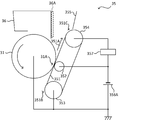
- FIG. 3 is a diagram illustrating an example of the configuration of the transfer device of the image forming apparatus according to the first embodiment of the present invention.
- FIG. 4 is a diagram showing a configuration around the peeling position of the image forming apparatus according to the first embodiment of the present invention.
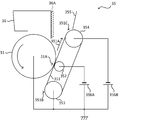
- FIG. 5 is a diagram illustrating another example of the configuration of the transfer device of the image forming apparatus according to the first embodiment of the present invention.
- FIG. 6 is a diagram showing experimental results using the image forming apparatus according to the first embodiment of the present invention.
- FIG. 1 is a diagram showing a configuration of an image forming apparatus according to the first embodiment of the present invention.
- FIG. 2 is a block diagram showing a system configuration of the image forming apparatus according to the first embodiment of the present invention.
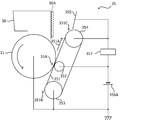
- FIG. 7 is a diagram illustrating an example of the configuration of the transfer device of the image forming apparatus according to the second embodiment of the present invention.
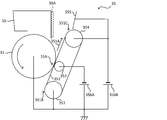
- FIG. 8 is a diagram showing another example of the configuration of the transfer device of the image forming apparatus according to the second embodiment of the present invention.
- FIG. 9 is a diagram showing a result of an experiment using the image forming apparatus according to the second embodiment of the present invention.
- FIG. 1 is a schematic cross-sectional view showing the configuration of the image forming apparatus 10.
- the image forming apparatus 10 includes an ADF 1, an image reading unit 2, an image forming unit 3, a sheet conveying unit 4, a control unit 5, and an operation display unit 6.
- the image forming apparatus 10 is a multifunction machine having a plurality of functions such as a scan function, a facsimile function, and a copy function, in addition to a printer function that forms an image based on image data.
- the present invention is also applicable to image forming apparatuses such as printers, facsimile machines, and copiers.
- the ADF 1 is an automatic document conveyance device that includes a document setting unit (not shown), a plurality of conveyance rollers, a document pressing unit, and a paper discharge unit, and conveys a document read by the image reading unit 2.
- the image reading unit 2 includes a document table (not shown), a reading unit, a plurality of mirrors, an optical lens, and a CCD (Charge Coupled Device), and reads image data from the document.
- the control unit 5 includes control devices such as a CPU, ROM, RAM, and EEPROM (not shown) and controls the operation of the image forming apparatus 10.
- the operation display unit 6 is a display unit such as a liquid crystal display that displays various types of information in response to control instructions from the control unit 5, and an operation key or touch panel that inputs various types of information to the control unit 5 in response to user operations. It has an operation unit.
- the image forming unit 3 can execute an image forming process (printing process) for forming an image by an electrophotographic method based on the image data read by the image reading unit 2.
- the image forming unit 3 can also execute the image forming process based on image data input from an information processing apparatus such as an external personal computer.
- the image forming unit 3 includes a photosensitive drum 31, a charging device 32, an optical scanning device (LSU) 33, a developing device 34, a transfer device 35, a cleaning device 36, a fixing device 37, And a paper discharge tray 38.
- LSU optical scanning device
- the image forming unit 3 an image is formed on the sheet supplied from the sheet conveying unit 4 according to the following procedure, and the sheet after the image formation is discharged to a paper discharge tray 38.
- the sheet is a sheet material such as paper, coated paper, postcard, envelope, and OHP sheet.
- the photosensitive drum 31 is uniformly charged to a predetermined potential by the charging device 32.
- the light scanning device 33 irradiates the surface of the photosensitive drum 31 with light based on the image data.
- an electrostatic latent image corresponding to the image data is formed on the surface of the photosensitive drum 31.
- the electrostatic latent image on the photosensitive drum 31 is developed (visualized) as a toner image by the developing device 34.
- the photosensitive drum 31 is an example of an image carrier in the present invention.
- the developing device 34 is supplied with toner (developer) from a toner container 34 ⁇ / b> A that can be attached to and detached from the image forming unit 3.
- the toner is agitated together with the carrier inside the developing device 34, so that the toner is frictionally charged to, for example, positive polarity.
- the toner image formed on the photosensitive drum 31 is transferred to the sheet by the transfer device 35.
- the toner image is transferred to the sheet at a contact position 31A between the photosensitive drum 31 and the conveyance belt 351 (see FIG. 3) of the transfer device 35.
- the transfer device 35 will be described in detail later.
- the toner image transferred to the sheet is heated and fixed by the fixing roller 37A when the sheet passes between the fixing roller 37A and the pressure roller 37B of the fixing device 37.
- the toner remaining on the surface of the photosensitive drum 31 is removed by the cleaning device 36.
- the sheet conveying unit 4 conveys the sheet on which an image is formed by the image forming unit 3.
- the sheet conveyance unit 4 includes a paper feed cassette 41, a pickup roller 42, a plurality of conveyance roller pairs 43, and a registration roller pair 44.
- the pickup roller 42, the plurality of conveyance roller pairs 43, and the registration roller pair 44 are rotated by a driving force generated by a motor (not shown) and convey the sheet.
- the paper feed cassette 41 is detachable from the housing of the image forming apparatus 10 and accommodates the sheet on which an image is formed by the image forming unit 3.
- the sheet accommodated in the paper feed cassette 41 is lifted up to a contact position with a pickup roller 42 provided at the top of the paper feed cassette 41 by a lift plate (not shown) provided at the bottom of the paper feed cassette 41.
- the uppermost sheet in contact with the pickup roller 42 is sent to the conveyance path 40A by the pickup roller 42, and is conveyed through the conveyance path 40A by the conveyance roller pair 43.
- the registration roller pair 44 sends the sheet to the contact position 31A at a predetermined timing in accordance with the arrival of the toner image formed on the photosensitive drum 31 to the contact position 31A.
- a registration sensor 40B (see FIG. 2) that detects the presence or absence of the sheet is provided on the upstream side of the registration roller pair 44 in the conveyance direction of the sheet in the conveyance path 40A.
- the resist sensor 40B is, for example, a transmissive or reflective optical sensor.
- control unit 5 controls the electromagnetic clutch (not shown) capable of switching the presence / absence of transmission of driving force from the motor to the registration roller pair 44 to rotate the registration roller pair 44 at the timing, thereby the sheet. Is sent out. Accordingly, the sheet is sent to the contact position 31A in accordance with the arrival of the toner image formed on the photosensitive drum 31 to the contact position 31A.
- the sheet on which the toner image has been transferred after passing through the contact position 31A passes between the fixing roller 37A and the pressure roller 37B by the fixing device 37, and then the toner image is melted and fixed, and then conveyed.
- the paper is conveyed to the paper discharge tray 38 by the roller pair 43 and discharged.
- the conveyance path 40A is provided with a plurality of sheet sensors 40C (see FIG. 2) for detecting the presence or absence of the sheet, along with the registration sensor 40B.
- the sheet sensor 40C is, for example, a reflective or transmissive optical sensor.
- the sheet is conveyed in a state of being electrostatically attracted to the conveyance belt 351.
- the separation property of the sheet from the photosensitive drum 31, the sheet conveyance stability, and the transfer property of the toner image onto the sheet are improved.
- FIG. 3 and FIG. 5 are schematic cross-sectional views showing a configuration example of the transfer device 35.
- FIG. 4 is a schematic cross-sectional view showing the configuration around the peeling position 351C. Note that a two-dot chain line in FIG. 4 indicates the sheet movement path 351D that has left the conveyance belt 351.
- the transfer device 35 electrostatically attracts and conveys the sheet sent from the registration roller pair 44 to the conveyance belt 351, and transfers the toner image formed on the photosensitive drum 31 to the sheet at the contact position 31A.
- the transfer device 35 includes a conveyance belt 351, a transfer roller 352, a first roller 353, a second roller 354, a guide member 355, a voltage application unit 356 ⁇ / b> A, and a resistor 357.
- the conveyance belt 351 contacts the photosensitive drum 31 and conveys the sheet via the contact position 31A.
- the transport belt 351 is an endless belt member stretched by a first roller 353 and a second roller 354 with a predetermined tension.
- the conveyance belt 351 is formed by coating a fluororesin on the outer peripheral surface of a rubber belt-shaped member. And the outer peripheral surface of the conveyance belt 351 moves along the conveyance direction 351A because the 1st roller 353 or the 2nd roller 354 is rotationally driven by the motor not shown. Thereby, the conveyance belt 351 can convey the sheet from the conveyance start position 351B to the peeling position 351C via the contact position 31A.
- the transfer roller 352 is applied with a voltage having a polarity opposite to the charging polarity of the toner forming the toner image, and transfers the toner image carried on the photosensitive drum 31 to the sheet at the contact position 31A.
- the transfer roller 352 is provided in contact with the inner peripheral surface of the conveyor belt 351 at the contact position 31A.
- the transfer roller 352 applies a negative voltage from the voltage application unit 356A to generate a discharge with the conveyance belt 351 at the contact position 31A, and injects a negative charge into the conveyance belt 351. To do.
- the toner image formed on the photosensitive drum 31 is attracted to the conveyance belt 351 and transferred to the sheet.
- the sheet conveyed by the conveyance belt 351 is electrostatically attracted to the outer peripheral surface of the conveyance belt 351 by the electric charge injected into the conveyance belt 351.
- the first roller 353 stretches the transport belt 351 at a transport start position 351B that is upstream of the contact position 31A in the transport direction 351A of the transport belt 351 and starts transporting the sheet.
- the first roller 353 is formed of a conductive member such as metal and is provided in the transfer device 35 in a state of being grounded via a bearing. Therefore, a part of the electric charge injected into the transport belt 351 is removed by the first roller 353.
- the second roller 354 is on the downstream side of the contact position 31 ⁇ / b> A in the conveyance direction 351 ⁇ / b> A by the conveyance belt 351, and stretches the conveyance belt 351 at a separation position 351 ⁇ / b> C where the sheet is separated from the conveyance belt 351.
- the second roller 354 is an example of a tension roller in the present invention.
- the sheet and the conveyance belt 351 are not separated. A peeling discharge occurs between them.
- charge exchange is performed between the sheet and the conveyance belt 351 on the basis of the positional relationship between the materials of the sheet and the conveyance belt 351 in a known charge train.
- the material of the sheet is paper and the outer peripheral surface of the conveyance belt 351 is formed of a fluorine-based resin such as PTFE, the sheet emits a negative charge when leaving the conveyance belt 351.
- the conveyance belt 351 is charged to a positive polarity and receives a charge released from the sheet, and is charged to a negative polarity. In this case, the electrostatic adhesion force of the positive toner adhering to the sheet to the sheet may be reduced, and the toner may be scattered from the sheet.
- a voltage having a polarity opposite to the charging polarity of the toner is applied to the second roller 354.
- the second roller 354 is applied with a negative voltage from the voltage application unit 356A.
- the guide member 355 guides the sheet separated from the conveying belt 351 to the fixing device 37 at the peeling position 351C. Specifically, as shown in FIG. 4, the guide member 355 is provided at a position facing the sheet conveyed from the second roller 354 toward the fixing device 37 along the movement path 351D. As a result, the leading end portion of the sheet in the conveying direction 351A hangs vertically downward due to its own weight, and the sheet is restricted from moving off the movement path 351D. In the image forming apparatus 10, the guide member 355 is arranged in a predetermined posture with respect to the movement path 351 ⁇ / b> D, thereby assisting the separation operation of the sheet that is separated from the conveyance belt 351 by curvature separation.
- the guide member 355 has a straight line extending from the axis of the second roller 354 toward the contact point with the second roller 354 in the movement path 351D, and the rear in the conveyance direction 351A of the guide member 355 from the axis of the second roller 354. It arrange
- the voltage application unit 356A applies a voltage having a polarity opposite to the charging polarity of the toner to the transfer roller 352 and the second roller 354.
- the voltage application unit 356A for applying a voltage to the transfer roller 352 and the second roller 354 is an example of the first voltage application unit in the present invention.
- the voltage application unit 356A is a power source connected to the transfer roller 352 and the second roller 354 as shown in FIG.
- the voltage application unit 356 ⁇ / b> A applies a negative voltage to the transfer roller 352 and the second roller 354 by being controlled by the control unit 5.
- the control unit 5 controls the voltage application unit 356A so that a total current of ⁇ 100 ⁇ A flows through the transfer roller 352 and the second roller 354.
- the present invention can be implemented without providing a separate power source for applying a voltage to the second roller 354.
- the voltage application unit 356A applies a voltage only while the sheet passes through the contact position 31A, while the rear end portion in the sheet conveyance direction 351A moves from the contact position 31A to the peeling position 351C, No voltage is applied to the second roller 354. Therefore, the occurrence of peeling discharge is not suppressed for a part of the sheet. Therefore, in the image forming apparatus 10, the voltage application unit 356 ⁇ / b> A includes a period from when the leading end in the sheet conveyance direction 351 ⁇ / b> A reaches the contact position 31 ⁇ / b> A until the trailing end in the sheet conveyance direction 351 ⁇ / b> A leaves the peeling position 351 ⁇ / b> C. Meanwhile, a voltage is applied to the transfer roller 352 and the second roller 354.
- the control unit 5 detects the leading edge of the sheet based on an electrical signal indicating detection of the leading edge of the sheet and an electrical signal indicating detection of the trailing edge of the sheet output from the registration sensor 40B.
- the arrival timing to the contact position 31A and the separation timing of the rear end portion of the sheet from the separation position 351C are acquired.
- the control unit 5 is based on the arrival timing and the separation timing, from the time when the leading end of the sheet reaches the contact position 31A until the separation from the separation position 351C of the trailing end of the sheet, A voltage is applied to the voltage application unit 356A. Thereby, it becomes possible to suppress generation
- the resistor 357 has a higher resistance value than the energization path including the transfer roller 352, the conveyance belt 351, and the photosensitive drum 31.
- the resistance value of the resistor 357 is 100 M ⁇ .
- a power source that applies a voltage to the second roller 354 may be provided separately from the voltage application unit 356 ⁇ / b> A that applies a voltage to the transfer roller 352.
- the transfer device 35 includes a voltage application unit 356 ⁇ / b> A that applies a voltage having a polarity opposite to the charging polarity of the toner to the transfer roller 352, and the charging polarity of the toner to the second roller 354.
- a configuration including a voltage application unit 356B that applies a reverse polarity voltage is conceivable.
- the voltage application unit 356A that applies a voltage to the transfer roller 352 is an example of the second voltage application unit in the present invention.
- the voltage application part 356B which applies a voltage to the 2nd roller 354 is an example of the 3rd voltage application part in this invention.
- control unit 5 controls the voltage application unit 356A so that a current of ⁇ 100 ⁇ A flows through the transfer roller 352, and controls the voltage application unit 356B so that a current of ⁇ 15 ⁇ A flows through the second roller 354.
- the voltage applied to the second roller 354 is reduced. The control and the control of the voltage applied to the transfer roller 352 can be separated.
- Examples 1 to 3 In the image forming apparatus 10, an experiment was conducted in which the configuration of the transfer device 35 was changed, and the scattering state of the toner and the change state of the print density at the peeling position 351C were investigated. The experimental results are shown in FIG. In the experiment, the toner scattering state is investigated by providing a collecting member 36A (see FIG. 3) on the outer surface of the cleaning device 36 facing the peeling position 351C, so that the image forming apparatus 10 has a printing rate of 50%. This was performed by a method for confirming the degree of contamination of the collecting member 36A after the printing process for printing image data for experiments was executed 10,000 times.
- the investigation of the change state of the print density in the experiment was performed by a method of executing the print process 10,000 times for each of the two types of humidity control papers and confirming the presence or absence of the density change of the printed image.
- ⁇ indicates that the toner was not confirmed on the collecting member 36A.
- x indicates that the contamination by the toner confirmed on the collecting member 36A exceeds a predetermined allowable range.
- FIGS. 7 and 8 are schematic cross-sectional views illustrating a configuration example of the transfer device 35 of the image forming apparatus 10 according to the second embodiment.
- the description of the configuration common to the image forming apparatus 10 according to the first embodiment in the image forming apparatus 10 according to the second embodiment is omitted.
- the image forming apparatus 10 according to the second embodiment is such that the guide member 355 of the transfer device 35 is connected to the voltage application unit 356 ⁇ / b> A via a resistor 357. This is different from the image forming apparatus 10 according to FIG.
- a voltage having a polarity opposite to the charging polarity of the toner is applied to the guide member 355.
- the guide member 355 is formed of a conductive member, and a negative voltage is applied from the voltage application unit 356A. Accordingly, a discharge is generated between the sheet conveyed from the second roller 354 toward the fixing device 37 along the movement path 351D and the guide member 355, and negative charge is injected into the sheet. Is possible. Therefore, it is possible to improve the electrostatic adhesion force of the toner to the sheet.
- the guide member 355 has a gap 351E having a predetermined width between the leading end portion 355A of the guide member 355 and the sheet conveyed along the movement path 351D.
- the width of the gap 351E is appropriately set based on the well-known Paschen's law so that electric discharge occurs between the leading end portion 355A of the guide member 355 and the sheet.
- the gap 351E is set to 1 mm.
- the guide member 355 is provided at a position facing the surface of the sheet on the second roller 354 side. Therefore, the toner formed on the sheet by the discharge between the guide member 355 and the sheet is compared with the configuration in which the guide member 355 is provided at a position facing the surface of the sheet on which the toner image is formed. The effect on the image is suppressed.
- the voltage application unit 356A applies a voltage only while the sheet passes through the contact position 31A, the rear end portion in the sheet conveyance direction 351A extends from the contact position 31A to the leading end portion 355A of the guide member 355. During the movement, no voltage is applied to the guide member 355. Therefore, no discharge is generated between the part of the sheet and the guide member 355. Therefore, in the image forming apparatus 10 according to the second embodiment, the voltage application unit 356A has the trailing end in the sheet conveyance direction 351A after the leading end in the sheet conveyance direction 351A reaches the contact position 31A. A voltage is applied to the transfer roller 352, the second roller 354, and the guide member 355 until the tip 355A of the guide member 355 is separated.
- the control unit 5 detects the leading edge of the sheet based on an electrical signal indicating detection of the leading edge of the sheet and an electrical signal indicating detection of the trailing edge of the sheet output from the registration sensor 40B.
- the arrival timing to the contact position 31A and the separation timing from the leading end portion 355A of the trailing end of the sheet are acquired.
- the control unit 5 extends from the time when the leading end of the sheet reaches the contact position 31A until the separation from the leading end 355A of the trailing end of the sheet.
- a voltage is applied to the voltage application unit 356A. Thereby, it becomes possible to generate discharge between the entire sheet and the guide member 355.
- the voltage application unit 356A applies a voltage to the transfer roller 352, the second roller 354, and the guide member 355, an excessive amount is applied from the second roller 354 or the guide member 355 to the fixing device 37 via the sheet.
- Current may flow.
- the amount of current flowing from the transfer roller 352 to the photosensitive drum 31 may be insufficient, and the density of the toner image transferred to the sheet may be reduced.
- an excessive current tends to flow from the second roller 354 or the guide member 355 to the fixing device 37 via the sheet. Therefore, in the image forming apparatus 10 according to the second embodiment, as shown in FIG.
- the second roller 354 and the guide member 355 are connected to the voltage applying unit 356 ⁇ / b> A via a common energization path, and the common A resistor 357 is provided on the energization path. Thereby, it is possible to suppress an excessive current from flowing from the second roller 354 or the guide member 355 to the fixing device 37 via the sheet.
- a power source for applying a voltage to the second roller 354 and the guide member 355 is provided separately from the voltage applying unit 356A for applying a voltage to the transfer roller 352. Also good.
- the transfer device 35 applies a voltage application unit 356 ⁇ / b> A that applies a voltage having a polarity opposite to the charging polarity of the toner to the transfer roller 352, and the toner to the second roller 354 and the guide member 355.
- a configuration including a voltage applying unit 356 ⁇ / b> B that applies a voltage having a polarity opposite to the charging polarity is conceivable.
- control unit 5 controls the voltage application unit 356A so that a current of ⁇ 100 ⁇ A flows through the transfer roller 352, and sets the voltage application unit 356B so that a total current of ⁇ 15 ⁇ A flows through the second roller 354 and the guide member 355. Control.
- the voltage application unit 356B for applying a voltage to the second roller 354 and the guide member 355 is provided separately from the voltage application unit 356A for applying a voltage to the transfer roller 352, the second roller 354 and the guide. Control of the voltage applied to the member 355 and control of the voltage applied to the transfer roller 352 can be separated.
- Examples 4 to 5 In the image forming apparatus 10 according to the second embodiment, an experiment was conducted in which the configuration of the transfer device 35 was changed to investigate the scattering state of the toner and the occurrence state of a defective image at the peeling position 351C. The experimental results are shown in FIG. Note that the method for investigating the scattering state of the toner in the experiment is the same as in the experiment for the image forming apparatus 10 according to the first embodiment. Further, the examination of the occurrence state of defective images in the experiment was performed by a method for confirming whether or not a defective image was generated during execution of the printing process 10,000 times.
Landscapes
- Physics & Mathematics (AREA)
- General Physics & Mathematics (AREA)
- Electrostatic Charge, Transfer And Separation In Electrography (AREA)
Abstract
Description
まず、図1及び図2を参照しつつ、本発明の実施形態に係る画像形成装置10の概略構成について説明する。ここで、図1は画像形成装置10の構成を示す断面模式図である。
以下、図3~図5を参照しつつ、転写装置35について説明する。ここで、図3及び図5は転写装置35の構成例を示す断面模式図である。また、図4は剥離位置351C周辺の構成を示す断面模式図である。なお、図4における二点鎖線は、搬送ベルト351を離れた前記シートの移動経路351Dを示すものである。
画像形成装置10において、転写装置35の構成を各々変化させて、剥離位置351Cでの前記トナーの飛散状況及び印刷濃度の変化状況を調査する実験を行った。実験結果を図6に示す。なお、前記実験における前記トナーの飛散状況の調査は、クリーニング装置36の剥離位置351Cに対向する外側面に捕集部材36A(図3参照)を設けて、画像形成装置10に印字率50パーセントの実験用の画像データを印刷する前記印刷処理を1万回実行させた後の捕集部材36Aの汚れ具合を確認する方法により行った。また、前記実験における印刷濃度の変化状況の調査は、2種類の調湿紙各々について前記印刷処理を1万回実行し、印刷された画像の濃度変化の有無を確認する方法により行った。ここで、図6において、「◎」は捕集部材36Aで前記トナーによる汚れが確認されなかったことを示すものである。また、「×」は捕集部材36Aで確認された前記トナーによる汚れが予め定められた許容範囲を超えていたことを示すものである。
ところで、前記シートに対する前記トナーの静電的な付着力が弱い場合には、前記シートが定着装置37に搬送されるまでの間に、前記シートに付着した前記トナーが飛散するおそれがある。また、定着装置37において前記シート上の前記トナーが前記シートに定着されずに定着ローラー37Aに静電的に付着して、後続の前記シートに不良画像を生じさせる静電オフセットと呼ばれる現象が発生するおそれがある。
前記第2実施形態に係る画像形成装置10において、転写装置35の構成を各々変化させて、剥離位置351Cでの前記トナーの飛散状況及び不良画像の発生状況を調査する実験を行った。実験結果を図9に示す。なお、前記実験における前記トナーの飛散状況の調査方法は、前記第1実施形態に係る画像形成装置10についての前記実験と同様である。また、前記実験における不良画像の発生状況の調査は、1万回の前記印刷処理の実行中における不良画像の発生の有無を確認する方法により行った。
Claims (6)
- トナー像を担持する像担持体と接触し、前記像担持体との接触位置を経由してシートを搬送する搬送ベルトと、
前記トナー像を形成するトナーの帯電極性と逆極性の電圧が印加され、前記接触位置において前記像担持体に担持された前記トナー像を前記シートに転写させる転写ローラーと、
前記搬送ベルトによる前記シートの搬送方向において前記接触位置より下流側であって前記シートが前記搬送ベルトから剥離する剥離位置において前記搬送ベルトを張架し、前記トナーの帯電極性と逆極性の電圧が印加される張架ローラーと、
を備える転写装置。 - 前記転写ローラー及び前記張架ローラーに前記トナーの帯電極性と逆極性の電圧を印加する第1電圧印加部を更に備える請求項1に記載の転写装置。
- 前記第1電圧印加部及び前記張架ローラーの間の通電経路上に設けられ、前記転写ローラー、前記搬送ベルト、及び前記像担持体を含む通電経路より高抵抗の抵抗器を更に備える請求項2に記載の転写装置。
- 前記第1電圧印加部が、前記シートの前記搬送方向における先端部が前記接触位置に到達してから前記シートの前記搬送方向における後端部が前記剥離位置を離れるまでの間、前記トナーの帯電極性と逆極性の電圧を印加する請求項2に記載の転写装置。
- 前記転写ローラーに前記トナーの帯電極性と逆極性の電圧を印加する第2電圧印加部と、
前記張架ローラーに前記トナーの帯電極性と逆極性の電圧を印加する第3電圧印加部と、
を更に備える請求項1に記載の転写装置。 - 請求項1に記載の転写装置を備える画像形成装置。
Priority Applications (4)
| Application Number | Priority Date | Filing Date | Title |
|---|---|---|---|
| CN201580001581.3A CN105474106A (zh) | 2014-06-30 | 2015-05-22 | 转印装置和图像形成装置 |
| EP15815852.7A EP3021170B1 (en) | 2014-06-30 | 2015-05-22 | Transfer apparatus and image forming apparatus |
| US14/914,602 US9575440B2 (en) | 2014-06-30 | 2015-05-22 | Transfer device, image forming apparatus |
| JP2016531188A JP6161818B2 (ja) | 2014-06-30 | 2015-05-22 | 転写装置、画像形成装置 |
Applications Claiming Priority (2)
| Application Number | Priority Date | Filing Date | Title |
|---|---|---|---|
| JP2014133690 | 2014-06-30 | ||
| JP2014-133690 | 2014-06-30 |
Publications (1)
| Publication Number | Publication Date |
|---|---|
| WO2016002379A1 true WO2016002379A1 (ja) | 2016-01-07 |
Family
ID=55018933
Family Applications (1)
| Application Number | Title | Priority Date | Filing Date |
|---|---|---|---|
| PCT/JP2015/064728 Ceased WO2016002379A1 (ja) | 2014-06-30 | 2015-05-22 | 転写装置、画像形成装置 |
Country Status (5)
| Country | Link |
|---|---|
| US (1) | US9575440B2 (ja) |
| EP (1) | EP3021170B1 (ja) |
| JP (1) | JP6161818B2 (ja) |
| CN (1) | CN105474106A (ja) |
| WO (1) | WO2016002379A1 (ja) |
Cited By (1)
| Publication number | Priority date | Publication date | Assignee | Title |
|---|---|---|---|---|
| JP2016161692A (ja) * | 2015-02-27 | 2016-09-05 | 京セラドキュメントソリューションズ株式会社 | 画像形成装置 |
Families Citing this family (3)
| Publication number | Priority date | Publication date | Assignee | Title |
|---|---|---|---|---|
| CN105474105B (zh) * | 2014-06-30 | 2019-02-05 | 京瓷办公信息系统株式会社 | 转印装置和图像形成装置 |
| US10915043B2 (en) * | 2018-09-04 | 2021-02-09 | Fuji Xerox Co., Ltd. | Image forming apparatus |
| JP7501022B2 (ja) * | 2020-03-19 | 2024-06-18 | 富士フイルムビジネスイノベーション株式会社 | 画像形成装置 |
Citations (4)
| Publication number | Priority date | Publication date | Assignee | Title |
|---|---|---|---|---|
| JPH03186876A (ja) * | 1989-12-16 | 1991-08-14 | Canon Inc | 画像形成装置 |
| JPH09134082A (ja) * | 1995-11-10 | 1997-05-20 | Ricoh Co Ltd | 画像形成装置 |
| JP2005148643A (ja) * | 2003-11-19 | 2005-06-09 | Ricoh Co Ltd | 画像形成装置 |
| JP2007298768A (ja) * | 2006-04-28 | 2007-11-15 | Canon Inc | 画像形成装置 |
Family Cites Families (6)
| Publication number | Priority date | Publication date | Assignee | Title |
|---|---|---|---|---|
| JP3228633B2 (ja) * | 1993-01-29 | 2001-11-12 | 株式会社日立製作所 | 画像形成装置 |
| JP3200216B2 (ja) * | 1993-01-29 | 2001-08-20 | 株式会社日立製作所 | 画像形成装置 |
| JP2000019856A (ja) * | 1998-07-03 | 2000-01-21 | Fuji Xerox Co Ltd | 画像形成装置 |
| JP4215379B2 (ja) | 2000-07-18 | 2009-01-28 | 株式会社リコー | 転写搬送装置及び画像形成装置 |
| JP4814625B2 (ja) | 2005-08-29 | 2011-11-16 | シャープ株式会社 | 画像形成装置 |
| JP6265066B2 (ja) * | 2014-06-30 | 2018-01-24 | 京セラドキュメントソリューションズ株式会社 | 転写装置、画像形成装置 |
-
2015
- 2015-05-22 WO PCT/JP2015/064728 patent/WO2016002379A1/ja not_active Ceased
- 2015-05-22 CN CN201580001581.3A patent/CN105474106A/zh active Pending
- 2015-05-22 JP JP2016531188A patent/JP6161818B2/ja active Active
- 2015-05-22 EP EP15815852.7A patent/EP3021170B1/en active Active
- 2015-05-22 US US14/914,602 patent/US9575440B2/en not_active Expired - Fee Related
Patent Citations (4)
| Publication number | Priority date | Publication date | Assignee | Title |
|---|---|---|---|---|
| JPH03186876A (ja) * | 1989-12-16 | 1991-08-14 | Canon Inc | 画像形成装置 |
| JPH09134082A (ja) * | 1995-11-10 | 1997-05-20 | Ricoh Co Ltd | 画像形成装置 |
| JP2005148643A (ja) * | 2003-11-19 | 2005-06-09 | Ricoh Co Ltd | 画像形成装置 |
| JP2007298768A (ja) * | 2006-04-28 | 2007-11-15 | Canon Inc | 画像形成装置 |
Cited By (1)
| Publication number | Priority date | Publication date | Assignee | Title |
|---|---|---|---|---|
| JP2016161692A (ja) * | 2015-02-27 | 2016-09-05 | 京セラドキュメントソリューションズ株式会社 | 画像形成装置 |
Also Published As
| Publication number | Publication date |
|---|---|
| US20160209787A1 (en) | 2016-07-21 |
| EP3021170A1 (en) | 2016-05-18 |
| EP3021170B1 (en) | 2020-04-22 |
| CN105474106A (zh) | 2016-04-06 |
| EP3021170A4 (en) | 2016-08-17 |
| JP6161818B2 (ja) | 2017-07-12 |
| US9575440B2 (en) | 2017-02-21 |
| JPWO2016002379A1 (ja) | 2017-04-27 |
Similar Documents
| Publication | Publication Date | Title |
|---|---|---|
| JP6091714B2 (ja) | 転写装置、画像形成装置 | |
| JP6265066B2 (ja) | 転写装置、画像形成装置 | |
| JP6161818B2 (ja) | 転写装置、画像形成装置 | |
| JP2010262040A (ja) | 画像形成装置 | |
| JP2017037097A (ja) | 画像形成装置 | |
| JP2011128398A (ja) | 画像形成装置 | |
| JP6204338B2 (ja) | 画像形成装置 | |
| JP2013238769A (ja) | 画像形成装置 | |
| JPH11258965A (ja) | 画像形成装置 | |
| JP5268311B2 (ja) | 画像形成装置 | |
| JP5184169B2 (ja) | 画像形成装置 | |
| JP6233604B2 (ja) | 画像形成装置 | |
| JP2016161692A (ja) | 画像形成装置 | |
| JP2014145811A (ja) | 画像形成装置 | |
| JP5341226B2 (ja) | 画像形成装置 | |
| JP2008265919A (ja) | 画像形成装置 | |
| US10139758B2 (en) | Transfer device allowing suppression of occurrence of separation discharge between sheets, and image forming apparatus | |
| JP2015106092A (ja) | 画像形成装置 | |
| JP2010002533A (ja) | 画像形成装置 | |
| JP2012173468A (ja) | 画像形成装置 | |
| JP2012118136A (ja) | 画像形成装置 | |
| JP2015225242A (ja) | 画像形成装置 | |
| JP2019174738A (ja) | 画像形成装置 | |
| JP2006301429A (ja) | 画像形成装置 | |
| JP2015099212A (ja) | 画像形成装置 |
Legal Events
| Date | Code | Title | Description |
|---|---|---|---|
| WWE | Wipo information: entry into national phase |
Ref document number: 201580001581.3 Country of ref document: CN |
|
| ENP | Entry into the national phase |
Ref document number: 2016531188 Country of ref document: JP Kind code of ref document: A |
|
| WWE | Wipo information: entry into national phase |
Ref document number: 2015815852 Country of ref document: EP |
|
| 121 | Ep: the epo has been informed by wipo that ep was designated in this application |
Ref document number: 15815852 Country of ref document: EP Kind code of ref document: A1 |
|
| WWE | Wipo information: entry into national phase |
Ref document number: 14914602 Country of ref document: US |
|
| NENP | Non-entry into the national phase |
Ref country code: DE |