WO2016006541A1 - 衣料 - Google Patents
衣料 Download PDFInfo
- Publication number
- WO2016006541A1 WO2016006541A1 PCT/JP2015/069236 JP2015069236W WO2016006541A1 WO 2016006541 A1 WO2016006541 A1 WO 2016006541A1 JP 2015069236 W JP2015069236 W JP 2015069236W WO 2016006541 A1 WO2016006541 A1 WO 2016006541A1
- Authority
- WO
- WIPO (PCT)
- Prior art keywords
- clothing
- knitted fabric
- sewn
- bra
- inner wear
- Prior art date
- Legal status (The legal status is an assumption and is not a legal conclusion. Google has not performed a legal analysis and makes no representation as to the accuracy of the status listed.)
- Ceased
Links
Images


Classifications
-
- A—HUMAN NECESSITIES
- A41—WEARING APPAREL
- A41C—CORSETS; BRASSIERES
- A41C3/00—Brassieres
- A41C3/005—Brassieres specially adapted for specific purposes
- A41C3/0064—Brassieres specially adapted for specific purposes for medical use or surgery
-
- A—HUMAN NECESSITIES
- A41—WEARING APPAREL
- A41C—CORSETS; BRASSIERES
- A41C3/00—Brassieres
- A41C3/0035—Brassieres with pockets
-
- A—HUMAN NECESSITIES
- A41—WEARING APPAREL
- A41C—CORSETS; BRASSIERES
- A41C3/00—Brassieres
- A41C3/02—Brassieres with front closures
-
- A—HUMAN NECESSITIES
- A41—WEARING APPAREL
- A41C—CORSETS; BRASSIERES
- A41C3/00—Brassieres
- A41C3/08—Brassieres combined with other garments
-
- A—HUMAN NECESSITIES
- A41—WEARING APPAREL
- A41C—CORSETS; BRASSIERES
- A41C3/00—Brassieres
- A41C3/12—Component parts
- A41C3/14—Stiffening or bust-forming inserts
- A41C3/144—Pads
-
- A—HUMAN NECESSITIES
- A41—WEARING APPAREL
- A41D—OUTERWEAR; PROTECTIVE GARMENTS; ACCESSORIES
- A41D13/00—Professional, industrial or sporting protective garments, e.g. surgeons' gowns or garments protecting against blows or punches
- A41D13/12—Surgeons' or patients' gowns or dresses
- A41D13/1236—Patients' garments
- A41D13/1245—Patients' garments for the upper part of the body
-
- D—TEXTILES; PAPER
- D04—BRAIDING; LACE-MAKING; KNITTING; TRIMMINGS; NON-WOVEN FABRICS
- D04B—KNITTING
- D04B1/00—Weft knitting processes for the production of fabrics or articles not dependent on the use of particular machines; Fabrics or articles defined by such processes
- D04B1/14—Other fabrics or articles characterised primarily by the use of particular thread materials
- D04B1/18—Other fabrics or articles characterised primarily by the use of particular thread materials elastic threads
-
- D—TEXTILES; PAPER
- D04—BRAIDING; LACE-MAKING; KNITTING; TRIMMINGS; NON-WOVEN FABRICS
- D04B—KNITTING
- D04B1/00—Weft knitting processes for the production of fabrics or articles not dependent on the use of particular machines; Fabrics or articles defined by such processes
- D04B1/22—Weft knitting processes for the production of fabrics or articles not dependent on the use of particular machines; Fabrics or articles defined by such processes specially adapted for knitting goods of particular configuration
- D04B1/24—Weft knitting processes for the production of fabrics or articles not dependent on the use of particular machines; Fabrics or articles defined by such processes specially adapted for knitting goods of particular configuration wearing apparel
-
- D—TEXTILES; PAPER
- D04—BRAIDING; LACE-MAKING; KNITTING; TRIMMINGS; NON-WOVEN FABRICS
- D04B—KNITTING
- D04B1/00—Weft knitting processes for the production of fabrics or articles not dependent on the use of particular machines; Fabrics or articles defined by such processes
- D04B1/22—Weft knitting processes for the production of fabrics or articles not dependent on the use of particular machines; Fabrics or articles defined by such processes specially adapted for knitting goods of particular configuration
- D04B1/24—Weft knitting processes for the production of fabrics or articles not dependent on the use of particular machines; Fabrics or articles defined by such processes specially adapted for knitting goods of particular configuration wearing apparel
- D04B1/246—Upper torso garments, e.g. sweaters, shirts, leotards
-
- A—HUMAN NECESSITIES
- A41—WEARING APPAREL
- A41B—SHIRTS; UNDERWEAR; BABY LINEN; HANDKERCHIEFS
- A41B2400/00—Functions or special features of shirts, underwear, baby linen or handkerchiefs not provided for in other groups of this subclass
- A41B2400/34—Functions or special features of shirts, underwear, baby linen or handkerchiefs not provided for in other groups of this subclass antimicrobial or antibacterial
-
- A—HUMAN NECESSITIES
- A41—WEARING APPAREL
- A41B—SHIRTS; UNDERWEAR; BABY LINEN; HANDKERCHIEFS
- A41B2400/00—Functions or special features of shirts, underwear, baby linen or handkerchiefs not provided for in other groups of this subclass
- A41B2400/36—Deodorising or perfuming
-
- A—HUMAN NECESSITIES
- A41—WEARING APPAREL
- A41B—SHIRTS; UNDERWEAR; BABY LINEN; HANDKERCHIEFS
- A41B2500/00—Materials for shirts, underwear, baby linen or handkerchiefs not provided for in other groups of this subclass
- A41B2500/10—Knitted
-
- A—HUMAN NECESSITIES
- A41—WEARING APPAREL
- A41D—OUTERWEAR; PROTECTIVE GARMENTS; ACCESSORIES
- A41D31/00—Materials specially adapted for outerwear
- A41D31/04—Materials specially adapted for outerwear characterised by special function or use
- A41D31/30—Antimicrobial, e.g. antibacterial
- A41D31/305—Antimicrobial, e.g. antibacterial using layered materials
-
- D—TEXTILES; PAPER
- D10—INDEXING SCHEME ASSOCIATED WITH SUBLASSES OF SECTION D, RELATING TO TEXTILES
- D10B—INDEXING SCHEME ASSOCIATED WITH SUBLASSES OF SECTION D, RELATING TO TEXTILES
- D10B2501/00—Wearing apparel
- D10B2501/02—Underwear
-
- D—TEXTILES; PAPER
- D10—INDEXING SCHEME ASSOCIATED WITH SUBLASSES OF SECTION D, RELATING TO TEXTILES
- D10B—INDEXING SCHEME ASSOCIATED WITH SUBLASSES OF SECTION D, RELATING TO TEXTILES
- D10B2509/00—Medical; Hygiene
- D10B2509/02—Bandages, dressings or absorbent pads
Definitions
- the present invention relates to a garment having a good touch and excellent wearing comfort.
- Representative methods in disease treatment can include surgery, drug treatment, and radiation treatment. Although these methods are extremely effective methods for treatment, sufficient consideration is required for complications and side effects that occur in the course of treatment. Although medical technology in these disease treatments continues to advance, there are few opportunities to obtain raw information in the medical field regarding how well the patient can receive treatment comfortably. There is a problem that it does not come up as a problem that can be solved.
- the affected area is often protected by applying new gauze or lint cloth to areas where the skin has been inflamed or weakened due to disease or therapeutic treatment. There is almost no general clothing that can hold the appropriate medical materials properly, and patients are inconvenienced.
- Surgical treatment, chemotherapy, and radiation therapy are effective treatments, and after surgery (surgical operations such as mastectomy) are effective in suppressing breast cancer recurrence.
- the latter irradiation has a great effect.
- radiation dermatitis at the irradiated site is an unavoidable side effect and occurs in a relatively wide range, so symptomatic treatment of dermatitis is also performed as a countermeasure.
- the symptomatic treatment is performed mainly from the application of a skin external medicine from the time of radiotherapy to about 2 weeks after the radiotherapy.
- an ointment or the like is applied to the epidermis of the treatment area and covered with a medical material such as gauze or lint cloth and fastened with an adhesive bandage, an elastic bandage is wrapped around, or a maternity bra is worn.
- a medical material such as gauze or lint cloth and fastened with an adhesive bandage
- an elastic bandage is wrapped around, or a maternity bra is worn.
- these methods can cause skin sores and itching.
- the outer coat may be soiled by leakage or exudation of skin exudate from drugs or inflamed areas.
- since there is no inner wear suitable for protecting the skin by holding the ointment it is a great obstacle in practical medical care.
- a “maternal bra” consisting of a non-stretchable cup lining and a stretchable outer material
- Patent Document 1 "Maternity brassiere” with front belt provided with a belt made of a strong elastic material
- Patent Document 2 "Brass for breastfeeding” that can expose left and right breasts when worn
- Patent Document 3 chest support without elasticity “Brassiere” having a panel
- Patent Document 4 the like
- the lining cloth of the cup part and the lining cloth of the strap part are made of non-stretchable or low-stretch cloth.
- the brassiere described in Patent Document 3 is configured so that the left and right cup portions can expose the breast in a mounted state, and has a holding portion into which a breast milk pad can be inserted inside the left and right cups. Overlapping, the step between the pad and the holding part is structured to cause skin irritation.
- the brassiere described in Patent Document 4 is a front opening brassiere made of a stretchable material, but has a chest support panel that does not have elasticity, so there is a possibility that the part does not stretch and may cause skin irritation. .
- An object of the present invention is to provide an apparel that is improved in the disadvantages of the prior art, has a good touch and is excellent in wearing comfort.
- the apparel of the present invention has the following configuration. That is, the garment according to the present invention uses a composite yarn of elastic fiber and synthetic fiber, and has an elongation rate of 160% or more and less than 250% in the vertical direction and the horizontal direction measured according to the JIS-L-1096 grab method. And it is the clothing using the knitted fabric whose fabric weight is 90 g / m ⁇ 2 > or more and less than 160 g / m ⁇ 2 >.
- the synthetic fiber is preferably made of a hygroscopic polyamide fiber.
- the clothing of the present invention is preferably configured as a front-opening bra type inner wear.
- the under belt under the breast position of the front opening bra type inner wear is made of the same material as the body cloth, and the width of the under belt is 5 cm or more and 10 cm or less.
- a pocket capable of putting in and out the pad is sewn on the outside of the breast position of the front opening bra type inner wear.
- the clothing of the present invention preferably has a combination of a front opening cardigan-type outerwear and a front opening bra-type inner wear.
- the front-opening cardigan-type outerwear and the front-opening bra-type innerwear have a mechanism that can be sewn or removed at the shoulder line.
- the knitted fabric is preferably water-repellent.
- the knitted fabric is water-repellent, a configuration having a fluorine compound layer on the surface of the knitted fabric can be adopted.
- the fluorine compound is preferably a fluorine water / oil repellent resin having a hydrophilic component.
- the knitted fabric has a water repellency of 2nd grade or less and an oil repellency of 4th grade or more.
- the clothing of the present invention preferably has antibacterial performance and / or deodorization performance.
- the clothing of the present invention is preferably clothing used by patients having dermatitis on the chest.
- the apparel of the present invention By wearing the apparel of the present invention, it is possible to gently cover and wrap the site where the skin has become fragile by treatment, the site where inflammation has occurred, and the wound after surgery, and further, gauze coated with a drug such as ointment It has the function of holding the lint cloth and has the effect of improving the wearing comfort for the patient.
- the apparel of the present invention is antifouling processed, the medicine applied to the affected skin and the body fluid exuded by inflammation will not ooze out of the inner wear, and there is a risk of staining the upper garment with the exudate. And has the effect that the upper garment can be worn with peace of mind.
- the apparel of the present invention meets the requirements for convenience of treatment and comfort for the patient. That is, it is highly functional for treatment and care (non-irritant, antifouling property, chemical resistance, stretchability, washable, etc.), and has a function of holding a medical material for protecting the affected area.
- a material having low skin irritation is selected and a composite yarn of elastic fiber and synthetic fiber is used.
- elastic fibers two types of polyester polymers, mainly spandex yarns or polyesters mainly composed of polytrimethylene terephthalate (hereinafter sometimes abbreviated as PTT), are bonded side by side along the fiber length. Multifilament yarns of composite fibers can be used.
- Synthetic fibers refer to polyester fibers, polyamide fibers, acrylic fibers, and the like. For example, it is possible to adopt a form in which polyurethane fiber and nylon fiber are false twisted, or both are aligned, and used properly on the front and back of the knitted structure.
- the diameter of this three-dimensional coil and the number of coils per unit fiber length are determined by the shrinkage difference (including the elastic recovery rate difference) between the high shrinkage component and the low shrinkage component. And the number of coils per unit fiber length increases.
- the coil crimp required as a stretch material has a small coil diameter, a large number of coils per unit fiber length (excellent elongation characteristics and good appearance), and good coil sag resistance (according to the number of expansions and contractions) The amount of coil sag is small and the stretch retention is excellent), and the hysteresis loss is small when the coil is recovered from elongation (excellent elasticity and good fit).
- the stretch rate in the vertical direction and the horizontal direction of the knitted fabric using the composite yarn of the elastic fiber and the synthetic fiber as described above is 160% or more and less than 250% under a load of 1.5 kg.
- the elongation rate indicates the degree of elongation of the knitted fabric, and details of the measurement method will be described later.
- the elongation rate of JIS-L-1096 “Fabric test method for general woven fabrics and knitted fabrics” (2014 edition) It is the value measured according to B method (grab method).
- B method grab method
- the basis weight of the knitted fabric is 90 g / m 2 or more and less than 160 g / m 2 . If the basis weight is less than 90 g / m 2, it is too light and adhesion to the skin is insufficient. On the other hand, if it is 160 g / m 2 or more, the weight of the product becomes large, so that the shoulder is burdened as a weight, which is not preferable. As a more preferable range for the same reason, the basis weight is 100 g / m 2 or more and less than 150 g / m 2 .
- the synthetic fiber is made of a polyamide fiber having a hygroscopic property in order to reduce the flexibility of the fiber and the stuffiness in the clothes.
- FIG. 1 is a view of an embodiment of a brassiere inner wear of a clothing according to the present invention as seen from the front body.
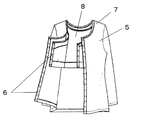
- FIG. 2 is a view of one aspect of the front-opening cardigan-type outerwear and the brassiere-type innerwear of the garment according to the present invention as seen from the front body.
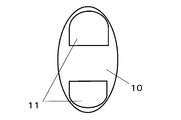
- FIG. 3 is a view of another aspect of the clothing of the present invention as viewed from above, and
- FIG. 4 is a view of the aspect of FIG. 3 as viewed from the bottom.
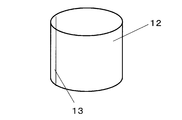
- FIG. 5: is the perspective view which looked at another one aspect
- the clothing used in the present invention refers to clothing that comes in direct contact with the skin, such as underwear, nightclothes, bras, shorts, socks, gloves, and stomach wrap.
- the front opening bra type inner wear 8 is composed of a front body 1 and a back body 2, and is a front opening type. It is necessary to arrange a member for locking the left and right at the front opening part.
- the locking tool 6 a hook-and-loop fastener, a coil open fastener, a snap, a dot button, a string, a button, a tape with a dot button, etc. Can be used.
- the tape with a dot button is more preferable because it has few sewing steps and the locking tool does not directly contact the skin surface.
- a dot button-attached tape is one in which a dot button is driven into a tape made of woven or knitted fabric, and it is only necessary to sew the tape at the time of sewing. Furthermore, in order to avoid irritation to the skin, the tape at the lower end of the front body may be slightly shorter than the end of the fabric, or the lower end of the body may be cut smoothly.
- a pad insertion pocket 3 is formed on the outer side of the front body, and an under belt 4 is sewn on the lower side of the main body.
- the under belt 4 under the breast of the bra-type inner wear 8 is made of the same material as the body material, and the width of the under belt 4 is not less than 5 cm and not more than 10 cm.
- the feel, easy attachment / detachment, adhesion to the body, breast support This is preferable. More preferably, it is 6 cm or more and 10 cm or less.
- underbelt 4 By making the underbelt 4 the same as the body fabric, the texture and fit of the body fabric, and the functionality such as the exudation of the medicine are equivalent, so that the performance of the entire wear can be maintained.
- the width of the underbelt 4 is less than 6 cm, it may bite into the skin and irritate the skin and become reddish and wrinkled. However, if it exceeds 10 cm, it is not preferable because it is too wide and feels pressure and heat.
- the underbelt 4 can be more closely attached to the body by sewing or bonding a tape with a stretch.
- the sewn or bonded surface may be either the skin surface or the outside.
- a pocket 3 in which a pad can be taken in and out is sewn outside the breast position of the bra-type inner wear 8.
- the size of the pad insertion pocket 3 is as large as possible so as to cope with various sizes of breasts.
- Products with pad insertion pockets on the inside are also available on the market, but it is difficult to insert or change the pad position in the inner pocket when treating with gauze or lint cloth on the affected area It is not preferable.
- the pocket insertion opening may be installed in any part such as a straight line along the upper side or the side gland, but it is preferable to install the pocket at an angle with a curve substantially parallel to the armhole so that the pad can be taken in and out.
- the material of the pad is not limited, it is preferably made of a material that is highly safe for the living body, and is preferably the same as the weight of the remaining breast as much as possible in consideration of the left and right balance.
- the bra-type inner wear 8 as described above is preferably used for breast feeding, for example, without being limited to disease treatment.
- the breast size during breastfeeding may change even in the same individual, but this can be dealt with by wearing the bra-type inner wear.
- the bra-type inner wear 8 and the front-opening cardigan-type outerwear 5 are combined, and the front-opening cardigan-type outerwear 5 is formed from the front body, the back body, and the left and right sleeves.
- the locking tool 6 is sewn to the left and right ends of the front body so that it can be opened and closed.
- the fastener 6 can be a hook-and-loop fastener, a coil open fastener, a snap, a dot button, a string, a button, a tape with a dot button, etc., but a tape with a dot button is sewn in the same way as a brass inner wear. It is more preferable.
- the front-opening cardigan-type outerwear 5 and the brassiere-type innerwear 8 can be integrated by sewing together at the shoulder line 7, or an openable and closable belt loop is sewn to the shoulder gland of the cardigan. It is also possible to integrate only when worn through the belt loop. In particular, the method of attaching the belt loop is more preferable because only the brassiere can be exchanged and washed.
- the knitted fabric used for the garments has a very good touch, it is also preferable when the skin is inflamed.
- a sock having a foot cover shape reference numeral 9: foot cover, reference numeral 10: foot cover bottom surface, reference numeral 11: cushion material
- FIGS. By using the above-described fiber structure having the above-mentioned expansion / contraction function for a cylindrical belly wrap (symbol 12: stomach wrap, symbol 13: belly wrap seam) and gloves as shown, skin irritation can be suppressed as much as possible. Can withstand wearing.
- a fluorine compound is preferably fixed on the surface of the fiber, and more preferably, the fluorine compound has a hydrophilic component.
- the fluorine compound in order to improve washing durability, it is a particularly preferable embodiment to use a triazine ring-containing resin in combination with the fluorine compound.
- the triazine ring-containing resin include melamine resin, guanamine resin, and bismaleimide triazine resin, and melamine resin is particularly preferable.
- the melamine resin of the present invention can be selected from various melamines from trimethylol melamine to hexamethylol melamine.
- a large amount of melamine resin is used, the crosslinking effect is improved, but the texture tends to be cured.
- Melamine curing catalysts include inorganic phosphates such as ammonium phosphate, ammonium sulfate, ammonium nitrate, aluminum phosphate, aluminum sulfate, aluminum nitrate, zinc phosphate, zinc sulfate, zinc nitrate, ammonium formate, ammonium acetate, ammonium acrylate, Ammonium succinate, aluminum formate, aluminum acetate, aluminum acrylate, aluminum succinate, zinc formate, zinc acetate, zinc acrylate, zinc succinate and the like are preferable.
- inorganic phosphates such as ammonium phosphate, ammonium sulfate, ammonium nitrate, aluminum phosphate, aluminum sulfate, aluminum nitrate, zinc phosphate, zinc sulfate, zinc nitrate, ammonium formate, ammonium acetate, ammonium acrylate, Ammonium succinate, aluminum formate, aluminum acetate, aluminum acrylate
- the exudate from the postoperative wound and the oil-based medicine applied on it are less likely to touch the skin surface of clothing and further ooze out to the outside. it can.
- the hydrophilic component can improve the affinity of the fiber with the cleaning liquid, and the water / oil repellent component can suppress the penetration of dirt into the fiber.
- the knitted fabric, scoured and dyed knitted fabric is immersed in a treatment solution containing a fluorine compound, and then squeezed with a constant pressure in the expanded state, preferably dried at a temperature of 80 to 140 ° C. Thereafter, preferably in a state where the knitted fabric is immersed in a pad dry cure method in which heat treatment is performed at a temperature of 160 to 200 ° C., a pad steam method in which steam heat treatment is performed, or a treatment liquid containing a fluorine compound. For example, an in-bath method for raising the temperature to 30 to 130 ° C. is used.
- the water repellency of the knitted fabric in the present invention is preferably grade 2 or less, and the oil repellency is preferably grade 4 or more. By satisfying both of these conditions, dirt on the skin surface, coating agent, etc. do not ooze out on the surface. Since it does not penetrate into the inside of the fiber, it is very preferable as clothing.
- the above-mentioned antifouling effect is not achieved simply by the water / oil repellent treatment for the fiber structure, but has high functionality only when combined with the effect of conformity (fitness) to the form of the body surface.
- a brassiere-type inner wear is made of a fiber having a stretchable function, and has a stretch effect and a fit effect to create an appropriate adhesion to the breast and chest, and then imparts an antifouling function to the inner wear.
- a high leakage prevention effect and antifouling property can be expressed as a result.
- the knitted fabric in the present invention can be used in combination with a finishing agent having functions such as antibacterial properties and deodorizing properties, but the application method is not particularly limited.
- Example 1 A circular knitted fabric was obtained by knitting at 28 gauge using a 22T elastic yarn and 56T-40F nylon false twisted yarn. After refining and dyeing the circular knitted fabric, it was dipped in a water repellent treatment solution in which Asahi Guard AG-E100, Becamine M-3 and Becamine ACX were mixed, squeezed with a mangle, dried at 130 ° C., and heated at 170 ° C.
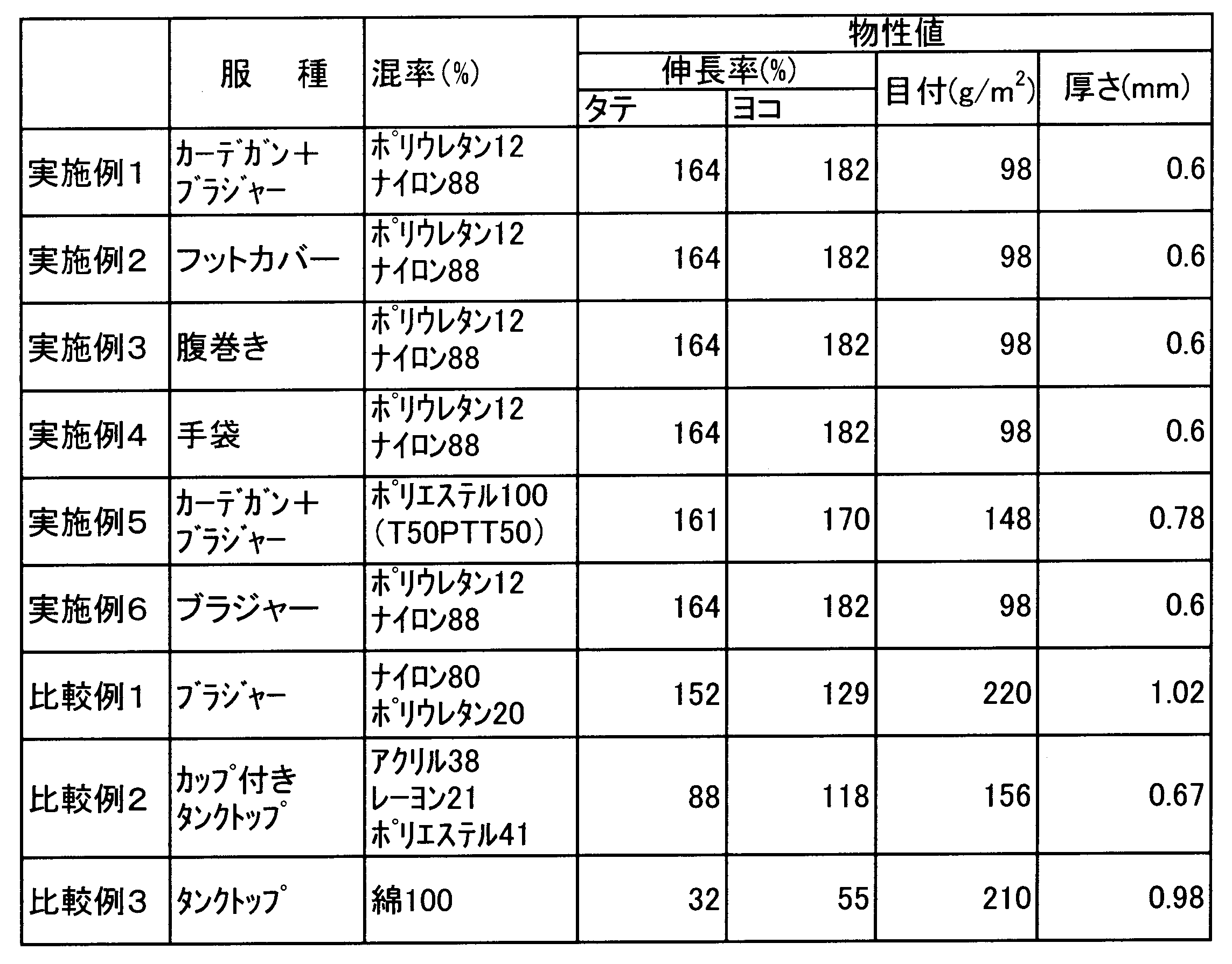
- the stretch rate of the knitted fabric was 164% in length, 182% in width, and 110 g / m 2 in basis weight.
- a bra-type inner wear that uses the circular knitted fabric to cover the breast and sew the front and back of the body together at the shoulder and side.
- a woven tape of width was sewn.
- On the outside of the breast position of the inner wear a pocket in which the pad could be put in and out of the same material as the main body was sewn, and an under belt of 8 cm width made of the same material as the main body was sewn on the lower side of the front body and the back body.
- the front center of the cardigan was also cut left and right, and woven tape with dot buttons was sewn on the end.
- the cardigan's shoulder line is sewn with a tape that can be opened and closed to allow the brassiere type inner wear to be removed.
- the wear was worn by one patient (one-sided mastectomy) who was being treated for breast cancer, and a gel pad was inserted from the front side to bring it into close contact with the body.
- the lint cloth affixed on the coating as a therapeutic agent did not slide off, and there was no feeling of tightening even if it was worn all day, and the coating agent did not ooze out into the cardigan and was excellent in wearing comfort.
- Table 2 shows the physical property evaluation results of the sewn product
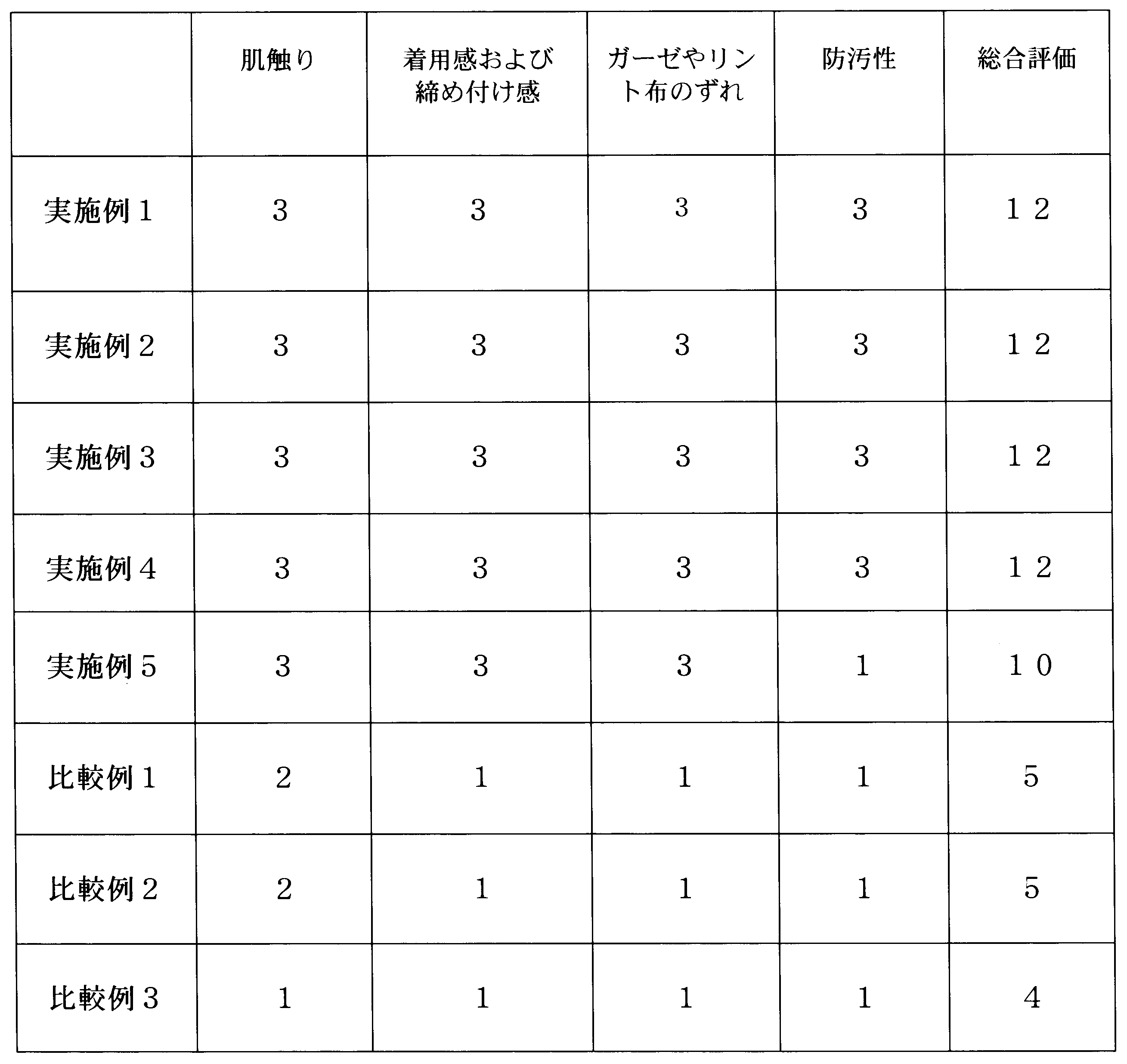
- Table 3 shows the results of evaluating the touch, the feeling of wearing, the feeling of tightening, the slipping property of the lint cloth, and the antifouling property when the sewn product is worn.
- Example 2 A foot cover 9 covering the heel to the toe as shown in FIGS. 3 and 4 was sewn with the circular knitted fabric obtained in Example 1. On the bottom surface 10 of the foot cover 9, a cushion material 11 wrapped with a low resilience material in the same circular knitted fabric as the main body fabric was sewn to the heel and the toe. Finished with rubber to prevent slipping off around the ankle.
- Table 2 shows the physical property evaluation results of the sewn product
- Table 3 shows the results of evaluating the touch, the feeling of wearing, the feeling of tightening, the slippage of the gauze cloth, and the antifouling property when the sewn product is worn.
- Example 3 The circular knitted fabric obtained in Example 1 was cut into a width of 60 cm and a length of 50 cm, and two sheets in the width direction were overlapped and sewn with an overlock to obtain a belly wrap 12 as shown in FIG.
- the overlock seam 13 was outside the body
- the touch was good and the lint cloth affixed on the medicine applied to the abdomen did not slide down, Since it did not protrude, it was excellent in wearing comfort.
- the ability to bend and arrange the belly wrap to the required length was also well received.
- Table 2 shows the physical property evaluation results of the sewn product
- Table 3 shows the results of evaluating the touch, the feeling of wearing, the feeling of tightening, the slipping property of the lint cloth, and the antifouling property when the sewn product is worn.
- Example 4 Five-finger gloves covering the fingertip to 10 cm above the wrist with the circular knitted fabric obtained in Example 1 were sewn. Flat rubber was passed around the wrist to prevent slipping. When this glove was worn by one skin disease patient, the gauze affixed onto the medicine applied to the palm of the skin did not slip off, and the skin feels good and is comfortable even when worn all day. there were.
- Table 2 shows the physical property evaluation results of the sewn product
- Table 3 shows the results of evaluating the touch, the feeling of wearing, the feeling of tightening, the slippage of the gauze cloth, and the antifouling property when the sewn product is worn.
- Example 5 A circular knitted fabric was obtained by knitting at 26 gauge using a mixed yarn of 56T polyester and 56T polytrimethylene terephthalate (PTT). The circular knitted fabric was refined and dyed, then drawn and expanded with mangles and dried at 130 ° C.
- PTT polytrimethylene terephthalate
- the stretch rate of the knitted fabric was 161% in length, 170% in width, and 148 g / m 2 in basis weight.
- the circular knitted fabric was used to sew bra-shaped innerwear and a cardigan that had a shape in which the front and back of the breast were continuously formed. Both were divided into left and right at the front center line and a plastic dot button was attached to the end.
- a pocket in which the pad could be taken in and out of the same material as the main body was sewn, and an underbelt of 6 cm width was sewn on the lower side of the front body and the back body.
- an openable / closable belt loop was sewn on the shoulder line of the cardigan, and the shoulder of the bra-type inner wear was integrated through the belt loop.
- Table 2 shows the physical property evaluation results of the sewn product
- Table 3 shows the results of evaluating the touch, the feeling of wearing, the feeling of tightening, the slipping property of the lint cloth, and the antifouling property when the sewn product is worn.
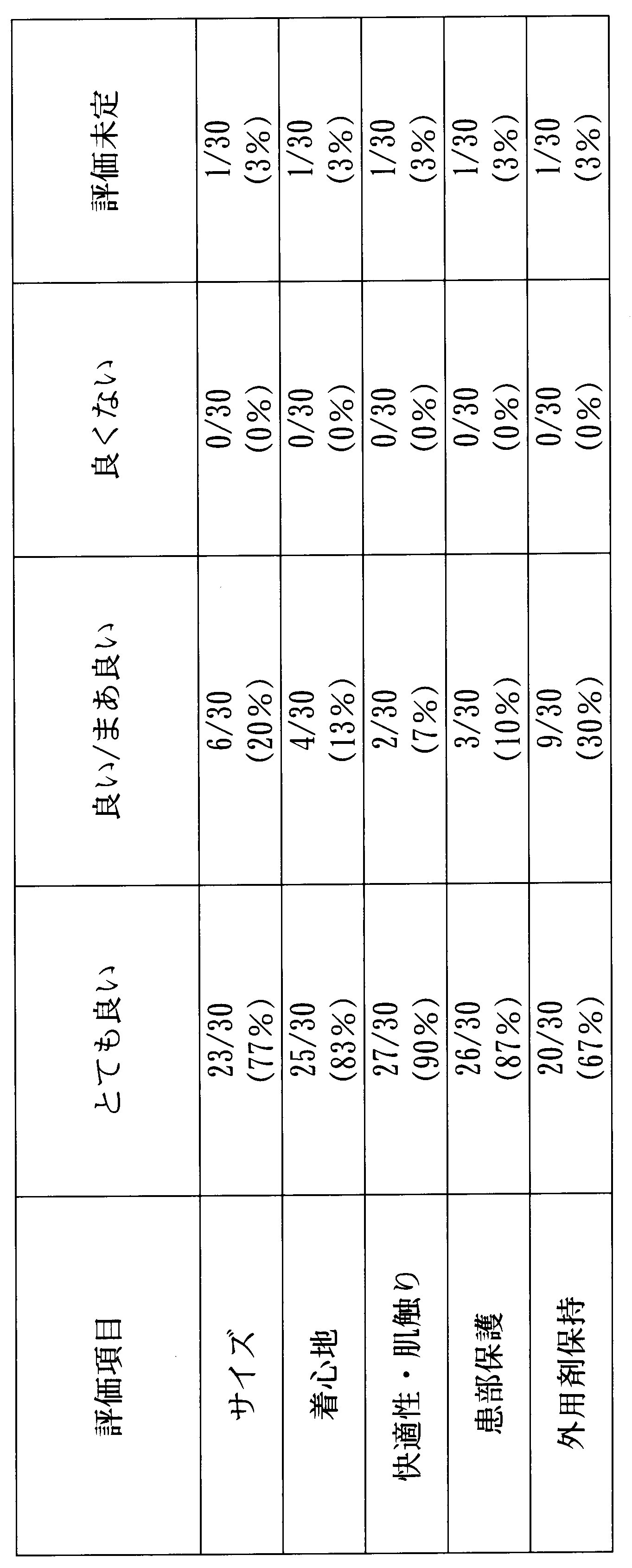
- Example 6 The bra-type innerwear created in Example 1 was worn for 30 months after the end of radiation therapy for 30 breast cancer patients undergoing radiation therapy under the control of a doctor. The function of the wear was evaluated.
- the patients to be evaluated were primary breast cancer patients undergoing radiotherapy on the chest wall, regardless of whether postoperative or palliative irradiation was performed.
- the age was 34 to 78 years and the average age was 52 years.
- the brassiere-type innerwear of the present invention has not only superiority in functional comparison with a general brassiere, but also has significance as a complementary innerwear during radiation therapy.
- a circular knitted fabric was obtained by knitting a 310T elastic yarn with 32 gauge using a yarn covered with 44T nylon.
- the circular knitted fabric was refined and dyed, and then subjected to a drying treatment at 120 ° C. with a mangle.
- the stretch rate of the knitted fabric was 152% in length, 129% in width, and 220 g / m 2 in basis weight.
- a bra-type innerwear that is worn from the head and that does not divide the front body and the back body of the shape covering the breast by the continuous front center line was obtained.
- Table 2 shows the physical property evaluation results of the sewn product
- Table 3 shows the results of evaluating the touch, the feeling of wearing, the feeling of tightening, the slipping property of the lint cloth, and the antifouling property when the sewn product is worn.
- Circular knitted fabric was obtained by knitting at 16 gauge using a blended yarn of 38% acrylic, 21% rayon and 41% polyester.
- the circular knitted fabric was refined and dyed, and then subjected to a drying treatment at 120 ° C. with a mangle.
- the stretch rate of the knitted fabric was 88% vertical, 118% wide, and the basis weight was 156 g / m 2 .
- the tank top is sewn using the circular knitted fabric, the cup part using urethane foam and the 100% nylon marquisette are sewn together as a base cloth, and a 1 cm wide flat rubber belt is sewn around the bottom, and the tank top Sewed on the upper side of the chest.
- Table 2 shows the physical property evaluation results of the sewn product
- Table 3 shows the results of evaluating the touch, the feeling of wearing, the feeling of tightening, the slippage of the gauze cloth, and the antifouling property when the sewn product is worn.
- Circular knitted fabric was obtained by knitting with 16 gauge using 30th cotton 100% cotton yarn.
- the circular knitted fabric was refined and dyed, and then drawn and dried with mangles.
- the stretch rate of the knitted fabric was 32% in length, 55% in width, and 210 g / m 2 in basis weight.
- a tank top was sewn using the circular knitted fabric.
- a lint cloth affixed on a coat as a therapeutic agent to one patient with dermatitis on the chest was wrapped around the body, and when the wear was worn thereon, the lint cloth could not be fixed, As time went on, the tank top became dirty.
- Table 2 shows the physical property evaluation results of the sewn product
- Table 3 shows the results of evaluating the touch, the feeling of wearing, the feeling of tightening, the slipping property of the lint cloth, and the antifouling property when the sewn product is worn.
- Example 1 and Example 5 and Comparative Examples 1 to 3 were requested to evaluate each clothing independently based on the same criteria. The reliability of intercomparison was maintained.
- the apparel according to the present invention is applicable to any apparel that is soft to the touch and requires excellent wearing comfort, and is particularly suitable for apparel used by patients with dermatitis.
- Front body of bra-type inner wear 2 Rear body of bra-type inner wear 3: Pocket of bra-type inner wear 4: Under belt of brass-type inner wear 5: Front-opening cardigan-type outerwear 6: Locking tool 7: Shoulder line 8: Bra-type inner wear 9: Foot cover 10: Foot cover bottom surface 11: Cushion material 12: Abdominal winding 13: Abdominal winding seam
Landscapes
- Engineering & Computer Science (AREA)
- Textile Engineering (AREA)
- Health & Medical Sciences (AREA)
- General Health & Medical Sciences (AREA)
- Physical Education & Sports Medicine (AREA)
- Corsets Or Brassieres (AREA)
- Professional, Industrial, Or Sporting Protective Garments (AREA)
Abstract
Description
すなわち、本発明に係る衣料は、弾性繊維と合成繊維の複合糸を用い、JIS-L-1096グラブ法に準じて測定したタテ方向およびヨコ方向の伸長率が160%以上250%未満であり、かつ目付が90g/m2以上160g/m2未満である編地を用いた衣料である。
本発明の衣料は、治療のための利便性と患者にとっての快適性保持のための必要要件を満たす。すなわち、治療とケアのために高機能であること(非刺激性、防汚性、耐薬品性、伸縮性、洗濯可能など)、患部保護の医療材の保持機能があること、などである。
図1は、本発明の衣料のブラジャー型インナーウエアの一態様を前身頃から見た図である。図2は、本発明の衣料の前開きカーデガン型上着とブラジャー型インナーウエアを組み合わせた一態様を前身頃から見た図である。図3は、本発明の衣料の別の一態様を上面からみた図、図4は図3の態様を底面から見た図である。図5は、本発明の衣料の別の一態様を正面から見た斜視図である。
(1)伸長率
表地および裏地の伸長率は、JIS-L-1096(2010年版)「織物及び編物の生地試験方法」の伸び率B法(グラブ法)に準じて測定した。
伸長率LA(%)={(L1-L)/L}×100
L :つかみ間隔(mm)
L1:14.7Nまで伸ばした時のつかみ間隔(mm)。
標準状態における1m2あたりの質量(g/m2)を測定する。
JIS-L-1092「繊維製品の防水性試験方法」(2009年)に規定される方法に準じてスプレー法で評価し、級判定した。級判定についてはn=1回の評価で実施した。
AATCC TM-1966に規定される方法に準じて測定し、撥油度について級判定した。級判定についてはn=3回の評価の平均とした。
JIS-L-1919「繊維製品の防汚性試験方法」(2006年)のC法に規定されている滴下拭き取り法試験の人工汚染物質を生地裏面から高さ10cmからメスピペットで0.1ml滴下する。1分間放置後、汚染が広がらないように、直径10~12cmの定型濾紙で軽く押さえて余分な汚染物質を吸い取り、直ちに汚染用グレースケールを用いて判定する。同時に表面への染みだしの有無についても判定する。その後、JIS-L-0217 103法で洗濯して付いた汚れの落ちやすさを上記と同様に判定する。
当該患者用衣料をモニターに着用させ、肌触り、着用感および締め付け性、ガーゼやリント布のずれ性、防汚性について官能評価を実施した。その評価基準を表1に示す。

22T弾性糸と56T-40Fナイロンを仮撚加工した糸を用いて28ゲージで編成して丸編地を得た。該丸編地を精錬、染色した後、アサヒガードAG-E100とベッカミンM-3及びベッカミンACXを混合した撥水処理液に浸漬しマングルで絞り130℃で乾燥、170℃で加熱処理した。
実施例1で得られた丸編地で図3、図4に示したような踵から足先までを覆うフットカバー9を縫製した。フットカバー9の底面10には本体生地と同じ丸編地で低反発材を包んだクッション材11を踵と足先に縫い付けた。足首周辺にはずり落ちないようにゴムを通して仕上げた。
実施例1で得られた丸編地を幅60cm×長さ50cmに裁断し、幅方向に二枚重ねてオーバーロックで縫い合わせて図5に示したような腹巻き12を得た。該腹巻きを消化器疾患患者1名にオーバーロック縫い目13が身体の外になるように着用させたところ、肌触りが良く、腹部に塗った薬の上に貼ったリント布がずり落ちず、外にもしみ出さないため着用快適性に優れるものであった。また、患者によっては腹巻きを必要な長さに折り曲げたりアレンジできることも好評価であった。縫製品の物性評価結果を表2に、縫製品を着用した時の肌触り、着用感、締め付け感、リント布のずれ性、防汚性などについて評価した結果を表3に示した。
実施例1で得られた丸編地で指先から手首上10cmまでを覆う5本指手袋を縫製した。手首周辺には、ずり落ち防止のため平ゴムを通した。該手袋を皮膚疾患患者1名に着用させたところ、手のひらに塗った薬の上に貼ったガーゼがずり落ちず、肌触りが良く1日中着用しても違和感がなく着用快適性に優れるものであった。縫製品の物性評価結果を表2に、縫製品を着用した時の肌触り、着用感、締め付け感、ガーゼ布のずれ性、防汚性などについて評価した結果を表3に示した。
56Tのポリエステルと56Tのポリトリメチレンテレフタレート(PTT)の混繊糸を用いて26ゲージで編成して丸編地を得た。該丸編地を精錬、染色した後、マングルで絞り拡布して130℃で乾燥した。
実施例1で作成したブラジャー型インナーウエアを、放射線治療を受けている乳がん患者30名に対して医師の管理下で、放射線治療開始後から終了後1ヶ月間にわたって着用してもらい、着用感とウエアの機能について評価した。評価対象患者は、胸壁に放射線療法を行う原発性乳がん患者で術後照射・緩和照射を問わない方で、年齢は34~78歳で平均年齢は52歳であった。ウエアのサイズはS、M、Lの3種類を各10着用意し、体型と胸部のサイズに合わせて着用してもらった。
310T弾性糸を44Tナイロンでカバーリングした糸を用いて32ゲージで編成して丸編地を得た。該丸編地を精錬、染色した後、マングルで絞り120℃で乾燥処理した。該編地の伸長率はタテ152%、ヨコ129%、目付は220g/m2であった。該丸編地を使って乳房を覆う形の前身頃と後身頃を連続した形状の前中心線で分割しない頭からかぶる型のブラジャー型インナーウエアを得た。該インナーウエアの乳房位置の内側には本体と同素材でパッドを出し入れできるポケットを、前身頃と後身頃の下辺には2cm幅の平ゴムベルトを縫着した。該ウエアを乳がん治療中の患者1名に着用させたところ、身体に密着しないため塗り薬の上に貼ったリント布がずれてしまい、その上に着ていたブラウスにまで汚れや塗り薬がしみ出てしまった。さらに、アンダーベルトが2cm幅の平ゴムベルトであるためアンダーベルトのみがしめつけられ、その周辺の皮膚にかゆみがでた。縫製品の物性評価結果を表2に、縫製品を着用した時の肌触り、着用感、締め付け感、リント布のずれ性、防汚性などについて評価した結果を表3に示した。
アクリル38%レーヨン21%ポリエステル41%の混紡糸を使い16ゲージで編成して丸編地を得た。該丸編地を精錬、染色した後、マングルで絞り120℃で乾燥処理した。
該編地の伸長率はタテ88%、ヨコ118%、目付は156g/m2であった。該丸編地を使ってタンクトップを縫製し、内側にウレタンフォームを用いたカップ部とナイロン100%のマーキゼットを土台布として縫い合わせて、底周辺には1cm幅の平ゴムベルトを縫い付け、タンクトップの胸上辺に縫い付けた。該ウエアを乳がん治療中の患者1名に着用させたところ、ウレタンフォームのカップが乳房に沿わず、乳房に治療用の塗り薬を塗って、ガーゼ布で押さえたが、ずれるし、底周辺の平ゴムベルトが身体に食い込んで痛かった。縫製品の物性評価結果を表2に、縫製品を着用した時の肌触り、着用感、締め付け感、ガーゼ布のずれ性、防汚性などについて評価した結果を表3に示した。
30番手の綿100%の紡績糸を使い16ゲージで編成して丸編地を得た。該丸編地を精錬、染色した後、マングルで絞り乾燥処理した。該編地の伸長率はタテ32%、ヨコ55%、目付は210g/m2であった。該丸編地を使ってタンクトップを縫製した。該ウエアを胸部に皮膚炎を有する患者1名に治療薬として塗り薬の上に貼ったリント布を身体に巻き付け、その上に該ウエアを着用させたところ、リント布を固定することができず、時間がたつに連れてずり落ちてきて、タンクトップに汚れがしみ出した。縫製品の物性評価結果を表2に、縫製品を着用した時の肌触り、着用感、締め付け感、リント布のずれ性、防汚性などについて評価した結果を表3に示した。
2:ブラジャー型インナーウエアの後身頃
3:ブラジャー型インナーウエアのポケット
4:ブラジャー型インナーウエアのアンダーベルト
5:前開きカーデガン型上着
6:係止具
7:肩線
8:ブラジャー型インナーウエア
9:フットカバー
10:フットカバー底面
11:クッション材
12:腹巻き
13:腹巻きの縫い目
Claims (14)
- 弾性繊維と合成繊維の複合糸が用いられ、JIS-L-1096グラブ法に準じて測定したタテ方向及びヨコ方向の伸長率が160%以上250%未満であり、かつ目付が90g/m2以上160g/m2未満である編地を用いた衣料。
- 前記合成繊維が吸湿性をもつポリアミド系繊維からなることを特徴とする請求項1に記載の衣料。
- 前記衣料が前開きブラジャー型インナーウエアであることを特徴とする請求項1または2に記載の衣料。
- 前記前開きブラジャー型インナーウエアの乳房位置下のアンダーベルトが身頃生地と同じ素材からなり、アンダーベルトの幅が5cm以上10cm以下であることを特徴とする請求項3に記載の衣料。
- 前記前開きブラジャー型インナーウエアの乳房位置の外側にはパッドを出し入れすることができるポケットが縫着されていることを特徴とする請求項3または4に記載の衣料。
- 前記衣料が前開きカーデガン型上着と前開きブラジャー型インナーウエアとの組合せであることを特徴とする請求項1~5のいずれかに記載の衣料。
- 前記前開きカーデガン型上着と前記前開きブラジャー型インナーウエアが、肩線で縫着、あるいは取り外しできる機構をもつことを特徴とする請求項6に記載の衣料。
- 前記編地が撥水加工されていることを特徴とする請求項1~7のいずれかに記載の衣料。
- 前記編地の繊維表面にフッ素系化合物を有することを特徴とする請求項8に記載の衣料。
- 前記フッ素化合物が、親水性成分を有するフッ素系撥水撥油樹脂であることを特徴とする請求項9に記載の衣料。
- 前記編地の撥水度が2級以下で、かつ撥油度が4級以上であることを特徴とする請求項10に記載の衣料。
- 前記編地が抗菌性能を有することを特徴とする請求項1~11のいずれかに記載の衣料。
- 前記編地が消臭性能を有することを特徴とする請求項1~12のいずれかに記載の衣料。
- 胸部に皮膚炎を有する患者が使用する衣料であることを特徴とする請求項1~13のいずれかに記載の衣料。
Priority Applications (4)
| Application Number | Priority Date | Filing Date | Title |
|---|---|---|---|
| CN201580037139.6A CN106535686B (zh) | 2014-07-09 | 2015-07-03 | 衣物 |
| US15/323,901 US10595569B2 (en) | 2014-07-09 | 2015-07-03 | Clothing |
| JP2016532910A JP6654565B2 (ja) | 2014-07-09 | 2015-07-03 | 衣料 |
| EP15818199.0A EP3167732A4 (en) | 2014-07-09 | 2015-07-03 | Clothing |
Applications Claiming Priority (2)
| Application Number | Priority Date | Filing Date | Title |
|---|---|---|---|
| JP2014141337 | 2014-07-09 | ||
| JP2014-141337 | 2014-07-09 |
Publications (1)
| Publication Number | Publication Date |
|---|---|
| WO2016006541A1 true WO2016006541A1 (ja) | 2016-01-14 |
Family
ID=55064177
Family Applications (1)
| Application Number | Title | Priority Date | Filing Date |
|---|---|---|---|
| PCT/JP2015/069236 Ceased WO2016006541A1 (ja) | 2014-07-09 | 2015-07-03 | 衣料 |
Country Status (5)
| Country | Link |
|---|---|
| US (1) | US10595569B2 (ja) |
| EP (1) | EP3167732A4 (ja) |
| JP (1) | JP6654565B2 (ja) |
| CN (1) | CN106535686B (ja) |
| WO (1) | WO2016006541A1 (ja) |
Cited By (3)
| Publication number | Priority date | Publication date | Assignee | Title |
|---|---|---|---|---|
| US11406141B2 (en) * | 2018-09-14 | 2022-08-09 | Nike, Inc. | Single-piece pad insert for bras |
| JP2023501659A (ja) * | 2019-11-15 | 2023-01-18 | ザ モーゼ エイチ.コーン メモリアル ホスピタル オペレーティング コーポレーション | 放射線療法中の着衣治療方法およびそのための衣服 |
| WO2025154444A1 (ja) * | 2024-01-15 | 2025-07-24 | グンゼ株式会社 | カバー |
Families Citing this family (10)
| Publication number | Priority date | Publication date | Assignee | Title |
|---|---|---|---|---|
| TWM575271U (zh) * | 2018-06-01 | 2019-03-11 | 芙爾摩莎股份有限公司 | 療復用胸罩結構 |
| CN110710734B (zh) * | 2019-11-08 | 2024-10-11 | 广州千誉智能科技有限公司 | 一种哺乳文胸 |
| WO2022066182A1 (en) * | 2020-09-28 | 2022-03-31 | Nike Innovate C.V. | Modest swimsuit system |
| CN112971229B (zh) * | 2021-02-06 | 2024-06-14 | 福建南安市万家美针织有限公司 | 一种抑菌抗过敏针织毛衫 |
| US20230061140A1 (en) * | 2021-08-25 | 2023-03-02 | Kathryn Wepfer | Utility Garment with Chest Access |
| KR102684981B1 (ko) * | 2021-11-25 | 2024-07-15 | (주)아이앤유앤아이 | 탈부착형 패드의 수납이 용이한 상의 |
| US12279657B2 (en) * | 2022-09-08 | 2025-04-22 | Pearl Pajamas, LLC | Garments with integrated bra feature |
| US20240172814A1 (en) * | 2022-11-28 | 2024-05-30 | Ashley Bietz | Breast Support Medical Gowns |
| US20240292911A1 (en) * | 2023-03-02 | 2024-09-05 | Mariah Ward | Two-Tie System, Full-Support, Kimono Robe |
| US12029261B1 (en) * | 2023-12-05 | 2024-07-09 | Kris Englebrecht | Garment with integrated mammary support system and related methods |
Citations (10)
| Publication number | Priority date | Publication date | Assignee | Title |
|---|---|---|---|---|
| JPH10317281A (ja) * | 1997-05-13 | 1998-12-02 | Toyobo Co Ltd | 防汚性合成繊維布帛およびその製造方法 |
| JP2001355103A (ja) * | 2000-06-14 | 2001-12-26 | Toyobo Co Ltd | ストレッチパンツ |
| JP2003013347A (ja) * | 2001-07-02 | 2003-01-15 | Matsumoto Textile Kk | パワー強化伸縮性たて編地とそれを用いた繊維製品 |
| JP2004011077A (ja) * | 2002-06-10 | 2004-01-15 | Wacoal Corp | 乳房カップ部を有する衣料 |
| US20070004314A1 (en) * | 2005-06-30 | 2007-01-04 | Carlucci Robin A | Blouse and brassiere combination |
| JP2007332520A (ja) * | 2006-06-19 | 2007-12-27 | Tomoko Iida | 乳がん患者用ブラジャー |
| JP2009024278A (ja) * | 2007-07-19 | 2009-02-05 | Teijin Fibers Ltd | 下着 |
| US8403724B1 (en) * | 2009-06-08 | 2013-03-26 | Claire Chapin | Pajamas incorporating a brassiere |
| JP2013155463A (ja) * | 2012-01-31 | 2013-08-15 | Violetta Corp | メッシュ経編地及び衣類 |
| JP2013231263A (ja) * | 2012-05-01 | 2013-11-14 | Tatsu Fujiwara | ブラジャー |
Family Cites Families (26)
| Publication number | Priority date | Publication date | Assignee | Title |
|---|---|---|---|---|
| US3122143A (en) * | 1962-08-15 | 1964-02-25 | Beatrix B Mcshea | Brassieres |
| JPS5487233U (ja) * | 1977-12-02 | 1979-06-20 | ||
| US4583544A (en) * | 1985-10-03 | 1986-04-22 | Gilbert Apparel Group, Inc. | Sports bra |
| JP2533290Y2 (ja) * | 1992-10-12 | 1997-04-23 | 株式会社ワコール | 妊産婦用ブラジャー |
| US5611086A (en) * | 1996-05-06 | 1997-03-18 | Eggen; Kathleen R. | Nursing garment |
| JP3064936B2 (ja) | 1996-12-26 | 2000-07-12 | ジェクス株式会社 | マタニティブラジャー |
| US5946726A (en) * | 1998-05-29 | 1999-09-07 | Green; Margaret R. | Sport top with interior bust support |
| US6059633A (en) * | 1999-02-13 | 2000-05-09 | Currier; Diane | Front-opening garment with built-in front-opening bra |
| DE60028092T2 (de) * | 1999-09-30 | 2006-12-21 | Asahi Kasei Kabushiki Kaisha | Schuss-strickware |
| US20030077961A1 (en) * | 2001-10-22 | 2003-04-24 | Elizbeth Cates | Textile substrate having coating containing organic cationic material and sorbant polymer thereon for image printing |
| JP4058598B2 (ja) * | 2001-10-23 | 2008-03-12 | アツギ株式会社 | ブラジャーの製造方法及びブラジャー |
| CA2363395C (en) | 2001-11-16 | 2009-12-15 | Sandra Ann Waitz | Comfort support system brassiere |
| US7922682B2 (en) * | 2002-07-01 | 2011-04-12 | Lightning2 Llc | Method of providing compressive forces to a human torso |
| FR2850536B1 (fr) * | 2003-02-03 | 2005-03-25 | Lee Sara Corp | Article textile de lingerie moule, notamment soutien-gorge, avec region de maintien en silicone |
| JP4329015B2 (ja) * | 2003-09-18 | 2009-09-09 | 東洋紡績株式会社 | 軽量かつタテヨコの伸長特性に優れた弾性経編地 |
| JP4507574B2 (ja) | 2003-12-01 | 2010-07-21 | ピジョン株式会社 | 授乳用ブラジャー |
| JP4693486B2 (ja) * | 2005-05-10 | 2011-06-01 | 東レ株式会社 | 肌着 |
| JP5216970B2 (ja) * | 2007-03-30 | 2013-06-19 | 帝人株式会社 | ポリエステル編地およびその製造方法および繊維製品 |
| JP3137385U (ja) * | 2007-09-11 | 2007-11-22 | 富士紡ホールディングス株式会社 | ハーフトップ |
| JP2009209495A (ja) * | 2008-03-06 | 2009-09-17 | Toray Ind Inc | 弾性経編地 |
| JP5485565B2 (ja) * | 2009-03-06 | 2014-05-07 | 帝人フロンティア株式会社 | 立毛布帛およびサポーターおよび繊維製品 |
| WO2011070828A1 (ja) * | 2009-12-07 | 2011-06-16 | 旭化成せんい株式会社 | 弾性経編地 |
| CN201665747U (zh) * | 2010-03-11 | 2010-12-08 | 东莞超盈纺织有限公司 | 一种新型的纬编弹性织物 |
| JP3161115U (ja) * | 2010-05-07 | 2010-07-22 | 株式会社帝健 | 複合糸およびファンデーション |
| US9591877B2 (en) * | 2012-12-11 | 2017-03-14 | Sergei MAZOURIK | Functional brassiere |
| US9408420B2 (en) * | 2013-09-19 | 2016-08-09 | Catherine Anne Betts | Adjustable bra |
-
2015
- 2015-07-03 WO PCT/JP2015/069236 patent/WO2016006541A1/ja not_active Ceased
- 2015-07-03 EP EP15818199.0A patent/EP3167732A4/en not_active Withdrawn
- 2015-07-03 CN CN201580037139.6A patent/CN106535686B/zh active Active
- 2015-07-03 JP JP2016532910A patent/JP6654565B2/ja active Active
- 2015-07-03 US US15/323,901 patent/US10595569B2/en active Active
Patent Citations (10)
| Publication number | Priority date | Publication date | Assignee | Title |
|---|---|---|---|---|
| JPH10317281A (ja) * | 1997-05-13 | 1998-12-02 | Toyobo Co Ltd | 防汚性合成繊維布帛およびその製造方法 |
| JP2001355103A (ja) * | 2000-06-14 | 2001-12-26 | Toyobo Co Ltd | ストレッチパンツ |
| JP2003013347A (ja) * | 2001-07-02 | 2003-01-15 | Matsumoto Textile Kk | パワー強化伸縮性たて編地とそれを用いた繊維製品 |
| JP2004011077A (ja) * | 2002-06-10 | 2004-01-15 | Wacoal Corp | 乳房カップ部を有する衣料 |
| US20070004314A1 (en) * | 2005-06-30 | 2007-01-04 | Carlucci Robin A | Blouse and brassiere combination |
| JP2007332520A (ja) * | 2006-06-19 | 2007-12-27 | Tomoko Iida | 乳がん患者用ブラジャー |
| JP2009024278A (ja) * | 2007-07-19 | 2009-02-05 | Teijin Fibers Ltd | 下着 |
| US8403724B1 (en) * | 2009-06-08 | 2013-03-26 | Claire Chapin | Pajamas incorporating a brassiere |
| JP2013155463A (ja) * | 2012-01-31 | 2013-08-15 | Violetta Corp | メッシュ経編地及び衣類 |
| JP2013231263A (ja) * | 2012-05-01 | 2013-11-14 | Tatsu Fujiwara | ブラジャー |
Non-Patent Citations (1)
| Title |
|---|
| See also references of EP3167732A4 * |
Cited By (4)
| Publication number | Priority date | Publication date | Assignee | Title |
|---|---|---|---|---|
| US11406141B2 (en) * | 2018-09-14 | 2022-08-09 | Nike, Inc. | Single-piece pad insert for bras |
| US11918058B2 (en) | 2018-09-14 | 2024-03-05 | Nike, Inc. | Single-piece pad insert for bras |
| JP2023501659A (ja) * | 2019-11-15 | 2023-01-18 | ザ モーゼ エイチ.コーン メモリアル ホスピタル オペレーティング コーポレーション | 放射線療法中の着衣治療方法およびそのための衣服 |
| WO2025154444A1 (ja) * | 2024-01-15 | 2025-07-24 | グンゼ株式会社 | カバー |
Also Published As
| Publication number | Publication date |
|---|---|
| US20170143049A1 (en) | 2017-05-25 |
| EP3167732A4 (en) | 2018-01-10 |
| EP3167732A1 (en) | 2017-05-17 |
| CN106535686B (zh) | 2019-07-12 |
| JP6654565B2 (ja) | 2020-02-26 |
| CN106535686A (zh) | 2017-03-22 |
| JPWO2016006541A1 (ja) | 2017-04-27 |
| US10595569B2 (en) | 2020-03-24 |
Similar Documents
| Publication | Publication Date | Title |
|---|---|---|
| JP6654565B2 (ja) | 衣料 | |
| AU2018203961B2 (en) | Fabrics, compression garments and compression garment systems | |
| ES3028789T3 (en) | Knitted anti-slip article | |
| US20130047313A1 (en) | Thermal regulating compression garments | |
| CN107529836A (zh) | 具有关节用支撑体部的衣物、及膝用支撑体 | |
| JP6346667B2 (ja) | 編まれた圧迫衣類及び編まれた生地 | |
| US12245644B2 (en) | Support garments | |
| CA3105862A1 (en) | Garment and cover combination to aid in user mobility | |
| EP2240038A1 (en) | Articles of clothing | |
| AU2015309663A1 (en) | Wound care foot wrap | |
| Yu | Achieving comfort in intimate apparel | |
| JP2005105427A (ja) | ファンデーション下着 | |
| EP3121321A1 (en) | Sleeve and device with graduated compression for the treatment and/or prevention of lymphoedemas | |
| JP5778528B2 (ja) | 伸縮性生地及びそれを用いた繊維製品 | |
| KR100485945B1 (ko) | 미끄럼방지 조직포의 편성방법 | |
| JP4053859B2 (ja) | 滑り止め組織布 | |
| US20040255360A1 (en) | Central line access and support garment | |
| CN214207236U (zh) | 一种无缝线阻力自调型瑜伽裤 | |
| Gökçen et al. | Evaluation of Fabric Properties and Developing Undershirt Designs for Elderly Women | |
| US20250207301A1 (en) | Article of clothing for protecting an affected area of the skin | |
| JP3169151U (ja) | ナチュラル志向衣類 | |
| EP3556236B1 (en) | Garment with higher coefficient of friction when stretched | |
| CN211268760U (zh) | 肥胖症患者病服 | |
| JP2019189963A (ja) | 下半身用衣類 | |
| TWM555141U (zh) | 磁力衣 |
Legal Events
| Date | Code | Title | Description |
|---|---|---|---|
| 121 | Ep: the epo has been informed by wipo that ep was designated in this application |
Ref document number: 15818199 Country of ref document: EP Kind code of ref document: A1 |
|
| ENP | Entry into the national phase |
Ref document number: 2016532910 Country of ref document: JP Kind code of ref document: A |
|
| REEP | Request for entry into the european phase |
Ref document number: 2015818199 Country of ref document: EP |
|
| WWE | Wipo information: entry into national phase |
Ref document number: 2015818199 Country of ref document: EP |
|
| WWE | Wipo information: entry into national phase |
Ref document number: 15323901 Country of ref document: US |
|
| NENP | Non-entry into the national phase |
Ref country code: DE |