WO2016008111A1 - 无源光网络的通信方法、装置以及系统 - Google Patents
无源光网络的通信方法、装置以及系统 Download PDFInfo
- Publication number
- WO2016008111A1 WO2016008111A1 PCT/CN2014/082279 CN2014082279W WO2016008111A1 WO 2016008111 A1 WO2016008111 A1 WO 2016008111A1 CN 2014082279 W CN2014082279 W CN 2014082279W WO 2016008111 A1 WO2016008111 A1 WO 2016008111A1
- Authority
- WO
- WIPO (PCT)
- Prior art keywords
- wavelength channel
- backup
- backup wavelength
- message
- identifier
- Prior art date
- Legal status (The legal status is an assumption and is not a legal conclusion. Google has not performed a legal analysis and makes no representation as to the accuracy of the status listed.)
- Ceased
Links
Classifications
-
- H—ELECTRICITY
- H04—ELECTRIC COMMUNICATION TECHNIQUE
- H04J—MULTIPLEX COMMUNICATION
- H04J14/00—Optical multiplex systems
- H04J14/02—Wavelength-division multiplex systems
- H04J14/0287—Protection in WDM systems
- H04J14/0293—Optical channel protection
-
- H—ELECTRICITY
- H04—ELECTRIC COMMUNICATION TECHNIQUE
- H04Q—SELECTING
- H04Q11/00—Selecting arrangements for multiplex systems
- H04Q11/0001—Selecting arrangements for multiplex systems using optical switching
- H04Q11/0005—Switch and router aspects
-
- H—ELECTRICITY
- H04—ELECTRIC COMMUNICATION TECHNIQUE
- H04B—TRANSMISSION
- H04B10/00—Transmission systems employing electromagnetic waves other than radio-waves, e.g. infrared, visible or ultraviolet light, or employing corpuscular radiation, e.g. quantum communication
- H04B10/03—Arrangements for fault recovery
- H04B10/038—Arrangements for fault recovery using bypasses
-
- H—ELECTRICITY
- H04—ELECTRIC COMMUNICATION TECHNIQUE
- H04B—TRANSMISSION
- H04B10/00—Transmission systems employing electromagnetic waves other than radio-waves, e.g. infrared, visible or ultraviolet light, or employing corpuscular radiation, e.g. quantum communication
- H04B10/25—Arrangements specific to fibre transmission
-
- H—ELECTRICITY
- H04—ELECTRIC COMMUNICATION TECHNIQUE
- H04J—MULTIPLEX COMMUNICATION
- H04J14/00—Optical multiplex systems
- H04J14/02—Wavelength-division multiplex systems
- H04J14/0227—Operation, administration, maintenance or provisioning [OAMP] of WDM networks, e.g. media access, routing or wavelength allocation
-
- H—ELECTRICITY
- H04—ELECTRIC COMMUNICATION TECHNIQUE
- H04J—MULTIPLEX COMMUNICATION
- H04J14/00—Optical multiplex systems
- H04J14/08—Time-division multiplex systems
-
- H—ELECTRICITY
- H04—ELECTRIC COMMUNICATION TECHNIQUE
- H04Q—SELECTING
- H04Q11/00—Selecting arrangements for multiplex systems
- H04Q11/0001—Selecting arrangements for multiplex systems using optical switching
- H04Q11/0005—Switch and router aspects
- H04Q2011/0007—Construction
- H04Q2011/0016—Construction using wavelength multiplexing or demultiplexing
-
- H—ELECTRICITY
- H04—ELECTRIC COMMUNICATION TECHNIQUE
- H04Q—SELECTING
- H04Q11/00—Selecting arrangements for multiplex systems
- H04Q11/0001—Selecting arrangements for multiplex systems using optical switching
- H04Q11/0005—Switch and router aspects
- H04Q2011/0037—Operation
- H04Q2011/0043—Fault tolerance
Definitions
- the present invention relates to the field of optical communication technologies, and in particular, to a communication method, apparatus, and system for a passive optical network.
- PON Passive Optical Network
- OLT10 Optical Line Terminal
- 0LT12 Optical Line Terminal
- 0DN Optical Distribution Network
- the ONU optical Network Unit
- the trunk optical fiber between the primary port and the ODN on the first OLT 10 is the main trunk fiber
- the second ONT 12 is used.
- the backbone fiber between the alternate port and the 0DN is the spare trunk fiber.
- the switch needs to be switched to the standby port to restore the service, thereby protecting the backbone fiber.
- T WDM-PON Time Wave Division Multiplexing-Passive Optical Network
- T WDM-PON is a combination of WDM and TDM technologies.
- a passive optical network consisting of an OLT (optical line terminal) on the office side, an ONU (optical network unit) on the user side, or an ONT (optical network terminal) and an ODN (optical distribution network).
- OLT optical line terminal
- ONU optical network unit
- ODN optical distribution network
- the embodiments of the present invention provide a PON communication method, a related device, and a PON, which are used to solve the problem of communication interruption caused by a failure of a passive optical network system, and implement fast protection switching of the passive optical network system, thereby improving system reliability. .
- a communication method of a passive optical network may include: an optical network unit receiving a first message sent by an optical line terminal, where the first message carries backup channel identification information; when the optical network unit detects a fault, The optical network unit switches the working wavelength channel of the optical network unit to the backup wavelength channel identified by the backup wavelength channel identification information; and the optical network unit performs data communication by using the switched backup wavelength channel.
- the first message includes: a message type identifier, a message type ID field, and a message content field, where the message type identifier field of the first message
- the configuration field is a channel template field, a system template field, or a wavelength protection pair
- the message content field includes backup wavelength channel identification information.
- the backup wavelength channel identification information includes a downlink backup wavelength channel identifier
- the optical network unit switches the working wavelength channel of the optical network unit to
- the backup wavelength channel identified by the backup wavelength channel identification information includes: the optical network unit switching the downlink working wavelength channel in the working wavelength channel of the optical network unit to the downlink backup identified by the downlink backup wavelength channel identifier Wavelength channel.
- the backup wavelength channel identification information includes an uplink backup wavelength channel identifier
- the optical network unit switches the working wavelength channel of the optical network unit to the backup wavelength channel identified by the backup wavelength channel identification information, including:
- the optical network unit switches an uplink working wavelength channel in the working wavelength channel of the optical network unit to an uplink backup wavelength channel identified by the uplink backup wavelength channel identifier.
- the backup wavelength channel identification information The downlink backup wavelength channel identifier and the uplink backup wavelength channel identifier are included;
- the switching of the working wavelength channel of the optical network unit to the backup wavelength channel identified by the backup wavelength channel identification information includes: the optical network unit downlinking in the working wavelength channel of the optical network unit The working wavelength channel is switched to the downlink backup wavelength channel identified by the downlink backup wavelength channel identification information; the optical network unit switches the uplink working wavelength channel in the working wavelength channel of the optical network unit to the uplink backup wavelength channel The upstream backup wavelength channel identified by the identification information.
- the message content field further includes: working wavelength channel identification information, where the working wavelength channel identification information corresponds to the backup wavelength channel identification information, and the working wavelength channel identification information includes an operating wavelength channel identifier;
- the switching of the working wavelength channel of the optical network unit to the backup wavelength channel identified by the backup wavelength channel identification information includes: the optical network unit according to its own working wave The long channel matches the working wavelength channel identified by the working wavelength channel identifier of the message content field; the optical network unit determines the backup wavelength channel identified by the backup wavelength channel identifier according to the matched working wavelength channel;
- the optical network unit switches the operating wavelength channel of the optical network unit to the backup wavelength channel.
- the message content field further includes a number of wavelength protection pairs for indicating the number of backup wavelength channel identifiers carried in the message content field, and the backup wavelength channel identifier includes the downlink backup wavelength channel identifier and the uplink backup wavelength channel identifier.
- the optical line terminal receiving, by the optical line terminal, the second message, where the second message includes: a message type identifier, a message type ID field, and a message content field, where the message type identifier field of the second message is a channel template identifier field, a system template field or a wavelength protection pair configuration field, where the message content field includes an uplink backup wavelength channel identifier;
- the switching of the working wavelength channel of the optical network unit to the backup wavelength channel identified by the backup wavelength channel identification information includes: the optical network unit uplinking the working wavelength channel of the optical network unit The working wavelength channel is switched to the uplink backup wavelength channel identified by the uplink backup wavelength channel identifier in the second message.
- a communication method of a passive optical network may include: an optical line terminal generating a first message, where the first message carries backup wavelength channel identification information, and the backup wavelength channel identification information When the optical network unit detects a fault, the working wavelength channel of the optical network unit is switched to the backup wavelength channel identified by the backup wavelength channel identification information; and the first message is sent to the optical network unit.
- the first message includes: a message type identifier field and a message content field, where the message type identifier field of the first message is a channel template field, The system template field or the wavelength protection pair configuration field, where the message content field includes backup wavelength channel identification information.
- the backup wavelength channel identification information includes a downlink backup wavelength channel identifier, and the downlink backup wavelength The channel identifier is used to indicate that the downlink working wavelength channel of the optical network unit is switched to the downlink backup wavelength channel identified by the downlink backup wavelength channel identifier.
- the backup wavelength channel identification information includes an uplink backup wavelength channel identifier, where the uplink backup wavelength channel identifier is used to switch the uplink working wavelength channel of the optical network unit to the uplink backup wavelength identified by the uplink backup wavelength channel identifier. aisle.
- the backup wavelength channel identifier information includes a downlink backup wavelength channel identifier and an uplink backup wavelength channel identifier ;
- the downlink backup wavelength channel identifier is used for
- the uplink backup wavelength channel identifier is used to indicate that the uplink working wavelength channel of the optical network unit is switched to the uplink backup wavelength channel identified by the uplink backup wavelength channel identifier.
- the message content field further includes: working wavelength channel identification information, the working wavelength
- the channel identifier information is associated with the backup wavelength channel identifier information
- the working wavelength channel identifier information includes a working wavelength channel identifier
- the working wavelength channel identifier is used to indicate that the optical network unit matches the identifier of the working wavelength channel identifier.
- the working wavelength channel is determined according to the matched working wavelength channel, and the backup wavelength channel identified by the backup wavelength channel identifier is determined, and the working wavelength channel of the optical network unit is switched to the backup wavelength channel.
- the message content field further includes a wavelength protection pair number, used to indicate the message content The number of the backup wavelength channel identifiers in the field, where the backup wavelength channel identifier includes the downlink backup wavelength channel identifier and the uplink backup wavelength channel identifier.
- the second message is sent to the optical line terminal, where the second message includes: the message type identifier a message type ID field and a message content field; wherein, the message type identifier field of the second message is a channel template field, a system template field, or a wavelength protection pair configuration field, where the message content field includes an uplink backup wavelength channel identifier;
- the uplink backup wavelength channel identifier is used to instruct the optical network unit to switch the uplink working wavelength channel in the working wavelength channel of the optical network unit to the uplink backup identified by the uplink backup wavelength channel identifier in the second message. Wavelength channel.
- a passive optical network communication device configured to receive a first message sent by an optical line terminal, where the first message carries backup wavelength channel identification information; And performing data communication through the switched backup wavelength channel Letter
- a first processing unit configured to: when the optical network unit detects a fault, switch the working wavelength channel of the optical network unit to the first message according to the first message received by the receiving unit
- the first message includes: a message type identifier, a message type ID field, and a message content field, where the message type identifier field of the first message
- the configuration field is a channel template field, a system template field, or a wavelength protection pair
- the message content field includes backup wavelength channel identification information.
- the backup wavelength channel identification information includes a downlink backup wavelength channel identifier, where the first processing unit is The downlink working wavelength channel in the working wavelength channel of the optical network unit is switched to the downlink backup wavelength channel identified by the downlink backup wavelength channel identifier.
- a fourth aspect provides a passive optical network communication device, where the communication device includes: a second processing unit, configured to generate a first message, where the first message carries backup wavelength channel identification information, and the backup wavelength
- the channel identification information is used to indicate that when the optical network unit detects a fault, the working wavelength channel of the optical network unit is switched to the backup wavelength channel identified by the backup wavelength channel identification information; Sending the first message to the optical network unit.
- the first message includes: a message type identifier field and a message content field, where the message type identifier field of the first message is a channel template field, The system template field or the wavelength protection pair configuration field, where the message content field includes backup wavelength channel identification information.
- the backup wavelength channel identification information includes a downlink backup wavelength channel identifier, and the downlink preparation The wavelength channel identifier is used to indicate that the downlink working wavelength channel of the optical network unit is switched to the downlink backup wavelength channel identified by the downlink backup wavelength channel identifier.
- a communication device including: a processor, a memory, and a bus system, wherein the processor and the memory are connected by the bus system, the memory is used to store an instruction, and the processor is used by the processor And executing the instruction stored in the memory, where the processor is configured to generate a first message, where the first message carries backup wavelength channel identification information, and the backup wavelength channel identification information is used to indicate when the light is When detecting the fault, the network unit switches the working wavelength channel of the optical network unit to the backup wavelength channel identified by the backup wavelength channel identifier information.
- a passive optical network system comprising the communication device described in the third aspect and the device described in the fourth aspect; or the system comprising the communication device and the third aspect described The device described in the five aspects.
- the optical network unit receives the first message sent by the optical line terminal, where the first message carries the backup wavelength channel identification information; when the optical network unit detects the fault, the light The network unit switches the working wavelength channel of the optical network unit to the backup wavelength channel identified by the backup wavelength channel identification information; and the optical network unit performs data communication by using the switched backup wavelength channel.
- FIG. 1 is a schematic diagram of a network architecture of a TWDM-PON system according to an embodiment of the present invention
- FIG. 2 is a schematic flowchart of a method for communicating a passive optical network according to an embodiment of the present invention
- a composition diagram of an active/standby switchover provided by the example
- FIG. 4 is a schematic flowchart of another method for communicating a passive optical network according to an embodiment of the present invention
- FIG. 5 is a schematic structural diagram of another active/standby switchover according to an embodiment of the present invention
- FIG. 6 is a schematic flowchart of another method for communicating a passive optical network according to an embodiment of the present invention
- FIG. 7 is a schematic structural diagram of another active/standby switchover according to an embodiment of the present invention
- FIG. 8 is a schematic flowchart of a communication method of a passive optical network according to an embodiment of the present invention
- FIG. 9 is a schematic structural diagram of a communication apparatus according to the present invention.
- FIG. 10 is a schematic structural diagram of another communication device according to the present invention.
- FIG. 11 is a schematic structural diagram of still another communication apparatus according to the present invention.
- the embodiments of the present invention provide a PON communication method and related equipment and a PON, so as to improve link utilization efficiency and increase data transmission rate between PON devices in the PON.
- FIG. 1 is a schematic diagram of the network architecture of the TWDM-PON system, as shown in Figure 1, the TWDM-PON system.
- the 100 includes an OLT 110, a plurality of ONUs 120, and an Optical Distribution Network (ODN) 130, wherein the OLT 110 is connected to the plurality of ONUs 120 in a point-to-multipoint manner through the ODN 130. More than one OLT may also be included in the T WDM-PON system 100.
- the plurality of ONUs 120 share the optical transmission medium of the ODN 130.
- the ODN 130 may include a backbone fiber 131, an optical power split module 132, and a plurality of branch fibers 133.
- the optical power splitting module 132 may be disposed at a remote node (RN), which is connected to the OLT 110 through the trunk optical fiber 131 on the one hand, and connected to the plurality of ONUs 120 through the plurality of branch optical fibers 133 on the other hand.
- RN remote node
- the communication link between the OLT 110 and the plurality of ONUs 120 may include a plurality of working wavelength channels, and the plurality of working wavelength channels share the optical transmission medium of the ODN 130 by WDM.
- Each ONU 120 can operate in one of the working wavelength channels of the TWDM-PON system 100, and each working wavelength channel can carry the services of one or more ONUs 120.
- the ONUs 120 operating in the same working wavelength channel can share the wavelength channel by time division multiplexing TDM.
- the TWDM-PON system 100 has four working wavelength channels as an example. It should be understood that, in practical applications, the number of working wavelength channels of the TWDM-PON system 100 may also be determined according to network requirements.
- data or optical signals carrying data are transmitted from the OLT to
- the transmission direction of the ONT/ONU is called the downlink direction.
- the optical signal sent by the OLT to the ONT/ONU is also called the downlink optical signal; similarly, the data or the optical signal carrying the data is transmitted from the ONT/ONU to the transmission direction of the OLT. It is called the uplink direction.
- the optical signal sent by the ONT/ONU to the OLT is also called the uplink optical signal.
- the four working wavelength channels of the TWDM-PON system 100 are respectively named working wavelength channel 1, working wavelength channel 2, working wavelength channel 3, and working wavelength channel 4, wherein each working wavelength channel is respectively Use a pair of uplink and downlink wavelengths
- the working wavelength channel 1 includes the uplink The working wavelength channel and the downlink working wavelength channel, wherein the uplink working wavelength channel corresponding to the uplink working wavelength is ⁇ and the downlink working wavelength channel corresponding to the downlink working wavelength may be ⁇
- the working wavelength channel 2 includes the uplink working wavelength channel and the downlink working wavelength channel
- the uplink working wavelength corresponding to the uplink working wavelength channel is ⁇ 2, and the downstream working wavelength channel corresponding to the downlink wavelength may be ⁇ 2, and the working wavelength channel 3 includes an uplink working wavelength channel and a downlink working wavelength channel, where the uplink working wavelength channel corresponds to the uplink
- the working wavelength is ⁇ 3 and the downlink working wavelength corresponding to the downlink working wavelength channel may be ⁇ 3, and the working wavelength channel 4 includes an uplink and downlink wavelength channel
- Each working wavelength channel may have a corresponding working wavelength channel identifier (for example, the channel numbers of the four wavelength channels may be 1, 2, 3, 4 respectively), that is, the working wavelength channel identifier corresponds to the working wavelength channel identified by the working wavelength channel.
- the uplink or downlink wavelengths have a matching relationship, and the OLT 110 and the ONU 120 can learn the uplink working wavelength and the downlink working wavelength corresponding to the working wavelength channel according to the working wavelength channel identifier.
- the OLT 110 may include an optical coupler 111, a first wavelength division multiplexer 112, a second wavelength division multiplexer 113, a plurality of downstream optical transmitters Tx1 to Tx4, a plurality of upstream optical receivers Rx1 to Rx4, and a processing module 114.
- the plurality of downstream optical transmitters Tx1 to Tx4 are connected to the optical coupler 111 through the first wavelength division multiplexer 112, and the plurality of upstream optical receivers Rx1 to Rx4 are connected to the optical coupler through the second wavelength division multiplexer 113.
- the coupler 111 is further connected to the trunk fiber 131 of the ODN 130.
- the emission wavelengths of the plurality of downlink optical transmitters Tx1 to Tx4 are different.
- Each of the downstream optical transmitters Tx1 to Tx4 can respectively correspond to one of the wavelength channels of the TWDM-PON system 100, for example, multiple downlink optical transmitters Txl ⁇ .
- the emission wavelength of Tx4 can be ⁇ (11 ⁇ (14.
- Downstream light emitters Txl ⁇ Tx4 can respectively use their emission wavelength ⁇ (11 ⁇ ⁇ (14 will transmit downlink data to the corresponding wavelength channel, so as to be It is received by the ONU 120 operating in the corresponding wavelength channel.
- the receiving wavelengths of the plurality of uplink optical receivers Rx1 to Rx4 may be different, and each of the upstream optical receivers Rx1 to Rx4 also respectively correspond to one of the wavelength channels of the TWDM-PON system 100, for example, multiple uplinks.
- the receiving wavelengths of the optical receivers Rxl ⁇ Rx4 can be respectively ⁇ ⁇ 4.
- the upstream optical receivers Rx1 to Rx4 can receive the uplink data transmitted by the ONU 120 operating in the corresponding wavelength channel by using the receiving wavelengths ⁇ 1 to ⁇ 4, respectively.
- the first wavelength division multiplexer 112 is configured to respectively transmit the wavelengths of the plurality of downlink optical transmitters Tx1 to Tx4 to ⁇ (11 ⁇ (14 downlink data is subjected to wavelength division multiplexing processing, and is sent to the optical coupler 111 through the optical coupler 111).
- the backbone fiber 131 of the ODN 130 provides downlink data to the ONU 120 through the ODN 130.
- the optocoupler 111 can also be used to provide uplink data from the plurality of ONUs 120 and having wavelengths of ⁇ 1 to ⁇ 4 to the second wavelength division multiplexer. 113.
- the second wavelength division multiplexer 113 may demultiplex the uplink data having the wavelengths of ⁇ to ⁇ 4 to the upstream optical receivers Rx1 to Rx4 for data reception.
- the processing module 114 may be a Media Access Control (MAC) module, which may specify a working wavelength channel for the plurality of ONUs 120 by wavelength negotiation, and send the signal to the ONU 120 according to the working wavelength channel of the ONU 120.
- the downlink data is provided to the downlink optical transmitters Tx1 to Tx4 corresponding to the wavelength channels, so that the downlink optical transmitters Tx1 to Tx4 transmit the downlink data to the corresponding wavelength channels.
- the processing module 114 can also uplink the respective wavelength channels.
- the dynamic bandwidth allocation (DBA) of the transmission allocates an uplink transmission time slot to the ONU 120 multiplexed to the same wavelength channel by the TDM mode, to authorize the ONU 120 to transmit uplink data through the corresponding wavelength channel in the designated time slot.
- DBA dynamic bandwidth allocation
- the uplink transmit wavelength and the downlink receive wavelength of each ONU 120 are adjustable.
- the ONU 120 can adjust its own uplink transmit wavelength and downlink receive wavelength to the uplink working wavelength and downlink operation corresponding to the working wavelength channel according to the wavelength channel specified by the OLT 110. Wavelength, thereby achieving the wavelength
- the channel transmits and receives uplink and downlink data.
- the OLT 110 indicates that an ONU 120 operates to the wavelength channel 1 during the wavelength negotiation process, the ONU 120 can adjust its own uplink transmit wavelength and downlink receive wavelength to the first uplink working wavelength ⁇ and the first downlink operating wavelength ⁇ , respectively; If the OLT 110 instructs the ONU 120 to operate to the wavelength channel 3, the ONU 120 can adjust its own uplink transmit wavelength and downlink receive wavelength to the third uplink operating wavelength ⁇ 3 and the first downlink operating wavelength, respectively.
- the ONU 120 can include an optocoupler 121, a downstream optical receiver 122, an upstream optical transmitter 123, and a processing module 124.
- the downstream optical receiver 122 and the upstream optical transmitter 123 are connected to the branch fiber 133 corresponding to the ONU 120 through the optical coupler 121.
- the optical coupler 121 can provide the uplink data sent by the upstream optical transmitter 123 to the branch fiber 133 of the ODN 130 on the one hand, and send it to the downstream optical receiver 122 for data reception through the ODN 130.
- the processing module 124 can be a media access controller MAC module or a microprocessor, which can be associated with
- the OLT 110 performs wavelength negotiation, and adjusts the receiving wavelength of the downstream optical receiver 122 and the transmitting wavelength of the upstream optical transmitter 123 according to the working wavelength channel specified by the OLT 110 (ie, adjusting the downlink receiving wavelength and the uplink transmitting wavelength of the ONU 120), so that the ONU 120 works.
- the working wavelength channel is specified by the OLT 110.
- the processing module 124 can also control the uplink optical transmitter 123 to send uplink data in a specified time slot according to the dynamic bandwidth allocation result of the OLT 110.
- a method, apparatus, and system for communicating a passive optical network may be applied to a passive optical network system using time division or wavelength division, for example,
- ' ⁇ ' Passive Optical Network
- ONU optical Network Terminal
- ONT Optical Network Terminal
- FIG. 2 is a schematic flowchart of a communication method of a passive optical network according to an embodiment of the present invention, which may be performed by a device that performs the communication method, for example, the method may be performed by an ONU or an OLT, where The ONU is explained as an example.
- the method includes:
- the OLT generates a first message, where the first message carries backup wavelength channel identification information. Further, the backup wavelength channel identification information is used to indicate that when the optical network unit detects a fault, the working wavelength channel of the optical network unit is switched to the backup wavelength channel identified by the backup wavelength channel identification information.
- the first message includes: a message type identifier, a message type ID field, and a message content field, where the message type identifier field of the first message is a channel template field, a system template field, or a wavelength protection pair configuration field.
- the message content field includes backup wavelength channel identification information.
- the message type identifier field is used to identify a type of the message
- the message content field is used to describe a message content corresponding to the message type identifier field.
- the backup wavelength channel identification information includes a downlink backup wavelength channel identifier, and the downlink backup wavelength channel identifier is used to identify the downlink backup wavelength channel, and specifically indicates that the ONU switches the downlink working wavelength channel of the ONU to the The downlink backup wavelength channel identified by the downlink backup wavelength channel identifier.
- the backup wavelength channel identification information includes an uplink backup wavelength channel identifier, where The uplink backup wavelength channel identifier is used to identify the uplink backup wavelength channel, and the ONU switches the uplink working wavelength channel of the ONU to the uplink backup wavelength channel identified by the uplink backup wavelength channel identifier.
- the backup wavelength channel identification information includes a downlink backup wavelength channel identifier and an uplink backup wavelength channel identifier
- the downlink backup wavelength channel identifier is used to indicate that the downlink working wavelength channel of the optical network unit is switched to the downlink backup wavelength channel identified by the downlink backup wavelength channel identifier; and the uplink backup wavelength channel identifier is used to indicate that The uplink working wavelength channel of the optical network unit is switched to the uplink backup wavelength channel identified by the uplink backup wavelength channel identifier.
- the message content field further includes: working wavelength channel identification information, where the working wavelength channel identification information corresponds to the backup wavelength channel identification information, and the working wavelength channel identification information includes a working wavelength channel identifier, where The working wavelength channel identifier is used to indicate that the ONU matches the working wavelength channel identified by the working wavelength channel identifier. According to the matched working wavelength channel, the backup wavelength channel identified by the backup wavelength channel identifier is determined, and the working wavelength channel of the ONU is determined. Switch to the backup wavelength channel.
- the message content field further includes a number of wavelength protection pairs, which is used to indicate the number of backup wavelength channel identifiers in the message content field, and the backup wavelength channel identifier includes the downlink backup wavelength channel identifier and the uplink backup wavelength channel. logo.
- the OLT sends the first message to the ONU.
- the method further includes: the OLT sending the second message to the ONU, where the second message includes: a message type identifier, a message type ID field, and a message content field; wherein, the message type identifier field of the second message For channel template fields, system template fields, or wavelength protection
- the message content field includes an uplink backup wavelength channel identifier, where the uplink backup wavelength channel identifier is used to instruct the optical network unit to switch the uplink working wavelength channel in the working wavelength channel of the optical network unit
- the uplink backup wavelength channel identified by the uplink backup wavelength channel in the second message identifies the uplink backup wavelength channel.
- the ONU receives the first message sent by the OLT, where the first message carries the backup wavelength channel identification information.
- the optical network unit When the optical network unit detects a fault, the optical network unit switches the working wavelength channel of the optical network unit to the backup wavelength channel identified by the backup wavelength channel identification information.
- the fault may include loss of light number, loss of frame, or high bit error rate.
- the backup wavelength channel identification information includes a downlink backup wavelength channel identifier.
- the optical network unit switches the working wavelength channel of the optical network unit to the backup wavelength channel identified by the backup wavelength channel identification information, including:
- the optical network unit switches the downlink working wavelength channel in the working wavelength channel of the optical network unit to the downlink backup wavelength channel identified by the downlink backup wavelength channel identifier.
- the backup wavelength channel identification information includes an uplink backup wavelength channel identifier.
- the optical network unit switches the working wavelength channel of the optical network unit to the backup wavelength channel identified by the backup wavelength channel identification information, including:
- the optical network unit switches an uplink working wavelength channel in the working wavelength channel of the optical network unit to an uplink backup wavelength channel identified by the uplink backup wavelength channel identifier.
- the backup wavelength channel identification information includes a downlink backup wavelength channel identifier and an uplink backup wavelength channel identifier
- the optical network unit switches an operating wavelength channel of the optical network unit to the backup wavelength
- the backup wavelength channel identified by the channel identification information includes:
- the optical network unit switches the downlink working wavelength channel in the working wavelength channel of the optical network unit to the downlink backup wavelength channel identified by the downlink backup wavelength channel identification information; the optical network unit uses the optical network unit The uplink working wavelength channel in the working wavelength channel is switched to the uplink backup wavelength channel identified by the uplink backup wavelength channel identification information.
- the message content field further includes: working wavelength channel identification information, where the working wavelength channel identification information corresponds to the backup wavelength channel identification information, and the working wavelength channel identification information includes a working wavelength channel identifier.
- the optical network unit switches the working wavelength channel of the optical network unit to the backup wavelength channel identified by the backup wavelength channel identification information, including:
- the optical network unit matches the working wavelength channel identified by the working wavelength channel identifier of the message content field according to its working wavelength channel;
- the optical network unit determines the backup wavelength channel identified by the backup wavelength channel identifier according to the matched working wavelength channel
- the optical network unit switches the operating wavelength channel of the optical network unit to the backup wavelength channel.
- the message content field further includes a number of wavelength protection pairs, and is used to indicate the number of backup wavelength channel identifiers carried in the message content field, where the backup wavelength channel identifier includes the downlink backup wavelength channel identifier and an uplink backup wavelength. Channel identification.
- the method further includes:
- the ONU receives the second message sent by the OLT, where the second message includes: a message type identifier, a message type ID field, and a message content field, where the message type identifier of the second message
- the segment is a channel template identifier field, a system template field, or a wavelength protection pair configuration field, and the message content field includes an uplink backup wavelength channel identifier.
- the optical network unit switches the working wavelength channel of the optical network unit to the backup wavelength channel identified by the backup wavelength channel identification information, including:
- the optical network unit switches the uplink working wavelength channel in the working wavelength channel of the optical network unit to the uplink backup wavelength channel identified by the uplink backup wavelength channel identifier in the second message.
- the optical network unit performs data communication by using the switched backup wavelength channel.
- the backup wavelength channel identification information and the working wavelength channel identification information:
- the backup wavelength channel identification information includes a backup wavelength channel identifier.
- the backup wavelength channel identifier includes a downlink backup wavelength channel identifier
- Upstream backup wavelength channel identifier
- Downstream backup wavelength channel identifier and upstream backup wavelength channel identifier are mapped to Downstream backup wavelength channel identifier and upstream backup wavelength channel identifier.
- the downlink backup wavelength channel identifier is used to identify the downlink backup wavelength channel
- the uplink backup wavelength channel identifier is used to identify the uplink backup wavelength channel
- the backup wavelength channel identification information includes a backup wavelength channel identifier, and the backup wavelength channel identifier is used to identify a backup wavelength channel.
- the backup wavelength channel includes: a downlink backup wavelength channel that is identified by the downlink backup wavelength channel identifier; or an uplink backup wavelength channel that is identified by the uplink backup wavelength channel identifier; or includes a downlink backup wavelength channel identifier.
- the identified downstream backup wavelength channel and the upstream backup wavelength channel identified by the upstream backup wavelength channel identifier can also be understood as follows:
- the working wavelength channel identification information includes an operating wavelength channel identifier
- the working wavelength channel identifier includes a downlink working wavelength channel identifier
- the downlink working wavelength channel identifier is used to identify the downlink working wavelength channel
- the uplink backup wavelength channel identifier is used to identify the uplink working wavelength channel
- the operating wavelength channel identification information includes the working wavelength channel identifier; the working wavelength channel identifier is used to identify the working wavelength channel;
- the working wavelength channel includes: a downlink working wavelength channel that is identified by a downlink working wavelength channel identifier; or an uplink working wavelength channel that is identified by an uplink working wavelength channel identifier; or includes a downlink working wavelength channel identifier The identified downlink working wavelength channel and the uplink working wavelength channel identified by the uplink working wavelength channel identifier.
- the first message and the second message may be a physical layer operation management and maintenance (PLOAM) message, an ONT management and control interface (OMCI) message.
- PLOAM physical layer operation management and maintenance
- OMCI ONT management and control interface
- MPCP Multi-Point Control Protocol
- OAM Operation Administration and Maintenance
- 0LT can pass PL0AM message, 0MCI message, MPCP message or OAM message.
- a bearer carries the foregoing backup wavelength channel identification information.
- the specific message format, such as the value of the field, the length of the field, and the location of each field in the message, may be determined according to actual needs.
- the OLT may also carry the backup wavelength channel identification information through the newly defined message.
- the ONU performs pre-configuration according to the backup wavelength channel identification information sent by the OLT. After the ONU detects the fault, the ONU quickly switches its working wavelength channel to the backup wavelength channel according to the pre-configured backup wavelength channel information. On the backup wavelength channel corresponding to the information, and then through the switched backup wavelength channel for data communication, the fast protection switching of the passive optical network system is realized, thereby improving the reliability of the system.
- Figure 3 shows the composition of the active/standby switchover.
- OLT 0 is the primary OLT
- OLT 1 is the standby OLT.
- the working port 0 of the primary OLT is connected to the optical splitter through the trunk optical fiber.
- the standby port 1 of the standby OLT is connected to the optical splitter through the backup optical fiber.
- the other end of the optical splitter is connected. Connected to each ONU, wherein the primary OLT and the standby OLT transmit data in real time through the optical splitter and each ONU.
- the primary OLT, OLT 0 includes at least four transceivers: transceiver 1, transceiver 2, transceiver 3, and transceiver 4, each transceiver operating on a working wavelength channel, each pair using one wavelength channel
- the working wavelength of the uplink and the downlink for example: the transceiver 1 works on the working wavelength channel 1, and the working wavelength channel 1 includes the uplink working wavelength channel and the downlink working wavelength channel respectively, wherein the uplink working wavelength channel corresponds to the uplink working wavelength is ⁇ , the downlink working wavelength The channel corresponds to the downstream working wavelength of ⁇ 1.
- the transceiver 2 operates on the wavelength channel 2, and the wavelength channel 2 uses the upstream working wavelength and the downstream working wavelength as ⁇ 2 and ⁇ 2, respectively.
- the backup OLT that is, the OLT 1 includes at least one transceiver: the transceiver 5, the transceiver 5 operates on the backup wavelength channel, and the uplink backup wavelength and the downlink backup wavelength corresponding to the backup wavelength channel are respectively ⁇ and ⁇ , wherein the backup wavelength
- the values of the uplink backup wavelength and the downlink backup wavelength corresponding to the channel may be wavelengths corresponding to the channel.
- the value of ⁇ may be any one of ⁇ 1- ⁇ 4, or the values of ⁇ 5, ⁇ are the same.
- the working wavelength channel identification information includes a working wavelength channel identifier, where the working wavelength channel identifier is used to identify the working wavelength channel, and the working wavelength channel may be an uplink working wavelength channel or a downlink working wavelength channel, where the uplink working wavelength channel Corresponding to the uplink working wavelength, the downlink working wavelength channel corresponds to the downlink working wavelength.
- Each ONU such as ONU1... ONU4 can be an adjustable ONU, and any ONU includes at least one transceiver, and the transceiver operates on a working wavelength channel, for example, ONU1 includes transceiver 1, and transceiver 1 operates.
- the working wavelength channel 1 uses the upstream working wavelength and the downstream working wavelength are ⁇ and ⁇ 1, respectively.
- the working wavelength channel is identified by the working wavelength channel identifier. For example, the working wavelength channel is identified as 1 and the working wavelength channel 1 is identified.
- the primary OLT When the primary OLT communicates with each ONU normally, the primary OLT sends a message carrying the backup wavelength channel identification information to the ONU, so that the 0 N U receives the message and pre-configures the backup wavelength channel identification information.
- the standby OLT When the primary OLT's working port 0 or the backbone optical fiber between the primary OLT and the optical splitter fails, the standby OLT is enabled, and the standby OLT uses the backup wavelength channel to send data to the ONU.
- each ONU When the ONU detects a fault, it switches its own working wavelength channel to the pre-configured backup wavelength channel. Since the backup wavelength channel identification information pre-configured by multiple ONUs is the same, each ONU switches to the same backup wavelength channel.
- the way in which the standby OLT communicates with each ONU In the time-division multiplexing mode, that is, in the uplink direction, each ONU sends data to the standby OLT. In the downlink direction, the OLT broadcasts data to each ONU.
- FIG. 4 provides a schematic flowchart of another communication method of the passive optical network.
- the primary OLT broadcasts the first message to each ONU, where the first message carries the backup wavelength channel identification information.
- the PLOAM message carries the backup wavelength channel identification information as an example.
- the message format of the PLOAM message is shown in Table 1.
- Table 1 is a PLOAM message format.
- the PLOAM message usually includes an Optical Network Unit Identity (ONU ID) field, a Message Type ID field, a Sequence No field, a Message Content field, and a Message Integrity Check field.
- the backup wavelength channel identification information may be carried in the message content field of the PLOAM message.
- the PLOAM message format based on the backup wavelength channel identification information is as shown in Table 1.
- the message type identifier field of the PLOAM message may be a channel template, a system template field, or a wavelength protection pair configuration field.
- the message content field includes: a backup wavelength channel identifier information, where the backup wavelength channel identifier information includes: a downlink backup wavelength channel identifier and The upstream backup channel identifies at least one type. Specifically as shown in Table 2:
- the 1-2 byte in the PLOAM message is the ONU identifier field ONU-ID, and the broadcast message is generally filled with 0X03FF, and is not limited thereto;
- the third byte is the message type field Message type ID, generally the channel Template channel profile or system template system profile;
- the fourth byte is the SeqNo sequence number, which is the serial number of the broadcast broadcast or unicast Unicast PLOAM message.
- the sequence numbe; the fifth byte is the backup wavelength channel ID backup wavelength channel identification information, which may include: ID of downstream backup wavelength channel, downlink backup wavelength channel identifier, and ID of upstream backup wavelength channel, for example, DDDD
- ID of downstream backup wavelength channel identifier
- ID of upstream backup wavelength channel for example, DDDD
- the value of 0000 indicates the identifier of the downlink backup wavelength channel 0
- the UUUU mode indicates the ID of the upstream backup wavelength channel.
- the value of DDDD is 1111, indicating the identifier of the upstream backup wavelength channel 15, and the 6th-40th byte can be filled with 0X00, the 41st 48 bytes are used for message integrity detection, where the 5th byte is a new field.
- the PLOAM message in the foregoing Table 2 does not describe the working wavelength channel ID information of the ONU.
- the working wavelength channel identification information of the ONU can be further filled in other unfilled fields. In Embodiment 1, the working wavelength channel is used. Identification information is optional.
- the PL 0 AM message is used to carry the backup wavelength channel identification information.
- the message format of the PLOAM message can also be as shown in Table 3 and Table 4.
- Table 3 and Table 4 are PLOAM message format diagrams.
- the downlink backup wavelength channel identifier and the uplink backup wavelength channel identifier included in the wavelength channel identifier information are respectively carried by two PLOAM messages. The details are shown in Tables 3 and 4.
- ONUs, ONU-ID 0x03FF.
- the ONU can detect updates single on the basis of
- the 1-2th byte is also the ONU ID field, which is the same as the content of this field in Table 2.
- the third byte is the message type identifier, and the message type identifier identifies the downlink channel template Downstream_Channel_Profile;
- the fourth byte is the serial number field, and the content of the field is shown in Table 2;
- the fifth byte is the template version Profile version And the template index profile index field, which is a field for template update when the template changes;
- the sixth byte is the downstream wavelength channel identifier Downstream wavelength channel ID field, indicating the downstream wavelength channel of the ONU;
- the seventh byte is Downstream backup
- the wavelength channel ID field indicates that the downlink backup wavelength channel of the ONU is only i, and identifies the downstream backup wavelength channel of the ONU.
- the other bytes n ⁇ 40 can be filled or filled according to the specified requirements. 41-48 bytes and Table 2 The description is the same. Among them, the 7th byte is a new field.
- the downlink backup wavelength channel identifier in the backup wavelength channel identifier information in Table 3 may be carried in the Downstream backup wavelength channel ID field of the PLOAM message.
- the wavelength channel identification information is a required field of the PLOAM message, and other fields are optional.
- Table 4 is a PLOAM message of another format, and the specific message format is as follows:
- the 1-2th byte is also the ONU ID field, which is the same as the content of the field in Table 2.
- the third byte is the message type identifier, the message type identifier is the upstream channel template upstream_Channel_Profile; the fourth byte is the serial number field, the content of the field is shown in Table 2; the fifth byte is the template version Profile version And the template index profile index field, where the field is the template update field when the template changes; the sixth byte is the upstream wavelength channel identifier Upstream wavelength channel ID field, indicating the upstream wavelength channel of the ONU; the seventh byte is Upstream The backup wavelength channel ID is the upstream backup wavelength field. It indicates the upstream backup wavelength channel identifier of the ONU.
- the other bytes n ⁇ 40 can be filled or filled according to the specified requirements. 41-48 words The section is the same as described in Table 2. Among them, the seventh byte in Table 4 is a new field.
- the PLO AM message in Table 3 and Table 4 does not describe the working wavelength channel ID information of the ONU.
- the working wavelength channel identification information of the ONU can be further filled in other unfilled fields.
- the working wavelength channel identification information is Option.
- the backup channel identification information includes the downlink backup wavelength channel identification information and the uplink backup wavelength channel identifier
- the first case is: the backup channel identifier in the first message delivered by the 0LT.
- the information includes the downlink backup wavelength channel identification information and the uplink backup wavelength channel identification information, and the first message received by the ONU also includes the foregoing two types of information.
- the second case is as follows:
- the backup channel identifier information in the first message sent by the 0LT includes only the downlink backup wavelength channel identifier information.
- the 0LT can also send the second message to the ONU, where the second message carries the uplink.
- the wavelength channel identification information is backed up.
- the 0NU also needs to receive the identifier information of the upstream backup wavelength channel.
- the format of the second message can be referred to Table 4 and the corresponding descriptions of Table 4, and details are not described herein again.
- the fifth byte is used to represent the ONU ID, etc.
- each of the above PLO AM message formats is a field that must be reserved in the message format, and other fields are optional.
- S404. The ONU receives the first message, and performs pre-configuration according to the backup wavelength channel identification information in the first message.
- each ONU after receiving the first message, each ONU pre-stores the backup wavelength channel identification information in the first message.
- the backup wavelength channel identification information saved by each ONU itself is the same.
- the backup wavelength channel identification information is pre-configured in each ONU, so that after detecting the fault, the ONU switches to the backup wavelength channel corresponding to the pre-configured backup wavelength channel identification information.
- the backup wavelength channel identification information is carried in the foregoing message and sent to the ONU by using the PLAOM message in the foregoing Table 2 to Table 4, so that the ONU pre-configures the corresponding corresponding to the backup wavelength channel identification information according to the message.
- the wavelength channel is backed up so that the ONU can quickly switch to the backup wavelength channel when it detects a fault, thereby reducing the interruption time and improving the reliability of the system.
- the primary OLT when the primary OLT is in normal communication with each ONU, the primary OLT transmits and receives data through the working port 0, and the standby OLT is in the disable transmission receiving state through the standby port 1, that is, the standby OLT can synchronously receive each ONU through the standby port 1.
- the transmitted data is prohibited from sending data to the ONU.
- the primary OLT detects the fault, it is confirmed that the working port 0 of the primary OLT is faulty or the trunk optical fiber between the primary OLT and the optical splitter is faulty, and the OLT turns off the working port 0 of the active OLT, so that the OLT prohibits sending data to the ONU. .
- the standby OLT is enabled to send and receive data, that is, the function of sending data is started, and the continuous downlink data is periodically sent to the ONU through the standby port 1.
- the ONU detects the fault, and switches the working wavelength channel to the backup wavelength channel corresponding to the backup wavelength channel identifier information according to the preset backup wavelength channel identifier information. Specifically, based on the networking architecture of FIG. 3, after the primary OLT switches to the standby OLT, each ONU switches to the same backup wavelength channel, and transmits data by means of time division multiplexing.
- the ONU receives the data sent by the standby 0LT through the backup wavelength channel, and performs data synchronization processing to restore the data communication.
- the 0NU receives the backup through the downlink backup wavelength channel corresponding to the downlink backup wavelength channel identification information.
- the data sent by the 0LT broadcast mode transmits data to the standby 0LT through the uplink backup wavelength channel corresponding to the uplink backup wavelength channel identification information in a time division manner, thereby restoring the data communication between the 0NU and the standby 0LT.
- the ONU performs pre-configuration according to the backup wavelength channel identification information sent by the OLT.
- the ONU detects the fault, the ONU quickly switches its working wavelength channel to the backup wavelength channel information according to the pre-configured backup wavelength channel information.
- FIG. 5 is a structural diagram of another active/standby switchover.
- the structure of OLT 0 in Fig. 5 is the same as that of the main OLT in Fig. 3, that is, OLT0.
- OLT0 For the structure of the OLT 0, please refer to the description of Figure 3, and the details are not described here.
- the OLT0 predetermines the protection relationship between the working wavelength channels of the OLT0, for example, the working wavelength channel 2 of the OLT serves as the backup wavelength channel of the working wavelength channel 3, that is, the working wavelength channel 2 and the working A protection relationship is established between the wavelength channels 3, and the protection relationship is represented in the PLOAM message as the working wavelength channel identification information and the backup wavelength channel identification information, and the message is sent to an ONU.
- ONU3 of working wavelength channel 3 uses working wavelength channel 2 as its own backup wavelength channel.
- the operating wavelength channel 3 of the ONU3 is switched to switch to the working wavelength channel 2 for data transmission and reception.
- each transceiver of the OLT0 operates on a fixed working wavelength channel, when the OLT0 detects a fault, the transceiver 3 is turned off, and data is transmitted and received through other transceivers such as the transceiver 1, the transceiver 2, and the transceiver 4.
- the communication method of the passive optical network is as follows:
- the OLT 0 broadcasts the first message to each ONU, where the first message carries the backup wavelength channel identification information.
- the OLT0 Before the step S602, the OLT0 itself sets the correspondence between the working wavelength channel identification information of the transceiver of the ONU and the backup wavelength channel identification information in advance and sends it to each ONU.
- the correspondence may be from the existing working wavelength channel identification information. Make mutual selection, that is, backup each other.
- the correspondence table may include: the working wavelength channel 3 and the working wavelength channel 2 used by the ONU3 are mutually prepared.
- the OLT0 sends the backup channel identification information and the like to the ONU in the format of the first message according to the pre-configured corresponding relationship, so that each ONU also performs corresponding pre-configuration.
- the first message uses the PL0AM message to carry the backup wavelength channel identification information as an example, and the PL0AM message format carrying the backup wavelength channel identification information is as shown in Table 5:
- BBBB ID of upstream backup wavelength channel upstream backup channel long channel identification n-4 Padding Set to 0x00 by the transmitter; treated as "don't care" by the
- the 1-2 byte in the PLOAM message is the ONU identifier field, and the broadcast message is generally padded with 0X03FF, and is not limited to this; the third byte is the message type field, and the protection-pair-configure is configured for the protection pair.
- the byte is a new field; the fourth byte is the serial number of the broadcast or unicast PLOAM message; the fifth byte is 0000 000C, which is used to identify the number of wavelength protection pairs, and the number of wavelength protection pairs is mainly used for identification
- the sixth byte in Table 5 is the workwavelength channel ID working wavelength channel identification information, which may include: ID of downstream wavelength channel downlink wavelength channel identifier, which is used to identify the working wavelength channel used by the downstream ONU, and may specifically use DDDD In this way, the ID of the upstream wavelength channel identifier is used to identify the working wavelength channel used by the ONU in the uplink direction. Specifically, the UUUU can be used to identify the channel.
- the seventh byte is the Backup wavelength channel ID.
- the backup wavelength channel identification information may include: ID of downstream backup wavelength channel, downlink backup wavelength channel identifier, used to identify the downlink backup wave used by the ONU
- the long channel can be identified by the AAAA mode and the ID of the upstream backup wavelength channel.
- the BBBB mode can be used to identify the number.
- the section can be filled with 0X00 and the 41st to 48th bytes are used for message integrity detection. Among them, the third byte, the fifth-7 bytes are new fields.
- each byte of Table 5 is convertible.
- the 1-2th byte is represented as the Backup wavelength channel ID backup wavelength channel identification information
- the fifth byte is used.
- the ONU ID and the like can be arbitrarily changed, and are not limited to the above, but at least one or more bytes in the PLOAM message are represented as Backup wavelength channel ID backup wavelength channel identification information.
- each of the above PLOAM message formats is a field that must be reserved in the message format, and other fields are optional.
- the wavelength protection pair number field is used to identify the number of wavelength protection pairs, and the wavelength protection pair includes a backup wavelength channel identified by the working wavelength channel and the backup wavelength channel identifier identified by the working wavelength channel identifier, wherein the working wavelength channel specifically includes The downlink working wavelength channel identified by the uplink working wavelength channel identifier and the downlink working wavelength channel identified by the downlink working wavelength channel identifier; the backup wavelength channel identifier includes an uplink backup wavelength channel and a downlink backup wavelength channel identified by the uplink backup wavelength channel identifier Identifies the identified downstream backup wavelength channel.
- the PLOAM message includes working wavelength channel identification information and backup wavelength channel identification information.
- the wavelength channel is switched according to the backup wavelength channel identification information, and the switching of the wavelength channel needs to be matched to the corresponding backup wavelength channel identification information according to the working wavelength channel identification information, thereby obtaining and
- the backup wavelength channel corresponding to the backup wavelength channel identification information is used to switch the wavelength channel.
- the ONU receives the first message, and according to the backup wavelength in the first message.
- the track identification information is pre-configured.
- each ONU after receiving the first message, each ONU pre-configures the backup wavelength channel identification information in the first message.
- the first message carries information such as the backup wavelength channel identification information of each ONU, and each ONU matches its corresponding backup wavelength channel identification information according to its working wavelength channel identification information, and each Pre-configured, so that each ONU detects a fault and switches to the backup wavelength channel corresponding to the pre-configured backup wavelength channel identification information.
- OLT0 detects the failure and shuts down the failed transceiver, so that the ONU cannot receive the data and detects the failure.
- the ONU detects the fault, and switches the working wavelength channel to the backup wavelength channel corresponding to the backup wavelength channel identifier information according to the preset backup wavelength channel identifier information.
- the ONU3 receives the downlink data and causes the fault.
- the ONU3 finds the backup wavelength channel identification information of the ONU3 through the working wavelength channel identification information of the ONU3 according to the pre-configured backup wavelength channel identification information, and then the operating wavelength of the ONU3.
- the channel is switched to a backup wavelength channel corresponding to the backup wavelength channel identification information.
- the ONU3 receives the data sent by the OLT based on the downlink backup wavelength channel of the switched backup wavelength channel.
- the S610 and the ONU receive data sent by the standby OLT through the backup wavelength channel, and restore data communication.
- the ONU3 receives the data sent by the OLT based on the downlink backup wavelength channel of the switched backup wavelength channel, and passes the uplink backup wave of the switched backup wavelength channel.
- the long channel sends data to the OLT.
- the ONU performs pre-configuration according to the backup wavelength channel identification information sent by the OLT. After the ONU detects the fault, the ONU quickly switches its working wavelength channel to the backup wavelength channel according to the pre-configured backup wavelength channel information. On the backup wavelength channel corresponding to the information, and then through the switched backup wavelength channel for data communication, the fast protection switching of the passive optical network system is realized, thereby improving the reliability of the system.
- Figure 7 shows the composition of another active/standby switchover.
- the structure of OLT 0 in Figure 7 can be seen in the structure of the main OLT in Figure 3, namely OLT0.
- the structure of the ONU in Figure 7 is different from the structure of the ONU in Figure 3.
- Each ONU supports two transceivers. If the two transceivers use different transceiver wavelengths, each ONU can work in two different simultaneously. On the wavelength channel. In this way, OLT0 can flexibly adjust the service traffic on the two different wavelength channels of the ONU according to the load condition of each wavelength channel, thereby achieving the purpose of load balancing.
- any ONU includes at least two transceivers, and the transceiver operates on two different working wavelength channels.
- the ONU1 includes the transceiver 1 and the transceiver 2.
- the transceiver 1 operates at the working wavelength channel 1 and the working wavelength channel is 1 ⁇ .
- the upper working wavelength and the lower working wavelength are respectively ⁇ and ⁇ ;
- the transceiver 2 operates in the working wavelength channel 2, and the working wavelength channel 2 uses the upstream working wavelength and the downstream working wavelength respectively as ⁇ 2 and ⁇ 2.
- the working wavelength channel is identified by the working wavelength channel identifier, for example, the working wavelength channel identifier is 1 , and the working wavelength channel 1 is identified.
- the working wavelength channel information of one of the transceivers in the ONU is configured according to the backup wavelength channel identification information carried in the first message sent by the OLT0.
- FIG. 8 is a flowchart of the embodiment of the present invention. Another schematic flow chart of a communication method of a passive optical network:
- the OLT0 sends a first message to the ONU, where the first message carries the backup wavelength channel identification information.
- the OLT0 is sent to the specified ONU in a unicast manner, that is, the first message delivered by the OLT includes the ONU ID information of the designated ONU, and is used to indicate that the first message is sent to the ONU ID. ONU. .
- the designated ONU receives the first message, and configures its own transceiver according to the first message.
- the ONU has at least two transceivers.
- the working wavelength channel of the other transceiver of the ONU is configured by using the backup wavelength channel identification information carried in the first message delivered by the OLT0.
- the ONU 3 is provided with at least two transceivers, a transceiver 1 and a transceiver 3.
- the ONU 3 communicates with the transceiver 3 of the OLT 0 via the transceiver 3.
- the ONU3 receives the first message sent by the OLT through the transceiver 3.
- the ONU3 uses the backup wavelength channel included in the backup wavelength channel identification information in the first message as the working wavelength channel of the other transceiver 1, that is, the transceiver 1 of the ONU3.
- the uplink working wavelength is set to the wavelength ⁇ used by the uplink backup wavelength channel corresponding to the uplink backup wavelength channel identifier, and the downlink working wavelength of the transceiver 1 is set to the downlink backup wavelength channel corresponding to the downlink backup wavelength channel identifier.
- Wavelength ⁇ is set to the wavelength ⁇ used by the uplink backup wavelength channel corresponding to the uplink backup wavelength channel identifier, and the downlink working wavelength of the transceiver 1 is set to the downlink backup wavelength channel corresponding to the downlink backup wavelength channel identifier.
- both transceivers of the ONU can receive data sent by OLT0.
- the OLT sends a first message to a specific ONU in a unicast manner, and the information carried in the first message is also different.
- the PLOAM message is taken as an example.
- the format see Table 6.
- DDDD ID information! ID of work downstream wavelength channel: listening to the discussion of the fiber: fiber: uuuu: ID of work upstream wavelength chan ne
- BBBB ID of upstream backup wavelength chan ne hidden country discussion ⁇ n-4 Padding Set to 0x00 by the transmitter; treated as "don't care" by the
- the ONU ID in the 1-2th byte in Table 6 is a broadcast message, and since it is a specific ONU, it is a unicast message, so the ONU ID here should be the identification information of a specific ONU, which is used to identify a specific ONU.
- the third byte is the message type identifier, and the content of the message is a wavelength protection pair configuration. The type does not define the message type identifier in the original PLOAM message, so the byte is a new message type.
- the number of wavelength protection pairs for the 5th byte is also an option in this embodiment for identifying the number of wavelength protection pairs.
- the contents of the 6th to 7th bytes are the same as those in Table 5, and both include working wavelength channel identification information and preparation. Wavelength channel identification information.
- the working wavelength channel identification information of the sixth byte is optional in Embodiment 3. Because the PLOAM message sent by the OLT is for a specific ONU, only the backup wavelength channel identification information of the specific ONU needs to be carried in the message. After the specific ONU receives the message, the ONU according to the backup wavelength channel identification information in the message The wavelength channel of one transceiver is pre-configured, that is, the other transceiver of the ONU is the working wavelength channel according to the backup wavelength channel corresponding to the backup wavelength channel identification information. When the ONU detects the fault, it can be based on another transceiver of the ONU. Data communication. The n-40th is the padding byte, and the 41st to 48th bytes are the message integrity detection fields.
- the ONU turns off one of the transceivers, and performs data communication through another transceiver.
- the transceiver 3 of the ONU3 when the ONU3 detects a fault, the transceiver 3 of the ONU3 is turned off, and the data on the wavelength channel used by the transceiver 3 is switched to the transceiver 1 of the ONU3, and is performed through the wavelength channel used by the transceiver 1. Data is sent and received. Specifically, data is received through the downlink working wavelength channel of the transceiver 1, and data is transmitted through the uplink working wavelength channel of the transceiver 1.
- the ONU performs pre-configuration according to the backup wavelength channel identification information sent by the OLT.
- the ONU detects the fault and performs data communication through the working wavelength channel of another transceiver, the fast protection of the passive optical network system is realized. Switching, which improves the reliability of the system.
- the device provided by the embodiment of the present invention is as shown in FIG.
- a communication device 90 for a passive optical network comprising:
- the first communication unit 902 is configured to receive a first message sent by the optical line terminal, where the first message carries the backup wavelength channel identification information, and performs data communication by using the switched backup wavelength channel;
- the first processing unit 904 is configured to: when the optical network unit detects a fault, according to the receiving unit Receiving the first message, switching the working wavelength channel of the optical network unit to the backup wavelength channel identified by the backup wavelength channel identification information.
- the above communication device may be an ONU, corresponding to the ONU in FIG.
- the first communication unit may be a transceiver of the ONU, and the first processing unit may be a MAC or a microprocessor, and the first processing unit may be implemented on a chip.
- the first message includes: a message type identifier, a message type ID field, and a message content field, where the message type identifier field of the first message is a channel template field, a system template field, or a wavelength protection pair configuration field, and the message content
- the field includes backup wavelength channel identification information.
- the backup wavelength channel identification information includes a downlink backup wavelength channel identifier
- the first processing unit is specifically configured to switch the downlink working wavelength channel in the working wavelength channel of the optical network unit to the downlink backup wavelength channel identified by the downlink backup wavelength channel identifier.
- the backup wavelength channel identification information includes an uplink backup wavelength channel identifier
- the first processing unit is specifically configured to switch an uplink working wavelength channel in the working wavelength channel of the optical network unit to an uplink backup wavelength channel identified by the uplink backup wavelength channel identifier.
- the backup wavelength channel identification information includes a downlink backup wavelength channel identifier and an uplink backup wavelength channel identifier
- the first processing unit is configured to switch the downlink working wavelength channel in the working wavelength channel of the optical network unit to the downlink backup wavelength channel identified by the downlink backup wavelength channel identification information; Switching the upstream working wavelength channel in the working wavelength channel to the The upstream backup wavelength channel identified by the upstream backup wavelength channel identification information.
- the message content field further includes: working wavelength channel identification information, where the working wavelength channel identification information corresponds to the backup wavelength channel identification information, and the working wavelength channel identification information includes a working wavelength channel identifier;
- the first processing unit is configured to match the working wavelength channel identified by the working wavelength channel identifier of the message content field according to the working wavelength channel of the message, and determine the backup identified by the backup wavelength channel identifier according to the matched working wavelength channel. a wavelength channel; switching a working wavelength channel of the optical network unit to the backup wavelength channel.
- the message content field further includes a number of wavelength protection pairs for indicating the number of backup wavelength channel identifiers carried by the message content field, and the backup wavelength channel identifier includes the downlink backup wavelength channel identifier and the uplink backup wavelength channel identifier.
- the first communication unit is further configured to receive a second message that is sent by the optical line terminal, where the second message includes: a message type identifier, a message type ID field, and a message content field, where the message of the second message is
- the type identifier field is a channel template identifier field, a system template field, or a wavelength protection pair configuration field, and the message content field includes an uplink backup wavelength channel identifier.
- the first processing unit is further configured to switch an uplink working wavelength channel in the working wavelength channel of the optical network unit to an uplink backup wavelength channel identified by the uplink backup wavelength channel identifier in the second message.
- the ONU performs pre-configuration according to the backup wavelength channel identification information sent by the OLT.
- the ONU detects the fault, the ONU operates its own working wavelength according to the pre-configured backup wavelength channel information.
- the channel is quickly switched to the backup wavelength channel corresponding to the backup wavelength channel information, and then the data is communicated through the switched backup wavelength channel, thereby implementing passive
- the fast protection switching of the optical network system improves the reliability of the system.
- an embodiment of the present invention further provides a passive optical network communication apparatus 100, and the specific structure is as follows:
- the communication device 100 includes:
- the second processing unit 1002 is configured to generate a first message, where the first message carries backup wavelength channel identification information, where the backup wavelength channel identification information is used to indicate that when the optical network unit detects a fault, The working wavelength channel of the optical network unit is switched to the backup wavelength channel identified by the backup wavelength channel identification information;
- the second communication unit 1004 is configured to send the first message to the optical network unit.
- the above communication device may be an OLT, corresponding to the OLT in FIG.
- the second communication unit may be a transceiver of the OLT, and the second processing unit may be a MAC or a microprocessor, and the function of the second processing unit may be implemented on a chip of the OLT.
- the first message includes: a message type identifier field and a message content field, where the message type identifier field of the first message is a channel template field, a system template field, or a wavelength protection pair configuration field, and the message content
- the field includes backup wavelength channel identification information.
- the backup wavelength channel identification information includes a downlink backup wavelength channel identifier, and the downlink backup wavelength channel identifier is used to indicate that the downlink working wavelength channel of the optical network unit is switched to the identifier of the downlink backup wavelength channel identifier.
- Downstream backup wavelength channel is used to indicate that the downlink working wavelength channel of the optical network unit is switched to the identifier of the downlink backup wavelength channel identifier.
- the backup wavelength channel identifier information includes an uplink backup wavelength channel identifier, and the uplink backup wavelength channel identifier is used to indicate that the uplink working wavelength channel of the optical network unit is switched.
- the uplink backup wavelength channel identified by the upstream backup wavelength channel identifier is used to indicate that the uplink working wavelength channel of the optical network unit is switched.
- the backup wavelength channel identification information includes a downlink backup wavelength channel identifier and an uplink backup wavelength channel identifier
- the downlink backup wavelength channel identifier is used to indicate that the downlink working wavelength channel of the optical network unit is switched to the downlink backup wavelength channel identified by the downlink backup wavelength channel identifier;
- the uplink backup wavelength channel identifier is used to indicate that the uplink working wavelength channel of the optical network unit is switched to the uplink backup wavelength channel identified by the uplink backup wavelength channel identifier.
- the message content field further includes: working wavelength channel identification information, where the working wavelength channel identification information corresponds to the backup wavelength channel identification information, and the working wavelength channel identification information includes a working wavelength channel identifier, where The working wavelength channel identifier is used to indicate that the optical network unit matches the working wavelength channel identified by the working wavelength channel identifier; and according to the matched working wavelength channel, the backup wavelength channel identified by the backup wavelength channel identifier is determined, and the light is The working wavelength channel of the network unit is switched to the backup wavelength channel.
- the message content field further includes a number of wavelength protection pairs, which is used to indicate the number of backup wavelength channel identifiers in the message content field, and the backup wavelength channel identifier includes the downlink backup wavelength channel identifier and the uplink backup wavelength channel. logo.
- the second control unit is further configured to generate a second message, where the second message includes: a message type identifier, a message type ID field, and a message content field, where the message type identifier field of the second message is a channel template field, a system template field, or a wavelength protection pair configuration field, where the message content field includes an uplink backup wavelength channel identifier, where the uplink backup wavelength channel identifier is used to indicate that the optical network unit is to be the optical network unit
- the uplink working wavelength channel in the working wavelength channel is switched to the uplink device identified by the uplink backup wavelength channel identifier in the second message.
- the second communication unit is further configured to send a second message to the optical line terminal.
- the backup wavelength channel identification information sent by the OLT is sent to the ONU, so that the ONU performs pre-configuration.
- the ONU detects the fault, the ONU automatically switches its working wavelength channel to and backs up according to the pre-configured backup wavelength channel information.
- the backup wavelength channel corresponding to the wavelength channel information is used for data communication through the switched backup wavelength channel, thereby realizing the fast protection switching of the passive optical network system, thereby improving the reliability of the system.
- the embodiment of the invention further provides a communication device 110, as shown in FIG.
- a communication device 110 characterized in that the device 110 comprises a processor 1102, a memory 1104 and a bus system 1106.
- the processor 1102 and the memory 1104 are connected by the bus system 1104, and the memory 1104 is used for storing instructions.
- the processor 1102 is configured to: execute the instruction stored in the memory 1104, where the processor 1102 is configured to: generate a first message, where the first message carries backup wavelength channel identification information, and the backup wavelength channel identification information is used And indicating that when the optical network unit detects a fault, the working wavelength channel of the optical network unit is switched to the backup wavelength channel identified by the backup wavelength channel identification information.
- processor 1102 can be referred to the specific functions of the second processing unit 1002 in the communication device 100 in the device embodiment of FIG. 10, and details are not described herein again.
- the communication device of the embodiment of the present invention is configured to generate the first message, where the first message carries the backup wavelength channel identification information, where the backup wavelength channel identification information is used to indicate that when the optical network unit detects the fault Switching the working wavelength channel of the optical network unit to the backup wavelength channel identified by the backup wavelength channel identification information, thereby implementing fast protection switching of the passive optical network system, thereby improving system reliability.
- the processor 1102 may be a central processing unit (Central Processing Unit, abbreviated as "CPU"), and the processor 1102 may also be other general-purpose processors, digital signal processors (DSPs).
- CPU Central Processing Unit
- DSPs digital signal processors
- ASICs Application Specific Integrated Circuits
- FPGAs off-the-shelf programmable gate arrays
- the general purpose processor may be a microprocessor or the processor or any conventional processor or the like.
- the memory 1104 can include read only memory and random access memory and provides instructions and data to the processor 1102.
- a portion of the memory 1104 can also include a non-volatile random access memory.
- the memory 1104 can also store information of the device type.
- the bus system 1106 may include a power bus, a control bus, a status signal bus, and the like in addition to the data bus. However, for clarity of description, various buses are labeled as bus system 1106 in the figure.
- each step of the above method may be completed by an integrated logic circuit of hardware in the processor 1102 or an instruction in a form of software.
- the steps of the method disclosed in connection with the embodiments of the present invention may be directly implemented as a hardware processor, or may be performed by a combination of hardware and software modules in the processor.
- the software modules can be located in a conventional storage medium such as random access memory, flash memory, read only memory, programmable read only memory or electrically erasable programmable memory, registers, and the like.
- the memory is located in memory 1104, and processor 1104 reads the information in memory 1104 and, in conjunction with its hardware, performs the steps of the above method. To avoid repetition, it will not be described in detail here.
- the present invention also provides a passive optical network system.
- the passive optical network system includes at least an OLT and each ONU, and the OLT and the ONU are connected by a splitter splitter, and the OLT performs The function is as described in FIG. 9 and FIG. 9 of the device embodiment.
- the functions performed by the ONU are as described in FIG. 10 and FIG. 10 of the device embodiment, and are specifically:
- the OLT is configured to generate a first message, where the first message carries backup wavelength channel identification information, where the backup wavelength channel identification information is used to indicate that the optical network unit works when the optical network unit detects a fault.
- the wavelength channel is switched to the backup wavelength channel identified by the backup wavelength channel identification information; and the first message is sent to the optical network unit.
- the ONU is configured to receive a first message sent by the optical line terminal, where the first message carries the backup wavelength channel identification information;
- the optical network unit When the optical network unit detects a fault, the optical network unit switches the working wavelength channel of the optical network unit to the backup wavelength channel identified by the backup wavelength channel identification information;
- the optical network unit performs data communication through the switched backup wavelength channel.
- the optical network unit receives the first message sent by the optical line terminal, where the first message carries the backup wavelength channel identification information; when the optical network unit detects the fault, the optical network unit detects the fault.
- the optical network unit switches the working wavelength channel of the optical network unit to the backup wavelength channel identified by the backup wavelength channel identification information; and the optical network unit performs data communication by using the switched backup wavelength channel to implement data communication.
- the fast protection switching of the passive optical network system improves the reliability of the system.
- the present invention also provides a passive optical network system.
- the passive optical network system includes at least an OLT and each ONU, and the OLT and the ONU are connected by a splitter splitter, and the OLT performs The function is as described in FIG. 11 and FIG. 11 of the device embodiment.
- the functions performed by the ONU are as described in FIG. 10 and FIG. 10 of the device embodiment, and are specifically:
- the OLT is used to include a processor, a memory, and a bus system, and the processor and the memory pass The bus system is connected, the memory is used to store an instruction, and the processor is configured to execute an instruction stored in the memory,
- the processor is configured to generate a first message, where the first message carries backup wavelength channel identification information, where the backup wavelength channel identification information is used to indicate that when the optical network unit detects a fault, The working wavelength channel of the optical network unit is switched to the backup wavelength channel identified by the backup wavelength channel identification information.
- the ONU is configured to receive a first message sent by the optical line terminal, where the first message carries the backup wavelength channel identification information;
- the optical network unit When the optical network unit detects a fault, the optical network unit switches the working wavelength channel of the optical network unit to the backup wavelength channel identified by the backup wavelength channel identification information;
- the optical network unit performs data communication through the switched backup wavelength channel.
- the ONU performs pre-configuration according to the backup wavelength channel identification information sent by the OLT.
- the ONU detects the fault, the ONU quickly switches its working wavelength channel to the backup wavelength channel information according to the pre-configured backup wavelength channel information.
- the disclosed apparatus can be implemented in other ways.
- the device embodiments described above are merely illustrative.
- the division of the above units is only a logical function division.
- multiple units or components may be combined or integrated. Go to another system, or some features can be ignored, or not executed.
- the coupling or direct coupling or communication connection shown or discussed may be an indirect coupling or communication connection through some interface, device or unit, and may be electrical or otherwise.
- the components displayed by the unit may or may not be physical units, that is, may be located in one place, or may be distributed to multiple network units. Some or all of the units may be selected according to actual needs to achieve the objectives of the solution of the embodiment.
- each functional unit in each embodiment of the present invention may be integrated into one processing unit, or each unit may exist physically separately, or two or more units may be integrated into one unit.
- the above integrated unit can be implemented in the form of hardware or in the form of a software functional unit.
- the above integrated units if implemented in the form of software functional units and sold or used as stand-alone products, may be stored in a computer readable storage medium.
- the technical solution of the present invention may contribute to the prior art or all or part of the technical solution may be embodied in the form of a software product stored in a storage medium. Included are instructions for causing a computer device (which may be a personal computer, server or network device, etc., and in particular a processor in a computer device) to perform various embodiments of the present invention All or part of the steps of the above method.
- the foregoing storage medium may include: a USB flash drive, a removable hard disk, a magnetic disk, an optical disk, a read-only memory (ROM), or a random access memory (RAM), and the like. The medium of the code.
Landscapes
- Engineering & Computer Science (AREA)
- Computer Networks & Wireless Communication (AREA)
- Signal Processing (AREA)
- Physics & Mathematics (AREA)
- Electromagnetism (AREA)
- Optical Communication System (AREA)
- Small-Scale Networks (AREA)
Abstract
本发明公开了一种无源光网络的通信方法、装置和系统。该方法包括:光网络单元接收光线路终端发送的第一消息,所述第一消息携带了备份波长通道标识信息;当光网络单元检测到故障,所述光网络单元将所述光网络单元的工作波长通道切换到所述备份波长通道标识信息所标识的备份波长通道;所述光网络单元通过所述切换后的备份波长通道进行数据通信,实现了无源光网络系统的快速保护倒换,进而提高了系统的可靠性。
Description
无源光网络的通信方法、 装置以及系统
技术领域
本发明涉及光通信技术领域, 具体涉及无源光网络的通信方法、装置以及 系统。
背景技术
无源光网络( PON , Passive Optical Network )技术是一种点到多点的光纤 接入技术, 随着技术的不断发展, 出现了 EPON ( Ethernet Passive Optical Network , 以太网无源光网络)和 GPON ( Gigabit passive Optical Network , 千 兆比特容量无源光网络) 以及 NG PON (下一代 ΡΟΝ )等。 为保证网络的可靠 性, ΡΟΝ网络需要支持快速倒换, 图 1所示为 ΡΟΝ的网络结构, 包含第一 OLT10 ( Optical Line Terminal, 光线路终端)、 第二 0LT12、 0DN ( Optical Distribution Network, 光分配网络)以及 ONU ( Optical Network Unit, 光网络单元), 当第 一 OLT10作为主用 OLT时, 第一 OLT10上的主用端口和 ODN间的主干光纤为主 用的主干光纤,第二 0LT12上的备用端口和 0DN间的主干光纤为备用的主干光 纤。在主用的主干光纤或者主用端口发生故障的情况下, 需要切换到备用端口 以恢复业务, 从而实现对主干光纤的保护。
为了进一步扩展 PON的应用, 业界提出时分波分混合复用无源光网络 ( Time wavelength division multiplexing-Passive Optical Network, T WDM-PON ) T WDM-PON TWDM-PON是一种结合 WDM和 TDM技术的无源光网络,它由局 侧的 OLT (光线路终端)、 用户侧的 ONU (光网络单元)或者 ONT (光网络终 端) 以及 ODN (光分配网络)组成。
光线路终端与光网络单元之间的通信中断时, 在 TWDM-PON系统中还未给出 具体的解决方案, 也是目前 TWDM-PON中亟待解决的问题。
发明内容
本发明实施例提供 PON的通信方法和相关设备以及 PON, 用以解决无源 光网络系统出现故障导致通信中断的问题,实现了无源光网络系统的快速保护 倒换, 进而提高了系统的可靠性。
一方面, 一种无源光网络的通信方法, 可包括: 光网络单元接收光线路终 端发送的第一消息, 所述第一消息携带了备份波长通道标识信息; 当光网络单 元检测到故障 ,所述光网络单元将所述光网络单元的工作波长通道切换到所述 备份波长通道标识信息所标识的备份波长通道;所述光网络单元通过所述切换 后的备份波长通道进行数据通信。 结合第一方面,在第一方面的第一种可能的实施方式中, 所述第一消息包 括: 消息类型标识 Message type ID字段和消息内容字段, 其中, 所述第一消 息的消息类型标识字段为通道模板字段、系统模板字段或者波长保护对配置字 段, 所述消息内容字段包括备份波长通道标识信息。 结合第一方面,在第一方面的第二种可能的实施方式中, 所述备份波长通 道标识信息包括下行备份波长通道标识; 所述光网络单元将所述光网络单元的工作波长通道切换到所述备份波长 通道标识信息所标识的备份波长通道包括: 所述光网络单元将所述光网络单元的工作波长通道中的下行工作波长通道 切换到所述下行备份波长通道标识所标识的下行备份波长通道。 结合第一方面的第一种可能的实施方式或第一方面的第二种可能的实施方
式,在第一方面的第三种可能的实施方式中, 所述备份波长通道标识信息包括 上行备份波长通道标识;
所述光网络单元将所述光网络单元的工作波长通道切换到所述备份波长 通道标识信息所标识的备份波长通道包括:
所述光网络单元将所述光网络单元的工作波长通道中的上行工作波长通 道切换到与所述上行备份波长通道标识所标识的上行备份波长通道。
结合第一方面的第一种可能的实施方式或第一方面的第二种可能的实施 方式,在第一方面的第三种以及第四种可能的实施方式中, 所述备份波长通道 标识信息包括下行备份波长通道标识和上行备份波长通道标识;
所述光网络单元将所述光网络单元的工作波长通道切换到所述备份波长 通道标识信息所标识的备份波长通道包括:所述光网络单元将所述光网络单元 的工作波长通道中的下行工作波长通道切换到所述下行备份波长通道标识信 息所标识的下行备份波长通道;所述光网络单元将所述光网络单元的工作波长 通道中的上行工作波长通道切换到所述上行备份波长通道标识信息所标识的 上行备份波长通道。
结合第一方面的第一种可能的实施方式或第一方面的第二种可能的实施 方式, 在第一方面的第三种、 第四种可能以及第五种可能的实施方式中, 所述 消息内容字段包括还包括: 工作波长通道标识信息, 所述工作波长通道标识信 息与所述备份波长通道标识信息相对应,所述工作波长通道标识信息包括工作 波长通道标识;
所述光网络单元将所述光网络单元的工作波长通道切换到所述备份波长 通道标识信息所标识的备份波长通道包括:所述光网络单元根据自身的工作波
长通道匹配所述消息内容字段的工作波长通道标识所标识的工作波长通道; 所述光网络单元才艮据匹配的工作波长通道,确定备份波长通道标识所标识 的备份波长通道;
所述光网络单元将所述光网络单元的工作波长通道切换到所述备份波长 通道。
结合第一方面的第一种可能的实施方式或第一方面的第二种可能的实施 方式, 在第一方面的第三种、 第四种可能以及第五种可能的实施方式中, 所述 消息内容字段还包括波长保护对数目,用于指示所述消息内容字段携带的备份 波长通道标识的数目,所述备份波长通道标识包括所述下行备份波长通道标识 和上行备份波长通道标识。
结合第一方面的第一种可能的实施方式或第一方面的第二种可能的实施 方式, 在第一方面的第三种、 第四种、 第五种以及第六种可能的实施方式中, 接收所述光线路终端发送的第二消息, 所述第二消息包括: 消息类型标识 Message type ID字段和消息内容字段, 其中, 所述第二消息的消息类型标识字 段为通道模板标识字段、 系统模板字段或者波长保护对配置字段, 所述消息内 容字段包括上行备份波长通道标识;
所述光网络单元将所述光网络单元的工作波长通道切换到所述备份波长 通道标识信息所标识的备份波长通道包括:所述光网络单元将所述光网络单元 的工作波长通道中的上行工作波长通道切换到所述第二消息中的上行备份波 长通道标识所标识的上行备份波长通道。
第二方面, 一种无源光网络的通信方法, 可包括: 光线路终端生成第一消 息, 所述第一消息携带了备份波长通道标识信息, 所述备份波长通道标识信息
用于指示当所述光网络单元检测到故障时,将所述光网络单元的工作波长通道 切换到所述备份波长通道标识信息所标识的备份波长通道;发送所述第一消息 给光网络单元。
结合第二方面, 所述第二方面的第一实施例中, 所述第一消息包括: 消息 类型标识字段和消息内容字段, 其中, 所述第一消息的消息类型标识字段为通 道模板字段、 系统模板字段或者波长保护对配置字段, 所述消息内容字段包括 备份波长通道标识信息。
结合第二方面或第二方面的第一种可能的实现方式,在第二方面的第二种 可能的实现方式中, 所述备份波长通道标识信息包括下行备份波长通道标识, 所述下行备份波长通道标识用于指示将所述光网络单元的下行工作波长通道 切换到所述下行备份波长通道标识所标识的下行备份波长通道。
结合第一方面或第一方面的第一种可能的实现方式, 在第一方面的第三种 可能的实现方式中,
所述备份波长通道标识信息包括上行备份波长通道标识,所述上行备份波 长通道标识用于指示将所述光网络单元的上行工作波长通道切换到所述上行 备份波长通道标识所标识的上行备份波长通道。
结合第一方面或第一方面的第一种可能的实现方式, 在第一方面的第四种 可能的实现方式中, 所述备份波长通道标识信息包括下行备份波长通道标识 和上行备份波长通道标识;
所述下行备份波长通道标识用于
指示将所述光网络单元的下行工作波长通道切换到所述下行备份波长通 道标识所标识的下行备份波长通道;
所述上行备份波长通道标识用于指示将所述光网络单元的上行工作波长 通道切换到所述上行备份波长通道标识所标识的上行备份波长通道。
结合第一方面或第一方面的第一种可能的实现方式,在第一方面的第五种 可能的实现方式中, 所述消息内容字段包括还包括: 工作波长通道标识信息, 所述工作波长通道标识信息与所述备份波长通道标识信息相对应,所述工作波 长通道标识信息包括工作波长通道标识,所述工作波长通道标识用于指示所述 光网络单元匹配所述工作波长通道标识所标识的工作波长通道;根据匹配的工 作波长通道,确定备份波长通道标识所标识的备份波长通道,将所述光网络单 元的工作波长通道切换到所述备份波长通道。
结合第一方面或第一方面的第一种可能的实现方式,在第一方面的第六种 可能的实现方式中, 所述消息内容字段还包括波长保护对数目, 用于指示所述 消息内容字段中备份波长通道标识的数目,所述备份波长通道标识包括所述下 行备份波长通道标识和上行备份波长通道标识。
结合第一方面或第一方面的第一种可能的实现方式,在第一方面的第七种 可能的实现方式中, 发送第二消息给光线路终端, 所述第二消息包括: 消息类 型标识 Message type ID字段和消息内容字段; 其中, 所述第二消息的消息类 型标识字段为通道模板字段、 系统模板字段或者波长保护对配置字段, 所述消 息内容字段包括上行备份波长通道标识; 其中, 所述上行备份波长通道标识用 于指示所述光网络单元将所述光网络单元的工作波长通道中的上行工作波长 通道切换到所述第二消息中的上行备份波长通道标识所标识的上行备份波长 通道。 第三方面, 提供一种无源光网络通信装置, 所述通信装置包括: 第一通信单元, 用于接收光线路终端发送的第一消息, 所述第一消息携带 了备份波长通道标识信息; 以及通过所述切换后的备份波长通道进行数据通
信;
第一处理单元, 用于当光网络单元检测到故障,根据所述接收单元接收的 第一消息, 将所述光网络单元的工作波长通道切换到所述
结合第三方面,在第三方面的第一种可能的实现方式中, 所述第一消息包 括: 消息类型标识 Message type ID字段和消息内容字段, 其中, 所述第一消 息的消息类型标识字段为通道模板字段、系统模板字段或者波长保护对配置字 段, 所述消息内容字段包括备份波长通道标识信息。 结合第三方面以及第三方面的第一种可能,在第三方面的第二种可能的实 现方式中, 所述备份波长通道标识信息包括下行备份波长通道标识; 所述第一处理单元,具体用于将所述光网络单元的工作波长通道中的下行 工作波长通道切换到所述下行备份波长通道标识所标识的下行备份波长通道。 第四方面, 提供了一种无源光网络通信装置, 所述通信装置包括: 第二处理单元, 用于生成第一消息, 所述第一消息携带了备份波长通道标 识信息, 所述备份波长通道标识信息用于指示当所述光网络单元检测到故障 时,将所述光网络单元的工作波长通道切换到所述备份波长通道标识信息所标 识的备份波长通道; 第二通信单元, 用于发送所述第一消息给光网络单元。
结合第四方面, 在第四方面的第一种可能方式中, 所述第一消息包括: 消 息类型标识字段和消息内容字段, 其中, 所述第一消息的消息类型标识字段为 通道模板字段、 系统模板字段或者波长保护对配置字段, 所述消息内容字段包 括备份波长通道标识信息。 结合第四方面以及第四方面的第二种可能方式,在第四方面的第三种可能 方式中, 所述备份波长通道标识信息包括下行备份波长通道标识, 所述下行备
份波长通道标识用于 指示将所述光网络单元的下行工作波长通道切换到所述下行备份波长通道 标识所标识的下行备份波长通道。 第五方面,提供了一种通信装置所述通信装置包括处理器、存储器和总线 系统, 所述处理器和所述存储器通过所述总线系统相连, 所述存储器用于存储 指令, 所述处理器用于执行所述存储器存储的指令, 其中, 所述处理器, 用于生成第一消息, 所述第一消息携带了备份波长通 道标识信息,所述备份波长通道标识信息用于指示当所述光网络单元检测到故 障时,将所述光网络单元的工作波长通道切换到所述备份波长通道标识信息所 标识的备份波长通道。
第六方面,提供了一种无源光网络系统, 所述系统包括第三方面所描述的 通信装置和第四方面所描述的装置;或者所述系统包括第三方面所描述的通信 装置和第五方面所描述的装置。
由上可见, 在本发明的实施方式中, 由于光网络单元接收光线路终端发送 的第一消息, 所述第一消息携带了备份波长通道标识信息; 当光网络单元检测 到故障,所述光网络单元将所述光网络单元的工作波长通道切换到所述备份波 长通道标识信息所标识的备份波长通道;所述光网络单元通过所述切换后的备 份波长通道进行数据通信。通过上述的通信的方法,解决了 TWDM-PON系统 中的光纤故障或者光线路终端的端口故障而导致通信中断的问题,进而实现了 系统的快速保护倒换, 提高了系统的可靠性。 附图说明 为了更清楚地说明本发明实施例技术方案,下面将对实施例和现有技术描 述中所需要使用的附图作简单地介绍, 显而易见地, 下面描述中的附图仅仅是
本发明的一些实施例,对于本领域普通技术人员来讲,在不付出创造性劳动性 的前提下, 还可以根据这些附图获得其它的附图。
图 1为本发明实施例提供的一种 TWDM-PON系统的网络架构示意图; 图 2为本发明实施例提供的一种无源光网络的通信方法的示意性流程图; 图 3为本发明实施例提供的一种主备倒换的组成架构图;
图 4为本发明实施例提供的另一种无源光网络的通信方法的示意性流程图; 图 5为本发明实施例提供的另一种主备倒换的组成架构图;
图 6为本发明实施例提供的另一种无源光网络的通信方法的示意性流程图; 图 7为本发明实施例提供的又一种主备倒换的组成架构图;
图 8为本发明实施例提供的又一种无源光网络的通信方法的示意性流程图; 图 9为本发明提供的一种通信装置的结构示意图;
图 10为本发明提供的另一种通信装置的结构示意图;
图 11为本发明提供的又一种通信装置的结构示意图。
具体实施方式
本发明实施例提供 PON的通信方法和相关设备以及 PON, 以期提高 PON 中 PON设备之间的链路利用效率, 提高数据传输速率。
为使得本发明的发明目的、 特征、 优点能够更加的明显和易懂, 下面将结 合本发明实施例中的附图,对本发明实施例中的技术方案进行清楚、 完整地描 述, 显然, 下面所描述的实施例仅仅是本发明一部分实施例, 而非全部的实施 例。基于本发明中的实施例, 本领域普通技术人员在没有做出创造性劳动前提 下所获得的所有其它实施例, 都属于本发明保护的范围。
图 1为 TWDM-PON系统的网络架构示意图,如图 1所示, TWDM-PON系统
100包括一个 OLT 110 , 多个 0NU120和光分配网络 ( Optical Distribution Network, ODN ) 130, 其中 OLT110通过 ODN130以点到多点的方式连接到多 个 ONU120。 在 T WDM-PON系统 100中还可以包括一个以上的 OLT。 其中多个 ONU120共享 ODN130的光传输介质。 ODN130可以包括主干光纤 131、 光功率 分路模块 132和多个分支光纤 133。 其中光功率分路模块 132可以设置在远端节 点 ( Remote Node, RN ) , 其一方面通过主干光纤 131连接到 OLT110, 另一方 面通过多个分支光纤 133分别连接至多个 ONU120。 在 TWDM-PON系统 100中, OLT110和多个 ONU120之间的通信链路可以包括多个工作波长通道,多个工作 波长通道通过 WDM方式共享 ODN130的光传输介质。每个 ONU120可以工作在 TWDM-PON系统 100的其中一个工作波长通道,且每个工作波长通道可以承载 一个或多个 ONU120的业务。 并且, 工作在同一个工作波长通道的 ONU120可 以通过时分复用 TDM方式共享该波长通道。 在图 1中, 以 TWDM-PON系统 100 具有四个工作波长通道为例进行介绍,应当理解,在实际应用时, TWDM-PON 系统 100的工作波长通道的数量还可以根据网络需要而定。
应理解, 在本发明实施例中, 数据或承载数据的光信号从 OLT传输到
ONT/ONU的传输方向称为下行方向,相应地, OLT向 ONT/ONU发送的光信号 也称为下行光信号;类似地,数据或承载数据的光信号从 ONT/ONU传输到 OLT 的传输方向称为上行方向, 相应地, ONT/ONU向 OLT发送的光信号也称为上 行光信号。
为便于描述, 在图 1中将 TWDM-PON系统 100的四个工作波长通道分别命 名为工作波长通道 1、 工作波长通道 2、 工作波长通道 3和工作波长通道 4, 其中 每个工作波长通道分别釆用一对上下行波长, 比如, 工作波长通道 1包括上行
工作波长通道和下行工作波长通道, 其中, 上行工作波长通道对应的上行工作 波长为 λιιρΐ和下行工作波长通道对应的下行工作波长可以为 λώιΐ ,工作波长通 道 2包括上行工作波长通道和下行工作波长通道, 其中, 上行工作波长通道对 应的上行工作波长为 λιιρ2和下行工作波长通道对应下行波长可以为 λώι2 ,工作 波长通道 3包括上行工作波长通道和下行工作波长通道, 其中, 上行工作波长 通道对应的上行工作波长为 λιιρ3和下行工作波长通道对应的下行工作波长可 以为 λώι3 , 工作波长通道 4包括上行工作波长通道和下行工作波长通道, 其中, 上行工作通道对应的上行波长为 λιιρ4 ,下行工作波长通道对应的下行工作波长 为 λώι4。 每个工作波长通道可以分别具有对应的工作波长通道标识(比如, 上 述四个波长通道的通道号可以分别为 1、 2、 3、 4), 即工作波长通道标识与其 标识的工作波长通道对应的上行或者下行波长具有匹配关系, OLT110和 ONU120可以根据工作波长通道标识获悉工作波长通道对应的上行工作波长 和下行工作波长。
OLT110可以包括光耦合器 111、第一波分复用器 112、第二波分复用器 113、 多个下行光发射器 Txl~Tx4、 多个上行光接收器 Rxl~Rx4和处理模块 114。 其 中, 多个下行光发射器 Txl~Tx4通过第一波分复用器 112连接到光耦合器 111 , 多个上行光接收器 Rxl~Rx4通过第二波分复用器 113连接到光耦合器 111 ,耦合 器 111进一步连接到 ODN130的主干光纤 131。
多个下行光发射器 Txl~Tx4的发射波长各不相同, 其中, 每一个下行光发 射器 Txl~Tx4可以分别对应 TWDM-PON系统 100的其中一个波长通道, 比如多 个下行光发射器 Txl~Tx4的发射波长可以分别 λ(11~λ(14。下行光发射器 Txl~Tx4 可以分别利用其发射波长 λ(11 ~λ(14将下行数据发射到对应的波长通道, 以便被
工作在对应波长通道的 ONU120所接收。相对应地,多个上行光接收器 Rxl~Rx4 的接收波长可以各不相同, 其中每一个上行光接收器 Rxl~Rx4同样分别对应 TWDM-PON系统 100的其中一个波长通道, 比如,多个上行光接收器 Rxl~Rx4 的接收波长可以分别 λιιΐ ~λιι4。 上行光接收器 Rxl~Rx4可以分别利用其接收波 长 λιι1~λιι4接收工作在对应波长通道的 ONU120发送的上行数据。
第一波分复用器 112用于将多个下行光发射器 Txl~Tx4发射的波长分别为 λ(11~λ(14的下行数据进行波分复用处理, 并通过光耦合器 111发送到 ODN130的 主干光纤 131 , 以通过 ODN130将下行数据提供给 ONU120。并且,光耦合器 111 还可以用于将来自多个 ONU120且波长分别为 λιι1~λιι4的上行数据提供给第二 波分复用器 113 , 第二波分复用器 113可以将波长分别为 λιιΐ ~λιι4的上行数据解 复用到上行光接收器 Rxl~Rx4进行数据接收。
处理模块 114可以为媒介接入控制 (Media Access Control, MAC )模块, 其一方面可以通过波长协商为多个 ONU120指定工作波长通道, 并根据某个 ONU120的工作波长通道, 将待发送给 ONU120的下行数据提供给与波长通道 相对应的下行光发射器 Txl~Tx4, 以便下行光发射器 Txl~Tx4将下行数据发射 到对应波长通道, 另一方面, 处理模块 114还可以对各个波长通道进行上行发 送的动态带宽分配( Dynamic Bandwidth Allocation , DBA ) , 给通过 TDM方式 复用到同一个波长通道的 ONU120分配上行发送时隙, 以授权 ONU120在指定 的时隙通过其对应的波长通道发送上行数据。
每个 ONU120的上行发射波长和下行接收波长是可调的, ONU120可以根 据 OLT110指定的波长通道将其自身的上行发射波长和下行接收波长分别调整 到该工作波长通道对应的上行工作波长和下行工作波长,从而实现通过该波长
通道进行上下行数据的发送和接收。 比如, 如果 OLT110在波长协商过程中指 示某一个 ONU120工作到波长通道 1 , ONU120可以将其自身的上行发射波长和 下行接收波长分别调整到第一上行工作波长 λιιρΐ和第一下行工作波长 λώιΐ;如 果 OLT110指示 ONU120工作到波长通道 3 , ONU120可以将其自身的上行发射 波长和下行接收波长分别调整到第三上行工作波长 λιιρ3和第一下行工作波长
ONU120可以包括光耦合器 121、 下行光接收器 122、 上行光发射器 123和 处理模块 124。 其中, 下行光接收器 122和上行光发射器 123通过光耦合器 121 连接到 ONU120对应的分支光纤 133。 光耦合器 121可以一方面将上行光发射器 123发送的上行数据提供到 ODN130的分支光纤 133 , 以通过 ODN130发送给 据提供给下行光接收器 122进行数据接收。
处理模块 124可以是媒体接入控制器 MAC模块或者微处理器, 其可以与
OLT110进行波长协商, 并根据 OLT110指定的工作波长通道, 调整下行光接收 器 122的接收波长和上行光发射器 123的发射波长 (即调整 ONU120的下行接收 波长和上行发射波长), 以使得 ONU120工作在 OLT110指定的工作波长通道; 另外, 处理模块 124还可以根据 OLT110的动态带宽分配结果,控制上行光发射 器 123在指定的时隙发送上行数据。
应理解,在本发明实施例中,根据本发明实施例的无源光网络的通信方法 方法、 装置和系统, 可以应用于釆用时分或者波分的无源光网络系统, 例如,
GPON系统、 10G GPON系统、 40G GPON系统、 以太网无源光网络( Ethernet
Passive Optical Network, 简称为 'ΈΡΟΝ" ) 系统、 10G ΕΡΟΝ系统或波分复
用无源光网络 WDM PON系统等, 为了描述方便, 下文中将以 GPON系统为例 进行说明, 但本发明并不限于此; 此外, 为了描述方便, 下文中将以光网络单 元(Optical Netwok Terminal, ONU )代替( Optical Network Terminal , ONT ) ONT和 /或光网络单元进行说明, 但本发明并不限于此。
图 2给出了根据本发明实施例的一种无源光网络的通信方法的示意性流程 图, 该方法可以由执行该通信方法的装置执行, 例如该方法可以由 ONU或者 OLT执行, 这里以 ONU为例进行讲解。 如图 2所示, 该方法包括:
S200, OLT生成第一消息, 所述第一消息携带了备份波长通道标识信息。 进一步地,所述备份波长通道标识信息用于指示当所述光网络单元检测到 故障时,将所述光网络单元的工作波长通道切换到所述备份波长通道标识信息 所标识的备份波长通道。
进一步地, 所述第一消息包括: 消息类型标识 Message type ID字段和消 息内容字段, 其中, 所述第一消息的消息类型标识字段为通道模板字段、 系统 模板字段或者波长保护对配置字段,所述消息内容字段包括备份波长通道标识 信息。
具体地, 所述消息类型标识字段用于标识消息的类型, 所述消息内容字段 用于描述所述消息类型标识字段对应的消息内容。
进一步地, 所述备份波长通道标识信息包括下行备份波长通道标识, 所述 下行备份波长通道标识用于对下行备份波长通道进行标识, 具体指示所述 ONU将所 ONU的下行工作波长通道切换到所述下行备份波长通道标识所标 识的下行备份波长通道。
进一步地, 所述备份波长通道标识信息包括上行备份波长通道标识, 所述
上行备份波长通道标识用于对上行备份波长通道进行标识, 具体指示 ONU将 ONU的上行工作波长通道切换到所述上行备份波长通道标识所标识的上行备 份波长通道。
进一步地,所述备份波长通道标识信息包括下行备份波长通道标识和上行 备份波长通道标识;
所述下行备份波长通道标识用于指示将所述光网络单元的下行工作波长 通道切换到所述下行备份波长通道标识所标识的下行备份波长通道;以及所述 上行备份波长通道标识用于指示将所述光网络单元的上行工作波长通道切换 到所述上行备份波长通道标识所标识的上行备份波长通道。
进一步地, 所述消息内容字段包括还包括: 工作波长通道标识信息, 所述 工作波长通道标识信息与所述备份波长通道标识信息相对应 ,所述工作波长通 道标识信息包括工作波长通道标识, 所述工作波长通道标识用于指示 ONU匹 配所述工作波长通道标识所标识的工作波长通道; 根据匹配的工作波长通道, 确定备份波长通道标识所标识的备份波长通道, 将所述 ONU的工作波长通道 切换到所述备份波长通道。
进一步地, 所述消息内容字段还包括波长保护对数目, 用于指示所述消息 内容字段中备份波长通道标识的数目,所述备份波长通道标识包括所述下行备 份波长通道标识和上行备份波长通道标识。
S202、 OLT发送所述第一消息给 ONU。
进一步地, 所述方法还包括: OLT发送第二消息给 ONU; 其中, 所述第 二消息包括: 消息类型标识 Message type ID字段和消息内容字段; 其中, 所 述第二消息的消息类型标识字段为通道模板字段、系统模板字段或者波长保护
对配置字段, 所述消息内容字段包括上行备份波长通道标识; 其中, 所述上行 备份波长通道标识用于指示所述光网络单元将所述光网络单元的工作波长通 道中的上行工作波长通道切换到所述第二消息中的上行备份波长通道标识所 标识的上行备份波长通道。
S204、 ONU接收 OLT发送的第一消息, 所述第一消息携带了备份波长通 道标识信息。
S206、 当光网络单元检测到故障, 所述光网络单元将所述光网络单元的工 作波长通道切换到所述备份波长通道标识信息所标识的备份波长通道。
所述故障可以包括光线号丟失、 帧丟失或者误码率高等。
进一步地, 所述备份波长通道标识信息包括下行备份波长通道标识。 所述光网络单元将所述光网络单元的工作波长通道切换到所述备份波长 通道标识信息所标识的备份波长通道包括:
所述光网络单元将所述光网络单元的工作波长通道中的下行工作波长通 道切换到所述下行备份波长通道标识所标识的下行备份波长通道。
进一步地, 所述备份波长通道标识信息包括上行备份波长通道标识。 所述光网络单元将所述光网络单元的工作波长通道切换到所述备份波长 通道标识信息所标识的备份波长通道包括:
所述光网络单元将所述光网络单元的工作波长通道中的上行工作波长通 道切换到与所述上行备份波长通道标识所标识的上行备份波长通道。
进一步地,所述备份波长通道标识信息包括下行备份波长通道标识和上行 备份波长通道标识;
所述光网络单元将所述光网络单元的工作波长通道切换到所述备份波长
通道标识信息所标识的备份波长通道包括:
所述光网络单元将所述光网络单元的工作波长通道中的下行工作波长通 道切换到所述下行备份波长通道标识信息所标识的下行备份波长通道; 所述光网络单元将所述光网络单元的工作波长通道中的上行工作波长通道 切换到所述上行备份波长通道标识信息所标识的上行备份波长通道。
进一步地, 所述消息内容字段包括还包括: 工作波长通道标识信息, 所述 工作波长通道标识信息与所述备份波长通道标识信息相对应 ,所述工作波长通 道标识信息包括工作波长通道标识。
所述光网络单元将所述光网络单元的工作波长通道切换到所述备份波长 通道标识信息所标识的备份波长通道包括:
所述光网络单元根据自身的工作波长通道匹配所述消息内容字段的工作 波长通道标识所标识的工作波长通道;
所述光网络单元才艮据匹配的工作波长通道,确定备份波长通道标识所标识 的备份波长通道;
所述光网络单元将所述光网络单元的工作波长通道切换到所述备份波长 通道。
进一步地, 所述消息内容字段还包括波长保护对数目, 用于指示所述消息 内容字段携带的备份波长通道标识的数目,所述备份波长通道标识包括所述下 行备份波长通道标识和上行备份波长通道标识。
进一步地, 所述方法还包括:
ONU接收所述 OLT发送的第二消息, 所述第二消息包括: 消息类型标识 Message type ID字段和消息内容字段, 其中, 所述第二消息的消息类型标识字
段为通道模板标识字段、 系统模板字段或者波长保护对配置字段, 所述消息内 容字段包括上行备份波长通道标识。
所述光网络单元将所述光网络单元的工作波长通道切换到所述备份波长 通道标识信息所标识的备份波长通道包括:
所述光网络单元将所述光网络单元的工作波长通道中的上行工作波长通 道切换到所述第二消息中的上行备份波长通道标识所标识的上行备份波长通 道。
S208、 所述光网络单元通过所述切换后的备份波长通道进行数据通信。 综上所述, 为了理解, 这里集中解释下关于备份波长通道标识信息与工作 波长通道标识信息:
备份波长通道标识信息包括备份波长通道标识;
所述备份波长通道标识包括下行备份波长通道标识; 或者,
上行备份波长通道标识; 或者,
下行备份波长通道标识和上行备份波长通道标识。
其中, 下行备份波长通道标识, 用于对下行备份波长通道进行标识; 上行 备份波长通道标识, 用于对上行备份波长通道进行标识。
即也可以理解为, 所述备份波长通道标识信息包括备份波长通道标识; 所述备份波长通道标识, 用于标识备份波长通道;
所述备份波长通道包括:用于下行备份波长通道标识所标识的下行备份波 长通道;或者,用于上行备份波长通道标识所标识的上行备份波长通道;或者, 包括用于下行备份波长通道标识所标识的下行备份波长通道和用于上行备份 波长通道标识所标识的上行备份波长通道。
相应的工作波长通道标识信息的理解也可以如下:
工作波长通道标识信息包括工作波长通道标识;
所述工作波长通道标识包括下行工作波长通道标识; 或者,
上行工作波长通道标识; 或者,
下行工作波长通道标识和上行工作波长通道标识。
其中, 下行工作波长通道标识, 用于标识下行工作波长通道; 上行备份波 长通道标识, 用于标识上行工作波长通道。
即也可以理解为, 所述工作波长通道标识信息包括工作波长通道标识; 所述工作波长通道标识, 用于标识工作波长通道;
所述工作波长通道包括:用于下行工作波长通道标识所标识的下行工作波 长通道;或者,用于上行工作波长通道标识所标识的上行工作波长通道;或者, 包括用于下行工作波长通道标识所标识的下行工作波长通道和用于上行工作 波长通道标识所标识的上行工作波长通道。
应理解地 ,上述对备份波长通道标识信息以及工作波长通道标识信息相关 的描述与定义均适用于下面的各种实施例。
可选地, 所述第一消息以及第二消息可以为物理层操作管理和维护 ( Physical Layer Operations Administration and Maintenance , PLOAM ) 消息、 光网络终端管理和控制接口 ( ONT Management and Control Interface , OMCI ) 消息、 多点控制协议( Multi-Point Control Protocols , MPCP ) 消息或者操作管 理和维护 ( Operation Administration and Maintenance, OAM ) 消息其中的任意 一种, 也可以是其它消息。
0LT可以通过 PL0AM消息、 0MCI消息、 MPCP消息或者 OAM消息其中之
一承载上述备份波长通道标识信息。 具体消息格式如字段取值、 字段长度, 以 及各字段在消息中的位置可以根据实际需要而定, 在其他替代实施例中, OLT 也可以通过新定义的消息承载备份波长通道标识信息。
在本发明实施例中, ONU根据 OLT发送的备份波长通道标识信息进行预 先配置, 当 ONU检测到故障后, 根据预先配置的备份波长通道信息, 将自身 的工作波长通道快速切换到与备份波长通道信息对应的备份波长通道上,进而 通过切换后的备份波长通道进行数据通信,实现了无源光网络系统的快速保护 倒换, 进而提高了系统的可靠性。
下面结合无源光网络系统的各故障场景进行举例说明,但是本发明实施例 的方案并不局限于下面的故障场景。
实施例 1
如图 3所示, 图 3为一种主备倒换的组成架构图。 图 3中 OLT 0为主用 OLT, OLT 1 为备用 OLT, 主用 OLT的工作端口 0通过主干光纤与分光器连接, 备用 OLT的备用端口 1通过备用光纤与分光器连接,分光器的另一端与各 ONU连接, 其中, 主用 OLT与备用 OLT通过分光器与各 ONU实时传输数据。
主用 OLT即 OLT 0 包括至少 4个收发器: 收发器 1 , 收发器 2, 收发器 3以及 收发器 4, 每个收发器工作在一个工作波长通道上, 每个波长通道分别釆用一 对上下行工作波长, 例如: 收发器 1工作在工作波长通道 1上, 工作波长通道 1 分别包括上行工作波长通道和下行工作波长通道, 其中, 上行工作波长通道对 应上行工作波长为 λιιρΐ , 下行工作波长通道对应下行工作波长为 λώι1。依此类 推, 收发器 2工作在波长通道 2上, 波长通道 2釆用上行工作波长和下行工作波 长分别为 λιιρ2和 λώι2。
备用 OLT即 OLT 1 包括至少 1个收发器: 收发器 5 , 该收发器 5工作在备份 波长通道上, 该备份波长通道对应的上行备份波长和下行备份波长分别为 λιιρί 和 λώή, 其中, 备份波长通道对应的上行备份波长和下行备份波长的值可以是 通道对应的波长,例如 λιιρί的值可以为 λιιρ1-λιιρ4中的任意一个,或者 λιιρ5, λάηί 的取值也是一样的。
所述工作波长通道标识信息包括工作波长通道标识 ,该工作波长通道标识 用于标识工作波长通道, 该工作波长通道可以为上行工作波长通道,也可以为 下行工作波长通道, 其中, 上行工作波长通道与上行工作波长对应, 下行工作 波长通道与下行工作波长对应。
各 ONU, 例如 ONU1... ... ONU4可以为可调 ONU, 任意一 ONU包括至少 1个 收发器, 该收发器工作在工作波长通道上, 例如 ONU1包括收发器 1 , 收发器 1 工作在工作波长通道 1上,工作波长通道 1釆用上行工作波长和下行工作波长分 别为 λιιρΐ和 λώι1。 该工作波长通道通过工作波长通道标识进行识别, 例如工作 波长通道标识为 1 , 标识工作波长通道 1。
主用 OLT与各 ONU正常通信时, 主用 OLT发送携带备份波长通道标识信息 的消息给 ONU, 使得 0 N U收到该消息预先配置该备份波长通道标识信息。
当主用 OLT的工作端口 0或者主用 OLT与光分路器之间的主干光纤故障, 启用备用 OLT , 备用 OLT釆用备份波长通道发送数据给 ONU。
当 ONU检测到故障, 将自身工作波长通道切换到预先配置的备份波长通道 上。 由于多个 ONU预先配置的备份波长通道标识信息是相同的, 所以各 ONU 都切换到相同的备份波长通道上。此时,备用 OLT与各 ONU进行通信的方式釆
用时分复用的方式,即上行方向,各 ONU时分发送数据给备用 OLT;下行方向, OLT广播方式下发数据给各 ONU。
基于上述图 3的架构,该数据通信方法如图 4所示,提供了另一种无源光网 络的通信方法的示意性流程图。
S402、 主用 OLT广播第一消息给各 ONU, 所述第一消息携带了备份波长通 道标识信息。
进一步地,以釆用 PLOAM消息来承载备份波长通道标识信息为例, PLOAM 消息的消息格式如表 1所示,表 1为 PLOAM消息格式示意图。 PLOAM消息通 常包括光网络单元标识 (ONU ID )字段、 消息类型标识( Message type ID ) 字段、 序列号 (Sequence No )字段、 消息内容(Message Content ) 字段和消 息完整性检查(Message Integrity Check )字段。 在本发明实施例中, 备份波长 通道标识信息可以承载在 PLOAM消息的消息内容字段, 比如, 基于备份波长 通道标识信息的 PLOAM消息格式如表 1所示。


(Octet)
5-40 消 息 内 容 (Message 承载备份波长通道标识信息
Content)
41-48 消息完整性检查 (MIC) 消息完整性检查
可选地, 上述 PLOAM消息的消息类型标识字段可以为通道模板、 系统模 板字段或者波长保护对配置字段。 当所述消息类型标识字段为通道模板、 系统 模板字段或者波长保护对配置字段, 所述消息内容字段包括: 备份波长通道标 识信息, 所述备份波长通道标识信息具体包括: 下行备份波长通道标识以及上 行备份通道标识至少一种。 具体如表 2所示:


上述表 2中, PLOAM消息中第 1-2字节为 ONU标识字段 ONU-ID, 广播消息 一般以 0X03FF进行填充, 也不限于此; 第 3字节为消息类型字段 Message type ID, 一般为通道模板 channel profile 或者系统模板 system profile; 第 4字节为 SeqNo序列号, 为广播 Broadcast或者单播 Unicast PLOAM消息的序列号
sequence numbe; 第 5字节为 Backup wavelength channel ID备份波长通道标识信 息 , 具体可以包括: ID of downstream backup wavelength channel下行备份波长 通道标识以及 ID of upstream backup wavelength channel上行备份波长通道标识 channel, 例如 DDDD取值为 0000表示下行备份波长通道 0的标识, 用 UUUU方 式表示 ID of upstream backup wavelength channel例如 DDDD取值为 1111表示上 行备份波长通道 15的标识, 第 6-40字节可以填充 0X00 , 第 41-48字节用于消息 完整检测, 其中第 5字节为新增字段。
上述表 2中的 PLOAM消息没有描述 ONU的 work wavelength channel ID information工作波长通道标识信息,该 ONU的工作波长通道标识信息可以在其 它未填充字段进一步进行填充, 在实施例 1中, 该工作波长通道标识信息为可 选项。
进一步地, 以釆用 PL 0 AM消息来承载备份波长通道标识信息为例, PLOAM消息的消息格式还可以如表 3和表 4所示,表 3和表 4为 PLOAM消息格式 示意图。 波长通道标识信息所包括的下行备份波长通道标识与上行备份波长通道标识 分别通过两个 PLOAM消息进行承载。 具体如表 3和表 4所示。
表 3
Octet Content Description
1-2 ONU ID Broadcast message to all ONUs of one
downstream wavelength. As a broadcast to all
ONUs, ONU-ID = 0x03FF.
3 Message Type Downstream— Channel— Profile
ID
4 SeqNo Broadcast or Unicast PLOAM sequence number.
5 Profile version If the content of the profile changes, the OLT
and profile index should ensure that the version also changes, so that
the ONU can detect updates solely on the basis of
the version field.
6 Downstream ID of the downstream wavelength channel
wavelength
channel ID
7 Downstream ID of the downstream wavelength backup channel
backup
wavelength
channel ID n〜40 Padding Set to 0x00 by the transmitter; treated as "don't
care" by the receiver.
41 -48 MIC Message integrity check
如表 3所示, 第 1-2字节还是 ONU ID字段,此字段与表 2的该字段的内容相同。 第 3字节为消息类型标识, 该消息类型标识标识下行通道模板 Downstream— Channel— Profile; 第 4字节为序列号字段, 该字段的内容请参见表 2; 第 5字节为模板版本 Profile version和模板索引 Profile index字段,该字段为模 板发生变化时,进行模板更新的字段;第 6字节为下行波长通道标识 Downstream wavelength channel ID字段,表示 ONU的下行波长通道; 第 7字节为 Downstream backup wavelength channel ID字段, 表示 ONU的下行备份波长通道标 i只, 标识 ONU的下行备份波长通道; 其它字节 n~40可以任意填充或者根据指定的需求 进行填充; 第 41-48字节与表 2描述相同。 其中, 第 7字节为新增字段。
表 3中的备份波长通道标识信息中的下行备份波长通道标识可以承载在 PLOAM消息的 Downstream backup wavelength channel ID字段中。表 3中除了备
份波长通道标识信息为该 PLOAM消息的必填字段, 其它字段均为可选。
进一步地, 如下表 4所示, 表 4为另外一种格式的 PLOAM消息, 具体消息格 式如下:

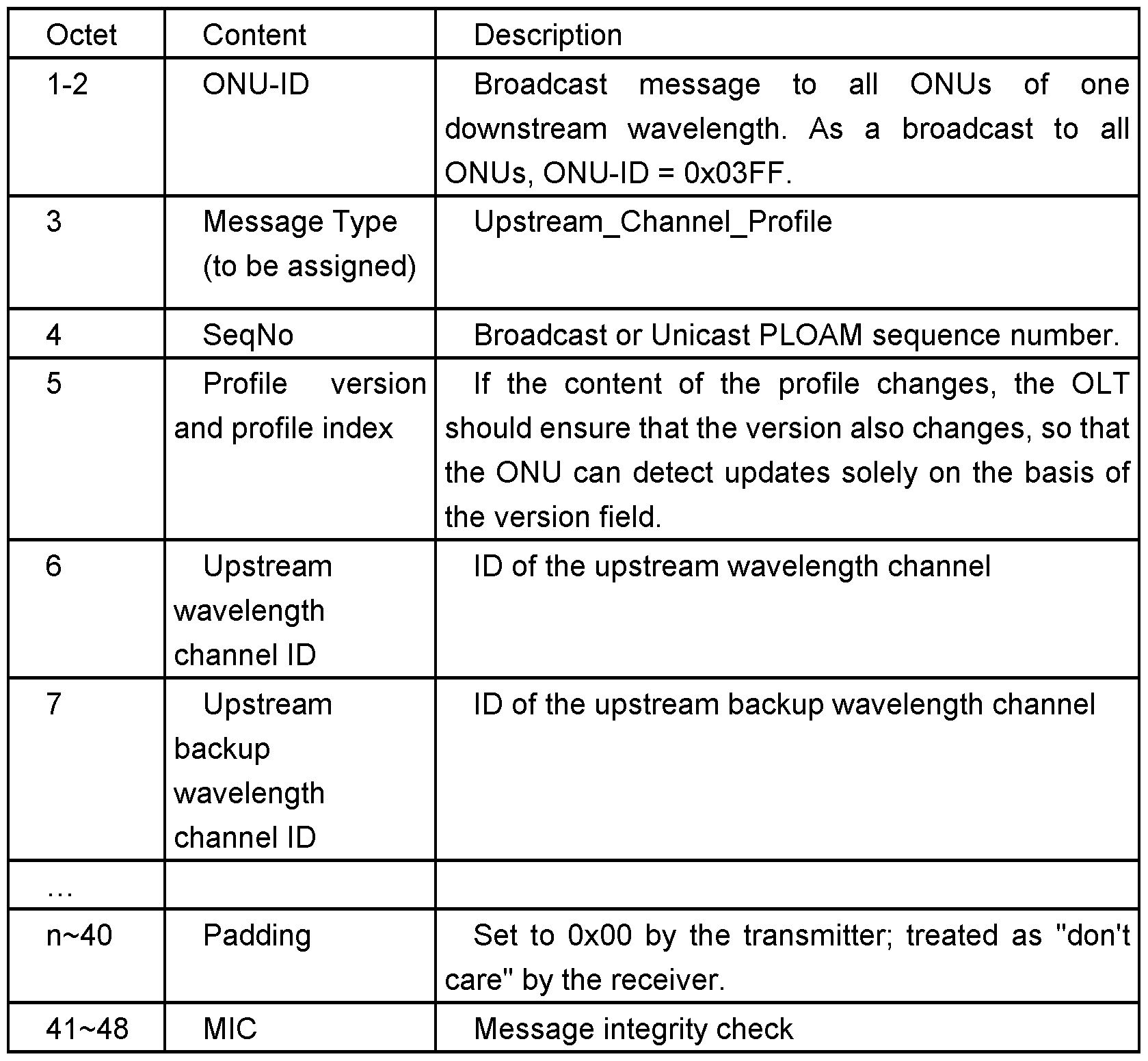
如上述表 4的内容可知, 第 1-2字节还是 ONU ID字段, 此字段与表 2的该字 段的内容相同。 第 3字节为消息类型标识, 该消息类型标识为上行通道模板 upstream— Channel— Profile; 第 4字节为序列号字段, 该字段的内容请参见表 2; 第 5字节为模板版本 Profile version和模板索引 Profile index字段, 该字段为模板 发生变化时, 进行模板更新的字段; 第 6字节为上行波长通道标识 Upstream wavelength channel ID字段, 表示 ONU的上行波长通道; 第 7字节为 Upstream
backup wavelength channel ID上行备份波长字段, 表示 ONU的上行备份波长通 道标识, 用于标识 ONU的上行备份波长通道; 其它字节 n~40可以任意填充或 者根据指定的需求进行填充; 第 41-48字节与表 2描述相同。 其中, 表 4中第 7字 节为新增字段。
表 3和表 4中 PLO AM消息没有描述 ONU的 work wavelength channel ID information工作波长通道标识信息,该 ONU的工作波长通道标识信息可以在其 它未填充字段进一步进行填充, 该工作波长通道标识信息为可选项。
综上所述,当所述备份通道标识信息包括下行备份波长通道标识信息和上 行备份波长通道标识时, 有两种情况, 第一种情况为: 0LT下发的第一消息中 的备份通道标识信息包括了下行备份波长通道标识信息和上行备份波长通道 标识信息, 则 0NU接收的的第一消息中也包括上述两种信息。
第二种情况为: 0LT下发的第一消息中的备份通道标识信息只包括了下行 备份波长通道标识信息, 则此时, 0LT还可以发送第二消息给 0NU, 该第二消 息中携带上行备份波长通道标识信息; 0NU还需要接收携带上行备份波长通道 标识信息。 该第二消息的格式可以参照表 4以及与表 4相应的描述, 这里就不 再赘述。 以变换的,例如第 1-2字节表示为 Backup wavelength channel ID备份波长通道标 识信息, 第 5字节用于表示 ONU ID等等, 都可以任意变换, 并不限制与上面的 形式, 只要保证上述 PLOAM消息中至少一个字节表示为 Backup wavelength channel ID备份波长通道标识信息即可。 另外, 上述各 PLO AM消息格式中除了 备份波长通道标识信息是该消息格式中必需保留的字段, 其它字段均为可选。
S404、 各 ONU接收到所述第一消息, 并根据所述第一消息中的备份波长通 道标识信息进行预先配置。
具体的, 如图 3中的组网架构图中, 各 ONU接收到所述第一消息后, 预先 存储该第一消息中的备份波长通道标识信息。其中,在如图 3所示的架构中, 各 ONU自身保存的备份波长通道标识信息都相同。 该备份波长通道标识信息预 先配置在各 ONU中, 使得 ONU检测到故障后, 切换到预先配置的备份波长通 道标识信息对应的备份波长通道上。
通过上述表 2-表 4的 PLAOM消息,将所述备份波长通道标识信息承载在上 述消息中下发给 ONU, 使得所述 ONU根据所述消息, 预先配置与所述备份波 长通道标识信息对应的备份波长通道, 以便于 ONU在检测到故障时能够快速 切换到备份波长通道上, 进而减少中断时间, 提高系统的可靠性。
S406、 当主用 OLT检测故障, 关闭主用 OLT的工作端口 0, 启用备用 OLT与 所述 ONU进行通信。
具体而言, 主用 OLT与各 ONU正常通信时, 主用 OLT通过工作端口 0收发 数据, 备用 OLT通过备用端口 1处于禁止发送使能接收状态, 即备用 OLT通过 备用端口 1可以同步接收各 ONU发送的数据, 禁止发送数据给 ONU。
当主用 OLT检测到故障, 则确认是主用 OLT的工作端口 0故障或者主用 OLT与分光器之间的主干光纤故障, OLT则关闭主用 OLT的工作端口 0, 使得 OLT禁止发送数据给 ONU。 此时, 备用 OLT在故障后, 使能收发数据, 即开启 发送数据功能, 通过备用端口 1周期性发送连续的下行数据给 ONU。
S408、 ONU检测到故障, 根据预先配置的备份波长通道标识信息, 将工 作波长通道切换到与所述备份波长通道标识信息对应的备份波长通道。
具体地,基于图 3的组网架构, 当主用 OLT切换到备用 OLT后, 各 ONU 都切换到相同的备份波长通道上, 通过时分复用的方式进行发送数据。
S410、 ONU通过备份波长通道接收备用 0LT发送的数据, 并进行数据同步 处理后, 恢复数据通信。
0NU通过下行备份波长通道标识信息对应的下行备份波长通道接收备用
0LT广播方式下发的数据, 通过时分方式釆用上行备份波长通道标识信息对应 的上行备份波长通道发送数据给备用 0LT, 进而恢复 0NU与备用 0LT之间的数 据通信。
在本发明实施例中, ONU根据 OLT发送的备份波长通道标识信息进行预 先配置, 当 ONU检测到故障, 根据预先配置的备份波长通道信息, 将自身的 工作波长通道快速切换到与备份波长通道信息对应的备份波长通道上,进而通 过切换后的备份波长通道进行数据通信,实现了无源光网络系统的快速保护倒 换, 进而提高了系统的可靠性。
实施例 2
如图 5所示, 图 5为另一种主备倒换的组成架构图。 图 5中 OLT 0的结构 与图 3中主用 OLT, 即 OLT0的结构相同。具体 OLT 0的结构请参见图 3的描 述, 这里就不再赘述。
在图 5的主备倒换的架构图中, OLT0预先确定 OLT0的工作波长通道之 间的保护关系, 例如 OLT的工作波长通道 2作为工作波长通道 3的备份波长 通道, 即工作波长通道 2与工作波长通道 3之间建立保护关系, 所述保护关系 在 PLOAM 消息中表示为工作波长通道标识信息与备份波长通道标识信息, 并将该消息进行下发给个 ONU。
釆用工作波长通道 3的 ONU3收到该消息后, 将工作波长通道 2作为自 身的备份波长通道。 当 ONU3检测到故障, 将 ONU3的工作波长通道 3切换 到切换到工作波长通道 2进行数据收发。 由于 OLT0的各收发器的工作在固定 的工作波长通道上, 当 OLT0检测到故障, 则关闭收发器 3 , 通过其他收发器 例如收发器 1 , 收发器 2以及收发器 4进行数据收发。
基于图 5的架构, 该无源光网络的通信方法如图 6所示如下:
S602、 OLT 0广播第一消息给各 ONU, 所述第一消息携带了备份波长通道 标识信息。
步骤 S602之前, OLT0自身将 ONU的收发器的工作波长通道标识信息与备 份波长通道标识信息的对应关系预先进行设置并下发给各 ONU, 该对应关系 可以从现有的工作波长通道标识信息中进行互相选择, 即互为备份。 例如, 该 对应关系表中可以包括: ONU3釆用的工作波长通道 3和工作波长通道 2互为备 下发。 OLT0根据预先配置的上述对应关系, 将备份通道标识信息等以第一消 息的格式下发给 ONU, 使各 ONU也进行相应的预先配置。
进一步地,所述第一消息以釆用 PL0AM消息来承载备份波长通道标识信息 为例, 具体携带备份波长通道标识信息的 PL0AM消息格式如表 5所示:
表 5
 1-2 ONU-ID Broadcast message to all ON Us of one downstream wavelength. As a broadcast to all ONUs, ONU-ID = 0x03FF.
3 Message type ID Protect-pair-configure
4 SeqNo Broadcast or Unicast PLOAM sequence number.
5 0000 OOOC 波长保护对数目
6 Work wavelength DDDD: ID of work downstream wavelength channel下行工作 channel ID information 波长通道标识
UUUU : ID of work upstream wavelength channel上行波长通道 标识
7 Backup wavelength AAAA: ID of downstream backup wavelength channel下行备份 channel ID information 波长通道标识
BBBB: ID of upstream backup wavelength channel上行备份波 长通道标识 n-4 Padding Set to 0x00 by the transmitter; treated as "don't care" by the
0 receiver.
41- MIC Message integrity check.
48
上述表 5中, PLOAM消息中第 1-2字节为 ONU标识字段, 广播消息一般以 0X03FF进行填充, 也不限于此; 第 3字节为消息类型字段, 为保护对配置 protect-pair-configure, 该字节为新增字段; 第 4字节为广播或者单播 PLOAM消 息的序列号; 第 5字节为 0000 000C, 用于标识波长保护对数目, 该波长保护对 数目主要用于标识第 6字节-第 n字节中工作波长通道标识所标识的工作波长通 道与备份波长通道标识所标识的备份波长通道的数量。 表 5中第 6字节为 workwavelength channel ID工作波长通道标识信息, , 具体可以包括: ID of downstream wavelength channel下行波长通道标识 , 用于标识下行方向 ONU釆 用的工作波长通道, 具体可以釆用 DDDD这种方式去标识, 以及 ID of upstream wavelength channel上行波长通道标识, 用于标识上行方向 ONU釆用的工作波 长通道, 具体可以釆用 UUUU这种方式去标识; 第 7字节为 Backup wavelength channel ID备份波长通道标识信息, 具体可以包括: ID of downstream backup wavelength channel下行备份波长通道标识, 用于标识 ONU釆用的下行备份波
长通道,具体可以通过 AAAA的方式标 i只以及 ID of upstream backup wavelength channel上行备份波长通道标识, 用于标识 ONU釆用的上行备份波长通道, 具 体可以通过 BBBB方式进行标识,第 n-40字节可以填充 0X00,第 41-48字节用于 消息完整检测。 其中, 第 3字节, 第 5-7字节为新增字段。
应理解, 在本发明实施例中表 5的各字节的内容的顺序以及位置是可以变 换的,例如第 1-2字节表示为 Backup wavelength channel ID备份波长通道标识信 息,第 5字节用于表示 ONU ID等等,都可以任意变换,并不限制与上面的形式, 但是上述 PLOAM消息中至少一个或多个字节表示为 Backup wavelength channel ID备份波长通道标识信息。 另外, 上述各 PLOAM消息格式中除了备份 波长通道标识是该消息格式中必需保留的字段, 其它字段均为可选。
这里的波长保护对数目字段用于标识波长保护对的数量, 所述波长保护对包 括工作波长通道标识所标识的工作波长通道和备份波长通道标识所标识的备 份波长通道,其中工作波长通道具体包括上行工作波长通道标识所标识的上行 工作波长通道和下行工作波长通道标识所标识的下行工作波长通道;所述备份 波长通道标识包括上行备份波长通道标识所标识的上行备份波长通道和下行 备份波长通道标识所标识的下行备份波长通道。 应理解地, 实施例 2中, PLOAM消息中包括工作波长通道标识信息和备份波长通道标识信息。 当 ONU 检测到故障后, 需要根据备份波长通道标识信息进行波长通道的切换, 而所述 的波长通道的切换需要根据工作波长通道标识信息去匹配到对应的备份波长 通道标识信息,进而得出与备份波长通道标识信息对应的备份波长通道进行波 长通道的切换。
S604、 各 ONU接收到所述第一消息, 并根据所述第一消息中的备份波长通
道标识信息进行预先配置。
具体的, 如图 5中的组网架构图中, 各 ONU接收到所述第一消息后, 预先 配置该第一消息中的备份波长通道标识信息。 其中, 在如图 5所示的架构中, 第一消息中携带了各 ONU的备份波长通道标识信息等信息, 各 ONU根据自身 的工作波长通道标识信息匹配与其对应的备份波长通道标识信息,各自预先配 置, 使得各 ONU检测到故障, 切换到预先配置备份波长通道标识信息对应的 备份波长通道上。
S606、 当 OLT0检测到故障, 关闭 OLT0中出现故障的收发器。
具体而言, OLT0检测到故障, 将故障的收发器进行关闭, 使得 ONU无法 接收到数据, 进而检测到故障。
S608、 ONU检测到故障, 根据预先配置的备份波长通道标识信息, 将工作 波长通道切换到与所述备份波长通道标识信息对应的备份波长通道。
具体地,基于图 5的组网架构,例如当 OLT0的收发器 3的端口出现故障, 关闭该收发器 3的端口。 相应地, ONU3由于接收不到下行数据, 导致故障产 生, ONU3根据预先配置的备份波长通道标识信息,通过 ONU3的工作波长通 道标识信息, 找到 ONU3的备份波长通道标识信息, 进而将 ONU3的工作波 长通道切换到与所述备份波长通道标识信息对应的备份波长通道上。 ONU3基 于切换后的备份波长通道的下行备份波长通道接收 OLT发送的数据, 通过切
S610、 ONU通过备份波长通道接收备用 OLT发送的数据, 恢复数据通信。 以步骤 S608中的 0NU3为例, ONU3基于切换后的备份波长通道的下行备 份波长通道接收 OLT发送的数据, 通过切换后的备份波长通道的上行备份波
长通道发送数据给 OLT。
在本发明实施例中, ONU根据 OLT发送的备份波长通道标识信息进行预 先配置, 当 ONU检测到故障后, 根据预先配置的备份波长通道信息, 将自身 的工作波长通道快速切换到与备份波长通道信息对应的备份波长通道上,进而 通过切换后的备份波长通道进行数据通信,实现了无源光网络系统的快速保护 倒换, 进而提高了系统的可靠性。
实施例 3
如图 7所示, 图 7为另一种主备倒换的组成架构图。 图 7中 OLT 0的结构 可以参见图 3中主用 OLT, 即 OLT0的结构。
图 7中 ONU的结构与图 3中 ONU的结构不同,每个 ONU都支持两个收 发器, 如果这两个收发器分别釆用不同的收发波长, 因此每个 ONU可以同时 工作在两个不同的波长通道上。 这样 OLT0可以根据各波长通道的负载情况, 灵活的调整 ONU两个不同波长通道上的业务流量, 达到负载均衡的目的。
任意一 ONU包括至少 2个收发器, 该收发器工作在两个不同的工作波长通 道上, 例如 ONU1包括收发器 1和收发器 2, 收发器 1工作在工作波长通道 1 , 工 作波长通道 1釆用上行工作波长和下行工作波长分别为 λιιρΐ和 λώιΐ ; 收发器 2 工作在工作波长通道 2,工作波长通道 2釆用上行工作波长和下行工作波长分别 为 λιιρ2和 λώι2。 该工作波长通道通过工作波长通道标识进行识别, 例如工作波 长通道标识为 1 , 标识工作波长通道 1。
这里 ONU中的其中一个收发器的工作波长通道信息是根据 OLT0下发的第 一消息中携带的备份波长通道标识信息进行配置的。
下面具体描述 ONU的处理过程如图 8所示, 图 8为本发明实施例提供的
又一种无源光网络的通信方法的示意性流程图:
S802、 OLT0发送第一消息给 ONU, 所述第一消息携带了备份波长通道标 识信息。
应理解地,这里的 OLT0以单播方式下发给指定的 ONU, 即 OLT下发的第一 消息中包括被指定的 ONU的 ONU ID信息, 用于表示该第一消息发送给与 ONU ID对应的 ONU。 。
S804、 被指定的 ONU接收该第一消息, 根据所述第一消息, 对自身的收发 器进行配置。
具体地, 该 ONU具有至少两个收发器, 配置时, ONU的另外一个收发器 的工作波长通道是通过 OLT0下发的第一消息中携带的备份波长通道标识信息 进行配置的。 例如, ONU3设置有至少两个收发器, 分别为收发器 1和收发器 3。 正常通信时, ONU3通过收发器 3与 OLT0的收发器 3进行数据通信。 ONU3通过 收发器 3接收 OLT下发的第一消息, ONU3将第一消息中的备份波长通道标识信 息所包括的备份波长通道作为另外一个收发器 1的工作波长通道, 即 ONU3的 收发器 1的上行工作波长设置为所述上行备份波长通道标识对应的上行备份波 长通道釆用的波长 λιιρΐ , 将收发器 1的下行工作波长设置为所述下行备份波长 通道标识对应的下行备份波长通道釆用的波长 λώιΐ。
正常通信时, 该 ONU的两个收发器都可以接收 OLT0发送的数据。
这里由于每个 ONU的两个收发器釆用的波长通道信息各不相同,所以 OLT 以单播的方式对特定的 ONU下发第一消息, 所述第一消息中携带的信息也有 所不同, 具体针对特定的 ONU接收到的第一消息, 以 PLOAM消息为例, 格式 可以参见表 6
Oct Content Description
et
1-2 ONU-ID 发给特定某个 ONU的单播 ONU-ID
3 Message type ID Protect-pair-configure波长保护对配置
4 SeqNo Broadcast or Unicast PLOAM sequence number.
1 0000 OOOC 波长保护对数目
6 :Si Work wavelength channel
DDDD ID information! : ID of work downstream wavelength channel議聽議羅纖誦議纖:纖: uuuu : ID of work upstream wavelength chan ne隱圖國國議纖曜,
1 Backup wavelength
AAAA:
channel ID information ID of downstream backup wavelength chan ne圖議漏議國議議謹鎮
BBBB : ID of upstream backup wavelength chan ne隱國翻國議議議繊 n-4 Padding Set to 0x00 by the transmitter; treated as "don't care" by the
0 receiver.
41- MIC Message integrity check.
48
表 6中的第 1-2字节中的 ONU ID为广播消息, 而这里由于是特定的 ONU, 是单播消息, 所以这里 ONU ID应该为特定 ONU的标识信息, 用于标识特定的 ONU。 第 3字节为消息类型标识, 消息内容为波长保护对配置, 该类型在原有 PLOAM消息中没有定义该消息类型标识, 因此该字节为新增消息类型。 第 5 字节的波长保护对数目在此实施例中也为可选项用于标识波长保护对的数量。 其中第 6-第 7字节的内容与表 5都是一样的,都包括工作波长通道标识信息和备
份波长通道标识信息。其中, 第 6字节的工作波长通道标识信息在实施例 3中是 可选项。 因为这里 OLT下发的 PLOAM消息是给特定的 ONU, 只需要在消息中 携带特定 ONU的备份波长通道标识信息, 特定 ONU收到该消息后, 根据消息 中的备份波长通道标识信息对 ONU的另一个收发器的波长通道进行预先配 置, 即该 ONU的另一个收发器是根据备份波长通道标识信息对应的备份波长 通道作为工作波长通道, 当 ONU检测到故障, 就可以根据 ONU的另一个收发 器进行数据通信。 第 n-40为填充字节, 第 41-48字节为消息完整性检测字段。
S806、 当特定的 ONU检测到故障, 该 ONU关闭其中一个收发器, 通过另 一个收发器进行数据通信。
以 ONU3为例, 当 ONU3检测到故障, ONU3的收发器 3被关闭, 该收发器 3 釆用的波长通道上的数据切换到 ONU3的收发器 1上, 通过收发器 1釆用的波长 通道进行数据收发。具体为,通过收发器 1的下行工作波长通道进行数据接收, 通过收发器 1的上行工作波长通道进行数据发送。
在本发明实施例中, ONU根据 OLT发送的备份波长通道标识信息进行预 先配置, 当 ONU检测到故障, 通过另一个收发器的工作波长通道进行数据通 信, 实现了无源光网络系统的快速保护倒换, 进而提高了系统的可靠性。
本发明实施例提供的装置如图 9所示。
一种无源光网络的通信装置 90, 所述装置包括:
第一通信单元 902, 用于接收光线路终端发送的第一消息, 所述第一消息 携带了备份波长通道标识信息;以及通过所述切换后的备份波长通道进行数据 通信;
第一处理单元 904, 用于当光网络单元检测到故障, 根据所述接收单元接
收的第一消息,将所述光网络单元的工作波长通道切换到所述备份波长通道标 识信息所标识的备份波长通道。
上述通信装置可以为 ONU, 对应于图 1中的 ONU。
具体 ONU的功能请参见图 1-8的方法实施例中的具体描述, 这里就不再 赘述。
上述的第一通信单元可以为 ONU的收发器, 第一处理单元可以为 MAC 或者微处理器, 该第一处理单元可以在芯片上实现。
所述第一消息包括: 消息类型标识 Message type ID字段和消息内容字段, 其中, 所述第一消息的消息类型标识字段为通道模板字段、 系统模板字段或者 波长保护对配置字段, 所述消息内容字段包括备份波长通道标识信息。
所述备份波长通道标识信息包括下行备份波长通道标识;
所述第一处理单元,具体用于将所述光网络单元的工作波长通道中的下行 工作波长通道切换到所述下行备份波长通道标识所标识的下行备份波长通道。
所述备份波长通道标识信息包括上行备份波长通道标识;
所述第一处理单元,具体用于将所述光网络单元的工作波长通道中的上行 工作波长通道切换到与所述上行备份波长通道标识所标识的上行备份波长通 道。
所述备份波长通道标识信息包括下行备份波长通道标识和上行备份波长 通道标识;
所述第一处理单元, 具体用于将所述光网络单元的工作波长通道中的下 行工作波长通道切换到所述下行备份波长通道标识信息所标识的下行备份波 长通道;将所述光网络单元的工作波长通道中的上行工作波长通道切换到所述
上行备份波长通道标识信息所标识的上行备份波长通道。
所述消息内容字段包括还包括: 工作波长通道标识信息, 所述工作波长通 道标识信息与所述备份波长通道标识信息相对应 ,所述工作波长通道标识信息 包括工作波长通道标识;
所述第一处理单元,具体用于根据自身的工作波长通道匹配所述消息内容 字段的工作波长通道标识所标识的工作波长通道; 根据匹配的工作波长通道, 确定备份波长通道标识所标识的备份波长通道;将所述光网络单元的工作波长 通道切换到所述备份波长通道。
所述消息内容字段还包括波长保护对数目,用于指示所述消息内容字段携 带的备份波长通道标识的数目,所述备份波长通道标识包括所述下行备份波长 通道标识和上行备份波长通道标识。
所述第一通信单元,还用于接收所述光线路终端发送的第二消息, 所述第 二消息包括: 消息类型标识 Message type ID字段和消息内容字段, 其中, 所 述第二消息的消息类型标识字段为通道模板标识字段、系统模板字段或者波长 保护对配置字段, 所述消息内容字段包括上行备份波长通道标识;
所述第一处理单元,还用于将所述光网络单元的工作波长通道中的上行工 作波长通道切换到所述第二消息中的上行备份波长通道标识所标识的上行备 份波长通道。
可以看出, 本实施例中, 在本发明实施例中, ONU根据 OLT发送的备份 波长通道标识信息进行预先配置, 当 ONU检测到故障, 根据预先配置的备份 波长通道信息,将自身的工作波长通道快速切换到与备份波长通道信息对应的 备份波长通道上, 进而通过切换后的备份波长通道进行数据通信, 实现了无源
光网络系统的快速保护倒换, 进而提高了系统的可靠性。
如图 10所示, 本发明实施例还提供一种无源光网络通信装置 100, 具体 结构如下:
所述通信装置 100包括:
第二处理单元 1002, 用于生成第一消息, 所述第一消息携带了备份波长 通道标识信息,所述备份波长通道标识信息用于指示当所述光网络单元检测到 故障时,将所述光网络单元的工作波长通道切换到所述备份波长通道标识信息 所标识的备份波长通道;
第二通信单元 1004, 用于发送所述第一消息给光网络单元。
上述通信装置可以为 OLT, 对应于图 1中的 OLT。
具体 ONU的功能请参见图 1-8的方法实施例中的具体描述, 这里就不再 赘述。
上述的第二通信单元可以为 OLT 的收发器, 第二处理单元可以为 MAC 或者微处理器, 该第二处理单元的功能可以在 OLT的芯片上实现。
进一步地,所述第一消息包括: 消息类型标识字段和消息内容字段,其中, 所述第一消息的消息类型标识字段为通道模板字段、系统模板字段或者波长保 护对配置字段, 所述消息内容字段包括备份波长通道标识信息。
进一步地, 所述备份波长通道标识信息包括下行备份波长通道标识, 所述 下行备份波长通道标识用于指示将所述光网络单元的下行工作波长通道切换 到所述下行备份波长通道标识所标识的下行备份波长通道。
进一步地, 所述备份波长通道标识信息包括上行备份波长通道标识, 所述 上行备份波长通道标识用于指示将所述光网络单元的上行工作波长通道切换
到所述上行备份波长通道标识所标识的上行备份波长通道。
进一步地,所述备份波长通道标识信息包括下行备份波长通道标识和上行 备份波长通道标识;
所述下行备份波长通道标识用于指示将所述光网络单元的下行工作波长 通道切换到所述下行备份波长通道标识所标识的下行备份波长通道;
所述上行备份波长通道标识用于指示将所述光网络单元的上行工作波长 通道切换到所述上行备份波长通道标识所标识的上行备份波长通道。
进一步地, 所述消息内容字段包括还包括: 工作波长通道标识信息, 所述 工作波长通道标识信息与所述备份波长通道标识信息相对应 ,所述工作波长通 道标识信息包括工作波长通道标识,所述工作波长通道标识用于指示所述光网 络单元匹配所述工作波长通道标识所标识的工作波长通道;根据匹配的工作波 长通道,确定备份波长通道标识所标识的备份波长通道, 将所述光网络单元的 工作波长通道切换到所述备份波长通道。
进一步地, 所述消息内容字段还包括波长保护对数目, 用于指示所述消息 内容字段中备份波长通道标识的数目,所述备份波长通道标识包括所述下行备 份波长通道标识和上行备份波长通道标识。
进一步地,所述第二控制单元,还用于生成第二消息,所述第二消息包括: 消息类型标识 Message type ID字段和消息内容字段; 其中, 所述第二消息的 消息类型标识字段为通道模板字段、 系统模板字段或者波长保护对配置字段, 所述消息内容字段包括上行备份波长通道标识; 其中, 所述上行备份波长通道 标识用于指示所述光网络单元将所述光网络单元的工作波长通道中的上行工 作波长通道切换到所述第二消息中的上行备份波长通道标识所标识的上行备
份波长通道;
所述第二通信单元, 还用于发送第二消息给光线路终端。
在本发明实施例中, OLT发送的备份波长通道标识信息给 ONU, 使得 ONU进行预先配置,当 ONU检测到故障,根据预先配置的备份波长通道信息, 将自身的工作波长通道快速切换到与备份波长通道信息对应的备份波长通道 上, 进而通过切换后的备份波长通道进行数据通信, 实现了无源光网络系统的 快速保护倒换, 进而提高了系统的可靠性。
本发明实施例还提供一种通信装置 110, 如图 11所示。
一种通信装置 110,其特征在于,该装置 110包括处理器 1102、存储器 1104 和总线系统 1106,该处理器 1102和该存储器 1104通过该总线系统 1104相连, 该存储器 1104用于存储指令, 该处理器 1104用于执行该存储器 1104存储的 指令, 其中, 该处理器 1102用于: 用于生成第一消息, 所述第一消息携带了 备份波长通道标识信息 ,所述备份波长通道标识信息用于指示当所述光网络单 元检测到故障时,将所述光网络单元的工作波长通道切换到所述备份波长通道 标识信息所标识的备份波长通道。
进一步地,该处理器 1102的具体功能可以参见装置实施例图 10中的通信 装置 100中的第二处理单元 1002的具体功能, 这里就不再赘述。
因此, 本发明实施例通信装置, 通过用于生成第一消息, 所述第一消息携 带了备份波长通道标识信息 ,所述备份波长通道标识信息用于指示当所述光网 络单元检测到故障时,将所述光网络单元的工作波长通道切换到所述备份波长 通道标识信息所标识的备份波长通道,, 实现了无源光网络系统的快速保护倒 换, 进而提高了系统的可靠性。
应理解,在本发明实施例中,该处理器 1102可以是中央处理单元( Central Processing Unit , 简称为 "CPU" ), 该处理器 1102还可以是其他通用处理器、 数字信号处理器(DSP )、 专用集成电路(ASIC )、 现成可编程门阵列(FPGA ) 或者其他可编程逻辑器件、 分立门或者晶体管逻辑器件、 分立硬件组件等。 通 用处理器可以是微处理器或者该处理器也可以是任何常规的处理器等。
该存储器 1104可以包括只读存储器和随机存取存储器, 并向处理器 1102 提供指令和数据。存储器 1104的一部分还可以包括非易失性随机存取存储器。 例如, 存储器 1104还可以存储设备类型的信息。
该总线系统 1106除包括数据总线之外, 还可以包括电源总线、 控制总线 和状态信号总线等。但是为了清楚说明起见,在图中将各种总线都标为总线系 统 1106。
在实现过程中, 上述方法的各步骤可以通过处理器 1102中的硬件的集成 逻辑电路或者软件形式的指令完成。结合本发明实施例所公开的方法的步骤可 以直接体现为硬件处理器执行完成,或者用处理器中的硬件及软件模块组合执 行完成。 软件模块可以位于随机存储器, 闪存、 只读存储器, 可编程只读存储 器或者电可擦写可编程存储器、 寄存器等本领域成熟的存储介质中。该存储介 质位于存储器 1104, 处理器 1104读取存储器 1104中的信息, 结合其硬件完 成上述方法的步骤。 为避免重复, 这里不再详细描述。
本发明还提供一种无源光网络系统, 可以参照图 1所示, 所述无源光网络 系统至少包括 OLT和各 ONU, 该 OLT与 ONU之间通过分光器 splitter连接, 所述 OLT执行的功能如装置实施例图 9以及图 9相应的描述,所述 ONU执行 的功能如装置实施例图 10以及图 10相应的描述, 具体为:
OLT用于生成第一消息,所述第一消息携带了备份波长通道标识信息,所 述备份波长通道标识信息用于指示当所述光网络单元检测到故障时,将所述光 网络单元的工作波长通道切换到所述备份波长通道标识信息所标识的备份波 长通道; 发送所述第一消息给光网络单元。
ONU用于接收光线路终端发送的第一消息, 所述第一消息携带了备份波 长通道标识信息;
当光网络单元检测到故障 ,所述光网络单元将所述光网络单元的工作波长 通道切换到所述备份波长通道标识信息所标识的备份波长通道;
所述光网络单元通过所述切换后的备份波长通道进行数据通信。
具体第一消息以及第二消息的格式请参见方法实施例图 2-图 8对应的实 施例的具体描述, 这里就不再赘述。
本发明实施例提供的一种无源光网络系统中,光网络单元接收光线路终端 发送的第一消息, 所述第一消息携带了备份波长通道标识信息; 当光网络单元 检测到故障 ,所述光网络单元将所述光网络单元的工作波长通道切换到所述备 份波长通道标识信息所标识的备份波长通道;所述光网络单元通过所述切换后 的备份波长通道进行数据通信, 实现了无源光网络系统的快速保护倒换, 进而 提高了系统的可靠性。
本发明还提供一种无源光网络系统, 可以参照图 1所示, 所述无源光网络 系统至少包括 OLT和各 ONU, 该 OLT与 ONU之间通过分光器 splitter连接, 所述 OLT执行的功能如装置实施例图 11以及图 11相应的描述,所述 ONU执 行的功能如装置实施例图 10以及图 10相应的描述, 具体为:
OLT用于包括处理器、存储器和总线系统,所述处理器和所述存储器通过
所述总线系统相连, 所述存储器用于存储指令, 所述处理器用于执行所述存储 器存储的指令,
其中, 所述处理器, 用于生成第一消息, 所述第一消息携带了备份波长通 道标识信息,所述备份波长通道标识信息用于指示当所述光网络单元检测到故 障时,将所述光网络单元的工作波长通道切换到所述备份波长通道标识信息所 标识的备份波长通道。
所述 ONU, 用于接收光线路终端发送的第一消息, 所述第一消息携带了 备份波长通道标识信息;
当光网络单元检测到故障 ,所述光网络单元将所述光网络单元的工作波长 通道切换到所述备份波长通道标识信息所标识的备份波长通道;
所述光网络单元通过所述切换后的备份波长通道进行数据通信。
在本发明实施例中, ONU根据 OLT发送的备份波长通道标识信息进行预 先配置, 当 ONU检测到故障, 根据预先配置的备份波长通道信息, 将自身的 工作波长通道快速切换到与备份波长通道信息对应的备份波长通道上,进而通 过切换后的备份波长通道进行数据通信,实现了无源光网络系统的快速保护倒 换, 进而提高了系统的可靠性。
在上述实施例中,对各个实施例的描述都各有侧重, 某个实施例中没有详 述的部分, 可以参见其他实施例的相关描述。
需要说明的是, 对于前述的各方法实施例, 为了简单描述, 故将其都表述 为一系列的动作组合,但是本领域技术人员应该知悉, 本发明并不受所描述的 动作顺序的限制, 因为依据本发明, 某些步骤可能可以釆用其他顺序或者同时 进行。 其次, 本领域技术人员也应该知悉, 说明书中所描述的实施例均属于优
选实施例, 所涉及的动作和模块并不一定是本发明所必须的。
在本申请所提供的几个实施例中, 应该理解到, 所揭露的装置, 可通过其 它的方式实现。 例如, 以上所描述的装置实施例仅仅是示意性的, 例如上述单 元的划分, 仅仅为一种逻辑功能划分, 实际实现时可以有另外的划分方式, 例 如多个单元或组件可以结合或者可以集成到另一个系统, 或一些特征可以忽 略, 或不执行。 另一点, 所显示或讨论的相互之间的耦合或直接耦合或通信连 接可以是通过一些接口, 装置或单元的间接耦合或通信连接, 可以是电性或其 它的形式。 单元显示的部件可以是或者也可以不是物理单元, 即可以位于一个地方, 或者 也可以分布到多个网络单元上。可以根据实际的需要选择其中的部分或者全部 单元来实现本实施例方案的目的。
另外,在本发明各实施例中的各功能单元可以集成在一个处理单元中, 也 可以是各个单元单独物理存在, 也可以两个或两个以上单元集成在一个单元 中。上述集成的单元既可以釆用硬件的形式实现, 也可以釆用软件功能单元的 形式实现。
上述集成的单元如果以软件功能单元的形式实现并作为独立的产品销售 或使用时, 可以存储在一个计算机可读取存储介质中。 基于这样的理解, 本发 明的技术方案本质上或者说对现有技术做出贡献的部分或者该技术方案的全 部或部分可以以软件产品的形式体现出来,该计算机软件产品存储在一个存储 介质中, 包括若干指令用以使得一台计算机设备(可以为个人计算机、 服务器 或者网络设备等, 具体可以是计算机设备中的处理器)执行本发明各个实施例
上述方法的全部或部分步骤。 其中, 而前述的存储介质可包括: U盘、 移动硬 盘、 磁碟、 光盘、 只读存储器 (ROM, Read-Only Memory )或者随机存取存 储器(RAM, Random Access Memory )等各种可以存储程序代码的介质。
以上所述, 以上实施例仅用以说明本发明的技术方案, 而非对其限制; 尽 管参照前述实施例对本发明进行了详细的说明,本领域的普通技术人员应当理 解: 其依然可以对前述各实施例所记载的技术方案进行修改, 或者对其中部分 技术特征进行等同替换; 而这些修改或者替换, 并不使相应技术方案的本质脱 离本发明各实施例技术方案的精神和范围。
Claims
1、 一种无源光网络的通信方法, 其特征在于, 所述方法包括:
光网络单元接收光线路终端发送的第一消息,所述第一消息携带了备份波 长通道标识信息;
当光网络单元检测到故障,所述光网络单元将所述光网络单元的工作波长 通道切换到所述备份波长通道标识信息所标识的备份波长通道;
所述光网络单元通过所述切换后的备份波长通道进行数据通信。
2、 根据权利要求 1所述的通信方法, 其特征在于, 所述第一消息包括: 消息类型标识 Message type ID字段和消息内容字段, 其中, 所述第一消息的 消息类型标识字段为通道模板字段、 系统模板字段或者波长保护对配置字段, 所述消息内容字段包括备份波长通道标识信息。
3、 根据权利要求 1或者 2所述的通信方法, 其特征在于, 所述备份波长 通道标识信息包括下行备份波长通道标识;
所述光网络单元将所述光网络单元的工作波长通道切换到所述备份波长 通道标识信息所标识的备份波长通道包括:
所述光网络单元将所述光网络单元的工作波长通道中的下行工作波长通 道切换到所述下行备份波长通道标识所标识的下行备份波长通道。
4、 根据权利要求 1-2所述的任一通信方法, 其特征在于, 所述备份波长 通道标识信息包括上行备份波长通道标识;
所述光网络单元将所述光网络单元的工作波长通道切换到所述备份波长 通道标识信息所标识的备份波长通道包括:
所述光网络单元将所述光网络单元的工作波长通道中的上行工作波长通
道切换到与所述上行备份波长通道标识所标识的上行备份波长通道。
5、 根据权利要求 1-2所述的通信方法, 其特征在于, 所述备份波长通道 标识信息包括下行备份波长通道标识和上行备份波长通道标识;
所述光网络单元将所述光网络单元的工作波长通道切换到所述备份波长 通道标识信息所标识的备份波长通道包括:
所述光网络单元将所述光网络单元的工作波长通道中的下行工作波长通道 切换到所述下行备份波长通道标识信息所标识的下行备份波长通道;
所述光网络单元将所述光网络单元的工作波长通道中的上行工作波长通道 切换到所述上行备份波长通道标识信息所标识的上行备份波长通道。
6、 根据权利要求 1-5所述的任一通信方法, 其特征在于, 所述消息内容 字段包括还包括: 工作波长通道标识信息, 所述工作波长通道标识信息与所述 备份波长通道标识信息相对应 ,所述工作波长通道标识信息包括工作波长通道 标识;
所述光网络单元将所述光网络单元的工作波长通道切换到所述备份波长 通道标识信息所标识的备份波长通道包括:所述光网络单元根据自身的工作波 长通道匹配所述消息内容字段的工作波长通道标识所标识的工作波长通道; 所述光网络单元才艮据匹配的工作波长通道,确定备份波长通道标识所标识 的备份波长通道;
所述光网络单元将所述光网络单元的工作波长通道切换到所述备份波长 通道。
7、 根据权利要求 1-6所述的任一通信方法, 其特征在于, 所述消息内容 字段还包括波长保护对数目,用于指示所述消息内容字段携带的备份波长通道
标识的数目,所述备份波长通道标识包括所述下行备份波长通道标识和上行备 份波长通道标识。
8、 根据权利要求 3所述的通信方法, 其特征在于, 所述方法还包括: 接收所述光线路终端发送的第二消息, 所述第二消息包括: 消息类型标识 Message type ID字段和消息内容字段, 其中, 所述第二消息的消息类型标识字 段为通道模板标识字段、 系统模板字段或者波长保护对配置字段, 所述消息内 容字段包括上行备份波长通道标识;
所述光网络单元将所述光网络单元的工作波长通道切换到所述备份波长 通道标识信息所标识的备份波长通道包括:所述光网络单元将所述光网络单元 的工作波长通道中的上行工作波长通道切换到所述第二消息中的上行备份波 长通道标识所标识的上行备份波长通道。
9、 一种无源光网络的通信方法, 其特征在于, 所述方法包括:
光线路终端生成第一消息, 所述第一消息携带了备份波长通道标识信息, 所述备份波长通道标识信息用于指示当所述光网络单元检测到故障时,将所述 光网络单元的工作波长通道切换到所述备份波长通道标识信息所标识的备份 波长通道; 发送所述第一消息给光网络单元。
10、 根据权利要求 9所述的通信方法, 其特征在于, 所述第一消息包括: 消息类型标识字段和消息内容字段, 其中, 所述第一消息的消息类型标识字段 为通道模板字段、 系统模板字段或者波长保护对配置字段, 所述消息内容字段 包括备份波长通道标识信息。
11、 根据权利要求 9-10所述的任一通信方法, 其特征在于, 所述备份波 长通道标识信息包括下行备份波长通道标识,所述下行备份波长通道标识用于
指示将所述光网络单元的下行工作波长通道切换到所述下行备份波长通 道标识所标识的下行备份波长通道。
12、 根据权利要求 9-10所述的任一通信方法, 其特征在于, 所述备份波 长通道标识信息包括上行备份波长通道标识,所述上行备份波长通道标识用于 指示将所述光网络单元的上行工作波长通道切换到所述上行备份波长通道标 识所标识的上行备份波长通道。
13、 根据权利要求 9-10所述的任一通信方法, 其特征在于, 所述备份波 长通道标识信息包括下行备份波长通道标识和上行备份波长通道标识;
所述下行备份波长通道标识用于指示将所述光网络单元的下行工作波长 通道切换到所述下行备份波长通道标识所标识的下行备份波长通道;
所述上行备份波长通道标识用于指示将所述光网络单元的上行工作波长 通道切换到所述上行备份波长通道标识所标识的上行备份波长通道。
14、 根据权利要求 9-13所述的任一通信方法, 其特征在于, 所述消息内 容字段包括还包括: 工作波长通道标识信息, 所述工作波长通道标识信息与所 述备份波长通道标识信息相对应 ,所述工作波长通道标识信息包括工作波长通 道标识,所述工作波长通道标识用于指示所述光网络单元匹配所述工作波长通 道标识所标识的工作波长通道; 根据匹配的工作波长通道,确定备份波长通道 标识所标识的备份波长通道,将所述光网络单元的工作波长通道切换到所述备 份波长通道。
15、 根据权利要求 9-13所述的任一通信方法, 其特征在于, 所述消息内 容字段还包括波长保护对数目,用于指示所述消息内容字段中备份波长通道标 识的数目,所述备份波长通道标识包括所述下行备份波长通道标识和上行备份
波长通道标识。
16、 根据权利要求 12所述的任一通信方法, 其特征在于, 发送第二消息 给光线路终端, 所述第二消息包括: 消息类型标识 Message type ID字段和消 息内容字段; 其中, 所述第二消息的消息类型标识字段为通道模板字段、 系统 模板字段或者波长保护对配置字段,所述消息内容字段包括上行备份波长通道 标识; 其中, 所述上行备份波长通道标识用于指示所述光网络单元将所述光网 络单元的工作波长通道中的上行工作波长通道切换到所述第二消息中的上行 备份波长通道标识所标识的上行备份波长通道。
17、 一种无源光网络通信装置, 其特征在于, 所述通信装置包括: 第一通信单元, 用于接收光线路终端发送的第一消息, 所述第一消息携带 了备份波长通道标识信息; 以及通过所述切换后的备份波长通道进行数据通 信;
第一处理单元, 用于当光网络单元检测到故障,根据所述接收单元接收的 第一消息,将所述光网络单元的工作波长通道切换到所述备份波长通道标识信 息所标识的备份波长通道。
18、 根据权利要求 17所述的通信装置, 其特征在于, 所述第一消息包括: 消息类型标识 Message type ID字段和消息内容字段, 其中, 所述第一消息的 消息类型标识字段为通道模板字段、 系统模板字段或者波长保护对配置字段, 所述消息内容字段包括备份波长通道标识信息。
19、 根据权利要求 17或 18所述的通信装置, 其特征在于, 所述备份波长 通道标识信息包括下行备份波长通道标识;
所述第一处理单元,具体用于将所述光网络单元的工作波长通道中的下行
工作波长通道切换到所述下行备份波长通道标识所标识的下行备份波长通道。
20、 根据权利要求 17或 18所述的通信装置, 其特征在于, 所述备份波长 通道标识信息包括上行备份波长通道标识;
所述第一处理单元,具体用于将所述光网络单元的工作波长通道中的上行 工作波长通道切换到与所述上行备份波长通道标识所标识的上行备份波长通 道。
21、 根据权利要求 17或 18所述的通信装置, 其特征在于, 所述备份波长 通道标识信息包括下行备份波长通道标识和上行备份波长通道标识;
所述第一处理单元, 具体用于将所述光网络单元的工作波长通道中的下 行工作波长通道切换到所述下行备份波长通道标识信息所标识的下行备份波 长通道;将所述光网络单元的工作波长通道中的上行工作波长通道切换到所述 上行备份波长通道标识信息所标识的上行备份波长通道。
22、 根据权利要求 17-21任一所述的通信装置, 其特征在于, 所述消息内 容字段包括还包括: 工作波长通道标识信息, 所述工作波长通道标识信息与所 述备份波长通道标识信息相对应 ,所述工作波长通道标识信息包括工作波长通 道标识;
所述第一处理单元,具体用于根据自身的工作波长通道匹配所述消息内容 字段的工作波长通道标识所标识的工作波长通道; 根据匹配的工作波长通道, 确定备份波长通道标识所标识的备份波长通道;将所述光网络单元的工作波长 通道切换到所述备份波长通道。
23、 根据权利要求 17-22任一所述的通信装置, 其特征在于, 所述消息内 容字段还包括波长保护对数目,用于指示所述消息内容字段携带的备份波长通
道标识的数目,所述备份波长通道标识包括所述下行备份波长通道标识和上行 备份波长通道标识。
24、 根据权利要求 19所述的通信装置, 其特征在于, 所述第一通信单元, 还用于接收所述光线路终端发送的第二消息, 所述第二消息包括: 消息类型标 识 Message type ID字段和消息内容字段, 其中, 所述第二消息的消息类型标 识字段为通道模板标识字段、 系统模板字段或者波长保护对配置字段, 所述消 息内容字段包括上行备份波长通道标识;
所述第一处理单元,还用于将所述光网络单元的工作波长通道中的上行工 作波长通道切换到所述第二消息中的上行备份波长通道标识所标识的上行备 份波长通道。
25、 一种无源光网络通信装置, 其特征在于, 所述通信装置包括: 第二处理单元, 用于生成第一消息, 所述第一消息携带了备份波长通道标 识信息, 所述备份波长通道标识信息用于指示当所述光网络单元检测到故障 时,将所述光网络单元的工作波长通道切换到所述备份波长通道标识信息所标 识的备份波长通道;
第二通信单元, 用于发送所述第一消息给光网络单元。
26、 根据权利要求 25所述的通信装置, 其特征在于, 所述第一消息包括: 消息类型标识字段和消息内容字段, 其中, 所述第一消息的消息类型标识字段 为通道模板字段、 系统模板字段或者波长保护对配置字段, 所述消息内容字段 包括备份波长通道标识信息。
27、 根据权利要求 25或者 26所述的通信装置, 其特征在于, 所述备份波 长通道标识信息包括下行备份波长通道标识,所述下行备份波长通道标识用于
指示将所述光网络单元的下行工作波长通道切换到所述下行备份波长通道 标识所标识的下行备份波长通道。
28、 根据权利要求 25或者 26所述的通信装置, 其特征在于, 所述备份波 长通道标识信息包括上行备份波长通道标识,所述上行备份波长通道标识用于 指示将所述光网络单元的上行工作波长通道切换到所述上行备份波长通道标 识所标识的上行备份波长通道。
29、 根据权利要求 25或者 26所述的通信装置, 其特征在于, 所述备份波 长通道标识信息包括下行备份波长通道标识和上行备份波长通道标识;
所述下行备份波长通道标识用于指示将所述光网络单元的下行工作波长 通道切换到所述下行备份波长通道标识所标识的下行备份波长通道;
所述上行备份波长通道标识用于指示将所述光网络单元的上行工作波长 通道切换到所述上行备份波长通道标识所标识的上行备份波长通道。
30、 根据权利要求 25-29所述的通信装置, 其特征在于, 所述消息内容字 段包括还包括: 工作波长通道标识信息, 所述工作波长通道标识信息与所述备 份波长通道标识信息相对应,所述工作波长通道标识信息包括工作波长通道标 识,所述工作波长通道标识用于指示所述光网络单元匹配所述工作波长通道标 识所标识的工作波长通道; 根据匹配的工作波长通道,确定备份波长通道标识 所标识的备份波长通道,将所述光网络单元的工作波长通道切换到所述备份波 长通道。
31、 根据权利要求 25-30所述的通信装置, 其特征在于, 所述消息内容字 段还包括波长保护对数目,用于指示所述消息内容字段中备份波长通道标识的 数目,所述备份波长通道标识包括所述下行备份波长通道标识和上行备份波长
通道标识。
32、 根据权利要求 27所述的通信装置, 其特征在于, 所述第二控制单元, 还用于生成第二消息, 所述第二消息包括: 消息类型标识 Message type ID字 段和消息内容字段;其中,所述第二消息的消息类型标识字段为通道模板字段、 系统模板字段或者波长保护对配置字段,所述消息内容字段包括上行备份波长 通道标识; 其中, 所述上行备份波长通道标识用于指示所述光网络单元将所述 光网络单元的工作波长通道中的上行工作波长通道切换到所述第二消息中的 上行备份波长通道标识所标识的上行备份波长通道;
所述第二通信单元, 还用于发送第二消息给光线路终端。
33、 一种通信装置, 其特征在于, 所述通信装置包括处理器、 存储器和总 线系统, 所述处理器和所述存储器通过所述总线系统相连, 所述存储器用于存 储指令, 所述处理器用于执行所述存储器存储的指令,
其中, 所述处理器, 用于生成第一消息, 所述第一消息携带了备份波长通 道标识信息,所述备份波长通道标识信息用于指示当所述光网络单元检测到故 障时,将所述光网络单元的工作波长通道切换到所述备份波长通道标识信息所 标识的备份波长通道。
34、一种无源光网络系统,其特征在于,所述系统包括:如权利要求 17-24 的任意一项通信装置和如权利要求 25-32所述的任意一项通信装置; 或者, 所 述系统包括: 如权利要求 17-24的任意一项通信装置和如权利要求 33所述的 装置。
Priority Applications (7)
| Application Number | Priority Date | Filing Date | Title |
|---|---|---|---|
| PCT/CN2014/082279 WO2016008111A1 (zh) | 2014-07-15 | 2014-07-15 | 无源光网络的通信方法、装置以及系统 |
| EP14897566.7A EP3065321B1 (en) | 2014-07-15 | 2014-07-15 | Communication method, apparatus and system for passive optical network |
| CN201480080649.7A CN106537826B (zh) | 2014-07-15 | 2014-07-15 | 无源光网络的通信方法、装置以及系统 |
| EP18160102.2A EP3402101B1 (en) | 2014-07-15 | 2014-07-15 | Passive optical network communications method, apparatus and system |
| ES14897566.7T ES2678947T3 (es) | 2014-07-15 | 2014-07-15 | Método, aparato y sistema de comunicación para red óptica pasiva |
| US15/406,392 US10244295B2 (en) | 2014-07-15 | 2017-01-13 | Passive optical network communications method, apparatus and system |
| US16/266,786 US10735836B2 (en) | 2014-07-15 | 2019-02-04 | Passive optical network communications method, apparatus and system |
Applications Claiming Priority (1)
| Application Number | Priority Date | Filing Date | Title |
|---|---|---|---|
| PCT/CN2014/082279 WO2016008111A1 (zh) | 2014-07-15 | 2014-07-15 | 无源光网络的通信方法、装置以及系统 |
Related Child Applications (1)
| Application Number | Title | Priority Date | Filing Date |
|---|---|---|---|
| US15/406,392 Continuation US10244295B2 (en) | 2014-07-15 | 2017-01-13 | Passive optical network communications method, apparatus and system |
Publications (1)
| Publication Number | Publication Date |
|---|---|
| WO2016008111A1 true WO2016008111A1 (zh) | 2016-01-21 |
Family
ID=55077809
Family Applications (1)
| Application Number | Title | Priority Date | Filing Date |
|---|---|---|---|
| PCT/CN2014/082279 Ceased WO2016008111A1 (zh) | 2014-07-15 | 2014-07-15 | 无源光网络的通信方法、装置以及系统 |
Country Status (5)
| Country | Link |
|---|---|
| US (2) | US10244295B2 (zh) |
| EP (2) | EP3065321B1 (zh) |
| CN (1) | CN106537826B (zh) |
| ES (1) | ES2678947T3 (zh) |
| WO (1) | WO2016008111A1 (zh) |
Families Citing this family (19)
| Publication number | Priority date | Publication date | Assignee | Title |
|---|---|---|---|---|
| WO2015100658A1 (zh) * | 2013-12-31 | 2015-07-09 | 华为技术有限公司 | 一种光发射器及发射方法、光接收器及接收方法 |
| EP3065321B1 (en) * | 2014-07-15 | 2018-05-16 | Huawei Technologies Co., Ltd. | Communication method, apparatus and system for passive optical network |
| US10009137B2 (en) * | 2014-07-24 | 2018-06-26 | Nippon Telegraph And Telephone Corporation | Optical communication system, station-side device, subscriber device, and optical communication method |
| JP6239132B2 (ja) * | 2014-08-26 | 2017-11-29 | 三菱電機株式会社 | 子局装置、光通信システムおよび異常検出方法 |
| US9998254B2 (en) | 2015-05-20 | 2018-06-12 | Finisar Corporation | Method and apparatus for hardware configured network |
| US10721011B2 (en) | 2015-05-20 | 2020-07-21 | II-VI Deleware, Inc. | Method and apparatus for hardware-configured network |
| US20170126352A1 (en) * | 2015-11-02 | 2017-05-04 | Alcatel-Lucent Usa, Inc. | Optical modem |
| WO2017098611A1 (ja) * | 2015-12-09 | 2017-06-15 | 住友電気工業株式会社 | 宅側装置、ponシステムおよび宅側装置の制御方法 |
| WO2017192894A1 (en) * | 2016-05-04 | 2017-11-09 | Adtran, Inc. | Systems and methods for performing optical line terminal (olt) failover switches in optical networks |
| US10148382B1 (en) * | 2017-06-05 | 2018-12-04 | Infinera Corporation | Optical network laser auto-tuning methods and systems |
| CN111512576B (zh) * | 2017-10-16 | 2022-12-02 | Ii-Vi特拉华股份有限公司 | 用于硬件配置的网络的方法和设备 |
| US10560190B2 (en) * | 2018-05-09 | 2020-02-11 | Greenwave Systems Pte. Ltd. | Adapting to differing optical line termination characteristics |
| CN109100989A (zh) * | 2018-08-31 | 2018-12-28 | 深圳前海达闼云端智能科技有限公司 | 一种机器人控制方法、装置、介质及电子设备 |
| CN111431658B (zh) | 2019-01-09 | 2022-08-30 | 菲尼萨公司 | 对光学网络中的光电收发器进行调谐的方法 |
| CN110602573B (zh) * | 2019-08-05 | 2021-12-21 | 深圳市双翼科技股份有限公司 | 一种设备配置恢复方法、hgu端、sfu端及分体式光猫 |
| JP7328596B2 (ja) * | 2020-03-02 | 2023-08-17 | 日本電信電話株式会社 | 波長多重通信システム及び波長多重通信方法 |
| WO2021237229A2 (en) * | 2020-12-09 | 2021-11-25 | Futurewei Technologies, Inc. | Efficient protection switching in wdm-pon |
| CN117768525A (zh) * | 2022-09-26 | 2024-03-26 | 华为技术有限公司 | 数据处理方法、装置、网络设备和通信系统 |
| CN119697538A (zh) * | 2024-12-31 | 2025-03-25 | 中国电信股份有限公司技术创新中心 | 光线路终端信道终端保护方法、系统、设备和存储介质 |
Citations (3)
| Publication number | Priority date | Publication date | Assignee | Title |
|---|---|---|---|---|
| CN1925370A (zh) * | 2005-08-01 | 2007-03-07 | 日立通讯技术株式会社 | Wdm型pon系统 |
| CN101667865A (zh) * | 2009-09-30 | 2010-03-10 | 中兴通讯股份有限公司 | 波分复用无源光网络中实现保护倒换的装置、系统及方法 |
| WO2013173983A1 (zh) * | 2012-05-23 | 2013-11-28 | 华为技术有限公司 | 多波长无源光网络的波长切换方法、系统和装置 |
Family Cites Families (8)
| Publication number | Priority date | Publication date | Assignee | Title |
|---|---|---|---|---|
| CN100571095C (zh) * | 2003-05-28 | 2009-12-16 | 日本电信电话株式会社 | 光波长多路复用接入系统 |
| JP4638754B2 (ja) * | 2005-03-18 | 2011-02-23 | 富士通株式会社 | 光装置および光クロスコネクト装置 |
| JP4388556B2 (ja) * | 2007-01-09 | 2009-12-24 | 株式会社日立コミュニケーションテクノロジー | パッシブ光ネットワークシステムおよび波長割当方法 |
| CN101873514B (zh) | 2009-04-21 | 2014-07-02 | 中兴通讯股份有限公司 | 无源光网络保护模式快速切换的方法及系统及光网络单元 |
| CN101990132A (zh) * | 2009-07-30 | 2011-03-23 | 中兴通讯股份有限公司 | 光线路终端快速更新光网络单元测距结果的方法及系统 |
| US9219566B2 (en) * | 2011-04-08 | 2015-12-22 | Futurewei Technologies, Inc. | Wavelength management in multiple-wavelength passive optical networks |
| US9240856B2 (en) * | 2011-07-29 | 2016-01-19 | Nec Corporation | Network system, network apparatus, and method of controlling network |
| EP3065321B1 (en) * | 2014-07-15 | 2018-05-16 | Huawei Technologies Co., Ltd. | Communication method, apparatus and system for passive optical network |
-
2014
- 2014-07-15 EP EP14897566.7A patent/EP3065321B1/en active Active
- 2014-07-15 EP EP18160102.2A patent/EP3402101B1/en active Active
- 2014-07-15 WO PCT/CN2014/082279 patent/WO2016008111A1/zh not_active Ceased
- 2014-07-15 ES ES14897566.7T patent/ES2678947T3/es active Active
- 2014-07-15 CN CN201480080649.7A patent/CN106537826B/zh active Active
-
2017
- 2017-01-13 US US15/406,392 patent/US10244295B2/en active Active
-
2019
- 2019-02-04 US US16/266,786 patent/US10735836B2/en active Active
Patent Citations (3)
| Publication number | Priority date | Publication date | Assignee | Title |
|---|---|---|---|---|
| CN1925370A (zh) * | 2005-08-01 | 2007-03-07 | 日立通讯技术株式会社 | Wdm型pon系统 |
| CN101667865A (zh) * | 2009-09-30 | 2010-03-10 | 中兴通讯股份有限公司 | 波分复用无源光网络中实现保护倒换的装置、系统及方法 |
| WO2013173983A1 (zh) * | 2012-05-23 | 2013-11-28 | 华为技术有限公司 | 多波长无源光网络的波长切换方法、系统和装置 |
Non-Patent Citations (1)
| Title |
|---|
| See also references of EP3065321A4 * |
Also Published As
| Publication number | Publication date |
|---|---|
| EP3065321A4 (en) | 2016-12-28 |
| US20170171647A1 (en) | 2017-06-15 |
| EP3402101B1 (en) | 2020-01-08 |
| US20190182569A1 (en) | 2019-06-13 |
| US10244295B2 (en) | 2019-03-26 |
| EP3065321A1 (en) | 2016-09-07 |
| EP3402101A1 (en) | 2018-11-14 |
| ES2678947T3 (es) | 2018-08-21 |
| EP3065321B1 (en) | 2018-05-16 |
| CN106537826A (zh) | 2017-03-22 |
| US10735836B2 (en) | 2020-08-04 |
| CN106537826B (zh) | 2019-05-24 |
Similar Documents
| Publication | Publication Date | Title |
|---|---|---|
| US10735836B2 (en) | Passive optical network communications method, apparatus and system | |
| CN103650422B (zh) | 多波长无源光网络的波长协商方法、系统和装置 | |
| US10123101B2 (en) | Communication method applied to multi-wavelength passive optical network, apparatus, and system | |
| CN103636153B (zh) | 多波长无源光网络的波长配置方法、系统和装置 | |
| US20130315594A1 (en) | Method, system, and device for transmittng optical network terminal management and control interface message | |
| US10939190B2 (en) | Passive optical network communications method, apparatus and system | |
| KR20170003649A (ko) | 파장 스위칭 방법, 장치, 및 시스템 | |
| US9819437B2 (en) | Rogue optical network unit mitigation in passive optical networks | |
| WO2017041210A1 (zh) | 一种无源光网络通信的方法、装置及系统 | |
| US9749076B2 (en) | Method and apparatus for reconfiguring wavelength of optical network unit | |
| CN108092709B (zh) | 无源光网络中的保护倒换方法及光线路终端、光网络装置 | |
| CN106059704A (zh) | 波长配置方法、系统和装置 | |
| CN102487466B (zh) | 一种全保护模式下无源光网络中的传输数据的方法及系统 | |
| CN106464385B (zh) | 一种通信方法、装置及系统 |
Legal Events
| Date | Code | Title | Description |
|---|---|---|---|
| 121 | Ep: the epo has been informed by wipo that ep was designated in this application |
Ref document number: 14897566 Country of ref document: EP Kind code of ref document: A1 |
|
| REEP | Request for entry into the european phase |
Ref document number: 2014897566 Country of ref document: EP |
|
| WWE | Wipo information: entry into national phase |
Ref document number: 2014897566 Country of ref document: EP |
|
| NENP | Non-entry into the national phase |
Ref country code: DE |