WO2016017469A1 - 混繊糸及びその製造方法 - Google Patents
混繊糸及びその製造方法 Download PDFInfo
- Publication number
- WO2016017469A1 WO2016017469A1 PCT/JP2015/070672 JP2015070672W WO2016017469A1 WO 2016017469 A1 WO2016017469 A1 WO 2016017469A1 JP 2015070672 W JP2015070672 W JP 2015070672W WO 2016017469 A1 WO2016017469 A1 WO 2016017469A1
- Authority
- WO
- WIPO (PCT)
- Prior art keywords
- fiber material
- synthetic fiber
- reinforcing fiber
- fiber
- yarn
- Prior art date
- Legal status (The legal status is an assumption and is not a legal conclusion. Google has not performed a legal analysis and makes no representation as to the accuracy of the status listed.)
- Ceased
Links
Images

Classifications
-
- D—TEXTILES; PAPER
- D02—YARNS; MECHANICAL FINISHING OF YARNS OR ROPES; WARPING OR BEAMING
- D02G—CRIMPING OR CURLING FIBRES, FILAMENTS, THREADS, OR YARNS; YARNS OR THREADS
- D02G3/00—Yarns or threads, e.g. fancy yarns; Processes or apparatus for the production thereof, not otherwise provided for
- D02G3/22—Yarns or threads characterised by constructional features, e.g. blending, filament/fibre
- D02G3/40—Yarns in which fibres are united by adhesives; Impregnated yarns or threads
- D02G3/402—Yarns in which fibres are united by adhesives; Impregnated yarns or threads the adhesive being one component of the yarn, i.e. thermoplastic yarn
-
- D—TEXTILES; PAPER
- D02—YARNS; MECHANICAL FINISHING OF YARNS OR ROPES; WARPING OR BEAMING
- D02J—FINISHING OR DRESSING OF FILAMENTS, YARNS, THREADS, CORDS, ROPES OR THE LIKE
- D02J1/00—Modifying the structure or properties resulting from a particular structure; Modifying, retaining, or restoring the physical form or cross-sectional shape, e.g. by use of dies or squeeze rollers
- D02J1/18—Separating or spreading
-
- D—TEXTILES; PAPER
- D10—INDEXING SCHEME ASSOCIATED WITH SUBLASSES OF SECTION D, RELATING TO TEXTILES
- D10B—INDEXING SCHEME ASSOCIATED WITH SUBLASSES OF SECTION D, RELATING TO TEXTILES
- D10B2101/00—Inorganic fibres
- D10B2101/10—Inorganic fibres based on non-oxides other than metals
- D10B2101/12—Carbon; Pitch
-
- D—TEXTILES; PAPER
- D10—INDEXING SCHEME ASSOCIATED WITH SUBLASSES OF SECTION D, RELATING TO TEXTILES
- D10B—INDEXING SCHEME ASSOCIATED WITH SUBLASSES OF SECTION D, RELATING TO TEXTILES
- D10B2331/00—Fibres made from polymers obtained otherwise than by reactions only involving carbon-to-carbon unsaturated bonds, e.g. polycondensation products
- D10B2331/04—Fibres made from polymers obtained otherwise than by reactions only involving carbon-to-carbon unsaturated bonds, e.g. polycondensation products polyesters, e.g. polyethylene terephthalate [PET]
Definitions
- the present invention relates to a mixed yarn in which a reinforcing fiber material such as carbon fiber and a synthetic fiber material such as a thermoplastic resin are mixed, and a method for producing the same.
- Fiber reinforced composite material is a combination of fiber material and matrix material, and it is lightweight, rigid and capable of various functional designs. It is widely used in aerospace field, transportation field, civil engineering field, exercise equipment field, etc. Used in the field.
- FRP Fiber Reinforced Plastic
- CFRP Carbon Fiber ; Reinforced Plastic
- Patent Document 1 For a fiber reinforced composite sheet material in which a reinforcing fiber material and a synthetic resin material are combined, for example, in Patent Document 1, a resin sheet obtained by laminating a resin on a release film with respect to a fiber body in which carbon fibers are aligned in one direction. It is described that a prepreg is manufactured by impregnating a fibrous body with a resin by superimposing and heating. In addition to the method of manufacturing a fiber reinforced composite material by superimposing a synthetic resin material serving as a matrix resin on such a reinforcing fiber material, a synthetic fiber material obtained by fiberizing a synthetic resin material serving as a matrix resin is mixed with a reinforcing fiber material. There has been proposed a method of producing a fiber reinforced composite material by producing a blended yarn and using the obtained blended yarn (see Non-Patent Document 1).
- Patent Document 1 since a resin sheet is superimposed on a fiber body so as to be impregnated with the resin, the resin hardly permeates between the fibers, and voids (voids) are easily generated. Moreover, the manufacturing process etc. of a resin sheet are needed, and a process increases, and the enlargement of a manufacturing facility and the cost burden of an installation must become large. Further, in the method using a mixed yarn obtained by mixing a synthetic fiber material with a reinforcing fiber material, a mixed yarn in which a synthetic fiber material is arranged in advance between reinforcing fiber materials is used. In comparison with this, the resin easily penetrates between the reinforcing fiber materials, and the generation of voids is suppressed.
- Non-Patent Document 1 synthetic fibers made of carbon fiber and polyphenylene sulfide (PPS) are overlapped while being sent out at a constant speed, and air is blown to the overlapped portion by an air nozzle so that the fibers are entangled and mixed. I am doing so.
- PPS polyphenylene sulfide
- an object of the present invention is to provide a blended yarn having a good quality in which a synthetic fiber material is dispersed and mixed between reinforcing fiber materials and a method for producing the same.
- the mixed yarn according to the present invention is a mixed yarn obtained by mixing a synthetic fiber material aligned in the same direction as the reinforcing fiber material with respect to the reinforcing fiber material aligned in a predetermined direction,
- the synthetic fiber material is bonded and integrated with the reinforcing fiber material, and the synthetic fiber has a standard deviation of 25 or less in terms of the ratio of the cross-sectional area of the synthetic fiber material in the divided region where the cross-section of the mixed fiber is divided.
- the material is dispersed.
- the method for producing a blended yarn according to the present invention includes a sheet-like reinforcing fiber material that has been opened and aligned in a predetermined direction, and is aligned in the same direction as the reinforcing fiber material.
- the reinforcing fiber material and the synthetic fiber material that are superposed are subjected to fiber opening treatment.
- a yarn forming step of forming the reinforcing fiber material and the synthetic fiber material, which are bonded and integrated, into another form of yarn is provided.
- the present invention can obtain a mixed yarn having a good quality in which a synthetic fiber material is dispersed and mixed between reinforcing fiber materials by having the above configuration.
- a molded product is obtained using the mixed fiber of the present invention, a high-quality molded product free from voids can be obtained even under relatively mild molding conditions.
- FIG. 1 is an explanatory diagram relating to a process for producing a mixed fiber according to the present invention.
- seat formation process which forms the reinforcing fiber material and synthetic fiber material used as the raw material of a mixed fiber in a sheet form is performed.
- the fiber bundle is opened and formed into a thin sheet.
- a method for opening the reinforcing fiber material a method of opening the fiber bundle by bringing it into contact with a fiber opening roller, a vibrating roller, or the like, or running the fiber bundle so as to intersect the flow of the fluid and bending the fiber bundle
- There are known methods such as a method for opening fibers and a method for opening them in combination.
- the method of opening a fiber bundle while bending the fiber bundle using a fluid can uniformly open the fiber without damaging the reinforcing fiber. It is suitable as a fiber opening method. Further, by arranging a plurality of fiber bundles in parallel in the width direction and simultaneously performing the fiber opening process, it can be easily formed into a wide sheet shape.
- a fiber bundle can be formed into a thin sheet by warping using a warping machine or opening treatment similar to a reinforcing fiber material. Further, when a fiber material is produced by spinning from a synthetic resin material as a raw material, a thin layer sheet-like synthetic fiber material can be obtained by spinning in a state where the fiber material is arranged in a sheet shape.
- Reinforcing fiber materials include, for example, carbon fibers, glass fibers, ceramic fibers, aramid fibers, PBO (polyparaphenylene benzobisoxazole) fibers, high-strength and high-modulus inorganic fibers and organic materials used in FRP Examples thereof include fibers. A plurality of fiber bundles in which these fibers are bundled may be combined. The fineness is not particularly limited.
- Synthetic fiber materials are matrix (matrix) resins, such as polypropylene, polyethylene, polystyrene, polyamide (nylon 6, nylon 66, nylon 12, etc.), polyacetal, polycarbonate, acrylonitrile-butadiene-styrene copolymer (ABS ), Polyethylene terephthalate, polybutylene terephthalate, LPC (liquid crystal polyester), polyimide, polyetherimide, polyethersulfone, polyphenylene sulfide, polyetherketone, polyetheretherketone and the like. Further, two or more of these thermoplastic resins may be mixed to form a polymer alloy and used as a base material (matrix) resin.
- matrix resins such as polypropylene, polyethylene, polystyrene, polyamide (nylon 6, nylon 66, nylon 12, etc.), polyacetal, polycarbonate, acrylonitrile-butadiene-styrene copolymer (ABS ), Polyethylene tere
- a composite fiber material having a lower melting point of the surface portion than that of the central portion can be used in order to enhance the adhesiveness with the reinforcing fiber material in the integration step described later.
- a composite fiber material having a core-sheath structure in which a high-melting synthetic resin material is used as the core portion and a low-melting synthetic resin material is used as the sheath portion is used as the sheath portion.
- the use amount of the synthetic fiber material may be set in accordance with the use amount of the reinforcing fiber material, and is based on the fiber volume content (hereinafter abbreviated as “Vf value”) of the fiber-reinforced composite material using the mixed yarn. Can be set. And it is desirable for the fineness of the synthetic fiber material to have durability against tension applied when it is handled as a mixed yarn that easily enters between the reinforcing fibers.
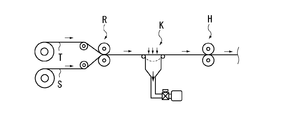
- FIG. 2 is an explanatory diagram relating to the polymerization step and the integration step.
- the sheet-like reinforcing fiber material T and the sheet-like synthetic fiber material S are conveyed in parallel in a state of being aligned in a predetermined direction and pass between the press-contact rolls R, whereby the sheet-like reinforcing fiber material
- the sheet-like synthetic fiber material is pressed on one side and set in a superposed state.
- the synthetic fiber material S is arranged so as to be dispersed according to the density of the sheet-like reinforcing fiber material T.
- the reinforcing fiber material T is a thin layer and has a low density
- a plurality of synthetic fiber materials S are arranged with a predetermined interval in accordance with the density and overlapped.
- the reinforcing fiber material T may be superimposed on both surfaces of the synthetic fiber material S.
- a fiber opening mechanism K is arranged on the downstream side in the conveying direction of the pressure roll R.
- an air flow is conveyed while conveying the reinforcing fiber material T and the synthetic fiber material S in a superposed state.
- the fiber is opened by crossing and bending.
- the opening mechanism K may be a mechanism in which vibration rollers or the like are combined.
- the tension applied to the reinforcing fiber material T and the synthetic fiber material S fluctuates during the fiber opening process, but when the synthetic fiber material S expands and contracts compared to the reinforcing fiber material T, the flow of airflow
- the synthetic fiber material S By arranging the synthetic fiber material S on the downstream side of the fiber, the fibers of the synthetic fiber material S are easily expanded and contracted during the fiber opening process, and easily enter between the reinforcing fibers.
- the synthetic fiber material can be dispersed and superposed in accordance with the density of the opened reinforcing fiber material, it is possible to mix the fibers in a more uniform state.
- the synthetic fiber material can be dispersed in advance in accordance with the processing of the yarn forming process described later, and the synthetic fiber material is overlapped so that the mixed fiber state of the finally manufactured mixed fiber yarn is uniform. Like that.
- the synthetic fiber material S is temporarily bonded and integrated by passing between the heating rolls H while conveying the reinforcing fiber material T and the synthetic fiber material S in an overlapped state.
- the synthetic fiber material S is temporarily bonded, the synthetic fiber material S is partially melted and thermally fused to the reinforcing fiber material T by press-contacting with the heating roll H. It is adhered while maintaining the condition.
- the sheath portion is reinforced by setting the temperature of the heating roll H to a temperature lower than the melting point of the core portion and higher than the melting point of the sheath portion. It can be integrated with the fiber material T while maintaining the form of the fiber by heat fusion.
- the synthetic fiber material may be bonded completely or partially as necessary. Or it can set to strip
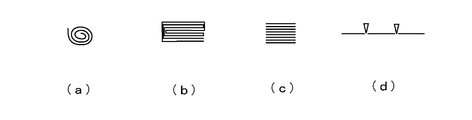
- FIG. 3 is a schematic cross-sectional view of a mixed fiber.
- Fig.3 (a) has shown sectional drawing of the mixed fiber obtained by twisting the integrated reinforcement fiber material and synthetic fiber material with the well-known twist apparatus.
- the integrated reinforcing fiber material and synthetic fiber material are formed into a sheet shape, and are processed by being wound in the width direction by twisting, so that the synthetic fiber material is dispersed to the center of the blended yarn.
- a uniform mixed yarn can be obtained.
- FIG. 3B shows a cross-sectional view of a mixed fiber obtained by folding a plurality of integrated reinforcing fiber materials and synthetic fiber materials so that a crease is formed in the yarn length direction.
- the reinforcing fiber material and the synthetic fiber material are alternately laminated, and the synthetic fiber material can be dispersed to the central portion to obtain a more uniform mixed yarn.
- FIG.3 (c) has shown sectional drawing of the mixed fiber obtained by laminating
- FIG. 3D is a cross-sectional view of the mixed fiber obtained by slitting the integrated reinforcing fiber material and synthetic fiber material in the yarn length direction.
- a synthetic fiber material is dispersed in accordance with the density of the spread sheet-like reinforcing fiber material, and is superposed and integrated to produce a mixed fiber that is more evenly mixed. Can do.
- the uniformity of the blended state of the obtained blended yarn can be confirmed by quantitatively analyzing the dispersion state of the synthetic fiber material in the cross section in the direction orthogonal to the yarn length direction of the blended yarn. For example, by dividing the cross section into a plurality of segmented areas, calculating the ratio of the cross-sectional area of the synthetic fiber material in each segmented area, and looking at the standard deviation regarding the calculated ratio of each area, the dispersion state can be quantitatively determined. Can be analyzed.
- the standard deviation ⁇ is required in order for the synthetic fiber material to melt and penetrate between the reinforcing fiber materials and be filled in a void-free state. It is necessary to set it to 25 or less.
- the conditions for forming by hot pressing using the mixed yarn according to the present invention can be a heating temperature of 260 ° C. to 320 ° C., a pressure of 0.1 MPa to 3.0 MPa, and a treatment time of 3 minutes to 20 minutes. .
- the pressure is 10 MPa or more and the treatment time is 30 minutes or more.
- Example 1 A blended yarn was produced using the following materials. ⁇ Materials used> (Reinforcing fiber material) Carbon fiber (Mitsubishi Rayon Co., Ltd .; 50R15L) Fiber diameter 7 ⁇ m Number of fibers 15000 (synthetic fiber material) Polyethylene terephthalate (PET) composite fiber (KB Seiren Co., Ltd .; Belcouple (PET core-sheath type fused yarn, core-sheath weight ratio 1: 1)) Fineness 8 dtex The number of fibers used was 1000 carbon fibers and the amount of composite fiber was set so that the Vf value was 49.0%.
- ⁇ Materials used> Carbon fiber (Mitsubishi Rayon Co., Ltd .; 50R15L) Fiber diameter 7 ⁇ m Number of fibers 15000 (synthetic fiber material) Polyethylene terephthalate (PET) composite fiber (KB Seiren Co., Ltd .; Belcouple (PET core-sheath type fused yarn, core-s
- the carbon fiber was opened to a width of 100 mm by an opening method using an air flow described in Japanese Patent No. 3064019.
- the density of the obtained sheet-like carbon fiber was 150 fibers / mm.
- the composite fiber was warped to a width of 100 mm using a known warping machine.
- the density of the obtained sheet-like composite fiber was 10 fibers / mm.
- the carbon fiber and the composite fiber formed in a sheet shape were superposed while being conveyed, and then a fiber-opening process similar to the carbon fiber opening method was performed to form a polymer sheet material having a width of 100 mm.
- the composite fiber was temporarily bonded and integrated with respect to carbon fiber by letting the formed polymeric sheet material pass between heating rolls (170 degreeC).
- the obtained temporary adhesive sheet material was folded four times along the fold line in the yarn length direction to produce a mixed yarn laminated in 16 layers.
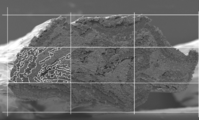
- FIG. 4 is a photographed image relating to the cross section of the blended yarn.
- the captured image of the cross section of the mixed yarn was processed to evaluate the dispersion state of the area of the composite fiber.
- Commercially available image processing software (Olympus Stream Essential) was used for processing the captured image. First, a region to be analyzed was defined by drawing a rectangle circumscribing the cross section of the mixed yarn, and nine divided regions were set by dividing the defined rectangular region into three equal parts. In FIG. 4, the divided areas are indicated by white straight lines.
- the contour line is drawn so as to trace the outer shape of the blended yarn for each segmented region, and the area S1 of the blended yarn surrounded by the drawn contour line and the boundary line of the segmented region is calculated.
- an area S2 of the composite fiber surrounded by drawing a surrounding line surrounding only the composite fiber is calculated.
- the outline and the surrounding line are shown by white curves.
- the fiber mixture ratio M is computed by the following formula
- equation. M (%) S2 / S1 ⁇ 100
- the standard deviation ⁇ is calculated with respect to the blend ratio M calculated for each of the nine divided regions.
- the standard deviation ⁇ of the mixed fiber of Example 1 was 9.3.
- Example 2 The same material as in Example 1 was used, and the integration process was performed from the sheet forming process in the same manner as in Example 1.
- the obtained temporary adhesive sheet material was twisted 100 times / m by a known twisting device to produce a mixed fiber.
- a cross-section of the manufactured mixed yarn was photographed in the same manner as in Example 1.
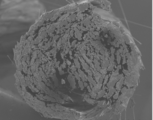
- FIG. 5 is a photographed image relating to the cross section of the blended yarn.
- image processing was performed on the cross-sectional image in the same manner as in Example 1, and the standard deviation was calculated.
- the standard deviation ⁇ was 11.5.
- Example 3 The same material as in Example 1 was used, and the integration process was performed from the sheet forming process in the same manner as in Example 1. The obtained temporary adhesive sheet material was spirally wound in the width direction to produce a mixed yarn. A cross-section of the manufactured mixed yarn was photographed in the same manner as in Example 1. Then, for uniformity evaluation, image processing was performed on the cross-sectional image in the same manner as in Example 1, and a standard deviation was calculated. The standard deviation ⁇ was 15.2.
- Example 4 The same material as in Example 1 was used, and the integration process was performed from the sheet forming process in the same manner as in Example 1.
- the obtained temporary adhesive sheet material was slit in the yarn length direction with a width of 2 mm by a known slitter to produce a mixed fiber.
- a cross-section of the manufactured mixed yarn was photographed in the same manner as in Example 1.
- image processing was performed on the cross-sectional image in the same manner as in Example 1, and a standard deviation was calculated.
- the standard deviation ⁇ was 19.2.
- Example 1 ⁇ Materials used> (Reinforcing fiber material) The same carbon fiber as in Example 1 was used. (Synthetic fiber material) Polyester fibers (KB Selen Co., Ltd .; Bell Couple) 280T / 16f 30 carbon fibers and polyester fibers were used so that the Vf value was 47.5%. ⁇ Manufacturing process> Polyester fibers were divided into two fiber bundles of 15 each, and double-covering treatment was performed on the two fiber bundles with a covering device centering on the carbon fiber to produce a mixed yarn. The number of windings of the fiber bundle was set to 200 times / m.
- Example 5 Next, using the mixed yarn obtained in Example 1, the permeability of the composite fiber by hot pressing was evaluated.
- the mixed yarn was set in a hot press apparatus (IMC-180C type manufactured by Imoto Seisakusho Co., Ltd.), set to a heating temperature of 300 ° C. and a pressing force of 0.14 MPa, and subjected to a hot press treatment for 5 minutes.
- the mixed yarn was molded into a plate-like body having a width of about 4.5 mm and a thickness of about 0.4 mm. When the molded plate was cut in the thickness direction and the cross section was observed with an electron microscope, the resin was filled between the carbon fibers exposed in the cross section, and no void was observed.
- Example 6 The mixed yarn obtained in Example 2 was heat-pressed in the same manner as in Example 5 to form a plate-like body.
- the resin was filled between the carbon fibers exposed in the cross section, and no void was observed.
- Comparative Example 2 The mixed yarn obtained in Comparative Example 1 was heat-pressed in the same manner as in Example 5 to form a plate-like body. When the molded plate-like body was cut in the thickness direction and the cross section was observed with an electron microscope, voids in which the resin did not permeate between the carbon fibers exposed in the cross section were observed.
- Example 7 Except that the heat treatment temperature was set at 280 ° C. and the applied pressure was set at 1.29 MPa, a hot press treatment was performed in the same manner as in Example 5 to form a plate-like body. When the molded plate was cut in the thickness direction and the cross section was observed with an electron microscope, the resin was filled between the carbon fibers exposed in the cross section, and no void was observed.
Landscapes
- Engineering & Computer Science (AREA)
- Textile Engineering (AREA)
- Mechanical Engineering (AREA)
- Yarns And Mechanical Finishing Of Yarns Or Ropes (AREA)
- Reinforced Plastic Materials (AREA)
Abstract
Description
以下の材料を用いて混繊糸を製造した。
<使用材料>
(補強繊維材料)
炭素繊維(三菱レーヨン株式会社製;50R15L)
繊維直径7μm 繊維本数15000本
(合成繊維材料)
ポリエチレンテレフタレート(PET)製複合繊維(KBセーレン株式会社製;ベルカップル(PET芯鞘タイプ融着糸、芯鞘重量比1:1))
繊度8dtex 繊維本数1000本
炭素繊維及び複合繊維の使用量は、Vf値が49.0%となるように設定した。
<製造工程>
炭素繊維は、特許第3064019号公報に記載された空気流による開繊方法により幅100mmに開繊処理した。得られたシート状の炭素繊維の密度は、150本/mmとなった。複合繊維は、公知の整経機を用いて幅100mmに整経処理した。得られたシート状の複合繊維の密度は、10本/mmであった。次に、シート状に形成した炭素繊維及び複合繊維を搬送しながら重ね合せた後、炭素繊維の開繊方法と同様の開繊処理を行って幅100mmの重合シート材に形成した。そして、形成した重合シート材を加熱ロール(170℃)の間を通すことで炭素繊維に対して複合繊維を仮接着して一体化した。得られた仮接着シート材を糸長方向の折り目に沿って4回折り畳むことで、16層に積層した混繊糸を製造した。
製造された混繊糸を糸長方向と直交する方向に切断して走査電子顕微鏡(株式会社日立ハイテクノロジーズ製S-3500N)により断面を撮影した。図4は、混繊糸の断面に関する撮影画像である。混繊糸の均一性を評価するために、混繊糸の断面の撮影画像を処理して複合繊維の面積の分散状態を評価した。撮影画像の処理には、市販の画像処理ソフトウェア(オリンパス株式会社製Stream Essential)を使用した。まず、混合糸の断面に外接する矩形を描いて分析する領域を画定し、画定された矩形領域を縦横3等分した9つの区分領域を設定した。図4では、白い直線で区分領域を示している。
M(%)=S2/S1×100
そして、9つの区分領域についてそれぞれ算出された混繊比率Mに関して標準偏差σを算出する。実施例1の混繊糸については、標準偏差σは9.3であった。
実施例1と同様の材料を使用し、実施例1と同様にシート形成工程から一体化工程を行った。得られた仮接着シート材を公知の撚り装置により100回/mの撚りをかけて混繊糸を製造した。製造された混繊糸について、実施例1と同様に断面を撮影した。図5は、混繊糸の断面に関する撮影画像である。均一性評価のため、実施例1と同様に断面画像について画像処理を行い、標準偏差を算出した。標準偏差σは11.5であった。
実施例1と同様の材料を使用し、実施例1と同様にシート形成工程から一体化工程を行った。得られた仮接着シート材を幅方向に渦巻き状に巻き付けて混繊糸を製造した。製造された混繊糸について、実施例1と同様に断面を撮影した。そして、均一性評価のため、実施例1と同様に断面画像について画像処理を行い、標準偏差を算出した。標準偏差σは15.2であった。
実施例1と同様の材料を使用し、実施例1と同様にシート形成工程から一体化工程を行った。得られた仮接着シート材を公知のスリッタにより幅2mmで糸長方向にスリットして混繊糸を製造した。製造された混繊糸について、実施例1と同様に断面を撮影した。そして、均一性評価のため、実施例1と同様に断面画像について画像処理を行い、標準偏差を算出した。標準偏差σは19.2であった。
<使用材料>
(補強繊維材料)
実施例1と同様の炭素繊維を使用した。
(合成繊維材料)
ポリエステル繊維(KBセーレン株式会社製;ベルカップル)280T/16f 30本
炭素繊維及びポリエステル繊維の使用量は、Vf値が47.5%となるように設定した。
<製造工程>
ポリエステル繊維を15本ずつ2つの繊維束に分け、炭素繊維を中心にしてカバーリング装置により2つの繊維束でダブルカバーリング処理を行って混繊糸を製造した。繊維束の巻き付け数は、200回/mに設定した。
次に、実施例1で得られた混繊糸を用いて熱プレスによる複合繊維の浸透性を評価した。熱プレス装置(株式会社井元製作所製IMC-180C型)に混繊糸をセットして、加熱温度300℃及び加圧力0.14MPaに設定し、5分間熱プレス処理した。混繊糸は、幅約4.5mm及び厚さ約0.4mmの板状体に成型された。成型された板状体を厚さ方向に切断して断面を電子顕微鏡により観察したところ、断面に表出した炭素繊維の間に樹脂が充填されており、ボイドは観察されなかった。
実施例2で得られた混繊糸を実施例5と同様に熱プレス処理して板状体に成型した。成型された板状体を厚さ方向に切断して断面を電子顕微鏡により観察したところ、断面に表出した炭素繊維の間に樹脂が充填されており、ボイドは観察されなかった。
比較例1で得られた混繊糸を実施例5と同様に熱プレス処理して板状体に成型した。成型された板状体を厚さ方向に切断して断面を電子顕微鏡により観察したところ、断面に表出した炭素繊維の間に樹脂が浸透していないボイドが観察された。
加熱処理温度280℃、加圧力1.29MPaに設定した以外は、実施例5と同様に熱プレス処理して板状体に成型した。成型された板状体を厚さ方向に切断して断面を電子顕微鏡により観察したところ、断面に表出した炭素繊維の間に樹脂が充填されており、ボイドは観察されなかった。
炭素繊維(三菱レーヨン株式会社製;50R15L)を引き揃え、ポリエチレンテレフタレートフィルム(藤森工業株式会社製;75-NT2-AS)を重ね合わせて、実施例7と同様の条件にて熱プレス処理して板状体に成型した。成型された板状体を厚さ方向に切断して断面を電子顕微鏡により観察したところ、断面に表出した炭素繊維の間に樹脂が浸透していないボイドが観察された。
Claims (5)
- 所定の方向に引き揃えられた補強繊維材料に対して当該補強繊維材料と同じ方向に引き揃えられた合成繊維材料を混繊させた混繊糸であって、前記合成繊維材料は、前記補強繊維材料に接着一体化しており、混繊糸の断面を分割した区分領域における前記合成繊維材料の断面積の比率に関する標準偏差が25以下となるように前記合成繊維材料が分散されている混繊糸。
- 請求項1に記載の混繊糸を用いて成型された成型品。
- 開繊されて所定の方向に引き揃えられたシート状の補強繊維材料に対して当該補強繊維材料と同じ方向に引き揃えられるとともに当該補強繊維材料の密度に合わせて分散された状態で合成繊維材料を重ね合せる重合工程と、重ね合わされた前記補強繊維材料及び前記合成繊維材料を接着一体化する一体化工程とを備えている混繊糸の製造方法。
- 前記重合工程では、重ね合わされた前記補強繊維材料及び前記合成繊維材料を開繊処理する請求項3に記載の混繊糸の製造方法。
- 接着一体化された前記補強繊維材料及び前記合成繊維材料を別の形態の糸に形成する糸形成工程を備えている請求項3又は4に記載の混繊糸の製造方法。
Priority Applications (3)
| Application Number | Priority Date | Filing Date | Title |
|---|---|---|---|
| JP2016538278A JP6682084B2 (ja) | 2014-07-30 | 2015-07-21 | 混繊糸及びその製造方法 |
| CN201580027937.0A CN106414822B (zh) | 2014-07-30 | 2015-07-21 | 混纤丝及其制造方法以及成型品 |
| EP15827142.9A EP3176295A4 (en) | 2014-07-30 | 2015-07-21 | Combined filament yarn and manufacturing method thereof |
Applications Claiming Priority (2)
| Application Number | Priority Date | Filing Date | Title |
|---|---|---|---|
| JP2014155595 | 2014-07-30 | ||
| JP2014-155595 | 2014-07-30 |
Publications (1)
| Publication Number | Publication Date |
|---|---|
| WO2016017469A1 true WO2016017469A1 (ja) | 2016-02-04 |
Family
ID=55217372
Family Applications (1)
| Application Number | Title | Priority Date | Filing Date |
|---|---|---|---|
| PCT/JP2015/070672 Ceased WO2016017469A1 (ja) | 2014-07-30 | 2015-07-21 | 混繊糸及びその製造方法 |
Country Status (4)
| Country | Link |
|---|---|
| EP (1) | EP3176295A4 (ja) |
| JP (1) | JP6682084B2 (ja) |
| CN (1) | CN106414822B (ja) |
| WO (1) | WO2016017469A1 (ja) |
Cited By (2)
| Publication number | Priority date | Publication date | Assignee | Title |
|---|---|---|---|---|
| WO2017153763A1 (en) * | 2016-03-09 | 2017-09-14 | J&P Coats Limited | Composite yard and its manufacture |
| JP2018172821A (ja) * | 2017-03-31 | 2018-11-08 | 株式会社サンライン | 糸の製造方法および釣り用糸 |
Families Citing this family (2)
| Publication number | Priority date | Publication date | Assignee | Title |
|---|---|---|---|---|
| US10604870B2 (en) | 2018-05-31 | 2020-03-31 | Hexcel Corporation | Increasing the filament count of carbon fiber tows |
| CN110658013A (zh) * | 2018-06-29 | 2020-01-07 | 北新集团建材股份有限公司 | 一种评价玻璃纤维在纸面石膏板中的分散性的方法 |
Citations (8)
| Publication number | Priority date | Publication date | Assignee | Title |
|---|---|---|---|---|
| JPH01280031A (ja) * | 1988-05-06 | 1989-11-10 | Teijin Ltd | 複合繊維の製造方法 |
| JPH0226938A (ja) * | 1988-07-13 | 1990-01-29 | Mitsubishi Rayon Co Ltd | 繊維強化プラスチック用糸条物 |
| JPH09324331A (ja) * | 1996-06-04 | 1997-12-16 | Asahi Fiber Glass Co Ltd | 複合材料用混繊糸及びその製造法 |
| JP2002053266A (ja) * | 2000-08-07 | 2002-02-19 | Harmoni Sangyo:Kk | 集合繊維の撓みレベル制御機構を備える通気式開繊装置 |
| JP2003064540A (ja) * | 2001-08-21 | 2003-03-05 | Toyobo Co Ltd | 複合材成形用複合糸条 |
| JP2005179829A (ja) * | 2003-12-19 | 2005-07-07 | Fukui Prefecture | テープ状繊維束を用いた混繊繊維束の製造方法およびその製造装置 |
| JP2007518890A (ja) * | 2003-07-08 | 2007-07-12 | 福井県 | 繊維束の開繊方法と、その方法に使用する装置 |
| WO2014136662A1 (ja) * | 2013-03-06 | 2014-09-12 | 三菱瓦斯化学株式会社 | 混繊糸、織物および編み物、複合材料、並びに、複合材料の製造方法 |
Family Cites Families (7)
| Publication number | Priority date | Publication date | Assignee | Title |
|---|---|---|---|---|
| JPH01111037A (ja) * | 1987-10-19 | 1989-04-27 | Toyobo Co Ltd | 成形用複合繊維布帛 |
| JP3345661B2 (ja) * | 1992-11-17 | 2002-11-18 | 東洋紡績株式会社 | 熱可塑性コンポジット用ヤーン |
| FR2698038B1 (fr) * | 1992-11-19 | 1995-01-27 | Vetrotex France Sa | Procédé et dispositif de formation d'un fil composite. |
| CN102815062A (zh) * | 2006-11-22 | 2012-12-12 | 福井县 | 热塑性树脂增强片材、热塑性树脂多层增强片材及其制造方法、热塑性树脂多层增强成形品 |
| DE102007028373B4 (de) * | 2007-06-11 | 2012-12-20 | Technische Universität Dresden | Faserverbundwerkstoff und Verfahren zur Herstellung von Faserverbundwerkstoffen |
| GB2451136B (en) * | 2007-07-20 | 2012-11-28 | Umeco Structural Materials Derby Ltd | Thermoset resin fibres |
| DE102011010592A1 (de) * | 2011-02-08 | 2012-08-09 | Daimler Ag | Verfahren zum Herstellen eines Hybridrovings |
-
2015
- 2015-07-21 WO PCT/JP2015/070672 patent/WO2016017469A1/ja not_active Ceased
- 2015-07-21 CN CN201580027937.0A patent/CN106414822B/zh not_active Expired - Fee Related
- 2015-07-21 JP JP2016538278A patent/JP6682084B2/ja active Active
- 2015-07-21 EP EP15827142.9A patent/EP3176295A4/en not_active Withdrawn
Patent Citations (8)
| Publication number | Priority date | Publication date | Assignee | Title |
|---|---|---|---|---|
| JPH01280031A (ja) * | 1988-05-06 | 1989-11-10 | Teijin Ltd | 複合繊維の製造方法 |
| JPH0226938A (ja) * | 1988-07-13 | 1990-01-29 | Mitsubishi Rayon Co Ltd | 繊維強化プラスチック用糸条物 |
| JPH09324331A (ja) * | 1996-06-04 | 1997-12-16 | Asahi Fiber Glass Co Ltd | 複合材料用混繊糸及びその製造法 |
| JP2002053266A (ja) * | 2000-08-07 | 2002-02-19 | Harmoni Sangyo:Kk | 集合繊維の撓みレベル制御機構を備える通気式開繊装置 |
| JP2003064540A (ja) * | 2001-08-21 | 2003-03-05 | Toyobo Co Ltd | 複合材成形用複合糸条 |
| JP2007518890A (ja) * | 2003-07-08 | 2007-07-12 | 福井県 | 繊維束の開繊方法と、その方法に使用する装置 |
| JP2005179829A (ja) * | 2003-12-19 | 2005-07-07 | Fukui Prefecture | テープ状繊維束を用いた混繊繊維束の製造方法およびその製造装置 |
| WO2014136662A1 (ja) * | 2013-03-06 | 2014-09-12 | 三菱瓦斯化学株式会社 | 混繊糸、織物および編み物、複合材料、並びに、複合材料の製造方法 |
Non-Patent Citations (1)
| Title |
|---|
| See also references of EP3176295A4 * |
Cited By (3)
| Publication number | Priority date | Publication date | Assignee | Title |
|---|---|---|---|---|
| WO2017153763A1 (en) * | 2016-03-09 | 2017-09-14 | J&P Coats Limited | Composite yard and its manufacture |
| US10994499B2 (en) | 2016-03-09 | 2021-05-04 | J&P Coats Limited | Composite yarn and its manufacture |
| JP2018172821A (ja) * | 2017-03-31 | 2018-11-08 | 株式会社サンライン | 糸の製造方法および釣り用糸 |
Also Published As
| Publication number | Publication date |
|---|---|
| EP3176295A4 (en) | 2018-04-25 |
| JP6682084B2 (ja) | 2020-04-15 |
| CN106414822A (zh) | 2017-02-15 |
| CN106414822B (zh) | 2019-11-26 |
| JPWO2016017469A1 (ja) | 2017-04-27 |
| EP3176295A1 (en) | 2017-06-07 |
Similar Documents
| Publication | Publication Date | Title |
|---|---|---|
| JP7285287B2 (ja) | 一方向繊維強化テープを作製するための開繊機要素 | |
| KR101411169B1 (ko) | 열가소성 수지 보강 시트재, 열가소성 수지 다층 보강 시트재 및 그 제조 방법, 및 열가소성 수지 다층 보강 성형품 | |
| JP5135616B2 (ja) | 熱可塑性樹脂補強シート材、熱可塑性樹脂多層補強シート材及びその製造方法、並びに熱可塑性樹脂多層補強成型品 | |
| JP5223130B2 (ja) | 熱可塑性樹脂補強シート材及びその製造方法、並びに熱可塑性樹脂多層補強シート材 | |
| KR102466875B1 (ko) | 섬유 강화 수지 시트재의 제조 방법 | |
| US11400689B2 (en) | Tape-like dry fibrous reinforcement | |
| JP5920690B2 (ja) | プリプレグシート材及びその製造方法 | |
| TWI532594B (zh) | 熱塑性樹脂補強片材及其製造方法 | |
| WO2016006543A1 (ja) | 擬似等方補強シート材及びその製造方法 | |
| JP6682084B2 (ja) | 混繊糸及びその製造方法 | |
| EP3835037A1 (en) | Reinforced fiber tape material and production method therefor, fiber reinforced resin molded body and reinforced fiber layered body using reinforced fiber tape material | |
| EP3837109B1 (en) | Semi -finished composite materials containing natural fibers and production thereof | |
| CN113226681A (zh) | 树脂一体化增强纤维片及其制造方法 | |
| JP6876267B2 (ja) | 繊維束の分割方法、長尺の繊維束、及び繊維強化樹脂材料の製造方法 |
Legal Events
| Date | Code | Title | Description |
|---|---|---|---|
| 121 | Ep: the epo has been informed by wipo that ep was designated in this application |
Ref document number: 15827142 Country of ref document: EP Kind code of ref document: A1 |
|
| ENP | Entry into the national phase |
Ref document number: 2016538278 Country of ref document: JP Kind code of ref document: A |
|
| NENP | Non-entry into the national phase |
Ref country code: DE |
|
| REEP | Request for entry into the european phase |
Ref document number: 2015827142 Country of ref document: EP |
|
| WWE | Wipo information: entry into national phase |
Ref document number: 2015827142 Country of ref document: EP |