WO2016030984A1 - 油入電気機器の診断方法 - Google Patents
油入電気機器の診断方法 Download PDFInfo
- Publication number
- WO2016030984A1 WO2016030984A1 PCT/JP2014/072399 JP2014072399W WO2016030984A1 WO 2016030984 A1 WO2016030984 A1 WO 2016030984A1 JP 2014072399 W JP2014072399 W JP 2014072399W WO 2016030984 A1 WO2016030984 A1 WO 2016030984A1
- Authority
- WO
- WIPO (PCT)
- Prior art keywords
- oil
- filled electrical
- gas
- discharge
- analysis
- Prior art date
- Legal status (The legal status is an assumption and is not a legal conclusion. Google has not performed a legal analysis and makes no representation as to the accuracy of the status listed.)
- Ceased
Links
Images
Classifications
-
- G—PHYSICS
- G01—MEASURING; TESTING
- G01N—INVESTIGATING OR ANALYSING MATERIALS BY DETERMINING THEIR CHEMICAL OR PHYSICAL PROPERTIES
- G01N33/00—Investigating or analysing materials by specific methods not covered by groups G01N1/00 - G01N31/00
- G01N33/26—Oils; Viscous liquids; Paints; Inks
- G01N33/28—Oils, i.e. hydrocarbon liquids
- G01N33/2835—Specific substances contained in the oils or fuels
- G01N33/2841—Gas in oils, e.g. hydrogen in insulating oils
-
- G—PHYSICS
- G01—MEASURING; TESTING
- G01N—INVESTIGATING OR ANALYSING MATERIALS BY DETERMINING THEIR CHEMICAL OR PHYSICAL PROPERTIES
- G01N30/00—Investigating or analysing materials by separation into components using adsorption, absorption or similar phenomena or using ion-exchange, e.g. chromatography or field flow fractionation
- G01N30/02—Column chromatography
-
- G—PHYSICS
- G01—MEASURING; TESTING
- G01N—INVESTIGATING OR ANALYSING MATERIALS BY DETERMINING THEIR CHEMICAL OR PHYSICAL PROPERTIES
- G01N30/00—Investigating or analysing materials by separation into components using adsorption, absorption or similar phenomena or using ion-exchange, e.g. chromatography or field flow fractionation
- G01N30/02—Column chromatography
- G01N30/62—Detectors specially adapted therefor
- G01N30/72—Mass spectrometers
- G01N30/7206—Mass spectrometers interfaced to gas chromatograph
-
- G—PHYSICS
- G01—MEASURING; TESTING
- G01N—INVESTIGATING OR ANALYSING MATERIALS BY DETERMINING THEIR CHEMICAL OR PHYSICAL PROPERTIES
- G01N33/00—Investigating or analysing materials by specific methods not covered by groups G01N1/00 - G01N31/00
- G01N33/26—Oils; Viscous liquids; Paints; Inks
- G01N33/28—Oils, i.e. hydrocarbon liquids
- G01N33/2835—Specific substances contained in the oils or fuels
-
- H—ELECTRICITY
- H01—ELECTRIC ELEMENTS
- H01F—MAGNETS; INDUCTANCES; TRANSFORMERS; SELECTION OF MATERIALS FOR THEIR MAGNETIC PROPERTIES
- H01F27/00—Details of transformers or inductances, in general
-
- G—PHYSICS
- G01—MEASURING; TESTING
- G01N—INVESTIGATING OR ANALYSING MATERIALS BY DETERMINING THEIR CHEMICAL OR PHYSICAL PROPERTIES
- G01N30/00—Investigating or analysing materials by separation into components using adsorption, absorption or similar phenomena or using ion-exchange, e.g. chromatography or field flow fractionation
- G01N30/02—Column chromatography
- G01N2030/022—Column chromatography characterised by the kind of separation mechanism
- G01N2030/027—Liquid chromatography
Definitions
- the present invention relates to a method for diagnosing oil-filled electrical equipment, for example, a method for diagnosing an abnormality caused by discharge in an oil-filled electrical equipment such as an oil-filled transformer.
- Patent Document 1 Japanese Patent Application Laid-Open No. 2004-200348.
- non-patent literature 1 Z. Wang, X. Wang, X. Yi and S. Li, “Gas Generation in Natural Ester and Mineral Oil Under Partial Discharge and Sparking Faults”, IEEE Electric Insulation Magazine, Vol 29 No. 5, pp. 62-70, 2013).
- the type, concentration in oil, concentration ratio between gas components, and the like are used as indicators.
- Diagnostic methods using hydrogen gas and acetylene gas as indices are known as methods for diagnosing the presence or absence of abnormalities (discharge abnormalities) caused by discharge, which is one type of internal abnormality.
- Hydrogen gas has a lower production temperature and a larger production amount than acetylene gas. For this reason, according to the diagnostic method using hydrogen gas as an index, discharge abnormality can be diagnosed earlier than when hydrogen gas is not used as an index.
- hydrogen gas may be generated for reasons other than abnormal discharge of oil-filled electrical equipment.
- Irgamet® 39 N, N-bis (2-ethylhexyl)-(4 or 5) -methyl-1H-benzotriazole-1-methylamine
- a copper sulfide formation inhibitor is added to the insulating oil.
- a phenomenon in which hydrogen gas is generated in the insulating oil is known (for example, see Non-Patent Document 2: CIGRE WG A2-32, “Copper sulphide in transformer insulation,” Final Report Brochure 378, 2009).
- the discharge of oil-filled electrical equipment is detected even when hydrogen gas is detected for a reason other than discharge abnormality. In some cases, it may be determined that there is an abnormality, which may lead to a misdiagnosis.
- This invention is made in view of the said subject, and provides the diagnosis method of the oil-filled electrical equipment which can diagnose the presence or absence of discharge generation inside the oil-filled electrical equipment with higher accuracy than before. Objective.
- the diagnostic method for an oil-filled electrical device is a method for diagnosing whether or not a discharge has occurred inside the oil-filled electrical device.
- the diagnostic method for oil-filled electrical equipment according to the present invention includes hydrogen gas, methane, ethane, ethylene, acetylene, carbonization having 3 or 4 carbon atoms contained in insulating oil used in the oil-filled electrical equipment.
- a gas-in-oil analysis step for analyzing at least one gas selected from the group consisting of hydrogen, carbon monoxide, carbon dioxide, oxygen and nitrogen, and generating hydrogen in the insulating oil regardless of whether or not a discharge is generated.
- the diagnosis method for an oil-filled electrical device is a method for diagnosing whether or not a discharge has occurred inside the oil-filled electrical device.
- the method for diagnosing an oil-filled electrical device according to the present embodiment includes at least a gas-in-oil analysis process, a causative substance analysis process, and a diagnosis process described below.
- a known oil-in-gas analysis method can be used as a method of analyzing these gas components in the insulating oil.
- a known oil-in-gas analysis method can be used.
- the method disclosed in Patent Document 1 or Non-Patent Document 1 described above can be used.
- the apparatus used for the analysis is not particularly limited, and a known gas analyzer can be used. Examples thereof include a gas chromatograph and a gas chromatograph mass spectrometer (GC-MS).
- this process can be implemented without stopping the operation of the oil-filled electrical device by analyzing the insulating oil collected from the oil-filled electrical device during operation.
- the causative substance that causes hydrogen to be generated in the insulating oil regardless of whether or not discharge is generated is preferably selected from boron trifluoride and a benzotriazole compound. At least one.
- boron trifluoride is a gas component
- analysis is performed using a known method for measuring a gas component in oil. can do.
- Boron trifluoride is analyzed by a gas analysis method that includes the steps of extracting and concentrating boron trifluoride dissolved in insulating oil by heating the insulating oil and bubbling with inert gas from the heated insulating oil. It is preferable. This is because boron trifluoride dissolved in the insulating oil is a trace component.
- the apparatus used for analysis is not particularly limited, and a known gas analyzer can be used.
- a gas chromatograph or a gas chromatograph mass spectrometer GC-MS
- GC-MS gas chromatograph mass spectrometer
- the benzotriazole compound is a liquid component, and therefore, it is analyzed using a known method for measuring the liquid component in oil. Can do.
- the benzotriazole compound can be analyzed, for example, by liquid chromatography such as high performance liquid chromatography.
- liquid chromatographs such as a high performance liquid chromatograph, can be used, for example.
- the benzotriazole compound is not particularly limited as long as it causes hydrogen generation in the insulating oil regardless of whether or not discharge is generated.
- Irgamet (registered trademark) 39 [N, N-bis (2- Ethylhexyl)-(4 or 5) -methyl-1H-benzotriazole-1-methylamine].
- this process can also be implemented without stopping the operation of the oil-filled electrical device by analyzing the insulating oil collected from the oil-filled electrical device in operation.
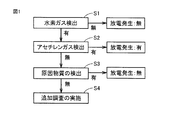
- Diagnosis process In this process, the presence or absence of discharge is diagnosed based on the analysis result of the oil-in-gas analysis process and the analysis result of the causative substance analysis process. The presence / absence of discharge is comprehensively diagnosed based on the analysis result of the oil-in-gas analysis process and the analysis result of the causative substance analysis process.
- acetylene gas is used as at least one gas selected from the group consisting of methane, ethane, ethylene, acetylene, hydrocarbons having 3 or 4 carbon atoms, carbon monoxide, carbon dioxide, oxygen, and nitrogen. The case of analyzing is described.
- step 1 it is confirmed whether or not hydrogen gas is detected in the oil-in-gas analysis step.
- hydrogen gas is not detected, it is diagnosed that there is a high possibility that no discharge is generated inside the oil-filled electrical device.
- step 2 the process proceeds to step 2 (S2).
- step 2 it is confirmed whether or not acetylene gas is detected in the gas-in-oil analysis process.
- acetylene gas it is considered that the cause of hydrogen gas generation is discharge, so that it is diagnosed that there is a high possibility of occurrence of discharge inside the oil-filled electrical device.
- hydrogen gas is not detected, there is a possibility that the cause of hydrogen gas generation is not discharge, so the process proceeds to the next step 3 (S3).
- step 3 it is confirmed whether or not the causative substance is detected in the causative substance analysis step.
- a causative substance it is considered that there is a high possibility that the cause of hydrogen gas generation is not discharge, and therefore, it is diagnosed that there is a high possibility that no discharge occurs in the oil-filled electrical device.
- step 4 an additional investigation is performed to determine whether or not the cause of hydrogen gas generation is discharge.
- the hydrogen produced by the reaction of boron trifluoride in the adhesive with the coil may have leached into the insulating oil.
- This confirmation can be performed, for example, by confirming a work history in the manufacturing process.
- the drying temperature is equal to or higher than the curing temperature of the adhesive, the possibility that hydrogen gas has oozed out of the adhesive is considered to be low. In this case, it can be diagnosed that discharge is generated when hydrogen gas is detected in the oil-in-gas analysis step.
- Irgamet 39 copper sulfide formation inhibitor
- the insulating oil may be deaerated to remove the hydrogen gas in the insulating oil. Thereafter, the hydrogen gas in the insulating oil is monitored, and if hydrogen gas is also detected in the insulating oil after the deaeration treatment, it can be diagnosed that the possibility of occurrence of discharge is high.
- diagnosis method for oil-filled electrical equipment of the present embodiment it is possible to diagnose the occurrence of discharge in the oil-filled electrical equipment with higher accuracy than before.
Landscapes
- Chemical & Material Sciences (AREA)
- Engineering & Computer Science (AREA)
- Health & Medical Sciences (AREA)
- Life Sciences & Earth Sciences (AREA)
- Analytical Chemistry (AREA)
- Pathology (AREA)
- Immunology (AREA)
- General Physics & Mathematics (AREA)
- General Health & Medical Sciences (AREA)
- Biochemistry (AREA)
- Physics & Mathematics (AREA)
- General Chemical & Material Sciences (AREA)
- Medicinal Chemistry (AREA)
- Food Science & Technology (AREA)
- Oil, Petroleum & Natural Gas (AREA)
- Chemical Kinetics & Catalysis (AREA)
- Power Engineering (AREA)
- Housings And Mounting Of Transformers (AREA)
Abstract
Description
本工程では、油入電気機器内で使用されている絶縁油中に含まれる、水素ガスと、メタン、エタン、エチレン、アセチレン、炭素数が3または4である炭化水素、一酸化炭素、二酸化炭素、酸素および窒素からなる群から選択される少なくとも1種のガスとを分析する。炭素数3または4の炭化水素としては、例えば、プロパン、プロピレンおよびブタンが挙げられる。これらの内、特に、アセチレン、水素、メタン、エタン、エチレンおよび一酸化炭素を分析することが好ましい。
本工程では、放電発生の有無によらず絶縁油中において水素を発生させる原因となる原因物質を分析する。
本工程においては、油中ガス分析工程の分析結果および原因物質分析工程の分析結果に基づいて、放電発生の有無を診断する。なお、放電発生の有無は、油中ガス分析工程の分析結果と原因物質分析工程の分析結果とに基づいて総合的に診断される。
Claims (6)
- 油入電気機器の内部における放電発生の有無を診断する診断方法であって、
前記油入電気機器内で使用されている絶縁油中に含まれる、水素ガスと、メタン、エタン、エチレン、アセチレン、炭素数が3または4である炭化水素、一酸化炭素、二酸化炭素、酸素および窒素からなる群から選択される少なくとも1種のガスとを分析する油中ガス分析工程と、
前記放電発生の有無によらず前記絶縁油中において前記水素を発生させる原因となる原因物質を分析する工程と、
前記油中ガス分析工程の分析結果、および、前記原因物質を分析する工程の分析結果に基づいて、前記放電発生の有無を診断する工程と、
を含むことを特徴とする、油入電気機器の診断方法。 - 前記原因物質は、三フッ化ホウ素およびベンゾトリアゾール化合物から選択される少なくとも1つである、請求項1に記載の油入電気機器の診断方法。
- 前記原因物質を分析する工程において、少なくとも前記三フッ化ホウ素を分析する、請求項2に記載の油入電気機器の診断方法。
- 前記三フッ化ホウ素は、前記絶縁油を加熱し、加熱された前記絶縁油から不活性ガスを用いたバブリングによって前記絶縁油中に溶解する前記三フッ化ホウ素を抽出および濃縮する工程を含むガス分析方法によって分析される、請求項3に記載の油入電気機器の診断方法。
- 前記原因物質を分析する工程において、少なくとも前記ベンゾトリアゾール化合物を測定する、請求項2に記載の油入電気機器の診断方法。
- 前記ベンゾトリアゾール化合物は、高速液体クロマトグラフィーによって分析される、請求項5に記載の油入電気機器の診断方法。
Priority Applications (4)
| Application Number | Priority Date | Filing Date | Title |
|---|---|---|---|
| PCT/JP2014/072399 WO2016030984A1 (ja) | 2014-08-27 | 2014-08-27 | 油入電気機器の診断方法 |
| JP2014553004A JP5705388B1 (ja) | 2014-08-27 | 2014-08-27 | 油入電気機器の診断方法 |
| US15/326,661 US10302618B2 (en) | 2014-08-27 | 2014-08-27 | Method for diagnosing oil-filled electrical apparatus |
| EP14900426.9A EP3188201B1 (en) | 2014-08-27 | 2014-08-27 | Method for inspecting oil-filled electrical apparatus |
Applications Claiming Priority (1)
| Application Number | Priority Date | Filing Date | Title |
|---|---|---|---|
| PCT/JP2014/072399 WO2016030984A1 (ja) | 2014-08-27 | 2014-08-27 | 油入電気機器の診断方法 |
Publications (1)
| Publication Number | Publication Date |
|---|---|
| WO2016030984A1 true WO2016030984A1 (ja) | 2016-03-03 |
Family
ID=52986014
Family Applications (1)
| Application Number | Title | Priority Date | Filing Date |
|---|---|---|---|
| PCT/JP2014/072399 Ceased WO2016030984A1 (ja) | 2014-08-27 | 2014-08-27 | 油入電気機器の診断方法 |
Country Status (4)
| Country | Link |
|---|---|
| US (1) | US10302618B2 (ja) |
| EP (1) | EP3188201B1 (ja) |
| JP (1) | JP5705388B1 (ja) |
| WO (1) | WO2016030984A1 (ja) |
Cited By (1)
| Publication number | Priority date | Publication date | Assignee | Title |
|---|---|---|---|---|
| JP2017181106A (ja) * | 2016-03-28 | 2017-10-05 | 一般財団法人電力中央研究所 | アセチレン発生可能性の評価方法、評価装置、及び評価プログラム |
Families Citing this family (6)
| Publication number | Priority date | Publication date | Assignee | Title |
|---|---|---|---|---|
| CN108431613A (zh) * | 2015-12-01 | 2018-08-21 | 通用电器技术有限公司 | 变压器油纸绝缘的主绝缘状况的智能评定方法 |
| US10761079B2 (en) * | 2016-06-15 | 2020-09-01 | Mitsubishi Electric Corporation | Method of estimating overheating temperature of oil-immersed electric appliance |
| US11137382B2 (en) * | 2018-06-15 | 2021-10-05 | Morgan Schaffer Ltd. | Apparatus and method for performing gas analysis using optical absorption spectroscopy, such as infrared (IR) and/or UV, and use thereof in apparatus and method for performing dissolved gas analysis (DGA) on a piece of electrical equipment |
| CN109212073A (zh) * | 2018-09-26 | 2019-01-15 | 胡贝贞 | 印染废水中4种苯并三唑类紫外线稳定剂残留量的提取和测定方法 |
| CN110608767A (zh) * | 2019-08-13 | 2019-12-24 | 大唐水电科学技术研究院有限公司 | 一种利用基准态分析的变压器状态评估方法及装置 |
| CA3089773C (en) | 2019-10-08 | 2025-06-17 | Morgan Schaffer Ltd. | CALIBRATION OF A DISSOLVE GAS ANALYSIS SYSTEM |
Citations (2)
| Publication number | Priority date | Publication date | Assignee | Title |
|---|---|---|---|---|
| JPS571203A (en) * | 1980-06-05 | 1982-01-06 | Hitachi Ltd | Monitor device for abnormality of oil-filled electric apparatus |
| JPH0552787A (ja) * | 1991-08-26 | 1993-03-02 | Nissin Electric Co Ltd | 油中溶存ガス測定装置 |
Family Cites Families (9)
| Publication number | Priority date | Publication date | Assignee | Title |
|---|---|---|---|---|
| CA1167279A (en) | 1980-05-20 | 1984-05-15 | Katuo Sugawara | System for monitoring abnormality of oil-filled electric devices |
| JP3171225B2 (ja) | 1995-09-07 | 2001-05-28 | 三菱電機株式会社 | 油入電気機器内部の異常診断方法 |
| JP3081717U (ja) | 2001-05-14 | 2001-11-22 | ユカインダストリーズ株式会社 | 油入電気機器の保守管理用診断記録用紙および診断記録帳 |
| WO2003075294A1 (en) * | 2002-03-01 | 2003-09-12 | Anil Kohli | On-line detection and measurement system for gases in oil-filled electrical equipment |
| JP4315675B2 (ja) | 2002-12-18 | 2009-08-19 | 東京電力株式会社 | 油中ガス分析による油入変圧器の診断方法 |
| JP4872519B2 (ja) | 2006-08-10 | 2012-02-08 | 東京電力株式会社 | 油入電気機器の内部異常診断方法 |
| US20080302672A1 (en) * | 2007-06-05 | 2008-12-11 | General Electric Company | Systems and methods for sensing |
| CN103299380B (zh) * | 2011-04-08 | 2016-01-20 | 三菱电机株式会社 | 抑制硫化铜生成的方法 |
| JP2013015409A (ja) | 2011-07-04 | 2013-01-24 | Toshiba Corp | ガスセンサ |
-
2014
- 2014-08-27 WO PCT/JP2014/072399 patent/WO2016030984A1/ja not_active Ceased
- 2014-08-27 US US15/326,661 patent/US10302618B2/en active Active
- 2014-08-27 EP EP14900426.9A patent/EP3188201B1/en active Active
- 2014-08-27 JP JP2014553004A patent/JP5705388B1/ja active Active
Patent Citations (2)
| Publication number | Priority date | Publication date | Assignee | Title |
|---|---|---|---|---|
| JPS571203A (en) * | 1980-06-05 | 1982-01-06 | Hitachi Ltd | Monitor device for abnormality of oil-filled electric apparatus |
| JPH0552787A (ja) * | 1991-08-26 | 1993-03-02 | Nissin Electric Co Ltd | 油中溶存ガス測定装置 |
Cited By (1)
| Publication number | Priority date | Publication date | Assignee | Title |
|---|---|---|---|---|
| JP2017181106A (ja) * | 2016-03-28 | 2017-10-05 | 一般財団法人電力中央研究所 | アセチレン発生可能性の評価方法、評価装置、及び評価プログラム |
Also Published As
| Publication number | Publication date |
|---|---|
| US10302618B2 (en) | 2019-05-28 |
| EP3188201A4 (en) | 2018-02-28 |
| EP3188201A1 (en) | 2017-07-05 |
| US20170199170A1 (en) | 2017-07-13 |
| JP5705388B1 (ja) | 2015-04-22 |
| EP3188201B1 (en) | 2019-01-16 |
| JPWO2016030984A1 (ja) | 2017-04-27 |
Similar Documents
| Publication | Publication Date | Title |
|---|---|---|
| JP5705388B1 (ja) | 油入電気機器の診断方法 | |
| CN101809688B (zh) | 充油型电气设备的诊断方法 | |
| Narang et al. | Fault detection techniques for transformer maintenance using Dissolved Gas analysis | |
| JP5111619B2 (ja) | 油入電気機器における異常発生の可能性を予測する方法 | |
| JP2010010439A (ja) | 油入電気機器における硫化銅生成の推定方法および異常を診断する方法 | |
| Martin et al. | Preliminary results for dissolved gas levels in a vegetable oil-filled power transformer | |
| Zope et al. | Analysis of 132kV/33kV 15MVA power transformer dissolved gas using transport-X Kelman Kit through Duval's triangle and Roger's Ratio prediction | |
| CN101995376A (zh) | 充油电气设备中线圈材料硫腐蚀的判断方法 | |
| JP5079936B1 (ja) | 油入電気機器の診断方法 | |
| JP5337303B2 (ja) | 油入電気機器の診断方法および診断装置 | |
| Tyuryumina et al. | Determination of transformer oil quality by the acoustic method | |
| Fofana et al. | INFLUENCE OF TRANSFORMER OIL AGING BYPRODUCTS ON THE DISSOLVED GAS ANALYSIS | |
| JP2023111322A (ja) | 油入りケーブルの異常発生の危険度の診断方法 | |
| CN104838456B (zh) | 充油电气设备的诊断方法及维护方法 | |
| JP5233021B2 (ja) | 油入電気機器における硫化銅生成量の推定方法、異常発生の診断方法、絶縁油中のジベンジルジスルフィド初期濃度の推定方法、および、異常発生の可能性の診断方法 | |
| Mizuno et al. | Elucidation of formation mechanism of by-products of copper sulfide deposition on insulating paper in oil-immersed transformer | |
| JP5442646B2 (ja) | 油入電気機器の診断方法 | |
| Weesmaa et al. | Study of stray gassing measurements by different methods | |
| Weesmaa et al. | Study about stray gas generation in transformer oil at different temperatures | |
| Zhou et al. | Examining acceptable Dissolved Gas Analysis level of in-service transformers | |
| Dani̇sh | Comparative Study Between Dissolved Gas Analysis Techniques Applied to Transformer | |
| Grisaru | A Comprehensive Approach to DGA. Advancing Transformer Diagnostics in the Era of Modern Power Systems | |
| WO2011080812A1 (ja) | 油入電気機器における硫化銅生成量の推定方法、異常発生の診断方法、絶縁油中のジベンジルジスルフィド初期濃度の推定方法、および、異常発生の可能性の診断方法 | |
| Cui et al. | Multi-variable approach for evaluating transformer paper insulation | |
| JP2008241451A (ja) | 油入電気機器の異常を診断する方法 |
Legal Events
| Date | Code | Title | Description |
|---|---|---|---|
| ENP | Entry into the national phase |
Ref document number: 2014553004 Country of ref document: JP Kind code of ref document: A |
|
| 121 | Ep: the epo has been informed by wipo that ep was designated in this application |
Ref document number: 14900426 Country of ref document: EP Kind code of ref document: A1 |
|
| WWE | Wipo information: entry into national phase |
Ref document number: 15326661 Country of ref document: US |
|
| REEP | Request for entry into the european phase |
Ref document number: 2014900426 Country of ref document: EP |
|
| WWE | Wipo information: entry into national phase |
Ref document number: 2014900426 Country of ref document: EP |
|
| NENP | Non-entry into the national phase |
Ref country code: DE |