WO2016031967A1 - (メタ)アクリレート樹脂材料、表面硬度向上剤、ポリカーボネート樹脂組成物および成形体 - Google Patents
(メタ)アクリレート樹脂材料、表面硬度向上剤、ポリカーボネート樹脂組成物および成形体 Download PDFInfo
- Publication number
- WO2016031967A1 WO2016031967A1 PCT/JP2015/074447 JP2015074447W WO2016031967A1 WO 2016031967 A1 WO2016031967 A1 WO 2016031967A1 JP 2015074447 W JP2015074447 W JP 2015074447W WO 2016031967 A1 WO2016031967 A1 WO 2016031967A1
- Authority
- WO
- WIPO (PCT)
- Prior art keywords
- structural unit
- mass
- meth
- polycarbonate resin
- resin material
- Prior art date
- Legal status (The legal status is an assumption and is not a legal conclusion. Google has not performed a legal analysis and makes no representation as to the accuracy of the status listed.)
- Ceased
Links
- MILSYCKGLDDVLM-UHFFFAOYSA-N CC(C)(c1ccccc1)c1ccccc1 Chemical compound CC(C)(c1ccccc1)c1ccccc1 MILSYCKGLDDVLM-UHFFFAOYSA-N 0.000 description 1
Images


Classifications
-
- C—CHEMISTRY; METALLURGY
- C08—ORGANIC MACROMOLECULAR COMPOUNDS; THEIR PREPARATION OR CHEMICAL WORKING-UP; COMPOSITIONS BASED THEREON
- C08F—MACROMOLECULAR COMPOUNDS OBTAINED BY REACTIONS ONLY INVOLVING CARBON-TO-CARBON UNSATURATED BONDS
- C08F220/00—Copolymers of compounds having one or more unsaturated aliphatic radicals, each having only one carbon-to-carbon double bond, and only one being terminated by only one carboxyl radical or a salt, anhydride ester, amide, imide or nitrile thereof
- C08F220/02—Monocarboxylic acids having less than ten carbon atoms; Derivatives thereof
- C08F220/10—Esters
- C08F220/40—Esters of unsaturated alcohols, e.g. allyl (meth)acrylate
-
- C—CHEMISTRY; METALLURGY
- C08—ORGANIC MACROMOLECULAR COMPOUNDS; THEIR PREPARATION OR CHEMICAL WORKING-UP; COMPOSITIONS BASED THEREON
- C08F—MACROMOLECULAR COMPOUNDS OBTAINED BY REACTIONS ONLY INVOLVING CARBON-TO-CARBON UNSATURATED BONDS
- C08F220/00—Copolymers of compounds having one or more unsaturated aliphatic radicals, each having only one carbon-to-carbon double bond, and only one being terminated by only one carboxyl radical or a salt, anhydride ester, amide, imide or nitrile thereof
- C08F220/02—Monocarboxylic acids having less than ten carbon atoms; Derivatives thereof
- C08F220/10—Esters
- C08F220/12—Esters of monohydric alcohols or phenols
- C08F220/14—Methyl esters, e.g. methyl (meth)acrylate
-
- C—CHEMISTRY; METALLURGY
- C08—ORGANIC MACROMOLECULAR COMPOUNDS; THEIR PREPARATION OR CHEMICAL WORKING-UP; COMPOSITIONS BASED THEREON
- C08F—MACROMOLECULAR COMPOUNDS OBTAINED BY REACTIONS ONLY INVOLVING CARBON-TO-CARBON UNSATURATED BONDS
- C08F220/00—Copolymers of compounds having one or more unsaturated aliphatic radicals, each having only one carbon-to-carbon double bond, and only one being terminated by only one carboxyl radical or a salt, anhydride ester, amide, imide or nitrile thereof
- C08F220/02—Monocarboxylic acids having less than ten carbon atoms; Derivatives thereof
- C08F220/10—Esters
- C08F220/26—Esters containing oxygen in addition to the carboxy oxygen
- C08F220/30—Esters containing oxygen in addition to the carboxy oxygen containing aromatic rings in the alcohol moiety
- C08F220/301—Esters containing oxygen in addition to the carboxy oxygen containing aromatic rings in the alcohol moiety and one oxygen in the alcohol moiety
-
- C—CHEMISTRY; METALLURGY
- C08—ORGANIC MACROMOLECULAR COMPOUNDS; THEIR PREPARATION OR CHEMICAL WORKING-UP; COMPOSITIONS BASED THEREON
- C08K—Use of inorganic or non-macromolecular organic substances as compounding ingredients
- C08K5/00—Use of organic ingredients
- C08K5/04—Oxygen-containing compounds
- C08K5/06—Ethers; Acetals; Ketals; Ortho-esters
-
- C—CHEMISTRY; METALLURGY
- C08—ORGANIC MACROMOLECULAR COMPOUNDS; THEIR PREPARATION OR CHEMICAL WORKING-UP; COMPOSITIONS BASED THEREON
- C08K—Use of inorganic or non-macromolecular organic substances as compounding ingredients
- C08K5/00—Use of organic ingredients
- C08K5/04—Oxygen-containing compounds
- C08K5/09—Carboxylic acids; Metal salts thereof; Anhydrides thereof
-
- C—CHEMISTRY; METALLURGY
- C08—ORGANIC MACROMOLECULAR COMPOUNDS; THEIR PREPARATION OR CHEMICAL WORKING-UP; COMPOSITIONS BASED THEREON
- C08K—Use of inorganic or non-macromolecular organic substances as compounding ingredients
- C08K5/00—Use of organic ingredients
- C08K5/04—Oxygen-containing compounds
- C08K5/13—Phenols; Phenolates
-
- C—CHEMISTRY; METALLURGY
- C08—ORGANIC MACROMOLECULAR COMPOUNDS; THEIR PREPARATION OR CHEMICAL WORKING-UP; COMPOSITIONS BASED THEREON
- C08L—COMPOSITIONS OF MACROMOLECULAR COMPOUNDS
- C08L33/00—Compositions of homopolymers or copolymers of compounds having one or more unsaturated aliphatic radicals, each having only one carbon-to-carbon double bond, and only one being terminated by only one carboxyl radical, or of salts, anhydrides, esters, amides, imides or nitriles thereof; Compositions of derivatives of such polymers
- C08L33/04—Homopolymers or copolymers of esters
- C08L33/06—Homopolymers or copolymers of esters of esters containing only carbon, hydrogen and oxygen, which oxygen atoms are present only as part of the carboxyl radical
- C08L33/10—Homopolymers or copolymers of methacrylic acid esters
-
- C—CHEMISTRY; METALLURGY
- C08—ORGANIC MACROMOLECULAR COMPOUNDS; THEIR PREPARATION OR CHEMICAL WORKING-UP; COMPOSITIONS BASED THEREON
- C08L—COMPOSITIONS OF MACROMOLECULAR COMPOUNDS
- C08L33/00—Compositions of homopolymers or copolymers of compounds having one or more unsaturated aliphatic radicals, each having only one carbon-to-carbon double bond, and only one being terminated by only one carboxyl radical, or of salts, anhydrides, esters, amides, imides or nitriles thereof; Compositions of derivatives of such polymers
- C08L33/04—Homopolymers or copolymers of esters
- C08L33/14—Homopolymers or copolymers of esters of esters containing halogen, nitrogen, sulfur, or oxygen atoms in addition to the carboxy oxygen
-
- C—CHEMISTRY; METALLURGY
- C08—ORGANIC MACROMOLECULAR COMPOUNDS; THEIR PREPARATION OR CHEMICAL WORKING-UP; COMPOSITIONS BASED THEREON
- C08L—COMPOSITIONS OF MACROMOLECULAR COMPOUNDS
- C08L69/00—Compositions of polycarbonates; Compositions of derivatives of polycarbonates
-
- C—CHEMISTRY; METALLURGY
- C08—ORGANIC MACROMOLECULAR COMPOUNDS; THEIR PREPARATION OR CHEMICAL WORKING-UP; COMPOSITIONS BASED THEREON
- C08F—MACROMOLECULAR COMPOUNDS OBTAINED BY REACTIONS ONLY INVOLVING CARBON-TO-CARBON UNSATURATED BONDS
- C08F220/00—Copolymers of compounds having one or more unsaturated aliphatic radicals, each having only one carbon-to-carbon double bond, and only one being terminated by only one carboxyl radical or a salt, anhydride ester, amide, imide or nitrile thereof
- C08F220/02—Monocarboxylic acids having less than ten carbon atoms; Derivatives thereof
- C08F220/10—Esters
- C08F220/12—Esters of monohydric alcohols or phenols
- C08F220/16—Esters of monohydric alcohols or phenols of phenols or of alcohols containing two or more carbon atoms
- C08F220/18—Esters of monohydric alcohols or phenols of phenols or of alcohols containing two or more carbon atoms with acrylic or methacrylic acids
- C08F220/1806—C6-(meth)acrylate, e.g. (cyclo)hexyl (meth)acrylate or phenyl (meth)acrylate
-
- C—CHEMISTRY; METALLURGY
- C08—ORGANIC MACROMOLECULAR COMPOUNDS; THEIR PREPARATION OR CHEMICAL WORKING-UP; COMPOSITIONS BASED THEREON
- C08L—COMPOSITIONS OF MACROMOLECULAR COMPOUNDS
- C08L2205/00—Polymer mixtures characterised by other features
- C08L2205/06—Polymer mixtures characterised by other features having improved processability or containing aids for moulding methods
-
- C—CHEMISTRY; METALLURGY
- C08—ORGANIC MACROMOLECULAR COMPOUNDS; THEIR PREPARATION OR CHEMICAL WORKING-UP; COMPOSITIONS BASED THEREON
- C08L—COMPOSITIONS OF MACROMOLECULAR COMPOUNDS
- C08L2205/00—Polymer mixtures characterised by other features
- C08L2205/24—Crystallisation aids
Definitions
- the present invention relates to a (meth) acrylate resin material, a surface hardness improver, a polycarbonate resin composition, and a molded body.
- This application includes Japanese Patent Application No. 2014-177274 filed in Japan on September 1, 2014, Japanese Patent Application No. 2014-175471 filed in Japan on August 29, 2014, and Japanese Patent Application No. 2014-175471 filed on November 12, 2014. Claim priority based on Japanese Patent Application No. 2014-229713 filed, the contents of which are incorporated herein.
- a molded body made of a polycarbonate resin is excellent in mechanical strength, heat resistance, electrical characteristics, dimensional stability, flame retardancy, transparency, and the like, and therefore is a member (housing) of various equipment (electric equipment, electronic equipment, OA equipment, etc.). Body), optical recording media, automobile parts, building members and the like.
- a molded body made of polycarbonate resin has insufficient surface hardness for use as an automobile headlamp, various sheets, and the like.
- a polycarbonate resin composition comprising a surface hardness improver comprising a polymer (A) having a structural unit (a1) derived from an aromatic (meth) acrylate and a structural unit (a2) derived from methyl methacrylate, and a polycarbonate resin.
- the molded object obtained by shape
- the present invention has good compatibility with a polycarbonate resin, and when blended with a polycarbonate resin, the molded product has excellent surface hardness while suppressing the molding defects such as whitening while maintaining the optical properties of the polycarbonate resin.
- the present invention provides a method for producing a molded article that is excellent in surface hardness and optical characteristics and in which molding defects such as whitening are suppressed.
- a (meth) acrylate resin material comprising at least one or more.
- Ar is an aryl group, and the aromatic ring in Ar is directly bonded to the ester terminal in formula (1).
- Ar is an aryl group, and the aromatic ring in Ar is directly bonded to the ester terminal in formula (1).
- the constitutional unit (a1) is any one of [1] to [3], wherein the constitutional unit (a1) is at least one of a constitutional unit derived from phenyl methacrylate and a constitutional unit derived from 2-naphthyl methacrylate.
- (Meth) acrylate resin material [5] The ratio of the structural unit (a1) is 5 to 50% by mass in a total of 100% by mass of the structural unit (a1) and the structural unit (a2). The (meth) acrylate resin material according to any one of the above. [6] The ratio of the structural unit (a1) is 5 to 25% by mass in a total of 100% by mass of the structural unit (a1) and the structural unit (a2). The (meth) acrylate resin material according to any one of the above.
- the ratio of the structural unit (a2) is 50 to 95% by mass in a total of 100% by mass of the structural unit (a1) and the structural unit (a2).
- the content of the acid (B) is 0.02 to 10 parts by mass with respect to 100 parts by mass in total of the structural unit (a1) and the structural unit (a2).
- the (meth) acrylate resin material according to any one of [1] to [13], wherein the nucleophile (C) is a compound having a chemical structure that reacts with a polycarbonate resin in the molecule.
- the content of the nucleophile (C) is 0.001 to 10 parts by mass with respect to 100 parts by mass of the polymer (A1), [1], [4] to [10] and The (meth) acrylate resin material according to any one of [12] to [14].
- the total content of the nucleophilic agent (C) and the structural unit (c1) is the polymer (A2).
- a surface hardness improver comprising the (meth) acrylate resin material according to any one of [1] to [17].
- a polycarbonate resin composition comprising a polycarbonate resin (D) and the (meth) acrylate resin material according to any one of [1] to [17].
- a molded product obtained by molding the polycarbonate resin composition according to [19].
- the surface hardness improver according to [18] wherein a pencil hardness measured in accordance with JIS K 5600-5-4 in a molded product having a thickness of 2 mm is F or more.
- [22] Obtained by molding a polycarbonate resin composition containing 25 parts by mass of the surface hardness improver according to [18] with respect to 100 parts by mass of a polycarbonate resin (D) having a viscosity average molecular weight of 16000 or more and 25000 or less.
- the surface hardness improver according to [18] or [21] wherein a haze measured in accordance with JIS K 7136 in a molded body having a thickness of 2 mm is 0.5% or less.
- the (meth) acrylate resin material of the present invention has good compatibility with the polycarbonate resin.
- a molded body having excellent surface hardness and suppressing molding defects such as whitening can be obtained while maintaining the optical properties of the polycarbonate resin.
- a polycarbonate resin composition that can be obtained is obtained.
- the surface hardness improver of the present invention has good compatibility with the polycarbonate resin.
- a polycarbonate resin composition capable of obtaining a molded article having excellent surface hardness while suppressing optical defects while suppressing molding defects such as whitening. Things are obtained.
- the polycarbonate resin composition of the present invention it is possible to obtain a molded article that is excellent in surface hardness and optical characteristics and in which molding defects such as whitening are suppressed.
- the molded article of the present invention is a molded article containing a polycarbonate resin, which is excellent in surface hardness and optical characteristics and in which molding defects such as whitening are suppressed.
- the production method of the present invention can provide a molded article that is excellent in surface hardness and optical characteristics and in which molding defects such as whitening are suppressed.
- Structural unit means a structural unit derived from a monomer in a polymer formed by polymerizing monomers, or a part of the structural unit is converted to another structure by treating the polymer. Means a structural unit.
- the “mass average molecular weight” is a polystyrene equivalent mass average molecular weight measured by gel permeation chromatography (GPC) at a column temperature of 40 ° C. using tetrahydrofuran as an eluent.
- GPC gel permeation chromatography
- (Meth) acrylate is a general term for acrylate and methacrylate.
- the (meth) acrylate resin material of the present invention is the following (meth) acrylate resin material ( ⁇ ) or (meth) acrylate resin material ( ⁇ ).
- the difference between the (meth) acrylate resin material ( ⁇ ) and the (meth) acrylate resin material ( ⁇ ) is that at least one of the acid (B) and the nucleophile (C) is a component of the (meth) acrylate resin material. Or at least one of the acid (B) and the nucleophile (C) is incorporated in the (meth) acrylate polymer as a structural unit of the polymer.
- a (meth) acrylate resin material comprising at least one or more.
- Structural unit (a1) derived from the compound of the following formula (1), structural unit (a2) derived from methyl methacrylate, structural unit (b1) derived from acid (B), and nucleophile (C) (Meth) acrylate resin material containing the polymer (A2) which has at least 1 or more of the structural unit (c1) originating in.
- the (meth) acrylate resin material ( ⁇ ) may contain at least one of an acid (B) and a nucleophile (C) as a component in addition to the polymer (A2).
- the polymer (A1) has a structural unit (a1) and a structural unit (a2).
- the polymer (A1) may have a structural unit (a3) derived from another monomer as necessary.
- the polymer (A1) does not have the structural unit (b1) derived from the acid (B) and the structural unit (c1) derived from the nucleophile (C).
- the mass average molecular weight of the polymer (A1) is preferably from 5,000 to 30,000, more preferably from 10,000 to 20,000, and even more preferably from 10,000 to 15,000.
- the mass average molecular weight of the polymer (A1) is 5000 or more, the surface hardness of the molded body is further improved. If the polymer (A1) has a mass average molecular weight of 30000 or less, molding defects of the molded product can be further suppressed.
- Examples of the method for producing the polymer (A1) include known suspension polymerization methods, solution polymerization methods, emulsion polymerization methods, bulk polymerization methods, and the like.
- a method for producing the polymer (A1) a suspension polymerization method or an emulsion polymerization method is preferable from the viewpoint of easy recovery of the polymer (A1).
- the polymer (A2) has at least one of the structural unit (a1), the structural unit (a2), the structural unit (b1), and the structural unit (c1).
- the polymer (A2) may have a structural unit (a3) derived from another monomer as necessary.
- the mass average molecular weight of the polymer (A2) is preferably from 5,000 to 30,000, more preferably from 10,000 to 20,000, and even more preferably from 10,000 to 15,000.
- the mass average molecular weight of the polymer (A2) is 5000 or more, the surface hardness of the molded body is further improved.
- the mass average molecular weight of the polymer (A2) is 30000 or less, molding defects of the molded product can be further suppressed.
- Examples of the method for producing the polymer (A2) include known suspension polymerization methods, solution polymerization methods, emulsion polymerization methods, bulk polymerization methods, and the like.
- a method for producing the polymer (A2) a suspension polymerization method or an emulsion polymerization method is preferable from the viewpoint of easy recovery of the polymer (A2).
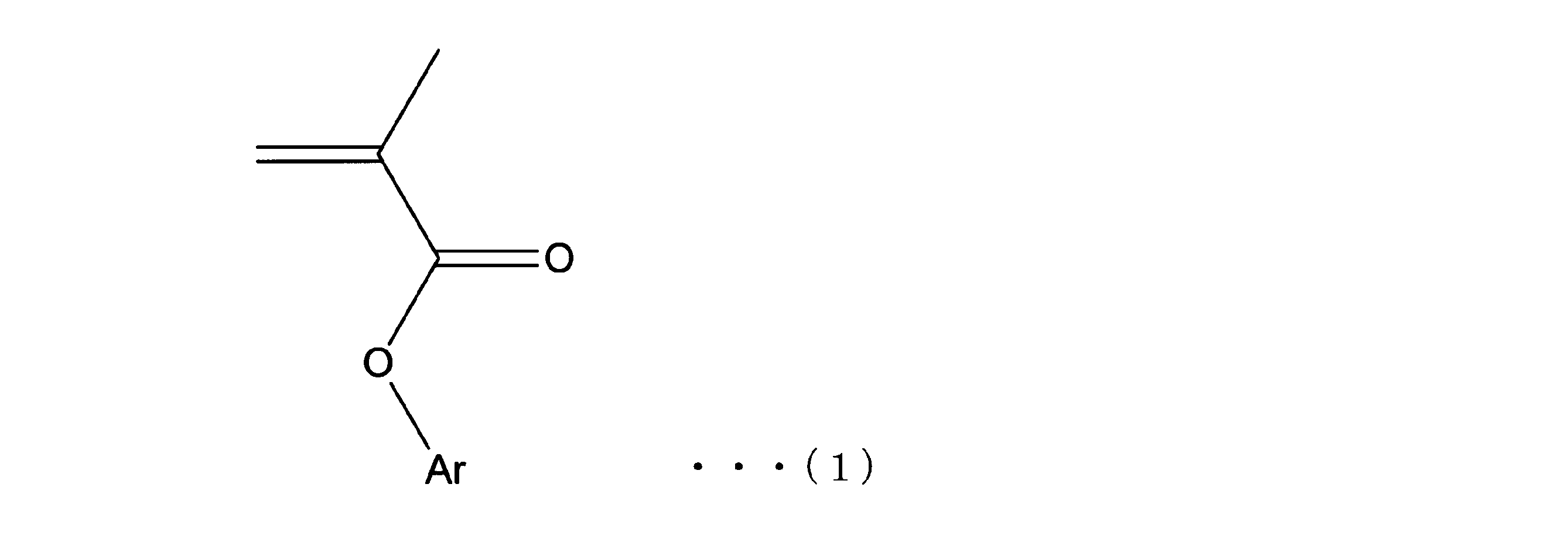
- the structural unit (a1) is a structural unit derived from the compound of the following formula (1).
- the structural unit (a1) improves the optical properties (transparency and the like) of the molded body.
- Ar is an aryl group, and the aromatic ring in Ar is directly bonded to the ester terminal in formula (1).
- Examples of the compound of the formula (1) include phenyl methacrylate, o-diphenyl methacrylate, p-diphenyl methacrylate, o-chlorophenyl methacrylate, 1-naphthyl methacrylate, 2-naphthyl methacrylate, 4-methoxyphenyl methacrylate, 4-chlorophenyl methacrylate, 2 4,6-trichlorophenyl methacrylate, 4-tertbutylphenyl methacrylate, and the like.
- the structural unit (a1) one type may be used alone, or two or more types may be used in combination.
- the structural unit (a1) is preferably at least one of a structural unit derived from phenyl methacrylate and a structural unit derived from 2-naphthyl methacrylate from the viewpoint of excellent heat resistance of the molded product.
- the proportion of the structural unit (a1) is preferably from 5 to 50% by weight, more preferably from 10 to 40% by weight, more preferably from 15 to 30% by weight, based on a total of 100% by weight of the structural unit (a1) and the structural unit (a2). Is more preferable.
- the proportion of the structural unit (a1) is preferably 5 to 30% by mass, and preferably 5 to 25% by mass, out of a total of 100% by mass of the structural unit (a1) and the structural unit (a2). % Is more preferable. If the structural unit (a1) is 5% by mass or more, the optical properties such as transparency of the molded product are further improved. When the structural unit (a1) is 50% by mass or less, the surface hardness of the molded body is further improved. In addition, the ratio and content of the structural unit in a polymer are computable from the mass of the monomer used when manufacturing a polymer, for example.
- the structural unit (a2) is a structural unit derived from methyl methacrylate.
- the structural unit (a2) improves the surface hardness of the molded body.
- the proportion of the structural unit (a2) is preferably 50 to 95% by weight, more preferably 60 to 90% by weight, and more preferably 70 to 85% by weight, out of a total of 100% by weight of the structural unit (a1) and the structural unit (a2). Is more preferable.
- the proportion of the structural unit (a2) is preferably 70 to 95% by mass, and 75 to 95% by mass, out of a total of 100% by mass of the structural unit (a1) and the structural unit (a2). % Is more preferable.
- the structural unit (a2) is 50% by mass or more, the surface hardness of the molded body is further improved.
- the structural unit (a2) is 95% by mass or less, the optical properties (transparency and the like) of the molded body are further improved.
- the structural unit (a3) is a structural unit derived from another monomer other than the monomer having the chemical structure of the formula (1), methyl methacrylate, acid (B), and nucleophile (C).
- Ar is an aryl group, and the aromatic ring in Ar is directly bonded to the ester terminal in formula (1).
- a monomer which comprises a structural unit (a3) the following are mentioned, for example.
- Methacrylate ethyl methacrylate, butyl methacrylate, propyl methacrylate, 2-ethylhexyl methacrylate, etc. (excluding monomers having a chemical structure of formula (1) and methyl methacrylate).
- Acrylate methyl acrylate, ethyl acrylate, butyl acrylate, propyl acrylate, 2-ethylhexyl acrylate, glycidyl acrylate, phenyl acrylate, 1-naphthyl acrylate, 2-naphthyl acrylate, p-diphenyl acrylate, o-diphenyl acrylate, o-chlorophenyl acrylate, 4-methoxyphenyl acrylate, 4-chlorophenyl acrylate, 2,4,6-trichlorophenyl acrylate, 4-tertbutylphenyl acrylate and the like.
- Vinyl cyanide monomer acrylonitrile, methacrylonitrile, etc. Diene monomer: butadiene, isoprene, dimethylbutadiene, etc.
- Vinyl ether monomers vinyl methyl ether, vinyl ethyl ether, etc.
- Carboxylic acid vinyl monomers vinyl acetate, vinyl butyrate, etc.
- Olefin monomers ethylene, propylene, isobutylene and the like.
- Vinyl halide monomers vinyl chloride, vinylidene chloride, etc.
- Maleimide monomers maleimide, N-phenylmaleimide, N-cyclohexylmaleimide, N-methylmaleimide and the like.
- Cross-linking agent allyl (meth) acrylate, divinylbenzene, 1,3-butylene dimethacrylate, etc.
- the other monomer is preferably a methacrylate, acrylate, or vinyl cyanide monomer from the viewpoint of excellent copolymerizability, that is, reactivity in copolymerization, and thermal decomposition of the polymer (A1) and the polymer (A2). From the viewpoint of suppressing acrylate, acrylate is more preferable.
- Another monomer may be used individually by 1 type and may use 2 or more types together.
- the content of the structural unit (a3) is preferably 0 to 10 parts by mass with respect to 100 parts by mass in total of the structural unit (a1) and the structural unit (a2). If content of a structural unit (a3) is 10 mass parts or less, the heat-resistant decomposition property of a molded object will be excellent.
- the acid (B) is a component contained in the (meth) acrylate resin material of the present invention.
- the acid (B) is included as one component of the (meth) acrylate resin material in the (meth) acrylate resin material ( ⁇ ), and the structural unit (A2) in the (meth) acrylate resin material ( ⁇ ) ( b1).
- the acid (B) improves the compatibility between the polycarbonate resin and the (meth) acrylate resin material or the surface hardness improver.
- (B) is not particularly limited as long as it is a compound capable of generating a proton, that is, a Bronsted acid.
- the acid (B) include methacrylic acid, acrylic acid, methacrylic anhydride, acrylic anhydride, maleic acid, maleic anhydride, itaconic acid, stearic acid, acetic acid, citric acid, formic acid, lactic acid, oxalic acid, tartaric acid, Examples include ascorbic acid, meldrum acid, hydrochloric acid, sulfuric acid, fuming sulfuric acid, phosphoric acid, fluorosulfonic acid, nitric acid, chromic acid, boric acid, and benzenesulfonic acid.
- (B) is preferably a compound having a carboxyl group from the viewpoint of excellent heat resistance of the molded article, and more preferably at least one of methacrylic acid and acrylic acid from the viewpoint of excellent copolymerizability.
- the content of the acid (B) in the (meth) acrylate resin material ( ⁇ ) is preferably 0.001 to 10 parts by mass with respect to 100 parts by mass in total of the structural unit (a1) and the structural unit (a2). 0.001 to 5 parts by mass is more preferable, and 0.001 to 2 parts by mass is even more preferable.
- the content of the acid (B) in the (meth) acrylate resin material ( ⁇ ) is 0 with respect to a total of 100 parts by mass of the structural unit (a1) and the structural unit (a2). 0.02 to 10 parts by mass is preferable, 0.02 to 5 parts by mass is more preferable, and 0.02 to 2 parts by mass is even more preferable.
- the content of the acid (B) in the (meth) acrylate resin material ( ⁇ ) is 0.001 part by mass or more, molding defects of the molded body can be further suppressed. If content of the acid (B) in (meth) acrylate resin material ((alpha)) is 10 mass parts or less, the moldability of a polycarbonate resin composition will be excellent.
- the structural unit (b1) is a structural unit derived from the acid (B).
- the acid (B) constituting the structural unit (b1) a monomer having a chemical structure of the formula (1), methyl methacrylate, or other single unit among the acids (B) is easily introduced as the structural unit.
- An acid (B1) copolymerizable with the monomer is preferred.
- Ar is an aryl group, and the aromatic ring in Ar is directly bonded to the ester terminal in formula (1).
- Examples of the acid (B1) constituting the structural unit (b1) include methacrylic acid, acrylic acid, methacrylic anhydride, acrylic anhydride, maleic acid, maleic anhydride, itaconic acid, and the like.
- the total content of the acid (B) and the structural unit (b1) is the structural unit (a1) and
- the amount is preferably 0.001 to 10 parts by mass, more preferably 0.001 to 5 parts by mass, and still more preferably 0.001 to 2 parts by mass with respect to 100 parts by mass in total of the structural unit (a2).
- the content of the structural unit (b1) in the (meth) acrylate resin material ( ⁇ ) or the sum of the acid (B) and the structural unit (b1) when the acid (B) is further included The content is preferably 0.02 to 10 parts by mass, more preferably 0.02 to 5 parts by mass, and more preferably 0.02 to 2 parts per 100 parts by mass in total of the structural unit (a1) and the structural unit (a2). Part by mass is more preferable.
- the total content of the acid (B) and the structural unit (b1) is 0.001 part by mass or more.
- the molding defect of a molded object is further suppressed.
- the content of the structural unit (b1) in the (meth) acrylate resin material ( ⁇ ) or the acid (B) is further included, the total content of the acid (B) and the structural unit (b1) is 10 parts by mass or less. The moldability of the polycarbonate resin composition is excellent.
- the (meth) acrylate resin material of the present invention described above contains the acid (B) or the (meth) acrylate polymer has the structural unit (b1) derived from the acid (B), the phase with the polycarbonate resin. Good solubility. Therefore, when the (meth) acrylate resin material of the present invention is blended with a polycarbonate resin, a polycarbonate resin composition capable of obtaining a molded body in which molding defects are suppressed is obtained. In the (meth) acrylate resin material of the present invention, since the (meth) acrylate polymer has a structural unit (a2) derived from methyl methacrylate, the (meth) acrylate resin material of the present invention is used as a polycarbonate resin.
- the molded object which is excellent in surface hardness can be obtained.
- the (meth) acrylate resin material of the present invention since the (meth) acrylate polymer has the structural unit (a1) derived from the compound of the formula (1), the (meth) acrylate resin material of the present invention.
- a polycarbonate resin composition capable of obtaining a molded article excellent in optical properties, that is, transparency, can be obtained.
- the nucleophilic agent (C) is a component contained in the (meth) acrylate resin composition of the present invention.
- the nucleophile (C) improves the compatibility of the polycarbonate resin with the (meth) acrylate resin material and the surface hardness improver.
- the nucleophile (C) is not particularly limited as long as it is a compound having nucleophilicity.
- the nucleophilic agent (C) include a compound having a hydroxy group, an amine, an organic phosphorus compound, and a compound having a chemical structure that reacts with a polycarbonate resin in the molecule.
- the compound having a hydroxy group include methanol, ethanol, isopropanol, ethylene glycol, glycerin, lauryl alcohol, stearyl alcohol, bisphenol A, bisphenol AP, bisphenol B, bisphenol BP, bisphenol C, bisphenol E, bisphenol F, and bisphenol G.
- Bisphenol M bisphenol S, bisphenol P, hydroxyethyl acrylate, hydroxyethyl methacrylate, hydroxypropyl acrylate, hydroxypropyl methacrylate, hydroxybutyl methacrylate, hydroxybutyl acrylate and the like.
- the amine include ammonia, trimethylamine, aniline, dimethylaminoethyl methacrylate, dimethylaminoethyl acrylate, diethylaminoethyl methacrylate, diethylaminoethyl acrylate, tertbutylaminoethyl methacrylate, tertbutylaminoethyl acrylate, and the like.
- organic phosphorus compound examples include phosphine, triphenylphosphine, trimethylphosphine, triethylphosphine, 2-phosphonooxyethyl methacrylate, 2-phosphonooxyethyl acrylate, and the like.
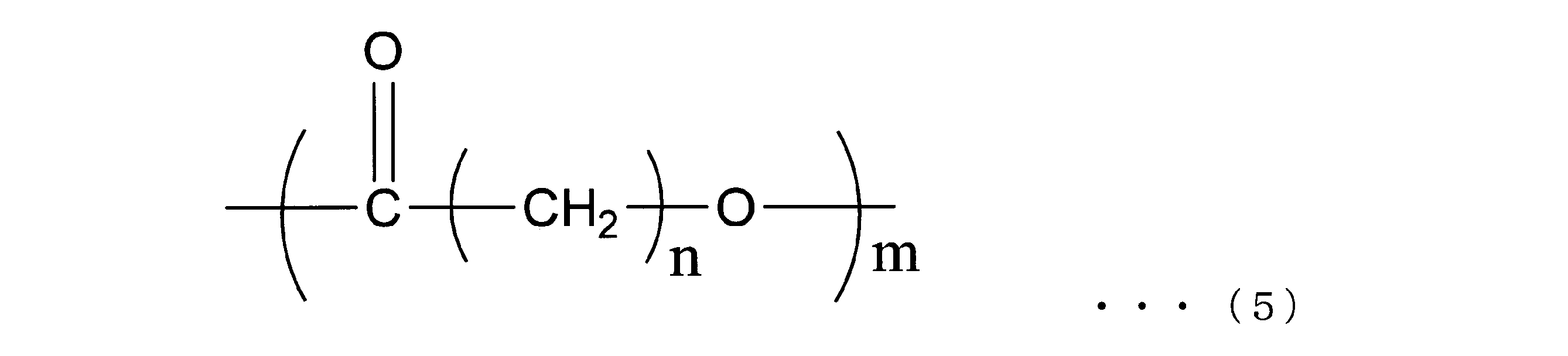
- compound having a chemical structure that reacts with the polycarbonate resin in the molecule examples include acetolactone, propiolactone, butyrolactone, valerolactone, (meth) acrylate having a chemical structure represented by the following formula (5), and the like.
- nucleophilic agent (C) it is preferable to use a compound having a hydroxy group from the viewpoint of obtaining a molded article having excellent optical properties.
- the nucleophilic agent (C) is preferably a compound having a structure represented by the following formula (2) in the molecule from the viewpoint of obtaining a molded article having excellent optical properties, and represented by the following formula (2) in the molecule. More preferred are compounds having a structure as described above and having a hydroxy group.
- those having a hydroxy annealing group are preferable, and examples thereof include bisphenol A, bisphenol C, and bisphenol P.
- the content of the nucleophile (C) in the (meth) acrylate resin material ( ⁇ ) is preferably 0.001 to 10 parts by mass, and 0.001 to 5 parts by mass with respect to 100 parts by mass of the polymer (A1). Is more preferably 0.001 to 2 parts by mass.
- the content of the nucleophilic agent (C) is 0.001 part by mass or more, molding defects of the molded body are further suppressed.
- content of a nucleophile (C) is 10 mass parts or less, thermal characteristics, such as heat resistance of a molded object, will be excellent.
- the structural unit (c1) is a structural unit derived from the nucleophile (C).
- the structural unit (c1) improves the compatibility between the polycarbonate resin, the (meth) acrylate resin material, and the surface hardness improver.
- the nucleophilic agent (C) constituting the structural unit (c1) has a chemical structure of the formula (1) in the nucleophilic agent (C) because it can be easily introduced as a structural unit into the polymer (A2).
- a nucleophile (C1) that is copolymerizable with a monomer, methyl methacrylate or another monomer is preferred.
- Ar is an aryl group, and the aromatic ring in Ar is directly bonded to the ester terminal in formula (1).
- nucleophilic agent (C1) examples include a compound having a hydroxy group, an amine, an organic phosphorus compound, and a compound having a chemical structure that reacts with a polycarbonate resin in the molecule.
- the compound having a hydroxy group examples include hydroxybutyl methacrylate, hydroxybutyl acrylate, hydroxyethyl methacrylate, and hydroxyethyl acrylate.
- Examples of the amine include dimethylaminoethyl methacrylate, dimethylaminoethyl acrylate, diethylaminoethyl methacrylate, diethylaminoethyl acrylate, tertbutylaminoethyl methacrylate, tertbutylaminoethyl acrylate, and the like.
- Examples of the organic phosphorus compound include 2-phosphonooxyethyl methacrylate and 2-phosphonooxyethyl acrylate.
- (Meth) acrylate which has a chemical structure represented by following formula (5) as a compound which has a chemical structure which reacts with a polycarbonate resin in a molecule
- numerator is mentioned.
- Examples of such a compound include trade names “Placcel FA1,” “Placcel FA2,” “Plaxel FA3,” “Plaxel FA4,” “Plaxel FA5,” “Plaxel FM1,” “Plaxel” manufactured by Daicel Corporation. FM2 ",” Plexel FM3 “,” Plexel FM4 “, and” Plexel FM5 ".
- the nucleophilic agent (C1) is preferably a compound having a chemical structure that reacts with the polycarbonate resin in the molecule because molding defects are suppressed.
- the total content of the nucleophilic agent (C) and the structural unit (c1) is The amount is preferably 0.001 to 10 parts by mass, more preferably 0.001 to 5 parts by mass, and still more preferably 0.001 to 1 part by mass with respect to 100 parts by mass of the combined (A2).
- the total content of the nucleophilic agent (C) and the structural unit (c1) is 0.001 part by mass or more. Molding defects are further suppressed.
- the content of the structural unit (c1) or the nucleophilic agent (C) is further included, if the total content of the nucleophilic agent (C) and the structural unit (c1) is 10 parts by mass or less, the optical properties of the molded body (Transparency etc.) is further excellent.
- the (meth) acrylate resin material of the present invention described above contains the nucleophilic agent (C) or the (meth) acrylate polymer has the structural unit (c1) derived from the nucleophilic agent (C),
- the compatibility with the polycarbonate resin is good. Therefore, it is possible to obtain a molded body in which molding defects are suppressed by molding a composition in which the (meth) acrylate resin material of the present invention is blended with a polycarbonate resin.
- the polymer (A1) or the polymer (A2) has a structural unit (a2) derived from methyl methacrylate
- the (meth) acrylate resin composition of the present invention comprises the (meth) acrylate resin composition of the present invention.
- a composition blended with a polycarbonate resin can be molded to obtain a molded body having excellent surface hardness.
- the polymer (A1) or the polymer (A2) has a structural unit (a1) derived from the following formula (1), the (meth) of the present invention
- a molded article having excellent optical characteristics, that is, transparency can be obtained.
- Ar is an aryl group, and the aromatic ring in Ar is directly bonded to the ester terminal in formula (1).
- the surface hardness improver of the present invention is a molding having a thickness of 2 mm obtained by blending 25 parts by mass of the surface hardness improver with 100 parts by mass of the polycarbonate resin (D) having a viscosity average molecular weight of 16000 to 25000.
- the pencil hardness measured according to JIS K 5600-5-4 is preferably F or more.
- the surface hardness improver of the present invention is a molding having a thickness of 2 mm obtained by blending 25 parts by mass of the surface hardness improver with 100 parts by mass of the polycarbonate resin (D) having a viscosity average molecular weight of 16000 to 25000.
- haze measured in accordance with JIS K 7136 is preferably 0.5% or less, more preferably 0.45% or less, and further preferably 0.4% or less.
- the surface hardness improver of the present invention comprises 25 parts by mass of a surface hardness improver with respect to 100 parts by mass of a polycarbonate resin (D) having a viscosity average molecular weight of 16000 to 25000, and is 100 t injection molded by Sumitomo Heavy Industries, Ltd.
- the haze of a 16 mm ⁇ 12 mm region including the existing portion is preferably 25% or less, more preferably 20% or less, and further preferably 17% or less.
- the polycarbonate resin composition of the present invention contains a polycarbonate resin (D) and the (meth) acrylate resin material of the present invention.
- the polycarbonate resin composition of the present invention may contain other components than the polycarbonate resin (D) and the (meth) acrylate resin material of the present invention as necessary.
- the polycarbonate resin (D) is not particularly limited as long as it is a polymer compound having a carbonate ester bond (—O—C (O) —O—) in the main chain.
- an aromatic polycarbonate produced by a reaction of a dihydric phenol and a carbonate precursor is usually mentioned. Specific examples include those produced by reacting a dihydric phenol and a carbonate precursor by a solution method or a melting method, and more specifically produced by reacting a dihydric phenol and phosgene. And those produced by reacting dihydric phenol with diphenyl carbonate or the like by a transesterification method.
- dihydric phenol examples include 2,2-bis (4-hydroxyphenyl) propane [bisphenol A], 2,2-bis (3-methyl-4-hydroxyphenyl) propane [bisphenol C], bis (4- Hydroxyphenyl) methane, 1,1-bis (4-hydroxyphenyl) ethane, 2,2-bis (4-hydroxy-3,5-dimethylphenyl) propane, 4,4′-dihydroxydiphenyl, bis (4-hydroxy) Phenyl) cycloalkane, bis (4-hydroxyphenyl) oxide, bis (4-hydroxyphenyl) sulfide, bis (4-hydroxyphenyl) sulfone, bis (4-hydroxyphenyl) sulfoxide, bis (4-hydroxyphenyl) ether, Bis (4-hydroxyphenyl) ketone, and these And halogen-substituted products.
- dihydric phenol examples include hydroquinone, resorcin, and catechol.
- dihydric phenol bis (hydroxyphenyl) alkane is preferable, and bisphenol A is particularly preferable from the viewpoint of cost.
- a dihydric phenol may be used individually by 1 type and may use 2 or more types together.
- Examples of the carbonate precursor include carbonyl halide, carbonyl ester, haloformate, and the like, and specifically, phosgene, dihaloformate of dihydric phenol, diphenyl carbonate, dimethyl carbonate, diethyl carbonate and the like.
- the polycarbonate resin (D) may have a branched structure.
- a branching agent for introducing a branched structure into the polycarbonate resin (D) 1,1,1-tris (4-hydroxyphenyl) ethane, ⁇ , ⁇ ′, ⁇ ′′ -tris (4-hydroxyphenyl) -1 , 3,5-triisopropylbenzene, phloroglycine, trimellitic acid, isatin bis (o-cresol) and the like.
- the polycarbonate resin (D) may be a copolymer having a polycarbonate part and a polyorganosiloxane part, or may be a polycarbonate resin containing this copolymer.
- the polycarbonate resin (D) contains a polyorganosiloxane part, the polyorganosiloxane part is preferably 1 to 40% by mass in the total mass of the polycarbonate resin (D).
- Polycarbonate resin (D) is a polyester-polycarbonate resin obtained by reacting a dihydric phenol and a carbonate precursor in the presence of an ester precursor, that is, a bifunctional carboxylic acid such as terephthalic acid or an ester-forming derivative thereof. It may be.
- the polyester part is preferably 1 to 50% by mass of the total mass of the polycarbonate resin (D).
- the polycarbonate resin (D) may be a mixture of various polycarbonate resins.
- the viscosity average molecular weight of the polycarbonate resin (D) can be calculated by a viscosity method, preferably 15000 to 30000, more preferably 16000 to 27000, and further preferably 17000 to 25000. When the viscosity average molecular weight is within the above range, the moldability of the polycarbonate resin composition and the surface hardness of the molded article are excellent.
- the ratio of these polycarbonate resins (D) to the total mass is, for example, 1 to 50% by mass. is there.
- the polycarbonate resin composition of the present invention contains various additives such as antioxidants, ultraviolet absorbers, light stabilizers, flame retardants, and various fillers such as glass, mica, talc, and rubber particles as necessary. You may go out.
- the polycarbonate resin composition of the present invention may contain a resin other than the polycarbonate resin as long as the effects of the present invention are not impaired.
- a part or all of the side chain aryl esters of the structural unit (a1) was exchange-reacted with one or more arbitrary carbonyl bonds and ester bonds in the polycarbonate resin (D).
- a compound also referred to as an exchange compound.
- a gas chromatograph-mass spectrometer (GC-MS) apparatus equipped with a thermal decomposition apparatus is used to measure the ratio of these exchange compounds.
- Pyrolysis devices such as micro vertical type such as PY-3030 manufactured by Frontier Labs and Curie point type such as JHP-5 type manufactured by Nihon Analytical Industrial Co., Ltd. are directly used for the GC-MS system. Any device that can be introduced may be used.
- TMAH tetramethylammonium hydroxide
- GC device inlet temperature 280 ° C
- Separation column DB-5 (length 30 m ⁇ inner diameter 0.25 mm ⁇ film thickness 0.25 ⁇ m)
- GC apparatus oven temperature 50 ° C (hold for 2 minutes) ⁇ temperature rise at 10 ° C / minute ⁇ 320 ° C (hold for 11 minutes)
- GC-MS device interface temperature 280 ° C
- a peak derived from the reaction pyrolysis product of the exchange compound is observed.
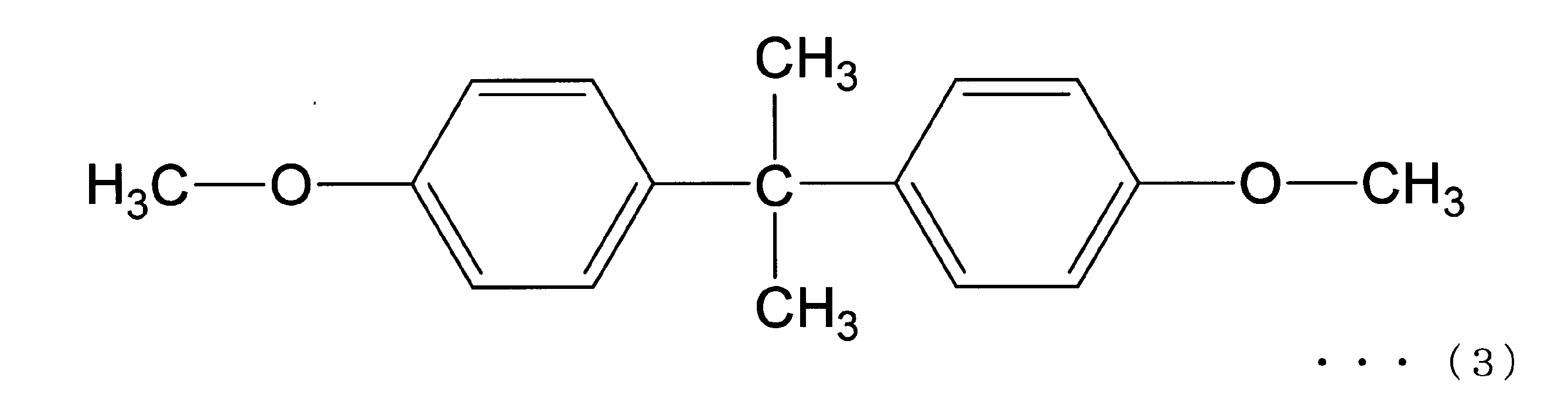
- the peak derived from the reaction pyrolysis product of the exchange compound include a peak having a retention time of 19.3 minutes derived from bisphenol A dimethyl ether represented by the following formula (3) and the following formula (4).
- a peak having a retention time of 22.1 minutes derived from bisphenol A methyl ether methacrylate a peak having a retention time of 22.1 minutes derived from bisphenol A methyl ether methacrylate.
- the polycarbonate resin composition of the present invention can be produced by melt-kneading the polycarbonate resin (D), the (meth) acrylate resin material of the present invention, and other components as necessary.
- the melt kneading apparatus include a Banbury mixer, a kneader, a roll, a kneader ruder, a single screw extruder, a twin screw extruder, a multi-screw extruder, and the like.
- the polycarbonate resin composition of the present invention can be produced by melting and kneading 0.1 to 60 parts by mass of a (meth) acrylate resin material with respect to 100 parts by mass of the polycarbonate resin (D).
- the polycarbonate resin composition of the present invention is obtained by melt-kneading 1 to 300 parts by mass of a (meth) acrylate resin material and other components as necessary with respect to 100 parts by mass of the polycarbonate resin (D).
- the polycarbonate resin composition can be manufactured by further blending 1 to 400 parts by mass of the polycarbonate resin (D) and melt-kneading.
- composition of polycarbonate resin composition The content of the (meth) acrylate resin material of the present invention is preferably 0.1 to 60 parts by mass, more preferably 10 to 50 parts by mass, and 20 to 45 parts by mass with respect to 100 parts by mass of the polycarbonate resin (D). Part is more preferable.
- the content of the (meth) acrylate resin material is 0.1 parts by mass or more, the surface hardness of the molded body is further improved.
- the optical characteristics of the molded product that is, (transparency and the like) are further improved.
- the polycarbonate resin composition of the present invention described above includes the (meth) acrylate resin material of the present invention having good compatibility with the polycarbonate resin (D), whitening occurs when the polycarbonate resin composition of the present invention is molded. Thus, a molded body in which molding defects such as the above are suppressed can be obtained. Moreover, since the (meth) acrylate resin material of this invention contains the (meth) acrylate polymer which has the structural unit (a2) derived from methyl methacrylate, the polycarbonate resin composition of this invention contains the polycarbonate resin composition of this invention. When is molded, a molded body having excellent surface hardness can be obtained.
- the (meth) acrylate resin material of the present invention contains a (meth) acrylate polymer having a structural unit (a1) derived from the following formula (1).
- a1 structural unit derived from the following formula (1).
- Ar is an aryl group, and the aromatic ring in Ar is directly bonded to the ester terminal in formula (1).
- the molded product of the present invention is obtained by molding the polycarbonate resin composition of the present invention.
- the molding method include known methods such as injection molding, extrusion molding, and compression molding.
- an injection molding method and an extrusion molding method are preferable because they can be molded into a desired shape.
- the molded article of the present invention described above is obtained by molding the polycarbonate resin composition of the present invention, it is excellent in surface hardness and suppresses molding defects such as whitening. Moreover, since the molded article of the present invention is obtained by molding the polycarbonate resin composition of the present invention, it is excellent in optical characteristics, that is, transparency.
- part means “part by mass”.
- the ratio of each structural unit of the polymer and the method for obtaining the weight average molecular weight and the evaluation method of the molded product are as follows.
- GC device inlet temperature 280 ° C
- Separation column DB-5 (length 30 m ⁇ inner diameter 0.25 mm ⁇ film thickness 0.25 ⁇ m)
- GC apparatus oven temperature 50 ° C (hold for 2 minutes) ⁇ temperature rise at 10 ° C / minute ⁇ 320 ° C (hold for 11 minutes)
- GC-MS device interface temperature 280 ° C
- Carrier gas Helium gas flow rate: 1 ml / min under constant flow conditions
- Example 1 Dispersant synthesis: In a reaction vessel having a capacity of 1200 L equipped with a stirrer, a condenser tube and a thermometer, 61.6 parts of a 17% by mass aqueous potassium hydroxide solution, 19.1 parts of methyl methacrylate (manufactured by Mitsubishi Rayon Co., Ltd., Acryester M) and 19.3 parts of deionized water was charged. The liquid in the reaction apparatus was stirred at room temperature, and after confirming an exothermic peak, the liquid was further stirred for 4 hours. Thereafter, the reaction solution in the reaction apparatus was cooled to room temperature to obtain a potassium methacrylate aqueous solution.
- a reaction vessel having a capacity of 1050 L equipped with a stirrer, a condenser and a thermometer, 900 parts of deionized water, 2-sulfoethyl sodium methacrylate (manufactured by Mitsubishi Rayon Co., Ltd., Acryester SEM-Na, 42 mass% aqueous solution) 60 parts, 10 parts of a potassium methacrylate aqueous solution and 12 parts of methyl methacrylate (manufactured by Mitsubishi Rayon Co., Ltd., Acryester M) were stirred and heated to 50 ° C. while purging the inside of the polymerization apparatus with nitrogen.
- 2-sulfoethyl sodium methacrylate manufactured by Mitsubishi Rayon Co., Ltd., Acryester SEM-Na, 42 mass% aqueous solution
- 10 parts of a potassium methacrylate aqueous solution and 12 parts of methyl methacrylate manufactured by Mitsubishi Rayon Co., Ltd., Acryester M
- the inside of the polymerization apparatus was sufficiently purged with nitrogen, and the aqueous dispersion was heated to 75 ° C., held for 3 hours, then heated to 85 ° C. and held for 1.5 hours.
- the aqueous dispersion was cooled to 40 ° C. to obtain an aqueous suspension of the polymer.
- This aqueous suspension was filtered with a filter cloth, and the filtrate was washed with deionized water and dried at 75 ° C. for 18 hours to obtain a polymer.
- the obtained polymer was designated as (meth) acrylate resin material ( ⁇ 1).
- Table 1 shows the ratio and the mass average molecular weight of each structural unit of the polymer constituting the (meth) acrylate resin material ( ⁇ 1).
- the pellets were molded using an injection molding machine (SE100DU, manufactured by Sumitomo Heavy Industries, Ltd.) at a molding temperature of 280 ° C. and a mold temperature of 80 ° C. to obtain a sheet-like molded body having a thickness corresponding to each evaluation.
- SE100DU injection molding machine
- the evaluation results are shown in Table 2.
- Example 2 Except for changing each composition as described in Table 1, the same operations as in Example 1 were performed to obtain (meth) acrylate resin materials ( ⁇ 2) to ( ⁇ 10).
- Table 1 shows the proportions and mass average molecular weights of the constituent units constituting the (meth) acrylate resin materials ( ⁇ 2) to ( ⁇ 10).
- acrylic acid manufactured by Wako Pure Chemical Industries, Ltd., special grade reagent
- an unsaturated fatty acid hydroxyalkyl ester-modified ⁇ -caprolactone manufactured by Daicel, Plaxel FM5 was used as the nucleophile (C) constituting the structural unit (c1).
- the nucleophile (C) was added to the aqueous dispersion before performing nitrogen substitution in the polymerization apparatus. Further, the polycarbonate resin composition of the present invention was prepared using the polycarbonate resin (D) and the (meth) acrylate resin materials ( ⁇ 2) to ( ⁇ 10). Except having changed the kind and compounding quantity of (meth) acrylate resin material as Table 2, operation similar to Example 1 was performed and the sheet-like molded object of the thickness according to each evaluation was obtained. The evaluation results are shown in Table 2.
- Example 11 to 15 Except having changed each composition as described in Table 1, the same operation as Example 1 was performed and the polymer was obtained.
- the obtained polymer was further mixed with a nucleophile (C) to obtain (meth) acrylate resin materials ( ⁇ 1) to ( ⁇ 4) and ( ⁇ 15).
- Table 1 shows the proportions and mass average molecular weights of the respective structural units of the polymers constituting the (meth) acrylate resin materials ( ⁇ 1) to ( ⁇ 4) and ( ⁇ 15), and the amount of the nucleophile (C).
- Examples 11, 12, and 15 bisphenol A (manufactured by Tokyo Chemical Industry Co., Ltd.) was used as the nucleophilic agent (C), and in Examples 13 and 14, bisphenol A / propylene oxide addition was used as the nucleophilic agent (C).
- Product product name: Adeka Polyether BPX-55, manufactured by Adeka
- the polycarbonate resin composition of the present invention was prepared using the polycarbonate resin (D) and the (meth) acrylate resin materials ( ⁇ 1) to ( ⁇ 4) and ( ⁇ 15). Except having changed the kind and compounding quantity of (meth) acrylate resin material as Table 2, operation similar to Example 1 was performed and the sheet-like molded object of the thickness according to each evaluation was obtained. The evaluation results are shown in Table 2.
- the polycarbonate resin composition obtained in Example 15 was subjected to thermal decomposition measurement as shown in FIG. As a result, peaks were observed at mass spectrum retention times of 19.3 minutes and 22.1 minutes. As a result of performing mass spectrometry on each of the samples having the retention times of 19.3 minutes and 22.1 minutes, the sample having the retention time of 19.3 minutes was the compound represented by the formula (3), the retention time of 22. A sample of 1 minute was assigned to the compound represented by formula (4). The results of mass spectrometry are as shown in FIGS.
- Example 16 A polymer was obtained in the same manner as in Example 1 except that the compound constituting the structural unit (b1) was not used. Furthermore, the obtained polymer and stearic acid (manufactured by Wako Pure Chemical Industries, Ltd.) as the acid (B) are included in Table 2 together with the polycarbonate resin (D) as a constituent of the (meth) acrylate resin material ( ⁇ 6).
- a polycarbonate resin composition was prepared in the same manner as in Example 1 except that mixing was performed at the stated ratio. The same operation as in Example 1 was performed to obtain a sheet-like molded body having a thickness corresponding to each evaluation. Table 1 shows the proportion and mass average molecular weight of each structural unit of the polymer constituting the (meth) acrylate resin material ( ⁇ 6), and the amount of the acid (B) used. The evaluation results are shown in Table 2.
- the polycarbonate resin composition of the present invention was prepared using the polycarbonate resin (D) and the (meth) acrylate resin materials ( ⁇ 1) to ( ⁇ 4). Except having changed the kind and compounding quantity of (meth) acrylate resin material as Table 2, operation similar to Example 1 was performed and the sheet-like molded object of the thickness according to each evaluation was obtained. The evaluation results are shown in Table 2.
- Example 17 100 parts by mass of the polycarbonate resin (D) and 100 parts by mass of the (meth) acrylate resin material ( ⁇ 7) were put in a polyethylene bag, and the polyethylene bag was well shaken and mixed by hand.
- the obtained mixture was melt-kneaded at 280 ° C. using a twin-screw extruder (manufactured by Ikegai Co., Ltd., PCM35), and the extruded strand was cut to obtain pellets.
- 150 parts by mass of the polycarbonate resin (D) was further added, put into a polyethylene bag, and the polyethylene bag was well shaken and mixed by hand.
- the obtained mixture was melt-kneaded at 280 ° C.
- Example 18 A sheet-like molded body having a thickness corresponding to each evaluation was carried out in the same manner as in Example 17 except that the (meth) acrylate resin material ( ⁇ 15) was used instead of the (meth) acrylate resin material ( ⁇ 7). Got. The evaluation results are shown in Table 3.
- Comparative Examples 1-1 and 1-2 contain the polymer (A1), but do not contain the acid (B) or the nucleophile (C), so improvement of molding defects of the molded product could not be confirmed.
- Comparative Examples 2 to 4 since a polymer other than the polymer (A1) and the polymer (A2) was used, the degree of molding failure of the molded body was large. Since Comparative Example 5 did not use a surface hardness improver, the pencil hardness was insufficient.
- the molded body of the present invention includes members (housing, etc.) of various equipment (electric equipment, electronic equipment, OA equipment, etc.), optical recording media, automobile parts (automobile headlamps, automobile interior materials, etc.), building members, and various sheets. Useful as.
Landscapes
- Chemical & Material Sciences (AREA)
- Health & Medical Sciences (AREA)
- Chemical Kinetics & Catalysis (AREA)
- Medicinal Chemistry (AREA)
- Polymers & Plastics (AREA)
- Organic Chemistry (AREA)
- Compositions Of Macromolecular Compounds (AREA)
- Addition Polymer Or Copolymer, Post-Treatments, Or Chemical Modifications (AREA)
- Manufacture Of Macromolecular Shaped Articles (AREA)
Abstract
Description
本願は、2014年9月1日に日本に出願された特願2014-177274号、2014年8月29日に日本に出願された特願2014-175471号、2014年11月12日に日本に出願された特願2014-229713号に基づき優先権を主張し、その内容をここに援用する。
しかしながら、ポリカーボネート樹脂からなる成形体は、自動車ヘッドランプ、各種シート等として用いるには、表面硬度が不足している。
・芳香族(メタ)アクリレートに由来する構成単位(a1)およびメチルメタクリレートに由来する構成単位(a2)を有する重合体(A)からなる表面硬度向上剤と、ポリカーボネート樹脂とを含むポリカーボネート樹脂組成物を成形して得られた成形体(特許文献1)。
本発明は、表面硬度および光学特性に優れ、かつ白化等の成形不良が抑えられた成形体の製造方法を提供する。
[1]下記式(1)の化合物に由来する構成単位(a1)およびメチルメタクリレートに由来する構成単位(a2)を有する重合体(A1)と、酸(B)および求核剤(C)の少なくとも一つ以上とからなる、(メタ)アクリレート樹脂材料。
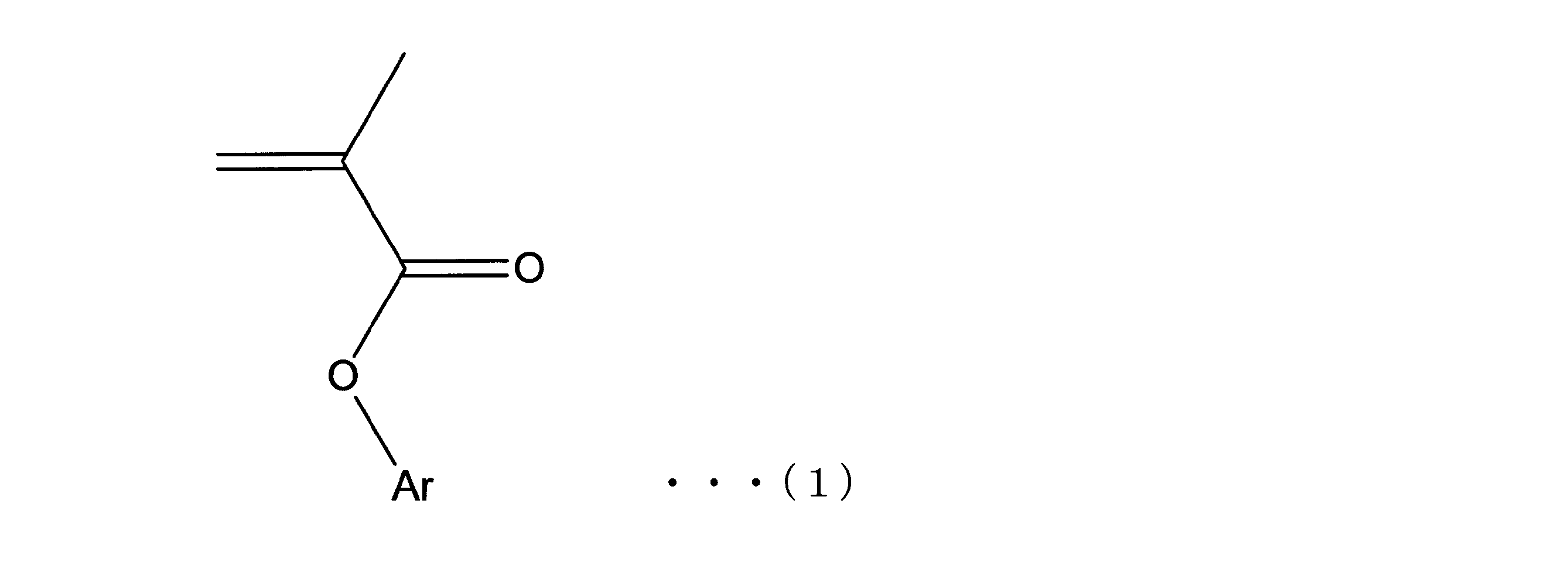

[4]前記構成単位(a1)が、フェニルメタクリレートに由来する構成単位および2-ナフチルメタクリレートに由来する構成単位の少なくとも一つ以上である、[1]~[3]のいずれか一つに記載の(メタ)アクリレート樹脂材料。
[5]前記構成単位(a1)の割合が、前記構成単位(a1)および前記構成単位(a2)の合計100質量%のうち、5~50質量%である、[1]~[4]のいずれか一つに記載の(メタ)アクリレート樹脂材料。
[6]前記構成単位(a1)の割合が、前記構成単位(a1)および前記構成単位(a2)の合計100質量%のうち、5~25質量%である、[1]~[5]のいずれか一つに記載の(メタ)アクリレート樹脂材料。
[8]前記酸(B)が、カルボキシル基を有する化合物である、[1]~[7]のいずれか一つに記載の(メタ)アクリレート樹脂材料。
[9]前記酸(B)が、メタクリル酸およびアクリル酸の少なくとも一つ以上である、[1]~[8]のいずれか一つに記載の(メタ)アクリレート樹脂材料。
[10]前記酸(B)の含有量が、前記構成単位(a1)および前記構成単位(a2)の合計100質量部に対して、0.02~10質量部である、[1]および[4]~[9]のいずれか一つに記載の(メタ)アクリレート樹脂材料。
[11]前記構成単位(b1)の含有量または酸(B)をさらに含む場合は前記酸(B)および前記構成単位(b1)の合計含有量が、前記構成単位(a1)および前記構成単位(a2)の合計100質量部に対して、0.02~10質量部である、[2]~[9]に記載の(メタ)アクリレート樹脂材料。
[12]前記求核剤(C)が、ヒドロキシ基を有する化合物である、[1]~[11]のいずれか一つに記載の(メタ)アクリレート樹脂材料。
[13]前記求核剤(C)が、分子内に下記式(2)で表される構造を有する化合物である、[1]~[12]のいずれか一つに記載の(メタ)アクリレート樹脂材料。

[15]前記求核剤(C)の含有量が、前記重合体(A1)100質量部に対して、0.001~10質量部である、[1]、[4]~[10]および[12]~[14]のいずれか一つに記載の(メタ)アクリレート樹脂材料。
[16]前記構成単位(c1)の含有量または求核剤(C)をさらに含む場合は前記求核剤(C)および前記構成単位(c1)の合計含有量が、前記重合体(A2)100質量部に対して、0.001~10質量部である、[2]~[9]および、[11]~[14]に記載の(メタ)アクリレート樹脂材料。
[17]前記重合体(A1)または前記重合体(A2)の質量平均分子量が、5000~30000である、[1]~[16]のいずれか一つに記載の(メタ)アクリレート樹脂材料。
[19]ポリカーボネート樹脂(D)と、[1]~[17]のいずれか一つに記載の(メタ)アクリレート樹脂材料とを含む、ポリカーボネート樹脂組成物。
[20]前記[19]に記載のポリカーボネート樹脂組成物を成形して得られた、成形体。
[21]粘度平均分子量が16000以上25000以下のポリカーボネート樹脂(D)100質量部に対して、25質量部の[18]に記載の表面硬度向上剤を含むポリカーボネート樹脂組成物を成形して得られた、厚さ2mmの成形体においてJIS K 5600-5-4に準拠し測定した鉛筆硬度がF以上となる、前記[18]の表面硬度向上剤。
[22]粘度平均分子量が16000以上25000以下のポリカーボネート樹脂(D)100質量部に対して、25質量部の[18]に記載の表面硬度向上剤を含むポリカーボネート樹脂組成物を成形して得られた、厚さ2mmの成形体においてJIS K 7136に準拠し測定したヘーズが0.5%以下となる、前記[18]または[21]に記載の表面硬度向上剤。
[23]粘度平均分子量が16000以上25000以下のポリカーボネート樹脂(D)100質量部に対して、25質量部の[15]に記載の表面硬度向上剤を含むポリカーボネート樹脂組成物を成形して得られた、JIS K7162に記載の1A形の成形体において、成形体の白化が発生している箇所を含む16mm×12mmの領域のヘーズが25%以下である、前記[18]、[21]および[22]のいずれか一つに記載の表面硬度向上剤。
[24]前記[19]に記載のポリカーボネート樹脂組成物100質量部に対し、さらにポリカーボネート樹脂(D)を1~400質量部配合する、ポリカーボネート樹脂組成物の製造方法。
得られる質量スペクトルの保持時間が19.3および22.1分の少なくとも一つ以上にピークを有するポリカーボネート樹脂組成物。
[26]下記式(3)および下記式(4)の化学構造の少なくとも一つ以上に由来する構成単位を有する重合体を含む、前記[25]に記載のポリカーボネート樹脂組成物。

本発明の表面硬度向上剤は、ポリカーボネート樹脂との相溶性が良好である。また、本発明の表面硬度向上剤をポリカーボネート樹脂に配合した場合には、光学特性を維持しつつ表面硬度に優れ、かつ白化等の成形不良が抑えられた成形体を得ることができるポリカーボネート樹脂組成物が得られる。
本発明のポリカーボネート樹脂組成物によれば、表面硬度および光学特性に優れ、かつ白化等の成形不良が抑えられた成形体を得ることができる。
本発明の成形体は、ポリカーボネート樹脂を含む成形体であって、表面硬度および光学特性に優れ、かつ白化等の成形不良が抑えられた成形体である。
本発明の製造方法は、表面硬度および光学特性に優れ、かつ白化等の成形不良が抑えられた成形体を得ることができる。
「構成単位」とは、単量体が重合することによって形成された重合体において単量体に由来する構成単位、または重合体を処理することによって構成単位の一部が別の構造に変換された構成単位を意味する。
「質量平均分子量」は、テトラヒドロフランを溶離液として用い、カラム温度40℃において、ゲル浸透クロマトグラフィ(GPC)によって測定される、ポリスチレン換算の質量平均分子量である。
「(メタ)アクリレート」は、アクリレートおよびメタクリレートの総称である。
本発明の(メタ)アクリレート樹脂材料は、下記の(メタ)アクリレート樹脂材料(α)または(メタ)アクリレート樹脂材料(β)である。(メタ)アクリレート樹脂材料(α)と(メタ)アクリレート樹脂材料(β)との違いは、酸(B)および求核剤(C)の少なくとも一つ以上を(メタ)アクリレート樹脂材料の一成分として含むか、酸(B)および求核剤(C)の少なくとも一つ以上が重合体の構成単位として(メタ)アクリレート重合体に取り込まれているかである。
(β)下記式(1)の化合物に由来する構成単位(a1)、メチルメタクリレートに由来する構成単位(a2)、並びに酸(B)に由来する構成単位(b1)および求核剤(C)に由来する構成単位(c1)の少なくとも一つ以上を有する重合体(A2)を含む(メタ)アクリレート樹脂材料。

なお、(メタ)アクリレート樹脂材料(β)は、重合体(A2)の他に、酸(B)および求核剤(C)の少なくとも一つ以上を一成分として含んでいてもよい。
重合体(A1)は、構成単位(a1)および構成単位(a2)を有する。重合体(A1)は、必要に応じて他の単量体に由来する構成単位(a3)を有していてもよい。重合体(A1)は、酸(B)に由来する構成単位(b1)およびに求核剤(C)に由来する構成単位(c1)を有さない。
重合体(A2)は、構成単位(a1)、構成単位(a2)、並びに構成単位(b1)および構成単位(c1)の少なくとも一つ以上を有する。重合体(A2)は、必要に応じて他の単量体に由来する構成単位(a3)を有していてもよい。
構成単位(a1)は、下記式(1)の化合物に由来する構成単位である。構成単位(a1)は、成形体の光学特性(透明性等)を向上させる。

なお、重合体中の構成単位の割合および含有量は、例えば重合体を製造する際に用いた単量体の質量から算出することができる。
構成単位(a2)は、メチルメタクリレートに由来する構成単位である。構成単位(a2)は、成形体の表面硬度を向上させる。
構成単位(a3)は、式(1)の化学構造を有する単量体、メチルメタクリレート、酸(B)、および求核剤(C)以外の他の単量体に由来する構成単位である。

メタクリレート:エチルメタクリレート、ブチルメタクリレート、プロピルメタクリレート、2-エチルヘキシルメタクリレート等(ただし、式(1)の化学構造を有する単量体、およびメチルメタクリレートを除く)。
アクリレート:メチルアクリレート、エチルアクリレート、ブチルアクリレート、プロピルアクリレート、2-エチルヘキシルアクリレート、グリシジルアクリレート、フェニルアクリレート、1-ナフチルアクリレート、2-ナフチルアクリレート、p-ジフェニルアクリレート、o-ジフェニルアクリレート、o-クロロフェニルアクリレート、4-メトキシフェニルアクリレート、4-クロロフェニルアクリレート、2、4、6-トリクロロフェニルアクリレート、4-tertブチルフェニルアクリレート等。
ジエン系単量体:ブタジエン、イソプレン、ジメチルブタジエン等。
ビニルエーテル系単量体:ビニルメチルエーテル、ビニルエチルエーテル等。
カルボン酸系ビニル単量体:酢酸ビニル、酪酸ビニル等。
オレフィン系単量体:エチレン、プロピレン、イソブチレン等。
ハロゲン化ビニル単量体:塩化ビニル、塩化ビニリデン等。
マレイミド系単量体:マレイミド、N-フェニルマレイミド、N-シクロヘキシルマレイミド、N-メチルマレイミド等。
架橋剤:アリル(メタ)アクリレート、ジビニルベンゼン、1,3-ブチレンジメタクリレート等。
他の単量体は、1種を単独で用いてもよく、2種以上を併用してもよい。
酸(B)は、本発明の(メタ)アクリレート樹脂材料に含まれる成分である。酸(B)は、(メタ)アクリレート樹脂材料(α)においては(メタ)アクリレート樹脂材料の一成分として含まれ、(メタ)アクリレート樹脂材料(β)においては重合体(A2)の構成単位(b1)として含まれている。
酸(B)は、ポリカーボネート樹脂と(メタ)アクリレート樹脂材料または表面硬度向上剤との相溶性を向上させる。
構成単位(b1)は、酸(B)に由来する構成単位である。
構成単位(b1)を構成する酸(B)としては、構成単位として導入しやすい点から、酸(B)のうち、式(1)の化学構造を有する単量体、メチルメタクリレートまたは他の単量体と共重合可能な酸(B1)が好ましい。

また、本発明の(メタ)アクリレート樹脂材料にあっては、(メタ)アクリレート重合体がメチルメタクリレートに由来する構成単位(a2)を有するため、本発明の(メタ)アクリレート樹脂材料をポリカーボネート樹脂に配合した場合には、表面硬度に優れる成形体を得ることができる。
また、本発明の(メタ)アクリレート樹脂材料にあっては、(メタ)アクリレート重合体が式(1)の化合物に由来する構成単位(a1)を有するため、本発明の(メタ)アクリレート樹脂材料をポリカーボネート樹脂に配合した場合には、光学特性、すなわち透明性に優れる成形体を得ることができるポリカーボネート樹脂組成物が得られる。
求核剤(C)は、本発明の(メタ)アクリレート樹脂組成物に含まれる成分である。求核剤(C)は、ポリカーボネート樹脂と(メタ)アクリレート樹脂材料および表面硬度向上剤との相溶性を向上させる。
ヒドロキシ基を有する化合物としては、例えば、メタノール、エタノール、イソプロパノール、エチレングリコール、グリセリン、ラウリルアルコール、ステアリルアルコール、ビスフェノールA、ビスフェノールAP、ビスフェノールB、ビスフェノールBP、ビスフェノールC、ビスフェノールE、ビスフェノールF、ビスフェノールG、ビスフェノールM、ビスフェノールS、ビスフェノールP、ヒドロキシエチルアクリレート、ヒドロキシエチルメタクリレート、ヒドロキシプロピルアクリレート、ヒドロキプロピルメタクリレート、ヒドロキシブチルメタクリレート、ヒドロキシブチルアクリレート等が挙げられる。
アミンとしては、アンモニア、トリメチルアミン、アニリン、ジメチルアミノエチルメタクリレート、ジメチルアミノエチルアクリレート、ジエチルアミノエチルメタクリレート、ジエチルアミノエチルアクリレート、tertブチルアミノエチルメタクリレート、tertブチルアミノエチルアクリレート等が挙げられる。
分子内にポリカーボネート樹脂と反応する化学構造を有する化合物としては、アセトラクトン、プロピオラクトン、ブチロラクトン、バレロラクトン、下記式(5)で表される化学構造を有する(メタ)アクリレート等が挙げられる。
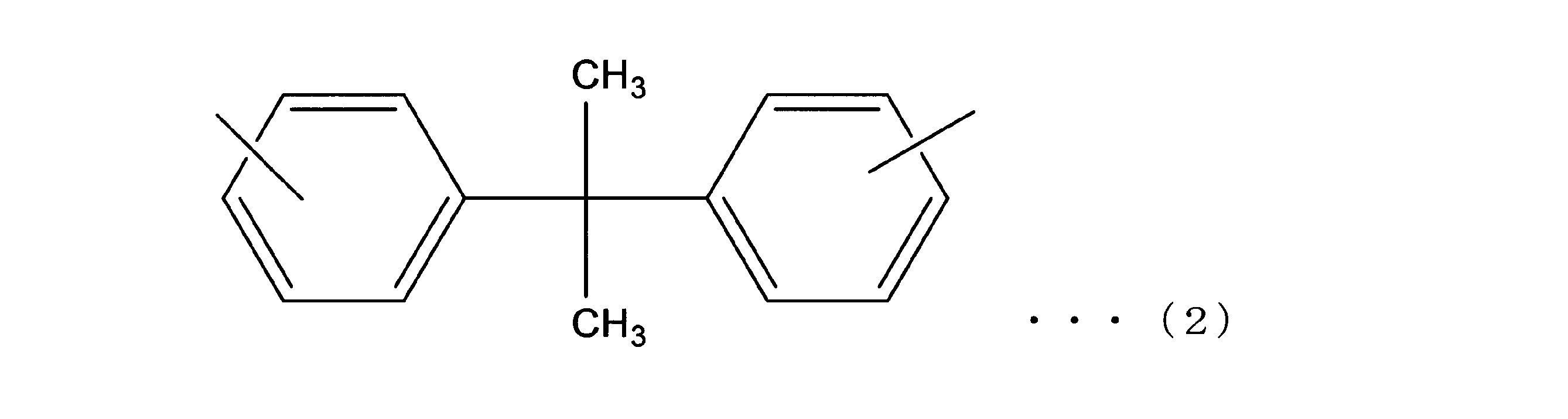
求核剤(C)としては、光学特性に優れた成形体を得る点から、分子内に下記式(2)で表される構造を有する化合物が好ましく、分子内に下記式(2)で表される構造を有し、かつヒドロキシ基を有する化合物がさらに好ましい。

構成単位(c1)は、求核剤(C)に由来する構成単位である。構成単位(c1)は、ポリカーボネート樹脂と(メタ)アクリレート樹脂材料および表面硬度向上剤との相溶性を向上させる。
構成単位(c1)を構成する求核剤(C)としては、重合体(A2)に構成単位として導入しやすい点から、求核剤(C)のうち、式(1)の化学構造を有する単量体、メチルメタクリレートまたは他の単量体と共重合可能な求核剤(C1)が好ましい。
ヒドロキシ基を有する化合物として、ヒドロキシブチルメタクリレート、ヒドロキシブチルアクリレート、ヒドロキシエチルメタクリレート、ヒドロキシエチルアクリレートなどが挙げられる。
アミンとして、ジメチルアミノエチルメタクリレート、ジメチルアミノエチルアクリレート、ジエチルアミノエチルメタクリレート、ジエチルアミノエチルアクリレート、tertブチルアミノエチルメタクリレート、tertブチルアミノエチルアクリレートなどが挙げられる。
分子内にポリカーボネート樹脂と反応する化学構造を有する化合物として、下記式(5)で表される化学構造を有する(メタ)アクリレートが挙げられる。このような化合物としては、例えば、(株)ダイセル社 製の商品名「プラクセルFA1」、「プラクセルFA2」、「プラクセルFA3」、「プラクセルFA4」、「プラクセルFA5」、「プラクセルFM1」、「プラクセルFM2」、「プラクセルFM3」、「プラクセルFM4」、および「プラクセルFM5」が挙げられる。これらは1種を単独で用いてもよく、2種以上を併用してもよい。成形体の耐熱性に優れる点から、「プラクセルFM1」、「プラクセルFM2」、「プラクセルFM3」、「プラクセルFM4」、および「プラクセルFM5」が好ましい。また、(メタ)アクリレートの総質量中、下記式(5)で表される化学構造の占める割合は、0.0001~30質量%が好ましい。

求核剤(C1)としては、成形不良が抑えられることから、分子内にポリカーボネート樹脂と反応する化学構造を有する化合物が好ましい。
また、本発明の(メタ)アクリレート樹脂材料は、重合体(A1)または重合体(A2)がメチルメタクリレートに由来する構成単位(a2)を有するため、本発明の(メタ)アクリレート樹脂組成物をポリカーボネート樹脂に配合した組成物を成形して、表面硬度に優れる成形体を得ることができる。
また、本発明の(メタ)アクリレート樹脂組成物には、重合体(A1)または重合体(A2)が下記式(1)に由来する構成単位(a1)を有するため、本発明の(メタ)アクリレート樹脂材料をポリカーボネート樹脂に配合した場合には、光学特性、すなわち透明性に優れる成形体を得ることができる。
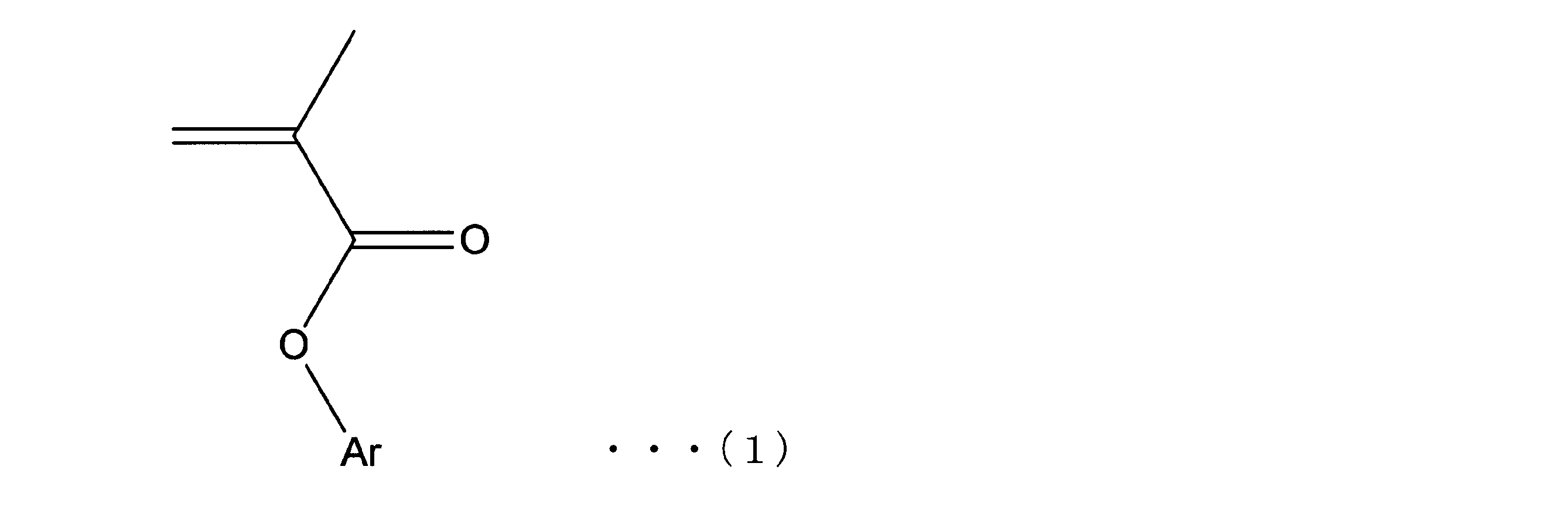
本発明の(メタ)アクリレート樹脂材料は、上述した効果を発揮することから、ポリカーボネート樹脂の表面硬度向上剤として好適に用いることができる。
そして、本発明の表面硬度向上剤にあっては、本発明の(メタ)アクリレート樹脂材料と同様の効果を発揮することができる。
本発明の表面硬度向上剤は、粘度平均分子量が16000~25000のポリカーボネート樹脂(D)100質量部に対し、表面硬度向上剤を25質量部配合し、成形して得られた厚さ2mmの成形体において、JIS K 5600-5-4に準拠し測定した鉛筆硬度がF以上が好ましい。
本発明の表面硬度向上剤は、粘度平均分子量が16000~25000のポリカーボネート樹脂(D)100質量部に対し、表面硬度向上剤を25質量部配合し、成形して得られた厚さ2mmの成形体において、JIS K 7136に準拠し測定したヘーズは0.5%以下が好ましく、0.45%以下がより好ましく、0.4%以下がさらに好ましい。
本発明の表面硬度向上剤は、粘度平均分子量が16000~25000のポリカーボネート樹脂(D)100質量部に対し、表面硬度向上剤を25質量部配合し、住友重機械工業(株)製100t射出成形機SE-100DUを用い、射出温度280℃、金型温度80℃、射出圧力95MPaにて成形して得られた、JIS K7162に記載の1A形の成形体において、成形体の白化が発生している箇所を含む16mm×12mmの領域のヘーズは25%以下が好ましく、20%以下がより好ましく、17%以下がさらに好ましい。
本発明のポリカーボネート樹脂組成物は、ポリカーボネート樹脂(D)と、本発明の(メタ)アクリレート樹脂材料とを含む。本発明のポリカーボネート樹脂組成物は、必要に応じてポリカーボネート樹脂(D)および本発明の(メタ)アクリレート樹脂材料以外の他の成分を含んでいてもよい。
ポリカーボネート樹脂(D)は、主鎖に炭酸エステル結合(-O-C(O)-O-)を有する高分子化合物であればよく、特に制限はない。
ポリカーボネート樹脂(D)としては、通常、2価フェノールとカーボネート前駆体との反応によって製造される芳香族ポリカーボネートが挙げられる。具体的には、2価フェノールとカーボネート前駆体とを溶液法または溶融法によって反応させて製造されたものが挙げられ、より具体的には、2価フェノールとホスゲンとを反応させて製造されたもの、2価フェノールとジフェニルカーボネート等とをエステル交換法によって反応させて製造されたものが挙げられる。
2価フェノールとしては、コストの点から、ビス(ヒドロキシフェニル)アルカン系が好ましく、ビスフェノールAが特に好ましい。
2価フェノールは、1種を単独で用いてもよく、2種以上を併用してもよい。
ポリカーボネート樹脂(D)は、エステル前駆体、すなわちテレフタル酸等の2官能性カルボン酸またはそのエステル形成誘導体等の存在下で、2価フェノールとカーボネート前駆体とを反応させて得られるポリエステル-ポリカーボネート樹脂であってもよい。ポリカーボネート樹脂(D)がポリエステル-ポリカーボネート樹脂である場合、ポリカーボネート樹脂(D)の総質量のうちポリエステル部は1~50質量%であることが好ましい。
ポリカーボネート樹脂(D)は、種々のポリカーボネート樹脂の混合物であってもよい。
ポリカーボネート樹脂(D)の粘度平均分子量は、粘度法により算出することができ、15000~30000が好ましく、16000~27000がより好ましく、17000~25000がさらに好ましい。粘度平均分子量が前記範囲内であれば、ポリカーボネート樹脂組成物の成形性および成形体の表面硬度が優れる。
分子量調節のためにフェノール、p-t-ブチルフェノール、p-t-オクチルフェノール、p-クミルフェノール等を用いる場合、これらのポリカーボネート樹脂(D)の総質量に対する割合は、例えば1~50質量%である。
本発明のポリカーボネート樹脂組成物は、必要に応じて酸化防止剤、紫外線吸収剤、光安定剤、難燃化剤等の各種添加剤、ガラス、マイカ、タルク、ゴム粒子等の各種フィラー等を含んでいてもよい。
本発明のポリカーボネート樹脂組成物は、本発明の効果を損なわない範囲において、ポリカーボネート樹脂以外の他の樹脂を含んでいてもよい。
GC装置注入口温度:280℃
分離カラム:DB-5(長さ30m×内径0.25mm×膜厚0.25μm)
GC装置オーブン温度:50℃(2分間保持)→10℃/分で昇温→320℃(11分間保持)
GC-MS装置インターフェイス温度:280℃
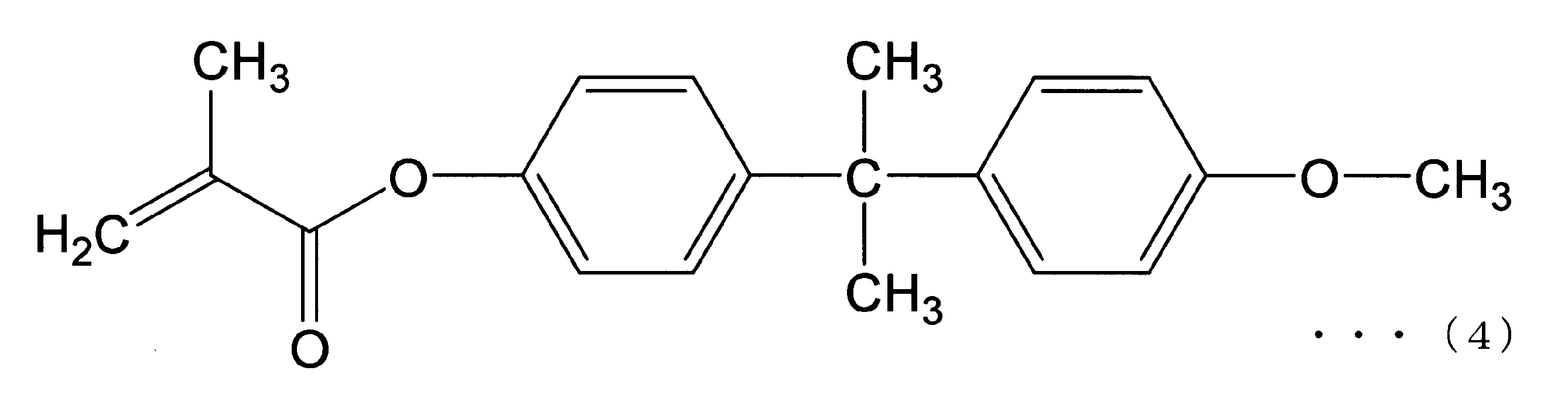
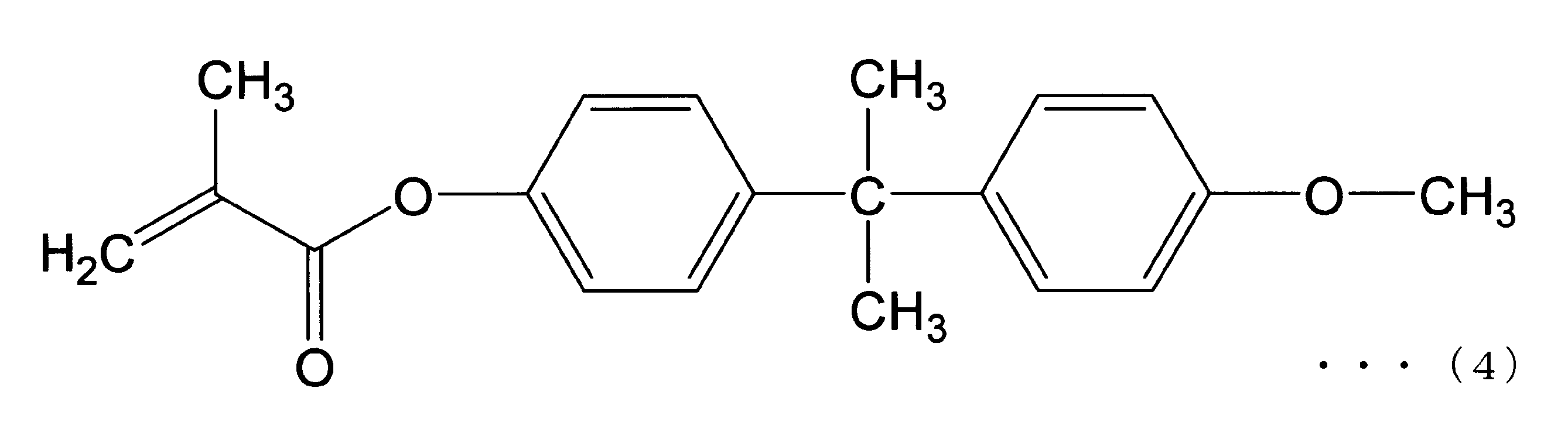
例えば、交換化合物が存在する場合、交換化合物の反応熱分解生成物に由来するピークが観測される。交換化合物の反応熱分解生成物に由来するピークとしては、例えば、下記式(3)で表されるビスフェノールAジメチルエーテルに由来する保持時間19.3分のピーク、および下記式(4)で表されるメタクリル酸ビスフェノールAメチルエーテルに由来する保持時間22.1分のピークが挙げられる。

本発明のポリカーボネート樹脂組成物は、ポリカーボネート樹脂(D)と、本発明の(メタ)アクリレート樹脂材料と、必要に応じて他の成分とを溶融混練することによって製造することができる。
溶融混練装置としては、例えば、バンバリーミキサ、ニーダ、ロール、ニーダールーダ、単軸押出機、二軸押出機、多軸押出機等が挙げられる。
本発明のポリカーボネート樹脂組成物は、ポリカーボネート樹脂(D)100質量部に対し、(メタ)アクリレート樹脂材料0.1~60質量部を溶融混練して製造することができる。
また、本発明のポリカーボネート樹脂組成物は、予めポリカーボネート樹脂(D)100質量部に対し、(メタ)アクリレート樹脂材料1~300質量部と、必要に応じて他の成分とを溶融混練し、得られたポリカーボネート樹脂組成物に、ポリカーボネート樹脂(D)を、さらに1~400質量部配合し、溶融混練して製造することができる。
本発明の(メタ)アクリレート樹脂材料の含有量は、ポリカーボネート樹脂(D)の100質量部に対して、0.1~60質量部が好ましく、10~50質量部がより好ましく、20~45質量部がさらに好ましい。(メタ)アクリレート樹脂材料の含有量が0.1質量部以上であれば、成形体の表面硬度がさらに優れる。(メタ)アクリレート樹脂材料の含有量が60質量部以下であれば、成形体の光学特性、すなわち(透明性等)がさらに優れる。
また、本発明のポリカーボネート樹脂組成物は、本発明の(メタ)アクリレート樹脂材料がメチルメタクリレートに由来する構成単位(a2)を有する(メタ)アクリレート重合体を含むため、本発明のポリカーボネート樹脂組成物を成形した場合、表面硬度に優れる成形体を得ることができる。
また、本発明のポリカーボネート樹脂組成物にあっては、本発明の(メタ)アクリレート樹脂材料が下記式(1)に由来する構成単位(a1)を有する(メタ)アクリレート重合体を含むため、本発明のポリカーボネート樹脂組成物を成形した場合、光学特性、すなわち透明性に優れる成形体を得ることができる。

本発明の成形体は、本発明のポリカーボネート樹脂組成物を成形して得られたものである。
成形方法としては、射出成形法、押出成形法、圧縮成形法等の公知の方法が挙げられる。成形方法としては、所望の形状に成形できる点から、射出成形法、押出成形法が好ましい。
また、本発明の成形体にあっては、本発明のポリカーボネート樹脂組成物を成形して得られたものであるため、光学特性、すなわち透明性に優れる。
重合体の各構成単位の割合は、単量体の仕込み量から計算した。
テトラヒドロフラン(THF)に溶解した重合体について、テトラヒドロフランを溶離液とし、カラム温度40℃において、ゲル浸透クロマトグラフィ(GPC)によって溶出曲線を測定し、標準ポリスチレンによる検量線を基に重合体の質量平均分子量を算出した。
成形体の成形不良については、厚さ4mmの成形体を目視により観察し、成形体に発生した白化の程度から下記基準によって評価した。
A:比較例1と比較し、白化が改善した。
B:比較例1と白化が同程度であった。
C:比較例1と比較し、白化が悪化した。
ヘーズメーターNDH2000(日本電色工業(株)製)を使用し、JIS K 7136に準拠して、JIS K7162-1A型成形体において、成形体の白化が発生している箇所を含む16mm×12mmの領域のヘーズを測定した。
JIS K 5600-5-4に準拠し、厚さ2mmの成形体の表面の鉛筆硬度を測定した。
ヘーズメーターNDH2000(日本電色工業(株)製)を使用し、JIS K 7136に準拠して厚さ2mmの成形体のヘーズを測定した。
ポリカーボネート樹脂組成物200μgと、水酸化テトラメチルアンモニウム(TMAH)の20%メタノール溶液5μLを混合した。400℃に設定した熱分解装置に混合物を導入し、試料とTMAHとを反応熱分解した。反応熱分解により生成したガスはGC-MS装置(フロンティアラボ社製PY-3030型)へ導入され、ガスクロマトグラフ(GC)装置内のカラムにより成分ごとに分離され、質量分析(MS)装置により分析されて、質量スペクトルを得た。GC-MS装置の測定条件は、以下の通りとした。
GC装置注入口温度:280℃
分離カラム:DB-5(長さ30m×内径0.25mm×膜厚0.25μm)
GC装置オーブン温度:50℃(2分間保持)→10℃/分で昇温→320℃(11分間保持)
GC-MS装置インターフェイス温度:280℃
キャリアーガス:ヘリウムガス
流速:コンスタントフロー条件下にて1ml/分
分散剤の合成:
撹拌機、冷却管および温度計を備えた容量1200Lの反応容器内に、17質量%水酸化カリウム水溶液の61.6部、メチルメタクリレート(三菱レイヨン社製、アクリエステルM)の19.1部および脱イオン水の19.3部を仕込んだ。反応装置内の液を室温にて撹拌し、発熱ピークを確認した後、さらに4時間撹拌した。この後、反応装置内の反応液を室温まで冷却してメタクリル酸カリウム水溶液を得た。
撹拌機、冷却管および温度計を備えた重合装置中に、脱イオン水の200部、硫酸ナトリウム(Na2SO4)の0.3部および分散剤(固形分10質量%)の0.26部を入れて撹拌して、均一な水溶液とした。構成単位(a1)を構成する化合物としてフェニルメタクリレート(三菱レイヨン社製、アクリエステルPH)の20.3部、構成単位(a2)を構成する化合物としてメチルメタクリレート(三菱レイヨン社製、アクリエステルM)の79.7部、構成単位(a3)を構成する化合物としてメチルアクリレート(和光純薬工業社製、試薬特級)の1.52部、構成単位(b1)を構成する酸(B)としてメタクリル酸(三菱レイヨン社製)の0.28部、連鎖移動剤として1-オクタンチオール(東京化成工業社製)の2部および重合開始剤として2,2-アゾビス-2-メチルブチロニトリル(日油社製、AMBN)の0.3部を重合装置中の水溶液にさらに加え、水性分散液とした。重合装置内を十分に窒素置換し、水性分散液を75℃に昇温してから3時間保持した後に85℃に昇温して1.5時間保持した。水性分散液を40℃に冷却して、重合体の水性懸濁液を得た。この水性懸濁液を濾過布で濾過し、濾過物を脱イオン水で洗浄し、75℃で18時間乾燥して、重合体を得た。得られた重合体を(メタ)アクリレート樹脂材料(β1)とした。(メタ)アクリレート樹脂材料(β1)を構成する重合体の各構成単位の割合および質量平均分子量を表1に示す。

ポリカーボネート樹脂(D)(三菱エンジニアリングプラスチックス社製、ユーピロンS-2000F)の100部および(メタ)アクリレート樹脂材料(β1)の25部をポリエチレン製の袋に入れ、ポリエチレン製の袋を手でよく振ることによりこれらを混合した。得られた混合物を、二軸押出機(池貝社製、PCM35)を用いて280℃で溶融混練し、押出されたストランドをカットし、ペレットを得た。
ペレットを、射出成形機(住友重機械工業社製、SE100DU)を用いて成形温度280℃および金型温度80℃で成形し、各評価に応じた厚さのシート状の成形体を得た。評価結果を表2に示す。

表1に記載の通りに各組成を変更した以外は実施例1と同様の操作を行い、(メタ)アクリレート樹脂材料(β2)~(β10)を得た。(メタ)アクリレート樹脂材料(β2)~(β10)を構成する各構成単位の割合および質量平均分子量を表1に示す。
なお、実施例7においては、アクリル酸(和光純薬工業社製、試薬特級)を用いた。
実施例8~10においては、構成単位(c1)を構成する求核剤(C)として不飽和脂肪酸ヒドロキシアルキルエステル修飾ε-カプロラクトン(ダイセル社製、プラクセルFM5)を用いた。求核剤(C)は、重合装置内の窒素置換を行う前に水性分散液に加えた。
さらに、ポリカーボネート樹脂(D)と、(メタ)アクリレート樹脂材料(β2)~(β10)とを用いて本発明のポリカーボネート樹脂組成物を作成した。(メタ)アクリレート樹脂材料の種類および配合量を表2の通りに変更した以外は実施例1と同様の操作を行い、各評価に応じた厚さのシート状の成形体を得た。評価結果を表2に示す。
表1に記載の通りに各組成を変更したこと以外は実施例1と同様の操作を行って重合体を得た。得られた重合体に、さらに求核剤(C)を混合し、(メタ)アクリレート樹脂材料(α1)~(α4)、(β15)を得た。(メタ)アクリレート樹脂材料(α1)~(α4)、(β15)を構成する重合体の各構成単位の割合および質量平均分子量、並びに求核剤(C)の量を表1に示す。
なお、実施例11、12、15においては求核剤(C)としてビスフェノールA(東京化成工業社製)を用い、実施例13、14においては求核剤(C)としてビスフェノールA・プロピレンオキシド付加物(製品名:アデカポリエーテルBPX-55アデカ社製)を用いた。
さらに、ポリカーボネート樹脂(D)と、(メタ)アクリレート樹脂材料(α1)~(α4)、(β15)とを用いて本発明のポリカーボネート樹脂組成物を作成した。(メタ)アクリレート樹脂材料の種類および配合量を表2の通りに変更した以外は実施例1と同様の操作を行い、各評価に応じた厚さのシート状の成形体を得た。評価結果を表2に示す。
実施例15で得られたポリカーボネート樹脂組成物について、図1で表されるように熱分解測定を実施した。その結果、質量スペクトルの保持時間19.3分および22.1分にピークを確認した。これら保持時間19.3分および22.1分のピークを形成した試料についてそれぞれ質量分析を行った結果、保持時間19.3分の試料は式(3)で表される化合物、保持時間22.1分の試料は式(4)で表される化合物に帰属された。質量分析の結果は図2、3に示される通りである。
構成単位(b1)を構成する化合物を用いないこと以外は実施例1と同様の操作を行って重合体を得た。さらに、得られた重合体と、酸(B)としてステアリン酸(和光純薬工業社製)を(メタ)アクリレート樹脂材料(α6)の構成成分として、ポリカーボネート樹脂(D)と同時に、表2に記載の割合にて混合すること以外は、実施例1と同様にポリカーボネート樹脂組成物を作成した。実施例1と同様の操作を行い、各評価に応じた厚さのシート状の成形体を得た。(メタ)アクリレート樹脂材料(α6)を構成する重合体の各構成単位の割合および質量平均分子量、並びに用いた酸(B)の量を表1に示す。また、評価結果を表2に示す。
表1の通りに各組成を変更した以外は、実施例1と同様の操作を行い、(メタ)アクリレート樹脂材料(γ1)~(γ4)を得た。(メタ)アクリレート樹脂材料(γ1)~(γ4)の各構成単位の割合および質量平均分子量、並びに酸(B)および求核剤(C)の量を表1に示す。
なお、比較例3においては構成成分(b1)を構成する酸(B)としてメタクリル酸(三菱レイヨン社製)、比較例4においては求核剤(C)としてビスフェノールA(東京化成工業社製)を用いた。
さらに、ポリカーボネート樹脂(D)と、(メタ)アクリレート樹脂材料(γ1)~(γ4)とを用いて本発明のポリカーボネート樹脂組成物を作成した。(メタ)アクリレート樹脂材料の種類および配合量を表2の通りに変更した以外は実施例1と同様の操作を行い、各評価に応じた厚さのシート状の成形体を得た。評価結果を表2に示す。
ポリカーボネート樹脂(D)100質量部および(メタ)アクリレート樹脂材料(β7)100質量部をポリエチレン製の袋に入れ、ポリエチレン製の袋を手でよく振って混合した。得られた混合物を、二軸押出機(池貝社製、PCM35)を用いて280℃で溶融混練し、押出されたストランドをカットし、ペレットを得た。得られたペレット100質量部に、さらにポリカーボネート樹脂(D)150質量部加え、ポリエチレン製の袋に入れ、ポリエチレン製の袋を手でよく振って混合した。得られた混合物を、二軸押出機を用いて280℃で溶融混練し、押出されたストランドをカットし、ペレットを得た。これをマスターバッチとする。
ペレットを、射出成形機を用いて成形温度280℃および金型温度80℃で成形し、各評価に応じた厚さのシート状の成形体を得た。評価結果を表3に示す。
(実施例18)
(メタ)アクリレート樹脂材料(β7)のかわりに(メタ)アクリレート樹脂材料(β15)を用いた以外は、実施例17と同様の操作を行い、各評価に応じた厚さのシート状の成形体を得た。評価結果を表3に示す。

比較例2~4は、重合体(A1)および重合体(A2)以外の重合体を用いたため、成形体の成形不良の程度が大きかった。
比較例5は、表面硬度向上剤を用いていないため、鉛筆硬度が不十分であった。
Claims (26)
- 下記式(1)の化合物に由来する構成単位(a1)およびメチルメタクリレートに由来する構成単位(a2)を有する重合体(A1)と、酸(B)および求核剤(C)の少なくとも一つ以上とからなる、(メタ)アクリレート樹脂材料。

- 下記式(1)の化合物に由来する構成単位(a1)、メチルメタクリレートに由来する構成単位(a2)、並びに酸(B)に由来する構成単位(b1)および求核剤(C)に由来する構成単位(c1)の少なくとも一つ以上を有する重合体(A2)を含む、(メタ)アクリレート樹脂材料。

- さらに酸(B)および求核剤(C)の少なくとも一つ以上を含む、請求項2に記載の(メタ)アクリレート樹脂材料。
- 前記構成単位(a1)が、フェニルメタクリレートに由来する構成単位および2-ナフチルメタクリレートに由来する構成単位の少なくとも一つ以上である、請求項1~3のいずれか一項に記載の(メタ)アクリレート樹脂材料。
- 前記構成単位(a1)の割合が、前記構成単位(a1)および前記構成単位(a2)の合計100質量%のうち、5~50質量%である、請求項1~3のいずれか一項に記載の(メタ)アクリレート樹脂材料。
- 前記構成単位(a1)の割合が、前記構成単位(a1)および前記構成単位(a2)の合計100質量%のうち、5~25質量%である、請求項1~3のいずれか一項に記載の(メタ)アクリレート樹脂材料。
- 前記構成単位(a2)の割合が、前記構成単位(a1)および前記構成単位(a2)の合計100質量%のうち、50~95質量%である、請求項1~3のいずれか一項に記載の(メタ)アクリレート樹脂材料。
- 前記酸(B)が、カルボキシル基を有する化合物である、請求項1~3のいずれか一項に記載の(メタ)アクリレート樹脂材料。
- 前記酸(B)が、メタクリル酸およびアクリル酸の少なくとも一つ以上である、請求項1~3のいずれか一項に記載の(メタ)アクリレート樹脂材料。
- 前記酸(B)の含有量が、前記構成単位(a1)および前記構成単位(a2)の合計100質量部に対して、0.02~10質量部である、請求項1に記載の(メタ)アクリレート樹脂材料。
- 前記構成単位(b1)の含有量または酸(B)をさらに含む場合は前記酸(B)および前記構成単位(b1)の合計含有量が、前記構成単位(a1)および前記構成単位(a2)の合計100質量部に対して、0.02~10質量部である、請求項2または3に記載の(メタ)アクリレート樹脂材料。
- 前記求核剤(C)が、ヒドロキシ基を有する化合物である、請求項1~3のいずれか一項に記載の(メタ)アクリレート樹脂材料。
- 前記求核剤(C)が、分子内に下記式(2)で表される構造を有する化合物である、請求項1~3のいずれか一項に記載の(メタ)アクリレート樹脂材料。
- 前記求核剤(C)が、分子内にポリカーボネート樹脂と反応する化学構造を有する化合物である、請求項1~3のいずれか一項に記載の(メタ)アクリレート樹脂材料。
- 前記求核剤(C)の含有量が、前記重合体(A1)100質量部に対して、0.001~10質量部である、請求項1に記載の(メタ)アクリレート樹脂材料。
- 前記構成単位(c1)の含有量または求核剤(C)をさらに含む場合は前記求核剤(C)および前記構成単位(c1)の合計含有量が、前記重合体(A2)100質量部に対して、0.001~10質量部である、請求項2または3に記載の(メタ)アクリレート樹脂材料。
- 前記重合体(A1)または前記重合体(A2)の質量平均分子量が、5000~30000である、請求項1~3のいずれか一項に記載の(メタ)アクリレート樹脂材料。
- 請求項1~3のいずれか一項に記載の(メタ)アクリレート樹脂材料を含む表面硬度向上剤。
- ポリカーボネート樹脂(D)と、請求項1~3のいずれか一項に記載の(メタ)アクリレート樹脂材料とを含む、ポリカーボネート樹脂組成物。
- 請求項19に記載のポリカーボネート樹脂組成物を成形して得られた、成形体。
- 粘度平均分子量が16000以上25000以下のポリカーボネート樹脂(D)100質量部に対して、25質量部の請求項18に記載の表面硬度向上剤を含むポリカーボネート樹脂組成物を成形して得られた、厚さ2mmの成形体においてJIS K 5600-5-4に準拠し測定した鉛筆硬度がF以上となる、請求項18に記載の表面硬度向上剤。
- 粘度平均分子量が16000以上25000以下のポリカーボネート樹脂(D)100質量部に対して、25質量部の請求項18に記載の表面硬度向上剤を含むポリカーボネート樹脂組成物を成形して得られた、厚さ2mmの成形体においてJIS K 7136に準拠し測定したヘーズが0.5%以下となる、請求項18に記載の表面硬度向上剤。
- 粘度平均分子量が16000以上25000以下のポリカーボネート樹脂(D)100質量部に対して、25質量部の請求項18に記載の表面硬度向上剤を含むポリカーボネート樹脂組成物を成形して得られた、JIS K7162に記載の1A形の成形体において、成形体の白化が発生している箇所を含む16mm×12mmの領域のヘーズが25%以下である、請求項18に記載の表面硬度向上剤。
- 請求項19に記載のポリカーボネート樹脂組成物100質量部に対し、さらにポリカーボネート樹脂(D)を1~400質量部配合する、ポリカーボネート樹脂組成物の製造方法。
- ポリカーボネート樹脂組成物200μgに、水酸化テトラメチルアンモニウム(TMAH)の20%メタノール溶液5μLを加え、400℃に設定した熱分解装置にてポリカーボネート樹脂組成物とTMAHとを反応熱分解し、生成したガスを分離した場合、
得られる質量スペクトルの保持時間が19.3および22.1分の少なくとも一つ以上にピークを有するポリカーボネート樹脂組成物。 - 下記式(3)および下記式(4)の化学構造の少なくとも一つ以上に由来する構成単位を有する重合体を含む、請求項25に記載のポリカーボネート樹脂組成物。

Priority Applications (9)
| Application Number | Priority Date | Filing Date | Title |
|---|---|---|---|
| CN201910054398.XA CN109777071B (zh) | 2014-08-29 | 2015-08-28 | 聚碳酸酯树脂组合物 |
| JP2015545546A JP6679931B2 (ja) | 2014-08-29 | 2015-08-28 | (メタ)アクリレート樹脂材料、表面硬度向上剤、ポリカーボネート樹脂組成物および成形体 |
| CN202010311846.2A CN111363079B (zh) | 2014-08-29 | 2015-08-28 | (甲基)丙烯酸酯树脂材料、表面硬度改进剂、聚碳酸酯树脂组合物及成型体 |
| CN201580057698.3A CN107075224B (zh) | 2014-08-29 | 2015-08-28 | (甲基)丙烯酸酯树脂材料、表面硬度改进剂、聚碳酸酯树脂组合物及成型体 |
| KR1020177007953A KR101929135B1 (ko) | 2014-08-29 | 2015-08-28 | (메트)아크릴레이트 수지 재료, 표면 경도 향상제, 폴리카르보네이트 수지 조성물 및 성형체 |
| KR1020187028195A KR101981025B1 (ko) | 2014-08-29 | 2015-08-28 | (메트)아크릴레이트 수지 재료, 표면 경도 향상제, 폴리카르보네이트 수지 조성물 및 성형체 |
| EP15835322.7A EP3196249B1 (en) | 2014-08-29 | 2015-08-28 | (meth)acrylate resin material, surface hardness enhancer, polycarbonate resin composition, and molded article |
| US15/506,403 US10513606B2 (en) | 2014-08-29 | 2015-08-28 | (Meth)acrylate resin material, surface hardness enhancer, polycarbonate resin composition, and molded article |
| US16/506,240 US11098193B2 (en) | 2014-08-29 | 2019-07-09 | (Meth)acrylate resin material, surface hardness enhancer, polycarbonate resin composition, and molded article |
Applications Claiming Priority (6)
| Application Number | Priority Date | Filing Date | Title |
|---|---|---|---|
| JP2014175471 | 2014-08-29 | ||
| JP2014-175471 | 2014-08-29 | ||
| JP2014-177274 | 2014-09-01 | ||
| JP2014177274 | 2014-09-01 | ||
| JP2014229713 | 2014-11-12 | ||
| JP2014-229713 | 2014-11-12 |
Related Child Applications (2)
| Application Number | Title | Priority Date | Filing Date |
|---|---|---|---|
| US15/506,403 A-371-Of-International US10513606B2 (en) | 2014-08-29 | 2015-08-28 | (Meth)acrylate resin material, surface hardness enhancer, polycarbonate resin composition, and molded article |
| US16/506,240 Division US11098193B2 (en) | 2014-08-29 | 2019-07-09 | (Meth)acrylate resin material, surface hardness enhancer, polycarbonate resin composition, and molded article |
Publications (1)
| Publication Number | Publication Date |
|---|---|
| WO2016031967A1 true WO2016031967A1 (ja) | 2016-03-03 |
Family
ID=55399850
Family Applications (1)
| Application Number | Title | Priority Date | Filing Date |
|---|---|---|---|
| PCT/JP2015/074447 Ceased WO2016031967A1 (ja) | 2014-08-29 | 2015-08-28 | (メタ)アクリレート樹脂材料、表面硬度向上剤、ポリカーボネート樹脂組成物および成形体 |
Country Status (7)
| Country | Link |
|---|---|
| US (2) | US10513606B2 (ja) |
| EP (1) | EP3196249B1 (ja) |
| JP (1) | JP6679931B2 (ja) |
| KR (2) | KR101981025B1 (ja) |
| CN (4) | CN107075224B (ja) |
| TW (2) | TWI678377B (ja) |
| WO (1) | WO2016031967A1 (ja) |
Citations (8)
| Publication number | Priority date | Publication date | Assignee | Title |
|---|---|---|---|---|
| JPS61145260A (ja) * | 1984-12-18 | 1986-07-02 | Mitsubishi Rayon Co Ltd | アクリル系被覆用材料 |
| JPH0657157A (ja) * | 1992-03-13 | 1994-03-01 | Mitsubishi Rayon Co Ltd | 重合体粒子及びその製法並びに義歯床用組成物 |
| JP2001066728A (ja) * | 1999-08-27 | 2001-03-16 | Konica Corp | 熱現像感光材料とそれを用いた画像形成方法 |
| JP2002080676A (ja) * | 2000-09-05 | 2002-03-19 | Nippon Shokubai Co Ltd | アクリル系樹脂層とポリカーボネート系樹脂層からなる積層体のリサイクル方法 |
| JP2012207164A (ja) * | 2011-03-30 | 2012-10-25 | Teijin Chem Ltd | ウエルド外観および表面硬度に優れた芳香族ポリカーボネート樹脂組成物 |
| JP2013534942A (ja) * | 2010-06-08 | 2013-09-09 | エルジー・ケム・リミテッド | 耐熱性・高強度のアクリル系共重合体及びそれを含む光学フィルム |
| JP2013241621A (ja) * | 2007-12-18 | 2013-12-05 | Cheil Industries Inc | 屈折率に優れた分岐型アクリル共重合体およびその製造方法 |
| JP2014065901A (ja) * | 2012-09-05 | 2014-04-17 | Mitsubishi Chemicals Corp | ポリカーボネート樹脂組成物およびその成形品 |
Family Cites Families (16)
| Publication number | Priority date | Publication date | Assignee | Title |
|---|---|---|---|---|
| US4158053A (en) * | 1977-08-05 | 1979-06-12 | Eli Lilly And Company | Aqueous emulsion polymer nail coating formulations |
| DE3719239A1 (de) * | 1987-06-06 | 1988-12-15 | Roehm Gmbh | Vertraegliche polycarbonat-polymethacrylat-mischungen |
| EP0584376A1 (en) | 1992-03-13 | 1994-03-02 | Mitsubishi Rayon Co., Ltd. | Spherical particle as dental plate material, production thereof, and dental plate resin composition |
| EP0716344A1 (en) * | 1994-12-05 | 1996-06-12 | Konica Corporation | Light-sensitive composition and light-sensitive lithographic printing plate using the same |
| JPWO2003072620A1 (ja) * | 2002-02-28 | 2005-06-23 | 三菱レイヨン株式会社 | 熱可塑性樹脂組成物、及びエンジニアリングプラスチック組成物 |
| US20050202096A1 (en) * | 2004-03-09 | 2005-09-15 | Jun Li | Microcapsules for encapsulation of bioactive substances |
| JP4914027B2 (ja) * | 2005-06-08 | 2012-04-11 | 出光興産株式会社 | 光拡散性ポリカーボネート系樹脂組成物、および同樹脂組成物を用いた光拡散板 |
| US8202943B2 (en) | 2006-12-25 | 2012-06-19 | Mitsubishi Rayon Co., Ltd. | Fluidity-improving agent, aromatic polycarbonate resin composition, and shaped article thereof |
| KR20090039612A (ko) * | 2007-10-18 | 2009-04-22 | 제일모직주식회사 | 메타크릴계 공중합체, 그 제조방법 및 이를 이용한 메타크릴계 수지 조성물 |
| FR2925059B1 (fr) * | 2007-12-13 | 2012-08-17 | Armines | Procede de preparation d'un materiau polymere transparent comprenant un polycarbonate thermoplastique et des nanoparticules minerales modifiees en surface. |
| JPWO2009110091A1 (ja) * | 2008-03-07 | 2011-07-14 | 綜研化学株式会社 | 光拡散性樹脂組成物およびこれを利用した光拡散シート |
| JP5357019B2 (ja) * | 2008-03-11 | 2013-12-04 | 三菱レイヨン株式会社 | 芳香族ポリカーボネート樹脂用流動性向上剤及びその製造方法、芳香族ポリカーボネート樹脂組成物、並びに成形体 |
| JP2010116501A (ja) | 2008-11-13 | 2010-05-27 | Mitsubishi Rayon Co Ltd | 表面硬度向上剤、熱可塑性樹脂組成物及びその成形体 |
| CN102311624A (zh) * | 2010-09-30 | 2012-01-11 | 深圳市科聚新材料有限公司 | 一种耐刮擦聚碳酸酯手机料及其制备方法 |
| CN104769039B (zh) * | 2012-09-05 | 2016-08-24 | 三菱化学株式会社 | 聚碳酸酯树脂组合物及其成型品 |
| JP6000816B2 (ja) * | 2012-11-16 | 2016-10-05 | 住化スタイロンポリカーボネート株式会社 | 表層材用ポリカーボネート樹脂組成物 |
-
2015
- 2015-08-28 KR KR1020187028195A patent/KR101981025B1/ko active Active
- 2015-08-28 US US15/506,403 patent/US10513606B2/en active Active
- 2015-08-28 CN CN201580057698.3A patent/CN107075224B/zh active Active
- 2015-08-28 TW TW104128278A patent/TWI678377B/zh active
- 2015-08-28 WO PCT/JP2015/074447 patent/WO2016031967A1/ja not_active Ceased
- 2015-08-28 CN CN201910054398.XA patent/CN109777071B/zh active Active
- 2015-08-28 EP EP15835322.7A patent/EP3196249B1/en active Active
- 2015-08-28 KR KR1020177007953A patent/KR101929135B1/ko active Active
- 2015-08-28 JP JP2015545546A patent/JP6679931B2/ja active Active
- 2015-08-28 TW TW108101752A patent/TWI665224B/zh active
- 2015-08-28 CN CN202010311846.2A patent/CN111363079B/zh active Active
- 2015-08-28 CN CN201910054408.XA patent/CN109777072B/zh active Active
-
2019
- 2019-07-09 US US16/506,240 patent/US11098193B2/en active Active
Patent Citations (8)
| Publication number | Priority date | Publication date | Assignee | Title |
|---|---|---|---|---|
| JPS61145260A (ja) * | 1984-12-18 | 1986-07-02 | Mitsubishi Rayon Co Ltd | アクリル系被覆用材料 |
| JPH0657157A (ja) * | 1992-03-13 | 1994-03-01 | Mitsubishi Rayon Co Ltd | 重合体粒子及びその製法並びに義歯床用組成物 |
| JP2001066728A (ja) * | 1999-08-27 | 2001-03-16 | Konica Corp | 熱現像感光材料とそれを用いた画像形成方法 |
| JP2002080676A (ja) * | 2000-09-05 | 2002-03-19 | Nippon Shokubai Co Ltd | アクリル系樹脂層とポリカーボネート系樹脂層からなる積層体のリサイクル方法 |
| JP2013241621A (ja) * | 2007-12-18 | 2013-12-05 | Cheil Industries Inc | 屈折率に優れた分岐型アクリル共重合体およびその製造方法 |
| JP2013534942A (ja) * | 2010-06-08 | 2013-09-09 | エルジー・ケム・リミテッド | 耐熱性・高強度のアクリル系共重合体及びそれを含む光学フィルム |
| JP2012207164A (ja) * | 2011-03-30 | 2012-10-25 | Teijin Chem Ltd | ウエルド外観および表面硬度に優れた芳香族ポリカーボネート樹脂組成物 |
| JP2014065901A (ja) * | 2012-09-05 | 2014-04-17 | Mitsubishi Chemicals Corp | ポリカーボネート樹脂組成物およびその成形品 |
Non-Patent Citations (1)
| Title |
|---|
| See also references of EP3196249A4 * |
Also Published As
| Publication number | Publication date |
|---|---|
| TW201609830A (zh) | 2016-03-16 |
| KR101929135B1 (ko) | 2019-03-12 |
| US20200010673A1 (en) | 2020-01-09 |
| US10513606B2 (en) | 2019-12-24 |
| CN109777071B (zh) | 2022-05-31 |
| KR101981025B1 (ko) | 2019-05-21 |
| JP6679931B2 (ja) | 2020-04-15 |
| US20170253736A1 (en) | 2017-09-07 |
| TW201920313A (zh) | 2019-06-01 |
| KR20180110229A (ko) | 2018-10-08 |
| CN111363079B (zh) | 2022-12-02 |
| CN109777072B (zh) | 2021-12-07 |
| US11098193B2 (en) | 2021-08-24 |
| TWI665224B (zh) | 2019-07-11 |
| EP3196249B1 (en) | 2023-06-28 |
| CN109777071A (zh) | 2019-05-21 |
| KR20170045289A (ko) | 2017-04-26 |
| EP3196249A4 (en) | 2017-08-30 |
| JPWO2016031967A1 (ja) | 2017-06-08 |
| CN111363079A (zh) | 2020-07-03 |
| TWI678377B (zh) | 2019-12-01 |
| EP3196249A1 (en) | 2017-07-26 |
| CN109777072A (zh) | 2019-05-21 |
| CN107075224B (zh) | 2020-06-19 |
| CN107075224A (zh) | 2017-08-18 |
Similar Documents
| Publication | Publication Date | Title |
|---|---|---|
| JP5924457B2 (ja) | (メタ)アクリル系共重合体、樹脂組成物及びその成形体 | |
| JP6679931B2 (ja) | (メタ)アクリレート樹脂材料、表面硬度向上剤、ポリカーボネート樹脂組成物および成形体 | |
| JP2019104944A (ja) | 樹脂材料、表面硬度向上剤、ポリカーボネート樹脂組成物、成形体 | |
| JP2018070874A (ja) | 樹脂材料、表面硬度向上剤、ポリカーボネート樹脂組成物、成形体及びポリカーボネート樹脂組成物の製造方法 | |
| EP3733773A1 (en) | Polycarbonate resin composition and molded body thereof | |
| JP2015206051A (ja) | 成形体の製造方法 | |
| JP6311556B2 (ja) | 表面硬度向上剤、ポリカーボネート樹脂組成物および成形体 | |
| JP2016047937A (ja) | (メタ)アクリレート樹脂材料、ポリカーボネート樹脂組成物および成形体 | |
| JP2018076459A (ja) | ポリカーボネート樹脂組成物および成形体 | |
| JP2016128583A (ja) | (メタ)アクリレート樹脂材料、樹脂組成物および成形体 | |
| JP2018076543A (ja) | 重合体 | |
| JP2016129962A (ja) | 成形体の製造方法 | |
| JP2022178794A (ja) | ポリカーボネート樹脂組成物および成形体 | |
| JP6429762B2 (ja) | 表面硬度向上剤、熱可塑性樹脂組成物及びその成形体 | |
| JP2018083911A (ja) | 樹脂組成物及び成形体 | |
| JP2017132825A (ja) | (メタ)アクリレート樹脂材料、ポリカーボネート樹脂組成物および成形体 | |
| JP2014101404A (ja) | ポリカーボネート樹脂組成物 |
Legal Events
| Date | Code | Title | Description |
|---|---|---|---|
| ENP | Entry into the national phase |
Ref document number: 2015545546 Country of ref document: JP Kind code of ref document: A |
|
| 121 | Ep: the epo has been informed by wipo that ep was designated in this application |
Ref document number: 15835322 Country of ref document: EP Kind code of ref document: A1 |
|
| REEP | Request for entry into the european phase |
Ref document number: 2015835322 Country of ref document: EP |
|
| WWE | Wipo information: entry into national phase |
Ref document number: 2015835322 Country of ref document: EP Ref document number: 15506403 Country of ref document: US |
|
| NENP | Non-entry into the national phase |
Ref country code: DE |
|
| ENP | Entry into the national phase |
Ref document number: 20177007953 Country of ref document: KR Kind code of ref document: A |