WO2016035804A1 - 掻痒性皮膚疾患の治療又は予防剤 - Google Patents
掻痒性皮膚疾患の治療又は予防剤 Download PDFInfo
- Publication number
- WO2016035804A1 WO2016035804A1 PCT/JP2015/074906 JP2015074906W WO2016035804A1 WO 2016035804 A1 WO2016035804 A1 WO 2016035804A1 JP 2015074906 W JP2015074906 W JP 2015074906W WO 2016035804 A1 WO2016035804 A1 WO 2016035804A1
- Authority
- WO
- WIPO (PCT)
- Prior art keywords
- polypeptide
- amino acid
- expression
- acid sequence
- therapeutic
- Prior art date
- Legal status (The legal status is an assumption and is not a legal conclusion. Google has not performed a legal analysis and makes no representation as to the accuracy of the status listed.)
- Ceased
Links
Images


Classifications
-
- A—HUMAN NECESSITIES
- A61—MEDICAL OR VETERINARY SCIENCE; HYGIENE
- A61K—PREPARATIONS FOR MEDICAL, DENTAL OR TOILETRY PURPOSES
- A61K38/00—Medicinal preparations containing peptides
- A61K38/16—Peptides having more than 20 amino acids; Gastrins; Somatostatins; Melanotropins; Derivatives thereof
- A61K38/17—Peptides having more than 20 amino acids; Gastrins; Somatostatins; Melanotropins; Derivatives thereof from animals; from humans
- A61K38/1703—Peptides having more than 20 amino acids; Gastrins; Somatostatins; Melanotropins; Derivatives thereof from animals; from humans from vertebrates
- A61K38/1709—Peptides having more than 20 amino acids; Gastrins; Somatostatins; Melanotropins; Derivatives thereof from animals; from humans from vertebrates from mammals
- A61K38/1751—Bactericidal/permeability-increasing protein [BPI]
-
- A—HUMAN NECESSITIES
- A61—MEDICAL OR VETERINARY SCIENCE; HYGIENE
- A61K—PREPARATIONS FOR MEDICAL, DENTAL OR TOILETRY PURPOSES
- A61K38/00—Medicinal preparations containing peptides
-
- A—HUMAN NECESSITIES
- A61—MEDICAL OR VETERINARY SCIENCE; HYGIENE
- A61P—SPECIFIC THERAPEUTIC ACTIVITY OF CHEMICAL COMPOUNDS OR MEDICINAL PREPARATIONS
- A61P17/00—Drugs for dermatological disorders
- A61P17/04—Antipruritics
-
- A—HUMAN NECESSITIES
- A61—MEDICAL OR VETERINARY SCIENCE; HYGIENE
- A61P—SPECIFIC THERAPEUTIC ACTIVITY OF CHEMICAL COMPOUNDS OR MEDICINAL PREPARATIONS
- A61P37/00—Drugs for immunological or allergic disorders
- A61P37/08—Antiallergic agents
-
- A—HUMAN NECESSITIES
- A61—MEDICAL OR VETERINARY SCIENCE; HYGIENE
- A61P—SPECIFIC THERAPEUTIC ACTIVITY OF CHEMICAL COMPOUNDS OR MEDICINAL PREPARATIONS
- A61P43/00—Drugs for specific purposes, not provided for in groups A61P1/00-A61P41/00
-
- C—CHEMISTRY; METALLURGY
- C07—ORGANIC CHEMISTRY
- C07C—ACYCLIC OR CARBOCYCLIC COMPOUNDS
- C07C231/00—Preparation of carboxylic acid amides
- C07C231/02—Preparation of carboxylic acid amides from carboxylic acids or from esters, anhydrides, or halides thereof by reaction with ammonia or amines
-
- C—CHEMISTRY; METALLURGY
- C07—ORGANIC CHEMISTRY
- C07K—PEPTIDES
- C07K14/00—Peptides having more than 20 amino acids; Gastrins; Somatostatins; Melanotropins; Derivatives thereof
- C07K14/435—Peptides having more than 20 amino acids; Gastrins; Somatostatins; Melanotropins; Derivatives thereof from animals; from humans
-
- C—CHEMISTRY; METALLURGY
- C07—ORGANIC CHEMISTRY
- C07K—PEPTIDES
- C07K14/00—Peptides having more than 20 amino acids; Gastrins; Somatostatins; Melanotropins; Derivatives thereof
- C07K14/435—Peptides having more than 20 amino acids; Gastrins; Somatostatins; Melanotropins; Derivatives thereof from animals; from humans
- C07K14/46—Peptides having more than 20 amino acids; Gastrins; Somatostatins; Melanotropins; Derivatives thereof from animals; from humans from vertebrates
- C07K14/47—Peptides having more than 20 amino acids; Gastrins; Somatostatins; Melanotropins; Derivatives thereof from animals; from humans from vertebrates from mammals
-
- C—CHEMISTRY; METALLURGY
- C12—BIOCHEMISTRY; BEER; SPIRITS; WINE; VINEGAR; MICROBIOLOGY; ENZYMOLOGY; MUTATION OR GENETIC ENGINEERING
- C12N—MICROORGANISMS OR ENZYMES; COMPOSITIONS THEREOF; PROPAGATING, PRESERVING, OR MAINTAINING MICROORGANISMS; MUTATION OR GENETIC ENGINEERING; CULTURE MEDIA
- C12N15/00—Mutation or genetic engineering; DNA or RNA concerning genetic engineering, vectors, e.g. plasmids, or their isolation, preparation or purification; Use of hosts therefor
Definitions
- the present invention relates to a therapeutic or prophylactic agent for pruritic skin diseases such as atopic dermatitis.
- a normal epidermal barrier protects the body from various stimuli from the outside world and has a role of retaining appropriate moisture in the body.
- the epidermis is a physical barrier and at the same time, the epidermis has its own pathogen recognition / exclusion mechanism, and forms a natural immunity barrier that does not involve lymphocytes.
- epidermal keratinocytes produce antibacterial peptides, human ⁇ -defencin (hBD) and cathelicidin (Non-patent Documents 1 and 2). These peptides having a strong positive charge are inserted into the negatively charged bacterial cell membrane to form pores and exert a bactericidal action (Non-patent Document 3).
- LL-37 is well known as human cathelicidin. LL-37 is a peptide having an antibacterial activity of 37 amino acid residues at the C terminus, which is released by the degradation of the 18 kDa inactive protein hCAP18 by serine protease kallikrein.
- Non-Patent Document 4 In normal human epidermis, hBD-1, which has relatively weak antibacterial activity, is constitutively expressed, but other antibacterial peptides are induced during emergencies such as bacterial infection and inflammation due to bacterial contact, differentiation, cytokine stimulation, etc.
- Non-Patent Document 4 As an application of the antibacterial peptide, for example, a technique for inhibiting the growth and metastasis of cancer cells such as breast cancer cells has been developed (Patent Document 1).
- Antibacterial peptides produced by epidermal keratinocytes in the skin are increasing in psoriatic lesions, which is considered to be one of the causes of psoriasis and fewer skin infections.
- Staphylococcus aureus flora formation that is not seen in healthy people is seen, and even though the epidermis is inflamed, expression of antibacterial peptides is not induced compared to psoriatic lesions It has been reported (Non-Patent Document 5).
- This abnormal expression of antibacterial peptides in the epidermis of atopic dermatitis patients is considered to be one of the causes of extremely high growth of S. aureus and severe infection.
- toxins and proteases produced by Staphylococcus aureus are considered to contribute to the chronicity and severity of atopic dermatitis (Non-patent Document 6).
- nerve growth factor nerve growth factor [NGF]
- NGF nerve growth factor
- blended recombinant Sema3A suppressed the scratching behavior of the atopic dermatitis model animal, and also improved dermatitis (nonpatent literature 8).
- the nerve repulsion factor is a therapeutic target for intractable itching with intraepidermal nerve invasion.
- Patent Documents 1 and 2 there is no report on the relationship between Sema3A expression in an atopic dermatitis lesion and an antimicrobial peptide.
- Patent Document 2 discloses a technique that uses a compound that sequesters antibacterial peptides such as LL-37 in the treatment of skin diseases and skin disorders, and is a technique that uses a substance that sequesters LL-37 as an active ingredient.
- antibacterial peptides themselves such as LL-37 are not used as therapeutic agents for skin diseases.
- An object of the present invention is to provide a novel means capable of treating or preventing pruritic skin diseases such as atopic dermatitis.
- the antibacterial peptide LL-37 has an action of promoting the expression of nerve repulsion factors such as Sema3A and the like, and by using the antibacterial peptide, atopic dermatitis and the like
- the present invention was completed by finding that normal expression of axon guidance molecules such as nerve repulsion factors in lesions of pruritic skin diseases can be reduced, and that it is possible to reduce pruritus and improve skin lesions.
- the present invention provides a therapeutic or prophylactic agent for pruritic skin diseases comprising the following polypeptide (a) or (b) as an active ingredient.
- polypeptide a polypeptide having the amino acid sequence shown in SEQ ID NO: 1.
- the present invention also provides an expression promoter for Sema3A containing the following polypeptide (a) or (b ′) as an active ingredient.
- the present invention provides a method for treating or preventing pruritic skin diseases, which comprises administering an effective amount of the polypeptide (a) or (b) to a subject in need thereof. Furthermore, the present invention provides a method of promoting Sema3A expression, comprising administering an effective amount of the polypeptide (a) or (b ′) to a subject in need thereof.
- a novel therapeutic or preventive agent for pruritic skin diseases targeting axon guidance molecules has been provided.
- axon guidance molecules By locally administering the polypeptide to lesions of pruritic skin diseases such as atopic dermatitis, expression of axon guidance molecules can be normalized, and itching can be reduced and skin lesions can be improved.
- Conventional standard treatments used for pruritic skin diseases are steroids and antihistamines, but these can be used to suppress symptoms caused by allergic and inflammatory substances released as a result of allergic reactions. It is a remedy and symptomatic treatment.
- Such a drug cannot fundamentally improve the state in which many sensory nerve fibers have entered the epidermis and become hypersensitive to itching.
- the agent of the present invention targeting axon guidance molecules can enable the fundamental treatment of pruritus. Since the mechanism of action is different from that of conventional standard therapeutic agents, the agent of the present invention is expected to have a therapeutic effect on refractory atopic dermatitis in which steroids and antihistamines have become ineffective.
- the agent of the present invention is a therapeutic or prophylactic agent for pruritic skin diseases, and contains the following polypeptides as active ingredients.
- SEQ ID NO: 1 is the amino acid sequence of LL-37, a human cathelicidin.
- the present inventors have revealed that LL-37 has an action of suppressing the expression of nerve elongation factor and promoting the expression of nerve repulsion factor in epidermal keratinocytes. Furthermore, LL-37 was also found to be able to suppress the expression of cytokine TSLP in epidermal keratinocytes.
- Non-patent Document 7 Cytokine TSLP is highly expressed in lesions of atopic dermatitis (Soumelis et al, Nat Immunol, 2002: 3, -673-680). Recently, TSLP has been reported to induce not only inflammation but also pruritus. (Wilson et al, Cell, 2013: 155, 285-295).
- Non-patent Document 8 it is also known that by applying recombinant Sema3A to a lesioned part, itching is reduced and dermatitis is improved.
- LL-37 By applying LL-37 to skin disease lesions, the expression of axon guidance molecules and TSLP is normalized, and the pathological conditions of pruritic skin diseases such as atopic dermatitis can be effectively improved.
- a protein may have almost the same function as the original protein even when a small number of amino acid residues in the amino acid sequence of the protein are substituted, deleted, or inserted. It is widely known to those skilled in the art. Therefore, one or several (for example, 1 to 9, 1 to 8, 1 to 7, 1 to 6, 1 to 5, 1 to 4) in SEQ ID NO: 1 defined in (b) above.
- the polypeptide having an amino acid sequence in which 1 to 3, 1 to 2, or 1 amino acid is substituted, deleted, inserted or added is also capable of treating or preventing pruritic skin disease, It can be used for the treatment or prevention of pruritic skin diseases in the same manner as the polypeptide (a) (polypeptide having the same sequence as LL-37).
- the polypeptide of (b) may have a sequence identity with SEQ ID NO: 1 of 80% or more, 90% or more, or 95% or more.
- sequence identity means that both amino acid sequences are aligned so that the amino acid residues of the two amino acid sequences to be compared match as much as possible, and the number of matched amino acid residues is expressed by the total number of amino acid residues. The percentage is expressed as a percentage.
- sequence alignment can be performed using a known program such as BLAST, FASTA, CLUSTAL W, and the like. When gaps are inserted, the total number of amino acid residues is the number of residues obtained by counting one gap as one amino acid residue.
- the sequence identity is the total number of amino acid residues in the longer sequence, and the amino acid residues that match. Calculated by dividing the number.
- the 20 amino acids constituting the natural protein are neutral amino acids having low side chains (Gly, Ile, Val, Leu, Ala, Met, Pro), and neutral amino acids having hydrophilic side chains (Asn). , Gln, Thr, Ser, Tyr, Cys), acidic amino acids (Asp, Glu), basic amino acids (Arg, Lys, His), aromatic amino acids (Phe, Tyr, Trp) It is known that the properties of polypeptides often do not change if substitution is made within these groups.
- the treatment of pruritic skin diseases includes improvement of various symptoms of skin lesions such as improvement of pruritus and improvement of inflammatory skin lesions.
- prevention of pruritic skin disease includes, for example, prevention of the occurrence of skin lesions by improving pruritus.
- the agent of the present invention can also be used prophylactically before the occurrence of pruritus for a site where repeated pruritus has occurred.
- “Therapeutic or prophylactic activity of pruritic skin disease” means an activity of improving symptoms of skin lesions of pruritic skin diseases or preventing exacerbation of the symptoms.
- the antibacterial peptide such as cathelicidin has the effect of suppressing skin pruritus, as specifically shown in the following Examples. This effect is due to the fact that the antibacterial peptide such as cathelicidin is axon guidance molecule and cytokine TSLP in the lesion.
- epidermis-derived cultured cells such as human epidermis keratinocytes (preferably human epidermis-derived cultured cells )
- any polypeptide exhibits one or more of the above-described actions such as promotion of expression or production of nerve repulsion factor, suppression of expression or production of nerve elongation factor, suppression of expression of TSLP, etc. It can be evaluated by examining whether or not.
- the above therapeutic or prophylactic activity can be evaluated based on whether or not there is an action of promoting Sema3A expression or production in epidermis-derived cells.
- model animals exhibiting symptoms of pruritic skin diseases are known, and whether or not any polypeptide has therapeutic or prophylactic activity for pruritic skin diseases is determined by conducting administration experiments to such model animals. You can also investigate.
- NC / Nga mice are known as model animals that develop atopic dermatitis, a kind of pruritic skin disease.
- NC / Nga mice are widely used in the field as animal models of atopic dermatitis.
- the atopy When reared under normal breeding conditions, the atopy is applied to the face, ears, upper back, etc. from around 7 weeks of age. Develops dermatitis similar to dermatitis.
- the dry skin model mouse can be produced, for example, by shaving the back hair of an ICR mouse and then applying cotton soaked with an acetone solution to the skin for 5 minutes. Alternatively, it can also be produced by applying cotton impregnated with an acetone solution to the skin of Hos: HR-1 hairless mouse (hairless mouse) for 5 minutes.
- Evaluation of the treatment or prevention activity of pruritic skin disease using a model animal that develops atopic dermatitis can be achieved by, for example, administering a polypeptide to the skin lesion of a model animal by applying it to improve the symptoms of the lesion. This can be done by evaluating the presence or absence. For example, clinical skin score (Leung, Clin Exp Immunol 107 (Suppl. 1), 25-30, 1997; Suto et al., Int Arch Allergy Immunol 120 (Suppl. 1 ), 70-75, 1999).
- the polypeptide when the score average value of the onset individual group administered with the polypeptide for a certain period of time compared to the average score of the untreated disease onset group significantly decreased, or for example, the average score of the polypeptide administration group When the value is about 2/3 or less, preferably about 1/2 or less of the average score of the untreated population, the polypeptide is judged to have a therapeutic or prophylactic activity for pruritic skin diseases. it can.
- the evaluation of the therapeutic or prophylactic activity of pruritic skin diseases using atopic dermatitis model animals and dry skin model animals can be carried out as follows.
- the number of nerve fibers invading into the epidermis in the above disease model, the number of nerve fibers invading into the epidermis has increased
- abnormal expression of axon guidance molecules increased expression of nerve elongation factors NGF and amphiregulin
- the expression of the neural repulsion factor Sema3A is normalized compared to the untreated disease-causing population, it can be determined that the polypeptide has a therapeutic or prophylactic activity for pruritic skin diseases.
- pruritic skin disease examples include, but are not limited to, atopic dermatitis, xeroderma, nodular rash, chronic renal failure, cholestatic cirrhosis, primary biliary cirrhosis, dialysis pruritus, Examples include visceral malignant tumors.
- the agent of the present invention can be particularly preferably used for atopic dermatitis. Since the antibacterial activity of the polypeptide is expected to have a favorable effect on pathogens against skin pruritus associated with infections, the agent of the present invention is also used for the treatment or prevention of skin pruritus associated with infections.
- the pruritic skin disease targeted in the present invention may be a disease other than skin pruritus associated with infection.
- the pruritic skin disease targeted by the present invention may also be a disease other than psoriasis.
- polypeptide refers to a molecule formed by peptide bonding of a plurality of (two or more) amino acids, and includes not only high molecular weight molecules having a large number of amino acids but also the number of amino acids. Low molecular weight molecules (oligopeptides) and proteins are also included.
- a sugar chain or a polyethylene glycol (PEG) chain is added to the polypeptide, or at least amino acids constituting the polypeptide are added.
- PEG polyethylene glycol
- a technique of using a D-form amino acid as a part is widely known and used. By adding sugar chains or PEG chains, or by using D-form amino acids as at least part of the amino acids that make up the polypeptide, it is less susceptible to degradation by peptidases in vivo, reducing the polypeptide in vivo by half. The period becomes longer.
- polypeptide of the present invention may be subjected to these known modifications for in vivo stabilization as long as it has a therapeutic or prophylactic activity for pruritic skin diseases.
- polypeptide in is used to include those modified for in vivo stabilization unless the context clearly indicates otherwise.
- Glycosylation to polypeptides is well known, for example, Sato M, Furuike T, Sadamoto R, Fujitani N, Nakahara T, Niikura K, Monde K, Kondo H, Nishimura S., "Glycoinsulins: dendritic sialylolulins displaying a prolonged blood-sugar-lowering activity. ", J Am Chem Soc. 2004 Nov 3; 126 (43): 14013-22, Sato M, Sadamoto R, Niikura K, Monde K, Kondo H, Nishimura S," Site- specific introduction of sialic acid into insulin. ", Angew Chem Int Ed Engl. 2004 Mar 12; 43 (12): 1516-20.
- the sugar chain can be bound to the N-terminus, C-terminus, or an amino acid therebetween, but is preferably bound to the N-terminus or C-terminus so as not to inhibit the activity of the polypeptide.
- the number of sugar chains to be added is preferably 1 or 2, and preferably 1.
- the sugar chain is preferably monosaccharide to tetrasaccharide, more preferably disaccharide or trisaccharide.
- the sugar chain can be bound to a free amino group or carboxyl group of the polypeptide directly or via a spacer structure such as a methylene chain having about 1 to 10 carbon atoms.
- the PEG chain can be attached to the N-terminus, C-terminus, or the amino acid between them, and usually one or two PEG chains are attached to a free amino group or carboxyl group on the polypeptide.
- the molecular weight of the PEG chain is not particularly limited, but is usually 3000 to 7000. Degrees, preferably those of about 5000 is used.
- a method in which at least a part of amino acids constituting a polypeptide is D-form is also known, for example, BrennemanneDE, Spong CY, Hauser JM, Abebe D, Pinhasov A, Golian T, Gozes I., "Protective peptides that are orally active and mechanistically nonchiral. ", J Pharmacol Exp Ther. 2004 Jun; 309 (3): 1190-7 and Wilkemeyer MF, Chen SY, Menkari CE, Sulik KK, Charness ME.,” Ethanol antagonist peptides: structural specificity without "J. Pharmacol. Exp. Ther. 2004. Jun; 309 (3): 1183-9.
- a part of the amino acids constituting the polypeptide may be D-form, but since the activity of the polypeptide is not inhibited as much as possible, all of the amino acids constituting the polypeptide are D-form amino acids rather than only a part of the amino acids. It is preferable that
- polypeptide used as an active ingredient in the present invention can be easily prepared by a conventional method using, for example, a commercially available peptide synthesizer.
- the agent of the present invention may consist only of the above polypeptide, or a pharmacologically acceptable excipient, stabilizer, preservative, buffer, solubilizer, emulsifier suitable for each dosage form.
- additives such as diluents and tonicity agents may be mixed as appropriate to prepare the preparation. Formulation methods and usable additives are well known in the field of pharmaceutical formulations, and any method and additive can be used.
- the agent of the present invention is used by local administration to the skin lesion to be treated or the skin to be prevented.
- the local administration method include intradermal administration using injections, drops, etc., and local administration using ointments, creams, lotions, patches, and the like.
- the dosage is appropriately selected according to symptoms, age, body weight, administration method, etc., and is not particularly limited.
- the amount of active ingredient is about 0.01 ⁇ g to 1 ⁇ g, for example, about 1 ⁇ g to 10 ⁇ g per day for the target animal. It is administered once or divided into several times. Depending on the degree of symptom improvement, it can be administered once or several times daily for several days to several months, or regularly once or several times every other day.
- the administration target of the agent of the present invention is a mammal, and examples thereof include humans, dogs, cats, rabbits, and hamsters.
- the agent of the present invention can be particularly preferably used for humans.
- the agent of the present invention may be used alone or in combination with other pruritic skin disease treatment or prevention agents and the like.
- Standard therapeutic agents conventionally used for pruritic skin diseases are steroids and antihistamines, but the agents of the present invention have a different mechanism of action from those of the standard therapeutic agents. It can also be used in combination with a steroid or the like.
- the therapeutic or prophylactic agent of the present invention can be regarded as an Sema3A expression promoter or production promoter. That is, the present invention provides an expression promoter for Sema3A containing the following polypeptide (a) or (b ′) as an active ingredient.
- the polypeptide of (b ') has the activity of promoting the expression of Sema3A, for example, by adding the polypeptide to cultured cells derived from the epidermis (such as normal human epidermal keratinocytes (NHEK)), The expression level of Sema3A can be measured and compared with the expression level of Sema3A in cells not added with the polypeptide.
- Other preferred conditions for the polypeptide (b ′) are the same as those for the polypeptide (b).
- Sema3A expression promoter comprising the polypeptide of (a) or (b ′) as an active ingredient, by promoting Sema3A expression of epidermal keratinocytes and increasing Sema3A production, atopic dermatitis, etc. It is possible to treat or prevent pruritic skin diseases.
- NHEK culture Normal human epidermal keratinocytes were cultured according to the protocol of Lonza. NHEK is cultured in a 12-well tissue culture plate, and LL-37 (20 ⁇ g / ml) alone or LL-37 (20 ⁇ g / ml) and peptide SLIGRL (SEQ ID NO: 2, 100 ⁇ M) in the growth phase (80% confluence) ) was added.
- the peptide SLIGRL is a peptide that is often used as a PAR2 agonist, and it is known that activation of PAR2 induces TSLP expression promotion in keratinocytes (Wilson et al, Cell, 2013: 155 , 285-295).
- Total RNA was extracted 48 hours after the addition of LL-37, and mRNA expression analysis was performed by real-time PCR. In addition, the culture supernatant was collected, and the protein expression level was analyzed by ELISA.
- RNA expression analysis of each gene The transcription level of each gene was analyzed by quantitative real-time PCR.
- Total RNA was extracted from cultured cells using RNeasy Mini Kit (QIAGEN) according to the manufacturer's instructions and reverse transcribed into cDNA using PrimeScript RT reagent kit (Takara).
- Quantitative real-time PCR was performed with an Applied Biosystems 7900HT Fast Real-time PCR system (Applied Biosystems) using SYBR Premix Ex Taq (Takara) according to the manufacturer's instructions. Information on the primers used is shown in Table 1.
- Ribosomal protein S18 (RPS18) was used as a reference gene. The amount of each mRNA was normalized to the amount of RPS18 mRNA and was finally expressed as a ratio to the untreated control mRNA.
- LL-37 increased the amount of Sema3A protein in the culture supernatant of normal human epidermal keratinocytes (NHEK) (FIG. 5). From these results, it was suggested that the addition of LL-37 increased Sema3A mRNA expression in normal human epidermal keratinocytes (NHEK), and Sema3A protein was produced and secreted into the culture supernatant.
- Sema3A and KAL1 are known as nerve repulsion factors, which are molecules that determine the direction of nerve axon elongation. In the presence of nerve repulsion factors, nerve axon elongation is inhibited.
- NGF and Artemin are known as nerve elongation factors, which are molecules that determine the direction of nerve axon elongation. In the presence of nerve elongation factors, nerve axon elongation is promoted.
- TSLP is a cytokine belonging to the IL-2 family and has been reported to be highly expressed in epidermis lesions of patients with atopic dermatitis (Soumelis et al, Nat Immunol, 2002: 3, 673-680).
- LL-37 may normalize the expression of nerve repulsion factor and nerve elongation factor in atopic dermatitis lesions.
- the expression of antibacterial peptides hBD-1 and hBD-2 was induced, suggesting the possibility of suppressing the expression of cytokine TSLP.
- the clinical skin score was determined the day before the start of application of the antimicrobial peptide mCRAMP ointment (Suto et al., Int Arch Allergy Immunol 120 (Suppl. 1), 70-75, 1999), and individuals with a score of 5 or more were tested. Used for.
- mCRAMP ointment was applied to Dfb-NC / Nga mice that developed atopic dermatitis twice a day for 4 days at 100 mg per mouse.
- the mCRAMP ointment was prepared by mixing 20 ⁇ l of mCRAMP solution (10 ⁇ g / ml; ANASPEC) with 100 mg of hydrophilic petrolatum (Maruishi Pharmaceutical). Mice in the control group (coated with petrolatum) were coated with 100 mg of hydrophilic petrolatum mixed with 20 ⁇ l of distilled water.
- mCRAMP GLLRKGGEKIGEKLKKIGQKIKNFFQKLVPQPEQ, SEQ ID NO: 19
- mCRAMP is a mouse cathelicidin-related antimicrobial peptide and corresponds to human LL-37.
Landscapes
- Health & Medical Sciences (AREA)
- Life Sciences & Earth Sciences (AREA)
- General Health & Medical Sciences (AREA)
- Veterinary Medicine (AREA)
- Engineering & Computer Science (AREA)
- Chemical & Material Sciences (AREA)
- Medicinal Chemistry (AREA)
- Animal Behavior & Ethology (AREA)
- Public Health (AREA)
- Pharmacology & Pharmacy (AREA)
- Bioinformatics & Cheminformatics (AREA)
- Immunology (AREA)
- Epidemiology (AREA)
- Proteomics, Peptides & Aminoacids (AREA)
- Chemical Kinetics & Catalysis (AREA)
- General Chemical & Material Sciences (AREA)
- Organic Chemistry (AREA)
- Nuclear Medicine, Radiotherapy & Molecular Imaging (AREA)
- Zoology (AREA)
- Molecular Biology (AREA)
- Gastroenterology & Hepatology (AREA)
- Marine Sciences & Fisheries (AREA)
- Pulmonology (AREA)
- Dermatology (AREA)
- Medicines That Contain Protein Lipid Enzymes And Other Medicines (AREA)
- Peptides Or Proteins (AREA)
Abstract
Description
(a) 配列番号1に示すアミノ酸配列のポリペプチド。
(b) 配列番号1に示すアミノ酸配列において、1又は数個のアミノ酸が置換、欠失、挿入又は付加されたアミノ酸配列のポリペプチドであって、かつ、掻痒性皮膚疾患の治療又は予防活性を有するポリペプチド。
(a) 配列番号1に示すアミノ酸配列のポリペプチド。
(b') 配列番号1に示すアミノ酸配列において、1又は数個のアミノ酸が置換、欠失、挿入又は付加されたアミノ酸配列のポリペプチドであって、かつ、Sema3Aの発現を促進する活性を有するポリペプチド。
(a) 配列番号1に示すアミノ酸配列のポリペプチド。
(b) 配列番号1に示すアミノ酸配列において、1又は数個のアミノ酸が置換、欠失、挿入又は付加されたアミノ酸配列のポリペプチドであって、かつ、掻痒性皮膚疾患の治療又は予防活性を有するポリペプチド。
(a) 配列番号1に示すアミノ酸配列のポリペプチド。
(b') 配列番号1に示すアミノ酸配列において、1又は数個のアミノ酸が置換、欠失、挿入又は付加されたアミノ酸配列のポリペプチドであって、かつ、Sema3Aの発現を促進する活性を有するポリペプチド。
[材料及び方法]
(1)LL-37の合成
LL-37ペプチド(LLGDFFRKSKEKIGKEFKRIVQRIKDFLRNLVPRTES、配列番号1)は、ペプチド自動合成機(島津製作所製モデルPSSM-8)を用い、同機の取扱説明書のプロトコールに従って合成した。
正常ヒト表皮角化細胞(NHEK)はLonza社のプロトコールに従い、培養した。NHEKを12ウェル組織培養プレート内で培養し、増殖期(80%コンフルエント)にLL-37(20μg/ml)を単独で、又はLL-37(20μg/ml)及びペプチドSLIGRL(配列番号2、100μM)を添加した。なお、ペプチドSLIGRLは、PAR2アゴニストとしてよく使用されているペプチドであり、PAR2の活性化により角化細胞においてTSLP発現促進が誘導されることが知られている(Wilson et al, Cell, 2013: 155, 285-295)。LL-37の添加から48時間後に全RNAを抽出し、リアルタイムPCRによりmRNA発現解析を行った。また、培養上清を回収し、ELISAによりタンパク質発現量の解析を行った。
各遺伝子の転写レベルを、定量リアルタイムPCRによって分析した。全RNAを、製造業者の取扱説明書に従って、RNeasy Mini Kit (QIAGEN)を用いて培養細胞から抽出し、PrimeScript RT reagent kit(Takara)を用いて、cDNAに逆転写した。定量リアルタイムPCRは製造業者の取扱説明書に従って、SYBR Premix Ex Taq(Takara)を使用して、Applied Biosystems 7900HT Fast Real-time PCR system (Applied Biosystems)により実施した。使用したプライマーに関する情報を表1に示す。リボソームタンパク質S18(RPS18)を基準遺伝子として使用した。各mRNAの量を、RPS18のmRNA量に対して標準化し、そして最終的に未処理対照のmRNAに対する比として示した。
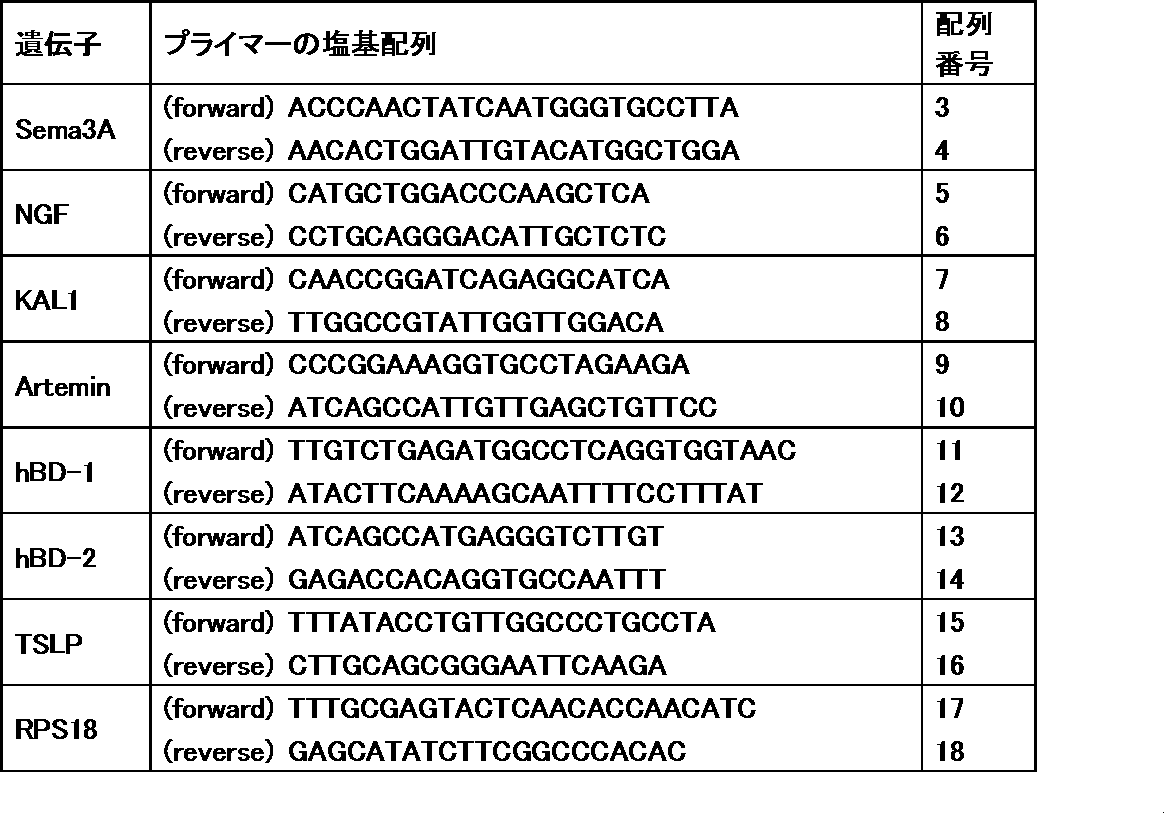
各タンパク質の発現レベルを、ELISAによって分析した。培養上清中のSema3A量を製造業者の取扱説明書に従って、Enzyme-linked Immunosorbent Assay Kit(USCN Life Science)を使用して測定した。
LL-37の添加により、正常ヒト表皮角化細胞(NHEK)におけるSema3A、KAL1、hBD-1、hBD-2のmRNA発現増加ならびにNGF、Artemin、TSLPのmRNA発現減少が認められた(図1、図2、図3、図4)。さらに、NHEKにSLIGRLを添加し、TSLPの発現誘導を行った場合においても、LL-37の添加によりTSLPのmRNA発現減少が認められた(図4)。
[材料及び方法]
(1)アトピー性皮膚炎モデルマウスの作製
ビオスタ社のプロトコールに従い、NC/Ngaマウス(オリエンタル酵母工業株式会社)の背部にコナヒョウヒダニ虫体(Dermatophagoides farinae body, Dfb)成分を含む軟膏試薬であるビオスタAD(株式会社ビオスタ)を週2回、3週間反復塗布することでアトピー性皮膚炎を誘発した。抗菌ペプチドであるmCRAMP軟膏の塗布を開始する前日にクリニカルスキンスコアを判定し(Suto et al., Int Arch Allergy Immunol 120 (Suppl. 1), 70-75, 1999)、スコア5以上の個体を実験に用いた。
アトピー性皮膚炎を発症したDfb-NC/Ngaマウスに1日2回4日間、mCRAMP軟膏を1匹当たり100mgで塗布した。mCRAMP軟膏は親水ワセリン(丸石製薬)100mgに20μlのmCRAMP溶液(10μg/ml; ANASPEC社)を混合することで作製した。対照群(ワセリン塗布)のマウスには親水ワセリン100mgに20μlの蒸留水を混合したものを塗布した。なお、mCRAMP(GLLRKGGEKIGEKLKKIGQKIKNFFQKLVPQPEQ、配列番号19)は、マウスカテリシジン関連抗菌ペプチド(cathelicidin-related antimicrobial peptide)であり、ヒトのLL-37に相当する。
SCLABA(登録商標)-Real(株式会社ノベルテック)を用いて掻破行動の測定及び解析を行った。アトピー性皮膚炎発症後mCRAMP軟膏塗布前(Day 0)とmCRAMP軟膏塗布後(Day 4)に各マウス12時間の掻破行動の測定を行った。
アトピー性皮膚炎発症後軟膏塗布前(Day 0)と軟膏塗布後(Day 4)の各群のマウスの掻破行動の変化率を比較し、アトピー性皮膚炎モデルマウスに対するmCRAMP軟膏塗布による治療効果を検討した。その結果、mCRAMP軟膏の塗布によりアトピー性皮膚炎モデルマウスの掻破行動が明らかに抑制された(図6)。
Claims (9)
- 下記の(a)又は(b)のポリペプチドを有効成分として含有する、掻痒性皮膚疾患の治療又は予防剤。
(a) 配列番号1に示すアミノ酸配列のポリペプチド。
(b) 配列番号1に示すアミノ酸配列において、1又は数個のアミノ酸が置換、欠失、挿入又は付加されたアミノ酸配列のポリペプチドであって、かつ、掻痒性皮膚疾患の治療又は予防活性を有するポリペプチド。 - 前記(b)のポリペプチドは、配列番号1に示すアミノ酸配列と80%以上の配列同一性を有する、請求項1記載の治療又は予防剤。
- 前記(b)のポリペプチドは、配列番号1に示すアミノ酸配列と90%以上の配列同一性を有する、請求項2記載の治療又は予防剤。
- 配列番号1に示すアミノ酸配列のポリペプチドを有効成分として含有する、請求項1記載の治療又は予防剤。
- 掻痒性皮膚疾患がアトピー性皮膚炎である、請求項1ないし4のいずれか1項に記載の治療又は予防剤。
- 下記の(a)又は(b')のポリペプチドを有効成分として含有する、セマフォリン3Aの発現促進剤。
(a) 配列番号1に示すアミノ酸配列のポリペプチド。
(b') 配列番号1に示すアミノ酸配列において、1又は数個のアミノ酸が置換、欠失、挿入又は付加されたアミノ酸配列のポリペプチドであって、かつ、セマフォリン3Aの発現を促進する活性を有するポリペプチド。 - 掻痒性皮膚疾患の治療又は予防剤である請求項6記載の剤。
- それを必要とする対象に対し、下記の(a)又は(b)のポリペプチドの有効量を投与することを含む、掻痒性皮膚疾患の治療又は予防方法。
(a) 配列番号1に示すアミノ酸配列のポリペプチド。
(b) 配列番号1に示すアミノ酸配列において、1又は数個のアミノ酸が置換、欠失、挿入又は付加されたアミノ酸配列のポリペプチドであって、かつ、掻痒性皮膚疾患の治療又は予防活性を有するポリペプチド。 - それを必要とする対象に対し、下記の(a)又は(b')のポリペプチドの有効量を投与することを含む、セマフォリン3Aの発現を促進する方法。
(a) 配列番号1に示すアミノ酸配列のポリペプチド。
(b') 配列番号1に示すアミノ酸配列において、1又は数個のアミノ酸が置換、欠失、挿入又は付加されたアミノ酸配列のポリペプチドであって、かつ、セマフォリン3Aの発現を促進する活性を有するポリペプチド。
Priority Applications (3)
| Application Number | Priority Date | Filing Date | Title |
|---|---|---|---|
| EP15837855.4A EP3189847A4 (en) | 2014-09-02 | 2015-09-02 | Therapeutic or prophylactic agent for itching skin diseases |
| US15/507,152 US20170281727A1 (en) | 2014-09-02 | 2015-09-02 | Therapeutic or prophylactic agent for itching skin diseases |
| JP2015543621A JPWO2016035804A1 (ja) | 2014-09-02 | 2015-09-02 | 掻痒性皮膚疾患の治療又は予防剤 |
Applications Claiming Priority (2)
| Application Number | Priority Date | Filing Date | Title |
|---|---|---|---|
| JP2014177778 | 2014-09-02 | ||
| JP2014-177778 | 2014-09-02 |
Publications (1)
| Publication Number | Publication Date |
|---|---|
| WO2016035804A1 true WO2016035804A1 (ja) | 2016-03-10 |
Family
ID=55439864
Family Applications (1)
| Application Number | Title | Priority Date | Filing Date |
|---|---|---|---|
| PCT/JP2015/074906 Ceased WO2016035804A1 (ja) | 2014-09-02 | 2015-09-02 | 掻痒性皮膚疾患の治療又は予防剤 |
Country Status (4)
| Country | Link |
|---|---|
| US (1) | US20170281727A1 (ja) |
| EP (1) | EP3189847A4 (ja) |
| JP (1) | JPWO2016035804A1 (ja) |
| WO (1) | WO2016035804A1 (ja) |
Cited By (1)
| Publication number | Priority date | Publication date | Assignee | Title |
|---|---|---|---|---|
| JP2017197501A (ja) * | 2016-04-28 | 2017-11-02 | 株式会社ダイセル | セマフォリン3a発現亢進剤 |
Citations (2)
| Publication number | Priority date | Publication date | Assignee | Title |
|---|---|---|---|---|
| JP2008297243A (ja) * | 2007-05-31 | 2008-12-11 | Yokohama City Univ | そう痒性皮膚疾患の治療又は予防剤 |
| JP2013536221A (ja) * | 2010-08-27 | 2013-09-19 | ネオファーム カンパニー, リミテッド | ヒト抗菌ペプチドの分泌を促進する新規化合物、その製造方法及びこれを有効成分として含有する組成物 |
Family Cites Families (2)
| Publication number | Priority date | Publication date | Assignee | Title |
|---|---|---|---|---|
| WO2004098536A2 (en) * | 2003-03-06 | 2004-11-18 | The Regents Of The University Of California | Anti-viral activity of cathelicidin peptides |
| WO2006011849A1 (en) * | 2004-07-28 | 2006-02-02 | Lipopeptide Ab | New use |
-
2015
- 2015-09-02 US US15/507,152 patent/US20170281727A1/en not_active Abandoned
- 2015-09-02 JP JP2015543621A patent/JPWO2016035804A1/ja active Pending
- 2015-09-02 WO PCT/JP2015/074906 patent/WO2016035804A1/ja not_active Ceased
- 2015-09-02 EP EP15837855.4A patent/EP3189847A4/en not_active Withdrawn
Patent Citations (2)
| Publication number | Priority date | Publication date | Assignee | Title |
|---|---|---|---|---|
| JP2008297243A (ja) * | 2007-05-31 | 2008-12-11 | Yokohama City Univ | そう痒性皮膚疾患の治療又は予防剤 |
| JP2013536221A (ja) * | 2010-08-27 | 2013-09-19 | ネオファーム カンパニー, リミテッド | ヒト抗菌ペプチドの分泌を促進する新規化合物、その製造方法及びこれを有効成分として含有する組成物 |
Non-Patent Citations (4)
| Title |
|---|
| CHEN X. ET AL.: "Human antimicrobial peptide LL- 37 modulates proinflammatory responses induced by cytokine milieus and double-stranded RNA in human keratinocytes.", BIOCHEMICAL AND BIOPHYSICAL RESEARCH COMMUNICATIONS, vol. 433, 2013, pages 532 - 537, XP028582698, DOI: doi:10.1016/j.bbrc.2013.03.024 * |
| See also references of EP3189847A4 * |
| TAKAI ET AL.: "Cytokine Oyobi Nihonsa RNA Shigeki ni Taisuru Keratinocytes Oto no, Hito Kokin Peptide LL-37 ni yoru Shushoku", JAPANESE JOURNAL OF ALLERGOLOGY, vol. 62, no. 9-10, 2013, pages 1404, XP055416075 * |
| UMEHARA Y. ET AL.: "The antimicrobial peptide cathelicidin LL-37 induces semaphorin 3A production in normalhuman epidermal keratinocytes.", JOURNAL OF INVESTIGATIVE DERMATOLOGY, vol. 135, no. Suppl.1, May 2015 (2015-05-01), pages S89 519 * |
Cited By (1)
| Publication number | Priority date | Publication date | Assignee | Title |
|---|---|---|---|---|
| JP2017197501A (ja) * | 2016-04-28 | 2017-11-02 | 株式会社ダイセル | セマフォリン3a発現亢進剤 |
Also Published As
| Publication number | Publication date |
|---|---|
| EP3189847A4 (en) | 2018-03-28 |
| JPWO2016035804A1 (ja) | 2017-07-20 |
| US20170281727A1 (en) | 2017-10-05 |
| EP3189847A1 (en) | 2017-07-12 |
Similar Documents
| Publication | Publication Date | Title |
|---|---|---|
| JP7267251B2 (ja) | 抗菌組成物及び医薬組成物 | |
| DE69033200T2 (de) | Wundbehandlung mittels biologisch aktiver peptide | |
| EP2937088B1 (en) | Composition having tissue repairing activity and utilization thereof | |
| US9359405B2 (en) | Antagonists of the interleukin-1 receptor | |
| KR102254260B1 (ko) | 다양한 피부 병태의 치료에 유용한 인간 c-x-c 케모카인으로부터 유래된 테트라펩타이드 | |
| US20200255489A1 (en) | Novel Senolytic Peptides | |
| JP7428404B2 (ja) | Gsx1を使用した脊髄損傷(sci)および脳損傷の処置 | |
| CN111201029B (zh) | Zag来源肽及其用途 | |
| AU2013202269A1 (en) | Compositions and methods for the treatment of fibrosis and fibrotic diseases | |
| JP4581115B2 (ja) | そう痒性皮膚疾患の治療又は予防剤 | |
| US10858654B2 (en) | Polypeptide inhibitors of SMAD3 polypeptide activities | |
| WO2016035804A1 (ja) | 掻痒性皮膚疾患の治療又は予防剤 | |
| JP2011514383A (ja) | 改良されたベータチモシンフラグメント | |
| US20180243383A1 (en) | Use of apc analogue for wound healing | |
| EP2076277A2 (en) | Method of treating or preventing tissue deterioration, injury or damage due to periodontal disease or disease of oral mucosa, and/or downregulating nf-kappab or suppressing nf-kappab-mediated actions | |
| US10072051B2 (en) | Anti-inflammatory lipopeptide and preparing method and application thereof | |
| US10160791B2 (en) | Protamine in treatment of neuronal injuries | |
| ZA202401042B (en) | Protein compositions for the treatment of inflammatory diseases | |
| US9078851B2 (en) | Composition for preventing or treating a spinal cord injury | |
| Jian et al. | Cetirizine regulates scleroderma skin fibrosis in mice via the TGF-β1/Smad3 signaling pathway. | |
| JP5784754B2 (ja) | 神経疾患の予防または処置のためのicam−1の使用 | |
| JPH05507718A (ja) | 生物活性ペプチドおよびdnaギラーゼを阻害する抗生物質よりなる組成物と治療法 | |
| Class et al. | Patent application title: Antagonists of the Interleukin-1 Receptor Inventors: Vladimir Berezin (Copenhagen N, DK) Vladimir Berezin (Copenhagen N, DK) Elisabeth Bock (Charlottenlund, DK) Assignees: SERODUS ASA | |
| Fantozzi et al. | ESTRADIOL MODULATES LEUCOCYTES MOBILIZATION AFTER INTESTINAL ISCHEMIA/REPERFUSION IN FEMALE RATS | |
| Fillat | Regression of Advanced Diabetic Nephropathy by Hepatocyte Growth Factor Gene Therapy in Rats |
Legal Events
| Date | Code | Title | Description |
|---|---|---|---|
| ENP | Entry into the national phase |
Ref document number: 2015543621 Country of ref document: JP Kind code of ref document: A |
|
| 121 | Ep: the epo has been informed by wipo that ep was designated in this application |
Ref document number: 15837855 Country of ref document: EP Kind code of ref document: A1 |
|
| REEP | Request for entry into the european phase |
Ref document number: 2015837855 Country of ref document: EP |
|
| WWE | Wipo information: entry into national phase |
Ref document number: 2015837855 Country of ref document: EP |
|
| WWE | Wipo information: entry into national phase |
Ref document number: 15507152 Country of ref document: US |
|
| NENP | Non-entry into the national phase |
Ref country code: DE |