WO2016035820A1 - 中枢作用性ペプチド誘導体及び医薬組成物 - Google Patents
中枢作用性ペプチド誘導体及び医薬組成物 Download PDFInfo
- Publication number
- WO2016035820A1 WO2016035820A1 PCT/JP2015/074962 JP2015074962W WO2016035820A1 WO 2016035820 A1 WO2016035820 A1 WO 2016035820A1 JP 2015074962 W JP2015074962 W JP 2015074962W WO 2016035820 A1 WO2016035820 A1 WO 2016035820A1
- Authority
- WO
- WIPO (PCT)
- Prior art keywords
- centrally acting
- peptide
- amino acid
- seq
- nasal
- Prior art date
- Legal status (The legal status is an assumption and is not a legal conclusion. Google has not performed a legal analysis and makes no representation as to the accuracy of the status listed.)
- Ceased
Links
Images




Classifications
-
- A—HUMAN NECESSITIES
- A61—MEDICAL OR VETERINARY SCIENCE; HYGIENE
- A61K—PREPARATIONS FOR MEDICAL, DENTAL OR TOILETRY PURPOSES
- A61K38/00—Medicinal preparations containing peptides
- A61K38/16—Peptides having more than 20 amino acids; Gastrins; Somatostatins; Melanotropins; Derivatives thereof
- A61K38/17—Peptides having more than 20 amino acids; Gastrins; Somatostatins; Melanotropins; Derivatives thereof from animals; from humans
- A61K38/22—Hormones
- A61K38/2264—Obesity-gene products, e.g. leptin
-
- C—CHEMISTRY; METALLURGY
- C07—ORGANIC CHEMISTRY
- C07K—PEPTIDES
- C07K14/00—Peptides having more than 20 amino acids; Gastrins; Somatostatins; Melanotropins; Derivatives thereof
- C07K14/435—Peptides having more than 20 amino acids; Gastrins; Somatostatins; Melanotropins; Derivatives thereof from animals; from humans
- C07K14/575—Hormones
- C07K14/605—Glucagons
-
- A—HUMAN NECESSITIES
- A61—MEDICAL OR VETERINARY SCIENCE; HYGIENE
- A61K—PREPARATIONS FOR MEDICAL, DENTAL OR TOILETRY PURPOSES
- A61K38/00—Medicinal preparations containing peptides
- A61K38/04—Peptides having up to 20 amino acids in a fully defined sequence; Derivatives thereof
- A61K38/08—Peptides having 5 to 11 amino acids
- A61K38/095—Oxytocins; Vasopressins; Related peptides
-
- A—HUMAN NECESSITIES
- A61—MEDICAL OR VETERINARY SCIENCE; HYGIENE
- A61K—PREPARATIONS FOR MEDICAL, DENTAL OR TOILETRY PURPOSES
- A61K38/00—Medicinal preparations containing peptides
- A61K38/16—Peptides having more than 20 amino acids; Gastrins; Somatostatins; Melanotropins; Derivatives thereof
- A61K38/17—Peptides having more than 20 amino acids; Gastrins; Somatostatins; Melanotropins; Derivatives thereof from animals; from humans
- A61K38/22—Hormones
- A61K38/2271—Neuropeptide Y
-
- A—HUMAN NECESSITIES
- A61—MEDICAL OR VETERINARY SCIENCE; HYGIENE
- A61K—PREPARATIONS FOR MEDICAL, DENTAL OR TOILETRY PURPOSES
- A61K38/00—Medicinal preparations containing peptides
- A61K38/16—Peptides having more than 20 amino acids; Gastrins; Somatostatins; Melanotropins; Derivatives thereof
- A61K38/17—Peptides having more than 20 amino acids; Gastrins; Somatostatins; Melanotropins; Derivatives thereof from animals; from humans
- A61K38/22—Hormones
- A61K38/26—Glucagons
-
- A—HUMAN NECESSITIES
- A61—MEDICAL OR VETERINARY SCIENCE; HYGIENE
- A61K—PREPARATIONS FOR MEDICAL, DENTAL OR TOILETRY PURPOSES
- A61K38/00—Medicinal preparations containing peptides
- A61K38/16—Peptides having more than 20 amino acids; Gastrins; Somatostatins; Melanotropins; Derivatives thereof
- A61K38/17—Peptides having more than 20 amino acids; Gastrins; Somatostatins; Melanotropins; Derivatives thereof from animals; from humans
- A61K38/22—Hormones
- A61K38/28—Insulins
-
- A—HUMAN NECESSITIES
- A61—MEDICAL OR VETERINARY SCIENCE; HYGIENE
- A61K—PREPARATIONS FOR MEDICAL, DENTAL OR TOILETRY PURPOSES
- A61K9/00—Medicinal preparations characterised by special physical form
- A61K9/0012—Galenical forms characterised by the site of application
- A61K9/0043—Nose
-
- A—HUMAN NECESSITIES
- A61—MEDICAL OR VETERINARY SCIENCE; HYGIENE
- A61P—SPECIFIC THERAPEUTIC ACTIVITY OF CHEMICAL COMPOUNDS OR MEDICINAL PREPARATIONS
- A61P25/00—Drugs for disorders of the nervous system
- A61P25/18—Antipsychotics, i.e. neuroleptics; Drugs for mania or schizophrenia
-
- A—HUMAN NECESSITIES
- A61—MEDICAL OR VETERINARY SCIENCE; HYGIENE
- A61P—SPECIFIC THERAPEUTIC ACTIVITY OF CHEMICAL COMPOUNDS OR MEDICINAL PREPARATIONS
- A61P25/00—Drugs for disorders of the nervous system
- A61P25/24—Antidepressants
-
- A—HUMAN NECESSITIES
- A61—MEDICAL OR VETERINARY SCIENCE; HYGIENE
- A61P—SPECIFIC THERAPEUTIC ACTIVITY OF CHEMICAL COMPOUNDS OR MEDICINAL PREPARATIONS
- A61P25/00—Drugs for disorders of the nervous system
- A61P25/28—Drugs for disorders of the nervous system for treating neurodegenerative disorders of the central nervous system, e.g. nootropic agents, cognition enhancers, drugs for treating Alzheimer's disease or other forms of dementia
-
- A—HUMAN NECESSITIES
- A61—MEDICAL OR VETERINARY SCIENCE; HYGIENE
- A61P—SPECIFIC THERAPEUTIC ACTIVITY OF CHEMICAL COMPOUNDS OR MEDICINAL PREPARATIONS
- A61P43/00—Drugs for specific purposes, not provided for in groups A61P1/00-A61P41/00
-
- C—CHEMISTRY; METALLURGY
- C07—ORGANIC CHEMISTRY
- C07K—PEPTIDES
- C07K19/00—Hybrid peptides, i.e. peptides covalently bound to nucleic acids, or non-covalently bound protein-protein complexes
-
- A—HUMAN NECESSITIES
- A61—MEDICAL OR VETERINARY SCIENCE; HYGIENE
- A61K—PREPARATIONS FOR MEDICAL, DENTAL OR TOILETRY PURPOSES
- A61K38/00—Medicinal preparations containing peptides
Definitions
- the present invention relates to a centrally acting peptide derivative and a pharmaceutical composition.
- GLP-1 glucagon-like peptide-1
- GLP-2 glucagon-like peptide-2
- GPCRs G protein-coupled receptors
- Non-patent Documents 3 to 3 there have been reports on antidepressant action, blood pressure lowering action, and learning disorder improving action that are effective even in treatment-resistant depression model animals (for example, Non-patent Documents 3 to 3). 9). Furthermore, it has been reported that neuromedin U (NmU) consisting of 23 amino acid residues also binds to a GPCR in the brain and exhibits a learning disorder improving action (for example, Non-Patent Document 10). In addition to these, peptides having a central action such as opioid peptides, oxytocin, leptin, neuropeptide Y, orexin, and insulin, and antibody drugs have been developed.
- Physiologically derived substances such as peptides are expected to be used as active ingredients of drugs with fewer side effects than existing drugs.
- the administration method is less invasive. Therefore, development of nasal and nasal preparations is being studied as a dosage form that can efficiently deliver active ingredients to the brain and can be administered in a less invasive manner.
- nasally / nasally-administered peptides are difficult to efficiently pass through the blood-brain barrier, and further, there are problems such as loss of effect in a short time due to enzymatic degradation in vivo.
- an object of the present invention is to provide a centrally acting peptide derivative excellent in transferability to the center and a pharmaceutical composition containing the centrally acting peptide derivative.
- a centrally acting peptide derivative having a centrally acting part, a membrane permeation sequence part, and an endosome escape part.
- the amino acid sequence portion is an amino acid sequence portion derived from a peptide which is GLP-1, GLP-2, neuromedin U, opioid peptide, oxytocin, leptin, orexin, neuropeptide Y or insulin, ⁇ 1> or The centrally acting peptide derivative according to ⁇ 2>.
- ⁇ 4> The centrally acting peptide derivative according to ⁇ 2> or ⁇ 3>, wherein the amino acid sequence portion is an amino acid sequence portion derived from a peptide of the following (a1) to (a3) or (b).
- ⁇ 6> The centrally acting peptide derivative according to any one of ⁇ 1> to ⁇ 4>, which is used for treatment of depression or learning disorder.
- ⁇ 7> A pharmaceutical composition comprising the centrally acting peptide derivative according to any one of ⁇ 1> to ⁇ 6> as an active ingredient.
- ⁇ 8> The pharmaceutical composition according to ⁇ 7>, which is used for treatment of a neuropsychiatric disorder.
- ⁇ 9> The pharmaceutical composition according to ⁇ 7> or ⁇ 8>, which is used for treatment of depression or learning disorder.
- ⁇ 11> The nasal / nasal preparation according to ⁇ 10>, which is used for treatment of a neuropsychiatric disorder.
- ⁇ 12> The nasal / nasal spray preparation according to ⁇ 10> or ⁇ 11>, which is used for treatment of depression or learning disorder.
- ⁇ 13> Use of a pharmaceutical composition comprising the centrally acting peptide derivative according to any one of ⁇ 1> to ⁇ 6> as an active ingredient for nasal / nasal administration.
- a method for stabilizing a centrally acting peptide comprising adding a membrane permeation sequence portion and an endosome escape portion to the centrally acting peptide.
- a centrally acting peptide derivative excellent in transferability to the center and a pharmaceutical composition containing the centrally acting peptide derivative.
- a numerical range indicated by using “to” indicates a range including the numerical values described before and after “to” as the minimum value and the maximum value, respectively.
- the left side is the N-terminal side
- the amino acid residue is represented by one letter (for example, “G” for glycine residue) or three letter (for example, “Gly” for glycine residue) well known in the art. )
- “treatment” means not only an action or effect for eliminating or alleviating symptoms, but also an action or effect for suppressing worsening of the symptoms.
- Antidepressive action or “anti-depressive effect” means an action or effect that eliminates or reduces symptoms of depression, as well as an action or effect that suppresses worsening of the symptoms.
- the “learning disorder improving effect” or “learning disorder improving effect” means not only an action or effect for eliminating or reducing a symptom of learning disorder but also an action or effect for suppressing the deterioration of the symptom.
- the centrally acting peptide derivative of the present invention has a centrally acting part, a membrane permeation sequence part, and an endosome escape part.
- the present inventors investigated a method for rapidly delivering a centrally acting peptide to the brain before it is degraded in vivo and efficiently transferring it to the brain.
- a centrally acting peptide derivative having a centrally acting part, a membrane permeation sequence part, and an endosomal escape part is administered nasally / nasally
- the centrally acting part is administered nasally / nasally alone. It was found that the migration to the brain is significantly improved.
- the use of the centrally acting peptide derivative is not particularly limited as long as it utilizes the pharmacological effect exerted by the centrally acting part acting on the central nerve.
- pharmacological effects include antidepressant action, learning disorder improving action, anti-anxiety action, feeding suppression action, cognitive disorder improving action, blood pressure lowering action, analgesic action, sleep action, antiepileptic action, and the like.
- the centrally acting peptide derivative of the present invention is a mental agent such as an antidepressant, learning disorder improving agent, anxiolytic agent, appetite suppressant, cognitive disorder improving agent, blood pressure lowering agent, analgesic agent, sleep inducer, antiepileptic agent and the like. It can be suitably used for the treatment of neurological diseases.
- the centrally acting moiety in the centrally acting peptide derivative is not particularly limited as long as it is derived from a substance that acts on the central nerve and exerts a pharmacological effect.
- the method for adding the membrane permeation sequence portion and the endosome escape portion to the centrally acting portion is not particularly limited, and can be performed by a known method.
- the centrally acting part is an amino acid sequence part derived from the centrally acting peptide (hereinafter also referred to as a centrally acting peptide part).
- the centrally acting peptide include GLP-1, GLP-2, neuromedin U, opioid peptides (such as enkephalin and dynorphin), oxytocin, leptin, orexin, neuropeptide Y, and insulin.
- the centrally acting moiety is a peptide moiety derived from the following peptide (a1) to (a3) or (b).
- A1 A peptide consisting of the amino acid sequence represented by HADGFSSDEMNTILDNLAARDFINWLIQTKITD (GLP-2, SEQ ID NO: 1)
- A2 A peptide consisting of an amino acid sequence represented by HAEGFTSDVSSYLEGQAAKEFIAWLVKGR-NH 2 (GLP-1: active 7-36 amide, SEQ ID NO: 2)
- A3 Peptide having an amino acid sequence represented by YKVNEYQGPVAPSGGFFLFRPRN-NH 2 (Neuromedin U, SEQ ID NO: 3)
- B A peptide comprising an amino acid sequence in which one or several amino acid residues are deleted, substituted or added in amino acid sequences (a1) to (a3) and having a central activity
- amino acid sequence derived from a peptide means a part corresponding to the amino acid sequence of the peptide when the amino acid sequence of a peptide is combined with another amino acid sequence to form one peptide. .
- the centrally acting peptide part is derived from “(b) a peptide consisting of an amino acid sequence in which one or several amino acid residues are deleted, substituted or added in amino acid sequences (a1) to (a3)”
- the number of amino acid residues to be lost, substituted or added is not particularly limited as long as the centrally acting peptide moiety can achieve the effects of the present invention.
- the number is 1 to 10, preferably 1 to 5, and more preferably 1 to 3.
- the total number of amino acid residues of the peptide (b) is preferably 40 or less, more preferably 35 or less, and 33 or less. Further preferred.
- Centrally acting peptide derivatives have a membrane permeation sequence portion.
- the membrane permeation sequence portion is composed of an amino acid sequence derived from a cell penetrating peptide (hereinafter also referred to as CPP).
- CPP cell penetrating peptide
- Membrane-permeable peptide means a peptide having an action of passing through a cell membrane.
- the centrally acting peptide derivative has a membrane permeation sequence portion
- the centrally acting peptide derivative is introduced into the cell by the membrane permeation effect of the membrane permeation sequence portion. It is considered that the centrally acting peptide derivative introduced into the cell moves to the brain via the nasal mucosa and the olfactory epithelium mainly by axonal transport and the like and is distributed in the brain.
- the membrane-permeable peptide constituting the membrane-permeable sequence portion is not particularly limited as long as it has an action of introducing a centrally acting peptide derivative into cells.
- membrane-penetrating peptides include oligoarginine (Rn, n is the number of arginine residues 6-12), Angiopep-5 (RFFYGGSRRGKRNNFRTEEY, SEQ ID NO: 4), Antp (RQIKIWFQNRRMKWKK, SEQ ID NO: 5), Bac (RQR) , SEQ ID NO: 6), BR1 (RAGLQFPVGRLLR, SEQ ID NO: 7), BR2 (RAGLQFPVGRLLRRRLR, SEQ ID NO: 8), Buf IIb [BR3] (RAGLQFPVGRLLRRLLRLRLR, SEQ ID NO: 9), SH-CPPP-2 (KLP), LP-LPM CyLoP-1 (CRWRWCCCKK, SEQ ID NO: 11), Cys-Antp
- m-N2-10-1 (MTS-N) (AAVALLPAVLLALLLP-HYSRLEICNL, SEQ ID NO: 31), m-N2-10-1 (NIV-C) (HYSRLEICNL-GRKKRRQRRRRPPQ, SEQ ID NO: 32), m- N2-10-1 (NIV-N) (GRKKRRQRRRPPPQ-HYSRLEICNL, SEQ ID NO: 33), m-N2-10-1 (OR-C) (RRRRRRRR-HYSRLEICNL, SEQ ID NO: 34), m-N2-10-1 ( OR-N) (HYSRLEICNL-RRRRRRRR , SEQ ID NO: 35), MPG-8 (AFLGWLGAWGTMGWSPKKKRK -Cysteamide, SEQ ID NO: 36), MPG ⁇ (GALFLAAALSLMGLWSQPKKKRKV-NH -CH 2 -CH 2 -SH, SEQ ID NO: 37), MPG ⁇ (GALFLGAALSLMGGLWSQ
- TP-10K AGYLLLGKINKLKALAALAKIL, SEQ ID NO: 81
- Transportant GWTLNSAGYLLLGKINLKALAALAKKIL, SEQ ID NO: 82
- CAD-2 GLWRLWRLRLSLSLWRLLWKA-NH-CH2-K2-H2-K6, NH-CH2-K2-H2-K6-H2-K2-H2-K6-H (TFQ4))
- INLKALAALAKIL SEQ ID NO: 84
- polyargineline derivative RRRQRRKRRQ, SEQ ID NO: 85
- membrane-permeable peptides are rich in basic amino acid residues such as arginine, lysine, histidine, and tryptophan from the viewpoint of affinity with cell membranes and ease of synthesis (for example, more than half of the total number of amino acid residues).
- Membrane-permeable peptides consisting of an amino acid sequence are preferred. Examples of such a membrane-permeable peptide include oligoarginine (Rn, n is the number of arginine residues 6 to 12), TAT derived from the Tat protein of human immunodeficiency virus type 1 (HIV-1), and the like. It is done.
- Membrane-permeable peptides consisting of amino acid sequences rich in basic amino acid residues are thought to induce macropinocytosis, a kind of endocytosis, which is a process in which cells take up extracellular substances. Thereby, it is considered that a centrally acting peptide derivative can be introduced into cells more efficiently.
- the membrane-permeable peptide is preferably a peptide in which more than half of the total number of amino acid residues is an arginine residue, and an oligopeptide comprising 6 to 12 arginine residues.
- Arginine is more preferred, oligoarginine consisting of 7 to 9 arginine residues is still more preferred, and oligoarginine consisting of 8 arginine residues is even more preferred.
- the endosome escape portion is not particularly limited as long as it has an action of promoting the endosome escape of the centrally acting peptide derivative.
- FFLIPKG SEQ ID NO: 86
- LILIG SEQ ID NO: 87
- FFG SEQ ID NO: 88
- FFFFG SEQ ID NO: 89
- FFFFFFG And an amino acid sequence known as an endosome escape promoting sequence (hereinafter also referred to as PAS), such as SEQ ID NO: 90).
- PAS an amino acid sequence known as an endosome escape promoting sequence
- the endosome escape portion is preferably PAS.
- the positions of the membrane permeation sequence portion and the endosome escape portion in the centrally acting peptide derivative are not particularly limited.
- the endosome escape portion may be located on the side closer to the central action portion.
- the membrane permeation array portion is located on the side closer to the central action portion, and the membrane permeation arrangement portion is located on the side closer to the central action portion.
- PAS is present as an endosome escape moiety on the N-terminal side of the membrane permeation sequence portion.
- the centrally acting part and the membrane permeation sequence part or the endosome escape part may be directly bound, or a spacer may be present between them.
- the amino acid sequence of the spacer in the case where a spacer is present between the centrally acting part and the membrane permeation sequence part is not particularly limited as long as it has a function of preventing the activity of the centrally acting part from being reduced or impaired.
- the membrane permeation sequence portion is composed of basic amino acids.
- the centrally acting moiety contains an acidic amino acid residue
- a spacer in which a plurality of neutral amino acid residues such as glycine (for example, 1 to 10, preferably 2 to 6) are continuously present is present, It is preferable to prevent the activity of the centrally acting part from being reduced or impaired by interaction with the centrally acting part.
- the centrally acting peptide derivative may be variously modified depending on the application. For example, amino group modification (biotinylation, myristoylation, palmitoylation, acetylation, maleimidation, etc.), carboxyl group modification (amidation, esterification, etc.), thiol group modification (farnesylation, geranylation, methylation, palmitoylation) Etc.), hydroxyl modification (phosphorylation, sulfate, octanoylation, palmitoylation, palmitoleylation, etc.), various fluorescent labels (FITC, FAM, Rhodamine, BODIPY, NBD, MCA, etc.), PEGylation, unnatural amino acids, Modifications such as introduction of D-amino acids and the like may be performed. The modification may be performed in any of the centrally acting part, the membrane permeation sequence part, the endosome escape part and the spacer.
- amino group modification biotinylation, myristoylation, palmito
- Each of the amino acid residues constituting the centrally acting peptide derivative may be either L-form or D-form as long as the effect of the present invention is achieved.
- the method for producing the centrally acting peptide derivative is not particularly limited, and any of a collection from a living body or a natural product, a genetic engineering method, an organic synthetic chemical method, or the like may be used.
- the centrally acting peptide derivative of the centrally acting peptide derivative is an amino acid sequence
- the number of amino acid residues in the entire centrally acting peptide derivative is not particularly limited as long as the effects of the present invention can be obtained, and can be selected according to the use.
- the total number of amino acid residues in the centrally acting peptide derivative may be, for example, 80 or less, preferably 70 or less, and more preferably 60 or less.
- the total number of amino acid residues in the centrally acting peptide derivative may be, for example, 35 or more, preferably 40 or more, and more preferably 45 or more.
- the pharmaceutical composition of the present invention contains a centrally acting peptide derivative having a centrally acting part, a membrane permeation sequence part, and an endosome escape part as an active ingredient.
- the pharmaceutical composition of the present invention contains a centrally acting peptide derivative as an active ingredient, and thus has excellent ability to migrate to the brain and can efficiently exert a pharmacological effect.
- suitable dosage forms of the pharmaceutical composition include nasal and nasal preparations.
- the neuropsychiatric disorder to be treated by the pharmaceutical composition is not particularly limited as long as the therapeutic effect is exhibited by the centrally acting portion of the centrally acting peptide derivative acting on the central nerve.
- Examples of the neuropsychiatric disorder to be treated include depression, learning disorder, anxiety, eating disorder, cognitive disorder, hypertension, sleep disorder, epilepsy and the like.
- the pharmaceutical composition include antidepressants, learning disorder improvers, anxiolytics, appetite suppressants, cognitive disorder improvers, antihypertensives, analgesics, sleep inducers, antiepileptics, etc.
- the type of the centrally acting part, the membrane permeation sequence part and the endosome escape part can be selected depending on the treatment target.
- a pharmaceutical composition comprising a centrally acting peptide derivative having a peptide moiety derived from GLP-2 as an active ingredient is useful as an antidepressant.
- GLP-2 exhibits a blood pressure lowering effect, it is considered that its effectiveness is particularly high when it is administered to a patient who suffers from depression due to strong stress and hypertension.
- a pharmaceutical composition comprising a centrally acting peptide derivative having a peptide moiety derived from GLP-1 or NmU is useful as a learning disorder improving agent.
- the method of using the pharmaceutical composition is not particularly limited as long as the effect of the present invention is obtained, and may be any of nasal / nasal administration, oral administration, intravenous administration, and the like. From the viewpoint of easy daily administration, nasal / nasal administration or oral administration is preferable, and from the viewpoint of delivery to the brain, nasal / nasal administration is more preferable.
- the pharmaceutical composition may contain components other than the centrally acting peptide derivative. Specific examples of components that may be contained in addition to the pharmaceutical composition include media and pharmaceutical additives used in the preparation of the pharmaceutical composition.
- Additives for formulation include excipients, disintegrants, binders, lubricants, surfactants, buffers, solubilizers, stabilizers, tonicity agents, suspending agents, emulsifiers, solvents, Examples include thickeners, mucolytic agents, wetting agents, preservatives, and the like.
- the dosage of the pharmaceutical composition is selected according to the type of disease, patient symptoms, body weight, age, etc., and the administration mode.
- the nasal / nasal nasal preparation of the present invention contains a centrally acting peptide derivative having a centrally acting portion, a membrane permeation sequence portion, and an endosome escape portion as an active ingredient.
- the nasal / nasal nasal preparation of the present invention contains a centrally acting peptide derivative as an active ingredient, and thus has excellent ability to migrate to the brain and can effectively exert a pharmacological action. Moreover, since the invasiveness of the administration form is low, it is suitable for symptom improvement of diseases that need to be administered daily at home.
- the nasal / nasal nasal preparation of the present invention may contain components other than the centrally acting peptide derivative.
- the components other than the centrally acting peptide derivative include those mentioned above as media and preparation additives for preparing pharmaceutical compositions.
- Embodiments of the present invention include the use of a pharmaceutical composition containing the above-mentioned centrally acting peptide derivative as an active ingredient for nasal / nasal administration. Details and preferred embodiments of the centrally acting peptide derivative and pharmaceutical composition in the use are as described above.
- Embodiments of the present invention include a method for stabilizing a centrally acting peptide comprising adding a membrane permeation sequence portion and an endosome escape portion to the centrally acting peptide.
- the details and preferred embodiments of the membrane permeation sequence portion, endosome escape portion and centrally acting peptide in the method are as described above.
- FITC-FFLIPKG- (R) 8 - was prepared by (G) 2 -HADGSFSDEMNTILDNLAARDFINWLIQTKITD consisting of the amino acid sequence GLP-2 derivative to a conventional method.
- the GLP-2 derivative was first dissolved in DMSO and then diluted with a phosphate buffer (PBS) so that the final concentration of DMSO was 16% to prepare a DMSO solution of the GLP-2 derivative.
- PBS phosphate buffer
- rats were subjected to a forced swimming test to evaluate the antidepressant effect of the GLP-2 derivative.
- the forced swimming test was performed as follows. On the forced swimming test day, rats (8-10 weeks old, male, number of individuals 6) were placed in the laboratory and acclimatized 1 hour before the start of the test. A DMSO solution of a GLP-2 derivative was administered to rats at 18 ⁇ g / day, nasally or nasally for 2 days 30 minutes before the forced swimming test. Swim each rat for 15 minutes in a transparent plastic cylindrical cylinder with a diameter of 18 cm and a height of 50 cm. did. Rats after forced swimming were wiped with Kim towel and returned to their cages.
- the first day was the preliminary test and the second day was the main test, and this test was conducted for two consecutive days.
- a forced swimming test was similarly performed on rats (8-10 weeks old, male, number of individuals 6) administered with 10 ⁇ L of a solvent containing no GLP-2 derivative intranasally or nasally.
- Example 2 Rat olfactory bulb (Olfactory bulb) and lower marginal cortex (Gluc-2 derivative (18 ⁇ g) administered nasally and nasally using DMSO solution (16%) of GLP-2 derivative prepared in the same manner as in Example 1) Infralimbic cortex, Basolateral amygdala, Central amygdala (Medical amygdala), Medial amydala in the hypothalamic nucleus, Paraventricular hypothalamic nucleus Of the distribution of GLP-2 derivatives in the hippocampus and parabrachial nucleus Thailand, was examined in the following manner.
- GLP-2 derivative (18 ⁇ g) was administered nasally and nasally to a rat using a DMSO solution (16%) of a GLP-2 derivative prepared in the same manner as in Example 1, and the rat was formalin-fixed 30 minutes later.
- a brain specimen was prepared. Thin sections (30 ⁇ m) were prepared from brain specimens with a cryostat (Leica Microsystems: CM1560S) and observed with a fluorescence microscope (Keyence: BZ-9000).
- FFLIPKG- (R) 8 - a (G) GLP-2 derivative comprising a 2 -EichieidijiesuefuesudiEMNTILDNLAARDFINWLIQTKITD amino acid sequence was produced by a conventional method. That is, the produced GLP-2 derivative differs from the GLP-2 derivative produced in Example 1 in that no fluorescent label (FITC) is added.
- the GLP-2 derivative was first dissolved in DMSO and then diluted with PBS so that the final concentration of DMSO was 16% to prepare a DMLP solution of the GLP-2 derivative.
- mice were subjected to a forced swimming test to evaluate the antidepressant effect of GLP-2 derivatives.
- mice were subjected to a tail suspension test using the DMLP solution of the GLP-2 derivative prepared in Example 3 to evaluate the antidepressant effect of the GLP-2 derivative.
- Example 5 Using a DMSO solution of the GLP-2 derivative prepared in Example 3, a forced swimming test was performed on a mouse model of depression, and the antidepressant effect of the GLP-2 derivative was evaluated.
- a depression onset model mouse a ddY mouse (5-7 weeks old, male, 11 individuals) in which the hyperthalamic-pituitary-adrenocortical system (HPA system) is induced by an adrenocorticotropic hormone (ACTH). It was used. ACTH was administered for 14 consecutive days in an amount of 0.45 mg / kg weight / day.
- the forced swimming test was performed in the same manner as in Example 3, and the immobility time (seconds) was measured.
- a learning disorder-inducing mouse was subjected to a Y-maze test to evaluate the learning disorder improving effect of the GLP-1 derivative.
- a learning disorder induction mouse a ddY mouse (5 to 7 weeks old, male, number of individuals 5) administered with 10 ⁇ g of LPS (lipopolysaccharide) 3 days before the test was used.
- LPS lipopolysaccharide
- the GLP-1 derivative 3 ⁇ g was administered intranasally or nasally using a FLP12 solution of the GLP-1 derivative.
- the Y-maze test uses a device having three arms of the same size, and after dividing the number of times of entering a different arm three times in succession by the value obtained by subtracting 2 from the total number of times of entering the arm, The value obtained by multiplying by 100 was determined as voluntary alternation behavior (%).
- mice 5-7 weeks old, male, 5 or 7 individuals administered nasally or nasally only with a solvent not containing GLP-1 derivative (4 ⁇ L) 15 minutes before administration of LPS were also used.
- a test similar to the above was performed.
- mice not receiving LPS (Vehicle).
- FFFFG- (R) 8 - a derivative of (G) NMU consisting 2 -YKVNEYQGPVAPSGGFFLFRPRN-NH 2 amino acid sequence (neuromedin U) was prepared by a conventional method.
- NmU derivative was first dissolved in FOS12 and then diluted with PBS so that the final concentration of FOS12 was 5% to prepare a FmS12 solution of NmU derivative.
- a ddY mouse (5-7 weeks old, male, number of individuals 6) administered with 10 ⁇ g of LPS (lipopolysaccharide) 3 days before the test was used.
- NmU derivative (5.6 ⁇ g) was administered nasally or nasally 15 minutes before administration of LPS using NmU derivative FOS12 solution.
- a Y-maze test was performed in the same manner as in Example 6, and spontaneous alternation behavior (%) was obtained from the measured values.
- Example 8 [Evaluation of stability of centrally acting peptide derivatives] ⁇ Example 8> Samples were prepared by first dissolving GLP-2 and the GLP-2 derivative prepared in Example 3 in DMSO and then diluting with phosphate buffer (PBS) so that the final concentration of DMSO was 1%. . The contents of GLP-2 and GLP-2 derivatives in the sample were 12 ng / ⁇ L, respectively. Also, 0.125 unit of DPP-4 (dipeptidyl peptidase-4) was added to each sample.
- PBS phosphate buffer
- Example 2 From the results of Example 2, it was found that GLP-2 derivatives having a membrane permeation sequence portion and an endosome escape portion are widely distributed in the brain. From this, the effect of improving the antidepressant action achieved by adding a membrane-permeable peptide and an endosome escape moiety to GLP-2 is due to the addition of the membrane permeability sequence part and the endosome escape part in the brain of GLP-2. It is thought to have resulted from the enhanced distribution.
- Example 3 and Example 4 performed by changing the test animal and the test method, and Example 5 using the treatment-resistant depression onset model, an antidepressant effect was obtained by administration of GLP-2.
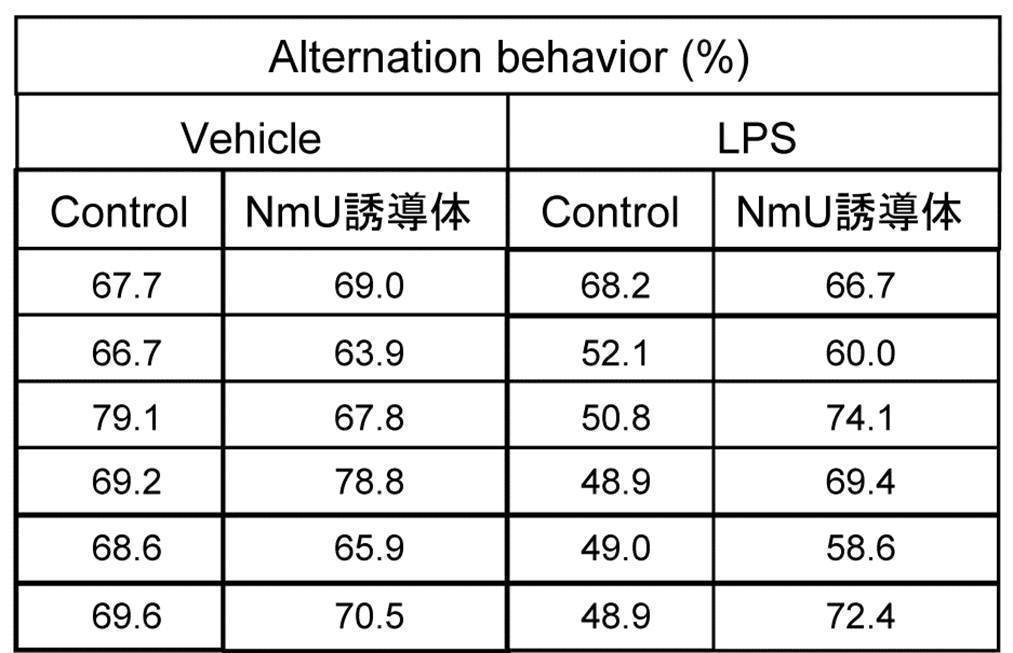
- Example 6 and Example 7 From the evaluation results of Example 6 and Example 7 in which the centrally acting peptide was changed to GLP-1 or NmU and the Y-maze test was conducted, the LPS administration group had learning ability compared to the LPS non-administration group (Vehicle). Although decreased, it was found that administration of GLP-1 or NmU significantly improved learning ability.
- Example 8 where the stability test of the centrally acting peptide derivative was conducted, the stability of the GLP-2 derivative in which a membrane permeation sequence portion and an endosomal escape portion were added to GLP-2 was more stable against the degradation enzyme DPP-4. Was higher than GLP-2 before derivatization. Therefore, by adding a membrane permeation sequence portion and an endosome escape portion to the central action portion, degradation by DPP-4 is difficult to proceed, the stability of the peptide is improved, and the ability to transfer to the center is further improved. The following effects can be obtained.
Landscapes
- Health & Medical Sciences (AREA)
- Life Sciences & Earth Sciences (AREA)
- Chemical & Material Sciences (AREA)
- General Health & Medical Sciences (AREA)
- Medicinal Chemistry (AREA)
- Bioinformatics & Cheminformatics (AREA)
- Engineering & Computer Science (AREA)
- Veterinary Medicine (AREA)
- Pharmacology & Pharmacy (AREA)
- Animal Behavior & Ethology (AREA)
- Public Health (AREA)
- Proteomics, Peptides & Aminoacids (AREA)
- Gastroenterology & Hepatology (AREA)
- Organic Chemistry (AREA)
- Epidemiology (AREA)
- Zoology (AREA)
- Endocrinology (AREA)
- Immunology (AREA)
- Biochemistry (AREA)
- Genetics & Genomics (AREA)
- Molecular Biology (AREA)
- Biophysics (AREA)
- Chemical Kinetics & Catalysis (AREA)
- General Chemical & Material Sciences (AREA)
- Nuclear Medicine, Radiotherapy & Molecular Imaging (AREA)
- Biomedical Technology (AREA)
- Neurology (AREA)
- Neurosurgery (AREA)
- Psychiatry (AREA)
- Toxicology (AREA)
- Diabetes (AREA)
- Obesity (AREA)
- Otolaryngology (AREA)
- Hospice & Palliative Care (AREA)
- Pain & Pain Management (AREA)
- Medicines That Contain Protein Lipid Enzymes And Other Medicines (AREA)
- Peptides Or Proteins (AREA)
- Medicinal Preparation (AREA)
Abstract
Description
<1>中枢作用部分と、膜透過配列部分と、エンドソーム脱出部分と、を有する、中枢作用性ペプチド誘導体。
<2>前記中枢作用部分がペプチドに由来するアミノ酸配列部分である、<1>に記載の中枢作用性ペプチド誘導体。
<3>前記アミノ酸配列部分が、GLP-1、GLP-2、ニューロメジンU、オピオイドペプチド、オキシトシン、レプチン、オレキシン、ニューロペプチドY又はインスリンであるペプチドに由来するアミノ酸配列部分である、<1>又は<2>に記載の中枢作用性ペプチド誘導体。
<4>前記アミノ酸配列部分が、以下の(a1)~(a3)又は(b)であるペプチドに由来するアミノ酸配列部分である、<2>又は<3>に記載の中枢作用性ペプチド誘導体。
(a1)His-Ala-Asp-Gly-Ser-Phe-Ser-Asp-Glu-Met-Asn-Thr-Ile-Leu-Asp-Asn-Leu-Ala-Ala-Arg-Asp-Phe-Ile-Asn-Trp-Leu-Ile-Gln-Thr-Lys-Ile-Thr-Asp、配列番号1)で表されるアミノ酸配列からなるペプチド
(a2)His-Ala-Glu-Gly-Thr-Phe-Thr-Ser-Asp-Val-Ser-Ser-Tyr-Leu-Glu-Gly-Gln-Ala-Ala-Lys-Glu-Phe-Ile-Ala-Trp-Leu-Val-Lys-Gly-Arg-NH2、配列番号2)で表されるアミノ酸配列からなるペプチド
(a3)Tyr-Lys-Val-Asn-Glu-Tyr-Gln-Gly-Pro-Val-Ala-Pro-Ser-Gly-Gly-Phe-Phe-Leu-Phe-Arg-Pro-Arg-Asn-NH2、配列番号3)で表されるアミノ酸配列からなるペプチド
(b)アミノ酸配列(a1)~(a3)において1若しくは数個のアミノ酸残基が欠失、置換若しくは付加されたアミノ酸配列からなり、かつ中枢作用性を有するペプチド
<5>精神神経疾患の治療用である、<1>~<4>のいずれか1項に記載の中枢作用性ペプチド誘導体。
<6>うつ病又は学習障害の治療用である、<1>~<4>のいずれか1項に記載の中枢作用性ペプチド誘導体。
<7><1>~<6>のいずれか1項に記載の中枢作用性ペプチド誘導体を有効成分として含む、医薬組成物。
<8>精神神経疾患の治療用である、<7>に記載の医薬組成物。
<9>うつ病又は学習障害の治療用である、<7>又は<8>に記載の医薬組成物。
<10><1>~<6>のいずれか1項に記載の中枢作用性ペプチド誘導体を有効成分として含む、経鼻・点鼻製剤。
<11>精神神経疾患の治療用である、<10>に記載の経鼻・点鼻製剤。
<12>うつ病又は学習障害の治療用である、<10>又は<11>に記載の経鼻・点鼻製剤。
<13><1>~<6>のいずれか1項に記載の中枢作用性ペプチド誘導体を有効成分として含む医薬組成物の、経鼻・点鼻投与への使用。
<14>膜透過配列部分と、エンドソーム脱出部分とを中枢作用性ペプチドに付加することを含む、中枢作用性ペプチドの安定化方法。
本明細書において「~」を用いて示された数値範囲は、「~」の前後に記載される数値をそれぞれ最小値及び最大値として含む範囲を示す。アミノ酸配列の記載は左側がN末端側であり、アミノ酸残基は当該技術分野で周知の一文字表記(例えば、グリシン残基を「G」)または三文字表記(例えば、グリシン残基を「Gly」)で表記する場合がある。
本明細書において「治療」とは、症状を消失又は軽減させる作用又は効果のほか、当該症状の悪化を抑制する作用又は効果も意味する。「抗うつ作用」又は「抗うつ効果」は、うつ病の症状を消失又は軽減させる作用又は効果のほか、当該症状の悪化を抑制する作用又は効果も意味する。「学習障害改善作用」又は「学習障害改善効果」は、学習障害の症状を消失又は軽減させる作用又は効果のほか、当該症状の悪化を抑制する作用又は効果も意味する。
本発明の中枢作用性ペプチド誘導体は、中枢作用部分と、膜透過配列部分と、エンドソーム脱出部分と、を有する。本発明者らは、中枢作用性のペプチドが生体内で分解する前に脳に迅速に送達し、かつ脳内に効率よく移行させるための方法を検討した。その結果、中枢作用部分と膜透過配列部分と、エンドソーム脱出部分と、を有する中枢作用性ペプチド誘導体を経鼻・点鼻投与した場合は、中枢作用部分を単独で経鼻・点鼻投与した場合よりも、脳への移行性が顕著に向上することを見出した。
中枢作用性ペプチド誘導体における中枢作用部分は、中枢神経に作用して薬理効果を発揮する物質に由来するものであれば特に制限されない。中枢作用性ペプチド誘導体において、中枢作用部分に膜透過配列部分及びエンドソーム脱出部分を付加する方法は特に制限されず、公知の方法により行うことができる。
(a2)HAEGTFTSDVSSYLEGQAAKEFIAWLVKGR-NH2で表されるアミノ酸配列からなるペプチド(GLP-1:活性体7-36アミド、配列番号2)
(a3)YKVNEYQGPVAPSGGFFLFRPRN-NH2で表されるアミノ酸配列からなるペプチド(ニューロメジンU、配列番号3)
(b)アミノ酸配列(a1)~(a3)において1若しくは数個のアミノ酸残基が欠失、置換若しくは付加されたアミノ酸配列からなり、かつ中枢作用性を有するペプチド
中枢作用性ペプチド誘導体は、膜透過配列部分を有する。膜透過配列部分は、膜透過性ペプチド(Cell penetrating peptide、以下CPPとも称する)に由来するアミノ酸配列からなる。「膜透過性ペプチド」とは、細胞膜を通過する作用を有するペプチドを意味する。中枢作用性ペプチド誘導体が膜透過配列部分を有することにより、中枢作用性ペプチド誘導体が膜透過配列部分の膜透過作用によって細胞内へと導入される。細胞内に導入された中枢作用性ペプチド誘導体は、主に軸索輸送等により鼻粘膜および嗅上皮等を介して脳に移行して脳内に分布すると考えられる。
中枢作用性ペプチド誘導体は、エンドソーム脱出部分を有する。中枢作用性ペプチド誘導体がエンドソーム脱出部分を有することにより、細胞内に導入された中枢作用性ペプチド誘導体がエンドソームに留まる時間が短縮され、より短時間でのエンドソーム脱出が可能になると考えられる。その結果、中枢作用性ペプチド誘導体の脳への移行及び分布がより短い時間で達成されると考えられる。
中枢作用性ペプチド誘導体において、中枢作用部分と膜透過配列部分又はエンドソーム脱出部分とは直接結合していても、これらの間にスペーサーが存在していてもよい。中枢作用部分と膜透過配列部分との間にスペーサーが存在している場合のスペーサーのアミノ酸配列は、中枢作用部分の活性が低下又は損なわれることを防ぐ機能を有するものであれば特に制限されない。一般に、膜透過配列部分は塩基性アミノ酸から構成される。従って、中枢作用部分が酸性アミノ酸残基を含む場合、グリシン等の中性アミノ酸残基が複数(例えば1~10個、好ましくは2~6個)連続したスペーサーを存在させ、膜透過配列部分と中枢作用部分とが相互作用して中枢作用部分の活性が低下又は損なわれるのを防ぐことが好ましい。
本発明の医薬組成物は、中枢作用部分と、膜透過配列部分と、エンドソーム脱出部分と、を有する中枢作用性ペプチド誘導体を有効成分として含む。本発明の医薬組成物は、中枢作用性ペプチド誘導体を有効成分として含むことにより、脳への移行性に優れ、効率的に薬理効果を発揮することができる。また、投与形態の侵襲性が低いため、例えば、在宅で連日投与する必要のある疾患の治療に有用である。従って、医薬組成物の好適な剤形としては経鼻・点鼻製剤が挙げられる。
本発明の経鼻・点鼻製剤は、中枢作用部分と、膜透過配列部分と、エンドソーム脱出部分と、を有する中枢作用性ペプチド誘導体を有効成分として含む。本発明の経鼻・点鼻製剤は、中枢作用性ペプチド誘導体を有効成分として含むことにより、脳への移行性に優れ、効果的に薬理作用を発揮することができる。また、投与形態の侵襲性が低いため、在宅で連日投与する必要のある疾患の症状改善に好適である。
<実施例1>
中枢作用性ペプチド誘導体として、FITC-FFLIPKG-(R)8-(G)2-HADGSFSDEMNTILDNLAARDFINWLIQTKITDのアミノ酸配列からなるGLP-2の誘導体を定法により作製した。次いで、GLP-2誘導体をDMSOに一次溶解してからDMSOの最終濃度が16%になるようにリン酸緩衝液(PBS)で希釈し、GLP-2誘導体のDMSO溶液を調製した。
膜透過配列部分とエンドソーム脱出部分を有しない、HADGSFSDEMNTILDNLAARDFINWLIQTKITDのアミノ酸配列からなるGLP-2を定法により作製し、実施例1と同様にしてDMSO溶液(16%)を作製した。このDMSO溶液を用いてGLP-2(18μg)をラット(8~10週齢、オス、個体数6)に経鼻・点鼻投与した以外は実施例1と同様にしてラットの強制水泳試験を行った。結果を表1及び図2に示す。図中のエラーバーは中央値±標準誤差(n=6)を表し、Mann-Whitney検定により統計処理を行った(ns=非有意)。

実施例1と同様にして調製したGLP-2誘導体のDMSO溶液(16%)を用いてGLP-2誘導体(18μg)を経鼻・点鼻投与したラットの嗅球(Olfactory bulb)、下辺縁皮質(Infralimbic cortex)、扁桃体基底外側部(Basolateral amygdala)、扁桃体中心核(Central amygdala)、扁桃体内側核(Medial amygdala)、視床下部室傍核(Paraventricular hypothalamic nucleus)、視床下部背内側核(Dorsomedial hypothalamic nucleus)、海馬(Hippocampus)及び傍小脳脚核(Parabrachial nucleus)におけるGLP-2誘導体の分布の状態を、以下のようにして調べた。
中枢作用性ペプチド誘導体として、FFLIPKG-(R)8-(G)2-HADGSFSDEMNTILDNLAARDFINWLIQTKITDのアミノ酸配列からなるGLP-2誘導体を定法により作製した。すなわち、作製したGLP-2誘導体は、蛍光標識(FITC)を付加していない点において実施例1で作製したGLP-2誘導体と異なっている。次いで、GLP-2誘導体をDMSOに一次溶解してからDMSOの最終濃度が16%になるようにPBSで希釈し、GLP-2誘導体のDMSO溶液を調製した。
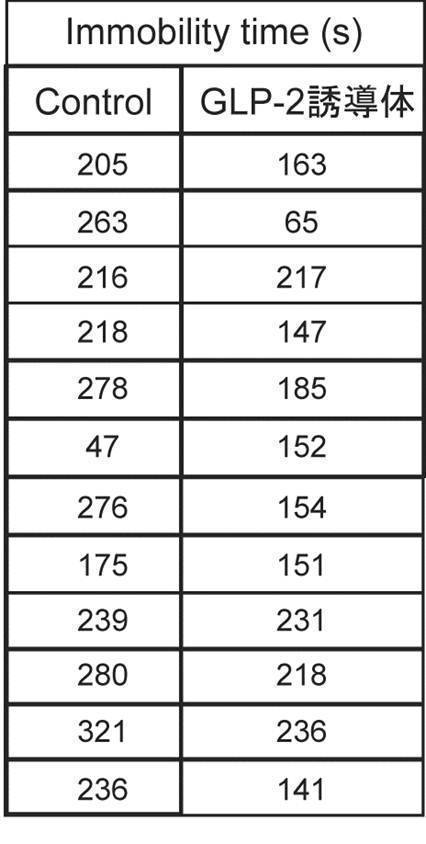
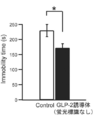
実施例3で作製したGLP-2誘導体のDMSO溶液を用いてマウスの尾懸垂試験を行い、GLP-2誘導体の抗うつ効果を評価した。尾懸垂試験は、以下のようにして行った。ddYマウス(5~7週齢、オス、個体数9)に対し、試験の前日と当日にGLP-2誘導体のDMSO溶液を用いてGLP-2誘導体を3.6μgずつ投与した。その後、マウスを尻尾から逆さに吊るし、無動時間(秒)を測定した。コントロールとして、GLP-2誘導体を含まない溶媒のみを経鼻・点鼻投与したマウス(5~7週齢、オス、個体数9)の尾懸垂試験も同様にして行った。結果を表3及び図5に示す。図中のエラーバーは中央値±標準誤差(n=9)を表し、Mann-Whitney検定により統計処理を行った(*P<0.05)。

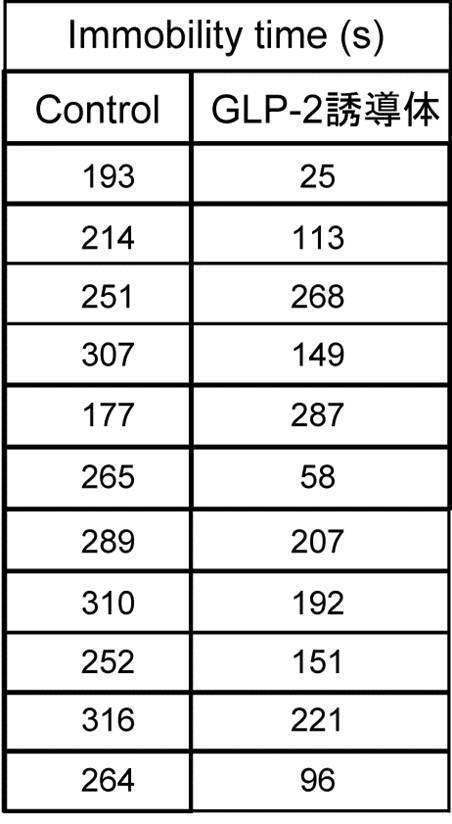
実施例3で作製したGLP-2誘導体のDMSO溶液を用いてうつ病発症モデルマウスの強制水泳試験を行い、GLP-2誘導体の抗うつ効果を評価した。うつ病発症モデルマウスとしては、視床下部-下垂体-副腎皮質系(HPA系)の亢進状態を副腎皮質刺激ホルモン(ACTH)により誘導したddYマウス(5~7週齢、オス、個体数11)を使用した。ACTHの投与は、0.45mg/kg重/日となる量で14日間連続して行った。強制水泳試験は実施例3と同様にして行い、無動時間(秒)を測定した。なお、試験の当日まで、6日間連続してGLP-2誘導体のDMSO溶液を用いてGLP-2誘導体を3.6μgずつ経鼻・点鼻投与した。コントロールとして、GLP-2誘導体を含まない溶媒のみ4μLを6日間連続して経鼻投与したマウス(5~7週齢、オス、個体数11)の強制水泳試験も同様にして行った。結果を表4及び図6に示す。図中のエラーバーは中央値±標準誤差(n=11)を表し、Mann-Whitney検定により統計処理を行った(**P<0.01)。
<実施例6>
中枢作用性ペプチド誘導体として、FFLIPKG-(R)8-(G)2-HAEGTFTSDVSSYLEGQAAKEFIAWLVKGR-NH2のアミノ酸配列からなるGLP-1(7-36アミド)の誘導体を定法により作製した。次いで、GLP-1誘導体をFOS12(n-dodecylphosphocholine)に一次溶解してからFOS12の最終濃度が1%になるようにPBSで希釈し、GLP-1誘導体のFOS12溶液を調製した。

<実施例7>
中枢作用性ペプチド誘導体として、FFFFG-(R)8-(G)2-YKVNEYQGPVAPSGGFFLFRPRN-NH2のアミノ酸配列からなるNmU(ニューロメジンU)の誘導体を定法により作製した。次いで、NmU誘導体をFOS12に一次溶解してからFOS12の最終濃度が5%になるようにPBSで希釈し、NmU誘導体のFOS12溶液を調製した。学習障害誘導マウスとしては、試験の3日前にLPS(リポ多糖)10μgを投与したddYマウス(5~7週齢、オス、個体数6)を使用した。なお、LPSの投与の15分前にNmU誘導体のFOS12溶液を用いてNmU誘導体(5.6μg)を経鼻・点鼻投与した。実施例6と同様にしてY字迷路試験を行い、測定値から自発的交代行動(%)を求めた。
<実施例8>
GLP-2及び実施例3で作製したGLP-2誘導体を、それぞれDMSOに一次溶解してからDMSOの最終濃度が1%になるようにリン酸緩衝液(PBS)で希釈してサンプルを調製した。サンプル中のGLP-2及びGLP-2誘導体の含有量は、それぞれ12ng/μLとした。また、DPP-4(ジペプチジルペプチダーゼ-4)0.125ユニットも各サンプルに添加した。
実施例1及び比較例1の結果に示すように、膜透過配列部分及びエンドソーム脱出部分をGLP-2に付加して作製したGLP-2誘導体を投与した群では強制水泳試験における無動時間がコントロール群に比べて有意に短く、抗うつ効果に有意な差がみられた。これに対して、膜透過配列部分とエンドソーム脱出部分を付加していないGLP-2を投与した群ではコントロール群との間で抗うつ効果に有意な差がみられなかった。これらの結果から、GLP-2の抗うつ効果はGLP-2に膜透過配列部分及びエンドソーム脱出部分を付加することによって向上することがわかった。
Claims (14)
- 中枢作用部分と、膜透過配列部分と、エンドソーム脱出部分と、を有する、中枢作用性ペプチド誘導体。
- 前記中枢作用部分がペプチドに由来するアミノ酸配列部分である、請求項1に記載の中枢作用性ペプチド誘導体。
- 前記アミノ酸配列部分が、GLP-1、GLP-2、ニューロメジンU、オピオイドペプチド、オキシトシン、レプチン、オレキシン、ニューロペプチドY又はインスリンであるペプチドに由来するアミノ酸配列部分である、請求項1又は請求項2に記載の中枢作用性ペプチド誘導体。
- 前記アミノ酸配列部分が、以下の(a1)~(a3)又は(b)であるペプチドに由来するアミノ酸配列部分である、請求項2又は請求項3に記載の中枢作用性ペプチド誘導体。
(a1)His-Ala-Asp-Gly-Ser-Phe-Ser-Asp-Glu-Met-Asn-Thr-Ile-Leu-Asp-Asn-Leu-Ala-Ala-Arg-Asp-Phe-Ile-Asn-Trp-Leu-Ile-Gln-Thr-Lys-Ile-Thr-Asp、配列番号1)で表されるアミノ酸配列からなるペプチド
(a2)His-Ala-Glu-Gly-Thr-Phe-Thr-Ser-Asp-Val-Ser-Ser-Tyr-Leu-Glu-Gly-Gln-Ala-Ala-Lys-Glu-Phe-Ile-Ala-Trp-Leu-Val-Lys-Gly-Arg-NH2、配列番号2)で表されるアミノ酸配列からなるペプチド
(a3)Tyr-Lys-Val-Asn-Glu-Tyr-Gln-Gly-Pro-Val-Ala-Pro-Ser-Gly-Gly-Phe-Phe-Leu-Phe-Arg-Pro-Arg-Asn-NH2、配列番号3)で表されるアミノ酸配列からなるペプチド
(b)アミノ酸配列(a1)~(a3)において1若しくは数個のアミノ酸残基が欠失、置換若しくは付加されたアミノ酸配列からなり、かつ中枢作用性を有するペプチド - 精神神経疾患の治療用である、請求項1~請求項4のいずれか1項に記載の中枢作用性ペプチド誘導体。
- うつ病又は学習障害の治療用である、請求項1~請求項4のいずれか1項に記載の中枢作用性ペプチド誘導体。
- 請求項1~請求項6のいずれか1項に記載の中枢作用性ペプチド誘導体を有効成分として含む、医薬組成物。
- 精神神経疾患の治療用である、請求項7に記載の医薬組成物。
- うつ病又は学習障害の治療用である、請求項7又は請求項8に記載の医薬組成物。
- 請求項1~請求項6のいずれか1項に記載の中枢作用性ペプチド誘導体を有効成分として含む、経鼻・点鼻製剤。
- 精神神経疾患の治療用である、請求項10に記載の経鼻・点鼻製剤。
- うつ病又は学習障害の治療用である、請求項10又は請求項11に記載の経鼻・点鼻製剤。
- 請求項1~請求項6のいずれか1項に記載の中枢作用性ペプチド誘導体を有効成分として含む医薬組成物の、経鼻・点鼻投与への使用。
- 膜透過配列部分と、エンドソーム脱出部分とを中枢作用性ペプチドに付加することを含む、中枢作用性ペプチドの安定化方法。
Priority Applications (4)
| Application Number | Priority Date | Filing Date | Title |
|---|---|---|---|
| US15/507,403 US20170253643A1 (en) | 2014-09-02 | 2015-09-02 | Centrally-Acting Peptide Derivative, and Pharmaceutical Composition |
| JP2016546673A JPWO2016035820A1 (ja) | 2014-09-02 | 2015-09-02 | 中枢作用性ペプチド誘導体及び医薬組成物 |
| EP15837573.3A EP3190129B1 (en) | 2014-09-02 | 2015-09-02 | Centrally-acting peptide derivative, and pharmaceutical composition |
| US17/172,408 US20210163567A1 (en) | 2014-09-02 | 2021-02-10 | Method of Delivering a Centrally-Acting Peptide Derivative, and Method of Treating a Neuropsychiatric Disorder |
Applications Claiming Priority (4)
| Application Number | Priority Date | Filing Date | Title |
|---|---|---|---|
| JP2014-177974 | 2014-09-02 | ||
| JP2014177974 | 2014-09-02 | ||
| JP2014184436 | 2014-09-10 | ||
| JP2014-184436 | 2014-09-10 |
Related Child Applications (2)
| Application Number | Title | Priority Date | Filing Date |
|---|---|---|---|
| US15/507,403 A-371-Of-International US20170253643A1 (en) | 2014-09-02 | 2015-09-02 | Centrally-Acting Peptide Derivative, and Pharmaceutical Composition |
| US17/172,408 Division US20210163567A1 (en) | 2014-09-02 | 2021-02-10 | Method of Delivering a Centrally-Acting Peptide Derivative, and Method of Treating a Neuropsychiatric Disorder |
Publications (1)
| Publication Number | Publication Date |
|---|---|
| WO2016035820A1 true WO2016035820A1 (ja) | 2016-03-10 |
Family
ID=55439879
Family Applications (1)
| Application Number | Title | Priority Date | Filing Date |
|---|---|---|---|
| PCT/JP2015/074962 Ceased WO2016035820A1 (ja) | 2014-09-02 | 2015-09-02 | 中枢作用性ペプチド誘導体及び医薬組成物 |
Country Status (4)
| Country | Link |
|---|---|
| US (2) | US20170253643A1 (ja) |
| EP (1) | EP3190129B1 (ja) |
| JP (2) | JPWO2016035820A1 (ja) |
| WO (1) | WO2016035820A1 (ja) |
Cited By (5)
| Publication number | Priority date | Publication date | Assignee | Title |
|---|---|---|---|---|
| JP2021507710A (ja) * | 2017-12-19 | 2021-02-25 | ザ・ユニヴァーシティ・オヴ・ノース・キャロライナ・アト・チャペル・ヒル | 血液脳関門を通過してウイルスベクターを送達するための方法および組成物 |
| JPWO2022239839A1 (ja) * | 2021-05-13 | 2022-11-17 | ||
| WO2024101433A1 (ja) | 2022-11-10 | 2024-05-16 | 学校法人東京理科大学 | 神経ペプチド配列及び糖鎖を含む糖鎖修飾神経ペプチド誘導体、医薬組成物、経鼻・点鼻製剤及び糖鎖修飾神経ペプチド誘導体の使用 |
| WO2024101434A1 (ja) * | 2022-11-10 | 2024-05-16 | 学校法人東京理科大学 | 眼疾患の治療のための生理活性ペプチド誘導体、医薬組成物、経鼻・点鼻製剤及び生理活性ペプチド誘導体の使用 |
| WO2025234425A1 (ja) * | 2024-05-08 | 2025-11-13 | 株式会社糖鎖工学研究所 | 新規ペプチド誘導体およびその用途 |
Families Citing this family (1)
| Publication number | Priority date | Publication date | Assignee | Title |
|---|---|---|---|---|
| GB202001620D0 (en) * | 2020-02-06 | 2020-03-25 | Inst De Medicina Molecular Joaeo Lobo Antunes | C-X-C motif chemokine receptor 4 antagonist |
Citations (3)
| Publication number | Priority date | Publication date | Assignee | Title |
|---|---|---|---|---|
| US20090030178A1 (en) * | 2006-08-02 | 2009-01-29 | Phoenix Pharmaceuticals, Inc. | Cell permeable bioactive peptide conjugates |
| JP2009545543A (ja) * | 2006-07-31 | 2009-12-24 | ザイジェン エス.アー. | ニューロン性nmdaレセプターとnmdaレセプター相互作用タンパク質との相互作用を阻害するための融合ペプチド |
| JP2010043001A (ja) * | 2006-11-09 | 2010-02-25 | Sanwa Kagaku Kenkyusho Co Ltd | Glp−1誘導体とその用途 |
Family Cites Families (5)
| Publication number | Priority date | Publication date | Assignee | Title |
|---|---|---|---|---|
| US20070004616A1 (en) * | 2005-06-30 | 2007-01-04 | Roland Cherif-Cheikh | GLP-1 pharmaceutical compositions |
| WO2009033746A2 (en) * | 2007-09-11 | 2009-03-19 | Mondobiotech Laboratories Ag | Use of a peptide as a therapeutic agent |
| WO2010054326A2 (en) * | 2008-11-07 | 2010-05-14 | The General Hospital Corporation | C-terminal fragments of glucagon-like peptide-1 (glp-1) |
| CN102348723A (zh) * | 2008-12-05 | 2012-02-08 | 安吉奥开米公司 | 肽治疗剂轭合物及其应用 |
| JP6033780B2 (ja) * | 2010-10-15 | 2016-11-30 | コーネル・ユニバーシティーCornell University | 内分泌障害、胃腸障害または自己免疫障害を処置するための組成物および方法 |
-
2015
- 2015-09-02 JP JP2016546673A patent/JPWO2016035820A1/ja active Pending
- 2015-09-02 EP EP15837573.3A patent/EP3190129B1/en active Active
- 2015-09-02 US US15/507,403 patent/US20170253643A1/en not_active Abandoned
- 2015-09-02 WO PCT/JP2015/074962 patent/WO2016035820A1/ja not_active Ceased
-
2020
- 2020-07-20 JP JP2020123607A patent/JP7263667B2/ja active Active
-
2021
- 2021-02-10 US US17/172,408 patent/US20210163567A1/en not_active Abandoned
Patent Citations (3)
| Publication number | Priority date | Publication date | Assignee | Title |
|---|---|---|---|---|
| JP2009545543A (ja) * | 2006-07-31 | 2009-12-24 | ザイジェン エス.アー. | ニューロン性nmdaレセプターとnmdaレセプター相互作用タンパク質との相互作用を阻害するための融合ペプチド |
| US20090030178A1 (en) * | 2006-08-02 | 2009-01-29 | Phoenix Pharmaceuticals, Inc. | Cell permeable bioactive peptide conjugates |
| JP2010043001A (ja) * | 2006-11-09 | 2010-02-25 | Sanwa Kagaku Kenkyusho Co Ltd | Glp−1誘導体とその用途 |
Non-Patent Citations (5)
| Title |
|---|
| KATAYAMA, S. ET AL.: "Acylation of octaarginine: Implication to the use of intracellular delivery vectors", JOURNAL OF CONTROLLED RELEASE, vol. 149, 2011, pages 29 - 35, XP027593310, ISSN: 0168-3659, DOI: doi:10.1016/j.jconrel.2010.02.004 * |
| RYUJI NAKAMURA ET AL.: "GLP-2 Keibi Toyo-yo Seizai no Chusu Sayo", DAI 130 KAI THE JAPANESE PHARMACOLOGICAL SOCIETY KANTO BUKAI PROGRAM YOSHISHU, 3 July 2014 (2014-07-03), pages 54, XP008185554 * |
| See also references of EP3190129A4 * |
| TAKAYAMA, K. ET AL.: "Effect of the Attachment of a Penetration Accelerating Sequence and the Influence of Hydrophobicity on Octaarginine- Mediated Intracellular Delivery", MOLECULAR PHARMACEUTICS, vol. 9, 2012, pages 1222 - 1230, XP055365276, ISSN: 1543-8384 * |
| TAKAYAMA, K. ET AL.: "Enhanced intracellular delivery using arginine-rich peptides by the addition of penetration accelerating sequences (Pas", JOURNAL OF CONTROLLED RELEASE, vol. 138, 2009, pages 128 - 133, XP026394864, ISSN: 0168-3659 * |
Cited By (11)
| Publication number | Priority date | Publication date | Assignee | Title |
|---|---|---|---|---|
| JP2021507710A (ja) * | 2017-12-19 | 2021-02-25 | ザ・ユニヴァーシティ・オヴ・ノース・キャロライナ・アト・チャペル・ヒル | 血液脳関門を通過してウイルスベクターを送達するための方法および組成物 |
| JP7403165B2 (ja) | 2017-12-19 | 2023-12-22 | ザ・ユニヴァーシティ・オヴ・ノース・キャロライナ・アト・チャペル・ヒル | 血液脳関門を通過してウイルスベクターを送達するための方法および組成物 |
| US11905533B2 (en) | 2017-12-19 | 2024-02-20 | The University Of North Carolina At Chapel Hill | Methods and compositions for delivery of viral vectors across the blood-brain barrier |
| US12281335B2 (en) | 2017-12-19 | 2025-04-22 | The University Of North Carolina At Chapel Hill | Methods and compositions for delivery of viral vectors across the blood-brain barrier |
| JPWO2022239839A1 (ja) * | 2021-05-13 | 2022-11-17 | ||
| WO2022239839A1 (ja) * | 2021-05-13 | 2022-11-17 | 学校法人東京理科大学 | 糖鎖修飾神経ペプチド誘導体、医薬組成物、経鼻・点鼻製剤及び医薬組成物の使用 |
| WO2024101433A1 (ja) | 2022-11-10 | 2024-05-16 | 学校法人東京理科大学 | 神経ペプチド配列及び糖鎖を含む糖鎖修飾神経ペプチド誘導体、医薬組成物、経鼻・点鼻製剤及び糖鎖修飾神経ペプチド誘導体の使用 |
| WO2024101434A1 (ja) * | 2022-11-10 | 2024-05-16 | 学校法人東京理科大学 | 眼疾患の治療のための生理活性ペプチド誘導体、医薬組成物、経鼻・点鼻製剤及び生理活性ペプチド誘導体の使用 |
| KR20250106286A (ko) | 2022-11-10 | 2025-07-09 | 갓코호우징 도쿄리카다이가쿠 | 신경 펩타이드 서열 및 당쇄를 포함하는 당쇄 수식 신경 펩타이드 유도체, 의약 조성물, 경비·점비 제제 및 당쇄 수식 신경 펩타이드 유도체의 사용 |
| EP4617288A1 (en) | 2022-11-10 | 2025-09-17 | Tokyo University Of Science Foundation | Glycosylated neuropeptide derivative including neuropeptide sequence and sugar chain, pharmaceutical composition, transnasal/nasal drip formulation, and use of glycosylated neuropeptide derivative |
| WO2025234425A1 (ja) * | 2024-05-08 | 2025-11-13 | 株式会社糖鎖工学研究所 | 新規ペプチド誘導体およびその用途 |
Also Published As
| Publication number | Publication date |
|---|---|
| JP7263667B2 (ja) | 2023-04-25 |
| EP3190129A1 (en) | 2017-07-12 |
| EP3190129B1 (en) | 2020-01-08 |
| JP2020183423A (ja) | 2020-11-12 |
| US20170253643A1 (en) | 2017-09-07 |
| US20210163567A1 (en) | 2021-06-03 |
| EP3190129A4 (en) | 2017-09-13 |
| JPWO2016035820A1 (ja) | 2017-06-22 |
Similar Documents
| Publication | Publication Date | Title |
|---|---|---|
| JP7263667B2 (ja) | 中枢作用性ペプチド誘導体及び医薬組成物 | |
| AU2008223469B2 (en) | Treating stroke and other diseases without inhibiting N-type calcium channels | |
| US8080518B2 (en) | Co-administration of an agent linked to an internalization peptide with an anti-inflammatory | |
| Jia et al. | Cardiovascular effects of a PEGylated apelin | |
| EP3059242A1 (en) | Alpha helix cell-penetrating peptide multimer, preparation method therefor and use thereof | |
| Maeng et al. | Systemic and brain delivery of antidiabetic peptides through nasal administration using cell-penetrating peptides | |
| US20210315890A1 (en) | Dipeptidyl peptidase-4 inhibitors for topical eye treatment of retinal neurodegenerative diseases | |
| US20240270811A1 (en) | Glycosylated Neuropeptide Derivative, Pharmaceutical Composition, Intranasal/Nasal Drop Formulation, and Use of Pharmaceutical Composition | |
| US10046024B2 (en) | Cyclic-GluR6 analogs, methods of treatment and use | |
| US20200017567A1 (en) | Npra agonists, compositions, and uses thereof | |
| JP6857875B2 (ja) | 新規な細胞膜透過性ペプチド | |
| Yu et al. | The novel peptide PACAP-TAT with enhanced traversing ability attenuates the severe lung injury induced by repeated smoke inhalation | |
| DK2397151T3 (en) | The treatment of the vascular complications of diabetes | |
| EP4617288A1 (en) | Glycosylated neuropeptide derivative including neuropeptide sequence and sugar chain, pharmaceutical composition, transnasal/nasal drip formulation, and use of glycosylated neuropeptide derivative | |
| JPWO2008018597A1 (ja) | デスアシルグレリン及びその誘導体を有効成分とする脊髄神経修復促進治療剤 | |
| JP2022552217A (ja) | 脊髄損傷の治療のため及び/又は髄鞘再形成のためのペプチドの全身投与 | |
| JPWO2009107766A1 (ja) | 経鼻投与用医薬組成物 | |
| TWI361694B (en) | Use of bombesin/gastrin-releasing peptide antagonists for the treatment of sepsis or acute lung injury | |
| WO2021226244A1 (en) | Vasoactive intestinal peptide fusion proteins for the treatment of covid-19 | |
| EP4269424A1 (en) | Novel antiviral compounds and use thereof | |
| Gómara et al. | Self‐Assembly of Anti‐Inflammatory Peptide Amphiphiles for Mucosal Health | |
| TW202604934A (zh) | 新穎胜肽衍生物及其用途 |
Legal Events
| Date | Code | Title | Description |
|---|---|---|---|
| 121 | Ep: the epo has been informed by wipo that ep was designated in this application |
Ref document number: 15837573 Country of ref document: EP Kind code of ref document: A1 |
|
| DPE1 | Request for preliminary examination filed after expiration of 19th month from priority date (pct application filed from 20040101) | ||
| ENP | Entry into the national phase |
Ref document number: 2016546673 Country of ref document: JP Kind code of ref document: A |
|
| WWE | Wipo information: entry into national phase |
Ref document number: 15507403 Country of ref document: US |
|
| NENP | Non-entry into the national phase |
Ref country code: DE |
|
| REEP | Request for entry into the european phase |
Ref document number: 2015837573 Country of ref document: EP |
|
| WWE | Wipo information: entry into national phase |
Ref document number: 2015837573 Country of ref document: EP |