WO2016039461A1 - 変性ポリオレフィン粒子及びその製造方法 - Google Patents
変性ポリオレフィン粒子及びその製造方法 Download PDFInfo
- Publication number
- WO2016039461A1 WO2016039461A1 PCT/JP2015/075920 JP2015075920W WO2016039461A1 WO 2016039461 A1 WO2016039461 A1 WO 2016039461A1 JP 2015075920 W JP2015075920 W JP 2015075920W WO 2016039461 A1 WO2016039461 A1 WO 2016039461A1
- Authority
- WO
- WIPO (PCT)
- Prior art keywords
- modified polyolefin
- less
- polyolefin particles
- molecular weight
- weight
- Prior art date
- Legal status (The legal status is an assumption and is not a legal conclusion. Google has not performed a legal analysis and makes no representation as to the accuracy of the status listed.)
- Ceased
Links
Images

Classifications
-
- C—CHEMISTRY; METALLURGY
- C08—ORGANIC MACROMOLECULAR COMPOUNDS; THEIR PREPARATION OR CHEMICAL WORKING-UP; COMPOSITIONS BASED THEREON
- C08F—MACROMOLECULAR COMPOUNDS OBTAINED BY REACTIONS ONLY INVOLVING CARBON-TO-CARBON UNSATURATED BONDS
- C08F255/00—Macromolecular compounds obtained by polymerising monomers on to polymers of hydrocarbons as defined in group C08F10/00
- C08F255/08—Macromolecular compounds obtained by polymerising monomers on to polymers of hydrocarbons as defined in group C08F10/00 on to polymers of olefins having four or more carbon atoms
-
- C—CHEMISTRY; METALLURGY
- C08—ORGANIC MACROMOLECULAR COMPOUNDS; THEIR PREPARATION OR CHEMICAL WORKING-UP; COMPOSITIONS BASED THEREON
- C08F—MACROMOLECULAR COMPOUNDS OBTAINED BY REACTIONS ONLY INVOLVING CARBON-TO-CARBON UNSATURATED BONDS
- C08F255/00—Macromolecular compounds obtained by polymerising monomers on to polymers of hydrocarbons as defined in group C08F10/00
- C08F255/02—Macromolecular compounds obtained by polymerising monomers on to polymers of hydrocarbons as defined in group C08F10/00 on to polymers of olefins having two or three carbon atoms
-
- C—CHEMISTRY; METALLURGY
- C08—ORGANIC MACROMOLECULAR COMPOUNDS; THEIR PREPARATION OR CHEMICAL WORKING-UP; COMPOSITIONS BASED THEREON
- C08F—MACROMOLECULAR COMPOUNDS OBTAINED BY REACTIONS ONLY INVOLVING CARBON-TO-CARBON UNSATURATED BONDS
- C08F255/00—Macromolecular compounds obtained by polymerising monomers on to polymers of hydrocarbons as defined in group C08F10/00
- C08F255/02—Macromolecular compounds obtained by polymerising monomers on to polymers of hydrocarbons as defined in group C08F10/00 on to polymers of olefins having two or three carbon atoms
- C08F255/04—Macromolecular compounds obtained by polymerising monomers on to polymers of hydrocarbons as defined in group C08F10/00 on to polymers of olefins having two or three carbon atoms on to ethylene-propylene copolymers
Definitions
- the present invention relates to modified polyolefin particles and a method for producing the same.
- Polyolefin resins have many excellent features such as chemical resistance and mechanical properties, but have the disadvantage of low affinity with polar substances because they are nonpolar polymers.
- the polyolefin is modified by adding a polar group derived from an organic carboxylic acid having a carbon-carbon double bond to the polyolefin by a graft reaction using an organic peroxide as an initiator. The method is being used.
- a method of blending a modifier with polyolefin and extruding the polyolefin in a molten state using an extruder or the like to modify under high temperature and high shear (melting method) or dissolving the polyolefin in a solvent a method of modifying a polyolefin by adding a modifier to this solution (solution method) or the like is employed.
- JP-A-2006-328388 Patent Document 2
- Patent Document 2 JP-A-2006-328388
- Patent Document 2 JP-A-2006-328388
- a method of obtaining acid-modified polypropylene by mixing is disclosed.
- a solid phase method is known in which modification is performed at a temperature below the melting point of the polyolefin polymer.
- the advantage of the solid-phase method is that the shearing force accompanying agitation does not act on the molecular chain in the course of the denaturation reaction, so that the molecular chain is not broken due to shearing, and the decrease in molecular weight can be suppressed accordingly. is there.
- the grafting reaction is localized, so that the quality of the product tends to be uneven, and the resulting product is It tends to contain a gel.
- a crosslinking reaction may occur simultaneously with the graft reaction.
- the modified polyolefin obtained by a known method has a problem that, when a gel is generated by a crosslinking reaction or the like, a fish eye is generated when it is processed into a film.
- strength at the time of processing into a composite body with carbon fiber, glass fiber, a cellulose fiber, a vegetable fiber, etc. falls.
- Patent Document 1 discloses an alcohol compound and / or epoxy contained as an impurity in 1,1,2-trichloroethane as a solvent when grafting an unsaturated carboxylic acid to a polyolefin in a solvent.
- the reaction temperature is set to 40 to 130 ° C., and the reaction pressure is set to 1 MPa or less, an unsaturated carboxylic acid-grafted polyolefin having a low gel content and low coloration is obtained.
- a manufacturing method is disclosed.
- the unsaturated carboxylic acid grafted polyolefin obtained by this production method contains a gel insoluble in xylene heated to 140 ° C., but its content is less than 0.02% by weight, It is also disclosed that the amount of unsaturated carboxylic acid grafted is 0.1 to 10% by weight.
- Patent Document 1 since the method described in Patent Document 1 is a solution method, as described above, there is room for improvement in the balance between the graft amount and the molecular weight, and the 1,1,2 used as a solvent when the graft reaction is performed.
- a step of removing alcohol compounds and / or epoxy compounds contained as impurities in 1,1,2-trichloroethane in advance is necessary, which is not economically preferable.
- the provided particles generally have a particle size of 0.1 mm or less, and there is a concern that the workability of handling during molding and mixing with various resins is inferior.
- the purpose of the present invention is a modified polyolefin that has both a graft amount and a molecular weight, is substantially free of gel, and has excellent handling workability during molding and mixing with various resins. To provide particles.
- the present invention relates to the following [1] to [25].
- the graft amount x of the monomer having the ethylenically unsaturated group and the polar functional group in the same molecule is 0.5% by weight or more and 20% by weight or less.
- Tm melting point
- A a monomer having an ethylenically unsaturated group and a polar functional group in the same molecule
- B an organic peroxide
- c impregnated with a solution comprising an organic solvent, and at a temperature lower than (Tm-10) ° C.
- the polymer according to [2] is a homopolymer of propylene, The method according to [2], wherein the value of (number of moles of (a) ⁇ number of moles of (b)) is 1.5 to 10.
- the polymer according to [2] is a random copolymer containing propylene as a main component, The method according to [2], wherein the value of (number of moles of (a) ⁇ number of moles of (b)) is 3 to 10.
- the polymer according to [2] is a random copolymer or a homopolymer mainly composed of 4-methylpentene-1.
- the content of an aliphatic alcohol having a molecular weight of 150 or less measured by headspace gas chromatography in the gas generated when the modified polyolefin particles are heated at 190 ° C. for 30 minutes is 1 ⁇ g or more per 1 g of the modified polyolefin particles.
- the content of aliphatic alcohol having a molecular weight of 110 or less as measured by headspace gas chromatography in the gas generated when the modified polyolefin particles are heated at 190 ° C. for 30 minutes is also 1 ⁇ g per 1 g of the modified polyolefin particles.
- Grafting is performed by graft-reacting the polyolefin resin with the monomer having the ethylenically unsaturated group and the polar functional group in the same molecule in the presence of a radical initiator,
- the radical initiator is an organic peroxide comprising an aliphatic alkoxy radical moiety having a molecular weight of 150 or less and an aromatic ring-containing compound radical moiety having a molecular weight of 250 or less as constituent parts [1], [9 ] To [14] and [17].
- the organic peroxide is an organic peroxide comprising an aliphatic alkoxy radical moiety having a molecular weight of 150 or less and an aromatic ring-containing compound radical moiety having a molecular weight of 250 or less as constituent parts [2], [21] And the manufacturing method in any one of [22].
- modified polyolefin particles having a low gel content and an appropriate particle size can be obtained. Thereby, it is expected that the handling workability at the time of molding or mixing with various resins is excellent, and problems such as generation of fish eyes when processed into a film are expected to be solved.
- the modified polyolefin particle according to the present invention is an ethylenically non-polymerized polymer having a melting point of 50 ° C. or higher and lower than 250 ° C., which is composed of one or more ⁇ -olefins selected from ⁇ -olefins having 2 to 18 carbon atoms.
- a monomer having a saturated group and a polar functional group in the same molecule is grafted to satisfy the following requirements (1) to (3): (1)
- the graft amount of the monomer having the ethylenically unsaturated group and the polar functional group in the same molecule is 0.5% by weight or more.
- the gel content is less than 1% by weight.
- the polymer serving as the base material constituting the modified polyolefin particles is composed of one or more ⁇ -olefins selected from ⁇ -olefins having 2 to 18 carbon atoms, and has a melting point of 50 ° C. or higher and 250 ° C.
- a polymer of less than 0 ° C. is employed.
- preferred polymers are: A polymer containing ethylene as a main component, a polymer containing propylene as a main component, a polymer containing butene as a main component, and a polymer containing 4-methylpentene-1 as a main component.
- a polymer mainly composed of propylene and a copolymer mainly composed of 4-methylpentene-1 are preferable, and among these, a homopolymer of propylene, propylene ⁇ Particularly preferred are an ethylene random copolymer, a propylene / butene-1 random copolymer, and a random copolymer of 4-methylpentene-1 and decene-1.
- the propylene content is 70 mol% or more and less than 99.9 mol%, preferably 80 mol% or more and less than 99.5 mol%, More preferably, it is 90 mol% or more and less than 99 mol%.
- the 4-methylpentene-1 content is 80 mol% or more, preferably 85 mol% or more and less than 99.5 mol%. More preferably, it is 90 mol% or more and less than 99 mol%.
- a polymer composed of one or more ⁇ -olefins selected from ⁇ -olefins having 2 to 18 carbon atoms and having a melting point of 50 ° C. or higher and lower than 250 ° C.
- polyolefin resin or simply “polyolefin”.
- the particles made of the polymer may be simply referred to as “polyolefin particles”.
- the modified polyolefin particles of the present invention can optionally contain known materials other than the above polyolefin resins as long as their unique properties are not changed.
- the blending amount of the known material is usually 20% by weight or less, preferably 10% by weight or less based on the polyolefin resin.
- the modified polyolefin particles of the present invention are composed only of the polyolefin resin.
- polymer may be used simply as a concept encompassing homopolymers and copolymers.
- the modified polyolefin particle of the present invention is grafted with a monomer having an ethylenically unsaturated group and a polar functional group in the same molecule on the polyolefin resin. Is included in the state.
- a repeating unit derived from a monomer having an ethylenically unsaturated group and a polar functional group in the same molecule is introduced into the polyolefin chain constituting the polyolefin resin.
- a hydroxyl group-containing ethylenically unsaturated compound an amino group-containing ethylenically unsaturated compound
- Epoxy group-containing ethylenically unsaturated compounds nitrogen-containing aromatic vinyl compounds
- lactam structure-containing ethylenically unsaturated compounds unsaturated carboxylic acids and their derivatives
- vinyl ester compounds nitrile group-containing unsaturated compounds
- vinyl chloride vinyl silane compounds Is mentioned.
- hydroxyl group-containing ethylenically unsaturated compound examples include hydroxyethyl (meth) acrylate, 2-hydroxypropyl (meth) acrylate, 3-hydroxypropyl (meth) acrylate, 2-hydroxy-3-phenoxy- Propyl (meth) acrylate, 3-chloro-2-hydroxypropyl (meth) acrylate, glycerin mono (meth) acrylate, pentaerythritol mono (meth) acrylate, trimethylolpropane mono (meth) acrylate, tetramethylol ethane mono (meth) (Meth) acrylic acid esters such as acrylate, butanediol mono (meth) acrylate, polyethylene glycol mono (meth) acrylate, 2- (6-hydroxyhexanoyloxy) ethyl acrylate 10-undecen-1-ol, 1-octen-3-ol, 2-methanol norbornene
- the amino group-containing ethylenically unsaturated compound is a compound having an ethylenic double bond and an amino group, and as such a compound, a vinyl-based compound having at least one amino group and a substituted amino group represented by the following formula: A monomer can be mentioned.
- R 6 represents a hydrogen atom, a methyl group or an ethyl group
- R 7 represents a hydrogen atom, an alkyl group having 1 to 12 carbon atoms, preferably 1 to 8 carbon atoms, or 6 to 12 carbon atoms, A 6 to 8 cycloalkyl group is preferred.
- the above alkyl group and cycloalkyl group may further have a substituent.
- amino group-containing ethylenically unsaturated compounds include aminoethyl (meth) acrylate, propylaminoethyl (meth) acrylate, 2- (dimethylamino) ethyl methacrylate, and aminopropyl (meth) acrylate.
- Alkyl ester derivatives of acrylic acid or methacrylic acid such as phenylaminoethyl methacrylate and cyclohexylaminoethyl methacrylate; vinylamine derivatives such as N-vinyldiethylamine and N-acetylvinylamine; allylamine, methacrylamine, N- Allylamine derivatives such as methyl (meth) acrylamine; (meth) acrylamide, N-methyl (meth) acrylamide, N, N-dimethyl (meth) acrylamide, and N, N-dimethylaminopropyl (meth) Aminostyrene such as p- aminostyrene; acrylamide derivatives such as acrylamide 6-aminohexyl succinimide and 2-aminoethyl succinimide and the like. Among these, aminoethyl (meth) acrylate, propylaminoethyl (meth) acrylate, (me
- the epoxy group-containing ethylenically unsaturated compound is a monomer having at least one polymerizable unsaturated bond and epoxy group in one molecule.
- Specific examples of such epoxy group-containing ethylenically unsaturated compounds include glycidyl acrylate, glycidyl methacrylate, mono and diglycidyl esters of maleic acid, mono and diglycidyl esters of fumaric acid, mono and diglycidyl esters of crotonic acid, tetrahydro Mono and diglycidyl esters of phthalic acid, mono and glycidyl esters of itaconic acid, mono and diglycidyl esters of butenetricarboxylic acid, mono and diglycidyl esters of citraconic acid, endo-cis-bicyclo [2.2.1] hept- Mono- and diglycidyl esters of 5-ene-2,3-dicarboxylic acid (Nadic acid TM ), endo
- nitrogen-containing aromatic vinyl compounds include 4-vinylpyridine, 2-vinylpyridine, 5-ethyl-2-vinylpyridine, 2-methyl-5-vinylpyridine, 2-isopropenylpyridine, 2-vinylquinoline. , 3-vinylisoquinoline, N-vinylcarbazole and the like.
- lactam structure-containing ethylenically unsaturated compound examples include N-vinylpyrrolidone.
- unsaturated carboxylic acid examples include acrylic acid, methacrylic acid, maleic acid, nadic acid, fumaric acid, tetrahydrophthalic acid, itaconic acid, citraconic acid, crotonic acid, isocrotonic acid, norbornene dicarboxylic acid, bicyclo [2,2 , 1]
- unsaturated carboxylic acids such as hept-2-ene-5,6-dicarboxylic acid.
- Examples of the unsaturated carboxylic acid derivative include —C ( ⁇ O) —X (where X is an atom selected from Group 15 to 17 elements) such as acid anhydrides, acid halides, amides, imides and esters of the above unsaturated carboxylic acids.
- (meth) acrylic acid, maleic anhydride, methyl (meth) acrylate, ethyl (meth) acrylate, and tetrahydrofurfuryl (meth) acrylate are particularly preferable.
- vinyl ester compounds include vinyl acetate, vinyl propionate, vinyl n-butyrate, vinyl isobutyrate, vinyl pivalate, vinyl caproate, vinyl versatate, vinyl laurate, vinyl stearate, vinyl benzoate, p Examples thereof include vinyl (t-butyl) benzoate, vinyl salicylate, and vinyl cyclohexanecarboxylate.
- nitrile group-containing unsaturated compound examples include (meth) acrylonitrile, fumaronitrile, allyl cyanide, cyanoethyl acrylate, etc. Among them, (meth) acrylonitrile is preferable.
- epoxy group-containing ethylenically unsaturated compounds such as allyl glycidyl ether, and vinylsilane compounds are also preferred.
- graft monomer a monomer having an ethylenically unsaturated group and a polar functional group in the same molecule may be simply referred to as “graft monomer”.
- the content (x) of the monomer having a grafted ethylenically unsaturated group and a polar functional group in the same molecule is 0.5% by weight or more, Preferably it is 1.0 weight% or more, More preferably, it is 1.4 weight% or more, More preferably, it is 2.0 weight% or more, Most preferably, it is 2.4 weight% or more.
- the determination as to whether the content is greater than or equal to the lower limit value can be made by rounding off the second decimal place.
- the content may be expressed as a graft amount or an M value.
- the amount of the monomer having a grafted ethylenically unsaturated group and a polar functional group in the same molecule there is no upper limit to the amount of the monomer having a grafted ethylenically unsaturated group and a polar functional group in the same molecule, but generally the compatibility with the unmodified polyolefin deteriorates when the amount exceeds 20% by weight. Since there is a tendency, it is preferable not to exceed 20% by weight, and more preferable not to exceed 8% by weight.
- the total content thereof is preferably 1.0% by weight or more.
- the total content of these is more preferably within the above preferred range.
- the modified polyolefin particles of the present invention include monomers having an ethylenically unsaturated group in addition to monomers having an ethylenically unsaturated group and a polar functional group in the same molecule in the polyolefin resin.
- a monomer other than the above-mentioned “monomer having an ethylenically unsaturated group and a polar functional group in the same molecule” (hereinafter referred to as “other monomer”) is further included in a grafted state. Also good.
- the modified polyolefin particles of the present invention comprise a repeating unit derived from a monomer having an ethylenically unsaturated group and a polar functional group in the same molecule with respect to the polyolefin chain constituting the polyolefin resin, And a repeating unit derived from “a monomer”.
- examples of “other monomers” that can be additionally grafted optionally to the modified polyolefin particles of the present invention include aromatic vinyl compounds other than the above “nitrogen-containing aromatic vinyl compound”.
- examples of the aromatic vinyl compound other than the “nitrogen-containing aromatic vinyl compound” include compounds represented by the following formulae.
- R 8 and R 9 may be the same or different from each other and each represents a hydrogen atom or an alkyl group having 1 to 3 carbon atoms, specifically, a methyl group, an ethyl group, a propyl group, and Mention may be made of the isopropyl group.
- R 10 independently represents a hydrocarbon group or halogen atom having 1 to 3 carbon atoms, specifically, a methyl group, an ethyl group, a propyl group, an isopropyl group, a chlorine atom, a bromine atom, or an iodine atom.
- N represents an integer of usually 0 to 5, preferably 1 to 5.
- aromatic vinyl compounds include styrene, ⁇ -methylstyrene, o-methylstyrene, p-methylstyrene, m-methylstyrene, p-chlorostyrene, m-chlorostyrene and p-chloro.
- aromatic vinyl compounds include styrene, ⁇ -methylstyrene, o-methylstyrene, p-methylstyrene, m-methylstyrene, p-chlorostyrene, m-chlorostyrene and p-chloro.
- examples include methylstyrene, and among these, styrene is preferable.
- the modified polyolefin particles of the present invention have a somewhat large molecular weight even if the graft amount by the graft monomer is large.
- the relationship between the content (x) of the monomer having a grafted ethylenically unsaturated group and a polar functional group in the same molecule and the intrinsic viscosity [ ⁇ ] measured in 135 ° C. decalin is: When x is expressed by weight% and [ ⁇ ] is expressed by dl / g, log 10 [ ⁇ ] ⁇ 0.1-0.15x And preferably log 10 [ ⁇ ] ⁇ 0.15-0.15x More preferably, log 10 [ ⁇ ] ⁇ 0.2-0.15x Meet.
- the value of (log 10 [ ⁇ ] + 0.15x) is 0.1 or more, preferably 0.15 or more, and more preferably 0.2 or more.
- the polyolefin-based resin is a nonpolar polymer, it generally has a drawback of low affinity with a polar substance.
- the content (x) of the monomer having an ethylenically unsaturated group and a polar functional group in the same molecule and the intrinsic viscosity [ ⁇ ] measured in decalin at 135 ° C By setting the relationship within a range that satisfies the above formula, it is possible to improve the affinity with the polar substance, which is a defect, while maintaining the mechanical properties that are the characteristics of the polyolefin resin.
- the relationship between the content of the monomer introduced by grafting and the intrinsic viscosity in the modified polyolefin varies depending on the modification method of the polyolefin.
- a melting method that has been conventionally used as a method of blending a modifier with polyolefin and extruding the polyolefin in a molten state using an extruder or the like to modify under high temperature and high shear
- a single amount introduced by grafting is used.
- the molecular weight of the resulting modified polyolefin tends to decrease. Therefore, it can be estimated that it is difficult to satisfy the above-described relational expression in the modified polyolefin obtained by the melting method.
- the rule of thumb is that even if the content of the monomer introduced by grafting increases. , The molecular weight of the resulting modified polyolefin tends to be kept high. Therefore, in the solid phase method, modified polyolefin particles satisfying the above relational formula tend to be easily obtained.
- the modified polyolefin particles according to the present invention have a gel content of less than 1% by weight, preferably 0.6% by weight or less, more preferably 0.3% by weight or less.
- the lower limit of the gel content is usually 0.0% by weight or more, preferably 0.00003% by weight or more, more preferably 0.03% by weight or more.
- the gel content needs to be less than 1% by weight, preferably 0.6% by weight or less, more preferably 0.3%. % By weight or less.
- the gel content is preferably 0.00003% by weight or more, and more preferably 0.03% by weight or more.
- the gel content is 0.00003% by weight or less from the viewpoint that it is inherently ideal that the gel content is 0, and such a gel content is used.
- the grafting amount of the monomer to a polymer composed of one or two or more ⁇ -olefins selected from ⁇ -olefins having 2 to 18 carbon atoms and having a melting point of 50 ° C. or higher and lower than 250 ° C. is reduced. In some cases, these problems are likely to occur simultaneously. Based on these facts, it is preferable that the gel content be in the above range, particularly in an ⁇ -olefin polymer excluding a propylene homopolymer. Also, when used for composite materials such as carbon fiber reinforcement, such graft-modified polyolefin resin has few defects that can be a starting point of destruction, so that a composite material with excellent mechanical strength can be obtained. .
- the gel content in the present invention means that about 0.3 gram of modified polyolefin particles is stored in a 330 mesh (mesh 45 ⁇ m) wire mesh, 100 ml of xylene is added to the modified polyolefin particles in that state, and heated to reflux. Is the ratio of the weight of the undissolved portion remaining in the wire mesh after 2 hours to the total weight of the modified polyolefin particles.
- the melting point (Tm) + 20 ° C. to Tm + 30 ° C. in the case of a propylene / ethylene random copolymer, a homopolymer or copolymer having 4-methylpentene-1 as a main component.
- the modified polyolefin particles according to the present invention are usually 0.2 mm or more and 10 mm or less, preferably 0.2 mm or more and 2.5 mm or less, more preferably 0.3 mm or more and 1.5 mm or less, and further preferably 0.3 mm or more. It has an average particle size of 0.7 mm or less.
- an average particle diameter means the average particle diameter by the laser beam diffraction scattering method (when the average particle diameter is less than 1 mm) or the classification method using a sieve (when the average particle diameter is 1 mm or more). . Since the modified polyolefin particles of the present invention have the above average particle size, the workability of handling during molding and mixing with various resins becomes good.
- the modified polyolefin particles obtained by the conventional solid phase method have a dense structure without pores, although the surface has irregularities.
- the surface of the modified polyolefin particle has such a dense structure without pores, for example, complex formation containing known additives such as various functional groups to impart physical or chemical properties to the particle
- additives such as various functional groups to impart physical or chemical properties to the particle
- an agent, a surfactant, an antioxidant, or the like is to be introduced
- additives sufficient to express these physical or chemical properties cannot be effectively introduced (adsorbed).
- the surface of the particle is so dense, it is estimated that it is difficult to improve the storage stability by introducing a stabilizer.
- the modified polyolefin particles in the present invention contain 5 to 400 pores having a size of 0.05 ⁇ m to 0.2 ⁇ m on the particle surface when the particle surface is observed at a magnification of 10,000 using a scanning electron microscope. It is preferable to have an area of 1 ⁇ m ⁇ 1 ⁇ m.
- the modified polyolefin particle according to the present invention focuses on pores having a size of 0.05 ⁇ m or more and 0.2 ⁇ m or less contained in a region of 1 ⁇ m ⁇ 1 ⁇ m.
- Known additives for imparting physical properties or chemical properties to the particles for example, stabilizers for enhancing storage stability, more specifically, storage stability such as antioxidant properties of polyolefin particles. It is based on what is considered effective for uniformly introducing an antioxidant for enhancing the polyolefin particles.
- the number of holes having a size of 0.05 ⁇ m or more and 0.2 ⁇ m or less is 5 or more and 400 or less, preferably 10 or more and 100 or less, more preferably 20 or more and 50 or more. Contains no more.
- an effect of uniformly introducing the additive such as a stabilizer into the polyolefin particle can be expected.
- the observation of the particle surface can be performed by specifically observing the particle surface at three arbitrary positions in a visual field of 13 ⁇ m ⁇ 10 ⁇ m.
- the modified polyolefin particles according to the present invention preferably have such a 1 ⁇ m ⁇ 1 ⁇ m region on the surface of one or more of the three locations.
- the modified polyolefin particles of the present invention may be obtained by using pellets which are molding materials granulated into a particle shape using a cutting device.
- the production method of the present invention described later is used. Even if it is obtained by use, the above-mentioned holes may not be observed on the surface.
- the modified polyolefin particles of the present application have the above-described pores on the surface
- the modified polyolefin particles are obtained by the production method of the present invention described later using “particles other than pellets” described later as raw materials. It is preferable that As will be described later, since the “particles other than pellets” usually have an average particle diameter of 2.5 mm or less, the modified polyolefin particles of the present application have an average particle diameter of 2.5 mm or less. It is preferable to have.
- the modified polyolefin particles of the present invention are often produced in the presence of a radical initiator as will be described later. However, as described later, when a specific radical initiator is used, the above requirements (1) to (4) are used. It is easy to obtain modified polyolefin particles satisfying At this time, the kind and content of the component derived from the radical initiator contained in the modified polyolefin particles tend to vary depending on the radical initiator used. In consideration of these matters, the kind and content of a specific component contained in the modified polyolefin particle can be an important evaluation item in evaluating the characteristics of the modified polyolefin particle.
- the content of the component to be evaluated can be specifically measured according to the following measurement conditions (a): Measurement conditions (a): Gas generated when the modified polyolefin particles are heated at 190 ° C. for 30 minutes is analyzed by head space gas chromatography.
- one of the components contained in the modified polyolefin particles that can be evaluated particularly in the present invention is an alcohol having a molecular weight of 150 or less, particularly an aliphatic alcohol having a molecular weight of 150 or less. Therefore, the modified polyolefin particles of the present invention preferably have a content of alcohol having a molecular weight of 150 or less measured according to the measurement condition (a) in the range of 1 to 10,000 ⁇ g per 1 g of the modified polyolefin particles.
- the modified polyolefin particles of the present invention can be obtained by graft-reacting a monomer having a specific ethylenically unsaturated group and a polar functional group in the same molecule to a polyolefin resin in the presence of a radical initiator.
- a radical initiator an organic peroxide that generates an alkoxy radical having a molecular weight of 150 or less by thermal decomposition, more specifically, an organic peroxide that includes an aliphatic alkoxy radical part having a molecular weight of 150 or less as a constituent part. Is preferably used.
- the “radical site” is a term indicating a partial structure of a molecule, and is used separately from the term “radical” indicating a reaction intermediate or an actual molecular species.
- the alcohol having a molecular weight of 150 or less is generated when an alkoxy radical generated by thermal decomposition of an organic peroxide used as an initiator for the graft reaction extracts hydrogen from the polyolefin.
- a gas generated when heated at 90 ° C. for 30 minutes a molecular weight of 150 or less measured by headspace gas chromatography. Assess by fatty alcohol.
- an aliphatic alcohol having a molecular weight of 150 or less, measured by headspace gas chromatography, of a gas generated when heated at 190 ° C. for 30 minutes is the heat of the organic peroxide used as an initiator for the graft reaction.
- the alkoxy radical generated by the decomposition is generated by extracting hydrogen from the polyolefin.
- the radical generated by the thermal decomposition of the organic peroxide newly generates a radical on the molecular chain of the polyolefin by extracting hydrogen of the polyolefin, and becomes a starting point of the graft reaction.
- the molecular weight of the alcohol that can be contained in the modified polyolefin particles of the present invention is preferably 110 or less, more preferably 100 or less, and even more preferably 80 or less.
- aliphatic alcohols having a molecular weight of 150 or less that satisfy such conditions include t-butyl alcohol (molecular weight 74), t-hexyl alcohol (molecular weight 102), isopropyl alcohol (molecular weight 60), ethanol (molecular weight 46), Methanol (molecular weight 32) is mentioned. Of these, t-butyl alcohol and isopropyl alcohol are preferable, and t-butyl alcohol is particularly preferable.
- the aliphatic alcohol having a molecular weight of more than 150 may not be included in the aliphatic alcohol measured by headspace gas chromatography of the gas generated when heated at 190 ° C. for 30 minutes.
- more than 110 is not included. Therefore, even when the content of alcohol having a molecular weight of 110 or less is measured according to the measurement condition (a), the content of alcohol having a molecular weight of 110 or less is in the range of 1 to 10000 ⁇ g per gram of modified polyolefin particles. It is preferable that the content of the alcohol having a molecular weight of 110 or less and the content of the alcohol having a molecular weight of 150 or less are the same.
- substances that can be generated by thermal decomposition of organic peroxides include ethers, ketones, aliphatic hydrocarbons, and aromatic hydrocarbons.
- the molecular weight of the ether, ketone, aliphatic hydrocarbon and aromatic hydrocarbon measured by headspace gas chromatography of the gas generated when heated at 190 ° C. for 30 minutes is, in principle, 150. More preferably, it does not exceed.
- the modified polyolefin particles of the present invention may contain an aromatic ring-containing compound having a molecular weight of 250 or less in addition to the aliphatic alcohol having a molecular weight of 150 or less.
- the content of the aromatic ring-containing compound having a molecular weight of 250 or less measured according to the measurement condition (a) is preferably in the range of 1 to 10,000 ⁇ g per 1 g of the modified polyolefin particles.
- an organic peroxide containing an aliphatic alkoxy radical site having a molecular weight of 150 or less as a constituent site is preferably used as the radical initiator.
- such an organic peroxide may also contain an aromatic ring-containing compound radical site having a molecular weight of 250 or less as a constituent site.
- an aromatic ring-containing compound having a molecular weight of 250 or less measured by headspace gas chromatography of a gas generated when heated at 190 ° C. for 30 minutes is often a fat having a molecular weight of 150 or less.
- radicals generated by thermal decomposition of the organic peroxide used as an initiator for the graft reaction are generated by extracting hydrogen from the polyolefin.
- the product from the radical generated by the thermal decomposition of the organic peroxide is not limited to the product obtained by extracting hydrogen from the polyolefin, but can be obtained by breaking bonds and / or rearrangement in the radical. In some cases.
- benzene may be generated after decarboxylation.
- methyl radicals and acetophenone may be generated as secondary products by ⁇ -scission.
- the radical generated by the thermal decomposition of the organic peroxide newly generates a radical on the molecular chain of the polyolefin by extracting hydrogen of the polyolefin, and becomes a starting point of the graft reaction.
- the molecular weight of the aliphatic alcohol is preferably 110 or less, more preferably 100 or less, and still more preferably. 80 or less.
- Examples of the aliphatic alcohol having a molecular weight of 150 or less satisfying such conditions are as described above.
- the molecular weight of the aromatic ring-containing compound that can be contained in the modified polyolefin particles of the present invention is 250 or less, more preferably 200 or less, and even more preferably 150 or less.
- aromatic ring-containing compounds satisfying such conditions include acetophenone (molecular weight 120), ⁇ -cumyl alcohol (molecular weight 136), 3′-acetylacetophenone (molecular weight 162), 2- (3-acetylphenyl)- 2-propanol (molecular weight 178), ⁇ , ⁇ '-dihydroxy-1,3-diisopropylbenzene (molecular weight 194), benzene (molecular weight 78), benzoic acid (molecular weight 122), methylbenzoic acid (molecular weight 136), dimethylbenzoic acid (Molecular weight 150).
- benzene, benzoic acid, methylbenzoic acid, and dimethylbenzoic acid are more preferable, and benzene is particularly preferable
- the content of alcohol having a molecular weight of 150 or less is in the range of 1 ⁇ g to 10,000 ⁇ g, preferably 30 ⁇ g to 5000 ⁇ g, per 1 g of the modified polyolefin particles. More preferably, it is in the range of 40 ⁇ g to 3000 ⁇ g.
- the modified polyolefin of the present invention contains an aromatic ring-containing compound having a molecular weight of 250 or less, the content of the aliphatic alcohol having a molecular weight of 150 or less and the aromatic having a molecular weight of 250 or less, which can be contained in the modified polyolefin of the present invention.
- the content of the ring-containing compound is in the range of 1 ⁇ g to 10,000 ⁇ g, preferably 10 ⁇ g to 5000 ⁇ g, more preferably 20 ⁇ g to 500 ⁇ g, and most preferably 20 ⁇ g to 50 ⁇ g, per 1 g of modified polyolefin particles.
- the content of an alcohol having a molecular weight of 150 or less is larger than the above upper limit, particularly when it is larger than 10,000 ⁇ g per gram of acid-modified polyolefin particles. , It may adversely affect the adhesion performance with polar substances.
- modified polyolefin of the present invention contains an aromatic ring-containing compound having a molecular weight of 250 or less, particularly when the content of the aromatic ring-containing compound having a molecular weight of 250 or less is larger than the above upper limit, The same applies to the case of greater than 10,000 ⁇ g per gram of polyolefin particles.
- the content of alcohol having a molecular weight of 150 or less it is not practical to make the content of alcohol having a molecular weight of 150 or less, more strictly, an aliphatic alcohol having a molecular weight of 150 or less less than 1 ⁇ g per 1 g of the modified polyolefin particles because the purification process becomes complicated.
- the modified polyolefin of the present invention contains an aromatic ring-containing compound having a molecular weight of 250 or less
- the content of the aromatic ring-containing compound having a molecular weight of 250 or less may be less than 1 ⁇ g per 1 g of the modified polyolefin particles. Further, the purification process becomes complicated and is not realistic.
- the modified polyolefin particles after the graft reaction are dissolved in a solvent such as high-temperature toluene and xylene, cooled, and then the precipitate generated by adding a polar solvent such as acetone is collected (“reprecipitation method”)
- a solvent such as high-temperature toluene and xylene
- the precipitate generated by adding a polar solvent such as acetone is collected
- the reprecipitation method uses a large amount of solvent and heat energy, so it is not cost effective. There is a case.
- one or both of the content of the aliphatic alcohol having a molecular weight of 150 or less and the compound having an aromatic ring having a molecular weight of 250 or less in the modified polyolefin is less than 1 ⁇ g per 1 g of the modified polyolefin particles.
- the content of the aliphatic alcohol in the modified polyolefin and the content of the compound having an aromatic ring having a molecular weight of 250 or less are both Has permeability to polyolefin particles prior to the graft reaction, and Dissolves a monomer having an unreacted ethylenically unsaturated group and a polar functional group in the same molecule, an aliphatic alcohol having a molecular weight of 150 or less derived from the organic peroxide, and an aromatic ring-containing compound having a molecular weight of 250 or less.
- solvents examples include: aliphatic hydrocarbons such as hexane, heptane, decane, cyclohexane; aromatic hydrocarbons such as benzene, toluene, xylene; acetone, methyl ethyl ketone, methyl isobutyl ketone, acetophenone, benzophenone, cyclohexanone, etc.
- Ketone benzyl alcohol, 1-butanol, 2-butanol, t-butanol, 1-pentanol, 2-pentanol, 3-pentanol, 2-ethyl-1-hexanol, normal propyl alcohol, isopropyl alcohol, ethanol, methanol Alcohols such as ethyl ether, ethylene glycol monomethyl ether, anisole, phenyl ether, dioxane, and tetrahydrofuran; esters such as ethyl acetate and butyl acetate; And the mixed solvent which consists of these 2 or more types can be mentioned. Ketones and alcohols are preferred, and acetone and isopropyl alcohol are particularly preferred.
- the washing temperature may be a temperature higher than room temperature as long as the polyolefin particles after the grafting reaction maintain the particle shape, preferably room temperature to 110 ° C., more preferably 40 to 100 ° C. Preferably, it is 50 to 80 ° C.
- the cleaning temperature when the cleaning temperature is set higher than the boiling point of the cleaning solvent at atmospheric pressure, it is preferably performed in a sealed state in order to prevent volatilization of the cleaning solvent.
- the washing treatment is preferably performed in an autoclave.
- the modified polyolefin particle of the present invention is a polymer composed of one or more ⁇ -olefins selected from ⁇ -olefins having 2 to 18 carbon atoms and having a melting point of 50 ° C. or higher and lower than 250 ° C., that is, As long as the above polyolefin resin is grafted with a monomer having an ethylenically unsaturated group and a polar functional group in the same molecule, and satisfies the above requirements (1) to (4),
- the organic peroxide may be obtained using a radical initiator as a radical initiator.
- an organic peroxide containing an aliphatic alkoxy radical moiety having a molecular weight of 150 or less is preferable to use as a radical initiator and graft reaction of the polyolefin resin in the presence of the radical initiator.
- an organic peroxide containing an aliphatic alkoxy radical site having a molecular weight of 110 or less as a constituent site is used as a radical initiator, and the presence of the radical initiator is present.
- a radical initiator is used as a radical initiator, and the presence of the radical initiator is present.
- the molecular weight of the aliphatic alkoxy radical site having the molecular weight of 150 or less constituting the organic peroxide is 110 or less.
- organic peroxides examples include Organic peroxides containing an n-propyloxy radical moiety (molecular weight 59) as a constituent moiety, such as di-n-propyl peroxydicarbonate; Organic peroxides containing an isopropyloxy radical moiety (molecular weight 59) as a constituent moiety, such as diisopropyl peroxydicarbonate; An organic peroxide containing a sec-butyloxy radical moiety (molecular weight 73) as a constituent moiety, such as di-sec-butylperoxydicarbonate; t-butylperoxyneodecanoate, t-butylperoxyneoheptanoate, t-butylperoxypivalate, t-butylperoxy-2-ethylhexanoate, t-butylperoxyisobutyrate, 1,1-di (t-butylperoxy) -2-methylcyclohex
- organic peroxides containing a t-butyloxy radical moiety as a constituent part are preferred, and organic peroxides containing an isopropyloxy radical part as a constituent part are preferred, and organic peroxides containing a t-butyloxy radical part as a constituent part are preferred.
- Oxides are particularly preferred.
- an aromatic ring is included as the aliphatic alkoxy radical moiety as exemplified above.
- Organic peroxides having no alkoxy radical sites can be used particularly preferably.
- the organic compound having an alkoxy radical moiety containing an aromatic ring as the aliphatic alkoxy radical moiety.
- the use of peroxides is not excluded. Examples of such organic peroxides include organic peroxides containing a cumyloxy radical site (molecular weight 135) as a constituent site, such as dicumyl peroxide and cumylperoxyneodecanoate.
- Such organic peroxides can be used singly or in combination of two or more.
- the organic peroxide is a radical part having a molecular weight of more than 150, excluding an aromatic ring-containing compound radical part having a molecular weight of 250 or less, which will be described later, in the molecular formula. More preferred are organic peroxides that do not contain a radical moiety as shown in Formula (1) or Structural Formula (2) [Note that R 1 in Formula (1) represents a hydrocarbon group having a molecular weight of 107 or more, R 2 in the formula (2) represents a hydrocarbon group having a molecular weight of 91 or more].
- Examples of the radical site represented by formula (1) and formula (2) include the radical sites represented by the following structural formulas (1 ′) and (2 ′), respectively.
- preferred organic peroxides are 2,5-dimethyl-2,5-di- (t-butylperoxy) hexane, di-t-butyl peroxide, and t-butylperoxyisopropyl monocarbonate. Of these, t-butyl peroxyisopropyl monocarbonate is particularly preferred.
- the organic peroxide contained as a site has good compatibility with the polyolefin resin before modification, and the generated radical has a low molecular weight. Since diffusion within the solid phase is easy, it is considered that it is advantageous not only for improving the graft amount but also for carrying out uniform grafting over the entire particle.
- an organic peroxide containing an aliphatic alkoxy radical site having a molecular weight of 150 or less as a constituent site is preferably used as the radical initiator.
- an organic peroxide containing an aliphatic alkoxy radical moiety having a molecular weight of 150 or less and an aromatic ring-containing compound radical moiety having a molecular weight of 250 or less as a radical is used as a radical. Examples thereof include those obtained by graft reaction of the above polyolefin resins in the presence of the radical initiator.
- organic peroxides examples include t-butylcumyl peroxide, 1,3-di (2-t-butylperoxyisopropyl) benzene, t-butylperoxybenzoate, t-amylperoxybenzoate, t-hexylperoxybenzoate, 2,5-dimethyl-2,5-di (benzoylperoxy) hexane.
- organic peroxides can be used singly or in combination of two or more.
- t-butyl peroxybenzoate, t-amyl peroxybenzoate, and t-hexyl peroxybenzoate are more preferable, and t-butyl peroxybenzoate is particularly preferable.
- An organic peroxide containing an aliphatic alkoxy radical part having a molecular weight of 150 or less and an aromatic ring-containing compound radical part having a molecular weight of 250 or less as a constituent part has good compatibility with the polyolefin resin before modification and is generated. Due to the low molecular weight of the radicals, when the reaction is carried out in the solid phase in the state of being impregnated with polyolefin, diffusion inside the solid phase is easy, so that not only the graft amount is improved, but also the entire particle. It is considered advantageous for all uniform grafting.
- an organic peroxide containing an aliphatic alkoxy radical moiety having a molecular weight of 150 or less and an aromatic ring-containing compound radical moiety having a molecular weight of 250 or less as separate constituent parts, for example, a cumyloxy radical
- An organic peroxide having a radical site that is an aliphatic alkoxy radical site having a molecular weight of 150 or less and a radical site that is also an aromatic ring-containing compound radical having a molecular weight of 250 or less, such as a site (molecular weight 135) is converted into a radical initiator.
- organic peroxide it may be used as in the modified polyolefin particles of the present invention, a case where such an organic peroxide is used as a radical initiator can also be a preferred embodiment.
- organic peroxides include dicumyl peroxide and cumyl peroxyneodecanoate. Even when such an organic peroxide is used, the same effect as an organic peroxide containing an aliphatic alkoxy radical moiety having a molecular weight of 150 or less and an aromatic ring-containing compound radical moiety having a molecular weight of 250 or less as constituent parts is obtained. be able to.
- the amount of the organic peroxide used is usually 0.01 to 30 parts by weight, preferably 1 to 20 parts by weight, more preferably 2 to 2 parts by weight based on 100 parts by weight of the polyolefin particles used in the graft reaction. An amount of 15 parts by weight.
- the production method for obtaining the modified polyolefin particles of the present invention described above is not particularly limited as long as the modified polyolefin particles obtained satisfy the above-described requirements.
- a melting point of 50 ° C. or more and 250 ° C. comprising one or more ⁇ -olefins selected from ⁇ -olefins having 2 to 18 carbon atoms.
- examples thereof include a method of obtaining modified polyolefin particles by a graft reaction between a polyolefin particle composed of less than a polymer and a monomer having an ethylenically unsaturated group and a polar functional group in the same molecule.
- this grafting reaction is carried out at a temperature not higher than the melting point (Tm) of the polyolefin particles, using an organic peroxide, in particular, the organic peroxide described in the above-mentioned “organic peroxide” section as an initiator.
- Tm melting point
- the average particle diameter of the polyolefin particles may be, for example, 0.2 mm to 2.5 mm, but is not limited thereto as described later.
- the melting point of the polyolefin particles is 50 ° C. or higher and lower than 240 ° C. in one exemplary embodiment of the present invention, but is not limited to this and is 240 as long as it is within the above melting point range. It does not prevent it from exceeding °C.
- This grafting reaction can be carried out without a solvent, but is preferably carried out in the presence of an organic solvent.
- the polymer is composed of one or more ⁇ -olefins selected from ⁇ -olefins having 2 to 18 carbon atoms, a polymer having a melting point of 50 ° C. or higher and lower than 250 ° C., and an average particle size of, for example, 0.2 mm to 10 mm.
- polyolefin particles preferably 0.2 mm to 2.5 mm, A monomer having an ethylenically unsaturated group and a polar functional group in the same molecule;
- An organic peroxide in particular the organic peroxide described in the section "Organic peroxide" above, An organic solvent
- the modified polyolefin particles of the present invention can be suitably obtained by impregnating the above three with the polyolefin particles impregnated in a solid state and carrying out a graft reaction at a temperature below the melting point Tm of the polyolefin resin.
- fusing point Tm of polyolefin resin is melting
- the peak temperature on the low temperature side is taken as the melting point.
- the grafting reaction is performed at a temperature below the melting point Tm of the polyolefin resin
- direct heating by an electric heater heating indirectly through a heat medium heated by an electric heater, infrared heater, etc.
- heating by infrared irradiation using s examples include silicon oil and water vapor.
- the heating can also be performed by microwave irradiation.
- the polyolefin particles used in the graft reaction can be made of the polyolefin resin described above in the section “Polyolefin resin”, and are usually 0.2 mm or more and 10 mm or less, preferably 0.2 mm or more and 2.
- the average particle size is 5 mm or less, more preferably 0.3 mm or more and 1.5 mm or less, and still more preferably 0.3 mm or more and 0.7 mm or less.
- the modified polyolefin particles obtained from pellets are employed as the polyolefin particles used in the graft reaction, the above-mentioned pores may not be observed on the surface of the obtained modified polyolefin particles. Therefore, in order to reliably obtain the modified polyolefin particles having pores, it is preferable to employ particles other than pellets as the polyolefin particles used in the graft reaction. Such “particles other than pellets” usually have an average particle diameter of 2.5 mm or less.
- the monomer having an ethylenically unsaturated group and a polar functional group in the same molecule used in the graft reaction is described in the above-mentioned “monomer having an ethylenically unsaturated group and a polar functional group in the same molecule”.
- the amount used is usually 0.01 to 50 parts by weight, preferably 1 to 20 parts by weight, more preferably 2 to 16 parts by weight, particularly preferably 100 parts by weight of polyolefin particles. An amount of 2 to 15.5 parts by weight.
- the organic peroxide used in the graft reaction is typically described in the above “organic peroxide”, and the amount used is usually 0 with respect to 100 parts by weight of the polyolefin particles. 0.01 to 30 parts by weight, preferably 1 to 20 parts by weight, more preferably 2 to 15 parts by weight.
- the gel content in the resulting modified polyolefin particles is the use amount of the above-mentioned “monomer having an ethylenically unsaturated group and a polar functional group in the same molecule”.
- the gel content in the resulting modified polyolefin particles is the use amount of the above-mentioned “monomer having an ethylenically unsaturated group and a polar functional group in the same molecule”.
- the gel content in the resulting modified polyolefin particles is the use amount of the above-mentioned “monomer having an ethylenically unsaturated group and a polar functional group in the same molecule”.
- the ratio of the “monomer having an ethylenically unsaturated group and a polar functional group in the same molecule” to the “organic peroxide” is somewhat small. Is preferred. Based on these, (the number of moles of monomers used in the same molecule having ethylenically unsaturated groups and polar functional groups) divided by the number of moles of organic peroxide used. ) Value (ratio) is usually in the range of 1-20, preferably 2-15, more preferably 3-10, even more preferably 3.5-6.
- the ratio can be changed depending on the type of the “polyolefin resin”, for example, In the case of a propylene homopolymer, 1.5 to 10, preferably 2 to 10, In the case of a polymer containing propylene as a main component, in particular, a propylene random copolymer, 3 to 10, preferably 4 to 10, more preferably 5 to 10, For random copolymers or homopolymers based on 4-methylpentene-1, 4-15, preferably 5-15, more preferably 6.5-15 Are preferred respectively.
- the value (ratio) of (number of moles of monomer used having ethylenically unsaturated groups and polar functional groups in the same molecule) ⁇ (number of moles of organic peroxide used) is within the above range. When it exists, it exists in the tendency for the modified polyolefin particle with little gel content to be obtained suitably.
- a solvent exhibiting swellability with respect to the amorphous olefin polymer portion of the polyolefin particles that is, a swelling solvent is preferably used.
- a swelling solvent As the organic solvent used for the graft reaction, a solvent exhibiting swellability with respect to the amorphous olefin polymer portion of the polyolefin particles, that is, a swelling solvent is preferably used.
- a swelling solvent as the organic solvent, the monomer having the ethylenically unsaturated group and the polar functional group in the same molecule as well as the organic peroxide can penetrate well into the polyolefin particles. It becomes possible to uniformly modify the inside of the particles.
- swelling solvents examples include aromatic hydrocarbon solvents such as benzene, toluene and xylene, aliphatic hydrocarbon solvents such as pentane, hexane, heptane, octane, nonane and decane, cyclohexane, methylcyclohexane and decahydronaphthalene.
- aromatic hydrocarbon solvents such as benzene, toluene and xylene
- aliphatic hydrocarbon solvents such as pentane, hexane, heptane, octane, nonane and decane
- cyclohexane methylcyclohexane and decahydronaphthalene.
- Alicyclic hydrocarbon solvents such as chlorobenzene, dichlorobenzene, trichlorobenzene, chlorinated hydrocarbon solvents such as methylene chloride, chloroform, carbon tetrachloride, tetrachloroethylene, 1-methyl-2-pyrrolidone, ethylene Carbonate, propylene carbonate, ⁇ -butyrolactone, N-methyl-2-pyrrolidone, propylene glycol monomethyl ether acetate, tributyl acetylcitrate, 2,4-pentadiene, dimethyl sulfoxide, n-alkyl adipate, 2,2, - trimethyl-1,3-pentanediol diisobutyrate, 3-methoxy-3-methyl-1-butyl acetate, and the like. Of these, toluene and benzene chloride are preferred.
- These swelling solvents may be used alone or in combination of two or more.
- the organic solvent used in the graft reaction it is also possible to use a mixture of the above swelling solvent and an appropriate amount of a poor solvent.
- the poor solvent include alcohol solvents such as methanol, ethanol, n-propanol, iso-propanol, n-butanol, sec-butanol and tert-butanol, ketone solvents such as acetone, methyl ethyl ketone and methyl isobutyl ketone, ethyl acetate, Examples include ester solvents such as dimethyl phthalate, and ether solvents such as dimethyl ether, diethyl ether, di-n-amyl ether, tetrahydrofuran, and dioxyanisole.
- the amount of the poor solvent can be, for example, 0.1 to 100 parts by weight with respect to 100 parts by weight of the swelling solvent.
- the polyolefin particles When the organic solvent in which the swelling solvent and the poor solvent are mixed is contacted with the polyolefin particles used as described above, the polyolefin particles, particularly the amorphous olefin polymer portion of the polymer particles are swollen and modified.
- the agent and the radical initiator play a role of facilitating entry into the particles.
- the swelling solvent is usually used in an amount of 5 to 50 parts by weight, preferably 12 to 40 parts by weight with respect to 100 parts by weight of the polyolefin particles.
- the amount of the swelling solvent is expressed in terms of the concentration of the polyolefin with respect to the total amount of the polyolefin and the swelling solvent, the 5 to 50 parts by weight corresponds to 952 g / kg to 667 g / kg, and the above 12 to 40 The parts by weight correspond to 892 g / kg to 714 g / kg.
- the organic solvent has a boiling point at atmospheric pressure when Tm is a melting point measured at a heating rate of 10 ° C./min in the differential scanning calorimetry of the polyolefin resin constituting the polyolefin particles. Tm-10) It is preferably lower than 0 ° C. An organic solvent having such a boiling point has a better swelling effect since the molecular mobility is good at the temperature of the graft reaction.
- Examples of the contacting order or contacting method of the components as described above include the following: (P1) A method of mixing a polyolefin particle, a monomer having an ethylenically unsaturated group and a polar functional group in the same molecule, an organic peroxide, and an organic solvent to form a mixture, and then reacting the mixture; (P2) Polyolefin particles, an ethylenically unsaturated group and a monomer having a polar functional group in the same molecule and an organic solvent are mixed in advance in a heated state to obtain a raw material mixture, and after this raw material mixture is once cooled, A method of further mixing organic peroxides and reacting them; (P3) A raw material mixture obtained by mixing a polyolefin particle, a monomer having an ethylenically unsaturated group and a polar functional group in the same molecule, and an organic solvent, and then heating the raw material mixture.
- the contact order or contact method is the method of (p6) above.
- an organic solvent solution of a monomer having an ethylenically unsaturated group and a polar functional group in the same molecule and an organic peroxide organic
- the time required for supplying the solvent solution at a low speed is not particularly limited, but is 1.5 to 100 times the decomposition half-life time of the organic peroxide at the reaction temperature, preferably 2 0.0 times to 50 times.
- the grafting reaction is performed at a temperature within a range where the polyolefin particles substantially maintain the solid particle shape. That is, in the present invention, the modification reaction is performed at a temperature equal to or lower than the temperature at which the polyolefin particles melt and the particles do not fuse with each other.
- the temperature at which modification can be performed in such a state varies depending on the type of polyolefin, but is generally measured at a rate of temperature increase of 10 ° C./min in differential scanning calorimetry of the polyolefin resin constituting the polyolefin particles.
- a temperature range of (Tm ⁇ 10) ° C. to (Tm ⁇ 30) ° C. is preferred when the melting point is Tm, and this can be known experimentally in advance.
- the upper limit of the modification temperature is around 200 ° C.
- the upper limit is around 150 ° C.
- the upper limit of the denaturation temperature of the olefin particles is around 90 ° C..
- the temperature of the graft reaction is as high as possible as long as the above conditions are satisfied.
- the monomer, organic peroxide, and thermal decomposition thereof having an ethylenically unsaturated group and a polar functional group in the same molecule.
- the boiling point at atmospheric pressure is higher than (Tm ⁇ 10) ° C. It is preferable that the temperature be equal to or higher than the boiling point of a low organic solvent.
- antioxidants such as hindered phenol compounds, process stabilizers, heat stabilizers, heat aging agents, weather stabilizers, antistatic agents, slips as long as they do not interfere with the object of the present invention
- Radical scavengers represented by nitroxy radicals such as anti-blocking agents, anti-blocking agents, anti-fogging agents, lubricants, pigments, dyes, nucleating agents, plasticizers, hydrochloric acid absorbents, flame retardants, anti-blooming agents, piperidines,
- additives such as known softeners, tackifiers, processing aids, adhesion promoters, fillers such as carbon fibers, glass fibers and whiskers can be used in combination.
- other polymer compounds can be blended in small amounts without departing from the spirit of the present invention.
- the graft reaction as described above can be used without particular limitation as long as it is an apparatus capable of mixing and heating polyolefin particles.
- both vertical and horizontal reactors can be used. Specific examples include a fluidized bed, a moving bed, a loop reactor, a horizontal reactor with a stirring blade, a vertical reactor with a stirring blade, a rotating drum, and the like.
- equipment capable of mixing and heating polyolefin particles is a multi-axis / spinning / revolving combined mixer such as a planetary mixer, kneader, paddle dryer, Henschel mixer, static mixer, V blender, tumbler, and nauter. Mixers can also be used.
- the reaction is preferably performed in a sealed state.
- the grafting reaction is preferably performed in an autoclave.
- the reaction can be performed while flowing an inert gas such as nitrogen supplied to the reaction system in order to suppress side reactions instead of being performed in a sealed state.
- the flow rate of the inert gas is preferably set to a minimum amount that can suppress the side reaction.
- the solvent vapor volatilized during the reaction may be captured, cooled and liquefied, recovered, and returned to the original reaction system.
- the reaction time for the graft reaction as described above can be appropriately set in consideration of conditions such as the reaction temperature and the half-life of the decomposition reaction of the organic peroxide used. Usually, it is 3 to 10 times, preferably 4 to 6 times the decomposition half-life of the organic peroxide at the reaction temperature. Specifically, it is usually 1/60 to 20 hours, preferably 0.5 to 15 hours.
- Modified polyolefin particles obtained by the present invention include, for example, filler reinforced resin compositions, compatibilizers for various polymer alloys, adhesives, adhesive layers of laminates, varnishes, aqueous dispersions, coating materials such as powder paints, etc. It is suitable for use.
- Filler reinforced resin compositions and various polymer alloy compatibilizer filler reinforced resin compositions include inorganic fillers such as silica, diatomaceous earth, alumina, titanium oxide, magnesium oxide, pumice powder, pumice balloon, aluminum hydroxide, hydroxide Magnesium, basic magnesium carbonate, dolomite, calcium sulfate, calcium titanate, barium sulfate, calcium sulfite, talc, clay, mica, asbestos, glass fiber, glass flake, glass beads, calcium silicate, montmorillonite, bentonite, boron fiber, Compositions reinforced with carbon fiber, carbon black, carbon nanofibers, aluminum powder, molybdenum sulfide, etc., and stronger than organic fillers chemically bonded to inorganic fillers as exemplified above And a composition reinforced with organic fillers, for example, fully aromatic polyamide fibers, aliphatic polyamide fibers, polyester fibers, cellulose fibers, and the like, fine dispersions of liquid crystal polyester, poly
- the filler reinforced resin composition contains the modified polyolefin particles obtained by the present invention and fillers such as the above inorganic filler and / or organic filler.
- Carbon fiber is mentioned as a particularly effective filler in the filler reinforced resin composition.
- Various conventionally known carbon fibers can be used as the carbon fibers.
- Specific examples include carbon fibers such as polyacrylonitrile-based, rayon-based, pitch-based, polyvinyl alcohol-based, regenerated cellulose, and pitch-based manufactured from mesophase pitch.
- the fiber diameter of the carbon fiber is preferably 3 to 30 ⁇ m, more preferably 4 to 10 ⁇ m. If the fiber diameter is too small, the fibers are easily damaged, and the productivity of the reinforcing fiber bundle may be reduced. Moreover, when pellets are continuously produced, a large number of fibers must be bundled, and a troublesome work for linking the fiber bundles is required, which is not preferable because productivity is reduced. In addition, when the pellet length is determined, if the fiber diameter is too large, the aspect ratio of the fiber is lowered, and the reinforcing effect may not be sufficiently exhibited. The aspect ratio is preferably 5 to 6000. If the aspect ratio is too small, the strength decreases, and if it is too large, the moldability may decrease. The aspect ratio of the carbon fiber can be determined by the average fiber length / average fiber diameter from the average fiber diameter and the average fiber length.
- a continuous fiber bundle is used as a raw material for carbon long fibers.
- the average fiber diameter is 3 to 30 ⁇ m, and the number of filaments is 500 to 24,000.
- the average fiber diameter is 4 to 10 ⁇ m and the number of bundles is 6,000 to 15,000.
- chopped strands can also be used as the carbon fiber.
- the length of the chopped strand is usually 1 to 20 mm, and the fiber diameter is about 3 to 30 ⁇ m, preferably 4 to 10 ⁇ m.
- the fiber length of the carbon fibers constituting the filler reinforced resin composition is usually 0.05 to 200 mm, preferably 0.2 to 50 mm, more preferably 4 to 20 mm.
- the average aspect ratio (fiber length / fiber diameter) is usually 5 to 6000, preferably 30 to 3000, more preferably 100 to 2000.
- the carbon fibers are preferably arranged in parallel with substantially the same length, particularly 2 to 200 mm, preferably 4 to 20 mm.
- the surface of the carbon fiber is preferably subjected to surface treatment by oxidation etching or coating.
- Oxidation etching treatment includes air oxidation treatment, oxygen treatment, treatment with oxidizing gas, treatment with ozone, corona treatment, flame treatment, (atmospheric pressure) plasma treatment, oxidizing liquid (nitric acid, alkali metal hypochlorite) Aqueous solution, potassium dichromate-sulphuric acid, potassium permanganate-sulfuric acid), etc.
- the substance covering the carbon fiber include carbon, silicon carbide, silicon dioxide, silicon, plasma monomer, ferrocene, iron trichloride and the like.
- the “compatibility agent for various polymer alloys” containing the modified polyolefin particles of the present invention includes (1) polystyrene, ethylene / vinyl alcohol copolymer, ionomer resin, polyurethane, polyamide, polyester, polyphenylene ether, polycarbonate, polyacetal.
- Various engineering plastics such as polyphenylene sulfide, polysulfone, polyether ketone, polyether ether ketone, polyimide, and (2) various polyolefins described in the above-mentioned “polyolefin resin” section; and (3) nitrile rubber, butadiene rubber , Chloroprene rubber, butyl rubber, isoprene rubber, styrene-isoprene-styrene block copolymer, styrene-butadiene-styrene block copolymer, hydrogenated styrene-butyl - diene various elastomers such as styrene block copolymers; compatibilizer polymer alloy in which the subject is preferably used for such.
- the modified polyolefin particle of the present invention is a reinforced resin comprising at least one selected from (1) to (3) and at least one filler selected from the above-mentioned fillers such as glass fiber and carbon fiber. It is also suitably used as a compatibilizing agent.
- filler-reinforced resin compositions and various polymer alloys can be molded by any known method. Specifically, air-cooled inflation molding, air-cooled two-stage cooling inflation molding, high-speed inflation molding, T-die film molding, water-cooled inflation molding, pipe molding, profile extrusion, wire coating, filament extrusion, injection molding, blow molding, It can be manufactured by press molding, stamping mold molding, calendar molding or the like.
- the obtained molded body can be stretched as necessary.
- an extruded sheet or extruded film (unstretched) as described above can be produced, for example, by a tenter method (longitudinal and transverse stretching, transverse and longitudinal stretching), simultaneous biaxial stretching method, or uniaxial stretching method.
- the filler remaining after the molding maintains its shape in the course of manufacturing the filler reinforced resin composition and the molded product.
- the weight average fiber length after molding is usually 0.01 mm or more, preferably 0.1 mm or more, more preferably 1 mm or more, the effect of improving rigidity, impact resistance, durability and the like can be obtained. can get.
- the molded body obtained by such a method is used in a wide range of applications from household items such as daily necessities and recreational uses to general industrial uses and industrial supplies.
- household items such as daily necessities and recreational uses to general industrial uses and industrial supplies.
- home appliance material parts, communication equipment parts, electrical parts, electronic parts, automotive parts, other vehicle parts, ships, aircraft materials, mechanical mechanism parts, building material-related parts, civil engineering parts, agricultural materials, power tool parts, food Containers, films, sheets, fibers and the like can be mentioned.
- automotive parts include front doors, foil caps, gasoline tanks, seats (filling, outer material, etc.), belts, ceilings, compatible tops, armrests, door trims, rear package trays, carpets, mats, sun visors, foil covers.
- Examples include ceiling plates, partition plates, side walls, carpets, wallpaper, wall covering materials, exterior materials, interior materials, roof materials, soundproof plates, heat insulating plates, window materials, and the like.
- home appliance material parts include, for example, printers, personal computers, word processors, keyboards, PDAs (small information terminals), headphone stereos, mobile phones, telephones, facsimiles, copying machines, Office / OA equipment such as ECR (electronic cash register), calculator, electronic notebook, electronic dictionary, card, holder, stationery; washing machine, refrigerator, vacuum cleaner, microwave oven, lighting equipment, game machine, iron, bag, etc.
- ECR electronic cash register
- calculator electronic notebook, electronic dictionary, card, holder, stationery
- washing machine refrigerator, vacuum cleaner, microwave oven, lighting equipment, game machine, iron, bag, etc.
- AV equipment such as TVs, VTRs, video cameras, radio cassette recorders, tape recorders, mini-discs, CD players, speakers, liquid crystal displays; connectors, relays, capacitors, switches, printed boards, coil bobbins, semiconductor encapsulating materials, electric wires , Cables, transformers, deflection yokes, distribution boards, watches, etc. It is.
- daily necessities include clothing, curtains, sheets, plywood, plywood, carpets, doormats, sheets, buckets, hoses, containers, glasses, bags, cases, goggles, skis, rackets, tents, musical instruments, etc. ⁇ Sports equipment.
- Adhesive and Laminate Adhesive Layer When the modified polyolefin particles of the present invention are used as an adhesive, polystyrene, ethylene / vinyl alcohol copolymer, ionomer resin, polyurethane, polyamide, polyester, polyphenylene ether, polycarbonate, polyacetal, polyphenylene
- Various engineering plastics such as sulfide, polysulfone, polyetherketone, polyetheretherketone, polyimide, etc., and polymer alloy compatibilizers, nitrile rubber, butadiene for various polyolefins described in the above section “Polyolefin Resin” Rubber, chloroprene rubber, butyl rubber, isoprene rubber, styrene-isoprene-styrene block copolymer, styrene-butadiene-styrene block copolymer, hydrogenated High adhesion to various substances such as resins such as various elastomers
- the modified polyolefin particles of the present invention may be used alone, but more preferably used as a thermoplastic resin composition containing modified polyolefin particles and unmodified polyolefin.
- the unmodified polyolefin the polyolefin described in the above section “Polyolefin resin” is preferably used.
- the thermoplastic resin composition containing such modified polyolefin particles and unmodified polyolefin can be produced by using a known method, for example, by any of the following methods. .
- An unmodified polyolefin, the modified polyolefin particles of the present invention, and other components to be added as required are suitable good solvents (for example, hydrocarbon solvents such as hexane, heptane, decane, cyclohexane, benzene, toluene and xylene) ) And then the solvent is removed.
- suitable good solvents for example, hydrocarbon solvents such as hexane, heptane, decane, cyclohexane, benzene, toluene and xylene
- a polyolefin resin preferably a layer (hereinafter also referred to as “base material”) composed of a polyolefin described in the above section “Polyolefin resin”, an adhesive layer, and polarity A laminate comprising a resin layer in this order is preferable.
- the modified polyolefin particles of the present invention may be used alone, but more preferably used as a thermoplastic resin composition containing modified polyolefin particles and unmodified polyolefin.
- the unmodified polyolefin the polyolefin described in the above section “Polyolefin resin” is preferably used.
- thermoplastic resin composition containing such modified polyolefin particles and unmodified polyolefin can be produced by, for example, a known method as described in the above (1) to (4).
- the substrate is usually in the form of a sheet or film.
- the thickness of the substrate can be appropriately selected depending on the material, shape, application, etc. of the substrate, but is preferably 0.01 mm or more, more preferably 0.03 mm or more in order to maintain the rigidity as the substrate. .
- the thickness of the base material is preferably 10 mm or less, more preferably 2 mm or less from the viewpoint of ease of handling.
- the thickness of the adhesive layer containing the adhesive of the present invention is preferably 0.001 mm or more, more preferably 0.003 mm or more in order to obtain a sufficient adhesive function. However, even if it is too thick, the effect is not changed and the cost is increased. Therefore, the thickness of the adhesive layer is preferably 0.3 mm or less, more preferably 0.1 mm or less.
- examples of the polar resin include ethylene / vinyl alcohol copolymer (EVOH), polyamide such as polyamide-6, polyamide-66, and polyamide 6T, and polyester such as polyethylene terephthalate and polybutylene terephthalate. It is done.
- EVOH ethylene / vinyl alcohol copolymer
- polyamide such as polyamide-6, polyamide-66, and polyamide 6T
- polyester such as polyethylene terephthalate and polybutylene terephthalate. It is done.
- the thickness of the layer made of polar resin is preferably 0.001 mm or more, more preferably 0.003 mm or more.
- the thickness of the layer made of a polar resin is preferably 0.3 mm or less, more preferably 0.1 mm or less.
- the manufacturing method of such a laminated body can use a conventionally well-known thing, and is not specifically limited.
- the laminate is obtained, for example, by a coextrusion injection method or a thermal lamination method.
- the shape of the obtained laminated body is not specifically limited, For example, shapes, such as a bottle, a cup, a tube, a sheet
- Specific uses of these laminates include shampoo and detergent bottles, seasoning bottles such as edible oil and soy sauce, beverage bottles such as mineral water and juice, lunch boxes, and bowls for steaming rice bowls.
- Containers, dishes, tableware such as chopsticks, various other food containers, standard bags, sugar bags, oil packaging bags, water packaging bags, food packaging (corresponding to high temperature sterilization processing), various packaging films such as retort pouches, Examples include packaging bags and agricultural materials.
- the varnish contains the modified polyolefin particle and a solvent.
- the solvent include aromatic hydrocarbon solvents such as benzene, toluene, xylene, aliphatic hydrocarbon solvents such as pentane, hexane, heptane, octane, nonane, decane, cyclohexane, methylcyclohexane, decahydronaphthalene, etc.
- alicyclic hydrocarbon solvents such as chlorobenzene, dichlorobenzene, trichlorobenzene, methylene chloride, chloroform, carbon tetrachloride, tetrachloroethylene and the like.
- solvents may be used alone or in combination of two or more.
- the concentration of solids in the varnish is usually 1 to 99% by weight, preferably 10 to 90% by weight.
- the poor solvent examples include alcohol solvents such as methanol, ethanol, n-propanol, iso-propanol, n-butanol, sec-butanol and tert-butanol, ketone solvents such as acetone, methyl ethyl ketone and methyl isobutyl ketone, ether acetate, Examples include ester solvents such as dimethyl phthalate, and ether solvents such as dimethyl ether, diethyl ether, di-n-amyl ether, tetrahydrofuran, and dioxyanisole.
- the amount of the poor solvent can be, for example, 0.1 to 100 parts by weight with respect to 100 parts by weight of the swelling solvent.
- modified polyolefin particles of the present invention When using the modified polyolefin particles of the present invention as an aqueous dispersion, it is particularly preferable to use modified polyolefin particles grafted with a monomer having an ethylenically unsaturated group and a carboxyl group in the same molecule.
- the aqueous dispersion can be produced by a known method, for example, by neutralizing a carboxyl group using a neutralizing agent as necessary and dispersing it in water.
- the neutralizing agent in this case include ammonia, monomethylamine, monoethylamine, dimethylamine, trimethylamine, triethylamine, ethyldimethylamine, sodium hydroxide, potassium hydroxide and the like.
- nonionic surfactants anionic surfactants, cationic surfactants and antifoaming agents can be used, and as an optional component, the solvent described in the above “varnish” section can be used. It can also be used together. That is, the aqueous dispersion contains the modified polyolefin particles or a salt of the modified polyolefin particles and the neutralizing agent, and water, and if necessary, a nonionic surfactant, an anionic surfactant, a cation It may further contain a surfactant such as a system surfactant, an antifoaming agent, the solvent described in the above “Varnish” section, and the like.
- a surfactant such as a system surfactant, an antifoaming agent, the solvent described in the above “Varnish” section, and the like.
- varnishes or aqueous dispersions are used as binders or antiwear agents for paints and inks used in various fields such as automobiles, electrical and electronic parts, construction and packaging materials, dyeing aids, dispersion aids such as pigments, Anti-blocking agent, anti-corrosive paint additive, primer, coating agent and adhesive, floor polish, car wax, glass fiber and carbon fiber sizing agent, paper softener, coated paper paint additive, It can be suitably used as a urethane foam, rubber molding release agent, and toner release agent.
- the measurement when viewing each of the three locations was performed as follows, using a scanning electron microscope JSM-6380, and observing the particle surface at a magnification of 10,000 times in a 10 ⁇ m ⁇ 13 ⁇ m field of view.
- the number of holes was measured at three arbitrary locations where the number of holes having a size of 0.05 ⁇ m or more and 0.2 ⁇ m or less existing on the 1 ⁇ m square of the surface was maximized.
- t-butyl alcohol t-BuOH
- m / z 59 cleavage ion characteristic of the mass spectrum of t-butyl alcohol
- the amount generated was determined by the absolute calibration curve method using the peak area with a retention time of 6.9 minutes.
- the amount generated was determined by an absolute calibration curve method using a peak area with a retention time of 7.5 minutes.
- Graft amount of graft monomer The graft amount when an unsaturated carboxylic acid was used as the graft monomer was determined as follows.
- a modified polyolefin from which ungrafted unsaturated carboxylic acid has been removed is hot-pressed at 250 ° C. to prepare a film, and an infrared absorption spectrum of this film is measured. Based on the absorption near 1790 cm ⁇ 1 or 1860 cm ⁇ 1 , The amount of unsaturated carboxylic acid graft was quantified. This value was converted into a measured value by 1 H-NMR by a calibration curve based on a correlation between a previously measured value by 1 H-NMR and a value by infrared absorption spectrum.
- the graft amount when a monomer other than unsaturated carboxylic acid was used as the graft monomer was determined by measuring the modified polyolefin from which the ungrafted monomer had been removed by 1 H-NMR.
- Average particle diameter The average particle diameter of each polyolefin particle sample and the modified polyolefin particle sample, if less than 1000 .mu.m, by laser beam diffraction scattering method, was measured ethanol as a dispersion medium. For those having a diameter of 1000 ⁇ m or more, eight types of sieves having an opening diameter of 100 ⁇ m, 180 ⁇ m, 355 ⁇ m, 850 ⁇ m, 1180 ⁇ m, 1400 ⁇ m, 1700 ⁇ m, and 2800 ⁇ m were used to classify polyolefin particles mixed with a very small amount of carbon black as an antistatic agent. . Based on the result, the median diameter obtained by a conventional method was defined as the average particle diameter.
- Tm Melting point
- melt flow rate The melt flow rate (MFR) of various polyolefin particles was measured under the conditions of 230 ° C. and 2.16 kg load according to ASTM D1238.
- copolymer particles of 4-methylpentene-1 and decene-1 were measured under a load condition of 260 ° C. and 5 kg.
- modified polyolefin particles were filtered using a G2 glass filter and dried at room temperature. In this state, 0.5 grams of the modified polyolefin particles were put into 5 grams of methanol and stirred at room temperature for 10 minutes to remove the unimpregnated antioxidant adhered to the surface of the modified polyolefin particles.
- the modified polyolefin particles adsorbed with the antioxidant thus obtained are modified polyolefin particles made of propylene homopolymer and modified polyolefin particles made of propylene / ethylene random copolymer at 200 ° C., 4-methylpentene.
- the oxidation induction time was measured at 250 ° C. in an oxygen atmosphere.
- the inventors of the present application that the oxidation induction time is long (that is, excellent in antioxidant property) in this example is equivalent to that the impregnation and adsorption of the antioxidant into the pores are sufficiently advanced. I believe that.
- the measurement temperature is 260 ° C. in the case of Example 7 and Comparative Example 4 using random copolymer particles of 4-methylpentene-1 and decene-1, and in the case of other Examples and Comparative Examples The temperature was 170 ° C.
- NOF Corporation Perbutyl I
- a solution obtained by dissolving 3.4 parts by weight of toluene in 3.5 parts by weight of toluene was simultaneously dropped in parallel.
- the time required for dropping was 4 hours for a toluene solution of maleic anhydride and 1 hour and 40 minutes for a toluene solution of t-butylperoxyisopropyl monocarbonate.
- heating and stirring were continued for another hour to complete the reaction.
- the autoclave was kept sealed.
- the reaction mixture was cooled, 280 parts by weight of acetone was added, the autoclave was sealed again, and the mixture was heated in an oil bath at 100 ° C.
- reaction time term of * 1 means that only the polypropylene homopolymer is initially charged in a reaction vessel, heated to 120 ° C., and then a toluene solution of maleic anhydride is added. It means that the toluene solution of the organic peroxide was added dropwise over 1 hour and 40 minutes and further reacted for 1 hour.
- Example 2 3.4 parts by weight of t-butyl peroxy isopropyl monocarbonate (NOF Corporation, Perbutyl I) is added to 3.7 parts by weight of t-butyl peroxybenzoate (NOF Corporation, Perbutyl Z), and the heating temperature is 125. The same operation as in Example 1 was performed except that the temperature was changed to ° C. Table 1-1 shows the charged amounts of each raw material and the grafting conditions.
- Example 1 The same operation as in Example 1 was carried out except that 3.4 parts by weight of t-butylperoxyisopropyl monocarbonate was changed to 6.1 parts by weight. Table 1-3 shows the charged amounts of each raw material and the grafting conditions.
- Example 2 100 parts by weight of the same propylene-ethylene random copolymer particles as used in Example 1 were charged into a 1 liter autoclave, and 5 parts by weight of maleic anhydride was added to 17 parts by weight of toluene while stirring at room temperature in a nitrogen atmosphere.
- Table 1-2 The charged amount of each raw material and the grafting conditions are shown in Table 1-2.
- Table 1-3 the item * 2 in the amount of toluene charged (peroxide dissolved) indicates that this comparative example uses xylene instead of toluene as the solvent used for charging organic peroxide. This corresponds to the case where it is used, and it means that the equivalent amount of xylene contained in the xylene solution is described in the column of the amount of toluene charged (peroxide dissolved).
- Example 3 100 parts by weight of the same propylene-ethylene random copolymer particles as used in Example 1, 10 parts by weight of maleic anhydride, t-butyl peroxyisopropyl monocarbonate (NOF Corporation, Perbutyl I) as the organic peroxide
- a pressure-resistant container having a capacity of 20 ml and replacing the inside with nitrogen
- 8.7 parts by weight of toluene was added and sealed, and heated for 5 hours in an oil bath heated to 120 ° C. for reaction. It was.
- the reaction mixture was cooled and the contents of the pressure vessel were extracted, and the same post-treatment as in Example 1 was performed.
- Table 1-1 shows the charged amounts of each raw material and the grafting conditions.
- the contents are cooled and extracted, put into an autoclave, 280 parts by weight of acetone is added, the autoclave is sealed, heated with stirring in an oil bath at 100 ° C. for 1 hour, Cooling and filtration were performed. The same operation was repeated three times in total, and vacuum drying was performed at 60 ° C. for 5 hours.
- * 3 in the reaction time section means that only the polypropylene homopolymer is initially charged in a reaction vessel, heated to 125 ° C., and then a toluene solution of maleic anhydride is added to 4 It means that the toluene solution of peroxide was dropped over 2 hours and 40 minutes from 30 minutes after the start of dropping of the maleic anhydride, and the reaction was further continued for 1 hour.
- PLM-2 a planetary mixer
- * 4 in the reaction time section means that only the polypropylene homopolymer is initially charged in a reaction vessel, heated to 140 ° C., and then a toluene solution of maleic anhydride is added to 4 It means that a toluene solution of peroxide was dropped over a period of 2 hours and 40 minutes, and the reaction was further continued for 1 hour.
- t-butyl peroxyisopropyl monocarbonate NOF Corporation, Perbutyl I
- reaction mixture was cooled, the content was extracted, 280 parts by weight of acetone was added, and the mixture was stirred and filtered at room temperature for 10 minutes. The same operation was repeated 4 times in total, and vacuum drying was performed at 60 ° C. for 5 hours.
- the propylene homopolymer particles used in this example are pellets unlike the polymer particles used in other examples.
- NOF Corporation Perbutyl I
- the solution was charged into a 2 liter planetary mixer (PLM-2 manufactured by Inoue Seisakusho), the inside was purged with nitrogen, and then reacted by heating in an oil bath heated to 150 ° C. for 1 hour. After completion of the reaction, it was cooled and the contents of the planetary mixer were extracted. Acetone was added thereto to make the total volume 1 liter, and the mixture was stirred at room temperature for 10 minutes, followed by filtration. The same operation was repeated 4 times in total, and vacuum drying was performed at 60 ° C. for 5 hours.
- PLM-2 manufactured by Inoue Seisakusho
- Table 2-3 shows the physical properties of the obtained anhydrous maleic-modified polypropylene.
- a solution in which 5 parts by weight of glycidyl ether is dissolved in 17 parts by weight of toluene and 2.6 parts by weight of t-butyl peroxyisopropyl monocarbonate (Nippon Oil Corporation, Perbutyl I) as an organic peroxide are 3.5 parts by weight of toluene.
- the solution dissolved in was simultaneously dropped in parallel over about 20 minutes.
- the surface of the particles at arbitrary three locations was observed with a visual field of 10 ⁇ m ⁇ 13 ⁇ m.
- 0.05 ⁇ m to 0.2 ⁇ m present on 1 ⁇ m square of the particle surface.
- the maximum number of holes was 25. When the three locations were viewed individually, the maximum was 25, 20, and 18 for each location.
- the graft amount of allyl glycidyl ether in the allyl glycidyl ether grafted polypropylene particles was 1.9 wt%, and the average particle size was 380 ⁇ m.
- the oxidation induction time determined by the method described in (10) above was 13 minutes.
- the content of t-butyl alcohol as the alcohol derived from the decomposition of the organic peroxide was measured by the headspace gas chromatography, and was found to be 50 ⁇ g per 1 g of allyl glycidyl ether-modified polypropylene particles, and the content of isopropyl alcohol. was 1550 ⁇ g.
- the intrinsic viscosity [ ⁇ ] of the allyl glycidyl ether grafted polypropylene particles was 0.95 dl / g.
- Example 9 to 13 Modified polypropylene particles were prepared in the same manner as in Example 8 except that the types of graft monomers and organic peroxides and the amounts of raw materials charged were changed as shown in Tables 3-1 and 3-2 below. Got. The analysis results of the resulting modified polypropylene particles are shown in Tables 4-1 and 4-2 below.
- NOF Corporation Perbutyl I
- a solution prepared by dissolving a part in 3.5 parts by weight of toluene was dropped simultaneously in parallel.
- the time required for dropping was 4 hours for a toluene solution of allyl glycidyl ether and 2 hours and 40 minutes for a toluene solution of t-butylperoxyisopropyl monocarbonate.
- the autoclave was kept sealed.
- the reaction mixture was cooled, 280 parts by weight of acetone was added, the autoclave was sealed again, and the mixture was heated in an oil bath at 100 ° C.
- Table 4-2 shows the physical properties of the obtained allyl glycidyl ether-modified polypropylene.
Landscapes
- Chemical & Material Sciences (AREA)
- Health & Medical Sciences (AREA)
- Chemical Kinetics & Catalysis (AREA)
- Medicinal Chemistry (AREA)
- Polymers & Plastics (AREA)
- Organic Chemistry (AREA)
- Graft Or Block Polymers (AREA)
- Processes Of Treating Macromolecular Substances (AREA)
Abstract
Description
(1) 前記エチレン性不飽和基と極性官能基を同一分子内に有する単量体のグラフト量xが0.5重量%以上20重量%以下である。
log10〔η〕≧ 0.1-0.15x
の式を満たす。
(a)エチレン性不飽和基と極性官能基を同一分子内に有する単量体
(b)有機過酸化物
(c)有機溶媒
からなる溶液を含浸させ、(Tm-10)℃より低い温度で反応させること、および
((a)のモル数÷(b)のモル数)の値が1~20であることを特徴とする、〔1〕に記載の変性ポリオレフィン粒子の製造方法。
((a)のモル数÷(b)のモル数)の値が1.5~10であることを特徴とする、〔2〕に記載の製造方法。
((a)のモル数÷(b)のモル数)の値が3~10であることを特徴とする、〔2〕に記載の製造方法。
((a)のモル数÷(b)のモル数)の値が4~15であることを特徴とする、〔2〕に記載の製造方法。
当該ラジカル開始剤が、分子量が150以下の脂肪族アルコキシラジカル部位を構成部位として含む有機過酸化物であることを特徴とする〔1〕,〔9〕~〔14〕および〔16〕のいずれかに記載の変性ポリオレフィン粒子。
当該ラジカル開始剤が、分子量が150以下の脂肪族アルコキシラジカル部位および分子量が250以下の芳香環含有化合物ラジカル部位を構成部位として含む有機過酸化物であることを特徴とする〔1〕,〔9〕~〔14〕および〔17〕のいずれかに記載の変性ポリオレフィン粒子。
本発明に係る変性ポリオレフィン粒子は、炭素数2~18のα-オレフィンから選ばれる1種類または2種類以上のα-オレフィンからなる、融点が50℃以上250℃未満の重合体に、エチレン性不飽和基と極性官能基を同一分子内に有する単量体がグラフトされてなり、以下の要件(1)~(3)を満たすことを特徴としている:
(1) 前記エチレン性不飽和基と極性官能基を同一分子内に有する単量体のグラフト量が、0.5重量%以上である。
log10〔η〕≧ 0.1-0.15x
の式を満たす。
本発明においては、変性ポリオレフィン粒子を構成する基材となる重合体として、炭素数2~18のα-オレフィンから選ばれる1種類または2種類以上のα-オレフィンからなる、融点が50℃以上250℃未満の重合体が採用される。ここで、本発明の例示的な態様の1つにおいては、このような重合体として、50℃以上240℃未満の融点を持つものが好適に採用される。しかし、本発明では、融点が50℃以上250℃未満の重合体として、240℃以上の融点を有する重合体の使用を排除するものではない。
エチレンを主成分とする重合体、プロピレンを主成分とする重合体、ブテンを主成分とする重合体、4-メチルペンテン-1を主成分とする重合体が挙げられ、
特に好ましい重合体として、
プロピレン単独重合体、プロピレン・エチレンランダム共重合体、プロピレン・ブテンランダム共重合体、プロピレン・エチレン・ブテンランダム共重合体、
ブテン単独重合体、ブテン・エチレンランダム共重合体、ブテン・プロピレンランダム共重合体、ブテン・エチレン・プロピレンランダム共重合体、
4-メチルペンテン-1の単独重合体、4-メチルペンテン-1とプロピレンのランダム共重合体、4-メチルペンテン-1とヘキセン-1のランダム共重合体、4-メチルペンテン-1とデセン-1とのランダム共重合体、4-メチルペンテン-1とテトラデセンとのランダム共重合体、4-メチルペンテン-1とヘキサデセン-1とのランダム共重合体、4-メチルペンテン-1とオクタデセン-1とのランダム共重合体、および、4-メチルペンテン-1とヘキサデセン-1とオクタデセン-1のランダム共重合体、
が挙げられる。
本発明の変性ポリオレフィン粒子には、ポリオレフィン樹脂にエチレン性不飽和基と極性官能基を同一分子内に有する単量体がグラフトされた状態で含まれている。具体的には、本発明の変性ポリオレフィン粒子は、上記ポリオレフィン樹脂を構成するポリオレフィン鎖に対して、エチレン性不飽和基と極性官能基を同一分子内に有する単量体由来の繰り返し単位が導入された構造を有する。

本発明の変性ポリオレフィン粒子には、ポリオレフィン樹脂にエチレン性不飽和基と極性官能基を同一分子内に有する単量体のほかに、エチレン性不飽和基を含む単量体であって上記「エチレン性不飽和基と極性官能基を同一分子内に有する単量体」以外の単量体(以下、「その他の単量体」)がグラフトされた状態でさらに含まれていてもよい。この態様では、本発明の変性ポリオレフィン粒子は、上記ポリオレフィン樹脂を構成するポリオレフィン鎖に対して、エチレン性不飽和基と極性官能基を同一分子内に有する単量体由来の繰り返し単位と、「その他の単量体」由来の繰り返し単位とが導入された構造を有する。
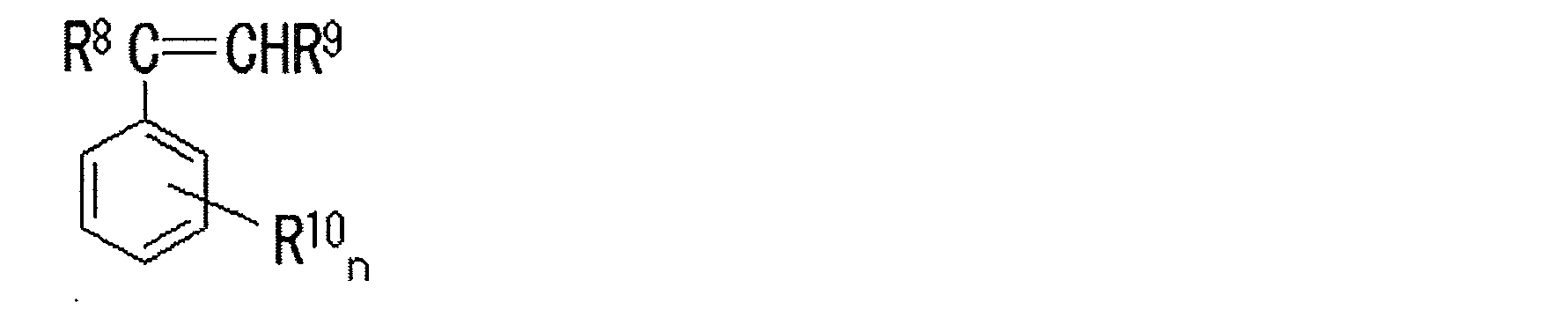
本発明の変性ポリオレフィン粒子は、グラフトモノマーによるグラフト量が多くても、ある程度大きな分子量を有する。具体的には、グラフトしたエチレン性不飽和基と極性官能基を同一分子内に有する単量体の含有量(x)と、135℃デカリン中で測定した極限粘度〔η〕との関係は、xを重量%で、〔η〕をdl/gで表したときに、
log10〔η〕≧ 0.1-0.15x
を満たしており、好ましくは、
log10〔η〕≧ 0.15-0.15x
を満たしており、更に好ましくは、
log10〔η〕≧ 0.2-0.15x
を満たす。
また、炭素繊維強化材などの複合材用途に供する場合において、このようなグラフト変性ポリオレフィン樹脂は、破壊の起点となりうるような欠陥が少ないことから、機械強度の優れた複合材を得ることができる。
|η*|0.1 ÷|η*|10 ≦ 1+0.07×〔log10{|η*|1}〕3.4
さらに好ましくは、
|η*|0.1 ÷|η*|10 ≦ 1+0.05×〔log10{|η*|1}〕3.5
の関係が成り立つ。|η*|0.1 ÷|η*|10 の値が上記の関係を満たすことは、長鎖分岐が少なく、ゲル分率が概ね1重量%未満であることを意味する。
測定条件(a):変性ポリオレフィン粒子を190℃、30分加熱した際に発生するガスを、ヘッドスペ-スガスクロマトグラフィーにより分析する。
グラフト反応前のポリオレフィン粒子に対して浸透性を有し、かつ、
未反応のエチレン性不飽和基と極性官能基を同一分子内に有する単量体や、上記の有機過酸化物由来の分子量150以下の脂肪族アルコールおよび分子量が250以下の芳香環含有化合物を溶解することのできる
溶媒で、グラフト反応後の変性ポリオレフィン粒子を洗浄することにより、本発明で定義する範囲内に収めることが可能である。
本発明の変性ポリオレフィン粒子は、炭素数2~18のα-オレフィンから選ばれる1種類または2種類以上のα-オレフィンからなる、融点が50℃以上250℃未満の重合体、すなわち、上記ポリオレフィン樹脂に、エチレン性不飽和基と極性官能基を同一分子内に有する単量体がグラフトされてなり、且つ、上記要件(1)~(4)を満たすものである限り、どのような有機過酸化物をラジカル開始剤として用いて得られたものであっても良い。ただし、分子量が150以下の脂肪族アルコキシラジカル部位を構成部位として含む有機過酸化物をラジカル開始剤として用い、当該ラジカル開始剤の存在下で上記ポリオレフィン樹脂をグラフト反応させて得られたものが好ましい。
ジ-n-プロピルパーオキシジカーボネートなど、n-プロピルオキシラジカル部位(分子量59)を構成部位として含む有機過酸化物;
ジイソプロピルパーオキシジカーボネートなど、イソプロピルオキシラジカル部位(分子量59)を構成部位として含む有機過酸化物;
ジ-sec-ブチルパーオキシジカーボネートなど、sec-ブチルオキシラジカル部位(分子量73)を構成部位として含む有機過酸化物;
t-ブチルパーオキシネオデカノエート、t-ブチルパーオキシネオヘプタノエート、t-ブチルパーオキシピバレート、t-ブチルパーオキシ-2-エチルヘキサノエート、t-ブチルパーオキシイソブチレート、1,1-ジ(t-ブチルパーオキシ)-2-メチルシクロヘキサン、1,1-ジ(t-ブチルパーオキシ)シクロヘキサン、2,2-ジ(4,4-ジ-(t-ブチルパーオキシ)シクロヘキシル)プロパン、t-ブチルパーオキシマレイン酸、t-ブチルパーオキシ-3,5,5-トリメチルヘキサノエート、t-ブチルパーオキシラウレート、t-ブチルパーオキシイソプロピルモノカーボネート、t-ブチルパーオキシ-2-エチルヘキシルモノカーボネート、t-ブチルパーオキシアセテート、2,2-ジ-(t-ブチルパーオキシ)ブタン、t-ブチルパーオキシイソノナノエート、t-ブチルパーオキシベンゾエート、n-ブチル-4,4-ジ-(t-ブチルパーオキシ)バレエート、メチルエチルケトンパーオキサイド、ジ(2-t-ブチルパーオキシイソプロピル)ベンゼン、エチル-3,3-ジ(t-ブチルパーオキシ)ブチレート、1,3-ジ(2-t-ブチルパーオキシイソプロピル)ベンゼン、2,5-ジメチル-2,5-ジ-(t-ブチルパーオキシ)ヘキサン、t-ブチルクミルパーオキサイド、ジ-t-ブチルパーオキサイド、2,5-ジメチル-2,5-ジ-(t-ブチルパーオキシ)ヘキシン-3、t-ブチルハイドロパーオキサイド、1,1-ジ(t-ブチルパーオキシ)-3,3,5-トリメチルシクロヘキサンなど、t-ブチルオキシラジカル部位(分子量73)を構成部位として含む有機過酸化物;
t-アミルパーオキシネオデカノエート、t-アミルパーオキシピバレート、t-アミルパーオキシ-2-エチルヘキサノエート、1,1-ジ(t-アミルパーオキシ)シクロヘキサン、t-アミルパーオキシイソノナノエート、t-アミルパーオキシノルマルオクトエート、t-アミルパーオキシイソプロピルモノカーボネート、t-アミルパーオキシ-2-エチルヘキシルモノカーボネート、t-アミルパーオキシアセテート、t-アミルパーオキシベンゾエート、ジ-t-アミルパーオキサイド、t-アミルハイドロパーオキサイドなど、t-アミルオキシラジカル部位(分子量87)を構成部位として含む有機過酸化物;
t-ヘキシルパーオキシネオデカノエート、t-ヘキシルパーオキシピバレート、t-ヘキシルパーオキシ-2-エチルヘキサノエート、1,1-ジ(t-ヘキシルパーオキシ)-3,3,5-トリメチルシクロヘキサン、1,1-ジ(t-ヘキシルパーオキシ)シクロヘキサン、t-ヘキシルパーオキシイソプロピルモノカーボネート、t-ヘキシルパーオキシベンゾエート、ジ-t-ヘキシルパーオキサイドなど、t-ヘキシルオキシラジカル部位(分子量101)を構成部位として含む有機過酸化物
が挙げられる。これらのうちでも、t-ブチルオキシラジカル部位を構成部位として含む有機過酸化物、イソプロピルオキシラジカル部位を構成部位として含む有機過酸化物が好ましく、t-ブチルオキシラジカル部位を構成部位として含む有機過酸化物が特に好ましい。


上述した本発明の変性ポリオレフィン粒子を得るための製造方法は、得られる変性ポリオレフィン粒子が上述した要件を満たす限りにおいて、特に制限されない。
炭素数2~18のα-オレフィンから選ばれる1種類または2種類以上のα-オレフィンからなる、融点が50℃以上250℃未満の重合体からなり、且つ平均粒径が例えば0.2mm~10mm以下、好ましくは0.2mm~2.5mmであるポリオレフィン粒子に対して、
エチレン性不飽和基と極性官能基を同一分子内に有する単量体と、
有機過酸化物、特に上記「有機過酸化物」の項に記載された有機過酸化物と、
有機溶媒と、
の3者を、当該ポリオレフィン粒子が固体の状態で含浸させ、当該ポリオレフィン樹脂の融点Tm以下の温度でグラフト反応を行うことで、本発明の変性ポリオレフィン粒子を好適に得ることができる。ここで、ポリオレフィン樹脂の融点Tmは、当該ポリオレフィン樹脂を、示差走査熱分析において10℃/分の昇温速度で測定した融点である。
プロピレン単独重合体では、1.5~10、好ましくは2~10、
プロピレンを主成分とする重合体、特に、プロピレン系ランダム共重合体では、3~10、好ましくは4~10、更に好ましくは5~10、
4-メチルペンテン-1を主成分とするランダム共重合体または単独重合体では、4~15、好ましくは5~15、更に好ましくは6.5~15
がそれぞれ好ましい。
(p1)ポリオレフィン粒子とエチレン性不飽和基と極性官能基を同一分子内に有する単量体と有機過酸化物と有機溶媒とを混合して混合物とし、その後、この混合物を反応させる方法;
(p2)ポリオレフィン粒子とエチレン性不飽和基と極性官能基を同一分子内に有する単量体と有機溶媒とを予め昇温状態で混合して原料混合物とし、この原料混合物を一旦冷却した後に、有機過酸化物をさらに混合し、これらを反応させる方法;
(p3)ポリオレフィン粒子とエチレン性不飽和基と極性官能基を同一分子内に有する単量体と有機溶媒とを混合して原料混合物とし、ついでこの原料混合物を加熱するなどすることにより、この原料混合物を反応が実質的に進行しうる状態に導いた後、有機過酸化物をさらに配合し、これらを反応させる方法;
(p4)ポリオレフィン粒子と有機過酸化物と有機溶媒とを混合して原料混合物とし、ついでこの原料混合物を加熱するなどすることにより、この原料混合物を反応が実質的に進行しうる状態に導いた後、エチレン性不飽和基と極性官能基を同一分子内に有する単量体をさらに配合し、これらを反応させる方法;
(p5)ポリオレフィン粒子を、加熱するなどすることにより反応が実質的に進行しうる状態に導いた後、このポリオレフィン粒子に対して、下記(s5a)~(s5d)のうちのいずれかの工程を行う方法:
(s5a)エチレン性不飽和基と極性官能基を同一分子内に有する単量体、有機過酸化物、および有機溶媒を同時に混合して、これらを反応させる工程、
(s5b)エチレン性不飽和基と極性官能基を同一分子内に有する単量体、有機過酸化物、および有機溶媒の各成分を任意の量に分割したうえで、各成分を、分割した量ごとに同時に混合して、これらを反応させる工程、
(s5c)エチレン性不飽和基と極性官能基を同一分子内に有する単量体、有機過酸化物、および有機溶媒のうち、任意の1成分、または2成分を先行して、当該成分の所定量を一度に、あるいは分割して混合したあとに、残りの2成分、または1成分を、当該成分の所定量を一度に、あるいは分割して混合した後に、これらを反応させる工程、
(s5d)エチレン性不飽和基と極性官能基を同一分子内に有する単量体、有機過酸化物、および有機溶媒を1成分ずつ、任意の順序で混合した後に、これらを反応させる工程;
(p6)ポリオレフィン粒子を、加熱するなどすることにより反応が実質的に進行しうる状態に導いた後、このポリオレフィン粒子に対して、下記(s6a)、(s6b)または(s6c)の工程を行う方法:
(s6a)エチレン性不飽和基と極性官能基を同一分子内に有する単量体の有機溶媒溶液、および、有機過酸化物の有機溶媒溶液を同時に、低速で連続的に供給し、反応させる工程、
(s6b)エチレン性不飽和基と極性官能基を同一分子内に有する単量体の有機溶媒溶液、および、有機過酸化物の有機溶媒溶液の任意の何れかを先行して、低速で連続的に供給した後、他方
の有機溶媒溶液を低速で連続的に供給して反応させる工程、
(s6c)エチレン性不飽和基と極性官能基を同一分子内に有する単量体の有機溶媒溶液、および、有機過酸化物の有機溶媒溶液の任意の何れかを先行して低速で連続的に供給を開始した後、当該有機溶媒の溶液の供給途中に、他方の有機溶媒溶液を低速で供給開始し、引き続き、両者の供給を継続することにより反応させる工程、
(p7)ポリオレフィン粒子と有機過酸化物と有機溶媒を混合して混合物とし、この混合物を加熱しながら気体状態のエチレン性不飽和基と極性官能基を同一分子内に有する単量体に接触させて、反応させる方法。
本発明により得られる変性ポリオレフィン粒子は、たとえば、フィラー強化樹脂組成物、各種ポリマーアロイの相溶化剤、接着剤、積層体の接着層、ワニス、水性分散体、粉体塗料などのコーティング材、などの用途に好適である。
フィラー強化樹脂組成物としては、無機フィラー、たとえば、シリカ、珪藻土、アルミナ、酸化チタン、酸化マグネシウム、軽石粉、軽石バルーン、水酸化アルミニウム、水酸化マグネシウム、塩基性炭酸マグネシウム、ドロマイト、硫酸カルシウム、チタン酸カルシウム、硫酸バリウム、亜硫酸カルシウム、タルク、クレー、マイカ、アスベスト、ガラス繊維、ガラスフレーク、ガラスビーズ、ケイ酸カルシウム、モンモリロナイト、ベントナイト、ボロン繊維、炭素繊維、カーボンブラック、カーボンナノファイバー、アルミニウム粉、硫化モリブデンなどにより強化した組成物、更には上記に例示したような無機フィラーに対し、有機物を化学的に結合させたものにより強化した組成物、また、有機フィラー、たとえば、全芳香族ポリアミド繊維、脂肪族ポリアミド繊維、ポリエステル繊維、セルロース繊維などの繊維や、液晶ポリエステル、ポリアミドなどの微分散体などにより強化した組成物、が挙げられる。さらには植物を繊維状あるいは粉体状に分解処理したものにより強化したものも挙げられる。すなわち、上記フィラー強化樹脂組成物は、本発明により得られる上記変性ポリオレフィン粒子と、上記のような無機フィラーおよび/または有機フィラーなどのフィラーとを含むことになる。
本発明の変性ポリオレフィン粒子を接着剤として用いる場合、ポリスチレン、エチレン・ビニルアルコール共重合体、アイオノマー樹脂、ポリウレタン、ポリアミド、ポリエステル、ポリフェニレンエーテル、ポリカーボネート、ポリアセタール、ポリフェニレンスルフィド、ポリサルホン、ポリエーテルケトン、ポリエーテルエーテルケトン、ポリイミドなど、種々のエンジニアリングプラスチックや、上記「ポリオレフィン樹脂」の項で述べた各種のポリオレフィンを対象にしたポリマーアロイの相溶化剤、ニトリルゴム、ブタジエンゴム、クロロプレンゴム、ブチルゴム、イソプレンゴム、スチレン-イソプレン-スチレンブロック共重合体、スチレン-ブタジエン-スチレンブロック共重合体、水添スチレン-ブタジエン-スチレンブロック共重合体などの各種エラストマーなどの樹脂、アルミニウム、鉄、ニッケル、銅などの金属、紙、綿や化学繊維などの生地等、種々の物質に対して高い接着性を有する。
このような変性ポリオレフィン粒子と未変性のポリオレフィンとを含む熱可塑性樹脂組成物は、公知の方法を利用して製造することができ、例えば、下記のような方法のいずれかで製造することができる。
これらの積層体の具体的用途しては、シャンプーや洗剤などのボトル、食用油、醤油などの調味料ボトル、ミネラルウォーターやジュースなどの飲料用ボトル、弁当箱、茶碗蒸し用椀などの耐熱食品用容器、皿、箸などの食器類、その他各種食品容器や、規格袋、砂糖袋、油物包装袋、水物包装袋、食品包装(の高温滅菌処理対応)、レトルトパウチなどの各種包装フィルム、包装袋、農業用資材などが挙げられる。
・ワニス
本発明の変性ポリオレフィン粒子をワニスとして用いる場合、当該ワニスは、上記変性ポリオレフィン粒子と、溶媒とを含む。ここで、溶媒としては、ベンゼン、トルエン、キシレン等の芳香族炭化水素系溶媒、ペンタン、ヘキサン、ヘプタン、オクタン、ノナン、デカン等の脂肪族炭化水素系溶媒、シクロヘキサン、メチルシクロヘキサン、デカヒドロナフタレン等の脂環族炭化水素系溶媒、クロルベンゼン、ジクロルベンゼン、トリクロルベンゼン、塩化メチレン、クロロホルム、四塩化炭素、テトラクロルエチレン等の塩素化炭化水素系溶媒を挙げることができる。
本発明の変性ポリオレフィン粒子を水性分散体として用いる場合は、エチレン性不飽和基とカルボキシル基を同一分子内に有する単量体をグラフトした変性ポリオレフィン粒子を用いることが特に好ましく、当該水性分散体は、公知の方法、たとえば、必要に応じて中和剤を用いてカルボキシル基を中和し、水に分散させることで製造可能である。この場合の中和剤としては、アンモニア、モノメチルアミン、モノエチルアミン、ジメチルアミン、トリメチルアミン、トリエチルアミン、エチルジメチルアミン、水酸化ナトリウム、水酸化カリウムなどを挙げることができる。
日本電子株式会社製、走査型電子顕微鏡JSM-6380型を用い、倍率10000倍で任意の3箇所の粒子表面を、10μm×13μmの視野で観察し、粒子表面の1μm四方に存在する0.05μm以上0.2μm以下の大きさの孔の数が、最大になるような箇所について、その最大値を求めた。
20mg(もしくは10mg)のサンプルを20mlのバイヤルビンに入れて密栓し、ヘッドスペースサンプラーを用いて190℃、30分加熱し、そのヘッドスペースガスをガスクロマトグラフィー質量分析法により分析した。
試料をデカリンに溶かし希薄溶液を作る。自動粘度測定装置でウベローデ改良型粘度計を用いて、135℃の比粘度を測定し、極限粘度を算出した。
反応終了後の変性ポリオレフィン粒子から未反応の不飽和カルボン酸を完全に除去するために、以下の操作をおこなった:変性ポリオレフィン粒子1gを採取し、キシレン約50mlを加え、還流冷却器を備えたフラスコ中で加熱溶解させた。ついで溶液を室温まで冷却し、アセトンを加えて変性ポリオレフィンを析出させたのち、濾過し、得られた析出物を乾燥処理した。
グラフトモノマーとして不飽和カルボン酸を用いたときのグラフト量は、以下のようにして求めた。
各ポリオレフィン粒子試料及び各変性ポリオレフィン粒子試料の平均粒径は、1000μm未満の場合は、レーザー光回折散乱法により、エタノールを分散媒体として測定した。1000μm以上のものについては、目開き径100μm、180μm、355μm、850μm、1180μm、1400μm、1700μm、2800μmの8種の篩を用い、帯電防止剤として極少量のカーボンブラックを混合したポリオレフィン粒子を分級した。その結果を基に常法により求めたメディアン径を平均粒径とした。
各種ポリオレフィン粒子の融点(Tm)は、示差走査熱分析において10℃/分の昇温速度で測定することにより測定した。具体的には、測定は、粒子形状の試料をアルミパンに詰め、10℃/分で200℃まで昇温し、昇温時のΔHが1J/g以上の融解ピーク頂点の位置の温度を融点とした。
各種ポリオレフィン粒子のメルトフローレート(MFR)は、ASTM D1238に従い、230℃、2.16kg荷重の条件下で測定を実施した。
下記に示す各実施例および比較例において用いられる有機過酸化物の略称は、以下の化合物または製品を指す。
PBZ:t-ブチルパーオキシベンゾエート(日油株式会社・パーブチルZ)
NP-BMT:ベンゾイルパーオキサイド、ベンゾイル-m-メチルベンゾイルパーオキサイド、m-トルオイルパーオキサイドの混合物(理論活性酸素量=6.05%、日油株式会社・ナイパー(登録商標)BMT-K40、40%キシレン溶液)
(10)酸化防止剤を吸着させた変性ポリオレフィン粒子の抗酸化性の評価
酸化防止剤としてペンタエリスリトールテトラキス(3-(3,5-ジ-t-ブチル-4-ヒドロキシフェニル)プロピオネート)(ビーエーエスエフ社製、イルガノックス1010)の1グラムをテトラヒドロフラン9グラムに溶解させたものに、変性ポリオレフィン粒子1グラムを投入し、室温にて24時間放置し、グラフト重合体粒子に酸化防止剤を含浸させた。ついで、G2のガラスフィルターを用いて変性ポリオレフィン粒子を濾過し、室温にて乾燥させた。この状態の変性ポリオレフィン粒子0.5グラムを5グラムのメタノールに投入し、室温で10分間撹拌し、変性ポリオレフィン粒子表面に付着した未含浸の酸化防止剤を除去した。このようにして得られた、酸化防止剤が吸着された変性ポリオレフィン粒子について、プロピレン単独重合体による変性ポリオレフィン粒子、プロピレン・エチレンランダム共重合体による変性ポリオレフィン粒子の場合は200℃、4-メチルペンテン-1とデセン-1のランダム共重合体による変性ポリオレフィン粒子の場合は、250℃にて、酸素雰囲気の条件下で酸化誘導時間を測定した。
なお、本願発明者らは本実施例において酸化誘導時間が長い(すなわち、抗酸化性に優れる)ということは、酸化防止剤の孔部分への含浸と吸着が十分に進行していることと等価であると考えている。
330メッシュの金網で作成した容器に、変性ポリオレフィン約0.3グラムを秤量し、キシレン100mlを加えて、加熱還流操作を2時間実施した。金網中に未溶解のまま残存したゲル分を、真空乾燥機にて120℃、12時間乾燥を行った後に、重量を測定し、最初に秤量したサンプル重量に対するゲル分の重量の比(百分率)をゲル含有量とした。
厚さ2mm、直径25mmの円盤形状の平行プレート型の試験片をプレス成形により成形し、アントンパール社製PhysicaMCR301型粘弾性測定装置を用いて、ひずみ1%にて、角周波数100rad/s~0.1rad/sの範囲で測定し、0.1rad/sと、10rad/sにおける複素粘性率の比を求めた。
MFR=0.4(g/10分)、融点145℃、平均粒径250μmのプロピレン-エチレンランダム共重合体粒子100重量部を1リットルのオートクレーブに仕込み、窒素雰囲気下で攪拌しつつ、120℃のオイルバスで加熱する。この状態で、オートクレーブ内に、無水マレイン酸7.5重量部をトルエン26重量部に溶解させた溶液と、有機過酸化物としてt-ブチルパーオキシイソプロピルモノカーボネート(日油株式会社・パーブチルI)3.4重量部をトルエン3.5重量部に溶解させた溶液とを同時に並行して滴下した。滴下に要する時間は、無水マレイン酸のトルエン溶液は4時間、t-ブチルパーオキシイソプロピルモノカーボネートのトルエン溶液は1時間40分とした。無水マレイン酸のトルエン溶液を滴下終了後、さらに1時間、加熱・攪拌を継続し、反応終了とした。反応中は、オートクレーブは密閉状態とした。反応終了後、冷却してアセトン280重量部を加え、再度、オートクレーブを密閉状態とし、撹拌しつつ、100℃のオイルバスで1時間加熱し、加熱終了後、冷却、濾過を行った。同様の操作を合計で3回、繰り返し、60℃で5時間、真空乾燥を行った。各原料の仕込み量およびグラフト条件を表1-1にまとめて示す。
t-ブチルパーオキシイソプロピルモノカーボネート(日油株式会社・パーブチルI)3.4重量部を、t-ブチルパーオキシベンゾエート(日油株式会社・パーブチルZ)3.7重量部に、加熱温度を125℃に、それぞれ変更した以外は実施例1と同様の操作を行った。各原料の仕込み量およびグラフト条件を表1-1に示す。
t-ブチルパーオキシイソプロピルモノカーボネート3.4重量部を6.1重量部に変更した以外は、実施例1と同様の操作を行った。各原料の仕込み量およびグラフト条件を表1-3に示す。
実施例1で用いたものと同じプロピレン-エチレンランダム共重合体粒子100重量部を1リットルのオートクレーブに仕込み、室温、窒素雰囲気下で攪拌しつつ、無水マレイン酸5重量部をトルエン17重量部に溶解させた溶液および有機過酸化物としてベンゾイルパーオキサイド、ベンゾイル-m-メチルベンゾイルパーオキサイド、m-トルオイルパーオキサイドの混合物の40%キシレン溶液(日油株式会社、商品名 ナイパー(登録商標)BMT-K40)11重量部を滴下して30分攪拌を継続した後、100℃に加熱したオイルバスにより4時間、加熱して反応させた。反応中は、オートクレーブは密閉状態とした。反応終了後、冷却してオートクレーブの内容物を抜き出した。これにアセトンを加えて合計の体積を1リットルとし、室温で10分間攪拌した後、濾過を行った。同様の操作を合計で4回繰り返し、60℃で5時間、真空乾燥を行った。各原料の仕込み量およびグラフト条件を表1-2に示す。ここで、表1-3中、トルエン仕込み量(過酸化物溶解分)の項に*2とあるのは、本比較例は、有機過酸化物の仕込みに用いた溶媒としてトルエンではなくキシレンを用いた場合に相当するものであり、トルエン仕込み量(過酸化物溶解分)の欄に、上記キシレン溶液に含まれるキシレン相当量を記載したことを意味する。
実施例1で用いたものと同じプロピレン-エチレンランダム共重合体粒子100重量部、無水マレイン酸10重量部、有機過酸化物としてt-ブチルパーオキシイソプロピルモノカーボネート(日油株式会社・パーブチルI)3.2重量部を容量20mlの耐圧容器に仕込み、内部を窒素置換した後に、トルエン8.7重量部を添加して密栓し、120℃に加熱したオイルバスにより5時間、加熱して反応させた。反応終了後、冷却して耐圧容器の内容物を抜き出し、実施例1と同様の後処理を行った。各原料の仕込み量およびグラフト条件を表1-1に示す。
MFR=0.6(g/10分)、融点160℃、平均粒径380μmのプロピレン単独重合体粒子100重量部を容量2リットルのプラネタリーミキサー(井上製作所製、PLM-2)に仕込み、窒素雰囲気下で攪拌しつつ、125℃のオイルバスで加熱する。この状態で、プラネタリーミキサー内に、無水マレイン酸8.3重量部をトルエン35重量部に溶解させた溶液を4時間かけて滴下した。当該無水マレイン酸のトルエン溶液の滴下開始の30分後に、有機過酸化物としてt-ブチルパーオキシイソプロピルモノカーボネート(日油株式会社・パーブチルI)6.8重量部をトルエン3.5重量部に溶解させた溶液の滴下を開始し、2時間40分かけて全量を滴下させた。無水マレイン酸のトルエン溶液を滴下終了後、さらに1時間、加熱・攪拌を継続し、反応終了とした。反応中、プラネタリーミキサー内は、常に窒素雰囲気下とした。反応終了後、冷却して内容物を抜出し、オートクレーブに投入し、アセトン280重量部を加えて、オートクレーブを密閉状態とし、撹拌しつつ、100℃のオイルバスで1時間加熱し、加熱終了後、冷却、濾過を行った。同様の操作を合計で3回、繰り返し、60℃で5時間、真空乾燥を行った。
実施例4で用いたものと同じMFR=0.6(g/10分)、平均粒径380μmのプロピレン単独重合体粒子100重量部を容量2リットルのプラネタリーミキサー(井上製作所製、PLM-2)に仕込み、窒素雰囲気下で攪拌しつつ、140℃のオイルバスで加熱する。この状態で、プラネタリーミキサー内に、無水マレイン酸8.3重量部をトルエン35重量部に溶解させた溶液と、有機過酸化物としてt-ブチルパーオキシイソプロピルモノカーボネート(日油株式会社・パーブチルI)6.8重量部をトルエン3.5重量部に溶解させた溶液とを同時に並行して滴下した。滴下に要する時間は、無水マレイン酸のトルエン溶液は4時間、t-ブチルパーオキシイソプロピルモノカーボネートのトルエン溶液は2時間40分とした。無水マレイン酸のトルエン溶液を滴下終了後、さらに1時間、加熱・攪拌を継続し、反応終了とした。反応中は、プラネタリーミキサー内は、常に窒素雰囲気下とした。反応終了後、冷却して内容物を抜出し、オートクレーブに投入し、アセトン280重量部を加え、オートクレーブを密閉状態とし、撹拌しつつ、100℃のオイルバスで1時間加熱し、加熱終了後、冷却、濾過を行った。同様の操作を合計で3回、繰り返し、60℃で5時間、真空乾燥を行った。
MFR=2(g/10分)、融点160℃、平均粒径4mmのプロピレン単独重合体粒子100重量部、無水マレイン酸8.3重量部をトルエン35重量部に溶解させた溶液と、有機過酸化物としてt-ブチルパーオキシイソプロピルモノカーボネート(日油株式会社・パーブチルI)6.8重量部を容量300ミリリットルのガラス容器に仕込んだ。容器内を窒素で置換したあと、125℃のオイルバスで5時間加熱し、反応させた。反応中は、ガラス容器内は、常に窒素雰囲気下とした。反応終了後、冷却して内容物を抜出しアセトン280重量部を加え、室温で10分間、撹拌、濾過を行った。同様の操作を合計で4回、繰り返し、60℃で5時間、真空乾燥を行った。
デセン-1単位含量=3重量%、MFR=5g/10分、平均粒径380μm、融点232℃の、4-メチルペンテン-1とデセン-1との共重合体粒子100重量部、無水マレイン酸5重量部をトルエン17重量部に溶解させた溶液と、過酸化物としてt-ブチルパーオキシイソプロピルモノカーボネート(日油株式会社・パーブチルI)1.3重量部をトルエン3.5重量部に溶解させた溶液を、容量2リットルのプラネタリーミキサー(井上製作所製PLM-2)に仕込み、内部を窒素置換した後に、150℃に加熱したオイルバスにより1時間、加熱して反応させた。反応終了後、冷却してプラネタリーミキサーの内容物を抜き出した。これにアセトンを加えて合計の体積を1リットルとし、室温で10分間攪拌した後、濾過を行った。同様の操作を合計で4回繰り返し、60℃で5時間、真空乾燥を行った。
実施例1に用いたものと同じMFR=0.4(g/10分)、融点145℃、平均粒径250μmのプロピレン-エチレンランダム共重合体粒子100重量部に対し、無水マレイン酸2重量部、過酸化物として2,5-ジメチル-2,5-ジ(t-ブチルパーオキシ)ヘキサン(日油株式会社、パーヘキサ25B)を0.5重量部添加してドライブレンドし、230℃に設定した2軸押出機にて混練し、変性ポリオレフィンを得た。
実施例7で用いたものと同じ4-メチルペンテン-1とデセン-1との共重合体粒子100重量部、無水マレイン酸5重量部、過酸化物としてt-ブチルパーオキシイソプロピルモノカーボネート(日油株式会社・パーブチルI)3.1重量部を容量20mlの耐圧容器に仕込み、内部を窒素置換した後に、トルエン17重量部を添加して密栓し、125℃に加熱したオイルバスにより5時間、加熱して反応させた。反応終了後、冷却して耐圧容器の内容物を抜き出し、実施例7と同様の後処理を行った。


MFR=0.6(g/10分)、平均粒径380μmのプロピレン単独重合体粒子(融点:160℃)100重量部を1リットルのオートクレーブに仕込み、室温、窒素雰囲気下で攪拌しつつ、アリルグリシジルエーテル5重量部をトルエン17重量部に溶解させた溶液および有機過酸化物としてt-ブチルパーオキシイソプロピルモノカーボネート(日油株式会社・パーブチルI)2.6重量部をトルエン3.5重量部に溶解させた溶液を同時に並行して約20分かけて滴下した。滴下終了後、30分攪拌を継続した後、125℃に加熱したオイルバスにより5時間、加熱して反応させた。反応中は、オートクレーブは密閉状態とした。反応終了後、冷却してオートクレーブの内容物を抜き出した。これにアセトンを加えて合計の体積を1リットルとし、室温で10分間攪拌した後、濾過を行った。同様の操作を合計で4回繰り返し、60℃で5時間、真空乾燥を行った。
グラフトモノマーおよび有機過酸化物の種類、並びに、各原材料の仕込み量などを下記表3-1および3-2に示すように変更した以外は、実施例8と同様の操作を行い、変性ポリプロピレン粒子を得た。得られた変性ポリプロピレン粒子の分析結果を下記表4-1および表4-2に示す。
実施例8で用いたものと同じMFR=0.6(g/10分)、平均粒径380μmのプロピレン単独重合体粒子100重量部を1リットルのオートクレーブに仕込み、窒素雰囲気下で攪拌しつつ、125℃のオイルバスで加熱する。この状態で、オートクレーブ内に、アリルグリシジルエーテル15重量部をトルエン35重量部に溶解させた溶液と、有機過酸化物としてt-ブチルパーオキシイソプロピルモノカーボネート(日油株式会社・パーブチルI)12重量部をトルエン3.5重量部に溶解させた溶液とを同時に並行して滴下した。滴下に要する時間は、アリルグリシジルエーテルのトルエン溶液は4時間、t-ブチルパーオキシイソプロピルモノカーボネートのトルエン溶液は2時間40分とした。アリルグリシジルエーテルのトルエン溶液を滴下終了後、さらに1時間、加熱・攪拌を継続し、反応終了とした。反応中は、オートクレーブは密閉状態とした。反応終了後、冷却してアセトン280重量部を加え、再度、オートクレーブを密閉状態とし、撹拌しつつ、100℃のオイルバスで1時間加熱し、加熱終了後、冷却、濾過を行った。同様の操作を合計で3回、繰り返し、60℃で5時間、真空乾燥を行った。得られたアリルグリシジルエーテル変性ポリプロピレンの物性を表4-2に示す。

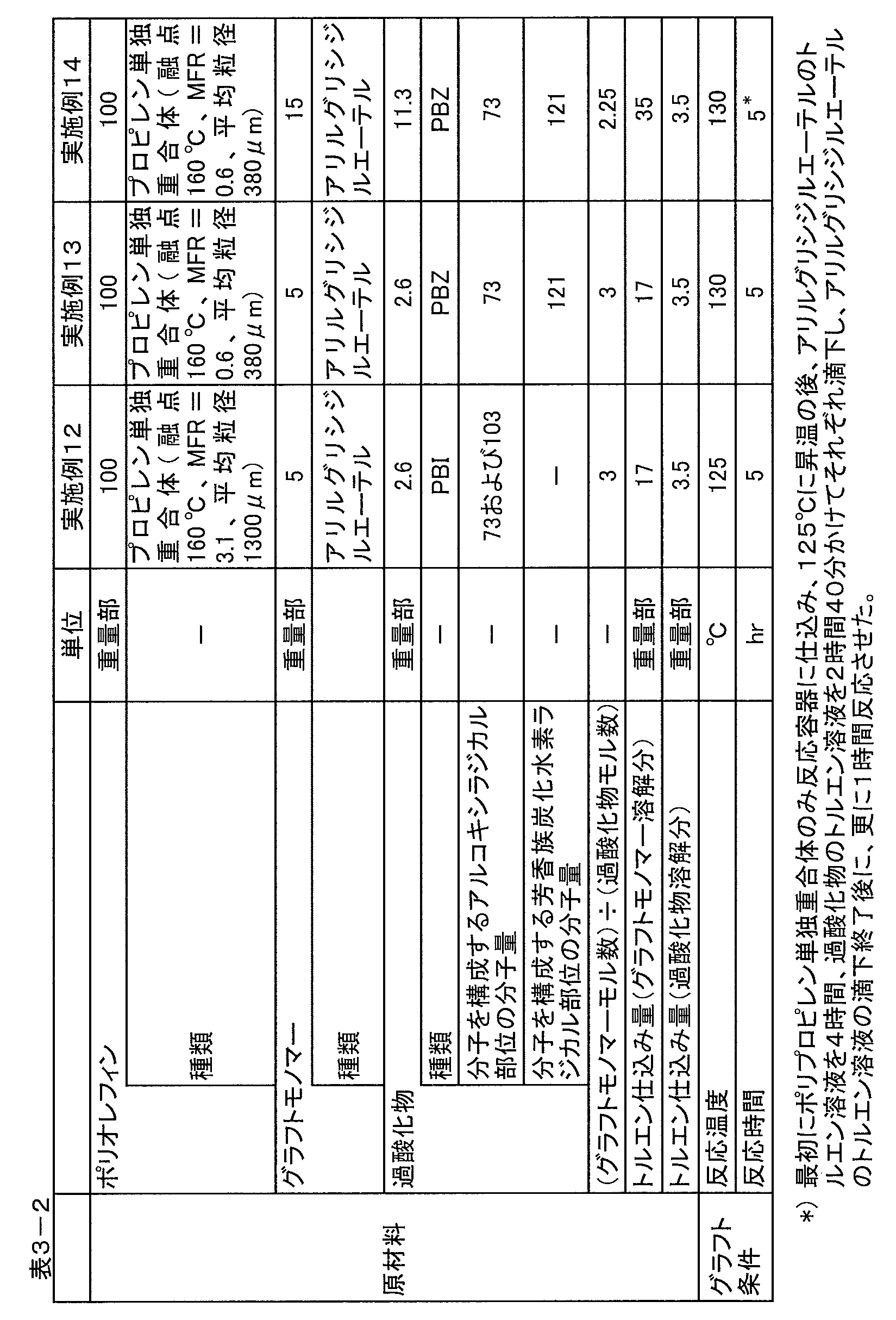


Claims (25)
- 炭素数2~18のα-オレフィンから選ばれる1種類または2種類以上のα-オレフィンからなる、融点が50℃以上250℃未満の重合体に、エチレン性不飽和基と極性官能基を同一分子内に有する単量体がグラフトされてなり、以下の要件(1)~(3)を満たす変性ポリオレフィン粒子:
(1) 前記エチレン性不飽和基と極性官能基を同一分子内に有する単量体のグラフト量xが0.5重量%以上20重量%以下である。
(2) 前記エチレン性不飽和基と極性官能基を同一分子内に有する単量体のグラフト量x(重量%)と、135℃デカリン中で測定した極限粘度〔η〕(dl/g)との関係が、
log10〔η〕≧ 0.1-0.15x
の式を満たす。
(3) ゲル含有量が1重量%未満である。
ここで、上記ゲル含有量は、変性ポリオレフィン粒子の約0.3グラムを330メッシュの金網に収納し、その状態の当該変性ポリオレフィン粒子にキシレン100mlを添加し、加熱還流を2時間行ったのちに金網内に残存する未溶解分の重量の、当該変性ポリオレフィン粒子全体の重量に対する割合である。 - 炭素数2~18のα-オレフィンから選ばれる1種類または2種類以上のα-オレフィンからなる、融点(Tm)が50℃以上250℃未満の重合体の粒子に、
(a)エチレン性不飽和基と極性官能基を同一分子内に有する単量体
(b)有機過酸化物
(c)有機溶媒
からなる溶液を含浸させ、
(Tm-10)℃より低い温度で反応させること、および
((a)のモル数÷(b)のモル数)の値が1~20であることを特徴とする、請求項1に記載の変性ポリオレフィン粒子の製造方法。 - 請求項2に記載の前記重合体が、プロピレンの単独重合体であり、
((a)のモル数÷(b)のモル数)の値が1.5~10であることを特徴とする、請求項2に記載の製造方法。 - 請求項2に記載の前記重合体が、プロピレンを主成分とするランダム共重合体であり、
((a)のモル数÷(b)のモル数)の値が3~10であることを特徴とする、請求項2に記載の製造方法。 - 前記ランダム共重合体におけるプロピレンの含有量が70モル%以上、99.9モル%未満であることを特徴とする、請求項4に記載の製造方法。
- 前記ランダム共重合体が、エチレン、ブテンから選ばれる少なくとも1種のコモノマーを含むランダム共重合体であることを特徴とする請求項5に記載の製造方法。
- 請求項2に記載の前記重合体が4-メチルペンテン-1を主成分とするランダム共重合体または単独重合体であり、
((a)のモル数÷(b)のモル数)の値が4~15であることを特徴とする、請求項2に記載の製造方法。 - 前記ランダム共重合体または単独重合体における4-メチルペンテン-1の含有量が80モル%以上であることを特徴とする、請求項7に記載の製造方法。
- 平均粒径が0.2mm~10mmであることを特徴とする、請求項1に記載の変性ポリオレフィン粒子。
- 平均粒径が0.2mm~2.5mmであることを特徴とする、請求項1に記載の変性ポリオレフィン粒子。
- ゲル含有量が0.00003重量%以上であることを特徴とする請求項1に記載の変性ポリオレフィン粒子。
- 前記重合体が、プロピレンの単独重合体を除くα-オレフィンの重合体であり、かつ、ゲル含有量が0.00003重量%以上であることを特徴とする請求項11に記載の変性ポリオレフィン粒子。
- 走査型電子顕微鏡を用い、倍率10000倍で粒子表面を観察したときに、粒子表面に、0.05μm~0.2μmの大きさの孔を5個~400個含む1μm×1μmの領域を有することを特徴とする、請求項10に記載の変性ポリオレフィン粒子。
- 走査型電子顕微鏡を用い、倍率10000倍で任意の3か所の粒子表面を13μm×10μmの視野で観察したときに、当該3か所中、1か所または2か所以上の粒子表面に、0.05μm~0.2μmの大きさの孔を10個~400個含む1μm×1μmの領域を有することを特徴とする請求項13に記載の変性ポリオレフィン粒子。
- 変性ポリオレフィン粒子を190℃、30分加熱した際に発生するガスの、ヘッドスペースガスクロマトグラフィーによって測定される分子量が150以下の脂肪族アルコールの含有量が、変性ポリオレフィン粒子1gあたり1μg以上10000μg以下であることを特徴とする請求項1および9~14のいずれか1項に記載の変性ポリオレフィン粒子。
- 変性ポリオレフィン粒子を190℃、30分加熱した際に発生するガスの、ヘッドスペースガスクロマトグラフィーによって測定される分子量が110以下の脂肪族アルコールの含有量もまた、変性ポリオレフィン粒子1gあたり1μg以上10000μg以下であることを特徴とする請求項15に記載の変性ポリオレフィン粒子。
- 変性ポリオレフィン粒子を190℃、30分加熱した際に発生するガスの、ヘッドスペースガスクロマトグラフィーによって測定される分子量が150以下の脂肪族アルコールの含有量および分子量が250以下の芳香環含有化合物の含有量が、いずれも、変性ポリオレフィン粒子1gあたり1μg以上10000μg以下であることを特徴とする請求項1および9~14のいずれか1項に記載の変性ポリオレフィン粒子。
- グラフトが、ラジカル開始剤の存在下で前記ポリオレフィン樹脂に前記エチレン性不飽和基と極性官能基を同一分子内に有する単量体をグラフト反応させることにより行われるものであり、
当該ラジカル開始剤が、分子量が150以下の脂肪族アルコキシラジカル部位を構成部位として含む有機過酸化物であることを特徴とする請求項1,9~14および16のいずれか1項に記載の変性ポリオレフィン粒子。 - 前記脂肪族アルコキシラジカル部位の分子量が110以下である請求項18に記載の変性ポリオレフィン粒子。
- グラフトが、ラジカル開始剤の存在下で前記ポリオレフィン樹脂に前記エチレン性不飽和基と極性官能基を同一分子内に有する単量体をグラフト反応させることにより行われるものであり、
当該ラジカル開始剤が、分子量が150以下の脂肪族アルコキシラジカル部位および分子量が250以下の芳香環含有化合物ラジカル部位を構成部位として含む有機過酸化物であることを特徴とする請求項1,9~14および17のいずれか1項に記載の変性ポリオレフィン粒子。 - 前記重合体の粒子の平均粒径が0.2mm~10mmであることを特徴とする、請求項2に記載の製造方法。
- 前記重合体の粒子の平均粒径が0.2mm~2.5mmであることを特徴とする、請求項2に記載の製造方法。
- 前記有機過酸化物が、分子量が150以下の脂肪族アルコキシラジカル部位を構成部位として含む有機過酸化物である請求項2,21および22のいずれか1項に記載の製造方法。
- 前記脂肪族アルコキシラジカル部位の分子量が110以下である請求項23に記載の製造方法。
- 前記有機過酸化物が、分子量が150以下の脂肪族アルコキシラジカル部位と分子量が250以下の芳香環含有化合物ラジカル部位を構成部位として含む有機過酸化物である請求項2,21および22のいずれか1項に記載の製造方法。
Priority Applications (5)
| Application Number | Priority Date | Filing Date | Title |
|---|---|---|---|
| CN201580048846.5A CN107075040B (zh) | 2014-09-12 | 2015-09-11 | 改性聚烯烃颗粒及其制造方法 |
| EP15840012.7A EP3192821B1 (en) | 2014-09-12 | 2015-09-11 | Modified polyolefin particles and production method therefor |
| ES15840012T ES2759773T3 (es) | 2014-09-12 | 2015-09-11 | Partículas de poliolefina modificada y método de producción para las mismas |
| US15/509,750 US10730988B2 (en) | 2014-09-12 | 2015-09-11 | Modified polyolefin particles and methods for producing the same |
| JP2016547807A JPWO2016039461A1 (ja) | 2014-09-12 | 2015-09-11 | 変性ポリオレフィン粒子及びその製造方法 |
Applications Claiming Priority (2)
| Application Number | Priority Date | Filing Date | Title |
|---|---|---|---|
| JP2014-186135 | 2014-09-12 | ||
| JP2014186135 | 2014-09-12 |
Publications (1)
| Publication Number | Publication Date |
|---|---|
| WO2016039461A1 true WO2016039461A1 (ja) | 2016-03-17 |
Family
ID=55459204
Family Applications (1)
| Application Number | Title | Priority Date | Filing Date |
|---|---|---|---|
| PCT/JP2015/075920 Ceased WO2016039461A1 (ja) | 2014-09-12 | 2015-09-11 | 変性ポリオレフィン粒子及びその製造方法 |
Country Status (7)
| Country | Link |
|---|---|
| US (1) | US10730988B2 (ja) |
| EP (1) | EP3192821B1 (ja) |
| JP (1) | JPWO2016039461A1 (ja) |
| CN (1) | CN107075040B (ja) |
| ES (1) | ES2759773T3 (ja) |
| PT (1) | PT3192821T (ja) |
| WO (1) | WO2016039461A1 (ja) |
Cited By (1)
| Publication number | Priority date | Publication date | Assignee | Title |
|---|---|---|---|---|
| WO2018105682A1 (ja) | 2016-12-09 | 2018-06-14 | 三井化学株式会社 | グラフトコポリマー含有固形物およびその用途 |
Families Citing this family (7)
| Publication number | Priority date | Publication date | Assignee | Title |
|---|---|---|---|---|
| US10591856B2 (en) * | 2018-04-18 | 2020-03-17 | Canon Kabushiki Kaisha | Roller with filler bundle in elastic layer and fixing device |
| JP7391572B2 (ja) * | 2019-08-29 | 2023-12-05 | キヤノン株式会社 | トナー及びトナーの製造方法 |
| CN111642438B (zh) * | 2020-05-09 | 2021-12-10 | 中国水产科学研究院东海水产研究所 | 一种防海藻附着圆柱形吊笼制备方法 |
| US11686947B2 (en) * | 2020-05-27 | 2023-06-27 | Microsoft Technology Licensing, Llc | Structural fiber component for injection molding in head mounted displays |
| US20220325052A1 (en) * | 2021-04-12 | 2022-10-13 | Illinois Tool Works Inc. | Solutions for solvent swelling and solvent bonding |
| CN115322310A (zh) * | 2022-08-29 | 2022-11-11 | 苏州海顺包装材料有限公司 | 一种固相法制备聚烯烃树脂的方法、热封胶 |
| EP4410904A1 (de) * | 2023-02-03 | 2024-08-07 | Clariant International Ltd | Ptfe-reduzierte strukturierungsmittel für pulverlacke |
Citations (9)
| Publication number | Priority date | Publication date | Assignee | Title |
|---|---|---|---|---|
| JPS59120644A (ja) * | 1982-12-27 | 1984-07-12 | Mitsui Petrochem Ind Ltd | ガラス繊維強化ポリ4−メチル−1−ペンテン組成物 |
| JPH07118488A (ja) * | 1993-10-20 | 1995-05-09 | Nissan Motor Co Ltd | 自動車外装部品用オレフィン系樹脂組成物 |
| JPH107704A (ja) * | 1996-06-25 | 1998-01-13 | Origin Electric Co Ltd | 樹脂粒子、その製造方法、樹脂粒子を用いた塗料及び 化粧品 |
| JP2000345098A (ja) * | 1999-06-02 | 2000-12-12 | Mitsui Chemicals Inc | コーティング剤 |
| JP2007126561A (ja) * | 2005-11-04 | 2007-05-24 | Idemitsu Kosan Co Ltd | 反応性前駆体組成物及び該組成物を用いた変性反応組成物、並びにそれらの製造方法 |
| JP2008163289A (ja) * | 2006-06-02 | 2008-07-17 | Mitsubishi Chemicals Corp | 水性樹脂分散体の製造方法 |
| JP2009040975A (ja) * | 2007-08-10 | 2009-02-26 | Tosoh Corp | 不飽和カルボン酸グラフトポリオレフィン及びその製造法 |
| JP2010018750A (ja) * | 2008-07-11 | 2010-01-28 | Tosoh Corp | 不飽和カルボン酸グラフトポリオレフィン及びその製造法 |
| JP2013155326A (ja) * | 2012-01-31 | 2013-08-15 | Mitsui Chemicals Inc | ポリ−4−メチル−1−ペンテン系樹脂組成物、該組成物から得られる成形体およびフィルム |
Family Cites Families (14)
| Publication number | Priority date | Publication date | Assignee | Title |
|---|---|---|---|---|
| US4536545A (en) | 1983-10-12 | 1985-08-20 | Occidental Chemical Corporation | Graft polymers of polymerizable monomers and olefin polymers |
| JPH0517585A (ja) * | 1991-07-09 | 1993-01-26 | Mitsui Petrochem Ind Ltd | ポリオレフインの微粉化方法 |
| JP2004505131A (ja) * | 2000-07-28 | 2004-02-19 | イー・アイ・デュポン・ドウ・ヌムール・アンド・カンパニー | ポリオレフィンのグラフト化 |
| JP4083519B2 (ja) | 2002-09-09 | 2008-04-30 | 株式会社プライムポリマー | ポリオレフィン樹脂組成物及びその製造方法 |
| WO2004022610A1 (ja) | 2002-09-09 | 2004-03-18 | Idemitsu Kosan Co., Ltd. | 変性プロピレン系重合体及びポリオレフィン樹脂組成物 |
| CN1823103B (zh) * | 2003-07-11 | 2010-11-03 | 陶氏环球技术公司 | 制造官能化聚烯烃的方法、官能化聚烯烃、双组分纤维、无纺织物和卫生吸收产品 |
| JP2006219627A (ja) | 2005-02-14 | 2006-08-24 | Prime Polymer:Kk | 変性ポリプロピレン樹脂 |
| WO2006118272A1 (ja) | 2005-04-28 | 2006-11-09 | Mitsubishi Chemical Corporation | 酸変性ポリプロピレン樹脂及びその製造方法、並びにそれを用いた樹脂組成物 |
| JP5320662B2 (ja) | 2005-04-28 | 2013-10-23 | 三菱化学株式会社 | 酸変性ポリプロピレン樹脂及びその製造方法、並びにそれを用いた樹脂組成物 |
| WO2009022646A1 (ja) * | 2007-08-10 | 2009-02-19 | Tosoh Corporation | 不飽和カルボン酸グラフトポリオレフィン及びその製造法 |
| CN101959906B (zh) | 2008-02-29 | 2012-09-05 | 住友化学株式会社 | 用于生产经改性的烯烃聚合物的方法 |
| WO2010119480A1 (ja) * | 2009-04-14 | 2010-10-21 | 化薬アクゾ株式会社 | 無水マレイン酸変性ポリプロピレン及びそれを含む樹脂組成物 |
| CN101700702A (zh) * | 2009-10-30 | 2010-05-05 | 沧州明珠塑料股份有限公司 | 聚烯烃复合微孔膜及其制备方法 |
| WO2015125802A1 (ja) * | 2014-02-19 | 2015-08-27 | 三井化学株式会社 | グラフト変性プロピレン・α-オレフィン共重合体およびその製造方法 |
-
2015
- 2015-09-11 EP EP15840012.7A patent/EP3192821B1/en active Active
- 2015-09-11 US US15/509,750 patent/US10730988B2/en active Active
- 2015-09-11 JP JP2016547807A patent/JPWO2016039461A1/ja not_active Ceased
- 2015-09-11 CN CN201580048846.5A patent/CN107075040B/zh active Active
- 2015-09-11 WO PCT/JP2015/075920 patent/WO2016039461A1/ja not_active Ceased
- 2015-09-11 PT PT158400127T patent/PT3192821T/pt unknown
- 2015-09-11 ES ES15840012T patent/ES2759773T3/es active Active
Patent Citations (9)
| Publication number | Priority date | Publication date | Assignee | Title |
|---|---|---|---|---|
| JPS59120644A (ja) * | 1982-12-27 | 1984-07-12 | Mitsui Petrochem Ind Ltd | ガラス繊維強化ポリ4−メチル−1−ペンテン組成物 |
| JPH07118488A (ja) * | 1993-10-20 | 1995-05-09 | Nissan Motor Co Ltd | 自動車外装部品用オレフィン系樹脂組成物 |
| JPH107704A (ja) * | 1996-06-25 | 1998-01-13 | Origin Electric Co Ltd | 樹脂粒子、その製造方法、樹脂粒子を用いた塗料及び 化粧品 |
| JP2000345098A (ja) * | 1999-06-02 | 2000-12-12 | Mitsui Chemicals Inc | コーティング剤 |
| JP2007126561A (ja) * | 2005-11-04 | 2007-05-24 | Idemitsu Kosan Co Ltd | 反応性前駆体組成物及び該組成物を用いた変性反応組成物、並びにそれらの製造方法 |
| JP2008163289A (ja) * | 2006-06-02 | 2008-07-17 | Mitsubishi Chemicals Corp | 水性樹脂分散体の製造方法 |
| JP2009040975A (ja) * | 2007-08-10 | 2009-02-26 | Tosoh Corp | 不飽和カルボン酸グラフトポリオレフィン及びその製造法 |
| JP2010018750A (ja) * | 2008-07-11 | 2010-01-28 | Tosoh Corp | 不飽和カルボン酸グラフトポリオレフィン及びその製造法 |
| JP2013155326A (ja) * | 2012-01-31 | 2013-08-15 | Mitsui Chemicals Inc | ポリ−4−メチル−1−ペンテン系樹脂組成物、該組成物から得られる成形体およびフィルム |
Cited By (2)
| Publication number | Priority date | Publication date | Assignee | Title |
|---|---|---|---|---|
| WO2018105682A1 (ja) | 2016-12-09 | 2018-06-14 | 三井化学株式会社 | グラフトコポリマー含有固形物およびその用途 |
| KR20190078617A (ko) | 2016-12-09 | 2019-07-04 | 미쓰이 가가쿠 가부시키가이샤 | 그래프트 코폴리머 함유 고형물 및 그의 용도 |
Also Published As
| Publication number | Publication date |
|---|---|
| EP3192821A1 (en) | 2017-07-19 |
| US20170283539A1 (en) | 2017-10-05 |
| EP3192821B1 (en) | 2019-10-30 |
| US10730988B2 (en) | 2020-08-04 |
| CN107075040B (zh) | 2019-08-30 |
| ES2759773T3 (es) | 2020-05-12 |
| PT3192821T (pt) | 2019-12-03 |
| JPWO2016039461A1 (ja) | 2017-06-22 |
| EP3192821A4 (en) | 2018-05-02 |
| CN107075040A (zh) | 2017-08-18 |
Similar Documents
| Publication | Publication Date | Title |
|---|---|---|
| CN107075040B (zh) | 改性聚烯烃颗粒及其制造方法 | |
| EP2221339B1 (en) | Molded article of filler-reinforced polypropylene resin composition | |
| CN101910225B (zh) | 改性丙烯树脂 | |
| JP7118137B2 (ja) | 4-メチル-1-ペンテン系重合体粒子および4-メチル-1-ペンテン系樹脂の製造方法 | |
| JP5180882B2 (ja) | ポリプロピレン樹脂組成物、およびその成形体 | |
| JP5134594B2 (ja) | 炭素繊維強化プロピレン系複合材料およびその成形体 | |
| CN102131862A (zh) | 离聚物树脂、含有其的树脂组合物以及它们的用途 | |
| JP5747561B2 (ja) | プロピレン樹脂組成物 | |
| JP2020105503A (ja) | 複合材および成形体 | |
| JP2009179665A (ja) | 変性ポリプロピレン樹脂、およびその製造方法 | |
| JP5166893B2 (ja) | 変性ポリプロピレン樹脂、およびその製造方法 | |
| JP7581481B2 (ja) | 再生炭素繊維強化ポリオレフィン組成物およびその用途 | |
| JP6357390B2 (ja) | 変性ポリオレフィン粒子の製造方法および精製方法 | |
| JP2020105367A (ja) | 樹脂組成物 | |
| JP2020105366A (ja) | 複合材および成形体 | |
| JP2014198847A (ja) | 酸変性ポリオレフィン粒子及びその製造方法 | |
| EP3604426A1 (en) | Filler-reinforced resin structure | |
| JP2006219627A (ja) | 変性ポリプロピレン樹脂 | |
| JP2018027999A (ja) | フィラー強化樹脂用助剤、フィラー強化ポリプロピレン樹脂組成物およびその成形品 | |
| JP2015155536A (ja) | 酸変性ポリオレフィン粒子及びその製造方法 | |
| JP2008184601A (ja) | 変性ポリプロピレン系樹脂およびその製造方法 |
Legal Events
| Date | Code | Title | Description |
|---|---|---|---|
| 121 | Ep: the epo has been informed by wipo that ep was designated in this application |
Ref document number: 15840012 Country of ref document: EP Kind code of ref document: A1 |
|
| ENP | Entry into the national phase |
Ref document number: 2016547807 Country of ref document: JP Kind code of ref document: A |
|
| WWE | Wipo information: entry into national phase |
Ref document number: 15509750 Country of ref document: US |
|
| NENP | Non-entry into the national phase |
Ref country code: DE |
|
| REEP | Request for entry into the european phase |
Ref document number: 2015840012 Country of ref document: EP |
|
| WWE | Wipo information: entry into national phase |
Ref document number: 2015840012 Country of ref document: EP |