WO2016043264A1 - 乳酸を含む蒸気組成物の製造方法 - Google Patents
乳酸を含む蒸気組成物の製造方法 Download PDFInfo
- Publication number
- WO2016043264A1 WO2016043264A1 PCT/JP2015/076462 JP2015076462W WO2016043264A1 WO 2016043264 A1 WO2016043264 A1 WO 2016043264A1 JP 2015076462 W JP2015076462 W JP 2015076462W WO 2016043264 A1 WO2016043264 A1 WO 2016043264A1
- Authority
- WO
- WIPO (PCT)
- Prior art keywords
- lactic acid
- vaporizer
- composition containing
- liquid
- composition
- Prior art date
- Legal status (The legal status is an assumption and is not a legal conclusion. Google has not performed a legal analysis and makes no representation as to the accuracy of the status listed.)
- Ceased
Links
Images

Classifications
-
- C—CHEMISTRY; METALLURGY
- C07—ORGANIC CHEMISTRY
- C07C—ACYCLIC OR CARBOCYCLIC COMPOUNDS
- C07C59/00—Compounds having carboxyl groups bound to acyclic carbon atoms and containing any of the groups OH, O—metal, —CHO, keto, ether, groups, groups, or groups
- C07C59/01—Saturated compounds having only one carboxyl group and containing hydroxy or O-metal groups
- C07C59/08—Lactic acid
-
- C—CHEMISTRY; METALLURGY
- C07—ORGANIC CHEMISTRY
- C07C—ACYCLIC OR CARBOCYCLIC COMPOUNDS
- C07C51/00—Preparation of carboxylic acids or their salts, halides or anhydrides
- C07C51/42—Separation; Purification; Stabilisation; Use of additives
- C07C51/43—Separation; Purification; Stabilisation; Use of additives by change of the physical state, e.g. crystallisation
-
- B—PERFORMING OPERATIONS; TRANSPORTING
- B01—PHYSICAL OR CHEMICAL PROCESSES OR APPARATUS IN GENERAL
- B01B—BOILING; BOILING APPARATUS ; EVAPORATION; EVAPORATION APPARATUS
- B01B1/00—Boiling; Boiling apparatus for physical or chemical purposes ; Evaporation in general
- B01B1/005—Evaporation for physical or chemical purposes; Evaporation apparatus therefor, e.g. evaporation of liquids for gas phase reactions
-
- C—CHEMISTRY; METALLURGY
- C07—ORGANIC CHEMISTRY
- C07C—ACYCLIC OR CARBOCYCLIC COMPOUNDS
- C07C51/00—Preparation of carboxylic acids or their salts, halides or anhydrides
- C07C51/42—Separation; Purification; Stabilisation; Use of additives
- C07C51/50—Use of additives, e.g. for stabilisation
-
- C—CHEMISTRY; METALLURGY
- C07—ORGANIC CHEMISTRY
- C07C—ACYCLIC OR CARBOCYCLIC COMPOUNDS
- C07C67/00—Preparation of carboxylic acid esters
- C07C67/48—Separation; Purification; Stabilisation; Use of additives
- C07C67/52—Separation; Purification; Stabilisation; Use of additives by change in the physical state, e.g. crystallisation
- C07C67/54—Separation; Purification; Stabilisation; Use of additives by change in the physical state, e.g. crystallisation by distillation
-
- C—CHEMISTRY; METALLURGY
- C07—ORGANIC CHEMISTRY
- C07C—ACYCLIC OR CARBOCYCLIC COMPOUNDS
- C07C69/00—Esters of carboxylic acids; Esters of carbonic or haloformic acids
- C07C69/66—Esters of carboxylic acids having esterified carboxylic groups bound to acyclic carbon atoms and having any of the groups OH, O—metal, —CHO, keto, ether, acyloxy, groups, groups, or in the acid moiety
- C07C69/67—Esters of carboxylic acids having esterified carboxylic groups bound to acyclic carbon atoms and having any of the groups OH, O—metal, —CHO, keto, ether, acyloxy, groups, groups, or in the acid moiety of saturated acids
- C07C69/675—Esters of carboxylic acids having esterified carboxylic groups bound to acyclic carbon atoms and having any of the groups OH, O—metal, —CHO, keto, ether, acyloxy, groups, groups, or in the acid moiety of saturated acids of saturated hydroxy-carboxylic acids
- C07C69/68—Lactic acid esters
Definitions
- the mass ratio of lactic acid dimer to lactic acid contained in the liquid composition containing the lactic acid oligomer is preferably 0.4 to 3. Furthermore, it is preferable that the average residence time in the region of 210 ° C. or higher in the mixed solution in the vaporizer is 300 minutes or shorter. That is, not only from the liquid composition containing lactic acid supplied to the vaporizer, but also the liquid composition containing lactic acid is mixed with the liquid composition containing the lactic acid oligomer held in the vaporizer, By using a part of the vapor, it is possible to suppress an increase in the liquid temperature in the vaporizer and to suppress generation of by-products due to thermal decomposition. Also, complete the technology that can effectively utilize the oligomers generated in the vaporizer, suppress the adhesion of heavy components in the vaporizer, and stably produce a vapor composition containing lactic acid for a long period of time. It came to.
- the pipe examples include a pipe for supplying the raw material composition, a pipe for circulating the oligomer composition, and a pipe for extracting a vapor composition containing lactic acid, and one or more of them can be used.
- the pump for supplying a raw material composition and the pump for circulating an oligomer composition are mentioned, for example, These can be used 1 or more types.
- the raw material composition A used in the present invention may contain other components in addition to lactic acid, lactic acid oligomer and lactide (hereinafter also referred to as lactic acid).
- other components include a solvent.
- the solvent those capable of dissolving lactic acid are preferable, and examples thereof include water, alcohol, hydrocarbon, ether, ketone, ester, amine, and amide. These can be used alone or in combination of two or more. Of these, water is preferred. If water is present, it can be expected that lactic acid oligomers and lactides are hydrolyzed to increase the concentration of lactic acid and improve the evaporation efficiency of lactic acids.
- the present invention is a method for efficiently producing a vapor composition containing lactic acid by sufficiently preventing lactic acid from being lost even if it is oligomerized in the course of evaporation.
- the raw material composition A is mixed with a liquid composition containing a lactic acid oligomer held in a vaporizer (hereinafter also referred to as oligomer composition B), and the mixed liquid is heated to mix.
- oligomer composition B a liquid composition containing a lactic acid oligomer held in a vaporizer
- a part of the liquid is vaporized to generate a vapor composition containing lactic acid.
- it is preferable to vaporize a part of the mixed solution by heating the mixed solution while adding and mixing the raw material composition A to the oligomer composition B.
- the lactic acid oligomer in the oligomer composition B has a distribution and includes lactic acid oligomers of trimer or higher.
- the oligomer composition B is supplied from the lower part of the heating pipe (3) by the oligomer composition B circulation pump (7) and introduced into the gas-liquid separation tank (5) from the upper part of the heating pipe (3). It is circulated through the B circulation line (6).
- the raw material composition A supplied from the raw material composition A supply pump (2) is supplied and mixed there, and the resulting mixed liquid is supplied into the heating tube (3).
- the heating tube (3) is heated from the tube wall by the heater (4), and a part of the mixed solution is vaporized in the heating tube (3), and is extracted from the upper portion of the heating tube (3) in the gas-liquid mixed state. And introduced into the gas-liquid separation tank (5).
- the feed rate, the amount of heat supplied to the heating tube, etc. are adjusted. Thereby a continuously stable evaporation is achieved.
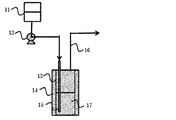
- a simpler vaporizer as shown in FIG. 2 may be used.
- An oligomer composition B (17) is charged in a heating container (13), and the mixture is mixed by supplying the raw material composition A through the raw material composition A supply line (15) into the composition. Can be extracted from the extraction line (16) of the vapor composition containing lactic acid.
- the average residence time is preferably 1 minute or longer, more preferably 3 minutes or longer, and even more preferably 5 minutes or longer from the viewpoint of obtaining lactic acid with a good yield. If it is less than 1 minute, the amount of liquid in the vaporizer is small, and there is a possibility that stable operation cannot be performed.
- the oligomer composition B contains more water than the raw material composition A.
- the water content of the water may be considerably small.
- the average residence time of lactic acids in the region of 210 ° C. or higher is obtained by dividing the volume of lactic acids in the mixed solution existing at 210 ° C.
- the thermal history in the vaporizer can suppress the thermal decomposition of lactic acids when the average residence time of lactic acids in the region of 210 ° C. or higher is 900 minutes or less.
- a vapor containing lactic acid can be obtained in high yield.
- the average residence time of lactic acids in the region of 210 ° C. or higher is more preferably 300 minutes or less, even more preferably 150 minutes or less, still more preferably 50 minutes or less, and particularly preferably 30 minutes or less.
- the ratio of the liquid mixture vaporized in the evaporation section such as the heating tube (3) in the above example is 40% by mass or less with respect to the liquid mixture introduced into the heating tube (3).
- the evaporation rate is 40% by mass or less with respect to the liquid mixture introduced into the heating tube (3).
- 30 mass% or less is more preferable, 20 mass% or less is more preferable, and 10 mass% or less is still more preferable.
- it exceeds 40 mass% the volume of the vapor
- the raw material composition A may be supplied to the vaporizer at room temperature, or may be supplied after preheating. When preheated, there are advantages such that the bumping of the raw material composition A can be suppressed, the temperature distribution in the vaporizer is reduced and the operation is stabilized, and the heating load in the vaporizer is reduced.
- the difference between the supply temperature of the raw material composition A and the liquid temperature of the oligomer composition B in the region where the raw material composition A is mixed is preferably 150 ° C. or lower, preferably 100 ° C. or lower, and more preferably 50 ° C. or lower.
- heavy components may accumulate in the vaporizer mixture during long-time operation.
- a part of the mixed solution can be extracted from the vaporizer, and the concentration of heavy components in the system can be kept constant.
- the oligomer composition B can be partially extracted from the circulation line of the vaporizer. The extracted liquid may be discarded, but can be reused by recovering lactic acid contained in the mixed solution or by recovering lactic acid oligomer or lactide contained in the mixed solution to recover free lactic acid. May be.
- An internal tube made of two types of titanium was placed in the heating tube and the gas-liquid separation tank, and the temperature was appropriately measured.
- an electronically controlled back pressure valve ER5000 manufactured by TESCOM
- a mass flow controller SLA5850S manufactured by ITW Japan
- nitrogen of a high purity cylinder manufactured by Sumitomo Seika
- a differential pressure gauge DP-15 manufactured by VALIDYNE was used to keep the liquid level in the gas-liquid separation tank constant.
- the liquid volume excluding the space part of the vaporizer constituted as described above was 326 mL.
- the lactic acid monomer equivalent amount of the condensate is 280 mmol / hour with respect to the lactic acid monomer equivalent amount of 288 mmol / hour in the raw material. ) was calculated as 97%.
- a vapor composition containing lactic acid can be produced stably at a high lactic acid distillate rate for a long period of time.
- the gas components after condensation were analyzed by gas chromatography (analysis condition 2), but no by-products other than lactic acids were detected.
- the temperature of raw material aqueous solution is 50 degreeC
- region which mixes raw material aqueous solution is 150 degreeC
- a temperature difference is 100 degreeC.
- Composition analysis was performed on the liquid phase (oligomer composition B) at the end of the evaporation operation.
- the lactic acids were analyzed by liquid chromatography and the water content was analyzed by a Karl Fischer analyzer, the compositions shown in Table 4 below were obtained.
Landscapes
- Chemical & Material Sciences (AREA)
- Organic Chemistry (AREA)
- Crystallography & Structural Chemistry (AREA)
- Engineering & Computer Science (AREA)
- Oil, Petroleum & Natural Gas (AREA)
- Chemical Kinetics & Catalysis (AREA)
- Organic Low-Molecular-Weight Compounds And Preparation Thereof (AREA)
Abstract
Description
例えば、乳酸を用いてアクリル酸を製造する技術として、固体触媒を用いる気相脱水方法が知られている(下記非特許文献1)。
また特許文献1は、α-または、β-ヒドロキシカルボン酸を含む水溶液を不活性なセラミック等や酸性の固体触媒を保持したところへ導入して加熱することにより、α、β-不飽和カルボン酸を合成する方法を開示している。
乳酸を含む蒸気組成物の製造方法であって、気化器に供給される乳酸を含む液体組成物を、気化器内に保持される乳酸オリゴマーを含む液体組成物と混合し、その混合液を加熱することにより混合液の一部を気化させ、乳酸を含む蒸気組成物を発生させることを特徴とする、乳酸を含む蒸気組成物の製造方法である。
上記乳酸を含む液体組成物を、上記乳酸オリゴマーを含む液体組成物に添加して混合しながら、その混合液を加熱することにより混合液の一部を気化させることが好ましい。
また上記乳酸オリゴマーを含む液体組成物に含まれる乳酸に対する乳酸2量体の質量比(乳酸2量体/乳酸)が0.4~3であることが好ましい。
更に、上記気化器内の混合液のうち210℃以上の領域での平均滞留時間が300分以下であることが好ましい。
すなわち、気化器に供給される乳酸を含む液体組成物からだけでなく、該乳酸を含む液体組成物を気化器内に保持される乳酸オリゴマーを含む液体組成物と混合して、その混合液の一部を蒸気とすることで、気化器内での液温の上昇を抑制し、熱分解による副生物の生成を抑えることができる。また気化器中で生成するオリゴマーを有効活用でき、気化器内での重質分の付着等を抑制して、長期間安定して乳酸を含む蒸気組成物を製造することができる技術を完成するに至った。
なお、以下において記載する本発明の個々の好ましい実施形態を2つ以上組み合わせたものもまた、本発明の好ましい実施形態である。
本発明で用いる気化器に供給される乳酸を含む液体組成物(以下、原料組成物Aともいう)は、一般的な製造法である発酵法で製造されたものでも化学法で製造されたものでもどちらでも使用できる。乳酸は通常水溶液の形態で流通しており、そのまま用いてもよいし、水等の溶媒でさらに希釈して用いてもよく、また蒸発等の操作を利用して水等を除去して適宜濃縮して用いてもよい。該希釈に用いる水としてはイオン交換水、純水、通常の水道水などを使用してもよいし、製造工程で発生する廃水をリサイクル使用してもよい。また乳酸を含む液体組成物は乳酸の他に、乳酸のオリゴマーやラクチドなどの乳酸同士の縮合物を含んでいてもよい。
本明細書中、気化器は、加熱部、加熱部を加熱するための加熱源、配管、及び、送液設備を含んで構成されるものであり、更に、加熱部とは別に気液分離槽等を含んでいてもよい。該配管としては、例えば、原料組成物を供給するための配管、オリゴマー組成物を循環するための配管、乳酸を含む蒸気組成物を抜き出すための配管が挙げられ、これらを1種以上使用できる。また、送液設備としては、例えば、原料組成物を供給するためのポンプ、オリゴマー組成物を循環するためのポンプが挙げられ、これらを1種以上使用できる。
原料組成物A中の乳酸類の濃度は、5質量%以上が好ましく、10質量%以上がより好ましく、15質量%以上が一層好ましく、20質量%以上がより一層好ましい。濃度が低すぎると、蒸発に必要なエネルギーが過大になる。
本発明の製造方法は、原料組成物Aを、気化器内に保持される乳酸オリゴマーを含む液体組成物(以下、オリゴマー組成物Bともいう)と混合し、その混合液を加熱することにより混合液の一部を気化させ、乳酸を含む蒸気組成物を発生させる。例えば、原料組成物Aを、オリゴマー組成物Bに添加して混合しながら、その混合液を加熱することにより混合液の一部を気化させることが好ましい。この場合、オリゴマー組成物Bに対して原料組成物Aを添加しながら、原料組成物Aとオリゴマー組成物Bとの混合物の一部を気化する。言い換えれば、原料組成物Aを、乳酸オリゴマーを含む気化器内混合液に添加しながら、該気化器内混合液の一部を気化させ、乳酸を含む蒸気組成物を得ることが本発明の好ましい形態の1つである。
オリゴマー組成物B中の乳酸オリゴマーは分布を持ち、3量体以上の乳酸オリゴマーも含んでいるが、長鎖の乳酸オリゴマーの割合が多くなると、沸点が高くなり、蒸気の発生の効率が悪くなったり、熱分解により蒸気として得られる乳酸類の収量が低下したりすることがある。該乳酸オリゴマーのうち、2量体から10量体までの合計が、50質量%以上であることが好ましく、60質量%以上が一層好ましい。また、2量体から5量体までの合計が30質量%以上が好ましく、40質量%以上がより好ましく、50質量%以上が一層好ましい。
なお、本明細書中、乳酸オリゴマーとは、乳酸の2量体から100量体までを言う。
オリゴマー組成物Bは、気化器内に保持されているが、例を挙げて後述するような、気化器を構成する機器である、加熱部、配管、気液分離槽等のいずれかの中に保持されていればよく、それらの機器の中で原料組成物Aと混合できればよい。気化器内に保持されているオリゴマー組成物Bの温度は、気化器の運転条件によるが、25℃から、運転圧力におけるオリゴマー組成物Bの沸点までの間にて維持される。その温度は各機器毎に異なっていてもよく、例えば配管内でも温度分布があってもよい。
原料組成物Aをオリゴマー組成物Bと混合し、その混合液の一部を蒸発させること、特に、原料組成物Aをオリゴマー組成物Bに添加して混合しながら、その混合液の一部を蒸発させることにより、原料組成物Aを単独で気化させる場合に比べて、蒸発時の液相の組成の変化が小さくなり、引いては蒸発温度の変化を小さくすることができる。そのため、高濃度にオリゴマーが濃縮されたような液の生成を避けることができ、高温化による熱分解を抑制することができる。
例えば、図1に従って、本発明を説明する。図1の気化器は、原料組成物Aタンク(1)、原料組成物A供給ポンプ(2)、加熱管(3)、ヒーター(4)、気液分離槽(5)、オリゴマー組成物B循環ライン(6)、オリゴマー組成物B循環ポンプ(7)、及び、乳酸を含む蒸気組成物の抜き出しライン(8)等から構成されている。
またより簡単な図2に示したような気化器を用いてもよい。加熱容器(13)にオリゴマー組成物B(17)を仕込んでおき、その組成物中に原料組成物A供給ライン(15)を通して原料組成物Aを供給することで混合し、発生した気体(乳酸を含む蒸気組成物)を、乳酸を含む蒸気組成物の抜き出しライン(16)より抜き出すことができる。
本発明によって安定に蒸発が行うことができ、乳酸を含む蒸気組成物を連続的に安定して得ることができる。気化器に供給した原料組成物Aに含まれる乳酸類の乳酸単量体換算の量に対し、乳酸を含む蒸気組成物に含まれる乳酸類の乳酸単量体換算の量は、85モル%以上が好ましく、90モル%以上がより好ましく、95モル%以上が更に好ましい。ここで乳酸単量体換算とは、乳酸オリゴマーやラクチドに含まれる乳酸単量体相当のモル数を指す。例えば、乳酸2量体1モルは乳酸単量体換算で2モル、乳酸3量体1モルは乳酸単量体換算で3モル、ラクチド1モルは乳酸単量体換算で2モルと数える。
また乳酸2量体等の重合度の小さいオリゴマーはある程度の蒸気圧を有するため、液相の乳酸オリゴマー分布によっては、乳酸を含む蒸気組成物に乳酸オリゴマーが含まれる場合がある。得られた乳酸を含む蒸気組成物を、例えば次工程の反応で用いる場合、乳酸オリゴマーが含まれていても差し支えない場合は、乳酸を含む蒸気組成物をそのまま次の工程で使用してもよい。
原料組成物Aとオリゴマー組成物Bとの混合は、できるだけ速やかに行えることが好ましい。原料組成物Aとオリゴマー組成物Bを接触させた後、攪拌機を有するような設備で混合したり、スタティックミキサーのような静止型混合器に流通させたりする等の手法を採用してもよい。
該熱交換器を備える気化器としては、水平管型や垂直管型の自然循環式気化器、強制循環式気化器が例示できる。
気化器内で40℃以上または210℃以上で保持される混合液の体積は、気化器内の温度分布を温度計により測定し、気化器内の各領域の体積から計算することができる。
また、本発明の製造方法においても、長時間の運転では、気化器内混合液に重質分が蓄積することがある。その場合は、該混合液を一部気化器から抜き出し、系内の重質分の濃度を一定に保つことができる。該混合液を一部抜き出す方法として、例えばオリゴマー組成物Bを気化器の循環ラインから一部抜き出すことができる。抜き出した液は、廃棄してもよいが、該混合液に含まれる乳酸を回収したり、該混合液に含まれる乳酸オリゴマーやラクチドを加水分解して遊離した乳酸を回収したりして再利用してもよい。
本体:L-2000シリーズ(株式会社日立ハイテクノロジーズ製)
使用カラム:Inertsil ODS-4(ジーエルサイエンス株式会社製) 1本
溶離液:アセトニトリル/水/リン酸/リン酸二水素カリウム=40/58.5/1.0/0.5(重量比)
検出器:UV 205nm
カラム温度:50℃
溶離液流量:0.5ml/分
本体:GC-2014(株式会社島津製作所製)
使用カラム:ULBON HR-20M(信和化工株式会社製)、内径0.53mm、長さ30m、膜厚5μm
検出器:FID
気化器温度:270℃
検出器温度:270℃
キャリアガス:ヘリウム
キャリアガス流量:10ml/分
本体:GC-2014(株式会社島津製作所製)
使用カラム:ShincarbonST 50/80(信和化工株式会社製)、内径3mm、長さ2m
検出器:TCD
気化室温度:260℃
検出器温度:260℃
キャリアガス:ヘリウム
キャリアガス流量:40ml/分
図2に示すような原料組成物A供給ライン15、乳酸を含む蒸気組成物の抜き出しライン16と温度計を備えたステンレス製気化器(内径23.4mm、高さ120mm)に、90質量%乳酸水溶液12gを仕込み、オイルバスにて所定の温度に加熱した。その後20質量%乳酸水溶液を0.2ml/分の流量で気化器内の液相中に供給し、気化器内の液と供給した乳酸水溶液を混合した。また窒素を気化器内の気相中に52ml/分の流量で流通させた。
蒸発したガスは抜き出しライン16から抜き出した後、冷却器で冷却し、受器内に凝縮液を得た。凝縮液の留出速度が、原料の供給速度と同じになるようにオイルバスの温度を調整した。オイルバスの温度が210℃、気化器内の液温が200℃の時に留出速度と供給速度が同じになったため、そのまま蒸発操作を9時間継続した。
取得した凝縮液の受器は1時間ごとに交換し、液体クロマトグラフィーでの分析を実施した。分析の結果、1時間経過以降は同じ組成で安定しており、乳酸が13.1質量%、乳酸2量体が5.7質量%、乳酸3量体が0.3質量%、残りは水であり、他の副生物は検出されなかった。このとき原料中の乳酸供給量26.7mmol/時に対して凝縮液の乳酸単量体換算量が26.7mmol/時となっており、乳酸単量体としての供給速度と留出速度が同じであることを確認した。凝縮液をガスクロマトグラフィー(分析条件1)で、凝縮後のガス成分をガスクロマトグラフィー(分析条件2)で分析したが、乳酸類以外の副生物は検出されなかった。
蒸発操作終了時の液相(オリゴマー組成物B)について組成分析を行った。カールフィッシャー分析装置にて水分量を測定したところ、0.5質量%であった。また、液体クロマトグラフィーにて乳酸類の分析を実施したところ、下表の組成であった。

この実施例では、20質量%乳酸水溶液(原料組成物A)が、気化器内に保持されている上記表の組成の溶液(オリゴマー組成物B)と混合され、その混合液から蒸気成分を取得することができ、その中に含まれる乳酸類の量が、供給した乳酸に対して、乳酸単量体換算でほぼ同量となっていることを示している。
内径10mmのステンレス管に、外径9mm、内径7mm、長さ35cmの石英管を入れ、石英管の中に径が710μmから2mmの石英ビーズ7.85mlを充填し気化器とした。気化器の外側から電気ヒーターで加熱し、気化器の上部に20質量%乳酸水溶液を0.05ml/分の流量で、窒素を55ml/分の流量でそれぞれ供給した。供給した乳酸水溶液がほぼ全量抜き出せるように電気ヒーターの出力を調整した。気化器の内温は入口付近では105℃、出口付近で301℃であった。気化器出口から抜き出した蒸気は冷却器で冷却し、受器内に凝縮液を得た。凝縮液を液体クロマトグラフィーにて分析したところ、乳酸が15.4質量%、乳酸2量体が3.7質量%であった。
また凝縮液をガスクロマトグラフィー(分析条件1)で、凝縮後のガス成分をガスクロマトグラフィー(分析条件2)で分析したところ、供給した乳酸に対して、副生物としてアセトアルデヒドが1.1モル%、ヒドロキシアセトンが0.3モル%、酢酸が0.2モル%、プロピオン酸が1.2モル%、アクリル酸が0.6モル%、一酸化炭素が1.0モル%、二酸化炭素が0.2モル%生成していた。
上記の副生物の生成割合は、(各副生物のモル数×炭素数)/(供給した乳酸のモル数×3)×100の式にて算出した。
実験後、石英ビーズは褐色に着色しており、炭化物の粉体が付着していた。
この比較例では、20質量%の乳酸水溶液を、乳酸オリゴマーを含んだ液と混合することなくそのまま気化器へ供給し、全量蒸発を試みたが、副生物が多く生成したことが示された。また、3量体以上の乳酸オリゴマーが気化器の中にとどまり、ロスとなった。
(気化器の作製)
図1に示される装置を以下の機器構成で作製した。
原料組成物Aタンク(1):5Lのポリエチレン製タンク
原料組成物A供給ポンプ(2):セラムQポンプ(山善株式会社製)
加熱管(3):チタン2種製チューブ(内径10.0mm、高さ600mm)
ヒーター(4):マイクロヒーター(電圧100V、電気容量600W、長さ4000mm)を加熱管(3)に螺旋状に巻き付けた。
気液分離槽(5):チタン2種製チューブ(内径21.2mm、長さ800mm)
オリゴマー組成物B循環ライン(6):チタン2種製チューブ(内径4.0mm、長さ1000mm)
オリゴマー組成物B循環ポンプ(7):セラムQポンプ(山善株式会社製)
乳酸を含む蒸気組成物の抜き出しライン(8):チタン2種製チューブとし、その先に冷却器を設置することで蒸気組成物を凝縮させた。
その他構成として、チューブの接続はSwagelok社製のステンレス継手で実施、加熱部はすべてグラスウール製の保温筒で保護した。加熱管および気液分離槽内にはチタン2種製の内挿管を入れ、適宜温度を計測した。また、装置内部の圧力を制御するため、電子制御式背圧弁ER5000(TESCOM社製)およびマスフローコントローラーSLA5850S(ITWジャパン社製)を使用するとともに、高純度ボンベ(住友精化社製)の窒素を不活性気体として用いた。さらに、気液分離槽内の液面を一定に保つために差圧計DP-15(VALIDYNE社製)を使用した。
以上から構成される気化器の空間部を除く液容積は326mLとなった。
(乳酸オリゴマー液の調製)
上記で作製した混合液循環型の気化器に90質量%の乳酸水溶液(和光純薬工業社製・特級試薬)を326ml仕込み、窒素を10ml/分の流量で流通させながら、電子制御式背圧弁で系内を0.1MPaとした。さらにオリゴマー組成物B循環ポンプ(7)を20ml/分の流量で稼働し、試薬を循環させながらヒーター(4)で熱を加えて水分を留去することでオリゴマー化を促進させた。蒸発した水分は抜き出しライン(8)から抜き出した後、冷却器で冷却し、受器内に凝縮させた。水分の留去量に応じて原料組成物A供給ポンプ(2)から90質量%の乳酸水溶液を供給し、気化器内の液量を常に一定に保った。加熱管(3)上部の液温が160℃に達したところで、90質量%乳酸水溶液の供給を停止した。
前述の乳酸オリゴマー液調製後に気化器内の圧力を0.1MPa、オリゴマー組成物B循環ポンプ(7)の流量を20ml/分、窒素流量を10ml/分とし、乳酸が20.3質量%、乳酸2量体が0.4質量%の組成である原料水溶液を2ml/分の流量で供給した。このとき、気化器内の液の滞留時間は163分と算出された。凝縮液の留出速度が原料の供給速度と同じになるように加熱管の温度を調整し、ヒーター(4)の設定が168℃、加熱管(3)上部の液温度が163℃となったところで留出速度と原料供給速度が同じになったため、そのまま蒸発操作を4時間継続した。取得した凝縮液の受器は30分ごとに交換し、液体クロマトグラフィーおよびガスクロマトグラフィー(分析条件1)での分析を実施した。分析の結果、30分経過以降は同じ組成で安定しており、乳酸が16.9質量%、乳酸2量体が2.4質量%、乳酸3量体が0.2質量%、残りは水であり、他の副生物は検出されなかった。このとき原料中の乳酸単量体換算量288mmol/時に対して凝縮液の乳酸単量体換算量は280mmol/時となっており、乳酸単量体としての留出率(乳酸類留出率ともいう)を97%と算出した。このように、本実施例では、高い乳酸類留出率で長期間安定して乳酸を含む蒸気組成物を製造することができる。また、凝縮後のガス成分をガスクロマトグラフィー(分析条件2)で分析したが、乳酸類以外の副生物は検出されなかった。
なお、原料水溶液の温度は50℃であり、原料水溶液を混合する領域の乳酸オリゴマー液の温度が150℃で、温度差は100℃である。
蒸発操作終了時の液相(オリゴマー組成物B)について組成分析を行った。液体クロマトグラフィーにて乳酸類を、カールフィッシャー分析装置にて水分量を、それぞれ分析したところ、下記表4に示した組成であった。
下記表2~表4に実施例2-1の結果を記す。なお、下記表3では、留出液組成は水を除いた乳酸、乳酸オリゴマー、副生物のうちの組成(mol%)を示している。
同様の実験を圧力、原料濃度、原料供給量、循環ポンプ流量を変えた実験を実施した。下表に各実施例の条件および結果を記す。
なお、下記表2~表4中、ADはアセトアルデヒドを表し、PAはプロピオン酸を表し、AAはアクリル酸を表し、COは一酸化炭素を表す。


2:原料組成物A供給ポンプ
3:加熱管
4:ヒーター
5:気液分離槽
6:オリゴマー組成物B循環ライン
7:オリゴマー組成物B循環ポンプ
8:乳酸を含む蒸気組成物の抜き出しライン
11:原料組成物Aタンク
12:原料組成物A供給ポンプ
13:加熱容器
14:ヒーター
15:原料組成物A供給ライン
16:乳酸を含む蒸気組成物の抜き出しライン
17:オリゴマー組成物B
Claims (6)
- 乳酸を含む蒸気組成物の製造方法であって、
気化器に供給される乳酸を含む液体組成物を、気化器内に保持される乳酸オリゴマーを含む液体組成物と混合し、その混合液を加熱することにより混合液の一部を気化させ、乳酸を含む蒸気組成物を発生させることを特徴とする、乳酸を含む蒸気組成物の製造方法。 - 前記乳酸オリゴマーを含む液体組成物に含まれる乳酸に対する乳酸2量体の質量比(乳酸2量体/乳酸)が0.4~3であることを特徴とする請求項1に記載の乳酸を含む蒸気組成物の製造方法。
- 前記気化器内の混合液のうち210℃以上の領域での平均滞留時間が300分以下であることを特徴とする請求項1又は2に記載の乳酸を含む蒸気組成物の製造方法。
- 前記気化器内の混合液の平均滞留時間は、1分以上、300分以下であることを特徴とする請求項1~3のいずれかに記載の乳酸を含む蒸気組成物の製造方法。
- 前記気化器内の圧力は、0.1kPa以上、4MPa以下であることを特徴とする請求項1~4のいずれかに記載の乳酸を含む蒸気組成物の製造方法。
- 前記乳酸を含む蒸気組成物の蒸発温度は、100℃以上、350℃以下であることを特徴とする請求項1~5のいずれかに記載の乳酸を含む蒸気組成物の製造方法。
Priority Applications (3)
| Application Number | Priority Date | Filing Date | Title |
|---|---|---|---|
| JP2016548938A JP6272493B2 (ja) | 2014-09-17 | 2015-09-17 | 乳酸を含む蒸気組成物の製造方法 |
| US15/511,158 US9758463B1 (en) | 2014-09-17 | 2015-09-17 | Method for producing vapor composition containing lactic acid |
| EP15841641.2A EP3196186B1 (en) | 2014-09-17 | 2015-09-17 | Method for producing vapor composition containing lactic acid |
Applications Claiming Priority (2)
| Application Number | Priority Date | Filing Date | Title |
|---|---|---|---|
| JP2014188694 | 2014-09-17 | ||
| JP2014-188694 | 2014-09-17 |
Publications (1)
| Publication Number | Publication Date |
|---|---|
| WO2016043264A1 true WO2016043264A1 (ja) | 2016-03-24 |
Family
ID=55533300
Family Applications (1)
| Application Number | Title | Priority Date | Filing Date |
|---|---|---|---|
| PCT/JP2015/076462 Ceased WO2016043264A1 (ja) | 2014-09-17 | 2015-09-17 | 乳酸を含む蒸気組成物の製造方法 |
Country Status (4)
| Country | Link |
|---|---|
| US (1) | US9758463B1 (ja) |
| EP (1) | EP3196186B1 (ja) |
| JP (1) | JP6272493B2 (ja) |
| WO (1) | WO2016043264A1 (ja) |
Cited By (6)
| Publication number | Priority date | Publication date | Assignee | Title |
|---|---|---|---|---|
| JP2023524711A (ja) * | 2020-11-24 | 2023-06-13 | エルジー・ケム・リミテッド | アクリル酸の製造方法 |
| JP2023524710A (ja) * | 2020-11-24 | 2023-06-13 | エルジー・ケム・リミテッド | アクリル酸の製造方法 |
| JP2023546421A (ja) * | 2020-10-16 | 2023-11-02 | エルジー・ケム・リミテッド | 乳酸気化方法、乳酸気化装置、およびアクリル酸の製造方法 |
| JP2024535988A (ja) * | 2022-09-14 | 2024-10-04 | エルジー・ケム・リミテッド | アクリル酸の製造方法 |
| KR102929276B1 (ko) * | 2020-11-24 | 2026-02-20 | 주식회사 엘지화학 | 아크릴산의 제조 공정 |
| KR102929269B1 (ko) | 2020-11-24 | 2026-02-20 | 주식회사 엘지화학 | 아크릴산의 제조 공정 |
Families Citing this family (2)
| Publication number | Priority date | Publication date | Assignee | Title |
|---|---|---|---|---|
| WO2024155161A1 (ko) * | 2023-01-20 | 2024-07-25 | 주식회사 엘지화학 | 젖산 기화 방법, 및 아크릴산 제조 방법 |
| WO2025131819A2 (en) | 2023-12-19 | 2025-06-26 | IFP Energies Nouvelles | Process for production of bio-acrylic acid |
Citations (4)
| Publication number | Priority date | Publication date | Assignee | Title |
|---|---|---|---|---|
| JPS5665841A (en) * | 1979-11-02 | 1981-06-03 | Daicel Chem Ind Ltd | Purification of lactic acid |
| WO2005095320A1 (en) * | 2004-04-02 | 2005-10-13 | Ciba Specialty Chemicals Water Treatments Limited | Preparation of acrylic acid derivatives from alpha or beta-hydroxy carboxylic acids |
| JP2011074084A (ja) * | 1999-03-22 | 2011-04-14 | Purac Biochem Bv | 乳酸の産業規模での精製方法 |
| WO2015016217A1 (ja) * | 2013-07-30 | 2015-02-05 | 株式会社日本触媒 | アクリル酸の製造方法 |
Family Cites Families (6)
| Publication number | Priority date | Publication date | Assignee | Title |
|---|---|---|---|---|
| US2859240A (en) | 1956-01-12 | 1958-11-04 | Minnesota Mining & Mfg | Production of acrylates by catalytic dehydration of lactic acid and alkyl lactates |
| US4786756A (en) | 1984-11-05 | 1988-11-22 | The Standard Oil Company | Catalytic conversion of lactic acid and ammonium lactate to acrylic acid |
| IT1256918B (it) | 1992-08-04 | 1995-12-27 | Mini Ricerca Scient Tecnolog | Procedimento per la produzione di poli acido lattico. |
| BE1011197A3 (fr) | 1997-06-06 | 1999-06-01 | Brussels Biotech En Abrege Bb | Procede de purification d'acide lactique. |
| NL1013682C2 (nl) | 1999-11-26 | 2001-05-30 | Purac Biochem Bv | Werkwijze en inrichting voor het zuiveren van een waterige oplossing van melkzuur. |
| DE102009015041A1 (de) * | 2009-03-26 | 2010-09-30 | Paul Hartmann Ag | Absorbierende Inkontinenzwegwerfwindel mit Seitenabschnitten |
-
2015
- 2015-09-17 US US15/511,158 patent/US9758463B1/en active Active
- 2015-09-17 EP EP15841641.2A patent/EP3196186B1/en active Active
- 2015-09-17 JP JP2016548938A patent/JP6272493B2/ja active Active
- 2015-09-17 WO PCT/JP2015/076462 patent/WO2016043264A1/ja not_active Ceased
Patent Citations (4)
| Publication number | Priority date | Publication date | Assignee | Title |
|---|---|---|---|---|
| JPS5665841A (en) * | 1979-11-02 | 1981-06-03 | Daicel Chem Ind Ltd | Purification of lactic acid |
| JP2011074084A (ja) * | 1999-03-22 | 2011-04-14 | Purac Biochem Bv | 乳酸の産業規模での精製方法 |
| WO2005095320A1 (en) * | 2004-04-02 | 2005-10-13 | Ciba Specialty Chemicals Water Treatments Limited | Preparation of acrylic acid derivatives from alpha or beta-hydroxy carboxylic acids |
| WO2015016217A1 (ja) * | 2013-07-30 | 2015-02-05 | 株式会社日本触媒 | アクリル酸の製造方法 |
Non-Patent Citations (1)
| Title |
|---|
| See also references of EP3196186A4 * |
Cited By (11)
| Publication number | Priority date | Publication date | Assignee | Title |
|---|---|---|---|---|
| JP2023546421A (ja) * | 2020-10-16 | 2023-11-02 | エルジー・ケム・リミテッド | 乳酸気化方法、乳酸気化装置、およびアクリル酸の製造方法 |
| JP7618792B2 (ja) | 2020-10-16 | 2025-01-21 | エルジー・ケム・リミテッド | 乳酸気化方法、乳酸気化装置、およびアクリル酸の製造方法 |
| JP2025039724A (ja) * | 2020-10-16 | 2025-03-21 | エルジー・ケム・リミテッド | 乳酸気化方法、乳酸気化装置、およびアクリル酸の製造方法 |
| JP2023524711A (ja) * | 2020-11-24 | 2023-06-13 | エルジー・ケム・リミテッド | アクリル酸の製造方法 |
| JP2023524710A (ja) * | 2020-11-24 | 2023-06-13 | エルジー・ケム・リミテッド | アクリル酸の製造方法 |
| JP7408225B2 (ja) | 2020-11-24 | 2024-01-05 | エルジー・ケム・リミテッド | アクリル酸の製造方法 |
| JP7471735B2 (ja) | 2020-11-24 | 2024-04-22 | エルジー・ケム・リミテッド | アクリル酸の製造方法 |
| KR102929276B1 (ko) * | 2020-11-24 | 2026-02-20 | 주식회사 엘지화학 | 아크릴산의 제조 공정 |
| KR102929269B1 (ko) | 2020-11-24 | 2026-02-20 | 주식회사 엘지화학 | 아크릴산의 제조 공정 |
| JP2024535988A (ja) * | 2022-09-14 | 2024-10-04 | エルジー・ケム・リミテッド | アクリル酸の製造方法 |
| JP7754576B2 (ja) | 2022-09-14 | 2025-10-15 | エルジー・ケム・リミテッド | アクリル酸の製造方法 |
Also Published As
| Publication number | Publication date |
|---|---|
| US20170253553A1 (en) | 2017-09-07 |
| JP6272493B2 (ja) | 2018-01-31 |
| EP3196186B1 (en) | 2019-02-20 |
| US9758463B1 (en) | 2017-09-12 |
| EP3196186A1 (en) | 2017-07-26 |
| EP3196186A4 (en) | 2018-02-28 |
| JPWO2016043264A1 (ja) | 2017-06-01 |
Similar Documents
| Publication | Publication Date | Title |
|---|---|---|
| JP6272493B2 (ja) | 乳酸を含む蒸気組成物の製造方法 | |
| US8624043B2 (en) | Catalytic conversion of cellulose to liquid hydrocarbon fuels by progressive removal of oxygen to facilitate separation processes and achieve high selectivities | |
| US9573874B2 (en) | Acrylic acid and acrylate ester from lactide process | |
| JP6290257B2 (ja) | アクリル酸の製造方法 | |
| CN102958894B (zh) | 制备甲酸的方法 | |
| JP2016175840A (ja) | アクリル酸の製造方法 | |
| CN102766132A (zh) | 一种连续制备丙交酯的方法 | |
| CN103387481A (zh) | 醋酸酯化-加氢生产乙醇的方法 | |
| US20200270195A1 (en) | Esterification unit for producing crude methyl methacrylate, esterification process using said unit and plant comprising said unit | |
| Song et al. | Conceptual design of water separation process in glycerol-based acrylic acid production | |
| Kadar et al. | Acrylic acid synthesis from lactide in a continuous liquid-phase process | |
| CN115380019A (zh) | 用于串联c-4氧化成甲基丙烯酸的改进的安全方法 | |
| CN121194958A (zh) | 生产丙烯酸的方法 | |
| JP2013071898A (ja) | 3−ヒドロキシプロピオン酸類の製造方法 | |
| CN105085227A (zh) | 生产乙醇酸溶液的方法 | |
| JP7408225B2 (ja) | アクリル酸の製造方法 | |
| WO2013005750A1 (ja) | テトラヒドロフランの製造方法 | |
| JP2023547431A (ja) | アクリル酸の製造方法 | |
| WO2016171178A1 (ja) | イソブチレン製造用触媒およびイソブチレンの製造方法 | |
| KR102957396B1 (ko) | α-하이드록시카복실산 조성물의 제조 방법 | |
| CN108026016A (zh) | 连续回收(甲基)丙烯酸的方法 | |
| JP7786375B2 (ja) | α-ヒドロキシカルボン酸組成物の製造方法 | |
| Ameri et al. | Improvement of Isopropyl Propionate Esterification Reaction using a Vapor Permeation Membrane Reactor | |
| KR102079772B1 (ko) | (메트)아크릴산의 연속 회수 방법 | |
| JP2017190287A (ja) | N−ビニルホルムアミドの製造方法 |
Legal Events
| Date | Code | Title | Description |
|---|---|---|---|
| 121 | Ep: the epo has been informed by wipo that ep was designated in this application |
Ref document number: 15841641 Country of ref document: EP Kind code of ref document: A1 |
|
| ENP | Entry into the national phase |
Ref document number: 2016548938 Country of ref document: JP Kind code of ref document: A |
|
| WWE | Wipo information: entry into national phase |
Ref document number: 15511158 Country of ref document: US |
|
| NENP | Non-entry into the national phase |
Ref country code: DE |
|
| REEP | Request for entry into the european phase |
Ref document number: 2015841641 Country of ref document: EP |