WO2016047512A1 - 基地局及びユーザ端末 - Google Patents
基地局及びユーザ端末 Download PDFInfo
- Publication number
- WO2016047512A1 WO2016047512A1 PCT/JP2015/076223 JP2015076223W WO2016047512A1 WO 2016047512 A1 WO2016047512 A1 WO 2016047512A1 JP 2015076223 W JP2015076223 W JP 2015076223W WO 2016047512 A1 WO2016047512 A1 WO 2016047512A1
- Authority
- WO
- WIPO (PCT)
- Prior art keywords
- user terminal
- range
- base station
- transmission
- proximity service
- Prior art date
- Legal status (The legal status is an assumption and is not a legal conclusion. Google has not performed a legal analysis and makes no representation as to the accuracy of the status listed.)
- Ceased
Links
Images





Classifications
-
- H—ELECTRICITY
- H04—ELECTRIC COMMUNICATION TECHNIQUE
- H04L—TRANSMISSION OF DIGITAL INFORMATION, e.g. TELEGRAPHIC COMMUNICATION
- H04L67/00—Network arrangements or protocols for supporting network services or applications
- H04L67/50—Network services
- H04L67/52—Network services specially adapted for the location of the user terminal
-
- H—ELECTRICITY
- H04—ELECTRIC COMMUNICATION TECHNIQUE
- H04W—WIRELESS COMMUNICATION NETWORKS
- H04W56/00—Synchronisation arrangements
-
- H—ELECTRICITY
- H04—ELECTRIC COMMUNICATION TECHNIQUE
- H04L—TRANSMISSION OF DIGITAL INFORMATION, e.g. TELEGRAPHIC COMMUNICATION
- H04L67/00—Network arrangements or protocols for supporting network services or applications
- H04L67/50—Network services
- H04L67/51—Discovery or management thereof, e.g. service location protocol [SLP] or web services
-
- H—ELECTRICITY
- H04—ELECTRIC COMMUNICATION TECHNIQUE
- H04W—WIRELESS COMMUNICATION NETWORKS
- H04W4/00—Services specially adapted for wireless communication networks; Facilities therefor
- H04W4/02—Services making use of location information
- H04W4/023—Services making use of location information using mutual or relative location information between multiple location based services [LBS] targets or of distance thresholds
-
- H—ELECTRICITY
- H04—ELECTRIC COMMUNICATION TECHNIQUE
- H04W—WIRELESS COMMUNICATION NETWORKS
- H04W48/00—Access restriction; Network selection; Access point selection
- H04W48/16—Discovering, processing access restriction or access information
-
- H—ELECTRICITY
- H04—ELECTRIC COMMUNICATION TECHNIQUE
- H04W—WIRELESS COMMUNICATION NETWORKS
- H04W72/00—Local resource management
- H04W72/04—Wireless resource allocation
-
- H—ELECTRICITY
- H04—ELECTRIC COMMUNICATION TECHNIQUE
- H04W—WIRELESS COMMUNICATION NETWORKS
- H04W92/00—Interfaces specially adapted for wireless communication networks
- H04W92/16—Interfaces between hierarchically similar devices
- H04W92/18—Interfaces between hierarchically similar devices between terminal devices
Definitions
- the present invention relates to a base station and a user terminal used in a mobile communication system.
- Non-Patent Document 1 In 3GPP (3rd Generation Partnership Project), a standardization project for mobile communication systems, as a new function after Release 12, the specification of near-terminal services (Device to Device: D2D) is in progress (see Non-Patent Document 1). ).
- the D2D proximity service (D2D ProSe) is a service that enables direct terminal-to-terminal communication within a synchronous cluster composed of a plurality of synchronized user terminals.
- the D2D proximity service includes a D2D discovery procedure (Discovery) for discovering nearby terminals and D2D communication (Communication) that is direct inter-terminal communication.
- Inter-Cell Discovery a discovery procedure for a user terminal located in a certain cell (serving cell) to discover a neighboring terminal located in another cell (neighboring cell) is called an inter-cell discovery procedure (Inter-Cell Discovery).
- inter-cell D2D communication Inter-Cell Communication
- the first user In order to perform the inter-cell discovery procedure and inter-cell D2D communication between the first user terminal located in the first cell and the second user terminal located in the second cell, the first user There is a need for synchronization between the terminal and the second user terminal.
- D2D synchronization signal a synchronization signal for the D2D proximity service
- an object of the present invention is to provide a base station and a user terminal that can establish synchronization directly between user terminals while suppressing the occurrence of interference.
- the base station is used in a mobile communication system that supports a D2D proximity service that enables direct terminal-to-terminal communication.
- the base station is configured to determine whether or not to cause the user terminal to execute a transmission / reception operation of a D2D synchronization signal for directly establishing synchronization between terminals, and information indicating a result of the determination to the user
- a transmission unit for transmitting to the terminal The control unit performs the determination based on D2D range information indicating an allowable communication range of the user terminal in the D2D proximity service.
- the user terminal according to the second feature is used in a mobile communication system that supports a D2D proximity service that enables direct inter-terminal communication. Whether the user terminal performs a transmission / reception operation of a D2D synchronization signal for directly establishing synchronization between terminals based on D2D range information indicating an allowable communication range of the user terminal in the D2D proximity service.
- a control unit for controlling is provided.
- the base station is used in a mobile communication system that supports a D2D proximity service that enables direct terminal-to-terminal communication.
- the base station is configured to determine whether or not to cause the user terminal to execute a transmission / reception operation of a D2D synchronization signal for directly establishing synchronization between terminals, and information indicating a result of the determination to the user
- a transmission unit for transmitting to the terminal The control unit performs the determination based on D2D range information indicating an allowable communication range of the user terminal in the D2D proximity service.
- the information processing apparatus further includes a reception unit that receives the D2D range information from the user terminal.
- the control unit performs the determination based on the D2D range information received from the user terminal.
- the D2D range information is included in at least one of a resource allocation request, a terminal capability notification, and a D2D interest notification transmitted from the user terminal to the base station.
- the resource allocation request is information for requesting radio resource allocation.
- the terminal capability notification is information for notifying the capability of the user terminal.
- the D2D interest notification is information regarding the interest of the user terminal with respect to the D2D proximity service.
- the allowable communication range includes an allowable communication range for transmission in the D2D proximity service and an allowable communication range for reception in the D2D proximity service.
- the D2D range information includes information for identifying whether the allowable communication range is the transmission or the reception in the D2D proximity service.
- a plurality of classes including classes corresponding to each of a plurality of stages of allowable communication ranges are defined.
- the D2D range information is information indicating any one of the plurality of classes.
- the plurality of classes include a first class that supports the D2D proximity service over a wide range including a serving cell and a neighboring cell, and a second class that supports only the D2D proximity service in a narrow range that does not include a neighboring cell. And including.
- the control unit determines that the user terminal is to perform the transmission / reception operation of the D2D synchronization signal in response to the D2D range information indicating the first class.
- the control unit determines that the user terminal is not allowed to perform the transmission / reception operation of the D2D synchronization signal in response to the D2D range information indicating the second class.
- the D2D proximity service includes a discovery procedure for one user terminal to discover another user terminal.
- the allowable communication range is an allowable communication range in the discovery procedure.
- the D2D range information is a value of an allowable communication range of the user terminal in the D2D proximity service.
- the control unit determines that the user terminal is to perform the transmission / reception operation of the D2D synchronization signal in response to the value being equal to or greater than a threshold value.
- the control unit determines not to cause the user terminal to perform the transmission / reception operation of the D2D synchronization signal in response to the value being less than the threshold.
- control unit further determines, based on the D2D range information, whether to notify the user terminal of a timing offset indicating a synchronization shift between the cell of the base station and another cell.
- control unit controls transmission power of the user terminal in the D2D proximity service based on the D2D range information.
- control unit transmits the D2D range information or cell range information indicating a communication range that the own cell allows for the D2D proximity service to other base stations that manage neighboring cells.
- the user terminal is used in a mobile communication system that supports a D2D proximity service that enables direct inter-terminal communication. Whether the user terminal performs a transmission / reception operation of a D2D synchronization signal for directly establishing synchronization between terminals based on D2D range information indicating an allowable communication range of the user terminal in the D2D proximity service.
- a control unit for controlling is provided.
- the user terminal further includes a transmission unit that transmits the D2D range information to a base station, and a reception unit that receives information transmitted from the base station based on the D2D range information.
- the control unit controls whether to perform the transmission / reception operation of the D2D synchronization signal according to the information.
- FIG. 1 is a configuration diagram of an LTE system according to the embodiment.
- the LTE system according to the embodiment includes a UE (User Equipment) 100, an E-UTRAN (Evolved-UMTS Terrestrial Radio Access Network) 10, and an EPC (Evolved Packet Core) 20.
- UE User Equipment
- E-UTRAN Evolved-UMTS Terrestrial Radio Access Network
- EPC Evolved Packet Core
- the UE 100 corresponds to a user terminal.
- the UE 100 is a mobile communication device, and performs wireless communication with a connection destination cell (serving cell).
- the configuration of the UE 100 will be described later.
- the E-UTRAN 10 corresponds to a radio access network.
- the E-UTRAN 10 includes an eNB 200 (evolved Node-B).
- the eNB 200 corresponds to a base station.
- the eNB 200 is connected to each other via the X2 interface. The configuration of the eNB 200 will be described later.
- the eNB 200 manages one or a plurality of cells and performs radio communication with the UE 100 that has established a connection with the own cell.
- the eNB 200 has a radio resource management (RRM) function, a user data routing function, a measurement control function for mobility control / scheduling, and the like.
- RRM radio resource management
- the “cell” is used as a term indicating a minimum unit of a radio communication area, and is also used as a term indicating a function or resource for performing radio communication with the UE 100.
- the EPC 20 corresponds to a core network.
- the LTE system network is configured by the E-UTRAN 10 and the EPC 20.
- the EPC 20 includes an MME (Mobility Management Entity) / S-GW (Serving-Gateway) 300.
- the MME performs various mobility controls for the UE 100.
- the SGW performs user data transfer control.
- the MME / S-GW 300 is connected to the eNB 200 via the S1 interface.
- the EPC 20 may include a PCE (ProSe Control Entity) 400 that controls the D2D proximity service (D2D ProSe).
- the PCE 400 corresponds to a service control device.
- the PCE 400 may be included in the E-UTRAN 10 instead of the EPC 20.
- FIG. 2 is a protocol stack diagram of a radio interface in the LTE system.
- the radio interface protocol is divided into the first to third layers of the OSI reference model, and the first layer is a physical (PHY) layer.
- the second layer includes a MAC (Medium Access Control) layer, an RLC (Radio Link Control) layer, and a PDCP (Packet Data Convergence Protocol) layer.
- the third layer includes an RRC (Radio Resource Control) layer.
- the physical layer performs encoding / decoding, modulation / demodulation, antenna mapping / demapping, and resource mapping / demapping. Between the physical layer of UE100 and the physical layer of eNB200, user data and a control signal are transmitted via a physical channel.
- the MAC layer performs data priority control, retransmission processing by hybrid ARQ (HARQ), and the like. Between the MAC layer of the UE 100 and the MAC layer of the eNB 200, user data and control signals are transmitted via a transport channel.
- the MAC layer of the eNB 200 includes a scheduler that determines (schedules) uplink / downlink transport formats (transport block size, modulation / coding scheme) and resource blocks allocated to the UE 100.
- the RLC layer transmits data to the RLC layer on the receiving side using the functions of the MAC layer and the physical layer. Between the RLC layer of the UE 100 and the RLC layer of the eNB 200, user data and control signals are transmitted via a logical channel.
- the PDCP layer performs header compression / decompression and encryption / decryption.
- the RRC layer is defined only in the control plane that handles control signals. Control signals (RRC messages) for various settings are transmitted between the RRC layer of the UE 100 and the RRC layer of the eNB 200.
- the RRC layer controls the logical channel, the transport channel, and the physical channel according to establishment, re-establishment, and release of the radio bearer.
- RRC connection When there is a connection (RRC connection) between the RRC of the UE 100 and the RRC of the eNB 200, the UE 100 is in a connected state (RRC connected state), and otherwise, the UE 100 is in an idle state (RRC idle state).
- the NAS (Non-Access Stratum) layer located above the RRC layer performs session management and mobility management.
- Upper layer signaling is transmitted and received between the UE 100 and the MME 300.
- Upper layer signaling may be transmitted and received between the UE 100 and the PCE 400.
- FIG. 3 is a configuration diagram of a radio frame used in the LTE system.
- OFDMA Orthogonal Frequency Division Multiple Access
- SC-FDMA Single Carrier Frequency Multiple Access
- the radio frame is composed of 10 subframes arranged in the time direction.
- Each subframe is composed of two slots arranged in the time direction.
- the length of each subframe is 1 ms, and the length of each slot is 0.5 ms.
- Each subframe includes a plurality of resource blocks (RB) in the frequency direction and includes a plurality of symbols in the time direction.
- Each resource block includes a plurality of subcarriers in the frequency direction.
- a resource element is composed of one subcarrier and one symbol.
- frequency resources are configured by resource blocks
- time resources are configured by subframes (or slots).
- D2D proximity service In the following, the D2D proximity service will be described.
- the LTE system according to the embodiment supports D2D proximity service.
- the D2D proximity service (D2D ProSe) is a service that enables direct UE-to-UE communication within a synchronized cluster composed of a plurality of synchronized UEs 100.
- the D2D proximity service includes a D2D discovery procedure (Discovery) for discovering a nearby UE and D2D communication (Communication) which is direct UE-to-UE communication.
- D2D communication is also referred to as direct communication.
- a scenario in which all the UEs 100 forming the synchronous cluster are located in the cell coverage is referred to as “in coverage”. Within the coverage, the UEs 100 forming the synchronization cluster may be distributed in a plurality of cells. A scenario in which all UEs 100 forming a synchronous cluster are located outside cell coverage is referred to as “out of coverage”. A scenario in which some UEs 100 in the synchronization cluster are located within the cell coverage and the remaining UEs 100 are located outside the cell coverage is referred to as “partial coverage”.
- the eNB 200 becomes the D2D synchronization source, and the UE 100 that is the D2D asynchronous source synchronizes with the eNB 200 that is the D2D synchronization source.
- the eNB 200 transmits D2D resource information indicating radio resources that can be used for the D2D proximity service.
- UE100 performs D2D discovery procedure and D2D communication based on D2D resource information received from eNB200.
- the UE 100 becomes the D2D synchronization source outside the coverage or in the partial coverage. Outside the coverage, the UE 100 that is the D2D synchronization source transmits a D2D synchronization signal.
- the D2D synchronization signal may include a primary D2D synchronization signal and a secondary D2D synchronization signal.
- the D2D asynchronous source synchronizes with the D2D synchronous source without transmitting the D2D synchronous signal.
- the D2D discovery procedure (Discovery) is mainly used when D2D communication is performed by unicast.
- the UE 100 transmits a D2D discovery signal (Discovery signal) using a radio resource for the D2D discovery procedure.
- the other UE 100 monitors the Discovery signal in the radio resource for the D2D discovery procedure, and receives the Discovery signal.
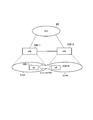
- FIG. 4 is a diagram illustrating an operating environment according to the embodiment.
- the embodiment mainly assumes a case where the D2D discovery procedure (and D2D communication) is performed between the UE 100-1 located in the cell # 1 and the UE 100-2 located in the cell # 2.
- cell # 1 and cell # 2 are adjacent to each other, but one or more cells may exist between cell # 1 and cell # 2.
- FIG. 4 illustrates an example in which the eNB 200 # 1 forms the cell # 1 and the eNB 200 # 2 forms the cell # 2.
- the UE 100-1 and the UE 100-2 need to be synchronized. Since UE 100 is generally synchronized with the cell in which it is located, when cell # 1 and cell # 2 are asynchronous, inter-cell discovery procedure and inter-cell D2D communication cannot be performed. There is a fear.
- FIG. 5 is a block diagram of the UE 100 (user terminal).
- the UE 100 includes an antenna 101, a radio transceiver 110, a user interface 120, a GNSS (Global Navigation Satellite System) receiver 130, a battery 140, a memory 150, and a processor 160.
- the wireless transceiver 110 constitutes a transmission unit and a reception unit.
- the memory 150 corresponds to a storage unit, and the processor 160 corresponds to a control unit.
- the UE 100 may not have the GNSS receiver 130. Further, the memory 150 may be integrated with the processor 160, and this set (that is, a chip set) may be used as the processor 160 ′.
- the antenna 101 and the wireless transceiver 110 are used for transmitting and receiving wireless signals.
- the radio transceiver 110 converts the baseband signal (transmission signal) output from the processor 160 into a radio signal and transmits it from the antenna 101. Further, the radio transceiver 110 converts a radio signal received by the antenna 101 into a baseband signal (received signal) and outputs the baseband signal to the processor 160.
- the user interface 120 is an interface with a user who owns the UE 100, and includes, for example, a display, a microphone, a speaker, and various buttons.
- the user interface 120 receives an operation from the user and outputs a signal indicating the content of the operation to the processor 160.
- the GNSS receiver 130 receives a GNSS signal and outputs the received signal to the processor 160 in order to obtain location information indicating the geographical location of the UE 100.
- the battery 140 stores power to be supplied to each block of the UE 100.
- the memory 150 stores a program executed by the processor 160 and information used for processing by the processor 160.
- the processor 160 includes a baseband processor that modulates / demodulates and encodes / decodes a baseband signal, and a CPU (Central Processing Unit) that executes programs stored in the memory 150 and performs various processes. .
- the processor 160 may further include a codec that performs encoding / decoding of an audio / video signal.
- the processor 160 executes various processes and various communication protocols.
- the processor 160 directly establishes the inter-UE synchronization based on the range information indicating the allowable communication range of the own UE 100 in the D2D proximity service (hereinafter referred to as “D2D range information”). Whether to perform the transmission / reception operation is controlled.
- the D2D range information is set by upper layer signaling, for example, and is stored in the memory 150.
- the D2D synchronization signal transmission / reception operation means at least one of transmission and reception (monitoring) of the D2D synchronization signal.
- the allowable communication range of the own UE 100 is an allowable communication range for transmission (announcing).
- the allowable communication range of the own UE 100 may be an allowable communication range for reception.
- the allowable communication range of the own UE 100 may be a combination of an allowable communication range for transmission and an allowable communication range for reception.
- the D2D range information may be associated with the D2D application executed by the UE 100.
- D2D range information is stored in the memory 150 for each D2D application, and the processor 160 acquires the D2D range information from the memory 150 according to the D2D application to be executed.
- the D2D range information may be associated with PLMN (Public Land Mobile Network).
- the D2D range information is information indicating one of a plurality of classes.
- the allowable communication range is an allowable communication range in the D2D discovery procedure (Discovery).
- Discovery range class such a class is referred to as a “Discovery range class”.
- the D2D range information may include information for identifying whether it is an allowable communication range for transmission (announcing) or an allowable communication range for reception.
- the Discovery range class includes a first class (hereinafter, referred to as “long class”) that supports a D2D proximity service over a wide range including a serving cell and a neighboring cell.
- the “wide range” is a range including not only the adjacent cell but also the next adjacent cell.
- the Discovery range class includes a second class (hereinafter referred to as “short class”) that supports only the D2D proximity service in a narrow range that does not include adjacent cells.
- the “narrow range” is, for example, a range of about several meters.
- the D2D synchronization signal is not transmitted / received because it is not necessary to enable the inter-cell discovery procedure. This is because transmission / reception of the D2D synchronization signal may cause interference and increase power consumption of the UE 100. Even if the UE 100 belongs to the short class, it may receive cellular synchronization signals (PSS, SSS) from neighboring cells when it is located near the cell boundary. In this case, the inter-cell discovery procedure can be performed by establishing synchronization between UEs.
- PSS cellular synchronization signals
- the Discovery range class may include a third class (hereinafter referred to as “middle class”) between the long class and the short class.
- the middle class supports D2D proximity services only in the range of the serving cell and neighboring cells.
- the middle class may be handled in the same manner as the long class or the same treatment as the short class. In the embodiment, an example in which the middle class is handled in the same manner as the short class will be described.
- the processor 160 transmits the D2D range information acquired from the memory 150 to the eNB 200 via the wireless transceiver 110.
- the processor 160 may include D2D range information in the UE capability notification transmitted to the eNB 200.
- the UE capability notification is a notification defined in the RRC layer.
- the processor 160 may transmit a UE capability notification including D2D range information to the eNB 200 in response to a request from the eNB 200.
- the processor 160 may include D2D range information in the resource allocation request transmitted to the eNB 200.
- the resource allocation request may include a scheduling request (SR) or a buffer status report (BSR).
- SR scheduling request
- BSR buffer status report
- the processor 160 may include D2D range information in the D2D interest notification transmitted to the eNB 200.
- the D2D interest notification is a notification regarding interest in the D2D proximity service, and is defined in the RRC layer.
- the D2D interest notification includes information indicating that the user is interested in the D2D proximity service / no longer interested in the D2D proximity service. Further, the D2D interest notification may include at least one of the following information elements.
- This information element is set to either “Discovery” indicating interest in Discovery or “Communication” indicating interest in Communication.
- This information element is set to either “announcing (transmitting)” indicating interest in transmission in the D2D proximity service, or “monitoring (receiving)” indicating interest in reception (or monitoring) in the D2D proximity service.
- Inter-PLMN / intra-PLMN
- This information element is either “inter-PLMN” indicating interest in D2D communication between different public land mobile networks (PLMN) or “intra-PLMN” indicating interest in D2D communication within the same PLMN. Is set.
- Inter-frequency / intra-frequency This information element is set to either “inter-frequency” indicating interest in D2D proximity service between different frequencies or “intra-frequency” indicating interest in D2D proximity service within the same frequency.
- Inter-cell / intra-cell This information element is set to either “inter-cell” indicating interest in D2D proximity service between different cells or “intra-cell” indicating interest in D2D proximity service in the same cell.
- This information element is a list indicating one or a plurality of frequencies that the UE 100 desires to use for the D2D proximity service.
- wireless transmitter / receiver 110 receives the information transmitted based on D2D range information from eNB200.
- the processor 160 controls whether or not to perform the transmission / reception operation of the D2D synchronization signal according to the received information.
- the processor 160 controls the wireless transceiver 110 to perform the D2D synchronization signal transmission / reception operation.
- the processor 160 controls the wireless transceiver 110 not to perform the D2D synchronization signal transmission / reception operation.
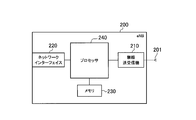
- FIG. 6 is a block diagram of the eNB 200 (base station). As illustrated in FIG. 6, the eNB 200 includes an antenna 201, a radio transceiver 210, a network interface 220, a memory 230, and a processor 240.
- the wireless transceiver 210 constitutes a transmission unit and a reception unit.
- the memory 230 corresponds to a storage unit, and the processor 240 corresponds to a control unit.
- the antenna 201 and the wireless transceiver 210 are used for transmitting and receiving wireless signals.
- the radio transceiver 210 converts the baseband signal (transmission signal) output from the processor 240 into a radio signal and transmits it from the antenna 201.
- the radio transceiver 210 converts a radio signal received by the antenna 201 into a baseband signal (received signal) and outputs the baseband signal to the processor 240.
- the network interface 220 is connected to the neighboring eNB 200 via the X2 interface and is connected to the MME / S-GW 300 via the S1 interface.
- the network interface 220 is used for communication performed on the X2 interface and communication performed on the S1 interface.
- the memory 230 stores a program executed by the processor 240 and information used for processing by the processor 240.
- the processor 240 includes a baseband processor that performs modulation / demodulation and encoding / decoding of a baseband signal, and a CPU that executes a program stored in the memory 230 and performs various processes.
- the processor 240 executes various processes and various communication protocols.
- the wireless transceiver 210 receives the D2D range information transmitted from the UE 100.
- the range information may be included in the UE capability notification or the D2D interest notification transmitted from the UE 100.
- the processor 240 determines whether or not to cause the UE 100 to execute the transmission / reception operation of the D2D synchronization signal based on the received D2D range information. For example, when the D2D range information indicates an allowable communication range for transmission (announcing), the processor 240 determines whether or not to transmit the D2D synchronization signal to the UE 100 based on the D2D range information. When the D2D range information indicates the allowable communication range for reception (monitoring), the processor 240 may determine whether to cause the UE 100 to receive (monitor) the D2D synchronization signal based on the D2D range information. .
- the processor 240 determines that the UE 100 performs the transmission / reception operation of the D2D synchronization signal in response to the D2D range information indicating the Long class. In response to the D2D range information indicating the short class or the middle class, the processor 240 determines that the UE 100 does not perform the transmission / reception operation of the D2D synchronization signal.
- the processor 240 transmits information indicating the result of the determination to the UE 100 via the wireless transceiver 210.
- This information is transmitted by dedicated RRC signaling, for example.
- the information may be transmitted by an L1 / L2 control signal (PDCCH / ePDCCH) or broadcast RRC signaling.
- the processor 240 transmits information indicating that the transmission / reception operation of the D2D synchronization signal is instructed or permitted to the UE 100.
- the processor 240 when it is determined that the UE 100 does not execute the transmission / reception operation of the D2D synchronization signal, the processor 240 does not instruct the transmission / reception operation of the D2D synchronization signal. Alternatively, the processor 240 transmits information indicating that the transmission / reception operation of the D2D synchronization signal is prohibited or rejected to the UE 100.
- FIG. 7 is a sequence diagram illustrating an operation sequence according to the embodiment.
- step S11 the UE 100 transmits D2D range information to the eNB 200.
- step S12 the eNB 200 determines whether or not to cause the UE 100 to perform the transmission / reception operation of the D2D synchronization signal based on the D2D range information.
- step S13 the eNB 200 transmits information indicating the determination result to the UE 100.
- step S14 the UE 100 controls whether to perform the transmission / reception operation of the D2D synchronization signal according to the received information.
- a D2D synchronization signal is transmitted for the UE 100 that supports a wide range of D2D discovery procedures.
- the synchronization can be directly established between the UEs, so that the discovery procedure between cells in a wide range can be made possible.
- the D2D synchronization signal is not transmitted. Thereby, generation
- the D2D range information is information indicating any one of three levels of classes (long, middle, and short).
- the D2D range information may be a value of the allowable communication range of the UE 100 in the D2D proximity service.
- the eNB 200 performs, for example, the following determination based on the D2D range information (value of the allowable communication range).
- the eNB 200 determines that the UE 100 performs the transmission / reception operation of the D2D synchronization signal in response to the D2D range information (allowable communication range value) being equal to or greater than the threshold value.
- the eNB 200 determines that the UE 100 does not perform the transmission / reception operation of the D2D synchronization signal in response to the D2D range information (allowable communication range value) being less than the threshold.
- the eNB 200 compares the distance between the eNBs, the size of the own cell (macro cell, small cell), etc. with the D2D range information (value of the allowable communication range), and determines which of the long / middle / short is applicable. May be.
- the eNB 200 may acquire the D2D range information from the PCE 400 without receiving the D2D range information from the UE 100.
- eNB200 may acquire D2D range information from OAM or MME. Then, the eNB 200 may determine whether or not to cause the UE 100 to execute the transmission / reception operation of the D2D synchronization signal based on the D2D range information acquired from the PCE 400 or the like, and may transmit information indicating the determination result to the UE 100.
- the eNB 200 may make a determination by comparing the information received from the PCE 400 with the information received from the UE 100. In this case, when the information received from the PCE 400 matches the information received from the UE 100, the eNB 200 considers that the information is valid. The eNB 200 may determine that one of the information received from the PCE 400 and the information received from the UE 100, whichever is smaller (the range is narrow), is valid, or the larger (the range is wide) is determined to be valid Good.
- the UE 100 may autonomously control whether or not to perform the transmission / reception operation of the D2D synchronization signal based on the D2D range information without being based on the determination result of the eNB 200.
- the determination logic based on the D2D range information is the same as in the above-described embodiment.
- the UE 100 may notify the eNB 200 to execute the transmission / reception operation of the D2D synchronization signal. Moreover, when stopping the transmission / reception operation of the D2D synchronization signal, the UE 100 may notify the eNB 200 that the transmission / reception operation of the D2D synchronization signal is stopped.
- the eNB 200 determines whether or not to cause the UE 100 to perform the transmission / reception operation of the D2D synchronization signal based on the D2D range information. In addition to such a determination, or instead of such a determination, the eNB 200 may perform the following determination and control.
- Timing offset The eNB 200 may determine whether to notify (set) the timing offset to the UE 100 based on the D2D range information from the UE 100.
- the timing offset is information indicating a synchronization shift between eNBs when they are asynchronous between eNBs (between cells). For example, when the D2D range information of the UE 100 is “middle”, the eNB 200 determines that the UE 100 is notified of the timing offset although the UE 100 does not transmit the D2D synchronization signal.
- a timing offset can be appropriately provided to the UE 100 that can use the inter-cell D2D proximity service, so that the inter-cell D2D proximity service can be facilitated.
- the eNB 200 may control the transmission power of the UE 100 based on the D2D range information from the UE 100. In that case, eNB200 may control the transmission power of UE100 also considering the frequency of a cell. This is because the propagation loss increases as the operating frequency of the cell increases. The frequency of the cell may be determined from the “Frequency list” included in the D2D interest notification.
- the eNB 200 may control the modulation scheme and repetition (number of repeated transmissions) applied to the UE 100 based on the D2D range information from the UE 100. At that time, the eNB 200 may control the modulation scheme and repetition (number of repeated transmissions) applied to the UE 100 in consideration of the cell frequency. This is because the propagation loss increases as the operating frequency of the cell increases. The frequency of the cell may be determined from the “Frequency list” included in the D2D interest notification.
- the inter-base station cooperative operation using the X2 interface is not particularly mentioned. However, the inter-base station cooperative operation may be introduced.
- the eNB 200 having the cell # 1 requests long transmission setting via the X2 interface to other eNBs having adjacent (or next adjacent) cells. To do.
- the eNB 200 having the cell # 1 requests the long reception setting via the X2 interface to the other eNB having the adjacent (or next adjacent) cell. To do.
- the long transmission setting / long reception setting includes transmission / reception resource pool information, offset parameter (for TDD frame adjustment), CP length, MCS, hopping parameter, repetition count, D2D RNTI, and the like.
- the long transmission setting / long reception setting further includes a signal identifier (SS ID) of the D2D synchronization signal.
- the long transmission setting / long reception setting further includes a timing offset value.
- the D2D range information of the UE 100 may be notified to the handover destination (neighboring cell).
- D2D range information is included in the handover request transmitted from the handover source to the handover destination.
- the handover destination cell includes the setting including the D2D range information after the handover in the response to the handover request (handover request ACK).
- handover request ACK the handover request ACK
- the neighboring cell may be notified of the D2D range (allowable communication range) allowed in the own cell. In this case, it is notified between cells by eNB Configuration Update (base station setting update) message or the like. Thereby, the neighboring cell can determine how to set the UE 100 of the own cell.
- eNB Configuration Update base station setting update
- the allowable communication range is the allowable communication range in the D2D discovery procedure (Discovery)
- the allowable communication range may not be the allowable communication range in the D2D discovery procedure, but may be the allowable communication range in D2D communication (Communication).
- the LTE system has been described as an example of the mobile communication system.
- the present invention is not limited to the LTE system, and the present invention may be applied to a system other than the LTE system.
- both 1) overlapping discovery resources between cells and 2) non-overlapping discovery resources between cells are supported.
- the serving cell may provide SIB information indicating which neighboring frequencies support Prose Discovery.
- the eNB For synchronization, full overlap, and co-frequency deployment, the eNB provides only one resource pool (D2DSS information is not required).
- the serving cell provides a timing offset that indicates the time difference between the serving cell and its neighboring cells.
- Option B UE directly monitors PSS / SSS and MIB transmitted from neighboring cell (s).
- Option C The UE directly monitors PD2DSS / SD2DSS (and also PD2DSCH) transmitted from the transmitting UE in the adjacent cell.
- Option B is the simplest option, but has the drawback that the successful range of Discovery depends on the range in which PSS / SSS transmitted by neighboring cells can be normally decoded. Therefore, option B should have a low priority.
- Proposal 1 For inter-cell Discovery under Asynchronous Deployment Scenario, the network should either timing offset (Option A) or D2DSS (Option C) to allow the UE to synchronize with Discovery resources from neighboring cells Should have the option to use.
- FIG. 8 shows synchronization options for inter-cell Discovery.
- Option A has the potential for synchronization between UEs in different cells. It is unclear whether a single offset timing is sufficient to support the synchronization needs of all UEs serving / camping on the cell. However, as long as the cells are synchronized based on the agreement that “eNB provides only one resource pool for synchronization, full duplication, in-frequency deployment (no D2DSS information required)” It can be assumed that no synchronization is required. For this reason, the timing offset is common to all terminals for a specific cell, and no offset in UE units is necessary.
- Release 12 does not assume coordination between cells via the X2 interface, it may be necessary for the OAM to provide a timing offset for each of its neighboring cells to the cell.
- the complexity for OAM to provide this level of support is particularly high for urban deployments with the introduction of dense cells with complex neighborhood relationships.
- Option C may be a Discovery for inter-cell synchronization.
- the serving cell needs to determine which UE needs to send D2DSS, and there are the following agreements.
- the UE can become the D2D synchronization source at least if the UE is set as the D2D synchronization source by the eNB.
- the D2DSS transmission settings are the same between D2D Discovery and D2D communication.
- the first subframe of the transmission pool within the discovery period for the cell can be used by the UE sending the Discovery signal to send PD2DSS and SD2DSS.
- the transmission PD2DSS and SD2DSS sequences are set using SIB.
- the eNodeB can instruct the UE to transmit PD2DSS and SD2DSS.
- the reception resource pool information includes time resources and sequence information (implicitly or explicitly) that the UE should monitor PD2DSS and SD2DSS. )
- D2DSS can be needed for inter-cell discovery.
- all UEs that have requested dedicated transmission resources in the UE Assistance Information or notified that they are “interested in the announcement” with the ProSe indicator are configured to transmit and / or receive D2DSS. I will assume that. However, this can cause excessive inter-cell interference and reduce Discovery probability due to lack of time-frequency synchronization between UEs. Therefore, setting up all UEs for D2DSS transmission should be avoided.
- D2DSS reception is set for all UEs.
- Proposal 2 It should not be assumed that PD2DSS and SD2DSS D2D transmissions are configured for all UEs.
- Proposal 2 is within an acceptable range, the issue is how the eNB determines whether the UE should be configured to send D2DSS. In other words, the eNB has no way of knowing the UE pair that needs D2DSS for Discovery.
- the authorization announcement range is provided by the ProSe function for each PLMN, but further study is necessary regarding the relationship between the range classes. If the allowed announcement range can be interpreted as the UE's interest in “long distance” Discovery, the eNB may determine the UE to be configured according to the allowed announcement range. In other words, it may not be necessary to set up D2DSS transmissions for UEs that are only interested in the “short range” of Discovery (eg, non-intersite distance (ISD)).
- ISD non-intersite distance
- Proposal 3 It should be discussed whether the allowed announcement range can be used to determine the UEs that need to set up D2DSS transmission.
- D2DSS reception is set for all UEs.
- the disadvantage of this assumption is increased UE complexity and power consumption when the UE needs to fast switch between transmission and reception at the UL transceiver and constantly monitor D2DSS. Therefore, it is preferable that it is set only for UEs that need to receive D2DSS. It may be useful to determine the UE that should be set up for D2DSS reception if the allowed announcement range is also defined in the Discovery monitor.
- Proposal 4 It should be discussed whether all UEs need to constantly monitor D2DSS.
- the present invention is useful in the field of wireless communication.
Landscapes
- Engineering & Computer Science (AREA)
- Computer Networks & Wireless Communication (AREA)
- Signal Processing (AREA)
- Computer Security & Cryptography (AREA)
- Mobile Radio Communication Systems (AREA)
Abstract
Description
実施形態に係る基地局は、直接的な端末間通信を可能とするD2D近傍サービスをサポートする移動通信システムにおいて用いられる。前記基地局は、直接的に端末間同期を確立するためのD2D同期信号の送受信動作を前記ユーザ端末に実行させるか否かの判断を行う制御部と、前記判断の結果を示す情報を前記ユーザ端末に送信する送信部と、を備える。前記制御部は、前記D2D近傍サービスにおける前記ユーザ端末の許容通信範囲を示すD2D範囲情報に基づいて、前記判断を行う。
以下において、本発明をLTEシステムに適用する場合の実施形態を説明する。
図1は、実施形態に係るLTEシステムの構成図である。図1に示すように、実施形態に係るLTEシステムは、UE(User Equipment)100、E-UTRAN(Evolved-UMTS Terrestrial Radio Access Network)10、及びEPC(Evolved Packet Core)20を備える。
以下において、D2D近傍サービスについて説明する。実施形態に係るLTEシステムは、D2D近傍サービスをサポートする。
以下において、実施形態に係る動作環境について説明する。図4は、実施形態に係る動作環境を示す図である。
図5は、UE100(ユーザ端末)のブロック図である。図5に示すように、UE100は、アンテナ101、無線送受信機110、ユーザインターフェイス120、GNSS(Global Navigation Satellite System)受信機130、バッテリ140、メモリ150、及びプロセッサ160を含む。無線送受信機110は送信部及び受信部を構成する。メモリ150は記憶部に相当し、プロセッサ160は制御部に相当する。UE100は、GNSS受信機130を有していなくてもよい。また、メモリ150をプロセッサ160と一体化し、このセット(すなわち、チップセット)をプロセッサ160’としてもよい。
本情報要素は、Discoveryへの興味を示す「Discovery」、又は、Communicationへの興味を示す「Communication」の何れかに設定される。
本情報要素は、D2D近傍サービスにおける送信への興味を示す「announcing (transmitting)」、又は、D2D近傍サービスにおける受信(又はモニタ)への興味を示す「monitoring (receiving)」の何れかに設定される。
本情報要素は、異なるPLMN(public land mobile network)間でのD2D通信への興味を示す「inter-PLMN」、又は、同じPLMN内でのD2D通信への興味を示す「intra-PLMN」の何れかに設定される。
本情報要素は、異なる周波数間でのD2D近傍サービスへの興味を示す「inter-frequency」、又は、同じ周波数内でのD2D近傍サービスへの興味を示す「intra-frequency」の何れかに設定される。
本情報要素は、異なるセル間でのD2D近傍サービスへの興味を示す「inter-cell」、又は、同じセル内でのD2D近傍サービスへの興味を示す「intra-cell」の何れかに設定される。
本情報要素は、UE100がD2D近傍サービスに利用したい1又は複数の周波数を示すリストである。
図6は、eNB200(基地局)のブロック図である。図6に示すように、eNB200は、アンテナ201、無線送受信機210、ネットワークインターフェイス220、メモリ230、及びプロセッサ240を含む。無線送受信機210は送信部及び受信部を構成する。メモリ230は記憶部に相当し、プロセッサ240は制御部に相当する。
図7は、実施形態に係る動作シーケンスを示すシーケンス図である。
実施形態では、広い範囲に渡るD2D発見手順をサポートするUE100については、D2D同期信号を送信させる。これにより、セル間で同期がとられていない場合でも、UE間で直接的に同期を確立することができるため、広い範囲でのセル間発見手順を可能とすることができる。
上述した実施形態では、D2D範囲情報が、3段階のクラス(Long、middle、short)の何れかを示す情報である一例を説明した。
上述した実施形態では、eNB200が、UE100から受信したD2D範囲情報に基づいて、D2D同期信号の送受信動作をUE100に実行させるか否かを判断する一例を説明した。
上述した実施形態では、UE100が、eNB200の判断結果に応じて、D2D同期信号の送受信動作を実行するか否かを制御する一例を説明した。
上述した実施形態では、eNB200は、D2D範囲情報に基づいて、D2D同期信号の送受信動作をUE100に実行させるか否かを判断していた。このような判断に加えて、又は、このような判断に代えて、eNB200は、以下のような判断及び制御を行ってもよい。
eNB200は、UE100からのD2D範囲情報に基づいて、タイミングオフセットを当該UE100に通知(設定)するか否かを判断してもよい。タイミングオフセットとは、eNB間(セル間)で非同期の場合に、eNB間の同期ズレを示す情報である。例えば、eNB200は、UE100のD2D範囲情報が「middle」である場合に、D2D同期信号の送信は当該UE100に行わせないものの、当該UE100にタイミングオフセットを通知するといった判断を行う。
eNB200は、UE100からのD2D範囲情報に基づいて、当該UE100の送信電力を制御してもよい。その際、eNB200は、セルの周波数も考慮して、UE100の送信電力を制御してもよい。セルの運用周波数が高いほど伝搬損失が大きくなるためである。セルの周波数は、D2D興味通知に含まれる「Frequency list」から判断してもよい。
eNB200は、UE100からのD2D範囲情報に基づいて、当該UE100に適用する変調方式、リピテション(繰り返し送信回数)を制御してもよい。その際、eNB200は、セルの周波数も考慮して、当該UE100に適用する変調方式、リピテション(繰り返し送信回数)を制御してもよい。セルの運用周波数が高いほど伝搬損失が大きくなるためである。セルの周波数は、D2D興味通知に含まれる「Frequency list」から判断してもよい。
上述した実施形態では、X2インターフェイスを用いた基地局間協調動作について特に触れなかった。しかしながら、当該基地局間協調動作を導入してもよい。
(1.はじめに)
セル間(及び周波数間)の隣接セルのサポートについて議論され、以下の合意に達している。
(2.1.非同期デプロイメントの下での同期方式)
セル間Discoveryをサポートするための多くの課題は、提案された周波数間及びPLMN間Discoveryを考慮することにより解決することができるが、非同期デプロイメントを取り扱う方法については更なる検討が必要である。提案したように、ピアUE間の(ラフな)同期をどのように保証するかに応じて、以下の選択肢を考慮することができる。
提案1が受け入れ可能である場合、選択肢Aは、異なるセルのUE間の同期化の可能性がある。これは、単一のオフセットタイミングが、セルにサーブ/キャンプしているすべてのUEの同期のニーズをサポートするのに十分であるかどうかは不明である。しかし、「同期、完全重複、周波数内のデプロイメントのために、eNBは、ただ一つのリソースプールを提供する(D2DSS情報は不要)」という合意に基づいて、セルが同期している限り、追加の同期が必要ないと仮定することができる。そのため、タイミングオフセットが特定のセル用の全ての端末に共通であり、UE単位でのオフセットは必要ない。
提案1が受け入れ可能である場合、選択肢Cは、セル間同期のためのDiscoveryの可能性もある。PD2DSSとSD2DSSについては、サービングセルは、どのUEがD2DSSを送信する必要があるかを決定する必要があり、以下の合意がある。
・イン・カバレッジについて
少なくともeNBによってUEがD2Dの同期ソースに設定された場合、UEは、D2Dの同期ソースになることができる。
・ネットワークがD2D通信とDiscoveryの両方をサポートしている場合、D2DSS送信設定は、D2D DiscoveryとD2D通信との間で同じである。
セルについてディスカバリ期間内で送信プールの最初のサブフレームは、Discovery信号を送信するUEがPD2DSS及びSD2DSSを送信するために使用することができる。
eNodeBはPD2DSS及びSD2DSSを送信するようにUEに指示することができる。
・受信について、いくつかのセル間シナリオでは、時間・周波数同期のために他のカバレッジ内UEからのD2DSSが必要な場合がある。
米国仮出願第62/056088号(2014年9月26日出願)の全内容が、参照により本願明細書に組み込まれている。
Claims (12)
- 直接的な端末間通信を可能とするD2D近傍サービスをサポートする移動通信システムにおいて用いられる基地局であって、
直接的に端末間同期を確立するためのD2D同期信号の送受信動作を前記ユーザ端末に実行させるか否かの判断を行う制御部と、
前記判断の結果を示す情報を前記ユーザ端末に送信する送信部と、を備え、
前記制御部は、前記D2D近傍サービスにおける前記ユーザ端末の許容通信範囲を示すD2D範囲情報に基づいて、前記判断を行うことを特徴とする基地局。 - 前記D2D範囲情報を前記ユーザ端末から受信する受信部をさらに備え、
前記制御部は、前記ユーザ端末から受信した前記D2D範囲情報に基づいて、前記判断を行うことを特徴とする請求項1に記載の基地局。 - 前記D2D範囲情報は、前記ユーザ端末から前記基地局に送信される、リソース割り当て要求、端末能力通知、D2D興味通知のうち少なくとも1つに含まれており、
前記リソース割り当て要求は、無線リソースの割り当てを要求する情報であり、
前記端末能力通知は、前記ユーザ端末の能力を通知する情報であり、
前記D2D興味通知は、前記D2D近傍サービスに対する前記ユーザ端末の興味に関する情報であることを特徴とする請求項2に記載の基地局。 - 前記許容通信範囲は、前記D2D近傍サービスにおける送信についての許容通信範囲と、前記D2D近傍サービスにおける受信についての許容通信範囲と、を含み、
前記D2D範囲情報は、前記許容通信範囲が前記D2D近傍サービスにおける前記送信又は前記受信の何れであるかを識別する情報を含むことを特徴とする請求項1に記載の基地局。 - 複数段階の許容通信範囲のそれぞれに対応するクラスからなる複数のクラスが規定されており、
前記D2D範囲情報は、前記複数のクラスのうち何れかのクラスを示す情報であり、
前記複数のクラスは、
サービングセル及び隣接セルを含む広い範囲に渡る前記D2D近傍サービスをサポートする第1のクラスと、
隣接セルを含まない狭い範囲での前記D2D近傍サービスのみをサポートする第2のクラスと、を含み、
前記制御部は、前記D2D範囲情報が前記第1のクラスを示すことに応じて、前記D2D同期信号の送受信動作を前記ユーザ端末に実行させると判断し、
前記制御部は、前記D2D範囲情報が前記第2のクラスを示すことに応じて、前記D2D同期信号の送受信動作を前記ユーザ端末に実行させないと判断することを特徴とする請求項3に記載の基地局。 - 前記D2D近傍サービスは、一のユーザ端末が他のユーザ端末を発見するための発見手順を含み、
前記許容通信範囲は、前記発見手順における許容通信範囲であることを特徴とする請求項1に記載の基地局。 - 前記D2D範囲情報は、前記D2D近傍サービスにおける前記ユーザ端末の許容通信範囲の値であり、
前記制御部は、前記値が閾値以上であることに応じて、前記D2D同期信号の送受信動作を前記ユーザ端末に実行させると判断し、
前記制御部は、前記値が前記閾値未満であることに応じて、前記D2D同期信号の送受信動作を前記ユーザ端末に実行させないと判断することを特徴とする請求項1に記載の基地局。 - 前記制御部は、前記D2D範囲情報に基づいて、自基地局のセルと他セルとの間の同期ズレを示すタイミングオフセットを前記ユーザ端末に通知するか否かをさらに判断することを特徴とする請求項1に記載の基地局。
- 前記制御部は、前記D2D範囲情報に基づいて、前記D2D近傍サービスにおける前記ユーザ端末の送信電力を制御することを特徴とする請求項1に記載の基地局。
- 前記制御部は、前記D2D範囲情報、又は、自セルが前記D2D近傍サービスについて許容する通信範囲を示すセル範囲情報を、隣接セルを管理する他の基地局に送信することを特徴とする請求項1に記載の基地局。
- 直接的な端末間通信を可能とするD2D近傍サービスをサポートする移動通信システムにおいて用いられるユーザ端末であって、
前記D2D近傍サービスにおける自ユーザ端末の許容通信範囲を示すD2D範囲情報に基づいて、直接的に端末間同期を確立するためのD2D同期信号の送受信動作を実行するか否かを制御する制御部を備えることを特徴とするユーザ端末。 - 前記D2D範囲情報を基地局に送信する送信部と、
前記基地局から前記D2D範囲情報に基づいて送信される情報を受信する受信部と、をさらに備え、
前記制御部は、前記情報に応じて、前記D2D同期信号の送受信動作を実行するか否かを制御することを特徴とする請求項11に記載のユーザ端末。
Priority Applications (3)
| Application Number | Priority Date | Filing Date | Title |
|---|---|---|---|
| JP2016550125A JP6475745B2 (ja) | 2014-09-26 | 2015-09-16 | 基地局及びユーザ端末 |
| EP15843116.3A EP3200554A4 (en) | 2014-09-26 | 2015-09-16 | Base station and user terminal |
| US15/512,774 US10382570B2 (en) | 2014-09-26 | 2015-09-16 | Base station and user terminal |
Applications Claiming Priority (2)
| Application Number | Priority Date | Filing Date | Title |
|---|---|---|---|
| US201462056088P | 2014-09-26 | 2014-09-26 | |
| US62/056,088 | 2014-09-26 |
Publications (1)
| Publication Number | Publication Date |
|---|---|
| WO2016047512A1 true WO2016047512A1 (ja) | 2016-03-31 |
Family
ID=55581039
Family Applications (1)
| Application Number | Title | Priority Date | Filing Date |
|---|---|---|---|
| PCT/JP2015/076223 Ceased WO2016047512A1 (ja) | 2014-09-26 | 2015-09-16 | 基地局及びユーザ端末 |
Country Status (4)
| Country | Link |
|---|---|
| US (1) | US10382570B2 (ja) |
| EP (1) | EP3200554A4 (ja) |
| JP (1) | JP6475745B2 (ja) |
| WO (1) | WO2016047512A1 (ja) |
Cited By (1)
| Publication number | Priority date | Publication date | Assignee | Title |
|---|---|---|---|---|
| JP2020537836A (ja) * | 2017-09-08 | 2020-12-24 | オッポ広東移動通信有限公司Guangdong Oppo Mobile Telecommunications Corp., Ltd. | 同期信号ブロックの位置指示方法、ネットワークデバイス及び端末デバイス |
Families Citing this family (5)
| Publication number | Priority date | Publication date | Assignee | Title |
|---|---|---|---|---|
| JP6566404B2 (ja) * | 2014-12-31 | 2019-08-28 | 華為技術有限公司Huawei Technologies Co.,Ltd. | 送信リソース要求の方法および装置 |
| JP6450012B2 (ja) * | 2015-08-13 | 2019-01-09 | 株式会社Nttドコモ | ユーザ装置及び信号同期方法 |
| CN110324784B (zh) * | 2018-03-29 | 2021-02-19 | 维沃移动通信有限公司 | 通信范围信息的处理方法及终端 |
| EP4203604A4 (en) | 2020-08-19 | 2024-05-22 | Beijing Xiaomi Mobile Software Co., Ltd. | Ranging capacity request method and apparatus, ranging capacity sending method and apparatus, and ranging capacity receiving method and apparatus |
| US11917716B2 (en) * | 2020-12-10 | 2024-02-27 | Qualcomm Incorporated | Two-stage discovery in sidelink |
Family Cites Families (9)
| Publication number | Priority date | Publication date | Assignee | Title |
|---|---|---|---|---|
| US7249173B2 (en) * | 2002-10-25 | 2007-07-24 | Emulex Design & Manufacturing Corporation | Abstracted node discovery |
| EP2412194A1 (en) * | 2009-03-27 | 2012-02-01 | Nokia Siemens Networks OY | Apparatus, method and article of manufacture |
| US8848700B2 (en) * | 2011-09-30 | 2014-09-30 | Electronics And Telecommunications Research Institute | Method for device-to-device communication based on cellular telecommunication system |
| US9451570B2 (en) * | 2012-08-29 | 2016-09-20 | Alcatel Lucent | Device discovery for device-to-device communication |
| US8594632B1 (en) * | 2012-12-11 | 2013-11-26 | Intel Corporation | Device to-device (D2D) discovery without authenticating through cloud |
| CN104053212B (zh) * | 2013-03-14 | 2018-02-23 | 电信科学技术研究院 | 一种d2d发现信号的传输方法和设备 |
| EP2978278A4 (en) * | 2013-03-22 | 2016-11-09 | Sharp Kk | TERMINAL DEVICE, BASE STATION DEVICE, AND CONTROL DEVICE |
| US9654960B2 (en) * | 2013-05-31 | 2017-05-16 | Qualcomm Incorporated | Server-assisted device-to-device discovery and connection |
| JP6328132B2 (ja) * | 2013-11-01 | 2018-05-23 | 京セラ株式会社 | 移動通信システム及びユーザ端末 |
-
2015
- 2015-09-16 EP EP15843116.3A patent/EP3200554A4/en not_active Withdrawn
- 2015-09-16 US US15/512,774 patent/US10382570B2/en active Active
- 2015-09-16 JP JP2016550125A patent/JP6475745B2/ja active Active
- 2015-09-16 WO PCT/JP2015/076223 patent/WO2016047512A1/ja not_active Ceased
Non-Patent Citations (8)
| Title |
|---|
| GENERAL DYNAMICS UK LTD: "D2D resource allocation for synchronisation signals and channels", 3GPP TSG-RAN1 #78 R1-142922, 10 August 2014 (2014-08-10), XP050788405 * |
| HTC: "Updates of D12 for network-assisted ProSe", 3GPP WG2 MEETING #100, S2-134039, 5 November 2013 (2013-11-05), pages 2 - 134039, XP050764613 * |
| HUAWEI ET AL.: "Network Triggered ProSe Direct Discovery", 3GPP TSG WG2 MEETING #99 S2-133709, 27 September 2013 (2013-09-27), pages 2 - 133709, XP050727063 * |
| ITRI: "Spectrum utilization model for D2D communications and discovery", 3GPP TSG-RAN WG1 MEETING #75, R1-135415, 2 November 2013 (2013-11-02), XP050750976 * |
| KYOCERA: "Intra-frequency and inter-frequency neighbor cell support", 3GPP TSG-RAN WG2 #87, R2-143755, 9 August 2014 (2014-08-09), XP050820023 * |
| NEC: "Discovery Range Class definition and terminology alignment", 3GPP TSG SA2 MEETING #103 S2-141777, 13 May 2014 (2014-05-13), pages 2 - 141777, XP050805130 * |
| SAMSUNG: "D2D Synchronization Procedure in "Exceptional Cases"", 3GPP TSG RAN WG1 #78 R1-143107, 10 August 2014 (2014-08-10), XP050815500 * |
| See also references of EP3200554A4 * |
Cited By (2)
| Publication number | Priority date | Publication date | Assignee | Title |
|---|---|---|---|---|
| JP2020537836A (ja) * | 2017-09-08 | 2020-12-24 | オッポ広東移動通信有限公司Guangdong Oppo Mobile Telecommunications Corp., Ltd. | 同期信号ブロックの位置指示方法、ネットワークデバイス及び端末デバイス |
| US11553444B2 (en) | 2017-09-08 | 2023-01-10 | Guangdong Oppo Mobile Telecommunications Corp., Ltd. | Method, network apparatus, and terminal apparatus for indicating position of synchronization signal block |
Also Published As
| Publication number | Publication date |
|---|---|
| US20170295248A1 (en) | 2017-10-12 |
| EP3200554A1 (en) | 2017-08-02 |
| JP6475745B2 (ja) | 2019-02-27 |
| EP3200554A4 (en) | 2018-05-30 |
| JPWO2016047512A1 (ja) | 2017-07-13 |
| US10382570B2 (en) | 2019-08-13 |
Similar Documents
| Publication | Publication Date | Title |
|---|---|---|
| US11395196B2 (en) | Base station and user terminal | |
| JP6441264B2 (ja) | 通信制御方法、ユーザ端末、基地局、及びプロセッサ | |
| JP6328132B2 (ja) | 移動通信システム及びユーザ端末 | |
| JP6224861B2 (ja) | ユーザ端末、プロセッサ、及び方法 | |
| JP6147848B2 (ja) | 通信制御方法及びプロセッサ | |
| JP2017022774A (ja) | 基地局、ユーザ端末及びプロセッサ | |
| JP6475745B2 (ja) | 基地局及びユーザ端末 | |
| WO2015060172A1 (ja) | 通信制御方法、ネットワーク装置、及び基地局 | |
| JPWO2014069222A1 (ja) | 移動通信システム、ユーザ端末、基地局、プロセッサ及び通信制御方法 | |
| JPWO2015141847A1 (ja) | 通信制御方法及び基地局 | |
| JP6144588B2 (ja) | ユーザ端末、基地局、及びサーバ装置 | |
| JP6538026B2 (ja) | ネットワーク選択制御方法、基地局、及びユーザ端末 | |
| JP2017195626A (ja) | 通信制御方法、ユーザ端末及びプロセッサ | |
| JP6106286B2 (ja) | ユーザ端末及びプロセッサ | |
| WO2014157397A1 (ja) | 通信制御方法、ユーザ端末、及び基地局 | |
| WO2015046138A1 (ja) | 基地局及びユーザ端末 | |
| JP2015159380A (ja) | 移動通信システム及びネットワーク装置 |
Legal Events
| Date | Code | Title | Description |
|---|---|---|---|
| 121 | Ep: the epo has been informed by wipo that ep was designated in this application |
Ref document number: 15843116 Country of ref document: EP Kind code of ref document: A1 |
|
| ENP | Entry into the national phase |
Ref document number: 2016550125 Country of ref document: JP Kind code of ref document: A |
|
| WWE | Wipo information: entry into national phase |
Ref document number: 15512774 Country of ref document: US |
|
| REEP | Request for entry into the european phase |
Ref document number: 2015843116 Country of ref document: EP |
|
| WWE | Wipo information: entry into national phase |
Ref document number: 2015843116 Country of ref document: EP |
|
| NENP | Non-entry into the national phase |
Ref country code: DE |