WO2016054971A1 - 羟基嘌呤类化合物及其应用 - Google Patents
羟基嘌呤类化合物及其应用 Download PDFInfo
- Publication number
- WO2016054971A1 WO2016054971A1 PCT/CN2015/090294 CN2015090294W WO2016054971A1 WO 2016054971 A1 WO2016054971 A1 WO 2016054971A1 CN 2015090294 W CN2015090294 W CN 2015090294W WO 2016054971 A1 WO2016054971 A1 WO 2016054971A1
- Authority
- WO
- WIPO (PCT)
- Prior art keywords
- mmol
- methyl
- dione
- indole
- dimethyl
- Prior art date
- Legal status (The legal status is an assumption and is not a legal conclusion. Google has not performed a legal analysis and makes no representation as to the accuracy of the status listed.)
- Ceased
Links
- 0 C[n]1c(C(N(CC*)C(N2C)=O)=O)c2nc1 Chemical compound C[n]1c(C(N(CC*)C(N2C)=O)=O)c2nc1 0.000 description 2
- RYUMPJRBQRKJNS-UHFFFAOYSA-N C[n]1c(C(N(CCOCC2(CCC2)O)C(N2C)=O)=O)c2nc1 Chemical compound C[n]1c(C(N(CCOCC2(CCC2)O)C(N2C)=O)=O)c2nc1 RYUMPJRBQRKJNS-UHFFFAOYSA-N 0.000 description 2
- VAJPACJJHPKZNJ-UHFFFAOYSA-N CC(C(F)(F)F)(C1(CN(C(c2c(N3C)nc[n]2C)=O)C3=O)CC1)O Chemical compound CC(C(F)(F)F)(C1(CN(C(c2c(N3C)nc[n]2C)=O)C3=O)CC1)O VAJPACJJHPKZNJ-UHFFFAOYSA-N 0.000 description 1
- XXMAUYKLIXXFJN-UHFFFAOYSA-N CC(C1)CC1C(F)(F)F Chemical compound CC(C1)CC1C(F)(F)F XXMAUYKLIXXFJN-UHFFFAOYSA-N 0.000 description 1
- SIZHSBJOLZLQIX-UHFFFAOYSA-N C[n]1c(C(N(CC(C2)CC2(C(F)(F)F)O)C(N2C)=O)=O)c2nc1 Chemical compound C[n]1c(C(N(CC(C2)CC2(C(F)(F)F)O)C(N2C)=O)=O)c2nc1 SIZHSBJOLZLQIX-UHFFFAOYSA-N 0.000 description 1
- KVSDFSYNVTVNPL-UHFFFAOYSA-N C[n]1c(C(N(CC(C2)CC2C(C(F)(F)F)(C(F)(F)F)O)C(N2C)=O)=O)c2nc1 Chemical compound C[n]1c(C(N(CC(C2)CC2C(C(F)(F)F)(C(F)(F)F)O)C(N2C)=O)=O)c2nc1 KVSDFSYNVTVNPL-UHFFFAOYSA-N 0.000 description 1
- MRCXNHDSHGTJGT-UHFFFAOYSA-N C[n]1c(C(N(CC2CCC2)C(N2C)=O)=O)c2nc1 Chemical compound C[n]1c(C(N(CC2CCC2)C(N2C)=O)=O)c2nc1 MRCXNHDSHGTJGT-UHFFFAOYSA-N 0.000 description 1
- RXONRYRTUQKSNI-UHFFFAOYSA-N C[n]1c(C(N(CCO)C(N2C)=O)=O)c2nc1 Chemical compound C[n]1c(C(N(CCO)C(N2C)=O)=O)c2nc1 RXONRYRTUQKSNI-UHFFFAOYSA-N 0.000 description 1
- JIGJDMNXSAGELC-UHFFFAOYSA-N Cc1nc(N(C)C(N(CC(C2)CC2C(OC)=O)C2=O)=O)c2[n]1C Chemical compound Cc1nc(N(C)C(N(CC(C2)CC2C(OC)=O)C2=O)=O)c2[n]1C JIGJDMNXSAGELC-UHFFFAOYSA-N 0.000 description 1
Classifications
-
- A—HUMAN NECESSITIES
- A61—MEDICAL OR VETERINARY SCIENCE; HYGIENE
- A61K—PREPARATIONS FOR MEDICAL, DENTAL OR TOILETRY PURPOSES
- A61K31/00—Medicinal preparations containing organic active ingredients
- A61K31/33—Heterocyclic compounds
- A61K31/395—Heterocyclic compounds having nitrogen as a ring hetero atom, e.g. guanethidine or rifamycins
- A61K31/495—Heterocyclic compounds having nitrogen as a ring hetero atom, e.g. guanethidine or rifamycins having six-membered rings with two or more nitrogen atoms as the only ring heteroatoms, e.g. piperazine or tetrazines
- A61K31/505—Pyrimidines; Hydrogenated pyrimidines, e.g. trimethoprim
- A61K31/519—Pyrimidines; Hydrogenated pyrimidines, e.g. trimethoprim ortho- or peri-condensed with heterocyclic rings
- A61K31/52—Purines, e.g. adenine
- A61K31/522—Purines, e.g. adenine having oxo groups directly attached to the heterocyclic ring, e.g. hypoxanthine, guanine, acyclovir
-
- C—CHEMISTRY; METALLURGY
- C07—ORGANIC CHEMISTRY
- C07D—HETEROCYCLIC COMPOUNDS
- C07D473/00—Heterocyclic compounds containing purine ring systems
- C07D473/26—Heterocyclic compounds containing purine ring systems with an oxygen, sulphur, or nitrogen atom directly attached in position 2 or 6, but not in both
- C07D473/28—Oxygen atom
- C07D473/30—Oxygen atom attached in position 6, e.g. hypoxanthine
-
- C—CHEMISTRY; METALLURGY
- C07—ORGANIC CHEMISTRY
- C07D—HETEROCYCLIC COMPOUNDS
- C07D473/00—Heterocyclic compounds containing purine ring systems
- C07D473/02—Heterocyclic compounds containing purine ring systems with oxygen, sulphur, or nitrogen atoms directly attached in positions 2 and 6
- C07D473/04—Heterocyclic compounds containing purine ring systems with oxygen, sulphur, or nitrogen atoms directly attached in positions 2 and 6 two oxygen atoms
-
- A—HUMAN NECESSITIES
- A61—MEDICAL OR VETERINARY SCIENCE; HYGIENE
- A61K—PREPARATIONS FOR MEDICAL, DENTAL OR TOILETRY PURPOSES
- A61K31/00—Medicinal preparations containing organic active ingredients
- A61K31/33—Heterocyclic compounds
- A61K31/395—Heterocyclic compounds having nitrogen as a ring hetero atom, e.g. guanethidine or rifamycins
- A61K31/495—Heterocyclic compounds having nitrogen as a ring hetero atom, e.g. guanethidine or rifamycins having six-membered rings with two or more nitrogen atoms as the only ring heteroatoms, e.g. piperazine or tetrazines
- A61K31/505—Pyrimidines; Hydrogenated pyrimidines, e.g. trimethoprim
- A61K31/519—Pyrimidines; Hydrogenated pyrimidines, e.g. trimethoprim ortho- or peri-condensed with heterocyclic rings
- A61K31/52—Purines, e.g. adenine
-
- A—HUMAN NECESSITIES
- A61—MEDICAL OR VETERINARY SCIENCE; HYGIENE
- A61P—SPECIFIC THERAPEUTIC ACTIVITY OF CHEMICAL COMPOUNDS OR MEDICINAL PREPARATIONS
- A61P11/00—Drugs for disorders of the respiratory system
-
- A—HUMAN NECESSITIES
- A61—MEDICAL OR VETERINARY SCIENCE; HYGIENE
- A61P—SPECIFIC THERAPEUTIC ACTIVITY OF CHEMICAL COMPOUNDS OR MEDICINAL PREPARATIONS
- A61P19/00—Drugs for skeletal disorders
- A61P19/02—Drugs for skeletal disorders for joint disorders, e.g. arthritis, arthrosis
-
- A—HUMAN NECESSITIES
- A61—MEDICAL OR VETERINARY SCIENCE; HYGIENE
- A61P—SPECIFIC THERAPEUTIC ACTIVITY OF CHEMICAL COMPOUNDS OR MEDICINAL PREPARATIONS
- A61P25/00—Drugs for disorders of the nervous system
-
- A—HUMAN NECESSITIES
- A61—MEDICAL OR VETERINARY SCIENCE; HYGIENE
- A61P—SPECIFIC THERAPEUTIC ACTIVITY OF CHEMICAL COMPOUNDS OR MEDICINAL PREPARATIONS
- A61P25/00—Drugs for disorders of the nervous system
- A61P25/28—Drugs for disorders of the nervous system for treating neurodegenerative disorders of the central nervous system, e.g. nootropic agents, cognition enhancers, drugs for treating Alzheimer's disease or other forms of dementia
-
- A—HUMAN NECESSITIES
- A61—MEDICAL OR VETERINARY SCIENCE; HYGIENE
- A61P—SPECIFIC THERAPEUTIC ACTIVITY OF CHEMICAL COMPOUNDS OR MEDICINAL PREPARATIONS
- A61P29/00—Non-central analgesic, antipyretic or antiinflammatory agents, e.g. antirheumatic agents; Non-steroidal antiinflammatory drugs [NSAID]
-
- A—HUMAN NECESSITIES
- A61—MEDICAL OR VETERINARY SCIENCE; HYGIENE
- A61P—SPECIFIC THERAPEUTIC ACTIVITY OF CHEMICAL COMPOUNDS OR MEDICINAL PREPARATIONS
- A61P43/00—Drugs for specific purposes, not provided for in groups A61P1/00-A61P41/00
-
- A—HUMAN NECESSITIES
- A61—MEDICAL OR VETERINARY SCIENCE; HYGIENE
- A61P—SPECIFIC THERAPEUTIC ACTIVITY OF CHEMICAL COMPOUNDS OR MEDICINAL PREPARATIONS
- A61P9/00—Drugs for disorders of the cardiovascular system
-
- A—HUMAN NECESSITIES
- A61—MEDICAL OR VETERINARY SCIENCE; HYGIENE
- A61P—SPECIFIC THERAPEUTIC ACTIVITY OF CHEMICAL COMPOUNDS OR MEDICINAL PREPARATIONS
- A61P9/00—Drugs for disorders of the cardiovascular system
- A61P9/10—Drugs for disorders of the cardiovascular system for treating ischaemic or atherosclerotic diseases, e.g. antianginal drugs, coronary vasodilators, drugs for myocardial infarction, retinopathy, cerebrovascula insufficiency, renal arteriosclerosis
-
- C—CHEMISTRY; METALLURGY
- C07—ORGANIC CHEMISTRY
- C07D—HETEROCYCLIC COMPOUNDS
- C07D241/00—Heterocyclic compounds containing 1,4-diazine or hydrogenated 1,4-diazine rings
- C07D241/02—Heterocyclic compounds containing 1,4-diazine or hydrogenated 1,4-diazine rings not condensed with other rings
- C07D241/10—Heterocyclic compounds containing 1,4-diazine or hydrogenated 1,4-diazine rings not condensed with other rings having three double bonds between ring members or between ring members and non-ring members
-
- C—CHEMISTRY; METALLURGY
- C07—ORGANIC CHEMISTRY
- C07D—HETEROCYCLIC COMPOUNDS
- C07D261/00—Heterocyclic compounds containing 1,2-oxazole or hydrogenated 1,2-oxazole rings
- C07D261/02—Heterocyclic compounds containing 1,2-oxazole or hydrogenated 1,2-oxazole rings not condensed with other rings
- C07D261/06—Heterocyclic compounds containing 1,2-oxazole or hydrogenated 1,2-oxazole rings not condensed with other rings having two or more double bonds between ring members or between ring members and non-ring members
-
- C—CHEMISTRY; METALLURGY
- C07—ORGANIC CHEMISTRY
- C07D—HETEROCYCLIC COMPOUNDS
- C07D277/00—Heterocyclic compounds containing 1,3-thiazole or hydrogenated 1,3-thiazole rings
- C07D277/02—Heterocyclic compounds containing 1,3-thiazole or hydrogenated 1,3-thiazole rings not condensed with other rings
- C07D277/20—Heterocyclic compounds containing 1,3-thiazole or hydrogenated 1,3-thiazole rings not condensed with other rings having two or three double bonds between ring members or between ring members and non-ring members
-
- C—CHEMISTRY; METALLURGY
- C07—ORGANIC CHEMISTRY
- C07D—HETEROCYCLIC COMPOUNDS
- C07D473/00—Heterocyclic compounds containing purine ring systems
- C07D473/02—Heterocyclic compounds containing purine ring systems with oxygen, sulphur, or nitrogen atoms directly attached in positions 2 and 6
- C07D473/04—Heterocyclic compounds containing purine ring systems with oxygen, sulphur, or nitrogen atoms directly attached in positions 2 and 6 two oxygen atoms
- C07D473/06—Heterocyclic compounds containing purine ring systems with oxygen, sulphur, or nitrogen atoms directly attached in positions 2 and 6 two oxygen atoms with radicals containing only hydrogen and carbon atoms, attached in position 1 or 3
- C07D473/14—Heterocyclic compounds containing purine ring systems with oxygen, sulphur, or nitrogen atoms directly attached in positions 2 and 6 two oxygen atoms with radicals containing only hydrogen and carbon atoms, attached in position 1 or 3 with two methyl radicals in positions 1 and 3 and two methyl radicals in positions 7, 8, or 9
Definitions
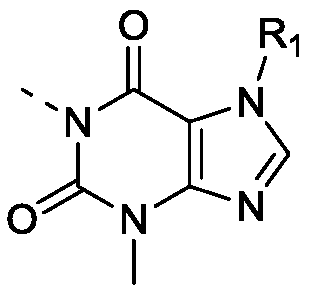
- the present invention relates to a series of hydroxy steroids and their use as PDE2 or TNF- ⁇ inhibitors, in particular to compounds of the formula ( ⁇ ), tautomers thereof or pharmaceutically acceptable salts thereof.
- Phosphodiesterase catalyzes the hydrolysis of cyclized nucleotides cGMP and cAMP, and regulates various physiological responses by controlling the intramolecular concentrations of these two important secondary signaling factors. Cyclization of nucleotides cGMP and cAMP intramolecular Abnormal regulation is the cause of many diseases. Several drugs have been used to improve and treat diseases by inhibiting PDE activity, such as PDE5 inhibitors for pulmonary hypertension and PDE4 inhibitors for arthritis caused by psoriasis. There are eleven major classes of phosphodiesterase genes, each of which can express several subtypes. There are more than 100 PDE subtypes in total. Different subtypes have different structures, different tissue distributions, and circularized nuclei. The activities of cGMP and cAMP are also very different, and the physiological functions of regulation are also very different.
- PDE2 phosphodiesterase can catalyze the hydrolysis of cyclized nucleotides cGMP and cAMP, while cAMP activity is regulated by cGMP, which plays a key role in the balance of cGMP and cAMP functions in cells.
- PDE2 is widely expressed in human tissues and is mainly distributed in the heart, central nervous system, liver, adrenal gland, endothelial cells, and platelets. PDE2 is involved in the regulation of various physiological activities, such as central learning, memory and cognition, maintaining the basic rhythm of the heart, smooth muscle and endothelial cells, permeability of endothelial cells, and regulating inflammation.
- PDE2 knockout mice directly cause embryonic death. It can be used in a variety of central, cardiovascular, and inflammatory responses by inhibiting PDE2 activity.
- Non-selective PDE inhibitory activities of various natural and synthetic terpenoids have long been discovered, such as caffeine, theophylline, pentoxifylline and the like.
- Pentoxifylline PDE2 activity
- PDE2 activity is clinically approved for lower limb paralysis caused by peripheral vascular occlusion. The main role is to reduce blood viscosity, increase red blood cell deformation, and inhibit platelet aggregation.
- Novel highly selective PDE2 inhibitors have also been reported to control endothelial cell division and angiogenesis, and to improve central cognitive impairment.
- the development and application of the new novel selective PDE2 inhibitors are still very limited, and the discovery and application of new PDE2 inhibitors have broad prospects.
- TNF- ⁇ Tumor necrosis factor alpha
- IL-1 interleukon-1
- IL-6 proinflammatory cytokines
- IMID immune-mediated inflammatory diseases
- RA rheumatoid arthritis
- psoriatic arthritis psoriatic arthritis
- AV ankylosing spondylitis
- IBD inflammatory bowel disease
- JCA juvenile chronic arthritis
- TNF- ⁇ inhibitors TNF- ⁇ inhibitors
- PDE2 can regulate the expression of TNF- ⁇ in a mechanism, so that the level of TNF- ⁇ can be controlled by regulating PDE2 activity, thereby controlling inflammatory response.
- the present invention provides a compound of the formula (I), a tautomer thereof or a pharmaceutically acceptable salt thereof,
- L 11 is selected from the group consisting of empty, C(R)(R');
- R, R' are each independently selected from H, halogen, OH, NH 2 , CN, optionally substituted 1 to 6 alkyl or heteroalkyl;
- R, R' may be cyclized to a 3-6 membered cycloalkyl or heterocycloalkyl group
- A is empty or is selected from optionally substituted cycloalkyl, heterocycloalkyl, aryl, heteroaryl;
- L 12 is selected from an optionally substituted 1 to 6 membered alkyl or heteroalkyl group
- R 1 is selected from an optionally substituted 1 to 6 membered alkyl or heteroalkyl group
- the substituents in the above R, R', A, L 12 , and R 1 are each independently selected from the group consisting of halogen, OH, NH 2 , CN, optionally substituted 1 to 6 alkyl or hetero
- the alkyl group, the number of each group substituent, is independently selected from 1, 2 or 3.
- the substituents in the above R, R', A, L 12 and R 1 are each independently selected from the group consisting of halogen, CF 3 , CN, OH, Me, Et, n-propyl, isopropyl, and ring.
- halogen CF 3 , CN, OH, Me, Et, n-propyl, isopropyl, and ring.
- R and R' are each independently selected from the group consisting of H, Me, CF 3 , and Et.
- the above L 11 is selected from
- the above A is selected from the group consisting of: a 3 to 12 membered cycloalkyl or heterocycloalkyl group, a 5 to 12 membered aryl group or a heteroaryl group.
- the above A is selected from the group consisting of: optionally substituted: cyclopropyl, cyclobutyl, cyclopentyl, cyclohexyl, pentyl, phenyl, pyridyl, pyrazinyl, oxazolyl , isoxazolyl, thiazolyl, bicyclo[1.1.1]pentane, or a bicyclic group, a spiro group or a bicyclic group selected from any two of the above groups.
- the above A is selected from the group consisting of:
- the above A is selected from the group consisting of
- the above L 12 is selected from the group consisting of methylene,
- R 1 is selected from the group consisting of Me, CHF 2 , CF 3 , Et, CH 2 CF 3 , isopropyl, Cyclopropyl,
- the invention is selected from the group consisting of:
- the invention is selected from the group consisting of:
- the invention also provides the use of the above compounds, their tautomers or chemically acceptable salts thereof for the preparation of PDE2 inhibitors and TNF- ⁇ inhibitors.
- pharmaceutically acceptable as used herein is intended to mean that those compounds, materials, compositions and/or dosage forms are within the scope of sound medical judgment and are suitable for use in contact with human and animal tissues. Without excessive toxicity, irritation, allergic reactions or other problems or complications, commensurate with a reasonable benefit/risk ratio.
- pharmaceutically acceptable salt refers to a salt of a compound of the invention prepared from a compound having a particular substituent found in the present invention and a relatively non-toxic acid or base.
- a base addition salt can be obtained by contacting a neutral amount of such a compound with a sufficient amount of a base in a neat solution or a suitable inert solvent.
- Pharmaceutically acceptable base addition salts include sodium, potassium, calcium, ammonium, organic ammonia or magnesium salts or similar salts.
- an acid addition salt can be obtained by contacting a neutral form of such a compound with a sufficient amount of an acid in a neat solution or a suitable inert solvent.
- pharmaceutically acceptable acid addition salts include inorganic acid salts including, for example, hydrochloric acid, hydrobromic acid, nitric acid, carbonic acid, hydrogencarbonate, phosphoric acid, monohydrogen phosphate, dihydrogen phosphate, sulfuric acid, Hydrogen sulfate, hydroiodic acid, phosphorous acid, etc.; and an organic acid salt, the organic acid Including, for example, acetic acid, propionic acid, isobutyric acid, maleic acid, malonic acid, benzoic acid, succinic acid, suberic acid, fumaric acid, lactic acid, mandelic acid, phthalic acid, benzenesulfonic acid, Similar acids such as toluenesulfonic acid, citric acid, tartaric
- the salt is contacted with a base or acid in a conventional manner, and the parent compound is separated, thereby regenerating the neutral form of the compound.
- the parent form of the compound differs from the form of its various salts by certain physical properties, such as differences in solubility in polar solvents.
- a "pharmaceutically acceptable salt” is a derivative of a compound of the invention wherein the parent compound is modified by salt formation with an acid or with a base.
- pharmaceutically acceptable salts include, but are not limited to, inorganic or organic acid salts of bases such as amines, alkali metal or organic salts of acid groups such as carboxylic acids, and the like.
- Pharmaceutically acceptable salts include the conventional non-toxic salts or quaternary ammonium salts of the parent compound, for example salts formed from non-toxic inorganic or organic acids.
- non-toxic salts include, but are not limited to, those derived from inorganic acids and organic acids selected from the group consisting of 2-acetoxybenzoic acid, 2-hydroxyethanesulfonic acid, acetic acid, ascorbic acid, Benzenesulfonic acid, benzoic acid, hydrogencarbonate, carbonic acid, citric acid, edetic acid, ethane disulfonic acid, ethanesulfonic acid, fumaric acid, glucoheptose, gluconic acid, glutamic acid, glycolic acid, Hydrobromic acid, hydrochloric acid, hydroiodide, hydroxyl, hydroxynaphthalene, isethionethane, lactic acid, lactose, dodecylsulfonic acid, maleic acid, malic acid, mandelic acid, methanesulfonic acid, nitric acid, oxalic acid, Pamoic acid, pantothenic acid, phenylacetic acid, phen
- the pharmaceutically acceptable salts of the present invention can be synthesized from the parent compound containing an acid group or a base by conventional chemical methods.
- such salts are prepared by reacting these compounds in water or an organic solvent or a mixture of the two via a free acid or base form with a stoichiometric amount of a suitable base or acid.
- a nonaqueous medium such as ether, ethyl acetate, ethanol, isopropanol or acetonitrile is preferred.
- the compounds provided herein also exist in the form of prodrugs.
- Prodrugs of the compounds described herein are readily chemically altered under physiological conditions to convert to the compounds of the invention.
- prodrugs can be converted to the compounds of the invention by chemical or biochemical methods in an in vivo setting.
- Certain compounds of the invention may exist in unsolvated or solvated forms, including hydrated forms.
- the solvated forms are equivalent to the unsolvated forms and are included within the scope of the invention.
- Certain compounds of the invention may have asymmetric carbon atoms (optical centers) or double bonds. Racemates, diastereomers, geometric isomers and individual isomers are included within the scope of the invention.
- the compounds of the invention may exist in specific geometric or stereoisomeric forms.
- the present invention contemplates all such compounds, including cis And trans isomers, (-)- and (+)-enantiomers, (R)- and (S)-enantiomers, diastereomers, (D)-isomers, (L)
- Additional asymmetric carbon atoms may be present in the substituents such as alkyl groups. All such isomers, as well as mixtures thereof, are included within the scope of the invention.
- optically active (R)- and (S)-isomers as well as the D and L isomers can be prepared by chiral synthesis or chiral reagents or other conventional techniques. If an enantiomer of a compound of the invention is desired, it can be prepared by asymmetric synthesis or by derivatization with a chiral auxiliary wherein the resulting mixture of diastereomers is separated and the auxiliary group cleaved to provide pure The desired enantiomer.
- a salt of a diastereomer is formed with a suitable optically active acid or base, and then by a conventional method known in the art.
- the diastereomers are resolved and the pure enantiomer is recovered.
- the separation of enantiomers and diastereomers is generally accomplished by the use of chromatography using a chiral stationary phase, optionally in combination with chemical derivatization (eg, formation of an amino group from an amine). Formate).
- the compounds of the present invention may contain unnatural proportions of atomic isotopes on one or more of the atoms that make up the compound.
- radiolabeled compounds can be used, such as tritium (3 H), iodine -125 (125 I) or C-14 (14 C). Alterations of all isotopic compositions of the compounds of the invention, whether radioactive or not, are included within the scope of the invention.
- pharmaceutically acceptable carrier refers to any formulation or carrier medium that is capable of delivering an effective amount of an active substance of the present invention, does not interfere with the biological activity of the active substance, and has no toxic side effects to the host or patient, including water, oil, Vegetables and minerals, cream bases, lotion bases, ointment bases, etc. These bases include suspending agents, tackifiers, transdermal enhancers and the like. Their formulations are well known to those skilled in the cosmetic or topical pharmaceutical arts. For additional information on vectors, reference is made to Remington: The Science and Practice of Pharmacy, 21st Ed., Lippincott, Williams & Wilkins (2005), the contents of which are hereby incorporated by reference.
- excipient generally refers to the carrier, diluent and/or vehicle required to formulate an effective pharmaceutical composition.
- an "effective amount” or “therapeutically effective amount” with respect to a pharmaceutical or pharmacologically active agent refers to a sufficient amount of a drug or agent that is non-toxic but that achieves the desired effect.
- an "effective amount” of an active substance in a composition refers to the amount required to achieve the desired effect when used in combination with another active substance in the composition. The determination of the effective amount will vary from person to person, depending on the age and general condition of the recipient, and also on the particular active substance, and a suitable effective amount in a case can be determined by one skilled in the art based on routine experimentation.
- active ingredient refers to a chemical entity that is effective in treating a target disorder, disease or condition.
- substituted means that any one or more hydrogen atoms on a particular atom are replaced by a substituent, including variants of heavy hydrogen and hydrogen, as long as the valence of the particular atom is normal and the substituted compound is stable.
- it means that two hydrogen atoms are substituted.
- Ketone substitution does not occur on the aryl group.
- optionally substituted means that it may or may not be substituted, and unless otherwise specified, the kind and number of substituents may be arbitrary on the basis of chemically achievable.
- any variable such as R
- its definition in each case is unique.
- Standing for example, if a group is substituted with 0-2 R, the group may optionally be substituted with at most two R, and each case has an independent option.
- substituents and/or variants thereof are permissible only if such combinations result in stable compounds.
- linking group When the number of one linking group is 0, such as -(CRR) 0 -, it indicates that the linking group is a single bond.
- one of the variables When one of the variables is selected from a single bond, it means that the two groups to which it is attached are directly linked. For example, when L represents a single bond in A-L-Z, the structure is actually A-Z.
- substituents When a bond of a substituent can be cross-linked to two atoms on a ring, the substituent can be bonded to any atom on the ring.
- substituents do not indicate which atom is attached to a compound included in the chemical structural formula including but not specifically mentioned, such a substituent may be bonded through any atomic phase thereof.
- Combinations of substituents and/or variants thereof are permissible only if such combinations result in stable compounds. For example, a structural unit It is indicated that it can be substituted at any position on the cyclohexyl or cyclohexadiene.
- halo or halogen
- haloalkyl is intended to include both monohaloalkyl and polyhaloalkyl.
- halo(C 1 -C 4 )alkyl is intended to include, but is not limited to, trifluoromethyl, 2,2,2-trifluoroethyl, 4-chlorobutyl, 3-bromopropyl, and the like. Wait.
- haloalkyl groups include, but are not limited to, trifluoromethyl, trichloromethyl, pentafluoroethyl, and pentachloroethyl.
- Alkoxy represents the above alkyl group having a specified number of carbon atoms attached through an oxygen bridge.
- the C 1-6 alkoxy group includes a C 1 , C 2 , C 3 , C 4 , C 5 and C 6 alkoxy groups.
- alkoxy groups include, but are not limited to, methoxy, ethoxy, n-propoxy, isopropoxy, n-butoxy, sec-butoxy, tert-butoxy, n-pentyloxy and S- Pentyloxy.
- Cycloalkyl includes saturated cyclic groups such as cyclopropyl, cyclobutyl or cyclopentyl.
- the 3-7 cycloalkyl group includes C 3 , C 4 , C 5 , C 6 and C 7 cycloalkyl groups.
- Alkenyl includes hydrocarbon chains in a straight or branched configuration wherein one or more carbon-carbon double bonds, such as vinyl and propylene groups, are present at any stable site on the chain.
- halo or halogen refers to fluoro, chloro, bromo and iodo.
- hetero denotes a hetero atom or a hetero atomic group (ie, a radical containing a hetero atom), including atoms other than carbon (C) and hydrogen (H), and radicals containing such heteroatoms, including, for example, oxygen (O).
- ring means substituted or unsubstituted cycloalkyl, heterocycloalkyl, cycloalkenyl, heterocycloalkenyl, cycloalkynyl, heterocycloalkynyl, aryl or heteroaryl. So-called rings include single rings, interlocking rings, spiral rings, parallel rings or bridge rings. The number of atoms on the ring is usually defined as the number of elements of the ring. For example, "5 to 7-membered ring” means 5 to 7 atoms arranged in a circle. Unless otherwise specified, the ring optionally contains from 1 to 3 heteroatoms.
- 5- to 7-membered ring includes, for example, phenylpyridine and piperidinyl; on the other hand, the term “5- to 7-membered heterocycloalkyl ring” includes pyridyl and piperidinyl, but does not include phenyl.
- ring also includes a ring system containing at least one ring, wherein each "ring" is independently conformed to The above definition.
- heterocycle or “heterocyclyl” means a stable monocyclic, bicyclic or tricyclic ring containing a hetero atom or a heteroatom group which may be saturated, partially unsaturated or unsaturated ( Aromatic) which comprise a carbon atom and 1, 2, 3 or 4 ring heteroatoms independently selected from N, O and S, wherein any of the above heterocycles may be fused to a phenyl ring to form a bicyclic ring.
- the nitrogen and sulfur heteroatoms can be optionally oxidized (i.e., NO and S(O)p, p is 1 or 2).
- the nitrogen atom can be substituted or unsubstituted (i.e., N or NR, wherein R is H or other substituents as already defined herein).
- the heterocyclic ring can be attached to the side groups of any hetero atom or carbon atom to form a stable structure. If the resulting compound is stable, the heterocycles described herein can undergo substitutions at the carbon or nitrogen sites.
- the nitrogen atom in the heterocycle is optionally quaternized.
- a preferred embodiment is that when the total number of S and O atoms in the heterocycle exceeds 1, these heteroatoms are not adjacent to each other. Another preferred embodiment is that the total number of S and O atoms in the heterocycle does not exceed one.
- aromatic heterocyclic group or "heteroaryl” as used herein means a stable 5, 6, or 7 membered monocyclic or bicyclic or aromatic ring of a 7, 8, 9 or 10 membered bicyclic heterocyclic group, It contains carbon atoms and 1, 2, 3 or 4 ring heteroatoms independently selected from N, O and S.
- the nitrogen atom can be substituted or unsubstituted (i.e., N or NR, wherein R is H or other substituents as already defined herein).
- the nitrogen and sulfur heteroatoms can be optionally oxidized (i.e., NO and S(O)p, p is 1 or 2).
- bridged rings are also included in the definition of heterocycles.
- a bridged ring is formed when one or more atoms (ie, C, O, N, or S) join two non-adjacent carbon or nitrogen atoms.
- Preferred bridged rings include, but are not limited to, one carbon atom, two carbon atoms, one nitrogen atom, two nitrogen atoms, and one carbon-nitrogen group. It is worth noting that a bridge always converts a single ring into a three ring. In the bridged ring, a substituent on the ring can also be present on the bridge.
- heterocyclic compounds include, but are not limited to, acridinyl, octanoyl, benzimidazolyl, benzofuranyl, benzofuranylfuranyl, benzindenylphenyl, benzoxazolyl, benzimidin Oxazolinyl, benzothiazolyl, benzotriazolyl, benzotetrazolyl, benzisoxazolyl, benzisothiazolyl, benzimidazolyl, oxazolyl, 4aH-carbazolyl, Porphyrin, chroman, chromene, porphyrin-decahydroquinolinyl, 2H, 6H-1,5,2-dithiazinyl, dihydrofuro[2,3-b] Tetrahydrofuranyl, furyl, furfuryl, imidazolidinyl, imidazolinyl, imidazolyl, 1H-carbazolyl, nonenyl,
- hydrocarbyl or its subordinate concept (such as alkyl, alkenyl, alkynyl, phenyl, etc.) by itself or as part of another substituent means straight-chain, branched or cyclic
- the hydrocarbon radical or a combination thereof may be fully saturated, mono- or polyunsaturated, may be monosubstituted, disubstituted or polysubstituted, and may be monovalent (such as methyl), divalent (such as methylene) or polyvalent (methine), may include a divalent or polyvalent radical having the specified number of carbon atoms (e.g., C 1 -C 10 represents 1 to 10 carbons).
- Hydrocarbyl includes, but is not limited to, aliphatic hydrocarbyl groups including chain and cyclic, including but not limited to alkyl, alkenyl, alkynyl groups including, but not limited to, 6-12 members.
- An aromatic hydrocarbon group such as benzene, naphthalene or the like.
- hydrocarbyl means a straight or branched chain radical or a combination thereof, which may be fully saturated, unitary or polyunsaturated, and may include divalent and multivalent radicals.
- saturated hydrocarbon radicals include, but are not limited to, methyl, ethyl, n-propyl, isopropyl, n-butyl, t-butyl, isobutyl, sec-butyl, isobutyl, cyclohexyl, (cyclohexyl).
- a homolog or isomer of a methyl group, a cyclopropylmethyl group, and an atomic group such as n-pentyl, n-hexyl, n-heptyl, n-octyl.
- the unsaturated alkyl group has one or more double or triple bonds, and examples thereof include, but are not limited to, a vinyl group, a 2-propenyl group, a butenyl group, a crotyl group, a 2-isopentenyl group, and a 2-(butadienyl group). ), 2,4-pentadienyl, 3-(1,4-pentadienyl), ethynyl, 1- and 3-propynyl, 3-butynyl, and higher homologs and Structure.
- heterohydrocarbyl or its subordinate concept (such as heteroalkyl, heteroalkenyl, heteroalkynyl, heteroaryl, etc.), by itself or in combination with another term, means a stable straight chain, branched chain. Or a cyclic hydrocarbon radical or a combination thereof having a number of carbon atoms and at least one heteroatom.
- heterohydrocarbyl by itself or in conjunction with another term denotes a stable straight chain, branched hydrocarbon radical or combination thereof, having a number of carbon atoms and at least one heteroatom.
- the heteroatoms are selected from the group consisting of B, O, N, and S, wherein the nitrogen and sulfur atoms are optionally oxidized, and the nitrogen heteroatoms are optionally quaternized.
- the heteroatoms B, O, N and S can be located at any internal position of the heterohydrocarbyl group (including where the hydrocarbyl group is attached to the rest of the molecule).
- Up to two heteroatoms may be consecutive, for example, -CH 2 -NH-OCH 3.
- alkoxy alkylamino and “alkylthio” (or thioalkoxy) are customary expressions and refer to those alkane which are attached to the remainder of the molecule through an oxygen atom, an amino group or a sulfur atom, respectively.
- Base group alkoxy
- cycloalkyl refers to any heterocyclic alkynyl group, etc., by itself or in combination with other terms, denotes a cyclized “hydrocarbyl group” or “heterohydrocarbyl group”, respectively.
- a hetero atom may occupy a position at which the hetero ring is attached to the rest of the molecule.
- cycloalkyl groups include, but are not limited to, cyclopentyl, cyclohexyl, 1-cyclohexenyl, 3-cyclohexenyl, cycloheptyl, and the like.
- heterocyclic groups include 1-(1,2,5,6-tetrahydropyridyl), 1-piperidinyl, 2-piperidinyl, 3-piperidinyl, 4-morpholinyl, 3-morpholinyl, tetrahydrofuran-2-yl, tetrahydrofuran-3-yl, tetrahydrothiophen-2-yl, tetrahydrothiophen-3-yl, 1-piperazinyl and 2-piperazinyl.
- aryl denotes a polyunsaturated, aromatic hydrocarbon substituent which may be monosubstituted, disubstituted or polysubstituted, may be monovalent, divalent or polyvalent, it may be monocyclic or Polycyclic (preferably 1 to 3 rings) which are fused together or covalently linked.
- heteroaryl refers to an aryl (or ring) containing one to four heteroatoms. In an illustrative example, the heteroatoms are selected from the group consisting of B, N, O, and S, Wherein the nitrogen and sulfur atoms are optionally oxidized and the nitrogen atom is optionally quaternized.
- a heteroaryl group can be attached to the remainder of the molecule through a heteroatom.
- aryl or heteroaryl groups include phenyl, 1-naphthyl, 2-naphthyl, 4-biphenyl, 1-pyrrolyl, 2-pyrrolyl, 3-pyrrolyl, 3-pyridyl Azyl, 2-imidazolyl, 4-imidazolyl, pyrazinyl, 2-oxazolyl, 4-oxazolyl, 2-phenyl-4-oxazolyl, 5-oxazolyl, 3-isoxan Azyl, 4-isoxazolyl, 5-isoxazolyl, 2-thiazolyl, 4-thiazolyl, 5-thiazolyl, 2-furyl, 3-furyl, 2-thienyl, 3-thiophene , 2-pyridyl, 3-pyridyl, 4-pyridyl, 2-pyrimidinyl, 4-pyrimidinyl, 5-benzothiazolyl, 5-
- aryl groups when used in conjunction with other terms (eg, aryloxy, arylthio, aralkyl), include aryl and heteroaryl rings as defined above.
- aralkyl is intended to include those radicals to which an aryl group is attached to an alkyl group (eg, benzyl, phenethyl, pyridylmethyl, and the like), including wherein the carbon atom (eg, methylene) has been, for example, oxygen.
- alkyl groups substituted by an atom such as phenoxymethyl, 2-pyridyloxymethyl 3-(1-naphthyloxy)propyl and the like.
- leaving group refers to a functional group or atom which may be substituted by another functional group or atom by a substitution reaction (for example, an affinity substitution reaction).
- substituent groups include triflate; chlorine, bromine, iodine; sulfonate groups such as mesylate, tosylate, p-bromobenzenesulfonate, p-toluenesulfonic acid Esters and the like; acyloxy groups such as acetoxy, trifluoroacetoxy and the like.
- protecting group includes, but is not limited to, "amino protecting group", “hydroxy protecting group” or “thiol protecting group”.
- amino protecting group refers to a protecting group suitable for preventing side reactions at the amino nitrogen position.
- Representative amino protecting groups include, but are not limited to, formyl; acyl, such as alkanoyl (e.g., acetyl, trichloroacetyl or trifluoroacetyl); alkoxycarbonyl, e.g., tert-butoxycarbonyl (Boc) Arylmethoxycarbonyl, such as benzyloxycarbonyl (Cbz) and 9-fluorenylmethoxycarbonyl (Fmoc); arylmethyl, such as benzyl (Bn), trityl (Tr), 1, 1-di -(4'-methoxyphenyl)methyl; silyl groups such as trimethylsilyl (TMS) and tert-
- hydroxy protecting group refers to a protecting group suitable for use in preventing hydroxy side reactions.
- Representative hydroxy protecting groups include, but are not limited to, alkyl groups such as methyl, ethyl and t-butyl groups; acyl groups such as alkanoyl groups (e.g., acetyl); arylmethyl groups such as benzyl (Bn), Oxybenzyl (PMB), 9-fluorenylmethyl (Fm) and diphenylmethyl (diphenylmethyl, DPM); silyl groups such as trimethylsilyl (TMS) and tert-butyl Dimethylsilyl (TBS) and the like.
- alkyl groups such as methyl, ethyl and t-butyl groups
- acyl groups such as alkanoyl groups (e.g., acetyl)
- arylmethyl groups such as benzyl (Bn), Oxybenzyl (PMB), 9-fluoreny
- the compounds of the present invention can be prepared by a variety of synthetic methods well known to those skilled in the art, including the specific embodiments set forth below, combinations thereof with other chemical synthetic methods, and those well known to those skilled in the art. Equivalent alternatives, preferred embodiments include, but are not limited to, embodiments of the invention.
- Ethyl 5-(3,7-dimethyl-2,6-dioxo-2,3,6,7-tetrahydro-1H-indol-1-yl)pentanoic acid ethyl ester (0.500 g, 1.62)
- Ethyl acetate was dissolved in anhydrous tetrahydrofuran (5 mL). N.sub.3.
- the reaction solution was stirred at -78 ° C for 0.5 hour, then slowly raised to 0 ° C and reacted for 0.5 hour.
- the reaction solution was poured into water and extracted with ethyl acetate (30 mL, 3). The organic phase was combined, dried over anhydrous sodium sulfate, filtered and evaporated.
- Ethylmagnesium bromide (3M ether solvent, 1.1 mL, 3.24 mmol) was added to ethyl 5-(3,7-dimethyl-2,6-dioxo-2,3 at -35 °C under nitrogen.
- ,6,7-Tetrahydro-1H-indol-1-yl)pentanoic acid ethyl ester 500 mg, 1.62 mmol
- tetraisopropyl titanate (461 mg, 1.62 mmol) in tetrahydrofuran (10 mL).
- the reaction solution was slowly heated to 25 ° C and stirred for 2 hours.
- the reaction was quenched by water (10 mL).
- Methyl-3-oxocyclobutanecarboxylic acid (25.0 g, 195 mmol), ethylene glycol (35.0 g, 564 mmol) and p-toluenesulfonic acid (3.50 g, 20.0 mmol) were dissolved in toluene (250 mL).
- the water separator was heated to reflux overnight.
- the reaction solution was cooled to 25 ° C, washed sequentially with water (300 mL ⁇ 2) and saturated sodium hydrogen carbonate (500 mL ⁇ 2).
- the organic phase was dried over anhydrous magnesium sulfate, filtered, and then filtered and evaporated tolulululululululululululululululululululululululu Rate: 90%.
- Lithium tetrahydroaluminum (5.20 g, 136 mmol) was slowly dissolved in tetrahydrofuran (240 mL) under nitrogen at 0 ° C, then 5,8-dioxaspiro[3,4] dissolved in tetrahydrofuran (60 mL) Methyl octane-2-carboxylate (19.5 g, 113 mmol). The reaction was slowly raised to 25 ° C and stirred for 3.5 hours.
- Methyl 3-(hydroxymethyl)bicyclo[1.1.1]pentane-1-carboxylate (40.0 mg, 0.256 mmol) and triethylamine (39.0 mg, 0.384 mmol) were dissolved in dichloromethane (15 mL) Methanesulfonyl chloride (35.0 mg, 0.307 mmol) was slowly added dropwise at 0 °C. The reaction mixture was stirred at 0 ° C for 2 hours. The mixture was diluted with methylene chloride (10 mL). Methyl (((methylsulfonyl)oxy)methyl)-bicyclo[1.1.1]pentan-1-carboxylate (50.0 mg, yellow oil).
- Methyl-3-methylenecyclobutanecarboxylic acid (2.00 g, 15.8 mmol) was dissolved in tetrahydrofuran (30 mL), and borane dimethyl sulfide (3.61 g, 47.5 mmol) was added dropwise at -10 ° C, then -10 ° C reaction for 3 hours, adding 3N aqueous sodium hydroxide solution (10 mL) and hydrogen peroxide (5 mL), the reaction was continued for 1 hour, the reaction solution was added to a saturated aqueous solution of sodium thiosulfate (30 mL) to quench the reaction, dichloromethane extraction (10 mL x 3), dried over anhydrous sodium sulfate, filtered, and evaporated, evaporated, evaporated.
- Methyl 3-oxo-cyclopentanoate (16.0 g, 110 mmol), p-toluenesulfonic acid (14.0 g, 220 mmol) and ethylene glycol (969 mg, 5.60 mmol) were dissolved in anhydrous toluene (160 mL). The water separator was heated and refluxed for 4 hours. The reaction was quenched with water (2OmL)EtOAc. The combined organic layers were washed with EtOAc EtOAc EtOAc.
- Methyl 1,4-dioxaspiro[4.4]nonane-7-carboxylate (1.00 g, 10.7 mmol) was dissolved in anhydrous tetrahydrofuran (30 mL), and the mixture was stirred under nitrogen. (531 mg, 13.9 mmol). The reaction solution was slowly warmed to 25 ° C and stirred for 3 hours. Water (0.5 mL), 15% sodium hydroxide solution (0.5 mL), and water (1.5 mL) were sequentially added to the mixture. The insoluble material was removed by filtration, and the filtrate was concentrated under reduced pressure to give (4-dioxaspiro[4.4]decane-7-yl)-methanol (m.
- the 1,4-dioxaspiro[4.4]decane-7-ylmethyl methanesulfonate (300 mg, 1.27 mmol) was dissolved in anhydrous N,N-dimethylformamide (10 mL). Potassium carbonate (350 mg, 2.54 mmol), potassium iodide (21.0 mg, 0.130 mmol), 2,6-hydroxy-3,7-dimethylindole (275 mg, 1.52 mmol) were added at 25 °C. The reaction solution was heated to 130 ° C and stirred for 3 hours. The reaction mixture was cooled to 25 ° C, then quenched with water (40 mL).
- Lithium tetrahydroaluminum (2.30 g, 61.0 mmol) was slowly added to tetrahydrofuran (60 mL) under nitrogen at 0 ° C, and ethyl 1,4-dioxaspiro[4,5]nonane-8-carboxyl was added dropwise.
- 1,4-Dioxaspiro[4,5]decane-8-ylmethyl methanesulfonate (1.50 g, 6.00 mmol), 3,7-dimethyl-1H-indole-2,6 ( 3H,7H)-dione (1.00 g, 6.00 mmol) and potassium carbonate (2.50 g, 18.0 mmol), potassium iodide (100 mg, 0.600 mmol) dissolved in N,N-dimethylformamide (20 mL) Heat to 130 ° C and stir for 3 hours.
- Triethyl phosphonoacetate (12.2 g, 54.4 mmol) was dissolved in tetrahydrofuran (100 mL), and sodium hydride (1.92 g, 48.0 mmol) was added portionwise at 0 ° C, and the reaction was stirred for 30 min under nitrogen atmosphere.
- a solution of 1,4-cyclohexanedione monoethylene ketal (5.00 g, 32.0 mmol) dissolved in tetrahydrofuran (15 mL) was added dropwise to the reaction solution at 0 ° C, and the reaction solution was stirred at 25 ° C for 3 hours. .
- the reaction was quenched with water (25 mL) andEtOAcEtOAc.
- Methyl 2-(1,4-dioxaspiro[4.5]decane-8-ylidene)acetate (3.80 g, 17.9 mmol) was dissolved in methanol (50 mL) and dry palladium carbon (palladium 10%) , water 1%, 400 mg), the reaction solution was reacted under hydrogen (50 psi) for 18 hours at room temperature. The reaction mixture was filtered, and the filtrate was evaporated toluiserjjjjjjjjj .
- Ethyl ethyl 1,4-dioxaspiro[4.5]decane-8-carboxylate (5.00 g, 23.3 mmol) was dissolved in anhydrous tetrahydrofuran (100 mL). A lithium diisopropylamide solution (2M tetrahydrofuran solution, 14.0 mL, 28.0 mmol) was added, and the mixture was stirred at -78 ° C for one hour. Methyl iodide (6.62 g, 46.7 mmol) was slowly added and stirring was continued for 1 hour. The reaction was quenched by the addition of water (100 mL). The reaction mixture was extracted with EtOAc (EtOAc (EtOAc)EtOAc.
- Ethyl 8-methyl-1,4-dioxaspiro[4.5]decane-8-carboxylic acid tert-butyl ester (5.00 g, 21.9 mmol) was dissolved in tetrahydrofuran (50 mL) and 1N hydrochloric acid was added dropwise at 0 °C. The aqueous solution (20 mL) was stirred at 20 ° C for 1 hour. The mixture was cooled to 0 ° C and quenched with sodium bicarbonate (50 mL). The mixture was extracted with ethyl acetate (100 mL x 3).
- Ethyl ethyl 1,4-dioxaspiro[4.5]decane-8-carboxylate (5.00 g, 23.3 mmol) was dissolved in anhydrous tetrahydrofuran (100 mL). A lithium diisopropylamide solution (2M-hexane solution, 14.0 mL, 28.0 mmol) was added, and the mixture was stirred at -78 ° C for one hour. Methoxybromomethane (5.83 g, 46.7 mmol) was slowly added and stirring was continued for 1 hour. The reaction was quenched by the addition of water (100 mL). The reaction mixture was extracted with EtOAc (EtOAc (EtOAc)EtOAc.
- Ethyl ethyl 8-(methoxymethyl)-1,4-dioxaspiro[4.5]decane-8-carboxylate (5.00 g, 19.4 mmol) was dissolved in tetrahydrofuran (50 mL) at 0 ° C After 1N diluted hydrochloric acid (10 mL) was added dropwise, the mixture was stirred at 20 ° C for 1 hour. The mixture was cooled to 0 ° C and quenched with sodium bicarbonate (50 mL). The mixture was extracted with ethyl acetate (100 mL x 3).
- Ethyl ethyl 1-(methoxymethyl)-4-oxocyclohexanecarboxylate (3.00 g, 14.0 mmol)
- EtOAc EtOAc
- EtOAc EtOAc
- Trimethylsilyltrifluoromethyl (3.98 g, 28.0 mmol) was then added at 0 °C.
- the reaction solution was reacted under nitrogen for 20 hours at 20 °C.
- 4N dilute hydrochloric acid (7 mL) was added.
- the mixture was reacted under nitrogen for 6 hours at room temperature.
- Methyl 1,4-cyclohexanecarboxylate (1.20 g, 6.45 mmol) was dissolved in anhydrous tetrahydrofuran (20 mL), and then filtered under nitrogen, and borane dimethyl sulfide (10 M, 1.0 mL) was slowly added dropwise at 0 ° C. 10.3 mmol), the reaction solution was stirred at 0 ° C for 0.5 hour, slowly raised to 25 ° C, and stirring was continued for 1 hour. The reaction was quenched by the addition of water (40 mL). The organic phase was combined, washed with EtOAc EtOAc (EtOAc m. : 91%.
- Methyl 4-hydroxymethylcyclohexanecarboxylate (900 mg, 5.20 mmol) and triethylamine (1.58 g, 15.6 mmol) were dissolved in anhydrous dichloromethane (5 mL). Sulfonyl chloride (720 mg, 6.30 mmol). The reaction solution was raised to 25 ° C and stirred for 2 hours. The reaction was quenched by the addition of water (60 mL). The organic phase was combined, washed with water and aq.
- Methyl 4-methanesulfonyloxymethyl-cyclohexanecarboxylate (580 mg, 2.32 mmol) was dissolved in 5 mL of anhydrous N,N-dimethylformamide, and potassium carbonate was added at 25 ° C under nitrogen atmosphere ( 640 mg, 4.64 mmol), potassium iodide (38.0 mg, 0.230 mmol), 2,6-hydroxy-3,7-dimethylindole (501 mg, 2.80 mmol). The reaction solution was stirred at 130 ° C for 3 hours. The mixture was extracted with ethyl acetate.
- Methyl 4-((3,7-dimethyl-2,6-dioxo-2,3,6,7-tetrahydro-1H-indol-1-yl)-cyclohexanecarboxylic acid (100 mg , 0.30 mmol) was dissolved in 5 mL of anhydrous tetrahydrofuran.
- Ethyl magnesium bromide solution (3M diethyl ether solution, 1 mL, 3.00 mmol) was slowly added dropwise at -65 ° C under nitrogen atmosphere, and the reaction mixture was stirred at -65 ° C for 2 hours.
- the trans-cyclohexane-1,4-dicarboxylic acid monomethyl ester (5.00 g, 26.8 mmol) was dissolved in tetrahydrofuran (100 mL), and borane dimethyl sulfide (3.06 g, 40.3 mmol) was added at 0 °C. The reaction was carried out for 2 hours at room temperature. The reaction was quenched by the addition of saturated MeOH (50 mL). After concentrating, water (50 mL) was evaporated (EtOAc m. Oily), yield: 87%.
- Methyl trans-4-methanesulfonyloxymethyl-cyclohexanecarboxylate (1.00 g, 4.00 mmol), 3,7-dimethyl-1H-indole-2,6(3H,7H)- Diketone (719 mg, 4.00 mmol), potassium iodide (66.0 mg, 0.397 mmol) and potassium carbonate (1.10 g, 7.96 mmol) were dissolved in N,N-dimethylformamide (10 mL). The reaction solution was warmed to 120 ° C and stirred for 3 hours. It was cooled to room temperature, filtered, and the filtrate was concentrated.
- Ethyl 3-acetylbenzoate 500 mg, 2.60 mmol was dissolved in tetrahydrofuran (20 mL), and trifluoromethyltrimethylsilane (370 mg, 2.60 mmol) and cesium fluoride (79.0 mg, 0.520) were added at room temperature. Mm). After stirring at room temperature for 12 hours, the reaction mixture was diluted with ethyl acetate (30 mL). Ethyl ethyl 3-(1,1,1-trifluoro-2-hydroxypropan-2-yl)benzoic acid ethyl ester (600 mg, yellow solid). 88%.
- Ethyl ethyl 3-(1,1,1-trifluoro-2-hydroxypropan-2-yl)benzoate (500 mg, 1.91 mmol) was dissolved in tetrahydrofuran (20 mL). Lithium aluminum hydride (108 mg, 2.87 mmol) was stirred at room temperature for 2 hours, and water (0.1 mL), 15% sodium hydroxide (0.1 mL) and water (0.3 mL) were added to the mixture and stirred for 20 min. The reaction mixture was diluted with ethyl acetate (30 mL). EtOAc. Methyl)phenyl)propan-2-ol (400 mg, yellow solid), yield: 95%.
- 1,1,1-Trifluoro-2-(3-hydroxymethyl)phenyl)propan-2-ol 400 mg, 1.82 mmol
- triethylamine 275 mg, 2.72 mmol
- the reaction mixture was added with methanesulfonyl chloride (250 mg, 2.18 mmol) at 0 ° C, and stirred for 2 hr, diluted with dichloromethane (30 mL). Filtration and concentration of the filtrate under reduced pressure gave 3-(1,1,1-trifluoro-2-hydroxypropan-2-yl)benzyl methanesulfonate (500 mg, m.
- Lithium aluminum hydride (1.61 g, 42.3 mmol) was slowly added to methyl 4-(1,1,1-trifluoro-2-hydroxypropyl-2-yl)benzoate (7.00 g) under nitrogen at 0 °C. , 28.2 mmol) in tetrahydrofuran (150 mL).
- the reaction solution was stirred at 0 ° C for 3 hours.
- water (1.60 mL), 15% sodium hydroxide solution (1.60 mL) and water (4.80 mL) were added slowly.
- 1,1,1-Trifluoro-2-(4-(hydroxymethyl)phenyl)propyl-2-ol (5.80 g, 26.3 mmol) and diisopropylethylamine (10.2 g, 79.0 mmol) Dissolved in dichloromethane (80 mL) and slowly added methanesulfonyl chloride (4.53 g, 39.5 mmol) at 0 °C. The reaction solution was stirred at 0 ° C for 0.5 hour.
- EtOAc EtOAc
- EtOAc EtOAc
- EtOAc Drying with anhydrous sodium sulfate, filtering, and concentrating the filtrate under reduced pressure by high-performance liquid chromatography to obtain 3,7-dimethyl-1-((6-(1,1,1-trifluoro-2-hydroxypropane-2) -yl)pyridin-3-yl)methyl)-1H-indole-2,6(3H,7H)-dione (50 mg, white solid), yield: 27%.
- N-Methoxy-N,5-dimethylpyrazine-2-carboxamide (1.50 g, 8.28 mmol) was dissolved in tetrahydrofuran (30 mL), and methylmagnesium bromide (3M diethyl ether solution) was added dropwise at 0 °C. 13.3 mL, 39.9 mmol), then stirred at 25 ° C for 1 hour. The mixture was cooled to 0 ° C and quenched by water (10 mL). The mixture was extracted with EtOAc (30 mLEtOAc) The residue was purified by EtOAc EtOAc EtOAcjjjjj 62%. MS-ESI calcd for [M + H] + 137, found 137.
- reaction solution It was poured into water (20 mL) and extracted with ethyl acetate (30 mL x 3). The organic phase was dried over anhydrous sodium sulfate, filtered, evaporated, evaporated,lulululululululululululululululululu -2,6(3H,7H)-dione (30.0 mg, colorless oil), yield: 30%.
- 1,4-Dioxaspiro[4,5]decane-8-ylmethyl methanesulfonate 200 mg, 0.800 mmol
- 3-methyl-7-(2,2,2-trifluoroethyl -1H-indole-2,6(3H,7H)-dione 200 g, 0.800 mmol
- potassium carbonate 334 mg, 2.42 mmol
- potassium iodide 14.0 mg, 0.0800 mmol
- N,N-dimethyl In the formamide (3 mL) the reaction solution was heated to 130 ° C and stirred for 3.5 hours.
- 1,4-Dioxaspiro[4,5]decane-8-ylmethyl methanesulfonate (603 mg, 2.41 mmol), 3-methyl-7-(2,2,2-trifluoroethyl -1H-indole-2,6-(3H,7H)-dione (500 mg, 2.01 mmol) and potassium iodide (33.3 mg, 0.201 mmol) were dissolved in N,N-dimethylformamide (8 mL). Potassium carbonate (555 mg, 4.02 mmol) was added, and the mixture was heated to reflux at 130 ° C for 4 hours. The reaction solution was cooled to room temperature, filtered, and the filtrate was evaporated evaporated. (2,2,2-Trifluoroethyl)-1H-indole-2,6-(3H,7H)-dione (980 mg, yellow oil). MS-ESI calcd for [M+H] + 403.
- 6-Amino-5-bromo-1-methylpyrimidine-2,4(1H,3H)-dione (2.19 g, 10.0 mmol) was dissolved in a mixed solvent of cyclopropylamine (20 mL) and water (5 mL). The reaction solution was heated to reflux for 5 hours. The reaction solution was filtered to remove the solvent to give the crude product 6-amino-5-(cyclopropylamine)-1-methylpyrimidine-2,4(1H,3H)-dione.
- 6-Amino-5-(cyclopropylamine)-1-methylpyrimidine-2,4(1H,3H)-dione (1.96 g, 10.0 mmol), trimethyl orthoformate (2.12) under N2 g, 20.0 mmol) and p-toluenesulfonic acid (86.0 mg, 0.500 mmol) were dissolved in anhydrous N,N-dimethylformamide (20 mL). The reaction solution was heated to 100 ° C overnight. The reaction solution was filtered, and the solvent was evaporated to give the crude product 7-cyclopropyl-3-methyl-1H-indole-2, 6(3H,7H)-dione.
- 1,4-Dioxaspiro[4.5]decane-8-ylmethyl methanesulfonate 250 mg, 1.00 mmol
- 7-isopropyl-3-methyl-1H-indole-2,6 ( 3H,7H)-Dione 208 mg, 1.00 mmol
- potassium iodide 15.8 mg, 0.100 mmol
- potassium carbonate 276 mg, 2.00 mmol
- 1,4-Dioxaspiro[4,5]nonane-8-ylmethyl methanesulfonate (682 mg, 2.72 mmol), 7-(cyclopropylmethyl)-3-methyl-1H- ⁇ -2,6-(3H,7H)-dione (500 mg, 2.27 mmol) and potassium iodide (37.7 mg, 0.227 mmol) were dissolved in N,N-dimethylformamide (10 mL), and potassium carbonate (627 mg) , 4.54 mmol), and the reaction was heated to reflux at 130 ° C for 4 hours. The reaction solution was cooled to room temperature, filtered, and the filtrate was evaporated evaporated evaporated. ) -3-methyl -1H- purine -2,6- (3H, 7H) - dione (1.10g, yellow oil) .MS-ESI calcd for [M + H] + 375, found 375.
- reaction solution was cooled to 20 ° C, filtered, concentrated, and then purified by preparative HPLC to give 7-(cyclopropylmethyl)-1-((4-hydroxy-1-methyl-4-(trifluoro) Cyclo) hexyl)methyl)-3-methyl-1H-indole-2,6-(3H,7H)-dione (10.0 mg, white solid).
Landscapes
- Health & Medical Sciences (AREA)
- Chemical & Material Sciences (AREA)
- Organic Chemistry (AREA)
- Veterinary Medicine (AREA)
- Medicinal Chemistry (AREA)
- Pharmacology & Pharmacy (AREA)
- Life Sciences & Earth Sciences (AREA)
- Animal Behavior & Ethology (AREA)
- General Health & Medical Sciences (AREA)
- Public Health (AREA)
- Engineering & Computer Science (AREA)
- Bioinformatics & Cheminformatics (AREA)
- Chemical Kinetics & Catalysis (AREA)
- General Chemical & Material Sciences (AREA)
- Nuclear Medicine, Radiotherapy & Molecular Imaging (AREA)
- Epidemiology (AREA)
- Neurosurgery (AREA)
- Biomedical Technology (AREA)
- Neurology (AREA)
- Rheumatology (AREA)
- Cardiology (AREA)
- Heart & Thoracic Surgery (AREA)
- Pain & Pain Management (AREA)
- Hospice & Palliative Care (AREA)
- Psychiatry (AREA)
- Vascular Medicine (AREA)
- Urology & Nephrology (AREA)
- Pulmonology (AREA)
- Immunology (AREA)
- Orthopedic Medicine & Surgery (AREA)
- Physical Education & Sports Medicine (AREA)
- Pharmaceuticals Containing Other Organic And Inorganic Compounds (AREA)
Abstract
Description



| 供试品(各实施例所制得的化合物) | PDE2磷酸二酯酶抑制活性 |
| 实施例1 | + |
| 实施例2 | ++ |
| 实施例3 | + |
| 实施例4 | ++ |
| 实施例5 | + |
| 实施例6 | -- |
| 实施例7 | -- |
| 实施例8异构体1/异构体2 | ++/+ |
| 实施例9异构体1/异构体2 | +/+ |
| 实施例10异构体1/异构体2 | --/-- |
| 实施例11 | + |
| 实施例12异构体1/异构体2 | +/++ |
| 实施例13 | -- |
| 实施例14 | -- |
| 实施例15异构体1/异构体2 | ++/++ |
| 实施例16 | -- |
| 实施例17 | -- |
| 实施例18 | ++ |
| 实施例19 | + |
| 实施例20 | + |
| 实施例21 | + |
| 实施例22 | ++ |
| 实施例23异构体1/异构体2 | --/-- |
| 实施例24 | -- |
| 实施例25 | ++ |
| 实施例26 | + |
| 实施例27 | ++ |
| 实施例28 | ++ |
| 实施例29 | -- |
| 实施例30 | -- |
| 实施例31 | + |
| 实施例32 | -- |
| 实施例33 | + |
| 实施例34 | + |
| 实施例35 | + |
| 实施例36 | + |
| 实施例37 | -- |
| 实施例38 | -- |
| 实施例39 | -- |
| 实施例40 | -- |
| 实施例41异构体1/异构体2 | --/-- |
| 实施例42 | ++ |
| 实施例43 | + |
| 实施例44 | ++ |
| 实施例45/45’ | --/++ |
| 实施例46异构体1/异构体2 | --/+ |
| 实施例47 | + |
| 实施例48 | + |
| 实施例49 | ++ |
| 实施例50异构体1/异构体2 | +/+++ |
| 实施例51异构体1/异构体2 | +/++ |
| 实施例52 | + |
| 实施例53 | + |
| 实施例54 | ++ |
| 实施例55 | +++ |
| 实施例56 | + |
| 实施例57 | ++ |
| 实施例58异构体1/异构体2 | --/-- |
| 实施例59 | -- |
| 实施例60 | -- |
| 实施例61 | -- |
| 供试品(各实施例所制得的化合物) | TNF-α抑制比率 |
| 实施例1 | + |
| 实施例11 | + |
| 实施例12异构体1/异构体2 | +/+ |
| 实施例27 | + |
| 实施例40 | + |
| 实施例44 | ++ |
| 实施例49 | ++ |
| 实施例50异构体1/异构体2 | --/++ |
| 实施例51异构体1/异构体2 | --/++ |
| 实施例55 | ++ |

Claims (9)
- 式(Ⅰ)所示化合物、其互变异构体或其药学上可接受的盐,
 其中,可将结构单元替换为
 具体替换为
具体替换为
 L11选自空、C(R)(R’);R、R’分别独立地选自H、卤素、OH、NH2、CN、任选被取代的1~6元烷基或杂烷基;任选地,R、R’可以环化成3-6元环烷基、杂环烷基;A为空,或选自任选被取代的环烷基、杂环烷基、芳基、杂芳基;L12选自任选被取代的1~6元烷基或杂烷基;R1选自任选被取代的1~6元烷基或杂烷基;“杂”代表N、O、S、C(=O)、S(=O)、S(=O)2,每个基团上杂原子的数目选自1、2、3或4。
 - 根据权利要求1所述的化合物,其中R、R’、A、L12、R1中取代基分别独立地选自卤素、OH、NH2、CN、任选被取代的1~6元烷基或杂烷基,每个基团取代基的数目分别独立地选自1、2或3;具体地,R、R’、A、L12、R1中取代基分别独立地选自卤素、CF3、CN、OH、Me、Et、正丙基、异丙基、环丙基、

- 根据权利要求1或2所述的化合物,其中R、R’分别独立地选自H、Me、CF3、Et;具体地,L11选自

- 根据权利要求1或2所述的化合物,其中A选自任选被取代的:3~12元环烷基或杂环烷基、5~12元芳基或杂芳基;具体地,A选自任选被取代的:环丙基、环丁基、环戊基、环己基、环氧戊基、苯基、吡啶基、吡嗪基、恶唑基、异恶唑基、噻唑基、双环[1.1.1]戊烷,或选自由上述基团中任意两个组成的二联环基、螺环基或并环基;具体地,A选自任选被取代的:

 具体地,A选自

- 根据权利要求1或2所述的化合物,其中L12选自亚甲基、


- 根据权利要求1或2所述的化合物,其中R1选自Me、CHF2、CF3、Et、CH2CF3、异丙基、环丙基、


- 下式化合物:


- 下式化合物:


- 根据权利要求1~8任意一项所述的化合物、其互变异构体或其化学上可接受的盐在制备PDE2抑制剂和TNF-a抑制剂中的应用。
Priority Applications (14)
| Application Number | Priority Date | Filing Date | Title |
|---|---|---|---|
| CA2964018A CA2964018C (en) | 2014-10-09 | 2015-09-22 | Hydroxyl purine compounds and applications thereof |
| US15/517,951 US10098885B2 (en) | 2014-10-09 | 2015-09-22 | Hydroxyl purine compounds and applications thereof |
| NZ731344A NZ731344A (en) | 2014-10-09 | 2015-09-22 | Hydroxyl purine compounds and applications thereof |
| KR1020177012407A KR101997592B1 (ko) | 2014-10-09 | 2015-09-22 | 히드록시퓨린계 화합물 및 이의 응용 |
| RU2017116164A RU2673458C1 (ru) | 2014-10-09 | 2015-09-22 | Гидроксипуриновые соединения и пути их применения |
| AU2015330490A AU2015330490B2 (en) | 2014-10-09 | 2015-09-22 | Hydroxyl purine compounds and applications thereof |
| US16/795,419 USRE49128E1 (en) | 2014-10-09 | 2015-09-22 | Hydroxyl purine compounds and applications thereof |
| CN201580054840.9A CN107001371B (zh) | 2014-10-09 | 2015-09-22 | 羟基嘌呤类化合物及其应用 |
| SG11201702900SA SG11201702900SA (en) | 2014-10-09 | 2015-09-22 | Hydroxyl purine compounds and applications thereof |
| MX2017004655A MX382726B (es) | 2014-10-09 | 2015-09-22 | Compuestos de hidroxil purinas y aplicaciones de estos |
| BR112017007194-0A BR112017007194B1 (pt) | 2014-10-09 | 2015-09-22 | Compostos de hidroxil purina e uso dos mesmos |
| EP15848312.3A EP3205652B1 (en) | 2014-10-09 | 2015-09-22 | Hydroxyl purine compounds and applications thereof |
| JP2017538284A JP6527948B2 (ja) | 2014-10-09 | 2015-09-22 | ヒドロキシプリン化合物及びその応用(hydroxyl purine compounds and applications thereof) |
| IL251659A IL251659B (en) | 2014-10-09 | 2017-04-09 | Hydroxylfurine compounds and their applications |
Applications Claiming Priority (4)
| Application Number | Priority Date | Filing Date | Title |
|---|---|---|---|
| CN201410529928.9A CN105566324B (zh) | 2014-10-09 | 2014-10-09 | 羟基嘌呤类化合物及其应用 |
| CN201410529928.9 | 2014-10-09 | ||
| CN201510590904 | 2015-09-16 | ||
| CN201510590904.9 | 2015-09-16 |
Publications (1)
| Publication Number | Publication Date |
|---|---|
| WO2016054971A1 true WO2016054971A1 (zh) | 2016-04-14 |
Family
ID=55652577
Family Applications (1)
| Application Number | Title | Priority Date | Filing Date |
|---|---|---|---|
| PCT/CN2015/090294 Ceased WO2016054971A1 (zh) | 2014-10-09 | 2015-09-22 | 羟基嘌呤类化合物及其应用 |
Country Status (15)
| Country | Link |
|---|---|
| US (2) | USRE49128E1 (zh) |
| EP (1) | EP3205652B1 (zh) |
| JP (1) | JP6527948B2 (zh) |
| KR (1) | KR101997592B1 (zh) |
| CN (1) | CN107001371B (zh) |
| AU (1) | AU2015330490B2 (zh) |
| BR (1) | BR112017007194B1 (zh) |
| CA (1) | CA2964018C (zh) |
| IL (1) | IL251659B (zh) |
| MX (1) | MX382726B (zh) |
| NZ (1) | NZ731344A (zh) |
| RU (1) | RU2673458C1 (zh) |
| SG (1) | SG11201702900SA (zh) |
| TW (1) | TWI689511B (zh) |
| WO (1) | WO2016054971A1 (zh) |
Cited By (7)
| Publication number | Priority date | Publication date | Assignee | Title |
|---|---|---|---|---|
| WO2017071607A1 (zh) * | 2015-10-29 | 2017-05-04 | 南京明德新药研发股份有限公司 | 4H-吡唑并[1,5-α]苯并咪唑类化合物晶型及其制备方法和中间体 |
| CN107614501A (zh) * | 2015-05-20 | 2018-01-19 | 广东众生药业股份有限公司 | 羟基嘌呤类化合物及其应用 |
| EP3299371A4 (en) * | 2015-05-20 | 2018-06-20 | Guangdong Zhongsheng Pharmaceutical Co., Ltd | Hydroxyl purine compounds and use thereof |
| US11065233B2 (en) | 2016-04-01 | 2021-07-20 | Recurium Ip Holdings, Llc | Estrogen receptor modulators |
| US11278532B2 (en) | 2019-08-06 | 2022-03-22 | Recurium Ip Holdings, Llc | Estrogen receptor modulators for treating mutants |
| USRE49128E1 (en) | 2014-10-09 | 2022-07-12 | Guangdong Raynovent Biotech Co., Ltd. | Hydroxyl purine compounds and applications thereof |
| CN116264834A (zh) * | 2020-08-25 | 2023-06-16 | 广东众生睿创生物科技有限公司 | 羟基嘌呤类化合物用于治疗皮肤疾病的用途 |
Families Citing this family (1)
| Publication number | Priority date | Publication date | Assignee | Title |
|---|---|---|---|---|
| JP2019014656A (ja) * | 2017-07-03 | 2019-01-31 | 宇部興産株式会社 | プリン誘導体化合物及びプリン誘導体化合物変性共役ジエン重合体 |
Citations (6)
| Publication number | Priority date | Publication date | Assignee | Title |
|---|---|---|---|---|
| WO1993017684A2 (en) * | 1992-03-04 | 1993-09-16 | Cell Therapeutics, Inc. | Enantiomeric hydroxylated xanthine compounds |
| WO1995022546A1 (en) * | 1994-02-18 | 1995-08-24 | Cell Therapeutics, Inc. | Intracellular signalling mediators |
| US5780476A (en) * | 1992-11-16 | 1998-07-14 | Cell Therapeutics, Inc. | Hydroxyl-containing xanthine compounds |
| WO2000007541A2 (de) * | 1998-07-31 | 2000-02-17 | Aventis Pharma Deutschland Gmbh | Verwendung von xanthinderivaten zur behandlung von erektionsstörungen |
| WO2011028922A1 (en) * | 2009-09-02 | 2011-03-10 | Concert Pharmaceuticals, Inc. | Substituted xanthine derivatives |
| WO2013013052A1 (en) * | 2011-07-19 | 2013-01-24 | Concert Pharmaceuticals, Inc. | Substituted xanthine derivatives |
Family Cites Families (18)
| Publication number | Priority date | Publication date | Assignee | Title |
|---|---|---|---|---|
| JPS5426349B2 (zh) | 1973-10-26 | 1979-09-03 | ||
| JPS601542B2 (ja) * | 1977-05-18 | 1985-01-16 | ダイキン工業株式会社 | 吸収式蓄熱冷暖房装置 |
| JPS55118488A (en) * | 1979-03-05 | 1980-09-11 | Eisai Co Ltd | Theobromine derivative and its preparation |
| DE3421072A1 (de) | 1984-06-06 | 1985-12-12 | Heinrich Mack Nachf., 7918 Illertissen | 1,4:3,6-dianhydro-hexit-derivate, verfahren zu ihrer herstellung und ihre verwendung als arzneimittel |
| US5321029A (en) | 1988-11-14 | 1994-06-14 | Beecham-Wuelfing Gmbh & Co.K.G. | Xanthines |
| IL100088A (en) | 1990-11-21 | 1995-07-31 | Smithkline Beecham Corp | FNT inhibitor preparations containing histogenic transducts converted at positions 1, 3, and 8 |
| US5580874A (en) | 1992-03-04 | 1996-12-03 | Cell Therapeutics, Inc. | Enatiomerically pure hydroxylated xanthine compounds |
| US6323201B1 (en) | 1994-12-29 | 2001-11-27 | The Regents Of The University Of California | Compounds for inhibition of ceramide-mediated signal transduction |
| US5775205A (en) * | 1996-12-16 | 1998-07-07 | Melton; Bruce W. | Infuser unit for beverages |
| ATE234099T1 (de) | 1998-04-24 | 2003-03-15 | Leuven K U Res & Dev | Immununterdrückende effekte von 8 substituierten xanthinderivaten |
| TWI347845B (en) | 2002-03-06 | 2011-09-01 | Nycomed Gmbh | Pharmaceutical compositions,combinations,and kits for the treatment of respiratory diseases and use of the same |
| US20070004745A1 (en) | 2005-03-25 | 2007-01-04 | Schering-Plough Corporation | Methods of treating benign prostatic hyperplasia or lower urinary tract symptoms by using PDE 5 inhibitors |
| JP2008546752A (ja) | 2005-06-21 | 2008-12-25 | ザ ユニヴァーシティー コート オブ ザ ユニヴァーシティー オブ ダンディー | インヒビター化合物 |
| EP2753333B1 (en) | 2011-10-27 | 2017-06-21 | ProtaMed, Inc. | Caffeinated compounds and compositions for treatment of amyloid diseases and synucleinopathies |
| CN102603737B (zh) | 2012-02-17 | 2014-04-09 | 四川大学 | 吡啶并嘧啶酮类衍生物以及在制备抗肿瘤药物方面的用途 |
| CN105566324B (zh) | 2014-10-09 | 2020-04-03 | 广东众生睿创生物科技有限公司 | 羟基嘌呤类化合物及其应用 |
| WO2016054971A1 (zh) | 2014-10-09 | 2016-04-14 | 南京明德新药研发股份有限公司 | 羟基嘌呤类化合物及其应用 |
| ES2784826T3 (es) * | 2015-10-29 | 2020-10-01 | Guangdong Raynovent Biotech Co Ltd | Forma cristalina de un compuesto de 4H-pirazol[1,5-]benzimidazol, procedimiento de preparación de la misma e intermediario de la misma |
-
2015
- 2015-09-22 WO PCT/CN2015/090294 patent/WO2016054971A1/zh not_active Ceased
- 2015-09-22 RU RU2017116164A patent/RU2673458C1/ru active
- 2015-09-22 US US16/795,419 patent/USRE49128E1/en active Active
- 2015-09-22 AU AU2015330490A patent/AU2015330490B2/en active Active
- 2015-09-22 JP JP2017538284A patent/JP6527948B2/ja active Active
- 2015-09-22 MX MX2017004655A patent/MX382726B/es unknown
- 2015-09-22 US US15/517,951 patent/US10098885B2/en not_active Ceased
- 2015-09-22 KR KR1020177012407A patent/KR101997592B1/ko active Active
- 2015-09-22 SG SG11201702900SA patent/SG11201702900SA/en unknown
- 2015-09-22 EP EP15848312.3A patent/EP3205652B1/en active Active
- 2015-09-22 CA CA2964018A patent/CA2964018C/en active Active
- 2015-09-22 BR BR112017007194-0A patent/BR112017007194B1/pt active IP Right Grant
- 2015-09-22 NZ NZ731344A patent/NZ731344A/en unknown
- 2015-09-22 CN CN201580054840.9A patent/CN107001371B/zh active Active
- 2015-10-05 TW TW104132712A patent/TWI689511B/zh active
-
2017
- 2017-04-09 IL IL251659A patent/IL251659B/en active IP Right Grant
Patent Citations (6)
| Publication number | Priority date | Publication date | Assignee | Title |
|---|---|---|---|---|
| WO1993017684A2 (en) * | 1992-03-04 | 1993-09-16 | Cell Therapeutics, Inc. | Enantiomeric hydroxylated xanthine compounds |
| US5780476A (en) * | 1992-11-16 | 1998-07-14 | Cell Therapeutics, Inc. | Hydroxyl-containing xanthine compounds |
| WO1995022546A1 (en) * | 1994-02-18 | 1995-08-24 | Cell Therapeutics, Inc. | Intracellular signalling mediators |
| WO2000007541A2 (de) * | 1998-07-31 | 2000-02-17 | Aventis Pharma Deutschland Gmbh | Verwendung von xanthinderivaten zur behandlung von erektionsstörungen |
| WO2011028922A1 (en) * | 2009-09-02 | 2011-03-10 | Concert Pharmaceuticals, Inc. | Substituted xanthine derivatives |
| WO2013013052A1 (en) * | 2011-07-19 | 2013-01-24 | Concert Pharmaceuticals, Inc. | Substituted xanthine derivatives |
Non-Patent Citations (1)
| Title |
|---|
| See also references of EP3205652A4 * |
Cited By (13)
| Publication number | Priority date | Publication date | Assignee | Title |
|---|---|---|---|---|
| USRE49128E1 (en) | 2014-10-09 | 2022-07-12 | Guangdong Raynovent Biotech Co., Ltd. | Hydroxyl purine compounds and applications thereof |
| US10618898B2 (en) | 2015-05-20 | 2020-04-14 | Guangdong Raynovent Biotech Co., Ltd. | Hydroxyl purine compounds and use thereof |
| EP3299371A4 (en) * | 2015-05-20 | 2018-06-20 | Guangdong Zhongsheng Pharmaceutical Co., Ltd | Hydroxyl purine compounds and use thereof |
| US10278973B2 (en) | 2015-05-20 | 2019-05-07 | Guangdong Raynovent Biotech Co., Ltd. | Hydroxyl purine compounds and use thereof |
| CN107614501B (zh) * | 2015-05-20 | 2020-01-14 | 广东众生睿创生物科技有限公司 | 羟基嘌呤类化合物及其应用 |
| CN107614501A (zh) * | 2015-05-20 | 2018-01-19 | 广东众生药业股份有限公司 | 羟基嘌呤类化合物及其应用 |
| US10399981B2 (en) | 2015-10-29 | 2019-09-03 | Guangdong Raynovent Biotech Co., Ltd. | Crystal form A of 7-(cyclopropylmethyl)-1-(((cis )-4-hydroxy-4-methylcyclohexyl)methyl)-3-methyl-1H-purine-2,6-(3H,7H)-dione for treating liver diseases |
| WO2017071607A1 (zh) * | 2015-10-29 | 2017-05-04 | 南京明德新药研发股份有限公司 | 4H-吡唑并[1,5-α]苯并咪唑类化合物晶型及其制备方法和中间体 |
| US11065233B2 (en) | 2016-04-01 | 2021-07-20 | Recurium Ip Holdings, Llc | Estrogen receptor modulators |
| US11065234B2 (en) | 2016-04-01 | 2021-07-20 | Recurium Ip Holdings, Llc | Estrogen receptor modulators |
| US11278532B2 (en) | 2019-08-06 | 2022-03-22 | Recurium Ip Holdings, Llc | Estrogen receptor modulators for treating mutants |
| CN116264834A (zh) * | 2020-08-25 | 2023-06-16 | 广东众生睿创生物科技有限公司 | 羟基嘌呤类化合物用于治疗皮肤疾病的用途 |
| CN116264834B (zh) * | 2020-08-25 | 2025-04-01 | 广东众生睿创生物科技有限公司 | 羟基嘌呤类化合物用于治疗皮肤疾病的用途 |
Also Published As
| Publication number | Publication date |
|---|---|
| JP6527948B2 (ja) | 2019-06-12 |
| JP2017531695A (ja) | 2017-10-26 |
| BR112017007194B1 (pt) | 2023-11-07 |
| TW201619160A (zh) | 2016-06-01 |
| CA2964018A1 (en) | 2016-04-14 |
| RU2673458C1 (ru) | 2018-11-27 |
| EP3205652A1 (en) | 2017-08-16 |
| MX2017004655A (es) | 2018-03-27 |
| US10098885B2 (en) | 2018-10-16 |
| BR112017007194A2 (pt) | 2017-12-26 |
| NZ731344A (en) | 2018-08-31 |
| MX382726B (es) | 2025-03-13 |
| SG11201702900SA (en) | 2017-05-30 |
| EP3205652B1 (en) | 2022-03-09 |
| USRE49128E1 (en) | 2022-07-12 |
| TWI689511B (zh) | 2020-04-01 |
| IL251659B (en) | 2021-04-29 |
| KR101997592B1 (ko) | 2019-07-08 |
| CN107001371B (zh) | 2019-07-05 |
| CN107001371A (zh) | 2017-08-01 |
| US20170326149A1 (en) | 2017-11-16 |
| CA2964018C (en) | 2019-04-02 |
| EP3205652A4 (en) | 2017-08-16 |
| IL251659A0 (en) | 2017-06-29 |
| AU2015330490A1 (en) | 2017-05-18 |
| KR20170066588A (ko) | 2017-06-14 |
| AU2015330490B2 (en) | 2018-08-09 |
Similar Documents
| Publication | Publication Date | Title |
|---|---|---|
| TWI689511B (zh) | 羥基嘌呤類化合物及其應用 | |
| US11046697B2 (en) | Compounds and compositions useful for treating disorders related to NTRK | |
| JP7083358B2 (ja) | Tnf活性のモジュレーターとしての縮合五環式イミダゾール誘導体 | |
| CN115368373A (zh) | 螺环类化合物及其用途 | |
| CN105566324B (zh) | 羟基嘌呤类化合物及其应用 | |
| JP6811233B2 (ja) | Tnfアルファの修飾因子として有用な環状化合物 | |
| TW201734021A (zh) | 布魯頓氏(bruton)酪胺酸激酶抑制劑及其使用方法 | |
| TW201734020A (zh) | 布魯頓氏酪胺酸激酶抑制劑及其使用方法 | |
| AU2021285467A1 (en) | N-phenylaminocarbonyl pyridino-, pyrimidino and benzo-tropanes as modulators of GPR65 | |
| KR102403176B1 (ko) | 브로모도메인 억제제로서의 피라졸 유도체 | |
| TW202333663A (zh) | Rxfp1促效劑 | |
| WO2025036132A1 (zh) | 一种化合物及其用途 | |
| WO2017140274A1 (zh) | 作为免疫调节剂的三并环化合物 | |
| CN107709323B (zh) | 羟基嘌呤类化合物及其应用 | |
| CN108348525B (zh) | 羟基嘌呤类化合物的医药用途 | |
| CN107614501B (zh) | 羟基嘌呤类化合物及其应用 | |
| TWI690526B (zh) | 羥基嘌呤類化合物及其應用 | |
| TWI690529B (zh) | 羥基嘌呤類化合物及其應用 | |
| JP2025536323A (ja) | 縮合二環式化合物ならびにMer阻害剤およびAxl阻害剤としてのその使用 | |
| JP2025537242A (ja) | 含窒素スピロ環式化合物、医薬組成物及びその用途 |
Legal Events
| Date | Code | Title | Description |
|---|---|---|---|
| 121 | Ep: the epo has been informed by wipo that ep was designated in this application |
Ref document number: 15848312 Country of ref document: EP Kind code of ref document: A1 |
|
| ENP | Entry into the national phase |
Ref document number: 2964018 Country of ref document: CA |
|
| WWE | Wipo information: entry into national phase |
Ref document number: 11201702900S Country of ref document: SG Ref document number: 15517951 Country of ref document: US Ref document number: MX/A/2017/004655 Country of ref document: MX |
|
| WWE | Wipo information: entry into national phase |
Ref document number: 251659 Country of ref document: IL |
|
| ENP | Entry into the national phase |
Ref document number: 2017538284 Country of ref document: JP Kind code of ref document: A |
|
| NENP | Non-entry into the national phase |
Ref country code: DE |
|
| REG | Reference to national code |
Ref country code: BR Ref legal event code: B01A Ref document number: 112017007194 Country of ref document: BR |
|
| ENP | Entry into the national phase |
Ref document number: 20177012407 Country of ref document: KR Kind code of ref document: A |
|
| REEP | Request for entry into the european phase |
Ref document number: 2015848312 Country of ref document: EP |
|
| ENP | Entry into the national phase |
Ref document number: 2017116164 Country of ref document: RU Kind code of ref document: A |
|
| ENP | Entry into the national phase |
Ref document number: 2015330490 Country of ref document: AU Date of ref document: 20150922 Kind code of ref document: A |
|
| ENP | Entry into the national phase |
Ref document number: 112017007194 Country of ref document: BR Kind code of ref document: A2 Effective date: 20170407 |