WO2016060241A1 - ビニルアルコール系重合体及びその用途 - Google Patents
ビニルアルコール系重合体及びその用途 Download PDFInfo
- Publication number
- WO2016060241A1 WO2016060241A1 PCT/JP2015/079298 JP2015079298W WO2016060241A1 WO 2016060241 A1 WO2016060241 A1 WO 2016060241A1 JP 2015079298 W JP2015079298 W JP 2015079298W WO 2016060241 A1 WO2016060241 A1 WO 2016060241A1
- Authority
- WO
- WIPO (PCT)
- Prior art keywords
- vinyl alcohol
- alcohol polymer
- vinyl
- paper
- coating
- Prior art date
- Legal status (The legal status is an assumption and is not a legal conclusion. Google has not performed a legal analysis and makes no representation as to the accuracy of the status listed.)
- Ceased
Links
Images
Classifications
-
- C—CHEMISTRY; METALLURGY
- C09—DYES; PAINTS; POLISHES; NATURAL RESINS; ADHESIVES; COMPOSITIONS NOT OTHERWISE PROVIDED FOR; APPLICATIONS OF MATERIALS NOT OTHERWISE PROVIDED FOR
- C09J—ADHESIVES; NON-MECHANICAL ASPECTS OF ADHESIVE PROCESSES IN GENERAL; ADHESIVE PROCESSES NOT PROVIDED FOR ELSEWHERE; USE OF MATERIALS AS ADHESIVES
- C09J7/00—Adhesives in the form of films or foils
- C09J7/40—Adhesives in the form of films or foils characterised by release liners
- C09J7/405—Adhesives in the form of films or foils characterised by release liners characterised by the substrate of the release liner
-
- C—CHEMISTRY; METALLURGY
- C08—ORGANIC MACROMOLECULAR COMPOUNDS; THEIR PREPARATION OR CHEMICAL WORKING-UP; COMPOSITIONS BASED THEREON
- C08F—MACROMOLECULAR COMPOUNDS OBTAINED BY REACTIONS ONLY INVOLVING CARBON-TO-CARBON UNSATURATED BONDS
- C08F216/00—Copolymers of compounds having one or more unsaturated aliphatic radicals, each having only one carbon-to-carbon double bond, and at least one being terminated by an alcohol, ether, aldehydo, ketonic, acetal or ketal radical
- C08F216/02—Copolymers of compounds having one or more unsaturated aliphatic radicals, each having only one carbon-to-carbon double bond, and at least one being terminated by an alcohol, ether, aldehydo, ketonic, acetal or ketal radical by an alcohol radical
- C08F216/04—Acyclic compounds
- C08F216/06—Polyvinyl alcohol ; Vinyl alcohol
-
- C—CHEMISTRY; METALLURGY
- C08—ORGANIC MACROMOLECULAR COMPOUNDS; THEIR PREPARATION OR CHEMICAL WORKING-UP; COMPOSITIONS BASED THEREON
- C08F—MACROMOLECULAR COMPOUNDS OBTAINED BY REACTIONS ONLY INVOLVING CARBON-TO-CARBON UNSATURATED BONDS
- C08F16/00—Homopolymers and copolymers of compounds having one or more unsaturated aliphatic radicals, each having only one carbon-to-carbon double bond, and at least one being terminated by an alcohol, ether, aldehydo, ketonic, acetal or ketal radical
- C08F16/02—Homopolymers and copolymers of compounds having one or more unsaturated aliphatic radicals, each having only one carbon-to-carbon double bond, and at least one being terminated by an alcohol, ether, aldehydo, ketonic, acetal or ketal radical by an alcohol radical
- C08F16/04—Acyclic compounds
- C08F16/06—Polyvinyl alcohol ; Vinyl alcohol
-
- C—CHEMISTRY; METALLURGY
- C08—ORGANIC MACROMOLECULAR COMPOUNDS; THEIR PREPARATION OR CHEMICAL WORKING-UP; COMPOSITIONS BASED THEREON
- C08F—MACROMOLECULAR COMPOUNDS OBTAINED BY REACTIONS ONLY INVOLVING CARBON-TO-CARBON UNSATURATED BONDS
- C08F218/00—Copolymers of compounds having one or more unsaturated aliphatic radicals, each having only one carbon-to-carbon double bond, and at least one being terminated by an acyloxy radical of a saturated carboxylic acid, of carbonic acid or of a haloformic acid
- C08F218/02—Esters of monocarboxylic acids
- C08F218/04—Vinyl esters
- C08F218/08—Vinyl acetate
-
- C—CHEMISTRY; METALLURGY
- C08—ORGANIC MACROMOLECULAR COMPOUNDS; THEIR PREPARATION OR CHEMICAL WORKING-UP; COMPOSITIONS BASED THEREON
- C08F—MACROMOLECULAR COMPOUNDS OBTAINED BY REACTIONS ONLY INVOLVING CARBON-TO-CARBON UNSATURATED BONDS
- C08F8/00—Chemical modification by after-treatment
- C08F8/12—Hydrolysis
-
- C—CHEMISTRY; METALLURGY
- C08—ORGANIC MACROMOLECULAR COMPOUNDS; THEIR PREPARATION OR CHEMICAL WORKING-UP; COMPOSITIONS BASED THEREON
- C08F—MACROMOLECULAR COMPOUNDS OBTAINED BY REACTIONS ONLY INVOLVING CARBON-TO-CARBON UNSATURATED BONDS
- C08F8/00—Chemical modification by after-treatment
- C08F8/14—Esterification
-
- C—CHEMISTRY; METALLURGY
- C09—DYES; PAINTS; POLISHES; NATURAL RESINS; ADHESIVES; COMPOSITIONS NOT OTHERWISE PROVIDED FOR; APPLICATIONS OF MATERIALS NOT OTHERWISE PROVIDED FOR
- C09D—COATING COMPOSITIONS, e.g. PAINTS, VARNISHES OR LACQUERS; FILLING PASTES; CHEMICAL PAINT OR INK REMOVERS; INKS; CORRECTING FLUIDS; WOODSTAINS; PASTES OR SOLIDS FOR COLOURING OR PRINTING; USE OF MATERIALS THEREFOR
- C09D129/00—Coating compositions based on homopolymers or copolymers of compounds having one or more unsaturated aliphatic radicals, each having only one carbon-to-carbon double bond, and at least one being terminated by an alcohol, ether, aldehydo, ketonic, acetal, or ketal radical; Coating compositions based on hydrolysed polymers of esters of unsaturated alcohols with saturated carboxylic acids; Coating compositions based on derivatives of such polymers
- C09D129/02—Homopolymers or copolymers of unsaturated alcohols
- C09D129/04—Polyvinyl alcohol; Partially hydrolysed homopolymers or copolymers of esters of unsaturated alcohols with saturated carboxylic acids
-
- C—CHEMISTRY; METALLURGY
- C09—DYES; PAINTS; POLISHES; NATURAL RESINS; ADHESIVES; COMPOSITIONS NOT OTHERWISE PROVIDED FOR; APPLICATIONS OF MATERIALS NOT OTHERWISE PROVIDED FOR
- C09J—ADHESIVES; NON-MECHANICAL ASPECTS OF ADHESIVE PROCESSES IN GENERAL; ADHESIVE PROCESSES NOT PROVIDED FOR ELSEWHERE; USE OF MATERIALS AS ADHESIVES
- C09J7/00—Adhesives in the form of films or foils
- C09J7/20—Adhesives in the form of films or foils characterised by their carriers
- C09J7/201—Adhesives in the form of films or foils characterised by their carriers characterised by the release coating composition on the carrier layer
-
- C—CHEMISTRY; METALLURGY
- C09—DYES; PAINTS; POLISHES; NATURAL RESINS; ADHESIVES; COMPOSITIONS NOT OTHERWISE PROVIDED FOR; APPLICATIONS OF MATERIALS NOT OTHERWISE PROVIDED FOR
- C09J—ADHESIVES; NON-MECHANICAL ASPECTS OF ADHESIVE PROCESSES IN GENERAL; ADHESIVE PROCESSES NOT PROVIDED FOR ELSEWHERE; USE OF MATERIALS AS ADHESIVES
- C09J7/00—Adhesives in the form of films or foils
- C09J7/20—Adhesives in the form of films or foils characterised by their carriers
- C09J7/21—Paper; Textile fabrics
-
- D—TEXTILES; PAPER
- D21—PAPER-MAKING; PRODUCTION OF CELLULOSE
- D21H—PULP COMPOSITIONS; PREPARATION THEREOF NOT COVERED BY SUBCLASSES D21C OR D21D; IMPREGNATING OR COATING OF PAPER; TREATMENT OF FINISHED PAPER NOT COVERED BY CLASS B31 OR SUBCLASS D21G; PAPER NOT OTHERWISE PROVIDED FOR
- D21H19/00—Coated paper; Coating material
- D21H19/10—Coatings without pigments
- D21H19/14—Coatings without pigments applied in a form other than the aqueous solution defined in group D21H19/12
- D21H19/20—Coatings without pigments applied in a form other than the aqueous solution defined in group D21H19/12 comprising macromolecular compounds obtained by reactions only involving carbon-to-carbon unsaturated bonds
-
- D—TEXTILES; PAPER
- D21—PAPER-MAKING; PRODUCTION OF CELLULOSE
- D21H—PULP COMPOSITIONS; PREPARATION THEREOF NOT COVERED BY SUBCLASSES D21C OR D21D; IMPREGNATING OR COATING OF PAPER; TREATMENT OF FINISHED PAPER NOT COVERED BY CLASS B31 OR SUBCLASS D21G; PAPER NOT OTHERWISE PROVIDED FOR
- D21H27/00—Special paper not otherwise provided for, e.g. made by multi-step processes
-
- D—TEXTILES; PAPER
- D21—PAPER-MAKING; PRODUCTION OF CELLULOSE
- D21H—PULP COMPOSITIONS; PREPARATION THEREOF NOT COVERED BY SUBCLASSES D21C OR D21D; IMPREGNATING OR COATING OF PAPER; TREATMENT OF FINISHED PAPER NOT COVERED BY CLASS B31 OR SUBCLASS D21G; PAPER NOT OTHERWISE PROVIDED FOR
- D21H27/00—Special paper not otherwise provided for, e.g. made by multi-step processes
- D21H27/001—Release paper
-
- C—CHEMISTRY; METALLURGY
- C08—ORGANIC MACROMOLECULAR COMPOUNDS; THEIR PREPARATION OR CHEMICAL WORKING-UP; COMPOSITIONS BASED THEREON
- C08F—MACROMOLECULAR COMPOUNDS OBTAINED BY REACTIONS ONLY INVOLVING CARBON-TO-CARBON UNSATURATED BONDS
- C08F2500/00—Characteristics or properties of obtained polyolefins; Use thereof
- C08F2500/17—Viscosity
-
- C—CHEMISTRY; METALLURGY
- C09—DYES; PAINTS; POLISHES; NATURAL RESINS; ADHESIVES; COMPOSITIONS NOT OTHERWISE PROVIDED FOR; APPLICATIONS OF MATERIALS NOT OTHERWISE PROVIDED FOR
- C09J—ADHESIVES; NON-MECHANICAL ASPECTS OF ADHESIVE PROCESSES IN GENERAL; ADHESIVE PROCESSES NOT PROVIDED FOR ELSEWHERE; USE OF MATERIALS AS ADHESIVES
- C09J2400/00—Presence of inorganic and organic materials
- C09J2400/20—Presence of organic materials
- C09J2400/28—Presence of paper
-
- C—CHEMISTRY; METALLURGY
- C09—DYES; PAINTS; POLISHES; NATURAL RESINS; ADHESIVES; COMPOSITIONS NOT OTHERWISE PROVIDED FOR; APPLICATIONS OF MATERIALS NOT OTHERWISE PROVIDED FOR
- C09J—ADHESIVES; NON-MECHANICAL ASPECTS OF ADHESIVE PROCESSES IN GENERAL; ADHESIVE PROCESSES NOT PROVIDED FOR ELSEWHERE; USE OF MATERIALS AS ADHESIVES
- C09J2400/00—Presence of inorganic and organic materials
- C09J2400/20—Presence of organic materials
- C09J2400/28—Presence of paper
- C09J2400/283—Presence of paper in the substrate
-
- C—CHEMISTRY; METALLURGY
- C09—DYES; PAINTS; POLISHES; NATURAL RESINS; ADHESIVES; COMPOSITIONS NOT OTHERWISE PROVIDED FOR; APPLICATIONS OF MATERIALS NOT OTHERWISE PROVIDED FOR
- C09J—ADHESIVES; NON-MECHANICAL ASPECTS OF ADHESIVE PROCESSES IN GENERAL; ADHESIVE PROCESSES NOT PROVIDED FOR ELSEWHERE; USE OF MATERIALS AS ADHESIVES
- C09J2429/00—Presence of polyvinyl alcohol
- C09J2429/005—Presence of polyvinyl alcohol in the release coating
-
- C—CHEMISTRY; METALLURGY
- C09—DYES; PAINTS; POLISHES; NATURAL RESINS; ADHESIVES; COMPOSITIONS NOT OTHERWISE PROVIDED FOR; APPLICATIONS OF MATERIALS NOT OTHERWISE PROVIDED FOR
- C09J—ADHESIVES; NON-MECHANICAL ASPECTS OF ADHESIVE PROCESSES IN GENERAL; ADHESIVE PROCESSES NOT PROVIDED FOR ELSEWHERE; USE OF MATERIALS AS ADHESIVES
- C09J2429/00—Presence of polyvinyl alcohol
- C09J2429/006—Presence of polyvinyl alcohol in the substrate
-
- C—CHEMISTRY; METALLURGY
- C09—DYES; PAINTS; POLISHES; NATURAL RESINS; ADHESIVES; COMPOSITIONS NOT OTHERWISE PROVIDED FOR; APPLICATIONS OF MATERIALS NOT OTHERWISE PROVIDED FOR
- C09J—ADHESIVES; NON-MECHANICAL ASPECTS OF ADHESIVE PROCESSES IN GENERAL; ADHESIVE PROCESSES NOT PROVIDED FOR ELSEWHERE; USE OF MATERIALS AS ADHESIVES
- C09J2483/00—Presence of polysiloxane
Definitions
- the present invention relates to a vinyl alcohol polymer having an ethylenic double bond.
- the present invention also relates to an aqueous solution containing the vinyl alcohol polymer and a coating agent comprising the same.
- the present invention relates to a coated product obtained by coating the coating agent on the surface of a paper substrate or a film substrate.
- a representative example of the barrier paper is a release paper base paper.
- the release paper base paper is usually produced by coating PVA on the surface of a cellulose substrate.
- a release paper is obtained by forming a release layer (silicone layer) on the surface of this release paper base paper.
- the release paper PVA has a barrier function that inhibits expensive silicone from penetrating into the substrate.
- the coating speed has been increased for the purpose of improving the productivity of coated paper, and further lowering of the viscosity of the PVA aqueous solution has been demanded.
- the shear rate applied to the coating liquid during coating is often 10 6 / s or more.
- a high shear rate of 10 6 / s or more is applied to a conventional aqueous solution containing PVA, the PVA tends to be oriented and crystallized in the aqueous solution, resulting in coating streaks and the like, which is uniformly applied to the paper surface. It becomes difficult.
- PVA with a low degree of polymerization has drawbacks such as a low coating strength and a small effect of improving the surface strength of the coated paper.
- PVA having a low saponification degree or having an ionic group introduced has problems such as low water resistance of a dry film and slow drying speed.
- Patent Document 1 describes a release paper base paper that satisfies specific conditions and is coated with a vinyl alcohol polymer having a silyl group. When such a vinyl alcohol polymer is applied, it is very effective for improving the barrier property of the cellulose base material. However, there is no significant effect on improving the adhesion between the substrate and the silicone layer. Further, the viscosity of the aqueous solution tends to be the same as or higher than that of a normal vinyl alcohol polymer, and there is a problem in high-speed coatability.
- Patent Document 2 describes a cellulose base material coated with a vinyl alcohol polymer in which a double bond is introduced into a side chain by acetalization.
- a vinyl alcohol polymer When such a vinyl alcohol polymer is applied, it is effective in improving the adhesion between the base material and the silicone layer, but the viscosity of the solution tends to be the same as or higher than that of a normal vinyl alcohol polymer. There is a problem in high-speed coating property.
- Patent Document 3 discloses a paper coating agent comprising a vinyl ester polymer obtained by polymerizing a vinyl ester at a temperature 2 to 80 ° C. higher than the boiling point of the reaction solution, and then saponifying the resulting vinyl ester polymer. Is described.
- a vinyl alcohol-based polymer is caused by an increase in the amount of 1,2-glycol bonds in the polymer main chain, and is slightly suppressed in orientation and crystallization under high shear, and has excellent high-speed coating properties.
- the viscosity of the aqueous solution is not significantly different from that of a normal vinyl alcohol polymer, and the water resistance is slightly inferior to that of a normal vinyl alcohol polymer.
- the present invention has been made to solve the above-mentioned problems, and is excellent in high-speed coating properties when used as a coating agent, and is obtained by applying a coating agent to the surface of a paper substrate or a film substrate.
- An object of the present invention is to provide a vinyl alcohol polymer excellent in water resistance and barrier properties of the resulting film. Furthermore, it aims at providing the coated material which is excellent in adhesiveness with a mold release layer.
- the above-mentioned problem is a vinyl alcohol polymer having an ethylenic double bond and a saponification degree of 70 mol% or more; the vinyl alcohol polymer is water-soluble, and a vinyl alcohol unit and a vinyl acetate unit And the intrinsic viscosity [ ⁇ ] of the vinyl ester polymer obtained by esterifying the vinyl alcohol polymer with a molar ratio of the ethylenic double bond to the total of 0.05 / 100 to 2/100, and It is solved by providing a vinyl alcohol polymer characterized in that the weight average molecular weight Mw satisfies the following formulas (1) and (2).
- the main chain preferably has an ethylenic double bond. It is also preferred that the side chain has an ethylenic double bond.
- a preferred embodiment of the present invention is an aqueous solution containing the vinyl alcohol polymer.
- the coating agent which consists of the said aqueous solution is suitable.
- the above problem can also be solved by providing a coated product in which the coating agent is coated on the surface of a paper substrate or a film substrate. It can also be solved by providing a release paper base paper in which the coating agent is applied to the surface of a paper substrate. Furthermore, the problem can be solved by providing a release paper having the release paper base paper and a release layer formed on the surface of the release paper base paper.
- the coating agent comprising the aqueous solution is excellent in high-speed coating property.
- coating the said coating agent on the surface of a paper base material or a film base material is excellent in water resistance and barrier property.
- the release paper or release film in which the release layer is formed on the coated surface is excellent in adhesion between the coated surface and the release layer.
- the characteristics of the vinyl alcohol polymer of the present invention are water-soluble while having a predetermined amount of ethylenic double bonds, and the intrinsic viscosity of the vinyl ester polymer obtained by esterifying the vinyl alcohol polymer. [ ⁇ ] and the weight average molecular weight Mw satisfy the following formulas (1) and (2).
- a coating agent containing such a vinyl alcohol polymer is excellent in high-speed coating properties. And the coating surface of the obtained coated material is excellent in water resistance and barrier property, and is excellent in adhesiveness with a mold release layer.
- the intrinsic viscosity [ ⁇ ] is a value measured in tetrahydrofuran (THF) at 40 ° C.
- the weight average molecular weight Mw and intrinsic viscosity [ ⁇ ] of the vinyl alcohol polymer satisfy the above formulas (1) and (2) from the viewpoint of high-speed coating property of the coating agent, water resistance of the coated surface and barrier properties. is important.
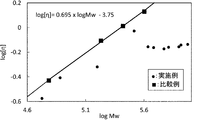
- FIG. 1 shows esterification of commercially available vinyl alcohol polymers (“PVA-105”, “PVA-117”, “PVA-124” and “PVA-145” manufactured by Kuraray Co., Ltd.) used in Comparative Examples described later.
- logarithm of the weight average molecular weight Mw of the vinyl ester polymer obtained in this manner is plotted on the horizontal axis and the logarithm of intrinsic viscosity [ ⁇ ] is plotted on the vertical axis.
- the base of the logarithm is 10.
- the logarithm of the intrinsic viscosity [ ⁇ ] is expressed by a linear function of the logarithm of the weight average molecular weight Mw (the following formula (3)).
- log [ ⁇ ] 0.695 ⁇ log Mw ⁇ 3.75 (3)
- the intrinsic viscosity [ ⁇ ] of the vinyl alcohol polymer contained in the coating agent is low.
- the vinyl alcohol polymer contained in the coating agent has a higher weight average molecular weight Mw.
- the logarithm of the weight average molecular weight Mw and the logarithm of the intrinsic viscosity [ ⁇ ] are plotted on one straight line, so that the limit is obtained while increasing the weight average molecular weight Mw. It was not easy to lower the viscosity [ ⁇ ].
- the weight average molecular weight Mw and the intrinsic viscosity [ ⁇ ] were measured and obtained.
- the logarithm of the obtained weight average molecular weight Mw and the logarithm of intrinsic viscosity [ ⁇ ] are plotted in FIG.
- the logarithm of the weight average molecular weight Mw and the logarithm of the intrinsic viscosity [ ⁇ ] are plotted downward from the straight line represented by the above formula (3). It was.
- the range of the weight average molecular weight Mw of the vinyl alcohol polymer of the present invention is defined by the above formula (1), and the relationship between the intrinsic viscosity [ ⁇ ] and the weight average molecular weight Mw is defined by the above formula (2). .
- region shown by said Formula (1) and Formula (2) is as follows.
- logMw when logMw is less than 4.7, either the water resistance or the barrier property of the coated surface may be inferior.
- logMw is preferably 5.0 or more.
- the log Mw exceeds 6.3, the viscosity of the aqueous solution is high, and it may not be applied uniformly, or even if it can be applied, the high-speed coating property may be inferior, and the log Mw value is 6.0 or less. Preferably there is.
- the vinyl alcohol polymer is water-soluble is an aqueous solution in which the vinyl alcohol polymer is completely dissolved at a temperature of 90 ° C. and the concentration of the vinyl alcohol polymer is 4% by mass. It is water-soluble.
- the vinyl alcohol polymer of the present invention has an ethylenic double bond. From the viewpoint of adhesion between the coated surface and the release layer, it is important that the molar ratio of the ethylenic double bond to the total of vinyl alcohol units and vinyl acetate units is 0.05 / 100 to 2/100. When the molar ratio is less than 0.05 / 100, the adhesion between the coated surface and the release layer is poor.
- the molar ratio is preferably 0.08 / 100 or more, and more preferably 0.1 / 100 or more. On the other hand, if the molar ratio exceeds 2/100, the vinyl alcohol polymer may not be dissolved in water.
- the molar ratio of the ethylenic double bond is preferably 1/100 or less, and more preferably 0.8 / 100 or less.
- the main chain of the vinyl alcohol polymer of the present invention preferably has an ethylenic double bond.
- the production method of the vinyl alcohol polymer having an ethylenic double bond in the main chain is not particularly limited, but the preferred production method is a step of polymerizing vinyl acetate to obtain a vinyl ester polymer. And a step of saponifying the vinyl ester polymer and a step of heat-treating the obtained vinyl alcohol polymer.
- Examples of the polymerization method include a bulk polymerization method, a solution polymerization method, a suspension polymerization method, and an emulsion polymerization method.
- the polymerization can be carried out without solvent or in the presence of an alcohol solvent.
- a solvent-free bulk polymerization method or a solution polymerization method using an alcohol solvent is preferable.
- the alcohol solvent is not particularly limited, and methanol, ethanol, propanol and the like can be used. These may be used alone or in combination of two or more.
- the polymerization method is not particularly limited, and any of batch polymerization, semi-batch polymerization, continuous polymerization, and semi-continuous polymerization may be used.
- the polymerization temperature is not particularly limited, but is preferably 0 to 200 ° C, more preferably 30 to 140 ° C. When the polymerization temperature is lower than 0 ° C., a sufficient polymerization rate may not be obtained. When the polymerization temperature is higher than 200 ° C., there is a concern about the decomposition of vinyl acetate and other monomers.
- a method for controlling the temperature there is a method of balancing the heat generated by the polymerization and the heat radiation from the surface of the polymerization vessel. Moreover, the method of controlling by the external jacket using a suitable heat medium is also mentioned. The latter method is preferable from the viewpoint of safety.
- the polymerization initiator may be selected from known initiators (for example, azo initiators, peroxide initiators, redox initiators, etc.) according to the polymerization method.
- known initiators for example, azo initiators, peroxide initiators, redox initiators, etc.
- examples of the azo initiator include 2,2′-azobisisobutyronitrile, 2,2′-azobis (2,4-dimethylvaleronitrile), 2,2′-azobis (4-methoxy-2, 4-dimethylvaleronitrile).
- peroxide-based initiator examples include percarbonate compounds such as diisopropyl peroxydicarbonate, di-2-ethylhexyl peroxydicarbonate, diethoxyethyl peroxydicarbonate; t-butyl peroxyneodecanate, ⁇ -Perester compounds such as cumylperoxyneodecanate and t-butylperoxydecanate; acetylcyclohexylsulfonyl peroxide; 2,4,4-trimethylpentyl-2-peroxyphenoxyacetate and the like.
- These initiators may be combined with potassium persulfate, ammonium persulfate, hydrogen peroxide, or the like as an initiator.
- the redox initiator examples include an initiator in which the above peroxide is combined with a reducing agent such as sodium hydrogen sulfite, sodium hydrogen carbonate, tartaric acid, L-ascorbic acid, or longalite.
- a reducing agent such as sodium hydrogen sulfite, sodium hydrogen carbonate, tartaric acid, L-ascorbic acid, or longalite.
- an antioxidant such as tartaric acid may be added to the polymerization system in an amount of about 1 to 100 ppm based on vinyl acetate.
- other monomers may be copolymerized as long as the gist of the present invention is not impaired.
- the other monomers include ⁇ -olefins such as ethylene and propylene; (meth) acrylic acid and salts thereof; methyl (meth) acrylate, ethyl (meth) acrylate, and (meth) acrylic acid n.
- the polymerization rate of vinyl acetate is preferably 20 to 95%. If the polymerization rate is less than 20%, the amount of vinyl ester polymer that can be produced per unit time is reduced, and production efficiency may be reduced. In addition, the cost for recovering vinyl acetate may increase. From the viewpoint of production efficiency and cost, the polymerization rate is more preferably 30% or more, and further preferably 40% or more.
- a chain transfer agent may coexist for the purpose of adjusting the degree of polymerization of the resulting vinyl alcohol polymer.
- Chain transfer agents include aldehydes such as acetaldehyde, propionaldehyde, butyraldehyde and benzaldehyde; ketones such as acetone, methyl ethyl ketone, hexanone and cyclohexanone; mercaptans such as 2-hydroxyethanethiol; halogens such as trichlorethylene and perchloroethylene Hydrocarbons are mentioned, among which aldehydes and ketones are preferably used.
- the addition amount of the chain transfer agent is determined according to the chain transfer constant of the added chain transfer agent and the degree of polymerization of the target vinyl alcohol polymer, but is generally 0.1 to 10% by mass with respect to vinyl acetate. It is desirable that
- Examples of the saponification method include an alcoholysis decomposition reaction or a hydrolysis reaction using a basic catalyst such as sodium hydroxide, potassium hydroxide or sodium methoxide or an acidic catalyst such as p-toluenesulfonic acid.
- Examples of the solvent that can be used in this reaction include alcohols such as methanol and ethanol; esters such as methyl acetate and ethyl acetate; ketones such as acetone and methyl ethyl ketone: aromatic hydrocarbons such as benzene and toluene. It is done. These solvents can be used alone or in combination of two or more. Of these, saponification using methanol or a methanol / methyl acetate mixed solution as a solvent and sodium hydroxide as a catalyst is convenient and preferable.
- An ethylenic double bond can be introduced into the main chain by heat-treating the vinyl alcohol polymer.
- the heat treatment is preferably performed by heating in an air stream.
- the heating temperature is preferably 100 to 150 ° C.
- the heating time is usually 2 to 10 hours.
- the side chain of the vinyl alcohol polymer of the present invention has an ethylenic double bond.
- the production method of the vinyl alcohol polymer having an ethylenic double bond in the side chain is not particularly limited, but the preferred production method is a polyfunctional having vinyl acetate and a plurality of ethylenic double bonds. It comprises a step of copolymerizing a monomer to obtain a vinyl ester copolymer, and a step of saponifying the vinyl ester copolymer.
- the polyfunctional monomer is not particularly limited as long as it has two or more ethylenic double bonds in the molecule. However, it must be capable of introducing a necessary amount of double bonds without inhibiting the water solubility of the vinyl alcohol polymer by the excessive crosslinking reaction. It is necessary to select a polyfunctional monomer with appropriate reactivity in consideration of various factors such as blending ratio of polyfunctional monomer to vinyl acetate, polymerization temperature, monomer concentration, polymerization rate, polymerization degree, etc. There is. From the viewpoint of suppressing an excessive crosslinking reaction, the number of ethylenic double bonds contained in the polyfunctional monomer is preferably two.
- ethanediol divinyl ether propanediol divinyl ether, butanediol divinyl ether, ethylene glycol divinyl ether, diethylene glycol divinyl ether, triethylene glycol divinyl ether, polyethylene glycol divinyl ether, propylene glycol divinyl ether, polypropylene glycol divinyl ether, and other divinyl ethers
- a monomer having a vinyl ether group such as a compound is preferable. By copolymerizing such a monomer with vinyl acetate, a vinyl alcohol polymer having a vinyl ether group in the side chain can be obtained.
- a monomer having an allyl group is also suitable.
- monomers having an allyl group include diene compounds such as pentadiene, hexadiene, heptadiene, octadiene, nonadiene, decadiene; glyceryl diallyl ether, diethylene glycol diallyl ether, ethylene glycol diallyl ether, triethylene glycol diallyl ether, polyethylene glycol diallyl ether, Diallyl ether compounds such as trimethylolpropane diallyl ether and pentaerythritol diallyl ether, triallyl ether compounds such as glycerin triallyl ether, trimethylolpropane triallyl ether and pentaerythritol triallyl ether, and tetraallyl ethers such as pentaerythritol tetraallyl ether Monomers with allyl ether groups like compounds Monomers having an allyl ester group such as
- Monomers having an allylamino group monomers having an allyl ammonium group such as diallyl ammonium salt such as diallyldimethylammonium chloride; triallyl isocyanurate; 1,3-diallyl urea; triallyl phosphate; diallyl disulfide .
- a monomer having an allyl ether group is easy to control the degree of polymerization and the double bond content, and is more preferably used.
- a vinyl alcohol polymer having an allyl group in the side chain can be obtained.
- Monomers having (meth) acrylic acid monomers having (meth) acrylamides such as N, N′-methylenebis (meth) acrylamide and N, N′-ethylenebis (meth) acrylamide, divinylbenzene, trivinylbenzene And so on.
- the molar ratio of the polyfunctional monomer to vinyl acetate is 0.05 / 100 to 2/100.
- the copolymerization method include a bulk polymerization method, a solution polymerization method, a suspension polymerization method, and an emulsion polymerization method.
- the polymerization can be carried out without solvent or in the presence of an alcohol solvent. Among these, a solvent-free bulk polymerization method and a solution polymerization method using an alcohol solvent are preferable.
- the alcohol solvent is not particularly limited, and for example, methanol, ethanol, propanol and the like can be used alone or in admixture of two or more.
- the polymerization method is not particularly limited, and any of batch polymerization, semi-batch polymerization, continuous polymerization, and semi-continuous polymerization may be used.
- the polymerization rate of vinyl acetate is preferably 20 to 95%. If the polymerization rate is less than 20%, the amount of vinyl ester polymer that can be produced per unit time is reduced, and production efficiency may be reduced. In addition, the cost for recovering vinyl acetate may increase. From the viewpoint of production efficiency and cost, the polymerization rate is more preferably 30% or more, and further preferably 40% or more. On the other hand, if it exceeds 95%, the crosslinking reaction proceeds excessively, and the water solubility of the resulting vinyl alcohol copolymer may be lowered. In light of suppression of the crosslinking reaction, the polymerization rate is more preferably 80% or less, and even more preferably 70% or less.
- the polymerization temperature and the method for controlling the polymerization temperature are as described in the method for producing a vinyl alcohol polymer having a double bond in the main chain.
- the initiator used for copolymerization the above-described initiator can also be used.
- other monomers may be copolymerized as long as the gist of the present invention is not impaired.
- the types of other monomers and the copolymerization amount of the monomers are the same as described above.
- the saponification method is also as described above.
- the saponification degree of the vinyl alcohol polymer of the present invention is 70 mol% or more. When the saponification degree is less than 70 mol%, the water resistance of the coated surface is inferior. Further, the vinyl alcohol polymer may not be dissolved in water.
- the saponification degree is preferably 80 mol% or more, and more preferably 90 mol% or more. On the other hand, if the degree of saponification is too high, industrial production may become difficult, so the degree of saponification is usually 99.9 mol% or less.
- the above saponification degree is a value measured by the saponification degree measuring method described in JIS-K6726 (1994). At this time, units other than the vinyl alcohol unit, the vinyl acetate unit, and the polyfunctional monomer unit are usually small in quantity even if they are included, and can be ignored.
- a preferred embodiment of the present invention is an aqueous solution containing a vinyl alcohol polymer.
- the aqueous solution may contain a small amount of an organic solvent, or may contain a small amount of organic or inorganic particles insoluble in water.
- the concentration of the vinyl alcohol polymer in the aqueous solution is preferably 1 to 30% by mass.
- a preferred embodiment of the present invention is a coating agent comprising an aqueous solution containing a vinyl alcohol polymer.
- the vinyl alcohol polymer of the present invention is useful as a component of a paper coating agent.
- the concentration of the vinyl alcohol polymer in the coating agent is preferably 2 to 30% by mass. When the concentration is less than 2% by mass, the coating efficiency may decrease. The concentration is more preferably 5% by mass or more. On the other hand, when the concentration exceeds 30% by mass, the high-speed coating property may be lowered. The concentration is more preferably 25% by mass or less.
- the coating agent may contain other components other than the vinyl alcohol polymer of the present invention as long as the effects of the present invention are not impaired.
- Other components include aqueous dispersible resins such as SBR latex, NBR latex, vinyl acetate emulsion, ethylene / vinyl acetate copolymer emulsion, (meth) acrylic ester emulsion, vinyl chloride emulsion; wheat, corn, rice , Raw starch obtained from potato, sweet potato, tapioca, sago palm, etc .; raw starch degradation products such as oxidized starch, dextrin; starch derivatives such as etherified starch, esterified starch, cationized starch; methylcellulose, hydroxyethylcellulose, carboxy Cellulose derivatives such as methylcellulose (CMC); monosaccharides such as glucose, fructose, isomerized sugar, xylose; maltose, lactose, sucrose, trehalose, palatinose, reduced
- Oligosaccharides such as starch syrup, isomalto-oligosaccharides, fructo-oligosaccharides, lactose oligosaccharides, soybean oligosaccharides, xylo-oligosaccharides, coupling sugars, cyclodextrin compounds, etc .
- sugars include albumin, gelatin, casein, gum arabic, polyamide resin, melamine resin, poly (meth) acrylamide, polyvinylpyrrolidone, poly (meth) acrylate sodium, anion-modified PVA, sodium alginate, and water-soluble polyester.
- the content of these components in the coating agent is usually 10% by mass or less.
- the pigment may be contained in the coating agent as long as the effect of the present invention is not impaired.
- the pigment include inorganic pigments (clay, kaolin, aluminum hydroxide, calcium carbonate, talc, etc.) and organic pigments (plastic pigment, etc.) that are generally used in the coated paper manufacturing field.
- the content of these pigment components in the coating agent is usually 50% by mass or less.
- a preferred embodiment of the present invention is a coated product in which the coating agent is coated on the surface of a substrate.
- a substrate a paper substrate or a film substrate is preferable.
- the production method of the coated product is not particularly limited, and includes a step of coating the base material with the coating agent and a step of drying the base material after coating.
- Known paper bases are obtained by papermaking chemical pulp such as hardwood kraft pulp, conifer kraft pulp, mechanical pulp such as GP (crushed wood pulp), RGP (refiner ground pulp), TMP (thermomechanical pulp), etc. Paper or synthetic paper can be used.
- the paper base material high-quality paper, medium-quality paper, alkaline paper, glassine paper, semi-glassine paper, or paperboard used for corrugated cardboard, building material, whiteball, chipball, and the like are also used. be able to.
- the paper base material may contain organic and inorganic pigments and papermaking auxiliary chemicals such as a paper strength enhancer, a sizing agent, and a yield improver. Further, the paper base material may be subjected to various surface treatments.
- the film base is preferably a film base made of a thermoplastic resin.
- thermoplastic resin include polyolefin, polyester, polyamide and the like.
- the coating equipment examples include a 2-roll size press, a gate roll size press, a metering size press, an air knife coater, a bar coater, a roll coater, and a blade coater.
- the coating speed is preferably 100 to 2,000 m / min. When the coating speed is less than 100 m / min, production efficiency may be reduced.
- the coating speed is more preferably 300 m / min or more. On the other hand, when the coating speed exceeds 2,000 m / min, uniform coating may not be possible.
- the coating speed is more preferably 1,800 m / min or less.
- the coating amount can be arbitrarily selected according to the properties of the paper, but usually about 0.05 to 10 g / m 2 per side of the paper is preferable.
- Drying after coating can be performed by, for example, hot air, infrared rays, a heating cylinder, or a combination of these.
- the dried coating can be further improved in barrier properties by humidity control and calendering.
- As the humidity control condition a condition in which the moisture content in the paper is 5 to 20% by mass is desirable.
- As the calendering conditions the roll temperature is preferably from room temperature to 200 ° C., and the roll linear pressure from 20 to 350 kg / cm.
- the air permeability of the coated product thus obtained is preferably 10,000 sec or more, and more preferably 20,000 sec or more. When the air permeability is less than 10,000 sec, the toluene barrier property may be inferior.
- the type of coated material is not particularly limited, and examples include release paper base paper, barrier paper, oil-resistant paper, wrapping paper, paperboard, polyethylene release film, polypropylene release film, and polyester release film.
- a release paper base paper in which the above coating agent is coated on the surface of a paper substrate is a preferred embodiment of the present invention.
- a release layer is formed on the surface of the release paper base paper.
- solvent-based silicone, non-solvent-based (emulsion-based, oligomer-based) silicone, or the like is used.
- the solvent-based silicone contains a solvent (toluene or the like)
- barrier properties against the solvent are required.
- water resistance is required. Since the release paper base paper of the present invention satisfies these requirements, a release paper having the release paper base paper and a release layer formed on the surface of the release paper base paper is also a preferred embodiment.
- Example 1 [Synthesis of vinyl alcohol copolymer] A 6 L reaction vessel equipped with a stirrer, a nitrogen inlet, an additive inlet and an initiator inlet was charged with 1200 g of vinyl acetate, 1800 g of methanol, and 30.1 g of trimethylolpropane diallyl ether as a polyfunctional monomer at 60 ° C. The temperature in the system was replaced with nitrogen by nitrogen bubbling for 30 minutes. The temperature in the reaction vessel was adjusted to 60 ° C., and 2.5 g of 2,2′-azobis (isobutyronitrile) was added to initiate polymerization. The polymerization temperature was maintained at 60 ° C. during the polymerization.
- 2,2′-azobis isobutyronitrile
- the concentration of the PVAc methanol solution was adjusted to 30%, and the NaOH methanol solution (10% concentration) was adjusted so that the alkali molar ratio (number of moles of NaOH / number of moles of vinyl ester units in PVAc) was 0.03. Added and saponified.
- the obtained vinyl alcohol copolymer was washed with methanol. By the above operation, a vinyl alcohol copolymer having a saponification degree of 98.6 mol% was obtained.
- the obtained vinyl alcohol copolymer was dissolved in water at 90 ° C. to prepare 4% by mass and 8% by mass aqueous solutions. At this time, the vinyl alcohol copolymer was completely dissolved in water. When the viscosity of this aqueous solution was measured at 60 rpm and 20 ° C. using a Brookfield viscometer, it was 12.5 and 82 mPa ⁇ s, respectively.
- aqueous solution having a concentration of 8% was prepared using the vinyl alcohol copolymer obtained above.
- This coating solution was applied to fine paper (basis weight 65 g / m 2 ) with a blade coater at a coating temperature of 30 ° C., a coating speed of 1200 m / min, and a paper-blade gap of 0.004 mm.
- the shear rate applied to the coating solution at this time is 5 ⁇ 10 6 / s. After coating, it was dried for 5 minutes with an 80 ° C. drum dryer.
- Whether or not the coating liquid was uniformly applied to the obtained coated paper was evaluated by applying colored toluene to the coated surface of the coated paper with a brush and judging according to the following criteria.
- Example preparation An aqueous solution having a concentration of 8% by mass was prepared using the vinyl alcohol copolymer obtained above. Then, this aqueous solution was added to a glassine paper having a basis weight of 80 g / m 2 (Canadian standard freeness: 200 ml) at 50 ° C. under a condition of 100 m / min using a test 2-roll size press machine (manufactured by Kumagai Riki Kogyo). ). After coating, it was dried at 110 ° C. for 1 minute to obtain a coated paper. The coating amount (both sides) in terms of solid content of the coating solution was 1.8 g / m 2 .
- the coated paper obtained in the above step was conditioned for 72 hours using a thermostatic and humidity machine, and the water content was adjusted to 17% by mass. The water content was measured according to JIS P8127. Then, the sample was obtained by carrying out the super calendar process (150 degreeC, 250 kg / cm, 10 m / min 1 time process). The physical properties of this sample were evaluated according to the following measurement methods.
- the obtained silicone layer was rubbed strongly 10 times with the thumb, and the adhesiveness between the silicone and the vinyl alcohol copolymer was evaluated according to the following criteria from the state of the silicone layer to be peeled off.
- the test tube was heated in an oil bath set at 60 ° C., the contents were mixed with a Teflon (registered trademark) stick every 30 minutes, and the vinyl alcohol copolymer charged 240 minutes after the start of heating was All dissolved.
- the obtained vinyl ester copolymer solution was slowly dropped into 500 mL of distilled water to precipitate the vinyl ester copolymer in water.
- reprecipitation purification using acetone and water was performed three times, and then washing with boiled distilled water was performed three times.
- the obtained vinyl ester copolymer was dried by vacuum drying to obtain a vinyl ester copolymer.
- the weight average molecular weight Mw and intrinsic viscosity [ ⁇ ] of the copolymer were measured by the methods described below.
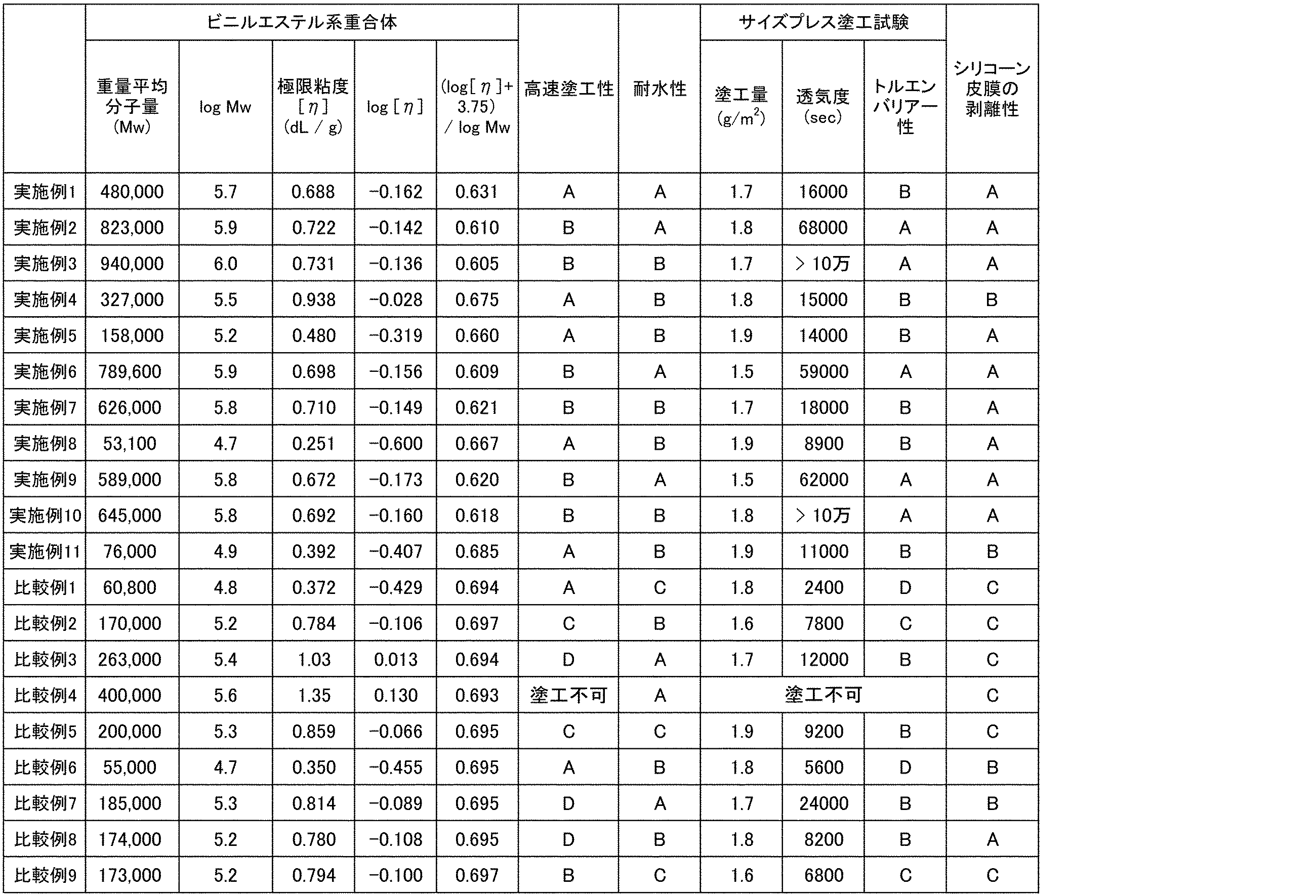
- Examples 2 to 10 As shown in Table 1, a vinyl alcohol copolymer was obtained in the same manner as in Example 1 except that the polymerization conditions were changed. And evaluation similar to Example 1 was implemented about the obtained vinyl alcohol-type copolymer. The results are shown in Tables 1 and 2.
- Example 11 A 6 L reactor equipped with a stirrer, nitrogen inlet, additive inlet and initiator inlet was charged with 2250 g of vinyl acetate, 750 g of methanol, and 40 g of acetaldehyde, and the inside of the reactor was purged with nitrogen by bubbling nitrogen gas. did.
- the temperature in the reaction vessel was adjusted to 60 ° C., and 5.7 g of 2,2′-azobis (isobutyronitrile) was added to initiate polymerization.
- the polymerization temperature was maintained at 60 ° C. during the polymerization. After 7 hours, when the polymerization rate reached 90%, the polymerization was stopped by cooling.
- a methanol solution of polyvinyl acetate (hereinafter sometimes abbreviated as PVAc).
- concentration of the PVAc methanol solution was adjusted to 30%, and the NaOH methanol solution (10% concentration) was adjusted so that the alkali molar ratio (number of moles of NaOH / number of moles of vinyl ester units in PVAc) was 0.05.
- Added and saponified The obtained vinyl alcohol polymer was washed with methanol and then dried for 1 hour in a hot air dryer (set temperature: 100 ° C.). By the above operation, a vinyl alcohol polymer having a saponification degree of 99.5 mol% was obtained.
- this vinyl alcohol polymer was heat-treated at 120 ° C. for 8 hours under an air stream to obtain a vinyl alcohol polymer having a double bond.
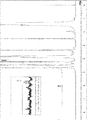
- This vinyl alcohol polymer was dissolved in deuterated dimethyl sulfoxide and 1 H-NMR measurement was performed. The measurement results are shown in FIG. From the obtained spectrum of FIG. 3, the introduced ethylenic double bond was calculated to be 0.4 mol%.
- Each evaluation was performed in the same manner as in Example 1 using the vinyl alcohol polymer thus obtained. The results are shown in Tables 1 and 2.
- Comparative Examples 1-7 instead of synthesizing vinyl alcohol polymer, “PVA-105”, “PVA-117”, “PVA-124”, “PVA-145”, “KL-118”, “R-2105” manufactured by Kuraray Co., Ltd. Each evaluation was carried out in the same manner as in Example 1 except that any one of “R-1130” was used. The results are shown in Tables 1 and 2. “PVA-105”, “PVA-117”, “PVA-124”, and “PVA-145” are unmodified polyvinyl alcohol. “KL-118” is a modified polyvinyl alcohol containing a monomer unit having a carboxylic acid group. “R-2105” and “R-1130” are modified polyvinyl alcohols containing monomer units having a silyl group. These PVA are commercially available from Kuraray Co., Ltd.
- Comparative Example 8 In a 3 L reaction vessel equipped with a stirrer and an additive inlet, 100 g of “PVA-117” manufactured by Kuraray Co., Ltd. was dissolved in 900 g of water, and hydrochloric acid was added to adjust the pH of the aqueous solution to 1.5. After raising the temperature of the reaction vessel to 90 ° C., 1.45 g of 10-undecylene aldehyde was added from the additive inlet, and stirring was continued for 30 minutes. After cooling, an aqueous sodium hydroxide solution was added to adjust the pH to 7 to complete the reaction, thereby obtaining an aqueous solution of a vinyl alcohol copolymer having a double bond.
- Comparative Example 9 A 5 L reaction vessel equipped with a stirrer, a nitrogen inlet and an initiator addition port and capable of maintaining a pressure higher than atmospheric pressure was charged with 860 g of vinyl acetate and 140 g of methanol, and the inside of the reactor was purged with nitrogen by bubbling nitrogen gas. The temperature in the reaction vessel was adjusted to 80 ° C., 0.04 g of 2,2′-azobis (isobutyronitrile) was added, and polymerization was started in a closed system. The polymerization temperature was maintained at 80 ° C. during the polymerization. After 4 hours, when the polymerization rate reached 60%, the polymerization was stopped by cooling.
- 2,2′-azobis isobutyronitrile
Landscapes
- Chemical & Material Sciences (AREA)
- Organic Chemistry (AREA)
- Chemical Kinetics & Catalysis (AREA)
- Polymers & Plastics (AREA)
- Medicinal Chemistry (AREA)
- Health & Medical Sciences (AREA)
- Wood Science & Technology (AREA)
- Life Sciences & Earth Sciences (AREA)
- Materials Engineering (AREA)
- Engineering & Computer Science (AREA)
- General Chemical & Material Sciences (AREA)
- Paper (AREA)
- Addition Polymer Or Copolymer, Post-Treatments, Or Chemical Modifications (AREA)
- Paints Or Removers (AREA)
- Laminated Bodies (AREA)
- Compositions Of Macromolecular Compounds (AREA)
Abstract
Description
0.60<(log[η]+3.75)/logMw<0.69 (2)
4.7≦logMw≦6.3 (1)
0.60<(log[η]+3.75)/logMw<0.69 (2)
ただし、極限粘度[η]は、40℃のテトラヒドロフラン(THF)中で測定した値である。
log[η]=0.695×logMw-3.75 (3)
log[η]=0.69×logMw-3.75 (4)
log[η]=0.60×logMw-3.75 (5)
logMw=4.7 (6)
logMw=6.3 (7)
[ビニルアルコール系共重合体の合成]
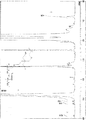
撹拌機、窒素導入口、添加剤導入口および開始剤添加口を備えた6Lの反応槽に酢酸ビニル1200g、メタノール1800g、多官能単量体としてトリメチロールプロパンジアリルエーテル30.1gを仕込み、60℃に昇温した後30分間窒素バブリングにより系中を窒素置換した。反応槽内の温度を60℃に調整し、2,2’-アゾビス(イソブチロニトリル)2.5gを加えて重合を開始した。重合中は重合温度を60℃に維持した。3時間後に重合率が47%に達したところで冷却して重合を停止した。次いで、減圧下にて未反応の酢酸ビニルを除去し、ポリ酢酸ビニル(以下、PVAcと略記することがある)のメタノール溶液を得た。こうして得られたPVAcの再沈殿精製を、良溶媒としてアセトン、貧溶媒としてヘキサンを用いて5回行い、引き続き真空乾燥により精製後のPVAcを乾燥させた。その後、得られたPVAcを重クロロホルムへ溶解して1H-NMRの測定を実施した。測定結果を図2に示す。得られた図2のスペクトルから、主鎖に導入されたトリメチロールプロパンジアリルエーテルの量は1.5モル%、側鎖に導入されたエチレン性二重結合は0.7モル%と算出された。
上記で得られたビニルアルコール系共重合体を用いて濃度8%の水溶液(塗工液)を調製した。この塗工液を、ブレードコーターで塗工温度30℃、塗工速度1200m/分、紙-ブレード間の隙間0.004mmとして上質紙(坪量65g/m2)に塗工した。このときの塗工液にかかる剪断速度は5×106/sとなる。塗工後、80℃のドラム乾燥機で5分間乾燥した。得られた塗工紙に塗工液が均一に塗られているかどうかの評価は、塗工紙の塗工面に着色トルエンを刷毛で塗り、以下の基準にしたがって判定した。
A:裏抜けせず、塗工面の着色にムラがなかった。
B:裏抜けはしないが、塗工面が不均一であり着色にムラがあった。
C:裏抜けが若干見られ、かつ塗工面の着色にムラがあった。
D:裏抜けが激しく、かつ塗工面の着色にムラがあった。
上記で得られたビニルアルコール系共重合体を用いて濃度4%の水溶液を調製した。この水溶液を20℃で流延し、厚み40μmの皮膜を得た。得られた皮膜を120℃で10分間熱処理した後、縦10cm、横10cmの大きさに切り出し、試験片を作製した。この試験片を20℃の蒸留水に30分間浸漬した後、取り出し(回収し)、表面に付着した水分をガーゼで拭き取り、水膨潤時の質量を測定した。次いで、水膨潤時の質量を測定した試験片を105℃で16時間乾燥した後、乾燥時の質量を測定した。ここで水膨潤時の質量を乾燥時の質量で除した値を求めてこれを膨潤度(倍)とし、以下の基準に従って判定した。
A:8.0倍未満
B:8.0倍以上10.0倍未満
C:10.0倍以上であるか、または浸漬した試験片を回収することができなかった。
(試料の準備)
上記で得られたビニルアルコール系共重合体を用いて濃度8質量%の水溶液を調製した。そしてこの水溶液を、試験用2-ロールサイズプレス機(熊谷理機工業製)を用いて、50℃にて100m/分の条件で、坪量80g/m2のグラシン紙(カナディアンスタンダードフリーネス:200ml)に塗工した。塗工後、110℃で1分間乾燥させ、塗工紙を得た。塗工液の固形分換算の塗工量(両面)は1.8g/m2であった。
上記工程にて得られた塗工紙を、恒温恒湿機にて72時間調湿し、含水率を17質量%に調整した。含水率の測定はJIS P8127に準拠して行った。その後、スーパーカレンダー処理(150℃、250kg/cm、10m/分 1回処理)してサンプルを得た。このサンプルの物性を以下の測定方法に従って評価した。
JIS P8117に準じて王研式滑度透気度試験器を用いてサンプルの透気度を測定した。結果を表2に示す。
サンプルの塗工面上に着色トルエン(赤)を塗布(5×5cm)後、裏面への裏抜け(小さな赤色の斑点ないし塗布面の全面着色)の度合いを以下の基準に従って判定した。
A:裏面に斑点はなかった。
B:斑点が多数発生した(トルエン塗布面の約10~20%程度)。
C:塗布面の約50%が着色した。
D:塗布面全体が着色した。
上記で得られたビニルアルコール系共重合体を用いて濃度4%の水溶液を調製した。そしてこの水溶液を、20℃で流延し、厚み40μmの皮膜を得た。得られた皮膜の上に東レダウコーニング社製シリコーン「LTC1056L」および白金触媒「SRX212 CATALYST」の混合液(混合質量比 100/0.6)を、アプリケーターバーを用いて、塗工量が1.5g/m2となるように塗工し、110℃で8分間乾燥させ、シリコーン塗工皮膜を得た。得られたシリコーン層を親指で強く10回擦り、剥がれるシリコーン層の様子から以下の基準に従ってシリコーンとビニルアルコール系共重合体の密着性を評価した。
A:シリコーン皮膜は全く剥がれ落ちなかった。
B:シリコーン皮膜が部分的に剥がれ落ちた。
C:シリコーン皮膜がほぼすべて剥がれ落ちた。
上記で得られたビニルアルコール系共重合体1g、無水酢酸17.8g、ピリジン3.5gを100mLの試験管中に秤量し、テフロン(登録商標)製の棒を用いて混ぜ合わせた。試験管を氷冷し、ジメチルアミノピリジン0.11gを試験管中に加え、氷冷しながら3分間テフロン(登録商標)製の棒で混ぜ合わせた。その後試験管を60℃に設定したオイルバス中で加熱し、30分おきに内容物をテフロン(登録商標)製の棒で混ぜ合わせ、加熱開始から240分後に投入したビニルアルコール系共重合体はすべて溶解した。さらに60分間、60℃での加熱を継続した後、得られたビニルエステル系共重合体の溶液を、蒸留水500mL中にゆっくりと滴下し、ビニルエステル系共重合体を水中に析出させた。水を除去後、アセトン、水を用いての再沈殿精製を3回行った後、煮沸した蒸留水での洗浄を3回行った。得られたビニルエステル系共重合体を真空乾燥により乾燥しビニルエステル系共重合体を得た。当該共重合体の重量平均分子量Mw及び極限粘度[η]を下述の方法で測定した。
上記で得られたビニルエステル系共重合体をTHFへ濃度0.4質量%で溶解し、その重量平均分子量Mwおよび極限粘度[η]を、多角度光散乱検出器(Multi-Angle Light Scattering, MALS)および粘度検出器(VIS)を接続したゲルパーミエーションクロマトグラフィー(GPC)を用い測定した。なお重量平均分子量Mwの算出には別途測定して算出した示差屈折率(dn/dc),0.0583mL/gを用いた。測定条件は以下の通りである。
多角度光散乱検出器:Wyatt Technology社製 DOWN EOS
高感度示差屈折率検出器:Wyatt Technology社製 OptilabrEX
粘度検出器:Wyatt Technology社製 ViscoStar II
ポンプ:Wators社製 Alliance-2695
カラム:Shodex社製 KF802+KF806L × 2
移動相:テトラヒドロフラン(THF)
測定温度:40℃
注入量:100μL
dn/dc = 0.0583mL/g
表1に示すように重合条件を変えた以外は実施例1と同様にしてビニルアルコール系共重合体を得た。そして、得られたビニルアルコール系共重合体について、実施例1と同様の評価を実施した。その結果を表1及び2に示す。
撹拌機、窒素導入口、添加剤導入口および開始剤添加口を備えた6Lの反応槽に酢酸ビニル2250g、メタノール750g、アセトアルデヒド40gを反応器に仕込み、窒素ガスのバブリングにより反応器内を窒素置換した。反応槽内の温度を60℃に調整し、2,2’-アゾビス(イソブチロニトリル)5.7gを加えて重合を開始した。重合中は重合温度を60℃に維持した。7時間後に重合率が90%に達したところで冷却して重合を停止した。次いで、減圧下にて未反応の酢酸ビニルを除去し、ポリ酢酸ビニル(以下、PVAcと略記することがある)のメタノール溶液を得た。上記PVAcのメタノール溶液の濃度を30%に調整し、アルカリモル比(NaOHのモル数/PVAc中のビニルエステル単位のモル数)が0.05となるようにNaOHメタノール溶液(10%濃度)を添加してけん化した。得られたビニルアルコール系重合体はメタノールで洗浄したのち、熱風乾燥機(設定温度100℃)内で、1時間乾燥させた。以上の操作によりけん化度99.5モル%のビニルアルコール系重合体を得た。次にこのビニルアルコール系重合体を空気気流下、120℃で8時間熱処理を行い、二重結合を有するビニルアルコール系重合体を得た。このビニルアルコール系重合体を重ジメチルスルホキシドへ溶解して1H-NMRの測定を実施した。測定結果を図3に示す。得られた図3のスペクトルから、導入されたエチレン性二重結合は0.4モル%と算出された。こうして得られたビニルアルコール系重合体を用い、実施例1と同様に各評価を実施した。その結果を表1及び2に示す。
ビニルアルコール系重合体を合成する代わりに、株式会社クラレ製「PVA-105」、「PVA-117」、「PVA-124」、「PVA-145」、「KL-118」、「R-2105」及び「R-1130」のいずれかを用いた以外は実施例1と同様に各評価を実施した。その結果を表1及び2に示す。なお、「PVA-105」、「PVA-117」、「PVA-124」、「PVA-145」は無変性ポリビニルアルコールである。「KL-118」は、カルボン酸基を有する単量体単位を含有する変性ポリビニルアルコールである。「R-2105」及び「R-1130」は、シリル基を有する単量体単位を含有する変性ポリビニルアルコールである。これらのPVAは、株式会社クラレから市販されている。
撹拌機、添加剤導入口を備えた3Lの反応槽中でクラレ社製「PVA-117」100gを900gの水中に溶解させ、塩酸を加えて水溶液のpHを1.5に調整した。この反応槽を90℃に昇温したのち、1.45gの10-ウンデシレンアルデヒドを添加剤導入口から投入し、30分間攪拌を継続した。冷却後、水酸化ナトリウム水溶液を投入しpHを7に調整し反応を完了させ、二重結合を有するビニルアルコール系共重合体の水溶液を得た。次にこの水溶液をヘキサン3L中に投入し、ビニルアルコール系共重合体をヘキサン中で析出させ、固体をろ過後、残存するヘキサンを減圧化で乾燥する事によりビニルアルコール系共重合体を固体として取り出した。取り出したビニルアルコール系共重合体を重ジメチルスルホキシドに溶解して1H-NMRの測定を実施した。その結果、導入されたエチレン性二重結合は0.4モル%と算出された。こうして得られたビニルアルコール系共重合体を用い、実施例1と同様に各評価を実施した。その結果を表1及び2に示す。
撹拌機、窒素導入口および開始剤添加口を備え、大気圧より高い圧力に保持可能な5Lの反応槽に酢酸ビニル860g、メタノール140gを仕込み、窒素ガスのバブリングにより反応器内を窒素置換した。反応槽内の温度を80℃に調整し、2,2’-アゾビス(イソブチロニトリル)0.04gを加えて、密閉系で重合を開始した。重合中は重合温度を80℃に維持した。4時間後に重合率が60%に達したところで冷却して重合を停止した。次いで、減圧下にて未反応の酢酸ビニルを除去し、PVAcのメタノール溶液を得た。上記PVAcのメタノール溶液の濃度を30%に調整し、アルカリモル比(NaOHのモル数/PVAc中のビニルエステル単位のモル数)が0.03となるようにNaOHメタノール溶液(10%濃度)を添加してけん化した。得られたビニルアルコール系重合体はメタノールで洗浄したのち、熱風乾燥機(設定温度100℃)内で、1時間乾燥させた。以上の操作によりけん化度98.5モル%のビニルアルコール系重合体を得た。こうして得られたビニルアルコール系重合体を用い、実施例1と同様に各評価を実施した。その結果を表1及び2に示す。

Claims (8)
- エチレン性二重結合を有し、けん化度が70モル%以上であるビニルアルコール系重合体であって;
前記ビニルアルコール系重合体が水溶性であり、
ビニルアルコール単位と酢酸ビニル単位の合計に対する前記エチレン性二重結合のモル比が0.05/100~2/100であり、かつ
前記ビニルアルコール系重合体をエステル化して得られるビニルエステル系重合体の極限粘度[η]と重量平均分子量Mwが下記式(1)及び式(2)を満たすことを特徴とするビニルアルコール系重合体。
4.7≦logMw≦6.3 (1)
0.60<(log[η]+3.75)/logMw<0.69 (2) - 主鎖がエチレン性二重結合を有する請求項1に記載のビニルアルコール系重合体。
- 側鎖がエチレン性二重結合を有する請求項1に記載のビニルアルコール系重合体。
- 請求項1~3のいずれかに記載のビニルアルコール系重合体を含有する水溶液。
- 請求項4に記載の水溶液からなるコーティング剤。
- 請求項5に記載のコーティング剤が紙基材またはフィルム基材の表面に塗工されてなる
塗工物。 - 請求項5に記載のコーティング剤が紙基材の表面に塗工されてなる剥離紙原紙。
- 請求項7に記載の剥離紙原紙と、該剥離紙原紙の表面に形成される離型層とを有する剥離紙。
Priority Applications (6)
| Application Number | Priority Date | Filing Date | Title |
|---|---|---|---|
| EP15851153.5A EP3208286B1 (en) | 2014-10-17 | 2015-10-16 | Vinyl alcohol polymer and use thereof |
| JP2016554132A JP6694391B2 (ja) | 2014-10-17 | 2015-10-16 | ビニルアルコール系重合体及びその用途 |
| CN201580068562.2A CN107001510B (zh) | 2014-10-17 | 2015-10-16 | 乙烯醇系聚合物及其用途 |
| US15/519,192 US10214604B2 (en) | 2014-10-17 | 2015-10-16 | Vinyl alcohol polymer and use thereof |
| KR1020177013239A KR102431413B1 (ko) | 2014-10-17 | 2015-10-16 | 비닐 알코올계 중합체 및 이의 용도 |
| CN202011278823.2A CN112521532B (zh) | 2014-10-17 | 2015-10-16 | 乙烯醇系聚合物及其用途 |
Applications Claiming Priority (2)
| Application Number | Priority Date | Filing Date | Title |
|---|---|---|---|
| JP2014-213128 | 2014-10-17 | ||
| JP2014213128 | 2014-10-17 |
Publications (1)
| Publication Number | Publication Date |
|---|---|
| WO2016060241A1 true WO2016060241A1 (ja) | 2016-04-21 |
Family
ID=55746775
Family Applications (1)
| Application Number | Title | Priority Date | Filing Date |
|---|---|---|---|
| PCT/JP2015/079298 Ceased WO2016060241A1 (ja) | 2014-10-17 | 2015-10-16 | ビニルアルコール系重合体及びその用途 |
Country Status (7)
| Country | Link |
|---|---|
| US (1) | US10214604B2 (ja) |
| EP (1) | EP3208286B1 (ja) |
| JP (2) | JP6694391B2 (ja) |
| KR (1) | KR102431413B1 (ja) |
| CN (2) | CN112521532B (ja) |
| TW (1) | TWI662052B (ja) |
| WO (1) | WO2016060241A1 (ja) |
Cited By (4)
| Publication number | Priority date | Publication date | Assignee | Title |
|---|---|---|---|---|
| JP2018165291A (ja) * | 2017-03-28 | 2018-10-25 | 株式会社クラレ | ビニルアルコール系共重合体の製造方法 |
| JP2019001921A (ja) * | 2017-06-16 | 2019-01-10 | 株式会社クラレ | 分散液及び感熱記録材料 |
| JP2019099768A (ja) * | 2017-12-07 | 2019-06-24 | 株式会社クラレ | 樹脂組成物、その製造方法及びその用途 |
| WO2020022016A1 (ja) * | 2018-07-27 | 2020-01-30 | デンカ株式会社 | ポリビニルアルコールの製造方法 |
Families Citing this family (9)
| Publication number | Priority date | Publication date | Assignee | Title |
|---|---|---|---|---|
| CN110662869B (zh) * | 2017-03-30 | 2022-04-15 | 株式会社可乐丽 | 剥离纸原纸和其制造方法、以及剥离纸 |
| WO2018212207A1 (ja) * | 2017-05-16 | 2018-11-22 | 日本合成化学工業株式会社 | ポリビニルアルコール系樹脂、分散剤及び懸濁重合用分散剤 |
| WO2019117118A1 (ja) * | 2017-12-12 | 2019-06-20 | 株式会社クラレ | エチレン-ビニルアルコール共重合体水溶液 |
| EP3636833A1 (en) * | 2018-10-09 | 2020-04-15 | UPM-Kymmene Corporation | A paper substrate comprising vinyl alcohol oligomers modified to contain catenated carbon structures with functional vinyl groups |
| JP2022088692A (ja) * | 2019-04-15 | 2022-06-15 | 株式会社クラレ | 紙用塗工液 |
| JP6865334B1 (ja) * | 2019-10-16 | 2021-04-28 | 株式会社クラレ | 紙用コーティング剤及びそれを用いた塗工紙 |
| AU2021295285A1 (en) * | 2020-06-23 | 2023-02-16 | Sappi Papier Holding Gmbh | Barrier paper or board |
| CN116003668A (zh) * | 2021-10-21 | 2023-04-25 | 中国石油化工股份有限公司 | 高粘度聚乙烯醇的制备方法 |
| CN115851214B (zh) * | 2022-12-29 | 2024-05-10 | 苏州凡络新材料科技有限公司 | 一种显示屏用防冲击作用光学填充胶 |
Citations (6)
| Publication number | Priority date | Publication date | Assignee | Title |
|---|---|---|---|---|
| JPH07286153A (ja) * | 1994-04-20 | 1995-10-31 | Sekisui Chem Co Ltd | 接着剤組成物及び該接着剤組成物を用いた紙管 |
| JP2001072720A (ja) * | 1999-07-02 | 2001-03-21 | Kuraray Co Ltd | 二重結合を側鎖に有するポリビニルアルコ−ル系共重合体およびその製法 |
| JP2005089492A (ja) * | 2003-09-12 | 2005-04-07 | Kao Corp | ポリビニルアルコール系粒子 |
| JP2006089536A (ja) * | 2004-09-21 | 2006-04-06 | Sekisui Chem Co Ltd | 架橋ポリビニルアルコール系樹脂微粒子の製造方法 |
| JP2013079374A (ja) * | 2011-09-22 | 2013-05-02 | Kuraray Co Ltd | ビニルアルコール系重合体を含有する組成物 |
| JP2013531136A (ja) * | 2010-02-23 | 2013-08-01 | アールストロム コーポレイション | 改質pva層を含有するセルロース繊維ベースの支持体、並びに、その製造及び使用の方法 |
Family Cites Families (13)
| Publication number | Priority date | Publication date | Assignee | Title |
|---|---|---|---|---|
| JPS5326830A (en) | 1976-08-26 | 1978-03-13 | Kansai Paint Co Ltd | Water-base composition for coating |
| NL7701688A (nl) * | 1977-02-17 | 1978-08-21 | Scholten Honig Research Nv | Werkwijze ter bereiding van strijkmassa's voor papier met vinylacetaatcopolymeer-dispersies als bindmiddel. |
| JP2866372B2 (ja) * | 1997-03-10 | 1999-03-08 | 富士写真フイルム株式会社 | 液晶表示装置および光学補償シート |
| JP3769380B2 (ja) | 1998-03-25 | 2006-04-26 | 日本酢ビ・ポバール株式会社 | 高速塗工性に優れたポリビニルアルコール系紙コート剤 |
| EP1380600B1 (en) * | 2002-07-11 | 2005-09-21 | Kuraray Co., Ltd. | Polyvinyl alcohol and method for producing polyvinyl alcohol |
| EP1380599B1 (en) * | 2002-07-11 | 2005-09-21 | Kuraray Co., Ltd. | Polyvinyl alcohol and method for producing polyvinyl alcohol |
| JP4279153B2 (ja) | 2004-01-08 | 2009-06-17 | 株式会社クラレ | 剥離紙原紙 |
| KR20070026365A (ko) * | 2004-06-09 | 2007-03-08 | 가부시키가이샤 구라레 | 수성 분산액, 조성물 및 종이용 코팅제 |
| EP2221321A4 (en) * | 2008-08-27 | 2010-10-27 | Kuraray Co | VINYL ALCOHOL SYSTEM POLYMER AND FILM WITH IT |
| CN101955561B (zh) * | 2010-09-16 | 2012-11-14 | 李汝基 | 乙烯醇系聚合物 |
| DE102011084478A1 (de) * | 2011-10-13 | 2013-04-18 | Kuraray Europe Gmbh | Copolymere enthaltend Vinylester, Vinylalkohol- und Divinylethergruppen |
| ES2673618T3 (es) * | 2013-04-19 | 2018-06-25 | Kuraray Co., Ltd. | Copolímero de alcohol vinílico y método para producir el mismo |
| JP6442405B2 (ja) | 2013-07-11 | 2018-12-19 | 株式会社クラレ | ビニルアセタール系重合体 |
-
2015
- 2015-10-16 TW TW104133949A patent/TWI662052B/zh active
- 2015-10-16 CN CN202011278823.2A patent/CN112521532B/zh active Active
- 2015-10-16 US US15/519,192 patent/US10214604B2/en active Active
- 2015-10-16 KR KR1020177013239A patent/KR102431413B1/ko active Active
- 2015-10-16 WO PCT/JP2015/079298 patent/WO2016060241A1/ja not_active Ceased
- 2015-10-16 CN CN201580068562.2A patent/CN107001510B/zh active Active
- 2015-10-16 JP JP2016554132A patent/JP6694391B2/ja active Active
- 2015-10-16 EP EP15851153.5A patent/EP3208286B1/en active Active
-
2020
- 2020-02-13 JP JP2020022739A patent/JP6694561B1/ja active Active
Patent Citations (6)
| Publication number | Priority date | Publication date | Assignee | Title |
|---|---|---|---|---|
| JPH07286153A (ja) * | 1994-04-20 | 1995-10-31 | Sekisui Chem Co Ltd | 接着剤組成物及び該接着剤組成物を用いた紙管 |
| JP2001072720A (ja) * | 1999-07-02 | 2001-03-21 | Kuraray Co Ltd | 二重結合を側鎖に有するポリビニルアルコ−ル系共重合体およびその製法 |
| JP2005089492A (ja) * | 2003-09-12 | 2005-04-07 | Kao Corp | ポリビニルアルコール系粒子 |
| JP2006089536A (ja) * | 2004-09-21 | 2006-04-06 | Sekisui Chem Co Ltd | 架橋ポリビニルアルコール系樹脂微粒子の製造方法 |
| JP2013531136A (ja) * | 2010-02-23 | 2013-08-01 | アールストロム コーポレイション | 改質pva層を含有するセルロース繊維ベースの支持体、並びに、その製造及び使用の方法 |
| JP2013079374A (ja) * | 2011-09-22 | 2013-05-02 | Kuraray Co Ltd | ビニルアルコール系重合体を含有する組成物 |
Non-Patent Citations (1)
| Title |
|---|
| See also references of EP3208286A4 * |
Cited By (5)
| Publication number | Priority date | Publication date | Assignee | Title |
|---|---|---|---|---|
| JP2018165291A (ja) * | 2017-03-28 | 2018-10-25 | 株式会社クラレ | ビニルアルコール系共重合体の製造方法 |
| JP2019001921A (ja) * | 2017-06-16 | 2019-01-10 | 株式会社クラレ | 分散液及び感熱記録材料 |
| JP2019099768A (ja) * | 2017-12-07 | 2019-06-24 | 株式会社クラレ | 樹脂組成物、その製造方法及びその用途 |
| WO2020022016A1 (ja) * | 2018-07-27 | 2020-01-30 | デンカ株式会社 | ポリビニルアルコールの製造方法 |
| US11365268B2 (en) | 2018-07-27 | 2022-06-21 | Denka Company Limited | Method for producing polyvinyl alcohol |
Also Published As
| Publication number | Publication date |
|---|---|
| CN112521532B (zh) | 2023-06-13 |
| US20170226247A1 (en) | 2017-08-10 |
| JP6694561B1 (ja) | 2020-05-13 |
| EP3208286B1 (en) | 2021-09-08 |
| JP6694391B2 (ja) | 2020-05-13 |
| JP2020090685A (ja) | 2020-06-11 |
| TW201619217A (zh) | 2016-06-01 |
| CN107001510B (zh) | 2020-12-04 |
| EP3208286A1 (en) | 2017-08-23 |
| TWI662052B (zh) | 2019-06-11 |
| CN112521532A (zh) | 2021-03-19 |
| JPWO2016060241A1 (ja) | 2017-09-07 |
| US10214604B2 (en) | 2019-02-26 |
| KR20170069279A (ko) | 2017-06-20 |
| EP3208286A4 (en) | 2018-05-16 |
| CN107001510A (zh) | 2017-08-01 |
| KR102431413B1 (ko) | 2022-08-12 |
Similar Documents
| Publication | Publication Date | Title |
|---|---|---|
| JP6694561B1 (ja) | ビニルアルコール系重合体及びその用途 | |
| CN110662869B (zh) | 剥离纸原纸和其制造方法、以及剥离纸 | |
| CN102958954B (zh) | 烷基改性乙烯醇系聚合物、以及含有其的组合物、增粘剂、纸用涂布剂、涂布纸、粘接剂和膜 | |
| US11208550B2 (en) | Polyvinyl alcohol composition and use thereof | |
| JP2019038935A (ja) | ポリビニルアルコール組成物及びその用途 | |
| TWI865628B (zh) | 紙用塗布劑、使用其之塗覆紙及塗覆紙之製造方法 | |
| JP7349898B2 (ja) | コーティング剤及びそれを用いた剥離紙原紙並びに剥離紙 | |
| JP7731785B2 (ja) | 塗工液、塗工物、成形体及び剥離紙 | |
| JP6909125B2 (ja) | コーティング剤及びそれを塗工してなる塗工物 | |
| WO2023190884A1 (ja) | 水溶液、コーティング剤、接着剤、紙加工剤、乳化重合用分散剤、水性エマルジョン、積層体及び水性エマルジョンの製造方法 | |
| CN118974109A (zh) | 水溶液、涂布剂、粘接剂、纸加工剂、乳液聚合用分散剂、水性乳液、层叠体和水性乳液的制造方法 | |
| JP5956889B2 (ja) | インクジェット記録材、その製造方法、及びそれを用いた印刷物の製造方法 | |
| WO2025009506A1 (ja) | 成形体、フィルム、マスキング材、凹凸構造を有するコーティング材層成形用水溶性転写コート材、造形用サポート材、及び成形体の使用方法 |
Legal Events
| Date | Code | Title | Description |
|---|---|---|---|
| 121 | Ep: the epo has been informed by wipo that ep was designated in this application |
Ref document number: 15851153 Country of ref document: EP Kind code of ref document: A1 |
|
| ENP | Entry into the national phase |
Ref document number: 2016554132 Country of ref document: JP Kind code of ref document: A |
|
| NENP | Non-entry into the national phase |
Ref country code: DE |
|
| REEP | Request for entry into the european phase |
Ref document number: 2015851153 Country of ref document: EP |
|
| ENP | Entry into the national phase |
Ref document number: 20177013239 Country of ref document: KR Kind code of ref document: A |