WO2016072212A1 - 変圧装置 - Google Patents
変圧装置 Download PDFInfo
- Publication number
- WO2016072212A1 WO2016072212A1 PCT/JP2015/078731 JP2015078731W WO2016072212A1 WO 2016072212 A1 WO2016072212 A1 WO 2016072212A1 JP 2015078731 W JP2015078731 W JP 2015078731W WO 2016072212 A1 WO2016072212 A1 WO 2016072212A1
- Authority
- WO
- WIPO (PCT)
- Prior art keywords
- circuit
- switch
- transformer
- series body
- dead time
- Prior art date
- Legal status (The legal status is an assumption and is not a legal conclusion. Google has not performed a legal analysis and makes no representation as to the accuracy of the status listed.)
- Ceased
Links
Images






















Classifications
-
- H—ELECTRICITY
- H02—GENERATION; CONVERSION OR DISTRIBUTION OF ELECTRIC POWER
- H02M—APPARATUS FOR CONVERSION BETWEEN AC AND AC, BETWEEN AC AND DC, OR BETWEEN DC AND DC, AND FOR USE WITH MAINS OR SIMILAR POWER SUPPLY SYSTEMS; CONVERSION OF DC OR AC INPUT POWER INTO SURGE OUTPUT POWER; CONTROL OR REGULATION THEREOF
- H02M3/00—Conversion of DC power input into DC power output
- H02M3/02—Conversion of DC power input into DC power output without intermediate conversion into AC
- H02M3/04—Conversion of DC power input into DC power output without intermediate conversion into AC by static converters
- H02M3/10—Conversion of DC power input into DC power output without intermediate conversion into AC by static converters using discharge tubes with control electrode or semiconductor devices with control electrode
- H02M3/145—Conversion of DC power input into DC power output without intermediate conversion into AC by static converters using discharge tubes with control electrode or semiconductor devices with control electrode using devices of a triode or transistor type requiring continuous application of a control signal
- H02M3/155—Conversion of DC power input into DC power output without intermediate conversion into AC by static converters using discharge tubes with control electrode or semiconductor devices with control electrode using devices of a triode or transistor type requiring continuous application of a control signal using semiconductor devices only
- H02M3/156—Conversion of DC power input into DC power output without intermediate conversion into AC by static converters using discharge tubes with control electrode or semiconductor devices with control electrode using devices of a triode or transistor type requiring continuous application of a control signal using semiconductor devices only with automatic control of output voltage or current, e.g. switching regulators
- H02M3/158—Conversion of DC power input into DC power output without intermediate conversion into AC by static converters using discharge tubes with control electrode or semiconductor devices with control electrode using devices of a triode or transistor type requiring continuous application of a control signal using semiconductor devices only with automatic control of output voltage or current, e.g. switching regulators including plural semiconductor devices as final control devices for a single load
-
- H—ELECTRICITY
- H02—GENERATION; CONVERSION OR DISTRIBUTION OF ELECTRIC POWER
- H02M—APPARATUS FOR CONVERSION BETWEEN AC AND AC, BETWEEN AC AND DC, OR BETWEEN DC AND DC, AND FOR USE WITH MAINS OR SIMILAR POWER SUPPLY SYSTEMS; CONVERSION OF DC OR AC INPUT POWER INTO SURGE OUTPUT POWER; CONTROL OR REGULATION THEREOF
- H02M3/00—Conversion of DC power input into DC power output
- H02M3/02—Conversion of DC power input into DC power output without intermediate conversion into AC
- H02M3/04—Conversion of DC power input into DC power output without intermediate conversion into AC by static converters
- H02M3/10—Conversion of DC power input into DC power output without intermediate conversion into AC by static converters using discharge tubes with control electrode or semiconductor devices with control electrode
- H02M3/145—Conversion of DC power input into DC power output without intermediate conversion into AC by static converters using discharge tubes with control electrode or semiconductor devices with control electrode using devices of a triode or transistor type requiring continuous application of a control signal
- H02M3/155—Conversion of DC power input into DC power output without intermediate conversion into AC by static converters using discharge tubes with control electrode or semiconductor devices with control electrode using devices of a triode or transistor type requiring continuous application of a control signal using semiconductor devices only
-
- H—ELECTRICITY
- H02—GENERATION; CONVERSION OR DISTRIBUTION OF ELECTRIC POWER
- H02M—APPARATUS FOR CONVERSION BETWEEN AC AND AC, BETWEEN AC AND DC, OR BETWEEN DC AND DC, AND FOR USE WITH MAINS OR SIMILAR POWER SUPPLY SYSTEMS; CONVERSION OF DC OR AC INPUT POWER INTO SURGE OUTPUT POWER; CONTROL OR REGULATION THEREOF
- H02M1/00—Details of apparatus for conversion
- H02M1/08—Circuits specially adapted for the generation of control voltages for semiconductor devices incorporated in static converters
-
- H—ELECTRICITY
- H02—GENERATION; CONVERSION OR DISTRIBUTION OF ELECTRIC POWER
- H02M—APPARATUS FOR CONVERSION BETWEEN AC AND AC, BETWEEN AC AND DC, OR BETWEEN DC AND DC, AND FOR USE WITH MAINS OR SIMILAR POWER SUPPLY SYSTEMS; CONVERSION OF DC OR AC INPUT POWER INTO SURGE OUTPUT POWER; CONTROL OR REGULATION THEREOF
- H02M5/00—Conversion of AC power input into AC power output, e.g. for change of voltage, for change of frequency, for change of number of phases
- H02M5/02—Conversion of AC power input into AC power output, e.g. for change of voltage, for change of frequency, for change of number of phases without intermediate conversion into DC
- H02M5/04—Conversion of AC power input into AC power output, e.g. for change of voltage, for change of frequency, for change of number of phases without intermediate conversion into DC by static converters
- H02M5/22—Conversion of AC power input into AC power output, e.g. for change of voltage, for change of frequency, for change of number of phases without intermediate conversion into DC by static converters using discharge tubes with control electrode or semiconductor devices with control electrode
-
- H—ELECTRICITY
- H02—GENERATION; CONVERSION OR DISTRIBUTION OF ELECTRIC POWER
- H02M—APPARATUS FOR CONVERSION BETWEEN AC AND AC, BETWEEN AC AND DC, OR BETWEEN DC AND DC, AND FOR USE WITH MAINS OR SIMILAR POWER SUPPLY SYSTEMS; CONVERSION OF DC OR AC INPUT POWER INTO SURGE OUTPUT POWER; CONTROL OR REGULATION THEREOF
- H02M5/00—Conversion of AC power input into AC power output, e.g. for change of voltage, for change of frequency, for change of number of phases
- H02M5/02—Conversion of AC power input into AC power output, e.g. for change of voltage, for change of frequency, for change of number of phases without intermediate conversion into DC
- H02M5/04—Conversion of AC power input into AC power output, e.g. for change of voltage, for change of frequency, for change of number of phases without intermediate conversion into DC by static converters
- H02M5/22—Conversion of AC power input into AC power output, e.g. for change of voltage, for change of frequency, for change of number of phases without intermediate conversion into DC by static converters using discharge tubes with control electrode or semiconductor devices with control electrode
- H02M5/275—Conversion of AC power input into AC power output, e.g. for change of voltage, for change of frequency, for change of number of phases without intermediate conversion into DC by static converters using discharge tubes with control electrode or semiconductor devices with control electrode using devices of a triode or transistor type requiring continuous application of a control signal
- H02M5/293—Conversion of AC power input into AC power output, e.g. for change of voltage, for change of frequency, for change of number of phases without intermediate conversion into DC by static converters using discharge tubes with control electrode or semiconductor devices with control electrode using devices of a triode or transistor type requiring continuous application of a control signal using semiconductor devices only
Definitions
- the present invention relates to a transformer device.
- Transformers are used for commercial AC transmission and distribution systems. Near the customer, for example, a pole transformer that transforms 6600 V (50 Hz or 60 Hz) to 200 V is used (see Non-Patent Document 1). In such a transformer on a pole, a thick coil serving as a conducting wire is wound around an iron core and has a corresponding weight. Further, if insulating oil and a case are further included, for example, a type having a diameter of 40 cm and a height of 80 cm has a weight of about 200 kg.
- SST Solid-State Transformer
- a high-frequency transformer is used for SST (see, for example, Non-Patent Document 2).
- the output voltage of solar power generation may be as high as 1000V, and in order to step down the voltage to about 100 to 200V, a device such as a step-down transformer is required on the way, like an AC circuit.
- the present invention provides a revolutionary next-generation transformer that is small and light and does not require magnetic coupling, electromagnetic induction, a coil for mutual inductance, an iron core, or the like as in a conventional transformer.
- the purpose is to provide.
- the power source may be either AC or DC.
- the transformer device of the present invention is provided between a power source and a load, and is constituted by a front-stage circuit and a rear-stage circuit.
- a plurality of switches that are multiples of 2 are connected in series to each other, and the odd-numbered switch and the even-numbered switch are alternately turned on when viewed from one end side of the series body.
- a switch series body connected in parallel to the power source as a whole, and (b) a total of m nodes including interconnection points of the switches and both end points of the switch series body, and the both end points
- a ground node when viewed in the order of 1 to m from one end side of the switch series body, the first electric circuit that bundles the odd nodes and leads to the first output port, and the even nodes are bundled
- a capacitor provided corresponding to (m ⁇ 1) nodes excluding the ground node, and (c) without passing through the capacitor.
- the connection And a a ground path is directly connected to the first output port of the node.
- the latter circuit is formed by (d) connecting a pair of semiconductor elements that are energized in opposite polarities to each other in series, and one end of the series body is connected to the first output port and the ground terminal of the load.
- the transformer device includes a control unit that controls the on / off operation of the switch.
- the transformer device of the present invention it is possible to provide a revolutionary next-generation transformer device that is small and light and does not require magnetic coupling, electromagnetic induction, a coil for mutual inductance, an iron core, or the like as in a conventional transformer. Can do.
- this transformer can be connected to the input / output common ground.
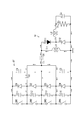
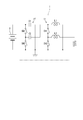
- FIG. 1 It is a circuit diagram of a transformer as an original form of a transformer concerning this embodiment.
- A) is a circuit diagram showing a state of substantial connection when two switches on the upper side of the four switches in FIG. 1 are on and two switches on the lower side are off
- B) is a circuit diagram in which the same circuit diagram as (a) is rewritten stepwise.
- A) is a circuit diagram showing a state of substantial connection when two switches on the lower side among the four switches in FIG. 1 are on and two switches on the upper side are off
- (B) is a circuit diagram in which the same circuit diagram as (a) is rewritten stepwise.
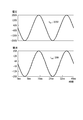
- the upper diagram is a waveform diagram showing the input voltage to the transformer, and the lower diagram is the input current.
- Voltage v m at the intermediate stage of the transformer, the current i m is a waveform diagram illustrating respectively.
- the upper diagram is a waveform diagram showing the output voltage from the transformer, and the lower diagram is the output current.
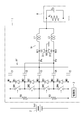
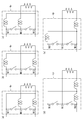
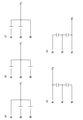
- It is a circuit diagram which shows an example of the transformer apparatus developed more practically. It is a circuit diagram which shows the variation of topology about the principal part of a front
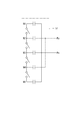
- FIG. 11 is a diagram showing another circuit variation of the first electric circuit when the total number of capacitors is not reduced from the first electric circuit (solid line) in FIG. 10.
- FIG. 11 is a diagram showing a circuit variation of the first electric circuit when the total number of capacitors is reduced by one from the first electric circuit (solid line) in FIG. 10.
- FIG. 1 shows a circuit variation in the case of reducing one capacitor from the 1st electric circuit (solid line) or the 2nd electric circuit (broken line) in FIG.
- It is a circuit diagram which shows the deformation
- It is a circuit diagram which shows the deformation
- FIG. 20 is a diagram illustrating a current flow in a first half time for a circuit on the rear stage side of the switch after stray capacitances of the switches in FIG. 19 are described.
- FIG. 20 is a diagram illustrating the flow of current in the latter half of the circuit on the downstream side of the switch after describing the stray capacitances of the switches in FIG. 19.
- (A) is a graph which shows the output voltage of a transformer
- (b) is a graph which shows the voltage of the both ends of an inductor. It is a graph which shows each waveform of switch voltage VSW (solid line) and electric current IQ (broken line). It is the figure which expanded the part enclosed with the square of the upper right in FIG. It is a diagram showing the vicinity of the top of the current I Q of the linear approximation. It is the figure which extended the waveform of FIG. 28 to the time-axis direction (right direction). It is a graph which shows the relationship between dead time (tau) [ns] and efficiency [%] in the case of condition 1.
- FIG. 41 is a graph showing a relationship between dead time ⁇ [ns] and efficiency [%] in the case of condition 1 in the transformer of FIG. 40.
- FIG. 41 is a graph showing the relationship between dead time ⁇ [ns] and output power [W] in condition 1 in the transformer of FIG. 40.
- FIG. 41 is a graph showing the relationship between dead time ⁇ [ns] and efficiency [%] in the case of condition 2 in the transformer device of FIG. 40.
- 41 is a graph showing the relationship between dead time ⁇ [ns] and output power [W] in condition 2 in the transformer device of FIG. 40. It is a circuit diagram of an input / output common grounding type “4C2L” transformer. 46 is a graph showing a relationship between dead time ⁇ [ns] and efficiency [%] in the case of condition 1 in the transformer device of FIG. 46 is a graph showing the relationship between dead time ⁇ [ns] and output power [W] in the case of condition 1 in the transformer device of FIG. 46 is a graph showing a relationship between dead time ⁇ [ns] and efficiency [%] in the case of condition 2 in the transformer device of FIG.
- 46 is a graph showing a relationship between dead time ⁇ [ns] and output power [W] in the case of condition 2 in the transformer device of FIG. It is a circuit diagram of an input / output common grounding type “6C2L” transformer.
- the transformer of FIG. 50 it is a graph which shows the relationship between dead time (tau) [ns] in the case of the conditions 1, and efficiency [%].
- the transformer of FIG. 50 it is a graph which shows the relationship between dead time (tau) [ns] in case of the conditions 1, and output electric power [W].
- 50 is a graph showing a relationship between dead time ⁇ [ns] and efficiency [%] in the case of condition 2 in the transformer device of FIG. 50.
- the transformer of FIG. 50 it is a graph which shows the relationship between dead time (tau) [ns] in case of the conditions 2, and output electric power [W].
- the gist of the embodiment of the present invention includes at least the following.
- This is a transformer provided between a power source and a load, and is constituted by a front-stage circuit and a rear-stage circuit.
- a plurality of switches that are multiples of 2 are connected in series to each other, and the odd-numbered switch and the even-numbered switch are alternately turned on when viewed from one end side of the series body.
- a switch series body connected in parallel to the power source as a whole, and (b) a total of m nodes including interconnection points of the switches and both end points of the switch series body, and the both end points
- a ground node when viewed in the order of 1 to m from one end side of the switch series body, the first electric circuit that bundles the odd nodes and leads to the first output port, and the even nodes are bundled
- a capacitor provided corresponding to (m ⁇ 1) nodes excluding the ground node, and (c) without passing through the capacitor.
- the connection And a a ground path is directly connected to the first output port of the node.
- the latter circuit is formed by (d) connecting a pair of semiconductor elements that are energized in opposite polarities to each other in series, and one end of the series body is connected to the first output port and the ground terminal of the load.
- the transformer device includes a control unit that controls the on / off operation of the switch.
- the transformation can be performed by the circuit configuration including the front-stage circuit and the rear-stage circuit and switching.
- a transformer as a power transformer, a conventional transformer including a coil, an iron core, and the like is not necessary. Therefore, a dramatic reduction in size and weight of the transformer and a cost reduction associated therewith can be realized.
- the problems of parasitic capacitance and leakage magnetic field generation which are problems with high-frequency transformers, are eliminated, and a low-loss transformer can be realized.
- the power source can be applied to both AC and DC.
- this transformer device can perform input / output common grounding from the power source to the load. In this case, there is an advantage of sharing the ground wire.
- the control for one of the switches is turned on from the dead time start time when the control for the odd-numbered switch and the even-numbered switch are both turned off. Assuming that the time until the dead time end time is the dead time ⁇ , the control unit performs the floating capacitance of the switch from the inductor of the third electric circuit while one of the semiconductor elements is conducting after the dead time start time.
- the first half time ⁇ 1 obtained on the basis of the electric charge moving to 1 and the second half time obtained on the basis of the electric charge moving from the inductor of the third electric circuit to the floating capacitance of the switch while the other of the semiconductor elements is conducting ⁇ 2 is obtained, and the dead time ⁇ is determined based on the first half time ⁇ 1 and the second half time ⁇ 2. Also good. In this case, it is possible to determine an appropriate dead time ⁇ based on the times ⁇ 1 and ⁇ 2 obtained by paying attention to the charge movement in the dead time, and to realize a zero voltage transition (ZVT).
- ZVT zero voltage transition
- the control unit ends the dead time ⁇ before the charge transferred to the floating capacitance returns to the inductor of the third electric circuit.
- the switch voltage rises again.
- the dead time ⁇ is terminated before that, so that the rise of the switch voltage can be prevented.
- FIG. 1 is a circuit diagram of a transformer device 1 as a prototype of the transformer device according to the present embodiment.
- the transformer 1 is provided between an AC power source 2 and a load R (R is also a resistance value).
- the transformer 1 includes a pair of capacitors C1 and C2, a pair of inductors L1 and L2, four switches S r1 , S r2 , S b1 , and S b2 , and these switches S r1 , S r2 , S b1 , S and a control unit 3 that controls on / off of b2 .
- the switching frequency of the control unit 3 is, for example, about 1 MHz.
- the capacitance values of the pair of capacitors C1 and C2 may be the same or different from each other. The same applies to the inductance values of the pair of inductors L1, L2.
- the switches S r1 , S r2 , S b1 , S b2 and the control unit 3 constitute a switch device 4 that switches the circuit connection state of the transformer 1.
- the switches S r1 and S r2 operate in synchronization with each other, and the switches S b1 and S b2 operate in synchronization with each other.
- the pair of switches S r1 and S r2 and the pair of switches S b1 and S b2 operate so as to be alternately turned on.
- the switches S r1 , S r2 , S b1 , S b2 are, for example, semiconductor switching elements made of SiC elements or GaN elements. An SiC element or a GaN element can be switched at a higher speed than, for example, an Si element. Further, a sufficient breakdown voltage (for example, 6 kV / 1 unit is possible) can be obtained without connecting the elements in multiple stages.
- a pair of capacitors C1 and C2 are connected in series with each other at a connection point M1.
- AC power supply 2 is connected to both ends of the series body.
- An input voltage v in is applied to the series body of the pair of capacitors C1 and C2, and an input current i in flows.
- the pair of inductors L1 and L2 are connected in series with each other at the connection point M2. Then, the both ends of the series connection body, are applied input voltage v m through the capacitors C1, C2 flows input current i m.
- a current flows through the load R when one of the switches S r2 and S b2 is on.
- the voltage applied to the load R is v out
- the output current flowing from the transformer 1 to the load R is i out .
- FIG. 2B is a circuit diagram in which the same circuit diagram as in FIG. On the other hand, (a) in FIG. 3, of the four switches in FIG.
- FIG. 3B is a circuit diagram in which the same circuit diagram as in FIG.
- the circuit configuration includes a front-stage circuit including a pair of capacitors C1 and C2 and a rear-stage circuit including a pair of inductors L1 and L2.
- the polarity of the output with respect to the input is inverted by switching. Note that the direction of the current is alternately reversed by switching for the capacitors C1 and C2, and the direction of the voltage is alternately reversed by switching for the inductors L1 and L2.
- the input voltage is output at 1/4. This will be proved theoretically below.
- the input voltage from the AC power source 2 is v in
- the voltage applied to the load R is v out
- the voltage applied to the capacitor C1 is v 1
- the voltage applied to the capacitor C2 is v 2
- the inductor L1 is the current flowing through the inductor
- i 2 is the current flowing through the inductor L 2
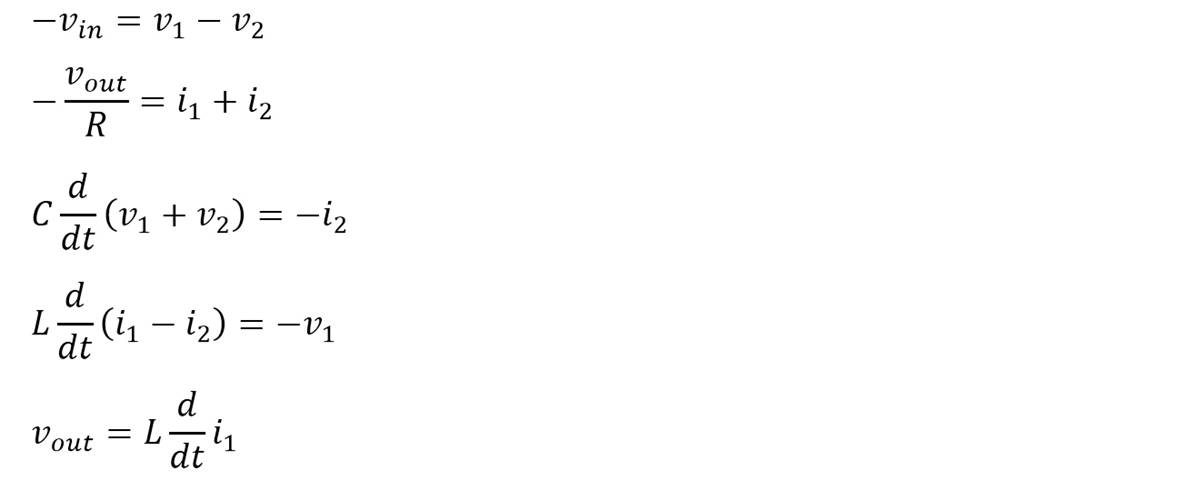
- the following equation holds: For simplification of calculation, it is assumed that the capacitors C1 and C2 have the same capacitance C, and the inductors L1 and L2 have the same inductance L.
- the input voltage from the AC power supply 2 is v in
- the voltage applied to the load R is v out
- the voltage applied to the capacitor C1 is v 1
- the capacitor C2 is applied.
- v 2 the current flowing through the inductor L 1 is i 1
- the current flowing through the inductor L 2 is i 2 , the following equation holds.
- the impedance of L in a frequency f o of the input voltage is sufficiently small with respect to resistance value. That is, 2 ⁇ f o L ⁇ R.
- the difference indicated by the inequality sign is preferably a difference of one digit or more, more preferably two digits or more. As a result, a more stable transformation operation with less distortion can be obtained.
- each C and each L is treated as the same value, but even when they are different, the same result can be derived by the same expression expansion.
- the second term on the right side of the lowermost formula in the conclusion formula is sufficiently smaller than the first term and can be ignored. Accordingly, v in ⁇ 4v out regardless of the load fluctuation (fluctuation in the value of R), and the output voltage is about 1 ⁇ 4 of the input voltage. Since there is no loss except for the load R, the output current is about 4 times the input current and the input impedance is 16 times the resistance value R.
- FIG. 4 is a waveform diagram in which the upper part represents the input voltage to the transformer 1 and the lower part represents the input current.
- Figure 5 is a waveform diagram showing the voltage v m at the intermediate stage of the transformer, the current i m respectively. This is actually constituted by a pulse train by switching, and has a waveform as shown in the figure as a whole.
- FIG. 6 is a waveform diagram in which the upper part represents the output voltage from the transformer 1 and the lower part represents the output current. As apparent from the comparison between FIGS. 4 and 6, the voltage is transformed to 1 ⁇ 4, and the current is quadrupled accordingly.
- Each of the front-stage circuit 1f and the rear-stage circuit 1r can be expressed as follows as the topology of the circuit configuration.
- the pre-stage circuit 1 f includes the following “switch series body” and “capacitor”.
- the “switch series body” is formed by connecting two switches (Sr1, Sb1) in series with each other, and an odd-numbered switch (S r1 ) and an even number when viewed from one end side (for example, the upper end side) of the series body.
- the second switch (S b1 ) is turned on alternately and connected to the power supply 2 in parallel as a whole.
- the “capacitor (C1, C2)” has a total of three nodes including the interconnection point (N2) of each switch and both end points (N1, N3) of the switch series body.
- At least one of a first electric circuit that bundles odd nodes (N1, N3) and leads to the first output port Px and a second electric circuit that leads even nodes (N2) to the second output port Py. are provided corresponding to two nodes.
- the post-stage circuit 1r includes the following “element series body” and “inductor”.
- the “element series body” is formed by connecting a pair of switches (S r2 , S b2 ) that conduct currents having opposite polarities in series, one end of the series body being connected to the first output port Px, and the other end Is connected to the second output port Py.
- the “inductors (L1, L2)” are a connection point between a pair of switches and a third electric circuit that bundles two nodes (N11, N13) that are both end points of the element series body and leads them to one end of the load R.
- One node (N12) is provided on at least one of the fourth circuits that guides the other end of the load R, and exists corresponding to two nodes (N11, N13) out of a total of three nodes To do.
- FIG. 7 is a circuit diagram of the transformer device 1.
- the transformer device 1 is provided between a power source 2 and a load R, and includes a front circuit 1f, a rear circuit 1r, and a control unit 3.
- the power source 2 is a DC power source, for example, and the voltage is 1 kV.
- Load R has a resistance R 3, a capacitor C 6 as an equivalent circuit element.
- the pre-stage circuit 1f includes bleeder resistors R1 and R2, switches SW1 to SW4, diodes D1 to D4 included therein, and capacitors C1 to C5, which are connected as illustrated.
- the post-stage circuit 1r includes diodes D11 and D12 and inductors L1 and L2, which are connected as illustrated. Further, a control unit 3 that controls the on / off operation of the switches SW1 to SW4 is provided.
- the circuit of FIG. 7 is referred to as a “4C2L” circuit of the front stage 4C and the rear stage 2L using “4” as many as the number of switches.
- the circuit of FIG. 1 is “2C2L”.
- the diodes D1 to D4 may be external diodes provided separately depending on the types of the switches SW1 to SW4 in addition to the body diodes inherent in the switches SW1 to SW4. These diodes D1 to D4 function as free-wheeling diodes and can reduce switching loss in some cases. As a result, the inductances of the inductors L1 and L2 can be reduced, which may contribute to downsizing.
- the preceding circuit 1f includes a “switch series body” and “capacitors (C1 to C5)”.
- the “switch series body” is formed by connecting switches (SW1 to SW4) in series with each other, and an odd-numbered switch (SW1, SW3) and an even-numbered switch as viewed from one end side (for example, the upper end side) of the series body.
- the switches (SW2, SW4) are turned on alternately and connected to the power supply 2 in parallel as a whole.
- the “capacitors (C1 to C5)” are either one end of the switch series body, with the interconnection points (N2, N3, N4) of the switches and both end points (N1, N5) of the switch series body as a total of five nodes.
- the first electric circuit for bundling odd nodes (N1, N3, N5) and leading to the first output port Px, and the second output by bundling even nodes (N2, N4) It is provided on at least one of the second electric circuits leading to the port Py, and exists corresponding to five nodes.
- the post-stage circuit 1r includes an “element series body” and “inductors (L1, L2)”.
- the “element series body” is formed by connecting a pair of semiconductor elements (D11, D12) that are energized in opposite polarities to each other in series, one end of the series body being connected to the first output port Px, and the other end being Connected to the second output port Py.
- the “inductors (L1, L2)” are a third electric circuit for bundling two nodes (N11, N13), which are both end points of the element series body, and leading to one end of the load R, and an interconnection point between a pair of semiconductor elements Is provided on at least one of the fourth electric circuits that guide one node (N12) to the other end of the load R, and corresponds to two nodes (N11, N13) out of a total of three nodes.
- the input voltage 1 kV can be stepped down to a direct current of 125 V.
- FIG. 8 is a circuit diagram showing a topology variation of the main part of the pre-stage circuit 1 f in the “2C2L” transformer 1.
- the circuit shown in each of the drawings (a) to (e) includes a pair of switches and a pair of capacitors (reference numerals omitted).
- FIG. 8A there are capacitors corresponding to the node N3 of the switch series body and the node N2 of the interconnection point of the pair of switches.
- B is the topology of FIG.
- C has a capacitor corresponding to the node N1 of the switch series body and the node N2 of the interconnection point of the pair of switches.
- D is an example in which two capacitors exist corresponding to the node N3 of the switch series body and one capacitor exists in the output direction corresponding to the node N1.
- (E) is an example in which two capacitors exist corresponding to the node N1 of the switch series body and one capacitor exists in the output direction corresponding to the node N3. In any circuit, there are two capacitors, but capacitors may exist corresponding to all the nodes N1 to N3.
- FIG. 9 is a circuit diagram showing a topology variation with respect to the main part of the post-stage circuit 1r.
- the rear circuit 1r connected to the load is constituted by a pair of switches and a pair of inductors (reference numerals omitted).
- a diode can be used as shown in FIG.
- FIG. 9A there are inductors corresponding to the node N13 of the switch series body and the node N12 of the interconnection point of the pair of switches.
- B is the topology of FIG.
- In (c) an inductor exists corresponding to the node N11 of the switch series body and the node N12 of the interconnection point of the pair of switches.
- D is an example in which two inductors exist corresponding to the node N13 of the switch series body, and one inductor exists in the output direction corresponding to the node N11.
- E is an example in which two inductors exist corresponding to the node N11 of the switch series body and one inductor exists in the output direction corresponding to the node N13. In each circuit, there are two inductors, but there may be inductors corresponding to all the nodes N11 to N13.
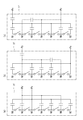
- FIG. 10 is a diagram of a main part of the pre-stage circuit 1 f in the “4C2L” transformer 1.
- the first electric circuit that bundles the odd nodes N1, N3, and N5 and leads to the first output port Px is represented by a solid line
- the even nodes N2 and N4 are bundled to the second output port Py.
- the second electric circuit to be guided is represented by a broken line.
- what is represented by a broken line is for convenience of display, and is an electric circuit coexisting with the first electric circuit.
- This topology is the same as that of the pre-stage circuit 1f of FIG.
- the first electric circuit (solid line) or the second electric circuit (broken line) are bundled with each other, and at least one capacitor is interposed between the connected nodes in order to realize DC insulation. It is necessary to be.
- FIG. 11 and 12 are diagrams showing circuit variations of the first electric circuit when the total number of capacitors is not reduced from the first electric circuit (solid line) in FIG.
- capacitors are provided in the three electric circuits before being bundled together (same as FIG. 10).
- capacitors are provided in two of the three electric circuits before being bundled, and capacitors are also provided in one electric circuit after being bundled.
- the electric circuit is bundled in two stages, and a capacitor is provided before or after the bundle.
- FIG. 13 is a diagram showing circuit variations of the first electric circuit when the total number of capacitors is reduced by one from the first electric circuit (solid line) in FIG.
- any one of N1, N3, and N5 is directly connected to the first output port Px.
- the other nodes are connected to the first output port Px via one or two capacitors.
- FIG. 14 is a diagram showing a circuit variation of the second electric circuit (broken line) in FIG. (A),
- (b) is a circuit diagram in the case of reducing one capacitor from the second electric circuit without reducing the capacitor from the first electric circuit.
- the node N2 is directly connected to the second output port Py.
- the node N4 is connected to the second output port Py through a capacitor.
- the node N4 is directly connected to the second output port Py.
- the node N2 is connected to the second output port Py through a capacitor.
- (d), (e) is a circuit diagram in the case where one capacitor is reduced from the first electric circuit and the capacitor is not decreased from the second electric circuit.
- the nodes N2 and N4 are both connected to the second output port Py via one or two capacitors. .
- FIG. 15 is a diagram of a main part of the pre-stage circuit 1 f in the “6C2L” transformer 1.
- the first electric circuit that bundles odd nodes N1, N3, N5, and N7 and leads them to the first output port Px when viewed from one end of the switch series body is represented by a solid line, and the even nodes N2, N4, and N6 are bundled to be the second.
- the second electric circuit leading to the output port Py is represented by a broken line.
- what is represented by a broken line is for convenience of display, and is an electric circuit coexisting with the first electric circuit.
- FIG. 16 is a diagram showing circuit variations when one capacitor is reduced from the first electric circuit (solid line) or the second electric circuit (broken line) in FIG.
- the node N3 is directly connected to the first output port Px without a capacitor.
- the node N7 is directly connected to the first output port Px without passing through a capacitor.
- the node N4 is directly connected to the second output port Py without passing through a capacitor.
- the pre-stage circuit 1f (FIGS. 1, 8, and 10 to 16) is formed by connecting a plurality of switches that are multiples of (a) 2 in series with each other, and the odd-numbered circuit viewed from one end side of the series body.
- the switch and the even-numbered switch are alternately turned on, and as a whole, the switch series body connected in parallel to the power supply, and (b) the total number of m of the interconnection points of the switches and the end points of the switch series body
- a first electric circuit that bundles odd nodes and leads them to the first output port when viewed in the order of 1 to m from any one end side of the switch series body, and a second output port that bundles even nodes
- a capacitor that is provided on at least one of the second electric circuits leading to the first electric circuit and exists corresponding to at least (m ⁇ 1) nodes.
- the post-stage circuit 1r (FIGS. 1, 7, and 9) includes (c) a pair of semiconductor elements that conduct currents having opposite polarities, connected in series, and one end of the series body is the first output port. An element series body having the other end connected to the second output port; and (d) a third electric circuit for bundling two nodes that are both end points of the element series body and leading to one end of the load; Is provided on at least one of the fourth circuit that leads one node which is an interconnection point of the semiconductor elements to the other end of the load, and exists corresponding to at least two of the three nodes in total And an inductor.
- an element series body can be configured by serially connecting the energization directions in opposite directions.
- the semiconductor element is a switch, a pair of switches are connected in series to form an element series body, and the pair of switches are alternately turned on.
- the transformation can be performed by the circuit configuration including the front circuit 1f and the rear circuit 1r and switching.
- a transformer device 1 as a power transformer, a conventional transformer including a coil and an iron core becomes unnecessary. Therefore, a dramatic reduction in size and weight of the transformer and a cost reduction associated therewith can be realized.
- the problems of parasitic capacitance and leakage magnetic field generation which are problems with high-frequency transformers, are eliminated, and a low-loss transformer can be realized.
- the power source can be applied to both AC and DC.
- FIG. 17 is a circuit diagram showing a modification procedure for the pre-stage circuit 1f to the input / output common ground type.
- A is the pre-stage circuit 1 f described also in FIGS. 7 and 10.
- B is a pre-stage circuit 1f performing an input / output operation equivalent to the pre-stage circuit 1f of (a).
- the topology of FIG. 13E and the topology of FIG. 14D are used.
- the pre-stage circuit 1f of FIG. 17B the node N5 can be directly connected to the first output port Px as it is without passing through a capacitor. Therefore, the pre-stage circuit 1f of (b) is suitable for the input / output common ground.
- FIG. 18 is a circuit diagram showing a modification procedure of the rear circuit 1r connected to the load R to the input / output common ground type.
- (A) is a circuit using three inductors L1 to L3 which can be said to be the original form of the post-stage circuit 1r. From this point, the circuit of (b) can be obtained by omitting the inductor L2. However, the circuit of (b) is not suitable when it is desired to ground the electric circuit at the bottom of the circuit. Therefore, the inductor L3 is omitted from (a) and the polarities of the diodes D11 and D12 are inverted to form the circuit of (c).
- the circuit (c) is suitable for the input / output common ground type because there is no circuit element in the electric circuit at the bottom of the circuit.
- the circuit (c) becomes the circuit (d) when expressed by changing the position of the inductor L1.
- the circuit of (c) and the circuit of (d) are the same as circuit connection.
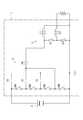
- FIG. 19 is a circuit diagram of the input / output common ground type transformer 1. This transformer device 1 is obtained by applying the modification shown in FIGS. 17 and 18 to the circuit of FIG. In FIG. 19, the transformer device 1 is provided between a power source 2 and a load R, and includes a front circuit 1f and a rear circuit 1r.
- the pre-stage circuit 1 f includes the following “switch series body”, “capacitor”, and “grounding circuit”.
- the “switch series body” is formed by connecting four switches SW1 to SW4 in series with each other.
- the odd-numbered switches SW1 and SW3 and the even-numbered switches SW2 and SW4 are alternately viewed from the upper end side of the series body. And is connected in parallel to the power source 2 as a whole.
- the interconnection points N2, N3, N4 of each switch and the both end points N1, N5 of the switch series body are a total of five nodes, and one of the both end points is a ground node N5.
- Capacitors C1 and C3 are provided in the first electric circuit, and capacitors C2 and C4 are provided in the second electric circuit. However, the capacitors exist in the output direction corresponding to the remaining four nodes excluding the ground node N5. This correspondence is as follows. N1: C1, C3 N2: C2, C4 N3: C3 N4: C4 The ground circuit G connects the ground node N5 directly to the first output port Px without passing through a capacitor.
- a “switch series body” consists of a plurality of switches that are multiples of 2 connected in series to each other, and an odd number when viewed from one end of the series body. These switches and even-numbered switches are turned on alternately, and are connected in parallel to the power supply as a whole.
- the “capacitor” is any one of the switch series bodies in which the interconnection point of each switch and the both end points of the switch series body are a total of m nodes, and one of the both end points is a ground node.
- the post-stage circuit 1r includes a “diode series body” and an “inductor”.
- the “diode series body” is formed by connecting a pair of diodes D11 and D12 that are energized with opposite polarities in series, and one end (node N13) of the series body is the ground terminal of the first output port Px and the load R. The other end (node N11) of the series body is connected to the second output port Py.
- the inductor L1 is provided in the third electric circuit that guides the non-grounded end (node N11) of the diode series body to the grounded end of the load R.
- the inductor L2 is provided in the fourth electric circuit that guides the interconnection point (node N12) of the pair of diodes D11 and D12 to the ungrounded end of the load R.
- the post-stage circuit 1r includes an “element series body” and an “inductor”.
- the “element series body” is formed by connecting a pair of semiconductor elements that are energized in opposite polarities to each other in series, and one end of the series body is connected to the first output port and the ground end of the load. Is connected to the second output port.
- the “inductor” is a third electric circuit that leads the non-grounded end of the element series body to the grounded end of the load, and a fourth electric circuit that leads an interconnection point of the pair of semiconductor elements to the non-grounded end of the load, respectively. Provided.
- the input / output common ground type transformer device 1 configured as described above, transformation can be performed by the circuit configuration including the front circuit 1f and the rear circuit 1r and switching, as in FIG.
- a transformer device 1 as a power transformer, a conventional transformer including a coil and an iron core becomes unnecessary. Therefore, a dramatic reduction in size and weight of the transformer and a cost reduction associated therewith can be realized.
- the problems of parasitic capacitance and leakage magnetic field generation which are problems with high-frequency transformers, are eliminated, and a low-loss transformer can be realized.
- the power source can be applied to both AC and DC.
- the transformer device 1 can perform common input / output grounding from the power source 2 to the load R. In this case, there is an advantage that the ground line can be shared. There is also an advantage that the number of parts is small.
- the dead time is either from the moment when the control for all the switches is turned off between the time when the odd-numbered switches SW1 and SW3 and the even-numbered switches SW2 and SW4 are alternately turned on in FIG. This is a transitional time until the switch control is turned on.
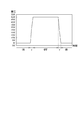
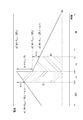
- FIG. 20 is a graph showing changes in the switch voltage (drain-source voltage) when the odd-numbered or even-numbered switch is turned off from on and turned on again.
- the switch voltage is 0V when on and 500V when off.
- ZVT Zero Voltage Transition
- a zero voltage transition that turns on after the switch voltage drops to 0 V is preferable in order to minimize switching loss.
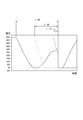
- FIG. 21 is a graph showing the relationship with ZVT by setting the length of the dead time from off to on to three types of large, medium and small.
- the dead time ⁇ is smaller than the appropriate value (medium)
- the voltage changes as indicated by the alternate long and short dash line, and the next turn-on starts before reaching 0V. That is, it is not a ZVT.
- the dead time ⁇ is larger than the appropriate value (medium)
- the voltage changes as shown by a solid line and reaches 0V at one end, but then the voltage rises again and eventually the next ON is started as it is. That is, this is not ZVT. Therefore, it can be said that ⁇ indicated by a broken line has an appropriate range that is not too large and not too small.
- FIG. 22 is a graph showing the change in various quantities when changing from off to on across the dead time ⁇ , with the time on the horizontal axis enlarged. Shown are four quantities of any one of the switch voltage V SW (solid line), the current I L1 flowing through the inductor L1 (broken line), the current I D11 flowing through the diode D11, and the current I D12 flowing through the diode D12. It is a change.
- the dead time ⁇ includes the first half time ⁇ 1 from 500 V to 250 V, and the subsequent second half time ⁇ 2 from 250 V to 0 V. That is, ⁇ ⁇ ⁇ 1 + ⁇ 2 (1) It is.
- the slopes of the first half time ⁇ 1 and the second half time ⁇ 2 are slightly different from each other, and ⁇ 1 ⁇ 2 . Therefore, the dead time ⁇ can be considered separately for the first half time ⁇ 1 and the second half time ⁇ 2 .
- ⁇ 1 Voltage is from 4V out to 2V out
- ⁇ 2 The voltage is from 2V out to 0.
- the diode D12 conducts and the current I D12 flows.
- the diode D11 is turned on and the current ID11 flows.
- FIG. 23 is a diagram illustrating the flow of current in the first half time ⁇ 1 for the circuit on the rear stage side of the switches SW1 to SW4 after describing the floating capacitances C11 to C14 respectively included in the switches SW1 to SW4 in FIG.
- Stray capacitance C11 ⁇ C14 is assumed to have a common capacitance C DS.
- the diode D12 becomes conductive, diode D11 has become nonconductive.
- FIG. 24 shows stray capacitances C11 to C14 that the switches SW1 to SW4 in FIG. 19 respectively have, and shows the current flow in the second half time ⁇ 2 for the circuit on the rear stage side of the switches SW1 to SW4.
- FIG. In the second half time ⁇ 2 the diode D11 is conductive and the diode D12 is nonconductive.
- the voltage waveform at both ends of the inductors L1 and L2 is a rectangular wave with a duty ratio of 50%.
- the absolute value of the voltage V L across the inductor L1 is twice the output voltage. That is, assuming that the maximum value of the voltage V L is V Lmax and the minimum value is V Lmin , V Lmax ⁇ 2V out V Lmin ⁇ -2V out It is.
- FIG. 25A is a graph showing the output voltage of the transformer 1.
- (B) is a graph showing a voltage V LI across the inductor L1.
- the voltage V L1 indicates ⁇ 250V,
- FIG. 26 is a graph showing waveforms of the switch voltage V SW (solid line) and the current I Q (broken line).
- FIG. 27 is an enlarged view of the portion surrounded by the upper right square in FIG.
- the slope of the switch voltage in the dead time tau (solid line) is changed, it changes the change characteristic of the current I Q. Therefore, the change of the current I Q, and the first half of time ⁇ 1, be divided into the second half time ⁇ 2.
- FIG. 28 is a diagram showing the vicinity of the top of the current I Q of the linear approximation.
- ⁇ 1 (T / 4) + (L 1 / 4R 3 ) -(1/4) [ ⁇ T + (L 1 / R 3 ) ⁇ 2 -128L 1 C DS ] 1/2 ... (7) It becomes.
- FIG. 29 is a diagram in which the waveform of FIG. 28 is extended in the time axis direction (right direction).
- ⁇ 0 elapses, a negative current flows. This means that the charge returns from the stray capacitance CDS to the inductor L1. If this happens, the switch voltage will rise again, so the time ⁇ 0 must not be exceeded.
- tau max is, ⁇ max ⁇ (T / 2 ) of course it must be.
- the dead time ⁇ range should be set as follows. ⁇ 1 + ⁇ 2 ⁇ ⁇ ⁇ ⁇ 0 + ⁇ 1 (14)
- ⁇ 0 , ⁇ 1 and ⁇ 2 are as follows.
- ⁇ 0 , ⁇ 1 , and ⁇ 2 are as follows when generalized in consideration of the multi-stage of the previous circuit. Note that equation (14) remains unchanged even when multistage is considered.
- the control unit 3 of the transformer 1 performs the floating capacitance of the switch from the inductor L1 while one of the diodes D11 and D12 (D12) is conducting after the dead time start time.
- a first half time tau 1 obtained based on the charge transferred to the C DS, calculated based on the charge transferred from the inductor L1 to the stray capacitance C DS switch between the other diode D11, D12 to (D11) is conducting seeking a late time tau 2 to be, on the basis of the first half time tau 1 and the second half time tau 2, it is possible to determine the dead time tau.
- an appropriate dead time ⁇ can be determined based on the times ⁇ 1 and ⁇ 2 obtained by paying attention to the movement of charges during the dead time, and zero voltage transition (ZVT) can be realized.
- ZVT zero voltage transition
- the control unit 3 before the charge transferred to the floating capacitance C DS returns to inductor L1 that end the dead time tau, it is possible to prevent the re-rise of the switch voltage. Further, the preferred range of the dead time ⁇ can be clearly defined by the above equations (7), (9), (13), and (14), and zero voltage transition can be realized with certainty. Further, since the inductance that is a factor for determining the range of ⁇ is only the inductor L1, there is an advantage that the low-loss inductor that should have a precise inductance may be only L1.
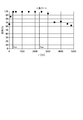
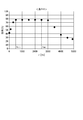
- FIG. 30 is a graph showing the relationship between the dead time ⁇ [ns] and the efficiency [%] in the case of condition 1.
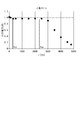
- FIG. 31 is a graph showing the relationship between the dead time ⁇ [ns] in the case of condition 1 and the output power [W] as the transformer.
- FIG. 32 is a graph showing the relationship between dead time ⁇ [ns] and efficiency [%] in the case of condition 2.
- FIG. 33 is a graph showing the relationship between the dead time ⁇ [ns] and the output power [W] as the transformer in the case of condition 2.
- ⁇ min and ⁇ max are shown on the graph, it can be seen that this is consistent with a stable high output range on the characteristics of the graph.
- the transformer can obtain excellent efficiency and stable high output.
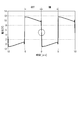
- FIG. 34 is an actually measured waveform of the switch voltage for the switch SW4 when ⁇ is 200 ns.
- the control is turned on around the circle in the figure.
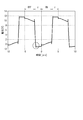
- FIG. 35 is an actually measured waveform of the switch voltage when ⁇ is 500 ns.
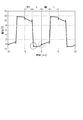
- FIG. 36 shows a measured waveform of the switch voltage when ⁇ is 1000 ns. In this case, it is ZVT.
- FIG. 37 shows an actual measurement waveform of the switch voltage when ⁇ is 2000 ns. In this case, it is ZVT. In other words, this is a theoretical result that ⁇ becomes ZVT at 449 to 2685 ns.
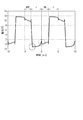
- FIG. 38 shows a measured waveform of the switch voltage when ⁇ is 2700 ns. In this case, the voltage begins to rise again when the control is turned on.
- FIG. 39 is a measured waveform of the switch voltage when ⁇ is 3000 ns. In this case, when the control is turned on, the voltage rises again. That is, ⁇ max is in good agreement with the calculated value of 2585 ns.
- FIG. 40 is a circuit diagram of the input / output common grounding type “2C2L” transformer 1.
- the circuit diagram is simplified by omitting illustration of a diode, a bleeder resistor, and the like.
- the semiconductor elements D11 and D12 of the post-stage circuit 1r are diodes having opposite polarities or switches that are alternately turned on (the same applies hereinafter). The result of verifying the performance of the transformer 1 in FIG. 40 is shown below.
- FIG. 41 is a graph showing the relationship between dead time ⁇ [ns] and efficiency [%] in the case of condition 1.
- FIG. 42 is a graph showing the relationship between the dead time ⁇ [ns] in the case of condition 1 and the output power [W] as the transformer.
- FIG. 43 is a graph showing the relationship between dead time ⁇ [ns] and efficiency [%] in the case of condition 2.
- FIG. 44 is a graph showing the relationship between the dead time ⁇ [ns] and the output power [W] as the transformer in the case of condition 2.
- ⁇ min and ⁇ max are shown on the graph, it can be seen that this is consistent with a stable high output range on the characteristics of the graph.
- FIG. 45 is a circuit diagram of the input / output common grounding type “4C2L” transformer device 1. Although it is a circuit equivalent to FIG. 19, the position of the capacitor C3 is slightly different from FIG. The results of verifying the performance of the transformer 1 are shown below.
- FIG. 46 is a graph showing the relationship between dead time ⁇ [ns] and efficiency [%] in condition 1.
- FIG. 47 is a graph showing a relationship between the dead time ⁇ [ns] in the case of condition 1 and the output power [W] as the transformer.
- ⁇ min and ⁇ max are shown on the graph, it can be seen that this is consistent with a stable high output range on the characteristics of the graph.
- FIG. 48 is a graph showing the relationship between dead time ⁇ [ns] and efficiency [%] in the case of condition 2.
- FIG. 49 is a graph showing the relationship between the dead time ⁇ [ns] in the case of condition 2 and the output power [W] as the transformer.
- FIG. 50 is a circuit diagram of the input / output common grounding type “6C2L” transformer device 1. The results of verifying the performance of the transformer 1 are shown below.
- FIG. 51 is a graph showing the relationship between dead time ⁇ [ns] and efficiency [%] in the case of condition 1.
- FIG. 52 is a graph showing a relationship between the dead time ⁇ [ns] in the case of condition 1 and the output power [W] as the transformer.
- FIG. 53 is a graph showing the relationship between dead time ⁇ [ns] and efficiency [%] in the case of condition 2.
- FIG. 54 is a graph showing the relationship between the dead time ⁇ [ns] and the output power [W] as the transformer in the case of condition 2.
- ⁇ min and ⁇ max are shown on the graph, it can be seen that this is consistent with a stable high output range on the characteristics of the graph.
Landscapes
- Engineering & Computer Science (AREA)
- Power Engineering (AREA)
- Dc-Dc Converters (AREA)
- Inverter Devices (AREA)
- Ac-Ac Conversion (AREA)
Abstract
Description
一方、高周波トランスは、寄生容量の影響が回避できず、設計上の困難性がある。
前記前段回路は、(a)2の倍数である複数のスイッチを互いに直列に接続して成り、直列体のいずれか一端側から見て奇数番目のスイッチと偶数番目のスイッチとは交互にオン動作し、全体としては前記電源に対して並列に接続されるスイッチ直列体と、(b)各スイッチの相互接続点及び前記スイッチ直列体の両端点を合計m個のノードとし、かつ、前記両端点のいずれか一方を接地ノードとして、前記スイッチ直列体のいずれか一端側から1~mの順番に見たとき、奇数ノードを束ねて第1出力ポートへ導く第1電路、及び、偶数ノードを束ねて第2出力ポートへ導く第2電路の少なくとも一方の電路上に設けられ、前記接地ノードを除く(m-1)個のノードに対応して存在するキャパシタと、(c)キャパシタを介さずに、前記接地ノードを前記第1出力ポートに直結する接地電路と、を備えている。
また、前記後段回路は、(d)互いに逆極性の通電動作をする一対の半導体素子を互いに直列に接続して成り、直列体の一端が前記第1出力ポート及び前記負荷の接地端に接続され、直列体の他端が前記第2出力ポートに接続される素子直列体と、(e)前記素子直列体の非接地端を前記負荷の接地端へ導く第3電路、及び、前記一対の半導体素子の相互接続点を前記負荷の非接地端へ導く第4電路にそれぞれ設けられたインダクタと、を備えている。
また、変圧装置は、前記スイッチのオン/オフ動作を制御する制御部を備えている。
本発明の実施形態の要旨としては、少なくとも以下のものが含まれる。
前記前段回路は、(a)2の倍数である複数のスイッチを互いに直列に接続して成り、直列体のいずれか一端側から見て奇数番目のスイッチと偶数番目のスイッチとは交互にオン動作し、全体としては前記電源に対して並列に接続されるスイッチ直列体と、(b)各スイッチの相互接続点及び前記スイッチ直列体の両端点を合計m個のノードとし、かつ、前記両端点のいずれか一方を接地ノードとして、前記スイッチ直列体のいずれか一端側から1~mの順番に見たとき、奇数ノードを束ねて第1出力ポートへ導く第1電路、及び、偶数ノードを束ねて第2出力ポートへ導く第2電路の少なくとも一方の電路上に設けられ、前記接地ノードを除く(m-1)個のノードに対応して存在するキャパシタと、(c)キャパシタを介さずに、前記接地ノードを前記第1出力ポートに直結する接地電路と、を備えている。
また、前記後段回路は、(d)互いに逆極性の通電動作をする一対の半導体素子を互いに直列に接続して成り、直列体の一端が前記第1出力ポート及び前記負荷の接地端に接続され、直列体の他端が前記第2出力ポートに接続される素子直列体と、(e)前記素子直列体の非接地端を前記負荷の接地端へ導く第3電路、及び、前記一対の半導体素子の相互接続点を前記負荷の非接地端へ導く第4電路にそれぞれ設けられたインダクタと、を備えている。
そして、変圧装置は、前記スイッチのオン/オフ動作を制御する制御部を備えている。
そして、この変圧装置は、電源から負荷まで入出力共通接地が可能である。この場合、接地線の共用という利点がある。
この場合、デッドタイムにおける電荷の移動に着目して求めた時間τ1,τ2に基づいて、適切なデッドタイムτを定め、ゼロ電圧遷移(ZVT:Zero Volt Transition)を実現することができる。
浮遊キャパシタンスに移動した電荷が戻ってくるとスイッチ電圧が再上昇するが、それ以前にデッドタイムτを終わらせることで、スイッチ電圧の再上昇を防止することができる。
τ1+τ2≦τ≦τ0+τ1
の関係にあって、

この場合、デッドタイムτの好適範囲を明確に定め、確実にゼロ電圧遷移を実現することができる。さらに、τの範囲を決める要素となるインダクタンスはインダクタL1のみであるので、精密なインダクタンスを有するべき低損失なインダクタがL1のみでよいという利点がある。
以下、実施形態の詳細について図面を参照して説明する。
図1は、本実施形態に係る変圧装置の原形としての変圧装置1の回路図である。図において、変圧装置1は、交流電源2と、負荷R(Rは、抵抗値でもある。)との間に設けられている。変圧装置1は、一対のキャパシタC1,C2と、一対のインダクタL1,L2と、4つのスイッチSr1,Sr2,Sb1,Sb2と、これらのスイッチSr1,Sr2,Sb1,Sb2のオン/オフを制御する制御部3とを備えている。制御部3のスイッチング周波数は、例えば1MHz程度である。
なお、一対のキャパシタC1,C2のキャパシタンス値は同じ値であってもよいし、互いに異なる値であってもよい。一対のインダクタL1,L2のインダクタンス値についても同様である。
また、一対のインダクタL1,L2は、接続点M2において互いに直列に接続されている。そして、その直列体の両端に、キャパシタC1,C2を介した入力電圧vmが印加され、入力電流imが流れる。負荷Rには、スイッチSr2,Sb2のいずれかがオンのとき電流が流れる。ここで、負荷Rに印加される電圧をvout、変圧装置1から負荷Rに流れる出力電流をioutとする。
一方、図3の(a)は、図1における4つのスイッチSr1,Sr2,Sb1,Sb2のうち、下側にある2つのスイッチSb1,Sb2がオンで、上側にある2つのスイッチSr1,Sr2がオフであるときの、実体接続の状態を示す回路図である。また、図3の(b)は、(a)と同じ回路図を、階段状に書き換えた回路図である。
ここで、入力電圧は1/4となって出力されるのではないかと推定できる。以下、これを理論的に証明する。
なお、計算の簡略化のため、キャパシタC1,C2のキャパシタンスは共に同じ値C、インダクタL1,L2のインダクタンスは共に同じ値L、とする。


(1)入力電圧の周波数foにおけるLのインピーダンス(リアクタンス)は、抵抗値に対して十分小さい。すなわち、2πfoL<<R、である。不等号で示す差は、例えば、1桁以上、より好ましくは2桁以上の差であることが好ましい。これにより、歪みの少ない、より安定した変圧動作が得られる。
(2)Cのインピーダンス(リアクタンス)は、スイッチング周波数fsにおいては、抵抗値Rに対して十分小さいが、入力電圧の周波数foにおいては、抵抗値に対して十分大きい。すなわち、1/(2πfsC)<<R<<1/(2πfoC)、である。不等号で示す差は、例えば、1桁以上、より好ましくは2桁以上の差であることが好ましい。これにより、歪みの少ない、より安定した変圧動作が得られる。
(3)また、スイッチングの一周期中で、入力電圧は、ほとんど変化しない。
従って、vin(t+Δt)=vin(t) (0 ≦ Δt ≦ 1/fs)
(4)系は定常であり、周期(1/fs)で同等な状態に戻る。
従って、vx(t+(1/fs))≒ vx(t) (x=1,2,3,4)



vin=-2{v3(0)+v4(0)+v3(ΔT)+v4(ΔT)}+v1(0)-v1(ΔT)
ここで、方程式3の3段目の式より、v1(0)-v1(ΔT)=(1/(4fsCR))v4(0)
また、-vout=R(i1+i2)=v3+v4であり、常に成り立つ式であるので、以下の結論式が得られる。

結論式における最下段の式の右辺の第2項は第1項に比べて十分に小さいので無視できる。従って、負荷変動(Rの値の変動)に関係なくvin≒4voutとなり、出力電圧は、入力電圧の約1/4となる。なお、負荷R以外での損失は無いので、出力電流は入力電流の約4倍、入力インピーダンスは抵抗値Rの16倍になる。
図5は、変圧の中間段階での電圧vm、電流imをそれぞれ表す波形図である。これは実際には、スイッチングによるパルス列によって構成され、全体として図示のような波形となる。
また、図6は、上が、変圧装置1からの出力電圧、下が、出力電流をそれぞれ表す波形図である。図4,図6の対比により明らかなように、電圧は1/4に変圧され、それに伴って、電流は4倍となる。
「スイッチ直列体」は、2個のスイッチ(Sr1,Sb1)を互いに直列に接続して成り、直列体のいずれか一端側(例えば上端側)から見て奇数番目のスイッチ(Sr1)と偶数番目のスイッチ(Sb1)とは交互にオン動作し、全体としては電源2に対して並列に接続される。
「キャパシタ(C1,C2)」は、各スイッチの相互接続点(N2)及びスイッチ直列体の両端点(N1,N3)を合計3個のノードとして、スイッチ直列体のいずれか一端側から1~3の順番に見たとき、奇数ノード(N1,N3)を束ねて第1出力ポートPxへ導く第1電路、及び、偶数ノード(N2)を第2出力ポートPyへ導く第2電路の少なくとも一方の電路上に設けられ、2個のノードに対応して存在する。
「素子直列体」は、互いに逆極性の通電動作をする一対のスイッチ(Sr2,Sb2)を互いに直列に接続して成り、直列体の一端が第1出力ポートPxに接続され、他端が第2出力ポートPyに接続される。
「インダクタ(L1,L2)」は、素子直列体の両端点である2個のノード(N11,N13)を束ねて負荷Rの一端へ導く第3電路、及び、一対のスイッチの相互接続点である1個のノード(N12)を負荷Rの他端へ導く第4電路の少なくとも一方の電路上に設けられ、合計3個のノードのうち2個のノード(N11,N13)に対応して存在する。
次に、上述の原形回路に基づいて、これをさらに実用的に発展させた変圧装置の一例について説明する。
図7は、かかる変圧装置1の回路図である。この変圧装置1は、電源2と負荷Rとの間に設けられ、前段回路1f、後段回路1r、及び、制御部3によって構成される。電源2は、例えば直流電源であり、電圧は1kVである。負荷Rは、等価回路要素として抵抗R3と、キャパシタンスC6とを有する。
後段回路1rは、ダイオードD11,D12と、インダクタL1,L2とを有し、これらは図示のように接続されている。
また、スイッチSW1~SW4について、オン/オフ動作を制御する制御部3が設けられている。
「スイッチ直列体」は、スイッチ(SW1~SW4)を互いに直列に接続して成り、直列体のいずれか一端側(例えば上端側)から見て奇数番目のスイッチ(SW1,SW3)と偶数番目のスイッチ(SW2,SW4)とは交互にオン動作し、全体としては電源2に対して並列に接続される。
「キャパシタ(C1~C5)」は、各スイッチの相互接続点(N2,N3,N4)及びスイッチ直列体の両端点(N1,N5)を合計5個のノードとして、スイッチ直列体のいずれか一端側から1~5の順番に見たとき、奇数ノード(N1,N3,N5)を束ねて第1出力ポートPxへ導く第1電路、及び、偶数ノード(N2,N4)を束ねて第2出力ポートPyへ導く第2電路の少なくとも一方の電路上に設けられ、5個のノードに対応して存在する。
「素子直列体」は、互いに逆極性の通電動作をする一対の半導体素子(D11,D12)を互いに直列に接続して成り、直列体の一端が第1出力ポートPxに接続され、他端が第2出力ポートPyに接続される。
「インダクタ(L1,L2)」は、素子直列体の両端点である2個のノード(N11,N13)を束ねて負荷Rの一端へ導く第3電路、及び、一対の半導体素子の相互接続点である1個のノード(N12)を負荷Rの他端へ導く第4電路の少なくとも一方の電路上に設けられ、合計3個のノードのうち2個のノード(N11,N13)に対応して存在する。
次に、変圧装置1(図1,図7その他)における回路構成のトポロジーのバリエーションについて説明する。
図8は、「2C2L」の変圧装置1における、前段回路1fの要部についての、トポロジーのバリエーションを示す回路図である。(a)~(e)の各図の回路は、一対のスイッチ及び一対のキャパシタ(符号省略)によって構成されている。
なお、いずれの回路もキャパシタは2個であるが、全てのノードN1~N3にそれぞれ対応してキャパシタが存在してもよい。
図9は、後段回路1rの要部についての、トポロジーのバリエーションを示す回路図である。(a)~(e)の各図の回路は、負荷に接続される後段回路1rが、一対のスイッチ及び一対のインダクタ(符号省略)によって構成されている。なお、スイッチに代えて、図7に示すようにダイオードを用いることができる。
なお、いずれの回路もインダクタは2個であるが、全てのノードN11~N13にそれぞれ対応してインダクタが存在してもよい。
図10は、「4C2L」の変圧装置1における前段回路1fの要部の図である。
ここで、スイッチ直列体の一端から見て奇数ノードN1,N3,N5を束ねて第1出力ポートPxに導く第1電路は実線で表し、偶数ノードN2,N4を束ねて第2出力ポートPyに導く第2電路は破線で表している。なお、破線で表しているのは表示の便宜上であり、第1電路と併存する電路である。
このトポロジーは、図7の前段回路1fと同様である。
また、5つのノードN1~N5のうち、第1電路(実線)又は第2電路(破線)で相互に束ねられ、繋がるノード間には直流的な絶縁を実現すべく、少なくとも1つのキャパシタを介していることが必要である。
図11の(a)の回路では、1本に束ねる前の3電路にそれぞれキャパシタが設けられている(図10と同じ)。(b)、(c)、(d)の回路では、1本に束ねる前の3電路のうち2電路にそれぞれキャパシタが設けられ、束ねた後の1本の電路にもキャパシタが設けられる。
図12の(a)、(b)、(c)、(d)の回路では、電路の束ね方が2段階になり、束ねる前又は後にキャパシタが設けられている。
図13の(a)~(e)の回路では、N1,N3,N5のうちいずれか1個のノードは、第1出力ポートPxに直結されている。それ以外のノードは、キャパシタを1個又は2個介して、第1出力ポートPxに接続されている。
(a)、(b)は、第1電路からキャパシタを減らさずに、第2電路からキャパシタを1個減らす場合の回路図である。(a)の場合、ノードN2は第2出力ポートPyに直結されている。ノードN4は、キャパシタを介して第2出力ポートPyに接続されている。(b)の場合、ノードN4は第2出力ポートPyに直結されている。ノードN2は、キャパシタを介して第2出力ポートPyに接続されている。
(c)、(d)、(e)は、第1電路からキャパシタを1個減らし、第2電路からはキャパシタを減らさない場合の回路図である。(c)(図10と同じ)、(d)、(e)のいずれの場合も、ノードN2,N4は共に、1個又は2個のキャパシタを介して第2出力ポートPyに接続されている。
また、降圧比増大方向への変形として「6C2L」も可能である。
図15は、「6C2L」の変圧装置1における前段回路1fの要部の図である。
ここで、スイッチ直列体の一端から見て奇数ノードN1,N3,N5,N7を束ねて第1出力ポートPxに導く第1電路は実線で表し、偶数ノードN2,N4,N6を束ねて第2出力ポートPyに導く第2電路は破線で表している。なお、破線で表しているのは表示の便宜上であり、第1電路と併存する電路である。
また、7つのノードN1~N7のうち、第1電路(実線)又は第2電路(破線)で相互に束ねられ、繋がるノード間には直流的な絶縁を実現すべく、少なくとも1つのキャパシタを介していることが必要である。
なお、さらに、「8C」以上にも同様に拡張することができる。
以上例示した各種の回路から、前段回路1fのトポロジーは以下のように表現できる。
前段回路1f(図1,図8,図10~16)は、(a)2の倍数である複数のスイッチを互いに直列に接続して成り、直列体のいずれか一端側から見て奇数番目のスイッチと偶数番目のスイッチとは交互にオン動作し、全体としては電源に対して並列に接続されるスイッチ直列体と、(b)各スイッチの相互接続点及びスイッチ直列体の両端点を合計m個のノードとして、スイッチ直列体のいずれか一端側から1~mの順番に見たとき、奇数ノードを束ねて第1出力ポートへ導く第1電路、及び、偶数ノードを束ねて第2出力ポートへ導く第2電路の少なくとも一方の電路上に設けられ、少なくとも(m-1)個のノードに対応して存在するキャパシタと、を備えている。
なお、後段回路1rの半導体素子がダイオードの場合は、通電方向を互いに逆向きにして直列接続することにより素子直列体を構成することができる。半導体素子がスイッチの場合は、一対のスイッチを直列接続して素子直列体を構成し、一対のスイッチを交互にオン動作させる。
次に、本発明のいわば本題としての入出力共通接地型の変圧装置について説明する。図1,図7の変圧装置1は、電源2から負荷Rまでの、入出力共通接地をすることはできない。入出力共通接地ができれば接地が容易になる。そこで、入出力共通接地型の変圧装置への変形を考える。
図19において、変圧装置1は、電源2と負荷Rとの間に設けられ、前段回路1f及び後段回路1rによって構成される。
「スイッチ直列体」は、4個のスイッチSW1~SW4を互いに直列に接続して成り、直列体の例えば上端側から見て奇数番目のスイッチSW1,SW3と偶数番目のスイッチSW2,SW4とは交互にオン動作し、全体としては電源2に対して並列に接続される。
各スイッチの相互接続点N2,N3,N4及びスイッチ直列体の両端点N1,N5を合計5個のノードとし、かつ、両端点の一方を接地ノードN5として、スイッチ直列体の上端側から見た奇数ノードN1,N3,N5を束ねて第1出力ポートPxへ導く第1電路、及び、偶数ノードN2,N4を束ねて第2出力ポートPyへ導く第2電路が存在している。
N1:C1,C3
N2:C2,C4
N3:C3
N4:C4
また、接地電路Gは、キャパシタを介さずに、接地ノードN5を第1出力ポートPxに直結する。
また、「キャパシタ」は、各スイッチの相互接続点及び前記スイッチ直列体の両端点を合計m個のノードとし、かつ、前記両端点のいずれか一方を接地ノードとして、前記スイッチ直列体のいずれか一端側から1~mの順番に見たとき、奇数ノードを束ねて第1出力ポートへ導く第1電路、及び、偶数ノードを束ねて第2出力ポートへ導く第2電路の少なくとも一方の電路上に設けられ、前記接地ノードを除く(m-1)個のノードに対応して存在する。
「ダイオード直列体」は、互いに逆極性の通電動作をする一対のダイオードD11,D12を互いに直列に接続して成り、直列体の一端(ノードN13)が第1出力ポートPx及び負荷Rの接地端に接続され、直列体の他端(ノードN11)が第2出力ポートPyに接続される。
インダクタL1は、ダイオード直列体の非接地端(ノードN11)を負荷Rの接地端へ導く第3電路に設けられている。また、インダクタL2は、一対のダイオードD11,D12の相互接続点(ノードN12)を負荷Rの非接地端へ導く第4電路に設けられている。
「素子直列体」は、互いに逆極性の通電動作をする一対の半導体素子を互いに直列に接続して成り、直列体の一端が前記第1出力ポート及び前記負荷の接地端に接続され、直列体の他端が前記第2出力ポートに接続される。
「インダクタ」は、前記素子直列体の非接地端を前記負荷の接地端へ導く第3電路、及び、前記一対の半導体素子の相互接続点を前記負荷の非接地端へ導く第4電路にそれぞれ設けられる。
そして、この変圧装置1は、電源2から負荷Rまで入出力共通接地が可能である。この場合、接地線が共用できる利点がある。また、部品点数が少ないという利点もある。
次に図19に示す変圧装置1におけるデッドタイムの設計について説明する。デッドタイムとは、図19において奇数番目のスイッチSW1,SW3と、偶数番目のスイッチSW2,SW4とが交互のオンになる合間の、全てのスイッチに対する制御がオフになった瞬間から、いずれか一方のスイッチの制御がオンになるまでの過渡的な時間である。
τ≧τ1+τ2 ・・・(1)
である。前半時間τ1と後半時間τ2とは勾配が互いに少し異なり、τ1<τ2である。従って、デッドタイムτを、前半時間τ1と後半時間τ2とに分けて考察することができる。変圧装置1の出力電圧125VをVoutとすると、
τ1:電圧が、4Vout~2Voutまで、
τ2:電圧が、2Vout~0まで、である。
前半時間τ1には、ダイオードD12が導通し、電流ID12が流れている。後半時間τ2には、ダイオードD11が導通し、電流ID11が流れている。
前半時間τ1においては、ダイオードD12が導通し、ダイオードD11は不導通となっている。この状態において、後段回路1rから前段回路1fの浮遊キャパシタンスC11~C14に流れ込む電流IQは、インダクタL1に流れる電流と同じであり、
IQ=IL1
である。
後半時間τ2においては、ダイオードD11が導通し、ダイオードD12は不導通となっている。この状態において、後段回路1rから前段回路1fの浮遊キャパシタンスC11~C14に流れ込む電流IQは、インダクタL1に流れる電流から負荷の抵抗R3に流れる電流IRを減じたものであり、
IQ=IL1-IR
である。
(近似条件1)
まず、降圧比は1/8で一定とする。すなわち、変圧装置1の入力電圧をVin、出力電圧をVoutとすると、
Vout≒Vin/8=125[V]
である。
(近似条件2)
インダクタL1,L2の両端の電圧波形はデューティ比50%の矩形波である。
(近似条件3)
そして、インダクタL1の両端の電圧VLの絶対値は、出力電圧の2倍である。すなわち、電圧VLの最大値をVLmax、最小値をVLminとすると、
VLmax≒2Vout
VLmin≒-2Vout
である。
|VL1|≒2Vout
であると言える。従って、以下の計算では、
VL1≒±2Vout
とする。
ここで、インダクタL1の両端電圧VL1は、
VL1=L1(dIL(t)/dt)=L1・a
である。aは電流IQの近似直線の傾きである。
従って、
a=2Vout/L1 ・・・(2)
である。
また、負荷に流れる電流IRは、
IR=Vout/R3 ・・・(3)
図において、前半時間τ1の間に浮遊キャパシタンスCDS(C11~C14の総称)に流れ込む電荷Q1は、図の左側のハッチング面積となる。途中の計算を省略して結果を示すと、
Q1=(Vout・τ1/2){(T/L1)+(1/R3)}
-(Vout・τ1 2/L1) ・・・(4)
である。
また、後半時間τ2の間に浮遊キャパシタンスCDSに流れ込む電荷Q2は、図の右側のハッチング面積となる。すなわち、
Q2=(Vout・τ2/2){(T/L1)-(1/R3)}
-(Vout・τ2 2/L1) ・・・(5)
である。
Q1=4CDS・2Vout=8CDS・Vout ・・・(6)
である。式(4)、(6)から得られる二次方程式をτ1について解くと、
τ1=(T/4)+(L1/4R3)
-(1/4)[{T+(L1/R3)}2-128L1CDS]1/2
・・・(7)
となる。
Q2=4CDS・2Vout=8CDS・Vout ・・・(8)
である。式(5)、(8)から得られる二次方程式をτ2について解くと、
τ2=(T/4)-(L1/4R3)
-(1/4)[{T-(L1/R3)}2-128L1CDS]1/2
・・・(9)
となる。
また、デッドタイムτの最小値τminは、
τmin=τ1+τ2 ・・・(10)
である。
図29は、図28の波形を時間軸方向(右方向)へ延長した図である。後半時間τ2の後半領域に入ると、電流の勾配は(-a)となる。従って、ピークからIQ=0となるまでの時間τ0が存在する。時間τ0を経過すると、マイナスの電流が流れることになる。これは、浮遊キャパシタンスCDSからインダクタL1に電荷が戻ってくることを意味している。もしそうなると、スイッチ電圧が再上昇するので、時間τ0を超えないようにしなければならない。τ0を超えないためのデッドタイムの最大値をτmaxとすると、
τmax=τ1+τ0 ・・・(11)
である。なお、スイッチングのオン時間を確保するために、τmaxは、τmax<(T/2)でなければならないことは言うまでもない。
{(aT/4)-(Vout/2R3)}-aτ0=0 ・・・(12)
である。ここからさらに、
τ0=(T/4)-(L1/4R3) ・・・(13)
となる。
τ1+τ2≦τ≦τ0+τ1 ・・・(14)
ここで、τ0,τ1,τ2は、以下の通りである。

なお、上記ルート記号の中の値は符号がプラスであってτ1<τ2である。
浮遊キャパシタンスCDSの個数(すなわちスイッチ直列体を構成するスイッチの個数と同じ)をn、1から順番に数えてn番目の浮遊キャパシタンスをCnDSとすると、τ0,τ1,τ2は以下のように一般化される。

なお、上記ルート記号の中の値は符号がプラスであってτ1<τ2である。
以上、詳述したように、図19において、変圧装置1の制御部3は、デッドタイム開始時刻後、ダイオードD11,D12の一方(D12)が導通している間にインダクタL1からスイッチの浮遊キャパシタンスCDSに移動する電荷に基づいて求められる前半時間τ1と、ダイオードD11,D12の他方(D11)が導通している間にインダクタL1からスイッチの浮遊キャパシタンスCDSに移動する電荷に基づいて求められる後半時間τ2とを求め、前半時間τ1及び後半時間τ2に基づいて、デッドタイムτを定めることができる。
これにより、デッドタイムにおける電荷の移動に着目して求めた時間τ1,τ2に基づいて、適切なデッドタイムτを定め、ゼロ電圧遷移(ZVT)を実現することができる。
また、上記式(7)、(9)、(13)、(14)により、デッドタイムτの好適範囲を明確に定め、確実にゼロ電圧遷移を実現することができる。
さらに、τの範囲を決める要素となるインダクタンスはインダクタL1のみであるので、精密なインダクタンスを有するべき低損失なインダクタがL1のみでよいという利点がある。
次に、上記の範囲でデッドタイムτを設計した場合の入出力共通接地型の変圧装置について、その性能を検証した結果を以下に示す。
回路構成:「入出力共通接地型(図19)」
インダクタL1のインダクタンスL1=15[mH]
負荷の抵抗R3=15625[Ω]
浮遊キャパシタンスCDS=5[pF]
上記の条件1の場合、式(14)に基づいてデッドタイムτの最小値及び最大値を計算すると、
最小値τmin=249[ns]
最大値τmax=2372[ns]
となる。
図31は、条件1の場合のデッドタイムτ[ns]と変圧装置としての出力電力[W]との関係を示すグラフである。上記計算上のτmin及びτmaxをグラフ上で示すと、グラフの特性上で安定した高出力となる範囲と一致していることがわかる。
回路構成:「入出力共通接地型」
インダクタL1のインダクタンスL1=15[mH]
負荷の抵抗R3=15625[Ω]
浮遊キャパシタンスCDS=10[pF]
上記の条件2の場合、式(14)に基づいてデッドタイムτの最小値及び最大値を計算すると、
最小値τmin=512[ns]
最大値τmax=2489[ns]
となる。
図33は、条件2の場合のデッドタイムτ[ns]と変圧装置としての出力電力[W]との関係を示すグラフである。上記計算上のτmin及びτmaxをグラフ上で示すと、グラフの特性上で安定した高出力となる範囲と一致していることがわかる。
C1,C2,C3,C4,C6:10nF
R1,R2:330kΩ
L1:2.2mH
L2:100mH
R3:15000Ω
スイッチング周波数fs:100kHz
D1~D4:ボディダイオード
Vin:20V
τmin=449ns
τmax=2685ns
である。
同様に、図35は、τが500nsの場合のスイッチ電圧の実測波形である。この場合、制御がオンになる時、電圧は、既に0Vに落ちている。従って、τ=500nsでZVTになり始めている。これは、計算値449nsと概ね一致する。
また、図37は、τが2000nsの場合のスイッチ電圧の実測波形である。この場合、ZVTになっている。
すなわち、τが、449~2685nsでZVTになるという理論通りの結果である。
図39は、τが3000nsの場合のスイッチ電圧の実測波形である。この場合、制御がオンになる時、電圧の再上昇が発生している。
すなわち、τmaxが2685nsという計算値と良く一致している。
また、参考までに、種々のトポロジーの、入出力共通接地型の変圧装置について、デッドタイムτの範囲と、その場合の性能とを検証した結果を以下に示す。
図40の変圧装置1について、その性能を検証した結果を以下に示す。
インダクタL1のインダクタンスL1=15[mH]
負荷の抵抗R3=7000[Ω]
浮遊キャパシタンスCDS=10[pF]
この場合、式(14)に基づいてデッドタイムτの最小値及び最大値を計算すると、
最小値τmin=259[ns]
最大値τmax=2065[ns]
となる。
図42は、条件1の場合のデッドタイムτ[ns]と変圧装置としての出力電力[W]との関係を示すグラフである。上記計算上のτmin及びτmaxをグラフ上で示すと、グラフの特性上で安定した高出力となる範囲と一致していることがわかる。
インダクタL1のインダクタンスL1=30[mH]
負荷の抵抗R3=15625[Ω]
浮遊キャパシタンスCDS=10[pF]
この場合、式(14)に基づいてデッドタイムτの最小値及び最大値を計算すると、
最小値τmin=531[ns]
最大値τmax=2229[ns]
となる。
図44は、条件2の場合のデッドタイムτ[ns]と変圧装置としての出力電力[W]との関係を示すグラフである。上記計算上のτmin及びτmaxをグラフ上で示すと、グラフの特性上で安定した高出力となる範囲と一致していることがわかる。
この変圧装置1について、その性能を検証した結果を以下に示す。
インダクタL1のインダクタンスL1=15[mH]
負荷の抵抗R3=15625[Ω]
浮遊キャパシタンスCDS=5,8,13,14[pF]
この場合、式(14)に基づいてデッドタイムτの最小値及び最大値を計算すると、
最小値τmin=512[ns]
最大値τmax=2489[ns]
となる。
図47は、条件1の場合のデッドタイムτ[ns]と変圧装置としての出力電力[W]との関係を示すグラフである。上記計算上のτmin及びτmaxをグラフ上で示すと、グラフの特性上で安定した高出力となる範囲と一致していることがわかる。
インダクタL1のインダクタンスL1=15[mH]
負荷の抵抗R3=15625[Ω]
浮遊キャパシタンスCDS=4,7,12,9[pF]
この場合、式(14)に基づいてデッドタイムτの最小値及び最大値を計算すると、
最小値τmin=405[ns]
最大値τmax=2441[ns]
となる。
図49は、条件2の場合のデッドタイムτ[ns]と変圧装置としての出力電力[W]との関係を示すグラフである。上記計算上のτmin及びτmaxをグラフ上で示すと、グラフの特性上で安定した高出力となる範囲と一致していることがわかる。
この変圧装置1について、その性能を検証した結果を以下に示す。
インダクタL1のインダクタンスL1=15[mH]
負荷の抵抗R3=15625[Ω]
浮遊キャパシタンスCDS=10[pF]
この場合、式(14)に基づいてデッドタイムτの最小値及び最大値を計算すると、
最小値τmin=792[ns]
最大値τmax=2611[ns]
となる。
図52は、条件1の場合のデッドタイムτ[ns]と変圧装置としての出力電力[W]との関係を示すグラフである。上記計算上のτmin及びτmaxをグラフ上で示すと、グラフの特性上で安定した高出力となる範囲と一致していることがわかる。
インダクタL1のインダクタンスL1=15[mH]
負荷の抵抗R3=15625[Ω]
浮遊キャパシタンスCDS=5[pF]
この場合、式(14)に基づいてデッドタイムτの最小値及び最大値を計算すると、
最小値τmin=378[ns]
最大値τmax=2429[ns]
となる。
図54は、条件2の場合のデッドタイムτ[ns]と変圧装置としての出力電力[W]との関係を示すグラフである。上記計算上のτmin及びτmaxをグラフ上で示すと、グラフの特性上で安定した高出力となる範囲と一致していることがわかる。
なお、今回開示された実施の形態はすべての点で例示であって制限的なものではないと考えられるべきである。本発明の範囲は特許請求の範囲によって示され、特許請求の範囲と均等の意味及び範囲内での全ての変更が含まれることが意図される。
1f 前段回路
1r 後段回路
2 交流電源、電源
3 制御部
4 スイッチ装置
C1~C6 キャパシタ
C6 キャパシタンス
D1~D4,D11,D12 ダイオード
G 接地電路
L1,L2 インダクタ
M1,M2 接続点
N1~N7,N11~N13 ノード
Px 第1出力ポート
Py 第2出力ポート
R 負荷
R1,R2 ブリーダ抵抗
R3 抵抗
Sr1,Sr2,Sb1,Sb2 スイッチ
SW1~SW6 スイッチ
Claims (4)
- 電源と負荷との間に設けられる変圧装置であって、前段回路及び後段回路によって構成され、
前記前段回路として、
2の倍数である複数のスイッチを互いに直列に接続して成り、直列体のいずれか一端側から見て奇数番目のスイッチと偶数番目のスイッチとは交互にオン動作し、全体としては前記電源に対して並列に接続されるスイッチ直列体と、
各スイッチの相互接続点及び前記スイッチ直列体の両端点を合計m個のノードとし、かつ、前記両端点のいずれか一方を接地ノードとして、前記スイッチ直列体のいずれか一端側から1~mの順番に見たとき、奇数ノードを束ねて第1出力ポートへ導く第1電路、及び、偶数ノードを束ねて第2出力ポートへ導く第2電路の少なくとも一方の電路上に設けられ、前記接地ノードを除く(m-1)個のノードに対応して存在するキャパシタと、
キャパシタを介さずに、前記接地ノードを前記第1出力ポートに直結する接地電路と、を備え、
前記後段回路として、
互いに逆極性の通電動作をする一対の半導体素子を互いに直列に接続して成り、直列体の一端が前記第1出力ポート及び前記負荷の接地端に接続され、直列体の他端が前記第2出力ポートに接続される素子直列体と、
前記素子直列体の非接地端を前記負荷の接地端へ導く第3電路、及び、前記一対の半導体素子の相互接続点を前記負荷の非接地端へ導く第4電路にそれぞれ設けられたインダクタと、を備え、
前記スイッチのオン/オフ動作を制御する制御部を備えている変圧装置。 - 前記奇数番目のスイッチ及び前記偶数番目のスイッチに対する制御がいずれもオフになったデッドタイム開始時刻から、いずれか一方のスイッチに対する制御がオンになるデッドタイム終了時刻までの時間をデッドタイムτとすると、
前記制御部は、前記デッドタイム開始時刻後、前記半導体素子の一方が導通している間に前記第3電路のインダクタから前記スイッチの浮遊キャパシタンスに移動する電荷に基づいて求められる前半時間τ1と、前記半導体素子の他方が導通している間に前記第3電路のインダクタから前記スイッチの浮遊キャパシタンスに移動する電荷に基づいて求められる後半時間τ2とを求め、前半時間τ1及び後半時間τ2に基づいて、前記デッドタイムτを定める請求項1に記載の変圧装置。 - 前記制御部は、前記浮遊キャパシタンスに移動した電荷が前記第3電路のインダクタに戻る以前に前記デッドタイムτを終わらせる請求項2に記載の変圧装置。
- 前記スイッチのスイッチング周期をT、前記第3電路のインダクタのインダクタンスをL1、前記負荷の抵抗値をR3とした場合、前記デッドタイムτは、
τ1+τ2≦τ≦τ0+τ1
の関係にあって、
であり、但し、nは、浮遊キャパシタンスCDSの個数、CnDSは、n番目の浮遊キャパシタンス、上記ルート記号の中の値は符号がプラスであってτ1<τ2である請求項3に記載の変圧装置。
Priority Applications (4)
| Application Number | Priority Date | Filing Date | Title |
|---|---|---|---|
| US15/509,313 US10116197B2 (en) | 2014-11-05 | 2015-10-09 | Transformer without magnetic coupling, electromagnetic induction or mutual inductance |
| CN201580056287.2A CN107078649B (zh) | 2014-11-05 | 2015-10-09 | 变压器 |
| EP15857744.5A EP3217528B1 (en) | 2014-11-05 | 2015-10-09 | Multi-stage voltage transformer |
| KR1020177008018A KR20170082502A (ko) | 2014-11-05 | 2015-10-09 | 변압 장치 |
Applications Claiming Priority (2)
| Application Number | Priority Date | Filing Date | Title |
|---|---|---|---|
| JP2014-225469 | 2014-11-05 | ||
| JP2014225469A JP6297963B2 (ja) | 2014-11-05 | 2014-11-05 | 変圧装置 |
Publications (1)
| Publication Number | Publication Date |
|---|---|
| WO2016072212A1 true WO2016072212A1 (ja) | 2016-05-12 |
Family
ID=55908939
Family Applications (1)
| Application Number | Title | Priority Date | Filing Date |
|---|---|---|---|
| PCT/JP2015/078731 Ceased WO2016072212A1 (ja) | 2014-11-05 | 2015-10-09 | 変圧装置 |
Country Status (7)
| Country | Link |
|---|---|
| US (1) | US10116197B2 (ja) |
| EP (1) | EP3217528B1 (ja) |
| JP (1) | JP6297963B2 (ja) |
| KR (1) | KR20170082502A (ja) |
| CN (1) | CN107078649B (ja) |
| TW (1) | TWI682618B (ja) |
| WO (1) | WO2016072212A1 (ja) |
Families Citing this family (2)
| Publication number | Priority date | Publication date | Assignee | Title |
|---|---|---|---|---|
| JP7095550B2 (ja) | 2018-10-18 | 2022-07-05 | 株式会社デンソー | 回転電機の制御装置及び回転電機の制御方法 |
| US12199608B2 (en) * | 2022-10-10 | 2025-01-14 | Avago Technologies International Sales Pte. Limited | System and apparatus for on-substrate circuit configured to operate as transformer |
Citations (3)
| Publication number | Priority date | Publication date | Assignee | Title |
|---|---|---|---|---|
| JP2010074931A (ja) * | 2008-09-18 | 2010-04-02 | Sumitomo Electric Ind Ltd | 電圧変換回路 |
| JP2013146181A (ja) * | 2011-12-16 | 2013-07-25 | Asahi Kasei Electronics Co Ltd | チャージ・ポンプ回路および負荷駆動システム |
| WO2015037455A1 (ja) * | 2013-09-12 | 2015-03-19 | 住友電気工業株式会社 | 変圧装置 |
Family Cites Families (31)
| Publication number | Priority date | Publication date | Assignee | Title |
|---|---|---|---|---|
| FR1064891A (fr) | 1952-10-18 | 1954-05-18 | Csf | Perfectionnements aux réseaux transformateurs d'impédances |
| US4203151A (en) * | 1978-09-21 | 1980-05-13 | Exxon Research & Engineering Co. | High-voltage converter circuit |
| US5570062A (en) | 1994-10-12 | 1996-10-29 | Ericsson Ge Mobile Communications Inc. | AM-FM transmitter power amplifier using class-BC |
| US5850337A (en) | 1997-07-25 | 1998-12-15 | Lucent Technologies Inc. | Magnetic-free DC/DC converter and method of operation thereof |
| US6400544B1 (en) * | 1999-07-23 | 2002-06-04 | Maxim Integrated Products, Inc. | Current limiting using capacitor charge measurement |
| CN1129227C (zh) * | 2000-07-12 | 2003-11-26 | 美禄科技股份有限公司 | 无线圈式交直流电源 |
| US6462962B1 (en) | 2000-09-08 | 2002-10-08 | Slobodan Cuk | Lossless switching DC-to-DC converter |
| JP3391773B2 (ja) | 2000-09-14 | 2003-03-31 | 敏久 清水 | イミタンス変換回路及びこれを使用したコンバータ |
| FR2818463B1 (fr) | 2000-12-18 | 2003-02-28 | Eisenmann France Sarl | Generateur de haute tension pour equipement de peinture electrostatique |
| US6775155B2 (en) * | 2002-11-05 | 2004-08-10 | Power Integrations, Inc. | Method and apparatus for output voltage regulation in primary controlled switched mode power supplies |
| US7209370B2 (en) | 2003-08-09 | 2007-04-24 | Astec International Limited | Circuit for reducing losses at light load in a soft switching full bridge converter |
| JP2005124126A (ja) * | 2003-09-24 | 2005-05-12 | Seiko Epson Corp | インピーダンス回路網、これを用いたフィルタ回路、増幅回路、半導体集積回路、電子機器及び無線通信装置 |
| CN2798411Y (zh) | 2004-12-02 | 2006-07-19 | 吴观晖 | 一种使用电场耦合变压器构成的直流变换器 |
| US7599196B2 (en) | 2006-06-06 | 2009-10-06 | Ideal Power Converters, Inc. | Universal power converter |
| DE102007030577A1 (de) * | 2007-06-29 | 2009-01-02 | Sma Solar Technology Ag | Wechselrichter zur Einspeisung elektrischer Energie in ein Energieversorgungsnetz |
| EP2023475B1 (de) * | 2007-08-04 | 2016-10-12 | SMA Solar Technology AG | Wechselrichter für eine geerdete Gleichspannungsquelle, insbesondere einen Photovoltaikgenerator |
| AT505801B1 (de) * | 2007-09-20 | 2012-09-15 | Siemens Ag | Verfahren zum betrieb eines elektronisch gesteuerten wechselrichters |
| US8212541B2 (en) * | 2008-05-08 | 2012-07-03 | Massachusetts Institute Of Technology | Power converter with capacitive energy transfer and fast dynamic response |
| KR101046026B1 (ko) * | 2008-10-30 | 2011-07-01 | 삼성전기주식회사 | 트랜스포머 |
| CN102150342B (zh) | 2009-03-05 | 2014-08-20 | 东芝三菱电机产业系统株式会社 | 不间断电源设备 |
| DE202011102068U1 (de) | 2011-06-07 | 2012-09-10 | Voltwerk Electronics Gmbh | Hochsetzsteller |
| JP5927826B2 (ja) | 2011-09-28 | 2016-06-01 | 日産自動車株式会社 | 非接触給電装置 |
| US9248747B2 (en) | 2011-11-29 | 2016-02-02 | Valeo Systemes De Controle Moteur | Converter for an electrical circuit designed to supply electrical propulsion power on board a motor vehicle |
| US8829866B2 (en) * | 2011-12-14 | 2014-09-09 | Volterra Semiconductor Corporation | DC to DC converter designed to mitigate problems associated with low duty cycle operation |
| JP5598513B2 (ja) | 2012-08-29 | 2014-10-01 | 株式会社村田製作所 | 電力系統連系インバータ装置 |
| JP5626293B2 (ja) | 2012-08-29 | 2014-11-19 | 株式会社村田製作所 | インバータ装置 |
| US8693224B1 (en) * | 2012-11-26 | 2014-04-08 | Arctic Sand Technologies Inc. | Pump capacitor configuration for switched capacitor circuits |
| JP5878495B2 (ja) | 2013-06-11 | 2016-03-08 | 株式会社豊田中央研究所 | 電動車両の電源システム |
| JP5727561B2 (ja) | 2013-08-29 | 2015-06-03 | 住友電気工業株式会社 | 変圧装置 |
| JP5695712B2 (ja) | 2013-08-29 | 2015-04-08 | 住友電気工業株式会社 | 変圧装置 |
| JP6430519B2 (ja) * | 2013-09-19 | 2018-11-28 | フィリップス ライティング ホールディング ビー ヴィ | 補助出力を有する特に発光ダイオード用のコンパクトなドライバ |
-
2014
- 2014-11-05 JP JP2014225469A patent/JP6297963B2/ja active Active
-
2015
- 2015-10-09 CN CN201580056287.2A patent/CN107078649B/zh not_active Expired - Fee Related
- 2015-10-09 EP EP15857744.5A patent/EP3217528B1/en active Active
- 2015-10-09 WO PCT/JP2015/078731 patent/WO2016072212A1/ja not_active Ceased
- 2015-10-09 US US15/509,313 patent/US10116197B2/en active Active
- 2015-10-09 KR KR1020177008018A patent/KR20170082502A/ko not_active Withdrawn
- 2015-10-30 TW TW104135872A patent/TWI682618B/zh not_active IP Right Cessation
Patent Citations (3)
| Publication number | Priority date | Publication date | Assignee | Title |
|---|---|---|---|---|
| JP2010074931A (ja) * | 2008-09-18 | 2010-04-02 | Sumitomo Electric Ind Ltd | 電圧変換回路 |
| JP2013146181A (ja) * | 2011-12-16 | 2013-07-25 | Asahi Kasei Electronics Co Ltd | チャージ・ポンプ回路および負荷駆動システム |
| WO2015037455A1 (ja) * | 2013-09-12 | 2015-03-19 | 住友電気工業株式会社 | 変圧装置 |
Also Published As
| Publication number | Publication date |
|---|---|
| TWI682618B (zh) | 2020-01-11 |
| TW201626707A (zh) | 2016-07-16 |
| JP2016092982A (ja) | 2016-05-23 |
| US10116197B2 (en) | 2018-10-30 |
| US20170294829A1 (en) | 2017-10-12 |
| JP6297963B2 (ja) | 2018-03-20 |
| KR20170082502A (ko) | 2017-07-14 |
| EP3217528A1 (en) | 2017-09-13 |
| EP3217528B1 (en) | 2021-08-25 |
| EP3217528A4 (en) | 2018-07-04 |
| CN107078649A (zh) | 2017-08-18 |
| CN107078649B (zh) | 2019-05-03 |
Similar Documents
| Publication | Publication Date | Title |
|---|---|---|
| JP4147414B2 (ja) | 電力変換装置および電力変換方法 | |
| JP5695782B1 (ja) | 変圧装置 | |
| WO2014174809A1 (ja) | 双方向dc/dcコンバータ | |
| US9509221B2 (en) | Forward boost power converters with tapped transformers and related methods | |
| Ibanez et al. | Novel technique for bidirectional series‐resonant DC/DC converter in discontinuous mode | |
| JP5727561B2 (ja) | 変圧装置 | |
| JP5695712B2 (ja) | 変圧装置 | |
| JP6297963B2 (ja) | 変圧装置 | |
| JP6359950B2 (ja) | 変圧装置 | |
| JP7247247B2 (ja) | 電力変換装置 | |
| Zhao et al. | A novel switched-capacitor based partial power architecture for a 20 MHz resonant SEPIC | |
| Laugner et al. | Influence of the parasitic series inductance of the coupling capacitor of a SEPIC to the coil current waveforms with coupled inductors | |
| JP6144709B2 (ja) | 変圧装置 | |
| AM et al. | Comparative study of zeta converter and a novel zeta converter with coupled inductor | |
| JP2003143850A (ja) | 双方向直流−直流変換装置 |
Legal Events
| Date | Code | Title | Description |
|---|---|---|---|
| 121 | Ep: the epo has been informed by wipo that ep was designated in this application |
Ref document number: 15857744 Country of ref document: EP Kind code of ref document: A1 |
|
| REEP | Request for entry into the european phase |
Ref document number: 2015857744 Country of ref document: EP |
|
| WWE | Wipo information: entry into national phase |
Ref document number: 2015857744 Country of ref document: EP |
|
| WWE | Wipo information: entry into national phase |
Ref document number: 15509313 Country of ref document: US |
|
| ENP | Entry into the national phase |
Ref document number: 20177008018 Country of ref document: KR Kind code of ref document: A |
|
| NENP | Non-entry into the national phase |
Ref country code: DE |