WO2016072349A1 - 画像記録方法及び画像記録物 - Google Patents
画像記録方法及び画像記録物 Download PDFInfo
- Publication number
- WO2016072349A1 WO2016072349A1 PCT/JP2015/080582 JP2015080582W WO2016072349A1 WO 2016072349 A1 WO2016072349 A1 WO 2016072349A1 JP 2015080582 W JP2015080582 W JP 2015080582W WO 2016072349 A1 WO2016072349 A1 WO 2016072349A1
- Authority
- WO
- WIPO (PCT)
- Prior art keywords
- image
- ink
- image recording
- recording
- recording method
- Prior art date
- Legal status (The legal status is an assumption and is not a legal conclusion. Google has not performed a legal analysis and makes no representation as to the accuracy of the status listed.)
- Ceased
Links
Classifications
-
- B—PERFORMING OPERATIONS; TRANSPORTING
- B41—PRINTING; LINING MACHINES; TYPEWRITERS; STAMPS
- B41J—TYPEWRITERS; SELECTIVE PRINTING MECHANISMS, i.e. MECHANISMS PRINTING OTHERWISE THAN FROM A FORME; CORRECTION OF TYPOGRAPHICAL ERRORS
- B41J2/00—Typewriters or selective printing mechanisms characterised by the printing or marking process for which they are designed
- B41J2/005—Typewriters or selective printing mechanisms characterised by the printing or marking process for which they are designed characterised by bringing liquid or particles selectively into contact with a printing material
- B41J2/01—Ink jet
-
- B—PERFORMING OPERATIONS; TRANSPORTING
- B41—PRINTING; LINING MACHINES; TYPEWRITERS; STAMPS
- B41M—PRINTING, DUPLICATING, MARKING, OR COPYING PROCESSES; COLOUR PRINTING
- B41M5/00—Duplicating or marking methods; Sheet materials for use therein
- B41M5/0011—Pre-treatment or treatment during printing of the recording material, e.g. heating, irradiating
-
- B—PERFORMING OPERATIONS; TRANSPORTING
- B41—PRINTING; LINING MACHINES; TYPEWRITERS; STAMPS
- B41M—PRINTING, DUPLICATING, MARKING, OR COPYING PROCESSES; COLOUR PRINTING
- B41M5/00—Duplicating or marking methods; Sheet materials for use therein
- B41M5/0041—Digital printing on surfaces other than ordinary paper
- B41M5/0047—Digital printing on surfaces other than ordinary paper by ink-jet printing
-
- B—PERFORMING OPERATIONS; TRANSPORTING
- B41—PRINTING; LINING MACHINES; TYPEWRITERS; STAMPS
- B41M—PRINTING, DUPLICATING, MARKING, OR COPYING PROCESSES; COLOUR PRINTING
- B41M5/00—Duplicating or marking methods; Sheet materials for use therein
- B41M5/0041—Digital printing on surfaces other than ordinary paper
- B41M5/0064—Digital printing on surfaces other than ordinary paper on plastics, horn, rubber, or other organic polymers
-
- B—PERFORMING OPERATIONS; TRANSPORTING
- B41—PRINTING; LINING MACHINES; TYPEWRITERS; STAMPS
- B41M—PRINTING, DUPLICATING, MARKING, OR COPYING PROCESSES; COLOUR PRINTING
- B41M5/00—Duplicating or marking methods; Sheet materials for use therein
- B41M5/50—Recording sheets characterised by the coating used to improve ink, dye or pigment receptivity, e.g. for ink-jet or thermal dye transfer recording
- B41M5/52—Macromolecular coatings
-
- C—CHEMISTRY; METALLURGY
- C09—DYES; PAINTS; POLISHES; NATURAL RESINS; ADHESIVES; COMPOSITIONS NOT OTHERWISE PROVIDED FOR; APPLICATIONS OF MATERIALS NOT OTHERWISE PROVIDED FOR
- C09D—COATING COMPOSITIONS, e.g. PAINTS, VARNISHES OR LACQUERS; FILLING PASTES; CHEMICAL PAINT OR INK REMOVERS; INKS; CORRECTING FLUIDS; WOODSTAINS; PASTES OR SOLIDS FOR COLOURING OR PRINTING; USE OF MATERIALS THEREFOR
- C09D11/00—Inks
- C09D11/30—Inkjet printing inks
-
- C—CHEMISTRY; METALLURGY
- C09—DYES; PAINTS; POLISHES; NATURAL RESINS; ADHESIVES; COMPOSITIONS NOT OTHERWISE PROVIDED FOR; APPLICATIONS OF MATERIALS NOT OTHERWISE PROVIDED FOR
- C09D—COATING COMPOSITIONS, e.g. PAINTS, VARNISHES OR LACQUERS; FILLING PASTES; CHEMICAL PAINT OR INK REMOVERS; INKS; CORRECTING FLUIDS; WOODSTAINS; PASTES OR SOLIDS FOR COLOURING OR PRINTING; USE OF MATERIALS THEREFOR
- C09D11/00—Inks
- C09D11/30—Inkjet printing inks
- C09D11/32—Inkjet printing inks characterised by colouring agents
- C09D11/322—Pigment inks
-
- D—TEXTILES; PAPER
- D06—TREATMENT OF TEXTILES OR THE LIKE; LAUNDERING; FLEXIBLE MATERIALS NOT OTHERWISE PROVIDED FOR
- D06M—TREATMENT, NOT PROVIDED FOR ELSEWHERE IN CLASS D06, OF FIBRES, THREADS, YARNS, FABRICS, FEATHERS OR FIBROUS GOODS MADE FROM SUCH MATERIALS
- D06M10/00—Physical treatment of fibres, threads, yarns, fabrics or fibrous goods made from such materials, e.g. by ultrasonic waves, corona discharge, irradiation, electric currents or magnetic fields; Physical treatment combined with treatment with chemical compounds or elements
Definitions
- the present invention relates to an image recording method and an image recorded matter.
- the image recording method by the ink jet method has been widely used because an image can be recorded at high speed and high quality images can be recorded on various recording media.
- an ink jet recording ink containing a urethane resin and a pigment is disclosed as an ink composition for textiles (see, for example, JP-A-2011-246632).
- composition containing a pigment and a urethane resin for printing on a wide format substrate and a textile, wherein the urethane resin contains an alicyclic isocyanate formed by a specific method.
- An aqueous inkjet ink composition is disclosed (see, for example, JP-A-2013-527267).
- a recording substrate which is an aggregate of non-absorbent or low-absorbent fiber materials.
- an ink jet recording method capable of obtaining an image having little bleeding and excellent abrasion resistance by performing surface treatment such as corona treatment on the nonwoven fabric in advance and then recording by the ink jet method by limiting the ink size.
- aqueous polyurethane dispersion having a specific structure and capable of radiation curing is disclosed (see, for example, JP-A-2008-538219).
- the effect of improving the abrasion resistance is exerted on a substrate which does not require treatment in the thickness direction, such as a film.
- a substrate which does not require treatment in the thickness direction, such as a film.
- a base material such as a non-woven fabric is an aggregate of low fiber density, so when forming an ink image on these, the ink strongly holds the fibers not only on the surface but also in the thickness direction It needs to be done.
- the methods described in JP-A-2011-246632 and JP-A-2013-527267 are not methods in which the surface treatment of the recording substrate is performed in advance, but are methods in which an ink image is simply formed on the substrate surface.
- One embodiment of the present invention provides an image recording method capable of obtaining an image excellent in abrasion resistance and texture when using a recording substrate which is an assembly of non-absorbing or low-absorbing fiber materials. To be an issue.
- Another object of the present invention is to provide an image-recorded matter excellent in abrasion resistance and texture using a recording substrate which is an aggregate of non-absorbing or low-absorbing fiber materials. .
- An image recording method comprising: a step; and an ink applying step of applying an ink composition to an image recording surface of a recording substrate after surface treatment by an inkjet method.
- the fiber material is at least one selected from fibers of polypropylene and fibers of polyethylene.
- irradiation intensity of light is 30mW / cm 2 ⁇ 300mW / cm 2 ⁇ 1> ⁇ image recording method according to any one of ⁇ 3>.
- ⁇ 5> The image recording method according to any one of ⁇ 1> to ⁇ 4>, wherein the irradiation time of light is 0.1 seconds to 10 seconds.
- ⁇ 6> The image recording method according to any one of ⁇ 1> to ⁇ 5>, wherein the ink composition comprises a colorant and water.
- the coloring material is a pigment.
- the ink composition contains particles of a urethane resin.
- ⁇ 9> The image recording method according to ⁇ 8>, wherein the urethane resin is an organic salt having an organic cation as a counter ion.
- the organic salt is a triethylamine salt having a triethylamine cation as a counter ion.
- an image recording method capable of obtaining an image excellent in abrasion resistance and texture when using a recording substrate which is an aggregate of non-absorbing or low-absorbing fiber materials.
- a recording substrate which is an aggregate of non-absorbing or low-absorbing fiber materials.
- an image recorded matter excellent in abrasion resistance and texture is provided using a recording base material which is an aggregate of non-absorbing or low absorbing fiber materials.
- the recording substrate is irradiated with excimer laser light by using xenon gas on the image recording surface of the recording substrate which is an assembly of non-absorbing or low-absorbing fiber materials. It is an image recording method including a surface treatment step of surface treatment, and an ink application step of applying an ink composition to the image recording surface of the recording substrate after the surface treatment by an ink jet method.
- the ink image recording method of the present disclosure in the ink image recording method of recording an ink image on a recording substrate such as non-woven fabric, corona treatment, metal halide by providing a surface treatment step with an excimer lamp using xenon gas before ink application.
- An ink image having abrasion resistance and texture that could not be achieved by pretreatment such as treatment with a mercury lamp is obtained.
- "feel" refers to the tactile sensation when a recording substrate (in particular, a non-woven fabric) including an image applied and recorded with ink is touched with a finger, and if it is smooth, the effect of the texture is high. It is evaluated.
- the fiber surface of the recording substrate is modified.
- excimer light emission using xenon gas light is considered to reach not only the surface on the image recording side of the recording substrate but also a deeper portion (inside of the substrate) than the surface. Therefore, the fibers on the surface of the recording substrate and the inside thereof because oxygen radicals generated in the air are decomposed not only on the surface of the recording substrate but also on the inside by irradiation of light. It is believed that the surface of the fibers of the fiber changes to hydrophilicity.
- Excimer lamps using xenon gas have a single wavelength with maximum intensity at 172 nm. According to the light of the excimer lamp, oxygen in the air is efficiently decomposed to generate radicals. In contrast, metal halide mercury lamps have wavelengths with maximum intensity at 185 nm and 254 nm.
- the light from the metal halide mercury lamp is less likely to generate oxygen radicals than the light from the excimer lamp, so it is considered that the surface treatment with the metal halide mercury lamp is insufficient for recording substrates such as non-woven fabrics.
- the processing method by corona discharge although it is possible to generate oxygen radicals by the discharge only on the surface of the recording substrate, it is difficult to generate in the thickness direction of the recording substrate.
- the energy given to the recording substrate is strong, and there is a concern about the damage to the surface of the recording substrate as compared with the method by the excimer lamp.
- the ink drop form for example, dots
- abrasion resistance means the durability of the image when the surface of the image formed on the substrate is rubbed.
- composition of the ink used for image recording may only be called “ink.”
- aggregation of components in the ink composition may be referred to as “aggregation of ink (composition)".
- a numerical range indicated by using “to” means a range including numerical values described before and after “to” as the minimum value and the maximum value, respectively.
- amount of each component in the ink composition is the total of the plurality of substances present in the ink composition unless a plurality of substances corresponding to each component are present in the ink composition. Means quantity.
- the recording substrate is irradiated with excimer laser light by using xenon gas on the image recording surface of the recording substrate which is an assembly of non-absorbing or low-absorbing fiber materials. It includes a surface treatment step of surface treatment.
- the surface treatment is to modify the surface by irradiating the light emitted with excimer light for an arbitrary time.
- the surface refers to the surface of the recording substrate on which the image is recorded.
- the image recording method of the present disclosure records an image using a recording substrate that is a collection of non-absorbing or low-absorbing fiber materials.
- the recording base refers to a recording material on which an image is recorded by the ink jet method.
- non-absorbable fiber means a fiber having a water absorption rate (measurement condition: 24 hr. Immersion in water) of less than 0.2% by mass according to ASTM D570 of ASTM test method
- low absorption The term “fibers of the nature” refers to fibers having a water absorption (measurement condition: 24 hr. Immersion in water) of 0.2% by mass or more and less than 0.5% by mass according to ASTM D570 of ASTM test method.
- non-absorbing or low-absorbing fiber materials for the ink composition include polyolefin fibers (fibers such as polypropylene and polyethylene), polyester fibers (fibers such as polyethylene terephthalate and polyethylene naphthalate), aramid fibers, cellulose fibers, Examples thereof include synthetic fibers such as nylon fibers, vinylon fibers and rayon fibers, fibers of metals such as stainless steel, gold, silver and aluminum, and glass fibers (glass wool and the like).
- polyolefin fibers in light of lightness, polyolefin fibers are preferable, and one or more selected from polypropylene fibers and polyethylene fibers are more preferable.
- Non-woven fabric, woven fabric, glass wool and the like can be mentioned as an assembly of non-absorbent or low-absorbent fiber materials.
- the non-woven fabric refers to a sheet-like one in which fibers are entangled without weaving, and includes a hydroentangled non-woven fabric.
- Non-woven fabrics are processed sheets, webs or bats of fibers which are unidirectionally or randomly oriented and fixed by friction, adhesion, adhesion or the like.
- Non-woven fabrics do not include woven, knitted, tufted, stitch bonded incorporating yarn or filament bonding, and those felted by wet milling.
- non-absorbable or low-absorbable fiber materials among the above, from the viewpoint of low cost, good processability, and relatively weak rubbing resistance of the image and easy occurrence of bleeding.
- Non-woven fabrics are preferred, and more preferred are non-woven fabrics of polyolefin fibers.
- the recording substrate in the present disclosure preferably has a diameter (fiber diameter) of a cross section orthogonal to the fiber axial direction of fibers constituting the recording substrate of 1 ⁇ m to 200 ⁇ m, more preferably 1 ⁇ m to 100 ⁇ m, and particularly preferably Preferably, it is 5 ⁇ m to 60 ⁇ m.
- the fiber diameter is 1 ⁇ m or more, it is advantageous from the viewpoint of the image abrasion resistance.
- a fiber diameter of 200 ⁇ m or less is advantageous in terms of image blur and the feel of the recording substrate.
- the thickness of the recording substrate is preferably 1 ⁇ m to 2000 ⁇ m, more preferably 1 ⁇ m to 1600 ⁇ m, and still more preferably 5 ⁇ m to 1000 ⁇ m.
- the thickness of the recording substrate is 1 ⁇ m or more, it is advantageous in terms of the flexibility, the repulsive force, and the elasticity obtained by the touch of the recording substrate itself.
- the thickness of the recording substrate is 2000 ⁇ m or less, it is advantageous in terms of not only the abrasion resistance but also the texture of the recording substrate itself.
- the density of the recording substrate (fiber areal density), preferably from 1g / m 2 ⁇ 300g / m 2, more preferably 1g / m 2 ⁇ 200g / m 2, 5g / m 2 ⁇ 100g / m 2 is particularly preferred .
- a fiber surface density of 1 g / m 2 or more is advantageous in that image density can be easily obtained.
- the surface density of fibers is 300 g / m 2 or less, it is advantageous from the viewpoint of image abrasion resistance.
- the fiber surface density refers to the ratio [unit: g / m 2 ] of the amount of fibers to the area of the surface on which the fibers are distributed in two dimensions, and the recording substrate is cut out by unit area to obtain a mass. It is a value obtained by measuring.
- the recording substrate (for example, non-woven fabric) may be a recording substrate produced by any method such as melt blowing, spun bonding, solvent spinning, electro spinning, carding and the like.
- the recording substrate in the present disclosure is surface-treated by an excimer lamp using xenon gas.
- the recording substrate is hydrophilized by surface treatment, and when the ink is prepared as a water system, the ink is repelled from the recording substrate when the ink is applied to the recording substrate ( The ink can be adhered and adhered not only on the fibers on the surface of the recording substrate but also on the fibers in the deep part.
- the surface tension of the recording substrate is preferably 3.4 ⁇ 10 ⁇ 6 J / m 2 to 4.5 ⁇ 10 ⁇ 6 J / m 2 (34 dynes / cm to 45 dynes / cm), and 3.5 ⁇ 10 10 -6 J / m 2 to 4.0 ⁇ 10 -6 J / m 2 (35 dyne / cm to 40 dyne / cm) is more preferable. If the surface tension of the recording substrate is too low, the adhesion of the image can be maintained, and if the surface tension of the substrate is too large, the feel of the recording substrate itself can be easily maintained.
- the surface tension of the recording substrate is measured using the mixed solution number for wetting tension test (manufactured by Wako Pure Chemical Industries, Ltd.) and the mixed solution number at which the recording substrate starts to get wet as the surface tension of the substrate.
- the surface tension of the ink is preferably in the range of 20 mN / m to 40 mN / m, and the range can be appropriately selected in order to adjust the average length of the ink attached in the fiber axis direction described later.
- the surface tension of the ink is measured by the Wilhelmy method using a static surface tension measurement device (for example, TD3 manufactured by Ikeda Rika Co., Ltd.).
- the image recording method of the present disclosure includes, as a pretreatment step of applying the ink, a surface treatment step of surface-treating the recording substrate by irradiating the light on the image recording surface of the recording substrate with excimer light.
- the form of the light irradiation method is not particularly limited as long as the recording base material can be irradiated with the light emitted by the excimer light emission using xenon gas.
- Light produced by excimer light emission using xenon gas refers to light having a wavelength at which the light emission intensity is maximized at 172 nm, which is generated by applying a voltage to xenon gas filled as a discharge gas, and generating the discharge.
- the wavelength is different, so for example, the processing by light irradiation is not suitable for a recording substrate having a thickness such as non-woven fabric. It will be enough.
- a light source to be used one commercially available as an excimer lamp can be used, and an RF discharge type excimer lamp L12431 (made by Hamamatsu Photonics) is particularly preferable.
- the irradiation conditions of the excimer-emitted light are not particularly limited, but the irradiation intensity can be selected in the range of 5 mW / cm 2 to 500 mW / cm 2 , preferably 30 mW / cm 2 to 300 mW / cm 2 , 40 mW / cm 2 to 100 mW / cm 2 is more preferable.
- the irradiation time can be selected in the range of 0.01 seconds to 30 seconds, preferably 0.1 seconds to 10 seconds, and more preferably 0.1 seconds to 5 seconds. 5 mm or less is preferable and, as for the distance (irradiation distance) of an excimer lamp and a base material, 3 mm or less is more preferable.
- the image recording method of the present disclosure includes an ink applying step of applying an ink composition to the surface treated surface of the recording substrate by the ink jet method after the surface treating step described above.
- the details of the ink application process will be described below.
- Application of the ink to the recording substrate in the present disclosure is performed by an inkjet method. By applying the ink to the recording substrate by the inkjet method, the ink is selectively applied to the desired area.
- the inkjet method is not particularly limited, and known methods, for example, a charge control method that discharges ink using electrostatic attraction, a drop-on-demand method (pressure pulse method) that uses the vibration pressure of a piezo element, An acoustic ink jet method of converting an electric signal into an acoustic beam and irradiating the ink to eject the ink using a radiation pressure, and a thermal ink jet (bubble jet (registration It may be any of the (trademark) type.
- the application method may be multipass or one pass, but from the viewpoint of high speed recording, one pass or two passes are preferable.
- one pass refers to an ink application method in which all the dots formed in the area of the scan are printed in one scan.
- a discharge head (a line head in which recording elements are arranged) having a length corresponding to the width in the substrate width direction intersecting the conveyance direction of the recording substrate conveyed during recording is provided, and the ejection head Ink is simultaneously ejected in the array direction of the elements from the plurality of ejection holes provided.
- the ink application method by one pass is called a so-called line method, and an image can be recorded on the entire surface of the recording base by conveying the recording medium in a direction intersecting the arrangement direction of the recording elements.
- a carriage system such as a shuttle system for printing while scanning a short serial head in the width direction (main scanning direction) of the recording substrate is unnecessary.
- two pass is a method of applying ink in which dots to be ejected to the scan area are recorded by two scans.
- the resolution per color is preferably 100 dpi (dot per inch) or more, and from the viewpoint of high image quality, 200 dpi or more is desirable.
- the viscosity (30 ° C.) of the ink is preferably 4 mPa ⁇ s to 20 mPa ⁇ s, more preferably 6 mPa ⁇ s to 16 mPa ⁇ s, from the viewpoint of stably supplying the ink from the ink tank to the recording head.
- the viscosity of the ink is a value determined under the condition of 30 ° C. by VISCOMETER TV-22 (manufactured by TOKISANGYO CO. LTD).
- the amount of the ink droplet to be ejected is not particularly limited as long as it can satisfy the required abrasion resistance and the texture of the image area, but the range of 1 pL (picoliter) to 150 pL is preferable, and the range of 2 pL to 120 pL Is more preferable, and more preferably in the range of 60 pL to 120 pL.
- a drying step of drying the ink applied to the recording substrate is provided during and / or after application of the ink by the inkjet method. That is, the image recorded matter obtained by the image recording method of the present disclosure preferably has an ink image which has been subjected to a drying process during and / or after recording of the image on the recording substrate.
- the drying step evaporation of the liquid medium (specifically, water, water-soluble organic solvent, etc.) in the ink is promoted, and adhesion is achieved not only on the fibers of the recording substrate surface but also on the fibers inside.
- the fixed ink is also fixed, so that a high-quality image with excellent abrasion resistance and less unevenness and blur can be obtained in a short time.
- fusion promotes the polymer particles contained in the ink by heating, and a good film is formed, thereby further improving the abrasion resistance of the recorded matter.
- the drying temperature at the time of drying is not particularly limited as long as the liquid medium present in the ink is evaporated and a film is formed on the outer edge of the ink, and in view of this, 40 ° C. or more is preferable. Among them, the drying temperature is preferably 40 ° C. or more and 150 ° C. or less, and more preferably 40 ° C. or more and 80 ° C. or less. When the temperature is 150 ° C. or less, and further 80 ° C. or less, deformation or the like of the recording substrate can be more effectively prevented.
- the heating time at the time of drying is not particularly limited as long as the liquid medium in the ink evaporates and a film can be formed on the outer edge of the ink, and the liquid medium type, polymer type, recording speed, etc. are considered. Can be selected appropriately.
- the drying method is not particularly limited as long as it promotes the volatilization of the liquid medium contained in the ink.
- Examples of the drying method include a method of applying heat to the recording substrate before and after recording, a method of blowing air onto the recording substrate after recording, and a method of combining these. Specifically, forced air heating, radiation heating, conductive heating, high frequency drying, microwave drying, dry air blowing and the like can be mentioned.
- the ink for recording an image by the image recording method of the present disclosure will be described in detail.
- a water-based ink from the viewpoint of surface treatment of the recording substrate to hydrophilize it, from the viewpoint of not impairing the working environment at the time of image recording, and other viewpoints.
- the aqueous ink discharged by the ink jet method and deposited on the surface-treated recording substrate promptly reduces the contact angle and penetrates into the deep portion of the recording substrate, and the aqueous ink is only on the fibers on the recording substrate surface. It also spreads on the fibers in the thickness direction of the recording substrate.
- the ink in the present disclosure preferably contains at least a colorant and water.
- the ink in the present disclosure preferably contains polymer particles, and, if necessary, may be further prepared using components such as a pigment dispersant, a water-soluble organic solvent, a surfactant, and other additives. it can.
- the ink in the present disclosure preferably contains at least one of colorants.
- a pigment, a dye and the like are preferable, and in particular, a pigment is preferable from the viewpoint of light resistance of an image and the like.
- a pigment is preferable from the viewpoint of light resistance of an image and the like.
- limiting in particular as a pigment According to the objective, it can select suitably, For example, any of an organic pigment or an inorganic pigment may be sufficient.
- the pigment is preferably substantially insoluble or poorly soluble in water in view of ink colorability.
- Organic pigments include azo lake, azo pigment, phthalocyanine pigment, perylene and perinone pigment, anthraquinone pigment, quinacridone pigment, dioxazine pigment, diketopyrrolopyrrole pigment, thioindigo pigment, isoindolinone pigment, and quinophthalone pigment etc .; Dye lakes such as basic dye type lakes and acid dye type lakes; nitro pigments, nitroso pigments, aniline black, and daylight fluorescent pigments. Moreover, as an inorganic pigment, pigments, such as a titanium oxide, iron oxide type, carbon black type, are mentioned. Any pigments not listed in the color index can be used as long as they can be dispersed in the aqueous phase.
- a pigment surface-treated with a surfactant, a polymer dispersant or the like, a graft carbon or the like can also be used.
- a surfactant e.g., a polymer dispersant or the like
- a graft carbon or the like e.g., a pigment surface-treated with a surfactant, a polymer dispersant or the like, a graft carbon or the like.
- a graft carbon or the like e.g., a pigment surface-treated with a surfactant, a polymer dispersant or the like, a graft carbon or the like.
- at least one selected from the group consisting of azo pigments, phthalocyanine pigments, anthraquinone pigments, quinacridone pigments, and carbon black pigments is particularly preferable as the pigment.
- the ink in the present disclosure can contain at least one dispersant.
- the dispersant for the pigment may be either a polymer dispersant or a low molecular weight surfactant type dispersant.
- the polymer dispersant may be either a water-soluble dispersant or a non-water-soluble dispersant.
- water insoluble means that the amount of dissolution is 10 g or less, when it makes it melt
- water soluble means that the above-mentioned dissolution amount is more than 10 g.
- the low molecular weight surfactant type dispersant can stably disperse the pigment in the water solvent while keeping the ink at a low viscosity.
- the low molecular weight surfactant type dispersant is a low molecular weight dispersant with a molecular weight of 2,000 or less.
- the molecular weight of the low molecular weight surfactant type dispersant is preferably 100 to 2,000, and more preferably 200 to 2,000.
- the low molecular weight surfactant type dispersant has a structure including a hydrophilic group and a hydrophobic group.
- the low molecular weight surfactant type dispersing agent may have one or more hydrophilic groups and one or more hydrophobic groups in one molecule independently, and may have a plurality of hydrophilic groups and hydrophobic groups. It may be done.
- the low molecular weight surfactant type dispersant may appropriately have a linking group for linking a hydrophilic group and a hydrophobic group.
- hydrophilic groups examples include anionic groups, cationic groups, nonionic groups, and betaine-type groups obtained by combining these.
- an anionic group is preferable.
- the anionic group may be any group having a negative charge, but from the group consisting of phosphoric acid group, phosphonic acid group, phosphinic acid group, sulfuric acid group, sulfonic acid group, sulfinic acid group, and carboxylic acid group It is preferably at least one selected, more preferably at least one selected from a phosphoric acid group and a carboxylic acid group, and still more preferably a carboxylic acid group.
- the cationic group may be any one as long as it has a positive charge, but is preferably an organic cationic substituent, and more preferably a nitrogen or phosphorus-containing cationic group. Further, as the nitrogen-containing cationic group, at least one selected from pyridinium group and ammonium group is preferable. Examples of the nonionic group include polyethylene oxide, polyglycerin, part of sugar units and the like.
- the hydrophobic group has a structure of hydrocarbon type, fluorocarbon type, silicone type or the like, and particularly preferably has a structure of hydrocarbon type.
- the hydrophobic group may have either a linear structure or a branched structure.
- the hydrophobic group may have a single chain structure or a double chain or more chain structure, and in the case of a double chain or more chain structure, it may have a plurality of types of hydrophobic groups.
- the hydrophobic group is preferably a hydrocarbon group having 2 to 24 carbon atoms, more preferably a hydrocarbon group having 4 to 24 carbon atoms, and still more preferably a hydrocarbon group having 6 to 20 carbon atoms.
- examples of the water-soluble polymer dispersant include hydrophilic polymer compounds.
- natural hydrophilic polymer compounds include plant polymers such as gum arabic, tragacanth gum, guar gum, karaya gum, locust bean gum, arabinogalacton, pectin, quince seed starch, seaweeds such as alginic acid, carrageenan and agar
- examples thereof include polymers, animal polymers such as gelatin, casein, albumin and collagen, and microorganism polymers such as xanthene gum and dextran.
- hydrophilic polymer compound modified with a natural product as a raw material cellulose polymers such as methyl cellulose, ethyl cellulose, hydroxyethyl cellulose, hydroxypropyl cellulose, carboxymethyl cellulose, sodium starch glycolate, sodium starch phosphate ester, etc.
- examples include starch-based polymers, seaweed-based polymers such as sodium alginate and propylene glycol alginate, and the like.
- vinyl polymers such as polyvinyl alcohol, polyvinyl pyrrolidone, polyvinyl methyl ether, non-crosslinked polyacrylamide, polyacrylic acid or alkali metal salts thereof, water-soluble styrene acrylic resin, etc.
- Acrylic resin water soluble styrene maleic resin, water soluble vinyl naphthalene acrylic resin, water soluble vinyl naphthalene maleic resin, polyvinyl pyrrolidone, polyvinyl alcohol, alkali metal salt of ⁇ -naphthalene sulfonic acid formalin condensate, quaternary ammonium or amino
- examples thereof include polymer compounds having a salt of a cationic functional group such as a group at a side chain, and natural polymer compounds such as shellac.
- a polymer compound containing a carboxyl group is preferable from the viewpoint of dispersion stability of the pigment, and acrylic resins such as water-soluble styrene acrylic resin, water-soluble styrene maleic acid resin, water-soluble Particularly preferred are high molecular weight compounds containing a carboxyl group such as water soluble vinyl naphthalene acrylic resin, water soluble vinyl naphthalene maleic acid resin and the like.
- the water-insoluble polymer dispersant a polymer having both a hydrophobic part and a hydrophilic part can be used.
- the water-insoluble polymer dispersant styrene- (meth) acrylic acid copolymer, styrene- (meth) acrylic acid- (meth) acrylic acid ester copolymer, (meth) acrylic acid ester- (meth) Acrylic acid copolymers, polyethylene glycol (meth) acrylate- (meth) acrylic acid copolymers, vinyl acetate-maleic acid copolymers, styrene-maleic acid copolymers, etc. may be mentioned.
- the weight average molecular weight of the polymer dispersant is preferably 3,000 to 200,000, more preferably 5,000 to 100,000, still more preferably 5,000 to 80,000, and particularly preferably 10,000 to 60000.
- the polymer dispersant preferably contains a polymer having a carboxyl group from the viewpoint of self-dispersibility, and more preferably a polymer having a carboxyl group and having an acid value of 100 mg KOH / g or less, and an acid value of 25 mg KOH / g Polymers of ⁇ 100 mg KOH / g are more preferred.
- An acid value is a value calculated
- the mixing mass ratio of the pigment to the dispersant is preferably in the range of 1: 0.06 to 1: 3, more preferably in the range of 1: 0.125 to 1: 2, and further preferably Preferably, it is in the range of 1: 0.125 to 1: 1.5.
- Dyes may be used instead of pigments.
- the dye held in a water-insoluble carrier can be used.
- known dyes can be used without limitation, and dyes described in JP 2001-115066 A, JP 2001-335714 A, JP 2002-249677 A, etc. are suitably used.
- the carrier is not particularly limited as long as it is insoluble or poorly soluble in water, and can be selected from inorganic materials, organic materials, and composite materials of these. Specifically, the carriers described in JP-A-2001-181549, JP-A-2007-169418, etc. are suitably used.
- the carrier (water-insoluble particles) holding the dye can be used as an aqueous dispersion using a dispersing agent. As a dispersing agent, the dispersing agent mentioned above can be used suitably.
- the image recording method of the present disclosure it is preferable to contain a pigment and a dispersant from the viewpoint of image scratch resistance, quality and the like, and it contains an organic pigment and a polymer dispersant, and at least a part of the pigment surface. Is more preferably contained as a water-dispersible pigment coated with a polymer dispersant. Furthermore, the aqueous ink contains an organic pigment and a polymer dispersant containing a carboxyl group, and at least a part of the pigment surface is contained as a water dispersible pigment coated with a polymer dispersant having a carboxyl group. Is particularly preferred.
- the average particle size of the pigment in the dispersed state is preferably 10 nm to 200 nm, more preferably 10 nm to 150 nm, and still more preferably 10 nm to 100 nm.
- the particle size distribution of the colorant is not particularly limited, and may be any of a wide particle size distribution or a monodispersed particle size distribution. Further, two or more kinds of coloring materials having monodisperse particle size distribution may be mixed and used.
- the average particle size of the pigment in the dispersed state indicates the average particle size in the inked state, but the same applies to so-called concentrated ink dispersions in the stage prior to inking.
- the average particle size of the pigment in the dispersed state, and the average particle size and particle size distribution of the polymer particles described later can be determined by using a nanotrack particle size distribution measuring apparatus UPA-EX150 (manufactured by Nikkiso Co., Ltd.). It can be determined by measuring the volume average particle size by the scattering method.
- the pigments may be used singly or in combination of two or more.
- the content of the pigment in the ink is preferably 1% by mass to 25% by mass, and more preferably 2% by mass to 15% by mass, with respect to the total amount of the ink, from the viewpoint of the image density.
- the ink in the present disclosure preferably contains at least one of polymer particles.
- the adhesion between the ink and the image recording substrate, and the abrasion resistance of the image can be further improved.
- thermoplastic resin thermosetting resin or modified acrylic resin, epoxy resin, urethane resin, ether resin, amide resin, unsaturated ester resin, phenolic resin, silicone resin, Fluorine-based resin, polyvinyl-based resin (eg: polyvinyl chloride, polyvinyl acetate, polyvinyl alcohol, polyvinyl butyral etc.), alkyd resin, ester-based resin (eg: phthalic acid resin etc.), amino-based material (eg: melamine resin, Examples of such particles include melamine formaldehyde resin, amino alkyd cocondensing resin, urea resin, urea resin, etc., and mixtures of these resins.
- a polymer particle you may use together 2 or more types, and you may use the particle
- particles of at least one resin selected from the group consisting of acrylic resins, urethane resins, ether resins, ester resins, and olefin resins are preferable, among which acrylic resins And particles of at least one resin selected from the group consisting of urethane resins are more preferable, and in particular, particles of at least one resin selected from urethane resins are preferable.
- urethane resin particles are particularly preferable from the viewpoint of further improving the continuous ejection property and the ejection stability of the ink and the viewpoint of enhancing the abrasion resistance of the image.
- the reason why the scratch resistance is good is that the surface of the substrate treated with excimer, the hydroxyl group on the fiber inside, the carboxyl group, etc. and the urethane-based resin in the ink It is considered that the hydrogen bond is formed densely, and the adhesion on the fiber as a whole of the ink composition is improved.
- the urethane resin is formed of a urethane moiety capable of strong interaction such as a hydrogen bond between polymers, and a non-urethane moiety having a relatively weak interaction between polymers.
- urethane resin is presumed to form a sea-island structure as a micro structure, in which a relatively strong interaction portion and a relatively weak portion are gathered together. Due to the construction of this sea-island structure, urethane is presumed to have flexibility.
- Urethane-based resins are inherently flexible, so polymer particles of high Tg can be used compared to conventionally known polymer particles, and they have flexibility and strength, and are excellent in abrasion resistance. It is assumed that the ink film (ink image) can be formed. Therefore, since the urethane molecule in close contact exhibits the above-described characteristics in the thickness direction of the substrate by the excimer treatment in the present disclosure, it is advantageous not only to further improve the abrasion resistance but also to improve the texture. It can be guessed that there is.
- the urethane resin is preferably a polymer having a structure derived from a diisocyanate compound and a structure derived from a diol compound.
- the preparation method of the urethane resin is not particularly limited. However, a method of preparing a urethane compound of a diisocyanate compound and a diol compound in an organic solvent is preferable. From the viewpoint of the affinity between the ink composition and the recording substrate, a method is preferable in which a diisocyanate compound, a diol compound and an organic salt of a diol compound containing a carboxyl group are subjected to a urethanization reaction in an organic solvent. Various known aliphatic, aromatic or alicyclic diisocyanate compounds can be used in the method of preparing the urethane resin.
- diisocyanate compound examples include 2,4-tolylene diisocyanate, 2,6-tolylene diisocyanate, 1,5-naphthyl diisocyanate, 4,4'-diphenylmethane diisocyanate, m-phenylene diisocyanate, xylylene diisocyanate Aliphatic or alicyclic such as aromatic diisocyanates such as 4,4'-diphenyldimethylmethane diisocyanate and 4,4'-dibenzyl isocyanate, tetramethylene diisocyanate, hexamethylene diisocyanate, 1,4-dicyclohexylmethane diisocyanate and isophorone diisocyanate Family diisocyanates and the like.
- diol compound examples include polyether compounds such as polyethylene glycol, polypropylene glycol and polytetramethylene glycol, ethylene glycol, propanediol, butanediol, pentanediol, hexanediol, neopentyl zeal, cyclohexane dimethanol and the like
- polyether compounds such as polyethylene glycol, polypropylene glycol and polytetramethylene glycol, ethylene glycol, propanediol, butanediol, pentanediol, hexanediol, neopentyl zeal, cyclohexane dimethanol and the like
- polyvalent carboxylic acid such as maleic acid, succinic acid, glutaric acid, adipic acid, sebacic acid, dodecanedioic acid, terephthalic acid, isophthalic acid, naphthalenedicarboxylic acid or cycl
- the diol compound in the present disclosure more preferably has a structure derived from a diol polycarbonate.
- Diol polycarbonate is also produced through reactions such as demethanol condensation reaction of polyhydric alcohol and dimethyl carbonate, dephenol condensation reaction of polyhydric alcohol and diphenyl carbonate, deethylene glycol condensation reaction of dialcohol and ethylene carbonate, etc. Ru.
- 1,6-hexanediol diethylene glycol, triethylene glycol, propylene glycol, 1,3-butanediol, 1,4-butanediol, neopentyl glycol, pentanediol,
- Various saturated or unsaturated glycols such as 3-methyl-1,5-pentanediol, octanediol, 1,4-butynediol, dipropylene glycol, tripropylene glycol, polytetramethylene ether glycol, 1,4-cyclohexane
- Examples include alicyclic glycols such as diglycol and 1,4-cyclohexanedimethanol.
- polycaprolactone polycaprolactone diol
- hydroxyl group hydroxyl group-containing acrylic polymer
- hydroxyl group-containing epoxide polyhydroxy polyacetal
- polyhydroxy polythioether polysiloxane polyol
- Ethoxylated polysiloxane polyol, polybutadiene polyol, hydrogenated polybutadiene polyol, polyisobutylene polyol, polyacrylate polyol, halogenated polyester, halogenated polyether and the like can be mentioned.
- polyethers such as diol polycarbonate, polycaprolactone containing hydroxyl group, low molecular weight glycol, polyethylene glycol, polypropylene glycol, polytetramethylene glycol and the like are preferable. More preferable is at least one selected from the group consisting of diol polycarbonate, polycaprolactone containing hydroxyl group, polypropylene glycol, and polytetramethylene glycol. Particularly preferred is a diol polycarbonate.
- the molecular weight (Mn) of the diol compound is preferably 200 to 25,000, more preferably 500 to 20,000, and most preferably 500 to 2,000.
- a diol compound containing a carboxyl group can be included in the component as a water solubility imparting component.
- dimethylolpropanoic acid which is a compound derived from hydroxycarboxylic acid, and dimethylolbutane from the viewpoint of enhancing the water dispersibility of particles of urethane resin Acids (DMBA), citric acid, tartaric acid, glycolic acid, lactic acid, malic acid, dihydroxy malic acid and dihydroxy tartaric acid, and mixtures thereof.
- DMPA dimethylolpropanoic acid
- DMBA dimethylolbutanoic acid
- a neutralizing agent that becomes a counter ion of the urethane resin in a solution to form a salt.
- the salt is not particularly limited, and inorganic salts and organic salts (for example, hydroxides or oxides of alkali metals or alkaline earth metals, carbonates or hydrogencarbonates thereof, and ammonia or primary or secondary) And salts of secondary or tertiary amines.
- an organic salt having an organic cation as a counter ion is preferable from the viewpoint of abrasion resistance.
- an organic salt an organic amine salt is preferred.
- organic salts having a cation such as dimethylaminopyridine as a counter ion.
- the organic salt is preferably an organic amine salt, more preferably at least one salt selected from the group consisting of triethylamine, pyridine, dimethylaminopyridine and tributylammonium, and a salt of triethylamine having a triethylamine cation as a counter ion Most preferred.
- the urethane-based resin in the present disclosure is a diol containing a structure derived from a diisocyanate compound, a structure derived from a diol compound, and a carboxyl group in terms of the water dispersibility of the ink and the affinity between the ink composition and the recording substrate. It is preferable to include a structure derived from an organic salt of a compound.
- the acid value of the urethane resin is preferably 10 mmol / g to 200 mmol / g, more preferably 10 mmol / g to 100 mmol / g, and most preferably 30 mmol / g to 80 mmol / g.
- the acid value is represented by the number of moles of potassium hydroxide required to neutralize 1 gram (g) of resin particles. That is, an acid value is a value calculated
- the weight-average molecular weight of the urethane resin is not particularly limited, but is preferably 10,000 to 200,000, more preferably 30,000 to 150,000, and 50,000 to 120,000. Is more preferred. By setting the weight average molecular weight of the urethane resin to 10,000 or more, higher abrasion resistance can be obtained. Moreover, higher flexibility can be obtained by setting the weight average molecular weight of the urethane resin to 200,000 or less.
- the weight average molecular weight of the urethane resin is measured by gel permeation chromatography (GPC).
- HLC (registered trademark) -8020GPC (manufactured by Tosoh Corp.)
- TSKgel registered trademark
- SuperMultipore HZ-H manufactured by Tosoh Corp., 4.6 mm ID ⁇ 15 cm
- THF tetrahydrofuran
- the conditions are a sample concentration of 0.45% by mass, a flow rate of 0.35 ml / min, a sample injection amount of 10 ⁇ l, a measurement temperature of 40 ° C., and a differential refractometer (RI) detector.
- RI differential refractometer
- the calibration curve can be obtained from Tosoh Corp.
- the acrylic resin having an anionic group is, for example, an acrylic monomer having an anionic group (an anionic group-containing acrylic monomer) and, if necessary, another monomer copolymerizable with the anionic group-containing acrylic monomer in a solvent Obtained by polymerization in Examples of the anionic group-containing acrylic monomer include acrylic monomers having one or more selected from the group consisting of a carboxyl group, a sulfonic acid group, and a phosphonic acid group, and among them, acrylic monomers having acrylic groups (acrylic acid) Methacrylic acid, crotonic acid, ethacrylic acid, propyl acrylic acid, isopropyl acrylic acid, itaconic acid, fumaric acid and the like) are preferable, and at least one selected from acrylic acid and methacrylic acid is particularly preferable.
- the ink in the present disclosure may include particles of polymers other than the above-mentioned urethane resin and acrylic resin.
- the polymer other than the urethane resin and the acrylic resin can be selected from polymers having a carboxyl group and having an acid value of 25 mg KOH / g to 100 mg KOH / g from the viewpoint of self-dispersibility described later.
- the above-mentioned acid value is more preferably 25 mg KOH / g to 80 mg KOH / g, and further preferably 30 mg KOH / g to 65 mg KOH / g from the viewpoint of self-dispersibility.
- the acid value is 25 mg KOH / g or more, the self-dispersion is stabilized, and when the acid value is 100 mg KOH / g or less, it is advantageous from the viewpoint of water resistance of the image.
- particles of self-dispersing polymer particles of a self-dispersing polymer having self-dispersing properties are suitable.
- the particles of the self-dispersing polymer are described below.
- the functional group especially, an acidic group or a salt thereof
- water insoluble polymer capable of being dispersed in an aqueous medium is meant particles of water insoluble polymer free of free surfactant.
- the particles of the self-dispersing polymer are preferable from the viewpoint of the ejection stability and the liquid stability (particularly, the dispersion stability) of a system including a pigment, and among them, particles of the self-dispersing polymer having a carboxyl group are more preferable.
- the dispersed state means an emulsified state (emulsion) in which a water-insoluble polymer is dispersed in a liquid state in an aqueous medium, and a dispersed state (suspension) in which a water-insoluble polymer is dispersed in a solid state in an aqueous medium. It includes both states.
- the water-insoluble polymer in the present disclosure is preferably a water-insoluble polymer which can be in a dispersed state in which the water-insoluble polymer is dispersed in a solid state, from the viewpoint of the fixability in the liquid composition.
- a phase inversion emulsification method As a method of bringing the self-dispersing polymer into an emulsified state or dispersion state, that is, a method of preparing an aqueous dispersion of the self-dispersing polymer, a phase inversion emulsification method can be mentioned.
- phase inversion emulsification method for example, after a self-dispersing polymer is dissolved or dispersed in a solvent (for example, a hydrophilic organic solvent), the polymer is directly introduced into water without addition of a surfactant, and the self-dispersing polymer In the state which neutralized the salt formation group (for example, acidic group) which this has, after stirring and mixing and removing a solvent, the method of obtaining the aqueous dispersion which became an emulsion state or a dispersed state is mentioned.
- a solvent for example, a hydrophilic organic solvent
- the dispersed state of the particles of the self-dispersing polymer is a solution of 30 g of water-insoluble polymer in 70 g of an organic solvent (eg methyl ethyl ketone), a neutralizing agent capable of neutralizing 100% of salt-forming groups of water-insoluble polymer (salt formation Sodium hydroxide if the group is anionic, acetic acid if it is cationic, and 200 g of water mixed and stirred (apparatus: stirring device with stirring blade, number of revolutions: 200 rpm, stirring time: 30 minutes, stirring temperature: 25 C), and after removing the organic solvent from the mixture liquid, it refers to a dispersed state which can be visually confirmed that the dispersed state is stably present at 25 ° C. for at least one week.
- an organic solvent eg methyl ethyl ketone
- a neutralizing agent capable of neutralizing 100% of salt-forming groups of water-insoluble polymer
- salt formation Sodium hydroxide if the group is
- a water-insoluble polymer is a polymer having a dissolution amount of 10 g or less when it is dissolved in 100 g of water at 25 ° C. after drying the polymer at 105 ° C. for 2 hours, and the dissolution amount is preferably Is 5 g or less, more preferably 1 g or less.
- the amount of dissolution is the amount of dissolution upon 100% neutralization with sodium hydroxide or acetic acid, depending on the type of salt forming groups of the water-insoluble polymer.
- the above-mentioned aqueous medium comprises water, and may optionally contain a hydrophilic organic solvent.
- the above aqueous medium is preferably composed of water and 0.2% by mass or less of a hydrophilic organic solvent with respect to water, and more preferably composed of water.
- the main chain skeleton of the above water-insoluble polymer is not particularly limited, and vinyl polymer, condensation type polymer (epoxy resin, polyester, polyurethane, polyamide, cellulose, polyether, polyurea, polyimide, polycarbonate, etc.) may be used. it can. Among them, at least one selected from vinyl polymers and polyurethanes is particularly preferable as the main chain skeleton of the above water-insoluble polymer.
- Preferred examples of the monomer constituting the condensation polymer are described in JP-A-2001-247787.
- the polyurethane is synthesized by a polyaddition reaction using a diol compound and a diisocyanate compound as raw materials.
- the diol compound and the diisocyanate compound reference can be made to the descriptions of paragraphs [0031] to [0036] of JP-A-2001-247787.
- the vinyl polymer and the monomer constituting the vinyl polymer the monomers described in JP-A-2001-181549 and JP-A-2002-88294 can be mentioned.
- a chain transfer agent having a dissociative group (or a substituent capable of being a dissociative group), radical polymerization of a vinyl monomer using a polymerization initiator, an iniferter or the like, or dissociative either as an initiator or a terminator
- the water-insoluble polymer which comprises polymer particles.
- emulsion polymerization is carried out in the presence of a polymerizable surfactant to covalently bond the surfactant and the water-insoluble polymer, and solution weight of a monomer mixture containing a hydrophilic group-containing monomer and an aromatic group-containing monomer is used.
- the method of making it copolymerize by well-known polymerization methods such as a legal method and a block polymerization method, is mentioned.
- a solution polymerization method is preferable, and a solution polymerization method using an organic solvent is more preferable, from the viewpoint of the droplet deposition stability in the case of using an ink composition.
- the polymer particle contains a polymer synthesized in an organic solvent, the polymer has a carboxyl group, a part or all of the carboxyl group of the polymer is neutralized, and the polymer dispersion is prepared as a water continuous phase.
- they are polymer particles. That is, the production of the polymer particles in the present disclosure is preferably performed by providing a step of synthesizing the polymer in an organic solvent and a dispersion step of forming an aqueous dispersion in which at least a part of carboxyl groups of the polymer is neutralized. .
- the dispersion step preferably includes the following step (1) and step (2).
- Step (1) Stirring a mixture containing a polymer (water-insoluble polymer), an organic solvent, a neutralizing agent, and an aqueous medium
- Step (2) removing the organic solvent from the mixture
- the above step (1) is preferably a step of first dissolving a polymer (water-insoluble polymer) in an organic solvent, then gradually adding a neutralizing agent and an aqueous medium, mixing and stirring to obtain a dispersion .
- a polymer water-insoluble polymer
- a neutralizing agent and an aqueous medium
- mixing and stirring to obtain a dispersion .
- the self-dispersion of the particle size with better storage stability without requiring strong shearing force Polymer particles can be obtained.
- Dispersing machines such as a mixing and stirring apparatus generally used, and an ultrasonic dispersing machine, a high pressure homogenizer, etc. can be used as needed.
- the organic solvent include alcohol solvents, ketone solvents, and ether solvents.
- these organic solvents the description in paragraph [0109] of JP-A-2011-42150 can be applied.
- at least one selected from the group consisting of ketone solvents such as methyl ethyl ketone and alcohol solvents such as isopropyl alcohol is preferable as the organic solvent, and the polarity change at the phase inversion from oil type to water type is mild.
- ketone solvents such as methyl ethyl ketone
- alcohol solvents such as isopropyl alcohol
- the polarity change at the phase inversion from oil type to water type is mild.
- isopropyl alcohol and methyl ethyl ketone is preferable.
- the neutralizing agent is used to neutralize part or all of the dissociative groups, and to form a stable emulsifying or dispersing state in water of the self-dispersible polymer.
- an anionic dissociative group for example, a carboxyl group
- basic compounds such as organic amine compounds, ammonia, hydroxides of alkali metals, etc.
- JP-A-2011-42150 can be applied.
- At least one selected from the group consisting of sodium hydroxide, potassium hydroxide, triethylamine, and triethanolamine is preferable as the neutralizing agent from the viewpoint of stabilization of dispersion of the self-dispersing polymer particles in water.
- These basic compounds are preferably used in a ratio of 5 mol% to 120 mol% with respect to 100 mol% of the dissociative group. The details of the ratio are described in paragraph [0111] of JP-A-2011-42150.
- aqueous dispersion of polymer particles is carried out by distilling off the organic solvent from the dispersion obtained in the above step (1) by a conventional method such as vacuum distillation and phase inversion to an aqueous system. You can get things.
- the organic solvent in the obtained aqueous dispersion is substantially removed, and the amount of the organic solvent is preferably 0.2% by mass or less, more preferably 0.1% by mass or less.
- the average particle diameter of the polymer particles is preferably in the range of 1 nm to 500 nm as volume average particle diameter, more preferably in the range of 5 nm to 200 nm, still more preferably in the range of 10 nm to 100 nm Is in the range of 15 nm to 60 nm.
- the particle size distribution of the polymer particles is not particularly limited, and the polymer particles may be either polymer particles having a wide particle size distribution or polymer particles having a monodispersed particle size distribution.
- the average particle size and particle size distribution of the polymer particles are determined by measuring the volume average particle size by a dynamic light scattering method using Nanotrack particle size distribution measuring apparatus UPA-EX150 (manufactured by Nikkiso Co., Ltd.). Be
- the glass transition temperature (Tg) of the polymer particles is preferably 0 ° C. or more, more preferably 10 ° C. or more, and still more preferably 15 ° C. or more, from the viewpoint of storage stability of the ink.
- the Tg is determined by differential scanning calorimetry (DSC) using a DSC 7020 (manufactured by Hitachi High-Tech Science Co., Ltd.).
- the polymer particles can be used alone or in combination of two or more.
- the content of the polymer particles in the ink is preferably 10% by mass to 60% by mass, more preferably 15% by mass to 50% by mass, and particularly preferably 20% by mass, from the viewpoint of the abrasion resistance of the image. % To 40% by mass is preferable.
- the ink in the present disclosure is preferably prepared in a water-containing water system, and the amount of water is not particularly limited. Among them, the amount of water is preferably 5% by mass or more and 99% by mass or less, and more preferably 10% by mass or more and 70% by mass or less based on the total mass of the ink from the viewpoint of securing stability and ejection reliability. It is.
- the ink in the present disclosure can contain at least one lubricant.
- the ink in the present disclosure contains a lubricant, the coefficient of friction on the image surface is reduced, and the abrasion resistance of the image is further improved.
- the lubricant is not particularly limited as long as it has a function to reduce the coefficient of friction of the image surface, and is not particularly limited.
- Wax particles, ester compounds, silicone compounds, fluorine compounds, higher aliphatic acids or salts thereof, fatty acid amide compounds Are carboxylic acid amide compounds), organic or inorganic matting agents and the like.
- Wax particles may include particles of natural wax and synthetic wax.
- Natural waxes include petroleum waxes, plant waxes, and animal and plant waxes. Among them, paraffin wax, microcrystalline wax, petrolatum and the like are examples of petroleum-based waxes, and carnauba wax, candelilla wax, rice wax, wood wax and the like as examples of plant-based waxes, and the like. , Lanolin, beeswax and the like.
- Synthetic waxes include synthetic hydrocarbon waxes and modified wax systems. Among them, polyethylene wax, Fischer-Tropsch wax and the like are exemplified as synthetic hydrocarbon waxes, and paraffin wax derivatives, montan wax derivatives, microcrystalline wax derivatives and the like are mentioned as examples of modified wax compounds.
- carnauba wax is preferable from the viewpoint of improving the abrasion resistance of the image.
- paraffin wax mainly composed of a hydrocarbon having 20 to 40 carbon atoms is preferable in that the glossiness of the image, the prevention of water evaporation from the tip of the nozzle, and the water retention effect are excellent.
- polyethylene wax is preferable from the viewpoint of being excellent in compatibility with the resin and easily obtaining a homogeneous and good image. From the viewpoint of imparting wettability, polyethylene wax is preferable as the wax.
- Polyethylene waxes are easy to modify, for example, glycol-modified glycol-modified polyethylene waxes have a wetting effect due to glycols and are effective in maintaining the wettability of the ink at the nozzle tip. Polyethylene wax is preferable in that the ejection stability of the ink can be maintained even higher.
- the wax is preferably added in the form of a dispersion dispersed in the form of particles, for example, an aqueous dispersion in which the particulate wax is dispersed in water (specifically, an emulsion (emulsified dispersion) or a suspension Any of solid particle dispersions) may be used.
- an aqueous dispersion in which the particulate wax is dispersed in water specifically, an emulsion (emulsified dispersion) or a suspension Any of solid particle dispersions
- ester compound examples include compounds described in JP-A-58-86540, JP-A-51-37217, JP-A-54-159221, JP-A-58-90633, and JP-A-51-141623, fatty acid esters and the like.
- fatty acid esters include linear higher fatty acid esters, trimethylolpropane fatty acid esters, pentaerythritol fatty acid esters, and dipentaerythritol fatty acid esters.
- silicone compounds respective publications such as JP-A 50-117414, JP-A 60-140341, JP-A 60-140342, JP-A 60-191240 and JP-A 59-4649, U.S. Pat. No.
- German patent The compounds described in each specification such as No. 2509534 and No. 1938959 can be mentioned.
- carboxylic acid amide compound a compound described in JP-A-55-79435, etc.
- fluorine compound a compound described in JP-A-63-19647, etc.
- family acids or salts thereof include higher aliphatic acids or salts thereof as described in British Patent No. 1263722 and the like.
- linear higher fatty acid ester wax particles, hydrocarbon wax particles, and-(-Si (CH 3 ) 2 ) n- have a structure in terms of improvement of image abrasion resistance
- At least one selected from the group consisting of silicone oil, 1-pentadecyl-2-hexadecyl-phthalic acid diester, and palmitic acid amide is preferable, and wax particles of linear higher fatty acid ester and hydrocarbon wax are more preferable. At least one selected from the group consisting of particles is preferred.
- the ink in the present disclosure can contain a water-soluble organic solvent.
- a water-soluble organic solvent when the water-soluble organic solvent is contained together with the polymer particles, the image film temperature of the polymer particles in the ink can be lowered, and the dischargeability of the ink is improved.
- the "water-soluble organic solvent” refers to an organic solvent which is dissolved in water at 20 ° C in an amount of 1% by mass or more.
- the water-soluble organic solvent is preferably at least one selected from the group consisting of alkyleneoxy alcohol and alkyleneoxyalkyl ether.
- the ink in the present disclosure contains these water-soluble organic solvents, curling of the recorded matter in a high humidity environment can be suppressed.
- the alkylene oxy alcohol is preferably propylene oxy alcohol.
- Examples of the propylene oxyalcohol include Sannix GP250, Sannix GP400 (manufactured by Sanyo Chemical Industries, Ltd.), and the like.
- the alkylene oxyalkyl ether is preferably at least one selected from the group consisting of an ethylene oxyalkyl ether having 1 to 4 carbon atoms in the alkyl portion and a propylene oxyalkyl ether having 1 to 4 carbon atoms in the alkyl portion. It is.
- alkylene oxyalkyl ether ethylene glycol monomethyl ether, ethylene glycol monoethyl ether, ethylene glycol monobutyl ether, diethylene glycol monomethyl ether, diethylene glycol monobutyl ether, propylene glycol monomethyl ether, propylene glycol monobutyl ether, propylene glycol monobutyl ether, dipropylene glycol monomethyl ether, triethylene glycol Monomethyl ether, ethylene glycol diacetate, ethylene glycol monomethyl ether acetate, triethylene glycol monomethyl ether, triethylene glycol monoethyl ether, ethylene glycol monophenyl ether and the like can be mentioned.
- the ink in the present disclosure may contain, in addition to the above-mentioned water-soluble organic solvent, another organic solvent from the viewpoint of preventing drying, promoting permeation, adjusting the viscosity, etc., if necessary.
- another organic solvent from the viewpoint of preventing drying, promoting permeation, adjusting the viscosity, etc.
- an organic solvent as the anti-drying agent, when the ink is discharged by the inkjet method to record an image, clogging of the nozzle that may occur due to the drying of the ink at the ink discharge port can be effectively prevented.
- a water-soluble organic solvent having a vapor pressure lower than that of water is preferred.
- water-soluble organic solvents suitable for preventing drying include ethylene glycol, propylene glycol, diethylene glycol, polyethylene glycol, thiodiglycol, dithiodiglycol, 2-methyl-1,3-propanediol, and 1,2 , 6-hexanetriol, acetylene glycol derivatives, glycerin, polyhydric alcohols represented by trimethylolpropane, etc., 2-pyrrolidone, N-methyl-2-pyrrolidone, 1,3-dimethyl-2-imidazolidinone, N And heterocycles such as ethylmorpholine, sulfur-containing compounds such as sulfolane, dimethylsulfoxide and 3-sulfolene, polyfunctional compounds such as diacetone alcohol and diethanolamine, and urea derivatives.
- polyhydric alcohols such as glycerin and diethylene glycol are preferable as the water-soluble organic solvent for preventing drying.
- an organic solvent may be used for the purpose of causing the ink to penetrate the recording medium well.
- Specific examples of the organic solvent suitable for permeation promotion include alcohols such as ethanol, isopropanol, butanol and 1,2-hexanediol, sodium lauryl sulfate, sodium oleate, nonionic surfactant and the like.
- the water-soluble organic solvent can be used to adjust the viscosity.
- Solvents formamide, N, N-dimethylformamide, N, N-dimethylacetamide, dimethylsulfoxide, sulfolane, 2-pyrrolidone, acetonitrile, acetone, etc.
- solvents formamide, N, N-dimethylformamide, N, N-dimethylacetamide, dimethylsulfoxide, sulfolane, 2-pyrrolidone, acetonitrile, acetone, etc.
- acetylene glycol surfactant can easily maintain the surface tension and the interfacial tension with an ink jet head member (head nozzle or the like) in contact with the ink properly, and does not easily foam, as compared to other surfactants. Therefore, when the ink in the present disclosure contains an acetylene glycol surfactant, discharge stability when discharging the ink is enhanced.
- the ink in the present disclosure contains an acetylene glycol surfactant, the wettability and the permeability of the ink to the recording medium become good, and the unevenness and bleeding of the ink are suppressed, which is advantageous for fine image recording. .
- Surfynol 104 As the acetylene glycol surfactant, Surfynol 104, Surfynol 104 E, Surfynol 104 H, Surfynol 104 A, Surfynol 104 BC, Surfynol 104 DPM, Surfynol 104 PA, Surfynol 104 PG-50, Surfynol 104 S, Surfynol 420 , Surfynol 440, Surfynol 465, Surfynol 485, Surfynol SE, Surfynol SE-F, Surfynol 504, Surfynol 61, Surfynol DF 37, Surfynol CT 111, Surfynol CT 121, Surfynol CT 131, Surfynol CT 136 , Surfynol TG, Surfynol GA (all are Air Products and C made by emicals.
- Surfynol 104 As the ace
- Orphin B Orphin Y, Orphin P, Orphin A, Orphin A, Orphin STG, Orphin SPC, Orphin E1004, Orphin E1010, Orphin PD-001, Orphin PD-002W, Orphin PD-003, Orphin PD 004, Olfin EXP. 4001, Olfin EXP. 4036, Olfin EXP.
- Orphin AF-103 Orphin AF-104
- Orphin AK-02 Orphin SK-14
- Orphin AE-3 all from Nisshin Chemical Industry Co., Ltd.
- Acetylenol E00 Acetylenol E00P
- Acetylenol E40 Acetylenol E100 (all from Kawaken Fine Chemical Co., Ltd.) and the like.
- the content of the surfactant in the ink is preferably 0.1% by mass to 1.5% by mass, and more preferably 0.5% by mass to 1.0% by mass with respect to the total amount of the ink.
- the content of the surfactant in the ink is 0.1% by mass or more based on the total amount of the ink, the ink easily spreads uniformly on the fibers of the recording base, and the abrasion resistance of the image is improved. , Blur of the image is suppressed and a more homogeneous image is obtained.
- the content of the surfactant in the ink is 1.5% by mass or less based on the total amount of the ink, the storage stability and the ejection stability of the water ink are excellent.
- the ink in the present disclosure can contain 2-pyrrolidone.
- 2-Pyrrolidone functions as a humectant.
- 2-Pyrrolidone has the effect of improving the permeability of the ink and extending the average length of the ink droplets adhering to the fibers of the recording substrate.
- the content of 2-pyrrolidone in the ink is 0.5% based on the total amount of the ink in that the ink is made permeable and the ink droplet diameter (here, the average length) is expanded as desired. % By mass or more and 50% by mass or less is preferable, and 0.5% by mass or more and 30% by mass or less is more preferable. Further, from the viewpoint of achieving both the effect of expanding the dot diameter and the image abrasion resistance, the content of 2-pyrrolidone in the ink is particularly preferably 1% by mass to 30% by mass with respect to the total amount of the ink.
- the ink in the present disclosure can contain other additives, as needed, in addition to the components described above.
- Other additives include matting agents, anti-fading agents, emulsion stabilizers, penetration accelerators, UV absorbers, preservatives, mildewproofing agents, pH adjusters, surface tension adjusters, antifoam agents, viscosity adjusters,
- Well-known additives such as a dispersing agent, a dispersion stabilizer, an antirust agent, a chelating agent, etc. are mentioned. These various additives may be added directly after preparation of the ink, or may be added at the preparation of the ink. The details of the other additives are described in paragraphs [0098] to [0105] of JP-A-2010-155359.
- the apparatus may be subjected to maintenance processing using a maintenance liquid for inkjet recording, if necessary.
- the maintenance process involves cleaning the flow path through which the ink flows between the ink supply tank and the inkjet head using a maintenance liquid for ink jet recording, and recovering the solidified ink by drying (regeneration of dispersed components in the ink). Dispersion), moisturizing the nozzle surface for drying prevention, etc. when left in the ink-filled state.
- a cloth eg, woven cloth, non-woven cloth, etc. which absorbs the maintenance liquid is brought into contact with the head surface of the apparatus and rubbed if necessary to prevent drying of the head surface and solidify and fix the ink.
- the maintenance liquid may be stored in the ink tank, and the maintenance liquid may be circulated in the flow path through which the ink flows, or the flow path may be cleaned and the solidified ink may be removed by filling the maintenance liquid.
- the maintenance liquid for inkjet recording in the present disclosure contains water and a humectant, and may further contain other components such as a surfactant.
- the moisturizing agent is contained as a component responsible for the moisturizing function and the cleaning function for the ink.
- a moisturizer for example, a polyol compound (eg, glycerin, ethylene glycol, diethylene glycol, triethylene glycol, tetraethylene glycol, polyethylene glycol, propylene glycol, dipropylene glycol, polypropylene glycol, 1,3-propanediol, 1,4 propanediol, -Butanediol, 1,5-pentanediol, pentaerythritol, 1,6-hexanediol, 1,8-octanediol, 2-methylpropane-1,3-diol, 2,2-dimethyl-1,3-propane Diol, 2,2-diethyl-1,3-propanediol etc.), diethylene glycol monoethyl ether, diethylene glycol monobutyl ether,
- the content of the humectant in the maintenance liquid for inkjet recording is preferably 0.1% by mass to 60% by mass, and more preferably 2% by mass to 50% by mass, with respect to the total amount of the maintenance liquid for inkjet recording.
- the maintenance liquid for ink jet recording is excellent in the cleaning property when the content of the moisturizing agent is between 0.1% by mass and 60% by mass with respect to the total amount of the maintenance liquid for ink jet recording, and the cleaning liquid It is excellent in the stability at the time of substitution to ink or substitution from ink to cleaning liquid.
- the maintenance liquid for inkjet recording in the present disclosure contains water.
- water pure water, ion exchange water or the like can be used.
- the content of water in the maintenance liquid for inkjet recording is preferably 20% by mass to 90% by mass, and more preferably 30% by mass to 80% by mass.
- acetylene glycol surfactant Various surfactants can be used for the maintenance liquid for inkjet recording in the present disclosure, and among them, it is preferable to use an acetylene glycol surfactant.
- Acetylene glycol surfactants are easier to maintain surface tension and interfacial tension with ink jet head members (head nozzles etc.) in contact with ink compared to other surfactants, and are less likely to cause foaming.
- the maintenance liquid for inkjet recording in the disclosure contains an acetylene glycol surfactant, the cleaning property when cleaning the flow path between the ink tank and the inside of the head is enhanced.
- acetylene glycol surfactants include acetylene glycol surfactants similar to the above-mentioned acetylene glycol surfactants that can be used in the ink according to the present disclosure.
- the content of the surfactant in the maintenance liquid for inkjet recording is preferably 0.1% by mass to 5% by mass, and 0.2% by mass to 3.0% by mass with respect to the total amount of the maintenance liquid for inkjet recording. More preferable.
- the content of the surfactant in the maintenance liquid for inkjet recording is between 0.1% by mass and 5% by mass with respect to the total amount of the maintenance liquid for inkjet recording, the maintenance liquid for inkjet recording is On the other hand, it is easy to get wet and the foamability is lowered, and excellent washability can be obtained.
- the maintenance liquid for inkjet recording of the present disclosure may contain an antifoaming agent.
- an antifoamer a silicone type compound, a nonionic compound, etc. are mentioned, Especially, a silicone type antifoamer is preferable.
- the silicone antifoaming agent a compound having a polysiloxane structure is preferable, and BYK-024 manufactured by Big Chemie Japan Ltd. is particularly preferable.
- nonionic antifoaming agent a compound having a polyethylene-polypropylene structure is preferable, and Adeka pluronic L, Adeka pluronic P, Adeka pluronic F, Adeka pluronic R, Adeka pluronic TR, and the like manufactured by ADEKA are preferable.
- the content of the antifoaming agent in the maintenance liquid for inkjet recording is preferably 0.01% by mass to 5% by mass, and 0.02% by mass to 3.0% by mass with respect to the total amount of the maintenance liquid for inkjet recording. More preferable. Defoamability and stability of the maintenance liquid when the content of the antifoaming agent in the maintenance liquid for ink jet recording is between 0.01% by mass and 5% by mass with respect to the total amount of the maintenance liquid for ink jet recording Excellent in washability and quality stability.
- the maintenance liquid for inkjet recording of the present disclosure may, in addition to the above components, if necessary, for example, an antifading agent, an emulsion stabilizer, a penetration accelerator, an ultraviolet absorber, a rust inhibitor, an antiseptic agent, a mildew agent, Other additives such as pH adjusters, viscosity adjusters, and silicone compounds described in JP-A-2011-63777 can be included.
- the viscosity of the maintenance liquid for inkjet recording is preferably 0.5 mPa ⁇ s to 10 mPa ⁇ s, more preferably 1 mPa ⁇ s to 8 mPa ⁇ s, and still more preferably 2 mPa ⁇ s to 6 mPa ⁇ s, from the viewpoint of the cleaning property.
- the viscosity is a value measured at 30 ° C. using VISCOMETER TV-22 (manufactured by TOKI SANGYO CO. LTD).
- the surface tension of the maintenance liquid for ink jet recording is preferably 20 mN / m to 60 mN / m, more preferably 20 mN / m to 45 mN / m, and more preferably 25 mN from the viewpoint of the filling property to the flow path and the ink jet head and the maintainability. It is further preferable that / m to 40 mN / m.
- the surface tension is a value measured at 30 ° C. using an Automatic Surface Tensiometer CBVP-Z (manufactured by Kyowa Interface Science Co., Ltd.).
- the recorded image of the present disclosure includes an image recorded by the above-described image recording method. That is, it is a recorded matter in which an ink image is recorded on a recording base material which is an aggregate of non-absorbing or low absorbing fiber materials.
- Applications of image recordings include emergency supplies, hygiene products, care products, medical and hygiene material products, and the like.
- Specific examples of the articles include gauze and triangular cloth for emergency supplies, paper diapers for sanitary goods, sanitary napkins for sanitary treatment, and the like.
- the standard curve is the standard sample TSK standard, polystyrene from Tosoh Corp .: “F-40”, “F-20”, “F-4”, “F-1”, “A-5000”, “A It prepared from eight samples of "-2500”, “A-1000", and "n-propyl benzene”.
- GPC HLC (registered trademark)-8020
- GPC manufactured by Tosoh Corporation
- -Column Three TSKgel (registered trademark), Super Multipore HZ-H (manufactured by Tosoh Corp., 4.6 mm ID x 15 cm)-Eluent: THF (tetrahydrofuran)
- Sample concentration 0.45 mass%
- Flow rate 0.35 ml / min
- Sample injection volume 10 ⁇ l ⁇ Measurement temperature: 40 ° C ⁇
- Detector Differential refractometer (RI)
- Example 1 Preparation of Magenta Ink 1. Synthesis of Water Soluble Polymer Dispersant P-1 Methacrylic acid (172 parts), benzyl methacrylate (828 parts), and isopropanol (375 parts) were mixed to prepare a monomer feed composition. An initiator feed composition was prepared by mixing 2,2-azobis (2-methylbutyronitrile) (22.05 parts) and isopropanol (187.5 parts). The mixture of the monomer feed composition and the initiator feed composition was added dropwise over 2 hours while isopropanol (187.5 parts) was warmed to 80 ° C. under a nitrogen atmosphere. After completion of the dropwise addition, the temperature was kept at 80 ° C. for 4 hours, and then cooled to 25 ° C.
- the obtained water-soluble polymer had a weight average molecular weight of about 50000 as determined by GPC, and an acid value of 112 mg KOH / g as determined by the above method.
- This water-soluble polymer dispersant aqueous solution (97.2 parts), pigment red 122 (trade name: CROMOP HTAL Jet Magenta DMQ, manufactured by Ciba Specialty Chemicals Inc .; magenta pigment) (48.6 parts), water (78.2 parts) and dipropylene glycol (100 parts) are mixed and dispersed by a bead mill using 0.1 mm ⁇ zirconia beads until a desired volume average particle size is obtained, and a polymer coating with a pigment concentration of 15% by mass Pigment Red 122 dispersion N1 (uncrosslinked dispersion) was obtained.
- magenta pigment dispersion K1 which is a dispersion (crosslinked dispersion) of polymer-coated pigment red 122, was obtained.
- the amount of the crosslinking agent used per 100 parts of the water-soluble polymer dispersant was 9.78 parts.
- the number of moles of reactive groups capable of reacting with the crosslinking agent in 1 mole of the water-soluble polymer dispersant is methacrylic acid (molecular weight: 1 mole of the water-soluble polymer dispersant). 86).
- Image recording and evaluation> 1 Image recording As a recording substrate, a polypropylene non-woven fabric (fiber surface density) exposed (surface treatment) with an energy of 1500 mJ / cm 2 using Ex-Mini (manufactured by Hamamatsu Photonics K. K.) as an excimer treatment in the surface treatment step. 30 g / m 2 , thickness: 600 ⁇ m, fiber diameter: 20 ⁇ m) were used. Note that Ex-Mini is an apparatus capable of emitting light by using excimer gas to emit light using xenon gas, and the emission center wavelength of light used for exposure is 172 nm.
- the magenta ink prepared as described above was discharged with Polaris PQ (manufactured by FUJIFILM Dimatix) at a droplet volume of 60 pl, and a 100% solid image of 200 dpi was recorded (ink application Process).
- the solid image obtained was brought into intimate contact on a nylon mesh stand, dried and fixed by applying warm air at a temperature of 40 ° C. and a temperature of 40 ° C. for 30 seconds with a dryer from the image non-recording side of the non-woven fabric ).
- image samples were obtained.
- the rubbing resistance is acceptable within the range of A to C.
- Image density The image density of the image area of the obtained image sample was evaluated.
- the optical density (OD) of the image area of the image sample was measured with an optical densitometer of Gretag Macbeth, and the image density was evaluated based on the obtained measurement values in accordance with the following evaluation criteria.
- C When the image area is touched with a finger, the finger feels slightly caught, and when the image area is folded, a slight trace is formed, but the level is practically usable.
- D When the image area was touched with a finger, slippage of the finger was poor, and when the image area was folded, a mark was formed, which was a practically problematic level.
- Example 2 A magenta ink was prepared in the same manner as in Example 1 except that the compound for forming the cation (counter ion) of the urethane resin in Example 1 was changed from triethylamine (NEt 3 ) to tributylamine (NBu 3 ). The prepared non-woven fabric was subjected to image recording in the same manner as in Example 1, and the image portion of the obtained sample image was evaluated.
- Example 3 A magenta ink was prepared in the same manner as in Example 1 except that the compound for forming the cation (counter ion) of the urethane resin in Example 1 was changed from triethylamine (NEt 3 ) to pyridine. The image recording was performed on the non-woven fabric in the same manner as in Example 1, and the image portion of the obtained sample image was evaluated.
- Example 4 A magenta ink is prepared in the same manner as in Example 1 except that in the ink composition of Example 1, the compound for cation (counter ion) formation of the urethane resin is changed from triethylamine (NEt 3 ) to morpholine, an example is The image recording was performed on the non-woven fabric in the same manner as 1 and the image portion of the obtained sample image was evaluated.
- Example 5 A magenta ink was prepared in the same manner as in Example 1 except that the compound for forming the cation (counter ion) of the urethane resin in Example 1 was changed from triethylamine (NEt 3 ) to dimethylaminopyridine (DMAP). The prepared non-woven fabric was subjected to image recording in the same manner as in Example 1, and the image portion of the obtained sample image was evaluated.
- the compound for forming the cation (counter ion) of the urethane resin in Example 1 was changed from triethylamine (NEt 3 ) to dimethylaminopyridine (DMAP).
- DMAP dimethylaminopyridine
- Example 6 A magenta ink is prepared in the same manner as in Example 1 except that the latex of the urethane resin is changed to a latex of an acrylic resin in the ink composition of Example 1, and the image recording on the nonwoven fabric is performed in the same manner as Example 1. The evaluation was performed on the image portion of the obtained sample image.
- the latex of acrylic resin WHEREIN: Monomer composition other than a solvent is as follows, and the weight average molecular weight of acrylic resin measured by GPC is 100,000.
- polymerization of the monomer was used for acrylic resin of a present Example. -Cyclohexyl methacrylate-35% by mass Methoxy polyethylene glycol acrylate: 58% by mass ⁇ Methacrylic acid ⁇ ⁇ ⁇ 7% by mass
- Example 7 A magenta ink is prepared in the same manner as in Example 6 except that the cation (counter ion) of triethylamine (NEt 3 ) is changed to a sodium (Na) ion in the ink composition of Example 6, and in the same manner as Example 1. The image recording was performed on the non-woven fabric, and the image area of the obtained sample image was evaluated.
- Example 8 A magenta ink is prepared in the same manner as in Example 1 except that the weight average molecular weight of hexanediol polycarbonate is changed to 200 in the ink composition of Example 1 with respect to the configuration of the urethane resin, and the non-woven fabric is similar to Example 1. The image recording was performed for the image area of the sample image obtained, and the evaluation was performed.
- Example 9 A magenta ink is prepared in the same manner as in Example 1 except that the weight average molecular weight of hexanediol polycarbonate is changed to 500 in the ink composition of Example 1 with respect to the configuration of the urethane resin, and the non-woven fabric is similar to Example 1. The image recording was performed for the image area of the sample image obtained, and the evaluation was performed.
- Example 10 A magenta ink is prepared in the same manner as in Example 1 except that the weight-average molecular weight of hexanediol polycarbonate is changed to 20000 in the ink composition of Example 1, and the non-woven fabric is similar to Example 1. The image recording was performed for the image area of the sample image obtained, and the evaluation was performed.
- Example 11 A magenta ink is prepared in the same manner as in Example 1 except that the weight average molecular weight of hexanediol polycarbonate is changed to 25,000 in the ink composition of Example 1 with respect to the configuration of the urethane resin, and the non-woven fabric is similar to Example 1. The image recording was performed for the image area of the sample image obtained, and the evaluation was performed.
- Example 12 A magenta ink was prepared in the same manner as in Example 1 except that the hexane diol polycarbonate having a weight average molecular weight of 2000 was changed to a polycaprolactone diol having a weight average molecular weight of 500 in the ink composition of Example 1. The image recording was performed on the non-woven fabric in the same manner as in Example 1, and the image portion of the obtained sample image was evaluated.
- Example 13 A magenta ink was prepared in the same manner as in Example 1 except that the hexane diol polycarbonate having a weight average molecular weight of 2000 was changed to a polycaprolactone diol having a weight average molecular weight of 2000 in the ink composition of Example 1.
- the image recording was performed on the non-woven fabric in the same manner as in Example 1, and the image portion of the obtained sample image was evaluated.
- Example 14 A magenta ink was prepared in the same manner as in Example 1 except that the hexane diol polycarbonate having a weight average molecular weight of 2000 was changed to a polycaprolactone diol having a weight average molecular weight of 20000 in the ink composition of Example 1. The image recording was performed on the non-woven fabric in the same manner as in Example 1, and the image portion of the obtained sample image was evaluated.
- Example 15 A magenta ink is prepared in the same manner as in Example 1 except that the hexane diol polycarbonate having a weight average molecular weight of 2000 is changed to a polypropylene glycol having a weight average molecular weight of 2000 in the ink composition of Example 1.
- the image recording was performed on the non-woven fabric in the same manner as in Example 1, and the image portion of the obtained sample image was evaluated.
- Example 16 A magenta ink is prepared in the same manner as in Example 1 except that the hexane diol polycarbonate having a weight average molecular weight of 2000 is changed to polytetramethylene glycol having a molecular weight of 2000 in the ink composition of Example 1.
- the image recording was performed on the non-woven fabric in the same manner as in Example 1, and the image portion of the obtained sample image was evaluated.
- Example 17 A magenta ink is prepared in the same manner as in Example 1 except that the acid value of the urethane resin is changed from 48 mmol / g to 100 mmol / g in the ink composition of Example 1, and the nonwoven fabric is used in the same manner as Example 1. The image recording was performed, and the image portion of the obtained sample image was evaluated.
- Example 18 A magenta ink is prepared in the same manner as in Example 1 except that the acid value of the urethane resin is changed from 48 mmol / g to 200 mmol / g in the ink composition of Example 1, and the nonwoven fabric is used in the same manner as Example 1. The image recording was performed, and the image portion of the obtained sample image was evaluated.
- Example 19 A magenta ink is prepared in the same manner as in Example 1 except that the acid value of the urethane resin is changed from 48 mmol / g to 280 mmol / g in the ink composition of Example 1, and the nonwoven fabric is used in the same manner as Example 1. The image recording was performed, and the image portion of the obtained sample image was evaluated.
- Example 20 A magenta ink is prepared in the same manner as in Example 1 except that the cation (counter ion) of triethylamine (NEt 3 ) is changed to sodium (Na) in the ink composition of Example 1, and the same as Example 1 The image recording was performed on the non-woven fabric, and the image area of the obtained sample image was evaluated.
- Example 21 A magenta ink is prepared in the same manner as in Example 1 except that the cation (counter ion) of triethylamine (NEt 3 ) is changed to a potassium (K) ion in the ink composition of Example 1, and in the same manner as Example 1.
- the image recording was performed on the non-woven fabric, and the image area of the obtained sample image was evaluated.
- Example 22 A magenta ink is prepared in the same manner as in Example 1 except that in the ink composition of Example 1 the illuminance of the light source is changed from 50 mW / cm 2 to 10 mW / cm 2 , The image recording was performed, and the evaluation was performed on the image portion of the obtained sample image.
- Example 23 In the ink composition of Example 1, except that the illuminance of the light source was changed from 50 mW / cm 2 to 30 mW / cm 2, the magenta ink was prepared in the same manner as in Example 1, with respect to similarly nonwoven Example 1 The image recording was performed, and the evaluation was performed on the image portion of the obtained sample image.
- Example 24 A magenta ink is prepared in the same manner as in Example 1 except that the illuminance of the light source is changed from 50 mW / cm 2 to 200 mW / cm 2 in the ink composition of Example 1, and The image recording was performed, and the evaluation was performed on the image portion of the obtained sample image.
- Example 25 A magenta ink is prepared in the same manner as in Example 1 except that in the ink composition of Example 1 the illuminance of the light source is changed from 50 mW / cm 2 to 500 mW / cm 2 , The image recording was performed, and the evaluation was performed on the image portion of the obtained sample image.
- Example 26 A magenta ink is prepared in the same manner as in Example 1 except that the irradiation time is changed from 2 seconds to 0.01 second in the ink composition of Example 1, and the image recording is performed on the non-woven fabric in the same manner as Example 1. Evaluation was performed on the image portion of the obtained sample image.
- Example 27 A magenta ink is prepared in the same manner as in Example 1 except that the irradiation time is changed from 2 seconds to 0.1 second in the ink composition of Example 1, and the image recording is performed on the non-woven fabric in the same manner as Example 1. Evaluation was performed on the image portion of the obtained sample image.
- Example 28 In the ink composition of Example 1, a magenta ink is prepared in the same manner as in Example 1 except that the irradiation time is changed from 2 seconds to 5 seconds, and the image recording is performed on the non-woven fabric in the same manner as in Example 1. Evaluation was performed about the image part of the obtained sample image.
- Example 29 In the ink composition of Example 1, a magenta ink is prepared in the same manner as in Example 1 except that the irradiation time is changed from 2 seconds to 10 seconds, and the image recording is performed on the non-woven fabric in the same manner as in Example 1. Evaluation was performed about the image part of the obtained sample image.
- Example 1 A magenta ink is prepared in the same manner as in Example 1 except that a non-pretreated non-woven fabric is used, and image recording is performed on the non-woven fabric in the same manner as in Example 1, and an image portion of a sample image obtained was evaluated.
- Example 2 A magenta ink is prepared in the same manner as in Example 1 except that the latex of the urethane resin is changed to a latex of an acrylic resin using a non-pretreated non-woven fabric, and an image recording is performed in the same manner as in Example 1. Evaluation was performed on the image portion of the obtained sample image.
- Example 3 A magenta ink is prepared in the same manner as in Example 1 except that a non-woven fabric treated with corona treatment under the following corona treatment conditions is used instead of the pre-treatment by irradiation of excimer light and the non-woven fabric is applied to non-woven fabric.
- Image recording was performed in the same manner as in Example 1, and evaluation was performed on the image portion of the obtained sample image.
- Corona treatment conditions Corona treatment was performed twice using Corona Master (PS-10S, manufactured by Shinko Electric Meter Co., Ltd.) under the conditions of treatment voltage: 5 kV and treatment speed: 50 mm / sec.
- Example 4 In the same manner as in Example 1 except that a non-woven fabric treated by irradiation of a metal halide mercury lamp (trade name: Vzero II-85, Neopt Co., Ltd.) was used instead of the pretreatment by irradiation of the excimer-emitted light. A magenta ink was prepared, image recording was performed on the non-woven fabric, and evaluation was performed on the image area of the obtained sample image.
- a metal halide mercury lamp trade name: Vzero II-85, Neopt Co., Ltd.
- (Reference data 2) A magenta ink is prepared in the same manner as in Example 1 except that the latex of the urethane resin is changed to the latex of the acrylic resin, and the image recording is performed on the polypropylene film in the same manner as in Example 1 instead of the non-woven fabric. The evaluation was performed on the image portion of the obtained sample image.
- Example 30 to 58 In Examples 1 to 29, after obtaining an image sample in “1. Image recording”, the print head of Polaris PQ used for image recording is shown in Table 4 and Table 5 below. Cover with a cloth soaked in 8) and leave it for 3 days in a 25 ° C. environment. After leaving it for 3 days, an image sample was produced again by the same method as the above-mentioned "1. Image recording”, but there was no hindrance to the dischargeability of the ink, and the same image sample as before leaving could be obtained.
Landscapes
- Chemical & Material Sciences (AREA)
- Engineering & Computer Science (AREA)
- Life Sciences & Earth Sciences (AREA)
- Materials Engineering (AREA)
- Wood Science & Technology (AREA)
- Organic Chemistry (AREA)
- Textile Engineering (AREA)
- Inks, Pencil-Leads, Or Crayons (AREA)
- Ink Jet Recording Methods And Recording Media Thereof (AREA)
- Ink Jet (AREA)
Abstract
Description
画像の耐久性を示す性質のうち、耐擦性を向上させることが試みられている。例えば、テキスタイル用のインク組成物として、ウレタン系樹脂と顔料とを含むインクジェット記録用インクが開示されている(例えば、特開2011-246632号公報参照)。
一方、不織布等の基材は、紙、フィルム等とは異なり、低い繊維密度の集合体であるため、これらへのインク画像形成においては、表面だけでなく厚み方向にもインクが繊維に強く保持されている必要がある。しかし、特開2011-246632号公報及び特開2013-527267号公報に記載の方法は、記録基材の表面処理を前もって行う方法ではなく、単に基材表面にインク画像を形成する方法である。これらの文献に記載の方法では、不織布等の記録基材において、付与されるインクを基材の表面と深部にある繊維とに密着させることは難しいため、耐擦性のあるインク画像が得られないと予想される。さらに、特開2013-075385号公報に記載の方法では、インク付与前の基材に対してコロナ処理を施すことによって、インク付与後の画像に耐擦性の向上が見られる。しかし、コロナ処理では、例えば、不織布のような繊維状の集合体である記録基材の内部までは処理できないため、記録基材の厚み方向におけるインク組成物と基材との密着性が不足することになり、十分な耐擦性は得られない。さらに、コロナ処理によれば、記録基材の表面にダメージを与える懸念がある。また、特開2008-538219号公報の実施例に示されているような、インク付与後のメタルハライド水銀ランプによる紫外線(UV)硬化処理では、満足のいく耐擦性及び風合いは得られない。
したがって、不織布のような繊維状の集合体である記録基材に対しては、表面のみならず厚み方向においても、インクと記録基材とを密着させる技術が望まれている。
また、本発明の一実施形態は、非吸収性又は低吸収性の繊維材料の集合体である記録基材を用い、耐擦性及び風合いに優れた画像記録物を提供することを課題とする。
<1> 非吸収性又は低吸収性の繊維材料の集合体である記録基材の画像記録面にキセノンガスを用いてエキシマ発光させた光を照射することで記録基材を表面処理する表面処理工程と、表面処理後の記録基材の画像記録面にインクジェット法によりインク組成物を付与するインク付与工程と、を含む画像記録方法。
<2> 繊維材料が、ポリプロピレンの繊維及びポリエチレンの繊維から選択される少なくとも1種である<1>に記載の画像記録方法。
<3> 集合体が不織布である<1>又は<2>に記載の画像記録方法。
<4> 光の照射強度が、30mW/cm2~300mW/cm2である<1>~<3>のいずれか1つに記載の画像記録方法。
<5> 光の照射時間が、0.1秒~10秒である<1>~<4>のいずれか1つに記載の画像記録方法。
<6> インク組成物は、色材と、水と、を含む<1>~<5>のいずれか1つに記載の画像記録方法。
<7> 色材が、顔料である<6>に記載の画像記録方法。
<8> インク組成物は、ウレタン系樹脂の粒子を含む<1>~<7>のいずれか1つに記載の画像記録方法。
<9> ウレタン系樹脂が有機カチオンを対イオンとする有機塩である<8>に記載の画像記録方法。
<10> 有機塩がトリエチルアミンカチオンを対イオンとするトリエチルアミン塩である<9>に記載の画像記録方法。
<11> ウレタン系樹脂は、ジイソシアネート化合物に由来する構造と、ジオール化合物に由来する構造と、カルボキシル基を含むジオール化合物の有機塩に由来する構造と、を含む<8>~<10>のいずれか1つに記載の画像記録方法。
<12> ジオール化合物がジオールポリカーボネートである<11>に記載の画像記録方法。
<13> ジオール化合物の分子量が500~20000である<11>又は<12>に記載の画像記録方法。
<14> ウレタン系樹脂は、酸価が10mmol/g~200mmol/gである<8>~<13>のいずれか1つに記載の画像記録方法。
<15> <1>~<14>のいずれか1つに記載の画像記録方法によって記録された画像記録物。
また、本発明の一実施形態によれば、非吸収性又は低吸収性の繊維材料の集合体である記録基材を用い、耐擦性及び風合いに優れた画像記録物が提供される。
本開示の画像記録方法は、非吸収性又は低吸収性の繊維材料の集合体である記録基材の画像記録面にキセノンガスを用いてエキシマ発光させた光を照射することで記録基材を表面処理する表面処理工程と、表面処理後の記録基材の画像記録面にインクジェット法によりインク組成物を付与するインク付与工程と、を含む画像記録方法である。
なお、本明細書において、「風合い」とは、インク付与されて記録された画像を含む記録基材(特に不織布)に指で触れた際の触感であり、滑らかであれば風合いの効果が高いと評価される。
エキシマランプによる前処理が、記録基材への画像記録を良好にさせる機構の詳細は不明であるが、発明者は以下のように推察している。
本開示における表面処理工程では、記録基材の繊維表面の改質が行われる。キセノンガスを用いたエキシマ発光では、光が、記録基材の画像記録される側の表面だけでなく、表面より深部(基材内部)にも到達すると考えられる。したがって、光の照射によって、空気中の酸素が分解されて生じた酸素ラジカルが、記録基材の表面だけでなく内部にも存在するようになるために、記録基材の表面上の繊維と内部の繊維の表面が親水性に変化すると考えられる。記録基材の表面上の繊維と内部の繊維の表面が親水性に変化することにより、その変化後に付与されたインクが記録基材の表面から下部へ浸潤しても、繊維上に密着できるようになるので、結果として剥がれ難い画像が記録されると考えられる。
キセノンガスを用いたエキシマランプは、172nmに最大強度を有する単一波長を有する。エキシマランプの光によれば、空気中の酸素が効率よく分解されラジカルが発生する。
これに対し、メタルハライド水銀ランプは、185nmと254nmとに最大強度を有する波長を有する。メタルハライド水銀ランプの光は、エキシマランプの光に比べて酸素ラジカルを発生し難いため、不織布等の記録基材においては、メタルハライド水銀ランプによる表面処理では不十分であると考えられる。さらに、コロナ放電による処理法では、記録基材に対して、その表面のみに放電による酸素ラジカルを生じさせることができるものの、記録基材の厚み方向には生じさせ難い。加えて、コロナ放電では、記録基材に与えるエネルギーが強く、エキシマランプによる方法に比べて記録基材表面へのダメージが懸念される。
以上のことから、キセノンガスによるエキシマ発光の光照射で前処理された記録基材へは、既述の特開2013-075385号公報に記載されたような、インクの打摘形態(例えば、ドットサイズ)を制限することなく、風合いがあって耐擦性に優れた画像が記録されることとなる。
ここで、「耐擦性」とは、基材上に形成された画像の表面を擦った場合における画像の耐久性を意味する。
なお、画像記録に用いるインクの組成物を単に「インク」ということがある。また、インク組成物中の成分の凝集を、「インク(組成物)の凝集」ということがある。
本明細書において、「~」を用いて示された数値範囲は、「~」の前後に記載される数値をそれぞれ最小値及び最大値として含む範囲を意味する。
本明細書において、インク組成物中の各成分の量は、インク組成物中に各成分に該当する物質が複数存在する場合、特に断らない限り、インク組成物中に存在する複数の物質の合計量を意味する。
本開示の画像記録方法は、非吸収性又は低吸収性の繊維材料の集合体である記録基材の画像記録面にキセノンガスを用いてエキシマ発光させた光を照射することで記録基材を表面処理する表面処理工程を含む。表面処理とは、エキシマ発光させた光を任意の時間照射することで表面を改質させることをいう。表面とは、記録基材のうち画像が記録される側の面をいう。
本開示の画像記録方法は、非吸収性又は低吸収性の繊維材料の集合体である記録基材を用いて画像を記録する。記録基材とは、インクジェット法で画像が記録される被記録材料をさす。
本明細書において、「非吸収性の繊維」とは、ASTM試験法のASTM D570で吸水率(測定条件:24hr.水に浸漬)が0.2質量%未満の繊維を意味し、「低吸収性の繊維」とは、ASTM試験法のASTM D570で吸水率(測定条件:24hr.水に浸漬)が0.2質量%以上0.5質量%未満の繊維をいう。
中でも、非吸収性又は低吸収性の繊維材料としては、軽量性の観点から、ポリオレフィン繊維が好ましく、ポリプロピレン繊維及びポリエチレン繊維から選択される1種以上がより好ましい。
なお、繊維面密度とは、繊維が2次元に分布している面の面積に対する、繊維の量の比率[単位:g/m2]をさし、記録基材を単位面積で切り出して質量を測ることにより求められる値である。
なお、記録基材の表面張力は、ぬれ張力試験用混合液(和光純薬工業社製)を用い、記録基材が濡れ始める混合液番号を基材の表面張力として測定される。
インクの表面張力としては、20mN/m~40mN/mの範囲にあることが好ましく、後述の繊維軸方向に付着するインクの平均長を調整するために、範囲を適宜選ぶことができる。インクの表面張力は、静的表面張力測定装置(例えば、池田理化社製のTD3)を用いたウィルヘルミ法によって測定される。
本開示の画像記録方法は、記録基材の画像記録面にエキシマ発光させた光を照射することで記録基材を表面処理する表面処理工程を、インクを付与する前処理工程として含む。
光の照射方法としては、記録基材にキセノンガスを用いてエキシマ発光させた光を照射できる方法であれば特に形態は限定されない。
「キセノンガスを用いてエキシマ発光させた光」とは、放電ガスとして充填されたキセノンガスに電圧をかけて放電させ、その放電によって発生する、172nmに発光強度が最大となる波長を持つ光をいう。したがって、キセノンガス以外に一般に用いられるアルゴンガス又はクリプトンガスを用いたエキシマ発光では、波長が異なるために、例えば不織布のような厚みを有する記録基材に対しては、光の照射による処理が不十分となる。
本開示の画像記録方法において、使用する光源としては、エキシマランプとして市販されているものを用いることができ、特にRF放電型エキシマランプ L12431(浜松ホトニクス製)が好適である。
エキシマランプと基材との距離(照射距離)は、5mm以下が好ましく、3mm以下がより好ましい。
本開示の画像記録方法は、上記の表面処理工程の後に、記録基材の表面処理面にインクジェット法によりインク組成物を付与するインク付与工程を含む。以下にインク付与工程の詳細を説明する。
本開示における記録基材へのインクの付与は、インクジェット法により行う。記録基材へのインクの付与をインクジェット法により行うことで、インクは所望の領域に選択的に付与される。インクジェット法には、特に制限はなく、公知の方式、例えば、静電誘引力を利用してインクを吐出させる電荷制御方式、ピエゾ素子の振動圧力を利用するドロップオンデマンド方式(圧力パルス方式)、電気信号を音響ビームに変えインクに照射して放射圧を利用してインクを吐出させる音響インクジェット方式、及びインクを加熱して気泡を形成し、生じた圧力を利用するサーマルインクジェット(バブルジェット(登録商標))方式のいずれであってもよい。
記録基材にインクを付与する場合、付与方式としては、マルチパスでも1パスでもよいが、高速記録の観点からは1パス又は2パスが好ましい。ここで、「1パス」とは、1回の走査で、その走査の領域に形成するドット全てを記録するインクの付与方式をいう。1パスでは、記録時に搬送させる記録基材の搬送方向と交差する基材幅方向に幅長に対応した長さの吐出ヘッド(記録素子が配列されているラインヘッド)が設けられ、吐出ヘッドに設けられた複数の吐出孔から素子の配列方向に同時にインクを吐出する。1パスによるインクの付与方式は、いわゆるライン方式と呼ばれ、記録素子の配列方向と交差する方向に記録媒体を搬送することで記録基材の全面に画像の記録が行える。ライン方式では、短尺のシリアルヘッドを記録基材の幅方向(主走査方向)に走査しながら記録するシャトル方式のようなキャリッジ等の搬送系が不要である。また、2パスとは、走査領域に吐出するドットを2回の走査により記録するインクの付与方式である。
なお、インクの粘度は、VISCOMETER TV-22(TOKISANGYO CO.LTD製)により、30℃の条件下で求められる値である。
なお、乾燥時の加熱時間については、インク中の液媒体が蒸発し、かつインク外縁部に皮膜形成が可能であれば、特に制限はなく、液媒体種、ポリマー種、記録速度等を考慮して適宜選択することができる。
インクジェット法により吐出され、表面処理された記録基材に着弾した水性インクは、すみやかに接触角を低下させ、記録基材の深部に浸透し、水性インクが、記録基材表面にある繊維上だけでなく、記録基材の厚さ方向の繊維上にも行き渡るようになる。
本開示におけるインクは、少なくとも色材及び水を含有することが好ましい。本開示におけるインクは、好ましくはポリマー粒子を含有し、また必要に応じて、更に、顔料の分散剤、水溶性有機溶剤、界面活性剤、その他の添加剤等の成分を用いて調製することができる。
本開示におけるインクは、好ましくは色材の少なくとも一種を含有する。色材としては、顔料、染料等が好適であり、中でも画像の耐光性等の観点から、顔料が好ましい。顔料としては、特に制限はなく、目的に応じて適宜選択することができ、例えば、有機顔料、又は無機顔料のいずれであってもよい。顔料は、水に殆ど不溶であるか又は難溶であることが、インク着色性の点で好ましい。
また、顔料としては、界面活性剤、高分子分散剤等で表面処理した顔料や、グラフトカーボン等も使用可能である。
顔料としては、上記の中でも、特に、アゾ顔料、フタロシアニン顔料、アントラキノン顔料、キナクリドン顔料、及びカーボンブラック系顔料からなる群より選択される少なくとも1種が好ましい。
本開示におけるインクは、分散剤の少なくとも1種を含有することができる。顔料の分散剤としては、ポリマー分散剤、又は低分子の界面活性剤型分散剤のいずれでもよい。また、ポリマー分散剤は、水溶性の分散剤、又は非水溶性の分散剤のいずれでもよい。
アニオン性基は、マイナスの電荷を有するものであればいずれでもよいが、リン酸基、ホスホン酸基、ホスフィン酸基、硫酸基、スルホン酸基、スルフィン酸基、及びカルボン酸基からなる群より選択される少なくとも1種であることが好ましく、リン酸基及びカルボン酸基から選択される少なくとも1種であることがより好ましく、カルボン酸基であることが更に好ましい。
ノニオン性基としては、ポリエチレンオキシド、ポリグリセリン、糖ユニットの一部等が挙げられる。
また、疎水性基は、炭素数2~24の炭化水素基が好ましく、炭素数4~24の炭化水素基がより好ましく、炭素数6~20の炭化水素基が更に好ましい。
例えば、天然の親水性高分子化合物としては、アラビアガム、トラガントガム、グアーガム、カラヤガム、ローカストビーンガム、アラビノガラクトン、ペクチン、クインスシードデンプン等の植物性高分子、アルギン酸、カラギーナン、寒天等の海藻系高分子、ゼラチン、カゼイン、アルブミン、コラーゲン等の動物系高分子、キサンテンガム、デキストラン等の微生物系高分子などが挙げられる。
更に、合成系の親水性高分子化合物としては、ポリビニルアルコール、ポリビニルピロリドン、ポリビニルメチルエーテル等のビニル系高分子、非架橋ポリアクリルアミド、ポリアクリル酸又はそのアルカリ金属塩、水溶性スチレンアクリル樹脂等のアクリル系樹脂、水溶性スチレンマレイン酸樹脂、水溶性ビニルナフタレンアクリル樹脂、水溶性ビニルナフタレンマレイン酸樹脂、ポリビニルピロリドン、ポリビニルアルコール、β-ナフタレンスルホン酸ホルマリン縮合物のアルカリ金属塩、四級アンモニウムやアミノ基等のカチオン性官能基の塩を側鎖に有する高分子化合物、セラック等の天然高分子化合物などが挙げられる。
染料を保持した担体(水不溶性粒子)は、分散剤を用いて水性分散物として用いることができる。分散剤としては、上述した分散剤を好適に用いることができる。
ここで、分散状態での顔料の平均粒子径は、インク化した状態での平均粒子径を示すが、インク化する前段階のいわゆる濃縮インク分散物についても同様である。
インク中における顔料の含有量としては、画像濃度の観点から、インク全量に対して、1質量%~25質量%が好ましく、2質量%~15質量%がより好ましい。
本開示におけるインクは、ポリマー粒子の少なくとも1種を含有することが好ましい。ポリマー粒子を含有することで、インクと画像記録基材との密着性、及び画像の耐擦性をより向上させることができる。
ポリマー粒子としては、2種以上を併用してもよく、また、2種以上を混合又は結合したポリマーで構成された粒子を使用してもよい。
ポリマー粒子としては、インクの連続吐出性及び吐出安定性をより高める観点、並びに画像の耐擦性を高める観点から、ウレタン系樹脂の粒子が特に好ましい。ウレタン系樹脂を用いる場合に耐擦性が良好な理由としては、エキシマ処理した基材表面と、内部にある繊維上のヒドロキシ基、カルボキシル基等と、インク中のウレタン系樹脂とが強固にあるいは密に水素結合を形成し、インク組成物全体としての繊維上への密着性が向上した為と考えられる。
したがって、本開示におけるエキシマ処理によって、密着したウレタン分子が、基材の厚み方向にも上記特性を発揮することになるので、耐擦性の更なる向上だけでなく、風合いの向上にも有利であると推察できる。
本開示の画像記録方法において、ウレタン系樹脂の調製方法は特に限定されないが、ジイソシアネート化合物とジオール化合物とを有機溶剤中でウレタン化させて調製する方法が好ましく、更には、インクの水分散性及びインク組成物と記録基材との親和性の観点から、ジイソシアネート化合物、ジオール化合物及びカルボキシル基を含むジオール化合物の有機塩を有機溶剤中でウレタン化反応させて調製する方法がより好ましい。ウレタン系樹脂の調製方法には、脂肪族、芳香族、又は脂環族の各種公知ジイソシアネート化合物を使用することができる。
ジオール化合物としては、ポリエーテル構造、ポリエステル構造及びポリカーボネート構造の少なくとも1つを有することが好ましい。
中でも、ジメチロールプロパン酸(DMPA)及びジメチロールブタン酸(DMBA)から選択される少なくとも1種が好ましい。
本開示におけるウレタン系樹脂は、インクの水分散性及びインク組成物と記録基材との親和性の点で、ジイソシアネート化合物に由来する構造と、ジオール化合物に由来する構造と、カルボキシル基を含むジオール化合物の有機塩に由来する構造と、を含むことが好ましい。
なお、酸価は樹脂粒子1グラム(g)を中和するのに必要な水酸化カリウムのモル数で表される。すなわち、酸価は、JIS規格(JIS K0070:1992)による測定法で求められる値である。
なお、ウレタン系樹脂の重量平均分子量は、ゲル透過クロマトグラフ(GPC)により測定される。
GPCは、HLC(登録商標)-8020GPC(東ソー(株)製)を用い、カラムとしてTSKgel(登録商標)、SuperMultipore HZ-H(東ソー(株)製、4.6mmID×15cm)を3本用い、溶離液としてTHF(テトラヒドロフラン)を用いる。また、条件としては、試料濃度を0.45質量%、流速を0.35ml/min、サンプル注入量を10μl、測定温度を40℃とし、示差屈折計(RI)検出器を用いて行う。また、検量線は、東ソー(株)製「標準試料TSK standard,polystyrene」:「F-40」、「F-20」、「F-4」、「F-1」、「A-5000」、「A-2500」、「A-1000」、「n-プロピルベンゼン」の8サンプルから作製する。
アクリル系樹脂の粒子としては、アニオン性基を有するアクリル系樹脂の粒子が最も好ましい。アニオン性基を有するアクリル系樹脂は、例えば、アニオン性基を有するアクリルモノマー(アニオン性基含有アクリルモノマー)と必要に応じてアニオン性基含有アクリルモノマーと共重合可能な他のモノマーとを溶媒中で重合して得られる。アニオン性基含有アクリルモノマーとしては、例えば、カルボキシル基、スルホン酸基、及びホスホン酸基からなる群より選択される1以上を有するアクリルモノマーが挙げられ、中でも、カルボキシル基を有するアクリルモノマー(アクリル酸、メタクリル酸、クロトン酸、エタアクリル酸、プロピルアクリル酸、イソプロピルアクリル酸、イタコン酸、フマル酸等)が好ましく、特にはアクリル酸及びメタクリル酸から選択される少なくとも1種が好ましい。
本開示におけるインクは、上記のウレタン系樹脂及びアクリル系樹脂以外のポリマーの粒子を含んでもよい。ウレタン系樹脂及びアクリル系樹脂以外のポリマーとしては、後述の自己分散性の観点から、カルボキシル基を有し、かつ、酸価が25mgKOH/g~100mgKOH/gであるポリマーから選択することができる。更に、上記の酸価は、自己分散性の観点から、25mgKOH/g~80mgKOH/gがより好ましく、更には30mgKOH/g~65mgKOH/gが好ましい。酸価が25mgKOH/g以上であると、自己分散性が安定化し、酸価が100mgKOH/g以下であると、画像の耐水性の点で有利である。
ポリマー粒子としては、自己分散性を有する自己分散性ポリマーの粒子が好適である。以下、自己分散性ポリマーの粒子について説明する。
自己分散性ポリマーの粒子は、界面活性剤の不存在下、分散状態(特に、転相乳化法による分散状態)とした場合、ポリマー自身が有する官能基(特に、酸性基又はその塩)によって、水性媒体中で分散状態となり得る水不溶性ポリマーであって、遊離の界面活性剤を含有しない水不溶性ポリマーの粒子を意味する。
自己分散性ポリマーの粒子は、吐出安定性及び顔料を含む系の液安定性(特に、分散安定性)の観点で好ましく、中でもカルボキシル基を有する自己分散性ポリマーの粒子がより好ましい。
本開示における水不溶性ポリマーにおいては、液体組成物とした場合の定着性の観点から、水不溶性ポリマーが固体状態で分散された分散状態となりうる水不溶性ポリマーであることが好ましい。
また、ビニルポリマー及びビニルポリマーを構成するモノマーの好適な例としては、特開2001-181549号公報及び特開2002-88294号公報に記載されているモノマーが挙げられる。また、解離性基(又は解離性基に誘導できる置換基)を有する連鎖移動剤、重合開始剤、イニファーター等を用いたビニルモノマーのラジカル重合、又は開始剤若しくは停止剤のいずれかに解離性基(又は解離性基に誘導できる置換基)を有する化合物を用いたイオン重合によって高分子鎖の末端に解離性基を導入したビニルポリマーも使用できる。
工程(1):ポリマー(水不溶性ポリマー)、有機溶媒、中和剤、及び水性媒体を含有する混合物を攪拌する工程
工程(2):混合物から上記有機溶媒を除去する工程
これら塩基性化合物は、解離性基100モル%に対して、5モル%~120モル%の比率で使用することが好ましい。比率の詳細については、特開2011-42150号公報の段落番号[0111]に記載されている。
なお、ポリマー粒子の平均粒子径及び粒径分布は、ナノトラック粒度分布測定装置UPA-EX150(日機装(株)製)を用いて、動的光散乱法により体積平均粒径を測定することにより求められる。
インク中におけるポリマー粒子の含有量としては、画像の耐擦性の観点から、インク全量に対して、10質量%~60質量%が好ましく、15質量%~50質量%が更に好ましく、特に20質量%~40質量%が好ましい。
本開示におけるインクは、水を含有する水系に調製されていることが好ましく、水の量には特に制限はない。中でも、水の量は、安定性及び吐出信頼性確保の点から、インクの全質量に対して、好ましくは5質量%以上99質量%以下であり、より好ましくは10質量%以上70質量%以下である。
本開示におけるインクは、滑剤の少なくとも1種を含有することができる。本開示におけるインクが滑剤を含有すると、画像表面の摩擦係数が低下し、画像の耐擦性がより向上する。
天然ワックスとしては、石油系ワックス、植物系ワックス、及び動植物系ワックスが挙げられる。このうち、石油系ワックスの例として、パラフィンワックス、マイクロクリスタリンワックス、ペトロラタム等が、植物系ワックスの例として、カルナバワックス、キャンデリラワックス、ライスワックス、木ロウ等が、動物植物系ワックスの例として、ラノリン、蜜蝋等を挙げることができる。
合成ワックスとしては、合成炭化水素系ワックス及び変性ワックス系が挙げられる。このうち、合成炭化水素系ワックスの例として、ポリエチレンワックス、フィッシャー・トロブシュワックス等が、変性ワックス系の例として、パラフィンワックス誘導体、モンタンワックス誘導体、マイクロクリスタリンワックス誘導体等が挙げられる。
シリコーン化合物としては、特開昭50-117414号、同60-140341号、同60-140342号、同60-191240号、同59-4649号等の各公報、米国特許第4404276号、独国特許第2509534号、同1938959号等の各明細書に記載の化合物が挙げられる。
また、カルボン酸アミド化合物としては、特開昭55-79435号公報等に記載の化合物が、上記フッ素化合物としては、特開昭63-19647号公報等に記載の化合物が、また、上記高級脂肪族酸又はその塩としては、英国特許第1263722号明細書等に記載の高級脂肪族酸又はその塩等が挙げられる。
本開示におけるインクは、水溶性有機溶剤を含有することができる。本開示におけるインクにおいて、水溶性有機溶剤をポリマー粒子と共に含有させると、インク中でのポリマー粒子の像膜温度を下げることができ、インクの吐出性等が向上する。
ここで、「水溶性有機溶剤」とは、20℃の水に1質量%以上溶解する有機溶剤をいう。
アルキレンオキシアルキルエーテルとしては、エチレングリコールモノメチルエーテル、エチレングリコールモノエチルエーテル、エチレングリコールモノブチルエーテル、ジエチレングリコールモノメチルエーテル、ジエチレングリコールモノブチルエーテル、プロピレングリコールモノメチルエーテル、プロピレングリコールモノブチルエーテル、ジプロピレングリコールモノメチルエーテル、トリエチレングリコールモノメチルエーテル、エチレングリコールジアセテート、エチレングリコールモノメチルエーテルアセテート、トリエチレングリコールモノメチルエーテル、トリエチレングリコールモノエチルエーテル、エチレングリコールモノフェニルエーテル等が挙げられる。
有機溶媒を乾燥防止剤として用いることで、インクをインクジェット法で吐出して画像記録する際に、インク吐出口でのインクの乾燥によって発生し得るノズルの目詰まりを効果的に防止することができる。乾燥防止のためには、水より蒸気圧の低い水溶性有機溶剤が好ましい。乾燥防止に好適な水溶性有機溶剤の具体的な例としては、エチレングリコール、プロピレングリコール、ジエチレングリコール、ポリエチレングリコール、チオジグリコール、ジチオジグリコール、2-メチル-1,3-プロパンジオール、1,2,6-ヘキサントリオール、アセチレングリコール誘導体、グリセリン、トリメチロールプロパン等に代表される多価アルコール類、2-ピロリドン、N-メチル-2-ピロリドン、1,3-ジメチル-2-イミダゾリジノン、N-エチルモルホリン等の複素環類、スルホラン、ジメチルスルホキシド、3-スルホレン等の含硫黄化合物、ジアセトンアルコール、ジエタノールアミン等の多官能化合物、尿素誘導体などが挙げられる。中でも、乾燥防止のための水溶性有機溶剤としては、グリセリン、ジエチレングリコール等の多価アルコールが好ましい。
また、インクを記録媒体により良く浸透させる目的で有機溶媒を用いてもよい。浸透促進に好適な有機溶媒の具体的な例としては、エタノール、イソプロパノール、ブタノール、1,2-ヘキサンジオール等のアルコール類、ラウリル硫酸ナトリウム、オレイン酸ナトリウム、ノニオン性界面活性剤などが挙げられる。
また、水溶性有機溶剤は、上記以外にも粘度の調整に用いることができる。粘度の調整に用いることができる水溶性有機溶剤の具体的な例としては、アルコール(メタノール、エタノール、プロパノール等)、アミン(エタノールアミン、ジエタノールアミン、トリエタノールアミン、エチレンジアミン、ジエチレントリアミン等)、その他の極性溶媒(ホルムアミド、N,N-ジメチルホルムアミド、N,N-ジメチルアセトアミド、ジメチルスルホキシド、スルホラン、2-ピロリドン、アセトニトリル、アセトン等)などが挙げられる。
本開示におけるインクには、種々の界面活性剤を用いることができ、中でも、アセチレングリコール系界面活性剤を用いることが好ましい。
アセチレングリコール系界面活性剤は、他の界面活性剤に比べ、表面張力及びインクと接触するインクジェットヘッド部材(ヘッドノズル等)との間の界面張力を適正に保ちやすく、起泡し難い。そのため、本開示におけるインクがアセチレングリコール系界面活性剤を含むと、インクを吐出する際の吐出安定性が高められる。また、本開示におけるインクがアセチレングリコール系界面活性剤を含むと、記録媒体に対するインクの濡れ性及び浸透性が良好になり、インクの濃淡ムラ及び滲みが抑えられ、精細な画像記録に有利である。
本開示におけるインクは、2-ピロリドンを含有することができる。
2-ピロリドンは、湿潤剤として機能する。2-ピロリドンには、インクの浸透性を向上させ、記録基材の繊維に付着するインク滴の平均長を拡げる作用がある。
本開示におけるインクは、上記の成分に加え、必要に応じて、その他の添加剤を含むことができる。その他の添加剤としては、マット剤、褪色防止剤、乳化安定剤、浸透促進剤、紫外線吸収剤、防腐剤、防黴剤、pH調整剤、表面張力調整剤、消泡剤、粘度調整剤、分散剤、分散安定剤、防錆剤、キレート剤等の公知の添加剤が挙げられる。これらの各種添加剤は、インクの調製後に直接添加してもよく、インクの調製時に添加してもよい。
その他の添加剤の詳細については、特開2010-155359号公報の段落番号[0098]~[0105]に記載されている。
本開示の画像記録方法においては、上記の工程を経て記録基材に画像記録した後、必要に応じて、インクジェット記録用メンテナンス液を用いて、装置にメンテナンス処理を施してもよい。
メンテナンス処理とは、インクジェット記録用メンテナンス液を用い、インク供給タンクとインクジェットヘッドとの間のインクが流通する流路を洗浄すること、乾燥により固形化したインクを回復(インク中の分散成分の再分散)させること、インクを充填した状態で放置する際にノズル表面を乾燥防止のために保湿すること等をいう。
メンテナンス処理では、メンテナンス液を吸収した布(例:織布、不織布等)などを装置のヘッド表面に接触させて必要に応じて擦ることにより、ヘッド表面の乾燥を防ぎ、固形化して固着したインクの除去を行ってもよい。また、インクタンクにメンテナンス液を収容し、インクが流通する流路にメンテナンス液を流通させ、あるいはメンテナンス液を満たすことにより、流路の洗浄、及び固形化したインクの除去を行ってもよい。
保湿剤は、インクに対する保湿機能と洗浄機能とを担う成分として含有される。
保湿剤としては、例えば、ポリオール化合物(例:グリセリン、エチレングリコール、ジエチレングリコール、トリエチレングリコール、テトラエチレングリコール、ポリエチレングリコール、プロピレングリコール、ジプロピレングリコール、ポリプロピレングリコール、1,3-プロパンジオール、1,4-ブタンジオール、1,5-ペンタンジオール、ペンタエリスリトール、1,6-ヘキサンジオール、1,8-オクタンジオール、2-メチルプロパン-1,3-ジオール、2,2-ジメチル-1,3-プロパンジオール、2,2-ジエチル-1,3-プロパンジオール等)、ジエチレングリコールモノエチルエーテル、ジエチレングリコールモノブチルエーテル、トリエチレングリコールモノメチルエーテル、トリエチレングリコールモノエチルエーテル、トリエチレングリコールモノブチルエーテル、ジプロピレングリコールモノメチルエーテル、トリプロピレングリコールモノメチルエーテル、ジエチレングリコールモノヘキシルエーテル、ジプロピレングリコールモノブチルエーテル等のアルコール系化合物、ラクタム化合物(例:2-ピロリドン、N-メチル-2-ピロリドン等)等の水溶性溶剤、及び水溶性の固体保湿剤(例:尿素、チオ尿素、N-エチル尿素等)の窒素化合物が挙げられる。
本開示におけるインクジェット記録用メンテナンス液は、水を含有する。
水としては、純水、イオン交換水等を用いることができる。
インクジェット記録用メンテナンス液中における水の含有量としては、20質量%~90質量%が好ましく、30質量%~80質量%がより好ましい。
本開示におけるインクジェット記録用メンテナンス液には、種々の界面活性剤を用いることができ、中でも、アセチレングリコール系界面活性剤を用いることが好ましい。
アセチレングリコール系界面活性剤は、他の界面活性剤に比べ、表面張力及びインクと接触するインクジェットヘッド部材(ヘッドノズル等)との間の界面張力を適正に保ちやすく、起泡し難いため、本開示におけるインクジェット記録用メンテナンス液がアセチレングリコール系界面活性剤を含むと、インクタンクとヘッド内部との間の流路を洗浄する際の洗浄性が高められる。
本開示のインクジェット記録用メンテナンス液は、消泡剤を含有してもよい。
消泡剤としては、シリコーン系化合物、ノニオン系化合物等が挙げられ、中でもシリコーン系消泡剤が好ましい。
シリコーン系消泡剤としては、ポリシロキサン構造を有している化合物が好ましく、ビックケミー・ジャパン(株)製のBYK-024が特に好ましい。
ノニオン系消泡剤としては、ポリエチレン-ポリプロピレン構造を有する化合物が好ましく、ADEKA製のアデカプルロニックL、アデカプルロニックP、アデカプルロニックF、アデカプルロニックR、アデカプルロニックTR等が好ましい。
本開示のインクジェット記録用メンテナンス液は、上記の成分に加え、必要に応じて、例えば、褪色防止剤、乳化安定剤、浸透促進剤、紫外線吸収剤、防錆剤、防腐剤、防黴剤、pH調整剤、粘度調整剤、特開2011-63777号公報に記載のシリコーン系化合物等のその他の添加剤を含むことができる。
インクジェット記録用メンテナンス液の粘度としては、洗浄性の観点から、0.5mPa・s~10mPa・sが好ましく、1mPa・s~8mPa・sがより好ましく、2mPa・s~6mPa・sが更に好ましい。
粘度は、VISCOMETER TV-22(TOKI SANGYO CO.LTD製)を用いて、30℃で測定される値である。
表面張力は、Automatic Surface Tensiometer CBVP-Z(協和界面科学(株)製)を用いて、30℃で測定される値である。
本開示の画像記録物は、上記の画像記録方法によって記録された画像を含む。すなわち、非吸収性又は低吸収性の繊維材料の集合体である記録基材の上に、インク画像が記録された記録物である。画像記録物の用途としては、救急用品、衛生用品、介護用品、医療・衛生材料用品等が挙げられる。具体的な物品としては、救急用品ではガーゼ、三角布等、衛生用品では紙おむつ、生理処理用ナプキン、おしりふき等が挙げられる。
実施例における酸価は、日本工業規格(JIS K0070:1992)に記載の方法により求めた。
また、実施例中の「Mw」は重量平均分子量を表し、重量平均分子量の測定は、既述のように、ゲル透過クロマトグラフ(GPC)により下記条件にて行った。検量線は、東ソー(株)製「標準試料TSK standard,polystyrene」:「F-40」、「F-20」、「F-4」、「F-1」、「A-5000」、「A-2500」、「A-1000」、「n-プロピルベンゼン」の8サンプルから作製した。
<条件>
・GPC:HLC(登録商標)-8020GPC(東ソー(株)製)
・カラム:TSKgel(登録商標)、Super MultiporeHZ-H(東ソー(株)製、4.6mmID×15cm)を3本
・溶離液:THF(テトラヒドロフラン)
・試料濃度:0.45質量%
・流速:0.35ml/min
・サンプル注入量:10μl
・測定温度:40℃
・検出器:示差屈折計(RI)
<マゼンタインクの調製>
1.水溶性ポリマー分散剤P-1の合成
メタクリル酸(172部)、メタクリル酸ベンジル(828部)、及びイソプロパノール(375部)を混合し、モノマー供給組成物を調製した。2,2-アゾビス(2-メチルブチロニトリル)(22.05部)、及びイソプロパノール(187.5部)を混合し、開始剤供給組成物を調製した。
イソプロパノール(187.5部)を窒素雰囲気下、80℃に加温した中に、上記モノマー供給組成物及び上記開始剤供給組成物の混合物を、2時間かけて滴下した。滴下終了後、更に4時間、80℃に保った後に、25℃まで冷却した。冷却後、溶媒を減圧除去することにより、水溶性ポリマー分散剤P-1(水溶性ポリマー)を得た。
得られた水溶性ポリマーは、GPCにより求めた重量平均分子量が約50000であり、上記方法により求めた酸価が112mgKOH/gであった。
上記で得た水溶性ポリマー分散剤P-1(150部)を、水酸化カリウム水溶液を用いて、水溶性ポリマー分散剤中のメタクリル酸量の0.8当量を中和し、更に蒸留水を加え、水溶性ポリマー分散剤の濃度が25質量%となるようにして、水溶性ポリマー分散剤水溶液を調製した。
この水溶性ポリマー分散剤水溶液(97.2部)と、ピグメント・レッド122(商品名:CROMOPHTAL Jet Magenta DMQ、チバ・スペシャルティ・ケミカルズ(株)製;マゼンタ顔料)(48.6部)と、水(78.2部)と、ジプロピレングリコール(100部)とを混合し、0.1mmφジルコニアビーズを用いてビーズミルにより所望の体積平均粒子径を得るまで分散し、顔料濃度15質量%のポリマー被覆ピグメント・レッド122の分散物N1(未架橋分散物)を得た。
この場合、水溶性ポリマー分散剤100部に対する架橋剤の使用量は、9.78部であった。
水溶性ポリマー分散剤11.25部に対して、架橋剤としての上記のDenacol EX-321(分子量:140)を1.1部反応させるので、水溶性ポリマー分散剤1モルと反応させる架橋剤のモル当量数は、(1.1/140)/(11.25/水溶性ポリマー分散剤の重量平均分子量(50000))=34.9となる。
Denacol EX-321は1つのカルボキシ基と反応するため、水溶性ポリマー分散剤1モル中に架橋剤と反応できる反応性基のモル数は、水溶性ポリマー分散剤1モルが有するメタクリル酸(分子量:86)の合計モル数である。ここで、メタクリル酸は、水溶性ポリマー中では172部(メタクリル酸)/1000部(メタクリル酸とメタクリル酸ベンジルとの合計量)=0.172の割合で存在するので、水溶性ポリマー1モルが有するメタクリル酸の合計モル数は、50000×0.172/86=100モルである。
従って、架橋率(モル%)=34.9×100/100=34.9モル%となる。
以下の組成中の成分を混合し、インクAを調液した。調液後、このインクAをプラスチック製のディスポーザルシリンジに詰め、ポリフッ化ビニリデン(PVDF)製の孔径5μmフィルタ(ミリポア社製のMillex-SV、直径:25mm)にてろ過し、マゼンタインクとした。
<インク組成>
・マゼンタ顔料分散物K1(顔料濃度:15質量%)・・・20部
・ジプロピレングリコール・・・32部
・以下の構造式で表されるウレタン系樹脂(酸価:48mmol/g、重量平均分子量:10万)のラテックス(ポリマー粒子;樹脂固形分:25質量%)・・・40部
・イオン交換水 ・・・インク総量を100部とした場合の残りの分(8部)
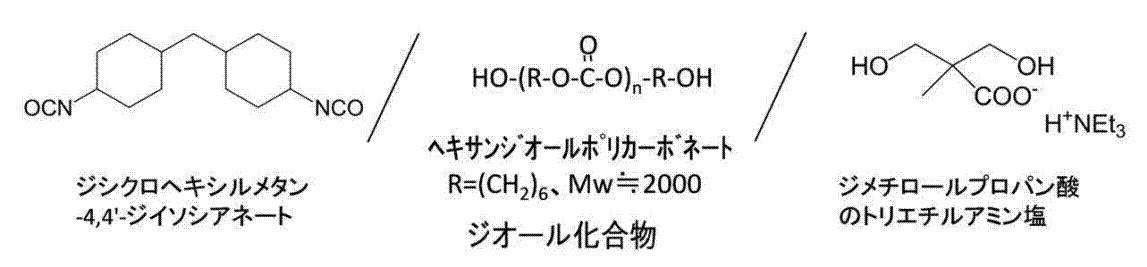
ヘキサンジオールポリカーボネート(分子量:2000)58.5g、ジシクロヘキシルメタン-4,4’-ジイソシアネート30g、ジメチロールプロパン酸11.5g、及びメチルエチルケトン150gを、還流冷却器、温度計及びスターラーを取り付けた1リットル容量の4つ口フラスコ内で混合し、窒素雰囲気下で室温より90℃まで30分間要して、昇温した後、2時間ウレタン化反応を行った。次いで、このウレタン化反応後のポリマー含有溶液にトリエチルアミン8.7gを加えて、中和されたウレタン系樹脂を含有する溶液(ラテックス)を得た。
1.画像記録
記録基材としては、表面処理工程におけるエキシマ処理として、Ex-Mini(浜松ホトニクス社製)を用いて、1500mJ/cm2のエネルギーで露光(表面処理)を行ったポリプロピレン不織布(繊維面密度:30g/m2、厚み:600μm、繊維径:20μm)を用いた。なお、Ex-Miniは、キセノンガスを用いてエキシマ発光させて光照射可能な装置であり、露光に用いた光の発光中心波長は、172nmである。
表面処理後のポリプロピレン不織布に対して、上記のように調製したマゼンタインクをPolaris PQ(FUJIFILM Dimatix社製)にて60plの液滴量で吐出し、200dpiの100%ベタ画像を記録した(インク付与工程)。得られたベタ画像をナイロンメッシュ台上に密着させ、不織布の画像非記録面側からドライヤで風速7m/s、温度40℃の温風を30秒間あて、乾燥、定着を行った(乾燥定着工程)。このようにして、画像サンプルを得た。
上記で得た画像サンプルについて、以下の測定及び評価を行った。測定及び評価の結果を下記の表1~表3に示す。
得られた画像サンプルの画像部について、ウェット(WET)状態での摩擦耐性(耐擦性)を評価した。
学振式摩擦試験機(No.428、安田精機社製)を用い、画像サンプルの画像部を、水0.05mlで湿らせた白綿(湿らせる面積として20mm×20mm)で、20mm×20mmの面積に2N(ニュートン)の力をかけて10回往復で擦り、白綿への色移りの有無及び色移りの程度を目視により確認し、下記の評価基準に従って、画像の耐擦性を評価した。耐擦性は、評価基準のうちA~Cが許容範囲である。
<評価基準>
A:画像部を10回往復で擦っても白綿への色移りはみられなかった。
B:画像部を10回往復で擦ると白綿への薄く色が転写している箇所が僅かに見られた。
C:画像部を10回往復で擦ると白綿の擦り部全面(20mm×20mm)に濃度の低い色移りがみられたが、その色移りは実用上支障を来たさない程度であった。
D:画像部を10回往復で擦ると白綿の擦り部全面(20mm×20mm)に画像部と同レベルの濃い色移りがみられ、その色移りは実用上支障を来たす可能性がある程度であった。
得られた画像サンプルの画像部について、画像濃度を評価した。グレタグマクベス社の光学濃度計にて、画像サンプルの画像部の光学濃度(OD)を測定し、得られた測定値に基づき、以下の評価基準に従って、画像濃度を評価した。
<評価基準>
A:OD≧0.35
B:0.35>OD≧0.3
C:0.3>OD≧0.25
D:0.25>OD
得られた画像サンプルの画像部について、風合いを評価した。画像サンプルの画像部を指で触って得られた触感、及び画像サンプルの画像部を折り曲げた後の観察結果に基づき、下記評価基準に従って、画像の風合いを評価した。風合いは、評価基準のうちA~Cが許容範囲である。
<評価基準>
A:画像部を指で触ると、滑らかな触感が得られ、画像部を折り曲げても折り跡がつかない。
B:画像部を指で触ると、やや指が引っかかる触感があるが、画像部を折り曲げても折り跡はつかない。
C:画像部を指で触ると、やや指が引っかかる触感があり、画像部を折り曲げるとうっすらと折り跡がつくが、実用上使用可能なレベルであった。
D:画像部を指で触ると、指の滑りが悪く、画像部を折り曲げると折り跡がつき、実用上問題のあるレベルであった。
実施例1のインク組成において、ウレタン樹脂のカチオン(対イオン)形成のための化合物をトリエチルアミン(NEt3)からトリブチルアミン(NBu3)に変更した以外は、実施例1と同様にしてマゼンタインクを調製し、実施例1と同様に不織布に対して画像記録を行い、得られたサンプル画像の画像部について、評価を行った。
実施例1のインク組成において、ウレタン樹脂のカチオン(対イオン)形成のための化合物をトリエチルアミン(NEt3)からピリジン(Pyridine)に変更した以外は、実施例1と同様にしてマゼンタインクを調製し、実施例1と同様に不織布に対して画像記録を行い、得られたサンプル画像の画像部について、評価を行った。
実施例1のインク組成において、ウレタン樹脂のカチオン(対イオン)形成のための化合物をトリエチルアミン(NEt3)からモルホリンに変更した以外は、実施例1と同様にしてマゼンタインクを調製し、実施例1と同様に不織布に対して画像記録を行い、得られたサンプル画像の画像部について、評価を行った。
実施例1のインク組成において、ウレタン樹脂のカチオン(対イオン)形成のための化合物をトリエチルアミン(NEt3)からジメチルアミノピリジン(DMAP)に変更した以外は、実施例1と同様にしてマゼンタインクを調製し、実施例1と同様に不織布に対して画像記録を行い、得られたサンプル画像の画像部について、評価を行った。
実施例1のインク組成において、ウレタン系樹脂のラテックスをアクリル系樹脂のラテックスに変更した以外は、実施例1と同様にしてマゼンタインクを調製し、実施例1と同様に不織布に対して画像記録を行い、得られたサンプル画像の画像部について、評価を行った。
アクリル系樹脂のラテックスにおいて、溶剤以外のモノマー組成は下記の通りであり、GPCにより測定したアクリル系樹脂の重量平均分子量は10万である。なお、本実施例のアクリル系樹脂には、モノマーを重合後にトリエチルアミンにて中和されたトリエチルアミン塩を用いた。
・シクロヘキシルメタクリレート・・・35質量%
・メトキシポリエチレングリコールアクリレート・・・58質量%
・メタクリル酸・・・7質量%
実施例6のインク組成において、トリエチルアミン(NEt3)のカチオン(対イオン)をナトリウム(Na)イオンに変更した以外は、実施例6と同様にしてマゼンタインクを調製し、実施例1と同様に不織布に対して画像記録を行い、得られたサンプル画像の画像部について、評価を行った。
実施例1のインク組成において、ウレタン系樹脂の構成について、ヘキサンジオールポリカーボネートの重量平均分子量を200に変更した以外は、実施例1と同様にしてマゼンタインクを調製し、実施例1と同様に不織布に対して画像記録を行い、得られたサンプル画像の画像部について、評価を行った。
実施例1のインク組成において、ウレタン系樹脂の構成について、ヘキサンジオールポリカーボネートの重量平均分子量を500に変更した以外は、実施例1と同様にしてマゼンタインクを調製し、実施例1と同様に不織布に対して画像記録を行い、得られたサンプル画像の画像部について、評価を行った。
実施例1のインク組成において、ウレタン系樹脂の構成について、ヘキサンジオールポリカーボネートの重量平均分子量を20000に変更した以外は、実施例1と同様にしてマゼンタインクを調製し、実施例1と同様に不織布に対して画像記録を行い、得られたサンプル画像の画像部について、評価を行った。
実施例1のインク組成において、ウレタン系樹脂の構成について、ヘキサンジオールポリカーボネートの重量平均分子量を25000に変更した以外は、実施例1と同様にしてマゼンタインクを調製し、実施例1と同様に不織布に対して画像記録を行い、得られたサンプル画像の画像部について、評価を行った。
実施例1のインク組成において、ウレタン系樹脂の構成について、重量平均分子量2000のヘキサンジオールポリカーボネートを重量平均分子量500のポリカプロラクトンジオールに変更した以外は、実施例1と同様にしてマゼンタインクを調製し、実施例1と同様に不織布に対して画像記録を行い、得られたサンプル画像の画像部について、評価を行った。
実施例1のインク組成において、ウレタン系樹脂の構成について、重量平均分子量2000のヘキサンジオールポリカーボネートを重量平均分子量2000のポリカプロラクトンジオールに変更した以外は、実施例1と同様にしてマゼンタインクを調製し、実施例1と同様に不織布に対して画像記録を行い、得られたサンプル画像の画像部について、評価を行った。
実施例1のインク組成において、ウレタン系樹脂の構成について、重量平均分子量2000のヘキサンジオールポリカーボネートを重量平均分子量20000のポリカプロラクトンジオールに変更した以外は、実施例1と同様にしてマゼンタインクを調製し、実施例1と同様に不織布に対して画像記録を行い、得られたサンプル画像の画像部について、評価を行った。
実施例1のインク組成において、ウレタン系樹脂の構成について、重量平均分子量2000のヘキサンジオールポリカーボネートを重量平均分子量2000のポリプロピレングリコールに変更した以外は、実施例1と同様にしてマゼンタインクを調製し、実施例1と同様に不織布に対して画像記録を行い、得られたサンプル画像の画像部について、評価を行った。
実施例1のインク組成において、ウレタン系樹脂の構成について、重量平均分子量2000のヘキサンジオールポリカーボネートを分子量2000のポリテトラメチレングリコールに変更した以外は、実施例1と同様にしてマゼンタインクを調製し、実施例1と同様に不織布に対して画像記録を行い、得られたサンプル画像の画像部について、評価を行った。
実施例1のインク組成において、ウレタン系樹脂の酸価を48mmol/gから100mmol/gに変更した以外は、実施例1と同様にしてマゼンタインクを調製し、実施例1と同様に不織布に対して画像記録を行い、得られたサンプル画像の画像部について、評価を行った。
実施例1のインク組成において、ウレタン系樹脂の酸価を48mmol/gから200mmol/gに変更した以外は、実施例1と同様にしてマゼンタインクを調製し、実施例1と同様に不織布に対して画像記録を行い、得られたサンプル画像の画像部について、評価を行った。
実施例1のインク組成において、ウレタン系樹脂の酸価を48mmol/gから280mmol/gに変更した以外は、実施例1と同様にしてマゼンタインクを調製し、実施例1と同様に不織布に対して画像記録を行い、得られたサンプル画像の画像部について、評価を行った。
実施例1のインク組成において、トリエチルアミン(NEt3)のカチオン(対イオン)をナトリウム(Na)イオンに変更した以外は、実施例1と同様にしてマゼンタインクを調製し、実施例1と同様に不織布に対して画像記録を行い、得られたサンプル画像の画像部について、評価を行った。
実施例1のインク組成において、トリエチルアミン(NEt3)のカチオン(対イオン)をカリウム(K)イオンに変更した以外は、実施例1と同様にしてマゼンタインクを調製し、実施例1と同様に不織布に対して画像記録を行い、得られたサンプル画像の画像部について、評価を行った。
実施例1のインク組成において、光源の照度を50mW/cm2から10mW/cm2に変更した以外は、実施例1と同様にしてマゼンタインクを調製し、実施例1と同様に不織布に対して画像記録を行い、得られたサンプル画像の画像部について、評価を行った。
実施例1のインク組成において、光源の照度を50mW/cm2から30mW/cm2に変更した以外は、実施例1と同様にしてマゼンタインクを調製し、実施例1と同様に不織布に対して画像記録を行い、得られたサンプル画像の画像部について、評価を行った。
実施例1のインク組成において、光源の照度を50mW/cm2から200mW/cm2に変更した以外は、実施例1と同様にしてマゼンタインクを調製し、実施例1と同様に不織布に対して画像記録を行い、得られたサンプル画像の画像部について、評価を行った。
実施例1のインク組成において、光源の照度を50mW/cm2から500mW/cm2に変更した以外は、実施例1と同様にしてマゼンタインクを調製し、実施例1と同様に不織布に対して画像記録を行い、得られたサンプル画像の画像部について、評価を行った。
実施例1のインク組成において、照射時間を2秒から0.01秒に変更した以外は、実施例1と同様にしてマゼンタインクを調製し、実施例1と同様に不織布に対して画像記録を行い、得られたサンプル画像の画像部について、評価を行った。
実施例1のインク組成において、照射時間を2秒から0.1秒に変更した以外は、実施例1と同様にしてマゼンタインクを調製し、実施例1と同様に不織布に対して画像記録を行い、得られたサンプル画像の画像部について、評価を行った。
実施例1のインク組成において、照射時間を2秒から5秒に変更した以外は、実施例1と同様にしてマゼンタインクを調製し、実施例1と同様に不織布に対して画像記録を行い、得られたサンプル画像の画像部について、評価を行った。
実施例1のインク組成において、照射時間を2秒から10秒に変更した以外は、実施例1と同様にしてマゼンタインクを調製し、実施例1と同様に不織布に対して画像記録を行い、得られたサンプル画像の画像部について、評価を行った。
前処理をしていない不織布を用いたこと以外は、実施例1と同様にしてマゼンタインクを調製し、実施例1と同様に不織布に対して画像記録を行い、得られたサンプル画像の画像部について、評価を行った。
前処理をしていない不織布を用い、更にウレタン系樹脂のラテックスをアクリル系樹脂のラテックスに変更した以外は、実施例1と同様にしてマゼンタインクを調製し、実施例1と同様に画像記録を行い、得られたサンプル画像の画像部について、評価を行った。
エキシマ発光させた光の照射による前処理の代わりに、下記のコロナ処理条件でコロナ処理をした不織布を用いたこと以外は、実施例1と同様にしてマゼンタインクを調製し、不織布に対して実施例1と同様に画像記録を行い、得られたサンプル画像の画像部について、評価を行った。
~コロナ処理条件~
コロナマスター(信光電気計社製、PS-10S)を用いて、処理電圧:5kV、処理速度:50mm/secの条件で2回コロナ処理を行った。
エキシマ発光させた光の照射による前処理の代わりに、メタルハライド水銀ランプ(商品名:VzeroII-85、ネオプト社製)の照射による処理をした不織布を用いたこと以外は、実施例1と同様にしてマゼンタインクを調製し、不織布に対して画像記録を行い、得られたサンプル画像の画像部について、評価を行った。
実施例1と同様にしてマゼンタインクを調製し、不織布の代わりに、ポリプロピレンフィルムに対して実施例1と同様に画像記録を行い、得られたサンプル画像の画像部について、評価を行った。
ウレタン系樹脂のラテックスをアクリル系樹脂のラテックスに変更した以外は、実施例1と同様にしてマゼンタインクを調製し、不織布の代わりに、ポリプロピレンフィルムに対して実施例1と同様に画像記録を行い、得られたサンプル画像の画像部について、評価を行った。
実施例1と同様にしてマゼンタインクを調製し、不織布の代わりに、前処理をしていないポリプロピレンフィルムに対して、実施例1と同様に画像記録を行い、得られたサンプル画像の画像部について、評価を行った。
実施例1と同様にしてマゼンタインクを調製し、不織布の代わりに、コロナ処理をしたポリプロピレンフィルムに対して、実施例1と同様に画像記録を行い、得られたサンプル画像の画像部について、評価を行った。
実施例1と同様にしてマゼンタインクを調製し、不織布の代わりに、メタルハライド水銀ランプの照射による処理をしたポリプロピレンフィルムに対して、実施例1と同様に画像記録を行い、得られたサンプル画像の画像部について、評価を行った。


表2の結果から、不織布に記録された画像の耐擦性及び風合いは、インクに、適度な分子量のジオール化合物、適度な酸価、及び適度な対イオンを有するウレタン系樹脂を、ラテックスとして含ませることにより向上することが明らかとなった。
表3の結果から、エキシマ発光させた光の適度な照射時間が、不織布に記録された画像の耐擦性及び風合いの両方の向上に重要であることが明らかとなった。
また、記録基材としてフィルムを用いた場合には、コロナ処理の方が、エキシマ発光させた光の照射による前処理よりも画像濃度及び画像の耐擦性に優れるが、記録基材として不織布を用いた場合には、コロナ処理の方が、エキシマ発光させた光の照射による前処理よりも画像濃度及び画像の耐擦性が劣ることが明らかとなった。
以上の結果から、エキシマ発光させた光の照射による記録基材の前処理と、記録基材としての不織布との組合せが、画像の耐擦性、画像濃度、及び画像の風合いに対して、優れた効果を発揮することが示唆される。
実施例1~29において、「1.画像記録」で画像サンプルを得た後、画像記録に使用したPolaris PQのプリントヘッドを、下記の表4及び表5に示す各メンテナンス液(メンテナンス液1~8)に浸した布で覆い、温度25℃の環境下、3日間放置した。
3日間放置した後、再び上記「1.画像記録」と同じ方法にて画像サンプルを作製したところ、インクの吐出性に全く支障はなく、放置前と同様の画像サンプルを得ることができた。


・2-PIROL:Ashland社製
・MP Diol Glycol:ライオンデル社製
・MFTG:日本乳化剤社製
・DPG:ADEKA社製
・オルフィンE1010:日信化学工業(株)製のアセチレングリコール系界面活性剤
・サーフィノール104A:Air Products and Chemicals. Inc.社製のアセチレングリコール系界面活性剤
・BYK-024:ビックケミー・ジャパン(株)製のシリコーン系消泡剤
本明細書に記載された全ての文献、特許出願、及び技術規格は、個々の文献、特許出願、及び技術規格が参照により取り込まれることが具体的に、かつ、個々に記された場合と同程度に、本明細書中に参照により取り込まれる。
Claims (15)
- 非吸収性又は低吸収性の繊維材料の集合体である記録基材の画像記録面にキセノンガスを用いてエキシマ発光させた光を照射することで前記記録基材を表面処理する表面処理工程と、
前記表面処理後の前記記録基材の画像記録面にインクジェット法によりインク組成物を付与するインク付与工程と、
を含む画像記録方法。 - 前記繊維材料が、ポリプロピレンの繊維及びポリエチレンの繊維から選択される少なくとも1種である請求項1に記載の画像記録方法。
- 前記集合体が不織布である請求項1又は請求項2に記載の画像記録方法。
- 前記光の照射強度が、30mW/cm2~300mW/cm2である請求項1~請求項3のいずれか1項に記載の画像記録方法。
- 前記光の照射時間が、0.1秒~10秒である請求項1~請求項4のいずれか1項に記載の画像記録方法。
- 前記インク組成物は、色材と、水と、を含む請求項1~請求項5のいずれか1項に記載の画像記録方法。
- 前記色材が、顔料である請求項6に記載の画像記録方法。
- 前記インク組成物は、ウレタン系樹脂の粒子を含む請求項1~請求項7のいずれか1項に記載の画像記録方法。
- 前記ウレタン系樹脂が有機カチオンを対イオンとする有機塩である請求項8に記載の画像記録方法。
- 前記有機塩がトリエチルアミンカチオンを対イオンとするトリエチルアミン塩である請求項9に記載の画像記録方法。
- 前記ウレタン系樹脂は、ジイソシアネート化合物に由来する構造と、ジオール化合物に由来する構造と、カルボキシル基を含むジオール化合物の有機塩に由来する構造と、を含む請求項8~請求項10のいずれか1項に記載の画像記録方法。
- 前記ジオール化合物がジオールポリカーボネートである請求項11に記載の画像記録方法。
- 前記ジオール化合物の分子量が500~20000である請求項11又は請求項12に記載の画像記録方法。
- 前記ウレタン系樹脂は、酸価が10mmol/g~200mmol/gである請求項8~請求項13のいずれか1項に記載の画像記録方法。
- 請求項1~請求項14のいずれか1項に記載の画像記録方法によって記録された画像記録物。
Priority Applications (3)
| Application Number | Priority Date | Filing Date | Title |
|---|---|---|---|
| JP2016557735A JP6258520B2 (ja) | 2014-11-05 | 2015-10-29 | 画像記録方法及び画像記録物 |
| EP15857456.6A EP3192664B1 (en) | 2014-11-05 | 2015-10-29 | Image recording method and image record |
| US15/468,139 US10112414B2 (en) | 2014-11-05 | 2017-03-24 | Image recording method and image recorded article |
Applications Claiming Priority (4)
| Application Number | Priority Date | Filing Date | Title |
|---|---|---|---|
| JP2014-225616 | 2014-11-05 | ||
| JP2014225616 | 2014-11-05 | ||
| JP2015103945 | 2015-05-21 | ||
| JP2015-103945 | 2015-05-21 |
Related Child Applications (1)
| Application Number | Title | Priority Date | Filing Date |
|---|---|---|---|
| US15/468,139 Continuation US10112414B2 (en) | 2014-11-05 | 2017-03-24 | Image recording method and image recorded article |
Publications (1)
| Publication Number | Publication Date |
|---|---|
| WO2016072349A1 true WO2016072349A1 (ja) | 2016-05-12 |
Family
ID=55909075
Family Applications (1)
| Application Number | Title | Priority Date | Filing Date |
|---|---|---|---|
| PCT/JP2015/080582 Ceased WO2016072349A1 (ja) | 2014-11-05 | 2015-10-29 | 画像記録方法及び画像記録物 |
Country Status (4)
| Country | Link |
|---|---|
| US (1) | US10112414B2 (ja) |
| EP (1) | EP3192664B1 (ja) |
| JP (1) | JP6258520B2 (ja) |
| WO (1) | WO2016072349A1 (ja) |
Cited By (6)
| Publication number | Priority date | Publication date | Assignee | Title |
|---|---|---|---|---|
| JP2017226741A (ja) * | 2016-06-21 | 2017-12-28 | 株式会社リコー | インク、インクジェット印刷方法、インクジェット印刷装置および印刷物 |
| JP2020078931A (ja) * | 2018-11-12 | 2020-05-28 | 王子ホールディングス株式会社 | 記録シート及び記録物 |
| JP2020193269A (ja) * | 2019-05-28 | 2020-12-03 | 株式会社リコー | インク、インクの製造方法、印刷方法及び印刷装置 |
| JP2022505484A (ja) * | 2018-10-26 | 2022-01-14 | ザ プロクター アンド ギャンブル カンパニー | 防腐剤非含有インクで印刷されたグラフィックを有する吸収性物品及びその製造方法 |
| WO2024106276A1 (ja) * | 2022-11-18 | 2024-05-23 | 株式会社日本触媒 | 捺染インク用重合体、該重合体を含む捺染インク用エマルション、及び捺染インク |
| WO2025192141A1 (ja) * | 2024-03-15 | 2025-09-18 | 第一工業製薬株式会社 | 水系ポリウレタン樹脂の粉体又はその凝集物 |
Families Citing this family (1)
| Publication number | Priority date | Publication date | Assignee | Title |
|---|---|---|---|---|
| DE102018125750A1 (de) | 2018-10-17 | 2020-04-23 | Koenig & Bauer Ag | Verfahren zum Bedrucken einer Oberfläche eines nichtsaugenden Substrates mit einer von einer Tintenstrahldruckeinrichtung aufzubringenden Tinte |
Citations (4)
| Publication number | Priority date | Publication date | Assignee | Title |
|---|---|---|---|---|
| JP2004043662A (ja) * | 2002-07-12 | 2004-02-12 | Dainippon Ink & Chem Inc | フイルムの表面処理方法および積層フィルムの製造方法 |
| JP2007098656A (ja) * | 2005-09-30 | 2007-04-19 | Canon Inc | 印刷物の有する色素の無色化方法及びそのための装置 |
| JP2013075385A (ja) * | 2011-09-29 | 2013-04-25 | Fujifilm Corp | インクジェット記録物 |
| JP2015164799A (ja) * | 2014-02-04 | 2015-09-17 | 江沢事務器株式会社 | 印刷対象面改質装置 |
Family Cites Families (10)
| Publication number | Priority date | Publication date | Assignee | Title |
|---|---|---|---|---|
| JPS60226534A (ja) * | 1984-04-24 | 1985-11-11 | Shin Etsu Chem Co Ltd | 表面改質合成樹脂成形品 |
| JP2001088280A (ja) * | 1999-09-21 | 2001-04-03 | Tatsuta Electric Wire & Cable Co Ltd | 非接着性樹脂成形体への印刷方法、その印刷方法により表面印刷された電線・ケーブル及びその印刷装置 |
| KR101251244B1 (ko) | 2005-02-24 | 2013-04-08 | 바스프 에스이 | 방사선 경화성 수성 폴리우레탄 분산액 |
| US7527695B2 (en) * | 2006-06-21 | 2009-05-05 | Asahi Glass Company, Limited | Apparatus and method for cleaning substrate |
| BE1017538A3 (fr) * | 2007-04-04 | 2008-11-04 | Andre Hahn | Procede pour ameliorer la production d'une bande ou courroie transporteuse. |
| BR112012023996A2 (pt) | 2010-03-31 | 2016-08-02 | Lubrizol Advanced Mat Inc | composição aquosa de tinta para impressão a jato de tinta, e, imagem impressa por jato de tinta |
| JP5569795B2 (ja) | 2010-05-28 | 2014-08-13 | セイコーエプソン株式会社 | インクジェット記録用インク組成物 |
| JP5757405B2 (ja) * | 2011-04-01 | 2015-07-29 | 株式会社リコー | インクジェット用記録インクセット及びこれを用いたインクカートリッジ、インクジェット記録装置、画像形成方法及び画像形成物 |
| JP5425241B2 (ja) * | 2011-09-09 | 2014-02-26 | 富士フイルム株式会社 | 複層形成用インクセット、インクジェット記録方法、及び、印刷物 |
| US10273349B2 (en) * | 2013-03-12 | 2019-04-30 | Kurashiki Boseki Kabushiki Kaisha | Fibers for use in fiber-reinforced resin, and production method thereof |
-
2015
- 2015-10-29 EP EP15857456.6A patent/EP3192664B1/en active Active
- 2015-10-29 WO PCT/JP2015/080582 patent/WO2016072349A1/ja not_active Ceased
- 2015-10-29 JP JP2016557735A patent/JP6258520B2/ja active Active
-
2017
- 2017-03-24 US US15/468,139 patent/US10112414B2/en active Active
Patent Citations (4)
| Publication number | Priority date | Publication date | Assignee | Title |
|---|---|---|---|---|
| JP2004043662A (ja) * | 2002-07-12 | 2004-02-12 | Dainippon Ink & Chem Inc | フイルムの表面処理方法および積層フィルムの製造方法 |
| JP2007098656A (ja) * | 2005-09-30 | 2007-04-19 | Canon Inc | 印刷物の有する色素の無色化方法及びそのための装置 |
| JP2013075385A (ja) * | 2011-09-29 | 2013-04-25 | Fujifilm Corp | インクジェット記録物 |
| JP2015164799A (ja) * | 2014-02-04 | 2015-09-17 | 江沢事務器株式会社 | 印刷対象面改質装置 |
Cited By (9)
| Publication number | Priority date | Publication date | Assignee | Title |
|---|---|---|---|---|
| JP2017226741A (ja) * | 2016-06-21 | 2017-12-28 | 株式会社リコー | インク、インクジェット印刷方法、インクジェット印刷装置および印刷物 |
| JP2022505484A (ja) * | 2018-10-26 | 2022-01-14 | ザ プロクター アンド ギャンブル カンパニー | 防腐剤非含有インクで印刷されたグラフィックを有する吸収性物品及びその製造方法 |
| JP7203216B2 (ja) | 2018-10-26 | 2023-01-12 | ザ プロクター アンド ギャンブル カンパニー | 防腐剤非含有インクで印刷されたグラフィックを有する吸収性物品及びその製造方法 |
| JP2020078931A (ja) * | 2018-11-12 | 2020-05-28 | 王子ホールディングス株式会社 | 記録シート及び記録物 |
| JP7310559B2 (ja) | 2018-11-12 | 2023-07-19 | 王子ホールディングス株式会社 | 記録シート及び記録物 |
| JP2020193269A (ja) * | 2019-05-28 | 2020-12-03 | 株式会社リコー | インク、インクの製造方法、印刷方法及び印刷装置 |
| JP7275467B2 (ja) | 2019-05-28 | 2023-05-18 | 株式会社リコー | インク、インクの製造方法、印刷方法及び印刷装置 |
| WO2024106276A1 (ja) * | 2022-11-18 | 2024-05-23 | 株式会社日本触媒 | 捺染インク用重合体、該重合体を含む捺染インク用エマルション、及び捺染インク |
| WO2025192141A1 (ja) * | 2024-03-15 | 2025-09-18 | 第一工業製薬株式会社 | 水系ポリウレタン樹脂の粉体又はその凝集物 |
Also Published As
| Publication number | Publication date |
|---|---|
| EP3192664A1 (en) | 2017-07-19 |
| JP6258520B2 (ja) | 2018-01-10 |
| EP3192664B1 (en) | 2020-07-01 |
| US20170190188A1 (en) | 2017-07-06 |
| EP3192664A4 (en) | 2017-10-25 |
| US10112414B2 (en) | 2018-10-30 |
| JPWO2016072349A1 (ja) | 2017-08-03 |
Similar Documents
| Publication | Publication Date | Title |
|---|---|---|
| JP5635055B2 (ja) | 画像記録方法及び画像記録物 | |
| JP6258520B2 (ja) | 画像記録方法及び画像記録物 | |
| JP7218571B2 (ja) | 液体吐出装置、インクジェット記録方法及び顔料捺染インク組成物 | |
| US8727524B2 (en) | Image forming method | |
| JP2013193324A (ja) | 画像記録方法及び画像記録物 | |
| JP5881570B2 (ja) | 画像記録方法及び画像記録物 | |
| US11124667B2 (en) | Inkjet ink compositions | |
| TW201720883A (zh) | 印刷方法 | |
| CN113597486B (zh) | 喷墨印花用外涂液、喷墨印花用油墨组及喷墨印花方法 | |
| JP7320384B2 (ja) | インクジェット捺染用インク及びインクセット | |
| JP5705695B2 (ja) | インクジェット記録物 | |
| TW201631061A (zh) | 墨水 | |
| JPWO2020090212A1 (ja) | インクジェット用水性インク、印刷物の製造方法、及びインクセット | |
| JP2021038279A (ja) | 捺染インクジェット用水性インク、及び捺染物の製造方法 | |
| JP7154431B2 (ja) | 着色樹脂粒子分散物、インク、インクセット、インクジェット捺染方法、油溶性染料の製造方法、及び捺染物 | |
| WO2023042761A1 (ja) | インクジェット用処理液、及び、インクジェット捺染装置 | |
| JP2013018282A (ja) | 画像形成方法 | |
| CN115726204A (zh) | 染料印染用处理液组合物、组合物组、印染方法及喷墨印染方法 | |
| JP2014177098A (ja) | 画像形成方法 | |
| JP2022158815A (ja) | 印刷方法、印刷装置 | |
| JP2024102676A (ja) | 捺染用インクジェットインク、画像形成方法及び画像形成装置 | |
| US20220127787A1 (en) | Inkjet printing | |
| CN116607339A (zh) | 染料印染用处理液组合物、组合物套装、印染方法和喷墨印染方法 |
Legal Events
| Date | Code | Title | Description |
|---|---|---|---|
| 121 | Ep: the epo has been informed by wipo that ep was designated in this application |
Ref document number: 15857456 Country of ref document: EP Kind code of ref document: A1 |
|
| ENP | Entry into the national phase |
Ref document number: 2016557735 Country of ref document: JP Kind code of ref document: A |
|
| REEP | Request for entry into the european phase |
Ref document number: 2015857456 Country of ref document: EP |
|
| WWE | Wipo information: entry into national phase |
Ref document number: 2015857456 Country of ref document: EP |
|
| NENP | Non-entry into the national phase |
Ref country code: DE |