WO2016072448A1 - エンドキシラナーゼ変異体、バイオマス分解用酵素組成物及び糖液の製造方法 - Google Patents
エンドキシラナーゼ変異体、バイオマス分解用酵素組成物及び糖液の製造方法 Download PDFInfo
- Publication number
- WO2016072448A1 WO2016072448A1 PCT/JP2015/081151 JP2015081151W WO2016072448A1 WO 2016072448 A1 WO2016072448 A1 WO 2016072448A1 JP 2015081151 W JP2015081151 W JP 2015081151W WO 2016072448 A1 WO2016072448 A1 WO 2016072448A1
- Authority
- WO
- WIPO (PCT)
- Prior art keywords
- endoxylanase
- amino acid
- seq
- acid sequence
- mutant
- Prior art date
- Legal status (The legal status is an assumption and is not a legal conclusion. Google has not performed a legal analysis and makes no representation as to the accuracy of the status listed.)
- Ceased
Links
Images

Classifications
-
- C—CHEMISTRY; METALLURGY
- C12—BIOCHEMISTRY; BEER; SPIRITS; WINE; VINEGAR; MICROBIOLOGY; ENZYMOLOGY; MUTATION OR GENETIC ENGINEERING
- C12P—FERMENTATION OR ENZYME-USING PROCESSES TO SYNTHESISE A DESIRED CHEMICAL COMPOUND OR COMPOSITION OR TO SEPARATE OPTICAL ISOMERS FROM A RACEMIC MIXTURE
- C12P19/00—Preparation of compounds containing saccharide radicals
- C12P19/14—Preparation of compounds containing saccharide radicals produced by the action of a carbohydrase (EC 3.2.x), e.g. by alpha-amylase, e.g. by cellulase, hemicellulase
-
- C—CHEMISTRY; METALLURGY
- C12—BIOCHEMISTRY; BEER; SPIRITS; WINE; VINEGAR; MICROBIOLOGY; ENZYMOLOGY; MUTATION OR GENETIC ENGINEERING
- C12N—MICROORGANISMS OR ENZYMES; COMPOSITIONS THEREOF; PROPAGATING, PRESERVING, OR MAINTAINING MICROORGANISMS; MUTATION OR GENETIC ENGINEERING; CULTURE MEDIA
- C12N15/00—Mutation or genetic engineering; DNA or RNA concerning genetic engineering, vectors, e.g. plasmids, or their isolation, preparation or purification; Use of hosts therefor
- C12N15/09—Recombinant DNA-technology
-
- C—CHEMISTRY; METALLURGY
- C12—BIOCHEMISTRY; BEER; SPIRITS; WINE; VINEGAR; MICROBIOLOGY; ENZYMOLOGY; MUTATION OR GENETIC ENGINEERING
- C12N—MICROORGANISMS OR ENZYMES; COMPOSITIONS THEREOF; PROPAGATING, PRESERVING, OR MAINTAINING MICROORGANISMS; MUTATION OR GENETIC ENGINEERING; CULTURE MEDIA
- C12N5/00—Undifferentiated human, animal or plant cells, e.g. cell lines; Tissues; Cultivation or maintenance thereof; Culture media therefor
-
- C—CHEMISTRY; METALLURGY
- C12—BIOCHEMISTRY; BEER; SPIRITS; WINE; VINEGAR; MICROBIOLOGY; ENZYMOLOGY; MUTATION OR GENETIC ENGINEERING
- C12N—MICROORGANISMS OR ENZYMES; COMPOSITIONS THEREOF; PROPAGATING, PRESERVING, OR MAINTAINING MICROORGANISMS; MUTATION OR GENETIC ENGINEERING; CULTURE MEDIA
- C12N9/00—Enzymes; Proenzymes; Compositions thereof; Processes for preparing, activating, inhibiting, separating or purifying enzymes
- C12N9/14—Hydrolases (3)
- C12N9/24—Hydrolases (3) acting on glycosyl compounds (3.2)
- C12N9/2402—Hydrolases (3) acting on glycosyl compounds (3.2) hydrolysing O- and S- glycosyl compounds (3.2.1)
- C12N9/2477—Hemicellulases not provided in a preceding group
- C12N9/248—Xylanases
- C12N9/2482—Endo-1,4-beta-xylanase (3.2.1.8)
-
- C—CHEMISTRY; METALLURGY
- C12—BIOCHEMISTRY; BEER; SPIRITS; WINE; VINEGAR; MICROBIOLOGY; ENZYMOLOGY; MUTATION OR GENETIC ENGINEERING
- C12P—FERMENTATION OR ENZYME-USING PROCESSES TO SYNTHESISE A DESIRED CHEMICAL COMPOUND OR COMPOSITION OR TO SEPARATE OPTICAL ISOMERS FROM A RACEMIC MIXTURE
- C12P19/00—Preparation of compounds containing saccharide radicals
- C12P19/02—Monosaccharides
-
- C—CHEMISTRY; METALLURGY
- C12—BIOCHEMISTRY; BEER; SPIRITS; WINE; VINEGAR; MICROBIOLOGY; ENZYMOLOGY; MUTATION OR GENETIC ENGINEERING
- C12Y—ENZYMES
- C12Y302/00—Hydrolases acting on glycosyl compounds, i.e. glycosylases (3.2)
- C12Y302/01—Glycosidases, i.e. enzymes hydrolysing O- and S-glycosyl compounds (3.2.1)
- C12Y302/01008—Endo-1,4-beta-xylanase (3.2.1.8)
-
- Y—GENERAL TAGGING OF NEW TECHNOLOGICAL DEVELOPMENTS; GENERAL TAGGING OF CROSS-SECTIONAL TECHNOLOGIES SPANNING OVER SEVERAL SECTIONS OF THE IPC; TECHNICAL SUBJECTS COVERED BY FORMER USPC CROSS-REFERENCE ART COLLECTIONS [XRACs] AND DIGESTS
- Y02—TECHNOLOGIES OR APPLICATIONS FOR MITIGATION OR ADAPTATION AGAINST CLIMATE CHANGE
- Y02E—REDUCTION OF GREENHOUSE GAS [GHG] EMISSIONS, RELATED TO ENERGY GENERATION, TRANSMISSION OR DISTRIBUTION
- Y02E50/00—Technologies for the production of fuel of non-fossil origin
- Y02E50/10—Biofuels, e.g. bio-diesel
Definitions
- the present invention relates to a novel endoxylanase mutant, an enzyme composition for decomposing biomass containing the same, and a method for producing a sugar solution.
- cellulose-containing biomass contains, in addition to cellulose, hemicelluloses such as xylan and arabinan, and lignin.
- Xylan has ⁇ -1,4-linked D-xylose as the main chain, and O-acetyl, ⁇ -arabinofuranosyl, glucuronic acid, and phenolic acid are partially modified to this main chain. (Non-patent Document 1).
- Xylanase is an important enzyme that degrades cellulose-containing biomass by acting on a ⁇ -1,4-linked xylose backbone.
- Xylanases are classified into Family 10 (GH10) and Family 11 (GH11) based on amino acid sequence homology (Non-patent Document 2).
- GH10 xylanase generally has a molecular weight of 30 kDa or more, whereas GH11 xylanase is generally said to have a molecular weight of about 20 kDa (Non-patent Document 3).
- Filamentous fungi are known as microorganisms that degrade a wide variety of cellulosic biomass.
- Cellulase produced by Acremonium cellulolyticus in the culture solution is known to obtain a higher glucose yield than the cellulase produced by Trichoderma reesei in the degradation of cellulose-containing biomass (Non-Patent Document) 4).
- Non-Patent Document 5 seven xylanases have been cloned from Acremonium cellulolyticus, and functional analysis of the wild-type enzyme has been carried out.
- XylC is reported to possess the highest xylan-degrading activity although it is the least expressed in Acremonium cellulolyticus.
- An object of the present invention is to provide a novel endoxylanase mutant with improved thermostability. Moreover, it is providing the enzyme agent containing this and the manufacturing method of an efficient sugar liquid.
- the present inventors have found that the amino acid sequence of filamentous fungal endoxylanase has positions 35, 44, 62, 63, and 101 of the amino acid sequence of SEQ ID NO: 1.
- the present inventors have found that the thermal stability of the endoxylanase can be improved by substituting an amino acid residue at a position corresponding to one or more positions selected from position 102 with another amino acid residue, and completed the present invention I came to let you. That is, the present invention has the following configuration.
- An endoxylanase variant comprising an amino acid sequence in which the amino acid residues are substituted and having endoxylanase activity.
- the amino acid residue at a position corresponding to position 44 and / or position 63 of the amino acid sequence of SEQ ID NO: 1 is from histidine, glycine, tryptophan, methionine, proline, alanine, phenylalanine, valine, leucine, and isoleucine,
- the amino acid residue at a position corresponding to position 101 and / or position 102 of the amino acid sequence of SEQ ID NO: 1 is substituted with any amino acid independently selected from proline and asparagine The endoxylanase mutant of any one of [1] to [3].
- any one of [1] to [4], wherein one or more amino acid residues selected from positions corresponding to position 61, position 65, and position 66 of the amino acid sequence of SEQ ID NO: 1 are substituted An endoxylanase variant.
- the amino acid residues at positions corresponding to position 35, position 44, position 61, position 62, position 63, position 65, position 66, position 101, and position 102 of the amino acid sequence of SEQ ID NO: 1 are all substituted.
- [7] The endoxylanase mutant of any one of [1] to [6], wherein the filamentous fungus-derived endoxylanase is derived from Acremonium cellulolyticus.
- An expression vector comprising the DNA of [9].
- a transformed cell produced by transformation using the expression vector of [10].
- a method for producing an endoxylanase mutant comprising culturing the transformed cell of [11] and obtaining an endoxylanase mutant produced by the transformed cell.
- An biomass decomposing enzyme composition comprising the endoxylanase mutant of any one of [1] to [8].
- the enzyme composition is one selected from the group consisting of cellobiohydrolase, endoglucanase, ⁇ -glucosidase, ⁇ -xylosidase, mannanase, mannosidase, glucoamylase, ⁇ -amylase, esterase, and lipase.
- the enzyme composition for decomposing biomass according to [13] further comprising two or more enzymes.
- a method for producing a sugar solution from the biomass comprising adding the enzyme composition for decomposing biomass according to [13] or [14] to the biomass.
- an endoxylanase mutant with improved thermostability can be provided.
- the endoxylanase mutant of the present invention has the effect that the thermal stability at high temperature conditions, specifically 65 ° C. or higher, is improved, and the xylan decomposition activity is also improved. Therefore, the endoxylanase mutant of the present invention and the enzyme composition containing the endoxylanase mutant of the present invention can be suitably used for producing a sugar solution from cellulose-containing biomass.
- FIG. 1 is a photograph showing the results of SDS-PAGE of the culture supernatant of yeast Pichia pastoris expressing wild-type endoxylanase or any of the endoxylanase mutants.
- M is a marker
- 1 is a wild-type endoxylanase
- 2 is an endoxylanase variant containing substitutions at positions 35 and 62
- 3 is position 35, position 44, position 62, position 61, position 65, position 63.
- Endoxylanase mutant is an enzyme having an activity of hydrolyzing hemicellulose (endoxylanase activity) by acting on a ⁇ -1,4-linked xylose main chain. It is an enzyme classified in the number 3.3.1.8. Endoxylanases are classified into two types, family 10 (GH10) and family 11 (GH11). The endoxylanase of the present invention is an enzyme classified into family 11 (GH11), and has a ⁇ -jelly roll structure. Possess.
- the “endoxylanase activity” can be measured using ⁇ -1,4-linked D-xylose as a substrate, preferably Birchwood xylan sold as a reagent as a substrate. Whether or not xylan as a substrate has been decomposed can be confirmed by measuring the amount of reducing sugar contained in the reaction solution after the reaction.
- the amount of reducing sugar can be measured by using the dinitrosalicylic acid method (DNS method), and Bailey et al. “Interlaboratory testing of methods for xylanase activity” J. Am. Biotechnol. 23, 257-270 can be preferably used.
- the conditions for measuring the activity are not particularly limited as long as the activity of endoxylanase can be measured by the method described above.
- a range of 20 ° C. to 90 ° C. preferably a range of 40 ° C. to 75 ° C.
- a pH of 4 to 9 is preferable
- a pH of 5 to 7 is more preferable
- a reaction time is It is preferably 1 second to 600 minutes, and most preferably 1 minute to 60 minutes.
- the xylan used as a substrate at the time of activity measurement is preferably in the range of 0.1% by weight to 10% by weight, and most preferably in the range of 0.5% by weight to 2% by weight.
- an endoxylanase can be used that is derived from a filamentous fungus, such as Trichoderma, Aspergillus, Cellulomonas, Clostridium, Streptomyces. ), Humicola, Acremonium, Irpex, Mucor, Talaromyces, and the like, preferably those derived from the genus Acremonium.
- the endoxylanase isolated from Acremonium cellulolyticus can be particularly preferably used as the endoxylanase of the present invention.
- the endoxylanase of Acremonium cerulolyticus is known. For example, it is registered in GenBank etc. as AB874990, AB8749991, AB8749992, AB874993, AB874994, AB874949, AB874949, and these gene information is used in the present invention. be able to.
- the endoxylanase preferably includes the amino acid sequence represented by SEQ ID NO: 1 or consists of the amino acid sequence.
- the endoxylanase includes a part of the endoxylanase as long as the endoxylanase activity is maintained.
- “part of endoxylanase” means at least 40%, 50%, 60%, 70%, 80%, 90%, 95%, 99% or more of the original endoxylanase activity.
- it consists of a fragment of endoxylanase from which any partial region has been removed. Examples of such a fragment include those obtained by removing the signal peptide region from endoxylanase.
- the signal peptide include a region represented by the amino acid sequence from position 1 to position 34 in the amino acid sequence represented by SEQ ID NO: 1.
- a part of the endoxylanase includes the amino acid sequence represented by SEQ ID NO: 2 or consists of the amino acid sequence.
- the “endoxylanase variant” of the present invention corresponds to position 35, position 44, position 62, position 63, position 101, and position 102 of the amino acid sequence of SEQ ID NO: 1 in the amino acid sequence of “endoxylanase” described above. It means a protein having an endoxylanase activity in which amino acid residues at one or more positions selected from positions are substituted with another amino acid. More preferably, the endoxylanase variant of the present invention has two, three, or three selected from positions corresponding to position 35, position 44, position 62, position 63, position 101, and position 102 of the amino acid sequence of SEQ ID NO: 1. Contains 4, 4, 5 or 6 amino acid substitutions. Particularly preferably, the endoxylanase variant of the invention comprises amino acid substitutions at all six positions corresponding to position 35, position 44, position 62, position 63, position 101 and position 102 of the amino acid sequence of SEQ ID NO: 1. .
- the “endoxylanase mutant” of the present invention has higher heat resistance than the endoxylanase not containing the amino acid substitution by including the amino acid substitution at the above position.
- amino acid positions specified by “positions corresponding to position 35, position 44, position 62, position 63, position 101, and position 102 of the amino acid sequence of SEQ ID NO: 1” are as follows: It can be determined by a method including procedures 1) to 3).
- Procedure 2 Next, the amino acid positions corresponding to position 35, position 44, position 62, position 63, position 101, and position 102 of the amino acid sequence represented by SEQ ID NO: 1 in the amino acid sequence of the above endoxylanase are determined. .
- the corresponding amino acid position can be determined by aligning the amino acid sequence of the endoxylanase with the amino acid sequence of SEQ ID NO: 1. Such an operation is called amino acid sequence alignment.
- the alignment tool many well-known software such as ClustalW is used, and default parameters are used.
- amino acid position corresponding to position 102 can be determined.
- the amino acid substitution at each position is not particularly limited as long as it is a substitution with another amino acid, and preferably includes substitution with the following amino acids: Position 35: cysteine; Position 44: histidine, glycine, tryptophan, methionine, proline, alanine, phenylalanine, valine, leucine or isoleucine, preferably histidine; Position 62: cysteine; Position 63: histidine, glycine, tryptophan, methionine, proline, alanine, phenylalanine, valine, leucine or isoleucine, preferably leucine; Position 101: proline, or asparagine, preferably proline; Position 102: Proline or asparagine, preferably asparagine.
- amino acids at positions corresponding to positions 35 and 62 are both substituted with cysteine, whereby a disulfide bond can be formed on the cysteine side chain at the position.
- the amino acids at the positions corresponding to position 101 and position 102 may remain as wild-type amino acids without being substituted.
- the positions corresponding to positions 101 and 102 may be included in the amino acid sequence that undergoes sugar chain modification in eukaryotes.
- the “endoxylanase variant” of the present invention includes amino acid substitution at a position selected from positions corresponding to position 35, position 44, position 62, position 63, position 101, and position 102 of the amino acid sequence of SEQ ID NO: 1.
- amino acid substitution at one or more positions selected from position 61, position 65, and position corresponding to position 66 of the amino acid sequence of SEQ ID NO: 1 may be included.
- the heat resistance can be further increased.
- the endoxylanase variant of the present invention further comprises two or three amino acid substitutions selected from position 61, position 65 and the position corresponding to position 66 of the amino acid sequence of SEQ ID NO: 1. More preferably, the endoxylanase variant of the present invention further comprises amino acid substitutions at three positions corresponding to position 61, position 65, and position 66 of the amino acid sequence of SEQ ID NO: 1.
- the amino acid substitution at each position may be any substitution with another amino acid, and is not particularly limited, but includes substitution with the following amino acids: Position 61: glycine, tryptophan, methionine, proline, alanine, phenylalanine, valine, leucine or isoleucine, preferably methionine; Position 65: proline; Position 66: Glycine, tryptophan, methionine, proline, alanine, phenylalanine, valine, leucine or isoleucine, preferably glycine.
- the endoxylanase variant of the present invention has one or more positions selected from position 35, position 44, position 62, position 63, position 101, and position 102 in the amino acid sequence of SEQ ID NO: 1.
- a polypeptide having or having an endoxylanase activity having an amino acid sequence in which the amino acid is substituted or a part thereof. Examples of the “part thereof” include polypeptides from which the signal peptide region has been removed.
- endoxylanase variants include the following: An endoxylanase variant containing a substitution for cysteine at position 35, comprising or consisting of the amino acid sequence of SEQ ID NO: 3 (the amino acid sequence of SEQ ID NO: 3 contains the region of the signal peptide) Absent); An endoxylanase variant containing a substitution to cysteine at position 62, comprising or consisting of the amino acid sequence of SEQ ID NO: 5 (the amino acid sequence of SEQ ID NO: 5 contains the region of the signal peptide) Absent); An endoxylanase variant containing a substitution to cysteine at both positions 35 and 62, and comprising or consisting of the amino acid sequence of SEQ ID NO: 9 (the amino acid sequence of SEQ ID NO: 9 contains the above signal Does not include the peptide region); An endoxylanase variant comprising a substitution for histidine at position 44, comprising or consisting of the amino acid sequence of SEQ ID NO: 4 (the amino acid sequence of SEQ ID
- the endoxylanase variant of the invention has a substitution in the amino acid sequence of SEQ ID NO: 1 in addition to a substitution of a position selected from position 35, position 44, position 62, position 63, position 101, and position 102.
- the endoxylanase variant of the present invention has the amino acid sequence of SEQ ID NO: 1 at seven positions of position 35, position 44, position 62, position 63, position 61, position 65, and position 66.
- the polypeptide includes or consists of a polypeptide having an amino acid sequence substituted with an amino acid or a part thereof and having endoxylanase activity. More specifically, such an endoxylanase variant includes or consists of the amino acid sequence of SEQ ID NO: 45 (the amino acid sequence of SEQ ID NO: 45 does not include the signal peptide region).
- the endoxylanase variant of the present invention has a position 35, position 44, position 62, position 63, position 101, position 102, position 61, position 65, and position in the amino acid sequence of SEQ ID NO: 1.
- the polypeptide comprises or consists of a polypeptide having an amino acid sequence in which amino acids at 9 positions of 66 are substituted or a part thereof and having endoxylanase activity. More specifically, such an endoxylanase mutant includes or consists of the amino acid sequence of SEQ ID NO: 10 (the amino acid sequence of SEQ ID NO: 10 does not include the signal peptide region).
- the endoxylanase mutant of the present invention includes the amino acid position 35, position 44, position 61, position 62, position 63, position 65, position 66, position 101 in the amino acid sequence of the endoxylanase mutant or a part thereof. Also included are proteins in which the substituted amino acid at position 102 is not mutated, has a deletion, substitution, addition or insertion of one or several amino acids and has endoxylanase activity.
- the range of “1 or several” is not particularly limited, but is, for example, within 10 pieces, more preferably within 5 pieces, particularly preferably within 4 pieces, or 1 piece or 2 pieces.
- the endoxylanase mutant of the present invention also has the amino acid position 35, position 44, position 61, position 62, position 63, position 65, position 66, position in the amino acid sequence of the endoxylanase mutant or a part thereof.
- 101 and the amino acid substituted at position 102 is not mutated, and except for the amino acid, the above endoxylanase mutant or a part of the amino acid sequence thereof and BLAST ((Basic Local Alignment Tool National Center for Biological) Information (basic local alignment search tool of the National Center for Biological Information)) etc.
- identity refers to identical amino acids and similarities to all overlapping amino acid residues in an optimal alignment when two amino acid sequences are aligned with or without introducing a gap. It means the percentage of amino acid residues.
- sequence analysis software for example, known algorithms such as BLAST and FASTA.
- the endoxylanase mutant of the present invention may have an additional peptide or protein added to the N-terminus and / or C-terminus.
- additional peptide or protein examples include those containing methionine as a translation initiation point, secretory signal sequence, transport protein, binding protein, tag peptide for purification, heterologous hydrolase, fluorescent protein and the like.
- those skilled in the art can select a peptide or protein having a function to be added according to the purpose and add it to the endoxylanase mutant of the present invention.
- the endoxylanase mutant of the present invention is prepared, for example, by preparing DNA encoding the amino acid sequence of the endoxylanase mutant described in (1) above, and ligating it to an expression vector. It can be produced by introducing an expression vector into a host, producing it as a heterologous or homologous protein, and isolating and purifying it.
- the codon usage frequency encoding the amino acid sequence may be the same as the filamentous fungus derived from endoxylanase, for example, Acremonium cellulolyticus (Acremonium cellulolyticus), or may be changed according to the codon usage frequency of the host. Good.
- a conventionally known method can be used as a method for preparing the DNA encoding the above-mentioned endoxylanase mutant. For example, a method of totally synthesizing a DNA encoding a target amino acid sequence by gene synthesis, or a filamentous form A DNA encoding an endoxylanase isolated from a bacterium or a part thereof is mutated so that the DNA encoding the amino acid at the predetermined position encodes another predetermined amino acid by site-directed mutagenesis. The method etc. which introduce
- transduce are mentioned.
- a site-specific mutagenesis method for causing mutation at a target site of DNA it can be carried out by a conventional and commonly used PCR method.
- DNA encoding the endoxylanase of the present invention it is particularly preferable to use a DNA encoding endoxylanase isolated from Acremonium cellulolyticus.
- DNA encoding endoxylanase encodes a signal peptide from DNA comprising the base sequence represented by SEQ ID NO: 32, DNA comprising the base sequence, or the base sequence represented by SEQ ID NO: 32 DNA containing the base sequence represented by SEQ ID NO: 33 from which the region to be removed has been removed or DNA comprising the base sequence can be used.
- These DNAs can be obtained by isolating DNA from Acremonium cellulolyticus according to a known method and amplifying the DNA by a technique such as PCR.
- the DNA encoding the endoxylanase variant of the present invention is 1 or 2 selected from amino acid position 35, position 44, position 62, position 63, position 101, and position 102 in the amino acid sequence of SEQ ID NO: 1. It contains or consists of a DNA encoding a polypeptide having an amino acid sequence in which amino acids in the above positions are substituted or a part thereof and having endoxylanase activity.
- the DNA encoding such an endoxylanase variant includes the following: DNA encoding an endoxylanase variant containing a substitution for cysteine at position 35, comprising or consisting of the base sequence of SEQ ID NO: 34 (the DNA does not encode the signal peptide region) ); DNA encoding an endoxylanase variant containing a cysteine substitution at position 62 and comprising or consisting of the base sequence of SEQ ID NO: 36 (the DNA does not encode the signal peptide region) ); DNA encoding an endoxylanase mutant containing a substitution to cysteine at both positions 35 and 62, and comprising the base sequence of SEQ ID NO: 40 or consisting of the base sequence (the DNA comprises the signal peptide Is not coded)); DNA encoding an endoxylanase variant containing a substitution for histidine at position 44 and comprising or consisting of the base sequence of SEQ ID NO: 35 (the DNA does not encode the region of the signal peptide)
- the DNA encoding the endoxylanase variant of the present invention has a substitution at position 61 in addition to the four substitutions at positions 35, 44, 62 and 63 described above in the amino acid sequence of SEQ ID NO: 1.
- the DNA encoding such an endoxylanase mutant includes the base sequence of SEQ ID NO: 49 or consists of the base sequence (the DNA does not encode the signal peptide region).
- the DNA encoding the endoxylanase variant of the present invention has six substitutions at position 35, position 44, position 62, position 63, position 101 and position 102 described above in the amino acid sequence of SEQ ID NO: 1.
- it has an amino acid sequence including a substitution at position 61 with methionine, a substitution at position 65 with aspartic acid, and a substitution at position 66 with asparagine, or a part thereof, and has endoxylanase activity
- the DNA encoding such an endoxylanase mutant includes the base sequence of SEQ ID NO: 41 or consists of the base sequence (the DNA does not encode the signal peptide region).
- the DNA encoding the endoxylanase mutant of the present invention includes amino acids substituted at amino acid position 35, position 44, position 61, position 62, position 63, position 65, position 66, position 101, and position 102.
- DNA containing the following base sequence or DNA consisting of the base sequence is also included: A base sequence in which one or more bases are deleted, substituted, added or inserted in the above base sequence.
- SEQ ID NO: 1 1 to 100 bases, preferably 1 to 50 bases, more preferably 1 to 10 bases are deleted, substituted, added or inserted.
- Sequence A nucleotide sequence having 80% or more, more preferably 90% or more, still more preferably 95% or more, and most preferably 99% or more of the above nucleotide sequence. Comparison of base sequences can be performed by a known method, for example, BLAST or the like can be performed using, for example, default settings; A base sequence that hybridizes under stringent conditions with DNA comprising a sequence complementary to the above base sequence. “Stringent conditions” refers to conditions under which so-called specific hybrids are formed and non-specific hybrids are not formed. For example, 2 to 6 ⁇ SSC (composition of 1 ⁇ SSC: 0.15M NaCl, 0 Hybridization is performed at 42 to 55 ° C.
- a DNA encoding the endoxylanase mutant prepared as described above is ligated downstream of a promoter in an appropriate expression vector using a restriction enzyme and DNA ligase to produce an expression vector containing the DNA. Can do.
- expression vectors include bacterial plasmids, yeast plasmids, phage DNA (such as lambda phage), retrovirus, baculovirus, vaccinia virus, adenovirus and other viral DNA, SV40 derivatives, and other Agrobacterium as a vector for plant cells. Any other vector can be used as long as it can replicate and survive in the host cell. For example, when the host is E. coli, pUC, pET, pBAD and the like can be exemplified.
- pPink-HC When the host is yeast, pPink-HC, pPink-LC, pPink ⁇ -HC, pPCIZ, pPCIZ ⁇ , pPCI6, pPCI6 ⁇ , pFLD1, pFLD1 ⁇ , pGAPZ, pGAPZ ⁇ , pPIC9K, pPIC9, pD912, pD915, etc.
- the promoter may be any promoter as long as it is appropriate for the host used for gene expression.
- the host is Escherichia coli
- lac promoter, Trp promoter, PL promoter, PR promoter and the like are used.
- AOX1 promoter, TEF1 promoter, ADE2 promoter, CYC1 promoter, GAL-L1 promoter, GAP promoter and the like can be mentioned. It is done.
- the host cells used in the present invention are preferably Escherichia coli, bacterial cells, yeast cells, fungal cells, insect cells, plant cells, animal cells and the like.
- yeast cells include the genus Pichia, the genus Saccharomyces, and the genus Schizosaccharomyces.
- fungal cells include Aspergillus and Trichoderma. Insect cells include Sf9, plant cells include dicotyledonous plants, and animal cells include CHO, HeLa, HEK293, and the like.
- the host used in the present invention is preferably a eukaryotic microorganism, more preferably a yeast cell or a fungal cell. When yeast cells or fungal cells are used as a host, there may be advantages such that the enzyme production is large, the enzyme can be secreted and produced outside the cell, and / or the heat resistance of the enzyme can be increased.
- Transformation or transfection can be performed by a known method such as a calcium phosphate method or an electroporation method.
- the endoxylanase mutant of the present invention can be obtained by expressing the product in the host cell transformed or transfected as described above under the control of a promoter and recovering the product.
- transformed or transfected host cells are propagated or grown to an appropriate cell density and then chemically induced means such as temperature shift or addition of isopropyl-1-thio- ⁇ -D-galactoside (IPTG)
- IPTG isopropyl-1-thio- ⁇ -D-galactoside
- the promoter is induced by and the cells are further cultured for a period of time.
- the promoter can be induced by the sugar contained in the medium, and the cells can be cultured and expressed simultaneously.
- endoxylanase mutant When the desired endoxylanase mutant is excreted outside the cell, it is directly from the medium, and when it is outside the cell, physical means such as ultrasonic disruption or mechanical disruption, or a cell lysing agent, etc.
- the endoxylanase mutant is purified after cell destruction by chemical means.
- endoxylanase variants can be obtained from recombinant cell culture using ammonium sulfate or ethanol precipitation, acid extraction, anion or cation exchange chromatography, reverse phase high performance liquid chromatography, affinity chromatography, gel filtration chromatography. It can be partially or completely purified by combining techniques such as electrophoresis.
- the biomass enzyme composition of the present invention contains at least the endoxylanase mutant of the present invention as an active ingredient for hydrolyzing biomass, and decomposes biomass. It is an enzyme composition used for a use.
- the biomass refers to a biological plant, and examples thereof include herbaceous plants, woody plants, algae, seaweeds, sugar-producing crops, resource crops, and grains. These biomasses all contain disaccharides or more, and can be hydrolyzed by the enzyme composition for biomass decomposition of the present invention.
- Cellulose-containing biomass can be particularly preferably used.
- Cellulose-containing biomass is a biological resource containing a cellulose component.
- herbaceous biomass such as bagasse, switchgrass, napiergrass, Eliansus, corn stover, rice straw and wheat straw, or woody biomass such as trees and waste building materials, algae, seaweed, etc. It refers to biomass.
- cellulosic biomass contains lignin, which is an aromatic polymer, in addition to cellulose and hemicellulose (hereinafter referred to as “cellulose” as a generic term for cellulose and hemicellulose).
- the endoxylanase mutant contained in the biomass decomposing enzyme composition of the present invention can be used either purified or roughly purified.
- the endoxylanase mutant contained in the enzyme composition for biomass degradation of the present invention may be immobilized on a solid phase.
- the solid phase include, but are not limited to, polyacrylamide gel, polystyrene resin, porous glass, and metal oxide.
- the endoxylanase mutant of the present invention is advantageous in that it can be used continuously and repeatedly by being immobilized on a solid phase.
- a processed product of cells transformed with DNA encoding the endoxylanase mutant can also be used as a crudely purified endoxylanase mutant.
- the “processed product of transformed cells” includes transformed cells immobilized on a solid phase, killed and disrupted transformed cells, and those obtained by immobilizing them on a solid phase.
- the enzyme composition for degrading biomass of the present invention may contain other enzymes in addition to the endoxylanase mutant of the present invention.
- a hydrolase related to biomass degradation is preferably included.
- examples of such other enzymes include cellobiohydrolase, endoglucanase, ⁇ -glucosidase, ⁇ -xylosidase, mannanase, mannosidase, glucoamylase, ⁇ -amylase, esterase, lipase, and the like.
- These other enzymes are preferably enzymes produced by microorganisms such as filamentous fungi.
- filamentous fungi include Trichoderma, Aspergillus, Cellulomonas, Clostridium, Streptomyces, Humicora, and Humicola.
- microorganisms such as the genus Irpex (Irpex), the genus Mucor (Mucor), and the genus Talaromyces (Talaromyces). Since these microorganisms produce an enzyme in the culture solution, the culture solution may be used as an unpurified enzyme as it is, together with the endoxylanase mutant of the present invention, to form the enzyme composition of the present invention.
- the purified and formulated product may be combined with the endoxylanase mutant of the present invention to form the enzyme composition of the present invention.
- the filamentous fungus for producing the other enzymes is preferably a filamentous fungus derived from the genus Trichoderma.
- a cellulase mixture derived from Trichoderma reesei can be more preferably used.
- Trichoderma reesei QM9414 Trichoderma reesei QM9414
- Trichoderma reesei QM9123 Trichoderma reesei QM9123
- Trichoderma reeseiRutC-30er Tricoderma reesei RutC-30er
- Trichoderma reesei PC3-7 Trichoderma reesei CL-847 (Trichoderma reesei CL-847), Trichoderma reesei MCG77 (Trichoderma reesei MCG77), Trichoderma reesei MCGer 80
- Cellulase mixtures thereof derived from dermatan viride QM9123 Trichoderma viride QM9123
- it may be a mutant strain derived from the genus Trichoderma and subjected to a mutation treatment with a mutation agent or ultraviolet
- the enzyme composition for decomposing biomass of the present invention may be added with substances other than enzymes, such as protease inhibitors, dispersants, dissolution promoters, stabilizers, buffers, preservatives, and the like.
- the enzyme composition for decomposing biomass of the present invention can be used in a method for producing a sugar solution by adding it to biomass.
- the sugar solution as used herein refers to a solution containing a saccharide obtained by hydrolyzing at least a polysaccharide derived from biomass into a saccharide having a lower molecular weight.
- the sugar component in the sugar solution include xylose, glucose, cellobiose, xylobiose, xylotriose, xylotetraose, xylopentaose, mannose, arabinose, sucrose, fructose and the like.
- the sugar solution obtained using the enzyme composition contains xylose, xylobiose, xylotriose, xylotetraose, xylopenta. Often contains aus.
- the biomass used in the production of the sugar solution may be any biomass as long as it is described above.
- a biomass pretreated for the purpose of increasing the sugar yield from the biomass can be used. Pretreatment refers to partially decomposing lignin and hemicellulose using biomass, such as acid, alkali, and pressurized hot water.
- an enzyme composition for decomposing biomass is added to biomass, and the temperature is 40 ° C. to 100 ° C., the treatment pH is 3 to 7, and the biomass concentration is 0.1 to 30%. It is preferable to react. By setting to this range, it is possible to maximize the degradation efficiency of the enzyme composition for biomass degradation of the present invention.
- the enzyme composition for decomposing biomass used in the method for producing a sugar liquid of the present invention can be recovered and further reused.
- the endoxylanase mutant contained in the recovered enzyme composition for degrading biomass is 50% or more, 60% or more, 70% or more, or 80% or more, preferably 90, before being subjected to the sugar liquid production method. % Activity can be retained.
- the enzyme composition for decomposing biomass can be collected by the following method. After adding the enzyme composition for biomass decomposition to biomass and performing a hydrolysis reaction, the hydrolyzate is solid-liquid separated.
- the solution component obtained by solid-liquid separation includes the biomass decomposing enzyme composition and the sugar component, and the biomass decomposing enzyme composition and the sugar component are separated by filtration using an ultrafiltration membrane.
- the molecular weight cut-off can pass through monosaccharides and oligosaccharides (disaccharides to 10 sugars). There is no limitation as long as it can be prevented.
- the molecular weight cut off may be in the range of 2,000 to 50,000, and from the viewpoint of separating impurities that inhibit the enzyme reaction from the enzyme, more preferably the molecular weight cut off is 5,000 to 5,000.
- the molecular weight is in the range of 50,000, more preferably in the range of 10,000 to 30,000 in the molecular weight cut-off.
- Ultrafiltration membrane materials include polyethersulfone (PES), polysulfone (PS), polyacrylonitrile (PAN), polyvinylidene fluoride (PVDF), regenerated cellulose, cellulose, cellulose ester, sulfonated polysulfone, and sulfonated polyether.
- PES polyethersulfone
- PS polysulfone
- PAN polyacrylonitrile
- PVDF polyvinylidene fluoride
- regenerated cellulose cellulose, cellulose ester
- Sulfone, polyolefin, polyvinyl alcohol, polymethyl methacrylate, polytetrafluoroethylene and the like can be used, but it is preferable to use an ultrafiltration membrane made of a synthetic polymer such as PES or PVDF.
- the endoxylanase mutant contained in the biomass degrading enzyme composition includes the position 35, position 44, position 62, It is more preferable to include an endoxylanase variant having the amino acid sequence of SEQ ID NO: 10 in which amino acids at 9 positions of position 63, position 101, position 102, position 61, position 65, and position 66 are substituted.
- the sugar liquid obtained by the method for producing a sugar liquid of the present invention contains monosaccharide components such as glucose and xylose, it can be used as a raw sugar such as ethanol and lactic acid.
- the sugar liquid obtained by the method for manufacturing a sugar liquid of the present invention contains xylooligosaccharide, xylobiose, xylotriose, etc., it can be used as an oligosaccharide for prebiotic applications, and is a human health food. Can be used as livestock feed.
- Trichoderma reesei ATCC 66589 (distributed from ATCC) was inoculated to this preculture medium so as to be 1 ⁇ 10 5 cells / mL, and cultured at 28 ° C. for 72 hours with shaking at 180 rpm to prepare a preculture (shaking).
- Apparatus BIO-SHAKER BR-40LF manufactured by TAITEC).
- ATG in the nucleotide sequence CATATG at the NdeI site of pET11a is used as a translation start point as a methionine codon and contains a stop codon “TAG” at the 3 ′ end.
- PET11a containing the nucleotide sequence of SEQ ID NO: 33 was cloned into BL21 (DE3) strain (Novagen).
- the obtained recombinant BL21 (DE3) strain was cultured in LB medium containing ampicillin sodium 100 mg / L at 37 ° C. until OD600 became 0.6, and then isopropyl- ⁇ -D-1-thiogalactopyrano Sid (IPTG) 200 ⁇ M was added to induce expression of wild-type endoxylanase having the amino acid sequence of SEQ ID NO: 2. Expression was induced by incubating the medium at 16 ° C. for 20 hours, and then the recombinant BL21 (DE3) strain was collected by centrifugation at 4 ° C.
- the collected cells were resuspended in Tris buffer pH 8 (20 mM Tris HCl, 50 mM NaCl).
- the buffer containing the bacterial cells is completely frozen at -80 ° C for 1 hour and then thawed at room temperature for a total of 3 times to extract soluble proteins in the bacterial cells into the buffer solution. It was. Thereafter, the buffer solution was centrifuged at 18,000 rpm for 20 minutes at 4 ° C. to separate into a supernatant and cell residue.
- the supernatant was passed through a Q-HP column (GE) pre-equilibrated with Tris buffer (20 mM, pH 8), the target endoxylanase was adsorbed on the column, and then eluted with a NaCl concentration gradient. .
- GE Q-HP column
- a solution having a NaCl concentration of 200 to 400 mM was collected. Thereafter, the endoxylanase fraction was further dialyzed against Tris buffer (20 mM, pH 8, 2M NaCl), and then passed through a Butyl HP column (GE) to adsorb endoxylanase.
- Endoxylanase was eluted with a NaCl concentration gradient, and the fraction eluted with 1 M NaCl was collected. The fraction was further purified through a Superdex 200 16/60 gel filtration column (GE). The obtained purified endoxylanase was confirmed for impurities by SDS-PAGE.
- Example 1 Preparation of DNA encoding endoxylanase mutant containing substitution of any one of position 35, position 44, position 62, position 63, position 101, position 102 and recombinant expression by E. coli
- Production of a DNA encoding an endoxylanase mutant containing any one substitution of position 35, position 44, position 62, position 63, position 101, and position 102 was performed by the following procedure.
- Table 1 shows pET11a containing a base sequence (SEQ ID NO: 33) encoding an amino acid sequence (SEQ ID NO: 2) excluding the signal peptide consisting of the N-terminal 34 amino acid residues from wild-type endoxylanase as a template (Comparative Example 1).
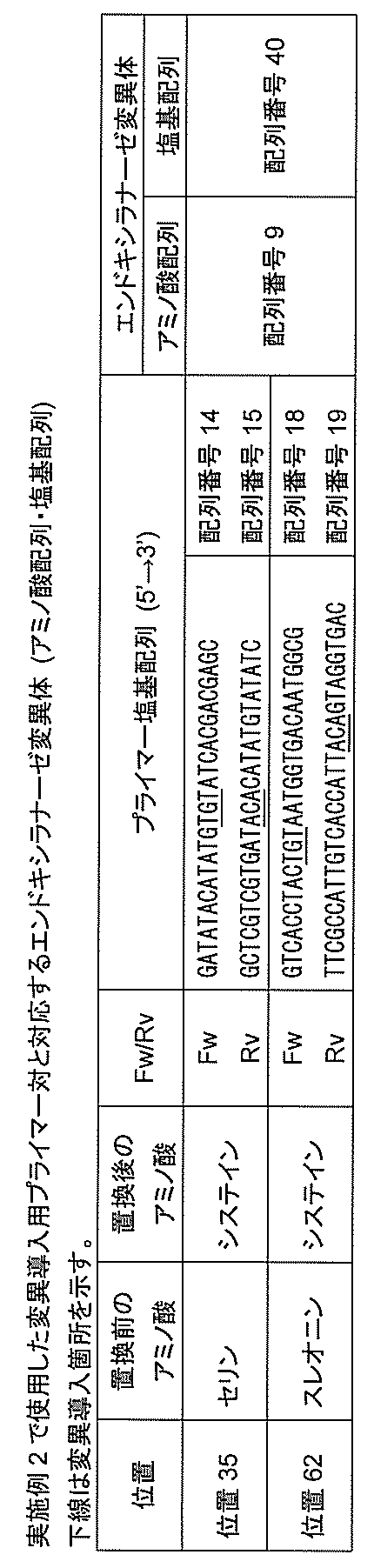
- a DNA encoding an endoxylanase mutant having an amino acid substitution at a predetermined position was prepared by performing PCR using the described primer pair (Fw: forward primer, Rv: reverse primer). For the PCR, PrimeSTAR MaxDNA Polymerase kit (Takara Bio Inc.) was used. The primer pairs used are shown in Table 1 (SEQ ID NO: 14 to SEQ ID NO: 25).
- the base sequence of the DNA encoding the obtained endoxylanase mutant (starting from the amino acid at position 35) is SEQ ID NO: 34, SEQ ID NO: 35, SEQ ID NO: 36, SEQ ID NO: 37, SEQ ID NO: 38, SEQ ID NO: 39. (Table 1).
- the amino acid sequences of the respective endoxylanase mutants are shown in SEQ ID NO: 3, SEQ ID NO: 4, SEQ ID NO: 5, SEQ ID NO: 6, SEQ ID NO: 7, and SEQ ID NO: 8.
- the obtained DNA encoding the endoxylanase mutant was cloned into pET11a according to the procedure of Comparative Example 1. Next, using pET11a containing DNA encoding the endoxylanase mutant, the protein was expressed and purified according to the procedure of Comparative Example 1 to obtain each endoxylanase mutant.
- Example 2 Production of DNA encoding endoxylanase mutant containing two substitutions at positions 35 and 62 and recombinant expression by Escherichia coli Endoxylanase mutation introduced in Example 1 with mutation introduced at position 35
- pET11 containing DNA encoding the body SEQ ID NO: 3
- SEQ ID NO: 18 and SEQ ID NO: 19 A DNA (SEQ ID NO: 40) encoding an endoxylanase variant with two substitutions into was generated.
- the primer pairs used for this mutagenesis are the two types shown in Table 2.
- the base sequence of the DNA encoding the produced endoxylanase mutant is shown in SEQ ID NO: 9.
- the obtained DNA encoding the endoxylanase mutant was cloned into pET11a according to the procedure of Comparative Example 1.
- the protein was expressed and purified according to the procedure of Comparative Example 1, and the endoxylanase mutant (SEQ ID NO: 9) of Example 2 was obtained. It was.
- the nucleotide pairs of the DNAs encoding the primer pairs used and the obtained endoxylanase mutants are shown in SEQ ID NO: 42, SEQ ID NO: 43, and SEQ ID NO: 44 (Table 3).
- the amino acid sequences of the respective endoxylanase mutants are shown in SEQ ID NO: 11, SEQ ID NO: 12, and SEQ ID NO: 13 (excluding the starting methionine).
- the obtained DNA encoding the endoxylanase mutant was cloned into pET11a according to the procedure of Comparative Example 1. Subsequently, pET11a containing DNA encoding the endoxylanase mutant was subjected to protein expression and purification according to the procedure of Comparative Example 1, and the mutant of Comparative Example 2 was obtained.
- Example 3 Production of DNA encoding endoxylanase mutant containing nine substitutions at position 35, position 44, position 62, position 63, position 101, position 102, position 61, position 65, position 66 and by E. coli Recombinant expression
- pET11 which was prepared in Example 2 and contains DNA (SEQ ID NO: 40) encoding an endoxylanase variant having two substitutions for cysteine at positions 35 and 62, respectively, position 44
- a DNA encoding an endoxylanase mutant having a substitution at each position was prepared.
- the primer pairs used for this mutagenesis are 9 types shown in Table 4.
- the nucleotide sequence of the DNA encoding the prepared endoxylanase mutant is shown in SEQ ID NO: 41.
- the amino acid sequence of the endoxylanase mutant is shown in SEQ ID NO: 10.
- the obtained DNA encoding the endoxylanase mutant was cloned into pET11a according to the procedure of Comparative Example 1. Subsequently, pET11a containing DNA encoding the endoxylanase mutant was subjected to protein expression and purification according to the procedure of Comparative Example 1 to obtain the endoxylanase mutant (SEQ ID NO: 10) of Example 3.
- Example 4 Endoxylanase activity measurement at each temperature of the endoxylanase mutant of Examples 1 to 3, the wild-type endoxylanase of Comparative Example 1 and the endoxylanase mutant of Comparative Example 2
- the endoxylanase activity was 1% Measurements were made using birchwood xylan (Sigma Aldrich) as a substrate. Birchwood xylan was hydrolyzed by endoxylanase, and the amount of reducing sugar produced was measured by the dinitrosalicylic acid method (DNS) method using xylose as a standard.
- DNS dinitrosalicylic acid method
- 1 unit of endoxylanase activity was defined as the amount of enzyme required to produce 1 ⁇ mol of xylose from birchwood xylan at 50 ° C. for 1 minute, and the number of units was calculated. Moreover, based on each calculated unit value, the relative activity value was put together in Table 5 by making the activity value of 55 degreeC especially in a wild type (comparative example 1) into a reference
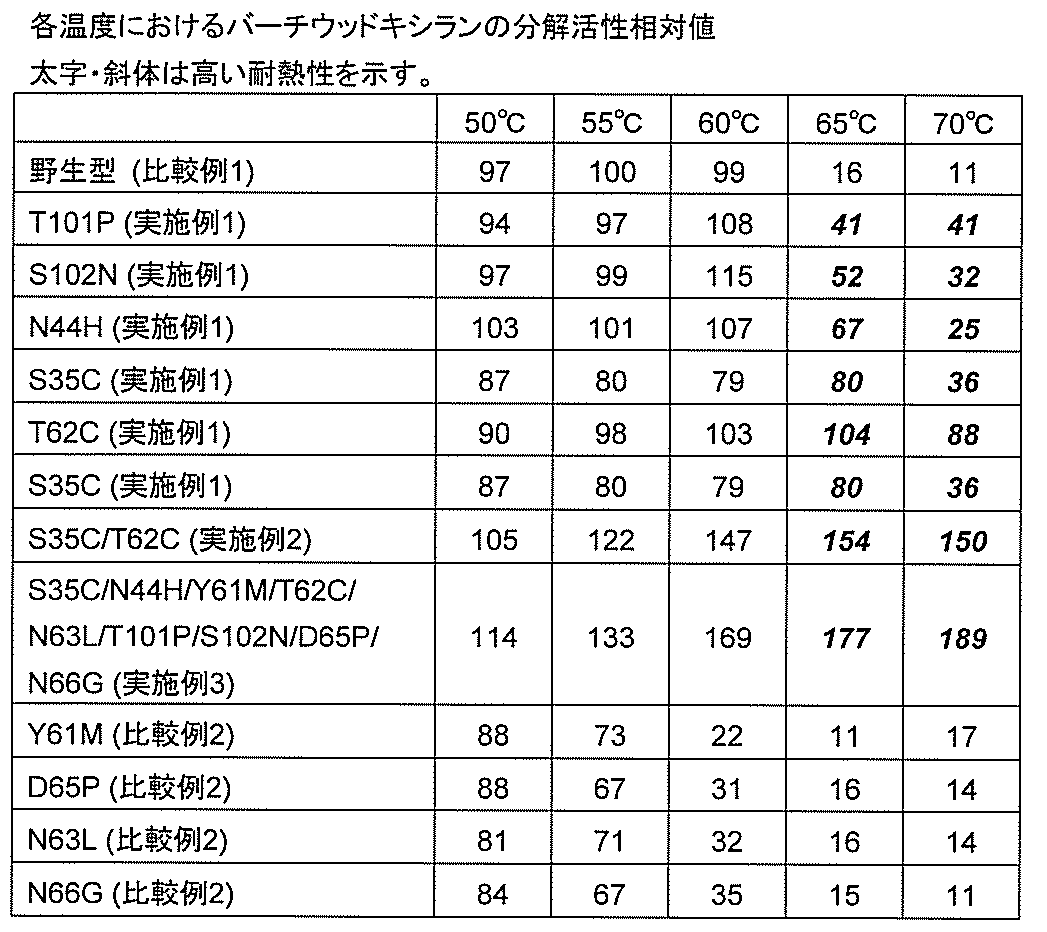
- an endoxylanase mutant containing a substitution at a position selected from position 35, position 44, position 62, position 63, position 101, and position 102 exhibits higher activity even under high temperature conditions than wild type endoxylanase. It was clarified that the heat resistance was enhanced by the mutation. In particular, high heat resistance was observed in the endoxylanase mutants containing substitutions at positions 61, 65, and 66 in addition to positions 35, 44, 62, 63, 101, and 102.
- Example 5 Method 1 for producing a sugar solution using an endoxylanase mutant An oligosaccharide liquid production was attempted using bagasse, which is a residue after sugarcane juice, as a raw material.
- the endoxylanase the wild-type endoxylanase of Comparative Example 1 or the endoxylanase mutant of Example 3 was used.
- immersion treatment was performed for 6 days in a 1N aqueous sodium hydroxide solution so that the biomass weight was 30% (w / w).
- 0.5 g of the pretreated product was weighed into a 2 mL tube, and after adding water so that the final concentration of biomass became 10% (w / w), the pH was adjusted to 5 using diluted sulfuric acid.
- Example 6 Production method 2 of sugar solution using endoxylanase mutant
- Trichoderma-derived cellulase Reference Example 2
- 10 mg / g-BM of Trichoderma-derived cellulase and 0.05 mg / g-BM of endoxylanase mutant (Example 3) were added to the composition adjusted to pH by the same method as in Example 5.
- the reaction was carried out at 50 ° C. for 48 hours using a thermoblock rotator (SN-48BN manufactured by Nisshin Rika).
- SN-48BN manufactured by Nisshin Rika
- Example 7 Endoxylanase residual activity after reaction in Example 5 Using 500 Vl of the supernatant obtained after the reaction obtained in Example 5 using VIVASPIN500 (PES, molecular weight cut-off 10,000) (Sartorius) After ultrafiltration, the wild-type endoxylanase of Comparative Example 1 or the endoxylanase mutant of Example 3 was recovered. The recovered wild-type endoxylanase of Comparative Example 1 or the endoxylanase mutant of Example 3 and the wild-type endoxylanase of Comparative Example 1 diluted to the concentration at the time of xylan degradation (2.5 mg / l), the end of Example 3 The endoxylanase activity of the xylanase mutant was measured.
- VIVASPIN500 PES, molecular weight cut-off 10,000
- Endoxylanase activity was performed in the same manner as in Example 4 except that 1/10 of the collected endoxylanase or diluted endoxylanase was added and the reaction temperature was 50 ° C.
- the diluted activity values of the wild-type endoxylanase of Comparative Example 1 and the endoxylanase mutant of Example 3 as the standard (100%), respectively, the recovered wild-type endoxylanase of Comparative Example 1 and the endoxylanase mutant of Example 3 were recovered.
- the relative activity value was defined as the residual activity.
- Table 8 shows the residual activity after recovery.
- the endoxylanase mutant remained highly active after xylan degradation, confirming that it can be significantly reused for xylan degradation.
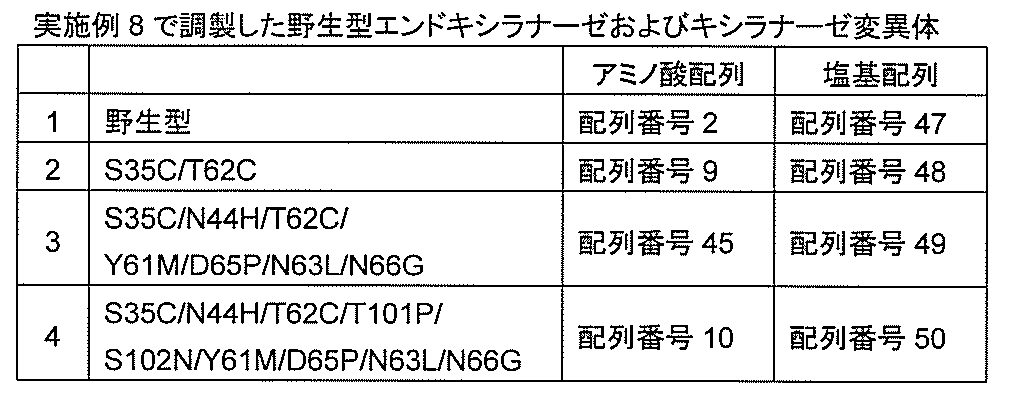
- Example 8 Expression of wild-type endoxylanase and endoxylanase mutants by yeast Pichia pastoris Base encoding an amino acid sequence (SEQ ID NO: 2) excluding a signal peptide consisting of 34 amino acid residues at the N-terminus from wild-type endoxylanase Using pET11a containing the sequence (SEQ ID NO: 33) as a template (Comparative Example 1), PCR was performed using the primer pair of SEQ ID NO: 51 and SEQ ID NO: 53, whereby SEQ ID NO: 54, SEQ ID NO: 47, and SEQ ID NO: 55 were obtained. DNAs encoding in order were prepared.
- PrimeSTAR MaxDNA Polymerase kit (Takara Bio Inc.) was used.
- the base sequence of SEQ ID NO: 54 is upstream of the base sequence (SEQ ID NO: 48) encoding the endoxylanase variant (SEQ ID NO: 9) containing two substitutions at positions 35 and 62, and the base sequence of SEQ ID NO: 55 is downstream.
- a DNA having the base sequence of SEQ ID NO: 54 added upstream and the base sequence of SEQ ID NO: 55 added downstream was artificially synthesized.
- a competent cell of Pichia pastoris PPS-9010 strain (DNA2.0 company) was prepared.
- a single colony of Pichia pastoris PPS-9010 strain in a 100 ml flask containing 20 ml of YPD liquid medium (yeast extract 1% (w / vol), peptone 2% (w / vol), glucose 2% (w / vol)) And incubating with shaking at 30 ° C. and 120 rpm for 16 hours (pre-culture).
- the culture solution was transferred to a 50 ml falcon tube and collected by centrifugation at 500 ⁇ g for 15 minutes.
- BEDS solution (10 mM bicine-sodium hydroxide buffer (pH 8.3), ethylene glycol 3% (vol / vol), dimethyl sulfoxide (DMSO) 5% (vol / vol), 9 ml of 1M sorbitol) was added and suspended gently, and 1 ml of 1M dithiothreitol (DTT) was further added, suspended gently, and shaken at 30 ° C. and 100 rpm for 5 minutes.
- DTT dithiothreitol
- the Falcon tube was cultured with shaking at 30 ° C. and 120 rpm for 1.5 hours, and 100 ⁇ L of the culture solution was added to a YPDS plate medium containing zeocin (1 mg / ml zeocin, yeast extract 1% (w / vol), peptone 2% (w / vol), glucose 2% (w / vol), 1M sorbitol, agar 2% (w / vol)) using a large rod and culturing at 30 ° C. for 2 to 3 days.
- zeocin 1 mg / ml zeocin, yeast extract 1% (w / vol), peptone 2% (w / vol), glucose 2% (w / vol), 1M sorbitol, agar 2% (w / vol)
- a colony having a large diameter was selected from the colonies generated on the plate, and each colony was inoculated and inoculated with a sterile toothpick into a 2 ml-deep 96-well plate with 0.5 ml of YPD liquid medium, and 4 at 28 ° C. and 1000 rpm. Cultured for days. The SDS-PAGE result of the culture supernatant is shown in FIG. It was confirmed that both proteins were secreted and expressed. In addition, since a band having a molecular weight larger than the molecular weight estimated from the primary structure was detected for the protein containing SEQ ID NOs: 2, 9, and 45, it was confirmed that sugar chain modification occurred in expression by Pichia.
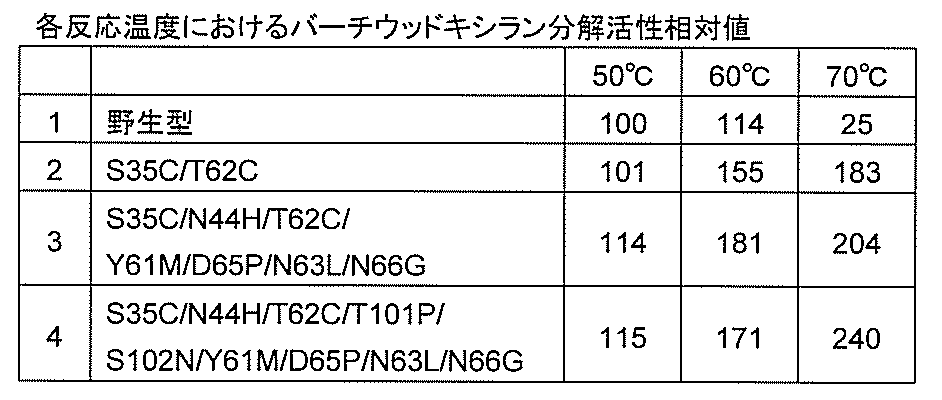
- Example 9 Activity comparison of endoxylanase variants Endoxylanase activity in the supernatants of various culture media obtained in Example 8 was measured. The activity was measured in the same manner as in Example 4 except that the supernatants of various culture solutions were added to 0.25 mg / mL and the reaction was performed at 50 ° C, 60 ° C, and 70 ° C. Based on the calculated unit values, the relative activity values are summarized in Table 11 with the activity value at 50 ° C. particularly in the wild type as a reference (100%). The supernatant containing the xylanase mutant retained high activity even under high temperature conditions. In addition, the enzyme expressed in yeast was found to have higher heat resistance as compared to the case expressed in E. coli in Example 4.
- the endoxylanase mutant in the present invention exhibits high xylan degrading activity under high temperature conditions, it can be used for biomass hydrolysis, sugar solution production, and oligosaccharide production.
Landscapes
- Chemical & Material Sciences (AREA)
- Life Sciences & Earth Sciences (AREA)
- Organic Chemistry (AREA)
- Engineering & Computer Science (AREA)
- Health & Medical Sciences (AREA)
- Zoology (AREA)
- Wood Science & Technology (AREA)
- Genetics & Genomics (AREA)
- Bioinformatics & Cheminformatics (AREA)
- General Engineering & Computer Science (AREA)
- Biotechnology (AREA)
- Biochemistry (AREA)
- General Health & Medical Sciences (AREA)
- Biomedical Technology (AREA)
- Microbiology (AREA)
- Molecular Biology (AREA)
- General Chemical & Material Sciences (AREA)
- Chemical Kinetics & Catalysis (AREA)
- Medicinal Chemistry (AREA)
- Cell Biology (AREA)
- Physics & Mathematics (AREA)
- Biophysics (AREA)
- Plant Pathology (AREA)
- Enzymes And Modification Thereof (AREA)
- Micro-Organisms Or Cultivation Processes Thereof (AREA)
- Preparation Of Compounds By Using Micro-Organisms (AREA)
Abstract
Description
[1] 糸状菌由来のエンドキシラナーゼのアミノ酸配列において、少なくとも配列番号1のアミノ酸配列の位置35、位置44、位置62、位置63、位置101、及び位置102に相当する位置から選択される一以上のアミノ酸残基が置換されているアミノ酸配列を含み、かつ、エンドキシラナーゼ活性を有する、エンドキシラナーゼ変異体。
[2] 配列番号1のアミノ酸配列の位置35、及び/又は位置62に相当する位置のアミノ酸残基が、システインに置換されている[1]のエンドキシラナーゼ変異体。
[3] 配列番号1のアミノ酸配列の位置44、及び/又は位置63に相当する位置のアミノ酸残基が、ヒスチジン、グリシン、トリプトファン、メチオニン、プロリン、アラニン、フェニルアラニン、バリン、ロイシン、及びイソロイシンから、それぞれ独立して選択されるいずれかのアミノ酸に置換されている、[1]又は[2]のエンドキシラナーゼ変異体。
[4] 配列番号1のアミノ酸配列の位置101、及び/又は位置102に相当する位置のアミノ酸残基が、プロリン、及びアスパラギンから、それぞれ独立して選択されるいずれかのアミノ酸に置換されている、[1]~[3]のいずれかのエンドキシラナーゼ変異体。
[5] さらに、配列番号1のアミノ酸配列の位置61、位置65、及び位置66に相当する位置から選択される一以上のアミノ酸残基が置換されている、[1]~[4]のいずれかのエンドキシラナーゼ変異体。
[6] 配列番号1のアミノ酸配列の位置35、位置44、位置61、位置62、位置63、位置65、位置66、位置101、及び位置102に相当する位置のアミノ酸残基が全て置換されている、[1]~[5]のいずれかのエンドキシラナーゼ変異体。
[7] 糸状菌由来のエンドキシラナーゼが、アクレモニウム・セルロリチカス(Acremonium cellulolyticus)に由来する、[1]~[6]のいずれかのエンドキシラナーゼ変異体。
[8] 以下の(a)から(c)のいずれかのアミノ酸配列からなり、かつエンドキシラナーゼ活性を有する、[1]~[7]のいずれかのエンドキシラナーゼ変異体:
(a)配列番号3,4,5,6,7,8,9,10又は45で示されるアミノ酸配列;
(b)配列番号3,4,5,6,7,8,9,10又は45で示されるアミノ酸配列において、位置35、位置44、位置61、位置62、位置63、位置65、位置66、位置101、及び位置102における置換されたアミノ酸は変異せず、1から数個のアミノ酸が欠失、置換、または付加されたアミノ酸配列;あるいは
(c)配列番号3,4,5,6,7,8,9,10又は45で示されるアミノ酸配列において、位置35、位置44、位置61、位置62、位置63、位置65、位置66、位置101、及び位置102における置換されたアミノ酸は変異せず、該アミノ酸を除いて、配列番号3,4,5,6,7,8,9,10又は45で示されるアミノ酸配列と90%以上の配列同一性を有するアミノ酸配列。
[9] [1]~[8]のいずれかのエンドキシラナーゼ変異体をコードするDNA。
[10] [9]のDNAを含む、発現ベクター。
[11] [10]の発現ベクターを用いた形質転換により作製された、形質転換細胞。
[12] [11]の形質転換細胞を培養し、該形質転換細胞により生産されたエンドキシラナーゼ変異体を得る工程を含む、エンドキシラナーゼ変異体の製造方法。
[13] [1]~[8]のいずれかのエンドキシラナーゼ変異体を含むバイオマス分解用酵素組成物。
[14] 前記酵素組成物が、セロビオハイドロラーゼ、エンドグルカナーゼ、β-グルコシダーゼ、β-キシロシダーゼ、マンナナーゼ、マンノシダ-ゼ、グルコアミラーゼ、α-アミラーゼ、エステラーゼ、リパーゼからなる群から選択される1または2種以上の酵素をさらに含む、[13]のバイオマス分解用酵素組成物。
[15] [13]又は[14]のバイオマス分解用酵素組成物を、バイオマスに添加することを含む、該バイオマスより糖液を製造する方法。
(1)エンドキシラナーゼ変異体
本発明において「エンドキシラナーゼ」とは、β-1,4結合したキシロース主鎖に作用することでヘミセルロースを加水分解する活性(エンドキシラナーゼ活性)を有する酵素であり、EC番号3.3.1.8に分類される酵素である。エンドキシラナーゼは、ファミリー10(GH10)とファミリー11(GH11)の2種に分類されるが、本発明のエンドキシラナーゼは、ファミリー11(GH11)に分類される酵素であり、β-ジェリーロール構造を保有する。「エンドキシラナーゼ活性」の測定は、β-1,4結合したD-キシロースを基質として、好ましくは、試薬として販売されているバーチウッドキシラン(Birchwood xylan)を基質として使用して行うことができる。基質であるキシランが分解されたか否かは、反応後の反応液に含まれる還元糖量を測定することで確認することができる。還元糖量は、ジニトロサリチル酸法(DNS法)を使用することで測定することができ、Baileyら“Interlaboratory testing of methods for assay of xylanase activity”J.Biotechnol.23,257-270に記載の方法が好ましく使用できる。活性を測定する条件は、前述した方法で、エンドキシラナーゼの活性を測定できれば特に限定はされない。活性測定のための、好ましい温度条件としては20℃~90℃の範囲、好ましくは、40℃~75℃の範囲、pHは4~9の範囲が好ましく、さらに好ましくはpH5~7、反応時間は、1秒から600分であることが好ましく、最も好ましくは1分から60分である。また活性測定時に基質として使用するキシランは、0.1重量%~10重量%の範囲が好ましく、最も好ましくは0.5重量%~2重量%の範囲である。
位置35:システイン;
位置44:ヒスチジン、グリシン、トリプトファン、メチオニン、プロリン、アラニン、フェニルアラニン、バリン、ロイシン、又はイソロイシン、好ましくはヒスチジン;
位置62:システイン;
位置63:ヒスチジン、グリシン、トリプトファン、メチオニン、プロリン、アラニン、フェニルアラニン、バリン、ロイシン、又はイソロイシン、好ましくはロイシン;
位置101:プロリン、又はアスパラギン、好ましくはプロリン;
位置102:プロリン、又はアスパラギン、好ましくはアスパラギン。
位置61:グリシン、トリプトファン、メチオニン、プロリン、アラニン、フェニルアラニン、バリン、ロイシン、又はイソロイシン、好ましくはメチオニン;
位置65:プロリン;
位置66:グリシン、トリプトファン、メチオニン、プロリン、アラニン、フェニルアラニン、バリン、ロイシン、又はイソロイシン、好ましくはグリシン。
位置35にシステインへの置換を含むエンドキシラナーゼ変異体であり、配列番号3のアミノ酸配列を含むか、当該アミノ酸配列からなる(配列番号3のアミノ酸配列には、上記シグナルペプチドの領域が含まれていない);
位置62にシステインへの置換を含むエンドキシラナーゼ変異体であり、配列番号5のアミノ酸配列を含むか、当該アミノ酸配列からなる(配列番号5のアミノ酸配列には、上記シグナルペプチドの領域が含まれていない);
位置35および位置62の両方の位置にシステインへの置換を含むエンドキシラナーゼ変異体であり、配列番号9のアミノ酸配列を含むか、当該アミノ酸配列からなる(配列番号9のアミノ酸配列には、上記シグナルペプチドの領域が含まれていない);
位置44にヒスチジンへの置換を含むエンドキシラナーゼ変異体であり、配列番号4のアミノ酸配列を含むか、当該アミノ酸配列からなる(配列番号4のアミノ酸配列には、上記シグナルペプチドの領域が含まれていない);
位置63にロイシンへの置換を含むエンドキシラナーゼ変異体であり、配列番号6のアミノ酸配列を含むか、当該アミノ酸配列からなる(配列番号6のアミノ酸配列には、上記シグナルペプチドの領域が含まれていない);
位置101にプロリンへの置換を含むエンドキシラナーゼ変異体であり、配列番号7のアミノ酸を含むか、当該アミノ酸配列からなる(配列番号7のアミノ酸配列には、上記シグナルペプチドの領域が含まれていない);
位置102にアスパラギンへの置換を含むエンドキシラナーゼ変異体であり、配列番号8のアミノ酸を含むか、当該アミノ酸配列からなる(配列番号8のアミノ酸配列には、上記シグナルペプチドの領域が含まれていない);
特に好ましいエンドキシラナーゼ変異体は、前述した位置35、位置44、位置62、位置63、位置101及び位置102の6つの置換の全てを含むエンドキシラナーゼ変異体又はその一部である。
(2)エンドキシラナーゼ変異体の製造方法
本発明のエンドキシラナーゼ変異体は、例えば前記(1)で述べたエンドキシラナーゼ変異体のアミノ酸配列をコードするDNAを調製し、これを発現ベクターに連結し、発現ベクターを宿主に導入し、異種あるいは同種タンパク質として生産し、単離および精製することで製造することができる。アミノ酸配列をコードするコドン使用頻度は、エンドキシラナーゼが由来とする糸状菌、例えばAcremonium cellulolyticus(アクレモニウム・セルロリチカス)と同じものでもあってもよいし、宿主のコドン使用頻度に合わせて変更してもよい。
位置35にシステインへの置換を含むエンドキシラナーゼ変異体をコードするDNAであり、配列番号34の塩基配列を含むか、当該塩基配列からなる(当該DNAは、上記シグナルペプチドの領域をコードしていない);
位置62にシステインへの置換を含むエンドキシラナーゼ変異体をコードするDNAであり、配列番号36の塩基配列を含むか、当該塩基配列からなる(当該DNAは、上記シグナルペプチドの領域をコードしていない);
位置35および位置62の両方の位置にシステインへの置換を含むエンドキシラナーゼ変異体をコードするDNAであり、配列番号40の塩基配列を含むか、当該塩基配列からなる(当該DNAは、上記シグナルペプチドの領域をコードしていない);
位置44にヒスチジンへの置換を含むエンドキシラナーゼ変異体をコードするDNAであり、配列番号35の塩基配列を含むか、当該塩基配列からなる(当該DNAは、上記シグナルペプチドの領域をコードしていない);
位置63にロイシンへの置換を含むエンドキシラナーゼ変異体をコードするDNAであり、配列番号37の塩基配列を含むか、当該塩基配列からなる(当該DNAは、上記シグナルペプチドの領域をコードしていない);
位置101にプロリンへの置換を含むエンドキシラナーゼ変異体をコードするDNAであり、配列番号38の塩基配列を含むか、当該塩基配列からなる(当該DNAは、上記シグナルペプチドの領域をコードしていない);
位置102にアスパラギンへの置換を含むエンドキシラナーゼ変異体をコードするDNAであり、配列番号39の塩基配列を含むか、当該塩基配列からなる(当該DNAは、上記シグナルペプチドの領域をコードしていない)。
上記塩基配列において、1~複数個の塩基が欠失、置換、付加若しくは挿入された塩基配列。例えば、配列番号1に表される塩基配列において、1~100個の塩基、好ましくは1~50個の塩基、より好ましくは1~10個の塩基が欠失、置換、付加若しくは挿入された塩基配列;
上記塩基配列と80%以上、より好ましくは90%以上、さらに好ましくは95%以上、最も好ましくは99%以上の配列同一性を有する塩基配列。塩基配列の比較は公知の手法によって行うことができ、例えば、BLAST等を例えば、デフォルトの設定で用いて実施できる;
上記塩基配列と相補的な配列からなるDNAとストリンジェントな条件下でハイブリダイズする塩基配列。「ストリンジェントな条件」とは、いわゆる特異的なハイブリッドが形成され、非特異的なハイブリッドが形成されない条件をいい、例えば、2~6×SSC(1×SSCの組成:0.15M NaCl,0.015M クエン酸ナトリウム,pH7.0)及び0.1~0.5%SDSを含有する溶液中42~55℃にてハイブリダイズを行い、0.1~0.2×SSC及び0.1~0.5%SDSを含有する溶液中55~65℃にて洗浄を行う条件をいう。
(3)エンドキシラナーゼ変異体を含むバイオマス分解用酵素組成物
本発明のバイオマス酵素組成物は、少なくとも本発明のエンドキシラナーゼ変異体を、バイオマスを加水分解するための有効成分として含み、バイオマスを分解する用途に使用される酵素組成物である。ここで、バイオマスとは、生物系の植物体のことを指し、草本系植物、木質系植物、藻類、海草類、製糖作物、資源作物、穀物、などが例示される。これらのバイオマスは、いずれも、2糖以上の多糖類を含んでおり、本発明のバイオマス分解用酵素組成物による多糖類の加水分解を行うことができる。特に好ましく使用できるのは、セルロース含有バイオマスである。セルロース含有バイオマスは、セルロース成分を含む生物資源である。具体的には、バガス、スイッチグラス、ネピアグラス、エリアンサス、コーンストーバー、稲藁、麦藁などの草本系バイオマス、あるいは樹木、廃建材などの木質系バイオマス、さらに藻類、海草、など水生環境由来のバイオマスのことを指す。こうしたセルロース系バイオマスには、セルロースおよびヘミセルロース(以下、セルロースとヘミセルロースの総称として「セルロース」という。)の他に芳香族高分子であるリグニン等を含有している。
(参考例1)タンパク質濃度の測定
本発明で使用したエンドキシラナーゼおよびエンドキシラナーゼ変異体のタンパク質濃度は、BCA法にて測定した。エンドキシラナーゼ又はエンドキシラナーゼ変異体を含む溶液25μLを200μLのBCA試薬と混合し、37℃で30分反応させることで発色させた。タンパク質濃度は、牛血清アルブミンを標準品として、570nmの吸光度を測定、比色定量することで決定した。
(参考例2)トリコデルマ由来セルラーゼの調製
トリコデルマ由来セルラーゼは以下の方法で調製した。
[前培養]
コーンスティップリカー5%(w/vol)、グルコース2%(w/vol)、酒石酸アンモニウム0.37%(w/vol)、硫酸アンモニウム0.14%(w/vol)、リン酸二水素カリウム0.2%(w/vol)、塩化カルシウム二水和物0.03%(w/vol)、硫酸マグネシウム七水和物0.03%(w/vol)、塩化亜鉛0.02%(w/vol)、塩化鉄(III)六水和物0.01%(w/vol)、硫酸銅(II)五水和物0.004%(w/vol)、塩化マンガン四水和物0.0008%(w/vol)、ホウ酸0.0006%(w/vol)、七モリブデン酸六アンモニウム四水和物0.0026%(w/vol)となるよう蒸留水に添加し、100mLを500mLバッフル付き三角フラスコに張り込み、121℃で15分間オートクレーブ滅菌した。放冷後、これとは別にそれぞれ121℃で15分間オートクレーブ滅菌したPE-MとTween80をそれぞれ0.01%(w/vol)添加した。この前培養培地にトリコデルマ・リーセイATCC66589(ATCCより分譲)を1×105個/mLになるように植菌し、28℃、72時間、180rpmで振とう培養し、前培養とした(振とう装置:TAITEC社製 BIO-SHAKER BR-40LF)。
[本培養]
コーンスティップリカー5%(w/vol)、グルコース2%(w/vol)、セルロース(アビセル)10%(w/vol)、酒石酸アンモニウム0.37%(w/vol)、硫酸アンモニウム0.14%(w/vol)、リン酸二水素カリウム0.2%(w/vol)、塩化カルシウム二水和物0.03%(w/vol)、硫酸マグネシウム七水和物0.03%(w/vol)、塩化亜鉛0.02%(w/vol)、塩化鉄(III)六水和物0.01%(w/vol)、硫酸銅(II)五水和物0.004%(w/vol)、塩化マンガン四水和物0.0008%(w/vol)、ホウ酸0.0006%(w/vol)、七モリブデン酸六アンモニウム四水和物0.0026%(w/vol)となるよう蒸留水に添加し、2.5Lを5L容撹拌ジャー(ABLE社製 DPC-2A)容器に張り込み、121℃で15分間オートクレーブ滅菌した。放冷後、これとは別にそれぞれ121℃で15分間オートクレーブ滅菌したPE-MとTween80をそれぞれ0.1%添加し、あらかじめ前記の方法にて液体培地で前培養したトリコデルマ・リーセイPC3-7を250mL接種した。その後、28℃、87時間、300rpm、通気量1vvmにて培養を行い、遠心分離後、上清を膜濾過(ミリポア社製 ステリカップ-GV 材質:PVDF)した。この前述条件で調製した培養液に対し、βグルコシダーゼ(Novozyme188)をタンパク質重量比として、1/100量添加し、これをトリコデルマ由来セルラーゼとして、以下、実施例に使用した。
(比較例1)アクレモニウム・セルロリチカス(Acremonium cellulolyticus)から単離された野生型エンドキシラナーゼ(配列番号1のアミノ酸配列を有する)のクローニング
配列番号1のアミノ酸配列を有する野生型エンドキシラナーゼをコードするDNAは、アクレモニウム・セルロリチカス(Acremonium cellulolyticus)CF株よりRT-PCRで単離し、pET11a(Novagen)のNdeI部位、BamHI部位に、野生型エンドキシラナーゼよりシグナルペプチド領域を除去したタンパク質をコードする、配列番号33の塩基配列を有するDNAのクローニングを実施した。pET11aのNdeI部位の塩基配列CATATGにおける、“ATG”は、メチオニンコドンとして翻訳開始点として使用し、3’末端にはストップコドン“TAG”を含んでいる。
(実施例1)位置35、位置44、位置62、位置63、位置101、位置102のいずれか1つの置換を含むエンドキシラナーゼ変異体をコードするDNAの作製と大腸菌による組換え発現
実施例として、位置35、位置44、位置62、位置63、位置101、位置102のいずれか1つの置換を含むエンドキシラナーゼ変異体をコードするDNAの作製を以下手順にて実施した。

実施例1にて作製した、位置35に変異を導入したエンドキシラナーゼ変異体(配列番号3)をコードするDNAを含むpET11に対して、さらに、位置62に変異を導入するプライマー対(配列番号18および配列番号19)を使用して、位置35と位置62においてそれぞれシステインへの2つの置換を有するエンドキシラナーゼ変異体をコードするDNA(配列番号40)を作製した。本変異導入に使用したプライマー対は表2に示す2種である。作製したエンドキシラナーゼ変異体をコードするDNAの塩基配列を配列番号9に示す。得られたエンドキシラナーゼ変異体をコードするDNAは比較例1の手順に準じてpET11aにクローニングした。次いで、当該エンドキシラナーゼ変異体をコードするDNAを含むpET11aを用いて、比較例1の手順に準じて、タンパク質の発現および精製を行い、実施例2のエンドキシラナーゼ変異体(配列番号9)を得た。
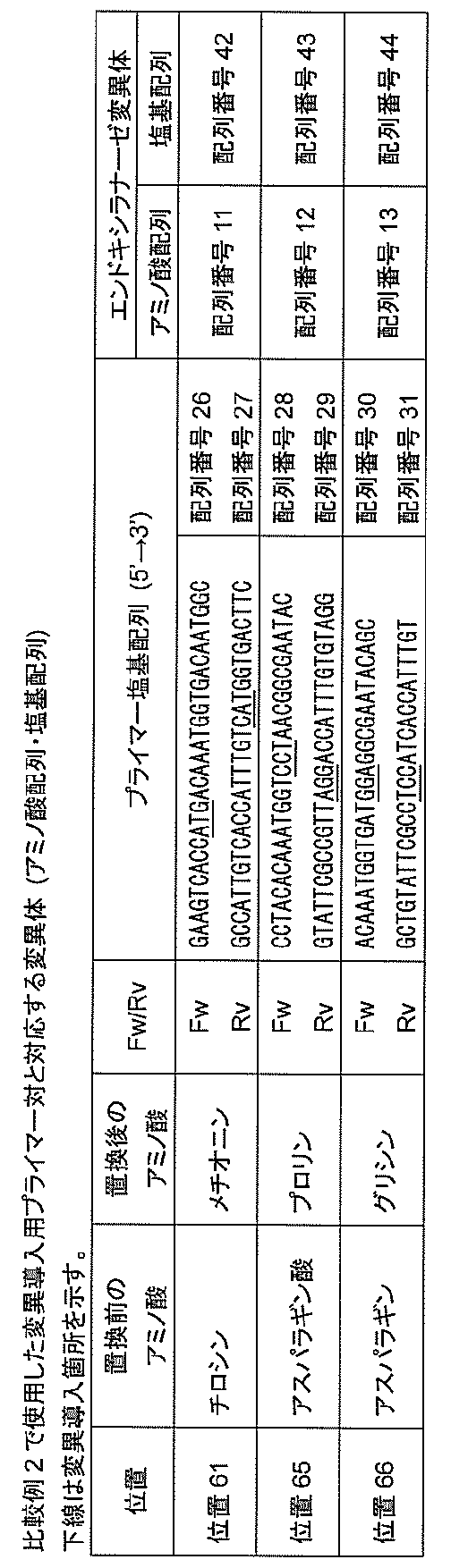
比較例として位置61、位置65、位置66のいずれか1つの置換を含むエンドキシラナーゼ変異体を作製した。野生型エンドキシラナーゼの塩基配列(配列番号2)を含むpET11aを鋳型として、表3に記載のプライマー対(Fw:フォワードプライマー、Rv:リバースプライマー)を使用して、PCRを行うことで、各エンドキシラナーゼ変異体をコードするDNAを作製した。PCRにはPrimeSTAR MaxDNA Polymerase kit(タカラバイオ株式会社)を用いた。使用したプライマー対と得られたエンドキシラナーゼ変異体をコードするDNAの塩基配列を配列番号42、配列番号43、配列番号44、に示す(表3)。またそれぞれのエンドキシラナーゼ変異体のアミノ酸配列を、配列番号11、配列番号12、配列番号13に示す(開始メチオニンを除く)。得られたエンドキシラナーゼ変異体をコードするDNAは比較例1の手順に準じてpET11aにクローニングした。次いで、当該エンドキシラナーゼ変異体をコードするDNAを含むpET11aは、比較例1の手順に準じて、タンパク質の発現および精製を行い、比較例2の変異体を得た。
実施例2にて作製した、位置35と位置62においてそれぞれシステインへの2つの置換を有するエンドキシラナーゼ変異体をコードするDNA(配列番号40)を含むpET11に対して、さらに、位置44、位置63、位置101、位置102、位置61、位置65、位置66に変異を導入するプライマー対を使用して、各位置に置換を有するエンドキシラナーゼ変異体をコードするDNAを作製した。本変異導入に使用したプライマー対は表4に示す9種である。作製したエンドキシラナーゼ変異体をコードするDNAの塩基配列を配列番号41に示す。また当該エンドキシラナーゼ変異体のアミノ酸配列を配列番号10に示す。得られたエンドキシラナーゼ変異体をコードするDNAは比較例1の手順に準じてpET11aにクローニングした。次いで、エンドキシラナーゼ変異体をコードするDNAを含むpET11aは、比較例1の手順に準じて、タンパク質の発現および精製を行い、実施例3のエンドキシラナーゼ変異体(配列番号10)を得た。

エンドキシラナーゼ活性は、1%のバーチウッドキシラン(シグマアルドリッチ社)を基質として使用して、測定を行った。エンドキシラナーゼによるバーチウッドキシランが加水分解され、生成した還元糖の量は、ジニトロサリチル酸法(DNS)法でキシロースを標品として使用して測定した。反応は、各種エンドキシラナーゼ変異体(実施例1、実施例2、実施例3)および野生型エンドキシラナーゼ(比較例1)、エンドキシラナーゼ変異体(比較例2)を1mg/mLとなるよう添加し、50℃、55℃、60℃、65℃、70℃の各温度において、10分間保温することでバーチウッドキシランの分解を実施した。タンパク質濃度は参考例1に準じて濃度測定を行い調整した。反応後、還元糖量を測定するためDNS溶液を0.75mL添加することで開始し、5分煮沸することで反応を停止した。反応停止後の反応液は、540nmの吸光度を測定することで還元糖量を測定した。1unitのエンドキシラナーゼ活性は、50℃・1分間において、1μmolのキシロースをバーチウッドキシランより生成するために必要な酵素量と定義しユニット数を算出した。また、算出した各ユニット値を元に、特に野生型(比較例1)における55℃の活性値を基準(100%)として相対的な活性値を表5にまとめた。
サトウキビ搾汁後の残渣であるバガスを原料にして、オリゴ糖液製造を試みた。エンドキシラナーゼとしては、比較例1の野生型エンドキシラナーゼもしくは実施例3のエンドキシラナーゼ変異体を使用した。前処理として、バイオマス重量が30%(w/w)となるように1N苛性ソーダ水溶液中で6日間浸漬処理した。前処理物を0.5gずつ2mLチューブに秤量し、バイオマスの終濃度が10%(w/w)となるように加水後、希釈硫酸を用いてpH5に調整した。pHを調整した本組成物に、野生型エンドキシラナーゼもしくはエンドキシラナーゼ変異体を0.05mg/g-BM添加し、サーモブロック回転器(日伸理化製 SN-48BN)を用いて50℃で24時間反応させた。反応後の上清における糖組成を表6に示す。野生型エンドキシラナーゼと比較して、エンドキシラナーゼ変異体の方がキシロオリゴ糖であるキシロビオースを多く得ることができた。

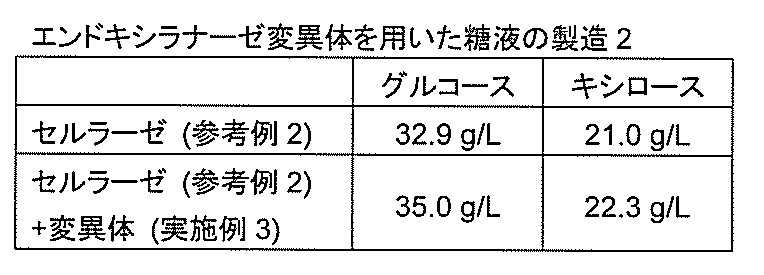
実施例5において、酵素としてエンドキシラナーゼ変異体に加えてトリコデルマ由来セルラーゼ(参考例2)を用いて糖液の製造を試みた。実施例5と同様の方法でpH調整まで行った組成物に対して、トリコデルマ由来セルラーゼをタンパク質量で10mg/g-BMおよびエンドキシラナーゼ変異体(実施例3)を0.05mg/g-BM添加し、サーモブロック回転器(日伸理化製 SN-48BN)を用いて50℃で48時間反応させた。比較として、トリコデルマ由来セルラーゼのみを添加して反応させた。反応後の上清における糖組成を表7に示す。トリコデルマ由来セルラーゼだけのものと比較して、エンドキシラナーゼ変異体を加えた方が糖収量を向上させることができた。
実施例5にて得られた反応後の上清500μlを、VIVASPIN500(PES、分画分子量10,000)(ザルトリウス社)を用いて限外濾過し、比較例1の野生型エンドキシラナーゼもしくは実施例3のエンドキシラナーゼ変異体を回収した。回収した比較例1の野生型エンドキシラナーゼもしくは実施例3のエンドキシラナーゼ変異体と、キシラン分解時の濃度(2.5mg/l)に希釈した比較例1の野生型エンドキシラナーゼ、実施例3のエンドキシラナーゼ変異体のエンドキシラナーゼ活性を測定した。エンドキシラナーゼ活性は、回収エンドキシラナーゼもしくは希釈エンドキシラナーゼを反応液の1/10量添加した点、反応温度を50℃で行った点以外は、実施例4と同様に行った。希釈した比較例1の野生型エンドキシラナーゼ、実施例3のエンドキシラナーゼ変異体の活性値をそれぞれ基準(100%)として、回収した比較例1の野生型エンドキシラナーゼ、実施例3のエンドキシラナーゼ変異体の相対的な活性値を残存活性とした。表8に回収後の残存活性を示す。エンドキシラナーゼ変異体ではキシラン分解後も活性が高く残っており、キシラン分解に有意に再利用出来ることが確認できた。

野生型エンドキシラナーゼからN末端の34アミノ酸残基からなるシグナルペプチドを除くアミノ酸配列(配列番号2)をコードする塩基配列(配列番号33)を含むpET11aを鋳型(比較例1)として、配列番号51と配列番号53のプライマー対を使用してPCRを行うことで、配列番号54、配列番号47、配列番号55を順にコードするDNAを作製した。
実施例8で得られた各種培養液の上清のエンドキシラナーゼの活性測定を行った。活性測定は、各種培養液の上清を0.25mg/mLとなるよう添加し、50℃、60℃、70℃の各温度で反応を行う以外は、実施例4と同様に行った。算出した各ユニット値を元に、特に野生型における50℃の活性値を基準(100%)として相対的な活性値を表11にまとめた。キシラナーゼ変異体を含む上清は高温条件下においても高い活性を保持していた。また、酵母にて発現させた酵素は、実施例4にて大腸菌より発現された場合と比較して、高い耐熱性が認められた。
Claims (15)
- 糸状菌由来のエンドキシラナーゼのアミノ酸配列において、少なくとも配列番号1のアミノ酸配列の位置35、位置44、位置62、位置63、位置101、及び位置102に相当する位置から選択される一以上のアミノ酸残基が置換されているアミノ酸配列を含み、かつ、エンドキシラナーゼ活性を有する、エンドキシラナーゼ変異体。
- 配列番号1のアミノ酸配列の位置35、及び/又は位置62に相当する位置のアミノ酸残基が、システインに置換されている、請求項1に記載のエンドキシラナーゼ変異体。
- 配列番号1のアミノ酸配列の位置44、及び/又は位置63に相当する位置のアミノ酸残基が、ヒスチジン、グリシン、トリプトファン、メチオニン、プロリン、アラニン、フェニルアラニン、バリン、ロイシン、及びイソロイシンから、それぞれ独立して選択されるいずれかのアミノ酸に置換されている、請求項1又は2に記載のエンドキシラナーゼ変異体。
- 配列番号1のアミノ酸配列の位置101、及び/又は位置102に相当する位置のアミノ酸残基が、プロリン、及びアスパラギンから、それぞれ独立して選択されるいずれかのアミノ酸に置換されている、請求項1~3のいずれか1項に記載のエンドキシラナーゼ変異体。
- さらに、配列番号1のアミノ酸配列の位置61、位置65、及び位置66に相当する位置から選択される一以上のアミノ酸残基が置換されている、請求項1~4のいずれか1項に記載のエンドキシラナーゼ変異体。
- 配列番号1のアミノ酸配列の位置35、位置44、位置61、位置62、位置63、位置65、位置66、位置101、及び位置102に相当する位置のアミノ酸残基が全て置換されている、請求項1~5のいずれか1項に記載のエンドキシラナーゼ変異体。
- 糸状菌由来のエンドキシラナーゼが、アクレモニウム・セルロリチカス(Acremonium cellulolyticus)に由来する、請求項1~6のいずれか1項に記載のエンドキシラナーゼ変異体。
- 以下の(a)から(c)のいずれかのアミノ酸配列からなり、かつエンドキシラナーゼ活性を有する、請求項1~7のいずれか1項に記載のエンドキシラナーゼ変異体:
(a)配列番号3,4,5,6,7,8,9,10又は45で示されるアミノ酸配列;
(b)配列番号3,4,5,6,7,8,9,10又は45で示されるアミノ酸配列において、位置35、位置44、位置61、位置62、位置63、位置65、位置66、位置101、及び位置102における置換されたアミノ酸は変異せず、1から数個のアミノ酸が欠失、置換、または付加されたアミノ酸配列;あるいは
(c)配列番号3,4,5,6,7,8,9,10又は45で示されるアミノ酸配列において、位置35、位置44、位置61、位置62、位置63、位置65、位置66、位置101、及び位置102における置換されたアミノ酸は変異せず、該アミノ酸を除いて、配列番号3,4,5,6,7,8,9,10又は45で示されるアミノ酸配列と90%以上の配列同一性を有するアミノ酸配列。 - 請求項1~8のいずれか1項に記載のエンドキシラナーゼ変異体をコードするDNA。
- 請求項9に記載のDNAを含む、発現ベクター。
- 請求項10に記載の発現ベクターを用いた形質転換により作製された、形質転換細胞。
- 請求項11に記載の形質転換細胞を培養し、該形質転換細胞により生産されたエンドキシラナーゼ変異体を得る工程を含む、エンドキシラナーゼ変異体の製造方法。
- 請求項1~8のいずれか1項に記載のエンドキシラナーゼ変異体を含むバイオマス分解用酵素組成物。
- 前記酵素組成物が、セロビオハイドロラーゼ、エンドグルカナーゼ、β-グルコシダーゼ、β-キシロシダーゼ、マンナナーゼ、マンノシダ-ゼ、グルコアミラーゼ、α-アミラーゼ、エステラーゼ、リパーゼからなる群から選択される1または2種以上の酵素をさらに含む、請求項13に記載のバイオマス分解用酵素組成物。
- 請求項13又は請求項14に記載のバイオマス分解用酵素組成物を、バイオマスに添加することを含む、該バイオマスより糖液を製造する方法。
Priority Applications (6)
| Application Number | Priority Date | Filing Date | Title |
|---|---|---|---|
| EP15856688.5A EP3216864A4 (en) | 2014-11-05 | 2015-11-05 | Endoxylanase mutant, enzyme composition for biomass decomposition, and method for producing sugar solution |
| US15/521,654 US10435728B2 (en) | 2014-11-05 | 2015-11-05 | Endoxylanase mutant, enzyme composition for biomass decomposition, and method of producing sugar solution |
| BR112017008702-2A BR112017008702A2 (ja) | 2014-11-05 | 2015-11-05 | An end key Shiranaze mutant, an enzyme constituent for biomass decomposition, and a manufacturing method of honeydew |
| AU2015344324A AU2015344324B2 (en) | 2014-11-05 | 2015-11-05 | Endoxylanase mutant, enzyme composition for biomass decomposition, and method for producing sugar solution |
| CA2966330A CA2966330A1 (en) | 2014-11-05 | 2015-11-05 | Endoxylanase mutant, enzyme composition for biomass decomposition, and method for producing sugar solution |
| JP2016557794A JP6689487B2 (ja) | 2014-11-05 | 2015-11-05 | エンドキシラナーゼ変異体、バイオマス分解用酵素組成物及び糖液の製造方法 |
Applications Claiming Priority (2)
| Application Number | Priority Date | Filing Date | Title |
|---|---|---|---|
| JP2014-225543 | 2014-11-05 | ||
| JP2014225543 | 2014-11-05 |
Publications (1)
| Publication Number | Publication Date |
|---|---|
| WO2016072448A1 true WO2016072448A1 (ja) | 2016-05-12 |
Family
ID=55909172
Family Applications (1)
| Application Number | Title | Priority Date | Filing Date |
|---|---|---|---|
| PCT/JP2015/081151 Ceased WO2016072448A1 (ja) | 2014-11-05 | 2015-11-05 | エンドキシラナーゼ変異体、バイオマス分解用酵素組成物及び糖液の製造方法 |
Country Status (7)
| Country | Link |
|---|---|
| US (1) | US10435728B2 (ja) |
| EP (1) | EP3216864A4 (ja) |
| JP (1) | JP6689487B2 (ja) |
| AU (1) | AU2015344324B2 (ja) |
| BR (1) | BR112017008702A2 (ja) |
| CA (1) | CA2966330A1 (ja) |
| WO (1) | WO2016072448A1 (ja) |
Cited By (4)
| Publication number | Priority date | Publication date | Assignee | Title |
|---|---|---|---|---|
| WO2018155650A1 (ja) * | 2017-02-23 | 2018-08-30 | 東レ株式会社 | キシラナーゼ変異体、及びバイオマス分解用酵素組成物 |
| CN111004789A (zh) * | 2019-12-11 | 2020-04-14 | 云南师范大学 | 一种耐硫酸铵的木糖苷酶突变体v322dh328dt329e |
| JP2024500712A (ja) * | 2020-12-15 | 2024-01-10 | シージェイ チェイルジェダン コーポレーション | キシラナーゼ活性を有する変異型ポリペプチド |
| JP2024500714A (ja) * | 2020-12-15 | 2024-01-10 | シージェイ チェイルジェダン コーポレーション | キシラナーゼ活性を有する変異型ポリペプチド |
Families Citing this family (3)
| Publication number | Priority date | Publication date | Assignee | Title |
|---|---|---|---|---|
| EP4028519A4 (en) * | 2019-09-13 | 2023-10-11 | Biological E Limited | SEQUENCE WITH N-TERMINAL EXTENSION FOR EXPRESSING RECOMBINANT THERAPEUTIC PEPTIDES |
| CN110904078B (zh) * | 2019-12-11 | 2020-09-04 | 云南师范大学 | 一种耐硫酸钠和硫酸铵的木糖苷酶突变体v322r及其应用 |
| CN111073876B (zh) * | 2020-01-18 | 2021-07-27 | 江南大学 | 热稳定性提高的枯草芽孢杆菌脂肪酶a |
Citations (8)
| Publication number | Priority date | Publication date | Assignee | Title |
|---|---|---|---|---|
| JP2002513595A (ja) * | 1998-05-06 | 2002-05-14 | ローヌ−プーラン・アニマル・ニユトリシオン・エス・アー | 酵素混合物 |
| JP2002199890A (ja) * | 2000-10-23 | 2002-07-16 | Inst Of Physical & Chemical Res | 生分解性ポリエステル合成酵素の改変方法 |
| JP2003511066A (ja) * | 1999-10-12 | 2003-03-25 | カーボザイム・オサケユキテュア | ファミリーG/11キシラナーゼの安定性を向上させ、pH領域を広域化する方法 |
| JP2006271379A (ja) * | 2005-03-03 | 2006-10-12 | Toyama Prefecture | 機能改変フェニルアラニン脱水素酵素、およびこの酵素を用いた生体試料中のアミノ酸の分析方法 |
| WO2009154247A1 (ja) * | 2008-06-19 | 2009-12-23 | 日本化薬株式会社 | 耐熱性1,5-アンヒドログルシトール脱水素酵素及びそれを用いた1,5-アンヒドログルシトールの測定法 |
| WO2013103127A1 (ja) * | 2012-01-06 | 2013-07-11 | 本田技研工業株式会社 | 糖化酵素組成物及びそれを用いる糖化溶液の製造方法 |
| JP2013243954A (ja) * | 2012-05-24 | 2013-12-09 | Kao Corp | キシラナーゼおよびそれを用いた糖の製造方法 |
| JP2014064563A (ja) * | 2012-09-04 | 2014-04-17 | Toray Ind Inc | 糖液の製造方法 |
Family Cites Families (4)
| Publication number | Priority date | Publication date | Assignee | Title |
|---|---|---|---|---|
| ES2561427T3 (es) * | 2008-12-23 | 2016-02-26 | Dupont Nutrition Biosciences Aps | Polipéptidos con actividad de xilanasa |
| WO2010072226A1 (en) * | 2008-12-23 | 2010-07-01 | Danisco A/S | Polypeptides with xylanase activity |
| US9663776B2 (en) * | 2012-10-19 | 2017-05-30 | National Institute Of Advanced Industrial Science And Technology | Xylanase |
| CN103642777A (zh) | 2013-12-10 | 2014-03-19 | 江南大学 | 一种提高米曲霉木聚糖酶热稳定性的方法 |
-
2015
- 2015-11-05 BR BR112017008702-2A patent/BR112017008702A2/ja not_active IP Right Cessation
- 2015-11-05 JP JP2016557794A patent/JP6689487B2/ja not_active Expired - Fee Related
- 2015-11-05 WO PCT/JP2015/081151 patent/WO2016072448A1/ja not_active Ceased
- 2015-11-05 CA CA2966330A patent/CA2966330A1/en not_active Abandoned
- 2015-11-05 AU AU2015344324A patent/AU2015344324B2/en not_active Expired - Fee Related
- 2015-11-05 EP EP15856688.5A patent/EP3216864A4/en not_active Withdrawn
- 2015-11-05 US US15/521,654 patent/US10435728B2/en not_active Expired - Fee Related
Patent Citations (8)
| Publication number | Priority date | Publication date | Assignee | Title |
|---|---|---|---|---|
| JP2002513595A (ja) * | 1998-05-06 | 2002-05-14 | ローヌ−プーラン・アニマル・ニユトリシオン・エス・アー | 酵素混合物 |
| JP2003511066A (ja) * | 1999-10-12 | 2003-03-25 | カーボザイム・オサケユキテュア | ファミリーG/11キシラナーゼの安定性を向上させ、pH領域を広域化する方法 |
| JP2002199890A (ja) * | 2000-10-23 | 2002-07-16 | Inst Of Physical & Chemical Res | 生分解性ポリエステル合成酵素の改変方法 |
| JP2006271379A (ja) * | 2005-03-03 | 2006-10-12 | Toyama Prefecture | 機能改変フェニルアラニン脱水素酵素、およびこの酵素を用いた生体試料中のアミノ酸の分析方法 |
| WO2009154247A1 (ja) * | 2008-06-19 | 2009-12-23 | 日本化薬株式会社 | 耐熱性1,5-アンヒドログルシトール脱水素酵素及びそれを用いた1,5-アンヒドログルシトールの測定法 |
| WO2013103127A1 (ja) * | 2012-01-06 | 2013-07-11 | 本田技研工業株式会社 | 糖化酵素組成物及びそれを用いる糖化溶液の製造方法 |
| JP2013243954A (ja) * | 2012-05-24 | 2013-12-09 | Kao Corp | キシラナーゼおよびそれを用いた糖の製造方法 |
| JP2014064563A (ja) * | 2012-09-04 | 2014-04-17 | Toray Ind Inc | 糖液の製造方法 |
Non-Patent Citations (3)
| Title |
|---|
| GRUBER, K. ET AL.: "Thermophilic xylanase from Thermomyces lanuginosus: high-resolution X-ray structure and modeling studies", BIOCHEMISTRY, vol. 37, no. 39, 29 September 1998 (1998-09-29), pages 13475 - 13485, XP002131131, doi:10.1021/bi980864l * |
| See also references of EP3216864A4 * |
| WATANABE, M. ET AL.: "Xylanase (GH11) from Acremonium cellulolyticus: homologous expression and characterization", AMB EXPRESS, vol. 4, April 2014 (2014-04-01), pages 27, XP055439690, Retrieved from the Internet <URL:http://www.ncbi.nlm.nih.gov/pmc/articles/PMC4052667/pdf/s13568-014-0027-x.pdf> * |
Cited By (11)
| Publication number | Priority date | Publication date | Assignee | Title |
|---|---|---|---|---|
| WO2018155650A1 (ja) * | 2017-02-23 | 2018-08-30 | 東レ株式会社 | キシラナーゼ変異体、及びバイオマス分解用酵素組成物 |
| JPWO2018155650A1 (ja) * | 2017-02-23 | 2019-12-12 | 東レ株式会社 | キシラナーゼ変異体、及びバイオマス分解用酵素組成物 |
| JP7046370B2 (ja) | 2017-02-23 | 2022-04-04 | 国立研究開発法人産業技術総合研究所 | キシラナーゼ変異体、及びバイオマス分解用酵素組成物 |
| CN111004789A (zh) * | 2019-12-11 | 2020-04-14 | 云南师范大学 | 一种耐硫酸铵的木糖苷酶突变体v322dh328dt329e |
| CN111004789B (zh) * | 2019-12-11 | 2021-10-15 | 云南师范大学 | 一种耐硫酸铵的木糖苷酶突变体v322dh328dt329e |
| JP2024500712A (ja) * | 2020-12-15 | 2024-01-10 | シージェイ チェイルジェダン コーポレーション | キシラナーゼ活性を有する変異型ポリペプチド |
| JP2024500714A (ja) * | 2020-12-15 | 2024-01-10 | シージェイ チェイルジェダン コーポレーション | キシラナーゼ活性を有する変異型ポリペプチド |
| JP7755651B2 (ja) | 2020-12-15 | 2025-10-16 | シージェイ チェイルジェダン コーポレーション | キシラナーゼ活性を有する変異型ポリペプチド |
| JP7755650B2 (ja) | 2020-12-15 | 2025-10-16 | シージェイ チェイルジェダン コーポレーション | キシラナーゼ活性を有する変異型ポリペプチド |
| US12577598B2 (en) | 2020-12-15 | 2026-03-17 | Kemin Industries, Inc. | Modified polypeptide having xylanase activity |
| US12577549B2 (en) | 2020-12-15 | 2026-03-17 | Kemin Industries, Inc. | Modified polypeptide having xylanase activity |
Also Published As
| Publication number | Publication date |
|---|---|
| US20170240941A1 (en) | 2017-08-24 |
| EP3216864A1 (en) | 2017-09-13 |
| AU2015344324A8 (en) | 2017-05-11 |
| AU2015344324B2 (en) | 2021-09-30 |
| AU2015344324A2 (en) | 2017-06-08 |
| CA2966330A1 (en) | 2016-05-12 |
| AU2015344324A1 (en) | 2017-04-27 |
| JPWO2016072448A1 (ja) | 2017-08-17 |
| US10435728B2 (en) | 2019-10-08 |
| JP6689487B2 (ja) | 2020-04-28 |
| BR112017008702A2 (ja) | 2018-02-27 |
| EP3216864A4 (en) | 2018-05-02 |
Similar Documents
| Publication | Publication Date | Title |
|---|---|---|
| JP6689487B2 (ja) | エンドキシラナーゼ変異体、バイオマス分解用酵素組成物及び糖液の製造方法 | |
| JP2017532967A (ja) | ベータ−グルコシダーゼに関連する組成物および方法 | |
| JP6330240B2 (ja) | 耐熱性β−グルコシダーゼ | |
| WO2014088935A2 (en) | Compositions and methods of use | |
| CN104371988B (zh) | 一种新型内切木聚糖酶及其编码基因和应用 | |
| JP5971811B2 (ja) | 変異型エンドグルカナーゼ | |
| EP2929021A1 (en) | Compositions and methods of use | |
| AU2011222255B2 (en) | Method for producing glucosidase, enzyme composition, and method for hydrolyzing biomass | |
| JP6354462B2 (ja) | Ghファミリー10に属する耐熱性キシラナーゼ | |
| JP6319907B2 (ja) | 耐熱性β―キシロシダーゼ | |
| JP7046370B2 (ja) | キシラナーゼ変異体、及びバイオマス分解用酵素組成物 | |
| EP2929022A1 (en) | Compositions and methods of use | |
| JP2017175958A (ja) | 耐熱性セロビオハイドロラーゼ | |
| US9034627B2 (en) | Method for producing glucosidase, enzyme composition, and method for hydrolyzing biomass | |
| JP6586659B2 (ja) | 耐熱性グリコシド加水分解酵素 | |
| JP2016029908A (ja) | Ghファミリー10に属する耐熱性キシラナーゼ | |
| JP2014100073A (ja) | バイオマス分解用組成物およびそれを用いた糖液の製造方法 | |
| JP2016167985A (ja) | 耐熱性セロビオハイドロラーゼ | |
| WO2016054194A1 (en) | Compositions comprising beta-mannanase and methods of use | |
| WO2016054168A1 (en) | Compositions comprising beta mannanase and methods of use |
Legal Events
| Date | Code | Title | Description |
|---|---|---|---|
| 121 | Ep: the epo has been informed by wipo that ep was designated in this application |
Ref document number: 15856688 Country of ref document: EP Kind code of ref document: A1 |
|
| ENP | Entry into the national phase |
Ref document number: 2016557794 Country of ref document: JP Kind code of ref document: A |
|
| WWE | Wipo information: entry into national phase |
Ref document number: 15521654 Country of ref document: US |
|
| ENP | Entry into the national phase |
Ref document number: 2015344324 Country of ref document: AU Date of ref document: 20151105 Kind code of ref document: A |
|
| ENP | Entry into the national phase |
Ref document number: 2966330 Country of ref document: CA |
|
| NENP | Non-entry into the national phase |
Ref country code: DE |
|
| REG | Reference to national code |
Ref country code: BR Ref legal event code: B01A Ref document number: 112017008702 Country of ref document: BR |
|
| REEP | Request for entry into the european phase |
Ref document number: 2015856688 Country of ref document: EP |
|
| ENP | Entry into the national phase |
Ref document number: 112017008702 Country of ref document: BR Kind code of ref document: A2 Effective date: 20170426 |