WO2016076367A1 - ラベルライター用テープ - Google Patents
ラベルライター用テープ Download PDFInfo
- Publication number
- WO2016076367A1 WO2016076367A1 PCT/JP2015/081772 JP2015081772W WO2016076367A1 WO 2016076367 A1 WO2016076367 A1 WO 2016076367A1 JP 2015081772 W JP2015081772 W JP 2015081772W WO 2016076367 A1 WO2016076367 A1 WO 2016076367A1
- Authority
- WO
- WIPO (PCT)
- Prior art keywords
- layer
- ink
- tape
- base material
- label
- Prior art date
- Legal status (The legal status is an assumption and is not a legal conclusion. Google has not performed a legal analysis and makes no representation as to the accuracy of the status listed.)
- Ceased
Links
Images
Classifications
-
- B—PERFORMING OPERATIONS; TRANSPORTING
- B41—PRINTING; LINING MACHINES; TYPEWRITERS; STAMPS
- B41M—PRINTING, DUPLICATING, MARKING, OR COPYING PROCESSES; COLOUR PRINTING
- B41M5/00—Duplicating or marking methods; Sheet materials for use therein
- B41M5/50—Recording sheets characterised by the coating used to improve ink, dye or pigment receptivity, e.g. for ink-jet or thermal dye transfer recording
- B41M5/52—Macromolecular coatings
- B41M5/5263—Macromolecular coatings characterised by the use of polymers obtained otherwise than by reactions only involving carbon-to-carbon unsaturated bonds
- B41M5/5281—Polyurethanes or polyureas
-
- B—PERFORMING OPERATIONS; TRANSPORTING
- B41—PRINTING; LINING MACHINES; TYPEWRITERS; STAMPS
- B41J—TYPEWRITERS; SELECTIVE PRINTING MECHANISMS, i.e. MECHANISMS PRINTING OTHERWISE THAN FROM A FORME; CORRECTION OF TYPOGRAPHICAL ERRORS
- B41J3/00—Typewriters or selective printing or marking mechanisms characterised by the purpose for which they are constructed
- B41J3/407—Typewriters or selective printing or marking mechanisms characterised by the purpose for which they are constructed for marking on special material
- B41J3/4075—Tape printers; Label printers
-
- B—PERFORMING OPERATIONS; TRANSPORTING
- B41—PRINTING; LINING MACHINES; TYPEWRITERS; STAMPS
- B41M—PRINTING, DUPLICATING, MARKING, OR COPYING PROCESSES; COLOUR PRINTING
- B41M5/00—Duplicating or marking methods; Sheet materials for use therein
- B41M5/26—Thermography ; Marking by high energetic means, e.g. laser otherwise than by burning, and characterised by the material used
- B41M5/30—Thermography ; Marking by high energetic means, e.g. laser otherwise than by burning, and characterised by the material used using chemical colour formers
- B41M5/32—Thermography ; Marking by high energetic means, e.g. laser otherwise than by burning, and characterised by the material used using chemical colour formers one component being a heavy metal compound, e.g. lead or iron
-
- B—PERFORMING OPERATIONS; TRANSPORTING
- B41—PRINTING; LINING MACHINES; TYPEWRITERS; STAMPS
- B41M—PRINTING, DUPLICATING, MARKING, OR COPYING PROCESSES; COLOUR PRINTING
- B41M5/00—Duplicating or marking methods; Sheet materials for use therein
- B41M5/26—Thermography ; Marking by high energetic means, e.g. laser otherwise than by burning, and characterised by the material used
- B41M5/382—Contact thermal transfer or sublimation processes
-
- B—PERFORMING OPERATIONS; TRANSPORTING
- B41—PRINTING; LINING MACHINES; TYPEWRITERS; STAMPS
- B41M—PRINTING, DUPLICATING, MARKING, OR COPYING PROCESSES; COLOUR PRINTING
- B41M5/00—Duplicating or marking methods; Sheet materials for use therein
- B41M5/26—Thermography ; Marking by high energetic means, e.g. laser otherwise than by burning, and characterised by the material used
- B41M5/40—Thermography ; Marking by high energetic means, e.g. laser otherwise than by burning, and characterised by the material used characterised by the base backcoat, intermediate, or covering layers, e.g. for thermal transfer dye-donor or dye-receiver sheets; Heat, radiation filtering or absorbing means or layers; combined with other image registration layers or compositions; Special originals for reproduction by thermography
- B41M5/42—Intermediate, backcoat, or covering layers
-
- B—PERFORMING OPERATIONS; TRANSPORTING
- B41—PRINTING; LINING MACHINES; TYPEWRITERS; STAMPS
- B41M—PRINTING, DUPLICATING, MARKING, OR COPYING PROCESSES; COLOUR PRINTING
- B41M5/00—Duplicating or marking methods; Sheet materials for use therein
- B41M5/26—Thermography ; Marking by high energetic means, e.g. laser otherwise than by burning, and characterised by the material used
- B41M5/40—Thermography ; Marking by high energetic means, e.g. laser otherwise than by burning, and characterised by the material used characterised by the base backcoat, intermediate, or covering layers, e.g. for thermal transfer dye-donor or dye-receiver sheets; Heat, radiation filtering or absorbing means or layers; combined with other image registration layers or compositions; Special originals for reproduction by thermography
- B41M5/42—Intermediate, backcoat, or covering layers
- B41M5/44—Intermediate, backcoat, or covering layers characterised by the macromolecular compounds
-
- B—PERFORMING OPERATIONS; TRANSPORTING
- B41—PRINTING; LINING MACHINES; TYPEWRITERS; STAMPS
- B41M—PRINTING, DUPLICATING, MARKING, OR COPYING PROCESSES; COLOUR PRINTING
- B41M5/00—Duplicating or marking methods; Sheet materials for use therein
- B41M5/50—Recording sheets characterised by the coating used to improve ink, dye or pigment receptivity, e.g. for ink-jet or thermal dye transfer recording
- B41M5/502—Recording sheets characterised by the coating used to improve ink, dye or pigment receptivity, e.g. for ink-jet or thermal dye transfer recording characterised by structural details, e.g. multilayer materials
-
- B—PERFORMING OPERATIONS; TRANSPORTING
- B41—PRINTING; LINING MACHINES; TYPEWRITERS; STAMPS
- B41M—PRINTING, DUPLICATING, MARKING, OR COPYING PROCESSES; COLOUR PRINTING
- B41M5/00—Duplicating or marking methods; Sheet materials for use therein
- B41M5/50—Recording sheets characterised by the coating used to improve ink, dye or pigment receptivity, e.g. for ink-jet or thermal dye transfer recording
- B41M5/502—Recording sheets characterised by the coating used to improve ink, dye or pigment receptivity, e.g. for ink-jet or thermal dye transfer recording characterised by structural details, e.g. multilayer materials
- B41M5/506—Intermediate layers
-
- B—PERFORMING OPERATIONS; TRANSPORTING
- B41—PRINTING; LINING MACHINES; TYPEWRITERS; STAMPS
- B41M—PRINTING, DUPLICATING, MARKING, OR COPYING PROCESSES; COLOUR PRINTING
- B41M5/00—Duplicating or marking methods; Sheet materials for use therein
- B41M5/50—Recording sheets characterised by the coating used to improve ink, dye or pigment receptivity, e.g. for ink-jet or thermal dye transfer recording
- B41M5/52—Macromolecular coatings
- B41M5/5254—Macromolecular coatings characterised by the use of polymers obtained by reactions only involving carbon-to-carbon unsaturated bonds, e.g. vinyl polymers
-
- B—PERFORMING OPERATIONS; TRANSPORTING
- B41—PRINTING; LINING MACHINES; TYPEWRITERS; STAMPS
- B41M—PRINTING, DUPLICATING, MARKING, OR COPYING PROCESSES; COLOUR PRINTING
- B41M5/00—Duplicating or marking methods; Sheet materials for use therein
- B41M5/50—Recording sheets characterised by the coating used to improve ink, dye or pigment receptivity, e.g. for ink-jet or thermal dye transfer recording
- B41M5/52—Macromolecular coatings
- B41M5/5263—Macromolecular coatings characterised by the use of polymers obtained otherwise than by reactions only involving carbon-to-carbon unsaturated bonds
- B41M5/5272—Polyesters; Polycarbonates
-
- C—CHEMISTRY; METALLURGY
- C09—DYES; PAINTS; POLISHES; NATURAL RESINS; ADHESIVES; COMPOSITIONS NOT OTHERWISE PROVIDED FOR; APPLICATIONS OF MATERIALS NOT OTHERWISE PROVIDED FOR
- C09J—ADHESIVES; NON-MECHANICAL ASPECTS OF ADHESIVE PROCESSES IN GENERAL; ADHESIVE PROCESSES NOT PROVIDED FOR ELSEWHERE; USE OF MATERIALS AS ADHESIVES
- C09J7/00—Adhesives in the form of films or foils
- C09J7/20—Adhesives in the form of films or foils characterised by their carriers
-
- C—CHEMISTRY; METALLURGY
- C09—DYES; PAINTS; POLISHES; NATURAL RESINS; ADHESIVES; COMPOSITIONS NOT OTHERWISE PROVIDED FOR; APPLICATIONS OF MATERIALS NOT OTHERWISE PROVIDED FOR
- C09J—ADHESIVES; NON-MECHANICAL ASPECTS OF ADHESIVE PROCESSES IN GENERAL; ADHESIVE PROCESSES NOT PROVIDED FOR ELSEWHERE; USE OF MATERIALS AS ADHESIVES
- C09J7/00—Adhesives in the form of films or foils
- C09J7/20—Adhesives in the form of films or foils characterised by their carriers
- C09J7/22—Plastics; Metallised plastics
- C09J7/25—Plastics; Metallised plastics based on macromolecular compounds obtained otherwise than by reactions involving only carbon-to-carbon unsaturated bonds
- C09J7/255—Polyesters
-
- G—PHYSICS
- G09—EDUCATION; CRYPTOGRAPHY; DISPLAY; ADVERTISING; SEALS
- G09F—DISPLAYING; ADVERTISING; SIGNS; LABELS OR NAME-PLATES; SEALS
- G09F3/00—Labels, tag tickets, or similar identification or indication means; Seals; Postage or like stamps
- G09F3/02—Forms or constructions
-
- G—PHYSICS
- G09—EDUCATION; CRYPTOGRAPHY; DISPLAY; ADVERTISING; SEALS
- G09F—DISPLAYING; ADVERTISING; SIGNS; LABELS OR NAME-PLATES; SEALS
- G09F3/00—Labels, tag tickets, or similar identification or indication means; Seals; Postage or like stamps
- G09F3/08—Fastening or securing by means not forming part of the material of the label itself
- G09F3/10—Fastening or securing by means not forming part of the material of the label itself by an adhesive layer
-
- B—PERFORMING OPERATIONS; TRANSPORTING
- B41—PRINTING; LINING MACHINES; TYPEWRITERS; STAMPS
- B41M—PRINTING, DUPLICATING, MARKING, OR COPYING PROCESSES; COLOUR PRINTING
- B41M2205/00—Printing methods or features related to printing methods; Location or type of the layers
- B41M2205/02—Dye diffusion thermal transfer printing (D2T2)
-
- B—PERFORMING OPERATIONS; TRANSPORTING
- B41—PRINTING; LINING MACHINES; TYPEWRITERS; STAMPS
- B41M—PRINTING, DUPLICATING, MARKING, OR COPYING PROCESSES; COLOUR PRINTING
- B41M2205/00—Printing methods or features related to printing methods; Location or type of the layers
- B41M2205/06—Printing methods or features related to printing methods; Location or type of the layers relating to melt (thermal) mass transfer
-
- B—PERFORMING OPERATIONS; TRANSPORTING
- B41—PRINTING; LINING MACHINES; TYPEWRITERS; STAMPS
- B41M—PRINTING, DUPLICATING, MARKING, OR COPYING PROCESSES; COLOUR PRINTING
- B41M2205/00—Printing methods or features related to printing methods; Location or type of the layers
- B41M2205/32—Thermal receivers
-
- B—PERFORMING OPERATIONS; TRANSPORTING
- B41—PRINTING; LINING MACHINES; TYPEWRITERS; STAMPS
- B41M—PRINTING, DUPLICATING, MARKING, OR COPYING PROCESSES; COLOUR PRINTING
- B41M2205/00—Printing methods or features related to printing methods; Location or type of the layers
- B41M2205/38—Intermediate layers; Layers between substrate and imaging layer
-
- B—PERFORMING OPERATIONS; TRANSPORTING
- B41—PRINTING; LINING MACHINES; TYPEWRITERS; STAMPS
- B41M—PRINTING, DUPLICATING, MARKING, OR COPYING PROCESSES; COLOUR PRINTING
- B41M5/00—Duplicating or marking methods; Sheet materials for use therein
- B41M5/50—Recording sheets characterised by the coating used to improve ink, dye or pigment receptivity, e.g. for ink-jet or thermal dye transfer recording
- B41M5/52—Macromolecular coatings
-
- C—CHEMISTRY; METALLURGY
- C09—DYES; PAINTS; POLISHES; NATURAL RESINS; ADHESIVES; COMPOSITIONS NOT OTHERWISE PROVIDED FOR; APPLICATIONS OF MATERIALS NOT OTHERWISE PROVIDED FOR
- C09J—ADHESIVES; NON-MECHANICAL ASPECTS OF ADHESIVE PROCESSES IN GENERAL; ADHESIVE PROCESSES NOT PROVIDED FOR ELSEWHERE; USE OF MATERIALS AS ADHESIVES
- C09J157/00—Adhesives based on unspecified polymers obtained by reactions only involving carbon-to-carbon unsaturated bonds
- C09J157/06—Homopolymers or copolymers containing elements other than carbon and hydrogen
-
- C—CHEMISTRY; METALLURGY
- C09—DYES; PAINTS; POLISHES; NATURAL RESINS; ADHESIVES; COMPOSITIONS NOT OTHERWISE PROVIDED FOR; APPLICATIONS OF MATERIALS NOT OTHERWISE PROVIDED FOR
- C09J—ADHESIVES; NON-MECHANICAL ASPECTS OF ADHESIVE PROCESSES IN GENERAL; ADHESIVE PROCESSES NOT PROVIDED FOR ELSEWHERE; USE OF MATERIALS AS ADHESIVES
- C09J167/00—Adhesives based on polyesters obtained by reactions forming a carboxylic ester link in the main chain; Adhesives based on derivatives of such polymers
-
- C—CHEMISTRY; METALLURGY
- C09—DYES; PAINTS; POLISHES; NATURAL RESINS; ADHESIVES; COMPOSITIONS NOT OTHERWISE PROVIDED FOR; APPLICATIONS OF MATERIALS NOT OTHERWISE PROVIDED FOR
- C09J—ADHESIVES; NON-MECHANICAL ASPECTS OF ADHESIVE PROCESSES IN GENERAL; ADHESIVE PROCESSES NOT PROVIDED FOR ELSEWHERE; USE OF MATERIALS AS ADHESIVES
- C09J2203/00—Applications of adhesives in processes or use of adhesives in the form of films or foils
- C09J2203/334—Applications of adhesives in processes or use of adhesives in the form of films or foils as a label
-
- C—CHEMISTRY; METALLURGY
- C09—DYES; PAINTS; POLISHES; NATURAL RESINS; ADHESIVES; COMPOSITIONS NOT OTHERWISE PROVIDED FOR; APPLICATIONS OF MATERIALS NOT OTHERWISE PROVIDED FOR
- C09J—ADHESIVES; NON-MECHANICAL ASPECTS OF ADHESIVE PROCESSES IN GENERAL; ADHESIVE PROCESSES NOT PROVIDED FOR ELSEWHERE; USE OF MATERIALS AS ADHESIVES
- C09J2433/00—Presence of (meth)acrylic polymer
-
- C—CHEMISTRY; METALLURGY
- C09—DYES; PAINTS; POLISHES; NATURAL RESINS; ADHESIVES; COMPOSITIONS NOT OTHERWISE PROVIDED FOR; APPLICATIONS OF MATERIALS NOT OTHERWISE PROVIDED FOR
- C09J—ADHESIVES; NON-MECHANICAL ASPECTS OF ADHESIVE PROCESSES IN GENERAL; ADHESIVE PROCESSES NOT PROVIDED FOR ELSEWHERE; USE OF MATERIALS AS ADHESIVES
- C09J2467/00—Presence of polyester
-
- C—CHEMISTRY; METALLURGY
- C09—DYES; PAINTS; POLISHES; NATURAL RESINS; ADHESIVES; COMPOSITIONS NOT OTHERWISE PROVIDED FOR; APPLICATIONS OF MATERIALS NOT OTHERWISE PROVIDED FOR
- C09J—ADHESIVES; NON-MECHANICAL ASPECTS OF ADHESIVE PROCESSES IN GENERAL; ADHESIVE PROCESSES NOT PROVIDED FOR ELSEWHERE; USE OF MATERIALS AS ADHESIVES
- C09J2467/00—Presence of polyester
- C09J2467/006—Presence of polyester in the substrate
-
- G—PHYSICS
- G09—EDUCATION; CRYPTOGRAPHY; DISPLAY; ADVERTISING; SEALS
- G09F—DISPLAYING; ADVERTISING; SIGNS; LABELS OR NAME-PLATES; SEALS
- G09F3/00—Labels, tag tickets, or similar identification or indication means; Seals; Postage or like stamps
- G09F3/02—Forms or constructions
- G09F2003/0201—Label sheets intended to be introduced in a printer, e.g. laser printer
-
- G—PHYSICS
- G09—EDUCATION; CRYPTOGRAPHY; DISPLAY; ADVERTISING; SEALS
- G09F—DISPLAYING; ADVERTISING; SIGNS; LABELS OR NAME-PLATES; SEALS
- G09F3/00—Labels, tag tickets, or similar identification or indication means; Seals; Postage or like stamps
- G09F3/02—Forms or constructions
- G09F2003/0222—Features for removal or adhesion, e.g. tabs
-
- G—PHYSICS
- G09—EDUCATION; CRYPTOGRAPHY; DISPLAY; ADVERTISING; SEALS
- G09F—DISPLAYING; ADVERTISING; SIGNS; LABELS OR NAME-PLATES; SEALS
- G09F3/00—Labels, tag tickets, or similar identification or indication means; Seals; Postage or like stamps
- G09F3/02—Forms or constructions
- G09F2003/0225—Carrier web
- G09F2003/0229—Carrier roll
Definitions
- the present invention relates to a label writer tape capable of printing by an ink ribbon method (thermal transfer) and an ink jet method.
- a label writer is known as a device that prints and creates a label to be affixed to a document or a sorting shelf for headlines or display. Usually, after a tape as a printing medium is stored in a cartridge and printed by a label writer, it can be used as a label by cutting it to an arbitrary length.
- the label writer printing method includes a thermal method, an ink ribbon method (thermal transfer), and an inkjet method.
- thermal paper that develops color when heated is used as the print medium.
- the print density becomes thin in about half a year, and the life is further shortened by direct sunlight and chemicals. Used for labels.
- the print medium itself does not develop color, it is thermal transfer using the ink ribbon, and printing is performed on the print medium by the ink jet.
- the printing medium has an adhesive layer to be attached to the adherend.
- a tape-shaped print medium is often used by being wound on a roll so that labels can be continuously printed.
- a separator layer may be used.
- ink layers having various hues are provided on the back surface of the base material layer so that the print can be clearly identified in the base material layer, including white, red, yellow, and blue. Often printed as color tape.
- the layer constitution is basically a three-layer constitution of the base material layer / ink layer / adhesive layer. It becomes.
- Patent Document 1 describes a colored film having an adhesive layer.
- a colored adhesive layer is provided on one surface of the transparent film so as to have a colored appearance.
- discoloration of ink due to cohesive failure or throwing failure, or the remaining ink or adhesive at the time of peeling from the adherend is not assumed.
- Patent Document 2 describes an ink jet label writer tape, and an ink receiving layer and a porous polymer layer for forming an ink jet system are provided on a base material layer. An ink layer is not provided. In this document, since no ink layer is provided, there is no mention of the remaining ink or adhesive or discoloration of the ink layer when the label is peeled off.
- An object of the present invention is to use a synthetic resin film as a base material layer, and in a label writer tape having an ink layer provided on the back surface of the base material layer, the tape is peeled off after being stuck on an adherend for a long time as a post-printing label. It is an object of the present invention to provide a label writer tape in which ink or adhesive does not remain on the adherend and the ink does not change color even when applied for a long time.
- the present inventors can provide a blocking layer between the ink layer and the pressure-sensitive adhesive layer, thereby suppressing the transfer of the pressure-sensitive adhesive component to the ink layer, and thus throwing and destroying the ink layer and the base material layer.
- the adhesive resin used in the ink layer is a specific adhesive resin, thereby preventing deterioration of the ink layer, preventing discoloration of the ink layer, and preventing cohesive failure.
- the inventors have conceived that no ink or adhesive remains on the adherend side when it is peeled off from the adherend.
- the present inventors use a synthetic resin film, especially a transparent synthetic resin film as a base material layer, and in a label writer tape provided with a colorant layer, a blocking layer is provided between the ink layer and the adhesive layer.
- a specific adhesive resin in the ink layer when the tape is peeled off after sticking to the adherend as a post-printing label for a long time, no ink or adhesive remains on the adherend.
- a label writer tape can be provided in which the ink does not change color even when applied for a long time.
- a label writer tape (I) The label writer tape has a layer structure including at least a treatment layer, a base material layer, an ink layer, a blocking layer, and an adhesive layer in this order, (Ii) the base material layer is a synthetic resin film, and (Iii) There is provided a label writer tape in which the ink layer includes one adhesive resin selected from the group consisting of a polyurethane resin, an acrylic resin, and a polyester resin, and a pigment.
- the layer structure is a layer structure having at least a treatment layer, a base material layer, an ink layer, a blocking layer, an adhesive layer, and a separator layer in this order.
- a lighter tape is provided.
- the present invention also provides (3) the label writer tape of (1) or (2), wherein the blocking layer comprises two or more layers.
- the acrylic resin is an acrylic elastomer.
- the label lighter tape of (1) to (4) wherein the blocking layer is made of a polyester film.
- the present invention also provides (6) the label writer tape of (1) to (5) above, wherein the blocking layer has a thickness of 1 to 70 ⁇ m.
- the present invention also provides (7) the label writer tape of (1) to (6) above, wherein the thickness of the base material layer is 5 to 300 ⁇ m.
- a tape for a label writer using a synthetic resin film colored with an ink layer no ink or adhesive remains when the label is peeled off from the adherend, and the ink layer can be used for a long time. It is possible to provide a tape for a label writer that can prevent discoloration.
- the label writer tape of the present invention includes at least a treatment layer, a base material layer, an ink layer, a blocking layer, and an adhesive layer. If necessary, a separator layer is provided.
- treatment layer The label writer tape of the present invention has a treatment layer for enabling printing on the base material layer.
- the treatment layer is provided on the printing side of the base material layer.
- the treatment layer differs depending on whether the ink ribbon method (thermal transfer) is used for printing or the ink jet method.
- the ink ribbon method thermal transfer
- a coating process is performed on the base material layer to enable printing with the ink ribbon.
- an adhesive resin to which both the base material layer and the ink ribbon easily adhere is used. Examples of these adhesive resins include polyester resins and polyurethane resins.
- a treatment layer is formed by applying an organic solvent solution of these resins.
- the organic solvent toluene and methyl ethyl ketone are known. In this case, it is often applied and dried to form a treated layer.
- the coating amount after drying of the ink ribbon type (thermal transfer) is usually about 0.10 to 0.50 g / m 2 .
- a treatment layer for absorbing ink is provided on the base material layer in order to spray ink.
- the ink-absorbing treatment agent include a treatment agent mainly composed of a water-soluble polymer such as polyvinyl alcohol, polyvinyl pyrrolidone, and gelatin; fine particles such as silica, alumina, glass beads, and synthetic resin microbeads in the water-soluble polymer. And a treatment agent mainly composed of a superabsorbent polymer.
- a treatment layer for non-aqueous inkjet ink can be used instead of the aqueous inkjet ink.
- the coating amount after drying of the treatment layer for inkjet ink is usually about 0.50 to 1.5 g / m 2 .
- the treatment layer may be composed of two or more layers.
- Base material layer As the base material layer, a synthetic resin film is used, and a transparent synthetic resin film is particularly preferable, and a synthetic resin film formed from polyethylene, polypropylene, polyvinyl chloride, polyester, polycarbonate, or the like is used. .
- the thickness of the base material layer is usually 5 to 300 ⁇ m, preferably 7 to 200 ⁇ m, more preferably 9 to 100 ⁇ m, still more preferably 10 to 50 ⁇ m, particularly preferably 12 to 25 ⁇ m, and most preferably 13 to 23 ⁇ m. . If the base material layer is too thick, it tends to peel off when pasted on a curved surface. On the other hand, if the base material layer is too thin, no tension is applied in the production process and productivity is impaired. In addition, since there are two layers of a base layer and a blocking layer film, and the ink layer is sandwiched between the two layers, the base layer and the blocking layer, the thickness of the base layer increases.
- the base material layer may be composed of two or more layers. In that case, an ink layer may be provided between the base material layers to form base material layer / ink layer / base material layer. Therefore, for example, when there are two base layers, it may be treated layer / base layer / ink layer / base layer / ink layer / blocking layer / adhesive layer.
- the ink layer is provided on the opposite side of the base layer from the treatment layer.
- the ink layer includes a pigment and an adhesive resin, and a known pigment that is a pigment conventionally used in various fields can be used as the pigment.
- a known pigment that is a pigment conventionally used in various fields can be used as the pigment.
- organic pigments such as black, titanium oxide, iron oxide, iron hydroxide, chromium oxide, chromic acid, aluminum powder, and bronze powder. These pigments may be in any form, and may be those subjected to a dispersion treatment by various known methods.
- adhesive resins include polyurethane resins, polyester resins, and acrylic resins. That is, the adhesive resin is one adhesive resin selected from the group consisting of polyurethane resins, acrylic resins, and polyester resins.
- Acrylic elastomers are generally polymers of ethyl acrylate and other acrylates having a polymethylene type saturated chain, or polymers of ethyl or other acrylates and acrylonitrile and having a polymethylene type saturated chain. Further, among acrylic elastomers, those having a block copolymer structure of methyl methacrylate and butyl acrylate are desirable.
- the mass average molecular weight of the block copolymer of methyl methacrylate and butyl acrylate is preferably 60,000 to 100,000, and more preferably 70,000 to 90,000.
- Examples include Kuraray's Clarity (registered trademark) LA2140e, LA2230, LA2250, and LA1114.
- a plurality of acrylic elastomers may be blended.
- Kuraray's LA2140e is preferred.
- a curing agent may be used in combination with the ink layer.
- an isocyanate curing agent it is preferable to use an isocyanate curing agent as the curing agent.
- the ink layer is a mixture of a pigment and an adhesive resin.
- the pigment is 30 to 70% by mass, preferably 35 to 60% by mass, more preferably 40 to 55% by mass.
- the thickness of the ink layer is usually 1 to 50 ⁇ m, preferably 5 to 30 ⁇ m, more preferably 7 to 25 ⁇ m.
- the ink layer may be composed of two or more layers.
- a barrier layer is provided between the ink layer and the pressure-sensitive adhesive layer in order for the pressure-sensitive adhesive layer to suppress the transition to the ink layer.
- a synthetic resin film suitable for blocking the pressure-sensitive adhesive layer can be used, and examples thereof include synthetic resin films formed from polyethylene, polypropylene, polyvinyl chloride, polyester, polycarbonate, etc. Among them, a polyester film is preferable. .
- the blocking layer needs to have a thickness capable of suppressing the transfer of the pressure-sensitive adhesive layer to the ink layer, and is usually 1 to 70 ⁇ m, preferably 5 to 50 ⁇ m, more preferably 9 to 30 ⁇ m, still more preferably 10 to 20 ⁇ m. In this case, the thickness is particularly preferably 11 to 15 ⁇ m. If it is too thick, the entire tape becomes thick, so that it is easy to peel off when attached to a curved surface, and if it is too thin, tension is not applied in the production process and productivity is impaired.
- the barrier layer is preferably thinner than the base material layer.
- the barrier layer may be composed of two or more layers.
- the pressure-sensitive adhesive layer of a patch is formed using a pressure-sensitive adhesive that exhibits pressure-sensitive adhesion at room temperature.
- adhesives include acrylic adhesives, natural rubber adhesives, synthetic rubber adhesives, silicone adhesives, vinyl ester adhesives, vinyl ether adhesives, urethane adhesives, and the like. Among them, an acrylic pressure-sensitive adhesive having good adhesion and weather resistance is preferably used.
- acrylic pressure-sensitive adhesives are mainly composed of (meth) acrylic acid alkyl esters as monomer units.
- the thickness of the pressure-sensitive adhesive layer is usually 3 to 150 ⁇ m, preferably 5 to 100 ⁇ m, more preferably 9 to 50 ⁇ m.
- the pressure-sensitive adhesive layer may be composed of two or more layers.
- a separator layer is provided as necessary in order to protect the adhesive layer and prevent alteration. It does not specifically limit as a separator layer. Generally what is used as a release paper, a release film, a release paper, a release film, a release liner etc. can be used. Specifically, for example, a polyester film having a surface treated with silicone, a paper having a surface treated with silicone, a laminate of polyethylene and paper having a surface treated with silicone, and the like can be given. The thickness of the separator layer is usually about 10 to 300 ⁇ m.
- the label writer tape of the present invention has a layer configuration in which (i) the label writer tape has at least a treatment layer, a base material layer, an ink layer, a blocking layer, and an adhesive layer in this order, (ii) )
- the base material layer is a synthetic resin film
- the ink layer is an adhesive resin selected from the group consisting of a polyurethane resin, an acrylic resin, and a polyester resin, and a pigment. Including label writer tape.
- At least a treatment layer / base material layer / ink layer / blocking layer / adhesive layer are laminated in this order from the outside to the inside (adhered body side) to form a 5-layer structure.
- An adhesive layer may be provided between the layers.
- a separator layer is used to protect the pressure-sensitive adhesive layer, and at least a treatment layer / base material layer / ink layer / blocking layer / pressure-sensitive adhesive layer / separator layer is used. May be provided with an adhesive layer between the layers.
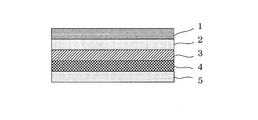
- FIG. 1 shows a five-layer configuration of treatment layer 1 / base material layer 2 / ink layer 3 / blocking layer 4 / adhesion layer 5.
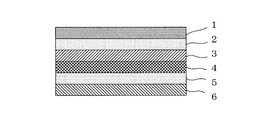
- FIG. 2 shows a six-layer configuration of treatment layer 1 / base material layer 2 / ink layer 3 / blocking layer 4 / adhesive layer 5 / separator layer 6.
- the method for evaluating the characteristics of the label writer tape of the present invention is as follows.
- Example 1 A coating solution in which a polyester resin (Toyobo's Byron (registered trademark) 200) is dispersed in toluene and methylethylketone is applied to a polyester film (Toyobo's ester film) having a thickness of 19 ⁇ m with a coater and dried. did. The coating amount of the treatment layer after drying is about 0.20 g / m 2 .
- an acrylic elastomer product name: Clarity LA2140e, manufactured by Kuraray Co., Ltd.
- Clarity LA2140e manufactured by Kuraray Co., Ltd.
- a rutile type particle size of 0.3 to 0.4 ⁇ m is mixed at a titanium concentration of 47%, an ink layer is provided by coating, and a polyester film having a thickness of 12 ⁇ m as a blocking layer Toray PET Lumirror (registered trademark) # 12) was bonded.
- the layer was bonded to the barrier layer to obtain a label writer tape.
- the tape was peeled off from the adherend after the weather resistance test, but there was no adherend adherend contamination such as ink residue or adhesive residue, and there was no discoloration of the ink layer.
- the printability was also good.
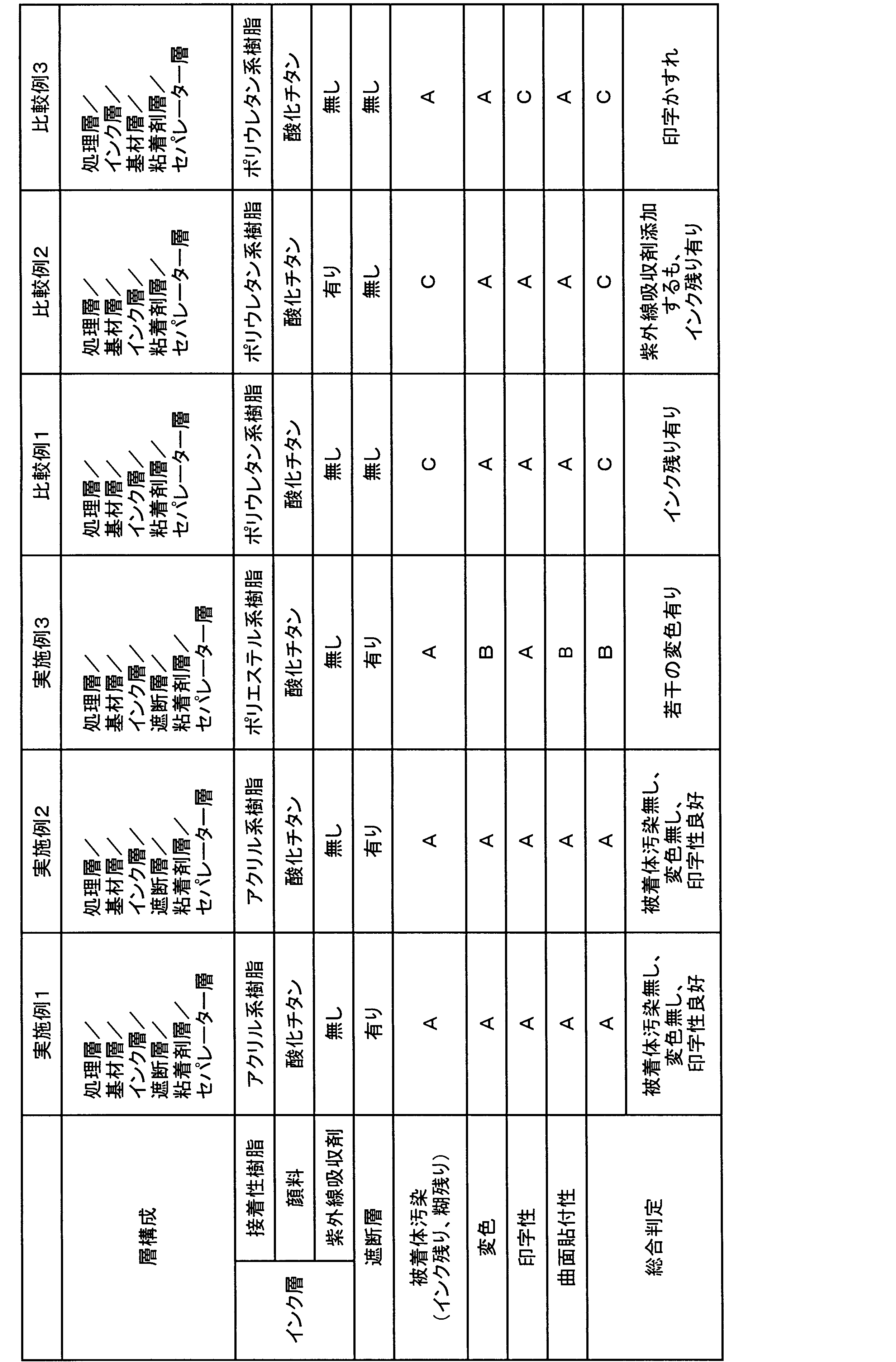
- the evaluation results are shown in Table 1.
- Example 3 The polyester film of the base layer is Toray PET Lumirror # 25 (thickness 25 ⁇ m), and the adhesive resin of the ink layer is changed to a polyester resin (manufactured by Hitachi Chemical Co., Ltd .: Hibon (registered trademark) 7663)
- a label writer tape was obtained in the same manner as Example 1 except for the above. After the weather resistance test, adherend contamination due to peeling of the tape did not occur, but slight discoloration was observed in the ink layer. The evaluation results are shown in Table 1.
- Comparative Example 2 A label writer tape was obtained in the same manner as in Comparative Example 1, except that 1% of a benzotriazole-based ultraviolet absorber (product name: Tinuvin (registered trademark) 326) was further added to the ink layer. Although the weather resistance was improved by the addition of the ultraviolet absorber, the ink residue was observed as in Comparative Example 1. The evaluation results are shown in Table 1.
- Comparative Example 3 A label writer tape was obtained in the same manner as in Comparative Example 1 except that the base material layer and the ink layer were replaced to make the ink layer the outermost surface. By making the ink layer the outermost surface, the ink and the pressure-sensitive adhesive have no interaction. However, when the treatment layer was applied, a problem that the ink layer was dissolved was observed. Further, the obtained label writer tape was faintly printed in the printability test. The evaluation results are shown in Table 1.
- Example 1 From the results shown in Table 1, in Examples 1 to 3 in which a blocking layer was provided between the pressure-sensitive adhesive layer and the ink layer, even if the tape was peeled off from the adherend after the weather resistance test, ink residue and adhesive residue were generated. It was confirmed that the transfer of the pressure-sensitive adhesive to the ink layer was suppressed by the blocking layer. Further, in Examples 1 and 2 using an acrylic elastomer as an adhesive resin for the ink layer, no discoloration of the ink layer occurred, but in Example 3 using a polyester resin as the adhesive resin, the ink layer was slightly changed. Discoloration occurred. Further, in Example 3, when the base material layer and the blocking layer are bonded, the thickness of the base material layer is thicker than in Examples 1 and 2, so that there is no problem in use, but the curved surface stickiness is Compared to Examples 1 and 2, it is slightly lower.
- Comparative Examples 1 and 2 since no blocking layer was provided, ink residue and adhesive residue occurred. In Comparative Example 2, although the weather resistance was improved by adding an ultraviolet absorber, ink residue and adhesive residue were generated. In Comparative Example 3, the base material layer and the ink layer were exchanged so that the ink layer was the outermost surface, so that the ink layer and the pressure-sensitive adhesive layer did not interact with each other. It was faded and could not function as a label writer tape. However, since Comparative Examples 1 to 3 do not have a blocking layer, a problem due to bonding does not occur, and a problem does not occur in curved surface sticking property.
- the label writer tape of the present invention can suppress the transfer of the pressure-sensitive adhesive component to the ink layer, can suppress the throwing destruction of the ink layer and the base material layer, and has a specific adhesive property to the ink layer. Since the resin can be used to prevent cohesive failure, when the label is peeled off from the adherend, no ink or pressure-sensitive adhesive remains on the adherend, and the label writer tape that does not discolor the ink layer can be provided. Industrial applicability is high.
Landscapes
- Physics & Mathematics (AREA)
- Chemical & Material Sciences (AREA)
- Theoretical Computer Science (AREA)
- General Physics & Mathematics (AREA)
- Engineering & Computer Science (AREA)
- Chemical Kinetics & Catalysis (AREA)
- Optics & Photonics (AREA)
- Organic Chemistry (AREA)
- General Chemical & Material Sciences (AREA)
- Adhesive Tapes (AREA)
- Laminated Bodies (AREA)
- Thermal Transfer Or Thermal Recording In General (AREA)
- Impression-Transfer Materials And Handling Thereof (AREA)
- Ink Jet Recording Methods And Recording Media Thereof (AREA)
Abstract
Description
粘着剤層を保護するため、セパレーター層を用いてもよい。
(i)該ラベルライター用テープが、少なくとも処理層、基材層、インク層、遮断層、粘着剤層をこの順に有する層構成を有し、
(ii)該基材層が、合成樹脂フィルムであり、かつ、
(iii)該インク層が、ポリウレタン系樹脂、アクリル系樹脂及びポリエステル系樹脂からなる群より選ばれる一つの接着性樹脂と、顔料とを含むラベルライター用テープが提供される。
また、本発明によれば、(2)該層構成が、少なくとも処理層、基材層、インク層、遮断層、粘着剤層、セパレーター層をこの順に有する層構成である前記(1)のラベルライター用テープが提供される。
また、本発明によれば、(3)該遮断層が、2層以上の層からなる前記(1)または(2)のラベルライター用テープが提供される。
また、本発明によれば、(4)該アクリル系樹脂が、アクリルエラストマーである前記(1)~(3)のラベルライター用テープが提供される。
また、本発明によれば、(5)該遮断層が、ポリエステルフィルムからなる前記(1)~(4)のラベルライター用テープが提供される。
また、本発明によれば、(6)該遮断層の厚さが、1~70μmである前記(1)~(5)のラベルライター用テープが提供される。
また、本発明によれば、(7)該基材層の厚さが、5~300μmである前記(1)~(6)のラベルライター用テープが提供される。
また、本発明によれば、(8)該基材層と該遮断層との厚さの比率は、基材層:遮断層=3:1~1:1である前記(1)~(7)のラベルライター用テープが提供される。
本発明のラベルライター用テープは、基材層に印字を可能とするための処理層が存在する。処理層は、基材層の印字側に設けられる。
インクリボン式(熱転写)の乾燥後の塗布量は、通常0.10~0.50g/m2程度である。
インクジェットインク用の処理層の乾燥後の塗布量は、通常0.50~1.5g/m2程度である。処理層は、2層以上の層からなっても良い。
基材層としては、合成樹脂フィルムが用いられ、とりわけ透明な合成樹脂フィルムが好適に挙げられ、ポリエチレン、ポリプロピレン、ポリ塩化ビニル、ポリエステル、ポリカーボネート等から形成される合成樹脂フィルムが挙げられる。
インク層は基材層の処理層とは反対側に設けられる。
インク層は、顔料と接着性樹脂とを含み、顔料としては従来各種の分野で使用される顔料である、公知の顔料を使用することができる。具体的には、フタロシアニン系、アゾ系、縮合アゾ系、アゾレーキ系、アンスラキノン系、ペリレン・ペリノン系、インジゴ・チオインジゴ系、アゾメチンアゾ系、イソインドリン系、ジオキサン系、キナクリドン系、アニリンブラック系、カーボンブラック系などの有機顔料や酸化チタン系、酸化鉄系、水酸化鉄系、酸化クロム系、クロム酸系、アルミニウム粉末系、ブロンズ粉末系等が挙げられる。これらの顔料はいずれの形態でもよく、また、種々の公知の方法によって分散処理が施されたものであってもよい。
アクリルエラストマーは、一般に、エチルアクリレートや他のアクリレートのポリマーでポリメチレン型の飽和鎖を有するポリマーか、エチルまたは他のアクリレートとアクリロニトリルとの共重合体でポリメチレン型の飽和鎖を有するポリマーである。更にアクリルエラストマーの中でも、メタクリル酸メチルとアクリル酸ブチルのブロック共重合体構造を持つものが望ましい。メタクリル酸メチルとアクリル酸ブチルのブロック共重合体の質量平均分子量は、6万~10万が好ましく、7万~9万が更に好ましい。例えば、株式会社クラレのクラリティ(登録商標)LA2140e、LA2230、LA2250、LA1114が挙げられる。この場合、複数のアクリルエラストマーをブレンドすることもある。特に、株式会社クラレのLA2140eが好ましい。
本発明では、粘着剤層がインク層への移行を抑制するために、インク層と粘着剤層との間に遮断層を設ける。遮断層としては、粘着剤層を遮断するにふさわしい合成樹脂フィルムが使用でき、ポリエチレン、ポリプロピレン、ポリ塩化ビニル、ポリエステル、ポリカーボネート等から形成される合成樹脂フィルムが挙げられ、中でもポリエステルフィルムが好適である。
一般に、貼付材の粘着剤層は、常温で感圧接着性を示す粘着剤を用いて形成される。粘着剤としては、例えば、アクリル系粘着剤、天然ゴム系粘着剤、合成ゴム系粘着剤、シリコーン系粘着剤、ビニルエステル系粘着剤、ビニルエーテル系粘着剤、ウレタン系粘着剤などがあり、これらの中でも粘着性、耐候性のよいアクリル系粘着剤が、好ましく使用される。アクリル系粘着剤は、一般に、単量体単位としては、(メタ)アクリル酸アルキルエステルを主成分としている。
粘着剤層の厚さは、通常3~150μm、好ましくは5~100μm、より好ましくは9~50μmである。粘着剤層は、2層以上の層からなっても良い。
本発明のラベルライター用テープでは、粘着剤層の保護や変質を予防するために、必要に応じて、セパレーター層が設けられる。セパレーター層としては、特に限定されず、一般に、離型紙、離型フィルム、剥離紙、剥離フィルム、剥離ライナーなどと称して使用されるものを用いることができる。具体的には、例えば、表面をシリコーン処理したポリエステルフィルム、表面をシリコーン処理した紙、あるいは表面をシリコーン処理したポリエチレンと紙との積層体などが挙げられる。セパレーター層の厚さは、通常10~300μm程度である。
本発明のラベルライター用テープは、(i)該ラベルライター用テープが、少なくとも処理層、基材層、インク層、遮断層、粘着剤層をこの順に有する層構成を有し、(ii)該基材層が、合成樹脂フィルムであり、かつ、(iii)該インク層が、ポリウレタン系樹脂、アクリル系樹脂及びポリエステル系樹脂からなる群より選ばれる一つの接着性樹脂と、顔料とを含むラベルライター用テープである。
フェドメーター(スガ試験機製)による耐候性試験後、被着体からテープを剥離した際の、インク残り、粘着剤残りを目視により評価した。耐候性試験は、アルミニウム板(A1050P)に、テープを12mm幅×100mmで貼付後、フェドメーターで、JISB7751規格に基づき、紫外線カーボンアーク灯を使用し、放射照度:500W/m2(300-700nm)、BPT:63℃で、300時間照射して行った。
A:ラベル剥離時に被着体にインク、粘着剤が残らない。
C:ラベル剥離時に被着体にインク、粘着剤が残る。
上記の耐候性試験後のテープのインク層の変色を処理層側から目視確認して評価した。
A:変色なし
B:わずかに変色
12mm幅、1mのテープをテプラ(登録商標;キングジム製)用カートリッジにセットし、市販のインクリボン方式(熱転写)のラベルライター(テプラ(登録商標;キングジム製))にて印字試験を行い、印字性を評価した。
A:印字かすれもなく、鮮明に明りょう。
C:印字かすれ。
12mm幅のテープを、塩ビ製LANケーブル(6mmφ)に重ならないように貼付し、曲面貼付性を評価した。
A:貼付後にテープの浮きはなく、曲面貼付性は良好である。
B:貼付後にテープがわずかに浮くが、曲面貼付性は使用上問題がない。
A:ラベル剥離時に被着体にインク、粘着剤が残らず。変色なし。印字も鮮明。曲面貼付性も良好。
B:若干のインクの変色有り。
C:ラベル剥離時に被着体にインク、粘着剤が残る。印字にかすれがある。
基材層の厚さ19μmのポリエステルフィルム(東洋紡製エステルフィルム)に、トルエン、メチルエチルケトンにポリエステル樹脂(東洋紡製バイロン(登録商標)200)を分散した塗布液をコーターで塗布、乾燥して処理層とした。乾燥後の処理層の塗布量は、0.20g/m2程度である。また、基材層の裏面に、厚さ12μmとなるように、接着性樹脂としてのアクリル系樹脂として、アクリルエラストマー(製品名:株式会社クラレ製 クラリティLA2140e)を使用し、顔料となる酸化チタン(ルチル型粒径0.3~0.4μm)をインク層全量を100質量%としたとき、チタン濃度47%で混合し、コーティングによってインク層を設け、さらに遮断層として厚さ12μmのポリエステルフィルム(東レ製PETルミラー(登録商標)♯12)を貼り合わせた。また、粘着剤層は、厚さは18μmとなるようにアクリル系粘着剤(アクリル酸ブチル/アクリル酸=95/5)を、セパレーター層となる厚さ85μmのシリコン離型紙にコーティングし、粘着剤層を上記遮断層と貼り合わせることによって、ラベルライター用テープを得た。上記評価方法により、耐候性試験後に、被着体からテープを剥離したが、インク残りや糊残りなどの被着体汚染はなく、インク層の変色もなかった。印字性も良好であった。評価した結果を表1に示す。
インク層の接着性樹脂のアクリルエラストマーを、実施例1とは分子量の相違するアクリルエラストマー(製品名:株式会社クラレ製 クラリティ LA2140e:LA1114=9:1)に変更したことを除き、実施例1と同様にしてラベルライター用テープを得た。実施例1と同様、耐候性試験後のテープの剥離による被着体汚染や、変色もなく、印字性も良好であった。評価した結果を表1に示す。
基材層のポリエステルフィルムを東レPETルミラー♯25(厚さ25μm)とし、インク層の接着性樹脂を、ポリエステル系樹脂(日立化成(株)製:ハイボン(登録商標)7663)に変更したことを除き、実施例1と同様にしてラベルライター用テープを得た。耐候性試験後、テープの剥離による被着体汚染は生じなかったが、インク層にわずかに変色が見られた。評価した結果を表1に示す。
基材層のポリエステルフィルムを東レPETルミラー♯38(厚さ38μm)とし、ポリウレタン系樹脂をバインダーとしたグラビアインキ(製品名:東洋インキ株式会社ラミスター(登録商標)、サカタインクス株式会社ベルカラー(登録商標)、大日精化工業株式会社ラミック(登録商標))とイソシアネート硬化剤を併用したインク層を設け、粘着剤層とインク層の間に遮断層を設けなかったことを除き、実施例1と同様にしてラベルライター用テープを得た。耐候性試験後、被着体からテープを剥離したときに、インク残りが見られた。評価した結果を表1に示す。
インク層に、さらにベンゾトリアゾール系紫外線吸収剤(製品名:チヌビン(登録商標)326)1%加えたことを除き、比較例1と同様にして、ラベルライター用テープを得た。紫外線吸収剤の添加によって、耐候性向上を図ったが、比較例1と同様、インク残りが見られた。評価した結果を表1に示す。
基材層とインク層を入れ替えて、インク層を最表面にしたことを除き、比較例1と同様にして、ラベルライター用テープを得た。インク層を最表面にすることにより、インク・粘着剤間の相互作用のない構成としたが、処理層塗布の際、インク層の溶け出す不具合が認められた。また、得られたラベルライター用テープは印字性試験にて、印字かすれを生じた。評価した結果を表1に示す。
2 基材層
3 インク層
4 遮断層
5 粘着層
6 セパレーター層
Claims (8)
- ラベルライター用テープであって、
(i)該ラベルライター用テープが、少なくとも処理層、基材層、インク層、遮断層、粘着剤層をこの順に有する層構成を有し、
(ii)該基材層が、合成樹脂フィルムであり、かつ、
(iii)該インク層が、ポリウレタン系樹脂、アクリル系樹脂及びポリエステル系樹脂からなる群より選ばれる一つの接着性樹脂と、顔料とを含むラベルライター用テープ。 - 該層構成が、少なくとも処理層、基材層、インク層、遮断層、粘着剤層、セパレーター層をこの順に有する層構成である請求項1記載のラベルライター用テープ。
- 該遮断層が、2層以上の層からなる請求項1または2記載のラベルライター用テープ。
- 該アクリル系樹脂が、アクリルエラストマーである請求項1乃至3のいずれか1項に記載のラベルライター用テープ。
- 該遮断層が、ポリエステルフィルムからなる請求項1乃至4のいずれか1項に記載のラベルライター用テープ。
- 該遮断層の厚さが、1~70μmである請求項1乃至5のいずれか1項に記載のラベルライター用テープ。
- 該基材層の厚さが、5~300μmである請求項1乃至6のいずれか1項に記載のラベルライター用テープ。
- 該基材層と該遮断層との厚さの比率は、基材層:遮断層=3:1~1:1である請求項1乃至7のいずれか1項に記載のラベルライター用テープ。
Priority Applications (5)
| Application Number | Priority Date | Filing Date | Title |
|---|---|---|---|
| JP2016559091A JP6211718B2 (ja) | 2014-11-11 | 2015-11-11 | ラベルライター用テープ |
| KR1020177012106A KR102270596B1 (ko) | 2014-11-11 | 2015-11-11 | 라벨 라이터용 테이프 |
| US15/525,644 US20170321090A1 (en) | 2014-11-11 | 2015-11-11 | Tape for label writer |
| EP15859857.3A EP3220377B1 (en) | 2014-11-11 | 2015-11-11 | Tape for label writer |
| CN201580061087.6A CN107111969B (zh) | 2014-11-11 | 2015-11-11 | 标签打印机用色带 |
Applications Claiming Priority (2)
| Application Number | Priority Date | Filing Date | Title |
|---|---|---|---|
| JP2014-229143 | 2014-11-11 | ||
| JP2014229143 | 2014-11-11 |
Publications (1)
| Publication Number | Publication Date |
|---|---|
| WO2016076367A1 true WO2016076367A1 (ja) | 2016-05-19 |
Family
ID=55954445
Family Applications (1)
| Application Number | Title | Priority Date | Filing Date |
|---|---|---|---|
| PCT/JP2015/081772 Ceased WO2016076367A1 (ja) | 2014-11-11 | 2015-11-11 | ラベルライター用テープ |
Country Status (6)
| Country | Link |
|---|---|
| US (1) | US20170321090A1 (ja) |
| EP (1) | EP3220377B1 (ja) |
| JP (1) | JP6211718B2 (ja) |
| KR (1) | KR102270596B1 (ja) |
| CN (1) | CN107111969B (ja) |
| WO (1) | WO2016076367A1 (ja) |
Cited By (2)
| Publication number | Priority date | Publication date | Assignee | Title |
|---|---|---|---|---|
| JP2018058931A (ja) * | 2016-09-30 | 2018-04-12 | ブラザー工業株式会社 | 粘着テープカートリッジ及び粘着テープロール並びに粘着テープロールの製造方法 |
| JP2018058926A (ja) * | 2016-09-30 | 2018-04-12 | ブラザー工業株式会社 | 粘着テープカートリッジ及び粘着テープロール並びに粘着テープロールの製造方法 |
Families Citing this family (7)
| Publication number | Priority date | Publication date | Assignee | Title |
|---|---|---|---|---|
| JP6988135B2 (ja) * | 2017-03-31 | 2022-01-05 | ブラザー工業株式会社 | 印刷装置 |
| CN112955329A (zh) * | 2018-08-20 | 2021-06-11 | 伊利诺斯工具制品有限公司 | 具有多色效果的热转印标签 |
| CN111662592B (zh) * | 2020-07-16 | 2022-08-30 | 焦作卓立膜材料股份有限公司 | 一种抗静电阻燃热转印碳带用油墨及其制备方法 |
| CN112622469A (zh) * | 2020-12-29 | 2021-04-09 | 福州艾瑞数码影像有限公司 | 一种能防止升华染料墨水迁移的喷墨打印热转印膜 |
| KR102245410B1 (ko) * | 2021-01-26 | 2021-04-28 | (주)동양엘앤피 | 톨루엔을 함유하지 않는 감온변색 인쇄층을 포함하는 친환경 리텐션 라벨 |
| CN114148109B (zh) * | 2021-11-09 | 2023-05-02 | 焦作卓立膜材料股份有限公司 | 一种可降解碳带及其制备方法 |
| CN118262605A (zh) * | 2022-12-27 | 2024-06-28 | 上海昂朴生物科技有限公司 | 一种采样管标签及其制备方法 |
Citations (4)
| Publication number | Priority date | Publication date | Assignee | Title |
|---|---|---|---|---|
| JPH08108644A (ja) * | 1994-10-13 | 1996-04-30 | Brother Ind Ltd | 熱転写インク用受像シート及びラベル印字用カセット |
| JPH08115050A (ja) * | 1994-10-14 | 1996-05-07 | Sato:Kk | 識別用貼付ラベル |
| JPH11231785A (ja) * | 1998-02-13 | 1999-08-27 | Oji Paper Co Ltd | 感熱記録ラベル |
| JP2003321657A (ja) * | 2002-04-30 | 2003-11-14 | Dainippon Ink & Chem Inc | 印刷用再剥離型粘着シート |
Family Cites Families (8)
| Publication number | Priority date | Publication date | Assignee | Title |
|---|---|---|---|---|
| JPS50240A (ja) | 1973-05-11 | 1975-01-06 | ||
| US4966476A (en) * | 1987-12-29 | 1990-10-30 | Brother Kogyo Kabushiki Kaisha | Tape printer |
| JPH05221167A (ja) * | 1992-02-14 | 1993-08-31 | Toppan Printing Co Ltd | 被熱転写記録媒体 |
| JP3451757B2 (ja) | 1994-11-18 | 2003-09-29 | 旭硝子株式会社 | インクジェット方式ラベルライター用テープ |
| US6235363B1 (en) * | 1998-05-06 | 2001-05-22 | Avery Dennison Corporation | Composite construction containing barrier layer |
| JP4880886B2 (ja) * | 2004-02-12 | 2012-02-22 | 富士フイルム株式会社 | 画像記録ラベルシート及び画像形成方法 |
| US20070204493A1 (en) | 2005-01-06 | 2007-09-06 | Arkwright, Inc. | Labels for electronic devices |
| US20070071945A1 (en) * | 2005-09-29 | 2007-03-29 | Schalk Wesley R | System and method for forming gloss and matte transparent labels from a common film and emulsion set |
-
2015
- 2015-11-11 WO PCT/JP2015/081772 patent/WO2016076367A1/ja not_active Ceased
- 2015-11-11 JP JP2016559091A patent/JP6211718B2/ja active Active
- 2015-11-11 US US15/525,644 patent/US20170321090A1/en not_active Abandoned
- 2015-11-11 EP EP15859857.3A patent/EP3220377B1/en active Active
- 2015-11-11 CN CN201580061087.6A patent/CN107111969B/zh active Active
- 2015-11-11 KR KR1020177012106A patent/KR102270596B1/ko active Active
Patent Citations (4)
| Publication number | Priority date | Publication date | Assignee | Title |
|---|---|---|---|---|
| JPH08108644A (ja) * | 1994-10-13 | 1996-04-30 | Brother Ind Ltd | 熱転写インク用受像シート及びラベル印字用カセット |
| JPH08115050A (ja) * | 1994-10-14 | 1996-05-07 | Sato:Kk | 識別用貼付ラベル |
| JPH11231785A (ja) * | 1998-02-13 | 1999-08-27 | Oji Paper Co Ltd | 感熱記録ラベル |
| JP2003321657A (ja) * | 2002-04-30 | 2003-11-14 | Dainippon Ink & Chem Inc | 印刷用再剥離型粘着シート |
Non-Patent Citations (1)
| Title |
|---|
| See also references of EP3220377A4 * |
Cited By (4)
| Publication number | Priority date | Publication date | Assignee | Title |
|---|---|---|---|---|
| JP2018058931A (ja) * | 2016-09-30 | 2018-04-12 | ブラザー工業株式会社 | 粘着テープカートリッジ及び粘着テープロール並びに粘着テープロールの製造方法 |
| JP2018058926A (ja) * | 2016-09-30 | 2018-04-12 | ブラザー工業株式会社 | 粘着テープカートリッジ及び粘着テープロール並びに粘着テープロールの製造方法 |
| US10870259B2 (en) | 2016-09-30 | 2020-12-22 | Brother Kogyo Kabushiki Kaisha | Adhesive tape cartridge, adhesive tape roll, and method of manufacturing an adhesive tape roll |
| US10995241B2 (en) | 2016-09-30 | 2021-05-04 | Brother Kogyo Kabushiki Kaisha | Adhesive tape cartridge, adhesive tape roll, and method of manufacturing an adhesive tape roll |
Also Published As
| Publication number | Publication date |
|---|---|
| JPWO2016076367A1 (ja) | 2017-10-05 |
| US20170321090A1 (en) | 2017-11-09 |
| CN107111969B (zh) | 2020-06-12 |
| CN107111969A (zh) | 2017-08-29 |
| KR102270596B1 (ko) | 2021-06-28 |
| EP3220377B1 (en) | 2019-09-11 |
| EP3220377A4 (en) | 2018-08-01 |
| EP3220377A1 (en) | 2017-09-20 |
| KR20170086486A (ko) | 2017-07-26 |
| JP6211718B2 (ja) | 2017-10-11 |
Similar Documents
| Publication | Publication Date | Title |
|---|---|---|
| JP6211718B2 (ja) | ラベルライター用テープ | |
| EP1689821B1 (en) | Water contact indicator | |
| CA2985654A1 (en) | Thin film adhesive labels and methods of making thereof | |
| JP2014529097A (ja) | 二重コーティングカプセル構造を用いた浸水ラベル | |
| US9199771B2 (en) | Non-tacky, tamper-evident label | |
| JP4710173B2 (ja) | 剥離シート、粘着テープおよびテープ貼着物 | |
| AU2018367453B2 (en) | Thin film adhesive labels and methods of making thereof | |
| US20050142341A1 (en) | Imaged substrate process and articles | |
| JP2015145064A (ja) | 感熱転写印刷用粘着シート | |
| JP2002366040A (ja) | 印刷用記録材料、粘着フィルム及び印刷物積層体 | |
| JP2005029718A (ja) | 機能層を有する粘着テープまたはシート | |
| EP1520690B1 (de) | Adhäsionsfolie | |
| CN112262193B (zh) | 用于将油墨选择性转印到膜上的微结构化隔离衬件 | |
| JP2017160362A (ja) | 活性エネルギー線硬化型組成物、活性エネルギー線硬化型インク、組成物収容容器、2次元又は3次元の像の形成方法及び形成装置 | |
| JP5933957B2 (ja) | グラフィックスフィルム前駆体 | |
| JP2003321657A (ja) | 印刷用再剥離型粘着シート | |
| CA3023688C (en) | Dye-based time-indicating label without initial gray time | |
| JP4057413B2 (ja) | インクジェットプリンタ用記録媒体、印刷シート、及び転写シート | |
| JP2013044999A (ja) | 隠蔽ラベル及び隠蔽ラベルの使用方法 | |
| JP4671941B2 (ja) | レーザー印字用積層体 | |
| JP4137930B2 (ja) | 積層粘着体の貼着方法およびその製造方法 | |
| JP4671942B2 (ja) | レーザー印字用積層体 | |
| JP2002103800A (ja) | インクジェットプリンター用記録材料及びその製造方法 | |
| JP2011056679A (ja) | 金属薄膜を有し、無機酸エステル化合物を含む前アンカー層を有する転写シート | |
| KR20050040389A (ko) | 박막 라미네이팅 필름 |
Legal Events
| Date | Code | Title | Description |
|---|---|---|---|
| 121 | Ep: the epo has been informed by wipo that ep was designated in this application |
Ref document number: 15859857 Country of ref document: EP Kind code of ref document: A1 |
|
| ENP | Entry into the national phase |
Ref document number: 2016559091 Country of ref document: JP Kind code of ref document: A |
|
| ENP | Entry into the national phase |
Ref document number: 20177012106 Country of ref document: KR Kind code of ref document: A |
|
| WWE | Wipo information: entry into national phase |
Ref document number: 15525644 Country of ref document: US |
|
| NENP | Non-entry into the national phase |
Ref country code: DE |
|
| REEP | Request for entry into the european phase |
Ref document number: 2015859857 Country of ref document: EP |