WO2016080282A1 - ビールテイスト飲料の製造方法及びビールテイスト飲料へのホップ香気の付与方法 - Google Patents
ビールテイスト飲料の製造方法及びビールテイスト飲料へのホップ香気の付与方法 Download PDFInfo
- Publication number
- WO2016080282A1 WO2016080282A1 PCT/JP2015/081889 JP2015081889W WO2016080282A1 WO 2016080282 A1 WO2016080282 A1 WO 2016080282A1 JP 2015081889 W JP2015081889 W JP 2015081889W WO 2016080282 A1 WO2016080282 A1 WO 2016080282A1
- Authority
- WO
- WIPO (PCT)
- Prior art keywords
- hop
- steam
- juice
- boiling
- recovering
- Prior art date
- Legal status (The legal status is an assumption and is not a legal conclusion. Google has not performed a legal analysis and makes no representation as to the accuracy of the status listed.)
- Ceased
Links
Images




Classifications
-
- A—HUMAN NECESSITIES
- A23—FOODS OR FOODSTUFFS; TREATMENT THEREOF, NOT COVERED BY OTHER CLASSES
- A23L—FOODS, FOODSTUFFS OR NON-ALCOHOLIC BEVERAGES, NOT OTHERWISE PROVIDED FOR; PREPARATION OR TREATMENT THEREOF
- A23L2/00—Non-alcoholic beverages; Dry compositions or concentrates therefor; Preparation or treatment thereof
-
- C—CHEMISTRY; METALLURGY
- C12—BIOCHEMISTRY; BEER; SPIRITS; WINE; VINEGAR; MICROBIOLOGY; ENZYMOLOGY; MUTATION OR GENETIC ENGINEERING
- C12G—WINE; PREPARATION THEREOF; ALCOHOLIC BEVERAGES; PREPARATION OF ALCOHOLIC BEVERAGES NOT PROVIDED FOR IN SUBCLASSES C12C OR C12H
- C12G3/00—Preparation of other alcoholic beverages
- C12G3/04—Preparation of other alcoholic beverages by mixing, e.g. for preparation of liqueurs
-
- C—CHEMISTRY; METALLURGY
- C12—BIOCHEMISTRY; BEER; SPIRITS; WINE; VINEGAR; MICROBIOLOGY; ENZYMOLOGY; MUTATION OR GENETIC ENGINEERING
- C12C—BEER; PREPARATION OF BEER BY FERMENTATION; PREPARATION OF MALT FOR MAKING BEER; PREPARATION OF HOPS FOR MAKING BEER
- C12C11/00—Fermentation processes for beer
- C12C11/003—Fermentation of beerwort
-
- C—CHEMISTRY; METALLURGY
- C12—BIOCHEMISTRY; BEER; SPIRITS; WINE; VINEGAR; MICROBIOLOGY; ENZYMOLOGY; MUTATION OR GENETIC ENGINEERING
- C12C—BEER; PREPARATION OF BEER BY FERMENTATION; PREPARATION OF MALT FOR MAKING BEER; PREPARATION OF HOPS FOR MAKING BEER
- C12C12/00—Processes specially adapted for making special kinds of beer
-
- C—CHEMISTRY; METALLURGY
- C12—BIOCHEMISTRY; BEER; SPIRITS; WINE; VINEGAR; MICROBIOLOGY; ENZYMOLOGY; MUTATION OR GENETIC ENGINEERING
- C12C—BEER; PREPARATION OF BEER BY FERMENTATION; PREPARATION OF MALT FOR MAKING BEER; PREPARATION OF HOPS FOR MAKING BEER
- C12C3/00—Treatment of hops
-
- C—CHEMISTRY; METALLURGY
- C12—BIOCHEMISTRY; BEER; SPIRITS; WINE; VINEGAR; MICROBIOLOGY; ENZYMOLOGY; MUTATION OR GENETIC ENGINEERING
- C12C—BEER; PREPARATION OF BEER BY FERMENTATION; PREPARATION OF MALT FOR MAKING BEER; PREPARATION OF HOPS FOR MAKING BEER
- C12C3/00—Treatment of hops
- C12C3/04—Conserving; Storing; Packing
- C12C3/08—Solvent extracts from hops
-
- C—CHEMISTRY; METALLURGY
- C12—BIOCHEMISTRY; BEER; SPIRITS; WINE; VINEGAR; MICROBIOLOGY; ENZYMOLOGY; MUTATION OR GENETIC ENGINEERING
- C12C—BEER; PREPARATION OF BEER BY FERMENTATION; PREPARATION OF MALT FOR MAKING BEER; PREPARATION OF HOPS FOR MAKING BEER
- C12C7/00—Preparation of wort
-
- C—CHEMISTRY; METALLURGY
- C12—BIOCHEMISTRY; BEER; SPIRITS; WINE; VINEGAR; MICROBIOLOGY; ENZYMOLOGY; MUTATION OR GENETIC ENGINEERING
- C12C—BEER; PREPARATION OF BEER BY FERMENTATION; PREPARATION OF MALT FOR MAKING BEER; PREPARATION OF HOPS FOR MAKING BEER
- C12C7/00—Preparation of wort
- C12C7/24—Clarifying beerwort between hop boiling and cooling
-
- C—CHEMISTRY; METALLURGY
- C12—BIOCHEMISTRY; BEER; SPIRITS; WINE; VINEGAR; MICROBIOLOGY; ENZYMOLOGY; MUTATION OR GENETIC ENGINEERING
- C12G—WINE; PREPARATION THEREOF; ALCOHOLIC BEVERAGES; PREPARATION OF ALCOHOLIC BEVERAGES NOT PROVIDED FOR IN SUBCLASSES C12C OR C12H
- C12G3/00—Preparation of other alcoholic beverages
- C12G3/02—Preparation of other alcoholic beverages by fermentation
- C12G3/021—Preparation of other alcoholic beverages by fermentation of botanical family Poaceae, e.g. wheat, millet, sorghum, barley, rye, or corn
- C12G3/022—Preparation of other alcoholic beverages by fermentation of botanical family Poaceae, e.g. wheat, millet, sorghum, barley, rye, or corn of botanical genus Oryza, e.g. rice
-
- C—CHEMISTRY; METALLURGY
- C12—BIOCHEMISTRY; BEER; SPIRITS; WINE; VINEGAR; MICROBIOLOGY; ENZYMOLOGY; MUTATION OR GENETIC ENGINEERING
- C12G—WINE; PREPARATION THEREOF; ALCOHOLIC BEVERAGES; PREPARATION OF ALCOHOLIC BEVERAGES NOT PROVIDED FOR IN SUBCLASSES C12C OR C12H
- C12G3/00—Preparation of other alcoholic beverages
- C12G3/02—Preparation of other alcoholic beverages by fermentation
- C12G3/025—Low-alcohol beverages
-
- A—HUMAN NECESSITIES
- A23—FOODS OR FOODSTUFFS; TREATMENT THEREOF, NOT COVERED BY OTHER CLASSES
- A23V—INDEXING SCHEME RELATING TO FOODS, FOODSTUFFS OR NON-ALCOHOLIC BEVERAGES AND LACTIC OR PROPIONIC ACID BACTERIA USED IN FOODSTUFFS OR FOOD PREPARATION
- A23V2002/00—Food compositions, function of food ingredients or processes for food or foodstuffs
Definitions
- the present invention relates to a method for producing a beer-taste beverage and a method for imparting hop aroma to a beer-taste beverage.
- Hops give refreshing bitterness and aroma to beer-taste beverages.
- the bitterness and aroma derived from hops have a great influence on the character formation of beer-taste beverages.
- the use of hops can control the intensity of bitterness and aroma.
- hops are added during boiling of raw material liquid such as wort. Such a method is generally referred to as “kettle hopping” and aims to impart bitterness.
- a technique called “late hopping” is also known in order to emphasize the aroma of hops.
- hops are added immediately before the boiling of the raw material juice or during standing in the warloop pool so as not to apply heat to the hops as much as possible.
- dry hopping to emphasize hop aroma.
- hops are added to a low-temperature young beer during fermentation ("Brewed Ingredients" (Japan Brewing Association: issued on December 10, 1999), p. 259-261).
- JP 2009-77730 A hops are boiled together with a solvent in order to reduce or remove the hop aroma component, and the obtained hop-treated liquid is added to the raw liquid soup. It is disclosed that a mixture with a product is boiled.
- Japanese Patent Application Laid-Open No. 2010-178628 describes that hop pellets or hop extracts are boiled together with an aqueous solvent, and the boiled hop solution is added to the cooled raw material boiled liquid.
- Japanese Patent Publication No. 2010-539892 discloses a flavor-containing distillation in a flavor recovery method during brewing in which steam discharged from wort during the boiling stage is allowed to flow into a rectifying column and rectified in the rectifying column. The point which supplies a thing to wort after a boiling stage is disclosed.
- hop aroma components for example, linalool: geraniol: geraniol, citronellol: citronellol, myrcene: myrcene, and beta ionone: betaionone, alpha eudesmol: alpha Eudesmol, 4-mercapto-4-methylpentan-2-one : 4-mercapto-4-methylpentane-2-one
- linalool geraniol: geraniol
- citronellol citronellol
- myrcene citronellol
- myrcene myrcene
- beta ionone betaionone
- alpha eudesmol alpha Eudesmol
- 4-mercapto-4-methylpentan-2-one 4-mercapto-4-methylpentane-2-one
- the method described in JP-A-2009-77730 is a method for reducing or removing the hop aroma component, and does not describe the point of efficiently incorporating the hop aroma component into the beverage.
- hop pellets or hop extracts are boiled together with an aqueous solvent, and the liquid phase is added to the raw material juice as a hop solution. Since the fragrance component contained in the hop is evaporated, the fragrance component is not added to the raw material juice.
- the hop solution is added to the raw material liquid after cooling, the hops are not dissolved or suspended in the raw material liquid, and the apparatus is easily contaminated by hop wrinkles.
- the filter medium may be clogged with hops.
- an object of the present invention is to provide a method for producing a beer-taste beverage and a method for imparting a hop aroma to a beer-taste beverage, in which both a bitter component and an aroma component of hops can be efficiently and easily contained in the beverage. Is to provide.
- the inventor of the present application has intensively studied to solve the above problems.
- the hop is boiled with an aqueous solvent separately from the raw material juice, and the hop suspension and the hop transpiration component are recovered respectively, and these are added to the juice to find that the above problems can be solved, and the present invention is completed. It came to.
- the present invention includes the following matters.
- a method for producing a beer-taste beverage comprising: [2] Furthermore, Holding the boiled juice in a swirl separator before cooling, With The said hop suspension is a manufacturing method as described in said [1] added to the juice being boiled or the juice being hold
- the production method according to [7] including recovering steam when the concentration ratio of linalool / geraniol in the steam is less than 3.2.
- the production method according to [7] comprising recovering the steam when the myrcene / geraniol concentration ratio in the steam is less than 0.3.
- the production method of the above-mentioned [7], comprising recovering the steam when the 4-mercapto-4-methylpentan-2-one / geraniol concentration ratio in the steam is 0.0008 or more.
- the collecting includes collecting steam when the transpiration coefficient is a preset value;
- the transpiration coefficient is defined as a value obtained by dividing the transpiration weight (integrated value) of the hop suspension by the hop weight added to the hop suspension.
- the manufacturing method described in the above [13] The production method according to [12], including collecting steam when the transpiration coefficient is 2.0 or less. [14] The production method according to [12], including collecting steam when the transpiration coefficient is 0.9 or less. [15] The production method according to [12], including collecting steam when the transpiration coefficient is 0.7 or less. [16] The production method according to any one of [1] to [15], wherein the raw material juice is wort.
- a hop treatment device configured to boil a hop suspension that is a mixture of hops and an aqueous solvent;
- a recovery device configured to recover steam as a hop transpiration component from the hop treatment device, and
- a raw material liquid boiling device configured to boil the raw material liquid;
- a juice cooler configured to cool the boiled juice; From the hop treatment device, the hop suspension after boiling is configured to be poured into the juice before cooling, a hop suspension charging line, From the recovery device, the hop transpiration component is configured to be introduced into the liquid juice after the boiling step by the raw material liquid boiling device, a transpiration component input line,
- An apparatus for producing a beer-taste beverage An apparatus for producing a beer-taste beverage.
- the recovery device includes: A heat exchanger configured to cool the steam and produce a condensate;
- the manufacturing method of a beer taste drink and the provision method of the hop flavor to a beer taste drink which can contain both the bitterness component and aroma component of a hop efficiently and simply are provided. .
- FIG. 1 is a schematic view showing an apparatus for producing a beer-taste beverage.
- FIG. 2 is a graph showing the concentration ratio of linalool and geraniol for each fraction.
- FIG. 3 is a graph showing the concentration ratio of 4MMP to geraniol for each fraction.
- FIG. 4 is a graph showing the concentration ratio of myrcene and geraniol for each fraction.
- FIG. 5 is a graph showing the relationship between each fraction and the concentration of each aroma component.
- FIG. 6 is a graph showing the linalool / geraniol concentration ratio.
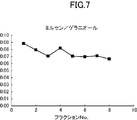
- FIG. 7 is a graph showing the myrcene / geraniol concentration ratio.
- FIG. 8 is a diagram schematically showing the configuration of the recovery device in the second embodiment.
- FIG. 9 is a diagram conceptually showing components and ratios contained in hop essential oil.
- FIG. 10 is a schematic view showing an experimental apparatus.
- FIG. 11 is a diagram showing measurement results of
- beer-taste beverage means an alcoholic beverage that has the same or similar flavor as beer and has a foaming property with carbon dioxide gas, regardless of the classification under the liquor tax law, the raw materials used and the amount used. It means non-alcoholic beverages. Therefore, the beer-taste beverage is used in a sense that includes not only beer and sparkling liquor currently defined in the Liquor Tax Law and related laws and regulations, but also commonly used third beer and non-alcohol beer-taste beverages.
- the method for producing a beer-taste beverage according to the present invention includes boiling raw material juice, cooling the boiled juice, boiling a hop suspension that is a mixture of hops and an aqueous solvent, and hopping steam. Recovering as a transpiration component, adding the boiled hop suspension to the juice before cooling, and preferably adding the recovered hop transpiration component to the juice after cooling, preferably after cooling.
- the bitter taste component of hops is solubilized by boiling, and is added as a hop suspension to the liquid juice that is the main liquid.
- the hop aroma component is recovered as a hop transpiration component, and then added to the main liquid (liquid juice). Therefore, both the hop bitterness component and the aroma component can be efficiently added to the juice.
- FIG. 1 is a schematic diagram illustrating an example of a beer-taste beverage manufacturing apparatus 10.
- a beer-taste beverage production apparatus 10 includes a raw material juice boiling device 1, a hop treatment device 2, a whirlpool 3 (a swirl separation tank), a heat exchanger 4 (a juice cooling device), a recovery device 5, and a hop suspension input line 9. , And a transpiration component input line 10.
- the raw material liquid boiling apparatus 1 is an apparatus (boiling pot) for boiling the raw material liquid.
- the whirlpool 3 is an apparatus for solid-liquid separation of the boiled liquid juice.
- the whirlpool 3 is connected to the raw material liquid boiling device 1 via a line 12.
- a line 13 is connected to the whirl pool 3.
- the broth separated in the whirlpool 3 is taken out via a line 13.
- the line 13 is provided with a heat exchanger 4.
- the juice extracted from the whirlpool 3 is cooled by the heat exchanger 4.
- a plate cooler or the like is used as the heat exchanger 4.
- the liquid juice cooled by the heat exchanger 4 is sent to the subsequent process via the line 13.
- the hop treatment apparatus 2 is an apparatus for boiling a hop suspension that is a mixture of hops and an aqueous solvent.
- the hop treatment device 2 is connected to the raw material liquid boiling device 1 via a hop suspension charging line 9.
- the boiled hop suspension is added to the raw material liquid boiling device 1 via the hop suspension charging line 9.
- the hop suspension may be added to the juice at any stage as long as it is before being cooled by the heat exchanger 4.
- the hop suspension charging line 9 is not necessarily connected to the raw material liquid boiling device 1.
- the hop suspension charging line 9 may be connected to the whirl pool 3.
- the recovery device 5 is provided to recover the steam generated in the hop treatment device 2 as a hop transpiration component.
- the collection device 5 is connected to the hop processing device 2 via a line 11.
- a recovery valve 7 is provided between the line 11 and the recovery device 5.
- the line 11 is further provided with a discharge valve 8. By operating the recovery valve 7 and the discharge valve 8, it is possible to recover the hop transpiration component at a desired timing.
- the recovery device 5 is provided with an aroma recovery tank 5-1 and a heat exchanger 5-2. In the recovery device 5, the hop transpiration component is cooled by the heat exchanger 5-2 and recovered in the aroma recovery tank 5-1 as a condensate (hop distillate).
- the aroma recovery tank 5-1 is connected to the line 13 via the transpiration component charging line 10.
- the condensate recovered in the fragrance recovery tank 5-1 is input to the liquid juice via the transpiration component input line 10 downstream of the raw material liquid boiling device 1, more preferably downstream of the heat exchanger 4. Note that the condensate may be added to the juice at any stage as long as it is after the raw material juice boiling device 1, and is not necessarily connected to the line 13.
- raw material liquid is prepared, put into the raw material liquid boiling apparatus 1, and boiled.
- the boiling time is not particularly limited, and a normal boiling time used at the time of producing the sparkling beverage may be adopted.
- the raw material juice is an aqueous solution containing monosaccharides, disaccharides, and trisaccharides or higher sugars.
- the raw material juice can be obtained, for example, by hydrolyzing cereal grains containing starch. As the grain containing starch, malt and an extract thereof are preferably used. However, in addition to malt, other materials such as rice and corn starch can be used.
- the raw material juice is preferably wort.
- the juice is taken out from the whirlpool 3 via the line 13 and cooled to an appropriate temperature by the heat exchanger 4.
- the cooled liquid juice is shipped as a product through a necessary post-process.
- yeast is inoculated into the liquid juice after cooling and fermented.
- the obtained fermentation broth is aged, and yeast and proteins are removed by filtration.
- a fermented drink is obtained as a target beer-taste drink.
- generated can be reduced by suppressing alcoholic fermentation at the time of fermentation, and the non-alcohol beer or low alcoholic beverage whose alcohol concentration is less than 1 volume% can be manufactured.
- a non-fermented beer-taste beverage can be produced by injecting carbon dioxide directly into the juice instead of the fermentation process.
- the hop suspension is heated and boiled by the hop treatment apparatus 2 separately from the boiling of the raw material liquid.
- This hop suspension does not contain malt-derived components, and by boiling, the ⁇ acid, which is a bitter component in the hops, is isolized and solubilized. As a result, a bitter component is extracted in the hop suspension.
- the aroma component in the hop is evaporated.
- steam of a hop suspension is taken in into the collection
- the taken-in hop transpiration component is cooled to become liquid by the heat exchanger 5-2, and is recovered in the aroma recovery tank 5-1 as a condensate (hop distillate).
- All of the vapor of the hop suspension may be recovered, but only a part may be selectively recovered.
- hops there are several components as fragrance components such as linalool, geraniol, citronellol, myrcene, ⁇ ionone, ⁇ eudesmol, and 4 -Mercapto-4-methylpentan-2-one and the like are included.
- fragrance components such as linalool, geraniol, citronellol, myrcene, ⁇ ionone, ⁇ eudesmol, and 4 -Mercapto-4-methylpentan-2-one and the like are included.
- Each aroma component gives a different taste.
- the concentration of each aromatic component in the steam of the hop suspension varies with time after the start of heating. Therefore, by adjusting the collection timing, it is possible to obtain a hop transpiration component having a desired composition, that is, a hop transpiration component having a desired aroma.
- recovered separately at a different timing
- Steam recovery may be performed at a preset timing.
- the ratio of linalool (ppb) / geraniol (ppb) in the steam is 3.2 or higher, and conversely, if characterizing the scent like a rose, linalool in steam (
- the ratio of ppb) / geraniol (ppb) is less than 3.2 and the fruity fragrance is characterized, the ratio of 4-mercapto-4-methylpentan-2-one (ppb) / geraniol (ppb) in the steam is 0. It is preferred to recover the steam when it is above .0008.
- the myrcene (ppb) / geraniol ratio (ppb) is 0.3 or less, preferably 0.1 or less.
- Myrcene is a component having an unpleasant blue odor, and the unpleasant blue odor can be sufficiently reduced by setting the myrcene / geraniol ratio to 0.3 or less.
- the timing for recovering the vapor is, for example, the transpiration coefficient is 2.0 or less, more preferably 0. Is not more than 0.9, more preferably not more than 0.7.
- the hop suspension is preferably heated at 70 ° C. or higher from the viewpoint of isolating the ⁇ acid.
- Table 1 below is a graph showing the measurement results of the isolation rate when hops are boiled for 60 minutes at each temperature. As shown in Table 1, when heated at 70 ° C. or higher, the value of 10% or more is obtained as the isotization rate, and it can be seen that a sufficient isodization rate can be achieved.
- the aqueous solvent used for the hop suspension is not particularly limited as long as it is a solvent mainly containing water.
- the aqueous solvent the same liquid soup as the raw material soup (for example, wort) and water containing liquid sugar are used.
- an additive may be added to the aqueous solvent.
- the additives include pH adjusters such as acids, alkalis and salts, emulsifiers, stabilizers, antioxidants, cereals, fruits, herbs, spices and the like.
- water that is not mixed with other components is preferably used as the aqueous solvent. By using water in which other components are not mixed as an aqueous solvent, it is possible to prevent components derived from components other than hops from being mixed into the hop vapor component.
- the amount of the aqueous solvent relative to the hop is preferably 1 to 500 L, for example, 12 L to 115 L, per 1 kg of hops. Further, when the hop is in the form of an extract or spikelet, the amount of the aqueous solvent is preferably (1 L) to (500 L) with respect to 1 kg of hop. On the other hand, when the hop is in the form of pellets, the amount of the aqueous solvent is preferably (25 L) to (500 L) with respect to 1 kg of hops.
- the amount of the aqueous solvent (the amount before boiling) is preferably about 1/10 to 1/200 (volume basis) of the amount of the raw material liquid used in the raw material liquid boiling step 2-1.
- the hop treatment can be carried out without any trouble, and if it is about 1/10 (volume basis) or less, the heat energy is efficient. Can be used.
- the form of a hop is not specifically limited, For example, it can be set as forms, such as a pellet, an extract, and a spikelet.
- the extract for example, a CO 2 extract, an ethanol extract and the like can be used.
- Hop variety is not particularly limited, for example, American Nugget, American Cascade, American Chinook, American Citra, American Amarillo, German Saffia, German Health Brooker, German tradition, New Zealand Nelson Sauvin Slovenian Styrian Golding Bobeck, Czech Satz, Japanese Shinshu Hayasei, etc. can be used.
- the hop suspension is added to the liquid juice as it is or after the resin fraction is removed.
- the hop suspension may be added to the juice at any stage before the cooling step 2-3.
- the hop suspension can be added to the liquid juice in the raw material liquid boiling step 2-1 and the solid-liquid separation step 2-2.
- the hop suspension is added to the juice before the solid-liquid separation step 2-2.
- the recovered hop transpiration component may be added to the juice in any step after the boiling step 2-1 of the raw material juice, but particularly preferably in the cooling step 2-3. Later it is added to the juice. By adding after the cooling step 2-3, it is possible to prevent the added hop vapor component from evaporating again.
- the hop transpiration component evaporated by boiling is recovered, the hop-derived aroma component can be sufficiently contained in the beer-taste beverage. That is, it becomes possible to efficiently incorporate hop bitterness components and aroma components into a beer-taste beverage.
- recover the component which has a desired aroma by collect
- the hop suspension is boiled separately from the boiling of the raw material juice, and the hop transpiration component is recovered.
- the transpiration component can be limited to hop-derived components.
- the beer-taste beverage may be a non-fermented beverage.
- components with high hydrophobicity such as myrcene are adsorbed to yeast and removed from the system to be reduced (eg, KISHIMOTO, T. Uemura, K., Aizawa, M., "A new insight for controlling the hop flavor using Non-fermented beverages do not undergo yeast fermentation and may leave more odor and unpleasant aromas in the final product.
- KISHIMOTO T. Uemura, K., Aizawa, M.
- Example 1 [Control Group 1] After reacting the malt and the enzyme at 50 ° C. for 30 minutes and at 62 ° C. for 50 minutes, the enzyme was inactivated at 76 ° C., and wort filtration was performed. The filtered wort was placed in a boiling kettle with liquid sugar, adjusted to 200 L with hot water, and then 140 g of hop (Citra from USA) was added. Boiled for 70 minutes to obtain 184 L of wort. Again adjusted to 200 L with hot water. After solid-liquid separation with a whirlpool (swirl separation tank), the mixture was cooled with a heat exchanger.
- hop American Citra
- hot water was added to 4 L and boiled for 70 minutes, 3.7 L of hop extract (hop suspension) and 0.3 L of Separated into hop distillate.
- hop extract hop suspension
- a whirlpool whirlpool
- the hop fragrance component was adsorbed on the surface.
- TDU thermal desorption unit
- CIS4 programmable temperature-vaporization inlet
- Gas chromatograph 6890 manufactured by Agilent Technologies Detector: MSD5973N quadrupole mass spectrum (Agilent Technologies)
- TDU 30 ° C-720 ° C / min-180 ° C (3min)
- CIS4inlet 10 ° C (0min) -720 ° C / min-280 ° C (3min)
- Agilent Triple Quadrupole GC / MS System Column: DB-Waxetr (15 m ⁇ 0.25 mm (inner diameter) ⁇ 0.25 ⁇ m thickness) Oven temperature rising condition: 100 ° C. (3 min) ⁇ 10 ° C./min ⁇ 250° C.
- Example 2 140 g of hop (American Citra) was added to a 4 L boiling kettle, hot water was added so as to reach 4 L, and boiling was carried out with such a strength that 7% of the liquid was evaporated per hour.
- the distillate was sampled at any time, and the concentrations of linalool, geraniol, myrcene, ⁇ -ionone, and 4-mercapto-4-methylpentan-2-one (denoted as 4MMP) were measured. Specifically, the concentration was measured by the same method as in Example 1 using a sample obtained by diluting the sampled distillate 100 times with water.
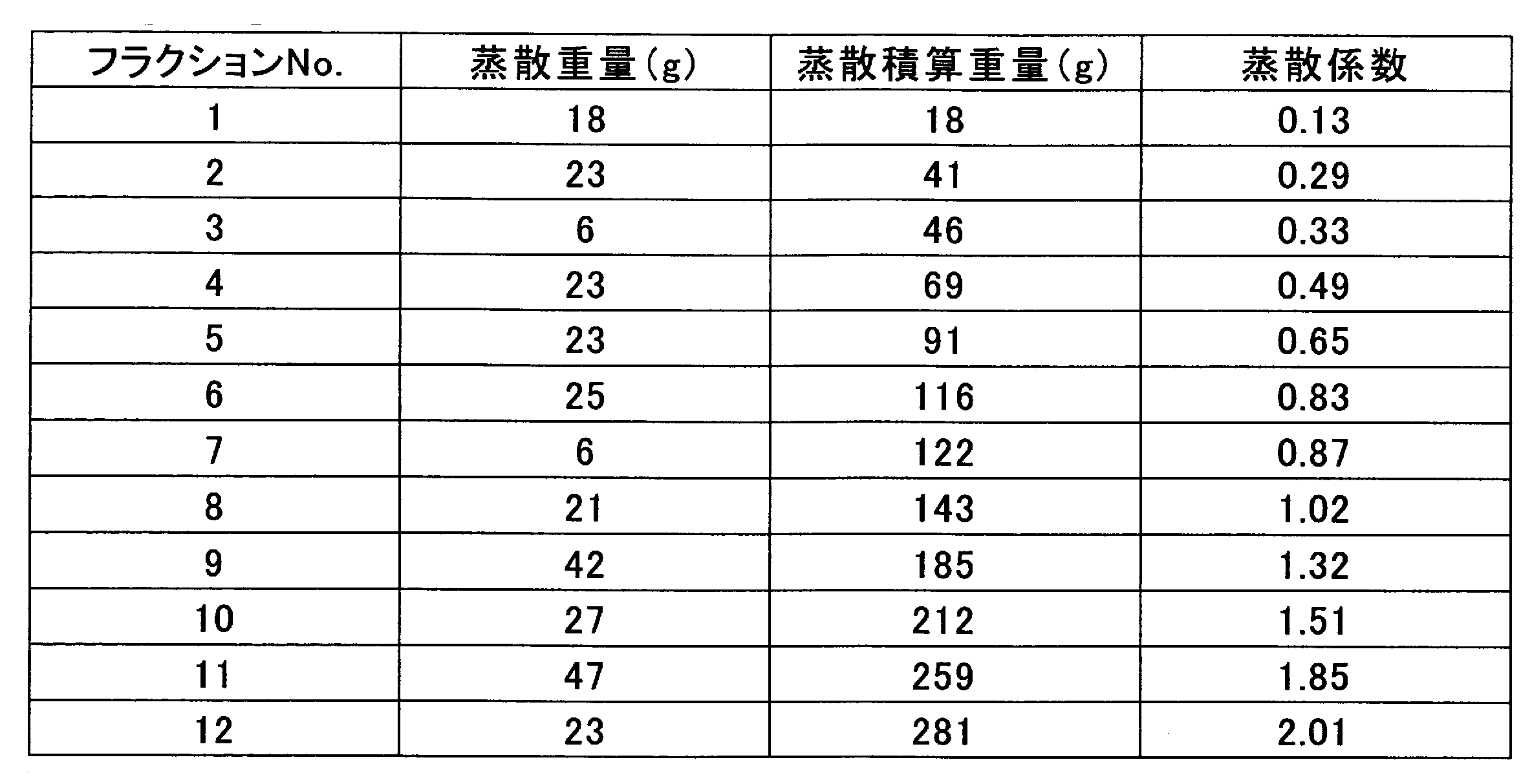
- Table 4 and the analysis results are shown in Table 4 for fractionation and transpiration coefficient of the distillate, respectively.
- each fraction was added to Asahi Super Dry (trade name) and the pre-fermented wort of Control Group 1 of Example 1 at a rate of 0.5 mL / L, and sensory evaluation was carried out on a beer specialty panel. Is shown in Table 6.
- FIG. 2 is a graph showing the concentration ratio of linalool to geraniol (linalool (ppb) / geraniol (ppb)) for each fraction.
- FIG. 3 is a graph showing the concentration ratio of 4MMP to geraniol (4MMP (ppb) / geraniol (ppb)) for each fraction.
- FIG. 4 is a graph showing the concentration ratio of myrcene and geraniol (myrcene (ppb) / geraniol (ppb)) for each fraction.
- Linalool has a gorgeous floral-like character as a characteristic scent of hops.
- 4MMP has fruity and muscat-like characteristics.
- Geraniol has the characteristic that transpiration is stable. As described above, myrcene is an ingredient having an unpleasant blue odor.
- the linalool / geraniol ratio is 3.2 or more. That is, it can be understood that a component having floral-like characteristics can be selectively obtained by recovering steam when the linalool / geraniol ratio is 3.2 or more.
- the linalool / geraniol ratio is less than 3.2. That is, it can be understood that by collecting steam when the linalool / geraniol ratio is less than 3.2, a component having rose-like characteristics can be selectively obtained. Further, as shown in FIG.
- the 4-mercapto-4-methylpentan-2-one / geraniol ratio is 0.0008 or more. That is, by collecting steam when the 4-mercapto-4-methylpentan-2-one / geraniol ratio is 0.0008 or more, a component having fruity or Muscat-like characteristics can be selectively obtained. Understandable. As described above, it was confirmed that the targeted aroma characteristics can be exhibited by controlling the steam recovery timing.
- the myrcene / geraniol concentration ratio is 0.3 or less in all fractions. As already mentioned, myrcene is a component that causes unpleasant odors. According to the present invention, the content of myrcene can be sufficiently reduced with respect to other aroma components such as geraniol by boiling a mixture of hops and an aqueous solvent and recovering the above as a hop transpiration component. .
- Example 3 Subsequently, the production scale was increased as compared with Example 2, and an experiment similar to Example 2 was performed. Specifically, 1532 g of hops (cascade species; ⁇ acid content 6.3%) was added to a 50 L boiling kettle, and 50 L of water was added. Next, boiling was performed at a boiling strength of 20%, and the evaporated components were cooled and recovered as a liquid. The transpiration component was collected up to the 8th L for every 1 L. About each collect
- FIG. 5 is a graph showing the relationship between each fraction and the concentration of each aroma component.
- FIG. 6 is a graph showing the linalool / geraniol concentration ratio.
- FIG. 7 is a graph showing the myrcene / geraniol concentration ratio.
- FIG. 5 shows, the density
- the behavior was different between the aroma components, and geraniol had a relatively small decrease in concentration with time, whereas linalool had a large decrease in concentration with time.
- FIG. 6 it was found that the linalool / geraniol concentration ratio decreased with the passage of time.
- the concentration ratio of myrcene / geraniol is 0.10 or lower throughout all fractions, and the concentration of myrcene causing unpleasant odor is compared with the concentration of other flavor components. It was possible to reduce significantly.
- FIG. 8 is a diagram schematically illustrating a configuration of the collection device 5 in the beer-taste beverage manufacturing apparatus 10 according to the present embodiment.
- a separation unit 5-3 is added between the heat exchanger 5-2 and the fragrance recovery tank 5-1.
- the vapor of the hop suspension is cooled by the heat exchanger 5-2 and guided to the separation unit 5-3 as a condensate.
- the separation unit 5-3 has a function of separating the oil phase and the aqueous phase of the condensate.
- the aqueous layer separated in the separation unit 5-3 is collected in the aroma collection tank 5-1 as a hop transpiration component.
- the structure of another part can employ
- the hop suspension vapor also contains components that contribute to undesirable aromas such as myrcene.
- the condensate is separated into an oil phase and an aqueous phase in the separation unit 5-3, and only the aqueous phase is selectively recovered. Thereby, it becomes possible to collect
- FIG. 9 is a diagram conceptually showing components and ratios contained in hop essential oil.
- the hop essential oil contains a hydrophilic compound and a hydrophobic compound (hydrocarbons).
- the hydrophobic compound contains a large amount of components that cause raw hop odor (blue odor).
- components that contribute to a preferred aroma are mainly hydrophilic compounds. Therefore, by separating the condensate from the oil phase and the aqueous phase, and selectively recovering only the aqueous phase, components that cause raw hop odor can be removed, and components that give a favorable aroma are concentrated. Is possible.
- This experimental apparatus 20 includes a three-necked flask 21, a cooling pipe (heat exchanger 5-2) connected to the three-necked flask 21, a container (separation unit 5-3) connected to the cooling pipe, and a flask (recovery tank 5- 1).
- a cooling pipe heat exchanger 5-2
- a container separatation unit 5-3
- a flask recovery tank 5- 1).
- 657 g of a cascade seed hop CO 2 extract and 1314 g of ion-exchanged water were added to obtain a hop suspension.
- the hop turbid solution was boiled at 100 ° C. under atmospheric pressure.
- the vapor of the hop suspension was cooled by a condenser and the condensate was introduced into the vessel.
- the condensate was separated into an oil phase and an aqueous phase. Boiled until 657 g of aqueous phase and 5.21 g of oil phase were obtained. Thereafter, the aqueous phase was recovered in an Erlenmeyer flask as a hop transpiration component.
- the concentration of each component in the recovered hop transpiration component was measured by gas chromatography.
- the concentration of each component in the cascade seed hop CO 2 extract was also measured by gas chromatography in the same manner. The results are shown in FIG.
- the concentrations of myrcene and ⁇ -humulene are significantly reduced compared to the CO 2 extract of cascade seed hops.
- the concentration of linalool is increased. Hydrocarbons including myrcene and ⁇ -humulene are components that cause raw hop odors. From this, it was confirmed that by extracting only the aqueous phase in the separation unit 5-3, components causing the odor of raw hops can be removed and desired aroma components such as linalool can be concentrated.
Landscapes
- Chemical & Material Sciences (AREA)
- Organic Chemistry (AREA)
- Engineering & Computer Science (AREA)
- Life Sciences & Earth Sciences (AREA)
- Health & Medical Sciences (AREA)
- Genetics & Genomics (AREA)
- General Engineering & Computer Science (AREA)
- General Health & Medical Sciences (AREA)
- Bioinformatics & Cheminformatics (AREA)
- Biochemistry (AREA)
- Wood Science & Technology (AREA)
- Zoology (AREA)
- Food Science & Technology (AREA)
- Nutrition Science (AREA)
- Polymers & Plastics (AREA)
- Microbiology (AREA)
- Non-Alcoholic Beverages (AREA)
- Distillation Of Fermentation Liquor, Processing Of Alcohols, Vinegar And Beer (AREA)
Abstract
Description
一方、特開2010-178628号公報には、ホップペレット又はホップエキスを水系溶媒と一緒に煮沸し、煮沸後のホップ溶液を、冷却後の原料煮沸液状物に添加する点が記載されている。更に、特表2010-539892号公報には、煮沸段階中の麦汁から流出される蒸気を精留塔に流入させ、精留塔で精留するビール醸造中におけるフレーバー回収方法において、フレーバー含有蒸留物を煮沸段階後の麦汁に供給する点が開示されている。
また、特開2009-77730号公報に記載された方法は、ホップ香気成分を低減又は除去するための方法であり、ホップの香気成分を飲料に効率よく含有させる点については記載されていない。
特開2010-178628号公報に記載の方法では、ホップペレット又はホップエキスが水系溶媒と一緒に煮沸され、液相がホップ溶液として原料液汁に添加される。ホップに含まれる香気成分は蒸散してしまうため、原料液汁に香気成分が添加されない。また、冷却後の原料液汁にホップ溶液を添加すると、原料液汁中においてホップが溶解又は懸濁されず、ホップの粕により装置が汚染されやすくなる。更に、後工程において濾過を行う際に、ホップの粕によって濾材が詰まる場合がある。加えて、冷却後の原料液汁にホップ溶液を添加した場合、ホップ由来の低極性の樹脂に由来する青臭い香気成分が最終的な飲料に付与されてしまいやすくなる。
特表2010-539892号公報に記載の方法では、煮沸段階の麦汁から流出する蒸気を精留塔で精留し、フレーバーを回収している。しかしながら、麦汁の煮沸によって生じる蒸気には多数の成分が含まれており、蒸気から所望するフレーバー含有蒸留物を得るためには、複雑な装置が必要になる。
従って、本発明の課題は、ホップの苦味成分と香気成分との両方を効率よく、かつ簡便に飲料に含有させることができる、ビールテイスト飲料の製造方法及びビールテイスト飲料へのホップ香気の付与方法を提供することにある。
具体的には、本発明は、以下の事項を含んでいる。
〔1〕原料液汁を煮沸することと、
前記煮沸された液汁を冷却することと、
ホップと水系溶媒との混合物であるホップ懸濁液を煮沸し、蒸気をホップ蒸散成分として回収することと、
冷却前の前記液汁に、前記煮沸されたホップ懸濁液を添加することと、
煮沸工程以降の前記液汁に、前記回収したホップ蒸散成分を添加することと、
を備えることを特徴とする
ビールテイスト飲料の製造方法。
〔2〕更に、
前記煮沸された液汁を、冷却前に、旋回分離槽中で保持すること、
を備え、
前記ホップ懸濁液は、煮沸中の液汁又は旋回分離槽での保持中の前記液汁に添加される前記〔1〕に記載の製造方法。
〔3〕前記回収することは、蒸気を冷却し、凝縮液を得ることを含む、前記〔1〕または〔2〕に記載の製造方法。
〔4〕前記回収することは、前記凝縮液の油相を除去し、水相を前記ホップ蒸散成分として回収することを含む、前記〔3〕に記載の製造方法。
〔5〕前記ホップ懸濁液は、麦芽由来成分を含まない、前記〔1〕から〔4〕のいずれかに記載された製造方法。
〔6〕前記回収することは、蒸気の一部を選択的に回収することを含む、前記〔1〕から〔5〕のいずれかに記載の製造方法。
〔7〕前記回収することは、予め設定したタイミングで蒸気を回収することを含む、前記〔6〕に記載の製造方法。
〔8〕蒸気中のリナロール/ゲラニオール濃度比が3.2以上であるときに蒸気を回収することを含む、前記〔7〕に記載の製造方法。
〔9〕蒸気中のリナロール/ゲラニオール濃度比が3.2未満であるときに蒸気を回収することを含む、前記〔7〕に記載の製造方法。
〔10〕蒸気中のミルセン/ゲラニオール濃度比が0.3未満であるときに蒸気を回収することを含む、前記〔7〕に記載の製造方法。
〔11〕蒸気中の4-メルカプト-4-メチルペンタン-2-オン/ゲラニオール濃度比が0.0008以上であるときに蒸気を回収することを含む、前記〔7〕に記載の製造方法。
〔12〕前記回収することは、蒸散係数が予め設定された値であるときに蒸気を回収することを含み、
前記蒸散係数は、蒸散した前記ホップ懸濁液の重量(積算値)を前記ホップ懸濁液中に添加されたホップ重量で割った数値として定義される、前記〔7〕~〔11〕のいずれかに記載された製造方法。
〔13〕前記蒸散係数が2.0以下であるときに蒸気を回収することを含む、前記〔12〕に記載の製造方法。
〔14〕前記蒸散係数が0.9以下であるときに蒸気を回収することを含む、前記〔12〕に記載の製造方法。
〔15〕前記蒸散係数が0.7以下であるときに蒸気を回収することを含む、前記〔12〕に記載の製造方法。
〔16〕前記原料液汁が麦汁である、前記〔1〕から〔15〕のいずれかに記載の製造方法。
〔17〕ビールテイスト飲料が、非発酵飲料である、前記〔1〕から〔16〕のいずれかに記載の製造方法。
〔18〕ホップと水系溶媒との混合物であるホップ懸濁液を煮沸し、蒸気をホップ蒸散成分として回収することと、
前記回収したホップ蒸散成分を、冷却後の液汁に添加することと、
を備え、
前記冷却後の液汁は、原料液汁を煮沸し、冷却することにより得られる液であり、
前記ホップ懸濁液は、麦芽由来成分を含まない、
ビールテイスト飲料へのホップ香気の付与方法。
〔19〕前記回収することは、前記ホップ懸濁液を、70℃以上の条件で加熱すること、を含む、前記〔18〕に記載された方法。
〔20〕前記回収することは、蒸気の一部を選択的に回収すること、を含む、前記〔18〕又は〔19〕に記載された方法。
〔21〕前記回収することは、前記ホップ懸濁液の加熱開始後、予め設定したタイミングで蒸気を回収することを含む、前記〔20〕のいずれかに記載の方法。
〔22〕前記回収することは、蒸気を冷却し、凝縮液を得ることを含む、前記〔18〕から〔21〕のいずれかに記載された方法。
〔23〕ホップと水系溶媒との混合物であるホップ懸濁液を煮沸するように構成された、ホップ処理装置と、
前記ホップ処理装置から、蒸気をホップ蒸散成分として回収するように構成された、回収装置と、
原料液汁を煮沸するように構成された、原料液汁煮沸装置と、
前記煮沸された液汁を冷却するように構成された、液汁冷却装置と、
前記ホップ処理装置から、煮沸後のホップ懸濁液を、冷却前の前記液汁に投入するように構成された、ホップ懸濁液投入ラインと、
前記回収装置から、前記ホップ蒸散成分を、前記原料液汁煮沸装置による煮沸工程以降の前記液汁に投入するように構成された、蒸散成分投入ラインと、
を備える
ビールテイスト飲料の製造装置。
〔24〕前記回収装置は、
蒸気を冷却し、凝縮液を生成するように構成された熱交換器と、
前記凝縮液の油相を除去し、水相を前記ホップ蒸散成分として回収する、分離部とを含む、前記〔23〕に記載されたビールテイスト飲料の製造装置。
以下、本発明の実施態様について詳細に説明する。
1.ビールテイスト飲料の製造装置
まず、本発明を実施するために用いられるビールテイスト飲料の製造装置10について説明する。図1は、ビールテイスト飲料の製造装置10の一例を示す概略図である。ビールテイスト飲料の製造装置10は、原料液汁煮沸装置1、ホップ処理装置2、ワールプール3(旋回分離槽)、熱交換器4(液汁冷却装置)、回収装置5、ホップ懸濁液投入ライン9、及び蒸散成分投入ライン10を備えている。
回収装置5には、香気回収タンク5-1及び熱交換器5-2が設けられている。回収装置5において、ホップ蒸散成分は、熱交換器5-2により冷却され、凝縮液(ホップ蒸留液)として香気回収タンク5-1に回収される。
香気回収タンク5-1は、蒸散成分投入ライン10を介して、ライン13に接続されている。香気回収タンク5-1に回収された凝縮液は、蒸散成分投入ライン10を介して、原料液汁煮沸装置1の下流、より好ましくは熱交換器4の下流側で液汁に投入される。なお、凝縮液は原料液汁煮沸装置1以降であればどの段階で液汁に添加されてもよく、必ずしもライン13に接続されている必要は無い。
続いて、ビールテイスト飲料の製造方法を詳細に説明する。
2-1:原料液汁の煮沸
まず、原料液汁を調製し、原料液汁煮沸装置1に投入し、煮沸する。煮沸時間は、特に限定されるものではなく、発泡性飲料の製造時に用いられる通常の煮沸時間を採用すればよい。
原料液汁は、単糖、二糖、及び三糖以上の糖類を含む水溶液である。原料液汁は、例えば、デンプン質を含む穀物を加水分解することにより、得ることができる。デンプン質を含む穀物としては、麦芽及びその抽出物が好ましく用いられる。但し、麦芽以外にも米、コーンスターチ等の他の材料を用いることも可能である。
一方で、植物性タンパク質分解物(大豆タンパク質分解物、エンドウタンパク質分解物など)を糖類と共に水に添加することにより、原料液汁を調製することも可能である。
但し、本実施態様において、原料液汁は、好ましくは、麦汁である。
煮沸後の液汁は、ワールプール3に送られる。ワールプール3において、煮沸後の液汁が高温(例えば70℃以上)で保持され、固液分離される。すなわち、煮沸時に生じた熱凝固物が、煮沸後の液汁から、沈殿除去される。
固液分離後、液汁は、ワールプール3からライン13を介して取り出され、熱交換器4により適切な温度にまで冷却される。冷却された液汁は、必要な後工程を経て、製品として出荷される。
例えば、ビールテイスト飲料が発酵飲料である場合、冷却後の液汁に酵母を接種し、発酵させる。次いで、得られた発酵液を熟成させ、濾過により酵母及びタンパク質等を除去する。これにより、目的のビールテイスト飲料として、発酵飲料が得られる。なお、発酵時のアルコール発酵を抑制することにより、生成されるアルコール量を低減でき、アルコール濃度が1容量%未満のノンアルコールビール又はローアルコール飲料を製造することができる。
一方、発酵工程の代わりに、液汁に直接炭酸ガスを圧入すれば、非発酵のビールテイスト飲料を製造することも可能である。
本発明では、原料液汁の煮沸とは別に、ホップ処理装置2によって、ホップ懸濁液を加熱し、煮沸する。このホップ懸濁液には、麦芽由来成分が含まれない、煮沸によって、ホップ中の苦味成分であるα酸がイソ化し、可溶化する。その結果、ホップ懸濁液中に苦味成分が抽出される。一方、ホップ中の香気成分は、蒸散する。ホップ懸濁液の蒸気は、ライン11を介して、ホップ蒸散成分として回収装置5に取り込まれる。取り込まれたホップ蒸散成分は、熱交換器5-2によって液体になるように冷却され、凝縮液(ホップ蒸留液)として香気回収タンク5-1に回収される。

但し、水系溶媒としては、他の成分が混合されていない水が好ましく用いられる。水系溶媒として他の成分が混合されていない水を用いることにより、ホップ以外の成分に由来する成分がホップ蒸気成分中に混入することを、防ぐことができる。
ホップに対する水系溶媒の液量(煮沸前の液量)は、ホップ1kgに対して1~500Lとすることが好ましく、例えば12L~115Lとすることができる。また、ホップがエキス又は毬花の形態である場合には、ホップ1kgに対して、水系溶媒の液量を(1L)~(500L)とすることが好ましい。一方、ホップがペレットの形態である場合には、ホップ1kgに対して水系溶媒の液量を(25L)~(500L)にすることが好ましい。
水系溶媒の液量(煮沸前の液量)は、原料液汁の煮沸工程2-1で用いる原料液汁の液量の約1/10~1/200(体積基準)であることが好ましい。水系溶媒の液量が原料液汁の液量に対して約1/200(体積基準)以上であればホップ処理を支障なく実施でき、約1/10(体積基準)以下であれば熱エネルギーを効率的に利用できる。
ホップの品種は、特に限定されず、例えば、アメリカ産ナゲット、アメリカ産カスケード、アメリカ産チヌーク、アメリカ産シトラ、アメリカ産アマリロ、ドイツ産サフィア、ドイツ産ヘルスブルッカー、ドイツ産トラディション、ニュージーランド産ネルソンソーヴィン、スロベニア産スティリアンゴールディングボベック、チェコ産ザーツ、日本産信州早生などを用いることができる。
煮沸後、ホップ懸濁液を、そのまま、または樹脂画分を除去した後に、液汁に添加する。ホップ懸濁液は、冷却工程2-3の前であれば、どの段階で液汁に添加されてもよい。冷却工程2-3の前にホップ懸濁液を液汁に添加することにより、原料液汁中においてホップの粕が生じることを防ぐことができ、装置の汚染が防止される。例えば、ホップ懸濁液は、原料液汁の煮沸工程2-1や固液分離工程2-2において、液汁に添加することができる。但し、好ましくは、ホップ懸濁液は、固液分離工程2-2の前に、液汁に添加される。固液分離工程2-2の前に添加することによって、ホップ懸濁液中に含まれる固形の不純物成分を、固液分離工程2-2において取り除くことが可能となる。
一方、回収されたホップ蒸散成分は、原料液汁の煮沸工程2-1以降のどの工程で液汁に添加されても良いが、特に好ましくは冷却工程2-3の後に、液汁に添加される。冷却工程2-3の後に添加することによって、添加したホップ蒸気成分が再度蒸散することを防ぐことができる。
また、本発明によれば、ホップの煮沸中の一部の時間帯に蒸散成分を回収することにより、所望の香気を有する成分を回収することが可能となる。従って、同一のホップ品種を用いて、様々なキャラクターをビールテイスト飲料に付与することが可能となり、より特徴的な香気付与を実現する(フローラルな華やかな香りを中心に回収するなど)ことが可能になる。
さらに、本発明によれば、原料液汁の煮沸とは別にホップ懸濁液の煮沸が行われ、ホップ蒸散成分が回収される。特表2010-539892号公報に記載されるような、原料液汁の煮沸により生じた蒸気を回収する場合と異なり、本発明によれば、蒸散成分をホップ由来の成分に限定することができる。単に蒸気を回収するタイミングを制御することにより、所望する香気成分を選択的に回収することが可能になり、特表2010-539892号公報に記載される精留塔等の大規模な装置を用いる必要がない。
以下、本発明をより詳細に説明するため、本発明者らにより行われた実施例について説明する。
実施例1
[対照区1]麦芽と酵素を50℃で30分、62℃で50分反応後、76℃で酵素失活を行い、麦汁濾過を実施した。濾過麦汁を液糖とともに煮沸釜に入れ、200Lに湯で調整後、ホップ(アメリカ産Citra)を140g添加した。70分間煮沸し、184Lの麦汁を得た。再び湯で200Lに調整した。ワールプール(旋回分離槽)で固液分離した後、熱交換器で冷却した。その後、酵母を添加し発酵させた。発酵後の液を濾過にて清澄化し、1.6倍希釈後に充填し、製品とした。
[対照区2]麦芽と酵素を50℃で30分、62℃で50分反応後、76℃で酵素失活を行い、麦汁濾過を実施した。濾過麦汁を液糖とともに煮沸釜に入れ、200Lに湯で調整後、70分間煮沸し、184Lの麦汁を得た。ホップ(アメリカ産Citra)を140g添加した後、再び湯で200Lに調整した。ワールプール(旋回分離槽)で固液分離した後、熱交換器で冷却した。その後、酵母を添加し発酵させた。発酵後の液を濾過にて清澄化し、1.6倍希釈後に充填し、製品とした。
[試験区]麦芽と酵素を50℃で30分、62℃で50分反応後、76℃で酵素失活を行い、麦汁濾過を実施した。濾過麦汁を液糖とともに煮沸釜に入れ、196Lに湯で調整した。70分間煮沸し、180Lの麦汁を得た。一方で、4L煮沸用釜にホップ(アメリカ産Citra)を140g添加し、4Lになるように湯を足し70分煮沸し、3.7Lのホップ抽出液(ホップ懸濁液)と0.3Lのホップ蒸留液に分離した。180Lの麦汁に3.7Lの抽出液を混合後、再び湯で199.7Lに調整し、ワールプール(旋回分離槽)で固液分離した。熱交換器で冷却後、前述のホップ蒸留液0.3Lと酵母を添加し発酵させた。発酵後の液を濾過にて清澄化し、1.6倍希釈後に充填し、製品とした。
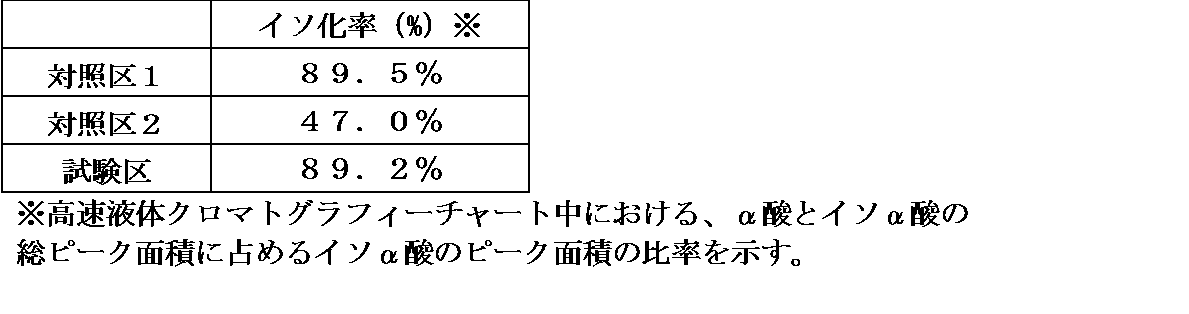
対照区1、2における煮沸後の麦汁について、ホップ由来のα酸のイソ化率を高速液体クロマトグラフィーを用いて測定した。
同様に、試験区におけるホップ抽出液について、ホップ由来α酸のイソ化率を測定した。
結果を下記表2に示す。
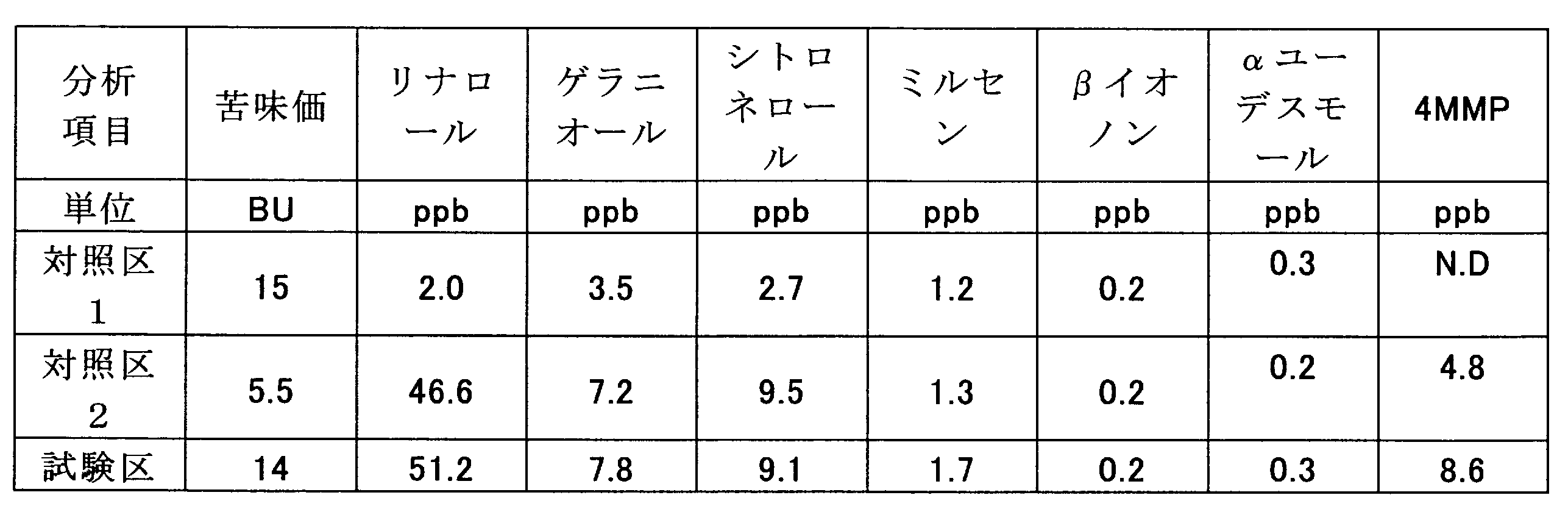
対照区1、2及び試験区のそれぞれについて、製品の苦味価(B.U)及び香気成分濃度を測定した。香気成分としては、リナロール、ゲラニオール、シトロネロール、ミルセン、βイオノン、αユーデスモール、及び4-メルカプト-4-メチルペンタン-2-オン(4MMPと表記)の濃度を、以下の手法により測定した。
攪拌枝吸着抽出法(SBSE法:Stir Bar Sorptive Extraction)を用いて、各ホップ香気成分の濃度を測定した。詳細には、最終製品であるビールテイスト発酵飲料に、内部標準としてβダマスコンを0.1ppbになるように添加した。試料を5倍希釈し、希釈サンプル20mlを30ml容バイアルに採取した。47μlのPDMS(ポリジメチルシロキサン)でコーティングした攪拌枝(長さ=20mm;Twister(商品名);Gerstel社製,Germany)をバイアルに入れ、蓋を締め、40℃で2時間攪拌し、攪拌枝にホップ香気成分を吸着させた。攪拌枝をバイアルから取り出し、水滴を完全に除去後、加熱脱着ユニット(Thermal desorption unit(TDU);Gerstel社製)とプログラマブル温度-蒸発インレット(Programmable temperature-vaporization inlet;CIS4;Gerstel社製)を装備したGC-MSに挿入した。
GC-MS条件は、以下の通りである。
ガスクロマトグラフ:アジレント・テクノロジー社製6890
検出器:MSD5973N四重極マススペクトル(Agilent Technologies社製)
カラム:DB-WAX capillary column(長さ:60m、内径:0.25mm、膜厚:0.25μm、Agilent Technologies社製)
注入口:250℃ パルス化スプリットレスインジェクションモード(pulsed splitless injection mode)
注入量:1μL
キャリアガス:ヘリウム(1ml/min).
カラム温度設定:40℃(5分保持)-(3℃/min)-240℃(20分)
質量-電荷比(mass-to-charge ratio):30~350(m/z),
イオン化条件:70eV、シングルイオン-モニタリングモード(single ion-monitoring(SIM) mode)
定量:それぞれの香気成分のピークエリア面積と内部標準品のピークエリア面積との比較によって行った。
最終製品であるビールテイスト発酵飲料20mlに、内部標準化合物を加え、pHを10に調整した。誘導体化試薬としてEthyl Propiolateを、最終濃度で0.6%(v/v)となるように添加した。GERSTEL社製PDMS Twisterを用いる攪拌枝吸着抽出法を用いて3時間香気を捕集した。捕集した香気をGERSTEL社製Thermal Desorption Unit(TDU)とCIS4 inletを装備したAgilent社製Triple Quadrupole GC/MS Systemにて分析を行った。それぞれの加熱条件、検出条件は以下の通りである。
TDU:30℃-720℃/min-180℃(3min)
CIS4inlet:10℃(0min)-720℃/min-280℃(3min)
Agilent社製Triple Quadrupole GC/MS System
カラム:DB-Waxetr(15m×0.25mm(内径)×0.25μm厚)
オーブン昇温条件:100℃(3min)-10℃/min-250℃(1min)+post run(Back-flush)
検出器:SRM acquisition mode、collision energy;2.5V、acquisition speed;5Hz、m/z=230
定量:それぞれの香気成分のピークエリア面積と内部標準品のピークエリア面積との比較によって行った。
4L煮沸用釜にホップ(アメリカ産Citra)を140g添加し、4Lになるよう湯を足し、1時間あたり7%の液が蒸散する強度で煮沸を実施した。随時留液をサンプリングし、リナロール、ゲラニオール、ミルセン、βイオノン、及び4-メルカプト-4-メチルペンタン-2-オン(4MMPと表記)の濃度を測定した。具体的には、サンプリングした留液を水で100倍に希釈したサンプルを用いて、実施例1と同様の方法により、濃度を測定した。
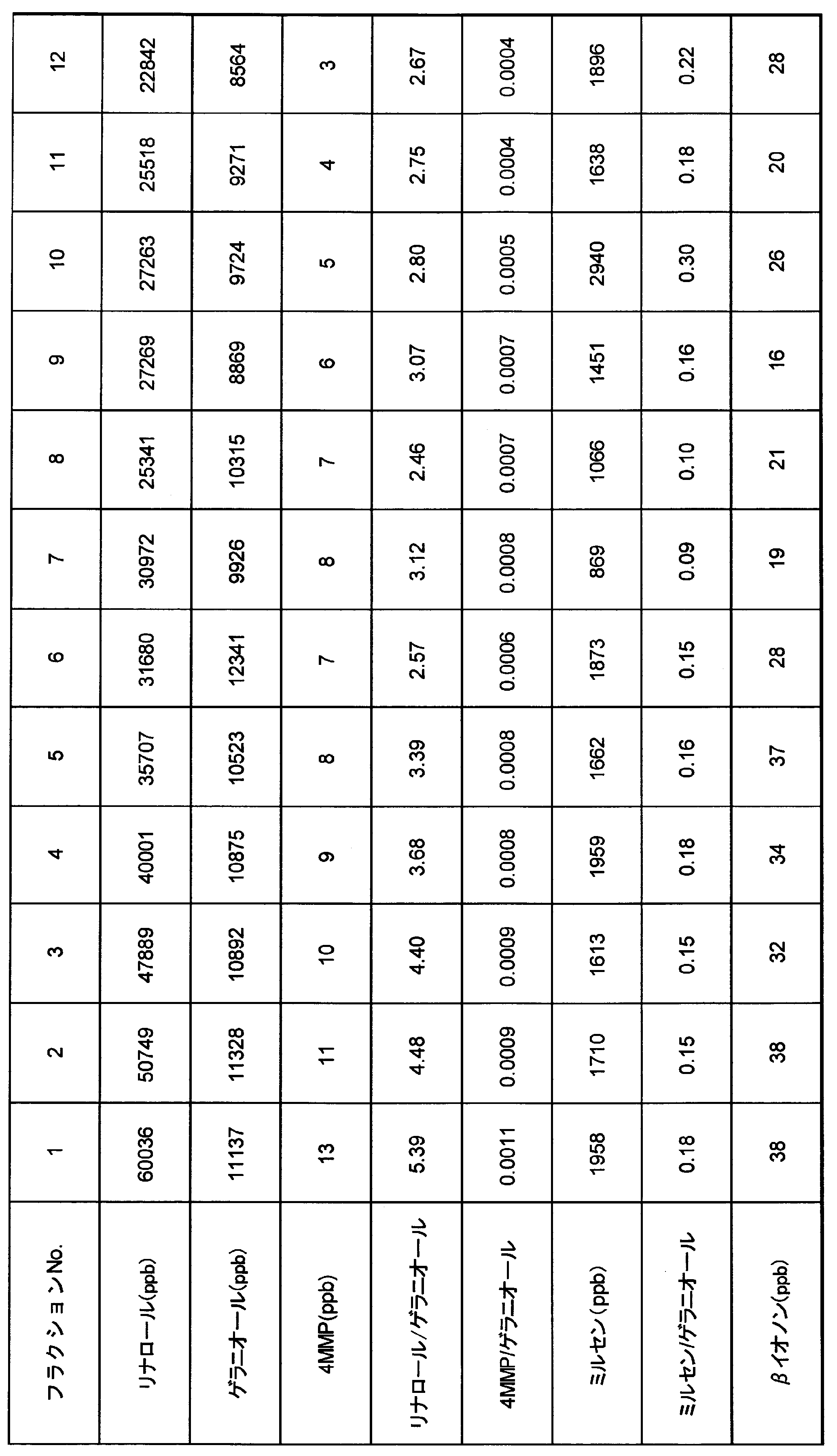

更に、図3に示されるように、フルーティー又はマスカット様な特徴を有するフラクションFR1~5では、4-メルカプト-4-メチルペンタン-2-オン/ゲラニオール比が0.0008以上になっている。すなわち、4-メルカプト-4-メチルペンタン-2-オン/ゲラニオール比が0.0008以上であるときに蒸気を回収することにより、フルーティー又はマスカット様な特徴を有する成分を選択的に得られることが理解できる。
上述の通り、蒸気の回収タイミングをコントロールする事で狙いとする香気特徴を現せることが確認された。
加えて、図4に示されるように、全てのフラクションにおいて、ミルセン/ゲラニオール濃度比は、0.3以下になっている。既述のように、ミルセンは、不快な臭いの原因となる成分である。本願発明によれば、ホップと水系溶媒との混合物を煮沸し、上記をホップ蒸散成分として回収することにより、ゲラニオール等の他の香気成分に対して、ミルセンの含有量を十分に減らすことができる。
続いて、実施例2よりも製造規模を高め、実施例2と同様の実験を行った。詳細には、50L煮沸用釜に、1532gのホップ(カスケード種;α酸含有量6.3%)を投入し、水50Lを加えた。次いで、煮沸強度20%で煮沸を行い、蒸散した成分を冷却し、液として回収した。蒸散成分は、1L毎に8L目まで回収した。回収した各留液(フラクション)について、ゲラニオール、リナロール、及びミルセンの濃度を、実施例2と同様の手法により測定した。
尚、煮沸強度は、1時間あたりの液の蒸発率を示す値であり、下記式により計算される。


また、図6に示されるように、リナロール/ゲラニオール濃度比は、時間の経過に伴い減少することが判った。更に、図7に示されるように、ミルセン/ゲラニオール濃度比は、全てのフラクションを通じて、0.10以下であり、不快な臭いの原因となるミルセンの濃度を、他の香味成分の濃度に比べて著しく低減することができた。
続いて、本発明の第2の実施態様について説明する。本実施態様では、第1の実施態様に対して、ホップ蒸散成分の回収方法が更に工夫されている。
図8は、本実施態様に係るビールテイスト飲料の製造装置10における回収装置5の構成を概略的に示す図である。本実施態様では、熱交換器5-2と香気回収タンク5-1との間に、分離部5-3が追加されている。本実施態様では、ホップ懸濁液の蒸気が、熱交換器5-2によって冷却され、凝縮液として分離部5-3に導かれる。分離部5-3は、凝縮液の油相と水相とを分離する機能を有している。分離部5-3において分離された水層は、ホップ蒸散成分として香気回収タンク5-1に回収される。
尚、その他の部分の構成は、第1の実施態様と同様の構成を採用することができる。
図9は、ホップの精油に含まれる成分及びその割合を概念的に示した図である。図9に示されるように、ホップの精油には、親水性化合物と疎水性化合物(炭化水素類)とが含まれている。ここで、疎水性化合物は、生のホップの匂い(青臭い匂い)の原因となる成分を多量に含んでいる。一方、ホップの精油に含まれる成分のうち、好ましい香気に寄与する成分は、主として親水性化合物である。従って、凝縮液を油相と水相とを分離し、水相だけを選択的に回収することにより、生のホップの匂いの原因になる成分を除去でき、好ましい香気を与える成分を濃縮することが可能になる。
以下、本実施態様の効果を詳細に説明するため、実験例について説明する。
実験装置20として、図10に示されるような装置を準備した。この実験装置20は、三口フラスコ21、三口フラスコ21に接続された冷却管(熱交換器5-2)、冷却管に接続された容器(分離部5-3)、及びフラスコ(回収タンク5-1)を備えている。
三口フラスコ21に、カスケード種ホップのCO2抽出エキス657g、イオン交換水1314gを加え、ホップ懸濁液とした。ホップ混濁液を、大気圧下、100℃で煮沸した。ホップ懸濁液の蒸気を、冷却管によって冷却し、凝縮液を容器に導入した。容器中において、凝縮液は、油相及び水相に分離した。657gの水相及び5.21gの油相が得られるまで煮沸を行った。その後、水相をホップ蒸散成分として三角フラスコに回収した。
結果を図11に示す。図11に示されるように、回収されたホップ蒸散成分では、カスケード種ホップのCO2抽出エキスと比較して、ミルセン及びα-フムレン(α-humulene)の濃度が著しく低減されている。一方で、リナロールの濃度は高められている。ミルセン及びα-フムレンを含む炭化水素類は、生のホップの匂いの原因になる成分である。このことから、分離部5-3において水相だけを抽出することにより、生のホップの匂いの原因になる成分を除去し、リナロール等の所望の香気成分を濃縮できることが確認された。
一方、ホップ蒸散成分を添加しなかった点以外は試験区2と同様の方法を用いて、対照区3に係る飲料を得た。
また、試験区2及び対照区3のホップ香の強さを、官能試験により比較した、官能試験は、6名の専門パネルにより行い、試験区2及び対象区3のうちどちらのホップ香が強いかを評価した。結果を表9に示す。尚、表9において、ホップ香の結果は、ホップ香が強いと判断した人数を表している。
更に、試験区2及び対照区3の飲料について、ビールとしての特性値(比重、エキス量、発酵度、など)を測定した。結果を表10に示す。

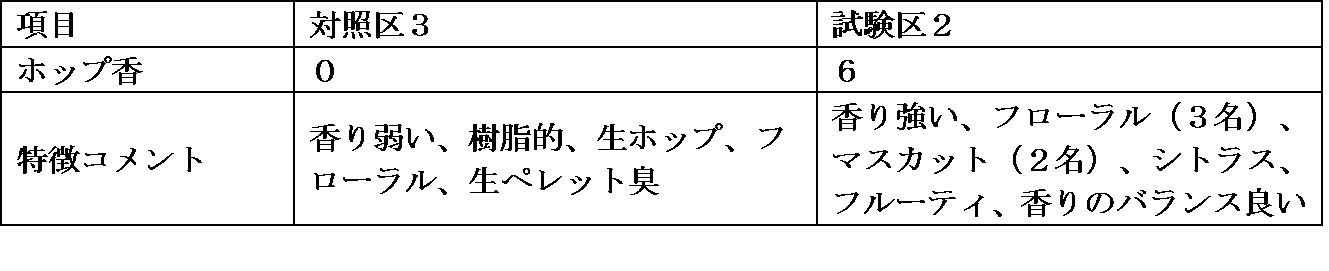

また、表9に示されるように、官能評価の結果、試験区では、対照区に比べて、ホップ香が強いことが確認された。
更に、表10に示されるように、試験区では、飲料のアミノ酸、アルコール、泡、発酵などに起因するパラメータが、対照区とほとんど変わらなかった。
以上の結果から、本実施態様によって得られたホップ蒸散成分を原料液汁に添加することにより、飲料の他の特性(アミノ酸含有量、アルコール度数、泡の状態、及び発酵度など)に影響を与えることなく、ホップ由来の香気成分の含有量を増やすことができ、ホップ香気のみを増強させることができることが確認された。
Claims (24)
- 原料液汁を煮沸することと、
前記煮沸された液汁を冷却することと、
ホップと水系溶媒との混合物であるホップ懸濁液を煮沸し、蒸気をホップ蒸散成分として回収することと、
冷却前の前記液汁に、前記煮沸されたホップ懸濁液を添加することと、
煮沸工程以降の前記液汁に、前記回収したホップ蒸散成分を添加することと、
を備えることを特徴とする
ビールテイスト飲料の製造方法。 - 更に、
前記煮沸された液汁を、冷却前に、旋回分離槽中で保持すること、
を備え、
前記ホップ懸濁液は、煮沸中の液汁又は旋回分離槽での保持中の前記液汁に添加される請求項1に記載の製造方法。 - 前記回収することは、蒸気を冷却し、凝縮液を得ることを含む、
請求項1または2に記載の製造方法。 - 前記回収することは、前記凝縮液の油相を除去し、水相を前記ホップ蒸散成分として回収することを含む、請求項3に記載の製造方法。
- 前記ホップ懸濁液は、麦芽由来成分を含まない、請求項1から4のいずれかに記載された製造方法。
- 前記回収することは、蒸気の一部を選択的に回収することを含む
請求項1から5のいずれかに記載の製造方法。 - 前記回収することは、予め設定したタイミングで蒸気を回収することを含む
請求項6に記載の製造方法。 - 蒸気中のリナロール/ゲラニオール濃度比が3.2以上であるときに蒸気を回収することを含む、請求項7に記載の製造方法。
- 蒸気中のリナロール/ゲラニオール濃度比が3.2未満であるときに蒸気を回収することを含む、請求項7に記載の製造方法。
- 蒸気中のミルセン/ゲラニオール濃度比が0.3未満であるときに蒸気を回収することを含む、請求項7に記載の製造方法。
- 蒸気中の4-メルカプト-4-メチルペンタン-2-オン/ゲラニオール濃度比が0.0008以上であるときに蒸気を回収することを含む、請求項7に記載の製造方法。
- 前記回収することは、蒸散係数が予め設定された値であるときに蒸気を回収することを含み、
前記蒸散係数は、蒸散した前記ホップ懸濁液の重量(積算値)を前記ホップ懸濁液中に添加されたホップ重量で割った数値として定義される、
請求項7~11のいずれかに記載された製造方法。 - 前記蒸散係数が2.0以下であるときに蒸気を回収することを含む、
請求項12に記載の製造方法。 - 前記蒸散係数が0.9以下であるときに蒸気を回収することを含む、
請求項12に記載の製造方法。 - 前記蒸散係数が0.7以下であるときに蒸気を回収することを含む、
請求項12に記載の製造方法。 - 前記原料液汁が麦汁である、
請求項1から15のいずれかに記載の製造方法。 - ビールテイスト飲料が、非発酵飲料である
請求項1から16のいずれかに記載の製造方法。 - ホップと水系溶媒との混合物であるホップ懸濁液を煮沸し、蒸気をホップ蒸散成分として回収することと、
前記回収したホップ蒸散成分を、冷却後の液汁に添加することと、
を備え、
前記冷却後の液汁は、原料液汁を煮沸し、冷却することにより得られる液であり、
前記ホップ懸濁液は、麦芽由来成分を含まない、
ビールテイスト飲料へのホップ香気の付与方法。 - 前記回収することは、前記ホップ懸濁液を、70℃以上の条件で加熱すること、を含む 請求項18に記載された方法。
- 前記回収することは、蒸気の一部を選択的に回収すること、を含む
請求項18又は19に記載された方法。 - 前記回収することは、前記ホップ懸濁液の加熱開始後、予め設定したタイミングで蒸気を回収することを含む
請求項20のいずれかに記載の方法。 - 前記回収することは、蒸気を冷却し、凝縮液を得ることを含む
請求項18から21のいずれかに記載された方法。 - ホップと水系溶媒との混合物であるホップ懸濁液を煮沸するように構成された、ホップ処理装置と、
前記ホップ処理装置から、蒸気をホップ蒸散成分として回収するように構成された、回収装置と、
原料液汁を煮沸するように構成された、原料液汁煮沸装置と、
前記煮沸された液汁を冷却するように構成された、液汁冷却装置と、
前記ホップ処理装置から、煮沸後のホップ懸濁液を、冷却前の前記液汁に投入するように構成された、ホップ懸濁液投入ラインと、
前記回収装置から、前記ホップ蒸散成分を、前記原料液汁煮沸装置による煮沸工程以降の前記液汁に投入するように構成された、蒸散成分投入ラインと、
を備える
ビールテイスト飲料の製造装置。 - 前記回収装置は、
蒸気を冷却し、凝縮液を生成するように構成された熱交換器と、
前記凝縮液の油相を除去し、水相を前記ホップ蒸散成分として回収する、分離部とを含む
請求項23に記載されたビールテイスト飲料の製造装置。
Priority Applications (4)
| Application Number | Priority Date | Filing Date | Title |
|---|---|---|---|
| US15/526,911 US20170339983A1 (en) | 2014-11-19 | 2015-11-12 | Method for producing beer-taste beverage, and method for imparting hop aroma to beer-taste beverage |
| JP2016560175A JP6785160B2 (ja) | 2014-11-19 | 2015-11-12 | ビールテイスト飲料の製造方法及びビールテイスト飲料へのホップ香気の付与方法 |
| EP15860072.6A EP3222705B1 (en) | 2014-11-19 | 2015-11-12 | Method for producing beer-tasting beverage, and method for imparting hop aroma to beer-tasting beverage |
| PL15860072T PL3222705T3 (pl) | 2014-11-19 | 2015-11-12 | Sposób wytwarzania napoju o smaku piwa oraz sposób nadawania aromatu chmielowego napojowi o smaku piwa |
Applications Claiming Priority (4)
| Application Number | Priority Date | Filing Date | Title |
|---|---|---|---|
| JP2014-234758 | 2014-11-19 | ||
| JP2014234758 | 2014-11-19 | ||
| PCT/JP2015/067873 WO2016080007A1 (ja) | 2014-11-19 | 2015-06-22 | ビールテイスト飲料の製造方法及びビールテイスト飲料へのホップ香気の付与方法 |
| JPPCT/JP2015/067873 | 2015-06-22 |
Publications (1)
| Publication Number | Publication Date |
|---|---|
| WO2016080282A1 true WO2016080282A1 (ja) | 2016-05-26 |
Family
ID=56013575
Family Applications (2)
| Application Number | Title | Priority Date | Filing Date |
|---|---|---|---|
| PCT/JP2015/067873 Ceased WO2016080007A1 (ja) | 2014-11-19 | 2015-06-22 | ビールテイスト飲料の製造方法及びビールテイスト飲料へのホップ香気の付与方法 |
| PCT/JP2015/081889 Ceased WO2016080282A1 (ja) | 2014-11-19 | 2015-11-12 | ビールテイスト飲料の製造方法及びビールテイスト飲料へのホップ香気の付与方法 |
Family Applications Before (1)
| Application Number | Title | Priority Date | Filing Date |
|---|---|---|---|
| PCT/JP2015/067873 Ceased WO2016080007A1 (ja) | 2014-11-19 | 2015-06-22 | ビールテイスト飲料の製造方法及びビールテイスト飲料へのホップ香気の付与方法 |
Country Status (5)
| Country | Link |
|---|---|
| US (1) | US20170339983A1 (ja) |
| EP (1) | EP3222705B1 (ja) |
| JP (1) | JP6785160B2 (ja) |
| PL (1) | PL3222705T3 (ja) |
| WO (2) | WO2016080007A1 (ja) |
Cited By (10)
| Publication number | Priority date | Publication date | Assignee | Title |
|---|---|---|---|---|
| JP2018011587A (ja) * | 2016-07-06 | 2018-01-25 | アサヒビール株式会社 | ビール様発泡性飲料及びその製造方法 |
| JP2018093775A (ja) * | 2016-12-12 | 2018-06-21 | サッポロビール株式会社 | 飲料の製造方法及び、ホップ原料から飲料への苦味成分の移行率及び飲料の香味を向上させる方法 |
| JP2018183126A (ja) * | 2017-04-27 | 2018-11-22 | アサヒビール株式会社 | 発酵麦芽飲料 |
| WO2020157892A1 (ja) * | 2019-01-31 | 2020-08-06 | サントリーホールディングス株式会社 | ビールテイスト飲料 |
| WO2020157891A1 (ja) * | 2019-01-31 | 2020-08-06 | サントリーホールディングス株式会社 | ビールテイスト飲料 |
| JP2020127374A (ja) * | 2019-02-07 | 2020-08-27 | アサヒビール株式会社 | ビール様発泡性飲料及びその製造方法 |
| JP2021106512A (ja) * | 2019-12-27 | 2021-07-29 | サッポロビール株式会社 | ビールテイスト飲料 |
| JP2021532217A (ja) * | 2018-07-20 | 2021-11-25 | カールスバーグ サプライ カンパニー エージー | 芳香の抽出 |
| JPWO2022163521A1 (ja) * | 2021-01-28 | 2022-08-04 | ||
| TWI924858B (zh) | 2021-06-28 | 2026-05-11 | 日商朝日集團控股股份有限公司 | 低酒精啤酒風味飲料及其製造方法 |
Families Citing this family (6)
| Publication number | Priority date | Publication date | Assignee | Title |
|---|---|---|---|---|
| JP6663729B2 (ja) * | 2016-01-20 | 2020-03-13 | アサヒビール株式会社 | ビールテイスト飲料及びその製造方法 |
| EP3336166A1 (en) * | 2016-12-15 | 2018-06-20 | Anheuser-Busch InBev S.A. | Method for preparing a beverage component comprising volatile thiols, beverage component obtained by such method and use of such beverage component |
| EP3682744A4 (en) * | 2017-09-11 | 2021-05-26 | Suntory Holdings Limited | COLORLESS AND TRANSPARENT DRINK INCLUDING A LINALOL |
| CN114554864A (zh) * | 2019-10-29 | 2022-05-27 | 不二制油集团控股株式会社 | 可可替代物 |
| JP2021136961A (ja) * | 2020-03-06 | 2021-09-16 | アサヒビール株式会社 | ビール様飲料 |
| JP7857933B2 (ja) * | 2021-06-28 | 2026-05-13 | アサヒグループホールディングス株式会社 | 低アルコールビールテイスト飲料 |
Citations (7)
| Publication number | Priority date | Publication date | Assignee | Title |
|---|---|---|---|---|
| JP2010178628A (ja) * | 2009-02-03 | 2010-08-19 | Asahi Breweries Ltd | ビールまたはビール様飲料製造方法 |
| JP2010539892A (ja) * | 2007-09-24 | 2010-12-24 | クロネス アクティェンゲゼルシャフト | ビール醸造におけるフレーバー回収方法及び装置 |
| JP2011244719A (ja) * | 2010-05-25 | 2011-12-08 | Kirin Brewery Co Ltd | マスカット、ライチ、マンゴーおよびパッションフルーツ様の爽快なフルーツ香が付与されたビールテイスト飲料およびその製造方法 |
| JP2013051913A (ja) * | 2011-09-02 | 2013-03-21 | Sapporo Breweries Ltd | ホップ香気の評価方法 |
| JP2013132274A (ja) * | 2011-12-27 | 2013-07-08 | Kirin Brewery Co Ltd | スパイシーでフルーティーなホップ香気を強調した発酵麦芽飲料 |
| JP2013132272A (ja) * | 2011-12-27 | 2013-07-08 | Kirin Brewery Co Ltd | フルーティーなホップ香気を強調した発酵麦芽飲料 |
| JP2014128241A (ja) * | 2012-12-28 | 2014-07-10 | Kirin Brewery Co Ltd | ホップ香気付与剤およびその製造方法 |
Family Cites Families (10)
| Publication number | Priority date | Publication date | Assignee | Title |
|---|---|---|---|---|
| US3364033A (en) * | 1963-11-29 | 1968-01-16 | Stockholms Bryggerier Ab | Method of preparing hop extracts |
| CA1047436A (en) * | 1974-06-11 | 1979-01-30 | Brewing Patents Limited | Preparation of hop oil |
| AT356045B (de) * | 1978-05-11 | 1980-04-10 | Simmering Graz Pauker Ag | Verfahren und vorrichtung zur vorentlaugung von hopfen |
| JP3513877B2 (ja) * | 1993-02-12 | 2004-03-31 | サントリー株式会社 | ホップの抽出物及びその製造方法、及び芳香性の高いビールの製造方法 |
| CN101161807B (zh) * | 2006-10-11 | 2011-09-28 | 韩延欣 | 从啤酒花中萃取分离啤酒花浸膏和啤酒花精油的方法 |
| JP5320032B2 (ja) * | 2007-09-04 | 2013-10-23 | アサヒビール株式会社 | ビールまたはビール様飲料製造方法 |
| JP4615058B1 (ja) * | 2009-07-17 | 2011-01-19 | 麒麟麦酒株式会社 | アルコールゼロビール様麦芽飲料及びその製造方法 |
| JP5420631B2 (ja) * | 2011-12-27 | 2014-02-19 | 麒麟麦酒株式会社 | ホップ香気を強調した発酵麦芽飲料の製造方法 |
| JP2013220091A (ja) * | 2012-04-19 | 2013-10-28 | Sapporo Breweries Ltd | 飲料及びその製造方法並びに添加用組成物 |
| JP6075526B2 (ja) * | 2012-07-04 | 2017-02-08 | アサヒビール株式会社 | ビール又はビール様飲料及びその製造方法 |
-
2015
- 2015-06-22 WO PCT/JP2015/067873 patent/WO2016080007A1/ja not_active Ceased
- 2015-11-12 PL PL15860072T patent/PL3222705T3/pl unknown
- 2015-11-12 WO PCT/JP2015/081889 patent/WO2016080282A1/ja not_active Ceased
- 2015-11-12 US US15/526,911 patent/US20170339983A1/en not_active Abandoned
- 2015-11-12 JP JP2016560175A patent/JP6785160B2/ja active Active
- 2015-11-12 EP EP15860072.6A patent/EP3222705B1/en active Active
Patent Citations (7)
| Publication number | Priority date | Publication date | Assignee | Title |
|---|---|---|---|---|
| JP2010539892A (ja) * | 2007-09-24 | 2010-12-24 | クロネス アクティェンゲゼルシャフト | ビール醸造におけるフレーバー回収方法及び装置 |
| JP2010178628A (ja) * | 2009-02-03 | 2010-08-19 | Asahi Breweries Ltd | ビールまたはビール様飲料製造方法 |
| JP2011244719A (ja) * | 2010-05-25 | 2011-12-08 | Kirin Brewery Co Ltd | マスカット、ライチ、マンゴーおよびパッションフルーツ様の爽快なフルーツ香が付与されたビールテイスト飲料およびその製造方法 |
| JP2013051913A (ja) * | 2011-09-02 | 2013-03-21 | Sapporo Breweries Ltd | ホップ香気の評価方法 |
| JP2013132274A (ja) * | 2011-12-27 | 2013-07-08 | Kirin Brewery Co Ltd | スパイシーでフルーティーなホップ香気を強調した発酵麦芽飲料 |
| JP2013132272A (ja) * | 2011-12-27 | 2013-07-08 | Kirin Brewery Co Ltd | フルーティーなホップ香気を強調した発酵麦芽飲料 |
| JP2014128241A (ja) * | 2012-12-28 | 2014-07-10 | Kirin Brewery Co Ltd | ホップ香気付与剤およびその製造方法 |
Non-Patent Citations (2)
| Title |
|---|
| KISHIMOTO, T. ET AL., COMPARISON OF 4-MERCAPTO- 4-METHYLPENTAN-2-ONE CONTENTS IN HOP CULTIVARS FROM DIFFERENT GROWING REGIONS, vol. 56, no. 3, 2008, pages 1051 - 1057, XP055377627, ISSN: 0021-8561 * |
| See also references of EP3222705A4 * |
Cited By (24)
| Publication number | Priority date | Publication date | Assignee | Title |
|---|---|---|---|---|
| JP2021036921A (ja) * | 2016-07-06 | 2021-03-11 | アサヒビール株式会社 | ビール様発泡性飲料のキレを向上させる方法 |
| JP2018011587A (ja) * | 2016-07-06 | 2018-01-25 | アサヒビール株式会社 | ビール様発泡性飲料及びその製造方法 |
| JP2018093775A (ja) * | 2016-12-12 | 2018-06-21 | サッポロビール株式会社 | 飲料の製造方法及び、ホップ原料から飲料への苦味成分の移行率及び飲料の香味を向上させる方法 |
| JP2018183126A (ja) * | 2017-04-27 | 2018-11-22 | アサヒビール株式会社 | 発酵麦芽飲料 |
| JP7604724B2 (ja) | 2018-07-20 | 2024-12-24 | カールスバーグ サプライ カンパニー エージー | 芳香の抽出 |
| JP2021532217A (ja) * | 2018-07-20 | 2021-11-25 | カールスバーグ サプライ カンパニー エージー | 芳香の抽出 |
| JP2024149644A (ja) * | 2018-07-20 | 2024-10-18 | カールスバーグ サプライ カンパニー エージー | 芳香の抽出 |
| JP7209021B2 (ja) | 2019-01-31 | 2023-01-19 | サントリーホールディングス株式会社 | ビールテイスト飲料 |
| WO2020157891A1 (ja) * | 2019-01-31 | 2020-08-06 | サントリーホールディングス株式会社 | ビールテイスト飲料 |
| JPWO2020157892A1 (ja) * | 2019-01-31 | 2021-11-11 | サントリーホールディングス株式会社 | ビールテイスト飲料 |
| WO2020157892A1 (ja) * | 2019-01-31 | 2020-08-06 | サントリーホールディングス株式会社 | ビールテイスト飲料 |
| JPWO2020157891A1 (ja) * | 2019-01-31 | 2021-11-04 | サントリーホールディングス株式会社 | ビールテイスト飲料 |
| JP7500439B2 (ja) | 2019-01-31 | 2024-06-17 | サントリーホールディングス株式会社 | ビールテイスト飲料 |
| JP2020127374A (ja) * | 2019-02-07 | 2020-08-27 | アサヒビール株式会社 | ビール様発泡性飲料及びその製造方法 |
| JP2021106512A (ja) * | 2019-12-27 | 2021-07-29 | サッポロビール株式会社 | ビールテイスト飲料 |
| JP7477971B2 (ja) | 2019-12-27 | 2024-05-02 | サッポロビール株式会社 | ビールテイスト飲料 |
| WO2022163521A1 (ja) * | 2021-01-28 | 2022-08-04 | アサヒグループホールディングス株式会社 | 低アルコールビールテイスト飲料 |
| EP4285736A4 (en) * | 2021-01-28 | 2024-12-18 | Asahi Group Holdings, Ltd. | LOW ALCOHOL BEER-FLAVOURED DRINK |
| JPWO2022163521A1 (ja) * | 2021-01-28 | 2022-08-04 | ||
| JP7711111B2 (ja) | 2021-01-28 | 2025-07-22 | アサヒグループホールディングス株式会社 | 低アルコールビールテイスト飲料 |
| JP2025120472A (ja) * | 2021-01-28 | 2025-08-15 | アサヒグループホールディングス株式会社 | 低アルコールビールテイスト飲料 |
| JP7757562B2 (ja) | 2021-01-28 | 2025-10-21 | アサヒグループホールディングス株式会社 | 低アルコールビールテイスト飲料 |
| TWI925947B (zh) | 2021-01-28 | 2026-05-21 | 日商朝日集團控股股份有限公司 | 低酒精啤酒風味飲料 |
| TWI924858B (zh) | 2021-06-28 | 2026-05-11 | 日商朝日集團控股股份有限公司 | 低酒精啤酒風味飲料及其製造方法 |
Also Published As
| Publication number | Publication date |
|---|---|
| JPWO2016080282A1 (ja) | 2017-09-28 |
| PL3222705T3 (pl) | 2022-05-02 |
| JP6785160B2 (ja) | 2020-11-18 |
| WO2016080007A1 (ja) | 2016-05-26 |
| EP3222705A4 (en) | 2018-06-20 |
| US20170339983A1 (en) | 2017-11-30 |
| EP3222705A1 (en) | 2017-09-27 |
| EP3222705B1 (en) | 2022-01-12 |
Similar Documents
| Publication | Publication Date | Title |
|---|---|---|
| JP6785160B2 (ja) | ビールテイスト飲料の製造方法及びビールテイスト飲料へのホップ香気の付与方法 | |
| JP5715825B2 (ja) | 未発酵のビール風味麦芽飲料の風味の改善 | |
| TWI426867B (zh) | Method of treating raw beans and coffee | |
| JP5685280B2 (ja) | ホップ苞を使用したビールテイスト飲料の製造方法 | |
| JP6211268B2 (ja) | ホップ香気付与剤およびその製造方法 | |
| JP6442819B2 (ja) | 麦由来の風味改良剤を含有する飲料 | |
| WO2020203717A1 (ja) | 花香を有する茶芳香組成物 | |
| JP7806337B2 (ja) | 低アルコールビールテイスト飲料 | |
| TW201638326A (zh) | 類啤酒發泡性飲料之製造方法 | |
| TW201143629A (en) | Coffee aroma-containing composition | |
| JP7762265B2 (ja) | 発酵ビールテイスト飲料及びその製造方法 | |
| JP2024114949A (ja) | 飲料、飲料の製造方法、およびジメチルスルフィド臭のマスキング方法 | |
| JP7570807B2 (ja) | ビール様発泡性飲料及びその製造方法 | |
| CN116981763B (zh) | 低酒精啤酒风味饮料及其制造方法 | |
| JP2017131255A (ja) | ホップ香気付与剤およびその製造方法 | |
| JP2023131573A (ja) | ビールテイスト飲料の蒸留脱香気処理液及びアルコール飲料ベース | |
| JP7051509B2 (ja) | 発酵麦芽飲料及びその製造方法 | |
| JP7346696B1 (ja) | ビールテイスト飲料 | |
| JP7166755B2 (ja) | ホップ香気を著しく増強することなく味の厚みを付与した発酵アルコール飲料の製法 | |
| JP2012105591A (ja) | 加熱処理されたテルペンにより麦汁オフフレーバーが低減された麦芽飲料およびその製造方法 | |
| HK40095506A (zh) | 低醇啤酒味饮料 | |
| JP2021106567A (ja) | オフフレーバーが低減された緑茶飲料 |
Legal Events
| Date | Code | Title | Description |
|---|---|---|---|
| 121 | Ep: the epo has been informed by wipo that ep was designated in this application |
Ref document number: 15860072 Country of ref document: EP Kind code of ref document: A1 |
|
| ENP | Entry into the national phase |
Ref document number: 2016560175 Country of ref document: JP Kind code of ref document: A |
|
| WWE | Wipo information: entry into national phase |
Ref document number: 15526911 Country of ref document: US |
|
| NENP | Non-entry into the national phase |
Ref country code: DE |
|
| REEP | Request for entry into the european phase |
Ref document number: 2015860072 Country of ref document: EP |