WO2016080483A1 - 熱硬化性塗料組成物 - Google Patents
熱硬化性塗料組成物 Download PDFInfo
- Publication number
- WO2016080483A1 WO2016080483A1 PCT/JP2015/082537 JP2015082537W WO2016080483A1 WO 2016080483 A1 WO2016080483 A1 WO 2016080483A1 JP 2015082537 W JP2015082537 W JP 2015082537W WO 2016080483 A1 WO2016080483 A1 WO 2016080483A1
- Authority
- WO
- WIPO (PCT)
- Prior art keywords
- epoxy resin
- coating composition
- group
- modified epoxy
- carbon atoms
- Prior art date
- Legal status (The legal status is an assumption and is not a legal conclusion. Google has not performed a legal analysis and makes no representation as to the accuracy of the status listed.)
- Ceased
Links
Classifications
-
- C—CHEMISTRY; METALLURGY
- C09—DYES; PAINTS; POLISHES; NATURAL RESINS; ADHESIVES; COMPOSITIONS NOT OTHERWISE PROVIDED FOR; APPLICATIONS OF MATERIALS NOT OTHERWISE PROVIDED FOR
- C09D—COATING COMPOSITIONS, e.g. PAINTS, VARNISHES OR LACQUERS; FILLING PASTES; CHEMICAL PAINT OR INK REMOVERS; INKS; CORRECTING FLUIDS; WOODSTAINS; PASTES OR SOLIDS FOR COLOURING OR PRINTING; USE OF MATERIALS THEREFOR
- C09D163/00—Coating compositions based on epoxy resins; Coating compositions based on derivatives of epoxy resins
-
- C—CHEMISTRY; METALLURGY
- C09—DYES; PAINTS; POLISHES; NATURAL RESINS; ADHESIVES; COMPOSITIONS NOT OTHERWISE PROVIDED FOR; APPLICATIONS OF MATERIALS NOT OTHERWISE PROVIDED FOR
- C09D—COATING COMPOSITIONS, e.g. PAINTS, VARNISHES OR LACQUERS; FILLING PASTES; CHEMICAL PAINT OR INK REMOVERS; INKS; CORRECTING FLUIDS; WOODSTAINS; PASTES OR SOLIDS FOR COLOURING OR PRINTING; USE OF MATERIALS THEREFOR
- C09D5/00—Coating compositions, e.g. paints, varnishes or lacquers, characterised by their physical nature or the effects produced; Filling pastes
- C09D5/44—Coating compositions, e.g. paints, varnishes or lacquers, characterised by their physical nature or the effects produced; Filling pastes for electrophoretic applications
- C09D5/4419—Coating compositions, e.g. paints, varnishes or lacquers, characterised by their physical nature or the effects produced; Filling pastes for electrophoretic applications with polymers obtained otherwise than by polymerisation reactions only involving carbon-to-carbon unsaturated bonds
- C09D5/4465—Polyurethanes
-
- C—CHEMISTRY; METALLURGY
- C08—ORGANIC MACROMOLECULAR COMPOUNDS; THEIR PREPARATION OR CHEMICAL WORKING-UP; COMPOSITIONS BASED THEREON
- C08G—MACROMOLECULAR COMPOUNDS OBTAINED OTHERWISE THAN BY REACTIONS ONLY INVOLVING UNSATURATED CARBON-TO-CARBON BONDS
- C08G18/00—Polymeric products of isocyanates or isothiocyanates
- C08G18/06—Polymeric products of isocyanates or isothiocyanates with compounds having active hydrogen
- C08G18/08—Processes
- C08G18/0804—Manufacture of polymers containing ionic or ionogenic groups
- C08G18/0809—Manufacture of polymers containing ionic or ionogenic groups containing cationic or cationogenic groups
- C08G18/0814—Manufacture of polymers containing ionic or ionogenic groups containing cationic or cationogenic groups containing ammonium groups or groups forming them
-
- C—CHEMISTRY; METALLURGY
- C08—ORGANIC MACROMOLECULAR COMPOUNDS; THEIR PREPARATION OR CHEMICAL WORKING-UP; COMPOSITIONS BASED THEREON
- C08G—MACROMOLECULAR COMPOUNDS OBTAINED OTHERWISE THAN BY REACTIONS ONLY INVOLVING UNSATURATED CARBON-TO-CARBON BONDS
- C08G18/00—Polymeric products of isocyanates or isothiocyanates
- C08G18/06—Polymeric products of isocyanates or isothiocyanates with compounds having active hydrogen
- C08G18/28—Polymeric products of isocyanates or isothiocyanates with compounds having active hydrogen characterised by the compounds used containing active hydrogen
- C08G18/2805—Compounds having only one group containing active hydrogen
- C08G18/2815—Monohydroxy compounds
- C08G18/283—Compounds containing ether groups, e.g. oxyalkylated monohydroxy compounds
- C08G18/2835—Compounds containing ether groups, e.g. oxyalkylated monohydroxy compounds having less than 5 ether groups
-
- C—CHEMISTRY; METALLURGY
- C08—ORGANIC MACROMOLECULAR COMPOUNDS; THEIR PREPARATION OR CHEMICAL WORKING-UP; COMPOSITIONS BASED THEREON
- C08G—MACROMOLECULAR COMPOUNDS OBTAINED OTHERWISE THAN BY REACTIONS ONLY INVOLVING UNSATURATED CARBON-TO-CARBON BONDS
- C08G18/00—Polymeric products of isocyanates or isothiocyanates
- C08G18/06—Polymeric products of isocyanates or isothiocyanates with compounds having active hydrogen
- C08G18/28—Polymeric products of isocyanates or isothiocyanates with compounds having active hydrogen characterised by the compounds used containing active hydrogen
- C08G18/40—High-molecular-weight compounds
- C08G18/64—Macromolecular compounds not provided for by groups C08G18/42 - C08G18/63
- C08G18/6407—Reaction products of epoxy resins with at least equivalent amounts of compounds containing active hydrogen
-
- C—CHEMISTRY; METALLURGY
- C08—ORGANIC MACROMOLECULAR COMPOUNDS; THEIR PREPARATION OR CHEMICAL WORKING-UP; COMPOSITIONS BASED THEREON
- C08G—MACROMOLECULAR COMPOUNDS OBTAINED OTHERWISE THAN BY REACTIONS ONLY INVOLVING UNSATURATED CARBON-TO-CARBON BONDS
- C08G18/00—Polymeric products of isocyanates or isothiocyanates
- C08G18/06—Polymeric products of isocyanates or isothiocyanates with compounds having active hydrogen
- C08G18/28—Polymeric products of isocyanates or isothiocyanates with compounds having active hydrogen characterised by the compounds used containing active hydrogen
- C08G18/40—High-molecular-weight compounds
- C08G18/64—Macromolecular compounds not provided for by groups C08G18/42 - C08G18/63
- C08G18/6415—Macromolecular compounds not provided for by groups C08G18/42 - C08G18/63 having nitrogen
- C08G18/643—Reaction products of epoxy resins with at least equivalent amounts of amines
-
- C—CHEMISTRY; METALLURGY
- C08—ORGANIC MACROMOLECULAR COMPOUNDS; THEIR PREPARATION OR CHEMICAL WORKING-UP; COMPOSITIONS BASED THEREON
- C08G—MACROMOLECULAR COMPOUNDS OBTAINED OTHERWISE THAN BY REACTIONS ONLY INVOLVING UNSATURATED CARBON-TO-CARBON BONDS
- C08G18/00—Polymeric products of isocyanates or isothiocyanates
- C08G18/06—Polymeric products of isocyanates or isothiocyanates with compounds having active hydrogen
- C08G18/70—Polymeric products of isocyanates or isothiocyanates with compounds having active hydrogen characterised by the isocyanates or isothiocyanates used
- C08G18/72—Polyisocyanates or polyisothiocyanates
- C08G18/74—Polyisocyanates or polyisothiocyanates cyclic
- C08G18/76—Polyisocyanates or polyisothiocyanates cyclic aromatic
- C08G18/7657—Polyisocyanates or polyisothiocyanates cyclic aromatic containing two or more aromatic rings
- C08G18/7664—Polyisocyanates or polyisothiocyanates cyclic aromatic containing two or more aromatic rings containing alkylene polyphenyl groups
-
- C—CHEMISTRY; METALLURGY
- C08—ORGANIC MACROMOLECULAR COMPOUNDS; THEIR PREPARATION OR CHEMICAL WORKING-UP; COMPOSITIONS BASED THEREON
- C08G—MACROMOLECULAR COMPOUNDS OBTAINED OTHERWISE THAN BY REACTIONS ONLY INVOLVING UNSATURATED CARBON-TO-CARBON BONDS
- C08G18/00—Polymeric products of isocyanates or isothiocyanates
- C08G18/06—Polymeric products of isocyanates or isothiocyanates with compounds having active hydrogen
- C08G18/70—Polymeric products of isocyanates or isothiocyanates with compounds having active hydrogen characterised by the isocyanates or isothiocyanates used
- C08G18/72—Polyisocyanates or polyisothiocyanates
- C08G18/80—Masked polyisocyanates
- C08G18/8061—Masked polyisocyanates masked with compounds having only one group containing active hydrogen
- C08G18/8064—Masked polyisocyanates masked with compounds having only one group containing active hydrogen with monohydroxy compounds
-
- C—CHEMISTRY; METALLURGY
- C08—ORGANIC MACROMOLECULAR COMPOUNDS; THEIR PREPARATION OR CHEMICAL WORKING-UP; COMPOSITIONS BASED THEREON
- C08G—MACROMOLECULAR COMPOUNDS OBTAINED OTHERWISE THAN BY REACTIONS ONLY INVOLVING UNSATURATED CARBON-TO-CARBON BONDS
- C08G59/00—Polycondensates containing more than one epoxy group per molecule; Macromolecules obtained by polymerising compounds containing more than one epoxy group per molecule using curing agents or catalysts which react with the epoxy groups
- C08G59/18—Macromolecules obtained by polymerising compounds containing more than one epoxy group per molecule using curing agents or catalysts which react with the epoxy groups ; e.g. general methods of curing
- C08G59/182—Macromolecules obtained by polymerising compounds containing more than one epoxy group per molecule using curing agents or catalysts which react with the epoxy groups ; e.g. general methods of curing using pre-adducts of epoxy compounds with curing agents
- C08G59/184—Macromolecules obtained by polymerising compounds containing more than one epoxy group per molecule using curing agents or catalysts which react with the epoxy groups ; e.g. general methods of curing using pre-adducts of epoxy compounds with curing agents with amines
-
- C—CHEMISTRY; METALLURGY
- C08—ORGANIC MACROMOLECULAR COMPOUNDS; THEIR PREPARATION OR CHEMICAL WORKING-UP; COMPOSITIONS BASED THEREON
- C08G—MACROMOLECULAR COMPOUNDS OBTAINED OTHERWISE THAN BY REACTIONS ONLY INVOLVING UNSATURATED CARBON-TO-CARBON BONDS
- C08G59/00—Polycondensates containing more than one epoxy group per molecule; Macromolecules obtained by polymerising compounds containing more than one epoxy group per molecule using curing agents or catalysts which react with the epoxy groups
- C08G59/18—Macromolecules obtained by polymerising compounds containing more than one epoxy group per molecule using curing agents or catalysts which react with the epoxy groups ; e.g. general methods of curing
- C08G59/40—Macromolecules obtained by polymerising compounds containing more than one epoxy group per molecule using curing agents or catalysts which react with the epoxy groups ; e.g. general methods of curing characterised by the curing agents used
- C08G59/4007—Curing agents not provided for by the groups C08G59/42 - C08G59/66
- C08G59/4014—Nitrogen containing compounds
- C08G59/4028—Isocyanates; Thioisocyanates
-
- C—CHEMISTRY; METALLURGY
- C09—DYES; PAINTS; POLISHES; NATURAL RESINS; ADHESIVES; COMPOSITIONS NOT OTHERWISE PROVIDED FOR; APPLICATIONS OF MATERIALS NOT OTHERWISE PROVIDED FOR
- C09D—COATING COMPOSITIONS, e.g. PAINTS, VARNISHES OR LACQUERS; FILLING PASTES; CHEMICAL PAINT OR INK REMOVERS; INKS; CORRECTING FLUIDS; WOODSTAINS; PASTES OR SOLIDS FOR COLOURING OR PRINTING; USE OF MATERIALS THEREFOR
- C09D175/00—Coating compositions based on polyureas or polyurethanes; Coating compositions based on derivatives of such polymers
- C09D175/04—Polyurethanes
- C09D175/12—Polyurethanes from compounds containing nitrogen and active hydrogen, the nitrogen atom not being part of an isocyanate group
-
- C—CHEMISTRY; METALLURGY
- C09—DYES; PAINTS; POLISHES; NATURAL RESINS; ADHESIVES; COMPOSITIONS NOT OTHERWISE PROVIDED FOR; APPLICATIONS OF MATERIALS NOT OTHERWISE PROVIDED FOR
- C09D—COATING COMPOSITIONS, e.g. PAINTS, VARNISHES OR LACQUERS; FILLING PASTES; CHEMICAL PAINT OR INK REMOVERS; INKS; CORRECTING FLUIDS; WOODSTAINS; PASTES OR SOLIDS FOR COLOURING OR PRINTING; USE OF MATERIALS THEREFOR
- C09D5/00—Coating compositions, e.g. paints, varnishes or lacquers, characterised by their physical nature or the effects produced; Filling pastes
- C09D5/44—Coating compositions, e.g. paints, varnishes or lacquers, characterised by their physical nature or the effects produced; Filling pastes for electrophoretic applications
-
- C—CHEMISTRY; METALLURGY
- C09—DYES; PAINTS; POLISHES; NATURAL RESINS; ADHESIVES; COMPOSITIONS NOT OTHERWISE PROVIDED FOR; APPLICATIONS OF MATERIALS NOT OTHERWISE PROVIDED FOR
- C09D—COATING COMPOSITIONS, e.g. PAINTS, VARNISHES OR LACQUERS; FILLING PASTES; CHEMICAL PAINT OR INK REMOVERS; INKS; CORRECTING FLUIDS; WOODSTAINS; PASTES OR SOLIDS FOR COLOURING OR PRINTING; USE OF MATERIALS THEREFOR
- C09D5/00—Coating compositions, e.g. paints, varnishes or lacquers, characterised by their physical nature or the effects produced; Filling pastes
- C09D5/44—Coating compositions, e.g. paints, varnishes or lacquers, characterised by their physical nature or the effects produced; Filling pastes for electrophoretic applications
- C09D5/4419—Coating compositions, e.g. paints, varnishes or lacquers, characterised by their physical nature or the effects produced; Filling pastes for electrophoretic applications with polymers obtained otherwise than by polymerisation reactions only involving carbon-to-carbon unsaturated bonds
- C09D5/443—Polyepoxides
- C09D5/4434—Polyepoxides characterised by the nature of the epoxy binder
-
- C—CHEMISTRY; METALLURGY
- C09—DYES; PAINTS; POLISHES; NATURAL RESINS; ADHESIVES; COMPOSITIONS NOT OTHERWISE PROVIDED FOR; APPLICATIONS OF MATERIALS NOT OTHERWISE PROVIDED FOR
- C09D—COATING COMPOSITIONS, e.g. PAINTS, VARNISHES OR LACQUERS; FILLING PASTES; CHEMICAL PAINT OR INK REMOVERS; INKS; CORRECTING FLUIDS; WOODSTAINS; PASTES OR SOLIDS FOR COLOURING OR PRINTING; USE OF MATERIALS THEREFOR
- C09D7/00—Features of coating compositions, not provided for in group C09D5/00; Processes for incorporating ingredients in coating compositions
- C09D7/40—Additives
-
- C—CHEMISTRY; METALLURGY
- C08—ORGANIC MACROMOLECULAR COMPOUNDS; THEIR PREPARATION OR CHEMICAL WORKING-UP; COMPOSITIONS BASED THEREON
- C08G—MACROMOLECULAR COMPOUNDS OBTAINED OTHERWISE THAN BY REACTIONS ONLY INVOLVING UNSATURATED CARBON-TO-CARBON BONDS
- C08G18/00—Polymeric products of isocyanates or isothiocyanates
- C08G18/06—Polymeric products of isocyanates or isothiocyanates with compounds having active hydrogen
- C08G18/70—Polymeric products of isocyanates or isothiocyanates with compounds having active hydrogen characterised by the isocyanates or isothiocyanates used
- C08G18/72—Polyisocyanates or polyisothiocyanates
- C08G18/73—Polyisocyanates or polyisothiocyanates acyclic
- C08G18/735—Polyisocyanates or polyisothiocyanates acyclic containing one isocyanate or isothiocyanate group linked to a primary carbon atom and at least one isocyanate or isothiocyanate group linked to a tertiary carbon atom
-
- C—CHEMISTRY; METALLURGY
- C08—ORGANIC MACROMOLECULAR COMPOUNDS; THEIR PREPARATION OR CHEMICAL WORKING-UP; COMPOSITIONS BASED THEREON
- C08G—MACROMOLECULAR COMPOUNDS OBTAINED OTHERWISE THAN BY REACTIONS ONLY INVOLVING UNSATURATED CARBON-TO-CARBON BONDS
- C08G18/00—Polymeric products of isocyanates or isothiocyanates
- C08G18/06—Polymeric products of isocyanates or isothiocyanates with compounds having active hydrogen
- C08G18/70—Polymeric products of isocyanates or isothiocyanates with compounds having active hydrogen characterised by the isocyanates or isothiocyanates used
- C08G18/72—Polyisocyanates or polyisothiocyanates
- C08G18/74—Polyisocyanates or polyisothiocyanates cyclic
- C08G18/76—Polyisocyanates or polyisothiocyanates cyclic aromatic
- C08G18/7614—Polyisocyanates or polyisothiocyanates cyclic aromatic containing only one aromatic ring
- C08G18/7621—Polyisocyanates or polyisothiocyanates cyclic aromatic containing only one aromatic ring being toluene diisocyanate including isomer mixtures
-
- C—CHEMISTRY; METALLURGY
- C08—ORGANIC MACROMOLECULAR COMPOUNDS; THEIR PREPARATION OR CHEMICAL WORKING-UP; COMPOSITIONS BASED THEREON
- C08K—Use of inorganic or non-macromolecular organic substances as compounding ingredients
- C08K5/00—Use of organic ingredients
- C08K5/04—Oxygen-containing compounds
- C08K5/13—Phenols; Phenolates
-
- C—CHEMISTRY; METALLURGY
- C25—ELECTROLYTIC OR ELECTROPHORETIC PROCESSES; APPARATUS THEREFOR
- C25D—PROCESSES FOR THE ELECTROLYTIC OR ELECTROPHORETIC PRODUCTION OF COATINGS; ELECTROFORMING; APPARATUS THEREFOR
- C25D13/00—Electrophoretic coating characterised by the process
- C25D13/04—Electrophoretic coating characterised by the process with organic material
- C25D13/06—Electrophoretic coating characterised by the process with organic material with polymers
Definitions
- thermosetting coating composition having excellent finish without reducing corrosion resistance.
- anticorrosion paints are applied to metal objects as undercoat paints.
- the anticorrosion paints are used for a wide range of applications, and those having various performances have been developed.
- the main performances required are paint stability, throwing power, corrosion resistance, finish, impact resistance, metal coating, etc.
- Adhesiveness with coatings and top coats can be mentioned.
- basic performances such as anticorrosion and finishing are important issues for automobile bodies that require high quality.
- Patent Document 1 discloses that a cationic group that improves the stability and finish of paint and the anticorrosion property by introducing a hydrophilic group (alkylene oxide structure) into an epoxy resin that is a base resin of an anticorrosion paint.
- a coating composition is disclosed.
- the base resin is hydrophilized, it may be difficult to achieve both corrosion resistance and finish.
- Patent Document 2 discloses an anionic electrodeposition coating composition containing a resol type phenol resin for the purpose of improving anticorrosion properties with respect to a carboxyl group-containing polyester resin and a crosslinking agent.
- a resol type phenol resin for the purpose of improving anticorrosion properties with respect to a carboxyl group-containing polyester resin and a crosslinking agent.
- the coating film becomes a thin film, the finish, anticorrosion, etc. may be insufficient.
- thermosetting coating composition having excellent finish without reducing the anticorrosion property, and particularly useful for cationic electrodeposition coating. That is.
- the inventors have included a modified epoxy resin (A) having a specific organic group and a blocked polyisocyanate compound (B), and the modified epoxy resin (A
- the present invention has been completed by finding that the above-mentioned problems can be achieved by a thermosetting coating composition having a number average molecular weight of 800 to 80,000.
- thermosetting coating composition obtained by reacting an epoxy resin (a1), a modifying agent (a2), and optionally (if necessary) an amine compound (a4), and a blocked polyisocyanate compound (B)
- the thermosetting coating composition is characterized in that the modified epoxy resin (A) has a number average molecular weight of 800 to 80,000.
- R 1 and R 2 each represent a hydrogen atom, an alkyl group having 1 to 12 carbon atoms, or an alkyloxymethyl group having 1 to 13 carbon atoms.
- R 3 represents a hydrogen atom or a methyl group.
- R 4 and R 5 each represent a hydrogen atom, an alkyl group having 1 to 12 carbon atoms, or an alkyloxymethyl group having 1 to 13 carbon atoms.
- R 6 represents a hydrogen atom or a methyl group.
- R 7 , R 8 , R 9 and R 10 each represent a hydrogen atom or an alkyl group having 1 to 12 carbon atoms.
- Item 2 The content of the modified epoxy resin (A) and the blocked polyisocyanate compound (B) is 10 to 90% by mass of the modified epoxy resin (A) based on the total mass of the resin solids, and the blocked polyisocyanate compound (B 2)
- the thermosetting coating composition according to item 1 which is in the range of 10 to 50% by mass.
- Item 3 The heat according to item 1 or 2, further comprising a bisphenol skeleton-containing diol (C) represented by the following general formula (3) and having a molecular weight of 280 to 610: Curable coating composition.
- R 11 , R 12 , R 14 and R 15 each represent a hydrogen atom, an alkyl group having 1 to 12 carbon atoms, or an alkyloxymethyl group having 1 to 13 carbon atoms.
- R 13 represents a hydrogen atom or a methyl group.
- the content of the bisphenol skeleton-containing diol (C) is 0 based on the total amount of resin solids of the modified epoxy resin (A), the blocked polyisocyanate compound (B), and the bisphenol skeleton-containing diol (C).
- Item 4. The thermosetting coating composition according to Item 3, wherein the composition is in the range of 1 to 20% by mass.
- Item 5. Item 5.
- thermosetting coating composition according to any one of Items 1 to 4, wherein the modified epoxy resin (A) has an amino group and is neutralized with an acidic compound.
- Item 6-1. 6 A coated article obtained by applying the thermosetting coating composition according to any one of items 1 to 5 onto a metal article and heat-curing it.
- Item 6-2. Item 6.
- Item 7. A cationic electrodeposition coating film in which a metal coating is immersed in an electrodeposition coating bath containing the thermosetting coating composition according to any one of items 1 to 5, and the metal coating is used as a cathode to energize the coating. Forming method.
- thermosetting coating composition of the present invention is a thermosetting coating composition that can obtain excellent coating surface smoothness without deteriorating the corrosion resistance and is particularly useful for cationic electrodeposition coating.
- the automobile body coated with the present invention has a good finish of the coating film, and has little corrosion deterioration even when traveling for a long time in an environment where snow melting salt is dispersed.
- thermosetting coating composition of the present invention contains a modified epoxy resin (A) having a specific organic group and a blocked polyisocyanate compound (B).
- Modified epoxy resin (A) In the modified epoxy resin (A) that can be used in the present invention, at least a part of the terminal of the resin (A) has an organic group represented by the following formula (1) or the following formula (2).
- R 1 and R 2 each represent a hydrogen atom, an alkyl group having 1 to 12 carbon atoms, or an alkyloxymethyl group having 1 to 13 carbon atoms.
- R 3 represents a hydrogen atom or a methyl group.
- R 5 and R 6 each represent a hydrogen atom, an alkyl group having 1 to 12 carbon atoms, or an alkyloxymethyl group having 1 to 13 carbon atoms.
- R 7 represents a hydrogen atom or a methyl group.
- R 8 , R 9 , R 10 and R 11 each represent a hydrogen atom or an alkyl group having 1 to 12 carbon atoms.
- examples of the alkyl group having 1 to 12 carbon atoms include a linear or branched alkyl group having 1 to 12 carbon atoms. Specific examples include a methyl group, Ethyl, n-propyl, isopropyl, n-butyl, tert-butyl, n-pentyl, n-hexyl, n-heptyl, n-octyl, n-nonyl, decyl, undecyl Group, dodecyl group and the like.
- alkyloxymethyl group having 1 to 13 carbon atoms examples include alkyloxymethyl groups in which the alkyloxy group portion is a linear or branched alkyloxy group having 1 to 12 carbon atoms.
- a methyl group, an n-octyloxymethyl group, an n-nonyloxymethyl group, a decyloxymethyl group, an undecyloxymethyl group, a dodecyloxymethyl group and the like are included.
- the modified epoxy resin (A) is produced by reacting an epoxy resin (a1), a modifier (a2), and an amine compound (a4) that can be optionally used (if necessary). I can do it.
- the epoxy resin (a1) used for the production of the modified epoxy resin (A) is a compound having at least one, preferably two or more epoxy groups in one molecule, and is at least 300, preferably 400-4, Suitable are those having a number average molecular weight in the range of 000, more preferably in the range of 800 to 2,500, and an epoxy equivalent weight in the range of at least 160, preferably 180 to 2,500, more preferably 400 to 1,500. Yes.
- this epoxy resin (a1) what is obtained by reaction of a polyphenol compound and epihalohydrin (for example, epichlorohydrin etc.) can be used, for example.
- Examples of the polyphenol compound used for forming the epoxy resin (a1) include bis (4-hydroxyphenyl) -2,2-propane [bisphenol A] and bis (4-hydroxyphenyl) methane [bisphenol F].
- Bis (4-hydroxycyclohexyl) methane [hydrogenated bisphenol F] 2,2-bis (4-hydroxycyclohexyl) propane [hydrogenated bisphenol A]
- 4,4′-dihydroxybenzophenone bis (4-hydroxyphenyl) -1,1-ethane, bis (4-hydroxyphenyl) -1,1-isobutane, bis (4-hydroxy-3-tert-butyl-phenyl) -2,2-propane, bis (2-hydroxynaphthyl) methane Tetra (4-hydroxyphenyl) -1,1,2,2-eta
- Mention may be made of 4,4'-dihydroxydiphenyl sulfone, phenol novolak, cresol novolak and the like.
- epoxy resin obtained by the reaction of the polyphenol compound and epihalohydrin a resin represented by the following formula (4) derived from bisphenol A is particularly preferable.
- Examples of such a commercially available epoxy resin (a1) include those sold by Mitsubishi Chemical Corporation under the product names jER828EL, jER1002, jER1004, and jER1007.
- the epoxy resin (a1) an epoxy resin containing a polyalkylene oxide chain in the resin skeleton can be used.
- Examples of the modifying agent (a2) used in the production of the modified epoxy resin (A) include 2,2-bis [4- (2-hydroxyethoxy) phenyl] propane, 2,2-bis [4- ( 2-hydroxypropoxy) phenyl] propane, 2,2-bis [4- (2-hydroxybutoxy) phenyl] propane, a reaction product of a heterocyclic compound (a2-1) and a diol compound (a2-2), hydroxy Examples include a reaction product of an alkyl chloride and a diol compound (a2-2), and these can be used alone or in combination of two or more. Of these, a modifier obtained by reacting the heterocyclic compound (a2-1) and the diol compound (a2-2) is preferable.
- heterocyclic compound (a2-1) examples include alkylene carbonates such as ethylene carbonate and propylene carbonate; alkylene oxides such as ethylene oxide, propylene oxide and butylene oxide. These may be used alone or in combination of two kinds. The above can be used in combination.
- examples of the diol compound (a2-2) include polyphenol compounds such as bisphenol A, bisphenol F, and bisphenol E, and these can be used alone or in combination of two or more.
- the reaction of the heterocyclic compound (a2-1) and the diol compound (a2-2) is usually performed in a suitable solvent at a temperature of about 60 to about 250 ° C., preferably about 70 to about 200 ° C. for 1 to The reaction can be performed in about 25 hours, preferably about 1 to 12 hours.
- the solvent include hydrocarbon solvents such as toluene, xylene, cyclohexane and n-hexane; ester solvents such as methyl acetate, ethyl acetate and butyl acetate; acetone, methyl ethyl ketone, methyl isobutyl ketone and methyl amyl ketone.
- Ketone solvents such as dimethylformamide and dimethylacetamide
- alcohol solvents such as methanol, ethanol, n-propanol and iso-propanol
- ether alcohol compounds such as ethylene glycol monobutyl ether and diethylene glycol monoethyl ether; or These mixtures etc. are mentioned.
- a modified epoxy resin (A) in which at least a part of the resin terminal has an organic group represented by the general formula (1) or the general formula (2). ) can be manufactured.
- the use ratio of the modifier (a2) is not particularly limited and can be appropriately changed according to the use of the coating composition.
- the modified epoxy resin (A ) Is usually in the range of 0.1 to 50% by mass, preferably 1 to 30% by mass, more preferably 2 to 20% by mass.
- denaturant (a2) can be used arbitrarily.
- the modifier (a3) is not particularly limited as long as it is a resin or compound having reactivity with the epoxy resin (a1).
- polyol, polyether polyol, polyester polyol, polyamidoamine, polycarboxylic acid, fatty acid, Polyisocyanate compounds, lactone compounds such as ⁇ -caprolactone, acrylic monomers, compounds obtained by polymerizing acrylic monomers, xylene formaldehyde compounds, polyphenol compounds, and the like can also be used as modifiers.
- These modifiers (a3) can be used alone or in combination of two or more.
- the use ratio of the modifier (a3) is not particularly limited and can be appropriately changed according to the application of the coating composition, etc., but based on the solid content mass of the modified epoxy resin (A), Usually, it is suitable within the range of 30% by mass or less, preferably 20% by mass or less, more preferably 10% by mass or less.
- the amine compound (a4) is preferably used as the compound that reacts with the epoxy resin (a1) from the viewpoint of coating stability and finish. .
- the amine compound (a4) is not particularly limited as long as it is an amine compound having reactivity with the epoxy resin (a1).
- Alkanolamines polymethylenediamine, polyetherdiamine, ethylenediamine, propylenediamine, butylenediamine, hexamethylenediamine, trimethylhexamethylenediamine, dimethylaminopropylamine, diethylenetriamine, diethylaminopropylamine, dipropylenetriamine, dibutylenetriamine, bis ( Hexamethylene) triamine, bis (4-aminobutyl) amine, triethylenetetramine, tetraethylenepentamine, pentaethylenehexamine, etc.
- Aromatic or alicyclic polyamines such as mensendiamine, isophoronediamine, bis (4-amino-3-methylcyclohexyl) methane, metaxylylenediamine, metaphenylenediamine, naphthylenediamine, dimethylaminomethylbenzene; piperazine, Polyamines having a heterocyclic ring such as 1-methylpiperazine, 3-pyrrolidinol, 3-piperidinol, 4-pyrrolidinol; an epoxy-added polyamine obtained by adding 1 to 30 mol of an epoxy group-containing compound to 1 mol of the polyamine One or more 1 in the molecule of the polyamide resin formed by condensation of the polyamine with the aromatic acid anhydride, cycloaliphatic acid anhydride, aliphatic acid anhydride, halogenated acid anhydride and / or dimer acid; Polyamide polyamido containing secondary or secondary amines A ketiminated amine obtained by reacting one or more primary or secondary
- the ketone compound for producing the ketiminated amine is not particularly limited as long as it reacts with the primary or secondary amine of the polyamine to form a ketimine compound and further hydrolyzes in the aqueous coating composition.
- MIPK isopropyl ketone
- DIBK diisobutyl ketone
- MIBK methyl isobutyl ketone
- DEK diethyl ketone
- EBK ethyl butyl ketone
- EPK ethyl propyl ket
- the amine value of the modified epoxy resin (A) obtained when such an amino compound (a4) is used is usually within the range of 20 to 100 mg KOH / g resin solids, preferably 30 to 70 mg KOH / g resin solids. From the viewpoint of improving water dispersibility and anticorrosion properties.
- the modified epoxy resin (A) preferably has an amino group and is neutralized with an acidic compound.
- the addition reaction of the above modifier (a2) and the optionally used modifier (a3) and / or amine compound (a4) to the epoxy resin (a1) is usually about 80 in an appropriate solvent.
- the reaction can be carried out at a temperature of about 200 ° C., preferably about 100 to about 170 ° C. for about 1 to 12 hours, preferably about 1 to 6 hours.
- the solvent examples include hydrocarbon solvents such as toluene and xylene; ester solvents such as methyl acetate, ethyl acetate and butyl acetate; ketone solvents such as acetone, methyl ethyl ketone, methyl isobutyl ketone and methyl amyl ketone; dimethyl Amide solvents such as formamide and dimethylacetamide; alcohol solvents such as methanol, ethanol, n-propanol, and iso-propanol; ether alcohol compounds such as ethylene glycol monobutyl ether and diethylene glycol monoethyl ether; or a mixture thereof It is done.
- hydrocarbon solvents such as toluene and xylene
- ester solvents such as methyl acetate, ethyl acetate and butyl acetate
- ketone solvents such as acetone, methyl ethyl ketone, methyl isobutyl
- the modified epoxy resin (A) obtained by the reaction is a high-purity resin by purifying the low molecular weight components such as unreacted monomers and modifiers by washing with water or alkaline water or by extraction with an organic solvent. It can be.
- the number average molecular weight of the modified epoxy resin (A) is usually in the range of 800 to 80,000, preferably 1,000 to 50,000, more preferably 1,000 to 30,000. is there.
- the number average molecular weight and the weight average molecular weight are the retention time (retention capacity) measured using a gel permeation chromatograph (GPC) and the retention time of a standard polystyrene with a known molecular weight measured under the same conditions.
- (Retention capacity) is a value obtained by converting to the molecular weight of polystyrene.
- HEC8120GPC (trade name, manufactured by Tosoh Corporation) is used as a gel permeation chromatograph
- TSKgel G-4000HXL”, “TSKgel G-3000HXL”, “TSKgel G-2500HXL” are used as columns.
- Blocked polyisocyanate compound (B) The blocked polyisocyanate compound (B) is an addition reaction product of a polyisocyanate compound and an isocyanate blocking agent in an approximately chemical theoretical amount.
- the polyisocyanate compound used in the blocked polyisocyanate compound (B) known compounds can be used.
- Aromatic, aliphatic or alicyclic polyisocyanate compounds; cyclized polymers or vinyls of these polyisocyanate compounds Tsu DOO body; or a combination thereof can be mentioned.
- aromatic polyisocyanate compounds such as tolylene diisocyanate, xylylene diisocyanate, phenylene diisocyanate, diphenylmethane-2,4′-diisocyanate, diphenylmethane-4,4′-diisocyanate, crude MDI (preferably crude MDI, etc.) are anticorrosive. More preferred for this.
- the isocyanate blocking agent is blocked by adding to the isocyanate group of the polyisocyanate compound, and the blocked polyisocyanate compound produced by the addition is stable at room temperature, but the baking temperature of the coating film (usually about 100). When heated to ⁇ about 200 ° C., it is desirable that the blocking agent dissociates to regenerate free isocyanate groups.
- Examples of the blocking agent used in the blocked polyisocyanate compound (B) include oxime compounds such as methyl ethyl ketoxime and cyclohexanone oxime; phenol compounds such as phenol, para-t-butylphenol and cresol; n-butanol, 2 -Alcohol compounds such as ethyl hexanol, phenyl carbinol, methyl phenyl carbinol, ethylene glycol monobutyl ether, diethylene glycol monoethyl ether, ethylene glycol, propylene glycol; lactam compounds such as ⁇ -caprolactam and ⁇ -butyrolactam; dimethyl malonate Active methylene compounds such as diethyl malonate, ethyl acetoacetate, methyl acetoacetate, acetylacetone, etc. (preferably alcohol compounds, etc. ).
- oxime compounds such as methyl ethyl ketoxime and cyclohe
- the thermosetting coating composition of the present invention preferably contains a bisphenol skeleton-containing diol (C).
- the bisphenol skeleton-containing diol (C) is represented by the following general formula (3) and has a molecular weight of 280 to 610.
- R 11 , R 12 , R 14 and R 15 each represent a hydrogen atom, an alkyl group having 1 to 12 carbon atoms, or an alkyloxymethyl group having 1 to 13 carbon atoms.
- R 13 represents a hydrogen atom or a methyl group.
- Examples of the bisphenol skeleton-containing diol (C) include 2,2-bis [4- (2-hydroxyethoxy) phenyl] propane, 2,2-bis [4- (2-hydroxypropoxy) phenyl] propane, , 2-bis [4- (2-hydroxybutoxy) phenyl] propane and the like, but at least one polyphenol compound selected from bisphenol A, bisphenol F, bisphenol E and the like may be used as the heterocyclic compound ( A bisphenol skeleton-containing diol obtained by reacting a2-1) is preferred.
- the above reaction can be usually carried out in a suitable solvent at a temperature of about 80 to about 200 ° C., preferably about 100 to about 170 ° C. for about 1 to 12 hours, preferably about 1 to 6 hours.
- the modifier (a2) used as a raw material for the modified epoxy resin (A) is a heterocyclic compound (a2-1) and a diol compound (a2-2).
- the content of the bisphenol skeleton-containing diol (C) produced as a by-product of the reaction can be quantitatively analyzed using gas chromatography “GC-17A” (trade name, manufactured by Shimadzu Corporation).
- the molecular weight can be measured using the aforementioned gel permeation chromatograph “HLC8120GPC” (trade name, manufactured by Tosoh Corporation).
- the content of the bisphenol skeleton-containing diol (C) is usually based on the total amount of resin solids of the modified epoxy resin (A), the blocked polyisocyanate compound (B), and the bisphenol skeleton-containing diol (C). From the standpoint of finish and anticorrosiveness, it is preferably in the range of 0.1 to 20% by mass, preferably 0.2 to 10% by mass, more preferably 0.3 to 5% by mass.
- the finish can be improved while maintaining the anticorrosion property.
- the reason is not fully understood, but the following reasons are possible.
- finishing properties are improved by containing a certain amount of a low molecular weight compound having a good affinity (compatibility) with the modified epoxy resin (A) as a base resin in the coating composition. Further, since the low molecular weight compound has a hydroxyl group, it is considered that the low molecular weight compound is incorporated in the crosslinking and does not affect the anticorrosion property.
- the blending ratio of the modified epoxy resin (A) and the blocked polyisocyanate compound (B) in the thermosetting coating composition of the present invention is based on the total mass of resin solids.
- the coating stability is such that (A) is usually in the range of 10 to 90% by mass, preferably 30 to 85% by mass, and component (B) is usually in the range of 10 to 50% by mass, preferably 15 to 40% by mass. It is also preferable for obtaining a coated article having good properties and excellent finish and corrosion resistance. If it is out of the above range, either coating properties or coating film performance may be impaired.
- the method for producing the thermosetting coating composition of the present invention is not particularly limited.
- the modified epoxy resin (A), the blocked polyisocyanate compound (B), and a bisphenol skeleton that can be optionally used.
- various additives such as surfactants and surface conditioners are optionally mixed thoroughly to prepare a compounded resin, and optionally, a pigment dispersion paste, water and / or organic It can be obtained by sufficiently mixing a solvent, a neutralizing agent and the like.
- the neutralizing agent known ones can be used without particular limitation.
- the modified epoxy resin (A) is cationic, an acidic compound is preferable, and formic acid, lactic acid, or a mixture thereof is more preferable.
- the pigment dispersion paste is obtained by dispersing pigments such as color pigments, rust preventive pigments and extender pigments into fine particles in advance.
- a pigment dispersion resin, a neutralizing agent and a pigment are blended, and a ball mill, sand mill
- the pigment dispersion paste can be prepared by dispersing in a dispersion mixer such as a pebble mill.
- pigment dispersion resin known resins can be used without particular limitation, for example, epoxy resins, acrylic resins, surfactants, etc., tertiary amine type epoxy resins, quaternary ammonium salt type epoxy resins, tertiary sulfonium salts.
- tertiary amine type epoxy resins quaternary ammonium salt type epoxy resins
- tertiary sulfonium salts tertiary sulfonium salts.
- Type epoxy resin, tertiary amine type acrylic resin, quaternary ammonium salt type acrylic resin, tertiary sulfonium salt type acrylic resin and the like can be used.
- pigments can be used without particular limitation, for example, colored pigments such as titanium oxide, carbon black, bengara, etc .; extender pigments such as clay, mica, barita, calcium carbonate, silica; aluminum phosphomolybdate, tripolylin Antirust pigments such as aluminum acid and zinc oxide (zinc white) can be added.
- colored pigments such as titanium oxide, carbon black, bengara, etc .
- extender pigments such as clay, mica, barita, calcium carbonate, silica
- aluminum phosphomolybdate, tripolylin Antirust pigments such as aluminum acid and zinc oxide (zinc white) can be added.
- a bismuth compound can be contained for the purpose of inhibiting corrosion or preventing rust.
- the bismuth compound include bismuth oxide, bismuth hydroxide, basic bismuth carbonate, bismuth nitrate, bismuth silicate, and organic acid bismuth.
- organic tin compounds such as dibutyltin dibenzoate, dioctyltin oxide, dibutyltin oxide, and the like can be used.
- the coating curability can be improved without containing these organic tin compounds.
- the blending amount of these pigments is preferably in the range of 1 to 100% by mass, particularly 10 to 50% by mass based on the total mass of the resin solids.
- the thermosetting coating composition obtained as described above can be applied to a metal object.
- the metal coating include automobile bodies, automobile parts, motorcycle parts, household equipment, other equipment, and the like.
- the metal steel plate as the object to be coated include a cold-rolled steel plate, a galvannealed steel plate, an electrogalvanized steel plate, an electrogalvanized steel double-plated steel plate, an organic composite plated steel plate, an Al material, an Mg material, and the like
- the metal plate is optionally subjected to a surface treatment such as alkaline degreasing and then optionally further subjected to a surface treatment such as a phosphate chemical treatment or a chromate treatment.
- thermosetting coating composition is preferably used for electrodeposition coating, particularly from the viewpoint of improving the corrosion resistance and finish of the coating film.
- a cationic electrodeposition coating film comprising a step of immersing a metal coating in an electrodeposition bath comprising a cationic coating composition containing an amino group-containing epoxy resin, and a step of energizing the metal coating as a cathode.
- the forming method (cationic electrodeposition coating) is particularly preferred.
- the thermosetting coating composition of the present invention is diluted with deionized water or the like, and the solid content concentration is usually about 5 to 40 masses. %, Preferably in the range of 10 to 25% by mass, and a thermosetting coating composition having a pH adjusted in the range of 4.0 to 9.0, preferably 5.5 to 7.0 as a bath.
- the bath temperature is adjusted to 15 to 35 ° C.
- the material to be coated is energized as a cathode under a load voltage of 100 to 400 V, preferably 150 to 350 V.
- after electrodeposition coating in order to remove the paint that has adhered to the object, wash thoroughly with ultrafiltrate (UF filtrate), reverse osmosis permeate (RO water), industrial water, pure water, etc. .
- the film thickness of the coating film is not particularly limited, but can generally be in the range of 5 to 40 ⁇ m, preferably 10 to 30 ⁇ m, based on the dry coating film.
- the coating film is baked and dried by using a drying facility such as an electric hot air dryer or a gas hot air dryer at a temperature of 110 to 200 ° C., preferably 140 to 180 ° C., at the surface temperature of the coating.
- the electrodeposition coating film is heated for 10 to 180 minutes, preferably 20 to 50 minutes.
- a cured coating film can be obtained by baking and drying.
- Production Examples 2-3 Amino group-containing epoxy resins (D-2) to (D-3) having a solid content of 80% were obtained in the same manner as in Production Example 1 except that the composition shown in Table 1 below was used.
- the number average molecular weight of the amino group-containing epoxy resin (D-4) was about 2,000, and the amine value was about 50 mgKOH / g.
- the amino group-containing epoxy resin (D-4) contains a modified epoxy resin (A-4) having a number average molecular weight of 2,200 and an amine value of 34 mgKOH / g of about 89%, and a bisphenol skeleton having a number average molecular weight of 300 as a by-product. About 11% of diol (C-4) is contained.
- Production Examples 5-6 The synthesis was carried out in the same manner as in Production Example 1 except that the formulation shown in Table 1 below was obtained, and amino group-containing epoxy resins (D-5) to (D-6) having a solid content of 80% were obtained.
- Production Examples 7-8 The synthesis was carried out in the same manner as in Production Example 4 except that the composition shown in Table 1 below was obtained, and amino group-containing epoxy resins (D-7) to (D-8) solutions having a solid content of 80% were obtained.
- Production Examples 9-10 The synthesis was carried out in the same manner as in Production Example 4 except that the composition shown in Table 1 below was obtained, and amino group-containing epoxy resins (D-9) to (D-10) solutions having a solid content of 80% were obtained.
- the synthesized resin was gradually added to a mixed solvent of ethylene glycol / methanol and reprecipitated to remove unreacted monomers, low molecular weight components, and the like. Subsequently, the precipitated resin was taken out, and ethylene glycol monobutyl ether was added to obtain an amino group-containing epoxy resin (D-11) solution having a solid content of 80%.
- the number average molecular weight of the amino group-containing epoxy resin (D-11) was about 2,000, and the amine value was about 30 mgKOH / g.
- the modified epoxy resin (A-11) was about 100% in the amino group-containing epoxy resin (D-11).
- the synthesized resin was gradually added to a mixed solvent of ethylene glycol / methanol and reprecipitated to remove unreacted monomers, low molecular weight components, and the like. Subsequently, the precipitated resin was taken out, and ethylene glycol monobutyl ether was added to obtain an amino group-containing epoxy resin (D-12) solution having a solid content of 80%.
- the number average molecular weight of the amino group-containing epoxy resin (D-12) was about 2,000, and the amine value was about 50 mgKOH / g.
- the modified epoxy resin (A-12) was about 100% in the amino group-containing epoxy resin (D-12).
- a reaction vessel was charged with 1140.0 parts of jER828EL, 456.0 parts of bisphenol A, and 0.2 part of dimethylbenzylamine, and the reaction vessel was purged with nitrogen. After nitrogen substitution, the reaction vessel is slowly heated to a temperature of about 160 ° C. and cooled after completion of the reaction, and then 205.0 parts of diethanolamine is added at 120 ° C. until the epoxy equivalent is 30,000 or more. Further, ethylene glycol monobutyl ether was added to obtain an amino group-containing epoxy resin (D-14) solution having a solid content of 80%. The number average molecular weight was about 2,000. The amino group-containing epoxy resin (D-14) does not contain the modified epoxy resin (A) and the bisphenol skeleton-containing diol (C).
- All the diethylenetriamine ketiminates in the table are those obtained by ketiminizing a primary amine using methyl isobutyl ketone.
- the amino group-containing epoxy resins (D-1) to (D-12) include modified epoxy resins (A-1) to (A-12) and amino group-containing epoxy resins (D-1) to (D-10).
- the bisphenol skeleton-containing diols (C-1) to (C-10) are contained as by-products in the solid content ratios in the table.
- Production and production example 20 of pigment dispersion paste 20 8.3 parts of pigment dispersion resin 60% solid content obtained in Production Example 19 (5 parts solid content), 14.5 parts titanium oxide, 7.0 parts refined clay, 0.3 parts carbon black, dioctyltin oxide 1 part, 1 part of bismuth hydroxide and 20.3 parts of deionized water were added and dispersed in a ball mill for 20 hours to obtain a pigment dispersion paste having a solid content of 55%.
- Production Example 1 of Thermosetting Paint 87.5 parts (solid content 70 parts) of the amino group-containing epoxy resin (D-1) solution obtained in Production Example 1 and 37.5 parts of the blocked polyisocyanate compound (B) solution obtained in Production Example 18 were obtained. Parts (30 parts solids) were mixed, and 13 parts of 10% acetic acid was further mixed and stirred uniformly. Then, deionized water was gradually added dropwise with vigorous stirring to obtain an emulsion having a solids content of 34%. Subsequently, 294 parts of the emulsion (100 parts of solid content), 52.4 parts of the 55% pigment dispersion paste obtained in Production Example 20 (28.8 parts of solid content), and 297.6 parts of deionized water were added. A thermosetting paint (X-1) having a solid content of 20% was produced.
- Examples 2 to 19 and Comparative Examples 1 to 3 Thermosetting paints (X-2) to (X-22) having a solid content of 20% were produced in the same manner as in Example 1 except that the compositions shown in Table 2 were used. Moreover, the evaluation test was done by the method mentioned later. The evaluation results are shown in the table.
- the “(A) / (B) / (C) ratio” in the table indicates the modified epoxy resin (A), blocked polyisocyanate compound (B), bisphenol skeleton diol (C) contained in the paint.
- the solid content ratio is calculated.
- test plate (trade name, PALBOND # 3020, Nippon Parkerizing Co., Ltd., zinc phosphate treatment agent) cold-rolled steel sheet which has been subjected to (150mm (vertical) ⁇ 70mm (horizontal) ⁇ 0.8mm (thickness))
- electrodeposition was applied so as to have a dry film thickness of 17 ⁇ m, followed by baking at 170 ° C. for 20 minutes to obtain test plates.
- Evaluation test ⁇ Finishability> Using a surf test 301 (trade name, manufactured by Mitutoyo Corporation, surface roughness meter), the surface roughness value (Ra) was measured at a cutoff of 0.8 mm on the coated surface of the test plate and evaluated according to the following criteria: did.
- the evaluation is that S to B are acceptable and C is unacceptable.
- S has a surface roughness value (Ra) of less than 0.2
- A has a surface roughness value (Ra) of 0.2 or more and less than 0.25
- B has a surface roughness value (Ra) of 0.25 or more and less than 0.3
- C represents a surface roughness value (Ra) of 0.3 or more.
- the maximum width of rust and blisters is 2.0 mm or less on one side from the cut part
- A the maximum width of rust and swelling exceeds 2.0 on one side from the cut part, and 3.0 mm or less
- B the maximum width of rust and blisters exceeds 3.0 mm on one side from the cut part, and 3.5 mm or less
- C the maximum width of rust and swelling exceeds 3.5 mm on one side from the cut part.
Landscapes
- Chemical & Material Sciences (AREA)
- Organic Chemistry (AREA)
- Health & Medical Sciences (AREA)
- Chemical Kinetics & Catalysis (AREA)
- Medicinal Chemistry (AREA)
- Polymers & Plastics (AREA)
- Life Sciences & Earth Sciences (AREA)
- Engineering & Computer Science (AREA)
- Wood Science & Technology (AREA)
- Materials Engineering (AREA)
- Molecular Biology (AREA)
- Manufacturing & Machinery (AREA)
- Paints Or Removers (AREA)
- Epoxy Resins (AREA)
Abstract
Description
本出願は、2014年11月19日に出願された、日本国特許出願第2014-234917号明細書(その開示全体が参照により本明細書中に援用される)に基づく優先権を主張する。本発明は、防食性を低下させることなく優れた仕上がり性を有する熱硬化性塗料組成物に関する。
例えば、自動車ボディ、自動車部品等の下塗り塗料として使用されている電着塗料に関しては、要求される主な性能として、塗料安定性、つきまわり性、防食性、仕上がり性、耐衝撃性、金属被塗物及び上塗り塗膜との付着性等が挙げられ、中でも、高い品質を要求される自動車ボディに関しては、防食性、仕上がり性等の基本性能は重要課題である。
性の向上を目的としてレゾール型フェノール樹脂を含有するアニオン電着塗料組成物が開
示されている。しかしながら、塗膜が薄膜になった場合、仕上がり性、防食性等が不十分な場合があった。
項1.エポキシ樹脂(a1)と、変性剤(a2)と、任意選択で(必要に応じて)アミン化合物(a4)とを反応させた変性エポキシ樹脂(A)、及びブロック化ポリイソシアネート化合物(B)を含有する熱硬化性塗料組成物であって、該変性エポキシ樹脂(A)の末端の少なくとも一部が、下記一般式(1)又は下記一般式(2)で表される有機基を有し、かつ、該変性エポキシ樹脂(A)の数平均分子量が800~80,000であることを特徴とする熱硬化性塗料組成物。


項2.変性エポキシ樹脂(A)とブロック化ポリイソシアネート化合物(B)の含有割合が、樹脂固形分の合計質量を基準にして、変性エポキシ樹脂(A)10~90質量%、ブロック化ポリイソシアネート化合物(B)10~50質量%の範囲にあることを特徴とする前記項1に記載の熱硬化性塗料組成物。
項3.さらに、下記一般式(3)で表され、かつ、分子量が280~610であることを特徴とするビスフェノール骨格含有ジオール(C)を含有することを特徴とする前記項1又は2に記載の熱硬化性塗料組成物。

項4.変性エポキシ樹脂(A)、ブロック化ポリイソシアネート化合物(B)、及びビスフェノール骨格含有ジオール(C)の樹脂固形分の合計総量を基準にして、該ビスフェノール骨格含有ジオール(C)の含有量が、0.1~20質量%の範囲内であることを特徴とする前記項3に記載の熱硬化性塗料組成物。
項5.変性エポキシ樹脂(A)がアミノ基を有し、酸性化合物で中和せしめられたものであることを特徴とする前記項1~4のいずれか1項に記載の熱硬化性塗料組成物。
項6-1.前記項1~5のいずれか1項に記載の熱硬化性塗料組成物を金属被塗物に塗装し、加熱硬化して得られた塗装物品。
項6-2.項1~5のいずれか1項に記載の熱硬化性塗料組成物を加熱硬化した塗膜を有する塗装物品。
項7.
前記項1~5のいずれか1項に記載の熱硬化性塗料組成物を含有する電着塗料浴に金属被塗物を浸漬し、該金属被塗物を陰極として通電するカチオン電着塗膜の形成方法。
項8-1.前記項1~5のいずれか1項に記載の熱硬化性塗料組成物を含有する電着塗料浴に金属被塗物を浸漬し、電着塗装及び加熱硬化して得られた塗装物品。
項8-2.前記項1~5のいずれか1項に記載の熱硬化性塗料組成物を含有する電着塗料浴に金属被塗物を浸漬する工程、浸漬した金属被塗物を電着塗装に供する工程及び電着塗装を施した金属被塗物を加熱硬化する工程を含む、塗装物品の製造方法。
なお、本発明は、以下の実施形態に限定されるものではなく、本発明の要旨を変更しない範囲において実施される各種の変形例も含むものとして理解されるべきである。
本発明で用いることができる変性エポキシ樹脂(A)は、該樹脂(A)の末端の少なくとも一部が、下記式(1)又は下記式(2)で表される有機基を有する。



上記変性剤(a3)としては、エポキシ樹脂(a1)との反応性を有する樹脂又は化合物であれば特に限定されず、例えばポリオール、ポリエーテルポリオール、ポリエステルポリオール、ポリアミドアミン、ポリカルボン酸、脂肪酸、ポリイソシアネート化合物、ε-カプロラクトン等のラクトン化合物、アクリルモノマー、アクリルモノマーを重合反応させた化合物、キシレンホルムアルデヒド化合物、ポリフェノール化合物等も変性剤として用いることができる。これらの変性剤(a3)は、1種を単独で又は2種以上を併用して用いることができる。
上記変性エポキシ樹脂(A)の数平均分子量としては、通常800~80,000、好ましくは1,000~50,000、より好ましくは1,000~30,000の範囲内であることが好適である。
ブロック化ポリイソシアネート化合物(B)は、ポリイソシアネート化合物とイソシアネートブロック剤とのほぼ化学理論量での付加反応生成物である。ブロック化ポリイソシアネート化合物(B)で使用されるポリイソシアネート化合物としては、公知のものを使用することができ、例えば、トリレンジイソシアネート、キシリレンジイソシアネート、フェニレンジイソシアネート、ジフェニルメタン-2,2’-ジイソシアネート、ジフェニルメタン-2,4’-ジイソシアネート、ジフェニルメタン-4,4’-ジイソシアネート、クルードMDI[ポリメチレンポリフェニルイソシアネート]、ビス(イソシアネートメチル)シクロヘキサン、テトラメチレンジイソシアネート、ヘキサメチレンジイソシアネート、メチレンジイソシアネート、イソホロンジイソシアネート等の芳香族、脂肪族又は脂環族ポリイソシアネート化合物;これらのポリイソシアネート化合物の環化重合体又はビゥレット体;又はこれらの組合せを挙げることができる。
本発明の熱硬化性塗料組成物は、ビスフェノール骨格含有ジオール(C)を含有することが好ましい。上記ビスフェノール骨格含有ジオール(C)は、下記一般式(3)で表され、かつ、分子量が280~610であることを特徴とする。

上記ビスフェノール骨格含有ジオール(C)としては、例えば、2,2-ビス[4-(2-ヒドロキシエトキシ)フェニル]プロパン、2,2-ビス[4-(2-ヒドロキシプロポキシ)フェニル]プロパン、2,2-ビス[4-(2-ヒドロキシブトキシ)フェニル]プロパン等を用いることができるが、ビスフェノールA、ビスフェノールF、ビスフェノールE等から選ばれる少なくとも1種のポリフェノール化合物に、前記複素環式化合物(a2-1)を反応せしめて得られるビスフェノール骨格含有ジオールが好ましい。
上記反応としては、通常、適当な溶媒中で、約80~約200℃、好ましくは約100~約170℃の温度で1~12時間程度、好ましくは1~6時間程度で行なうことができる。
なお、反応の副生成物として生成する上記ビスフェノール骨格含有ジオール(C)の含有量はガスクロマトグラフィー「GC-17A」(商品名、島津製作所製)を用いて定量分析することが可能であり、分子量は前述のゲルパーミュエーションクロマトグラフ「HLC8120GPC」(商品名、東ソー社製)を用いて測定することが可能である。
まず、基体樹脂である変性エポキシ樹脂(A)との親和性(相溶性)が良好な低分子量化合物が塗料組成物に一定量含有することで仕上がり性が向上する。さらに該低分子量化合物が水酸基を有するため、架橋に組み込まれ、防食性には影響しないと考えられる。
本発明の熱硬化性塗料組成物における変性エポキシ樹脂(A)及びブロック化ポリイソシアネート化合物(B)の配合割合としては、樹脂固形分の合計質量を基準にして、成分(A)が、通常10~90質量%、好ましくは30~85質量%、成分(B)が、通常10~50質量%、好ましくは15~40質量%の範囲内であることが、塗料安定性が良好で、仕上がり性、防食性に優れた塗装物品を得る為にも好ましい。上記範囲を外れると、塗料特性及び塗膜性能のいずれかを損なう場合がある。
本発明では、上記の通り得られる熱硬化塗料組成物を金属被塗物に塗装することができる。上記金属被塗物としては、自動車ボディ、自動車部品、2輪車部品、家庭用機器、その他の機器等が挙げられ、金属であれば特に制限はない。上記被塗物としての金属鋼板としては、冷延鋼板、合金化溶融亜鉛めっき鋼板、電気亜鉛めっき鋼板、電気亜鉛-鉄二層めっき鋼板、有機複合めっき鋼板、Al素材、Mg素材等、並びにこれらの金属板を任意選択でアルカリ脱脂等の表面を洗浄した後、さらに任意選択でリン酸塩化成処理、クロメート処理等の表面処理を行ったもの等が挙げられる。
製造例1
オートクレーブに、ビスフェノールA 798.0部、水酸化カリウム 1.9部を仕込み、反応容器の窒素置換を行なった。そこにエチレンオキシドを55.0部加え、ゆっくりと約160℃まで昇温して反応終了後に冷却し、濃硫酸で中和した。次いでjER828EL(商品名、三菱化学社製、エポキシ樹脂、エポキシ当量190、数平均分子量380)1235.0部及びジメチルベンジルアミン0.2部を加えて160℃で反応させ、次いで120℃でジエチレントリアミンとメチルイソブチルケトンとのケチミン化物53.4部及びジエタノールアミン52.5部を加え、エポキシ当量が30,000以上になるまで反応させ、更にエチレングリコールモノブチルエーテルを加え、固形分80%のアミノ基含有エポキシ樹脂(D-1)溶液を得た。アミノ基含有エポキシ樹脂(D-1)の数平均分子量は約2,000、アミン価は約30mgKOH/gであった。アミノ基含有エポキシ樹脂(D-1)中に、数平均分子量2,000、アミン価30mgKOH/gのアミノ基を有する変性エポキシ樹脂(A-1)が約99%、副生成物として数平均分子量300のビスフェノール骨格含有ジオール(C-1)が約1%含まれる。
下記表1に示す配合とする以外は、製造例1と同様にして合成し、固形分80%のアミノ基含有エポキシ樹脂(D-2)~(D-3)溶液を得た。
反応容器に、jER828EL 570.0部、ビスフェノールA114.0部、ジメチルベンジルアミン0.2部を加え、140℃でエポキシ当量が370になるまで反応させた。次いで、2,2-ビス[4-(2-ヒドロキシエトキシ)フェニル]プロパン 395.0部を加えて240℃で反応させ、次いで120℃でジエチレントリアミンとメチルイソブチルケトンとのケチミン化物53.4部、ジエタノールアミン52.5部を加え、エポキシ当量が30,000以上になるまで反応させ、更にエチレングリコールモノブチルエーテルを加え、固形分80%のアミノ基含有エポキシ樹脂(D-4)溶液を得た。アミノ基含有エポキシ樹脂(D-4)の数平均分子量は約2,000、アミン価は約50mgKOH/gであった。アミノ基含有エポキシ樹脂(D-4)中に数平均分子量2,200、アミン価34mgKOH/gの変性エポキシ樹脂(A-4)が約89%、副生成物として数平均分子量300のビスフェノール骨格含有ジオール(C-4)が約11%含まれる。
下記表1に示す配合とする以外は、製造例1と同様にして合成し、固形分80%のアミノ基含有エポキシ樹脂(D-5)~(D-6)溶液を得た。
下記表1に示す配合とする以外は、製造例4と同様にして合成し、固形分80%のアミノ基含有エポキシ樹脂(D-7)~(D-8)溶液を得た。
下記表1に示す配合とする以外は、製造例4と同様にして合成し、固形分80%のアミノ基含有エポキシ樹脂(D-9)~(D-10)溶液を得た。
オートクレーブに、ビスフェノールA 798.0部、水酸化カリウム 1.9部を仕込み、反応容器の窒素置換を行なった。そこにエチレンオキシドを55.0部加え、ゆっくりと約160℃まで昇温して反応終了後に冷却し、濃硫酸で中和した。次いでjER828EL 1235.0部、ジメチルベンジルアミン0.2部を加えて160℃で反応させ、次いで120℃でジエチレントリアミンのケチミン化物53.4部、ジエタノールアミン52.5部を加え、エポキシ当量が30,000以上になるまで反応させた。その後、合成した樹脂をエチレングリコール/メタノールの混合溶媒に徐々に加えて再沈殿させ未反応のモノマー、低分子量成分等の除去を行った。続いて沈殿した樹脂を取り出しエチレングリコールモノブチルエーテルを加え、固形分80%のアミノ基含有エポキシ樹脂(D-11)溶液を得た。アミノ基含有エポキシ樹脂(D-11)の数平均分子量は約2,000、アミン価約30mgKOH/gであった。アミノ基含有エポキシ樹脂(D-11)中に変性エポキシ樹脂(A-11)が約100%であった。
反応容器に、jER828EL 570.0部、ビスフェノールA114.0部、ジメチルベンジルアミン0.2部を加え、140℃でエポキシ当量が370になるまで反応させた。次いで、2,2-ビス[4-(2-ヒドロキシエトキシ)フェニル]プロパン 395.0部を加えて240℃で反応させ、次いで120℃でジエチレントリアミンのケチミン化物53.4部、ジエタノールアミン52.5部を加え、エポキシ当量が30,000以上になるまで反応させた。その後、合成した樹脂をエチレングリコール/メタノールの混合溶媒に徐々に加えて再沈殿させ未反応のモノマー、低分子量成分等の除去を行った。続いて沈殿した樹脂を取り出しエチレングリコールモノブチルエーテルを加え、固形分80%のアミノ基含有エポキシ樹脂(D-12)溶液を得た。アミノ基含有エポキシ樹脂(D-12)の数平均分子量は約2,000、アミン価は約50mgKOH/gであった。アミノ基含有エポキシ樹脂(D-12)中に変性エポキシ樹脂(A-12)が約100%であった。
反応容器に、jER828EL 608部、ビスフェノールA136.8部、ジメチルベンジルアミン0.2部を加え、140℃でエポキシ当量が370になるまで反応させた。次いで、1,6-ヘキサンジオール153.4部を加えて240℃で反応させ、次いで120℃でジエチレントリアミンのケチミン化物53.4部、ジエタノールアミン52.5部を加え、エポキシ当量が30,000以上になるまで反応させ、更にエチレングリコールモノブチルエーテルを加え、固形分80%のアミノ基含有エポキシ樹脂(D-13)溶液を得た。数平均分子量は約2,500であった。アミノ基含有エポキシ樹脂(D-13)中に変性エポキシ樹脂(A)及びビスフェノール骨格含有ジオール(C)は含有していない。
反応容器に、jER828EL 1140.0部、ビスフェノールA 456.0部、ジメチルベンジルアミン0.2部を仕込み、反応容器の窒素置換を行なった。窒素置換後、反応容器をゆっくりと加熱して約160℃まで昇温して反応終了後に冷却し、次いで120℃でジエタノールアミン205.0部を加え、エポキシ当量が30,000以上になるまで反応させ、更にエチレングリコールモノブチルエーテルを加え、固形分80%のアミノ基含有エポキシ樹脂(D-14)溶液を得た。数平均分子量は約2,000であった。アミノ基含有エポキシ樹脂(D-14)中に変性エポキシ樹脂(A)及びビスフェノール骨格含有ジオール(C)は含有していない。
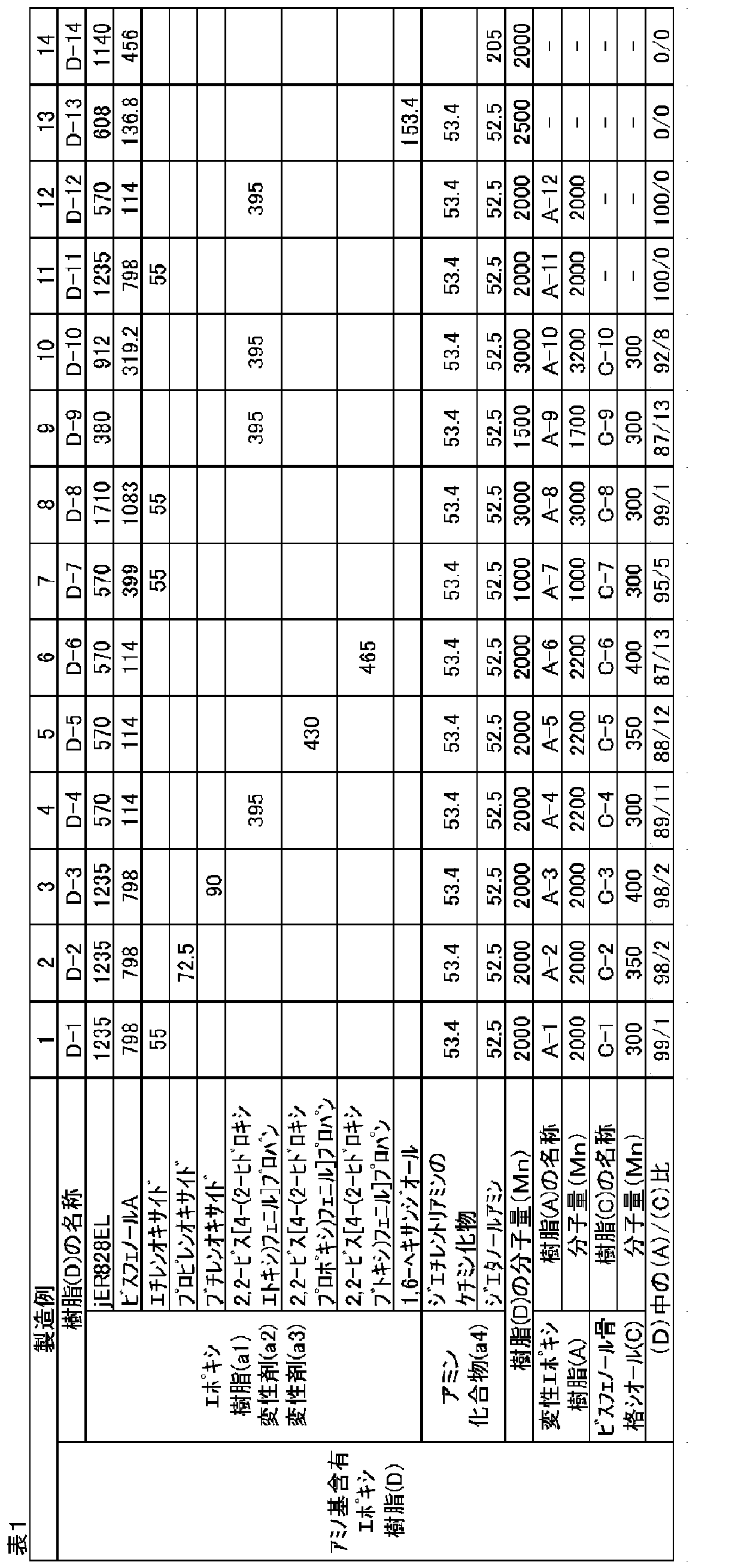
アミノ基含有エポキシ樹脂(D-1)~(D-12)中には変性エポキシ樹脂(A-1)~(A-12)、アミノ基含有エポキシ樹脂(D-1)~(D-10)中には副生成物としてビスフェノール骨格含有ジオール(C-1)~(C-10)がそれぞれ表中の固形分比率で含有されている。
製造例15
オートクレーブに、ビスフェノールA 228.0部、水酸化カリウム 0.6部を仕込み、反応容器の窒素置換を行なった。そこにエチレンオキシドを92.4部加え、ゆっくりと約160℃まで昇温して反応終了後に冷却し、濃硫酸で中和した。次いでエチレングリコールモノブチルエーテルを加え、固形分80%のビスフェノール骨格含有ジオール(C-11)溶液を得た。ビスフェノール骨格含有ジオール(C-11)の分子量は316であった。
オートクレーブに、ビスフェノールA 228.0部、水酸化カリウム 0.7部、プロピレンオキシドを122.0部加え、反応容器の窒素置換を行なった。窒素置換後、反応容器をゆっくりと約160℃まで昇温して反応終了後に冷却し、濃硫酸で中和した。次いでエチレングリコールモノブチルエーテルを加え、固形分80%のビスフェノール骨格含有ジオール(C-12)溶液を得た。ビスフェノール骨格含有ジオール(C-12)の分子量は344であった。
オートクレーブに、ビスフェノールA 228.0部、水酸化カリウム 0.8部、ブチレンオキシドを151.4部加え、反応容器の窒素置換を行なった。窒素置換後、反応容器をゆっくりと約160℃まで昇温して反応終了後に冷却し、濃硫酸で中和した。次いでエチレングリコールモノブチルエーテルを加え、固形分80%のビスフェノール骨格含有ジオール(C-13)溶液を得た。ビスフェノール骨格含有ジオール(C-13)の分子量は373であった。
製造例18
反応容器中に、コスモネートM-200(商品名、三井化学社製、クルードMDI、NCO基含有率31.3%)270部、及びメチルイソブチルケトン127部を加え70℃に昇温した。この中にエチレングリコールモノブチルエーテル236部を1時間かけて滴下して加え、その後100℃に昇温し、この温度を保ちながら経時でサンプリングし、赤外線吸収スペクトル測定にて未反応のイソシアネート基の吸収がなくなったことを確認し、樹脂固形分80%のブロック化ポリイソシアネート化合物(B)溶液を得た。
製造例19
撹拌機、温度計、滴下ロート及び還流冷却器を取り付けたフラスコに、jER828EL 1010部に、ビスフェノールA 390部、プラクセル212(商品名、ポリカプロラクトンジオール、ダイセル化学工業株式会社、重量平均分子量約1,250)240部及びジメチルベンジルアミン 0.2部を加え、130℃でエポキシ当量が約1,090になるまで反応させた。次に、ジメチルエタノールアミン134部及び90%の乳酸水溶液150部を加え、120℃で4時間反応させた。次いで、メチルイソブチルケトンを加えて固形分を調整し、固形分60%の4級アンモニウム塩型樹脂系の顔料分散用樹脂溶液を得た。
製造例20
製造例19で得た固形分60%の顔料分散用樹脂8.3部(固形分5部)、酸化チタン14.5部、精製クレー7.0部、カーボンブラック0.3部、ジオクチル錫オキサイド1部、水酸化ビスマス1部及び脱イオン水20.3部を加え、ボールミルにて20時間分散し、固形分55%の顔料分散ペーストを得た。
実施例1
製造例1で得られたアミノ基含有エポキシ樹脂(D-1)溶液を87.5部(固形分70部)、製造例18で得られたブロック化ポリイソシアネート化合物(B)溶液を37.5部(固形分30部)混合し、さらに10%酢酸13部を配合して均一に攪拌した後、強く攪拌しながら脱イオン水を徐々に滴下して固形分34%のエマルションを得た。続いて、該エマルション294部(固形分100部)、製造例20で得た55%の顔料分散ペーストを52.4部(固形分28.8部)、脱イオン水297.6部を加え、固形分20%の熱硬化性塗料(X-1)を製造した。
下記表2で示される組成とする以外は実施例1と同様にして、固形分20%の熱硬化性塗料(X-2)~(X-22)を製造した。また、後述する方法で評価試験を行った。表中に評価結果を示す。

化成処理(商品名、パルボンド#3020、日本パーカライジング社製、リン酸亜鉛処理剤)を施した冷延鋼板(150mm(縦)×70mm(横)×0.8mm(厚))を被塗物として、実施例及び比較例で得た各々の熱硬化性塗料を用いて乾燥膜厚17μmとなるように電着塗装し、170℃で20分間焼付け乾燥して試験板を得た。
<仕上がり性>
試験板の塗面をサーフテスト301(商品名、株式会社ミツトヨ製、表面粗度計)を用いて、表面粗度値(Ra)をカットオフ0.8mmにて測定し、以下の基準で評価した。評価は、S~Bが合格であり、Cが不合格である。
Sは、表面粗度値(Ra)が0.2未満、
Aは、表面粗度値(Ra)が0.2以上でかつ0.25未満、
Bは、表面粗度値(Ra)が0.25以上でかつ0.3未満、
Cは、表面粗度値(Ra)が0.3以上、を示す。
試験板の素地に達するように塗膜にカッターナイフでクロスカット傷を入れ、これをJIS Z-2371に準じて、35℃ソルトスプレー試験を1200時間行い、カット部からの片側での錆、フクレ幅によって以下の基準で評価した。
評価は、S~Bが合格であり、Cが不合格である。
Sは、錆及びフクレの最大幅がカット部より片側で2.0mm以下、
Aは、錆及びフクレの最大幅がカット部より片側で2.0を超え、かつ3.0mm以下、
Bは、錆及びフクレの最大幅がカット部より片側で3.0mmを超え、かつ3.5mm以下、
Cは、錆及びフクレの最大幅がカット部より片側で3.5mmを超える。
Claims (8)
- エポキシ樹脂(a1)と、変性剤(a2)と、任意選択でアミン化合物(a4)とを反応させた変性エポキシ樹脂(A)、及びブロック化ポリイソシアネート化合物(B)を含有する熱硬化性塗料組成物であって、該変性エポキシ樹脂(A)の末端の少なくとも一部が、下記一般式(1)又は下記一般式(2)で表される有機基を有し、かつ、該変性エポキシ樹脂(A)の数平均分子量が800~80,000であることを特徴とする熱硬化性塗料組成物。


- 変性エポキシ樹脂(A)とブロック化ポリイソシアネート化合物(B)の含有割合が、樹脂固形分の合計質量を基準にして、変性エポキシ樹脂(A)10~90質量%、ブロック化ポリイソシアネート化合物(B)10~50質量%の範囲にあることを特徴とする請求項1に記載の熱硬化性塗料組成物。
- さらに、下記一般式(3)で表され、かつ、分子量が280~610であることを特徴とするビスフェノール骨格含有ジオール(C)を含有することを特徴とする請求項1又は2に記載の熱硬化性塗料組成物。

- 変性エポキシ樹脂(A)、ブロック化ポリイソシアネート化合物(B)、及びビスフェノール骨格含有ジオール(C)の樹脂固形分の合計総量を基準にして、該ビスフェノール骨格含有ジオール(C)の含有量が、0.1~20質量%の範囲内であることを特徴とする請求項3に記載の熱硬化性塗料組成物。
- 変性エポキシ樹脂(A)がアミノ基を有し、酸性化合物で中和せしめられたものであることを特徴とする請求項1~4のいずれか1項に記載の熱硬化性塗料組成物。
- 請求項1~5のいずれか1項に記載の熱硬化性塗料組成物を加熱硬化した塗膜を有する塗装物品。
- 請求項1~5のいずれか1項に記載の熱硬化性塗料組成物を含有する電着塗料浴に金属被塗物を浸漬し、該金属被塗物を陰極として通電するカチオン電着塗膜の形成方法。
- 請求項1~5のいずれか1項に記載の熱硬化性塗料組成物を含有する電着塗料浴に金属被塗物を浸漬する工程、浸漬した金属被塗物を電着塗装に供する工程及び電着塗装を施した金属被塗物を加熱硬化する工程を含む、塗装物品の製造方法。
Priority Applications (4)
| Application Number | Priority Date | Filing Date | Title |
|---|---|---|---|
| EP15861948.6A EP3222687B1 (en) | 2014-11-19 | 2015-11-19 | Thermosetting coating composition |
| US15/527,437 US10308822B2 (en) | 2014-11-19 | 2015-11-19 | Thermosetting coating composition |
| CN201580071338.9A CN107109105B (zh) | 2014-11-19 | 2015-11-19 | 热固性涂料组合物 |
| JP2016560281A JP6546932B2 (ja) | 2014-11-19 | 2015-11-19 | 熱硬化性塗料組成物 |
Applications Claiming Priority (2)
| Application Number | Priority Date | Filing Date | Title |
|---|---|---|---|
| JP2014234917 | 2014-11-19 | ||
| JP2014-234917 | 2014-11-19 |
Publications (1)
| Publication Number | Publication Date |
|---|---|
| WO2016080483A1 true WO2016080483A1 (ja) | 2016-05-26 |
Family
ID=56014016
Family Applications (1)
| Application Number | Title | Priority Date | Filing Date |
|---|---|---|---|
| PCT/JP2015/082537 Ceased WO2016080483A1 (ja) | 2014-11-19 | 2015-11-19 | 熱硬化性塗料組成物 |
Country Status (5)
| Country | Link |
|---|---|
| US (1) | US10308822B2 (ja) |
| EP (1) | EP3222687B1 (ja) |
| JP (1) | JP6546932B2 (ja) |
| CN (1) | CN107109105B (ja) |
| WO (1) | WO2016080483A1 (ja) |
Cited By (3)
| Publication number | Priority date | Publication date | Assignee | Title |
|---|---|---|---|---|
| WO2023048273A1 (ja) * | 2021-09-27 | 2023-03-30 | 関西ペイント株式会社 | 変性エポキシ樹脂及び電着塗料 |
| JP2023047834A (ja) * | 2021-09-27 | 2023-04-06 | 関西ペイント株式会社 | エポキシ系樹脂及び電着塗料 |
| JP2023050150A (ja) * | 2021-09-29 | 2023-04-10 | 関西ペイント株式会社 | 変性エポキシ樹脂及びカチオン電着塗料 |
Families Citing this family (2)
| Publication number | Priority date | Publication date | Assignee | Title |
|---|---|---|---|---|
| CN109575747B (zh) * | 2018-11-16 | 2021-02-26 | 上海博歌建材有限公司 | 一种防腐型无溶剂防静电自流平面漆及其制备方法 |
| JP2020100732A (ja) * | 2018-12-21 | 2020-07-02 | 日本ペイント・オートモーティブコーティングス株式会社 | カチオン電着塗料組成物及びカチオン電着塗膜の製造方法 |
Citations (7)
| Publication number | Priority date | Publication date | Assignee | Title |
|---|---|---|---|---|
| JPS54120642A (en) * | 1978-03-13 | 1979-09-19 | Nippon Soda Co Ltd | Cathode-deposition-type electrocoating composition |
| JPS5857422A (ja) * | 1981-09-14 | 1983-04-05 | ピ−ピ−ジ−・インダストリ−ズ・インコ−ポレイテツド | カチオン樹脂の製法 |
| JPS61176674A (ja) * | 1985-01-29 | 1986-08-08 | バスフ・コーポレイション | 陰極型電着プロセス用樹脂組成物及びその製造方法 |
| JP2003238650A (ja) * | 2002-02-19 | 2003-08-27 | Asahi Denka Kogyo Kk | ポリオール樹脂組成物 |
| JP2011006655A (ja) * | 2009-05-26 | 2011-01-13 | Kansai Paint Co Ltd | カチオン電着塗料組成物 |
| JP2014172944A (ja) * | 2013-03-06 | 2014-09-22 | Nippon Paint Co Ltd | 電着塗料組成物 |
| JP2014214223A (ja) * | 2013-04-25 | 2014-11-17 | 関西ペイント株式会社 | カチオン電着塗料組成物 |
Family Cites Families (10)
| Publication number | Priority date | Publication date | Assignee | Title |
|---|---|---|---|---|
| ZA9962B (en) * | 1998-01-20 | 1999-07-06 | Cook Composites & Polymers | Aromatic polyol end-capped unsaturated polyetherester resins and resin compositions containing the same having improved chemical and/or water resistance. |
| US6607646B2 (en) * | 2001-09-12 | 2003-08-19 | E. I. Du Pont De Nemours And Company | Cathodic electrocoating compositions containing hydroxyl-carbonate blocked polyisocyanate crosslinking agent |
| JP5305566B2 (ja) | 2006-05-11 | 2013-10-02 | 関西ペイント株式会社 | アニオン電着塗料組成物 |
| US8729196B2 (en) | 2007-09-11 | 2014-05-20 | Kansai Paint Co., Ltd. | Cationic electrodeposition paint compositions |
| JP5721307B2 (ja) | 2007-10-17 | 2015-05-20 | 関西ペイント株式会社 | 複層皮膜形成方法及び塗装物品 |
| JP2010095668A (ja) * | 2008-10-20 | 2010-04-30 | Nippon Paint Co Ltd | カチオン性電着塗料組成物 |
| WO2012058657A2 (en) * | 2010-10-29 | 2012-05-03 | Hardcoat Surfaces Llc | High hardness low surface energy coating |
| US8951398B2 (en) | 2011-03-04 | 2015-02-10 | Kansai Paint Co., Ltd. | Cationic electrodeposition coating composition |
| JP5473983B2 (ja) | 2011-04-28 | 2014-04-16 | トヨタ自動車株式会社 | カチオン電着塗料組成物及び塗装物品 |
| JP6076187B2 (ja) * | 2012-04-26 | 2017-02-08 | 関西ペイント株式会社 | カチオン電着塗料組成物 |
-
2015
- 2015-11-19 CN CN201580071338.9A patent/CN107109105B/zh active Active
- 2015-11-19 JP JP2016560281A patent/JP6546932B2/ja active Active
- 2015-11-19 EP EP15861948.6A patent/EP3222687B1/en active Active
- 2015-11-19 US US15/527,437 patent/US10308822B2/en active Active
- 2015-11-19 WO PCT/JP2015/082537 patent/WO2016080483A1/ja not_active Ceased
Patent Citations (7)
| Publication number | Priority date | Publication date | Assignee | Title |
|---|---|---|---|---|
| JPS54120642A (en) * | 1978-03-13 | 1979-09-19 | Nippon Soda Co Ltd | Cathode-deposition-type electrocoating composition |
| JPS5857422A (ja) * | 1981-09-14 | 1983-04-05 | ピ−ピ−ジ−・インダストリ−ズ・インコ−ポレイテツド | カチオン樹脂の製法 |
| JPS61176674A (ja) * | 1985-01-29 | 1986-08-08 | バスフ・コーポレイション | 陰極型電着プロセス用樹脂組成物及びその製造方法 |
| JP2003238650A (ja) * | 2002-02-19 | 2003-08-27 | Asahi Denka Kogyo Kk | ポリオール樹脂組成物 |
| JP2011006655A (ja) * | 2009-05-26 | 2011-01-13 | Kansai Paint Co Ltd | カチオン電着塗料組成物 |
| JP2014172944A (ja) * | 2013-03-06 | 2014-09-22 | Nippon Paint Co Ltd | 電着塗料組成物 |
| JP2014214223A (ja) * | 2013-04-25 | 2014-11-17 | 関西ペイント株式会社 | カチオン電着塗料組成物 |
Non-Patent Citations (1)
| Title |
|---|
| See also references of EP3222687A4 * |
Cited By (4)
| Publication number | Priority date | Publication date | Assignee | Title |
|---|---|---|---|---|
| WO2023048273A1 (ja) * | 2021-09-27 | 2023-03-30 | 関西ペイント株式会社 | 変性エポキシ樹脂及び電着塗料 |
| JP2023047834A (ja) * | 2021-09-27 | 2023-04-06 | 関西ペイント株式会社 | エポキシ系樹脂及び電着塗料 |
| JP7841866B2 (ja) | 2021-09-27 | 2026-04-07 | 関西ペイント株式会社 | エポキシ系樹脂及び電着塗料 |
| JP2023050150A (ja) * | 2021-09-29 | 2023-04-10 | 関西ペイント株式会社 | 変性エポキシ樹脂及びカチオン電着塗料 |
Also Published As
| Publication number | Publication date |
|---|---|
| US10308822B2 (en) | 2019-06-04 |
| CN107109105A (zh) | 2017-08-29 |
| EP3222687A4 (en) | 2018-08-15 |
| CN107109105B (zh) | 2019-06-28 |
| EP3222687A1 (en) | 2017-09-27 |
| EP3222687B1 (en) | 2019-06-05 |
| JPWO2016080483A1 (ja) | 2017-09-07 |
| JP6546932B2 (ja) | 2019-07-17 |
| US20180327613A1 (en) | 2018-11-15 |
Similar Documents
| Publication | Publication Date | Title |
|---|---|---|
| JP5441802B2 (ja) | カチオン電着塗料組成物 | |
| US8097665B2 (en) | Cationic electrodeposition coating composition | |
| JP5612252B2 (ja) | カチオン電着塗料組成物 | |
| JP6608463B2 (ja) | カチオン電着塗料組成物の製造方法 | |
| JP6058113B2 (ja) | カチオン電着塗料組成物 | |
| JP5567767B2 (ja) | カチオン電着塗料組成物 | |
| JP5110962B2 (ja) | カチオン電着塗料組成物及び当該電着塗料を用いて塗装した物品 | |
| JP6546932B2 (ja) | 熱硬化性塗料組成物 | |
| JP5814828B2 (ja) | カチオン電着塗料組成物 | |
| JP2009149867A (ja) | 塗料組成物及び塗装物品 | |
| JP6012744B2 (ja) | カチオン電着塗料組成物 | |
| JP7516699B2 (ja) | カチオン電着塗料組成物 | |
| JP6099138B2 (ja) | カチオン電着塗料組成物 | |
| JP2013256560A (ja) | カチオン電着塗料組成物 | |
| JP6461618B2 (ja) | カチオン電着塗料組成物 | |
| JP5701442B1 (ja) | カチオン電着塗料組成物 | |
| JP2013253184A (ja) | カチオン電着塗料組成物 | |
| JP2014152247A (ja) | カチオン電着塗料組成物 | |
| JP6714752B1 (ja) | カチオン電着塗料組成物 |
Legal Events
| Date | Code | Title | Description |
|---|---|---|---|
| 121 | Ep: the epo has been informed by wipo that ep was designated in this application |
Ref document number: 15861948 Country of ref document: EP Kind code of ref document: A1 |
|
| ENP | Entry into the national phase |
Ref document number: 2016560281 Country of ref document: JP Kind code of ref document: A |
|
| WWE | Wipo information: entry into national phase |
Ref document number: 15527437 Country of ref document: US |
|
| NENP | Non-entry into the national phase |
Ref country code: DE |
|
| REEP | Request for entry into the european phase |
Ref document number: 2015861948 Country of ref document: EP |