WO2016088549A1 - 毛髪変形処理剤 - Google Patents
毛髪変形処理剤 Download PDFInfo
- Publication number
- WO2016088549A1 WO2016088549A1 PCT/JP2015/082282 JP2015082282W WO2016088549A1 WO 2016088549 A1 WO2016088549 A1 WO 2016088549A1 JP 2015082282 W JP2015082282 W JP 2015082282W WO 2016088549 A1 WO2016088549 A1 WO 2016088549A1
- Authority
- WO
- WIPO (PCT)
- Prior art keywords
- hair
- group
- carbon atoms
- less
- treatment agent
- Prior art date
- Legal status (The legal status is an assumption and is not a legal conclusion. Google has not performed a legal analysis and makes no representation as to the accuracy of the status listed.)
- Ceased
Links
- 0 *c(c(*)c(c(N)c1O)O)c1N Chemical compound *c(c(*)c(c(N)c1O)O)c1N 0.000 description 5
Classifications
-
- A—HUMAN NECESSITIES
- A45—HAND OR TRAVELLING ARTICLES
- A45D—HAIRDRESSING OR SHAVING EQUIPMENT; EQUIPMENT FOR COSMETICS OR COSMETIC TREATMENTS, e.g. FOR MANICURING OR PEDICURING
- A45D7/00—Processes of waving, straightening or curling hair
- A45D7/06—Processes of waving, straightening or curling hair combined chemical and thermal
-
- A—HUMAN NECESSITIES
- A61—MEDICAL OR VETERINARY SCIENCE; HYGIENE
- A61K—PREPARATIONS FOR MEDICAL, DENTAL OR TOILETRY PURPOSES
- A61K8/00—Cosmetics or similar toiletry preparations
- A61K8/18—Cosmetics or similar toiletry preparations characterised by the composition
- A61K8/30—Cosmetics or similar toiletry preparations characterised by the composition containing organic compounds
- A61K8/33—Cosmetics or similar toiletry preparations characterised by the composition containing organic compounds containing oxygen
- A61K8/34—Alcohols
-
- A—HUMAN NECESSITIES
- A61—MEDICAL OR VETERINARY SCIENCE; HYGIENE
- A61K—PREPARATIONS FOR MEDICAL, DENTAL OR TOILETRY PURPOSES
- A61K8/00—Cosmetics or similar toiletry preparations
- A61K8/18—Cosmetics or similar toiletry preparations characterised by the composition
- A61K8/30—Cosmetics or similar toiletry preparations characterised by the composition containing organic compounds
- A61K8/33—Cosmetics or similar toiletry preparations characterised by the composition containing organic compounds containing oxygen
- A61K8/34—Alcohols
- A61K8/347—Phenols
-
- A—HUMAN NECESSITIES
- A61—MEDICAL OR VETERINARY SCIENCE; HYGIENE
- A61K—PREPARATIONS FOR MEDICAL, DENTAL OR TOILETRY PURPOSES
- A61K8/00—Cosmetics or similar toiletry preparations
- A61K8/18—Cosmetics or similar toiletry preparations characterised by the composition
- A61K8/30—Cosmetics or similar toiletry preparations characterised by the composition containing organic compounds
- A61K8/33—Cosmetics or similar toiletry preparations characterised by the composition containing organic compounds containing oxygen
- A61K8/36—Carboxylic acids; Salts or anhydrides thereof
- A61K8/365—Hydroxycarboxylic acids; Ketocarboxylic acids
-
- A—HUMAN NECESSITIES
- A61—MEDICAL OR VETERINARY SCIENCE; HYGIENE
- A61Q—SPECIFIC USE OF COSMETICS OR SIMILAR TOILETRY PREPARATIONS
- A61Q5/00—Preparations for care of the hair
- A61Q5/04—Preparations for permanent waving or straightening the hair
-
- A—HUMAN NECESSITIES
- A45—HAND OR TRAVELLING ARTICLES
- A45D—HAIRDRESSING OR SHAVING EQUIPMENT; EQUIPMENT FOR COSMETICS OR COSMETIC TREATMENTS, e.g. FOR MANICURING OR PEDICURING
- A45D2200/00—Details not otherwise provided for in A45D
- A45D2200/15—Temperature
Definitions
- the present invention relates to a hair deformation treatment agent that can deform a hair shape semipermanently or permanently.
- a method for transforming the hair shape semipermanently or permanently there are a method using a reducing agent such as permanent wave, and a method using a strong alkaline treatment agent having a pH of 12 to 14 typified by an alkali relaxer.
- a strong alkaline treatment agent having a pH of 12 to 14 typified by an alkali relaxer.
- these methods have a heavy load on the hair and damage is likely to remain on the hair.
- a method for correcting curly hair using a large amount of formaldehyde has also been developed as a method of causing little damage to the hair in semi-permanently or permanently deforming the shape of the hair.
- the method using highly toxic formaldehyde must be handled with care because of its high volatility, and it is never a preferable hair treatment method.
- Patent Document 1 discloses a technique for applying a ⁇ -keto acid, particularly glyoxylic acid to hair, and heat-treating it at 200 ° C. ⁇ 50 ° C. with a flat iron to make strong curly hair straight.
- Patent Document 2 discloses a method of permanently relaxing keratin fibers by applying a polyhydroxylated aromatic compound to hair and heating to 110 ° C. or higher.
- Patent Document 3 discloses a hair composition in which glyceraldehyde and resorcin are heated to reflux in the presence of boric acid or silicic acid to form an oligomer. It is described that this composition has improved set holding power and moisture resistance, can be reshaped by wetting with water, and improves the mechanical strength of the hair.
- Patent Document 1 European Patent Application Publication No. 2538916 (Patent Document 2) Special Table 2009-537619 (Patent Document 3) US Patent No. 4278659
- the present invention contains the following components (A), (B) and (C), and the molar ratio (B) / (A) of the content of component (B) to the content of component (A) is 0.2 or more
- the present invention provides a hair deformation treatment agent that is 5 or less.
- the present invention provides a hair treatment method for transforming the hair shape semipermanently or permanently, comprising the following steps (i) and (ii). (i) The step of applying the hair deformation treatment agent to the hair and allowing it to penetrate into the hair (ii) The step of heating and shaping the hair infiltrated with the hair deformation treatment agent
- Patent Document 3 the technique described in Patent Document 3 is characterized in that it can be washed off with water by using an oligomer as a treatment agent. For this reason, by repeatedly washing the hair, it returns to the original hair shape, and it is difficult to say that it is semi-permanent or permanent hair shape deformation.
- the present invention is safe for the human body and has little damage to the hair, can be semi-permanently or permanently, can give not only straight hair shape but also wave and curl shape, and further, the style made once,
- the present invention relates to a hair deformation treatment agent and a hair treatment method that can be changed into another semi-permanent or permanent hair shape simply and without damaging the hair without using a hair deformation treatment agent such as a reducing agent.
- the present inventors have not only provided a hair treatment agent containing glyoxylic acid and resorcin to semi-permanently give straight hair shape, curl and wave shape to hair, but also treat hair with this hair treatment agent once. For example, after that, it was found that it can be transformed into a completely different hairstyle just by using a heating means such as a hair iron or curler without treatment with a hair treatment agent such as a reducing agent, and the invention was completed. did.
- the hair deformation treatment agent of the present invention is highly safe for the human body, has little hair damage, can deform the shape of the hair semipermanently or permanently, and this hair deformation does not collapse even when washed with shampoo or the like. .
- the hair can be repeatedly and semi-permanently or permanently deformed by simply applying heat without the need to penetrate the hair treatment agent again.
- hair that has been repeatedly and repeatedly deformed by heat also has a high hair-washing resistance and does not lose its shape due to shampoo or water.
- “semi-permanent to permanent hair deformation” means that the hair washing resistance is extremely excellent and the shape of the hair does not change even when shampooing is repeated. Specifically, when the deformed hair is washed with shampoo, thoroughly washed with water, and naturally dried, it means that the shape of the hair is maintained before and after shampooing. Note that the shape of the hair is maintained, for example, if it is wave-shaped hair, the number of waves does not change substantially before and after shampooing. It does not occur.
- “hair deformation” refers to deformation not caused by cleavage and recombination of the SS bonds of proteins in the hair. In addition to transforming straight hair into curls, etc., It includes transforming hair that has undergone deformation such as curl or natural curly hair into straight hair.
- component (A) Glyoxylic acid or hydrate or salt thereof
- component (A) includes glyoxylic acid hydrate and glyoxylic acid salt.
- the hydrate of glyoxylic acid include glyoxylic acid monohydrate.
- glyoxylic acid salts include glyoxylic acid alkali metal salts and glyoxylic acid alkaline earth metal salts.
- alkali metal salts include lithium salts, sodium salts, and potassium salts. Examples thereof include magnesium salt and calcium salt.
- the content of the component (A) in the hair deformation treatment agent of the present invention makes the change of the hair shape after treatment with the hair deformation treatment agent of the present invention more remarkable, and the hair washing resistance of the hair shape is further improved.
- glyoxylic acid from the viewpoint of making the change in the shape of the hair shape semi-permanently re-transformed by heating more prominent and making the hair shape of the hair shape after the re-transformation more excellent, 1% by mass or more, more preferably 2% by mass or more, further preferably 2.5% by mass or more, and further preferably 3% by mass or more.
- it is preferable from the viewpoint of suppressing irritation to the skin Is 30% by mass or less, more preferably 25% by mass or less, still more preferably 20% by mass or less, still more preferably 15% by mass or less, and further preferably 12% by mass or less.
- Component (B): Resorcin The content of the component (B) in the hair deformation treatment agent of the present invention makes the change of the hair shape after treatment with the hair deformation treatment agent of the present invention more remarkable, and the hair washing resistance of the hair shape is further improved.
- the viewpoint of making the change in shape during reperformation of the hair shape semi-permanent by heating more prominent, and further improving the hair washing resistance after re-deformation preferably 1% by mass or more, More preferably 2% by mass or more, further preferably 3% by mass or more, further preferably 4% by mass or more, and further preferably 5% by mass or more.
- the viewpoint of suppressing irritation to the skin therefore, it is preferably 30% by mass or less, more preferably 25% by mass or less, still more preferably 20% by mass or less, and still more preferably 17% by mass or less.
- the molar ratio (B) / (A) of the content of the component (B) to the content of the component (A) in the hair deformation treating agent of the present invention is the component (A) and the component (B) formed in the hair.
- it is 0.2 or more, preferably 0.3 or more, more preferably 0.4 or more, more preferably 0.5 or more, more preferably 0.7 or more, and 5 or less, preferably 2.5 or less, more preferably 2 or less, still more preferably 1.5 or less, and further preferably 1.2 or less.
- the hair deformation treatment agent of the present invention uses water as a medium. If necessary, in addition to water, a lower alcohol having 1 to 3 carbon atoms such as methanol or ethanol can be used in combination.
- the content of the lower alcohol having 1 to 3 carbon atoms in the hair deformation treatment agent of the present invention is preferably 60% by mass or less, more preferably 40% by mass or less, still more preferably 30% by mass or less, and still more preferably. Is 20% by mass or less, more preferably 15% by mass or less, and still more preferably 10% by mass or less. Moreover, it is preferable that it is 0.1 mass% or more.
- the hair deformation treating agent of the present invention preferably contains a compound represented by the following general formula (1) as component (D) in order to make it easier to impart a shape change to the hair.
- R 1 represents a hydrogen atom or a methyl group
- a 1 and A 2 may be the same or different and are a hydrogen atom, a linear or branched alkyl or alkenyl group having 1 to 12 carbon atoms, and an aralkyl having 7 to 12 carbon atoms which may have a substituent.
- a group or arylalkenyl group, a linear or branched alkoxy group or alkenyloxy group having 1 to 6 carbon atoms, a halogen atom, or —CO—R 2 (wherein R 2 is a linear or branched chain group having 1 to 12 carbon atoms)
- R 2 is a linear or branched chain group having 1 to 12 carbon atoms
- B represents a hydrogen atom, a linear or branched alkyl group or alkenyl group having 1 to 12 carbon atoms, an aralkyl group or arylalkenyl group having 7 to 12 carbon atoms which may have a substituent, —OR 3 or — COOR 3 (R 3 represents a hydrogen atom, or a
- a 1 , A 2 , B and E are hydrogen atoms, and the remaining groups do not contain a sulfo group.
- D is a hydrogen atom or a methyl group
- a 1 and B or A 2 and B together with two adjacent carbon atoms form a benzene ring that may be substituted with a hydroxyl group.
- the substituent when the aralkyl group, arylalkenyl group or aromatic hydrocarbon group has a substituent, examples of the substituent include a hydroxyl group, a linear or branched alkyl group or alkenyl having 1 to 6 carbon atoms. And alkoxy groups having 1 to 12 carbon atoms.
- the carbon number of the aralkyl group, arylalkenyl group or aromatic hydrocarbon group refers to the total number of carbon atoms including the number of carbon atoms of the substituent.
- Examples of the linear or branched alkyl group or alkenyl group having 1 to 6 carbon atoms in R 3 include a methyl group, an ethyl group, an n-propyl group, an isopropyl group, an n-butyl group, an isobutyl group, and a sec-butyl group.
- Examples of the linear or branched alkoxy or alkenyloxy group having 1 to 6 carbon atoms in A 1 , A 2 , and E include groups in which an oxygen atom is bonded to the alkyl group or alkenyl group having 1 to 6 carbon atoms. It is done.
- Examples of the straight chain or branched chain alkyl group or alkenyl group having 1 to 12 carbon atoms in A 1 , A 2 , R 2 , and B include, for example, n-heptyl other than the alkyl group or alkenyl group having 1 to 6 carbon atoms.
- Examples of the linear or branched alkoxy group or alkenyloxy group having 1 to 12 carbon atoms in D include a group in which an oxygen atom is bonded to the alkyl group or alkenyl group having 1 to 12 carbon atoms.
- Examples of the aralkyl group or arylalkenyl group having 7 to 12 carbon atoms that may have a substituent in A 1 , A 2 , R 2 , and B include benzyl group, hydroxybenzyl group, dihydroxybenzyl group, phenylethyl group, phenyl Ethenyl group, hydroxyphenylethyl group, dihydroxyphenylethyl group, hydroxyphenylethenyl group, dihydroxyphenylethenyl group, phenylpropyl group, phenylpropenyl group, 1-naphthylmethyl group, 2-naphthylmethyl group, 1-indanyl group Etc.
- Examples of the aromatic hydrocarbon group having 6 to 12 carbon atoms which may have a substituent in R 2 include a phenyl group, a hydroxyphenyl group, a dihydroxyphenyl group, a trihydroxyphenyl group, a naphthyl group, a hydroxynaphthyl group, and a dihydroxynaphthyl group. Groups and the like.
- Examples of the halogen atom in A 1 and A 2 include a fluorine atom, a chlorine atom, and a bromine atom.
- Specific examples of the compound represented by the general formula (1) include a compound represented by the following general formula (1-1), a benzophenone derivative represented by the general formula (1-2), and a general formula (1 Naphthol derivatives represented by -3-a) or (1-3-b).
- R 1 , A 1 , A 2 , B and E have the same meaning as described above, and D 1 represents a hydroxyl group or a methoxy group.
- R 1 represents the same meaning as described above, D 2 represents a hydroxyl group or an alkoxy group having 1 to 12 carbon atoms, and G represents a hydroxyl group, a linear or branched alkyl group or alkenyl having 1 to 6 carbon atoms.
- Group represents an alkoxy group having 1 to 6 carbon atoms, and n represents an integer of 0 to 2.
- the following compounds (1-1-1) to (1-1-3) are preferable.
- a hydrogen atom, a linear or branched alkyl group or alkenyl group having 1 to 4 carbon atoms is preferable, and a hydrogen atom is more preferable.
- B is preferably a hydrogen atom, an alkyl or alkenyl group having 1 to 4 carbon atoms, an arylalkenyl group having 7 to 10 carbon atoms which may have a substituent, or a hydroxyl group, and has a hydrogen atom or substituent. More preferred are an arylalkenyl group having 7 to 10 carbon atoms and a hydroxyl group.
- E is preferably a hydrogen atom, a linear or branched alkyl group or alkenyl group having 1 to 4 carbon atoms, and more preferably a hydrogen atom.
- Examples of the compound corresponding to (1-1-1) include 1,3-dimethoxybenzene, 3,5-dimethoxyphenol, 2,6-dimethoxyphenol, 5- (hydroxyphenylethenyl) -1,3- And dimethoxybenzene (common name: pterostilbene).
- a 1 and A 2 include a hydrogen atom, a linear or branched alkyl group or alkenyl group having 1 to 12 carbon atoms, an aralkyl group or arylalkenyl group having 7 to 12 carbon atoms which may have a substituent.
- a hydrogen atom, a linear or branched alkyl group having 1 to 6 carbon atoms, and an arylalkenyl group having 7 to 10 carbon atoms which may have a substituent are preferable.
- R 3 is preferably a hydrogen atom, or a linear or branched alkyl or alkenyl group having 1 to 6 carbon atoms, and may have a hydrogen atom, an alkyl or alkenyl group having 1 to 4 carbon atoms, or a substituent.
- arylalkenyl groups having 7 to 10 carbon atoms and hydroxyl groups are more preferred, and arylalkenyl groups and hydroxyl groups having 7 to 10 carbon atoms which may have a hydrogen atom and a substituent are more preferred.
- E is preferably a hydrogen atom, a hydroxyl group, a linear or branched alkyl group or alkenyl group having 1 to 4 carbon atoms, and a linear or branched alkoxy group or alkenyloxy group having 1 to 4 carbon atoms. Is preferred.
- Examples of the compound corresponding to (1-1-2) include 3-methoxyphenol, 5-methoxyresorcin, 3-methoxybenzene-1,2-diol, 4-butyl-3-methoxyphenol, 3-methoxy- 4- (1-phenylethyl) phenol, 5- (4-hydroxyphenylethenyl) -1-hydroxy-3-methoxybenzene (common name: Pinostilbene) and the like can be mentioned.
- resorcin derivative examples include those represented by the following general formula (i) or (ii).
- E 1 represents a hydroxyl group, a linear or branched alkyl or alkenyl group having 1 to 6 carbon atoms, or a linear chain having 1 to 6 carbon atoms. Alternatively, it represents a branched alkoxy group or alkenyloxy group.
- a hydrogen atom, a linear or branched alkyl group or alkenyl group having 1 to 12 carbon atoms is preferable, and a hydrogen atom is more preferable.
- B represents a hydrogen atom, an optionally substituted aralkyl group having 7 to 12 carbon atoms or an arylalkenyl group, —OR 3 (R 3 is a hydrogen atom or a straight chain or branched chain having 1 to 4 carbon atoms). An alkyl group or an alkenyl group) is preferred.
- E 1 is preferably a hydroxyl group, a linear or branched alkyl group or alkenyl group having 1 to 4 carbon atoms, or a linear or branched alkoxy group or alkenyloxy group having 1 to 4 carbon atoms.
- Examples of the resorcin derivative represented by the general formula (i) include 2-alkylresorcin such as 2-methylresorcin, 2-ethylresorcin, 2-propylresorcin; Pyrogallol; 2-alkoxyresorcin such as 2-methoxyresorcin; Gallic acid esters such as gallic acid, methyl gallate, ethyl gallate, propyl gallate, butyl gallate; 5- (phenylethenyl) 2-isopropylresorcin and the like can be mentioned.
- 2-alkylresorcin such as 2-methylresorcin, 2-ethylresorcin, 2-propylresorcin
- Pyrogallol 2-alkoxyresorcin such as 2-methoxyresorcin
- Gallic acid esters such as gallic acid, methyl gallate, ethyl gallate, propyl gallate, butyl gallate
- a resorcin derivative represented by the general formula (ii) is more preferable.
- resorcin derivative represented by the general formula (ii-1) 4-methylresorcin, 4-ethylresorcin, 4-propylresorcin, 4-isopropylresorcin (common name: Rucinol), 4-isobutyl resorcin, 4-sec-butyl resorcin, 4-tert-butyl resorcin, 4-pentyl resorcin, 4-isopentyl resorcin, 4-sec-pentyl resorcin, 4-tert-pentyl resorcin, 4-neopentyl resorcin, 4-hexyl resorcin, 4-isohexyl resorcin, 4-heptyl resorcin, 4-octyl resorcin, 4- (2-ethylhexyl) resorcin, 4-nonyl resorc
- a 1 and A 2 have the same meaning as described above, and B 1 has a linear or branched alkyl group or alkenyl group having 1 to 12 carbon atoms and a substituent having 7 to 12 carbon atoms. And an aralkyl group or arylalkenyl group, —OR 3 or —COOR 3 (R 3 is a hydrogen atom or a linear or branched alkyl or alkenyl group having 1 to 6 carbon atoms).
- a resorcin derivative represented by the general formula (ii-2-a) or (ii-2-b) is more preferable.
- Resorcin derivatives represented by the general formula (ii-2-a) include 5-methylresorcin, 5-ethylresorcin, 5-propylresorcin, 5-isopropylresorcin, 5-butylresorcin, 5-isobutylresorcin, 5- sec-butyl resorcin, 5-tert-butyl resorcin, 5-pentyl-resorcin (common name: Olivetol), 5-isopentyl resorcin, 5-neopentyl resorcin, 5-hexyl resorcin, 5-isohexyl resorcin, 5-alkylresorcins such as 5-heptylresorcin, 5-octylresorcin, 5- (2-ethylhexyl) resorcin, 5-nonylresorcin, 5-decylres
- a 1 and A 2 are preferably a hydrogen atom, a linear or branched alkyl group or alkenyl group having 1 to 4 carbon atoms, an alkoxy group or alkenyloxy group having 1 to 4 carbon atoms.
- Resorcin derivatives represented by the general formula (ii-2-b) include 2-methylbenzene-1,3,5-triol, 2-ethylbenzene-1,3,5-triol, 2-propylbenzene-1, 3,5-triol, 2-butylbenzene-1,3,5-triol, 2-hexylbenzene-1,3,5-triol, 2-octylbenzene-1,3,5-triol, 2-dodecylbenzene- 2-alkylbenzene-1,3,5-triol such as 1,3,5-triol; 2-Aralkyl- such as 2-benzylbenzene-1,3,5-triol, 2- (phenylethyl) benzene-1,3,5-triol, 2- (phenylpropyl) benzene-1,3,5-triol 1,3,5-triol, 2-acetylbenzene-1,3,5-triol, 2-propanoylbenzene-1,3,5-triol, 2-butanoyl
- benzophenone derivative represented by the general formula (1-2) examples include 4-benzoylresorcin (common name: benzophenone-1), 4- (hydroxybenzoyl) resorcin, 4- (dihydroxybenzoyl) resorcin, 4- (2,4-dihydroxybenzoyl) resorcin (common name: Benzophenone-2), 4- (methylbenzoyl) resorcin, 4- (ethylbenzoyl) resorcin, 4- (dimethylbenzoyl) resorcin, 4 -(Diethylbenzoyl) resorcin, 4-naphthoylresorcin, 2-hydroxy-4-methoxybenzophenone (common names: benzophenone-3), 2,2'-dihydroxy-4,4'-dimethoxybenzophenone (common) Name: Benzophenone-6, 2,2'-dihydroxy-4-methoxybenzophen
- R 1 is a hydrogen atom or Those having 1 to 4 carbon atoms or alkenyl are preferred, and those having a hydrogen atom are more preferred.
- a 1 and A 2 are preferably a hydrogen atom, a hydroxyl group, a linear or branched alkyl group having 1 to 4 carbon atoms, or an alkoxy group having 1 to 4 carbon atoms, and those having a hydrogen atom or a hydroxyl group. More preferred.
- D is a hydrogen atom, a hydroxyl group, a linear or branched alkyl group having 1 to 4 carbon atoms, or an alkoxy group having 1 to 4 carbon atoms.
- E is a hydrogen atom, a hydroxyl group, an alkyl group having 1 to 4 carbon atoms, or an alkoxy group having 1 to 4 carbon atoms.
- Examples of such compounds include 1-naphthol, 2-naphthol, 3-methylnaphthalen-1-ol, naphthalene-1,4-diol, naphthalene-1,5-diol, naphthalene-1,8-diol, and the like. It is done.
- m-dimethoxybenzene derivatives represented by the general formula (1-1-1), resorcin derivatives represented by the general formula (1-1-3), general formulas A benzophenone derivative represented by (1-2) and a naphthol derivative represented by the general formula (1-3-a) or (1-3-b) are preferred.
- 2-methyl resorcin, 4-chlororesorcin, 4-alkyl resorcin, 4-aralkyl resorcin, 4-acylated resorcin, 5-alkyl resorcin, 5-aralkyl resorcin, 5-hydroxyarylalkenyl resorcin, phloroglucinate, gallic acid Acids and gallic acid esters are preferred.
- 4-butylresorcin (common name: Rucinol), 4- (1-phenylethyl) resorcinol (common name: Symwhite377), 5- (hydroxyphenylethenyl) resorcinol (common name: Resveratrol), 3-hydroxyphenyl-1- (benzene-2,4,6-triol) propan-1-one (common names: Phloretin, 4- (2,4-dihydroxybenzoyl) Resorcin (common name: Benzophenone-2), 5- (hydroxyphenylethenyl) -1,3-dimethoxybenzene (common name: Pterostilbene), 1-naphthol are preferred.
- -Butyl resorcin, 4- (1-phenylethyl) resorcin, 4-n-hexyl resorcin are preferred.
- the molecular weight of the compound represented by the general formula (1) is preferably 120 or more, and from the viewpoint of penetrability into the hair, it is preferably 1000 or less, more preferably 500 or less, and even more preferably 300 or less.
- Component (D) can be used alone or in combination of two or more, but it is more preferable to use two or more.
- the total content with (D) is preferably 5% by mass or more, more preferably 10% by mass or more, still more preferably 15% by mass or more, and preferably 30% by mass or less, more preferably 27% by mass.
- it is more preferably 25% by mass or less, and further preferably 23% by mass or less.
- the mass ratio (D) / (B) of the content of the component (D) to the content of the component (B) is preferably 0.1 or more, more preferably 0.15 or more, and still more preferably 0.2, from the viewpoint of high effect. From the viewpoint of preventing the low solubility component (D) from precipitating after penetration into the hair and insufficient penetration into the tissue in the hair, it is preferably 3 or less, more preferably 2 Hereinafter, it is more preferably 1 or less, and further preferably 0.4 or less.
- the molar ratio [(B) + (D)] / (A) of the total content of components (B) and (D) to the content of component (A) in the hair deformation treating agent of the present invention is the hair From the viewpoint of further improving the effect of deforming semipermanently or permanently and the effect of allowing the hair to be repeatedly deformed semipermanently or permanently by simply heating the hair, preferably 0.2 or more, more preferably 0.3 or more, more preferably 0.4 or more, more preferably 0.5 or more, further preferably 0.7 or more, and preferably 5 or less, more preferably 2.5 or less, further preferably 2 or less, still more preferably 1.5 or less, still more preferably Is 1.2 or less.
- the hair deformation treatment agent of the present invention can be in any form, whether it is a single agent type or a multi-agent type such as a two-agent type, but the penetrability of component (A) and component (B) into the hair From the viewpoint of improving the effect of the present invention and increasing the effect of the present invention, it is more preferable to use a multi-agent type, further two-component type, in which component (A) and component (B) are contained in separate agents.
- the agent containing component (A) is the first agent
- the agent containing component (B) is the second agent.
- the content of the component (A) in the first agent is preferably 1% by mass or more, more preferably 2% by mass or more, still more preferably 2.5% by mass or more, and more preferably in terms of glyoxylic acid. Is 3% by mass or more, preferably 30% by mass or less, more preferably 25% by mass or less, further preferably 20% by mass or less, still more preferably 15% by mass or less, and further preferably 12% by mass or less. .
- the content of the component (B) in the second agent is preferably 1% by mass or more, more preferably 2% by mass or more, further preferably 3% by mass or more, and further preferably 4% by mass or more. More preferably, it is 5% by mass or more, preferably 30% by mass or less, more preferably 25% by mass or less, still more preferably 20% by mass or less, and further preferably 17% by mass or less.
- the mixing ratio is not particularly defined, but the composition after the combination is preferably the hair deformation treatment agent of the present invention. Therefore, in the case of a multi-drug type, unless otherwise specified, the content of each component is the content in the composition after the mixture.
- the component (C) can be contained as a solvent for each agent, and in the case of a 2-drug formula, the component (C) is an agent containing the component (A) and the component (B). It is preferable to be contained in both of the agents containing.
- the component (D) when the component (D) is contained, it is preferable that the component (B) and the component (D) are contained in the same agent, the first agent containing the component (A), the component (B), and the component (D ) Containing a second agent and a two-agent type.
- the mass ratio (D) / (B) of the content of the component (D) to the content of the component (B) in the second agent is preferably 0.1 or more, more preferably It is 0.15 or more, more preferably 0.2 or more, preferably 3 or less, more preferably 2 or less, still more preferably 1 or less, and still more preferably 0.4 or less.
- the pH of the hair modification treatment agent of the present invention is preferably 4 or less, more preferably 3 or less, even more preferably 2.5 or less, and even more preferably 2 or less, from the viewpoint of the permeability of component (A) into the hair. Also, from the viewpoint of hair damage suppression and skin irritation suppression, it is preferably 1 or more, more preferably 1.2 or more, and still more preferably 1.5 or more.
- the agent containing component (A), that is, the first agent is preferably within the above range, and the pH after mixing all the agents is more preferably within the above range.
- the pH of the hair treatment agent refers to a value obtained by directly measuring with a pH meter at room temperature (25 ° C.) without diluting the hair deformation treatment agent.
- a pH adjusting agent can be appropriately used.
- a pH adjuster as an alkaline agent, ammonia or a salt thereof; an alkanolamine such as monoethanolamine, isopropanolamine, 2-amino-2-methylpropanol, 2-aminobutanol or a salt thereof; 1,3-propanediamine, etc. Alkanediamines or salts thereof; carbonates such as guanidine carbonate, sodium carbonate, potassium carbonate, sodium hydrogen carbonate, potassium hydrogen carbonate; hydroxides such as sodium hydroxide and potassium hydroxide can be used.
- inorganic acids such as hydrochloric acid and phosphoric acid
- hydrochlorides such as monoethanolamine hydrochloride
- phosphates such as monopotassium dihydrogen phosphate and disodium monohydrogen phosphate, lactic acid, malic acid and other components
- Organic acids other than (A) can be used.
- the hair deformation treatment agent of the present invention preferably contains a cationic surfactant from the viewpoint of improving the feel of the hair after hair treatment and further improving the effects of the present invention.
- the cationic surfactant is preferably a mono long-chain alkyl quaternary ammonium salt having one alkyl group having 8 to 24 carbon atoms and three alkyl groups having 1 to 4 carbon atoms.
- the at least one mono long chain alkyl quaternary ammonium surfactant is selected from compounds represented by the following general formula:
- R 4 is a saturated or unsaturated linear or branched alkyl group having 8 to 22 carbon atoms, R 8 —CO—NH— (CH 2 ) m — or R 8 —CO—O— (CH 2 ) m— (R 8 represents a saturated or unsaturated linear or branched alkyl chain having 7 to 21 carbon atoms, and m represents an integer of 1 to 4), R 5 , R 6 and R 7 independently represents an alkyl group having 1 to 4 carbon atoms and a hydroxyl alkyl group having 1 to 4 carbon atoms, and X ⁇ represents a chloride ion, bromide ion, methosulphate ion or ethosulphate ion. ]
- Suitable cationic surfactants include, for example, long-chain quaternary ammonium compounds such as cetyltrimethylammonium chloride, myristyltrimethylammonium chloride, behentrimonium chloride, cetyltrimethylammonium bromide, stearamidepropyltrimonium chloride, These may be used alone or as a mixture thereof.
- the content of the cationic surfactant in the hair deformation treatment agent of the present invention is preferably 0.05% by mass or more, more preferably 0.1% by mass or more, and preferably 10% by mass or less, more preferably 5% by mass. % Or less.
- the cationic surfactant may be contained in the first agent, may be contained in the second agent, or contained in both the first and second agents. May be.
- the hair deformation treatment agent of the present invention preferably contains silicone from the viewpoint of improving the feel of the hair after hair treatment and improving the unity.
- silicone dimethylpolysiloxane and amino-modified silicone are preferable.
- any cyclic or non-cyclic dimethylpolysiloxane polymer can be used, for example, SH200 series, BY22-019, BY22-020, BY11-026, B22-029, BY22-034, BY22. -050A, BY22-055, BY22-060, BY22-083, FZ-4188 (all are Toray Dow Corning), KF-9088, KM-900 series, MK-15H, MK-88 (all Shin-Etsu Chemical) Industrial Co., Ltd.).
- any silicone having an amino group or an ammonium group can be used, and examples thereof include amino-modified silicone oils having all or some terminal hydroxyl groups end-capped with methyl groups or the like and end-capping. Amojimethicone that is not stopped.
- a preferred amino-modified silicone for example, a compound represented by the following formula can be used.
- R ′ represents a hydrogen atom, a hydroxyl group or R X ;
- R X represents a substituted or unsubstituted monovalent hydrocarbon group having 1 to 20 carbon atoms;
- J represents R X , R ′′ — (NHCH 2 CH 2 ) a NH 2 , OR X or a hydroxyl group,
- R ′′ represents a divalent hydrocarbon group having 1 to 8 carbon atoms, a represents a number of 0 to 3, and b and c are the number average of the sum The number is from 10 to less than 20000, preferably from 20 to less than 3000, more preferably from 30 to less than 1000, and even more preferably from 40 to less than 800.
- the number is from 10 to less than 20000, preferably from 20 to less than 3000, more preferably from 30 to less than 1000, and even more preferably from 40 to less than 800.
- suitable commercially available amino-modified silicones include SF8452C, SS3551 (all are Toray Dow Corning Co., Ltd.), KF-8004, KF-867S, KF-8015 (all Shin-Etsu Chemical Co., Ltd.), etc.
- Amodimethicone emulsions such as amino-modified silicone oil, SM8704C, SM8904, BY22-079, FZ-4671, FZ4672 (all of which are Toray Dow Corning Co., Ltd.).
- the silicone content in the hair deformation treatment agent of the present invention is preferably 0.1% by mass or more, more preferably 0.2% by mass or more, still more preferably 0.5% by mass or more, and preferably 20% by mass or less, more Preferably it is 10 mass% or less, More preferably, it is 5 mass% or less.
- silicone may be contained in the first agent, may be contained in the second agent, or may be contained in both the first agent and the second agent. .
- the hair deformation treatment agent of the present invention preferably contains a cationic polymer from the viewpoint of improving the feel of the hair after the hair treatment.
- the cationic polymer refers to a polymer having a cationic group or a group that can be ionized to a cationic group, and includes an amphoteric polymer that becomes cationic as a whole. That is, an aqueous solution containing an amino group or an ammonium group in the side chain of the polymer chain or containing a diallyl quaternary ammonium salt as a structural unit, such as a cationized cellulose derivative, a cationic starch, a cationized guar gum derivative, a diallyl quaternary Examples thereof include a polymer or copolymer of an ammonium salt, a quaternized polyvinylpyrrolidone derivative, and the like.
- diallyl quaternary ammonium salt is used from the viewpoint of the softness of touch during rinsing and shampooing, smoothness and ease of fingering, ease of consolidation during drying and moisturizing effect, and the stability of the agent.
- Polymers contained as structural units, quaternized polyvinylpyrrolidone derivatives, and cationized cellulose derivatives are preferred, and polymers or copolymers of diallyl quaternary ammonium salts and cationized cellulose derivatives are more preferred.
- diallyl quaternary ammonium salt polymers or copolymers include dimethyldiallylammonium chloride polymer (Polyquaternium-6, eg, Marquat 100; Lubrizol Advanced Materials), dimethyldiallylammonium chloride / Acrylic acid copolymer (Polyquaternium-22, eg Marquat 280, 295; Lubrizol Advanced Materials), Dimethyldiallylammonium chloride / acrylamide copolymer (Polyquaternium-7, eg Marquat 550; Lubrizol Advanced Materials, Inc.).
- dimethyldiallylammonium chloride polymer Polyquaternium-6, eg, Marquat 100; Lubrizol Advanced Materials
- dimethyldiallylammonium chloride / Acrylic acid copolymer Polyquaternium-22, eg Marquat 280, 295; Lubrizol Advanced Materials
- Dimethyldiallylammonium chloride / acrylamide copolymer Polyquaternium-7, eg Marquat
- suitable quaternized polyvinylpyrrolidone derivatives include polymers obtained by polymerizing a vinylpyrrolidone copolymer and dimethylaminoethyl methacrylate (polyquaternium 11, such as Guffcut 734, Guffcut 755, Guffcut 755N (above Ashland)) ).
- Suitable cationized cellulose include polymers loaded with glycidyltrimethylammonium chloride on hydroxycellulose (Polyquaternium 10, such as Leogard G, GP (above, Lion)), polymers JR-125, JR-400, JR-30M, LR-400, LR-30M (above, Amercor) and hydroxyethylcellulose dimethyl diallylammonium chloride (Polyquaternium-4, eg Cellcoat H-100, L-200 (above, Akzo Nobel) ) And the like.
- Polyquaternium 10 polymers loaded with glycidyltrimethylammonium chloride on hydroxycellulose
- Polyquaternium 10 such as Leogard G, GP (above, Lion)
- Polymers JR-125, JR-400, JR-30M, LR-400, LR-30M above, Amercor
- hydroxyethylcellulose dimethyl diallylammonium chloride Polyquaternium-4, eg Cellcoat H
- the content of the cationic polymer in the hair deformation treatment agent of the present invention is preferably 0.001% by mass or more, more preferably 0.01% by mass or more, still more preferably 0.05% by mass or more, and preferably 20% by mass or less. More preferably, it is 10% by mass or less.
- the cationic polymer may be contained in the first agent, in the second agent, or in both the first and second agents. Also good.
- the hair deformation treating agent of the present invention may contain an antioxidant in an amount usually contained.
- Any antioxidant that is generally used in the field of hair cosmetics may be used, and examples thereof include ascorbic acid.
- the hair deformation treatment agent of the present invention can appropriately contain components that are usually blended in hair cosmetics.
- the hair deformation treatment agent of the present invention does not substantially contain a precursor that is blended with an oxidative hair dye that dyes hair by an oxidation reaction between a precursor and a coupler. That is, the hair deformation treatment agent of the present invention has at least one amino group, has another amino group or hydroxyl group at the ortho position or para position of one amino group, and has a closed shell quinoid structure when oxidized. It is substantially free of aromatic compounds.
- the component (B) resorcin is a typical compound as a coupler used in an oxidative hair dye, but the present invention allows the component (A) and the component (B) to be polymerized in the hair to obtain a subsequent compound. It is characterized in that the hair shape can be freely deformed by heating, and is a technique completely different from the use of resorcin in oxidative hair dyes.
- the hair deformation treatment agent of the present invention forms an oligomer of glyceraldehyde and resorcin using boric acid or silicic acid, it does not substantially contain boric acid or silicic acid. It is preferable.
- the hair deformation treatment agent of the present invention does not substantially contain a hair reducing agent.
- the present invention is characterized in that the hair can be deformed regardless of the cleavage of the SS bond of the protein in the hair.
- a reducing agent By using a reducing agent, the SS bond of the protein in the hair is cleaved. This technique is completely different from the permanent agent that transforms hair.
- the hair reducing agent include thioglycolic acid, dithioglycolic acid, thiols such as cysteine, acetylcysteine, and butyrolactone thiol, hydrogen sulfite, and salts thereof.
- substantially does not contain means that the content of the target compound in the hair deformation treating agent is preferably less than 0.1% by mass, more preferably less than 0.01% by mass, Preferably, it means that the target compound is not contained in the hair deformation treatment agent.
- the hair deformation treatment agent of the present invention is highly safe for the human body and has little hair damage, and therefore can be suitably used particularly for human hair.
- the hair treatment that transforms the hair shape semipermanently or permanently using the hair deformation treatment agent of the present invention can be performed by a hair treatment method including the following steps (i) and (ii). (i) The step of applying the hair deformation treatment agent of the present invention to the hair and allowing it to penetrate into the hair (ii) The step of heating and shaping the hair infiltrated with the hair deformation treatment agent
- the hair deformation treatment agent may be applied to dry hair or wet hair, but in order to swell the hair and promote penetration of the hair treatment agent into the hair, It is preferable to wet the hair with water before step (i).
- the mass of the hair deformation treating agent applied to the hair in the step (i) is preferably a ratio of bath to the mass of the hair (mass of hair deformation treating agent / mass of hair), preferably 0.05 or more, more preferably 0.1 or more, even more preferably. Is 0.25 or more, more preferably 0.5 or more, preferably 5 or less, more preferably 3 or less, and still more preferably 2 or less.
- the hair to be treated may be all or part of the hair.
- the hair deformation treatment agent can be applied to the hair by any method.
- the hair deformation treatment agent is a multi-drug type
- the first agent containing component (A) and the second agent containing component (B) may be mixed before applying to the hair.
- the other After applying one of the agent and the second agent to the hair, the other may be applied over the application part.
- the hair deformation treatment agent after applying repeatedly, from the viewpoint of promoting the penetration of the hair deformation treatment agent and enhancing the effect, after applying one agent, leave the hair to which the hair treatment agent has been applied, and then overlay the other agent. It may be applied.
- the standing time is preferably 1 minute or more, more preferably 3 minutes or more, still more preferably 5 minutes or more, and preferably 1 hour or less in order to allow the hair deformation treatment agent to penetrate and diffuse into the hair. More preferably, it is 30 minutes or less, and further preferably 20 minutes or less. And at this time, you may heat from a viewpoint which accelerates
- the order of application may be arbitrary, but from the viewpoint of promoting the penetration of the hair deformation treatment agent and enhancing the effect, after applying the second agent to the hair, the first agent is applied to the hair. It is more preferable to apply.
- the coating amount of the first agent and the second agent is not particularly defined.
- the molar ratio (B) / (A) of the amount of the component (B) in the second agent applied to the hair to the amount of the component (A) in the first agent applied to the hair is preferably 0.3 or more, more preferably Is 0.4 or more, more preferably 0.5 or more, and preferably 5 or less, more preferably 2.5 or less, still more preferably 2 or less, still more preferably 1.5 or less.
- the ratio of the component (B) content and the amount of the component (B) applied to the hair calculated from the amount of the second agent applied to the hair may be in the above range in terms of molar ratio.
- the total content of components (B) and (D) in the second agent relative to the amount of component (A) in the first agent applied to the hair is preferably 0.2 or more, preferably 0.3 or more, more preferably 0.4 or more, still more preferably 0.5 or more, still more preferably 0.7 or more, Preferably it is 5 or less, preferably 2.5 or less, more preferably 2 or less, still more preferably 1.5 or less, still more preferably 1.2 or less.
- a step of leaving the hair to which the hair treatment agent is applied may be left.
- the standing time is preferably 1 minute or more, more preferably 3 minutes or more, still more preferably 5 minutes or more, and preferably 2 hours or less in order to allow the hair deformation treatment agent to penetrate and diffuse into the hair. More preferably, it is 1 hour or less, More preferably, it is 30 minutes or less, More preferably, it is 20 minutes or less.
- the hair may be warmed from the viewpoint of promoting the penetration of the hair deformation treatment agent.
- heating it is preferable to heat at 40 to 90 ° C. This heating is also preferable in that the step (ii) can be proceeded more advantageously because the lower-order oligomer can be polymerized in the hair before the step (ii).
- the hair may be either rinsed or not rinsed, but the hair treatment agent component is sufficiently retained in the hair to impart a semi-permanent shape to the hair. Further, from the viewpoint of further strengthening the effect of semipermanently deforming the hair shape again by heat, it is preferable that no soot is present.
- the heating temperature in the step (ii) increases the interaction between the component (A) and the component (B) in the hair and the protein in the hair, and the condensation of the component (A) and the component (B) in the hair.
- it is preferably 50 ° C. or higher, more preferably 60 ° C. or higher, more preferably 80 ° C. or higher, and to suppress rapid evaporation of moisture during heating.
- the temperature is preferably 250 ° C. or lower, more preferably 240 ° C. or lower, and still more preferably 230 ° C. or lower.
- Examples of the heating method include a method using a hair iron, an electric rod, a hot curler, and the like.
- the heating time in the step (ii) is appropriately selected depending on the heating tool and heating temperature to be used, but from the viewpoint of causing the hair deformation treatment agent to penetrate and diffuse into the hair and cause sufficient polymerization, preferably 5 seconds or more, and more Preferably it is 1 minute or more, more preferably 5 minutes or more, more preferably 15 minutes or more, more preferably 30 minutes or more, and preferably 2 hours or less, more preferably 1 hour or less, in order to suppress hair damage. More preferably, it is 45 minutes or less.
- the shaping in step (ii) includes both straight shaping and curled shaping.
- Methods for shaping hair straightly include a method of blowing hair with a tool such as hands, combs and brushes, a method of blowing with a dryer, a method of heating using a hair iron, etc. Therefore, a method using a hair iron is preferred.
- the hair is slid from the root to the tip of the hair while being pinched with a flat iron, by hand, comb, brush or other tools. What is necessary is just to use the method etc. which hold
- Step (ii) is preferably performed in an environment where rapid evaporation of moisture is suppressed.
- a hair treatment agent is covered with a plastic film such as a food wrap film, a cap or the like, or water vapor such as superheated steam is continuously sprayed onto the hair. Methods and the like.
- the hair may be rinsed or may not be rinsed, but rinsing is preferred from the viewpoint of preventing the hair feel from being reduced by excess polymer.
- a step of applying heat to transform the hair semipermanently into another shape can be performed.
- the ultimate temperature (hair temperature) at the time of heating the hair changes the shape of the hair semi-permanently or permanently regardless of the type of hair iron used, the material of the heating part, the set temperature, and the method of operating the hair iron.
- the temperature of the hair is preferably 120 ° C. or higher, more preferably 150 ° C. or higher, and preferably 230 ° C. from the viewpoint of achieving both hair damage prevention and semi-permanent or permanent deformation of the hair shape.
- it is more preferably 220 ° C. or less, and further preferably 210 ° C. or less.
- the heating temperature of the hair can be measured using, for example, a radiation thermometer (model number ST653) manufactured by SENTRY.
- the temperature reached at the time of heating the hair is preferably 30 ° C. or higher, more preferably 40 ° C. or higher, from the viewpoint of semi-permanently or permanently deforming the hair shape.
- the temperature of the hair is preferably 180 ° C. or lower, more preferably 120 ° C. or lower, more preferably 100 ° C. or lower, more preferably 80 ° C. or lower More preferably, it is 60 ° C. or lower.
- the hair when it is heated, it may be a method of heating the hair in a dry state or a method of heating after wetting with water, but the hair shape is deformed semipermanently or permanently. From the viewpoint of achieving this, a method of heating after wetting with water is preferred.
- the heating time of the hair when the hair is re-deformed is appropriately selected depending on the heating temperature. From the viewpoint of semi-permanently or permanently deforming the hair shape, it is preferably 1 second or longer, preferably 5 seconds or longer, more preferably 1 minute or more, more preferably 5 minutes or more, more preferably 15 minutes or more, more preferably 30 minutes or more, and preferably 2 hours or less, more preferably 1 hour or less, even more preferably for hair damage control. Is less than 45 minutes.
- the hair treatment method of the present invention is a technique that enables hair to be freely changed according to a completely different principle from a permanent treatment using a reducing agent and a relaxer treatment using a strong alkaline hair treatment agent having a pH of 12 to 14. Therefore, the step of applying to the hair a hair treatment agent containing a reducing agent or a strong alkaline hair treatment agent having a pH of 12 to 14 is not included. Therefore, it can be said that the hair treatment method of the present invention is advantageous over the above-described conventional hair deformation methods in that the hair can be deformed without damaging the hair.
- Pattern 1 When the hair treatment agent is a single agent type 1) Optionally wet the hair with water. 2) The following components (A), (B) and (C), optionally further containing component (D), and the molar ratio of the content of component (B) to the content of component (A) being 0.01 to 5
- the hair treatment agent of the present invention is applied to the hair and allowed to penetrate.
- Pattern 2 When the hair treatment agent is a two-component type 1) Optionally wet the hair with water. 2) A first agent containing the following components (A) and (C), a component (B) and (C), and optionally a second agent containing component (D) The hair treatment agent of the present invention mixed so that the molar ratio of the component (B) content to the content is 0.01 to 5 is applied to the hair and allowed to penetrate.
- Pattern 3 When the hair treatment agent is a two-component type 1) Optionally wet water. 2) A first agent containing the following components (A) and (C) is applied to the hair and allowed to penetrate. Ingredient (A): Glyoxylic acid or hydrate or salt thereof Ingredient (C): Water 3) Optionally, leave the hair for 1 minute to 1 hour. At this time, it may optionally be heated to 40 to 90 ° C. 4) A second agent containing the following components (B) and (C), and optionally component (D), has a ratio of the number of moles of component (B) to the number of moles of component (A) being 0.01 Apply to the top of the first agent application part of the hair so that it becomes ⁇ 5, and let it penetrate.
- 40 to 40 hair optionally Let stand for 1 minute to 1 hour while heating to 90 ° C. 6) Heat and shape the hair at 50-250 ° C. 7) Optionally rinse hair. 8) Optionally re-transform the hair by heating at 40-230 ° C.
- Pattern 4 When the hair treatment agent is a two-component type 1) Optionally wet water. 2) A second agent containing the following components (B) and (C) and optionally a component (D) is applied to the hair and allowed to penetrate.
- the first agent containing the following components (A) and (C) is added to the hair so that the ratio of the number of moles of component (B) to the number of moles of component (A) is 0.01-5. Apply on top of the two-part application part and infiltrate.
- 7) Optionally rinse hair.
- 8) Optionally re-transform the hair by heating at 40-230 ° C.
- the molar ratio (B) / (A) of the content of the component (B) to the content of the component (A) is preferably 0.3 or more, more preferably 0.4 or more, further preferably 0.5 or more, more preferably 0.7 or more.
- the hair deformation treatment agent according to ⁇ 1> which is preferably 2.5 or less, more preferably 2 or less, still more preferably 1.5 or less, and still more preferably 1.2 or less.
- the content of the component (A) as an acid is preferably 1% by mass or more, more preferably 2% by mass or more, still more preferably 2.5% by mass or more, still more preferably 3% by mass or more, and preferably 30%.
- the content of the component (B) is preferably 1% by mass or more, more preferably 2% by mass or more, further preferably 3% by mass or more, further preferably 4% by mass or more, and further preferably 5% by mass or more.
- the hair deformation treating agent according to any one of ⁇ 1> to ⁇ 4>, further comprising a compound represented by the following general formula (1) as component (D).
- R 1 represents a hydrogen atom or a methyl group
- a 1 and A 2 may be the same or different and are a hydrogen atom, a linear or branched alkyl or alkenyl group having 1 to 12 carbon atoms, and an aralkyl having 7 to 12 carbon atoms which may have a substituent.
- a group or an arylalkenyl group, a linear or branched alkoxy or alkenyloxy group having 1 to 6 carbon atoms, a halogen atom, or —CO—R 2 (wherein R 2 is a linear or branched alkyl having 1 to 12 carbon atoms)
- B represents a hydrogen atom, a linear or branched alkyl group or alkenyl group having 1 to 12 carbon atoms, an aralkyl group or arylalkenyl group having 7 to 12 carbon atoms which may have a substituent, —OR 3 or — COOR 3 (R 3 represents a hydrogen atom or a linear or branched alkyl or alkenyl group having 1 to 6 carbon atoms),
- a 1 , A 2 , B and E are hydrogen atoms, and the remaining groups do not contain a sulfo group.
- D is a hydrogen atom or a methyl group
- a 1 and B or A 2 and B together with two adjacent carbon atoms form a benzene ring that may be substituted with a hydroxyl group.
- the molar ratio (D) / (B) of the content of the component (D) to the content of the component (B) is preferably 0.1 or more, more preferably 0.15 or more, further preferably 0.2 or more, and preferably 3
- the hair deformation treatment agent according to ⁇ 5> further preferably 2 or less, more preferably 1 or less, and still more preferably 0.4 or less.
- the molar ratio [(B) + (D)] / (A) of the total content of components (B) and (D) to the content of component (A) is preferably 0.2 or more, more preferably 0.3 or more, Preferably it is 0.4 or more, More preferably, it is 0.5 or more, More preferably, it is 0.7 or more, Preferably it is 5 or less, More preferably, it is 2.5 or less, More preferably, it is 2 or less, More preferably, it is 1.2 or less ⁇ 5> or ⁇
- the hair deformation treating agent according to 6> is preferably 0.2 or more, more preferably 0.3 or more, Preferably it is 0.4 or more, More preferably, it is 0.5 or more, More preferably, it is 0.7 or more, Preferably it is 5 or less, More preferably, it is 2.5 or less, More preferably, it is 2 or less, More preferably, it is 1.2 or less ⁇ 5> or ⁇
- the hair deformation treating agent according to 6> is
- the total content of component (B) and component (D) is preferably 5% by mass or more, more preferably 10% by mass or more, still more preferably 15% by mass or more, and preferably 30% by mass or less,
- Component (D) is preferably one or more compounds selected from the following general formulas (1-1), (1-2), (1-3-a) or (1-3-b)
- R 1 , A 1 , A 2 , B and E have the same meaning as described above, and D 1 represents a hydroxyl group or a methoxy group.
- R 1 represents the same meaning as described above, D 2 represents a hydroxyl group or an alkoxy group having 1 to 12 carbon atoms, and G represents a hydroxyl group, a linear or branched alkyl group or alkenyl having 1 to 6 carbon atoms.
- Group represents an alkoxy group having 1 to 6 carbon atoms, and n represents an integer of 0 to 2.
- the hair deformation treating agent according to ⁇ 9> wherein the compound represented by the general formula (1-1) is preferably an m-dimethoxybenzene derivative represented by the following general formula (1-1-1).
- a 1 and A 2 are preferably a hydrogen atom, a linear or branched alkyl group or alkenyl group having 1 to 4 carbon atoms, and more preferably a hydrogen atom.
- ⁇ 12> B is preferably a hydrogen atom, a linear or branched alkyl group or alkenyl group having 1 to 12 carbon atoms, an aralkyl group or arylalkenyl group having 7 to 12 carbon atoms which may have a substituent, or —OR 3 (R 3 is a hydrogen atom, or a linear or branched alkyl or alkenyl group having 1 to 6 carbon atoms), more preferably a hydrogen atom, an alkyl or alkenyl group having 1 to 4 carbon atoms, or a substituent.
- ⁇ 10> or ⁇ 7> which may be an arylalkenyl group having 7 to 10 carbon atoms or a hydroxyl group, more preferably a hydrogen atom, an arylalkenyl group having 7 to 10 carbon atoms which may have a substituent, or a hydroxyl group
- the hair deformation treating agent according to 11> may be an arylalkenyl group having 7 to 10 carbon atoms or a hydroxyl group, more preferably a hydrogen atom, an arylalkenyl group having 7 to 10 carbon atoms which may have a substituent, or a hydroxyl group
- E is preferably a hydrogen atom or a linear or branched alkyl or alkenyl group having 1 to 4 carbon atoms, more preferably a hydrogen atom.
- a 1 and A 2 are preferably a hydrogen atom, a linear or branched alkyl group or alkenyl group having 1 to 12 carbon atoms, or an aralkyl group or arylalkenyl group having 7 to 12 carbon atoms which may have a substituent.
- ⁇ 14> which is a group, more preferably a hydrogen atom, a linear or branched alkyl group having 1 to 6 carbon atoms, or an arylalkenyl group having 7 to 10 carbon atoms which may have a substituent. Deformation treatment agent.
- B is preferably a hydrogen atom, a linear or branched alkyl group or alkenyl group having 1 to 12 carbon atoms, an aralkyl group or arylalkenyl group having 7 to 12 carbon atoms which may have a substituent, or —OR 3 (R 3 is a hydrogen atom, or a linear or branched alkyl or alkenyl group having 1 to 6 carbon atoms), more preferably a hydrogen atom, an alkyl or alkenyl group having 1 to 4 carbon atoms, or a substituent.
- ⁇ 17> E is preferably a hydrogen atom, a hydroxyl group, a linear or branched alkyl group or alkenyl group having 1 to 4 carbon atoms, or a linear or branched alkoxy group or alkenyloxy group having 1 to 4 carbon atoms,
- resorcin derivative represented by the general formula (1-1-3) is preferably a resorcin derivative represented by the following general formula (i).
- E 1 represents a hydroxyl group, a linear or branched alkyl or alkenyl group having 1 to 6 carbon atoms, or a linear chain having 1 to 6 carbon atoms. Alternatively, it represents a branched alkoxy group or alkenyloxy group.
- a 1 and A 2 are preferably a hydrogen atom, or a linear or branched alkyl or alkenyl group having 1 to 12 carbon atoms, and more preferably a hydrogen atom.
- ⁇ 21> B is preferably a hydrogen atom, an optionally substituted aralkyl group having 7 to 12 carbon atoms or an arylalkenyl group, or —OR 3 (R 3 is a hydrogen atom or a straight chain or branched group having 1 to 4 carbon atoms)
- R 3 is a hydrogen atom or a straight chain or branched group having 1 to 4 carbon atoms
- the hair deformation treatment agent according to ⁇ 19> or ⁇ 20> which is an alkyl group or an alkenyl group of a chain.
- E 1 is preferably a hydroxyl group, a linear or branched alkyl group or alkenyl group having 1 to 4 carbon atoms, or a linear or branched alkoxy group or alkenyloxy group having 1 to 4 carbon atoms ⁇ 18> to ⁇ 21>
- the hair deformation treatment agent according to any one of the above.
- the resorcin derivative represented by the general formula (i) is preferably 2-alkylresorcin, pyrogallol, 2-methoxyresorcin, gallic acid or gallic acid ester, more preferably 2-alkylresorcin, gallic acid or gallic acid ester ⁇ 19>- ⁇ 22>
- resorcin derivative represented by the general formula (1-1-3) is preferably a resorcin derivative represented by the following formula (ii-1):
- the resorcin derivative represented by the general formula (ii-1) is preferably 4-alkyl resorcin, 4-alkenyl resorcin, 4-aralkyl resorcin, 4-hydroxyaralkyl resorcin, 4-arylalkenyl resorcin, 4-hydroxyarylalkenyl resorcin 4- (1-methylnaphthyl) resorcin, 4-alkoxyresorcin, halogenated resorcin, 4-alkanoyl resorcin, or 4-arylalkanoyl resorcin, more preferably 4-alkyl resorcin, 4-aralkyl resorcin, halogenated resorcin, 4
- the hair deformation treating agent according to ⁇ 24> which is -alkanoyl resorcin or 4-arylalkanoyl resorcin, more preferably
- resorcin derivative represented by the general formula (1-1-3) is preferably a resorcin derivative represented by the following general formula (ii-2).
- a 1 and A 2 have the same meaning as described above, and B 1 has a linear or branched alkyl group or alkenyl group having 1 to 12 carbon atoms and a substituent having 7 to 12 carbon atoms. And an aralkyl group or arylalkenyl group, —OR 3 or —COOR 3 (R 3 is a hydrogen atom or a linear or branched alkyl or alkenyl group having 1 to 6 carbon atoms).
- resorcin derivative represented by the general formula (ii-2) is preferably a resorcin derivative represented by the following general formula (ii-2-a).
- the resorcin derivative represented by the general formula (ii-2-a) is preferably 5-alkylresorcin, 5-alkenylresorcin, phloroglucinol, 5-alkoxybenzene-1,3-diol, 3,5-dihydroxybenzoic acid Acid, 3,5-dihydroxybenzoic acid ester, 5-aralkyl resorcin, 5-hydroxyaralkyl resorcin, 5-arylalkenyl resorcin, or 5-hydroxyarylalkenyl resorcin, more preferably 5-alkyl resorcin, 5-aralkyl resorcin, 5
- the hair deformation treating agent according to ⁇ 27> which is -hydroxyaralkyl resorcin or 5-hydroxyarylalkenyl resorcin.
- resorcin derivative represented by (ii-2) is preferably a resorcin derivative represented by the following general formula (ii-2-b).
- a 1 and A 2 are preferably a hydrogen atom, a linear or branched alkyl group or alkenyl group having 1 to 4 carbon atoms, or an alkoxy group or alkenyloxy group having 1 to 4 carbon atoms Hair deformation treatment agent.
- the resorcin derivative represented by the general formula (ii-2-b) is preferably 2-alkylbenzene-1,3,5-triol, phloroglucic acid ester, or 3,5-dihydroxybenzoic acid ester, more preferably phloroglucic acid.
- the hair deformation treating agent according to ⁇ 30> which is an ester.
- the benzophenone derivative represented by the general formula (1-2) is preferably benzophenone-1, benzophenone-2, benzophenone-3, benzophenone-6, benzophenone-8, benzophenone-10, or benzophenone-12, more preferably benzophenone
- R 1 in the general formula (1-3-a) or (1-3-b) is preferably a hydrogen atom.
- a hair deformation treating agent according to ⁇ 9> which is a naphthol derivative having a C 1-4 alkyl group or alkenyl, more preferably a hydrogen atom.
- the naphthol derivative represented by the general formula (1-3-a) or (1-3-b) is preferably A 1 or A 2 in the general formula (1-3-a) or (1-3-b).
- ⁇ 33> is a naphthol derivative which is a hydrogen atom, a hydroxyl group, a linear or branched alkyl group having 1 to 4 carbon atoms or an alkoxy group having 1 to 4 carbon atoms, more preferably a hydrogen atom or a hydroxyl group. Deformation treatment agent.
- D in the general formula (1-3-a) or (1-3-b) is preferably a hydrogen atom
- the hair deformation treating agent according to ⁇ 33> or ⁇ 34> which is a naphthol derivative which is a hydroxyl group, a linear or branched alkyl group having 1 to 4 carbon atoms, or an alkoxy group having 1 to 4 carbon atoms.
- E in the general formula (1-3-a) or (1-3-b) is preferably a hydrogen atom
- a naphthol derivative represented by the general formula (1-3-a) or (1-3-b) is 1-naphthol, 2-naphthol, 3-methylnaphthalen-1-ol, naphthalene-1,4-diol,
- Component (D) is preferably an m-dimethoxybenzene derivative represented by the general formula (1-1-1), a resorcin derivative represented by the general formula (1-1-3), a general formula (1-2) And one or more selected from naphthol derivatives represented by general formula (1-3-a) or (1-3-b), more preferably 2-methylresorcin 4-chlororesorcin, 4-alkyl resorcin, 4-aralkyl resorcin, 4-acylated resorcin, 5-alkyl resorcin, 5-aralkyl resorcin, 5-hydroxyarylalkenyl resorcin, phloroglucic acid ester, gallic acid and gallic acid ester
- the pH is preferably 4 or less, more preferably 3 or less, still more preferably 2.5 or less, further preferably 2 or less, preferably 1 or more, more preferably 1.2 or more, and still more preferably 1.5 or more.
- ⁇ 1>- ⁇ 38> The hair deformation treatment agent according to any one of ⁇ 1> to ⁇ 38>.
- the molecular weight of component (D) is preferably 120 or more, and from the viewpoint of penetrability into the hair, it is 1000 or less, more preferably 500 or less, and further 300 or less, in any one of ⁇ 1> to ⁇ 39>
- the amount of the aromatic compound having at least one amino group, having another amino group or hydroxyl group at the ortho-position or para-position of one amino group, and having a closed-shell quinoid structure when oxidized is preferably 0.
- the hair deformation treatment agent according to any one of ⁇ 1> to ⁇ 41>, wherein the hair deformation is not caused by cleavage and recombination of the SS bond of the hair protein.
- the total amount of the components that reduce proteins in the hair is preferably less than 0.1% by mass, more preferably less than 0.01% by mass, and even more preferably, the hair deformation treatment agent does not contain the compound ⁇ 1> to ⁇ 42. > The hair deformation treatment agent according to any one of the above.
- the hair deformation treating agent according to ⁇ 43> wherein the component that reduces protein in the hair is thiol, hydrogen sulfite, and salts thereof.
- thiol is preferably thioglycolic acid, dithioglycolic acid, cysteine or acetylcysteine, or butyrolactone thiol.
- the hair deformation treatment agent according to any one of ⁇ 1> to ⁇ 45> which is preferably a multi-drug formulation comprising a first agent comprising component (A) and a second agent comprising component (B).
- the content of the component (A) in the first agent is preferably 1% by mass or more, more preferably 2% by mass or more, still more preferably 2.5% by mass or more, further preferably 3% by mass or more, and preferably
- the hair deformation treating agent according to ⁇ 46> wherein is 30% by mass or less, more preferably 25% by mass or less, still more preferably 20% by mass or less, still more preferably 15% by mass or less, and still more preferably 12% by mass or less.
- the content of component (B) in the second agent is preferably 1% by mass or more, more preferably 2% by mass or more, still more preferably 3% by mass or more, still more preferably 4% by mass or more, and further preferably 5% by mass.
- the hair deformation according to any one of ⁇ 46> to ⁇ 48>, wherein the hair deformation is a multi-agent formula comprising a first agent comprising component (A) and a second agent comprising component (B) and component (D) Processing agent.
- the mass ratio (D) / (B) of the content of the component (D) to the content of the component (B) in the second agent is preferably 0.1 or more, more preferably 0.15 or more, and further preferably 0.2 or more.
- the hair deformation treatment agent according to ⁇ 49> preferably 3 or less, more preferably 2 or less, still more preferably 1 or less, and still more preferably 0.4 or less.
- the pH of the first agent is preferably 4 or less, further 3 or less, further 2.5 or less, and further 2 or less, preferably 1 or more, more preferably 1.2 or more, and further 1.5 or more.
- a hair treatment method comprising transforming the hair shape semipermanently or permanently, comprising the following steps (i) and (ii): (i) A step of applying the hair deformation treatment agent according to any one of ⁇ 1> to ⁇ 52> to the hair and allowing the hair to penetrate into the hair (ii) A step of heating and shaping the hair infiltrated with the hair deformation treatment agent
- step (i) is a step of mixing the first agent and the second agent of the multi-component hair deformation treatment agent according to any one of ⁇ 46> to ⁇ 52>, and applying the mixture to the hair.
- step (i) is a step of mixing the first agent and the second agent of the multi-component hair deformation treatment agent according to any one of ⁇ 46> to ⁇ 52>, and applying the mixture to the hair.
- step (i) is a step of mixing the first agent and the second agent of the multi-component hair deformation treatment agent according to any one of ⁇ 46> to ⁇ 52>, and applying the mixture to the hair.
- step (i) is a step of mixing the first agent and the second agent of the multi-component hair deformation treatment agent according to any one of ⁇ 46> to ⁇ 52>, and applying the mixture to the hair.
- step (i) is a step of mixing the first agent and the second agent of the multi-component hair deformation treatment agent according to any one of ⁇ 46> to ⁇ 52>
- step (i) applies one of the first agent and the second agent in the multi-component hair deformation treatment agent according to any one of ⁇ 46> to ⁇ 52> to the hair,
- the hair deformation method according to ⁇ 53> which is a step of applying the other layer on top of the other.
- the step (i) is a step of applying the second agent containing the component (B) and then applying the first agent containing the component (A) on the application portion in an overlapping manner ⁇ 55
- the hair deformation method according to> is a step of applying the second agent containing the component (B) and then applying the first agent containing the component (A) on the application portion in an overlapping manner ⁇ 55.
- the molar ratio (B) / (A) of the amount of the component (B) contained in the second agent applied to the hair to the amount of the component (A) contained in the first agent applied to the hair is preferably 0.2 or more, more preferably 0.3 or more, further preferably 0.4 or more, further preferably 0.5 or more, further preferably 0.7 or more, preferably 5 or less, more preferably 2.5 or less, still more preferably 2 or less, still more preferably
- the molar ratio of the total content of the components (B) and (D) in the second agent applied to the hair to the amount of the component (A) in the first agent applied to the hair [(B) + (D)] / (A) is preferably 0.2 or more, preferably 0.3 or more, more preferably 0.4 or more, still more preferably 0.5 or more, still more preferably 0.7 or more, preferably 5 or less, preferably 2.5 or less,
- the hair treatment method according to any one of ⁇ 55> to ⁇ 57>, more preferably 2 or less, further preferably 1.5 or less, and further preferably 1.2 or less.
- the method includes a step of applying one of the first agent and the second agent to the hair, and a step of leaving the hair on which the one agent is applied between the step of applying the other on the application portion and applying the other.
- ⁇ 55>- ⁇ 58> The hair deformation method according to any one of ⁇ 58> to ⁇ 58>.
- the hair treatment method according to any one of ⁇ 53> to ⁇ 60>, comprising a step of wetting the hair before step (i).
- the heating temperature in step (ii) is preferably 50 ° C. or higher, more preferably 60 ° C. or higher, still more preferably 80 ° C. or higher, preferably 250 ° C. or lower, more preferably 240 ° C. or lower, still more preferably 230
- step (ii) is preferably performed in an environment in which evaporation of moisture is suppressed.
- the hair treatment method according to any one of ⁇ 53> to ⁇ 63>, which does not include a step of applying a hair treatment agent containing a reducing agent or a strong alkaline hair treatment agent having a pH of 12 to 14 to the hair.
- the mass of the hair deformation treatment agent applied to the hair in step (i) is preferably 0.05 or more, more preferably 0.1 or more, and still more preferably in a bath ratio (mass of hair deformation treatment agent / mass of hair) to the mass of hair.
- the heating time in step (ii) is preferably 1 second or longer, more preferably 5 seconds or longer, further 1 minute or longer, further 5 minutes or longer, further 15 minutes or longer, and further 30 minutes or longer, and preferably The hair treatment method according to any one of ⁇ 53> to ⁇ 65>, wherein is 2 hours or less, further 1 hour or less, and further 45 minutes or less.
- the hair treatment method according to any one of ⁇ 53> to ⁇ 66>, further comprising a step of leaving the hair coated with the hair treatment agent between step (i) and step (ii).
- the standing time is preferably 1 minute or more, more preferably 3 minutes or more, still more preferably 5 minutes or more, and preferably 1 hour or less, more preferably 30 minutes or less, still more preferably 20 minutes or less ⁇ 67>.
- the hair treatment method according to ⁇ 67> or ⁇ 68> wherein the hair is heated at 40 to 90 ° C. during the standing time between step (i) and step (ii).
- the hair treatment method according to any one of ⁇ 53> to ⁇ 69>, which does not include a step of rinsing the hair to which the hair treatment agent is applied between step (i) and step (ii).
- the hair treatment method according to any one of ⁇ 53> to ⁇ 70>, further comprising a step of rinsing the hair after step (ii).
- step (ii) the hair treatment method according to any one of ⁇ 53> to ⁇ 71>, wherein the hair is re-transformed into a different shape by heating.
- the hair treatment method according to ⁇ 72> wherein the hair deformation treatment agent is not applied when the hair is re-deformed.
- the heating temperature when re-transforming the hair is preferably 30 ° C. or higher, more preferably 40 ° C. or higher, and 230 ° C. or lower, more preferably 220 ° C. or lower, more preferably 210 ° C. or lower ⁇ 72> Or the hair processing method as described in ⁇ 73>.
- ⁇ I Semipermanent curling shape> 1. After wetting a hair bundle of 0.5 cm of Caucasian straight hair (untreated hair) with a length of 25 cm with tap water at 30 ° C. for 30 seconds, the wet hair bundle was wound around a plastic rod having a diameter of 14 mm and fixed with a clip. 2. 1 g of the treatment agent was applied to the hair bundle wound around the rod, the entire rod was covered with a wrap, sealed, and heated in an oven set at 90 ° C. for 1 hour. 3. The hair bundle was removed from the oven and returned to room temperature. 4). The hair bundle was removed from the rod, rinsed with running tap water at 30 ° C. for 30 seconds, and bubbled with an evaluation shampoo for 60 seconds. 5.
- ⁇ II Semipermanent straight shape imparting to semipermanently curled hair> 1.
- the hair bundle evaluated in ⁇ I: semi-permanent curling shape> was entangled through a comb and then slid 6 times with an iron at an actual measurement temperature of 180 ° C. at a speed of 5 cm / sec. 2.
- the sample was rinsed with running tap water at 30 ° C. for 30 seconds, bubbled with an evaluation shampoo for 60 seconds, rinsed with running tap water at 30 ° C. for 30 seconds, and then towel-dried. 3.
- the hair was dried while giving vibrations so that the natural shape of the hair appeared (without using a dryer), passed through a comb, and then suspended and visually observed from the side.
- ⁇ III Semipermanent curling for semipermanent straight hair> 1. After wetting the hair bundle evaluated in ⁇ II: semipermanent curl shape imparting semipermanent straight shape> with tap water at 30 ° C. for 30 seconds, wrap the wet hair bundle around a plastic rod with a diameter of 14 mm, and Fixed. 2. The entire rod was covered with a wrap, sealed, and heated in an oven set at 40 ° C. for 1 hour. 3. The hair bundle was removed from the oven and returned to room temperature. 4). The hair bundle was removed from the rod, rinsed with running tap water at 30 ° C. for 30 seconds, and bubbled with an evaluation shampoo for 60 seconds. 5.
- Examples 13-14 The treatment agents shown in Table 2 were prepared, the following three stages of hair treatment were performed, and the respective shape imparting effects were evaluated. The results are also shown in Table 2.
- ⁇ I Semipermanent curling shape> 1.
- a hair bundle of 0.5 cm in length of Caucasian straight hair (untreated hair) having a length of 25 cm was wetted with tap water at 30 ° C. for 30 seconds, and the wet hair bundle was wound around a plastic rod having a diameter of 14 mm and fixed with a clip. 2.
- the hair bundle wound around the rod was heated in an oven set at 90 ° C. for 3 hours while being immersed in 40 g of the treatment agent. 3.
- the hair bundle was removed from the oven and returned to room temperature. 4).
- the hair bundle was removed from the rod, rinsed with running tap water at 30 ° C. for 30 seconds, and bubbled with an evaluation shampoo for 60 seconds. 5.
- ⁇ II Semipermanent straight shape imparting to semipermanently curled hair> 1.
- the hair bundle whose initial shape imparting effect was evaluated was entangled through a comb and then slid 6 times with a flat iron at an actually measured temperature of 180 ° C. at a speed of 5 cm / sec. 2.
- the sample was rinsed with running tap water at 30 ° C. for 30 seconds, bubbled with an evaluation shampoo for 60 seconds, rinsed with running tap water at 30 ° C. for 30 seconds, and then towel-dried. 3.
- the hair was dried while giving vibrations so that the natural shape of the hair appeared (without using a dryer), passed through a comb, and then suspended and visually observed from the side.
- ⁇ III Semipermanent curling for semipermanent straight hair> 1. After wetting the hair bundle evaluated in ⁇ II: semipermanent curl shape imparting semipermanent straight shape> with tap water at 30 ° C. for 30 seconds, wrap the wet hair bundle around a plastic rod with a diameter of 14 mm, and Fixed. 2. The entire rod was covered with a wrap, sealed, and heated in an oven set at 40 ° C. for 1 hour. 3. The hair bundle was removed from the oven and returned to room temperature. 4). The hair bundle was removed from the rod, rinsed with running tap water at 30 ° C. for 30 seconds, and bubbled with an evaluation shampoo for 60 seconds. 5.
- Example 15 The treatment agents shown in Table 3 were prepared, and the following three stages of hair treatment were performed, and the respective shape imparting effects were evaluated. The results are also shown in Table 3.
- ⁇ I Give semipermanent straight shape> 1. After wetting a straight hair bundle (unprocessed hair) (weight 0.5g / length 25cm) with a slight spread derived from the Caucasian race for 30 seconds with tap water at 30 ° C, the wet hair bundle is 14mm in diameter. It was wound around a plastic rod and fixed with a clip. 2. 1.0 g of the treatment agent was applied to the hair bundle wound around the rod, the entire rod was covered with a wrap film, sealed, and heated in an oven set at 40 ° C. for 1 hour. 3. The hair bundle was removed from the oven and returned to room temperature. 4).
- the wrap film was removed, the hair bundle was removed from the rod, lightly drained with a towel, and then dried with warm air until completely dried with a dryer. 5. After tangling the hair bundle through a comb, the hair bundle was slid six times at a speed of 5 cm / sec on a flat iron with an actual measurement temperature of 230 ° C., and a straight hair style was made completely from the root of the hair bundle to the tip of the hair. . 6). The hair bundle was rinsed with running water at 30 ° C. for 30 seconds and foamed with an evaluation shampoo for 60 seconds. Then, it rinsed for 30 seconds with 30 degreeC running water of a tap water, and towel-dried. 7). The hair was dried while applying vibrations so that the shape of the hair appeared as it was, passed through the comb, then hung and visually observed from the side.
- ⁇ II Semipermanent curling for semipermanent straight shape imparting hair> 1.
- the hair bundle evaluated in ⁇ I: imparting a semi-permanent straight shape> was wetted with tap water at 30 ° C. for 30 seconds, and then the wet hair bundle was wound around a plastic rod having a diameter of 14 mm and fixed with a clip. 2.
- the entire rod was covered with a wrap, sealed, and heated in an oven set at 40 ° C. for 1 hour. 3.
- the hair bundle was removed from the oven and returned to room temperature. 4).
- the hair bundle was removed from the rod, rinsed with running tap water at 30 ° C. for 30 seconds, and bubbled with an evaluation shampoo for 60 seconds. 5.
- ⁇ III Semipermanent straight shape imparted to semipermanently curled hair> 1.
- ⁇ II Semipermanent curl shape imparted to semipermanent straight shape imparted hair>
- the hair bundle evaluated in ⁇ 1> was entangled through a comb, and then slid six times at a speed of 5 cm / sec with a flat iron at a measured temperature of 180 ° C. . 2.
- the sample was rinsed with running tap water at 30 ° C. for 30 seconds, bubbled with an evaluation shampoo for 60 seconds, rinsed with running tap water at 30 ° C. for 30 seconds, and then towel-dried. 3.
- the hair was dried while giving vibrations so that the natural shape of the hair appeared (without using a dryer), passed through a comb, and then suspended and visually observed from the side.
- Example 16 A two-component treatment agent shown in Table 4 was prepared, and the following three stages of hair treatment were performed to evaluate each shape imparting effect. The results are also shown in Table 4.
- ⁇ I Semipermanent curling shape> 1. After weaving 0.5 g of Caucasian straight hair (untreated hair) with a length of 25 cm in tap water at 30 ° C. for 30 seconds, the wet hair bundle was wound around a plastic rod with a diameter of 14 mm and fixed with a clip. 2. 1 g of the prescription agent was applied to the hair bundle wound around the rod, and the entire rod was covered with a wrap and sealed, and left at 25 ° C. for 5 minutes. 3. 1 g of the prescription was applied to the hair bundle wound around the rod, the entire rod was covered with a wrap, sealed, and heated in an oven set at 90 ° C. for 1 hour. 4). The hair bundle was removed from the oven and returned to room temperature. 5.
- the hair bundle was removed from the rod, rinsed with running tap water at 30 ° C. for 30 seconds, and bubbled with an evaluation shampoo for 60 seconds. 6). Rinse with tap water at 30 ° C for 30 seconds, immerse in 30 ° C tap water at an infinite bath ratio for 60 seconds, then gently pull it out of the water with the root of the hair bundle, and gently shake it to drain the water. . 7).
- the sample was hung in the laboratory for 2 hours, left to dry, passed through a comb, and then hung up to take a picture from the side. Based on the photograph, the radius of curvature of the most curled portion of the hair bundle was obtained, and this was doubled to obtain the curl diameter.
- ⁇ II Semipermanent straight shape imparting to semipermanently curled hair> 1.
- the hair bundle evaluated in ⁇ I: semipermanent curling shape> was entangled through a comb and then slid 6 times with a flat iron at an actual measurement temperature of 180 ° C. at a speed of 5 cm / sec. 2.
- the sample was rinsed with running tap water at 30 ° C. for 30 seconds, bubbled with an evaluation shampoo for 60 seconds, rinsed with running tap water at 30 ° C. for 30 seconds, and then towel-dried. 3.
- the hair was dried while giving vibrations so that the natural shape of the hair appeared (without using a dryer), passed through a comb, and then suspended and visually observed from the side.
- ⁇ III Semipermanent curling for semipermanent straight hair> 1. After wetting the hair bundle evaluated in ⁇ II: semipermanent curl shape imparting semipermanent straight shape> with tap water at 30 ° C. for 30 seconds, wrap the wet hair bundle around a plastic rod with a diameter of 14 mm, and Fixed. 2. The entire rod was covered with a wrap, sealed, and heated in an oven set at 40 ° C. for 1 hour. 3. The hair bundle was removed from the oven and returned to room temperature. 4). The hair bundle was removed from the rod, rinsed with running tap water at 30 ° C. for 30 seconds, and bubbled with an evaluation shampoo for 60 seconds. 5.
- the curl diameter is 1 to 2 times the rod used (diameter 14 mm).
- Example 17 Evaluation was performed in the same procedure as in Example 16 except that the prescription agent and the prescription agent used in Example 16 were used and the application order of the prescription agent and the prescription agent was changed. That is, in the evaluation of ⁇ I: semi-permanent curling shape>, 1 g of the prescription was applied to the hair bundle wound around the rod, the entire rod was covered with wrap, and left at 25 ° C. for 5 minutes. The procedure was the same as in Example 16, except that 1 g of foreign agent was applied to the hair bundle, the entire rod was covered with a wrap, sealed, and heated in an oven set at 90 ° C. for 1 hour.
- Comparative Example 7 A hair treatment agent was prepared according to Patent Document 3 (US Pat. No. 4,278,659), and ⁇ I: semipermanent curl shape imparting> was evaluated. Specifically, hair treatment agents were prepared and evaluated according to the following procedures.
- ⁇ Preparation of hair treatment agent> A pH 2.0 aqueous solution containing 5% by mass of glyceraldehyde and 5% by mass of resorcinol was prepared. This aqueous solution was heated to reflux for 1 hour to obtain a hair treatment agent.
- ⁇ I Semipermanent curling shape> 1. After wetting 0.5 g of Caucasian straight hair with a length of 25 cm with tap water at 30 ° C. for 30 seconds, the wet hair bundle was wound around a plastic rod with a diameter of 14 mm and fixed with a clip. 2. 1 g of the treatment agent prepared in ⁇ Preparation of hair treatment agent> was applied to the hair bundle wound around the rod, the entire rod was covered with a wrap, sealed, and heated in an oven set at 90 ° C. for 1 hour. 3. The hair bundle was removed from the oven and returned to room temperature. 4). The hair bundle was removed from the rod, rinsed with running tap water at 30 ° C. for 30 seconds, and bubbled with an evaluation shampoo for 60 seconds. 5.
- the hair treatment was performed according to the procedure described above, after treatment with the hair treatment agent used in Comparative Example 7, the hair shape was the same as that at the time of untreatment, and a curl shape could not be imparted.
- ⁇ II Semipermanent straight shape imparting to semipermanently curled hair>
- the hair bundle evaluated in ⁇ I: semi-permanent curling shape> was entangled through a comb and then slid six times with a flat iron at an actually measured temperature of 140 ° C. at a speed of 5 cm / sec.
- the sample was rinsed with running tap water at 30 ° C. for 30 seconds, bubbled with an evaluation shampoo for 60 seconds, rinsed with running tap water at 30 ° C. for 30 seconds, and then towel-dried.
- the hair was dried while giving vibrations so that the natural shape of the hair appeared. After passing through the comb, the hair was hung and visually observed from the side, giving a semi-permanent straight shape.
- Method Example 2 The following treatments (I to II) were performed.
- ⁇ I: Semipermanent curling shape> After wetting 0.5 g of Caucasian straight hair with a length of 25 cm with tap water at 30 ° C. for 30 seconds, the wet hair bundle was wound around a plastic rod with a diameter of 14 mm and fixed with a clip. 0.5 g of a 30% by weight aqueous solution of resorcin (pH 2.0) was applied to the hair bundle wound around the rod and allowed to stand at 25 ° C. for 5 minutes.
- ⁇ II Semipermanent straight shape imparting to semipermanently curled hair>
- the hair bundle evaluated in ⁇ I: semi-permanent curling shape> was entangled through a comb and then slid six times with a flat iron at an actually measured temperature of 140 ° C. at a speed of 5 cm / sec.
- the sample was rinsed with running tap water at 30 ° C. for 30 seconds, bubbled with an evaluation shampoo for 60 seconds, rinsed with running tap water at 30 ° C. for 30 seconds, and then towel-dried.
- the hair was dried while giving vibrations so that the natural shape of the hair appeared. After passing through the comb, the hair was hung and visually observed from the side, giving a semi-permanent straight shape.
- the excess treatment agent on the hair is wiped off with a towel and dried in a drier while passing through a comb.
- a flat iron dihatsu taiff titanium
- the hair bundle after drying the dryer is sandwiched between flat iron plates with a flat iron plate, and the hair bundle is held at a speed of 5 cm / sec. Now, the operation of sliding the plate from the root side toward the hair tip is performed 6 times.
- the hair bundle after ironing is rinsed with running water at 30 ° C for 30 seconds, foamed with evaluation shampoo for 60 seconds, rinsed with running water at 30 ° C for 30 seconds, towel-dried, and then naturally dried. Semi-permanent straight shape is given.
- ⁇ STEP 2 Semipermanent curling shape> Wet the hair bundle evaluated in STEP 1 with tap water at 30 ° C for 30 seconds, wrap the wet hair bundle around a plastic rod with a diameter of 14 mm, and fix it with a clip. The whole rod is covered with a wrap, sealed, and heated in an oven set at 40 ° C. for 1 hour. Remove the hair bundle from the oven and bring it to room temperature. Remove the hair bundle from the rod, rinse with tap water at 30 ° C for 30 seconds, and foam with an evaluation shampoo for 60 seconds.
- ⁇ STEP 3 Give semi-permanent straight shape> After the hair bundle evaluated in STEP 2 is entangled through a comb, it is slid 6 times at a speed of 5 cm / sec with an iron at an actually measured temperature of 180 ° C. Rinse with tap water at 30 ° C for 30 seconds, foam with an evaluation shampoo for 60 seconds, rinse with tap water at 30 ° C for 30 seconds, and dry with towel. When the hair is dried while giving vibrations so that the natural shape of the hair appears, and after passing through the comb, it is suspended and visually observed to give a semi-permanent straight shape.
Landscapes
- Health & Medical Sciences (AREA)
- Life Sciences & Earth Sciences (AREA)
- General Health & Medical Sciences (AREA)
- Veterinary Medicine (AREA)
- Public Health (AREA)
- Animal Behavior & Ethology (AREA)
- Birds (AREA)
- Epidemiology (AREA)
- Emergency Medicine (AREA)
- Physics & Mathematics (AREA)
- Thermal Sciences (AREA)
- Cosmetics (AREA)
- Pharmaceuticals Containing Other Organic And Inorganic Compounds (AREA)
Abstract
Description
(特許文献2)特表2009-537619号公報
(特許文献3)米国特許第4278659号明細書
(A)グリオキシル酸又はその水和物若しくは塩
(B)レゾルシン
(C)水
(i)前記の毛髪変形処理剤を毛髪に塗布し、毛髪内に浸透させるステップ
(ii)毛髪変形処理剤が浸透した毛髪を加熱して形付けするステップ
本発明において、「毛髪変形」とは、毛髪内の蛋白質のS-S結合の切断及び再結合によらない変形であって、直毛状の毛髪をカール等に変形することのほか、ウェーブやカール等の変形を付与した毛髪や天然の縮れ毛等を直毛状に変形することを含む。
成分(A)には、グリオキシル酸のほか、グリオキシル酸の水和物及びグリオキシル酸の塩が含まれる。グリオキシル酸の水和物としては、グリオキシル酸一水和物が挙げられる。グリオキシル酸の塩としては、グリオキシル酸アルカリ金属塩、グリオキシル酸アルカリ土類金属塩が挙げられ、アルカリ金属塩としては、例えばリチウム塩、ナトリウム塩、カリウム塩等が挙げられ、アルカリ土類金属塩としては、マグネシウム塩、カルシウム塩等が挙げられる。
本発明の毛髪変形処理剤中における成分(B)の含有量は、本発明の毛髪変形処理剤による処理後の毛髪形状の変化をより顕著にし、その毛髪形状の耐洗髪性をより一層優れたものとし、加熱による毛髪形状の半永久的な再変形時の形状の変化をより顕著にし、再変形後の毛髪形状の耐洗髪性も一層優れたものとする観点から、好ましくは1質量%以上、より好ましくは2質量%以上、更に好ましくは3質量%以上、更に好ましくは4質量%以上、更に好ましくは5質量%以上であり、また、上記の観点に加え、皮膚への刺激を抑制する観点から、好ましくは30質量%以下、より好ましくは25質量%以下、更に好ましくは20質量%以下、更に好ましくは17質量%以下である。
本発明の毛髪変形処理剤は、水を媒体とする。また、必要に応じ、水に加え、メタノール、エタノール等の炭素数1~3の低級アルコールを併用することもできる。この場合、本発明の毛髪変形処理剤中の炭素数1~3の低級アルコールの含有量は、好ましくは60質量%以下、より好ましくは40質量%以下、更に好ましくは30質量%以下、更に好ましくは20質量%以下、更に好ましくは15質量%以下、更に好ましくは10質量%以下である。また、0.1質量%以上であることが好ましい。
更に、本発明の毛髪変形処理剤には、毛髪に形状変化をより付与しやすくするため、成分(D)として次の一般式(1)で表される化合物を含有させることが好ましい。
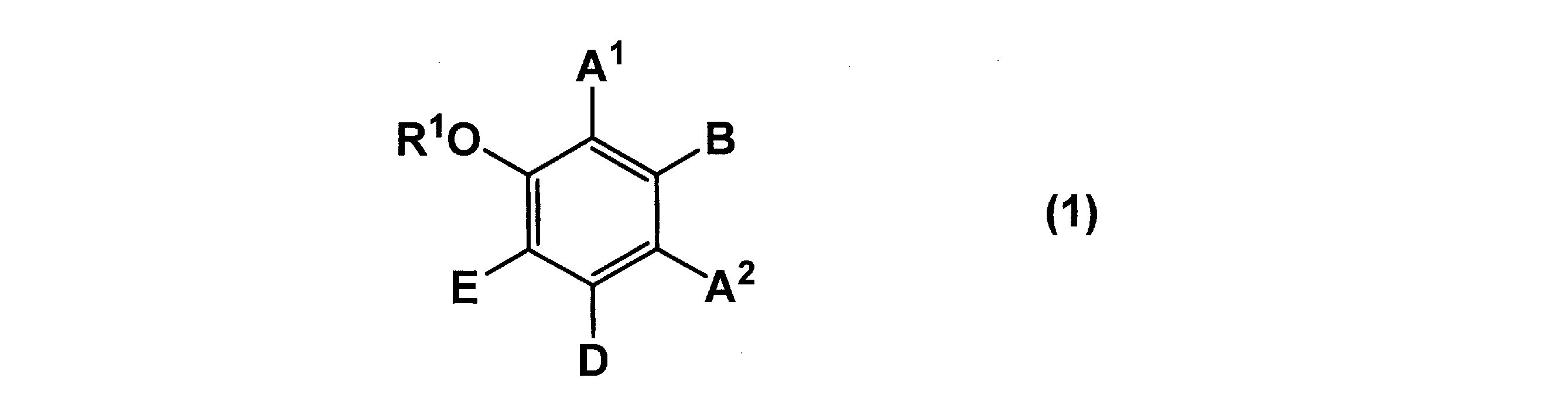
R1は、水素原子又はメチル基を示し、
A1及びA2は、同一でも異なってもよく、水素原子、炭素数1~12の直鎖若しくは分岐鎖のアルキル基若しくはアルケニル基、置換基を有してもよい炭素数7~12のアラルキル基若しくはアリールアルケニル基、炭素数1~6の直鎖若しくは分岐鎖のアルコキシ基若しくはアルケニルオキシ基、ハロゲン原子、又は-CO-R2(R2は炭素数1~12の直鎖若しくは分岐鎖のアルキル基若しくはアルケニル基、置換基を有してもよい炭素数7~12のアラルキル基若しくはアリールアルケニル基、又は置換基を有してもよい炭素数6~12の芳香族炭化水素基)を示し、
Bは、水素原子、炭素数1~12の直鎖若しくは分岐鎖のアルキル基若しくはアルケニル基、置換基を有してもよい炭素数7~12のアラルキル基若しくはアリールアルケニル基、-OR3又は-COOR3(R3は水素原子、又は炭素数1~6の直鎖若しくは分岐鎖のアルキル基若しくはアルケニル基)を示し、
Dは、水素原子、水酸基、メチル基又は炭素数1~12の直鎖若しくは分岐鎖のアルコキシ基若しくはアルケニルオキシ基を示し、
Eは、水素原子、水酸基、炭素数1~6の直鎖若しくは分岐鎖のアルキル基若しくはアルケニル基、又は炭素数1~6の直鎖若しくは分岐鎖のアルコキシ基若しくはアルケニルオキシ基を示す。
ただし、A1、A2、B及びEのうち2個又は3個は水素原子であり、残りの基はスルホ基を含むものではない。また、Dが水素原子又はメチル基である場合には、A1とB、又はA2とBが、これらに隣接する2つの炭素原子と共に、水酸基が置換してもよいベンゼン環を形成する。〕
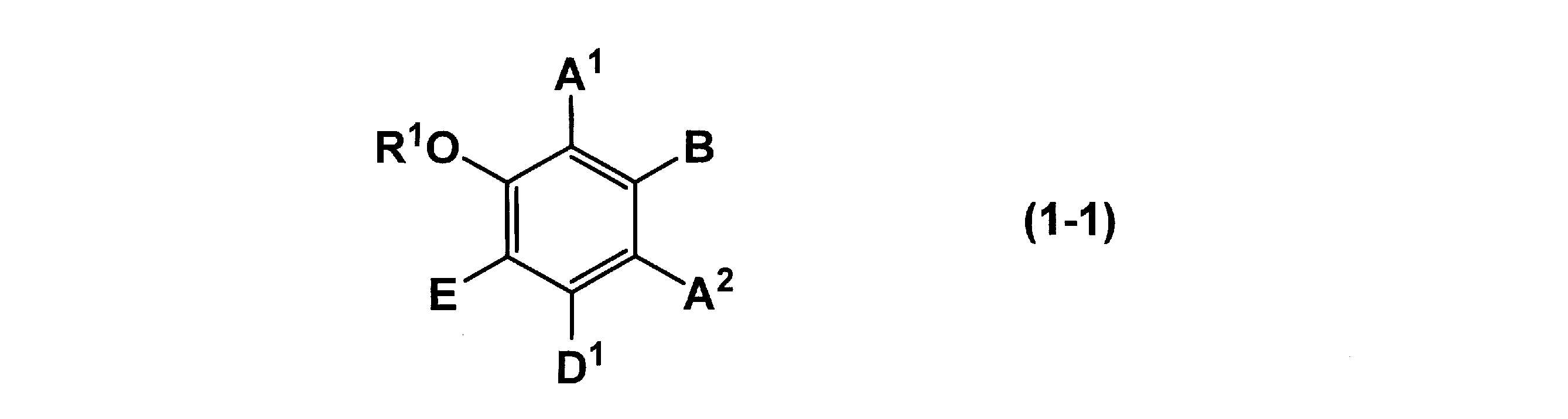
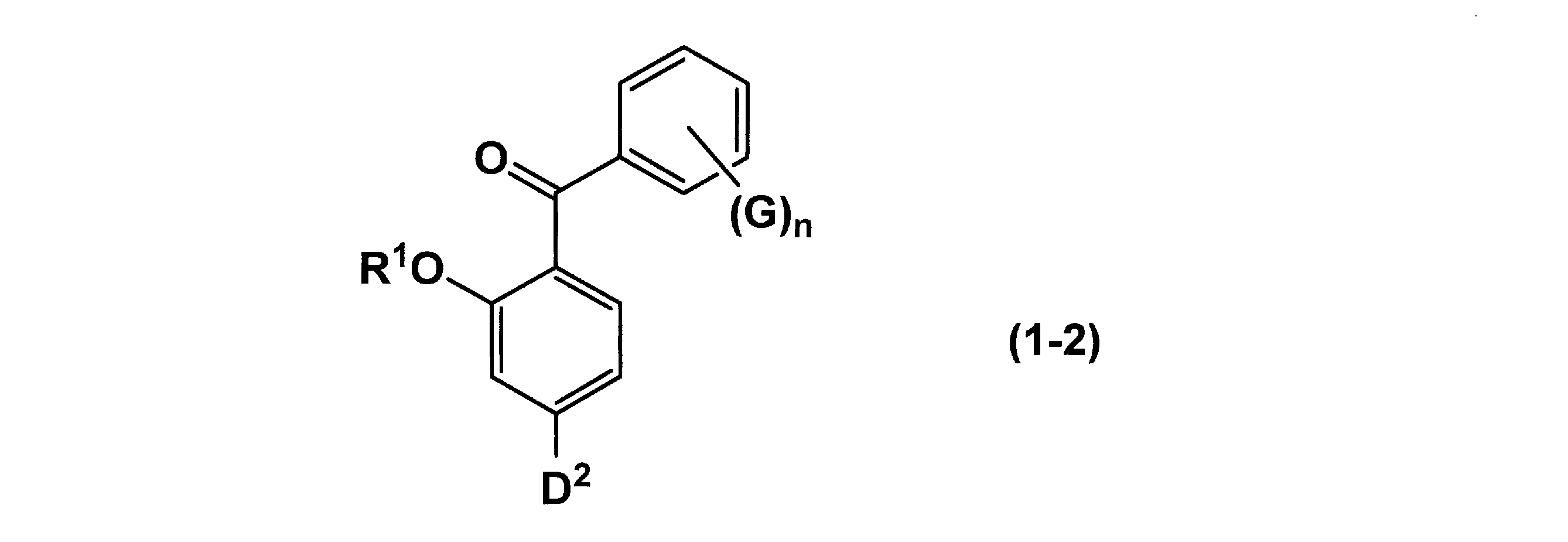
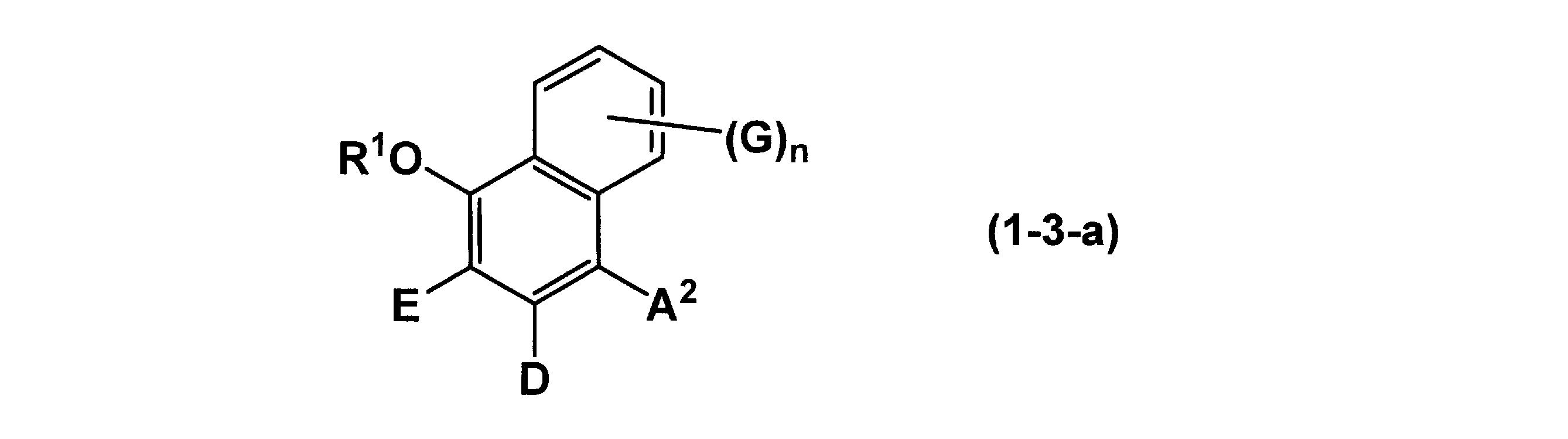


Bとしては、水素原子、炭素数1~4のアルキル基又はアルケニル基、置換基を有してもよい炭素数7~10のアリールアルケニル基、水酸基が好ましく、水素原子、置換基を有してもよい炭素数7~10のアリールアルケニル基、水酸基がより好ましい。
Eとしては、水素原子、炭素数1~4の直鎖又は分岐鎖のアルキル基又はアルケニル基が好ましく、水素原子がより好ましい。
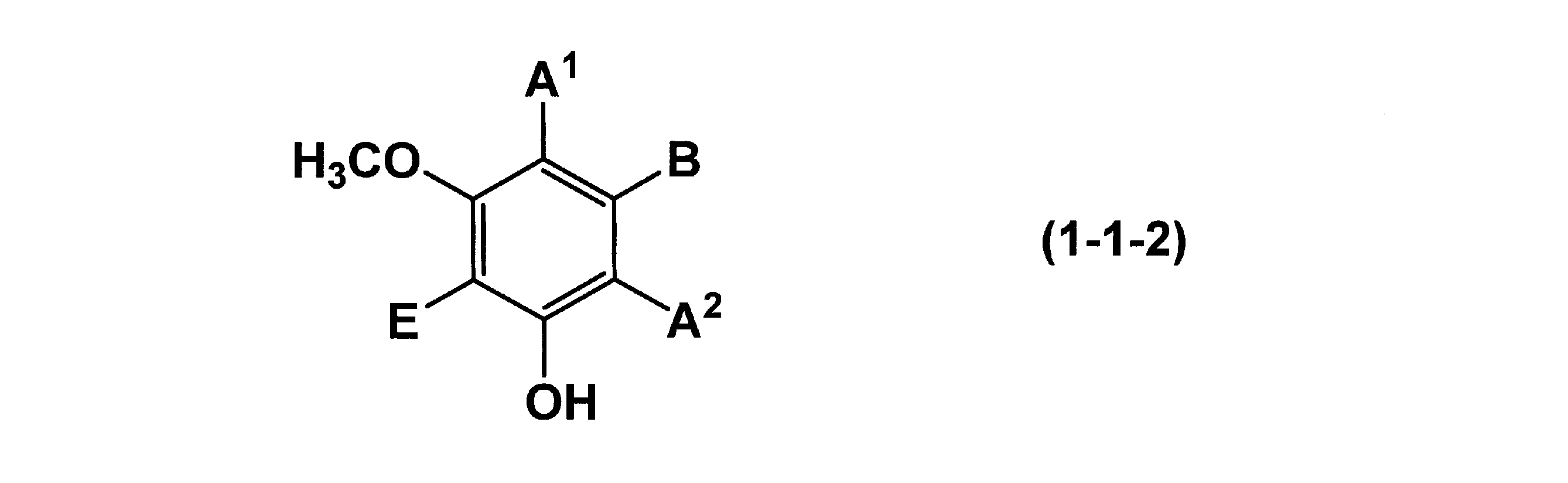
Bとしては、水素原子、炭素数1~12の直鎖又は分岐鎖のアルキル基又はアルケニル基、置換基を有してもよい炭素数7~12のアラルキル基又はアリールアルケニル基、-OR3(R3は水素原子、又は炭素数1~6の直鎖若しくは分岐鎖のアルキル基若しくはアルケニル基)が好ましく、水素原子、炭素数1~4のアルキル基又はアルケニル基、置換基を有してもよい炭素数7~10のアリールアルケニル基、水酸基がより好ましく、水素原子、置換基を有してもよい炭素数7~10のアリールアルケニル基、水酸基が更に好ましい。
Eは水素原子、水酸基、炭素数1~4の直鎖又は分岐鎖のアルキル基又はアルケニル基、炭素数1~4の直鎖又は分岐鎖のアルコキシ基又はアルケニルオキシ基が好ましく、水素原子、水酸基が好ましい。
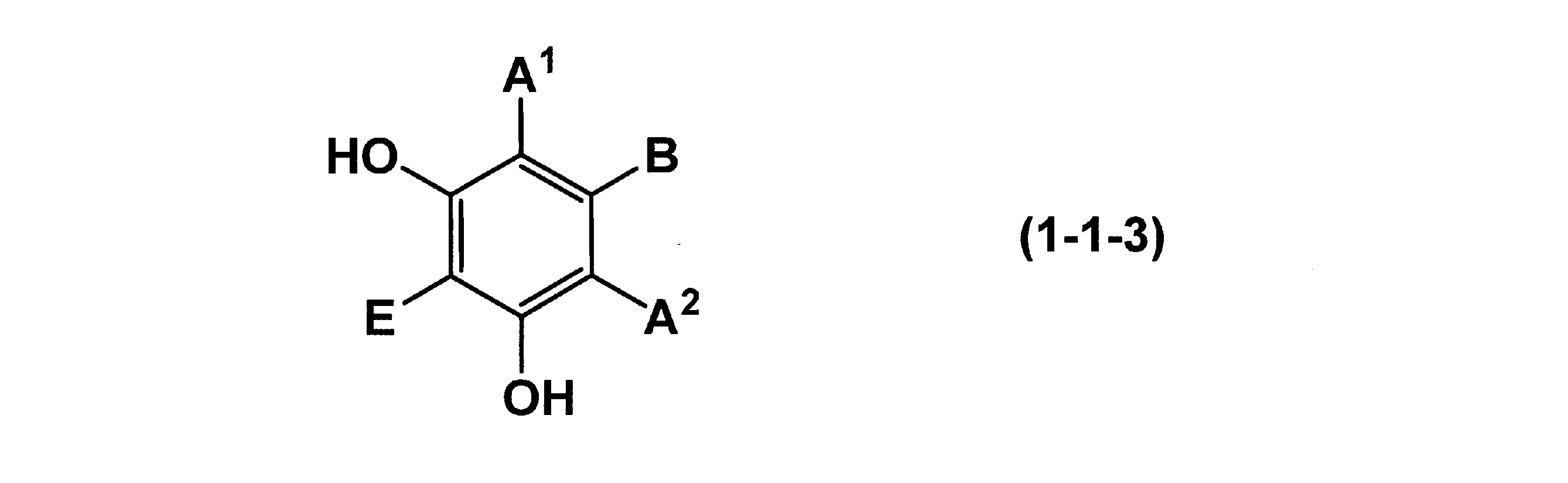
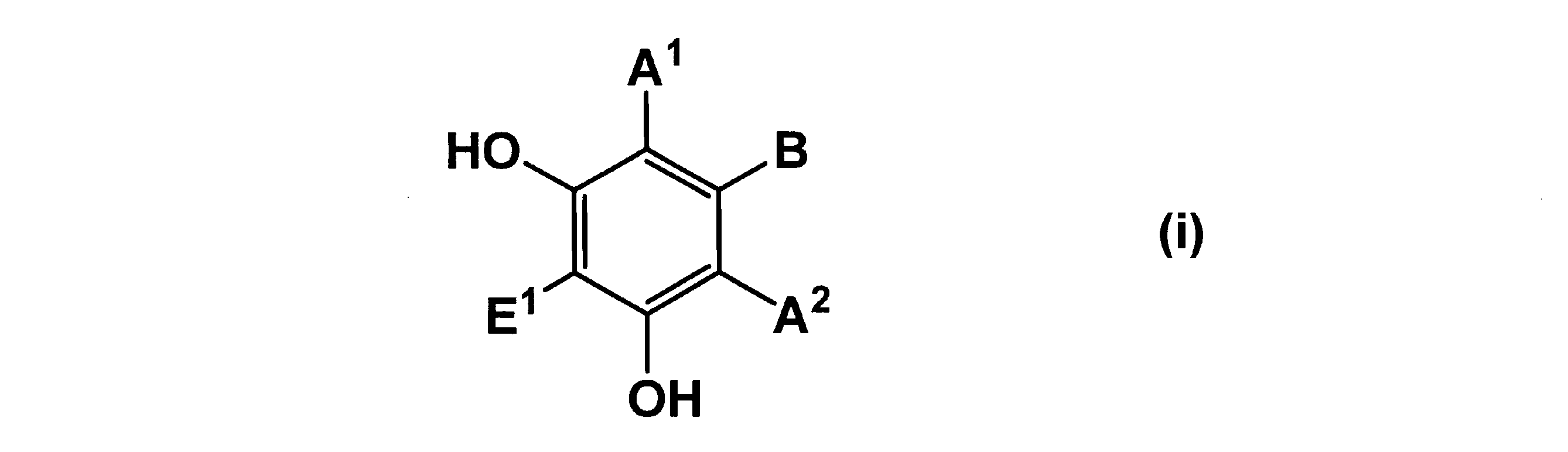
Bとしては、水素原子、置換基を有してもよい炭素数7~12のアラルキル基又はアリールアルケニル基、-OR3(R3は水素原子又は炭素数1~4の直鎖若しくは分岐鎖のアルキル基若しくはアルケニル基)が好ましい。
E1としては、水酸基、炭素数1~4の直鎖又は分岐鎖のアルキル基又はアルケニル基、炭素数1~4の直鎖又は分岐鎖のアルコキシ基又はアルケニルオキシ基が好ましい。
ピロガロール;
2-メトキシレゾルシン等の2-アルコキシレゾルシン;
没食子酸、没食子酸メチル、没食子酸エチル、没食子酸プロピル、没食子酸ブチル等の没食子酸エステル;
5-(フェニルエテニル)2-イソプロピルレゾルシン等が挙げられる。
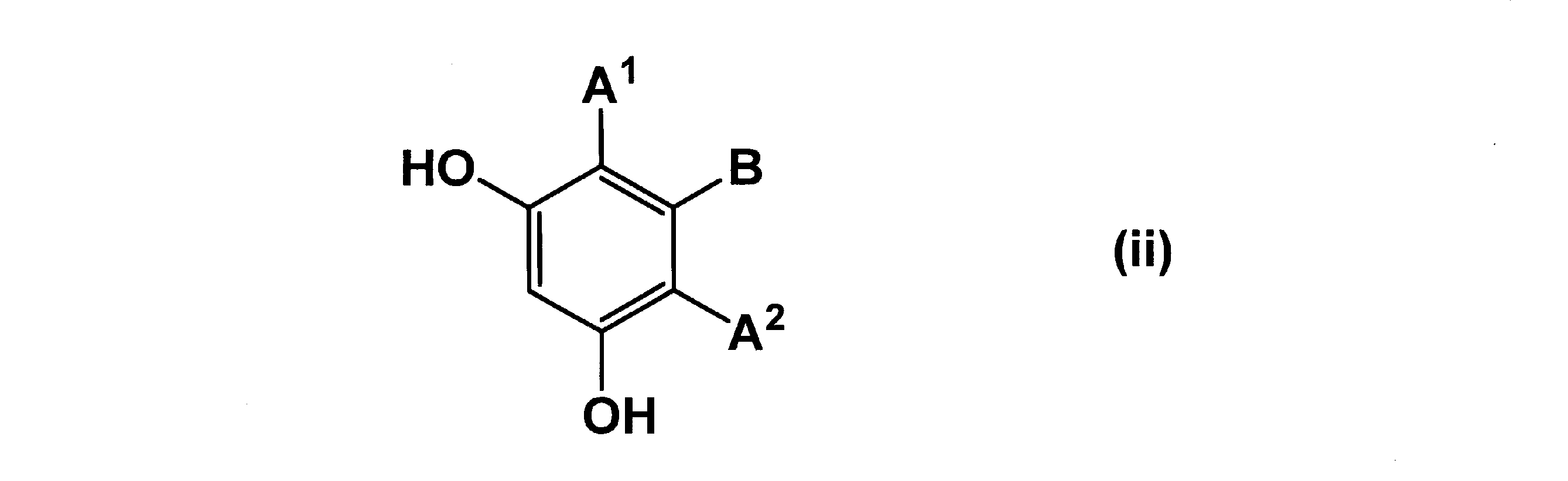
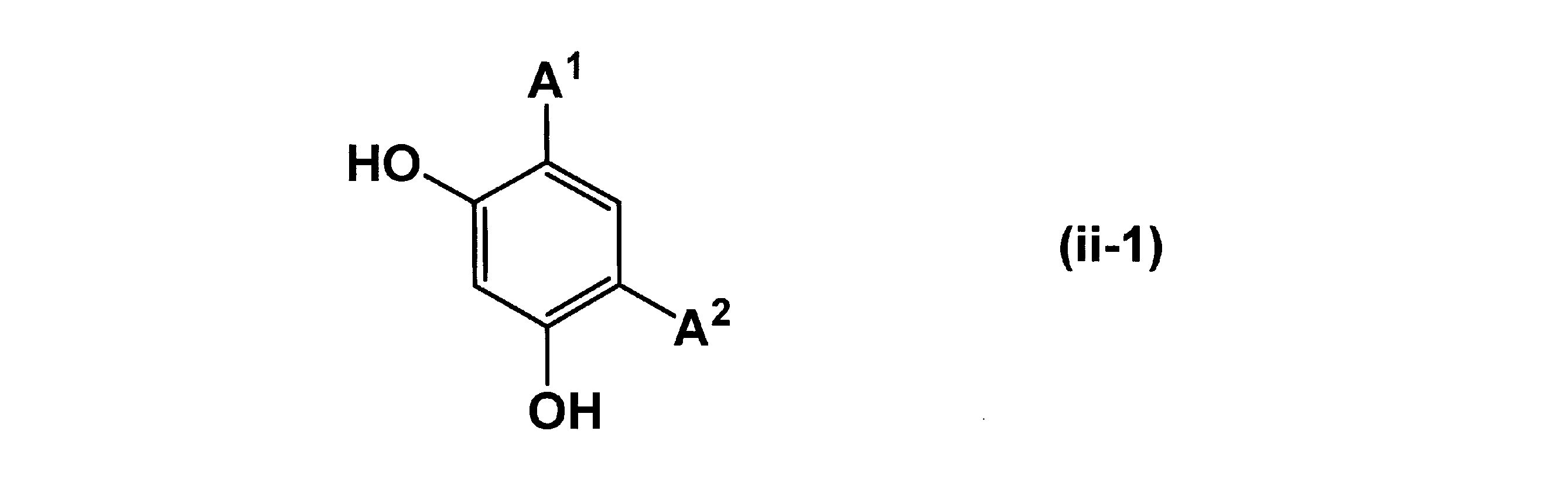
4-ビニルレゾルシン、4-アリルレゾルシン、4-ブテニルレゾルシン、4-ヘキセニルレゾルシン、4-デセニルレゾルシン等の4-アルケニルレゾルシン;
4-ベンジルレゾルシン、4-(1-フェニルエチル)レゾルシン(慣用名:シムホワイト377(Symwhite 377))、4-(2-フェニルエチル)レゾルシン、4-(3-フェニルプロピル)レゾルシン等の4-アラルキルレゾルシン;
4-(4-ヒドロキシベンジル)レゾルシン、4-(2,4-ジヒドロキシベンジル)レゾルシン、4-(4-ヒドロキシフェニルエチル)レゾルシン、4-(2,4-ジヒドロキシフェニルエチル)レゾルシン等の4-ヒドロキシアラルキルレゾルシン;
4-(1-フェニルエテニル)レゾルシン、4-(3-フェニルプロペニル)レゾルシン等の4-アリールアルケニルレゾルシン;
4-(4-ヒドロキシフェニルエテニル)レゾルシン、4-(2,4-ジヒドロキシフェニルエテニル)レゾルシン等の4-ヒドロキシアリールアルケニルレゾルシン;
4-(1-メチルナフチル)レゾルシン;
4-メトキシレゾルシン、4-エトキシレゾルシン、4-イソプロポキシレゾルシン、4-プロポキシレゾルシン、4-ブトキシレゾルシン、4-sec-ブトキシレゾルシン、4-tert-ブトキシレゾルシン、4-ペントキシレゾルシン等の4-アルコキシレゾルシン;
4-クロロレゾルシン、4-ブロモレゾルシン等のハロゲン化レゾルシン;
4-アセチルレゾルシン、4-プロパノイルレゾルシン、4-ブタノイルレゾルシン、4-ペンタノイルレゾルシン、4-ヘキサノイルレゾルシン等の4-アルカノイルレゾルシン;
4-フェニルエタノイルレゾルシン、4-フェニルプロパノイルレゾルシン、4-フェニルブタノイルレゾルシン、4-フェニルペンタノイルレゾルシン、4-フェニルヘキサノイルレゾルシン、3-(ヒドロキシフェニル)-1-(2,4-ジヒドロキシフェニル)プロペン-1-オン(慣用名:イソリキリチゲニン(Isoliquiritigenin))等の4-アリールアルカノイルレゾルシン等が挙げられる。


5-ビニルレゾルシン、5-アリルレゾルシン、5-ブテニルレゾルシン、5-ヘキセニルレゾルシン、5-デセニルレゾルシン等の5-アルケニルレゾルシン;
フロログルシノール;
5-エトキシベンゼン-1,3-ジオール、5-プロポキシベンゼン-1,3-ジオール、5-ブトキシベンゼン-1,3-ジオール等の5-アルコキシベンゼン-1,3-ジオール;
3,5-ジヒドロキシ安息香酸;
3,5-ジヒドロキシ安息香酸メチル、3,5-ジヒドロキシ安息香酸エチル、3,5-ジヒドロキシ安息香酸プロピル、3,5-ジヒドロキシ安息香酸ブチル、3,5-ジヒドロキシ安息香酸ペンチル、3,5-ジヒドロキシ安息香酸ヘキシル等の3,5-ジヒドロキシ安息香酸エステル;
5-ベンジルレゾルシン、5-(1-フェニルエチル)レゾルシン、5-(2-フェニルエチル)レゾルシン、5-(フェニルプロピル)レゾルシン等の5-アラルキルレゾルシン;
5-(4-ヒドロキシベンジル)レゾルシン、5-(2,4-ジヒドロキシベンジル)レゾルシン5-(ヒドロキシフェニルエチル)レゾルシン(慣用名:ジヒドロレスベラトール(Dihydro-resveratrol))、5-(2,4-ジヒドロキシフェニルエチル)レゾルシン、等の5-ヒドロキシアラルキルレゾルシン;
5-(フェニルエテニル)レゾルシン(慣用名:ピノシルビン(Pinosylvin))5-(フェニルプロペニル)レゾルシン等の5-アリールアルケニルレゾルシン;
5-(4-ヒドロキシフェニルエテニル)レゾルシン(慣用名:レスベラトロール(Resveratrol))、5-(4-メトキシフェニルエテニル)レゾルシン(慣用名:4-メトキシレスベラトロール(4-MethoxyResveratrol))、5-(2,4-ジヒドロキシフェニルエテニル)レゾルシン(慣用名:オキシレスベラトロール(Oxyresveratrol))、5-(2-メトキシ-4-ヒドロキシフェニルエテニル)レゾルシン(慣用名:グネツクレイストールD(Gnetucleistol D))、5-(3,4-ジメトキシフェニルエテニル)レゾルシン(慣用名:グネツクレイストールE(Gnetucleistol E))、5-(3-ヒドロキシ-4-メトキシフェニルエテニル)レゾルシン(慣用名:ラポンチゲニン(Rhapontigenin))、5-(4-ヒドロキシ-3-メトキシフェニルエテニル)レゾルシン(慣用名:イソラポンチゲニン(Isorhapontigenin))、5-(ジヒドロキシフェニルエテニル)レゾルシン(慣用名:ピセアタンノール(Piceatannol))等の5-ヒドロキシアリールアルケニルレゾルシン等が挙げられる。
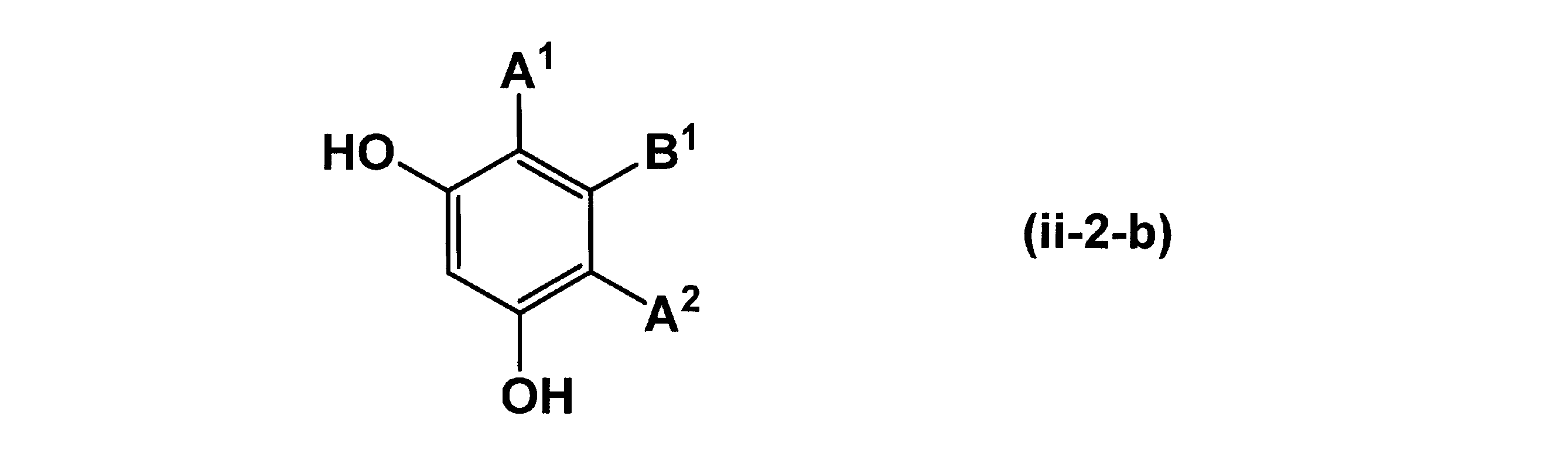
2-ベンジルベンゼン-1,3,5-トリオール、2-(フェニルエチル)ベンゼン-1,3,5-トリオール、2-(フェニルプロピル)ベンゼン-1,3,5-トリオール等の2-アラルキル-1,3,5-トリオール、2-アセチルベンゼン-1,3,5-トリオール、2-プロパノイルベンゼン-1,3,5-トリオール、2-ブタノイルベンゼン-1,3,5-トリオール、2-フェニルエタノイルベンゼン-1,3,5-トリオール、2-ヒドロキシフェニル-1-(ベンゼン-2,4,6-トリオール)エタン-1-オン、3-ヒドロキシフェニル-1-(ベンゼン-2,4,6-トリオール)プロパン-1-オン(慣用名:フロレチン(Phloretin))、4-ヒドロキシフェニル-1-(ベンゼン-2,4,6-トリオール)ブタン-1-オン、2-ベンゾイルベンゼン-1,3,5-トリオール、2-(ヒドロキシベンゾイル)ベンゼン-1,3,5-トリオール、2-(3,5-ジヒドロキシベンゾイル)ベンゼン-1,3,5-トリオール、2-(2,4-ジヒドロキシベンゾイル)ベンゼン-1,3,5-トリオール等のフロログルシン酸エステル;
3,5-ジヒドロキシ-2-メチル安息香酸、3,5-ジヒドロキシ-2-メチル安息香酸メチル、3,5-ジヒドロキシ-2-エチル安息香酸、3,5-ジヒドロキシ-2-エチル安息香酸メチル、3,5-ジヒドロキシ-2-プロピル安息香酸、3,5-ジヒドロキシ-2-プロピル安息香酸メチル3,5-ジヒドロキシ-2-ブチル安息香酸、3,5-ジヒドロキシ-2-ブチル安息香酸メチル等の3,5-ジヒドロキシ安息香酸エステル等が挙げられる。
また、A1及びA2が水素原子、水酸基、炭素数1~4の直鎖若しくは分岐鎖のアルキル基又は炭素数1~4のアルコキシ基であるものが好ましく、水素原子又は水酸基であるものがより好ましい。
また、Dが水素原子、水酸基、炭素数1~4の直鎖若しくは分岐鎖のアルキル基又は炭素数1~4のアルコキシ基であるものが好ましい。
また、Eが水素原子、水酸基又は炭素数1~4のアルキル基若しくは炭素数1~4のアルコキシ基であるものが好ましい。


本発明の毛髪変形処理剤を用いて毛髪形状を半永久的ないし永久的に変形する毛髪処理は、下記工程(i)及び(ii)を含む毛髪処理方法により行うことができる。
(i)本発明の毛髪変形処理剤を毛髪に塗布し、毛髪に浸透させるステップ
(ii)毛髪変形処理剤が浸透した毛髪を加熱して形付けするステップ
また、放置するステップにおいて、毛髪変形処理剤の浸透を促進する観点から、毛髪を加温してもよい。加温する場合は40~90℃で加温するのが好ましい。この加温によって、工程(ii)の前に低次のオリゴマーを毛髪内で重合することができるため、工程(ii)をより有利に進めることができる点でも好ましい。
工程(i)又は工程(ii)を含む方法により毛髪を変形処理した後、熱を与えて毛髪を別の形に半永久的に再変形させる工程を行うことができる。再変形する際には、好ましくは30℃以上、より好ましくは40℃以上であり、また、230℃以下、より好ましくは220℃以下、更に好ましくは210℃以下の温度を与えるのが好ましい。また、再変形処理をする際には本発明の毛髪変形処理剤も、いわゆるパーマ剤のように還元剤を含む毛髪処理剤、アルカリリラクサー等の既知の毛髪変形処理剤も、塗布しないことが好ましい。
カール状に変形処理した毛髪をストレート状に再変形するには、手や、くし、ブラシ等の道具により毛髪を引っ張りながらドライヤーでブローする方法、ヘアアイロンを用いて加熱する方法等があるが、変形の容易さの観点から、ヘアアイロンを用いる方法が好ましい。ヘアアイロンを用いて毛髪を加熱しながらストレート状に形付けするには、毛髪をヘアアイロンで挟んだ後に挟んだまま根元から毛先に滑らせる方法、手や、くし、ブラシ等の道具により毛髪を引っ張りながらヘアアイロンで挟んでそのまま保持する方法等、及びその両者の組合せ等によればよい。
ストレート状に処理した毛髪をカール状に変形するには、毛髪をロッド、カーラー等に巻いて加熱しながら保持する方法、毛髪をヘアアイロンに巻いて保持する方法等が挙げられる。
1)任意で毛髪を水で濡らす。
2)以下の成分(A)、(B)及び(C)、任意で更に成分(D)を含有し、成分(A)の含有量に対する成分(B)の含有量のモル比が0.01~5である本発明の毛髪処理剤を毛髪に塗布し、浸透させる。
成分(A):グリオキシル酸又はその水和物若しくは塩
成分(B):レゾルシン
成分(C):水
成分(D):一般式(1-1-3)で表されるレゾルシン誘導体、好ましくは4-アルキルレゾルシン
3)任意で、毛髪処理剤を塗布した毛髪を1分以上1時間以下放置する。このとき、任意で40~90℃に加温しても良い。
4)毛髪を50~250℃で加熱して形付ける。
5)任意で髪をすすぐ。
6)任意で40~230℃で加熱して毛髪を再変形する。
1)任意で毛髪を水で濡らす。
2)以下の成分(A)及び(C)を含有する第一剤と、成分(B)及び(C)、更に任意で成分(D)を含有する第二剤とを、成分(A)の含有量に対する成分(B)の含有量のモル比が0.01~5となるように混合した本発明の毛髪処理剤を毛髪に塗布し、浸透させる。
成分(A):グリオキシル酸又はその水和物若しくは塩
成分(B):レゾルシン
成分(C):水
成分(D):一般式(1-1-3)で表されるレゾルシン誘導体、好ましくは4-アルキルレゾルシン
3)任意で、毛髪処理剤を塗布した毛髪を1分以上1時間以下放置する。このとき、任意で40~90℃に加温しても良い。
4)毛髪を50~250℃で加熱して形付ける。
5)任意で髪をすすぐ。
6)任意で40~230℃で加熱して毛髪を再変形する。
1)任意で水を濡らす。
2)以下の成分(A)及び(C)を含有する第一剤を毛髪に塗布し、浸透させる。
成分(A):グリオキシル酸又はその水和物若しくは塩
成分(C):水
3)任意で、毛髪を1分以上1時間以下放置する。このとき、任意で40~90℃に加温してもよい。
4)以下の成分(B)及び(C)、更に任意で成分(D)を含有する第二剤を、成分(A)のモル数に対して成分(B)のモル数の比がが0.01~5となるように毛髪の第一剤塗布部の上に重ねて塗布し、浸透させる。
成分(B):レゾルシン
成分(C):水
成分(D):一般式(1-1-3)で表されるレゾルシン誘導体、好ましくは4-アルキルレゾルシン
5)任意で、毛髪を任意で40~90℃に加温しながら1分以上1時間以下放置する。
6)毛髪を50~250℃で加熱して形付ける。
7)任意で髪をすすぐ。
8)任意で40~230℃で加熱して毛髪を再変形する。
1)任意で水を濡らす。
2)以下の成分(B)及び(C)、更に任意で成分(D)を含有する第二剤を毛髪に塗布し、浸透させる。
成分(B):レゾルシン
成分(C):水
成分(D):一般式(1-1-3)で表されるレゾルシン誘導体、好ましくは4-アルキルレゾルシン
3)任意で、毛髪を1分以上1時間以下放置する。このとき、任意で40~90℃に加温してもよい。
4)以下の成分(A)及び(C)を含有する第一剤を、成分(A)のモル数に対して成分(B)のモル数の比が0.01~5となるように毛髪の第二剤塗布部の上に重ねて塗布し、浸透させる。
成分(A):グリオキシル酸又はその水和物若しくは塩
成分(C):水
5)任意で、毛髪を任意で40~90℃に加温しながら1分以上1時間以下放置する。
6)毛髪を50~250℃で加熱して形付ける。
7)任意で髪をすすぐ。
8)任意で40~230℃で加熱して毛髪を再変形する。
以下の成分(A)、(B)及び(C)を含有し、成分(A)の含有量に対する成分(B)の含有量のモル比(B)/(A)が0.2以上5以下である毛髪変形処理剤。
(A)グリオキシル酸又はその水和物若しくは塩
(B)レゾルシン
(C)水
成分(A)の含有量に対する成分(B)の含有量のモル比(B)/(A)が、好ましくは0.3以上、より好ましくは0.4以上、更に好ましくは0.5以上、更に好ましくは0.7以上であり、また、好ましくは2.5以下、より好ましくは2以下、更に好ましくは1.5以下、更に好ましくは1.2以下である、<1>に記載の毛髪変形処理剤。
成分(A)の酸としての含有量が、好ましくは1質量%以上、より好ましくは2質量%以上、更に好ましくは2.5質量%以上、更に好ましくは3質量%以上であり、また、好ましくは30質量%以下、より好ましくは25質量%以下、更に好ましくは20質量%以下、更に好ましくは15質量%以下、更に好ましくは12質量%以下である<1>又は<2>に記載の毛髪変形処理剤。
成分(B)の含有量が、好ましくは1質量%以上、より好ましくは2質量%以上、更に好ましくは3質量%以上、更に好ましくは4質量%以上、更に好ましくは5質量%以上であり、好ましくは30質量%以下、より好ましくは25質量%以下、更に好ましくは20質量%以下、更に好ましくは17質量%以下である<1>~<3>のいずれかに記載の毛髪変形処理剤。
好ましくは、更に成分(D)として次の一般式(1)で表される化合物を含有する<1>~<4>のいずれかに記載の毛髪変形処理剤。

R1は、水素原子又はメチル基を示し、
A1及びA2は、同一でも異なってもよく、水素原子、炭素数1~12の直鎖若しくは分岐鎖のアルキル基若しくはアルケニル基、置換基を有してもよい炭素数7~12のアラルキル基若しくはアリールアルケニル基、炭素数1~6の直鎖若しくは分岐鎖のアルコキシ基若しくはアルケニルオキシ基、ハロゲン原子又は-CO-R2(R2は炭素数1~12の直鎖若しくは分岐鎖のアルキル基若しくはアルケニル基、置換基を有してもよい炭素数7~12のアラルキル基若しくはアリールアルケニル基又は置換基を有してもよい炭素数6~12の芳香族炭化水素基)を示し、
Bは、水素原子、炭素数1~12の直鎖若しくは分岐鎖のアルキル基若しくはアルケニル基、置換基を有してもよい炭素数7~12のアラルキル基若しくはアリールアルケニル基、-OR3又は-COOR3(R3は水素原子又は炭素数1~6の直鎖若しくは分岐鎖のアルキル基若しくはアルケニル基)を示し、
Dは、水素原子、水酸基、メチル基又は炭素数1~12の直鎖若しくは分岐鎖のアルコキシ基若しくはアルケニルオキシ基を示し、
Eは、水素原子、水酸基、炭素数1~6の直鎖若しくは分岐鎖のアルキル基若しくはアルケニル基、又は炭素数1~6の直鎖若しくは分岐鎖のアルコキシ基若しくはアルケニルオキシ基を示す。
ただし、A1、A2、B及びEのうち2個又は3個は水素原子であり、残りの基はスルホ基を含むものではない。また、Dが水素原子又はメチル基である場合には、A1とB、又はA2とBが、これらに隣接する2つの炭素原子と共に、水酸基が置換してもよいベンゼン環を形成する。〕
成分(B)の含有量に対する成分(D)の含有量のモル比(D)/(B)が、好ましくは0.1以上、より好ましくは0.15以上、更に好ましくは0.2以上であり、また好ましくは3以下、更より好ましくは2以下、更に好ましくは1以下、更に好ましくは0.4以下である、<5>に記載の毛髪変形処理剤。
成分(A)の含有量に対する成分(B)及び(D)の合計含有量のモル比〔(B)+(D)〕/(A)が、好ましくは0.2以上、より好ましくは0.3以上、更に好ましくは0.4以上、更に好ましくは0.5以上、更に好ましくは0.7以上であり、また、好ましくは5以下、より好ましくは2.5以下、更に好ましくは2以下、更に好ましくは1.2以下である<5>又は<6>に記載の毛髪変形処理剤。
成分(B)と成分(D)との合計含有量が、好ましくは5質量%以上、より好ましくは10質量%以上、更に好ましくは15質量%以上であり、また、好ましくは30質量%以下、より好ましくは27質量%以下、更に好ましくは25質量%以下、更に好ましくは23質量%以下である<5>~<7>のいずれかに記載の毛髪変形処理剤。
成分(D)が、好ましくは以下の一般式(1-1)、(1-2)、(1-3-a)又は(1-3-b)で表される化合物から選ばれる1種又は2種以上である<5>~<8>のいずれかに記載の毛髪変形処理剤。
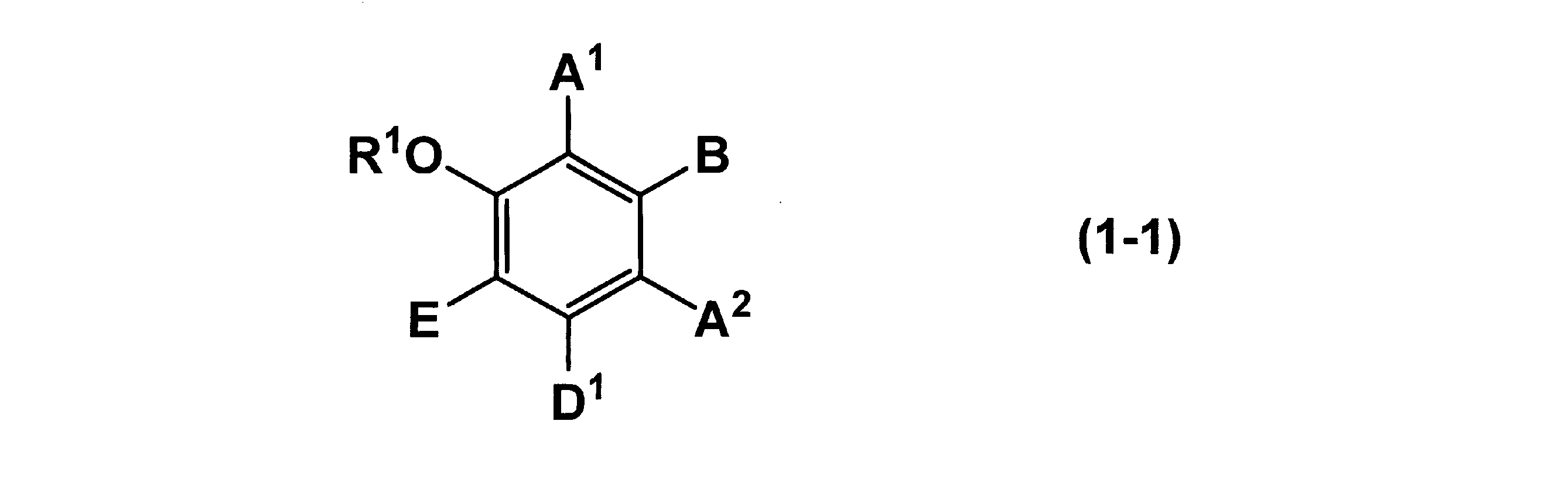

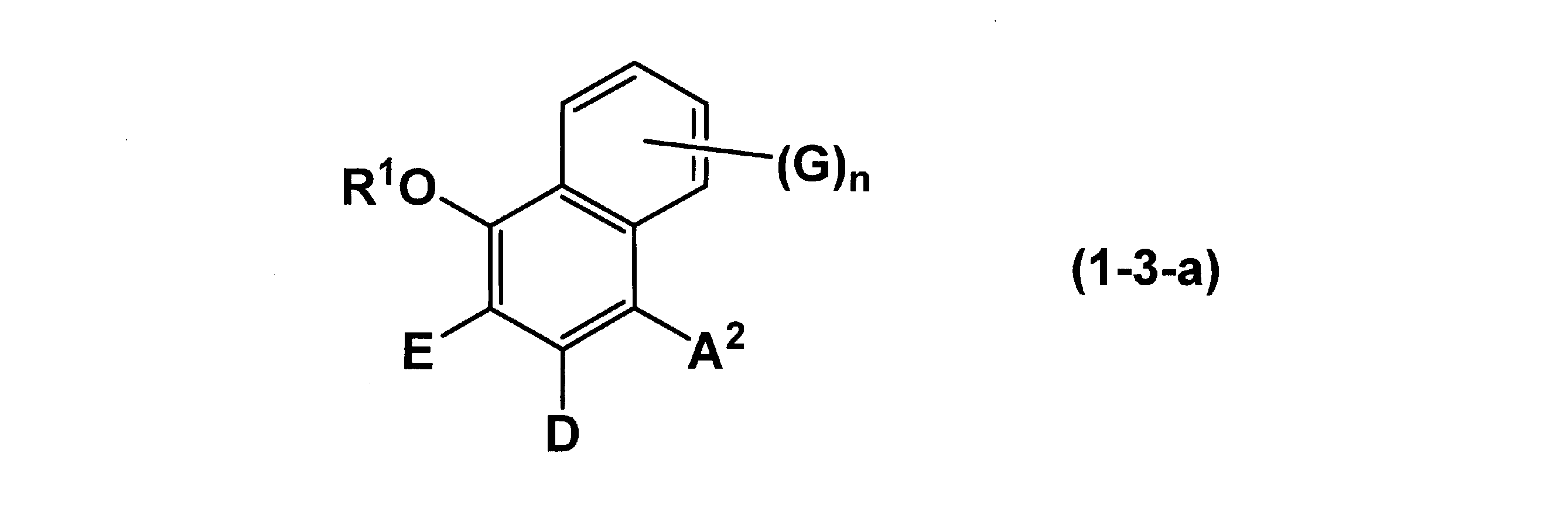

一般式(1-1)で表される化合物が、好ましくは以下の一般式(1-1-1)で表されるm-ジメトキシベンゼン誘導体である<9>に記載の毛髪変形処理剤。
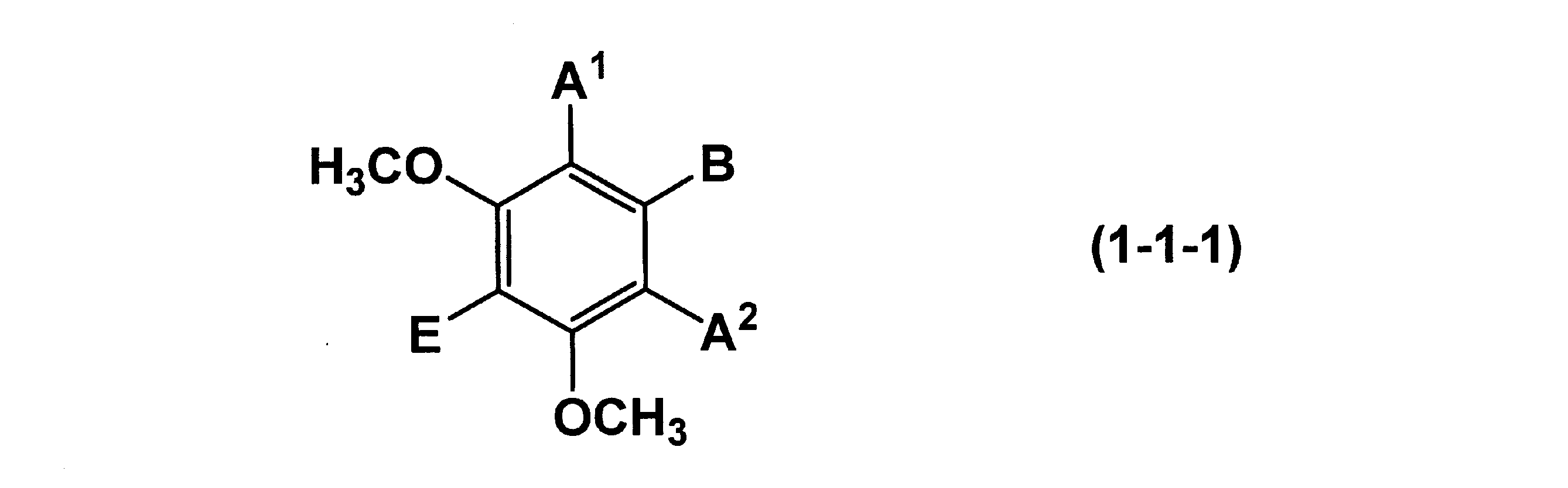
A1及びA2が、好ましくは水素原子、炭素数1~4の直鎖又は分岐鎖のアルキル基又はアルケニル基、より好ましくは水素原子である<10>に記載の毛髪変形処理剤。
Bが、好ましくは水素原子、炭素数1~12の直鎖若しくは分岐鎖のアルキル基若しくはアルケニル基、置換基を有してもよい炭素数7~12のアラルキル基若しくはアリールアルケニル基、又は-OR3(R3は水素原子、又は炭素数1~6の直鎖若しくは分岐鎖のアルキル基若しくはアルケニル基)、より好ましくは水素原子、炭素数1~4のアルキル基若しくはアルケニル基、置換基を有してもよい炭素数7~10のアリールアルケニル基、又は水酸基、更に好ましくは水素原子、置換基を有してもよい炭素数7~10のアリールアルケニル基、又は水酸基である<10>又は<11>に記載の毛髪変形処理剤。
Eが、好ましくは水素原子又は炭素数1~4の直鎖若しくは分岐鎖のアルキル基若しくはアルケニル基、より好ましくは水素原子である<10>~<12>のいずれかに記載の毛髪変形処理剤。
一般式(1-1)で表される化合物が、好ましくは以下の一般式(1-1-2)で表されるm-メトキシフェノール誘導体である<9>に記載の毛髪変形処理剤。
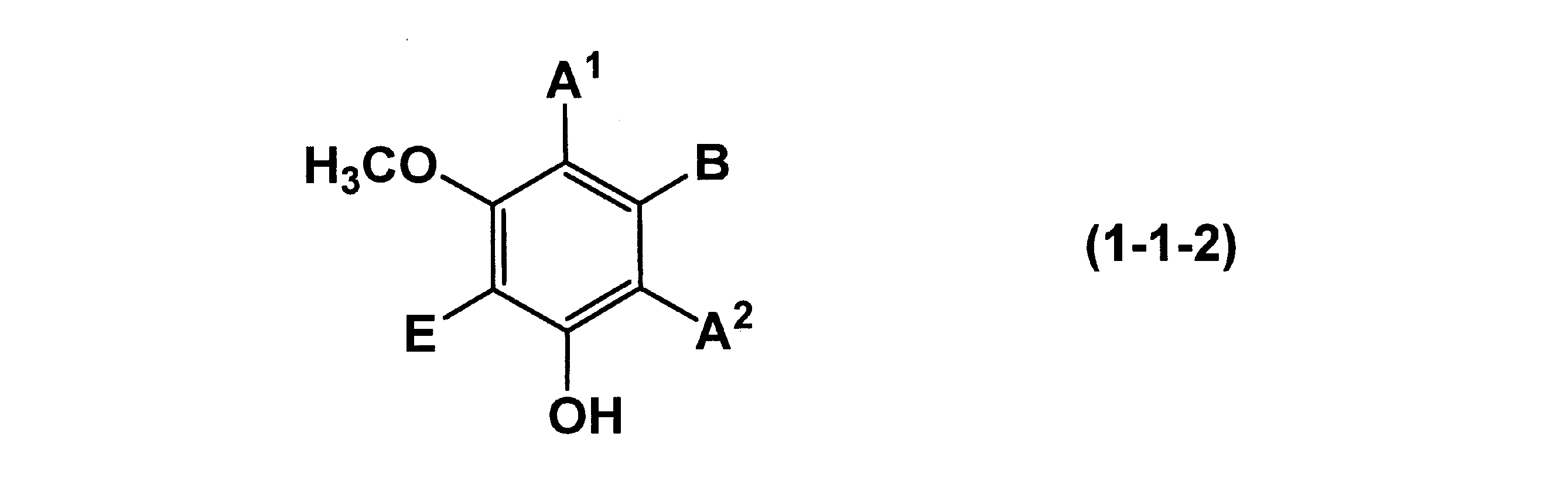
A1及びA2が、好ましくは水素原子、炭素数1~12の直鎖若しくは分岐鎖のアルキル基若しくはアルケニル基、又は置換基を有してもよい炭素数7~12のアラルキル基若しくはアリールアルケニル基、より好ましくは水素原子、炭素数1~6の直鎖若しくは分岐鎖のアルキル基、又は置換基を有してもよい炭素数7~10のアリールアルケニル基である<14>に記載の毛髪変形処理剤。
Bが、好ましくは水素原子、炭素数1~12の直鎖若しくは分岐鎖のアルキル基若しくはアルケニル基、置換基を有してもよい炭素数7~12のアラルキル基若しくはアリールアルケニル基、又は-OR3(R3は水素原子、又は炭素数1~6の直鎖若しくは分岐鎖のアルキル基若しくはアルケニル基)、より好ましくは、水素原子、炭素数1~4のアルキル基若しくはアルケニル基、置換基を有してもよい炭素数7~10のアリールアルケニル基、又は水酸基、更に好ましくは水素原子、置換基を有してもよい炭素数7~10のアリールアルケニル基、又は水酸基である<14>又は<15>に記載の毛髪変形処理剤。
Eが、好ましくは水素原子、水酸基、炭素数1~4の直鎖若しくは分岐鎖のアルキル基若しくはアルケニル基、又は炭素数1~4の直鎖若しくは分岐鎖のアルコキシ基若しくはアルケニルオキシ基であり、より好ましくは水素原子又は水酸基である<14>~<16>のいずれかに記載の毛髪変形処理剤。
一般式(1-1)で表される化合物が、好ましくは以下の一般式(1-1-3)で表されるレゾルシン誘導体である<9>に記載の毛髪変形処理剤。

一般式(1-1-3)で表されるレゾルシン誘導体が、好ましくは以下の一般式(i)で表されるレゾルシン誘導体である<18>に記載の毛髪変形処理剤。

A1及びA2が、好ましくは水素原子、又は炭素数1~12の直鎖若しくは分岐鎖のアルキル基若しくはアルケニル基であり、より好ましくは水素原子である<19>に記載の毛髪変形処理剤。
Bが、好ましくは水素原子、置換基を有してもよい炭素数7~12のアラルキル基若しくはアリールアルケニル基、又は-OR3(R3は水素原子又は炭素数1~4の直鎖若しくは分岐鎖のアルキル基若しくはアルケニル基)である<19>又は<20>に記載の毛髪変形処理剤。
E1が、好ましくは水酸基、炭素数1~4の直鎖若しくは分岐鎖のアルキル基若しくはアルケニル基又は炭素数1~4の直鎖若しくは分岐鎖のアルコキシ基若しくはアルケニルオキシ基である<18>~<21>のいずれかに記載の毛髪変形処理剤。
一般式(i)で表されるレゾルシン誘導体が、好ましくは2-アルキルレゾルシン、ピロガロール、2-メトキシレゾルシン、没食子酸又は没食子酸エステル、より好ましくは2-アルキルレゾルシン、没食子酸又は没食子酸エステルである<19>~<22>のいずれかに記載の毛髪変形処理剤。
一般式(1-1-3)で表されるレゾルシン誘導体が、好ましくは以下の式(ii-1)で表されるレゾルシン誘導体である<18>に記載の毛髪変形処理剤
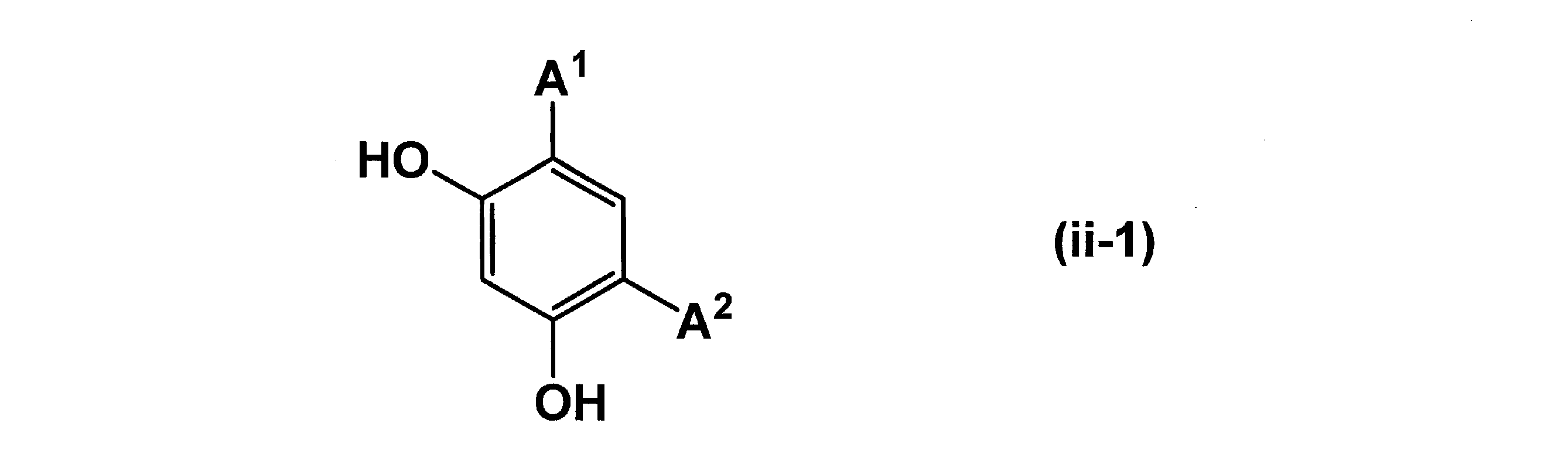
一般式(ii-1)で表されるレゾルシン誘導体が、好ましくは4-アルキルレゾルシン、4-アルケニルレゾルシン、4-アラルキルレゾルシン、4-ヒドロキシアラルキルレゾルシン、4-アリールアルケニルレゾルシン、4-ヒドロキシアリールアルケニルレゾルシン、4-(1-メチルナフチル)レゾルシン、4-アルコキシレゾルシン、ハロゲン化レゾルシン、4-アルカノイルレゾルシン、又は4-アリールアルカノイルレゾルシン、より好ましくは4-アルキルレゾルシン、4-アラルキルレゾルシン、ハロゲン化レゾルシン、4-アルカノイルレゾルシン、又は4-アリールアルカノイルレゾルシン、更に好ましくは4-アルキルレゾルシン、又は4-アラルキルレゾルシンである<24>に記載の毛髪変形処理剤。
一般式式(1-1-3)で表されるレゾルシン誘導体が、好ましくは以下の一般式(ii-2)で表されるレゾルシン誘導体である<18>に記載の毛髪変形処理剤。

一般式(ii-2)で表されるレゾルシン誘導体が、好ましくは以下の一般式(ii-2-a)で表されるレゾルシン誘導体である<26>に記載の毛髪変形処理剤。

一般式(ii-2-a)で表されるレゾルシン誘導体が、好ましくは5-アルキルレゾルシン、5-アルケニルレゾルシン、フロログルシノール、5-アルコキシベンゼン-1,3-ジオール、3,5-ジヒドロキシ安息香酸、3,5-ジヒドロキシ安息香酸エステル、5-アラルキルレゾルシン、5-ヒドロキシアラルキルレゾルシン、5-アリールアルケニルレゾルシン、又は5-ヒドロキシアリールアルケニルレゾルシン、より好ましくは5-アルキルレゾルシン、5-アラルキルレゾルシン、5-ヒドロキシアラルキルレゾルシン、又は5-ヒドロキシアリールアルケニルレゾルシンである<27>に記載の毛髪変形処理剤。
(ii-2)で表されるレゾルシン誘導体が、好ましくは以下の一般式(ii-2-b)で表されるレゾルシン誘導体である<26>に記載の毛髪変形処理剤。
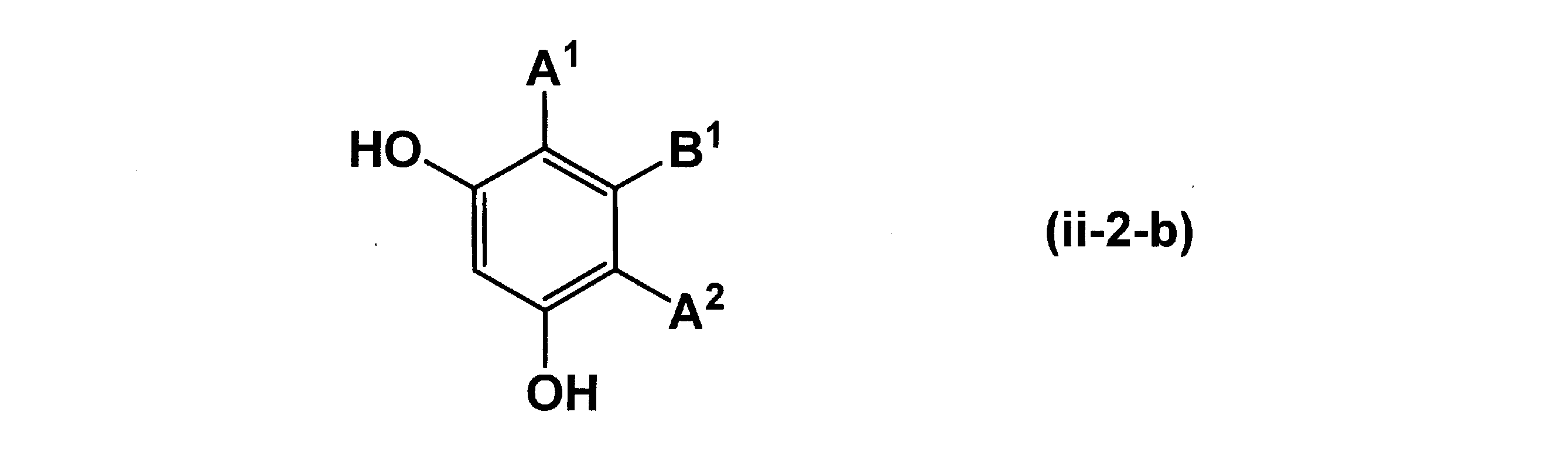
A1及びA2が、好ましくは水素原子、炭素数1~4の直鎖若しくは分岐鎖のアルキル基若しくはアルケニル基、又は炭素数1~4のアルコキシ基若しくはアルケニルオキシ基である<29>に記載の毛髪変形処理剤。
一般式(ii-2-b)で表されるレゾルシン誘導体が、好ましくは2-アルキルベンゼン-1,3,5-トリオール、フロログルシン酸エステル、又は3,5-ジヒドロキシ安息香酸エステル、より好ましくはフロログルシン酸エステルである<30>に記載の毛髪変形処理剤。
一般式(1-2)で表されるベンゾフェノン誘導体が、好ましくはベンゾフェノン-1、ベンゾフェノン-2、ベンゾフェノン-3、ベンゾフェノン-6、ベンゾフェノン-8、ベンゾフェノン-10、又はベンゾフェノン-12、より好ましくはベンゾフェノン-12である<9>に記載の毛髪変形処理剤。
一般式(1-3-a)又は(1-3-b)で示されるナフトール誘導体が、一般式(1-3-a)又は(1-3-b)中のR1が好ましくは水素原子、又は炭素数1~4のアルキル基若しくはアルケニル、より好ましくは水素原子であるナフトール誘導体である<9>に記載の毛髪変形処理剤。
一般式(1-3-a)又は(1-3-b)で示されるナフトール誘導体が、一般式(1-3-a)又は(1-3-b)中のA1及びA2が好ましくは水素原子、水酸基、炭素数1~4の直鎖若しくは分岐鎖のアルキル基又は炭素数1~4のアルコキシ基、より好ましくは水素原子又は水酸基であるナフトール誘導体である<33>に記載の毛髪変形処理剤。
一般式(1-3-a)又は(1-3-b)で示されるナフトール誘導体が、一般式(1-3-a)又は(1-3-b)中のDが好ましくは水素原子、水酸基、炭素数1~4の直鎖若しくは分岐鎖のアルキル基又は炭素数1~4のアルコキシ基であるナフトール誘導体である<33>又は<34>に記載の毛髪変形処理剤。
一般式(1-3-a)又は(1-3-b)で示されるナフトール誘導体が、一般式(1-3-a)又は(1-3-b)中のEが好ましくは水素原子、水酸基又は炭素数1~4のアルキル基若しくは炭素数1~4のアルコキシ基であるナフトール誘導体である<33>~<35>のいずれかに記載の毛髪変形処理剤。
一般式(1-3-a)又は(1-3-b)で表されるナフトール誘導体が、1-ナフトール、2-ナフトール、3-メチルナフタレン-1-オール、ナフタレン-1,4-ジオール、ナフタレン-1,5-ジオール、又はナフタレン-1,8-ジオールである<33>~<36>のいずれかに記載の毛髪変形処理剤。
成分(D)が、好ましくは一般式(1-1-1)で表されるm-ジメトキシベンゼン誘導体、一般式(1-1-3)で表されるレゾルシン誘導体、一般式(1-2)で表されるベンゾフェノン誘導体、及び一般式(1-3-a)若しくは(1-3-b)で表されるナフトール誘導体から選ばれる1種又は2種以上であり、より好ましくは2-メチルレゾルシン、4-クロロレゾルシン、4-アルキルレゾルシン、4-アラルキルレゾルシン、4-アシル化レゾルシン、5-アルキルレゾルシン、5-アラルキルレゾルシン、5-ヒドロキシアリールアルケニルレゾルシン、フロログルシン酸エステル、没食子酸及び没食子酸エステルから選ばれる1種又は2種以上であり、更に好ましくは4-ブチルレゾルシン(慣用名:ルシノール(Rucinol))、4-(1-フェニルエチル)レゾルシン(慣用名:シムホワイト377(Symwhite377))、5-(ヒドロキシフェニルエテニル)レゾルシン(慣用名:レスベラトロール(resveratrol))、3-ヒドロキシフェニル-1-(ベンゼン-2,4,6-トリオール)プロパン-1-オン(慣用名:フロレチン(Phloretin)、4-(2,4-ジヒドロキシベンゾイル)レゾルシン(慣用名:ベンゾフェノン-2(Benzophenone-2))、5-(ヒドロキシフェニルエテニル)-1,3-ジメトキシベンゼン(慣用名:プテロスチルベン(Pterostilbene))又は1-ナフトールから選ばれる1種又は2種以上であり、更に好ましくは4-ブチルレゾルシン、4-(1-フェニルエチル)レゾルシン及び4-n-へキシルレゾルシンから選ばれる1種又は2種以上である<5>~<37>のいずれかに記載の毛髪変形処理剤。
pHが、好ましくは4以下、より好ましくは3以下、更に好ましくは2.5以下であり、更に好ましくは2以下であり、また、好ましくは1以上、より好ましくは1.2以上、更に好ましくは1.5以上である、<1>~<38>のいずれかに記載の毛髪変形処理剤。
成分(D)の分子量は、120以上が好ましく、また、毛髪内部への浸透性の観点から、1000以下、更には500以下、更には300以下である<1>~<39>のいずれかに記載の毛髪変形処理剤。
少なくとも一つのアミノ基を有し、一のアミノ基のオルト位又はパラ位に他のアミノ基又は水酸基を有し、酸化した際に閉殻キノイド構造を有する芳香族化合物の量が、好ましくは0.1質量%未満、より好ましくは0.01質量%未満、更に好ましくは毛髪変形処理剤中に当該化合物を含有しない<1>~<40>のいずれかに記載の毛髪変形処理剤。
好ましくは、毛髪の変形が、毛髪蛋白質のS-S結合の切断及び再結合によるものでない、<1>~<41>のいずれかに記載の毛髪変形処理剤。
毛髪内の蛋白質を還元する成分の合計量が好ましくは0.1質量%未満、より好ましくは0.01質量%未満であり、更に好ましくは、毛髪変形処理剤中に当該化合物を含有しない<1>~<42>のいずれかに記載の毛髪変形処理剤。
好ましくは、毛髪内の蛋白質を還元する成分がチオール、亜硫酸水素、及びそれらの塩である<43>に記載の毛髪変形処理剤。
チオールが、好ましくはチオグリコール酸、ジチオグリコール酸、システイン又はアセチルシステイン、ブチロラクトンチオールである<44>に記載の毛髪変形処理剤。
好ましくは成分(A)を含む第一剤と成分(B)を含む第二剤とを含む多剤式である<1>~<45>のいずれかに記載の毛髪変形処理剤。
第一剤中の成分(A)の含有量が、好ましくは1質量%以上、より好ましくは2質量%以上、更に好ましくは2.5質量%以上、更に好ましくは3質量%以上であり、また、好ましくは30質量%以下、より好ましくは25質量%以下、更に好ましくは20質量%以下、更に好ましくは15質量%以下、更に好ましくは12質量%以下である<46>に記載の毛髪変形処理剤。
第二剤中の成分(B)の含有量が、好ましくは1質量%以上、より好ましくは2質量%以上、更に好ましくは3質量%以上、更に好ましくは4質量%以上、更に好ましくは5質量%以上であり、また、好ましくは30質量%以下、より好ましくは25質量%以下、更に好ましくは20質量%以下、更に好ましくは17質量%以下である<46>又は<47>に記載の毛髪変形処理剤。
好ましくは、成分(A)を含む第一剤と、成分(B)及び成分(D)を含む第二剤を含む多剤式である<46>~<48>のいずれかに記載の毛髪変形処理剤。
第二剤中の成分(B)の含有量に対する成分(D)の含有量の質量比(D)/(B)が、好ましくは0.1以上、より好ましくは0.15以上、更に好ましくは0.2以上であり、また、好ましくは3以下、より好ましくは2以下、更に好ましくは1以下、更に好ましくは0.4以下である<49>に記載の毛髪変形処理剤。
第一剤のpHが好ましくは4以下、更には3以下、更には2.5以下、更には2以下であり、また、好ましくは1以上、更には1.2以上、更には1.5以上である、<46>又は<50>に記載の毛髪変形処理剤。
混合後の組成物が<1>~<45>のいずれかに記載された組成物となる<46>~<51>のいずれかに記載の多剤式毛髪変形処理剤。
下記工程(i)及び(ii)を含む、毛髪形状を半永久的ないし永久的に変形する毛髪処理方法。
(i)<1>~<52>のいずれかに記載の毛髪変形処理剤を毛髪に塗布し、毛髪に浸透させるステップ
(ii)毛髪変形処理剤が浸透した毛髪を加熱して形付けするステップ
好ましくは工程(i)が、<46>~<52>のいずれかに記載の多剤式毛髪変形処理剤の第一剤と第二剤とを混合し、混合物を毛髪に塗布するステップである<53>に記載の毛髪変形方法。
好ましくは、工程(i)が、<46>~<52>のいずれかに記載の多剤式毛髪変形処理剤における第一剤と第二剤の一方を毛髪に塗布した後、その塗布部の上に他方を重ねて塗布するステップである<53>に記載の毛髪変形方法。
好ましくは、工程(i)が、成分(B)を含有する第二剤を塗布した後、その塗布部の上に成分(A)を含有する第一剤を重ねて塗布するステップである<55>に記載の毛髪変形方法。
毛髪に塗布した第一剤中に含まれる成分(A)の量に対する、毛髪に塗布した第二剤中に含まれる成分(B)の量のモル比(B)/(A)が、好ましくは0.2以上、より好ましくは0.3以上、更に好ましくは0.4以上、更に好ましくは0.5以上、更に好ましくは0.7以上であり、また、好ましくは5以下、更に好ましくは2.5以下、更に好ましくは2以下、更に好ましくは1.5以下、更に好ましくは1.2以下である<55>又は<56>に記載の毛髪処理方法。
毛髪に塗布した第一剤中の成分(A)の量に対する、毛髪に塗布した第二剤中の成分(B)及び(D)の合計含有量のモル比〔(B)+(D)〕/(A)が好ましくは0.2以上、好ましくは0.3以上、より好ましくは0.4以上、更に好ましくは0.5以上、更に好ましくは0.7以上であり、また、好ましくは5以下であって、好ましくは2.5以下、より好ましくは2以下、更に好ましくは1.5以下、更に好ましくは1.2以下である<55>~<57>のいずれかに記載の毛髪処理方法。
好ましくは、第一剤と第二剤の一方を毛髪に塗布するステップと、その塗布部の上に他方を重ねて塗布するステップの間に一方の剤が塗布された毛髪を放置するステップを含む<55>~<58>のいずれかに記載の毛髪変形方法。
一方の剤が塗布された毛髪を放置する際に、好ましくは毛髪を40~90℃で加温しながら放置する<59>に記載の毛髪処理方法。
好ましくは、工程(i)の前に毛髪を濡らすステップを含む、<53>~<60>のいずれかに記載の毛髪処理方法。
工程(ii)における加熱温度が、好ましくは50℃以上、より好ましくは60℃以上、更に好ましくは80℃以上であり、また、好ましくは250℃以下、より好ましくは240℃以下、更に好ましくは230℃以下である、<53>~<61>のいずれかに記載の毛髪処理方法。
好ましくは、工程(ii)が、水分の蒸発が抑制される環境下で行われるものである、請求項<53>~<62>のいずれかに記載の毛髪処理方法。
好ましくは還元剤を含む毛髪処理剤やpH12~14の強アルカリ性の毛髪処理剤を髪に塗布するステップを含まない<53>~<63>のいずれかに記載の毛髪処理方法。
工程(i)において毛髪に塗布する毛髪変形処理剤の質量が、毛髪の質量に対する浴比(毛髪変形処理剤の質量/毛髪の質量)で、好ましくは0.05以上、より好ましくは0.1以上、更に好ましくは0.25以上、更に好ましくは0.5以上であり、また好ましくは5以下、より好ましくは3以下、更に好ましくは2以下である<53>~<64>のいずれかに記載の毛髪処理方法。
工程(ii)における加熱時間が、好ましくは1秒以上、更には5秒以上、更には1分以上、更には5分以上、更には15分以上、更には30分以上であり、また、好ましくは2時間以下、更には1時間以下、更には45分以下である<53>~<65>のいずれかに記載の毛髪処理方法。
好ましくは工程(i)と工程(ii)の間に、毛髪処理剤が塗布された毛髪を放置するステップを含む<53>~<66>のいずれかに記載の毛髪処理方法。
放置時間が、好ましくは1分以上、より好ましくは3分以上、更に好ましくは5分以上であり、また、好ましくは1時間以下、より好ましくは30分以下、更に好ましくは20分以下である<67>に記載の毛髪処理方法。
好ましくは工程(i)と工程(ii)の間の放置時間において、毛髪を40~90℃で加温する<67>又は<68>に記載の毛髪処理方法。
好ましくは工程(i)と工程(ii)の間に、毛髪処理剤が塗布された毛髪をすすぐステップを含まない<53>~<69>のいずれかに記載の毛髪処理方法。
好ましくは工程(ii)の後、毛髪をすすぐステップを含む<53>~<70>のいずれかに記載の毛髪処理方法。
好ましくは工程(ii)の後、加熱により異なる形状に毛髪を再変形する<53>~<71>のいずれかに記載の毛髪処理方法。
好ましくは、毛髪を再変形する際に毛髪変形処理剤を塗布しない<72>に記載の毛髪処理方法。
毛髪を再変形する際の加熱温度が、好ましくは30℃以上、より好ましくは40℃以上であり、また、230℃以下、より好ましくは220℃以下、更に好ましくは210℃以下である<72>又は<73>に記載の毛髪処理方法。
<1>~<52>のいずれかに記載の組成物の、半永久的ないし永久的な毛髪変形のための使用。
表1に示す処理剤を調製し、以下の3段階の毛髪処理を行い、それぞれの形状付与効果を評価した。この結果を表1に併せて示す。なお、各組成物のpHは、調製した組成物を室温(25℃)において、そのままpHメーター(HORIBA製 / 型番:F-52)で測定した。
1.コーカシアン直毛(未処理毛)0.5gの長さ25cmの毛束を30℃の水道水で30秒間濡らした後、濡れた毛束を直径14mmのプラスチック製ロッドに巻き付け、クリップで固定した。
2.ロッドに巻き付けられた毛束に処理剤を1g塗布し、ロッドの全体をラップで覆って密封し、90℃設定のオーブンにて1時間加熱した。
3.毛束をオーブンから取り出し、室温に戻した。
4.毛束をロッドから外し、水道水の30℃流水にて30秒すすぎ、評価用シャンプーで60秒泡立てた。
5.水道水の30℃流水にて30秒すすぎ、30℃の水道水中に無限浴比で60秒浸漬した後、毛束の根本を持って静かに水中から引き上げ、軽く振動を与えて水を切った。
6.実験室中に2時間吊して静置し、乾燥させ、クシを通した後、吊して真横から写真を撮った。写真をもとに、毛束の最もカールの強い部分の曲率半径を求め、これを2倍することでカール直径を求めた。
A:カール直径が、使用したロッド(直径14mm)の1倍以上2倍未満
B:カール直径が、使用したロッド(直径14mm)の2倍以上3倍未満
C:カール直径が、使用したロッド(直径14mm)の3倍以上4倍未満
D:カール直径が、使用したロッド(直径14mm)の4倍以上50倍未満
E:直毛のままであり、処理前と形状の変化なし
1.<I:半永久的カール形状付与>で評価した毛束に対し、クシを通して絡まりをとった後に、実測温度180℃のアイロンで5cm/secの速度で6回スライドした。
2.水道水の30℃流水にて30秒すすぎ、評価用シャンプーで60秒泡立てた後、水道水の30℃流水にて30秒すすぎ、タオルドライした。
3.毛髪の自然な形状が出るよう振動を与えながら乾かし(ドライヤー不使用)、クシを通した後、吊して真横から目視観察した。
A:カールが残っておらず、完全に直毛化している
B:フラットアイロン処理前よりはカールは弱くなっているが、完全に直毛化はしていない
C:カール毛のままであり、処理前と形状の変化なし
1.<II:半永久的カール形状付与毛に対する半永久的ストレート形状付与>で評価した毛束を30℃の水道水で30秒間濡らした後、濡れた毛束を直径14mmのプラスチック製ロッドに巻き付け、クリップで固定した。
2.ロッドの全体をラップで覆って密封し、40℃設定のオーブンにて1時間加熱した。
3.毛束をオーブンから取り出し、室温に戻した。
4.毛束をロッドから外し、水道水の30℃流水にて30秒すすぎ、評価用シャンプーで60秒泡立てた。
5.水道水の30℃流水にて30秒すすぎ、30℃の水道水中に無限浴比で60秒浸漬した後、毛束の根本を持って静かに水中から引き上げ、軽く振動を与えて水を切った。
6.実験室中に2時間吊して静置し、乾燥させ、クシを通した後、吊して真横から写真を撮った。写真をもとに、毛束の最もカールの強い部分の曲率半径を求め、これを2倍することでカール直径を求めた。
A:カール直径が、使用したロッド(直径14mm)の1倍以上2倍未満
B:カール直径が、使用したロッド(直径14mm)の2倍以上3倍未満
C:カール直径が、使用したロッド(直径14mm)の3倍以上4倍未満
D:カール直径が、使用したロッド(直径14mm)の4倍以上50倍未満
E:直毛のままであり、処理前と形状の変化なし
成分 (質量%)
ラウレス硫酸ナトリウム 15.5
ラウラミドDEA 1.5
安息香酸ナトリウム 0.5
EDTA-2Na 0.3
リン酸 pH7に調整する量
イオン交換水 バランス
合計 100
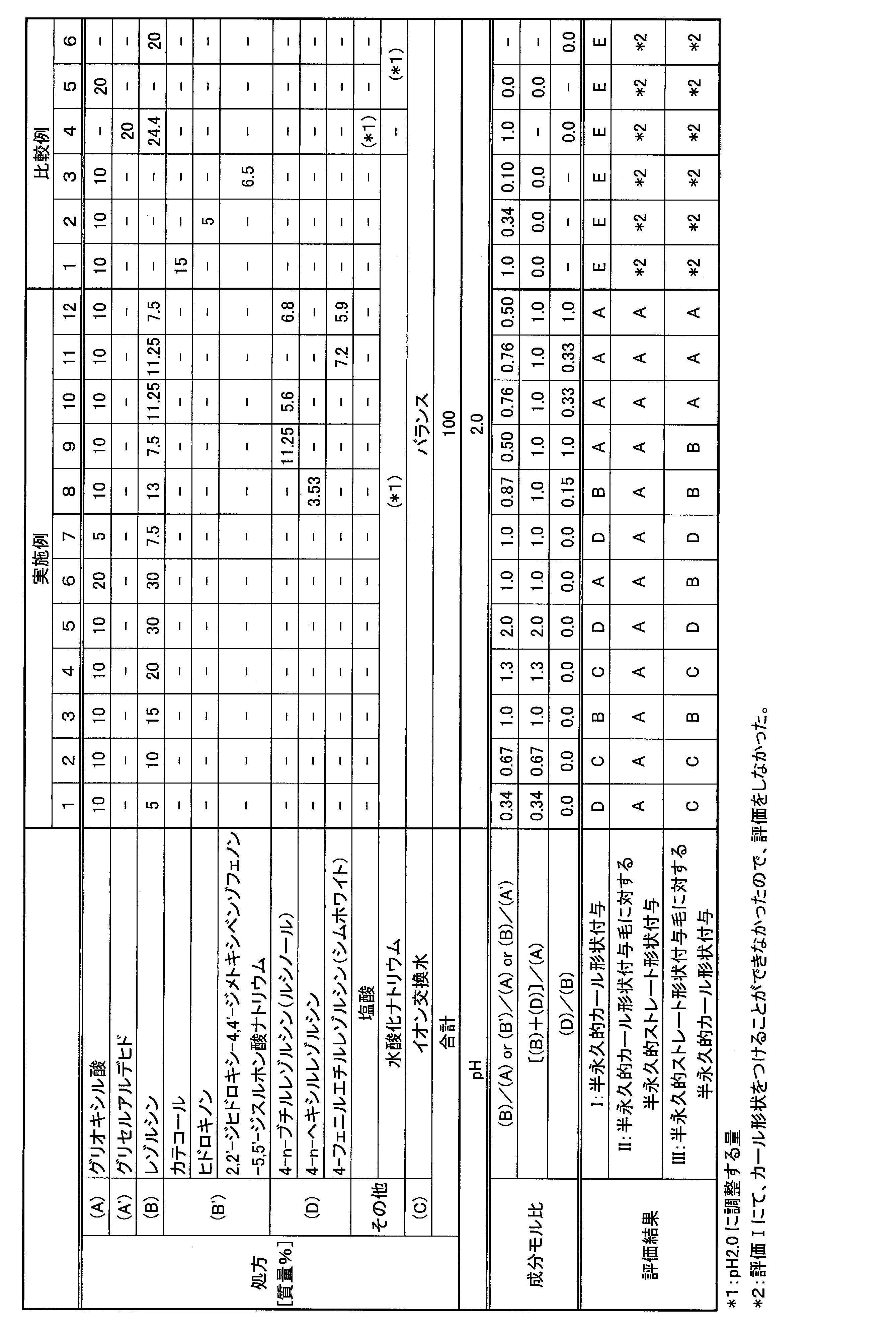
表2に示す処理剤を調製し、以下の3段階の毛髪処理を行い、それぞれの形状付与効果を評価した。この結果を表2に併せて示す。
1.コーカシアン直毛(未処理毛)0.5gの長さ25cmの毛束を30℃の水道水で30秒間濡らした後、濡れた毛束を直径14mmのプラスチック製ロッドに巻き付け、クリップで固定した。
2.ロッドに巻き付けられた毛束を40gの処理剤中に浸漬させたまま90℃設定のオーブンにて3時間加熱した。
3.毛束をオーブンから取り出し、室温に戻した。
4.毛束をロッドから外し、水道水の30℃流水にて30秒すすぎ、評価用シャンプーで60秒泡立てた。
5.水道水の30℃流水にて30秒すすぎ、30℃の水道水中に無限浴比で60秒浸漬した後、毛束の根本を持って静かに水中から引き上げ、軽く振動を与えて水を切った。
6.実験室中に2時間吊して静置し、乾燥させ、クシを通した後、吊して真横から写真を撮った。写真をもとに、毛束の最もカールの強い部分の曲率半径を求め、これを2倍することでカール直径を求めた。
A:カール直径が、使用したロッド(直径14mm)の1倍以上2倍未満
B:カール直径が、使用したロッド(直径14mm)の2倍以上3倍未満
C:カール直径が、使用したロッド(直径14mm)の3倍以上4倍未満
D:カール直径が、使用したロッド(直径14mm)の4倍以上50倍未満
E:直毛のままであり、処理前と形状の変化なし
1.初期形状付与効果を評価した毛束に対し、クシを通して絡まりをとった後に、実測温度180℃のフラットアイロンで5cm/secの速度で6回スライドした。
2.水道水の30℃流水にて30秒すすぎ、評価用シャンプーで60秒泡立てた後、水道水の30℃流水にて30秒すすぎ、タオルドライした。
3.毛髪の自然な形状が出るよう振動を与えながら乾かし(ドライヤー不使用)、クシを通した後、吊して真横から目視観察した。
A:カールが残っておらず、完全に直毛化している
B:フラットアイロン処理前よりはカールは弱くなっているが、完全に直毛化はしていない
C:カール毛のままであり、処理前と形状の変化なし
1.<II:半永久的カール形状付与毛に対する半永久的ストレート形状付与>で評価した毛束を30℃の水道水で30秒間濡らした後、濡れた毛束を直径14mmのプラスチック製ロッドに巻き付け、クリップで固定した。
2.ロッドの全体をラップで覆って密封し、40℃設定のオーブンにて1時間加熱した。
3.毛束をオーブンから取り出し、室温に戻した。
4.毛束をロッドから外し、水道水の30℃流水にて30秒すすぎ、評価用シャンプーで60秒泡立てた。
5.水道水の30℃流水にて30秒すすぎ、30℃の水道水中に無限浴比で60秒浸漬した後、毛束の根本を持って静かに水中から引き上げ、軽く振動を与えて水を切った。
6.実験室中に2時間吊して静置し、乾燥させ、クシを通した後、吊して真横から写真を撮った。写真をもとに、毛束の最もカールの強い部分の曲率半径を求め、これを2倍することでカール直径を求めた。
A:カール直径が、使用したロッド(直径14mm)の1倍以上2倍未満
B:カール直径が、使用したロッド(直径14mm)の2倍以上3倍未満
C:カール直径が、使用したロッド(直径14mm)の3倍以上4倍未満
D:カール直径が、使用したロッド(直径14mm)の4倍以上50倍未満
E:直毛のままであり、処理前と形状の変化なし
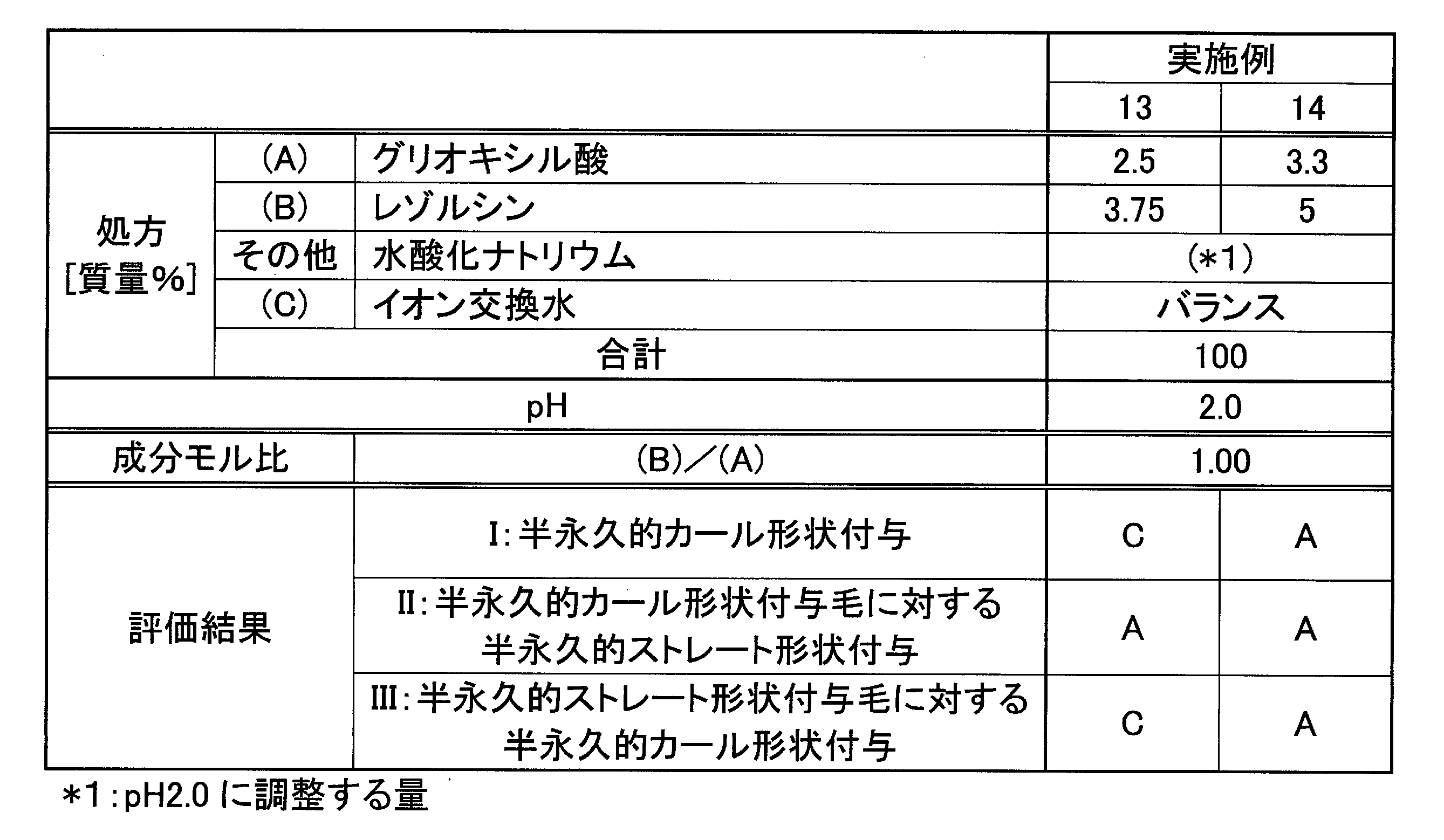
表3に示す処理剤を調製し、以下の3段階の毛髪処理を行い、それぞれの形状付与効果を評価した。この結果を表3に併せて示す。
1.コーカシアン人種由来のやや広がりを持った直毛の毛束(未処理毛)(重さ0.5g / 長さ25cm)を30℃の水道水で30秒間濡らした後、濡れた毛束を直径14mmのプラスチック製ロッドに巻き付け、クリップで固定した。
2.ロッドに巻き付けられた毛束に処理剤を1.0g塗布し、ロッド全体をラップフィルムで覆って密封し、40℃設定のオーブンにて1時間加熱した。
3.毛束をオーブンから取り出し、室温に戻した。
4.ラップフィルムを外してロッドから毛束を取り外し、タオルで軽く水気を切った後、ドライヤーで完全に乾くまで温風乾燥した。
5.毛束に櫛を通して絡まりを取った後、毛束を実測温度230℃のフラットアイロンで5cm/secの速度で6回スライドし、毛束の根元から毛先まで完全に直毛のスタイルを作った。
6.毛束を水道水の30℃流水にて30秒すすぎ、評価用シャンプーで60秒泡立てた。その後、水道水の30℃流水にて30秒すすぎ、タオルドライした。
7.毛髪の有する形状がそのまま出るよう、振動を与えながら乾かし、クシを通した後、吊して真横から目視観察した。
A:毛束の広がりがなくなり、根元から毛先まで完全な直毛が維持されている。
B:毛束の広がりが抑えられた直毛だが、わずかな広がりがある。
C:毛束の広がりは、未処理の状態と同等である
1.<I:半永久的ストレート形状付与>で評価した毛束を30℃の水道水で30秒間濡らした後、濡れた毛束を直径14mmのプラスチック製ロッドに巻き付け、クリップで固定した。
2.ロッドの全体をラップで覆って密封し、40℃設定のオーブンにて1時間加熱した。
3.毛束をオーブンから取り出し、室温に戻した。
4.毛束をロッドから外し、水道水の30℃流水にて30秒すすぎ、評価用シャンプーで60秒泡立てた。
5.水道水の30℃流水にて30秒すすぎ、30℃の水道水中に無限浴比で60秒浸漬した後、毛束の根本を持って静かに水中から引き上げ、軽く振動を与えて水を切った。
6.実験室中に2時間吊して静置し、乾燥させ、クシを通した後、吊して真横から写真を撮った。写真をもとに、毛束の最もカールの強い部分の曲率半径を求め、これを2倍することでカール直径を求めた。
A:カール直径が、使用したロッド(直径14mm)の1倍以上2倍未満
B:カール直径が、使用したロッド(直径14mm)の2倍以上3倍未満
C:カール直径が、使用したロッド(直径14mm)の3倍以上4倍未満
D:カール直径が、使用したロッド(直径14mm)の4倍以上50倍未満
E:直毛のままであり、処理前と形状の変化なし
1.<II:半永久的ストレート形状付与毛に対する半永久的カール形状付与>で評価した毛束に対し、クシを通して絡まりをとった後に、実測温度180℃のフラットアイロンで5cm/secの速度で6回スライドした。
2.水道水の30℃流水にて30秒すすぎ、評価用シャンプーで60秒泡立てた後、水道水の30℃流水にて30秒すすぎ、タオルドライした。
3.毛髪の自然な形状が出るよう振動を与えながら乾かし(ドライヤー不使用)、クシを通した後、吊して真横から目視観察した。
A:カールが残っておらず、完全に直毛化している
B:フラットアイロン処理前よりはカールは弱くなっているが、完全に直毛化はしていない
C:カール毛のままであり、処理前と形状の変化なし
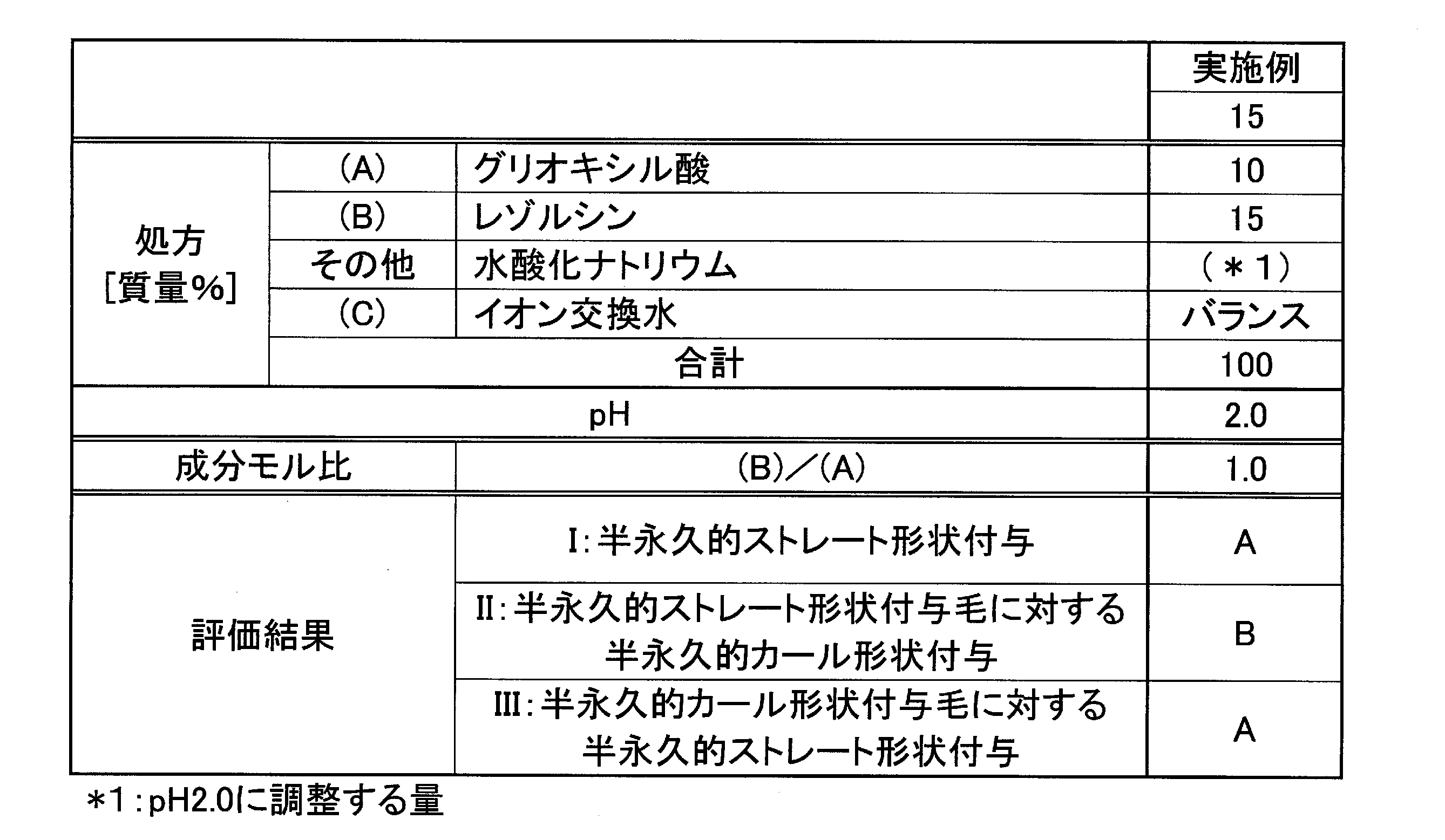
表4に示す2剤式の処理剤を調製し、以下の3段階の毛髪処理を行い、それぞれの形状付与効果を評価した。この結果を表4に併せて示す。
1.コーカシアンの直毛(未処理毛)0.5gの長さ25cmの毛束を30℃の水道水で30秒間濡らした後、濡れた毛束を直径14mmのプラスチック製ロッドに巻き付け、クリップで固定した。
2.ロッドに巻き付けられた毛束に処方一剤を1g塗布し、ロッドの全体をラップで覆って密封し、25℃にて5分放置した。
3.ロッドに巻き付けられた毛束に処方二剤を1g塗布し、ロッドの全体をラップで覆って密封し、90℃設定のオーブンにて1時間加熱した。
4.毛束をオーブンから取り出し、室温に戻した。
5.毛束をロッドから外し、水道水の30℃流水にて30秒すすぎ、評価用シャンプーで60秒泡立てた。
6.水道水の30℃流水にて30秒すすぎ、30℃の水道水中に無限浴比で60秒浸漬した後、毛束の根本を持って静かに水中から引き上げ、軽く振動を与えて水を切った。
7.実験室中に2時間吊して静置し、乾燥させ、クシを通した後、吊して真横から写真を撮った。写真をもとに、毛束の最もカールの強い部分の曲率半径を求め、これを2倍することでカール直径を求めた。
A:カール直径が、使用したロッド(直径14mm)の1倍以上2倍未満
B:カール直径が、使用したロッド(直径14mm)の2倍以上3倍未満
C:カール直径が、使用したロッド(直径14mm)の3倍以上4倍未満
D:カール直径が、使用したロッド(直径14mm)の4倍以上50倍未満
E:直毛のままであり、処理前と形状の変化なし
1.<I:半永久的カール形状付与>で評価した毛束に対し、クシを通して絡まりをとった後に、実測温度180℃のフラットアイロンで5cm/secの速度で6回スライドした。
2.水道水の30℃流水にて30秒すすぎ、評価用シャンプーで60秒泡立てた後、水道水の30℃流水にて30秒すすぎ、タオルドライした。
3.毛髪の自然な形状が出るよう振動を与えながら乾かし(ドライヤー不使用)、クシを通した後、吊して真横から目視観察した。
A:カールが残っておらず、完全に直毛化している
B:フラットアイロン処理前よりはカールは弱くなっているが、完全に直毛化はしていない
C:カール毛のままであり、処理前と形状の変化なし
1.<II:半永久的カール形状付与毛に対する半永久的ストレート形状付与>で評価した毛束を30℃の水道水で30秒間濡らした後、濡れた毛束を直径14mmのプラスチック製ロッドに巻き付け、クリップで固定した。
2.ロッドの全体をラップで覆って密封し、40℃設定のオーブンにて1時間加熱した。
3.毛束をオーブンから取り出し、室温に戻した。
4.毛束をロッドから外し、水道水の30℃流水にて30秒すすぎ、評価用シャンプーで60秒泡立てた。
5.水道水の30℃流水にて30秒すすぎ、30℃の水道水中に無限浴比で60秒浸漬した後、毛束の根本を持って静かに水中から引き上げ、軽く振動を与えて水を切った。
6.実験室中に2時間吊して静置し、乾燥させ、クシを通した後、吊して真横から写真を撮った。写真をもとに、毛束の最もカールの強い部分の曲率半径を求め、これを2倍することでカール直径を求めた。
A:カール直径が、使用したロッド(直径14mm)の1倍以上2倍未満
B:カール直径が、使用したロッド(直径14mm)の2倍以上3倍未満
C:カール直径が、使用したロッド(直径14mm)の3倍以上4倍未満
D:カール直径が、使用したロッド(直径14mm)の4倍以上50倍未満
E:直毛のままであり、処理前と形状の変化なし

実施例16で使用した処方一剤と処方二剤を用い、処方一剤と処方二剤の塗布順序を変えた以外は実施例16と同じ手順で評価を行った。すなわち、<I:半永久的カール形状付与>の評価において、ロッドに巻き付けた毛束に先に処方二剤を1g塗布し、ロッド全体をラップで覆い、25℃で5分放置した後、処方一剤を毛束に外資1g塗布し、ロッド全体をラップで覆って密封し、90℃設定のオーブンにて1時間加熱する以外は、実施例16と同じ手順で行った。
処理した毛束を観察したところ、<I:半永久的カール形状付与>の評価はC、<II:半永久的カール形状付与毛に対する半永久的ストレート形状付与>の評価はA、<III:半永久的ストレート形状付与毛に対する半永久的カール形状付与>の評価はCであった。
特許文献3(米国特許第4278659号明細書)に準じて毛髪処理剤を調製し、<I:半永久的カール形状付与>の評価を行った。具体的には以下の手順で毛髪処理剤を調製し、評価を行った。
グリセルアルデヒドを5質量%、レゾルシノールを5質量%含有するpH2.0の水溶液を調製した。この水溶液を1時間加熱還流し、毛髪処理剤を得た。
1.コーカシアン直毛0.5gの長さ25cmの毛束を30℃の水道水で30秒間濡らした後、濡れた毛束を直径14mmのプラスチック製ロッドに巻き付け、クリップで固定した。
2.ロッドに巻き付けられた毛束に<毛髪処理剤の準備>で調製した処理剤を1g塗布し、ロッドの全体をラップで覆って密封し、90℃設定のオーブンにて1時間加熱した。
3.毛束をオーブンから取り出し、室温に戻した。
4.毛束をロッドから外し、水道水の30℃流水にて30秒すすぎ、評価用シャンプーで60秒泡立てた。
5.水道水の30℃流水にて30秒すすぎ、30℃の水道水中に無限浴比で60秒浸漬した後、毛束の根本を持って静かに水中から引き上げ、軽く振動を与えて水を切った。
6.実験室中に2時間吊して静置し、乾燥させ、クシを通した後、吊して真横から写真を撮った。
以下(I~II)の施術を行った。
<I:半永久的カール形状付与>
コーカシアン直毛0.5gの長さ25cmの毛束を30℃の水道水で30秒間濡らした後、濡れた毛束を直径14mmのプラスチック製ロッドに巻き付け、クリップで固定した。
ロッドに巻き付けられた毛束にグリオキシル酸20質量%水溶液(pH=2.0)を0.5g塗布し、25℃で5分間静置した。その後、レゾルシン30質量%水溶液(pH=2.0)を0.5g塗布し、ロッドの全体をラップで覆って密封し、90℃設定のオーブンにて1時間加熱した。
毛束をオーブンから取り出し、室温に戻した。毛束をロッドから外し、水道水の30℃流水にて30秒すすぎ、評価用シャンプーで60秒泡立てた。水道水の30℃流水にて30秒すすぎ、30℃の水道水中に無限浴比で60秒浸漬した後、毛束の根本を持って静かに水中から引き上げ、軽く振動を与えて水を切った。実験室中に2時間吊して静置し、乾燥させ、クシを通した後、吊して真横から目視観察したところ、半永久的なカール形状が付与されていた。
<I:半永久的カール形状付与>で評価した毛束に対し、クシを通して絡まりをとった後に、実測温度140℃のフラットアイロンで5cm/secの速度で6回スライドした。水道水の30℃流水にて30秒すすぎ、評価用シャンプーで60秒泡立てた後、水道水の30℃流水にて30秒すすぎ、タオルドライした。毛髪の自然な形状が出るよう振動を与えながら乾かし、クシを通した後、吊して真横から目視観察したところ、半永久的なストレート形状が付与されていた。
以下(I~II)の施術を行った。
<I:半永久的カール形状付与>
コーカシアン直毛0.5gの長さ25cmの毛束を30℃の水道水で30秒間濡らした後、濡れた毛束を直径14mmのプラスチック製ロッドに巻き付け、クリップで固定した。
ロッドに巻き付けられた毛束にレゾルシン30質量%水溶液(pH=2.0)を0.5g塗布し、25℃で5分間静置した。その後、グリオキシル酸20質量%水溶液(pH=2.0)を0.5g塗布し、ロッドの全体をラップで覆って密封し、90℃設定のオーブンにて1時間加熱した。
毛束をオーブンから取り出し、室温に戻した。毛束をロッドから外し、水道水の30℃流水にて30秒すすぎ、評価用シャンプーで60秒泡立てた。水道水の30℃流水にて30秒すすぎ、30℃の水道水中に無限浴比で60秒浸漬した後、毛束の根本を持って静かに水中から引き上げ、軽く振動を与えて水を切った。実験室中に2時間吊して静置し、乾燥させ、クシを通した後、吊して真横から目視観察したところ、半永久的なカール形状が付与されていた。
<I:半永久的カール形状付与>で評価した毛束に対し、クシを通して絡まりをとった後に、実測温度140℃のフラットアイロンで5cm/secの速度で6回スライドした。水道水の30℃流水にて30秒すすぎ、評価用シャンプーで60秒泡立てた後、水道水の30℃流水にて30秒すすぎ、タオルドライした。毛髪の自然な形状が出るよう振動を与えながら乾かし、クシを通した後、吊して真横から目視観察したところ、半永久的なストレート形状が付与されていた。
以下(STEP1~3)の施術を行う。
<STEP 1:半永久的ストレート形状付与>
グリオキシル酸20質量%水溶液(pH=2.0)とレゾルシン30質量%水溶液(pH=2.0)を、1:1で混合し、処理剤Aを調製する。コーカシアンカーリー毛0.5gの長さ25cmの毛束を30℃の水道水で30秒間濡らした後、毛束に処理剤Aを1g塗布し、毛束全体をラップで覆って密封し、40℃設定のオーブンにて1時間加熱する。
毛束をオーブンから取り出し、室温に戻し、ラップを外した後、毛髪上の過剰な処理剤を、タオルでふき取り、クシを通しながらドライヤー乾燥をする。
ドライヤー乾燥後の毛束を、設定温度230℃のフラットアイロン(daihatsu社製taiff titanium)を用いて、毛束の根元側をフラットアイロンのプレートで挟み、毛束を挟んだまま5cm/secの速さで根元側から毛先に向かってプレートを滑らせる操作を6回行う。
アイロン処理後の毛束を、水道水の30℃流水にて30秒すすぎ、評価用シャンプーで60秒泡立て、水道水の30℃流水にて30秒すすいだ後、タオルドライし、自然乾燥すると、半永久的なストレート形状が付与されている。
STEP 1で評価した毛束を30℃の水道水で30秒間濡らした後、濡れた毛束を直径14mmのプラスチック製ロッドに巻き付け、クリップで固定する。ロッドの全体をラップで覆って密封し、40℃設定のオーブンにて1時間加熱する。毛束をオーブンから取り出し、室温に戻す。毛束をロッドから外し、水道水の30℃流水にて30秒すすぎ、評価用シャンプーで60秒泡立てる。水道水の30℃流水にて30秒すすぎ、30℃の水道水中に無限浴比で60秒浸漬した後、毛束の根本を持って静かに水中から引き上げ、軽く振動を与えて水を切る。実験室中に2時間吊して静置し、乾燥させ、クシを通した後、吊して真横から目視観察すると、半永久的なカール形状が付与される。
STEP 2で評価した毛束に対し、クシを通して絡まりをとった後に、実測温度180℃のアイロンで5cm/secの速度で6回スライドする。水道水の30℃流水にて30秒すすぎ、評価用シャンプーで60秒泡立てた後、水道水の30℃流水にて30秒すすぎ、タオルドライする。毛髪の自然な形状が出るよう振動を与えながら乾かし、クシを通した後、吊して目視観察すると、半永久的なストレート形状が付与されている。
Claims (17)
- 以下の成分(A)、(B)及び(C)を含有し、成分(A)の含有量に対する成分(B)の含有量のモル比(B)/(A)が0.2以上5以下である毛髪変形処理剤。
(A)グリオキシル酸又はその水和物若しくは塩
(B)レゾルシン
(C)水 - 更に成分(D)として次の一般式(1)で表される化合物を含有する請求項1に記載の毛髪変形処理剤。
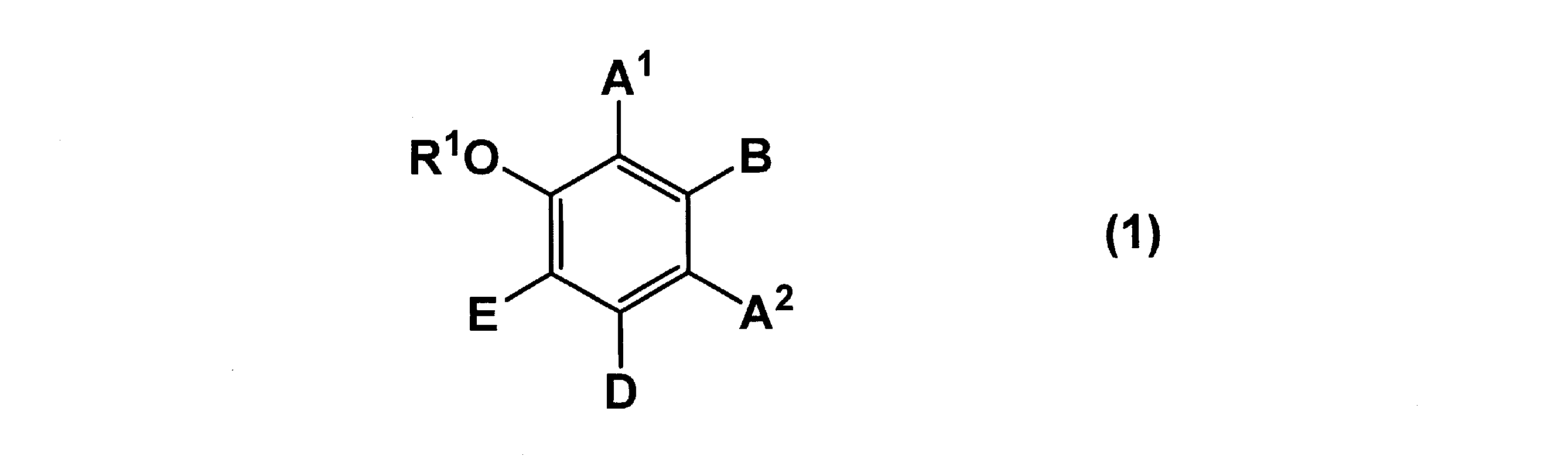
R1は、水素原子又はメチル基を示し、
A1及びA2は、同一でも異なってもよく、水素原子、炭素数1~12の直鎖若しくは分岐鎖のアルキル基若しくはアルケニル基、置換基を有してもよい炭素数7~12のアラルキル基若しくはアリールアルケニル基、炭素数1~6の直鎖若しくは分岐鎖のアルコキシ基若しくはアルケニルオキシ基、ハロゲン原子又は-CO-R2(R2は炭素数1~12の直鎖若しくは分岐鎖のアルキル基若しくはアルケニル基、置換基を有してもよい炭素数7~12のアラルキル基若しくはアリールアルケニル基又は置換基を有してもよい炭素数6~12の芳香族炭化水素基)を示し、
Bは、水素原子、炭素数1~12の直鎖若しくは分岐鎖のアルキル基若しくはアルケニル基、置換基を有してもよい炭素数7~12のアラルキル基若しくはアリールアルケニル基、-OR3又は-COOR3(R3は水素原子又は炭素数1~6の直鎖若しくは分岐鎖のアルキル基若しくはアルケニル基)を示し、
Dは、水素原子、水酸基、メチル基又は炭素数1~12の直鎖若しくは分岐鎖のアルコキシ基若しくはアルケニルオキシ基を示し、
Eは、水素原子、水酸基、炭素数1~6の直鎖若しくは分岐鎖のアルキル基若しくはアルケニル基、又は炭素数1~6の直鎖若しくは分岐鎖のアルコキシ基若しくはアルケニルオキシ基を示す。
ただし、A1、A2、B及びEのうち2個又は3個は水素原子であり、残りの基はスルホ基を含むものではない。また、Dが水素原子又はメチル基である場合には、A1とB、又はA2とBが、これらに隣接する2つの炭素原子と共に、水酸基が置換してもよいベンゼン環を形成する。〕 - 成分(B)の含有量に対する成分(D)の含有量のモル比(D)/(B)が0.1以上3以下である、請求項2に記載の毛髪変形処理剤。
- 成分(D)が一般式(1-1-3)で表される化合物である請求項2又は3に記載の毛髪変形処理剤。
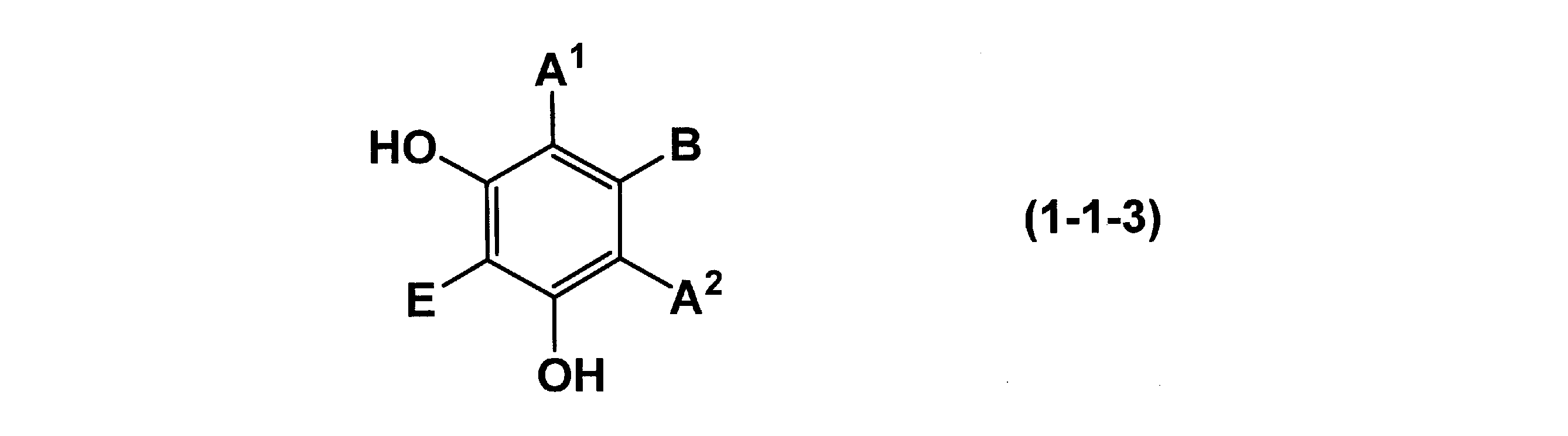
- 成分(A)の酸としての含有量が1質量%以上30質量%以下である、請求項1~4のいずれかに記載の毛髪変形処理剤。
- 成分(B)の含有量が1質量%以上30質量%以下である、請求項1~5のいずれかに記載の毛髪変形処理剤。
- pHが4以下である、請求項1~6のいずれかに記載の毛髪変形処理剤。
- 少なくとも一つのアミノ基を有し、一のアミノ基のオルト位又はパラ位に他のアミノ基又は水酸基を有し、酸化した際に閉殻キノイド構造を有する芳香族化合物の量が0.1質量%未満である、請求項1~7のいずれかに記載の毛髪変形処理剤。
- チオール、亜硫酸水素、及びそれらの塩の合計量が0.1質量%未満である、請求項1~8のいずれかに記載の毛髪変形処理剤。
- 成分(A)を含む第一剤と成分(B)を含む第二剤とを含む多剤式であり、第一剤のpHが4以下である請求項1~9のいずれかに記載の毛髪変形処理剤。
- 請求項1~10のいずれかに記載の処理剤の毛髪変形のための使用。
- 下記工程(i)及び(ii)を含む、毛髪形状を半永久的ないし永久的に変形する毛髪処理方法。
(i)請求項1~10のいずれかに記載の毛髪変形処理剤を毛髪に塗布し、毛髪に浸透させるステップ
(ii)毛髪変形処理剤が浸透した毛髪を加熱して形付けするステップ - 工程(i)が、請求項10に記載の毛髪変形処理剤における第一剤と第二剤の一方を毛髪に塗布した後、その塗布部の上に他方を重ねて塗布するステップである請求項12に記載の毛髪処理方法。
- 工程(i)の前に毛髪を濡らすステップを含む、請求項12又は13に記載の毛髪処理方法。
- 工程(ii)における加熱温度が50℃以上250℃以下である、請求項12~14のいずれかに記載の毛髪処理方法。
- 工程(ii)が、水分の蒸発が抑制される環境下で行われるものである、請求項12~15のいずれかに記載の毛髪処理方法。
- 還元剤を含む毛髪処理剤やpH12~14の強アルカリ性の毛髪処理剤を髪に塗布するステップを含まない請求項12~16のいずれかに記載の毛髪処理方法。
Priority Applications (7)
| Application Number | Priority Date | Filing Date | Title |
|---|---|---|---|
| CN201580066091.1A CN106999380B (zh) | 2014-12-05 | 2015-11-17 | 毛发变形处理剂 |
| US15/532,967 US11129781B2 (en) | 2014-12-05 | 2015-11-17 | Agent for hair deforming treatment |
| BR112017011916-1A BR112017011916B1 (pt) | 2014-12-05 | 2015-11-17 | uso de um agente de uma parte ou várias partes, agente para tratamento de deformação de cabelo e método para tratamento de cabelo para deformar de modo semipermanente ou permanente a forma do cabelo |
| EP15865038.2A EP3228300B1 (en) | 2014-12-05 | 2015-11-17 | Agent for hair deforming treatment |
| SG11201704504PA SG11201704504PA (en) | 2014-12-05 | 2015-11-17 | Agent for hair deforming treatment |
| RU2017122966A RU2698908C2 (ru) | 2014-12-05 | 2015-11-17 | Средство для деформирующей обработки волос |
| AU2015356323A AU2015356323A1 (en) | 2014-12-05 | 2015-11-17 | Agent for hair deforming treatment |
Applications Claiming Priority (2)
| Application Number | Priority Date | Filing Date | Title |
|---|---|---|---|
| JP2014247483 | 2014-12-05 | ||
| JP2014-247483 | 2014-12-05 |
Publications (1)
| Publication Number | Publication Date |
|---|---|
| WO2016088549A1 true WO2016088549A1 (ja) | 2016-06-09 |
Family
ID=56091499
Family Applications (1)
| Application Number | Title | Priority Date | Filing Date |
|---|---|---|---|
| PCT/JP2015/082282 Ceased WO2016088549A1 (ja) | 2014-12-05 | 2015-11-17 | 毛髪変形処理剤 |
Country Status (10)
| Country | Link |
|---|---|
| US (1) | US11129781B2 (ja) |
| EP (1) | EP3228300B1 (ja) |
| JP (1) | JP6293717B2 (ja) |
| CN (1) | CN106999380B (ja) |
| AU (1) | AU2015356323A1 (ja) |
| BR (1) | BR112017011916B1 (ja) |
| RU (1) | RU2698908C2 (ja) |
| SG (1) | SG11201704504PA (ja) |
| TW (1) | TWI693075B (ja) |
| WO (1) | WO2016088549A1 (ja) |
Cited By (1)
| Publication number | Priority date | Publication date | Assignee | Title |
|---|---|---|---|---|
| US11248095B2 (en) | 2018-02-14 | 2022-02-15 | N3 Coat Ltd. and Mobichem Scientific Engineering Ltd. | Photoinitiators for polyolefins |
Families Citing this family (6)
| Publication number | Priority date | Publication date | Assignee | Title |
|---|---|---|---|---|
| EP3346974B1 (en) * | 2015-09-08 | 2021-05-12 | Kao Germany GmbH | Process for semipermanent straightening and permanent shaping hair |
| JP2017218394A (ja) * | 2016-06-03 | 2017-12-14 | 花王株式会社 | 毛髪化粧料 |
| JP2017218395A (ja) | 2016-06-03 | 2017-12-14 | 花王株式会社 | 毛髪化粧料 |
| WO2018235890A1 (ja) * | 2017-06-22 | 2018-12-27 | 花王株式会社 | 毛髪変形処理方法 |
| WO2019030872A1 (ja) * | 2017-08-09 | 2019-02-14 | 花王株式会社 | 毛髪処理方法 |
| US20240000679A1 (en) * | 2020-11-30 | 2024-01-04 | Jean Paul Myne' Srl | Cosmetic composition for the treatment of keratinic fibers and method comprising the application of said composition to the keratinic fibers |
Citations (4)
| Publication number | Priority date | Publication date | Assignee | Title |
|---|---|---|---|---|
| JP2005194261A (ja) * | 2003-12-10 | 2005-07-21 | Lion Corp | ちぢれ毛矯正剤 |
| JP2013520468A (ja) * | 2010-02-24 | 2013-06-06 | 花王株式会社 | カーリーヘア、癖毛又は縮れ毛の半永久的矯正方法 |
| JP2013531046A (ja) * | 2010-07-20 | 2013-08-01 | 花王株式会社 | カーリーヘア、癖毛又は縮れ毛の半永久矯正方法 |
| WO2014068101A2 (en) * | 2012-11-05 | 2014-05-08 | Kao Corporation | Process for bleaching and straightening hair |
Family Cites Families (13)
| Publication number | Priority date | Publication date | Assignee | Title |
|---|---|---|---|---|
| CH220638A (de) | 1937-12-11 | 1942-04-15 | Ig Farbenindustrie Ag | Verfahren zur Herstellung eines kationenaustauschenden Kunstharzes. |
| US4278659A (en) | 1978-12-22 | 1981-07-14 | The Gillette Company | Hair setting and bodying composition and method |
| US6805136B2 (en) * | 2001-11-02 | 2004-10-19 | Kenra, Llc | Hair relaxer |
| DE102004050395A1 (de) | 2004-10-15 | 2006-04-27 | Construction Research & Technology Gmbh | Polykondensationsprodukt auf Basis von aromatischen oder heteroaromatischen Verbindungen, Verfahren zu seiner Herstellung und dessen Verwendung |
| DE102004054055A1 (de) | 2004-11-05 | 2006-05-18 | Wella Ag | Verfahren zum Färben und dauerhaften Verformung von Haaren |
| FR2901470B1 (fr) | 2006-05-24 | 2010-06-04 | Oreal | Procede de defrisage des fibres keratimiques avec un moyen de chauffage et un compose aromatique |
| EP1880706A1 (en) | 2006-07-21 | 2008-01-23 | Wella Aktiengesellschaft | Method and composition for permanently shaping hair |
| WO2012142444A2 (en) * | 2011-04-15 | 2012-10-18 | Playtex Products, Llc. | Food container assembly |
| US20150290096A1 (en) * | 2012-11-05 | 2015-10-15 | Kao Corporation | Process for straightening and dyeing hair |
| FR2997845B1 (fr) * | 2012-11-09 | 2015-03-06 | Oreal | Procede de lissage des cheveux a partir d'une composition contenant de l'acide glyoxylique et/ou un de ses derives |
| JP6316790B2 (ja) | 2014-12-05 | 2018-04-25 | 花王株式会社 | 毛髪変形処理剤 |
| JP6293718B2 (ja) | 2014-12-05 | 2018-03-14 | 花王株式会社 | 毛髪変形処理剤 |
| JP2016108322A (ja) | 2014-12-05 | 2016-06-20 | 花王株式会社 | 毛髪変形処理剤 |
-
2015
- 2015-11-11 JP JP2015221154A patent/JP6293717B2/ja active Active
- 2015-11-17 CN CN201580066091.1A patent/CN106999380B/zh active Active
- 2015-11-17 BR BR112017011916-1A patent/BR112017011916B1/pt not_active IP Right Cessation
- 2015-11-17 WO PCT/JP2015/082282 patent/WO2016088549A1/ja not_active Ceased
- 2015-11-17 AU AU2015356323A patent/AU2015356323A1/en not_active Abandoned
- 2015-11-17 US US15/532,967 patent/US11129781B2/en active Active
- 2015-11-17 EP EP15865038.2A patent/EP3228300B1/en active Active
- 2015-11-17 RU RU2017122966A patent/RU2698908C2/ru active
- 2015-11-17 SG SG11201704504PA patent/SG11201704504PA/en unknown
- 2015-11-23 TW TW104138829A patent/TWI693075B/zh not_active IP Right Cessation
Patent Citations (4)
| Publication number | Priority date | Publication date | Assignee | Title |
|---|---|---|---|---|
| JP2005194261A (ja) * | 2003-12-10 | 2005-07-21 | Lion Corp | ちぢれ毛矯正剤 |
| JP2013520468A (ja) * | 2010-02-24 | 2013-06-06 | 花王株式会社 | カーリーヘア、癖毛又は縮れ毛の半永久的矯正方法 |
| JP2013531046A (ja) * | 2010-07-20 | 2013-08-01 | 花王株式会社 | カーリーヘア、癖毛又は縮れ毛の半永久矯正方法 |
| WO2014068101A2 (en) * | 2012-11-05 | 2014-05-08 | Kao Corporation | Process for bleaching and straightening hair |
Non-Patent Citations (1)
| Title |
|---|
| BOGA, C. ET AL.: "Formaldehyde replacement with glyoxylic acid in semipermanent hair straightening: a new and multidisciplinary investigation", INTERNATIONAL JOURNAL OF COSMETIC SCIENSCE, vol. 36, pages 459 - 470, XP055173854, DOI: doi:10.1111/ics.12148 * |
Cited By (1)
| Publication number | Priority date | Publication date | Assignee | Title |
|---|---|---|---|---|
| US11248095B2 (en) | 2018-02-14 | 2022-02-15 | N3 Coat Ltd. and Mobichem Scientific Engineering Ltd. | Photoinitiators for polyolefins |
Also Published As
| Publication number | Publication date |
|---|---|
| US20180353406A1 (en) | 2018-12-13 |
| EP3228300A1 (en) | 2017-10-11 |
| CN106999380B (zh) | 2020-05-05 |
| RU2017122966A3 (ja) | 2019-01-09 |
| EP3228300A4 (en) | 2018-07-11 |
| CN106999380A (zh) | 2017-08-01 |
| JP2016108319A (ja) | 2016-06-20 |
| TW201625206A (zh) | 2016-07-16 |
| RU2698908C2 (ru) | 2019-09-02 |
| EP3228300B1 (en) | 2020-01-15 |
| US11129781B2 (en) | 2021-09-28 |
| SG11201704504PA (en) | 2017-07-28 |
| JP6293717B2 (ja) | 2018-03-14 |
| BR112017011916A2 (ja) | 2018-01-16 |
| BR112017011916B1 (pt) | 2020-12-01 |
| AU2015356323A1 (en) | 2017-06-29 |
| TWI693075B (zh) | 2020-05-11 |
| RU2017122966A (ru) | 2019-01-09 |
Similar Documents
| Publication | Publication Date | Title |
|---|---|---|
| JP6316790B2 (ja) | 毛髪変形処理剤 | |
| JP6293717B2 (ja) | 毛髪変形処理剤 | |
| JP2016108322A (ja) | 毛髪変形処理剤 | |
| US11045402B2 (en) | Hair cosmetic composition | |
| JP2019006769A (ja) | 毛髪変形処理方法 | |
| WO2017208463A1 (ja) | 毛髪化粧料 | |
| JP2017218395A (ja) | 毛髪化粧料 | |
| WO2019030872A1 (ja) | 毛髪処理方法 | |
| JP2017218396A (ja) | 毛髪化粧料 | |
| HK1238133A1 (en) | Hair deformation treatment agent | |
| HK1240120A1 (en) | Hair deformation treatment agent | |
| HK1240120B (zh) | 毛发变形处理剂 | |
| HK1238133B (zh) | 毛发变形处理剂 | |
| JP2017218393A (ja) | 毛髪化粧料 |
Legal Events
| Date | Code | Title | Description |
|---|---|---|---|
| 121 | Ep: the epo has been informed by wipo that ep was designated in this application |
Ref document number: 15865038 Country of ref document: EP Kind code of ref document: A1 |
|
| REEP | Request for entry into the european phase |
Ref document number: 2015865038 Country of ref document: EP |
|
| WWE | Wipo information: entry into national phase |
Ref document number: 11201704504P Country of ref document: SG |
|
| NENP | Non-entry into the national phase |
Ref country code: DE |
|
| REG | Reference to national code |
Ref country code: BR Ref legal event code: B01A Ref document number: 112017011916 Country of ref document: BR |
|
| ENP | Entry into the national phase |
Ref document number: 2015356323 Country of ref document: AU Date of ref document: 20151117 Kind code of ref document: A |
|
| ENP | Entry into the national phase |
Ref document number: 2017122966 Country of ref document: RU Kind code of ref document: A |
|
| ENP | Entry into the national phase |
Ref document number: 112017011916 Country of ref document: BR Kind code of ref document: A2 Effective date: 20170605 |