WO2016090366A1 - Animal feed supplement and method - Google Patents
Animal feed supplement and method Download PDFInfo
- Publication number
- WO2016090366A1 WO2016090366A1 PCT/US2015/064293 US2015064293W WO2016090366A1 WO 2016090366 A1 WO2016090366 A1 WO 2016090366A1 US 2015064293 W US2015064293 W US 2015064293W WO 2016090366 A1 WO2016090366 A1 WO 2016090366A1
- Authority
- WO
- WIPO (PCT)
- Prior art keywords
- animal
- nitrate
- feed
- nitric oxide
- premix
- Prior art date
- Legal status (The legal status is an assumption and is not a legal conclusion. Google has not performed a legal analysis and makes no representation as to the accuracy of the status listed.)
- Ceased
Links
Classifications
-
- A—HUMAN NECESSITIES
- A23—FOODS OR FOODSTUFFS; TREATMENT THEREOF, NOT COVERED BY OTHER CLASSES
- A23K—FODDER
- A23K10/00—Animal feeding-stuffs
- A23K10/30—Animal feeding-stuffs from material of plant origin, e.g. roots, seeds or hay; from material of fungal origin, e.g. mushrooms
-
- A—HUMAN NECESSITIES
- A61—MEDICAL OR VETERINARY SCIENCE; HYGIENE
- A61K—PREPARATIONS FOR MEDICAL, DENTAL OR TOILETRY PURPOSES
- A61K33/00—Medicinal preparations containing inorganic active ingredients
- A61K33/06—Aluminium, calcium or magnesium; Compounds thereof, e.g. clay
-
- A—HUMAN NECESSITIES
- A23—FOODS OR FOODSTUFFS; TREATMENT THEREOF, NOT COVERED BY OTHER CLASSES
- A23K—FODDER
- A23K20/00—Accessory food factors for animal feeding-stuffs
-
- A—HUMAN NECESSITIES
- A23—FOODS OR FOODSTUFFS; TREATMENT THEREOF, NOT COVERED BY OTHER CLASSES
- A23K—FODDER
- A23K20/00—Accessory food factors for animal feeding-stuffs
- A23K20/10—Organic substances
- A23K20/174—Vitamins
-
- A—HUMAN NECESSITIES
- A23—FOODS OR FOODSTUFFS; TREATMENT THEREOF, NOT COVERED BY OTHER CLASSES
- A23K—FODDER
- A23K20/00—Accessory food factors for animal feeding-stuffs
- A23K20/20—Inorganic substances, e.g. oligoelements
- A23K20/24—Compounds of alkaline earth metals, e.g. magnesium
-
- A—HUMAN NECESSITIES
- A23—FOODS OR FOODSTUFFS; TREATMENT THEREOF, NOT COVERED BY OTHER CLASSES
- A23K—FODDER
- A23K50/00—Feeding-stuffs specially adapted for particular animals
- A23K50/30—Feeding-stuffs specially adapted for particular animals for swines
-
- A—HUMAN NECESSITIES
- A23—FOODS OR FOODSTUFFS; TREATMENT THEREOF, NOT COVERED BY OTHER CLASSES
- A23K—FODDER
- A23K50/00—Feeding-stuffs specially adapted for particular animals
- A23K50/60—Feeding-stuffs specially adapted for particular animals for weanlings
-
- A—HUMAN NECESSITIES
- A61—MEDICAL OR VETERINARY SCIENCE; HYGIENE
- A61K—PREPARATIONS FOR MEDICAL, DENTAL OR TOILETRY PURPOSES
- A61K9/00—Medicinal preparations characterised by special physical form
- A61K9/0012—Galenical forms characterised by the site of application
- A61K9/0053—Mouth and digestive tract, i.e. intraoral and peroral administration
- A61K9/0056—Mouth soluble or dispersible forms; Suckable, eatable, chewable coherent forms; Forms rapidly disintegrating in the mouth; Lozenges; Lollipops; Bite capsules; Baked products; Baits or other oral forms for animals
-
- Y—GENERAL TAGGING OF NEW TECHNOLOGICAL DEVELOPMENTS; GENERAL TAGGING OF CROSS-SECTIONAL TECHNOLOGIES SPANNING OVER SEVERAL SECTIONS OF THE IPC; TECHNICAL SUBJECTS COVERED BY FORMER USPC CROSS-REFERENCE ART COLLECTIONS [XRACs] AND DIGESTS
- Y02—TECHNOLOGIES OR APPLICATIONS FOR MITIGATION OR ADAPTATION AGAINST CLIMATE CHANGE
- Y02P—CLIMATE CHANGE MITIGATION TECHNOLOGIES IN THE PRODUCTION OR PROCESSING OF GOODS
- Y02P60/00—Technologies relating to agriculture, livestock or agroalimentary industries
- Y02P60/20—Reduction of greenhouse gas [GHG] emissions in agriculture, e.g. CO2
- Y02P60/22—Methane [CH4], e.g. from rice paddies
Definitions
- Feeding calcium nitrate and other ingredients to ruminants is one way to mitigate methane production.
- the present invention is directed to an animal feed containing a nitric oxide producing compound.
- the nitric oxide producing compound is at least one of calcium nitrite, magnesium nitrite or salts thereof.
- the nitric oxide producing compound may be introduced into the animal feed through a premix, for example, which can be further incorporated into the animal feed product.
- a supplement containing a nitric acid producing compound is also contemplated by the present invention.
- the present invention is further directed to a method of supplying an animal such animal feed or supplement containing the nitric oxide producing compound.
- the animal feed or supplement containing the nitric oxide producing compound is supplied during at least one of a gestation feed or lactation feed.
- the animal feed or supplement containing the nitric oxide producing compound is supplied during at least one of a gestation feed or lactation feed through a liquid application in an amount less than 90 grams of nitric oxide producing compound per animal per day.
- the present invention is also directed at the use of a nitric oxide producing compound in animal feed to increase vasodilation of the placenta and the mammary glands of the animal.
- the present invention may also be directed to the use of a nitric oxide producing compound in animal feed to increase systemic vasodilation for the reduction of animal fatigue and farrowing time.
- the present invention involves a premix.
- the premix includes a nitrate compound and salts thereof in the amount of greater than about 50% by weight of the premix.
- the premix may also include vitamins and trace minerals.
- the premix may be formulated for use in at least one of a number of phases of swine production including the gestation or lactation phase of an animal and in an amount of less than about five percent by weight (5.0 wt%) inclusion per metric ton of the premix.
- the present invention involves a supplement for an animal feed for feeding during at least one of an animal's gestation phase and/or lactation phase.
- the supplement may include a nitric oxide producing compound in an amount of less than lOkg/metric ton of the total weight of the feed.
- the present invention involves a method for feeding an animal.
- the method includes providing to the animal an animal feed product containing at least one of gestation feed and a lactation feed having a nitric oxide producing compound in an amount of less than 1 Okg/metric ton of the total weight of the feed.
- the method also includes providing the feed to the animal 110 days after gestation of the animal.
- the animal feed supplement is intended for feeding to a non-ruminant animal, such as a monogastric animal, for example, a sow.
- Swine production can be logically separated into a number of phases, beginning with the sow being bred.
- the sow is bred during her estrous period.
- a special breeding feed can be fed to the sow.
- the sow "gestates" her litter for 113 to 1 16 days before the piglets are born or "farrowed."
- the term "gestation" or gestation phase means the 1 13 to 116 day period when the sow is pregnant from breeding until farrowing.
- Farrowing The process of giving birth is called farrowing. Sows are normally moved into a farrowing room a few days prior to farrowing and remain in this location through lactation. In certain instances, sows are moved into a farrowing room five to seven days prior to farrowing. Sows typically farrow from eight to fourteen piglets, which as a group are called a litter. It is also possible for sows to farrow from eight to eighteen piglets, which as a group are also called a litter. The piglets are born weighing about three pounds at birth. As used in this disclosure, the term “farrowing" means birth, and the term “farrowing phase" means the period from birth to weaning.
- the period of time called the transition period is typically seven days pre-farrowing until one to five days post farrowing.
- the piglets stay with the lactating sow for about 19 - 35 days after farrowing, during which time the piglets drink milk produced by the lactating sow.
- lactation lactation
- lactation phase means the period when a sow is producing milk and providing the milk to her piglets and the period of time from farrowing until weaning is called the lactation period.
- a farm can provide one feed (typically called a lactation feed) or two feeds (typically a transition feed and a lactation feed).
- weaning means the process of removing the piglets from the sow and moving them to the nursery. During a weaning or nursery phase, the piglets remain in the nursery (est. until 42 days after farrowing).
- the sow is typically fed a gestation diet.
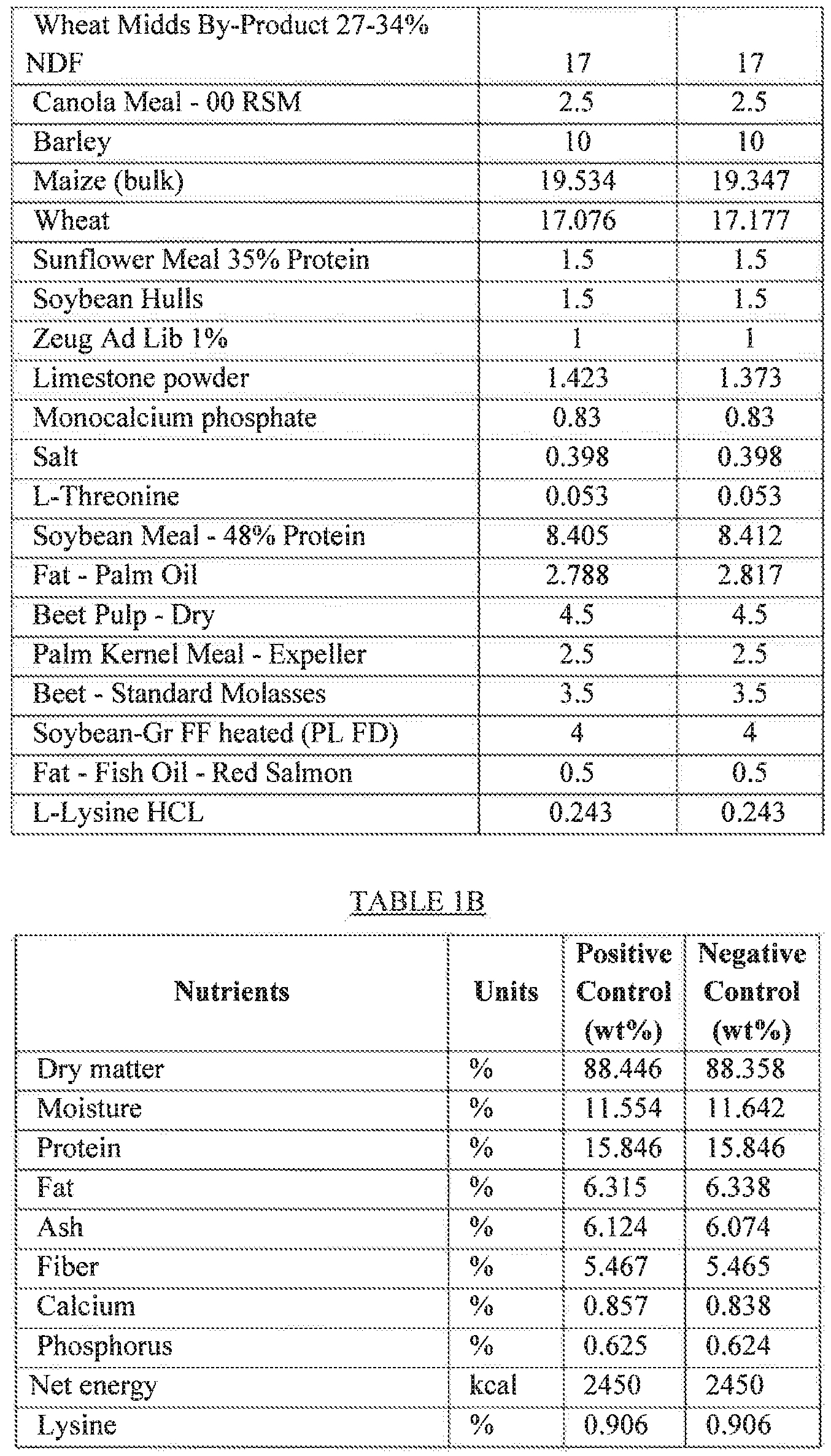
- a gestation diet is characterized primarily by its time of feeding. The gestation diet is provided in fixed daily amounts to achieve targeted nutrient intakes. See TABLE 1.
- the sow is typically switched to a fixed amount of lactation feed.
- a lactation feed is characterized primarily by the time of feeding and contains the appropriate nutrients and energy to support milk production. See TABLE 1.
- the sow is fed a lactation feed ad libitum or in fixed daily amounts. After the lactation phase, the sow is separated from its piglets (the weaning phase for the piglets) and the sow enters rebreeding.
- the fetus receives nutrients from the placenta of the sow.
- the piglets receive nutrients from the milk produced by the sow.
- the piglets are fed a nursery diet.
- a weaning diet is
- the monogastric animal is fed a supplement that is included in an animal feed during at least one of the gestation and lactation phases according to an exemplary embodiment.
- the monogastric animal is fed a supplement that is included in at least one of a breeding feed or transition feed.
- the animal feed supplement of the present invention comprises a nitrate compound, typically a physiologically acceptable or tolerated nitrate compound.
- the nitrate compound has sufficient solubility in water according to a preferred embodiment.
- the nitrate compound is an ionic nitrate compound according to preferred embodiments, most preferably an inorganic nitrate salt.
- Exemplary salts include sodium nitrate, potassium nitrate, calcium nitrate, or ammonium nitrate, all of which are readily soluble in water at standard temperature and pressure.
- exemplary salts include sodium nitrate, potassium nitrate, calcium nitrate, magnesium nitrate, ammonium nitrate, or a combination thereof, all of which are readily soluble in water at standard temperature and pressure.
- the salt is a magnesium nitrate.
- the salts can include different hydrated forms.
- the salts can also include double salts (e.g. calcium nitrate and ammonium nitrate).
- the nitrate is provided as inorganic calcium nitrate having the formula Ca(N(3 ⁇ 4)2.
- Calcium nitrate is also referred to as calcium dinitrate, Kalksalpeter, nitrocalcite, Norwegian saltpeter, and lime nitrate.
- Calcium nitrate may be produced by treating limestone with nitric acid, followed by neutralization with ammonia according to the reaction: CaCCh + 2HN(1 ⁇ 4 -> Ca(N03) 2 + C0 2 + H 2 0.
- the nitrate is provided as an inorganic salt of magnesium nitrate hexahydrate having the formula (Mg(N03) 2 *6H 2 0).
- Calcium ammonium nitrate is a double salt (calcium nitrate and ammonium nitrate) having the formula
- the calcium ammonium nitrate is pentacalcium ammonium nitrate decahydrate commercially available from Bri-Chem Supply Limited with the following specification: Ammonium-N (NI-U-N) 1.1%; Nitrate-N (NO3- N): 14.4%; Total N: 15.5%; Calcium (Ca): 18.8%. According to another exemplary
- the calcium nitrate is BOLIFOR CNF calcium nitrate feed grade having the formula 5Ca(NO3)2 * NH 4 NO3*10H 2 O commercially available from Yara Phosphates Oy of Helsingborg Sweden.
- the calcium nitrate can have the following specification: Calcium (Ca): 18.9%; Nitrogen (N) 15.5%; pH (10% solution): 6; bulk density kg/m3: 1050; appearance: prilled; size: ⁇ 1.0rnm: 2%; 1.0-2.0mm: 78%; >2mm: 20%.
- Exemplary formulations of calcium nitrate lacking ammonia include Ca(N03) 2* 4H 2 0.
- An exemplary anhydrous air-stable derivative of calcium nitrate includes the urea complex
- the nitrate may be provided by a variety of plant ingredients according to alternative embodiments.
- plant ingredients may include, for example, leafy greens such as spinach, arugula and beetroot.
- Beetroot has an inorganic nitrate content typically ranging from 110 to 3670 mg nitrate/kg.
- the supplement including the nitrate compound may be fed to the sow such that the amount of nitrate fed per sow per day is from 90 grams to less than 0.5 grams.
- the supplement including the nitrate compound may be fed to the sow such that the amount of nitrate fed per sow per day is less than 10 g nitrate per sow per day, also for example, less than 5g nitrate per sow per day, also for example, less than 4g nitrate per sow per day, also for example, less than 3g nitrate per sow per day, also for example, less than 2g nitrate per sow per day also for example, less than lg nitrate per sow per day, also for example, less than 0.5g nitrate per sow per day according to suitable embodiments.
- the supplement including the nitrate compound may also be fed to the sow such that the amount of nitrate fed per sow per day is from 90 mg nitrate per kg of body weight of the sow to less than 5 mg nitrate per kg of body weight of the sow.
- the supplement including the nitrate compound may also be fed to the sow such that the amount of nitrate fed per sow per day is less than 35 mg nitrate per kg of body weight of the sow, also for example, less than 30 mg nitrate per kg of body weight of the sow, also for example, less than 25 mg nitrate per kg of body weight of the sow, also for example, less than 20 mg nitrate per kg of body weight of the sow, also for example, less than 15 mg nitrate per kg of body weight of the sow, also for example, less than 10 mg nitrate per kg of body weight of the sow, also for example, less than 5 mg nitrate per kg of body weight of the sow according to suitable embodiments.
- the amount of nitrate in the feed may be measured via ion chromatography.
- samples are extracted with water, filtered, diluted and then applied to an anion exchange column.
- Nitrate is separated and identified using isocratic carbonate/bicarbonate elution coupled with suppressed conductivity detection. Concentration is determined using a standard curve of known nitrate solutions.
- the supplement including the nitrate compound may be included in a complete animal feed.
- the amount of calcium nitrate and its related salts in the complete feed is less than 1 wt% of the total weight of the feed, for example less than 0.5 wt%, also for example less than 0.4 wt%, also for example less than 0.3 wt%, also for example less than 0.2 wt%, also for example less than 0.1 wt%, also for example less than 0.09 wt%, also for example less than 0.08 wt%, also for example less than 0.07 wt%, also for example less than 0.06 wt%, also for example less than 0.05 wt% according to suitable embodiments.
- the supplement comprising the nitrate compound may be included in a premix feed.
- the premix feed is then added to an animal feed and provided to the animal (e.g. sow) such that the amount of nitrate fed per animal per day is from 90 mg nitrate per kg of body weight of the sow to less than 5 mg nitrate per kg of body weight of the animal.
- the amount of calcium nitrate and its related salts in the premix feed is greater than 50 wt% of the total weight of the feed, for example, greater than 60 wt%, also for example, greater than 70 wt%, also for example, greater than 80 wt%, also for example, greater than 90 wt%, also for example, greater than 95 wt% according to suitable embodiments.
- the nitrate in the supplement is a source for the biological messenger nitric oxide (NO) according to a non- enzymatic pathway for the generation of NO (nitrate-nitrite-NO pathway).
- NO biological messenger nitric oxide
- nitrate-nitrite-NO pathway Unlike arginine conversion to nitric oxide, nitrate conversion to nitric oxide via the nitrate-nitrite-NO pathway is not dependent upon oxygen levels. During the farrowing process, sows may experience fatigue and periods of hypoxia or lower oxygen levels.
- NO in the animal is important for the control of vascular tone, smooth muscle growth, platelet aggregation and inflammation. The release of NO in the animal, for example, in a sow fed the supplement, is believed to induce vasodilation and increased blood flow and exchange of oxygen.
- an animal e.g. a sow
- a liquid application such as drinking water.
- An exemplary dosage using this method is less than 90 grams of NO producing compound per animal per day.
- vasodilation refers to the widening of blood vessels in the animal. Vasodilation results from relaxation of smooth muscle cells within the vessel walls, in particular in the large veins, large arteries, and smaller arterioles. When blood vessels dilate in the animal, the flow of blood is increased due to a decrease in vascular resistance. Vasodilation may be localized to a specific organ (depending on the metabolic needs of a particular tissue, as during stress), or it may be systemic (seen throughout the entire systemic circulation). The primary function of vasodilation is to increase blood flow in the body to tissues that need it most. This is often in response to a localized need of oxygen, but can occur when the tissue in question is not receiving enough glucose or lipids or other nutrients,
- the nitrate in the supplement produces NO when consumed by the animal, which causes vasodilation in specific organs of the animal during certain periods.
- the animal feed supplement fed during gestation may result in vasodilation in the placenta— thereby increasing the exchange of oxygen and nutrients between the placenta and the fetus and further thereby decreasing the number of stillbirths.
- the supplement fed during gestation through lactation may result in vasodilation of the placenta of the sow— thereby reducing stillborn births during farrowing.
- the supplement fed during the gestation phase through the lactation phase may result in improved nutrient and oxygen delivery throughout the entire systemic circulation - thereby reducing stillborn births due to less sow fatigue and reducing farrowing time.
- the supplement fed during the lactation phase may result in vasodilation of the mammary glands of the so w— thereby increasing milk production and further thereby reducing piglet mortality and increasing piglet vitality during the weaning phase.
- Feeding the supplement during at least one of the gestation and lactation phases of swine production may result in certain physiological benefits to the sow and/or her offspring compared with not feeding the supplement.
- a sow fed the supplement during the pre-farrowing phase may result in fewer stillborn piglets being born.
- a sow fed the supplement during at least one of the lactation phase or weaning phase may result in piglets showing greater vitality and reduced mortality.
- the number of total born piglets in a litter is determined during ovulation, insemination, and early gestation.
- the number of piglets born alive is determined by: (i) mortality in utero (mortality in early gestation results in fewer total born piglets while mortality in late gestation can result in an increased number of piglets born mummified); and (ii) mortality during the farrowing process (stillborn). Stillbirth can occur during gestation (Type I stillbirth), which is often due to an infectious cause, or intra-partum (Type II stillbirths), which is often non-infectious.
- angiogenesis and vasculogenesis are essential for the embryo to take up nutrients such as amino acids, glucose and oxygen from the maternal bloodstream and to loose waste products, such as C0 2 .
- Angiogenesis is the expansion of blood vessels from pre-existing vessels in the endometrium of the mother, while vasculogenesis is the formation of new blood vessels in the fetal membranes.
- vascularization is not developed properly, problems can occur, one of them being placental insufficiency. Placental insufficiency is caused by a poor placentation (a poor vascular development at the utero-placental surface) and leads to a degenerating placental functioning and a decrease in exchange of oxygen and nutrients from placenta to fetus.
- the fetus will have a shortage of oxygen, or hypoxemia.
- feeding the animal feed supplement to the sow during the gestation phase causes vasodilation to increases blood flow to the placenta during early gestation resulting in improved embryonic survival and implantation, further resulting in an increased number of total live born piglets and further having improved uniformity, birth weight and vitality.
- feeding the supplement to the sow during the gestation phase may result in vasodilation resulting in: (i) improved development of a functional placenta through increased angiogenesis and/or vasculogenesis; (ii) decreased placental insufficiency; and/or (iii) increased exchange of oxygen and nutrients from the placenta to the fetus.
- Feeding the animal feed supplement comprising the nitrate compound to the animal (e.g. sow) during the gestation phase may reduce the number of stillborn during farrowing.
- the major cause of stillbirths is asphyxiation. This is caused by the cumulative effects of successive contractions of the uterus, which result in reduced oxygenation of the unborn piglets. Reduced oxygenation (asphyxiation) results in piglet death in utero or results in reduced piglet vitality which is associated with a higher mortality risk during the first three days after farrowing. Asphyxiation is further complicated by the farrowing time, as increased farrowing time due to sow fatigue results in higher stillbirth piglets.
- feeding the supplement to the sow during gestation through lactation phases causes vasodilation to increase blood flow to the placenta and therefore oxygen flow to the placenta during the farrowing process to support uterine contractions. Furthermore, systemic effects of feeding the supplement will reduce sow fatigue and reduce farrowing time. According to an exemplary embodiment, feeding supplement to the sow during the gestation through lactation phases may result in vasodilation resulting in: (i) decreased asphyxiation of the fetus; and/or (ii) reduced farrowing duration.
- Feeding the supplement including the nitrate compound to the animal (e.g. sow) during the lactation phase and/or transition phase may decrease or reduce piglet post-farrowing mortality.
- the nitrate in the animal feed supplement produces nitric oxide which causes vasodilation of the mammary glands of the sow, thereby increasing milk production.
- Increased milk production by the sow results in increased uptake of colostrum and milk by the piglets in the litter during the first few days post-farrowing.
- Increased colostrum and milk uptake by the piglets leads to reduced mortality during the first week post-farrowing.
- the sow vitality can be improved resulting in less crushing of piglets and better start of feed intake in the early lactation phase.
- Feeding the animal feed supplement including the nitrate compound to the animal (e.g. sow) during the lactation phase and/or transition phase may increase the growth and vitality of the piglet post farrowing.
- the nitrate in the supplement produces nitric oxide which causes vasodilation of the mammary glands of the sow, thereby increasing milk production.
- Increased milk production by the sow results in increased uptake of milk by the piglets in the litter, and a greater average daily gain over the entire suckling period.
- the piglets show increased vitality as demonstrated by reduced time from birth to first time suckling. Vitality is calculated as the amount of time from birth until nursing.
- Additional benefits from the supplement may include, for example, post weaning performance of piglets in gain, feed intake, efficiency, immunity, meat quality, gut health, color/bloom, ability to cope with heat stress, ear necroses, streptococcus.
- Additional benefits may include, for example, an increased effect on feed intake, efficiency, udder quality, milk production, milk quality, incidence of lameness, heat stress and hair growth.
- the supplement refers to an additive or premix that includes a nitrate compound.
- the supplement may be added to an animal feed.
- animal feed as used in this disclosure means a feed ration produced for consumption by an animal.
- the animal feed supplement may be included in a compound animal feed according to an exemplary embodiment.
- compound feed as used in this disclosure means an animal feed blended to include two or more ingredients which assist in meeting certain daily nutritional requirements of an animal.
- the animal feed may be a complete animal feed according to an exemplary embodiment.
- complete feed as used in this disclosure means an animal feed which is a complete feed, e.g. a nutritionally balanced blend of ingredients designed as the sole ration to provide all the daily nutritional requirements of an animal to maintain life and promote production without any additional substances being consumed except for water.
- the animal feed may also be a concentrate animal feed according to an exemplary embodiment.
- concentrate feed means an animal feed that typically includes a protein source blended with supplements or additives or vitamins, trace minerals, other micro ingredients, macro minerals, etc. to provide a part of the ration for the animal.
- the concentrate feed may be fed along with other ingredients (e.g., forages in ruminants).
- the animal feed may include a premix according to an alternative embodiment.
- premix means a blend of primarily vitamins and/or minerals along with appropriate carriers in an amount of less than about five percent (5.0%) inclusion per ton of complete feed.
- the animal feed may also include a base mix according to an exemplary embodiment.
- base mix means a blend containing vitamins, trace minerals and/or other micro ingredients plus macro minerals such as calcium, phosphorus, sodium, magnesium and potassium, or vitamin or trace mineral in an amount of less than ten percent (10.0%) inclusion per ton of complete feed.
- the animal feed may be a feed
- additive means an ingredient such as a protein source, salt, mineral, additive, or buffer that is added to an animal feed.
- An example of an additive includes calcium, zinc, manganese, copper, iodine, cobalt, selenium and other trace ingredients.
- the supplement may be top dressed, dissolved in a liquid such as drinking water or any other consumable liquid presented to the animal, etc. according to other alternative embodiments.
- ruminant means any mammal that has a multicompartment stomach and is associated with digestion by regurgitation and repeated chewing of a bolus or cud.
- ruminant mammals include, but are not limited to, bovine animals such as buffalo, bison, and all cattle, including calves, steers, heifers, cows, and bulls.
- monogastric animals include, but are not limited to, porcine, equine, caprine, ovine, avian animals, seafood (aquaculture) animals.
- Porcine monogastric animals include, for example, feeder pigs and breeding pigs, including piglets, sows, gilts, barrows, and boars. While the description is primarily with reference to sows, it is not limited as such and should be understood that the disclosure is applicable to other monogastric and ruminant animals.
- the animal feed is the vehicle to deliver nutrients to the animal.
- nutrients There are six major classes of nutrients: carbohydrates, fats, proteins, vitamins, minerals, and water. These nutrient classes can be categorized as either raacronutrients (needed in relatively large amounts) or micronutrients (needed in smaller quantities).
- the macronutrients are carbohydrates, fats, fiber, proteins, and water.
- the micronutrients are minerals and vitamins.
- the macronutrients (excluding water) provide structural material (amino acids from which proteins are built, and lipids from which cell membranes and some signaling molecules are built) and energy.
- Vitamins, minerals, fiber, and water do not provide energy, but are required for other reasons.
- Micronutrients include antioxidants and phytochemicals. Nutrients are delivered by sources of ingredients.
- Macromineral (also referred to as bulk, minerals) nutrients include, for example, calcium, chlorine (as chloride ions), magnesium, phosphorus, potassium, sodium, and sulfur.
- Micromineral (also referred to as trace minerals) nutrients include, for example, cobalt, copper, chromium, iodine, iron, manganese, molybdenum, nickel, selenium, vandadium, and zinc.
- Vitamins nutrients include, for example, vitamin A.
- Ingredient sources of vitamin A include, for example, vitamin A supplement, vitamin A oil, etc..
- Vitamins also include, for example, vitamin Bl, vitamin B2, vitamin B3, vitamin B4, vitamin B5, vitamin B6, vitamin B7, vitamin B9, vitamin B12, and vitamin C.
- Vitamins also include, for example, vitamin D.
- Ingredient sources of vitamin D include, for example, vitamin D supplement.
- Vitamins also include, for example, vitamin E.
- Ingredient sources of vitamin E include, for example, vitamin E supplement.
- Vitamins also include, for example, vitamin K.
- Other vitamin product ingredients may include, for example, riboflavin, vitamin D3 supplement, niacin, betaine, choline chloride, tocopherol, inositol, etc.
- the animal feed may include a combination or compound of various ingredients to deliver the nutrients.
- ingredients include protein ingredients, grain products, grain by-products, roughage products, fats, minerals, vitamins, additives or other ingredients according to an exemplary embodiment.
- Protein ingredients may include, for example, animal derived proteins such as: dried blood meal, meat meal, meat and bone meal, poultry by-product meal, hydrolyzed feather meal, etc. Protein ingredients may also include, for example, marine products such as: fish meal, crab meal, shrimp meal, condensed fish solubles, fish protein concentrate, etc.
- Protein ingredients may further include, for example, plant products such as: algae meal, beans, coconut meal, cottonseed meal, rapeseed meal, canola meal, linseed meal, peanut meal, soybean meal, sunflower meal, peas, soy protein concentrate, dried yeast, active dried yeast, etc.
- Protein ingredients may also include, for example, milk products such as: dried skim milk, condensed skim milk, dried whey, condensed whey, dried hydrolyzed whey, casein, dried whole milk, dried milk protein, dried hydrolyzed casein, etc.
- Grain product ingredients may include, for example, corn, milo, oats, rice, rye, wheat, etc.
- Grain by-product ingredients may also include, for example, corn bran, peanut skins, rice bran, brewers dried grains, distillers dried grains, distillers dried grains with solubles, corn gluten feed, corn gluten meal, corn germ meal, flour, oat groats, hominy feed, corn flour, soy flour, malt sprouts, rye middlings, wheat middlings, wheat mill run, wheat shorts, wheat red dog, feeding oat meal, etc.
- Grain product ingredients may also include, for example high-moisture processed grain by-products. Such high-moisture processed grain by-products result from the processing of a number of different grains such as corn, wheat, and milo.
- high-moisture processed grain by-products include, without limitation, gluten, non-grain feed ingredients (e.g., molasses, beet pulp and other crop residues), and wet distiller's grain.
- Roughage product ingredients may include, for example, corn cob fractions, barley hulls, barley mill product, malt hulls, cottonseed hulls, almond hulls, sunflower hulls, oat hulls, peanut hulls, rice mill byproduct, bagasse, soybean hulls, soybean mill feed, dried citrus pulp, dried citrus meal, dried apple pomace, dried tomato pomace, straw, hay, etc.
- Fat product ingredients may include, for example, beef fat, poultry fat, pork fat, restaurant grease, soy oil, corn oil, tallow, hydrolyzed animal fat, hydrolyzed vegetable fat, calcium salts of long chain fatty acids, hydrogenated glycerides, etc.
- Mineral product ingredients may include, for example, basic copper chloride, bone ash, bone meal, calcium acetate, calcium carbonate, calcium chloride, calcium gluconate, calcium hydroxide, calcium iodate, calcium iodobehenate, calcium oxide, calcium sulfate (anhydrous or dihydrate), cobalt acetate, cobalt carbonate, cobalt chloride, cobalt oxide, cobalt sulfate, copper carbonate, copper chloride, copper gluconate, copper hydroxide, copper orthophosphate, copper oxide, copper pyrophosphate, copper sulfate, cuprous iodide, dicalcium phosphate, diiodosalicylic acid, disodium phosphate, ethylenediamine dihydroiodide, ferrous fumarate, iron ammonium citrate, iron carbonate iron chloride, iron gluconate, iron oxide, iron phosphate, iron pyrophosphate, iron sulfate, reduced iron, magnesium acetate,
- Vitamin product ingredients may include, for example, vitamin A supplement, vitamin A oil, vitamin D, vitamin B12 supplement, vitamin E supplement, riboflavin, vitamin D3 supplement, niacin, betaine, choline chloride, tocopherol, inositol, etc.
- Additive product ingredients can be used, for example, to protect animals from disease and/or stress (e.g.
- anitbiotics e.g., probiotics, etc.
- to stimulate or control growth and behavior e.g. hormones
- Feed additives can be used, for example, to help provide a balanced diet (e.g., vitamins and/or trace minerals), to protect the animals from disease and/or stress (e.g., antibiotics, probiotics) and/or to stimulate or control growth and behavior (e.g., hormones).
- Additive product ingredients may include, for example: growth promoters, medicinal substances, buffers, antioxidants, enzymes, preservatives, pellet-binding agents, direct-fed microbials, etc.
- Additive product ingredients may also include, for example, ionophores (e.g.
- ⁇ -agonist zilpaterol, ractompamine, etc.
- antibiotics e.g., chlortetracycline (CTC), oxytetracycline, bacitrain, tylosin, aureomycin
- probiotics and yeast cultures e.g., coccidiostats (e.g., amprollium, decoquinate, lasalocid, monensin), and hormones (e.g., growth hormones or hormones that inhibit estrus and/or ovulation such as melengestrol acetate), pheromones, nutraceuticals, pharmaceuticals, flavanoids, nutritive and non-nutritive supplements, detoxicants, etc.
- Example 1 determines the effect of calcium nitrate in the diet of a sow.
- the sows entered a farrowing room on average on day 111 of gestation and received a standard lactation diet (see TABLE 1A and TABLE IB) without (negative control) or with (positive control) the 1.0 kg/metric ton BOLIFOR CNF inorganic feed material of calcium nitrate feed grade (calcium nitrate, containing 63.1% of nitrate) commercially available from Yara Phosphates Oy of Helsingborg, Sweden.
- sows were fed either the positive control or negative control standard lactation diet according to a step-up feeding schedule.
- Example 2 determined the effect of calcium nitrate in the diet of a sow. 600 sows and all sows were fed two diets over the test period. The first diet (phase 1) was fed from approximately 5 days pre-farrowing until 5 days post-farrowing. The second diet (phase 2) was fed from day 5 post-farrowing until weaning. For the first 138 days both phase 1 and 2 diets did not contain any test product (i.e. negative control).
- phase 1 diets that contained 1.0 kg/metric ton BOLIFOR CNF inorganic feed material of calcium nitrate feed grade (calcium nitrate, containing 63.1% of nitrate) commercially available from Yara Phosphates Oy of Helsingborg, Sweden (i.e. positive control).
- phase 1 and 2 diets did not contain any test product (i.e. negative control).
- feeding calcium nitrate resulted in: (i) a decrease in the number of stillborn; (ii) an increase in piglets weaned; and (iii) an increase in piglet livability.
- Example 3 is directed to the effect of calcium nitrate in lactation feed on reproduction performance of sows, number of stillborn piglets, placental blood flow and viability of piglets; demonstrating the lower probability on stillbirth of piglets and a higher probability of live born piglets.
- NBA was significantly higher in litters of sows receiving the 0.1% Bolifor CNF ® compared to the control sows (16.84 vs. 16.34 respectively, p ⁇ 0.05) and higher for parity 1 & 2 sows (17.14 vs. 16.36 and 16.27 for parity 1 & 2, parity 3 & 4 and parity >4 respectively.
- Example 4 is directed to the effect of nitrate in the diet of a sow.
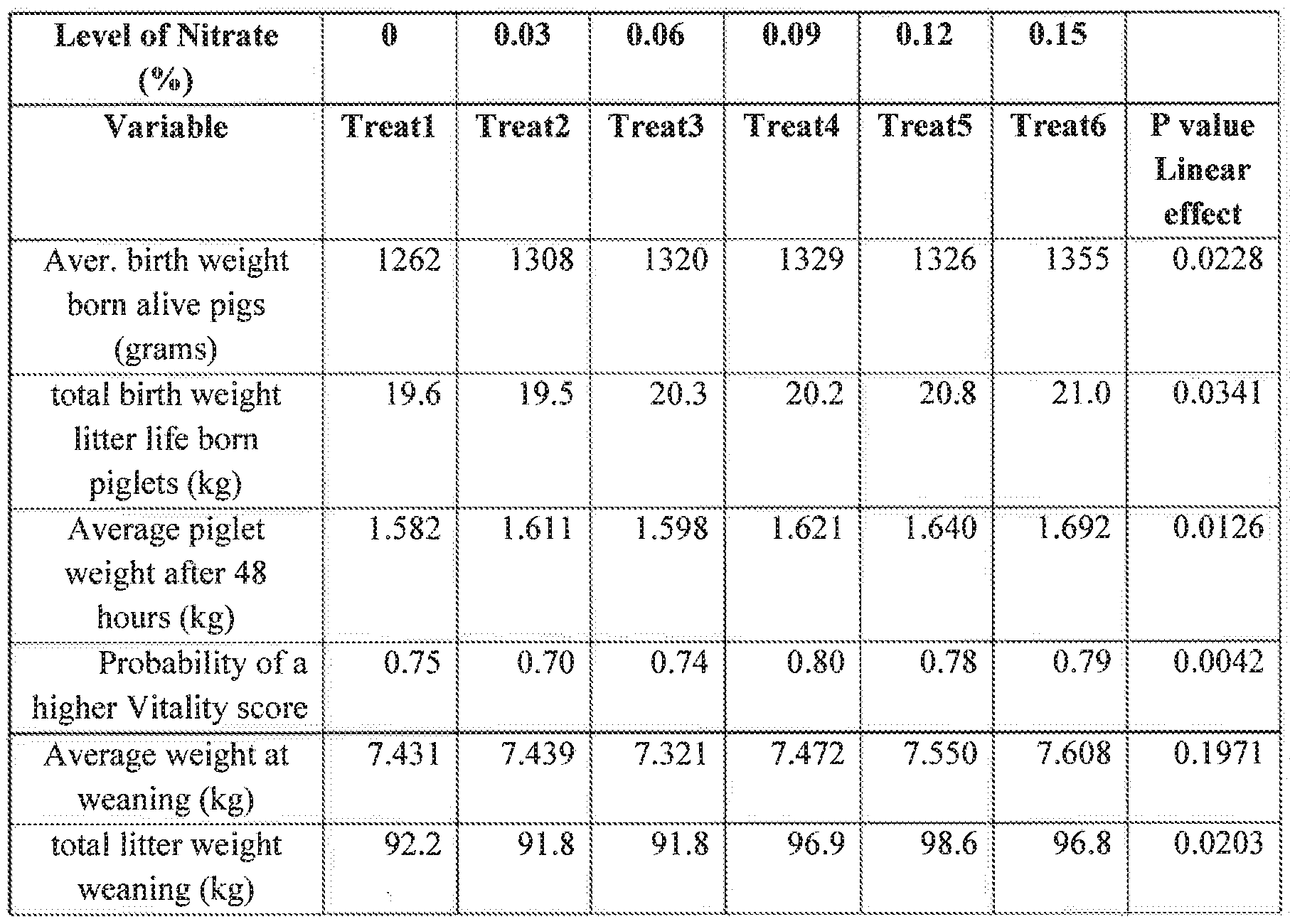
- sows received a fixed amount of feed (3.25 kg from day 107-113 and 2.7 kg/sow/day from day 113 till farrowing).
- sows were fed the diets according to a step-up feeding schedule applied (increasing with 0.5 kg/sow/day) the same over the 6 treatments aiming at a peak intake of 7.5 kg/sow/day.
- Piglets were weaned from the sow at 27 days of age. Performance of sows (e.g. weight, backfat, piglets born alive, stillborn piglets, mortality of piglets) and piglets (e.g. weight at birth, after 48 hours and weaning) was measured on all sows and litters.
- nitrate in lactation feed improves piglet's livability and enhances their body weight development.
- the hypotheses that nitrate in feed (via nitrite pathway) can lead to better oxygen supply is confirmed by the blood p02 as measured in the umbilical cord of the piglets. This can explain the better vitality score of the fresh born piglets.
- Statistics show several linear effects suggesting that the higher the dose the better. Looking at the figures numerically, some characteristics reach their optimum already at 0.09% nitrate inclusion. An optimal dose is not clear cut but seems to be somewhere between 0.09 and 0.15% added nitrate.
Landscapes
- Life Sciences & Earth Sciences (AREA)
- Chemical & Material Sciences (AREA)
- Polymers & Plastics (AREA)
- Engineering & Computer Science (AREA)
- Zoology (AREA)
- Animal Husbandry (AREA)
- Food Science & Technology (AREA)
- Health & Medical Sciences (AREA)
- Birds (AREA)
- Inorganic Chemistry (AREA)
- Veterinary Medicine (AREA)
- General Health & Medical Sciences (AREA)
- Public Health (AREA)
- Epidemiology (AREA)
- Pharmacology & Pharmacy (AREA)
- Medicinal Chemistry (AREA)
- Animal Behavior & Ethology (AREA)
- Physiology (AREA)
- Biotechnology (AREA)
- Botany (AREA)
- Molecular Biology (AREA)
- Mycology (AREA)
- Nutrition Science (AREA)
- Fodder In General (AREA)
Abstract
Description






Claims
Priority Applications (14)
| Application Number | Priority Date | Filing Date | Title |
|---|---|---|---|
| CN201580066034.3A CN106998754A (en) | 2014-12-05 | 2015-12-07 | Animal feed supplements and methods |
| EP25180085.0A EP4585219A3 (en) | 2014-12-05 | 2015-12-07 | Animal feed supplement and method |
| PL15864845.1T PL3086657T3 (en) | 2014-12-05 | 2015-12-07 | Animal feed supplement and method |
| ES15864845T ES3046538T3 (en) | 2014-12-05 | 2015-12-07 | Animal feed supplement and method |
| BR112017011870-0A BR112017011870B1 (en) | 2014-12-05 | 2015-12-07 | PREMIXTURE, SUPPLEMENT FOR AN ANIMAL FOOD AND METHOD FOR FEEDING AN ANIMAL |
| US15/533,120 US10967002B2 (en) | 2014-12-05 | 2015-12-07 | Animal feed supplement and method |
| RU2017123550A RU2755947C2 (en) | 2014-12-05 | 2015-12-07 | Animal feed additive and method |
| MX2017007219A MX2017007219A (en) | 2014-12-05 | 2015-12-07 | SUPPLEMENT AND METHOD FOR ANIMAL FEED. |
| EP15864845.1A EP3086657B1 (en) | 2014-12-05 | 2015-12-07 | Animal feed supplement and method |
| CA2969744A CA2969744A1 (en) | 2014-12-05 | 2015-12-07 | Animal feed supplement and method |
| KR1020177018544A KR102715962B1 (en) | 2014-12-05 | 2015-12-07 | Animal feed supplement and method |
| PH1/2017/501037A PH12017501037B1 (en) | 2014-12-05 | 2015-12-07 | Animal feed supplement and method |
| DK15864845.1T DK3086657T3 (en) | 2014-12-05 | 2015-12-07 | ANIMAL FEED SUPPLEMENT AND METHOD |
| US17/213,013 US12246034B2 (en) | 2014-12-05 | 2021-03-25 | Animal feed supplement and method |
Applications Claiming Priority (2)
| Application Number | Priority Date | Filing Date | Title |
|---|---|---|---|
| US201462088035P | 2014-12-05 | 2014-12-05 | |
| US62/088,035 | 2014-12-05 |
Related Child Applications (2)
| Application Number | Title | Priority Date | Filing Date |
|---|---|---|---|
| US15/533,120 A-371-Of-International US10967002B2 (en) | 2014-12-05 | 2015-12-07 | Animal feed supplement and method |
| US17/213,013 Division US12246034B2 (en) | 2014-12-05 | 2021-03-25 | Animal feed supplement and method |
Publications (1)
| Publication Number | Publication Date |
|---|---|
| WO2016090366A1 true WO2016090366A1 (en) | 2016-06-09 |
Family
ID=56092597
Family Applications (1)
| Application Number | Title | Priority Date | Filing Date |
|---|---|---|---|
| PCT/US2015/064293 Ceased WO2016090366A1 (en) | 2014-12-05 | 2015-12-07 | Animal feed supplement and method |
Country Status (13)
| Country | Link |
|---|---|
| US (2) | US10967002B2 (en) |
| EP (2) | EP4585219A3 (en) |
| KR (1) | KR102715962B1 (en) |
| CN (1) | CN106998754A (en) |
| BR (1) | BR112017011870B1 (en) |
| CA (1) | CA2969744A1 (en) |
| DK (1) | DK3086657T3 (en) |
| ES (1) | ES3046538T3 (en) |
| MX (1) | MX2017007219A (en) |
| PH (1) | PH12017501037B1 (en) |
| PL (1) | PL3086657T3 (en) |
| RU (1) | RU2755947C2 (en) |
| WO (1) | WO2016090366A1 (en) |
Cited By (11)
| Publication number | Priority date | Publication date | Assignee | Title |
|---|---|---|---|---|
| WO2016177891A3 (en) * | 2015-05-06 | 2017-01-05 | Yara International Asa | The use of nitrate for improving the reproductive performance of monogastric mammals |
| CN106490370A (en) * | 2016-12-16 | 2017-03-15 | 万旻 | A kind of biological feedstuff for improving meat quality |
| WO2018237233A1 (en) | 2017-06-23 | 2018-12-27 | Can Technologies, Inc. | Method for improving meat quality |
| WO2019073307A3 (en) * | 2017-08-24 | 2019-09-06 | Can Technologies, Inc. | Method for reducing the incidence of pectoral myopathy in poultry feed |
| EP3547828A4 (en) * | 2016-12-02 | 2020-07-01 | Jyga Concept Inc. | Farrowing system with piglet birth detection and method for operating the same |
| WO2021242498A1 (en) * | 2020-05-29 | 2021-12-02 | Can Technologies, Inc. | Animal feed or feed product including beetroot powder |
| WO2023192041A1 (en) | 2022-03-29 | 2023-10-05 | Can Technologies, Inc. | Method for improving offspring quality |
| WO2023192038A1 (en) | 2022-03-29 | 2023-10-05 | Can Technologies, Inc. | Nitrate supplement for poultry for improved offspring quality |
| WO2023245003A1 (en) | 2022-06-14 | 2023-12-21 | Can Technologies, Inc. | Method of improving growth performance in swine |
| WO2024097601A1 (en) | 2022-10-31 | 2024-05-10 | Can Technologies, Inc. | Method of reducing lameness and improving bone mineralization in swine |
| US12246034B2 (en) | 2014-12-05 | 2025-03-11 | Can Technologies, Inc. | Animal feed supplement and method |
Families Citing this family (7)
| Publication number | Priority date | Publication date | Assignee | Title |
|---|---|---|---|---|
| KR20200010268A (en) * | 2017-04-25 | 2020-01-30 | 뉴트레코 아이피 애셋츠 비.브이. | Compositions for Use in Pregnant Animals |
| CN108338269A (en) * | 2017-11-12 | 2018-07-31 | 柳州维克源生态农业发展有限公司 | A kind of formula for pig forage |
| CN108041349A (en) * | 2017-12-26 | 2018-05-18 | 重庆医学检验试剂研究所 | A kind of pharmaceutical composition for promoting aquatic livestock growth and its reagent and method |
| CN108850615A (en) * | 2018-08-07 | 2018-11-23 | 湖南九鼎动物营养研究院有限公司 | A kind of sow gestation later period feed and method for breeding |
| CN108967702A (en) * | 2018-09-27 | 2018-12-11 | 嘉禾县广发农牧有限公司 | A kind of piglet special forage formula |
| CN111280326A (en) * | 2020-02-13 | 2020-06-16 | 黑龙江省三禾饲料有限公司 | Compound feed for preventing constipation of sows in gestation period and preparation method thereof |
| IT202200017292A1 (en) * | 2022-08-12 | 2024-02-12 | Panificazione Malagrinò S R L | Food composition for monogastric animals |
Citations (6)
| Publication number | Priority date | Publication date | Assignee | Title |
|---|---|---|---|---|
| US6514521B1 (en) * | 1999-08-30 | 2003-02-04 | Catalyst Informational, Inc. | Feed additive for monogastric animals |
| WO2003009703A1 (en) | 2001-07-24 | 2003-02-06 | Nutreco Nederland B.V. | Dietary modifications to improve fertility |
| US7105191B2 (en) * | 2003-05-23 | 2006-09-12 | Tetra Technologies, Inc. | Calcium supplement for animals and method for making same |
| WO2012159186A1 (en) * | 2011-05-23 | 2012-11-29 | Grasp Indústria E Comércio Ltda. | Use of encapsulated nitrates and sulfates to reduce methane emission derived from ruminal fermentation |
| US8771723B2 (en) | 2009-07-23 | 2014-07-08 | Hindrik Bene Perdok | Compositions for reducing gastro-intestinal methanogenesis in ruminants |
| WO2016177891A2 (en) | 2015-05-06 | 2016-11-10 | Yara International Asa | The use of nitrate for improving the reproductive performance of monogastric mammals. |
Family Cites Families (17)
| Publication number | Priority date | Publication date | Assignee | Title |
|---|---|---|---|---|
| US3639584A (en) | 1968-07-01 | 1972-02-01 | Univ Colorado State Res Found | Method for promoting weight gain in bronze turkeys |
| DE2008193A1 (en) | 1969-02-25 | 1970-12-10 | Takeda Chemical Industries, Ltd., Osaka (Japan) | Process for stabilizing the color of meat |
| PL180769B1 (en) * | 1994-02-21 | 2001-04-30 | Univ Aberdeen | Acidified nitrite as an agent against micro-organisms |
| CZ20021346A3 (en) | 1999-10-18 | 2003-06-18 | Muscletech Research And Development Inc. | Foodstuff supplement for growth of muscle mass and strength |
| US7820420B2 (en) * | 2000-08-11 | 2010-10-26 | Whitlock David R | Compositions including ammonia oxidizing bacteria to increase production of nitric oxide and nitric oxide precursors and methods of using same |
| US20030235646A1 (en) | 2002-03-15 | 2003-12-25 | Lonza Inc. | Method for improving quality of meat by supplementing pig diets and concentrates used therefor |
| US20060073193A1 (en) * | 2004-09-27 | 2006-04-06 | Novozymes A/S | Enzyme granules |
| US20060257537A1 (en) | 2005-04-27 | 2006-11-16 | Wisconsin Alumni Research Foundation | Method to reduce pink color in light colored, cooked, uncured meats |
| JP5371429B2 (en) * | 2005-08-26 | 2013-12-18 | ネステク ソシエテ アノニム | Compositions and methods for improving functional vascular integrity and cell survival and reducing apoptosis in or after cerebral ischemia |
| DE102007020378A1 (en) * | 2007-04-30 | 2008-11-06 | AURAPA-Würzungen GmbH | Agent with natural nitrate content and health promoting effect, which in the consumption by humans or animals with an effect of e.g. increasing the nitrate and nitrite content in the blood or increasing the flow-mediated dilatation |
| US8466187B2 (en) | 2007-09-18 | 2013-06-18 | Thermolife International, Llc | Amino acid compositions |
| BR112014028922B1 (en) | 2012-05-21 | 2020-10-20 | National University Corporation Obihiro University Of Agriculture And Veterinary Medicine | method of preparing a standard for determining the meat color classification, and, method for determining the meat color classification |
| CN103931907A (en) * | 2013-01-21 | 2014-07-23 | 李宗禄 | Formula of polypeptide organic pig feed and preparation method of pig feed |
| EP3139769B1 (en) * | 2014-05-05 | 2022-06-22 | California Safe Soil, LLC | Nutrient rich compositions |
| KR101834227B1 (en) * | 2014-10-23 | 2018-03-05 | 전북대학교산학협력단 | Feed Ingredients Against Methane Gas Produced by the Rumen of Ruminant Animals |
| RU2755947C2 (en) | 2014-12-05 | 2021-09-23 | Кэн Текнолоджиз, Инк. | Animal feed additive and method |
| DK3641777T3 (en) | 2017-06-23 | 2026-04-13 | Can Tech Inc | METHOD FOR IMPROVING MEAT QUALITY |
-
2015
- 2015-12-07 RU RU2017123550A patent/RU2755947C2/en active
- 2015-12-07 WO PCT/US2015/064293 patent/WO2016090366A1/en not_active Ceased
- 2015-12-07 MX MX2017007219A patent/MX2017007219A/en unknown
- 2015-12-07 EP EP25180085.0A patent/EP4585219A3/en active Pending
- 2015-12-07 PL PL15864845.1T patent/PL3086657T3/en unknown
- 2015-12-07 US US15/533,120 patent/US10967002B2/en active Active
- 2015-12-07 CN CN201580066034.3A patent/CN106998754A/en active Pending
- 2015-12-07 BR BR112017011870-0A patent/BR112017011870B1/en active IP Right Grant
- 2015-12-07 ES ES15864845T patent/ES3046538T3/en active Active
- 2015-12-07 PH PH1/2017/501037A patent/PH12017501037B1/en unknown
- 2015-12-07 EP EP15864845.1A patent/EP3086657B1/en active Active
- 2015-12-07 DK DK15864845.1T patent/DK3086657T3/en active
- 2015-12-07 KR KR1020177018544A patent/KR102715962B1/en active Active
- 2015-12-07 CA CA2969744A patent/CA2969744A1/en active Pending
-
2021
- 2021-03-25 US US17/213,013 patent/US12246034B2/en active Active
Patent Citations (7)
| Publication number | Priority date | Publication date | Assignee | Title |
|---|---|---|---|---|
| US6514521B1 (en) * | 1999-08-30 | 2003-02-04 | Catalyst Informational, Inc. | Feed additive for monogastric animals |
| WO2003009703A1 (en) | 2001-07-24 | 2003-02-06 | Nutreco Nederland B.V. | Dietary modifications to improve fertility |
| US8303979B2 (en) | 2001-07-24 | 2012-11-06 | Nutreco Nederland B.V. | Dietary modifications to improve fertility |
| US7105191B2 (en) * | 2003-05-23 | 2006-09-12 | Tetra Technologies, Inc. | Calcium supplement for animals and method for making same |
| US8771723B2 (en) | 2009-07-23 | 2014-07-08 | Hindrik Bene Perdok | Compositions for reducing gastro-intestinal methanogenesis in ruminants |
| WO2012159186A1 (en) * | 2011-05-23 | 2012-11-29 | Grasp Indústria E Comércio Ltda. | Use of encapsulated nitrates and sulfates to reduce methane emission derived from ruminal fermentation |
| WO2016177891A2 (en) | 2015-05-06 | 2016-11-10 | Yara International Asa | The use of nitrate for improving the reproductive performance of monogastric mammals. |
Non-Patent Citations (7)
| Title |
|---|
| "SAS software", SAS INSTITUTE INC. |
| LIDDER, S ET AL.: "Vascular Effects of Dietary Nitrate (As Found in Green Leafy Vegetables and Beetroot) Via The Nitrate-Nitrite-Nitric Oxide Pathway.", BRITISH JOURNAL OF CLINICAL PHARMACOLOGY., vol. 75, no. 3, 2012, pages 677 - 678, XP055099073 * |
| MODESTO ET AL., NJAS - WAGENINGEN JOURNAL OF LIFE SCIENCES VOLUME, vol. 58, December 2011 (2011-12-01), pages 149 - 156 |
| See also references of EP3086657A4 |
| SEERLEY ET AL., JOURNAL OF ANIMAL SCIENCE, vol. 24, November 1965 (1965-11-01), pages 1014 - 1019 |
| SIAHL, C: "Research Spotlight.", SWINE NEWS NC STATE UNIVERSITY., vol. 31, no. 9, September 2008 (2008-09-01), pages 1 - 2, XP055318869, Retrieved from the Internet <URL:https://www,ncsu,edu/project/swineextension/swine_news/2008/september/septembor_08.pd;> [retrieved on 20160115] * |
| WU, G ET AL.: "Important Roles tor the Arginine Family of Amino Acids in Swine Nutrition and Production.", LIVESTOCK SCIENCE, vol. 112, 2007, XP022286966, doi:10.1016/j.livsci.2007.07.003 * |
Cited By (20)
| Publication number | Priority date | Publication date | Assignee | Title |
|---|---|---|---|---|
| US12246034B2 (en) | 2014-12-05 | 2025-03-11 | Can Technologies, Inc. | Animal feed supplement and method |
| WO2016177891A3 (en) * | 2015-05-06 | 2017-01-05 | Yara International Asa | The use of nitrate for improving the reproductive performance of monogastric mammals |
| EP3547828A4 (en) * | 2016-12-02 | 2020-07-01 | Jyga Concept Inc. | Farrowing system with piglet birth detection and method for operating the same |
| CN106490370A (en) * | 2016-12-16 | 2017-03-15 | 万旻 | A kind of biological feedstuff for improving meat quality |
| US11547126B2 (en) | 2017-06-23 | 2023-01-10 | Can Technologies, Inc. | Method for improving meat quality |
| EP3641777A4 (en) * | 2017-06-23 | 2021-03-17 | Can Technologies, Inc. | MEAT QUALITY IMPROVEMENT PROCESS |
| RU2759959C2 (en) * | 2017-06-23 | 2021-11-19 | Кэн Текнолоджиз, Инк. | Method for improving meat quality |
| KR20200027951A (en) * | 2017-06-23 | 2020-03-13 | 캔 테크놀로지스 인코포레이티드 | How to improve meat quality |
| EP4721578A2 (en) | 2017-06-23 | 2026-04-08 | Can Technologies, Inc. | Method for improving meat quality |
| WO2018237233A1 (en) | 2017-06-23 | 2018-12-27 | Can Technologies, Inc. | Method for improving meat quality |
| KR102742963B1 (en) * | 2017-06-23 | 2024-12-16 | 캔 테크놀로지스 인코포레이티드 | How to improve meat quality |
| US12004538B2 (en) | 2017-06-23 | 2024-06-11 | Can Technologies, Inc. | Method for improving meat quality |
| US12029227B2 (en) | 2017-08-24 | 2024-07-09 | Can Technologies, Inc. | Method for reducing the incidence of pectoral myopathy in poultry feed |
| EP3673259A4 (en) * | 2017-08-24 | 2021-06-23 | CAN Technologies, Inc. | PROCESS FOR REDUCING THE INCIDENCE OF PECTORAL MYOPATHY IN POULTRY FOOD |
| WO2019073307A3 (en) * | 2017-08-24 | 2019-09-06 | Can Technologies, Inc. | Method for reducing the incidence of pectoral myopathy in poultry feed |
| WO2021242498A1 (en) * | 2020-05-29 | 2021-12-02 | Can Technologies, Inc. | Animal feed or feed product including beetroot powder |
| WO2023192041A1 (en) | 2022-03-29 | 2023-10-05 | Can Technologies, Inc. | Method for improving offspring quality |
| WO2023192038A1 (en) | 2022-03-29 | 2023-10-05 | Can Technologies, Inc. | Nitrate supplement for poultry for improved offspring quality |
| WO2023245003A1 (en) | 2022-06-14 | 2023-12-21 | Can Technologies, Inc. | Method of improving growth performance in swine |
| WO2024097601A1 (en) | 2022-10-31 | 2024-05-10 | Can Technologies, Inc. | Method of reducing lameness and improving bone mineralization in swine |
Also Published As
| Publication number | Publication date |
|---|---|
| RU2017123550A (en) | 2019-01-09 |
| PH12017501037B1 (en) | 2024-04-12 |
| US12246034B2 (en) | 2025-03-11 |
| MX2017007219A (en) | 2017-12-04 |
| PL3086657T3 (en) | 2025-11-24 |
| EP3086657B1 (en) | 2025-07-16 |
| EP3086657A4 (en) | 2017-08-30 |
| US20170360830A1 (en) | 2017-12-21 |
| DK3086657T3 (en) | 2025-10-20 |
| BR112017011870B1 (en) | 2022-09-20 |
| KR102715962B1 (en) | 2024-10-10 |
| EP4585219A2 (en) | 2025-07-16 |
| ES3046538T3 (en) | 2025-12-02 |
| BR112017011870A2 (en) | 2018-01-30 |
| EP4585219A3 (en) | 2025-10-08 |
| US10967002B2 (en) | 2021-04-06 |
| CA2969744A1 (en) | 2016-06-09 |
| CN106998754A (en) | 2017-08-01 |
| EP3086657A1 (en) | 2016-11-02 |
| KR20170117380A (en) | 2017-10-23 |
| RU2755947C2 (en) | 2021-09-23 |
| RU2017123550A3 (en) | 2019-06-06 |
| US20210283175A1 (en) | 2021-09-16 |
| PH12017501037A1 (en) | 2018-03-05 |
Similar Documents
| Publication | Publication Date | Title |
|---|---|---|
| US12246034B2 (en) | Animal feed supplement and method | |
| CN103284002A (en) | Concentrated feed for sows in perinatal stage | |
| Abdel Rahman et al. | Physiological responses of sheep to diet supplementation with yeast culture | |
| US20190223469A1 (en) | Use of nitrate for improving the reproductive performance of monogastric mammals | |
| CN108077622B (en) | Additive for improving production performance of sows, preparation method of additive and mixed feed containing additive | |
| TWI448248B (en) | Use of 25-hydroxy vitamin d3 to improve vitality of animals | |
| Mudgal et al. | Vitamins supplementation affecting colostrum composition in Murrah buffaloes | |
| KR101313142B1 (en) | Pig feed, and method for feeding same | |
| CN101336077B (en) | Use of 25-hydroxy-vitamin D3 for improving the vitality of animals | |
| WO2012111277A1 (en) | Method for improving number of sows beginning to nurse or number of weaning sows | |
| CN114027406B (en) | Feed simultaneously applicable to perinatal sow and lactation piglet and preparation method | |
| Abu El-Ella et al. | Reproductive performance and blood constituents of Damascus goats as affected by yeast culture supplementation | |
| Staples et al. | Feeding fatty acids for fertility | |
| Zeedan et al. | Productive and reproductive performance of buffaloes fed on rations supplemented with Biogen-Zinc at late pregnancy period. | |
| Rumsey | Addition of trace minerals, starch, and straw to apple pomace-urea diets for gestating beef cows | |
| Gavan et al. | The effects of oral administration of propylene glycol and calcium propionate in dairy cows | |
| Reyes et al. | Activated IGF-I supplementation during late gestation and lactation period affects sow and piglet performance | |
| CN109221715A (en) | A kind of mixed feed and preparation method for self-sufficient and strategically located region pork pig replacement gilt perinatal period | |
| Pham et al. | Effect of dietary lysine supplement on the performance of Mong Cai sows and their piglets | |
| CN108703268A (en) | A kind of premix and the sow complete feed being configured to using the premix | |
| Khajavi et al. | The effect of different levels of protected sodium butyrate on feed intake, growth performance and some blood parameters in Holstein dairy calves | |
| Hafez et al. | The effect of omega-3 on productive and reproductive performance of sheep 1-ewes and ewe lambs | |
| DURMUŞ et al. | Utilization Of Rumen Boluses in Nutritional and Health Management of Ruminants | |
| WO2017103885A1 (en) | Dietary compositions to control infections & metabolic disorders in livestock and method thereof | |
| KHALIFA et al. | FLUSHING, SUCKLING AND SEXUAL MATURITY OF SMALL RUMINANTS FED DIET CONTAINING SILAGE OF TRITICALE, BERSEEM OR ITS MIXTURE |
Legal Events
| Date | Code | Title | Description |
|---|---|---|---|
| REEP | Request for entry into the european phase |
Ref document number: 2015864845 Country of ref document: EP |
|
| WWE | Wipo information: entry into national phase |
Ref document number: 2015864845 Country of ref document: EP |
|
| 121 | Ep: the epo has been informed by wipo that ep was designated in this application |
Ref document number: 15864845 Country of ref document: EP Kind code of ref document: A1 |
|
| ENP | Entry into the national phase |
Ref document number: 2969744 Country of ref document: CA |
|
| WWE | Wipo information: entry into national phase |
Ref document number: 12017501037 Country of ref document: PH Ref document number: MX/A/2017/007219 Country of ref document: MX |
|
| NENP | Non-entry into the national phase |
Ref country code: DE |
|
| REG | Reference to national code |
Ref country code: BR Ref legal event code: B01A Ref document number: 112017011870 Country of ref document: BR |
|
| ENP | Entry into the national phase |
Ref document number: 2017123550 Country of ref document: RU Kind code of ref document: A Ref document number: 20177018544 Country of ref document: KR Kind code of ref document: A |
|
| ENP | Entry into the national phase |
Ref document number: 112017011870 Country of ref document: BR Kind code of ref document: A2 Effective date: 20170605 |
|
| WWG | Wipo information: grant in national office |
Ref document number: 2015864845 Country of ref document: EP |