WO2016098524A1 - ポリオレフィン系樹脂組成物 - Google Patents
ポリオレフィン系樹脂組成物 Download PDFInfo
- Publication number
- WO2016098524A1 WO2016098524A1 PCT/JP2015/082625 JP2015082625W WO2016098524A1 WO 2016098524 A1 WO2016098524 A1 WO 2016098524A1 JP 2015082625 W JP2015082625 W JP 2015082625W WO 2016098524 A1 WO2016098524 A1 WO 2016098524A1
- Authority
- WO
- WIPO (PCT)
- Prior art keywords
- acid
- polyolefin resin
- compound
- mass
- parts
- Prior art date
- Legal status (The legal status is an assumption and is not a legal conclusion. Google has not performed a legal analysis and makes no representation as to the accuracy of the status listed.)
- Ceased
Links
Classifications
-
- C—CHEMISTRY; METALLURGY
- C08—ORGANIC MACROMOLECULAR COMPOUNDS; THEIR PREPARATION OR CHEMICAL WORKING-UP; COMPOSITIONS BASED THEREON
- C08G—MACROMOLECULAR COMPOUNDS OBTAINED OTHERWISE THAN BY REACTIONS ONLY INVOLVING UNSATURATED CARBON-TO-CARBON BONDS
- C08G59/00—Polycondensates containing more than one epoxy group per molecule; Macromolecules obtained by polymerising compounds containing more than one epoxy group per molecule using curing agents or catalysts which react with the epoxy groups
- C08G59/18—Macromolecules obtained by polymerising compounds containing more than one epoxy group per molecule using curing agents or catalysts which react with the epoxy groups ; e.g. general methods of curing
- C08G59/20—Macromolecules obtained by polymerising compounds containing more than one epoxy group per molecule using curing agents or catalysts which react with the epoxy groups ; e.g. general methods of curing characterised by the epoxy compounds used
- C08G59/22—Di-epoxy compounds
-
- C—CHEMISTRY; METALLURGY
- C08—ORGANIC MACROMOLECULAR COMPOUNDS; THEIR PREPARATION OR CHEMICAL WORKING-UP; COMPOSITIONS BASED THEREON
- C08G—MACROMOLECULAR COMPOUNDS OBTAINED OTHERWISE THAN BY REACTIONS ONLY INVOLVING UNSATURATED CARBON-TO-CARBON BONDS
- C08G63/00—Macromolecular compounds obtained by reactions forming a carboxylic ester link in the main chain of the macromolecule
- C08G63/02—Polyesters derived from hydroxycarboxylic acids or from polycarboxylic acids and polyhydroxy compounds
- C08G63/12—Polyesters derived from hydroxycarboxylic acids or from polycarboxylic acids and polyhydroxy compounds derived from polycarboxylic acids and polyhydroxy compounds
- C08G63/16—Dicarboxylic acids and dihydroxy compounds
-
- C—CHEMISTRY; METALLURGY
- C08—ORGANIC MACROMOLECULAR COMPOUNDS; THEIR PREPARATION OR CHEMICAL WORKING-UP; COMPOSITIONS BASED THEREON
- C08G—MACROMOLECULAR COMPOUNDS OBTAINED OTHERWISE THAN BY REACTIONS ONLY INVOLVING UNSATURATED CARBON-TO-CARBON BONDS
- C08G65/00—Macromolecular compounds obtained by reactions forming an ether link in the main chain of the macromolecule
- C08G65/02—Macromolecular compounds obtained by reactions forming an ether link in the main chain of the macromolecule from cyclic ethers by opening of the heterocyclic ring
- C08G65/04—Macromolecular compounds obtained by reactions forming an ether link in the main chain of the macromolecule from cyclic ethers by opening of the heterocyclic ring from cyclic ethers only
- C08G65/06—Cyclic ethers having no atoms other than carbon and hydrogen outside the ring
- C08G65/08—Saturated oxiranes
-
- C—CHEMISTRY; METALLURGY
- C08—ORGANIC MACROMOLECULAR COMPOUNDS; THEIR PREPARATION OR CHEMICAL WORKING-UP; COMPOSITIONS BASED THEREON
- C08K—Use of inorganic or non-macromolecular organic substances as compounding ingredients
- C08K3/00—Use of inorganic substances as compounding ingredients
- C08K3/10—Metal compounds
-
- C—CHEMISTRY; METALLURGY
- C08—ORGANIC MACROMOLECULAR COMPOUNDS; THEIR PREPARATION OR CHEMICAL WORKING-UP; COMPOSITIONS BASED THEREON
- C08K—Use of inorganic or non-macromolecular organic substances as compounding ingredients
- C08K3/00—Use of inorganic substances as compounding ingredients
- C08K3/34—Silicon-containing compounds
-
- C—CHEMISTRY; METALLURGY
- C08—ORGANIC MACROMOLECULAR COMPOUNDS; THEIR PREPARATION OR CHEMICAL WORKING-UP; COMPOSITIONS BASED THEREON
- C08L—COMPOSITIONS OF MACROMOLECULAR COMPOUNDS
- C08L23/00—Compositions of homopolymers or copolymers of unsaturated aliphatic hydrocarbons having only one carbon-to-carbon double bond; Compositions of derivatives of such polymers
-
- C—CHEMISTRY; METALLURGY
- C08—ORGANIC MACROMOLECULAR COMPOUNDS; THEIR PREPARATION OR CHEMICAL WORKING-UP; COMPOSITIONS BASED THEREON
- C08L—COMPOSITIONS OF MACROMOLECULAR COMPOUNDS
- C08L23/00—Compositions of homopolymers or copolymers of unsaturated aliphatic hydrocarbons having only one carbon-to-carbon double bond; Compositions of derivatives of such polymers
- C08L23/02—Compositions of homopolymers or copolymers of unsaturated aliphatic hydrocarbons having only one carbon-to-carbon double bond; Compositions of derivatives of such polymers not modified by chemical after-treatment
- C08L23/04—Homopolymers or copolymers of ethene
- C08L23/08—Copolymers of ethene
- C08L23/0807—Copolymers of ethene with unsaturated hydrocarbons only containing four or more carbon atoms
- C08L23/0815—Copolymers of ethene with unsaturated hydrocarbons only containing four or more carbon atoms with aliphatic 1-olefins containing one carbon-to-carbon double bond
-
- C—CHEMISTRY; METALLURGY
- C08—ORGANIC MACROMOLECULAR COMPOUNDS; THEIR PREPARATION OR CHEMICAL WORKING-UP; COMPOSITIONS BASED THEREON
- C08L—COMPOSITIONS OF MACROMOLECULAR COMPOUNDS
- C08L23/00—Compositions of homopolymers or copolymers of unsaturated aliphatic hydrocarbons having only one carbon-to-carbon double bond; Compositions of derivatives of such polymers
- C08L23/02—Compositions of homopolymers or copolymers of unsaturated aliphatic hydrocarbons having only one carbon-to-carbon double bond; Compositions of derivatives of such polymers not modified by chemical after-treatment
- C08L23/10—Homopolymers or copolymers of propene
-
- C—CHEMISTRY; METALLURGY
- C08—ORGANIC MACROMOLECULAR COMPOUNDS; THEIR PREPARATION OR CHEMICAL WORKING-UP; COMPOSITIONS BASED THEREON
- C08L—COMPOSITIONS OF MACROMOLECULAR COMPOUNDS
- C08L23/00—Compositions of homopolymers or copolymers of unsaturated aliphatic hydrocarbons having only one carbon-to-carbon double bond; Compositions of derivatives of such polymers
- C08L23/02—Compositions of homopolymers or copolymers of unsaturated aliphatic hydrocarbons having only one carbon-to-carbon double bond; Compositions of derivatives of such polymers not modified by chemical after-treatment
- C08L23/10—Homopolymers or copolymers of propene
- C08L23/14—Copolymers of propene
-
- C—CHEMISTRY; METALLURGY
- C08—ORGANIC MACROMOLECULAR COMPOUNDS; THEIR PREPARATION OR CHEMICAL WORKING-UP; COMPOSITIONS BASED THEREON
- C08L—COMPOSITIONS OF MACROMOLECULAR COMPOUNDS
- C08L67/00—Compositions of polyesters obtained by reactions forming a carboxylic ester link in the main chain; Compositions of derivatives of such polymers
- C08L67/02—Polyesters derived from dicarboxylic acids and dihydroxy compounds
-
- C—CHEMISTRY; METALLURGY
- C08—ORGANIC MACROMOLECULAR COMPOUNDS; THEIR PREPARATION OR CHEMICAL WORKING-UP; COMPOSITIONS BASED THEREON
- C08F—MACROMOLECULAR COMPOUNDS OBTAINED BY REACTIONS ONLY INVOLVING CARBON-TO-CARBON UNSATURATED BONDS
- C08F2500/00—Characteristics or properties of obtained polyolefins; Use thereof
- C08F2500/03—Narrow molecular weight distribution, i.e. Mw/Mn < 3
-
- C—CHEMISTRY; METALLURGY
- C08—ORGANIC MACROMOLECULAR COMPOUNDS; THEIR PREPARATION OR CHEMICAL WORKING-UP; COMPOSITIONS BASED THEREON
- C08L—COMPOSITIONS OF MACROMOLECULAR COMPOUNDS
- C08L2201/00—Properties
- C08L2201/02—Flame or fire retardant/resistant
Definitions
- the present invention relates to a polyolefin-based resin composition (hereinafter, also simply referred to as “resin composition”). Specifically, the antistatic performance is high, the antistatic performance is sustained, and the antistatic performance is excellent in wiping resistance.
- resin composition a polyolefin-based resin composition suitable for interior and exterior applications.
- JP 11-323070 A Japanese Patent Laid-Open No. 10-101865 Japanese Laid-Open Patent Publication No. 58-118838 Japanese Patent Laid-Open No. 3-290464 JP 2001-278985 A
- an object of the present invention is to provide a polyolefin resin composition having excellent antistatic properties having sufficient durability and wiping resistance without impairing the original mechanical properties of the resin.
- Another object of the present invention is to provide an automotive interior / exterior material comprising a polyolefin-based resin composition that has the inherent mechanical properties of a resin and is less likely to cause a decline in commercial value due to surface contamination or dust adhesion due to static electricity. It is to provide.
- the polyolefin resin composition of the present invention contains 50 to 90 parts by mass of a polyolefin resin, 3 to 40 parts by mass of a thermoplastic elastomer, and 3 to 30 parts by mass of a filler (provided that the polyolefin resin, The total of the thermoplastic elastomer and the filler is 100 parts by mass), and the antistatic agent comprising the polymer compound (E) is added in an amount of 3 to 20 with respect to the total 100 parts by mass of the polyolefin resin, the thermoplastic elastomer and the filler.
- the polymer compound (E) is contained in parts by mass, and the polymer compound (E) has at least one group represented by the following formula (1) with a diol, an aliphatic dicarboxylic acid, an aromatic dicarboxylic acid, and hydroxyl groups at both ends.
- the compound (B) having an epoxy compound (D) having two or more epoxy groups is bonded via an ester bond. The one in which the features.
- the polymer compound (E) is a polyester (A) composed of a diol, an aliphatic dicarboxylic acid and an aromatic dicarboxylic acid, the compound (B), and the epoxy.
- the compound (D) preferably has a structure formed by bonding via an ester bond.
- the polymer compound (E) is a block composed of the polyester (A) and a block composed of the compound (B) are repeated via an ester bond. It is preferable that the block polymer (C) having a carboxyl group at both ends formed by alternately bonding and the epoxy compound (D) have a structure formed by bonding through an ester bond.
- the polyester (A) constituting the polymer compound (E) has a structure having carboxyl groups at both ends. Furthermore, in the polyolefin resin composition of the present invention, the polymer compound (E) has a number average molecular weight of the block composed of the polyester (A) of 800 to 8,000 in terms of polystyrene, The number average molecular weight of the block composed of the compound (B) is 400 to 6,000 in terms of polystyrene, and the number average molecular weight of the block polymer (C) is 5,000 to 25,000 in terms of polystyrene. Preferably there is.
- the compound (B) constituting the polymer compound (E) is polyethylene glycol.
- the polyolefin resin composition of the present invention further comprises at least one selected from the group consisting of alkali metal salts and Group 2 element salts, the polyolefin resin, the thermoplastic elastomer and the filler. It is preferable to contain 0.1 to 15 parts by mass with respect to a total of 100 parts by mass.
- the melt flow rate of the polyolefin resin is preferably in the range of 5 to 100 g / 10 min.
- the automotive interior / exterior material of the present invention is characterized by being formed by molding the above-mentioned polyolefin resin composition.
- the present invention it is possible to provide a polyolefin-based resin composition having mechanical properties inherent to a resin, high antistatic performance, excellent antistatic performance durability and antistatic performance wiping resistance.
- polyolefin resin examples include low density polyethylene, linear low density polyethylene, high density polyethylene, isotactic polypropylene, syndiotactic polypropylene, hemiisotactic polypropylene, polybutene, cycloolefin polymer, ⁇ -olefin polymers such as stereoblock polypropylene, poly-3-methyl-1-butene, poly-3-methyl-1-pentene, poly-4-methyl-1-pentene, block or random copolymerization of ethylene-propylene Polymer, impact copolymer polypropylene, ethylene-methyl methacrylate copolymer, ethylene-methyl acrylate copolymer, ethylene-ethyl acrylate copolymer, ethylene-butyl acrylate copolymer, ethylene-vinegar ⁇ - olefin copolymers such as
- the polyolefin resin used in the present invention includes a molecular weight, a degree of polymerization, a density, a softening point, a ratio of insoluble matter in a solvent, a degree of stereoregularity, the presence or absence of a catalyst residue, the kind and blending ratio of monomers as raw materials, a polymerization catalyst Regardless of the type (for example, Ziegler catalyst, metallocene catalyst, etc.), etc. can be used.
- the polyolefin resin used in the present invention is preferably polypropylene, a polypropylene copolymer, and an ethylene-propylene copolymer from the viewpoint of mechanical properties such as flexural modulus, impact strength, and heat distortion temperature of the molded body. More preferred are ethylene-propylene block copolymers and impact copolymer polypropylene.
- the polyolefin resin used in the present invention has a melt flow rate of preferably 5 to 100 g / 10 min, more preferably 10 to 90 g / 10 min, more preferably 15 to 80 g from the viewpoint of the mechanical properties of the molded product.
- the thing of / 10min is further more preferable.
- thermoplastic elastomer used in the present invention is an elastomer that has rubber elasticity at room temperature, exhibits fluidity when heated, and can be molded.
- the thermoplastic elastomer is not particularly limited, and any known one can be used.
- examples of the thermoplastic elastomer include polyolefin-based thermoplastic elastomers, polystyrene-based thermoplastic elastomers, polyvinyl chloride-based thermoplastic elastomers, polyester-based thermoplastic elastomers, polyamide-based thermoplastic elastomers, polyurethane-based thermoplastic elastomers, and the like.
- polyolefin-based thermoplastic elastomers and polystyrene-based thermoplastic elastomers are preferable, and polyolefin-based thermoplastic elastomers are more preferable.
- filler As a filler used by this invention, the well-known filler used for polyolefin resin composition can be used without a restriction
- the filler include talc, calcium carbonate, magnesium sulfate fiber, silica, clay, kaolin, alumina, carbon black, and glass fiber.
- Talc is particularly preferable from the viewpoint of the mechanical properties of the molded body.
- the talc may be subjected to processing such as pulverization or micronization.
- the blending ratio of the polyolefin resin, the thermoplastic elastomer and the filler is 50 to 90 parts by mass for the polyolefin resin, 3 to 40 parts by mass for the thermoplastic elastomer, and 3 to 30 parts by mass for the filler. However, the total of these polyolefin resin, thermoplastic elastomer and filler is 100 parts by mass. Two or more types of polyolefin resin, thermoplastic elastomer and filler may be used.
- the content of the polyolefin resin is preferably 55 to 80 parts by mass, and the content of the thermoplastic elastomer is preferably 5 to 35.
- the content of the filler is preferably 5 to 25 parts by mass.
- the polymer compound (E) used in the present invention is blended in order to impart antistatic properties to the polyolefin resin composition of the present invention.
- the polymer compound (E) used in the present invention is a compound having a diol, an aliphatic dicarboxylic acid, an aromatic dicarboxylic acid, one or more groups represented by the following general formula (1), and hydroxyl groups at both ends.
- (B) and the epoxy compound (D) which has 2 or more of epoxy groups have the structure formed by couple
- the polymer compound (E) includes a diol, an aliphatic dicarboxylic acid, an aromatic dicarboxylic acid, and a compound (B) having one or more groups represented by the general formula (1) and having hydroxyl groups at both ends.
- the epoxy compound (D) having two or more epoxy groups can be obtained by an esterification reaction.
- diol used in the present invention examples include aliphatic diols and aromatic group-containing diols.
- the diol may be a mixture of two or more.
- examples of the aliphatic diol include 1,2-ethanediol (ethylene glycol), 1,2-propanediol (propylene glycol), 1,3-propanediol, 1,2-butanediol, and 1,3-butanediol.
- 1,4-cyclohexanedimethanol and hydrogenated bisphenol A are preferred from the viewpoint of compatibility with polyolefin resins and antistatic properties, and 1,4-cyclohexanedimethanol is more preferred.
- the aliphatic diol preferably has hydrophobicity, among the aliphatic diols, polyethylene glycol having hydrophilicity is not preferable. However, this is not the case when used with other diols.
- aromatic group-containing diol examples include bisphenol A, 1,2-hydroxybenzene, 1,3-hydroxybenzene, 1,4-hydroxybenzene, 1,4-benzenedimethanol, an ethylene oxide adduct of bisphenol A, Examples thereof include propylene oxide adducts of bisphenol A, polyhydroxyethyl adducts of mononuclear dihydric phenol compounds such as 1,4-bis (2-hydroxyethoxy) benzene, resorcin, and pyrocatechol.
- diols having an aromatic group ethylene oxide adduct of bisphenol A, 1,4-bis ( ⁇ -hydroxyethoxy) benzene is preferable.
- the aliphatic dicarboxylic acid used in the present invention may be a derivative of an aliphatic dicarboxylic acid (for example, acid anhydride, alkyl ester, alkali metal salt, acid halide, etc.).
- the aliphatic dicarboxylic acid and its derivative may be a mixture of two or more.
- the aliphatic dicarboxylic acid is preferably an aliphatic dicarboxylic acid having 2 to 20 carbon atoms, such as oxalic acid, malonic acid, succinic acid, glutaric acid, adipic acid, pimelic acid, suberic acid, azelaic acid, Examples include sebacic acid, 1,10-decanedicarboxylic acid, 1,4-cyclohexanedicarboxylic acid, dimer acid, maleic acid, and fumaric acid.
- oxalic acid such as oxalic acid, malonic acid, succinic acid, glutaric acid, adipic acid, pimelic acid, suberic acid, azelaic acid
- Examples include sebacic acid, 1,10-decanedicarboxylic acid, 1,4-cyclohexanedicarboxylic acid, dimer acid, maleic acid, and fumaric acid.
- a dicarboxylic acid having 4 to 16 carbon atoms is preferable and a dicarboxylic acid having 6 to 12 carbon atoms is more preferable from the viewpoint of melting point and heat resistance.
- the aromatic dicarboxylic acid used in the present invention may be a derivative of an aromatic dicarboxylic acid (for example, acid anhydride, alkyl ester, alkali metal salt, acid halide, etc.). Moreover, 2 or more types of mixtures may be sufficient as aromatic dicarboxylic acid and its derivative (s).
- the aromatic dicarboxylic acid is preferably an aromatic dicarboxylic acid having 8 to 20 carbon atoms.
- a hydrophilic compound is preferable, and a polysiloxane having a group represented by the general formula (1) is preferable.
- Ether is more preferable, and polyethylene glycol represented by the following general formula (2) is particularly preferable.
- m represents a number of 5 to 250. m is preferably 20 to 150 from the viewpoint of heat resistance and compatibility.
- the compound (B) in addition to polyethylene glycol obtained by addition reaction of ethylene oxide, ethylene oxide and other alkylene oxides (for example, propylene oxide, 1,2-, 1,4-, 2,3- or And a polyether obtained by addition reaction with one or more of 1,3-butylene oxide and the like.
- the polyether may be random or block.
- compound (B) examples include compounds having a structure in which ethylene oxide is added to an active hydrogen atom-containing compound, ethylene oxide and other alkylene oxides (for example, propylene oxide, 1,2-, 1,4-, 2,3- or 1,3-butylene oxide, etc.). These may be either random addition or block addition.
- Examples of the active hydrogen atom-containing compound include glycol, dihydric phenol, primary monoamine, secondary diamine and dicarboxylic acid.
- glycol aliphatic glycols having 2 to 20 carbon atoms, alicyclic glycols having 5 to 12 carbon atoms, aromatic glycols having 8 to 26 carbon atoms, and the like can be used.
- Examples of the aliphatic glycol include ethylene glycol, 1,2-propylene glycol, 1,3-propanediol, 1,2-butanediol, 1,3-butanediol, 1,4-butanediol, 1,3- Hexanediol, 1,4-hexanediol, 1,6-hexanediol, 2,5-hexanediol, 1,2-octanediol, 1,8-octanediol, 1,10-decanediol, 1,18-octadecane Examples thereof include diol, 1,20-eicosanediol, diethylene glycol, triethylene glycol, and thiodiethylene glycol.
- Examples of the alicyclic glycol include 1-hydroxymethyl-1-cyclobutanol, 1,2-cyclohexanediol, 1,3-cyclohexanediol, 1,4-cyclohexanediol, and 1-methyl-3,4-cyclohexanediol. 2-hydroxymethylcyclohexanol, 4-hydroxymethylcyclohexanol, 1,4-cyclohexanedimethanol, 1,1′-dihydroxy-1,1′-dicyclohexyl and the like.
- aromatic glycol examples include dihydroxymethylbenzene, 1,4-bis ( ⁇ -hydroxyethoxy) benzene, 2-phenyl-1,3-propanediol, 2-phenyl-1,4-butanediol, and 2-benzyl. 1,3-propanediol, triphenylethylene glycol, tetraphenylethylene glycol, benzopinacol and the like.
- phenol having 6 to 30 carbon atoms can be used.
- alkyls (having 1 to 10 carbon atoms) or halogen-substituted products thereof can be used.
- Examples of primary monoamines include aliphatic primary monoamines having 1 to 20 carbon atoms, such as methylamine, ethylamine, n-propylamine, isopropylamine, n-butylamine, s-butylamine, isobutylamine, n- Examples thereof include amylamine, isoamylamine, n-hexylamine, n-heptylamine, n-octylamine, n-decylamine, n-octadecylamine and n-icosylamine.
- Secondary diamines include aliphatic secondary diamines having 4 to 18 carbon atoms, heterocyclic secondary diamines having 4 to 13 carbon atoms, alicyclic secondary diamines having 6 to 14 carbon atoms, and carbon numbers 8 -14 aromatic secondary diamines and secondary alkanol diamines having 3 to 22 carbon atoms can be used.
- Examples of the aliphatic secondary diamine include N, N′-dimethylethylenediamine, N, N′-diethylethylenediamine, N, N′-dibutylethylenediamine, N, N′-dimethylpropylenediamine, and N, N′-diethylpropylene.
- N, N'-dibutylpropylenediamine N, N'-dimethyltetramethylenediamine, N, N'-diethyltetramethylenediamine, N, N'-dibutyltetramethylenediamine, N, N'-dimethylhexamethylenediamine N, N'-diethylhexamethylenediamine, N, N'-dibutylhexamethylenediamine, N, N'-dimethyldecamethylenediamine, N, N'-diethyldecamethylenediamine and N, N'-dibutyldecamethylenediamine Etc.
- heterocyclic secondary diamine examples include piperazine and 1-aminopiperidine.
- Examples of the alicyclic secondary diamine include N, N′-dimethyl-1,2-cyclobutanediamine, N, N′-diethyl-1,2-cyclobutanediamine, N, N′-dibutyl-1,2- Cyclobutanediamine, N, N'-dimethyl-1,4-cyclohexanediamine, N, N'-diethyl-1,4-cyclohexanediamine, N, N'-dibutyl-1,4-cyclohexanediamine, N, N'- Examples thereof include dimethyl-1,3-cyclohexanediamine, N, N′-diethyl-1,3-cyclohexanediamine, and N, N′-dibutyl-1,3-cyclohexanediamine.
- aromatic secondary diamines include N, N′-dimethyl-phenylenediamine, N, N′-dimethyl-xylylenediamine, N, N′-dimethyl-diphenylmethanediamine, and N, N′-dimethyl-diphenyletherdiamine.
- Examples of the secondary alkanoldiamine include N-methyldiethanolamine, N-octyldiethanolamine, N-stearyldiethanolamine, and N-methyldipropanolamine.
- dicarboxylic acids having 2 to 20 carbon atoms can be used.
- dicarboxylic acids having 2 to 20 carbon atoms can be used.
- aliphatic dicarboxylic acids, aromatic dicarboxylic acids, and alicyclic dicarboxylic acids are used.
- Examples of the aliphatic dicarboxylic acid include oxalic acid, malonic acid, succinic acid, glutaric acid, methyl succinic acid, dimethyl malonic acid, ⁇ -methyl glutaric acid, ethyl succinic acid, isopropyl malonic acid, adipic acid, pimelic acid, suberic acid, Azelaic acid, sebacic acid, undecanedioic acid, dodecanedioic acid, tridecanediic acid, tetradecanediic acid, hexadecanediic acid, octadecanediic acid and icosandiic acid.
- aromatic dicarboxylic acid examples include terephthalic acid, isophthalic acid, phthalic acid, phenylmalonic acid, homophthalic acid, phenylsuccinic acid, ⁇ -phenylglutaric acid, ⁇ -phenyladipic acid, ⁇ -phenyladipic acid, biphenyl-2 2,2'-dicarboxylic acid, biphenyl-4,4'-dicarboxylic acid, naphthalenedicarboxylic acid, sodium 3-sulfoisophthalate and potassium 3-sulfoisophthalate.
- Examples of the alicyclic dicarboxylic acid include 1,3-cyclopentanedicarboxylic acid, 1,2-cyclopentanedicarboxylic acid, 1,4-cyclohexanedicarboxylic acid, 1,2-cyclohexanedicarboxylic acid, and 1,3-cyclohexanedicarboxylic acid.
- Examples include acids, 1,4-cyclohexanediacetic acid, 1,3-cyclohexanediacetic acid, 1,2-cyclohexanediacetic acid and dicyclohexyl-4,4′-dicarboxylic acid.
- active hydrogen atom-containing compounds can be used singly or in a mixture of two or more.
- epoxy compound (D) having two or more epoxy groups used in the present invention will be described.
- the epoxy compound (D) used in the present invention is not particularly limited as long as it has two or more epoxy groups, and examples thereof include mononuclear polyhydric phenol compounds such as hydroquinone, resorcin, pyrocatechol, and phloroglucinol.
- Polyglycidyl ether compounds dihydroxynaphthalene, biphenol, methylene bisphenol (bisphenol F), methylene bis (orthocresol), ethylidene bisphenol, isopropylidene bisphenol (bisphenol A), isopropylidene bis (orthocresol), tetrabromobisphenol A, 1,3 -Bis (4-hydroxycumylbenzene), 1,4-bis (4-hydroxycumylbenzene), 1,1,3-tris (4-hydroxyphenyl) butane, 1,1,2,2-tetra ( -Hydroxyphenyl) polyglycidyl ether compounds of polynuclear polyhydric phenol compounds such as ethane, thiobisphenol, sulfobisphenol, oxybisphenol, phenol novolak, orthocresol novolak, ethylphenol novolak, butylphenol novolak, octylphenol novolak, resorcin novol
- epoxy compounds are made high molecular weight by using those internally crosslinked by terminal isocyanate prepolymers or polyvalent active hydrogen compounds (polyhydric phenols, polyamines, carbonyl group-containing compounds, polyphosphate esters, etc.). It may be what you did. Two or more of such epoxy compounds (D) may be used.
- the polymer compound (E) includes a polyester (A) composed of a diol, an aliphatic dicarboxylic acid and an aromatic dicarboxylic acid, and the compound (B) from the viewpoint of compatibility with a polyolefin resin and antistatic properties.
- the epoxy compound (D) preferably have a structure formed by bonding via an ester bond.
- the polymer compound (E) includes a block composed of a polyester (A) composed of a diol, an aliphatic dicarboxylic acid and an aromatic dicarboxylic acid, from the viewpoint of compatibility with the polyolefin resin and antistatic properties.
- the polyester (A) according to the present invention is only required to be composed of a diol, an aliphatic dicarboxylic acid and an aromatic dicarboxylic acid, and preferably includes a residue excluding the hydroxyl group of the diol and a carboxyl group of the aliphatic dicarboxylic acid.
- the removed residue has a structure bonded via an ester bond, and the residue obtained by removing the hydroxyl group of the diol and the residue obtained by removing the carboxyl group of the aromatic dicarboxylic acid are linked via an ester bond. Structure.
- the polyester (A) preferably has a structure having carboxyl groups at both ends. Further, the degree of polymerization of the polyester (A) is preferably in the range of 2-50.
- the polyester (A) having carboxyl groups at both ends can be obtained, for example, by subjecting the aliphatic dicarboxylic acid and the aromatic dicarboxylic acid to a polycondensation reaction with the diol.
- the aliphatic dicarboxylic acid may be a derivative of an aliphatic dicarboxylic acid (for example, an acid anhydride, an alkyl ester, an alkali metal salt, an acid halide, etc.).
- an aliphatic dicarboxylic acid for example, an acid anhydride, an alkyl ester, an alkali metal salt, an acid halide, etc.
- the aliphatic dicarboxylic acid and its derivative may be a mixture of two or more.
- the aromatic dicarboxylic acid may be a derivative of an aromatic dicarboxylic acid (for example, an acid anhydride, an alkyl ester, an alkali metal salt, an acid halide, etc.). It is sufficient that the both ends are treated to form carboxyl groups, and the reaction for proceeding to the next block polymer (C) having a structure having carboxyl groups at both ends may be proceeded as it is. Moreover, 2 or more types of mixtures may be sufficient as aromatic dicarboxylic acid and its derivative (s).
- an aromatic dicarboxylic acid for example, an acid anhydride, an alkyl ester, an alkali metal salt, an acid halide, etc.
- the ratio of the residue excluding the carboxyl group of the aliphatic dicarboxylic acid to the residue excluding the carboxyl group of the aromatic dicarboxylic acid is 90:10 to 99.9: 0. 1 is preferable, and 93: 7 to 99.9: 0.1 is more preferable.
- the polyester (A) having carboxyl groups at both ends can be obtained, for example, by subjecting the aliphatic dicarboxylic acid or derivative thereof and the aromatic dicarboxylic acid or derivative thereof to a polycondensation reaction with the diol.
- the reaction ratio of the aliphatic dicarboxylic acid or derivative thereof and the aromatic dicarboxylic acid or derivative thereof to the diol is such that the aliphatic dicarboxylic acid or derivative thereof and the aromatic dicarboxylic acid or derivative thereof are adjusted so that both ends are carboxyl groups. It is preferable to use in excess, and it is preferable to use 1 molar excess with respect to diol by molar ratio.
- the molar ratio of the aliphatic dicarboxylic acid or derivative thereof and the aromatic dicarboxylic acid or derivative thereof during the polycondensation reaction is preferably 90:10 to 99.9: 0.1, and 93: 7 to 99.9. : 0.1 is more preferable.
- a polyester composed only of a diol and an aliphatic dicarboxylic acid or a polyester composed only of a diol and an aromatic dicarboxylic acid may be produced. They may be mixed in A), or they may be directly reacted with the component (B) to obtain the block polymer (C).
- a catalyst that promotes the esterification reaction may be used.
- the catalyst conventionally known ones such as dibutyltin oxide, tetraalkyl titanate, zirconium acetate, and zinc acetate can be used.
- aliphatic dicarboxylic acids and aromatic dicarboxylic acids can be obtained by reacting them with a diol when a derivative such as a carboxylic acid ester, a carboxylic acid metal salt, or a carboxylic acid halide is used instead of the dicarboxylic acid.
- the terminal may be treated to form a dicarboxylic acid, or the reaction may proceed to the next reaction for obtaining a block polymer (C) having a structure having a carboxyl group at both ends.
- a suitable polyester (A) comprising a diol, an aliphatic dicarboxylic acid and an aromatic dicarboxylic acid and having a carboxyl group at both ends forms an ester bond by reacting with the component (B), and the block polymer (C) Any structure may be used, and the carboxyl groups at both ends may be protected, modified, or in the form of a precursor. Moreover, in order to suppress the oxidation of a product at the time of reaction, you may add antioxidants, such as a phenolic antioxidant, to a reaction system.
- the compound (B) having hydroxyl groups at both ends only needs to form an ester bond by reacting with the component (A) to form the structure of the block polymer (C), and the hydroxyl groups at both ends are protected. It may be modified, modified, or in the form of a precursor.
- the block polymer (C) having a structure having a carboxyl group at both ends has a block composed of the polyester (A) and a block composed of the compound (B).
- the block has a structure in which the block is repeatedly and alternately bonded through an ester bond formed by a carboxyl group and a hydroxyl group.
- An example of such a block polymer (C) is, for example, one having a structure represented by the following general formula (3).
- (A) represents a block composed of the polyester (A) having carboxyl groups at both ends
- (B) is from the compound (B) having hydroxyl groups at both ends.
- t is the number of repeating units, and preferably represents a number of 1 to 10.
- t is more preferably a number of 1 to 7, and most preferably a number of 1 to 5.
- a part of the block composed of the polyester (A) in the block polymer (C) is composed of a polyester composed only of a diol and an aliphatic dicarboxylic acid, or composed only of a diol and an aromatic dicarboxylic acid. It may be replaced with a block made of polyester.
- the block polymer (C) having a structure having carboxyl groups at both ends is a polycondensation reaction between the polyester (A) having carboxyl groups at both ends and the compound (B) having hydroxyl groups at both ends.
- a block polymer (C) having the following can be preferably obtained.
- the compound (B) may be added to the reaction system and reacted as it is without isolating the polyester (A).
- a catalyst that promotes the esterification reaction may be used.
- the catalyst conventionally known ones such as dibutyltin oxide, tetraalkyl titanate, zirconium acetate, and zinc acetate can be used.
- antioxidants such as a phenolic antioxidant
- the polyester (A) may be mixed with a polyester composed only of a diol and an aliphatic dicarboxylic acid, or a polyester composed only of a diol and an aromatic dicarboxylic acid. To obtain a block polymer (C).
- the block polymer (C) includes a block composed of a polyester composed only of a diol and an aliphatic dicarboxylic acid in addition to a block composed of the polyester (A) and a block composed of the compound (B), A block composed of a polyester composed only of an aromatic dicarboxylic acid may be included in the structure.
- the block polymer (C) having a structure having a carboxyl group at both ends and the epoxy compound (D) having two or more epoxy groups are preferably a block polymer. It has a structure formed by bonding via an ester bond formed by the terminal carboxyl group of (C) and the epoxy group of epoxy compound (D).
- the polymer compound (E) may further contain an ester bond formed by the carboxyl group of the polyester (A) and the epoxy group of the epoxy compound (D).
- the carboxyl group of the block polymer (C) and the epoxy group of the epoxy compound (D) may be reacted.
- the number of epoxy groups in the epoxy compound is preferably 0.5 to 5 equivalents, more preferably 0.5 to 1.5 equivalents, of the number of carboxyl groups in the block polymer (C) to be reacted.
- the said reaction may be performed in various solvents and may be performed in a molten state.
- the epoxy compound (D) having two or more epoxy groups to be reacted is preferably 0.1 to 2.0 equivalents, preferably 0.2 to 1.5 equivalents of the number of carboxyl groups of the block polymer (C) to be reacted. More preferred.
- the epoxy compound (D) may be added to the reaction system without isolation of the block polymer (C) and reacted as it is.
- the carboxyl group of the unreacted polyester (A) used excessively when synthesizing the block polymer (C) reacts with some epoxy groups of the epoxy compound (D) to form an ester bond. May be.
- a preferred polymer compound (E) of the present invention comprises a block polymer (C) having a structure having carboxyl groups at both ends and an epoxy compound (D) having two or more epoxy groups, each having a carboxyl group and an epoxy group. It is not always necessary to synthesize from the block polymer (C) and the epoxy compound (D) as long as it has a structure equivalent to that having a structure bonded through an ester bond formed by
- the number average molecular weight of the block composed of the polyester (A) in the polymer compound (E) is preferably 800 to 8,000, more preferably 1,000 to 6,000 in terms of polystyrene. More preferably, it is 2,000 to 4,000.
- the number average molecular weight of the block composed of the compound (B) having hydroxyl groups at both ends in the polymer compound (E) is preferably 400 to 6,000, more preferably 1,000 in terms of polystyrene. 5,000 to 5,000, more preferably 2,000 to 4,000.
- the number average molecular weight of the block composed of the block polymer (C) having a structure having carboxyl groups at both ends in the polymer compound (E) is preferably 5,000 to 25,000 in terms of polystyrene. More preferably, it is 7,000 to 17,000, and more preferably 9,000 to 13,000.
- the polymer compound (E) of the present invention is obtained by obtaining the polyester (A) from a diol, an aliphatic dicarboxylic acid and an aromatic dicarboxylic acid, and then isolating the polyester (A) without isolating the polyester (A). Or you may make it react with an epoxy compound (D).
- the blending amount of the polymer compound (E) of the present invention is 3 to 20 parts by mass with respect to 100 parts by mass in total of the polyolefin resin, thermoplastic elastomer and filler, and antistatic properties, flexural modulus, From the viewpoint of mechanical properties such as impact strength and heat distortion temperature, 5 to 18 parts by mass is preferable, and 7 to 15 parts by mass is more preferable. When the amount is less than 3 parts by mass, sufficient antistatic properties cannot be obtained, and when it exceeds 20 parts by mass, the mechanical properties are adversely affected.
- the polyolefin resin composition of the present invention preferably further contains one or more selected from the group consisting of alkali metal salts and Group 2 element salts. .
- alkali metal salts and Group 2 element salts include organic acid or inorganic acid salts.
- alkali metals include lithium, sodium, potassium, cesium, rubidium, and the like.
- the acid include beryllium, magnesium, calcium, strontium, barium and the like, and examples of the organic acid include aliphatic monocarboxylic acids having 1 to 18 carbon atoms such as formic acid, acetic acid, propionic acid, butyric acid, and lactic acid.
- Aliphatic carboxylic acids having 1 to 12 carbon atoms such as oxalic acid, malonic acid, succinic acid, fumaric acid, maleic acid and adipic acid; aromatic carboxylic acids such as benzoic acid, phthalic acid, isophthalic acid, terephthalic acid and salicylic acid Acid; charcoal such as methanesulfonic acid, p-toluenesulfonic acid, dodecylbenzenesulfonic acid, trifluoromethanesulfonic acid, etc.
- Examples of the inorganic acid include hydrochloric acid, hydrobromic acid, sulfuric acid, sulfurous acid, phosphoric acid, phosphorous acid, polyphosphoric acid, nitric acid, perchloric acid, and the like. .
- alkali metal salts are preferable, lithium, sodium and potassium are more preferable, and lithium is most preferable.
- acetic acid salts, perchloric acid salts, p-toluenesulfonic acid salts, and dodecylbenzenesulfonic acid salts are preferred.
- alkali metal salt and the group 2 element salt include, for example, lithium acetate, sodium acetate, potassium acetate, lithium chloride, sodium chloride, potassium chloride, magnesium chloride, calcium chloride, lithium phosphate, and sodium phosphate.
- the blending amount of the alkali metal salt and / or the Group 2 metal salt is the above-mentioned polyolefin resin, thermoplastic elastomer and filler from the viewpoint of mechanical properties such as antistatic properties, flexural modulus, impact strength, and heat distortion temperature. Is preferably 0.1 to 15 parts by mass, more preferably 0.5 to 10 parts by mass, and still more preferably 1 to 5 parts by mass.
- a surfactant may be blended in the polyolefin resin composition of the present invention.
- nonionic, anionic, cationic or amphoteric surfactants can be used.
- Nonionic surfactants include polyethylene glycol type nonionic surfactants such as higher alcohol ethylene oxide adducts, fatty acid ethylene oxide adducts, higher alkylamine ethylene oxide adducts, and polypropylene glycol ethylene oxide adducts; polyethylene oxide, fatty acid esters of glycerin
- Polyanhydric alcohol type nonionic surfactants such as fatty acid ester of pentaerythritol, fatty acid ester of sorbit or sorbitan, alkyl ether of polyhydric alcohol, aliphatic amide of alkanolamine, etc.
- Is for example, carboxylates such as alkali metal salts of higher fatty acids; sulfate esters such as higher alcohol sulfates, higher alkyl ether sulfates, alkylbenzes Sulfonates such as sulfonates, alkyl sulfonates, and paraffin sulfonates; and phosphate ester salts such as higher alcohol phosphates.
- cationic surfactants include alkyltrimethylammonium salts. And quaternary ammonium salts.
- amphoteric surfactants include amino acid-type amphoteric surfactants such as higher alkylaminopropionates, and betaine-type amphoteric surfactants such as higher alkyldimethylbetaines and higher alkyldihydroxyethylbetaines, which can be used alone or Two or more types can be used in combination.
- anionic surfactants are preferable, and sulfonates such as alkylbenzene sulfonate, alkyl sulfonate, and paraffin sulfonate are particularly preferable.
- the blending amount of the surfactant is preferably 0.1 to 10 parts by mass, and more preferably 0.5 to 5 parts by mass with respect to 100 parts by mass in total of the polyolefin resin, the thermoplastic elastomer and the filler.
- the polyolefin resin composition of the present invention may contain other polymer type antistatic agents.
- a polymer type antistatic agent such as a known polyether ester amide can be used.
- a known polyether ester amide for example, JP-A-7-10989 And polyether ester amides comprising a polyoxyalkylene adduct of bisphenol A described in 1. above.
- a block polymer having a repeating structure having 2 to 50 bonding units between a polyolefin block and a hydrophilic polymer block can be used, and examples thereof include a block polymer described in US Pat. No. 6,552,131.
- the compounding amount of the polymer type antistatic agent is preferably 0.1 to 10 parts by mass, more preferably 0.5 to 5 parts by mass with respect to 100 parts by mass in total of the polyolefin resin, the thermoplastic elastomer and the filler.
- the polyolefin resin composition of the present invention may contain an ionic liquid.
- the ionic liquid are those having a melting point of room temperature or lower, at least one of cations or anions constituting the ionic liquid is an organic ion, and an initial conductivity of 1 to 200 ms / cm, preferably 10 to 200 ms.
- a room temperature molten salt that is / cm for example, a room temperature molten salt described in International Publication No. 95/15572.
- Examples of cations constituting the ionic liquid include cations selected from the group consisting of amidinium, pyridinium, pyrazolium and guanidinium cations.
- Imidazolinium cation Examples include those having 5 to 15 carbon atoms, such as 1,2,3,4-tetramethylimidazolinium and 1,3-dimethylimidazolinium;
- Imidazolium cation Examples include those having 5 to 15 carbon atoms, such as 1,3-dimethylimidazolium, 1-ethyl-3-methylimidazolium;
- Tetrahydropyrimidinium cation Examples include those having 6 to 15 carbon atoms, such as 1,3-dimethyl-1,4,5,6-tetrahydropyrimidinium, 1,2,3,4-tetra.
- Methyl-1,4,5,6-tetrahydropyrimidinium (4) Dihydropyrimidinium cation C6-20, for example, 1,3-dimethyl-1,4-dihydropyrimidinium, 1,3-dimethyl-1,6-dihydropyrimidi Ni, 8-methyl-1,8-diazabicyclo [5,4,0] -7,9-undecadienium, 8-methyl-1,8-diazabicyclo [5,4,0] -7,10-un Decadienium.
- 1,3-dimethyl-1,4-dihydropyrimidinium 1,3-dimethyl-1,6-dihydropyrimidi Ni
- 8-methyl-1,8-diazabicyclo [5,4,0] -7,9-undecadienium 8-methyl-1,8-diazabicyclo [5,4,0] -7,10-un Decadienium.
- Examples of the pyridinium cation include those having 6 to 20 carbon atoms, such as 3-methyl-1-propylpyridinium and 1-butyl-3,4-dimethylpyridinium.
- Examples of the pyrazolium cation include those having 5 to 15 carbon atoms, such as 1,2-dimethylpyrazolium and 1-n-butyl-2-methylpyrazolium.
- Guanidinium cation having an imidazolinium skeleton One having 8 to 15 carbon atoms includes, for example, 2-dimethylamino-1,3,4-trimethylimidazolinium, 2-diethylamino-1,3 , 4-trimethylimidazolinium;
- the above cations may be used alone or in combination of two or more. Of these, from the viewpoint of antistatic properties, an amidinium cation is preferable, an imidazolium cation is more preferable, and a 1-ethyl-3-methylimidazolium cation is particularly preferable.
- examples of the organic acid or inorganic acid constituting the anion include the following.
- examples of the organic acid include carboxylic acid, sulfuric acid ester, sulfonic acid and phosphoric acid ester;
- examples of the inorganic acid include super strong acid (for example, borofluoric acid, tetrafluoroboric acid, perchloric acid, phosphorus hexafluoride). Acid, hexafluoroantimonic acid and hexafluoroarsenic acid), phosphoric acid and boric acid.
- the organic acid and inorganic acid may be used singly or in combination of two or more.
- a super strong acid conjugate in which the Hammett acidity function ( ⁇ H 0 ) of the anion constituting the ionic liquid is 12 to 100 is preferable.
- Bases acids that form anions other than conjugate bases of super strong acids, and mixtures thereof.
- halogen eg, fluorine, chlorine and bromine
- alkyl having 1 to 12 carbon atoms
- benzenesulfonic acid eg, p-toluenesulfonic acid and dodecylbenzenesulfonic acid.
- examples of super strong acids include those derived from proton acids, combinations of proton acids and Lewis acids, and mixtures thereof.
- borofluoric acid trifluoromethanesulfonic acid, bis (trifluoromethanesulfonyl) imidic acid and bis (pentafluoroethylsulfonyl) imidic acid are preferable from the viewpoint of ease of synthesis.
- Examples of the protonic acid used in combination with the Lewis acid include hydrogen halide (for example, hydrogen fluoride, hydrogen chloride, hydrogen bromide and hydrogen iodide), perchloric acid, fluorosulfonic acid, methanesulfonic acid, and trifluoromethane.
- Examples include sulfonic acid, pentafluoroethanesulfonic acid, nonafluorobutanesulfonic acid, undecafluoropentanesulfonic acid, tridecafluorohexanesulfonic acid, and mixtures thereof.
- hydrogen fluoride is preferred from the viewpoint of the initial conductivity of the ionic liquid.
- Lewis acid examples include boron trifluoride, phosphorus pentafluoride, antimony pentafluoride, arsenic pentafluoride, tantalum pentafluoride, and mixtures thereof.
- boron trifluoride and phosphorus pentafluoride are preferable from the viewpoint of the initial conductivity of the ionic liquid.
- the combination of the protonic acid and the Lewis acid is arbitrary, but examples of the super strong acid composed of these combinations include tetrafluoroboric acid, hexafluorophosphoric acid, hexafluorotantalic acid, hexafluoroantimonic acid, hexafluoride. Tantalum sulfonate, tetrafluoroboronic acid, hexafluorophosphoric acid, chloroboron trifluoride, arsenic hexafluoride and mixtures thereof.
- a conjugate base of a super strong acid (a super strong acid comprising a proton acid and a super strong acid comprising a combination of a proton acid and a Lewis acid), and more preferred.
- a conjugate base of a super strong acid composed of a proton acid and a super strong acid composed of a proton acid and boron trifluoride and / or phosphorus pentafluoride is particularly preferred.
- the ionic liquid having an amidinium cation is preferable from the viewpoint of antistatic properties, the ionic liquid having a 1-ethyl-3-methylimidazolium cation is more preferable, and particularly preferable.
- 1-ethyl-3-methylimidazolium bis (trifluoromethanesulfonyl) imide is more preferable, and particularly preferable.
- the blending amount of the ionic liquid is preferably 0.01 to 5 parts by mass, more preferably 0.1 to 3 parts by mass with respect to 100 parts by mass in total of the polyolefin resin, the thermoplastic elastomer and the filler.
- a compatibilizing agent may be blended in the polyolefin resin composition of the present invention.
- blending a compatibilizing agent By mix
- a compatibilizing agent include a modified vinyl polymer having at least one functional group (polar group) selected from the group consisting of a carboxyl group, an epoxy group, an amino group, a hydroxyl group, and a polyoxyalkylene group, for example, Examples include a polymer described in JP-A-3-258850, a modified vinyl polymer having a sulfonyl group described in JP-A-6-345927, or a block polymer having a polyolefin part and an aromatic vinyl polymer part. It is done.
- the compounding amount of the compatibilizing agent is preferably 0.01 to 5 parts by mass, more preferably 0.1 to 3 parts by mass with respect to 100 parts by mass in total of the polyolefin resin, the thermoplastic elastomer and the filler.
- the polyolefin resin composition of the present invention can also be blended with other thermoplastic resins other than the polyolefin resin and thermoplastic elastomer used in the present invention within a range not impairing the effects of the present invention.
- other thermoplastic resins include polyvinyl chloride, polyvinylidene chloride, chlorinated polyethylene, chlorinated polypropylene, polyvinylidene fluoride, chlorinated rubber, vinyl chloride-vinyl acetate copolymer, vinyl chloride-ethylene copolymer, Vinyl chloride-vinylidene chloride copolymer, vinyl chloride-vinylidene chloride-vinyl acetate terpolymer, vinyl chloride-acrylic acid ester copolymer, vinyl chloride-maleic acid ester copolymer, vinyl chloride-cyclohexyl maleimide copolymer Halogen-containing resins such as coalescence; petroleum resin, coumarone resin, polystyrene, polyvinyl
- Aromatic polyesters such as polyalkylene naphthalates such as polyalkylene terephthalate, polyethylene naphthalate, polybutylene naphthalate and linear polyesters such as polytetramethylene terephthalate; polyhydroxybutyrate, polycaprolactone, polybutylene succinate, polyethylene succinate , Polylactic acid, polymalic acid, polyglycolic acid, polydioxane, poly (2-oxetanone) Polyester: Polyamides such as polyphenylene oxide, polycaprolactam and polyhexamethylene adipamide, polycarbonate, polycarbonate / ABS resin, branched polycarbonate, polyacetal, polyphenylene sulfide, polyurethane, fibrous resin, polyimide resin, polysulfone, polyphenylene ether, polyether Mention may be made of thermoplastic resins such as ketones, polyether ether ketones, liquid crystal polymers, and blends thereof.
- thermoplastic resins such as ketones
- thermoplastic resin examples include isoprene rubber, butadiene rubber, acrylonitrile-butadiene copolymer rubber, styrene-butadiene copolymer rubber, fluorine rubber, and silicone rubber. These thermoplastic resins may be used alone or in combination of two or more. Further, the thermoplastic resin may be alloyed.
- the method for producing the polyolefin resin composition of the present invention is not particularly limited, and a filler, a polymer compound (E), and other optional components may be added to the resin component.
- This method can be used. For example, they may be mixed and kneaded by roll kneading, bumper kneading, an extruder, a kneader or the like.
- the high molecular compound (E) may be added as it is, it may be added after impregnating the carrier as required. In order to impregnate the carrier, it may be heated and mixed as it is, or if necessary, it may be diluted with an organic solvent, impregnated into the carrier, and then the solvent is removed.
- a carrier those known as fillers and fillers of synthetic resins, or flame retardants and light stabilizers that are solid at room temperature can be used.
- titanium oxide powder those obtained by chemically modifying the surface of these carriers, solid materials among the flame retardants and antioxidants listed below, and the like can be mentioned.
- these carriers those obtained by chemically modifying the surface of the carrier are preferred, and those obtained by chemically modifying the surface of the silica powder are more preferred.
- These carriers preferably have an average particle size of 0.1 to 100 ⁇ m, more preferably 0.5 to 50 ⁇ m.
- the polymer compound (E) As a method for blending the polymer compound (E) into the resin component, the polymer compound (E) is mixed with the block polymer (C) and the epoxy compound (D) simultaneously with the polyolefin resin and the thermoplastic elastomer. It may be synthesized and blended, or may be blended by a method of obtaining a molded product by mixing the polymer compound (E) and a resin at the time of molding such as injection molding. A master batch with a thermoplastic elastomer may be manufactured and blended.
- the polyolefin-based resin composition of the present invention may further include various additives such as a phenol-based antioxidant, a phosphorus-based antioxidant, a thioether-based antioxidant, an ultraviolet absorber, a hindered amine-based light stabilizer, as necessary. It can be added, and thereby the resin composition of the present invention can be stabilized.
- various additives such as a phenol-based antioxidant, a phosphorus-based antioxidant, a thioether-based antioxidant, an ultraviolet absorber, a hindered amine-based light stabilizer, as necessary. It can be added, and thereby the resin composition of the present invention can be stabilized.
- phenolic antioxidant examples include 2,6-ditert-butyl-p-cresol, 2,6-diphenyl-4-octadecyloxyphenol, distearyl (3,5-ditert-butyl-4). -Hydroxybenzyl) phosphonate, 1,6-hexamethylenebis [(3,5-ditert-butyl-4-hydroxyphenyl) propionic acid amide], 4,4'-thiobis (6-tert-butyl-m-cresol ), 2,2′-methylenebis (4-methyl-6-tert-butylphenol), 2,2′-methylenebis (4-ethyl-6-tert-butylphenol), 4,4′-butylidenebis (6-tert-butyl) -M-cresol), 2,2′-ethylidenebis (4,6-ditert-butylphenol), 2,2′-ethylidenebis (4-secondarybutyl-6-tert-butyl) Eno
- the amount of these phenolic antioxidants added is preferably 0.001 to 10 parts by mass, and 0.05 to 5 parts by mass with respect to 100 parts by mass in total of the polyolefin resin, thermoplastic elastomer and filler. It is more preferable that
- Examples of the phosphorus antioxidant include trisnonylphenyl phosphite, tris [2-tert-butyl-4- (3-tert-butyl-4-hydroxy-5-methylphenylthio) -5-methylphenyl].
- Phosphite tridecyl phosphite, octyl diphenyl phosphite, di (decyl) monophenyl phosphite, di (tridecyl) pentaerythritol diphosphite, di (nonylphenyl) pentaerythritol diphosphite, bis (2,4-di Tert-butylphenyl) pentaerythritol diphosphite, bis (2,6-ditert-butyl-4-methylphenyl) pentaerythritol diphosphite, bis (2,4,6-tritert-butylphenyl) pentaerythritol diphosphite Phosphite, bis (2,4-dicumylphenyl) pe Taerythritol diphosphite, tetra (tridecyl) isopropylidene diphenol diphosphit
- the addition amount of these phosphorus-based antioxidants is preferably 0.001 to 10 parts by mass, and 0.05 to 5 parts by mass with respect to 100 parts by mass in total of the polyolefin resin, the thermoplastic elastomer and the filler. It is more preferable that
- thioether-based antioxidant examples include dialkylthiodipropionates such as dilauryl thiodipropionate, dimyristyl thiodipropionate, distearyl thiodipropionate, and pentaerythritol tetra ( ⁇ -alkylthiopropionic acid).
- dialkylthiodipropionates such as dilauryl thiodipropionate, dimyristyl thiodipropionate, distearyl thiodipropionate, and pentaerythritol tetra ( ⁇ -alkylthiopropionic acid).
- esters examples include esters.
- the addition amount of these thioether-based antioxidants is preferably 0.001 to 10 parts by mass, and 0.05 to 5 parts by mass with respect to 100 parts by mass in total of the above polyolefin resin, thermoplastic elastomer and filler. It is more preferable
- Examples of the ultraviolet absorber include 2,4-dihydroxybenzophenone, 2-hydroxy-4-methoxybenzophenone, 2-hydroxy-4-octoxybenzophenone, and 5,5′-methylenebis (2-hydroxy-4-methoxybenzophenone).
- 2-Hydroxybenzophenones such as 2- (2′-hydroxy-5′-methylphenyl) benzotriazole, 2- (2′-hydroxy-3 ′, 5′-ditert-butylphenyl) -5-chloro Benzotriazole, 2- (2′-hydroxy-3′-tert-butyl-5′-methylphenyl) -5-chlorobenzotriazole, 2- (2′-hydroxy-5′-tert.
- Octylphenyl) benzotriazole 2- (2′-hydroxy-3 ′, 5′-dicumylphenyl) benzotriazole, 2 2- (methylenebis (4-tert-octyl-6- (benzotriazolyl) phenol), 2- (2′-hydroxy-3′-tert-butyl-5′-carboxyphenyl) benzotriazole and the like 2- ( 2'-hydroxyphenyl) benzotriazoles; phenyl salicylate, resorcinol monobenzoate, 2,4-ditertiarybutylphenyl-3,5-ditertiarybutyl-4-hydroxybenzoate, 2,4-ditertiary amylphenyl Benzoates such as 3,5-ditert-butyl-4-hydroxybenzoate and hexadecyl-3,5-ditert-butyl-4-hydroxybenzoate; 2-ethyl-2′-ethoxyoxanilide, 2-ethoxy Substitute
- the addition amount of these ultraviolet absorbers is preferably 0.001 to 30 parts by mass, and 0.05 to 10 parts by mass with respect to 100 parts by mass in total of the polyolefin resin, the thermoplastic elastomer and the filler. It is more preferable.
- hindered amine light stabilizer examples include 2,2,6,6-tetramethyl-4-piperidyl stearate, 1,2,2,6,6-pentamethyl-4-piperidyl stearate, 2,2, 6,6-tetramethyl-4-piperidylbenzoate, bis (2,2,6,6-tetramethyl-4-piperidyl) sebacate, bis (1,2,2,6,6-tetramethyl-4-piperidyl) Sebacate, bis (1-octoxy-2,2,6,6-tetramethyl-4-piperidyl) sebacate, tetrakis (2,2,6,6-tetramethyl-4-piperidyl) -1,2,3,4 -Butanetetracarboxylate, tetrakis (1,2,2,6,6-pentamethyl-4-piperidyl) -1,2,3,4-butanetetracarboxylate, bis (2, , 6,6-tetramethyl-4-piperidyl) -di (tridecyl
- the addition amount of these hindered amine light stabilizers is preferably 0.001 to 30 parts by mass, and 0.05 to 10 parts by mass with respect to 100 parts by mass in total of the polyolefin resin, thermoplastic elastomer and filler. It is more preferable that
- a known neutralizing agent as necessary to neutralize the residual catalyst in the polyolefin resin.
- the neutralizing agent include fatty acid metal salts such as calcium stearate, lithium stearate, and sodium stearate, or fatty acid amides such as ethylene bis (stearamide), ethylene bis (12-hydroxystearamide), and stearic acid amide. Compounds, and these neutralizing agents may be used in combination.
- the polyolefin resin composition of the present invention may further include an aromatic carboxylic acid metal salt, an alicyclic alkyl carboxylic acid metal salt, an aluminum p-tert-butylbenzoate, an aromatic phosphate metal salt, Nucleating agents such as dibenzylidene sorbitols, metal soap, hydrotalcite, triazine ring-containing compounds, metal hydroxides, phosphate ester flame retardants, condensed phosphate ester flame retardants, phosphate flame retardants, inorganic phosphorus Flame retardants, (poly) phosphate flame retardants, halogen flame retardants, silicon flame retardants, antimony oxides such as antimony trioxide, other inorganic flame retardant aids, other organic flame retardant aids, filling Agents, pigments, lubricants, foaming agents and the like may be added.
- Nucleating agents such as dibenzylidene sorbitols, metal soap, hydrotalcite, triazine ring-containing compounds
- triazine ring-containing compound examples include melamine, ammelin, benzguanamine, acetoguanamine, phthalodiguanamine, melamine cyanurate, melamine pyrophosphate, butylenediguanamine, norbornene diguanamine, methylene diguanamine, ethylene dimelamine, trimethylene Dimelamine, tetramethylene dimelamine, hexamethylene dimelamine, 1,3-hexylene dimelamine and the like can be mentioned.
- metal hydroxide examples include magnesium hydroxide, aluminum hydroxide, calcium hydroxide, barium hydroxide, zinc hydroxide, Kismer 5A (magnesium hydroxide: manufactured by Kyowa Chemical Industry Co., Ltd.) and the like.
- phosphate ester flame retardant examples include, for example, trimethyl phosphate, triethyl phosphate, tributyl phosphate, tributoxyethyl phosphate, trischloroethyl phosphate, trisdichloropropyl phosphate, triphenyl phosphate, tricresyl phosphate, cresyl diphenyl phosphate, Trixylenyl phosphate, octyl diphenyl phosphate, xylenyl diphenyl phosphate, trisisopropylphenyl phosphate, 2-ethylhexyl diphenyl phosphate, t-butylphenyl diphenyl phosphate, bis- (t-butylphenyl) phenyl phosphate, tris- (t-butyl Phenyl) phosphate, isopropylphenyldiphenylphosphate, bis- ( Isopropy
- condensed phosphate ester flame retardant examples include 1,3-phenylene bis (diphenyl phosphate), 1,3-phenylene bis (dixylenyl phosphate), bisphenol A bis (diphenyl phosphate), and the like.
- Examples of the (poly) phosphate flame retardant include ammonium salts and amine salts of (poly) phosphoric acid such as ammonium polyphosphate, melamine polyphosphate, piperazine polyphosphate, melamine pyrophosphate, and piperazine pyrophosphate. .
- Examples of other inorganic flame retardant aids include inorganic compounds such as titanium oxide, aluminum oxide, magnesium oxide, hydrotalcite, talc, montmorillonite, and surface-treated products thereof.
- inorganic compounds such as titanium oxide, aluminum oxide, magnesium oxide, hydrotalcite, talc, montmorillonite, and surface-treated products thereof.
- TIPAQUE R-680 Titanium oxide: manufactured by Ishihara Sangyo Co., Ltd.
- Kyowa Mag 150 magnesium oxide: manufactured by Kyowa Chemical Industry Co., Ltd.
- DHT-4A hydrotalcite: manufactured by Kyowa Chemical Industry Co., Ltd.
- Alkamizer 4 zinc modified hydro
- talcite manufactured by Kyowa Chemical Industry Co., Ltd.
- examples of other organic flame retardant aids include pentaerythritol.
- additives that are usually used for synthetic resins, for example, a crosslinking agent, an antifogging agent, a plate-out preventing agent, a surface treatment agent, a plasticizer, and a lubricant, are used as necessary.
- Flame retardants, fluorescent agents, antifungal agents, bactericides, foaming agents, metal deactivators, mold release agents, pigments, processing aids, antioxidants, light stabilizers, etc., in a range that does not impair the effects of the present invention Can be blended.
- a molded resin having antistatic properties can be obtained by molding the polyolefin resin composition of the present invention.
- the molding method is not particularly limited, and examples thereof include extrusion processing, calendar processing, injection molding, roll, compression molding, blow molding, rotational molding, and the like. Resin plate, sheet, film, bottle, fiber, irregular shape product Various shaped products such as these can be manufactured.
- the molded body obtained from the polyolefin resin composition of the present invention is excellent in antistatic performance and its sustainability. It also has resistance to wiping. It also has mechanical properties such as the inherent bending elastic modulus, impact strength, and heat distortion temperature of the resin. Therefore, the molded product obtained from the polyolefin resin composition of the present invention is suitable for automobile interior and exterior materials.
- the polyolefin-based resin composition of the present invention and a molded body using the same are electric, electronic, communication, agriculture, forestry and fisheries, mining, construction, food, textiles, clothing, medical care, coal, petroleum, rubber, leather, automobiles, precision equipment. It can be used in a wide range of industrial fields such as wood, building materials, civil engineering, furniture, printing and musical instruments.
- the polyolefin resin composition of the present invention and the molded product thereof are printers, personal computers, word processors, keyboards, PDAs (small information terminals), telephones, copiers, facsimiles, ECRs (electronic cash registers).
- Calculators electronic notebooks, cards, holders, office supplies such as stationery, OA equipment, washing machines, refrigerators, vacuum cleaners, microwave ovens, lighting equipment, game machines, irons, kotatsu and other household appliances, TVs, VTRs, video cameras , Radio-cassettes, tape recorders, mini-discs, CD players, speakers, liquid crystal displays and other AV equipment, connectors, relays, capacitors, switches, printed boards, coil bobbins, semiconductor sealing materials, LED sealing materials, electric wires, cables, transformers, Electric and electronic parts such as deflection yokes, distribution boards, watches, and communication equipment, automobiles Used for interior and exterior materials, film for plate making, adhesive film, bottle, food container, food packaging film, pharmaceutical / pharmaceutical wrap film, product packaging film, agricultural film, agricultural sheet, greenhouse film, etc. .
- the polyolefin resin composition of the present invention is preferably used for automobile interior / exterior materials and automobile interior / exterior parts.
- automotive interior parts include instrument panels, door trim panels, pillar trims, door trims, pillar garnishes, package trays, rear trays, console boxes, etc.
- automotive exterior parts include bumpers, radiator grills, front Grill, front panel, fender, pillar, pillar cover, door mirror stay cover, glass run channel, door mirror housing, lamp housing, wheel cover, spoiler, air spoiler, weather strip, window molding, belt molding, sunroof, front end module, door module , Back door modules, outer plates and the like.
- the present invention will be specifically described by way of examples.
- “%” and “ppm” are based on mass unless otherwise specified.
- the polymer compound (E) used in the present invention was produced.
- the number average molecular weight was measured by the following molecular weight measurement method.
- Mn The number average molecular weight (hereinafter referred to as “Mn”) was measured by a gel permeation chromatography (GPC) method.
- GPC gel permeation chromatography
- the measurement conditions for Mn are as follows. Apparatus: GPC apparatus manufactured by JASCO Corporation, Solvent: tetrahydrofuran, Reference material: Polystyrene, Detector: differential refractometer (RI detector), Column stationary phase: Shodex KF-804L manufactured by Showa Denko KK Column temperature: 40 ° C Sample concentration: 1 mg / 1 mL, Flow rate: 0.8 mL / min. , Injection volume: 100 ⁇ L
- a block polymer (C) -3 having a structure having carboxyl groups at both ends The acid value of the block polymer (C) -3 having a structure having a carboxyl group at both ends was 9, and the number average molecular weight Mn was 11,800 in terms of polystyrene.
- Examples 1 to 8 Comparative Examples 1 to 4
- a test piece was obtained according to the test piece preparation conditions shown below.
- the surface resistivity (SR value) measurement and the water wiping resistance evaluation test were performed according to the following.
- bending elastic modulus, Charpy impact strength, and heat distortion temperature were measured under the following conditions.
- the resin composition of the comparative example was prepared with the formulation shown in Table 2 below, and evaluated.
- ⁇ Test specimen preparation conditions The polyolefin resin composition blended based on the blending amounts shown in the following Tables 1 and 2 is 200 ° C. and 9 kg / hour using a twin screw extruder (PCM30, 60 mesh included) manufactured by Ikegai Co., Ltd. Granulation was performed under conditions to obtain pellets. The obtained pellets were molded using a horizontal injection molding machine (NEX80: manufactured by Nissei Plastic Industry Co., Ltd.) under processing conditions of a resin temperature of 200 ° C. and a mold temperature of 40 ° C., and the surface resistivity and water resistance were evaluated. Test pieces (100 mm ⁇ 100 mm ⁇ 3 mm) and test pieces (80 mm ⁇ 10 mm ⁇ 4 mm) of flexural modulus, Charpy impact strength and heat distortion temperature were obtained.
- PCM30, 60 mesh included manufactured by Ikegai Co., Ltd.
- Granulation was performed under conditions to obtain pellets.
- the obtained pellets were molded using a horizontal injection molding
- SR value ⁇ Method for measuring surface resistivity (SR value)>
- the obtained test piece was stored under conditions of a temperature of 25 ° C. and a humidity of 60% RH. After storage for 1 day and 30 days of molding, the R8340 resistance meter manufactured by Advantest was used in the same atmosphere. The surface specific resistance value ( ⁇ / ⁇ ) was measured under the conditions of an applied voltage of 100 V and an applied time of 1 minute. The measurement was performed for 5 points, and the average value was obtained.
- ⁇ Water wiping resistance evaluation test> The surface of the obtained test piece was wiped 50 times with a waste water cloth, and then stored for 24 hours under conditions of a temperature of 25 ° C. and a humidity of 60%. Thereafter, an R8340 resistance meter manufactured by Advantest was used in the same atmosphere. The surface resistivity ( ⁇ / ⁇ ) was measured under the conditions of an applied voltage of 100 V and an applied time of 1 minute. The measurement was performed at 5 points, and the average value was obtained.
- the polyolefin resin composition of each Example in which an antistatic agent composed of a predetermined polymer compound (E) is blended in a predetermined amount with respect to a polyolefin resin, a thermoplastic elastomer and a filler is as follows. It was confirmed that the resin had excellent antistatic properties with sufficient durability and wiping resistance without impairing the original mechanical properties of the resin. On the other hand, in the olefin resin composition of Comparative Example 3 containing 10 parts by mass of glycerin monostearate as an antistatic agent, the glycerin monostearate bleeds out on the surface of the test piece, and the surface of the test piece is I was sticky.
Landscapes
- Chemical & Material Sciences (AREA)
- Health & Medical Sciences (AREA)
- Chemical Kinetics & Catalysis (AREA)
- Medicinal Chemistry (AREA)
- Polymers & Plastics (AREA)
- Organic Chemistry (AREA)
- Compositions Of Macromolecular Compounds (AREA)
Abstract
Description

[ポリオレフィン樹脂]
本発明で使用されるポリオレフィン樹脂としては、例えば、低密度ポリエチレン、直鎖状低密度ポリエチレン、高密度ポリエチレン、アイソタクチックポリプロピレン、シンジオタクチックポリプロピレン、ヘミアイソタクチックポリプロピレン、ポリブテン、シクロオレフィンポリマー、ステレオブロックポリプロピレン、ポリ-3-メチル-1-ブテン、ポリ-3-メチル-1-ペンテン、ポリ-4-メチル-1-ペンテン等のα-オレフィン重合体、エチレン-プロピレンのブロックまたはランダム共重合体、インパクトコポリマーポリプロピレン、エチレン-メチルメタクリレート共重合体、エチレン-メチルアクリレート共重合体、エチレン-エチルアクリレート共重合体、エチレン-ブチルアクリレート共重合体、エチレン-酢酸ビニル共重合体等のα-オレフィン共重合体等が挙げられ、これらの2種以上の共重合体でもよい。また、これらのポリオレフィン樹脂は2種以上を使用してもよく、合成樹脂はアロイ化されていてもよい。
本発明で使用される熱可塑性エラストマーは、常温でゴム弾性を有し、加熱により流動性を発揮し、成形加工が可能なエラストマーである。熱可塑性エラストマーとしては、特に限定されず、公知のものをいずれも用いることができる。熱可塑性エラストマーとしては、例えば、ポリオレフィン系熱可塑性エラストマー、ポリスチレン系熱可塑性エラストマー、ポリ塩化ビニル系熱可塑性エラストマー、ポリエステル系熱可塑性エラストマー、ポリアミド系熱可塑性エラストマー、ポリウレタン系熱可塑性エラストマー等が挙げられ、成形体の力学的特性の点から、ポリオレフィン系熱可塑性エラストマー、および、ポリスチレン系熱可塑性エラストマーが好ましく、ポリオレフィン系熱可塑性エラストマーがより好ましい。
本発明で使用される充填剤としては、ポリオレフィン系樹脂組成物に用いられる公知の充填剤を制限なく用いることができる。充填剤としては、例えば、タルク、炭酸カルシウム、硫酸マグネシウム繊維、シリカ、クレー、カオリン、アルミナ、カーボンブラック、ガラス繊維などが挙げられ、成形体の力学特性の点から、特にタルクが好ましい。また、タルクは、微粉化や微粒子化等の処理をされていてもよい。
次に、本発明で使用される高分子化合物(E)について説明する。
高分子化合物(E)は、本発明のポリオレフィン系樹脂組成物に帯電防止性を付与するために配合される。本発明で用いる高分子化合物(E)は、ジオールと、脂肪族ジカルボン酸と、芳香族ジカルボン酸と、下記一般式(1)で示される基を一つ以上有し両末端に水酸基を有する化合物(B)と、エポキシ基を2個以上有するエポキシ化合物(D)とが、エステル結合を介して結合してなる構造を有する。

本発明で用いられるジオールとしては、脂肪族ジオール、芳香族基含有ジオールが挙げられる。また、ジオールは、2種以上の混合物でもよい。脂肪族ジオールとしては、例えば、1,2-エタンジオール(エチレングリコール)、1,2-プロパンジオール(プロピレングリコール)、1,3-プロパンジオール、1,2-ブタンジオール、1,3-ブタンジオール、2-メチル-1,3-プロパンジオール、1,4-ブタンジオール、1,5-ペンタンジオール、2,2-ジメチル-1,3-プロパンジオール(ネオペンチルグリコール)、2,2-ジエチル-1,3-プロパンジオール(3,3-ジメチロールペンタン)、2-n-ブチル-2-エチル-1,3プロパンジオール(3,3-ジメチロールヘプタン)、3-メチル-1,5-ペンタンジオール、1,6-ヘキサンジオール、2,2,4-トリメチル-1,3-ペンタンジオール、2-エチル-1,3-ヘキサンジオール、2-メチル-1,8-オクタンジオール、1,9-ノナンジオール、1,10-デカンジオール、1,12-オクタデカンジオール、1,4-シクロヘキサンジメタノール、水添ビスフェノールA、1,2-、1,3-または1,4-シクロヘキサンジオール、シクロドデカンジオール、ダイマージオール、水添ダイマージオール、ジエチレングリコール、ジプロピレングリコール、トリエチレングリコール、ポリエチレングリコール等が挙げられる。これら脂肪族ジオールの中でも、1,4-シクロヘキサンジメタノール、水添ビスフェノールAが、ポリオレフィン系樹脂との相溶性および帯電防止性の点から好ましく、1,4-シクロヘキサンジメタノールがより好ましい。
本発明で用いられる脂肪族ジカルボン酸は、脂肪族ジカルボン酸の誘導体(例えば、酸無水物、アルキルエステル、アルカリ金属塩、酸ハライド等)であってもよい。脂肪族ジカルボン酸およびその誘導体は、2種以上の混合物でもよい。
本発明で用いられる芳香族ジカルボン酸は、芳香族ジカルボン酸の誘導体(例えば、酸無水物、アルキルエステル、アルカリ金属塩、酸ハライド等)であってもよい。また、芳香族ジカルボン酸およびその誘導体は、2種以上の混合物でもよい。


(1)イミダゾリニウムカチオン
炭素原子数5~15のものが挙げられ、例えば、1,2,3,4-テトラメチルイミダゾリニウム、1,3-ジメチルイミダゾリニウム;
(2)イミダゾリウムカチオン
炭素原子数5~15のものが挙げられ、例えば、1,3-ジメチルイミダゾリウム、1-エチル-3-メチルイミダゾリウム;
(3)テトラヒドロピリミジニウムカチオン
炭素原子数6~15のものが挙げられ、例えば、1,3-ジメチル-1,4,5,6-テトラヒドロピリミジニウム、1,2,3,4-テトラメチル-1,4,5,6-テトラヒドロピリミジニウム;
(4)ジヒドロピリミジニウムカチオン
炭素原子数6~20のものが挙げられ、例えば、1,3-ジメチル-1,4-ジヒドロピリミジニウム、1,3-ジメチル-1,6-ジヒドロピリミジニウム、8-メチル-1,8-ジアザビシクロ[5,4,0]-7,9-ウンデカジエニウム、8-メチル-1,8-ジアザビシクロ[5,4,0]-7,10-ウンデカジエニウム。
(1)イミダゾリニウム骨格を有するグアニジニウムカチオン
炭素原子数8~15のものが挙げられ、例えば、2-ジメチルアミノ-1,3,4-トリメチルイミダゾリニウム、2-ジエチルアミノ-1,3,4-トリメチルイミダゾリニウム;
(2)イミダゾリウム骨格を有するグアニジニウムカチオン
炭素原子数8~15のものが挙げられ、例えば、2-ジメチルアミノ-1,3,4-トリメチルイミダゾリウム、2-ジエチルアミノ-1,3,4-トリメチルイミダゾリウム;
(3)テトラヒドロピリミジニウム骨格を有するグアニジニウムカチオン
炭素原子数10~20のものが挙げられ、例えば、2-ジメチルアミノ-1,3,4-トリメチル-1,4,5,6-テトラヒドロピリミジニウム、2-ジエチルアミノ-1,3-ジメチル-4-エチル-1,4,5,6-テトラヒドロピリミジニウム;
(4)ジヒドロピリミジニウム骨格を有するグアニジニウムカチオン
炭素原子数10~20のものが挙げられ、例えば、2-ジメチルアミノ-1,3,4-トリメチル-1,4-ジヒドロピリミジニウム、2-ジメチルアミノ-1,3,4-トリメチル-1,6-ジヒドロピリミジニウム、2-ジエチルアミノ-1,3-ジメチル-4-エチル-1,4-ジヒドロピリミジニウム、2-ジエチルアミノ-1,3-ジメチル-4-エチル-1,6-ジヒドロピリミジニウム。
自動車内装部品の例を挙げると、インストルメントパネル、ドアトリムパネル、ピラートリム、ドアトリム、ピラーガーニッシュ、パッケージトレイ、リアトレイ、コンソールボックス等が挙げられ、自動車外装部品の例を挙げると、バンパー、ラジエーターグリル、フロントグリル、フロントパネル、フェンダー、ピラー、ピラーカバー、ドアミラーステーカバー、グラスランチャンネル、ドアミラーハウジング、ランプハウジング、ホイールカバー、スポイラー、エアスポイラー、ウェザーストリップ、ウインドウモール、ベルトモール、サンルーフ、フロントエンドモジュール、ドアモジュール、バックドアモジュール、外板等が挙げられる。
下記の製造例に従い、本発明で用いられる高分子化合物(E)を製造した。また、下記の製造例において数平均分子量は、下記分子量測定方法で測定した。
数平均分子量(以下、「Mn」と称する)は、ゲルパーミエーションクロマトグラフィー(GPC)法によって測定した。Mnの測定条件は以下の通りである。
装置 :日本分光(株)製GPC装置,
溶媒 :テトラヒドロフラン,
基準物質 :ポリスチレン,
検出器 :示差屈折計(RI検出器),
カラム固定相 :昭和電工(株)製Shodex KF-804L,
カラム温度 :40℃,
サンプル濃度 :1mg/1mL,
流量 :0.8mL/min.,
注入量 :100μL
セパラブルフラスコに、1,4-シクロヘキサンジメタノールを544g、アジピン酸を582g(3.98モル)、無水フタル酸を0.7g(0.01モル)、酸化防止剤(テトラキス[3-(3,5-ジ第三ブチル-4-ヒドロキシフェニル)プロピオニルオキシメチル]メタン、アデカスタブAO-60(株)ADEKA製)を0.5g仕込み、160℃から210℃まで徐々に昇温しながら常圧で4時間、その後210℃、減圧下で3時間重合して、ポリエステル(A)-1を得た。ポリエステル(A)-1の酸価は28、数平均分子量Mnはポリスチレン換算で5,400であった。
セパラブルフラスコに、ビスフェノールAのエチレンオキサイド付加物を591g、セバシン酸を235g(1.16モル)、イソフタル酸を8g(0.05モル)、酸化防止剤(アデカスタブAO-60)を0.5g仕込み、160℃から220℃まで徐々に昇温しながら常圧で4時間重合した。その後テトライソプロポキシチタネートを0.5g仕込み、220℃、減圧下で5時間重合してポリエステル(A)-2を得た。ポリエステル(A)-2の酸価は56、数平均分子量Mnはポリスチレン換算で2,300であった。
セパラブルフラスコに、1,4-ビス(β-ヒドロキシエトキシ)ベンゼンを370g、アジピン酸を289g(1.98モル)、イソフタル酸を8g(0.05モル)、両末端に水酸基を有する化合物(B)-1として数平均分子量4,000のポリエチレングリコールを300g、酸化防止剤(アデカスタブAO-60)を0.8g仕込み、180℃から220℃まで徐々に昇温しながら常圧で5時間した。その後テトライソプロポキシチタネートを0.8g仕込み、220℃、減圧下で6時間重合して、両末端にカルボキシル基を有する構造を有するブロックポリマー(C)-3を得た。この両末端にカルボキシル基を有する構造を有するブロックポリマー(C)-3の酸価は9、数平均分子量Mnはポリスチレン換算で11,800であった。
下記の表1に記載した配合量(質量部)に基づいてブレンドしたポリオレフィン系樹脂組成物を用いて、下記に示す試験片作製条件に従い、試験片を得た。得られた試験片を用いて、下記に従い、表面固有抵抗値(SR値)の測定および耐水拭き性評価試験を行った。更に、得られた試験片を用いて、下記条件で、曲げ弾性率、シャルピー衝撃強度、熱変形温度を測定した。同様にして、下記の表2に示す配合で、比較例の樹脂組成物を調製し、それぞれ評価を行った。
下記の表1、2中に示す配合量に基づいてブレンドしたポリオレフィン系樹脂組成物を、(株)池貝製の2軸押出機(PCM30,60mesh入り)を用いて、200℃、9kg/時間の条件で造粒し、ペレットを得た。得られたペレットを、横型射出成形機(NEX80:日精樹脂工業(株)製)を用い、樹脂温度200℃、金型温度40℃の加工条件で成形し、表面固有抵抗値および耐水拭き性評価用の試験片(100mm×100mm×3mm)と、曲げ弾性率、シャルピー衝撃強度および熱変形温度の試験片(80mm×10mm×4mm)を得た。
得られた試験片を、成形加工後直ちに、温度25℃、湿度60%RHの条件下に保存し、成形加工の1日および30日保存後に、同雰囲気下で、アドバンテスト社製のR8340抵抗計を用いて、印加電圧100V、印加時間1分の条件で、表面固有抵抗値(Ω/□)を測定した。測定は5点について行い、その平均値を求めた。
得られた試験片の表面を流水中ウエスで50回拭いた後、温度25℃、湿度60%の条件下で24時間保存し、その後、同雰囲気下にて、アドバンテスト社製、R8340抵抗計を用いて、印加電圧100V、印加時間1分の条件で、表面固有抵抗値(Ω/□)を測定した。測定は5点で行い、その平均値を求めた。
ISO178に準拠して測定した。
ISO179-1(ノッチ付)に準拠して測定した。
ISO75-2に準拠して測定した。
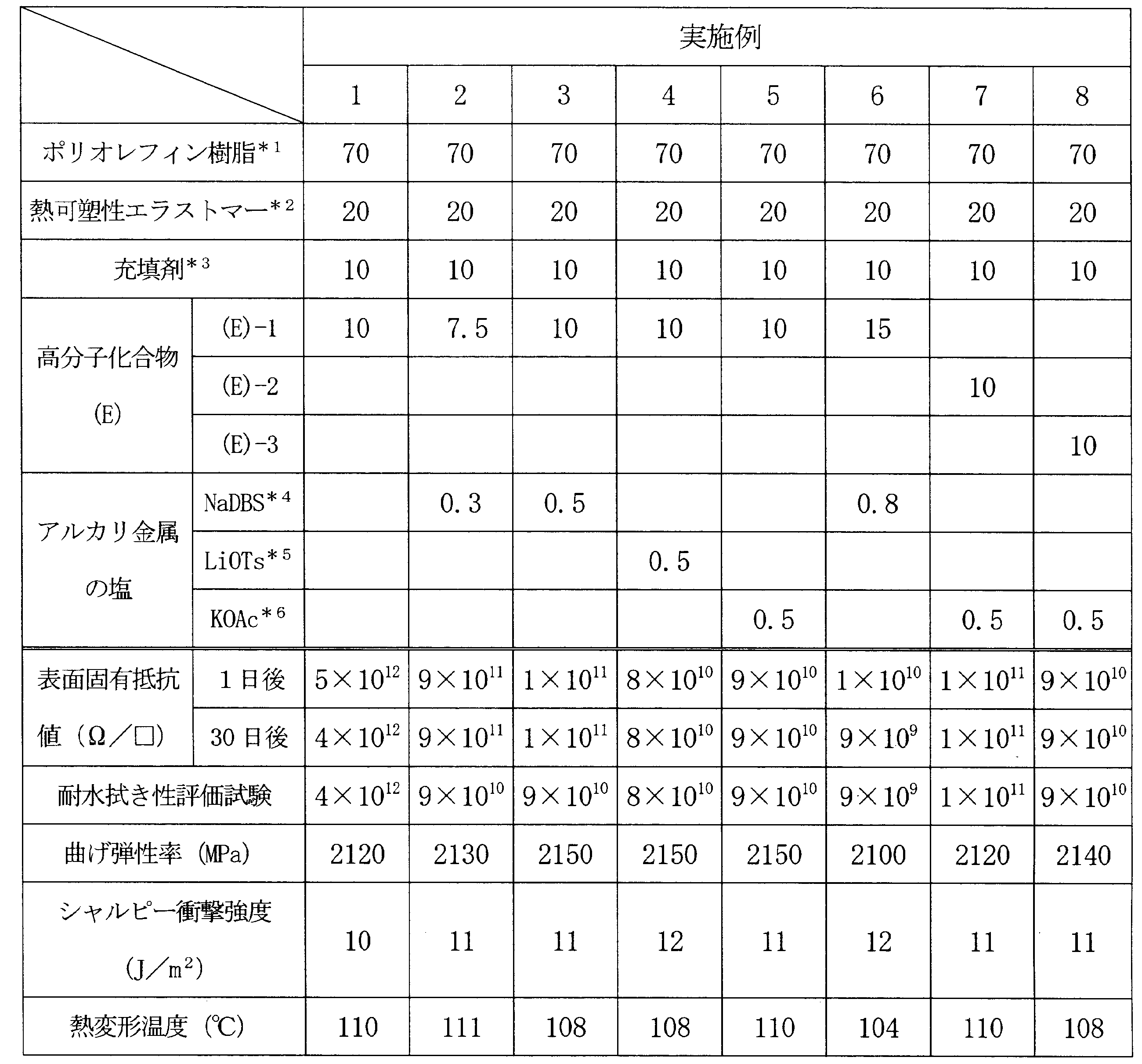
*2:ポリオレフィン系熱可塑性エラストマー、ダウケミカル社製、商品名 エンゲージ8100
*3:微粉タルク、日本タルク株式会社製、商品名 MICRO ACE P-4
*4:ドデシルベンゼンスルホン酸ナトリウム
*5:p-トルエンスルホン酸リチウム
*6:酢酸カリウム

*2:ポリオレフィン系熱可塑性エラストマー、ダウケミカル社製、商品名 エンゲージ8100
*3:微粉タルク、日本タルク株式会社製、商品名 MICRO ACE P-4
*7:グリセリンモノステアレート
*8:ポリエーテルエステルアミド系帯電防止剤、BASF社製、商品名イルガスタットP-22
Claims (9)
- ポリオレフィン樹脂を50~90質量部、熱可塑性エラストマーを3~40質量部、および、充填剤を3~30質量部含有するとともに(但し、ポリオレフィン樹脂、熱可塑性エラストマーおよび充填剤の合計は100質量部)、
高分子化合物(E)からなる帯電防止剤を、前記ポリオレフィン樹脂、前記熱可塑性エラストマーおよび前記充填剤の合計100質量部に対して3~20質量部含有し、
前記高分子化合物(E)が、ジオールと、脂肪族ジカルボン酸と、芳香族ジカルボン酸と、下記一般式(1)で示される基を一つ以上有し両末端に水酸基を有する化合物(B)と、エポキシ基を2個以上有するエポキシ化合物(D)とが、エステル結合を介して結合してなる構造を有することを特徴とするポリオレフィン系樹脂組成物。

- 前記高分子化合物(E)が、ジオール、脂肪族ジカルボン酸および芳香族ジカルボン酸から構成されるポリエステル(A)と、前記化合物(B)と、前記エポキシ化合物(D)とが、エステル結合を介して結合してなる構造を有する請求項1記載のポリオレフィン系樹脂組成物。
- 前記高分子化合物(E)が、前記ポリエステル(A)から構成されたブロックおよび前記化合物(B)から構成されたブロックがエステル結合を介して繰り返し交互に結合してなる両末端にカルボキシル基を有するブロックポリマー(C)と、前記エポキシ化合物(D)とが、エステル結合を介して結合してなる構造を有する請求項2記載のポリオレフィン系樹脂組成物。
- 前記高分子化合物(E)を構成する前記ポリエステル(A)が、両末端にカルボキシル基を有する構造を有する請求項2記載のポリオレフィン系樹脂組成物。
- 前記高分子化合物(E)における、前記ポリエステル(A)から構成されたブロックの数平均分子量がポリスチレン換算で800~8,000であり、前記化合物(B)から構成されたブロックの数平均分子量がポリスチレン換算で400~6,000であり、かつ、前記ブロックポリマー(C)の数平均分子量が、ポリスチレン換算で5,000~25,000である請求項3記載のポリオレフィン系樹脂組成物。
- 前記高分子化合物(E)を構成する前記化合物(B)が、ポリエチレングリコールである請求項1記載のポリオレフィン系樹脂組成物。
- さらに、アルカリ金属の塩および第2族元素の塩からなる群から選択される1種以上を、前記ポリオレフィン樹脂、前記熱可塑性エラストマーおよび前記充填剤の合計100質量部に対し、0.1~15質量部含有する請求項1記載のポリオレフィン系樹脂組成物。
- 前記ポリオレフィン樹脂のメルトフローレートが、5~100g/10minの範囲である請求項1記載のポリオレフィン系樹脂組成物。
- 請求項1記載のポリオレフィン系樹脂組成物を成形してなることを特徴とする自動車内外装材。
Priority Applications (5)
| Application Number | Priority Date | Filing Date | Title |
|---|---|---|---|
| EP15869732.6A EP3235864A4 (en) | 2014-12-19 | 2015-11-19 | Polyolefin resin composition |
| US15/537,114 US10385162B2 (en) | 2014-12-19 | 2015-11-19 | Polyolefin resin composition |
| KR1020177020082A KR20170097160A (ko) | 2014-12-19 | 2015-11-19 | 폴리올레핀계 수지 조성물 |
| CN201580069373.7A CN107108982B (zh) | 2014-12-19 | 2015-11-19 | 聚烯烃系树脂组合物 |
| BR112017012670-2A BR112017012670A2 (pt) | 2014-12-19 | 2015-11-19 | composição de resina poliolefínica |
Applications Claiming Priority (2)
| Application Number | Priority Date | Filing Date | Title |
|---|---|---|---|
| JP2014257937A JP6619930B2 (ja) | 2014-12-19 | 2014-12-19 | ポリオレフィン系樹脂組成物 |
| JP2014-257937 | 2014-12-19 |
Publications (1)
| Publication Number | Publication Date |
|---|---|
| WO2016098524A1 true WO2016098524A1 (ja) | 2016-06-23 |
Family
ID=56126422
Family Applications (1)
| Application Number | Title | Priority Date | Filing Date |
|---|---|---|---|
| PCT/JP2015/082625 Ceased WO2016098524A1 (ja) | 2014-12-19 | 2015-11-19 | ポリオレフィン系樹脂組成物 |
Country Status (8)
| Country | Link |
|---|---|
| US (1) | US10385162B2 (ja) |
| EP (1) | EP3235864A4 (ja) |
| JP (1) | JP6619930B2 (ja) |
| KR (1) | KR20170097160A (ja) |
| CN (1) | CN107108982B (ja) |
| BR (1) | BR112017012670A2 (ja) |
| TW (1) | TWI705102B (ja) |
| WO (1) | WO2016098524A1 (ja) |
Cited By (2)
| Publication number | Priority date | Publication date | Assignee | Title |
|---|---|---|---|---|
| CN110885496A (zh) * | 2019-12-17 | 2020-03-17 | 苏州度辰新材料有限公司 | 一种抗静电导热聚烯烃组合物及其制备方法 |
| CN116003919A (zh) * | 2022-12-29 | 2023-04-25 | 金发科技股份有限公司 | 一种与α-氰基丙烯酸乙酯胶粘剂快速粘合TPV材料 |
Families Citing this family (7)
| Publication number | Priority date | Publication date | Assignee | Title |
|---|---|---|---|---|
| US10308852B2 (en) | 2015-03-30 | 2019-06-04 | Adeka Corporation | Antistatic resin composition and polyolefin antistatic fiber for container and pipe for organic solvent |
| WO2019021943A1 (ja) * | 2017-07-24 | 2019-01-31 | 株式会社Adeka | 組成物、これを含む樹脂組成物、およびその成形体 |
| CN110128753A (zh) * | 2018-02-08 | 2019-08-16 | 贝内克-长顺汽车内饰材料(张家港)有限公司 | 用于制备tpo表皮层的组合物及由其制备的tpo表皮层和人造革 |
| CN113227858B (zh) * | 2018-12-28 | 2023-03-14 | 株式会社可乐丽 | 聚乙烯醇膜和使用其的偏振膜的制造方法 |
| CN111378253B (zh) * | 2018-12-29 | 2023-07-11 | 太阳油墨(苏州)有限公司 | 树脂填充材料 |
| CN114381234B (zh) * | 2021-12-31 | 2023-07-21 | 佛山南宝高盛高新材料有限公司 | 一种防水的超低温冷冻品专用标签胶及其制备方法 |
| CN115521634B (zh) * | 2022-10-15 | 2023-06-27 | 温州市和沐环保科技有限公司 | 一种再生阻燃塑料粒子及其加工工艺 |
Citations (6)
| Publication number | Priority date | Publication date | Assignee | Title |
|---|---|---|---|---|
| JPH11100471A (ja) * | 1997-09-26 | 1999-04-13 | Grand Polymer:Kk | 自動車部品用ポリプロピレン樹脂組成物 |
| JP2002053847A (ja) * | 2000-08-10 | 2002-02-19 | Asahi Denka Kogyo Kk | 帯電防止剤 |
| JP2002256117A (ja) * | 2001-03-05 | 2002-09-11 | Asahi Denka Kogyo Kk | 樹脂組成物 |
| JP2002309001A (ja) * | 2001-04-09 | 2002-10-23 | Calp Corp | 帯電付着防止方法 |
| JP2010280841A (ja) * | 2009-06-05 | 2010-12-16 | Sunallomer Ltd | ポリプロピレン系樹脂組成物及び自動車内装部品用成形体 |
| WO2014115745A1 (ja) * | 2013-01-23 | 2014-07-31 | 株式会社Adeka | 帯電防止剤、帯電防止剤組成物、帯電防止性樹脂組成物および成形体 |
Family Cites Families (13)
| Publication number | Priority date | Publication date | Assignee | Title |
|---|---|---|---|---|
| FR2519012B1 (fr) | 1981-12-29 | 1987-04-10 | Ato Chimie | Composition nouvelle formee d'un melange intime de polyolefines et de polyetheresteramides |
| DE3541664A1 (de) * | 1985-11-26 | 1987-06-11 | Hoechst Ag | Oligomere diazaspirodecane, ihre herstellung und ihre verwendung als lichtschutzmittel fuer polymere |
| US5061401A (en) * | 1988-09-08 | 1991-10-29 | Ciba-Geigy Corporation | Electrically conductive composition of polyheteroaromatic compounds and polymeric sulfates |
| JPH03290464A (ja) | 1990-04-05 | 1991-12-20 | Toray Ind Inc | 熱可塑性樹脂組成物 |
| JPH07309954A (ja) * | 1994-05-17 | 1995-11-28 | Dainippon Ink & Chem Inc | エポキシ樹脂水分散液 |
| JPH10101865A (ja) | 1996-09-26 | 1998-04-21 | Nippon Poriorefuin Kk | 自動車内装部品用成形体 |
| JPH10287738A (ja) * | 1997-04-15 | 1998-10-27 | Asahi Chem Ind Co Ltd | 帯電防止用ポリエーテルエステル |
| JPH11323070A (ja) | 1998-05-08 | 1999-11-26 | Chisso Corp | 帯電防止性及びフォギング防止性に優れた自動車内装材用樹脂組成物 |
| JP3488163B2 (ja) | 1999-02-10 | 2004-01-19 | 三洋化成工業株式会社 | ブロックポリマー及びこれからなる帯電防止剤 |
| CN100508609C (zh) | 2002-04-18 | 2009-07-01 | 株式会社东芝 | 运动图像编码/解码方法和装置 |
| WO2005073282A1 (ja) * | 2004-01-30 | 2005-08-11 | Mitsui Chemicals, Inc. | 新規な重合体及びその用途 |
| WO2006098214A1 (ja) * | 2005-03-14 | 2006-09-21 | Adeka Corporation | 帯電防止剤組成物 |
| KR101949127B1 (ko) * | 2013-08-01 | 2019-02-18 | 삼성전자주식회사 | 하이브리드 동기화 기법을 적용한 무선 에너지 수신 방법 및 장치 |
-
2014
- 2014-12-19 JP JP2014257937A patent/JP6619930B2/ja active Active
-
2015
- 2015-11-19 KR KR1020177020082A patent/KR20170097160A/ko not_active Ceased
- 2015-11-19 US US15/537,114 patent/US10385162B2/en active Active
- 2015-11-19 CN CN201580069373.7A patent/CN107108982B/zh active Active
- 2015-11-19 WO PCT/JP2015/082625 patent/WO2016098524A1/ja not_active Ceased
- 2015-11-19 EP EP15869732.6A patent/EP3235864A4/en not_active Withdrawn
- 2015-11-19 BR BR112017012670-2A patent/BR112017012670A2/pt not_active Application Discontinuation
- 2015-12-18 TW TW104142787A patent/TWI705102B/zh active
Patent Citations (6)
| Publication number | Priority date | Publication date | Assignee | Title |
|---|---|---|---|---|
| JPH11100471A (ja) * | 1997-09-26 | 1999-04-13 | Grand Polymer:Kk | 自動車部品用ポリプロピレン樹脂組成物 |
| JP2002053847A (ja) * | 2000-08-10 | 2002-02-19 | Asahi Denka Kogyo Kk | 帯電防止剤 |
| JP2002256117A (ja) * | 2001-03-05 | 2002-09-11 | Asahi Denka Kogyo Kk | 樹脂組成物 |
| JP2002309001A (ja) * | 2001-04-09 | 2002-10-23 | Calp Corp | 帯電付着防止方法 |
| JP2010280841A (ja) * | 2009-06-05 | 2010-12-16 | Sunallomer Ltd | ポリプロピレン系樹脂組成物及び自動車内装部品用成形体 |
| WO2014115745A1 (ja) * | 2013-01-23 | 2014-07-31 | 株式会社Adeka | 帯電防止剤、帯電防止剤組成物、帯電防止性樹脂組成物および成形体 |
Non-Patent Citations (1)
| Title |
|---|
| See also references of EP3235864A4 * |
Cited By (2)
| Publication number | Priority date | Publication date | Assignee | Title |
|---|---|---|---|---|
| CN110885496A (zh) * | 2019-12-17 | 2020-03-17 | 苏州度辰新材料有限公司 | 一种抗静电导热聚烯烃组合物及其制备方法 |
| CN116003919A (zh) * | 2022-12-29 | 2023-04-25 | 金发科技股份有限公司 | 一种与α-氰基丙烯酸乙酯胶粘剂快速粘合TPV材料 |
Also Published As
| Publication number | Publication date |
|---|---|
| CN107108982B (zh) | 2020-03-13 |
| TW201638181A (zh) | 2016-11-01 |
| US20170342207A1 (en) | 2017-11-30 |
| JP6619930B2 (ja) | 2019-12-11 |
| JP2016117826A (ja) | 2016-06-30 |
| CN107108982A (zh) | 2017-08-29 |
| TWI705102B (zh) | 2020-09-21 |
| BR112017012670A2 (pt) | 2018-03-13 |
| US10385162B2 (en) | 2019-08-20 |
| EP3235864A1 (en) | 2017-10-25 |
| EP3235864A4 (en) | 2018-05-23 |
| KR20170097160A (ko) | 2017-08-25 |
Similar Documents
| Publication | Publication Date | Title |
|---|---|---|
| JP6377437B2 (ja) | 帯電防止剤、帯電防止剤組成物、帯電防止性樹脂組成物および成形体 | |
| JP6275654B2 (ja) | 帯電防止剤、帯電防止剤組成物、帯電防止性樹脂組成物および成形体 | |
| JP6619930B2 (ja) | ポリオレフィン系樹脂組成物 | |
| JP6453003B2 (ja) | 帯電防止剤、帯電防止剤組成物、帯電防止性樹脂組成物および成形体 | |
| JP6452993B2 (ja) | 帯電防止剤、帯電防止剤組成物、帯電防止性樹脂組成物および成形体 | |
| WO2014148454A1 (ja) | 帯電防止剤、帯電防止剤組成物、帯電防止性樹脂組成物および成形体 | |
| JPWO2016158258A1 (ja) | 樹脂添加剤組成物および帯電防止性熱可塑性樹脂組成物 | |
| WO2016117233A1 (ja) | 帯電防止性樹脂組成物ならびにこれを用いた容器および包装材 | |
| JP6566643B2 (ja) | 容器および包装材 | |
| JP7329934B2 (ja) | 組成物、これを含有する樹脂組成物、およびその成形体 | |
| JP6472669B2 (ja) | 帯電防止剤、帯電防止剤組成物、帯電防止性樹脂組成物および成形体 | |
| JP2019006951A (ja) | ブロックポリマー、これを含む組成物、これらを含む樹脂組成物およびその成型体 | |
| JP2025038479A (ja) | 帯電防止性樹脂組成物、ならびにこれを用いた包装材および容器 | |
| JP2021102686A (ja) | ポリオレフィン系樹脂組成物、及びこれを用いた自動車内装材 | |
| JP2019006950A (ja) | 高分子化合物、これを含む組成物、これらを含む樹脂組成物およびその成型体 | |
| JP2022089622A (ja) | 組成物、これを含有する合成樹脂組成物およびその成形体 | |
| TW201920383A (zh) | 組成物,含此之樹脂組成物,及其成形體 |
Legal Events
| Date | Code | Title | Description |
|---|---|---|---|
| 121 | Ep: the epo has been informed by wipo that ep was designated in this application |
Ref document number: 15869732 Country of ref document: EP Kind code of ref document: A1 |
|
| WWE | Wipo information: entry into national phase |
Ref document number: 15537114 Country of ref document: US |
|
| NENP | Non-entry into the national phase |
Ref country code: DE |
|
| REG | Reference to national code |
Ref country code: BR Ref legal event code: B01A Ref document number: 112017012670 Country of ref document: BR |
|
| REEP | Request for entry into the european phase |
Ref document number: 2015869732 Country of ref document: EP |
|
| ENP | Entry into the national phase |
Ref document number: 20177020082 Country of ref document: KR Kind code of ref document: A |
|
| ENP | Entry into the national phase |
Ref document number: 112017012670 Country of ref document: BR Kind code of ref document: A2 Effective date: 20170613 |