WO2016098888A1 - 放射線線量測定ゲル、及びそれを放射線線量の計測材料として備える放射線線量計 - Google Patents
放射線線量測定ゲル、及びそれを放射線線量の計測材料として備える放射線線量計 Download PDFInfo
- Publication number
- WO2016098888A1 WO2016098888A1 PCT/JP2015/085521 JP2015085521W WO2016098888A1 WO 2016098888 A1 WO2016098888 A1 WO 2016098888A1 JP 2015085521 W JP2015085521 W JP 2015085521W WO 2016098888 A1 WO2016098888 A1 WO 2016098888A1
- Authority
- WO
- WIPO (PCT)
- Prior art keywords
- radiation
- sodium
- gel
- dosimetry gel
- radiation dosimetry
- Prior art date
- Legal status (The legal status is an assumption and is not a legal conclusion. Google has not performed a legal analysis and makes no representation as to the accuracy of the status listed.)
- Ceased
Links
Images




Classifications
-
- G—PHYSICS
- G01—MEASURING; TESTING
- G01T—MEASUREMENT OF NUCLEAR OR X-RADIATION
- G01T1/00—Measuring X-radiation, gamma radiation, corpuscular radiation, or cosmic radiation
- G01T1/16—Measuring radiation intensity
- G01T1/167—Measuring radioactive content of objects, e.g. contamination
-
- C—CHEMISTRY; METALLURGY
- C08—ORGANIC MACROMOLECULAR COMPOUNDS; THEIR PREPARATION OR CHEMICAL WORKING-UP; COMPOSITIONS BASED THEREON
- C08K—Use of inorganic or non-macromolecular organic substances as compounding ingredients
- C08K3/00—Use of inorganic substances as compounding ingredients
- C08K3/02—Elements
- C08K3/08—Metals
-
- C—CHEMISTRY; METALLURGY
- C08—ORGANIC MACROMOLECULAR COMPOUNDS; THEIR PREPARATION OR CHEMICAL WORKING-UP; COMPOSITIONS BASED THEREON
- C08K—Use of inorganic or non-macromolecular organic substances as compounding ingredients
- C08K3/00—Use of inorganic substances as compounding ingredients
- C08K3/34—Silicon-containing compounds
-
- C—CHEMISTRY; METALLURGY
- C08—ORGANIC MACROMOLECULAR COMPOUNDS; THEIR PREPARATION OR CHEMICAL WORKING-UP; COMPOSITIONS BASED THEREON
- C08L—COMPOSITIONS OF MACROMOLECULAR COMPOUNDS
- C08L33/00—Compositions of homopolymers or copolymers of compounds having one or more unsaturated aliphatic radicals, each having only one carbon-to-carbon double bond, and only one being terminated by only one carboxyl radical, or of salts, anhydrides, esters, amides, imides or nitriles thereof; Compositions of derivatives of such polymers
- C08L33/04—Homopolymers or copolymers of esters
- C08L33/06—Homopolymers or copolymers of esters of esters containing only carbon, hydrogen and oxygen, which oxygen atoms are present only as part of the carboxyl radical
-
- G—PHYSICS
- G01—MEASURING; TESTING
- G01T—MEASUREMENT OF NUCLEAR OR X-RADIATION
- G01T1/00—Measuring X-radiation, gamma radiation, corpuscular radiation, or cosmic radiation
- G01T1/02—Dosimeters
- G01T1/04—Chemical dosimeters
-
- C—CHEMISTRY; METALLURGY
- C08—ORGANIC MACROMOLECULAR COMPOUNDS; THEIR PREPARATION OR CHEMICAL WORKING-UP; COMPOSITIONS BASED THEREON
- C08K—Use of inorganic or non-macromolecular organic substances as compounding ingredients
- C08K3/00—Use of inorganic substances as compounding ingredients
- C08K3/02—Elements
- C08K3/08—Metals
- C08K2003/0856—Iron
Definitions
- the present invention relates to a radiation dosimetry gel and a radiation dosimeter comprising the gel as a radiation dose measurement material. More specifically, the present invention relates to a radiation dosimetry gel used for measuring a three-dimensional dose distribution, and a radiation dosimeter provided with the radiation dosimeter as a radiation dose measurement material.
- Stereotherapy that performs pinpoint radiation therapy as radiation therapy for cancer, or changes the dose intensity within the same irradiation field to set the irradiation field along the contour of the cancer in three dimensions
- High-precision treatments such as intensity-modulated particle therapy (IMPT) that can be performed are being introduced.
- IMPT intensity-modulated particle therapy
- the amount of microscopic energy applied to each three-dimensional position of the target is being introduced.
- the integrated value ie dose distribution
- particle beam therapy using a charged particle beam having a high dose concentration such as a proton beam or a heavy particle beam (carbon beam, neon beam, etc.) is performed.
- Particle beam therapy has an advantage that a tumor can be treated by controlling the irradiation position and dose of radiation irradiation with higher accuracy than conventional X-ray therapy.
- What is required in particle beam therapy is to properly release the energy from the particle beam at a target location such as a lesion in a living tissue and to have as little influence as possible on normal tissue around the target. That's both.
- the radial spread of the particle beam and the position of the Bragg peak of the particle beam are aligned with the target position in the irradiated object.
- the dose distribution at each position in three dimensions in the living tissue is optimized.
- the dose distribution (dose due to radiation at each position) in the target tissue is deformed according to the treatment purpose, and at the same time, the influence of radiation on the surrounding normal tissue is suppressed, and the organ at risk (organ at risk) is also made as small as possible.
- the beam may be precisely controlled and irradiated from multiple directions. This control is equipped with filters and collimators (range shifter, multi-leaf collimator, bolus, etc.) that are adjusted according to the irradiated object.
- a technique that can actually measure the amount of energy imparted by a large number of ionizing radiations incident from various directions with various acceleration energies. If the energy application amount can be integrated and the dose can be measured accurately at each position, it is possible to measure the three-dimensional energy application amount distribution (dose distribution) that supports the QA / QC. It is. Conventionally, one-dimensional or two-dimensional dosimeters such as an ionization chamber dosimeter, a semiconductor detector, and a film are used for this purpose. In these dosimeters, the dose distribution with respect to one-dimensional or two-dimensional coordinates in the region where the particle beam is aligned with the target position is actually measured.
- a gel dosimeter capable of measuring a three-dimensional dose distribution with a gel using the measurement principle of a chemical dosimeter has attracted attention. If a gel dosimeter is used, it is possible to accurately measure the amount of energy imparted by radiation at each position of water, which is a material that can be regarded as equivalent to a living body. There is also the advantage that the impact can be measured. A gel dosimeter can acquire a three-dimensional dose distribution while using itself as a solid phantom.
- a Fricke gel dosimeter is a gel containing a solution of a Fricke dosimeter known as a liquid chemical dosimeter (an aqueous solution containing ferrous sulfate), and the oxidation reaction (coloring) of iron from divalent to trivalent upon irradiation.
- a Fricke gel dosimeter is a gel containing a solution of a Fricke dosimeter known as a liquid chemical dosimeter (an aqueous solution containing ferrous sulfate), and the oxidation reaction (coloring) of iron from divalent to trivalent upon irradiation.
- a Fricke gel dosimeter is a gel containing a solution of a Fricke dosimeter known as a liquid chemical dosimeter (an aqueous solution containing ferrous sulfate), and the oxidation reaction (coloring) of iron from divalent to trivalent upon irradiation.
- it uses the fact that it increases in proportion to the
- a polymer gel dosimeter is one in which monomers are dispersed in a gel, and when irradiated, a polymer is generated in proportion to the dose. Therefore, the dose is estimated by obtaining the amount of production (white turbidity). Can do.
- the polymer produced is difficult to diffuse in the gel, the white turbidity is stable over time, and the white turbid part appears to float in the transparent gel, and is characterized by visual superiority. .
- JP 2014-209093 A Japanese Patent No. 550526 JP 2002-214354 A JP 2014-185969 A
- Patent Document 1 proposes a gel dosimeter using clay fine particles.
- this gel dosimeter the diffusion of the recording material is suppressed by utilizing the solidification action by the thixotropy of the clay particles.
- the inventors of the present invention have an organic acid salt structure or an organic acid anion structure as a result of intensive studies on a gel having heat resistance, which can be produced by simply mixing at room temperature without requiring heating. It has been found that a gel containing a water-soluble organic polymer (A), a silicate (B), and a silicate dispersant (C) becomes a radiation dosimetry gel having excellent heat resistance. Was completed.
- the present invention provides, as a first aspect, a water-soluble organic polymer (A) having an organic acid salt structure or an organic acid anion structure, a silicate (B), and a dispersant (C) for the silicate. It is related with the radiation dosimetry gel characterized by including.
- the present invention relates to the radiation dosimetry gel according to the first aspect, wherein the water-soluble organic polymer (A) is a completely neutralized or partially neutralized polyacrylate having a weight average molecular weight of 1,000,000 to 10,000,000.
- the silicate (B) is one or more water-swellable silicate particles selected from the group consisting of smectite, bentonite, vermiculite, and mica.
- the dispersant (C) is sodium orthophosphate, sodium pyrophosphate, sodium tripolyphosphate, sodium tetraphosphate, sodium hexametaphosphate, sodium polyphosphate, sodium poly (meth) acrylate, poly (meth) acrylic acid.
- the compound (D) is one or more selected from the group consisting of a compound containing a Group 2 element, a compound containing a transition element, a compound containing an amphoteric element, and a compound containing a polyamine. It is related with the radiation dosimetry gel as described in a 5th viewpoint which is a compound.
- the present invention relates to the radiation dosimetry gel according to any one of the first aspect to the sixth aspect, including a monomer polymerizable by radiation irradiation.
- the present invention relates to a radiation dosimeter provided with the radiation dose measurement gel according to any one of the first aspect to the eleventh aspect as a radiation dose measurement material.
- the radiation dosimetry gel of the present invention has excellent heat resistance compared to gelatin and the like widely used in conventional gel dosimeters.
- the radiation dosimetry gel of the present invention can be produced by simply mixing at room temperature using industrially available raw materials without the need for heating. It can be manufactured and used as an injectable gel as a radiation dose measurement material in a radiation dosimeter.
- the radiation dosimetry gel of the present invention has sufficient strength.
- it typically has a hardness (“elastic modulus”) and strength (“breaking stress”) that can maintain the shape of the gel without a support such as a container, that is, it has self-supporting properties. Therefore, the radiation dosimetry gel of the present invention can be used not only for glass and plastic containers but also for the production of flexible gel dosimeters using plastic wraps with low oxygen permeability.
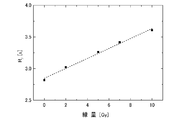
- FIG. It is a photograph which shows the result of the irradiation test of the radiation dosimeter in Example 2.
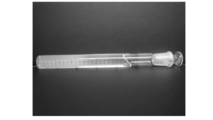
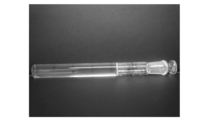
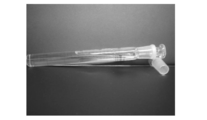
- FIG. It is a photograph which shows the result of the heat resistance test of the radiation dosimeter in Example 3 (heat resistance at 20 degreeC of the sample of Example 1). It is a photograph which shows the result of the heat resistance test (heat resistance at 30 degrees C of the sample of Example 1) of the radiation dosimeter in Example 3. It is a photograph which shows the result of the heat resistance test of the radiation dosimeter in Example 3 (heat resistance at 60 degreeC of the sample of Example 1). It is a photograph which shows the result of the heat resistance test of the radiation dosimeter in Example 3 (heat resistance at 20 degreeC of the sample of the comparative example 1).
- ⁇ Radiation dosimetry gel> As a component of the radiation dosimetry gel of the present invention, a water-soluble organic polymer (A) having an organic acid salt structure or an organic acid anion structure, a silicate (B), a dispersant for the silicate (C), and The compound (D) having a positive charge of 2 or more is included as necessary, but in addition to the above components, other components can be arbitrarily selected as long as the desired effects of the present invention are not impaired. You may mix
- Examples of the water-soluble organic polymer (A) having an organic acid salt structure or an organic acid anion structure include a water-soluble organic polymer having a salt structure or an anion structure of an organic acid group such as a carboxyl group, a sulfonyl group, and a phosphonyl group. Is mentioned.
- water-soluble organic polymers examples include those having a carboxyl group, poly (meth) acrylic acid salt, carboxyvinyl polymer salt, carboxymethylcellulose salt; those having a sulfonyl group, polystyrene sulfonic acid
- salts having a phosphonyl group include polyvinylphosphonates.
- a salt of polyacrylic acid is preferable.
- (meth) acrylic acid refers to both acrylic acid and methacrylic acid.
- salt structure of an organic acid group the sodium salt of the said organic acid group, ammonium salt, potassium salt, lithium salt etc. are mentioned, for example.
- anion structure examples include those having a structure in which a cation is dissociated from an organic acid group or a salt of an organic acid.
- the water-soluble organic polymer (A) preferably has a linear structure having no branched or chemical cross-linked structure, and either a completely neutralized product or a partially neutralized product of a polymer having an organic acid group can be used.
- the water-soluble organic polymer (A) may be a completely neutralized product or a partially neutralized product of a polymer having an organic acid group, or a mixture thereof.
- the weight average molecular weight of the water-soluble organic polymer (A) is preferably 1 million or more and 10 million or less, more preferably 2.5 million or more and 5 million or less in terms of polyethylene glycol by gel permeation chromatography (GPC). .
- the water-soluble organic polymer (A) in the present invention is preferably a completely neutralized or partially neutralized polyacrylate, more preferably a completely neutralized or partially neutralized linear polyacrylate, and a weight average molecular weight.
- a completely neutralized or partially neutralized linear sodium polyacrylate having a molecular weight of 2.5 to 5 million is particularly preferred.
- the content of the water-soluble organic polymer (A) is 0.001% by mass to 20% by mass, preferably 0.01% by mass to 10% by mass in 100% by mass of the radiation dosimetry gel.
- Component (B): Silicate examples include water-swellable silicate particles such as smectite, bentonite, vermiculite, and mica, and those that form a colloid using water or a hydrous liquid as a dispersion medium are preferable.
- the smectite is a general term for clay minerals having swelling properties such as montmorillonite, beidellite, hectorite, saponite, and stevensite.
- Examples of the primary particle shape of the silicate particles include a disk shape, a plate shape, a spherical shape, a granular shape, a cubic shape, a needle shape, a rod shape, an amorphous shape, and the like, for example, a disk shape or a plate shape having a diameter of 5 nm to 1000 nm. Is preferred.
- silicates include layered silicates.
- examples of easily available silicates include Laponite XLG (synthetic hectorite) and XLS (synthetic hectorite) manufactured by Rockwood Additives.
- the content of the silicate (B) is 0.01% by mass to 20% by mass, preferably 0.1% by mass to 10% by mass in 100% by mass of the radiation dosimetry gel.
- Component (C): Dispersant of Silicate As the silicate dispersant (C), a dispersant or a peptizer used for the purpose of improving the dispersibility of the silicate or delaminating the layered silicate can be used.
- a dispersant or a peptizer used for the purpose of improving the dispersibility of the silicate or delaminating the layered silicate can be used.
- phosphate dispersants, carboxylate dispersants, those acting as alkalis, and organic peptizers can be used.
- sodium pyrophosphate as the phosphate-based dispersant
- low-polymerized sodium polyacrylate having a weight average molecular weight of 1,000 to 20,000 as the carboxylate-based dispersant
- polyethylene glycol eg, PEG900
- Low-polymerized sodium polyacrylate interacts with silicate particles to generate negative charges derived from carboxy anions on the particle surface, and acts as a dispersant by a mechanism such as dispersion of silicate by repulsion of charges.
- a mechanism such as dispersion of silicate by repulsion of charges.
- Content of the said dispersing agent (C) is 0.001 mass% thru
- a dispersant may or may not be added.
- Component (D) Compound having a positive charge of 2 or more valences
- the compound (D) having a positive charge of 2 or more is selected from the group consisting of, for example, a compound containing a Group 2 element, a compound containing a transition element, a compound containing an amphoteric element, and a compound containing a polyamine.
- species or 2 or more types of compounds is mentioned.
- a compound containing a group 2 element a compound of beryllium, magnesium, calcium; as a compound containing a transition element, scandium, titanium, vanadium, chromium, manganese, iron, cobalt, nickel, copper, zirconium, molybdenum, ruthenium, Rhodium and palladium compounds; compounds containing amphoteric elements such as zinc, cadmium, mercury, aluminum, gallium, indium, thallium, tin and lead; compounds containing polyamines such as ethylenediamine, phenylenediamine, hydrazine, putrescine and cadaverine , Spermidine, spermine compounds and the like.
- Acids constituting the salt include sulfuric acid, hydrochloric acid, hydrobromic acid, hydrofluoric acid, trifluoroacetic acid, acetic acid, phosphoric acid, diphosphoric acid, hexametaphosphoric acid, polyphosphoric acid, silicic acid, aluminate, trifluoromethanesulfone Examples include acid, methanesulfonic acid, and p-toluenesulfonic acid.
- the compound (D) having a positive charge of 2 or more is preferably magnesium, calcium, aluminum hydrochloride, sulfate, diphosphate, silicate and aluminate, more preferably chloride.
- the content of the compound (D) is 0.001% by mass to 50% by mass, preferably 0.01% in 100% by mass of the radiation dosimetry gel. % By mass to 20% by mass.
- a weight average as a component (A) in 100% by mass of the radiation dosimetry gel Completely neutralized or partially neutralized linear sodium polyacrylate having a molecular weight of 2.5 million to 5 million, 0.01% by mass to 10% by mass, water swellable smectite or saponite 0.1% by mass as component (B) Or 0.01 to 10% by mass of sodium pyrophosphate as a component (C), or 0.01 to 10% by mass of low-polymerized sodium polyacrylate having a weight average molecular weight of 1,000 to 20,000.
- the combination which becomes is mentioned.
- the radiation dosimetry gel of the present invention contains the component (D), the water-soluble organic polymer (A), the silicate (B), the silicate dispersant (C), and the compound ( As a preferred combination of D), 100% by mass of the radiation dosimetry gel, a completely neutralized or partially neutralized linear sodium polyacrylate having a weight average molecular weight of 2.5 million to 5 million as a component (A) 01% by mass to 10% by mass, 0.1% by mass to 10% by mass of water-swellable smectite or saponite as component (B), 0.01% by mass to 10% by mass of sodium pyrophosphate as component (C), or weight average Low polymerized sodium polyacrylate having a molecular weight of 1,000 or more and 20,000 or less, 0.01% by mass to 10% by mass, and magnesium chloride, calcium chloride or magnesium sulfate as component (D) They include combinations of beam 0.01% to 20% by weight.
- the radiation dosimeter gel of the present invention can contain a monomer that can be polymerized by irradiation, and the radiation dosimeter comprising the radiation dosimeter gel of the present invention as a radiation dose measuring material functions as a polymer gel dosimeter. .
- the monomer that can be polymerized by radiation irradiation is not particularly limited as long as it has a carbon-carbon unsaturated bond that can be polymerized by the action of radiation, and examples thereof include methyl methacrylate, ethyl methacrylate, 2-methoxy methacrylate.
- Examples include acrylamide, acryloylmorpholine, N-isopropylacrylamide, methacryloyl-L-alanine methyl ester, and acryloyl-L-proline methyl ester.
- polymer having a crosslinked structure In order to prevent the polymer produced after irradiation from diffusing and moving in the gel, it is preferable to form a polymer having a crosslinked structure, and a monomer having two or more unsaturated bonds in one molecule (hereinafter referred to as In the present specification, it is preferable that at least one kind of “polyfunctional monomer” is included.
- polyfunctional monomers examples include N, N′-methylenebisacrylamide, N, N′-diallylacrylamide, N, N′-diaacryloylimide, triallyl formal, diallylnaphthalene, ethylene glycol diacrylate, Ethylene glycol dimethacrylate, various polyethylene glycol di (meth) acrylates, propylene glycol diacrylate, propylene glycol dimethacrylate, various polypropylene glycol di (meth) acrylates, 1,3-butylene glycol diacrylate, 1,3-butylene glycol dimethacrylate 1,4-butylene glycol dimethacrylate, various polybutylene glycol di (meth) acrylates, glycerol dimethacrylate, neopentylglycol Dimethacrylate, trimethylolpropane triacrylate, trimethylolpropane trimethacrylate, tetramethylolmethane tetramethacrylate, and the
- ethylene glycol There are 1, 2, 3, 4, 9, 14, and 23 units of ethylene glycol, and among them, water-soluble units having 9 or more units are preferable from the viewpoint of solubility. Some of the above-mentioned monomers are difficult to dissolve in water, but it is sufficient that they are uniformly dispersed in the gel and the entire gel before irradiation is transparent. In order to further improve the uniform dispersibility, an organic solvent such as alcohol may be added as long as it is 5% or less.
- the content of the monomer polymerizable by radiation irradiation is preferably 2% by mass to 15% by mass, more preferably 3% by mass to 8% by mass in 100% by mass of the radiation dosimetry gel.
- the radiation dosimetry gel of the present invention can contain iron ions.
- iron ions include iron (II) ions and iron (III) ions.
- the radiation dosimetry gel of the present invention can contain both iron (II) ions and iron (III) ions, as well as either iron (II) ions or iron (III) ions.
- the radiation dosimetry gel of the present invention contains iron (II) ions
- the radiation dosimetry gel of the present invention produces a color produced by oxidation of iron (II) ions to iron (III) ions by irradiation.
- the gel used may be used.
- the radiation dosimeter provided with the radiation dosimetry gel of the present invention as a radiation dose measurement material functions as, for example, a Fricke gel dosimeter.
- the radiation dosimetry gel of the present invention can contain iron (II) ions by including a compound that generates iron (II) ions.
- a compound that generates iron (II) ions is not particularly limited as long as it is a compound that can generate iron (II) ions in an aqueous solution.
- ammonium iron (II) or ferrous sulfate (II) etc. are mentioned.
- the radiation dosimetry gel of the present invention contains iron (III) ions
- the radiation dosimetry gel of the present invention develops a color produced by reduction of iron (III) ions to iron (II) ions by irradiation.
- the gel used may be used.
- the radiation dosimeter provided with the radiation dosimetry gel of the present invention as a radiation dose measurement material functions as, for example, a TBG gel dosimeter (turnable blue dosimeter).
- the radiation dosimetry gel of the present invention can contain iron (III) ions by including a compound that generates iron (III) ions.
- a compound that generates iron (III) ions is not particularly limited as long as it is a compound that can generate iron (III) ions when made into an aqueous solution, and examples thereof include potassium hexacyanoferrate (III) and citric acid. Examples include iron (III) ammonium and chloride (III) hexahydrate.
- the content of iron (II) ions in the radiation dosimetry gel is preferably 0.05 mM to 5 mM, more preferably 0.1 mM to 2 mM.
- the content of the iron (III) ions is preferably 0.1 mM to 5 mM, more preferably 0.45 mM to 2 mM in the radiation dosimetry gel.
- the radiation dosimetry gel of the present invention can include a radiation sensitive dye.
- a radiation-sensitive dye is not particularly limited as long as it is a compound that changes color (discoloration, color development) in response to radiation.
- the content of the radiation-sensitive dye is preferably 0.5 mM to 5 mM, more preferably 1 mM to 2 mM in the radiation dosimetry gel.
- the radiation dosimetry gel of the present invention promotes a polymerization reaction by radiation irradiation and enhances radiosensitivity, so that an oxygen scavenger such as ascorbic acid or tetrakis (hydroxymethyl) phosphonium chloride (THPC), or glucono- ⁇ - It is preferable to include a pH adjuster such as lactone, perchloric acid, sulfuric acid or sodium chloride.
- the radiation dosimetry gel of the present invention may contain a free radical scavenger such as hydroquinone, an ultraviolet absorber such as guaiazulene, etc. in order to suppress polymerization by residual monomers after irradiation.
- the radiation dosimetry gel of the present invention may contain a colorant and the like as necessary.
- the method for producing the radiation dosimetry gel is not particularly limited, but a mixture of two components of component (A) to component (C) or an aqueous solution or solution thereof, and the remaining one component or solution or solution thereof. It can be made to gel by mixing with an aqueous solution. Further, gelation is possible by adding water or an aqueous solution to the mixture of each component.
- the component (A) to (C) In addition to the method of separately mixing the component (D) with the components (A) to (C) at the time of gelation or the method of previously mixing with the components (A) to (C), the component (A) to It is also possible to add (C) and, if necessary, a gel containing the component (D) by a method of immersing the gel in the aqueous solution of the component (D). These processing methods can be performed by combining the respective operations.
- the concentration of the aqueous solution of the component (D) is usually 0.1% by mass to 50% by mass, preferably 1% by mass to 30% by mass, and more preferably 5% by mass to 20% by mass.
- the radiation dosimetry gel containing other components other than the components (A) to (D), for example, a monomer that can be polymerized by irradiation, iron ions, or a radiation-sensitive dye is the production of the radiation dosimetry gel described above. In the method, it can manufacture by adding another component to a component (A) thru
- the radiation dosimetry gel containing other components is, for example, a mixture of two components of component (A) to component (C) or an aqueous solution or solution thereof, and / or the remaining component or an aqueous solution or solution thereof. In addition, it can be produced by adding other components and mixing them.
- sonication can be used in addition to mechanical or manual stirring.
- Mechanical agitation is preferred.
- a magnetic stirrer, propeller type stirrer, rotation / revolution mixer, disper, homogenizer, shaker, vortex mixer, ball mill, kneader, ultrasonic oscillator, etc. can be used.
- the mixing by a rotation / revolution mixer is preferable.
- the temperature at the time of mixing is the freezing point or boiling point of the aqueous solution or aqueous dispersion, preferably ⁇ 5 ° C. to 100 ° C., more preferably 0 ° C. to 50 ° C.
- the strength is weak and sol-like, but it gels when left standing.
- the standing time is preferably 2 hours to 100 hours.
- the standing temperature is -5 ° C to 100 ° C, preferably 0 ° C to 50 ° C.
- the radiation dose measuring gel of arbitrary shapes is producible by pouring into a type
- the radiation dosimeter gel of the present invention is suitable for a radiation dose measurement material
- the radiation dosimeter gel can be used as a radiation dosimeter, for example, a phantom by filling the container with the radiation dosimetry gel.
- the container is not particularly limited as long as it does not respond to MRI, transmits radiation, has solvent resistance, airtightness, etc., and its material is glass, acrylic resin, polyester, ethylene-vinyl alcohol copolymer, etc. preferable. If the container is transparent, not only MRI but also optical CT capable of three-dimensional measurement of white turbidity can be used to measure the three-dimensional dose distribution. Further, after filling the container, it may be replaced with nitrogen gas or the like.
- Example 1 Production of a radiation dosimeter (VIPET (Normoxic N-vinylpyrrolidone based polymer) gel dosimeter) including a radiation dosimetry gel as a radiation dose measurement material] 8 g of N, N′-methylenebisacrylamide (manufactured by Wako Pure Chemical Industries, Ltd.) was added to 132 g of water, and heated and stirred at 40 ° C. to 45 ° C.
- VIP Exponoxic N-vinylpyrrolidone based polymer
- Example 2 Irradiation test of radiation dosimeter
- Each sample of the radiation dosimeter obtained in Example 1 was irradiated with X-rays (250 kV, 4 mA) using Radioflex 250CG (Rigaku Corporation). Specifically, each sample was irradiated by 2, 5, 7, 10 Gy at a dose rate of 1 Gy / min.
- Each sample after irradiation was analyzed by MRI measurement using 1.5T MRI (Intera Achieva Nova Dual, Philips). As a pulse magnetic field for analysis, a mixed turbo spin echo pulse sequence was applied, T 2 relaxation time of each sample was obtained, and R 2 (that is, 1 / T 2 ) was calculated. From the results shown in FIG. 1, it was confirmed that R 2 increased in proportion to the dose. The increase rate of R 2 with respect to the dose was 0.078 [Gy ⁇ 1 s ⁇ 1 ].
- Example 3 Heat resistance test of radiation dosimeter
- Four test samples were prepared for each of the procedures of Example 1 and Comparative Example 1. Each sample was bathed in water at 20 ° C., 30 ° C., 40 ° C., and 60 ° C. for 30 minutes, and the presence or absence of gel dissolution was confirmed by observation by tilting the sample. The results are shown in Table 1 and FIGS. In Table 1, “ ⁇ ” represents the case where the gel did not dissolve, while “x” represents the case where the gel dissolved. 2 to 4 are photographs of the sample of Example 1 after 30 minutes of water bathing at temperatures of 20 ° C., 30 ° C. and 60 ° C., respectively, while FIGS. 5 to 7 are 20 ° C. and 30 ° C., respectively. It is a photograph of the sample of the comparative example 1 after water bathing for 30 minutes at the temperature of 60 degreeC.
- the gel of the sample of Comparative Example 1 was dissolved at 30 ° C. or higher.
- the gel did not dissolve at all temperatures, and the gel state was maintained. That is, it is clear that the radiation dosimetry gel of the present invention has heat resistance compared to gelatin widely used in conventional gel dosimeters.
- Example 4 Production of a radiation dosimeter (LCV (Leuco Crystal Violet) gel dosimeter) including a radiation dosimeter gel as a radiation dose measuring material]
- 37.4 mg of Leuco Crystal Violet (Tokyo Chemical Industry Co., Ltd.) and 259 mg of Triton X-100 (Sigma Aldrich Co.) are added to 68 g of water, stirred at room temperature for 10 minutes, and then trichloroacetic acid (Tokyo Chemical Industry Co., Ltd.) is added. The solution was added in small portions until the pH of the mixed solution reached 4, and stirred at room temperature for 10 minutes.
- Example 5 Production of radiation dosimeter (flicke gel dosimeter) provided with radiation dosimetry gel as radiation dose measurement material]
- Citric acid monohydrate manufactured by Junsei Chemical Co., Ltd.
- ammonium iron (II) sulfate hexahydrate (Kanto Chemical Co., Ltd.) (4.0 mg) was added.
- 8.0 g of the highly polymerized sodium polyacrylate aqueous solution produced in Production Example 2 was added and stirred until uniform, then 8.0 g of the silicate aqueous dispersion produced in Production Example 1 was added and stirred for 10 minutes.
- 2.0 mg of xylenol orange was added to the reaction mixture and stirred for 10 minutes.
- the obtained mixture was filled in a PET container and allowed to stand in a cool and dark place for 22 hours to obtain an object for irradiation test.
- Example 6 Irradiation test of the radiation dosimeter (LCV gel dosimeter) manufactured in Example 4] Using Radioflex 250CG (Rikagaku Electric Co., Ltd.), X-rays (250 kV, 4 mA) were irradiated at 1 Gy / min to 20 Gy and 30 Gy, and coloring was confirmed. The result is shown in FIG. The left side of the sample in FIG. 8 is irradiated with 20 Gy and 30 Gy, and the right half of the sample in FIG. 8 is an unirradiated region. It was confirmed that the product was colored blue by irradiation. Further, visually, blue shades were confirmed in the 20 Gy and 30 Gy irradiated areas, and coloring according to an increase in dose was confirmed.
- Example 7 Irradiation test of the radiation dosimeter (Flickegel dosimeter) manufactured in Example 5]
- the sample was irradiated with X-rays (250 kV, 4 mA) at 1 Gy / min using Radioflex 250CG (Rikagaku Electric Co., Ltd.) and 40 Gy using a shielding plate so that the right half of the sample was not irradiated with radiation.
- the change in coloring was confirmed from the difference in contrast between the left and right parts of the sample.
- the radiation dosimetry gel of the present invention can be produced by simply mixing at room temperature using industrially available raw materials without requiring heating, and has excellent heat resistance and self-supporting properties. Therefore, it can be applied to various gel dosimeters.
Landscapes
- Chemical & Material Sciences (AREA)
- Health & Medical Sciences (AREA)
- Organic Chemistry (AREA)
- Polymers & Plastics (AREA)
- Medicinal Chemistry (AREA)
- Chemical Kinetics & Catalysis (AREA)
- General Physics & Mathematics (AREA)
- Spectroscopy & Molecular Physics (AREA)
- Molecular Biology (AREA)
- High Energy & Nuclear Physics (AREA)
- Physics & Mathematics (AREA)
- Life Sciences & Earth Sciences (AREA)
- Measurement Of Radiation (AREA)
Abstract
Description
第2観点として、前記水溶性有機高分子(A)が重量平均分子量100万乃至1000万の完全中和又は部分中和ポリアクリル酸塩である、第1観点に記載の放射線線量測定ゲルに関する。
第3観点として、前記ケイ酸塩(B)がスメクタイト、ベントナイト、バーミキュライト、及び雲母からなる群より選ばれる1種又は2種以上の水膨潤性ケイ酸塩粒子である、第1観点又は第2観点に記載の放射線線量測定ゲルに関する。
第4観点として、前記分散剤(C)がオルトリン酸ナトリウム、ピロリン酸ナトリウム、トリポリリン酸ナトリウム、テトラリン酸ナトリウム、ヘキサメタリン酸ナトリウム、ポリリン酸ナトリウム、ポリ(メタ)アクリル酸ナトリウム、ポリ(メタ)アクリル酸アンモニウム、アクリル酸ナトリウム/マレイン酸ナトリウム共重合体、アクリル酸アンモニウム/マレイン酸アンモニウム共重合体、水酸化ナトリウム、ヒドロキシルアミン、炭酸ナトリウム、ケイ酸ナトリウム、ポリエチレングリコール、ポリプロピレングリコール、フミン酸ナトリウム、及びリグニンスルホン酸ナトリウムからなる群から選ばれる1種又は2種以上である、第1観点乃至第3観点のいずれか1つに記載の放射線線量測定ゲルに関する。
第5観点として、二価以上の正電荷を有する化合物(D)を更に含む、第1観点乃至第4観点のいずれか1つに記載の放射線線量測定ゲルに関する。
第6観点として、前記化合物(D)が第2族元素を含む化合物、遷移元素を含む化合物、両性元素を含む化合物、及びポリアミン類を含む化合物からなる群から選ばれる1種又は2種以上の化合物である、第5観点に記載の放射線線量測定ゲルに関する。
第7観点として、放射線照射により重合可能なモノマーを含む、第1観点乃至第6観点のいずれか1つに記載の放射線線量測定ゲルに関する。
第8観点として、鉄(II)イオン若しくは鉄(III)イオン又はその両方を含む、第1観点乃至第6観点のいずれか1つに記載の放射線線量測定ゲルに関する。
第9観点として、放射線感受性色素を含む、第1観点乃至第6観点のいずれか1つに記載の放射線線量測定ゲルに関する。
第10観点として、脱酸素剤を含む、第1観点乃至第9観点のいずれか1つに記載の放射線線量測定ゲルに関する。
第11観点として、pH調整剤を含む、第1観点乃至第10観点のいずれか1つに記載の放射線線量測定ゲルに関する。
第12観点として、第1観点乃至第11観点のいずれか1つに記載の放射線線量測定ゲルを放射線線量の計測材料として備える放射線線量計に関する。
本発明の放射線線量測定ゲルの成分として、有機酸塩構造又は有機酸アニオン構造を有する水溶性有機高分子(A)、ケイ酸塩(B)、前記ケイ酸塩の分散剤(C)、並びに必要に応じて二価以上の正電荷を有する化合物(D)が挙げられるが、上記成分の他に、本発明の所期の効果を損なわない範囲で、必要に応じて、他の成分を任意に配合してもよい。
有機酸塩構造又は有機酸アニオン構造を有する水溶性有機高分子(A)としては、例えば、カルボキシル基、スルホニル基、ホスホニル基などの有機酸基の塩構造又はアニオン構造を有する水溶性有機高分子が挙げられる。
一方、アニオン構造を有するものとしては、例えば、有機酸基又は有機酸の塩からカチオンが解離した構造を有するものが挙げられる。
ケイ酸塩(B)としては、例えば、スメクタイト、ベントナイト、バーミキュライト、及び雲母等の水膨潤性ケイ酸塩粒子が挙げられ、水又は含水液体を分散媒としたコロイドを形成するものが好ましい。なお、スメクタイトとは、モンモリロナイト、バイデライト、ヘクトライト、サポナイト、及びスチブンサイト等の膨潤性を有する粘土鉱物の総称である。
ケイ酸塩の分散剤(C)として、ケイ酸塩の分散性の向上や、層状ケイ酸塩を層剥離させる目的で使用される分散剤又は解膠剤を使用することができる。例えば、リン酸塩系分散剤、カルボン酸塩系分散剤、アルカリとして作用するもの、有機解膠剤を使用することができる。
なお、本発明では、分散剤を含有するケイ酸塩を使用する場合は、分散剤をさらに添加しても、添加しなくてもよい。
二価以上の正電荷を有する化合物(D)としては、例えば、第2族元素を含む化合物、遷移元素を含む化合物、両性元素を含む化合物、及びポリアミン類を含む化合物からなる群から選ばれる1種又は2種以上の化合物が挙げられる。
塩を構成する酸としては、硫酸、塩酸、臭化水素酸、フッ化水素酸、トリフルオロ酢酸、酢酸、リン酸、二リン酸、ヘキサメタリン酸、ポリリン酸、ケイ酸、アルミン酸、トリフルオロメタンスルホン酸、メタンスルホン酸、及びp-トルエンスルホン酸等が挙げられる。
本発明の放射線線量測定ゲルは放射線照射により重合可能なモノマーを含むことができ、これにより、本発明の放射線線量測定ゲルを放射線線量の計測材料として備える放射線線量計はポリマーゲル線量計として機能する。
本発明の放射線線量測定ゲルは鉄イオンを含むことができる。鉄イオンとしては、鉄(II)イオン又は鉄(III)イオンが挙げられる。また、本発明の放射線線量測定ゲルは、鉄(II)イオン又は鉄(III)イオンの一方だけではなく、鉄(II)イオン及び鉄(III)イオンの両方を含むことができる。
本発明の放射線線量測定ゲルが鉄(II)イオンを含む場合、本発明の放射線線量測定ゲルは、放射線照射により、鉄(II)イオンが鉄(III)イオンに酸化されることによって生じる発色を利用したゲルであってもよい。これにより、本発明の放射線線量測定ゲルを放射線線量の計測材料として備える放射線線量計は、例えばフリッケゲル線量計として機能する。
本発明の放射線線量測定ゲルが鉄(III)イオンを含む場合、本発明の放射線線量測定ゲルは、放射線照射により、鉄(III)イオンが鉄(II)イオンに還元されることによって生じる発色を利用したゲルであってもよい。これにより、本発明の放射線線量測定ゲルを放射線線量の計測材料として備える放射線線量計は、例えばTBGゲル線量計(ターンブルブルー線量計)として機能する。
本発明の放射線線量測定ゲルは放射線感受性色素を含むことができる。そのような放射線感受性色素としては、放射線に感応して色彩が変化(変色、発色)する化合物であれば特に限定されず、例えば、ロイコクリスタルバイオレット、ロイコマラカイトグリーン、ビス(4-ジエチルアミノ-2-メチルフェニル)フェニルメタン、トリス(4-ジエチルアミノ-2-メチルフェニル)メタンなどのトリアリールメタン類などのトリフェニルメタン類またはトリアリールメタン類;ロイコクリスタルバイオレットラクトン、ロイコマラカイトグリーンラクトンなどのトリフェニルメタンフタリド類;3-ジエチルアミノ-7-クロロフルオラン、3-ジエチルアミノベンゾ-α-フルオラン、3-ジエチルアミノ-7-ジベンジルアミノフルオラン、3,6-ジメトキシフルオランなどのフルオラン類;3,7-ビスジメチルアミノ-10-(4’-アミノベンゾイル)フェノチアジン、p-ニトロベンジルロイコメチレンブル-、ベンゾイルロイコメチレンブルーなどのフェノチアジン類;3,3-ビス(1-エチル-2-メチルインドル-3-イル)フタリド、3,3-ビス(1-n-ブチル-2-メチルインドル-3-イル)フタリドなどのインドリルフタリド類;N-(2,3-ジクロロフェニル)ロイコオーラミン、N-フェニルロイコオーラミンなどのロイコオーラミン類;ローダミンBラクトンなどのローダミンラクトン類;ローダミンB-o-クロロアミノラクタム、ローダミンBアニリノラクタム、ローダミンB-p-クロロアニリノラクタムなどのローダミンラクタム類;2-(フェニルイミノエタンジリデン)-3,3’-ジメチルインドリンなどのインドリン類;4,4-ビス(ジメチルアミノフェニル)ベンズヒドリルベンジルエーテル、N-ハロフェニルロイコオーラミン、N-2,4,5-トリクロロフェニルロイコオーラミンなどのジフェニルメタン類;3-メチルスピロジナフトピラン、3-エチルスピロジナフトピラン、3,3-ジクロロスピロジナフトピラン、3-ベンジルスピロジナフトピランなどのナフトピラン類;3-プロピルスピロベンゾピラン、3,6-ビス(ジメチルアミノ)フルオレン-9-スピロ-3’-(6’-ジメチルアミノフタリド)、3-ジエチルアミノ-6-ジメチルアミノフルオレン-9-スピロ-3’-(6’-ジメチルアミノフタリド)などのスピロ化合物類;3-インドリル-3-アミノフェニルアザフタリドなどのアザフタリド類;クロメノインドール;アミノジヒドロフェナジンなどのフェナジン類;トリアゼン類;ナフトラクタム類;ジアセチレン類;アゾメチン類などが挙げられる。
これらの中でも、トリフェニルメタン類またはトリアリールメタン類が好ましく、特にロイコクリスタルバイオレットが最も好ましい。
放射線線量測定ゲルの製造方法は特に限定されるものではないが、成分(A)乃至成分(C)のうちの2成分の混合物若しくはその水溶液又は含水溶液と、残りの1成分若しくはその水溶液又は含水溶液とを混合することによってゲル化させることができる。また、各成分の混合物に対して、水又は含水溶液を添加することによってもゲル化が可能である。
上記成分(D)の水溶液の濃度としては、通常0.1質量%乃至50質量%であり、好ましくは1質量%乃至30質量%であり、より好ましくは5質量%乃至20質量%である。
本発明の放射線線量測定ゲルは放射線線量の計測材料に適するため、当該放射線線量測定ゲルを容器に充填して放射線線量計、例えばファントムとすることができる。容器はMRIに感応せず、放射線を透過し、耐溶剤性、気密性等を有していれば特に限定されず、その材質はガラス、アクリル樹脂、ポリエステル、エチレン-ビニルアルコール共重合体などが好ましい。容器が透明であれば、MRIのみならず、白濁度の3次元計測が可能な光学CTを使用することで、3次元線量分布を測定できる。また、容器に充填した後、窒素ガス等で置換してもよい。
ラポナイトXLG(ロックウッド・アディティブズ社製)6部、低重合ポリアクリル酸ナトリウム35%水溶液(平均分子量15000:シグマアルドリッチ社製)1.7部、水92.3部を混合し、均一な水分散液になるまで25℃にて撹拌し目的物を得た。
高重合ポリアクリル酸ナトリウム(和光純薬工業株式会社製:重合度22000乃至70000)2部、水98部を混合し、均一な水溶液になるまで25℃にて撹拌し目的物を得た。
N,N’-メチレンビスアクリルアミド(和光純薬工業株式会社製)8gを水132gに加え、40℃乃至45℃で加熱撹拌した。製造例2で製造した高重合ポリアクリル酸ナトリウム水溶液22g、次いでN-ビニル-2-ピロリドン(和光純薬工業株式会社製)16g、テトラキス(ヒドロキシメチル)ホスホニウムクロリド80%水溶液(東京化成工業株式会社製)353μLを加え、均一になるまで撹拌した。製造例1で製造したケイ酸塩水分散液22gを加え1分間撹拌した。得られた混合物を25mL比色管に充填後24時間室温で静置し、照射試験用の目的物を得た。
実施例1で得られた放射線線量計の各サンプルには、ラジオフレックス 250CG(理学電気株式会社)を用いてX線(250kV,4mA)を照射した。具体的には、各サンプルに、線量率1Gy/分で2、5、7、10Gyだけ照射した。照射後の各サンプルは、1.5T MRI(Intera Achieva Nova Dual, Philips社製)によるMRI測定によって分析した。分析のためのパルス磁界は、Mixed turbo spin echo pulse sequenceを印加し、各サンプルのT2緩和時間を取得して、R2(つまり1/T2)を算出した。図1に示した結果から線量に比例してR2が増加することを確認することができた。なお、線量に対するR2の増加率は0.078[Gy-1s-1]であった。
N,N’-メチレンビスアクリルアミド(和光純薬工業株式会社製)4g、ゼラチン(シグマアルドリッチ社製)7g、N-ビニル-2-ピロリドン(和光純薬工業株式会社製)8g、テトラキス(ヒドロキシメチル)ホスホニウムクロリド80%水溶液(東京化成工業株式会社製)177μLを水81gに加え、45℃乃至50℃で加熱し、均一になるまで撹拌した。得られた混合物を25mL比色管に充填し、静置した状態で氷水により3時間冷却した。
実施例1および比較例1の手順により、試験サンプルをそれぞれ4つ作製した。それぞれのサンプルを20℃、30℃、40℃及び60℃の温度で30分間水浴し、サンプルの傾斜による観察によりゲル溶解の有無を確認した。その結果を表1並びに図2乃至図7に示す。なお、表1において、「○」はゲルが溶解しなかった場合を、一方、「×」はゲルが溶解した場合を表す。また、図2乃至図4は、それぞれ20℃、30℃及び60℃の温度で30分間水浴した後の実施例1のサンプルの写真であり、一方、図5乃至図7はそれぞれ20℃、30℃及び60℃の温度で30分間水浴した後の比較例1のサンプルの写真である。

ロイコクリスタルバイオレット(東京化成工業株式会社製)37.4mg及びトリトンX-100(シグマアルドリッチ社製)259mgを水68gに加え、室温で10分間撹拌後、トリクロロ酢酸(東京化成工業株式会社製)を混合溶液のpHが4になるまで少量ずつ加え、室温で10分間撹拌した。製造例2で製造した高重合ポリアクリル酸ナトリウム水溶液16gを加え均一になるまで撹拌後、製造例1で製造したケイ酸塩水分散液16gを加え10分間撹拌した。得られた混合物を25mL比色管に充填後24時間冷暗所で静置し、照射試験用の目的物を得た。
くえん酸一水和物(純正化学株式会社製)200mgを水84gに加え、室温で5分間撹拌後、硫酸アンモニウム鉄(II)六水和物(関東化学株式会社製)4.0mgを加え、室温で5分間撹拌した。製造例2で製造した高重合ポリアクリル酸ナトリウム水溶液8.0gを加え均一になるまで撹拌後、製造例1で製造したケイ酸塩水分散液8.0gを加え、10分間撹拌した。さらに反応混合物にキシレノールオレンジ2.0mgを加え、10分間撹拌した。得られた混合物をPET容器に充填後22時間冷暗所で静置し、照射試験用の目的物を得た。
ラジオフレックス 250CG(理化学電気株式会社)を用いてX線(250kV,4mA)を1Gy/分で20Gyと30Gyをサンプルに照射し着色を確認した。その結果を図8に示す。図8におけるサンプルの左側は20Gyと30Gy照射されており、図8におけるサンプルの右側半分は未照射領域である。放射線照射により青色に着色することが確認できた。さらに、目視では20Gyと30Gy照射領域において青色の濃淡が確認され、線量増加に従った着色を確認した。
ラジオフレックス 250CG(理化学電気株式会社)を用いてX線(250kV,4mA)を1Gy/分で40Gyを、遮蔽版を用いてサンプル右側半分に放射線が当たらないようにサンプルに照射した。サンプル左右部分のコントラストの違いから着色の変化を確認した。
Claims (12)
- 有機酸塩構造又は有機酸アニオン構造を有する水溶性有機高分子(A)、ケイ酸塩(B)、及び前記ケイ酸塩の分散剤(C)を含むことを特徴とする、放射線線量測定ゲル。
- 前記水溶性有機高分子(A)が重量平均分子量100万乃至1000万の完全中和又は部分中和ポリアクリル酸塩である、請求項1に記載の放射線線量測定ゲル。
- 前記ケイ酸塩(B)がスメクタイト、ベントナイト、バーミキュライト、及び雲母からなる群より選ばれる1種又は2種以上の水膨潤性ケイ酸塩粒子である、請求項1又は請求項2に記載の放射線線量測定ゲル。
- 前記分散剤(C)がオルトリン酸ナトリウム、ピロリン酸ナトリウム、トリポリリン酸ナトリウム、テトラリン酸ナトリウム、ヘキサメタリン酸ナトリウム、ポリリン酸ナトリウム、ポリ(メタ)アクリル酸ナトリウム、ポリ(メタ)アクリル酸アンモニウム、アクリル酸ナトリウム/マレイン酸ナトリウム共重合体、アクリル酸アンモニウム/マレイン酸アンモニウム共重合体、水酸化ナトリウム、ヒドロキシルアミン、炭酸ナトリウム、ケイ酸ナトリウム、ポリエチレングリコール、ポリプロピレングリコール、フミン酸ナトリウム、及びリグニンスルホン酸ナトリウムからなる群から選ばれる1種又は2種以上である、請求項1乃至請求項3のいずれか1項に記載の放射線線量測定ゲル。
- 二価以上の正電荷を有する化合物(D)を更に含む、請求項1乃至請求項4のいずれか1項に記載の放射線線量測定ゲル。
- 前記化合物(D)が第2族元素を含む化合物、遷移元素を含む化合物、両性元素を含む化合物、及びポリアミン類を含む化合物からなる群から選ばれる1種又は2種以上の化合物である、請求項5に記載の放射線線量測定ゲル。
- 放射線照射により重合可能なモノマーを含む、請求項1乃至請求項6のいずれか1項に記載の放射線線量測定ゲル。
- 鉄(II)イオン若しくは鉄(III)イオン又はその両方を含む、請求項1乃至請求項6のいずれか1項に記載の放射線線量測定ゲル。
- 放射線感受性色素を含む、請求項1乃至請求項6のいずれか1項に記載の放射線線量測定ゲル。
- 脱酸素剤を含む、請求項1乃至請求項9のいずれか1項に記載の放射線線量測定ゲル。
- pH調整剤を含む、請求項1乃至請求項10のいずれか1項に記載の放射線線量測定ゲル。
- 請求項1乃至請求項11のいずれか1項に記載の放射線線量測定ゲルを放射線線量の計測材料として備える放射線線量計。
Priority Applications (4)
| Application Number | Priority Date | Filing Date | Title |
|---|---|---|---|
| US15/537,456 US10031241B2 (en) | 2014-12-19 | 2015-12-18 | Radiation dosimetry gel and radiation dosimeter comprising the same as material for measuring radiation dose |
| CN201580069416.1A CN107209274B (zh) | 2014-12-19 | 2015-12-18 | 放射线剂量测定凝胶及具备其作为放射线剂量的计测材料的放射线剂量计 |
| EP15870087.2A EP3246731B1 (en) | 2014-12-19 | 2015-12-18 | Radiation dosimetry gel and radiation dosimeter provided with same as material for measuring radiation dose |
| JP2016564915A JP6675712B2 (ja) | 2014-12-19 | 2015-12-18 | 放射線線量測定ゲル、及びそれを放射線線量の計測材料として備える放射線線量計 |
Applications Claiming Priority (2)
| Application Number | Priority Date | Filing Date | Title |
|---|---|---|---|
| JP2014257836 | 2014-12-19 | ||
| JP2014-257836 | 2014-12-19 |
Publications (1)
| Publication Number | Publication Date |
|---|---|
| WO2016098888A1 true WO2016098888A1 (ja) | 2016-06-23 |
Family
ID=56126767
Family Applications (1)
| Application Number | Title | Priority Date | Filing Date |
|---|---|---|---|
| PCT/JP2015/085521 Ceased WO2016098888A1 (ja) | 2014-12-19 | 2015-12-18 | 放射線線量測定ゲル、及びそれを放射線線量の計測材料として備える放射線線量計 |
Country Status (5)
| Country | Link |
|---|---|
| US (1) | US10031241B2 (ja) |
| EP (1) | EP3246731B1 (ja) |
| JP (1) | JP6675712B2 (ja) |
| CN (1) | CN107209274B (ja) |
| WO (1) | WO2016098888A1 (ja) |
Cited By (3)
| Publication number | Priority date | Publication date | Assignee | Title |
|---|---|---|---|---|
| WO2019069853A1 (ja) * | 2017-10-02 | 2019-04-11 | 国立研究開発法人理化学研究所 | 放射線線量測定ゾル又はゲル、及びそれを放射線線量の計測材料として備える放射線線量計 |
| JPWO2020241354A1 (ja) * | 2019-05-24 | 2020-12-03 | ||
| JPWO2020246229A1 (ja) * | 2019-06-05 | 2020-12-10 |
Families Citing this family (8)
| Publication number | Priority date | Publication date | Assignee | Title |
|---|---|---|---|---|
| WO2017221903A1 (ja) * | 2016-06-22 | 2017-12-28 | 国立研究開発法人理化学研究所 | 放射線線量測定用ゲル形成組成物、及び該組成物からなるゲルを用いた放射線線量計 |
| US10428160B2 (en) * | 2016-07-08 | 2019-10-01 | Arizona Board Of Regents On Behalf Of Arizona State University | Colorimetric hydrogel based nanosensor for detection of therapeutic levels of ionizing radiation |
| CN110316855A (zh) * | 2018-03-29 | 2019-10-11 | 宝山钢铁股份有限公司 | 同时去除冷轧铬锌废水中六价铬、总铬和总锌的处理方法和系统 |
| CN110579788A (zh) * | 2019-06-03 | 2019-12-17 | 南华大学 | 一种低探测下限的辐射剂量测量方法 |
| CN110579789A (zh) * | 2019-06-03 | 2019-12-17 | 南华大学 | 一种高通量和信号强度稳定的回顾性剂量测量法 |
| US11971510B2 (en) * | 2020-11-27 | 2024-04-30 | Riken | Gel dosimeter for measuring radiation dose |
| WO2024011452A1 (zh) * | 2022-07-13 | 2024-01-18 | 深圳先进技术研究院 | 一种薄膜的制备方法及其应用 |
| CN115291268B (zh) * | 2022-07-28 | 2025-06-20 | 苏州大学 | 一种电离辐射凝胶剂量计及其制备方法 |
Citations (8)
| Publication number | Priority date | Publication date | Assignee | Title |
|---|---|---|---|---|
| JP2002214354A (ja) * | 2001-01-23 | 2002-07-31 | Nippon Kayaku Co Ltd | 放射線線量計用樹脂組成物及びその硬化物 |
| JP2011503602A (ja) * | 2007-11-15 | 2011-01-27 | ネクシア・ソリユーシヨンズ・リミテツド | ポリマーコアを有する放射検出器 |
| JP2011133598A (ja) * | 2009-12-24 | 2011-07-07 | Iej:Kk | 固体ファントム |
| JP5590526B2 (ja) * | 2010-06-17 | 2014-09-17 | 独立行政法人日本原子力研究開発機構 | 放射線線量計用ゲル、及びそれを用いた放射線線量計 |
| JP2014185969A (ja) * | 2013-03-25 | 2014-10-02 | Univ Of Tsukuba | ポリマーゲル線量計 |
| JP2014209093A (ja) * | 2013-03-28 | 2014-11-06 | 独立行政法人理化学研究所 | 放射線線量測定用のゲル線量計およびその製造方法 |
| JP2015017934A (ja) * | 2013-07-12 | 2015-01-29 | 株式会社アイ・イー・ジェー | 放射線線量計用ゲル、およびそのゲルを用いた放射線線量計 |
| JP2015098523A (ja) * | 2013-11-19 | 2015-05-28 | 株式会社アイ・イー・ジェー | 放射線線量計用ゲル、およびそのゲルを用いた放射線線量計 |
Family Cites Families (14)
| Publication number | Priority date | Publication date | Assignee | Title |
|---|---|---|---|---|
| US20050208290A1 (en) * | 2002-08-14 | 2005-09-22 | Patel Gordhanbhai N | Thick radiation sensitive devices |
| US7098463B2 (en) * | 2003-03-03 | 2006-08-29 | Heuris Pharma, Llc | Three-dimensional dosimeter for penetrating radiation and method of use |
| US7608829B2 (en) * | 2007-03-26 | 2009-10-27 | General Electric Company | Polymeric composite scintillators and method for making same |
| JP2010522806A (ja) * | 2007-03-26 | 2010-07-08 | ゼネラル・エレクトリック・カンパニイ | シンチレータおよびその作製方法 |
| KR101696939B1 (ko) * | 2008-10-29 | 2017-01-16 | 후지필름 가부시키가이샤 | 색소, 이것을 사용한 광전 변환 소자, 광전기 화학 전지, 및 색소의 제조 방법 |
| KR20120012792A (ko) * | 2009-04-15 | 2012-02-10 | 제이에스알 가부시끼가이샤 | 감방사선성 수지 조성물, 이것에 이용하는 중합체 및 이것에 이용하는 화합물 |
| CN108587223B (zh) * | 2012-09-18 | 2021-03-05 | 日产化学工业株式会社 | 水凝胶形成性组合物 |
| US9238718B2 (en) * | 2012-09-18 | 2016-01-19 | Nissan Chemical Industries, Ltd. | Hydrogel forming composition and hydrogel produced therefrom |
| US20150050214A1 (en) * | 2013-08-13 | 2015-02-19 | King Faisal Specialist Hospital And Research Centre | Composition and method of making the novel 3d polymer gel for use in radiation treatment planning |
| CN103632739B (zh) * | 2013-12-12 | 2016-02-03 | 长春吉原生物科技有限公司 | 一种以钴60放射源制备水凝胶片材的辐照装置及合成方法 |
| WO2015125968A1 (ja) * | 2014-02-24 | 2015-08-27 | 日産化学工業株式会社 | ゲルの製造方法 |
| CN104199077B (zh) * | 2014-08-13 | 2017-06-13 | 四川大学 | 一种三维辐射变色凝胶剂量计的制备方法 |
| WO2017221903A1 (ja) * | 2016-06-22 | 2017-12-28 | 国立研究開発法人理化学研究所 | 放射線線量測定用ゲル形成組成物、及び該組成物からなるゲルを用いた放射線線量計 |
| WO2018168933A1 (ja) * | 2017-03-17 | 2018-09-20 | 日産化学株式会社 | 吸水性ヒドロゲルおよびその製造方法 |
-
2015
- 2015-12-18 JP JP2016564915A patent/JP6675712B2/ja active Active
- 2015-12-18 US US15/537,456 patent/US10031241B2/en active Active
- 2015-12-18 CN CN201580069416.1A patent/CN107209274B/zh not_active Expired - Fee Related
- 2015-12-18 EP EP15870087.2A patent/EP3246731B1/en not_active Not-in-force
- 2015-12-18 WO PCT/JP2015/085521 patent/WO2016098888A1/ja not_active Ceased
Patent Citations (8)
| Publication number | Priority date | Publication date | Assignee | Title |
|---|---|---|---|---|
| JP2002214354A (ja) * | 2001-01-23 | 2002-07-31 | Nippon Kayaku Co Ltd | 放射線線量計用樹脂組成物及びその硬化物 |
| JP2011503602A (ja) * | 2007-11-15 | 2011-01-27 | ネクシア・ソリユーシヨンズ・リミテツド | ポリマーコアを有する放射検出器 |
| JP2011133598A (ja) * | 2009-12-24 | 2011-07-07 | Iej:Kk | 固体ファントム |
| JP5590526B2 (ja) * | 2010-06-17 | 2014-09-17 | 独立行政法人日本原子力研究開発機構 | 放射線線量計用ゲル、及びそれを用いた放射線線量計 |
| JP2014185969A (ja) * | 2013-03-25 | 2014-10-02 | Univ Of Tsukuba | ポリマーゲル線量計 |
| JP2014209093A (ja) * | 2013-03-28 | 2014-11-06 | 独立行政法人理化学研究所 | 放射線線量測定用のゲル線量計およびその製造方法 |
| JP2015017934A (ja) * | 2013-07-12 | 2015-01-29 | 株式会社アイ・イー・ジェー | 放射線線量計用ゲル、およびそのゲルを用いた放射線線量計 |
| JP2015098523A (ja) * | 2013-11-19 | 2015-05-28 | 株式会社アイ・イー・ジェー | 放射線線量計用ゲル、およびそのゲルを用いた放射線線量計 |
Non-Patent Citations (1)
| Title |
|---|
| SHIN'ICHIRO HAYASHI: "Verification of 3D Dose Distribution Using Polymer Gel Dosimeter", JPN. J. MED. PHYS., vol. 32, no. 3, 30 September 2013 (2013-09-30), pages 125 - 129, XP055455523 * |
Cited By (10)
| Publication number | Priority date | Publication date | Assignee | Title |
|---|---|---|---|---|
| WO2019069853A1 (ja) * | 2017-10-02 | 2019-04-11 | 国立研究開発法人理化学研究所 | 放射線線量測定ゾル又はゲル、及びそれを放射線線量の計測材料として備える放射線線量計 |
| EP3686632A4 (en) * | 2017-10-02 | 2020-10-14 | Riken | SOL OR GEL FOR RADIATION DOSIMETRY AND RADIATION DOSIMETER PROVIDED WITH SUCH SOL OR GEL AS A MATERIAL FOR RADIATION DOSIMETRY |
| US11150358B2 (en) | 2017-10-02 | 2021-10-19 | Riken | Radiation dosimetry sol or gel and radiation dosimeter comprising same as material for radiation dosimetry |
| JPWO2020241354A1 (ja) * | 2019-05-24 | 2020-12-03 | ||
| WO2020241354A1 (ja) * | 2019-05-24 | 2020-12-03 | 国立研究開発法人理化学研究所 | 放射線線量測定ゲル、及びそれを放射線線量の計測材料として備える放射線線量計 |
| JP7414241B2 (ja) | 2019-05-24 | 2024-01-16 | 国立研究開発法人理化学研究所 | 放射線線量測定ゲル、及びそれを放射線線量の計測材料として備える放射線線量計 |
| US11960038B2 (en) | 2019-05-24 | 2024-04-16 | Riken | Radiation dosimetry gel and radiation dosimeter comprising same as material for measuring radiation dose |
| JPWO2020246229A1 (ja) * | 2019-06-05 | 2020-12-10 | ||
| WO2020246229A1 (ja) * | 2019-06-05 | 2020-12-10 | 国立研究開発法人理化学研究所 | 放射線線量測定ゲル、及びそれを放射線線量の計測材料として備える放射線線量計 |
| JP7442148B2 (ja) | 2019-06-05 | 2024-03-04 | 国立研究開発法人理化学研究所 | 放射線線量測定ゲル、及びそれを放射線線量の計測材料として備える放射線線量計 |
Also Published As
| Publication number | Publication date |
|---|---|
| CN107209274B (zh) | 2021-06-18 |
| JPWO2016098888A1 (ja) | 2017-11-02 |
| EP3246731A1 (en) | 2017-11-22 |
| JP6675712B2 (ja) | 2020-04-01 |
| EP3246731A4 (en) | 2018-08-22 |
| US10031241B2 (en) | 2018-07-24 |
| CN107209274A (zh) | 2017-09-26 |
| EP3246731B1 (en) | 2019-09-04 |
| US20170350989A1 (en) | 2017-12-07 |
Similar Documents
| Publication | Publication Date | Title |
|---|---|---|
| JP6675712B2 (ja) | 放射線線量測定ゲル、及びそれを放射線線量の計測材料として備える放射線線量計 | |
| JP7016123B2 (ja) | 放射線線量測定用ゲル形成組成物およびその製造方法、該組成物からなるゲルを用いた放射線線量計および線量測定方法 | |
| JP5590526B2 (ja) | 放射線線量計用ゲル、及びそれを用いた放射線線量計 | |
| CN105440188B (zh) | 一种新型三维凝胶剂量计材料及其制备方法 | |
| US11971510B2 (en) | Gel dosimeter for measuring radiation dose | |
| WO2021093355A1 (zh) | 一种三维Fricke凝胶剂量计、其制备方法及应用 | |
| Jin et al. | Effect of DMSO on the sensitivity and diffusion of FPGX gel dosimeter | |
| WO2019069853A1 (ja) | 放射線線量測定ゾル又はゲル、及びそれを放射線線量の計測材料として備える放射線線量計 | |
| Rabaeh et al. | High optical stability of reusable radiochromic polyvinyl alcohol-iodine gel dosimeter for radiotherapy | |
| JP7414241B2 (ja) | 放射線線量測定ゲル、及びそれを放射線線量の計測材料として備える放射線線量計 | |
| JP7727305B2 (ja) | 増感剤を含む放射線線量測定用ゲル線量計 | |
| Jiang et al. | Detecting ionizing radiation dose using composite hydrogel-based sensors | |
| JP2021032856A (ja) | 放射線線量測定用組成物及びその製造方法、並びに放射線線量計 | |
| WO2025220236A1 (ja) | 線量計用組成物の製造方法、線量計用組成物、線量計、及び、放射線検証方法 | |
| WO2021162110A1 (ja) | 放射線線量測定用ゲル線量計 | |
| JP6714231B2 (ja) | 放射線感応性ゲルインジケータ、及びその調製方法、及びその使用方法、及びその処理方法 | |
| Siti et al. | Acoustic evaluation of hema polymer gel dosimeter phantoms | |
| Sandwall II | Spatial dosimetry with violet diode laser-induced fluorescence of water-equivalent radio-fluorogenic gels | |
| Walker | Generation of macromolecule-templated gold nanoparticles by ionizing radiation | |
| Fong et al. | Development of" normoxic" polymer gels for MRI dosimetry | |
| Hill et al. | Manufacturing method and absorbed dose measurements of ferrous sulphate polyvinyl alcohol gel |
Legal Events
| Date | Code | Title | Description |
|---|---|---|---|
| 121 | Ep: the epo has been informed by wipo that ep was designated in this application |
Ref document number: 15870087 Country of ref document: EP Kind code of ref document: A1 |
|
| ENP | Entry into the national phase |
Ref document number: 2016564915 Country of ref document: JP Kind code of ref document: A |
|
| NENP | Non-entry into the national phase |
Ref country code: DE |
|
| REEP | Request for entry into the european phase |
Ref document number: 2015870087 Country of ref document: EP |
|
| WWE | Wipo information: entry into national phase |
Ref document number: 15537456 Country of ref document: US |