WO2016104128A1 - ステント - Google Patents
ステント Download PDFInfo
- Publication number
- WO2016104128A1 WO2016104128A1 PCT/JP2015/084319 JP2015084319W WO2016104128A1 WO 2016104128 A1 WO2016104128 A1 WO 2016104128A1 JP 2015084319 W JP2015084319 W JP 2015084319W WO 2016104128 A1 WO2016104128 A1 WO 2016104128A1
- Authority
- WO
- WIPO (PCT)
- Prior art keywords
- stent
- strut
- fragile
- biodegradable polymer
- outer peripheral
- Prior art date
- Legal status (The legal status is an assumption and is not a legal conclusion. Google has not performed a legal analysis and makes no representation as to the accuracy of the status listed.)
- Ceased
Links
Images



Classifications
-
- A—HUMAN NECESSITIES
- A61—MEDICAL OR VETERINARY SCIENCE; HYGIENE
- A61F—FILTERS IMPLANTABLE INTO BLOOD VESSELS; PROSTHESES; DEVICES PROVIDING PATENCY TO, OR PREVENTING COLLAPSING OF, TUBULAR STRUCTURES OF THE BODY, e.g. STENTS; ORTHOPAEDIC, NURSING OR CONTRACEPTIVE DEVICES; FOMENTATION; TREATMENT OR PROTECTION OF EYES OR EARS; BANDAGES, DRESSINGS OR ABSORBENT PADS; FIRST-AID KITS
- A61F2/00—Filters implantable into blood vessels; Prostheses, i.e. artificial substitutes or replacements for parts of the body; Appliances for connecting them with the body; Devices providing patency to, or preventing collapsing of, tubular structures of the body, e.g. stents
- A61F2/82—Devices providing patency to, or preventing collapsing of, tubular structures of the body, e.g. stents
- A61F2/86—Stents in a form characterised by the wire-like elements; Stents in the form characterised by a net-like or mesh-like structure
- A61F2/90—Stents in a form characterised by the wire-like elements; Stents in the form characterised by a net-like or mesh-like structure characterised by a net-like or mesh-like structure
- A61F2/91—Stents in a form characterised by the wire-like elements; Stents in the form characterised by a net-like or mesh-like structure characterised by a net-like or mesh-like structure made from perforated sheets or tubes, e.g. perforated by laser cuts or etched holes
- A61F2/915—Stents in a form characterised by the wire-like elements; Stents in the form characterised by a net-like or mesh-like structure characterised by a net-like or mesh-like structure made from perforated sheets or tubes, e.g. perforated by laser cuts or etched holes with bands having a meander structure, adjacent bands being connected to each other
-
- A—HUMAN NECESSITIES
- A61—MEDICAL OR VETERINARY SCIENCE; HYGIENE
- A61F—FILTERS IMPLANTABLE INTO BLOOD VESSELS; PROSTHESES; DEVICES PROVIDING PATENCY TO, OR PREVENTING COLLAPSING OF, TUBULAR STRUCTURES OF THE BODY, e.g. STENTS; ORTHOPAEDIC, NURSING OR CONTRACEPTIVE DEVICES; FOMENTATION; TREATMENT OR PROTECTION OF EYES OR EARS; BANDAGES, DRESSINGS OR ABSORBENT PADS; FIRST-AID KITS
- A61F2/00—Filters implantable into blood vessels; Prostheses, i.e. artificial substitutes or replacements for parts of the body; Appliances for connecting them with the body; Devices providing patency to, or preventing collapsing of, tubular structures of the body, e.g. stents
- A61F2/02—Prostheses implantable into the body
- A61F2/04—Hollow or tubular parts of organs, e.g. bladders, tracheae, bronchi or bile ducts
-
- A—HUMAN NECESSITIES
- A61—MEDICAL OR VETERINARY SCIENCE; HYGIENE
- A61F—FILTERS IMPLANTABLE INTO BLOOD VESSELS; PROSTHESES; DEVICES PROVIDING PATENCY TO, OR PREVENTING COLLAPSING OF, TUBULAR STRUCTURES OF THE BODY, e.g. STENTS; ORTHOPAEDIC, NURSING OR CONTRACEPTIVE DEVICES; FOMENTATION; TREATMENT OR PROTECTION OF EYES OR EARS; BANDAGES, DRESSINGS OR ABSORBENT PADS; FIRST-AID KITS
- A61F2/00—Filters implantable into blood vessels; Prostheses, i.e. artificial substitutes or replacements for parts of the body; Appliances for connecting them with the body; Devices providing patency to, or preventing collapsing of, tubular structures of the body, e.g. stents
- A61F2/82—Devices providing patency to, or preventing collapsing of, tubular structures of the body, e.g. stents
- A61F2/856—Single tubular stent with a side portal passage
-
- A—HUMAN NECESSITIES
- A61—MEDICAL OR VETERINARY SCIENCE; HYGIENE
- A61F—FILTERS IMPLANTABLE INTO BLOOD VESSELS; PROSTHESES; DEVICES PROVIDING PATENCY TO, OR PREVENTING COLLAPSING OF, TUBULAR STRUCTURES OF THE BODY, e.g. STENTS; ORTHOPAEDIC, NURSING OR CONTRACEPTIVE DEVICES; FOMENTATION; TREATMENT OR PROTECTION OF EYES OR EARS; BANDAGES, DRESSINGS OR ABSORBENT PADS; FIRST-AID KITS
- A61F2/00—Filters implantable into blood vessels; Prostheses, i.e. artificial substitutes or replacements for parts of the body; Appliances for connecting them with the body; Devices providing patency to, or preventing collapsing of, tubular structures of the body, e.g. stents
- A61F2/95—Instruments specially adapted for placement or removal of stents or stent-grafts
- A61F2/954—Instruments specially adapted for placement or removal of stents or stent-grafts for placing stents or stent-grafts in a bifurcation
-
- A—HUMAN NECESSITIES
- A61—MEDICAL OR VETERINARY SCIENCE; HYGIENE
- A61F—FILTERS IMPLANTABLE INTO BLOOD VESSELS; PROSTHESES; DEVICES PROVIDING PATENCY TO, OR PREVENTING COLLAPSING OF, TUBULAR STRUCTURES OF THE BODY, e.g. STENTS; ORTHOPAEDIC, NURSING OR CONTRACEPTIVE DEVICES; FOMENTATION; TREATMENT OR PROTECTION OF EYES OR EARS; BANDAGES, DRESSINGS OR ABSORBENT PADS; FIRST-AID KITS
- A61F2/00—Filters implantable into blood vessels; Prostheses, i.e. artificial substitutes or replacements for parts of the body; Appliances for connecting them with the body; Devices providing patency to, or preventing collapsing of, tubular structures of the body, e.g. stents
- A61F2/95—Instruments specially adapted for placement or removal of stents or stent-grafts
- A61F2/958—Inflatable balloons for placing stents or stent-grafts
-
- A—HUMAN NECESSITIES
- A61—MEDICAL OR VETERINARY SCIENCE; HYGIENE
- A61F—FILTERS IMPLANTABLE INTO BLOOD VESSELS; PROSTHESES; DEVICES PROVIDING PATENCY TO, OR PREVENTING COLLAPSING OF, TUBULAR STRUCTURES OF THE BODY, e.g. STENTS; ORTHOPAEDIC, NURSING OR CONTRACEPTIVE DEVICES; FOMENTATION; TREATMENT OR PROTECTION OF EYES OR EARS; BANDAGES, DRESSINGS OR ABSORBENT PADS; FIRST-AID KITS
- A61F2/00—Filters implantable into blood vessels; Prostheses, i.e. artificial substitutes or replacements for parts of the body; Appliances for connecting them with the body; Devices providing patency to, or preventing collapsing of, tubular structures of the body, e.g. stents
- A61F2/02—Prostheses implantable into the body
- A61F2/04—Hollow or tubular parts of organs, e.g. bladders, tracheae, bronchi or bile ducts
- A61F2002/041—Bile ducts
-
- A—HUMAN NECESSITIES
- A61—MEDICAL OR VETERINARY SCIENCE; HYGIENE
- A61F—FILTERS IMPLANTABLE INTO BLOOD VESSELS; PROSTHESES; DEVICES PROVIDING PATENCY TO, OR PREVENTING COLLAPSING OF, TUBULAR STRUCTURES OF THE BODY, e.g. STENTS; ORTHOPAEDIC, NURSING OR CONTRACEPTIVE DEVICES; FOMENTATION; TREATMENT OR PROTECTION OF EYES OR EARS; BANDAGES, DRESSINGS OR ABSORBENT PADS; FIRST-AID KITS
- A61F2/00—Filters implantable into blood vessels; Prostheses, i.e. artificial substitutes or replacements for parts of the body; Appliances for connecting them with the body; Devices providing patency to, or preventing collapsing of, tubular structures of the body, e.g. stents
- A61F2/02—Prostheses implantable into the body
- A61F2/04—Hollow or tubular parts of organs, e.g. bladders, tracheae, bronchi or bile ducts
- A61F2002/043—Bronchi
-
- A—HUMAN NECESSITIES
- A61—MEDICAL OR VETERINARY SCIENCE; HYGIENE
- A61F—FILTERS IMPLANTABLE INTO BLOOD VESSELS; PROSTHESES; DEVICES PROVIDING PATENCY TO, OR PREVENTING COLLAPSING OF, TUBULAR STRUCTURES OF THE BODY, e.g. STENTS; ORTHOPAEDIC, NURSING OR CONTRACEPTIVE DEVICES; FOMENTATION; TREATMENT OR PROTECTION OF EYES OR EARS; BANDAGES, DRESSINGS OR ABSORBENT PADS; FIRST-AID KITS
- A61F2/00—Filters implantable into blood vessels; Prostheses, i.e. artificial substitutes or replacements for parts of the body; Appliances for connecting them with the body; Devices providing patency to, or preventing collapsing of, tubular structures of the body, e.g. stents
- A61F2/02—Prostheses implantable into the body
- A61F2/04—Hollow or tubular parts of organs, e.g. bladders, tracheae, bronchi or bile ducts
- A61F2002/044—Oesophagi or esophagi or gullets
-
- A—HUMAN NECESSITIES
- A61—MEDICAL OR VETERINARY SCIENCE; HYGIENE
- A61F—FILTERS IMPLANTABLE INTO BLOOD VESSELS; PROSTHESES; DEVICES PROVIDING PATENCY TO, OR PREVENTING COLLAPSING OF, TUBULAR STRUCTURES OF THE BODY, e.g. STENTS; ORTHOPAEDIC, NURSING OR CONTRACEPTIVE DEVICES; FOMENTATION; TREATMENT OR PROTECTION OF EYES OR EARS; BANDAGES, DRESSINGS OR ABSORBENT PADS; FIRST-AID KITS
- A61F2/00—Filters implantable into blood vessels; Prostheses, i.e. artificial substitutes or replacements for parts of the body; Appliances for connecting them with the body; Devices providing patency to, or preventing collapsing of, tubular structures of the body, e.g. stents
- A61F2/02—Prostheses implantable into the body
- A61F2/04—Hollow or tubular parts of organs, e.g. bladders, tracheae, bronchi or bile ducts
- A61F2002/045—Stomach, intestines
-
- A—HUMAN NECESSITIES
- A61—MEDICAL OR VETERINARY SCIENCE; HYGIENE
- A61F—FILTERS IMPLANTABLE INTO BLOOD VESSELS; PROSTHESES; DEVICES PROVIDING PATENCY TO, OR PREVENTING COLLAPSING OF, TUBULAR STRUCTURES OF THE BODY, e.g. STENTS; ORTHOPAEDIC, NURSING OR CONTRACEPTIVE DEVICES; FOMENTATION; TREATMENT OR PROTECTION OF EYES OR EARS; BANDAGES, DRESSINGS OR ABSORBENT PADS; FIRST-AID KITS
- A61F2/00—Filters implantable into blood vessels; Prostheses, i.e. artificial substitutes or replacements for parts of the body; Appliances for connecting them with the body; Devices providing patency to, or preventing collapsing of, tubular structures of the body, e.g. stents
- A61F2/02—Prostheses implantable into the body
- A61F2/04—Hollow or tubular parts of organs, e.g. bladders, tracheae, bronchi or bile ducts
- A61F2002/047—Urethrae
-
- A—HUMAN NECESSITIES
- A61—MEDICAL OR VETERINARY SCIENCE; HYGIENE
- A61F—FILTERS IMPLANTABLE INTO BLOOD VESSELS; PROSTHESES; DEVICES PROVIDING PATENCY TO, OR PREVENTING COLLAPSING OF, TUBULAR STRUCTURES OF THE BODY, e.g. STENTS; ORTHOPAEDIC, NURSING OR CONTRACEPTIVE DEVICES; FOMENTATION; TREATMENT OR PROTECTION OF EYES OR EARS; BANDAGES, DRESSINGS OR ABSORBENT PADS; FIRST-AID KITS
- A61F2/00—Filters implantable into blood vessels; Prostheses, i.e. artificial substitutes or replacements for parts of the body; Appliances for connecting them with the body; Devices providing patency to, or preventing collapsing of, tubular structures of the body, e.g. stents
- A61F2/82—Devices providing patency to, or preventing collapsing of, tubular structures of the body, e.g. stents
- A61F2002/825—Devices providing patency to, or preventing collapsing of, tubular structures of the body, e.g. stents having longitudinal struts
-
- A—HUMAN NECESSITIES
- A61—MEDICAL OR VETERINARY SCIENCE; HYGIENE
- A61F—FILTERS IMPLANTABLE INTO BLOOD VESSELS; PROSTHESES; DEVICES PROVIDING PATENCY TO, OR PREVENTING COLLAPSING OF, TUBULAR STRUCTURES OF THE BODY, e.g. STENTS; ORTHOPAEDIC, NURSING OR CONTRACEPTIVE DEVICES; FOMENTATION; TREATMENT OR PROTECTION OF EYES OR EARS; BANDAGES, DRESSINGS OR ABSORBENT PADS; FIRST-AID KITS
- A61F2/00—Filters implantable into blood vessels; Prostheses, i.e. artificial substitutes or replacements for parts of the body; Appliances for connecting them with the body; Devices providing patency to, or preventing collapsing of, tubular structures of the body, e.g. stents
- A61F2/82—Devices providing patency to, or preventing collapsing of, tubular structures of the body, e.g. stents
- A61F2/86—Stents in a form characterised by the wire-like elements; Stents in the form characterised by a net-like or mesh-like structure
- A61F2/90—Stents in a form characterised by the wire-like elements; Stents in the form characterised by a net-like or mesh-like structure characterised by a net-like or mesh-like structure
- A61F2/91—Stents in a form characterised by the wire-like elements; Stents in the form characterised by a net-like or mesh-like structure characterised by a net-like or mesh-like structure made from perforated sheets or tubes, e.g. perforated by laser cuts or etched holes
- A61F2/915—Stents in a form characterised by the wire-like elements; Stents in the form characterised by a net-like or mesh-like structure characterised by a net-like or mesh-like structure made from perforated sheets or tubes, e.g. perforated by laser cuts or etched holes with bands having a meander structure, adjacent bands being connected to each other
- A61F2002/9155—Adjacent bands being connected to each other
- A61F2002/91575—Adjacent bands being connected to each other connected peak to trough
-
- A—HUMAN NECESSITIES
- A61—MEDICAL OR VETERINARY SCIENCE; HYGIENE
- A61F—FILTERS IMPLANTABLE INTO BLOOD VESSELS; PROSTHESES; DEVICES PROVIDING PATENCY TO, OR PREVENTING COLLAPSING OF, TUBULAR STRUCTURES OF THE BODY, e.g. STENTS; ORTHOPAEDIC, NURSING OR CONTRACEPTIVE DEVICES; FOMENTATION; TREATMENT OR PROTECTION OF EYES OR EARS; BANDAGES, DRESSINGS OR ABSORBENT PADS; FIRST-AID KITS
- A61F2/00—Filters implantable into blood vessels; Prostheses, i.e. artificial substitutes or replacements for parts of the body; Appliances for connecting them with the body; Devices providing patency to, or preventing collapsing of, tubular structures of the body, e.g. stents
- A61F2/82—Devices providing patency to, or preventing collapsing of, tubular structures of the body, e.g. stents
- A61F2/86—Stents in a form characterised by the wire-like elements; Stents in the form characterised by a net-like or mesh-like structure
- A61F2/90—Stents in a form characterised by the wire-like elements; Stents in the form characterised by a net-like or mesh-like structure characterised by a net-like or mesh-like structure
- A61F2/91—Stents in a form characterised by the wire-like elements; Stents in the form characterised by a net-like or mesh-like structure characterised by a net-like or mesh-like structure made from perforated sheets or tubes, e.g. perforated by laser cuts or etched holes
- A61F2/915—Stents in a form characterised by the wire-like elements; Stents in the form characterised by a net-like or mesh-like structure characterised by a net-like or mesh-like structure made from perforated sheets or tubes, e.g. perforated by laser cuts or etched holes with bands having a meander structure, adjacent bands being connected to each other
- A61F2002/9155—Adjacent bands being connected to each other
- A61F2002/91583—Adjacent bands being connected to each other by a bridge, whereby at least one of its ends is connected along the length of a strut between two consecutive apices within a band
-
- A—HUMAN NECESSITIES
- A61—MEDICAL OR VETERINARY SCIENCE; HYGIENE
- A61F—FILTERS IMPLANTABLE INTO BLOOD VESSELS; PROSTHESES; DEVICES PROVIDING PATENCY TO, OR PREVENTING COLLAPSING OF, TUBULAR STRUCTURES OF THE BODY, e.g. STENTS; ORTHOPAEDIC, NURSING OR CONTRACEPTIVE DEVICES; FOMENTATION; TREATMENT OR PROTECTION OF EYES OR EARS; BANDAGES, DRESSINGS OR ABSORBENT PADS; FIRST-AID KITS
- A61F2210/00—Particular material properties of prostheses classified in groups A61F2/00 - A61F2/26 or A61F2/82 or A61F9/00 or A61F11/00 or subgroups thereof
- A61F2210/0004—Particular material properties of prostheses classified in groups A61F2/00 - A61F2/26 or A61F2/82 or A61F9/00 or A61F11/00 or subgroups thereof bioabsorbable
-
- A—HUMAN NECESSITIES
- A61—MEDICAL OR VETERINARY SCIENCE; HYGIENE
- A61F—FILTERS IMPLANTABLE INTO BLOOD VESSELS; PROSTHESES; DEVICES PROVIDING PATENCY TO, OR PREVENTING COLLAPSING OF, TUBULAR STRUCTURES OF THE BODY, e.g. STENTS; ORTHOPAEDIC, NURSING OR CONTRACEPTIVE DEVICES; FOMENTATION; TREATMENT OR PROTECTION OF EYES OR EARS; BANDAGES, DRESSINGS OR ABSORBENT PADS; FIRST-AID KITS
- A61F2250/00—Special features of prostheses classified in groups A61F2/00 - A61F2/26 or A61F2/82 or A61F9/00 or A61F11/00 or subgroups thereof
- A61F2250/0014—Special features of prostheses classified in groups A61F2/00 - A61F2/26 or A61F2/82 or A61F9/00 or A61F11/00 or subgroups thereof having different values of a given property or geometrical feature, e.g. mechanical property or material property, at different locations within the same prosthesis
- A61F2250/0029—Special features of prostheses classified in groups A61F2/00 - A61F2/26 or A61F2/82 or A61F9/00 or A61F11/00 or subgroups thereof having different values of a given property or geometrical feature, e.g. mechanical property or material property, at different locations within the same prosthesis differing in bending or flexure capacity
-
- A—HUMAN NECESSITIES
- A61—MEDICAL OR VETERINARY SCIENCE; HYGIENE
- A61F—FILTERS IMPLANTABLE INTO BLOOD VESSELS; PROSTHESES; DEVICES PROVIDING PATENCY TO, OR PREVENTING COLLAPSING OF, TUBULAR STRUCTURES OF THE BODY, e.g. STENTS; ORTHOPAEDIC, NURSING OR CONTRACEPTIVE DEVICES; FOMENTATION; TREATMENT OR PROTECTION OF EYES OR EARS; BANDAGES, DRESSINGS OR ABSORBENT PADS; FIRST-AID KITS
- A61F2250/00—Special features of prostheses classified in groups A61F2/00 - A61F2/26 or A61F2/82 or A61F9/00 or A61F11/00 or subgroups thereof
- A61F2250/0058—Additional features; Implant or prostheses properties not otherwise provided for
- A61F2250/0071—Additional features; Implant or prostheses properties not otherwise provided for breakable or frangible
Definitions
- the present invention relates to a stent.
- a stent is a medical device used to expand a stenosis or occlusion site and secure a lumen in order to treat various diseases caused by stenosis or occlusion of a lumen such as a blood vessel.
- the stent has a substantially cylindrical shape whose outer periphery is formed in a mesh shape, and expands radially outward to apply an expansion holding force for securing the lumen to the lumen.
- Stents are used at the branch of the lumen in addition to the straight portion of the lumen.
- a path communicating with a branch destination lumen is ensured by breaking a part of the stent and widening the gap on the outer periphery of the stent.
- the biodegradable polymer is generally stronger than the metal if excessive force is applied to widen the gap around the stent. Therefore, not only a part of the stent is broken, but the entire stent is randomly collapsed. As a result, a desired expansion holding force may not be applied to the lumen.
- the present invention has been made in view of such a problem, and an object of the present invention is to provide a stent capable of preventing the whole from being randomly collapsed when expanded even if it is formed of a biodegradable polymer. To do.
- the stent of the present invention for achieving the above object is a stent having a configuration formed in a cylindrical shape by linear struts.
- the strut includes an outer peripheral portion that extends around the cylindrical axial direction, and a connection portion that connects the outer peripheral portions with a gap formed by the outer peripheral portion.
- the connection part is integrally formed of a biodegradable polymer.
- a part of the strut includes a fragile part that is weaker than the other part of the strut different from the part, and the fragile part includes the same components as the other part, The biodegradable polymer itself is weakened.
- the fragile portion is broken, it is difficult to apply a large force to other portions different from the fragile portion. Therefore, even when the stent is formed of a biodegradable polymer, the stent is expanded. Random collapse can be prevented from occurring throughout.
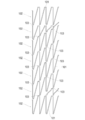
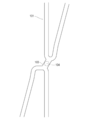
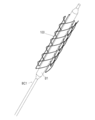
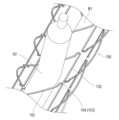
- FIG. 3 is a development view in which a part of the outer periphery of the stent according to the embodiment is developed by cutting linearly along the axial direction. It is the elements on larger scale which expand and show a weak part. It is an expanded view of the stent which shows arrangement
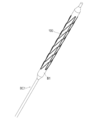
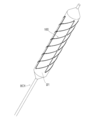
- 1 is a perspective view showing an embodiment of a stent expanded by a balloon.
- FIG. It is a perspective view which shows the state which deflated the balloon after stent expansion.
- the stent 100 of the embodiment has a strut 101 which is a linear component.
- the stent 100 has a configuration in which a cylindrical shape is formed by the struts 101.
- the strut 101 includes an outer peripheral portion 102 that extends around a cylindrical axial direction, and a connection portion 103 that connects the outer peripheral portions 102 to each other.
- connection portion 103 is provided in a gap formed between the outer peripheral portions 102.
- the outer peripheral portion 102 includes, for example, a spiral portion extending spirally around the axial direction (vertical direction in FIG. 2) of the stent 100 and an endless annular portion extending around the axial direction of the stent 100. At least one of the above.
- the annular portion is provided at both axial ends of the stent 100, and the spiral portion is provided therebetween, but the arrangement of the annular portion and the spiral portion is not particularly limited.
- the connecting portion 103 connects the outer peripheral portions 102 so as to be arranged coaxially in the axial direction of the stent 100.
- the arrangement of the connection unit 103 is not particularly limited. Moreover, the number of the connection parts 103 is not specifically limited.
- the outer peripheral portion 102 and the connecting portion 103 are integrally formed of a biodegradable polymer.
- the biodegradable polymer is not particularly limited as long as it is a polymer that gradually biodegrades in vivo and does not adversely affect the human or animal body.
- the biodegradable polymer is selected from the group consisting of aliphatic polyester, polyester, polyanhydride, polyorthoester, polycarbonate, polyphosphazene, polyphosphate ester, polyvinyl alcohol, polypeptide, polysaccharide, protein, cellulose, for example.
- At least one polymer, a copolymer obtained by arbitrarily copolymerizing monomers constituting the polymer, and a mixture of the polymer and / or the copolymer (herein, “mixture” refers to a polymer) It is preferably a broad concept including composites such as alloys.
- aliphatic polyesters are preferable because they have low reactivity with living tissue and can control degradation in vivo.
- the aliphatic polyester is not particularly limited, and for example, at least one polymer selected from the group consisting of polylactic acid, polyglycolic acid, polycaprolactone, etc., and any monomer constituting the polymer is arbitrary.
- the weight average molecular weight of the entire strut 101 including the outer peripheral portion 102 and the connecting portion 103 is, for example, 10,000 or more, but is not limited thereto.
- the weight average molecular weight of the entire strut 101 is preferably 10,000 to 1,000,000, more preferably 20,000 to 500,000, particularly preferably 50,000 to 200,000.
- Examples of the method for measuring the weight average molecular weight include GPC, light scattering method, viscosity measurement method, and mass spectrometry (TOFMASS etc.).
- the stent 100 has a configuration in which the entire strut 101 is integrally formed of a biodegradable polymer. Therefore, after the stent 100 functions as the stent 100, that is, after suppressing the vascular occlusion and restenosis rate in the acute phase, It is decomposed and absorbed by the body and disappears. This reduces the risk of late restenosis and thrombotic complications.
- a fragile portion 104 is formed in at least one connection portion 103.
- the fragile portion 104 is formed to be more fragile than other portions of the strut 101. Further, the fragile portion 104 may be formed in a part of the connection portion 103, or the entire connection portion 103 may be formed of the fragile portion 104. It is sufficient that at least the connection part in which the weak part is formed is easier to break than the other connection part in which the weak part is not formed.
- the fragile portion 104 is formed by, for example, forming a part of the strut 101 by adding a material having a different component from that of the biodegradable polymer forming the strut 101, or forming a shape such as a notch or a hole. It is not formed by imparting to a part of the strut 101 but by weakening the biodegradable polymer itself.
- the fragile portion 104 is not particularly limited as long as it includes the same constituent components as the other portions of the strut 101 and is formed by weakening of the biodegradable polymer itself.
- the fragile portion 104 is formed by making the weight average molecular weight of a part of the strut 101 lower than the weight average molecular weight of the entire strut 101.
- the weight average molecular weight of the fragile portion 104 is preferably 5% or more and 50% or less of the weight average molecular weight of the entire strut 101.
- the weight average molecular weight of the fragile portion 104 may be decreased by, for example, locally converging energy such as electron beam, radiation, infrared rays, or heat on the strut 101.
- biodegradable polymer itself is weakened by changing the blending ratio of the constituent components of the biodegradable polymer in the fragile portion 104 with the blending ratio of the constituent components in the other portions of the strut 101 to form the fragile portion 104. May be.
- the blending ratio of polyglycolic acid in the fragile portion 104 can be increased as compared with other portions.
- the biodegradation rate of the fragile portion 104 can be changed in addition to the strength. For example, if the weight average molecular weight of the fragile portion 104 is lowered, the fragile portion 104 decomposes and disappears earlier than other portions.
- the fragile portion 104 is formed in a plurality of connection portions 103.
- the strut 101 includes a spiral shape (thick black line in FIG. 4) that connects from one end to the other end in the axial direction (vertical direction in FIG. 4) without being interrupted by avoiding the fragile portion 104. That is, the fragile portion 104 is not disposed in this spiral portion. In the spiral portion shown by the thick black line in FIG. 4, the fragile portion 104 is not formed, and therefore it is difficult for breakage to occur.
- the stent 100 is transported to a branching portion of a lumen such as a blood vessel while being attached to the balloon B1 of the balloon catheter BC1. At this time, the balloon B1 and the stent 100 are contracted.
- a conventionally known balloon catheter BC1 can be used, and the balloon catheter BC1 and the stent 100 can be transported to a desired position in the lumen by a conventionally known procedure, and thus detailed description thereof will be omitted.
- the lumen in which the stent 100 is used is not limited to a blood vessel, and may be, for example, a bile duct, trachea, esophagus, other digestive tract, urethra, and the like.
- the balloon B1 After the delivery to the lumen branch, the balloon B1 is expanded as shown in FIG.
- the balloon B1 expands the stent 100 and expands a stenosis or occlusion that occurs in the bifurcation.
- the balloon B1 is deflated. At this time, the stent 100 maintains the expanded state.
- the expanded stent 100 secures the lumen by applying an expansion holding force to the lumen.
- the balloon B 2 of another balloon catheter BC 2 is inserted into the gap formed by the outer peripheral portion 102 of the stent 100.
- the balloon B2 is directed toward the lumen into which the balloon B1 is inserted and the other lumen branched.
- a conventionally known balloon catheter BC2 can be used.
- the balloon B2 applies a force that expands and pulls the outer peripheral portion 102 and the weakened portion 104 around the balloon B2.
- the fragile portion 104 is broken.
- the gap formed by the outer peripheral portion 102 widens and a large opening is formed. This facilitates transport of a medical instrument such as a catheter to the branch destination lumen to which the balloon B2 is directed.
- the balloon B1 is also expanded and pressed to hold the stent 100 against the inner wall of the lumen.
- the stent 100 when the fragile portion 104 is broken, a large force is hardly applied to other portions different from the fragile portion 104, for example, the outer peripheral portion 102, the connection portion 103 without the fragile portion 104, and the like. For this reason, even if the stent 100 is integrally formed of the biodegradable polymer, it is possible to prevent random collapse of the entire stent 100 during expansion.
- the weak part 104 is formed not in the outer peripheral part 102 but in the connection part 103, and disappearance of the outer peripheral part 102 due to breakage or decomposition is suppressed. Therefore, the stent 100 can effectively exert an expansion holding force from the outer peripheral portion 102 to the lumen.
- the strut 101 includes a spiral shape that is connected from end to end in the axial direction (vertical direction in FIG. 4) avoiding the fragile portion 104. For this reason, even if the fragile portion 104 is broken or preferentially disassembled and disappeared at a plurality of locations, the strut 101 maintains a state of being connected from end to end in the axial direction. Therefore, division of the stent 100 is prevented, and the stent 100 can stably exhibit its function.
- the weight average molecular weight of the fragile portion 104 is 50% or less of the weight average molecular weight of the entire strut 101, the strength of the fragile portion 104 is lower than that of the other portions of the strut 101. can do.
- the weight average molecular weight of the entire strut 101 is 10,000 or more, the strength of the entire stent 100 is ensured, so that the stent 100 can stably hold the expanded lumen.
- the fragile portion 104 can be easily broken. it can.
- the place where the fragile portion is formed is not limited to the connecting portion, and may be formed on a part of the strut different from the connecting portion, for example, the outer peripheral portion.
- the location where the stent of the present invention is used is not limited to the branch portion of the lumen.
- the stent of the present invention may be used at a location where there is no branch in the lumen, for example, a straight portion.
Landscapes
- Health & Medical Sciences (AREA)
- Engineering & Computer Science (AREA)
- Biomedical Technology (AREA)
- Heart & Thoracic Surgery (AREA)
- Life Sciences & Earth Sciences (AREA)
- Cardiology (AREA)
- Oral & Maxillofacial Surgery (AREA)
- Transplantation (AREA)
- Veterinary Medicine (AREA)
- Vascular Medicine (AREA)
- Public Health (AREA)
- Animal Behavior & Ethology (AREA)
- General Health & Medical Sciences (AREA)
- Optics & Photonics (AREA)
- Physics & Mathematics (AREA)
- Gastroenterology & Hepatology (AREA)
- Pulmonology (AREA)
- Media Introduction/Drainage Providing Device (AREA)
- Materials For Medical Uses (AREA)
Abstract
生分解性ポリマーによって形成されていたとしても、拡張時に全体がランダムに崩壊するのを防止し得るステントを提供する。 ステント(100)は、線状のストラット(101)によって円筒形状に形作られた構成を有する。ストラットは、円筒形状の軸方向のまわりに延在する外周部(102)と、外周部が形成する隙間で外周部同士を接続している接続部(103)と、を含むとともに、外周部および接続部が生分解性ポリマーによって一体に形成された構成を有する。また、ストラットの一部に、当該一部と異なるストラットの他の部分に比べて脆弱な脆弱部(104)を含み、脆弱部は、他の部分と同一の構成成分を含んだ状態で、生分解性ポリマー自体が脆弱化されている。
Description
本発明は、ステントに関する。
ステントは、血管等の管腔が狭窄もしくは閉塞することによって生じる様々な疾患を治療するために、狭窄もしくは閉塞部位を拡張し、内腔を確保するために使用される医療用具である。ステントは、外周が網目状に形成された略円筒形状を有し、径方向外側に拡張することによって、内腔を確保する拡張保持力を管腔に作用させる。
ステントは、管腔の直線部に加え、管腔の分岐部においても用いられる。分岐部で用いられる際、例えば特許文献1に記載されているように、ステントの一部を破断させてステント外周の隙間部分を広げることによって、分岐先の管腔へと連通する経路が確保される。
しかしながら、生分解性ポリマーによって形成されたステントが分岐部で用いられる場合、ステント外周の隙間を広げる際に過剰な力が無理に加えられると、生分解性ポリマーは一般的に金属に比べて強度が小さいため、ステントの一部だけが破断するのではなく、ステント全体にランダムな崩壊が生じ、その結果、所望の拡張保持力を管腔に作用させられなくなる虞がある。
本発明は、このような課題に鑑みてなされたものであり、生分解性ポリマーによって形成されていたとしても、拡張時に全体がランダムに崩壊するのを防止し得るステントを提供することを目的とする。
上記目的を達成するための本発明のステントは、線状のストラットによって円筒形状に形作られた構成を有するステントである。前記ストラットは、前記円筒形状の軸方向のまわりに延在する外周部と、当該外周部が形成する隙間で前記外周部同士を接続している接続部と、を有するとともに、前記外周部および前記接続部が生分解性ポリマーによって一体に形成された構成を有する。また、前記ストラットの一部に、当該一部と異なる前記ストラットの他の部分に比べて脆弱な脆弱部を含み、当該脆弱部は、前記他の部分と同一の構成成分を含んだ状態で、前記生分解性ポリマー自体が脆弱化されている。
上記のように構成したステントにおいては、脆弱部が破断することによって、脆弱部と異なる他の部分に大きな力が加わり難いため、生分解性ポリマーによってステントが形成されていたとしても、拡張時にステント全体にランダムな崩壊が生じるのを防止できる。
以下、図面を参照して本発明の実施形態を説明する。なお、図面の寸法比率は、説明の都合上、誇張されて実際の比率と異なる。
図1に示すように、実施形態のステント100は、線状の構成要素であるストラット101を有する。ステント100は、ストラット101によって円筒形状が形作られた構成を有する。ストラット101は、円筒形状の軸方向のまわりに延在する外周部102と、外周部102同士を接続する接続部103と、を含む。
図2に示すように、接続部103は、外周部102の間に形成される隙間に設けられている。
外周部102は、例えば、ステント100の軸方向(図2の上下方向)のまわりに螺旋状に延在する螺旋部、およびステント100の軸方向のまわりに延在する無端状の環状部のうちの少なくとも一方を含む。例えば、環状部がステント100の軸方向両端に設けられ、それらの間に螺旋部が設けられるが、環状部および螺旋部の配置は特に限定されない。
接続部103は、外周部102同士を、ステント100の軸方向に同軸的に並ぶように接続している。接続部103の配置は特に限定されない。また、接続部103の数は特に限定されない。
外周部102および接続部103は、生分解性ポリマーによって一体に形成されている。ここで、生分解性ポリマーは、生体内で徐々に生分解するポリマーであって、人間または動物の生体内に悪影響を及ぼさないポリマーであれば特に限定されない。
生分解性ポリマーは、例えば、脂肪族ポリエステル、ポリエステル、ポリ酸無水物、ポリオルソエステル、ポリカーボネート、ポリホスファゼン、ポリリン酸エステル、ポリビニルアルコール、ポリペプチド、多糖、タンパク質、セルロースからなる群から選択される少なくとも1つの重合体、前記重合体を構成する単量体が任意に共重合されてなる共重合体、ならびに前記重合体および/または前記共重合体の混合物(ここで「混合物」とは、ポリマーアロイなどの複合物なども含む広い概念である。)であることが好ましい。これらの中でも、脂肪族ポリエステルは、生体組織との反応性が低く、生体内での分解を制御することができるので好ましい。
脂肪族ポリエステルとしては、特に限定されるものではなく、例えば、ポリ乳酸、ポリグリコール酸、ポリカプロラクトン等からなる群から選択される少なくとも1つの重合体、前記重合体を構成する単量体が任意に共重合されてなる共重合体、ならびに前記重合体および/または前記共重合体の混合物である。
外周部102および接続部103を含むストラット101全体の重量平均分子量は、例えば、10,000以上であるが、これに限定されない。ストラット101全体の重量平均分子量は、好ましくは10,000~1,000,000、より好ましくは20,000~500,000、特に好ましくは50,000~200,000である。
重量平均分子量の測定方法として、例えば、GPC、光散乱法、粘度測定法、質量分析法(TOFMASS等)が挙げられる。
ステント100は、ストラット101全体が生分解性ポリマーによって一体に形成された構成を有するため、ステント100としての機能を果した後、すなわち、急性期の血管閉塞および再狭窄率を抑制した後、生体内に分解・吸収され消失される。このため、晩期における再狭窄や血栓性合併症の危険性が低い。
図3に示すように、少なくとも1つの接続部103に、脆弱部104が形成されている。脆弱部104は、ストラット101における他の部分に比べて脆弱に形成されている。また、脆弱部104は接続部103の一部に形成されていても、接続部103全体が脆弱部104で形成されていても良い。少なくとも、脆弱部を形成されていない他の接続部に比べて、脆弱部が形成されている接続部の方が破断し易ければ良い。
脆弱部104は、例えば、ストラット101を形成している生分解性ポリマーとは構成成分の異なる材料を別物として付け加えてストラット101の一部を形成すること、または、切欠きもしくは孔等の形状をストラット101の一部に付与すること等によってではなく、生分解性ポリマー自体を脆弱化させることによって形成されている。脆弱部104は、ストラット101の他の部分と同一の構成成分を含みつつ、生分解性ポリマー自体の脆弱化によって形成されるのであれば、特に限定されない。
例えば、脆弱部104は、ストラット101の一部の重量平均分子量を、ストラット101全体の重量平均分子量よりも低くすることによって形成される。この場合、脆弱部104の重量平均分子量は、好ましくは、ストラット101全体の重量平均分子量の5%以上50%以下である。
脆弱部104の重量平均分子量は、例えば、電子線、放射線、赤外線、または熱等のエネルギーを、ストラット101に局部的に収束させることによって低下させてもよい。
また、脆弱部104における生分解性ポリマーの構成成分の配合比を、ストラット101の他の部分における構成成分の配合比と変えることによって、生分解性ポリマー自体を脆弱化させて脆弱部104を形成してもよい。
その場合の例として、ポリ乳酸とポリグリコール酸との共重合体によって形成されたストラット101において、脆弱部104におけるポリグリコール酸の配合比を、他の部分に比べて高くすることが挙げられる。
脆弱部104の重量平均分子量または構成成分の配合比を、上述のように他の部分と変えることによって、強度に加え、脆弱部104の生分解速度を変えることができる。例えば、脆弱部104の重量平均分子量を低くすれば、脆弱部104は他の部分に比べて早期に分解して消失する。
図4に示すように、本実施形態では、脆弱部104は複数の接続部103に形成されている。ストラット101は、軸方向(図4の上下方向)における一端から他端まで、脆弱部104を避けて途切れることなく繋がる螺旋形状(図4の太い黒線)を含んでいる。つまり、脆弱部104は、この螺旋形状の部分には配置されていない。図4の黒い太線によって示す螺旋形状の部分では、脆弱部104が形成されていないため、破断が生じ難くなっている。
次に、ステント100の使用方法の一形態について説明する。
図5に示すように、ステント100は、バルーンカテーテルBC1のバルーンB1に取り付けられた状態で、血管等の管腔の分岐部へと搬送される。このとき、バルーンB1およびステント100は収縮している。バルーンカテーテルBC1としては従来公知のものを使用でき、また、従来公知の手技によってバルーンカテーテルBC1およびステント100を管腔内の所望の位置へと搬送できるため、それらについての詳述は省略する。
ステント100が用いられる管腔は、血管に限定されず、例えば、胆管、気管、食道、その他消化管、尿道等であってもよい。
管腔の分岐部への搬送後、図6に示すように、バルーンB1は拡張する。バルーンB1は、ステント100を拡張させるとともに、分岐部に生じた狭窄部または閉塞部を拡張させる。
図7に示すように、ステント100の拡張後、バルーンB1は収縮する。このとき、ステント100は、拡張状態を維持している。拡張したステント100は、管腔に拡張保持力を作用させて内腔を確保する。
その後、図8に示すように、他のバルーンカテーテルBC2のバルーンB2が、ステント100の外周部102によって形成される隙間に差し込まれる。バルーンB2は、バルーンB1が挿入されている管腔と分岐した他の管腔の方向に向けられる。バルーンカテーテルBC2としては従来公知のものを使用できる。
図9に示すように、バルーンB2は、そのまわりの外周部102および脆弱部104に対し、拡張してこれらを引っ張るような力を加える。このような力が作用すると、脆弱部104が破断する。その結果、外周部102が形成している隙間は広がり、大きな開口部が形成される。これによって、バルーンB2が向けられている分岐先の管腔へとカテーテル等の医療器具を搬送し易くなる。
バルーンB2の拡張とともに、バルーンB1も拡張し、ステント100を管腔の内壁に押し付けるように押圧して保持する。
次に、本実施形態の作用効果を述べる。
ステント100においては、脆弱部104が破断することによって、脆弱部104と異なる他の部分、例えば、外周部102、脆弱部104のない接続部103等に大きな力が加わり難い。このため、ステント100が生分解性ポリマーによって一体に形成されていたとしても、拡張時にステント100全体にランダムな崩壊が生じるのを防止できる。
脆弱部104は、外周部102ではなく接続部103に形成されており、外周部102の破断もしくは分解による消失が抑制される。このため、ステント100は、外周部102から管腔に拡張保持力を効果的に作用させることができる。
ストラット101には、図4の太い黒線によって示したように、脆弱部104を避けて軸方向(図4では上下方向)の端から端まで繋がる螺旋形状が含まれる。このため、たとえ脆弱部104が複数個所で破断もしくは優先的に分解して消失しても、ストラット101は、軸方向の端から端まで接続した状態を維持する。従って、ステント100の分断が防止され、ステント100は機能を安定的に発揮できる。
脆弱部104の重量平均分子量を、ストラット101全体の重量平均分子量の50%以下とすれば、脆弱部104の強度がストラット101の他の部分に比べて低下するため、脆弱部104を破断し易くすることができる。
ストラット101全体の重量平均分子量が10,000以上であれば、ステント100全体として強度が確保されるため、ステント100は、拡張させた管腔を安定的に保持できる。
生分解性ポリマーの構成成分の配合比を、脆弱部104とストラット101の他の部分とで異ならせることによって、脆弱部104の強度を低下させれば、脆弱部104を破断し易くすることができる。
本発明は、上述した実施形態に限定されるものではなく、特許請求の範囲内で種々改変できる。
例えば、脆弱部が形成される箇所は、接続部に限定されず、例えば外周部等、接続部と異なるストラットの一部に形成されてもよい。
また、本発明のステントが用いられる箇所は、管腔の分岐部に限定されない。本発明のステントは、管腔において分岐のない箇所、例えば直線部等で用いられてもよい。
本出願は、2014年12月26日に出願された日本特許出願番号2014-266471号に基づいており、それらの開示内容は、参照され、全体として、組み入れられている。
100 ステント、
101 ストラット、
102 外周部、
103 接続部、
104 脆弱部、
BC1、BC2 バルーンカテーテル、
B1、B2 バルーン。
101 ストラット、
102 外周部、
103 接続部、
104 脆弱部、
BC1、BC2 バルーンカテーテル、
B1、B2 バルーン。
Claims (6)
- 線状のストラットによって円筒形状に形作られた構成を有するステントであって、
前記ストラットは、前記円筒形状の軸方向のまわりに延在する外周部と、当該外周部が形成する隙間で前記外周部同士を接続している接続部と、を有するとともに、前記外周部および前記接続部が生分解性ポリマーによって一体に形成された構成を有し、
前記ストラットの一部に、当該一部と異なる前記ストラットの他の部分に比べて脆弱な脆弱部を含み、当該脆弱部は、前記他の部分と同一の構成成分を含んだ状態で前記生分解性ポリマー自体が脆弱化されている、ステント。 - 前記脆弱部は、前記接続部に形成されている、請求項1に記載のステント。
- 前記ストラットには、前記円筒形状の軸方向における一端から他端まで、前記脆弱部を避けて途切れることなく繋がる螺旋形状が含まれている、請求項1または請求項2に記載のステント。
- 前記脆弱部の重量平均分子量は、前記ストラット全体の重量平均分子量の50%以下である、請求項1~請求項3のうちのいずれか1つに記載のステント。
- 前記ストラット全体の重量平均分子量が10,000以上である、請求項1~請求項4のうちのいずれか1つに記載のステント。
- 前記脆弱部における前記生分解性ポリマーの構成成分の配合比は、前記ストラットの他の部分における前記構成成分の配合比と異なる、請求項1~請求項5のうちのいずれか1つに記載のステント。
Priority Applications (3)
| Application Number | Priority Date | Filing Date | Title |
|---|---|---|---|
| EP15872697.6A EP3238668A4 (en) | 2014-12-26 | 2015-12-07 | Stent |
| JP2016566092A JPWO2016104128A1 (ja) | 2014-12-26 | 2015-12-07 | ステント |
| US15/625,332 US20170281378A1 (en) | 2014-12-26 | 2017-06-16 | Stent |
Applications Claiming Priority (2)
| Application Number | Priority Date | Filing Date | Title |
|---|---|---|---|
| JP2014-266471 | 2014-12-26 | ||
| JP2014266471 | 2014-12-26 |
Related Child Applications (1)
| Application Number | Title | Priority Date | Filing Date |
|---|---|---|---|
| US15/625,332 Continuation US20170281378A1 (en) | 2014-12-26 | 2017-06-16 | Stent |
Publications (1)
| Publication Number | Publication Date |
|---|---|
| WO2016104128A1 true WO2016104128A1 (ja) | 2016-06-30 |
Family
ID=56150158
Family Applications (1)
| Application Number | Title | Priority Date | Filing Date |
|---|---|---|---|
| PCT/JP2015/084319 Ceased WO2016104128A1 (ja) | 2014-12-26 | 2015-12-07 | ステント |
Country Status (4)
| Country | Link |
|---|---|
| US (1) | US20170281378A1 (ja) |
| EP (1) | EP3238668A4 (ja) |
| JP (1) | JPWO2016104128A1 (ja) |
| WO (1) | WO2016104128A1 (ja) |
Families Citing this family (3)
| Publication number | Priority date | Publication date | Assignee | Title |
|---|---|---|---|---|
| US9592138B1 (en) | 2015-09-13 | 2017-03-14 | Martin Mayse | Pulmonary airflow |
| WO2023004362A1 (en) * | 2021-07-20 | 2023-01-26 | Apreo Health, Inc. | Endobronchial implants and related technology |
| US20230079131A1 (en) * | 2021-09-13 | 2023-03-16 | Covidien Lp | Implantable channel guides and methods and kits thereof |
Citations (7)
| Publication number | Priority date | Publication date | Assignee | Title |
|---|---|---|---|---|
| JPH11221288A (ja) * | 1997-10-21 | 1999-08-17 | Cordis Corp | 多重ブリッジ形接合部を有する内視鏡手術用プロテーゼとその操作法 |
| WO2003020175A1 (en) * | 2001-08-31 | 2003-03-13 | Scimed Life Systems, Inc. | Hybrid balloon expandable /self-expanding stent |
| JP2009523048A (ja) * | 2006-01-13 | 2009-06-18 | メディノール リミテッド | ハイブリッドステント |
| US20110066225A1 (en) * | 2009-09-17 | 2011-03-17 | Mikael Trollsas | Bioabsorbable Stent With Time Dependent Structure And Properties And Regio-Selective Degradation |
| WO2013065218A1 (ja) * | 2011-11-02 | 2013-05-10 | 二プロ株式会社 | ステント |
| WO2013126708A1 (en) * | 2012-02-23 | 2013-08-29 | Celonova Stent, Inc. | Stent having at least one connecting member configured to controllably sever in vivo |
| JP2014531275A (ja) * | 2011-10-03 | 2014-11-27 | アボット カーディオヴァスキュラー システムズ インコーポレイテッド | 末梢用途のための改良されたスキャフォールド |
Family Cites Families (3)
| Publication number | Priority date | Publication date | Assignee | Title |
|---|---|---|---|---|
| EP2374434B1 (en) * | 2006-09-06 | 2016-03-02 | Cook Medical Technologies LLC | Stents with connectors and stabilizing biodegradable elements |
| WO2008117315A1 (en) * | 2007-03-23 | 2008-10-02 | Invatec Technology Center Gmbh | Endoluminal prosthesis |
| WO2009041664A1 (ja) * | 2007-09-27 | 2009-04-02 | Terumo Kabushiki Kaisha | ステントおよび生体器官拡張器具 |
-
2015
- 2015-12-07 WO PCT/JP2015/084319 patent/WO2016104128A1/ja not_active Ceased
- 2015-12-07 EP EP15872697.6A patent/EP3238668A4/en not_active Withdrawn
- 2015-12-07 JP JP2016566092A patent/JPWO2016104128A1/ja active Pending
-
2017
- 2017-06-16 US US15/625,332 patent/US20170281378A1/en not_active Abandoned
Patent Citations (7)
| Publication number | Priority date | Publication date | Assignee | Title |
|---|---|---|---|---|
| JPH11221288A (ja) * | 1997-10-21 | 1999-08-17 | Cordis Corp | 多重ブリッジ形接合部を有する内視鏡手術用プロテーゼとその操作法 |
| WO2003020175A1 (en) * | 2001-08-31 | 2003-03-13 | Scimed Life Systems, Inc. | Hybrid balloon expandable /self-expanding stent |
| JP2009523048A (ja) * | 2006-01-13 | 2009-06-18 | メディノール リミテッド | ハイブリッドステント |
| US20110066225A1 (en) * | 2009-09-17 | 2011-03-17 | Mikael Trollsas | Bioabsorbable Stent With Time Dependent Structure And Properties And Regio-Selective Degradation |
| JP2014531275A (ja) * | 2011-10-03 | 2014-11-27 | アボット カーディオヴァスキュラー システムズ インコーポレイテッド | 末梢用途のための改良されたスキャフォールド |
| WO2013065218A1 (ja) * | 2011-11-02 | 2013-05-10 | 二プロ株式会社 | ステント |
| WO2013126708A1 (en) * | 2012-02-23 | 2013-08-29 | Celonova Stent, Inc. | Stent having at least one connecting member configured to controllably sever in vivo |
Non-Patent Citations (1)
| Title |
|---|
| See also references of EP3238668A4 * |
Also Published As
| Publication number | Publication date |
|---|---|
| JPWO2016104128A1 (ja) | 2017-10-05 |
| US20170281378A1 (en) | 2017-10-05 |
| EP3238668A4 (en) | 2018-08-15 |
| EP3238668A1 (en) | 2017-11-01 |
Similar Documents
| Publication | Publication Date | Title |
|---|---|---|
| CA2593945C (en) | Twisted anchoring barb for stent of abdominal aortic aneurysm (aaa) device | |
| US8323350B2 (en) | Duodenum stent and associated method | |
| Hinchliffe et al. | “Paving and cracking”: an endovascular technique to facilitate the introduction of aortic stent-grafts through stenosed iliac arteries | |
| US8388673B2 (en) | Polymeric stent | |
| EP2004253B1 (en) | Stent, intraluminal stent delivery system, and method of treating a vascular condition | |
| US20050222671A1 (en) | Partially biodegradable stent | |
| US20030065386A1 (en) | Radially expandable endoprosthesis device with two-stage deployment | |
| CN112399832A (zh) | 在扩张时缩短从而为血管运动产生空间的可吸收血管内装置 | |
| CN102858280A (zh) | 具有生物不可降解端部和用于增大的支架环绕强度的机构的生物可降解支架 | |
| CA2513857A1 (en) | Low deployment force delivery device | |
| JP2009050715A (ja) | らせん要素を有するクリンプ(縮らす)可能な管腔内部人工装具 | |
| CN106456347A (zh) | 减少肉芽和炎症的支架设计 | |
| JP2005533557A (ja) | 管腔内拡張システム | |
| EP2409655A2 (en) | False lumen occluder | |
| Janík et al. | Biodegradable polydioxanone stents: a new option for therapy-resistant anastomotic strictures of the colon | |
| Kische et al. | Technique of interventional repair in adult aortic coarctation | |
| JPWO2016104128A1 (ja) | ステント | |
| US20130226279A1 (en) | Systems and methods for delivering a stent to a body lumen | |
| KR101273034B1 (ko) | 생분해성 약물전달 필름을 구비하는 생분해성 스텐트 | |
| JP6425981B2 (ja) | 自己拡張型ステント | |
| US9877853B2 (en) | Stent having added feature for strain relief and mitigation of crack propagation | |
| JP2012061063A (ja) | ステントデリバリーシステム | |
| WO2017158985A1 (ja) | ステント | |
| CN101917941A (zh) | 带有弯曲支柱的医疗装置 | |
| US20170304094A1 (en) | Stent and method for producing stent |
Legal Events
| Date | Code | Title | Description |
|---|---|---|---|
| 121 | Ep: the epo has been informed by wipo that ep was designated in this application |
Ref document number: 15872697 Country of ref document: EP Kind code of ref document: A1 |
|
| REEP | Request for entry into the european phase |
Ref document number: 2015872697 Country of ref document: EP |
|
| ENP | Entry into the national phase |
Ref document number: 2016566092 Country of ref document: JP Kind code of ref document: A |
|
| NENP | Non-entry into the national phase |
Ref country code: DE |