WO2016107524A1 - 数据发送方法、获取方法、发送装置及获取装置 - Google Patents
数据发送方法、获取方法、发送装置及获取装置 Download PDFInfo
- Publication number
- WO2016107524A1 WO2016107524A1 PCT/CN2015/099248 CN2015099248W WO2016107524A1 WO 2016107524 A1 WO2016107524 A1 WO 2016107524A1 CN 2015099248 W CN2015099248 W CN 2015099248W WO 2016107524 A1 WO2016107524 A1 WO 2016107524A1
- Authority
- WO
- WIPO (PCT)
- Prior art keywords
- protocol data
- radio frame
- station
- data
- information
- Prior art date
- Legal status (The legal status is an assumption and is not a legal conclusion. Google has not performed a legal analysis and makes no representation as to the accuracy of the status listed.)
- Ceased
Links
Images




Classifications
-
- H—ELECTRICITY
- H04—ELECTRIC COMMUNICATION TECHNIQUE
- H04L—TRANSMISSION OF DIGITAL INFORMATION, e.g. TELEGRAPHIC COMMUNICATION
- H04L12/00—Data switching networks
- H04L12/02—Details
- H04L12/16—Arrangements for providing special services to substations
- H04L12/18—Arrangements for providing special services to substations for broadcast or conference, e.g. multicast
- H04L12/189—Arrangements for providing special services to substations for broadcast or conference, e.g. multicast in combination with wireless systems
-
- H—ELECTRICITY
- H04—ELECTRIC COMMUNICATION TECHNIQUE
- H04L—TRANSMISSION OF DIGITAL INFORMATION, e.g. TELEGRAPHIC COMMUNICATION
- H04L12/00—Data switching networks
- H04L12/28—Data switching networks characterised by path configuration, e.g. LAN [Local Area Networks] or WAN [Wide Area Networks]
- H04L12/46—Interconnection of networks
- H04L12/4633—Interconnection of networks using encapsulation techniques, e.g. tunneling
-
- H—ELECTRICITY
- H04—ELECTRIC COMMUNICATION TECHNIQUE
- H04L—TRANSMISSION OF DIGITAL INFORMATION, e.g. TELEGRAPHIC COMMUNICATION
- H04L61/00—Network arrangements, protocols or services for addressing or naming
- H04L61/09—Mapping addresses
- H04L61/25—Mapping addresses of the same type
- H04L61/2503—Translation of Internet protocol [IP] addresses
- H04L61/2592—Translation of Internet protocol [IP] addresses using tunnelling or encapsulation
-
- H—ELECTRICITY
- H04—ELECTRIC COMMUNICATION TECHNIQUE
- H04W—WIRELESS COMMUNICATION NETWORKS
- H04W12/00—Security arrangements; Authentication; Protecting privacy or anonymity
- H04W12/02—Protecting privacy or anonymity, e.g. protecting personally identifiable information [PII]
-
- H—ELECTRICITY
- H04—ELECTRIC COMMUNICATION TECHNIQUE
- H04W—WIRELESS COMMUNICATION NETWORKS
- H04W12/00—Security arrangements; Authentication; Protecting privacy or anonymity
- H04W12/03—Protecting confidentiality, e.g. by encryption
- H04W12/033—Protecting confidentiality, e.g. by encryption of the user plane, e.g. user's traffic
-
- H—ELECTRICITY
- H04—ELECTRIC COMMUNICATION TECHNIQUE
- H04W—WIRELESS COMMUNICATION NETWORKS
- H04W28/00—Network traffic management; Network resource management
- H04W28/02—Traffic management, e.g. flow control or congestion control
- H04W28/06—Optimizing the usage of the radio link, e.g. header compression, information sizing, discarding information
- H04W28/065—Optimizing the usage of the radio link, e.g. header compression, information sizing, discarding information using assembly or disassembly of packets
-
- H—ELECTRICITY
- H04—ELECTRIC COMMUNICATION TECHNIQUE
- H04W—WIRELESS COMMUNICATION NETWORKS
- H04W72/00—Local resource management
- H04W72/04—Wireless resource allocation
- H04W72/044—Wireless resource allocation based on the type of the allocated resource
- H04W72/0446—Resources in time domain, e.g. slots or frames
-
- H—ELECTRICITY
- H04—ELECTRIC COMMUNICATION TECHNIQUE
- H04W—WIRELESS COMMUNICATION NETWORKS
- H04W74/00—Wireless channel access
- H04W74/08—Non-scheduled access, e.g. ALOHA
-
- H—ELECTRICITY
- H04—ELECTRIC COMMUNICATION TECHNIQUE
- H04L—TRANSMISSION OF DIGITAL INFORMATION, e.g. TELEGRAPHIC COMMUNICATION
- H04L2209/00—Additional information or applications relating to cryptographic mechanisms or cryptographic arrangements for secret or secure communication H04L9/00
- H04L2209/80—Wireless
Definitions
- the present invention relates to the field of communications, and in particular to a data transmission method, an acquisition method, a transmission device, and an acquisition device.
- WLANs Wireless Local Area Networks
- IEEE802.11 working group of the Institute of Electrical and Electronics Engineers has defined a series of WLAN technology standards such as 802.11a, 802.11b, 802.11g, 802.11n, etc., mainly to develop physical layer (Physical Layer, PHY for short) and media access control ( Media Access Control, referred to as the MAC layer layer specification.
- PHY Physical Layer
- MAC layer layer specification Media Access Control
- other task groups have emerged to develop specifications that are related to the existing 802.11 technology improvements.
- the High Efficiency WLAN (HEW) task group mainly studies how to make WLAN networks implement data in dense network scenarios. Efficient transmission.
- HEW High Efficiency WLAN
- the basic architecture of a WLAN is a Basic Service Set (BSS) consisting of a station (Station, abbreviated as STA).
- BSS Basic Service Set
- the BSS includes an access point station (AP) and an AP.
- AP access point station
- AP access point station
- AP access point station
- PCF scheduling-based access method-point coordination function
- PCF scheduling-based access method-point coordination function
- DCF is the most basic channel access mode, and uses multiple carrier sense multiple access mechanisms (CSMA with Collision Avoidance, CSMA/CA for short) to enable multiple STAs to share wireless channels.
- EDCA is an enhanced channel access mode. Based on the CSMA/CA mechanism, EDCA defines four access categories (Access Categories, AC for short), which are the background access category (AC Background, AC_BK for short). Access category (AC Best Effort, AC_BE for short), video access category (AC Video, AC_VI for short), and voice access category (AC Voice for short), each AC defines a specific set of parameters. These parameters statistically specify the priority level of each AC for channel access.
- the STA obtains a TXOP through the channel access procedure.
- One TXOP refers to a bounded period in which the STA can transmit a specific communication category.
- the STA can continue to transmit data frames or control frames according to the AC. , or manage frames, or receive response frames.
- the access point AP may transmit data of multiple users in one AC queue in one TXOP, but each user data is independently packaged in different radio frames, each radio frame has a physical frame header overhead, and at least the interval is short. Inter-frame space (Short Interframe Space, referred to as SIFS) is transmitted.
- SIFS Short Interframe Space
- the service access priority competition channel is too low in point-to-point push efficiency, and is transmitted through a multi-user transmission method such as Orthogonal Frequency Division Multiple Access (OFDMA) or multi-user multiple input and multiple output (Multi- The User Multiple-Input Multiple-Output (MU-MIMO) technology is also only for a small number of multi-users, and still cannot solve the channel competition and overhead caused by the small data transmission of massive users.
- OFDMA Orthogonal Frequency Division Multiple Access
- MU-MIMO Multi- The User Multiple-Input Multiple-Output
- the present invention provides a data transmission method, an acquisition method, a transmission device, and an acquisition device, so as to at least solve the problem that the channel competition is fierce and the overhead is large when the data is transmitted in the related art.
- a data transmitting method including: a first station separately encapsulates data that needs to be sent to a plurality of second sites in different protocol data units, wherein the protocol data unit includes media access Controlling a MAC layer protocol data unit and/or a physical layer protocol data unit; the first station concatenates protocol data units encapsulating the data into a radio frame; the first station transmits the radio frame to a A plurality of second sites are described.
- the first station before sending the radio frame to the multiple second sites, further includes: the first site, corresponding to the data, for identifying the plurality of second The identification information of the site is encapsulated in the radio frame.
- the first station encapsulates the identifier information in the radio frame by using at least one of the following manners: The first station encapsulates the identification information in a protocol data unit, and concatenates the protocol data unit encapsulating the identification information with a protocol data unit encapsulating the data into the radio frame. The first station encapsulates the identifier information in a physical layer signaling domain of the radio frame; and the first station respectively encapsulates the identifier information in a protocol data unit encapsulating the data.
- the first station encrypts a protocol data unit encapsulating the data by a private key of a second site corresponding to the data; and/or, the first site pair encapsulates the The protocol data unit of the identification information is encrypted by the group key.
- the identifier information includes at least one of the following: the identification identifier information of the multiple second sites, the packet identifier information of the multiple second sites, and the data presence indication of the multiple second sites. Information, location information of protocol data units of the plurality of second sites, number information of protocol data units of the plurality of second sites, and address information corresponding to the plurality of second sites.
- the protocol data units encapsulated with the data respectively correspond to the same or different second sites, and when the protocol data unit includes the MAC layer protocol data unit, the MAC layer protocol data of the data is encapsulated.
- the frame header of the unit includes at least one of the following information: address information corresponding to the second site; and an acknowledgement feedback policy corresponding to the second site.
- the radio frame includes indication information of data that needs to be sent to a plurality of second stations; and receiving address identification information for identifying a broadcast address or a multicast address.
- the frame header of the MAC layer protocol data unit encapsulated with the identifier information includes broadcast or multicast receiving address information and/or The confirmation feedback strategy corresponding to the second site.
- the first station concatenates the MAC layer protocol data unit encapsulated with the data into the radio frame, including: the first site
- the MAC layer protocol data unit encapsulating the data is concatenated into the radio frame by a predetermined format, where the predetermined format includes at least one of: MAC layer protocol data unit length information, verification information, The first specific spacer, the first filler.
- the protocol data unit includes the physical layer protocol data unit
- the physical layer protocol data units encapsulated with the data respectively correspond to the same or different second sites, and the physical layer of the data is encapsulated.
- the physical layer signaling domain of the protocol data unit includes at least one of the following information: indication information indicating that the radio frame includes data that needs to be sent to multiple second sites; the physical layer protocol data unit length information; Identification information corresponding to the second site; for indicating a physical layer protocol data unit encapsulated with the data Whether there is also indication information of the physical layer protocol data unit; the physical layer transmission parameter, wherein the physical layer transmission parameter includes at least: a modulation coding mode.
- the physical layer signaling domain includes at least one of the following information: used to indicate the The radio frame includes indication information of data to be sent to the plurality of second stations; the physical layer protocol data unit length information; broadcast or multicast receiving address identification information; and a physical layer protocol data unit for indicating that the data is encapsulated Whether there is further indication information of the physical layer protocol data unit; the physical layer transmission parameter, wherein the physical layer transmission parameter includes at least: a modulation and coding mode.
- the first station concatenates the physical layer protocol data unit encapsulated with the data into the radio frame, including: the first site Physical layer protocol data units encapsulated with the data are cascaded in the radio frame in a direct sequence; and/or the first station encapsulates the physical layer protocol data unit level of the data by a predetermined format
- the predetermined format includes at least one of the following: a second filler, a second specific spacer.
- the sending, by the first station, the radio frame to the multiple second stations includes: the first station acquiring a transmission opportunity for sending the radio frame; The transmission opportunity transmits the wireless frame to the plurality of second stations.
- the acquiring, by the first station, the transmission opportunity for sending the radio frame includes: the first station adopts an enhanced distributed coordinated access function EDCA mode to perform channel competition by using a channel access parameter of a corresponding priority, Obtain the transmission opportunity.
- the first station adopts an enhanced distributed coordinated access function EDCA mode to perform channel competition by using a channel access parameter of a corresponding priority
- the sending, by the first station, the radio frame to the multiple second stations by using the transmission opportunity comprises: after the specific inter-frame interval after sending the system message frame, the first station Transmitting a radio frame to the plurality of second stations; and/or, the first station transmitting the radio frame to the plurality of second sites on a pre-assigned resource for transmitting the radio frame .
- a data acquisition method including: receiving, by a second station, a radio frame sent by a first station, where the radio frame includes a concatenated protocol data unit encapsulated with data,
- the protocol data unit includes a media access control MAC layer protocol data unit and/or a physical layer protocol data unit; the second station determines whether the wireless frame carries data that needs to be acquired by the second station; If the determination result is yes, the second station acquires data in the radio frame.
- the determining, by the second station, whether the radio frame carries the data that needs to be acquired by the second station the second station determining, according to at least one of the following information, whether the radio frame carries The identification information or the address information of the second site: the identifier information of the site in the physical layer signaling domain of the radio frame for identifying the site corresponding to the data, and the encapsulation in the protocol data unit of the radio frame For identification and the data
- the second station determines, according to the identifier information that is used in the physical layer signaling domain of the radio frame to identify a site corresponding to the data, whether the second site is carried in the radio frame. Determining, by the second station, whether the second station is carried in the radio frame according to at least one of the following information carried in the identifier information encapsulated in the physical layer signaling domain of the radio frame Identification information of the second site, packet identification information of the second site, data presence indication information of the second site, location information of data of the second site, and the second The number information of the site and the address information corresponding to the second site.
- the second station determines, according to the identifier information encapsulated in the protocol data unit of the radio frame, the identifier of the site corresponding to the data, whether the identifier of the second station is carried in the radio frame.
- the information includes: the second station determining, according to at least one of the following information carried in the identifier information encapsulated in the protocol data unit of the radio frame, whether the identifier information of the second station is carried in the radio frame: Identification information of the second site, packet identification information of the second site, data presence indication information of the second site, location information of data of the second site, data of the second site The number information and the address information corresponding to the second site.
- the second station determines, according to the address information of the station that needs to acquire data included in a frame header of the protocol data unit that encapsulates the data in the wireless detection, whether the wireless frame carries the
- the address information of the second station includes: the second station sequentially decodes the protocol data unit encapsulated with the data in the wireless detection; and the second station determines whether the frame header of the protocol data unit encapsulated with the data carries There is address information of the second site; if the determination result is yes, it is determined that the wireless information carries the address information of the second site.
- a data transmitting apparatus configured to be applied to a first site, comprising: a first encapsulating module configured to encapsulate data to be sent to a plurality of second sites in different protocols a data unit, wherein the protocol data unit comprises a media access control MAC layer protocol data unit and/or a physical layer protocol data unit; a concatenation module configured to concatenate protocol data units encapsulated with the data into a radio frame And a sending module configured to send the wireless frame to the plurality of second stations.
- a first encapsulating module configured to encapsulate data to be sent to a plurality of second sites in different protocols a data unit, wherein the protocol data unit comprises a media access control MAC layer protocol data unit and/or a physical layer protocol data unit
- a concatenation module configured to concatenate protocol data units encapsulated with the data into a radio frame
- a sending module configured to send the wireless frame to the plurality of second stations.
- the data sending apparatus further includes: a second encapsulating module, configured to encapsulate the identifier information corresponding to the data for identifying the plurality of second sites in the radio frame.
- a second encapsulating module configured to encapsulate the identifier information corresponding to the data for identifying the plurality of second sites in the radio frame.
- the data sending apparatus further includes: a first encryption module, configured to encrypt a protocol data unit encapsulating the data by a private key of the second site corresponding to the data; and/or, Second encryption The module is configured to encrypt the protocol data unit encapsulating the identification information by a group key.
- a first encryption module configured to encrypt a protocol data unit encapsulating the data by a private key of the second site corresponding to the data
- Second encryption The module is configured to encrypt the protocol data unit encapsulating the identification information by a group key.
- the sending module includes: an acquiring unit, configured to acquire a transmission opportunity for transmitting the radio frame; and a sending unit, configured to send the radio frame to the plurality of second by using the transmission opportunity Site.
- a data acquisition apparatus configured to be applied to a second base station, comprising: a receiving module, configured to receive a radio frame sent by a first station, wherein the radio frame includes a level And a protocol data unit encapsulated with data, wherein the protocol data unit includes a media access control MAC layer protocol data unit and/or a physical layer protocol data unit; and the determining module is configured to determine whether the wireless frame carries The second site needs to acquire data; and the acquiring module is configured to acquire data in the radio frame if the judgment result of the determining module is yes.
- the determining module includes: a determining unit, configured to determine, according to at least one of the following information, whether the wireless frame carries identification information or address information of the second station: a physical layer of the wireless frame And identifying, in the domain, identifier information for identifying a site corresponding to the data, identifier information encapsulated in a protocol data unit of the radio frame, and identifying a site corresponding to the data, the wireless detection package Address information of a station that needs to acquire data included in a header of a protocol data unit having the data; and a determining unit configured to determine that the wireless detection is carried in a case where the determination result of the determining unit is yes The second site needs to acquire data.
- a determining unit configured to determine, according to at least one of the following information, whether the wireless frame carries identification information or address information of the second station: a physical layer of the wireless frame And identifying, in the domain, identifier information for identifying a site corresponding to the data, identifier information encapsulated in a protocol
- protocol data units include media access control MAC layer protocol data units and/or physical layer protocols.
- a data unit the first station concatenates protocol data units encapsulated with the data into a radio frame; and the first station sends the radio frame to the multiple second sites, which solves the related art
- the channel competition is fierce and the overhead is large, thereby achieving the effect of reducing channel competition and reducing overhead.
- FIG. 1 is a schematic diagram of an EDCA contention access mechanism in the related art
- FIG. 2 is a flowchart of a data transmitting method according to an embodiment of the present invention.
- FIG. 3 is a flowchart of a data acquisition method according to an embodiment of the present invention.
- FIG. 4 is a block diagram showing the structure of a data transmitting apparatus according to an embodiment of the present invention.
- FIG. 5 is a block diagram showing a first preferred structure of a data transmitting apparatus according to an embodiment of the present invention.
- FIG. 6 is a block diagram showing a second preferred structure of a data transmitting apparatus according to an embodiment of the present invention.
- FIG. 7 is a structural block diagram of a transmitting module 46 in a data transmitting apparatus according to an embodiment of the present invention.
- FIG. 8 is a structural block diagram of a data acquisition apparatus according to an embodiment of the present invention.
- FIG. 9 is a structural block diagram of a determining module 84 in a data acquiring apparatus according to an embodiment of the present invention.
- FIG. 10 is a schematic diagram of a format of a first type of radio frame according to Embodiment 1 of the present invention.
- FIG. 11 is a schematic diagram of a format of a second radio frame according to Embodiment 1 of the present invention.
- FIG. 12 is a schematic diagram of a format of a third radio frame according to Embodiment 1 of the present invention.
- FIG. 13 is a schematic diagram of a format of a radio frame according to Embodiment 2 of the present invention.
- FIG. 14 is a schematic diagram of a format of a radio frame according to Embodiment 3 of the present invention.
- FIG. 15 is a schematic diagram of a format of a radio frame according to Embodiment 4 of the present invention.
- FIG. 16 is a schematic diagram of a format of a radio frame according to Embodiment 5 of the present invention.
- FIG. 17 is a schematic diagram of a format of a radio frame according to Embodiment 6 of the present invention.
- FIG. 18 is a schematic diagram of a format of a radio frame according to Embodiment 7 of the present invention.
- FIG. 21 is a schematic diagram of radio frame transmission according to Embodiment 10 of the present invention.
- FIG. 2 is a flowchart of a data sending method according to an embodiment of the present invention. As shown in FIG. 2, the process includes the following steps:
- Step S202 The first station encapsulates data that needs to be sent to multiple second sites in different protocol data units, where the protocol data unit includes a media access control MAC layer protocol data unit and/or a physical layer protocol data unit.
- the protocol data unit includes a media access control MAC layer protocol data unit and/or a physical layer protocol data unit.
- Step S204 the first station concatenates the protocol data unit encapsulated with data into the radio frame
- Step S206 the first station sends the radio frame to the plurality of second stations.
- the method of cascading protocol data units encapsulated with data in a radio frame can achieve the purpose of transmitting data to multiple stations through one radio frame, thereby reducing channel competition and effectively solving the related technologies.
- the channel competition is fierce and the overhead is large, thereby achieving the effect of reducing channel competition and reducing overhead.
- the first station may also encapsulate the identification information associated with the second station in the wireless frame before transmitting the wireless frame to the plurality of second stations.
- the wireless frame is at the first station.
- the method further includes: the first site encapsulates the identifier information corresponding to the data for identifying the plurality of second sites in the wireless frame. Therefore, it is ensured that after receiving the wireless frame, the second station may determine, according to the identification information, whether the wireless frame includes data that it needs to receive.
- the first site may encapsulate the identification information in the radio frame by at least one of the following manners: the first site will The identification information is encapsulated in a protocol data unit, and the protocol data unit encapsulating the identification information and the protocol data unit encapsulating the data are concatenated in the radio frame; the first station encapsulates the identification information in the physical layer signaling of the radio frame The first site encapsulates the identification information in a protocol data unit encapsulated with data.
- the protocol data unit in the radio frame may be encrypted before being sent to the multiple second sites, and the encrypted protocol data unit may be all protocol data units or partial protocol data units. . Moreover, the encrypted data protocol unit may be an independent encryption unit. The method for encrypting the protocol data unit may be multiple.
- the protocol data unit may be encrypted by: the first station is configured to correspond to the data by the protocol data unit encapsulating the data. The private key of the second site is encrypted; and/or, the first site encrypts the protocol data unit encapsulated with the identification information by the group key. That is, the protocol data unit encapsulated with the data to be sent to the second base station may be different from the protocol data unit encapsulated with the identification information, thereby ensuring the reliability of data transmission.
- the foregoing identification information includes at least one of the following information: identification identifier information of the plurality of second sites, group identification information of the plurality of second sites, data presence indication information of the plurality of second sites, and protocol data units of the plurality of second sites.
- identification identifier information of the plurality of second sites group identification information of the plurality of second sites, data presence indication information of the plurality of second sites, and protocol data units of the plurality of second sites.
- the location information the number of protocol data units of the plurality of second sites, and the address information corresponding to the plurality of second sites.
- the protocol data units encapsulated with data respectively correspond to the same or different second stations.
- the frame header of the MAC layer protocol data unit encapsulated with data may include at least the following information. One: address information corresponding to the second site; and an acknowledgement feedback policy corresponding to the second site.
- the physical layer signaling domain may carry at least one of the following information: indication information indicating that the radio frame includes data to be sent to the plurality of second stations; and receiving address identification information for identifying the broadcast address or the multicast address.
- the frame header of the MAC layer protocol data unit encapsulated with the identification information may include broadcast or multicast receiving address information and/or an acknowledgement feedback policy corresponding to the second station.
- the plurality of protocol data units may be concatenated into the radio frame, and the manner of cascading is various.
- the protocol data unit when the protocol data unit is used
- the first station concatenates the MAC layer protocol data unit encapsulated with data into the radio frame, including: the first station concatenates the MAC layer protocol data unit encapsulated with data into the wireless by using a predetermined format.
- the predetermined format includes at least one of the following: MAC layer protocol data unit length information, check information, a first specific spacer, and a first filler.
- the physical layer protocol data units encapsulated with data respectively correspond to the same or different second sites, and the physical layer signaling domain of the physical layer protocol data unit encapsulated with data may include At least one of the following information: indication information indicating that the radio frame includes data to be sent to the plurality of second stations; physical layer protocol data unit length information; identification information corresponding to the second station; and indicating that the data is encapsulated
- the physical layer protocol data unit is followed by the indication information of the physical layer protocol data unit; the physical layer transmission parameter, where the physical layer transmission parameter includes at least: a modulation and coding mode.
- the physical layer protocol data unit encapsulated with the identification information includes: at least one of the following information: indicating that the radio frame includes a need to be sent to multiple second sites The indication information of the data; the physical layer protocol data unit length information; the broadcast or multicast receiving address identification information; the indication information indicating whether the physical layer protocol data unit is further encapsulated with the physical layer protocol data unit; the physical layer And a transmission parameter, where the physical layer transmission parameter includes at least: a modulation coding mode.
- the plurality of protocol data units may be concatenated into the radio frame, and the manner of cascading is various.
- the protocol data unit when used When the physical layer protocol data unit is included, the first station concatenates the physical layer protocol data unit encapsulated with data into the radio frame, including: the first station concatenates the physical layer protocol data unit encapsulated with data in a direct sequence to the radio frame And/or, the first station concatenates the physical layer protocol data unit encapsulated with data into the radio frame by a predetermined format, wherein the predetermined format includes at least one of the following: a second filler, a second specific Spacer.
- the first station may obtain the transmission opportunity before sending the radio frame to the second station.
- the first station sends the radio frame to the multiple second stations, including: the first station obtains the Transmitting a transmission opportunity of the radio frame; the first station transmits the radio frame to the plurality of second stations by using the transmission opportunity described above.
- the first station obtains the transmission opportunity in multiple manners.
- the first station acquires the transmission opportunity for sending the radio frame, including: the first station adopts an enhanced distributed coordinated access function EDCA mode.
- the priority channel access parameters perform channel competition to acquire the transmission opportunity.
- the first station may use the transmission opportunity to send the radio frame to the second station.
- the first station transmits the radio frame to the multiple second stations by using the transmission opportunity, including: The first station transmits the radio frame to the plurality of second stations after the specific interframe interval after the system message frame is sent; and/or, the first station sends the radio frame on the pre-assigned resource for transmitting the radio frame Give multiple second sites.
- FIG. 3 is a flowchart of a data acquisition method according to an embodiment of the present invention. As shown in FIG. 3, the process includes the following steps:
- Step S302 The second station receives the radio frame sent by the first station, where the radio frame includes a concatenated protocol data unit encapsulated with data, where the protocol data unit includes a media access control MAC layer protocol data unit and/or Or physical layer protocol data unit;
- Step S304 the second station determines whether the radio frame carries data that needs to be acquired by the second station.
- Step S306 if the determination result is yes, the second station acquires data in the radio frame.
- data is acquired by receiving a radio frame carrying data, and a protocol data unit encapsulating data is cascaded in the radio frame, so that multiple second stations can receive only the same radio frame.
- the purpose of obtaining the data required by the user is to reduce the channel competition, and effectively solve the problem that the channel competition is fierce and the overhead is large when the data is transmitted in the related art, thereby reducing the channel competition and reducing the overhead. effect.
- the second station can determine whether the data needs to be acquired by the second station in the radio frame.
- the method can be determined by using at least the following information: Determining whether the radio frame carries the identification information or the address information of the second station: the identifier information of the site encapsulated in the physical layer signaling domain of the radio frame for identifying the data, and the protocol data unit encapsulated in the radio frame.
- the second station determines, according to the identifier information of the site in the physical layer signaling domain of the radio frame that is used to identify the site corresponding to the data, whether the identifier information of the second site is carried in the radio frame, including The second station determines, according to at least one of the following information carried in the identifier information encapsulated in the physical layer signaling domain of the radio frame, whether the radio station carries the identifier information of the second station: the identifier information of the second station, and the second The group identification information of the site, the data presence indication information of the second site, the location information of the data of the second site, the number information of the data of the second site, and the address information corresponding to the second site.
- the second station determines, according to the identifier information of the station in the protocol data unit of the radio frame that is used to identify the site corresponding to the data, whether the identifier information of the second station is carried in the radio frame, including: The station determines, according to at least one of the following information carried in the identifier information encapsulated in the protocol data unit of the radio frame, whether the identifier information of the second station is carried in the radio frame: the identifier information of the second station, and the group identifier information of the second station.
- the data of the second site includes indication information, location information of data of the second site, number information of data of the second site, and address information corresponding to the second site.
- the second station determines, according to the address information of the station that needs to acquire data included in the frame header of the protocol data unit that encapsulates the data in the wireless detection, whether the address information of the second station is carried in the wireless frame.
- the method includes: the second station sequentially decodes the protocol data unit encapsulated with data in the wireless detection; and the second station determines whether the address header of the protocol data unit encapsulating the data carries the address information of the second station; if the judgment result is yes Next, it is determined that the wireless station carries the address information of the second station.
- a data transmitting apparatus is further provided, which is used to implement the foregoing embodiments and preferred embodiments, and is not described again.
- the term "module” may implement a combination of software and/or hardware of a predetermined function.
- the apparatus described in the following embodiments is preferably implemented in software, hardware, or a combination of software and hardware, is also possible and contemplated.
- FIG. 4 is a structural block diagram of a data transmitting apparatus according to an embodiment of the present invention.
- the data transmitting apparatus may be applied to a first station.
- the apparatus includes a first encapsulating module 42, a cascading module 44, and a transmitting module. 46.
- the device will be described below.
- the first encapsulating module 42 is configured to encapsulate data to be sent to the plurality of second stations in different protocol data units, where the protocol data unit includes media access control MAC layer protocol data units and/or physical layer protocol data.
- the cascading module 44 is connected to the first encapsulating module 42, and is configured to concatenate the protocol data unit encapsulated with data into the radio frame;
- the sending module 46 is connected to the cascading module 44, and is configured to set the radio frame Send to multiple second sites.
- FIG. 5 is a block diagram of a first preferred structure of a data transmitting apparatus according to an embodiment of the present invention. As shown in FIG. 5, the apparatus includes a second encapsulating module 52 in addition to all the modules shown in FIG. The device is described.
- the second encapsulating module 52 is connected to the sending module 46, and is configured to encapsulate the identification information corresponding to the data for identifying the plurality of second sites in the radio frame.
- FIG. 6 is a second preferred structural block diagram of a data transmitting apparatus according to an embodiment of the present invention. As shown in FIG. 6, the apparatus includes a first encryption module 62 and/or a portion in addition to all the modules shown in FIG. 5. The second encryption module 64 will be described below.
- the first encryption module 62 is connected to the foregoing sending module 46 and configured to be a protocol data unit encapsulated with data. Encryption by the private key of the second site corresponding to the data;
- the second encryption module 64 is connected to the foregoing sending module 46, and is configured to encrypt the protocol data unit encapsulated with the identification information by using the group key.
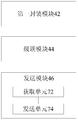
- FIG. 7 is a structural block diagram of a transmitting module 46 in a data transmitting apparatus according to an embodiment of the present invention. As shown in FIG. 7, the transmitting module 46 includes an obtaining unit 72 and a transmitting unit 74, and the transmitting module 46 will be described below.
- the obtaining unit 72 is configured to acquire a transmission opportunity for transmitting a radio frame
- the sending unit 46 is connected to the obtaining unit 72, and is configured to send the radio frame to the plurality of second stations by using the foregoing transmission opportunity.
- FIG. 8 is a structural block diagram of a data acquiring apparatus according to an embodiment of the present invention.
- the apparatus is applied to a second base station.
- the apparatus includes a receiving module 82, a determining module 84, and an obtaining module 86.
- the device is described.
- the receiving module 82 is configured to receive a radio frame sent by the first station, where the radio frame includes a concatenated protocol data unit encapsulated with data, where the protocol data unit includes a media access control MAC layer protocol data unit and And a physical layer protocol data unit; the determining module 84 is connected to the receiving module 82, and configured to determine whether the wireless frame carries the data that needs to be acquired by the second station; the obtaining module 86 is connected to the determining module 84, and is set to be When the determination result of the determination module 84 is YES, the data in the radio frame is acquired.
- FIG. 9 is a block diagram showing the structure of the determining module 84 in the data obtaining apparatus according to the embodiment of the present invention. As shown in FIG. 9, the determining module 84 includes a determining unit 92 and a determining unit 94. The determining module 84 will be described below.
- the determining unit 92 is configured to determine, according to at least one of the following information, whether the radio frame carries the identification information or the address information of the second station: the information encapsulated in the physical layer signaling domain of the radio frame is used to identify the site corresponding to the data. Identification information, identification information of a site encapsulated in a protocol data unit of the radio frame for identifying a site corresponding to the data, address information of a site included in the frame header of the protocol data unit in which the data is encapsulated with data to be acquired; determining The unit 94 is connected to the judging unit 92, and is configured to determine that the wireless retrieval carries the data that needs to be acquired by the second station if the judgment result of the judging unit 92 is YES.
- an access point AP (same as the first station described above) and stations STA1, STA2, ..., STAn, etc. (same multiple second stations as described above).
- FIG. 10 is a schematic diagram of a format of a first type of radio frame according to the first embodiment of the present invention.
- the access point AP caches a small number of small packets of a station.
- the AP encapsulates the small data packets of the multiple sites into one MAC PDU, that is, the MPDU, according to the format of the Protocol Data Unit (PDU).
- Each MPDU includes a MAC frame header and a MAC frame body, wherein the MAC frame header includes address information of the station.
- Each MAC frame body is encrypted by the private key of the corresponding site.
- the AP aggregates the MPDUs of the multiple sites into a data field of the radio frame in an A-MPDU format according to the format of the specific MAC frame aggregation, that is, the format of the A-MPDU, where a special definition is added before each MPDU.
- the format of the second radio frame according to the first embodiment of the present invention is shown in FIG.
- the AP may include a broadcast or multicast type of receiving address information, such as a Partial Associated Identifier (Partial AID) of the broadcast or multicast MAC address, in the physical layer signaling domain in front of the data field.
- a wireless frame is a broadcast or multicast wireless frame.
- the AP may also carry the user data indication information of the multiple radio stations in the physical layer signaling domain in front of the data domain to indicate that the station carries the MAC layer protocol data unit of multiple sites in the radio frame, as shown in FIG. 12 .
- 12 is a schematic diagram of a format of a third radio frame according to Embodiment 1 of the present invention.
- the AP may also indicate an acknowledgement feedback policy (ACK Policy) of the corresponding station in the frame header of the MPDU of each station, such as no feedback acknowledgement (NO ACK), immediate acknowledgement (ACK), delayed acknowledgement (Delayed ACK), and the like.
- ACK Policy acknowledgement feedback policy
- the receiving station After receiving the radio frame, the receiving station, when determining that it matches the broadcast or multicast address according to the Partial AID in the signaling domain, continuously decodes the MAC layer protocol data unit in the radio frame, and obtains an MPDU when decoding.
- the MPDU When the receiving address is its own MAC address, the MPDU is received; or the receiving station continues to decode the radio frame according to the user data indication information carried by the signaling domain that carries multiple sites, and the radio frame contains multiple user data.
- the MAC layer protocol data unit in the medium receives the MPDU when it is decoded that the receiving address of an MPDU is its own MAC address. According to the acknowledgement feedback strategy in the frame header of the received MPDU, it is fed back in a corresponding manner.
- the access point AP caches small packets of a large number of sites.
- the AP encapsulates small data packets of multiple sites into one MPDU according to the format of the MAC layer PDU.
- Each MPDU includes a MAC frame header and a MAC frame body, wherein the MAC frame header includes address information of the station.
- Each MAC frame body is encrypted by the private key of the corresponding site.
- the AP aggregates the MPDUs of multiple sites into a data field of a radio frame in an A-MPDU according to the format of a specific MAC frame aggregation, that is, the format of the A-MPDU, where a special definition is added before each MPDU.
- the separator includes MPDU length information, CRC check information, and a specific delimiter.
- the indication information of the foregoing site by the AP may be an address list, or a grouping range, or a site bitmap information, a site data presence indication information, a site data location indication information, a site data number indication information, etc.
- the receiving address of the MPDU is a broadcast or multicast MAC address, and is aggregated into an A-MPDU in the format of a specific MAC frame aggregation, that is, the format of the A-MPDU, together with the MPDUs of the multiple sites.
- the first MPDU in the A-MPDU is an MPDU carrying the above-mentioned site indication information.
- FIG. 13 is a schematic diagram of a format of a radio frame according to Embodiment 2 of the present invention.
- the AP may also indicate an acknowledgement feedback policy (ACK Policy) of the corresponding station in the frame header of the MPDU of each station, such as no feedback acknowledgement (No ACK), immediate acknowledgement (ACK), delayed acknowledgement (Delayed ACK), and the like.
- ACK Policy acknowledgement feedback policy
- the AP carries an acknowledgement feedback policy in the frame header of the MPDU carrying the above-mentioned site indication information as no feedback acknowledgement (NO ACK).
- the receiving station After receiving the radio frame, the receiving station decodes the first MPDU in the data field A-MPDU, obtains the address information, and determines whether the A-MPDU has its own MPDU, and if so, according to the specific information indicated by the address information.
- the MPDU is received, or the MPDU that receives the address as its own address is blindly checked, and the MPDU is received. According to the acknowledgement feedback strategy in the frame header of the received MPDU, it is fed back in a corresponding manner.
- the first MPDU of the access point in an A-MPDU carries site indication information, and then the MPDUs of each site are cascaded to form a data domain of the radio frame.
- the AP carries broadcast or multicast type receiving address information in the physical layer signaling domain in front of the data domain, and/or carries user data indication information that carries multiple sites.
- the AP sends this radio frame.
- FIG. 14 is a schematic diagram of a format of a radio frame according to Embodiment 3 of the present invention.
- the receiving station After receiving the radio frame, the receiving station successfully decodes the first MPDU in the data domain A-MPDU, obtains the site indication information, and determines whether the A-MPDU has its own MPDU, and if so, according to the site indication information.
- the MPDU of the indicated specific MPDU, or the MPDU that receives the address as its own address, is blindly checked to receive the MPDU. If the first MPDU fails to be decoded, the address information is received according to the broadcast or multicast type, and/or the user data indication information carrying multiple sites is carried, and it is determined that the radio frame may have its own data, and the wireless device is continuously decoded.
- the MAC layer protocol data unit in the frame receives the MPDU when it is decoded that the receiving address of an MPDU is its own MAC address. According to the acknowledgement feedback strategy in the frame header of the received MPDU, it is fed back in a corresponding manner.
- the access point AP caches small packets of a large number of sites.
- the AP encapsulates small data packets of multiple sites into one MPDU according to the format of the MAC layer PDU.
- Each MPDU includes a MAC frame header and a MAC frame body, and
- the MAC address header contains the address information of the site.
- Each MAC frame body is encrypted by the private key of the corresponding site.
- the AP aggregates the MPDUs of multiple sites into a data field of a radio frame in an A-MPDU according to the format of a specific MAC frame aggregation, that is, the format of the A-MPDU, where a special definition is added before each MPDU.
- the separator includes MPDU length information, CRC check information, and a specific delimiter.
- the AP may also indicate an acknowledgement feedback policy (ACK Policy) of the corresponding station in the frame header of the MPDU of each station, such as no feedback acknowledgement (NO ACK), immediate acknowledgement (ACK), delayed acknowledgement (Delayed ACK), and the like.
- ACK Policy acknowledgement feedback policy
- the AP includes the receiving site indication information in the physical layer signaling domain in front of the data domain, that is, the Partial Associated Identifier (Partial AID) of each receiving site, or the site AID range, or the bitmap indication information.
- the site data presence indication information, the site data location indication information, the site data number indication information, and the like are used to indicate which sites of the radio frame contain data.
- FIG. 15 is a schematic diagram of a format of a radio frame according to Embodiment 4 of the present invention.
- the receiving station After receiving the radio frame, the receiving station determines, according to the station indication information in the signaling domain, whether the radio frame data field includes its own MPDU, and if so, according to the location of the specific MPDU indicated by the station indication information. Receive an MPDU that matches its own MAC address. According to the acknowledgement feedback strategy in the frame header of the received MPDU, it is fed back in a corresponding manner.
- the access point AP caches small packets of a large number of sites.
- the AP encapsulates the small data packets of multiple sites into one PHY PDU, that is, a PPDU, according to the format of the physical layer (PHY) protocol data unit PDU.
- PHY physical layer
- the MAC layer frame body of each PPDU is encrypted by the private key of the corresponding site.
- the AP aggregates PPDUs of multiple sites into one radio frame, and the radio frame includes one physical preamble information, and a PPDU of each station, that is, an aggregate PPDU subframe (A-PPDU subframe).
- Each PPDU can be directly linked or linked with a filler and/or a special spacer, wherein when the PPDUs are directly linked, there is no direct link between the PPDUs, such as fillers, spacers, and the like.
- Each of the PPDUs includes at least one of a physical layer signaling domain and/or a MAC layer protocol data unit MPDU, where the physical layer signaling domain may include at least one of the following information:
- the indication information of the multi-site data is used to indicate that the radio frame includes PPDUs of multiple sites;
- the identification information of the site to which the data carried by the PPDU belongs such as a partial association identification number PAID;
- the physical layer transmission parameter such as the Modulation Coding Scheme (MCS) is used to indicate the demodulation and decoding mode of the PPDU.
- MCS Modulation Coding Scheme
- FIG. 16 is a schematic diagram of a format of a radio frame according to Embodiment 5 of the present invention
- FIG. 16 is a schematic diagram of direct link between PPDUs.
- the AP may also indicate an acknowledgement feedback policy (ACK Policy) of the corresponding station in the MAC layer header of the PPDU of each station, such as no feedback acknowledgement (No ACK), immediate acknowledgement (ACK), delayed acknowledgement (Delayed ACK), and the like.
- ACK Policy acknowledgement feedback policy
- the receiving station After receiving the foregoing radio frame, the receiving station performs channel estimation according to the preamble information, and decodes each PPDU according to the site identification information PAID in the physical signaling domain in the PPDU, or in the MAC layer frame header in the PPDU.
- the receiving address information determines whether the PPDU is its own PPDU, and if so, receives the PPDU.
- the feedback policy is acknowledged in a corresponding manner according to the acknowledgement feedback policy in the MAC layer header of the received PPDU.
- the access point AP caches small packets of a large number of sites.
- the AP encapsulates the small data packets of multiple sites into one PHY PDU, that is, a PPDU, according to the format of the physical layer (PHY) protocol data unit PDU.
- Each PPDU includes at least a physical layer signaling domain and/or a MAC layer protocol data unit MPDU.
- the MAC layer load of each PPDU includes a MAC frame header and a MAC frame body.
- the MAC layer frame body is encrypted by the private key of the corresponding site.
- the receiving address in the MAC frame header of each PPDU is the MAC address of the corresponding site, and the MAC layer frame header may also indicate an ACK Policy of the corresponding station, and the MAC frame body carries the data information of the corresponding station.
- the physical layer signaling domain of the PPDU may contain at least one of the following information:
- the indication information of the multi-site data is used to indicate that the radio frame includes PPDUs of multiple sites;
- the identification information of the site to which the data carried by the PPDU belongs such as a partial association identification number PAID;
- the physical layer transmission parameter such as the modulation and coding mode MCS, is used to indicate the demodulation and decoding mode of the PPDU.
- the AP encapsulates the indication information of the foregoing site, which may be an address list, or a packet range, or a site bitmap information, a site data presence indication information, a site data location indication information, a site data number indication information, etc., into a PPDU, and
- the group key encrypts the MAC frame body of the PPDU.
- the receiving address in the MAC frame header of the PPDU is a broadcast or multicast MAC address, and the MAC layer header may also indicate that the ACK Policy of the corresponding station is a no-acknowledgment mode (No ACK), in the MAC frame body.
- the PPDU includes at least a physical layer signaling domain and/or a MAC layer load, where the physical layer signaling domain Can contain at least one of the following information:
- the indication information of the multi-site data is used to indicate that the radio frame includes PPDUs of multiple sites;
- Broadcast or multicast identification information such as partial association identification number PAID;
- the physical layer transmission parameter such as the modulation and coding mode MCS, is used to indicate the demodulation and decoding mode of the PPDU.
- the AP links the PPDU carrying the site indication information with the PPDUs of multiple sites and adds physical preamble information to form a radio frame.
- Each PPDU can be directly linked or linked with a filler and/or a special spacer.
- FIG. 17 is a schematic diagram of a format of a radio frame according to Embodiment 6 of the present invention.
- the receiving station After receiving the radio frame, the receiving station performs channel estimation according to the preamble information, first decodes the PPDU carrying the indication information of the site, acquires the station indication information, that is, the packet information, the location information of the PPDU, and the like, and then decodes the PPDU of the subsequent corresponding location. And determining, according to the site identification information PAID in the physical signaling domain in the PPDU and/or the receiving address information in the MAC layer frame header in the PPDU, whether the PPDU is its own PPDU, and if yes, receiving the PPDU.
- the feedback policy is acknowledged in a corresponding manner according to the acknowledgement feedback policy in the MAC layer header of the received PPDU.
- the AP may encapsulate the site indication information into a PPDU.
- the PPDU only includes a physical signaling domain, as shown in FIG. 18.
- FIG. 18 is a schematic diagram of a format of a radio frame according to Embodiment 7 of the present invention. Include at least one of the following information in the physical signaling domain:
- ⁇ at least one of an address list, a packet range, a site bitmap information, a site data presence indication information, a site data location indication information, and a site data number indication information;
- the indication information of the multi-site data which is used to indicate that the radio frame includes PPDUs of multiple sites;
- Broadcast or multicast identification information such as partial association identification number PAID;
- the physical layer transmission parameter such as the modulation and coding mode MCS, is used to indicate the demodulation and decoding mode of the PPDU.
- FIG. 19 is a schematic diagram of radio frame transmission according to Embodiment 8 of the present invention.
- FIG. 20 is a schematic diagram of radio frame transmission according to Embodiment 9 of the present invention.
- the AP may also send another downlink data frame in the TXOP, and send the wireless frame after the SIFS interval. Or the AP sends a resource scheduling indication frame in the TXOP to reserve a non-contention access time window, and the AP sends the radio frame in the non-contention access time window.
- FIG. 21 is a schematic diagram of radio frame transmission according to Embodiment 10 of the present invention.
- modules or steps of the present invention described above can be implemented by a general-purpose computing device that can be centralized on a single computing device or distributed across a network of multiple computing devices. Alternatively, they may be implemented by program code executable by the computing device such that they may be stored in the storage device by the computing device and, in some cases, may be different from the order herein.
- the steps shown or described are performed, or they are separately fabricated into individual integrated circuit modules, or a plurality of modules or steps thereof are fabricated as a single integrated circuit module.
- the invention is not limited to any specific combination of hardware and software.
- the data sending method, the obtaining method, the sending device, and the obtaining device provided by the embodiments of the present invention have the following beneficial effects: solving the problem that the channel is highly competitive and expensive when data is transmitted in the related art.
- the problem in turn, achieves the effect of reducing channel competition and reducing overhead.
Landscapes
- Engineering & Computer Science (AREA)
- Computer Networks & Wireless Communication (AREA)
- Signal Processing (AREA)
- Computer Security & Cryptography (AREA)
- Mobile Radio Communication Systems (AREA)
Abstract
本发明提供了一种数据发送方法、获取方法、发送装置及获取装置,其中,该数据发送方法包括:第一站点将需要发送至多个第二站点的数据分别封装于不同的协议数据单元中,其中,该协议数据单元包括媒体访问控制MAC层协议数据单元和/或物理层协议数据单元;该第一站点将封装有数据的协议数据单元级联于无线帧中;该第一站点将无线帧发送给多个第二站点,通过本发明,解决了相关技术中存在的在进行数据发送时,会造成信道竞争激烈及开销大的问题,进而达到了降低信道竞争,减小开销的效果。
Description
本发明涉及通信领域,具体而言,涉及一种数据发送方法、获取方法、发送装置及获取装置。
当前,在无线网络领域,无线局域网(Wireless Local Area Networks,简称为WLAN)快速发展,全球对WLAN覆盖需求日益增长。电气和电子工程师协会工业规范IEEE802.11工作组先后定义了802.11a、802.11b、802.11g、802.11n等一系列WLAN技术标准,主要制定物理层(Physical Layer,简称为PHY)和媒体访问控制(Media Access Control,简称为MAC)层规范。随后陆续出现了其他任务组,致力于发展涉及现有802.11技术改进的规范,例如,高效局域网(High Efficiency WLAN,简称为HEW)任务组主要研究密集布网场景下如何使WLAN网络实现数据的更高效传输。
WLAN的基本架构指一个由站点(Station,简称为STA)组成的基本服务集(Basic Service Set,简称为BSS),该BSS包含一个接入点站点(Access Point station,简称为AP)以及与AP相关联的多个非AP站点(non-AP Station)。802.11定义了两种基本的无线信道的接入方式:基于竞争的接入方式-分布式协调功能(Distributed Coordination Function,简称为DCF);以及基于调度的接入方式-点协调功能(Point Coordination Function,简称为PCF)。在这两种基本接入方式的基础上,考虑业务流的服务质量(Quality of Service,简称为QoS)需求,又提出了两种信道接入方式:增强型分布式协调访问功能(Enhanced Distributed Channel Access,简称为EDCA)和混合协调功能控制信道访问功能(Hybrid Coordination function Controlled channel Access,简称为HCCA)。
DCF是最基本的信道接入模式,利用带有冲突避免的载波侦听多路访问机制(CSMA with Collision Avoidance,简称为CSMA/CA)使多个STA共享无线信道。EDCA是增强型信道接入模式,基于CSMA/CA机制,EDCA中定义了4种接入类别(Access Categories,简称为AC),分别为背景接入类别(AC Background,简称为AC_BK)、尽力服务接入类别(AC Best Effort,简称为AC_BE)、视频接入类别(AC Video,简称为AC_VI)和语音接入类别(AC Voice,简称为AC_VO),每个AC定义了一组特定的参数,这些参数在统计上规定了各AC对信道接入的优先级别。EDCA竞争信道接入的过程为:当信道变为空闲状态后首先等待一个固定时长,称为仲裁帧间隔
(Arbitration Inter-Frame Space,简称为AIFS),然后等待一个随机回退时段,之后获得一个传输机会(Transmission Opportunity,简称为TXOP),如图1所示,图1是相关技术中的EDCA竞争接入机制示意图。
在EDCA和HCCA方式下,STA通过信道接入过程获得一个TXOP,一个TXOP指的是STA可以传输特定通信类别的有界时段,一旦获得TXOP,该STA可以根据AC继续传输数据帧、或控制帧、或管理帧、或接收响应帧。接入点AP可以在一个TXOP内传输一个AC队列内的多个用户的数据,但每个用户数据独立打包在不同的无线帧中,每个无线帧都有物理帧头开销,且至少间隔短帧间间隔(Short Interframe Space,简称为SIFS)发送。
在HEW的典型场景中,STA分布非常密集,从而导致信道竞争激烈,每一个站点能获取到的传输机会随之减少,对于接入点而言,要和所有非接入点站点竞争接入信道。在实际部署的场景中,常发生小数据风暴的现象,当接入点有大量站点的时延不敏感小数据待发时,如果采用传统的竞争接入方式,接入点按照AC-BE类的业务接入优先级竞争信道,通过点对点的推送效率太低,通过多用户传输方式,如正交频分多址(Orthogonal Frequency Division Multiple Access,OFDMA)方式或多用户多入多出(Multi-User Multiple-Input Multiple-Output,简称为MU-MIMO)技术也仅针对少量多用户,仍然不能很好地解决海量用户的小数据发送带来的信道竞争及开销问题。
针对相关技术中的数据发送时,会造成信道竞争激烈及开销大的问题,目前尚未提出有效的解决方案。
发明内容
本发明提供了一种数据发送方法、获取方法、发送装置及获取装置,以至少解决相关技术中存在的在进行数据发送时,会造成信道竞争激烈及开销大的问题。
根据本发明的一个方面,提供了一种数据发送方法,包括:第一站点将需要发送至多个第二站点的数据分别封装于不同的协议数据单元中,其中,所述协议数据单元包括媒体访问控制MAC层协议数据单元和/或物理层协议数据单元;所述第一站点将封装有所述数据的协议数据单元级联于无线帧中;所述第一站点将所述无线帧发送给所述多个第二站点。
可选地,所述第一站点在将所述无线帧发送至所述多个第二站点之前,还包括:所述第一站点将与所述数据对应的用于标识所述多个第二站点的标识信息封装于所述无线帧中。
可选地,所述第一站点通过如下方式至少之一将所述标识信息封装于所述无线帧
中:所述第一站点将所述标识信息封装于一个协议数据单元中,并将封装有所述标识信息的协议数据单元与封装有所述数据的协议数据单元级联于所述无线帧中;所述第一站点将所述标识信息封装于所述无线帧的物理层信令域中;所述第一站点将所述标识信息分别对应封装于封装有所述数据的协议数据单元中。
可选地,所述第一站点对封装有所述数据的协议数据单元通过与所述数据对应的第二站点的私有密钥进行加密;和/或,所述第一站点对封装有所述标识信息的协议数据单元通过组密钥进行加密。
可选地,所述标识信息包括以下信息至少之一:所述多个第二站点的识别标识信息、所述多个第二站点的分组标识信息、所述多个第二站点的数据存在指示信息、所述多个第二站点的协议数据单元的位置信息、所述多个第二站点的协议数据单元的个数信息、所述多个第二站点对应的地址信息。
可选地,封装有所述数据的协议数据单元分别对应于相同或不同的第二站点,当所述协议数据单元包括所述MAC层协议数据单元时,封装有所述数据的MAC层协议数据单元的帧头中包括以下信息至少之一:与所述第二站点对应的地址信息;与所述第二站点对应的确认反馈策略。
可选地,当所述多个第二站点的数据分别封装于不同的MAC层协议数据单元中时,在所述无线帧的物理层信令域中携带以下信息至少之一:用于指示所述无线帧包含有需要发送至多个第二站点的数据的指示信息;用于标识广播地址或组播地址的接收地址识别信息。
可选地,当所述协议数据单元包括所述MAC层协议数据单元时,封装有所述标识信息的MAC层协议数据单元的帧头中包括广播或组播接收地址信息和/或与所述第二站点对应的确认反馈策略。
可选地,当所述协议数据单元包括所述MAC层协议数据单元时,所述第一站点将封装有所述数据的MAC层协议数据单元级联于无线帧中包括:所述第一站点通过预定的格式将封装有所述数据的MAC层协议数据单元级联于所述无线帧中,其中,所述预定的格式包括以下至少之一:MAC层协议数据单元长度信息、校验信息、第一特定间隔符、第一填充符。
可选地,当所述协议数据单元包括所述物理层协议数据单元时,封装有所述数据的物理层协议数据单元分别对应于相同或不同的第二站点,封装有所述数据的物理层协议数据单元的物理层信令域中包括以下信息至少之一:用于指示所述无线帧包含有需要发送至多个第二站点的数据的指示信息;所述物理层协议数据单元长度信息;与所述第二站点对应的识别信息;用于指示封装有所述数据的物理层协议数据单元后续
是否还存在物理层协议数据单元的指示信息;物理层传输参数,其中,所述物理层传输参数至少包括:调制编码方式。
可选地,当所述协议数据单元包括所述物理层协议数据单元时,封装有所述标识信息的物理层协议数据单元物理层信令域中包括以下信息至少之一:用于指示所述无线帧包含有需要发送至多个第二站点的数据的指示信息;所述物理层协议数据单元长度信息;广播或组播接收地址识别信息;用于指示封装有所述数据的物理层协议数据单元后续是否还存在物理层协议数据单元的指示信息;物理层传输参数,其中,所述物理层传输参数至少包括:调制编码方式。
可选地,当所述协议数据单元包括所述物理层协议数据单元时,所述第一站点将封装有所述数据的物理层协议数据单元级联于无线帧中包括:所述第一站点将封装有所述数据的物理层协议数据单元按直接顺序级联于所述无线帧中;和/或,所述第一站点通过预定的格式将封装有所述数据的物理层协议数据单元级联于所述无线帧中,其中,所述预定的格式包括以下至少之一:第二填充符、第二特定间隔符。
可选地,所述第一站点将所述无线帧发送给所述多个第二站点包括:所述第一站点获取用于发送所述无线帧的传输机会;所述第一站点利用所述传输机会将所述无线帧发送给所述多个第二站点。
可选地,所述第一站点获取用于发送所述无线帧的传输机会包括:所述第一站点通过增强型分布式协调访问功能EDCA方式采用相应优先级的信道接入参数进行信道竞争,获取所述传输机会。
可选地,所述第一站点利用所述传输机会将所述无线帧发送给所述多个第二站点包括:所述第一站点在发送完系统消息帧之后的特定帧间间隔后将所述无线帧发送给所述多个第二站点;和/或,所述第一站点在预先分配的用于发送所述无线帧的资源上将所述无线帧发送给所述多个第二站点。
根据本发明的另一方面,提供了一种数据获取方法,包括:第二站点接收第一站点发送的无线帧,其中,所述无线帧中包括级联的且封装有数据的协议数据单元,其中,所述协议数据单元包括媒体访问控制MAC层协议数据单元和/或物理层协议数据单元;所述第二站点判断所述无线帧中是否携带有所述第二站点需要获取的数据;在判断结果为是的情况下,所述第二站点获取所述无线帧中的数据。
可选地,所述第二站点判断所述无线帧中是否携带有所述第二站点需要获取的数据包括:所述第二站点根据以下信息至少之一判断所述无线帧中是否携带有所述第二站点的标识信息或地址信息:所述无线帧的物理层信令域中封装的用于标识与所述数据对应的站点的标识信息、所述无线帧的协议数据单元中封装的用于标识与所述数据
对应的站点的标识信息、所述无线侦中封装有所述数据的层协议数据单元的帧头中包括的需要获取数据的站点的地址信息;在判断结果为是的情况下,所述第二站点确定所述无线侦中携带有所述第二站点需要获取的数据。
可选地,所述第二站点根据所述无线帧的物理层信令域中封装的用于标识与所述数据对应的站点的标识信息判断所述无线帧中是否携带有所述第二站点的标识信息包括:所述第二站点根据所述无线帧的物理层信令域中封装的所述标识信息中携带的以下信息至少之一判断所述无线帧中是否携带有所述第二站点的标识信息:所述第二站点的识别标识信息、所述第二站点的分组标识信息、所述第二站点的数据存在指示信息、所述第二站点的数据的位置信息、所述第二站点的数据的个数信息、所述第二站点对应的地址信息。
可选地,所述第二站点根据所述无线帧的协议数据单元中封装的用于标识与所述数据对应的站点的标识信息判断所述无线帧中是否携带有所述第二站点的标识信息包括:所述第二站点根据所述无线帧的协议数据单元中封装的所述标识信息中携带的以下信息至少之一判断所述无线帧中是否携带有所述第二站点的标识信息:所述第二站点的识别标识信息、所述第二站点的分组标识信息、所述第二站点的数据存在指示信息、所述第二站点的数据的位置信息、所述第二站点的数据的个数信息、所述第二站点对应的地址信息。
可选地,所述第二站点根据所述无线侦中封装有所述数据的协议数据单元的帧头中包括的需要获取数据的站点的地址信息判断所述无线帧中是否携带有所述第二站点的地址信息包括:所述第二站点依次解码所述无线侦中封装有所述数据的协议数据单元;所述第二站点判断封装有所述数据的协议数据单元的帧头中是否携带有所述第二站点的地址信息;在判断结果为是的情况下,确定所述无线侦中携带有所述第二站点的地址信息。
根据本发明的另一方面,提供了一种数据发送装置,该装置应用于第一站点中,包括:第一封装模块,设置为将需要发送至多个第二站点的数据分别封装于不同的协议数据单元中,其中,所述协议数据单元包括媒体访问控制MAC层协议数据单元和/或物理层协议数据单元;级联模块,设置为将封装有所述数据的协议数据单元级联于无线帧中;发送模块,设置为将所述无线帧发送给所述多个第二站点。
可选地,所述数据发送装置还包括:第二封装模块,设置为将与所述数据对应的用于标识所述多个第二站点的标识信息封装于所述无线帧中。
可选地,所述数据发送装置还包括:第一加密模块,设置为对封装有所述数据的协议数据单元通过与所述数据对应的第二站点的私有密钥进行加密;和/或,第二加密
模块,设置为对封装有所述标识信息的协议数据单元通过组密钥进行加密。
可选地,所述发送模块包括:获取单元,设置为获取用于发送所述无线帧的传输机会;发送单元,设置为利用所述传输机会将所述无线帧发送给所述多个第二站点。
根据本发明的另一方面,提供了一种数据获取装置,该装置应用于第二基站中,包括:接收模块,设置为接收第一站点发送的无线帧,其中,所述无线帧中包括级联的且封装有数据的协议数据单元,其中,所述协议数据单元包括媒体访问控制MAC层协议数据单元和/或物理层协议数据单元;判断模块,设置为判断所述无线帧中是否携带有所述第二站点需要获取的数据;获取模块,设置为在所述判断模块的判断结果为是的情况下,获取所述无线帧中的数据。
可选地,所述判断模块包括:判断单元,设置为根据以下信息至少之一判断所述无线帧中是否携带有所述第二站点的标识信息或地址信息:所述无线帧的物理层信令域中封装的用于标识与所述数据对应的站点的标识信息、所述无线帧的协议数据单元中封装的用于标识与所述数据对应的站点的标识信息、所述无线侦中封装有所述数据的协议数据单元的帧头中包括的需要获取数据的站点的地址信息;确定单元,设置为在所述判断单元的判断结果为是的情况下,确定所述无线侦中携带有所述第二站点需要获取的数据。
通过本发明,采用第一站点将需要发送至多个第二站点的数据分别封装于不同的协议数据单元中,其中,所述协议数据单元包括媒体访问控制MAC层协议数据单元和/或物理层协议数据单元;所述第一站点将封装有所述数据的协议数据单元级联于无线帧中;所述第一站点将所述无线帧发送给所述多个第二站点,解决了相关技术中存在的在进行数据发送时,会造成信道竞争激烈及开销大的问题,进而达到了降低信道竞争,减小开销的效果。
此处所说明的附图用来提供对本发明的进一步理解,构成本申请的一部分,本发明的示意性实施例及其说明用于解释本发明,并不构成对本发明的不当限定。在附图中:
图1是相关技术中的EDCA竞争接入机制示意图;
图2是根据本发明实施例的数据发送方法的流程图;
图3是根据本发明实施例的数据获取方法的流程图;
图4是根据本发明实施例的数据发送装置的结构框图;
图5是根据本发明实施例的数据发送装置的第一种优选结构框图;
图6是根据本发明实施例的数据发送装置的第二种优选结构框图;
图7是根据本发明实施例的数据发送装置中发送模块46的结构框图;
图8是根据本发明实施例的数据获取装置的结构框图;
图9是根据本发明实施例的数据获取装置中判断模块84的结构框图;
图10是根据本发明实施例一的第一种无线帧的格式示意图;
图11是根据本发明实施例一的第二种无线帧的格式示意图;
图12是根据本发明实施例一的第三种无线帧的格式示意图;
图13是根据本发明实施例二的无线帧的格式示意图;
图14是根据本发明实施例三的无线帧的格式示意图;
图15是根据本发明实施例四的无线帧的格式示意图;
图16是根据本发明实施例五的无线帧的格式示意图;
图17是根据本发明实施例六的无线帧的格式示意图;
图18是根据本发明实施例七的无线帧的格式示意图;
图19是根据本发明实施例八的无线帧发送示意图;
图20是根据本发明实施例九的无线帧发送示意图;
图21是根据本发明实施例十的无线帧发送示意图。
下文中将参考附图并结合实施例来详细说明本发明。需要说明的是,在不冲突的情况下,本申请中的实施例及实施例中的特征可以相互组合。
在本实施例中提供了一种数据发送方法,图2是根据本发明实施例的数据发送方法的流程图,如图2所示,该流程包括如下步骤:
步骤S202,第一站点将需要发送至多个第二站点的数据分别封装于不同的协议数据单元中,其中,该协议数据单元包括媒体访问控制MAC层协议数据单元和/或物理层协议数据单元;
步骤S204,该第一站点将封装有数据的协议数据单元级联于无线帧中;
步骤S206,该第一站点将无线帧发送给多个第二站点。
通过上述步骤,采用将封装有数据的协议数据单元级联于无线帧中的方法,可以实现通过一个无线帧给多个站点发送数据的目的,降低了信道竞争,有效解决了相关技术中存在的在进行数据发送时,会造成信道竞争激烈及开销大的问题,进而达到了降低信道竞争,减小开销的效果。
在第一站点在将无线帧发送至多个第二站点之前,还可以在该无线帧中封装与第二站点相关的标识信息,在一个可选的实施例中,在第一站点在将无线帧发送至多个第二站点之前,还包括:第一站点将与数据对应的用于标识多个第二站点的标识信息封装于无线帧中。从而保证了第二站点在接收到该无线帧后可以根据标识信息确定该无线帧中是否包含自身所需要接收的数据。
在将标识数据封装于无线帧中时,可以有多种封装方式,在一个可选的实施例中,第一站点可以通过如下方式至少之一将标识信息封装于无线帧中:第一站点将标识信息封装于一个协议数据单元中,并将封装有标识信息的协议数据单元与封装有数据的协议数据单元级联于无线帧中;第一站点将标识信息封装于无线帧的物理层信令域中;第一站点将标识信息分别对应封装于封装有数据的协议数据单元中。
其中,在将无线帧发送给多个第二站点之前,还可以对该无线帧中的协议数据单元进行加密处理,进行加密的协议数据单元可以是全部协议数据单元,也可以是部分协议数据单元。并且,经过加密处理后的协议数据单元可以为独立加密单元。对协议数据单元进行加密的方式可以为多种,在一个可选的实施例中,可以通过如下方式对协议数据单元进行加密:第一站点对封装有数据的协议数据单元通过与数据对应的第二站点的私有密钥进行加密;和/或,第一站点对封装有标识信息的协议数据单元通过组密钥进行加密。即,封装有需要发送给第二基站的数据的协议数据单元与封装有标识信息的协议数据单元的加密方式可以不一样,从而保证了数据传输的可靠性。
上述标识信息包括以下信息至少之一:多个第二站点的识别标识信息、多个第二站点的分组标识信息、多个第二站点的数据存在指示信息、多个第二站点的协议数据单元的位置信息、多个第二站点的协议数据单元的个数信息、多个第二站点对应的地址信息。
封装有数据的协议数据单元分别对应于相同或不同的第二站点,当该协议数据单元包括MAC层协议数据单元时,封装有数据的MAC层协议数据单元的帧头中可以包括以下信息至少之一:与第二站点对应的地址信息;与第二站点对应的确认反馈策略。
当多个第二站点的数据分别封装于不同的MAC层协议数据单元中时,在无线帧
的物理层信令域中可以携带以下信息至少之一:用于指示无线帧包含有需要发送至多个第二站点的数据的指示信息;用于标识广播地址或组播地址的接收地址识别信息。
当上述协议数据单元包括MAC层协议数据单元时,封装有标识信息的MAC层协议数据单元的帧头中可以包括广播或组播接收地址信息和/或与第二站点对应的确认反馈策略。
在将数据封装于多个协议数据单元中后,可以将该多个协议数据单元级联于无线帧中,级联的方式多种多样,在一个可选的实施例中,当上述协议数据单元包括MAC层协议数据单元时,第一站点将封装有数据的MAC层协议数据单元级联于无线帧中包括:第一站点通过预定的格式将封装有数据的MAC层协议数据单元级联于无线帧中,其中,该预定的格式包括以下至少之一:MAC层协议数据单元长度信息、校验信息、第一特定间隔符、第一填充符。
当协议数据单元包括物理层协议数据单元时,封装有数据的物理层协议数据单元分别对应于相同或不同的第二站点,封装有数据的物理层协议数据单元的物理层信令域中可以包括以下信息至少之一:用于指示无线帧包含有需要发送至多个第二站点的数据的指示信息;物理层协议数据单元长度信息;与第二站点对应的识别信息;用于指示封装有数据的物理层协议数据单元后续是否还存在物理层协议数据单元的指示信息;物理层传输参数,其中,该物理层传输参数至少包括:调制编码方式。
当上述协议数据单元包括物理层协议数据单元时,封装有标识信息的物理层协议数据单元物理层信令域中包括以下信息至少之一:用于指示无线帧包含有需要发送至多个第二站点的数据的指示信息;物理层协议数据单元长度信息;广播或组播接收地址识别信息;用于指示封装有数据的物理层协议数据单元后续是否还存在物理层协议数据单元的指示信息;物理层传输参数,其中,该物理层传输参数至少包括:调制编码方式。
在将数据封装于多个协议数据单元中后,可以将该多个协议数据单元级联于无线帧中,级联的方式多种多样,在一个可选的实施例中,当上述协议数据单元包括物理层协议数据单元时,第一站点将封装有数据的物理层协议数据单元级联于无线帧中包括:第一站点将封装有数据的物理层协议数据单元按直接顺序级联于无线帧中;和/或,第一站点通过预定的格式将封装有数据的物理层协议数据单元级联于无线帧中,其中,该预定的格式包括以下至少之一:第二填充符、第二特定间隔符。
第一站点在将无线帧发送给第二站点之前,可以先获取传输机会,在一个可选的实施例中,第一站点将无线帧发送给多个第二站点包括:第一站点获取用于发送无线帧的传输机会;该第一站点利用上述传输机会将无线帧发送给多个第二站点。
第一站点获取传输机会的方式为多种,在一个可选的实施例中,第一站点获取用于发送无线帧的传输机会包括:第一站点通过增强型分布式协调访问功能EDCA方式采用相应优先级的信道接入参数进行信道竞争,获取该传输机会。
在获取传输机会后,第一站点可以利用该传输机会将无线帧发送给第二站点,在一个可选的实施例中,第一站点利用传输机会将无线帧发送给多个第二站点包括:第一站点在发送完系统消息帧之后的特定帧间间隔后将无线帧发送给多个第二站点;和/或,第一站点在预先分配的用于发送无线帧的资源上将无线帧发送给多个第二站点。
在本实施例中还提供了一种数据获取方法,图3是根据本发明实施例的数据获取方法的流程图,如图3所示,该流程包括如下步骤:
步骤S302,第二站点接收第一站点发送的无线帧,其中,该无线帧中包括级联的且封装有数据的协议数据单元,其中,协议数据单元包括媒体访问控制MAC层协议数据单元和/或物理层协议数据单元;
步骤S304,第二站点判断该无线帧中是否携带有第二站点需要获取的数据;
步骤S306,在判断结果为是的情况下,该第二站点获取无线帧中的数据。
通过上述步骤,采用接收携带数据的无线帧的方法获取数据,并且,在该无线帧中级联有封装了数据的协议数据单元,从而可以实现多个第二站点仅接收同一个无线帧便能够获取自身所需要的数据的目的,降低了信道竞争,有效解决了相关技术中存在的在进行数据发送时,会造成信道竞争激烈及开销大的问题,进而达到了降低信道竞争,减小开销的效果。
第二站点判断无线帧中是否携带有第二站点需要获取的数据时可以有多种判断方式,在一个可选的实施例中,可以至少通过如下方式进行判断:第二站点根据以下信息至少之一判断无线帧中是否携带有第二站点的标识信息或地址信息:无线帧的物理层信令域中封装的用于标识与数据对应的站点的标识信息、无线帧的协议数据单元中封装的用于标识与数据对应的站点的标识信息、无线侦中封装有数据的层协议数据单元的帧头中包括的需要获取数据的站点的地址信息;在判断结果为是的情况下,第二站点确定无线侦中携带有第二站点需要获取的数据。
在一个可选的实施例中,第二站点根据上述无线帧的物理层信令域中封装的用于标识与数据对应的站点的标识信息判断无线帧中是否携带有第二站点的标识信息包括:第二站点根据无线帧的物理层信令域中封装的标识信息中携带的以下信息至少之一判断无线帧中是否携带有第二站点的标识信息:第二站点的识别标识信息、第二站点的分组标识信息、第二站点的数据存在指示信息、第二站点的数据的位置信息、第二站点的数据的个数信息、第二站点对应的地址信息。
在一个可选的实施例中,第二站点根据无线帧的协议数据单元中封装的用于标识与数据对应的站点的标识信息判断无线帧中是否携带有第二站点的标识信息包括:第二站点根据无线帧的协议数据单元中封装的标识信息中携带的以下信息至少之一判断无线帧中是否携带有第二站点的标识信息:第二站点的识别标识信息、第二站点的分组标识信息、第二站点的数据存在指示信息、第二站点的数据的位置信息、第二站点的数据的个数信息、第二站点对应的地址信息。
在一个可选的实施例中,第二站点根据无线侦中封装有数据的协议数据单元的帧头中包括的需要获取数据的站点的地址信息判断无线帧中是否携带有第二站点的地址信息包括:第二站点依次解码无线侦中封装有数据的协议数据单元;第二站点判断封装有数据的协议数据单元的帧头中是否携带有第二站点的地址信息;在判断结果为是的情况下,确定该无线侦中携带有第二站点的地址信息。
在本实施例中还提供了一种数据发送装置,该装置用于实现上述实施例及优选实施方式,已经进行过说明的不再赘述。如以下所使用的,术语“模块”可以实现预定功能的软件和/或硬件的组合。尽管以下实施例所描述的装置较佳地以软件来实现,但是硬件,或者软件和硬件的组合的实现也是可能并被构想的。
图4是根据本发明实施例的数据发送装置的结构框图,该数据发送装置可以应用于第一站点中,如图4所示,该装置包括第一封装模块42、级联模块44和发送模块46,下面对该装置进行说明。
第一封装模块42,设置为将需要发送至多个第二站点的数据分别封装于不同的协议数据单元中,其中,该协议数据单元包括媒体访问控制MAC层协议数据单元和/或物理层协议数据单元;级联模块44,连接至上述第一封装模块42,设置为将封装有数据的协议数据单元级联于无线帧中;发送模块46,连接至上述级联模块44,设置为将无线帧发送给多个第二站点。
图5是根据本发明实施例的数据发送装置的第一种优选结构框图,如图5所示,该装置除包括图4所示的所有模块外,还包括第二封装模块52,下面对该装置进行说明。
第二封装模块52,连接至上述发送模块46,设置为将与数据对应的用于标识多个第二站点的标识信息封装于无线帧中。
图6是根据本发明实施例的数据发送装置的第二种优选结构框图,如图6所示,该装置除包括图5所示的所有模块外,还包括第一加密模块62和/或第二加密模块64,下面对该装置进行说明。
第一加密模块62,连接至上述发送模块46,设置为对封装有数据的协议数据单元
通过与数据对应的第二站点的私有密钥进行加密;
第二加密模块64,连接至上述发送模块46,设置为对封装有标识信息的协议数据单元通过组密钥进行加密。
图7是根据本发明实施例的数据发送装置中发送模块46的结构框图,如图7所示,该发送模块46包括获取单元72和发送单元74,下面对该发送模块46进行说明。
获取单元72,设置为获取用于发送无线帧的传输机会;发送单元46,连接至上述获取单元72,设置为利用上述传输机会将无线帧发送给多个第二站点。
图8是根据本发明实施例的数据获取装置的结构框图,该装置应用于第二基站中,如图8所示,该装置包括接收模块82、判断模块84和获取模块86,下面对该装置进行说明。
接收模块82,设置为接收第一站点发送的无线帧,其中,该无线帧中包括级联的且封装有数据的协议数据单元,其中,该协议数据单元包括媒体访问控制MAC层协议数据单元和/或物理层协议数据单元;判断模块84,连接至上述接收模块82,设置为判断无线帧中是否携带有第二站点需要获取的数据;获取模块86,连接至上述判断模块84,设置为在判断模块84的判断结果为是的情况下,获取无线帧中的数据。
图9是根据本发明实施例的数据获取装置中判断模块84的结构框图,如图9所示,该判断模块84包括判断单元92和确定单元94,下面对该判断模块84进行说明。
判断单元92,设置为根据以下信息至少之一判断无线帧中是否携带有第二站点的标识信息或地址信息:该无线帧的物理层信令域中封装的用于标识与数据对应的站点的标识信息、无线帧的协议数据单元中封装的用于标识与数据对应的站点的标识信息、无线侦中封装有数据的协议数据单元的帧头中包括的需要获取数据的站点的地址信息;确定单元94,连接至上述判断单元92,设置为在判断单元92的判断结果为是的情况下,确定无线侦中携带有第二站点需要获取的数据。
下面结合具体实施例对本发明进行说明:
实施例一
在密集场景下的无线通信系统中,有接入点AP(同上述的第一站点)以及站点STA1、STA2…STAn等(同上述的多个第二站点)。
图10是根据本发明实施例一的第一种无线帧的格式示意图,如图10所示,接入点AP缓存有大量站点的小数据包。AP将多个站点的小数据包按照MAC层协议数据单元(Protocol Data Unit,简称PDU)的格式分别封装为一个MAC PDU,即MPDU。
每个MPDU中包含MAC帧头及MAC帧体,其中MAC帧头中包含该站点的地址信息。每个MAC帧体通过相应站点的私有密钥进行加密。AP将多个站点的MPDU按照特定的MAC帧聚合的格式,即A-MPDU的格式将每个MPDU聚合在一个A-MPDU中构成该无线帧的数据域,其中每个MPDU之前添加一个特殊定义的间隔符,包括MPDU长度信息,CRC校验信息,特定分界符,可以如图11所示,图11是根据本发明实施例一的第二种无线帧的格式示意图。AP可以在数据域前面的物理层信令域中包括广播或组播类型的接收地址信息,例如广播或组播MAC地址的部分关联识别标识(Partial Associated Identifier,简称Partial AID),用于指示该无线帧为一个广播或组播的无线帧。
AP也可以在数据域前面的物理层信令域中携带该无线帧承载多个站点的用户数据指示信息,用于指示站点该无线帧中携带多个站点的MAC层协议数据单元,如图12所示,图12是根据本发明实施例一的第三种无线帧的格式示意图。
AP在每个站点的MPDU的帧头中还可以指示相应站点的确认反馈策略(ACK Policy),例如无反馈确认(NO ACK)、立即确认(ACK)、延迟确认(Delayed ACK)等。
接收站点在收到上述无线帧后,当根据信令域中的Partial AID判断自己匹配该广播或组播地址时,将持续解码该无线帧中的MAC层协议数据单元,当解码得到某个MPDU的接收地址为自己的MAC地址时,接收此MPDU;或者,接收站点根据信令域携带的承载多个站点的用户数据指示信息获知该无线帧包含多个用户数据时,将持续解码该无线帧中的MAC层协议数据单元,当解码得到某个MPDU的接收地址为自己的MAC地址时,接收此MPDU。根据所接收的自己的MPDU的帧头中确认反馈策略,以相应方式反馈。
实施例二
在密集场景下的无线通信系统中,有接入点AP以及站点STA1、STA2…STAn等。
接入点AP缓存有大量站点的小数据包。AP将多个站点的小数据包按照MAC层PDU的格式分别封装为一个MPDU。每个MPDU中包含MAC帧头及MAC帧体,其中MAC帧头中包含该站点的地址信息。每个MAC帧体通过相应站点的私人密钥进行加密。AP将多个站点的MPDU按照特定的MAC帧聚合的格式,即A-MPDU的格式,将每个MPDU聚合在一个A-MPDU中构成无线帧的数据域,其中每个MPDU之前添加一个特殊定义的间隔符,包括MPDU长度信息,CRC校验信息,特定分界符。
AP将上述站点的指示信息,可以是地址列表,或者分组范围,或者站点比特图信息,站点数据存在指示信息,站点数据位置指示信息,站点数据个数指示信息等,封
装为一个MPDU,并以组密钥对该MPDU的MAC帧体进行加密。该MPDU的接收地址为广播或组播MAC地址,并与多个站点的MPDU一起按照特定的MAC帧聚合的格式,即A-MPDU的格式,将每个MPDU聚合在一个A-MPDU中构成该无线帧的数据域。在A-MPDU中的第一个MPDU为承载上述站点指示信息的MPDU。AP在A-MPDU的前面添加物理层信令域及前导信息构成无线帧并发送。如图13所示,图13是根据本发明实施例二的无线帧的格式示意图。
AP在每个站点的MPDU的帧头中还可以指示相应站点的确认反馈策略(ACK Policy),例如无反馈确认(No ACK)、立即确认(ACK)、延迟确认(Delayed ACK)等。AP在承载上述站点指示信息的MPDU的帧头中携带确认反馈策略为无反馈确认(NO ACK)。
接收站点在收到上述无线帧后,解码数据域A-MPDU中的第一个MPDU,获得地址信息,判断该A-MPDU中是否有自己的MPDU,若有,则根据地址信息所指示的具体MPDU的位置,或者盲检得到接收地址为自己的地址的MPDU,接收此MPDU。根据所接收的自己的MPDU的帧头中确认反馈策略,以相应方式反馈。
实施例三
结合实施例一和二,接入点在一个A-MPDU中的第一个MPDU承载站点指示信息,后面级联各个站点的MPDU,构成无线帧的数据域。AP在数据域前面的物理层信令域中携带广播或组播类型接收地址信息,和/或携带承载多个站点的用户数据指示信息。AP发送此无线帧。如图14所示,图14是根据本发明实施例三的无线帧的格式示意图。
接收站点在收到上述无线帧后,若成功解码数据域A-MPDU中的第一个MPDU,获得站点指示信息,判断该A-MPDU中是否有自己的MPDU,若有,则根据站点指示信息所指示的具体MPDU的位置,或者盲检得到接收地址为自己的地址的MPDU,接收此MPDU。若第一个MPDU解码失败,则根据广播或组播类型接收地址信息,和/或携带承载多个站点的用户数据指示信息,判断该无线帧中可能有自己的数据,则将持续解码该无线帧中的MAC层协议数据单元,当解码得到某个MPDU的接收地址为自己的MAC地址时,接收此MPDU。根据所接收的自己的MPDU的帧头中确认反馈策略,以相应方式反馈。
实施例四
在密集场景下的无线通信系统中,有接入点AP以及站点STA1、STA2…STAn等。
接入点AP缓存有大量站点的小数据包。AP将多个站点的小数据包按照MAC层PDU的格式分别封装为一个MPDU。每个MPDU中包含MAC帧头及MAC帧体,其
中MAC帧头中包含该站点的地址信息。每个MAC帧体通过相应站点的私有密钥进行加密。AP将多个站点的MPDU按照特定的MAC帧聚合的格式,即A-MPDU的格式,将每个MPDU聚合在一个A-MPDU中构成无线帧的数据域,其中每个MPDU之前添加一个特殊定义的间隔符,包括MPDU长度信息,CRC校验信息,特定分界符。
AP在每个站点的MPDU的帧头中还可以指示相应站点的确认反馈策略(ACK Policy),例如无反馈确认(NO ACK),立即确认(ACK),延迟确认(Delayed ACK)等。AP在数据域前面的物理层信令域中包括接收站点指示信息,即各个接收站点的部分关联识别标识列表(Partial Associated Identifier,简称为Partial AID),或者站点AID范围,或者比特图指示信息,站点数据存在指示信息,站点数据位置指示信息,站点数据个数指示信息等,用于指示该无线帧中包含哪些站点的数据。如图15所示,图15是根据本发明实施例四的无线帧的格式示意图。
接收站点在收到上述无线帧后,根据信令域中的站点指示信息,判断该无线帧数据域中是否包含有自己的MPDU,若有,则根据站点指示信息所指示的具体MPDU的位置,接收与自己MAC地址匹配的MPDU。根据所接收的自己的MPDU的帧头中确认反馈策略,以相应方式反馈。
实施例五
在密集场景下的无线通信系统中,有接入点AP以及站点STA1、STA2…STAn等。
接入点AP缓存有大量站点的小数据包。AP将多个站点的小数据包按照物理层(PHY)协议数据单元PDU的格式分别封装为一个PHY PDU,即PPDU。每个PPDU的MAC层帧体通过相应站点的私人密钥进行加密。AP将多个站点的PPDU聚合成为一个无线帧,该无线帧包括一个物理前导信息,以及每个站点的PPDU,即聚合PPDU子帧(A-PPDU子帧)。每个PPDU之间可以直接链接或者以填充符和/或特殊间隔符链接,其中,当PPDU之间直接链接时,PPDU之间是无填充符、间隔符等的直接链接。其中每个PPDU中至少包含物理层信令域和/或MAC层协议数据单元MPDU,其中物理层信令域中可以包含以下信息至少之一:
●多站点数据的指示信息,用于指示该无线帧包含多个站点的PPDU;
●该PPDU长度信息;
●该PPDU承载的数据所属站点的识别信息,如部分关联识别号PAID;
●指示后续有其它PPDU的指示信息;
●物理层传输参数,如调制编码方式(Modulation Coding Scheme,简称为MCS),用于指示该PPDU的解调解码方式。
如图16所示,图16是根据本发明实施例五的无线帧的格式示意图,在图16中表示的是PPDU间的直接链接示意图。
AP在每个站点的PPDU的MAC层帧头中还可以指示相应站点的确认反馈策略(ACK Policy),例如无反馈确认(No ACK)、立即确认(ACK)、延迟确认(Delayed ACK)等。
接收站点在收到上述无线帧后,根据前导信息进行信道估计,并解码每个PPDU,根据PPDU中的物理信令域中的站点识别信息PAID和、或该PPDU中的MAC层帧头中的接收地址信息判断该PPDU是否是自己的PPDU,若是,则接收此PPDU。根据所接收的PPDU的MAC层帧头中确认反馈策略,以相应方式反馈。
实施例六
在密集场景下的无线通信系统中,有接入点AP以及站点STA1、STA2…STAn等。
接入点AP缓存有大量站点的小数据包。AP将多个站点的小数据包按照物理层(PHY)协议数据单元PDU的格式分别封装为一个PHY PDU,即PPDU。每个PPDU中至少包含物理层信令域和/或MAC层协议数据单元MPDU。每个PPDU的MAC层负荷包括MAC帧头及MAC帧体。MAC层帧体通过相应站点的私人密钥进行加密。每个PPDU的MAC帧头中的接收地址为对应站点的MAC地址,MAC层帧头中还可以指示相应站点的确认反馈策略(ACK Policy),MAC帧体中携带对应站点的数据信息。PPDU的物理层信令域中可以包含以下信息至少之一:
●多站点数据的指示信息,用于指示该无线帧包含多个站点的PPDU;
●该PPDU长度信息;
●该PPDU承载的数据所属站点的识别信息,如部分关联识别号PAID;
●指示后续还有其它PPDU的指示信息;
●物理层传输参数,如调制编码方式MCS,用于指示该PPDU的解调解码方式。
AP将上述站点的指示信息,可以是地址列表,或者分组范围,或者站点比特图信息,站点数据存在指示信息,站点数据位置指示信息,站点数据个数指示信息等,封装为一个PPDU,并以组密钥对该PPDU的MAC帧体进行加密。该PPDU的MAC帧头中的接收地址为广播或组播MAC地址,MAC层帧头中还可以指示相应站点的确认反馈策略(ACK Policy)为无反馈确认方式(No ACK),MAC帧体中携带上述站点的指示信息。该PPDU中至少包含物理层信令域和/或MAC层负荷,其中物理层信令域
中可以包含以下信息至少之一:
●多站点数据的指示信息,用于指示该无线帧包含多个站点的PPDU;
●该PPDU长度信息;
●广播或组播识别信息,如部分关联识别号PAID;
●指示后续还有其它PPDU的指示信息;
●物理层传输参数,如调制编码方式MCS,用于指示该PPDU的解调解码方式。
AP将承载上述站点指示信息的PPDU与多个站点的PPDU链接在一起并在前面添加物理前导信息,构成无线帧。每个PPDU之间可以直接链接或者以填充符和/或特殊间隔符链接。如图17所示,图17是根据本发明实施例六的无线帧的格式示意图。
接收站点在收到上述无线帧后,根据前导信息进行信道估计,首先解码承载上述站点指示信息的PPDU,获取站点指示信息,即分组信息,自己的PPDU位置信息等,然后解码后续相应位置的PPDU,根据PPDU中的物理信令域中的站点识别信息PAID和/或该PPDU中的MAC层帧头中的接收地址信息判断该PPDU是否是自己的PPDU,若是,则接收此PPDU。根据所接收的PPDU的MAC层帧头中确认反馈策略,以相应方式反馈。
实施例七
同实施例六,AP可以将站点指示信息封装为一个PPDU。该PPDU只包含物理信令域,如图18所示,图18是根据本发明实施例七的无线帧的格式示意图。在物理信令域中包含以下信息至少之一:
●地址列表、分组范围、站点比特图信息,站点数据存在指示信息,站点数据位置指示信息,站点数据个数指示信息等至少之一;
●多站点数据的指示信息,用于指示无线帧包含多个站点的PPDU;
●广播或组播识别信息,如部分关联识别号PAID;
●更多PPDU指示信息,指示后续还有其它PPDU;
●物理层传输参数,如调制编码方式MCS,用于指示该PPDU的解调解码方式。
实施例八
在密集场景下的无线通信系统中,有接入点AP以及站点STA1、STA2…STAn等。
AP通过EDCA机制竞争接入信道,其中,AP在检测到媒体空闲后,先后延一个仲裁帧间隔PIFS,然后后延一个随机回退时段,并成功获取到一个传输机会TXOP,AP发送上述实施例中的无线帧。AP在发送该无线帧之前,也可以先发送一个信道预约帧,如CTS-TO-SELF。如图19所示,图19是根据本发明实施例八的无线帧发送示意图。
实施例九
在密集场景下的无线通信系统中,有接入点AP以及站点STA1、STA2…STAn等。
AP通过EDCA机制竞争接入信道,其中,AP在检测到媒体空闲后,先后延一个仲裁帧间隔PIFS,然后后延一个随机回退时段,并成功获取到一个传输机会TXOP。AP发送系统消息信标beacon帧,并在beacon帧之后的SIFS帧间间隔后发送上述实施例中的无线帧。如图20所示,图20是根据本发明实施例九的无线帧发送示意图。
本实施例中,AP也可以在上述TXOP中发送一个其它下行数据帧,并在SIFS间隔之后,发送上述无线帧。或者AP在上述TXOP中先发送一个资源调度指示帧,预约一段非竞争接入时间窗,AP在该非竞争接入时间窗内发送上述无线帧。
实施例十
在密集场景下的无线通信系统中,有接入点AP以及站点STA1、STA2…STAn等。
AP通过EDCA机制竞争接入信道,其中,AP在检测到媒体空闲后,先后延一个仲裁帧间隔AIFS,然后后延一个随机回退时段,并成功获取到一个传输机会TXOP。AP发送调度帧,并在调度帧中指示该帧结束t时间后发送上述实施例中的无线帧。如图21所示,图21是根据本发明实施例十的无线帧发送示意图。
显然,本领域的技术人员应该明白,上述的本发明的各模块或各步骤可以用通用的计算装置来实现,它们可以集中在单个的计算装置上,或者分布在多个计算装置所组成的网络上,可选地,它们可以用计算装置可执行的程序代码来实现,从而,可以将它们存储在存储装置中由计算装置来执行,并且在某些情况下,可以以不同于此处的顺序执行所示出或描述的步骤,或者将它们分别制作成各个集成电路模块,或者将它们中的多个模块或步骤制作成单个集成电路模块来实现。这样,本发明不限制于任何特定的硬件和软件结合。
以上所述仅为本发明的优选实施例而已,并不用于限制本发明,对于本领域的技术人员来说,本发明可以有各种更改和变化。凡在本发明的精神和原则之内,所作的任何修改、等同替换、改进等,均应包含在本发明的保护范围之内。
如上所述,本发明实施例提供的一种数据发送方法、获取方法、发送装置及获取装置具有以下有益效果:解决了相关技术中存在的在进行数据发送时,会造成信道竞争激烈及开销大的问题,进而达到了降低信道竞争,减小开销的效果。
Claims (26)
- 一种数据发送方法,包括:第一站点将需要发送至多个第二站点的数据分别封装于不同的协议数据单元中,其中,所述协议数据单元包括媒体访问控制MAC层协议数据单元和/或物理层协议数据单元;所述第一站点将封装有所述数据的协议数据单元级联于无线帧中;所述第一站点将所述无线帧发送给所述多个第二站点。
- 根据权利要求1所述的方法,其中,所述第一站点在将所述无线帧发送至所述多个第二站点之前,还包括:所述第一站点将与所述数据对应的用于标识所述多个第二站点的标识信息封装于所述无线帧中。
- 根据权利要求2所述的方法,其中,通过如下方式至少之一将所述标识信息封装于所述无线帧中:所述第一站点将所述标识信息封装于一个协议数据单元中,并将封装有所述标识信息的协议数据单元与封装有所述数据的协议数据单元级联于所述无线帧中;所述第一站点将所述标识信息封装于所述无线帧的物理层信令域中;所述第一站点将所述标识信息分别对应封装于封装有所述数据的协议数据单元中。
- 根据权利要求3所述的方法,其中,包括:所述第一站点对封装有所述数据的协议数据单元通过与所述数据对应的第二站点的私有密钥进行加密;和/或,所述第一站点对封装有所述标识信息的协议数据单元通过组密钥进行加密。
- 根据权利要求2所述的方法,其中,所述标识信息包括以下信息至少之一:所述多个第二站点的识别标识信息、所述多个第二站点的分组标识信息、所述多个第二站点的数据存在指示信息、所述多个第二站点的协议数据单元的位置信息、所述多个第二站点的协议数据单元的个数信息、所述多个第二站点对应的地址信息。
- 根据权利要求1所述的方法,其中,封装有所述数据的协议数据单元分别对应于 相同或不同的第二站点,当所述协议数据单元包括所述MAC层协议数据单元时,封装有所述数据的MAC层协议数据单元的帧头中包括以下信息至少之一:与所述第二站点对应的地址信息;与所述第二站点对应的确认反馈策略。
- 根据权利要求1所述的方法,其中,当所述多个第二站点的数据分别封装于不同的MAC层协议数据单元中时,在所述无线帧的物理层信令域中携带以下信息至少之一:用于指示所述无线帧包含有需要发送至多个第二站点的数据的指示信息;用于标识广播地址或组播地址的接收地址识别信息。
- 根据权利要求1所述的方法,其中,当所述协议数据单元包括所述MAC层协议数据单元时,封装有所述标识信息的MAC层协议数据单元的帧头中包括广播或组播接收地址信息和/或与所述第二站点对应的确认反馈策略。
- 根据权利要求1所述的方法,其中,当所述协议数据单元包括所述MAC层协议数据单元时,所述第一站点将封装有所述数据的MAC层协议数据单元级联于无线帧中包括:所述第一站点通过预定的格式将封装有所述数据的MAC层协议数据单元级联于所述无线帧中,其中,所述预定的格式包括以下至少之一:MAC层协议数据单元长度信息、校验信息、第一特定间隔符、第一填充符。
- 根据权利要求1所述的方法,其中,当所述协议数据单元包括所述物理层协议数据单元时,封装有所述数据的物理层协议数据单元分别对应于相同或不同的第二站点,封装有所述数据的物理层协议数据单元的物理层信令域中包括以下信息至少之一:用于指示所述无线帧包含有需要发送至多个第二站点的数据的指示信息;所述物理层协议数据单元长度信息;与所述第二站点对应的识别信息;用于指示封装有所述数据的物理层协议数据单元后续是否还存在物理层协议数据单元的指示信息;物理层传输参数,其中,所述物理层传输参数至少包括:调制编码方式。
- 根据权利要求3所述的方法,其中,当所述协议数据单元包括所述物理层协议数 据单元时,封装有所述标识信息的物理层协议数据单元物理层信令域中包括以下信息至少之一:用于指示所述无线帧包含有需要发送至多个第二站点的数据的指示信息;所述物理层协议数据单元长度信息;广播或组播接收地址识别信息;用于指示封装有所述数据的物理层协议数据单元后续是否还存在物理层协议数据单元的指示信息;物理层传输参数,其中,所述物理层传输参数至少包括:调制编码方式。
- 根据权利要求1所述的方法,其中,当所述协议数据单元包括所述物理层协议数据单元时,所述第一站点将封装有所述数据的物理层协议数据单元级联于无线帧中包括:所述第一站点将封装有所述数据的物理层协议数据单元按直接顺序级联于所述无线帧中;和/或,所述第一站点通过预定的格式将封装有所述数据的物理层协议数据单元级联于所述无线帧中,其中,所述预定的格式包括以下至少之一:第二填充符、第二特定间隔符。
- 根据权利要求1所述的方法,其中,所述第一站点将所述无线帧发送给所述多个第二站点包括:所述第一站点获取用于发送所述无线帧的传输机会;所述第一站点利用所述传输机会将所述无线帧发送给所述多个第二站点。
- 根据权利要求13所述的方法,其中,所述第一站点获取用于发送所述无线帧的传输机会包括:所述第一站点通过增强型分布式协调访问功能EDCA方式采用相应优先级的信道接入参数进行信道竞争,获取所述传输机会。
- 根据权利要求13所述的方法,其中,所述第一站点利用所述传输机会将所述无线帧发送给所述多个第二站点包括:所述第一站点在发送完系统消息帧之后的特定帧间间隔后将所述无线帧发送给所述多个第二站点;和/或,所述第一站点在预先分配的用于发送所述无线帧的资源上将所述无线帧发送给所述多个第二站点。
- 一种数据获取方法,包括:第二站点接收第一站点发送的无线帧,其中,所述无线帧中包括级联的且封装有数据的协议数据单元,其中,所述协议数据单元包括媒体访问控制MAC层协议数据单元和/或物理层协议数据单元;所述第二站点判断所述无线帧中是否携带有所述第二站点需要获取的数据;在判断结果为是的情况下,所述第二站点获取所述无线帧中的数据。
- 根据权利要求16所述的方法,其中,所述第二站点判断所述无线帧中是否携带有所述第二站点需要获取的数据包括:所述第二站点根据以下信息至少之一判断所述无线帧中是否携带有所述第二站点的标识信息或地址信息:所述无线帧的物理层信令域中封装的用于标识与所述数据对应的站点的标识信息、所述无线帧的协议数据单元中封装的用于标识与所述数据对应的站点的标识信息、所述无线侦中封装有所述数据的层协议数据单元的帧头中包括的需要获取数据的站点的地址信息;在判断结果为是的情况下,所述第二站点确定所述无线侦中携带有所述第二站点需要获取的数据。
- 根据权利要求17所述的方法,其中,所述第二站点根据所述无线帧的物理层信令域中封装的用于标识与所述数据对应的站点的标识信息判断所述无线帧中是否携带有所述第二站点的标识信息包括:所述第二站点根据所述无线帧的物理层信令域中封装的所述标识信息中携带的以下信息至少之一判断所述无线帧中是否携带有所述第二站点的标识信息:所述第二站点的识别标识信息、所述第二站点的分组标识信息、所述第二站点的数据存在指示信息、所述第二站点的数据的位置信息、所述第二站点的数据的个数信息、所述第二站点对应的地址信息。
- 根据权利要求17所述的方法,其中,所述第二站点根据所述无线帧的协议数据单元中封装的用于标识与所述数据对应的站点的标识信息判断所述无线帧中是否携带有所述第二站点的标识信息包括:所述第二站点根据所述无线帧的协议数据单元中封装的所述标识信息中携带的以下信息至少之一判断所述无线帧中是否携带有所述第二站点的标识信息:所述第二站点的识别标识信息、所述第二站点的分组标识信息、所述第二站点的数据存在指示信息、所述第二站点的数据的位置信息、所述第二站点的数据的个数信息、所述第二站点对应的地址信息。
- 根据权利要求17所述的方法,其中,所述第二站点根据所述无线侦中封装有所述数据的协议数据单元的帧头中包括的需要获取数据的站点的地址信息判断所述无线帧中是否携带有所述第二站点的地址信息包括:所述第二站点依次解码所述无线侦中封装有所述数据的协议数据单元;所述第二站点判断封装有所述数据的协议数据单元的帧头中是否携带有所述第二站点的地址信息;在判断结果为是的情况下,确定所述无线侦中携带有所述第二站点的地址信息。
- 一种数据发送装置,应用于第一站点中,包括:第一封装模块,设置为将需要发送至多个第二站点的数据分别封装于不同的协议数据单元中,其中,所述协议数据单元包括媒体访问控制MAC层协议数据单元和/或物理层协议数据单元;级联模块,设置为将封装有所述数据的协议数据单元级联于无线帧中;发送模块,设置为将所述无线帧发送给所述多个第二站点。
- 根据权利要求21所述的装置,其中,还包括:第二封装模块,设置为将与所述数据对应的用于标识所述多个第二站点的标识信息封装于所述无线帧中。
- 根据权利要求22所述的装置,其中,还包括:第一加密模块,设置为对封装有所述数据的协议数据单元通过与所述数据对应的第二站点的私有密钥进行加密;和/或,第二加密模块,设置为对封装有所述标识信息的协议数据单元通过组密钥进行加密。
- 根据权利要求21所述的装置,其中,所述发送模块包括:获取单元,设置为获取用于发送所述无线帧的传输机会;发送单元,设置为利用所述传输机会将所述无线帧发送给所述多个第二站点。
- 一种数据获取装置,应用于第二站点中,包括:接收模块,设置为接收第一站点发送的无线帧,其中,所述无线帧中包括级联的且封装有数据的协议数据单元,其中,所述协议数据单元包括媒体访问控制MAC层协议数据单元和/或物理层协议数据单元;判断模块,设置为判断所述无线帧中是否携带有所述第二站点需要获取的数据;获取模块,设置为在所述判断模块的判断结果为是的情况下,获取所述无线帧中的数据。
- 根据权利要求25所述的装置,其中,所述判断模块包括:判断单元,设置为根据以下信息至少之一判断所述无线帧中是否携带有所述第二站点的标识信息或地址信息:所述无线帧的物理层信令域中封装的用于标识与所述数据对应的站点的标识信息、所述无线帧的协议数据单元中封装的用于标识与所述数据对应的站点的标识信息、所述无线侦中封装有所述数据的协议数据单元的帧头中包括的需要获取数据的站点的地址信息;确定单元,设置为在所述判断单元的判断结果为是的情况下,确定所述无线侦中携带有所述第二站点需要获取的数据。
Priority Applications (2)
| Application Number | Priority Date | Filing Date | Title |
|---|---|---|---|
| EP15875200.6A EP3242528A4 (en) | 2014-12-31 | 2015-12-28 | Data transmission method, acquisition method, transmission apparatus and acquisition apparatus |
| US15/541,103 US20170353330A1 (en) | 2014-12-31 | 2015-12-28 | Data Sending Method, Acquisition Method, Sending Device and Acquisition Device |
Applications Claiming Priority (2)
| Application Number | Priority Date | Filing Date | Title |
|---|---|---|---|
| CN201410856631.3A CN105813131A (zh) | 2014-12-31 | 2014-12-31 | 数据发送方法、获取方法、发送装置及获取装置 |
| CN201410856631.3 | 2014-12-31 |
Publications (1)
| Publication Number | Publication Date |
|---|---|
| WO2016107524A1 true WO2016107524A1 (zh) | 2016-07-07 |
Family
ID=56284272
Family Applications (1)
| Application Number | Title | Priority Date | Filing Date |
|---|---|---|---|
| PCT/CN2015/099248 Ceased WO2016107524A1 (zh) | 2014-12-31 | 2015-12-28 | 数据发送方法、获取方法、发送装置及获取装置 |
Country Status (4)
| Country | Link |
|---|---|
| US (1) | US20170353330A1 (zh) |
| EP (1) | EP3242528A4 (zh) |
| CN (1) | CN105813131A (zh) |
| WO (1) | WO2016107524A1 (zh) |
Cited By (1)
| Publication number | Priority date | Publication date | Assignee | Title |
|---|---|---|---|---|
| EP3694248A4 (en) * | 2017-11-02 | 2020-11-25 | Huawei Technologies Co., Ltd. | RESPONSE FRAME DELAY DURATION ADJUSTMENT METHOD, DEVICE AND SYSTEM |
Families Citing this family (5)
| Publication number | Priority date | Publication date | Assignee | Title |
|---|---|---|---|---|
| US10873878B2 (en) * | 2016-02-19 | 2020-12-22 | Nxp Usa, Inc. | Acknowledgement of transmissions in a wireless local area network |
| CN114585091B (zh) * | 2016-11-04 | 2025-10-17 | 松下电器(美国)知识产权公司 | 集成电路 |
| CN113994614B (zh) * | 2019-07-11 | 2024-06-11 | 松下电器(美国)知识产权公司 | 用于混合自动重复请求传输的通信装置和通信方法 |
| US20260095901A1 (en) * | 2022-09-02 | 2026-04-02 | Lg Electronics Inc. | Method and device for transmitting and receiving aggregated physical layer protocol data unit in wireless lan system |
| WO2024049034A1 (ko) * | 2022-09-02 | 2024-03-07 | 엘지전자 주식회사 | 무선랜 시스템에서 병합 물리 계층 프로토콜 데이터 유닛 송수신 방법 및 장치 |
Citations (4)
| Publication number | Priority date | Publication date | Assignee | Title |
|---|---|---|---|---|
| CN102026411A (zh) * | 2009-09-18 | 2011-04-20 | 大唐移动通信设备有限公司 | 一种mac pdu的发送方法、系统和装置 |
| CN102158899A (zh) * | 2010-02-12 | 2011-08-17 | 华为技术有限公司 | 中继网络中的数据转发方法、装置及系统 |
| CN102595494A (zh) * | 2012-02-07 | 2012-07-18 | 北京新岸线无线技术有限公司 | 一种数据传输方法和装置 |
| US20130301625A1 (en) * | 2012-05-11 | 2013-11-14 | Cambridge Silicon Radio Limited | Aggregation of information units in a wireless network |
Family Cites Families (7)
| Publication number | Priority date | Publication date | Assignee | Title |
|---|---|---|---|---|
| US7590118B2 (en) * | 2003-12-23 | 2009-09-15 | Agere Systems Inc. | Frame aggregation format |
| KR100631271B1 (ko) * | 2004-08-07 | 2006-10-02 | 삼성전자주식회사 | 패킷 응집 전송 방법 |
| WO2006041673A2 (en) * | 2004-10-08 | 2006-04-20 | Interdigital Technology Corporation | Wireless local area network medium access control extensions for station power efficiency and resource management |
| US20080130538A1 (en) * | 2006-12-05 | 2008-06-05 | Qualcomm Incorporated | Enhanced management frame aggregation in a wireless network system |
| KR100935976B1 (ko) * | 2007-12-07 | 2010-01-08 | 삼성전기주식회사 | 무선랜 시스템에서 다중 목적지 데이터 전송 방법 |
| CN102118872A (zh) * | 2009-12-31 | 2011-07-06 | 中兴通讯股份有限公司 | 上行同步命令传递的方法和系统 |
| CN104852777B (zh) * | 2014-02-14 | 2018-08-21 | 华为终端有限公司 | 多目标聚合传输方法和相关设备及系统 |
-
2014
- 2014-12-31 CN CN201410856631.3A patent/CN105813131A/zh not_active Withdrawn
-
2015
- 2015-12-28 US US15/541,103 patent/US20170353330A1/en not_active Abandoned
- 2015-12-28 EP EP15875200.6A patent/EP3242528A4/en not_active Withdrawn
- 2015-12-28 WO PCT/CN2015/099248 patent/WO2016107524A1/zh not_active Ceased
Patent Citations (4)
| Publication number | Priority date | Publication date | Assignee | Title |
|---|---|---|---|---|
| CN102026411A (zh) * | 2009-09-18 | 2011-04-20 | 大唐移动通信设备有限公司 | 一种mac pdu的发送方法、系统和装置 |
| CN102158899A (zh) * | 2010-02-12 | 2011-08-17 | 华为技术有限公司 | 中继网络中的数据转发方法、装置及系统 |
| CN102595494A (zh) * | 2012-02-07 | 2012-07-18 | 北京新岸线无线技术有限公司 | 一种数据传输方法和装置 |
| US20130301625A1 (en) * | 2012-05-11 | 2013-11-14 | Cambridge Silicon Radio Limited | Aggregation of information units in a wireless network |
Non-Patent Citations (1)
| Title |
|---|
| See also references of EP3242528A4 * |
Cited By (1)
| Publication number | Priority date | Publication date | Assignee | Title |
|---|---|---|---|---|
| EP3694248A4 (en) * | 2017-11-02 | 2020-11-25 | Huawei Technologies Co., Ltd. | RESPONSE FRAME DELAY DURATION ADJUSTMENT METHOD, DEVICE AND SYSTEM |
Also Published As
| Publication number | Publication date |
|---|---|
| CN105813131A (zh) | 2016-07-27 |
| US20170353330A1 (en) | 2017-12-07 |
| EP3242528A1 (en) | 2017-11-08 |
| EP3242528A4 (en) | 2017-12-27 |
Similar Documents
| Publication | Publication Date | Title |
|---|---|---|
| US11006448B2 (en) | Method for transmitting data in wireless communication system and apparatus therefor | |
| US10687314B2 (en) | Data transmission method and device in wireless communication system | |
| US10986660B2 (en) | Data transmission method in wireless communication system and device therefor | |
| US10771126B2 (en) | Uplink multi-user multiple input multiple output for wireless local area network | |
| US10278172B2 (en) | Method for transmitting frame in wireless communication system and device therefor | |
| US10383141B2 (en) | Uplink SDMA transmit opportunity scheduling | |
| KR20110043501A (ko) | 고용량 무선 통신 시스템에서의 자원 관리 방법 | |
| JP2013536655A (ja) | マルチユーザmimo送信のための複数の宛先からの確認応答メッセージの管理 | |
| US20150049727A1 (en) | Uplink sdma transmit opportunity scheduling | |
| TW201640856A (zh) | 控制訊框聚合訊框 | |
| WO2016107524A1 (zh) | 数据发送方法、获取方法、发送装置及获取装置 | |
| CN106304390A (zh) | 一种信道接入方法、站点和系统 | |
| CN107660349A (zh) | 高效随机调度信道接入 | |
| HK1173576A1 (zh) | 用於对等数据通信的方法 | |
| HK1173576B (zh) | 用於对等数据通信的方法 |
Legal Events
| Date | Code | Title | Description |
|---|---|---|---|
| 121 | Ep: the epo has been informed by wipo that ep was designated in this application |
Ref document number: 15875200 Country of ref document: EP Kind code of ref document: A1 |
|
| WWE | Wipo information: entry into national phase |
Ref document number: 15541103 Country of ref document: US |
|
| NENP | Non-entry into the national phase |
Ref country code: DE |
|
| REEP | Request for entry into the european phase |
Ref document number: 2015875200 Country of ref document: EP |