WO2016109300A1 - Picolinamides with fungicidal activity - Google Patents

Picolinamides with fungicidal activity Download PDF

Info

Publication number
WO2016109300A1
WO2016109300A1 PCT/US2015/067199 US2015067199W WO2016109300A1 WO 2016109300 A1 WO2016109300 A1 WO 2016109300A1 US 2015067199 W US2015067199 W US 2015067199W WO 2016109300 A1 WO2016109300 A1 WO 2016109300A1
Authority
WO
WIPO (PCT)
Prior art keywords
compounds
mmol
benzyl
formula
alkyl
Prior art date
Legal status (The legal status is an assumption and is not a legal conclusion. Google has not performed a legal analysis and makes no representation as to the accuracy of the status listed.)
Ceased
Application number
PCT/US2015/067199
Other languages
French (fr)
Inventor
Chenglin Yao
Kevin G. Meyer
Yu Lu
Brian Loy
David M. Jones
Ronald J. Heemstra
Jeffrey B. Epp
Johnathan E. DELORBE
Kyle A. DEKORVER
SR. John F. DAEUBLE
Current Assignee (The listed assignees may be inaccurate. Google has not performed a legal analysis and makes no representation or warranty as to the accuracy of the list.)
Corteva Agriscience LLC
Original Assignee
Dow AgroSciences LLC
Priority date (The priority date is an assumption and is not a legal conclusion. Google has not performed a legal analysis and makes no representation as to the accuracy of the date listed.)
Filing date
Publication date
Priority to AU2015374375A priority Critical patent/AU2015374375B2/en
Priority to CA2972034A priority patent/CA2972034A1/en
Priority to RU2017123807A priority patent/RU2017123807A/en
Priority to KR1020177018610A priority patent/KR20170100547A/en
Priority to US15/540,811 priority patent/US10173971B2/en
Priority to MX2017008418A priority patent/MX2017008418A/en
Priority to BR112017013589A priority patent/BR112017013589A2/en
Priority to EP15876023.1A priority patent/EP3240408B1/en
Priority to JP2017534651A priority patent/JP6629862B2/en
Application filed by Dow AgroSciences LLC filed Critical Dow AgroSciences LLC
Priority to NZ732591A priority patent/NZ732591A/en
Priority to CN201580074486.6A priority patent/CN107205386B/en
Publication of WO2016109300A1 publication Critical patent/WO2016109300A1/en
Priority to IL253100A priority patent/IL253100A0/en
Anticipated expiration legal-status Critical
Priority to ZA2017/04556A priority patent/ZA201704556B/en
Priority to CONC2017/0006827A priority patent/CO2017006827A2/en
Priority to US16/202,797 priority patent/US20190359557A1/en
Ceased legal-status Critical Current

Links

Classifications

    • CCHEMISTRY; METALLURGY
    • C07ORGANIC CHEMISTRY
    • C07CACYCLIC OR CARBOCYCLIC COMPOUNDS
    • C07C271/00Derivatives of carbamic acids, i.e. compounds containing any of the groups, the nitrogen atom not being part of nitro or nitroso groups
    • C07C271/06Esters of carbamic acids
    • C07C271/08Esters of carbamic acids having oxygen atoms of carbamate groups bound to acyclic carbon atoms
    • C07C271/10Esters of carbamic acids having oxygen atoms of carbamate groups bound to acyclic carbon atoms with the nitrogen atoms of the carbamate groups bound to hydrogen atoms or to acyclic carbon atoms
    • C07C271/22Esters of carbamic acids having oxygen atoms of carbamate groups bound to acyclic carbon atoms with the nitrogen atoms of the carbamate groups bound to hydrogen atoms or to acyclic carbon atoms to carbon atoms of hydrocarbon radicals substituted by carboxyl groups
    • AHUMAN NECESSITIES
    • A01AGRICULTURE; FORESTRY; ANIMAL HUSBANDRY; HUNTING; TRAPPING; FISHING
    • A01NPRESERVATION OF BODIES OF HUMANS OR ANIMALS OR PLANTS OR PARTS THEREOF; BIOCIDES, e.g. AS DISINFECTANTS, AS PESTICIDES OR AS HERBICIDES; PEST REPELLANTS OR ATTRACTANTS; PLANT GROWTH REGULATORS
    • A01N37/00Biocides, pest repellants or attractants, or plant growth regulators containing organic compounds containing a carbon atom having three bonds to hetero atoms with at the most two bonds to halogen, e.g. carboxylic acids
    • A01N37/44Biocides, pest repellants or attractants, or plant growth regulators containing organic compounds containing a carbon atom having three bonds to hetero atoms with at the most two bonds to halogen, e.g. carboxylic acids containing at least one carboxylic group or a thio analogue, or a derivative thereof, and a nitrogen atom attached to the same carbon skeleton by a single or double bond, this nitrogen atom not being a member of a derivative or of a thio analogue of a carboxylic group, e.g. amino-carboxylic acids
    • AHUMAN NECESSITIES
    • A01AGRICULTURE; FORESTRY; ANIMAL HUSBANDRY; HUNTING; TRAPPING; FISHING
    • A01NPRESERVATION OF BODIES OF HUMANS OR ANIMALS OR PLANTS OR PARTS THEREOF; BIOCIDES, e.g. AS DISINFECTANTS, AS PESTICIDES OR AS HERBICIDES; PEST REPELLANTS OR ATTRACTANTS; PLANT GROWTH REGULATORS
    • A01N43/00Biocides, pest repellants or attractants, or plant growth regulators containing heterocyclic compounds
    • A01N43/02Biocides, pest repellants or attractants, or plant growth regulators containing heterocyclic compounds having rings with one or more oxygen or sulfur atoms as the only ring hetero atoms
    • A01N43/04Biocides, pest repellants or attractants, or plant growth regulators containing heterocyclic compounds having rings with one or more oxygen or sulfur atoms as the only ring hetero atoms with one hetero atom
    • A01N43/06Biocides, pest repellants or attractants, or plant growth regulators containing heterocyclic compounds having rings with one or more oxygen or sulfur atoms as the only ring hetero atoms with one hetero atom five-membered rings
    • A01N43/10Biocides, pest repellants or attractants, or plant growth regulators containing heterocyclic compounds having rings with one or more oxygen or sulfur atoms as the only ring hetero atoms with one hetero atom five-membered rings with sulfur as the ring hetero atom
    • AHUMAN NECESSITIES
    • A01AGRICULTURE; FORESTRY; ANIMAL HUSBANDRY; HUNTING; TRAPPING; FISHING
    • A01NPRESERVATION OF BODIES OF HUMANS OR ANIMALS OR PLANTS OR PARTS THEREOF; BIOCIDES, e.g. AS DISINFECTANTS, AS PESTICIDES OR AS HERBICIDES; PEST REPELLANTS OR ATTRACTANTS; PLANT GROWTH REGULATORS
    • A01N43/00Biocides, pest repellants or attractants, or plant growth regulators containing heterocyclic compounds
    • A01N43/34Biocides, pest repellants or attractants, or plant growth regulators containing heterocyclic compounds having rings with one nitrogen atom as the only ring hetero atom
    • A01N43/40Biocides, pest repellants or attractants, or plant growth regulators containing heterocyclic compounds having rings with one nitrogen atom as the only ring hetero atom six-membered rings
    • AHUMAN NECESSITIES
    • A01AGRICULTURE; FORESTRY; ANIMAL HUSBANDRY; HUNTING; TRAPPING; FISHING
    • A01NPRESERVATION OF BODIES OF HUMANS OR ANIMALS OR PLANTS OR PARTS THEREOF; BIOCIDES, e.g. AS DISINFECTANTS, AS PESTICIDES OR AS HERBICIDES; PEST REPELLANTS OR ATTRACTANTS; PLANT GROWTH REGULATORS
    • A01N47/00Biocides, pest repellants or attractants, or plant growth regulators containing organic compounds containing a carbon atom not being member of a ring and having no bond to a carbon or hydrogen atom, e.g. derivatives of carbonic acid
    • A01N47/08Biocides, pest repellants or attractants, or plant growth regulators containing organic compounds containing a carbon atom not being member of a ring and having no bond to a carbon or hydrogen atom, e.g. derivatives of carbonic acid the carbon atom having one or more single bonds to nitrogen atoms
    • A01N47/10Carbamic acid derivatives, i.e. containing the group —O—CO—N<; Thio analogues thereof
    • A01N47/12Carbamic acid derivatives, i.e. containing the group —O—CO—N<; Thio analogues thereof containing a —O—CO—N< group, or a thio analogue thereof, neither directly attached to a ring nor the nitrogen atom being a member of a heterocyclic ring
    • AHUMAN NECESSITIES
    • A61MEDICAL OR VETERINARY SCIENCE; HYGIENE
    • A61KPREPARATIONS FOR MEDICAL, DENTAL OR TOILETRY PURPOSES
    • A61K31/00Medicinal preparations containing organic active ingredients
    • A61K31/33Heterocyclic compounds
    • A61K31/395Heterocyclic compounds having nitrogen as a ring hetero atom, e.g. guanethidine or rifamycins
    • A61K31/435Heterocyclic compounds having nitrogen as a ring hetero atom, e.g. guanethidine or rifamycins having six-membered rings with one nitrogen as the only ring hetero atom
    • A61K31/44Non condensed pyridines; Hydrogenated derivatives thereof
    • CCHEMISTRY; METALLURGY
    • C07ORGANIC CHEMISTRY
    • C07CACYCLIC OR CARBOCYCLIC COMPOUNDS
    • C07C229/00Compounds containing amino and carboxyl groups bound to the same carbon skeleton
    • C07C229/02Compounds containing amino and carboxyl groups bound to the same carbon skeleton having amino and carboxyl groups bound to acyclic carbon atoms of the same carbon skeleton
    • C07C229/04Compounds containing amino and carboxyl groups bound to the same carbon skeleton having amino and carboxyl groups bound to acyclic carbon atoms of the same carbon skeleton the carbon skeleton being acyclic and saturated
    • C07C229/06Compounds containing amino and carboxyl groups bound to the same carbon skeleton having amino and carboxyl groups bound to acyclic carbon atoms of the same carbon skeleton the carbon skeleton being acyclic and saturated having only one amino and one carboxyl group bound to the carbon skeleton
    • C07C229/08Compounds containing amino and carboxyl groups bound to the same carbon skeleton having amino and carboxyl groups bound to acyclic carbon atoms of the same carbon skeleton the carbon skeleton being acyclic and saturated having only one amino and one carboxyl group bound to the carbon skeleton the nitrogen atom of the amino group being further bound to hydrogen atoms
    • CCHEMISTRY; METALLURGY
    • C07ORGANIC CHEMISTRY
    • C07CACYCLIC OR CARBOCYCLIC COMPOUNDS
    • C07C229/00Compounds containing amino and carboxyl groups bound to the same carbon skeleton
    • C07C229/02Compounds containing amino and carboxyl groups bound to the same carbon skeleton having amino and carboxyl groups bound to acyclic carbon atoms of the same carbon skeleton
    • C07C229/04Compounds containing amino and carboxyl groups bound to the same carbon skeleton having amino and carboxyl groups bound to acyclic carbon atoms of the same carbon skeleton the carbon skeleton being acyclic and saturated
    • C07C229/22Compounds containing amino and carboxyl groups bound to the same carbon skeleton having amino and carboxyl groups bound to acyclic carbon atoms of the same carbon skeleton the carbon skeleton being acyclic and saturated the carbon skeleton being further substituted by oxygen atoms
    • CCHEMISTRY; METALLURGY
    • C07ORGANIC CHEMISTRY
    • C07CACYCLIC OR CARBOCYCLIC COMPOUNDS
    • C07C229/00Compounds containing amino and carboxyl groups bound to the same carbon skeleton
    • C07C229/02Compounds containing amino and carboxyl groups bound to the same carbon skeleton having amino and carboxyl groups bound to acyclic carbon atoms of the same carbon skeleton
    • C07C229/34Compounds containing amino and carboxyl groups bound to the same carbon skeleton having amino and carboxyl groups bound to acyclic carbon atoms of the same carbon skeleton the carbon skeleton containing six-membered aromatic rings
    • C07C229/36Compounds containing amino and carboxyl groups bound to the same carbon skeleton having amino and carboxyl groups bound to acyclic carbon atoms of the same carbon skeleton the carbon skeleton containing six-membered aromatic rings with at least one amino group and one carboxyl group bound to the same carbon atom of the carbon skeleton
    • CCHEMISTRY; METALLURGY
    • C07ORGANIC CHEMISTRY
    • C07CACYCLIC OR CARBOCYCLIC COMPOUNDS
    • C07C69/00Esters of carboxylic acids; Esters of carbonic or haloformic acids
    • C07C69/02Esters of acyclic saturated monocarboxylic acids having the carboxyl group bound to an acyclic carbon atom or to hydrogen
    • CCHEMISTRY; METALLURGY
    • C07ORGANIC CHEMISTRY
    • C07DHETEROCYCLIC COMPOUNDS
    • C07D213/00Heterocyclic compounds containing six-membered rings, not condensed with other rings, with one nitrogen atom as the only ring hetero atom and three or more double bonds between ring members or between ring members and non-ring members
    • C07D213/02Heterocyclic compounds containing six-membered rings, not condensed with other rings, with one nitrogen atom as the only ring hetero atom and three or more double bonds between ring members or between ring members and non-ring members having three double bonds between ring members or between ring members and non-ring members
    • C07D213/04Heterocyclic compounds containing six-membered rings, not condensed with other rings, with one nitrogen atom as the only ring hetero atom and three or more double bonds between ring members or between ring members and non-ring members having three double bonds between ring members or between ring members and non-ring members having no bond between the ring nitrogen atom and a non-ring member or having only hydrogen or carbon atoms directly attached to the ring nitrogen atom
    • C07D213/60Heterocyclic compounds containing six-membered rings, not condensed with other rings, with one nitrogen atom as the only ring hetero atom and three or more double bonds between ring members or between ring members and non-ring members having three double bonds between ring members or between ring members and non-ring members having no bond between the ring nitrogen atom and a non-ring member or having only hydrogen or carbon atoms directly attached to the ring nitrogen atom with hetero atoms or with carbon atoms having three bonds to hetero atoms with at the most one bond to halogen, e.g. ester or nitrile radicals, directly attached to ring carbon atoms
    • C07D213/78Carbon atoms having three bonds to hetero atoms, with at the most one bond to halogen, e.g. ester or nitrile radicals
    • C07D213/81Amides; Imides
    • CCHEMISTRY; METALLURGY
    • C07ORGANIC CHEMISTRY
    • C07BGENERAL METHODS OF ORGANIC CHEMISTRY; APPARATUS THEREFOR
    • C07B2200/00Indexing scheme relating to specific properties of organic compounds
    • C07B2200/07Optical isomers
    • CCHEMISTRY; METALLURGY
    • C07ORGANIC CHEMISTRY
    • C07CACYCLIC OR CARBOCYCLIC COMPOUNDS
    • C07C2601/00Systems containing only non-condensed rings
    • C07C2601/02Systems containing only non-condensed rings with a three-membered ring

Definitions

  • Fungicides are compounds, of natural or synthetic origin, which act to protect and/or cure plants against damage caused by agriculturally relevant fungi. Generally, no single fungicide is useful in all situations. Consequently, research is ongoing to produce fungicides that may have better performance, are easier to use, and cost less.
  • the present disclosure relates to picolinamides and their use as fungicides.
  • the compounds of the present disclosure may offer protection against ascomycetes, basidiomycetes, deuteromycetes and oomycetes.
  • One embodiment of the present disclosure may include compounds of Formula I:
  • X is hydrogen or C(O)R 5 ;
  • Y is hydrogen, C(O)R 5 , or Q;
  • R 1 is CH 2 OCH 3 , or hydrogen or alkyl, where alkyl is optionally substituted with 0, 1 or multiple R 8 ;
  • R 2 is methyl
  • R 3 is chosen from C(O)OCH 3 or alkyl, alkenyl, or aryl, each optionally substituted with 0, 1 or multiple R 8 ;
  • R 4 is chosen from alkyl or aryl, each optionally substituted with 0, 1 or multiple R 8 ;
  • R 5 is alkoxy, optionally substituted with 0, 1, or multiple R 8 ;
  • R 6 is chosen from hydrogen or alkoxy, each optionally substituted with 0, 1, or multiple R 8 ;
  • R 7 is chosen from hydrogen,–C(O)R 9 , or–CH 2 OC(O)R 9 ;
  • R 8 is chosen from hydrogen, alkyl, aryl, halo, alkenyl, or phenoxy, each optionally substituted with 0, 1, or multiple R 10;
  • R 9 is chosen from alkyl, alkoxy, or aryl, each optionally substituted with 0, 1, or multiple R 8 ;
  • R 10 is chosen from alkyl, aryl, halo, haloalkyl, haloaryl, alkenyl, or alkoxy; R 11 is chosen from hydrogen or methyl.
  • Another embodiment of the present disclosure may include a fungicidal composition for the control or prevention of fungal attack comprising the compounds described above and a phytologically acceptable carrier material.
  • Yet another embodiment of the present disclosure may include a method for the control or prevention of fungal attack on a plant, the method including the steps of applying a fungicidally effective amount of one or more of the compounds described above to at least one of the fungus, the plant, and an area adjacent to the plant.
  • alkyl refers to a saturated branched, unbranched, or cyclic carbon chain, including, but not limited to, methyl, ethyl, propyl, butyl, isopropyl, isobutyl, tertiary butyl, pentyl, hexyl, cyclopropyl, cyclobutyl, cyclopentyl, cyclohexyl and the like.
  • alkenyl refers to a branched, unbranched or cyclic carbon chain containing one or more double bonds including, but not limited to, ethenyl, propenyl, butenyl, isopropenyl, isobutenyl, cyclobutenyl, cyclopentenyl, cyclohexenyl, and the like.
  • alkynyl refers to a branched or unbranched carbon chain containing one or more triple bonds including, but not limited to, propynyl, butynyl and the like.
  • aryl refers to any aromatic, mono- or bi-cyclic, containing 0 heteroatoms.
  • heterocycle refers to any aromatic or non-aromatic ring, mono- or bi- cyclic, containing one or more heteroatoms
  • alkoxy refers to an—OR substituent.
  • haloalkyl refers to an alkyl, which is substituted with Cl, F, I, or Br or any combination thereof.
  • halogen refers to one or more halogen atoms, defined as F, Cl, Br, and I.
  • Formula (I) is read as also including salts or hydrates thereof.
  • Exemplary salts include, but are not limited to: hydrochloride, hydrobromide, and hydroiodide.
  • Another embodiment of the present disclosure is a use of a compound of Formula I, for protection of a plant against attack by a phytopathogenic organism or the treatment of a plant infested by a phytopathogenic organism, comprising the application of a compound of Formula I, or a composition comprising the compound to soil, a plant, a part of a plant, foliage, and/or roots.
  • a composition useful for protecting a plant against attack by a phytopathogenic organism and/or treatment of a plant infested by a phytopathogenic organism comprising a compound of Formula I and a phytologically acceptable carrier material.
  • the compounds of the present disclosure may be applied by any of a variety of known techniques, either as the compounds or as formulations comprising the compounds.
  • the compounds may be applied to the roots or foliage of plants for the control of various fungi, without damaging the commercial value of the plants.
  • the materials may be applied in the form of any of the generally used formulation types, for example, as solutions, dusts, wettable powders, flowable concentrate, or emulsifiable concentrates.
  • the compounds of the present disclosure are applied in the form of a formulation, comprising one or more of the compounds of Formula I with a phytologically acceptable carrier.
  • Concentrated formulations may be dispersed in water, or other liquids, for application, or formulations may be dust-like or granular, which may then be applied without further treatment.
  • the formulations can be prepared according to procedures that are conventional in the agricultural chemical art.
  • the present disclosure contemplates all vehicles by which one or more of the compounds may be formulated for delivery and use as a fungicide.
  • formulations are applied as aqueous suspensions or emulsions.
  • Such suspensions or emulsions may be produced from water-soluble, water-suspendible, or emulsifiable formulations which are solids, usually known as wettable powders; or liquids, usually known as emulsifiable concentrates, aqueous suspensions, or suspension concentrates.
  • any material to which these compounds may be added may be used, provided it yields the desired utility without significant interference with the activity of these compounds as antifungal agents.
  • Wettable powders which may be compacted to form water-dispersible granules, comprise an intimate mixture of one or more of the compounds of Formula I, an inert carrier and surfactants.
  • concentration of the compound in the wettable powder may be from about 10 percent to about 90 percent by weight based on the total weight of the wettable powder, more preferably about 25 weight percent to about 75 weight percent.
  • the compounds may be compounded with any finely divided solid, such as prophyllite, talc, chalk, gypsum, Fuller's earth, bentonite, attapulgite, starch, casein, gluten, montmorillonite clays, diatomaceous earths, purified silicates or the like.
  • the finely divided carrier and surfactants are typically blended with the compound(s) and milled.
  • Emulsifiable concentrates of the compounds of Formula I may comprise a convenient concentration, such as from about 1 weight percent to about 50 weight percent of the compound, in a suitable liquid, based on the total weight of the concentrate.
  • the compounds may be dissolved in an inert carrier, which is either a water-mi scible solvent or a mixture of water-immiscible organic solvents, and emulsifiers.
  • the concentrates may be diluted with water and oil to form spray mixtures in the form of oil-in-water emulsions.
  • Useful organic solvents include aromatics, especially the high-boiling naphthalenic and olefinic portions of petroleum such as heavy aromatic naphtha. Other organic solvents may also be used, for example, terpenic solvents, including rosin derivatives, aliphatic ketones, such as cyclohexanone, and complex alcohols, such as 2- ethoxyethanol.
  • Emulsifiers which may be advantageously employed herein may be readily determined by those skilled in the art and include various nonionic, anionic, cationic and amphoteric emulsifiers, or a blend of two or more emulsifiers.
  • nonionic emulsifiers useful in preparing the emulsifiable concentrates include the polyalkylene glycol ethers and condensation products of alkyl and aryl phenols, aliphatic alcohols, aliphatic amines or fatty acids with ethylene oxide, propylene oxides such as the ethoxylated alkyl phenols and carboxylic esters solubilized with the polyol or polyoxyalkylene.
  • Cationic emulsifiers include quaternary ammonium compounds and fatty amine salts.
  • Anionic emulsifiers include the oil-soluble salts (e.g., calcium) of alkylaryl sulphonic acids, oil-soluble salts or sulfated polyglycol ethers and appropriate salts of phosphated polyglycol ether.
  • Representative organic liquids which may be employed in preparing the emulsifiable concentrates of the compounds of the present disclosure are the aromatic liquids such as xylene, propyl benzene fractions; or mixed naphthalene fractions, mineral oils, substituted aromatic organic liquids such as dioctyl phthalate; kerosene; dialkyl amides of various fatty acids, particularly the dimethyl amides of fatty glycols and glycol derivatives such as the «-butyl ether, ethyl ether or methyl ether of di ethylene glycol, the methyl ether of triethylene glycol, petroleum fractions or hydrocarbons such as mineral oil, aromatic solvents, paraffinic oils, and the like; vegetable oils such as soy bean oil, rape seed oil, olive oil, castor oil, sunflower seed oil, coconut oil, corn oil, cotton seed oil, linseed oil, palm oil, peanut oil, safflower oil, sesame oil, tung oil and the like; vegetable oils
  • Organic liquids include xylene, and propyl benzene fractions, with xylene being most preferred in some cases.
  • Surface-active dispersing agents are typically employed in liquid formulations and in an amount of from 0.1 to 20 percent by weight based on the combined weight of the dispersing agent with one or more of the compounds.
  • the formulations can also contain other compatible additives, for example, plant growth regulators and other biologically active compounds used in agriculture.
  • Aqueous suspensions comprise suspensions of one or more water-insoluble compounds of Formula I, dispersed in an aqueous vehicle at a concentration in the range from about 1 to about 50 weight percent, based on the total weight of the aqueous suspension.
  • Suspensions are prepared by finely grinding one or more of the compounds, and vigorously mixing the ground material into a vehicle comprised of water and surfactants chosen from the same types discussed above.
  • Other components such as inorganic salts and synthetic or natural gums, may also be added to increase the density and viscosity of the aqueous vehicle.
  • the compounds of Formula I can also be applied as granular formulations, which are particularly useful for applications to the soil.
  • Granular formulations generally contain from about 0.5 to about 10 weight percent, based on the total weight of the granular formulation of the compound(s), dispersed in an inert carrier which consists entirely or in large part of coarsely divided inert material such as attapulgite, bentonite, diatomite, clay or a similar inexpensive substance.
  • Such formulations are usually prepared by dissolving the compounds in a suitable solvent and applying it to a granular carrier which has been preformed to the appropriate particle size, in the range of from about 0.5 to about 3 mm.
  • a suitable solvent is a solvent in which the compound is substantially or completely soluble.
  • Such formulations may also be prepared by making a dough or paste of the carrier and the compound and solvent, and crushing and drying to obtain the desired granular particle.
  • Dusts containing the compounds of Formula I may be prepared by intimately mixing one or more of the compounds in powdered form with a suitable dusty agricultural carrier, such as, for example, kaolin clay, ground volcanic rock, and the like. Dusts can suitably contain from about 1 to about 10 weight percent of the compounds, based on the total weight of the dust.
  • a suitable dusty agricultural carrier such as, for example, kaolin clay, ground volcanic rock, and the like. Dusts can suitably contain from about 1 to about 10 weight percent of the compounds, based on the total weight of the dust.
  • the formulations may additionally contain adjuvant surfactants to enhance deposition, wetting and penetration of the compounds onto the target crop and organism.
  • adjuvant surfactants may optionally be employed as a component of the formulation or as a tank mix.
  • the amount of adjuvant surfactant will typically vary from 0.01 to 1.0 percent by volume, based on a spray-volume of water, preferably 0.05 to 0.5 volume percent.
  • Suitable adjuvant surfactants include, but are not limited to ethoxylated nonyl phenols, ethoxylated synthetic or natural alcohols, salts of the esters or sulphosuccinic acids, ethoxylated organosili cones, ethoxylated fatty amines, blends of surfactants with mineral or vegetable oils, crop oil concentrate (mineral oil (85%) + emulsifiers (15%)); nonylphenol ethoxylate; benzyl cocoalkyldimethyl quaternary ammonium salt; blend of petroleum hydrocarbon, alkyl esters, organic acid, and anionic surfactant; C 9 - C 11
  • alkylpolyglycoside phosphated alcohol ethoxylate; natural primary alcohol (C 12 - C 16 ) ethoxylate; di-sec-butylphenol EO-PO block copolymer; polysiloxane-methyl cap; nonylphenol ethoxylate + urea ammonium nitrrate; emulsified methylated seed oil; tridecyl alcohol (synthetic) ethoxylate (8EO); tallow amine ethoxylate (15 EO); PEG(400) dioleate-99.
  • the formulations may also include oil-in-water emulsions such as those disclosed in U.S. Patent Application Serial No. 11/495,228, the disclosure of which is expressly incorporated by reference herein.
  • the formulations may optionally include combinations that contain other pesticidal compounds.
  • additional pesticidal compounds may be fungicides, insecticides, herbicides, nematocides, miticides, arthropodicides, bactericides or combinations thereof that are compatible with the compounds of the present disclosure in the medium selected for application, and not antagonistic to the activity of the present compounds.
  • the other pesticidal compound is employed as a supplemental toxicant for the same or for a different pesticidal use.
  • the compounds of Formula I and the pesticidal compound in the combination can generally be present in a weight ratio of from 1 : 100 to 100 : 1.
  • the compounds of the present disclosure may also be combined with other fungicides to form fungicidal mixtures and synergistic mixtures thereof.
  • the fungicidal compounds of the present disclosure are often applied in conjunction with one or more other fungicides to control a wider variety of undesirable diseases.
  • the presently claimed compounds may be formulated with the other fungicide(s), tank-mixed with the other fungicide(s) or applied sequentially with the other fungicide(s).
  • Such other fungicides may include 2-(thiocyanatomethylthio)-benzothiazole, 2-phenylphenol, 8-hydroxyquinoline sulfate, ametoctradin, amisulbrom, antimycin, Ampelomyces quisqualis, azaconazole, azoxystrobin, Bacillus subtilis, Bacillus subtilis strain QST713, benalaxyl, benomyl, benthiavalicarb-isopropyl, benzylaminobenzene-sulfonate (BABS) salt, bicarbonates, biphenyl, bismerthiazol, bitertanol, bixafen, blasticidin-S, borax, Bordeaux mixture, boscalid, bromuconazole, bupirimate, calcium polysulfide, captafol, captan, carbendazim, carboxin, carpropamid, carvone, chlazafenone, chloroneb, chloro
  • pyrametostrobin pyraoxystrobin, pyrazophos, pyribencarb, pyributicarb, pyrifenox, pyrimethanil, pyriofenone, pyroquilon, quinoclamine, quinoxyfen, quintozene, Reynoutria sachalinensis extract, sedaxane, silthiofam, simeconazole, sodium 2-phenylphenoxide, sodium bicarbonate, sodium pentachlorophenoxide, spiroxamine, sulfur, SYP-Z048, tar oils, tebuconazole, tebufloquin, tecnazene, tetraconazole, thiabendazole, thifluzamide, thiophanate-methyl, thiram, tiadinil, tolclofos-methyl, tolylfluanid, triadimefon, triadimenol, triazoxid
  • hydrochloride pyracarbolid, pyridinitril, pyroxychlor, pyroxyfur, quinacetol; quinacetol sulfate, quinazamid, quinconazole, rabenzazole, salicylanilide, SSF-109, sultropen, tecoram, thiadifluor, thicyofen, thiochlorfenphim, thiophanate, thioquinox, tioxymid, triamiphos, triarimol, triazbutil, trichlamide, urbacid, zarilamid, and any combinations thereof.
  • the compounds described herein may be combined with other pesticides, including insecticides, nematocides, miticides, arthropodicides, bactericides or combinations thereof that are compatible with the compounds of the present disclosure in the medium selected for application, and not antagonistic to the activity of the present compounds to form pesticidal mixtures and synergistic mixtures thereof.
  • the fungicidal compounds of the present disclosure may be applied in conjunction with one or more other pesticides to control a wider variety of undesirable pests.
  • the presently claimed compounds may be formulated with the other pesticide(s), tank-mixed with the other pesticide(s) or applied sequentially with the other pesticide(s).
  • Typical insecticides include, but are not limited to: 1,2-dichloropropane, abamectin, acephate, acetamiprid, acethion, acetoprole, acrinathrin, acrylonitrile, alanycarb, aldicarb, aldoxycarb, aldrin, allethrin, allosamidin, allyxycarb, alpha-cypermethrin, alpha-ecdysone, alpha-endosulfan, amidithion, aminocarb, amiton, amiton oxalate, amitraz, anabasine, athidathion, azadirachtin, azamethiphos, azinphos-ethyl, azinphos-methyl, azothoate, barium hexafluorosilicate, barthrin, bendiocarb, benfuracarb, bensultap, beta-cyfluthr
  • chlorphoxim chlorprazophos, chlorpyrifos, chlorpyrifos-methyl, chlorthiophos, chromafenozide, cinerin I, cinerin II, cinerins, cismethrin, cloethocarb, closantel, clothianidin, copper acetoarsenite, copper arsenate, copper naphthenate, copper oleate, coumaphos, coumithoate, crotamiton, crotoxyphos, crufomate, cryolite, cyanofenphos, cyanophos, cyanthoate, cyantraniliprole, cyclethrin, cycloprothrin, cyfluthrin, cyhalothrin, cypermethrin, cyphenothrin, cyromazine, cythioate, DDT, decarbofuran, deltamethrin, demephi
  • methamidophos methidathion, methiocarb, methocrotophos, methomyl, methoprene,
  • methoxychlor methoxyfenozide, methyl bromide, methyl isothiocyanate, methylchloroform, methylene chloride, metofluthrin, metolcarb, metoxadiazone, mevinphos, mexacarbate,
  • the compounds described herein may be combined with herbicides that are compatible with the compounds of the present disclosure in the medium selected for application, and not antagonistic to the activity of the present compounds to form pesticidal mixtures and synergistic mixtures thereof.
  • the fungicidal compounds of the present disclosure may be applied in conjunction with one or more herbicides to control a wide variety of undesirable plants.
  • the presently claimed compounds may be formulated with the herbicide(s), tank-mixed with the herbicide(s) or applied sequentially with the herbicide(s).
  • Typical herbicides include, but are not limited to: 4-CPA; 4-CPB; 4-CPP; 2,4-D; 3,4-DA; 2,4-DB; 3,4-DB; 2,4-DEB; 2,4-DEP; 3,4-DP; 2,3,6-TBA; 2,4,5-T; 2,4,5-TB; acetochlor, acifluorfen, aclonifen, acrolein, alachlor, allidochlor, alloxydim, allyl alcohol, alorac, ametridione, ametryn, amibuzin, amicarbazone, amidosulfuron, aminocyclopyrachlor, aminopyralid, amiprofos-methyl, amitrole, ammonium sulfamate, anilofos, anisuron, asulam, atraton, atrazine, azafenidin, azimsulfuron, aziprotryne, barban, BCPC, beflubutamid, benazolin, ben
  • Another embodiment of the present disclosure is a method for the control or prevention of fungal attack.
  • This method comprises applying to the soil, plant, roots, foliage, or locus of the fungus, or to a locus in which the infestation is to be prevented (for example applying to cereal or grape plants), a fungicidally effective amount of one or more of the compounds of Formula I.
  • the compounds are suitable for treatment of various plants at fungicidal levels, while exhibiting low phytotoxicity.
  • the compounds may be useful both in a protectant and/or an eradicant fashion.
  • the compounds have been found to have significant fungicidal effect particularly for agricultural use. Many of the compounds are particularly effective for use with agricultural crops and horticultural plants.
  • the compounds have broad ranges of activity against fungal pathogens.
  • Exemplary pathogens may include, but are not limited to, causing agent of wheat leaf blotch (Zymoseptoria tritici), wheat brown rust (Puccinia triticina), wheat stripe rust (Puccinia striiformis), scab of apple (Venturia inaequalis), powdery mildew of grapevine (Uncinula necator), barley scald
  • the compounds are effective in use with plants in a disease-inhibiting and
  • phytologically acceptable amount refers to an amount of a compound that kills or inhibits the plant disease for which control is desired, but is not significantly toxic to the plant. This amount will generally be from about 0.1 to about 1000 ppm (parts per million), with 1 to 500 ppm being preferred. The exact concentration of compound required varies with the fungal disease to be controlled, the type of formulation employed, the method of application, the particular plant species, climate conditions, and the like. A suitable application rate is typically in the range from about 0.10 to about 4 pounds/acre (about 0.01 to 0.45 grams per square meter, g/m 2 ).
  • the compounds of Formula I may be made using well-known chemical procedures. Intermediates not specifically mentioned in this disclosure are either commercially available, may be made by routes disclosed in the chemical literature, or may be readily synthesized from commercial starting materials utilizing standard procedures. GENERAL SCHEMES
  • Compounds of Formula 1.3, wherein R 4 is as originally defined, but not alkoxyaryl can be prepared according to the methods outlined in Scheme 1, steps a– c.
  • Compounds of Formula 1.1, wherein R 4 is as originally defined, but not alkoxyaryl can be obtained by reaction of the dianion of an ester of Formula 1.0, formed by treatment with lithium diisopropylamide (LDA) at -50 °C, with an alkyl halide, such as benzyl bromide, or allyl halide in a solvent such as
  • LDA lithium diisopropylamide
  • tetrahydrofuran at cryogenic temperatures, such as–78 °C, as shown in step a.
  • Compounds of Formula 1.2, wherein R 4 is alkyl can be obtained by treating compounds of Formula 1.1, wherein R 4 is an alkenyl functionality, with hydrogen gas in the presence of a catalyst, such as palladium on carbon (Pd/C), in a solvent such as ethyl acetate (EtOAc), as shown in step b.
  • a catalyst such as palladium on carbon (Pd/C)
  • EtOAc ethyl acetate
  • Compounds of Formula 1.3 wherein R 4 is as originally defined, but not alkoxyaryl, can be prepared from compounds of Formula 1.1, wherein R 4 is as defined above, but not alkoxyaryl, and Formula 1.2, wherein R 4 is as defined above, but not alkoxyaryl, by treating with an alkylating agent such as 4-methoxybenzyl 2,2,2-trichloroacetimidate, or benzyl 2,2,2-trichloroacetimidate, in the presence of an acid such as camphor sulfonic acid (CSA), or triflic acid, in a solvent such as dichloromethane (DCM), as depicted in step c.
  • an alkylating agent such as 4-methoxybenzyl 2,2,2-trichloroacetimidate, or benzyl 2,2,2-trichloroacetimidate
  • Compounds of Formulas 2.2 and 2.3 can be prepared according to the methods outlined in Scheme 2, steps a– b.
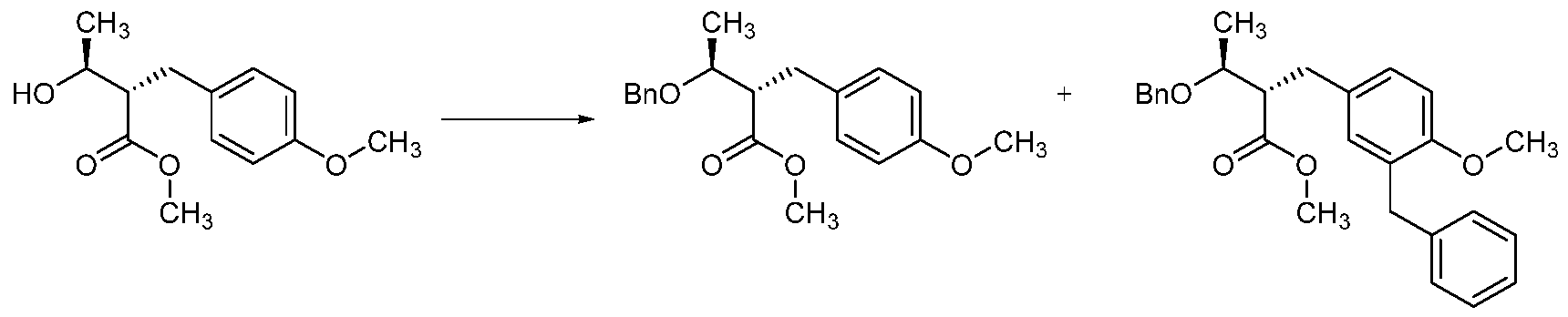
  • Compound 2.1 can be obtained by reaction of the dianion of an ester of Formula 2.0, formed by treatment with LDA at -50 °C, with alkyl halide such as 4- methoxybenzyl bromide, in a solvent such as THF at cryogenic temperatures such as–78 °C, as shown in step a.
  • Compounds of Formulas 2.2 and 2.3 can be prepared from compounds of Formula 2.1, by treating with an alkylating agent such as benzyl 2,2,2-trichloroacetimidate, in the presence of an acid such as triflic acid, in a solvent such as DCM, as depicted in step b.
  • an alkylating agent such as benzyl 2,2,2-trichloroacetimidate
  • Compounds of Formulas 3.2, 3.3, 3.4, and 3.5 wherein R 4 is as originally defined can be prepared according to the methods outlined in Scheme 3, steps a– d.
  • Compounds of Formula 3.1, wherein R 4 is as originally defined can be obtained by the reaction of compounds of the Formula 3.0, wherein R 4 is as originally defined, with a reducing agent such as diethylsilane in the presence of a transition metal catalyst such as chlorobis(cyclooctene)iridium(I) dimer in a solvent such as DCM at a temperature such as 0 °C, as depicted in step a.
  • a transition metal catalyst such as chlorobis(cyclooctene)iridium(I) dimer
  • Compounds of Formulas 3.2 and 3.3, wherein R 4 is as originally defined can be prepared from compounds of the Formula 3.1, wherein R 4 is as originally defined, by treating with vinylmagnesium bromide at cryogenic temperatures such as–78 °C in a solvent such as THF, as shown in step b.
  • Compounds of the Formula 3.4, wherein R 4 is as originally defined can be obtained by a reaction of compounds of the Formula 3.0, wherein R 4 is as originally defined, with a reducing agent such as lithium aluminum hydride (LAH) in a solvent such as THF at a temperature of about–78 °C to about 23 °C, as shown in step c.
  • LAH lithium aluminum hydride
  • compounds of Formula 3.0, wherein R 4 is as originally defined can be treated with a nucleophile such as methyllithium in a solvent such as THF at a temperature of about –78 °C to about 23 °C, as described is step d, to afford compounds of Formula 3.5, wherein R 4 is as originally defined.
  • Compounds of Formulas 4.2, 4.4, and 4.7, wherein R 4 is as originally defined, R 8 is alkyl or aryl, and R 10 is alkyl, can be prepared according to the methods described in Scheme 4, steps a– g.
  • Compounds of the Formula 4.0 can be treated with a base such as potassium t-butoxide and alkylating agent such as n-propyltosylate, in a solvent such as dimethoxyethane (DME) at a temperature of about 40 o C, to afford compounds of Formula 4.1, wherein R 4 is as originally described and R 8 is alkyl, as depicted in step a.
  • a base such as potassium t-butoxide and alkylating agent such as n-propyltosylate
  • DME dimethoxyethane
  • compounds of the Formula 4.0 wherein R 4 is as originally described, can be arylated to provide compounds of the Formula 4.3, wherein R 4 is as originally described and R 8 is aryl, using a reagent such as tris(o-tolyl)bismuth(V) diacetate in the presence of an amine base such as N,N-dicyclohexyl-N-methylamine and a catalyst such as copper(II) acetate, in a solvent such as toluene at a temperature of about 65 °C, as shown in step c.
  • a reagent such as tris(o-tolyl)bismuth(V) diacetate
  • an amine base such as N,N-dicyclohexyl-N-methylamine
  • a catalyst such as copper(II) acetate
  • compounds of Formula 4.3 wherein R 4 is as originally described and R 8 is aryl, can be subjected to ozone (O 3 ) in the presence of an acid scavenger, such as sodium bicarbonate (NaHCO 3 ), and an indicator, such as Sudan III, in a solvent like DCM at a temperature of about–78 °C, followed by addition of a reducing agent, such as sodium borohydride, in a solvent such as methanol at a temperature of about–78 °C to about 23 °C, to provide compounds of Formula 4.5, wherein R 4 is as originally described and R 8 is aryl, as shown in step e.
  • an acid scavenger such as sodium bicarbonate (NaHCO 3 )
  • an indicator such as Sudan III
  • a solvent like DCM at a temperature of about–78 °C
  • a reducing agent such as sodium borohydride
  • Compounds of Formula 5.2, wherein R 4 is as originally defined, R 8 is hydrogen or methyl, and R 10 is either alkyl or alkenyl, can be obtained from the reaction between compounds of a Formula 5.0, wherein R 4 is as originally defined and R 8 is hydrogen or methyl, and an appropriate alkyl or alkenyl halide, such as benzyl bromide or allyl bromide, in the presence of a base, such as sodium hydride, and a catalyst such as tetrabutylammonium iodide, in a solvent such as DMF at a temperatures of about 0 °C to 23 °C, as shown in step b.
  • a base such as sodium hydride
  • a catalyst such as tetrabutylammonium iodide
  • compounds of Formula 5.0 wherein R 4 is as originally defined and R 8 is hydrogen or methyl
  • a base such as sodium hydride or potassium t- butoxide
  • an aryl fluoride such as 1,2,4-trifluorobenzene
  • a crown ether such as 15-crown-5
  • a solvent such as DMF at temperatures of about 0 °C to about 70 °C
  • compounds of Formula 6.2 wherein R 4 is as originally defined and R 8 is alkyl, benzyl or aryl, may be obtained by treating compounds of Formula 6.1, where R 4 is as originally defined and R 8 is alkyl, benzyl or aryl, with an oxidant, such as ceric ammonium nitrate (CAN) in a solvent such as wet acetonitrile at a temperature of about 0 °C to 23 °C, as shown in step c.
  • an oxidant such as ceric ammonium nitrate (CAN) in a solvent such as wet acetonitrile at a temperature of about 0 °C to 23 °C, as shown in step c.
  • Compounds of Formula 7.2 wherein R 4 is as originally defined and R 8 is alkyl or aryl, can be prepared according to the methods depicted in Scheme 7, steps a– c.
  • Hydrogenolysis of compounds of Formula 7.0, wherein R 4 is as originally defined and R 8 is aryl, alkenyl, or alkyl, but not benzyl, in the presence of a catalyst such as Pd/C under an atmosphere of H 2 in a polar solvent such as EtOAc or EtOH provides products of Formula 7.2, wherein R 4 is as originally defined and R 8 is alkyl or aryl, but not alkenyl, benzyl or aryl chloride, as shown in step a.
  • compounds of Formula 7.2 wherein R 4 is as originally defined and R 8 is alkyl, alkenyl, benzyl or aryl, may be obtained by treating compounds of Formula 7.1, where R 4 is as originally defined and R 8 is alkyl, alkenyl, benzyl or aryl, with an oxidant, such as CAN, in a solvent such as wet acetonitrile at a temperature of about 0 °C to 23 °C, as shown in step c.
  • an oxidant such as CAN
  • Compounds of Formula 8.2, wherein R 4 is as originally defined and R 8 is alkyl, alkenyl, or benzyl, can be obtained by treating compounds of Formula 8.1, wherein R 4 is as originally defined, with lithium diisopropylamide (LDA), which was generated in situ from n-butyllithium (n-BuLi) and diisopropylamine (i-Pr 2 NH) at–20 °C, followed by reacting with alkyl, allyl, or benzyl bromide or alkyl, allyl, or benzyl chloride, such as R 8 Br, wherein R 8 is alkyl, allyl, or benzyl, in a solvent such as THF from–78 °C to ambient temperature, as shown in step b.
  • LDA lithium diisopropylamide
  • i-Pr 2 NH diisopropylamine
  • Compounds of Formula 9.1, wherein R 4 is as originally defined and R 8 is alkyl, allyl, or benzyl can be obtained by reacting compounds of Formula 9.0, wherein R 4 is as originally defined and R 8 is alkyl, allyl, or benzyl, with an oxidant, such as a solution of chromium trioxide (CrO 3 ) and pyridine in DCM, in a solvent such as DCM at low temperatures such as from about–25 °C to about–10 °C, as shown in step b.
  • an oxidant such as a solution of chromium trioxide (CrO 3 ) and pyridine in DCM, in a solvent such as DCM at low temperatures such as from about–25 °C to about–10 °C, as shown in step b.
  • Compounds of Formula 10.1, wherein R 4 is as originally defined can be prepared from the reaction between trans-2-methyl-3-phenyloxirane, a compound of Formula 10.0, with an organolithium reagent, such as R 4 CH 2 Li, or a Grignard reagent, such as R 4 CH 2 MgX, wherein R 4 is as originally defined and X is bromide or chloride, and copper (I) iodide in a solvent such as THF at cryogenic temperatures such as–78 °C, as shown in step a.
  • organolithium reagent such as R 4 CH 2 Li
  • a Grignard reagent such as R 4 CH 2 MgX
  • R 4 is as originally defined and X is bromide or chloride
  • copper (I) iodide in a solvent such as THF at cryogenic temperatures such as–78 °C, as shown in step a.
  • Compounds of Formula 11.3, wherein R 4 is aryl can be generated by a reduction of ketones of Formula 11.2, wherein R 4 is aryl, using a reductant such as borane-dimethylsulfide complex (BH 3 •SMe 2 ) in the presence of a chiral catalyst like (R)-(+)-2-Methyl-CBS-oxazaborolidine in nonpolar solvent such as toluene at temperatures of about–78 °C to about 23 °C, as shown in step c.
  • a reductant such as borane-dimethylsulfide complex (BH 3 •SMe 2 )
  • a chiral catalyst like (R)-(+)-2-Methyl-CBS-oxazaborolidine in nonpolar solvent such as toluene at temperatures of about–78 °C to about 23 °C, as shown in step c.
  • compounds of Formula 12.3, wherein R 1 , R 2 , R 3 , R 4 , and R 11 are as originally defined can be prepared by reacting compounds of Formula 12.2, wherein R 2 , R 3 , and R 4 are as originally defined, with an activating agent, such as diisopropyl azodicarboxylate (DIAD), in the presence of phosphine reagent, such as triphenylphosphine, and a nucleophile such as compounds of Formula 12.1, wherein R 1 and R 11 are as originally defined, in a solvent such as tetrahydrofuran (THF) at temperatures of about 0 °C to about 23 °C, as depicted in step b.
  • an activating agent such as diisopropyl azodicarboxylate (DIAD)
  • phosphine reagent such as triphenylphosphine
  • a nucleophile such as compounds of Formula 12.1, wherein R 1 and R 11 are as originally defined, in a solvent such
  • Ketones of Formula 13.2, wherein R 1 and R 11 are as originally defined can be treated with an olefinating reagent, such as bis(cyclopentadienyl)- ⁇ -chloro(dimethylaluminum)- ⁇ - methylenetitanium (Tebbe reagent), in a nonpolar solvent like toluene at temperatures of about 0 °C to about 23 °C, to afford compounds of Formula 13.3, R 1 and R 11 are as originally defined, as shown in step b.
  • Compounds of Formula 13.3, wherein R 1 and R 11 are as originally defined can be hydrogenated under conditions outlined in Scheme 9, step d, to afford compounds of the Formula 13.4, R 1 and R 11 are as originally defined, as depicted in step c.
  • compounds of Formula 14.2 wherein R 1 , R 2 , R 3 , R 4 , R 6 and R 11 are as originally defined, can be obtained via treatment of compounds of Formula 14.0, wherein R 1 , R 2 , R 3 , R 4 , R 6 and R 11 are as originally defined, with an acid, such as 2,2,2-trifluoroacetic acid, in a solvent such as DCM, as depicted in step b.
  • an acid such as 2,2,2-trifluoroacetic acid
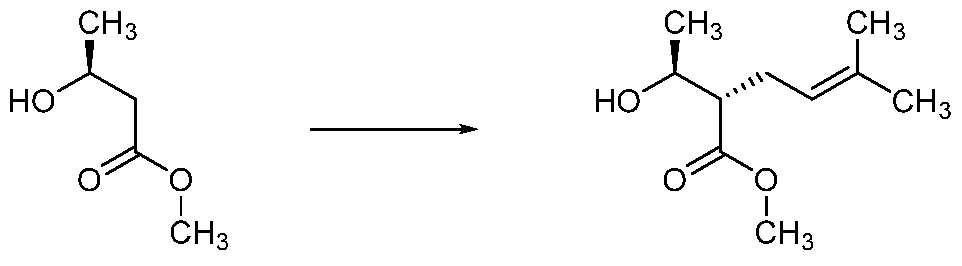
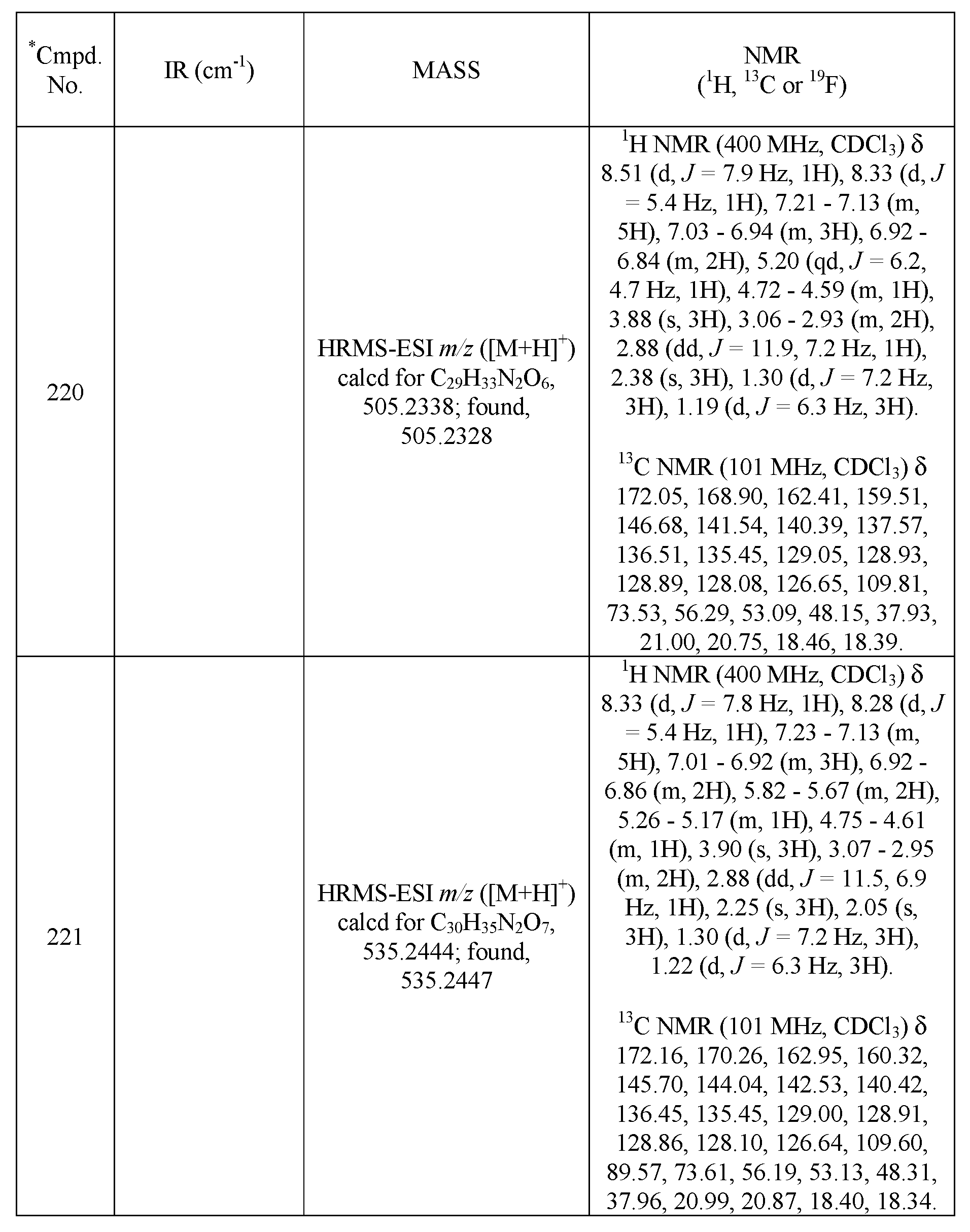
  • Example 1 Preparation of (S)-methyl 2-((S)-1-hydroxyethyl)-5- methylhex-4-enoate.
  • (2S,3S)-methyl 2-(3-benzyl-4- methoxybenzyl)-3-(benzyloxy)butanoate (1.314 g, 2.51 mmol, 8%, ⁇ 80% purity) as a viscous orange oil.
  • the reaction was poured into a well-stirred Erlenmeyer flask containing a mixture of 50 mL Et 2 O and 15 mL 2 N HCl at 0 °C. The flask was stirred vigorously at 0 °C for 1.5 h, then the mixture was transferred to a separatory funnel and diluted with 25 mL H 2 O. The phases were separated and the aqueous phase was extracted with Et 2 O x 3. The organic phases were washed with sat. NaHCO 3 and then brine.
  • Example 3A, Step 2 Preparation of (3S,4R,5S)-4-benzyl-5-((4- methoxybenzyl)oxy)hex-1-en-3-ol and (3R,4R,5S)-4-benzyl-5-((4-methoxybenzyl)oxy)hex-1-en-3- ol.
  • (2S,3S)-2- benzyl-3-((4-methoxybenzyl)oxy)butanal 1.987 g, 6.66 mmol
  • THF 13 mL
  • Example 3C Preparation of (3S,4S)-3-(4-fluorobenzyl)-4-((4-methoxybenzyl)oxy)-2- methylpentan-2-ol.
  • a solution of (2S,3S)-methyl 2-(4-fluorobenzyl)-3- ((4-methoxybenzyl)oxy)butanoate (3.55 g, 10.25 mmol) was prepared in THF (41.0 mL) and cooled to–78 °C in an acetone/dry ice bath.
  • the oil was purified via flash chromatography on silica (120 g column, 85 mL/min, 100% hexanes for 2 column volumes, 100% hexanes to 40% acetone : hexanes over 12 column volumes, hold at 40% acetone : hexanes for 2 column volumes) to afford (3S,4S)-3-(4-fluorobenzyl)-4-((4-methoxybenzyl)oxy)-2-methylpentan- 2-ol (1.706 g, 48%) as a yellow oil.
  • Example 4B, Step 1 Preparation of 1-fluoro-4-((2S,3S)-2-((S)-1-((4- methoxybenzyl)oxy)ethyl)-3-(p-tolyloxy)pent-4-en-1-yl)benzene.
  • Example 4B, Step 2 Preparation of (2R,3S,4S)-3-(4-fluorobenzyl)-4-((4- methoxybenzyl)oxy)-2-(p-tolyloxy)pentan-1-ol.
  • Example 4B, Step 3 Preparation of 1-((2S,3R)-4-ethoxy-2-((S)-1-((4-methoxy- benzyl)oxy)ethyl)-3-(p-tolyloxy)butyl)-4-fluorobenzene.
  • Example 4C Preparation of 1-fluoro-4-((S)-3-methoxy-2-((S)-1-((4- methoxybenzyl)oxy)ethyl)-3-methylbutyl)benzene.
  • Example 4E Preparation of 1-(((3S,4S)-3-benzyl-4-((4-methoxybenzyl)oxy)-2- methylpentan-2-yl)oxy)-2,4-dichlorobenzene.
  • Example 6, step 1 Preparation of (4R,5S)-4-(4-fluorobenzyl)-5-methyldihydrofuran- 2(3H)-one.
  • Mg-turnings 66.9 g, 2752.2 mmol
  • Para-fluorobenzyl chloride 66.4 g, 458.7 mmol
  • a water cooling bath was applied when required.
  • reaction mixture was stirred for a further 2 h at room temperature.
  • a separate flame dried 3- neck flask was charged with CuI (dried in a vac oven at 60 oC overnight, 40.8 g, 214.06 mmol) under nitrogen to which was added dry ether (450 mL), stirred for 10 min, and cooled to–78 oC.
  • the Grignard reagent (prepared above) was transferred to the dropping funnel using a cannula and added slowly over 1 h (the temperature increased to–63 oC) and the reaction mixture was stirred for a further 2.5 h.
  • reaction mixture was also allowed to warm up to–33 oC and the gray color reaction mixture turned to a black solution with black suspension indicating the formation of the organo-copper reagent.
  • a pre-mixed mixture of compound 8 and TMSCl (16.6 g, 152.9 mmol) in ether (100 mL) was added using a addition funnel over 20 min.
  • the reaction mixture was stirred for 2 h at -78 oC and the HPLC showed no starting material (confirmed by TLC 40% EA in hexane).
  • the formation of the product was confirmed by GC.
  • the reaction mixture was quenched with a saturated NH 4 Cl solution and extracted with ethyl acetate (3 times).
  • Hexamethylphosphoramide (155 mg, 0.864 mmol) was added and the reaction was stirred for 0.5 h.
  • Benzylbromide (2.9 g, 17.29 mmol) was added drop-wise as a THF (10 mL) solution at–78 oC.
  • the reaction mixture was then stirred at–78 oC for 30 min.
  • the cooling bath was then removed to allow the mixture to come up to room temperature and stirred overnight.
  • the reaction mixture was quenched with a saturated aq. NH 4 Cl solution and extracted with ethyl acetate (3 times).
  • Example 6 Preparation of (4S,5S,6S)-6-benzyl-5-(4-fluorobenzyl)-2,2,4,9,9- pentamethyl-3,8-dioxa-2,9-disiladecane.
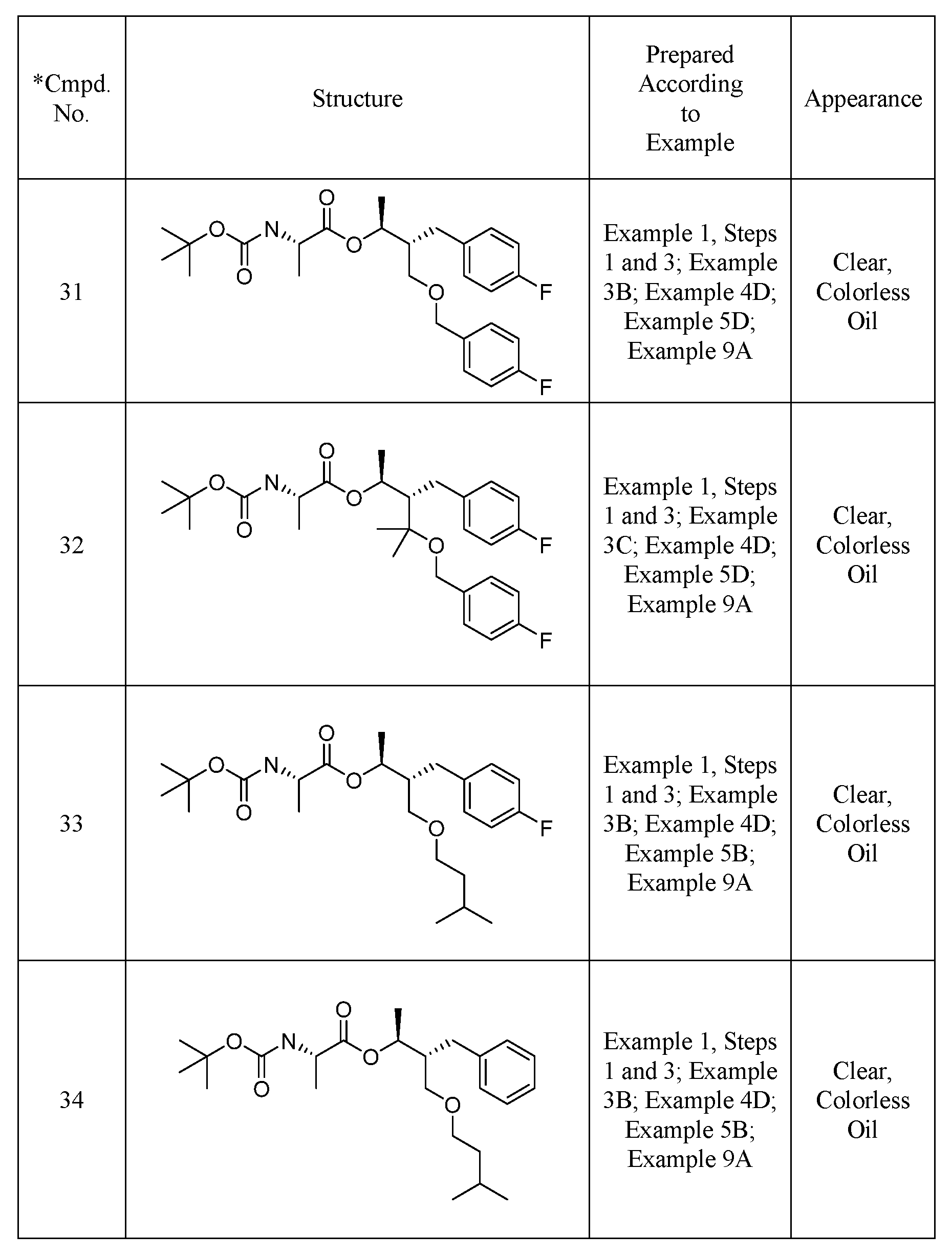
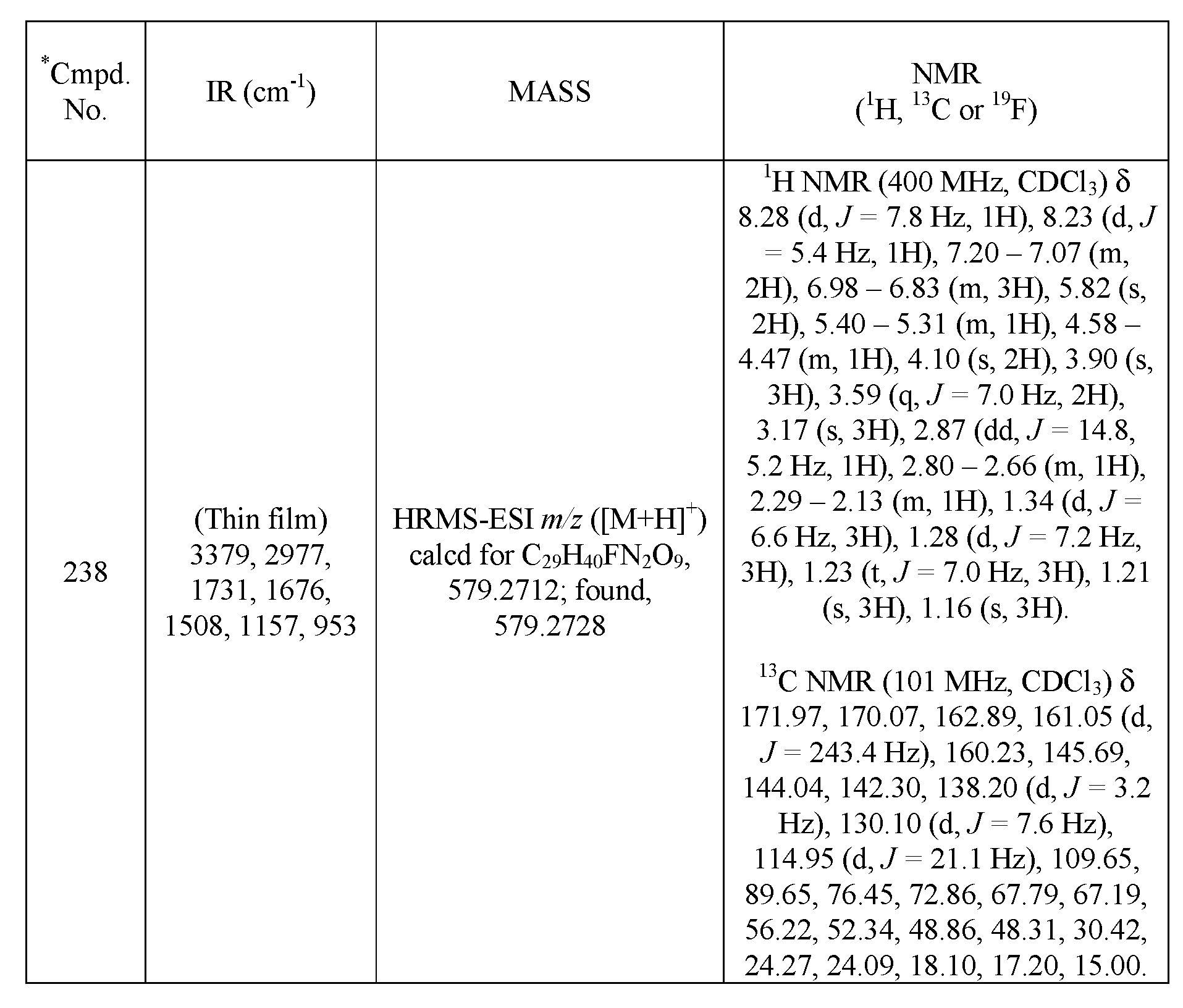
  • Example 9A Preparation of (S)-(2S,3S)-3-benzyl-4-methyl-4-propoxypentan-2-yl 2- ((tert-butoxycarbonyl)amino)propanoate.
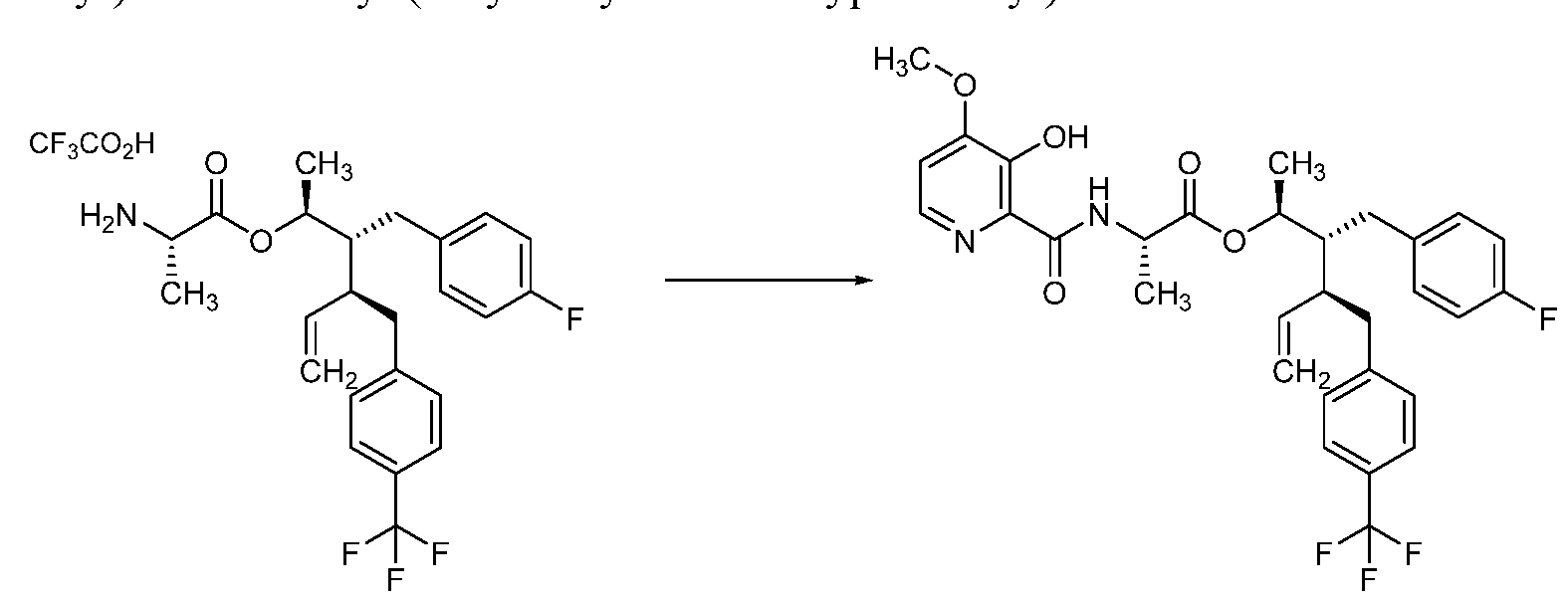
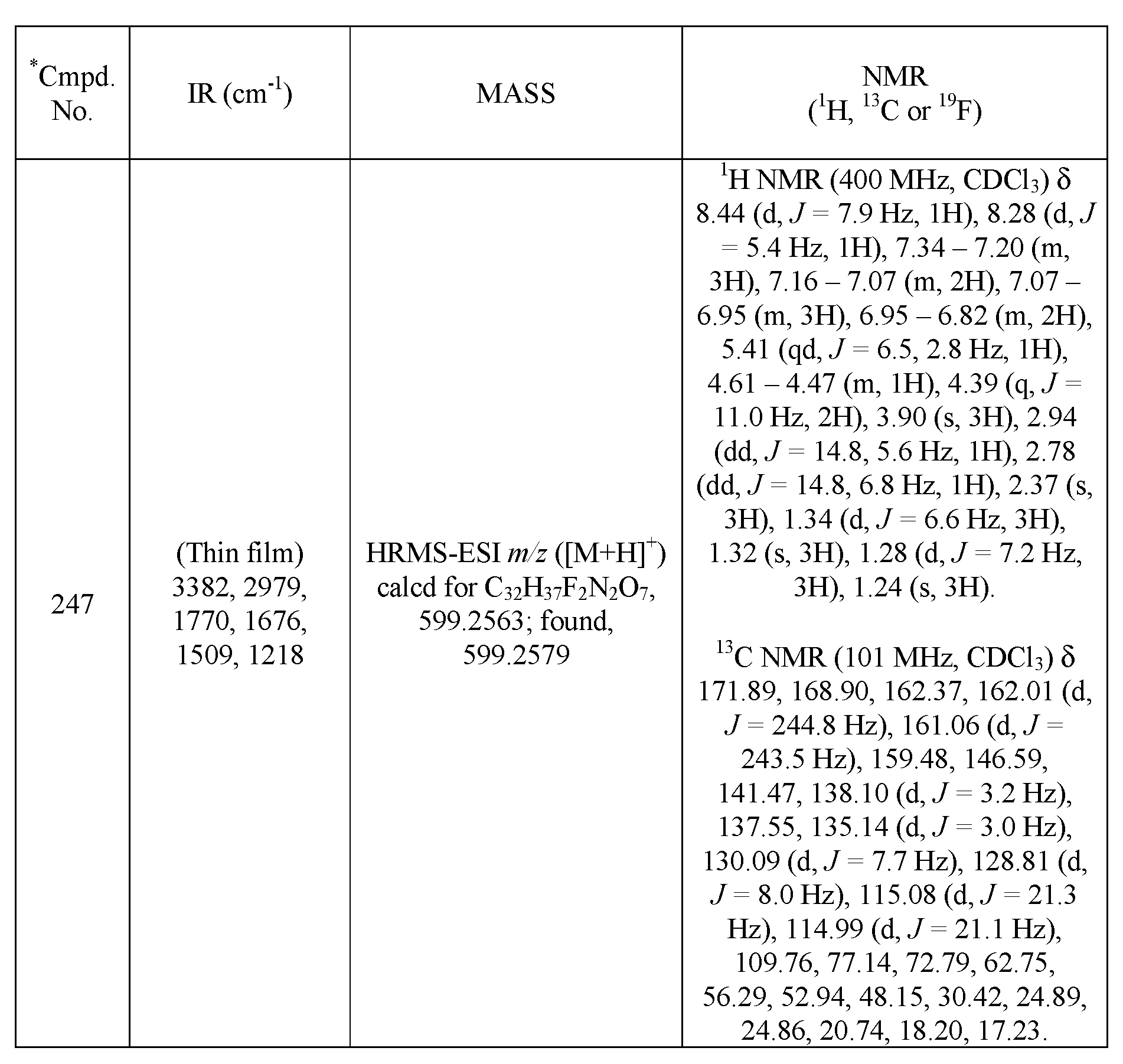
  • Example 11B, Step 2 Preparation of (2S,3R,4S)-3-(4-fluorobenzyl)-4-(4-(trifluoro- methyl)benz l hex-5-en-2- l 3-h drox -4-methox icolino l -L-alaninate.
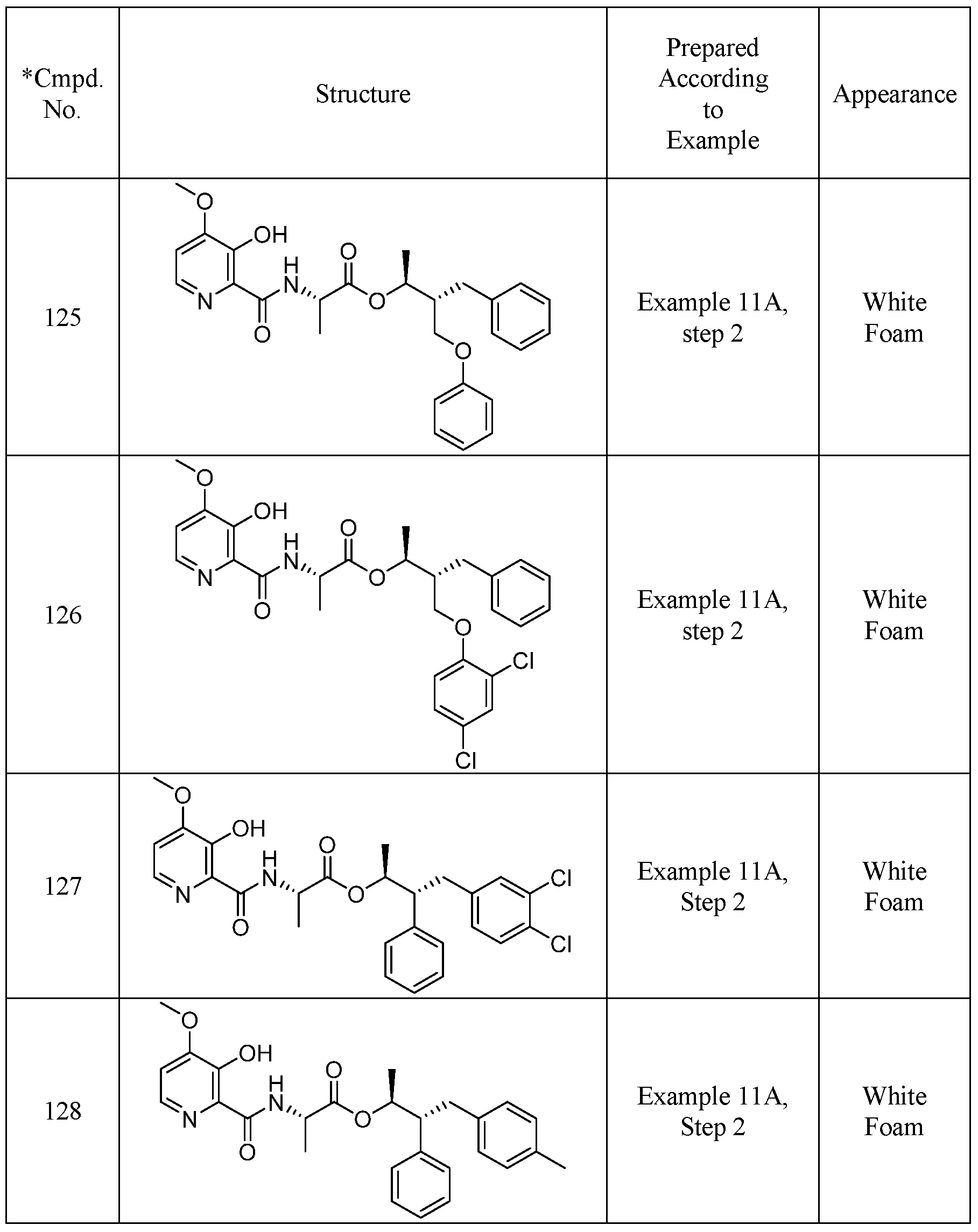
  • Example 11C, Step 2 Preparation of (S)-(2S,3S)-3-benzyl-4-(2,4-dichlorophenoxy)- 4-methylpentan-2-yl 2-(3-hydroxy-4-methoxypicolinamido)propanoate and (S)-(2S,3R)-3-benzyl-4- methylpent-4-en-2-yl 2-(3-hydroxy-4-methoxypicolinamido)propanoate.
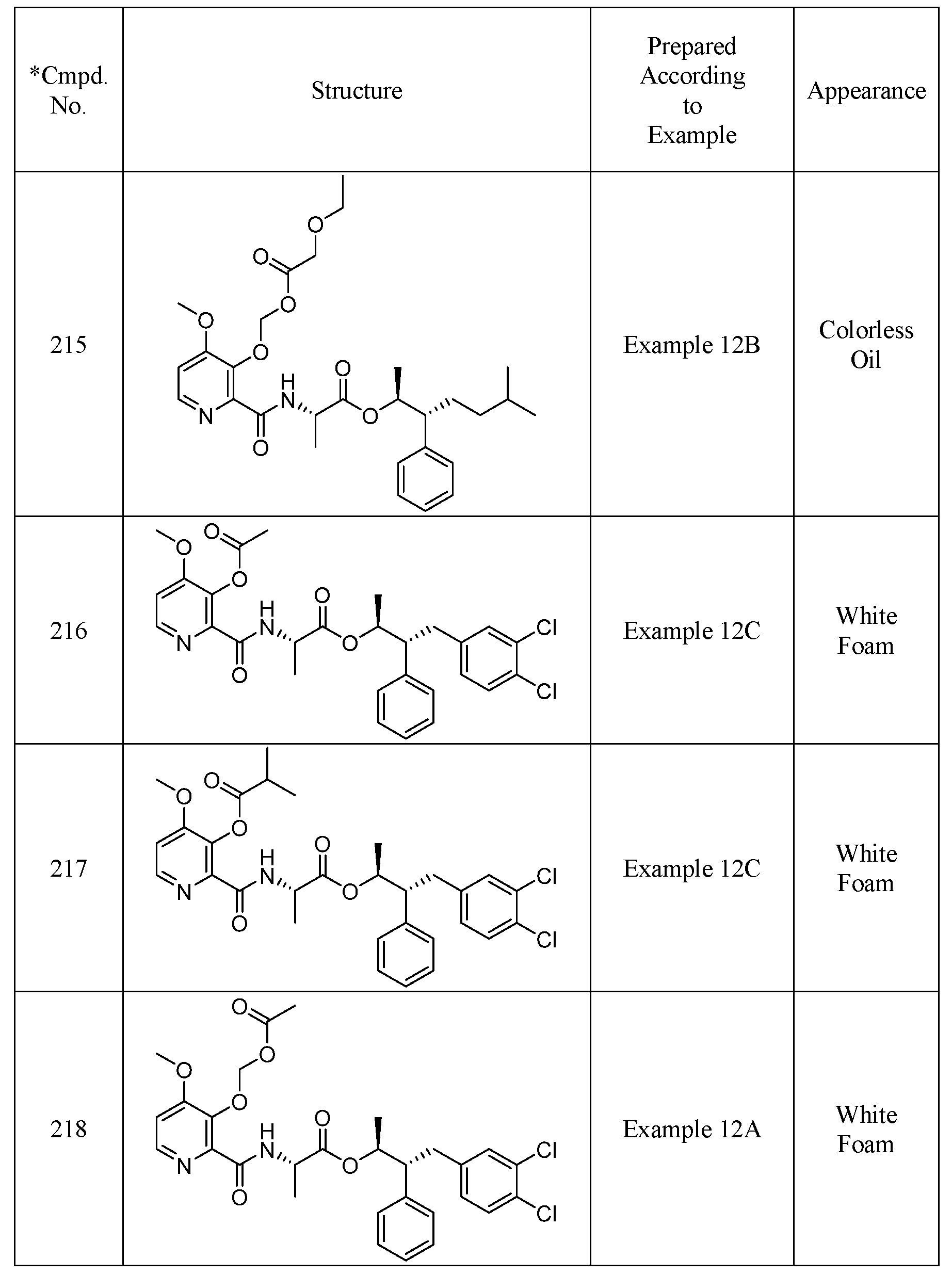
  • Example 12B Preparation of ((4-methoxy-2-(((S)-1-oxo-1-(((2S,3R)-3-phenylheptan- 2-yl)oxy)propan-2-yl)carbamoyl)pyridin-3-yl)oxy)methyl isobutyrate
  • reaction mixture was purified via flash chromatography on silica to provide (S)-(2S,3R)-3-phenylheptan-2-yl 2-(3- acetoxy-4-methoxypicolinamido)propanoate (85 mg, 71%) as a colorless oil.
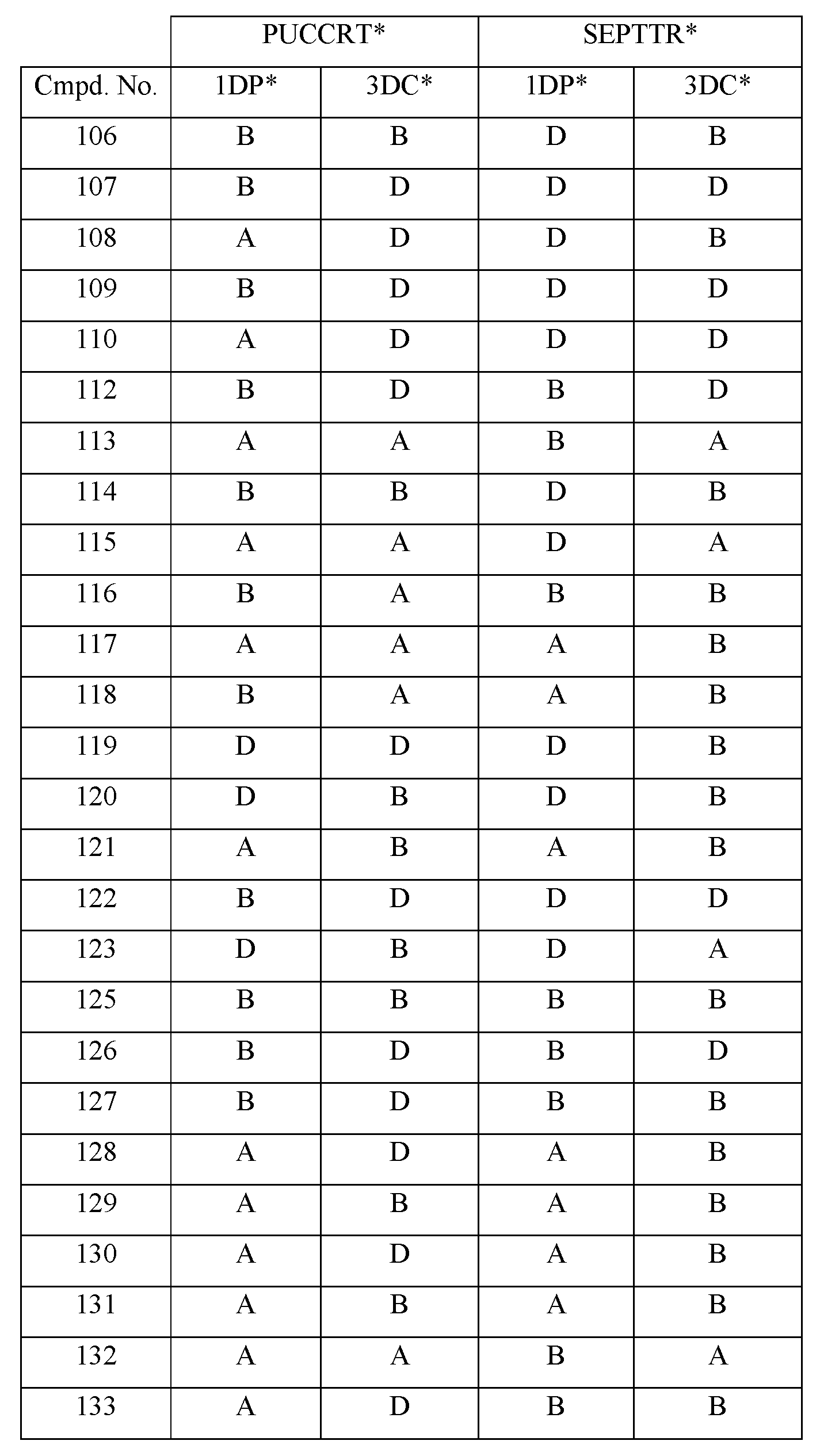
  • Wheat plants (variety Yuma) were grown from seed in a greenhouse in 50% mineral soil/50% soil-less Metro mix until the first leaf was fully emerged, with 7-10 seedlings per pot. These plants were inoculated with an aqueous spore suspension of Zymoseptoria tritici either prior to or after fungicide treatments. After inoculation the plants were kept in 100% relative humidity (one day in a dark dew chamber followed by two to three days in a lighted dew chamber at 20 oC) to permit spores to germinate and infect the leaf. The plants were then transferred to a greenhouse set at 20 oC for disease to develop.
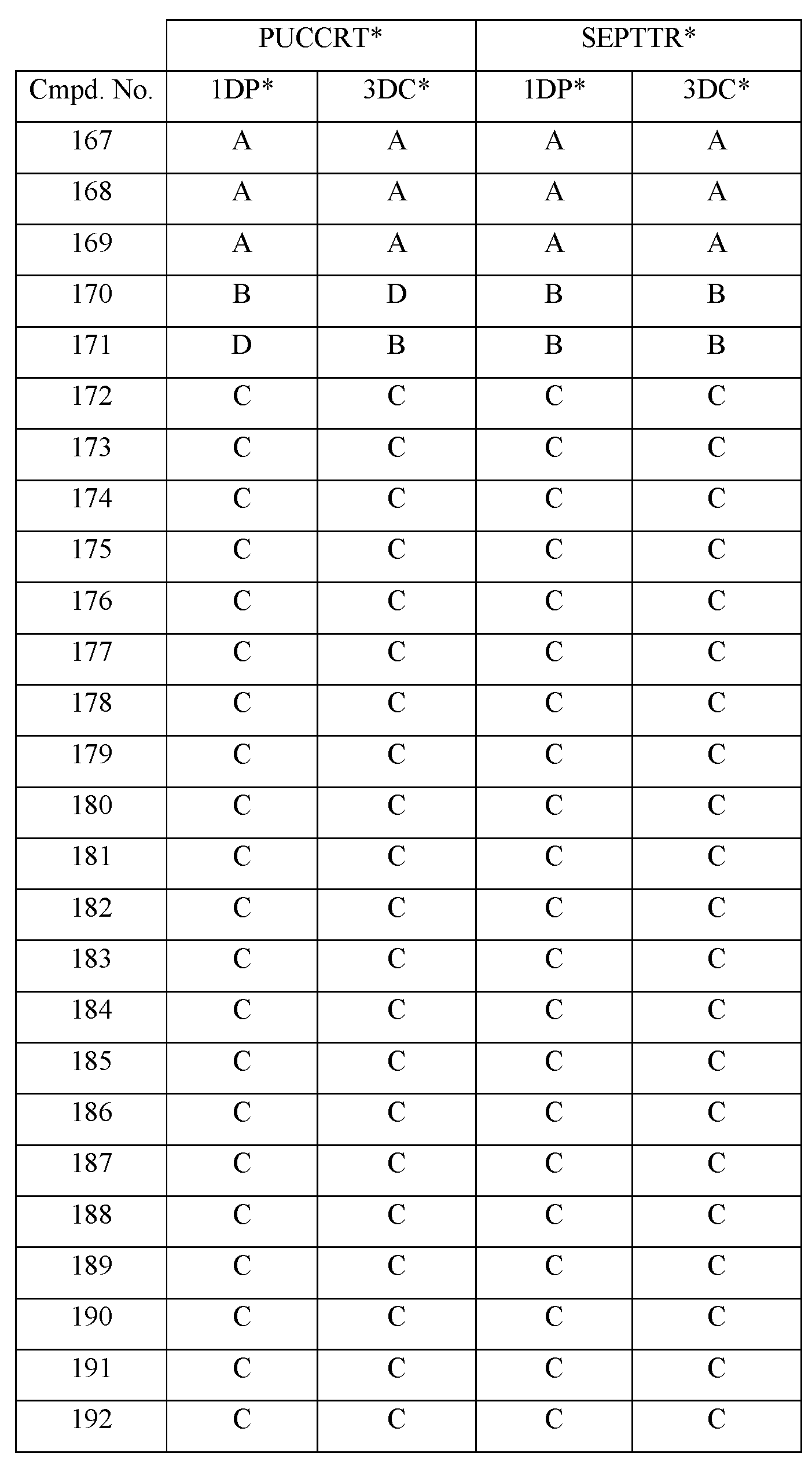
  • Example B Evaluation of Fungicidal Activity: Wheat Brown Rust (Puccinia triticina; Synonym: Puccinia recondita f. sp. tritici; Bayer code PUCCRT):
  • Soybean plants (variety Williams 82) were grown in soil-less Metro mix, with one plant per pot. Two weeks old seedlings were used for testing. Plants were inoculated either 3 days prior to or 1 day after fungicide treatments. Plants were incubated for 24 h in a dark dew room at 22 °C and 100 % RH then transferred to a growth room at 23 °C for disease to develop. Disease severity was assessed on the sprayed leaves.

Landscapes

  • Chemical & Material Sciences (AREA)
  • Organic Chemistry (AREA)
  • Life Sciences & Earth Sciences (AREA)
  • Health & Medical Sciences (AREA)
  • General Health & Medical Sciences (AREA)
  • Environmental Sciences (AREA)
  • Wood Science & Technology (AREA)
  • Engineering & Computer Science (AREA)
  • Pest Control & Pesticides (AREA)
  • Zoology (AREA)
  • Dentistry (AREA)
  • Agronomy & Crop Science (AREA)
  • Plant Pathology (AREA)
  • Animal Behavior & Ethology (AREA)
  • Epidemiology (AREA)
  • Public Health (AREA)
  • Pharmacology & Pharmacy (AREA)
  • Veterinary Medicine (AREA)
  • Medicinal Chemistry (AREA)
  • Agricultural Chemicals And Associated Chemicals (AREA)
  • Pyridine Compounds (AREA)
  • Biodiversity & Conservation Biology (AREA)
  • Ecology (AREA)
  • Forests & Forestry (AREA)
  • Toxicology (AREA)
  • Organic Low-Molecular-Weight Compounds And Preparation Thereof (AREA)
  • Botany (AREA)

Abstract

The invention relates to picolinamides of Formula I and their use as fungicides.

Description

PICOLINAMIDES WITH FUNGICIDAL ACTIVITY CROSS REFERENCE TO RELATED APPLICATIONS
[0001] This application claims the benefit of U.S. Provisional Patent Application Serial Nos. 62/098089 filed December 30, 2014, 62/098097 filed December 30, 2014, 62/255144 filed
November 13, 2015 and 62/255152 filed November 13, 2015, which are expressly incorporated by reference herein. BACKGROUND & SUMMARY
[0002] Fungicides are compounds, of natural or synthetic origin, which act to protect and/or cure plants against damage caused by agriculturally relevant fungi. Generally, no single fungicide is useful in all situations. Consequently, research is ongoing to produce fungicides that may have better performance, are easier to use, and cost less.
[0003] The present disclosure relates to picolinamides and their use as fungicides. The compounds of the present disclosure may offer protection against ascomycetes, basidiomycetes, deuteromycetes and oomycetes.
[0004] One embodiment of the present disclosure may include compounds of Formula I:
Figure imgf000003_0001
X is hydrogen or C(O)R5;
Y is hydrogen, C(O)R5, or Q;
Q is
Figure imgf000003_0002
; R1 is CH2OCH3, or hydrogen or alkyl, where alkyl is optionally substituted with 0, 1 or multiple R8;
R2 is methyl;
R3 is chosen from C(O)OCH3 or alkyl, alkenyl, or aryl, each optionally substituted with 0, 1 or multiple R8;
R4 is chosen from alkyl or aryl, each optionally substituted with 0, 1 or multiple R8; R5 is alkoxy, optionally substituted with 0, 1, or multiple R8;
R6 is chosen from hydrogen or alkoxy, each optionally substituted with 0, 1, or multiple R8;
R7 is chosen from hydrogen,–C(O)R9, or–CH2OC(O)R9;
R8 is chosen from hydrogen, alkyl, aryl, halo, alkenyl, or phenoxy, each optionally substituted with 0, 1, or multiple R10;
R9 is chosen from alkyl, alkoxy, or aryl, each optionally substituted with 0, 1, or multiple R8;
R10 is chosen from alkyl, aryl, halo, haloalkyl, haloaryl, alkenyl, or alkoxy; R11 is chosen from hydrogen or methyl. [0005] Another embodiment of the present disclosure may include a fungicidal composition for the control or prevention of fungal attack comprising the compounds described above and a phytologically acceptable carrier material.
[0006] Yet another embodiment of the present disclosure may include a method for the control or prevention of fungal attack on a plant, the method including the steps of applying a fungicidally effective amount of one or more of the compounds described above to at least one of the fungus, the plant, and an area adjacent to the plant.
[0007] It will be understood by those skilled in the art that the following terms may include generic "R"-groups within their definitions, e.g., "the term alkoxy refers to an–OR substituent". It is also understood that within the definitions for the following terms, these "R" groups are included for illustration purposes and should not be construed as limiting or being limited by substitutions about Formula I.
[0008] The term "alkyl" refers to a saturated branched, unbranched, or cyclic carbon chain, including, but not limited to, methyl, ethyl, propyl, butyl, isopropyl, isobutyl, tertiary butyl, pentyl, hexyl, cyclopropyl, cyclobutyl, cyclopentyl, cyclohexyl and the like.
[0009] The term "alkenyl" refers to a branched, unbranched or cyclic carbon chain containing one or more double bonds including, but not limited to, ethenyl, propenyl, butenyl, isopropenyl, isobutenyl, cyclobutenyl, cyclopentenyl, cyclohexenyl, and the like.
[0010] The term "alkynyl" refers to a branched or unbranched carbon chain containing one or more triple bonds including, but not limited to, propynyl, butynyl and the like.
[0011] The term "aryl" refers to any aromatic, mono- or bi-cyclic, containing 0 heteroatoms.
[0012] The term "heterocycle" refers to any aromatic or non-aromatic ring, mono- or bi- cyclic, containing one or more heteroatoms
[0013] The term "alkoxy" refers to an–OR substituent.
[0014] The term "haloalkyl" refers to an alkyl, which is substituted with Cl, F, I, or Br or any combination thereof.
[0015] The term "halogen" or "halo" refers to one or more halogen atoms, defined as F, Cl, Br, and I.
[0016] Throughout the disclosure, reference to the compounds of Formula I is read as also including diastereomers, enantiomers, and mixtures thereof. In another embodiment, Formula (I) is read as also including salts or hydrates thereof. Exemplary salts include, but are not limited to: hydrochloride, hydrobromide, and hydroiodide.
[0017] It is also understood by those skilled in the art that additional substitution is allowable, unless otherwise noted, as long as the rules of chemical bonding and strain energy are satisfied and the product still exhibits fungicidal activity.
[0018] Another embodiment of the present disclosure is a use of a compound of Formula I, for protection of a plant against attack by a phytopathogenic organism or the treatment of a plant infested by a phytopathogenic organism, comprising the application of a compound of Formula I, or a composition comprising the compound to soil, a plant, a part of a plant, foliage, and/or roots. [0019] Additionally, another embodiment of the present disclosure is a composition useful for protecting a plant against attack by a phytopathogenic organism and/or treatment of a plant infested by a phytopathogenic organism comprising a compound of Formula I and a phytologically acceptable carrier material.
DETAILED DESCRIPTION
[0020] The compounds of the present disclosure may be applied by any of a variety of known techniques, either as the compounds or as formulations comprising the compounds. For example, the compounds may be applied to the roots or foliage of plants for the control of various fungi, without damaging the commercial value of the plants. The materials may be applied in the form of any of the generally used formulation types, for example, as solutions, dusts, wettable powders, flowable concentrate, or emulsifiable concentrates.
[0021] Preferably, the compounds of the present disclosure are applied in the form of a formulation, comprising one or more of the compounds of Formula I with a phytologically acceptable carrier. Concentrated formulations may be dispersed in water, or other liquids, for application, or formulations may be dust-like or granular, which may then be applied without further treatment. The formulations can be prepared according to procedures that are conventional in the agricultural chemical art.
[0022] The present disclosure contemplates all vehicles by which one or more of the compounds may be formulated for delivery and use as a fungicide. Typically, formulations are applied as aqueous suspensions or emulsions. Such suspensions or emulsions may be produced from water-soluble, water-suspendible, or emulsifiable formulations which are solids, usually known as wettable powders; or liquids, usually known as emulsifiable concentrates, aqueous suspensions, or suspension concentrates. As will be readily appreciated, any material to which these compounds may be added may be used, provided it yields the desired utility without significant interference with the activity of these compounds as antifungal agents.
[0023] Wettable powders, which may be compacted to form water-dispersible granules, comprise an intimate mixture of one or more of the compounds of Formula I, an inert carrier and surfactants. The concentration of the compound in the wettable powder may be from about 10 percent to about 90 percent by weight based on the total weight of the wettable powder, more preferably about 25 weight percent to about 75 weight percent. In the preparation of wettable powder formulations, the compounds may be compounded with any finely divided solid, such as prophyllite, talc, chalk, gypsum, Fuller's earth, bentonite, attapulgite, starch, casein, gluten, montmorillonite clays, diatomaceous earths, purified silicates or the like. In such operations, the finely divided carrier and surfactants are typically blended with the compound(s) and milled.
[0024] Emulsifiable concentrates of the compounds of Formula I may comprise a convenient concentration, such as from about 1 weight percent to about 50 weight percent of the compound, in a suitable liquid, based on the total weight of the concentrate. The compounds may be dissolved in an inert carrier, which is either a water-mi scible solvent or a mixture of water-immiscible organic solvents, and emulsifiers. The concentrates may be diluted with water and oil to form spray mixtures in the form of oil-in-water emulsions. Useful organic solvents include aromatics, especially the high-boiling naphthalenic and olefinic portions of petroleum such as heavy aromatic naphtha. Other organic solvents may also be used, for example, terpenic solvents, including rosin derivatives, aliphatic ketones, such as cyclohexanone, and complex alcohols, such as 2- ethoxyethanol.
[0025] Emulsifiers which may be advantageously employed herein may be readily determined by those skilled in the art and include various nonionic, anionic, cationic and amphoteric emulsifiers, or a blend of two or more emulsifiers. Examples of nonionic emulsifiers useful in preparing the emulsifiable concentrates include the polyalkylene glycol ethers and condensation products of alkyl and aryl phenols, aliphatic alcohols, aliphatic amines or fatty acids with ethylene oxide, propylene oxides such as the ethoxylated alkyl phenols and carboxylic esters solubilized with the polyol or polyoxyalkylene. Cationic emulsifiers include quaternary ammonium compounds and fatty amine salts. Anionic emulsifiers include the oil-soluble salts (e.g., calcium) of alkylaryl sulphonic acids, oil-soluble salts or sulfated polyglycol ethers and appropriate salts of phosphated polyglycol ether.
[0026] Representative organic liquids which may be employed in preparing the emulsifiable concentrates of the compounds of the present disclosure are the aromatic liquids such as xylene, propyl benzene fractions; or mixed naphthalene fractions, mineral oils, substituted aromatic organic liquids such as dioctyl phthalate; kerosene; dialkyl amides of various fatty acids, particularly the dimethyl amides of fatty glycols and glycol derivatives such as the «-butyl ether, ethyl ether or methyl ether of di ethylene glycol, the methyl ether of triethylene glycol, petroleum fractions or hydrocarbons such as mineral oil, aromatic solvents, paraffinic oils, and the like; vegetable oils such as soy bean oil, rape seed oil, olive oil, castor oil, sunflower seed oil, coconut oil, corn oil, cotton seed oil, linseed oil, palm oil, peanut oil, safflower oil, sesame oil, tung oil and the like; esters of the above vegetable oils; and the like. Mixtures of two or more organic liquids may also be employed in the preparation of the emulsifiable concentrate. Organic liquids include xylene, and propyl benzene fractions, with xylene being most preferred in some cases. Surface-active dispersing agents are typically employed in liquid formulations and in an amount of from 0.1 to 20 percent by weight based on the combined weight of the dispersing agent with one or more of the compounds. The formulations can also contain other compatible additives, for example, plant growth regulators and other biologically active compounds used in agriculture.
[0027] Aqueous suspensions comprise suspensions of one or more water-insoluble compounds of Formula I, dispersed in an aqueous vehicle at a concentration in the range from about 1 to about 50 weight percent, based on the total weight of the aqueous suspension. Suspensions are prepared by finely grinding one or more of the compounds, and vigorously mixing the ground material into a vehicle comprised of water and surfactants chosen from the same types discussed above. Other components, such as inorganic salts and synthetic or natural gums, may also be added to increase the density and viscosity of the aqueous vehicle.
[0028] The compounds of Formula I can also be applied as granular formulations, which are particularly useful for applications to the soil. Granular formulations generally contain from about 0.5 to about 10 weight percent, based on the total weight of the granular formulation of the compound(s), dispersed in an inert carrier which consists entirely or in large part of coarsely divided inert material such as attapulgite, bentonite, diatomite, clay or a similar inexpensive substance. Such formulations are usually prepared by dissolving the compounds in a suitable solvent and applying it to a granular carrier which has been preformed to the appropriate particle size, in the range of from about 0.5 to about 3 mm. A suitable solvent is a solvent in which the compound is substantially or completely soluble. Such formulations may also be prepared by making a dough or paste of the carrier and the compound and solvent, and crushing and drying to obtain the desired granular particle.
[0029] Dusts containing the compounds of Formula I may be prepared by intimately mixing one or more of the compounds in powdered form with a suitable dusty agricultural carrier, such as, for example, kaolin clay, ground volcanic rock, and the like. Dusts can suitably contain from about 1 to about 10 weight percent of the compounds, based on the total weight of the dust.
[0030] The formulations may additionally contain adjuvant surfactants to enhance deposition, wetting and penetration of the compounds onto the target crop and organism. These adjuvant surfactants may optionally be employed as a component of the formulation or as a tank mix. The amount of adjuvant surfactant will typically vary from 0.01 to 1.0 percent by volume, based on a spray-volume of water, preferably 0.05 to 0.5 volume percent. Suitable adjuvant surfactants include, but are not limited to ethoxylated nonyl phenols, ethoxylated synthetic or natural alcohols, salts of the esters or sulphosuccinic acids, ethoxylated organosili cones, ethoxylated fatty amines, blends of surfactants with mineral or vegetable oils, crop oil concentrate (mineral oil (85%) + emulsifiers (15%)); nonylphenol ethoxylate; benzyl cocoalkyldimethyl quaternary ammonium salt; blend of petroleum hydrocarbon, alkyl esters, organic acid, and anionic surfactant; C9 - C11
alkylpolyglycoside; phosphated alcohol ethoxylate; natural primary alcohol (C12- C16) ethoxylate; di-sec-butylphenol EO-PO block copolymer; polysiloxane-methyl cap; nonylphenol ethoxylate + urea ammonium nitrrate; emulsified methylated seed oil; tridecyl alcohol (synthetic) ethoxylate (8EO); tallow amine ethoxylate (15 EO); PEG(400) dioleate-99. The formulations may also include oil-in-water emulsions such as those disclosed in U.S. Patent Application Serial No. 11/495,228, the disclosure of which is expressly incorporated by reference herein.
[0031] The formulations may optionally include combinations that contain other pesticidal compounds. Such additional pesticidal compounds may be fungicides, insecticides, herbicides, nematocides, miticides, arthropodicides, bactericides or combinations thereof that are compatible with the compounds of the present disclosure in the medium selected for application, and not antagonistic to the activity of the present compounds. Accordingly, in such embodiments, the other pesticidal compound is employed as a supplemental toxicant for the same or for a different pesticidal use. The compounds of Formula I and the pesticidal compound in the combination can generally be present in a weight ratio of from 1 : 100 to 100 : 1.
[0032] The compounds of the present disclosure may also be combined with other fungicides to form fungicidal mixtures and synergistic mixtures thereof. The fungicidal compounds of the present disclosure are often applied in conjunction with one or more other fungicides to control a wider variety of undesirable diseases. When used in conjunction with other fungicide(s), the presently claimed compounds may be formulated with the other fungicide(s), tank-mixed with the other fungicide(s) or applied sequentially with the other fungicide(s). Such other fungicides may include 2-(thiocyanatomethylthio)-benzothiazole, 2-phenylphenol, 8-hydroxyquinoline sulfate, ametoctradin, amisulbrom, antimycin, Ampelomyces quisqualis, azaconazole, azoxystrobin, Bacillus subtilis, Bacillus subtilis strain QST713, benalaxyl, benomyl, benthiavalicarb-isopropyl, benzylaminobenzene-sulfonate (BABS) salt, bicarbonates, biphenyl, bismerthiazol, bitertanol, bixafen, blasticidin-S, borax, Bordeaux mixture, boscalid, bromuconazole, bupirimate, calcium polysulfide, captafol, captan, carbendazim, carboxin, carpropamid, carvone, chlazafenone, chloroneb, chlorothalonil, chlozolinate, Coniothyrium minitans, copper hydroxide, copper octanoate, copper oxychloride, copper sulfate, copper sulfate (tribasic), cuprous oxide, cyazofamid, cyflufenamid, cymoxanil, cyproconazole, cyprodinil, dazomet, debacarb, diammonium ethylenebis- (dithiocarbamate), dichlofluanid, dichlorophen, diclocymet, diclomezine, dichloran, diethofencarb, difenoconazole, difenzoquat ion, diflumetorim, dimethomorph, dimoxystrobin, diniconazole, diniconazole-M, dinobuton, dinocap, diphenylamine, dithianon, dodemorph, dodemorph acetate, dodine, dodine free base, edifenphos, enestrobin, enestroburin, epoxiconazole, ethaboxam, ethoxyquin, etridiazole, famoxadone, fenamidone, fenarimol, fenbuconazole, fenfuram,
fenhexamid, fenoxanil, fenpiclonil, fenpropidin, fenpropimorph, fenpyrazamine, fentin, fentin acetate, fentin hydroxide, ferbam, ferimzone, fluazinam, fludioxonil, flumorph, fluopicolide, fluopyram, fluoroimide, fluoxastrobin, fluquinconazole, flusilazole, flusulfamide, flutianil, flutolanil, flutriafol, fluxapyroxad, folpet, formaldehyde, fosetyl, fosetyl-aluminium, fuberidazole, furalaxyl, furametpyr, guazatine, guazatine acetates, GY-81, hexachlorobenzene, hexaconazole, hymexazol, imazalil, imazalil sulfate, imibenconazole, iminoctadine, iminoctadine triacetate, iminoctadine tris(albesilate), iodocarb, ipconazole, ipfenpyrazolone, iprobenfos, iprodione, iprovalicarb, isoprothiolane, isopyrazam, isotianil, kasugamycin, kasugamycin hydrochloride hydrate, kresoxim-methyl, laminarin, mancopper, mancozeb, mandipropamid, maneb, mefenoxam, mepanipyrim, mepronil, meptyl-dinocap, mercuric chloride, mercuric oxide, mercurous chloride, metalaxyl, metalaxyl-M, metam, metam-ammonium, metam-potassium, metam-sodium, metconazole, methasulfocarb, methyl iodide, methyl isothiocyanate, metiram, metominostrobin, metrafenone, mildiomycin, myclobutanil, nabam, nitrothal-isopropyl, nuarimol, octhilinone, ofurace, oleic acid (fatty acids), orysastrobin, oxadixyl, oxine-copper, oxpoconazole fumarate, oxycarboxin, pefurazoate, penconazole, pencycuron, penflufen, pentachlorophenol,
pentachlorophenyl laurate, penthiopyrad, phenylmercury acetate, phosphonic acid, phthalide, picoxystrobin, polyoxin B, polyoxins, polyoxorim, potassium bicarbonate, potassium
hydroxyquinoline sulfate, probenazole, prochloraz, procymidone, propamocarb, propamocarb hydrochloride, propiconazole, propineb, proquinazid, prothioconazole, pyraclostrobin,
pyrametostrobin, pyraoxystrobin, pyrazophos, pyribencarb, pyributicarb, pyrifenox, pyrimethanil, pyriofenone, pyroquilon, quinoclamine, quinoxyfen, quintozene, Reynoutria sachalinensis extract, sedaxane, silthiofam, simeconazole, sodium 2-phenylphenoxide, sodium bicarbonate, sodium pentachlorophenoxide, spiroxamine, sulfur, SYP-Z048, tar oils, tebuconazole, tebufloquin, tecnazene, tetraconazole, thiabendazole, thifluzamide, thiophanate-methyl, thiram, tiadinil, tolclofos-methyl, tolylfluanid, triadimefon, triadimenol, triazoxide, tricyclazole, tridemorph, trifloxystrobin, triflumizole, triforine, triticonazole, validamycin, valifenalate, valiphenal, vinclozolin, zineb, ziram, zoxamide, Candida oleophila, Fusarium oxysporum, Gliocladium spp., Phlebiopsis gigantea, Streptomyces griseoviridis, Trichoderma spp., (RS)-N-(3,5-dichlorophenyl)- 2-(methoxymethyl)-succinimide, 1,2-dichloropropane, 1,3-dichloro-1,1,3,3-tetrafluoroacetone hydrate, 1-chloro-2,4-dinitronaphthalene, 1-chloro-2-nitropropane, 2-(2-heptadecyl-2-imidazolin-1- yl)ethanol, 2,3-dihydro-5-phenyl-1,4-dithi-ine 1,1,4,4-tetraoxide, 2-methoxyethylmercury acetate, 2-methoxyethylmercury chloride, 2-methoxyethylmercury silicate, 3-(4-chlorophenyl)-5- methylrhodanine, 4-(2-nitroprop-1-enyl)phenyl thiocyanateme, ampropylfos, anilazine, azithiram, barium polysulfide, Bayer 32394, benodanil, benquinox, bentaluron, benzamacril; benzamacril- isobutyl, benzamorf, binapacryl, bis(methylmercury) sulfate, bis(tributyltin) oxide, buthiobate, cadmium calcium copper zinc chromate sulfate, carbamorph, CECA, chlobenthiazone,
chloraniformethan, chlorfenazole, chlorquinox, climbazole, copper bis(3-phenylsalicylate), copper zinc chromate, cufraneb, cupric hydrazinium sulfate, cuprobam, cyclafuramid, cypendazole, cyprofuram, decafentin, dichlone, dichlozoline, diclobutrazol, dimethirimol, dinocton, dinosulfon, dinoterbon, dipyrithione, ditalimfos, dodicin, drazoxolon, EBP, ESBP, etaconazole, etem, ethirim, fenaminosulf, fenapanil, fenitropan, fluotrimazole, furcarbanil, furconazole, furconazole-cis, furmecyclox, furophanate, glyodine, griseofulvin, halacrinate, Hercules 3944, hexylthiofos, ICIA0858, isopamphos, isovaledione, mebenil, mecarbinzid, metazoxolon, methfuroxam, methylmercury dicyandiamide, metsulfovax, milneb, mucochloric anhydride, myclozolin, N-3,5- dichlorophenyl-succinimide, N-3-nitrophenylitaconimide, natamycin, N-ethylmercurio-4- toluenesulfonanilide, nickel bis(dimethyldithiocarbamate), OCH, phenylmercury
dimethyldithiocarbamate, phenylmercury nitrate, phosdiphen, prothiocarb; prothiocarb
hydrochloride, pyracarbolid, pyridinitril, pyroxychlor, pyroxyfur, quinacetol; quinacetol sulfate, quinazamid, quinconazole, rabenzazole, salicylanilide, SSF-109, sultropen, tecoram, thiadifluor, thicyofen, thiochlorfenphim, thiophanate, thioquinox, tioxymid, triamiphos, triarimol, triazbutil, trichlamide, urbacid, zarilamid, and any combinations thereof. [0033] Additionally, the compounds described herein may be combined with other pesticides, including insecticides, nematocides, miticides, arthropodicides, bactericides or combinations thereof that are compatible with the compounds of the present disclosure in the medium selected for application, and not antagonistic to the activity of the present compounds to form pesticidal mixtures and synergistic mixtures thereof. The fungicidal compounds of the present disclosure may be applied in conjunction with one or more other pesticides to control a wider variety of undesirable pests. When used in conjunction with other pesticides, the presently claimed compounds may be formulated with the other pesticide(s), tank-mixed with the other pesticide(s) or applied sequentially with the other pesticide(s). Typical insecticides include, but are not limited to: 1,2-dichloropropane, abamectin, acephate, acetamiprid, acethion, acetoprole, acrinathrin, acrylonitrile, alanycarb, aldicarb, aldoxycarb, aldrin, allethrin, allosamidin, allyxycarb, alpha-cypermethrin, alpha-ecdysone, alpha-endosulfan, amidithion, aminocarb, amiton, amiton oxalate, amitraz, anabasine, athidathion, azadirachtin, azamethiphos, azinphos-ethyl, azinphos-methyl, azothoate, barium hexafluorosilicate, barthrin, bendiocarb, benfuracarb, bensultap, beta-cyfluthrin, beta-cypermethrin, bifenthrin, bioallethrin, bioethanomethrin, biopermethrin, bistrifluron, borax, boric acid, bromfenvinfos, bromocyclen, bromo-DDT, bromophos, bromophos-ethyl, bufencarb, buprofezin, butacarb, butathiofos, butocarboxim, butonate, butoxycarboxim, cadusafos, calcium arsenate, calcium polysulfide, camphechlor, carbanolate, carbaryl, carbofuran, carbon disulfide, carbon tetrachloride, carbophenothion, carbosulfan, cartap, cartap hydrochloride, chlorantraniliprole, chlorbicyclen, chlordane, chlordecone, chlordimeform, chlordimeform hydrochloride, chlorethoxyfos, chlorfenapyr, chlorfenvinphos, chlorfluazuron, chlormephos, chloroform, chloropicrin,
chlorphoxim, chlorprazophos, chlorpyrifos, chlorpyrifos-methyl, chlorthiophos, chromafenozide, cinerin I, cinerin II, cinerins, cismethrin, cloethocarb, closantel, clothianidin, copper acetoarsenite, copper arsenate, copper naphthenate, copper oleate, coumaphos, coumithoate, crotamiton, crotoxyphos, crufomate, cryolite, cyanofenphos, cyanophos, cyanthoate, cyantraniliprole, cyclethrin, cycloprothrin, cyfluthrin, cyhalothrin, cypermethrin, cyphenothrin, cyromazine, cythioate, DDT, decarbofuran, deltamethrin, demephion, demephion-O, demephion-S, demeton, demeton-methyl, demeton-O, demeton-O-methyl, demeton-S, demeton-S-methyl, demeton-S- methylsulphon, diafenthiuron, dialifos, diatomaceous earth, diazinon, dicapthon, dichlofenthion, dichlorvos, dicresyl, dicrotophos, dicyclanil, dieldrin, diflubenzuron, dilor, dimefluthrin, dimefox, dimetan, dimethoate, dimethrin, dimethylvinphos, dimetilan, dinex, dinex-diclexine, dinoprop, dinosam, dinotefuran, diofenolan, dioxabenzofos, dioxacarb, dioxathion, disulfoton, dithicrofos, d- limonene, DNOC, DNOC-ammonium, DNOC-potassium, DNOC-sodium, doramectin, ecdysterone, emamectin, emamectin benzoate, EMPC, empenthrin, endosulfan, endothion, endrin, EPN, epofenonane, eprinomectin, esdepalléthrine, esfenvalerate, etaphos, ethiofencarb, ethion, ethiprole, ethoate-methyl, ethoprophos, ethyl formate, ethyl-DDD, ethylene dibromide, ethylene dichloride, ethylene oxide, etofenprox, etrimfos, EXD, famphur, fenamiphos, fenazaflor, fenchlorphos, fenethacarb, fenfluthrin, fenitrothion, fenobucarb, fenoxacrim, fenoxycarb, fenpirithrin, fenpropathrin, fensulfothion, fenthion, fenthion-ethyl, fenvalerate, fipronil, flonicamid, flubendiamide, flucofuron, flucycloxuron, flucythrinate, flufenerim, flufenoxuron, flufenprox, fluvalinate, fonofos, formetanate, formetanate hydrochloride, formothion, formparanate, formparanate hydrochloride, fosmethilan, fospirate, fosthietan, furathiocarb, furethrin, gamma- cyhalothrin, gamma-HCH, halfenprox, halofenozide, HCH, HEOD, heptachlor, heptenophos, heterophos, hexaflumuron, HHDN, hydramethylnon, hydrogen cyanide, hydroprene, hyquincarb, imidacloprid, imiprothrin, indoxacarb, iodomethane, IPSP, isazofos, isobenzan, isocarbophos, isodrin, isofenphos, isofenphos-methyl, isoprocarb, isoprothiolane, isothioate, isoxathion, ivermectin, jasmolin I, jasmolin II, jodfenphos, juvenile hormone I, juvenile hormone II, juvenile hormone III, kelevan, kinoprene, lambda-cyhalothrin, lead arsenate, lepimectin, leptophos, lindane, lirimfos, lufenuron, lythidathion, malathion, malonoben, mazidox, mecarbam, mecarphon, menazon, mephosfolan, mercurous chloride, mesulfenfos, metaflumizone, methacrifos,
methamidophos, methidathion, methiocarb, methocrotophos, methomyl, methoprene,
methoxychlor, methoxyfenozide, methyl bromide, methyl isothiocyanate, methylchloroform, methylene chloride, metofluthrin, metolcarb, metoxadiazone, mevinphos, mexacarbate,
milbemectin, milbemycin oxime, mipafox, mirex, molosultap, monocrotophos, monomehypo, monosultap, morphothion, moxidectin, naftalofos, naled, naphthalene, nicotine, nifluridide, nitenpyram, nithiazine, nitrilacarb, novaluron, noviflumuron, omethoate, oxamyl, oxydemeton- methyl, oxydeprofos, oxydisulfoton, para-dichlorobenzene, parathion, parathion-methyl, penfluron, pentachlorophenol, permethrin, phenkapton, phenothrin, phenthoate, phorate, phosalone, phosfolan, phosmet, phosnichlor, phosphamidon, phosphine, phoxim, phoxim-methyl, pirimetaphos, pirimicarb, pirimiphos-ethyl, pirimiphos-methyl, potassium arsenite, potassium thiocyanate, pp'- DDT, prallethrin, precocene I, precocene II, precocene III, primidophos, profenofos, profluralin, promacyl, promecarb, propaphos, propetamphos, propoxur, prothidathion, prothiofos, prothoate, protrifenbute, pyraclofos, pyrafluprole, pyrazophos, pyresmethrin, pyrethrin I, pyrethrin II, pyrethrins, pyridaben, pyridalyl, pyridaphenthion, pyrifluquinazon, pyrimidifen, pyrimitate, pyriprole, pyriproxyfen, quassia, quinalphos, quinalphos-methyl, quinothion, rafoxanide, resmethrin, rotenone, ryania, sabadilla, schradan, selamectin, silafluofen, silica gel, sodium arsenite, sodium fluoride, sodium hexafluorosilicate, sodium thiocyanate, sophamide, spinetoram, spinosad, spiromesifen, spirotetramat, sulcofuron, sulcofuron-sodium, sulfluramid, sulfotep, sulfoxaflor, sulfuryl fluoride, sulprofos, tau-fluvalinate, tazimcarb, TDE, tebufenozide, tebufenpyrad, tebupirimfos, teflubenzuron, tefluthrin, temephos, TEPP, terallethrin, terbufos, tetrachloroethane, tetrachlorvinphos, tetramethrin, tetramethylfluthrin, theta-cypermethrin, thiacloprid, thiamethoxam, thicrofos, thiocarboxime, thiocyclam, thiocyclam oxalate, thiodicarb, thiofanox, thiometon, thiosultap, thiosultap-disodium, thiosultap-monosodium, thuringiensin, tolfenpyrad, tralomethrin, transfluthrin, transpermethrin, triarathene, triazamate, triazophos, trichlorfon, trichlormetaphos-3, trichloronat, trifenofos, triflumuron, trimethacarb, triprene, vamidothion, vaniliprole, XMC, xylylcarb, zeta-cypermethrin, zolaprofos, and any combinations thereof. [0034] Additionally, the compounds described herein may be combined with herbicides that are compatible with the compounds of the present disclosure in the medium selected for application, and not antagonistic to the activity of the present compounds to form pesticidal mixtures and synergistic mixtures thereof. The fungicidal compounds of the present disclosure may be applied in conjunction with one or more herbicides to control a wide variety of undesirable plants. When used in conjunction with herbicides, the presently claimed compounds may be formulated with the herbicide(s), tank-mixed with the herbicide(s) or applied sequentially with the herbicide(s). Typical herbicides include, but are not limited to: 4-CPA; 4-CPB; 4-CPP; 2,4-D; 3,4-DA; 2,4-DB; 3,4-DB; 2,4-DEB; 2,4-DEP; 3,4-DP; 2,3,6-TBA; 2,4,5-T; 2,4,5-TB; acetochlor, acifluorfen, aclonifen, acrolein, alachlor, allidochlor, alloxydim, allyl alcohol, alorac, ametridione, ametryn, amibuzin, amicarbazone, amidosulfuron, aminocyclopyrachlor, aminopyralid, amiprofos-methyl, amitrole, ammonium sulfamate, anilofos, anisuron, asulam, atraton, atrazine, azafenidin, azimsulfuron, aziprotryne, barban, BCPC, beflubutamid, benazolin, bencarbazone, benfluralin, benfuresate, bensulfuron, bensulide, bentazone, benzadox, benzfendizone, benzipram, benzobicyclon, benzofenap, benzofluor, benzoylprop, benzthiazuron, bicyclopyrone, bifenox, bilanafos, bispyribac, borax, bromacil, bromobonil, bromobutide, bromofenoxim, bromoxynil, brompyrazon, butachlor, butafenacil, butamifos, butenachlor, buthidazole, buthiuron, butralin, butroxydim, buturon, butylate, cacodylic acid, cafenstrole, calcium chlorate, calcium cyanamide, cambendichlor, carbasulam, carbetamide, carboxazole chlorprocarb, carfentrazone, CDEA, CEPC, chlomethoxyfen,
chloramben, chloranocryl, chlorazifop, chlorazine, chlorbromuron, chlorbufam, chloreturon, chlorfenac, chlorfenprop, chlorflurazole, chlorflurenol, chloridazon, chlorimuron, chlornitrofen, chloropon, chlorotoluron, chloroxuron, chloroxynil, chlorpropham, chlorsulfuron, chlorthal, chlorthiamid, cinidon-ethyl, cinmethylin, cinosulfuron, cisanilide, clethodim, cliodinate, clodinafop, clofop, clomazone, clomeprop, cloprop, cloproxydim, clopyralid, cloransulam, CMA, copper sulfate, CPMF, CPPC, credazine, cresol, cumyluron, cyanatryn, cyanazine, cycloate,
cyclosulfamuron, cycloxydim, cycluron, cyhalofop, cyperquat, cyprazine, cyprazole, cypromid, daimuron, dalapon, dazomet, delachlor, desmedipham, desmetryn, di-allate, dicamba, dichlobenil, dichloralurea, dichlormate, dichlorprop, dichlorprop-P, diclofop, diclosulam, diethamquat, diethatyl, difenopenten, difenoxuron, difenzoquat, diflufenican, diflufenzopyr, dimefuron, dimepiperate, dimethachlor, dimethametryn, dimethenamid, dimethenamid-P, dimexano, dimidazon, dinitramine, dinofenate, dinoprop, dinosam, dinoseb, dinoterb, diphenamid, dipropetryn, diquat, disul, dithiopyr, diuron, DMPA, DNOC, DSMA, EBEP, eglinazine, endothal, epronaz, EPTC, erbon, esprocarb, ethalfluralin, ethametsulfuron, ethidimuron, ethiolate, ethofumesate, ethoxyfen, ethoxysulfuron, etinofen, etnipromid, etobenzanid, EXD, fenasulam, fenoprop, fenoxaprop, fenoxaprop-P, fenoxasulfone, fenteracol, fenthiaprop, fentrazamide, fenuron, ferrous sulfate, flamprop, flamprop- M, flazasulfuron, florasulam, fluazifop, fluazifop-P, fluazolate, flucarbazone, flucetosulfuron, fluchloralin, flufenacet, flufenican, flufenpyr, flumetsulam, flumezin, flumiclorac, flumioxazin, flumipropyn, fluometuron, fluorodifen, fluoroglycofen, fluoromidine, fluoronitrofen, fluothiuron, flupoxam, flupropacil, flupropanate, flupyrsulfuron, fluridone, flurochloridone, fluroxypyr, flurtamone, fluthiacet, fomesafen, foramsulfuron, fosamine, furyloxyfen, glufosinate, glufosinate-P, glyphosate, halosafen, halosulfuron, haloxydine, haloxyfop, haloxyfop-P, hexachloroacetone, hexaflurate, hexazinone, imazamethabenz, imazamox, imazapic, imazapyr, imazaquin, imazethapyr, imazosulfuron, indanofan, indaziflam, iodobonil, iodomethane, iodosulfuron, ioxynil, ipazine, ipfencarbazone, iprymidam, isocarbamid, isocil, isomethiozin, isonoruron, isopolinate, isopropalin, isoproturon, isouron, isoxaben, isoxachlortole, isoxaflutole, isoxapyrifop, karbutilate, ketospiradox, lactofen, lenacil, linuron, MAA, MAMA, MCPA, MCPA-thioethyl, MCPB, mecoprop, mecoprop- P, medinoterb, mefenacet, mefluidide, mesoprazine, mesosulfuron, mesotrione, metam, metamifop, metamitron, metazachlor, metazosulfuron, metflurazon, methabenzthiazuron, methalpropalin, methazole, methiobencarb, methiozolin, methiuron, methometon, methoprotryne, methyl bromide, methyl isothiocyanate, methyldymron, metobenzuron, metobromuron, metolachlor, metosulam, metoxuron, metribuzin, metsulfuron, molinate, monalide, monisouron, monochloroacetic acid, monolinuron, monuron, morfamquat, MSMA, naproanilide, napropamide, naptalam, neburon, nicosulfuron, nipyraclofen, nitralin, nitrofen, nitrofluorfen, norflurazon, noruron, OCH, orbencarb, ortho-dichlorobenzene, orthosulfamuron, oryzalin, oxadiargyl, oxadiazon, oxapyrazon, oxasulfuron, oxaziclomefone, oxyfluorfen, parafluron, paraquat, pebulate, pelargonic acid, pendimethalin, penoxsulam, pentachlorophenol, pentanochlor, pentoxazone, perfluidone, pethoxamid,
phenisopham, phenmedipham, phenmedipham-ethyl, phenobenzuron, phenylmercury acetate, picloram, picolinafen, pinoxaden, piperophos, potassium arsenite, potassium azide, potassium cyanate, pretilachlor, primisulfuron, procyazine, prodiamine, profluazol, profluralin, profoxydim, proglinazine, prometon, prometryn, propachlor, propanil, propaquizafop, propazine, propham, propisochlor, propoxycarbazone, propyrisulfuron, propyzamide, prosulfalin, prosulfocarb, prosulfuron, proxan, prynachlor, pydanon, pyraclonil, pyraflufen, pyrasulfotole, pyrazolynate, pyrazosulfuron, pyrazoxyfen, pyribenzoxim, pyributicarb, pyriclor, pyridafol, pyridate, pyriftalid, pyriminobac, pyrimisulfan, pyrithiobac, pyroxasulfone, pyroxsulam, quinclorac, quinmerac, quinoclamine, quinonamid, quizalofop, quizalofop-P, rhodethanil, rimsulfuron, saflufenacil, S- metolachlor, sebuthylazine, secbumeton, sethoxydim, siduron, simazine, simeton, simetryn, SMA, sodium arsenite, sodium azide, sodium chlorate, sulcotrione, sulfallate, sulfentrazone, sulfometuron, sulfosulfuron, sulfuric acid, sulglycapin, swep, TCA, tebutam, tebuthiuron, tefuryltrione, tembotrione, tepraloxydim, terbacil, terbucarb, terbuchlor, terbumeton, terbuthylazine, terbutryn, tetrafluron, thenylchlor, thiazafluron, thiazopyr, thidiazimin, thidiazuron, thiencarbazone-methyl, thifensulfuron, thiobencarb, tiocarbazil, tioclorim, topramezone, tralkoxydim, triafamone, tri-allate, triasulfuron, triaziflam, tribenuron, tricamba, triclopyr, tridiphane, trietazine, trifloxysulfuron, trifluralin, triflusulfuron, trifop, trifopsime, trihydroxytriazine, trimeturon, tripropindan, tritac, tritosulfuron, vernolate, and xylachlor. [0035] Another embodiment of the present disclosure is a method for the control or prevention of fungal attack. This method comprises applying to the soil, plant, roots, foliage, or locus of the fungus, or to a locus in which the infestation is to be prevented (for example applying to cereal or grape plants), a fungicidally effective amount of one or more of the compounds of Formula I. The compounds are suitable for treatment of various plants at fungicidal levels, while exhibiting low phytotoxicity. The compounds may be useful both in a protectant and/or an eradicant fashion.
[0036] The compounds have been found to have significant fungicidal effect particularly for agricultural use. Many of the compounds are particularly effective for use with agricultural crops and horticultural plants.
[0037] It will be understood by those in the art that the efficacy of the compound for the foregoing fungi establishes the general utility of the compounds as fungicides. [0038] The compounds have broad ranges of activity against fungal pathogens. Exemplary pathogens may include, but are not limited to, causing agent of wheat leaf blotch (Zymoseptoria tritici), wheat brown rust (Puccinia triticina), wheat stripe rust (Puccinia striiformis), scab of apple (Venturia inaequalis), powdery mildew of grapevine (Uncinula necator), barley scald
(Rhynchosporium secalis), blast of rice (Pyricularia oryzae), rust of soybean (Phakopsora pachyrhizi), glume blotch of wheat (Leptosphaeria nodorum), powdery mildew of wheat (Blumeria graminis f. sp.tritici), powdery mildew of barley (Blumeria graminis f. sp. hordei), powdery mildew of cucurbits (Erysiphe cichoracearum), anthracnose of cucurbits (Colletotrichum lagenarium), leaf spot of beet (Cercospora beticola), early blight of tomato (Alternaria solani), and spot blotch of barley (Cochliobolus sativus). The exact amount of the active material to be applied is dependent not only on the specific active material being applied, but also on the particular action desired, the fungal species to be controlled, and the stage of growth thereof, as well as the part of the plant or other product to be contacted with the compound. Thus, all the compounds, and formulations containing the same, may not be equally effective at similar concentrations or against the same fungal species.
[0039] The compounds are effective in use with plants in a disease-inhibiting and
phytologically acceptable amount. The term "disease-inhibiting and phytologically acceptable amount" refers to an amount of a compound that kills or inhibits the plant disease for which control is desired, but is not significantly toxic to the plant. This amount will generally be from about 0.1 to about 1000 ppm (parts per million), with 1 to 500 ppm being preferred. The exact concentration of compound required varies with the fungal disease to be controlled, the type of formulation employed, the method of application, the particular plant species, climate conditions, and the like. A suitable application rate is typically in the range from about 0.10 to about 4 pounds/acre (about 0.01 to 0.45 grams per square meter, g/m2).
[0040] Any range or desired value given herein may be extended or altered without losing the effects sought, as is apparent to the skilled person for an understanding of the teachings herein.
[0041] The compounds of Formula I may be made using well-known chemical procedures. Intermediates not specifically mentioned in this disclosure are either commercially available, may be made by routes disclosed in the chemical literature, or may be readily synthesized from commercial starting materials utilizing standard procedures. GENERAL SCHEMES
[0042] The following schemes illustrate approaches to generating picolinamide compounds of Formula (I). The following descriptions and examples are provided for illustrative purposes and should not be construed as limiting in terms of substituents or substitution patterns.
[0043] Compounds of Formula 1.3, wherein R4 is as originally defined, but not alkoxyaryl, can be prepared according to the methods outlined in Scheme 1, steps a– c. Compounds of Formula 1.1, wherein R4 is as originally defined, but not alkoxyaryl, can be obtained by reaction of the dianion of an ester of Formula 1.0, formed by treatment with lithium diisopropylamide (LDA) at -50 °C, with an alkyl halide, such as benzyl bromide, or allyl halide in a solvent such as
tetrahydrofuran (THF) at cryogenic temperatures, such as–78 °C, as shown in step a. Compounds of Formula 1.2, wherein R4 is alkyl, can be obtained by treating compounds of Formula 1.1, wherein R4 is an alkenyl functionality, with hydrogen gas in the presence of a catalyst, such as palladium on carbon (Pd/C), in a solvent such as ethyl acetate (EtOAc), as shown in step b.
Compounds of Formula 1.3, wherein R4 is as originally defined, but not alkoxyaryl, can be prepared from compounds of Formula 1.1, wherein R4 is as defined above, but not alkoxyaryl, and Formula 1.2, wherein R4 is as defined above, but not alkoxyaryl, by treating with an alkylating agent such as 4-methoxybenzyl 2,2,2-trichloroacetimidate, or benzyl 2,2,2-trichloroacetimidate, in the presence of an acid such as camphor sulfonic acid (CSA), or triflic acid, in a solvent such as dichloromethane (DCM), as depicted in step c.
Scheme 1
Figure imgf000021_0001
[0044] Compounds of Formulas 2.2 and 2.3 can be prepared according to the methods outlined in Scheme 2, steps a– b. Compound 2.1 can be obtained by reaction of the dianion of an ester of Formula 2.0, formed by treatment with LDA at -50 °C, with alkyl halide such as 4- methoxybenzyl bromide, in a solvent such as THF at cryogenic temperatures such as–78 °C, as shown in step a. Compounds of Formulas 2.2 and 2.3 can be prepared from compounds of Formula 2.1, by treating with an alkylating agent such as benzyl 2,2,2-trichloroacetimidate, in the presence of an acid such as triflic acid, in a solvent such as DCM, as depicted in step b. Scheme 2
Figure imgf000021_0002
[0045] Compounds of Formulas 3.2, 3.3, 3.4, and 3.5 wherein R4 is as originally defined, can be prepared according to the methods outlined in Scheme 3, steps a– d. Compounds of Formula 3.1, wherein R4 is as originally defined, can be obtained by the reaction of compounds of the Formula 3.0, wherein R4 is as originally defined, with a reducing agent such as diethylsilane in the presence of a transition metal catalyst such as chlorobis(cyclooctene)iridium(I) dimer in a solvent such as DCM at a temperature such as 0 °C, as depicted in step a. Compounds of Formulas 3.2 and 3.3, wherein R4 is as originally defined, can be prepared from compounds of the Formula 3.1, wherein R4 is as originally defined, by treating with vinylmagnesium bromide at cryogenic temperatures such as–78 °C in a solvent such as THF, as shown in step b. Compounds of the Formula 3.4, wherein R4 is as originally defined, can be obtained by a reaction of compounds of the Formula 3.0, wherein R4 is as originally defined, with a reducing agent such as lithium aluminum hydride (LAH) in a solvent such as THF at a temperature of about–78 °C to about 23 °C, as shown in step c. Additionally, compounds of Formula 3.0, wherein R4 is as originally defined, can be treated with a nucleophile such as methyllithium in a solvent such as THF at a temperature of about –78 °C to about 23 °C, as described is step d, to afford compounds of Formula 3.5, wherein R4 is as originally defined.
Scheme 3
Figure imgf000023_0001
[0046] Compounds of Formulas 4.2, 4.4, and 4.7, wherein R4 is as originally defined, R8 is alkyl or aryl, and R10 is alkyl, can be prepared according to the methods described in Scheme 4, steps a– g. Compounds of the Formula 4.0 can be treated with a base such as potassium t-butoxide and alkylating agent such as n-propyltosylate, in a solvent such as dimethoxyethane (DME) at a temperature of about 40 oC, to afford compounds of Formula 4.1, wherein R4 is as originally described and R8 is alkyl, as depicted in step a. Compounds of Formula 4.2, wherein R4 is as originally described and R8 is alkyl, can be obtained upon treating compounds of the Formula 4.1, wherein R4 is as originally described and R8 is alkyl, with a transition metal catalyst, such as Pd/C, under a hydrogen (H2) atmosphere in a polar solvent such as EtOAc or methanol (MeOH), as shown in step b. Additionally, compounds of the Formula 4.0, wherein R4 is as originally described, can be arylated to provide compounds of the Formula 4.3, wherein R4 is as originally described and R8 is aryl, using a reagent such as tris(o-tolyl)bismuth(V) diacetate in the presence of an amine base such as N,N-dicyclohexyl-N-methylamine and a catalyst such as copper(II) acetate, in a solvent such as toluene at a temperature of about 65 °C, as shown in step c. Compounds of Formula 4.4, wherein R4 is as originally described and R8 is aryl, can be obtained via hydrogenation of compounds of Formula 4.3, wherein R4 is as originally described and R8 is aryl, in the presence of a transition metal catalyst, such as Pd/C, under a H2 atmosphere in a polar solvent such as EtOAc or MeOH, as shown in step d. Furthermore, compounds of Formula 4.3, wherein R4 is as originally described and R8 is aryl, can be subjected to ozone (O3) in the presence of an acid scavenger, such as sodium bicarbonate (NaHCO3), and an indicator, such as Sudan III, in a solvent like DCM at a temperature of about–78 °C, followed by addition of a reducing agent, such as sodium borohydride, in a solvent such as methanol at a temperature of about–78 °C to about 23 °C, to provide compounds of Formula 4.5, wherein R4 is as originally described and R8 is aryl, as shown in step e. Alkylation of compounds of Formula 4.5, wherein R4 is as originally described and R8 is aryl, using a base, such as sodium hydride, and an alkylating agent, such as ethyl iodide, in a solvent such as THF at temperatures from about 0 °C to 23 °C, afford compounds of Formula 4.6, wherein R4 is as originally described, R8 is aryl and R10 is alkyl, as depicted in step f. Compounds of Formula 4.7, wherein R4 is as originally described, R8 is aryl and R10 is alkyl, can be obtained upon treating compounds of the Formula 4.6, wherein R4 is as originally described, R8 is aryl and R10 is alkyl, with a 2,3-dichloro-5,6-dicyanoquinone (DDQ) in a solvent such as DCM at a temperature of about 0 °C, as shown in step g.
Figure imgf000025_0001
[0047] Compounds of Formulas 5.1, 5.2, and 5.3, wherein R4 is as originally defined and R8 is hydrogen or alkyl, and R10 is alkyl or aryl, can be prepared according to the methods outlined in Scheme 5, steps a– c. Treatment of compounds of Formula 5.0, wherein R4 is as originally defined and R8 is hydrogen or methyl, with a methylating agent, trimethyloxonium tetrafluoroborate, in the presence of a base, such as 1,8-bis(dimethylamino)naphthalene, in a solvent such as DCM at a temperature of about 0 °C to 23 °C, affords compounds of Formula 5.1, wherein R4 is as originally defined, R8 is hydrogen or methyl, and R10 is methyl, as shown in step a. Compounds of Formula 5.2, wherein R4 is as originally defined, R8 is hydrogen or methyl, and R10 is either alkyl or alkenyl, can be obtained from the reaction between compounds of a Formula 5.0, wherein R4 is as originally defined and R8 is hydrogen or methyl, and an appropriate alkyl or alkenyl halide, such as benzyl bromide or allyl bromide, in the presence of a base, such as sodium hydride, and a catalyst such as tetrabutylammonium iodide, in a solvent such as DMF at a temperatures of about 0 °C to 23 °C, as shown in step b. Additionally, compounds of Formula 5.0, wherein R4 is as originally defined and R8 is hydrogen or methyl, can be treated with a base, such as sodium hydride or potassium t- butoxide, and an aryl fluoride such as 1,2,4-trifluorobenzene, with or without a crown ether such as 15-crown-5, in a solvent such as DMF at temperatures of about 0 °C to about 70 °C, to provide compounds of Formula 5.3, wherein R4 is as originally defined, R8 is hydrogen or methyl, and R10 is aryl, as shown in step c. Scheme 5
Figure imgf000026_0001
[0048] Compounds of Formula 6.2, wherein R4 is as originally defined and R8 is alkyl or aryl, can be prepared according to the methods depicted in Scheme 6, steps a– c. Hydrogenolysis of compounds of Formula 6.0, wherein R4 is as originally defined and R8 is aryl, alkenyl, or alkyl, but not benzyl, in the presence of a catalyst such as Pd/C under an atmosphere of H2 in a polar solvent such as EtOAc or EtOH, or with an alternate source of hydrogen, such as cyclohexene, in a polar solvent such as EtOH, provides products of Formula 6.2, wherein R4 is as originally defined and R8 is alkyl or aryl, but not alkenyl, benzyl or aryl chloride, as shown in step a. Compounds of Formula 6.1, wherein R4 is as originally defined and R8 is alkyl, alkenyl, or aryl, but not benzyl, upon treatment with a catalyst such as Pd/C under an atmosphere of H2 in a polar solvent such as EtOAc or EtOH, afford compounds of Formula 6.2, wherein R4 is as originally defined and R8 is alkyl or aryl, but not alkenyl, benzyl or aryl chloride, as shown in step b. Alternatively, compounds of Formula 6.2, wherein R4 is as originally defined and R8 is alkyl, benzyl or aryl, may be obtained by treating compounds of Formula 6.1, where R4 is as originally defined and R8 is alkyl, benzyl or aryl, with an oxidant, such as ceric ammonium nitrate (CAN) in a solvent such as wet acetonitrile at a temperature of about 0 °C to 23 °C, as shown in step c. Scheme 6
Figure imgf000027_0001
[0049] Compounds of Formula 7.2, wherein R4 is as originally defined and R8 is alkyl or aryl, can be prepared according to the methods depicted in Scheme 7, steps a– c. Hydrogenolysis of compounds of Formula 7.0, wherein R4 is as originally defined and R8 is aryl, alkenyl, or alkyl, but not benzyl, in the presence of a catalyst such as Pd/C under an atmosphere of H2 in a polar solvent such as EtOAc or EtOH, provides products of Formula 7.2, wherein R4 is as originally defined and R8 is alkyl or aryl, but not alkenyl, benzyl or aryl chloride, as shown in step a. Compounds of Formula 7.1, wherein R4 is as originally defined and R8 is alkyl or alkenyl, but not benzyl, upon treatment with a catalyst such as Pd/C, under an atmosphere of H2 in a polar solvent such as EtOAc or EtOH, afford compounds of Formula 7.2, wherein R4 is as originally defined and R8 is alkyl or aryl, but not alkenyl or benzyl, as shown in step b. Alternatively, compounds of Formula 7.2, wherein R4 is as originally defined and R8 is alkyl, alkenyl, benzyl or aryl, may be obtained by treating compounds of Formula 7.1, where R4 is as originally defined and R8 is alkyl, alkenyl, benzyl or aryl, with an oxidant, such as CAN, in a solvent such as wet acetonitrile at a temperature of about 0 °C to 23 °C, as shown in step c.
Figure imgf000028_0001
[0050] Compounds of Formula 8.3, wherein R4 is as originally defined and R8 is alkyl, allyl, or benzyl, can be prepared according to the methods outlined in Scheme 8, steps a– c. Compounds of Formula 8.1, wherein R4 is as originally defined, can be obtained by reaction of (S)-5- methylfuran-2(5H)-one, a compound of Formula 8.0 (prepared as in Kobayashi et al. Tetrahedron 2003, 59, 9743– 9758) with an organolithium reagent, such as R4CH2Li, or a Grignard reagent, such as R4CH2MgX, wherein R4 is as originally defined and X is bromide or chloride, and copper (I) iodide in a solvent such as THF at cryogenic temperatures such as–78 °C, as shown in step a. Compounds of Formula 8.2, wherein R4 is as originally defined and R8 is alkyl, alkenyl, or benzyl, can be obtained by treating compounds of Formula 8.1, wherein R4 is as originally defined, with lithium diisopropylamide (LDA), which was generated in situ from n-butyllithium (n-BuLi) and diisopropylamine (i-Pr2NH) at–20 °C, followed by reacting with alkyl, allyl, or benzyl bromide or alkyl, allyl, or benzyl chloride, such as R8Br, wherein R8 is alkyl, allyl, or benzyl, in a solvent such as THF from–78 °C to ambient temperature, as shown in step b. Compounds of Formula 8.3, wherein R4 is as originally defined and R8 is alkyl, allyl, or benzyl, can be prepared from compounds of Formula 8.2, wherein R4 is as originally defined and R8 is alkyl, allyl, or benzyl, by treating with a reducing agent such as LAH, in a solvent such as THF from 0 °C to ambient temperature, as depicted in step c. Scheme 8
Figure imgf000029_0001
[0051] Compounds of Formula 9.3, wherein R4 is as originally defined and R8 is alkyl or benzyl, can be prepared as shown in Scheme 9, steps a– d. Diols of Formula 9.3, wherein R4 is as originally defined and R8 is alkyl, allyl, or benzyl, can be protected as bis-trimethylsilyl (TMS) ethers to give compounds of Formula 9.0, wherein R4 is as originally defined and R8 is alkyl, allyl, or benzyl, by reacting with a base such as triethylamine (Et3N) and silylating reagent, such as chloro trimethylsilane (TMSCl), in an aprotic solvent, such as DCM, at ambient temperature, as shown in step a. Compounds of Formula 9.1, wherein R4 is as originally defined and R8 is alkyl, allyl, or benzyl, can be obtained by reacting compounds of Formula 9.0, wherein R4 is as originally defined and R8 is alkyl, allyl, or benzyl, with an oxidant, such as a solution of chromium trioxide (CrO3) and pyridine in DCM, in a solvent such as DCM at low temperatures such as from about–25 °C to about–10 °C, as shown in step b. Compounds of Formula 9.2, wherein R4 is as originally defined and R7 is alkyl, allyl, or benzyl, can be prepared by addition of compounds of Formula 9.1, is as originally defined and R8 is alkyl, allyl, or benzyl, into a mixture of n-BuLi and
triphenylmethylphosphonium bromide (Ph3PCH3Br), in a solvent such as THF at cryogenic temperatures such as–78 °C, and slowly warming to ambient temperature, as shown in step c. Compounds of Formula 9.3, wherein R4 is as originally defined and R8 is alkyl or benzyl, can be obtained from compounds of Formula 9.2, is as originally defined and R8 is alkyl, allyl, or benzyl, via hydrogenation in the presence of a catalyst, such as Pd/C, under an atmosphere of H2 in a polar solvent such as EtOAc or EtOH, as shown in step d. Scheme 9
Figure imgf000030_0001
[0052] Compounds of Formula 10.1, wherein R4 is as originally defined, can be prepared from the reaction between trans-2-methyl-3-phenyloxirane, a compound of Formula 10.0, with an organolithium reagent, such as R4CH2Li, or a Grignard reagent, such as R4CH2MgX, wherein R4 is as originally defined and X is bromide or chloride, and copper (I) iodide in a solvent such as THF at cryogenic temperatures such as–78 °C, as shown in step a. Scheme 10
Figure imgf000030_0002
[0053] Compounds of Formula 11.3, wherein R4 is aryl, can be prepared as shown in Scheme 11, steps a– c. Methyl acetoacetate, a compound of Formula 11.0, can be reacted with benzylic halides, such as R4CH2X, wherein R4 is aryl and X is Br or Cl, in the presence of a base, such as potassium carbonate (K2CO3) and a phase transfer catalyst, such as 1-butyl-3-methylimidazolium tetrafluoroborate, in a polar aprotic solvent like DMF at a temperature of about 23 °C to afford compounds of Formula 11.1, wherein R4 is aryl, as depicted in step a. Treatment of compounds such as 11.1, wherein R4 is aryl, with a nucleophile such as 4-aminobenzenethiol in the presence of a base, such as cesium carbonate (Cs2CO3) in a solvent like DMF at a temperature of about 85 °C provides compounds of Formula 11.2, wherein R4 is aryl, as in step b. Compounds of Formula 11.3, wherein R4 is aryl, can be generated by a reduction of ketones of Formula 11.2, wherein R4 is aryl, using a reductant such as borane-dimethylsulfide complex (BH3•SMe2) in the presence of a chiral catalyst like (R)-(+)-2-Methyl-CBS-oxazaborolidine in nonpolar solvent such as toluene at temperatures of about–78 °C to about 23 °C, as shown in step c. Scheme 11
Figure imgf000031_0001
[0054] Compounds of Formula 12.3, wherein R1, R2, R3, R4, and R11 are as originally defined, can be prepared according to the methods shown in Scheme 12, steps a– b. Alcohols of Formula 12.0, wherein R2, R3, and R4 are as originally defined, can be treated with compounds of Formula 12.1, wherein R1 and R11 are as originally defined, a coupling reagent, such as 3- ethyliminomethyleneamino)-N,N-dimethylpropan-1-amine hydrochloride (EDC) or a polymer- supported carbodiimide (PS-CDI), and a catalyst, such as N,N-dimethylaminopyridine (DMAP), in a halogenated solvent such as DCM to afford compounds of Formula 12.3, wherein R1, R2, R3, R4, and R11 are as originally defined, as shown in step a. Alternatively, compounds of Formula 12.3, wherein R1, R2, R3, R4, and R11 are as originally defined, can be prepared by reacting compounds of Formula 12.2, wherein R2, R3, and R4 are as originally defined, with an activating agent, such as diisopropyl azodicarboxylate (DIAD), in the presence of phosphine reagent, such as triphenylphosphine, and a nucleophile such as compounds of Formula 12.1, wherein R1 and R11 are as originally defined, in a solvent such as tetrahydrofuran (THF) at temperatures of about 0 °C to about 23 °C, as depicted in step b. Scheme 12
Figure imgf000032_0001
[0055] Compounds of Formula 13.4, wherein R1 and R11 are as originally defined, can be prepared according to the methods described in Scheme 13, steps a– c. Treatment of compound of Formula 13.1 (see: Hayashi, T. et al. Tetrahedron 1994, 50, 335) with amino acids of Formula 13.0, wherein R1 and R11 are as originally defined, under coupling conditions outlined in Scheme 12, step a, affords compounds of Formula 13.2, wherein R1 and R11 are as originally defined, as depicted in step a. Ketones of Formula 13.2, wherein R1 and R11 are as originally defined, can be treated with an olefinating reagent, such as bis(cyclopentadienyl)-μ-chloro(dimethylaluminum)-μ- methylenetitanium (Tebbe reagent), in a nonpolar solvent like toluene at temperatures of about 0 °C to about 23 °C, to afford compounds of Formula 13.3, R1 and R11 are as originally defined, as shown in step b. Compounds of Formula 13.3, wherein R1 and R11 are as originally defined, can be hydrogenated under conditions outlined in Scheme 9, step d, to afford compounds of the Formula 13.4, R1 and R11 are as originally defined, as depicted in step c. Scheme 13
Figure imgf000033_0001
[0056] Compounds of Formula 14.4, wherein R1, R2, R3, R4, R6 and R11 are as originally defined, can be prepare according to the methods outlined in Scheme 14, steps a– c. Compounds of Formula 14.0, wherein R1, R2, R3, R4, R6 and R11 are as originally defined, but not alkenyl, can be treated with an acid, such as a 4 N solution of HCl in dioxane, to afford compounds of Formula 14.1, wherein R1, R2, R3, R4, R6 and R11 are as originally defined, but not alkenyl, as shown in step a. Alternatively, compounds of Formula 14.2, wherein R1, R2, R3, R4, R6 and R11 are as originally defined, can be obtained via treatment of compounds of Formula 14.0, wherein R1, R2, R3, R4, R6 and R11 are as originally defined, with an acid, such as 2,2,2-trifluoroacetic acid, in a solvent such as DCM, as depicted in step b. Compounds of Formulas 14.1 and 14.2, wherein R1, R2, R3, R4, R6 and R11 are as originally defined, can be treated with compound of Formula 14.3, in the presence of a base, such as diisopropylethylamine, and a peptide coupling reagent, such as benzotriazol-1-yl- oxytripyrrolidinophosphonium hexafluorophosphate (PyBOP) or O-(7-azabenzo-triazol-1-yl)- N,N,N′,N′-tetramethyluronium hexafluorophosphate (HATU), in a halogenated solvent such as DCM, to afford compounds of Formula 14.4, wherein R1, R2, R3, R4, R6 and R11 are as originally defined, as shown step c. Scheme 14
Figure imgf000034_0001
[0057] Compounds of Formula 15.1, wherein R1, R2, R3, R4, R6, R7, and R11 are as originally defined, can be prepared according to the method outlined in Scheme 15, step a. Compounds of Formula 15.0, wherein R1, R2, R3, R4, R6, R7, and R11 are as previously defined, can be treated with an appropriate alkyl halide, with or without a reagent such as sodium iodide (NaI), and an alkali carbonate base, such as Na2CO3 or potassium carbonate (K2CO3), in a solvent like acetone or by treatment with an acyl halide in the presence of an amine base, such as pyridine, NEt3, DMAP, or mixtures thereof, in an aprotic solvent such as DCM, to afford compounds of Formula 15.1, wherein R1, R2, R3, R4, R6, R7, and R11 are as previously defined, as shown in step a.
Figure imgf000034_0002
[0058] The following examples are presented to illustrate the various aspects of the compounds of the present disclosure and should not be construed as limitations to the claims. EXAMPLES
[0059] Example 1, Step 1: Preparation of (S)-methyl 2-((S)-1-hydroxyethyl)-5- methylhex-4-enoate.
Figure imgf000035_0001
[0060] To a solution of diisopropylamine (19.93 mL, 142 mmol) in anhydrous THF (99 mL) at–50 °C (deficient dry ice/acetone bath) was added butyllithium (54.3 mL, 130 mmol). This solution was removed from the cold bath for 15 min, then re-cooled to–50 °C. To this solution was added a solution of (S)-methyl 3-hydroxybutanoate (6.64 mL, 59.3 mmol) in THF (20 mL) dropwise over 15 minutes using a teflon canula. This solution was allowed to warm to–30 °C over 30 min, then stirred at this temperature for another 1 h and cooled to–78 °C. To this solution was added a solution of 1-bromo-3-methylbut-2-ene (13.69 mL, 119 mmol) in anhydrous 1,2- dimethoxyethane (20.00 mL, 193 mmol) dropwise over 15 minutes using a teflon canula. This reaction was at–60 °C after 1 h. Removed the cold bath and stirred at room temperature for 1.5 h. The reaction was quenched with addition of sat aq. NH4Cl (50 mL) then added EtOAc (50 mL) and the phases were transferred to a separatory funnel and separated. The aqueous phase was further extracted with EtOAc (2 x 50 mL) and the combined organic extracts were washed with brine (50 mL), dried (Na2SO4), filtered and concentrated to dryness. The crude residue was purified using flash chromatography on silica (120 g column, 85 mL/min, 0% EtOAc 1 min, ramp to 40% EtOAc/hexanes over 28 min) to afford (S)-methyl 2-((S)-1-hydroxyethyl)-5-methylhex-4-enoate (9.5 g, 86%) as a slightly yellow oil.1H NMR (400 MHz, CDCl3) δ 5.11– 5.01 (m, 1H), 3.92 (p, J = 6.3 Hz, 1H), 3.70 (s, 3H), 2.78 (s, 1H), 2.46– 2.28 (m, 3H), 1.69 (d, J = 1.4 Hz, 3H), 1.62 (s, 3H), 1.23 (d, J = 6.4 Hz, 3H).13C NMR (101 MHz, CDCl3) δ 175.54, 134.14, 120.30, 67.78, 52.72, 51.52, 27.90, 25.73, 21.46, 17.64; (Thin film) 3452, 2971, 2929, 1730, 1437, 1198, 1160 cm-1. [0061] Example 1, Step 2: Preparation of (S)-methyl 2-((S)-1-hydroxyethyl)-5- methylhexanoate.
Figure imgf000036_0001
[0062] Palladium on carbon (Pd/C) (0.543 g, 5.10 mmol) (1 mol%) was added to a well stirred solution of (S)-methyl 2-((S)-1-hydroxyethyl)-5-methylhex-4-enoate (9.5 g, 51.0 mmol) in MeOH (51.0 mL). The reaction was placed under a hydrogen atmosphere (balloon) and stirred at room temperature for 20 h. The suspension was filtered through plug of celite, and the plug was washed with MeOH (20 mL). The solvent was removed under reduced pressure and then CH2Cl2 (50 mL) was added to the residue and the solution was passed through a phase separator. Then the solvent was removed under reduced pressure to afford (S)-methyl 2-((S)-1-hydroxyethyl)-5- methylhexanoate (9.45 g, 98%) as a slightly yellow oil.1H NMR (400 MHz, CDCl3) δ 3.91 (p, J = 6.4 Hz, 1H), 3.72 (s, 3H), 2.77 (s, 1H), 2.36 (ddd, J = 9.2, 6.3, 5.0 Hz, 1H), 1.72– 1.45 (m, 3H), 1.28– 1.05 (m, 5H), 0.88 (dd, J = 6.6, 3.2 Hz, 6H).13C NMR (75 MHz, CDCl3) δ 176.13, 68.55, 53.29, 51.67, 36.55, 28.16, 27.37, 22.74, 22.44, 21.68. (Thin film) 3451, 2954, 2871, 1736, 1719, 1169 cm-1. [0063] Example 1, Step 3: Preparation of (S)-methyl 2-((S)-1-((4-methoxybenzyl)oxy)ethyl)- 5-methylhexanoate.
Figure imgf000037_0001
[0064] To a solution of (S)-methyl 2-((S)-1-hydroxyethyl)-5-methylhexanoate (5 g, 26.6 mmol) and ((1S,4R)-7,7-dimethyl-2-oxobicyclo[2.2.1]heptan-1-yl)methanesulfonic acid (0.617 g, 2.66 mmol) in CH2Cl2 (53.1 mL ) at 0 °C was added 4-methoxybenzyl 2,2,2-trichloroacetimidate (8.27 mL, 39.8 mmol). The reaction mixture was removed from the cold bath and stirred at room temperature for 17 h. To the mixture was added hexanes (50 mL) and the precipitates were removed by filtration through a phase separator. The solids were washed with hexanes (2 x 10 mL). CeliteTM (2 scoopula tip-fulls) was then added to the organic phase then the solvent was removed under reduced pressure and the resulting solid material was directly loaded onto a column and purified using flash chromatography on silica (80 g column, 60 mL/min, 0% EtOAc 1 min, ramp to 35% EtOAc/hexanes over 33 min and hold at 35% for 2 mins) to afford (S)-methyl 2-((S)- 1-((4-methoxybenzyl)oxy)ethyl)-5-methylhexanoate (6.3 g, 77%) as a colorless oil.1H NMR (400 MHz, CDCl3) δ 7.24– 7.16 (m, 2H), 6.89– 6.79 (m, 2H), 4.49 (d, J = 11.2 Hz, 1H), 4.33 (d, J = 11.1 Hz, 1H), 3.75 (s, 3H), 3.74– 3.62 (m, 4H), 2.49 (ddd, J = 10.7, 8.2, 4.0 Hz, 1H), 1.62– 1.40 (m, 3H), 1.23– 1.16 (m, 3H), 1.16– 1.03 (m, 2H), 0.87 (d, J = 3.9 Hz, 3H), 0.85 (d, J = 3.9 Hz, 3H).13C NMR (101 MHz, CDCl3) δ 175.03, 159.10, 130.63, 129.14, 113.62, 76.16, 70.71, 55.11, 52.64, 51.25, 36.58, 27.97, 26.00, 22.69, 22.17, 17.08. ESIMS (m/z) 331 ([M+Na]+). [0065] Example 2: Preparation of (2S,3S)-methyl 3-(benzyloxy)-2-(4- methoxybenzyl)butanoate and (2S,3S)-methyl 2-(3-benzyl-4-methoxybenzyl)-3- (benzyloxy)butanoate.
Figure imgf000038_0001
[0066] To a solution of (2S,3S)-methyl 3-hydroxy-2-(4-methoxybenzyl)butanoate (7.6 g, 31.9 mmol) in DCM (100 mL) at 0 °C was added benzyl 2,2,2-trichloroacetimidate (12.08 g, 47.8 mmol). To the mixture was then added trifluoromethanesulfonic acid (0.282 mL, 3.19 mmol) dropwise. The mixture was allowed to slowly warm to room temperature and stirred overnight. To the mixture was then added hexanes. The solution was stirred for 20 min, filtered through celite and the filter cake washed with hexanes. The filtrate was then treated with sat. NaHCO3, and the products extracted with DCM. The organics were then washed with water and brine, dried with Na2SO4, filtered and concentrated. Purification via flash chromatography (120 g silica column, 0– 30% acetone/hexanes) provided 5.76 g of a pale yellow oil. Subsequent reverse phase
chromatography (C18 stationary phase column, 5– 100% acetonitrile/water) provided (2S,3S)- methyl 3-(benzyloxy)-2-(4-methoxybenzyl)butanoate (3.009 g, 28%) as viscous yellow/orange oil. 1H NMR (400 MHz, CDCl3) δ 7.38– 7.20 (m, 5H), 7.13– 6.97 (m, 2H), 6.88– 6.70 (m, 2H), 4.59 (d, J = 11.7 Hz, 1H), 4.46 (d, J = 11.6 Hz, 1H), 3.80 (dq, J = 10.8, 6.3 Hz, 1H), 3.76 (s, 3H), 3.53 (s, 3H), 2.93– 2.71 (m, 3H), 1.28 (d, J = 6.2 Hz, 3H).13C NMR (101 MHz, CDCl3) δ 174.13, 158.09, 138.48, 131.28, 129.76, 128.33, 127.63, 127.54, 113.82, 75.98, 71.04, 55.20, 54.37, 51.44, 33.09, 17.23. (Thin film) 2948.79, 1731.78, 1511.90, 1244.97, 1028.55 cm-1. HRMS-ESI (m/z) ([M+H]+) calcd for C20H25O4, 329.1747; found, 329.1731. And, (2S,3S)-methyl 2-(3-benzyl-4- methoxybenzyl)-3-(benzyloxy)butanoate (1.314 g, 2.51 mmol, 8%, ~80% purity) as a viscous orange oil.1H NMR (400 MHz, CDCl3) δ 7.40– 7.21 (m, 6H), 7.21– 7.00 (m, 3H), 6.96 (dt, J = 8.3, 1.6 Hz, 1H), 6.93– 6.81 (m, 1H), 6.81– 6.61 (m, 2H), 4.57 (d, J = 11.6 Hz, 1H), 4.43 (d, J = 11.5 Hz, 1H), 4.063.84 (m, 2H), 3.77 (s, 3H), 3.54– 3.49 (m, 1H), 3.46 (s, 3H), 2.87– 2.70 (m, 3H), 1.25 (d, J = 6.2 Hz, 3H).13C NMR (101 MHz, CDCl3) δ 174.14, 155.90, 141.13, 138.48, 130.87, 129.47, 128.85, 128.45, 128.30, 128.21, 127.63, 127.55, 127.52, 125.73, 110.46, 76.03, 71.04, 55.43, 54.42, 51.36, 35.83, 33.21, 17.25. (Thin film) 2947, 1732, 1495, 1248, 1028 cm-1. HRMS-ESI (m/z) ([M+H]+) calcd for C27H31O4, 419.2217; found, 419.2219. [0067] Example 3A, Step 1: Preparation of (2S,3S)-2-benzyl-3-((4- methoxybenzyl)oxy)butanal.
Figure imgf000039_0001
[0068] To a magnetically stirred 50 mL RB flask was added (2S,3S)-methyl 2-benzyl-3-((4- methoxybenzyl)oxy)butanoate (5 g, 15.23 mmol) and DCM (7.61 mL). Then, Ir2Cl2(coe)4 (0.273 g, 0.305 mmol) was added and the flask was cooled to 0 °C. Over 5 min, diethylsilane (2.95 mL, 22.84 mmol) was added via syringe with much gas evolution. Once the addition was complete, the flask was removed from the cold bath and allowed to warm to rt overnight. The reaction was poured into a well-stirred Erlenmeyer flask containing a mixture of 50 mL Et2O and 15 mL 2 N HCl at 0 °C. The flask was stirred vigorously at 0 °C for 1.5 h, then the mixture was transferred to a separatory funnel and diluted with 25 mL H2O. The phases were separated and the aqueous phase was extracted with Et2O x 3. The organic phases were washed with sat. NaHCO3 and then brine. The solvent was removed and the resulting oil was purified by flash chromatography on silica (gradient eluent: 1– 15% acetone in hexanes) to afford (2S,3S)-2-benzyl-3-((4-methoxybenzyl)- oxy)butanal (4.25 g, 94%) as a colorless oil.1H NMR (400 MHz, CDCl3) δ 9.78 (d, J = 2.8 Hz, 1H), 7.29– 7.22 (m, 4H), 7.22– 7.14 (m, 1H), 7.11– 7.05 (m, 2H), 6.93– 6.85 (m, 2H), 4.56 (d, J = 11.3 Hz, 1H), 4.34 (d, J = 11.3 Hz, 1H), 3.81 (s, 3H), 3.81– 3.75 (m, 1H), 3.03 (dd, J = 14.0, 8.2 Hz, 1H), 2.87 (dd, J = 14.0, 6.3 Hz, 1H), 2.70 (dddd, J = 8.2, 6.4, 4.5, 2.8 Hz, 1H), 1.29 (d, J = 6.4 Hz, 3H). [0069] Example 3A, Step 2: Preparation of (3S,4R,5S)-4-benzyl-5-((4- methoxybenzyl)oxy)hex-1-en-3-ol and (3R,4R,5S)-4-benzyl-5-((4-methoxybenzyl)oxy)hex-1-en-3- ol.
Figure imgf000040_0001
[0070] To a magnetically stirred 100 mL round-bottomed (rb) flask was added (2S,3S)-2- benzyl-3-((4-methoxybenzyl)oxy)butanal (1.987 g, 6.66 mmol) and THF (13 mL). The flask was cooled to–78 °C and vinylmagnesium bromide (1.0 M in THF) (13.3 mL, 13.3 mmol) was added in a slow stream via syringe. The reaction was maintained at–78 °C for 1.5 h. The reaction was quenched with sat. NH4Cl at–78 °C (20 mL) and then removed from the cold bath. After warming to rt, the biphasic solution was diluted with EtOAc (50 mL). The solution was washed with brine (15 mL), dried over MgSO4, filtered and concentrated. The oil was purified by flash
chromatography on silica (40 g column, 40 mL/min, gradient eluent: 0– 15% acetone in hexanes over 20 min) to afford clean separation of the two isomers: (3S,4R,5S)-4-benzyl-5-((4-methoxy- benzyl)oxy)hex-1-en-3-ol (1.15 g, 51%).1H NMR (400 MHz, CDCl3) δ 7.28– 7.17 (m, 5H), 7.05– 6.98 (m, 2H), 6.92– 6.84 (m, 2H), 5.91 (ddd, J = 17.1, 10.6, 4.4 Hz, 1H), 5.36 (dt, J = 17.2, 1.9 Hz, 1H), 5.23 (dt, J = 10.6, 1.8 Hz, 1H), 4.65– 4.59 (m, 1H), 4.56 (d, J = 10.9 Hz, 1H), 4.21 (d, J = 11.0 Hz, 1H), 3.89 (d, J = 2.7 Hz, 1H), 3.78 (s, 3H), 3.65 (qd, J = 6.3, 3.7 Hz, 1H), 2.72 (d, J = 7.3 Hz, 2H), 1.78– 1.70 (m, 1H), 1.25 (d, J = 6.2 Hz, 3H).13C NMR (101 MHz, CDCl3) δ 159.46, 141.10, 139.22, 130.09, 129.57, 129.23, 128.39, 125.91, 115.02, 114.01, 75.38, 70.99, 70.74, 55.33, 50.95, 31.46, 17.72. ESIMS (m/z) 349 ([M+Na]+). And, (3R,4R,5S)-4-benzyl-5-((4- methoxybenzyl)oxy)hex-1-en-3-ol (0.5 g, 22%).1H NMR (400 MHz, CDCl3) δ 7.29– 7.22 (m, 5H), 7.16– 7.10 (m, 2H), 6.92– 6.85 (m, 2H), 5.95 (ddd, J = 17.2, 10.5, 5.5 Hz, 1H), 5.24 (dt, J = 17.2, 1.7 Hz, 1H), 5.10 (dt, J = 10.5, 1.6 Hz, 1H), 4.55 (d, J = 11.3 Hz, 1H), 4.30 (d, J = 11.3 Hz, 1H), 4.28– 4.20 (m, 1H), 3.81 (s, 3H), 3.69 (qd, J = 6.4, 4.1 Hz, 1H), 2.85 (dd, J = 5.4, 1.1 Hz, 1H), 2.80 (dd, J = 14.0, 7.1 Hz, 1H), 2.71 (dd, J = 14.0, 7.0 Hz, 1H), 2.04– 1.96 (m, 1H), 1.26 (d, J = 6.4 Hz, 3H). [0071] Example 3B: Preparation of (2R,3S)-2-benzyl-3-((4-methoxybenzyl)oxy)butan-1-ol.
Figure imgf000041_0001
[0072] To a suspension of lithium aluminum hydride (0.844 g, 22.23 mmol) in THF (50 mL) at–78 °C was added a solution of (2S,3S)-methyl 2-benzyl-3-((4-methoxybenzyl)oxy)butanoate (3.65 g, 11.11 mmol) in THF (5 mL) dropwise. The mixture was then warmed to room temperature and stirred overnight. The mixture was cooled to 0 °C and the reaction was quenched via the CAREFUL addition of water (0.84 mL) followed by the addition of 15% NaOH (0.84 mL), and then more water (2.52 mL). The solution was then allowed to warm to room temperature and stirred an additional 1 h. The solids were then filtered off and the filter cake washed with ether. The collected filtrate was then concentrated and the residue purified via flash chromatography (80 g silica column, 0– 30% acetone/hexanes) to provide (2R,3S)-2-benzyl-3-((4- methoxybenzyl)oxy)butan-1-ol (2.94 g, 88%) as a clear colorless oil.1H NMR (400 MHz, CCDCl3) δ 7.30– 7.23 (m, 4H), 7.21– 7.12 (m, 3H), 6.92– 6.86 (m, 2H), 4.60 (d, J = 11.2 Hz, 1H), 4.31 (d, J = 11.2 Hz, 1H), 3.90 (ddd, J = 11.3, 3.9, 2.6 Hz, 1H), 3.81 (s, 3H), 3.66 (qd, J = 6.2, 4.3 Hz, 1H), 3.56– 3.43 (m, 1H), 2.86 (ddd, J = 7.6, 3.9, 1.3 Hz, 1H), 2.84– 2.68 (m, 2H), 1.82– 1.71 (m, 1H), 1.30 (d, J = 6.2 Hz, 3H).13C NMR (101 MHz, CDCl3) δ 159.30, 140.56, 130.31, 129.36, 129.17, 128.34, 125.95, 113.90, 70.68, 62.36, 55.29, 47.79, 35.13, 17.66. (Thin film) 3432.14, 2932.00, 1611.60, 1512.16, 1245.18, 1030.65 cm-1. HRMS-ESI (m/z) ([M+Na]+) calcd for C19H24NaO3 , 323.1623; found, 323.1625. [0073] Example 3C: Preparation of (3S,4S)-3-(4-fluorobenzyl)-4-((4-methoxybenzyl)oxy)-2- methylpentan-2-ol.
Figure imgf000042_0001
[0074] In a 250 mL round-bottom flask, a solution of (2S,3S)-methyl 2-(4-fluorobenzyl)-3- ((4-methoxybenzyl)oxy)butanoate (3.55 g, 10.25 mmol) was prepared in THF (41.0 mL) and cooled to–78 °C in an acetone/dry ice bath. After ~15 min, methyllithium (1.6 M in Et2O) (19.22 mL, 30.7 mmol) was added via syringe over 1 h. The reaction was allowed to slowly warm to room temperature and stirred overnight. The reaction was cooled to 0 °C and carefully quenched with sat. aq. NH4Cl (60 mL) and extracted with EtOAc (3 x 60 mL). The combined organic phases were dried over Na2SO4, filtered and concentrated to afford a yellow oil. The oil was purified via flash chromatography on silica (120 g column, 85 mL/min, 100% hexanes for 2 column volumes, 100% hexanes to 40% acetone : hexanes over 12 column volumes, hold at 40% acetone : hexanes for 2 column volumes) to afford (3S,4S)-3-(4-fluorobenzyl)-4-((4-methoxybenzyl)oxy)-2-methylpentan- 2-ol (1.706 g, 48%) as a yellow oil.1H NMR (400 MHz, CDCl3) δ 7.30– 7.21 (m, 2H), 7.11– 7.01 (m, 2H), 6.99– 6.82 (m, 4H), 4.60 (d, J = 10.9 Hz, 1H), 4.45 (s, 1H), 4.30 (d, J = 11.0 Hz, 1H), 3.80 (s, 3H), 3.75– 3.65 (m, 1H), 2.76– 2.65 (m, 1H), 2.39 (dd, J = 15.3, 7.2 Hz, 1H), 1.95 (td, J = 7.0, 4.1 Hz, 1H), 1.27– 1.20 (m, 9H).13C NMR (101 MHz, CDCl3) δ 161.15 (d, J = 243.8 Hz), 159.42, 137.58 (d, J = 3.2 Hz), 129.99 (d, J = 7.7 Hz), 129.73, 129.65, 115.10 (d, J = 21.1 Hz), 113.96, 78.02, 73.70, 70.27, 55.30, 55.14, 34.78, 30.31, 26.29, 18.99.19F NMR (376 MHz, CDCl3) δ–117.71. (Thin film) 3441, 2971, 2935, 1612, 1586, 1509, 1464, 1377, 1302, 1247, 1218, 1172, 1157, 1071, 986, 942, 900, 819, 749 cm-1. HRMS-ESI (m/z) ([M+Na]+) calcd for C21H27FNaO3, 369.1836; found, 369.1845. [0075] Example 4A: Preparation of 1-((((2S,3S,4S)-3-benzyl-4-propoxyhex-5-en-2-yl)oxy)- methyl)-4-methoxybenzene.
Figure imgf000043_0001
[0076] To a solution of (3S,4R,5S)-4-benzyl-5-((4-methoxybenzyl)oxy)hex-1-en-3-ol (390 mg, 1.195 mmol) in THF (7965 µl) at room temperature was added t-BuOK (161 mg, 1.434 mmol). The mixture then became orange. After stirring at this temperature for 10 min n-propyl tosylate (337 µl, 1.792 mmol) was added to the solution and the mixture was stirred at room temperature for 20 h. The mixture became slurry-like. Alcohol remained so additional tosylate (100 μL) and potassium t-BuOK (40.2 mg, 0.358 mmol) were added and the reaction was allowed to stir at room temperature for 14 h. H2O (10 mL) was added and the reaction was transferred to a separtory funnel. The aq. phase was extracted with EtOAc (3 x 10 mL), and the combined organics were dried (Na2SO4), filtered, and concentrated to dryness. Took up in CH2Cl2 (10 mL) then CeliteTM (2 scoopula tip-fulls) was added to the organic phase then the solvent was removed under reduced pressure and the resulting solid material was directly loaded onto a column and purified via flash chromatography on silica (24 g column, 35 mL/min, 0% EtOAc 1 min, ramp to 30% EtOAc/hexanes over 12 min and hold at 30% for 2 mins) to afford recovered (3S,4R,5S)-4- benzyl-5-((4-methoxybenzyl)oxy)hex-1-en-3-ol (60 mg, 15%) and 1-((((2S,3S,4S)-3-benzyl-4- propoxyhex-5-en-2-yl)oxy)methyl)-4-methoxybenzene (315 mg, 72%).1H NMR (400 MHz, CDCl3) δ 7.27– 7.16 (m, 6H), 7.16– 7.08 (m, 1H), 6.90– 6.80 (m, 2H), 5.67 (ddd, J = 17.4, 10.3, 7.2 Hz, 1H), 5.21– 5.10 (m, 2H), 4.43 (d, J = 11.3 Hz, 1H), 4.33 (d, J = 11.3 Hz, 1H), 3.87– 3.79 (m, 1H), 3.77 (s, 3H), 3.73– 3.62 (m, 1H), 3.40 (app dt, J = 9.1, 6.6 Hz, 1H), 3.11 ( app dt, J = 9.1, 6.6 Hz, 1H), 2.83 (dd, J = 14.4, 6.1 Hz, 1H), 2.68 (dd, J = 14.4, 6.2 Hz, 1H), 2.16 (qd, J = 6.0, 4.7 Hz, 1H), 1.60– 1.46 (m, 2H), 1.13 (d, J = 6.4 Hz, 3H), 0.90 (t, J = 7.4 Hz, 3H).13C NMR (101 MHz, CDCl3) δ 159.06, 142.74, 138.35, 131.27, 129.22, 129.20, 128.12, 125.44, 116.55, 113.74, 81.12, 75.17, 70.52, 70.13, 55.28, 49.99, 32.01, 23.25, 17.35, 10.92. ESIMS (m/z) 391 ([M+Na]+). [0077] Example 4B, Step 1: Preparation of 1-fluoro-4-((2S,3S)-2-((S)-1-((4- methoxybenzyl)oxy)ethyl)-3-(p-tolyloxy)pent-4-en-1-yl)benzene.
Figure imgf000044_0001
[0078] To a magnetically stirred 100 mL Schlenk tube was added (3S,4R,5S)-4-(4- fluorobenzyl)-5-((4-methoxybenzyl)oxy)hex-1-en-3-ol (1.2 g, 3.48 mmol) and toluene (11.61 mL), followed by copper(II) acetate (0.127 g, 0.697 mmol), tri(p-tolyl)bismuth(V) acetate (2.51 g, 4.18 mmol), and N-cyclohexyl-N-methylcyclohexanamine (0.887 mL, 4.18 mmol). The flask was evacuated under vacuum and backfilled with N2 four times, then heated to 65 °C and left to stir over the weekend. The reaction was filtered through CeliteTM with EtOAc and then concentrated. The crude green oil was purified via flash chromatography on silica (gradient eluent: 1– 10% acetone in hexanes) to afford 1-fluoro-4-((2S,3S)-2-((S)-1-((4-methoxybenzyl)oxy)ethyl)-3-(p- tolyloxy)pent-4-en-1-yl)benzene (798 mg, 53%).1H NMR (400 MHz, CDCl3) δ 7.17– 7.11 (m, 2H), 7.08– 7.00 (m, 4H), 6.99– 6.89 (m, 2H), 6.80– 6.71 (m, 4H), 5.78 (ddd, J = 17.3, 10.7, 5.2 Hz, 1H), 5.22 (dt, J = 17.5, 1.6 Hz, 1H), 5.18 (dt, J = 10.6, 1.5 Hz, 1H), 4.99 (td, J = 3.6, 1.8 Hz, 1H), 4.40 (d, J = 10.8 Hz, 1H), 4.15 (d, J = 10.9 Hz, 1H), 3.78 (s, 3H), 3.69 (p, J = 6.4 Hz, 1H), 2.95 (dd, J = 15.0, 5.8 Hz, 1H), 2.68 (dd, J = 14.8, 6.3 Hz, 1H), 2.28 (s, 3H), 2.17 (qd, J = 6.4, 3.5 Hz, 1H), 1.15 (d, J = 6.2 Hz, 3H).19F NMR (376 MHz, CDCl3) δ–117.98. [0079] Example 4B, Step 2: Preparation of (2R,3S,4S)-3-(4-fluorobenzyl)-4-((4- methoxybenzyl)oxy)-2-(p-tolyloxy)pentan-1-ol.
Figure imgf000044_0002
[0080] To a magnetically stirred 100 mL three-necked flask was added 1-fluoro-4- ((2S,3S)-2-((S)-1-((4-methoxybenzyl)oxy)ethyl)-3-(p-tolyloxy)pent-4-en-1-yl)benzene (748 mg, 1.721 mmol), DCM (20 mL), MeOH (5 mL), and 2 drops of 0.1% Sudan III in DCM. Then, the flask was connected to the ozonator and cooled to–78 °C. Ozone was bubbled into the flask (ozone pressure = 1.0, 6 psi) for ~10 min until the color turned from red to colorless. Then, the ozone was shut off and O2 was bubbled through the reaction to purge remaining ozone for ~5 min. While still at–78 °C, sodium borohydride (195 mg, 5.16 mmol) was added in one potion, and then the flask was removed from the cold bath, fitted to a nitrogen inlet, and let warm to rt. Another 10 mL MeOH was added and the reaction was left to stir overnight. The reaction was quenched with sat. NH4Cl and extracted with DCM x 3. The organic phases were passed through a phase separator and then the solvent was removed. The crude oil was purified via flash chromatography on silica (gradient eluent: 1– 25% acetone in hexanes) to afford (2R,3S,4S)-3-(4-fluorobenzyl)-4-((4- methoxybenzyl)oxy)-2-(p-tolyloxy)pentan-1-ol (602 mg, 80%) as a colorless oil.1H NMR (400 MHz, CDCl3) δ 7.19 (d, J = 8.5 Hz, 2H), 7.10 (dd, J = 8.3, 5.7 Hz, 2H), 7.03– 6.99 (m, 2H), 6.95 (t, J = 8.6 Hz, 2H), 6.87 (d, J = 8.6 Hz, 2H), 6.69 (dd, J = 8.4, 1.4 Hz, 2H), 4.51 (d, J = 11.0 Hz, 1H), 4.52– 4.47 (m, 1H), 4.18 (d, J = 11.1 Hz, 1H), 3.81 (s, 3H), 3.81– 3.74 (m, 2H), 3.64– 3.55 (m, 1H), 2.83 (dd, J = 14.3, 7.3 Hz, 1H), 2.74 (dd, J = 14.2, 6.9 Hz, 1H), 2.47– 2.35 (m, 1H), 2.27 (s, 3H), 2.27– 2.20 (m, 1H), 1.29 (d, J = 6.4 Hz, 3H).13C NMR (101 MHz, CDCl3) δ 161.36 (d, J = 244.0 Hz), 159.20, 155.88, 136.70 (d, J = 2.2 Hz), 130.51 (d, J = 7.8 Hz), 130.46, 130.31, 130.00, 129.28, 115.80, 115.14 (d, J = 21.0 Hz), 113.83, 78.80, 74.95, 70.40, 62.78, 55.30, 46.83, 33.68, 20.49, 17.68.19F NMR (376 MHz, CDCl3) δ–117.22. [0081] Example 4B, Step 3: Preparation of 1-((2S,3R)-4-ethoxy-2-((S)-1-((4-methoxy- benzyl)oxy)ethyl)-3-(p-tolyloxy)butyl)-4-fluorobenzene.
Figure imgf000046_0001
[0082] To a magnetically stirred 25 mL screw-cap vial was added (2R,3S,4S)-3-(4- fluorobenzyl)-4-((4-methoxybenzyl)oxy)-2-(p-tolyloxy)pentan-1-ol (142 mg, 0.324 mmol) and THF (3238 µL). Then, the vial was cooled to 0 °C and sodium hydride (32.4 mg, 0.810 mmol) was added. The reaction was stirred for 30 min at 0 °C, then ethyl iodide (78 µL, 0.971 mmol) was added. The reaction was removed from the cold bath and allowed to warm to rt overnight. In the morning, a small amount of alcohol remained by TLC, so another 15 mg NaH and 40 μL ethyl iodide was added. The reaction was left for another 3 h, then quenched with sat. NH4Cl. The aqueous phase was extracted with EtOAc (3x) and then the organic phase was washed with brine and dried over Na2SO4. The solvent was removed and the crude oil was purified via flash chromatography on silica (gradient eluent: 1– 15% acetone in hexanes) to afford 1-((2S,3R)-4- ethoxy-2-((S)-1-((4-methoxybenzyl)oxy)ethyl)-3-(p-tolyloxy)butyl)-4-fluorobenzene (108 mg, 72%) as a colorless oil.1H NMR (400 MHz, CDCl3) δ 7.17 (dd, J = 8.5, 5.6 Hz, 2H), 7.12 (d, J = 8.6 Hz, 2H), 7.05– 7.01 (m, 2H), 6.94 (t, J = 8.7 Hz, 2H), 6.80 (t, J = 8.9 Hz, 4H), 4.65 (td, J = 5.9, 3.1 Hz, 1H), 4.41 (d, J = 11.1 Hz, 1H), 4.14 (d, J = 11.2 Hz, 1H), 3.79 (s, 3H), 3.59 (p, J = 6.2 Hz, 1H), 3.51 (dd, J = 10.3, 5.7 Hz, 1H), 3.44– 3.33 (m, 2H), 3.33– 3.25 (m, 1H), 2.92 (dd, J = 14.5, 6.9 Hz, 1H), 2.73 (dd, J = 14.5, 5.9 Hz, 1H), 2.34 (dtd, J = 7.0, 5.9, 3.1 Hz, 1H), 2.27 (s, 3H), 1.19 (d, J = 6.2 Hz, 3H), 1.10 (t, J = 7.0 Hz, 3H).13C NMR (101 MHz, CDCl3) δ 161.22 (d, J = 243.3 Hz), 159.01, 156.47, 137.70 (d, J = 3.2 Hz), 130.97, 130.50 (d, J = 7.7 Hz), 130.02, 129.87, 129.21, 115.97, 114.92 (d, J = 21.0 Hz), 113.65, 76.76, 75.17, 70.36, 70.16, 66.62, 55.27, 46.88, 31.49, 20.52, 17.54, 15.16. ESIMS (m/z) 467 [(M+H)+]. [0083] Example 4C: Preparation of 1-fluoro-4-((S)-3-methoxy-2-((S)-1-((4- methoxybenzyl)oxy)ethyl)-3-methylbutyl)benzene.
Figure imgf000047_0001
[0084] To a solution of (3S,4S)-3-(4-fluorobenzyl)-4-((4-methoxybenzyl)oxy)-2- methylpentan-2-ol (300 mg, 0.866 mmol) in DCM (4330 µL) was added N,N,N’,N’- tetramethylnaphthalene-1,8-diamine (371 mg, 1.732 mmol), in one portion, followed by the addition of trimethyloxonium tetrafluoroborate (167 mg, 1.126 mmol). The resulting clear, colorless solution was stirred at room temperature overnight. The reaction was carefully quenched with sat. aq. NaHCO3 (20 mL) and extracted with DCM (3 x 20 mL). The combined organic layers were washed with 1 N HCl (2 x 20 mL) and then brine (20 mL). The organic layer was filtered through a phase separator and concentrated to afford a pale yellow oil. The oil was purified via flash chromatography on silica (40 g column, 40 mL/min, 100% hexanes for 2 column volumes, 100% hexanes to 30% ethyl acetate : hexanes over 12 column volumes, hold at 30% ethyl acetate :
hexanes for 2 column volumes) to afford 1-fluoro-4-((S)-3-methoxy-2-((S)-1-((4- methoxybenzyl)oxy)ethyl)-3-methylbutyl)benzene (232.6 mg, 74%) as a clear, colorless oil.1H NMR (400 MHz, CDCl3) δ 7.15 (dt, J = 8.5, 2.7 Hz, 4H), 6.95– 6.80 (m, 4H), 4.41 (d, J = 11.4 Hz, 1H), 4.29 (d, J = 11.5 Hz, 1H), 3.86– 3.72 (m, 4H), 3.12 (s, 3H), 2.76 (dd, J = 6.1, 2.8 Hz, 2H), 2.23 (ddd, J = 6.4, 5.6, 2.9 Hz, 1H), 1.24 (d, J = 6.4 Hz, 3H), 1.17 (s, 3H), 1.14 (s, 3H).13C NMR (101 MHz, CDCl3) δ 160.94 (d, J = 242.6 Hz), 158.96, 139.33 (d, J = 3.3 Hz), 131.28, 130.36 (d, J = 7.7 Hz), 128.90, 114.72 (d, J = 20.9 Hz), 113.66, 76.80, 74.64, 69.84, 55.26, 52.32, 48.73, 30.83, 24.31, 24.25, 17.52.19F NMR (376 MHz, CDCl3) δ–118.64. (Thin film) 2972, 2936, 2833, 1612, 1586, 1509, 1464, 1381, 1365, 1301, 1245, 1219, 1172, 1156, 1143, 1109, 1069, 1035, 929, 895, 812, 772, 753 cm-1. HRMS-ESI (m/z) ([M+Na]+) calcd for C22H29FNaO3, 383.1993; found, 383.1997. [0085] Example 4D: Preparation of 1-((((2S,3S)-4-(allyloxy)-3-benzyl-4-methylpentan-2-yl)- oxy)methyl)-4-methoxybenzene.
Figure imgf000048_0001
[0086] To a suspension of sodium hydride (0.046 g, 1.142 mmol) in THF (3.04 mL) was added a solution of ((3S,4S)-3-benzyl-4-((4-methoxybenzyl)oxy)-2-methylpentan-2-ol (0.250 g, 0.761 mmol) in THF (1 mL). To the mixture was added tetrabutylammonium iodide (0.028 g, 0.076 mmol) followed by allyl bromide (0.079 mL, 0.913 mmol). The mixture was then heated to reflux and stirred overnight. The reaction was quenched with NH4Cl and extracted with ether (2x). The combined organics were then washed with water and brine (2x), dried with Na2SO4, filtered and concentrated. The crude mixture was purified via flash chromatography on silica (12 g silica column, 0– 30% acetone in hexanes) to provide 1-((((2S,3S)-4-(allyloxy)-3-benzyl-4-methylpentan- 2-yl)oxy)methyl)-4-methoxybenzene (132 mg, 47%) as a pale yellow oil.1H NMR (400 MHz, CDCl3) δ 7.29– 7.21 (m, 4H), 7.21– 7.08 (m, 3H), 6.91– 6.80 (m, 2H), 5.94– 5.80 (m, 1H), 5.32– 5.18 (m, 1H), 5.14– 5.02 (m, 2H), 4.41 (d, J = 11.5 Hz, 1H), 4.33 (d, J = 11.4 Hz, 1H), 3.90– 3.85 (m, 2H), 3.80 (s, 3H), 2.85 (dd, J = 6.0, 1.1 Hz, 2H), 2.37– 2.29 (m, 1H), 1.26 (d, J = 6.4 Hz, 3H), 1.21 (s, 3H), 1.17 (s, 3H).13C NMR (101 MHz, CDCl3) δ 158.88, 143.75, 136.14, 131.40, 129.11, 128.89, 128.09, 125.21, 115.10, 113.64, 77.18, 74.74, 69.84, 62.15, 55.28, 52.46, 31.67, 25.07, 24.86, 17.70. (Thin film) 2972.71, 1611.99, 1512.34, 1245.18, 1062.24, 1033.31 cm-1. HRMS-ESI (m/z) ([M+Na]+) calcd for C24H32NaO3, 391.2244; found, 391.2249. [0087] Example 4E: Preparation of 1-(((3S,4S)-3-benzyl-4-((4-methoxybenzyl)oxy)-2- methylpentan-2-yl)oxy)-2,4-dichlorobenzene.
Figure imgf000049_0001
[0088] To a solution of (3S,4S)-3-benzyl-4-((4-methoxybenzyl)oxy)-2-methylpentan-2-ol (0.445 g, 1.355 mmol) in DMF (6.77 mL) was added 15-crown-5 (0.030 g, 0.135 mmol), 2,4- dichloro-1-fluorobenzene (0.476 mL, 4.06 mmol), and sodium hydride (0.081 g, 2.032 mmol). The mixture was then warmed to 70 °C and stirred overnight. The reaction was quenched with NH4Cl and extracted with ether (2x). The combined organics were then washed with water and brine (2x), dried with Na2SO4, filtered and concentrated. The crude mixture was purified via flash
chromatography on silica (24 g silica column, 0– 30% acetone in hexanes) to provide 1-(((3S,4S)- 3-benzyl-4-((4-methoxybenzyl)oxy)-2-methylpentan-2-yl)oxy)-2,4-dichlorobenzene (318 mg, 50%) as a pale yellow oil.1H NMR (400 MHz, CDCl3) δ 7.37 (d, J = 2.6 Hz, 1H), 7.28– 7.23 (m, 4H), 7.21– 7.13 (m, 3H), 7.09 (dd, J = 8.8, 2.6 Hz, 1H), 6.95 (d, J = 8.8 Hz, 1H), 6.89– 6.83 (m, 2H), 4.48 (d, J = 11.5 Hz, 1H), 4.36 (d, J = 11.6 Hz, 1H), 4.02 (qd, J = 6.5, 3.0 Hz, 1H), 3.80 (s, 3H), 3.08 (dd, J = 14.5, 5.7 Hz, 1H), 2.97 (dd, J = 14.6, 6.3 Hz, 1H), 2.53 (td, J = 6.0, 3.0 Hz, 1H), 1.35 (d, J = 6.4 Hz, 3H), 1.33 (s, 3H), 1.31 (s, 3H).13C NMR (101 MHz, CDCl3) δ 158.97, 150.31, 143.27, 131.22, 130.09, 129.93, 129.07, 129.01, 128.21, 128.19, 127.11, 125.43, 125.16, 113.69, 86.22, 74.55, 69.96, 55.29, 54.62, 32.10, 26.26, 25.93, 17.86. (Thin film) 2975.24, 1512.04, 1494.87, 1471.70, 1245.00, 1055.68 cm-1. HRMS-ESI (m/z) ([M+Na]+) calcd for C27H30Cl2 NaO3, 495.1464; found, 495.146. [0089] Example 5A: Preparation of (2S,3S)-3-(4-methoxybenzyl)-4-methyl-4- propoxypentan-2-ol.
Figure imgf000050_0001
[0090] To a solution of 1-((S)-3-(allyloxy)-2-((S)-1-(benzyloxy)ethyl)-3-methylbutyl)-4- methoxybenzene (0.300 g, 0.814 mmol) in EtOAc (4.07 mL) was added palladium (5% wt on carbon, dry basis) (0.347 g, 0.081 mmol). The mixture was then stirred overnight under an atmosphere of hydrogen. The mixture was filtered through CeliteTM, and the filter cake was washed with EtOAc. The combined filtrate was concentrated and the residue purified via flash
chromatography (12 g silica column, 0– 30% acetone in hexanes) to provide (2S,3S)-3-(4- methoxybenzyl)-4-methyl-4-propoxypentan-2-ol (90 mg, 39%) as a clear oil.1H NMR (400 MHz, CDCl3) δ 7.19– 7.09 (m, 2H), 6.87– 6.65 (m, 2H), 5.42 (s, 1H), 4.003.90 (m, 1H), 3.79 (s, 3H), 3.41 (ddt, J = 28.2, 8.5, 6.6 Hz, 2H), 2.52 (dd, J = 15.6, 4.0 Hz, 1H), 2.35 (dd, J = 15.7, 6.3 Hz, 1H), 2.02 (ddd, J = 8.7, 6.3, 4.0 Hz, 1H), 1.61– 1.51 (m, 2H), 1.29 (s, 3H), 1.25 (s, 3H), 1.13 (d, J = 6.2 Hz, 3H), 0.92 (t, J = 7.4 Hz, 3H).13C NMR (101 MHz, CDCl3) δ 157.69, 133.99, 129.41, 113.78, 80.84, 70.43, 62.83, 55.24, 54.15, 34.13, 25.10, 23.48, 22.96, 20.42, 10.76. (Thin film) 3418.41, 2967.62, 1511.47, 1245.36, 1069.93, 1035.76 cm-1. [0091] Example 5B: Preparation of (2S,3R)-3-benzyl-4-phenoxybutan-2-ol.
Figure imgf000050_0002
[0092] To a solution of 1-((2R,3S)-2-benzyl-3-((4-methoxybenzyl)oxy)butoxy)-2,4- dichlorobenzene (0.275 g, 0.617 mmol) in MeOH (1.544 mL) and ethyl acetate (1.544 mL) was added palladium (5% wt on carbon, dry basis) (0.131 g, 0.031 mmol). The mixture was then stirred under an atmosphere of hydrogen overnight. The reaction was incomplete as determined by UPLC. An additional portion of palladium (5% wt on carbon, dry basis) (0.131 g, 0.031 mmol) was then added and the mixture was warmed to 50 °C and stirred under hydrogen for an additional 8 h. The mixture was cooled to rt and filtered through CeliteTM. The filter cake was washed with EtOAc and the filtrate concentrated. The residue was then purified via flash chromatography on silica (4 g silica column, 0– 20% acetone in hexanes) to provide (2S,3R)-3-benzyl-4-phenoxybutan-2-ol (110 mg, 70%) as a clear oil.1H NMR (400 MHz, CDCl3) δ 7.32– 7.23 (m, 4H), 7.23– 7.16 (m, 3H), 6.98– 6.91 (m, 1H), 6.89– 6.82 (m, 2H), 4.09 (dd, J = 9.5, 3.9 Hz, 1H), 4.06– 3.97 (m, 1H), 3.91 (ddd, J = 9.6, 4.9, 1.0 Hz, 1H), 2.92 (dd, J = 13.7, 6.0 Hz, 1H), 2.79 (dd, J = 13.7, 9.2 Hz, 1H), 2.28 (s, 1H), 2.11– 1.98 (m, 1H), 1.32 (dd, J = 6.4, 0.9 Hz, 3H).13C NMR (101 MHz, CDCl3) δ 158.59, 140.19, 129.49, 129.22, 128.49, 126.14, 121.03, 114.54, 68.92, 67.07, 46.84, 34.62, 21.54. (Thin film) 3382.25, 2929.09, 1598.48, 1495.02, 1240.62 cm-1. HRMS-ESI (m/z) ([M+Na]+) calcd for C17H20NaO2, 279.1356; found, 279.1351. [0093] Example 5C: (2S,3R)-4-(2,4-difluorophenoxy)-3-(4-methoxybenzyl)butan-2-ol.
Figure imgf000051_0001
[0094] To a solution of 1-((2R,3S)-3-(benzyloxy)-2-(4-methoxybenzyl)butoxy)-2,4- difluorobenzene (0.298 g, 0.722 mmol) in EtOH (4.82 mL) and cyclohexene (2.408 mL) was added palladium (5% wt on carbon, dry basis) (0.154 g, 0.036 mmol). The mixture was then heated to 65 °C and stirred for 3 h. The mixture was filtered through CeliteTM and the filter cake washed with EtOAc. The filtrate was then concentrated to provide (2S,3R)-4-(2,4-difluorophenoxy)-3-(4- methoxybenzyl)butan-2-ol (232 mg, 100%) as a clear oil.1H NMR (400 MHz, CDCl3) δ 7.14– 7.08 (m, 2H), 7.04– 6.96 (m, 1H), 6.85– 6.79 (m, 2H), 6.62– 6.51 (m, 2H), 4.09 (dd, J = 9.3, 3.9 Hz, 1H), 4.06– 3.98 (m, 1H), 3.91 (dd, J = 9.3, 4.7 Hz, 1H), 3.78 (s, 3H), 2.87 (dd, J = 13.8, 6.0 Hz, 1H), 2.74 (dd, J = 13.8, 9.4 Hz, 1H), 2.12 (s, 1H), 2.07– 1.98 (m, 1H), 1.34 (d, J = 6.4 Hz, 3H).13C NMR (101 MHz, CDCl3) δ 158.70 (dd, J = 242.1, 2.5 Hz), 158.06, 148.94 (dd, J = 241.1, 3.3 Hz), 147.44 (dd, J = 12.7, 10.4 Hz), 131.74, 130.06, 116.07 (dd, J = 20.6, 10.2 Hz), 113.96, 106.68 (dd, J = 23.8, 6.9 Hz), 102.58 (dd, J = 27.7, 1.9 Hz), 68.41, 68.35, 55.24, 47.02, 33.43, 21.59. HRMS-ESI (m/z) (([M+Na]+)) calcd for C18H20F2NaO3, 345.1273; found, 345.126. [0095] Example 5D: Preparation of (2S,3R)-3-benzyl-4-(2,4-dichlorophenoxy)butan-2-ol.
Figure imgf000052_0001
[0096] To a solution of 1-((2R,3S)-2-benzyl-3-((4-methoxybenzyl)oxy)butoxy)-2,4- dichlorobenzene (0.280 g, 0.629 mmol) in acetonitrile (5.72 mL) and water (0.572 mL) was added ceric ammonium nitrate (0.758 g, 1.383 mmol) at room temperature. The mixture was stirred for 45 min and then was quenched with NaHCO3 (some gas evolution). The mixture was then diluted with water and ether. The products were extracted with Et2O (2x), and the combined organics were washed with water and brine (2x), dried with Na2SO4, filtered and concentrated. The crude was purified via flash chromatography on silica (24 g silica column, 0– 25% acetone in hexanes) to afford (2S,3R)-3-benzyl-4-(2,4-dichlorophenoxy)butan-2-ol (172 mg, 84%) as a clear, slightly pink oil.1H NMR (400 MHz, CDCl3) δ 7.37 (d, J = 2.5 Hz, 1H), 7.31– 7.26 (m, 2H), 7.24– 7.16 (m, 3H), 7.13 (dd, J = 8.8, 2.6 Hz, 1H), 6.71 (d, J = 8.8 Hz, 1H), 4.13 (dd, J = 9.2, 3.7 Hz, 1H), 4.09– 3.99 (m, 1H), 3.89 (dd, J = 9.3, 4.4 Hz, 1H), 2.95 (dd, J = 13.6, 6.0 Hz, 1H), 2.85 (dd, J = 13.6, 9.5 Hz, 1H), 2.30 (s, 1H), 2.12– 1.99 (m, 1H), 1.36 (d, J = 6.4 Hz, 3H).13C NMR (101 MHz, CDCl3) δ 152.96, 139.92, 129.86, 129.16, 128.53, 127.61, 126.23, 125.91, 123.57, 113.65, 68.69, 68.12, 46.86, 34.57, 21.74. (Thin film) 3377.21, 2929.96, 1483.11, 1461.63, 1245.26, 1058.96 cm- 1. HRMS-ESI (m/z) ([M+H]+) calcd for C17H19Cl2O2, 325.0757; found, 325.0756. [0097] Example 6, step 1: Preparation of (4R,5S)-4-(4-fluorobenzyl)-5-methyldihydrofuran- 2(3H)-one.
Figure imgf000053_0001
[0098] To a flame-dried 3-neck 2L rb flask charged with Mg-turnings (66.9 g, 2752.2 mmol) that were activated by stirring half an hour under nitrogen, was added dry ether (900 mL). This was allowed to stir for 15 min. Para-fluorobenzyl chloride (66.4 g, 458.7 mmol) was then added as an ether (200 mL) solution drop-wise over ~1.5 h, maintaining an internal temperature below 30 ºC. A water cooling bath was applied when required. After completion of the addition, the reaction mixture was stirred for a further 2 h at room temperature. A separate flame dried 3- neck flask was charged with CuI (dried in a vac oven at 60 ºC overnight, 40.8 g, 214.06 mmol) under nitrogen to which was added dry ether (450 mL), stirred for 10 min, and cooled to–78 ºC. The Grignard reagent (prepared above) was transferred to the dropping funnel using a cannula and added slowly over 1 h (the temperature increased to–63 ºC) and the reaction mixture was stirred for a further 2.5 h. The reaction mixture was also allowed to warm up to–33 ºC and the gray color reaction mixture turned to a black solution with black suspension indicating the formation of the organo-copper reagent. A pre-mixed mixture of compound 8 and TMSCl (16.6 g, 152.9 mmol) in ether (100 mL) was added using a addition funnel over 20 min. The reaction mixture was stirred for 2 h at -78 ºC and the HPLC showed no starting material (confirmed by TLC 40% EA in hexane). The formation of the product was confirmed by GC. The reaction mixture was quenched with a saturated NH4Cl solution and extracted with ethyl acetate (3 times). The combined organic layers were further washed with a NH4Cl solution (3 times) to remove CuI. The organic layers were dried over Na2SO4, filtered, and evaporated to give a crude material (41 g), which was purified by silica gel flash chromatography (0– 30% ethyl acetate in hexanes) to give (4R,5S)-4- (4-fluorobenzyl)-5-methyldihydrofuran-2(3H)-one (17.0 g, 53%).1H NMR (400 MHz, CDCl3) δ 7.14– 7.08 (m, 2H), 7.01– 6.97 (m, 2H), 4.31 (m, 1H), 2.80 (m, 1H), 2.71– 2.52 (m, 2H), 2.39– 2.23 (m, 2H), 1.31 (d, J = 4 Hz, 3H). [0099] Example 6, Step 2: Preparation of (3R,4R,5S)-3-benzyl-4-(4-fluorobenzyl)-5-methyl- dihydrofuran-2(3H)-one.
Figure imgf000054_0001
[00100] To a solution of (4R,5S)-4-(4-fluorobenzyl)-5-methyldihydrofuran-2(3H)-one (1.2 g, 5.76 mmol) in dry THF (30 mL) at–78 ºC was added LDA (2.0 M, 17.29 mmol, 8.15 mL) drop- wise. After complete addition, the reaction mixture was stirred for a further 30 min at–78 ºC.
Hexamethylphosphoramide (155 mg, 0.864 mmol) was added and the reaction was stirred for 0.5 h. Benzylbromide (2.9 g, 17.29 mmol) was added drop-wise as a THF (10 mL) solution at–78 ºC. The reaction mixture was then stirred at–78 ºC for 30 min. The cooling bath was then removed to allow the mixture to come up to room temperature and stirred overnight. The reaction mixture was quenched with a saturated aq. NH4Cl solution and extracted with ethyl acetate (3 times). The combined organic layers were washed with brine, dried (Na2SO4), filtered, and evaporated to give a crude product which was purified via flash chromatography on silica to give the (3R,4R,5S)-3- benzyl-4-(4-fluorobenzyl)-5-methyldihydrofuran-2(3H)-one (0.99 g, 58%).1H NMR (400 MHz, CDCl3) δ 7.34– 7.26 (m, 3H), 7.15(d, J = 8Hz, 2H), 7.01– 6.92 (m, 4H), 4.17 (m, 1H), 3.06– 2.95 (m, 2H), 2.67 (m, 1H), 2.51 (m, 1H), 2.04 (m, 1H), 1.01 (d, J = 4 Hz, 3H). [00101] Example 6, Step 3: Preparation of (2R,3R,4S)-2-benzyl-3-(4-fluorobenzyl)pentane- 1,4-diol.
Figure imgf000055_0001
[00102] To a solution of (3R,4R,5S)-3-benzyl-4-(4-fluorobenzyl)-5-methyldihydrofuran- 2(3H)-one (1.2 g, 4.02 mmol) in dry THF (30 mL) at 0 ºC in an ice-water bath was added LiAlH4 (2.0 M in THF, 4.43 mmol, 2.2 mL) drop-wise. The reaction mixture was stirred cold for 30 min and then for an additional 30 min at room temperature. The reaction mixture was quenched with water (0.6 mL) and NaOH (1 N, 1.2 mL) and stirred for a further 15 min. Na2SO4 was added and the reaction mixture was filtered and washed with excess DCM. The filtrate was evaporated to give the crude material which was purified via flash chromatography on silica to afford (2R,3R,4S)-2- benzyl-3-(4-fluorobenzyl)pentane-1,4-diol (1.2 g, 98%) which was used in the next step without further purification.1H NMR (400 MHz, CDCl3) δ 7.23– 7.21 (m, 2H), 7.16 (m, 1H), 7.05– 7.01 (m, 4H), 6.92– 6.90 (m, 2H), 3.91 (m, 1H), 3.79 (m, 1H), 3.57 (m, 1H), 2.87(dd, J = 8 Hz, 4 Hz, 1H), 2.74– 2.70 (m, 2H), 2.61– 2.54 (m, 2H), 2.26 (br-s, 1H), 2.03 (m, 1H), 1.88 (m, 1H), 1.33 (d, J = 8 Hz, 3H). [00103] Example 6, Step 4: Preparation of (4S,5S,6S)-6-benzyl-5-(4-fluorobenzyl)-2,2,4,9,9- pentamethyl-3,8-dioxa-2,9-disiladecane.
Figure imgf000055_0002
[00104] (2R,3R,4S)-2-benzyl-3-(4-fluorobenzyl)pentane-1,4-diol (2.6 g, 8.6 mmol) was dissolved in dry DCM (90 mL) to which was added Et3N (4.4 g, 43.0 mmol) followed by TMSCl (2.3 g, 21.5 mmol) drop-wise. The reaction mixture was stirred at room temperature for 1 h. Hexane was added to precipitate the triethyl amine salt, which was filtered through a CeliteTM pad and washed with hexane-ethyl acetate (440 mL, 10:1). The filtrate was evaporated to give (4S,5S,6S)-6- benzyl-5-(4-fluorobenzyl)-2,2,4,9,9-pentamethyl-3,8-dioxa-2,9-disiladecane (3.6 g) as an colorless oil which was used in the next step without further purification or characterization. [00105] Example 6, Step 5: Preparation of (2S,3S,4S)-2-benzyl-3-(4-fluorobenzyl)-4- ((trimethylsilyl)oxy)pentanal.
Figure imgf000056_0001
[00106] Dry chromium(VI) oxide (3.9 g, 38.7 mmol) was dissolved in dry DCM (80 mL) at room temperature, to which pyridine (6.1 g, 77.4 mmol) was added slowly and stirred at room temperature for 30 min. The reaction mixture was then cooled to–20 ºC. The (4S,5S,6S)-6-benzyl- 5-(4-fluorobenzyl)-2,2,4,9,9-pentamethyl-3,8-dioxa-2,9-disiladecane (3.6 g crude) was added as a DCM (30 mL) solution slowly. The reaction mixture was allowed to stir at a temperature of between–10 ºC and–20 ºC for 2 h. The cold reaction mixture was filtered quickly through a pad of silica gel and the silica was further washed with Hex-EA (5:1, checked by TLC). The clear filtrate was evaporated to give (2S,3S,4S)-2-benzyl-3-(4-fluorobenzyl)-4-((trimethylsilyl)oxy)pentanal (2.9 g) which was used in the next step without further purification or characterization. [00107] Example 6, Step 6: Preparation of (2S,3S,4R)-4-benzyl-3-(4-fluorobenzyl)hex-5-en-2- ol.
Figure imgf000057_0001
[00108] To a suspension of bromo(methyl)triphenylphosphorane (10.4 g, 29.24 mmol) in dry THF (110 mL) was added n-BuLi (2.5 M, 28.38 mmol, 11.4 mL) drop-wise at 0 ºC and stirred for 30 min (colour changed from white to yellow). The reaction mixture was then cooled to–78 ºC and (2S,3S,4S)-2-benzyl-3-(4-fluorobenzyl)-4-((trimethylsilyl)oxy)pentanal (2.9 g) was added as a THF (30 mL) solution drop-wise. The reaction mixture was allowed to warm up to room temperature overnight. The reaction mixture was quenched with water, then the pH was adjusted to 1 using 1 N HCl, stirred for 15 min and then extracted with EtOAc (3 times). The organic layers were washed with brine, dried over Na2SO4 and evaporated to give an colorless oil which was purified via flash chromatography on silica to afford (2S,3S,4R)-4-benzyl-3-(4-fluorobenzyl)hex-5-en-2-ol (1.2 g, 47%).1H NMR (400 MHz, CDCl3) δ 7.25– 7.22 (m, 2H), 7.14 (m, 1H), 7.05– 7.02 (m, 2H), 7.00 – 6.98 (m, 2H), 6.94– 6.90 (m, 2H), 5.85 (m, 1H), 5.03 (dd, J = 8 Hz, 0.8 Hz, 1H), 4.88 (dd, J = 12 Hz, 0.8 Hz, 1H), 3.92 (m, 1H), 2.95 (dd, J = 8 Hz, 4 Hz, 1H), 2.72 (dd, J = 8 Hz, 4 Hz, 1H), 2.64 (dd, J = 8 Hz, 4 Hz, 1H), 2.54 (dd, J = 8 Hz, 4Hz, 1H), 1.84 (m, 1H), 1.29 (d, J = 4 Hz, 1H), 1.23 (d, J = 8 Hz, 3H). [00109] Example 7: (2S,3R)-4-(3,4-dichlorophenyl)-3-phenylbutan-2-ol.
Figure imgf000057_0002
[00110] To magnesium turnings (219 mg, 9.00 mmol) in 2 mL Et2O was added a solution of 4- (bromomethyl)-1,2-dichlorobenzene (1080 mg, 4.50 mmol) in 2 mL Et2O at rt, followed by 5
Figure imgf000057_0003
of MeI. The mixture was warmed to rt, heated by heat gun to gentle boil, and then stirred at rt for 1 hr. The clear solution was transferred into a suspension of copper(I) iodide (429 mg, 2.250 mmol) in 3.5 mL Et2O at–78 °C. The reaction was stirred at -30 °C for 30 min, then cooled to–78 °C, (2S,3S)-2-methyl-3-phenyloxirane (201 µl, 1.5 mmol) was added. The reaction was slowly warmed to rt overnight. The reaction was then quenched with saturated aq. NH4Cl and extracted with EtOAc. Combined organic phases dried over Na2SO4, concentrated and purified by flash chromatography on silica (0– 10% acetone in hexanes) to provide (2S,3R)-4-(3,4-dichlorophenyl)- 3-phenylbutan-2-ol (370 mg, 79%) as a colorless oil.1H NMR (400 MHz, CDCl3) δ 7.32– 7.25 (m, 2H), 7.25– 7.19 (m, 2H), 7.19– 7.11 (m, 3H), 6.85 (dd, J = 8.2, 2.1 Hz, 1H), 4.03– 3.91 (m, 1H), 3.11 (dd, J = 13.6, 6.3 Hz, 1H), 2.88 (dd, J = 13.5, 9.0 Hz, 1H), 2.76 (ddd, J = 9.1, 6.4, 5.2 Hz, 1H), 1.35 (s, 1H), 1.16 (d, J = 6.3 Hz, 3H).13C NMR (101 MHz, CDCl3) δ 140.70, 139.68, 131.98, 130.97, 130.00, 129.80, 129.05, 128.55, 128.52, 127.10, 69.48, 54.91, 37.66, 21.63.
ESIMS m/z 318.2 ([M+Na]+). [00111] Example 8, Step 1: Preparation of methyl 2,2-bis(4-fluorobenzyl)-3-oxobutanoate
Figure imgf000058_0001
[00112] To a stirred solution of methyl 3-oxobutanoate (0.929 mL, 8.61 mmol) in DMF (20 mL) was added potassium carbonate (2.98 g, 21.53 mmol), 1-(bromomethyl)-4-fluorobenzene (2.361 mL, 18.95 mmol) and 1-butyl-3-methyl-1H-imidazolium tetrafluoroborate (0.161 mL, 0.861 mmol). The reaction was stirred at rt for two hours at room temperature. The reaction was filtered and the solid was washed with diethyl ether. The filtrate was diluted with water and extracted with diethyl ether. The organic layers were combined and washed with brine solution and dried over Mg2SO4. The residue is purified via flash chromatography on silica to yield methyl 2,2- bis(4-fluorobenzyl)-3-oxobutanoate (2.786 g, 97%) as a white solid.1H NMR (400 MHz, CDCl3) δ 7.14– 7.01 (m, 4H), 7.01– 6.89 (m, 4H), 3.66 (s, 3H), 3.15 (s, 4H), 1.93 (s, 3H).13C NMR (101 MHz, CDCl3) δ 205.44 , 172.01 , 161.93 (d, J = 245.7 Hz), 131.76 (d, J = 3.4 Hz), 131.48 (d, J = 7.9 Hz), 115.24 (d, J = 21.2 Hz), 66.14, 52.12, 39.31, 29.32. HRMS-ESI (m/z) (([M+H]+)) calcd for C19H18F2O3, 332.341; found, 355.1115. [00113] Example 8, Step 2: Preparation of 3-(4-fluorobenzyl)-4-(4-fluorophenyl)butan-2-one.
Figure imgf000059_0001
[00114] To a stirred solution of methyl 2,2-bis(4-fluorobenzyl)-3-oxobutanoate (2.736 g, 8.23 mmol) and cesium carbonate (0.805 g, 2.470 mmol) in DMF (10 mL) was added 4- aminobenzenethiol (2.061 g, 16.47 mmol). The reaction was partitioned between ether and water, and the aqueous layer was thoroughly extracted with ether. The organic layers were combined and washed with brine solution, and dried over Na2SO4. The ether was evaporated to yield an oil, which was purified via flash chromatography on silica to yield 3-(4-fluorobenzyl)-4-(4- fluorophenyl)butan-2-one (2.235 g, 99%) as an oil.1H NMR (400 MHz, CDCl3) δ 7.12– 7.04 (m, 4H), 7.01– 6.92 (m, 4H), 3.08 (tt, J = 8.8, 5.9 Hz, 1H), 2.88 (dd, J = 13.6, 8.9 Hz, 2H), 2.68 (dd, J = 13.6, 5.8 Hz, 2H), 1.78 (s, 3H).13C NMR (101 MHz, CDCl3) δ 211.68, 161.56 (d, J = 244.6 Hz), 134.79 (d, J = 3.3 Hz), 130.26 (d, J = 7.9 Hz), 115.38 (d, J = 21.2 Hz), 56.62, 37.24, 31.68.19F NMR (376 MHz, CDCl3) δ–116.54. [00115] Example 8, Step 3: Preparation of (S)-3-(4-fluorobenzyl)-4-(4-fluorophenyl)butan-2- ol.
Figure imgf000060_0001
[00116] To a stirred solution of 3-(4-fluorobenzyl)-4-(4-fluorophenyl)butan-2-one (2.195 g, 8.00 mmol) and (R)-1-methyl-3,3-diphenylhexahydropyrrolo[1,2-c][1,3,2]oxazaborole (0.800 mL, 0.800 mmol) in toluene (53.3 mL) under nitrogen at–78 °C was added 1 M borane-THF complex in THF (8.80 mL, 8.80 mmol) dropwise. The reaction was allowed to warm to rt and was stirred for 1 h. The reaction mixture was partitioned between EtOAc (50 mL) and water (50 mL), and the aqueous phase was extracted with EtOAc (2x, 40 mL). The organic layers were combined, washed with brine, and dried over Na2SO4. The organic phase was concentrated to yield a semi-solid which was purified via flash chromatography on silica to yield (S)-3-(4-fluorobenzyl)-4-(4- fluorophenyl)butan-2-ol (2.127 g, 96%) as an oil.1H NMR (400 MHz, CDCl3) δ 7.12– 7.02 (m, 4H), 7.02– 6.89 (m, 4H), 3.84– 3.72 (m, 1H), 2.75 (dd, J = 13.8, 7.4 Hz, 1H), 2.67 (dd, J = 14.0, 6.6 Hz, 1H), 2.53 (dd, J = 14.0, 7.8 Hz, 1H), 2.43 (dd, J = 13.8, 7.1 Hz, 1H), 1.95 (ddq, J = 11.1, 7.3, 3.7 Hz, 1H), 1.22 (d, J = 6.4 Hz, 3H).19F NMR (471 MHz, CDCl3) δ–117.48. (Thin film) 3353, 2929, 1600, 1507, 1218, 823 cm-1. [00117] Example 9A: Preparation of (S)-(2S,3S)-3-benzyl-4-methyl-4-propoxypentan-2-yl 2- ((tert-butoxycarbonyl)amino)propanoate.
Figure imgf000060_0002
[00118] To a solution of (2S,3S)-3-benzyl-4-methyl-4-propoxypentan-2-ol (0.044 g, 0.176 mmol) in DCM (0.879 mL) at rt was added N-ethyl-N-isopropylpropan-2-amine (0.061 ml, 0.351 mmol), N,N-dimethylpyridin-4-amine (2.147 mg, 0.018 mmol), (S)-2-((tert-butoxycarbonyl)- amino)propanoic acid (0.037 g, 0.193 mmol), and 3-(((ethylimino)methylene)amino)-N,N- dimethylpropan-1-aminium chloride (EDC) (0.040 g, 0.211 mmol), in that order. The mixture was stirred at room temperature overnight. The mixture was concentrated onto CeliteTM and purified via flash chromatography on silica to provide (S)-(2S,3S)-3-benzyl-4-methyl-4-propoxypentan-2-yl 2- ((tert-butoxycarbonyl)amino)propanoate (55 mg, 53% yield) (~71% pure by wt) as a clear oil.1H NMR (400 MHz, CDCl3) δ 7.31– 7.12 (m, 5H), 5.35 (qd, J = 6.6, 2.8 Hz, 1H), 4.84 (s, 1H), 4.12– 3.99 (m, 1H), 3.29 (td, J = 6.5, 1.0 Hz, 2H), 2.96 (dd, J = 14.7, 4.7 Hz, 1H), 2.74 (dd, J = 14.7, 7.8 Hz, 1H), 2.23 (ddd, J = 7.7, 4.8, 2.8 Hz, 1H), 1.61– 1.48 (m, 2H), 1.44 (s, 9H), 1.34 (d, J = 6.5 Hz, 3H), 1.23 (s, 3H), 1.18 (s, 3H), 1.07 (d, J = 7.2 Hz, 3H), 0.92 (t, J = 7.4 Hz, 3H).13C NMR (101 MHz, CDCl3) δ 172.4, 155.0, 143.0, 128.9, 128.2, 125.5, 79.6, 75.9, 73.0, 62.5, 52.9, 49.5, 31.0, 28.4, 24.8, 24.6, 23.7, 18.4, 17.0, 11.0. (Thin film) 3432, 2974, 1715, 1496, 1366, 1167 cm-1. HRMS-ESI (m/z) ([M+Na]+) calcd for C24H39NNaO5, 444.272; found, 444.2723. [00119] Example 9B: (S)-(2S,3S)-3-phenylpentan-2-yl 2-((tert- butoxycarbonyl)amino)propanoate.
Figure imgf000061_0001
[00120] To a solution of triphenylphosphine (399 mg, 1.522 mmol) in 4 mL of THF at 0 °C was added (E)-diisopropyl diazene-1,2-dicarboxylate (300 µl, 1.522 mmol). The solution was stirred at 0 °C for 30 min. A mixture of (S)-2-((tert-butoxycarbonyl)amino)propanoic acid (288 mg, 1.522 mmol) and (2R,3S)-3-phenylpentan-2-ol (125 mg, 0.761 mmol) in 4 mL THF was added dropwise. The reaction was slowly warmed to rt overnight. The reaction was quenched with saturated aq. NaHCO3 and was extracted with Et2O. The organic phases were combined, dried over Na2SO4, concentrated and purified via flash chromatography on silica to provide (S)-(2S,3S)-3- phenylpentan-2-yl 2-((tert-butoxycarbonyl)amino)propanoate (94 mg, 36%) as a colorless oil.1H NMR (300 MHz, CDCl3) δ 7.34– 7.19 (m, 3H), 7.17– 7.11 (m, 2H), 5.21– 5.01 (m, 2H), 4.42– 4.22 (m, 1H), 2.63 (ddd, J = 11.0, 8.6, 3.8 Hz, 1H), 1.84 (dqd, J = 13.4, 7.5, 3.9 Hz, 1H), 1.69– 1.51 (m, 1H), 1.45 (s, 9H), 1.41 (d, J = 7.2 Hz, 3H), 1.04 (d, J = 6.3 Hz, 3H), 0.72 (t, J = 7.4 Hz, 3H).13C NMR (101 MHz, CDCl3) δ 172.91, 155.04, 140.84, 128.60, 128.42, 126.76, 79.72, 75.34, 53.05, 49.54, 28.34, 24.58, 18.83, 18.38, 11.84. ESIMS m/z 336 [(M+H)+]. [00121] Example 10, Step 1: Preparation of (S)-(2S,3S)-3-benzyl-4-oxopentan-2-yl 2-((tert- butoxycarbonyl)amino)propanoate.
Figure imgf000062_0001
[00122] To a solution of (3S,4S)-3-benzyl-4-hydroxypentan-2-one (300 mg, 1.560 mmol) (for preparation see: see: Hayashi, T. et al. Tetrahedron 1994, 50, 335) in DCM (7.80 mL) at 0 °C was added (S)-2-((tert-butoxycarbonyl)amino)propanoic acid (354 mg, 1.873 mmol), EDC (598 mg, 3.12 mmol), and N,N-dimethylpyridin-4-amine (19.06 mg, 0.156 mmol). The mixture was then slowly warmed to room temperature overnight. The reaction was quenched with saturated aq. NH4Cl and the product was extracted with DCM. The organics were then washed with saturated aq. NaHCO3 and brine, dried with Na2SO4, filtered and concentrated to provide a yellow oil. The crude material was purified via flash chromatography on silica to provide (S)-(2S,3S)-3-benzyl-4- oxopentan-2-yl 2-((tert-butoxycarbonyl)amino)propanoate (540 mg, 81%) (~85% purity) as a colorless oil.1H NMR (400 MHz, CDCl3) δ 7.34– 7.23 (m, 2H), 7.24– 7.17 (m, 1H), 7.16– 7.09 (m, 2H), 5.16 (dq, J = 7.3, 6.3 Hz, 1H), 5.02 (d, J = 8.0 Hz, 1H), 4.33– 4.18 (m, 1H), 3.11 (ddd, J = 10.0, 7.4, 5.1 Hz, 1H), 2.93– 2.75 (m, 2H), 1.92 (s, 3H), 1.44 (s, 9H), 1.34 (d, J = 6.4 Hz, 3H), 1.33 (d, J = 7.2 Hz, 3H). ESIMS (m/z) 387 ([M+Na]+). [00123] Example 10, Step 2: Preparation of (S)-(2S,3R)-3-benzyl-4-methylpent-4-en-2-yl 2- ((tert-butoxycarbonyl)amino)propanoate.
Figure imgf000063_0001
[00124] To a solution of (S)-(2S,3S)-3-benzyl-4-oxopentan-2-yl 2-((tert-butoxycarbonyl)- amino)propanoate (350 mg, 0.963 mmol) in THF (9.63 mL) at–78 °C was added pyridine (15.51 µL, 0.193 mmol) and Tebbe reagent (0.5 M in toluene) (3.85 mL, 1.926 mmol). The reaction was stirred at 0 °C for 3 hr. The reaction was quenched carefully with 1 N NaOH at 0 °C, and was extracted with EtOAc. The organic phases were combined, concentrated and purified via flash chromatography on silica to provide (S)-(2S,3R)-3-benzyl-4-methylpent-4-en-2-yl 2-((tert- butoxycarbonyl)amino)propanoate (144 mg, 35%) as a colorless oil.1H NMR (400 MHz, CDCl3) δ 7.29– 7.22 (m, 2H), 7.21– 7.08 (m, 3H), 5.15– 4.96 (m, 2H), 4.84– 4.76 (m, 1H), 4.71– 4.61 (m, 1H), 4.29 (p, J = 7.6 Hz, 1H), 2.80 (dd, J = 13.6, 5.6 Hz, 1H), 2.64 (dd, J = 13.6, 9.5 Hz, 1H), 2.53 (dt, J = 9.5, 5.8 Hz, 1H), 1.68 (dd, J = 1.5, 0.8 Hz, 3H), 1.45 (s, 9H), 1.39 (d, J = 7.2 Hz, 3H), 1.27 (d, J = 6.3 Hz, 3H). ESIMS (m/z) 362.4 ([M+H]+). [00125] Example 10, Step 3: Preparation of (S)-(2S,3R)-3-benzyl-4-methylpentan-2-yl 2- ((tert-butoxycarbonyl)amino)propanoate.
Figure imgf000063_0002
[00126] A mixture of (S)-(2S,3R)-3-benzyl-4-methylpent-4-en-2-yl 2-((tert-butoxycarbonyl)- amino)propanoate (160 mg, 0.443 mmol) and palladium on carbon (5% w/w) (94 mg, 0.044 mmol) in EtOAc (4.43 mL) was stirred under H2 (100 psi) at rt overnight. The crude material was used directly in next step.1H NMR (400 MHz, CDCl3) δ 7.31– 7.24 (m, 2H), 7.22– 7.12 (m, 3H), 5.06 – 4.95 (m, 2H), 4.32– 4.20 (m, 1H), 2.68 (dd, J = 14.3, 5.2 Hz, 1H), 2.52 (dd, J = 14.2, 8.2 Hz, 1H), 2.03– 1.89 (m, 1H), 1.83– 1.73 (m, 1H), 1.45 (s, 9H), 1.36 (d, J = 7.2 Hz, 3H), 1.19 (d, J = 6.5 Hz, 3H), 1.01 (d, J = 6.9 Hz, 3H), 0.95 (d, J = 6.8 Hz, 3H). ESIMS (m/z) 364 [(M+H)+]. [00127] Example 11A, Step 1: Preparation of (S)-(2S,3R)-3-benzyl-4-phenoxybutan-2-yl 2- aminopropanoate hydrochloride.
Figure imgf000064_0001
[00128] To neat (S)-(2S,3R)-3-benzyl-4-phenoxybutan-2-yl 2-((tert- butoxycarbonyl)amino)propanoate (0.111 g, 0.260 mmol) was added hydrogen chloride (4 M in dioxane) (1.298 mL, 5.19 mmol). The mixture was then stirred for 2 h. The solution was concentrated under a stream of nitrogen to provide (S)-(2S,3R)-3-benzyl-4-phenoxybutan-2-yl 2- aminopropanoate hydrochloride (0.094 g, 100%) as a clear glass. The solid was used in the next step without further purification or characterization. ESIMS (m/z) 328.4 [(M+H)+]. [00129] Example 11A, Step 2: Preparation of (S)-(2S,3R)-3-benzyl-4-phenoxybutan-2-yl 2-(3- hydroxy-4-methoxypicolinamido)propanoate.
Figure imgf000064_0002
[00130] To a solution of (S)-(2S,3R)-3-benzyl-4-phenoxybutan-2-yl 2-aminopropanoate hydrochloride (0.094 g, 0.258 mmol) in DCM (2.58 mL) was added N-ethyl-N-isopropylpropan-2- amine (0.135 mL, 0.775 mmol), 3-hydroxy-4-methoxypicolinic acid (0.048 g, 0.284 mmol), and ((1H-benzo[d][1,2,3]triazol-1-yl)oxy)tri(pyrrolidin-1-yl)phosphonium hexafluorophosphate(V) (PyBOP) (0.148 g, 0.284 mmol). The mixture was then stirred at room temperature overnight. The mixture was concentrated and purified via flash chromatography on silica to provide (S)-(2S,3R)-3- benzyl-4-phenoxybutan-2-yl 2-(3-hydroxy-4-methoxypicolinamido)propanoate (80 mg, 62%) (~95% pure) as a white foam.1H NMR (400 MHz, CDCl3) δ 12.13 (s, 1H), 8.49 (d, J = 8.0 Hz, 1H), 7.97 (d, J = 5.2 Hz, 1H), 7.30– 7.17 (m, 5H), 7.17– 7.12 (m, 2H), 6.92 (tt, J = 7.4, 1.1 Hz, 1H), 6.85 (d, J = 4.7 Hz, 1H), 6.836.79 (m, 2H), 5.26 (qd, J = 6.4, 5.0 Hz, 1H), 4.784.61 (m, 1H), 3.93 (s, 3H), 3.91– 3.86 (m, 2H), 2.84– 2.75 (m, 2H), 2.36– 2.25 (m, 1H), 1.50 (d, J = 7.2 Hz, 3H), 1.40 (d, J = 6.5 Hz, 3H).13C NMR (101 MHz, CDCl3) δ 171.35, 168.74, 158.67, 155.38, 148.77, 140.51, 139.41, 130.42, 129.40, 129.15, 128.52, 126.30, 120.80, 114.44, 109.47, 72.36, 65.70, 56.06, 48.12, 45.32, 33.66, 18.36, 17.53. (Thin film) 3368.01, 2937.00, 1734.91, 1648.24, 1527.51, 1240.25, 1147.60 cm-1. HRMS-ESI (m/z) ([M+H]+) calcd for C27H31N2O6, 480.2209; found, 480.221. [00131] Example 11B, Step 1: Preparation of (2S,3R,4S)-3-(4-fluorobenzyl)-4-(4-(trifluoro- methyl)benz l hex-5-en-2- l L-alaninate 222-trifluoroacetate.
Figure imgf000065_0001
[00132] To a solution of (2S,3R,4S)-3-(4-fluorobenzyl)-4-(4-(trifluoromethyl)benzyl)hex-5-en- 2-yl (tert-butoxycarbonyl)-L-alaninate (328 mg, 0.595 mmol) in DCM (3 mL) was added trifluoroacetic acid (0.46 mL, 5.95 mmol). After stirring at room temperature for 4 h, the mixture was concentrated in vacuo, to provide (2S,3R,4S)-3-(4-fluorobenzyl)-4-(4-(trifluoromethyl)- benzyl)hex-5-en-2-yl L-alaninate 2,2,2-trifluoroacetate (328 mg, 100%) as a clear, light yellow oil. 1H NMR (400 MHz, d6-DMSO) δ 8.30 (bs, 3H), 7.55 (d, J = 7.9 Hz, 2H), 7.24 (d, J = 7.9 Hz, 2H), 7.17 (dd, J = 8.7, 5.6 Hz, 2H), 7.08 (t, J = 8.9 Hz, 2H), 5.75 (m, 1H), 5.10 (m, 1H), 4.98 (dd, J = 10.3, 1.6 Hz, 1H), 4.83 (d, J = 17.2 Hz, 1H), 4.10 (m, 1H), 2.94 (dd, J = 13.6, 4.4 Hz, 1H), 2.73 (m, 2H), 2.65 (m, 1H), 2.46 (m, 1H), 2.05 (m, 1H), 1.36 (d, J = 7.3 Hz, 3H), 1.25 (d, J = 6.4 Hz, 3H).19F NMR (376 MHz, d6-DMSO)) δ–55.96,–69.59,–112.58. ESIMS (m/z) 438 [(M+H)+]. [00133] Example 11B, Step 2: Preparation of (2S,3R,4S)-3-(4-fluorobenzyl)-4-(4-(trifluoro- methyl)benz l hex-5-en-2- l 3-h drox -4-methox icolino l -L-alaninate.
Figure imgf000066_0001
[00134] To a mixture of (2S,3R,4S)-3-(4-fluorobenzyl)-4-(4-(trifluoromethyl)benzyl)hex-5-en- 2-yl L-alaninate 2,2,2-trifluoroacetate (328 mg, 0.595 mmol), 3-hydroxy-4-methoxypicolinic acid (126 mg, 0.744 mmol), and PyBOP (465 mg, 0.893 mmol) were added DCM (3 mL) and N,N- diisopropyl-N-ethylamine (0.31 mL, 1.79 mmol). The mixture was stirred for ~40 h. The mixture was concentrated in vacuo, and the residue partitioned between water and EtOAc. The layers were separated and the organics dried with Na2SO4, filtered and concentrated. The crude residue was purified via silica gel column chromatography (CH2Cl2/MeOH 100:1) to provide (2S,3R,4S)-3-(4- fluorobenzyl)-4-(4-(trifluoromethyl)benzyl)hex-5-en-2-yl (3-hydroxy-4-methoxypicolinoyl)-L- alaninate (233 mg, 67%) as a clear colorless oil.1H NMR (400 MHz, CDCl3) δ 12.09 (s, 1H), 8.43 (d, J = 7.9 Hz, 1H), 7.87 (d, J = 5.1 Hz, 1H), 7.39 (d, J = 7.9 Hz, 2H), 7.04– 6.96 (m, 4H), 6.91 (t, J = 8.7 Hz, 2H), 6.77 (d, J = 5.1 Hz, 1H), 5.69 (ddd, J = 17.2, 10.3, 8.5 Hz, 1H), 5.17 (m, 1H), 5.03 (dd, J = 10.3, 1.3 Hz, 1H), 4.84 (d, J = 20 Hz, 1H), 4.73 (m, 1H), 3.91 (s, 3H), 2.90 (dd, J = 13.1, 5.1 Hz, 1H), 2.72 (dd, J = 14.1, 6.3 Hz, 1H), 2.60 (dd, J = 14.1, 7.8 Hz, 1H), 2.562.48 (m, 1H), 2.46 (m, 1H), 1.97 (m, 1H), 1.56 (d, J = 7.3 Hz, 3H), 1.31 (d, J = 6.4 Hz, 3H).13C NMR (101 MHz, CDCl3) δ 171.33, 168.83, 161.34 (d, J = 243 Hz), 155.36, 148.76, 144.44, 140.49, 138.45, 135.83 (d, J = 3 Hz), 130.23, 130.22 (d, J = 7 Hz), 129.32, 127.93 (q, J = 32 Hz), 124.81 (q, J = 4 Hz), 124.36 (q, J = 270 Hz), 116.99, 115.18, (d, J = 21 Hz), 109.40, 72.63, 56.02, 48.13, 45.33, 37.96, 32.69, 18.10, 17.63.19F NMR (376 MHz, CDCl3) δ–62.27,–117.06. ESIMS (m/z) 589 [(M+H)+]. [00135] Example 11C, Step 1: Preparation of (S)-(2S,3S)-3-benzyl-4-(2,4-dichlorophenoxy)- 4-methylpentan-2-yl 2-aminopropanoate hydrochloride and (S)-(2S,3R)-3-benzyl-4-methylpent-4- en-2-yl 2-aminopropanoate hydrochloride.
Figure imgf000067_0001
[00136] To neat (S)-(2S,3S)-3-benzyl-4-(2,4-dichlorophenoxy)-4-methylpentan-2-yl 2-((tert- butoxycarbonyl)amino)propanoate (0.095 g, 0.181 mmol) was added hydrogen chloride (4 M in dioxane) (0.906 ml, 3.62 mmol). The mixture was stirred at room temperature for 2.5 h. The mixture was concentrated under a stream of nitrogen to provide a 2:3 mixture of compounds (S)- (2S,3R)-3-benzyl-4-methylpent-4-en-2-yl 2-aminopropanoate hydrochloride (21 mg, 40%). ESIMS (m/z) 424.4 ([M+H]+), and
(S)-(2S,3S)-3-benzyl-4-(2,4-dichlorophenoxy)-4-methylpentan-2-yl 2-aminopropanoate hydrochloride (50 mg, 60%). ESIMS (m/z) 262.4 ([M+H]+). [00137] Example 11C, Step 2: Preparation of (S)-(2S,3S)-3-benzyl-4-(2,4-dichlorophenoxy)- 4-methylpentan-2-yl 2-(3-hydroxy-4-methoxypicolinamido)propanoate and (S)-(2S,3R)-3-benzyl-4- methylpent-4-en-2-yl 2-(3-hydroxy-4-methoxypicolinamido)propanoate.
Figure imgf000068_0001
[00138] To a solution of a mixture of (S)-(2S,3S)-3-benzyl-4-(2,4-dichlorophenoxy)-4- methylpentan-2-yl 2-aminopropanoate hydrochloride (0.050 g, 0.109 mmol) and (S)-(2S,3R)-3- benzyl-4-methylpent-4-en-2-yl 2-aminopropanoate hydrochloride (21 mg, 0.071 mmol) in DCM (1.085 ml) were added N-ethyl-N-isopropylpropan-2-amine (0.094 ml, 0.543 mmol), 3-hydroxy-4- methoxypicolinic acid (0.032 g, 0.189 mmol), and PyBOP (0.098 g, 0.189 mmol). The mixture was stirred overnight at room temperature. The mixture was then concentrated and purified via reverse phase chromatography (5.5 g C18 column, 5– 100% acetonitrile in water) to afford:
(S)-(2S,3R)-3-benzyl-4-methylpent-4-en-2-yl 2-(3-hydroxy-4-methoxypicolinamido)propanoate (18 mg, 62%) as a sticky wax.1H NMR (400 MHz, CDCl3) δ 12.15 (s, 1H), 8.50 (d, J = 7.9 Hz, 1H), 7.99 (d, J = 5.2 Hz, 1H), 7.28– 7.22 (m, 2H), 7.20– 7.14 (m, 1H), 7.14– 7.07 (m, 2H), 6.87 (d, J = 5.3 Hz, 1H), 5.08 (p, J = 6.3 Hz, 1H), 4.78– 4.76 (m, 1H), 4.75– 4.66 (m, 1H), 4.66– 4.63 (m, 1H), 3.94 (s, 3H), 2.81 (dd, J = 13.5, 5.4 Hz, 1H), 2.68– 2.60 (m, 1H), 2.59– 2.50 (m, 1H), 1.65 (dd, J = 1.5, 0.8 Hz, 3H), 1.56 (d, J = 7.2 Hz, 3H), 1.30 (d, J = 6.3 Hz, 3H).13C NMR (101 MHz, CDCl3) δ 171.54, 168.73, 155.38, 148.76, 143.19, 140.46, 139.73, 130.50, 128.85, 128.22, 126.04, 114.84, 109.45, 73.11, 56.08, 53.85, 48.20, 35.81, 20.59, 18.37, 18.15. (Thin film) 3368.25, 2978.89, 1732.44, 1647.36, 1526.67, 1451.05, 1262.62 cm-1. HRMS-ESI (m/z) ([M+H]+) calcd for C23H29N2O5, 413.2071; found, 413.2071, and (S)-(2S,3S)-3-benzyl-4-(2,4- dichlorophenoxy)-4-methylpentan-2-yl 2-(3-hydroxy-4-methoxypicolinamido)propanoate (31 mg, 50%) as a sticky wax.1H NMR (400 MHz, CDCl3) δ 12.14 (s, 1H), 8.40 (d, J = 7.9 Hz, 1H), 7.97 (d, J = 5.2 Hz, 1H), 7.39 (d, J = 2.6 Hz, 1H), 7.30– 7.18 (m, 4H), 7.18– 7.11 (m, 2H), 7.01 (d, J = 8.8 Hz, 1H), 6.86 (d, J = 5.2 Hz, 1H), 5.60 (qd, J = 6.5, 2.9 Hz, 1H), 4.56– 4.44 (m, 1H), 3.94 (s, 3H), 3.24 (dd, J = 14.9, 5.2 Hz, 1H), 2.93 (dd, J = 14.9, 7.0 Hz, 1H), 2.51 (ddd, J = 7.0, 5.2, 3.0 Hz, 1H), 1.49 (d, J = 6.5 Hz, 3H), 1.43 (s, 3H), 1.31 (s, 3H), 1.29 (d, J = 7.2 Hz, 3H).13C NMR (101 MHz, CDCl3) δ 171.44, 168.67, 155.37, 149.85, 148.75, 142.20, 140.46, 130.47, 130.21, 129.94, 128.75, 128.63, 128.42, 127.24, 125.80, 125.27, 109.44, 85.33, 73.24, 56.08, 54.16, 48.09, 31.34, 26.30, 25.82, 17.88, 17.30. (Thin film) 3366.01, 2977.63, 1732.01, 1648.45, 1472.90, 1261.08, cm-1. HRMS-ESI (m/z) ([M+H]+) calcd for C29H33Cl2N2O6, 575.171; found, 575.171. [00139] Example 11D, Step 1: Preparation of (S)-(2S,3S)-3-(4-fluorobenzyl)-4-((4- fluorobenzyl)oxy)-4-methylpentan-2-yl 2-aminopropanoate.
Figure imgf000069_0001
[00140] To a solution of (S)-(2S,3S)-3-(4-fluorobenzyl)-4-((4-fluorobenzyl)oxy)-4- methylpentan-2-yl 2-((tert-butoxycarbonyl)amino)propanoate (213.1 mg, 0.421 mmol) in DCM (4.215 mL) was added 2,6-dimethylpyridine (292 µL, 2.53 mmol) in one portion via syringe, followed by trimethylsilyl trifluoromethanesulfonate (305 µL, 1.686 mmol). The resulting clear, colorless solution was then stirred at room temperature for 3 h. Methanol (3 mL) was then added, and the solution was stirred at room temperature for 30 min. After 30 min, the solution was concentrated under a stream of N2 to yield the title compound as a pale orange oil that was used directly in the next step without further purification.19F NMR (376 MHz, CDCl3) δ -115.97, - 118.05; (Thin film) 3488, 2981, 1742, 1647, 1510, 1222, 1158, 1027 cm-1; HRMS-ESI (m/z) calc’d for [C23H30F2NO3]+, 406.2188; found, 406.2196. [00141] Example 11D, Step 2: Preparation of (S)-(2S,3R)-3-benzyl-4-phenoxybutan-2-yl 2-(3- hydroxy-4-methoxypicolinamido)propanoate.
Figure imgf000070_0001
[00142] To a solution of (S)-(2S,3S)-3-(4-fluorobenzyl)-4-((4-fluorobenzyl)oxy)-4- methylpentan-2-yl 2-aminopropanoate (173.0 mg, 0.427 mmol) was added 3-hydroxy-4- methoxypicolinic acid (87 mg, 0.512 mmol) and ((1H-benzo[d][1,2,3]triazol-1- yl)oxy)tri(pyrrolidin-1-yl)phosphonium hexafluorophosphate(V) (266 mg, 0.512 mmol) in DCM (4.27 mL) was added N-ethyl-N-isopropylpropan-2-amine (297 µL, 1.707 mmol) dropwise over 45 seconds. The resultant pale orange colored reaction was stirred at rt overnight. The reaction was concentrated under reduced pressure to yield an orange colored oil which was purified via flash chromatography on silica to afford the title compound (174.6 mg, 73% yield over two steps) as a clear, colorless oil.1H NMR (400 MHz, CDCl3) δ 12.13 (s, 1H), 8.38 (d, J = 7.9 Hz, 1H), 7.96 (d, J = 5.2 Hz, 1H), 7.36– 7.20 (m, 2H), 7.20– 7.06 (m, 2H), 7.06– 6.95 (m, 2H), 6.94– 6.87 (m, 2H), 6.85 (d, J = 5.3 Hz, 1H), 5.45 (qd, J = 6.5, 2.8 Hz, 1H), 4.59– 4.46 (m, 1H), 4.45– 4.32 (m, 2H), 3.93 (d, J = 2.0 Hz, 3H), 2.96 (dd, J = 14.8, 5.3 Hz, 1H), 2.78 (dd, J = 14.9, 7.0 Hz, 1H), 2.29 (ddd, J = 7.0, 5.4, 2.8 Hz, 1H), 1.93 (dddd, J = 31.2, 13.0, 7.3, 5.9 Hz, 1H), 1.36 (d, J = 6.6 Hz, 3H), 1.33 (s, 3H), 1.30 (d, J = 7.2 Hz, 3H), 1.26 (s, 3H); 19F NMR (376 MHz, CDCl3) δ -115.67, -117.79; (Thin film) 3369, 2976, 1732, 1649, 1528, 1218, 1141, 1040, 729 cm-1; HRMS-ESI (m/z) calc’d for [C30H35F2N2O6]+, 557.2458; found, 557.2471. [00143] Example 12A: Preparation of (S)-(2S,3R)-3-phenylheptan-2-yl 2-(3- (acetoxymethoxy)-4-methoxypicolinamido)propanoate.
Figure imgf000071_0001
[00144] To a solution of (S)-(2S,3R)-3-phenylheptan-2-yl 2-(3-hydroxy-4-methoxypicolin- amido)propanoate (98 mg, 0.236 mmol) and K2CO3 (98 mg, 0.709 mmol) in acetone (4.73 mL) was added bromomethyl acetate (34.8 µL, 0.355 mmol). The solution was heated to 50 °C for 3 hr. The solution was cooled to rt and concentrated. Purification via flash chromatography on silica yielded (S)-(2S,3R)-3-phenylheptan-2-yl 2-(3-(acetoxymethoxy)-4-methoxypicolinamido)propanoate (84 mg, 69%) as a colorless oil.1H NMR (400 MHz, CDCl3) δ 8.43– 8.14 (m, 2H), 7.31– 7.21 (m, 2H), 7.22– 7.11 (m, 3H), 6.94 (d, J = 5.4 Hz, 1H), 5.86– 5.60 (m, 2H), 5.31– 5.14 (m, 1H), 4.75– 4.49 (m, 1H), 3.90 (s, 3H), 2.71 (ddd, J = 10.3, 7.0, 4.6 Hz, 1H), 2.06 (s, 3H), 1.73– 1.58 (m, 2H), 1.37– 1.19 (m, 2H), 1.24 (d, J = 6.3 Hz, 3H), 1.17– 1.04 (m, 2H), 1.14 (d, J = 7.1 Hz, 3H).0.81 (t, J = 7.2 Hz, 3H).13C NMR (101 MHz, CDCl3) d 172.23, 170.23, 162.87, 160.26, 145.68, 143.96, 142.56, 141.28, 128.62, 128.18, 126.49, 109.54, 89.55, 74.79, 56.17, 51.14, 48.18, 31.40, 29.46, 22.60, 20.85, 18.35, 18.12, 13.89. HRMS-ESI (m/z) ([M+H]+) calcd for C26H35N2O7, 487.2444; found, 487.2437. [00145] Example 12B: Preparation of ((4-methoxy-2-(((S)-1-oxo-1-(((2S,3R)-3-phenylheptan- 2-yl)oxy)propan-2-yl)carbamoyl)pyridin-3-yl)oxy)methyl isobutyrate
Figure imgf000072_0001
[00146] To a solution of (S)-(2S,3R)-3-phenylheptan-2-yl 2-(3-hydroxy-4-methoxy- picolinamido)propanoate (98 mg, 0.236 mmol), sodium iodide (7.09 mg, 0.047 mmol) and sodium carbonate (75 mg, 0.709 mmol) in acetone (4729 µl) was added chloromethyl isobutyrate (48.4 mg, 0.355 mmol). The solution was heated to 55 °C and stirred overnight. The solution was cooled to room temperature and concentrated. Purification via flash chromatography on silica yielded ((4- methoxy-2-(((S)-1-oxo-1-(((2S,3R)-3-phenylheptan-2-yl)oxy)propan-2-yl)carbamoyl)pyridin-3-yl)- oxy)methyl isobutyrate (94 mg, 73%) as a colorless oil.1H NMR (400 MHz, CDCl3) δ 8.34 (d, J = 7.8 Hz, 1H), 8.26 (d, J = 5.4 Hz, 1H), 7.27– 7.15 (m, 5H), 6.94 (d, J = 5.4 Hz, 1H), 5.76 (q, J = 6.4 Hz, 2H), 5.33– 5.10 (m, 1H), 4.65– 4.51 (m, 1H), 3.88 (s, 3H), 2.72 (ddd, J = 10.3, 7.0, 4.7 Hz, 1H), 2.54 (hept, J = 7.0 Hz, 1H), 1.76– 1.55 (m, 2H), 1.32– 1.21 (m, 2H), 1.24 (d, J = 6.3 Hz, 3H), 1.20– 1.02 (m, 2H), 1.14 (d, J = 7.2 Hz, 3H), 1.14 (d, J = 7.0 Hz, 6H), 0.81 (t, J = 7.2 Hz, 3H).13C NMR (101 MHz, CDCl3) δ 176.19, 172.23, 162.84, 160.25, 145.53, 144.19, 142.19, 141.27, 128.62, 128.17, 126.48, 109.48, 89.91, 74.77, 56.12, 51.13, 48.17, 33.84, 31.39, 29.46, 22.60, 18.66, 18.34, 18.12, 13.88. HRMS-ESI (m/z) ([M+H]+) calcd for
Figure imgf000072_0002
515.2764; found, 515.2759. [00147] Example 12C: Preparation of (S)-(2S,3R)-3-phenylheptan-2-yl 2-(3-acetoxy-4- methoxypicolinamido)propanoate.
Figure imgf000073_0001
[00148] To (S)-(2S,3R)-3-phenylheptan-2-yl 2-(3-hydroxy-4-methoxypicolinamido)propanoate (98 mg, 0.236 mmol), N,N-dimethylpyridin-4-amine (5.78 mg, 0.047 mmol) and triethylamine (99 µL, 0.709 mmol) in DCM (4.73 mL) was added acetyl chloride (33.6 µl, 0.473 mmol) at rt. The reaction gradually turned orange. The reaction was stirred at rt for 2 hr. The reaction mixture was purified via flash chromatography on silica to provide (S)-(2S,3R)-3-phenylheptan-2-yl 2-(3- acetoxy-4-methoxypicolinamido)propanoate (85 mg, 71%) as a colorless oil.1H NMR (400 MHz, CDCl3) δ 8.46 (d, J = 8.3 Hz, 1H), 8.32 (d, J = 5.4 Hz, 1H), 7.33– 7.14 (m, 5H), 6.99 (d, J = 5.5 Hz, 1H), 5.20 (p, J = 6.4 Hz, 1H), 4.58 (dq, J = 8.2, 7.2 Hz, 1H), 3.89 (s, 3H), 2.70 (ddd, J = 10.3, 6.9, 4.9 Hz, 1H), 2.38 (s, 3H), 1.75– 1.56 (m, 2H), 1.33– 1.23 (m, 2H), 1.22 (d, J = 6.3 Hz, 3H), 1.13 (d, J = 7.2 Hz, 3H), 1.12– 0.99 (m, 2H), 0.81 (t, J = 7.2 Hz, 3H).13C NMR (101 MHz, CDCl3) δ 172.13, 168.87, 162.28, 159.44, 146.64, 141.56, 141.22, 137.47, 128.65, 128.17, 126.50, 109.73, 74.81, 56.27, 51.11, 47.97, 31.39, 29.48, 22.61, 20.73, 18.32, 18.30, 13.90. HRMS-ESI (m/z) ([M+H]+) calcd for C25H33N2O6, 457.2338; found, 457.2345. [00149] Example A: Evaluation of Fungicidal Activity: Leaf Blotch of Wheat (Zymoseptoria tritici; Bayer code SEPTTR):
[00150] Technical grades of materials were dissolved in acetone, which were then mixed with nine volumes of water containing 110 ppm Triton X-100. The fungicide solutions were applied onto wheat seedlings using an automated booth sprayer to run-off. All sprayed plants were allowed to air dry prior to further handling. All fungicides were evaluated using the aforementioned method for their activity vs. all target diseases. Wheat leaf blotch and brown rust activity were also evaluated using track spray applications, in which case the fungicides were formulated as EC formulations, containing 0.1% Trycol 5941 in the spray solutions. [00151] Wheat plants (variety Yuma) were grown from seed in a greenhouse in 50% mineral soil/50% soil-less Metro mix until the first leaf was fully emerged, with 7-10 seedlings per pot. These plants were inoculated with an aqueous spore suspension of Zymoseptoria tritici either prior to or after fungicide treatments. After inoculation the plants were kept in 100% relative humidity (one day in a dark dew chamber followed by two to three days in a lighted dew chamber at 20 ºC) to permit spores to germinate and infect the leaf. The plants were then transferred to a greenhouse set at 20 ºC for disease to develop. When disease symptoms were fully expressed on the 1st leaves of untreated plants, infection levels were assessed on a scale of 0 to 100 percent disease severity. Percent disease control was calculated using the ratio of disease severity on treated plants relative to untreated plants. [00152] Example B: Evaluation of Fungicidal Activity: Wheat Brown Rust (Puccinia triticina; Synonym: Puccinia recondita f. sp. tritici; Bayer code PUCCRT):
[00153] Wheat plants (variety Yuma) were grown from seed in a greenhouse in 50% mineral soil/50% soil-less Metro mix until the first leaf was fully emerged, with 7-10 seedlings per pot. These plants were inoculated with an aqueous spore suspension of Puccinia triticina either prior to or after fungicide treatments. After inoculation the plants were kept in a dark dew room at 22 ºC with 100% relative humidity overnight to permit spores to germinate and infect the leaf. The plants were then transferred to a greenhouse set at 24 ºC for disease to develop. Fungicide formulation, application and disease assessment followed the procedures as described in the Example A. [00154] Example C: Evaluation of Fungicidal Activity: Asian Soybean Rust (Phakopsora pachyrhizi; Bayer code PHAKPA):
[00155] Technical grades of materials were dissolved in acetone, which were then mixed with nine volumes of water containing 0.011% Tween 20. The fungicide solutions were applied onto soybean seedlings using an automated booth sprayer to run-off. All sprayed plants were allowed to air dry prior to further handling.
[00156] Soybean plants (variety Williams 82) were grown in soil-less Metro mix, with one plant per pot. Two weeks old seedlings were used for testing. Plants were inoculated either 3 days prior to or 1 day after fungicide treatments. Plants were incubated for 24 h in a dark dew room at 22 °C and 100 % RH then transferred to a growth room at 23 °C for disease to develop. Disease severity was assessed on the sprayed leaves.
Table 1. Com ound Structure and A earance
Figure imgf000076_0001
Figure imgf000077_0001
Figure imgf000078_0001
Figure imgf000079_0001
Figure imgf000080_0001
Figure imgf000081_0001
Figure imgf000082_0001
Figure imgf000083_0001
Figure imgf000084_0001
Figure imgf000085_0001
Figure imgf000086_0001
Figure imgf000087_0001
Figure imgf000088_0001
Figure imgf000089_0001
Figure imgf000090_0001
Figure imgf000091_0001
Figure imgf000092_0001
Figure imgf000093_0001
Figure imgf000094_0001
Figure imgf000095_0001
Figure imgf000096_0001
Figure imgf000097_0001
Figure imgf000098_0001
Figure imgf000099_0001
Figure imgf000100_0001
Figure imgf000101_0001
Figure imgf000102_0001
Figure imgf000103_0001
Figure imgf000104_0001
Figure imgf000105_0001
Figure imgf000106_0001
Figure imgf000107_0001
Figure imgf000108_0001
Figure imgf000109_0001
Figure imgf000110_0001
Figure imgf000111_0001
Figure imgf000112_0001
Figure imgf000113_0001
Figure imgf000114_0001
Figure imgf000115_0001
Figure imgf000116_0001
Figure imgf000117_0001
Figure imgf000118_0001
Figure imgf000119_0001
Figure imgf000120_0001
Figure imgf000121_0001
Figure imgf000122_0001
Figure imgf000123_0001
Figure imgf000124_0001
Figure imgf000125_0001
Figure imgf000126_0001
Figure imgf000127_0001
Figure imgf000128_0001
Figure imgf000129_0001
Figure imgf000130_0001
Figure imgf000131_0001
Figure imgf000132_0001
Figure imgf000133_0001
Figure imgf000134_0001
Figure imgf000135_0001
Figure imgf000136_0001
Figure imgf000137_0001
Figure imgf000138_0001
Figure imgf000139_0001
Figure imgf000140_0001
Figure imgf000141_0001
Figure imgf000142_0001
Figure imgf000143_0001
Figure imgf000144_0001
Figure imgf000145_0001
Figure imgf000146_0001
Figure imgf000147_0001
Figure imgf000148_0001
Figure imgf000149_0001
Figure imgf000150_0001
Figure imgf000151_0001
Figure imgf000152_0001
* Cmpd. No.– Compound Number Table 2. Analytical Data
Figure imgf000153_0001
Figure imgf000154_0001
Figure imgf000155_0001
Figure imgf000156_0001
Figure imgf000157_0001
Figure imgf000158_0001
Figure imgf000159_0001
Figure imgf000160_0001
Figure imgf000161_0001
Figure imgf000162_0001
Figure imgf000163_0001
Figure imgf000164_0001
Figure imgf000165_0001
Figure imgf000166_0001
Figure imgf000167_0001
Figure imgf000168_0001
Figure imgf000169_0001
Figure imgf000170_0001
Figure imgf000171_0001
Figure imgf000172_0001
Figure imgf000173_0001
Figure imgf000174_0001
Figure imgf000175_0001
Figure imgf000176_0001
Figure imgf000177_0001
Figure imgf000178_0001
Figure imgf000180_0001
Figure imgf000181_0001
Figure imgf000182_0001
Figure imgf000183_0001
Figure imgf000184_0001
Figure imgf000185_0001
Figure imgf000186_0001
Figure imgf000187_0001
Figure imgf000188_0001
Figure imgf000189_0001
Figure imgf000190_0001
Figure imgf000191_0001
Figure imgf000192_0001
Figure imgf000193_0001
Figure imgf000194_0001
Figure imgf000195_0001
Figure imgf000196_0001
Figure imgf000197_0001
Figure imgf000198_0001
Figure imgf000199_0001
Figure imgf000200_0001
Figure imgf000201_0001
Figure imgf000202_0001
Figure imgf000203_0001
Figure imgf000204_0001
Figure imgf000205_0001
Figure imgf000206_0001
Figure imgf000207_0001
Figure imgf000208_0001
Figure imgf000209_0001
Figure imgf000210_0001
Figure imgf000211_0001
Figure imgf000212_0001
Figure imgf000213_0001
Figure imgf000214_0001
Figure imgf000215_0001
Figure imgf000216_0001
Figure imgf000217_0001
Figure imgf000218_0001
Figure imgf000219_0001
Figure imgf000220_0001
Figure imgf000221_0001
Figure imgf000222_0001
Figure imgf000223_0001
Figure imgf000224_0001
Figure imgf000225_0001
Figure imgf000226_0001
Figure imgf000227_0001
Figure imgf000228_0001
Figure imgf000229_0001
Figure imgf000230_0001
Figure imgf000231_0001
Figure imgf000232_0001
Figure imgf000233_0001
Figure imgf000234_0001
Figure imgf000235_0001
Figure imgf000236_0001
Figure imgf000237_0001
Figure imgf000238_0001
Figure imgf000239_0001
Figure imgf000240_0001
Figure imgf000241_0001
Figure imgf000242_0001
Figure imgf000243_0001
Figure imgf000244_0001
Figure imgf000245_0001
Figure imgf000246_0001
Figure imgf000247_0001
Figure imgf000248_0001
Figure imgf000249_0001
Figure imgf000250_0001
Figure imgf000251_0001
Figure imgf000252_0001
Figure imgf000253_0001
Figure imgf000254_0001
Figure imgf000255_0001
Figure imgf000256_0001
Figure imgf000257_0001
Figure imgf000258_0001
Figure imgf000259_0001
Figure imgf000260_0001
Figure imgf000261_0001
Figure imgf000262_0001
Figure imgf000263_0001
Figure imgf000264_0001
Figure imgf000265_0001
Figure imgf000266_0001
Figure imgf000267_0001
Figure imgf000268_0001
Figure imgf000269_0001
Figure imgf000270_0001
Figure imgf000271_0001
Figure imgf000272_0001
Figure imgf000273_0001
Figure imgf000274_0001
Figure imgf000275_0001
Figure imgf000276_0001
Figure imgf000277_0001
Figure imgf000278_0001
Figure imgf000279_0001
Figure imgf000280_0001
Figure imgf000281_0001
Figure imgf000282_0001
Figure imgf000283_0001
Figure imgf000284_0001
Figure imgf000285_0001
Figure imgf000286_0001
Figure imgf000287_0001
Figure imgf000288_0001
Figure imgf000289_0001
Figure imgf000290_0001
Figure imgf000291_0001
Figure imgf000292_0001
Figure imgf000293_0001
Figure imgf000294_0001
Figure imgf000295_0001
Figure imgf000296_0001
Figure imgf000297_0001
Figure imgf000298_0001
Figure imgf000299_0001
Figure imgf000300_0001
Figure imgf000301_0001
Figure imgf000302_0001
Figure imgf000303_0001
Figure imgf000304_0001
Figure imgf000305_0001
Figure imgf000306_0001
Figure imgf000307_0001
Figure imgf000308_0001
Figure imgf000309_0001
Figure imgf000310_0001
Figure imgf000311_0001
* Cmpd. No.– Compound Number
*1H NMR were run at 400 MHz unless noted otherwise *13C NMR were run at 101 MHz unless noted otherwise *19F NMR were run at 376 MHz unless noted otherwise
Table 3. Biological Testing Rating Scale
Figure imgf000313_0001
Table 4. Biological Activity–High-Volume Cereal Activity at 100 ppm
Figure imgf000313_0002
Figure imgf000314_0001
Figure imgf000315_0001
Figure imgf000316_0001
Figure imgf000317_0001
Figure imgf000318_0001
Figure imgf000319_0001
Figure imgf000320_0001
*PUCCRT− Wheat Brown Rust (Puccinia triticina) *SEPTTR− Wheat Leaf Blotch (Zymoseptoria tritici) *1DP– 1 Day Protectant
*3DC– 3 Day Curative
Table 5. Biological Activity– Low-Volume Cereal Activity at 121.5 g/H
Figure imgf000321_0001
Figure imgf000322_0001
Figure imgf000323_0001
Figure imgf000324_0001
Figure imgf000325_0001
Figure imgf000326_0001
Figure imgf000327_0001
*PUCCRT− Wheat Brown Rust (Puccinia triticina) *SEPTTR− Wheat Leaf Blotch (Zymoseptoria tritici) *1DP– 1 Day Protectant
*3DC– 3 Day Curative Table 6. Biological Activity– Disease Control at 25 ppm
Figure imgf000328_0001
*PHAKPA– Asian Soybean Rust (Phakopsora pachyrhizi) *1DP– 1 Day Protectant
*3DC– 3 Day Curative

Claims

CLAIMS What is claimed is: 1. A compound of Formula I
Figure imgf000329_0001
X is hydrogen or C(O)R5;
Y is hydrogen, C(O)R5, or Q;
Q is
Figure imgf000329_0002
; R1 is CH2OCH3, or hydrogen or alkyl, where alkyl is optionally substituted with 0, 1 or multiple R8;
R2 is methyl;
R3 is chosen from C(O)OCH3 or alkyl, alkenyl, or aryl, each optionally substituted with 0, 1 or multiple R8;
R4 is chosen from alkyl or aryl, each optionally substituted with 0, 1 or multiple R8; R5 is alkoxy, optionally substituted with 0, 1, or multiple R8;
R6 is chosen from hydrogen or alkoxy, where alkoxy is optionally substituted with 0, 1, or multiple R8;
R7 is chosen from hydrogen, C(O)R9, or CH2OC(O)R9; R8 is chosen from hydrogen, alkyl, aryl, halo, alkenyl, or phenoxy, each optionally substituted with 0, 1, or multiple R10;
R9 is chosen from alkyl, alkoxy, or aryl, each optionally substituted with 0, 1, or multiple R8;
R10 is chosen from alkyl, aryl, halo, haloalkyl, haloaryl, alkenyl, or alkoxy;
R11 is chosen from hydrogen or methyl.
2. A compound according to Claim 1, wherein X and Y are hydrogen.
3. A compound according to Claim 2, wherein R1 and R11 are independently chosen from hydrogen or methyl.
4. A compound according to Claim 2, wherein R3 is independently chosen from alkyl or aryl, each optionally substituted with 0, 1 or multiple R8.
5. A compound according to Claim 2, wherein R4 is independently chosen from alkyl or aryl, each optionally substituted with 0, 1 or multiple R8.
6. A compound according to Claim 2, wherein R1 and R11 are independently chosen from hydrogen or methyl, R3 is independently chosen from alkyl or aryl, each optionally substituted with 0, 1 or multiple R8, and R4 is independently chosen from alkyl or aryl, each optionally substituted with 0, 1 or multiple R8.
7. A compound according to Claim 1, wherein X is C(O)R5 and Y is hydrogen.
8. A compound according to Claim 7, wherein R1 and R11 are independently chosen from hydrogen or methyl.
9. A compound according to Claim 7, wherein R3 is independently chosen from alkyl or aryl, each optionally substituted with 0, 1 or multiple R8.
10. A compound according to Claim 7, wherein R4 is independently chosen from alkyl or aryl, each optionally substituted with 0, 1 or multiple R8.
11. A compound according to Claim 7, wherein R1 and R11 are independently chosen from hydrogen or methyl, R3 is independently chosen from alkyl or aryl, each optionally substituted with 0, 1 or multiple R8, and R4 is independently chosen from alkyl or aryl, each optionally substituted with 0, 1 or multiple R8.
12. A compound according to Claim 1, wherein X is hydrogen and Y is Q.
13. A compound according to Claim 12, wherein R7 is hydrogen.
14. A compound according to Claim 13, wherein R6 is OCH3.
15. A compound according to Claim 14, wherein R1 and R11 are independently chosen from hydrogen or methyl.
16. A compound according to Claim 14, wherein R3 is independently chosen from alkyl or aryl, each optionally substituted with 0, 1 or multiple R8.
17. A compound according to Claim 14, wherein R4 is independently chosen from alkyl or aryl, each optionally substituted with 0, 1 or multiple R8.
18. A compound according to Claim 14, wherein R1 and R11 are independently chosen from hydrogen or methyl, R3 is independently chosen from alkyl or aryl, each optionally substituted with 0, 1 or multiple R8, and R4 is independently chosen from alkyl or aryl, each optionally substituted with 0, 1 or multiple R8.
19. A compound according to Claim 13, wherein R7 is C(O)R9, or CH2OC(O)R9. 20. A compound according to Claim 19, wherein R1 and R11 are independently chosen from hydrogen or methyl. 21. A compound according to Claim 19, wherein R3 is independently chosen from alkyl or aryl, each optionally substituted with 0, 1 or multiple R8. 22. A compound according to Claim 19, wherein R4 is independently chosen from alkyl or aryl, each optionally substituted with 0, 1 or multiple R8. 23. A compound according to Claim 19, wherein R1 and R11 are independently chosen from hydrogen or methyl, R3 is independently chosen from alkyl or aryl, each optionally substituted with 0, 1 or multiple R8, and R4 is independently chosen from alkyl or aryl, each optionally substituted with 0, 1 or multiple R8.
PCT/US2015/067199 2014-12-30 2015-12-21 Picolinamides with fungicidal activity Ceased WO2016109300A1 (en)

Priority Applications (15)

Application Number Priority Date Filing Date Title
JP2017534651A JP6629862B2 (en) 2014-12-30 2015-12-21 Picolinamide with fungicidal activity
RU2017123807A RU2017123807A (en) 2014-12-30 2015-12-21 PICOLINAMIDES WITH FUNGICIDAL ACTIVITY
NZ732591A NZ732591A (en) 2014-12-30 2015-12-21 Picolinamides and related compounds with fungicidal activity
US15/540,811 US10173971B2 (en) 2014-12-30 2015-12-21 Picolinamides with fungicidal activity
MX2017008418A MX2017008418A (en) 2014-12-30 2015-12-21 Picolinamides with fungicidal activity.
BR112017013589A BR112017013589A2 (en) 2014-12-30 2015-12-21 picolinamides with fungicidal activity
EP15876023.1A EP3240408B1 (en) 2014-12-30 2015-12-21 Picolinamides with fungicidal activity
AU2015374375A AU2015374375B2 (en) 2014-12-30 2015-12-21 Picolinamides with fungicidal activity
KR1020177018610A KR20170100547A (en) 2014-12-30 2015-12-21 Picolinamides with fungicidal activity
CA2972034A CA2972034A1 (en) 2014-12-30 2015-12-21 Picolinamides with fungicidal activity
CN201580074486.6A CN107205386B (en) 2014-12-30 2015-12-21 Pyridinamide with fungicidal activity
IL253100A IL253100A0 (en) 2014-12-30 2017-06-22 Picolinamides with fungicidal activity
ZA2017/04556A ZA201704556B (en) 2014-12-30 2017-07-05 Picolinamides with fungicidal activity
CONC2017/0006827A CO2017006827A2 (en) 2014-12-30 2017-07-07 Picolinamides with fungicidal activity
US16/202,797 US20190359557A1 (en) 2014-12-30 2018-11-28 Picolinamides with fungicidal activity

Applications Claiming Priority (8)

Application Number Priority Date Filing Date Title
US201462098097P 2014-12-30 2014-12-30
US201462098089P 2014-12-30 2014-12-30
US62/098,097 2014-12-30
US62/098,089 2014-12-30
US201562255152P 2015-11-13 2015-11-13
US201562255144P 2015-11-13 2015-11-13
US62/255,144 2015-11-13
US62/255,152 2015-11-13

Related Child Applications (2)

Application Number Title Priority Date Filing Date
US15/540,811 A-371-Of-International US10173971B2 (en) 2014-12-30 2015-12-21 Picolinamides with fungicidal activity
US16/202,797 Continuation US20190359557A1 (en) 2014-12-30 2018-11-28 Picolinamides with fungicidal activity

Publications (1)

Publication Number Publication Date
WO2016109300A1 true WO2016109300A1 (en) 2016-07-07

Family

ID=56284928

Family Applications (2)

Application Number Title Priority Date Filing Date
PCT/US2015/067199 Ceased WO2016109300A1 (en) 2014-12-30 2015-12-21 Picolinamides with fungicidal activity
PCT/US2015/067200 Ceased WO2016109301A1 (en) 2014-12-30 2015-12-21 Picolinamides with fungicidal activity

Family Applications After (1)

Application Number Title Priority Date Filing Date
PCT/US2015/067200 Ceased WO2016109301A1 (en) 2014-12-30 2015-12-21 Picolinamides with fungicidal activity

Country Status (17)

Country Link
US (3) US10252989B2 (en)
EP (2) EP3240408B1 (en)
JP (2) JP6629862B2 (en)
KR (2) KR20170100547A (en)
CN (2) CN107105649A (en)
AU (3) AU2015374375B2 (en)
BR (2) BR112017013589A2 (en)
CA (2) CA2971433A1 (en)
CO (2) CO2017006827A2 (en)
IL (2) IL252964A0 (en)
MX (2) MX2017008418A (en)
NZ (2) NZ732591A (en)
RU (2) RU2017123807A (en)
TW (2) TW201630533A (en)
UY (2) UY36491A (en)
WO (2) WO2016109300A1 (en)
ZA (2) ZA201704556B (en)

Cited By (30)

* Cited by examiner, † Cited by third party
Publication number Priority date Publication date Assignee Title
US10172358B2 (en) 2016-08-30 2019-01-08 Dow Agrosciences Llc Thiopicolinamide compounds with fungicidal activity
US10173981B2 (en) 2014-12-30 2019-01-08 Dow Agrosciences Llc Picolinamides as fungicides
US10173982B2 (en) 2016-08-30 2019-01-08 Dow Agrosciences Llc Picolinamides as fungicides
US10182568B2 (en) 2014-12-30 2019-01-22 Dow Agrosciences Llc Use of picolinamide compounds as fungicides
US10188109B2 (en) 2014-12-30 2019-01-29 Dow Agrosciences Llc Picolinamide compounds with fungicidal activity
US10246417B2 (en) 2017-01-05 2019-04-02 Dow Agrosciences Llc Picolinamides as fungicides
US10244754B2 (en) 2016-08-30 2019-04-02 Dow Agrosciences Llc Picolinamide N-oxide compounds with fungicidal activity
US10252989B2 (en) 2014-12-30 2019-04-09 Dow Agrosciences Llc Picolinamides with fungicidal activity
WO2019068812A1 (en) 2017-10-05 2019-04-11 Syngenta Participations Ag Microbiocidal picolinamide derivatives
WO2019068809A1 (en) 2017-10-05 2019-04-11 Syngenta Participations Ag Microbiocidal picolinamide derivatives
WO2019096709A1 (en) 2017-11-15 2019-05-23 Syngenta Participations Ag Microbiocidal picolinamide derivatives
CN109843058A (en) * 2016-08-30 2019-06-04 美国陶氏益农公司 Pyridamides as fungicides
WO2019121149A1 (en) 2017-12-19 2019-06-27 Syngenta Participations Ag Microbiocidal picolinamide derivatives
US10334852B2 (en) 2016-08-30 2019-07-02 Dow Agrosciences Llc Pyrido-1,3-oxazine-2,4-dione compounds with fungicidal activity
US10433555B2 (en) 2014-12-30 2019-10-08 Dow Agrosciences Llc Picolinamide compounds with fungicidal activity
WO2019224160A1 (en) 2018-05-25 2019-11-28 Syngenta Participations Ag Microbiocidal picolinamide derivatives
CN110963963A (en) * 2018-09-29 2020-04-07 沈阳中化农药化工研发有限公司 A kind of pyridine amide compound and its bactericidal use
WO2020208095A1 (en) 2019-04-10 2020-10-15 Syngenta Crop Protection Ag Microbiocidal picolinamide derivatives
WO2020208096A1 (en) 2019-04-10 2020-10-15 Syngenta Crop Protection Ag Fungicidal compositions
CN112088155A (en) * 2018-05-09 2020-12-15 阿克比治疗有限公司 Process for the preparation of 2- [ [5- (3-chlorophenyl) -3-hydroxypyridine-2-carbonyl ] amino ] acetic acid
WO2021004968A1 (en) 2019-07-05 2021-01-14 Syngenta Crop Protection Ag Microbiocidal picolinamide derivatives
US11155520B2 (en) 2018-03-08 2021-10-26 Dow Agrosciences Llc Picolinamides as fungicides
US11191269B2 (en) 2017-05-02 2021-12-07 Dow Agrosciences Llc Use of an acyclic picolinamide compound as a fungicide for fungal diseases on turfgrasses
US11206828B2 (en) 2017-05-02 2021-12-28 Corteva Agriscience Llc Synergistic mixtures for fungal controls in cereals
WO2022058877A1 (en) 2020-09-15 2022-03-24 Pi Industries Limited Novel picolinamide compounds for combating phytopathogenic fungi
WO2022058878A1 (en) 2020-09-15 2022-03-24 Pi Industries Limited Novel picolinamide compounds for combating phytopathogenic fungi
US11459318B2 (en) 2017-10-06 2022-10-04 Syngenta Participations Ag Pesticidally active pyrrole derivatives
US11639334B2 (en) 2018-10-15 2023-05-02 Corteva Agriscience Llc Methods for synthesis of oxypicolinamides
US11771085B2 (en) 2017-05-02 2023-10-03 Corteva Agriscience Llc Synergistic mixtures for fungal control in cereals
US12281076B2 (en) 2019-10-18 2025-04-22 Corteva Agriscience Llc Process for synthesis of picolinamides

Families Citing this family (2)

* Cited by examiner, † Cited by third party
Publication number Priority date Publication date Assignee Title
JP7529938B1 (en) * 2022-09-26 2024-08-06 住友化学株式会社 Cyclopropane carboxylic acid ester compounds and their uses
WO2024071444A2 (en) * 2023-12-22 2024-04-04 住友化学株式会社 Cyclopropanecarboxylic acid ester compound and use thereof

Citations (7)

* Cited by examiner, † Cited by third party
Publication number Priority date Publication date Assignee Title
WO2001005769A2 (en) 1999-07-20 2001-01-25 Dow Agrosciences Llc Fungicidal heterocyclic aromatic amides and their compositions, methods of use and preparation
US20020119979A1 (en) * 2000-10-17 2002-08-29 Degenhardt Charles Raymond Acyclic compounds and methods for treating multidrug resistance
USRE39991E1 (en) * 1999-08-20 2008-01-01 Dow Agrosciences Llc Fungicidal heterocyclic aromatic amides and their compositions, methods of use and preparation
US20080070985A1 (en) * 2004-09-06 2008-03-20 Samuel Derrer Anti-Bacterial Compounds
US20120088903A1 (en) * 2009-03-20 2012-04-12 Pasit Phiasivongsa Crystalline tripeptide epoxy ketone protease inhibitors
WO2013169660A1 (en) 2012-05-07 2013-11-14 Dow Agrosciences Llc Macrocyclic picolinamides as fungicides
US20140357713A1 (en) * 2012-12-15 2014-12-04 Nexmed Holdings, Inc. Antimicrobial compounds and methods of use

Family Cites Families (104)

* Cited by examiner, † Cited by third party
Publication number Priority date Publication date Assignee Title
US4051173A (en) 1974-04-02 1977-09-27 Merck Patent Gesellschaft Mit Beschrankter Haftung Phenoxyalkanol derivatives
US4588735A (en) 1983-02-28 1986-05-13 Chevron Research Company Fungicidal (trihalophenoxy or trihalophenthio) alkylaminoalkyl pyridines and pyrroles
FR2649699A1 (en) 1989-07-13 1991-01-18 Rhone Poulenc Agrochimie Fungicidal 4-phenylpyrimidines
IL91418A (en) 1988-09-01 1997-11-20 Rhone Poulenc Agrochimie (hetero) cyclic amide derivatives, process for their preparation and fungicidal compositions containing them
JPH0626884A (en) 1992-07-07 1994-02-04 San Tesuto Kk Position detection device
EP0612754B1 (en) 1993-02-25 1998-08-19 Th. Goldschmidt AG Organopolysiloxanes with polyether sidechains and their use as hydrolytically stable wetting agent in aqueous systems
ATE149485T1 (en) * 1993-11-02 1997-03-15 Hoechst Ag SUBSTITUTED HETEROCYCLIC CARBOXYLIC AMIDE ESTERS, THEIR PREPARATION AND THEIR USE AS MEDICINAL PRODUCTS
US5466823A (en) 1993-11-30 1995-11-14 G.D. Searle & Co. Substituted pyrazolyl benzenesulfonamides
DE69422306T4 (en) 1993-11-30 2000-09-07 G.D. Searle & Co., Chicago SUBSTITUTED PYRAZOLYL-BENZOLSULFONAMIDES FOR TREATING INFLAMMATION
DE4434637A1 (en) 1994-09-28 1996-04-04 Hoechst Schering Agrevo Gmbh Substituted pyridines, processes for their preparation and their use as pesticides and fungicides
EP0828713A2 (en) 1995-05-24 1998-03-18 Ciba-Geigy Ag Pyridine-microbicides
JPH09208541A (en) * 1995-11-29 1997-08-12 Nippon Nohyaku Co Ltd Novel phenylalanine derivative, its optically active substance, its salt or complex compound, its use and its use
AU7710596A (en) 1995-11-29 1997-06-19 Nihon Nohyaku Co., Ltd. Phenylalanine derivatives, optically active substances, salts or coordination compounds thereof, and their use as fungicides
CA2253282A1 (en) * 1996-04-30 1997-11-06 Hoechst Aktiengesellschaft 3-alkoxypyridine-2-carboxylic acid amide esters, their preparation and their use as drugs
JPH1045747A (en) 1996-08-06 1998-02-17 Pola Chem Ind Inc Antimycin-a group compound mixture
JPH1053583A (en) 1996-08-09 1998-02-24 Mitsubishi Chem Corp Pyrazole compounds and fungicides, insecticidal and acaricides containing the same as active ingredients
GB9622636D0 (en) 1996-10-30 1997-01-08 Scotia Holdings Plc Presentation of bioactives
ATE242962T1 (en) 1997-03-03 2003-07-15 Rohm & Haas PESTICIDE COMPOSITIONS
WO1999011127A1 (en) 1997-08-29 1999-03-11 Meiji Seika Kaisha, Ltd. Rice blast control agent and wheat scab control agent
TW491686B (en) 1997-12-18 2002-06-21 Basf Ag Fungicidal mixtures based on amide compounds and tetrachloroisophthalonitrile
JP4463420B2 (en) 1998-02-06 2010-05-19 明治製菓株式会社 New antifungal compounds and their preparation
US7183278B1 (en) 1998-11-04 2007-02-27 Meiji Seika Kaisha, Ltd. Picolinamide derivative and harmful organism control agent comprising said picolinamide derivative as active component
WO2000076979A1 (en) 1999-06-09 2000-12-21 Bayer Aktiengesellschaft Pyridine carboxamides and their use as plant protection agents
US6355660B1 (en) 1999-07-20 2002-03-12 Dow Agrosciences Llc Fungicidal heterocyclic aromatic amides and their compositions, methods of use and preparation
US20050239873A1 (en) 1999-08-20 2005-10-27 Fred Hutchinson Cancer Research Center 2 Methoxy antimycin a derivatives and methods of use
JP2003507474A (en) 1999-08-20 2003-02-25 フレッド ハッチンソン キャンサー リサーチ センター Compositions and methods for modulating apoptosis in cells overexpressing a bcl-2 family member protein
PL205059B1 (en) 1999-08-20 2010-03-31 Dow Agrosciences Llc Fungicidal heterocyclic aromatic amides and their compositions, methods of use and preparation
FR2803592A1 (en) 2000-01-06 2001-07-13 Aventis Cropscience Sa NOVEL DERIVATIVES OF 3-HYDROXYPICOLINIC ACID, PROCESS FOR THEIR PREPARATION AND FUNGICIDAL COMPOSITIONS CONTAINING SAME
US7241804B1 (en) 2000-08-18 2007-07-10 Fred Hutchinson Cancer Research Center Compositions and methods for modulating apoptosis in cells over-expressing Bcl-2 family member proteins
EP1275653A1 (en) 2001-07-10 2003-01-15 Bayer CropScience S.A. Oxazolopyridines and their use as fungicides
FR2827286A1 (en) 2001-07-11 2003-01-17 Aventis Cropscience Sa New 3,4-disubstituted pyridine-2-carboxylic acid derivatives, useful as broad-spectrum plant fungicides and medicinal antifungal agents
KR20040018538A (en) 2001-07-31 2004-03-03 다우 아그로사이언시즈 엘엘씨 Reductive cleavage of the exocyclic ester of UK-2A or its derivatives and products formed therefrom
US6903219B2 (en) 2001-10-05 2005-06-07 Dow Agrosciences Llc Process to produce derivatives from UK-2A derivatives
AR037328A1 (en) 2001-10-23 2004-11-03 Dow Agrosciences Llc COMPOSITE OF [7-BENCIL-2,6-DIOXO-1,5-DIOXONAN-3-IL] -4-METOXIPIRIDIN-2-CARBOXAMIDE, COMPOSITION THAT UNDERSTANDS AND METHOD THAT USES IT
MXPA05012286A (en) 2003-05-28 2006-01-30 Basf Ag Fungicidal mixtures for controlling rice pathogens.
AU2004263256A1 (en) 2003-07-17 2005-02-17 Akzo Nobel N.V. 1,2,4,-trioxepanes as precursors for lactones
DE10347090A1 (en) 2003-10-10 2005-05-04 Bayer Cropscience Ag Synergistic fungicidal drug combinations
PT1751087E (en) 2004-06-04 2012-09-10 Xenoport Inc Levodopa derivatives, and compositions and uses thereof
AU2006211239B2 (en) 2005-02-04 2011-04-07 Mitsui Chemicals, Inc. Composition for preventing plant diseases and method for preventing the diseases
EP2363421B1 (en) 2005-04-18 2013-09-18 Basf Se Copolymers CP for the preparation of compositions containing at least one type of fungicidal conazole
WO2007054835A2 (en) 2005-06-21 2007-05-18 Cheminova Agro A/S Synergistic combination of a glyphosate herbicide and a triazole fungicide
DK1912503T3 (en) 2005-08-05 2014-11-03 Basf Se FUNGICIDE MIXTURES CONTAINING SUBSTITUTED 1-METHYL-PYRAZOL-4-YLCARBOXYL ACIDANILIDES
US8008231B2 (en) 2005-10-13 2011-08-30 Momentive Performance Materials Inc. Extreme environment surfactant compositions comprising hydrolysis resistant organomodified disiloxane surfactants
WO2008079387A1 (en) 2006-12-21 2008-07-03 Xenoport, Inc. Catechol protected levodopa diester prodrugs, compositions, and methods of use
WO2008105964A1 (en) 2007-02-26 2008-09-04 Stepan Company Adjuvants for agricultural applications
JP2010540495A (en) 2007-09-26 2010-12-24 ビーエーエスエフ ソシエタス・ヨーロピア Three-component bactericidal composition comprising boscalid and chlorothalonil
US20090306142A1 (en) 2008-05-30 2009-12-10 Dow Agrosciences Llc METHODS TO CONTROL QoI-RESISTANT FUNGAL PATHOGENS
CN102245608A (en) 2008-10-08 2011-11-16 百时美施贵宝公司 Azolotriazinone melanin concentrating hormone receptor-1 antagonists
US8465562B2 (en) 2009-04-14 2013-06-18 Indiana University Research And Technology Corporation Scalable biomass reactor and method
CN101530104B (en) 2009-04-21 2013-07-31 上虞颖泰精细化工有限公司 Herbicide composition containing sulfonylurea, pyridine and cyhalofop-butyl and use thereof
UA112284C2 (en) 2009-08-07 2016-08-25 ДАУ АГРОСАЙЄНСІЗ ЕлЕлСі 5-fluoro-pyrimidinone derivatives
DK2462134T3 (en) 2009-08-07 2014-08-11 Dow Agrosciences Llc N 1-sulfonyl-5-fluorpyrimidinonderivater
US8470840B2 (en) 2009-09-01 2013-06-25 Dow Agrosciences, Llc. Synergistic fungicidal compositions containing a 5-fluoropyrimidine derivative for fungal control in cereals
US20110070278A1 (en) 2009-09-22 2011-03-24 Humberto Benito Lopez Metconazole compositions and methods of use
UA109416C2 (en) 2009-10-06 2015-08-25 STABLE EMULSIONS OF OIL-IN-WATER TYPE
WO2011043876A1 (en) 2009-10-07 2011-04-14 Dow Agrosciences Llc Synergistic fungicidal composition containing 5-fluorocytosine for fungal control in cereals
DK3178321T3 (en) 2009-10-07 2019-08-26 Dow Agrosciences Llc SYNERGISTIC FUNGICIDE MIXTURES OF EPOXICONAZOLE TO FIGHT AGAINST GRAIN
NZ600886A (en) 2009-12-08 2013-06-28 Basf Se An agrochemical pesticidal mixture for increasing the yield and health of a plant
US9156816B2 (en) 2010-02-26 2015-10-13 Nippon Soda Co., Ltd. Tetrazolyloxime derivative or salt thereof and fungicide
AU2011242562B2 (en) 2010-04-24 2016-10-13 Mycovia Pharmaceuticals, Inc. Metalloenzyme inhibitor compounds
KR101466838B1 (en) 2010-06-18 2014-11-28 주식회사 녹십자 Thiazole derivatives as sglt2 inhibitors and pharmaceutical composition comprising same
UA111593C2 (en) 2010-07-07 2016-05-25 Баєр Інтеллекчуел Проперті Гмбх ANTRANILIC ACID AMIDES IN COMBINATION WITH FUNGICIDES
WO2012016989A2 (en) 2010-08-03 2012-02-09 Basf Se Fungicidal compositions
EP3058823A1 (en) 2010-08-05 2016-08-24 Bayer Intellectual Property GmbH Active compound combinations comprising prothioconazole and fluxapyroxad for controlling oil seed rape diseases
UA111167C2 (en) 2010-08-05 2016-04-11 ДАУ АГРОСАЙЄНСІЗ ЕлЕлСі PESTICIDIC COMPOSITIONS OF MECHANIZED PARTICLES WITH STRENGTH
JP2012036143A (en) 2010-08-10 2012-02-23 Sumitomo Chemical Co Ltd Plant disease control composition and application for same
EP2643300A1 (en) 2010-11-24 2013-10-02 Stemergie Biotechnology SA Inhibitors of the activity of complex iii of the mitochondrial electron transport chain and use thereof for treating diseases
JP6013032B2 (en) 2011-07-08 2016-10-25 石原産業株式会社 Disinfectant composition and method for controlling plant diseases
US9414596B2 (en) 2012-01-20 2016-08-16 Viamet Pharmaceuticals, Inc. Metalloenzyme inhibitor compounds
TWI568721B (en) 2012-02-01 2017-02-01 杜邦股份有限公司 Fungicide pyrazole mixture
BR112014027601A2 (en) 2012-05-07 2017-06-27 Dow Agrosciences Llc macrocyclic picolinamides as fungicides
TWI652013B (en) 2012-05-07 2019-03-01 陶氏農業科學公司 Use of pro-fungicides of uk-2a for control of soybean rust
PL2847185T3 (en) 2012-05-07 2017-06-30 Dow Agrosciences Llc Macrocyclic picolinamides as fungicides
US9198419B2 (en) 2012-05-07 2015-12-01 Dow Agrosciences Llc Use of pro-fungicides of UK-2A for control of black sigatoka
EP2938191B1 (en) 2012-12-28 2018-01-31 Dow AgroSciences LLC Synergistic fungicidal mixtures for fungal control in cereals
RU2018118951A (en) 2012-12-28 2018-11-02 Адама Мактешим Лтд. 1- (SUBSTITUTED BENZOYL) -5-fluoro-4-imino-3-methyl-3,4-dihydro-pyrimidine-2 (1H) -one derivatives
CL2015001862A1 (en) 2012-12-28 2015-10-02 Dow Agrosciences Llc Derivatives of n- (substitutes) -5-fluoro-4-imino-3-methyl-2-oxo-3, 4-dihydropyrimidon-1 (2h) -carboxylate
KR20150100869A (en) 2012-12-28 2015-09-02 다우 아그로사이언시즈 엘엘씨 N-(substituted)-5-fluoro-4-imino-3-methyl-2-oxo-3,4-dihydropyrimidine-1 (2h)-carboxamides derivatives
JP6324994B2 (en) 2012-12-28 2018-05-16 アダマ・マクテシム・リミテッド N- (substituted) -5-fluoro-4-imino-3-methyl-2-oxo-3,4-dihydropyrimidine-1 (2H) -carboxylate derivative
US9750248B2 (en) 2012-12-31 2017-09-05 Dow Agrosciences Llc Synergistic fungicidal compositions
US9482661B2 (en) 2012-12-31 2016-11-01 Dow Agrosciences Llc Synthesis and use of isotopically labeled macrocyclic compounds
BR112015015243B8 (en) 2012-12-31 2022-08-23 Dow Agrosciences Llc COMPOUND CONTAINING MACROCYCLIC PICOLINAMIDES, COMPOSITION AND METHOD FOR CONTROL AND PREVENTION OF DISEASE IN PLANT
JP6539205B2 (en) 2013-07-10 2019-07-03 Meiji Seikaファルマ株式会社 Composition for controlling synergistic plant diseases comprising picolinic acid derivative
UA117375C2 (en) 2013-09-04 2018-07-25 Медівір Аб Hcv polymerase inhibitors
EP3052489A4 (en) 2013-10-01 2017-05-17 Dow AgroSciences LLC Use of macrocyclic picolinamides as fungicides
US9439422B2 (en) 2013-10-01 2016-09-13 Dow Agrosciences Llc Use of macrocyclic picolinamides as fungicides
WO2015100182A1 (en) 2013-12-26 2015-07-02 Dow Agrosciences Llc Use of macrocyclic picolinamides as fungicides
EP3099170A4 (en) 2013-12-26 2017-06-21 Dow AgroSciences LLC Use of macrocyclic picolinamides as fungicides
ES2744911T3 (en) 2013-12-31 2020-02-26 Dow Agrosciences Llc Synergistic fungicide mixtures to fight against fungi in cereals
JP6052189B2 (en) 2014-01-16 2016-12-27 信越半導体株式会社 Heat treatment method for silicon single crystal wafer
EP3139916A4 (en) 2014-05-06 2017-11-15 Dow AgroSciences LLC Macrocyclic picolinamides as fungicides
WO2016007525A1 (en) 2014-07-08 2016-01-14 Dow Agrosciences Llc Macrocyclic picolinamides as a seed treatment
BR112017000104A2 (en) 2014-07-08 2017-10-31 Dow Agrosciences Llc macrocyclic picolinamides as fungicides
WO2016007529A1 (en) 2014-07-08 2016-01-14 Dow Agrosciences Llc Macrocyclic picolinamides as fungicides
US20160037774A1 (en) 2014-08-08 2016-02-11 Dow Agrosciences Llc Synergistic fungicidal mixtures for fungal control in cereals
MX2017008439A (en) 2014-12-30 2017-10-02 Dow Agrosciences Llc Picolinamide compounds with fungicidal activity.
EP3240418A4 (en) 2014-12-30 2018-07-04 Dow Agrosciences LLC Use of macrocyclic picolinamides as fungicides
AU2015374459A1 (en) 2014-12-30 2017-06-29 Dow Agrosciences Llc Picolinamide compounds with fungicidal activity
EP3240417A4 (en) 2014-12-30 2018-06-06 Dow Agrosciences LLC Macrocyclic picolinamide compounds with fungicidal activity
MX2017008444A (en) 2014-12-30 2017-10-02 Dow Agrosciences Llc Picolinamides as fungicides.
EP3240408B1 (en) 2014-12-30 2020-04-08 Dow Agrosciences LLC Picolinamides with fungicidal activity
US20170290333A1 (en) 2014-12-30 2017-10-12 Dow Agrosciences Llc Picolinamide compounds with fungicidal activity
WO2016109634A1 (en) 2014-12-30 2016-07-07 Dow Agrosciences Llc Fungicidal compositions
EP3141118A1 (en) 2015-09-14 2017-03-15 Bayer CropScience AG Compound combination for controlling control phytopathogenic harmful fungi

Patent Citations (7)

* Cited by examiner, † Cited by third party
Publication number Priority date Publication date Assignee Title
WO2001005769A2 (en) 1999-07-20 2001-01-25 Dow Agrosciences Llc Fungicidal heterocyclic aromatic amides and their compositions, methods of use and preparation
USRE39991E1 (en) * 1999-08-20 2008-01-01 Dow Agrosciences Llc Fungicidal heterocyclic aromatic amides and their compositions, methods of use and preparation
US20020119979A1 (en) * 2000-10-17 2002-08-29 Degenhardt Charles Raymond Acyclic compounds and methods for treating multidrug resistance
US20080070985A1 (en) * 2004-09-06 2008-03-20 Samuel Derrer Anti-Bacterial Compounds
US20120088903A1 (en) * 2009-03-20 2012-04-12 Pasit Phiasivongsa Crystalline tripeptide epoxy ketone protease inhibitors
WO2013169660A1 (en) 2012-05-07 2013-11-14 Dow Agrosciences Llc Macrocyclic picolinamides as fungicides
US20140357713A1 (en) * 2012-12-15 2014-12-04 Nexmed Holdings, Inc. Antimicrobial compounds and methods of use

Non-Patent Citations (3)

* Cited by examiner, † Cited by third party
Title
HAYASHI, T. ET AL., TETRAHEDRON, vol. 50, 1994, pages 335
KOBAYASHI ET AL., TETRAHEDRON, vol. 59, 2003, pages 9743 - 9758
See also references of EP3240408A4

Cited By (52)

* Cited by examiner, † Cited by third party
Publication number Priority date Publication date Assignee Title
US10252989B2 (en) 2014-12-30 2019-04-09 Dow Agrosciences Llc Picolinamides with fungicidal activity
US10173981B2 (en) 2014-12-30 2019-01-08 Dow Agrosciences Llc Picolinamides as fungicides
US10595531B2 (en) 2014-12-30 2020-03-24 Dow Agrosciences Llc Use of picolinamide compounds as fungicides
US10182568B2 (en) 2014-12-30 2019-01-22 Dow Agrosciences Llc Use of picolinamide compounds as fungicides
US10188109B2 (en) 2014-12-30 2019-01-29 Dow Agrosciences Llc Picolinamide compounds with fungicidal activity
US10588318B2 (en) 2014-12-30 2020-03-17 Dow Agrosciences Llc Picolinamide compounds with fungicidal activity
US10433555B2 (en) 2014-12-30 2019-10-08 Dow Agrosciences Llc Picolinamide compounds with fungicidal activity
US11751568B2 (en) 2014-12-30 2023-09-12 Corteva Agriscience Llc Picolinamide compounds with fungicidal activity
US12114660B2 (en) 2014-12-30 2024-10-15 Corteva Agriscience Llc Picolinamide compounds with fungicidal activity
US10231452B2 (en) 2016-08-30 2019-03-19 Dow Agrosciences Llc Thiopicolinamide compounds with fungicidal activity
US10172358B2 (en) 2016-08-30 2019-01-08 Dow Agrosciences Llc Thiopicolinamide compounds with fungicidal activity
EP3506753A4 (en) * 2016-08-30 2020-04-08 Dow AgroSciences LLC USE OF PICOLINAMIDES AS FUNGICIDES
EP3506752A4 (en) * 2016-08-30 2020-04-08 Dow AgroSciences, LLC PICOLINAMIDES USED AS FUNGICIDES
CN109843058A (en) * 2016-08-30 2019-06-04 美国陶氏益农公司 Pyridamides as fungicides
US10244754B2 (en) 2016-08-30 2019-04-02 Dow Agrosciences Llc Picolinamide N-oxide compounds with fungicidal activity
US10334852B2 (en) 2016-08-30 2019-07-02 Dow Agrosciences Llc Pyrido-1,3-oxazine-2,4-dione compounds with fungicidal activity
US10173982B2 (en) 2016-08-30 2019-01-08 Dow Agrosciences Llc Picolinamides as fungicides
US10214490B2 (en) 2016-08-30 2019-02-26 Dow Agrosciences Llc Picolinamides as fungicides
JP7167033B2 (en) 2017-01-05 2022-11-08 コルテバ アグリサイエンス エルエルシー Picolinamide as a fungicide
JP2020506889A (en) * 2017-01-05 2020-03-05 ダウ アグロサイエンシィズ エルエルシー Picolinamide as a fungicide
CN110352006A (en) * 2017-01-05 2019-10-18 美国陶氏益农公司 Picolinamides as fungicides
CN110352006B (en) * 2017-01-05 2022-02-18 美国陶氏益农公司 Picolinamides as fungicides
US10246417B2 (en) 2017-01-05 2019-04-02 Dow Agrosciences Llc Picolinamides as fungicides
US11191269B2 (en) 2017-05-02 2021-12-07 Dow Agrosciences Llc Use of an acyclic picolinamide compound as a fungicide for fungal diseases on turfgrasses
US11771085B2 (en) 2017-05-02 2023-10-03 Corteva Agriscience Llc Synergistic mixtures for fungal control in cereals
US11206828B2 (en) 2017-05-02 2021-12-28 Corteva Agriscience Llc Synergistic mixtures for fungal controls in cereals
US11395489B2 (en) 2017-10-05 2022-07-26 Syngenta Participations Ag Microbiocidal picolinamide derivatives
CN111183133A (en) * 2017-10-05 2020-05-19 先正达参股股份有限公司 Microbicidal pyridine amide derivatives
WO2019068812A1 (en) 2017-10-05 2019-04-11 Syngenta Participations Ag Microbiocidal picolinamide derivatives
WO2019068809A1 (en) 2017-10-05 2019-04-11 Syngenta Participations Ag Microbiocidal picolinamide derivatives
US11629138B2 (en) 2017-10-05 2023-04-18 Syngenta Participations Ag Microbiocidal picolinamide derivatives
CN111194314B (en) * 2017-10-05 2022-12-30 先正达参股股份有限公司 Microbicidal pyridine amide derivative
CN111194314A (en) * 2017-10-05 2020-05-22 先正达参股股份有限公司 Microbicidal picolinamide derivatives
US11459318B2 (en) 2017-10-06 2022-10-04 Syngenta Participations Ag Pesticidally active pyrrole derivatives
WO2019096709A1 (en) 2017-11-15 2019-05-23 Syngenta Participations Ag Microbiocidal picolinamide derivatives
WO2019121149A1 (en) 2017-12-19 2019-06-27 Syngenta Participations Ag Microbiocidal picolinamide derivatives
US11535594B2 (en) 2017-12-19 2022-12-27 Syngenta Participations Ag Microbiocidal picolinamide derivatives
US11155520B2 (en) 2018-03-08 2021-10-26 Dow Agrosciences Llc Picolinamides as fungicides
US12180163B2 (en) 2018-03-08 2024-12-31 Corteva Agriscience Llc Picolinamides as fungicides
CN112088155A (en) * 2018-05-09 2020-12-15 阿克比治疗有限公司 Process for the preparation of 2- [ [5- (3-chlorophenyl) -3-hydroxypyridine-2-carbonyl ] amino ] acetic acid
US12269802B2 (en) 2018-05-09 2025-04-08 Akebia Therapeutics, Inc. Process for preparing 2-[[5-(3-chlorophenyl)-3-hydroxypyridine-2-carbonyl] amino] acetic acid
US11629129B2 (en) 2018-05-25 2023-04-18 Syngenta Participations Ag Microbiocidal picolinamide derivatives
WO2019224160A1 (en) 2018-05-25 2019-11-28 Syngenta Participations Ag Microbiocidal picolinamide derivatives
CN110963963A (en) * 2018-09-29 2020-04-07 沈阳中化农药化工研发有限公司 A kind of pyridine amide compound and its bactericidal use
US11639334B2 (en) 2018-10-15 2023-05-02 Corteva Agriscience Llc Methods for synthesis of oxypicolinamides
WO2020208095A1 (en) 2019-04-10 2020-10-15 Syngenta Crop Protection Ag Microbiocidal picolinamide derivatives
WO2020208096A1 (en) 2019-04-10 2020-10-15 Syngenta Crop Protection Ag Fungicidal compositions
WO2021004968A1 (en) 2019-07-05 2021-01-14 Syngenta Crop Protection Ag Microbiocidal picolinamide derivatives
CN114072384A (en) * 2019-07-05 2022-02-18 先正达农作物保护股份公司 Microbicidal picolinamide derivatives
US12281076B2 (en) 2019-10-18 2025-04-22 Corteva Agriscience Llc Process for synthesis of picolinamides
WO2022058877A1 (en) 2020-09-15 2022-03-24 Pi Industries Limited Novel picolinamide compounds for combating phytopathogenic fungi
WO2022058878A1 (en) 2020-09-15 2022-03-24 Pi Industries Limited Novel picolinamide compounds for combating phytopathogenic fungi

Also Published As

Publication number Publication date
CA2972034A1 (en) 2016-07-07
TW201627276A (en) 2016-08-01
CN107105649A (en) 2017-08-29
ZA201704562B (en) 2018-11-28
CN107205386A (en) 2017-09-26
UY36491A (en) 2016-07-29
US20180037541A1 (en) 2018-02-08
AU2015374376A1 (en) 2017-06-29
BR112017013589A2 (en) 2018-03-06
RU2703402C2 (en) 2019-10-16
CN107205386B (en) 2021-07-23
WO2016109301A1 (en) 2016-07-07
EP3240409A1 (en) 2017-11-08
RU2017123618A (en) 2019-01-31
TW201630533A (en) 2016-09-01
JP2018504389A (en) 2018-02-15
RU2017123618A3 (en) 2019-01-31
EP3240408A4 (en) 2018-06-20
EP3240408B1 (en) 2020-04-08
UY36490A (en) 2016-07-29
ZA201704556B (en) 2018-11-28
EP3240409A4 (en) 2018-06-20
NZ732591A (en) 2018-12-21
IL253100A0 (en) 2017-08-31
IL252964A0 (en) 2017-08-31
JP6629862B2 (en) 2020-01-15
BR112017013105A2 (en) 2017-12-26
US20190359557A1 (en) 2019-11-28
AU2018203381A1 (en) 2018-05-31
CO2017006827A2 (en) 2017-11-30
CA2971433A1 (en) 2016-07-07
US10173971B2 (en) 2019-01-08
KR20170100547A (en) 2017-09-04
CO2017006855A2 (en) 2017-11-30
RU2017123807A (en) 2019-01-31
US20170369421A1 (en) 2017-12-28
AU2015374376B2 (en) 2018-02-15
AU2015374375A1 (en) 2017-06-29
EP3240408A1 (en) 2017-11-08
JP2018505865A (en) 2018-03-01
MX2017008418A (en) 2017-09-28
KR20170099928A (en) 2017-09-01
NZ732799A (en) 2018-12-21
AU2015374375B2 (en) 2019-03-21
RU2017123807A3 (en) 2019-06-18
MX2017008060A (en) 2018-01-09
US10252989B2 (en) 2019-04-09

Similar Documents

Publication Publication Date Title
US12114660B2 (en) Picolinamide compounds with fungicidal activity
EP3240408B1 (en) Picolinamides with fungicidal activity
US20180000084A1 (en) Use of picolinamide compounds with fungicidal activity
EP3086642A1 (en) Use of macrocyclic picolinamides as fungicides
WO2016109304A1 (en) Picolinamides as fungicides
EP3052490A1 (en) Macrocyclic picolinamide compounds with fungicidal activity
WO2015100184A1 (en) Use of macrocyclic picolinamides as fungicides
EP2576519A1 (en) Pyrazinyl carboxamides as fungicides
WO2017116956A1 (en) Macrocyclic picolinamides as fungicides
WO2017116954A1 (en) Macrocyclic picolinamides as fungicides

Legal Events

Date Code Title Description
121 Ep: the epo has been informed by wipo that ep was designated in this application

Ref document number: 15876023

Country of ref document: EP

Kind code of ref document: A1

ENP Entry into the national phase

Ref document number: 2972034

Country of ref document: CA

WWE Wipo information: entry into national phase

Ref document number: MX/A/2017/008418

Country of ref document: MX

Ref document number: 253100

Country of ref document: IL

ENP Entry into the national phase

Ref document number: 2017534651

Country of ref document: JP

Kind code of ref document: A

ENP Entry into the national phase

Ref document number: 2015374375

Country of ref document: AU

Date of ref document: 20151221

Kind code of ref document: A

NENP Non-entry into the national phase

Ref country code: DE

REG Reference to national code

Ref country code: BR

Ref legal event code: B01A

Ref document number: 112017013589

Country of ref document: BR

ENP Entry into the national phase

Ref document number: 20177018610

Country of ref document: KR

Kind code of ref document: A

WWE Wipo information: entry into national phase

Ref document number: NC2017/0006827

Country of ref document: CO

REEP Request for entry into the european phase

Ref document number: 2015876023

Country of ref document: EP

ENP Entry into the national phase

Ref document number: 2017123807

Country of ref document: RU

Kind code of ref document: A

ENP Entry into the national phase

Ref document number: 112017013589

Country of ref document: BR

Kind code of ref document: A2

Effective date: 20170622