WO2016113780A1 - 高強度鋼板およびその製造方法 - Google Patents
高強度鋼板およびその製造方法 Download PDFInfo
- Publication number
- WO2016113780A1 WO2016113780A1 PCT/JP2015/004380 JP2015004380W WO2016113780A1 WO 2016113780 A1 WO2016113780 A1 WO 2016113780A1 JP 2015004380 W JP2015004380 W JP 2015004380W WO 2016113780 A1 WO2016113780 A1 WO 2016113780A1
- Authority
- WO
- WIPO (PCT)
- Prior art keywords
- steel sheet
- less
- phase
- area ratio
- temperature range
- Prior art date
- Legal status (The legal status is an assumption and is not a legal conclusion. Google has not performed a legal analysis and makes no representation as to the accuracy of the status listed.)
- Ceased
Links
Classifications
-
- C—CHEMISTRY; METALLURGY
- C21—METALLURGY OF IRON
- C21D—MODIFYING THE PHYSICAL STRUCTURE OF FERROUS METALS; GENERAL DEVICES FOR HEAT TREATMENT OF FERROUS OR NON-FERROUS METALS OR ALLOYS; MAKING METAL MALLEABLE, e.g. BY DECARBURISATION OR TEMPERING
- C21D6/00—Heat treatment of ferrous alloys
- C21D6/001—Heat treatment of ferrous alloys containing Ni
-
- C—CHEMISTRY; METALLURGY
- C21—METALLURGY OF IRON
- C21D—MODIFYING THE PHYSICAL STRUCTURE OF FERROUS METALS; GENERAL DEVICES FOR HEAT TREATMENT OF FERROUS OR NON-FERROUS METALS OR ALLOYS; MAKING METAL MALLEABLE, e.g. BY DECARBURISATION OR TEMPERING
- C21D6/00—Heat treatment of ferrous alloys
- C21D6/002—Heat treatment of ferrous alloys containing Cr
-
- C—CHEMISTRY; METALLURGY
- C21—METALLURGY OF IRON
- C21D—MODIFYING THE PHYSICAL STRUCTURE OF FERROUS METALS; GENERAL DEVICES FOR HEAT TREATMENT OF FERROUS OR NON-FERROUS METALS OR ALLOYS; MAKING METAL MALLEABLE, e.g. BY DECARBURISATION OR TEMPERING
- C21D6/00—Heat treatment of ferrous alloys
- C21D6/005—Heat treatment of ferrous alloys containing Mn
-
- C—CHEMISTRY; METALLURGY
- C21—METALLURGY OF IRON
- C21D—MODIFYING THE PHYSICAL STRUCTURE OF FERROUS METALS; GENERAL DEVICES FOR HEAT TREATMENT OF FERROUS OR NON-FERROUS METALS OR ALLOYS; MAKING METAL MALLEABLE, e.g. BY DECARBURISATION OR TEMPERING
- C21D6/00—Heat treatment of ferrous alloys
- C21D6/008—Heat treatment of ferrous alloys containing Si
-
- C—CHEMISTRY; METALLURGY
- C21—METALLURGY OF IRON
- C21D—MODIFYING THE PHYSICAL STRUCTURE OF FERROUS METALS; GENERAL DEVICES FOR HEAT TREATMENT OF FERROUS OR NON-FERROUS METALS OR ALLOYS; MAKING METAL MALLEABLE, e.g. BY DECARBURISATION OR TEMPERING
- C21D8/00—Modifying the physical properties of ferrous metals or ferrous alloys by deformation combined with, or followed by, heat treatment
- C21D8/02—Modifying the physical properties of ferrous metals or ferrous alloys by deformation combined with, or followed by, heat treatment during manufacturing of plates or strips
-
- C—CHEMISTRY; METALLURGY
- C21—METALLURGY OF IRON
- C21D—MODIFYING THE PHYSICAL STRUCTURE OF FERROUS METALS; GENERAL DEVICES FOR HEAT TREATMENT OF FERROUS OR NON-FERROUS METALS OR ALLOYS; MAKING METAL MALLEABLE, e.g. BY DECARBURISATION OR TEMPERING
- C21D8/00—Modifying the physical properties of ferrous metals or ferrous alloys by deformation combined with, or followed by, heat treatment
- C21D8/02—Modifying the physical properties of ferrous metals or ferrous alloys by deformation combined with, or followed by, heat treatment during manufacturing of plates or strips
- C21D8/0221—Modifying the physical properties of ferrous metals or ferrous alloys by deformation combined with, or followed by, heat treatment during manufacturing of plates or strips characterised by the working steps
- C21D8/0226—Hot rolling
-
- C—CHEMISTRY; METALLURGY
- C21—METALLURGY OF IRON
- C21D—MODIFYING THE PHYSICAL STRUCTURE OF FERROUS METALS; GENERAL DEVICES FOR HEAT TREATMENT OF FERROUS OR NON-FERROUS METALS OR ALLOYS; MAKING METAL MALLEABLE, e.g. BY DECARBURISATION OR TEMPERING
- C21D8/00—Modifying the physical properties of ferrous metals or ferrous alloys by deformation combined with, or followed by, heat treatment
- C21D8/02—Modifying the physical properties of ferrous metals or ferrous alloys by deformation combined with, or followed by, heat treatment during manufacturing of plates or strips
- C21D8/0221—Modifying the physical properties of ferrous metals or ferrous alloys by deformation combined with, or followed by, heat treatment during manufacturing of plates or strips characterised by the working steps
- C21D8/0236—Cold rolling
-
- C—CHEMISTRY; METALLURGY
- C21—METALLURGY OF IRON
- C21D—MODIFYING THE PHYSICAL STRUCTURE OF FERROUS METALS; GENERAL DEVICES FOR HEAT TREATMENT OF FERROUS OR NON-FERROUS METALS OR ALLOYS; MAKING METAL MALLEABLE, e.g. BY DECARBURISATION OR TEMPERING
- C21D8/00—Modifying the physical properties of ferrous metals or ferrous alloys by deformation combined with, or followed by, heat treatment
- C21D8/02—Modifying the physical properties of ferrous metals or ferrous alloys by deformation combined with, or followed by, heat treatment during manufacturing of plates or strips
- C21D8/0247—Modifying the physical properties of ferrous metals or ferrous alloys by deformation combined with, or followed by, heat treatment during manufacturing of plates or strips characterised by the heat treatment
- C21D8/0263—Modifying the physical properties of ferrous metals or ferrous alloys by deformation combined with, or followed by, heat treatment during manufacturing of plates or strips characterised by the heat treatment following hot rolling
-
- C—CHEMISTRY; METALLURGY
- C21—METALLURGY OF IRON
- C21D—MODIFYING THE PHYSICAL STRUCTURE OF FERROUS METALS; GENERAL DEVICES FOR HEAT TREATMENT OF FERROUS OR NON-FERROUS METALS OR ALLOYS; MAKING METAL MALLEABLE, e.g. BY DECARBURISATION OR TEMPERING
- C21D8/00—Modifying the physical properties of ferrous metals or ferrous alloys by deformation combined with, or followed by, heat treatment
- C21D8/02—Modifying the physical properties of ferrous metals or ferrous alloys by deformation combined with, or followed by, heat treatment during manufacturing of plates or strips
- C21D8/0247—Modifying the physical properties of ferrous metals or ferrous alloys by deformation combined with, or followed by, heat treatment during manufacturing of plates or strips characterised by the heat treatment
- C21D8/0273—Final recrystallisation annealing
-
- C—CHEMISTRY; METALLURGY
- C21—METALLURGY OF IRON
- C21D—MODIFYING THE PHYSICAL STRUCTURE OF FERROUS METALS; GENERAL DEVICES FOR HEAT TREATMENT OF FERROUS OR NON-FERROUS METALS OR ALLOYS; MAKING METAL MALLEABLE, e.g. BY DECARBURISATION OR TEMPERING
- C21D9/00—Heat treatment, e.g. annealing, hardening, quenching or tempering, adapted for particular articles; Furnaces therefor
- C21D9/46—Heat treatment, e.g. annealing, hardening, quenching or tempering, adapted for particular articles; Furnaces therefor for sheet metals
-
- C—CHEMISTRY; METALLURGY
- C22—METALLURGY; FERROUS OR NON-FERROUS ALLOYS; TREATMENT OF ALLOYS OR NON-FERROUS METALS
- C22C—ALLOYS
- C22C38/00—Ferrous alloys, e.g. steel alloys
-
- C—CHEMISTRY; METALLURGY
- C22—METALLURGY; FERROUS OR NON-FERROUS ALLOYS; TREATMENT OF ALLOYS OR NON-FERROUS METALS
- C22C—ALLOYS
- C22C38/00—Ferrous alloys, e.g. steel alloys
- C22C38/001—Ferrous alloys, e.g. steel alloys containing N
-
- C—CHEMISTRY; METALLURGY
- C22—METALLURGY; FERROUS OR NON-FERROUS ALLOYS; TREATMENT OF ALLOYS OR NON-FERROUS METALS
- C22C—ALLOYS
- C22C38/00—Ferrous alloys, e.g. steel alloys
- C22C38/002—Ferrous alloys, e.g. steel alloys containing In, Mg, or other elements not provided for in one single group C22C38/001 - C22C38/60
-
- C—CHEMISTRY; METALLURGY
- C22—METALLURGY; FERROUS OR NON-FERROUS ALLOYS; TREATMENT OF ALLOYS OR NON-FERROUS METALS
- C22C—ALLOYS
- C22C38/00—Ferrous alloys, e.g. steel alloys
- C22C38/005—Ferrous alloys, e.g. steel alloys containing rare earths, i.e. Sc, Y, Lanthanides
-
- C—CHEMISTRY; METALLURGY
- C22—METALLURGY; FERROUS OR NON-FERROUS ALLOYS; TREATMENT OF ALLOYS OR NON-FERROUS METALS
- C22C—ALLOYS
- C22C38/00—Ferrous alloys, e.g. steel alloys
- C22C38/02—Ferrous alloys, e.g. steel alloys containing silicon
-
- C—CHEMISTRY; METALLURGY
- C22—METALLURGY; FERROUS OR NON-FERROUS ALLOYS; TREATMENT OF ALLOYS OR NON-FERROUS METALS
- C22C—ALLOYS
- C22C38/00—Ferrous alloys, e.g. steel alloys
- C22C38/04—Ferrous alloys, e.g. steel alloys containing manganese
-
- C—CHEMISTRY; METALLURGY
- C22—METALLURGY; FERROUS OR NON-FERROUS ALLOYS; TREATMENT OF ALLOYS OR NON-FERROUS METALS
- C22C—ALLOYS
- C22C38/00—Ferrous alloys, e.g. steel alloys
- C22C38/06—Ferrous alloys, e.g. steel alloys containing aluminium
-
- C—CHEMISTRY; METALLURGY
- C22—METALLURGY; FERROUS OR NON-FERROUS ALLOYS; TREATMENT OF ALLOYS OR NON-FERROUS METALS
- C22C—ALLOYS
- C22C38/00—Ferrous alloys, e.g. steel alloys
- C22C38/08—Ferrous alloys, e.g. steel alloys containing nickel
-
- C—CHEMISTRY; METALLURGY
- C22—METALLURGY; FERROUS OR NON-FERROUS ALLOYS; TREATMENT OF ALLOYS OR NON-FERROUS METALS
- C22C—ALLOYS
- C22C38/00—Ferrous alloys, e.g. steel alloys
- C22C38/12—Ferrous alloys, e.g. steel alloys containing tungsten, tantalum, molybdenum, vanadium, or niobium
-
- C—CHEMISTRY; METALLURGY
- C22—METALLURGY; FERROUS OR NON-FERROUS ALLOYS; TREATMENT OF ALLOYS OR NON-FERROUS METALS
- C22C—ALLOYS
- C22C38/00—Ferrous alloys, e.g. steel alloys
- C22C38/14—Ferrous alloys, e.g. steel alloys containing titanium or zirconium
-
- C—CHEMISTRY; METALLURGY
- C22—METALLURGY; FERROUS OR NON-FERROUS ALLOYS; TREATMENT OF ALLOYS OR NON-FERROUS METALS
- C22C—ALLOYS
- C22C38/00—Ferrous alloys, e.g. steel alloys
- C22C38/16—Ferrous alloys, e.g. steel alloys containing copper
-
- C—CHEMISTRY; METALLURGY
- C22—METALLURGY; FERROUS OR NON-FERROUS ALLOYS; TREATMENT OF ALLOYS OR NON-FERROUS METALS
- C22C—ALLOYS
- C22C38/00—Ferrous alloys, e.g. steel alloys
- C22C38/18—Ferrous alloys, e.g. steel alloys containing chromium
- C22C38/22—Ferrous alloys, e.g. steel alloys containing chromium with molybdenum or tungsten
-
- C—CHEMISTRY; METALLURGY
- C22—METALLURGY; FERROUS OR NON-FERROUS ALLOYS; TREATMENT OF ALLOYS OR NON-FERROUS METALS
- C22C—ALLOYS
- C22C38/00—Ferrous alloys, e.g. steel alloys
- C22C38/18—Ferrous alloys, e.g. steel alloys containing chromium
- C22C38/24—Ferrous alloys, e.g. steel alloys containing chromium with vanadium
-
- C—CHEMISTRY; METALLURGY
- C22—METALLURGY; FERROUS OR NON-FERROUS ALLOYS; TREATMENT OF ALLOYS OR NON-FERROUS METALS
- C22C—ALLOYS
- C22C38/00—Ferrous alloys, e.g. steel alloys
- C22C38/18—Ferrous alloys, e.g. steel alloys containing chromium
- C22C38/26—Ferrous alloys, e.g. steel alloys containing chromium with niobium or tantalum
-
- C—CHEMISTRY; METALLURGY
- C22—METALLURGY; FERROUS OR NON-FERROUS ALLOYS; TREATMENT OF ALLOYS OR NON-FERROUS METALS
- C22C—ALLOYS
- C22C38/00—Ferrous alloys, e.g. steel alloys
- C22C38/18—Ferrous alloys, e.g. steel alloys containing chromium
- C22C38/28—Ferrous alloys, e.g. steel alloys containing chromium with titanium or zirconium
-
- C—CHEMISTRY; METALLURGY
- C22—METALLURGY; FERROUS OR NON-FERROUS ALLOYS; TREATMENT OF ALLOYS OR NON-FERROUS METALS
- C22C—ALLOYS
- C22C38/00—Ferrous alloys, e.g. steel alloys
- C22C38/18—Ferrous alloys, e.g. steel alloys containing chromium
- C22C38/32—Ferrous alloys, e.g. steel alloys containing chromium with boron
-
- C—CHEMISTRY; METALLURGY
- C22—METALLURGY; FERROUS OR NON-FERROUS ALLOYS; TREATMENT OF ALLOYS OR NON-FERROUS METALS
- C22C—ALLOYS
- C22C38/00—Ferrous alloys, e.g. steel alloys
- C22C38/18—Ferrous alloys, e.g. steel alloys containing chromium
- C22C38/38—Ferrous alloys, e.g. steel alloys containing chromium with more than 1.5% by weight of manganese
-
- C—CHEMISTRY; METALLURGY
- C22—METALLURGY; FERROUS OR NON-FERROUS ALLOYS; TREATMENT OF ALLOYS OR NON-FERROUS METALS
- C22C—ALLOYS
- C22C38/00—Ferrous alloys, e.g. steel alloys
- C22C38/18—Ferrous alloys, e.g. steel alloys containing chromium
- C22C38/40—Ferrous alloys, e.g. steel alloys containing chromium with nickel
- C22C38/58—Ferrous alloys, e.g. steel alloys containing chromium with nickel with more than 1.5% by weight of manganese
-
- C—CHEMISTRY; METALLURGY
- C22—METALLURGY; FERROUS OR NON-FERROUS ALLOYS; TREATMENT OF ALLOYS OR NON-FERROUS METALS
- C22C—ALLOYS
- C22C38/00—Ferrous alloys, e.g. steel alloys
- C22C38/60—Ferrous alloys, e.g. steel alloys containing lead, selenium, tellurium, or antimony, or more than 0.04% by weight of sulfur
-
- C—CHEMISTRY; METALLURGY
- C21—METALLURGY OF IRON
- C21D—MODIFYING THE PHYSICAL STRUCTURE OF FERROUS METALS; GENERAL DEVICES FOR HEAT TREATMENT OF FERROUS OR NON-FERROUS METALS OR ALLOYS; MAKING METAL MALLEABLE, e.g. BY DECARBURISATION OR TEMPERING
- C21D2211/00—Microstructure comprising significant phases
- C21D2211/002—Bainite
Definitions
- the present invention relates to a high-strength steel sheet excellent in bending workability having a tensile strength of 980 MPa or more and a method for producing the same.
- the high-strength steel sheet of the present invention can be suitably used as a material for automobile parts and the like.
- the variation in mechanical properties within the product tends to increase, and as the variation in mechanical properties increases, the variation in bending workability within the product also increases. It is important that the variation in bending workability in the product does not increase. For example, when manufacturing parts by foam molding with many bending parts, the stability of bending workability in the product improves the component yield. Is required from the viewpoint of.
- product means a high-strength steel plate. Therefore, “the variation in the mechanical properties in the product” means that the measurement result varies when the measurement points of the bending workability are different. And what becomes a problem here is the variation in the width direction of the steel plate which is a product.
- Patent Document 1 discloses a high-proportional steel plate excellent in bending workability and a manufacturing method thereof. Specifically, cold rolling is performed on a steel sheet having a specific component composition, and annealing is performed in a specific temperature range below the recrystallization temperature, thereby causing rearrangement of dislocations while suppressing excessive recovery. A method for improving the bending workability as well as the proportional limit is disclosed. In Patent Document 1, bending workability is evaluated by a 90 ° V bending test. However, in Patent Document 1, since no consideration is given to the evaluation position, it can be said that Patent Document 1 does not improve the stability of bending workability. Furthermore, in the method described in Patent Document 1, long-term annealing by a batch annealing furnace is essential after cold rolling, and there is a problem that productivity is inferior compared with continuous annealing.
- Patent Document 2 discloses a steel sheet excellent in bending workability and drilling resistance. Specifically, the steel sheet is rapidly cooled after rolling, or reheated after the rolling and rapidly cooled to obtain a martensite main structure or a mixed structure of martensite and lower bainite, and the content of Mn / C is within the C content range. A method for improving the bending workability by setting the value constant is disclosed. In Patent Document 2, bending workability is evaluated by a push bending method. However, since Patent Document 2 does not consider the evaluation position at all, it can be said that Patent Document 2 does not improve the stability of bending workability. Furthermore, Patent Document 2 does not disclose the tensile strength although there is a regulation of Brinell hardness.
- Patent Document 3 discloses a high-tensile steel plate having excellent bendability and a method for manufacturing the same. Specifically, after heating and roughly rolling a steel having a specific component composition, starting at 1050 ° C. or less, performing hot finish rolling completed at Ar 3 points to Ar 3 + 100 ° C., then 20 ° C. Cooled at a cooling rate of less than / sec., Wound up at 600 ° C. or higher, pickled, cold-rolled at a reduction rate of 50 to 70%, annealed in the ( ⁇ + ⁇ ) two phase region for 30 to 90 seconds, and 550 ° C.
- a method of obtaining a steel sheet having good adhesion bending in rolling direction bending, width direction bending and 45 ° direction bending is disclosed by cooling up to 5 ° C./second or more.
- bending workability is evaluated by contact bending.
- the stability of bending workability is not improved in Patent Document 3.
- the tensile properties are evaluated by a tensile test, but the strength is less than 980 MPa, and it cannot be said that the strength is sufficient as a high-strength steel plate used for automobiles.
- the present invention has been made in view of such circumstances, and an object of the present invention is to provide a high-strength steel sheet having a tensile strength of 980 MPa or more and a stable and excellent bending workability in a product, and a method for producing the same.
- the present inventors have intensively studied from the viewpoint of the component composition and the structure (metal structure) of the steel sheet. As a result, it has been found that adjusting the component composition to an appropriate range and appropriately controlling the metal structure is extremely important in solving the above problems.
- a composite structure including two phases of a ferrite phase and a martensite phase or a bainite phase.
- This composite structure is obtained by cooling the steel sheet to a predetermined temperature after annealing.
- the B (boron) content of the steel sheet surface layer decreases due to the atmosphere during annealing or cooling to obtain the above composite structure, the hardenability of the surface layer decreases, and the area ratio of the ferrite phase of the surface layer increases.
- C Due to the increase in the area ratio of the ferrite phase, C may be concentrated in the austenite, and a hard martensite phase and / or a bainite phase may be generated on the surface layer.
- a surface layer (it may be described as a steel plate surface layer and a plate
- the present inventors are stable in the product while the tensile strength is 980 MPa or more by defining the component composition of the steel sheet (especially the amount of Sb added is important) and the structure. It has been found that the steel sheet has good bending workability. In other words, the strength and ductility are ensured by defining the area ratio of the ferrite phase as a structure, and the strength and bendability are controlled by appropriately controlling the area ratio of the bainite phase and / or martensite phase and cementite as the second phase. Secured. Furthermore, by appropriately controlling the area ratio of the ferrite phase of the surface layer and the particle diameter and area ratio of the martensite phase and / or bainite phase, it is possible to stably obtain high bending workability in the product.
- the present invention is based on the above findings, and features are as follows.
- the composition of the component is% by mass, further Cr: 0.30% or less, V: 0.10% or less, Mo: 0.20% or less, Cu: 0.10% or less, Ni: 0.00.
- [5] A method for producing a high-strength steel sheet having a tensile strength of 980 MPa or more, which is described in any one of [1], [3], and [4], and a steel material having a component composition not containing Sb, Ar It is finish-rolled at a temperature of 3 or more points and wound at a temperature of 600 ° C. or lower, a pickling step for pickling hot-rolled steel sheets after the hot rolling, and pickling in the pickling step.
- the heated steel sheet is heated to a temperature range of 570 ° C. or higher at an average heating rate of 2 ° C./s or higher, and the holding time in which the steel plate is in the temperature range of 760 to (Ac 3 ⁇ 5) ° C.
- the steel sheet is cooled to a temperature range of 650 to 720 ° C. at an average cooling rate of 1 to 8 ° C./s, and the holding time in which the steel sheet is in the temperature range is set to 10 to 40 seconds, and the average cooling rate of 5 to 50 ° C./s is 400.
- the steel sheet is cooled to a temperature range of less than or equal to °C.
- a method for producing a high-strength steel sheet having a tensile strength of 980 MPa or more which is described in any one of [2] to [4] and has a component composition containing Sb: 0.005 to 0.015%
- a hot rolling process in which a steel material is finish-rolled at a temperature of Ar 3 or higher and wound at a temperature of 600 ° C. or lower, a pickling process for pickling hot-rolled steel sheets after the hot rolling, and the pickling pickled steel sheet in step, 2 ° C. / s and heated to a temperature range of not lower than 570 ° C.
- the holding time of the steel sheet in the temperature range is set to 10 to 50 seconds, and 5 to 50 ° C./s.
- a high-strength steel sheet excellent in bending workability with a tensile strength of 980 MPa or more can be obtained.
- the high-strength steel sheet of the present invention is stable and excellent in bending workability in the product. For this reason, for example, if the high-strength steel sheet of the present invention is used for an automobile structural member, it contributes to weight reduction of the vehicle body. By reducing the weight of the vehicle body, the fuel efficiency of the automobile is improved and the yield of parts is also increased. Therefore, the industrial utility value of the present invention is remarkably great.
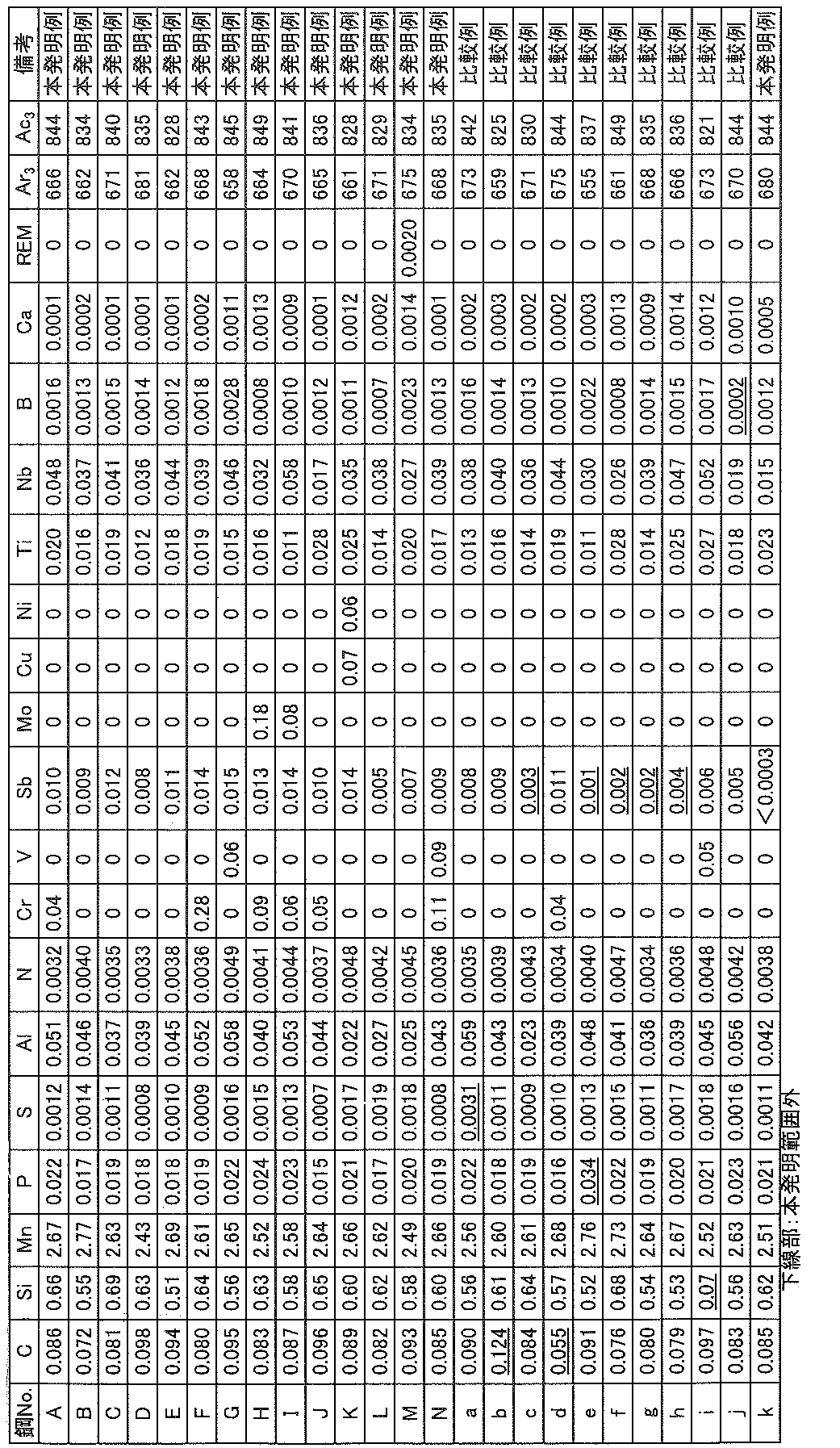
- the component composition of the high-strength steel sheet of the present invention is, in mass%, C: 0.070 to 0.100%, Si: 0.30 to 0.70%, Mn: 2.20 to 2.80%, P: 0.025% or less, S: 0.0020% or less, Al: 0.020 to 0.060%, N: 0.0050% or less, Nb: 0.010 to 0.060%, Ti: 0.010 to It is a component composition containing 0.030%, B: 0.0005 to 0.0030%, and Ca: 0.0015% or less as essential components.
- % representing the content of a component means “% by mass”.
- C 0.070 to 0.100%
- C is an essential element for securing a desired strength and combining the structure to improve the strength and ductility. In order to acquire this effect, it is necessary to make C content 0.070% or more. On the other hand, when the C content exceeds 0.100%, the strength is remarkably increased and the desired bending workability cannot be obtained. Therefore, the C content is within the range of 0.070 to 0.100%.
- Si 0.30 to 0.70%
- Si is an effective element for strengthening steel without significantly reducing the ductility of the steel.
- Si is an important element for controlling the area ratio of the ferrite phase in the surface layer, the area ratio of the bainite phase having a particle size of more than 5 ⁇ m and / or the martensite phase having a particle size of more than 5 ⁇ m.
- the Si content is set to 0.30 to 0.70%.
- it is 0.50 to 0.70%. More preferably, it is 0.55 to 0.70%.
- Mn 2.20-2.80% Mn, like C, is an essential element for ensuring a desired strength. Mn is an important element for stabilizing the austenite phase and suppressing the formation of ferrite during the cooling of continuous annealing. In order to acquire the said effect, it is necessary to make Mn content 2.20% or more. However, if the Mn content exceeds 2.80%, the area ratio of the second phase structure becomes excessive, and the bending workability decreases. Therefore, the Mn content is 2.80% or less. Preferably, it is 2.40 to 2.80%. More preferably, it is 2.50 to 2.80%.
- P 0.025% or less
- P is an element effective for strengthening steel, and may be added according to the strength level of the steel sheet.
- the P content is preferably 0.005% or more.
- the P content is 0.025% or less.
- the P content is preferably 0.020% or less.
- S 0.0020% or less
- S is a nonmetallic inclusion such as MnS.
- the S content is set to 0.0020% or less.
- the S content is preferably 0.0015% or less.
- Al 0.020 to 0.060%
- Al is an element added for deoxidation of steel.
- the Al content needs to be 0.020% or more.
- the Al content is set in the range of 0.020 to 0.060%.
- N 0.0050% or less
- the B content which increases the hardenability during cooling of continuous annealing, decreases, the area ratio of the ferrite phase in the surface layer increases excessively, and bending work is performed. Deteriorates. Therefore, in the present invention, the N content is preferably as small as possible. Therefore, the N content is 0.0050% or less, preferably 0.0040% or less.
- Nb 0.010 to 0.060%
- Nb is an element that forms carbonitrides in steel and is effective in increasing the strength and refining of the steel.
- the Nb content is set to 0.010% or more.
- the Nb content is in the range of 0.010 to 0.060%.
- it is 0.020 to 0.050%.
- Ti 0.010 to 0.030%
- Ti forms a carbonitride in steel and is an element effective for increasing the strength and refining of the steel. Further, Ti suppresses the formation of B nitride that causes a decrease in hardenability. In order to obtain such an effect, the Ti content is set to 0.010% or more. On the other hand, when the Ti content exceeds 0.030%, the strength rises remarkably and the desired bending workability cannot be obtained. Therefore, the Ti content is within the range of 0.010 to 0.030%. Preferably, it is 0.012 to 0.022%.
- B 0.0005 to 0.0030%
- B is an important element for enhancing the hardenability of the steel and suppressing the formation of ferrite during the cooling of continuous annealing.
- B is an effective element for controlling the area ratio of the ferrite phase of the surface layer.
- the B content is set to 0.0005% or more.
- the B content is within the range of 0.0005 to 0.0030%. Preferably, it is 0.0005 to 0.0025%.
- Ca 0.0015% or less
- Ca is an oxide that extends in the rolling direction. In the bending test, the interface between the oxide and the metal structure tends to crack. Therefore, the Ca content decreases bending workability. For this reason, it is better that the Ca content is as low as possible.
- the Ca content is set to 0.0015% or less.
- the Ca content is preferably 0.0007% or less. More preferably, it is 0.0003% or less.
- the component composition of the present invention may be a component composition containing Sb in addition to the above components.
- Sb 0.005 to 0.015%
- Sb is an important element in the present invention. That is, in the annealing process of continuous annealing, Sb is concentrated in the steel surface layer, thereby suppressing the reduction of the B content existing in the steel surface layer. For this reason, the area ratio of the ferrite phase of the surface layer can be controlled within a desired range by Sb. Furthermore, the area ratio of the bainite phase having a particle size of more than 5 ⁇ m and / or the martensite phase having a particle size of more than 5 ⁇ m in the surface layer can be controlled. In order to obtain such an effect, the Sb content is set to 0.005% or more.
- Sb is set in the range of 0.005 to 0.015%.
- the content is 0.008 to 0.012%.
- the component composition of the present invention may be a component composition containing one or more elements selected from Cr, V, Mo, Cu, and Ni as optional components in addition to the above components.
- Cr and V can be added for the purpose of improving the hardenability of the steel and increasing the strength.
- Mo is an element effective for strengthening the hardenability of steel and can be added for the purpose of increasing the strength.
- Cu and Ni are elements that contribute to strength, and can be added for the purpose of strengthening steel. The upper limit of each element is the amount at which the effect is saturated. From the above, in order to obtain the above effect by adding these elements, the content is as follows: Cr is 0.30% or less, V is 0.10% or less, Mo is 0.20% or less, and Cu is 0.10%. % Or less, Ni is 0.10% or less.
- Cr is 0.04 to 0.30%
- V is 0.04 to 0.10%
- Mo is 0.04 to 0.20%
- Cu is 0.05 to 0.10%
- Ni is 0. .05-0.10%.
- the component composition of the present invention may further contain REM as an optional component.
- REM is added for the purpose of spheroidizing the sulfide shape and improving bending workability.
- the lower limit of the REM content is a minimum amount at which a desired effect is obtained, and the upper limit is an amount at which the effect is saturated. From the above, in order to obtain the above effect by adding REM, the content is made 0.0010 to 0.0050%.
- the balance other than the above components and optional components is Fe and inevitable impurities.
- the structure of the high-strength steel sheet of the present invention is a structure containing, in terms of area ratio, a ferrite phase of 30% or more, a bainite phase and / or a martensite phase of 40 to 65%, and cementite of 5% or less.
- the area ratio of the ferrite phase containing 40 to 55% by area ratio and the bainite phase having a particle diameter of more than 5 ⁇ m and / or the martensite phase having a particle diameter of more than 5 ⁇ m is set to 20% or less.
- Area ratio of ferrite phase 30% or more In order to ensure ductility, it is necessary to contain a ferrite phase with an area ratio of 30% or more. Preferably, it is 35% or more.
- Area ratio of bainite phase and / or martensite phase 40 to 65%
- the area ratio of the bainite phase and / or martensite phase is set to 40% or more.
- the area ratio of a bainite phase and / or a martensite phase shall be 65% or less.
- a preferred range of the area ratio of the bainite phase and / or martensite phase is 45 to 60%.
- the bainite phase in the present invention includes both so-called upper bainite in which plate-like cementite is deposited along the interface of lath-like ferrite and so-called lower bainite in which cementite is finely dispersed in lath-like ferrite.
- the bainite phase and / or the martensite phase can be easily distinguished by a scanning electron microscope (SEM).
- SEM scanning electron microscope
- the total area ratio is preferably 40 to 65%, and the total area ratio is preferably 45 to 60%.
- cementite area ratio 5% or less In order to secure good bending workability, the cementite area ratio needs to be 5% or less. If the area ratio of cementite exceeds 5%, bending workability deteriorates. Moreover, the cementite as used in the field of this invention is cementite which exists independently (it exists in a crystal grain boundary), without being contained in any metal structure.
- a retained austenite phase can be included as a structure other than the ferrite phase, bainite phase, martensite phase, and cementite.
- the area ratio of the retained austenite phase is desirably 5% or less. Since the area ratio of other phases is preferably 5% or less, the total amount of ferrite phase, bainite phase, martensite phase, and cementite is preferably 95% or more in terms of area ratio.
- the metal structure of ferrite phase, bainite phase, martensite phase, and cementite was corroded with 3% nital after polishing the plate thickness section parallel to the rolling direction of the steel plate, and was scanned with a scanning electron microscope (SEM) over 10 fields of view at 2000 times magnification ) At a thickness of 1/4 position (in the cross section, a position of 1/4 in the thickness direction from the surface), and the image is image analysis software “Image Pro Plus ver. 4.0” manufactured by Media Cybernetics. And the area ratio of each phase can be obtained.
- the area ratio of the ferrite phase and cementite is determined by visual determination using a structural photograph taken with an SEM, the area ratio of each of the ferrite phase and cementite is obtained by image analysis, and this is divided by the area analyzed by image analysis. Area ratio. Since the metal structure of the present invention is a ferrite phase, residual austenite, and the remainder other than cementite is a bainite phase and / or martensite phase, the area ratio of the bainite phase and / or martensite phase is other than ferrite phase, residual austenite, and cementite. Area ratio.
- the bainite referred to in the present invention includes so-called upper bainite in which plate-like cementite is deposited along the interface of lath-like ferrite and so-called lower bainite in which cementite is finely dispersed in lath-like ferrite.
- the residual austenite phase was obtained by grinding a steel plate from the surface in the plate thickness direction, and then polishing the surface further polished by 0.1 mm by chemical polishing so that the plate thickness 1/4 position was exposed from the surface using an X-ray diffractometer. Measure the integrated intensity of the (200), (220), (311) and fcc iron (200), (211), and (220) planes using fcc iron.
- the amount of retained austenite was determined from the value, and was defined as the area ratio of the retained austenite phase.
- the area ratio of each phase is obtained for each measurement field, and these values are averaged (10 fields) to obtain the area ratio of each phase.
- the ferrite layer in the surface layer that is a region from the surface to the thickness direction of 50 ⁇ m in the thickness direction contains 40 to 55% of the ferrite phase by area ratio in the surface layer that is the region from the surface to the thickness direction of 50 ⁇ m.
- the appearance of the ferrite layer on the surface layer is an important indicator of the quality of the high-strength steel sheet of the present invention.
- the ferrite phase of the surface layer plays a role of dispersing strain applied to the steel sheet by bending.
- the area ratio of the ferrite phase of the surface layer needs to be 40% or more.
- the area ratio of the ferrite phase of the surface layer exceeds 55%, C is excessively concentrated and hardened in the second phase (bainite phase and / or martensite phase), and the hardness difference between the ferrite and the second phase is large. As a result, bending workability deteriorates. Therefore, the area ratio of the ferrite phase of the surface layer is set to 55% or less.
- the area ratio of the ferrite phase is preferably 45 to 55%.
- the area ratio of the bainite phase having a particle size of more than 5 ⁇ m and / or the martensite phase having a particle size of more than 5 ⁇ m in the surface layer is made 20% or less in total.
- a bainite phase having a particle size of more than 5 ⁇ m and / or a martensite phase having a particle size of more than 5 ⁇ m and a ferrite phase during bending work exceeds 20%, a bainite phase having a particle size of more than 5 ⁇ m and / or a martensite phase having a particle size of more than 5 ⁇ m and a ferrite phase during bending work. Voids generated at the interface are connected as processing progresses, and bending workability deteriorates.
- the area ratio of the bainite phase having a particle size of more than 5 ⁇ m and / or the martensite phase having a particle size of more than 5 ⁇ m is 20% or less (including 0). Preferably it is 15% or less. When only one of “total” is included, the other is calculated as “0”.
- the reason for using 5 ⁇ m as a reference is that when the particle size of the second phase is 5 ⁇ m or less, generation of voids at the interface with the ferrite can be greatly suppressed.
- the area ratio of the ferrite phase is 50 ⁇ m from the steel plate surface to the steel plate thickness direction on the polished surface after corrosion at a magnification of 2000 ⁇ after polishing the plate thickness section parallel to the steel plate rolling direction and corroding with 3% nital. This area is observed with a scanning electron microscope (SEM) over 10 fields of view, and the image is obtained by an image analysis process using image analysis software “Image Pro Plus ver. 4.0” manufactured by Media Cybernetics. be able to. That is, the ferrite phase can be classified on the digital image by image analysis, image processing can be performed, and the area ratio of the ferrite phase can be obtained for each measurement visual field. These values were averaged (10 fields of view) to obtain the surface area ferrite phase area ratio.
- the grain size and area ratio of the bainite phase and / or martensite phase in the surface layer are the same as the positions where the ferrite phase is quantified, using the SEM photograph of 1000 to 3000 times, and the bainite phase and / or martensite.
- the phases were identified, and the particle size (equivalent circle diameter) and area ratio were calculated by image analysis.
- the total area ratio was determined for the bainite phase having a particle size of more than 5 ⁇ m and / or the martensite phase having a particle size of more than 5 ⁇ m.
- the area ratio was obtained from 10 fields of view, and this was averaged to obtain the area ratio of the bainite phase having a particle size of more than 5 ⁇ m and / or the martensite phase having a particle size of more than 5 ⁇ m.
- the manufacturing method of a high-strength steel sheet has a hot rolling process, a pickling process, and a continuous annealing process. Moreover, it is preferable that the manufacturing method of this invention has a cold rolling process between a pickling process and a continuous annealing process.
- the temperature is the surface temperature of a steel plate or the like.
- the average heating rate and average cooling rate are values obtained by calculation based on the surface temperature.
- the average heating rate is expressed by ((heating reached temperature ⁇ heating start temperature) / heating time).
- the heating start temperature which is the temperature of the steel plate after pickling is room temperature.
- the average cooling rate is represented by ((cooling start temperature ⁇ cooling stop temperature) / cooling time).
- the hot rolling process is a process in which a steel material having a component composition is finish-rolled at a temperature of Ar 3 or higher and wound at a temperature of 600 ° C or lower.
- the steel material can be manufactured by melting molten steel having the above-described component composition by a melting method using a converter or the like, and casting by a casting method such as a continuous casting method.
- Finishing rolling finish temperature Ar 3 points or more
- the finish rolling finish temperature is less than Ar 3 points, the structure in the sheet thickness direction becomes non-uniform due to the coarsening of the ferrite phase in the steel sheet surface layer.
- the finishing temperature of finish rolling is set to Ar 3 points or more.
- the upper limit is not particularly limited, but if rolled at an excessively high temperature, scale wrinkles and the like are caused.
- Ar 3 point adopts the value obtained by calculation from the following equation (1).
- Ar 3 910-310 ⁇ [C] ⁇ 80 ⁇ [Mn] + 0.35 ⁇ (t ⁇ 8)
- [M] represents the content (% by mass) of the element M
- t represents the plate thickness (mm).
- a correction term may be introduced depending on the contained element. For example, when Cu, Cr, Ni, or Mo is contained, ⁇ 20 ⁇ [Cu], ⁇ 15 ⁇ [Cr], ⁇ 55 Correction terms such as ⁇ [Ni] and ⁇ 80 ⁇ [Mo] may be added to the right side of Equation (1).
- Winding temperature 600 ° C. or less
- the steel structure after hot rolling becomes ferrite and pearlite, so the steel sheet after continuous annealing or after continuous annealing after cold rolling.
- the cementite has an area ratio of more than 5%.
- the area ratio of cementite exceeds 5%, bending workability deteriorates. Accordingly, the coiling temperature is 600 ° C. or less.
- winding temperature shall be 200 degreeC or more.
- the pickling step is a step of pickling the hot-rolled steel sheet obtained in the hot rolling step.
- a pickling process is performed in order to remove the black skin scale produced
- the pickling conditions are not particularly limited.
- the cold rolling step is a step of cold rolling the pickled hot rolled steel sheet.
- it is preferable to perform a cold rolling process after the pickling process and before the continuous annealing process. If the rolling reduction of the cold rolling is less than 40%, the recrystallization of the ferrite phase becomes difficult to proceed, the non-recrystallized ferrite phase remains in the structure after continuous annealing, and the bending workability may be lowered. Therefore, the rolling reduction of cold rolling is preferably 40% or more. Further, if the rolling reduction of the cold rolling becomes too high, the load of the rolling roll increases, and rolling troubles such as chattering and plate breakage are caused. Therefore, it is preferably 70% or less.
- Continuous annealing step In the continuous annealing step, the cold-rolled steel sheet is heated to a temperature range of 570 ° C or higher at an average heating rate of 2 ° C / s or higher, and the cold-rolled steel sheet is in the temperature range of 760 to (Ac 3 -5) ° C.
- the holding time is set to 60 seconds or more, and it is cooled to a temperature range of 620 to 740 ° C. (650 to 720 ° C. when Sb is not contained) at an average cooling rate of 0.1 to 8 ° C./s.
- the holding time in the temperature range is 10 to 50 seconds (10 to 40 seconds when Sb is not included), and the steel sheet is cooled to a temperature range of 400 ° C. or less at an average cooling rate of 5 to 50 ° C./s. Is kept in the temperature range of 400 ° C. or lower for 200 to 800 seconds. Note that “when not containing Sb” means that the Sb content is less than 0.0003%.
- the heating rate in the recrystallization temperature range of ferrite is reduced, so recrystallization proceeds and continuous annealing is performed.
- the structure of the later steel sheet surface layer may become coarse, and bending workability may deteriorate.
- the upper limit of the average heating rate is preferably 10 ° C./s or less from the viewpoint of controlling the ferrite layer area ratio of the surface layer.
- the annealing temperature is less than 760 ° C. or the annealing time (holding time) is less than 60 seconds
- the cementite generated during the hot rolling process does not dissolve sufficiently during annealing, and the austenite phase is not sufficiently generated.
- a sufficient amount of the second phase (bainite phase and / or martensite phase) is not generated during annealing and cooling, resulting in insufficient strength.
- the annealing temperature is less than 760 ° C. or when the annealing time is less than 60 seconds, the area ratio of cementite exceeds 5%, the bainite phase having a surface layer particle size of more than 5 ⁇ m and / or a martensite having a particle size of more than 5 ⁇ m.
- the area ratio of the site phase exceeds 20%, and the bending workability is lowered.
- the annealing temperature exceeds (Ac 3 ⁇ 5) ° C.
- the grain growth of the austenite phase is remarkable, the area ratio of the ferrite phase of the steel sheet after continuous annealing becomes less than 30%, and the strength excessively increases.
- the upper limit of the annealing time is not particularly specified, but holding for over 200 seconds saturates the effect and increases the cost. Therefore, the annealing (holding) time is preferably 200 seconds or less.
- the value obtained by calculating from the following equation (2) is adopted for Ac 3 points.
- the cooling stop temperature is less than 620 ° C.
- ferrite is excessively precipitated in the surface layer of the steel sheet during cooling, and the area ratio of the ferrite phase of the surface layer exceeds 55%, so that bending workability is deteriorated.
- the cooling stop temperature exceeds 740 ° C.
- the area ratio of the ferrite phase of the surface layer is less than 40%, and the area ratio of the bainite phase having a particle diameter of more than 5 ⁇ m and / or a martensite phase having a particle diameter of more than 5 ⁇ m in the surface layer.
- Exceeds 20% and bending workability deteriorates.
- a preferable temperature range of the cooling stop temperature is 640 to 720 ° C.
- the holding temperature needs to be more strictly controlled in order to control the area ratio of the ferrite phase of the surface layer, and the cooling stop temperature needs to be 650 to 720 ° C. Preferably, it is 660 to 700 ° C.
- the holding time When the holding time exceeds 50 seconds, the area ratio of the ferrite phase in the surface layer becomes excessive, so that the hardness difference between the ferrite phase, the bainite phase, and the martensite phase increases, and bending workability decreases.
- the preferable holding time is 15 to 40 seconds.
- the holding time means a time (holding time) during which the cold-rolled steel sheet stays in the temperature range of the cooling stop temperature, and is not limited to a time for holding at a constant temperature. For steel containing no Sb, the holding time needs to be 10 to 40 seconds. Preferably, it is 10 to 35 seconds.
- Cooling to a temperature range of 400 ° C or less at an average cooling rate of 5 to 50 ° C / s This cooling is performed after “holding for 10 to 50 seconds in the temperature range of the cooling stop temperature” and then the cooling stop temperature in the temperature range of 400 ° C or less The cooling is performed at an average cooling rate of 5 to 50 ° C./s.
- This average cooling rate condition is one of the important requirements in the present invention.
- the area ratio of the ferrite phase, the bainite phase, and / or the martensite phase can be controlled.
- the average cooling rate is less than 5 ° C./s, the ferrite phase is excessively precipitated during cooling, so that the area ratio of the bainite phase and / or martensite phase is less than 40%, and the strength is lowered.
- the average cooling rate exceeds 50 ° C./s, the ferrite is not sufficiently precipitated, and the bainite phase and / or the martensite phase is excessively precipitated, so that the strength is increased and the bending workability is deteriorated.
- the average cooling rate in the main cooling is set to 50 ° C./s or less. Cooling to a cooling stop temperature in a temperature range of 350 ° C. or lower at an average cooling rate of 10 to 40 ° C./s is preferred.
- the bainite phase When the holding time is less than 200 seconds when the holding time is less than 200 seconds, when the bainite phase is present in the second phase, the bainite transformation does not proceed, and the bainite phase of the steel sheet after continuous annealing and / The area ratio of the martensite phase does not become 40% or more, and it becomes difficult to ensure the strength.
- holding temperature exceeds 400 degreeC
- the area ratio of cementite exceeds 5% and bending workability falls.
- tempering of the martensite phase proceeds excessively, resulting in a decrease in strength.
- a preferable condition is holding for 300 to 650 seconds in a temperature range of 350 ° C. or lower.
- holding time means the time (holding time) for which a cold-rolled steel sheet stays in said temperature range, and is not restricted to the time hold
- the holding temperature does not have to be constant as long as it is within the above-described temperature range, and when the cooling rate or heating rate changes during cooling or heating. However, there is no problem as long as it is within the range of the prescribed cooling rate and heating rate. Moreover, as long as a desired heat history is satisfied in the heat treatment, no matter what equipment is used for the heat treatment, the gist of the present invention is not impaired.
- the temper rolling for shape correction is also included in the scope of the present invention. In temper rolling, the elongation is preferably 0.3% or less. In the present invention, it is assumed that the steel material is manufactured through normal steelmaking, casting, and hot rolling processes. For example, a part or all of the hot rolling process is omitted by thin slab casting or the like. Such cases are also included in the scope of the present invention.
- the effect of the present invention is not impaired.
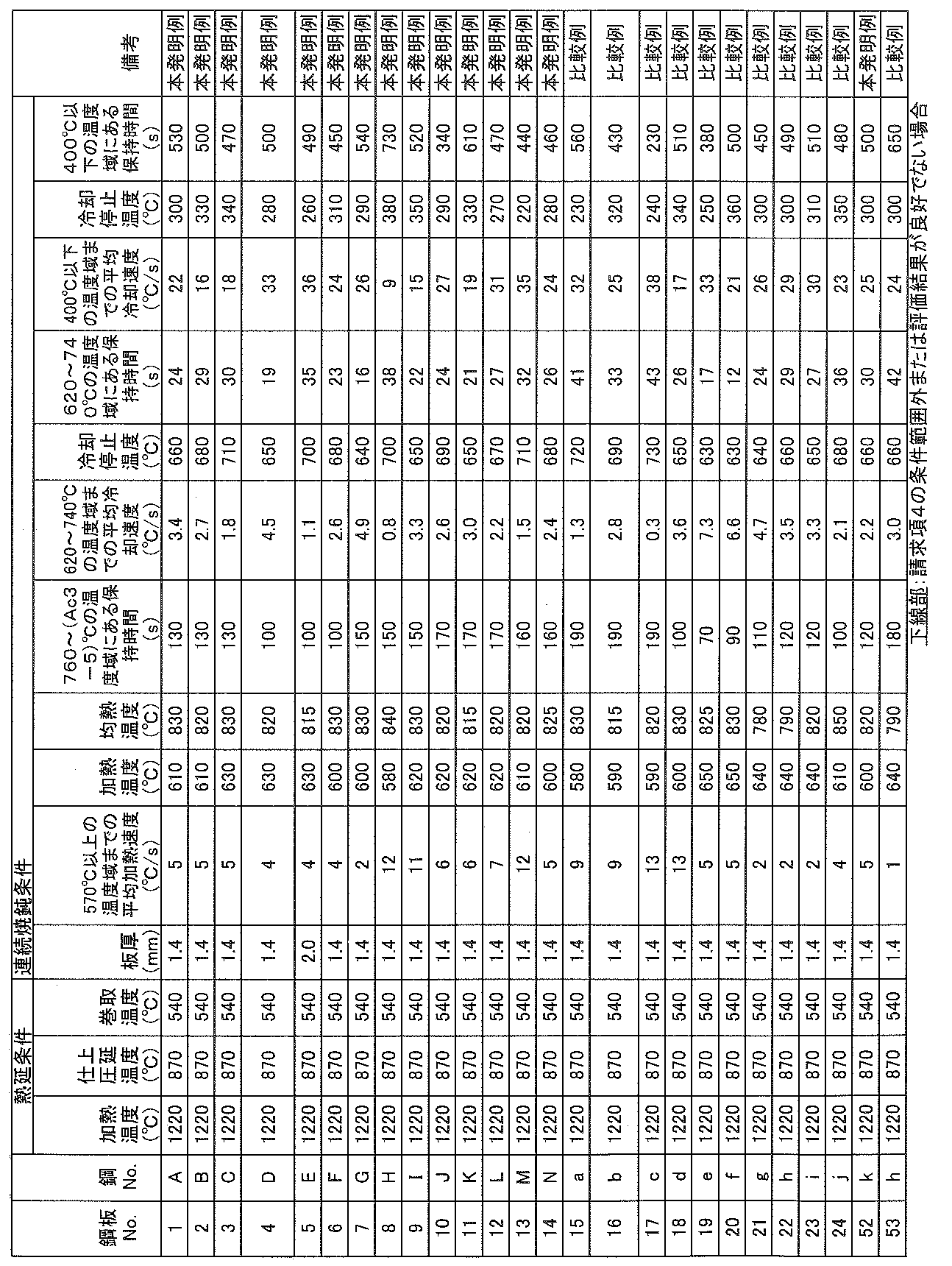
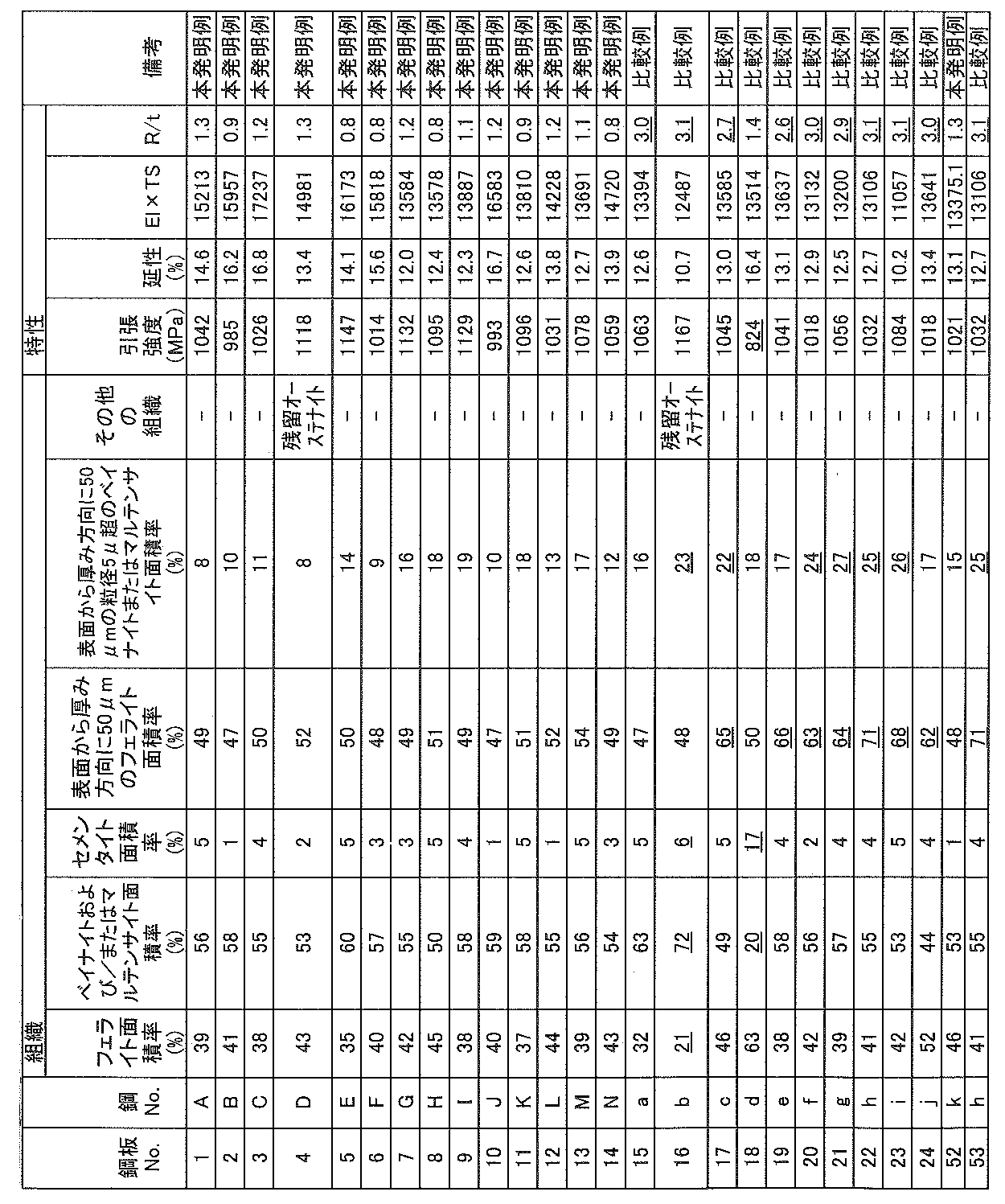
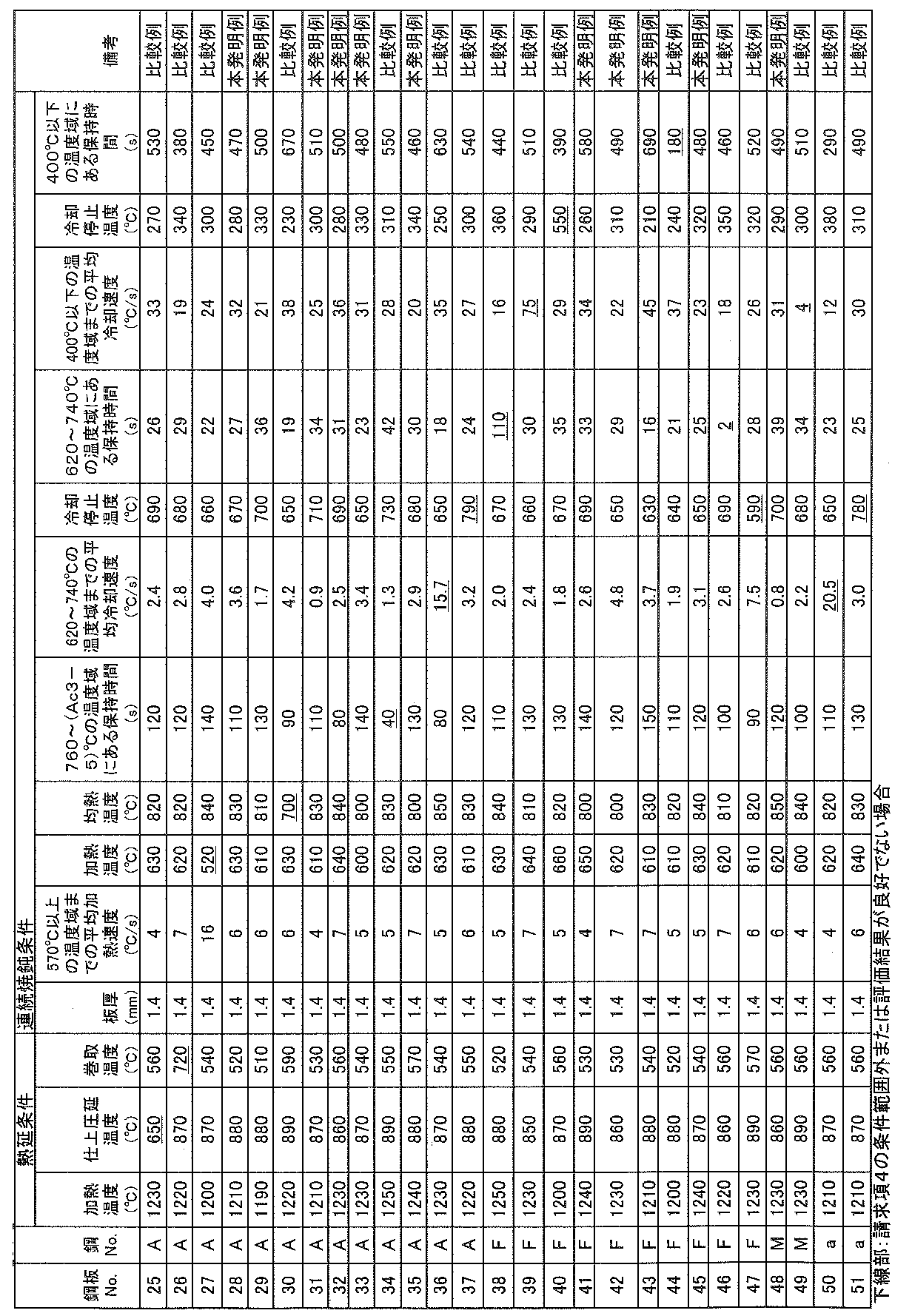
- a steel material (slab) having the composition shown in Table 1 was used as a starting material. These steel materials are heated as shown in Table 2 (Table 2-1 and Table 2-2 are combined into Table 2) and Table 3 (Table 3-1 and Table 3-2 are combined into Table 3). After heating to temperature, it was hot-rolled and pickled under the conditions shown in Tables 2 and 3, and then cold-rolled and continuously annealed. Some steel plates (steel plate No. 5) were not cold-rolled.
- the metal structure of the present invention is a ferrite phase, residual austenite, and the remainder other than cementite is a bainite phase and / or martensite phase
- the area ratio of the bainite phase and / or martensite phase is other than ferrite phase, residual austenite, and cementite. Area ratio.
- the bainite referred to in the present invention includes so-called upper bainite in which plate-like cementite is deposited along the interface of lath-like ferrite and so-called lower bainite in which cementite is finely dispersed in lath-like ferrite.
- the residual austenite phase was obtained by grinding a steel plate from the surface in the plate thickness direction, and then polishing the surface further polished by 0.1 mm by chemical polishing so that the plate thickness 1/4 position was exposed from the surface using an X-ray diffractometer. Measure the integrated intensity of the (200), (220), (311) and fcc iron (200), (211), and (220) planes using fcc iron. The amount of retained austenite was determined from the value, and was defined as the area ratio of the retained austenite phase. For the ferrite phase, bainite phase, martensite phase, and cementite metal structures, the area ratio of each phase is obtained for each measurement field, and these values are averaged (10 fields) to obtain the area ratio of each phase.
- the area ratio of the ferrite phase etc. of the surface layer is the surface on the polished surface after corrosion at a magnification of 2000 times after corroding a plate thickness section parallel to the rolling direction of the steel sheet and corroding with 3% nital. A 50 ⁇ m region in the thickness direction is observed with a scanning electron microscope (SEM) over 10 fields of view, and the image is subjected to image analysis processing using image analysis software “Image Pro Plus ver. 4.0” manufactured by Media Cybernetics. By analyzing, the area ratio of the ferrite phase can be obtained.
- SEM scanning electron microscope
- the ferrite phase can be classified on the digital image by image analysis, image processing can be performed, and the area ratio of the ferrite phase can be obtained for each measurement visual field. These values were averaged (10 fields of view) to obtain the surface area ferrite phase area ratio.
- the grain size and area ratio of the bainite phase and / or martensite phase in the surface layer are the same as the positions where the ferrite phase is quantified, using the SEM photograph of 1000 to 3000 times, and the bainite phase and / or martensite.
- the phases were identified, and the particle size (equivalent circle diameter) and area ratio were calculated by image analysis. Then, the total area ratio was determined for the bainite phase having a particle size of more than 5 ⁇ m and / or the martensite phase having a particle size of more than 5 ⁇ m.
- the area ratio was obtained from 10 fields of view, and this was averaged to obtain the area ratio of the bainite phase and / or martensite phase having a particle size of more than 5 ⁇ m.
- Bending workability was evaluated based on the V block method defined in JIS Z 2248.
- the bending test was performed in a direction in which the rolling direction becomes a bending ridge line.
- Samples for evaluation were collected at five locations of 1/8 w, 1/4 w, 1/2 w, 3/4 w, and 7/8 w in the plate width (w) in the width direction of the steel plate.
- the bending test the presence or absence of a crack was visually confirmed on the outside of the bent portion, and the minimum bending radius at which no crack was generated was defined as the limit bending radius.
- the critical bending radii of the five steel plates are averaged to obtain the critical bending radius of the steel sheet.
- the limit bending radius / plate thickness (R / t) is shown. In the present invention, it is judged that R / t is 2.0 or less. If the variation in bending workability in the width direction of the steel sheet is large, the limit bending radius is increased at a predetermined position in the width direction, and the limit bending radius / plate thickness (R / t) is also increased. Variation in bending workability can be evaluated by limiting bending radius / plate thickness (R / t).
- the structure has a ferrite phase with an area ratio of 30% or more, a bainite phase and / or a martensite phase with an area ratio of 40 to 65%, and a cementite with an area ratio of 5% or less.
- the area ratio of the ferrite layer of the surface layer is 40 to 55%
- the area ratio of the bainite phase having a particle diameter of more than 5 ⁇ m and / or the martensite phase having a particle diameter of more than 5 ⁇ m is 20% or less in total. Then, bending workability is favorable.
- the comparative example one or more of strength and bending workability is low.
- the high-strength steel plate of the present invention is excellent in bending workability and can be used as a steel plate for reducing the weight and strength of the automobile body itself.
Landscapes
- Chemical & Material Sciences (AREA)
- Engineering & Computer Science (AREA)
- Mechanical Engineering (AREA)
- Materials Engineering (AREA)
- Metallurgy (AREA)
- Organic Chemistry (AREA)
- Physics & Mathematics (AREA)
- Thermal Sciences (AREA)
- Crystallography & Structural Chemistry (AREA)
- Heat Treatment Of Sheet Steel (AREA)
- Heat Treatment Of Steel (AREA)
Abstract
Description
本発明の高強度鋼板の成分組成は、質量%で、C:0.070~0.100%、Si:0.30~0.70%、Mn:2.20~2.80%、P:0.025%以下、S:0.0020%以下、Al:0.020~0.060%、N:0.0050%以下、Nb:0.010~0.060%、Ti:0.010~0.030%、B:0.0005~0.0030%、Ca:0.0015%以下を必須成分として含有する成分組成である。
Cは、所望の強度を確保し、組織を複合化して強度と延性を向上させるために必須の元素である。この効果を得るためには、C含有量を0.070%以上にすることが必要である。一方、C含有量が0.100%を超えると強度上昇が著しく、所望の曲げ加工性が得られない。したがって、C含有量は0.070~0.100%の範囲内とする。
Siは、鋼の延性を顕著に低下させることなく、鋼を強化するため有効な元素である。また、Siは、表層におけるフェライト相の面積率、粒径が5μm超のベイナイト相および/または粒径が5μm超のマルテンサイト相の面積率を制御するために重要な元素である。上記効果を得るために、Si含有量を0.30%以上にすることが必要である。しかし、Si含有量が0.70%を超えると著しく強度が上昇し、所望の曲げ加工性が得られない。従って、Si含有量は0.30~0.70%とする。好ましくは、0.50~0.70%である。より好ましくは、0.55~0.70%である。
Mnは、Cと同様に所望の強度を確保するために必須の元素である。また、Mnはオーステナイト相を安定化させ、連続焼鈍の冷却中にフェライト生成を抑制するために重要な元素である。上記効果を得るために、Mn含有量を2.20%以上にする必要がある。しかし、Mn含有量が2.80%を超えると、第2相組織の面積率が過大となり、曲げ加工性が低下する。従って、Mn含有量は2.80%以下とする。好ましくは、2.40~2.80%である。より好ましくは、2.50~2.80%である。
Pは、鋼の強化に有効な元素であり、鋼板の強度レベルに応じて添加してもよい。このような効果を得るにはP含有量を0.005%以上とすることが好ましい。一方、P含有量が0.025%を超えると溶接性が劣化する。従って、P含有量は0.025%以下とする。また、より優れた溶接性が要求される場合には、P含有量を0.020%以下にすることが好ましい。
Sは、MnSなどの非金属介在物となる。曲げ試験において非金属介在物と金属組織との界面が割れやすくなる。したがって、Sの含有は曲げ加工性を低下させる。このため、S含有量は極力低いほうがよく、本発明ではS含有量を0.0020%以下とする。また、より優れた曲げ加工性が要求される場合にはS含有量は0.0015%以下が好ましい。
Alは、鋼の脱酸のために添加される元素である。本発明ではAl含有量を0.020%以上にする必要がある。一方、Al含有量が0.060%を超えると表面性状が劣化する。そこで、Al含有量は0.020~0.060%の範囲内とする。
NがBとB窒化物を形成すると、連続焼鈍の冷却中に焼入れ性を高めるB含有量が低下して、表層のフェライト相の面積率が増加し過ぎ、曲げ加工性が劣化する。よって、本発明において、N含有量はできるだけ少ないほうが好ましい。従って、N含有量は0.0050%以下、好ましくは0.0040%以下とする。
Nbは、鋼中で炭窒化物を形成し、鋼の高強度化および組織微細化に有効な元素である。このような効果を得るために、Nb含有量を0.010%以上にする。一方、Nb含有量が0.060%を超えると強度上昇が著しく、所望の曲げ加工性が得られない。従って、Nb含有量は0.010~0.060%の範囲内とする。好ましくは、0.020~0.050%である。
Tiは、Nbと同様に鋼中で炭窒化物を形成し、鋼の高強度化および組織微細化に有効な元素である。また、Tiは、焼入れ性低減の原因となるB窒化物の形成を抑制する。このような効果を得るために、Ti含有量を0.010%以上とする。一方、Ti含有量が0.030%を超えると強度上昇が著しく、所望の曲げ加工性が得られない。従って、Ti含有量は0.010~0.030%の範囲内とする。好ましくは、0.012~0.022%である。
Bは、鋼の焼入れ性を高めて、連続焼鈍の冷却中にフェライト生成を抑制するために重要な元素である。また、Bは、表層のフェライト相の面積率を制御するために効果的な元素である。このような効果を得るために、B含有量を0.0005%以上とする。一方、B含有量が0.0030%を超えると、その効果が飽和するだけでなく、熱間圧延、冷間圧延における圧延荷重の増大も招く。従って、B含有量は0.0005~0.0030%の範囲内とする。好ましくは、0.0005~0.0025%である。
Caは、圧延方向に伸展した酸化物となる。曲げ試験において酸化物と金属組織との界面が割れやすい。したがって、Caの含有は曲げ加工性を低下させる。このため、Ca含有量は極力低いほうがよく、本発明ではCa含有量を0.0015%以下とする。また、より優れた曲げ加工性が要求される場合にはCa含有量は0.0007%以下が好ましい。さらに好ましくは、0.0003%以下である。
Sbは、本発明において重要な元素である。すなわち、連続焼鈍の焼鈍過程において、Sbは鋼の表層に濃化することで鋼の表層に存在するB含有量の低減を抑制する。このため、Sbによって、表層のフェライト相の面積率を所望の範囲に制御できる。さらに、表層における、粒径が5μm超のベイナイト相および/または粒径が5μm超のマルテンサイト相の面積率を制御できる。このような効果を得るために、Sb含有量を0.005%以上とする。一方、Sb含有量が0.015%を超えるとその効果が飽和するだけでなく、Sbの粒界偏析により靭性が低下する。従って、Sbは0.005~0.015%の範囲内とする。好ましくは、0.008~0.012%である。
延性を確保するためには、フェライト相を面積率30%以上含有することが必要である。好ましくは、35%以上である。
強度を確保するため、ベイナイト相および/またはマルテンサイト相の面積率を40%以上とする。一方、ベイナイト相および/またはマルテンサイト相の面積率が65%を超えると過度に強度上昇し、所望の曲げ加工性を得られなくなる。このため、ベイナイト相および/またはマルテンサイト相の面積率は65%以下とする。ベイナイト相および/またはマルテンサイト相の面積率の好ましい範囲は45~60%である。また、本発明でいうベイナイト相とは、ラス状フェライトの界面に沿って板状のセメンタイトが析出した所謂上部ベイナイト、およびラス状フェライト内にセメンタイトが微細分散した所謂下部ベイナイトの両者を含むものとする。なお、ベイナイト相および/またはマルテンサイト相は走査型電子顕微鏡(SEM)で容易に区別可能である。また、マルテンサイト相とベイナイト相の両者を含む場合には合計の面積率が40~65%とし、合計の面積率が45~60%であることが好ましい。
良好な曲げ加工性を確保するためには、セメンタイトの面積率を5%以下とする必要がある。セメンタイトの面積率が5%を超えると、曲げ加工性が劣化する。また、本発明でいうセメンタイトとは、何れの金属組織にも含まれずに単独で存在する(結晶粒界に存在する)セメンタイトである。
本発明では、表面から厚み方向に50μmまでの領域である表層に、面積率でフェライト相を40~55%含有する。
高強度鋼板の製造方法は、熱間圧延工程と、酸洗工程と、連続焼鈍工程とを有する。また、本発明の製造方法は、酸洗工程と連続焼鈍工程との間に冷間圧延工程を有することが好ましい。以下、冷間圧延工程を有する場合について、各工程について説明する。なお、以下の説明において、温度は鋼板等の表面温度とする。また、平均加熱速度および平均冷却速度は表面温度をもとに計算して得られた値とする。平均加熱速度は((加熱到達温度-加熱開始温度)/加熱時間)で表される。酸洗後の鋼板の温度である加熱開始温度は室温である。平均冷却速度は((冷却開始温度-冷却停止温度)/冷却時間)で表される。
熱間圧延工程とは、成分組成を有する鋼素材を、Ar3点以上の温度で仕上圧延し、600℃以下の温度で巻取る工程である。上記鋼素材は、上記した成分組成を有する溶鋼を、転炉等を用いる溶製方法で溶製し、連続鋳造法等の鋳造方法で鋳造することで製造できる。
仕上圧延の終了温度がAr3点未満となると、鋼板表層でのフェライト相の粗大化等により、板厚方向の組織が不均一となる。この不均一が生じると、連続焼鈍後の組織において表層のフェライト相の面積率を55%以下に制御できない。従って、仕上圧延の終了温度はAr3点以上とする。上限は特に限定されないが、過度に高い温度で圧延するとスケール疵などの原因となるため、1000℃以下とすることが好ましい。なお、Ar3点は次式(1)から計算で得られた値を採用する。
Ar3=910-310×[C]-80×[Mn]+0.35×(t-8)・・・(1)
ここで[M]は元素Mの含有量(質量%)を、tは板厚(mm)を表す。なお、含有元素に応じて、補正項を導入してもよく、例えば、Cu、Cr、Ni、Moが含有される場合には、-20×[Cu]、-15×[Cr]、-55×[Ni]、-80×[Mo]といった補正項を式(1)の右辺に加えてもよい。
巻取温度が600℃を超えると、熱間圧延後の鋼板において、金属組織がフェライトとパーライトになるため、連続焼鈍後の鋼板もしくは冷間圧延した後の連続焼鈍後の鋼板において、セメンタイトの面積率が5%超の組織となる。セメンタイトの面積率が5%超になると、曲げ加工性が劣化する。したがって、巻取温度は600℃以下とする。なお、熱延板の形状が劣化するため巻取温度は200℃以上とすることが好ましい。
酸洗工程とは、熱間圧延工程で得られた熱延鋼板を酸洗する工程である。酸洗工程は、表面に生成した黒皮スケールを除去するために行われる。なお、酸洗条件は特に限定しない。
冷間圧延工程とは、酸洗された熱延鋼板を冷間圧延する工程である。本発明において、酸洗工程後連続焼鈍工程前に冷間圧延工程を行うことが好ましい。冷間圧延の圧下率が40%未満となるとフェライト相の再結晶が進行しにくくなり、連続焼鈍後の組織において未再結晶フェライト相が残存し、曲げ加工性が低下する場合がある。よって、冷間圧延の圧下率は40%以上が好ましい。また、冷間圧延の圧下率が高くなりすぎると圧延ロールの負荷が増大し、チャタリングや板破断等の圧延トラブルを引き起こすようになるため、70%以下であることが好ましい。
連続焼鈍工程では、冷延鋼板を2℃/s以上の平均加熱速度で570℃以上の温度域まで加熱し、冷延鋼板が760~(Ac3-5)℃の温度域にある保持時間を60秒以上とし、0.1~8℃/sの平均冷却速度で620~740℃(Sbを含有しない場合については650~720℃)の温度域まで冷却し、冷延鋼板が該温度域にある保持時間を10~50秒(Sbを含有しない場合については10~40秒)とし、5~50℃/sの平均冷却速度で400℃以下の温度域まで冷却し、冷延鋼板が該400℃以下の温度域にある保持時間を200~800秒とする。なお、「Sbを含有しない場合」とは、Sb含有量が0.0003%未満であることを意味する。
加熱到達温度が570℃未満の場合、フェライトの再結晶温度域での加熱速度が小さくなるため、再結晶が進行し連続焼鈍後の鋼板表層の組織が粗大化し、曲げ加工性が劣化する場合がある。平均加熱速度が2℃/s未満の場合、通常よりも長い炉が必要で消費エネルギーが多大となりコスト増加と生産効率の悪化を引き起こす。なお、平均加熱速度の上限は、表層のフェライト相面積率の制御の観点から10℃/s以下が好ましい。
上記「570℃以上の温度まで加熱」の後に行われるこの保持は、「570℃以上の温度まで加熱」の加熱到達温度が760℃未満の場合には、この加熱後さらに760℃以上まで加熱する必要がある。また、「570℃以上の温度まで加熱」の加熱到達温度が760℃以上であっても、所望の温度までさらに加熱して上記保持を行ってもよい。この更なる加熱の条件は特に限定されない。重要なのは冷延鋼板が760~(Ac3-5)℃の温度域に滞留する時間(保持時間)であり、保持時間は定温で保持される時間に限られない。
Ac3=910-203×([C])1/2-15.2×[Ni]+44.7×[Si]+104×[V]+31.5×[Mo]-30×[Mn]-11×[Cr]-20×[Cu]+700×[P]+400×[Al]+400×[Ti]・・・(2)
ここで[M]は元素Mの含有量(質量%)を表す。
本冷却は、上記保持温度(760~(Ac3-5)℃の範囲の温度)から620~740℃(Sbを含有しない場合については650~720℃)の温度域まで、0.1~8℃/sの平均冷却速度で行う冷却である。
先ず、Sb:0.005~0.015%を含有する場合、上記冷却停止温度の温度域での保持は、本発明の製造方法において重要な要件の一つである。保持時間が10秒未満の場合には、鋼板の幅方向にわたり表層のフェライト変態が均一に進行せず、連続焼鈍後の鋼板の表層のフェライト相の面積率が40%以上存在する組織が得られず、曲げ加工性が劣化する。保持時間が50秒を超える場合は、表層のフェライト相の面積率が過度となるため、フェライト相とベイナイト相やマルテンサイト相の硬度差が大きくなり、曲げ加工性が低下する。好ましい上記保持時間は15~40秒である。なお、保持時間とは、冷却停止温度の温度域に冷延鋼板が滞留する時間(保持時間)を意味し、定温で保持される時間に限らない。また、Sbを含有しない鋼については、上記保持時間を10~40秒とする必要がある。好ましくは、10~35秒である。
本冷却は、「冷却停止温度の温度域で10~50秒保持」の後、400℃以下の温度域の冷却停止温度まで、5~50℃/sの平均冷却速度で行う冷却である。
保持時間が200秒未満の場合には、第2相にベイナイト相が存在する場合、ベイナイト変態が進行せず、連続焼鈍後の鋼板のベイナイト相および/またはマルテンサイト相の面積率が40%以上とならず、強度確保が困難となる。また、第2相にベイナイト相が存在しない場合においては、本発明においては第2相にマルテンサイト相を含む必要があり、この場合に保持時間が200℃未満ではマルテンサイト相の焼戻しが不十分となり、マルテンサイト相の加工性に乏しいために曲げ加工性が劣化する。保持温度が400℃を超える場合は、セメンタイトの面積率が5%を超え、曲げ加工性が低下する。保持時間が800秒を超える場合は、マルテンサイト相の焼戻しが過度に進行するため強度が低下する。好ましい条件は、350℃以下の温度域で300~650秒保持である。なお、保持時間とは、上記の温度域に冷延鋼板が滞留する時間(保持時間)を意味し、定温で保持される時間に限らない。
フェライト相、ベイナイト相、マルテンサイト相、セメンタイトの金属組織は、鋼板圧延方向に平行な板厚断面を研磨後、3%ナイタールで腐食し、2000倍の倍率で10視野にわたり走査型電子顕微鏡(SEM)で板厚1/4位置を観察し、その画像をMedia Cybernetics社製の画像解析ソフト“Image Pro Plus ver.4.0”を使用した画像解析処理により解析し、各相の面積率を求めることができる。フェライト相およびセメンタイトの面積率は、SEMで撮影した組織写真を用いて目視判定により特定し、画像解析によりフェライト相およびセメンタイトの各々の面積率を求め、これを画像解析した面積で除して各々の面積率とした。本発明の金属組織はフェライト相、残留オーステナイト、セメンタイト以外の残部はベイナイト相および/またはマルテンサイト相であるため、ベイナイト相および/またはマルテンサイト相の面積率は、フェライト相、残留オーステナイト、セメンタイト以外の面積率とした。本発明でいうベイナイトとは、ラス状フェライトの界面に沿って板状のセメンタイトが析出した所謂上部ベイナイト、およびラス状フェライト内にセメンタイトが微細分散した所謂下部ベイナイトを含むものとした。残留オーステナイト相は、鋼板を表面から板厚方向に研削した後、表面から板厚1/4位置が露出するように化学研磨によりさらに0.1mm研磨した面を、X線回折装置でMoのKα線を用いて、fcc鉄の(200)面、(220)面、(311)面とbcc鉄の(200)面、(211)面、(220)面の積分強度を測定し、各々の測定値から残留オーステナイトの量を求めて、残留オーステナイト相の面積率とした。フェライト相、ベイナイト相、マルテンサイト相、セメンタイトの金属組織は、測定視野毎に各々の相の面積率を求めて、これらの値を平均(10視野)して各々の相の面積率とする。
上記のフェライト相の面積率は、鋼板圧延方向に平行な板厚断面を研磨後、3%ナイタールで腐食し、2000倍の倍率で、腐食後の研磨面における、表面から厚み方向に50μmの領域を10視野にわたり走査型電子顕微鏡(SEM)で観察し、その画像をMedia Cybernetics社製の画像解析ソフト“Image Pro Plus ver.4.0”を使用した画像解析処理により解析し、フェライト相の面積率を求めることができる。すなわち、画像解析により、フェライト相をデジタル画像上で分別し、画像処理し、測定視野毎にフェライト相の面積率を求めることができる。これらの値を平均(10視野)して表層のフェライト相の面積率とした。
得られた鋼板の圧延方向に対して直角方向からJIS5号引張試験片を採取し、引張試験(JIS Z2241(2011))を実施した。引張試験は破断まで実施して、引張強度、破断伸び(延性)を求めた。本発明では曲げ加工性とともに強度と延性のバランスに優れており、強度(TS)と延性(El)の積で13500MPa・%以上が得られ、その場合に延性が良好と判断している。好ましくは14000MPa・%以上である。
曲げ加工性の評価は、JIS Z 2248に規定のVブロック法に基づき実施した。ここで、曲げ試験は、圧延方向が曲げ稜線となる方向で実施した。評価用サンプルは、鋼板の幅方向の板幅(w)で1/8w、1/4w、1/2w、3/4w、7/8wの5箇所で採取した。曲げ試験では曲げ部の外側についてき裂の有無を目視で確認し、き裂が発生しない最小の曲げ半径を限界曲げ半径とした。本発明では5箇所の限界曲げ半径を平均して鋼板の限界曲げ半径とした。表2、表3では、限界曲げ半径/板厚(R/t)を記載した。本発明ではR/tが2.0以下を良好と判断している。なお、鋼板の幅方向における曲げ加工性のバラツキが大きいと、幅方向の所定の位置で限界曲げ半径が大きくなり、限界曲げ半径/板厚(R/t)も大きくなるため、鋼板の幅方向における曲げ加工性のバラツキを限界曲げ半径/板厚(R/t)で評価できる。

Claims (7)
- 質量%で、C:0.070~0.100%、Si:0.30~0.70%、Mn:2.20~2.80%、P:0.025%以下、S:0.0020%以下、Al:0.020~0.060%、N:0.0050%以下、Nb:0.010~0.060%、Ti:0.010~0.030%、B:0.0005~0.0030%、Ca:0.0015%以下を含有し、残部がFeおよび不可避的不純物からなる成分組成を有し、
面積率で、フェライト相を30%以上、ベイナイト相および/またはマルテンサイト相を40~65%、セメンタイトを5%以下含有する組織を有し、
表面から厚み方向に50μmまでの領域である表層において、面積率で、フェライト相を40~55%、粒径が5μm超のベイナイト相および/または粒径が5μm超のマルテンサイト相を合計で20%以下とし、
引張強度が980MPa以上である高強度鋼板。 - 前記成分組成は、質量%で、さらに、Sb:0.005~0.015%を含有する成分組成であることを特徴とする請求項1に記載の曲げ加工性に優れた高強度鋼板。
- 前記成分組成は、質量%で、さらに、Cr:0.30%以下、V:0.10%以下、Mo:0.20%以下、Cu:0.10%以下、Ni:0.10%以下の中から選ばれる1種以上の元素を含有する成分組成である請求項1または2に記載の高強度鋼板。
- 前記成分組成は、質量%で、さらに、REM:0.0010~0.0050%を含有する成分組成である請求項1~3のいずれかに記載の高強度鋼板。
- 引張強度が980MPa以上の高強度鋼板の製造方法であって、
請求項1、3、4のいずれかに記載され、Sbを含有しない成分組成を有する鋼素材を、Ar3点以上の温度で仕上圧延し、600℃以下の温度で巻取る熱間圧延工程と、
前記熱間圧延後に、熱延鋼板を酸洗する酸洗工程と、
前記酸洗工程で酸洗された鋼板を、2℃/s以上の平均加熱速度で570℃以上の温度域まで加熱し、鋼板が760~(Ac3-5)℃の温度域にある保持時間を60秒以上とし、0.1~8℃/sの平均冷却速度で650~720℃の温度域まで冷却し、鋼板が該温度域にある保持時間を10~40秒とし、5~50℃/sの平均冷却速度で400℃以下の温度域まで冷却し、鋼板が該400℃以下の温度域にある保持時間を200~800秒とする連続焼鈍工程と、を有することを特徴とする高強度鋼板の製造方法。 - 引張強度が980MPa以上の高強度鋼板の製造方法であって、
請求項2~4のいずれかに記載され、Sb:0.005~0.015%を含有する成分組成を有する鋼素材を、Ar3点以上の温度で仕上圧延し、600℃以下の温度で巻取る熱間圧延工程と、
前記熱間圧延後に、熱延鋼板を酸洗する酸洗工程と、
前記酸洗工程で酸洗された鋼板を、2℃/s以上の平均加熱速度で570℃以上の温度域まで加熱し、鋼板が760~(Ac3-5)℃の温度域にある保持時間を60秒以上とし、0.1~8℃/sの平均冷却速度で620~740℃の温度域まで冷却し、鋼板が該温度域にある保持時間を10~50秒とし、5~50℃/sの平均冷却速度で400℃以下の温度域まで冷却し、鋼板が該400℃以下の温度域にある保持時間を200~800秒とする連続焼鈍工程と、を有することを特徴とする高強度鋼板の製造方法。 - 前記酸洗工程後、前記連続焼鈍工程前に、酸洗された熱延鋼板を、冷間圧延する冷間圧延工程を有する請求項5または6に記載の高強度鋼板の製造方法。
Priority Applications (6)
| Application Number | Priority Date | Filing Date | Title |
|---|---|---|---|
| EP15877739.1A EP3246424B1 (en) | 2015-01-16 | 2015-08-28 | High-strength steel sheet and production method therefor |
| JP2015559757A JP5958668B1 (ja) | 2015-01-16 | 2015-08-28 | 高強度鋼板およびその製造方法 |
| KR1020177019562A KR101963705B1 (ko) | 2015-01-16 | 2015-08-28 | 고강도 강판 및 그의 제조 방법 |
| US15/542,203 US10760142B2 (en) | 2015-01-16 | 2015-08-28 | High-strength steel sheet and method for manufacturing the same |
| MX2017009204A MX380138B (es) | 2015-01-16 | 2015-08-28 | Lamina de acero de alta resistencia y metodo para la fabricacion de la misma. |
| CN201580073329.3A CN107208207B (zh) | 2015-01-16 | 2015-08-28 | 高强度钢板及其制造方法 |
Applications Claiming Priority (2)
| Application Number | Priority Date | Filing Date | Title |
|---|---|---|---|
| JP2015-006311 | 2015-01-16 | ||
| JP2015006311 | 2015-01-16 |
Publications (1)
| Publication Number | Publication Date |
|---|---|
| WO2016113780A1 true WO2016113780A1 (ja) | 2016-07-21 |
Family
ID=56405352
Family Applications (1)
| Application Number | Title | Priority Date | Filing Date |
|---|---|---|---|
| PCT/JP2015/004380 Ceased WO2016113780A1 (ja) | 2015-01-16 | 2015-08-28 | 高強度鋼板およびその製造方法 |
Country Status (7)
| Country | Link |
|---|---|
| US (1) | US10760142B2 (ja) |
| EP (1) | EP3246424B1 (ja) |
| JP (1) | JP5958668B1 (ja) |
| KR (1) | KR101963705B1 (ja) |
| CN (1) | CN107208207B (ja) |
| MX (1) | MX380138B (ja) |
| WO (1) | WO2016113780A1 (ja) |
Cited By (3)
| Publication number | Priority date | Publication date | Assignee | Title |
|---|---|---|---|---|
| WO2019124794A1 (ko) * | 2017-12-24 | 2019-06-27 | 주식회사 포스코 | 폭방향을 따라 강도가 차등화된 강판 및 그 제조방법 |
| US20190390314A1 (en) * | 2017-01-31 | 2019-12-26 | Jfe Steel Corporation | High-strength galvanized hot-rolled steel sheet and method for manufacturing same |
| JPWO2024181566A1 (ja) * | 2023-03-01 | 2024-09-06 |
Families Citing this family (3)
| Publication number | Priority date | Publication date | Assignee | Title |
|---|---|---|---|---|
| KR101975136B1 (ko) * | 2015-03-13 | 2019-05-03 | 제이에프이 스틸 가부시키가이샤 | 고강도 냉연 강판 및 그 제조 방법 |
| CN108950405B (zh) * | 2018-08-14 | 2020-02-18 | 武汉钢铁有限公司 | 一种具有良好翻边性能的800MPa级多相钢及生产方法 |
| MX2023010216A (es) * | 2021-03-02 | 2023-09-11 | Nippon Steel Corp | Hoja de acero. |
Citations (4)
| Publication number | Priority date | Publication date | Assignee | Title |
|---|---|---|---|---|
| JP2007302918A (ja) * | 2006-05-09 | 2007-11-22 | Nippon Steel Corp | 穴拡げ性と成形性に優れた高強度鋼板及びその製造方法 |
| JP2008202115A (ja) * | 2007-02-21 | 2008-09-04 | Nippon Steel Corp | 延性に優れた高強度鋼板およびその製造方法 |
| JP2009263752A (ja) * | 2008-04-28 | 2009-11-12 | Nippon Steel Corp | 穴拡げ性と延性のバランスが極めて良好な高強度鋼板の製造方法と亜鉛めっき鋼板の製造方法 |
| JP2012012703A (ja) * | 2010-05-31 | 2012-01-19 | Jfe Steel Corp | 曲げ性および溶接性に優れる高強度溶融亜鉛めっき鋼板およびその製造方法 |
Family Cites Families (13)
| Publication number | Priority date | Publication date | Assignee | Title |
|---|---|---|---|---|
| US3962501A (en) | 1972-12-15 | 1976-06-08 | Nippon Steel Corporation | Method for coating of corrosion-resistant molten alloy |
| DE69607702T2 (de) | 1995-02-03 | 2000-11-23 | Nippon Steel Corp., Tokio/Tokyo | Hochfester Leitungsrohrstahl mit niedrigem Streckgrenze-Zugfestigkeit-Verhältnis und ausgezeichneter Tieftemperaturzähigkeit |
| JP3610883B2 (ja) | 2000-05-30 | 2005-01-19 | 住友金属工業株式会社 | 曲げ性に優れる高張力鋼板の製造方法 |
| JP3763573B2 (ja) | 2002-11-21 | 2006-04-05 | 三菱製鋼株式会社 | 焼入れ性と耐孔食性を改善したばね用鋼 |
| JP4486336B2 (ja) | 2003-09-30 | 2010-06-23 | 新日本製鐵株式会社 | 溶接性と延性に優れた高降伏比高強度冷延鋼板および高降伏比高強度溶融亜鉛めっき鋼板、並びに、高降伏比高強度合金化溶融亜鉛めっき鋼板とその製造方法 |
| KR101165166B1 (ko) * | 2003-09-30 | 2012-07-11 | 신닛뽄세이테쯔 카부시키카이샤 | 용접성과 연성이 우수한 고항복비 고강도 열연 강판 및 고항복비 고강도 용융 아연 도금 강판 및 고항복비 고강도 합금화 용융 아연 도금 강판 |
| JP4788291B2 (ja) * | 2005-10-27 | 2011-10-05 | Jfeスチール株式会社 | 伸びフランジ成形性に優れた高強度溶融亜鉛めっき鋼板の製造方法 |
| JP4916189B2 (ja) | 2006-03-03 | 2012-04-11 | 新日本製鐵株式会社 | 曲げ加工性と耐穴あけ性に優れた鋼板 |
| JP5194878B2 (ja) | 2007-04-13 | 2013-05-08 | Jfeスチール株式会社 | 加工性および溶接性に優れる高強度溶融亜鉛めっき鋼板およびその製造方法 |
| JP5376927B2 (ja) | 2008-12-11 | 2013-12-25 | 日新製鋼株式会社 | 曲げ加工性に優れた高比例限鋼板の製造方法 |
| JP4924730B2 (ja) * | 2009-04-28 | 2012-04-25 | Jfeスチール株式会社 | 加工性、溶接性および疲労特性に優れる高強度溶融亜鉛めっき鋼板およびその製造方法 |
| KR101253885B1 (ko) | 2010-12-27 | 2013-04-16 | 주식회사 포스코 | 연성이 우수한 성형 부재용 강판, 성형 부재 및 그 제조방법 |
| JP5408314B2 (ja) | 2011-10-13 | 2014-02-05 | Jfeスチール株式会社 | 深絞り性およびコイル内材質均一性に優れた高強度冷延鋼板およびその製造方法 |
-
2015
- 2015-08-28 KR KR1020177019562A patent/KR101963705B1/ko active Active
- 2015-08-28 US US15/542,203 patent/US10760142B2/en not_active Expired - Fee Related
- 2015-08-28 MX MX2017009204A patent/MX380138B/es unknown
- 2015-08-28 WO PCT/JP2015/004380 patent/WO2016113780A1/ja not_active Ceased
- 2015-08-28 JP JP2015559757A patent/JP5958668B1/ja active Active
- 2015-08-28 EP EP15877739.1A patent/EP3246424B1/en active Active
- 2015-08-28 CN CN201580073329.3A patent/CN107208207B/zh active Active
Patent Citations (4)
| Publication number | Priority date | Publication date | Assignee | Title |
|---|---|---|---|---|
| JP2007302918A (ja) * | 2006-05-09 | 2007-11-22 | Nippon Steel Corp | 穴拡げ性と成形性に優れた高強度鋼板及びその製造方法 |
| JP2008202115A (ja) * | 2007-02-21 | 2008-09-04 | Nippon Steel Corp | 延性に優れた高強度鋼板およびその製造方法 |
| JP2009263752A (ja) * | 2008-04-28 | 2009-11-12 | Nippon Steel Corp | 穴拡げ性と延性のバランスが極めて良好な高強度鋼板の製造方法と亜鉛めっき鋼板の製造方法 |
| JP2012012703A (ja) * | 2010-05-31 | 2012-01-19 | Jfe Steel Corp | 曲げ性および溶接性に優れる高強度溶融亜鉛めっき鋼板およびその製造方法 |
Cited By (6)
| Publication number | Priority date | Publication date | Assignee | Title |
|---|---|---|---|---|
| US20190390314A1 (en) * | 2017-01-31 | 2019-12-26 | Jfe Steel Corporation | High-strength galvanized hot-rolled steel sheet and method for manufacturing same |
| US10927441B2 (en) * | 2017-01-31 | 2021-02-23 | Jfe Steel Corporation | High-strength galvanized hot-rolled steel sheet and method for manufacturing same |
| WO2019124794A1 (ko) * | 2017-12-24 | 2019-06-27 | 주식회사 포스코 | 폭방향을 따라 강도가 차등화된 강판 및 그 제조방법 |
| JPWO2024181566A1 (ja) * | 2023-03-01 | 2024-09-06 | ||
| WO2024181566A1 (ja) * | 2023-03-01 | 2024-09-06 | 日本製鉄株式会社 | 鋼板およびその製造方法 |
| JP7849641B2 (ja) | 2023-03-01 | 2026-04-22 | 日本製鉄株式会社 | 鋼板およびその製造方法 |
Also Published As
| Publication number | Publication date |
|---|---|
| EP3246424A1 (en) | 2017-11-22 |
| US20180002777A1 (en) | 2018-01-04 |
| JPWO2016113780A1 (ja) | 2017-04-27 |
| KR20170095977A (ko) | 2017-08-23 |
| EP3246424A4 (en) | 2018-01-24 |
| CN107208207B (zh) | 2020-02-14 |
| KR101963705B1 (ko) | 2019-03-29 |
| CN107208207A (zh) | 2017-09-26 |
| EP3246424B1 (en) | 2019-11-20 |
| MX380138B (es) | 2025-03-12 |
| MX2017009204A (es) | 2017-11-17 |
| US10760142B2 (en) | 2020-09-01 |
| JP5958668B1 (ja) | 2016-08-02 |
Similar Documents
| Publication | Publication Date | Title |
|---|---|---|
| KR101638719B1 (ko) | 용융 아연 도금 강판 및 그 제조 방법 | |
| JP5765092B2 (ja) | 延性と穴広げ性に優れた高降伏比高強度溶融亜鉛めっき鋼板およびその製造方法 | |
| JP5958669B1 (ja) | 高強度鋼板およびその製造方法 | |
| CN104114731A (zh) | 钢板、镀敷钢板和它们的制造方法 | |
| JP5958668B1 (ja) | 高強度鋼板およびその製造方法 | |
| CN105734411A (zh) | 具有优异拉伸性能的热浸镀锌和合金化热浸镀锌钢板及制造其的方法 | |
| WO2013160928A1 (ja) | 高強度鋼板およびその製造方法 | |
| WO2016120914A1 (ja) | 高強度めっき鋼板およびその製造方法 | |
| KR20240170848A (ko) | 구멍 확장비가 높은 열간 압연된 강 시트 및 이의 제조 방법 | |
| JP5988000B1 (ja) | 高強度鋼板およびその製造方法 | |
| JP5338873B2 (ja) | 引張強度440MPa以上の加工性に優れた高強度溶融亜鉛めっき鋼板およびその製造方法 | |
| JP6037087B1 (ja) | 高強度冷延鋼板およびその製造方法 | |
| JP5434984B2 (ja) | 引張強度440MPa以上の加工性に優れた高強度溶融亜鉛めっき鋼板およびその製造方法 | |
| JP6225733B2 (ja) | 高強度熱延鋼板およびその製造方法 | |
| JP6575727B1 (ja) | 高延性高強度鋼板及びその製造方法 |
Legal Events
| Date | Code | Title | Description |
|---|---|---|---|
| ENP | Entry into the national phase |
Ref document number: 2015559757 Country of ref document: JP Kind code of ref document: A |
|
| 121 | Ep: the epo has been informed by wipo that ep was designated in this application |
Ref document number: 15877739 Country of ref document: EP Kind code of ref document: A1 |
|
| WWE | Wipo information: entry into national phase |
Ref document number: 15542203 Country of ref document: US |
|
| REEP | Request for entry into the european phase |
Ref document number: 2015877739 Country of ref document: EP |
|
| WWE | Wipo information: entry into national phase |
Ref document number: MX/A/2017/009204 Country of ref document: MX |
|
| ENP | Entry into the national phase |
Ref document number: 20177019562 Country of ref document: KR Kind code of ref document: A |
|
| NENP | Non-entry into the national phase |
Ref country code: DE |