WO2016120710A1 - 接着性樹脂層、接着性樹脂フィルム、積層体及び積層体の製造方法 - Google Patents
接着性樹脂層、接着性樹脂フィルム、積層体及び積層体の製造方法 Download PDFInfo
- Publication number
- WO2016120710A1 WO2016120710A1 PCT/IB2016/000054 IB2016000054W WO2016120710A1 WO 2016120710 A1 WO2016120710 A1 WO 2016120710A1 IB 2016000054 W IB2016000054 W IB 2016000054W WO 2016120710 A1 WO2016120710 A1 WO 2016120710A1
- Authority
- WO
- WIPO (PCT)
- Prior art keywords
- adhesive resin
- resin layer
- temperature
- adhesive
- laminate
- Prior art date
- Legal status (The legal status is an assumption and is not a legal conclusion. Google has not performed a legal analysis and makes no representation as to the accuracy of the status listed.)
- Ceased
Links
Images


Classifications
-
- C—CHEMISTRY; METALLURGY
- C09—DYES; PAINTS; POLISHES; NATURAL RESINS; ADHESIVES; COMPOSITIONS NOT OTHERWISE PROVIDED FOR; APPLICATIONS OF MATERIALS NOT OTHERWISE PROVIDED FOR
- C09J—ADHESIVES; NON-MECHANICAL ASPECTS OF ADHESIVE PROCESSES IN GENERAL; ADHESIVE PROCESSES NOT PROVIDED FOR ELSEWHERE; USE OF MATERIALS AS ADHESIVES
- C09J7/00—Adhesives in the form of films or foils
-
- B—PERFORMING OPERATIONS; TRANSPORTING
- B32—LAYERED PRODUCTS
- B32B—LAYERED PRODUCTS, i.e. PRODUCTS BUILT-UP OF STRATA OF FLAT OR NON-FLAT, e.g. CELLULAR OR HONEYCOMB, FORM
- B32B27/00—Layered products comprising a layer of synthetic resin
- B32B27/30—Layered products comprising a layer of synthetic resin comprising vinyl (co)polymers; comprising acrylic (co)polymers
- B32B27/308—Layered products comprising a layer of synthetic resin comprising vinyl (co)polymers; comprising acrylic (co)polymers comprising acrylic (co)polymers
-
- B—PERFORMING OPERATIONS; TRANSPORTING
- B32—LAYERED PRODUCTS
- B32B—LAYERED PRODUCTS, i.e. PRODUCTS BUILT-UP OF STRATA OF FLAT OR NON-FLAT, e.g. CELLULAR OR HONEYCOMB, FORM
- B32B17/00—Layered products essentially comprising sheet glass, or glass, slag, or like fibres
- B32B17/06—Layered products essentially comprising sheet glass, or glass, slag, or like fibres comprising glass as the main or only constituent of a layer, next to another layer of a specific material
-
- B—PERFORMING OPERATIONS; TRANSPORTING
- B32—LAYERED PRODUCTS
- B32B—LAYERED PRODUCTS, i.e. PRODUCTS BUILT-UP OF STRATA OF FLAT OR NON-FLAT, e.g. CELLULAR OR HONEYCOMB, FORM
- B32B37/00—Methods or apparatus for laminating, e.g. by curing or by ultrasonic bonding
- B32B37/06—Methods or apparatus for laminating, e.g. by curing or by ultrasonic bonding characterised by the heating method
-
- B—PERFORMING OPERATIONS; TRANSPORTING
- B32—LAYERED PRODUCTS
- B32B—LAYERED PRODUCTS, i.e. PRODUCTS BUILT-UP OF STRATA OF FLAT OR NON-FLAT, e.g. CELLULAR OR HONEYCOMB, FORM
- B32B37/00—Methods or apparatus for laminating, e.g. by curing or by ultrasonic bonding
- B32B37/12—Methods or apparatus for laminating, e.g. by curing or by ultrasonic bonding characterised by using adhesives
-
- B—PERFORMING OPERATIONS; TRANSPORTING
- B32—LAYERED PRODUCTS
- B32B—LAYERED PRODUCTS, i.e. PRODUCTS BUILT-UP OF STRATA OF FLAT OR NON-FLAT, e.g. CELLULAR OR HONEYCOMB, FORM
- B32B37/00—Methods or apparatus for laminating, e.g. by curing or by ultrasonic bonding
- B32B37/12—Methods or apparatus for laminating, e.g. by curing or by ultrasonic bonding characterised by using adhesives
- B32B37/1207—Heat-activated adhesive
-
- B—PERFORMING OPERATIONS; TRANSPORTING
- B32—LAYERED PRODUCTS
- B32B—LAYERED PRODUCTS, i.e. PRODUCTS BUILT-UP OF STRATA OF FLAT OR NON-FLAT, e.g. CELLULAR OR HONEYCOMB, FORM
- B32B7/00—Layered products characterised by the relation between layers; Layered products characterised by the relative orientation of features between layers, or by the relative values of a measurable parameter between layers, i.e. products comprising layers having different physical, chemical or physicochemical properties; Layered products characterised by the interconnection of layers
- B32B7/04—Interconnection of layers
- B32B7/12—Interconnection of layers using interposed adhesives or interposed materials with bonding properties
-
- C—CHEMISTRY; METALLURGY
- C09—DYES; PAINTS; POLISHES; NATURAL RESINS; ADHESIVES; COMPOSITIONS NOT OTHERWISE PROVIDED FOR; APPLICATIONS OF MATERIALS NOT OTHERWISE PROVIDED FOR
- C09J—ADHESIVES; NON-MECHANICAL ASPECTS OF ADHESIVE PROCESSES IN GENERAL; ADHESIVE PROCESSES NOT PROVIDED FOR ELSEWHERE; USE OF MATERIALS AS ADHESIVES
- C09J11/00—Features of adhesives not provided for in group C09J9/00, e.g. additives
- C09J11/02—Non-macromolecular additives
- C09J11/06—Non-macromolecular additives organic
-
- C—CHEMISTRY; METALLURGY
- C09—DYES; PAINTS; POLISHES; NATURAL RESINS; ADHESIVES; COMPOSITIONS NOT OTHERWISE PROVIDED FOR; APPLICATIONS OF MATERIALS NOT OTHERWISE PROVIDED FOR
- C09J—ADHESIVES; NON-MECHANICAL ASPECTS OF ADHESIVE PROCESSES IN GENERAL; ADHESIVE PROCESSES NOT PROVIDED FOR ELSEWHERE; USE OF MATERIALS AS ADHESIVES
- C09J133/00—Adhesives based on homopolymers or copolymers of compounds having one or more unsaturated aliphatic radicals, each having only one carbon-to-carbon double bond, and at least one being terminated by only one carboxyl radical, or of salts, anhydrides, esters, amides, imides, or nitriles thereof; Adhesives based on derivatives of such polymers
-
- C—CHEMISTRY; METALLURGY
- C09—DYES; PAINTS; POLISHES; NATURAL RESINS; ADHESIVES; COMPOSITIONS NOT OTHERWISE PROVIDED FOR; APPLICATIONS OF MATERIALS NOT OTHERWISE PROVIDED FOR
- C09J—ADHESIVES; NON-MECHANICAL ASPECTS OF ADHESIVE PROCESSES IN GENERAL; ADHESIVE PROCESSES NOT PROVIDED FOR ELSEWHERE; USE OF MATERIALS AS ADHESIVES
- C09J133/00—Adhesives based on homopolymers or copolymers of compounds having one or more unsaturated aliphatic radicals, each having only one carbon-to-carbon double bond, and at least one being terminated by only one carboxyl radical, or of salts, anhydrides, esters, amides, imides, or nitriles thereof; Adhesives based on derivatives of such polymers
- C09J133/04—Homopolymers or copolymers of esters
- C09J133/06—Homopolymers or copolymers of esters of esters containing only carbon, hydrogen and oxygen, the oxygen atom being present only as part of the carboxyl radical
- C09J133/062—Copolymers with monomers not covered by C09J133/06
- C09J133/066—Copolymers with monomers not covered by C09J133/06 containing -OH groups
-
- C—CHEMISTRY; METALLURGY
- C09—DYES; PAINTS; POLISHES; NATURAL RESINS; ADHESIVES; COMPOSITIONS NOT OTHERWISE PROVIDED FOR; APPLICATIONS OF MATERIALS NOT OTHERWISE PROVIDED FOR
- C09J—ADHESIVES; NON-MECHANICAL ASPECTS OF ADHESIVE PROCESSES IN GENERAL; ADHESIVE PROCESSES NOT PROVIDED FOR ELSEWHERE; USE OF MATERIALS AS ADHESIVES
- C09J133/00—Adhesives based on homopolymers or copolymers of compounds having one or more unsaturated aliphatic radicals, each having only one carbon-to-carbon double bond, and at least one being terminated by only one carboxyl radical, or of salts, anhydrides, esters, amides, imides, or nitriles thereof; Adhesives based on derivatives of such polymers
- C09J133/04—Homopolymers or copolymers of esters
- C09J133/06—Homopolymers or copolymers of esters of esters containing only carbon, hydrogen and oxygen, the oxygen atom being present only as part of the carboxyl radical
- C09J133/08—Homopolymers or copolymers of acrylic acid esters
-
- C—CHEMISTRY; METALLURGY
- C09—DYES; PAINTS; POLISHES; NATURAL RESINS; ADHESIVES; COMPOSITIONS NOT OTHERWISE PROVIDED FOR; APPLICATIONS OF MATERIALS NOT OTHERWISE PROVIDED FOR
- C09J—ADHESIVES; NON-MECHANICAL ASPECTS OF ADHESIVE PROCESSES IN GENERAL; ADHESIVE PROCESSES NOT PROVIDED FOR ELSEWHERE; USE OF MATERIALS AS ADHESIVES
- C09J4/00—Adhesives based on organic non-macromolecular compounds having at least one polymerisable carbon-to-carbon unsaturated bond ; adhesives, based on monomers of macromolecular compounds of groups C09J183/00 - C09J183/16
- C09J4/06—Organic non-macromolecular compounds having at least one polymerisable carbon-to-carbon unsaturated bond in combination with a macromolecular compound other than an unsaturated polymer of groups C09J159/00 - C09J187/00
-
- C—CHEMISTRY; METALLURGY
- C09—DYES; PAINTS; POLISHES; NATURAL RESINS; ADHESIVES; COMPOSITIONS NOT OTHERWISE PROVIDED FOR; APPLICATIONS OF MATERIALS NOT OTHERWISE PROVIDED FOR
- C09J—ADHESIVES; NON-MECHANICAL ASPECTS OF ADHESIVE PROCESSES IN GENERAL; ADHESIVE PROCESSES NOT PROVIDED FOR ELSEWHERE; USE OF MATERIALS AS ADHESIVES
- C09J7/00—Adhesives in the form of films or foils
- C09J7/10—Adhesives in the form of films or foils without carriers
-
- B—PERFORMING OPERATIONS; TRANSPORTING
- B32—LAYERED PRODUCTS
- B32B—LAYERED PRODUCTS, i.e. PRODUCTS BUILT-UP OF STRATA OF FLAT OR NON-FLAT, e.g. CELLULAR OR HONEYCOMB, FORM
- B32B2309/00—Parameters for the laminating or treatment process; Apparatus details
- B32B2309/02—Temperature
-
- C—CHEMISTRY; METALLURGY
- C08—ORGANIC MACROMOLECULAR COMPOUNDS; THEIR PREPARATION OR CHEMICAL WORKING-UP; COMPOSITIONS BASED THEREON
- C08K—Use of inorganic or non-macromolecular organic substances as compounding ingredients
- C08K5/00—Use of organic ingredients
- C08K5/04—Oxygen-containing compounds
- C08K5/14—Peroxides
-
- C—CHEMISTRY; METALLURGY
- C09—DYES; PAINTS; POLISHES; NATURAL RESINS; ADHESIVES; COMPOSITIONS NOT OTHERWISE PROVIDED FOR; APPLICATIONS OF MATERIALS NOT OTHERWISE PROVIDED FOR
- C09J—ADHESIVES; NON-MECHANICAL ASPECTS OF ADHESIVE PROCESSES IN GENERAL; ADHESIVE PROCESSES NOT PROVIDED FOR ELSEWHERE; USE OF MATERIALS AS ADHESIVES
- C09J2203/00—Applications of adhesives in processes or use of adhesives in the form of films or foils
- C09J2203/318—Applications of adhesives in processes or use of adhesives in the form of films or foils for the production of liquid crystal displays
-
- C—CHEMISTRY; METALLURGY
- C09—DYES; PAINTS; POLISHES; NATURAL RESINS; ADHESIVES; COMPOSITIONS NOT OTHERWISE PROVIDED FOR; APPLICATIONS OF MATERIALS NOT OTHERWISE PROVIDED FOR
- C09J—ADHESIVES; NON-MECHANICAL ASPECTS OF ADHESIVE PROCESSES IN GENERAL; ADHESIVE PROCESSES NOT PROVIDED FOR ELSEWHERE; USE OF MATERIALS AS ADHESIVES
- C09J2203/00—Applications of adhesives in processes or use of adhesives in the form of films or foils
- C09J2203/326—Applications of adhesives in processes or use of adhesives in the form of films or foils for bonding electronic components such as wafers, chips or semiconductors
-
- C—CHEMISTRY; METALLURGY
- C09—DYES; PAINTS; POLISHES; NATURAL RESINS; ADHESIVES; COMPOSITIONS NOT OTHERWISE PROVIDED FOR; APPLICATIONS OF MATERIALS NOT OTHERWISE PROVIDED FOR
- C09J—ADHESIVES; NON-MECHANICAL ASPECTS OF ADHESIVE PROCESSES IN GENERAL; ADHESIVE PROCESSES NOT PROVIDED FOR ELSEWHERE; USE OF MATERIALS AS ADHESIVES
- C09J2301/00—Additional features of adhesives in the form of films or foils
- C09J2301/30—Additional features of adhesives in the form of films or foils characterized by the chemical, physicochemical or physical properties of the adhesive or the carrier
- C09J2301/312—Additional features of adhesives in the form of films or foils characterized by the chemical, physicochemical or physical properties of the adhesive or the carrier parameters being the characterizing feature
-
- C—CHEMISTRY; METALLURGY
- C09—DYES; PAINTS; POLISHES; NATURAL RESINS; ADHESIVES; COMPOSITIONS NOT OTHERWISE PROVIDED FOR; APPLICATIONS OF MATERIALS NOT OTHERWISE PROVIDED FOR
- C09J—ADHESIVES; NON-MECHANICAL ASPECTS OF ADHESIVE PROCESSES IN GENERAL; ADHESIVE PROCESSES NOT PROVIDED FOR ELSEWHERE; USE OF MATERIALS AS ADHESIVES
- C09J2301/00—Additional features of adhesives in the form of films or foils
- C09J2301/40—Additional features of adhesives in the form of films or foils characterized by the presence of essential components
- C09J2301/408—Additional features of adhesives in the form of films or foils characterized by the presence of essential components additives as essential feature of the adhesive layer
-
- C—CHEMISTRY; METALLURGY
- C09—DYES; PAINTS; POLISHES; NATURAL RESINS; ADHESIVES; COMPOSITIONS NOT OTHERWISE PROVIDED FOR; APPLICATIONS OF MATERIALS NOT OTHERWISE PROVIDED FOR
- C09J—ADHESIVES; NON-MECHANICAL ASPECTS OF ADHESIVE PROCESSES IN GENERAL; ADHESIVE PROCESSES NOT PROVIDED FOR ELSEWHERE; USE OF MATERIALS AS ADHESIVES
- C09J2433/00—Presence of (meth)acrylic polymer
Definitions
- the present invention relates to an adhesive resin layer, an adhesive resin film, a laminate, and a method for producing the laminate, which can prevent the generation of bubbles even when bonded to a substrate having a step.
- This application claims the priority based on Japan Japanese Patent Application No. 2015-017131 for which it applied on January 30, 2015, and uses the content here.
- Adhesives are widely used for laminating and bonding transparent or translucent base materials such as touch panels, mobile phones, displays, and laminated glass.
- the surface of the base material may have a step due to a printed layer, wiring, electrodes, a frame, or the like.
- a pressure-sensitive adhesive is laminated on a substrate having a step, a gap is generated between the step and the pressure-sensitive adhesive, and if bubbles remain, the adhesive strength between the substrates and the optical properties through the substrate may be reduced. is there.
- Patent Document 1 discloses a hard coat layer, a transparent substrate, and a protective film adhesive sheet that are suitable for a panel protective film of a portable information terminal such as a mobile phone and a touch panel, particularly for a glass panel and excellent in the shape followability of the panel.
- a protective film pressure-sensitive adhesive sheet in which a material film, an adhesive layer, a polyester film, a pressure-sensitive adhesive layer, and a release sheet are sequentially laminated is disclosed.
- this pressure-sensitive adhesive sheet for protective film has a complicated layer structure, is expensive, and it is difficult to follow high steps due to the elastic force of the resin film, and bubbles are generated.
- Patent Document 2 describes a pressure-sensitive adhesive sheet produced by photopolymerizing an acrylic resin composition containing a photoradical polymerization initiator on a release sheet as a pressure-sensitive adhesive sheet used for bonding optical members and the like. ing. However, Patent Document 2 does not mention prevention of bubbles against a step.
- Patent Document 3 describes the following two embodiments as a method of manufacturing a touch panel without generating bubbles or the like.
- (1st Embodiment) The process which forms a resin layer by apply
- Patent Document 4 discloses a pressure-sensitive adhesive containing a main polymer having a crosslinkable functional group, a low molecular weight polymer having a hydrogen bondable functional group, and an isocyanate crosslinker as an acrylic pressure-sensitive adhesive used for a touch panel. Are listed. Patent Document 4 describes that, as an effect, the electrical characteristics of the transparent conductive film are small, the heat-and-moisture stability and the step following property are good, and whitening and foaming hardly occur. It is difficult to follow and bubbles will enter.
- Japanese Unexamined Patent Publication No. 2012-035431 Japanese Unexamined Patent Publication No. 2013-166846 Japanese Unexamined Patent Publication No. 2014-026337 Japanese Unexamined Patent Publication No. 2013-001769
- the present invention has been made in view of the above circumstances, and can prevent the generation of bubbles even when bonded to a substrate having a high level difference.
- the substrate, the adhesive resin layer, and the substrate are sequentially arranged.
- the laminated laminate has an adhesive resin layer, an adhesive resin film, a laminate and a laminate that has good durability and no transparency even after heat endurance and after wet heat endurance and can maintain transparency. It aims at providing the manufacturing method of a laminated body.
- the present invention provides a single-layer adhesive resin layer containing a transparent acrylic adhesive resin composition, wherein the adhesive resin composition comprises (A) an acrylic polymer. And (B) an acrylic monomer, and (C) a thermal polymerization initiator, and the adhesive resin layer has adhesiveness on both sides at room temperature, a temperature of 100 to 250 ° C., and 30 seconds to 10
- the adhesive resin layer which can be thermally cured by heating for a minute time.
- the acrylic monomer is preferably a (meth) acrylate monomer having a hydroxyl group.
- the adhesive resin composition preferably contains 4 to 20 parts by weight of the (B) acrylic monomer with respect to 100 parts by weight of the (A) acrylic polymer.
- the thermal polymerization initiator is preferably a peroxide.
- the adhesive resin layer has a higher storage elastic modulus at a temperature of 23 ° C. after thermosetting by the heating than a storage elastic modulus at a temperature of 23 ° C. before heating, and a storage elastic modulus at a temperature of 23 ° C. before heating. Is 1 ⁇ 10 4 to 1 ⁇ 10 6 Pa, and the storage elastic modulus at a temperature of 23 ° C. after thermosetting by the heating is preferably 1 ⁇ 10 4 to 1 ⁇ 10 9 Pa.
- the present invention also provides an adhesive resin film, wherein the adhesive resin layer is laminated between two separators. Moreover, this invention provides the laminated body characterized by laminating
- the adhesive resin layer is heated and cured in a state where two substrates are laminated via the adhesive resin layer and the obtained laminate is sandwiched between two molds.
- the manufacturing method of the laminated body characterized by doing is provided.
- the boiling point of the solvent contained in the raw material composition of the adhesive resin layer is temperature A
- the temperature at which the thermal polymerization initiator has a half-life of 1 minute is temperature B
- the solvent is removed in the manufacturing process of the adhesive resin layer.
- the temperatures are in the order of the following formula (1), where temperature C is the temperature during heating and temperature D is the mold pressing temperature in the step of heat curing the adhesive resin layer.
- At least one of the two substrates may include one or more steps of 5 ⁇ m to 1 mm in the surface in contact with the adhesive resin layer.
- the step is preferably 50 ⁇ m to 1 mm.
- the adhesive resin layer of the present invention is preferably thicker than the step.
- the adhesive resin layer of the present invention preferably has a thickness of 55 ⁇ m to 3 mm which is 1.1 to 3 times the step, and more preferably 60 ⁇ m to 2 mm which is 1.2 to 2 times the thickness of the step.
- the mold temperature during the heat curing is preferably 150 to 300 ° C.
- the present invention is characterized by containing an acrylic polymer, an acrylic monomer, and a thermal polymerization initiator, and a transfer tape-like adhesive resin layer can be produced from the above components.
- the adhesive resin layer has a substrate followability to a substrate having a step due to the monomer component. It is possible to provide an adhesive resin layer in which a monomer component is cured by a reaction start condition such as heat and no bubbles enter even if there is a step, and a method for producing the same. In particular, the followability to the substrate and the strength of the adhesive resin layer itself in the form of a transfer tape can be maintained by devising the addition amount of the acrylic monomer. According to the present invention, the adhesive resin layer can be forced to follow the substrate forcibly, particularly by hot pressing.
- the laminated body At the time of manufacturing the laminated body, it is not hardening by electron beam irradiation or energy beam irradiation via air, but a heat press that applies both heat and pressure to the laminated body without air is used to suppress bubble generation and durability Is preferable.
- an adhesive resin layer, an adhesive resin film, a laminate, and an adhesive resin layer that can prevent the generation of bubbles even when bonded to a substrate having a high level difference and can maintain transparency.
- a manufacturing method of a layered product can be provided.
- FIG. 1 sectional drawing of an example of the adhesive resin film 10 is shown.
- the adhesive resin film 10 has two separators 12 and 13 and an adhesive resin layer 11 laminated therebetween.
- the adhesive resin composition constituting the adhesive resin layer 11 contains (A) an acrylic polymer, (B) an acrylic monomer, and (C) a thermal polymerization initiator. Both surfaces 11a and 11b of the adhesive resin layer 11 have adhesiveness at normal temperature (becomes adhesive surfaces).
- “normal temperature” is about 3 ° C. to about 40 ° C., preferably about 10 ° C. to about 30 ° C., more preferably about 15 ° C. to about 25 ° C., and most preferably. Is about 23 ° C.
- the adhesive resin layer 11 includes an adhesive resin composition throughout the thickness direction. If the adhesive resin composition satisfying the requirements is included, the adhesive resin layer 11 may be composed of two or more layers including the same type or different types of adhesive resin compositions. When the adhesive resin layer 11 contains a single adhesive resin layer, it is preferable because the layer configuration can be simplified and the cost can be reduced.
- the adhesive resin composition contains an acrylic adhesive resin (polymer) and has transparency.
- the separators 12 and 13 have peelability on the surfaces 12a and 13a on the side in contact with the adhesive resin layer 11 (becomes a peel surface).
- Examples of the configuration of the separators 12 and 13 include a configuration in which a release agent layer is provided on one side or both sides of a resin film, and a configuration in which a release agent is included in the resin of the resin film.
- the separators 12 and 13 have transparency because the adhesive resin layer 11 can be optically inspected with the adhesive resin film 10 in which the separators 12 and 13 are not peeled off.
- FIG. 3 shows an example of a laminate 20 in which the adhesive resin layer 11 is laminated between two substrates 21 and 22. At least one of the two substrates 21 and 22 (here, the substrate 21) has a step due to the convex portion 23 as shown in FIG.
- the level difference due to the convex portion 23 may exist on one of the surfaces 21 a and 22 a on the side where the two base materials 21 and 22 are in contact with the adhesive resin layer 11, or may exist on both.
- the convex portion 23 is illustrated separately from the base material 21, but the convex portion 23 may be integrated with the base material 21.
- a step is formed between the bottom of the recess and the top of the protrusion (height difference).
- the steps provided on the surfaces 21a and 22a on the side in contact with the adhesive resin layer 11 may be mixed in size, but may include steps of 5 ⁇ m to 1 mm, preferably 50 ⁇ m to 1 mm.
- the base materials 21 and 22 are adherends bonded by the adhesive resin layer 11.
- Each of the substrates 21 and 22 may be a rigid plate or may be flexible like a film.
- a single plate made of glass, polycarbonate, acrylic, various resins, ceramics, metal, or the like may be used, or a composite made of a plurality of materials such as a liquid crystal panel, a touch panel, a cover glass, or a wiring board may be used.
- the outer surfaces 21b and 22b of the base materials 21 and 22 may be flat or may have irregularities.
- the order in which the separators 12 and 13 are peeled when the laminate 20 as shown in FIG. 3 is formed is not particularly limited. After pasting one separator on one adhesive surface exposed by peeling one separator, the other substrate is pasted on the other adhesive surface exposed by peeling the other separator. May be. After peeling both separators and exposing both adhesive surfaces, you may bond a base material, respectively.
- the adhesive resin layer 11 contains the (B) acrylic monomer having fluidity, the adhesive resin layer 11 has high flexibility and can be wetted by the adhesive resin composition up to the stepped corner 24 of the convex portion 23. For this reason, even if a level
- the laminate 20 obtained by laminating the two base materials 21 and 22 through the adhesive resin layer 11 is heated while being sandwiched between the two dies 31 and 32 as shown in FIG. By doing so, the adhesive resin layer 11 can be hardened. Thereby, reaction (polymerization, crosslinking, etc.) of (A) acrylic polymer and (B) acrylic monomer proceeds, and the adhesive force between the base materials 21 and 22 increases. Further, by applying pressure with heating, even if bubbles remain around the step, the gap is filled and the bubbles can be removed. At the time of heat curing, at least one of the molds 31 and 32 is heated.
- the molds 31 and 32 do not cover the side surfaces of the stacked body 20, but one or both of the molds 31 and 32 are provided with irregularities so that the side surfaces of the stacked body 20 are covered with the molds. It may be configured.
- one mold may be a convex mold
- the other mold may be a concave mold
- the laminate 20 may be accommodated in the concave recess, and then the convex protrusion may approach the concave recess.
- FIG. 5 shows an example of a laminate 30 obtained by heat curing.
- the adhesive layer 25 including the thermosetting adhesive resin is laminated between the two substrates 21 and 22. Since the adhesive layer 25 after thermosetting has increased in hardness, even if the adhesive resin layer 11 before heating is flexible, it is difficult to peel again. Thereby, as the adhesive resin layer 11, even if the adhesive force is low, a resin having excellent step followability can be used.
- the laminated body 30 when the base material 21 has an unevenness
- the adhesive resin layer 11 is laminated on the substrate 21 having unevenness, and then autoclave treatment is performed, and a flat substrate 22 is laminated on the adhesive resin layer 11 to obtain a laminate.
- a method of heat-curing the adhesive resin layer 11 using the molds 31 and 32 after laminating 20 or while laminating the base material 22 is mentioned.
- the adhesive resin layer 11 is laminated on the flat base material 22, and then the autoclave treatment is performed. After the base material 21 having unevenness is laminated on the adhesive resin layer 11, Or the method of heat-hardening the adhesive resin layer 11 using the metal mold
- the adhesive resin layer 11 is used by using the molds 31 and 32 after simultaneously or simultaneously laminating the uneven substrate 21, the adhesive resin layer 11, and the flat substrate 22. The method of heat-curing is mentioned.
- the third lamination method is the most cost-effective method because the manufacturing process can be shortened.
- the steps of the base materials 21 and 22 are provided in advance on the base material before hot pressing, but when the adhesive resin layer 11 is laminated between the base materials 21 and 22 and hot pressing is performed.
- the pressing surfaces 31a and 32a of the molds 31 and 32 are provided with irregularities, the flexible base materials 21 and 22 such as a resin film can be deformed.
- the steps of the base materials 21 and 22 can be followed. Further, as the thermal polymerization proceeds during the hot pressing, the adhesive resin layer 11 is cured and the generation of voids and bubbles can be suppressed.
- the convex portion is formed on the inner surface of the substrate, the concave portion may be formed on the outer surface on the back side.
- the adhesive resin layer 11 is preferably thermoset by heating at a temperature of 100 to 250 ° C. and a time of 30 seconds to 10 minutes. It is preferable to perform thermosetting under the conditions of at least a part of these temperatures and time ranges, and it is more preferable that thermosetting is possible over the entire range. The thermosetting conditions during actual use may be outside the above range. However, from the viewpoint of storability, it is preferable that thermosetting does not proceed substantially at room temperature. For example, at a temperature of 100 ° C. or lower, it is preferable that the resin does not thermoset by heating within 10 minutes.
- the storage elastic modulus at a temperature of 23 ° C. is preferably 1 ⁇ 10 4 to 1 ⁇ 10 6 Pa. Further, after the adhesive resin layer 11 is thermally cured by heating, the storage elastic modulus at a temperature of 23 ° C. is preferably 1 ⁇ 10 4 to 1 ⁇ 10 9 Pa. It is preferable that the storage elastic modulus at a temperature of 23 ° C. after thermosetting by heating is higher than the storage elastic modulus at a temperature of 23 ° C. before heating.
- These storage elastic moduli are set so that the temperature of the adhesive resin layer in an uncured state (before heating) and the temperature of the adhesive resin layer after heat curing by heating (adhesive layer after heat curing) are 23 ° C. Can be measured.
- the vibration frequency when measuring the storage elastic modulus is, for example, 1 Hz.
- the adhesive raw material composition used in the production of the adhesive resin layer of the present invention preferably contains an organic solvent because it can be applied with higher accuracy when dissolved in an organic solvent.
- an adhesive resin layer is obtained. That is, the composition of the adhesive raw material composition may be obtained by adding a solvent to the composition of the adhesive resin composition constituting the adhesive resin layer.
- the adhesive resin layer can function as a pressure-sensitive adhesive layer at room temperature (before thermosetting).
- the monomer constituting the acrylic polymer is an acrylic monomer having an ester group (—COO—), an acrylic monomer having a carboxyl group (—COOH), an amide group (—CONR 2 , R is a hydrogen atom or an alkyl group)
- Non-acrylic monomers such as an acrylic monomer having a substituent such as a group, an acrylic monomer having a nitrile group (—CN), olefins, styrene, vinyl esters, vinyl ethers, vinyl silane.
- the acrylic polymer is preferably a copolymer composed of two or more monomers.
- the number average molecular weight of the (A) acrylic polymer before photopolymerization is preferably about 50,000 to 100,000, for example.
- the viscosity is, for example, about 1000 to 10,000 mPa ⁇ s.
- an acrylic monomer having an ester group (—COO—) an alkyl (meth) acrylate, a (meth) acrylate having a hydroxyl group (hydroxyl group), a (meth) acrylate having an alkoxy group or a polyether group, an amino group, or a substituent
- examples thereof include (meth) acrylate having an amino group.
- (meth) acrylate is a general term for acrylate and methacrylate.
- acrylic monomer having a carboxyl group examples include acrylic acid, methacrylic acid, (meth) acrylate having a carboxyl group (—COOH), and the like.
- acrylic monomer having an amide group examples include acrylamide and methacrylamide.
- acrylic monomer having a nitrile group examples include acrylonitrile and methacrylonitrile.
- an acrylic polymer it is preferable that 50 weight% or more of a structural monomer consists of an acrylic monomer.
- alkyl (meth) acrylate examples include methyl (meth) acrylate, ethyl (meth) acrylate, n-propyl (meth) acrylate, isopropyl (meth) acrylate, n-butyl (meth) acrylate, and isobutyl (meth) acrylate.
- an alkyl (meth) acrylate having an alkyl group R 2 having 4 to 12 carbon atoms as an essential component (for example, 50 to 100 mol%).
- Examples of the (meth) acrylate containing a hydroxyl group include 2-hydroxyethyl (meth) acrylate, 2-hydroxypropyl (meth) acrylate, 3-hydroxypropyl (meth) acrylate, and 4-hydroxybutyl (meth).
- Examples of the acrylic monomer include the same monomers as those constituting the (A) acrylic polymer. However, the same monomer as (A) one type or two or more types of monomers constituting the acrylic polymer is not necessarily used as one type or two or more types of (B) acrylic monomers, and is different from each other. Monomer may be used.
- the acrylic monomer is not particularly limited as long as it is a liquid (fluid) that becomes part of the polymer by (C) thermal curing with a thermal polymerization initiator and has a lower viscosity than the polymer.
- acrylate oligomers such as a urethane acrylate oligomer and an epoxy acrylate oligomer, can also be used.
- the number of polymerizable functional groups contained in the acrylic monomer is, for example, 1 to 5.
- the thermal polymerization initiator includes a radical initiator that decomposes by heat to start polymerization of a monomer (radical polymerization) and curing of a resin.
- a radical initiator that decomposes by heat to start polymerization of a monomer (radical polymerization) and curing of a resin.
- a redox initiator and an organometallic compound that act at a low temperature are also known, but in terms of the handleability of the adhesive resin layer, an (organic) peroxide system that acts at a higher temperature, An azo type or the like is preferable.
- the thermal polymerization initiator is a temperature at which the half-life of the thermal polymerization initiator becomes 1 minute in the manufacturing process of the transfer tape, in particular, in the solvent drying step, so that the half-life of the thermal polymerization initiator is 1 minute (hereinafter referred to as “1 minute half-life temperature”). Is preferably higher than the boiling point of the organic solvent contained in the adhesive raw material composition.
- the thermal polymerization initiator is preferably a material having a half-life temperature of 1 minute that is 50 ° C. or more lower than the hot press set temperature in order to sufficiently react at a temperature at the time of hot press for a certain period of time.
- (organic) peroxide-based thermal polymerization initiators include benzoyl peroxide, acetyl peroxide, decanoyl peroxide, lauroyl peroxide, dicumyl peroxide, di-t-butyl peroxide, and t-butyl peroxybenzoate. , T-butylperoxy-2-ethylhexanoate, cumene hydroperoxide, t-butyl hydroperoxide and the like.
- 2,2′-azobis isobutyronitrile
- 2,2'-azobis (4-methoxy-2,4-dimethylvaleronitrile) 2,2'-azobis (methylisobutyrate) 1,1′-azobis (1-cyclohexanecarbonitrile) and the like.
- a polymerization retarder can be added to the adhesive resin layer of the present invention.
- Use of a polymerization retarder facilitates control of the degree of polymerization. Moreover, it is preferable from a viewpoint of improving level
- the adhesive resin composition contains (B) acrylic monomer 4 to 20 parts by weight and (C) thermal polymerization initiator 0.001 to 5 parts by weight with respect to 100 parts by weight of (A) acrylic polymer. Is preferred.
- the adhesive resin composition can further contain optional components other than (A) to (C).
- cross-linking agents such as isocyanate cross-linking agents, epoxy cross-linking agents, metal chelate compounds, (A) acrylic polymers, or (B) polymers produced by polymerization of acrylic monomers. It is preferably used for crosslinking.
- (D) a polymer or monomer having a functional group that reacts with the crosslinking agent is used as at least a part of (A) the acrylic polymer or (B) the acrylic monomer, if necessary.
- the functional group that reacts with the crosslinking agent is, for example, a hydroxyl group or a carboxyl group in the case of an isocyanate crosslinking agent.
- a crosslinking agent 1.5 equivalent or less is preferable with respect to the functional group of a polymer.
- examples of other optional components include an antioxidant, a filler, and a plasticizer.
- the adhesive raw material composition used in the production of the adhesive resin layer may contain a solvent such as water or an organic solvent, or may be a solvent-free syrup-like composition.
- the material of the adhesive resin composition is corrosion of acid or the like.
- a polymer having a low acid value it is preferable to use a polymer having a low acid value.
- the adhesive resin layer (transfer tape) in this invention can be manufactured by apply
- the adhesive raw material composition is preferably applied using a die or a pipe doctor.
- drying the solvent drying with a dryer or the like is preferable.
- the drying time of the solvent considering productivity, it is preferably 10 minutes or less, more preferably 2 to 5 minutes.
- the laminate may have an adhesive resin layer between three or more substrates. It is preferable that one or more (preferably all) of the two or more adhesive resin layers included in the laminate are the adhesive resin layer of the present embodiment.
- two or more laminates When the laminate is hot-pressed, two or more laminates may be disposed between a pair of molds. This arrangement is not particularly limited, and two or more laminates may be stacked in the compression direction of the mold, and two or more laminates may be stacked in a plane perpendicular to the compression direction (for example, on the pressing surface of any mold). May be arranged. The above-described inclusions may be interposed between two or more laminates.
- a laminated structure as shown in FIG. 3 is produced, and heat treatment is performed in the configuration as shown in FIG.
- the temperature of the mold is preferably 100 to 300 ° C, more preferably 150 to 300 ° C. If the base material or part of the base material contains polyethylene terephthalate, and the polyethylene terephthalate is heated at, for example, 180 ° C. for about 10 minutes, an oligomer component is precipitated, and if the appearance of the resulting component causes poor appearance, heat press It is preferable that the heating temperature is 180 ° C. or less.
- the temperature may be 100 to 300 ° C.
- the reaction is preferably completed within 2 minutes from the viewpoint of productivity. Further, the press temperature and time can be set so that the strength of the laminate is sufficient.
- Example 1 (A) SK Dyne (registered trademark) 2094 (Soken Chemical Co., Ltd., acid value: 33, number average molecular weight 70,000) is used as an acrylic polymer, and E-AX (Soken Chemical Co., Ltd.) is used as a crosslinking agent. It mix
- the adhesive raw material composition was dried. After applying so as to have a thickness of 175 ⁇ m, the solvent was dried at 90 ° C. for 2 minutes in a drying step to produce a laminate in which an adhesive resin layer was laminated. Next, a separator (manufactured by Fujimori Kogyo Co., Ltd .; product name; 38E-0010BDAS, thickness 38 ⁇ m) is bonded to the upper surface of the adhesive resin layer of the obtained laminate, and the adhesive resin film of Example 1 is bonded. Produced.
- SK Dyne 2094 and “SK Dyne 2147” represent SK Dyne (registered trademark) 2094 and SK Dyne (registered trademark) 2147, respectively.
- 4HBA represents 4-hydroxybutyl acrylate.
- Perbutyl O is a thermal polymerization initiator containing t-butylperoxy-2-ethylhexanoate as an active ingredient.
- Irg651 is a photopolymerization initiator containing 2,2-dimethoxy-2-phenylacetophenone (also known as benzyldimethyl ketal) as an active ingredient.
- Perbutyl H (see Table 3) is a thermal polymerization initiator containing t-butyl hydroperoxide as an active ingredient.
- one flat polyethylene terephthalate (PET) film was prepared, and another polyethylene terephthalate (PET) film having 20 ⁇ m, 50 ⁇ m, and 100 ⁇ m printing steps formed on the surface.
- PET polyethylene terephthalate
- PET polyethylene terephthalate
- the mold molds having mutually smooth surfaces were used so that the outer surface of the base material after pressing (the outer surface of the laminate) was smooth.
- the separator on one side is peeled off from the adhesive resin film in advance and bonded to a PET film on which a printing step is formed, and the smooth PET film on which the printing step is not formed is pasted with a hot press machine.
- hot pressing was performed under the hot pressing conditions shown in “Process conditions after bonding” in Table 1.
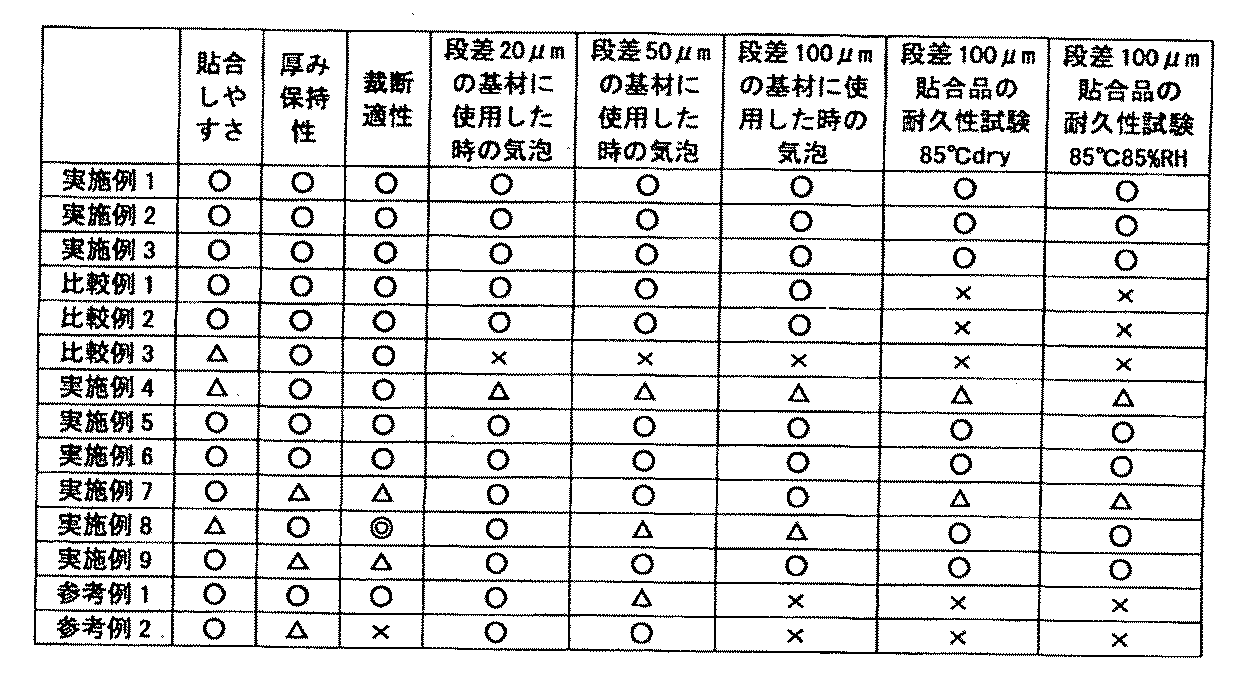
- the ease of pasting was evaluated as follows.
- the separator on one side of the adhesive resin film is peeled off, and it is easy to align when pasting to a predetermined position on a PET film with a printed step, and the appearance of the laminated body after lamination (especially biting) Air bubbles) were visually confirmed.
- the pasting apparatus product name SE320 made by Climb Products Co., Ltd. was used for pasting.
- ⁇ Bubbles remain in the vicinity of the corner of the printing step (because they disappear with a hot press).
- ⁇ Bubbles remain around the printing step (because they disappear with a hot press).
- X Air bubbles of 1 mm or more remain from the printing step (because they do not disappear by hot pressing).
- Thickness retention was evaluated as follows for the adhesive resin layer when the coated product was wound up with a coating width of 400 mm and wound up with a tension of 40 N. ⁇ : No appearance of wrinkles and good appearance. ⁇ : There are wrinkles but no separator is seen. X: Wrinkles entered and the separator floated, and the thickness of the adhesive resin layer was changed.
- a pinnacle blade that can be punched into a square shape with a blade angle of 30 degrees was installed in a cutting device, and press working and peeling of unnecessary portions around the periphery were performed. Evaluation was performed as follows. A: Unnecessary surrounding parts were easily peeled off. ⁇ : Unnecessary surroundings could be removed. (Triangle
- Reference Examples 1 and 2 are examples using an adhesive raw material composition containing a photopolymerization initiator.
- a substrate one flat polyethylene terephthalate (PET) film was prepared, and another polyethylene terephthalate (PET) film having 20 ⁇ m, 50 ⁇ m, and 100 ⁇ m printing steps formed on the surface.
- PET polyethylene terephthalate
- PET polyethylene terephthalate
- the separator on one side is peeled off from the adhesive resin film and bonded to a PET film having a printed step, the separator remaining in the two-layer bonded product is peeled off, and a smooth PET film is bonded to the PET film.
- a three-layer bonded product of / adhesive resin / PET was prepared, and the appearance of the laminate immediately after the autoclave treatment was visually confirmed and evaluated as follows.
- the reference example 1 is a reference example in which the step followability is not sufficient for a step having a deformation amount of 50 ⁇ m or more, and improvement is necessary.
- the step followability can be improved, and even a step having a relatively large deformation amount can be bonded without bubbles, but for a step of 100 ⁇ m
- bonding was not sufficient, thickness retention was poor, and when the laminate was cut, there was a problem that the adhesive component of the joined portion of the laminate exuded from the cut surface It is a reference example.
- the bonded product that can follow the step where air bubbles cannot be confirmed is irradiated with ultraviolet rays to polymerize the monomer, so that foaming cannot be confirmed even in the durability test, but the bonded product applied to the 100 ⁇ m step is an autoclave. Since bubbles are generated after the treatment, the foam remains as it is even when irradiated with ultraviolet rays.
- the adhesive resin layer is formed from the adhesive raw material composition not containing (B) the acrylic monomer, and therefore cannot follow the deformation of the base material due to the press of the mold having a printing step.
- Comparative Examples 1 to 3 the durability in a high temperature drying environment and a high temperature and high humidity environment was inferior.
- Comparative Examples 1 and 2 it is considered that the polymerization of the acrylic monomer is difficult to proceed because the adhesive raw material composition containing the acrylic monomer but not including the thermal polymerization initiator was heated by hot press.
- Comparative Example 3 it is considered that the durability was lowered because the bonded product had bubbles.
- the adhesive resin layer is bonded to a bonded substrate such as PET in a state of high fluidity, it can be firmly adhered to fine irregularities.
- a highly fluid monomer flows by hot pressing and follows the deformation, and then the thermal polymerization reaction proceeds gradually with heat, and the monomer component becomes polymerized, so the fluidity of the adhesive resin layer decreases. Since it hardens in a deformed state, it is considered that not only bubbles in the deformed portion did not occur, but also foaming between the substrates did not occur.
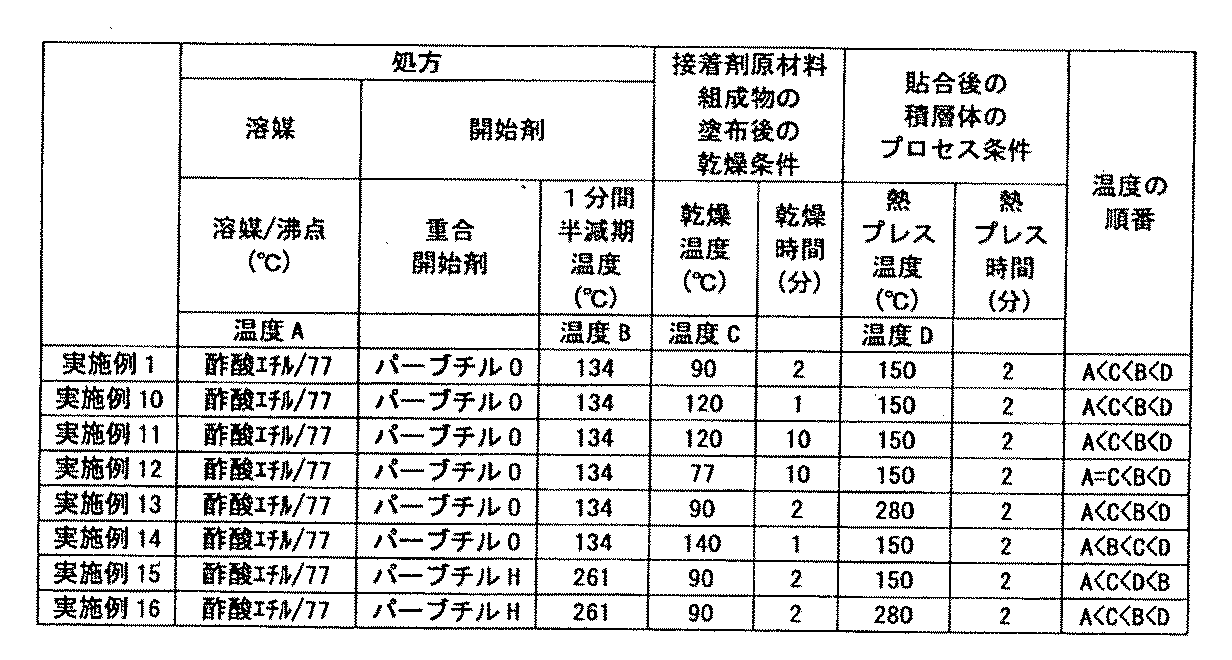
- Example 15 and 16 changed the polymerization initiator
- Examples 10, 11, 12, and 14 changed the drying conditions of the adhesive resin layer
- the temperature of the laminate during hot pressing was changed.
- the boiling point of the solvent of the adhesive resin layer is temperature A
- the half-life temperature of 1 minute of the thermal polymerization initiator is temperature B
- the temperature during heating for removing the solvent in the manufacturing process of the adhesive resin layer is temperature C
- heat curing The press temperature of the mold in the step of making was the temperature D.
- Example 11 if the drying time is too long under the drying conditions after application of the adhesive raw material composition, there are very few bubbles even if the order of the temperatures A, B, C, and D is the preferred order. It was. This is presumably because the residual solvent was too little and the fluidity of the adhesive resin layer was lost. In Example 12, since the drying temperature at the time of producing the adhesive resin layer is the same as the boiling point of the solvent, the organic solvent remains in the adhesive resin layer, and it takes time to dry.
- Example 14 This is an example in which bubbles due to In Example 14, the temperature at the time of drying after the application of the adhesive raw material composition is high, so that the polymerization initiator has been deactivated at the time of drying, the reaction does not proceed sufficiently at the time of pressing, and the acrylic monomer is volatilized. It seems that there were very few bubbles. Moreover, it is thought that hardening is inadequate. In Example 15, since the temperature at the time of hot pressing is lower than the one-minute half-life temperature of the thermal polymerization initiator, the thermal polymerization reaction does not occur sufficiently, the acrylic monomer volatilizes, and the curing is insufficient. It is possible.
- the adhesive resin film of each example was hot-pressed under the same conditions as the “appearance confirmation evaluation method after hot pressing” with the adhesive resin layer being laminated between the separators, and then the cured adhesive resin layer was
- FT-IR Fastier transform infrared spectroscopy
- almost no peaks of carbon-carbon double bonds such as vinyl groups of acrylic monomers
- DSC differential scanning calorimetry
- Adhesive resin film 11 ... Adhesive resin layer, 11a, 11b ... Both surfaces (adhesive surface) of adhesive resin layer, 12, 13 ... Separator, 12a, 13a ... Surface of separator (peeling surface), 20, 30 ... Laminate, 21, 22 ... Base material, 21a, 22a ... Inner surface, 21b, 22b ... Outer surface, 23 ... Projection, 24 ... Corner of step, 25 ... Adhesive layer after thermosetting, 31, 32 ... Mold , 31a, 32a ... pressing surfaces.
Landscapes
- Chemical & Material Sciences (AREA)
- Organic Chemistry (AREA)
- Laminated Bodies (AREA)
- Adhesive Tapes (AREA)
- Adhesives Or Adhesive Processes (AREA)
- Table Devices Or Equipment (AREA)
- Health & Medical Sciences (AREA)
- Chemical Kinetics & Catalysis (AREA)
- Medicinal Chemistry (AREA)
- Polymers & Plastics (AREA)
Abstract
Description
本願は、2015年1月30日に出願された日本国特願2015−017131号に基づく優先権を主張し、その内容をここに援用する。
(第1の実施形態)タッチパネル本体部の印刷層が形成されている面に、紫外線硬化樹脂又は熱硬化樹脂を塗布した後、紫外線照射又は加熱することにより樹脂層を形成する工程と、カバーフィルムに光学用透明粘着シートが張られている面を、タッチパネル本体部の樹脂層が形成されている面に貼り付ける工程とを有する製造方法。
(第2の実施形態)タッチパネル本体部の印刷層が形成されている面に、紫外線硬化樹脂を塗布する工程と、紫外線硬化樹脂の上にカバーフィルムを載置する工程と、その後、紫外線を照射する工程とを有する製造方法。
しかしながら、第1の実施形態の場合、基材ごとにそれぞれ樹脂層を形成する必要があり、工程数が増大する。また、第2の実施形態の場合、人体に悪影響のある紫外線照射の設備が必要な上、樹脂層一面に紫外線を照射する必要があるので、基材に不透明な部分があると、光硬化が不十分になる。
前記接着性樹脂組成物が、前記(A)アクリル系ポリマー100重量部に対して、前記(B)アクリル系モノマー4~20重量部を含有することが好ましい。
前記熱重合開始剤が過酸化物であることが好ましい。
前記接着性樹脂層は、加熱前の温度23℃における貯蔵弾性率よりも、前記加熱により熱硬化した後の温度23℃における貯蔵弾性率の方が高く、加熱前の温度23℃における貯蔵弾性率が1×10⁴~1×10⁶Paであり、前記加熱により熱硬化した後の温度23℃における貯蔵弾性率が1×10⁴~1×10⁹Paであることが好ましい。
また、本発明は、前記接着性樹脂層を介して、2枚の基材が積層されてなることを特徴とする積層体を提供する。
式(1) 温度A<温度C<温度B<温度D
前記段差が、好ましくは50μm~1mmである。
本発明の接着性樹脂層はその厚みが段差よりも厚いことが好ましい。本発明の接着性樹脂層は厚みが段差の1.1~3倍の55μm~3mmであることが好ましく、さらに好ましくは段差の厚みの1.2~2倍の60μm~2mmである。
前記加熱硬化する際の金型の温度が、150~300℃の温度であることが好ましい。
図1に、接着性樹脂フィルム10の一例の断面図を示す。接着性樹脂フィルム10は、2枚のセパレーター12,13と、これらの間に積層された接着性樹脂層11とを有する。接着性樹脂層11を構成する接着性樹脂組成物は、(A)アクリル系ポリマーと、(B)アクリル系モノマーと、(C)熱重合開始剤とを含有する。接着性樹脂層11の両面11a,11bは、常温で粘着性を有する(粘着面となっている)。
なお、本明細書中において「常温」とは、約3℃~約40℃であり、好ましくは約10℃~約30℃であり、より好ましくは約15℃~約25℃であり、最も好ましくは約23℃である。
第2の積層方法として、平坦な基材22に接着性樹脂層11を積層し、その後オートクレーブ処理を実施し、接着性樹脂層11の上に、凹凸を有した基材21を積層した後、もしくは基材21を積層させながら、金型31,32を用いて接着性樹脂層11を加熱硬化させる方法が挙げられる。
第3の積層方法として、凹凸を有した基材21、接着性樹脂層11、平坦な基材22を同時に積層した後、もしくは積層すると同時に、金型31,32を用いて接着性樹脂層11を加熱硬化させる方法が挙げられる。
本発明の接着性樹脂層の製造に用いる接着剤原材料組成物は、有機溶剤に溶解している方が、より厚みの精度良く塗布することが可能となるため、有機溶剤を含むことが好ましい。接着剤原材料組成物から溶剤を乾燥することで、接着性樹脂層が得られる。つまり、接着剤原材料組成物の組成は、接着性樹脂層を構成する接着性樹脂組成物の組成に、溶剤を加えたものであってもよい。接着性樹脂層は、常温では(熱硬化前)、粘着剤層として機能することができる。
アミド基(−CONR2,Rは水素原子又はアルキル基等の置換基)を有するアクリル系モノマーとしては、アクリルアミド、メタクリルアミド等が挙げられる。
ニトリル基(−CN)を有するアクリル系モノマーとしては、アクリロニトリル、メタクリロニトリル等が挙げられる。
本発明における接着性樹脂層(トランスファーテープ)は、接着剤原材料組成物をセパレーターフィルムに溶媒を含んだ状態で塗布し、乾燥し、さらにセパレーターフィルムにより保護されることで製造することができる。接着剤原材料組成物は、ダイ又はパイプドクターを用いて塗布することが好ましい。溶剤の乾燥においては、ドライヤー等で乾燥させることが好ましい。溶媒の乾燥時間に関しては、生産性を考慮すると、10分間以下であることが好ましく、2~5分間であることがさらに好ましい。また、有機溶媒を十分に乾燥することが必要なため、有機溶媒の沸点以上の温度で乾燥させることが好ましく、熱重合開始剤の1分間半減期温度以下での乾燥をすることが好ましい。
本発明のプレス時において、積層体への加熱温度が100~250℃となる熱をかけるために、金型の温度は所望の加熱温度よりも高い温度で加熱することが必要である。金型の温度は100~300℃が好ましく、さらに好ましくは150~300℃である。基材もしくは基材の一部にポリエチレンテレフタレートを含み、そのポリエチレンテレフタレートを例えば180℃、10分間程度で加熱したときに、オリゴマー成分が析出し、析出した成分により外観不良が起こる場合は、熱プレス時の加熱温度を180℃以下とすることが好ましい。
基材にポリエチレンテレフタレートを含まず、オリゴマー成分の析出のない素材を用いたときは100~300℃とすればよい。本発明においてのプレス時間に関しては生産性の観点から2分間以内で反応が終わることが好ましい。また、プレス温度・時間に関しては、積層体の強度が十分になるように設定することができる。
(A)アクリル系ポリマーとして、SKダイン(登録商標)2094(綜研化学株式会社、酸価:33、数平均分子量7万)、架橋剤としてE−AX(綜研化学株式会社)を用い、ポリマー固形分100重量部に対して、架橋剤0.05重量部の割合で配合した。得られた混合物に、(B)アクリル系モノマーとして、4−ヒドロキシブチルアクリレート(大阪有機化学工業株式会社;4HBA)10重量部と、(C)熱重合開始剤として、t−ブチルペルオキシ−2−エチルヘキサノエート(日油株式会社製;製品名:パーブチル(登録商標)O)0.02重量部とを加えて、接着剤原材料組成物を調製した。接着剤原材料組成物は、溶媒として、酢酸エチル(沸点77℃)を含む。
その接着剤原材料組成物を、セパレーター(藤森工業株式会社製;製品名:125E−0010DG2.5AS、厚み125μm)の上面に、アプリケーターを用いて、乾燥後における接着剤樹脂層(粘着剤層)の厚みが175μmとなるように塗布した後、乾燥工程において90℃、2分間の条件で溶剤を乾燥させて接着性樹脂層が積層された積層体を作製した。
次に、得られた積層体の接着性樹脂層の上面に、セパレーター(藤森工業株式会社製;製品名;38E−0010BDAS、厚み38μm)を貼合して、実施例1の接着性樹脂フィルムを作製した。
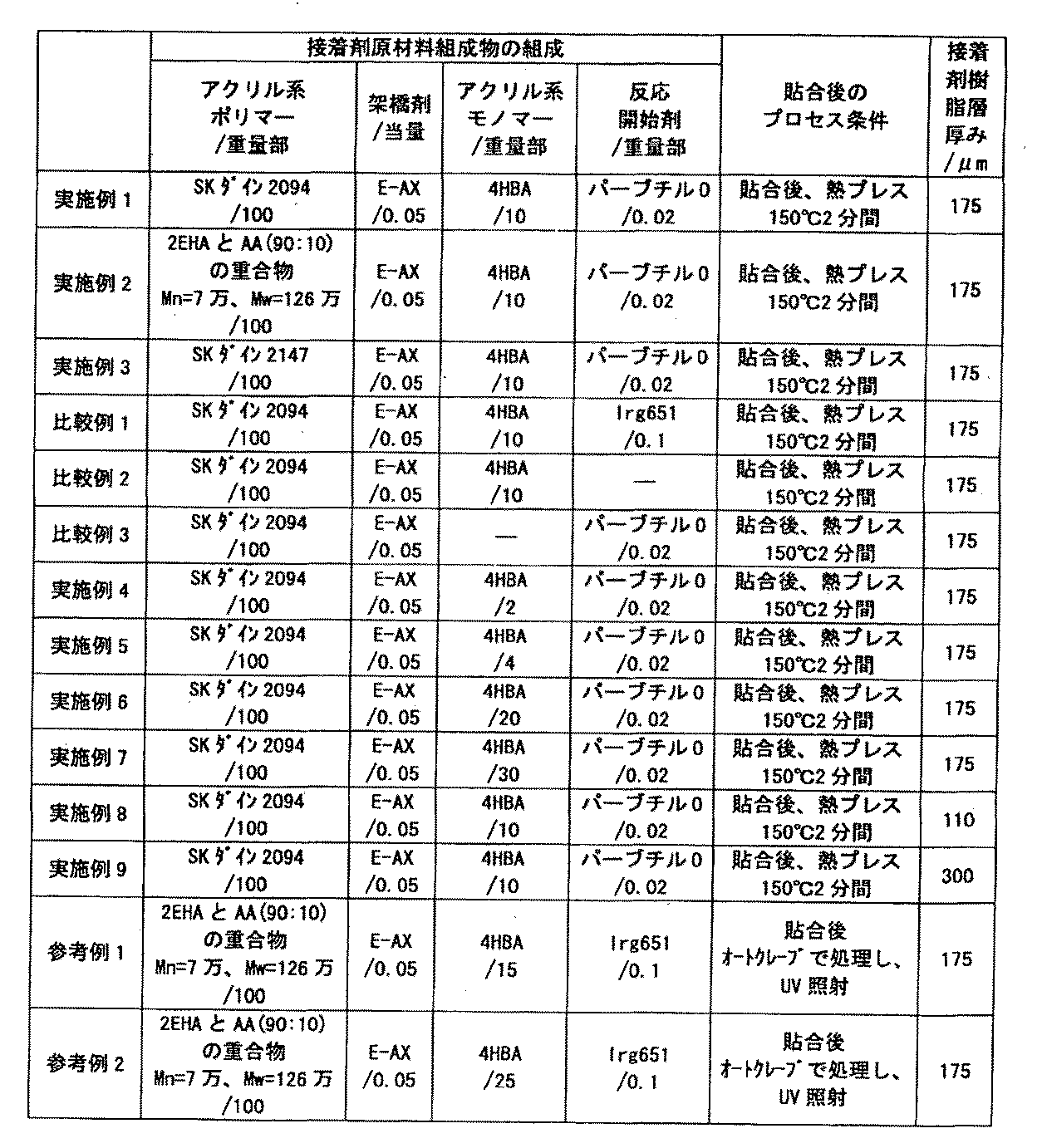
基材として、1枚は平坦なポリエチレンテレフタレート(PET)フィルムを用意し、もう1枚には表面に20μm、50μm、100μmの印刷段差を形成したポリエチレンテレフタレート(PET)フィルムを用意した。金型には、プレス後の基材の外面(積層体の外面)が平滑になるように金型がお互いに平滑な表面を持つ金型を使用した。事前に接着性樹脂フィルムから片側のセパレーターを剥離して印刷段差を形成したPETフィルムに貼合し、その貼合フィルムと印刷段差が形成されていない平滑なPETフィルムを熱プレス機で金型の間にはさみ、表1の「貼合後のプロセス条件」に示す熱プレス条件で、熱プレスを行った。熱プレス直後に貼合後の積層体(貼合品)の外観を目視にて確認し、下記のように評価を行った。
○:基材間又は印刷段差部分に気泡が確認できない。
△:基材間又は印刷段差部分にごくわずかに気泡が確認できる。
×:基材間又は印刷段差部分に気泡が確認できる。
○:印刷段差の角付近に気泡が残る(熱プレスで消えるため)。
△:印刷段差の周辺に気泡が残る(熱プレスで消えるため)。
×:印刷段差から1mm以上の気泡が残る(熱プレスで消えないため)。
○:しわが入っておらず外観が良好である。
△:シワはあるがセパレーターのウキが見られない。
×:シワが入りセパレーターが浮いてしまい、接着性樹脂層の厚みが変わっている。
◎:周囲の不要部分のはぎ取りが容易だった。
○:周囲の不要部分のはぎ取りが可能だった。
△:周囲の不要部分のはぎ取りが難しかった。
×:断裁部分が再付着してはぎ取りが容易にできなかった。
耐久性試験は、熱プレス後の積層体(貼合品)を、85℃dryの高温乾燥環境、又は85℃85%RHの高温高湿度環境に投入し、所定時間経過後に取り出して目視による確認を実施し、下記のように評価を行った。
○:貼合品に浮き・剥がれがない。
△:貼合品に小さな浮き・剥がれがある。
×:貼合品に大きな浮き・剥がれがある。
○:基材間又は印刷段差部分に気泡が確認できない。
△:基材間又は印刷段差部分にごくわずかに気泡が確認できる。
×:基材間又は印刷段差部分に気泡が確認できる。
実施例では、変形量が100μmでも気泡が確認されず、印刷段差を有する金型のプレスによる基材の変形に追従していることが確認できた。これは、(A)アクリル系ポリマー以外に、流動性の高い成分として(B)アクリル系モノマーを接着剤原材料組成物に添加したためと考えられる。
実施例1記載の接着剤原材料組成物を用いて、製造方法に関する検討を行った。表3に示すように、実施例1記載の製造方法において、実施例15,16は重合開始剤を変更し、実施例10,11,12,14は接着性樹脂層の乾燥条件を変更し、実施例13,16は熱プレス時の積層体の温度を変更した。接着性樹脂層の溶媒の沸点を温度A、熱重合開始剤の1分間半減期温度を温度B、接着性樹脂層の製造工程において溶媒を除去するための加熱時の温度を温度C、加熱硬化させる工程における金型のプレス温度を温度Dとした。
◎:生産スピードが十分に速い条件である。
○:生産スピードが一般的な条件である。
△:生産スピードが遅い条件である。
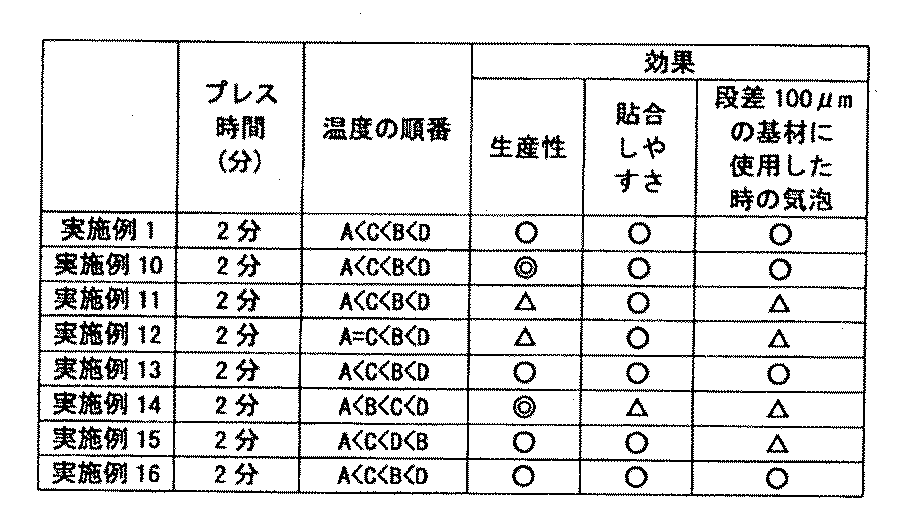
実施例12は、接着性樹脂層製造時の乾燥温度が溶媒の沸点と同一であるため、有機溶媒が接着性樹脂層に残ってしまい、乾燥に時間がかかり、またプレス時にも溶媒の揮発起因による気泡がごくわずかにできている実施例である。
実施例14は、接着剤原材料組成物の塗布後の乾燥時の温度が高いため、重合開始剤が乾燥時に失活してしまっており、プレス時に反応が十分に進まず、アクリル系モノマーが揮発してしまい、ごくわずかに気泡が出来てしまったと考えられる。また、硬化も不十分であることが考えられる。
実施例15は、熱プレス時の温度が熱重合開始剤の1分間半減期温度よりも低いため、熱重合反応が十分に起きず、アクリル系モノマーが揮発してしまい、硬化も不十分であることが考えられる。
熱プレス前でのDSCでは、比較例1,2では発熱ピークが確認されなかった。熱による反応は確認できないため、熱硬化反応が進んでいないと判断できる。比較例3は熱反応開始剤の発熱が確認されるだけで、重合する反応性モノマーが無いため重合反応は進行しない。
Claims (14)
- 透明性を有するアクリル系の接着性樹脂組成物を含む単層の接着性樹脂層であって、
前記接着性樹脂組成物が、(A)アクリル系ポリマーと、(B)アクリル系モノマーと、(C)熱重合開始剤とを含有し、
前記接着性樹脂層が、常温で両面に粘着性を有し、100~250℃の温度及び30秒~10分の時間の加熱により熱硬化することができることを特徴とする接着性樹脂層。 - 前記アクリル系モノマーが、ヒドロキシル基を有する(メタ)アクリレートのモノマーであることを特徴とする請求項1に記載の接着性樹脂層。
- 前記接着性樹脂組成物が、前記(A)アクリル系ポリマー100重量部に対して、前記(B)アクリル系モノマー4~20重量部を含有することを特徴とする請求項1又は2に記載の接着性樹脂層。
- 前記熱重合開始剤が過酸化物であることを特徴とする請求項1~3のいずれか1項に記載の接着性樹脂層。
- 加熱前の温度23℃における貯蔵弾性率よりも、前記加熱により熱硬化した後の温度23℃における貯蔵弾性率の方が高く、加熱前の温度23℃における貯蔵弾性率が1×10⁴~1×10⁶Paであり、前記加熱により熱硬化した後の温度23℃における貯蔵弾性率が1×10⁴~1×10⁹Paであることを特徴とする請求項1~4のいずれかに記載の接着性樹脂層。
- 請求項1~5のいずれかに記載の接着性樹脂層が、2枚のセパレーターの間に積層されてなることを特徴とする接着性樹脂フィルム。
- 請求項1~5のいずれかに記載の接着性樹脂層を介して、2枚の基材が積層されてなることを特徴とする積層体。
- 前記2枚の基材の少なくとも一方の基材が、前記接着性樹脂層と接する側の面内に、5μm~1mmの段差を1以上含むことを特徴とする請求項7に記載の積層体。
- 前記段差が、50μm~1mmであることを特徴とする請求項8に記載の積層体。
- 請求項1~5のいずれかに記載の接着性樹脂層を介して、2枚の基材を積層し、得られた積層体を、2つの金型の間に挟持した状態で、前記接着性樹脂層を加熱硬化することを特徴とする積層体の製造方法。
- 前記接着性樹脂層の原材料組成物に含まれる溶媒の沸点を温度A、前記熱重合開始剤が1分間の半減期を有する温度を温度B、前記接着性樹脂層の製造工程において前記溶媒を除去するための加熱時の温度を温度C、前記接着性樹脂層を加熱硬化させる工程における金型のプレス温度を温度Dとしたとき、各温度が下記式(1)の順であることを特徴とする請求項10に記載の積層体の製造方法。
式(1) 温度A<温度C<温度B<温度D - 前記2枚の基材の少なくとも一方の基材が、前記接着性樹脂層と接する側の面内に、5μm~1mmの段差を1以上含むことを特徴とする請求項10又は11に記載の積層体の製造方法。
- 前記段差が、50μm~1mmであることを特徴とする請求項12に記載の積層体の製造方法。
- 前記加熱硬化する際の金型の温度が、150~300℃の温度であることを特徴とする請求項10~13のいずれかに記載の積層体の製造方法。
Priority Applications (6)
| Application Number | Priority Date | Filing Date | Title |
|---|---|---|---|
| EP16742843.2A EP3252121B1 (en) | 2015-01-30 | 2016-01-27 | Adhesive resin layer, adhesive resin film, laminate, and laminate manufacturing method |
| KR1020197004967A KR102092056B1 (ko) | 2015-01-30 | 2016-01-27 | 접착성 수지층, 접착성 수지 필름, 적층체 및 적층체의 제조 방법 |
| CN201680004541.9A CN107109147B (zh) | 2015-01-30 | 2016-01-27 | 粘接性树脂层、粘接性树脂膜、层叠体及层叠体的制造方法 |
| KR1020197011623A KR102160936B1 (ko) | 2015-01-30 | 2016-01-27 | 접착성 수지층, 접착성 수지 필름, 적층체 및 적층체의 제조 방법 |
| US15/540,098 US10919276B2 (en) | 2015-01-30 | 2016-01-27 | Adhesive resin layer, adhesive resin film, laminate, and method of producing laminate |
| KR1020177017681A KR20170091670A (ko) | 2015-01-30 | 2016-01-27 | 접착성 수지층, 접착성 수지 필름, 적층체 및 적층체의 제조 방법 |
Applications Claiming Priority (2)
| Application Number | Priority Date | Filing Date | Title |
|---|---|---|---|
| JP2015017131A JP6460525B2 (ja) | 2015-01-30 | 2015-01-30 | 接着性樹脂層、接着性樹脂フィルム、積層体及び積層体の製造方法 |
| JP2015-017131 | 2015-01-30 |
Publications (1)
| Publication Number | Publication Date |
|---|---|
| WO2016120710A1 true WO2016120710A1 (ja) | 2016-08-04 |
Family
ID=56542529
Family Applications (1)
| Application Number | Title | Priority Date | Filing Date |
|---|---|---|---|
| PCT/IB2016/000054 Ceased WO2016120710A1 (ja) | 2015-01-30 | 2016-01-27 | 接着性樹脂層、接着性樹脂フィルム、積層体及び積層体の製造方法 |
Country Status (7)
| Country | Link |
|---|---|
| US (1) | US10919276B2 (ja) |
| EP (1) | EP3252121B1 (ja) |
| JP (1) | JP6460525B2 (ja) |
| KR (3) | KR102160936B1 (ja) |
| CN (1) | CN107109147B (ja) |
| TW (2) | TWI738637B (ja) |
| WO (1) | WO2016120710A1 (ja) |
Cited By (3)
| Publication number | Priority date | Publication date | Assignee | Title |
|---|---|---|---|---|
| EP3521982A4 (en) * | 2016-10-03 | 2020-04-22 | Maxgen Technology Co., Ltd. | DISPLAY DEVICE WITH A FINE BUMPER FOR ADJUSTING THE FASTENING AND REMOVAL AND MANUFACTURING METHOD THEREFOR |
| EP3686715A4 (en) * | 2016-10-03 | 2020-10-28 | Young Su Kim | DISPLAY DEVICE INCLUDING A ADHESION REDUCING LAYER WITH A MICRO-PROJECT PATTERN |
| EP3686716A4 (en) * | 2016-10-03 | 2020-11-04 | Young Su Kim | Display device having attachable/detachable pattern |
Families Citing this family (20)
| Publication number | Priority date | Publication date | Assignee | Title |
|---|---|---|---|---|
| JP6460525B2 (ja) | 2015-01-30 | 2019-01-30 | 藤森工業株式会社 | 接着性樹脂層、接着性樹脂フィルム、積層体及び積層体の製造方法 |
| JP6583991B2 (ja) * | 2015-05-18 | 2019-10-02 | 藤森工業株式会社 | 接着性樹脂層及び接着性樹脂フィルム |
| JP6632115B2 (ja) * | 2015-07-17 | 2020-01-15 | 藤森工業株式会社 | 接着性樹脂層及び接着性樹脂フィルム |
| KR102652732B1 (ko) | 2016-12-15 | 2024-03-28 | 쓰리엠 이노베이티브 프로퍼티즈 컴파니 | 점착 필름 |
| JP6955904B2 (ja) * | 2017-05-26 | 2021-10-27 | 東京エレクトロン株式会社 | 基板処理装置 |
| JP6914156B2 (ja) * | 2017-09-19 | 2021-08-04 | 藤森工業株式会社 | 積層構造体の製造方法 |
| JP6999339B2 (ja) * | 2017-09-19 | 2022-01-18 | 藤森工業株式会社 | 成形体の製造方法 |
| KR102582227B1 (ko) * | 2018-10-26 | 2023-09-22 | 미쓰이 가가쿠 가부시키가이샤 | 기판 적층체의 제조 방법 및 적층체 |
| JP6632168B2 (ja) * | 2018-12-20 | 2020-01-22 | 藤森工業株式会社 | 接着性樹脂層、接着性樹脂フィルム、積層体及び積層体の製造方法 |
| JP7413097B2 (ja) * | 2019-03-25 | 2024-01-15 | フタムラ化学株式会社 | フィルム状樹脂層を有する薄板状積層物の製造方法 |
| EP3782812B1 (en) * | 2019-08-20 | 2023-08-02 | Roller Bearing Company of America, Inc. | Permanent, self-adhering, self-lubricating, anti-wear composite system |
| CN114729510A (zh) * | 2019-11-26 | 2022-07-08 | Omya国际股份公司 | 包含纸部件和可热封涂层的纸制品 |
| JP7453804B2 (ja) * | 2020-02-26 | 2024-03-21 | 藤森工業株式会社 | 複合成型体および複合成型体の製造方法 |
| JP7437185B2 (ja) * | 2020-02-26 | 2024-02-22 | 藤森工業株式会社 | 複合成型体、接着性樹脂層及び複合成型体の製造方法 |
| JP2021158852A (ja) * | 2020-03-27 | 2021-10-07 | 日本電産株式会社 | 積層体製造装置及び積層体製造方法 |
| CN114047574A (zh) * | 2021-11-24 | 2022-02-15 | 凯鑫森(上海)功能性薄膜产业股份有限公司 | 一种新工艺制作的显示增效膜开视角膜及制备方法 |
| EP4517971A4 (en) * | 2022-05-25 | 2025-11-05 | Lg Energy Solution Ltd | BATTERY MODULE AND ITS MANUFACTURING PROCESS |
| KR102571694B1 (ko) * | 2022-12-20 | 2023-08-29 | 율촌화학 주식회사 | 열경화성 점착제 조성물 및 이를 포함하는 표면 보호 필름 |
| KR102589574B1 (ko) | 2023-03-24 | 2023-10-16 | 주식회사 아로텍 | 카메라를 이용한 순찰 방법 및 장치 |
| KR102589573B1 (ko) | 2023-03-24 | 2023-10-16 | 주식회사 아로텍 | 촬영 구역을 결정하기 위한 방법 및 장치 |
Citations (3)
| Publication number | Priority date | Publication date | Assignee | Title |
|---|---|---|---|---|
| JP2011162659A (ja) * | 2010-02-09 | 2011-08-25 | Fujimori Kogyo Co Ltd | 粘着剤組成物、粘着フィルム、粘着剤組成物の製造方法及び粘着フィルムの製造方法 |
| JP2013221065A (ja) * | 2012-04-16 | 2013-10-28 | Nippon Synthetic Chem Ind Co Ltd:The | アクリル系樹脂組成物、アクリル系粘着剤、粘着シート、両面粘着シート、透明電極用粘着剤、タッチパネル及び画像表示装置、並びに粘着剤層含有積層体の製造方法 |
| JP2013234322A (ja) * | 2012-04-10 | 2013-11-21 | Nippon Synthetic Chem Ind Co Ltd:The | 粘着シート、粘着剤層付き積層体の製造方法、およびその用途 |
Family Cites Families (13)
| Publication number | Priority date | Publication date | Assignee | Title |
|---|---|---|---|---|
| KR101023837B1 (ko) * | 2008-01-11 | 2011-03-22 | 주식회사 엘지화학 | 점착제 조성물, 상기를 포함하는 편광판 및 액정표시장치 |
| JP5657900B2 (ja) * | 2010-03-08 | 2015-01-21 | 株式会社カネカ | 熱伝導材料 |
| JP2011184582A (ja) * | 2010-03-09 | 2011-09-22 | Three M Innovative Properties Co | 光学用粘着シート |
| US20120156456A1 (en) | 2010-03-14 | 2012-06-21 | Mitsubishi Plastics, Inc. | Transparent double-sided self-adhesive sheet |
| JP2012035431A (ja) | 2010-08-04 | 2012-02-23 | Lintec Corp | 保護フィルム用粘着シート |
| US9848875B2 (en) * | 2010-09-30 | 2017-12-26 | Ethicon Llc | Anvil layer attached to a proximal end of an end effector |
| JP5651073B2 (ja) | 2011-06-14 | 2015-01-07 | 綜研化学株式会社 | 粘着剤、粘着シートおよびタッチパネル用積層体 |
| KR101422662B1 (ko) * | 2011-09-08 | 2014-07-23 | 제일모직주식회사 | 위상차 점착필름, 그 제조방법 및 이를 포함하는 광학부재 |
| JP6067964B2 (ja) * | 2011-08-12 | 2017-01-25 | スリーエム イノベイティブ プロパティズ カンパニー | 放射線硬化性粘着シート |
| JP5948075B2 (ja) | 2012-02-15 | 2016-07-06 | 株式会社寺岡製作所 | 粘着シート及びその製造方法、接着用シート、光硬化型接着剤組成物並びに光学用部材 |
| JP2014026337A (ja) | 2012-07-24 | 2014-02-06 | Fujitsu Component Ltd | タッチパネルの製造方法及びタッチパネル |
| WO2014162990A1 (ja) * | 2013-04-02 | 2014-10-09 | 昭和電工株式会社 | 導電性接着剤、異方性導電フィルム及びそれらを使用した電子機器 |
| JP6460525B2 (ja) | 2015-01-30 | 2019-01-30 | 藤森工業株式会社 | 接着性樹脂層、接着性樹脂フィルム、積層体及び積層体の製造方法 |
-
2015
- 2015-01-30 JP JP2015017131A patent/JP6460525B2/ja active Active
-
2016
- 2016-01-26 TW TW105102308A patent/TWI738637B/zh active
- 2016-01-26 TW TW110112292A patent/TWI786586B/zh active
- 2016-01-27 CN CN201680004541.9A patent/CN107109147B/zh active Active
- 2016-01-27 WO PCT/IB2016/000054 patent/WO2016120710A1/ja not_active Ceased
- 2016-01-27 KR KR1020197011623A patent/KR102160936B1/ko active Active
- 2016-01-27 US US15/540,098 patent/US10919276B2/en active Active
- 2016-01-27 KR KR1020197004967A patent/KR102092056B1/ko active Active
- 2016-01-27 EP EP16742843.2A patent/EP3252121B1/en active Active
- 2016-01-27 KR KR1020177017681A patent/KR20170091670A/ko not_active Ceased
Patent Citations (3)
| Publication number | Priority date | Publication date | Assignee | Title |
|---|---|---|---|---|
| JP2011162659A (ja) * | 2010-02-09 | 2011-08-25 | Fujimori Kogyo Co Ltd | 粘着剤組成物、粘着フィルム、粘着剤組成物の製造方法及び粘着フィルムの製造方法 |
| JP2013234322A (ja) * | 2012-04-10 | 2013-11-21 | Nippon Synthetic Chem Ind Co Ltd:The | 粘着シート、粘着剤層付き積層体の製造方法、およびその用途 |
| JP2013221065A (ja) * | 2012-04-16 | 2013-10-28 | Nippon Synthetic Chem Ind Co Ltd:The | アクリル系樹脂組成物、アクリル系粘着剤、粘着シート、両面粘着シート、透明電極用粘着剤、タッチパネル及び画像表示装置、並びに粘着剤層含有積層体の製造方法 |
Non-Patent Citations (1)
| Title |
|---|
| See also references of EP3252121A4 * |
Cited By (3)
| Publication number | Priority date | Publication date | Assignee | Title |
|---|---|---|---|---|
| EP3521982A4 (en) * | 2016-10-03 | 2020-04-22 | Maxgen Technology Co., Ltd. | DISPLAY DEVICE WITH A FINE BUMPER FOR ADJUSTING THE FASTENING AND REMOVAL AND MANUFACTURING METHOD THEREFOR |
| EP3686715A4 (en) * | 2016-10-03 | 2020-10-28 | Young Su Kim | DISPLAY DEVICE INCLUDING A ADHESION REDUCING LAYER WITH A MICRO-PROJECT PATTERN |
| EP3686716A4 (en) * | 2016-10-03 | 2020-11-04 | Young Su Kim | Display device having attachable/detachable pattern |
Also Published As
| Publication number | Publication date |
|---|---|
| EP3252121B1 (en) | 2022-12-14 |
| KR20190021484A (ko) | 2019-03-05 |
| TW202128909A (zh) | 2021-08-01 |
| JP6460525B2 (ja) | 2019-01-30 |
| EP3252121A4 (en) | 2018-08-15 |
| US10919276B2 (en) | 2021-02-16 |
| TWI786586B (zh) | 2022-12-11 |
| CN107109147B (zh) | 2021-01-19 |
| US20170368808A1 (en) | 2017-12-28 |
| KR102160936B1 (ko) | 2020-09-29 |
| CN107109147A (zh) | 2017-08-29 |
| KR102092056B1 (ko) | 2020-03-23 |
| KR20190045402A (ko) | 2019-05-02 |
| TWI738637B (zh) | 2021-09-11 |
| KR20170091670A (ko) | 2017-08-09 |
| JP2016141706A (ja) | 2016-08-08 |
| TW201634625A (zh) | 2016-10-01 |
| EP3252121A1 (en) | 2017-12-06 |
Similar Documents
| Publication | Publication Date | Title |
|---|---|---|
| JP6460525B2 (ja) | 接着性樹脂層、接着性樹脂フィルム、積層体及び積層体の製造方法 | |
| JP6632115B2 (ja) | 接着性樹脂層及び接着性樹脂フィルム | |
| JP6583991B2 (ja) | 接着性樹脂層及び接着性樹脂フィルム | |
| JP5322968B2 (ja) | 粘着剤組成物、粘着フィルム、粘着剤組成物の製造方法及び粘着フィルムの製造方法 | |
| JP2014065207A (ja) | 積層体の製造方法及び積層体 | |
| JP2019051681A (ja) | 成形体の製造方法 | |
| JP6632168B2 (ja) | 接着性樹脂層、接着性樹脂フィルム、積層体及び積層体の製造方法 | |
| KR20170119001A (ko) | 다층 구조의 광학용 점착 시트, 다층 구조의 광학용 점착 시트의 제조 방법 및 터치 스크린 패널 |
Legal Events
| Date | Code | Title | Description |
|---|---|---|---|
| 121 | Ep: the epo has been informed by wipo that ep was designated in this application |
Ref document number: 16742843 Country of ref document: EP Kind code of ref document: A1 |
|
| REEP | Request for entry into the european phase |
Ref document number: 2016742843 Country of ref document: EP |
|
| ENP | Entry into the national phase |
Ref document number: 20177017681 Country of ref document: KR Kind code of ref document: A |
|
| WWE | Wipo information: entry into national phase |
Ref document number: 15540098 Country of ref document: US |
|
| NENP | Non-entry into the national phase |
Ref country code: DE |