WO2016121142A1 - 発泡体 - Google Patents
発泡体 Download PDFInfo
- Publication number
- WO2016121142A1 WO2016121142A1 PCT/JP2015/065567 JP2015065567W WO2016121142A1 WO 2016121142 A1 WO2016121142 A1 WO 2016121142A1 JP 2015065567 W JP2015065567 W JP 2015065567W WO 2016121142 A1 WO2016121142 A1 WO 2016121142A1
- Authority
- WO
- WIPO (PCT)
- Prior art keywords
- mass
- polypropylene resin
- foam
- paper
- density polyethylene
- Prior art date
- Legal status (The legal status is an assumption and is not a legal conclusion. Google has not performed a legal analysis and makes no representation as to the accuracy of the status listed.)
- Ceased
Links
Images



Classifications
-
- B—PERFORMING OPERATIONS; TRANSPORTING
- B65—CONVEYING; PACKING; STORING; HANDLING THIN OR FILAMENTARY MATERIAL
- B65D—CONTAINERS FOR STORAGE OR TRANSPORT OF ARTICLES OR MATERIALS, e.g. BAGS, BARRELS, BOTTLES, BOXES, CANS, CARTONS, CRATES, DRUMS, JARS, TANKS, HOPPERS, FORWARDING CONTAINERS; ACCESSORIES, CLOSURES, OR FITTINGS THEREFOR; PACKAGING ELEMENTS; PACKAGES
- B65D81/00—Containers, packaging elements, or packages, for contents presenting particular transport or storage problems, or adapted to be used for non-packaging purposes after removal of contents
- B65D81/38—Containers, packaging elements, or packages, for contents presenting particular transport or storage problems, or adapted to be used for non-packaging purposes after removal of contents with thermal insulation
-
- B—PERFORMING OPERATIONS; TRANSPORTING
- B65—CONVEYING; PACKING; STORING; HANDLING THIN OR FILAMENTARY MATERIAL
- B65D—CONTAINERS FOR STORAGE OR TRANSPORT OF ARTICLES OR MATERIALS, e.g. BAGS, BARRELS, BOTTLES, BOXES, CANS, CARTONS, CRATES, DRUMS, JARS, TANKS, HOPPERS, FORWARDING CONTAINERS; ACCESSORIES, CLOSURES, OR FITTINGS THEREFOR; PACKAGING ELEMENTS; PACKAGES
- B65D81/00—Containers, packaging elements, or packages, for contents presenting particular transport or storage problems, or adapted to be used for non-packaging purposes after removal of contents
- B65D81/38—Containers, packaging elements, or packages, for contents presenting particular transport or storage problems, or adapted to be used for non-packaging purposes after removal of contents with thermal insulation
- B65D81/3813—Containers, packaging elements, or packages, for contents presenting particular transport or storage problems, or adapted to be used for non-packaging purposes after removal of contents with thermal insulation rigid container being in the form of a box, tray or like container
- B65D81/3823—Containers, packaging elements, or packages, for contents presenting particular transport or storage problems, or adapted to be used for non-packaging purposes after removal of contents with thermal insulation rigid container being in the form of a box, tray or like container formed of different materials, e.g. laminated or foam filling between walls
-
- C—CHEMISTRY; METALLURGY
- C08—ORGANIC MACROMOLECULAR COMPOUNDS; THEIR PREPARATION OR CHEMICAL WORKING-UP; COMPOSITIONS BASED THEREON
- C08J—WORKING-UP; GENERAL PROCESSES OF COMPOUNDING; AFTER-TREATMENT NOT COVERED BY SUBCLASSES C08B, C08C, C08F, C08G or C08H
- C08J3/00—Processes of treating or compounding macromolecular substances
- C08J3/20—Compounding polymers with additives, e.g. colouring
- C08J3/22—Compounding polymers with additives, e.g. colouring using masterbatch techniques
-
- C—CHEMISTRY; METALLURGY
- C08—ORGANIC MACROMOLECULAR COMPOUNDS; THEIR PREPARATION OR CHEMICAL WORKING-UP; COMPOSITIONS BASED THEREON
- C08J—WORKING-UP; GENERAL PROCESSES OF COMPOUNDING; AFTER-TREATMENT NOT COVERED BY SUBCLASSES C08B, C08C, C08F, C08G or C08H
- C08J9/00—Working-up of macromolecular substances to porous or cellular articles or materials; After-treatment thereof
- C08J9/0061—Working-up of macromolecular substances to porous or cellular articles or materials; After-treatment thereof characterized by the use of several polymeric components
-
- C—CHEMISTRY; METALLURGY
- C08—ORGANIC MACROMOLECULAR COMPOUNDS; THEIR PREPARATION OR CHEMICAL WORKING-UP; COMPOSITIONS BASED THEREON
- C08J—WORKING-UP; GENERAL PROCESSES OF COMPOUNDING; AFTER-TREATMENT NOT COVERED BY SUBCLASSES C08B, C08C, C08F, C08G or C08H
- C08J9/00—Working-up of macromolecular substances to porous or cellular articles or materials; After-treatment thereof
- C08J9/0066—Use of inorganic compounding ingredients
-
- C—CHEMISTRY; METALLURGY
- C08—ORGANIC MACROMOLECULAR COMPOUNDS; THEIR PREPARATION OR CHEMICAL WORKING-UP; COMPOSITIONS BASED THEREON
- C08J—WORKING-UP; GENERAL PROCESSES OF COMPOUNDING; AFTER-TREATMENT NOT COVERED BY SUBCLASSES C08B, C08C, C08F, C08G or C08H
- C08J9/00—Working-up of macromolecular substances to porous or cellular articles or materials; After-treatment thereof
- C08J9/04—Working-up of macromolecular substances to porous or cellular articles or materials; After-treatment thereof using blowing gases generated by a previously added blowing agent
- C08J9/12—Working-up of macromolecular substances to porous or cellular articles or materials; After-treatment thereof using blowing gases generated by a previously added blowing agent by a physical blowing agent
- C08J9/125—Water, e.g. hydrated salts
-
- C—CHEMISTRY; METALLURGY
- C08—ORGANIC MACROMOLECULAR COMPOUNDS; THEIR PREPARATION OR CHEMICAL WORKING-UP; COMPOSITIONS BASED THEREON
- C08J—WORKING-UP; GENERAL PROCESSES OF COMPOUNDING; AFTER-TREATMENT NOT COVERED BY SUBCLASSES C08B, C08C, C08F, C08G or C08H
- C08J9/00—Working-up of macromolecular substances to porous or cellular articles or materials; After-treatment thereof
- C08J9/34—Chemical features in the manufacture of articles consisting of a foamed macromolecular core and a macromolecular surface layer having a higher density than the core
-
- C—CHEMISTRY; METALLURGY
- C08—ORGANIC MACROMOLECULAR COMPOUNDS; THEIR PREPARATION OR CHEMICAL WORKING-UP; COMPOSITIONS BASED THEREON
- C08L—COMPOSITIONS OF MACROMOLECULAR COMPOUNDS
- C08L1/00—Compositions of cellulose, modified cellulose or cellulose derivatives
- C08L1/02—Cellulose; Modified cellulose
-
- C—CHEMISTRY; METALLURGY
- C08—ORGANIC MACROMOLECULAR COMPOUNDS; THEIR PREPARATION OR CHEMICAL WORKING-UP; COMPOSITIONS BASED THEREON
- C08L—COMPOSITIONS OF MACROMOLECULAR COMPOUNDS
- C08L23/00—Compositions of homopolymers or copolymers of unsaturated aliphatic hydrocarbons having only one carbon-to-carbon double bond; Compositions of derivatives of such polymers
- C08L23/02—Compositions of homopolymers or copolymers of unsaturated aliphatic hydrocarbons having only one carbon-to-carbon double bond; Compositions of derivatives of such polymers not modified by chemical after-treatment
-
- C—CHEMISTRY; METALLURGY
- C08—ORGANIC MACROMOLECULAR COMPOUNDS; THEIR PREPARATION OR CHEMICAL WORKING-UP; COMPOSITIONS BASED THEREON
- C08L—COMPOSITIONS OF MACROMOLECULAR COMPOUNDS
- C08L23/00—Compositions of homopolymers or copolymers of unsaturated aliphatic hydrocarbons having only one carbon-to-carbon double bond; Compositions of derivatives of such polymers
- C08L23/02—Compositions of homopolymers or copolymers of unsaturated aliphatic hydrocarbons having only one carbon-to-carbon double bond; Compositions of derivatives of such polymers not modified by chemical after-treatment
- C08L23/04—Homopolymers or copolymers of ethene
- C08L23/06—Polyethylene
-
- C—CHEMISTRY; METALLURGY
- C08—ORGANIC MACROMOLECULAR COMPOUNDS; THEIR PREPARATION OR CHEMICAL WORKING-UP; COMPOSITIONS BASED THEREON
- C08J—WORKING-UP; GENERAL PROCESSES OF COMPOUNDING; AFTER-TREATMENT NOT COVERED BY SUBCLASSES C08B, C08C, C08F, C08G or C08H
- C08J2201/00—Foams characterised by the foaming process
- C08J2201/02—Foams characterised by the foaming process characterised by mechanical pre- or post-treatments
- C08J2201/03—Extrusion of the foamable blend
-
- C—CHEMISTRY; METALLURGY
- C08—ORGANIC MACROMOLECULAR COMPOUNDS; THEIR PREPARATION OR CHEMICAL WORKING-UP; COMPOSITIONS BASED THEREON
- C08J—WORKING-UP; GENERAL PROCESSES OF COMPOUNDING; AFTER-TREATMENT NOT COVERED BY SUBCLASSES C08B, C08C, C08F, C08G or C08H
- C08J2203/00—Foams characterized by the expanding agent
- C08J2203/10—Water or water-releasing compounds
-
- C—CHEMISTRY; METALLURGY
- C08—ORGANIC MACROMOLECULAR COMPOUNDS; THEIR PREPARATION OR CHEMICAL WORKING-UP; COMPOSITIONS BASED THEREON
- C08J—WORKING-UP; GENERAL PROCESSES OF COMPOUNDING; AFTER-TREATMENT NOT COVERED BY SUBCLASSES C08B, C08C, C08F, C08G or C08H
- C08J2303/00—Characterised by the use of starch, amylose or amylopectin or of their derivatives or degradation products
-
- C—CHEMISTRY; METALLURGY
- C08—ORGANIC MACROMOLECULAR COMPOUNDS; THEIR PREPARATION OR CHEMICAL WORKING-UP; COMPOSITIONS BASED THEREON
- C08J—WORKING-UP; GENERAL PROCESSES OF COMPOUNDING; AFTER-TREATMENT NOT COVERED BY SUBCLASSES C08B, C08C, C08F, C08G or C08H
- C08J2423/00—Characterised by the use of homopolymers or copolymers of unsaturated aliphatic hydrocarbons having only one carbon-to-carbon double bond; Derivatives of such polymers
- C08J2423/02—Characterised by the use of homopolymers or copolymers of unsaturated aliphatic hydrocarbons having only one carbon-to-carbon double bond; Derivatives of such polymers not modified by chemical after treatment
- C08J2423/04—Homopolymers or copolymers of ethene
- C08J2423/06—Polyethene
-
- C—CHEMISTRY; METALLURGY
- C08—ORGANIC MACROMOLECULAR COMPOUNDS; THEIR PREPARATION OR CHEMICAL WORKING-UP; COMPOSITIONS BASED THEREON
- C08J—WORKING-UP; GENERAL PROCESSES OF COMPOUNDING; AFTER-TREATMENT NOT COVERED BY SUBCLASSES C08B, C08C, C08F, C08G or C08H
- C08J2423/00—Characterised by the use of homopolymers or copolymers of unsaturated aliphatic hydrocarbons having only one carbon-to-carbon double bond; Derivatives of such polymers
- C08J2423/02—Characterised by the use of homopolymers or copolymers of unsaturated aliphatic hydrocarbons having only one carbon-to-carbon double bond; Derivatives of such polymers not modified by chemical after treatment
- C08J2423/10—Homopolymers or copolymers of propene
- C08J2423/12—Polypropene
-
- C—CHEMISTRY; METALLURGY
- C08—ORGANIC MACROMOLECULAR COMPOUNDS; THEIR PREPARATION OR CHEMICAL WORKING-UP; COMPOSITIONS BASED THEREON
- C08J—WORKING-UP; GENERAL PROCESSES OF COMPOUNDING; AFTER-TREATMENT NOT COVERED BY SUBCLASSES C08B, C08C, C08F, C08G or C08H
- C08J2453/00—Characterised by the use of block copolymers containing at least one sequence of a polymer obtained by reactions only involving carbon-to-carbon unsaturated bonds; Derivatives of such polymers
- C08J2453/02—Characterised by the use of block copolymers containing at least one sequence of a polymer obtained by reactions only involving carbon-to-carbon unsaturated bonds; Derivatives of such polymers of vinyl aromatic monomers and conjugated dienes
-
- C—CHEMISTRY; METALLURGY
- C08—ORGANIC MACROMOLECULAR COMPOUNDS; THEIR PREPARATION OR CHEMICAL WORKING-UP; COMPOSITIONS BASED THEREON
- C08J—WORKING-UP; GENERAL PROCESSES OF COMPOUNDING; AFTER-TREATMENT NOT COVERED BY SUBCLASSES C08B, C08C, C08F, C08G or C08H
- C08J2497/00—Characterised by the use of lignin-containing materials
- C08J2497/02—Lignocellulosic material, e.g. wood, straw or bagasse
-
- C—CHEMISTRY; METALLURGY
- C08—ORGANIC MACROMOLECULAR COMPOUNDS; THEIR PREPARATION OR CHEMICAL WORKING-UP; COMPOSITIONS BASED THEREON
- C08L—COMPOSITIONS OF MACROMOLECULAR COMPOUNDS
- C08L2205/00—Polymer mixtures characterised by other features
- C08L2205/02—Polymer mixtures characterised by other features containing two or more polymers of the same C08L -group
- C08L2205/025—Polymer mixtures characterised by other features containing two or more polymers of the same C08L -group containing two or more polymers of the same hierarchy C08L, and differing only in parameters such as density, comonomer content, molecular weight, structure
-
- C—CHEMISTRY; METALLURGY
- C08—ORGANIC MACROMOLECULAR COMPOUNDS; THEIR PREPARATION OR CHEMICAL WORKING-UP; COMPOSITIONS BASED THEREON
- C08L—COMPOSITIONS OF MACROMOLECULAR COMPOUNDS
- C08L2205/00—Polymer mixtures characterised by other features
- C08L2205/03—Polymer mixtures characterised by other features containing three or more polymers in a blend
-
- C—CHEMISTRY; METALLURGY
- C08—ORGANIC MACROMOLECULAR COMPOUNDS; THEIR PREPARATION OR CHEMICAL WORKING-UP; COMPOSITIONS BASED THEREON
- C08L—COMPOSITIONS OF MACROMOLECULAR COMPOUNDS
- C08L2205/00—Polymer mixtures characterised by other features
- C08L2205/03—Polymer mixtures characterised by other features containing three or more polymers in a blend
- C08L2205/035—Polymer mixtures characterised by other features containing three or more polymers in a blend containing four or more polymers in a blend
-
- C—CHEMISTRY; METALLURGY
- C08—ORGANIC MACROMOLECULAR COMPOUNDS; THEIR PREPARATION OR CHEMICAL WORKING-UP; COMPOSITIONS BASED THEREON
- C08L—COMPOSITIONS OF MACROMOLECULAR COMPOUNDS
- C08L2205/00—Polymer mixtures characterised by other features
- C08L2205/08—Polymer mixtures characterised by other features containing additives to improve the compatibility between two polymers
-
- C—CHEMISTRY; METALLURGY
- C08—ORGANIC MACROMOLECULAR COMPOUNDS; THEIR PREPARATION OR CHEMICAL WORKING-UP; COMPOSITIONS BASED THEREON
- C08L—COMPOSITIONS OF MACROMOLECULAR COMPOUNDS
- C08L2207/00—Properties characterising the ingredient of the composition
- C08L2207/06—Properties of polyethylene
- C08L2207/066—LDPE (radical process)
-
- C—CHEMISTRY; METALLURGY
- C08—ORGANIC MACROMOLECULAR COMPOUNDS; THEIR PREPARATION OR CHEMICAL WORKING-UP; COMPOSITIONS BASED THEREON
- C08L—COMPOSITIONS OF MACROMOLECULAR COMPOUNDS
- C08L53/00—Compositions of block copolymers containing at least one sequence of a polymer obtained by reactions only involving carbon-to-carbon unsaturated bonds; Compositions of derivatives of such polymers
- C08L53/02—Compositions of block copolymers containing at least one sequence of a polymer obtained by reactions only involving carbon-to-carbon unsaturated bonds; Compositions of derivatives of such polymers of vinyl-aromatic monomers and conjugated dienes
- C08L53/025—Compositions of block copolymers containing at least one sequence of a polymer obtained by reactions only involving carbon-to-carbon unsaturated bonds; Compositions of derivatives of such polymers of vinyl-aromatic monomers and conjugated dienes modified
Definitions
- the present invention relates to a foam suitably used as a heat insulating material for cold insulation of a cold insulation container.
- a foam for example, a foam comprising 10 to 40% by weight of a paper powder component or a vegetable powder component, 25 to 40% by weight of a starch component as an auxiliary agent, and 35 to 50% by weight of a polypropylene component.
- the body is known (see, for example, Patent Document 1).
- the foam is made of government-made postcard paper or general wastepaper as the paper powder component, and can be combusted as general waste after use. Moreover, the said foam is supposed to be able to acquire the outstanding cold insulation effect with respect to this cold storage space by covering the inside six surfaces of cardboard boxes, such as a cardboard box, and making the inside into a cold insulation space.
- Patent Document 1 may not be able to obtain a sufficient cooling effect, and a foam having an excellent cooling effect is desired.
- an object of the present invention is to provide a foam having a further excellent cold insulation effect as a cold insulation heat insulating material for a cold insulation container.
- the foam of the present invention comprises 50.0 to 70.0% by mass of paper pellets, which are a mixture of fine paper powder and hydrophilic polymer, and a foamable polypropylene resin and other polypropylene resins.
- Polypropylene resin group consisting of 22.0 to 34.0% by mass, low density polyethylene resin 3.0 to 20.0% by mass, and compatibilizer of polypropylene resin and polyethylene resin 0.6 to 2.0% by mass
- the paper pellets comprise 30.0 to 50.0% by mass of fine paper powder having a particle size of 30 to 200 ⁇ m and 50.0 to 70.0% by mass of a hydrophilic polymer.
- the polypropylene resin group is characterized in that it comprises 5.0 to 11.0% by mass of expandable polypropylene resin and 17 to 23% by mass of other polypropylene resins.
- the foam of the present invention includes the paper pellet, the propylene resin group, the low-density polyethylene resin, and a compatibilizer (hereinafter simply abbreviated as “compatibilizer”) of the polypropylene resin and the polyethylene resin.
- a compatibilizer hereinafter simply abbreviated as “compatibilizer”
- the paper fine powder can be mixed with the polypropylene resin group and the low-density polyethylene resin by mixing with the hydrophilic polymer to form paper pellets.
- the polypropylene resin group and the low density polyethylene resin can be mixed uniformly by mixing in the presence of the compatibilizing agent.
- the foam of the present invention is superior to the conventional foam by being foam-molded including the polypropylene resin group having the mass in the range and the low-density polyethylene resin having the mass in the range. A cold insulation effect can be obtained.
- the foam of the present invention it is difficult to uniformly mix the paper fine powder with the polypropylene resin group and the low-density polyethylene resin when the particle size exceeds 200 ⁇ m. Moreover, it is technically difficult to make the particle size of the paper fine powder less than 30 ⁇ m.
- the paper fine powder is less than 30.0% by mass relative to the total amount of the paper pellets, the amount of the polypropylene resin group and the low-density polyethylene resin cannot be sufficiently reduced, and the foam after use Can not be combusted as general waste. Further, if the paper fine powder is more than 50.0% by mass with respect to the total amount of the paper pellets, it is difficult to mix the paper fine powder with the polypropylene resin group and the low density polyethylene resin.
- the hydrophilic polymer When the hydrophilic polymer is less than 50.0% by mass with respect to the total amount of the paper pellets, the ratio of paper becomes excessive when pelletized with the paper fine powder, and the pellets are divided into the polypropylene resin group and the pellets. It becomes an obstacle when mixing with low density polyethylene resin.
- the hydrophilic polymer is more than 70.0% by mass with respect to the total amount of the paper pellets, and the amount of the hydrophilic polymer is excessive with respect to the paper fine powder having the mass within the above range. It becomes an obstacle when mixing with low density polyethylene resin.
- the polypropylene resin group When the polypropylene resin group is less than 22.0% by mass, an excellent cooling effect cannot be obtained when mixed with the low-density polyethylene resin having the mass within the above range. Moreover, the polypropylene resin group cannot be mixed with the low-density polyethylene resin having a mass within the above range if it exceeds 34.0% by mass.
- the polypropylene resin group is composed of 5.0 to 11.0% by mass of expandable polypropylene resin and 17 to 23% by mass of other polypropylene resins.
- the expandable polypropylene resin is less than 5.0% by mass, it is difficult to obtain a foam. Further, even if the foamable polypropylene resin exceeds 11.0% by mass, no further effect can be obtained.
- the foamable polypropylene resin is a polypropylene resin that has uniform and independent bubbles by having high melt tension and strain hardening.
- the low density polyethylene resin is less than 3.0% by mass, an excellent cooling effect cannot be obtained when mixed with the polypropylene resin group having the mass within the above range. Moreover, the said low density polyethylene resin cannot be mixed with the said polypropylene resin group of the mass of the said range in more than 20.0 mass%.
- the low-density polyethylene resin is defined in JIS K 6899-1: 2000, and the density is defined as polyethylene having a density of 0.910 or more and less than 0.930 in the former JIS K6748: 1995.
- the compatibilizer is less than 0.6% by mass, the polypropylene resin group having the mass within the above range and the low-density polyethylene resin cannot be mixed. Further, even if the compatibilizing agent exceeds 2.0% by mass, no further effect can be obtained.
- the foam of the present invention comprises, for example, a plurality of rod-like foams, and each of the plurality of rod-like foams has a skin layer without bubbles formed on the surface thereof, and a foam formed by coating the skin layer on the inside thereof. A surface layer, and the surfaces of the skin layer are closely bonded to each other.
- the foam of the present invention can be formed into a plurality of rod-like foams to form a uniform foam layer with a predetermined length and a predetermined diameter. Moreover, the foam of this invention can obtain the outstanding mechanical strength, when the several rod-shaped foam is closely bonded between the surfaces of the said skin layer. Also, at this time, the rod-shaped foam is coated with a skin layer having no air bubbles, and has a foam layer inside thereof, so that an excellent heat insulating effect can be obtained. In addition, an excellent cooling effect can be obtained.
- the paper pellet is 53.9 to 68.0% by mass
- the polypropylene resin group is the expandable polypropylene resin 6.0 to 10.5% by mass
- the other polypropylene resin It is preferably 17.9 to 22.0% by mass, and the total is 26.4 to 30.5% by mass
- the low-density polyethylene resin is preferably 4.0 to 16.0% by mass.
- the compatibilizing agent is preferably a hydrogenated styrene thermoplastic elastomer.
- the hydrogenated styrene thermoplastic elastomer include hydrogenated styrene-ethylene-butylene-styrene block copolymers (for example, trade name: Tuftec H1602 manufactured by Asahi Kasei Chemicals Corporation).
- the foam of the present invention has a pigment of 1.0 parts by mass or less relative to 100 parts by mass of the paper pellet, the polypropylene resin group, the low density polyethylene resin, and the compatibilizer. May be added, and the pigment can be colored to a desired color, for example, white.
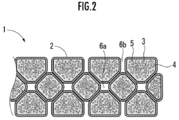
- the foam 1 of this embodiment has a plurality of rod-like bodies 2 extending in the axial direction.
- the foam 1 of the present embodiment actually has dimensions of a width of 1 m, a length of 1 m, and a thickness of 30 mm, but FIG. 1 shows a part thereof enlarged.
- each rod-like body 2 has a two-layer structure of a skin layer 3 and a foam layer 4, and a large number of bubbles 5 are present in the foam layer 4.
- each rod-like body 2 is in a state in which the surface skin layers 3 are closely bonded to each other.
- gap 6a is formed between each rod-shaped body 2, and it becomes the groove
- the foam 1 of the present embodiment comprises 50.0 to 70.0% by mass of paper pellets, preferably 53.9 to 68.0% by mass, and 22.0 to 34.0% by mass of polypropylene resin group, preferably 26 0.4 to 30.5% by mass, low-density polyethylene resin 3.0 to 20.0% by mass, preferably 4.0 to 16.0% by mass, and a compatibilizer of polypropylene resin and polyethylene resin 0.6 It is obtained by mixing with 2.0% by mass and foam molding.
- the paper pellet is a mixture of 30.0 to 50.0% by mass of fine paper powder having a particle size in the range of 30 to 200 ⁇ m and 50.0 to 70.0% by mass of a hydrophilic polymer.
- the paper fine powder is mixed with the hydrophilic polymer in advance to form paper pellets.
- the paper fine powder is obtained by roughly crushing, for example, about 2 mm square of damaged paper such as roll paper that has become industrial waste, and finely crushing the particle size to 30 to 200 ⁇ m using a vertical roller mill (not shown).
- a vertical roller mill (not shown).
- starch such as industrial starch can be used.
- the polypropylene resin group comprises a foamable polypropylene resin of 5.0 to 11.0% by mass, preferably 6.0 to 10.5% by mass, and another polypropylene resin of 17 to 23% by mass, for example, 17.9 to 22%. It consists of 0% by mass.
- the foam 1 may contain additives such as pigments, antioxidants and fungicides.
- the pigment include a white pigment such as titanium dioxide, and the white pigment may be mixed with a polyethylene resin to form a master batch.
- the additive such as the pigment can be contained in the paper pellet, for example.
- An extruder 10 shown in FIG. 3 includes a hopper 11 for charging raw materials and a cylinder 13 having a biaxial screw 12 inside, and a die 14 having a plurality of small holes is provided at the downstream end of the cylinder 13. Yes.
- the cylinder 13 is provided with a plurality of heaters 15 for heating the inside of the cylinder 13 in the axial direction of the cylinder 13.
- a motor 16 that rotates the screw 14 is provided on the upstream side of the cylinder 13.
- paper pellets 17, polypropylene resin group pellets 18, low-density polyethylene resin pellets 19 and a compatibilizer (not shown) as raw materials are charged into the extruder 10 from the hopper 11.
- the supply amount of the raw material is adjusted by a raw material supply device (not shown), and is introduced into the hopper 11.
- the compatibilizing agent may be blended in advance in either the polypropylene resin group pellet 18 or the low density polyethylene resin pellet 19 or may be added independently.
- the raw material charged into the hopper 11 is supplied into the cylinder 13, heated by the heater 15 while being stirred by the two screws 12 in the cylinder 13, and melt mixed.
- raw material paper pellets 17, polypropylene resin group pellets 18, and low density polyethylene resin pellets 19 are kneaded, and the paper fine powder, starch, polypropylene resin group, low density polyethylene resin, The solubilizer is mixed.
- the raw material in the cylinder 13 is melted by being heated by the heater 15 and conveyed to the downstream side while being kneaded by the screw 12.
- the molten mixture of paper fine powder, starch, polypropylene resin group, low density polyethylene resin, and compatibilizer is uniformly kneaded, and the paper fine powder is uniformly diffused throughout the mixture.
- water is added to the melt-kneaded raw material by supplying water stored in the water tank 22 from the water supply channel 21 to the inside of the cylinder 13, and bubbles 5 are generated by vaporizing the added water.
- the water can be added, for example, in the range of 2.0 to 10.0 parts by mass with respect to 100 parts by mass of the raw material.
- the raw material melted and kneaded in the cylinder 13 is extruded to the outside through a die 14 composed of a plurality of small holes to form a plurality of rod-shaped foams 2.
- the foam 5 is expanded and foamed due to expansion of the internal bubbles 5, and as a result, rod-like foaming occurs.
- the skin layer 3 and the foam layer 4 are formed.
- the raw materials forming the skin layer 3 are still in a molten state immediately after being extruded from the die 14, so that the adjacent rod-shaped foams 2 are The foam 1 is formed by tightly bonding through the skin layer 3.
- a thickness adjusting roller 20 is provided on the downstream side of the die 14 of the extruder 10, and the thickness adjusting roller 20 is a foaming interval between the metal rollers disposed above and below and the roller passing between the rollers. The thickness of the foam 1 is adjusted by the elastic force pressed against the body 1.
- the foam 1 is cooled while the thickness is made constant by the thickness adjusting roller 20, conveyed to the downstream side, and cut to a desired length.
- Example 1 In Example 1, 68% by mass of paper pellets, 26.4% by mass of polypropylene resin group, 4.0% by mass of low-density polyethylene resin (trade name: L719, manufactured by Ube Maruzen Polyethylene Co., Ltd.) and a compatibilizer (Asahi Kasei) Chemicals Co., Ltd., trade name: Tuftec H1062) 0.8% by mass and white pigment (Toyocolor Co., Ltd., trade name: high concentration titanium oxide masterbatch TET 1TA538 WHT-FD) 0.8% by mass Then, using the extruder 10 shown in FIG. 3, 3.0% by mass of water was added to the total amount of the raw material and foamed to produce the foam 1 shown in FIG.
- the paper pellet contains 22.0% by mass of paper fine powder having an average particle size of 100 ⁇ m and 46.0% by mass of industrial starch, based on the total amount of the raw materials.
- the ratio of the fine paper powder to the total amount of the paper pellets is 32.4% by mass, and the ratio of the industrial starch is 67.6% by mass.
- the said polypropylene resin group is 8.5 mass% of expandable polypropylene resins (made by Nippon Polypro Co., Ltd., brand name: New Former), and a normal polypropylene resin (made by Nippon Polypro Co., Ltd., products) with respect to the total amount of the above raw materials. Name: FY-6) 17.9% by mass.
- the white pigment is composed of 70% by mass of titanium oxide and 30% by mass of low density polyethylene resin.
- the foam 1 of this Example 1 had 22% by mass of the fine paper powder, 46% by mass of industrial starch, 26.4% by mass of the polypropylene resin group, and 4.0% by mass of the low-density polyethylene resin. And 0.8% by mass of a compatibilizing agent and 0.8% by mass of a white pigment.
- Example 2 a cold insulating container in which the foam 1 obtained in Example 1 is disposed on the six inner surfaces of a corrugated cardboard box having an inner size of 170 mm ⁇ 149 mm ⁇ 144 mm is prepared, and 2 kg of dry ice is accommodated in the cold insulating container. Then, the change with time of the remaining weight of dry ice was measured. The results are shown in FIG.
- Example 2 In Example 2, 56.1% by mass of paper pellets, 28.5% by mass of polypropylene resin group, 14.6% by mass of low-density polyethylene resin (trade name: Petrocene 221 manufactured by Tosoh Corporation), and a compatibilizing agent (Asahi Kasei Chemicals Co., Ltd., trade name: Tuftec H1062) 0.8% by mass as a raw material, and using the extruder 10 shown in FIG. The foam 1 shown in FIG. 1 was created by molding.
- the paper pellet contains 18.2% by mass of fine paper powder having an average particle size of 100 ⁇ m and 37.9% by mass of industrial starch, based on the total amount of the raw materials.
- the ratio of the paper fine powder to the total amount of the paper pellets is 32.3 mass%, and the ratio of the industrial starch is 67.7 mass%.
- the said polypropylene resin group is 8.5 mass% of expandable polypropylene resins (made by Nippon Polypro Co., Ltd., brand name: New Former), and a normal polypropylene resin (made by Nippon Polypro Co., Ltd., products) with respect to the total amount of the above raw materials. Name: VS700) 20.0 mass%.
- the foam 1 of this example had 18.2% by mass of the fine paper powder, 37.9% by mass of industrial starch, 28.5% by mass of the polypropylene resin group, and 14.6% of low-density polyethylene resin.
- the composition contains 0.8% by mass of a compatibilizing agent and 0.8% by mass.
- Example 2 a cold insulating container in which the foam 1 obtained in Example 2 is disposed on the inner six surfaces of a cardboard box having an inner size of 170 mm ⁇ 149 mm ⁇ 144 mm is prepared, and 2 kg of dry ice is accommodated in the cold insulating container. Then, when the change with time of the remaining weight of dry ice was measured, the same performance as the foam 1 of Example 1 could be obtained.
- Example 3 In Example 3, 53.9% by mass of paper pellets, 30.5% by mass of the polypropylene resin group, 14.0% by mass of low-density polyethylene resin (trade name: L719, manufactured by Ube Maruzen Polyethylene Co., Ltd.), a compatibilizing agent (Asahi Kasei Chemicals Corporation, trade name: Tuftec H1062) 0.8% by mass and white pigment (Toyocolor Co., Ltd., trade name: high concentration titanium oxide masterbatch TET 1TA538 WHT-FD) 0.8% by mass
- the foam 1 shown in FIG. 1 was created by using the extruder 10 shown in FIG. 3 and adding 3.0% by mass of water to the raw material to perform foam molding.
- the paper pellets contain 17.5% by mass of paper fine powder having an average particle size of 100 ⁇ m and 36.4% by mass of industrial starch, based on the total amount of the raw materials.
- the ratio of the fine paper powder to the total amount of the paper pellets is 32.4% by mass, and the ratio of the industrial starch is 67.6% by mass.
- the said polypropylene resin group is 10.5 mass% of expandable polypropylene resins (Nippon Polypro company make, brand name: New Former) with respect to the whole quantity of the said raw material, and normal polypropylene resin (Nippon Polypro company make, goods). Name: FY-6) 20.0 mass%.
- the foam 1 of Example 3 had 17.5% by mass of the paper fine powder, 36.4% by mass of industrial starch, 30.5% by mass of the polypropylene resin group, and 14.0% of low-density polyethylene resin. It contains 0.8% by mass of a compatibilizer and 0.8% by mass of a white pigment.
- Example 3 a cold insulation container in which the foam 1 obtained in Example 3 is disposed on the inner six surfaces of a corrugated cardboard box having an inner dimension of 170 mm ⁇ 149 mm ⁇ 144 mm is prepared, and 2 kg of dry ice is accommodated in the cold insulation container. Then, when the change with time of the remaining weight of dry ice was measured, the same performance as the foam 1 of Example 1 could be obtained.
- Example 4 In Example 4, 54.4% by mass of paper pellets, 28.0% by mass of a polypropylene resin group, 16.0% by mass of a low density polyethylene resin (trade name: L719, manufactured by Ube Maruzen Polyethylene Co., Ltd.), a compatibilizing agent (Asahi Kasei Chemicals Corporation, trade name: Tuftec H1062) 0.8% by mass and white pigment (Toyocolor Co., Ltd., trade name: high concentration titanium oxide masterbatch TET 1TA538 WHT-FD) 0.8% by mass
- the foam 1 shown in FIG. 1 was created by using the extruder 10 shown in FIG. 3 and adding 3.0% by mass of water to the raw material to perform foam molding.
- the paper pellet contains 17.6% by mass of fine paper powder having an average particle diameter of 100 ⁇ m and 36.8% by mass of industrial starch with respect to the total amount of the raw material.
- the ratio of the fine paper powder to the total amount of the paper pellets is 32.4% by mass, and the ratio of the industrial starch is 67.6% by mass.
- the polypropylene resin group is composed of 6.0% by mass of a foamable polypropylene resin (manufactured by Nippon Polypro Co., Ltd., trade name: New Former) and a normal polypropylene resin (manufactured by Nippon Polypro Co., Ltd. Name: FY-6) 22.0% by mass.
- a foamable polypropylene resin manufactured by Nippon Polypro Co., Ltd., trade name: New Former
- a normal polypropylene resin manufactured by Nippon Polypro Co., Ltd. Name: FY-6 22.0% by mass.
- the fine paper powder 17.6% by mass, industrial starch 36.8% by mass, polypropylene resin group 28.0% by mass, and low density polyethylene resin 16.0%. It contains 0.8% by mass of a compatibilizer and 0.8% by mass of a white pigment.
- Example 4 a cold insulation container in which the foam 1 obtained in Example 4 is disposed on the inner six surfaces of a corrugated cardboard box having an inner dimension of 170 mm ⁇ 149 mm ⁇ 144 mm is prepared, and 2 kg of dry ice is accommodated in the cold insulation container. Then, when the change with time of the remaining weight of dry ice was measured, the same performance as the foam 1 of Example 1 could be obtained.
- water is appropriately supplied to 24% by weight of a paper powder component having a particle size of about 150 to 80 ⁇ m, 36% by weight of a starch component, and 40% by weight of a polypropylene resin component, and then kneaded thoroughly with a kneader and extruded. It is the one that was put into the machine and foamed. The results are shown in FIG.
Landscapes
- Chemical & Material Sciences (AREA)
- Health & Medical Sciences (AREA)
- Chemical Kinetics & Catalysis (AREA)
- Medicinal Chemistry (AREA)
- Polymers & Plastics (AREA)
- Organic Chemistry (AREA)
- Engineering & Computer Science (AREA)
- Materials Engineering (AREA)
- Mechanical Engineering (AREA)
- Inorganic Chemistry (AREA)
- Manufacture Of Porous Articles, And Recovery And Treatment Of Waste Products (AREA)
- Compositions Of Macromolecular Compounds (AREA)
Abstract
Description
実施例1では、紙ペレット68質量%と、ポリプロピレン樹脂群26.4質量%と、低密度ポリエチレン樹脂(宇部丸善ポリエチレン社製、商品名:L719)4.0質量%と、相溶化剤(旭化成ケミカルズ株式会社製、商品名:タフテックH1062)0.8質量%と、白色顔料(トーヨーカラー株式会社製、商品名:高濃度酸化チタンマスターバッチTET 1TA538 WHT-FD)0.8質量%とを原料とし、図3に示す押出機10を用い、原料全量に対して3.0質量%の水を添加して発泡成形することにより、図1に示す発泡体1を作成した。
本実施例2では、紙ペレット56.1質量%と、ポリプロピレン樹脂群28.5質量%と、低密度ポリエチレン樹脂(東ソー社製、商品名:ペトロセン221)14.6質量%と、相溶化剤(旭化成ケミカルズ株式会社製、商品名:タフテックH1062)0.8質量%とを原料とし、図3に示す押出機10を用い、原料全量に対して3.0質量%の水を添加して発泡成形することにより、て図1に示す発泡体1を作成した。
実施例3では、紙ペレット53.9質量%と、ポリプロピレン樹脂群30.5質量%と、低密度ポリエチレン樹脂(宇部丸善ポリエチレン社製、商品名:L719)14.0質量%と、相溶化剤(旭化成ケミカルズ株式会社製、商品名:タフテックH1062)0.8質量%と、白色顔料(トーヨーカラー株式会社製、商品名:高濃度酸化チタンマスターバッチTET 1TA538 WHT-FD)0.8質量%とを原料とし、図3に示す押出機10を用い、原料全量に対して3.0質量%の水を添加して発泡成形することにより、図1に示す発泡体1を作成した。
実施例4では、紙ペレット54.4質量%と、ポリプロピレン樹脂群28.0質量%と、低密度ポリエチレン樹脂(宇部丸善ポリエチレン社製、商品名:L719)16.0質量%と、相溶化剤(旭化成ケミカルズ株式会社製、商品名:タフテックH1062)0.8質量%と、白色顔料(トーヨーカラー株式会社製、商品名:高濃度酸化チタンマスターバッチTET 1TA538 WHT-FD)0.8質量%とを原料とし、図3に示す押出機10を用い、原料全量に対して3.0質量%の水を添加して発泡成形することにより、図1に示す発泡体1を作成した。
本比較例では、特許文献1の実施品とされる市販の発泡体を用いた以外は、発泡体の寸法等を実施例1と同一条件にして、ドライアイスの残重量の経時変化を測定した。
Claims (5)
- 紙微粉体と親水性高分子との混合物である紙ペレット50.0~70.0質量%と、
発泡性ポリプロピレン樹脂と他のポリプロピレン樹脂とからなるポリプロピレン樹脂群22.0~34.0質量%と、
低密度ポリエチレン樹脂3.0~20.0質量%と、
ポリプロピレン樹脂とポリエチレン樹脂との相溶化剤0.6~2.0質量%とを含む発泡体であって、
前記紙ペレットは、30~200μmの粒径を有する紙微粉体30.0~50.0質量%と、親水性高分子50.0~70.0質量%とを混合してなり、
前記ポリプロピレン樹脂群は、発泡性ポリプロピレン樹脂5.0~11.0質量%と、他のポリプロピレン樹脂17~23質量%とからなることを特徴とする発泡体。 - 請求項1記載の発泡体において、
前記紙ペレットが53.9~68.0質量%であり、
前記ポリプロピレン樹脂群が、前記発泡性ポリプロピレン樹脂6.0~10.5質量%と、前記他のポリプロピレン樹脂17.9~22.0質量%とからなり、これらを合わせて26.4~30.5質量%であり、
前記低密度ポリエチレン樹脂が4.0~16.0質量%であることを特徴とする発泡体。 - 請求項1記載の発泡体において、前記相溶化剤は、水添スチレン系熱可塑性エラストマーであることを特徴とする発泡体。
- 請求項3記載の発泡体において、前記水添スチレン系熱可塑性エラストマーは、水添スチレン-エチレン-ブチレン-スチレンブロックコポリマーであることを特徴とする発泡体。
- 請求項1記載の発泡体において、前記紙ペレットと前記ポリプロピレン樹脂群と前記低密度ポリエチレン樹脂と、前記相溶化剤とを合わせて100質量部にしたものに対し、1.0質量部以下の顔料を添加することを特徴とする発泡体。
Priority Applications (7)
| Application Number | Priority Date | Filing Date | Title |
|---|---|---|---|
| KR1020167028217A KR101922648B1 (ko) | 2015-05-29 | 2015-05-29 | 발포체 |
| BR112016025074-5A BR112016025074B1 (pt) | 2015-05-29 | 2015-05-29 | Produto de espuma |
| CA2944780A CA2944780C (en) | 2015-05-29 | 2015-05-29 | Insulating foamed product comprising paper pellets |
| US15/300,927 US10100177B2 (en) | 2015-05-29 | 2015-05-29 | Foamed product |
| EP15880036.7A EP3305836B1 (en) | 2015-05-29 | 2015-05-29 | Foam |
| JP2016524613A JP5985787B1 (ja) | 2015-05-29 | 2015-05-29 | 発泡体 |
| PCT/JP2015/065567 WO2016121142A1 (ja) | 2015-05-29 | 2015-05-29 | 発泡体 |
Applications Claiming Priority (1)
| Application Number | Priority Date | Filing Date | Title |
|---|---|---|---|
| PCT/JP2015/065567 WO2016121142A1 (ja) | 2015-05-29 | 2015-05-29 | 発泡体 |
Publications (1)
| Publication Number | Publication Date |
|---|---|
| WO2016121142A1 true WO2016121142A1 (ja) | 2016-08-04 |
Family
ID=56542783
Family Applications (1)
| Application Number | Title | Priority Date | Filing Date |
|---|---|---|---|
| PCT/JP2015/065567 Ceased WO2016121142A1 (ja) | 2015-05-29 | 2015-05-29 | 発泡体 |
Country Status (7)
| Country | Link |
|---|---|
| US (1) | US10100177B2 (ja) |
| EP (1) | EP3305836B1 (ja) |
| JP (1) | JP5985787B1 (ja) |
| KR (1) | KR101922648B1 (ja) |
| BR (1) | BR112016025074B1 (ja) |
| CA (1) | CA2944780C (ja) |
| WO (1) | WO2016121142A1 (ja) |
Families Citing this family (1)
| Publication number | Priority date | Publication date | Assignee | Title |
|---|---|---|---|---|
| KR102430807B1 (ko) * | 2017-12-12 | 2022-08-09 | 엘지디스플레이 주식회사 | 플렉서블 터치 스크린 패널 및 그 제조 방법 |
Citations (5)
| Publication number | Priority date | Publication date | Assignee | Title |
|---|---|---|---|---|
| JP2011214371A (ja) * | 2010-04-02 | 2011-10-27 | Kankyo Keiei Sogo Kenkyusho:Kk | 断熱材 |
| JP2012062467A (ja) * | 2010-08-19 | 2012-03-29 | Kao Corp | 樹脂組成物 |
| JP2013007030A (ja) * | 2011-06-22 | 2013-01-10 | Kankyo Keiei Sogo Kenkyusho:Kk | 微細紙粉含有樹脂組成物の製造方法 |
| JP2014005416A (ja) * | 2012-06-27 | 2014-01-16 | Fukuvi Chem Ind Co Ltd | 高機能発泡成形体、及びその製造方法 |
| JP2014194004A (ja) * | 2013-03-01 | 2014-10-09 | Fukuvi Chem Ind Co Ltd | セルロース含有の発泡断熱材 |
Family Cites Families (6)
| Publication number | Priority date | Publication date | Assignee | Title |
|---|---|---|---|---|
| JP3323481B2 (ja) | 2000-08-17 | 2002-09-09 | トキワ印刷株式会社 | 板状発泡体内蔵の保冷箱 |
| US7323502B2 (en) | 2002-03-12 | 2008-01-29 | Ciba Specialty Chemicals Corporation | Flame retardant compositions |
| JP4120339B2 (ja) * | 2002-09-30 | 2008-07-16 | 東レ株式会社 | 白色ポリエステルフィルム |
| EP2308599B1 (en) * | 2009-11-02 | 2014-01-08 | Kankyokeieisogokenkyusho Co, Inc. | Method for producing fine paper powder |
| JP4594445B1 (ja) * | 2010-04-02 | 2010-12-08 | 株式会社環境経営総合研究所 | 発泡体及びその製造方法 |
| JP2013107963A (ja) * | 2011-11-18 | 2013-06-06 | Kyoraku Co Ltd | 発泡成形品およびその製造方法 |
-
2015
- 2015-05-29 KR KR1020167028217A patent/KR101922648B1/ko not_active Expired - Fee Related
- 2015-05-29 WO PCT/JP2015/065567 patent/WO2016121142A1/ja not_active Ceased
- 2015-05-29 EP EP15880036.7A patent/EP3305836B1/en active Active
- 2015-05-29 JP JP2016524613A patent/JP5985787B1/ja active Active
- 2015-05-29 BR BR112016025074-5A patent/BR112016025074B1/pt not_active IP Right Cessation
- 2015-05-29 CA CA2944780A patent/CA2944780C/en active Active
- 2015-05-29 US US15/300,927 patent/US10100177B2/en active Active
Patent Citations (5)
| Publication number | Priority date | Publication date | Assignee | Title |
|---|---|---|---|---|
| JP2011214371A (ja) * | 2010-04-02 | 2011-10-27 | Kankyo Keiei Sogo Kenkyusho:Kk | 断熱材 |
| JP2012062467A (ja) * | 2010-08-19 | 2012-03-29 | Kao Corp | 樹脂組成物 |
| JP2013007030A (ja) * | 2011-06-22 | 2013-01-10 | Kankyo Keiei Sogo Kenkyusho:Kk | 微細紙粉含有樹脂組成物の製造方法 |
| JP2014005416A (ja) * | 2012-06-27 | 2014-01-16 | Fukuvi Chem Ind Co Ltd | 高機能発泡成形体、及びその製造方法 |
| JP2014194004A (ja) * | 2013-03-01 | 2014-10-09 | Fukuvi Chem Ind Co Ltd | セルロース含有の発泡断熱材 |
Also Published As
| Publication number | Publication date |
|---|---|
| EP3305836A4 (en) | 2018-11-07 |
| BR112016025074B1 (pt) | 2021-06-01 |
| JPWO2016121142A1 (ja) | 2017-04-27 |
| US10100177B2 (en) | 2018-10-16 |
| EP3305836B1 (en) | 2020-07-08 |
| KR101922648B1 (ko) | 2018-11-27 |
| CA2944780A1 (en) | 2016-08-04 |
| CA2944780C (en) | 2019-04-23 |
| KR20180004646A (ko) | 2018-01-12 |
| BR112016025074A2 (ja) | 2018-07-10 |
| EP3305836A1 (en) | 2018-04-11 |
| JP5985787B1 (ja) | 2016-09-06 |
| US20170015818A1 (en) | 2017-01-19 |
Similar Documents
| Publication | Publication Date | Title |
|---|---|---|
| JP4594445B1 (ja) | 発泡体及びその製造方法 | |
| JP4621804B1 (ja) | 断熱材 | |
| KR102160456B1 (ko) | 성형성이 우수한 발포시트, 이의 제조방법 및 이를 이용한 식품용기 | |
| JP5707048B2 (ja) | 樹脂発泡シート及び樹脂発泡シートの製造方法 | |
| JP5985787B1 (ja) | 発泡体 | |
| JP5253119B2 (ja) | 熱可塑性樹脂発泡粒子の製造方法 | |
| JP3895237B2 (ja) | ポリプロピレン系樹脂発泡体の製造方法 | |
| JP2008274031A (ja) | 帯電防止性樹脂組成物および熱可塑性樹脂製多層シート | |
| JP5171238B2 (ja) | 発泡剤マスターバッチ | |
| JP6909394B2 (ja) | 発泡補助材及び発泡成形方法 | |
| HK1253774A1 (en) | Foam | |
| HK1253774B (en) | Foam | |
| JP2013082117A (ja) | 軽量化された発泡木質プラスチック成形体の製造方法 | |
| JP4855138B2 (ja) | ポリプロピレン系樹脂発泡体粒子及びその製造方法 | |
| JP6619165B2 (ja) | 植物由来成分を含有するシート状又は板状押出発泡体の製造方法 | |
| JP6422153B2 (ja) | 発泡成形体の製造方法 | |
| JP6835939B2 (ja) | 植物由来成分を含有するシート状又は板状押出発泡体の製造方法 | |
| JP2006131703A (ja) | 発泡体およびその製造方法 | |
| JP2017014311A5 (ja) | ||
| JP2007100016A (ja) | ポリプロピレン系樹脂押出発泡シートの製造方法 | |
| TWI605069B (zh) | Polylactic acid foaming molding material, foamed molded article and manufacturing method thereof | |
| JP2009001674A (ja) | 熱可塑性樹脂組成物発泡成形体及びその製造方法 | |
| JP2010260631A (ja) | 分解性緩衝材及びその製造方法 |
Legal Events
| Date | Code | Title | Description |
|---|---|---|---|
| ENP | Entry into the national phase |
Ref document number: 2016524613 Country of ref document: JP Kind code of ref document: A |
|
| 121 | Ep: the epo has been informed by wipo that ep was designated in this application |
Ref document number: 15880036 Country of ref document: EP Kind code of ref document: A1 |
|
| WWE | Wipo information: entry into national phase |
Ref document number: 15300927 Country of ref document: US |
|
| ENP | Entry into the national phase |
Ref document number: 2944780 Country of ref document: CA |
|
| ENP | Entry into the national phase |
Ref document number: 20167028217 Country of ref document: KR Kind code of ref document: A |
|
| REEP | Request for entry into the european phase |
Ref document number: 2015880036 Country of ref document: EP |
|
| NENP | Non-entry into the national phase |
Ref country code: DE |
|
| WWE | Wipo information: entry into national phase |
Ref document number: 2015880036 Country of ref document: EP |
|
| REG | Reference to national code |
Ref country code: BR Ref legal event code: B01A Ref document number: 112016025074 Country of ref document: BR |
|
| ENP | Entry into the national phase |
Ref document number: 112016025074 Country of ref document: BR Kind code of ref document: A2 Effective date: 20161026 |