WO2016121842A1 - 近赤外線吸収微粒子分散液とその製造方法、近赤外線吸収微粒子分散液を用いた偽造防止インク組成物、および近赤外線吸収微粒子を用いた偽造防止印刷物 - Google Patents
近赤外線吸収微粒子分散液とその製造方法、近赤外線吸収微粒子分散液を用いた偽造防止インク組成物、および近赤外線吸収微粒子を用いた偽造防止印刷物 Download PDFInfo
- Publication number
- WO2016121842A1 WO2016121842A1 PCT/JP2016/052400 JP2016052400W WO2016121842A1 WO 2016121842 A1 WO2016121842 A1 WO 2016121842A1 JP 2016052400 W JP2016052400 W JP 2016052400W WO 2016121842 A1 WO2016121842 A1 WO 2016121842A1
- Authority
- WO
- WIPO (PCT)
- Prior art keywords
- pigment
- infrared absorbing
- absorbing fine
- fine particles
- printed matter
- Prior art date
- Legal status (The legal status is an assumption and is not a legal conclusion. Google has not performed a legal analysis and makes no representation as to the accuracy of the status listed.)
- Ceased
Links
Images

Classifications
-
- B—PERFORMING OPERATIONS; TRANSPORTING
- B42—BOOKBINDING; ALBUMS; FILES; SPECIAL PRINTED MATTER
- B42D—BOOKS; BOOK COVERS; LOOSE LEAVES; PRINTED MATTER CHARACTERISED BY IDENTIFICATION OR SECURITY FEATURES; PRINTED MATTER OF SPECIAL FORMAT OR STYLE NOT OTHERWISE PROVIDED FOR; DEVICES FOR USE THEREWITH AND NOT OTHERWISE PROVIDED FOR; MOVABLE-STRIP WRITING OR READING APPARATUS
- B42D25/00—Information-bearing cards or sheet-like structures characterised by identification or security features; Manufacture thereof
- B42D25/30—Identification or security features, e.g. for preventing forgery
- B42D25/36—Identification or security features, e.g. for preventing forgery comprising special materials
- B42D25/378—Special inks
- B42D25/382—Special inks absorbing or reflecting infrared light
-
- B—PERFORMING OPERATIONS; TRANSPORTING
- B41—PRINTING; LINING MACHINES; TYPEWRITERS; STAMPS
- B41M—PRINTING, DUPLICATING, MARKING, OR COPYING PROCESSES; COLOUR PRINTING
- B41M3/00—Printing processes to produce particular kinds of printed work, e.g. patterns
- B41M3/14—Security printing
-
- C—CHEMISTRY; METALLURGY
- C09—DYES; PAINTS; POLISHES; NATURAL RESINS; ADHESIVES; COMPOSITIONS NOT OTHERWISE PROVIDED FOR; APPLICATIONS OF MATERIALS NOT OTHERWISE PROVIDED FOR
- C09D—COATING COMPOSITIONS, e.g. PAINTS, VARNISHES OR LACQUERS; FILLING PASTES; CHEMICAL PAINT OR INK REMOVERS; INKS; CORRECTING FLUIDS; WOODSTAINS; PASTES OR SOLIDS FOR COLOURING OR PRINTING; USE OF MATERIALS THEREFOR
- C09D11/00—Inks
- C09D11/02—Printing inks
- C09D11/03—Printing inks characterised by features other than the chemical nature of the binder
- C09D11/037—Printing inks characterised by features other than the chemical nature of the binder characterised by the pigment
-
- C—CHEMISTRY; METALLURGY
- C09—DYES; PAINTS; POLISHES; NATURAL RESINS; ADHESIVES; COMPOSITIONS NOT OTHERWISE PROVIDED FOR; APPLICATIONS OF MATERIALS NOT OTHERWISE PROVIDED FOR
- C09D—COATING COMPOSITIONS, e.g. PAINTS, VARNISHES OR LACQUERS; FILLING PASTES; CHEMICAL PAINT OR INK REMOVERS; INKS; CORRECTING FLUIDS; WOODSTAINS; PASTES OR SOLIDS FOR COLOURING OR PRINTING; USE OF MATERIALS THEREFOR
- C09D11/00—Inks
- C09D11/02—Printing inks
- C09D11/12—Printing inks based on waxes or bitumen
-
- C—CHEMISTRY; METALLURGY
- C09—DYES; PAINTS; POLISHES; NATURAL RESINS; ADHESIVES; COMPOSITIONS NOT OTHERWISE PROVIDED FOR; APPLICATIONS OF MATERIALS NOT OTHERWISE PROVIDED FOR
- C09D—COATING COMPOSITIONS, e.g. PAINTS, VARNISHES OR LACQUERS; FILLING PASTES; CHEMICAL PAINT OR INK REMOVERS; INKS; CORRECTING FLUIDS; WOODSTAINS; PASTES OR SOLIDS FOR COLOURING OR PRINTING; USE OF MATERIALS THEREFOR
- C09D11/00—Inks
- C09D11/50—Sympathetic, colour changing or similar inks
-
- C—CHEMISTRY; METALLURGY
- C09—DYES; PAINTS; POLISHES; NATURAL RESINS; ADHESIVES; COMPOSITIONS NOT OTHERWISE PROVIDED FOR; APPLICATIONS OF MATERIALS NOT OTHERWISE PROVIDED FOR
- C09D—COATING COMPOSITIONS, e.g. PAINTS, VARNISHES OR LACQUERS; FILLING PASTES; CHEMICAL PAINT OR INK REMOVERS; INKS; CORRECTING FLUIDS; WOODSTAINS; PASTES OR SOLIDS FOR COLOURING OR PRINTING; USE OF MATERIALS THEREFOR
- C09D17/00—Pigment pastes, e.g. for mixing in paints
-
- C—CHEMISTRY; METALLURGY
- C09—DYES; PAINTS; POLISHES; NATURAL RESINS; ADHESIVES; COMPOSITIONS NOT OTHERWISE PROVIDED FOR; APPLICATIONS OF MATERIALS NOT OTHERWISE PROVIDED FOR
- C09K—MATERIALS FOR MISCELLANEOUS APPLICATIONS, NOT PROVIDED FOR ELSEWHERE
- C09K3/00—Materials not provided for elsewhere
-
- B—PERFORMING OPERATIONS; TRANSPORTING
- B42—BOOKBINDING; ALBUMS; FILES; SPECIAL PRINTED MATTER
- B42D—BOOKS; BOOK COVERS; LOOSE LEAVES; PRINTED MATTER CHARACTERISED BY IDENTIFICATION OR SECURITY FEATURES; PRINTED MATTER OF SPECIAL FORMAT OR STYLE NOT OTHERWISE PROVIDED FOR; DEVICES FOR USE THEREWITH AND NOT OTHERWISE PROVIDED FOR; MOVABLE-STRIP WRITING OR READING APPARATUS
- B42D25/00—Information-bearing cards or sheet-like structures characterised by identification or security features; Manufacture thereof
- B42D25/30—Identification or security features, e.g. for preventing forgery
- B42D25/36—Identification or security features, e.g. for preventing forgery comprising special materials
- B42D25/373—Metallic materials
-
- B—PERFORMING OPERATIONS; TRANSPORTING
- B42—BOOKBINDING; ALBUMS; FILES; SPECIAL PRINTED MATTER
- B42D—BOOKS; BOOK COVERS; LOOSE LEAVES; PRINTED MATTER CHARACTERISED BY IDENTIFICATION OR SECURITY FEATURES; PRINTED MATTER OF SPECIAL FORMAT OR STYLE NOT OTHERWISE PROVIDED FOR; DEVICES FOR USE THEREWITH AND NOT OTHERWISE PROVIDED FOR; MOVABLE-STRIP WRITING OR READING APPARATUS
- B42D25/00—Information-bearing cards or sheet-like structures characterised by identification or security features; Manufacture thereof
- B42D25/30—Identification or security features, e.g. for preventing forgery
- B42D25/36—Identification or security features, e.g. for preventing forgery comprising special materials
- B42D25/378—Special inks
- B42D25/387—Special inks absorbing or reflecting ultraviolet light
Definitions
- the present invention relates to a near-infrared absorbing fine particle dispersion having an absorption capability in the near-infrared region and applicable to offset printing, a method for producing the same, an anti-counterfeit ink composition using the near-infrared absorbing fine particle dispersion, and a near infrared
- the present invention relates to an anti-counterfeit printed matter using absorbent fine particles.
- offset printing is characterized by being capable of high-definition printing and suitable for mass printing.
- the pigment dispersion used from the printing principle is required to be oleophilic and not to dissolve the rubber blanket to which the dispersion is transferred during the offset printing.
- the infrared absorbing material is transparent in the visible light region, it cannot be visually determined that the infrared absorbing material is printed as a pigment. For this reason, it is preferable from the viewpoint of forgery prevention and the like, and since it does not visually disturb the original print display, it is also preferable from the viewpoint of visibility and aesthetics.
- Patent Document 1 proposes a material using a phthalocyanine compound.
- Patent Document 2 proposes one using tin-doped indium oxide.
- Patent Document 3 and Patent Document 4 disclose a coating solution for a selectively permeable membrane dispersed in the above.
- Patent Document 5 an anti-counterfeit ink in which the anti-counterfeit ink composition containing the hexaboride fine particles as a near-infrared absorbing material is dispersed in a solvent.
- the organic pigment such as the phthalocyanine compound used in Patent Document 1 has a problem that its infrared absorption characteristics change due to the influence of temperature, ultraviolet rays, etc., and is inferior in durability. have.
- the infrared absorbing material using tin-doped indium oxide used in Patent Document 2 has insufficient contrast between the wavelength region that transmits or reflects as visible light and the wavelength region that absorbs as infrared light. For this reason, when the near-infrared absorbing fine particle dispersion using the tin-doped indium oxide is applied to offset printing, there is a problem in that the reading accuracy of the printing unit is lowered.
- near-infrared absorbing fine particles are dispersed in an organic solvent such as toluene.
- the offset printing plate utilizes water repellency, and includes a hydrophilic layer (non-image area) and an oleophilic layer (image area).
- those in which near-infrared absorbing fine particles are dispersed in an organic solvent such as toluene may dissolve a rubber blanket and cannot be used for offset printing.
- the present inventors use a petroleum solvent as a solvent, and add to the solvent the general formula XB a (wherein the element X is La, Ce, Pr, Nd, Gd, Tb, Dy, Ho, Y, Sm, Eu). , Er, Tm, Yb, Lu, Sr or Ca, at least one element selected from hexaboride fine particles represented by 4.0 ⁇ a ⁇ 6.2) is added to form a dispersion. Tried.
- the organic solvent described in Patent Documents 3 to 5 is replaced with a petroleum solvent having low invasiveness to the resin, the force of the petroleum solvent to disperse the near-infrared absorbing fine particles is reduced to a resin such as toluene.
- the viscosity of the near-infrared absorbing fine particle dispersion was inferior to that of highly invasive organic solvents. As a result of the increase in the viscosity of the near-infrared absorbing fine particle dispersion, there has been a problem that the dispersed particle diameter of the near-infrared absorbing fine particles cannot be lowered to a predetermined value.
- the present invention has been made under such circumstances, and a problem to be solved is a near-infrared ray that has an absorption capability in the near-infrared region, has a clear contrast, and can be applied to offset printing.
- the object is to provide an absorbent fine particle dispersion and a method for producing the same.
- the present invention also provides an anti-counterfeit ink composition capable of offset printing containing the near-infrared absorbing fine particle dispersion. Furthermore, by using the anti-counterfeit ink composition for offset printing, copying or the like is impossible, and authenticity can be determined reliably without relying on visual determination, and there are few design restrictions, An object is to provide a forgery-preventing printed matter having an excellent anti-counterfeit effect.
- one or more types selected from petroleum solvents are used as solvents, and 10% by mass or more and 25% by mass or less of hexaboride fine particles are added thereto. Then, when the dispersion is pulverized and dispersed to obtain a dispersion, if the dispersion has a viscosity of 180 mPa ⁇ s or less, the hexaboride fine particles are sufficiently pulverized and dispersed, and can be applied to offset printing. It was found that an infrared-absorbing fine particle dispersion can be obtained.
- the viscosity of the dispersion can be kept at 180 mPa ⁇ s or less by adding a predetermined dispersant to the dispersion.
- the anti-counterfeiting ink composition for offset printing containing the near-infrared absorbing fine particle dispersion described above, or containing a pigment usually used in general offset printing ink together with the above-mentioned near-infrared absorbing fine particle dispersion, The present invention was also completed by conceiving an anti-counterfeit printed matter printed using an anti-counterfeit ink composition for offset printing.
- the first invention for solving the above-described problem is One or more solvents selected from petroleum solvents; Hexaboride fine particles having a general formula of XBa of 2% by mass to 25% by mass (wherein element X is La, Ce, Pr, Nd, Gd, Tb, Dy, Ho, Y, Sm At least one selected from the group consisting of Eu, Er, Tm, Yb, Lu, Sr and Ca, one or more near-infrared absorbing fine particles selected from 4.0 ⁇ a ⁇ 6.2), A dispersant soluble in the solvent and having a fatty acid in its structure, A near-infrared absorbing fine particle dispersion having a viscosity of 180 mPa ⁇ s or less.
- the second invention is The near-infrared absorbing fine particle dispersion according to the first invention, wherein the dispersant has at least one selected from a secondary amine group, a tertiary amine group, and a quaternary ammonium group as a functional group It is a liquid.
- the third invention is The near-infrared absorbing fine particle dispersion according to the first or second invention, wherein the dispersant has an acid value of 1 mgKOH / g or more.
- the fourth invention is: 4. The near-infrared absorbing fine particle dispersion according to any one of the first to third aspects, wherein the near-infrared absorbing fine particles have a dispersed particle diameter of 1 nm to 200 nm.
- the fifth invention is: The near infrared ray according to any one of the first to fourth inventions, wherein the surface of the near infrared ray absorbing fine particles is coated with one or more compounds selected from Si, Ti, Al, and Zr. Absorption fine particle dispersion.
- the sixth invention is: 6. The near-infrared absorbing fine particle dispersion according to any one of the first to fifth inventions, wherein the near-infrared absorbing fine particles have a lattice constant of 0.4100 nm to 0.4160 nm.
- the seventh invention The first to sixth inventions, wherein the solvent is at least one selected from petroleum solvents having an aniline point of 75 ° C or higher and 95 ° C or lower and a boiling point of 150 ° C or higher and 340 ° C or lower.
- the eighth invention The near-infrared absorbing fine particle dispersion according to any one of the first to seventh inventions, wherein the near-infrared absorbing fine particle dispersion further contains a binder.
- the ninth invention The method for producing a near-infrared absorbing fine particle dispersion according to any one of the first to eighth inventions, wherein the near-infrared absorbing fine particles, the solvent, and the dispersant are mixed and dispersed. is there.
- the tenth invention is A forgery-preventing ink composition comprising the infrared-absorbing fine particle dispersion according to any one of the first to eighth inventions.
- the eleventh invention is The anti-counterfeit ink composition according to the tenth aspect of the invention, further comprising a pigment.
- the twelfth invention is The pigment described in the eleventh invention is an organic pigment and is one or more selected from carbon black, azo lake pigments, insoluble azo pigments, condensed azo pigments, phthalocyanine pigments, and condensed polycyclic pigments. This is an anti-counterfeit ink composition.
- the thirteenth invention is The pigment described in the eleventh invention is an inorganic pigment, and is selected from a white pigment, an extender pigment, a red pigment, a yellow pigment, a green pigment, a blue pigment, a purple pigment, a fluorescent pigment, a temperature pigment, a pearl pigment, and a metal powder pigment. 1 or more types of anti-counterfeit ink compositions.
- the fourteenth invention is The anti-counterfeit ink composition according to any one of the tenth to thirteenth inventions, comprising one or more selected from a plasticizer, an antioxidant, a thickener, and a wax.
- the fifteenth invention On one or both sides of the substrate, a printed matter having a printing pattern, the printing pattern general formula hexaboride particles (here, denoted by XB a, the element X, La, Ce, Pr, Nd, Gd, Tb, Dy, Ho, Y, Sm, Eu, Er, Tm, Yb, Lu, Sr and Ca, at least one selected from 4.0 ⁇ a ⁇ 6.2)
- a forgery-preventing printed matter comprising the above-mentioned near-infrared absorbing fine particles.
- the sixteenth invention is The forgery-proof printed matter according to the fifteenth aspect, wherein the printed pattern further contains a pigment.
- the seventeenth invention The pigment is an organic pigment, and is at least one selected from carbon black, azo lake pigment, insoluble azo pigment, condensed azo pigment, phthalocyanine pigment, and condensed polycyclic pigment according to the sixteenth invention, This is an anti-counterfeit print.
- the eighteenth invention The pigment is an inorganic pigment and is at least one selected from white pigment, extender pigment, red pigment, yellow pigment, green pigment, blue pigment, purple pigment, fluorescent pigment, temperature pigment, pearl pigment, and metal powder pigment
- the anti-counterfeit printed matter according to the sixteenth invention characterized in that The nineteenth invention The value obtained by dividing the average value of the diffuse reflectance at a wavelength of 800 nm to 1300 nm of the anti-counterfeit printed matter by the average value of the diffuse reflectance at a wavelength of 800 nm to 1300 nm of a blank not containing near-infrared absorbing fine particles is 0.84 or less.
- the anti-counterfeit printed matter according to any one of the fifteenth to eighteenth inventions.
- the near-infrared absorbing fine particle dispersion according to the present invention By using the near-infrared absorbing fine particle dispersion according to the present invention, offset printing having a near-infrared absorption capability and a clear contrast can be easily performed.
- the anti-counterfeit ink composition that can be offset printed by using the near-infrared absorbing fine particle dispersion according to the present invention and the copy cannot be reproduced by copying, etc. Therefore, it is possible to provide a forgery-preventing printed matter with less design restrictions and excellent anti-counterfeiting effect.
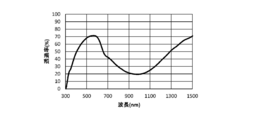
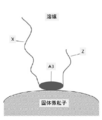
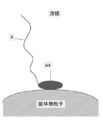
- Example 1 of this invention It is the transmission profile of the light in the dry film of the dispersion liquid A which concerns on Example 1 of this invention. It is a schematic diagram of the aspect of the polymer dispersing agent used for this invention. It is a schematic diagram of the aspect of a different polymer dispersing agent used for this invention. It is a schematic diagram of the aspect of the further different polymer dispersing agent used for this invention.
- near infrared absorbing fine particles solvent, dispersant, dispersion method of near infrared absorbing fine particles in solvent, near infrared absorbing fine particle dispersion, anti-counterfeiting ink composition for offset printing, printing method
- the near-infrared absorbing fine particles used in the present invention are hexaboride fine particles whose general formula is represented by XB a (4.0 ⁇ a ⁇ 6.2).
- the element X is at least one selected from La, Ce, Pr, Nd, Gd, Tb, Dy, Ho, Y, Sm, Eu, Er, Tm, Yb, Lu, Sr and Ca. .
- lanthanum hexaboride LaB 6 cerium hexaboride CeB 6 , praseodymium hexaboride PrB 6 , neodymium hexaboride NdB 6 , gadolinium hexaboride GdB 6 , terbium hexaboride TbB 6 , hexaboride Dysprosium DyB 6 , holmium hexaboride HoB 6 , yttrium hexaboride YB 6 , samarium hexaboride SmB 6 , europium hexaboride EuB 6 , erbium hexaboride ErB 6 , thulium hexaboride TmB 6 , hexaboro It is preferably at least one selected from ytterbium iodide YbB 6 , lutetium hexaboride LuB 6 ,
- the surface of the hexaboride fine particles is preferably not oxidized. However, usually, the surface is often slightly oxidized, and oxidation of the surface in the fine particle dispersion process is unavoidable to some extent. However, even in that case, the effectiveness of developing the heat ray shielding effect is not changed, and therefore, hexaboride fine particles having an oxidized surface can be used.
- the higher the crystallinity of the hexaboride fine particles the greater the heat ray shielding effect.
- the basic bonds inside the fine particles are composed of bonds of each metal and boron.
- the lattice constant is 0.4100 nm or more and 0.4160 nm or less, it can be preferably applied in the present invention because a desired heat ray shielding effect is exhibited.
- the lattice constant can be obtained, for example, by performing Rietveld analysis based on XRD pattern data.
- the surface of the hexaboride fine particles is coated with a silane coupling agent. Since the surface of the hexaboride fine particles is coated with a silane coupling agent, excellent dispersibility of the hexaboride fine particles can be obtained. As a result, in the near-infrared absorbing fine particle dispersion according to the present invention, an excellent near-infrared absorbing function and transparency in the visible light region can be obtained.
- the light transmittance has a maximum value between wavelengths of 400 nm and 700 nm, and has a minimum value between wavelengths of 700 nm and 1800 nm. Furthermore, it has been observed that the difference between the maximum value and the minimum value in the light transmittance is 15 points or more.
- such a heat ray shielding transparent resin molded article is effective for visible light. It can be seen that it has the characteristic of effectively reflecting and absorbing other heat rays.
- the hexaboride fine particles according to the present invention greatly absorb light in the near-ultraviolet region with a wavelength of about 350 to 400 nm and near-infrared region with a wavelength of about 650 to 1300 nm, particularly about 1000 nm. For this reason, the transmission color tone is often colorless to green.
- the dispersed particle size of the hexaboride fine particles according to the present invention can be selected depending on the purpose of use.
- the dispersed particle diameter is made sufficiently small in order to exhibit absorption in the near infrared region. This is because the light absorption property of hexaboride is due to localized surface plasmon resonance, which is a phenomenon unique to nanoparticles.
- the dispersed particle size means the aggregated particle size of boride fine particles in a solvent, and can be measured by various commercially available particle size distribution analyzers.
- ELS-800 manufactured by Otsuka Electronics Co., Ltd. based on the principle of dynamic light scattering, is sampled from a dispersion in which boride fine particles are dispersed in a solvent in the presence of aggregates of boride fine particles. Can be measured.
- the dispersed particle diameter of the hexaboride fine particles exceeds, for example, 1500 nm, the hexaboride fine particles hardly absorb in the near infrared region.
- the absorption in the near infrared region becomes strong when the dispersed particle size of the hexaboride fine particles is approximately 800 nm or less, the stronger absorption is exhibited when it is 200 nm or less, and the stronger absorption is exhibited when it is 100 nm or less. Is done.
- the hexaboride fine particles according to the present invention transparency and non-scattering properties in the visible light region can be obtained by suppressing light scattering caused by the fine particles.
- Light scattering includes geometric optical scattering, Mie scattering, and Rayleigh scattering depending on the ratio of the particle diameter to the wavelength of light.
- geometrical optical scattering is almost negligible if the dispersed particle diameter of the hexaboride fine particles is 1000 nm or less. If the dispersed particle diameter is 200 nm or less, Mie scattering is weakened, and if it is 100 nm or less, it is further weakened.
- Rayleigh scattering is the main scattering factor in the region where the dispersed particle size of the fine particles is smaller. Since the Rayleigh scattering intensity decreases in inverse proportion to the sixth power of the dispersed particle diameter, the scattered light can be reduced by further reducing the dispersed particle diameter of the fine particles, which is preferable.
- the dispersed particle size of the hexaboride fine particles according to the present invention is 200 nm or less. Preferably there is. If the dispersed particle diameter is 200 nm or less, the near-infrared absorption of hexaboride by localized surface plasmon resonance is sufficiently exhibited and the light scattering of visible light is sufficiently reduced. This is because the contrast of [reflection / absorption] or [transmission / absorption] in light or transmitted light is improved. On the other hand, if the dispersed particle diameter is 1 nm or more, industrial production is easy.
- the surface of the hexaboride fine particles according to the present invention is coated with an oxide containing one or more of Si, Ti, Zr, and Al. preferable.
- solvent used in the present invention is required to be water-insoluble in consideration of application to offset printing and not to dissolve a rubber roller or the like. Specifically, one or more kinds of solvents selected from petroleum solvents can be used.
- the petroleum solvent is a crude oil-derived solvent having an aromatic hydrocarbon content of 5% by weight or less, and has a boiling point of 50 ° C. or more and 350 ° C. or less, preferably 150 ° C. to 340 ° C.
- the boiling point of the petroleum solvent is 50 ° C. or higher, the volatilization amount of the solvent at the time of pulverizing and dispersing hexaboride particles is not excessive, and handling is easy.
- the boiling point of a petroleum-type solvent is 350 degrees C or less, it has sufficient drying property and is preferable.
- the aniline point of the petroleum solvent is preferably in the range of 70 ° C to 95 ° C. When the aniline point is 70 ° C.
- the ability to dissolve the resin does not become excessive, and it can be applied even when the base material is an acrylic resin or the like. It can also be used in a printing process using a rubber jig such as offset printing. An aniline point of 95 ° C. or lower is preferable because it has sufficient resin solubility. For example, even when the dispersant is solid, the dispersant can be used.
- preferable petroleum solvents include commercially available petroleum solvents such as Isopar E, Exol Hexane, Exol Heptane, Exol E, Exol D30, Exol D40, Exol D60, Exol D80, Exol D95, Exol D110, Exol D130. (Above, manufactured by ExxonMobil).
- the dispersant for dispersing the near-infrared absorbing fine particles in the solvent preferably has a fatty acid structure. Furthermore, the dispersant is required to be soluble in the solvent according to the present invention described above. Further, the structure of the dispersant is not particularly limited, but it is preferable to use a polymer dispersant having a basic anchor portion.
- the anchor portion is a site (group) in the molecule of the polymer dispersant and is a site (group) that is adsorbed on the surface of the infrared absorbing fine particles. In the present invention, it is particularly preferable to use a polymer dispersant having a basic anchor portion because the storage stability of the ink is improved. Examples of the basic site (group) serving as the anchor portion include sites (groups) such as (secondary amino group, tertiary amino group, and quaternary ammonium group).
- A1 and A2 are portions (anchor portions) adsorbed on the solid fine particles. If the anchor portion has at least one point (adsorption point) that adsorbs to the solid fine particles, the structure is not particularly limited, and for example, chain, cyclic, condensed polycyclic, or a combination thereof Consists of. A1 and A2 may be the same or different.
- X, Y, and Z are polymer chain portions that are solvated and dissolve in the liquid from the surface of the solid fine particles, and hereinafter, X and Z are referred to as a tail portion, and Y is referred to as a loop portion.
- a homopolymer composed of a single monomer or a copolymer composed of a plurality of monomers is used for the tail portion and the loop portion.
- a compound having the loop part (Y) in the general formula [X-A1-Y-A2-Z] can be used, and in this case, the general formula [X— A1-A2-Z].
- Y shown in FIG. 3 does not exist, and a structure in which two tail portions are bonded to one anchor portion can be taken. In this case, the general formula is [X-A3-Z].
- a structure in which Z shown in FIG. 4 does not exist and one tail portion is bonded to one anchor portion can be taken. In this case, the general formula is [X-A4].
- a constituting the polymer dispersant used in the present invention (in the present invention, the aforementioned A1, A2, A3, and A4 may be collectively referred to as “A”) is, for example, a hydrogen bond or an acid.
- -It has at least one adsorption point (functional group) having an adsorption interaction with the solid particle surface by base interaction or the like.
- A1 and A2 may be the same or different, but considering the adsorptivity to the solid fine particles, those having the same functional group as the adsorption point (functional group) having the adsorption interaction are preferable. Further, from the viewpoint of production of the polymer dispersant, it is preferable that A1 and A2 are the same.
- X, Y, and Z constituting the polymer dispersant used in the present invention may be composed of different chemical species, and at least two may be composed of the same chemical species. Since the tail part and the loop part are parts that solvate and dissolve in the liquid from the surface of the solid fine particles, a polymer chain having affinity for the solvent in which the solid fine particles are dispersed is used. Furthermore, it is preferable that the acid value of the dispersant according to the present invention is 1 mgKOH / g or more because the ability to disperse the above-described near-infrared absorbing fine particles in the solvent according to the present invention is high.
- the obtained dispersion liquid is preferable because there is no fear of dissolving a rubber roller or the like of an offset printing machine.
- Dispersic As specific examples of preferred dispersants, commercially available dispersants may be Dispersic (DISPERBYK) 142; Dispersic 160, Dispersic 161, Dispersic 162, Dispersic 163, Dispersic 166, Dispersic 170, Dispersic 180, Disperbic 182, Disperbic 184, Disperbic 190, Disperbic 2155 (above, manufactured by Big Chemie Japan Co., Ltd.); EFKA-46, EFKA-47, EFKA-48, EFKA-49 (above, manufactured by BASF); Solsperse 11200, Solsperse 13940, Solsperse 16000, Solsperse 17000, Solsperse 18000, Solsperse 20000, Solsper 24000, Solsperse 27000, Solsperse 28000, Solsperse 32000, Solsperse 33000, Solsperse 39000, Solsperse 56000, Solsperse 71000 (manufactured by Nippon Lubrizol Co., Ltd.
- the addition amount of the dispersant according to the present invention is preferably 30 parts by weight or more and 200 parts by weight or less with respect to 100 parts by weight of the hexaboride fine particles.
- the said dispersing agent does not contain the solvent which may melt
- the dispersion method for obtaining the near-infrared absorbing fine particle dispersion by dispersing the hexaboride fine particles according to the present invention in the solvent according to the present invention is to uniformly distribute the fine particles. Any method of dispersing in a solvent can be selected. Specifically, it is preferable to use a wet medium mill such as a bead mill or a ball mill.
- the concentration of hexaboride fine particles in the near-infrared absorbing fine particle dispersion according to the present invention is 2 to 25% by mass, preferably 5 to 25% by mass, more preferably 10 to 25% by mass.
- the higher the concentration of the hexaboride fine particles the easier the preparation of the anti-counterfeit ink for offset printing is preferable.
- the concentration of the hexaboride fine particles is 25% by mass or less, the addition of the dispersant described above suppresses the viscosity of the obtained near-infrared absorbing fine particle dispersion to 180 mPa ⁇ s or less, Crushing and dispersion can be sufficiently advanced.
- the dispersed particle size of the hexaboride fine particles can be arbitrarily controlled by the processing time of the wet medium mill. For example, the dispersed particle size can be reduced by increasing the processing time.
- the near-infrared absorbing fine particle dispersion according to the present invention can be obtained by the production method described above.
- a binder may be further added to the near-infrared absorbing fine particle dispersion according to the present invention.
- the binder is not particularly limited as long as it can be dissolved in the solvent according to the present invention, and examples thereof include synthetic resins such as rosin-modified phenol resin, rosin-modified alkyd resin, and petroleum resin-modified phenol resin. Therefore, it is possible to select a suitable one for the application.
- Anti-counterfeit ink composition for offset printing The near-infrared absorbing fine particle dispersion according to the present invention, a resin varnish component, a vegetable oil component, a petroleum solvent component, and an additive are mixed to produce an anti-counterfeit ink composition for offset printing.
- a resin varnish component phenol resin, petroleum resin, rosin modified phenol resin, petroleum resin modified rosin modified phenol resin, vegetable oil modified rosin modified phenol resin, modified alkyd resin, rosin modified maleic acid resin, polyester resin, acrylic resin, Arbitrary resin systems such as urethane resin and epoxy resin are used.
- resin varnish using rosin-modified phenol resin and petroleum resin is preferably used.
- the addition amount of the resin varnish in the lithographic offset printing ink composition is 15 to 70% by mass, preferably 40 to 60% by mass.
- the vegetable oil component and the petroleum solvent component may be any as long as they are generally used for lithographic offset inks.
- the additive examples include a plasticizer, an antioxidant, a thickener, and a wax.
- the ink composition for offset printing according to the present invention can be added with a pigment used in a general lithographic offset ink to form a pattern colored in the visible light region. By forming the colored pattern, the design effect can be enhanced, and the forgery prevention effect can be enhanced.
- any pigment may be used as long as it does not impair printability.
- various organic pigments such as carbon black, azo lake pigments, insoluble azo pigments, condensed azo pigments, phthalocyanine pigments, and condensed polycyclic pigments can be used.
- white pigments such as titanium oxide and lead white
- extender pigments such as calcium carbonate
- red pigments such as red pepper
- yellow pigments such as yellow lead
- green pigments such as chromium oxide
- blue pigments such as ultramarine blue
- Various inorganic pigments such as purple pigments such as manganese violet, fluorescent pigments, temperature pigments, pearl pigments, or metal powder pigments can be used. It is also preferable to use carbon black alone.
- near-infrared absorbing fine particles and a pigment used in general lithographic offset ink can be used at the same time.
- the kneading of the near-infrared absorbing fine particle dispersion, the resin varnish component, the petroleum solvent component, the additive, and / or the pigment according to the present invention can be performed using a kneader such as a three-roll mill.
- a wet varnish such as an alkyd resin, which is excellent in the wettability of the infrared absorber, or other additives may be used in order to increase the kneading degree or work efficiency.
- a conventionally known planographic offset printing method is used. Examples include offset sheet-fed printing, offset rotary printing, waterless offset printing, and dry offset printing.
- a base material used for the printed matter according to the present invention for example, a white paper, a white film printed on a plastic film, and the like can be given.
- the plastic film in this case include polypropylene (PP), polyvinyl chloride (PVC), polyethylene terephthalate (PET), and synthetic paper.
- PP polypropylene
- PVC polyvinyl chloride
- PET polyethylene terephthalate
- synthetic paper synthetic paper.
- the ink set according to the present invention conventionally known lithographic offset printing ink is used.
- an oxidation polymerization type ink, a heat set type ink, a permeation dry type ink and the like can be mentioned.
- a conventionally known plate making technique is also used for the plate used for printing. Examples thereof include a plate formed by an amplitude modulation screening (AM screening) method, a plate formed by a frequency modulation screening (FM screening) method, and the like.
- AM screening amplitude modulation screening
- FM screening frequency modulation screening
- the printed matter according to the present invention is irradiated with near-infrared rays having a wavelength of 800 nm to 1300 nm, and the near-infrared rays having the above-mentioned wavelength diffusely reflected from the printed matter are measured.
- the printed matter according to the present invention has less diffuse reflection of near-infrared light having a wavelength of 800 nm to 1300 nm as compared with a blank printed matter not containing near-infrared absorbing fine particles.
- the near infrared diffuse reflectance of 800 nm to 1300 nm of the printed matter containing the near infrared absorbing fine particles and the near infrared diffuse reflectance of the blank printed matter of 800 nm to 1300 nm. Can be determined. For example, by dividing the diffuse reflectance value at a wavelength of 800 nm to 1300 nm of the printed matter according to the present invention by the diffuse reflectance value at a wavelength of 800 nm to 1300 nm of the blank printed matter, The net diffuse reflectance of near-infrared absorbing fine particles excluding factors can be evaluated. The smaller this divided value is, the easier it is to determine authenticity, preferably 0.84 or less, and more preferably 0.77 or less.
- the content of the near infrared absorbing fine particles may be increased, and the near infrared rays in the ink may be increased.
- the absorption fine particle concentration may be increased, there is a limit from the viewpoint of ink stability and cost.
- the amount of the near infrared absorbing fine particles contained in the printed material is small, and the near infrared absorbing fine particles according to the present invention are used.
- the amount of near-infrared absorbing fine particles contained in the printed material is preferably 0.8 g / cm 2 or less.
- the diffuse reflectance according to the present invention is adjusted using a spectrophotometer with the diffuse reflectance of a white plate obtained by solidifying a fine powder of barium sulfate as 100%, and the diffuse reflectance in the wavelength range of 800 nm to 1300 nm. Is measured as a relative value.
- the measuring method of the acid value of the near-infrared absorption fine particle dispersing agent which concerns on a present Example is based on JISK0070, and is based on a potentiometric titration method.
- the optical properties of the printed materials according to the examples were measured using a spectrophotometer U-4100 (manufactured by Hitachi, Ltd.).
- the diffuse reflectance is adjusted using a spectrophotometer U-4100 (manufactured by Hitachi, Ltd.), with the diffuse reflectance of the white plate on which the fine powder of barium sulfate is solidified being set to 100%, and the wavelength range of 800 nm to 1300 nm.
- the diffuse reflectance at every 5 nm was measured as a relative value, and the average value of the obtained values was used.
- Example 1 As near-infrared absorbing fine particles, lanthanum hexaboride fine particles (average particle size of 1 to 2 ⁇ m) are 10.0% by mass, the dispersant has a fatty acid structure, an amino group, and an acid value of 20.3 mgKOH / g.
- a dispersant having a hydroxystearic acid chain and having a nonvolatile content of 100% (hereinafter abbreviated as “dispersant a”) is 5.0% by mass, and Exol D80 (boiling point: 205 ° C., aniline point: 79 ° C.) 85 as a solvent. 0.0% by mass was weighed.
- dispersion a near-infrared absorbing fine particle dispersion
- liquid A The dispersed particle size of the hexaboride fine particles in the dispersion A was measured with a particle size distribution meter (manufactured by Otsuka Electronics Co., Ltd.) and found to be 79.3 nm.
- the lattice constant of the lanthanum hexaboride fine particles was 0.41560 nm.
- An acrylic resin substrate having a thickness of 3 mm was prepared as a substrate to be printed, and a dispersion A was formed on the surface thereof with a thickness of 8 ⁇ m using a bar coater. This film was dried at 70 ° C. for 1 minute to dry the dispersion A to obtain a dry film.
- the visible light transmittance of the dried film of Dispersion A thus obtained was 69.1%. Further, the transmittance of light having a wavelength of 550 nm in the visible light region is 71.2%, the light transmittance of wavelength 800 nm in the near infrared region is 29.5%, the light transmittance of wavelength 900 nm is 21.3%, wavelength The light transmittance at 1000 nm was 19.6%, and the light transmittance at a wavelength of 1500 nm was 70.6%.
- Table 1 the same applies to Comparative Examples 1 and 2 below.
- Dispersion A can be applied to offset printing because the solvent contained therein has low solubility and the solvent has low polarity and does not mix with water.
- Dispersant b lanthanum hexaboride fine particles (average particle size of 1 to 2 ⁇ m) as near-infrared absorbing fine particles and a carboxyl group as a functional group
- Dispersant b 8.0 Disperse hexaboride fine particles by mixing 82.0% by mass of toluene (boiling point: 110 ° C., aniline point: 10 ° C.) as a solvent and pulverizing and dispersing with a paint shaker containing 0.3 mm ⁇ ZrO 2 beads for 30 hours.
- a liquid hereinafter abbreviated as Dispersion E was prepared.
- the dispersed particle size of the hexaboride fine particles in the dispersion B was measured with a particle size distribution meter (manufactured by Otsuka Electronics Co., Ltd.) and found to be 82.6 nm.
- the lattice constant was 0.41560 nm.
- Dispersion B was highly soluble in the solvent contained therein and could not be applied to offset printing.
- Comparative Example 2 As near-infrared absorbing fine particles, lanthanum hexaboride fine particles (average particle diameter of 1 to 2 ⁇ m) were 10.0% by mass, dispersant a was 8.0% by mass, and isopropyl alcohol was 82.0% by mass. These near-infrared absorbing fine particles, a dispersant, and a solvent were pulverized and dispersed for 30 hours with a paint shaker containing 0.3 mm ⁇ ZrO 2 beads to obtain a near-infrared absorbing fine particle dispersion according to Comparative Example 2.
- the dispersed particle size of the hexaboride fine particles in the dispersion C was measured with a particle size distribution meter (manufactured by Otsuka Electronics), it was 80.1 nm.
- the lattice constant was 0.41560 nm.
- the dispersion C has a high polarity of the solvent contained therein and is mixed with water, it cannot be applied to offset printing.
- Example 2 A preparation example of an anti-counterfeiting ink A for offset printing (hereinafter abbreviated as ink A) using the dispersion liquid A prepared in Example 1, and a printing example using the ink A will be described.
- ink A an anti-counterfeiting ink A for offset printing
- a four-necked flask equipped with a stirrer, a condenser with a water separator, and a thermometer was charged with 1000 parts by weight of gum rosin and dissolved at 200 ° C. while blowing nitrogen gas. To this, 1800 parts by weight of the resol solution obtained above was added and reacted at 230 ° C. for 4 hours while removing toluene. After the reaction, 110 parts by weight of glycerin was added and reacted at 250 ° C.
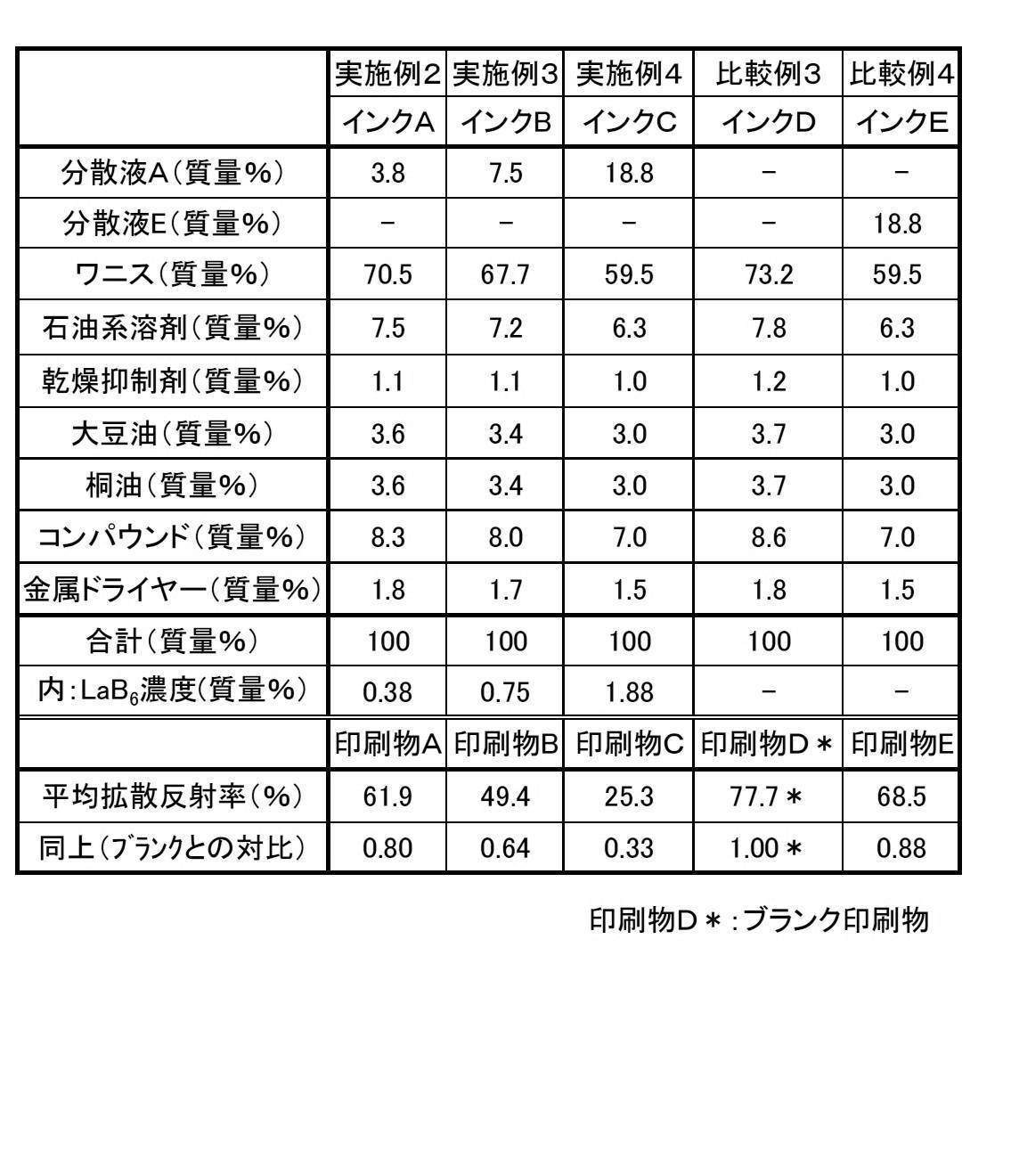
- Dispersion A varnish, petroleum solvent (manufactured by Shin Nippon Oil Co., Ltd .: AF-6 solvent), soybean oil, tung oil, and compound (manufactured by Joint Ink Co., Ltd.) prepared in Example 1 with the formulation shown in Table 2 : UG compound), a metal dryer (manufactured by DIC Graphics Corporation: 937 dryer), and a drying inhibitor (manufactured by Tokyo Ink Co., Ltd .: Inkeeper) were mixed to obtain ink A.
- ink A the concentration of lanthanum hexaboride was 0.38% by mass.
- the obtained ink for offset printing was stable without causing aggregation or the like.
- the value obtained by dividing the average value of the diffuse reflectance of the printed matter A according to Example 2 with the wavelength of 800 nm to 1300 nm by the average value of the diffuse reflectance of the blank printed matter described in Comparative Example 3 described later with the wavelength of 800 nm to 1300 nm is It was 0.80.
- Example 3 Example 2 except that the dispersion A and varnish prepared in Example 1 were mixed with the petroleum solvent, soybean oil, tung oil, compound, metal dryer, and drying inhibitor in the formulation shown in Table 2.
- forgery prevention ink B (hereinafter abbreviated as ink B) for offset printing was obtained.
- ink B the concentration of lanthanum hexaboride was 0.75% by mass.
- White fine paper was prepared as a substrate to be printed, and offset printing was performed using ink B to obtain printed matter B.
- the average value of the reflectance of the obtained printed matter B at a wavelength of 800 nm to 1300 nm was 49.4%.
- the value obtained by dividing the average value of the diffuse reflectance of the printed material B at a wavelength of 800 nm to 1300 nm by the average value of the diffuse reflectance of the blank printed material described in Comparative Example 3 at a wavelength of 800 nm to 1300 nm was 0.64.
- Example 4 Example 2 except that the dispersion A and varnish prepared in Example 1 were mixed with the petroleum solvent, soybean oil, tung oil, compound, metal dryer, and drying inhibitor in the formulation shown in Table 2. Similarly, an anti-counterfeit ink C for offset printing (hereinafter abbreviated as ink C) was obtained. In ink C, the concentration of lanthanum hexaboride was 1.88% by mass. White fine paper was prepared as a substrate to be printed, and offset printing was performed using ink C to obtain a printed matter C. The average value of the reflectance of the obtained printed matter C at wavelengths of 800 nm to 1300 nm was 25.3%.
- the value obtained by dividing the average value of the diffuse reflectance of the printed material C at a wavelength of 800 nm to 1300 nm by the average value of the diffuse reflectance of the blank printed material described in Comparative Example 3 at a wavelength of 800 nm to 1300 nm was 0.33.
- Example 3 Forgery prevention ink D for offset printing (hereinafter referred to as Example 2) except that varnish, petroleum solvent, soybean oil, tung oil, compound, metal dryer, and drying inhibitor were mixed in the formulation shown in Table 2. And abbreviated as Ink D).
- White fine paper was prepared as a substrate to be printed, and offset printing was performed using the ink D to obtain a printed matter D that was a blank printed matter.
- ATO particles (average particle size 1 to 10 ⁇ m) are 20.0% by mass as near-infrared absorbing fine particles, dispersant a is 10.0% by mass, Exol D80 (boiling point 205 ° C., aniline point 79) as a solvent. C.) was weighed 70.0% by mass. These near-infrared absorbing fine particles, a dispersing agent, and a solvent were loaded into a paint shaker containing 0.3 mm ⁇ ZrO 2 beads and pulverized and dispersed for 30 hours to obtain a near-infrared absorbing fine particle dispersion according to Comparative Example 4 (hereinafter referred to as dispersion).
- ATO Antimony-added tin oxide
- Liquid E (Abbreviated as Liquid E).
- the dispersion particle diameter of the antimony-added tin oxide fine particles in dispersion E was measured and found to be 64.5 nm.
- Counterfeit prevention for offset printing in the same manner as in Example 2 except that dispersion E, varnish, petroleum solvent, soybean oil, tung oil, compound, metal dryer, and drying inhibitor prepared by mixing shown in Table 2 were mixed.
- Ink E hereinafter abbreviated as Ink E
- White fine paper was prepared as a substrate to be printed, and offset printing was performed using ink E to obtain a printed matter E.
- the average value of the diffuse reflectance at a wavelength of 800 nm to 1300 nm of the obtained printed matter E was 68.5%.
- the value obtained by dividing the average value of the diffuse reflectance at a wavelength of 800 nm to 1300 nm of the printed material E by the average value of the diffuse reflectance at a wavelength of 800 nm to 1300 nm of the blank described in Comparative Example 3 was 0.88.
- the printed materials A to C containing hexaboride particles in the printed pattern show low diffuse reflectance at wavelengths of 800 nm to 1300 nm.
- a value obtained by dividing the average value of the diffuse reflectance of these wavelengths of 800 nm to 1300 nm by the average value of the diffuse reflectance of the blank wavelength of 800 nm to 1300 nm is as small as 0.33 to 0.80. As a result, it was confirmed that the printed matter containing the hexaboride particles can be easily determined.
- the printed material D containing no hexaboride particles in the printed pattern according to Comparative Example 3 and the printed material E containing no antimony-added tin oxide particles in the printed pattern according to Comparative Example 4 have a wavelength of 800 nm to 1300 nm. It shows a high diffuse reflectance of 5% to 77.7%. A value obtained by dividing the average value of the diffuse reflectance of these wavelengths from 800 nm to 1300 nm by the average value of the diffuse reflectance of the blank wavelength from 800 nm to 1300 nm is as large as 0.88 to 1.00, and the reflection from the wavelength of 800 nm to 1300 nm. It is considered difficult to determine authenticity at a rate.
Landscapes
- Chemical & Material Sciences (AREA)
- Engineering & Computer Science (AREA)
- Materials Engineering (AREA)
- Organic Chemistry (AREA)
- Life Sciences & Earth Sciences (AREA)
- Wood Science & Technology (AREA)
- Chemical Kinetics & Catalysis (AREA)
- General Chemical & Material Sciences (AREA)
- Inks, Pencil-Leads, Or Crayons (AREA)
- Printing Methods (AREA)
- Pigments, Carbon Blacks, Or Wood Stains (AREA)
Abstract
Description
このような用途においては、大量の紙媒体へ多くのデータが印刷される為、印刷方法としてはオフセット印刷を用いることが検討されている。
また、特許文献2では、錫ドープ酸化インジウムを用いたものが提案されている。
また、特許文献2に用いられている錫ドープ酸化インジウムを用いた赤外線吸収材料は、可視光として透過または反射する波長領域と、赤外光として吸収する波長領域とにおけるコントラストが不十分である。この為、当該錫ドープ酸化インジウムを用いた近赤外線吸収微粒子分散液をオフセット印刷へ適用した場合、印刷部の読み取り精度などが低下する問題があった。
しかしながら、特許文献3から5に記載の有機溶剤を、樹脂への侵襲性が低い石油系溶剤へ代替しようとしても、当該石油系溶剤が近赤外線吸収微粒子を分散する力は、トルエン等の樹脂への侵襲性が高い有機溶剤に較べて劣り、近赤外線吸収微粒子分散液の粘度が上昇した。そして、近赤外線吸収微粒子分散液の粘度が上昇した結果、近赤外線吸収微粒子の分散粒子径を所定値まで下げることが出来ない、という課題が発生した。
そして、上述した近赤外線吸収微粒子分散液を含有する、または、上述した近赤外線吸収微粒子分散液と共に一般のオフセット印刷用インクに通常用いられる顔料を含有するオフセット印刷用の偽造防止インク組成物、当該オフセット印刷用の偽造防止インク組成物を用いて印刷された偽造防止印刷物にも想到し、本発明を完成した。
石油系溶剤から選択される1種類以上の溶剤と、
2質量%以上25質量%以下の、一般式がXBaで表記される六ホウ化物微粒子(ここで、元素Xは、La、Ce、Pr、Nd、Gd、Tb、Dy、Ho、Y、Sm、Eu、Er、Tm、Yb、Lu、SrおよびCaから選択される少なくとも1種以上、4.0≦a≦6.2)から選択される1種以上の近赤外線吸収微粒子と、
前記溶剤に可溶で、脂肪酸を構造中に有する分散剤と、を含み、
粘度が、180mPa・s以下であることを特徴とする近赤外線吸収微粒子分散液である。
第2の発明は、
前記分散剤が官能基として、2級アミン基、3級アミン基、および、4級アンモニウム基から選択される1種類以上を有することを特徴とする第1の発明に記載の近赤外線吸収微粒子分散液である。
第3の発明は、
前記分散剤の酸価が1mgKOH/g以上の分散剤であることを特徴とする第1または第2の発明に記載の近赤外線吸収微粒子分散液である。
第4の発明は、
前記近赤外線吸収微粒子の分散粒子径が、1nm以上200nm以下であることを特徴とする第1から第3の発明のいずれかに記載の近赤外線吸収微粒子分散液である。
第5の発明は、
前記近赤外線吸収微粒子の表面が、Si、Ti、Al、Zrから選択される1種以上の化合物で被覆されていることを特徴とする第1から第4の発明のいずれかに記載の近赤外線吸収微粒子分散液である。
第6の発明は、
前記近赤外線吸収微粒子の格子定数が0.4100nm以上0.4160nm以下であることを特徴とする第1から第5の発明のいずれかに記載の近赤外線吸収微粒子分散液である。
第7の発明は、
前記溶剤が、アニリン点75℃以上95℃以下、かつ、沸点150℃以上340℃以下の石油系溶剤から選択される1種類以上であることを特徴とする第1から第6の発明請求項1から6のいずれかに記載の近赤外線吸収微粒子分散液である。
第8の発明は、
前記近赤外線吸収微粒子分散液が、さらにバインダーを含むことを特徴とする第1から第7の発明のいずれかに記載の近赤外線吸収微粒子分散液である。
第9の発明は、
前記近赤外線吸収微粒子と、前記溶剤と、前記分散剤とを混合し、分散処理することを特徴とする第1から第8の発明のいずれかに記載の近赤外線吸収微粒子分散液の製造方法である。
第10の発明は、
第1から第8の発明のいずれかに記載の赤外線吸収微粒子分散液を含むことを特徴とする偽造防止インク組成物である。
第11の発明は、
さらに、顔料を含むことを特徴とする第10の発明に記載の偽造防止インク組成物である。
第12の発明は、
第11の発明に記載の顔料が有機顔料であり、カーボンブラック、アゾレーキ顔料、不溶性アゾ顔料、縮合アゾ顔料、フタロシアニン顔料、縮合多環系顔料から選択される1種類以上であることを特徴とする偽造防止インク組成物である。
第13の発明は、
第11の発明に記載の顔料が無機顔料であり、白色顔料、体質顔料、赤色顔料、黄色顔料、緑色顔料、青色顔料、紫色顔料、蛍光顔料、示温顔料、パール顔料、金属粉顔料から選択される1種類以上であることを特徴とする偽造防止インク組成物である。
第14の発明は、
可塑剤、酸化防止剤、増粘剤、ワックスから選択される1種類以上を含むことを特徴とする第10から第13の発明のいずれかに記載の偽造防止インク組成物である。
第15の発明は、
基材の一方もしくは両面に、印刷パターンを有する印刷物であって、前記印刷パターンに一般式がXBaで表記される六ホウ化物微粒子(ここで、元素Xは、La、Ce、Pr、Nd、Gd、Tb、Dy、Ho、Y、Sm、Eu、Er、Tm、Yb、Lu、SrおよびCaから選択される少なくとも1種以上、4.0≦a≦6.2)から選択される1種以上の近赤外線吸収微粒子を含有していることを特徴とする偽造防止印刷物である。
第16の発明は、
印刷パターンがさらに顔料を含むことを特徴とする、第15の発明に記載の偽造防止印刷物である。
第17の発明は、
顔料が有機顔料であり、カーボンブラック、アゾレーキ顔料、不溶性アゾ顔料、縮合アゾ顔料、フタロシアニン顔料、縮合多環系顔料から選択される1種類以上であることを特徴とする、第16の発明に記載の偽造防止印刷物である。
第18の発明は、
顔料が無機顔料であり、白色顔料、体質顔料、赤色顔料、黄色顔料、緑色顔料、青色顔料、紫色顔料、蛍光顔料、示温顔料、パール顔料、金属粉顔料から選択される1種類以上であることを特徴とする、第16の発明に記載の偽造防止印刷物である。
第19の発明は、
偽造防止印刷物の波長800nm~1300nmの拡散反射率の平均値を、近赤外線吸収微粒子を含まないブランクの波長800nm~1300nmの拡散反射率の平均値で除した値が0.84以下であることを特徴とする、第15から第18の発明のいずれかに記載の偽造防止印刷物である。
本発明に用いられる近赤外線吸収微粒子は、一般式がXBa(4.0≦a≦6.2)で表記される六ホウ化物微粒子である。ここで、元素Xは、La、Ce、Pr、Nd、Gd、Tb、Dy、Ho、Y、Sm、Eu、Er、Tm、Yb、Lu、SrおよびCaから選択される少なくとも1種以上である。
具体的には、六ホウ化ランタンLaB6、六ホウ化セリウムCeB6、六ホウ化プラセオジムPrB6、六ホウ化ネオジムNdB6、六ホウ化ガドリニウムGdB6、六ホウ化テルビウムTbB6、六ホウ化ディスプロシウムDyB6、六ホウ化ホルミウムHoB6、六ホウ化イットリウムYB6、六ホウ化サマリウムSmB6、六ホウ化ユーロピウムEuB6、六ホウ化エルビウムErB6、六ホウ化ツリウムTmB6、六ホウ化イッテルビウムYbB6、六ホウ化ルテチウムLuB6、六ホウ化ランタンセリウム(La,Ce)B6、六ホウ化ストロンチウムSrB6、六ホウ化カルシウムCaB6から選択される1種以上であることが好ましい。
六ホウ化物微粒子の分散粒子径が、例えば1500nmを超えるとき、当該六ホウ化物微粒子は近赤外領域にほとんど吸収を持たない。これに対し、六ホウ化物微粒子の分散粒子径がおおよそ800nm以下のとき近赤外領域の吸収は強くなり、200nm以下であればさらに強い吸収が発揮され、100nm以下であればさらに強い吸収が発揮される。
可視光の場合、当該六ホウ化物微粒子の分散粒子径が1000nm以下であれば幾何光学散乱はほとんど無視できる。そして、分散粒子径が200nm以下であれば、ミー散乱は弱化され、100nm以下であればさらに弱化される。当該微粒子の分散粒子径が、さらに小さい分散粒子径の領域ではレイリー散乱が主な散乱因子となる。そして、レイリー散乱強度は、分散粒子径の6乗に反比例して低減するため、当該微粒子の分散粒子径をさらに減少させることで散乱光を低減させることができ、好ましい。
一方、分散粒子径が1nm以上であれば、工業的な製造は容易である。
本発明に用いられる溶剤は、オフセット印刷への適用を考慮して非水溶性であり、かつ、ゴムローラー等を溶解しないことが求められる。具体的には、石油系溶剤から選択される1種類以上の溶剤を用いることが出来る。
さらに、石油系溶剤のアニリン点は70℃以上95℃以下の範囲にあることが好ましい。アニリン点が70℃以上の場合には、樹脂を溶解させる能力が過剰にならず、基材がアクリル樹脂等の場合であっても適用可能である。また、オフセット印刷などゴム製治具を用いる印刷工程で用いることはできる。アニリン点が95℃以下であれば、十分な樹脂溶解性を有し、例えば、分散剤が固形であっても、当該分散剤を使用可能となり好ましい。
前記近赤外線吸収微粒子を前記溶剤中に分散させる分散剤は、脂肪酸の構造を有するものが好ましい。さらに、当該分散剤は、上述した本発明に係る溶剤に可溶であることが求められる。
また、当該分散剤の構造は、特に限定されるものではないが、塩基性のアンカー部を有する高分子の分散剤を用いることが好ましい。アンカー部とは、当該高分子分散剤における分子中の部位(基)であって、前記赤外線吸収微粒子表面に吸着する部位(基)である。
本発明においては、特に塩基性のアンカー部を有する高分子分散剤を用いると、インクの保存安定性が改良されるため、好ましい。当該アンカー部となる塩基性の部位(基)としては、(2級アミノ基、3級アミノ基、および、4級アンモニウム基、等の部位(基)が挙げられる。
さらにまた、本発明に用いる高分子分散剤の一態様として、図3に示すYが存在せず、一つのアンカー部に2つのテール部が結合した構造も取り得る。この場合、一般式は[X-A3-Z]となる。
さらに加えて、本発明に用いる高分子分散剤の一態様として、図4に示すZが存在せず、一つのアンカー部に一つのテール部が結合した構造も取り得る。この場合、一般式は[X-A4]となる。
さらに、本発明に係る分散剤の酸価が1mgKOH/g以上であると、上述した近赤外線吸収微粒子を、本発明に係る溶剤に分散させる能力が高く好ましい。
また、市販の分散剤を用いる場合は、当該分散剤がオフセット印刷用のゴム製のブランケットを溶解する可能性のある溶剤を含有していないことが好ましい。従って、当該分散剤の不揮発分(180℃、20分間加熱後)は高いことが好ましく、例えば95%以上であることが好ましい。
本発明に係る六ホウ化物微粒子を本発明に係る溶剤へ分散させて、近赤外線吸収微粒子分散液を得る為の分散方法は、当該微粒子を均一に溶剤へ分散する方法であれば任意に選択できる。具体的には、ビーズミル、ボールミル等の湿式媒体ミルを用いることが好ましい。
六ホウ化物微粒子の濃度が高いほど、オフセット印刷用の偽造防止インク調製が容易であり好ましい。一方、六ホウ化物微粒子の濃度が25質量%以下であれば、上述した分散剤の添加により、得られる近赤外線吸収微粒子分散液の粘度を180mPa・s以下に抑制して、六ホウ化物微粒子の粉砕・分散を十分に進めることが出来る。この場合、六ホウ化物微粒子の分散粒子径は、湿式媒体ミルの処理時間により、任意に制御出来る。例えば、処理時間を長くする事により、分散粒子径を小さくすることができる。
以上説明した製造方法により、本発明に係る近赤外線吸収微粒子分散液が得られる。
本発明に係る近赤外線吸収微粒子分散液へ、さらにバインダーを添加してもよい。当該バインダーとしては、本発明に係る溶剤へ溶解できれば特に限定されず、例えば、ロジン変性フェノール樹脂、ロジン変性アルキッド樹脂、石油樹脂変性フェノール樹脂などの合成樹脂等が挙げられる。そこで、用途に適したものを選択することが可能である。
本発明に係る近赤外線吸収微粒子分散液、樹脂ワニス成分、植物油成分、石油系溶剤成分、および添加剤を混合して、オフセット印刷用の偽造防止インク組成物を得ることが出来る。
樹脂ワニス成分としては、フェノール樹脂、石油樹脂、ロジン変性フェノール樹脂、石油樹脂変性ロジン変性フェノール樹脂、植物油変性ロジン変性フェノール樹脂、変性アルキッド樹脂、ロジン変性マレイン酸樹脂、ポリエステル系樹脂、アクリル系樹脂、ウレタン樹脂、エポキシ樹脂等任意の樹脂系が用いられるが、例えばロジン変性フェノール樹脂、石油樹脂を用いた樹脂ワニスが好ましく用いられる。
さらに、本発明に係るオフセット印刷用インク組成物には、一般の平版オフセットインクに用いられる顔料を添加して、可視光領域で着色したパターンを形成することができる。着色パターンの形成により、デザイン上の効果を高めたり、偽造防止効果を高めることができる。
また、カーボンブラック単体で用いることも好ましい。
本発明に係る印刷物を提供するための印刷方法としては、従来公知の平版オフセット印刷方法が用いられる。例えば、オフセット枚葉印刷、オフセット輪転印刷、水無しオフセット印刷、ドライオフセット印刷などが挙げられる。
本発明に係る印刷物に用いられる基材としては、例えば白紙、プラスチックフィルムに白色印刷したもの等を挙げることができる。この場合のプラスチックフィルムとしては、ポリプロピレン(PP)、ポリ塩化ビニル(PVC)、ポリエチレンテレフタレート(PET)、合成紙などが挙げられる。完成品の用途によりそれぞれ紙・フィルムの優位性があると考えられ、一概にはどれが良いとは言えないが、後述する本発明実施例においては、安価な点や扱いやすさなどから白色上質紙を選択した。
また、印刷に使用する版についても、従来公知の製版技術が用いられる。例えば、振幅変調スクリーニング(AMスクリーニング)法により形成した版、周波数変調スクリーニング(FMスクリーニング)法により形成した版などが挙げられる。
本発明に係るオフセット印刷の偽造防止インク組成物を用いて印刷することにより、デザイン上の制約が少なく、偽造防止効果にも優れた印刷物を提供することができる。
本発明に係る印刷物に波長800nm~1300nmの近赤外線を照射し、当該印刷物から拡散反射してくる上記波長の近赤外線を測定する。本発明に係る印刷物は、近赤外線吸収微粒子を含有していないブランク印刷物に比べて、波長800nm~1300nmの近赤外線の拡散反射が少ない。そのため、近赤外線吸収微粒子を含有する印刷物の波長800nm~1300nmの近赤外線の拡散反射率と、ブランク印刷物の波長800nm~1300nmの近赤外線の拡散反射率との差に拠って、印刷物の真贋を容易に判定することができる。例えば、本発明に係る印刷物の波長800nm~1300nmの拡散反射率の値を、ブランク印刷物の波長800nm~1300nmの拡散反射率の値で除することで、バインダー等の他の成分や基材などの要因を除いた近赤外線吸収微粒子の正味の拡散反射率を評価できる。この除した値が小さい程、真贋の判定は容易であり、0.84以下であることが好ましく、0.77以下であることがより好ましい。
従って、印刷物中に含まれる近赤外線吸収微粒子の量は少ないほうが好ましく、本発明に係る近赤外線吸収微粒子を用いることとなる。具体的には、印刷物中に含まれる近赤外線吸収微粒子の量が0.8g/cm2以下であることが好ましい。
尚、本発明に係る拡散反射率は、分光光度計を用いて、硫酸バリウムの微粉末を固めた白板の拡散反射率を100%として調整の上、波長800nm~1300nmの波長領域における拡散反射率を相対値で測定したものである。
尚、本実施例に係る近赤外線吸収微粒子分散剤の酸価の測定方法は、JIS K 0070に準拠し、電位差滴定法による。また、実施例に係る印刷物の光学特性は、分光光度計U-4100(日立製作所(株)製)を用いて測定した。
さらに、X線回折装置(ブルカー・エイエックスエス(株)製、D2 PHASER)を用い、CuKα線使用の条件下で測定を行い、2θ=10°~100°のXRDパターンを得て、XRDパターンに基づいてリートベルト解析を行い、実施例に係る近赤外線吸収微粒子の格子定数を求めた。
そして、本実施例に係る印刷物の光学特性は、分光光度計U-4100(日立製作所(株)製)を用いて測定した。拡散反射率は、分光光度計U-4100(日立製作所(株)製)を用いて、硫酸バリウムの微粉末を固めた白板の拡散反射率を100%として調整の上、波長800nm~1300nm波長領域において5nm毎の拡散反射率を相対値で測定し、得られた値の平均値を用いた。
近赤外線吸収微粒子として六ホウ化ランタン微粒子(平均粒径1~2μm)を10.0質量%、分散剤の構造に脂肪酸を有し、アミノ基を有し、酸価が20.3mgKOH/gであり、ヒドロキシステアリン酸鎖を有し、不揮発分100%である分散剤(以下、分散剤aと略称する。)5.0質量%、溶剤としてエクソールD80(沸点205℃、アニリン点79℃)85.0質量%を秤量した。
これらの近赤外線吸収微粒子、分散剤、溶剤を、0.3mmφZrO2ビーズを入れたペイントシェーカーに装填して30時間粉砕・分散処理し、実施例1に係る近赤外線吸収微粒子分散液(以下、分散液Aと略称する)を得た。
分散液A中における六ホウ化物微粒子の分散粒子径を、粒度分布計(大塚電子製)で測定したところ79.3nmであった。また、六ホウ化ランタン微粒子の格子定数は0.41560nmであった。
分散液Aは、含有する溶媒の溶解性が低く、さらに当該溶媒は極性が低く水と混ざらないため、オフセット印刷に適用することが可能である。
近赤外線吸収微粒子として六ホウ化ランタン微粒子(平均粒径1~2μm)を10.0質量%、官能基としてカルボキシル基を有するアクリル系分散剤(以下、分散剤bと略称する。)8.0質量%、溶剤としてトルエン(沸点110℃、アニリン点10℃)82.0質量%を混合し、0.3mmφZrO2ビーズを入れたペイントシェーカーで30時間粉砕・分散処理することによって六ホウ化物微粒子分散液(以下、分散液Eと略称する。)を調製した。
分散液B内における六ホウ化物微粒子の分散粒子径を粒度分布計(大塚電子製)で測定したところ82.6nmであった。また、格子定数は0.41560nmであった。
しかしながら分散液Bは、含有する溶媒の溶解性が高く、オフセット印刷に適用することができなかった。
近赤外線吸収微粒子として六ホウ化ランタン微粒子(平均粒径1~2μm)を10.0質量%、分散剤aを8.0質量%、イソプロピルアルコール82.0質量%を秤量した。
これらの近赤外線吸収微粒子、分散剤、溶剤を、0.3mmφZrO2ビーズを入れたペイントシェーカーで30時間粉砕・分散処理し、比較例2に係る近赤外線吸収微粒子分散液を得た。
分散液C内における六ホウ化物微粒子の分散粒子径を粒度分布計(大塚電子製)で測定したところ80.1nmであった。また、格子定数は0.41560nmであった。
しかしながら分散液Cは含有する溶媒の極性が高く、水と混ざるため、オフセット印刷に適用することができなかった。
実施例1にて調整した分散液A液を用いたオフセット印刷用の偽造防止インクA(以下インクAと略称する)の調製例、および、当該インクAを用いた印刷例について説明する。但し、本発明の範囲は、これら記載の実施例に限定されるものではない。
撹拌機、冷却器、温度計をつけた4つ口フラスコに、P-オクチルフェノール1000重量部、35%ホルマリン850重量部、93%水酸化ナトリウム60重量部、トルエン1000重量部を装填して、90℃で6時間反応させた。その後、6N塩酸125重量部、水1000重量部の塩酸溶液を添加し、撹拌、静置した後、上層部を取り出した。そして、不揮発分49%のレゾールタイプフェノール樹脂のトルエン溶液2000重量部を得、これをレゾール液とした。
前記で得られたロジン変性フェノール樹脂40重量部、大豆油35重量部、AFソルベント6号(新日本石油化学(株)製溶剤)24重量部、ALCH(川研ファインケミカル(株)製ゲル化剤)1.0重量部を、190℃で1時間加熱撹拌してワニスを得た。
表2に示す配合にて、実施例1にて調製した分散液A、ワニス、石油系溶剤(新日本石油株式会社製:AF-6ソルベント)、大豆油、桐油、コンパウンド(合同インキ株式会社製:UGコンパウンド)、金属ドライヤー(DICグラフィックス株式会社製:937ドライヤー)、乾燥抑制剤(東京インキ株式会社製:インキーパー)を混合しインクAを得た。インクAにおいて六ホウ化ランタン濃度は0.38質量%となった。得られたオフセット印刷用インクは凝集等を起こさず、安定であった。
被印刷基材として白色上質紙を準備し、インクAを用いてオフセット印刷を行って印刷物Aを得た。得られた印刷物Aの波長800nm~1300nmにおける拡散反射率の平均値は、61.9%であった。
一方、後述する比較例3に係るブランク印刷物の波長800nm~1300nmにおける拡散反射率の平均値は77.7%であった。
従って、実施例2に係る印刷物Aの波長800nm~1300nmの拡散反射率の平均値を、後述する比較例3に記載するブランク印刷物の波長800nm~1300nmの拡散反射率の平均値で除した値は0.80であった。
表2に示す配合にて、実施例1にて調整した調製した分散液A、ワニスと、石油系溶剤、大豆油、桐油、コンパウンド、金属ドライヤー、乾燥抑制剤を混合した以外は実施例2と同様にしてオフセット印刷用の偽造防止インクB(以下、インクBと略称する)を得た。インクBにおいて六ホウ化ランタン濃度は0.75質量%となった。被印刷基材として白色上質紙を準備し、インクBを用いてオフセット印刷を行って印刷物Bを得た。得られた印刷物Bの波長800nm~1300nmの反射率の平均値は49.4%であった。
従って、印刷物Bの波長800nm~1300nmの拡散反射率の平均値を比較例3に記載のブランク印刷物の波長800nm~1300nmの拡散反射率の平均値で除した値は0.64であった。
表2に示す配合にて、実施例1にて調整した調製した分散液A、ワニスと、石油系溶剤、大豆油、桐油、コンパウンド、金属ドライヤー、乾燥抑制剤を混合した以外は実施例2と同様にしてオフセット印刷用の偽造防止インクC(以下、インクCと略称する)を得た。インクCにおいて六ホウ化ランタン濃度は1.88質量%となった。被印刷基材として白色上質紙を準備し、インクCを用いてオフセット印刷を行って印刷物Cを得た。得られた印刷物Cの波長800nm~1300nmの反射率の平均値は25.3%であった。
従って、印刷物Cの波長800nm~1300nmの拡散反射率の平均値を比較例3に記載のブランク印刷物の波長800nm~1300nmの拡散反射率の平均値で除した値は0.33であった。
表2に示す配合にて、ワニスと、石油系溶剤、大豆油、桐油、コンパウンド、金属ドライヤー、乾燥抑制剤を混合した以外は実施例2と同様にしてオフセット印刷用の偽造防止インクD(以下、インクDと略称する)を得た。被印刷基材として白色上質紙を準備し、インクDを用いてオフセット印刷を行ってブランク印刷物である印刷物Dを得た。得られたブランク印刷物である印刷物Dの波長800nm~1300nmの拡散反射率の平均値は77.7%であった。
近赤外線吸収微粒子としてアンチモン添加酸化錫(ATO)粒子(平均粒径1~10μm)を20.0質量%、分散剤aを10.0質量%、溶剤としてエクソールD80(沸点205℃、アニリン点79℃)を70.0質量%秤量した。
これらの近赤外線吸収微粒子、分散剤、溶剤を、0.3mmφZrO2ビーズを入れたペイントシェーカーに装填して30時間粉砕・分散処理し、比較例4に係る近赤外線吸収微粒子分散液(以下、分散液Eと略称する)を得た。
分散液E中におけるアンチモン添加酸化錫微粒子の分散粒子径を測定したところ64.5nmであった。
表2に示す配合にて調製した分散液E、ワニス、石油系溶剤、大豆油、桐油、コンパウンド、金属ドライヤー、乾燥抑制剤を混合した以外は実施例2と同様にしてオフセット印刷用の偽造防止インクE(以下、インクEと略称する)を得た。被印刷基材として白色上質紙を準備し、インクEを用いてオフセット印刷を行って印刷物Eを得た。得られた印刷物Eの波長800nm~1300nmの拡散反射率の平均値は68.5%であった。
従って、印刷物Eの波長800nm~1300nmの拡散反射率の平均値を比較例3に記載のブランクの波長800nm~1300nmの拡散反射率の平均値で除した値は0.88であった。
実施例2~4において、印刷パターンに六ホウ化物の粒子を含む印刷物A~Cは、波長800nm~1300nmで低い拡散反射率を示している。これらの波長800nm~1300nmの拡散反射率の平均値を、ブランクの波長800nm~1300nmの拡散反射率の平均値で除した値は、0.33~0.80と小さい。この結果、六ホウ化物の粒子を含む印刷物は、真贋判定が容易であることが確認された。
一方、比較例3に係る印刷パターンに六ホウ化物の粒子を含まない印刷物D、比較例4に係る印刷パターンにアンチモン添加酸化錫の粒子を含まない印刷物Eは、波長800nm~1300nmで、69.5%~77.7%と高い拡散反射率を示している。これらの波長800nm~1300nmの拡散反射率の平均値を、ブランクの波長800nm~1300nmの拡散反射率の平均値で除した値は、0.88~1.00と大きく、波長800nm~1300nmの反射率で真贋判定を行うことは困難であると考えられる。
また、比較例4に係るアンチモン添加酸化錫の粒子を含む印刷インクで真贋判定が容易な印刷物を得ようとした場合、印刷物表面のインクの膜厚を、目視で認識できるほど厚くする必要があり、当該印刷物を偽造防止用途に用いることは、現実的でないと考えられた。

Claims (19)
- 石油系溶剤から選択される1種類以上の溶剤と、
2質量%以上25質量%以下の、一般式がXBaで表記される六ホウ化物微粒子(ここで、元素Xは、La、Ce、Pr、Nd、Gd、Tb、Dy、Ho、Y、Sm、Eu、Er、Tm、Yb、Lu、SrおよびCaから選択される少なくとも1種以上、4.0≦a≦6.2)から選択される1種以上の近赤外線吸収微粒子と、
前記溶剤に可溶で、脂肪酸を構造中に有する分散剤と、を含み、
粘度が、180mPa・s以下であることを特徴とする近赤外線吸収微粒子分散液。 - 前記分散剤のアンカー部が、2級アミン基、3級アミン基、および、4級アンモニウム基から選択される1種類以上を有することを特徴とする請求項1に記載の近赤外線吸収微粒子分散液。
- 前記分散剤の酸価が、1mgKOH/g以上の分散剤であることを特徴とする請求項1または2に記載の近赤外線吸収微粒子分散液。
- 前記近赤外線吸収微粒子の分散粒子径が、1nm以上200nm以下であることを特徴とする請求項1から3のいずれかに記載の近赤外線吸収微粒子分散液。
- 前記近赤外線吸収微粒子の表面が、Si、Ti、Al、Zrから選択される1種以上の化合物で被覆されている、ことを特徴とする請求項1から4のいずれかに記載の近赤外線吸収微粒子分散液。
- 前記近赤外線吸収微粒子の格子定数が0.4100nm以上0.4160nm以下であることを特徴とする請求項1から5のいずれかに記載の近赤外線吸収微粒子分散液。
- 前記溶剤が、アニリン点70℃以上95℃以下、かつ、沸点150℃以上340℃以下の石油系溶剤から選択される1種類以上であることを特徴とする請求項1から6のいずれかに記載の近赤外線吸収微粒子分散液。
- 前記近赤外線吸収微粒子分散液が、さらにバインダーを含むことを特徴とする請求項1から7のいずれかに記載の近赤外線吸収微粒子分散液。
- 前記近赤外線吸収微粒子と、前記溶剤と、前記分散剤とを混合し、分散処理することを特徴とする請求項1から8のいずれかに記載の近赤外線吸収微粒子分散液の製造方法。
- 請求項1から8のいずれかに記載の赤外線吸収微粒子分散液を含むことを特徴とする偽造防止インク組成物。
- さらに、顔料を含むことを特徴とする請求項10に記載の偽造防止インク組成物。
- 請求項11に記載の顔料が無機顔料であり、カーボンブラック、白色顔料、体質顔料、赤色顔料、黄色顔料、緑色顔料、青色顔料、紫色顔料、蛍光顔料、示温顔料、パール顔料、金属粉顔料から選択される1種類以上であることを特徴とする偽造防止インク組成物。
- 請求項11に記載の顔料が有機顔料であり、アゾレーキ顔料、不溶性アゾ顔料、縮合アゾ顔料、フタロシアニン顔料、縮合多環系顔料から選択される1種類以上であることを特徴とする偽造防止インク組成物。
- 可塑剤、酸化防止剤、増粘剤、ワックスから選択される1種類以上を含むことを特徴とする請求項10から13のいずれかに記載の偽造防止インク組成物。
- 基材の一方もしくは両面に、印刷パターンを有する印刷物であって、前記印刷パターンに一般式がXBaで表記される六ホウ化物微粒子(ここで、元素Xは、La、Ce、Pr、Nd、Gd、Tb、Dy、Ho、Y、Sm、Eu、Er、Tm、Yb、Lu、SrおよびCaから選択される少なくとも1種以上、4.0≦a≦6.2)から選択される1種以上の近赤外線吸収近赤外線吸収微粒子を含有していることを特徴とする偽造防止印刷物。
- 印刷パターンがさらに顔料を含むことを特徴とする、請求項15に記載の偽造防止印刷物。
- 顔料が無機顔料であり、カーボンブラック、白色顔料、体質顔料、赤色顔料、黄色顔料、緑色顔料、青色顔料、紫色顔料、蛍光顔料、示温顔料、パール顔料、金属粉顔料から選択される1種類以上であることを特徴とする、請求項16に記載の偽造防止印刷物。
- 顔料が有機顔料であり、アゾレーキ顔料、不溶性アゾ顔料、縮合アゾ顔料、フタロシアニン顔料、縮合多環系顔料から選択される1種類以上であることを特徴とする、請求項16に記載の偽造防止印刷物。
- 偽造防止印刷物の波長800nm~1300nmの拡散反射率の平均値を、近赤外線吸収微粒子を含まないブランクの波長800nm~1300nmの拡散反射率の平均値で除した値が0.84以下であることを特徴とする、請求項15から18のいずれかに記載の偽造防止印刷物。
Priority Applications (6)
| Application Number | Priority Date | Filing Date | Title |
|---|---|---|---|
| JP2016572122A JP6519597B2 (ja) | 2015-01-27 | 2016-01-27 | 近赤外線吸収微粒子分散液とその製造方法 |
| EP16743445.5A EP3252114B1 (en) | 2015-01-27 | 2016-01-27 | Near-infrared ray absorbing microparticle dispersion solution, production method thereof, counterfeit-preventing ink composition using said near-infrared ray absorbing microparticle dispersion solution, and anti-counterfeit printed matter using said near-infrared ray absorbing microparticles |
| AU2016213102A AU2016213102B2 (en) | 2015-01-27 | 2016-01-27 | Near-infrared ray absorbing microparticle dispersion solution, production method thereof, counterfeit-preventing ink composition using said near-infrared ray absorbing microparticle dispersion solution, and anti-counterfeit printed matter using said near-infrared ray absorbing microparticles |
| CN201680007418.2A CN107532030B (zh) | 2015-01-27 | 2016-01-27 | 微粒分散液及其制造方法、防伪油墨组合物及防伪印刷物 |
| US15/546,755 US20180015772A1 (en) | 2015-01-27 | 2016-01-27 | Near infrared absorbing fine particle dispersion liquid and method for producing the same, anti-counterfeit ink composition using near infrared absorbing fine particle dispersion liquid, and anti-counterfeit printed matter using near infrared absorbing fine particles |
| US16/394,342 US11021002B2 (en) | 2015-01-27 | 2019-04-25 | Near infrared absorbing fine particle dispersion liquid and method for producing the same, anti-counterfeit ink composition using near infrared absorbing fine particle dispersion liquid, and anti-counterfeit printed matter using near infrared absorbing fine particles |
Applications Claiming Priority (2)
| Application Number | Priority Date | Filing Date | Title |
|---|---|---|---|
| JP2015-012897 | 2015-01-27 | ||
| JP2015012897 | 2015-01-27 |
Related Child Applications (2)
| Application Number | Title | Priority Date | Filing Date |
|---|---|---|---|
| US15/546,755 A-371-Of-International US20180015772A1 (en) | 2015-01-27 | 2016-01-27 | Near infrared absorbing fine particle dispersion liquid and method for producing the same, anti-counterfeit ink composition using near infrared absorbing fine particle dispersion liquid, and anti-counterfeit printed matter using near infrared absorbing fine particles |
| US16/394,342 Division US11021002B2 (en) | 2015-01-27 | 2019-04-25 | Near infrared absorbing fine particle dispersion liquid and method for producing the same, anti-counterfeit ink composition using near infrared absorbing fine particle dispersion liquid, and anti-counterfeit printed matter using near infrared absorbing fine particles |
Publications (1)
| Publication Number | Publication Date |
|---|---|
| WO2016121842A1 true WO2016121842A1 (ja) | 2016-08-04 |
Family
ID=56543450
Family Applications (1)
| Application Number | Title | Priority Date | Filing Date |
|---|---|---|---|
| PCT/JP2016/052400 Ceased WO2016121842A1 (ja) | 2015-01-27 | 2016-01-27 | 近赤外線吸収微粒子分散液とその製造方法、近赤外線吸収微粒子分散液を用いた偽造防止インク組成物、および近赤外線吸収微粒子を用いた偽造防止印刷物 |
Country Status (7)
| Country | Link |
|---|---|
| US (2) | US20180015772A1 (ja) |
| EP (1) | EP3252114B1 (ja) |
| JP (1) | JP6519597B2 (ja) |
| CN (1) | CN107532030B (ja) |
| AU (1) | AU2016213102B2 (ja) |
| TW (1) | TWI740814B (ja) |
| WO (1) | WO2016121842A1 (ja) |
Cited By (5)
| Publication number | Priority date | Publication date | Assignee | Title |
|---|---|---|---|---|
| CN110997823A (zh) * | 2017-07-24 | 2020-04-10 | 住友金属矿山株式会社 | 红外线吸收微粒分散粉末、含红外线吸收微粒分散粉末的分散液、含红外线吸收微粒分散粉末的油墨、防伪油墨以及防伪用印刷物 |
| US11097565B2 (en) | 2018-04-27 | 2021-08-24 | Casio Computer Co., Ltd. | Thermally expandable sheet |
| JP2021523280A (ja) * | 2018-05-15 | 2021-09-02 | シクパ ホルディング ソシエテ アノニムSicpa Holding Sa | 機械可読セキュリティ機能 |
| US11203220B2 (en) | 2017-03-24 | 2021-12-21 | Casio Computer Co., Ltd. | Ink, printing apparatus, printing method, manufacturing method for shaped object, and thermal expansion sheet |
| US20220228012A1 (en) * | 2019-06-05 | 2022-07-21 | Sumitomo Metal Mining Co., Ltd. | Anti-counterfeit ink composition, anti-counterfeit ink, and anti-counterfeit printed product |
Families Citing this family (5)
| Publication number | Priority date | Publication date | Assignee | Title |
|---|---|---|---|---|
| CN108559332A (zh) * | 2018-03-22 | 2018-09-21 | 深圳市华鑫防伪科技有限公司 | 一种红外线防伪检测材料及该材料的红外线防伪探测方法 |
| JP2019167418A (ja) * | 2018-03-22 | 2019-10-03 | カシオ計算機株式会社 | インク、熱膨張性シート及び造形物の製造方法 |
| CN110407273A (zh) * | 2019-09-09 | 2019-11-05 | 鲁东大学 | 一种基于六硼化镧纳米粒子的光热表面水蒸发器件的设计 |
| TWI826942B (zh) * | 2022-03-04 | 2023-12-21 | 南亞塑膠工業股份有限公司 | 色料分散體及其製造方法 |
| CN114525676B (zh) * | 2022-04-25 | 2022-08-02 | 天津包钢稀土研究院有限责任公司 | 一种稀土基红外反射保暖织物及其制备方法和应用 |
Citations (5)
| Publication number | Priority date | Publication date | Assignee | Title |
|---|---|---|---|---|
| JPH01311177A (ja) * | 1988-06-09 | 1989-12-15 | Sakata Corp | 顔料分散剤及びそれを用いたオフセット印刷インキ組成物 |
| JP2004168842A (ja) * | 2002-11-19 | 2004-06-17 | Sumitomo Metal Mining Co Ltd | 偽造防止インク用組成物、偽造防止インク及び偽造防止印刷物 |
| JP2008509271A (ja) * | 2004-08-13 | 2008-03-27 | ヘ−ウク・イ | 機能性コーティング組成物、これを用いた機能性被膜及びそれらの製造方法 |
| JP2008169294A (ja) * | 2007-01-11 | 2008-07-24 | Sumitomo Metal Mining Co Ltd | レーザー溶着用光吸収樹脂組成物及び光吸収樹脂成形体、並びに光吸収樹脂成形体の製造方法 |
| JP2008291167A (ja) * | 2007-05-28 | 2008-12-04 | Toyo Ink Mfg Co Ltd | 平版インキ組成物 |
Family Cites Families (12)
| Publication number | Priority date | Publication date | Assignee | Title |
|---|---|---|---|---|
| JPH04320466A (ja) | 1991-04-19 | 1992-11-11 | Mitsui Toatsu Chem Inc | セキュリティインキ |
| JP4058822B2 (ja) | 1997-09-30 | 2008-03-12 | 住友金属鉱山株式会社 | 選択透過膜用塗布液、選択透過膜および選択透過多層膜 |
| JP4096277B2 (ja) | 1998-09-22 | 2008-06-04 | 住友金属鉱山株式会社 | 日射遮蔽材料、日射遮蔽膜用塗布液、及び、日射遮蔽膜 |
| JP2000309736A (ja) | 1999-04-26 | 2000-11-07 | Toppan Printing Co Ltd | 赤外線吸収インキ組成物およびそれを用いた印刷物 |
| US7179535B2 (en) * | 2003-12-17 | 2007-02-20 | Solutia Incorporated | Polymer sheets and multiple layer glass panels having adjustable tint |
| JP2010516860A (ja) * | 2007-01-24 | 2010-05-20 | キャボット コーポレイション | 改質顔料を生成するための方法 |
| JP5351400B2 (ja) * | 2007-09-20 | 2013-11-27 | リンテック株式会社 | 再剥離性粘着シート |
| JP5087783B2 (ja) * | 2007-10-19 | 2012-12-05 | 住友金属鉱山株式会社 | 表面被覆六ホウ化物粒子前駆体の製造方法と表面被覆六ホウ化物粒子前駆体、表面被覆六ホウ化物粒子並びにその分散体、および、表面被覆六ホウ化物粒子が用いられた構造体と物品 |
| DE102008049595A1 (de) * | 2008-09-30 | 2010-04-01 | Merck Patent Gmbh | Infrarotabsorbierende Druckfarben |
| JP2009108324A (ja) * | 2008-12-12 | 2009-05-21 | Sumitomo Metal Mining Co Ltd | 偽造防止用インク及び偽造防止印刷物 |
| EP2670801B1 (en) * | 2011-02-01 | 2020-06-17 | Reserve Bank of Australia | Transparent infrared absorbing materials |
| CN102732138B (zh) * | 2012-07-16 | 2016-01-27 | 惠州市彩田化工实业有限公司 | 一种屏蔽红外和紫外全波段的醇酸树脂纳米透明隔热涂料 |
-
2016
- 2016-01-27 US US15/546,755 patent/US20180015772A1/en not_active Abandoned
- 2016-01-27 AU AU2016213102A patent/AU2016213102B2/en active Active
- 2016-01-27 EP EP16743445.5A patent/EP3252114B1/en active Active
- 2016-01-27 TW TW105102631A patent/TWI740814B/zh active
- 2016-01-27 WO PCT/JP2016/052400 patent/WO2016121842A1/ja not_active Ceased
- 2016-01-27 JP JP2016572122A patent/JP6519597B2/ja active Active
- 2016-01-27 CN CN201680007418.2A patent/CN107532030B/zh active Active
-
2019
- 2019-04-25 US US16/394,342 patent/US11021002B2/en active Active
Patent Citations (5)
| Publication number | Priority date | Publication date | Assignee | Title |
|---|---|---|---|---|
| JPH01311177A (ja) * | 1988-06-09 | 1989-12-15 | Sakata Corp | 顔料分散剤及びそれを用いたオフセット印刷インキ組成物 |
| JP2004168842A (ja) * | 2002-11-19 | 2004-06-17 | Sumitomo Metal Mining Co Ltd | 偽造防止インク用組成物、偽造防止インク及び偽造防止印刷物 |
| JP2008509271A (ja) * | 2004-08-13 | 2008-03-27 | ヘ−ウク・イ | 機能性コーティング組成物、これを用いた機能性被膜及びそれらの製造方法 |
| JP2008169294A (ja) * | 2007-01-11 | 2008-07-24 | Sumitomo Metal Mining Co Ltd | レーザー溶着用光吸収樹脂組成物及び光吸収樹脂成形体、並びに光吸収樹脂成形体の製造方法 |
| JP2008291167A (ja) * | 2007-05-28 | 2008-12-04 | Toyo Ink Mfg Co Ltd | 平版インキ組成物 |
Non-Patent Citations (1)
| Title |
|---|
| See also references of EP3252114A4 * |
Cited By (8)
| Publication number | Priority date | Publication date | Assignee | Title |
|---|---|---|---|---|
| US11203220B2 (en) | 2017-03-24 | 2021-12-21 | Casio Computer Co., Ltd. | Ink, printing apparatus, printing method, manufacturing method for shaped object, and thermal expansion sheet |
| EP3378664B1 (en) * | 2017-03-24 | 2023-08-09 | Casio Computer Co., Ltd. | Printing method, manufacturing method for shaped object, and thermal expansion sheet |
| CN110997823A (zh) * | 2017-07-24 | 2020-04-10 | 住友金属矿山株式会社 | 红外线吸收微粒分散粉末、含红外线吸收微粒分散粉末的分散液、含红外线吸收微粒分散粉末的油墨、防伪油墨以及防伪用印刷物 |
| US11097565B2 (en) | 2018-04-27 | 2021-08-24 | Casio Computer Co., Ltd. | Thermally expandable sheet |
| JP2021523280A (ja) * | 2018-05-15 | 2021-09-02 | シクパ ホルディング ソシエテ アノニムSicpa Holding Sa | 機械可読セキュリティ機能 |
| JP7259189B2 (ja) | 2018-05-15 | 2023-04-18 | シクパ ホルディング ソシエテ アノニム | 機械可読セキュリティ機能 |
| US11891527B2 (en) | 2018-05-15 | 2024-02-06 | Sicpa Holding Sa | Machine readable security features |
| US20220228012A1 (en) * | 2019-06-05 | 2022-07-21 | Sumitomo Metal Mining Co., Ltd. | Anti-counterfeit ink composition, anti-counterfeit ink, and anti-counterfeit printed product |
Also Published As
| Publication number | Publication date |
|---|---|
| AU2016213102B2 (en) | 2020-04-02 |
| CN107532030B (zh) | 2020-09-01 |
| CN107532030A (zh) | 2018-01-02 |
| EP3252114A4 (en) | 2018-06-27 |
| AU2016213102A1 (en) | 2017-08-31 |
| JP6519597B2 (ja) | 2019-05-29 |
| US11021002B2 (en) | 2021-06-01 |
| EP3252114B1 (en) | 2022-10-26 |
| JPWO2016121842A1 (ja) | 2017-11-02 |
| TWI740814B (zh) | 2021-10-01 |
| EP3252114A1 (en) | 2017-12-06 |
| TW201641623A (zh) | 2016-12-01 |
| US20180015772A1 (en) | 2018-01-18 |
| US20190263170A1 (en) | 2019-08-29 |
Similar Documents
| Publication | Publication Date | Title |
|---|---|---|
| US11021002B2 (en) | Near infrared absorbing fine particle dispersion liquid and method for producing the same, anti-counterfeit ink composition using near infrared absorbing fine particle dispersion liquid, and anti-counterfeit printed matter using near infrared absorbing fine particles | |
| US11248133B2 (en) | Near infrared absorbing fine particle dispersion liquid and method for producing the same, anti-counterfeit ink composition using near infrared absorbing fine particle dispersion liquid, and anti-counterfeit printed matter using near infrared absorbing fine particles | |
| US11084949B2 (en) | Near infrared absorbing fine particle dispersion liquid and method for producing the same, anti-counterfeit ink composition using near infrared absorbing fine particle dispersion liquid, and anti-counterfeit printed matter using near infrared absorbing fine particles | |
| JP6541400B2 (ja) | 偽造防止用インキ及びその印刷物 | |
| US10442948B2 (en) | Near-infrared absorbing fine particle dispersion liquid and method for producing the same | |
| JP2004168842A (ja) | 偽造防止インク用組成物、偽造防止インク及び偽造防止印刷物 |
Legal Events
| Date | Code | Title | Description |
|---|---|---|---|
| 121 | Ep: the epo has been informed by wipo that ep was designated in this application |
Ref document number: 16743445 Country of ref document: EP Kind code of ref document: A1 |
|
| ENP | Entry into the national phase |
Ref document number: 2016572122 Country of ref document: JP Kind code of ref document: A |
|
| WWE | Wipo information: entry into national phase |
Ref document number: 15546755 Country of ref document: US |
|
| NENP | Non-entry into the national phase |
Ref country code: DE |
|
| REEP | Request for entry into the european phase |
Ref document number: 2016743445 Country of ref document: EP |
|
| ENP | Entry into the national phase |
Ref document number: 2016213102 Country of ref document: AU Date of ref document: 20160127 Kind code of ref document: A |