WO2016125272A1 - 分子集合体の製造方法および分子集合体製造装置 - Google Patents
分子集合体の製造方法および分子集合体製造装置 Download PDFInfo
- Publication number
- WO2016125272A1 WO2016125272A1 PCT/JP2015/053116 JP2015053116W WO2016125272A1 WO 2016125272 A1 WO2016125272 A1 WO 2016125272A1 JP 2015053116 W JP2015053116 W JP 2015053116W WO 2016125272 A1 WO2016125272 A1 WO 2016125272A1
- Authority
- WO
- WIPO (PCT)
- Prior art keywords
- molecular assembly
- polymer
- film
- substrate
- molecular
- Prior art date
- Legal status (The legal status is an assumption and is not a legal conclusion. Google has not performed a legal analysis and makes no representation as to the accuracy of the status listed.)
- Ceased
Links
Images


Classifications
-
- B—PERFORMING OPERATIONS; TRANSPORTING
- B01—PHYSICAL OR CHEMICAL PROCESSES OR APPARATUS IN GENERAL
- B01J—CHEMICAL OR PHYSICAL PROCESSES, e.g. CATALYSIS OR COLLOID CHEMISTRY; THEIR RELEVANT APPARATUS
- B01J13/00—Colloid chemistry, e.g. the production of colloidal materials or their solutions, not otherwise provided for; Making microcapsules or microballoons
- B01J13/02—Making microcapsules or microballoons
- B01J13/04—Making microcapsules or microballoons by physical processes, e.g. drying, spraying
-
- C—CHEMISTRY; METALLURGY
- C08—ORGANIC MACROMOLECULAR COMPOUNDS; THEIR PREPARATION OR CHEMICAL WORKING-UP; COMPOSITIONS BASED THEREON
- C08J—WORKING-UP; GENERAL PROCESSES OF COMPOUNDING; AFTER-TREATMENT NOT COVERED BY SUBCLASSES C08B, C08C, C08F, C08G or C08H
- C08J3/00—Processes of treating or compounding macromolecular substances
- C08J3/02—Making solutions, dispersions, lattices or gels by other methods than by solution, emulsion or suspension polymerisation techniques
-
- C—CHEMISTRY; METALLURGY
- C08—ORGANIC MACROMOLECULAR COMPOUNDS; THEIR PREPARATION OR CHEMICAL WORKING-UP; COMPOSITIONS BASED THEREON
- C08J—WORKING-UP; GENERAL PROCESSES OF COMPOUNDING; AFTER-TREATMENT NOT COVERED BY SUBCLASSES C08B, C08C, C08F, C08G or C08H
- C08J3/00—Processes of treating or compounding macromolecular substances
- C08J3/02—Making solutions, dispersions, lattices or gels by other methods than by solution, emulsion or suspension polymerisation techniques
- C08J3/03—Making solutions, dispersions, lattices or gels by other methods than by solution, emulsion or suspension polymerisation techniques in aqueous media
-
- C—CHEMISTRY; METALLURGY
- C08—ORGANIC MACROMOLECULAR COMPOUNDS; THEIR PREPARATION OR CHEMICAL WORKING-UP; COMPOSITIONS BASED THEREON
- C08J—WORKING-UP; GENERAL PROCESSES OF COMPOUNDING; AFTER-TREATMENT NOT COVERED BY SUBCLASSES C08B, C08C, C08F, C08G or C08H
- C08J3/00—Processes of treating or compounding macromolecular substances
- C08J3/12—Powdering or granulating
-
- C—CHEMISTRY; METALLURGY
- C08—ORGANIC MACROMOLECULAR COMPOUNDS; THEIR PREPARATION OR CHEMICAL WORKING-UP; COMPOSITIONS BASED THEREON
- C08J—WORKING-UP; GENERAL PROCESSES OF COMPOUNDING; AFTER-TREATMENT NOT COVERED BY SUBCLASSES C08B, C08C, C08F, C08G or C08H
- C08J5/00—Manufacture of articles or shaped materials containing macromolecular substances
- C08J5/18—Manufacture of films or sheets
-
- A—HUMAN NECESSITIES
- A61—MEDICAL OR VETERINARY SCIENCE; HYGIENE
- A61K—PREPARATIONS FOR MEDICAL, DENTAL OR TOILETRY PURPOSES
- A61K9/00—Medicinal preparations characterised by special physical form
- A61K9/48—Preparations in capsules, e.g. of gelatin, of chocolate
- A61K9/50—Microcapsules having a gas, liquid or semi-solid filling; Solid microparticles or pellets surrounded by a distinct coating layer, e.g. coated microspheres, coated drug crystals
- A61K9/51—Nanocapsules; Nanoparticles
- A61K9/5107—Excipients; Inactive ingredients
- A61K9/513—Organic macromolecular compounds; Dendrimers
- A61K9/5146—Organic macromolecular compounds; Dendrimers obtained otherwise than by reactions only involving carbon-to-carbon unsaturated bonds, e.g. polyethylene glycol, polyamines, polyanhydrides
-
- A—HUMAN NECESSITIES
- A61—MEDICAL OR VETERINARY SCIENCE; HYGIENE
- A61K—PREPARATIONS FOR MEDICAL, DENTAL OR TOILETRY PURPOSES
- A61K9/00—Medicinal preparations characterised by special physical form
- A61K9/70—Web, sheet or filament bases ; Films; Fibres of the matrix type containing drug
- A61K9/7015—Drug-containing film-forming compositions, e.g. spray-on
-
- C—CHEMISTRY; METALLURGY
- C08—ORGANIC MACROMOLECULAR COMPOUNDS; THEIR PREPARATION OR CHEMICAL WORKING-UP; COMPOSITIONS BASED THEREON
- C08J—WORKING-UP; GENERAL PROCESSES OF COMPOUNDING; AFTER-TREATMENT NOT COVERED BY SUBCLASSES C08B, C08C, C08F, C08G or C08H
- C08J2323/00—Characterised by the use of homopolymers or copolymers of unsaturated aliphatic hydrocarbons having only one carbon-to-carbon double bond; Derivatives of such polymers
- C08J2323/02—Characterised by the use of homopolymers or copolymers of unsaturated aliphatic hydrocarbons having only one carbon-to-carbon double bond; Derivatives of such polymers not modified by chemical after treatment
- C08J2323/18—Homopolymers or copolymers of hydrocarbons having four or more carbon atoms
- C08J2323/20—Homopolymers or copolymers of hydrocarbons having four or more carbon atoms having four to nine carbon atoms
-
- C—CHEMISTRY; METALLURGY
- C08—ORGANIC MACROMOLECULAR COMPOUNDS; THEIR PREPARATION OR CHEMICAL WORKING-UP; COMPOSITIONS BASED THEREON
- C08J—WORKING-UP; GENERAL PROCESSES OF COMPOUNDING; AFTER-TREATMENT NOT COVERED BY SUBCLASSES C08B, C08C, C08F, C08G or C08H
- C08J2327/00—Characterised by the use of homopolymers or copolymers of compounds having one or more unsaturated aliphatic radicals, each having only one carbon-to-carbon double bond, and at least one being terminated by a halogen; Derivatives of such polymers
- C08J2327/02—Characterised by the use of homopolymers or copolymers of compounds having one or more unsaturated aliphatic radicals, each having only one carbon-to-carbon double bond, and at least one being terminated by a halogen; Derivatives of such polymers not modified by chemical after-treatment
- C08J2327/12—Characterised by the use of homopolymers or copolymers of compounds having one or more unsaturated aliphatic radicals, each having only one carbon-to-carbon double bond, and at least one being terminated by a halogen; Derivatives of such polymers not modified by chemical after-treatment containing fluorine atoms
- C08J2327/18—Homopolymers or copolymers of tetrafluoroethylene
-
- C—CHEMISTRY; METALLURGY
- C08—ORGANIC MACROMOLECULAR COMPOUNDS; THEIR PREPARATION OR CHEMICAL WORKING-UP; COMPOSITIONS BASED THEREON
- C08J—WORKING-UP; GENERAL PROCESSES OF COMPOUNDING; AFTER-TREATMENT NOT COVERED BY SUBCLASSES C08B, C08C, C08F, C08G or C08H
- C08J2367/00—Characterised by the use of polyesters obtained by reactions forming a carboxylic ester link in the main chain; Derivatives of such polymers
- C08J2367/02—Polyesters derived from dicarboxylic acids and dihydroxy compounds
-
- C—CHEMISTRY; METALLURGY
- C08—ORGANIC MACROMOLECULAR COMPOUNDS; THEIR PREPARATION OR CHEMICAL WORKING-UP; COMPOSITIONS BASED THEREON
- C08J—WORKING-UP; GENERAL PROCESSES OF COMPOUNDING; AFTER-TREATMENT NOT COVERED BY SUBCLASSES C08B, C08C, C08F, C08G or C08H
- C08J2367/00—Characterised by the use of polyesters obtained by reactions forming a carboxylic ester link in the main chain; Derivatives of such polymers
- C08J2367/04—Polyesters derived from hydroxy carboxylic acids, e.g. lactones
-
- C—CHEMISTRY; METALLURGY
- C08—ORGANIC MACROMOLECULAR COMPOUNDS; THEIR PREPARATION OR CHEMICAL WORKING-UP; COMPOSITIONS BASED THEREON
- C08J—WORKING-UP; GENERAL PROCESSES OF COMPOUNDING; AFTER-TREATMENT NOT COVERED BY SUBCLASSES C08B, C08C, C08F, C08G or C08H
- C08J2379/00—Characterised by the use of macromolecular compounds obtained by reactions forming in the main chain of the macromolecule a linkage containing nitrogen with or without oxygen, or carbon only, not provided for in groups C08J2361/00 - C08J2377/00
- C08J2379/04—Polycondensates having nitrogen-containing heterocyclic rings in the main chain; Polyhydrazides; Polyamide acids or similar polyimide precursors
Definitions
- the present invention relates to a method for producing a molecular assembly of an amphiphilic block polymer having a hydrophilic block chain and a hydrophobic block chain, and a molecular assembly production apparatus used for producing the molecular assembly.
- Patent Document 1 discloses an amphiphilic block polymer having a hydrophilic block chain containing a sarcosine unit and a hydrophobic block chain containing a lactic acid unit.
- Patent Document 2 discloses a branched amphiphilic block polymer having a branched hydrophilic block chain containing a sarcosine unit and a hydrophobic block chain containing a lactic acid unit.
- amphiphilic block polymers self-assemble in water to form molecular aggregates (lactosomes) such as micelles and vesicles having a particle size of about 10 nm to 500 nm.
- lactosomes such as micelles and vesicles having a particle size of about 10 nm to 500 nm.
- hydrophobic polymer in addition to the amphiphilic block polymer, it is also possible to control the volume of the hydrophobic core of the molecular assembly and adjust the size (particle diameter) of the molecular assembly.
- Lactosomes are characterized by having a high blood retention and a significantly low accumulation amount in the liver compared to other molecular assemblies.
- the lactosome can encapsulate a signal agent such as a fluorescent agent, a ligand, a drug, or the like, or can hold these substances on the surface by intermolecular interaction. Therefore, molecular imaging or drugs targeting cancerous sites by utilizing the property (EPR effect) that nanoparticles with a particle size of several tens to several hundreds of nanometers staying in the blood easily accumulate in cancerous diseases. Lactosomes can be applied as nanocarriers for transport.
- film method and “injection method” are described as methods for forming lactosomes from a solution of an amphiphilic block polymer.
- a solution containing an amphiphilic block polymer is prepared in a container such as a test tube or a flask.
- the solvent is removed from the solution, and an amphiphilic block polymer film is formed on the inner wall of the container.
- a molecular assembly can be obtained in the aqueous liquid.
- the amphiphilic block polymer solution is dispersed in an aqueous liquid, and then the organic solvent is removed.
- the above film method is a batch type production method, and it cannot be said that mass productivity is sufficient. Moreover, it is difficult to make the particle diameter between different batches uniform. Even if the volume of the container is increased in order to increase the production amount per batch by the film method, the increase in the surface area of the inner wall surface on which the film is deposited is limited, and there is a limit to improving the mass productivity. Also, if the amount of solution per batch is increased or the concentration of the solution is increased, when removing the organic solvent in the container, the concentrated solution accumulates at the bottom of the container, and the polymer tends to precipitate in the solution. Therefore, there are cases where the formation of molecular aggregates is hindered or the particle diameter is nonuniform.
- an object of the present invention is to provide a molecular assembly containing an amphiphilic block polymer such as lactosome with a uniform particle size and high productivity.
- a polymer solution containing a block polymer having a hydrophilic block chain and a hydrophobic block chain and a solvent is applied in a layer form on a planar substrate and dried to form a polymer film on the substrate.
- a molecular assembly is obtained by forming and contacting the polymer film with an aqueous liquid.
- the amphiphilic block polymer for example, a hydrophilic block chain having 20 or more sarcosine units and the hydrophobic block chain having 10 or more lactic acid units is used.
- the solvent for the polymer solution an organic solvent having a boiling point of 200 ° C. or lower is preferably used.
- a plate-like substrate such as a glass plate or a film, or a cylindrical substrate such as a film-forming roll or an endless belt is preferably used.
- a flexible long film as a plate-like substrate or a cylindrical substrate, the steps of film formation, drying, and molecular assembly formation are continuously performed while moving the substrate. Since it can be carried out, the productivity of the molecular assembly is increased.
- the substrate When the polymer solution is applied in layers, the substrate is preferably flat or curved with a convex coating surface.
- the substrate When applying the polymer solution in layers, the substrate may be supplied in a heated state.
- the polymer solution may contain a hydrophobic polymer, a signal agent, a ligand, a drug and the like in addition to the amphiphilic block polymer.
- the polymer solution may contain a hydrophobic polymer to which a signal agent, a ligand, a drug and the like are bound.
- These additional compounds are incorporated into the molecular assembly and can be responsible for particle size control and function expression of the molecular assembly.
- these substances can be incorporated into a molecular assembly by blending a signal agent, a ligand, a drug and the like in an aqueous liquid.
- the present invention relates to a molecular assembly production apparatus used in the method for producing a molecular assembly.
- the apparatus of the present invention comprises a film-forming part for applying a polymer solution containing an amphiphilic block polymer having a hydrophilic block chain and a hydrophobic block chain and a solvent in a layer form on a planar substrate, and applying the polymer solution A drying unit that removes the solvent from the layer to form a polymer film on the substrate, and a molecular assembly forming unit that obtains a molecular assembly by bringing the polymer film into contact with an aqueous liquid.
- the apparatus of the present invention further includes a substrate moving mechanism that sequentially moves the substrate to the film forming unit, the drying unit, and the molecular assembly forming unit.
- the amphiphilic block polymer solution is applied in a layered manner on a planar substrate, liquid pooling of the solution is suppressed. Therefore, problems such as polymer precipitation in the concentrated solution are suppressed, and a molecular assembly having excellent particle size uniformity can be obtained.
- the application from the polymer solution to the formation of the molecular assembly in the aqueous liquid can be carried out continuously as a series of steps, the productivity of the molecular assembly is enhanced.
- the present invention relates to a method for producing a molecular assembly of an amphiphilic block polymer.
- the amphiphilic block polymer is a block polymer having a hydrophilic block chain and a hydrophobic block chain, and forms a nanoparticle of a molecular assembly by self-organization by contact with an aqueous liquid (water or aqueous solution).
- the particle diameter of the nanoparticles is, for example, about 10 nm to 500 nm, and the particle diameter is adjusted according to the application.
- Examples of the shape of the molecular assembly include micelles and vesicles.
- the amphiphilic block polymer comes into contact with the aqueous liquid and the hydrophobic block chain forms a core, the molecules are self-assembled with the hydrophilic block chain facing outward to form micelles.
- the substance can be embedded in the micelle, or the surface part of the micelle can interact with the substance.
- the volume and characteristics of the hydrophobic core portion can be changed, and the particle size of the micelle, the drug content, etc. can be controlled.
- the amphiphilic block polymer aggregates in a film shape with the hydrophobic block chain facing inward, and a vesicle having a structure in which the film body is closed in a spherical shell shape may be formed.
- the vesicle usually has an internal hollow space filled with an aqueous phase, and a drug or the like can be contained in the aqueous phase. It is also possible to cause the hydrophilic portion on the membrane surface of the vesicle to interact with a drug or the like.
- a polymer solution containing an amphiphilic block polymer and a solvent is applied in layers on a planar substrate and dried to form a polymer film on the substrate.
- an amphiphilic polymer molecular assembly is obtained.
- amphiphilic block polymer used in the present invention is a block polymer having a hydrophilic block chain and a hydrophobic block chain.
- examples of the monomer unit of the hydrophilic block chain include alkylene oxide and sarcosine.
- the monomer unit of the hydrophobic block chain includes glycolic acid, lactic acid, hydroxyisobutyric acid and other hydroxy acids, glycine, alanine, valine, leucine, isoleucine, proline, methionine, tyrosine, tryptophan, methyl glutamate, benzyl glutamate, aspartic acid
- examples include hydrophobic amino acids or amino acid derivatives such as methyl, ethyl aspartate, and benzyl aspartate.
- amphiphilic block polymers those having a hydrophilic block chain having a sarcosine unit and a hydrophobic block chain having a lactic acid unit are preferably used.
- an amphiphilic polymer having a hydrophilic block chain having 20 or more sarcosine units and a hydrophobic block having 10 or more lactic acid units can easily form nanoparticles having a uniform particle size, and can cause cancerous sites. It is suitable as a nanocarrier for molecular imaging and drug delivery targeting such as.
- amphiphilic block polymer having a hydrophilic block chain having a sarcosine unit and a hydrophobic block chain having a lactic acid unit will be described as an example of the amphiphilic block polymer.
- the amphiphilic block polymer may be either linear or branched.
- the hydrophilic block and the hydrophobic block are bonded via a linker.
- the hydrophilic block chain contains a sarcosine unit (N-methylglycine unit). Sarcosine is highly water soluble. In addition, since polysarcosine has an N-substituted amide, cis-trans isomerization is possible, and since there is little steric hindrance around the ⁇ -carbon, it has high flexibility. Therefore, by using a polysarcosine chain as a structural unit, a hydrophilic block chain having both high hydrophilicity and flexibility is formed.
- sarcosine unit N-methylglycine unit
- the hydrophilic block chain preferably contains 20 or more sarcosine units. If the number of sarcosine units is 20 or more, the hydrophilic blocks of the adjacent block polymer are easily aggregated, and the self-aggregation property is enhanced, so that molecular aggregates such as micelles and vesicles are easily formed.
- the upper limit of the number of sarcosine units in the hydrophilic block chain is not particularly limited, but is preferably 300 or less from the viewpoint of stabilizing the structure of the molecular assembly.
- the number of sarcosine units in the hydrophilic block is more preferably from 30 to 200, and even more preferably from 50 to 100.
- all sarcosine units may be continuous, or the sarcosine units may be discontinuous as long as the properties of the above polysarcosine are not impaired.
- the hydrophilic block chain has a monomer unit other than sarcosine, the monomer unit other than sarcosine is not particularly limited, and examples thereof include a hydrophilic amino acid or an amino acid derivative.
- Amino acids include ⁇ -amino acids, ⁇ -amino acids, and ⁇ -amino acids, and are preferably ⁇ -amino acids.
- hydrophilic ⁇ -amino acids include serine, threonine, lysine, aspartic acid, glutamic acid and the like.
- the hydrophilic block may have a sugar chain, a polyether or the like.
- the hydrophilic block preferably has a hydrophilic group such as a hydroxyl group at the terminal (terminal opposite to the linker part with the hydrophobic block).
- the hydrophilic block chain may be a straight chain or may have a branched structure.
- each branch chain contains two or more sarcosine units.
- the hydrophobic block chain contains lactic acid units.
- Polylactic acid has excellent biocompatibility and stability. Moreover, since polylactic acid has excellent biodegradability, it is rapidly metabolized and has low accumulation in non-cancerous tissues in vivo. Therefore, a molecular assembly obtained from an amphiphilic polymer having polylactic acid as a building block is useful in applications to living bodies, particularly the human body.
- polylactic acid has high solubility in a low-boiling solvent, a low-boiling organic solvent can be used for a solution for producing a molecular assembly (amphiphilic block polymer solution). Therefore, the production efficiency of the molecular assembly is increased.
- the hydrophobic block chain preferably contains 10 or more lactic acid units.
- the number of lactic acid units is 10 or more, a hydrophobic core is easily formed and the self-aggregation property is enhanced, so that molecular aggregates such as micelles and vesicles are easily formed.
- the upper limit of the number of lactic acid units in the hydrophobic block chain is not particularly limited, but is preferably 300 or less from the viewpoint of stabilizing the structure of the molecular assembly.
- the number of lactic acid units in the hydrophobic block is more preferably 20 to 200, and further preferably 30 to 100.
- the lactic acid unit constituting the hydrophobic block chain may be L-lactic acid or D-lactic acid. Moreover, L-lactic acid and D-lactic acid may be mixed. In the hydrophobic block chain, all lactic acid units may be continuous, or the lactic acid units may be discontinuous.
- the monomer unit other than lactic acid contained in the hydrophobic block chain is not particularly limited, for example, hydroxy acid such as glycolic acid, hydroxyisobutyric acid, glycine, alanine, valine, leucine, isoleucine, proline, methionine, tyrosine, tryptophan,
- hydroxy acid such as glycolic acid, hydroxyisobutyric acid, glycine, alanine, valine, leucine, isoleucine, proline, methionine, tyrosine, tryptophan
- hydrophobic amino acids or amino acid derivatives such as glutamic acid methyl ester, glutamic acid benzyl ester, aspartic acid methyl ester, aspartic acid ethyl ester, and aspartic acid benzyl ester.
- the hydrophobic block chain may be linear or may have a branched structure.
- a compact hydrophobic core tends to be formed at the time of molecular assembly formation, and the density of the hydrophilic block chain tends to increase. Therefore, in order to form a core / shell type molecular assembly having a small particle size and high structural stability, the hydrophobic block chain is preferably linear.
- the amphiphilic polymer is obtained by bonding a hydrophilic block chain and a hydrophobic block chain.
- the hydrophilic block chain and the hydrophobic block chain may be bonded via a linker.
- the linker includes a lactic acid monomer (lactic acid or lactide), which is a structural unit of a hydrophobic block chain, or a functional group (for example, a hydroxyl group, an amino group, etc.) capable of binding to a polylactic acid chain and a sarcosine, which is a structural unit of a hydrophilic block.
- a monomer for example, sarcosine or N-carboxysarcosine anhydride
- a functional group for example, an amino group
- the number of sarcosine units contained in the hydrophilic block chain and the number of lactic acid units contained in the hydrophobic block chain are determined by the molecular assembly of the amphiphilic block polymer by self-organization in an aqueous liquid. It is adjusted so that the body can be formed.
- the ratio NS / NL between the number NS of sarcosine units and the number NL of lactic acid units in the amphiphilic block polymer is preferably about 0.05 to 10.
- NS / NL is preferably 0.5 to 7.5, and more preferably 1 to 5.
- the method for synthesizing the amphiphilic block polymer is not particularly limited, and a known peptide synthesis method, polyester synthesis method, depsipeptide synthesis method, or the like can be used.
- an amphiphilic block polymer can be synthesized with reference to WO2009 / 148121 (the above-mentioned Patent Document 1) and WO2012 / 17685 (the above-mentioned Patent Document 2).
- the chain length of polylactic acid in the hydrophobic block chain In order to make it easier to control the shape and size of the molecular assembly, it is preferable to adjust the chain length of polylactic acid in the hydrophobic block chain. In order to easily control the chain length of polylactic acid, it is preferable to synthesize polylactic acid having a linker introduced at one end thereof before synthesizing an amphiphilic block polymer and then introduce polysarcosine. .
- the chain lengths of the polysarcosine chain and the polylactic acid chain can be adjusted by adjusting conditions such as the ratio of the initiator and the monomer in the polymerization reaction, the reaction time, and the temperature.
- the chain length of the hydrophilic block chain and the hydrophobic block chain (molecular weight of the amphiphilic block polymer) can be confirmed by, for example, 1 H-NMR.
- a solution containing an amphiphilic block polymer in an organic solvent is applied in a layer form on a planar substrate, and the applied layer is dried on the substrate to form a film. By bringing this film into contact with an aqueous liquid, a molecular assembly is obtained.
- the amphiphilic block polymer solution can be prepared by dissolving the amphiphilic block polymer in an organic solvent.
- the organic solvent is not particularly limited as long as it can dissolve the amphiphilic block polymer.
- examples of the organic solvent include alcohols such as methanol, ethanol, isopropanol, butanol, trifluoroethanol, and hexafluoroisopropanol; acetone, methyl ethyl ketone, methyl isobutyl ketone, methyl-n-amyl ketone, cyclohexanone, diacetone alcohol, diisobutyl ketone, and methylcyclohexanone.
- Ketones such as dimethyl ether, diethyl ether, methyl ethyl ether, methyl cellosolve, methyl carbitol and the like chain ethers; tetrahydrofuran, 1,2-dioxolane, 1,3-dioxolane, 1,2-dioxane, 1,3- Cyclic ethers such as dioxane, 1,4-dioxane, 1,3,5-trioxane; aromatic hydrocarbons such as toluene and xylene; chloroform, dichloromethane, Halogenated hydrocarbons such as chloroethane, trichloroethane, tetrachloroethane; esters such as methyl acetate, ethyl acetate, propyl acetate, isopropyl acetate, butyl acetate, ethyl lactate, butyl lactate, ethyl benzoate, methyl acetoa
- a molecular assembly (lactosome) using an amphiphilic block polymer having a hydrophilic block chain containing a sarcosine unit and a hydrophobic block chain containing a lactic acid unit
- alcohols, halogenated hydrocarbons, dimethyl An organic solvent such as formamide is preferably used.
- the organic solvent may be a mixed solvent composed of two or more solvents.
- the type of organic solvent used for preparing the amphiphilic block polymer solution can be selected according to the structure and molecular weight of the polymer.
- a solvent having a high polymer solubility is preferably used.
- an organic solvent having a boiling point of 200 ° C. or less is preferably used.
- the boiling point of the organic solvent is more preferably 100 ° C. or lower, and further preferably 90 ° C. or lower.
- the amphiphilic block polymer solution may contain substances other than the amphiphilic block polymer and the solvent.
- a hydrophobic polymer in the solution it is possible to promote the formation of a hydrophobic core during the formation of the molecular assembly and to adjust the particle size of the molecular assembly.
- these can also be taken in in a molecular assembly by including a chemical
- Hydrophobic polymers have functions such as promoting the formation of a hydrophobic core and adjusting the size (particle diameter) of molecular aggregates. That is, the coexistence of the amphiphilic block polymer and the hydrophobic polymer can increase the volume of the hydrophobic core in the molecular assembly and control the particle diameter.
- the size of the molecular assembly can be adjusted by adjusting the molecular weight and content of the hydrophobic polymer blended in the amphiphilic block polymer solution.
- the number of structural units of the hydrophobic polymer is not particularly limited, but a hydrophobic polymer having 10 or more lactic acid units is preferably used for promoting the formation of the hydrophobic core and controlling the size of the molecular assembly.
- the number of lactic acid units in the hydrophobic polymer is more preferably 15 or more. From the viewpoint of achieving both size control by the hydrophobic polymer and structural stability of the molecular assembly, the number of lactic acid units in the hydrophobic polymer is preferably 20 to 300, more preferably 25 to 200, and more preferably 30 to 100. Further preferred.
- the hydrophobic polymer may have other structural units other than lactic acid units.
- structural unit other than lactic acid those exemplified above as the structural unit of the hydrophobic block, such as hydroxy acid, hydrophobic amino acid or amino acid derivative, are preferably used.
- a signal agent in the block polymer solution, a signal agent, a ligand, a drug and the like can be included. Further, a signal group, a ligand, a drug and the like can be bound to the hydrophobic polymer.
- a signal agent is a compound that contains a signal group and allows imaging by detection of the signal group. Examples of the signal group include a fluorescent group, a radioactive element-containing group, and a magnetic group.
- the ligand include a ligand for targeting for specifically binding the molecular assembly to a target site when the molecular assembly is administered to a living body, a ligand for coordinating a signal agent and the like. .
- Examples of ligands intended for targeting include antibodies and adhesion factors such as arginine-glycine-aspartic acid (RGD).
- Examples of the ligand for coordinating a drug or a signal agent to be delivered to the target site include tricarboxylic acid that can coordinate a transition metal.
- Examples of drugs include drugs that should be delivered to target sites (target diseases, etc.) such as anticancer drugs, antibacterial drugs, antiviral drugs, anti-inflammatory drugs, immunosuppressive drugs, steroid drugs, hormone drugs, and angiogenesis inhibitors. It is done.
- anticancer agent examples include camptothecin, exatecan (camptothecin derivative), gemcitabine, doxorubicin, irinotecan, SN-38 (irinotecan active metabolite), 5-FU, cisplatin, oxaliplatin, paclitaxel, docetaxel and the like. . These drugs may be used in combination of multiple types.
- the number of signal agents, ligands, drugs, or the like that bind to one polymer may be one, or two or more.
- “bonding” between a hydrophobic polymer and a signal group, a ligand, a drug, etc. specifically refers to a covalent bond, a form in which the hydrophobic polymer is directly bonded to a specific portion of the hydrophobic polymer, and a spacer. It includes both forms that are indirectly bonded through a group or the like.
- the spacer group used for bonding the hydrophobic polymer to the signal agent, ligand, drug, etc. is not particularly limited. Examples of the spacer include alkyl groups; polysaccharides such as carboxymethyl cellulose and amylose; water-soluble polymers such as polyalkylene oxide chains, polyethylene glycol chains, and polyvinyl alcohol chains.
- the binding site for the signal agent, ligand, drug, etc. may be any part of the hydrophobic polymer.
- the hydrophobic polymer is polylactic acid
- the signal agent, ligand, drug and the like may be bonded to the terminal structural unit of polylactic acid or to the internal structural unit. In any case, these signal agents, ligands, drugs and the like are retained in the molecular assembly.
- the molecular assembly is a micelle, a micelle holding a signal agent, a ligand, a drug, or the like can be formed in the vicinity of the hydrophobic core inside the micelle or the boundary between the hydrophilic portion and the hydrophobic portion.
- the molecular assembly is a vesicle
- a vesicle enclosing a signal agent, a ligand, a drug and the like can be formed in the membrane tissue.
- the signal agent, ligand, drug, and the like can be included in the molecular assembly by being bonded to other polymers in addition to being bonded to the hydrophobic polymer.
- a signal agent, a ligand, a drug or the like may be bound to the hydrophobic block chain, hydrophilic block chain, linker or the like of the amphiphilic block polymer.
- a signal agent, a ligand, a drug, and the like can be included in a molecular assembly or taken into a molecular assembly by intermolecular interaction with the surface layer of the molecular assembly.
- the concentration of the solid content (amphiphilic block polymer, hydrophobic polymer, signal agent, ligand, drug, etc.) of the block polymer solution is not particularly limited. From the viewpoint of increasing the drying efficiency after application of the solution, the solid content concentration of the solution is preferably high. On the other hand, when the concentration of the solution is excessively high, problems such as polymer precipitation may occur. Taking these into consideration, the solid content concentration may be set according to the type of the organic solvent. The solid content concentration of the block polymer solution is, for example, about 0.1 to 20% by weight.
- the shape of the substrate is preferably a plate shape or a cylindrical shape.
- the plate-like substrate include a rigid substrate such as a glass plate, a resin plate, and a metal plate, and a flexible substrate such as a resin film and a metal foil.
- the cylindrical shape means endless, and is not limited to a cylindrical shape.
- the cylindrical substrate include a flexible substrate such as an endless belt and a rigid substrate such as a cylindrical cast drum roll. In order to improve continuous productivity, a flexible plate-like substrate and a flexible or rigid cylindrical substrate are preferably used.
- the shape is preferably a plate shape (planar shape) or a curved shape curved so that the coated surface is convex.
- the shape of the substrate is a flat surface or a curved surface curved so that the coated surface is convex.
- the inner wall surface is concave, so that the concentrated solution at the time of removing the solvent accumulates at the bottom of the container, Polymer precipitation is likely to occur.
- the solution can be applied in a uniform layer form on the substrate without causing a liquid pool. it can. Therefore, precipitation of the polymer at the time of drying hardly occurs, and a molecular assembly having a uniform particle diameter can be easily obtained.
- the contact area (application area) with a solution is large compared with the case where film formation is performed on the inner wall surface of the container, the method of the present invention has high solvent removal efficiency and excellent productivity.
- the aqueous liquid is water or an aqueous solution.
- a biochemically and pharmaceutically acceptable aqueous solution such as distilled water for injection, physiological saline, and buffer solution is preferably used.
- additional compounds such as a signal agent, a ligand, and a drug in the aqueous liquid, a molecular assembly embedding these additional compounds can also be obtained.
- FIG. 1 is a schematic cross-sectional view showing an embodiment of a molecular assembly production apparatus used for creating a molecular assembly.
- a flexible long film is used as a base material.
- the feeding unit 20 and the winding unit 29 as the base material moving mechanism are configured to be rotatable, and the film substrate fed from the feeding unit 20 is continuously conveyed toward the winding unit 29 to be applied. Then, drying and contact with an aqueous liquid are sequentially performed, and then the substrate film is collected by the winding unit 29.
- a nip roll (not shown) for transporting the film may be provided between the feeding unit 20 and the winding unit 29.
- the film base 11 fed out from the roll 10 of the film base set in the feed unit 20 is continuously transported from the feed unit 20 to the downstream side of the base material transport path, and passes through the guide roller. It is conveyed to the film forming unit 40.
- the amphiphilic block polymer solution 45 is applied in a layered manner on the film substrate.
- the film base material 13 on which the coating layer of the polymer solution is formed is conveyed to the drying unit 30 and the solvent is removed by drying, whereby an amphiphilic polymer film is formed on the film base material.
- the film base material 15 on which the amphiphilic polymer film is formed is conveyed to the molecular assembly forming unit 50 and immersed in the aqueous liquid 55, whereby the amphiphilic polymer film is peeled off from the film base material, and the aqueous liquid A molecular assembly is formed in it. Thereafter, the film substrate 17 is collected as the wound body 19 by the winding unit 29.
- the film substrate only needs to have flexibility, and those having excellent mechanical strength, thermal stability, and solvent resistance are preferably used.
- a resin film, metal foil, flexible glass, or the like is used as the film substrate.
- a resin film is preferable because it is inexpensive, excellent in surface smoothness, and generates less foreign matter.
- polyesters such as polyethylene terephthalate (PET) and polyethylene naphthalate (PEN); cellulose polymers such as diacetyl cellulose (DAC) and triacetyl cellulose (TAC); polymethyl methacrylate ( Acrylic polymer such as PMMA); styrene polymer such as polystyrene or acrylonitrile / styrene copolymer (SAN); polyolefin such as polyethylene, polypropylene, ethylene / propylene copolymer, trimethylpentene (PMP); cyclic such as polynorbornene Polyamide; Amide polymers such as nylon and aromatic polyamide; Polycarbonate; Vinyl chloride; Imide polymer; Polytetrafluoroethylene (PTFE), Perfluoroalco Sulfone polymers of polyether sulfone; polyether ether ketone; polyphenylene sulfide; vinylidene chloride; Shiarukan (PET) and polyethylene naphthal
- the film substrate may be colorless and transparent, and may be colored or opaque.
- the surface of the film substrate may be subjected to easy adhesion treatment, mold release treatment, antistatic treatment, antiblocking treatment and the like.
- the embossing (knurling) etc. may be given to the edge part of the width direction of a film base material for the purpose of blocking prevention.
- the thickness of the film substrate is not particularly limited as long as it has both self-supporting properties and flexibility.
- the thickness of the film substrate is generally about 20 ⁇ m to 300 ⁇ m, preferably 30 ⁇ m to 200 ⁇ m, and more preferably 35 ⁇ m to 100 ⁇ m.
- FIG. 1 shows a form (direct gravure method) in which the gravure roll 41 is brought into direct contact with the amphiphilic block polymer solution 45 in the solution pan 47.
- the solution 45 in the solution pan 47 adheres to the surface of the gravure roll, the surplus is scraped off by the doctor blade 44, and the amphiphilic block polymer solution is supplied between the film substrate and the gravure roll.
- the film base material is conveyed while being in contact with the backup roll 42, and the solution supplied between the gravure roll 41 and the film base material is applied in layers on the base material.
- the solution is applied onto a curved film substrate having a convex application surface by bringing the surface (back surface) opposite to the application surface of the flexible film substrate into contact with the backup roll.
- the inner wall surface of the container has a concave shape, so that a liquid pool is formed and the solution is concentrated. Polymer precipitation is likely to occur.
- the application surface is flat or convex, the solution can be applied in layers on the substrate. Therefore, the amount of the solution staying in a specific region such as the bottom of the container is reduced, the solvent can be dried in a short time, and polymer precipitation accompanying the concentration of the solution is difficult to occur.
- the coating layer when coating is performed while continuously moving the substrate, the coating layer can be made uniform in thickness, and the retention of the solution in a specific region can be suppressed to prevent polymer precipitation. Therefore, a molecular assembly having a uniform particle size can be easily obtained.
- the gravure roll 41 and the coating surface of the film substrate may be in direct contact with each other or may have a gap.
- the gap between the gravure roll and the film substrate is preferably about 0.1 ⁇ m to 10 ⁇ m, for example. Since the gravure roll has a concavo-convex pattern on the surface, the gap can be adjusted to a desired range depending on the height of the convex portion on the roll surface.
- the film substrate 11 supplied to the film forming section may be heated.
- the film can be formed in a state where the film substrate is heated by a method in which the substrate is heated before being conveyed to the film forming unit, a method in which the backup roll 42 is heated, or the like.
- the backup roll can be heated by, for example, a method of circulating a heat medium such as warm water or silicone oil in the roll, an electric heater, or the like.
- the film forming method in the film forming unit 40 is not limited to gravure coating, but knife roll coating, kiss roll coating, gravure coating, reverse coating, spray coating, Meyer bar coating, air knife coating, curtain coating, lip coating, die coating, Various methods such as spin coating and dropping are used.
- the coating thickness in the film forming part is not particularly limited, and is set in consideration of the thickness after drying of the amphiphilic polymer film.
- the thickness after drying is not particularly limited, but if the thickness is excessively small, peeling may occur during drying. When the thickness is excessively large, the amount of residual solvent increases due to a decrease in solvent removal efficiency during drying, or the self-integration property decreases due to a decrease in the amount of contact with the liquid per unit area of the film in an aqueous liquid. There is. Therefore, the thickness after drying is preferably about 0.5 ⁇ m to 200 ⁇ m, more preferably about 1 ⁇ m to 100 ⁇ m.
- the film base material 13 on which the coating layer of the polymer solution is formed is conveyed to the drying unit 30, the solvent is removed, and a laminate in which an amphiphilic polymer film is closely laminated on the film base material is obtained.
- the solvent is removed by heating. Heating may be performed from either the application surface side or the back surface side. Also, heating can be performed from both the application surface side and the back surface side. When the thickness of the coating layer is large, it is preferable to heat at least from the back side in order to reliably remove the solvent in the vicinity of the interface with the substrate.
- the heating temperature is not particularly limited as long as it is lower than the heat resistant temperature of the film substrate.
- the drying temperature is preferably equal to or higher than the boiling point of the organic solvent.
- the drying temperature is set in the range of about 40 to 200 ° C., for example.
- the drying temperature can be adjusted by an appropriate heating means such as an air circulation type fence oven in which hot air or cold air circulates, a heater using microwaves or far infrared rays, a roll heated for temperature adjustment, a heat pipe roll or the like.
- the temperature in the drying furnace in the drying section does not have to be constant throughout the furnace, and may have a temperature profile that increases or decreases in steps.
- the inside of the furnace can be divided into a plurality of zones, and the set temperature can be changed in each zone.
- the drying temperature refers to the atmospheric temperature in the furnace at the highest temperature.
- the drying time in the drying section is not particularly limited. From the viewpoint of improving productivity, it is preferable that the drying time is as short as possible within a range in which the solvent can be sufficiently removed. As described above, in the present invention, since the solution is applied in layers, the drying time can be shortened. The drying time can be adjusted by the length of the substrate conveyance path (furnace length) in the heating furnace and the substrate conveyance speed.
- the film substrate 15 on which the amphiphilic polymer film is closely laminated is conveyed to the molecular assembly forming unit 50.
- the aqueous assembly 55 in the water bath 57 and the amphiphilic polymer film are brought into contact with each other to form a molecular assembly.
- the amphiphilic polymer film In the contact between the amphiphilic polymer film and the aqueous liquid, it is preferable to perform a heating treatment or an ultrasonic treatment in order to promote the formation of a molecular assembly.
- a heating treatment can be performed, for example, under conditions of 70 to 100 ° C. and 5 to 60 minutes.
- the amphiphilic block polymer film may be peeled from the substrate in advance, and the amphiphilic block polymer film after peeling may be brought into contact with an aqueous liquid.
- the film substrate 17 from which the amphiphilic block polymer film has been peeled off by the molecular assembly forming unit 50 is wound around the wound body 19 and collected by the winding unit 29 as necessary.
- the wound body after collection can be reused.
- An appropriate drying unit or wiping unit (not shown) may be provided between the molecular assembly forming unit 50 and the winding unit 29 to remove the aqueous liquid adhering to the surface of the substrate.
- the molecular assembly production apparatus used in the production method of the present invention comprises a film forming unit for applying a solution in a layer form on a substrate, an amphiphilic polymer on the substrate by removing the solvent from the application layer on the substrate. If there is a drying unit that forms a film, and a molecular assembly forming unit that obtains a molecular assembly by contact with an aqueous liquid, and a movement mechanism for sequentially moving the substrate between these,
- the configuration is not limited to the form shown in FIG.
- the film substrate is continuously conveyed from the drying unit 30 to the molecular assembly forming unit 50, but the film substrate on which the amphiphilic polymer film after drying is closely laminated is laminated. After being wound around the wound body, it may be conveyed and supplied to the molecular assembly forming portion while the wound body is fed out again.
- the process can be performed at a processing speed suitable for each process.
- amphiphilic polymer film for a molecular assembly formation part.
- FIG. 1 shows an example in which a flexible film substrate is used, but a rigid plate-like substrate or a cylindrical substrate can also be used as described above.
- each step may be performed sequentially while the substrate is continuously conveyed. It may be moved. For example, using an applicator or the like, an amphiphilic block polymer solution is applied onto a substrate to form a coating layer, then the substrate is moved to a heating oven or the like to dry, and then the substrate is converted into an aqueous liquid. A molecular assembly is obtained by soaking.
- the base material can be sequentially moved to the film forming unit, the drying unit, and the molecular assembly forming unit by a method of placing the base material on a conveyor.
- FIG. 2 is a schematic cross-sectional view showing an embodiment of a molecular assembly manufacturing apparatus using a cylindrical base material.
- the apparatus 101 of FIG. 2 includes a cylindrical film forming drum 110 as a base material.
- the film-forming drum 110 is rotatable, and by rotating the film-forming drum, the surface thereof moves in order to the film-forming part 140, the drying part 130, and the molecular assembly forming part 150. Thereby, all of application
- the film-forming drum 110 is made of a resin, metal, or the like that has solvent resistance to the organic solvent of the amphiphilic block polymer solution 145. It is preferable that the film forming drum 110 can be adjusted in temperature by including a pipe for circulating a heat medium such as warm water or silicone oil, an electric heater, or the like inside. In order to easily control the surface temperature, the film-forming drum 110 is preferably made of a metal having high heat conductivity such as stainless steel or copper. In addition, a metal surface having an inorganic layer such as glass (silica) or a coating such as a resin layer can be used.
- the amphiphilic block polymer solution 145 discharged from the lip 141 is applied in layers on the film forming drum 110.
- the film forming method is not limited to lip coating, and various coating methods as described above can be applied.
- the coating film By applying the coating film while rotating the film forming drum 110 (that is, continuously moving the base material), the solution is continuously applied in a layered manner on the outer peripheral surface, which is a convex curved surface, to prevent liquid pooling. And the film thickness of a coating layer can be made uniform.
- By adjusting the temperature of the film forming drum 110 it is possible to prevent a rapid temperature drop after application of the solution, and to suppress problems such as polymer precipitation due to a decrease in polymer solubility in the solution and condensation on the film surface.
- the coating layer of the amphiphilic block polymer solution applied by the film forming unit 140 reaches the drying unit 130 by the rotation of the film forming drum 110.
- the drying unit the solvent is dried and removed by the heat from the film forming drum as the film forming drum 110 rotates.
- the drying unit 130 may include means such as a heater 133 for performing heating from the application surface side.
- the amphiphilic polymer film after the solvent is dried and removed by the drying unit 130 reaches the molecular assembly forming unit 150 by the rotation of the film forming drum 110.
- the surface 115 of the film forming drum 110 is immersed in an aqueous liquid in the water bath 157.
- the amphiphilic polymer film comes into contact with the aqueous liquid 155 to form a molecular assembly.
- the heating process may be performed by heat from the film forming drum 110 or may be performed by heating the water bath 157 to increase the temperature of the aqueous liquid 155.
- the surface 119 of the film forming drum 110 after the amphiphilic block polymer film is peeled off by the molecular assembly forming unit 150 reaches the film forming unit 140 again by the rotation of the film forming drum 110, and the amphiphilic block polymer solution Application is performed.
- an appropriate wiping unit such as a doctor blade 161 or a drying unit such as a heater is used. It is preferable to remove the aqueous liquid adhering to the surface 117.
- the film forming drum is provided as the cylindrical base material
- an endless belt may be used as the cylindrical base material.
- the film forming unit, the drying unit, and the molecular assembly forming unit may be arranged in this order along the belt movement path.
- the upper part of the water baths 57 and 157 is shown as an open system, but by providing a lid or the like on the upper part of the water bath as long as the movement and rotation of the base material is not hindered, the aqueous liquid 55 , 155 can be prevented from scattering and evaporating. Further, by providing a stirring blade, a circulation pump, and the like and stirring or circulating the aqueous liquid in the water bath, it is possible to prevent a local increase in the organic solvent concentration in the vicinity of the substrate passage route.
- filtration of a water-based liquid in a water bath, aeration (aeration), and the like can be performed to reduce the concentration of an organic solvent in the water bath, thereby promoting the formation of molecular aggregates and improving the efficiency of post-treatment.
- the molecular assembly recovered in the aqueous liquid may be subjected to an appropriate post-treatment.
- Post-treatment includes removal of the organic solvent.
- an appropriate purification treatment may be performed before removing the organic solvent. Examples of the purification treatment include gel filtration chromatography, filtering, and ultracentrifugation. In this way, a solution or dispersion of a molecular assembly (nanoparticle) can be obtained.
- the nanoparticle dispersion may be put to practical use as it is, or the aqueous liquid or the like may be removed by filtering or lyophilization to form a nanoparticle powder.
- a known method can be used as the freeze-drying method.
- the nanoparticle dispersion is frozen with liquid nitrogen or the like and sublimated under reduced pressure to obtain a freeze-dried product of the molecular assembly.
- the lyophilized product of the molecular assembly can be put to practical use as a dispersion by adding an appropriate aqueous liquid as necessary.
- an aqueous liquid to be added to the freeze-dried product a biochemically and pharmaceutically acceptable one such as distilled water for injection, physiological saline and buffer solution may be appropriately selected.
- post-treatments may be carried out separately from the formation of molecular aggregates by drawing an aqueous liquid from a water bath. Further, the post-treatment can be carried out continuously with the precipitation of the molecular assembly in the aqueous liquid in the molecular assembly forming part. For example, precipitation of molecular assemblies and post-treatment can be continuously performed by connecting a circulation path to a water bath, circulating an aqueous liquid with a circulation pump, and performing post-treatment in the circulation path.
- the molecular assembly obtained by the method of the present invention has the same characteristics as the molecular assembly obtained by the conventional film method.
- the size of the molecular assembly is, for example, a particle diameter of 10 to 500 nm.
- the molecular aggregate used for in vivo molecular imaging or the like preferably has a particle size of 15 nm to 200 nm, and more preferably 20 nm to 100 nm.
- the “particle diameter” refers to the particle diameter that appears most frequently in the particle distribution, that is, the central particle diameter.
- the particle diameter of the molecular assembly can be measured by a dynamic light scattering (DLS) method.
- DLS dynamic light scattering
- the particle diameter of the molecular assembly can be adjusted by the chain length of the amphiphilic block polymer, the presence or absence of the hydrophobic polymer, the content thereof, and the like. Moreover, as shown in the Example below, the particle diameter of the molecular assembly can be adjusted by changing the type of the organic solvent in the amphiphilic block polymer solution. Specifically, when an organic solvent having a high solubility of the amphiphilic block polymer is used, a molecular assembly having a small particle size, a uniform particle size distribution, and a single peak tends to be obtained.
- the particle size distribution of the molecular assembly is preferably unimodal. Whether the particle size distribution is unimodal can be determined by visual inspection of the histogram. Further, a polydispersity index (Polydispersity ⁇ Index; PdI) of particle diameter may be used as a unimodal index.
- PdI Polydispersity ⁇ Index
- the particle diameter PdI of the molecular assembly is preferably 0.3 or less, more preferably 0.2 or less.
- a signal agent, a ligand, a drug or the like is contained, or the amphiphilic block polymer or the hydrophobic polymer contains a signal agent.
- a molecular assembly containing these substances can be obtained by a method of binding ligands, drugs and the like.
- Molecular assemblies are used for drug delivery systems, molecular imaging, and the like.
- a drug delivery system and molecular imaging can be performed by administering the molecular assembly in vivo. Examples of the administration method of the molecular assembly into the body include blood administration, oral administration, transdermal administration, transmucosal administration and the like.
- the subject to which the molecular assembly is administered can be a human or non-human animal.
- Non-human animals include mammals other than humans, more specifically primates, rodents (mouse, rat, etc.), rabbits, dogs, cats, pigs, cows, sheep, horses and the like.
- the molecular assembly having the above particle diameter is excellent in specific accumulation at a vascular lesion site (for example, a malignant tumor site, an inflammatory site, an arteriosclerosis site, an angiogenesis site, etc.). Since molecular aggregates accumulate in tissues at these sites due to the EPR (enhanced permeability and retention) effect, the accumulation does not depend on the tissue type of the vascular lesion site.
- administration targets include cancers such as liver cancer, pancreatic cancer, lung cancer, cervical cancer, breast cancer, and colon cancer.
- the molecular assembly can also be used as a substance delivery carrier in cosmetics, foods and the like.
- the present invention will be described in more detail by comparing the preparation examples of the molecular assembly by the method of the present invention with the preparation examples by the conventional method, but the present invention is not limited to these examples.
- the particle diameter and polydispersity index (PdI) of the molecular assembly were measured by a dynamic light scattering (DLS) method using Zetasizer Nano S manufactured by Malvern.
- the DLS measurement results in which contamination due to the experimental environment was observed were measured again after passing through a 100 nm filter.
- Example 1 The block polymer obtained in the above synthesis example was dissolved in chloroform to obtain a 100 mg / mL solution. While heating the glass plate to 70 ° C. on a planar heater, 150 ⁇ L of the block polymer solution was dropped into a range of about 5 cm 2 on the glass plate (thickness of coating layer: about 300 ⁇ m). Then, the heating by a planar heater was continued and the solvent was fully removed, and the film of the block polymer was obtained on the glass plate. The obtained polymer film was immersed in distilled water (1 mL with respect to 1 mg of polymer) and heated at 85 ° C. for 20 minutes to obtain a dispersion of amphiphilic block polymer particles.
- the method of the present invention is a group having solvent resistance to an organic solvent and heat resistance during heat drying regardless of the nature of the substrate surface (whether hydrophobic or hydrophilic). It can be seen that the material can be used arbitrarily.
- the reason why the particle size of the molecular assembly is not affected by the substrate surface (interface between the substrate and the amphiphilic polymer layer) is that the amphiphilic polymer coated and dried on the substrate is a monomolecular film
- the surface properties of the substrate are final molecular aggregates. This is considered to be because the influence on the collective form is small.
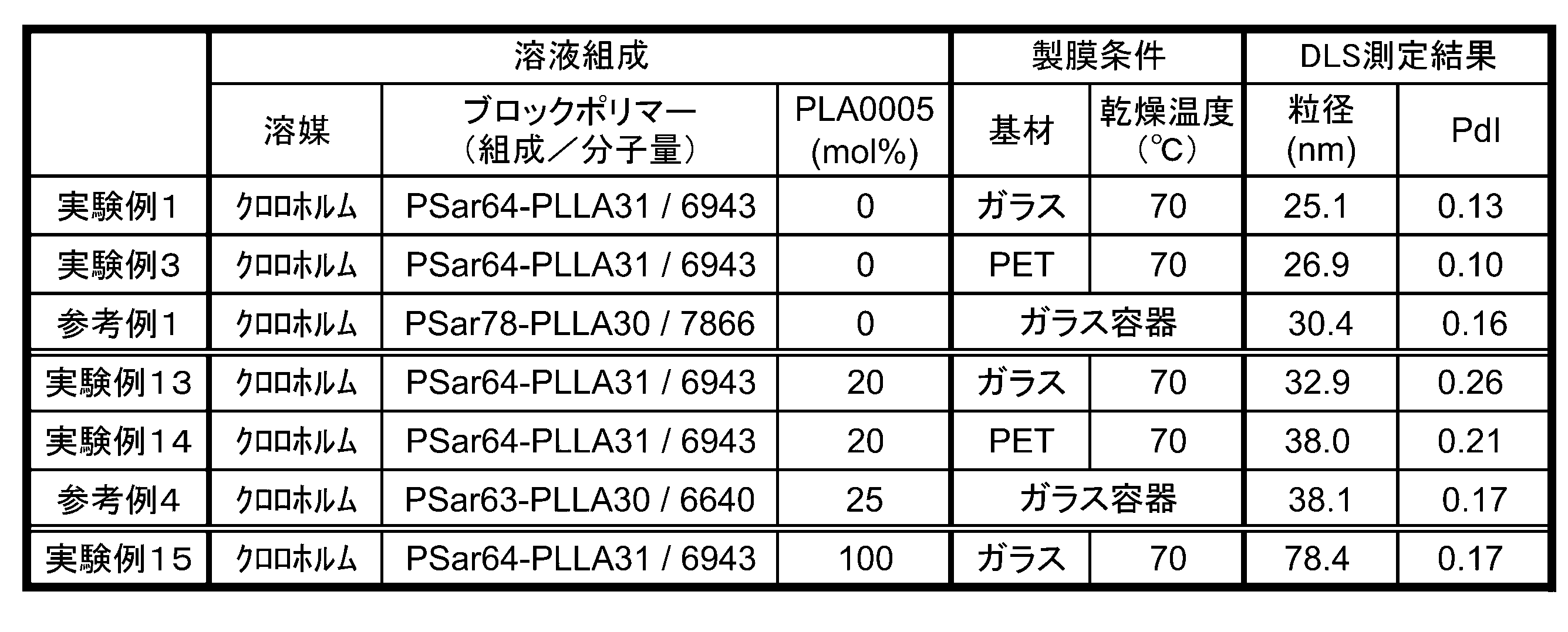
- the particle diameters and PdI of the molecular assemblies obtained in Experimental Examples 1 to 5 were the same as those in Reference Example 1 by the conventional film method for forming molecular assemblies in a glass container (in Reference Example 1, The particle size is increasing, which is probably due to the different chain lengths of the amphiphilic block polymers). From this result, it is considered that the molecular assembly obtained by the method of the present invention is equivalent to the molecular assembly obtained by the conventional film forming method.
- Reference Example 4 In Reference Example 4, a solution containing 25 mol% of polylactic acid (PLA0005) with respect to 100 mol% of the amphiphilic block polymer (PSar63-PLLA30) was used, and the amphiphilic block polymer was obtained by the film method described in WO2009 / 148121. Obtained particles.
- Table 2 shows the solution compositions, film forming conditions, and DLS measurement results of Experimental Examples 13 to 15 and Reference Example 4 together with the results of Experimental Examples 1 and 3 and Reference Example 1.
Landscapes
- Chemical & Material Sciences (AREA)
- Organic Chemistry (AREA)
- Chemical Kinetics & Catalysis (AREA)
- Polymers & Plastics (AREA)
- Health & Medical Sciences (AREA)
- Medicinal Chemistry (AREA)
- Dispersion Chemistry (AREA)
- Engineering & Computer Science (AREA)
- Manufacturing & Machinery (AREA)
- Materials Engineering (AREA)
- Medicinal Preparation (AREA)
- Processes Of Treating Macromolecular Substances (AREA)
- Manufacture Of Macromolecular Shaped Articles (AREA)
Abstract
Description
本発明に用いられる両親媒性ブロックポリマーは、親水性ブロック鎖と疎水性ブロック鎖とを有するブロックポリマーである。親水性ブロック鎖のモノマー単位としては、アルキレンオキシドやサルコシン等が挙げられる。疎水性ブロック鎖のモノマー単位としては、グリコール酸、乳酸、ヒドロキシイソ酪酸等のヒドロキシ酸や、グリシン、アラニン、バリン、ロイシン、イソロイシン、プロリン、メチオニン、チロシン、トリプトファン、グルタミン酸メチル、グルタミン酸ベンジル、アスパラギン酸メチル、アスパラギン酸エチル、アスパラギン酸ベンジル等の疎水性アミノ酸あるいはアミノ酸誘導体が挙げられる。
親水性ブロック鎖は、サルコシン単位(N-メチルグリシン単位)を含む。サルコシンは、水溶性が高い。また、ポリサルコシンはN置換アミドを有することからシス-トランス異性化が可能であり、かつ、α炭素まわりの立体障害が少ないことから、高い柔軟性を有する。そのため、ポリサルコシン鎖を構成単位として用いることにより、高い親水性と柔軟性とを併せ持つ親水性ブロック鎖が形成される。
疎水性ブロックは、乳酸単位を含む。ポリ乳酸は、優れた生体適合性および安定性を有する。また、ポリ乳酸は、優れた生分解性を有することから、代謝が早く、生体内においてがん組織以外への集積性が低い。そのため、ポリ乳酸を構成ブロックとした両親媒性ポリマーから得られる分子集合体は、生体、特に人体への応用において有用である。また、ポリ乳酸は、低沸点溶媒への溶解性が高いため、分子集合体を製造するための溶液(両親媒性ブロックポリマー溶液)に、低沸点の有機溶媒を使用可能である。そのため、分子集合体の製造効率が高められる。
両親媒性ポリマーは、親水性ブロック鎖と疎水性ブロック鎖とを結合させたものである。親水性ブロック鎖と疎水性ブロック鎖とは、リンカーを介して結合していてもよい。リンカーとしては、疎水性ブロック鎖の構成単位である乳酸モノマー(乳酸やラクチド)またはポリ乳酸鎖と結合可能な官能基(例えば、水酸基、アミノ基等)と、親水性ブロックの構成単位であるサルコシンモノマー(例えばサルコシンやN-カルボキシサルコシン無水物)またはポリサルコシンと結合可能な官能基(例えばアミノ基)とを有するものが好ましく用いられる。リンカーを適宜に選択することにより、親水性ブロック鎖や疎水性ブロック鎖の分枝構造を制御することができる。
本発明においては、有機溶媒中に両親媒性ブロックポリマーを含む溶液を、面状の基材上に層状に塗布し、基材上で塗布層を乾燥してフィルムを形成する。このフィルムを水系液体と接触させることにより、分子集合体が得られる。
両親媒性ブロックポリマー溶液は、上記の両親媒性ブロックポリマーを有機溶媒中に溶解させることにより調製できる。有機溶媒は、両親媒性ブロックポリマーを溶解可能なものであれば特に限定されない。有機溶媒としては、メタノール、エタノール、イソプロパノール、ブタノール、トリフルオロエタノール、ヘキサフルオロイソプロパノール等のアルコール類;アセトン、メチルエチルケトン、メチルイソブチルケトン、メチル-n-アミルケトン、シクロヘキサノン、ジアセトンアルコール、ジイソブチルケトン、メチルシクロヘキサノン等のケトン類;ジメチルエーテル、ジエチルエーテル、メチルエチルエーテル、メチルセロソルブ、メチルカルビトール等の鎖状エーテル;テトラヒドロフラン、1,2‐ジオキソラン、1,3‐ジオキソラン、1,2‐ジオキサン、1,3‐ジオキサン、1,4‐ジオキサン、1,3,5‐トリオキサン等の環状エーテル;トルエン、キシレン等の芳香族炭化水素;クロロホルム、ジクロロメタン、ジクロロエタン、トリクロロエタン、テトラクロロエタン等のハロゲン化炭化水素;酢酸メチル、酢酸エチル、酢酸プロピル、酢酸イソプロピル、酢酸ブチル、乳酸エチル、乳酸ブチル、安息香酸エチル、アセト酢酸メチル等のエステル類;シクロペンタン、シクロヘキサン、メチルシクロヘキサン、エチルシクロヘキサン等の脂環式炭化水素; アセトニトリル、ジメチルスルホキシド、ジメチルホルムアミド等が挙げられる。例えば、サルコシン単位を含む親水性ブロック鎖と乳酸単位を含む疎水性ブロック鎖とを有する両親媒性ブロックポリマーを用いた分子集合体(ラクトソーム)の形成においては、アルコール類、ハロゲン化炭化水素、ジメチルホルムアミド等の有機溶媒が好ましく用いられる。有機溶媒は2種以上の溶媒からなる混合溶媒でもよい。
両親媒性ブロックポリマー溶液は、上記両親媒性ブロックポリマーおよび溶媒以外の物質を含有していてもよい。例えば、溶液中に疎水性ポリマーを含有させることにより、分子集合体形成時の疎水コアの形成促進や、分子集合体の粒子サイズを調整することができる。また、溶液中に、薬剤等を含めることにより、これらを分子集合体中に取り込むこともできる。
上記の両親媒性ブロックポリマー溶液を基材上に層状に塗布し、乾燥することにより、ブロックポリマーフィルムが得られる。溶液を層状に塗布するために、基材の塗布面は面状である。なお、「面状」とは、溶液を塗布する部分が面状であればよい。基材の形状としては、好ましくは板状または筒状である。板状の基材としては、ガラス板、樹脂板、金属板等の剛性基材や、樹脂フィルム、金属箔等の可撓性基材が挙げられる。筒状とは無端であることを意味し、円筒形に限定されるものではない。筒状の基材としては、エンドレスベルト等の可撓性基材や、円筒形のキャストドラムロール等の剛性基材が挙げられる。連続生産性を高めるためには、可撓性の板状基材、可撓性または剛性の筒状基材が好ましく用いられる。
基材上に形成された両親媒性ブロックポリマーのフィルムを水系液体と接触させることにより、両親媒性ポリマーの分子集合体が得られる。水系液体は、水または水溶液である。水溶液としては、注射用蒸留水、生理食塩水、緩衝液等、生化学的、薬学的に許容し得る水溶液が好ましく用いられる。水系液体に、シグナル剤、リガンド、薬剤等の付加化合物を含めることにより、これらの付加化合物を包埋する分子集合体を得ることもできる。
図1は、分子集合体の作成に用いられる分子集合体製造装置の一形態を表す模式的断面図である。図1の装置1では、基材として可撓性の長尺フィルムが用いられる。基材移動機構としての繰出部20および巻取部29は回転可能に構成されており、繰出部20から繰り出されたフィルム基材は、巻取部29に向けて連続的に搬送されて、塗布、乾燥、水系液体との接触が順次行われ、その後巻取部29で基材フィルムが回収される。なお、繰出部20と巻取部29との間には、フィルムを搬送するためのニップロール(不図示)が設けられていてもよい。
フィルム基材は、可撓性を有するものであればよく、機械的強度、熱安定性、耐溶剤性に優れるものが好ましく用いられる。フィルム基材としては、樹脂フィルムや金属箔、可撓性ガラス等が用いられる。中でも、安価であり、表面平滑性に優れ、かつ異物の発生が少ないことから、樹脂フィルムが好ましい。フィルム基材を構成する樹脂材料としては、ポリエチレンテレフタレート(PET)やポリエチレンナフタレート(PEN)等のポリエステル類;ジアセチルセルロース(DAC)やトリアセチルセルロース(TAC)等のセルロース系ポリマー;ポリメチルメタクリレート(PMMA)等のアクリル系ポリマー;ポリスチレンやアクリロニトリル・スチレン共重合体等(SAN)のスチレン系ポリマー;ポリエチレン、ポリプロピレン、エチレン・プロピレン共重合体、トリメチルペンテン(PMP)等のポリオレフィン;ポリノルボルネン等の環状ポリオレフィン;ナイロンや芳香族ポリアミド等のアミド系ポリマー;ポリカーボネート;塩化ビニル;イミド系ポリマー;ポリテトラフルオロエチレン(PTFE)、パーフルオロアルコキシアルカン(PFA)、エチレン・テトラフルオロエチレン共重合体(ETFE)等のフッ素系ポリマー;ポリエーテルスルホン等のスルホン系ポリマー;ポリエーテルエーテルケトン;ポリフェニレンスルフィド;塩化ビニリデン;エポキシ系ポリマー等が挙げられる。これらの中から、ポリマー溶液の有機溶媒に対する耐久性や、溶液の塗布性(表面の濡れ性等)、乾燥温度での耐熱性等を考慮して適宜の材料が選択される。
製膜部40では、繰出部20から搬送されたフィルム基材11の塗布面上に、両親媒性ブロックポリマー溶液45が層状に塗布される。図1では、溶液パン47内の両親媒性ブロックポリマー溶液45にグラビアロール41を直接接触させる形態(ダイレクトグラビア法)が図示されている。溶液パン47内の溶液45は、グラビアロールの表面に付着し、余剰分がドクターブレード44で掻き落とされ、フィルム基材とグラビアロールとの間に両親媒性ブロックポリマー溶液が供給される。
ポリマー溶液の塗布層が形成されたフィルム基材13は、乾燥部30に搬送され、溶媒が除去され、フィルム基材上に両親媒性ポリマーフィルムが密着積層された積層体が得られる。乾燥部30では、加熱により溶媒の除去が行われることが好ましい。塗布面側および背面側のいずれから加熱を行ってもよい。また、塗布面側および背面側の両方から加熱を行うこともできる。塗布層の厚みが大きい場合は、基材との界面付近の溶媒の除去を確実に行うために、少なくとも背面側から加熱を行うことが好ましい。
両親媒性ポリマーフィルムが密着積層されたフィルム基材15は、分子集合体形成部50に搬送される。分子集合体形成部では、水浴57中の水系液体55と両親媒性ポリマーフィルムとが接触することにより、分子集合体が形成される。分子集合体形成部50では、分子集合体の形成を促進するために、水系液体55中に、両親媒性ポリマーフィルムが密着積層された基材を浸漬することが好ましい。
本発明の製造方法に用いられる分子集合体製造装置は、基材上へ層状に溶液の塗布を行う製膜部、基材上の塗布層から溶媒を除去して基材上に両親媒性ポリマーフィルムを形成する乾燥部、および水系液体との接触により分子集合体を得る分子集合体形成部を有し、これらの間を、基材を順に移動させるための移動機構を備えていれば、その構成は図1に示す形態に限定されない。
水系液体中に回収された分子集合体は、適宜の後処理に供してもよい。後処理としては、有機溶媒の除去が挙げられる。有機溶媒を除去する前に、適宜の精製処理を行ってもよい。精製処理としては、例えばゲルろ過クロマトグラフィー、フィルタリング、超遠心等が挙げられる。このようにして、分子集合体(ナノ粒子)の溶液ないしは分散液を得ることができる。
本発明の方法により得られる分子集合体は、従来のフィルム法により得られる分子集合体と同様の特性を有する。分子集合体の大きさは、例えば粒子径10~500nmである。生体内への分子イメージング等に用いられる分子集合体は、粒子径が15nm~200nmであることが好ましく、20nm~100nmであることがより好ましい。ここで「粒子径」とは、粒子分布で最も出現頻度の高い粒子径、すなわち中心粒子径をいう。分子集合体の粒子径は、動的光散乱(Dynamic Light Scattering:DLS)法により測定できる。
以下の実験例および参考例において、分子集合体の粒子径および多分散性指数(Polydispersity Index; PdI)は、Malvern社製 Zetasizer Nano Sを用い、動的光散乱(DLS)法により測定した。DLS測定結果に、実験環境起因のコンタミネーションがみられたもの(実験例2~9,14)は、100nmのフィルタを通した後、再測定を行った。
WO2009/148121号に記載の方法を参照して、サルコシン無水物およびアミノ化ポリL-乳酸をモノマー成分として、グリコール酸、O-(ベンゾトリアゾル-1-イル)-N,N,N’,N’-テトラメチルウロニウムヘキサフルオロリン酸塩(HATU)およびN,N-ジイソプロピルエチルアミン(DIEA)を用いて、サルコシン単位64個からなる親水性ブロックとL-乳酸単位31個からなる疎水性ブロックとを有する直鎖状の両親媒性ブロックポリマー(PSar64-PLLA31;分子量6943)を合成した。
上記合成例で得られたブロックポリマーをクロロホルムに溶解して、100mg/mLの溶液を得た。面状ヒータ上でガラス板を70℃に加熱しながら、ガラス板上の約5cm2の範囲に、上記のブロックポリマー溶液150μLを滴下した(塗布層の厚み:約300μm)。その後、面状ヒータによる加熱を継続し、溶媒を十分に除去することにより、ガラス板上にブロックポリマーのフィルムを得た。得られたポリマーフィルムを蒸留水(ポリマー1mgに対して1mL)に浸漬し、85℃で20分加熱し、両親媒性ブロックポリマー粒子の分散液を得た。
実験例2~5では、面状ヒータ上で樹脂フィルムを70℃に加熱しながら、樹脂フィルム上に、上記のブロックポリマー溶液150μLを滴下し、実験例1と同様にしてブロックポリマーフィルムの作製、蒸留水への浸漬および加熱を行い、両親媒性ブロックポリマー粒子の分散液を得た。各実験例で用いた樹脂フィルムは、パーフルオロアルコキシアルカン(PFA;実験例2)、ポリエチレンテレフタレート(PET;実験例3)、ポリメチルペンテン(PMP;実験例4)、ポリイミド(PI;実験例5)のフィルムであった。
有機溶媒の種類、基材の種類および乾燥温度(面状ヒータによる加熱温度)を表1に示すように変更した。それ以外は実験例1と同様にして、両親媒性ブロックポリマーの粒子の分散液を得た。
参考例1~3では、WO2009/148121号に記載のフィルム法により、両親媒性ブロックポリマーの粒子を得た。具体的には、ブロックポリマー溶液をガラス製のフラスコに入れ、エバポレーターを用いてフラスコの壁面にポリマーフィルムを形成させた。さらに、内壁面にフィルムが形成されフラスコ内に水を加え、温度85℃で30分間超音波処理を行い、両親媒性ブロックポリマーの粒子の分散液を得た。なお、参考例1~3では、上記実験例とは異なる合成ロットのポリマーを用いた。各参考例で用いたブロックポリマーのサルコシン単位数(PSar)、L-乳酸単位数(PLLA)および分子量を表1に示している。

実験例13~15では、両親媒性ブロックポリマー(PSar64-PLLA31)に加えて、疎水性ポリマーとしてポリ乳酸(DL-乳酸の直鎖状ホモポリマー、重量平均分子量5000:和光純薬製 PLA-0005)をクロロホルムに溶解した溶液を用いた。ポリ乳酸の含有量は、両親媒性ブロックポリマー100mol%に対して、20mol%(実験例13,14)および100mol%(実験例15)とした。実験例13および実験例15では面状ヒータ上でガラス板を70℃に加熱しながら、ガラス板上に溶液を滴下した。実験例14では、面状ヒータ上でPETフィルムを70℃に加熱しながら、PETフィルム上に溶液を滴下した。それ以外は、実験例1と同様にして、両親媒性ブロックポリマー粒子の分散液を得た。
参考例4では、両親媒性ブロックポリマー(PSar63-PLLA30)100mol%に対して、ポリ乳酸(PLA0005)を25mol%含む溶液を用い、WO2009/148121号に記載のフィルム法により、両親媒性ブロックポリマーの粒子を得た。
10,11,13,15,17,19 フィルム基材
110 製膜ドラム
40,140 製膜部
41 グラビアロール(製膜ロール)
42 バックアップロール
45,145 両親媒性ブロックポリマー溶液
30,130 乾燥部
50,150 分子集合体形成部
55,155 水系液体
57,157 水浴
Claims (18)
- 両親媒性ブロックポリマーの分子集合体を製造する方法であって、
親水性ブロック鎖と疎水性ブロック鎖とを有する両親媒性ブロックポリマーおよび溶媒を含むポリマー溶液を、面状の基材上に層状に塗布するステップ;
前記ポリマー溶液の塗布層から溶媒を除去し、前記基材上にポリマーフィルムを形成するステップ;および
前記ポリマーフィルムを水系液体と接触させ、分子集合体を得るステップ、
を有する、分子集合体の製造方法。 - 前記基材は板状である、請求項1に記載の分子集合体の製造方法。
- 前記基材は可撓性の長尺フィルムである、請求項2に記載の分子集合体の製造方法。
- 前記基材は筒状である、請求項1に記載の分子集合体の製造方法。
- 前記ポリマー溶液が層状に塗布される際に、前記基材は、平面状または塗布面が凸の曲面状である、請求項1~4のいずれか1項に記載の分子集合体の製造方法。
- 前記ポリマー溶液が層状に塗布される際に、前記基材が加温された状態で供給される、請求項1~5のいずれか1項に記載の分子集合体の製造方法。
- 前記両親媒性ブロックポリマーは、前記親水性ブロック鎖が20個以上のサルコシン単位を有し、前記疎水性ブロック鎖が10個以上の乳酸単位を有する、請求項1~6のいずれか1項に記載の分子集合体の製造方法。
- 前記ポリマー溶液は、疎水性ポリマーをさらに含有する、請求項1~7のいずれか1項に記載の分子集合体の製造方法。
- 前記疎水性ポリマーは、シグナル剤、リガンドおよび薬剤からなる群から選択される1以上が結合したポリマーである、請求項8に記載の分子集合体の製造方法。
- 前記ポリマー溶液は、シグナル剤、リガンドおよび薬剤からなる群から選択される1以上の付加化合物を含有し、
前記分子集合体は、前記両親媒性ブロックポリマーと、前記ポリマー溶液中に含まれる前記付加化合物とを含む分子集合体である、請求項1~9のいずれか1項に記載の分子集合体の製造方法。 - 前記ポリマー溶液の前記溶媒は、沸点が200℃以下である、請求項1~10のいずれか1項に記載の分子集合体の製造方法。
- 前記水系液体は、シグナル剤、リガンドおよび薬剤からなる群から選択される1以上の付加化合物を含有し、
前記分子集合体は、前記両親媒性ブロックポリマーと、前記水系液体中に含まれる前記付加化合物とを含む分子集合体である、請求項1~11のいずれか1項に記載の分子集合体の製造方法。 - 前記分子集合体は、粒子径が、10~500nmである、請求項1~12のいずれか1項に記載のナノ粒子の製造方法。
- 前記分子集合体は、粒子径の多分散性指数が0.3以下である、請求項1~13のいずれか1項に記載のナノ粒子の製造方法。
- 両親媒性ブロックポリマーの分子集合体を製造するための分子集合体製造装置であって、
親水性ブロック鎖と疎水性ブロック鎖とを有する両親媒性ブロックポリマーおよび溶媒を含むポリマー溶液を、面状の基材上に層状に塗布する製膜部;
前記ポリマー溶液の塗布層から溶媒を除去し、前記基材上にポリマーフィルムを形成する乾燥部;および
前記ポリマーフィルムを水系液体と接触させ、分子集合体を得る分子集合体形成部、を備え、
さらに、前記製膜部、前記乾燥部および前記分子集合体形成部へと、前記基材を順に移動させる基材移動機構を備える、分子集合体製造装置。 - 前記基材は可撓性の長尺フィルムであり、
前記基材移動機構は、巻回体から長尺フィルムを繰り出して前記製膜部へ搬送する繰出部と、前記分子集合体形成部から搬送された長尺フィルムを回収する巻取部とを備える、請求項15に記載の分子集合体製造装置。 - 前記基材は筒状であり、
前記基材移動機構は、筒状基材の外周面を、前記製膜部、前記乾燥部および前記分子集合体形成部へと順に移動させ、筒状基材の外周面を前記製膜部へ再度移動させる、請求項16に記載の分子集合体製造装置。 - 前記分子集合体形成部は水浴中に水系液体を含んでおり、前記ポリマーフィルムが表面に形成された前記基材を前記水系液体中に浸漬することにより、前記ポリマーフィルムを前記水系液体と接触させる、請求項15~17のいずれか1項に記載の分子集合体製造装置。
Priority Applications (7)
| Application Number | Priority Date | Filing Date | Title |
|---|---|---|---|
| CN201580075537.7A CN107207742B (zh) | 2015-02-04 | 2015-02-04 | 分子聚集体的制造方法和分子聚集体制造装置 |
| EP15881089.5A EP3231832B1 (en) | 2015-02-04 | 2015-02-04 | Method for producing molecular assemblies |
| US15/547,687 US20180021748A1 (en) | 2015-02-04 | 2015-02-04 | Method for producing molecular assemblies, and device for producing molecular assemblies |
| JP2016572997A JPWO2016125272A1 (ja) | 2015-02-04 | 2015-02-04 | 分子集合体の製造方法および分子集合体製造装置 |
| PCT/JP2015/053116 WO2016125272A1 (ja) | 2015-02-04 | 2015-02-04 | 分子集合体の製造方法および分子集合体製造装置 |
| TW105101154A TWI570168B (zh) | 2015-02-04 | 2016-01-15 | A method for producing a molecular assembly, and a device for producing an aggregate |
| US16/775,358 US20200164331A1 (en) | 2015-02-04 | 2020-01-29 | Method for producing molecular assemblies, and device for producing molecular assemblies |
Applications Claiming Priority (1)
| Application Number | Priority Date | Filing Date | Title |
|---|---|---|---|
| PCT/JP2015/053116 WO2016125272A1 (ja) | 2015-02-04 | 2015-02-04 | 分子集合体の製造方法および分子集合体製造装置 |
Related Child Applications (2)
| Application Number | Title | Priority Date | Filing Date |
|---|---|---|---|
| US15/547,687 A-371-Of-International US20180021748A1 (en) | 2015-02-04 | 2015-02-04 | Method for producing molecular assemblies, and device for producing molecular assemblies |
| US16/775,358 Division US20200164331A1 (en) | 2015-02-04 | 2020-01-29 | Method for producing molecular assemblies, and device for producing molecular assemblies |
Publications (1)
| Publication Number | Publication Date |
|---|---|
| WO2016125272A1 true WO2016125272A1 (ja) | 2016-08-11 |
Family
ID=56563636
Family Applications (1)
| Application Number | Title | Priority Date | Filing Date |
|---|---|---|---|
| PCT/JP2015/053116 Ceased WO2016125272A1 (ja) | 2015-02-04 | 2015-02-04 | 分子集合体の製造方法および分子集合体製造装置 |
Country Status (6)
| Country | Link |
|---|---|
| US (2) | US20180021748A1 (ja) |
| EP (1) | EP3231832B1 (ja) |
| JP (1) | JPWO2016125272A1 (ja) |
| CN (1) | CN107207742B (ja) |
| TW (1) | TWI570168B (ja) |
| WO (1) | WO2016125272A1 (ja) |
Cited By (7)
| Publication number | Priority date | Publication date | Assignee | Title |
|---|---|---|---|---|
| WO2018134953A1 (ja) * | 2017-01-19 | 2018-07-26 | 株式会社島津製作所 | ヒドロゲル組成物およびその製造方法 |
| US11709155B2 (en) | 2017-09-18 | 2023-07-25 | Waters Technologies Corporation | Use of vapor deposition coated flow paths for improved chromatography of metal interacting analytes |
| US11709156B2 (en) | 2017-09-18 | 2023-07-25 | Waters Technologies Corporation | Use of vapor deposition coated flow paths for improved analytical analysis |
| US11918936B2 (en) | 2020-01-17 | 2024-03-05 | Waters Technologies Corporation | Performance and dynamic range for oligonucleotide bioanalysis through reduction of non specific binding |
| US12181452B2 (en) | 2017-09-18 | 2024-12-31 | Waters Technologies Corporation | Use of vapor deposition coated flow paths for improved chromatography of metal interacting analytes |
| US12180581B2 (en) | 2017-09-18 | 2024-12-31 | Waters Technologies Corporation | Use of vapor deposition coated flow paths for improved chromatography of metal interacting analytes |
| US12352734B2 (en) | 2020-09-24 | 2025-07-08 | Waters Technologies Corporation | Chromatographic hardware improvements for separation of reactive molecules |
Families Citing this family (3)
| Publication number | Priority date | Publication date | Assignee | Title |
|---|---|---|---|---|
| WO2016154342A1 (en) * | 2015-03-24 | 2016-09-29 | South Dakota Board Of Regents | High shear thin film machine for dispersion and simultaneous orientation-distribution of nanoparticles within polymer matrix |
| CN110021381B (zh) * | 2017-10-23 | 2021-07-09 | 中国石油化工股份有限公司 | 一种用于打破重油沥青质分子聚集体的添加剂及方法 |
| CN115090227B (zh) * | 2022-07-28 | 2023-09-22 | 巩义市泛锐熠辉复合材料有限公司 | 一种连续化制备气凝胶粉的设备、方法及气凝胶粉 |
Citations (6)
| Publication number | Priority date | Publication date | Assignee | Title |
|---|---|---|---|---|
| JP2005520872A (ja) * | 2002-03-20 | 2005-07-14 | ローディア,インコーポレイテッド | 両親媒性ジブロック共重合体及び疎水性化合物を含むベシクル |
| JP2009510109A (ja) * | 2005-09-28 | 2009-03-12 | ザ・トラスティーズ・オブ・ザ・ユニバーシティ・オブ・ペンシルバニア | 自己組織化生分解性ポリマーソーム |
| WO2009148121A1 (ja) * | 2008-06-05 | 2009-12-10 | 株式会社 島津製作所 | 新規な分子集合体、それを用いた分子イメージング用分子プローブ及び薬剤搬送システム用分子プローブ、並びに分子イメージングシステム及び薬剤搬送システム |
| JP2011062586A (ja) * | 2009-09-15 | 2011-03-31 | Biseibutsu Kagaku Kenkyusho:Kk | リポソームの連続大量製造方法およびその装置 |
| WO2012176885A1 (ja) * | 2011-06-23 | 2012-12-27 | 株式会社 島津製作所 | 分岐型両親媒性ブロックポリマー、それを用いた分子集合体及び薬剤搬送システム |
| JP2014156555A (ja) * | 2013-02-17 | 2014-08-28 | Shimadzu Corp | ナノ粒子の製造方法 |
Family Cites Families (4)
| Publication number | Priority date | Publication date | Assignee | Title |
|---|---|---|---|---|
| CN103402547B (zh) * | 2011-03-02 | 2017-08-04 | 国立大学法人京都大学 | 开关型荧光纳米颗粒探针以及使用其的荧光分子成像法 |
| WO2012128326A1 (ja) * | 2011-03-23 | 2012-09-27 | 国立大学法人筑波大学 | 光線力学治療用ナノ粒子 |
| US20150031988A1 (en) * | 2011-09-16 | 2015-01-29 | Eri Takeuchi | Nano-particles for internal radiation therapy of involved area, and therapy system |
| JP2014105161A (ja) * | 2012-11-25 | 2014-06-09 | Shimadzu Corp | 金属イオン含有両親媒性ブロックポリマー及び金属イオン含有ナノ粒子、並びに前記ナノ粒子を用いた分子イメージング用プローブ及び薬剤搬送システム |
-
2015
- 2015-02-04 JP JP2016572997A patent/JPWO2016125272A1/ja active Pending
- 2015-02-04 US US15/547,687 patent/US20180021748A1/en not_active Abandoned
- 2015-02-04 EP EP15881089.5A patent/EP3231832B1/en active Active
- 2015-02-04 WO PCT/JP2015/053116 patent/WO2016125272A1/ja not_active Ceased
- 2015-02-04 CN CN201580075537.7A patent/CN107207742B/zh active Active
-
2016
- 2016-01-15 TW TW105101154A patent/TWI570168B/zh not_active IP Right Cessation
-
2020
- 2020-01-29 US US16/775,358 patent/US20200164331A1/en not_active Abandoned
Patent Citations (6)
| Publication number | Priority date | Publication date | Assignee | Title |
|---|---|---|---|---|
| JP2005520872A (ja) * | 2002-03-20 | 2005-07-14 | ローディア,インコーポレイテッド | 両親媒性ジブロック共重合体及び疎水性化合物を含むベシクル |
| JP2009510109A (ja) * | 2005-09-28 | 2009-03-12 | ザ・トラスティーズ・オブ・ザ・ユニバーシティ・オブ・ペンシルバニア | 自己組織化生分解性ポリマーソーム |
| WO2009148121A1 (ja) * | 2008-06-05 | 2009-12-10 | 株式会社 島津製作所 | 新規な分子集合体、それを用いた分子イメージング用分子プローブ及び薬剤搬送システム用分子プローブ、並びに分子イメージングシステム及び薬剤搬送システム |
| JP2011062586A (ja) * | 2009-09-15 | 2011-03-31 | Biseibutsu Kagaku Kenkyusho:Kk | リポソームの連続大量製造方法およびその装置 |
| WO2012176885A1 (ja) * | 2011-06-23 | 2012-12-27 | 株式会社 島津製作所 | 分岐型両親媒性ブロックポリマー、それを用いた分子集合体及び薬剤搬送システム |
| JP2014156555A (ja) * | 2013-02-17 | 2014-08-28 | Shimadzu Corp | ナノ粒子の製造方法 |
Non-Patent Citations (1)
| Title |
|---|
| See also references of EP3231832A4 * |
Cited By (10)
| Publication number | Priority date | Publication date | Assignee | Title |
|---|---|---|---|---|
| WO2018134953A1 (ja) * | 2017-01-19 | 2018-07-26 | 株式会社島津製作所 | ヒドロゲル組成物およびその製造方法 |
| JPWO2018134953A1 (ja) * | 2017-01-19 | 2019-11-14 | 株式会社島津製作所 | ヒドロゲル組成物およびその製造方法 |
| US11709155B2 (en) | 2017-09-18 | 2023-07-25 | Waters Technologies Corporation | Use of vapor deposition coated flow paths for improved chromatography of metal interacting analytes |
| US11709156B2 (en) | 2017-09-18 | 2023-07-25 | Waters Technologies Corporation | Use of vapor deposition coated flow paths for improved analytical analysis |
| US12181452B2 (en) | 2017-09-18 | 2024-12-31 | Waters Technologies Corporation | Use of vapor deposition coated flow paths for improved chromatography of metal interacting analytes |
| US12180581B2 (en) | 2017-09-18 | 2024-12-31 | Waters Technologies Corporation | Use of vapor deposition coated flow paths for improved chromatography of metal interacting analytes |
| US12416607B2 (en) | 2017-09-18 | 2025-09-16 | Waters Technologies Corporation | Use of vapor deposition coated flow paths for improved chromatography of metal interacting analytes |
| US12510520B2 (en) | 2017-09-18 | 2025-12-30 | Waters Technologies Corporation | Use of vapor deposition coated flow paths for improved analytical analysis |
| US11918936B2 (en) | 2020-01-17 | 2024-03-05 | Waters Technologies Corporation | Performance and dynamic range for oligonucleotide bioanalysis through reduction of non specific binding |
| US12352734B2 (en) | 2020-09-24 | 2025-07-08 | Waters Technologies Corporation | Chromatographic hardware improvements for separation of reactive molecules |
Also Published As
| Publication number | Publication date |
|---|---|
| TWI570168B (zh) | 2017-02-11 |
| US20200164331A1 (en) | 2020-05-28 |
| JPWO2016125272A1 (ja) | 2017-10-05 |
| US20180021748A1 (en) | 2018-01-25 |
| TW201629130A (zh) | 2016-08-16 |
| CN107207742A (zh) | 2017-09-26 |
| EP3231832B1 (en) | 2021-03-31 |
| EP3231832A4 (en) | 2018-12-05 |
| EP3231832A1 (en) | 2017-10-18 |
| CN107207742B (zh) | 2020-10-30 |
Similar Documents
| Publication | Publication Date | Title |
|---|---|---|
| JPWO2016125272A1 (ja) | 分子集合体の製造方法および分子集合体製造装置 | |
| Singh et al. | On-demand drug delivery systems using nanofibers | |
| Yadav et al. | Nanoscale self-assembly for therapeutic delivery | |
| Zhang et al. | Polymersomes in nanomedicine-a review | |
| AU2004228008B2 (en) | Tumor-targeting drug-loaded particles | |
| Park et al. | Polydopamine-based simple and versatile surface modification of polymeric nano drug carriers | |
| Rao et al. | Biodegradable PLGA based nanoparticles for sustained regional lymphatic drug delivery | |
| CA2823355C (en) | Nanoparticle and surface-modified particulate coatings, coated balloons, and methods therefore | |
| US8043631B2 (en) | Tumor targeting drug-loaded particles | |
| Neerooa et al. | Development of polymer-assisted nanoparticles and nanogels for cancer therapy: an update | |
| Chen et al. | Surface modification of mitoxantrone-loaded PLGA nanospheres with chitosan | |
| Palacio et al. | PEGylation of PLA nanoparticles to improve mucus-penetration and colloidal stability for oral delivery systems | |
| Esfandyari-Manesh et al. | Improved anticancer delivery of paclitaxel by albumin surface modification of PLGA nanoparticles | |
| US20120059456A1 (en) | Modification of stent surfaces to impart functionality | |
| CN103635514B (zh) | 支链型两亲性嵌段聚合物、使用其的分子聚集体及药物输送系统 | |
| Gillella et al. | Polymeric nanoparticles–a review | |
| Karewicz | Polymeric and liposomal nanocarriers for controlled drug delivery | |
| Karimi et al. | Study of release behavior of carboplatin from modified immunoglobulin nanoparticles by folic acid: preparation, characterization and analytical approaches | |
| Pastorino et al. | Towards the fabrication of polyelectrolyte-based nanocapsules for bio-medical applications | |
| Rramaswamy et al. | Preparation and characterization of tetrahydrocurcumin-loaded cellulose acetate phthalate/polyethylene glycol electrospun nanofibers | |
| Jiao et al. | Layer-by-layer assembly of poly (lactic acid) nanoparticles: A facile way to fabricate films for model drug delivery | |
| Jagtiani et al. | Recent advancements of electrospun nanofibers for cancer therapy | |
| Pande | Studies on the characteristics of zaltoprofen loaded gelatin nanoparticles by nanoprecipitation | |
| JP6519659B2 (ja) | ナノ粒子の製造方法 | |
| CN114831966B (zh) | 一种无毒副作用的光热转换纳米复合材料及其制备方法和应用 |
Legal Events
| Date | Code | Title | Description |
|---|---|---|---|
| 121 | Ep: the epo has been informed by wipo that ep was designated in this application |
Ref document number: 15881089 Country of ref document: EP Kind code of ref document: A1 |
|
| ENP | Entry into the national phase |
Ref document number: 2016572997 Country of ref document: JP Kind code of ref document: A |
|
| REEP | Request for entry into the european phase |
Ref document number: 2015881089 Country of ref document: EP |
|
| WWE | Wipo information: entry into national phase |
Ref document number: 15547687 Country of ref document: US |
|
| NENP | Non-entry into the national phase |
Ref country code: DE |