WO2016125727A1 - フェロコークスの製造方法 - Google Patents
フェロコークスの製造方法 Download PDFInfo
- Publication number
- WO2016125727A1 WO2016125727A1 PCT/JP2016/052875 JP2016052875W WO2016125727A1 WO 2016125727 A1 WO2016125727 A1 WO 2016125727A1 JP 2016052875 W JP2016052875 W JP 2016052875W WO 2016125727 A1 WO2016125727 A1 WO 2016125727A1
- Authority
- WO
- WIPO (PCT)
- Prior art keywords
- coal
- softening
- csn
- coke
- ferro
- Prior art date
- Legal status (The legal status is an assumption and is not a legal conclusion. Google has not performed a legal analysis and makes no representation as to the accuracy of the status listed.)
- Ceased
Links
Images



Classifications
-
- C—CHEMISTRY; METALLURGY
- C22—METALLURGY; FERROUS OR NON-FERROUS ALLOYS; TREATMENT OF ALLOYS OR NON-FERROUS METALS
- C22B—PRODUCTION AND REFINING OF METALS; PRETREATMENT OF RAW MATERIALS
- C22B1/00—Preliminary treatment of ores or scrap
- C22B1/14—Agglomerating; Briquetting; Binding; Granulating
- C22B1/24—Binding; Briquetting ; Granulating
- C22B1/242—Binding; Briquetting ; Granulating with binders
-
- C—CHEMISTRY; METALLURGY
- C10—PETROLEUM, GAS OR COKE INDUSTRIES; TECHNICAL GASES CONTAINING CARBON MONOXIDE; FUELS; LUBRICANTS; PEAT
- C10B—DESTRUCTIVE DISTILLATION OF CARBONACEOUS MATERIALS FOR PRODUCTION OF GAS, COKE, TAR, OR SIMILAR MATERIALS
- C10B53/00—Destructive distillation, specially adapted for particular solid raw materials or solid raw materials in special form
- C10B53/08—Destructive distillation, specially adapted for particular solid raw materials or solid raw materials in special form in the form of briquettes, lumps and the like
-
- C—CHEMISTRY; METALLURGY
- C10—PETROLEUM, GAS OR COKE INDUSTRIES; TECHNICAL GASES CONTAINING CARBON MONOXIDE; FUELS; LUBRICANTS; PEAT
- C10B—DESTRUCTIVE DISTILLATION OF CARBONACEOUS MATERIALS FOR PRODUCTION OF GAS, COKE, TAR, OR SIMILAR MATERIALS
- C10B1/00—Retorts
- C10B1/02—Stationary retorts
- C10B1/04—Vertical retorts
-
- C—CHEMISTRY; METALLURGY
- C10—PETROLEUM, GAS OR COKE INDUSTRIES; TECHNICAL GASES CONTAINING CARBON MONOXIDE; FUELS; LUBRICANTS; PEAT
- C10B—DESTRUCTIVE DISTILLATION OF CARBONACEOUS MATERIALS FOR PRODUCTION OF GAS, COKE, TAR, OR SIMILAR MATERIALS
- C10B31/00—Charging devices
- C10B31/02—Charging devices for charging vertically
-
- C—CHEMISTRY; METALLURGY
- C10—PETROLEUM, GAS OR COKE INDUSTRIES; TECHNICAL GASES CONTAINING CARBON MONOXIDE; FUELS; LUBRICANTS; PEAT
- C10B—DESTRUCTIVE DISTILLATION OF CARBONACEOUS MATERIALS FOR PRODUCTION OF GAS, COKE, TAR, OR SIMILAR MATERIALS
- C10B45/00—Other details
-
- C—CHEMISTRY; METALLURGY
- C10—PETROLEUM, GAS OR COKE INDUSTRIES; TECHNICAL GASES CONTAINING CARBON MONOXIDE; FUELS; LUBRICANTS; PEAT
- C10B—DESTRUCTIVE DISTILLATION OF CARBONACEOUS MATERIALS FOR PRODUCTION OF GAS, COKE, TAR, OR SIMILAR MATERIALS
- C10B57/00—Other carbonising or coking processes; Features of destructive distillation processes in general
- C10B57/04—Other carbonising or coking processes; Features of destructive distillation processes in general using charges of special composition
-
- C—CHEMISTRY; METALLURGY
- C10—PETROLEUM, GAS OR COKE INDUSTRIES; TECHNICAL GASES CONTAINING CARBON MONOXIDE; FUELS; LUBRICANTS; PEAT
- C10B—DESTRUCTIVE DISTILLATION OF CARBONACEOUS MATERIALS FOR PRODUCTION OF GAS, COKE, TAR, OR SIMILAR MATERIALS
- C10B57/00—Other carbonising or coking processes; Features of destructive distillation processes in general
- C10B57/04—Other carbonising or coking processes; Features of destructive distillation processes in general using charges of special composition
- C10B57/06—Other carbonising or coking processes; Features of destructive distillation processes in general using charges of special composition containing additives
-
- C—CHEMISTRY; METALLURGY
- C10—PETROLEUM, GAS OR COKE INDUSTRIES; TECHNICAL GASES CONTAINING CARBON MONOXIDE; FUELS; LUBRICANTS; PEAT
- C10L—FUELS NOT OTHERWISE PROVIDED FOR; NATURAL GAS; SYNTHETIC NATURAL GAS OBTAINED BY PROCESSES NOT COVERED BY SUBCLASSES C10G OR C10K; LIQUIFIED PETROLEUM GAS; USE OF ADDITIVES TO FUELS OR FIRES; FIRE-LIGHTERS
- C10L5/00—Solid fuels
- C10L5/02—Solid fuels such as briquettes consisting mainly of carbonaceous materials of mineral or non-mineral origin
- C10L5/04—Raw material of mineral origin to be used; Pretreatment thereof
-
- C—CHEMISTRY; METALLURGY
- C10—PETROLEUM, GAS OR COKE INDUSTRIES; TECHNICAL GASES CONTAINING CARBON MONOXIDE; FUELS; LUBRICANTS; PEAT
- C10L—FUELS NOT OTHERWISE PROVIDED FOR; NATURAL GAS; SYNTHETIC NATURAL GAS OBTAINED BY PROCESSES NOT COVERED BY SUBCLASSES C10G OR C10K; LIQUIFIED PETROLEUM GAS; USE OF ADDITIVES TO FUELS OR FIRES; FIRE-LIGHTERS
- C10L5/00—Solid fuels
- C10L5/02—Solid fuels such as briquettes consisting mainly of carbonaceous materials of mineral or non-mineral origin
- C10L5/06—Methods of shaping, e.g. pelletizing or briquetting
-
- C—CHEMISTRY; METALLURGY
- C21—METALLURGY OF IRON
- C21B—MANUFACTURE OF IRON OR STEEL
- C21B13/00—Making spongy iron or liquid steel, by direct processes
- C21B13/0066—Preliminary conditioning of the solid carbonaceous reductant
-
- C—CHEMISTRY; METALLURGY
- C21—METALLURGY OF IRON
- C21B—MANUFACTURE OF IRON OR STEEL
- C21B5/00—Making pig-iron in the blast furnace
- C21B5/007—Conditions of the cokes or characterised by the cokes used
-
- C—CHEMISTRY; METALLURGY
- C10—PETROLEUM, GAS OR COKE INDUSTRIES; TECHNICAL GASES CONTAINING CARBON MONOXIDE; FUELS; LUBRICANTS; PEAT
- C10L—FUELS NOT OTHERWISE PROVIDED FOR; NATURAL GAS; SYNTHETIC NATURAL GAS OBTAINED BY PROCESSES NOT COVERED BY SUBCLASSES C10G OR C10K; LIQUIFIED PETROLEUM GAS; USE OF ADDITIVES TO FUELS OR FIRES; FIRE-LIGHTERS
- C10L2200/00—Components of fuel compositions
- C10L2200/02—Inorganic or organic compounds containing atoms other than C, H or O, e.g. organic compounds containing heteroatoms or metal organic complexes
- C10L2200/0204—Metals or alloys
- C10L2200/024—Group VIII metals: Fe, Co, Ni, Ru, Rh, Pd, Os, Ir, Pt
-
- C—CHEMISTRY; METALLURGY
- C10—PETROLEUM, GAS OR COKE INDUSTRIES; TECHNICAL GASES CONTAINING CARBON MONOXIDE; FUELS; LUBRICANTS; PEAT
- C10L—FUELS NOT OTHERWISE PROVIDED FOR; NATURAL GAS; SYNTHETIC NATURAL GAS OBTAINED BY PROCESSES NOT COVERED BY SUBCLASSES C10G OR C10K; LIQUIFIED PETROLEUM GAS; USE OF ADDITIVES TO FUELS OR FIRES; FIRE-LIGHTERS
- C10L2290/00—Fuel preparation or upgrading, processes or apparatus therefore, comprising specific process steps or apparatus units
- C10L2290/30—Pressing, compressing or compacting
Definitions
- the present invention relates to a method for producing ferrocoke obtained by dry distillation of a mixture of coal and iron ore.
- blast furnace operation has been strongly demanded to improve the reduction reaction in the furnace due to consideration for the global environment, and as part of this, it is obtained by molding and dry-distilling a mixture of coal and iron ore.
- ferro-coke is attracting attention.
- Such ferro-coke is generally made of softening coal (caking coal, strong caking coal) that shows softening and melting during coal carbonization, and non-softening coal (non-caking caking coal) that suppresses fusion between molded products. , Non-caking coal).
- the hardly softening coal is one having a maximum fluidity of less than 2 ddpm as measured with a Gisela plastometer described in JIS M 8801.
- it is important that ferro-coke is excellent in reactivity, but if it is easily pulverized in the blast furnace, the air permeability in the blast furnace is deteriorated, so that a certain level of strength is required.
- the blending ratio of coal and iron ore is often about 7: 3, and when the ratio of iron ore is less than that, the reactivity of ferro-coke tends to decrease, while even more than that The reactivity improvement is small and the ferro-coke strength tends to be greatly reduced.
- strength for example, in the “Research on innovative Iron Making Process” conducted by the New Energy and Industrial Technology Development Organization from 2006, the target ferrocoke drum strength (150 rpm 6 mm index) It is defined as 82 or more.
- Patent Document 1 discloses a particle size preparation method for blending semi-anthracite and / or anthracite with a volatile content of 18 mass% or less, and suppressing ferro-coke fusion and maintaining strength. ing. Further, in Patent Document 2, when blending non-softening coal (described in Patent Document 2 as non-caking coal, non-caking coal), based on the ratio of Fe and O in iron ore, It is disclosed to determine the blending ratio of coal. Furthermore, Patent Document 3 discloses that sand iron is used as an iron source and the blending ratio of non-coking coal is determined according to the blending ratio of sand iron.
- ferro-coke disclosed in these documents is made from coal having no caking property and having a maximum fluidity value of 0 ddpm, such as non-caking coal, lignite, anthracite, petroleum coke, and coal. It is said.
- conventional ferro-coke is mainly made of coal having no caking property (a material having a maximum fluidity of 0 ddpm, for example, non-caking coal, lignite, anthracite, petroleum coke, coal).
- a material having a maximum fluidity of 0 ddpm for example, non-caking coal, lignite, anthracite, petroleum coke, coal.
- MF maximum fluidity
- CSN button index
- the sample is put in a special crucible and rapidly heated at 820 ° C., and the shape of the coke cake after re-solidification is applied in comparison with the standard outline drawing, 1, 1.5, 2,. ⁇ Indicates discrete index such as 9 The smaller the value, the less caking.
- Patent Document 4 there is a technique disclosed in Patent Document 4 as a conventional technique related to the production of molded coke instead of ferro-coke.
- inferior coal having a CSN of 0.5 is blended.
- Patent Documents 5 and 6 disclose examples in which non-caking coal or Caking coal having 0 to 1 CSN is blended.
- Patent Document 7 discloses an example of blending non-coking coal or fine caking coal having a CSN of 0 to 1 and fine caking coal having a CSN of 1.5, but the CSN is 1.5. Molded coke strength is low in cases where fine caking coal is blended.
- Ferro-coke is generally produced by carbonizing a mixture of a carbon raw material such as coal and iron ore as an iron source in a dedicated vertical furnace. And this ferro-coke is required to have high reactivity and high strength. In order to increase the reactivity of ferro-coke, it is possible to increase the composition of iron ore or softening coal with low carbon content, but increasing the composition of iron ore tends to decrease the strength of ferro-coke. For this reason, it is considered that the use of softening coal having a low carbon content is more preferable because the decrease in strength is reduced.
- easily softening coal with a low carbon content has a high volatile content, which may increase the porosity of ferro-coke, and there is a high risk of causing a decrease in strength compared to coal with a high carbon content. There is.
- coal that improves the ferro-coke strength is used for the non-softening coal that is blended for the purpose of suppressing the fusion of the moldings in the vertical distillation furnace.
- fusion between molded products is likely to occur when a large amount of coal that easily expands or coal with a small amount of shrinkage is blended. Therefore, in order to increase the strength of ferro-coke, it is necessary to select and use coal that expands to a certain extent and has a small shrinkage, and selection of hardly softening coal is important as well as selection of softening coal.
- An object of the present invention is to propose an effective method for producing high-strength ferro-coke without incurring fusion of molded products.
- the button index of hardly softening coal as a raw material for producing ferrocoke is within a suitable range.
- the present invention was developed by ascertaining that the strength of ferro-coke can be increased without causing fusion. Furthermore, it is found that the same result can be obtained by making the properties and blending amount of the softening coal appropriate according to the properties of the softening coal, and enabling selection of raw materials in a wider range. Can now.
- the present invention uses a non-softening coal having a button index (CSN) of 2.0 or less as the coal in a method for producing ferro-coke by molding a mixture of coal and iron ore and dry distillation. In the method for producing ferro-coke.
- CSN button index
- the method for producing ferrocoke of the present invention includes: (1) Use of a softening-resistant coal having a button index (CSN) of 1.5 to 2.0 as the coal; (2)
- the coal is a coal blend of hardly softening coal and easy softening coal, and the softening coal is a coal having a button index (CSN) of 1.0 and a volatile content of 17% or more.
- the softening coal has a value obtained by multiplying the blending ratio of the softening coal by CSN and the total coal in the range of 0.3 to 5.2; (3) The blending ratio of the easy-softening coal in all the coals is 0.8 or less; and (4) the coal is a blended coal of hardly-softening coal and easy-softening coal; Coal is a coal with a button index (CSN) of 1.5 to 2.0, and the softening coal has a value obtained by multiplying the softening coal by CSN and the blending ratio in the total coal is 5.0 or less. In the range of; Is considered to be a more preferable solution.
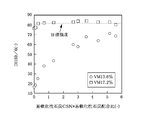
- Button index (CSN) It is a graph which shows the relationship between the softening coal CSN and the softening coal compounding ratio which exert on the strength after dry distillation at the time of using the 1.0 softening coal.
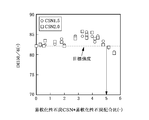
- Button index (CSN) It is a graph which shows the relationship between the softening coal CSN and the softening coal compounding ratio which exert on the strength after dry distillation at the time of using the softening coal of 1.5 and 2.0. It is a figure which shows the external appearance photograph of the fused ferro-coke. It is a figure which shows the influence of CSN of the hardly softening coal which acts on a fusion rate.
- the present invention is a method for producing high-strength and highly-reactive ferrocoke without causing a decrease in strength even if poor quality coal is used. That is, in this method, when a mixture of coal and iron ore is molded and then ferro-coke is produced by dry distillation, coal having a button index (CSN) of 2.0 or less is used as a softening-resistant coal. It is characterized by its use. In the present invention, the button index (CSN) of the hardly softening coal is limited to 2.0 or less.
- the lower limit of the button index (CSN) of the hardly softening coal is not particularly limited, but when the button index (CSN) of the hardly softening coal is 1.0, as shown in the examples described later, the softening is difficult. Since the target strength may not be achieved depending on the volatile content of the heat-sensitive coal, the button index (CSN) of the softening-resistant coal is preferably set to 1.5 to 2.0.
- the coal is a blended coal of a hardly soft coal and a soft soft coal
- the soft soft coal is a coal having a button index (CSN) of 1.5 to 2.0. It is preferable that the value of the property coal multiplied by CSN of the softening coal and the blending ratio in the total coal is in the range of 5.0 or less.
- the coal is a blended coal of hardly softening coal and easy softening coal, and the softening coal is coal having a button index (CSN) of 1.0.
- the coal has a volatile content of 17% or more, and the softening coal has a value obtained by multiplying the blending ratio of the softening coal by CSN and the total coal in the range of 0.3 to 5.2. Is preferred.
- the volatile matter was measured according to JIS M 8812 and displayed on an ashless anhydrous basis.
- the maximum fluidity MF in Table 2 was measured with a Gieseller plastometer.
- the sensitivity is low in the low MF range. For this reason, in the MF measurement of the hardly softening coal of this case, the measurement was performed 5 times, and the average value was obtained as the MF value.
- molding process was implemented with the following method. That is, they were mixed so that the blending ratios of coal, iron ore, and binder were 65.8 mass%, 28.2 mass%, and 6 mass%, respectively, with respect to the total raw material weight.
- coal it is 2 types of combination of easy softening coal and poor softening coal.
- the mixed raw material was kneaded at 140 to 160 ° C. for about 2 minutes with a high-speed mixer, and the kneaded raw material was made into briquettes with a double roll molding machine.
- the roll had a diameter of 650 mm and a width of 104 mm, and was molded at a peripheral speed of 0.2 m / s and a linear pressure of 4 t / cm.
- the size of the molded product is 30 mm ⁇ 25 mm ⁇ 18 mm (6 cc) and the shape is egg-shaped.
- the molded product obtained as described above was subjected to carbonization according to the following laboratory-scale carbonization method. That is, 3 kg of a molded product was filled in a dry distillation can having a length and width of 300 mm and a height of 400 mm, held at a furnace wall temperature of 1000 ° C. for 6 hours, and then cooled in nitrogen. And the dry distillate cooled to room temperature was extract
- the DI 150 6 is a value obtained by measuring the mass ratio of coke having a particle size of 6 mm or more under the conditions of 15 rpm and 150 rotations according to the rotational strength test method of JIS K2151. The target strength was 82 or more.
- the fusion rate was evaluated by the weight percentage of the fusion product relative to the total weight of the dry distillation product.
- Example 1 About preferred examples of CSN and volatile content of hardly softening coal in blended coal and properties of easy softening coal> About the result of the said experiment, the graph which plotted the ferro-coke intensity
- the softening coal coal having CSN of 1.0 and volatile content of 13.6% and 17.2% were used.
- Table 2 above two types of CSN 1.0 coal are listed in the brands J and K of the softening-resistant coal. When the volatile content is 13.6%, the brands J and K are listed. In the case of 17.2%, brands L and M were blended by 50 mass% each.
- Table 3 shows the data obtained by multiplying the data of the graph of FIG. 1 by the blending conditions of the softening coal blended with the softening coal, the CSN of the softening coal and the ratio of the softening coal weight to the total weight of the coal.
- the strength of ferro-coke obtained from a blended coal combined with a coal with a CSN of 1.0, a softening-resistant coal Regardless of any softening coal, if the CSN of the softening coal is 1.0 and the volatile content is 13.6%, the strength after dry distillation is the target strength, unlike the examples shown in the patent literature. Was found to be significantly below.
- Ferro-coke contains iron ore that is completely incompatible with the carbon component. Therefore, blending hard-softening coal that hardly softens and melts and does not exhibit expansibility tends to greatly reduce the strength of ferro-coke. it is conceivable that.
- the plot when the value on the horizontal axis is 0 shows the blending result of the hardly softening coal, but when the volatile content is 13.6%, the strength is greatly reduced.
- the strength is close to the target in the blending alone.
- the target strength is obtained when the value obtained by multiplying the blending ratio of the softening coal CSN and the weight of the softening coal is 0.3 to 5.2. It turned out that it exceeded.
- Example 2 About preferred examples of CSN of hardly softening coal and properties of easy softening coal in blended coal>
- Figure 2 shows the strength of ferro-coke obtained from a blended coal combined with coals with softening coal CSN of 1.5 and 2.0. And based on the result of this Table 4, the graph which plotted the ferro-coke intensity
- Example 3 About a suitable example of CSN of hardly softening coal in blended coal>
- the CSN of the hardly softening coal is 2.5
- FIG. 3 shows a photograph of the fused example.
- Table 5 and FIG. 4 show dry distillation at a lab scale with respect to the value obtained by multiplying the blending ratio of the CSN of the softening coal and the weight of the softening coal with respect to two types of CSN of the softening coal of 2.0 and 2.5.
- the result of the fusion test at the time of doing is shown.
- two kinds of CSN: 2.5 coal are described as P and Q of the softening-resistant coal. In this test, 50 mass% of each was blended.
- the fusion rate refers to the mass ratio of the ferro-coke fused as shown in FIG. 4 in the produced ferro-coke mass.
- the above-mentioned carbonization test is a carbonization test in a state where the molded product is fixed (fixed layer).
- it becomes a continuous type in which dry-distilled matter is continuously discharged from the lower part of the furnace while feeding the molded article from the upper part of the furnace like a vertical furnace.
- dry distillation using a fixed bed is easier to fuse than a continuous type.
- the inventors have formed a molded product in which the discharge failure due to the fusion in the furnace occurred in the continuous vertical dry distillation bench plant. Were tested in a lab-scale carbonization furnace.
- Example 4 About other suitable examples>
- the blending ratios of coal, iron ore, and binder were mixed so as to be 65.8 mass%, 28.2 mass%, and 6 mass%, respectively, with respect to the total raw material weight.
- Coal A in Table 1 was used as the softening coal
- Ocoal in Table 2 was used as the softening coal.
- the blending ratio of the easy softening coal and the hard softening coal was 1/9 and 7/3.
- the value obtained by multiplying the CSN of the softening coal and the ratio of the softening coal weight to the total weight of the coal is CSN2.5 of coal A and the blending ratio of the softening coal 0.1 Multiply by to get 0.25.
- 1.75 is obtained by multiplying CSN2.5 of Coal A by a blending ratio of easy softening coal 0.7.
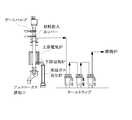
- a 0.3 t / d vertical carbonization furnace shown in FIG. 5 was used.
- the dimensions are a continuous countercurrent furnace made of SUS with a diameter of 0.25 m and a height of 3 m and equipped with a cooling facility for the generated gas.
- Thermocouples were installed in the center of the reaction tube from the top of the furnace toward the cooling zone at the bottom of the furnace at intervals of about 10 to 20 cm, and the heating conditions were determined so as to obtain a predetermined heat pattern.
- the upper electric furnace was set to 700 ° C. and the lower electric furnace was set to 850 ° C., and a high-temperature gas at 850 ° C. was circulated at a flow rate of 60 L / min.
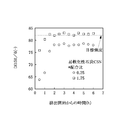
- FIG. 6 shows a heat pattern when the temperature of the lower-stage electric furnace and the high-temperature gas is set to 850 ° C.
- the maximum temperature reached at the center of the reaction tube is 852 ° C., and the holding time at that temperature is about 60 minutes.
- Green briquettes are introduced into the furnace from the top of the furnace through a double valve, and dry-distilled ferro-coke is continuously discharged from the lower part of the furnace. Ferro-coke discharged at 30-minute intervals was collected and measured for strength. The results are shown in FIG.
- coal blended with easy-softening coal and non-softening coal is used as coal.
- Use coal with (CSN) of 1.5 to 2.0, and easily softening coal is a value obtained by multiplying the blending ratio of CSN of the softening coal and the total coal within the range of 5.0 or less. It is important to do.
- the method for producing ferro-coke of the present invention it is possible to produce ferro-coke having high strength, low cost and high reactivity, and by using the obtained ferro-coke as a coal raw material, the ratio of low reducing material in a blast furnace is reduced. Operation can be enabled.
Landscapes
- Chemical & Material Sciences (AREA)
- Engineering & Computer Science (AREA)
- Organic Chemistry (AREA)
- Oil, Petroleum & Natural Gas (AREA)
- Materials Engineering (AREA)
- Manufacturing & Machinery (AREA)
- Metallurgy (AREA)
- Environmental & Geological Engineering (AREA)
- Geochemistry & Mineralogy (AREA)
- Geology (AREA)
- General Life Sciences & Earth Sciences (AREA)
- Life Sciences & Earth Sciences (AREA)
- Mechanical Engineering (AREA)
- Coke Industry (AREA)
- Solid Fuels And Fuel-Associated Substances (AREA)
Abstract
Description
(1)前記石炭として、ボタン指数(CSN)が1.5~2.0の難軟化性石炭を使用すること;
(2)前記石炭を難軟化性石炭と易軟化性石炭との配合炭とし、かつ該難軟化性石炭はボタン指数(CSN)が1.0でありかつ揮発分が17%以上の石炭であり、該易軟化性石炭は該易軟化性石炭のCSNと全石炭中の配合比を乗じた値が0.3~5.2の範囲にあること;
(3)前記易軟化性石炭の全石炭中の配合比が0.8以下であること;および
(4)前記石炭を難軟化性石炭と易軟化性石炭との配合炭とし、該難軟化性石炭はボタン指数(CSN)が1.5~2.0の石炭であり、かつ該易軟化性石炭は該易軟化性石炭のCSNと全石炭中の配合比を乗じた値が5.0以下の範囲にあること;
がより好ましい解決手段となるものと考えられる。


前記実験の結果について、易軟化性石炭のCSNと石炭全重量に対する易軟化性石炭重量の割合を乗じた値に対するフェロコークス強度をプロットしたグラフを図1に示す。難軟化性石炭にはCSNが1.0の石炭で揮発分13.6%および17.2%を用いた。上掲の表2には難軟化性石炭の銘柄J、KにCSN1.0の石炭が2種類記載されているが、揮発分13.6%の場合は銘柄J、Kを、また、揮発分17.2%の場合は銘柄L、Mをそれぞれ50mass%ずつの配合とした。

次に、難軟化性石炭のCSNが1.5および2.0の石炭について検討した。即ち、表2に示すとおり、CSN1.5の石炭N、OおよびCSN2.0の石炭P、Qをそれぞれ50mass%ずつ配合したものについて検討した。その検討結果について、表4に、前記難軟化性石炭に配合した易軟化性石炭の配合条件、易軟化性石炭のCSNと石炭全重量に対する易軟化性石炭重量の割合を乗じた値、および難軟化性石炭のCSNが1.5および2.0の石炭と組み合わせた配合炭から得たフェロコークスの強度を示す。そして、この表4の結果に基づき、易軟化性石炭のCSNと石炭全重量に対する易軟化性石炭重量の割合を乗じた値に対するフェロコークス強度をプロットしたグラフを図2に示す。

難軟化性石炭のCSNが2.5の場合については、乾留物の融着のおそれが発生する。図3に融着した例の写真を示す。表5および図4は、難軟化性石炭のCSNが2.0と2.5の2種類について、易軟化性石炭のCSNと易軟化性石炭重量の配合比を乗じた値に対するラボスケールで乾留したときの融着試験の結果を示したものである。表2には難軟化性石炭のP、QとしてCSN:2.5の石炭が2種類記載されているが、この試験ではこれらをそれぞれ50mass%ずつ配合した。図4に示す結果から、難軟化性石炭のCSNが2.0の場合は融着率は10%以下となっていることがわかる。一方、難軟化性石炭のCSNが2.5の場合は、融着率が概ね20%以上となっていることがわかる。なお、ここで、「融着率」とは、製造したフェロコークス質量のうち図4に示すように融着したフェロコークスの質量割合のことをいう。

この実施例では、石炭、鉄鉱石、バインダーの配合率がそれぞれ全原料重量に対し65.8mass%、28.2mass%、6mass%となるように混合した。易軟化性石炭として表1のA炭を難軟化性石炭として表2のO炭を用いた。易軟化性石炭と難軟化性石炭の配合比は1/9および7/3とした。すなわち、易軟化性石炭のCSNと石炭全重量に対する易軟化性石炭重量の割合を乗じた値は、1/9のケースでは、A炭のCSN2.5に易軟化性石炭の配合比0.1を乗じると0.25が得られる。また、7/3のケースでは、A炭のCSN2.5に易軟化性石炭の配合比0.7を乗じると1.75が得られる。
Claims (5)
- 石炭と鉄鉱石との混合物を成型し乾留してフェロコークスを製造する方法において、
前記石炭として、ボタン指数(CSN)が2.0以下の難軟化性石炭を使用することを特徴とするフェロコークスの製造方法。 - 前記石炭として、ボタン指数(CSN)が1.5~2.0の難軟化性石炭を使用することを特徴とする請求項1に記載のフェロコークスの製造方法。
- 前記石炭を難軟化性石炭と易軟化性石炭との配合炭とし、かつ該難軟化性石炭はボタン指数(CSN)が1.0でありかつ揮発分が17%以上の石炭であり、該易軟化性石炭は該易軟化性石炭のCSNと全石炭中の配合比を乗じた値が0.3~5.2の範囲にあることを特徴とする請求項1に記載のフェロコークスの製造方法。
- 前記易軟化性石炭の全石炭中の配合比が0.8以下であることを特徴とする請求項3に記載のフェロコークスの製造方法。
- 前記石炭を難軟化性石炭と易軟化性石炭との配合炭とし、該難軟化性石炭はボタン指数(CSN)が1.5~2.0の石炭であり、かつ該易軟化性石炭は該易軟化性石炭のCSNと全石炭中の配合比を乗じた値が5.0以下の範囲にあることを特徴とする請求項1に記載のフェロコークスの製造方法。
Priority Applications (5)
| Application Number | Priority Date | Filing Date | Title |
|---|---|---|---|
| JP2016538825A JP6210156B2 (ja) | 2015-02-06 | 2016-02-01 | フェロコークスの製造方法 |
| CN201680007312.2A CN107207966B (zh) | 2015-02-06 | 2016-02-01 | 铁焦的制造方法 |
| EP16746558.2A EP3255122B1 (en) | 2015-02-06 | 2016-02-01 | Ferrocoke manufacturing method |
| KR1020177021736A KR101910405B1 (ko) | 2015-02-06 | 2016-02-01 | 페로코크스의 제조 방법 |
| US15/548,900 US11486022B2 (en) | 2015-02-06 | 2016-02-01 | Ferrocoke manufacturing method |
Applications Claiming Priority (2)
| Application Number | Priority Date | Filing Date | Title |
|---|---|---|---|
| JP2015-021695 | 2015-02-06 | ||
| JP2015021695 | 2015-02-06 |
Publications (1)
| Publication Number | Publication Date |
|---|---|
| WO2016125727A1 true WO2016125727A1 (ja) | 2016-08-11 |
Family
ID=56564072
Family Applications (1)
| Application Number | Title | Priority Date | Filing Date |
|---|---|---|---|
| PCT/JP2016/052875 Ceased WO2016125727A1 (ja) | 2015-02-06 | 2016-02-01 | フェロコークスの製造方法 |
Country Status (6)
| Country | Link |
|---|---|
| US (1) | US11486022B2 (ja) |
| EP (1) | EP3255122B1 (ja) |
| JP (2) | JP6210156B2 (ja) |
| KR (1) | KR101910405B1 (ja) |
| CN (1) | CN107207966B (ja) |
| WO (1) | WO2016125727A1 (ja) |
Cited By (1)
| Publication number | Priority date | Publication date | Assignee | Title |
|---|---|---|---|---|
| JP2024053917A (ja) * | 2022-10-04 | 2024-04-16 | Jfeスチール株式会社 | フェロコークス用石炭の評価方法 |
Citations (5)
| Publication number | Priority date | Publication date | Assignee | Title |
|---|---|---|---|---|
| JPS63137989A (ja) * | 1986-11-28 | 1988-06-09 | Sumitomo Metal Ind Ltd | フエロコ−クスの製造方法 |
| JP2004217914A (ja) * | 2002-12-25 | 2004-08-05 | Jfe Steel Kk | フェロコークスの製造及び使用方法、並びにフェロコークス製造における副生ガス利用方法 |
| JP2007126505A (ja) * | 2005-11-01 | 2007-05-24 | Jfe Steel Kk | フェロコークスの製造方法 |
| JP2008056791A (ja) * | 2006-08-31 | 2008-03-13 | Jfe Steel Kk | フェロコークス原料成型物およびフェロコークスの製造方法 |
| JP2011037963A (ja) * | 2009-08-10 | 2011-02-24 | Jfe Steel Corp | フェロコークスの製造方法 |
Family Cites Families (15)
| Publication number | Priority date | Publication date | Assignee | Title |
|---|---|---|---|---|
| JPS598313B2 (ja) | 1975-03-28 | 1984-02-23 | 住友金属工業株式会社 | 冶金用成型コ−クスの製造方法 |
| JPS5423604A (en) | 1977-07-23 | 1979-02-22 | Sumitomo Metal Ind Ltd | Production of molded coal |
| JPS5480302A (en) | 1977-12-09 | 1979-06-27 | Kawasaki Steel Co | Method of making improved coal to be served for production of blast furnace coke |
| US4318779A (en) * | 1979-05-14 | 1982-03-09 | Sumikin Coke Company Ltd. | Method of manufacture of blast furnace cokes containing substantial amounts of low grade coals |
| JPS5780481A (en) | 1980-11-10 | 1982-05-20 | Sumikin Coke Co Ltd | Production of coke by blending low-grade coal in high proportion |
| JP4267390B2 (ja) | 2003-08-07 | 2009-05-27 | 新日本製鐵株式会社 | 高炉用フェロコークスの製造方法 |
| JP4892930B2 (ja) | 2005-11-01 | 2012-03-07 | Jfeスチール株式会社 | フェロコークスの製造方法 |
| RU2352605C1 (ru) | 2008-01-09 | 2009-04-20 | Борис Анатольевич Мусохранов | Способ подготовки угольных смесей для производства шихты для коксования и композиции таких смесей (варианты) |
| JP5386838B2 (ja) * | 2008-03-21 | 2014-01-15 | Jfeスチール株式会社 | 冶金用フェロコークス |
| JP5220481B2 (ja) | 2008-05-30 | 2013-06-26 | 独立行政法人森林総合研究所 | レーザ誘起プラズマ発光分析による木材密度の測定方法 |
| JP5177101B2 (ja) | 2008-09-16 | 2013-04-03 | 新日鐵住金株式会社 | 高反応性小塊コークスの製造方法 |
| JP5466106B2 (ja) | 2009-07-31 | 2014-04-09 | 株式会社神戸製鋼所 | 鉄鉱石含有コークスの製造方法 |
| JP2011084734A (ja) * | 2009-09-15 | 2011-04-28 | Jfe Steel Corp | フェロコークスの製造方法 |
| KR101418053B1 (ko) * | 2012-12-21 | 2014-07-09 | 주식회사 포스코 | 성형탄 및 그 제조 방법 |
| JP6245914B2 (ja) | 2013-10-01 | 2017-12-13 | 共同印刷株式会社 | 識別コード読取システム及び方法 |
-
2016
- 2016-02-01 US US15/548,900 patent/US11486022B2/en active Active
- 2016-02-01 CN CN201680007312.2A patent/CN107207966B/zh active Active
- 2016-02-01 KR KR1020177021736A patent/KR101910405B1/ko active Active
- 2016-02-01 JP JP2016538825A patent/JP6210156B2/ja active Active
- 2016-02-01 EP EP16746558.2A patent/EP3255122B1/en active Active
- 2016-02-01 WO PCT/JP2016/052875 patent/WO2016125727A1/ja not_active Ceased
-
2017
- 2017-08-02 JP JP2017149902A patent/JP2017193723A/ja active Pending
Patent Citations (5)
| Publication number | Priority date | Publication date | Assignee | Title |
|---|---|---|---|---|
| JPS63137989A (ja) * | 1986-11-28 | 1988-06-09 | Sumitomo Metal Ind Ltd | フエロコ−クスの製造方法 |
| JP2004217914A (ja) * | 2002-12-25 | 2004-08-05 | Jfe Steel Kk | フェロコークスの製造及び使用方法、並びにフェロコークス製造における副生ガス利用方法 |
| JP2007126505A (ja) * | 2005-11-01 | 2007-05-24 | Jfe Steel Kk | フェロコークスの製造方法 |
| JP2008056791A (ja) * | 2006-08-31 | 2008-03-13 | Jfe Steel Kk | フェロコークス原料成型物およびフェロコークスの製造方法 |
| JP2011037963A (ja) * | 2009-08-10 | 2011-02-24 | Jfe Steel Corp | フェロコークスの製造方法 |
Non-Patent Citations (1)
| Title |
|---|
| See also references of EP3255122A4 * |
Cited By (2)
| Publication number | Priority date | Publication date | Assignee | Title |
|---|---|---|---|---|
| JP2024053917A (ja) * | 2022-10-04 | 2024-04-16 | Jfeスチール株式会社 | フェロコークス用石炭の評価方法 |
| JP7647718B2 (ja) | 2022-10-04 | 2025-03-18 | Jfeスチール株式会社 | フェロコークス用石炭の評価方法 |
Also Published As
| Publication number | Publication date |
|---|---|
| JPWO2016125727A1 (ja) | 2017-04-27 |
| US11486022B2 (en) | 2022-11-01 |
| EP3255122A1 (en) | 2017-12-13 |
| US20180023166A1 (en) | 2018-01-25 |
| JP2017193723A (ja) | 2017-10-26 |
| KR101910405B1 (ko) | 2018-10-22 |
| CN107207966A (zh) | 2017-09-26 |
| CN107207966B (zh) | 2020-05-15 |
| KR20170103862A (ko) | 2017-09-13 |
| JP6210156B2 (ja) | 2017-10-11 |
| EP3255122A4 (en) | 2018-01-24 |
| EP3255122B1 (en) | 2023-06-07 |
Similar Documents
| Publication | Publication Date | Title |
|---|---|---|
| KR101456449B1 (ko) | 코크스 제조 방법 | |
| JP5547879B2 (ja) | 炭材内装酸化鉄塊成化物およびその製造方法、ならびに還元鉄または金属鉄の製造方法 | |
| JP6102484B2 (ja) | 焼結鉱の製造方法 | |
| JP6421666B2 (ja) | 焼結鉱の製造方法 | |
| JP2011084734A (ja) | フェロコークスの製造方法 | |
| JP6210156B2 (ja) | フェロコークスの製造方法 | |
| JP6016001B1 (ja) | フェロコークスの製造方法 | |
| JP6227482B2 (ja) | 高炉用コークスの製造方法及び高炉用コークス | |
| JP6241336B2 (ja) | 高炉用コークスの製造方法 | |
| JP7143714B2 (ja) | 焼結用炭材の製造方法、焼結用炭材の原料選定方法及び焼結鉱の製造方法 | |
| JP5763308B2 (ja) | フェロコークスの製造方法 | |
| JP4910631B2 (ja) | 高炉の操業方法 | |
| KR102325752B1 (ko) | 코크스의 제조 방법 | |
| JP6075354B2 (ja) | コークスの製造方法 | |
| JP2016210865A (ja) | コークスの製造方法 | |
| JP5163247B2 (ja) | コークスの製造方法 | |
| JP6241337B2 (ja) | 高炉用コークスの製造方法 | |
| JP6521259B2 (ja) | 焼結鉱製造用焼結原料の製造方法 | |
| JP6189811B2 (ja) | 無灰炭配合量決定方法及び高炉用コークスの製造方法 | |
| JP6268474B2 (ja) | 焼結原料の製造方法 | |
| WO2024202185A1 (ja) | コークスの製造方法 | |
| JP6179732B2 (ja) | 石炭または石炭と金属酸化物との混合物の成型方法 | |
| JP5453993B2 (ja) | フェロコークスの製造方法 | |
| JP2010144096A (ja) | フェロコークスの製造方法 |
Legal Events
| Date | Code | Title | Description |
|---|---|---|---|
| ENP | Entry into the national phase |
Ref document number: 2016538825 Country of ref document: JP Kind code of ref document: A |
|
| 121 | Ep: the epo has been informed by wipo that ep was designated in this application |
Ref document number: 16746558 Country of ref document: EP Kind code of ref document: A1 |
|
| REEP | Request for entry into the european phase |
Ref document number: 2016746558 Country of ref document: EP |
|
| ENP | Entry into the national phase |
Ref document number: 20177021736 Country of ref document: KR Kind code of ref document: A |
|
| WWE | Wipo information: entry into national phase |
Ref document number: 15548900 Country of ref document: US |
|
| NENP | Non-entry into the national phase |
Ref country code: DE |