WO2016143447A1 - 重合体、樹脂組成物及び樹脂成形体 - Google Patents
重合体、樹脂組成物及び樹脂成形体 Download PDFInfo
- Publication number
- WO2016143447A1 WO2016143447A1 PCT/JP2016/053721 JP2016053721W WO2016143447A1 WO 2016143447 A1 WO2016143447 A1 WO 2016143447A1 JP 2016053721 W JP2016053721 W JP 2016053721W WO 2016143447 A1 WO2016143447 A1 WO 2016143447A1
- Authority
- WO
- WIPO (PCT)
- Prior art keywords
- group
- hydrocarbon group
- polymer
- carbon atoms
- same
- Prior art date
- Legal status (The legal status is an assumption and is not a legal conclusion. Google has not performed a legal analysis and makes no representation as to the accuracy of the status listed.)
- Ceased
Links
- UHOVQNZJYSORNB-UHFFFAOYSA-N c1ccccc1 Chemical compound c1ccccc1 UHOVQNZJYSORNB-UHFFFAOYSA-N 0.000 description 1
Images
Classifications
-
- C—CHEMISTRY; METALLURGY
- C08—ORGANIC MACROMOLECULAR COMPOUNDS; THEIR PREPARATION OR CHEMICAL WORKING-UP; COMPOSITIONS BASED THEREON
- C08G—MACROMOLECULAR COMPOUNDS OBTAINED OTHERWISE THAN BY REACTIONS ONLY INVOLVING UNSATURATED CARBON-TO-CARBON BONDS
- C08G65/00—Macromolecular compounds obtained by reactions forming an ether link in the main chain of the macromolecule
- C08G65/34—Macromolecular compounds obtained by reactions forming an ether link in the main chain of the macromolecule from hydroxy compounds or their metallic derivatives
- C08G65/38—Macromolecular compounds obtained by reactions forming an ether link in the main chain of the macromolecule from hydroxy compounds or their metallic derivatives derived from phenols
- C08G65/40—Macromolecular compounds obtained by reactions forming an ether link in the main chain of the macromolecule from hydroxy compounds or their metallic derivatives derived from phenols from phenols (I) and other compounds (II), e.g. OH-Ar-OH + X-Ar-X, where X is halogen atom, i.e. leaving group
-
- C—CHEMISTRY; METALLURGY
- C08—ORGANIC MACROMOLECULAR COMPOUNDS; THEIR PREPARATION OR CHEMICAL WORKING-UP; COMPOSITIONS BASED THEREON
- C08J—WORKING-UP; GENERAL PROCESSES OF COMPOUNDING; AFTER-TREATMENT NOT COVERED BY SUBCLASSES C08B, C08C, C08F, C08G or C08H
- C08J5/00—Manufacture of articles or shaped materials containing macromolecular substances
-
- C—CHEMISTRY; METALLURGY
- C08—ORGANIC MACROMOLECULAR COMPOUNDS; THEIR PREPARATION OR CHEMICAL WORKING-UP; COMPOSITIONS BASED THEREON
- C08L—COMPOSITIONS OF MACROMOLECULAR COMPOUNDS
- C08L71/00—Compositions of polyethers obtained by reactions forming an ether link in the main chain; Compositions of derivatives of such polymers
-
- C—CHEMISTRY; METALLURGY
- C08—ORGANIC MACROMOLECULAR COMPOUNDS; THEIR PREPARATION OR CHEMICAL WORKING-UP; COMPOSITIONS BASED THEREON
- C08L—COMPOSITIONS OF MACROMOLECULAR COMPOUNDS
- C08L71/00—Compositions of polyethers obtained by reactions forming an ether link in the main chain; Compositions of derivatives of such polymers
- C08L71/08—Polyethers derived from hydroxy compounds or from their metallic derivatives
- C08L71/10—Polyethers derived from hydroxy compounds or from their metallic derivatives from phenols
-
- C—CHEMISTRY; METALLURGY
- C08—ORGANIC MACROMOLECULAR COMPOUNDS; THEIR PREPARATION OR CHEMICAL WORKING-UP; COMPOSITIONS BASED THEREON
- C08L—COMPOSITIONS OF MACROMOLECULAR COMPOUNDS
- C08L73/00—Compositions of macromolecular compounds obtained by reactions forming a linkage containing oxygen or oxygen and carbon in the main chain, not provided for in groups C08L59/00 - C08L71/00; Compositions of derivatives of such polymers
Definitions
- halogen-based organic solvents such as methylene chloride have been avoided due to concerns about the environment and the human body, and conversion to non-halogen-based organic solvents is required.
- the polyarylate described in JP-A-8-269214 has poor solubility in non-halogen organic solvents, and it is difficult to obtain a highly versatile resin composition applicable to various uses.
- the polymer when the resin molded body is applied to an application where it is used at a high temperature, the polymer is required to have heat resistance in order to suppress thermal deterioration of the resin molded body.
- R 10 and R 11 are each independently a halogen atom, a monovalent hydrocarbon group having 1 to 20 carbon atoms, a monovalent halogenated hydrocarbon group having 1 to 20 carbon atoms, A nitro group or a cyano group, e and f are each independently an integer of 0 to 2.
- a and b are each independently an integer of 0 to 8.
- the plurality of R 10 may be the same or different, and may be combined in any combination to form a part of the ring structure.
- the plurality of R 11 are They may be the same or different, and may be bonded together in any combination to form part of the ring structure, each Z being independently —O— or —S—, R 4
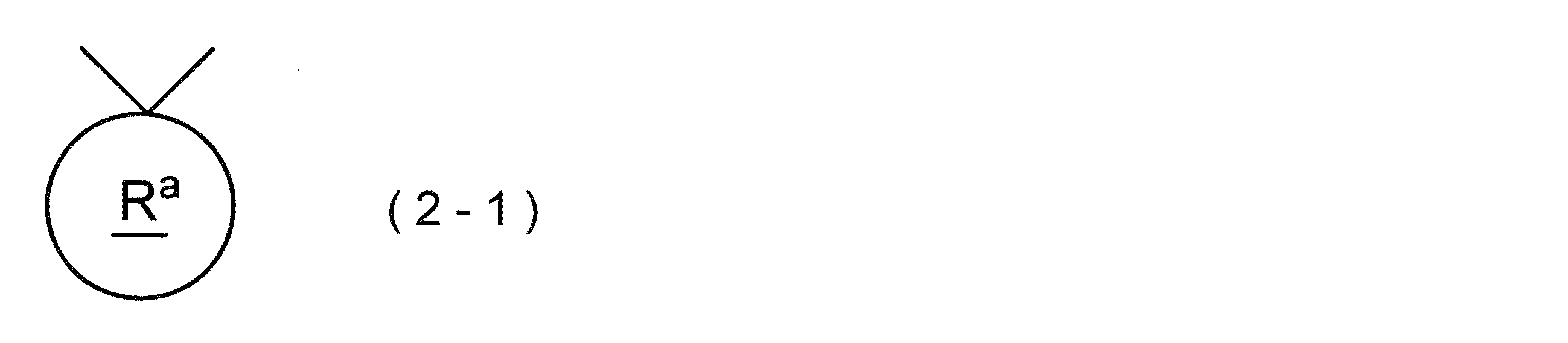
- R 4 When w is 2, two R 4 may be the same or different, and two Z may be the same or different, and L is represented by the following formula (2-1).
- Y is an integer of 1 to 3.
- y is 2 or more, a plurality of L may be the same or different, and y is 2 or more and a is 1 In the above case, the plurality of R 10 may be the same or different.
- R a is a divalent alicyclic hydrocarbon group having 5 to 30 ring members or a divalent fluorinated alicyclic hydrocarbon group having 5 to 30 ring members.
- R 20 is a monovalent hydrocarbon group having 1 to 20 carbon atoms or a monovalent halogenated hydrocarbon group having 1 to 20 carbon atoms.
- G is an integer of 1 to 4)
- the plurality of R 20 may be the same or different, and may be bonded together in any combination to form part of the ring structure.
- each of R 5 is independently a methylene group or an alkylene group having 2 to 4 carbon atoms, t is an integer of 0 to 2, and t is 2.
- two R 5 may be the same or different, and two Y may be the same or different, and u is an integer of 0 to 2.
- u is 2
- Two R 5 may be the same or different, and two Y may be the same or different.
- the present invention further includes a resin composition containing the polymer and an organic solvent, and a resin molded product containing the polymer.
- the “hydrocarbon group” includes a chain hydrocarbon group and a cyclic hydrocarbon group.
- the “hydrocarbon group” may be a saturated hydrocarbon group or an unsaturated hydrocarbon group.
- the “chain hydrocarbon group” refers to a hydrocarbon group that does not include a cyclic structure but includes only a chain structure, and includes both a linear hydrocarbon group and a branched hydrocarbon group.
- Cyclic hydrocarbon group refers to a hydrocarbon group containing a cyclic structure, and includes both alicyclic hydrocarbon groups and aromatic hydrocarbon groups.
- alicyclic hydrocarbon group refers to a hydrocarbon group that includes only an alicyclic structure as a cyclic structure and does not include an aromatic ring structure, and includes a monocyclic alicyclic hydrocarbon group and a polycyclic alicyclic carbonization. Includes both hydrogen groups. However, it is not necessary to be composed only of the alicyclic structure, and a part thereof may include a chain structure.
- aromatic hydrocarbon group refers to a hydrocarbon group containing an aromatic ring structure as a cyclic structure, and includes both monocyclic aromatic hydrocarbon groups and polycyclic aromatic hydrocarbon groups.
- Numberer of ring members refers to the number of atoms constituting the cyclic structure, and in the case of polycycles, the number of atoms constituting the polycycles.
- the polymer of the present invention (hereinafter also referred to as “[A] polymer”) is a polymer having the first structural unit and the second structural unit.
- the polymer may have two or more of the above structural units.
- the arrangement of the structural units and other structures are not particularly limited.
- the [A] polymer may have other structural units other than the first and second structural units.
- the polymer may have repeating units (a) to (f) containing the first and second structural units as described later, and further, other repeating units other than these repeating units. You may have a unit.
- the polymer Since the polymer has the first and second structural units, it has excellent heat resistance and can improve solubility in various organic solvents. [A] The reason why the above effect is achieved by the polymer having the above-mentioned configuration is not clear, but is presumably mainly due to the following reasons (1) and (2).
- the polarization of the polymer chain is moderately adjusted and the aromatic rings are connected via a relatively bulky ring structure.
- incorporation of the second structural unit having a structure connected to each other or a structure containing a benzene ring to which a substituent is bonded can suppress aggregation of the polymer chain, so that the solubility in various organic solvents can be improved. .
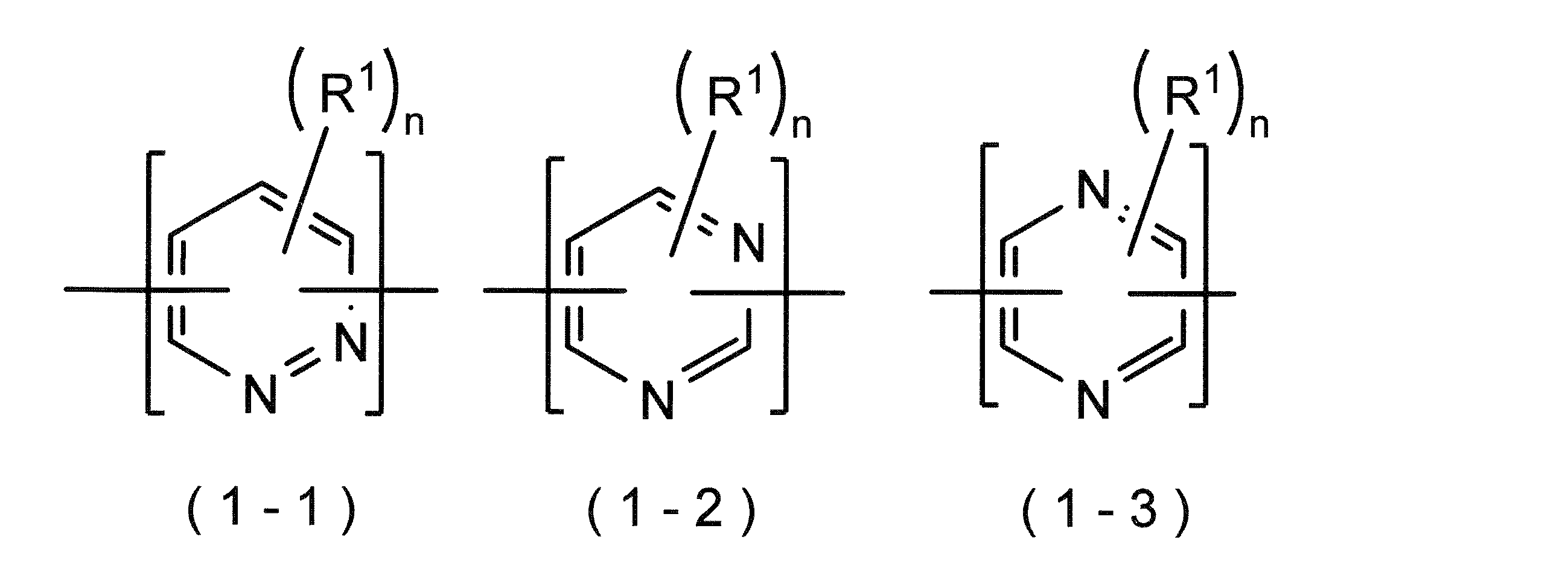
- the first structural unit is represented by the following formula (1-1), (1-2) or (1-3).
- each R 1 independently represents a halogen atom, a monovalent hydrocarbon group having 1 to 20 carbon atoms, or a monovalent halogen having 1 to 20 carbon atoms.
- n is each independently an integer of 0 to 2.
- the plurality of R 1 may be the same or different, and may be bonded in any combination to form a part of the ring structure.
- Examples of the halogen atom represented by R 1 include a fluorine atom, a chlorine atom, a bromine atom, and an iodine atom.
- Examples of the monovalent hydrocarbon group having 1 to 20 carbon atoms represented by R 1 include a monovalent chain hydrocarbon group, a monovalent alicyclic hydrocarbon group, a monovalent aromatic hydrocarbon group, and the like. Is mentioned.
- Examples of the monovalent chain hydrocarbon group include methyl group, ethyl group, n-propyl group, i-propyl group, n-butyl group, i-butyl group, sec-butyl group, t-butyl group, n -An alkyl group such as a pentyl group; Alkenyl groups such as ethenyl group, propenyl group, butenyl group, pentenyl group; Examples thereof include alkynyl groups such as ethynyl group, propynyl group, butynyl group, and pentynyl group.
- Examples of the monovalent alicyclic hydrocarbon group include monocyclic cycloalkyl groups such as a cyclopropyl group, a cyclobutyl group, a cyclopentyl group, and a cyclohexyl group; A polycyclic cycloalkyl group such as a norbornyl group and an adamantyl group; A monocyclic cycloalkenyl group such as a cyclopropenyl group, a cyclobutenyl group, a cyclopentenyl group, a cyclohexenyl group; And polycyclic cycloalkenyl groups such as norbornenyl group.
- monocyclic cycloalkyl groups such as a cyclopropyl group, a cyclobutyl group, a cyclopentyl group, and a cyclohexyl group
- a polycyclic cycloalkyl group such as a norbornyl group and
- Examples of the monovalent aromatic hydrocarbon group include aryl groups such as phenyl group, tolyl group, xylyl group, naphthyl group, and anthryl group; Examples include aralkyl groups such as benzyl group, phenethyl group, phenylpropyl group, naphthylmethyl group, and the like.
- the monovalent halogenated hydrocarbon radicals for example, a hydrogen atom, monovalent hydrocarbon group exemplified 1 to 20 carbon atoms as a group represented by R 1 having 1 to 20 carbon atoms represented by R 1 And a group in which a part or all of is substituted with a halogen atom such as a fluorine atom, a chlorine atom, a bromine atom or an iodine atom.
- R 1 is a halogen atom, a monovalent hydrocarbon group having 1 to 3 carbon atoms, or a monovalent halogen having 1 to 3 carbon atoms from the viewpoint of improving the polymerization reactivity of the monomer giving the first structural unit.
- a hydrocarbon group, a nitro group and a cyano group are preferable, and a fluorine atom, a chlorine atom, a methyl group, a nitro group and a cyano group are more preferable. From the same viewpoint, as n, 0 and 1 are preferable, and 0 is more preferable.
- the position of the other bond to the bond of the first structural unit is preferably a meta position and a para position, more preferably a meta position from the viewpoint of improving the polymerization reactivity of the monomer that gives the first structural unit. .
- the first structural unit includes the above formula (1-1-) having a pyrimidine skeleton from the viewpoint of improving the polymerization reactivity of the monomer giving the first structural unit and the solubility in various organic solvents.
- the structural unit represented by 2) is preferred.
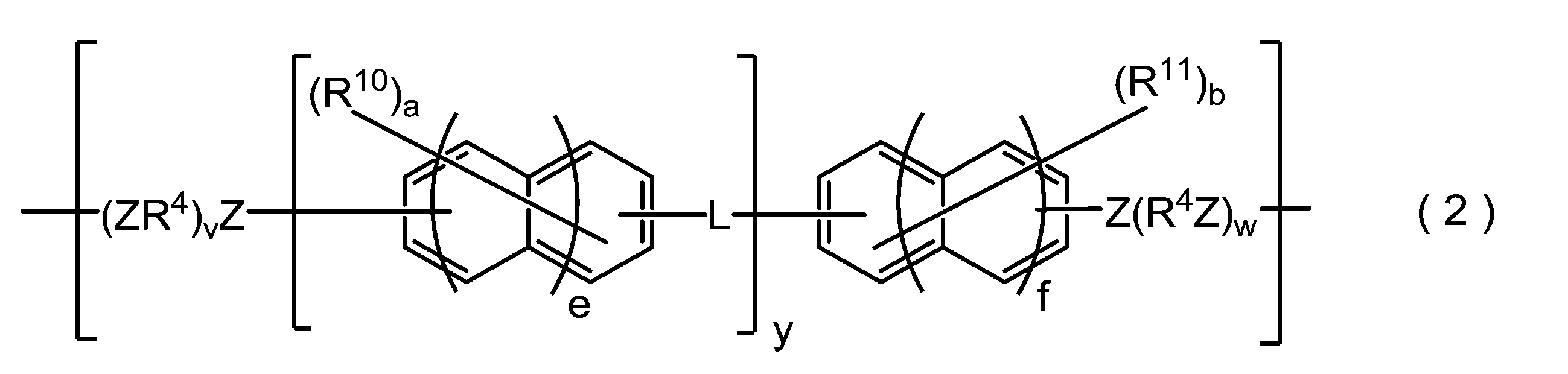
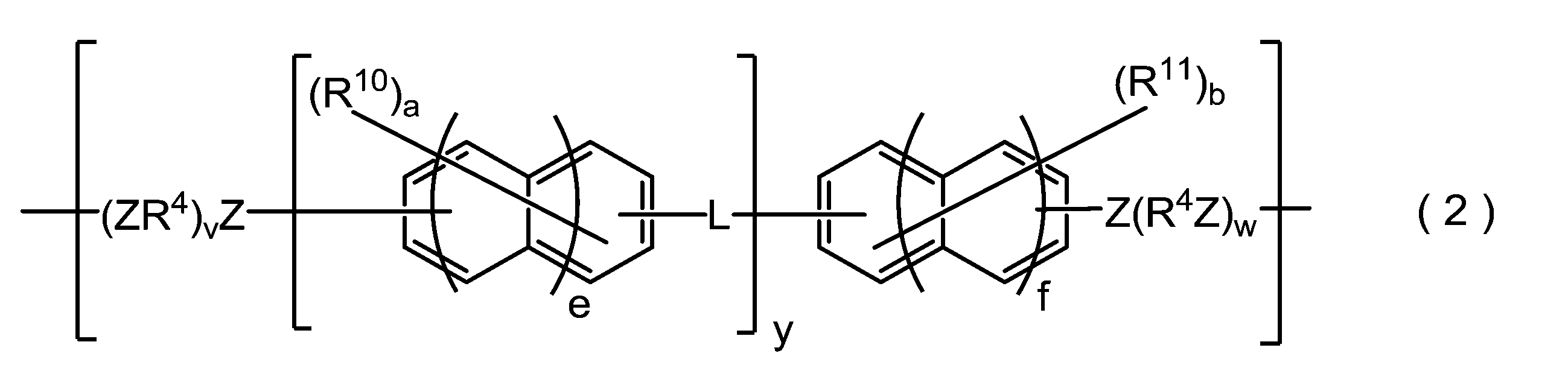
- the second structural unit is represented by the following formula (2) or (3).
- R 10 and R 11 are each independently a halogen atom, a monovalent hydrocarbon group having 1 to 20 carbon atoms, a monovalent halogenated hydrocarbon group having 1 to 20 carbon atoms, A nitro group or a cyano group.
- e and f are each independently an integer of 0 to 2.
- a and b are each independently an integer of 0 to 8.
- the plurality of R 10 may be the same or different, and may be bonded in any combination to form part of the ring structure.
- the plurality of R 11 may be the same or different, and may be bonded in any combination to form part of the ring structure.
- Z is independently —O— or —S—.
- Each R 4 is independently a methylene group or an alkylene group having 2 to 4 carbon atoms.
- v is an integer of 0-2. When v is 2, two R 4 may be the same or different, and two Z may be the same or different.
- w is an integer of 0-2. When w is 2, two R 4 may be the same or different, and two Z may be the same or different.
- L is a divalent group represented by the following formula (2-1).
- y is an integer of 1 to 3. When y is 2 or more, the plurality of L may be the same or different. When y is 2 or more and a is 1 or more, the plurality of R 10 may be the same or different.
- R a is a divalent alicyclic hydrocarbon group having 5 to 30 ring members or a divalent fluorinated alicyclic hydrocarbon group having 5 to 30 ring members.
- R 20 is a monovalent hydrocarbon group having 1 to 20 carbon atoms or a monovalent halogenated hydrocarbon group having 1 to 20 carbon atoms.
- g is an integer of 1 to 4. When g is 2 or more, the plurality of R 20 may be the same or different, and may be bonded in any combination to form part of the ring structure.
- Y is independently —O— or —S—.
- R 5 each independently represents a methylene group or an alkylene group having 2 to 4 carbon atoms.
- t is an integer of 0-2. When t is 2, two R 5 may be the same or different, and two Y may be the same or different.
- u is an integer of 0-2. When u is 2, two R 5 may be the same or different, and two Y may be the same or different.
- halogen atom represented by R 10 and R 11 examples include the same halogen atoms as those exemplified as the halogen atom represented by R 1 above.
- Examples of the monovalent hydrocarbon group having 1 to 20 carbon atoms represented by R 10 , R 11 and R 20 include monovalent hydrocarbons having 1 to 20 carbon atoms exemplified as the group represented by R 1 above. Groups and the like.
- Examples of the monovalent halogenated hydrocarbon group having 1 to 20 carbon atoms represented by R 10 , R 11 and R 20 include monovalent halogenated hydrocarbon groups having 1 to 20 carbon atoms exemplified as the group represented by R 1 above. Examples include a group in which part or all of the hydrogen atoms of the hydrocarbon group are substituted with a halogen atom such as a fluorine atom, a chlorine atom, a bromine atom or an iodine atom.
- R 10 and R 11 are each a halogen atom, a monovalent hydrocarbon group having 1 to 6 carbon atoms, or 1 having 1 to 6 carbon atoms from the viewpoint of improving the polymerization reactivity of the monomer giving the second structural unit.
- a valent halogenated hydrocarbon group, a nitro group and a cyano group are preferred, a fluorine atom, a chlorine atom, a methyl group, a t-butyl group, a phenyl group, a nitro group and a cyano group are more preferred, a fluorine atom, a methyl group, t- A butyl group and a phenyl group are more preferable, and a methyl group is particularly preferable.
- R 20 includes a monovalent hydrocarbon group having 3 to 20 carbon atoms and a monovalent group having 3 to 20 carbon atoms from the viewpoint of improving the polymerization reactivity of the monomer giving the second structural unit and the bulkiness.
- Halogenated hydrocarbon groups are preferred, alkyl groups having 3 to 10 carbon atoms and aryl groups having 6 to 10 carbon atoms are more preferred, t-alkyl groups, phenyl groups and naphthyl groups are more preferred, and t-butyl groups are particularly preferred. preferable.
- a and b are preferably 0 to 2, more preferably 0 and 1, and even more preferably 0, from the viewpoint of improving the polymerization reactivity of the monomer providing the second structural unit. From the same viewpoint, as e and f, 0 and 1 are preferable, and 0 is more preferable. From the viewpoint of improving the polymerization reactivity of the monomer providing the second structural unit and from the viewpoint of bulkiness, g is preferably 1 to 3, and more preferably 1 and 2.
- Z and Y are preferably —O— from the viewpoint of the structural stability of the [A] polymer.
- Examples of the alkylene group having 2 to 4 carbon atoms represented by R 4 and R 5 include an ethylene group, an n-propylene group, an isopropylene group, an n-butylene group, a sec-butylene group, and a t-butylene group. It is done.
- R 4 and R 5 are preferably a methylene group and an ethylene group from the viewpoint of improving the polymerization reactivity of the monomer that gives the second structural unit.
- V and w are preferably 0 and 1, and more preferably 0, from the viewpoint of improving the polymerization reactivity of the monomer giving the second structural unit. From the same viewpoint, as t and u, 0 and 1 are preferable, and 0 is more preferable.
- Examples of the divalent alicyclic hydrocarbon group having 5 to 30 ring members represented by Ra include a monocyclic alicyclic hydrocarbon group having 5 to 15 ring members and a monocyclic alicyclic hydrocarbon group having 5 to 15 ring members. Examples thereof include a fluorinated alicyclic hydrocarbon group, a polycyclic alicyclic hydrocarbon group having 7 to 30 ring members, and a polycyclic fluorinated alicyclic hydrocarbon group having 7 to 30 ring members.
- Examples of the monocyclic alicyclic hydrocarbon group having 5 to 15 ring members include cyclopentane-1,1-diyl group, cyclohexane-1,1-diyl group, cyclopentene-3,3-diyl group, cyclohexene- 3,3-diyl group, cyclooctane-1,1-diyl group, cyclodecane-1,1-diyl group, cyclododecane-1,1-diyl group, and some or all of the hydrogen atoms of these groups have carbon atoms And groups substituted with 1 to 20 monovalent chain hydrocarbon groups.
- the monocyclic alicyclic hydrocarbon group having 5 to 15 ring members is an alicyclic group having 5 to 10 ring members from the viewpoint of further improving the solubility in various organic solvents while maintaining high heat resistance.
- a hydrocarbon group is preferred.
- the monocyclic fluorinated alicyclic hydrocarbon group having 5 to 15 ring members is a fluorine atom having 5 to 10 ring members from the viewpoint of further improving the solubility in various organic solvents while maintaining high heat resistance.
- a alicyclic hydrocarbon group is preferred.
- Examples of the polycyclic alicyclic hydrocarbon group having 7 to 30 ring members include norbornane, norbornene, adamantane, tricyclo [5.2.1.0 2,6 ] decane, and tricyclo [5.2.1.0].
- a group excluding two hydrogen atoms bonded to one carbon atom of the formula hydrocarbon, and part or all of the hydrogen atoms of these groups are substituted with a monovalent chain hydrocarbon group having 1 to 20 carbon atoms And the like.
- polycyclic fluorinated alicyclic hydrocarbon group having 7 to 30 ring members examples include, for example, part or all of the hydrogen atoms of the groups exemplified as the polycyclic alicyclic hydrocarbon group having 7 to 30 ring members. Is a group substituted with a fluorine atom.
- the position of the other bond to one bond in the benzene ring is from the viewpoint of improving the polymerization reactivity of the monomer that gives the second structural unit.
- the para position and the meta position are preferred, and the para position is more preferred. From the viewpoint of improving the solubility of the polymer, the ortho position is preferred.
- the lower limit of the content ratio of the second structural unit in the polymer is preferably 5 mol%, more preferably 10 mol%, still more preferably 20 mol%, based on the total structural units of the [A] polymer. 30 mol% is particularly preferable.
- As an upper limit of the said content rate 67 mol% is preferable, 60 mol% is more preferable, 55 mol% is further more preferable, 50 mol% is especially preferable.
- the polymer may have other structural units different from the first and second structural units in order to adjust the molecular weight, for example, within a range not impairing the effects described above.
- L is a single bond, —O—, —S—, —CO—, —SO—, —SO 2 —, —CONH—, —COO—.
- a divalent chain hydrocarbon group having 1 to 20 carbon atoms, a divalent fluorinated chain hydrocarbon group having 1 to 20 carbon atoms, a divalent aromatic hydrocarbon group having 6 to 20 carbon atoms, or the number of carbon atoms A third structural unit which is a 6-20 divalent fluorinated aromatic hydrocarbon group; Examples include the fourth structural unit represented by the following formula (4).
- R 2 is a halogen atom, a monovalent hydrocarbon group having 1 to 20 carbon atoms, a monovalent halogenated hydrocarbon group having 1 to 20 carbon atoms, a nitro group, or a cyano group.
- i is 1 or 2.
- h is an integer of 0 to 8. When h is 2 or more, the plurality of R 2 may be the same or different, and may be bonded in any combination to form a part of the ring structure.
- Each R 3 is independently a methylene group or an alkylene group having 2 to 4 carbon atoms.
- c is an integer of 0-2. When c is 2, two R 3 may be the same or different.
- d is an integer of 0-2. When d is 2, two R 3 may be the same or different.
- halogen atom represented by R 2 examples include the same halogen atoms as those exemplified as the halogen atom represented by R 1 above.
- Examples of the monovalent hydrocarbon group having 1 to 20 carbon atoms represented by R 2 include groups similar to those exemplified as the monovalent hydrocarbon group having 1 to 20 carbon atoms represented by R 1 above. Is mentioned.
- Examples of the monovalent halogenated hydrocarbon group having 1 to 20 carbon atoms represented by R 2 include a hydrogen atom of a monovalent hydrocarbon group having 1 to 20 carbon atoms exemplified as the group represented by R 1 above. And a group in which a part or all of is substituted with a halogen atom such as a fluorine atom, a chlorine atom, a bromine atom or an iodine atom.
- R 2 is preferably a monovalent hydrocarbon group having 1 to 10 carbon atoms, more preferably a monovalent chain hydrocarbon group having 1 to 10 carbon atoms, and a monovalent branched carbon group having 1 to 10 carbon atoms.
- a hydrogen group is more preferable, and an i-butyl group, a sec-butyl group, and a t-butyl group are particularly preferable.
- Examples of the alkylene group having 2 to 4 carbon atoms represented by R 3 include an ethylene group, an n-propylene group, an isopropylene group, an n-butylene group, a sec-butylene group, and a t-butylene group.
- R 3 is preferably a methylene group or an ethylene group from the viewpoint of improving the polymerization reactivity of the monomer that gives the fourth structural unit.
- C and d are preferably 0 and 1 and more preferably 0 from the viewpoint of improving the polymerization reactivity of the monomer giving the fourth structural unit. From the same viewpoint, i is preferably 1.
- a 4th structural unit is preferable from a viewpoint of improving the solubility to various organic solvents more.
- the fourth structural unit from the same viewpoint, in the above formula (4), there is a structural unit in which —O (R 3 O) d — is bonded to the ortho position with respect to — (OR 3 ) c O—. preferable.
- the lower limit of the content of the other structural unit is preferably 1 mol% with respect to the total structural unit of the polymer [A], and 5 mol. % Is more preferable, and 10 mol% is more preferable.
- As an upper limit of the said content rate 40 mol% is preferable and 30 mol% is more preferable.
- the lower limit of the content ratio of the fourth structural unit is preferably 5 mol% with respect to all the structural units of the [A] polymer, and 10 mol. % Is more preferable, and 20 mol% is more preferable.
- the said content rate 40 mol% is preferable and 30 mol% is more preferable.
- the arrangement of each structural unit is not limited, but the viewpoint of further improving the solubility in various organic solvents while maintaining high heat resistance. Therefore, it is preferable to have the first and second structural units in the main chain.
- the “main chain” refers to the relatively long bond chain in the polymer.
- the [A] polymer has the first and second structural units in the main chain, it is easy to lower the dielectric constant when the [A] polymer is applied to an insulating film for a printed wiring board. Therefore, for example, the high frequency characteristics of the printed wiring board can be improved.
- Examples of the polymer having the first and second structural units in the main chain include, for example, a repeating unit (a) represented by the following formula (a), a repeating unit (b) represented by the following formula (b), Repeating unit (c) shown in the following formula (c), repeating unit (d) shown in the following formula (d), repeating unit (e) shown in the following formula (e), repeating unit (f) shown in the following formula (f) ), A polymer having a combination of these repeating units (hereinafter collectively referred to as “specific repeating unit”) in the main chain.
- R 1 and n are as defined in the above formulas (1-1) to (1-3).
- R 4 , R 10 , R 11 , a, b, e, f, v, w, y, L, and Z are as defined in the above formula (2).
- R 5 , R 20 , g, t, u, and Y are as defined in the above formula (3).
- the polymer can be synthesized by, for example, a known poly (thio) ether synthesis method. For example, it can be synthesized by reacting a dihalide monomer giving a first structural unit, a diol monomer or dithiol monomer giving a second structural unit, and another compound in an organic solvent under predetermined conditions. .
- Examples of the other compound include an alkali metal compound, a terminal terminator, and a monomer that gives the other structural unit described above.
- the alkali metal compound reacts with the diol monomer and the like in the process of synthesizing the [A] polymer to form an alkali metal salt.
- alkali metal compounds include alkali metal hydrides such as lithium hydride, sodium hydride, and potassium hydride; Alkali metal hydroxides such as lithium hydroxide, sodium hydroxide and potassium hydroxide; Alkali metal carbonates such as lithium carbonate, sodium carbonate, potassium carbonate; Examples thereof include alkali metal hydrogen carbonates such as lithium hydrogen carbonate, sodium hydrogen carbonate, and potassium hydrogen carbonate.
- alkali metal hydroxides and alkali metal carbonates are preferable, and sodium hydroxide and potassium carbonate are more preferable.
- the lower limit of the amount used is preferably a 1-fold equivalent as the amount of metal atoms in the alkali metal compound relative to the hydroxyl groups of all monomers used in the synthesis of the polymer [A].
- the 1-fold equivalent is more preferred, the 1.2-fold equivalent is more preferred, and the 1.5-fold equivalent is particularly preferred.
- the upper limit of the amount used is preferably 3 times equivalent and more preferably 2 times equivalent.
- organic solvent examples include N, N-dimethylacetamide, N, N-dimethylformamide, N-methyl-2-pyrrolidone, 1,3-dimethyl-2-imidazolidinone, ⁇ -butyrolactone, sulfolane, dimethyl sulfoxide, Diethyl sulfoxide, dimethyl sulfone, diethyl sulfone, diisopropyl sulfone, diphenyl sulfone, diphenyl ether, benzophenone, methylene chloride, benzene, toluene, xylene, dialkoxybenzene (1 to 4 carbon atoms of alkoxy group), trialkoxybenzene (carbon of alkoxy group) Examples 1 to 4) may be mentioned. These organic solvents may be used alone or in combination of two or more.
- azeotropic solvents such as hexane, cyclohexane, octane, chlorobenzene, dioxane, tetrahydrofuran, anisole, and phenetole can be used in combination.
- reaction temperature at the time of a synthesis of a polymer 20 ° C is preferred and 100 ° C is more preferred.
- As an upper limit of the said reaction temperature 250 degreeC is preferable and 180 degreeC is more preferable.
- As a minimum of reaction time 15 minutes are preferred and 1 hour is more preferred.
- the upper limit of the reaction time is preferably 100 hours, and more preferably 10 hours.
- the said resin composition contains a [A] polymer and an organic solvent, and may contain the other component in the range which does not impair the effect of this invention. Since the said resin composition contains the [A] polymer excellent in the solubility to various organic solvents, it can be used as a highly versatile resin composition applicable to various uses. Moreover, since the said resin composition contains the [A] polymer excellent in heat resistance, it can suppress the thermal deterioration of the resin molding obtained from the said resin composition.
- the lower limit of the content of the [A] polymer in the resin composition is preferably 1% by mass, more preferably 10% by mass, and still more preferably 50% by mass with respect to the total solid content of the resin composition. 90% by mass is particularly preferred.
- the upper limit of the content is, for example, 100% by mass.
- the lower limit of the content of the organic solvent in the resin composition is preferably 50 parts by weight, more preferably 100 parts by weight, further preferably 500 parts by weight, and 1,000 parts per 100 parts by weight of the [A] polymer. Part by mass is particularly preferred, 5,000 parts by mass is further particularly preferred, and 10,000 parts by mass is most preferred.
- the upper limit of the content is, for example, 100,000 parts by mass.
- Examples of the other components include an antioxidant, a lubricant, a flame retardant, an antibacterial agent, a colorant, a release agent, a foaming agent, and a polymer other than the [A] polymer. These other components may be used individually by 1 type, and may use 2 or more types together.
- antioxidants examples include hindered phenol compounds, phosphorus compounds, sulfur compounds, metal compounds, hindered amine compounds, and the like. Of these, hindered phenol compounds are preferred.
- hindered phenol compound those having a molecular weight of 500 or more are preferable.
- hindered phenol compounds having a molecular weight of 500 or more include triethylene glycol-bis [3- (3-tert-butyl-5-methyl-4-hydroxyphenyl) propionate], 1,6-hexanediol-bis [3 -(3,5-di-t-butyl-4-hydroxyphenyl) propionate], 2,4-bis- (n-octylthio) -6- (4-hydroxy-3,5-di-t-butylanilino)- 3,5-triazine, pentaerythritol tetrakis [3- (3,5-t-butyl-4-hydroxyphenyl) propionate], 1,1,3-tris [2-methyl-4- [3- (3,5 -Di-t-butyl-4-hydroxyphenyl) propionyloxy] -5-t-butylphenyl] butane
- the said resin composition contains antioxidant, as a minimum of content of antioxidant in the said resin composition, 0.01 mass part is preferable with respect to 100 mass parts of [A] polymers, 0 More preferable is 1 part by mass. As an upper limit of the said content, 10 mass parts is preferable and 1 mass part is more preferable.
- the resin composition is prepared by uniformly mixing [A] a polymer, an organic solvent, and, if necessary, other components such as an antioxidant.
- the resin composition is prepared in a liquid form, a paste form, or the like.
- the said resin molding contains a [A] polymer, for example, is obtained with the said resin composition. Since the said resin molding contains the [A] polymer excellent in heat resistance, it can suppress thermal deterioration.
- Examples of the resin molded body include optical parts and insulating films for printed wiring boards.
- optical component examples include optical films such as wave plates and retardation plates; Various special lenses such as conical lenses, spherical lenses, and cylindrical lenses; A lens array is mentioned.
- the resin molded body can be produced by, for example, a mold molding method, an extrusion molding method, a solvent casting method, or the like.
- a mold forming method is suitable for manufacturing the lens.
- extrusion molding and solvent casting are preferred, and extrusion molding is more preferred.
- the lower limit of the average thickness of the insulating film for printed wiring boards is preferably 10 ⁇ m.
- the upper limit of the average thickness is preferably 2 mm, more preferably 1 mm, and even more preferably 0.5 mm. If the average thickness is less than the lower limit, the film strength may not be sufficiently secured. On the other hand, when the average thickness exceeds the upper limit, it may be difficult to apply to an electronic device that is required to be thin.
- Example 2 To a four-necked separable flask equipped with a stirrer, 1,1-bis (4-hydroxyphenyl) -3,3,5-trimethylcyclohexane (9.3 g, 30.0 mmol), 4-t-butylcatechol ( 5.0 g, 30.0 mmol), 4,6-dichloropyrimidine (8.9 g, 60.0 mmol), and potassium carbonate (11.2 g, 81.0 mmol) were weighed into N-methyl-2-pyrrolidone (109 g). ) And toluene (46 g) were added and stirred. Under a nitrogen atmosphere, toluene was refluxed at 100 ° C.
- Example 3 To a four-necked separable flask equipped with a stirrer, 2-t-butylhydroquinone (5.8 g, 35.0 mmol), 2,5-di-t-butylhydroquinone (7.8 g, 35.0 mmol), 2 , 2-bis (4-hydroxyphenyl) propane (6.8 g, 30.0 mmol), 4,6-dichloropyrimidine (14.9 g, 100.0 mmol), and potassium carbonate (18.7 g, 135.0 mmol). Weighed in and added N-methyl-2-pyrrolidone (102.9 g) and reacted at 130 ° C. for 6 hours under nitrogen atmosphere.
- Example 4 To a four-necked separable flask equipped with a stirrer, 1,1-bis (4-hydroxy-3-methylphenyl) -3,3,5-trimethylcyclohexane (20.3 g, 60.0 mmol), 2,5 Di-t-butylhydroquinone (8.9 g, 40.0 mmol), 4,6-dichloropyrimidine (14.9 g, 100.0 mmol), and potassium carbonate (18.7 g, 135.0 mmol) were weighed in and N -Methyl-2-pyrrolidone (102.9 g) was added, and the mixture was reacted at 130 ° C. for 6 hours under a nitrogen atmosphere.
- Example 5 To a four-necked separable flask equipped with a stirrer, 1,1-bis (4-hydroxy-3-methylphenyl) -3,3,5-trimethylcyclohexane (25.4 g, 75.0 mmol), 4,6 -Dichloropyrimidine (11.2 g, 75.0 mmol) and potassium carbonate (14.0 g, 101.3 mmol) were weighed in, N-methyl-2-pyrrolidone (85 g) was added, and the mixture was added at 130 ° C. under a nitrogen atmosphere. Reacted for hours.
- Example 6 To a four-necked separable flask equipped with a stirrer, 1,1-bis (4-hydroxyphenyl) -3,3,5-trimethylcyclohexane (10.7 g, 34.5 mmol), 3,6-dichloropyridazine ( 5.1 g, 34.2 mmol) and potassium carbonate (6.5 g, 47.0 mmol) were weighed, N-methyl-2-pyrrolidone (36 g) was added, and the mixture was reacted at 145 ° C. for 9 hours in a nitrogen atmosphere. .
- Example 7 To a four-necked separable flask equipped with a stirrer, 1,1-bis (4-hydroxyphenyl) -3,3,5-trimethylcyclohexane (23.3 g, 75.1 mmol), 2,6-dichloropyrazine ( 11.2 g, 75.2 mmol) and potassium carbonate (14.0 g, 101.3 mmol) were weighed, N-methyl-2-pyrrolidone (80 g) was added, and the mixture was reacted at 145 ° C. for 6 hours under a nitrogen atmosphere. .
- Example 8 To a four-necked separable flask equipped with a stirrer, 1,1-bis (4-hydroxyphenyl) -3,3,5-trimethylcyclohexane (37.2 g, 120.0 mmol), 4,6-dichloropyrimidine ( 17.8 g, 120.0 mmol) and potassium carbonate (22.2 g, 162.0 mmol) were weighed in, N-methyl-2-pyrrolidone (130 g) was added, and the mixture was reacted at 130 ° C. for 10 hours in a nitrogen atmosphere. .
- Weight average molecular weight (Mw) The weight average molecular weight (Mw) of each polymer was measured using a GPC apparatus (“HLC-8320 type” manufactured by Tosoh Corporation) under the following conditions. Column: Tosoh's “TSKgel ⁇ -M” and Tosoh's “TSKgel guardcylum ⁇ ” linked Developing solvent: N-methyl-2-pyrrolidone Column temperature: 40 ° C. Flow rate: 1.0 mL / min Sample concentration: 0.75% by mass Sample injection volume: 50 ⁇ L Detector: Differential refractometer Standard material: Monodisperse polystyrene
- the glass transition temperature (Tg) of each polymer was a thermogram obtained using a differential scanning calorimeter (Rigaku DSC apparatus “Thermo Plus DSC8230”) at a temperature rising rate of 20 ° C./min in a nitrogen atmosphere.
- a temperature corresponding to the intersection of the base line and the tangent at the inflection point was used.
- the inflection point was a temperature corresponding to a peak in a DDSC curve that is a differential curve of the DSC temperature rising curve.
- the DDSC curve was referred to as appropriate for confirming the DSC baseline.
- Td1 1% mass reduction temperature (Td1)]
- the 1% mass reduction temperature (Td1) of each polymer was measured using a differential type differential thermal balance (“TG / DTA6200” manufactured by SII Nanotechnology) under the conditions of a temperature increase rate of 10 ° C./min in a nitrogen atmosphere. From the obtained thermal mass curve, it was set as the temperature when the mass of the polymer was reduced by 1 mass% in total. Note that Td1 is one of heat resistance indexes, and it can be evaluated that the larger the value, the better the heat resistance.
- EDM Diethylene glycol ethyl methyl ether
- MMP Methyl 3-methoxypropionate
- BuOAc Butyl acetate
- PGMEA Propylene glycol-1-monomethyl ether-2-acetate
- GBL ⁇ -butyrolactone
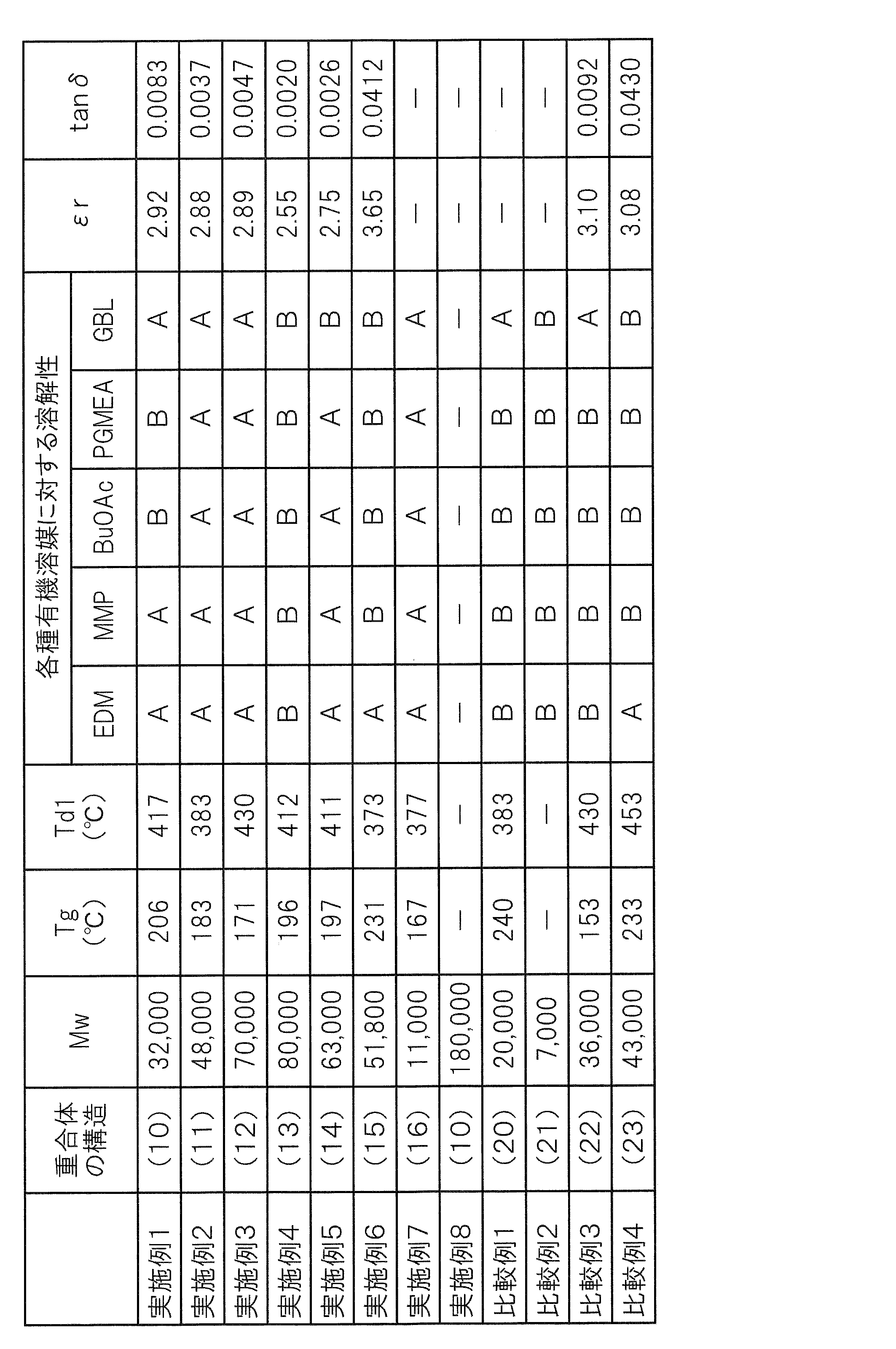
- the polymers of the examples were excellent in heat resistance and could improve the solubility in various organic solvents.
- the polymers of Examples 1 to 3, 5 and 7 all showed high values of Td1 of 370 ° C. or higher, and were soluble (A evaluation) in three or more organic solvents.
- the polymers of Comparative Examples 1, 3 and 4 had only one soluble organic solvent, and the polymer of Comparative Example 2 was insoluble (B evaluation) in any organic solvent.
- the polymers of Examples 1 to 5 have smaller values of ⁇ r and tan ⁇ than the polymers of Comparative Examples 3 and 4, and thus when applied to, for example, a printed wiring board, It can be seen that the high frequency characteristics can be improved.
- the present invention it is possible to provide a polymer having excellent heat resistance and improved solubility in various organic solvents, and a resin composition and a resin molded body using the polymer.
Landscapes
- Chemical & Material Sciences (AREA)
- Health & Medical Sciences (AREA)
- Chemical Kinetics & Catalysis (AREA)
- Medicinal Chemistry (AREA)
- Polymers & Plastics (AREA)
- Organic Chemistry (AREA)
- Engineering & Computer Science (AREA)
- Manufacturing & Machinery (AREA)
- Materials Engineering (AREA)
- Compositions Of Macromolecular Compounds (AREA)
- Polyethers (AREA)
Abstract
Description


本発明の重合体(以下、「[A]重合体」ともいう)は、上記第1構造単位と、上記第2構造単位とを有する重合体である。[A]重合体は、上記各構造単位を2種以上有していてもよい。なお、[A]重合体は、上記第1及び第2構造単位を有する限り、各構造単位の配列やその他の構造については特に限定されない。例えば[A]重合体が第1及び第2構造単位以外の他の構造単位を有してもよい。また、[A]重合体が、後述するように、第1及び第2構造単位を含む繰り返しユニット(a)~(f)を有してもよく、さらに、これらの繰り返しユニット以外の他の繰り返しユニットを有してもよい。
第1構造単位は、下記式(1-1)、(1-2)又は(1-3)で表される。

メチル基、エチル基、n-プロピル基、i-プロピル基、n-ブチル基、i-ブチル基、sec-ブチル基、t-ブチル基、n-ペンチル基等のアルキル基;
エテニル基、プロペニル基、ブテニル基、ペンテニル基等のアルケニル基;
エチニル基、プロピニル基、ブチニル基、ペンチニル基等のアルキニル基などが挙げられる。
シクロプロピル基、シクロブチル基、シクロペンチル基、シクロヘキシル基等の単環のシクロアルキル基;
ノルボルニル基、アダマンチル基等の多環のシクロアルキル基;
シクロプロペニル基、シクロブテニル基、シクロペンテニル基、シクロヘキセニル基等の単環のシクロアルケニル基;
ノルボルネニル基等の多環のシクロアルケニル基などが挙げられる。
フェニル基、トリル基、キシリル基、ナフチル基、アントリル基等のアリール基;
ベンジル基、フェネチル基、フェニルプロピル基、ナフチルメチル基等のアラルキル基などが挙げられる。
第2構造単位は、下記式(2)又は(3)で表される。


[A]重合体は、上述した効果を損なわない範囲で、例えば分子量の調整等のために上記第1及び第2構造単位とは異なる他の構造単位を有してもよい。
上記式(2)において、Lが、単結合、-O-、-S-、-CO-、-SO-、-SO2-、-CONH-、-COO-、炭素数1~20の2価の鎖状炭化水素基、炭素数1~20の2価のフッ素化鎖状炭化水素基、炭素数6~20の2価の芳香族炭化水素基又は炭素数6~20の2価のフッ素化芳香族炭化水素基である第3構造単位;
下記式(4)で表される第4構造単位等が挙げられる。

[A]重合体は、上記第1及び第2構造単位を有する限り、各構造単位の配列については限定されないが、耐熱性を高く維持しつつ、各種有機溶媒への溶解性をより向上させる観点から、上記第1及び第2構造単位を主鎖中に有することが好ましい。ここで、「主鎖」とは、重合体中で相対的に最も長い結合鎖をいう。
[A]重合体が第1及び第2構造単位を主鎖中に有する例としては、例えば下記式(a)に示す繰り返しユニット(a)、下記式(b)に示す繰り返しユニット(b)、下記式(c)に示す繰り返しユニット(c)、下記式(d)に示す繰り返しユニット(d)、下記式(e)に示す繰り返しユニット(e)、下記式(f)に示す繰り返しユニット(f)、これらの繰り返しユニットの組み合わせ(以下、これらをまとめて「特定繰り返しユニット」ともいう)等を主鎖中に有する重合体が挙げられる。

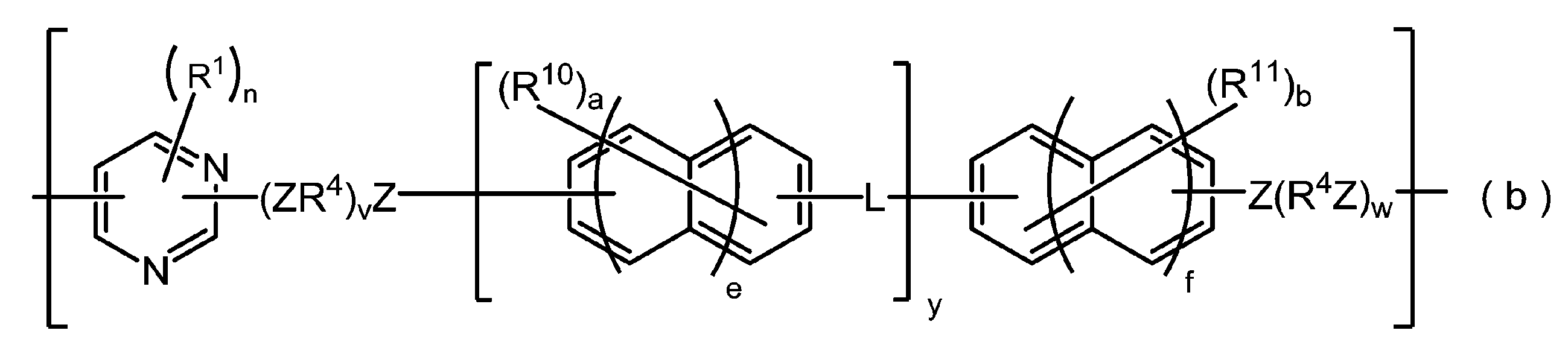
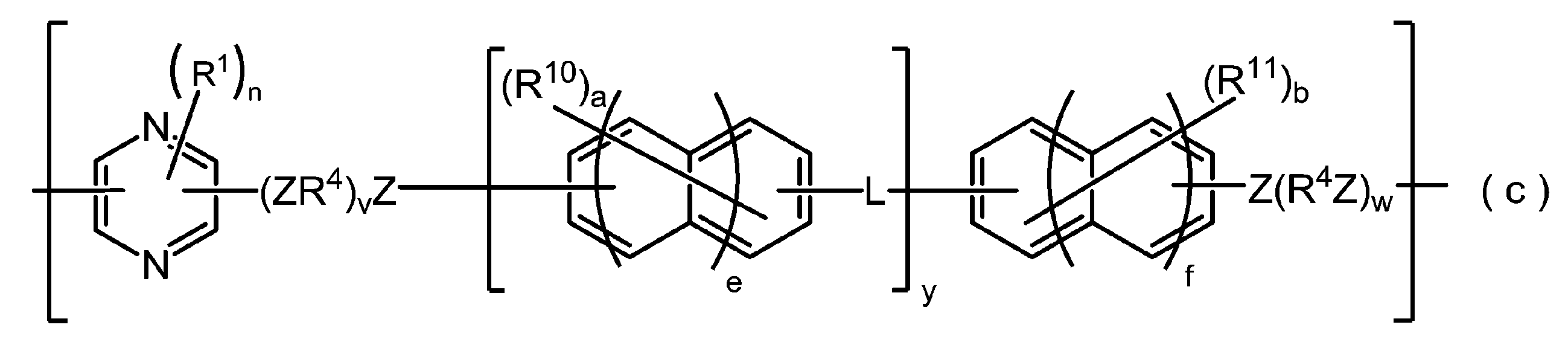
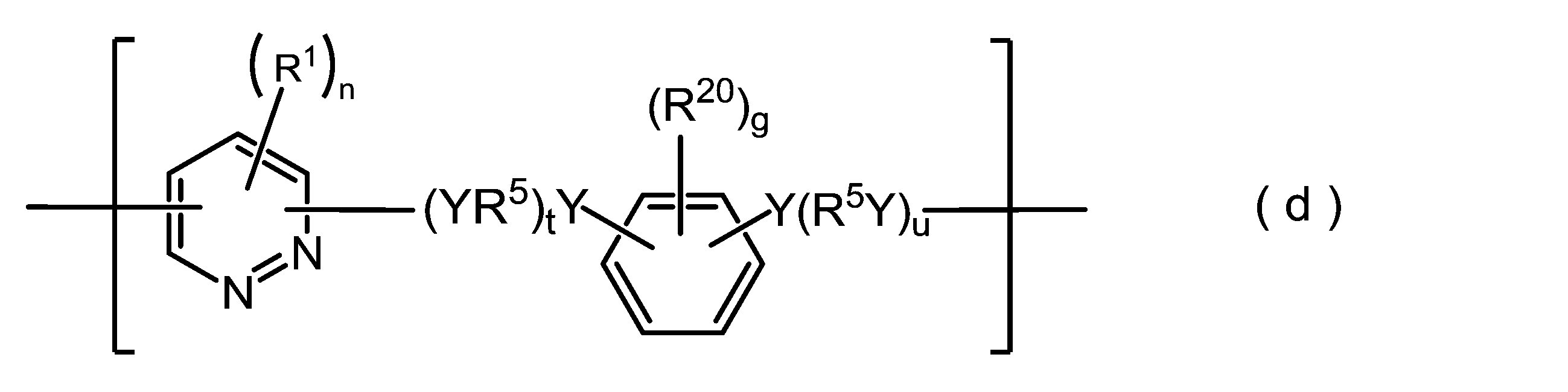
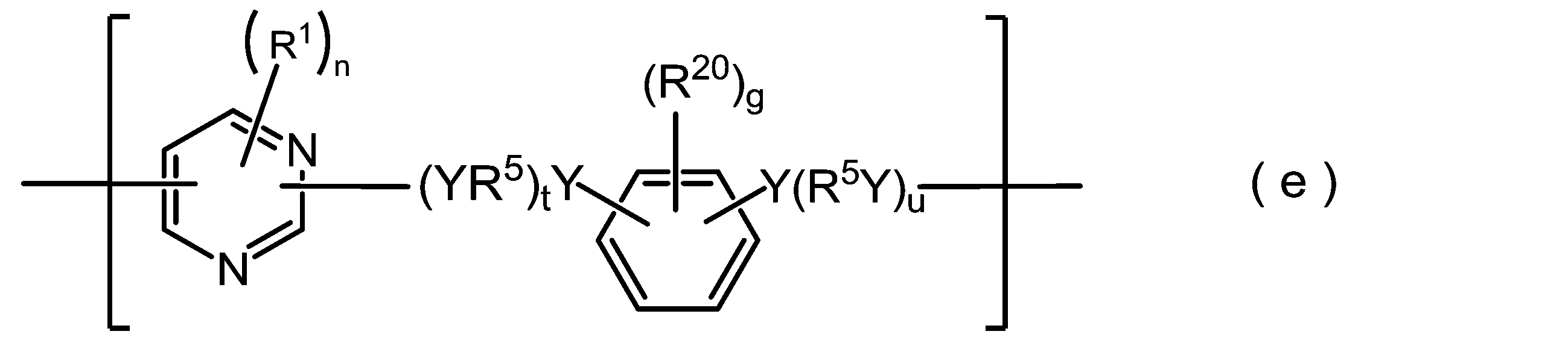

[A]重合体は、例えば公知のポリ(チオ)エーテルの合成方法により合成できる。例えば第1構造単位を与えるジハライド単量体と、第2構造単位を与えるジオール単量体又はジチオール単量体と、他の化合物とを、有機溶媒中、所定の条件で反応させることで合成できる。
水素化リチウム、水素化ナトリウム、水素化カリウム等の水素化アルカリ金属;
水酸化リチウム、水酸化ナトリウム、水酸化カリウム等の水酸化アルカリ金属;
炭酸リチウム、炭酸ナトリウム、炭酸カリウム等のアルカリ金属炭酸塩;
炭酸水素リチウム、炭酸水素ナトリウム、炭酸水素カリウム等のアルカリ金属炭酸水素塩などが挙げられる。これらの中で、水酸化アルカリ金属及びアルカリ金属炭酸塩が好ましく、水酸化ナトリウム及び炭酸カリウムがより好ましい。
[A]重合体の重量平均分子量(Mw)の下限としては、500が好ましく、1,000がより好ましく、10,000がさらに好ましく、20,000が特に好ましく、30,000がさらに特に好ましい。上記Mwの上限としては、300,000が好ましく、200,000がより好ましく、100,000がさらに好ましく、80,000が特に好ましい。上記Mwを上記下限以上とすることにより、耐熱性をより向上させることができる。一方、上記Mwが上記上限を超えると、成形性が低下するおそれがある。なお、上記Mwは、ゲルパーミエーションクロマトグラフィー(GPC)により以下に示す測定条件で測定される値である。
展開溶媒:N-メチル-2-ピロリドン
カラム温度:40℃
流速:1.0mL/分
試料濃度:0.75質量%
試料注入量:50μL
検出器:示差屈折計
標準物質:単分散ポリスチレン
[A]重合体のガラス転移温度の下限としては、150℃が好ましく、165℃がより好ましく、180℃がさらに好ましく、190℃が特に好ましい。上記ガラス転移温度を上記下限以上とすることにより、耐熱性をより向上させることができる。上記ガラス転移温度の上限としては、例えば300℃である。なお、上記「ガラス転移温度」は、例えば示差走査熱量測定装置を用い、窒素雰囲気下、昇温速度20℃/分で測定した値である。
当該樹脂組成物は、[A]重合体及び有機溶媒を含有し、本発明の効果を損なわない範囲で他の成分を含有していてもよい。当該樹脂組成物は、各種有機溶媒への溶解性に優れる[A]重合体を含有するため、各種用途に適用可能な汎用性の高い樹脂組成物として使用できる。また、当該樹脂組成物は、耐熱性に優れる[A]重合体を含有するため、当該樹脂組成物から得られる樹脂成形体の熱劣化を抑制できる。
当該樹脂成形体は、[A]重合体を含有し、例えば当該樹脂組成物により得られる。当該樹脂成形体は、耐熱性に優れる[A]重合体を含有するため、熱劣化を抑制できる。
波長板、位相差板等の光学フィルム;
円錐レンズ、球面レンズ、円筒レンズ等の各種特殊レンズ;
レンズアレイなどが挙げられる。
重合体の1H-NMR分析は、核磁気共鳴装置(日本電子社の「ECX400P」)を使用し、測定溶媒として重クロロホルムを用いて行った。
[実施例1]
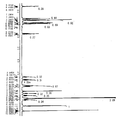
攪拌装置を備えた四つ口セパラブルフラスコに、1,1-ビス(4-ヒドロキシフェニル)-3,3,5-トリメチルシクロヘキサン(18.6g、60.0mmol)、4,6-ジクロロピリミジン(8.9g、60.0mmol)、及び炭酸カリウム(11.1g、81.0mmol)を量り入れ、N-メチル-2-ピロリドン(64g)を加え、窒素雰囲気下、130℃で6時間反応させた。反応終了後、N-メチル-2-ピロリドン(368g)を加えて希釈し、濾過により塩を除去した後、この溶液をメタノール(9.1kg)に投入した。析出した固体を濾別し、少量のメタノールで洗浄し、再度濾別して回収した後、真空乾燥機を用いて減圧下120℃で12時間乾燥し、下記式(10)に示す実施例1の重合体を得た(収量20.5g、収率90%)。得られた重合体の1H-NMRスペクトルを図1に示す。

攪拌装置を備えた四つ口セパラブルフラスコに、1,1-ビス(4-ヒドロキシフェニル)-3,3,5-トリメチルシクロヘキサン(9.3g、30.0mmol)、4-t-ブチルカテコール(5.0g、30.0mmol)、4,6-ジクロロピリミジン(8.9g、60.0mmol)、及び炭酸カリウム(11.2g、81.0mmol)を量り入れ、N-メチル-2-ピロリドン(109g)及びトルエン(46g)を加えて撹拌した。窒素雰囲気下、トルエンを100℃で2時間還流させた後、トルエンを留去し、さらに130℃で6時間反応させた。反応終了後、N-メチル-2-ピロリドン(249g)を加えて希釈し、濾過により塩を除去した後、この溶液をメタノール(7.5kg)に投入した。析出した固体を濾別し、少量のメタノールで洗浄し、再度濾別して回収した後、真空乾燥機を用いて減圧下120℃で12時間乾燥し、下記式(11)に示す実施例2の重合体を得た(収量8.8g、収率46.7%)。

攪拌装置を備えた四つ口セパラブルフラスコに、2-t-ブチルヒドロキノン(5.8g、35.0mmol)、2,5-ジ-t-ブチルヒドロキノン(7.8g、35.0mmol)、2,2-ビス(4-ヒドロキシフェニル)プロパン(6.8g、30.0mmol)、4,6-ジクロロピリミジン(14.9g、100.0mmol)、及び炭酸カリウム(18.7g、135.0mmol)を量り入れ、N-メチル-2-ピロリドン(102.9g)を加え、窒素雰囲気下、130℃で6時間反応させた。反応終了後、N-メチル-2-ピロリドン(300g)を加えて希釈し、濾過により塩を除去した後、この溶液をメタノール(6kg)に投入した。析出した固体を濾別し、少量のメタノールで洗浄し、再度濾別して回収した後、真空乾燥機を用いて減圧下120℃で12時間乾燥し、下記式(12)に示す実施例3の重合体を得た(収量23.4g、収率83.5%)。

攪拌装置を備えた四つ口セパラブルフラスコに、1,1-ビス(4-ヒドロキシ-3-メチルフェニル)-3,3,5-トリメチルシクロヘキサン(20.3g、60.0mmol)、2,5-ジ-t-ブチルヒドロキノン(8.9g、40.0mmol)、4,6-ジクロロピリミジン(14.9g、100.0mmol)、及び炭酸カリウム(18.7g、135.0mmol)を量り入れ、N-メチル-2-ピロリドン(102.9g)を加え、窒素雰囲気下、130℃で6時間反応させた。反応終了後、N-メチル-2-ピロリドン(206g)を加えて希釈し、濾過により塩を除去した後、この溶液をメタノール(7kg)に投入した。析出した固体を濾別し、少量のメタノールで洗浄し、再度濾別して回収した後、真空乾燥機を用いて減圧下120℃で12時間乾燥し、下記式(13)に示す実施例4の重合体を得た(収量30.3g、収率82%)。

攪拌装置を備えた四つ口セパラブルフラスコに、1,1-ビス(4-ヒドロキシ-3-メチルフェニル)-3,3,5-トリメチルシクロヘキサン(25.4g、75.0mmol)、4,6-ジクロロピリミジン(11.2g、75.0mmol)、及び炭酸カリウム(14.0g、101.3mmol)を量り入れ、N-メチル-2-ピロリドン(85g)を加え、窒素雰囲気下、130℃で6時間反応させた。反応終了後、N-メチル-2-ピロリドン(300g)を加えて希釈し、濾過により塩を除去した後、この溶液をメタノール(6kg)に投入した。析出した固体を濾別し、少量のメタノールで洗浄し、再度濾別して回収した後、真空乾燥機を用いて減圧下120℃で12時間乾燥し、下記式(14)に示す実施例5の重合体を得た(収量29.6g、収率95%)。

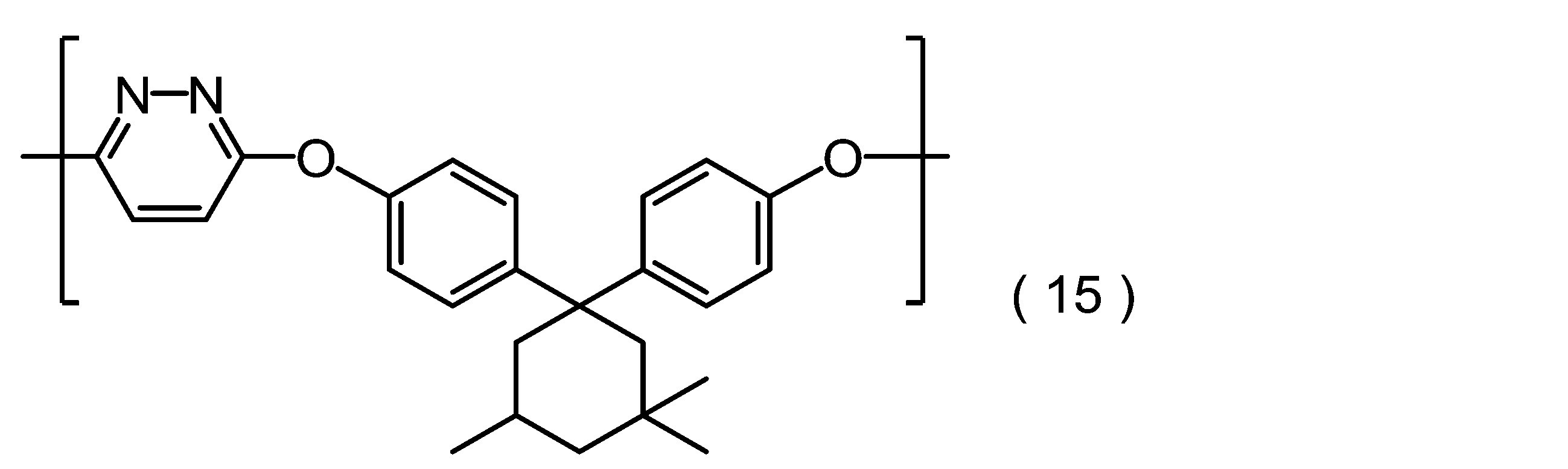
攪拌装置を備えた四つ口セパラブルフラスコに、1,1-ビス(4-ヒドロキシフェニル)-3,3,5-トリメチルシクロヘキサン(10.7g、34.5mmol)、3,6-ジクロロピリダジン(5.1g、34.2mmol)、及び炭酸カリウム(6.5g、47.0mmol)を量り入れ、N-メチル-2-ピロリドン(36g)を加え、窒素雰囲気下、145℃で9時間反応させた。反応終了後、N-メチル-2-ピロリドン(150g)を加えて希釈し、濾過により塩を除去した後、この溶液をメタノール(3kg)に投入した。析出した固体を濾別し、少量のメタノールで洗浄し、再度濾別して回収した後、真空乾燥機を用いて減圧下120℃で12時間乾燥し、下記式(15)に示す実施例6の重合体を得た(収量7.6g、収率48%)。
攪拌装置を備えた四つ口セパラブルフラスコに、1,1-ビス(4-ヒドロキシフェニル)-3,3,5-トリメチルシクロヘキサン(23.3g、75.1mmol)、2,6-ジクロロピラジン(11.2g、75.2mmol)、及び炭酸カリウム(14.0g、101.3mmol)を量り入れ、N-メチル-2-ピロリドン(80g)を加え、窒素雰囲気下、145℃で6時間反応させた。反応終了後、N-メチル-2-ピロリドン(300g)を加えて希釈し、濾過により塩を除去した後、この溶液をメタノール(6kg)に投入した。析出した固体を濾別し、少量のメタノールで洗浄し、再度濾別して回収した後、真空乾燥機を用いて減圧下100℃で12時間乾燥し、下記式(16)に示す実施例7の重合体を得た(収量21.1g、収率73%)。

攪拌装置を備えた四つ口セパラブルフラスコに、1,1-ビス(4-ヒドロキシフェニル)-3,3,5-トリメチルシクロヘキサン(37.2g、120.0mmol)、4,6-ジクロロピリミジン(17.8g、120.0mmol)、及び炭酸カリウム(22.2g、162.0mmol)を量り入れ、N-メチル-2-ピロリドン(130g)を加え、窒素雰囲気下、130℃で10時間反応させた。反応終了後、N-メチル-2-ピロリドン(730g)を加えて希釈し、濾過により塩を除去した後、この溶液をメタノール(18kg)に投入した。析出した固体を濾別し、少量のメタノールで洗浄し、再度濾別して回収した後、真空乾燥機を用いて減圧下120℃で12時間乾燥し、実施例8の重合体を得た(収量21.6g、収率95%、構造式は上記式(10)と同じ)。
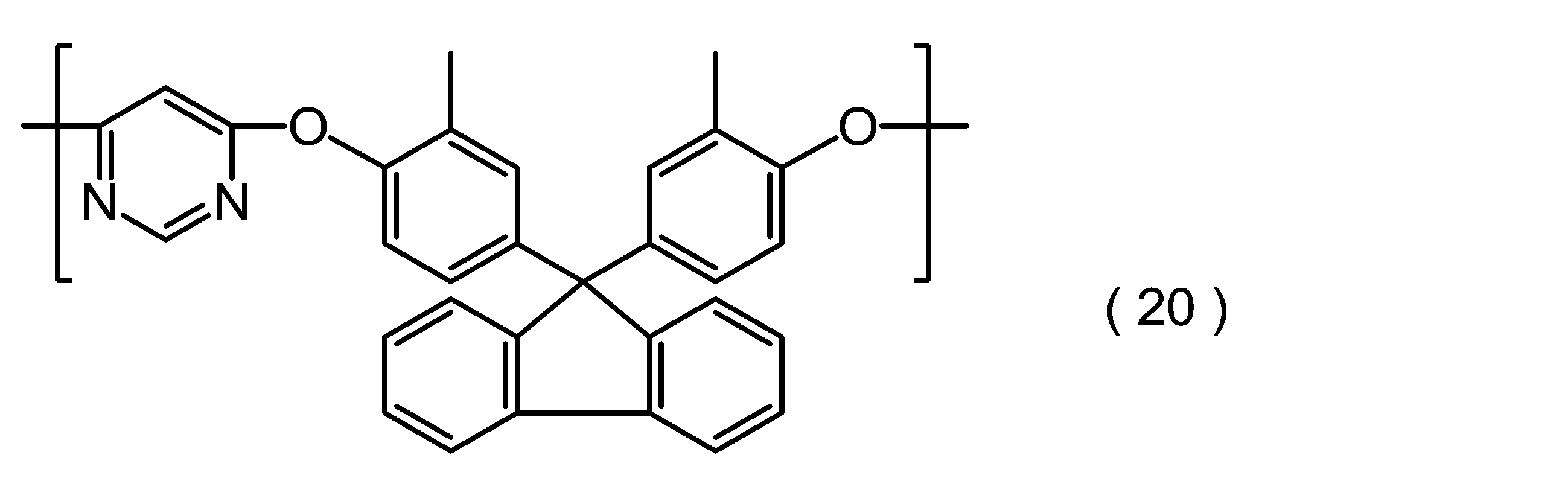
攪拌装置を備えた四つ口セパラブルフラスコに、9,9-ビス(4-ヒドロキシ-3-メチルフェニル)フルオレン(18.9g、50.0mmol)、4,6-ジクロロピリミジン(7.4g、50.0mmol)、及び炭酸カリウム(9.3g、67.5mmol)を量り入れ、N-メチル-2-ピロリドン(103g)を加え、窒素雰囲気下、130℃で6時間反応させた。反応終了後、N-メチル-2-ピロリドン(329g)を加えて希釈し、濾過により塩を除去した後、この溶液をメタノール(9.1kg)に投入した。析出した固体を濾別し、少量のメタノールで洗浄し、再度濾別して回収した後、真空乾燥機を用いて減圧下120℃で12時間乾燥し、下記式(20)に示す比較例1の重合体を得た(収量11.5g、収率61.8%)。
攪拌装置を備えた四つ口セパラブルフラスコに、1,3-ジヒドロキシベンゼン(11.0g、100.0mmol)、4,6-ジクロロピリミジン(14.9g、100.0mmol)、及び炭酸カリウム(18.6g、135.0mmol)を量り入れ、N-メチル-2-ピロリドン(128g)を加え、窒素雰囲気下、130℃で6時間反応させた。反応終了後、N-メチル-2-ピロリドン(225g)を加えて希釈し、濾過により塩を除去した後、この溶液をメタノール(7.4kg)に投入した。析出した固体を濾別し、少量のメタノールで洗浄し、再度濾別して回収した後、真空乾燥機を用いて減圧下120℃で12時間乾燥し、下記式(21)に示す比較例2の重合体を得た(収量11.5g、収率62%)。

攪拌装置を備えた四つ口セパラブルフラスコに、2,2-ビス(4-ヒドロキシフェニル)プロパン(11.4g、50.0mmol)、4,6-ジクロロピリミジン(7.4g、50.0mmol)、及び炭酸カリウム(9.3g、67.5mmol)を量り入れ、N-メチル-2-ピロリドン(90g)を加え、窒素雰囲気下、130℃で6時間反応させた。反応終了後、N-メチル-2-ピロリドン(200g)を加えて希釈し、濾過により塩を除去した後、この溶液をメタノール(6.1kg)に投入した。析出した固体を濾別し、少量のメタノールで洗浄し、再度濾別して回収した後、真空乾燥機を用いて減圧下120℃で12時間乾燥し、下記式(22)に示す比較例3の重合体を得た(収量12.1g、収率80%)。

攪拌装置を備えた四つ口セパラブルフラスコに、1,1-ビス(4-ヒドロキシフェニル)-3,3,5-トリメチルシクロヘキサン(15.5g、50.0mmol)、4,4’-ジクロロジフェニルスルホン(14.4g、50.0mmol)、及び炭酸カリウム(9.3g、67.5mmol)を量り入れ、N-メチル-2-ピロリドン(121g)及びトルエン(50g)を加えて撹拌した。窒素雰囲気下、トルエンを100℃で2時間還流させた後、トルエンを留去し、さらに190℃で6時間反応させた。反応終了後、N-メチル-2-ピロリドン(398g)を加えて希釈し、濾過により塩を除去した後、この溶液をメタノール(10.5kg)に投入した。析出した固体を濾別し、少量のメタノールで洗浄し、再度濾別して回収した後、真空乾燥機を用いて減圧下120℃で12時間乾燥し、下記式(23)に示す比較例4の重合体を得た(収量23.3g、収率88.8%)。

上記得られた重合体について、下記方法に従い、重量平均分子量(Mw)、ガラス転移温度(Tg)、1%質量減少温度(Td1)、各種有機溶媒に対する溶解性、比誘電率(εr)及び誘電正接(tanδ)を評価した。評価結果を表1に示す。なお、表1において、「-」は当該評価項目について測定していないことを意味する。
各重合体の重量平均分子量(Mw)は、GPC装置(東ソー社の「HLC-8320型」)を使用し、下記条件で測定した。
カラム:東ソー社の「TSKgel α―M」と、東ソー社の「TSKgel guardcоlumn α」とを連結したもの
展開溶媒:N-メチル-2-ピロリドン
カラム温度:40℃
流速:1.0mL/分
試料濃度:0.75質量%
試料注入量:50μL
検出器:示差屈折計
標準物質:単分散ポリスチレン
各重合体のガラス転移温度(Tg)は、示差走査熱量測定装置(Rigaku社のDSC装置「Thermo Plus DSC8230」)を用いて、窒素雰囲気下、昇温速度20℃/分で得られたサーモグラムのDSC昇温曲線において、ベースラインと変曲点での接線との交点に対応する温度とした。上記変曲点は、DSC昇温曲線の微分曲線であるDDSC曲線におけるピークに対応する温度とした。また、DSCのベースラインの確認には、適宜DDSC曲線を参照した。
各重合体の1%質量減少温度(Td1)は、差動型示差熱天秤(SIIナノテクノロジー社の「TG/DTA6200」)を用いて、窒素雰囲気下、昇温速度10℃/分の条件で得られた熱質量曲線から、重合体の質量が累計で1質量%減少した時の温度とした。なお、Td1は、耐熱性の指標の1つであり、その値が大きいほど耐熱性に優れると評価できる。
各重合体の各種有機溶媒に対する溶解性は、各重合体を表1に示す各種有機溶媒にそれぞれ濃度10質量%となるように加え、攪拌した後、目視で沈殿物を確認できなかった場合を「A」、目視で沈殿物を確認できた場合を「B」として評価した。
EDM:ジエチレングリコールエチルメチルエーテル
MMP:3-メトキシプロピオン酸メチル
BuOAc:酢酸ブチル
PGMEA:プロピレングリコール-1-モノメチルエーテル-2-アセテート
GBL:γ-ブチロラクトン
まず、適量の各重合体を塩化メチレンに溶解させて重合体溶液を調製し、この溶液をガラス板上にキャスト成膜し、常圧下、室温で一晩乾燥させた。次いで真空乾燥機にて残存する塩化メチレンを除去し、寸法3×4cm、平均厚み90μmのフィルムを得た。得られたフィルムの一方の面に、真空蒸着装置(日本電子社の「JEE-420」)を用いてアルミニウムを真空蒸着することにより電極を形成し、εr及びtanδを評価するための試験片を得た。この試験片について、JIS-C-2138(2007年)に準拠し、プレシジョンLCRメーター(ヒューレット・パッカード社の「4284A型」)を用いて、振幅100mV、周波数1MHz、温度25℃及び相対湿度50%の条件によりεr及びtanδを測定した。
Claims (7)
- 下記式(1-1)、(1-2)又は(1-3)で表される第1構造単位と、
下記式(2)又は(3)で表される第2構造単位と
を有する重合体。



- 上記式(2-1)のRaが、環員数5~15の単環の脂環式炭化水素基又は環員数5~15の単環のフッ素化脂環式炭化水素基である請求項1に記載の重合体。
- 上記式(2-1)のRaが、環員数5~10の単環の脂環式炭化水素基又は環員数5~10の単環のフッ素化脂環式炭化水素基である請求項2に記載の重合体。
- 上記式(2-1)のRaが、環員数7~30の多環の脂環式炭化水素基又は環員数7~30の多環のフッ素化脂環式炭化水素基である請求項1に記載の重合体。
- ポリスチレン換算の重量平均分子量が500以上300,000以下である請求項1から請求項4のいずれか1項に記載の重合体。
- 請求項1から請求項5のいずれか1項に記載の重合体と有機溶媒とを含有する樹脂組成物。
- 請求項1から請求項5のいずれか1項に記載の重合体を含有する樹脂成形体。
Priority Applications (5)
| Application Number | Priority Date | Filing Date | Title |
|---|---|---|---|
| KR1020177025040A KR102438427B1 (ko) | 2015-03-11 | 2016-02-08 | 중합체, 수지 조성물 및 수지 성형체 |
| CN201680010525.0A CN107250212B (zh) | 2015-03-11 | 2016-02-08 | 聚合物、树脂组合物和树脂成型体 |
| JP2017504930A JP6566023B2 (ja) | 2015-03-11 | 2016-02-08 | 重合体、樹脂組成物及び樹脂成形体 |
| EP16761419.7A EP3272784B1 (en) | 2015-03-11 | 2016-02-08 | Polymer, resin composition and resin molded body |
| US15/698,786 US10266650B2 (en) | 2015-03-11 | 2017-09-08 | Polymer, resin composition and resin molded product |
Applications Claiming Priority (4)
| Application Number | Priority Date | Filing Date | Title |
|---|---|---|---|
| JP2015-048511 | 2015-03-11 | ||
| JP2015048511 | 2015-03-11 | ||
| JP2015207564 | 2015-10-21 | ||
| JP2015-207564 | 2015-10-21 |
Related Child Applications (1)
| Application Number | Title | Priority Date | Filing Date |
|---|---|---|---|
| US15/698,786 Continuation US10266650B2 (en) | 2015-03-11 | 2017-09-08 | Polymer, resin composition and resin molded product |
Publications (1)
| Publication Number | Publication Date |
|---|---|
| WO2016143447A1 true WO2016143447A1 (ja) | 2016-09-15 |
Family
ID=56879529
Family Applications (1)
| Application Number | Title | Priority Date | Filing Date |
|---|---|---|---|
| PCT/JP2016/053721 Ceased WO2016143447A1 (ja) | 2015-03-11 | 2016-02-08 | 重合体、樹脂組成物及び樹脂成形体 |
Country Status (6)
| Country | Link |
|---|---|
| US (1) | US10266650B2 (ja) |
| EP (1) | EP3272784B1 (ja) |
| JP (1) | JP6566023B2 (ja) |
| KR (1) | KR102438427B1 (ja) |
| CN (1) | CN107250212B (ja) |
| WO (1) | WO2016143447A1 (ja) |
Cited By (7)
| Publication number | Priority date | Publication date | Assignee | Title |
|---|---|---|---|---|
| JP2017137486A (ja) * | 2016-02-04 | 2017-08-10 | Jsr株式会社 | 樹脂組成物、重合体の製造方法及び成形体 |
| WO2017183461A1 (ja) * | 2016-04-20 | 2017-10-26 | Jsr株式会社 | 重合体、組成物、成形体、硬化物及び積層体 |
| JP2017197725A (ja) * | 2016-04-20 | 2017-11-02 | Jsr株式会社 | 重合体、組成物及び成形体 |
| WO2019054334A1 (ja) | 2017-09-15 | 2019-03-21 | Jsr株式会社 | 高周波回路用積層体及びその製造方法、並びにbステージシート |
| WO2019054335A1 (ja) | 2017-09-15 | 2019-03-21 | Jsr株式会社 | 回路基板 |
| JPWO2020179443A1 (ja) * | 2019-03-01 | 2020-09-10 | ||
| US20210286262A1 (en) * | 2018-07-25 | 2021-09-16 | Jsr Corporation | Photosensitive resin composition, method for producing resin film having pattern, resin film having pattern, and semiconductor circuit substrate |
Families Citing this family (3)
| Publication number | Priority date | Publication date | Assignee | Title |
|---|---|---|---|---|
| CN115298616B (zh) * | 2020-03-18 | 2026-01-13 | 日产化学株式会社 | 感光性绝缘膜形成用组合物 |
| CN116917376A (zh) * | 2021-04-02 | 2023-10-20 | Jsr株式会社 | 聚合物、组合物、硬化物、层叠体及电子零件 |
| TWI871055B (zh) * | 2023-10-19 | 2025-01-21 | 台燿科技股份有限公司 | 樹脂組成物及其應用 |
Citations (4)
| Publication number | Priority date | Publication date | Assignee | Title |
|---|---|---|---|---|
| JP2006199746A (ja) * | 2005-01-18 | 2006-08-03 | Jsr Corp | 芳香族ポリエーテルおよびその製造方法 |
| JP2011219643A (ja) * | 2010-04-12 | 2011-11-04 | Tokyo Institute Of Technology | トリアジン単位含有ポリ(フェニレンチオエーテル) |
| JP2012038785A (ja) * | 2010-08-03 | 2012-02-23 | Jsr Corp | 基板の製造方法ならびにそれに用いられるフィルムおよび組成物 |
| JP2015209511A (ja) * | 2014-04-28 | 2015-11-24 | Jsr株式会社 | 重合体組成物、重合体ペレット、成形体及びフィルム |
Family Cites Families (5)
| Publication number | Priority date | Publication date | Assignee | Title |
|---|---|---|---|---|
| JPH08269214A (ja) | 1995-03-30 | 1996-10-15 | Teijin Ltd | 光学等方性ポリアリレート系フィルムの製造方法 |
| JP4121301B2 (ja) | 2002-04-26 | 2008-07-23 | ユニチカ株式会社 | 金属基板用コート液 |
| US6846899B2 (en) | 2002-10-01 | 2005-01-25 | Chartered Semiconductor Manufacturing Ltd. | Poly(arylene ether) dielectrics |
| WO2013080929A1 (ja) * | 2011-12-01 | 2013-06-06 | Jsr株式会社 | 多層レジストプロセスに用いられるレジスト下層膜形成用組成物、レジスト下層膜及びその形成方法、並びにパターン形成方法 |
| EP3275917B1 (en) * | 2015-03-23 | 2019-08-21 | JSR Corporation | Polymer, resin composition, and resin molded article |
-
2016
- 2016-02-08 WO PCT/JP2016/053721 patent/WO2016143447A1/ja not_active Ceased
- 2016-02-08 EP EP16761419.7A patent/EP3272784B1/en active Active
- 2016-02-08 JP JP2017504930A patent/JP6566023B2/ja active Active
- 2016-02-08 CN CN201680010525.0A patent/CN107250212B/zh active Active
- 2016-02-08 KR KR1020177025040A patent/KR102438427B1/ko active Active
-
2017
- 2017-09-08 US US15/698,786 patent/US10266650B2/en active Active
Patent Citations (4)
| Publication number | Priority date | Publication date | Assignee | Title |
|---|---|---|---|---|
| JP2006199746A (ja) * | 2005-01-18 | 2006-08-03 | Jsr Corp | 芳香族ポリエーテルおよびその製造方法 |
| JP2011219643A (ja) * | 2010-04-12 | 2011-11-04 | Tokyo Institute Of Technology | トリアジン単位含有ポリ(フェニレンチオエーテル) |
| JP2012038785A (ja) * | 2010-08-03 | 2012-02-23 | Jsr Corp | 基板の製造方法ならびにそれに用いられるフィルムおよび組成物 |
| JP2015209511A (ja) * | 2014-04-28 | 2015-11-24 | Jsr株式会社 | 重合体組成物、重合体ペレット、成形体及びフィルム |
Non-Patent Citations (1)
| Title |
|---|
| See also references of EP3272784A4 * |
Cited By (17)
| Publication number | Priority date | Publication date | Assignee | Title |
|---|---|---|---|---|
| JP2017137486A (ja) * | 2016-02-04 | 2017-08-10 | Jsr株式会社 | 樹脂組成物、重合体の製造方法及び成形体 |
| US11505651B2 (en) | 2016-04-20 | 2022-11-22 | Jsr Corporation | Polymer, composition, molded article, cured product and laminate |
| WO2017183461A1 (ja) * | 2016-04-20 | 2017-10-26 | Jsr株式会社 | 重合体、組成物、成形体、硬化物及び積層体 |
| JP2017197725A (ja) * | 2016-04-20 | 2017-11-02 | Jsr株式会社 | 重合体、組成物及び成形体 |
| US12043702B2 (en) | 2016-04-20 | 2024-07-23 | Jsr Corporation | Polymer, composition, molded article, cured product and laminate |
| US11582860B2 (en) | 2017-09-15 | 2023-02-14 | Jsr Corporation | Circuit board |
| CN111108816A (zh) * | 2017-09-15 | 2020-05-05 | Jsr株式会社 | 电路基板 |
| JP2019054242A (ja) * | 2017-09-15 | 2019-04-04 | Jsr株式会社 | 回路基板 |
| WO2019054335A1 (ja) | 2017-09-15 | 2019-03-21 | Jsr株式会社 | 回路基板 |
| WO2019054334A1 (ja) | 2017-09-15 | 2019-03-21 | Jsr株式会社 | 高周波回路用積層体及びその製造方法、並びにbステージシート |
| US20210286262A1 (en) * | 2018-07-25 | 2021-09-16 | Jsr Corporation | Photosensitive resin composition, method for producing resin film having pattern, resin film having pattern, and semiconductor circuit substrate |
| US12529958B2 (en) * | 2018-07-25 | 2026-01-20 | Jsr Corporation | Photosensitive resin composition, method for producing resin film having pattern, resin film having pattern, and semiconductor circuit substrate |
| JPWO2020179443A1 (ja) * | 2019-03-01 | 2020-09-10 | ||
| WO2020179443A1 (ja) * | 2019-03-01 | 2020-09-10 | Jsr株式会社 | 高周波回路用積層体及びその製造方法、フレキシブルプリント基板、bステージシート、並びに積層体捲回体 |
| KR20210134641A (ko) * | 2019-03-01 | 2021-11-10 | 제이에스알 가부시끼가이샤 | 고주파 회로용 적층체 및 그의 제조 방법, 플렉시블 프린트 기판, b 스테이지 시트, 그리고 적층체 권회체 |
| JP7306449B2 (ja) | 2019-03-01 | 2023-07-11 | Jsr株式会社 | 高周波回路用積層体、フレキシブルプリント基板、及び積層体捲回体 |
| KR102780208B1 (ko) * | 2019-03-01 | 2025-03-14 | 제이에스알 가부시키가이샤 | 고주파 회로용 적층체 및 그의 제조 방법, 플렉시블 프린트 기판, b 스테이지 시트, 그리고 적층체 권회체 |
Also Published As
| Publication number | Publication date |
|---|---|
| US10266650B2 (en) | 2019-04-23 |
| EP3272784A1 (en) | 2018-01-24 |
| JP6566023B2 (ja) | 2019-08-28 |
| US20180179335A9 (en) | 2018-06-28 |
| KR102438427B1 (ko) | 2022-09-01 |
| CN107250212A (zh) | 2017-10-13 |
| CN107250212B (zh) | 2019-12-13 |
| US20170369649A1 (en) | 2017-12-28 |
| KR20170128272A (ko) | 2017-11-22 |
| EP3272784A4 (en) | 2018-08-29 |
| EP3272784B1 (en) | 2020-04-15 |
| JPWO2016143447A1 (ja) | 2018-02-01 |
Similar Documents
| Publication | Publication Date | Title |
|---|---|---|
| JP6566023B2 (ja) | 重合体、樹脂組成物及び樹脂成形体 | |
| CN109071804B (zh) | 聚合物、组合物、成形体、硬化物以及层叠体 | |
| US20130030116A1 (en) | Film, resin composition and polymer | |
| JP2020502310A (ja) | 硬化性化合物 | |
| KR101736533B1 (ko) | 신규 중합체, 그의 제조 방법 및 필름 | |
| JP6888308B2 (ja) | 樹脂組成物、重合体の製造方法及び成形体 | |
| JP7659692B1 (ja) | 樹脂組成物及びその硬化物 | |
| JP6866737B2 (ja) | 重合体、組成物及び成形体 | |
| JP6705991B2 (ja) | 重合体、樹脂組成物及び樹脂成形体 | |
| JP6922364B2 (ja) | 重合体、組成物及び成形体 | |
| JP6221759B2 (ja) | 重合体、化合物、樹脂組成物、樹脂ペレット及び樹脂成形体 | |
| TWI642723B (zh) | 光學材料用非晶性聚合物、樹脂組成物、樹脂顆粒及樹脂成型體 | |
| JP6102637B2 (ja) | 芳香族ジハライド化合物、重合体、重合体組成物及び成形体 | |
| JP6520495B2 (ja) | 芳香族ポリケトンの製造方法 | |
| JP6314537B2 (ja) | 重合体、樹脂組成物、樹脂ペレット及び樹脂成形体 | |
| KR20230034637A (ko) | 수지, 이의 제조방법, 수지 조성물 및 성형품 | |
| JP5759302B2 (ja) | 脂環式構造及びトリアジン構造を含む重合体、並びに当該重合体を含んでなる透明材料 |
Legal Events
| Date | Code | Title | Description |
|---|---|---|---|
| 121 | Ep: the epo has been informed by wipo that ep was designated in this application |
Ref document number: 16761419 Country of ref document: EP Kind code of ref document: A1 |
|
| ENP | Entry into the national phase |
Ref document number: 2017504930 Country of ref document: JP Kind code of ref document: A |
|
| ENP | Entry into the national phase |
Ref document number: 20177025040 Country of ref document: KR Kind code of ref document: A |
|
| NENP | Non-entry into the national phase |
Ref country code: DE |
|
| REEP | Request for entry into the european phase |
Ref document number: 2016761419 Country of ref document: EP |