WO2016150167A1 - 无线通信设备和无线通信方法 - Google Patents
无线通信设备和无线通信方法 Download PDFInfo
- Publication number
- WO2016150167A1 WO2016150167A1 PCT/CN2015/093972 CN2015093972W WO2016150167A1 WO 2016150167 A1 WO2016150167 A1 WO 2016150167A1 CN 2015093972 W CN2015093972 W CN 2015093972W WO 2016150167 A1 WO2016150167 A1 WO 2016150167A1
- Authority
- WO
- WIPO (PCT)
- Prior art keywords
- wireless communication
- frequency band
- base station
- user equipment
- unlicensed
- Prior art date
- Legal status (The legal status is an assumption and is not a legal conclusion. Google has not performed a legal analysis and makes no representation as to the accuracy of the status listed.)
- Ceased
Links
Images




Classifications
-
- H—ELECTRICITY
- H04—ELECTRIC COMMUNICATION TECHNIQUE
- H04W—WIRELESS COMMUNICATION NETWORKS
- H04W24/00—Supervisory, monitoring or testing arrangements
-
- H—ELECTRICITY
- H04—ELECTRIC COMMUNICATION TECHNIQUE
- H04W—WIRELESS COMMUNICATION NETWORKS
- H04W72/00—Local resource management
- H04W72/20—Control channels or signalling for resource management
- H04W72/23—Control channels or signalling for resource management in the downlink direction of a wireless link, i.e. towards a terminal
-
- H—ELECTRICITY
- H04—ELECTRIC COMMUNICATION TECHNIQUE
- H04W—WIRELESS COMMUNICATION NETWORKS
- H04W72/00—Local resource management
- H04W72/12—Wireless traffic scheduling
-
- H—ELECTRICITY
- H04—ELECTRIC COMMUNICATION TECHNIQUE
- H04W—WIRELESS COMMUNICATION NETWORKS
- H04W72/00—Local resource management
- H04W72/04—Wireless resource allocation
- H04W72/044—Wireless resource allocation based on the type of the allocated resource
-
- H—ELECTRICITY
- H04—ELECTRIC COMMUNICATION TECHNIQUE
- H04L—TRANSMISSION OF DIGITAL INFORMATION, e.g. TELEGRAPHIC COMMUNICATION
- H04L5/00—Arrangements affording multiple use of the transmission path
- H04L5/003—Arrangements for allocating sub-channels of the transmission path
- H04L5/0048—Allocation of pilot signals, i.e. of signals known to the receiver
-
- H—ELECTRICITY
- H04—ELECTRIC COMMUNICATION TECHNIQUE
- H04W—WIRELESS COMMUNICATION NETWORKS
- H04W16/00—Network planning, e.g. coverage or traffic planning tools; Network deployment, e.g. resource partitioning or cells structures
- H04W16/14—Spectrum sharing arrangements between different networks
-
- H—ELECTRICITY
- H04—ELECTRIC COMMUNICATION TECHNIQUE
- H04W—WIRELESS COMMUNICATION NETWORKS
- H04W24/00—Supervisory, monitoring or testing arrangements
- H04W24/02—Arrangements for optimising operational condition
-
- H—ELECTRICITY
- H04—ELECTRIC COMMUNICATION TECHNIQUE
- H04W—WIRELESS COMMUNICATION NETWORKS
- H04W24/00—Supervisory, monitoring or testing arrangements
- H04W24/08—Testing, supervising or monitoring using real traffic
-
- H—ELECTRICITY
- H04—ELECTRIC COMMUNICATION TECHNIQUE
- H04W—WIRELESS COMMUNICATION NETWORKS
- H04W72/00—Local resource management
- H04W72/04—Wireless resource allocation
- H04W72/044—Wireless resource allocation based on the type of the allocated resource
- H04W72/0453—Resources in frequency domain, e.g. a carrier in FDMA
-
- H—ELECTRICITY
- H04—ELECTRIC COMMUNICATION TECHNIQUE
- H04W—WIRELESS COMMUNICATION NETWORKS
- H04W72/00—Local resource management
- H04W72/20—Control channels or signalling for resource management
- H04W72/27—Control channels or signalling for resource management between access points
-
- H—ELECTRICITY
- H04—ELECTRIC COMMUNICATION TECHNIQUE
- H04W—WIRELESS COMMUNICATION NETWORKS
- H04W72/00—Local resource management
- H04W72/30—Resource management for broadcast services
-
- H—ELECTRICITY
- H04—ELECTRIC COMMUNICATION TECHNIQUE
- H04W—WIRELESS COMMUNICATION NETWORKS
- H04W74/00—Wireless channel access
- H04W74/08—Non-scheduled access, e.g. ALOHA
- H04W74/0808—Non-scheduled access, e.g. ALOHA using carrier sensing, e.g. carrier sense multiple access [CSMA]
-
- H—ELECTRICITY
- H04—ELECTRIC COMMUNICATION TECHNIQUE
- H04W—WIRELESS COMMUNICATION NETWORKS
- H04W88/00—Devices specially adapted for wireless communication networks, e.g. terminals, base stations or access point devices
- H04W88/02—Terminal devices
-
- H—ELECTRICITY
- H04—ELECTRIC COMMUNICATION TECHNIQUE
- H04W—WIRELESS COMMUNICATION NETWORKS
- H04W88/00—Devices specially adapted for wireless communication networks, e.g. terminals, base stations or access point devices
- H04W88/08—Access point devices
Definitions
- the present disclosure generally relates to the field of wireless communications, and more particularly, to a wireless communication device for a base station side, a wireless communication device for a user equipment side, and a wireless communication method.
- LTE Long Term Evolution
- the small cell is a low-power wireless access node that operates in an authorized, unlicensed spectrum and can cover a range of 10 meters to 200 meters.
- the LTE network deployed in the licensed band will be widely deployed worldwide.
- the LTE wireless interface and transmission mechanism can be adjusted to enable unlicensed spectrum resources for data transmission. This technology is called LAA (Authorized Auxiliary Access) - LTE.
- a wireless communication device for a base station side comprising one or more processors, the one or more processors configured to: determine a user for the base station on a target unlicensed frequency band The communication content of the device to be transmitted and predicting the transmission progress, and generating indication information about the progress of the transmission and adding the indication information to the communication frame of the user equipment for transmitting the indication information.
- a method of wireless communication comprising the steps of determining a communication content to be transmitted for a user equipment of the base station on a target unlicensed frequency band and predicting a transmission progress, and generating indication information about a transmission progress. And adding the indication information to the communication frame of the user equipment for transmitting the indication information.
- a wireless communication device for a user equipment side comprising one or more processors, the one or more processors configured to: detect an unlicensed frequency band; and parse the communication frame of the base station And indication information about a transmission progress of the communication content to be transmitted on the unlicensed frequency band; and generating feedback information for the serving base station of the user equipment based on the detection result of the unlicensed frequency band.
- a method for wireless communication performed on a user equipment side includes the step of detecting an unlicensed frequency band, and parsing a transmission progress of the communication content to be transmitted on the unlicensed frequency band included in the communication frame of the base station a step of indicating information, and generating feedback information for the serving base station of the user equipment based on the detection result of the unlicensed frequency band.
- a wireless communication device for a base station side comprising one or more processors, the one or more processors configured to detect availability of an unlicensed band; availability based on unlicensed bands Initially allocating a corresponding unlicensed frequency band to the user equipment of the base station; and generating an interference signal corresponding to the pilot sequence corresponding to the cell of the base station without including the data information for the corresponding unlicensed frequency band, thereby indicating that the base station intends to connect within a certain time period Enter the corresponding unlicensed band.
- FIG. 1 is a block diagram showing a configuration example of a wireless communication device for a base station side according to an embodiment of the present invention
- FIG. 2 is a block diagram showing a configuration example of a wireless communication device for a base station side according to another embodiment of the present invention
- FIG. 3 is a block diagram showing a configuration example of a wireless communication device for a base station side according to still another embodiment of the present invention.
- FIG. 4 is a block diagram showing a configuration example of a wireless communication device for a base station side according to another embodiment of the present invention.
- FIG. 5 is a block diagram showing a configuration example of a wireless communication device for a base station side according to still another embodiment of the present invention.
- FIG. 6 is a block diagram showing a configuration example of a wireless communication device for a base station side according to another embodiment of the present invention.
- FIG. 7 is a flowchart showing an example of a procedure of a wireless communication method performed on a base station side according to an embodiment of the present invention.
- FIG. 8 is a block diagram showing a configuration example of a wireless communication device for a user equipment side according to an embodiment of the present invention.
- FIG. 9 is a block diagram showing a configuration example of a wireless communication device for a user equipment side according to another embodiment of the present invention.
- FIG. 10 is a block diagram showing a configuration example of a wireless communication device for a user equipment side according to still another embodiment of the present invention.
- FIG. 11 is a flowchart showing an example of a procedure of a wireless communication method performed on a user equipment side according to an embodiment of the present invention
- FIG. 12 is a block diagram showing an exemplary structure of a computer that implements the method and apparatus of the present disclosure
- FIG. 13 is a block diagram showing an example of a schematic configuration of a smartphone that can apply the technology of the present disclosure
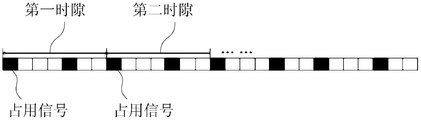
- Figure 14 is a schematic diagram for explaining an occupation signal in an embodiment of the present invention.
- Figure 15 is a schematic diagram for explaining an example process according to a specific embodiment
- 16 is a block diagram showing an example of a schematic configuration of an eNB (Evolved Base Station) to which the technology of the present disclosure can be applied.
- eNB Evolved Base Station
- the wireless communication device 100 includes a processor 110.
- the determination unit 111 and the generation unit 113 in the processor 110 are shown in the form of functional modules in the drawings, it should be understood that the functions of the determination unit 111 and the generation unit 113 may also be implemented by the processor 110 as a whole. This is achieved, and is not necessarily achieved by separate physical components in processor 110.
- the processor 110 is illustrated by a dashed box in the figure, the communication device 100 may include a plurality of processors, and the functions of the determining unit 111 and the generating unit 113 may be distributed to a plurality of processors, thereby being processed by a plurality of The devices work together to perform these functions.
- the determining unit 111 is configured to determine a communication to be transmitted of the user equipment for the base station on the target unlicensed frequency band and to predict a transmission schedule.
- the data transmitted by the LAA (Licensed Assisted Access) band is pure data, while in other examples, the signaling information may be transmitted through the LAA band in addition to the data.
- the LAA band is usually used in combination with the licensed band by carrier aggregation, and as an example of applying an unlicensed band in a cellular communication system, in some examples, the unlicensed band resources can also be stand-alone (stand-alone). It is used, and the invention is not intended to be limiting.
- the transmission progress may be the remaining time of the communication content transmission, for example, the transmission remaining time may be estimated by calculating the transmitted data size and the current transmission rate.
- the present invention is not limited thereto, and for example, the transmission progress may be indicated by the remaining amount of data to be transmitted.
- the transmission progress may also be indicated by the time that has been transmitted.
- the generating unit 113 generates indication information about the progress of the transmission and adds the indication information to the communication frame of the user equipment to transmit the indication information.
- the generated indication information may be included in a broadcast subframe for coordination with other communication devices.
- the broadcast subframe may be a common channel subframe, and accordingly, the generating unit 113 may further include information related to a physical cell identifier (PCI) of the base station to the public.
- Co-channel subframes are used for coordination with other communication devices, for example, by transmitting a synchronization signal in a common channel subframe to implicitly indicate PCI.
- the wireless communication device 100 can add the indication information to the communication frame containing the content to be transmitted to transmit on the target unlicensed frequency band, thereby reducing the detection of the transmission progress/idle time on the target unlicensed band by the other device. the complexity.
- the indication information may be added to the broadcast subframe on the licensed frequency band without being transmitted together with the content to be transmitted, where the unlicensed frequency band ID corresponding to the indication information needs to be included in the broadcast subframe.
- LTE users must follow the discontinuous transmission of limited maximum transmission time in the unlicensed band carrier.
- a signal indicating the remaining time of the transmission may be periodically added to the transmitted data to indicate, for example, the transmission progress of the current frequency band of other operators, such as the remaining time of transmission, and the like.
- the unlicensed band transmission indication signal can be transmitted in the broadcast subframe to enable the base station and the user of different operators to detect the information to achieve coordination/coexistence of utilization of the unlicensed band between the different operators.
- the LTE communication system operated by the second operator may determine the available transmission time remaining during the limited maximum transmission time according to the transmission progress of the LTE communication system of the first operator on the unlicensed frequency band and prepare for transmission.
- the broadcast subframe is a Multicast Broadcast Single Frequency Network (MBSFN) subframe.
- MMSFN Multicast Broadcast Single Frequency Network
- Multimedia Broadcast Multicast Service supports multicast and broadcast services in cellular systems, thereby providing simultaneous multicast, broadcast, and unicast services in a single network.
- this kind of propagation is called MBMS Single Frequency Network (MBSFN).
- MBSFN MBMS Single Frequency Network
- multiple cells participating in MBSFN transmission transmit identical information on the specified MBSFN subframe, for the user equipment.
- the signal waveforms from multiple cells are identical, so that it can be considered to receive a single signal that has undergone multipath transmission from a single cell, thus providing the following benefits:
- the terminal may use signal energy received from the plurality of cells;
- Additional diversity is generated against wireless channel fading because the information is received from several geographically separated locations, which typically results in a strong time dispersion, or strong frequency selectivity, for the overall composite channel.
- the inventor subverts the knowledge of the traditional MBSFN transmission, and does not require the multi-cell to transmit the same information in the MBSFN transmission of the multi-cell, and the user equipment pair is no longer needed.
- the MBSFN transmission content of the multi-cell is combined, and each cell is designed to carry the transmission progress information of each of the unlicensed frequency bands by using the MBSFN subframe, whereby the user equipment and/or the base station in the LTE communication system can be easily on the specific transmission resource ( For example, the frequency points and subframes that are uniformly set in advance are read.
- the MBSFN transmission content from multiple cells (for example, managed by different operators) is read, and the unlicensed frequency band transmission progress of each cell is determined based on the decoding result of the MBSFN subframe.
- the interaction between cells is not forced, and there is no need to design a new subframe structure, so that the coordinated use of unlicensed spectrum between different operators becomes simple and easy.
- the base station can, for example, send an indication signal every two frames to indicate the remaining transmission time it needs. For example, when other base stations or users detect the sequence "11" in the MBSFN, they can know that there are still three MBSFN subframes remaining in the frequency band, that is, the base station currently transmitting still has six frames to transmit. Other base stations can use this information to decide whether to wait for access after the current band transmission is completed.
- the MBSFN may also join the PCI information of the base station to help the UE distinguish which cell the received MBSFN subframe comes from.
- the interval at which the base station sends the indication signal may be set to different values according to the limitation of the limited maximum transmission time. For example, when the limited maximum transmission duration is less than 30 ms, it may be set to send an indication signal in each frame.
- the UE can learn the PCI of the same carrier base station by using the current system information, for example, the white list on the SIB information. If the PCI detected by the user is not above the white list, the UE can determine that the PCI belongs to other Operator. If the detected PCI is on the white list, it can be judged that the signal is from an adjacent co-operator. Thereby, the UE can feed back the corresponding detection result to the serving base station for the base station to decide the coexistence strategy on the unlicensed frequency band.
- the current system information for example, the white list on the SIB information. If the PCI detected by the user is not above the white list, the UE can determine that the PCI belongs to other Operator. If the detected PCI is on the white list, it can be judged that the signal is from an adjacent co-operator. Thereby, the UE can feed back the corresponding detection result to the serving base station for the base station to decide the coexistence strategy on the unlicensed frequency band.
- the wireless communication device 200 includes a processor 210 including a determination unit 211, a generation unit 213, and a detection unit 215.
- the determining unit 211 and the generating unit 213 are similar to the determining unit 111 and the generating unit 113 explained earlier with reference to FIG.
- the detecting unit 215 is configured to detect an unlicensed frequency band, estimate an available unlicensed frequency band based on the detection result, and select one or more candidate frequency bands for the user equipment.
- the wireless communication device 200 further includes a transceiver 220 configured to notify the user device of the selected one or more candidate frequency bands.
- the detecting unit 215 can perform detection of the unlicensed frequency band by controlling the transceiver device 220.
- the unlicensed band 5470MHz to 5725MHz may be occupied by radar systems or Wi-Fi users.
- the wireless communication device can, for example, perform full-band detection on the unlicensed frequency band and generate a list of information including available unlicensed frequency bands based on the detection result, such as Table 1 below.
- the base station can separately send the obtained available frequency band information to each user who needs to transmit data in the unlicensed frequency band. More specifically, the base station can allocate available frequency bands according to different data transmission requirements of the user. For example, users with greater data transmission needs can preferentially obtain wider unlicensed band resources.
- the user equipment after receiving the frequency band information from the base station, the user equipment itself may also detect the specific frequency band to reduce interference that may be caused to the current system. The user will send the feedback information to the base station after detecting the corresponding frequency band information.
- the delay of the user equipment feedback mechanism is about 4 ms, but the access time of other systems such as the WiFi system may be shorter than 4 ms. Therefore, during this period of time feedback by the user, it is possible for the WiFi device to also detect the frequency band and find that the frequency band is currently available, so it is possible for the WiFi device to access the frequency band within 4 ms. In this case, the LTE base station cannot occupy the frequency band or the base station continues to access the frequency band, causing two systems to collide.
- the transceiver 220 is configured to transmit an occupancy signal on a candidate frequency band within a predetermined time period after notifying the user equipment of the candidate frequency band.
- the occupancy signal can be a beacon signal.
- a wireless communication device for a base station side includes one or more processors, and the processor may include a detecting unit, an allocating unit, and a generating unit.
- the detection unit is configured to detect the availability of the unlicensed band.
- the allocation unit is configured to initially allocate a corresponding unlicensed frequency band to the user equipment of the base station based on the availability of the unlicensed frequency band.
- the generating unit is configured to generate a pilot sequence corresponding to the cell of the base station without including the occupied signal of the data information for the corresponding unlicensed band, thereby indicating that the base station intends to access the corresponding unlicensed band within a certain period of time.
- the wireless communication device may further include a transceiver device that can perform detection of an unlicensed frequency band and transmit a pilot sequence generated by the processor, for example, under the control of the processor.
- the base station When the base station detects the idle frequency band in the unlicensed frequency band and allocates it to the user, it can periodically transmit the occupancy signal in the frequency band to prevent other devices from accessing the frequency band during user feedback.
- the occupancy signal can for example be designed as a cell-specific reference signal (CRS). From the time domain, there are two CRS signals in one LTE slot. This means that the maximum time interval of the CRS signal is three OFDM symbols, which is approximately 200 us. As shown in the schematic diagram of FIG. 14, the base station can always transmit the occupancy signal until the user's feedback information is received.
- CRS cell-specific reference signal
- the WiFi device By transmitting the occupancy signal during the feedback time, for example, the WiFi device can be prevented from accessing the frequency band to thereby increase the access probability of LTE in the unlicensed frequency band.
- the user equipment can also detect a particular frequency band and send feedback information to the base station.
- this embodiment will be described with reference to FIG. 3.
- the wireless communication device 300 includes a processor 310 and a transceiver 320.
- the processor includes a determining unit 311, a generating unit 313, a detecting unit 315, and an allocating unit 317.
- the determining unit 311, the generating unit 313, and the detecting unit 315 are similar to the determining unit 111, the generating unit 113, and the detecting unit 215 explained with reference to FIG. 2 described above with reference to FIG.
- the transceiver unit 320 is configured to receive a detection result of the user equipment for the candidate frequency band.
- the allocating unit 317 is configured to determine a target unlicensed band allocated to the user equipment according to at least the detection result of the candidate band by the user equipment.
- the allocation of the unlicensed frequency band may be determined according to the feedback information of the user equipment, or the allocation of the unlicensed frequency band may be determined according to the detection result of the unlicensed frequency band by the base station and the feedback information of the user equipment. .
- the detecting unit 315 may be configured to be again obtained in the case of obtaining the detection result of the user equipment for the candidate frequency band.
- the candidate frequency band is detected, and the allocating unit 317 can be based on the detection result of the candidate frequency band by the user equipment and the result detected by the detecting unit 315 again.
- the user equipment can indicate the detection result of the target unlicensed frequency band, for example, by the following 2-bit sequence:
- the user equipment detects the occupied signal sent by the base station when detecting the channel. For the user equipment, if only the occupied signal sent by the base station is detected, the frequency band can be considered as available, and 00 is fed back.
- a signal sent by another base station such as a CRS signal
- the frequency band is unavailable (the probability of this case is low because the base station only has a time of about 4 ms of feedback).
- the CRS signal will be sent internally, and then access, abandon or wait will be selected, so this situation simply chooses to abandon the access and does not significantly affect the access probability to the unlicensed band).
- the base station can allocate two or more target unlicensed frequency bands to one user equipment at the same time.
- the user equipment can separately detect the frequency bands and obtain corresponding feedback information, and the specific detection manner is related to the single frequency band. The situation is similar.
- the base station After obtaining the feedback result of the user about the two frequency bands, the base station jointly judges whether the allocated frequency band can be used according to the self-detection result, or only a part of the frequency band can be used.
- the channels may be labeled, for example, as shown in Table 2 below:
- the base station allocates n channels to a certain user equipment, and the user equipment detects all the n channels after receiving the allocated channel. After all channel detection is completed, the user feeds back the detection results of the n channels to the base station, for example, channel 1: "00"; channel 2: “01”; ...; channel n: "11".
- the base station can determine whether each channel is available independently according to the feedback result and the self-detection result.
- the detection results of the frequency band by the user equipment and the base station can be represented by a two-bit information sequence, respectively, such as listed in Table 3 below.
- the base station can determine the allocation of the target unlicensed frequency band based on the combination of the detection results according to different criteria.
- the frequency band may be allocated if neither the base station nor the user equipment detects that the other base station or device uses the target unlicensed frequency band.
- the allocation of the frequency band may be determined.
- the use of the target frequency band can be coordinated with other base stations, which will be described later in connection with specific embodiments.
- the available time of the corresponding unlicensed frequency band may be estimated according to the indication information, so that the corresponding frequency band is used or detected at the corresponding time.
- the wireless communication device 400 includes a processor 410 and a transceiver 420.
- the processor 410 includes a determining unit 411, a generating unit 413, a detecting unit 415, and a predicting unit 417. Determining unit 411, generating unit 413 and detecting unit 415 with reference to FIG. 1
- the illustrated determining unit 111, the generating unit 113, and the detecting unit 215 described with reference to FIG. 2 are similar, and the transmitting and receiving device 420 is similar to the transmitting and receiving device 220 previously described with reference to FIG.
- the prediction unit 417 is configured to estimate the available time of the corresponding unlicensed band based on the detected indication information about the progress of the transmission in the signals of the other base stations.
- the wireless communication device 500 includes a processor 510 and a transceiver 520.
- the processor 510 includes a determining unit 511, a generating unit 513, a detecting unit 515, and a coordinating unit 517.
- the determining unit 511, the generating unit 513, and the detecting unit 515 are similar to the determining unit 111, the generating unit 113, and the detecting unit 215 described with reference to FIG. 2, which are described above with reference to FIG. 1, and the transmitting and receiving device 520 is similar to the transmitting and receiving device 520 described above with reference to FIG. .
- the coordinating unit 517 is configured to coordinate the use of the unlicensed band with other base stations in the case of detected signals of other base stations in the same system in the unlicensed band. It should be noted that other base stations in the same system as referred to herein refer to other base stations of the same carrier of the LTE system.
- the base station or user equipment detects that the target frequency band has LTE signals from the same carrier.
- the base station can be coordinated, for example, via an X2 interface with other base stations that have been accessed.
- some X2 messages related to Inter-Cell Interference Coordination (ICIC) have been defined, such as High Interference Indication (HII) and Overload Indication (OI) messages.
- HII can be seen as an active tool for ICIC, avoiding situations where the signal-to-noise ratio is too low.
- OI is a passive ICIC tool that basically indicates the level of interference experienced by a cell on different resources at three levels (low, medium, and high).
- a neighboring base station that is connected to the OI for example, can change its scheduling behavior to change the interference situation of the base station that issued the OI.
- the remaining transmission time can be determined by detecting the indication information in, for example, the MBSFN.
- the base station can wait for the corresponding time and then detect the target frequency band again.
- the target frequency band may also be detected after waiting for the corresponding time according to the indication information.
- Both the base station and the user equipment have detected that the base station of different operators is using the target frequency band. In case: if the base station and the user equipment detect information from the same base station, then only need to wait for the base station to complete the transmission to access; if the detected information comes from the unused base station, then there are two different base stations.
- the base station can reselect the new target frequency band, or the base station can wait for the two visited base stations to complete the transmission after using the target frequency band.
- coordination unit 517 can identify other base stations in the same system based on physical cell identification (PCI) or synchronization signals (SS) in signals from other base stations.
- the synchronization signal includes, for example, a primary synchronization signal (PSS) and a secondary synchronization signal (SSS), which can be used to calculate PCI.
- PSS primary synchronization signal
- SSS secondary synchronization signal
- the wireless communication device 600 includes a processor 610 and a transceiver 620.
- the processor 610 includes a determining unit 611, a generating unit 613, a detecting unit 615, and a triggering unit 617.
- the determining unit 611, the generating unit 613, and the detecting unit 615 are similar to the determining unit 111, the generating unit 113, and the detecting unit 215 described with reference to FIG. 2, which are described above with reference to FIG. 1, and the transceiver 620 is similar to the transceiver 620 previously described with reference to FIG. .
- the triggering unit 617 is configured to trigger detection of the unlicensed frequency band based on the request of the user equipment and/or the quality of communication with the user equipment using the licensed frequency band. That is, the wireless communication device according to the present embodiment may trigger the detection of the unlicensed frequency band based on a predetermined condition, which may be a request from the user equipment, or may be that the communication quality using the licensed frequency band is lower than a predetermined standard, thereby requiring Applicable unlicensed bands.
- a predetermined condition which may be a request from the user equipment, or may be that the communication quality using the licensed frequency band is lower than a predetermined standard, thereby requiring Applicable unlicensed bands.
- the user equipment may request the base station to access the unlicensed frequency band.
- the user equipment can also detect the unlicensed frequency band, for example, generate a frequency band information list and send it to the base station through a physical uplink control channel (PUCCH).
- the base station can compare the list provided by the user equipment with its own list, and select a blank unlicensed frequency band detected by both the user equipment and the base station, and perform frequency band allocation.
- the wireless communication method performed on the base station side includes:
- S710. Determine, to the target unlicensed frequency band, the communication content to be transmitted by the user equipment of the base station, and predict the transmission progress;
- the indication information may be added to the communication frame containing the content to be transmitted to transmit on the target unlicensed frequency band, thereby reducing the complexity of other devices detecting the transmission progress/idle time on the target unlicensed frequency band.
- the indication information may be added to the broadcast subframe on the licensed frequency band without being transmitted together with the content to be transmitted, where the unlicensed frequency band ID corresponding to the indication information needs to be included in the broadcast subframe.
- the indication information is included in a broadcast subframe for coordination with other communication devices, such as MBSFN subframes.
- wireless communication device and the wireless communication method for the base station side have been described above. Further, embodiments of the present invention also include a wireless communication device and method for a user equipment side. Next, an overview of the wireless communication device and method for the user equipment side is given without repeating some of the details already discussed above.
- a wireless communication device 800 for a user equipment side includes one or more processors 810 including a detecting unit 811, a parsing unit 813, and a generating unit 815.
- detection unit 811, parsing unit 813, and generation unit 815 represent functions that may be implemented by processor 810 and are not necessarily actual components of processor 810.
- the communication device 800 may include a plurality of processors that may operate together to implement the functions of the detecting unit 811, the parsing unit 813, and the generating unit 815.
- the detecting unit 811 is configured to detect an unlicensed band.
- detecting the unlicensed frequency band may mean detecting by controlling other components such as a transceiver.
- the specific configuration of the detecting unit 811 can be similar to the detecting unit 215 explained earlier with reference to FIG. 2.
- the parsing unit 813 is configured to parse the indication information about the transmission progress of the communication content to be transmitted on the unlicensed band contained in the communication frame of the base station.
- the communication frame may be located in an unlicensed frequency band, and the communication frame may also carry the communication content to be transmitted. Alternatively, the communication frame can be located on a licensed band.
- the indication information is included in a periodic broadcast subframe.
- the generating unit 815 is configured to generate feedback information for the serving base station of the user equipment based on the detection result of the unlicensed frequency band.
- the detecting unit 811 is configured to detect for one or more of the unlicensed bands specified by the serving base station, and the generating unit 815 generates corresponding feedback information.
- the parsing unit 813 is configured to detect a multicast broadcast single frequency network subframe included in the communication frame to parse the indication information.
- the multicast broadcast single frequency network subframe may include a physical cell identifier of the base station that sends the indication information, the parsing unit 813 is configured to parse the physical cell identifier, and the generating unit 815 determines the current occupation corresponding to the physical cell identifier.
- a wireless communication device 900 for a user equipment side includes a processor 910 including a detecting unit 911, a parsing unit 913, a generating unit 915, and a requesting unit 917.
- the configuration of the detecting unit 911, the analyzing unit 913, and the generating unit 915 is similar to the detecting unit 811, the analyzing unit 813, and the generating unit 815 described above with reference to FIG.
- the requesting unit 917 is configured to generate an unlicensed band request for requesting triggering detection and allocation of the unlicensed band if the quality of communication using the licensed band with the serving base station of the wireless communication device 900 is below a predetermined level .
- the requesting unit 917 can send the request, for example, through scheduling request (SR) signaling.
- SR scheduling request
- the wireless communication device 1000 includes one or more processors 1010 and a transceiver device 1020.
- the processor 1010 includes a detecting unit 1011, a parsing unit 1013, and a generating unit 1015.
- the configuration of the detecting unit 1011, the analyzing unit 1013, and the generating unit 1015 is similar to the detecting unit 811, the analyzing unit 813, and the generating unit 815 described above with reference to FIG.
- the transceiver 1020 is configured to send feedback information to the serving base station through a licensed frequency band.
- the generating unit 1015 may generate a PUCCH including feedback information, and the transceiver 1020 may transmit the feedback information through the primary carrier.
- the generating unit 1015 may generate media access control (MAC) signaling including feedback information, and the transceiver 1020 may send the signaling through the primary carrier.
- MAC signaling is more suitable for the case of having multiple candidate frequency bands.
- the wireless communication method performed on the user equipment side includes:
- the communication frame may be located in an unlicensed frequency band, and the communication frame may also carry the communication content to be transmitted. Alternatively, the communication frame can be located on a licensed band;
- S1130 Generate feedback information for the serving base station of the user equipment based on the detection result of the unlicensed frequency band.
- the base station eNB 1 is a serving base station of the user equipment UE.
- eNB 1 creates a list of available unlicensed bands.
- eNB 1 notifies the UE of the target unlicensed band.
- eNB 1 transmits an occupancy signal on the target unlicensed band to prevent other devices from accessing the band.
- the UE and the eNB 1 respectively detect whether the target unlicensed band is used by other devices. It should be pointed out here that before ST1, eNB 1 can also perform the corresponding detection process.
- the UE feeds back the detection result to the eNB 1.
- the eNB 1 determines the allocation of the unlicensed band in conjunction with the detection result from the UE and the detection result performed by the eNB 1 itself, and performs corresponding configuration at ST8 to apply the unlicensed band.
- the various steps of the above methods, as well as the various constituent modules and/or units of the above-described apparatus may be implemented as software, firmware, hardware or a combination thereof.
- a program constituting software for implementing the above method may be installed from a storage medium or a network to a computer having a dedicated hardware structure (for example, the general-purpose computer 1200 shown in FIG. 12), which is installed.
- a dedicated hardware structure for example, the general-purpose computer 1200 shown in FIG. 12
- an arithmetic processing unit i.e., CPU 1201 executes various processes in accordance with a program stored in a read only memory (ROM) 1202 or a program loaded from a storage portion 1208 to a random access memory (RAM) 1203.
- ROM read only memory
- RAM random access memory
- data required when the CPU 1201 executes various processes and the like is also stored as needed.
- the CPU 1201, the ROM 1202, and the RAM 1203 are linked to each other via a bus 1204.
- Input/output interface 1205 is also linked to bus 1204.
- an input/output interface 1205 an input portion 1206 (including a keyboard, a mouse, etc.), an output portion 1207 (including a display such as a cathode ray tube (CRT), a liquid crystal display (LCD), etc., and a speaker, etc.) , storage part 1208 (including hard disk, etc.), communication part 1209 (including network interface cards such as LAN cards, modems, etc.).
- the communication section 1209 performs communication processing via a network such as the Internet.
- Driver 1210 can also be linked to input/output interface 1205 as needed.
- a removable medium 1211 such as a magnetic disk, an optical disk, a magneto-optical disk, a semiconductor memory or the like is mounted on the drive 1210 as needed, so that a computer program read therefrom is installed into the storage portion 1208 as needed.
- a program constituting the software is installed from a network such as the Internet or a storage medium such as the detachable medium 1211.
- such a storage medium is not limited to the removable medium 1211 shown in FIG. 12 in which a program is stored and distributed separately from the device to provide a program to the user.
- the detachable medium 1211 include a magnetic disk (including a floppy disk (registered trademark)), an optical disk (including a compact disk read only memory (CD-ROM) and a digital versatile disk (DVD)), and a magneto-optical disk (including a mini disk (MD) (registered trademark) )) and semiconductor memory.
- the storage medium may be a ROM 1202, a hard disk included in the storage portion 1208, or the like, in which programs are stored, and distributed to the user together with the device containing them.
- Embodiments of the present invention also relate to a program product for storing a machine readable instruction code.
- the instruction code is read and executed by a machine, the above-described method according to an embodiment of the present invention can be performed.
- a storage medium for carrying a program product storing the above-described storage machine readable instruction code is also included in the disclosure of the present invention.
- the storage medium includes, but is not limited to, a floppy disk, an optical disk, a magneto-optical disk, a memory card, a memory stick, and the like.
- Embodiments of the present application also relate to the following electronic devices.
- the electronic device can be implemented as any type of evolved Node B (eNB), such as a macro eNB and a small eNB.
- the small eNB may be an eNB covering a cell smaller than the macro cell, such as a pico eNB, a micro eNB, and a home (femto) eNB.
- the electronic device can be implemented as any other type of base station, such as a NodeB and a base transceiver station (BTS).
- BTS base transceiver station
- the electronic device can include: a body (also referred to as a base station device) configured to control wireless communication; and one or more remote wireless headends (RRHs) disposed at a different location than the body.
- a body also referred to as a base station device
- RRHs remote wireless headends
- various types of terminals which will be described below, can operate as a base station by performing base station functions temporarily or semi-persistently.
- the electronic device can be implemented as a mobile terminal (such as a smart phone, a tablet personal computer (PC), a notebook PC, a portable game terminal, a portable/encrypted dog type mobile router, and a digital camera device) or Vehicle terminal (such as car navigation equipment).
- the electronic device may be a wireless communication module (such as an integrated circuit module including a single or a plurality of wafers) mounted on each of the above terminals.
- FIG. 13 is a block diagram showing an example of a schematic configuration of a smartphone 2500 to which the technology of the present disclosure can be applied.
- the smart phone 2500 includes a processor 2501, a memory 2502, a storage device 2503, an external connection interface 2504, an imaging device 2506, a sensor 2507, a microphone 2508, an input device 2509, a display device 2510, a speaker 2511, a wireless communication interface 2512, and one or more An antenna switch 2515, one or more antennas 2516, a bus 2517, a battery 2518, and an auxiliary controller 2519.
- the processor 2501 may be, for example, a CPU or a system on chip (SoC), and controls the functions of the application layer and the other layers of the smartphone 2500.
- the memory 2502 includes a RAM and a ROM, and stores data and programs executed by the processor 2501.
- the storage device 2503 may include a storage medium such as a semiconductor memory and a hard disk.
- the external connection interface 2504 is an interface for connecting an external device such as a memory card and a universal serial bus (USB) device to the smartphone 2500.
- USB universal serial bus
- the image pickup device 2506 includes an image sensor such as a charge coupled device (CCD) and a complementary metal oxide semiconductor (CMOS), and generates a captured image.
- Sensor 2507 can include a set of sensors, such as a measurement sensor, a gyro sensor, a geomagnetic sensor, and an acceleration sensor.
- the microphone 2508 converts the sound input to the smartphone 2500 into an audio signal.
- the input device 2509 includes, for example, a touch sensor, a keypad, a keyboard, a button, or a switch configured to detect a touch on the screen of the display device 2510, and receives an operation or information input from a user.
- the display device 2510 includes screens such as a liquid crystal display (LCD) and an organic light emitting diode (OLED) display, and displays an output image of the smartphone 2500.
- the speaker 2511 converts the audio signal output from the smartphone 2500 into a sound.
- the wireless communication interface 2512 supports any cellular communication scheme (such as LTE and LTE-Advanced) and performs wireless communication.
- Wireless communication interface 2512 may typically include, for example, BB processor 2513 and RF circuitry 2514.
- the BB processor 2513 can perform, for example, encoding/decoding, modulation/demodulation, and multiplexing/demultiplexing, and performs various types of signal processing for wireless communication.
- the RF circuit 2514 may include, for example, a mixer, a filter, and an amplifier, and transmits and receives a wireless signal via the antenna 2516.
- the wireless communication interface 2512 can be a chip module on which the BB processor 2513 and the RF circuit 2514 are integrated. As shown in FIG.
- the wireless communication interface 2512 can include a plurality of BB processors 2513 and a plurality of RF circuits 2514.
- FIG. 13 illustrates an example in which the wireless communication interface 2512 includes a plurality of BB processors 2513 and a plurality of RF circuits 2514, the wireless communication interface 2512 may also include a single BB processor 2513 or a single RF circuit 2514.
- wireless communication interface 2512 can support additional types of wireless communication schemes, such as short-range wireless communication schemes, near field communication schemes, and wireless local area network (LAN) schemes.
- the wireless communication interface 2512 can include for each type of wireless communication
- the BB processor 2513 and RF circuit 2514 of the signaling scheme can be included in the signaling scheme.
- Each of the antenna switches 2515 switches the connection destination of the antenna 2516 between a plurality of circuits included in the wireless communication interface 2512, such as circuits for different wireless communication schemes.
- Each of the antennas 2516 includes a single or multiple antenna elements (such as multiple antenna elements included in a MIMO antenna) and is used by the wireless communication interface 2512 to transmit and receive wireless signals.
- smart phone 2500 can include multiple antennas 2516.
- FIG. 13 shows an example in which the smartphone 2500 includes a plurality of antennas 2516, the smartphone 2500 may also include a single antenna 2516.
- smart phone 2500 can include an antenna 2516 for each wireless communication scheme.
- the antenna switch 2515 can be omitted from the configuration of the smartphone 2500.
- the bus 2517 has a processor 2501, a memory 2502, a storage device 2503, an external connection interface 2504, an imaging device 2506, a sensor 2507, a microphone 2508, an input device 2509, a display device 2510, a speaker 2511, a wireless communication interface 2512, and an auxiliary controller 2519. connection.
- Battery 2518 provides power to various blocks of smart phone 2500 shown in FIG. 13 via feeders, which are partially shown as dashed lines in the figure.
- the secondary controller 2519 operates the minimum required function of the smartphone 2500, for example, in a sleep mode.
- the transceiver 1020 described by using FIG. 10 can be implemented by the wireless communication interface 2512. At least a portion of the functions of the units described with reference to FIGS. 8 through 10 may also be implemented by the processor 2501 or the auxiliary controller 2519. For example, the power consumption of the battery 2518 can be reduced by performing a portion of the functions of the processor 2501 by the auxiliary controller 2519. Further, the processor 2501 or the auxiliary controller 2519 can perform at least a part of the functions of the units described with reference to FIGS. 8 to 10 by executing the program stored in the memory 2502 or the storage device 2503.
- FIG. 16 is a block diagram showing an example of a schematic configuration of an eNB to which the technology of the present disclosure can be applied.
- the eNB 2300 includes one or more antennas 2310 and base station devices 2320.
- the base station device 2320 and each antenna 2310 may be connected to each other via an RF (Radio Frequency) cable.
- RF Radio Frequency
- Each of the antennas 2310 includes a single or multiple antenna elements, such as multiple antenna elements included in a multiple input multiple output (MIMO) antenna, and is used by the base station device 2320 to transmit and receive wireless signals.
- the eNB 2300 may include a plurality of antennas 2310.
- multiple antennas 2310 can be compatible with multiple frequency bands used by eNB 2300.
- FIG. 16 shows an eNB therein 2300 includes an example of multiple antennas 2310, but eNB 2300 may also include a single antenna 2310.
- the base station device 2320 includes a controller 2321, a memory 2322, a network interface 2323, and a wireless communication interface 2325.
- the controller 2321 can be, for example, a CPU or a DSP, and operates various functions of higher layers of the base station device 2320. For example, controller 2321 generates data packets based on data in signals processed by wireless communication interface 2325 and delivers the generated packets via network interface 2323. The controller 2321 can bundle data from a plurality of baseband processors to generate bundled packets and deliver the generated bundled packets. The controller 2321 may have a logical function that performs control such as radio resource control, radio bearer control, mobility management, admission control, and scheduling. This control can be performed in conjunction with nearby eNBs or core network nodes.
- the memory 2322 includes a RAM and a ROM, and stores programs executed by the controller 2321 and various types of control data such as a terminal list, transmission power data, and scheduling data.
- the network interface 2323 is a communication interface for connecting the base station device 2320 to the core network 2324. Controller 2321 can communicate with a core network node or another eNB via network interface 2323. In this case, the eNB 2300 and the core network node or other eNBs may be connected to each other through a logical interface such as an S1 interface and an X2 interface.
- the network interface 2323 can also be a wired communication interface or a wireless communication interface for wireless backhaul lines. If the network interface 2323 is a wireless communication interface, the network interface 2323 can use a higher frequency band for wireless communication than the frequency band used by the wireless communication interface 2325.
- the wireless communication interface 2325 supports any cellular communication schemes, such as Long Term Evolution (LTE) and LTE-Advanced, and provides wireless connectivity to terminals located in cells of the eNB 2300 via the antenna 2310.
- Wireless communication interface 2325 can typically include, for example, a baseband (BB) processor 2326 and RF circuitry 2327.
- the BB processor 2326 can perform, for example, encoding/decoding, modulation/demodulation, and multiplexing/demultiplexing, and performs layers (eg, L1, Medium Access Control (MAC), Radio Link Control (RLC), and Packet Data Convergence Protocol (PDCP)) Various types of signal processing.
- BB processor 2326 may have some or all of the above described logic functions.
- the BB processor 2326 can be a memory that stores a communication control program, or a module that includes a processor and associated circuitry configured to execute the program.
- the update program can cause the functionality of the BB processor 2326 to change.
- the module can be a card or blade that is inserted into the slot of the base station device 2320. Alternatively, the module can also be a chip mounted on a card or blade.
- the RF circuit 2327 may include, for example, a mixer, a filter, and an amplifier, and transmits and receives a wireless signal via the antenna 2310.
- the wireless communication interface 2325 can include a plurality of BB processors 2326. E.g, Multiple BB processors 2326 can be compatible with multiple frequency bands used by eNB 2300. As shown in FIG. 16, the wireless communication interface 2325 can include a plurality of RF circuits 2327. For example, multiple RF circuits 2327 can be compatible with multiple antenna elements. Although FIG. 16 shows an example in which the wireless communication interface 2325 includes a plurality of BB processors 2326 and a plurality of RF circuits 2327, the wireless communication interface 2325 may also include a single BB processor 2326 or a single RF circuit 2327.
- the transceiver 220 to the transceiver 620 described by using FIGS. 2 through 6 can be implemented by the wireless communication interface 2325.
- the wireless communication interface 2325 At least a portion of the functions of the various units described with reference to Figures 1 through 6 may also be provided by controller 221.
- the controller 2321 can perform at least a portion of the functions of the units described with reference to FIGS. 1 through 6 by executing a program stored in the memory 2322.
- the method of the present invention is not limited to being performed in the chronological order described in the specification, and may be performed in other chronological order, in parallel, or independently. Therefore, the order of execution of the methods described in the present specification does not limit the technical scope of the present invention.
Landscapes
- Engineering & Computer Science (AREA)
- Signal Processing (AREA)
- Computer Networks & Wireless Communication (AREA)
- Mobile Radio Communication Systems (AREA)
Abstract
Description


Claims (23)
- 一种用于基站侧的无线通信设备,包括:一个或多个处理器,被配置为确定在目标非授权频段上用于所述基站的用户设备的待传输的通信内容并预计传输进度;以及生成关于传输进度的指示信息并将该指示信息加入到用户设备的通信帧中,以用于传输该指示信息。
- 根据权利要求1所述的无线通信设备,其中,所述通信帧位于所述目标非授权频段,并且还携带所述待传输通信内容,所述一个或多个处理器被配置为将所述指示信息包含于广播子帧中以用于与其他通信设备的协调。
- 根据权利要求2所述的无线通信设备,其中,所述广播子帧为公共信道子帧,所述一个或多个处理器还被配置为将所述基站的物理小区标识包含于所述公共信道子帧中以用于与其他通信设备的协调。
- 根据权利要求2所述的无线通信设备,其中,所述广播子帧为多播广播单频网子帧。
- 根据权利要求1-4中任一项所述的无线通信设备,其中,所述一个或多个处理器还被配置为对非授权频段进行检测,基于检测结果估计可用的非授权频段以及选取用于所述用户设备的一个或更多个候选频段,并且,所述无线通信设备还包括收发装置,被配置为向所述用户设备通知所述一个或更多个候选频段。
- 根据权利要求5所述的无线通信设备,其中,所述收发装置还被配 置为在向所述用户设备通知所述候选频段后的预定时段内在所述候选频段上发送占用信号。
- 根据权利要求6所述的无线通信设备,其中,所述占用信号是小区专用参考信号。
- 根据权利要求5所述的无线通信设备,其中,所述收发装置还被配置为接收所述用户设备对所述候选频段的检测结果,以及所述一个或多个处理器还被配置为至少根据所述用户设备对所述候选频段的检测结果确定向所述用户设备分配的目标非授权频段。
- 根据权利要求8所述的无线通信设备,其中,所述一个或多个处理器还被配置为在获得所述用户设备对所述候选频段的检测结果的情况下再次检测所述候选频段,并且基于所述用户设备对所述候选频段的检测结果以及再次检测到的结果来确定向所述用户设备分配的目标非授权频段。
- 根据权利要求5所述的无线通信设备,其中,所述一个或多个处理器还被配置为根据检测到的其他基站的信号中的所述指示信息预计相应的非授权频段的可用时间。
- 根据权利要求5所述的无线通信设备,所述一个或多个处理器还被配置为在检测到的同系统的其他基站在所述非授权频段中的信号的情况下,与所述其他基站协调对所述非授权频段的使用。
- 根据权利要求11所述的无线通信设备,其中,所述一个或多个处理器还基于来自其他基站的信号中的物理小区标识和/或同步信号来识别所述同系统的其他基站。
- 根据权利要求5所述的无线通信设备,所述一个或多个处理器还被配置为基于用户设备的请求和/或使用授权频段与用户设备进行的通信的质量,触发对所述非授权频段的检测。
- 一种在基站侧进行的无线通信方法,包括:确定在目标非授权频段上用于所述基站的用户设备的待传输的通信内容并预计传输进度;以及生成关于传输进度的指示信息并将该指示信息加入到用户设备的通信帧中,以用于传输该指示信息。
- 一种用于用户设备侧的无线通信设备,包括:一个或多个处理器,被配置为对非授权频段进行检测;解析基站的通信帧中包含的关于所述非授权频段上的待传输通信内容的传输进度的指示信息;以及基于对所述非授权频段的检测结果,生成用于所述用户设备的服务基站的反馈信息。
- 根据权利要求15所述的无线通信设备,其中,所述通信帧位于所述非授权频段,并且所述通信帧还携带所述待传输通信内容。
- 根据权利要求15所述的无线通信设备,其中,所述一个或多个处理器被配置为针对所述服务基站指定的非授权频段中的一个或更多个候选频段进行检测,并且生成相应的反馈信息。
- 根据权利要求15所述的无线通信设备,其中,所述一个或多个处理器被配置为检测所述通信帧中包含的多播广播单频网子帧以解析所述指示信息。
- 根据权利要求18所述的无线通信设备,其中,所述多播广播单频网子帧还包括发送该指示信息的基站的物理小区标识,所述一个或多个处理器被配置为解析该物理小区标识,基于该物理小区标识确定当前占用相应非授权频段传输的基站所属的运营商以及生成相应的反馈信息。
- 根据权利要求15-19中任一项所述的无线通信设备,其中,所述一个或多个处理器还被配置为在使用授权频段与所述服务基站进行的通信的质量低于预定水平的情况下生成非授权频段请求,以用于请求触发对非授权频段的检测和分配过程。
- 根据权利要求15-19任一项所述的无线通信设备,还包括收发装置,被配置为通过授权频段向所述服务基站发送反馈信息。
- 一种在用户设备侧进行的无线通信方法,包括:对非授权频段进行检测;解析基站的通信帧中包含的关于所述非授权频段上的待传输通信内容的传输进度的指示信息;以及基于对所述非授权频段的检测结果,生成用于所述用户设备的服务基站的反馈信息。
- 一种用于基站侧的无线通信设备,包括:一个或多个处理器,被配置为检测非授权频段的可用性;基于非授权频段的可用性为所述基站的用户设备初步分配相应的非授权频段;以及生成包含所述基站的小区对应的导频序列而不包含数据信息的占用信号以用于所述相应非授权频段,从而在特定时间段内指示所述基站意图接入所述相应非授权频段。
Priority Applications (4)
| Application Number | Priority Date | Filing Date | Title |
|---|---|---|---|
| US15/547,188 US10462782B2 (en) | 2015-03-20 | 2015-11-06 | Wireless communication equipment and wireless communication method |
| CA2978983A CA2978983A1 (en) | 2015-03-20 | 2015-11-06 | Wireless communication equipment and wireless communication method |
| EP15886089.0A EP3273716A4 (en) | 2015-03-20 | 2015-11-06 | Wireless communication equipment and wireless communication method |
| KR1020177025948A KR20170129136A (ko) | 2015-03-20 | 2015-11-06 | 무선 통신 장비 및 무선 통신 방법 |
Applications Claiming Priority (2)
| Application Number | Priority Date | Filing Date | Title |
|---|---|---|---|
| CN201510124590.3 | 2015-03-20 | ||
| CN201510124590.3A CN106034309B (zh) | 2015-03-20 | 2015-03-20 | 无线通信设备和无线通信方法 |
Publications (1)
| Publication Number | Publication Date |
|---|---|
| WO2016150167A1 true WO2016150167A1 (zh) | 2016-09-29 |
Family
ID=56976918
Family Applications (1)
| Application Number | Title | Priority Date | Filing Date |
|---|---|---|---|
| PCT/CN2015/093972 Ceased WO2016150167A1 (zh) | 2015-03-20 | 2015-11-06 | 无线通信设备和无线通信方法 |
Country Status (6)
| Country | Link |
|---|---|
| US (1) | US10462782B2 (zh) |
| EP (1) | EP3273716A4 (zh) |
| KR (1) | KR20170129136A (zh) |
| CN (2) | CN106034309B (zh) |
| CA (1) | CA2978983A1 (zh) |
| WO (1) | WO2016150167A1 (zh) |
Cited By (1)
| Publication number | Priority date | Publication date | Assignee | Title |
|---|---|---|---|---|
| CN106550468A (zh) * | 2016-11-07 | 2017-03-29 | 北京佰才邦技术有限公司 | 数据传输方法和基站 |
Families Citing this family (11)
| Publication number | Priority date | Publication date | Assignee | Title |
|---|---|---|---|---|
| CN111586699B (zh) | 2014-05-27 | 2023-10-13 | 索尼公司 | 电子设备和用于电子设备的方法 |
| CN106376084B (zh) * | 2015-07-23 | 2021-10-12 | 索尼公司 | 无线通信系统中的装置和方法 |
| CN108882244A (zh) * | 2017-05-11 | 2018-11-23 | 索尼公司 | 用于无线通信的电子设备和方法 |
| CN110769463A (zh) * | 2018-07-27 | 2020-02-07 | 索尼公司 | 电子装置、无线通信方法和计算机可读介质 |
| CN111431642A (zh) * | 2019-01-10 | 2020-07-17 | 普天信息技术有限公司 | 离散频谱下空闲可用频点的分配方法和装置 |
| ES3030714T3 (en) | 2019-03-27 | 2025-07-01 | Beijing Xiaomi Mobile Software Co Ltd | Channel indication method and apparatus |
| CN117880991B (zh) * | 2019-05-20 | 2025-02-18 | 华为技术有限公司 | 资源分配的指示方法及装置 |
| CN114930879B (zh) * | 2020-01-14 | 2023-11-17 | 华为技术有限公司 | 一种多播业务传输方法及装置 |
| CN113328812B (zh) * | 2020-02-28 | 2023-02-21 | Oppo广东移动通信有限公司 | 防信息泄露方法及相关产品 |
| CN113708889A (zh) * | 2020-05-22 | 2021-11-26 | 维沃移动通信有限公司 | 数据传输方法和设备 |
| CN112787674B (zh) * | 2020-12-31 | 2022-04-12 | 上海移为通信技术股份有限公司 | 数据传输方法、系统、网络设备和存储介质 |
Citations (3)
| Publication number | Priority date | Publication date | Assignee | Title |
|---|---|---|---|---|
| CN104301273A (zh) * | 2014-08-25 | 2015-01-21 | 中兴通讯股份有限公司 | 使用非授权载波发送及接收信号的方法、基站及用户设备 |
| WO2015009433A1 (en) * | 2013-07-17 | 2015-01-22 | Qualcomm Incorporated | Lte channel access over unlicensed bands |
| CN104333873A (zh) * | 2014-11-28 | 2015-02-04 | 东莞宇龙通信科技有限公司 | 信道检测方法及系统、具有基站功能的设备和终端 |
Family Cites Families (6)
| Publication number | Priority date | Publication date | Assignee | Title |
|---|---|---|---|---|
| CN1913563B (zh) * | 2006-08-25 | 2010-06-23 | 清华大学 | 一种数字广播网和宽带无线接入网的融合方法 |
| US20130203429A1 (en) * | 2010-10-13 | 2013-08-08 | Nokia Corporation | Method and apparatus for enabling scheduled transmission |
| CN102843696B (zh) * | 2011-06-21 | 2016-06-22 | 中国移动通信集团设计院有限公司 | 一种无线系统间共用频谱资源的方法、装置及系统 |
| US9031017B2 (en) * | 2012-06-21 | 2015-05-12 | Nokia Solutions And Networks Oy | Power control for LTE deployment in unlicensed band |
| US9398563B2 (en) * | 2013-08-23 | 2016-07-19 | Qualcomm Incorporated | LTE based multicast in unlicensed spectrum |
| US9544898B2 (en) * | 2014-07-10 | 2017-01-10 | Alcatel Lucent | Coordinating base station downlink transmissions in unlicensed frequency bands |
-
2015
- 2015-03-20 CN CN201510124590.3A patent/CN106034309B/zh not_active Expired - Fee Related
- 2015-03-20 CN CN202110142081.9A patent/CN112929886B/zh active Active
- 2015-11-06 EP EP15886089.0A patent/EP3273716A4/en not_active Withdrawn
- 2015-11-06 US US15/547,188 patent/US10462782B2/en active Active
- 2015-11-06 CA CA2978983A patent/CA2978983A1/en not_active Abandoned
- 2015-11-06 WO PCT/CN2015/093972 patent/WO2016150167A1/zh not_active Ceased
- 2015-11-06 KR KR1020177025948A patent/KR20170129136A/ko not_active Withdrawn
Patent Citations (3)
| Publication number | Priority date | Publication date | Assignee | Title |
|---|---|---|---|---|
| WO2015009433A1 (en) * | 2013-07-17 | 2015-01-22 | Qualcomm Incorporated | Lte channel access over unlicensed bands |
| CN104301273A (zh) * | 2014-08-25 | 2015-01-21 | 中兴通讯股份有限公司 | 使用非授权载波发送及接收信号的方法、基站及用户设备 |
| CN104333873A (zh) * | 2014-11-28 | 2015-02-04 | 东莞宇龙通信科技有限公司 | 信道检测方法及系统、具有基站功能的设备和终端 |
Non-Patent Citations (1)
| Title |
|---|
| See also references of EP3273716A4 * |
Cited By (3)
| Publication number | Priority date | Publication date | Assignee | Title |
|---|---|---|---|---|
| CN106550468A (zh) * | 2016-11-07 | 2017-03-29 | 北京佰才邦技术有限公司 | 数据传输方法和基站 |
| WO2018082710A1 (zh) * | 2016-11-07 | 2018-05-11 | 北京佰才邦技术有限公司 | 数据传输方法、基站和计算机可读存储介质 |
| CN106550468B (zh) * | 2016-11-07 | 2020-03-31 | 北京佰才邦技术有限公司 | 数据传输方法和基站 |
Also Published As
| Publication number | Publication date |
|---|---|
| KR20170129136A (ko) | 2017-11-24 |
| EP3273716A1 (en) | 2018-01-24 |
| US10462782B2 (en) | 2019-10-29 |
| US20180020437A1 (en) | 2018-01-18 |
| CN106034309B (zh) | 2021-03-02 |
| CN112929886A (zh) | 2021-06-08 |
| CN106034309A (zh) | 2016-10-19 |
| CA2978983A1 (en) | 2016-09-29 |
| CN112929886B (zh) | 2024-06-28 |
| EP3273716A4 (en) | 2018-10-24 |
Similar Documents
| Publication | Publication Date | Title |
|---|---|---|
| US11716718B2 (en) | Wireless communication device and wireless communication method | |
| JP7548238B2 (ja) | 電子機器及び無線通信方法 | |
| CN112929886B (zh) | 无线通信设备、方法以及非暂时性计算机可读介质 | |
| CN106376082B (zh) | 用于无线通信的电子设备以及无线通信方法 | |
| US10517052B2 (en) | Wireless communication equipment and wireless communication method | |
| KR20180080274A (ko) | 기지국 측 및 사용자 장비 측 장치들 및 방법들과, 무선 통신 시스템 | |
| CN106549742A (zh) | 无线通信系统中的装置和方法 | |
| WO2019011168A1 (zh) | 电子装置和无线通信方法 | |
| CN106162885A (zh) | 无线通信的装置和方法、基站、用户设备侧的装置 | |
| JP2021532657A (ja) | ユーザ機器、電子機器、無線通信方法及び記憶媒体 | |
| WO2019019964A1 (zh) | 电子装置、信息处理设备和信息处理方法 | |
| JP5893205B2 (ja) | ポータブル・ロング・ターム・エボリューション・ローカル・エリア・ネットワーク間干渉に関わるセル間干渉検出 |
Legal Events
| Date | Code | Title | Description |
|---|---|---|---|
| 121 | Ep: the epo has been informed by wipo that ep was designated in this application |
Ref document number: 15886089 Country of ref document: EP Kind code of ref document: A1 |
|
| WWE | Wipo information: entry into national phase |
Ref document number: 15547188 Country of ref document: US |
|
| REEP | Request for entry into the european phase |
Ref document number: 2015886089 Country of ref document: EP |
|
| ENP | Entry into the national phase |
Ref document number: 2978983 Country of ref document: CA |
|
| ENP | Entry into the national phase |
Ref document number: 20177025948 Country of ref document: KR Kind code of ref document: A |
|
| NENP | Non-entry into the national phase |
Ref country code: DE |