WO2016152446A1 - 動画像符号化装置 - Google Patents
動画像符号化装置 Download PDFInfo
- Publication number
- WO2016152446A1 WO2016152446A1 PCT/JP2016/056641 JP2016056641W WO2016152446A1 WO 2016152446 A1 WO2016152446 A1 WO 2016152446A1 JP 2016056641 W JP2016056641 W JP 2016056641W WO 2016152446 A1 WO2016152446 A1 WO 2016152446A1
- Authority
- WO
- WIPO (PCT)
- Prior art keywords
- intra
- prediction mode
- picture
- unit
- input image
- Prior art date
- Legal status (The legal status is an assumption and is not a legal conclusion. Google has not performed a legal analysis and makes no representation as to the accuracy of the status listed.)
- Ceased
Links
Images


Classifications
-
- H—ELECTRICITY
- H04—ELECTRIC COMMUNICATION TECHNIQUE
- H04N—PICTORIAL COMMUNICATION, e.g. TELEVISION
- H04N19/00—Methods or arrangements for coding, decoding, compressing or decompressing digital video signals
- H04N19/10—Methods or arrangements for coding, decoding, compressing or decompressing digital video signals using adaptive coding
- H04N19/134—Methods or arrangements for coding, decoding, compressing or decompressing digital video signals using adaptive coding characterised by the element, parameter or criterion affecting or controlling the adaptive coding
- H04N19/157—Assigned coding mode, i.e. the coding mode being predefined or preselected to be further used for selection of another element or parameter
- H04N19/159—Prediction type, e.g. intra-frame, inter-frame or bidirectional frame prediction
-
- H—ELECTRICITY
- H04—ELECTRIC COMMUNICATION TECHNIQUE
- H04N—PICTORIAL COMMUNICATION, e.g. TELEVISION
- H04N19/00—Methods or arrangements for coding, decoding, compressing or decompressing digital video signals
- H04N19/50—Methods or arrangements for coding, decoding, compressing or decompressing digital video signals using predictive coding
- H04N19/593—Methods or arrangements for coding, decoding, compressing or decompressing digital video signals using predictive coding involving spatial prediction techniques
-
- H—ELECTRICITY
- H04—ELECTRIC COMMUNICATION TECHNIQUE
- H04N—PICTORIAL COMMUNICATION, e.g. TELEVISION
- H04N19/00—Methods or arrangements for coding, decoding, compressing or decompressing digital video signals
- H04N19/10—Methods or arrangements for coding, decoding, compressing or decompressing digital video signals using adaptive coding
- H04N19/102—Methods or arrangements for coding, decoding, compressing or decompressing digital video signals using adaptive coding characterised by the element, parameter or selection affected or controlled by the adaptive coding
- H04N19/103—Selection of coding mode or of prediction mode
- H04N19/107—Selection of coding mode or of prediction mode between spatial and temporal predictive coding, e.g. picture refresh
-
- H—ELECTRICITY
- H04—ELECTRIC COMMUNICATION TECHNIQUE
- H04N—PICTORIAL COMMUNICATION, e.g. TELEVISION
- H04N19/00—Methods or arrangements for coding, decoding, compressing or decompressing digital video signals
- H04N19/10—Methods or arrangements for coding, decoding, compressing or decompressing digital video signals using adaptive coding
- H04N19/102—Methods or arrangements for coding, decoding, compressing or decompressing digital video signals using adaptive coding characterised by the element, parameter or selection affected or controlled by the adaptive coding
- H04N19/103—Selection of coding mode or of prediction mode
- H04N19/11—Selection of coding mode or of prediction mode among a plurality of spatial predictive coding modes
-
- H—ELECTRICITY
- H04—ELECTRIC COMMUNICATION TECHNIQUE
- H04N—PICTORIAL COMMUNICATION, e.g. TELEVISION
- H04N19/00—Methods or arrangements for coding, decoding, compressing or decompressing digital video signals
- H04N19/10—Methods or arrangements for coding, decoding, compressing or decompressing digital video signals using adaptive coding
- H04N19/102—Methods or arrangements for coding, decoding, compressing or decompressing digital video signals using adaptive coding characterised by the element, parameter or selection affected or controlled by the adaptive coding
- H04N19/124—Quantisation
- H04N19/126—Details of normalisation or weighting functions, e.g. normalisation matrices or variable uniform quantisers
-
- H—ELECTRICITY
- H04—ELECTRIC COMMUNICATION TECHNIQUE
- H04N—PICTORIAL COMMUNICATION, e.g. TELEVISION
- H04N19/00—Methods or arrangements for coding, decoding, compressing or decompressing digital video signals
- H04N19/10—Methods or arrangements for coding, decoding, compressing or decompressing digital video signals using adaptive coding
- H04N19/134—Methods or arrangements for coding, decoding, compressing or decompressing digital video signals using adaptive coding characterised by the element, parameter or criterion affecting or controlling the adaptive coding
- H04N19/136—Incoming video signal characteristics or properties
- H04N19/14—Coding unit complexity, e.g. amount of activity or edge presence estimation
-
- H—ELECTRICITY
- H04—ELECTRIC COMMUNICATION TECHNIQUE
- H04N—PICTORIAL COMMUNICATION, e.g. TELEVISION
- H04N19/00—Methods or arrangements for coding, decoding, compressing or decompressing digital video signals
- H04N19/10—Methods or arrangements for coding, decoding, compressing or decompressing digital video signals using adaptive coding
- H04N19/169—Methods or arrangements for coding, decoding, compressing or decompressing digital video signals using adaptive coding characterised by the coding unit, i.e. the structural portion or semantic portion of the video signal being the object or the subject of the adaptive coding
- H04N19/17—Methods or arrangements for coding, decoding, compressing or decompressing digital video signals using adaptive coding characterised by the coding unit, i.e. the structural portion or semantic portion of the video signal being the object or the subject of the adaptive coding the unit being an image region, e.g. an object
- H04N19/176—Methods or arrangements for coding, decoding, compressing or decompressing digital video signals using adaptive coding characterised by the coding unit, i.e. the structural portion or semantic portion of the video signal being the object or the subject of the adaptive coding the unit being an image region, e.g. an object the region being a block, e.g. a macroblock
-
- H—ELECTRICITY
- H04—ELECTRIC COMMUNICATION TECHNIQUE
- H04N—PICTORIAL COMMUNICATION, e.g. TELEVISION
- H04N19/00—Methods or arrangements for coding, decoding, compressing or decompressing digital video signals
- H04N19/10—Methods or arrangements for coding, decoding, compressing or decompressing digital video signals using adaptive coding
- H04N19/169—Methods or arrangements for coding, decoding, compressing or decompressing digital video signals using adaptive coding characterised by the coding unit, i.e. the structural portion or semantic portion of the video signal being the object or the subject of the adaptive coding
- H04N19/182—Methods or arrangements for coding, decoding, compressing or decompressing digital video signals using adaptive coding characterised by the coding unit, i.e. the structural portion or semantic portion of the video signal being the object or the subject of the adaptive coding the unit being a pixel
-
- H—ELECTRICITY
- H04—ELECTRIC COMMUNICATION TECHNIQUE
- H04N—PICTORIAL COMMUNICATION, e.g. TELEVISION
- H04N19/00—Methods or arrangements for coding, decoding, compressing or decompressing digital video signals
- H04N19/60—Methods or arrangements for coding, decoding, compressing or decompressing digital video signals using transform coding
- H04N19/61—Methods or arrangements for coding, decoding, compressing or decompressing digital video signals using transform coding in combination with predictive coding
-
- H—ELECTRICITY
- H04—ELECTRIC COMMUNICATION TECHNIQUE
- H04N—PICTORIAL COMMUNICATION, e.g. TELEVISION
- H04N19/00—Methods or arrangements for coding, decoding, compressing or decompressing digital video signals
- H04N19/60—Methods or arrangements for coding, decoding, compressing or decompressing digital video signals using transform coding
- H04N19/625—Methods or arrangements for coding, decoding, compressing or decompressing digital video signals using transform coding using discrete cosine transform [DCT]
Definitions
- the present invention relates to a moving picture coding apparatus for coding a moving picture.
- a locally decoded image is used to determine an intra prediction mode, and a locally decoded image is used to generate a predicted image.
- intra prediction mode determination often uses an input image.
- the optimal intra prediction mode can not be selected when the predicted image is generated from the local decoded image. I have a problem.
- an appropriate prediction error can not be calculated, and an intra prediction mode with a large error is selected and visual Image quality deterioration is noticeable.
- An example similar to the frame image is a title image in which the pixel values of the entire screen are flat and characters are partially written.
- Patent Document 1 intra prediction is performed using an input image, but when the difference between the input image and the local decoded image is large, the DC mode is forcibly set. However, in the DC mode, since it is possible to suppress the image quality deterioration because the predicted image is created using the average of the adjacent pixel data, the effect of the image quality improvement is weak. In addition, when the difference between the input image and the local decoded image can not be calculated, the technology of Patent Document 1 can not be used.
- Patent Document 2 is a method of suppressing deterioration of image quality at the time of fade.
- the weighted prediction is controlled to be switched ON / OFF for each area, and is set to be OFF in the frame area.
- the technique of Patent Document 2 can not be used for ordinary video without fade.
- the present invention has been made to solve the above-described problems, and its object is to provide a moving image capable of improving the image quality of a video including an area with flat pixel values such as frame broadcasting. An image coding apparatus is obtained.
- a moving picture coding apparatus quantizes an output of an arithmetic unit that subtracts a predicted image from an input image, an orthogonal transformation unit that performs orthogonal transformation on the output of the arithmetic unit, and the orthogonal transformation unit.
- the image quality is improved with respect to a video including an area with flat pixel values such as frame broadcasting.
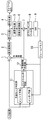
- FIG. 1 is a diagram showing a moving picture coding apparatus according to an embodiment of the present invention.
- the operation unit 1 subtracts the predicted image from the input image.
- the orthogonal transformation unit 2 subjects the output of the operation unit 1 to orthogonal transformation such as discrete cosine transformation or Karhunen-Loeve transformation.
- the method of orthogonal transformation is arbitrary.
- the quantization unit 3 quantizes the output of the orthogonal transformation unit 2. Note that the method of quantization is arbitrary.
- the encoding unit 4 encodes the output of the quantization unit 3 to generate a stream output.
- the inverse quantization unit 5 inversely quantizes the output of the quantization unit 3.
- the inverse quantization method may be any method as long as it corresponds to the quantization process of the quantization unit 3.
- the inverse orthogonal transform unit 6 performs inverse orthogonal transform on the output of the inverse quantization unit 5.
- the method of an inverse orthogonal transformation is a method corresponding to the orthogonal transformation process of the orthogonal transformation part 2, what kind of method may be used.
- the calculation unit 7 adds the predicted image to the output of the inverse quantization unit 5 to obtain a locally reconstructed image.
- the reconstructed image is stored in the frame memory 10 after being filtered by the deblocking filter 8 and the sample adaptive offset (SAO) 9.
- SAO sample adaptive offset
- the prediction mode determination unit 11 determines different prediction modes according to the types of I picture, P picture, and B picture of the input image. Specifically, since the I picture is a picture for performing only intra prediction, intra prediction is performed to determine a prediction mode. In the case of P picture or B picture, intra prediction and inter prediction are performed to determine an intra prediction mode and an inter prediction mode. Next, intra / inter determination is performed to select one of the determined intra prediction mode and inter prediction mode, and the prediction mode is determined.
- the intra prediction mode is determined by intra prediction using pixel values of an image of a surrounding area located around the encoding target block.
- the inter prediction mode performs inter prediction using the input image and the reference image supplied from the frame memory 10 to determine.
- the predicted image generation unit 12 generates a predicted image using the mode determined by the prediction mode determination unit 11 and the reference image supplied from the frame memory 10.
- a feature amount that can be calculated from information of the input image is used.
- the feature amount includes information of pixel values of luminance and color difference, and can be acquired in units of CU (Coding Unit), picture, and the like.
- a flat region determination parameter is used to determine a region where a non-moving pixel value, which is a feature of frame broadcasting, is flat.
- the flat area determination parameter include an activity and the sum of absolute differences between adjacent pixels.
- the activity is a parameter indicating the degree of dispersion of pixel values of the input image, and is an important feature quantity in measuring the complexity of the image.
- the adjacent pixel difference absolute value sum is a parameter indicating the relationship with adjacent pixels, and is a feature value for measuring the degree of similarity or difference between adjacent pixels.
- n is a block size
- X is a pixel value
- X ( ⁇ ) is an average value of pixel values X in the block size.
- the block size for acquiring the activity is arbitrary.
- the sum of absolute values of differences between adjacent pixels can be obtained from Formula 2.
- n represents a block size
- X and Y represent pixel values of adjacent pixels.
- the block size for acquiring the sum of absolute differences between adjacent pixels is arbitrary.
- an offset value is obtained based on the flat region discrimination parameter, and intra prediction is performed based on an evaluation value to which the offset value is added.
- an offset value is obtained from the flat region discrimination parameter, and either the intra prediction mode or the inter prediction mode is selected based on the evaluation value obtained by adding the offset value, and each block of the input image Apply to By adding the offset value obtained from the flat area determination parameter to the evaluation value used for mode determination as described above, the image quality is improved with respect to a video including a flat area having no pixel values such as frame broadcasting.
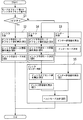
- FIG. 2 is a diagram showing a processing flow of the prediction mode determination unit.
- 0 is set to the mode offset value and the intra offset value.
- intra prediction is performed to determine one mode from an intra prediction mode having 35 modes using an intra prediction mode evaluation value (step S2).
- the intra prediction mode evaluation value is a value obtained by adding the intra prediction mode offset value to the existing evaluation value.
- the intra prediction mode offset value is a value determined by the flat region determination parameter.
- inter prediction is performed to detect a motion vector from a reference image and determine an optimal motion vector (step S3).
- intra prediction is performed as in the case of the I picture (step S4).
- the optimal mode is determined one by one at inter and intra.
- intra / inter determination is performed to determine the best mode using the inter evaluation value and the intra evaluation value from the determined inter optimum mode and intra optimum mode (step S5).
- the improvement in intra prediction (steps S2 and S4) and the improvement in intra / inter determination (step S5) can be set independently.
- the calculation block of the offset value in step S5 is not called when intra prediction only is to be effective, and the calculation block of the offset value in step S2 and step S4 is called when it is desired to make intra / inter determination only effective. It can be realized by not having it.
- the frame broadcast is an area determined to be flat by the flat area determination parameter, it is necessary to prevent the selection of the intra prediction direction from the block determined to be not flat.
- the mode with the smallest evaluation value is selected. Therefore, it is possible to make it difficult to select the mode by increasing the evaluation value of the mode.
- an evaluation value is calculated for each mode, and an offset value is added to the evaluation value to correct.
- the offset value is determined from the magnitude relationship between the flat region discrimination parameter of the adjacent block used for prediction and the set threshold. For example, a plurality of threshold values are provided, and the offset value is changed stepwise, such as increasing the offset as the flat area determination parameter of the adjacent block is larger.
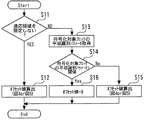
- FIG. 3 is a diagram showing an offset value calculation flow.
- step S11 it is determined whether or not the adaptation area is limited.
- step S12 evaluation values obtained by adding offset values to all blocks are used.
- step S12 the intra prediction mode offset value used in intra prediction is calculated using the flow of FIG. 4 and the intra offset value used in intra / inter determination is calculated using the flow of FIG.
- the flat area discrimination parameter of the encoding target block is acquired (step S13). It is determined whether the flat area determination parameter of the encoding target block is equal to or more than the designated threshold (step S14). If the flat area determination parameter is smaller than the threshold value, the evaluation value obtained by adding the offset value is used (step S15). In the offset value calculation (step S15), the intra prediction mode offset value used in intra prediction is calculated using the flow of FIG. 4 and the intra offset value used in intra / inter determination is calculated using the flow of FIG.
- the block where the flat area determination parameter is equal to or larger than the threshold value has a large change in pixel value, and is not a fixed pixel value such as a black band. Therefore, when the flat area determination parameter is equal to or greater than the threshold value, 0 is substituted for the offset value and this function is not applied (step S16). In general, there are more areas where the pixel value is not flat, so by substituting 0 for the offset value according to the flat area discrimination parameter and limiting the application range, the area where the pixel value is not flat is not adversely affected. Make it
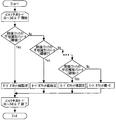
- FIG. 4 is a diagram showing a flow of intra prediction mode offset value calculation.
- FIG. 5 is a diagram showing a flow of intra offset value calculation.
- a plurality of threshold values 1 to n are set, and different offset values are set according to the threshold values. Further, in intra prediction mode offset value calculation, an adjacent block used for intra prediction changes, so an offset value is set for each intra prediction mode.
- the intra prediction mode can be predicted from 35 different directions. By predicting from a block similar to the block to be coded, the error is reduced and the coding efficiency is improved. In the area where the pixel value without motion such as a black band is flat, the image quality deterioration is subjectively noticeable even if the difference between the pixel values is small. Therefore, by adding the calculated offset value to the existing evaluation value, it is easy to select prediction from similar blocks.
- FIG. 6 is a diagram showing an intra prediction mode determination flow.
- the maximum value is set to the best intra evaluation value (step S21).
- a loop in the intra prediction mode (0 to 34) is started (step S22).
- an existing evaluation value is calculated (step S23).
- the existing evaluation value is calculated from Equation 3 below.
- Existing evaluation value D + ⁇ * H formula 3
- D represents an error between the input image and the predicted image
- ⁇ represents a weighting coefficient
- H represents a header cost necessary for prediction.
- the smaller the evaluation value the smaller the amount of data or the smaller the error with the input image, which means that the mode is a mode in which the coding efficiency is good.
- the present embodiment can be easily implemented simply by using the existing evaluation value shown in Equation 2 as it is and adding the offset value as it is.
- the mode offset value is added to the existing evaluation value to obtain an evaluation value (mode) (step S24).
- the evaluation value (mode) is smaller than the best intra evaluation value (step S25). If so, the next intra prediction mode is evaluated without updating the best intra mode. On the other hand, if smaller, the best intra evaluation value is updated to the evaluation value (mode), the best intra mode is updated to the mode (step S26), and the next intra prediction mode is evaluated.
- the loop of intra prediction modes (0 to 34) is ended (step S27).
- An appropriate prediction mode can be selected by using the offset value calculated for each prediction mode as described above. For example, in the image of frame broadcast of black bands at the top and bottom, if the coding target block is in contact with the black band border of the lower part of the screen, and the flat region discrimination parameter of the upper adjacent block is large, The offset value becomes large, which makes it difficult to select upward intra prediction. As a result, in the case of coding a black band portion, since prediction is performed based on the black band portion, the prediction residual becomes smaller and the image quality of the intra block is improved.
- the offset is added to the evaluation value so as to give priority to inter prediction over intra prediction in a region where there is a flat pixel value with no motion such as a black band.
- a flat region deterioration of a reference image used in inter prediction is small, and prediction errors tend to be small.
- the code amount is small because the motion vector is small. Therefore, it is better to give priority to inter prediction.
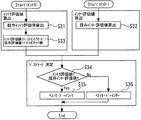
- FIG. 7 is a diagram showing an intra / inter determination process flow.
- the existing intra evaluation value and the existing inter evaluation value are calculated (steps S31 and S32).
- the intra offset value is added to the existing intra evaluation value to obtain an intra evaluation value (step S33).
- the process of adding the offset value to the existing intra evaluation value used in the intra / inter determination is added.
- intra / inter determination the one with the smaller evaluation value is selected. If a positive value is set to the intra offset value, the intra evaluation value becomes large and it becomes difficult to select the intra. Conversely, if a negative value is set to the intra offset value, it becomes easy to select the intra.
- setting a positive value to the intra offset value makes it more difficult to select intra with large prediction error, and improves image quality by selecting inter prediction with priority. It can be done.
- image improvement has already been performed by intra prediction.
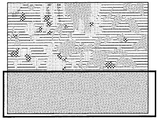
- FIG. 8 is a diagram showing an example of a video (input image).
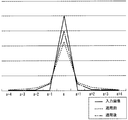
- FIG. 9 is a diagram showing a frequency distribution of a difference between a flat portion surrounded by a square in FIG. 8 and a pixel value after encoding when the pixel value of the input image is a.
- the frequency distributions before and after the application of the present embodiment are compared, there are many pixel values closer to a after application.
- the pixel value after encoding is closer to the pixel value of the input image, and the image quality is less deteriorated. Therefore, by applying the present embodiment, it was confirmed that the image is close to the pixel value of the input image and the image is less deteriorated.
Landscapes
- Engineering & Computer Science (AREA)
- Multimedia (AREA)
- Signal Processing (AREA)
- Physics & Mathematics (AREA)
- Discrete Mathematics (AREA)
- General Physics & Mathematics (AREA)
- Compression Or Coding Systems Of Tv Signals (AREA)
Abstract
Description


既存の評価値 = D + λ * H ・・・数式3
ここで、Dは入力画像と予測画像の誤差、λは重み付け係数、Hは予測時に必要なヘッダコストを示す。評価値が小さい程、データ量が小さい又は入力画像との誤差も小さく符号化効率が良いモードであることを意味する。本実施の形態は、数式2に示した既存の評価値を見直さずそのまま使用しオフセット値を加算するだけで容易に実施することができる。
Claims (4)
- 入力画像から予測画像を減算する演算部と、
前記演算部の出力に対して直交変換を施す直交変換部と、
前記直交変換部の出力を量子化する量子化部と、
前記量子化部の出力を符号化する符号化部と、
前記入力画像からIピクチャ、Pピクチャ、及びBピクチャの種類に応じて異なる予測モードを判定する予測モード判定部とを備えることを特徴とする動画像符号化装置。 - 前記予測モード判定部は、前記Iピクチャについてはイントラ予測モードを適用し、前記Pピクチャ及び前記Bピクチャについては前記イントラ予測モードとインター予測モードの何れかを選択して適用することを特徴とする請求項1に記載の動画像符号化装置。
- 前記予測モード判定部は、前記入力画像から平坦領域を判定する平坦領域判別パラメータを算出し、前記入力画像の符号化対象ブロックの周囲のブロックの前記平坦領域判別パラメータからモードオフセット値を求め、前記モードオフセット値を加算した評価値をもとに、前記符号化対象ブロックにおける前記イントラ予測モードの中から最適なモードを選択して適用することを特徴とする請求項2に記載の動画像符号化装置。
- 前記予測モード判定部は、前記入力画像から平坦領域を判定する平坦領域判別パラメータを算出し、前記入力画像の符号化対象ブロックの周囲のブロックの前記平坦領域判別パラメータからイントラオフセット値を求め、前記イントラオフセット値を加算した評価値をもとに、前記符号化対象ブロックにおける前記イントラ予測モードと前記インター予測モードの何れかを選択して適用することを特徴とする請求項2又は3に記載の動画像符号化装置。
Priority Applications (5)
| Application Number | Priority Date | Filing Date | Title |
|---|---|---|---|
| US15/548,673 US20180020233A1 (en) | 2015-03-25 | 2016-03-03 | Moving image encoding device |
| EP21167177.1A EP3869799B1 (en) | 2015-03-25 | 2016-03-03 | Moving image encoding device |
| BR112017017282-8A BR112017017282B1 (pt) | 2015-03-25 | 2016-03-03 | Dispositivo de codificação de imagem em movimento |
| EP16768349.9A EP3276959B1 (en) | 2015-03-25 | 2016-03-03 | Moving image encoding device |
| US16/452,025 US11432005B2 (en) | 2015-03-25 | 2019-06-25 | Moving image encoding device |
Applications Claiming Priority (2)
| Application Number | Priority Date | Filing Date | Title |
|---|---|---|---|
| JP2015-062905 | 2015-03-25 | ||
| JP2015062905A JP6052319B2 (ja) | 2015-03-25 | 2015-03-25 | 動画像符号化装置 |
Related Child Applications (2)
| Application Number | Title | Priority Date | Filing Date |
|---|---|---|---|
| US15/548,673 A-371-Of-International US20180020233A1 (en) | 2015-03-25 | 2016-03-03 | Moving image encoding device |
| US16/452,025 Division US11432005B2 (en) | 2015-03-25 | 2019-06-25 | Moving image encoding device |
Publications (1)
| Publication Number | Publication Date |
|---|---|
| WO2016152446A1 true WO2016152446A1 (ja) | 2016-09-29 |
Family
ID=56977877
Family Applications (1)
| Application Number | Title | Priority Date | Filing Date |
|---|---|---|---|
| PCT/JP2016/056641 Ceased WO2016152446A1 (ja) | 2015-03-25 | 2016-03-03 | 動画像符号化装置 |
Country Status (4)
| Country | Link |
|---|---|
| US (2) | US20180020233A1 (ja) |
| EP (2) | EP3276959B1 (ja) |
| JP (1) | JP6052319B2 (ja) |
| WO (1) | WO2016152446A1 (ja) |
Cited By (1)
| Publication number | Priority date | Publication date | Assignee | Title |
|---|---|---|---|---|
| CN110035290A (zh) * | 2017-12-20 | 2019-07-19 | 英特尔公司 | 用于视频编码的解耦预测和编码结构 |
Families Citing this family (4)
| Publication number | Priority date | Publication date | Assignee | Title |
|---|---|---|---|---|
| JP6272194B2 (ja) * | 2014-09-24 | 2018-01-31 | 株式会社日立情報通信エンジニアリング | 動画像符号化装置、動画像復号装置、および動画像符号化・復号化方法 |
| JP6052319B2 (ja) * | 2015-03-25 | 2016-12-27 | Nttエレクトロニクス株式会社 | 動画像符号化装置 |
| KR20230070062A (ko) | 2016-10-04 | 2023-05-19 | 주식회사 비원영상기술연구소 | 영상 데이터 부호화/복호화 방법 및 장치 |
| JP2019201388A (ja) * | 2018-05-18 | 2019-11-21 | 富士通株式会社 | 情報処理装置、情報処理方法、及びプログラム |
Citations (6)
| Publication number | Priority date | Publication date | Assignee | Title |
|---|---|---|---|---|
| JP2006115487A (ja) * | 2004-09-22 | 2006-04-27 | Sony Taiwan Ltd | アドバンスドビデオ符号化の演算の複雑度を低減する空間領域情報の前処理 |
| JP2007228519A (ja) * | 2006-02-27 | 2007-09-06 | Renesas Technology Corp | 画像符号化装置及び画像符号化方法 |
| JP2007251996A (ja) * | 2007-05-24 | 2007-09-27 | Toshiba Corp | 動画像符号化方法及びその装置 |
| JP2009111691A (ja) * | 2007-10-30 | 2009-05-21 | Hitachi Ltd | 画像符号化装置及び符号化方法、画像復号化装置及び復号化方法 |
| JP2013138502A (ja) * | 2013-03-04 | 2013-07-11 | Canon Inc | 符号化装置及びその制御方法、コンピュータプログラム |
| JP2014082639A (ja) * | 2012-10-16 | 2014-05-08 | Canon Inc | 画像符号化装置およびその方法 |
Family Cites Families (20)
| Publication number | Priority date | Publication date | Assignee | Title |
|---|---|---|---|---|
| WO1999022524A1 (fr) * | 1997-10-23 | 1999-05-06 | Mitsubishi Denki Kabushiki Kaisha | Codeur/decodeur d'images, systeme de communication d'images et convertisseur d'un train de binaires codes |
| GB2351916B (en) * | 2000-03-23 | 2001-05-30 | Christopher Howard Field | Putters |
| BRPI0307197B1 (pt) * | 2002-11-25 | 2018-06-19 | Godo Kaisha Ip Bridge 1 | Método de compensação de movimento, método de codificação de imagem e método de decodificação de imagem |
| JP4877449B2 (ja) * | 2004-11-04 | 2012-02-15 | カシオ計算機株式会社 | 動画像符号化装置および動画像符号化処理プログラム |
| FR2880745A1 (fr) * | 2005-01-07 | 2006-07-14 | France Telecom | Procede et dispositif de codage video |
| CN101370480A (zh) * | 2006-02-03 | 2009-02-18 | 赢创罗姆有限责任公司 | 含有由聚合物和在水中溶解较差的活性成分组成的混合物的药物组合物 |
| KR101370919B1 (ko) * | 2006-07-12 | 2014-03-11 | 엘지전자 주식회사 | 신호처리방법 및 장치 |
| US8036270B2 (en) * | 2006-07-27 | 2011-10-11 | Sharp Laboratories Of America, Inc. | Intra-frame flicker reduction in video coding |
| US20100266042A1 (en) * | 2007-03-02 | 2010-10-21 | Han Suh Koo | Method and an apparatus for decoding/encoding a video signal |
| EP2081386A1 (en) * | 2008-01-18 | 2009-07-22 | Panasonic Corporation | High precision edge prediction for intracoding |
| JP2009182623A (ja) * | 2008-01-30 | 2009-08-13 | Panasonic Corp | 画像符号化方法 |
| JP5183573B2 (ja) | 2009-06-08 | 2013-04-17 | 三菱電機株式会社 | 動画像符号化装置 |
| JP5215951B2 (ja) * | 2009-07-01 | 2013-06-19 | キヤノン株式会社 | 符号化装置及びその制御方法、コンピュータプログラム |
| US8711930B2 (en) * | 2009-07-09 | 2014-04-29 | Qualcomm Incorporated | Non-zero rounding and prediction mode selection techniques in video encoding |
| JP2012244353A (ja) | 2011-05-18 | 2012-12-10 | Sony Corp | 画像処理装置および方法 |
| GB2491391B (en) * | 2011-06-02 | 2014-09-03 | Canon Kk | Encoding mode values representing prediction modes |
| RU2583040C2 (ru) * | 2011-08-30 | 2016-05-10 | Нокиа Текнолоджиз Ой | Устройство, способ и компьютерная программа для кодирования и декодирования видеосигналов |
| WO2014005305A1 (en) * | 2012-07-04 | 2014-01-09 | Intel Corporation | Inter-view filter parameters re-use for three dimensional video coding |
| US10212445B2 (en) * | 2014-10-09 | 2019-02-19 | Qualcomm Incorporated | Intra block copy prediction restrictions for parallel processing |
| JP6052319B2 (ja) * | 2015-03-25 | 2016-12-27 | Nttエレクトロニクス株式会社 | 動画像符号化装置 |
-
2015
- 2015-03-25 JP JP2015062905A patent/JP6052319B2/ja active Active
-
2016
- 2016-03-03 EP EP16768349.9A patent/EP3276959B1/en active Active
- 2016-03-03 EP EP21167177.1A patent/EP3869799B1/en active Active
- 2016-03-03 US US15/548,673 patent/US20180020233A1/en not_active Abandoned
- 2016-03-03 WO PCT/JP2016/056641 patent/WO2016152446A1/ja not_active Ceased
-
2019
- 2019-06-25 US US16/452,025 patent/US11432005B2/en active Active
Patent Citations (6)
| Publication number | Priority date | Publication date | Assignee | Title |
|---|---|---|---|---|
| JP2006115487A (ja) * | 2004-09-22 | 2006-04-27 | Sony Taiwan Ltd | アドバンスドビデオ符号化の演算の複雑度を低減する空間領域情報の前処理 |
| JP2007228519A (ja) * | 2006-02-27 | 2007-09-06 | Renesas Technology Corp | 画像符号化装置及び画像符号化方法 |
| JP2007251996A (ja) * | 2007-05-24 | 2007-09-27 | Toshiba Corp | 動画像符号化方法及びその装置 |
| JP2009111691A (ja) * | 2007-10-30 | 2009-05-21 | Hitachi Ltd | 画像符号化装置及び符号化方法、画像復号化装置及び復号化方法 |
| JP2014082639A (ja) * | 2012-10-16 | 2014-05-08 | Canon Inc | 画像符号化装置およびその方法 |
| JP2013138502A (ja) * | 2013-03-04 | 2013-07-11 | Canon Inc | 符号化装置及びその制御方法、コンピュータプログラム |
Non-Patent Citations (1)
| Title |
|---|
| See also references of EP3276959A4 * |
Cited By (2)
| Publication number | Priority date | Publication date | Assignee | Title |
|---|---|---|---|---|
| CN110035290A (zh) * | 2017-12-20 | 2019-07-19 | 英特尔公司 | 用于视频编码的解耦预测和编码结构 |
| CN110035290B (zh) * | 2017-12-20 | 2025-06-10 | 英特尔公司 | 用于视频编码的解耦预测和编码结构 |
Also Published As
| Publication number | Publication date |
|---|---|
| JP6052319B2 (ja) | 2016-12-27 |
| EP3276959A4 (en) | 2018-10-17 |
| EP3276959A1 (en) | 2018-01-31 |
| EP3276959B1 (en) | 2021-05-19 |
| US11432005B2 (en) | 2022-08-30 |
| US20190320201A1 (en) | 2019-10-17 |
| EP3869799A1 (en) | 2021-08-25 |
| JP2016184801A (ja) | 2016-10-20 |
| EP3869799B1 (en) | 2022-09-14 |
| BR112017017282A2 (ja) | 2018-04-17 |
| US20180020233A1 (en) | 2018-01-18 |
Similar Documents
| Publication | Publication Date | Title |
|---|---|---|
| US10477216B2 (en) | Encoding/decoding apparatus and method using flexible deblocking filtering | |
| US9756326B2 (en) | Video coding method using at least evaluated visual quality and related video coding apparatus | |
| US20190281322A1 (en) | Method and device for optimizing encoding/decoding of compensation offsets for a set of reconstructed samples of an image | |
| JP4455487B2 (ja) | 復号化装置及び復号化方法及びプログラム | |
| KR101849891B1 (ko) | 화상 필터 및 복호 장치 | |
| CN108028927A (zh) | 图像编码装置、图像解码装置、和其程序 | |
| JP5594841B2 (ja) | 画像符号化装置及び画像復号装置 | |
| JP2013519293A (ja) | デブロッキングフィルタリング制御 | |
| US11432005B2 (en) | Moving image encoding device | |
| CN109845252A (zh) | 用于视频编码的设备和方法 | |
| US10419775B2 (en) | Moving image encoding apparatus, image capturing apparatus, moving image encoding method, and non-transitory computer readable storage medium | |
| JP2008054267A (ja) | 画像処理装置、画像符号化装置及び画像復号化装置 | |
| CN114339223B (zh) | 解码方法、装置、设备及机器可读存储介质 | |
| US20120044991A1 (en) | Moving image coding apparatus and moving image coding method | |
| JP5518224B2 (ja) | 符号化装置、符号化方法及びプログラム | |
| WO2020036130A1 (ja) | イントラ予測装置、画像符号化装置、画像復号装置、及びプログラム | |
| JP7229682B2 (ja) | ループフィルタ制御装置、画像符号化装置、画像復号装置、及びプログラム | |
| US20250254310A1 (en) | Quantization using distortion-aware rounding offsets | |
| HK1244136A1 (zh) | 用於视频运动补偿的装置和方法 |
Legal Events
| Date | Code | Title | Description |
|---|---|---|---|
| 121 | Ep: the epo has been informed by wipo that ep was designated in this application |
Ref document number: 16768349 Country of ref document: EP Kind code of ref document: A1 |
|
| WWE | Wipo information: entry into national phase |
Ref document number: 15548673 Country of ref document: US |
|
| REEP | Request for entry into the european phase |
Ref document number: 2016768349 Country of ref document: EP |
|
| REG | Reference to national code |
Ref country code: BR Ref legal event code: B01A Ref document number: 112017017282 Country of ref document: BR |
|
| NENP | Non-entry into the national phase |
Ref country code: DE |
|
| ENP | Entry into the national phase |
Ref document number: 112017017282 Country of ref document: BR Kind code of ref document: A2 Effective date: 20170811 |