WO2016152782A1 - 二酸化炭素を分離回収するための吸収液、及びそれを用いた二酸化炭素を分離回収する方法 - Google Patents
二酸化炭素を分離回収するための吸収液、及びそれを用いた二酸化炭素を分離回収する方法 Download PDFInfo
- Publication number
- WO2016152782A1 WO2016152782A1 PCT/JP2016/058715 JP2016058715W WO2016152782A1 WO 2016152782 A1 WO2016152782 A1 WO 2016152782A1 JP 2016058715 W JP2016058715 W JP 2016058715W WO 2016152782 A1 WO2016152782 A1 WO 2016152782A1
- Authority
- WO
- WIPO (PCT)
- Prior art keywords
- carbon dioxide
- group
- absorbing solution
- separating
- hydrogen atom
- Prior art date
- Legal status (The legal status is an assumption and is not a legal conclusion. Google has not performed a legal analysis and makes no representation as to the accuracy of the status listed.)
- Ceased
Links
- 0 *C(*)(*(CC1)C*1O)N* Chemical compound *C(*)(*(CC1)C*1O)N* 0.000 description 1
Classifications
-
- B—PERFORMING OPERATIONS; TRANSPORTING
- B01—PHYSICAL OR CHEMICAL PROCESSES OR APPARATUS IN GENERAL
- B01D—SEPARATION
- B01D53/00—Separation of gases or vapours; Recovering vapours of volatile solvents from gases; Chemical or biological purification of waste gases, e.g. engine exhaust gases, smoke, fumes, flue gases, aerosols
- B01D53/14—Separation of gases or vapours; Recovering vapours of volatile solvents from gases; Chemical or biological purification of waste gases, e.g. engine exhaust gases, smoke, fumes, flue gases, aerosols by absorption
- B01D53/1493—Selection of liquid materials for use as absorbents
-
- B—PERFORMING OPERATIONS; TRANSPORTING
- B01—PHYSICAL OR CHEMICAL PROCESSES OR APPARATUS IN GENERAL
- B01D—SEPARATION
- B01D53/00—Separation of gases or vapours; Recovering vapours of volatile solvents from gases; Chemical or biological purification of waste gases, e.g. engine exhaust gases, smoke, fumes, flue gases, aerosols
- B01D53/14—Separation of gases or vapours; Recovering vapours of volatile solvents from gases; Chemical or biological purification of waste gases, e.g. engine exhaust gases, smoke, fumes, flue gases, aerosols by absorption
-
- B—PERFORMING OPERATIONS; TRANSPORTING
- B01—PHYSICAL OR CHEMICAL PROCESSES OR APPARATUS IN GENERAL
- B01D—SEPARATION
- B01D53/00—Separation of gases or vapours; Recovering vapours of volatile solvents from gases; Chemical or biological purification of waste gases, e.g. engine exhaust gases, smoke, fumes, flue gases, aerosols
- B01D53/14—Separation of gases or vapours; Recovering vapours of volatile solvents from gases; Chemical or biological purification of waste gases, e.g. engine exhaust gases, smoke, fumes, flue gases, aerosols by absorption
- B01D53/1418—Recovery of products
-
- B—PERFORMING OPERATIONS; TRANSPORTING
- B01—PHYSICAL OR CHEMICAL PROCESSES OR APPARATUS IN GENERAL
- B01D—SEPARATION
- B01D53/00—Separation of gases or vapours; Recovering vapours of volatile solvents from gases; Chemical or biological purification of waste gases, e.g. engine exhaust gases, smoke, fumes, flue gases, aerosols
- B01D53/14—Separation of gases or vapours; Recovering vapours of volatile solvents from gases; Chemical or biological purification of waste gases, e.g. engine exhaust gases, smoke, fumes, flue gases, aerosols by absorption
- B01D53/1425—Regeneration of liquid absorbents
-
- B—PERFORMING OPERATIONS; TRANSPORTING
- B01—PHYSICAL OR CHEMICAL PROCESSES OR APPARATUS IN GENERAL
- B01D—SEPARATION
- B01D53/00—Separation of gases or vapours; Recovering vapours of volatile solvents from gases; Chemical or biological purification of waste gases, e.g. engine exhaust gases, smoke, fumes, flue gases, aerosols
- B01D53/14—Separation of gases or vapours; Recovering vapours of volatile solvents from gases; Chemical or biological purification of waste gases, e.g. engine exhaust gases, smoke, fumes, flue gases, aerosols by absorption
- B01D53/1456—Removing acid components
- B01D53/1475—Removing carbon dioxide
-
- B—PERFORMING OPERATIONS; TRANSPORTING
- B01—PHYSICAL OR CHEMICAL PROCESSES OR APPARATUS IN GENERAL
- B01D—SEPARATION
- B01D53/00—Separation of gases or vapours; Recovering vapours of volatile solvents from gases; Chemical or biological purification of waste gases, e.g. engine exhaust gases, smoke, fumes, flue gases, aerosols
- B01D53/34—Chemical or biological purification of waste gases
- B01D53/46—Removing components of defined structure
- B01D53/62—Carbon oxides
-
- B—PERFORMING OPERATIONS; TRANSPORTING
- B01—PHYSICAL OR CHEMICAL PROCESSES OR APPARATUS IN GENERAL
- B01D—SEPARATION
- B01D53/00—Separation of gases or vapours; Recovering vapours of volatile solvents from gases; Chemical or biological purification of waste gases, e.g. engine exhaust gases, smoke, fumes, flue gases, aerosols
- B01D53/34—Chemical or biological purification of waste gases
- B01D53/74—General processes for purification of waste gases; Apparatus or devices specially adapted therefor
- B01D53/77—Liquid phase processes
- B01D53/78—Liquid phase processes with gas-liquid contact
-
- C—CHEMISTRY; METALLURGY
- C01—INORGANIC CHEMISTRY
- C01B—NON-METALLIC ELEMENTS; COMPOUNDS THEREOF; METALLOIDS OR COMPOUNDS THEREOF NOT COVERED BY SUBCLASS C01C
- C01B32/00—Carbon; Compounds thereof
- C01B32/50—Carbon dioxide
-
- B—PERFORMING OPERATIONS; TRANSPORTING
- B01—PHYSICAL OR CHEMICAL PROCESSES OR APPARATUS IN GENERAL
- B01D—SEPARATION
- B01D2252/00—Absorbents, i.e. solvents and liquid materials for gas absorption
- B01D2252/10—Inorganic absorbents
- B01D2252/103—Water
-
- B—PERFORMING OPERATIONS; TRANSPORTING
- B01—PHYSICAL OR CHEMICAL PROCESSES OR APPARATUS IN GENERAL
- B01D—SEPARATION
- B01D2252/00—Absorbents, i.e. solvents and liquid materials for gas absorption
- B01D2252/20—Organic absorbents
- B01D2252/202—Alcohols or their derivatives
- B01D2252/2023—Glycols, diols or their derivatives
- B01D2252/2026—Polyethylene glycol, ethers or esters thereof, e.g. Selexol
-
- B—PERFORMING OPERATIONS; TRANSPORTING
- B01—PHYSICAL OR CHEMICAL PROCESSES OR APPARATUS IN GENERAL
- B01D—SEPARATION
- B01D2252/00—Absorbents, i.e. solvents and liquid materials for gas absorption
- B01D2252/20—Organic absorbents
- B01D2252/202—Alcohols or their derivatives
- B01D2252/2023—Glycols, diols or their derivatives
- B01D2252/2028—Polypropylene glycol, ethers or esters thereof
-
- B—PERFORMING OPERATIONS; TRANSPORTING
- B01—PHYSICAL OR CHEMICAL PROCESSES OR APPARATUS IN GENERAL
- B01D—SEPARATION
- B01D2252/00—Absorbents, i.e. solvents and liquid materials for gas absorption
- B01D2252/20—Organic absorbents
- B01D2252/204—Amines
- B01D2252/20478—Alkanolamines
- B01D2252/20484—Alkanolamines with one hydroxyl group
-
- B—PERFORMING OPERATIONS; TRANSPORTING
- B01—PHYSICAL OR CHEMICAL PROCESSES OR APPARATUS IN GENERAL
- B01D—SEPARATION
- B01D2252/00—Absorbents, i.e. solvents and liquid materials for gas absorption
- B01D2252/50—Combinations of absorbents
- B01D2252/504—Mixtures of two or more absorbents
-
- B—PERFORMING OPERATIONS; TRANSPORTING
- B01—PHYSICAL OR CHEMICAL PROCESSES OR APPARATUS IN GENERAL
- B01D—SEPARATION
- B01D2257/00—Components to be removed
- B01D2257/50—Carbon oxides
- B01D2257/504—Carbon dioxide
-
- B—PERFORMING OPERATIONS; TRANSPORTING
- B01—PHYSICAL OR CHEMICAL PROCESSES OR APPARATUS IN GENERAL
- B01D—SEPARATION
- B01D2258/00—Sources of waste gases
- B01D2258/02—Other waste gases
- B01D2258/0233—Other waste gases from cement factories
-
- B—PERFORMING OPERATIONS; TRANSPORTING
- B01—PHYSICAL OR CHEMICAL PROCESSES OR APPARATUS IN GENERAL
- B01D—SEPARATION
- B01D2258/00—Sources of waste gases
- B01D2258/02—Other waste gases
- B01D2258/025—Other waste gases from metallurgy plants
-
- B—PERFORMING OPERATIONS; TRANSPORTING
- B01—PHYSICAL OR CHEMICAL PROCESSES OR APPARATUS IN GENERAL
- B01D—SEPARATION
- B01D2258/00—Sources of waste gases
- B01D2258/02—Other waste gases
- B01D2258/0283—Flue gases
-
- C—CHEMISTRY; METALLURGY
- C01—INORGANIC CHEMISTRY
- C01B—NON-METALLIC ELEMENTS; COMPOUNDS THEREOF; METALLOIDS OR COMPOUNDS THEREOF NOT COVERED BY SUBCLASS C01C
- C01B2210/00—Purification or separation of specific gases
- C01B2210/0001—Separation or purification processing
- C01B2210/0009—Physical processing
- C01B2210/0025—Physical processing by absorption in liquids
-
- Y—GENERAL TAGGING OF NEW TECHNOLOGICAL DEVELOPMENTS; GENERAL TAGGING OF CROSS-SECTIONAL TECHNOLOGIES SPANNING OVER SEVERAL SECTIONS OF THE IPC; TECHNICAL SUBJECTS COVERED BY FORMER USPC CROSS-REFERENCE ART COLLECTIONS [XRACs] AND DIGESTS
- Y02—TECHNOLOGIES OR APPLICATIONS FOR MITIGATION OR ADAPTATION AGAINST CLIMATE CHANGE
- Y02C—CAPTURE, STORAGE, SEQUESTRATION OR DISPOSAL OF GREENHOUSE GASES [GHG]
- Y02C20/00—Capture or disposal of greenhouse gases
- Y02C20/40—Capture or disposal of greenhouse gases of CO2
-
- Y—GENERAL TAGGING OF NEW TECHNOLOGICAL DEVELOPMENTS; GENERAL TAGGING OF CROSS-SECTIONAL TECHNOLOGIES SPANNING OVER SEVERAL SECTIONS OF THE IPC; TECHNICAL SUBJECTS COVERED BY FORMER USPC CROSS-REFERENCE ART COLLECTIONS [XRACs] AND DIGESTS
- Y02—TECHNOLOGIES OR APPLICATIONS FOR MITIGATION OR ADAPTATION AGAINST CLIMATE CHANGE
- Y02P—CLIMATE CHANGE MITIGATION TECHNOLOGIES IN THE PRODUCTION OR PROCESSING OF GOODS
- Y02P20/00—Technologies relating to chemical industry
- Y02P20/10—Process efficiency
- Y02P20/129—Energy recovery, e.g. by cogeneration, H2recovery or pressure recovery turbines
-
- Y—GENERAL TAGGING OF NEW TECHNOLOGICAL DEVELOPMENTS; GENERAL TAGGING OF CROSS-SECTIONAL TECHNOLOGIES SPANNING OVER SEVERAL SECTIONS OF THE IPC; TECHNICAL SUBJECTS COVERED BY FORMER USPC CROSS-REFERENCE ART COLLECTIONS [XRACs] AND DIGESTS
- Y02—TECHNOLOGIES OR APPLICATIONS FOR MITIGATION OR ADAPTATION AGAINST CLIMATE CHANGE
- Y02P—CLIMATE CHANGE MITIGATION TECHNOLOGIES IN THE PRODUCTION OR PROCESSING OF GOODS
- Y02P20/00—Technologies relating to chemical industry
- Y02P20/151—Reduction of greenhouse gas [GHG] emissions, e.g. CO2
Definitions
- the present invention relates to an absorbing liquid for separating and recovering carbon dioxide from a gas containing carbon dioxide, and a method for separating and recovering carbon dioxide from a gas containing carbon dioxide using the absorbing liquid.
- Sources of carbon dioxide include thermal power plants that use coal, heavy oil, natural gas, etc. as fuels, blast furnaces in steelworks that reduce iron oxide with coke, and steelworks that burn carbon from pig iron to produce steel.
- equipment other than transportation equipment is stationary equipment, and is an equipment that is easy to take measures to reduce the emission of carbon dioxide into the atmosphere.
- a method of absorbing carbon dioxide by contacting a gas containing carbon dioxide with an aqueous solution of alkanolamine in an absorption tower is known.
- monoethanolamine, diethanolamine, triethanolamine, methyldiethanolamine, diisopropanolamine, diglycolamine and the like are known as alkanolamines, and among them, monoethanolamine is widely used.
- alkanolamine aqueous solutions are used as carbon dioxide absorption liquids
- primary amines such as monoethanolamine are highly corrosive to the material of the equipment. It is necessary to reduce the concentration.
- diffusion and recovery of absorbed carbon dioxide is generally performed by heating the absorption liquid to about 120 ° C. in the regeneration tower.
- the absorption amount of carbon dioxide in the absorption tower is Since the amount of carbon dioxide emitted in the regeneration tower is not sufficient, as a result, a large amount of energy is required for recovery per unit weight of carbon dioxide.
- Patent Document 1 discloses a combustion exhaust gas characterized by contacting an aqueous solution of a specific hindered amine with combustion exhaust gas under atmospheric pressure. A method for removing carbon dioxide therein is described.
- N-methylaminoethanol and N-ethylaminoethanol are described as hindered amines, and other examples of hindered amines include amines such as 2-isopropylaminoethanol.
- Patent Document 2 describes a method of absorbing carbon dioxide by absorbing a liquid and maximizing performance while utilizing the characteristics of each amine by mixing a plurality of alkanolamines.
- Patent Documents 4 and 5 two-phase separation type absorption liquids are also proposed.
- this absorbing liquid the absorbing liquid that has absorbed an acidic compound such as carbon dioxide is separated into a phase rich in acidic compound and a phase poor in acidic compound.
- a phase rich in acidic compounds is separated using a decantation device, etc., and the amount of liquid absorbed is reduced by dissipating acidic compounds only from the phases rich in acidic compounds, thereby reducing the energy required for emission. It is.
- a considerable amount of acidic compound remains even in a phase poor in acidic compound, and the poor recovery efficiency cannot be denied.
- An object of the present invention is to provide an absorption liquid and a method capable of separating and recovering carbon dioxide with high efficiency and low energy cost.
- the present inventors have found that the absorption liquid contains at least one kind of a specific alkanolamine, a low molecular diol compound and / or glycerin, and water, so that carbon dioxide can be produced. It has been found that the emission rate and the emission rate under low temperature conditions are improved, and carbon dioxide can be efficiently separated and recovered from a gas containing carbon dioxide. The present inventors have further studied based on these findings and have completed the present invention.
- the present invention provides an absorption liquid for separating and collecting the following carbon dioxide, and a method for separating and collecting carbon dioxide.
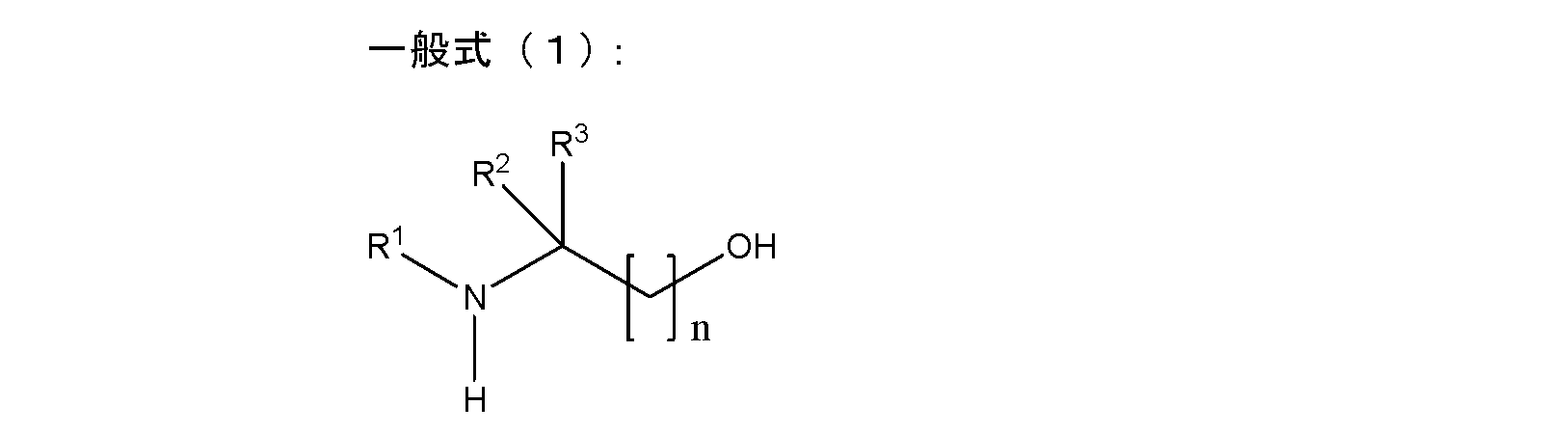
- R 1 represents a hydrogen atom or an alkyl group having a carbon number of 1 ⁇ 4
- R 2 and R 3 are the same or different, a hydrogen atom or an alkyl group having a carbon number of 1 ⁇ 3, R 1 , R 2 and R 3 are not all hydrogen atoms, and n is 1 or 2.
- R 1 is a hydrogen atom, a methyl group, an ethyl group, an n-propyl group, an isopropyl group or an n-butyl group
- R 2 and R 3 are the same or different and are a hydrogen atom or a methyl group
- n Item 6 The absorbent according to Item 1, wherein is 1 or 2.
- the alkanolamine represented by the general formula (1) is (I) an alkanolamine in which R 1 is a methyl group, an ethyl group, an n-propyl group, an isopropyl group, or an n-butyl group, R 2 and R 3 are hydrogen atoms, and n is 1 or 2, and (II) The absorbent according to Item 1 or 2, wherein R 1 is a hydrogen atom, R 2 and R 3 are methyl groups, and n is a mixed amine of alkanolamine. Item 4. Item 4.
- the absorbent according to Item 3 wherein the alkanolamine represented by the general formula (1) is a mixed amine of N-isopropylaminoethanol and 2-amino-2-methyl-1-propanol.
- Item 5. The absorbent according to any one of Items 1 to 4, wherein the concentration of the low molecular diol compound and / or glycerin is 5 to 30% by weight.
- Item 6. Item 5. The absorbent according to any one of Items 1 to 4, wherein the low-molecular diol compound and / or glycerin is ethylene glycol, and the concentration thereof is 5 to 20% by weight.
- a method for separating and recovering carbon dioxide from a gas containing carbon dioxide including the following steps A and B: A step A of bringing the absorbing liquid according to any one of Items 1 to 6 into contact with a gas containing carbon dioxide to obtain an absorbing liquid that has absorbed carbon dioxide from the gas containing carbon dioxide; and A step B in which the absorbing liquid that has absorbed carbon dioxide obtained in the step A is heated, carbon dioxide is desorbed and released from the absorbing liquid, and the released carbon dioxide is recovered.
- carbon dioxide can be released under a lower temperature condition with respect to an absorbing solution made of an aqueous solution having the same amine composition. Further, according to the present invention, carbon dioxide can be recovered with a lower energy consumption. Thereby, the energy required for the separation and recovery of carbon dioxide is reduced, and carbon dioxide can be recovered efficiently and with low energy consumption. In addition, the ability to dissipate carbon dioxide under low temperature conditions has been greatly improved, making it possible to use so-called low-grade waste heat that has been discarded, and greatly reducing the energy required for carbon dioxide separation and recovery. Is possible.
- the absorbing liquid of the present invention has the general formula (1):
- R 1 represents a hydrogen atom or an alkyl group having a carbon number of 1 ⁇ 4
- R 2 and R 3 are the same or different, a hydrogen atom or an alkyl group having a carbon number of 1 ⁇ 3, R 1 , R 2 and R 3 are not all hydrogen atoms, and n is 1 or 2.
- R 1 in the general formula (1) may be any one of a hydrogen atom and a linear or branched alkyl group having 1 to 4 carbon atoms, specifically, a hydrogen atom, a methyl group, or an ethyl group. , N-propyl group, isopropyl group, n-butyl group and the like. Among these, a hydrogen atom, an ethyl group, an n-propyl group, an isopropyl group, and an n-butyl group are preferable, and an isopropyl group is more preferable.
- n 1 or 2, and 1 is more preferable.
- R 2 and R 3 in the general formula (1) may be any of a hydrogen atom and a linear or branched alkyl group having 1 to 3 carbon atoms, specifically, a hydrogen atom, a methyl group , Ethyl group, n-propyl group and isopropyl group. Among these, a hydrogen atom and a methyl group are preferable.
- Specific alkanolamines represented by the general formula (1) include N-ethylaminoethanol, Nn-propylaminoethanol, N-isopropylaminoethanol, Nn-butylaminoethanol, 2-amino-1-propanol, N-isobutylaminoethanol, 2-amino-2-methyl-1-propanol, 3-ethylamino-1-propanol, 3-n-propylamino-1-propanol, 3-isopropylamino-1-propanol, 3-n -Butylamino-1-propanol, 3-isobutylamino-1-propanol and the like can be mentioned, and these can also be used industrially.
- the absorbing liquid of the present invention only needs to contain at least one alkanolamine represented by the general formula (1), and may contain a mixed amine composed of a plurality of alkanolamines.
- R 1 is a methyl group, ethyl group, n-propyl group, isopropyl group or n-butyl group
- R 2 and R 3 are hydrogen atoms
- n a mixed amine of an alkanolamine in which R 1 is a hydrogen atom, R 2 and R 3 are methyl groups, and n is 1.
- a mixed amine of N-isopropylaminoethanol and 2-amino-2-methyl-1-propanol is preferable.
- the higher the concentration of the amine component the greater the amount of carbon dioxide absorbed, the rate of absorption, the amount of desorption and the rate of desorption per unit liquid volume, which is desirable from the viewpoint of energy consumption, the size and efficiency of plant equipment. If the weight concentration exceeds 70%, the effect of water as an activator may decrease, causing problems such as a decrease in carbon dioxide absorption, a decrease in mixing of amine components, and an increase in viscosity. .
- the total amount of alkanolamine is preferably 60% by weight or less because of problems such as a decrease in mixing properties of amine components and an increase in viscosity. Further, 30% by weight or more is preferable from the viewpoint of practical absorption performance and desorption performance.
- the total amount of alkanolamine in the absorbing solution is preferably 30 to 60% by weight, more preferably 30 to 55% by weight, and particularly preferably 40 to 55% by weight.
- low molecular diol compound examples include aliphatic diol compounds having 2 to 8 carbon atoms (for example, ethylene glycol, diethylene glycol, triethylene glycol, 1,2-propanediol, 1,3-propanediol, 1,2-butane). Diol, 1,3-butanediol, 1,4-butanediol, etc.), preferably ethylene glycol.
- the absorption liquid of the present invention only needs to contain at least one of a low molecular diol compound and glycerin.
- the low molecular diol compound should be used alone or in combination of two or more. Can do.
- ethylene glycol is preferable.
- the total amount of the low molecular diol compound and glycerin in the absorption liquid of the present invention is preferably 5 to 30% by weight, and more preferably 5 to 20% by weight.
- the absorbing liquid of the present invention contains water.
- the water content in the absorbent of the present invention is not particularly limited, and the balance can be water.
- the water in the absorption liquid of the present invention is not particularly limited, and distilled water, ion exchange water, tap water, ground water, and the like can be appropriately used.
- the absorption liquid of this invention contains components other than the alkanolamine represented by General formula (1), low molecular diol, glycerin, and water in the range which does not inhibit the effect of this invention as needed. Also good.
- Other components include stabilizers for ensuring the chemical or physical stability of the liquid (for example, side reaction inhibitors such as antioxidants), deterioration of the materials of the apparatus or equipment using the solution of the present invention. Examples thereof include an inhibitor (for example, a corrosion inhibitor) and an antifoaming agent (for example, a surfactant).
- the content of these other components is not particularly limited as long as the effects of the present invention are not impaired.
- the gas containing carbon dioxide examples include a thermal power plant fueled with heavy oil, natural gas, etc., a boiler in a factory or a kiln in a cement factory, a blast furnace in a steelworks that reduces iron oxide with coke, and carbon in pig iron Exhaust gas from the converter of the same steel mill that burns steel to produce steel.
- the concentration of carbon dioxide in the gas is not particularly limited, and is usually about 5 to 30% by volume, particularly about 10 to 20% by volume. In such a carbon dioxide concentration range, the effects of the present invention are suitably exhibited.
- the gas containing carbon dioxide may contain an impurity gas derived from a generation source such as water vapor and CO in addition to carbon dioxide.
- step A The method for separating and recovering carbon dioxide according to the present invention was obtained in step A and step A in which the absorption liquid was brought into contact with a gas containing carbon dioxide to obtain an absorption liquid that absorbed carbon dioxide from the gas containing carbon dioxide. It includes a step B in which the absorbing liquid that has absorbed carbon dioxide is heated, carbon dioxide is desorbed and released from the absorbing liquid, and the released carbon dioxide is recovered.
- carbon dioxide can be absorbed into the absorbent by bringing the gas containing carbon dioxide into contact with the absorbent.
- the method of contacting and absorbing the gas containing carbon dioxide in the absorbing liquid for example, a method of absorbing the gas containing carbon dioxide in the absorbing liquid and absorbing the gas, and the mist of the absorbing liquid in the gas stream containing carbon dioxide.
- spraying method a method of bringing a gas containing carbon dioxide and an absorbing solution into countercurrent contact in an absorption tower containing a magnetic or metal mesh filler, and the like.
- the temperature at which carbon dioxide in a gas containing carbon dioxide is absorbed by the absorbing solution is usually about 60 ° C. or less, preferably about 50 ° C. or less, more preferably about 20 to 45 ° C.
- the carbon dioxide absorption process is usually performed under atmospheric pressure. Although it can be performed under pressure in order to enhance the carbon dioxide absorption performance, it is preferably performed under atmospheric pressure from the viewpoint of suppressing energy consumption for pressurization.
- Process B Carbon dioxide emission and recovery process
- carbon dioxide is diffused by heating the absorption liquid that has absorbed carbon dioxide obtained in the step A, and the pure or high-concentration carbon dioxide that has been diffused can be recovered.
- Examples of a method for desorbing and releasing carbon dioxide from an absorbing solution that has absorbed carbon dioxide include, for example, a method in which the absorbing solution is heated and bubbled and desorbed in a kettle, a plate tower, a spray tower, magnetic, or a metal net And a method in which the liquid interface is expanded and heated in a desorption tower containing a filler.
- carbon dioxide present as bicarbonate ions in the absorbing solution is desorbed and diffused as molecular carbon dioxide.
- the absorbing solution When desorbing and releasing carbon dioxide from the absorbing solution, the absorbing solution should be about 100 to 120 ° C. when a conventional aqueous solution is used as the absorbing solution.
- the higher the temperature of the absorption liquid the greater the amount of carbon dioxide released.
- the higher the temperature the more energy is required to heat the absorption liquid, so the temperature is the gas temperature and heat recovery in the process of exhausting the gas containing carbon dioxide. Determined by goals and others.
- the absorbing solution when carbon dioxide is desorbed and diffused from the absorbing solution, can be set to about 70 to 120 ° C, and can be set to 70 to 95 ° C, so that the design of the stripping tower can be optimized.
- so-called low-grade waste heat a sufficient amount of radiation can be obtained in a low temperature range of 80 to 95 ° C.
- the absorption liquid after desorbing and releasing carbon dioxide in the process B can be sent again to the process A and recycled (recycled).
- ⁇ Action> it is possible to improve the emission amount of carbon dioxide under low-temperature conditions from an absorbing solution that has absorbed carbon dioxide while generally maintaining a high carbon dioxide recovery amount from a gas containing carbon dioxide. .
- carbon dioxide can be recovered at a lower energy cost because the emission rate of carbon dioxide and the amount of emission relative to the amount of carbon dioxide absorbed (hereinafter referred to as “emission rate” in this specification) can be increased. can do.
- the carbon dioxide recovered in this manner is extremely high in purity, usually 99% by volume or more, and can be used in the chemical industry or the food industry. It can also be used for underground isolation in EOR (Enhanced Oil Recovery) and CCS (Carbon Dioxide Capture and Storage), which are currently being put to practical use.
- EGL Ethylene glycol
- Gly Glycerin 1,2-PD: 1,2-propanediol 1,3-PD: 1,3-propanediol
- 1,2-BD 1,2-butanediol 1,4-BD: 1
- 4-Butanediol TEG Triethylene glycol IPAE: N-isopropylaminoethanol AMP: 2-amino-2-methyl-1-propanol
- Example 1 Ethylene glycol, water and IPAE were mixed at a weight ratio of 10:35:55 to obtain an absorbing solution.
- Example 2 Ethylene glycol, water and IPAE were mixed at a weight ratio of 20:25:55 to obtain an absorbing solution.
- Example 3 Ethylene glycol, water, IPAE and AMP were mixed at a weight ratio of 10: 30: 45: 15 to obtain an absorbing solution.
- Example 4 Ethylene glycol, water, IPAE and AMP were mixed at a weight ratio of 10: 35: 47.5: 7.5 to obtain an absorbing solution.
- Example 5 Ethylene glycol, water, IPAE and AMP were mixed at a weight ratio of 20: 25: 45: 10 to obtain an absorbing solution.
- Example 6 Ethylene glycol, water, IPAE and AMP were mixed at a weight ratio of 10: 35: 42.5: 12.5 to obtain an absorbing solution.
- Example 7 Ethylene glycol, water, IPAE and AMP were mixed at a weight ratio of 5: 40: 40: 15 to obtain an absorbing solution.
- Example 8 Glycerin, water, IPAE and AMP were mixed at a weight ratio of 5: 40: 40: 15 to obtain an absorbing solution.
- Examples 9 to 10 Ethylene glycol, water, IPAE and AMP were mixed at a weight ratio of 10: 35: 40: 15 to obtain an absorbing solution.
- Examples 11 to 14 Ethylene glycol, water, IPAE and AMP were mixed at a weight ratio of 20: 25: 40: 15 to obtain an absorbing solution.
- Example 15 Ethylene glycol, water, IPAE and AMP were mixed at a weight ratio of 25: 20: 40: 15 to obtain an absorbing solution.
- Example 16 1,2-propanediol, water, IPAE and AMP were mixed at a weight ratio of 10: 35: 40: 15 to obtain an absorbing solution.
- Example 17 1,2-butanediol, water, IPAE and AMP were mixed at a weight ratio of 10: 35: 40: 15 to obtain an absorbing solution.
- Example 18 Glycerin, water, IPAE and AMP were mixed at a weight ratio of 10: 35: 40: 15 to obtain an absorbing solution.
- Example 19 1,2-butanediol, water, IPAE and AMP were mixed at a weight ratio of 20: 25: 40: 15 to obtain an absorbing solution.
- Example 20 1,3-propanediol, water, IPAE and AMP were mixed at a weight ratio of 20: 25: 40: 15 to obtain an absorbing solution.
- Example 21 1,4-butanediol, water, IPAE and AMP were mixed at a weight ratio of 20: 25: 40: 15 to obtain an absorbing solution.
- Example 22 Triethylene glycol, water, IPAE and AMP were mixed at a weight ratio of 20: 25: 40: 15 to obtain an absorbing solution.
- Example 23 Ethylene glycol, water, IPAE and AMP were mixed at a weight ratio of 20: 35: 35: 10 to obtain an absorbing solution.
- Example 24 Ethylene glycol, water, IPAE and EAE were mixed at a weight ratio of 20: 25: 40: 15 to obtain an absorbing solution.
- Example 25 Ethylene glycol, water, IPAE and NBAE were mixed at a weight ratio of 20: 25: 40: 15 to obtain an absorbing solution.
- Example 26 Ethylene glycol, water, IPAE and 2A1P were mixed at a weight ratio of 20: 25: 40: 15 to obtain an absorbing solution.
- Comparative Example 1 Water and IPAE were mixed at a weight ratio of 45:55 to obtain an absorbing solution.
- Comparative Example 2 Water, IPAE and AMP were mixed at a weight ratio of 45:40:15 to obtain an absorbing solution.
- Comparative Example 3 Water, IPAE and AMP were mixed at a weight ratio of 45:40:15 to obtain an absorbing solution.
- Comparative Example 4 Water and IPAE and EAE were mixed at a weight ratio of 45:40:15 to obtain an absorbent.
- Comparative Example 5 Water and IPAE and NBAE were mixed at a weight ratio of 45:40:15 to obtain an absorbing solution.
- Comparative Example 6 Water, IPAE and 2A1P were mixed at a weight ratio of 45:40:15 to obtain an absorbing solution.
- the alkanolamine, low molecular diol compound, and glycerin used in the above Examples and Comparative Examples are reagent manufacturer products such as Tokyo Chemical Industry Co., Ltd., and use general purity products. IPAE uses Guangei Chemical Industry Co., Ltd., and the purity is 99% or more. As the water, ion-exchanged water was used.
- Test example 1 About the absorption liquid in an Example and a comparative example, the absorption amount of carbon dioxide, the emitted amount, and the emitted rate were measured. Carbon dioxide gas cylinder (purity 99.9%) and nitrogen gas cylinder (purity 99.9%), carbon dioxide gas flow rate controller and nitrogen gas flow rate controller, glass reaction vessel (0.5 L), stirring blade and temperature controller, gas flow meter, chiller , And a carbon dioxide concentration meter (IR100 manufactured by YOKOGAWA) were sequentially used to perform the carbon dioxide absorption and dissipation device.
- the periphery of the glass reaction vessel was covered with an electric heater, and the temperature regulator was used to arbitrarily control the temperature of the absorbent in the glass reaction vessel.
- the gas inside the glass reaction vessel was replaced with nitrogen gas. Hold the absorbing solution in the glass reaction vessel at 40 ° C, and with sufficient stirring at a rotation speed of 700 rpm, carbon dioxide gas at a flow rate of 0.14 L / min and nitrogen gas at a flow rate of 0.56 L / min.
- the process A was started by blowing into the absorbent, and continued for 2 hours.
- Step A After Step A was completed, the absorbent in the glass reaction vessel was heated to 80 ° C. to 95 ° C. to start Step B, and continued for 2 hours.
- the exhaust gas from the glass reaction vessel was analyzed with a carbon dioxide concentration meter.
- the amount of carbon dioxide dissolved in the absorbing solution that is, the amount of absorption was determined from the change over time in the carbon dioxide concentration obtained from the carbon dioxide concentration meter.
- the amount of carbon dioxide released from the absorbing solution by heating was defined as a value obtained by subtracting the amount of carbon dioxide dissolved 2 hours after the start of the process B from the amount of carbon dioxide absorbed 2 hours after the start of the process A.
- the rate of carbon dioxide emission from the absorbing solution was defined as the change in the amount of carbon dioxide absorbed per unit time in 10 minutes after the start of carbon dioxide emission in Step B.
- Table 1 shows the compositions of the absorbents and the measurement results in Examples and Comparative Examples.
- the absorption liquids of the examples showed the performance that the emission rate and the diffusion rate of carbon dioxide were both significantly higher than the absorption liquids of the comparative examples.
Landscapes
- Chemical & Material Sciences (AREA)
- Engineering & Computer Science (AREA)
- Chemical Kinetics & Catalysis (AREA)
- Analytical Chemistry (AREA)
- General Chemical & Material Sciences (AREA)
- Oil, Petroleum & Natural Gas (AREA)
- Environmental & Geological Engineering (AREA)
- Organic Chemistry (AREA)
- Health & Medical Sciences (AREA)
- Biomedical Technology (AREA)
- Inorganic Chemistry (AREA)
- Gas Separation By Absorption (AREA)
- Treating Waste Gases (AREA)
- Organic Low-Molecular-Weight Compounds And Preparation Thereof (AREA)
Abstract
Description

で表されるアルカノールアミンの少なくとも1種、
低分子ジオール化合物及び/又はグリセリン、並びに
水
を含有する、
二酸化炭素を含むガスから二酸化炭素を分離回収するための吸収液。
項2.R1が、水素原子、メチル基、エチル基、n-プロピル基、イソプロピル基又はn-ブチル基であり、R2及びR3が、それぞれ同一又は異なって、水素原子又はメチル基であり、nが1又は2である、項1に記載の吸収液。
項3.前記一般式(1)で表されるアルカノールアミンが、
(I) R1が、メチル基、エチル基、n-プロピル基、イソプロピル基又はn-ブチル基であり、R2及びR3が水素原子であり、nが1又は2であるアルカノールアミン、及び
(II) R1が水素原子であり、R2及びR3がメチル基であり、nが1であるアルカノールアミン
の混合アミンである、項1又は2に記載の吸収液。
項4.前記一般式(1)で表わされるアルカノールアミンが、N-イソプロピルアミノエタノール及び2-アミノ-2-メチル-1-プロパノールの混合アミンである、項3に記載の吸収液。
項5.前記低分子ジオール化合物及び/又はグリセリンの濃度が5~30重量%である、項1~4のいずれか一項に記載の吸収液。
項6.前記低分子ジオール化合物及び/又はグリセリンがエチレングリコールであり、その濃度が5~20重量%である、項1~4のいずれか一項に記載の吸収液。
項7.以下の工程A及びBを含む、二酸化炭素を含むガスから二酸化炭素を分離回収する方法:
項1~6のいずれか一項に記載の吸収液を、二酸化炭素を含むガスと接触させ、二酸化炭素を含むガスから二酸化炭素を吸収した吸収液を得る工程A、及び、
前記工程Aで得られた二酸化炭素を吸収した吸収液を加熱して、吸収液から二酸化炭素を脱離して放散させ、放散した二酸化炭素を回収する工程B。
項8.前記工程Bにおいて二酸化炭素を吸収した吸収液を80~95℃の温度で加熱して二酸化炭素を脱離する、項7に記載の方法。
本発明の吸収液は、一般式(1):

で表わされるアルカノールアミンの少なくとも1種、低分子ジオール化合物及び/又はグリセリン並びに水を含有する。
(II) R1が水素原子であり、R2及びR3がメチル基であり、nが1であるアルカノールアミンの混合アミンを挙げることができる。その中でもN-イソプロピルアミノエタノール及び2-アミノ-2-メチル-1-プロパノールの混合アミンが好ましい。
本発明の二酸化炭素の分離回収方法は、前記吸収液を、二酸化炭素を含むガスと接触させ、二酸化炭素を含むガスから二酸化炭素を吸収した吸収液を得る工程A、及び工程Aで得られた二酸化炭素を吸収した吸収液を加熱して、吸収液から二酸化炭素を脱離して放散させ、放散した二酸化炭素を回収する工程Bを含むことを特徴とする。
本発明によれば、吸収液に二酸化炭素を含むガスを接触させることにより、二酸化炭素を吸収液に吸収させることができる。吸収液に二酸化炭素を含むガスを接触吸収させる方法は特に限定されず、例えば、吸収液中に二酸化炭素を含むガスをバブリングさせて吸収する方法、二酸化炭素を含むガス気流中に吸収液を霧状に降らす方法(噴霧乃至スプレー方式)、磁製又は金属網製の充填材の入った吸収塔内で二酸化炭素を含むガスと吸収液とを向流接触させる方法等が挙げられる。
本発明によれば、前記工程Aで得られた二酸化炭素を吸収した吸収液を加熱することによって二酸化炭素を放散し、放散された純粋又は高濃度の二酸化炭素を回収することができる。
本発明によれば、二酸化炭素を含むガスからの高い二酸化炭素の回収量を概ね維持しつつ、二酸化炭素を吸収した吸収液からの、低温条件下における二酸化炭素の放散量を向上させることができる。特に、本発明によれば、80~95℃という従来に比べ極めて低い温度条件でも十分な放散量を得ることが可能である。
EGL:エチレングリコール
Gly:グリセリン
1,2-PD:1,2-プロパンジオール
1,3-PD:1,3-プロパンジオール
1,2-BD:1,2-ブタンジオール
1,4-BD:1,4-ブタンジオール
TEG:トリエチレングリコール
IPAE:N-イソプロピルアミノエタノール
AMP:2-アミノ-2-メチル-1-プロパノール
EAE:N-エチルアミノエタノール
NBAE:N-n-ブチルアミノエタノール
2A1P:2-アミノ-1-プロパノール
エチレングリコール、水及びIPAEを10:35:55の重量比で混合し、吸収液を得た。
エチレングリコール、水及びIPAEを20:25:55の重量比で混合し、吸収液を得た。
エチレングリコール、水、IPAE及びAMPを10:30:45:15の重量比で混合し、吸収液を得た。
エチレングリコール、水、IPAE及びAMPを10:35:47.5:7.5の重量比で混合し、吸収液を得た。
エチレングリコール、水、IPAE及びAMPを20:25:45:10の重量比で混合し、吸収液を得た。
エチレングリコール、水、IPAE及びAMPを10:35:42.5:12.5の重量比で混合し、吸収液を得た。
エチレングリコール、水、IPAE及びAMPを5:40:40:15の重量比で混合し、吸収液を得た。
グリセリン、水、IPAE及びAMPを5:40:40:15の重量比で混合し、吸収液を得た。
エチレングリコール、水、IPAE及びAMPを10:35:40:15の重量比で混合し、吸収液を得た。
エチレングリコール、水、IPAE及びAMPを20:25:40:15の重量比で混合し、吸収液を得た。
エチレングリコール、水、IPAE及びAMPを25:20:40:15の重量比で混合し、吸収液を得た。
1,2-プロパンジオール、水、IPAE及びAMPを10:35:40:15の重量比で混合し、吸収液を得た。
1,2-ブタンジオール、水、IPAE及びAMPを10:35:40:15の重量比で混合し、吸収液を得た。
グリセリン、水、IPAE及びAMPを10:35:40:15の重量比で混合し、吸収液を得た。
1,2-ブタンジオール、水、IPAE及びAMPを20:25:40:15の重量比で混合し、吸収液を得た。
1,3-プロパンジオール、水、IPAE及びAMPを20:25:40:15の重量比で混合し、吸収液を得た。
1,4-ブタンジオール、水、IPAE及びAMPを20:25:40:15の重量比で混合し、吸収液を得た。
トリエチレングリコール、水、IPAE及びAMPを20:25:40:15の重量比で混合し、吸収液を得た。
エチレングリコール、水、IPAE及びAMPを20:35:35:10の重量比で混合し、吸収液を得た。
エチレングリコール、水、IPAE及EAEを20:25:40:15の重量比で混合し、吸収液を得た。
エチレングリコール、水、IPAE及びNBAEを20:25:40:15の重量比で混合し、吸収液を得た。
エチレングリコール、水、IPAE及び2A1Pを20:25:40:15の重量比で混合し、吸収液を得た。
水及びIPAEを45:55の重量比で混合し、吸収液を得た。
水及びIPAE及びAMPを45:40:15の重量比で混合し、吸収液を得た。
水及びIPAE及びAMPを45:40:15の重量比で混合し、吸収液を得た。
水及びIPAE及びEAEを45:40:15の重量比で混合し、吸収液を得た。
水及びIPAE及びNBAEを45:40:15の重量比で混合し、吸収液を得た。
水及びIPAE及び2A1Pを45:40:15の重量比で混合し、吸収液を得た。
実施例及び比較例における吸収液について、二酸化炭素の吸収量、放散量及び放散速度の測定を行った。測定は、炭酸ガスボンベ(純度99.9%)及び窒素ガスボンベ(純度99.9%)、炭酸ガス流量コントローラー及び窒素ガス流量コントローラー、ガラス製反応容器(0.5 L)、撹拌翼及び温度調整器、ガス流量計、チラー、並びに二酸化炭素濃度計(YOKOGAWA製IR100)を順次接続した二酸化炭素吸収放散装置を用いて行った。


Claims (8)
-
で表されるアルカノールアミンの少なくとも1種、
低分子ジオール化合物及び/又はグリセリン、並びに
水
を含有する、
二酸化炭素を含むガスから二酸化炭素を分離回収するための吸収液。 - R1が、水素原子、メチル基、エチル基、n-プロピル基、イソプロピル基又はn-ブチル基であり、R2及びR3が、それぞれ同一又は異なって、水素原子又はメチル基であり、nが1又は2である、請求項1に記載の吸収液。
- 前記一般式(1)で表されるアルカノールアミンが、
(I) R1が、メチル基、エチル基、n-プロピル基、イソプロピル基又はn-ブチル基であり、R2及びR3が水素原子であり、nが1又は2であるアルカノールアミン、及び
(II) R1が水素原子であり、R2及びR3がメチル基であり、nが1であるアルカノールアミン
の混合アミンである、請求項1又は2に記載の吸収液。 - 前記一般式(1)で表わされるアルカノールアミンが、N-イソプロピルアミノエタノール及び2-アミノ-2-メチル-1-プロパノールの混合アミンである、請求項3に記載の吸収液。
- 前記低分子ジオール化合物及び/又はグリセリンの濃度が5~30重量%である、請求項1~4のいずれか一項に記載の吸収液。
- 前記低分子ジオール化合物及び/又はグリセリンがエチレングリコールであり、その濃度が5~20重量%である、請求項1~4のいずれか一項に記載の吸収液。
- 以下の工程A及びBを含む、二酸化炭素を含むガスから二酸化炭素を分離回収する方法:
請求項1~6のいずれか一項に記載の吸収液を、二酸化炭素を含むガスと接触させ、二酸化炭素を含むガスから二酸化炭素を吸収した吸収液を得る工程A、及び、
前記工程Aで得られた二酸化炭素を吸収した吸収液を加熱して、吸収液から二酸化炭素を脱離して放散させ、放散した二酸化炭素を回収する工程B。 - 前記工程Bにおいて二酸化炭素を吸収した吸収液を80~95℃の温度で加熱して二酸化炭素を脱離する、請求項7に記載の方法。
Priority Applications (6)
| Application Number | Priority Date | Filing Date | Title |
|---|---|---|---|
| CN201680018432.2A CN107427759A (zh) | 2015-03-26 | 2016-03-18 | 用于分离和捕集二氧化碳的吸收液以及使用所述吸收液分离和捕集二氧化碳的方法 |
| EP16768685.6A EP3275526A4 (en) | 2015-03-26 | 2016-03-18 | Absorbing solution for separating and recovering carbon dioxide, and method for separating and recovering carbon dioxide in which same is used |
| KR1020177030436A KR20170129920A (ko) | 2015-03-26 | 2016-03-18 | 이산화탄소를 분리 회수하기 위한 흡수액 및 그것을 사용한 이산화탄소를 분리 회수하는 방법 |
| JP2017508318A JP6755854B2 (ja) | 2015-03-26 | 2016-03-18 | 二酸化炭素を分離回収するための吸収液、及びそれを用いた二酸化炭素を分離回収する方法 |
| BR112017020089A BR112017020089A2 (pt) | 2015-03-26 | 2016-03-18 | solução de absorção para separar e capturar dióxido de carbono, e método para separar e capturar dióxido de carbono no qual a mesma é usada |
| US15/560,354 US10717038B2 (en) | 2015-03-26 | 2016-03-18 | Absorbing solution for separating and capturing carbon dioxide, and method for separating and capturing carbon dioxide in which same is used |
Applications Claiming Priority (2)
| Application Number | Priority Date | Filing Date | Title |
|---|---|---|---|
| JP2015-064402 | 2015-03-26 | ||
| JP2015064402 | 2015-03-26 |
Publications (1)
| Publication Number | Publication Date |
|---|---|
| WO2016152782A1 true WO2016152782A1 (ja) | 2016-09-29 |
Family
ID=56978575
Family Applications (1)
| Application Number | Title | Priority Date | Filing Date |
|---|---|---|---|
| PCT/JP2016/058715 Ceased WO2016152782A1 (ja) | 2015-03-26 | 2016-03-18 | 二酸化炭素を分離回収するための吸収液、及びそれを用いた二酸化炭素を分離回収する方法 |
Country Status (7)
| Country | Link |
|---|---|
| US (1) | US10717038B2 (ja) |
| EP (1) | EP3275526A4 (ja) |
| JP (1) | JP6755854B2 (ja) |
| KR (1) | KR20170129920A (ja) |
| CN (1) | CN107427759A (ja) |
| BR (1) | BR112017020089A2 (ja) |
| WO (1) | WO2016152782A1 (ja) |
Cited By (3)
| Publication number | Priority date | Publication date | Assignee | Title |
|---|---|---|---|---|
| JP2022085754A (ja) * | 2020-11-27 | 2022-06-08 | 株式会社トクヤマ | 吸収液および分離回収方法 |
| JP2023124995A (ja) * | 2022-02-28 | 2023-09-07 | 東ソー株式会社 | 二酸化炭素分離用アミン組成物 |
| WO2024202126A1 (ja) * | 2023-03-30 | 2024-10-03 | 株式会社Eプラス | 二酸化炭素処理方法 |
Families Citing this family (2)
| Publication number | Priority date | Publication date | Assignee | Title |
|---|---|---|---|---|
| CN110801711B (zh) * | 2019-12-03 | 2022-03-22 | 中冶京诚工程技术有限公司 | 一种捕集二氧化碳的相变吸收剂及捕集二氧化碳的方法 |
| KR102831229B1 (ko) * | 2024-07-29 | 2025-07-09 | 한화토탈에너지스 주식회사 | 증발 억제제를 포함한 이산화탄소 포집 흡수제 |
Citations (4)
| Publication number | Priority date | Publication date | Assignee | Title |
|---|---|---|---|---|
| JPH05301023A (ja) * | 1992-02-27 | 1993-11-16 | Kansai Electric Power Co Inc:The | 燃焼排ガス中の二酸化炭素の除去方法 |
| JP2005230808A (ja) * | 2003-12-23 | 2005-09-02 | Inst Fr Petrole | 排煙中に含まれる二酸化炭素を捕集する方法 |
| JP2009521313A (ja) * | 2005-12-23 | 2009-06-04 | プラクスエア・テクノロジー・インコーポレイテッド | 排ガスなどからの二酸化炭素の回収 |
| JP2012236165A (ja) * | 2011-05-12 | 2012-12-06 | National Institute Of Advanced Industrial Science & Technology | 低温廃熱を利用して二酸化炭素を回収するガス分離回収方法 |
Family Cites Families (12)
| Publication number | Priority date | Publication date | Assignee | Title |
|---|---|---|---|---|
| GB1596753A (en) * | 1978-04-18 | 1981-08-26 | Contemporary Perfumers Ltd | Method for reducing malodours of carboxylic acids |
| KR0123107B1 (ko) * | 1992-02-27 | 1997-11-12 | 아끼야마 요시히사 | 연소배기가스중의 2산화탄소의 제거방법 |
| DE19945221A1 (de) * | 1998-10-14 | 2000-04-20 | Merck Patent Gmbh | Walzenwaschmittel |
| FR2898284B1 (fr) | 2006-03-10 | 2009-06-05 | Inst Francais Du Petrole | Procede de desacidification d'un gaz par solution absorbante avec regeneration fractionnee par chauffage. |
| WO2009001804A1 (ja) | 2007-06-28 | 2008-12-31 | Research Institute Of Innovative Technology For The Earth | ガス中の二酸化炭素を効率的に回収する方法 |
| FR2942972B1 (fr) | 2009-03-10 | 2012-04-06 | Inst Francais Du Petrole | Procede de desacidification d'un gaz par solution absorbante avec vaporisation et/ou purification d'une fraction de la solution absorbante regeneree. |
| KR20110099466A (ko) * | 2010-03-02 | 2011-09-08 | 현대자동차주식회사 | 이산화탄소 흡수제 |
| IT1401668B1 (it) * | 2010-09-13 | 2013-08-02 | Consiglio Nazionale Ricerche | Processo di separazione e rimozione di co2 da miscele gassose mediante ammine in soluzione di alcoli |
| KR101193087B1 (ko) * | 2011-01-04 | 2012-10-19 | 경희대학교 산학협력단 | 입체장애가 도입된 2급 알칸올아민과 디올을 포함하는 비수계 이산화탄소 흡수제 |
| EP2719439A4 (en) * | 2011-06-09 | 2015-04-15 | Asahi Chemical Ind | CARBON DIOXIDE ABSORPTION AND CARBON DIOXIDE SEPARATION / RECOVERY PROCESS WITH THE ABSORBER |
| AU2013281027B2 (en) | 2012-06-29 | 2017-10-19 | Dow Global Technologies Llc | Aqueous alkanolamine absorbent composition comprising piperazine for enhanced removal of hydrogen sulfide from gaseous mixtures and method for using the same |
| JP2015029987A (ja) | 2013-08-07 | 2015-02-16 | 株式会社東芝 | 酸性ガス吸収剤、酸性ガス除去方法及び酸性ガス除去装置 |
-
2016
- 2016-03-18 EP EP16768685.6A patent/EP3275526A4/en not_active Withdrawn
- 2016-03-18 WO PCT/JP2016/058715 patent/WO2016152782A1/ja not_active Ceased
- 2016-03-18 JP JP2017508318A patent/JP6755854B2/ja active Active
- 2016-03-18 US US15/560,354 patent/US10717038B2/en active Active
- 2016-03-18 BR BR112017020089A patent/BR112017020089A2/pt not_active IP Right Cessation
- 2016-03-18 CN CN201680018432.2A patent/CN107427759A/zh active Pending
- 2016-03-18 KR KR1020177030436A patent/KR20170129920A/ko not_active Ceased
Patent Citations (4)
| Publication number | Priority date | Publication date | Assignee | Title |
|---|---|---|---|---|
| JPH05301023A (ja) * | 1992-02-27 | 1993-11-16 | Kansai Electric Power Co Inc:The | 燃焼排ガス中の二酸化炭素の除去方法 |
| JP2005230808A (ja) * | 2003-12-23 | 2005-09-02 | Inst Fr Petrole | 排煙中に含まれる二酸化炭素を捕集する方法 |
| JP2009521313A (ja) * | 2005-12-23 | 2009-06-04 | プラクスエア・テクノロジー・インコーポレイテッド | 排ガスなどからの二酸化炭素の回収 |
| JP2012236165A (ja) * | 2011-05-12 | 2012-12-06 | National Institute Of Advanced Industrial Science & Technology | 低温廃熱を利用して二酸化炭素を回収するガス分離回収方法 |
Non-Patent Citations (1)
| Title |
|---|
| See also references of EP3275526A4 * |
Cited By (4)
| Publication number | Priority date | Publication date | Assignee | Title |
|---|---|---|---|---|
| JP2022085754A (ja) * | 2020-11-27 | 2022-06-08 | 株式会社トクヤマ | 吸収液および分離回収方法 |
| JP2023124995A (ja) * | 2022-02-28 | 2023-09-07 | 東ソー株式会社 | 二酸化炭素分離用アミン組成物 |
| WO2024202126A1 (ja) * | 2023-03-30 | 2024-10-03 | 株式会社Eプラス | 二酸化炭素処理方法 |
| JP2024143443A (ja) * | 2023-03-30 | 2024-10-11 | 株式会社Eプラス | 二酸化炭素処理方法 |
Also Published As
| Publication number | Publication date |
|---|---|
| JP6755854B2 (ja) | 2020-09-16 |
| KR20170129920A (ko) | 2017-11-27 |
| US20180078893A1 (en) | 2018-03-22 |
| BR112017020089A2 (pt) | 2018-06-05 |
| EP3275526A4 (en) | 2018-12-12 |
| CN107427759A (zh) | 2017-12-01 |
| JPWO2016152782A1 (ja) | 2018-01-25 |
| US10717038B2 (en) | 2020-07-21 |
| EP3275526A1 (en) | 2018-01-31 |
Similar Documents
| Publication | Publication Date | Title |
|---|---|---|
| JP5449059B2 (ja) | 排ガス中の二酸化炭素を効率的に吸収及び回収する水溶液 | |
| JP6095579B2 (ja) | 排ガス中の二酸化炭素を効率的に吸収及び回収する水溶液、及びそれを用いた二酸化炭素の回収方法 | |
| JP5452222B2 (ja) | ガス中の二酸化炭素を効率的に回収する方法 | |
| JP6755854B2 (ja) | 二酸化炭素を分離回収するための吸収液、及びそれを用いた二酸化炭素を分離回収する方法 | |
| JP5557426B2 (ja) | ガス中の二酸化炭素を効率的に吸収及び回収する水溶液及び方法 | |
| JP2015107443A (ja) | 酸性ガス吸収剤、酸性ガス除去装置および酸性ガス除去方法 | |
| KR20150121152A (ko) | 가스 중의 이산화탄소를 흡수 및 회수하기 위한 액체, 및 그것을 사용한 이산화탄소의 회수 방법 | |
| WO2011071150A1 (ja) | 高圧用二酸化炭素吸収剤並びに高圧二酸化炭素吸収及び回収方法 | |
| JP2006240966A (ja) | 排ガス中の二酸化炭素を吸収及び脱離して回収する方法 | |
| JP2020044489A (ja) | 酸性ガス吸収剤、酸性ガスの除去方法及び酸性ガス除去装置 | |
| JP2008168227A (ja) | 排ガス中の二酸化炭素の吸収液 | |
| JP2015112574A (ja) | 酸性ガス吸収剤、酸性ガス除去方法及び酸性ガス除去装置 | |
| JP2009213974A (ja) | ガス中の二酸化炭素を効率的に吸収、脱離回収する水溶液及び方法 | |
| JP2008168184A (ja) | 排ガス中の二酸化炭素を吸収及び脱離して回収するための組成物及び方法 | |
| CN102350368A (zh) | 一种用于去除烟气中co2的基于碳酸钾溶液的催化体系 | |
| JP2015047581A (ja) | 二酸化炭素吸収剤及びそれを用いた二酸化炭素の分離回収方法。 | |
| JP7394963B2 (ja) | 二酸化炭素を含むガスから二酸化炭素を分離回収するための吸収液及びそれを用いた二酸化炭素の回収方法 | |
| JP2024059402A (ja) | 二酸化炭素を回収するためのアミン溶液、及びそれを用いた二酸化炭素を分離回収する方法 | |
| JP7720406B2 (ja) | 二酸化炭素を含むガスから二酸化炭素を回収する方法、および、二酸化炭素を回収するためのアミン水溶液 | |
| JP2025036217A (ja) | 二酸化炭素の吸収剤および二酸化炭素の分離回収方法 | |
| JP2024008922A (ja) | 二酸化炭素吸収液及び二酸化炭素の分離回収方法 | |
| EP2767325A1 (en) | Process for the removal of carbon dioxide from a gas | |
| JPWO2019163867A1 (ja) | 二酸化炭素の吸収剤および二酸化炭素の分離回収方法 |
Legal Events
| Date | Code | Title | Description |
|---|---|---|---|
| 121 | Ep: the epo has been informed by wipo that ep was designated in this application |
Ref document number: 16768685 Country of ref document: EP Kind code of ref document: A1 |
|
| ENP | Entry into the national phase |
Ref document number: 2017508318 Country of ref document: JP Kind code of ref document: A |
|
| WWE | Wipo information: entry into national phase |
Ref document number: 15560354 Country of ref document: US |
|
| NENP | Non-entry into the national phase |
Ref country code: DE |
|
| REG | Reference to national code |
Ref country code: BR Ref legal event code: B01A Ref document number: 112017020089 Country of ref document: BR |
|
| ENP | Entry into the national phase |
Ref document number: 20177030436 Country of ref document: KR Kind code of ref document: A |
|
| ENP | Entry into the national phase |
Ref document number: 112017020089 Country of ref document: BR Kind code of ref document: A2 Effective date: 20170920 |