WO2016152986A1 - アンモニウム塩を用いためっき液 - Google Patents
アンモニウム塩を用いためっき液 Download PDFInfo
- Publication number
- WO2016152986A1 WO2016152986A1 PCT/JP2016/059429 JP2016059429W WO2016152986A1 WO 2016152986 A1 WO2016152986 A1 WO 2016152986A1 JP 2016059429 W JP2016059429 W JP 2016059429W WO 2016152986 A1 WO2016152986 A1 WO 2016152986A1
- Authority
- WO
- WIPO (PCT)
- Prior art keywords
- acid
- plating solution
- salt
- plating
- tin
- Prior art date
- Legal status (The legal status is an assumption and is not a legal conclusion. Google has not performed a legal analysis and makes no representation as to the accuracy of the status listed.)
- Ceased
Links
Classifications
-
- C—CHEMISTRY; METALLURGY
- C25—ELECTROLYTIC OR ELECTROPHORETIC PROCESSES; APPARATUS THEREFOR
- C25D—PROCESSES FOR THE ELECTROLYTIC OR ELECTROPHORETIC PRODUCTION OF COATINGS; ELECTROFORMING; APPARATUS THEREFOR
- C25D3/00—Electroplating: Baths therefor
- C25D3/02—Electroplating: Baths therefor from solutions
- C25D3/30—Electroplating: Baths therefor from solutions of tin
- C25D3/32—Electroplating: Baths therefor from solutions of tin characterised by the organic bath constituents used
-
- C—CHEMISTRY; METALLURGY
- C25—ELECTROLYTIC OR ELECTROPHORETIC PROCESSES; APPARATUS THEREFOR
- C25D—PROCESSES FOR THE ELECTROLYTIC OR ELECTROPHORETIC PRODUCTION OF COATINGS; ELECTROFORMING; APPARATUS THEREFOR
- C25D7/00—Electroplating characterised by the article coated
- C25D7/12—Semiconductors
-
- H—ELECTRICITY
- H05—ELECTRIC TECHNIQUES NOT OTHERWISE PROVIDED FOR
- H05K—PRINTED CIRCUITS; CASINGS OR CONSTRUCTIONAL DETAILS OF ELECTRIC APPARATUS; MANUFACTURE OF ASSEMBLAGES OF ELECTRICAL COMPONENTS
- H05K3/00—Apparatus or processes for manufacturing printed circuits
- H05K3/10—Apparatus or processes for manufacturing printed circuits in which conductive material is applied to the insulating support in such a manner as to form the desired conductive pattern
- H05K3/18—Apparatus or processes for manufacturing printed circuits in which conductive material is applied to the insulating support in such a manner as to form the desired conductive pattern using precipitation techniques to apply the conductive material
Definitions
- the present invention relates to a plating solution of tin or tin alloy that is excellent in throwing power and suppresses generation of voids when a bump electrode is formed.
- a lead-tin alloy solder plating solution comprising an aqueous solution containing at least one selected from acids and salts thereof, a soluble lead compound, a soluble tin compound, a nonionic surfactant and a formalin condensate of naphthalenesulfonic acid or a salt thereof
- a formalin condensate of naphthalenesulfonic acid or a salt thereof as an additive contains 0.02 to 1.50% by mass with respect to lead ions.
- Patent Document 1 states that even if plating is performed with this plating solution at a high current density, a lead-tin alloy protruding electrode having a small surface height variation, smoothness, and a small variation in the lead / tin composition ratio can be formed. Are listed.
- a soluble salt composed of any one of a tin salt and a mixture of a tin salt and a predetermined metal salt such as silver, copper, bismuth, lead, etc.
- B an acid or a salt thereof
- C a specific A tin or tin alloy plating bath containing a phenanthrolinedione compound is disclosed (for example, see Patent Document 2).
- this plating bath contains a specific phenanthrolinedione compound as an additive, the plating bath can have excellent uniform electrodeposition and a good film appearance in a wide range of current densities. It is described that a uniform synthetic composition can be obtained in the current density region.
- Patent Document 3 a tin plating solution containing a tin ion source, at least one nonionic surfactant, and imidazoline dicarboxylate and 1,10-phenanthroline as additives is disclosed (for example, see Patent Document 3). ).
- Patent Document 3 states that this tin plating solution does not cause discoloration even in the plating of highly complicated printed circuit boards, has excellent uniformity of in-plane film thickness distribution, and excellent uniformity of through-hole plating. Has been.
- JP 2005-290505 A (Claim 1, paragraph [0004]) Japanese Unexamined Patent Publication No. 2013-044401 (A) (Summary, paragraph [0010]) Japanese Unexamined Patent Publication No. 2012-087393 (A) (Summary, paragraph [0006])
- Patent Documents 1 to 3 has improved the throwing power of the plating solution of tin or tin alloy.
- the demand for the quality of the plating film has increased, and the more uniform
- bump electrodes provided on a substrate for connecting semiconductor devices in flip chip mounting are formed by plating, voids called voids may be formed inside the bumps after reflow treatment, resulting in poor bonding. There is a need to avoid the formation of this potentially void.
- the throwing power is improved by increasing the polarization resistance of the electrode surface, while the generation of voids is suppressed by reducing the overvoltage of the cathode.
- additives for plating solutions that satisfy both characteristics have been demanded.
- An object of the present invention is to provide a tin or tin alloy plating solution that has excellent throwing power and suppresses the generation of voids when bump electrodes are formed.
- a first aspect of the present invention is a plating solution containing (A) a soluble salt containing at least a stannous salt, (B) an acid selected from organic acids and inorganic acids or salts thereof, and (C) an additive.
- the additive contains an ammonium salt represented by the following general formula (1).
- a second aspect of the present invention is an invention based on the first aspect, wherein the additive further includes a nonionic surfactant represented by the following general formula (2).
- R3 and R4 are groups represented by the following formula (A), and Y1 and Y2 are groups selected from a single bond, —O—, —COO— and —CONH—.
- Z represents a benzene ring or 2,2-diphenylpropane.
- n represents 2 or 3.
- m represents an integer of 1 to 15.
- a third aspect of the present invention is an invention based on either the first or second aspect, wherein the plating solution further includes any other additive of a complexing agent, a brightening agent, or an antioxidant. is there.
- the plating solution according to the first aspect of the present invention by using a specific ammonium salt as an additive, it is possible to improve the uniform electrodeposition in a wide current density range with a good appearance and to form a bump electrode. Generation of voids can be suppressed, and a highly reliable plating film can be formed. As a result, a product that can cope with a narrow pitch or a complicated wiring pattern with high quality can be manufactured.
- the nonionic surfactant represented by the above formula (2) by further including the nonionic surfactant represented by the above formula (2), generation of voids can be suppressed when the bump electrode is formed, and the plating film Thickness variation can be further reduced.
- the plating solution of the third aspect of the present invention has the following effects by further including any other additive of a complexing agent, a brightening agent, or an antioxidant.
- the brightener imparts gloss to the plating film.
- the complexing agent is a plating solution containing a noble metal such as silver, which stabilizes noble metal ions and the like in the bath and makes the composition of the precipitated alloy uniform.
- the antioxidant prevents oxidation of the soluble stannous salt to the stannic salt.
- the plating solution which is one embodiment of the present invention is a plating solution of tin or a tin alloy, and (A) a soluble salt containing at least a stannous salt, (B ) An acid selected from organic acids and inorganic acids or salts thereof, and (C) an additive.
- This additive contains the specific ammonium salt represented by following General formula (1).
- the soluble salt is composed of any one of a stannous salt and a mixture of the stannous salt and a metal salt selected from the group consisting of silver, copper, bismuth, nickel, antimony, indium, and zinc.
- the tin alloy contained in the plating solution of the present invention is an alloy of tin and a predetermined metal selected from silver, copper, bismuth, nickel, antimony, indium, and zinc.
- a predetermined metal selected from silver, copper, bismuth, nickel, antimony, indium, and zinc.
- the soluble salt (A) contained in the plating solution of the present invention is various metals such as Sn 2+ , Ag + , Cu + , Cu 2+ , Bi 3+ , Ni 2+ , Sb 3+ , In 3+ and Zn 2+ in the plating solution. It means any soluble salt that generates ions, and includes, for example, metal oxides, halides, inorganic acids or organic acids of the metal.
- metal oxides include stannous oxide, copper oxide, nickel oxide, bismuth oxide, antimony oxide, indium oxide, and zinc oxide.
- Metal halides include stannous chloride, bismuth chloride, and bromide. Examples thereof include bismuth, cuprous chloride, cupric chloride, nickel chloride, antimony chloride, indium chloride, and zinc chloride.
- Metal salts of inorganic or organic acids include copper sulfate, stannous sulfate, bismuth sulfate, nickel sulfate, antimony sulfate, bismuth nitrate, silver nitrate, copper nitrate, antimony sulfate, indium nitrate, nickel nitrate, zinc nitrate, copper acetate , Nickel acetate, nickel carbonate, sodium stannate, stannous borofluoride, stannous methanesulfonate, silver methanesulfonate, copper methanesulfonate, bismuth methanesulfonate, nickel methanesulfonate, indium metasulfonate, bismethane Examples thereof include zinc sulfonate, stannous ethanesulfonate, and bismuth 2-hydroxypropanesulfonate.
- the acid or salt (B) contained in the plating solution of the present invention is selected from organic acids and inorganic acids, or salts thereof.
- the organic acid include organic sulfonic acids such as alkane sulfonic acid, alkanol sulfonic acid, and aromatic sulfonic acid, and aliphatic carboxylic acids.
- Inorganic acids include borohydrofluoric acid, silicohydrofluoric acid, and sulfamine. Acid, hydrochloric acid, sulfuric acid, nitric acid, perchloric acid and the like can be mentioned.
- the salts include alkali metal salts, alkaline earth metal salts, ammonium salts, amine salts, sulfonates, and the like.
- the component (B) is preferably an organic sulfonic acid in terms of the solubility of the metal salt and the ease of wastewater treatment.
- methanesulfonic acid methanesulfonic acid
- ethanesulfonic acid 1-propanesulfonic acid.
- 2-propanesulfonic acid 1-butanesulfonic acid, 2-butanesulfonic acid, pentanesulfonic acid, and the like
- hexanesulfonic acid, decanesulfonic acid, dodecanesulfonic acid, and the like can be given.
- 2-hydroxyethane In addition to 1-sulfonic acid, 2-hydroxypropane-1-sulfonic acid, 2-hydroxybutane-1-sulfonic acid, 2-hydroxypentane-1-sulfonic acid, etc., 1-hydroxypropane-2-sulfonic acid, 3 -Hydroxypropane-1-sulfonic acid, 4-hydroxybutane-1-sulfonic acid, 2-hydroxyhexane-1-sulfonic acid, 2-hydroxydecane-1-sulfonic acid, 2-hydroxydodecane-1-sulfonic acid, etc. Can be mentioned.
- the aromatic sulfonic acid is basically benzene sulfonic acid, alkylbenzene sulfonic acid, phenol sulfonic acid, naphthalene sulfonic acid, alkyl naphthalene sulfonic acid, etc., specifically, 1-naphthalene sulfonic acid, 2-naphthalene.
- Examples include sulfonic acid, toluenesulfonic acid, xylenesulfonic acid, p-phenolsulfonic acid, cresolsulfonic acid, sulfosalicylic acid, nitrobenzenesulfonic acid, sulfobenzoic acid, diphenylamine-4-sulfonic acid, and the like.
- aliphatic carboxylic acid examples include acetic acid, propionic acid, butyric acid, citric acid, tartaric acid, gluconic acid, sulfosuccinic acid, and trifluoroacetic acid.
- ammonium salt contained in the additive (C) contained in the plating solution of the present invention is represented by the following general formula (1).
- Ammonium salt 1 is N, N-dimethyl-N- [2- [2-[[4- (1,1,3,3-tetramethylbutyl) phenyl] oxy] ethoxy] ethyl] benzenemethanamine.
- R2 and R3 are CH3
- X is chlorine
- Y is (CH2-CH2-O) 2, expressed.
- Ammonium salt 2 is N, N-dimethyl-N- [2- [2-[[4- (tetradecyl) phenyl] oxy] benzenemethanaminium.
- R2 and R3 are CH3
- X is chlorine
- Y is CH2-CH2-O, and is represented by the following formula: .
- Ammonium salt 3 is N, N-dimethyl-N- [2- [2-[[4- (1,1,3,3-tetramethyloctyl) phenyl] oxy] ethoxy] ethyl] benzenemethanamine.
- R2 and R3 are CH3
- X is chlorine
- Y is (CH2-CH2-O) 2, expressed.
- Ammonium salt 4 is N, N-dimethyl-N- [2- [2-[[4- (1,1,3,3-tetramethylhexyl) phenyl] oxy] ethoxy] ethyl] benzenemethanamine.
- R2 and R3 are CH3
- X is bromine
- Y is (CH2-CH2-O) 2, expressed.
- the ammonium salt 5 is N, N-diethyl-N- [2- [2-[[4- (tetrahexyl) phenyl] oxy] benzenemethanaminium.
- R2 and R3 are C2H5
- X is chlorine
- Y is (CH2-CH2-O) 2, expressed.
- the ammonium salt 6 is N, N-dimethyl-N- [2- [2-[[4-tetrabutylphenyl] oxy] ethoxy] ethyl] benzenemethanaminium.
- R2 and R3 are CH3
- X is chlorine
- Y is (CH2-CH2-O) 2, expressed.
- Ammonium salt 7 is N, N-dimethyl-N- [2- [2-[[4- (1,1,3,3-tetramethyloctyl) phenyl] oxy] ethoxy] ethyl] benzenemethaneamine Ni.
- R2 and R3 are CH3
- X is chlorine
- Y is (CH2-CH2-O) 2, expressed.
- the plating solution of the present invention further contains a nonionic surfactant represented by the following formula (2) as another additive.
- R3 and R4 are groups represented by the following formula (A), and Y1 and Y2 are groups selected from a single bond, —O—, —COO— and —CONH—.
- Z represents a benzene ring or 2,2-diphenylpropane.
- n represents 2 or 3.
- m represents an integer of 1 to 15.
- the nonionic surfactant represented by the formula (2) contained in the plating solution of the present invention are as follows.
- the nonionic surfactant 1 represented by the formula (2) is polyoxyethylene bisphenol ether.
- the substituent R3 is H- (CH2-CH2-O) p (p is an integer of 2 to 10)
- Y1 is -O-
- Z is (C6H10) C3H4 (C6H10)
- Y2 is- O- and R4 are H- (CH2-CH2-O) p (p is an integer of 2 to 10) and is represented by the following formula.
- Nonionic surfactant 2 represented by the formula (2) is polyoxyethylene phenyl ether.
- the substituent R3 is H- (CH2-CH2-O) q (q is an integer of 2 to 15), Y1 is -O-, Z is C6H10, Y2 is a single bond, R4 Is CH2-CH2-OH and is represented by the following formula.
- the plating solution of the present invention preferably further contains other surfactants, complexing agents and / or antioxidants other than the above as other additives.
- surfactants examples include ordinary anionic surfactants, cationic surfactants, nonionic surfactants and amphoteric surfactants.
- anionic surfactants include polyoxyethylene (ethylene oxide: containing 12 mol) nonyl ether sulfate polyoxyalkylene alkyl ether sulfate such as sodium sulfate, polyoxyethylene (ethylene oxide: containing 12 mol) dodecyl phenyl ether sodium sulfate, etc.
- Cationic surfactants include mono to trialkylamine salts, dimethyldialkylammonium salts, trimethylalkylammonium salts, dodecyltrimethylammonium salts, hexadecyltrimethylammonium salts, octadecyltrimethylammonium salts, dodecyldimethylammonium salts, octadecenyl Dimethylethylammonium salt, dodecyldimethylbenzylammonium salt, hexadecyldimethylbenzylammonium salt, octadecyldimethylbenzylammonium salt, trimethylbenzylammonium salt, triethylbenzylammonium salt, hexadecylpyridinium salt, dodecylpyridinium salt, dodecylpicolinium salt, dodecylimidazo Linium salt, oleylimidazolinium salt
- Nonionic surfactants include sugar esters, fatty acid esters, C1 to C25 alkoxyl phosphoric acid (salts), sorbitan esters, C1 to C22 aliphatic amides, ethylene oxide (EO) and / or propylene oxide (PO) 2 to 300 mol addition-condensed, silicon-based polyoxyethylene ether, silicon-based polyoxyethylene ester, fluorine-based polyoxyethylene ether, fluorine-based polyoxyethylene ester, ethylene oxide and / or propylene oxide and alkylamine or diamine Examples thereof include sulfated or sulfonated adducts of condensation products.
- amphoteric surfactants include betaine, carboxybetaine, imidazolinium betaine, sulfobetaine, and aminocarboxylic acid.
- the complexing agent is a plating solution containing a noble metal such as silver and is used for stabilizing noble metal ions and the like in a bath and making the precipitated alloy composition uniform.
- a noble metal such as silver
- Examples of the complexing agent include oxycarboxylic acid, polycarboxylic acid, and monocarboxylic acid.
- gluconic acid, citric acid, glucoheptonic acid, gluconolactone, glucoheptlactone formic acid, acetic acid, propionic acid, butyric acid, ascorbic acid, oxalic acid, malonic acid, succinic acid, glycolic acid, malic acid, Tartaric acid, diglycolic acid, thioglycolic acid, thiodiglycolic acid, thioglycol, thiodiglycol, mercaptosuccinic acid, 3,6-dithia-1,8-octanediol, 3,6,9-trithiadecane-1,11 -Disulfonic acid, thiobis (dodecaethylene glycol), di (6-methylbenzothiazolyl) disulfide trisulfonic acid, di (6-chlorobenzothiazolyl) disulfide disulfonic acid, gluconic acid, citric acid, glucoheptonic acid
- sulfur-containing compounds such as thioureas and phosphorus compounds such as tris (3-hydroxypropyl) phosphine.
- the conductive salt include sulfuric acid, hydrochloric acid, phosphoric acid, sulfamic acid, sodium salt of sulfonic acid, potassium salt, magnesium salt, ammonium salt, and amine salt.
- Brighteners include benzaldehyde, o-chlorobenzaldehyde, 2,4,6-trichlorobenzaldehyde, m-chlorobenzaldehyde, p-nitrobenzaldehyde, p-hydroxybenzaldehyde, furfural, 1-naphthaldehyde, 2-naphthaldehyde, 2- Various aldehydes such as hydroxy-1-naphthaldehyde, 3-acenaphthaldehyde, benzylideneacetone, pyridideneacetone, furfuryldenacetone, cinnamaldehyde, anisaldehyde, salicylaldehyde, crotonaldehyde, acrolein, glutaraldehyde, paraaldehyde, vanillin , Triazine, imidazole, indole, quinoline, 2-vinyl
- Antioxidants include hypophosphorous acids, ascorbic acid or a salt thereof, phenolsulfonic acid (Na), cresolsulfonic acid (Na), hydroquinonesulfonic acid (Na), hydroquinone, ⁇ or ⁇ -naphthol, catechol, Examples include resorcin, phloroglucin, hydrazine, phenolsulfonic acid, catecholsulfonic acid, hydroxybenzenesulfonic acid, naphtholsulfonic acid, and salts thereof.
- the ammonium salt (C) contained in the plating solution of the present invention can be used alone or in combination, and the content in the plating solution is 0.1 to 10 g / L, preferably 1 to 2 g / L. If the content is less than the appropriate range, the effect of improving the electrodeposition and film appearance cannot be obtained sufficiently, and if the content is too large, there is a risk that burns will occur.
- the predetermined soluble metal salt (A) can be used alone or in combination, and its content in the plating solution is 30 to 100 g / L, preferably 40 to 60 g / L. When the content is less than the appropriate range, productivity is lowered, and when the content is increased, the cost of the plating solution is increased.
- the inorganic acid, organic acid or salt thereof (B) can be used alone or in combination, and the content in the plating solution is 80 to 300 g / L, preferably 100 to 200 g / L. If the content is less than the appropriate range, the electrical conductivity is low and the voltage is increased. If the content is increased, the viscosity of the plating solution is increased and the stirring speed of the plating solution is decreased.
- concentration of each of the above components (A) to (C) is arbitrarily adjusted and selected according to the plating method such as barrel plating, rack plating, high-speed continuous plating, rackless plating, and bump plating.
- the temperature of the electroplating solution of the present invention is generally 70 ° C. or lower, preferably 10 to 40 ° C. If the current density is too low, the productivity is deteriorated, and if it is too high, the throwing power is deteriorated.
- the cathode current density is generally from 0.01 to 150 A / dm 2 , preferably from 0.1 to 100 A / dm 2 .
- a predetermined metal film can be formed on an electronic component by applying a plating solution of tin or tin alloy containing an ammonium salt contained in the plating solution of the present invention to an electronic component that is an object to be plated.
- the electronic component include a printed board, a flexible printed board, a film carrier, a semiconductor integrated circuit, a resistor, a capacitor, a filter, an inductor, a thermistor, a crystal resonator, a switch, and a lead wire.
- a coating can be formed by applying the plating solution of the present invention to a part of an electronic component such as a bump electrode of a wafer.
- Example 1 is an example of a tin plating solution containing the ammonium salt 1
- Example 2 is an example of a tin-silver alloy plating solution containing the ammonium salt 2
- Example 3 is the above example.
- Example 4 is an example of tin plating solution containing ammonium salt 4
- Example 5 is a tin-copper alloy plating solution containing ammonium salt 5
- Example 6 is a tin-zinc alloy plating solution containing the ammonium salt 5.
- Examples 1, 4 and Comparative Example 1 are acidic tin plating solutions, and Examples 2, 3, 5, 6 and Comparative Example 2 are acidic tin alloy plating solutions.
- ammonium salts 1 to 5 of Examples 1 to 6 and the ammonium salts 6 and 7 of Comparative Examples 1 and 2 can be purchased from chemical manufacturers. Details of the ammonium salts used in Examples 1 to 6 and Comparative Examples 1 and 2 are shown in Table 1.
- Examples 1 to 6 and Comparative Examples 1 and 2 show Examples 1 to 6 and Comparative Examples 1 and 2 in which the components (A) to (C), surfactants, complexing agents, and antioxidants were variously changed.
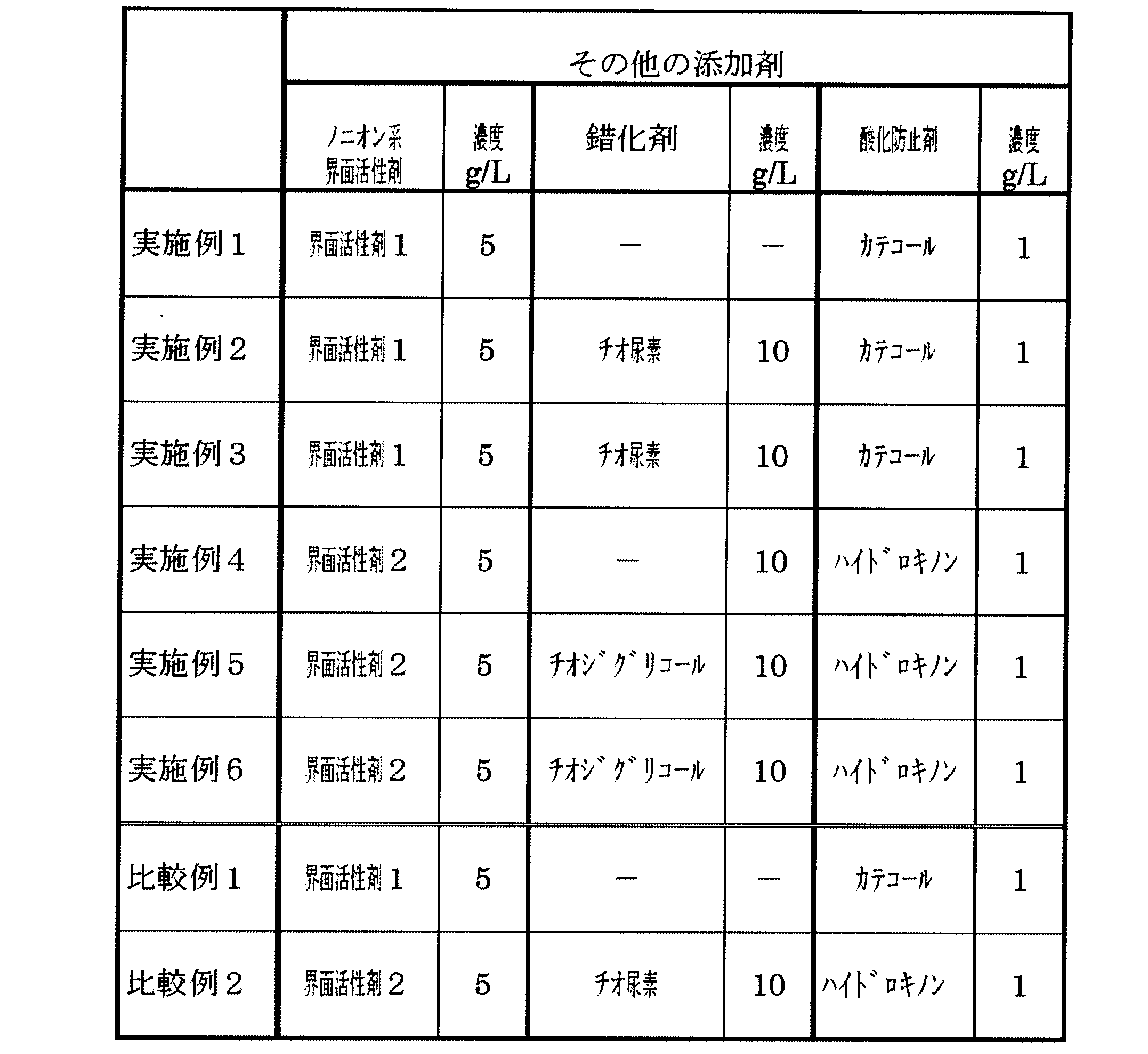
- “Surfactant 1” means polyoxyethylene bisphenol ether
- “Surfactant 2” means polyoxyethylene phenyl ether.
- the hull cell test uses a commercially available hull cell tester (manufactured by Yamamoto Kakin Tester Co., Ltd.), and the substrate to be plated uses a copper hull cell plate (length 70 mm, width 100 mm, thickness 0.3 mm) did.
- the plating solution was put into a Hull cell tester, the solution temperature was 25 ° C., and the energization current was 2A.
- the plating treatment time was 5 minutes, and the plating solution was not stirred during the plating treatment.
- the hull cell evaluation was performed based on the presence or absence of burns on the plated hull cell plate.
- a copper substrate (10 cm long, 10 cm wide, 0.3 mm thick) was immersed in a plating solution at a liquid temperature of 25 ° C. 1 minute at a current density of / dm 2 .
- the film thickness of ten places of the obtained plating film was measured with the fluorescent X-ray film thickness measuring device (made by SII nanotechnology Co., Ltd.).
- the standard deviation (3 ⁇ ) of the film thickness at 10 locations was calculated, and it was evaluated whether the plating film thickness variation, that is, electrodeposition was performed uniformly.
- Evaluation of the void was performed by observing the plated film after reflowing with transmission X-ray, and dividing the area occupied by the void by the area of small pieces of 10 mm in length and 10 mm in width to calculate the void area ratio. Whether or not voids were generated was defined as void generation when the void area ratio was 0.1% or more.
- the plating solution of the present invention includes printed circuit boards, flexible printed circuit boards, film carriers, semiconductor integrated circuits, resistors, capacitors, filters, inductors, thermistors, crystal resonators, switches, lead wires and other electronic components, and wafer bump electrodes. It can be used for some electronic components.
Landscapes
- Chemical & Material Sciences (AREA)
- Engineering & Computer Science (AREA)
- Chemical Kinetics & Catalysis (AREA)
- Electrochemistry (AREA)
- Materials Engineering (AREA)
- Metallurgy (AREA)
- Organic Chemistry (AREA)
- Electroplating And Plating Baths Therefor (AREA)
Abstract
Description
本願は、2015年3月26日に日本に出願された特願2015-064073号及び2016年3月22日に日本に出願された特願2016-056776号に基づき優先権を主張し、その内容をここに援用する。
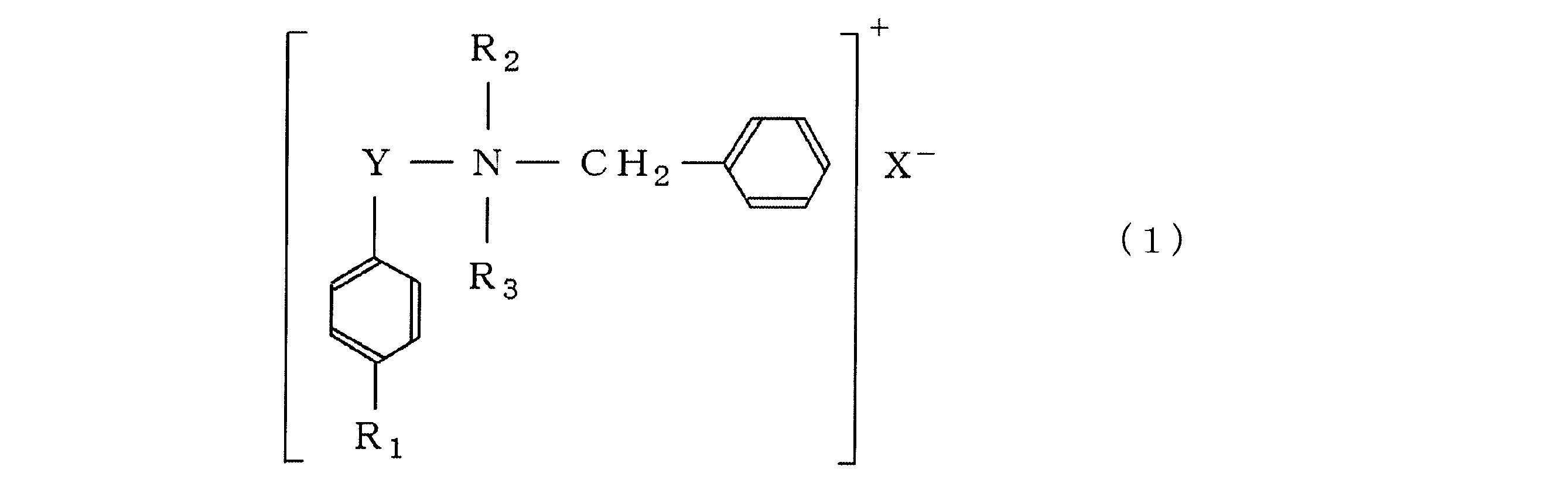
(CH2-CH2-O)n;(n=1~2)を示す。


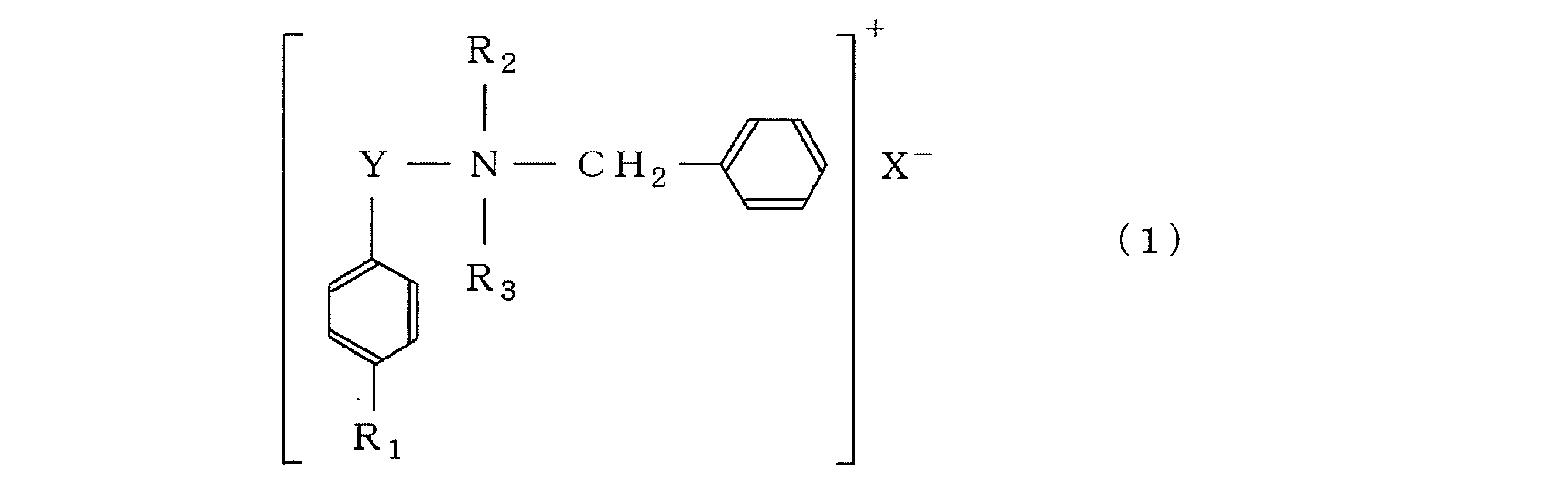
(CH2-CH2-O)n;(n=1~2)を示す。

(CH2-CH2-O)n;(n=1~2)を示す。
(i)アンモニウム塩1は、N,N-ジメチル-N-[2-[2-[[4-(1,1,3,3-テトラメチルブチル)フェニル]オキシ]エトキシ]エチル]ベンゼンメタンアミニウムである。 上記式(1)中、置換基R1はC8H17(n=8)であり、R2、R3はCH3であり、Xは塩素であり、Yは(CH2-CH2-O)2であり、下式で表される。










実施例1~6のうち、実施例1は前記アンモニウム塩1を含有する錫めっき液の例、実施例2は前記アンモニウム塩2を含有する錫-銀合金めっき液の例、実施例3は前記アンモニウム塩3を含有する錫-銀合金めっき液の例、実施例4は前記アンモニウム塩4を含有する錫めっき液の例、実施例5は前記アンモニウム塩5を含有する錫-銅合金めっき液の例、実施例6は前記アンモニウム塩5を含有する錫-亜鉛合金めっき液である。また比較例1~2のうち、比較例1は置換基R1がC4H9(n=4)のときのアンモニウム塩6を含む錫めっき液の例、比較例2は置換基R1がC20H41(n=20)のときのアンモニウム塩7を含む錫-銀合金めっき液の例である。実施例1、4と比較例1は酸性錫めっき液、実施例2、3、5、6と比較例2は酸性錫合金めっき液である。
上記(A)~(C)の各成分と、界面活性剤、錯化剤、酸化防止剤の配合を種々変更した実施例1~6及び比較例1~2を表2及び表3に示す。表3において、「界面活性剤1」はポリオキシエチレンビスフェノールエーテルを、「界面活性剤2」はポリオキシエチレンフェニルエーテルをそれぞれ意味する。

実施例1~6及び比較例1~2で得られためっき液について、ハルセル試験とめっき試験を行い、各めっき液の電着性とボイド発生率を評価した。その結果を表4に示す。
ハルセル試験は、市販のハルセル試験器(山本鍍金試験器社製)を用い、めっき対象の基材は、銅製ハルセル板(縦70mm、横100mm、厚さ0.3mm)を使用した。ハルセル試験器にめっき液を入れ、液温を25℃とし、通電電流を2Aとした。めっき処理時間は5分間で、めっき処理中はめっき液を撹拌しなかった。ハルセル評価は、めっき処理したハルセル板のヤケの有無により行った。
(b-1) めっき膜厚のばらつき
第1のめっき試験は、銅製基板(縦10cm、横10cm、厚さ0.3mm)を液温
25℃のめっき液に浸漬し、5A/dm2の電流密度で1分間を行った。得られためっき皮膜の10箇所の膜厚を蛍光X線膜厚測定器(エスアイアイ・ナノテクノロジー(株)社製)によって測定した。10箇所の膜厚の標準偏差(3σ)を算出し、めっき膜厚のばらつき、即ち電着が均一に行われたか評価した。
(b-2) めっき皮膜のボイド発生率
第2のめっき試験は、銅製基板(縦10cm、横7cm、厚さ0.3mm)を液温25℃のめっき液に浸漬し、3A/dm2の電流密度で13分間通電し、膜厚20μmのめっき皮膜を基板上に形成した。このめっき皮膜付き基板の中央を縦10mm、横10mmの正方形の小片に切り出し、リフロー処理に模して、これらの小片を窒素雰囲気中、基板の表面温度が270℃になるまでホットプレートで昇温し、その温度で20秒間保持した後、急冷した。ボイドの評価はリフロー後のめっき皮膜を透過X線で観察し、ボイドが占める面積を縦10mm、横10mmの小片の面積で除してボイド面積率を算出することで行った。ボイドが発生したか否かは、ボイド面積率が0.1%以上の場合にボイド発生と規定した。

表4から明らかなように、上記式(1)のR1がC4H9のアンモニウム塩を含む錫めっき液にてめっきを行った比較例1では、CnH2n+1のnが4であったため、めっき膜厚のばらつきが2.2と大きかった。また上記式(1)のR1がC20H41のアンモニウム塩を含む錫めっき液にてめっきを行った比較例2では、CnH2n+1のnが20であったため、ボイド面積率が3.4%と大きかった。これに対して上記式(1)のR1、R2及びR3が所定の条件を満たすアンモニウム塩を含む錫めっき液にてめっきを行った実施例1~6では、めっき膜厚のばらつきが0.39~0.89と小さかった。また実施例1~6では、く、またボイド面積率も0.01~0.05と小さく、均一電着性が良く、ボイドの発生がない、良好なめっき皮膜が得られたことが分かった。
Claims (3)
- (A)少なくとも第一錫塩を含む可溶性塩、
(B)有機酸及び無機酸から選ばれた酸又はその塩、
(C)添加剤
を含むめっき液であって、
前記添加剤が次の一般式(1)で表されるアンモニウム塩を含むことを特徴とするめっき液。

(CH2-CH2-O)n;(n=1~2)を示す。 - 前記添加剤が次の一般式(2)で表されるノニオン系界面活性剤を更に含む請求項1記載のめっき液。


- 錯化剤、光沢剤又は酸化防止剤のいずれかのその他の添加剤を更に含む請求項1又は2記載のめっき液。
Priority Applications (4)
| Application Number | Priority Date | Filing Date | Title |
|---|---|---|---|
| US15/560,300 US10450665B2 (en) | 2015-03-26 | 2016-03-24 | Plating solution using ammonium salt |
| EP16768889.4A EP3276046B1 (en) | 2015-03-26 | 2016-03-24 | Plating solution using ammonium salt |
| CN201680019192.8A CN107406999B (zh) | 2015-03-26 | 2016-03-24 | 使用了铵盐的电镀液 |
| KR1020177026116A KR20170131418A (ko) | 2015-03-26 | 2016-03-24 | 암모늄염을 사용한 도금액 |
Applications Claiming Priority (4)
| Application Number | Priority Date | Filing Date | Title |
|---|---|---|---|
| JP2015064073 | 2015-03-26 | ||
| JP2015-064073 | 2015-03-26 | ||
| JP2016056776A JP6631349B2 (ja) | 2015-03-26 | 2016-03-22 | アンモニウム塩を用いためっき液 |
| JP2016-056776 | 2016-03-22 |
Publications (1)
| Publication Number | Publication Date |
|---|---|
| WO2016152986A1 true WO2016152986A1 (ja) | 2016-09-29 |
Family
ID=56977347
Family Applications (1)
| Application Number | Title | Priority Date | Filing Date |
|---|---|---|---|
| PCT/JP2016/059429 Ceased WO2016152986A1 (ja) | 2015-03-26 | 2016-03-24 | アンモニウム塩を用いためっき液 |
Country Status (1)
| Country | Link |
|---|---|
| WO (1) | WO2016152986A1 (ja) |
Cited By (1)
| Publication number | Priority date | Publication date | Assignee | Title |
|---|---|---|---|---|
| CN119800461A (zh) * | 2025-03-12 | 2025-04-11 | 深圳市联合蓝海应用材料科技股份有限公司 | 锡银合金电镀液及其制备方法与应用、电镀方法 |
Citations (4)
| Publication number | Priority date | Publication date | Assignee | Title |
|---|---|---|---|---|
| JP2001026898A (ja) * | 1998-11-05 | 2001-01-30 | C Uyemura & Co Ltd | 錫−銅合金電気めっき浴及びそれを使用するめっき方法 |
| JP2003027277A (ja) * | 2001-07-13 | 2003-01-29 | Ishihara Chem Co Ltd | スズメッキ浴、スズメッキ方法及び当該メッキ浴を用いてスズメッキを施した電子部品 |
| JP2004244719A (ja) * | 2003-01-24 | 2004-09-02 | Ishihara Chem Co Ltd | スズ又はスズ合金の脂肪族スルホン酸メッキ浴 |
| JP2009510255A (ja) * | 2005-08-15 | 2009-03-12 | エントン インコーポレイテッド | 電子工学の製造分野での錫−銀ハンダ・バンプ |
-
2016
- 2016-03-24 WO PCT/JP2016/059429 patent/WO2016152986A1/ja not_active Ceased
Patent Citations (4)
| Publication number | Priority date | Publication date | Assignee | Title |
|---|---|---|---|---|
| JP2001026898A (ja) * | 1998-11-05 | 2001-01-30 | C Uyemura & Co Ltd | 錫−銅合金電気めっき浴及びそれを使用するめっき方法 |
| JP2003027277A (ja) * | 2001-07-13 | 2003-01-29 | Ishihara Chem Co Ltd | スズメッキ浴、スズメッキ方法及び当該メッキ浴を用いてスズメッキを施した電子部品 |
| JP2004244719A (ja) * | 2003-01-24 | 2004-09-02 | Ishihara Chem Co Ltd | スズ又はスズ合金の脂肪族スルホン酸メッキ浴 |
| JP2009510255A (ja) * | 2005-08-15 | 2009-03-12 | エントン インコーポレイテッド | 電子工学の製造分野での錫−銀ハンダ・バンプ |
Cited By (2)
| Publication number | Priority date | Publication date | Assignee | Title |
|---|---|---|---|---|
| CN119800461A (zh) * | 2025-03-12 | 2025-04-11 | 深圳市联合蓝海应用材料科技股份有限公司 | 锡银合金电镀液及其制备方法与应用、电镀方法 |
| CN119800461B (zh) * | 2025-03-12 | 2025-06-13 | 深圳市联合蓝海应用材料科技股份有限公司 | 锡银合金电镀液及其制备方法与应用、电镀方法 |
Similar Documents
| Publication | Publication Date | Title |
|---|---|---|
| JP5150016B2 (ja) | スズ又はスズ合金メッキ浴、及び当該メッキ浴を用いたバレルメッキ方法 | |
| US11174565B2 (en) | Plating liquid | |
| JP6631349B2 (ja) | アンモニウム塩を用いためっき液 | |
| JP6631348B2 (ja) | ホスホニウム塩を用いためっき液 | |
| JP2017179515A (ja) | めっき液 | |
| JP6607106B2 (ja) | スルホニウム塩を用いためっき液 | |
| WO2016152986A1 (ja) | アンモニウム塩を用いためっき液 | |
| WO2018180192A1 (ja) | めっき液 | |
| WO2016152983A1 (ja) | ホスホニウム塩を用いためっき液 | |
| JP2018123402A (ja) | アンモニウム塩を用いためっき液 | |
| WO2016152997A1 (ja) | スルホニウム塩を用いためっき液 |
Legal Events
| Date | Code | Title | Description |
|---|---|---|---|
| 121 | Ep: the epo has been informed by wipo that ep was designated in this application |
Ref document number: 16768889 Country of ref document: EP Kind code of ref document: A1 |
|
| ENP | Entry into the national phase |
Ref document number: 20177026116 Country of ref document: KR Kind code of ref document: A |
|
| WWE | Wipo information: entry into national phase |
Ref document number: 15560300 Country of ref document: US |
|
| REEP | Request for entry into the european phase |
Ref document number: 2016768889 Country of ref document: EP |
|
| NENP | Non-entry into the national phase |
Ref country code: DE |