WO2016163538A1 - 成形時の冷間加工性に優れた鋼板及びその製造方法 - Google Patents
成形時の冷間加工性に優れた鋼板及びその製造方法 Download PDFInfo
- Publication number
- WO2016163538A1 WO2016163538A1 PCT/JP2016/061608 JP2016061608W WO2016163538A1 WO 2016163538 A1 WO2016163538 A1 WO 2016163538A1 JP 2016061608 W JP2016061608 W JP 2016061608W WO 2016163538 A1 WO2016163538 A1 WO 2016163538A1
- Authority
- WO
- WIPO (PCT)
- Prior art keywords
- less
- steel sheet
- carbides
- ferrite
- carbide
- Prior art date
- Legal status (The legal status is an assumption and is not a legal conclusion. Google has not performed a legal analysis and makes no representation as to the accuracy of the status listed.)
- Ceased
Links
Classifications
-
- C—CHEMISTRY; METALLURGY
- C21—METALLURGY OF IRON
- C21D—MODIFYING THE PHYSICAL STRUCTURE OF FERROUS METALS; GENERAL DEVICES FOR HEAT TREATMENT OF FERROUS OR NON-FERROUS METALS OR ALLOYS; MAKING METAL MALLEABLE, e.g. BY DECARBURISATION OR TEMPERING
- C21D8/00—Modifying the physical properties of ferrous metals or ferrous alloys by deformation combined with, or followed by, heat treatment
- C21D8/02—Modifying the physical properties of ferrous metals or ferrous alloys by deformation combined with, or followed by, heat treatment during manufacturing of plates or strips
- C21D8/0247—Modifying the physical properties of ferrous metals or ferrous alloys by deformation combined with, or followed by, heat treatment during manufacturing of plates or strips characterised by the heat treatment
- C21D8/0263—Modifying the physical properties of ferrous metals or ferrous alloys by deformation combined with, or followed by, heat treatment during manufacturing of plates or strips characterised by the heat treatment following hot rolling
-
- C—CHEMISTRY; METALLURGY
- C21—METALLURGY OF IRON
- C21D—MODIFYING THE PHYSICAL STRUCTURE OF FERROUS METALS; GENERAL DEVICES FOR HEAT TREATMENT OF FERROUS OR NON-FERROUS METALS OR ALLOYS; MAKING METAL MALLEABLE, e.g. BY DECARBURISATION OR TEMPERING
- C21D8/00—Modifying the physical properties of ferrous metals or ferrous alloys by deformation combined with, or followed by, heat treatment
- C21D8/02—Modifying the physical properties of ferrous metals or ferrous alloys by deformation combined with, or followed by, heat treatment during manufacturing of plates or strips
-
- C—CHEMISTRY; METALLURGY
- C21—METALLURGY OF IRON
- C21D—MODIFYING THE PHYSICAL STRUCTURE OF FERROUS METALS; GENERAL DEVICES FOR HEAT TREATMENT OF FERROUS OR NON-FERROUS METALS OR ALLOYS; MAKING METAL MALLEABLE, e.g. BY DECARBURISATION OR TEMPERING
- C21D8/00—Modifying the physical properties of ferrous metals or ferrous alloys by deformation combined with, or followed by, heat treatment
- C21D8/02—Modifying the physical properties of ferrous metals or ferrous alloys by deformation combined with, or followed by, heat treatment during manufacturing of plates or strips
- C21D8/0221—Modifying the physical properties of ferrous metals or ferrous alloys by deformation combined with, or followed by, heat treatment during manufacturing of plates or strips characterised by the working steps
- C21D8/0226—Hot rolling
-
- C—CHEMISTRY; METALLURGY
- C21—METALLURGY OF IRON
- C21D—MODIFYING THE PHYSICAL STRUCTURE OF FERROUS METALS; GENERAL DEVICES FOR HEAT TREATMENT OF FERROUS OR NON-FERROUS METALS OR ALLOYS; MAKING METAL MALLEABLE, e.g. BY DECARBURISATION OR TEMPERING
- C21D9/00—Heat treatment, e.g. annealing, hardening, quenching or tempering, adapted for particular articles; Furnaces therefor
- C21D9/46—Heat treatment, e.g. annealing, hardening, quenching or tempering, adapted for particular articles; Furnaces therefor for sheet metals
-
- C—CHEMISTRY; METALLURGY
- C22—METALLURGY; FERROUS OR NON-FERROUS ALLOYS; TREATMENT OF ALLOYS OR NON-FERROUS METALS
- C22C—ALLOYS
- C22C38/00—Ferrous alloys, e.g. steel alloys
- C22C38/001—Ferrous alloys, e.g. steel alloys containing N
-
- C—CHEMISTRY; METALLURGY
- C22—METALLURGY; FERROUS OR NON-FERROUS ALLOYS; TREATMENT OF ALLOYS OR NON-FERROUS METALS
- C22C—ALLOYS
- C22C38/00—Ferrous alloys, e.g. steel alloys
- C22C38/002—Ferrous alloys, e.g. steel alloys containing In, Mg, or other elements not provided for in one single group C22C38/001 - C22C38/60
-
- C—CHEMISTRY; METALLURGY
- C22—METALLURGY; FERROUS OR NON-FERROUS ALLOYS; TREATMENT OF ALLOYS OR NON-FERROUS METALS
- C22C—ALLOYS
- C22C38/00—Ferrous alloys, e.g. steel alloys
- C22C38/005—Ferrous alloys, e.g. steel alloys containing rare earths, i.e. Sc, Y, Lanthanides
-
- C—CHEMISTRY; METALLURGY
- C22—METALLURGY; FERROUS OR NON-FERROUS ALLOYS; TREATMENT OF ALLOYS OR NON-FERROUS METALS
- C22C—ALLOYS
- C22C38/00—Ferrous alloys, e.g. steel alloys
- C22C38/02—Ferrous alloys, e.g. steel alloys containing silicon
-
- C—CHEMISTRY; METALLURGY
- C22—METALLURGY; FERROUS OR NON-FERROUS ALLOYS; TREATMENT OF ALLOYS OR NON-FERROUS METALS
- C22C—ALLOYS
- C22C38/00—Ferrous alloys, e.g. steel alloys
- C22C38/04—Ferrous alloys, e.g. steel alloys containing manganese
-
- C—CHEMISTRY; METALLURGY
- C22—METALLURGY; FERROUS OR NON-FERROUS ALLOYS; TREATMENT OF ALLOYS OR NON-FERROUS METALS
- C22C—ALLOYS
- C22C38/00—Ferrous alloys, e.g. steel alloys
- C22C38/06—Ferrous alloys, e.g. steel alloys containing aluminium
-
- C—CHEMISTRY; METALLURGY
- C22—METALLURGY; FERROUS OR NON-FERROUS ALLOYS; TREATMENT OF ALLOYS OR NON-FERROUS METALS
- C22C—ALLOYS
- C22C38/00—Ferrous alloys, e.g. steel alloys
- C22C38/08—Ferrous alloys, e.g. steel alloys containing nickel
-
- C—CHEMISTRY; METALLURGY
- C22—METALLURGY; FERROUS OR NON-FERROUS ALLOYS; TREATMENT OF ALLOYS OR NON-FERROUS METALS
- C22C—ALLOYS
- C22C38/00—Ferrous alloys, e.g. steel alloys
- C22C38/10—Ferrous alloys, e.g. steel alloys containing cobalt
-
- C—CHEMISTRY; METALLURGY
- C22—METALLURGY; FERROUS OR NON-FERROUS ALLOYS; TREATMENT OF ALLOYS OR NON-FERROUS METALS
- C22C—ALLOYS
- C22C38/00—Ferrous alloys, e.g. steel alloys
- C22C38/12—Ferrous alloys, e.g. steel alloys containing tungsten, tantalum, molybdenum, vanadium, or niobium
-
- C—CHEMISTRY; METALLURGY
- C22—METALLURGY; FERROUS OR NON-FERROUS ALLOYS; TREATMENT OF ALLOYS OR NON-FERROUS METALS
- C22C—ALLOYS
- C22C38/00—Ferrous alloys, e.g. steel alloys
- C22C38/14—Ferrous alloys, e.g. steel alloys containing titanium or zirconium
-
- C—CHEMISTRY; METALLURGY
- C22—METALLURGY; FERROUS OR NON-FERROUS ALLOYS; TREATMENT OF ALLOYS OR NON-FERROUS METALS
- C22C—ALLOYS
- C22C38/00—Ferrous alloys, e.g. steel alloys
- C22C38/16—Ferrous alloys, e.g. steel alloys containing copper
-
- C—CHEMISTRY; METALLURGY
- C22—METALLURGY; FERROUS OR NON-FERROUS ALLOYS; TREATMENT OF ALLOYS OR NON-FERROUS METALS
- C22C—ALLOYS
- C22C38/00—Ferrous alloys, e.g. steel alloys
- C22C38/18—Ferrous alloys, e.g. steel alloys containing chromium
-
- C—CHEMISTRY; METALLURGY
- C22—METALLURGY; FERROUS OR NON-FERROUS ALLOYS; TREATMENT OF ALLOYS OR NON-FERROUS METALS
- C22C—ALLOYS
- C22C38/00—Ferrous alloys, e.g. steel alloys
- C22C38/60—Ferrous alloys, e.g. steel alloys containing lead, selenium, tellurium, or antimony, or more than 0.04% by weight of sulfur
-
- C—CHEMISTRY; METALLURGY
- C21—METALLURGY OF IRON
- C21D—MODIFYING THE PHYSICAL STRUCTURE OF FERROUS METALS; GENERAL DEVICES FOR HEAT TREATMENT OF FERROUS OR NON-FERROUS METALS OR ALLOYS; MAKING METAL MALLEABLE, e.g. BY DECARBURISATION OR TEMPERING
- C21D2211/00—Microstructure comprising significant phases
- C21D2211/005—Ferrite
Definitions
- the present invention relates to a steel plate excellent in cold workability during forming and a method for producing the same.
- Automotive parts, blades, and other machine parts are manufactured through processing steps such as punching, bending, and pressing.
- processing steps such as punching, bending, and pressing.
- the carbon steel sheet as a raw material is required to have improved workability.
- a carbon steel plate is subjected to cold rolling and spheroidizing annealing, and a soft carbon steel plate made of ferrite and spheroidized carbide and having good workability is manufactured.
- Many techniques for improving the workability of carbon steel sheets have been proposed so far.
- Patent Document 1 C: 0.15 to 0.90 mass%, Si: 0.40 mass% or less, Mn: 0.3 to 1.0 mass%, P: 0.03 mass% or less, Total Al: 0.10 mass% or less, Ti: 0.01 to 0.05 mass%, B: 0.0005 to 0.0050 mass%, N: 0.01 mass% or less, Cr: 1.2 mass% High carbon for precision punching with a structure in which carbides with an average carbide particle size of 0.4 to 1.0 ⁇ m and carbide spheroidization ratio of 80% or more are dispersed in a ferrite matrix, and the notch tensile elongation is 20% or more A steel sheet and its manufacturing method are disclosed.
- Patent Document 2 C: 0.3 to 1.3% by mass, Si: 1.0% by mass or less, Mn: 0.2 to 1.5% by mass, P: 0.02% by mass or less, S: 0.02% by mass or less, and carbides are dispersed so that a relationship of C GB / C IG ⁇ 0.8 is established between the carbide C GB on the ferrite grain boundary and the number of carbides C IG in the ferrite crystal grain
- An intermediate and high carbon steel sheet excellent in workability characterized by having the above-mentioned structure and having a cross-sectional hardness of 160 HV or less, and a method for producing the same are disclosed.
- Patent Document 3 C: 0.30 to 1.00 mass%, Si: 1.0 mass% or less, Mn: 0.2 to 1.5 mass%, P: 0.02 mass% or less, S: The relationship of C GB / C IG ⁇ 0.8 holds between the carbide C GB on the ferrite grain boundary and the number of carbides C IG in the ferrite crystal grain, including 0.02% by mass or less.
- a medium and high carbon steel sheet excellent in workability is disclosed, characterized by having a structure in which a carbide occupying 90% or more of the spheroidized carbide having a major axis / minor axis of 2 or less is dispersed in ferrite. .
- Patent Documents 1 to 3 describe that as the ratio of carbide in the ferrite grains increases, the workability improves.
- S gb ⁇ S on / (S on + S in ) ⁇ ⁇ 100 (where S on : unit area) Ferrite grains defined by the total occupied area of carbides present on the grain boundaries among the carbides present per grain, and S in : the total occupied area of carbides present within the grains among the carbides present per unit area)
- S gb is 40% or more.
- Patent Document 1 aims at increasing the ferrite grain size and carbide coarseness, and annealing is performed at a temperature higher than the A C1 point for softening, but annealing is performed at a temperature higher than the A C1 point.
- annealing is performed at a temperature higher than the A C1 point.
- rod-like and plate-like carbides precipitate during annealing. Since this carbide reduces workability, even if it can reduce hardness, it is disadvantageous for workability.
- Patent Documents 2 and 3 both cause the deterioration of workability due to the low carbide spheroidization rate of carbides precipitated at grain boundaries, and do not have a problem of improving the spheroidization rate of grain boundary carbides. .
- the technique described in Patent Document 4 only defines the tissue factor, and the relationship between workability and mechanical properties has not been studied.
- Patent Document 5 The technique described in Patent Document 5 is an invention made by paying attention to the relationship between fine blanking workability, the amount of carbides present in ferrite grains, and the ferrite grain size. However, Patent Document 5 does not discuss how the texture affects the plastic anisotropy.
- Patent Document 6 discloses a hot-rolled steel sheet in which the development of a texture developed by rolling is suppressed and a method for manufacturing the hot-rolled steel sheet. However, Patent Document 6 does not discuss the relationship between the texture other than the texture developed by rolling and cold forgeability.
- Patent Document 7 is an invention made in consideration of the fact that the cementite density in ferrite grains greatly affects the hardness and total elongation of a high carbon hot rolled steel sheet before quenching.
- the hot-rolled steel sheet described in Patent Document 7 is characterized by having a microstructure composed of ferrite and cementite having a cementite density in ferrite grains of 0.10 pieces / ⁇ m 2 or less.
- Patent Document 7 does not discuss how the texture affects the plastic anisotropy.
- Patent Document 8 The technique described in Patent Document 8 is an invention that is made in consideration of the fact that the C eq value is related not only to mechanical properties and weldability but also to the fatigue crack growth rate in a steel having a fine structure.
- Patent Document 8 discloses that by limiting the range of the C eq value to 0.28% to 0.65%, the fatigue resistance of the steel material is improved and weldability is ensured.
- Patent Document 8 does not discuss how the texture affects the plastic anisotropy.
- the present invention has an object to improve cold workability at the time of forming a steel sheet, and an object of the present invention is to provide a steel sheet that solves the problem and a method for manufacturing the same.
- the present inventors have intensively studied a method for solving the above problems.
- the carbide dispersion in the steel sheet structure before cold working is controlled by optimizing the production conditions from hot rolling to annealing, thereby precipitating carbides on the ferrite grain boundaries and collecting them in the hot rolled steel sheet. It was found that the structure can be controlled and the cold workability can be improved.
- the present invention has been made on the basis of the above findings, and the gist thereof is as follows.
- the component composition is mass%, C: 0.10 to 0.40%, Si: 0.01 to 0.30%, Mn: 0.30 to 1.00% P: 0.0001 to 0.020%, S: 0.0001 to 0.010%, Al: 0.001 to 0.10% And the balance consists of Fe and inevitable impurities, (a) the ratio of the number of carbides in the ferrite grain boundary to the number of carbides in the ferrite grains exceeds 1, (b) The ferrite grain size is 5 ⁇ m or more and 50 ⁇ m or less, (c) The in-plane anisotropy
- the component composition is further in mass%, N: 0.0001 to 0.010% O: 0.0001 to 0.020%, Cr: 0.001 to 0.50%, Mo: 0.001 to 0.10%, Nb: 0.001 to 0.10%, V: 0.001 to 0.10%, Cu: 0.001 to 0.10%, W: 0.001 to 0.10%, Ta: 0.001 to 0.10%, Ni: 0.001 to 0.10%, Sn: 0.001 to 0.050%, Sb: 0.001 to 0.050%, As: 0.001 to 0.050%, Mg: 0.0001 to 0.050%, Ca: 0.001 to 0.050%, Y: 0.001 to 0.050%, Zr: 0.001 to 0.050%, La: 0.001 to 0.050%, Ce: A steel sheet excellent in cold workability at the time of forming as described in (1) above, containing one or more of 0.001 to 0.050%.
- a manufacturing method for manufacturing a steel sheet having excellent cold workability during forming as described in (1) or (2) above The steel slab having the composition described in (1) or (2) is heated and subjected to hot rolling, and finish hot rolling is completed in a temperature range of 800 ° C. or higher and 900 ° C. or lower, and 400 ° C. or higher and 550 ° C. or lower.
- finish hot rolling is completed in a temperature range of 800 ° C. or higher and 900 ° C. or lower, and 400 ° C. or higher and 550 ° C. or lower.
- First-stage annealing is performed in a temperature range of 650 ° C. to 720 ° C. for 3 hours to 60 hours, and then held in a temperature range of 725 ° C. to 790 ° C.
- the steel sheet excellent in cold workability during forming of the present invention (hereinafter sometimes referred to as “the present steel sheet”) has a component composition of mass%, C: 0.10 to 0.40%, Si: 0.01 to 0.30%, Mn: 0.30 to 1.00% P: 0.0001 to 0.020%, S: 0.0001 to 0.010%, Al: 0.001 to 0.10% And the balance consists of Fe and inevitable impurities, (a) the ratio of the number of carbides in the ferrite grain boundary to the number of carbides in the ferrite grains exceeds 1, (b) The ferrite grain size is 5 ⁇ m or more and 50 ⁇ m or less, (c) The in-plane anisotropy
- the method for producing a steel sheet excellent in cold workability at the time of forming of the present invention is a production method for producing the present steel sheet,
- a steel strip having the composition of the steel sheet of the present invention is heated and subjected to hot rolling, and finish hot rolling is completed in a temperature range of 800 ° C. or higher and 900 ° C. or lower.
- finish hot rolling is completed in a temperature range of 800 ° C. or higher and 900 ° C. or lower.
- (I) First-stage annealing is performed in a temperature range of 650 ° C. to 720 ° C. for 3 hours to 60 hours, and then held in a temperature range of 725 ° C. to 790 ° C. for 3 hours to 50 hours.
- % concerning a component composition means the mass%.
- C 0.10 to 0.40%
- C is an element that forms carbides in steel and is effective in strengthening steel and refining ferrite grains.
- C is made 0.10% or more.
- the volume fraction of carbide increases, and when a load is instantaneously applied, a large amount of cracks that become the starting point of fracture are generated, and the impact resistance characteristics are reduced.
- 0.40% or less Preferably it is 0.38% or less.
- Si 0.01 to 0.30% Si is an element that acts as a deoxidizer and affects the morphology of carbides.
- an austenite phase is generated during annealing, and once the carbides are dissolved, It is necessary to gradually cool and promote the precipitation of carbides on the ferrite grain boundaries.
- Si is preferably as little as possible, but if it is reduced to less than 0.01%, the manufacturing cost increases, so Si is set to 0.01% or more.
- Si is made 0.30% or less.
- Si is made 0.30% or less.
- it is 0.28% or less.
- Mn 0.30 to 1.00%
- Mn is an element that controls the form of carbide in the two-step annealing. If it is less than 0.30%, it becomes difficult to precipitate carbide at the ferrite grain boundaries in the slow cooling after the second stage annealing, so Mn is 0.30% or more. Preferably it is 0.33% or more.
- Mn is made 1.00% or less.
- Mn is 0.96% or less.
- P 0.0001 to 0.020%
- P is an element that segregates at the ferrite grain boundaries and suppresses the formation of grain boundary carbides. The smaller the amount, the better. However, if P is reduced to less than 0.0001% in the refining process, the refining cost increases significantly. Therefore, P is set to 0.0001% or more. Preferably it is 0.0013% or more.
- P is made 0.020% or less. Preferably it is 0.018% or less.
- S 0.0001 to 0.010%
- S is an element that forms non-metallic inclusions such as MnS. Since non-metallic inclusions are the starting point of crack generation during cold forging, it is preferable that S is small. However, if the content is reduced to less than 0.0001%, the refining cost increases significantly, so S is 0.0001%. That's it. Preferably it is 0.0012% or more.
- S is made 0.010% or less.
- S is 0.007% or less.
- Al 0.001 to 0.10%
- Al is an element that acts as a deoxidizer for steel and stabilizes ferrite. If it is less than 0.001%, the effect of addition cannot be sufficiently obtained, so Al is made 0.001% or more. Preferably it is 0.004% or more.
- Al is made 0.10% or less. Preferably it is 0.08% or less.
- the steel sheet of the present invention is N: 0.0001 to 0.010%, O: 0.0001 to 0.020%, Cr: 0.001 to 0 .50%, Mo: 0.001 to 0.10%, Nb: 0.001 to 0.10%, V: 0.001 to 0.10%, Cu: 0.001 to 0.10%, W: 0.001 to 0.10%, Ta: 0.001 to 0.10%, Ni: 0.001 to 0.10%, Sn: 0.001 to 0.050%, Sb: 0.001 to 0.00.
- 0.050% As: 0.001 to 0.050%, Mg: 0.0001 to 0.050%, Ca: 0.001 to 0.050%, Y: 0.001 to 0.050%, Zr: 0
- 0.001 to 0.050% La: 0.001 to 0.050%, Ce: 0.001 to 0.050% It may contain.
- N 0.0001 to 0.010%
- N is an element that causes embrittlement of ferrite due to a large content. The smaller the amount, the better. However, if the content is reduced to less than 0.0001%, the refining cost increases significantly, so N is made 0.0001% or more. Preferably it is 0.0006% or more. On the other hand, if it exceeds 0.010%, the ferrite becomes brittle and the cold forgeability deteriorates, so N is made 0.010% or less. Preferably it is 0.007% or less.
- O is an element that forms a coarse oxide in steel due to its large amount. A smaller amount is preferable, but if it is reduced to less than 0.0001%, the refining cost increases significantly, so O is made 0.0001% or more. Preferably it is 0.0011% or more. On the other hand, if it exceeds 0.020%, a coarse oxide is generated in the steel and becomes a starting point of cracking during cold working, so O is made 0.020% or less. Preferably it is 0.017% or less.
- Cr 0.001 to 0.50% Cr is an element that improves hardenability and contributes to the improvement of strength, and is an element that concentrates in carbides and forms stable carbides even in the austenite phase. If it is less than 0.001%, the effect of improving hardenability cannot be obtained sufficiently, so Cr is made 0.001% or more. Preferably it is 0.007% or more. On the other hand, if it exceeds 0.50%, the carbide is stabilized, the dissolution of the carbide is delayed at the time of quenching, and the required quenching strength may not be achieved, so Cr is made 0.50% or less. Preferably it is 0.45% or less.
- Mo 0.001 to 0.10%
- Mo is an element effective for controlling the morphology of carbides. If it is less than 0.001%, the effect of addition cannot be sufficiently obtained, so Mo is made 0.001% or more. Preferably it is 0.010% or more. On the other hand, if it exceeds 0.10%, the in-plane anisotropy of the r value deteriorates and the cold workability deteriorates, so Mo is made 0.10% or less. Preferably it is 0.08% or less.
- Nb 0.001 to 0.10%
- Nb is an element that is effective for controlling the morphology of carbides, and is an element that refines the structure and contributes to improved toughness. If it is less than 0.001%, the effect of addition cannot be sufficiently obtained, so Nb is made 0.001% or more. Preferably it is 0.004% or more. On the other hand, if it exceeds 0.10%, a large number of fine Nb carbides precipitate, the strength excessively increases, the number ratio of grain boundary carbides decreases, and cold forgeability decreases, so Nb is 0 10% or less. Preferably it is 0.08% or less.
- V 0.001 to 0.10%
- Nb is an element that is effective for controlling the morphology of carbides, and is an element that contributes to refinement of the structure and improvement of toughness. If it is less than 0.001%, the effect of addition cannot be obtained sufficiently, so V is made 0.001% or more. Preferably it is 0.004% or more. On the other hand, if it exceeds 0.10%, a large number of fine V carbides precipitate, the strength excessively increases, the number ratio of grain boundary carbides decreases, and the cold forgeability decreases, so V is 0. 10% or less. Preferably it is 0.08% or less.
- Cu 0.001 to 0.10%
- Cu is an element that segregates at the ferrite grain boundaries and contributes to the improvement of strength by forming fine precipitates. If it is less than 0.001%, a sufficient strength improvement effect cannot be obtained, so Cu is made 0.001% or more. Preferably it is 0.005% or more. On the other hand, if it exceeds 0.10%, red heat embrittlement occurs and productivity in hot rolling decreases, so Cu is made 0.10% or less. Preferably it is 0.08% or less.
- W 0.001 to 0.10% W, like Nb and V, is an element effective for controlling the form of carbide. If it is less than 0.001%, the effect of addition cannot be sufficiently obtained, so W is made 0.001% or more. Preferably it is 0.003% or more. On the other hand, if it exceeds 0.10%, many fine W carbides precipitate, the strength excessively increases, the number ratio of grain boundary carbides decreases, and the cold forgeability decreases, so W is 0. 10% or less. Preferably it is 0.08% or less.
- Ta 0.001 to 0.10% Ta, as well as Nb, V, and W, is an element effective for controlling the morphology of carbides. If less than 0.001%, the effect of addition cannot be sufficiently obtained, so Ta is made 0.001% or more. Preferably it is 0.005% or more. On the other hand, if it exceeds 0.10%, many fine W carbides precipitate, the strength increases excessively, the number ratio of grain boundary carbides decreases, and the cold forgeability decreases, so Ta is 0. 10% or less. Preferably it is 0.08% or less.
- Ni 0.001 to 0.10%
- Ni is an element effective for improving the toughness of parts. If it is less than 0.001%, the effect of addition cannot be sufficiently obtained, so Ni is made 0.001% or more. Preferably it is 0.003% or more. On the other hand, if it exceeds 0.10%, the number ratio of grain boundary carbides decreases and cold forgeability decreases, so Ni is made 0.10% or less. Preferably it is 0.08% or less.
- Sn 0.001 to 0.050%
- Sn is an element mixed from the steel raw material (scrap). Since it segregates at the grain boundaries and causes a decrease in the number ratio of grain boundary carbides, it is preferably as small as possible. However, if it is reduced to less than 0.001%, the refining cost will increase significantly, so Sn is made 0.001% or more. . Preferably it is 0.002% or more. On the other hand, if it exceeds 0.050%, ferrite becomes brittle and cold forgeability deteriorates, so Sn is made 0.050% or less. Preferably it is 0.040% or less.
- Sb 0.001 to 0.050%
- Sb is an element mixed from steel raw material (scrap) like Sn. Since it segregates at the grain boundaries and causes a decrease in the number ratio of grain boundary carbides, it is preferably as small as possible. However, if it is reduced to less than 0.001%, the refining cost will increase significantly. . Preferably it is 0.002% or more. On the other hand, if it exceeds 0.050%, the cold forgeability deteriorates, so Sb is made 0.050% or less. Preferably it is 0.040% or less.
- Mg 0.0001 to 0.050%
- Mg is an element that can control the form of sulfide by addition of a small amount. If it is less than 0.0001%, the effect of addition cannot be sufficiently obtained, so Mg is made 0.0001% or more. Preferably it is 0.0008% or more. On the other hand, if it exceeds 0.050%, ferrite becomes brittle and cold forgeability deteriorates, so Mg is made 0.050% or less. Preferably it is 0.040% or less.
- Ca 0.001 to 0.050%
- Ca is an element that can control the form of sulfide with a small amount of addition. If it is less than 0.001%, the effect of addition cannot be sufficiently obtained, so Ca is made 0.001% or more. Preferably it is 0.003% or more. On the other hand, if it exceeds 0.050%, coarse Ca oxide is generated and becomes a starting point of crack generation during cold forging, so Ca is made 0.050% or less. Preferably it is 0.040% or less.
- Y 0.001 to 0.050%
- Y is an element that can control the form of sulfide by addition of a trace amount. If it is less than 0.001%, the effect of addition cannot be sufficiently obtained, so Y is made 0.001% or more. Preferably it is 0.003% or more. On the other hand, if it exceeds 0.050%, coarse Y oxide is generated and becomes a starting point of cracking during cold working, so Y is made 0.050% or less. Preferably it is 0.035% or less.
- Zr 0.001 to 0.050%
- Zr is an element that can control the form of sulfide by adding a small amount. If it is less than 0.001%, the effect of addition cannot be sufficiently obtained, so Zr is made 0.001% or more. Preferably it is 0.004% or more. On the other hand, if it exceeds 0.050%, a coarse Zr oxide is generated and becomes a starting point of cracking during cold working, so Zr is made 0.050% or less. Preferably it is 0.045% or less.
- La 0.001 to 0.050%
- La is an element that can control the form of sulfide with a small amount of addition, but is also an element that segregates at the grain boundary and causes a decrease in the number ratio of grain boundary carbides. If it is less than 0.001%, the shape control effect cannot be obtained sufficiently, so La is made 0.001% or more. Preferably it is 0.004% or more. On the other hand, if it exceeds 0.050%, the number ratio of grain boundary carbides decreases and cold workability decreases, so La is made 0.050% or less. Preferably it is 0.045% or less.
- Ce 0.001 to 0.050% Ce, like La, is an element that can control the form of the sulfide with a small amount of addition, but is also an element that segregates at the grain boundary and causes a decrease in the number ratio of grain boundary carbides. If it is less than 0.001%, the shape control effect cannot be obtained sufficiently, so Ce is made 0.001% or more. Preferably it is 0.004% or more. On the other hand, if it exceeds 0.050%, the number ratio of grain boundary carbides decreases and cold forgeability decreases, so Ce is made 0.050% or less. Preferably it is 0.045% or less.
- the balance of the component composition of the steel sheet of the present invention is Fe and inevitable impurities.
- the steel sheet of the present invention is the result of optimum hot rolling and annealing in addition to the above component composition, (a) the ratio of the number of carbides in the ferrite grain boundary to the number of carbides in the ferrite grains exceeds 1, (b) The ferrite grain size is 5 ⁇ m or more and 50 ⁇ m or less, (c) The in-plane anisotropy
- the steel sheet of the present invention is substantially composed of ferrite and carbide, and has a structure in which the ratio of the number of carbides in the ferrite grain boundary to the number of carbides in the ferrite grains exceeds 1.
- the carbide is a compound obtained by substituting Fe in cementite with an element such as Mn or Cr, or an alloy carbide (M 23 C 6 , M 6 C, MC and the like, and M is Fe and other additive metal elements).
- a shear band is formed in the macro structure of the steel sheet, and slip deformation is concentrated in the vicinity of the shear band. Slip deformation is accompanied by dislocation growth, and a region having a high dislocation density is formed in the vicinity of the shear band. As the amount of strain applied to the steel sheet increases, slip deformation is promoted and the dislocation density increases. In cold forging, strong processing exceeding 1 is performed with considerable strain.
- the formation of a shear band is a phenomenon in which a slip generated in a certain crystal grain overcomes the grain boundary and continuously propagates to adjacent crystal grains. Therefore, in order to suppress the formation of shear bands, it is necessary to prevent the propagation of slip across the grain boundaries.
- Carbides in steel plates are strong particles that prevent slipping, and by making carbides present at the ferrite grain boundaries, formation of shear bands can be suppressed, and cold forgeability can be improved for the first time. Become.
- serial sectioning SEM observation or three-dimensional EBSP observation is performed by repeatedly performing sample cutting and observation by FIB in a scanning electron microscope. It becomes indispensable, requires a huge amount of measurement time, and accumulates technical know-how.
- the present inventors clarified this and concluded that a general analysis method is not suitable.
- the spheroidization rate of the carbide on the grain boundary is less than 80%, strain is concentrated locally on the rod-shaped or strip carbide, and voids and / or cracks are likely to occur.
- the spheroidization rate of the carbide is preferably 80% or more, and more preferably 90% or more.
- the average particle size of the carbide in the ferrite grain and the carbide at the ferrite grain boundary is less than 0.1 ⁇ m, the hardness of the steel sheet is remarkably increased and the workability is lowered, so the average particle size of the carbide is 0.1 ⁇ m.
- the above is preferable. More preferably, it is 0.17 ⁇ m or more.
- the average particle diameter of the carbide exceeds 2.0 ⁇ m, coarse carbides are generated as a starting point during cold working, cracking occurs, and cold workability is deteriorated. Therefore, the average particle diameter of the carbide is 2.0 ⁇ m or less. preferable. More preferably, it is 1.95 ⁇ m or less.
- Carbide is observed with a scanning electron microscope. Prior to observation, a sample for tissue observation was wet-polished with emery paper and polished with diamond abrasive grains having an average particle size of 1 ⁇ m, and the observation surface was finished to a mirror surface, and the tissue was then washed with a 3% nitric acid-alcohol solution. Etch.
- the area of each carbide contained in the region is measured in detail by image analysis software typified by Mitani Corporation (Win ROOF).
- the spheroidization rate of the carbide approximates an ellipse with an equal area and equal moment of inertia, and calculates the ratio of the ratio of the maximum length to the maximum length in the perpendicular direction being less than 3. Asked.
- carbides with an area of 0.01 ⁇ m 2 or more are counted, and carbides with an area of 0.01 ⁇ m 2 or less are evaluated. Excluded from the subject.
- the number of carbides present on the ferrite grain boundaries was counted, and the number of carbides in the ferrite grains was determined by subtracting the number of carbides on the ferrite grain boundaries from the total number of carbides. Based on the measured number, the ratio of the number of carbides at the grain boundaries to the carbides in the ferrite grains was determined.
- the ferrite grain size is 5 ⁇ m or more and 50 ⁇ m or less: In the structure after annealing the cold-rolled steel sheet, the cold workability can be improved by setting the ferrite grain size to 5 ⁇ m or more. If the ferrite particle size is less than 5 ⁇ m, the hardness increases and cracks and cracks are likely to occur during cold working, so the ferrite particle size is 5 ⁇ m or more. Preferably it is 7 micrometers or more.
- the ferrite grain size is set to 50 ⁇ m or less. Preferably it is 37 micrometers or less.
- the ferrite grain size was measured by polishing the sample observation surface to a mirror surface using the polishing method described above, etching with a 3% nitric acid-alcohol solution, and observing the structure of the observation surface with an optical microscope or a scanning electron microscope. Measure by applying line segment method to the image.
- of the r value specified in JIS Z 2254 is 0.2 or less:
- of the plastic strain ratio (r value) of the steel sheet is measured by a method based on JIS Z 2254. Measured r values (0 ° direction: r 0 , 45 ° direction: r 45 , 90 ° direction: 0 ° direction, 45 ° direction, and 90 ° direction) with respect to the rolling direction. r 90 ) and calculated using the following formula.
- (r 0 -2r 45 + r 90 ) / 2
- Cold workability can be improved by setting the in-plane anisotropy
- Vickers hardness is 100HV or more and 150HV or less: Cold workability can be improved by making the Vickers hardness of a steel plate into 100HV or more and 150HV or less. If the Vickers hardness is less than 100 HV, buckling is likely to occur during cold working, so the Vickers hardness is 100 HV or more. Preferably it is 110HV or more.
- the Vickers hardness exceeds 150 HV, the ductility is lowered and internal cracks are likely to occur during cold forging, so the Vickers hardness is set to 150 HV or less. Preferably it is 146HV or less.
- X-ray diffraction X-ray diffraction by Mo tube may be used as the X-ray diffraction.
- the diffraction intensities ⁇ 110 ⁇ , ⁇ 220 ⁇ , ⁇ 211 ⁇ , and ⁇ 310 ⁇ are obtained from the reflection, and a crystal orientation distribution (Orientation Distribution Function: ODF) is created based on these diffraction intensities.
- ODF Orientation Distribution Function
- the X-ray diffraction intensity ratio is determined using the diffraction intensity data of the 1/2 plate thickness obtained from ODF and the diffraction intensity data of the random orientation of the hot-rolled steel sheet. Specifically, as a standard sample in which the metal structure does not have an accumulation in a specific orientation, a sample obtained by sintering iron of a hot rolled steel sheet powder to be measured or the powder before sintering is used. / 2 The diffraction intensity is obtained under the same conditions as when obtaining the diffraction intensity data of the plate thickness surface. In addition, the site
- the X-ray diffraction intensity ratio in a specific direction is a numerical value obtained by dividing the diffraction intensity in the specific direction of the 1 ⁇ 2 plate thickness surface obtained from ODF by the diffraction intensity of the standard sample.
- the X-ray diffraction intensity ratio in the ⁇ 311 ⁇ ⁇ 011> orientation obtained by the ODF analysis described above is I1, and that this I1 is 3.0 or less. Preferably it is 2.5 or less. If a random texture with I1 of 3.0 or less is obtained, the plastic anisotropy is reduced and the formability is improved.
- the production method of the present invention is characterized in that the structure control is performed by consistently managing hot rolling and annealing.
- the steel slab After continuously casting a steel slab having a predetermined composition, the steel slab is heated and subjected to hot rolling, and finish hot rolling is completed in a temperature range of 800 ° C. or higher and 900 ° C. or lower and wound at 400 ° C. or higher and 550 ° C. or lower.
- finish hot rolling is completed in a temperature range of 800 ° C. or higher and 900 ° C. or lower and wound at 400 ° C. or higher and 550 ° C. or lower.
- First-stage annealing is performed in a temperature range of 650 ° C. to 720 ° C. and held for 3 hours to 60 hours, and then in a temperature range of 725 ° C.
- the steel sheet structure can be made from fine pearlite and bainite by the above hot rolling and annealing.
- Heating temperature of steel slab 1000 ° C. or higher and 1250 ° C. or lower
- the heating temperature of the steel slab subjected to hot rolling is preferably 1000 ° C. or higher and 1250 ° C. or lower, and the heating time is preferably 0.5 hours or longer and 3 hours or shorter.
- the heating temperature is less than 1000 ° C. or the heating time is less than 0.5 hour, microsegregation and macrosegregation formed by casting are not eliminated, and Si, Mn, and the like are locally concentrated in the steel material. Since the region remains and the impact resistance is lowered, the heating temperature is preferably 1000 ° C. or more, and the heating time is preferably 0.5 hours or more.
- the heating temperature exceeds 1250 ° C or the heating time exceeds 3 hours, decarburization from the steel slab surface layer becomes prominent, and the austenite grains on the surface layer grow abnormally during heating before carburizing and quenching, Since the impact resistance is lowered, the heating temperature is preferably 1250 ° C. or less, and the heating time is preferably 3 hours or less.
- Finishing hot rolling temperature 800 ° C to 900 ° C Finishing hot rolling is completed at 800 ° C to 900 ° C. If the finish hot rolling temperature is less than 800 ° C., the deformation resistance of the steel slab increases, the rolling load increases significantly, the amount of roll wear increases, and the productivity decreases.
- the temperature is 800 ° C. or higher. Preferably it is 820 degreeC or more.
- the finish hot rolling temperature exceeds 900 ° C.
- a thick scale is formed in the run plate on the ROT (Run Out Table), and the surface of the steel sheet is wrinkled due to the scale, resulting in cold forging and immersion.
- the finish hot rolling temperature is 900 ° C. or less. Preferably it is 880 degrees C or less.
- Cooling rate in ROT 10 ° C./second or more and 100 ° C./second or less
- the cooling rate when cooling the hot-rolled steel sheet on the ROT after finish hot rolling is preferably 10 ° C./second or more and 100 ° C./second or less. If the cooling rate is less than 10 ° C./second, a thick scale is generated during cooling, and generation of wrinkles on the surface of the steel sheet due to the scale cannot be suppressed. Therefore, the cooling rate is set to 10 ° C./second or more. More preferably, it is 20 ° C./second or more.
- cooling rate exceeds 100 ° C./second
- cooling is performed at a cooling rate exceeding 100 ° C./second from the surface layer of the steel plate to the inside, and the outermost layer portion of the steel plate is excessively cooled, resulting in low temperatures such as bainite and martensite. Metamorphic tissue is formed.
- the cooling rate is preferably 100 ° C./second or less.
- the cooling rate is as follows: from the time when the hot-rolled steel sheet after finish hot rolling passes through the non-water-injection zone to receive water cooling in the water-injection zone, and when it is cooled on the ROT to the winding target temperature. It refers to the cooling capacity received from the cooling facility, and does not indicate the average cooling rate from the water injection start point to the temperature taken up by the winder.
- Winding temperature 400 ° C. or higher and 550 ° C. or lower
- the winding temperature is 400 ° C. or higher and 550 ° C. or lower. If the coiling temperature is less than 400 ° C., the austenite that has not been transformed before winding is transformed into hard martensite, and when the hot-rolled coil is dispensed, cracks are formed in the surface layer of the steel sheet and workability is reduced.
- the winding temperature is 400 ° C. or higher. Preferably it is 430 degreeC or more.
- the coiling temperature exceeds 550 ° C.
- pearlite with a large lamellar spacing is generated, and thick needle-like carbides having high thermal stability are formed. Even after annealing in a two-step type, the needle-like carbides are not formed. Remains. Since cracks are generated during cold working starting from these needle-like carbides, the coiling temperature is set to 550 ° C. or lower. Preferably it is 520 degrees C or less.
- the hot rolled coil manufactured under the above conditions is subjected to two-step annealing that is held in two temperature ranges after pickling.
- the first-stage annealing and the second-stage annealing may be either box annealing or continuous annealing.
- the stability of the carbide is controlled to promote the formation of carbide at the ferrite grain boundary, and the spheroidization rate of the carbide on the ferrite grain boundary is increased.
- the first stage annealing is performed in the temperature range below the A C1 point, and the carbides are coarsened and the alloy elements are concentrated to increase the thermal stability of the carbides. Thereafter, the temperature is raised to a temperature range from A C1 point to A 3 point, and austenite is generated in the structure.
- the austenite is transformed into ferrite by slow cooling to increase the carbon concentration in the austenite.
- carbon atoms are adsorbed on the carbide remaining in the austenite, and the carbide and austenite cover the ferrite grain boundaries, and finally there are many spheroidized carbides in the ferrite grain boundaries.
- An organization can be formed.
- the annealing temperature is 650 ° C. or more and 720 ° C. or less. If the first stage annealing temperature is less than 650 ° C., the stability of the carbide is insufficient, and it becomes difficult to leave the carbide in the austenite in the second stage annealing, so the first stage annealing temperature is 650 ° C. or higher. Preferably it is 670 degreeC or more.
- the first stage annealing temperature exceeds 720 ° C.
- austenite is generated before increasing the stability of the carbide, and it becomes difficult to control to the required structural change, so the first stage annealing temperature is 720 ° C or lower.
- it is 700 degrees C or less.
- the first stage hold time is 3 hours or more and 60 hours or less. If the holding time is less than 3 hours, the carbide is not sufficiently stabilized, and it is difficult to leave the carbide during the second stage annealing, so the first stage holding time is set to 3 hours or more. On the other hand, if the first stage holding time exceeds 60 hours, the stability of the carbide cannot be improved, and the productivity is further lowered. Therefore, the first stage holding time is set to 60 hours or less. Preferably it is 55 hours or less.
- the annealing atmosphere is not limited to a specific atmosphere.
- a nitrogen atmosphere of 95% or more of nitrogen, a hydrogen atmosphere of 95% or more of hydrogen, and an air atmosphere may be used.
- the annealing temperature is 725 ° C. or more and 790 ° C. or less. If the second stage annealing temperature is less than 725 ° C., the amount of austenite produced is small and the number ratio of carbides on the ferrite grain boundaries decreases, so the second stage annealing temperature is set to 725 ° C. or higher. Preferably it is 745 degreeC or more.
- the annealing temperature of the second stage exceeds 790 ° C, it becomes difficult to leave the carbide in the austenite, and it becomes difficult to control the required structure change, so the annealing temperature of the second stage is 790 ° C or less. And Preferably it is 770 degrees C or less.
- the retention time for the second stage is 3 hours to 50 hours. If the second stage holding time is less than 3 hours, the amount of austenite produced is small, and the carbides in the ferrite grains are not sufficiently dissolved, making it difficult to increase the number ratio of carbides on the ferrite grain boundaries. Therefore, the second stage holding time is set to 3 hours or more. Preferably it is 5 hours or more.
- the second stage holding time is set to 50 hours or less. Preferably it is 46 hours or less.
- the annealing atmosphere is not limited to a specific atmosphere.
- a nitrogen atmosphere of 95% or more of nitrogen, a hydrogen atmosphere of 95% or more of hydrogen, and an air atmosphere may be used.
- the hot-rolled steel sheet is cooled, and at that time, it is cooled to 650 ° C. at a cooling rate of 1 ° C./hour to 30 ° C./hour.
- the cooling rate is low. However, if the cooling rate is less than 1 ° C./hour, the time required for cooling increases and productivity decreases, so the cooling rate is set to 1 ° C./hour or more. Preferably, it is 5 ° C./hour.
- the cooling rate exceeds 30 ° C./hour, austenite transforms into pearlite, the hardness of the steel sheet increases, cold forgeability decreases, and impact resistance after carburizing, quenching and tempering decreases. Therefore, the cooling rate is set to 30 ° C./hour or less. Preferably it is 26 degrees C / hour or less.
- the component composition is mass%, C: 0.10 to 0.40%, Si: 0.01 to 0.30%, Mn: 0.30 to 1.00% , P: 0.0001 to 0.020%, S: 0.0001 to 0.010%, Al: 0.001 to 0.10%, with the balance being Fe and unavoidable impurities,
- the cross-sectional shrinkage rate is defined by the following formula (1).
- a large value means that the local deformability is high, and the workability of the steel sheet increases as the value of equation (1) increases.
- Cross-sectional shrinkage (%) 100 ⁇ (cross-sectional area at tensile fracture / initial cross-sectional area) ⁇ 100 (1)
- the present invention is characterized in that a structure in which carbides (that is, cementite) are uniformly dispersed is obtained by rolling control and heat treatment after rolling, and anisotropy of crystals can be eliminated. Therefore, this invention can make the random intensity ratio of ⁇ 311 ⁇ ⁇ 011> orientation of the 1/2 plate
- an Example is an example of the conditions employ
- the present invention can adopt various conditions as long as the object of the present invention is achieved without departing from the gist of the present invention.
- Example 1 In order to investigate the influence of hot rolling conditions, continuous cast slabs (steel ingots) having the composition shown in Table 1 were hot-rolled under the conditions shown in Table 2 to produce hot rolled coils having a plate thickness of 3.0 mm.
- the steel type described as "development steel” in the column of "Remarks” in Table 1 has a composition included in the composition range of the steel sheet according to the present invention.
- the steel type described as “Comparative Steel” in the “Remarks” column of Table 1 has a composition outside the composition range of the steel sheet according to the present invention, and does not satisfy the composition condition of the steel sheet according to the present invention. Ingredients are underlined.
- the in-plane anisotropy of the r value is superior when the in-plane anisotropy
- I1 X-ray diffraction intensity ratio
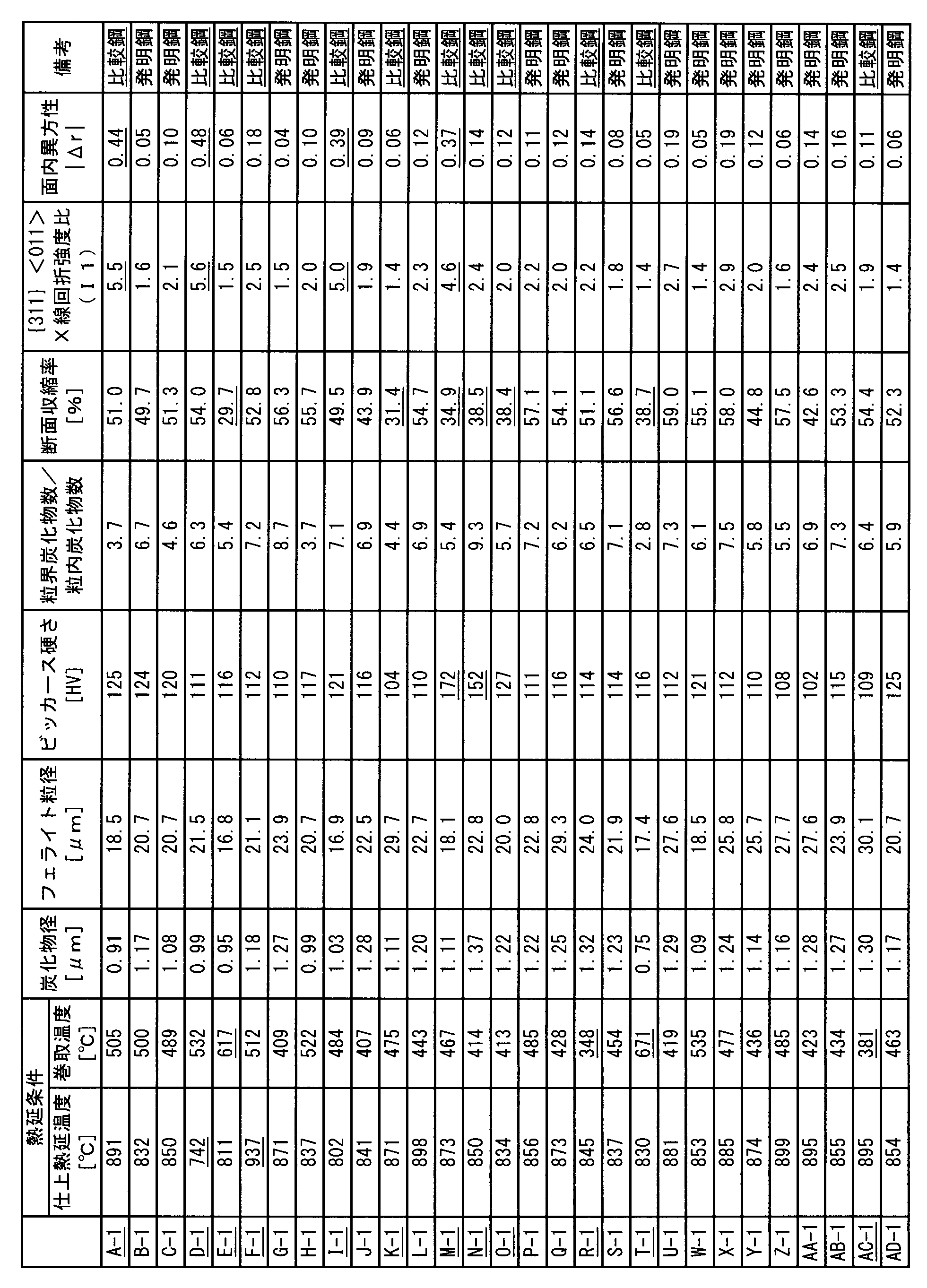
- Table 2 shows the carbide diameter, ferrite particle diameter, Vickers hardness, ratio of the number of carbides at the ferrite grain boundary to the number of carbides in the ferrite grains, cross-sectional shrinkage ratio, ⁇ 311 ⁇ ⁇ 011
- the X-ray diffraction intensity ratio and in-plane anisotropy measurement results are shown.
- those indicated as “invention steel” in the remarks column satisfy the requirements of the steel sheet according to the present invention
- those indicated as “comparative steel” in the remarks column are those of the present invention. It does not meet the requirements for steel plates.
- the measurement results that do not satisfy the requirements of the steel sheet according to the present invention and the manufacturing conditions that do not satisfy the requirements of the manufacturing method of the steel sheet according to the present invention are underlined.
- the inventive steels B-1, C-1, G-1, H-1, J-1, L-1, P-1, Q-1, S-1, U-1, W-1, X-1, Y-1, Z-1, AA-1, AB-1, and AD-1 all have a ratio of the number of carbides in the ferrite grain boundary to the number of carbides in the ferrite grains. 1 and a Vickers hardness of 150 HV or less.
- the steels of the invention all have excellent cold workability because the cross-sectional shrinkage ratio exceeds 40% and the in-plane anisotropy
- of r value is 0.2 or less.
- Comparative Steel A-1 has a high Al content and a lower A3 point, so that recrystallization during finish hot rolling is inhibited,
- Comparative Steel I-1 has high Mo and Cr, recrystallization during finish hot rolling is inhibited, and
- Comparative steels K-1 and N-1 have a high S or Mn content, coarse MnS is formed in the steel, and cold workability is low. Since the comparative steel M-1 has a high Si content and increased hardness, the cold workability is low. In comparison steel M-1, since the A3 point was raised, recrystallization during finish hot rolling was hindered, and
- Comparative Steel O-1 has a high C, a volume fraction of carbides, a large amount of cracks that are the starting points of fracture, and a low cross-sectional shrinkage ratio, resulting in low cold workability.
- Comparative Steel D-1 had a low hot-rolling finishing temperature and decreased productivity.
- Comparative Steel F-1 had a high hot rolling finishing temperature, and scale wrinkles were formed on the surface of the steel plate.
- the comparative steels R-1 and AC-1 have a low hot rolling coiling temperature and become brittle due to an increase in low temperature transformation structures such as bainite and martensite, resulting in frequent cracking when the hot rolled coil is discharged, resulting in decreased productivity. did.
- the comparative steels E-1 and T-1 have a high hot rolling coiling temperature, and in the hot rolled structure, thick pearlite with lamellar spacing and acicular coarse carbide with high thermal stability are formed. Since it remains in the steel plate even after the two-step type annealing, the cross-sectional shrinkage ratio is low and the cold workability is low.
- a steel slab (slab) having the composition shown in Table 1 was heated at 1240 ° C. for 1.8 hours, then subjected to hot rolling, and finish hot rolling was completed at 890 ° C. Then, it is cooled to 520 ° C. at a cooling rate of 45 ° C./second on the ROT, wound at 510 ° C. to produce a hot-rolled coil having a plate thickness of 3.0 mm. A 0 mm hot-rolled sheet annealed sample was produced.
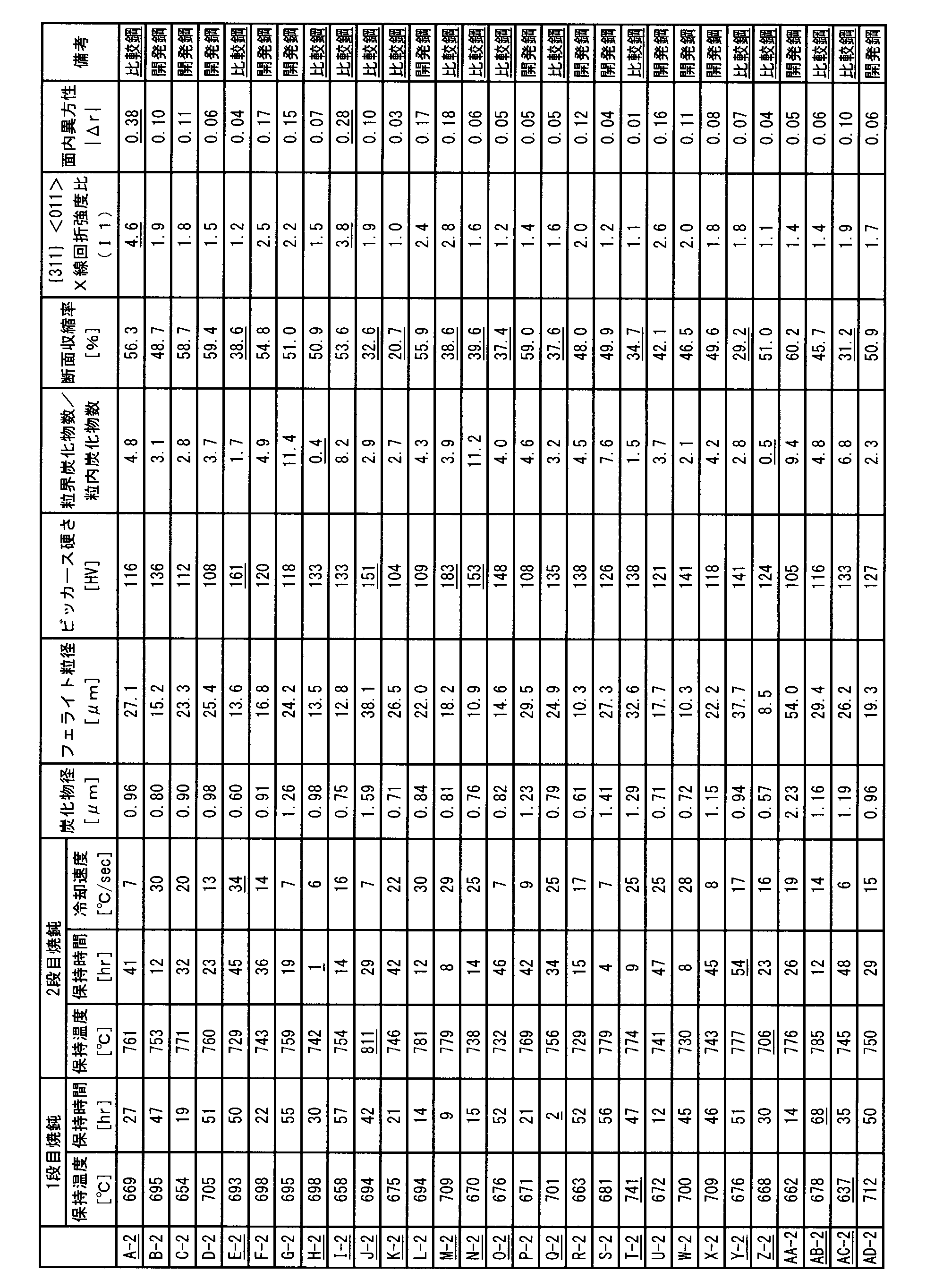
- the inventive steels B-2, C-2, D-2, F-2, G-2, L-2, P-2, R-2, S-2, U-2, In W-2, X-2, AA-2, and AD-2 the ratio of the number of carbides in the ferrite grain boundary to the number of carbides in the ferrite grains exceeds 1, and the Vickers hardness is 150 HV or less.
- the steels of the invention all have excellent cold workability because the cross-sectional shrinkage ratio exceeds 40% and the in-plane anisotropy
- Comparative Steel A-2 has a high Al content and the A3 point is lowered, so that recrystallization during finishing hot rolling is inhibited,
- Mo and Cr are high, recrystallization during finish hot rolling is inhibited, and
- Comparative steels K-2 and N-2 had a high S or Mn content, and coarse MnS was formed in the steel, resulting in a decrease in cold workability.
- Comparative steel M-2 had a high Si content, increased hardness, and decreased cold workability. Further, the comparative steel M-2 has a lowered A3 point, which inhibits recrystallization during finish hot rolling, deteriorates
- Comparative Steel O-2 has a high C, a volume ratio of carbide increases, a large amount of cracks are generated as a starting point of fracture, and a low cross-sectional shrinkage ratio results in low cold workability.
- the comparative steel AC-2 has a low annealing temperature in the first stage annealing in the two-step type box annealing, the carbide coarsening treatment at the Ac1 temperature or lower is insufficient, and the thermal stability of the carbide is low. By being insufficient, carbide remaining at the time of second-stage annealing decreases, pearlite transformation cannot be suppressed in the structure after slow cooling, and cold workability is low due to a low cross-sectional shrinkage rate.
- the comparative steel T-2 Since the comparative steel T-2 has a high annealing temperature in the first stage annealing at the time of the two-step type box annealing, austenite is generated during the annealing, and the stability of the carbide can be increased. The carbide remaining at the time of annealing decreases, the pearlite transformation cannot be suppressed in the structure after the slow cooling, and the cold forgeability is low because the cross-sectional shrinkage rate is low.
- the comparative steel Q-2 has a short holding time in the first stage annealing in the two-step type annealing, the coarsening treatment of the carbide below the Ac1 temperature, and the thermal stability of the carbide is insufficient. As a result, the carbide remaining at the time of second-stage annealing is reduced, the pearlite transformation cannot be suppressed in the structure after the slow cooling, and the cold workability is low because the cross-sectional shrinkage rate is low.
- the comparative steel AB-2 has a long holding time in the first-stage annealing at the time of the two-step type box annealing, and the productivity is low.
- Comparative steel Z-2 has a low annealing temperature during the second stage annealing in the two-step type box annealing, the amount of austenite generated is small, and the number ratio of carbides at the grain boundaries cannot be increased. Low cold workability.
- the comparative steel J-2 has a high annealing temperature during the second stage annealing in the two-step annealing, the carbide dissolution is accelerated and the remaining carbides are reduced, and the pearlite transformation is caused in the structure after the slow cooling. It cannot be suppressed, the Vickers hardness is too high, and the cold forgeability is low because the cross-sectional shrinkage rate is low.
- the comparative steel H-2 has a low annealing temperature during the second stage annealing in the two-step annealing, a small amount of austenite is generated, and the number ratio of carbides at the grain boundaries cannot be increased. Low workability.
- the comparative steel Y-2 has a long holding time during the second stage annealing in the two-step annealing, the dissolution of the carbide accelerates and the remaining carbide decreases, and the pearlite transformation occurs in the structure after the slow cooling. It cannot be suppressed and the cold forgeability is low due to the low cross-sectional shrinkage rate.
- the comparative steel E-2 has a high cooling rate from the second stage annealing to 650 ° C. during the two-step type annealing, pearlite transformation occurs during cooling, the Vickers hardness is too high, and the cross-sectional shrinkage ratio is too high. Low cold workability due to low.
- Comparative Steels A-1, D-1, I-1, M-1, A-2, and I-2 all have an X-ray diffraction intensity ratio of ⁇ 311 ⁇ ⁇ 011> exceeding 3.0.
- These comparative steels have an in-plane anisotropy
- the degree of plastic anisotropy such as
- the present invention it is possible to manufacture and provide a steel sheet having excellent cold workability during forming. Since the steel sheet of the present invention is a steel sheet suitable as a material for automobile parts, blades, and other machine parts manufactured through processing steps such as punching, bending, and pressing, the present invention has industrial applicability. It is expensive.
Landscapes
- Chemical & Material Sciences (AREA)
- Engineering & Computer Science (AREA)
- Mechanical Engineering (AREA)
- Materials Engineering (AREA)
- Metallurgy (AREA)
- Organic Chemistry (AREA)
- Physics & Mathematics (AREA)
- Thermal Sciences (AREA)
- Crystallography & Structural Chemistry (AREA)
- Heat Treatment Of Sheet Steel (AREA)
Abstract
Description
C :0.10~0.40%、
Si:0.01~0.30%、
Mn:0.30~1.00%、
P :0.0001~0.020%、
S :0.0001~0.010%、
Al:0.001~0.10%
を含有し、残部がFe及び不可避的不純物からなり、
(a)フェライト粒内の炭化物の個数に対するフェライト粒界の炭化物の個数の比率が1を超え、
(b)フェライト粒径が5μm以上50μm以下であり、
(c)JIS Z 2254に規格されるr値の面内異方性|Δr|が0.2以下であり、
(d)ビッカース硬さが100HV以上150HV以下であり、
(e)鋼板の結晶粒がランダムに方位分布してなる試料をX線回折したときのX線回折強度に対する、鋼板の1/2板厚部分の{311}<011>方位のX線回折強度比が3.0以下であることを特徴とする成形時の冷間加工性に優れた鋼板。
N :0.0001~0.010%、
O :0.0001~0.020%、
Cr:0.001~0.50%、
Mo:0.001~0.10%、
Nb:0.001~0.10%、
V :0.001~0.10%、
Cu:0.001~0.10%、
W :0.001~0.10%、
Ta:0.001~0.10%、
Ni:0.001~0.10%、
Sn:0.001~0.050%、
Sb:0.001~0.050%、
As:0.001~0.050%、
Mg:0.0001~0.050%、
Ca:0.001~0.050%、
Y :0.001~0.050%、
Zr:0.001~0.050%、
La:0.001~0.050%、
Ce:0.001~0.050%の1種又は2種以上を含有する
ことを特徴とする前記(1)に記載の成形時の冷間加工性に優れた鋼板。
前記(1)又は(2)に記載の成分組成の鋼片を加熱して熱間圧延に供し、800℃以上900℃以下の温度域で仕上げ熱延を完了し、400℃以上550℃以下で巻き取った熱延鋼板に、酸洗後、2つの温度域で保持する2段ステップ型の焼鈍を施す際、
(i)650℃以上720℃以下の温度域で、3時間以上60時間以下保持する1段目の焼鈍を施し、次いで、725℃以上790℃以下の温度域で、3時間以上50時間以下保持する2段目の焼鈍を施し、その後、
(ii)650℃以下まで冷却速度1℃/時間以上30℃/時間以下で冷却する
ことを特徴とする成形時の冷間加工性に優れた鋼板の製造方法。
C :0.10~0.40%、
Si:0.01~0.30%、
Mn:0.30~1.00%、
P :0.0001~0.020%、
S :0.0001~0.010%、
Al:0.001~0.10%
を含有し、残部がFe及び不可避的不純物からなり、
(a)フェライト粒内の炭化物の個数に対するフェライト粒界の炭化物の個数の比率が1を超え、
(b)フェライト粒径が5μm以上50μm以下であり、
(c)JIS Z 2254に規格されるr値の面内異方性|Δr|が0.2以下であり、
(d)ビッカース硬さが100HV以上150HV以下であり、
(e)鋼板の結晶粒がランダムに方位分布してなる試料をX線回折したときのX線回折強度に対する、鋼板の1/2板厚部分の{311}<011>方位のX線回折強度比が3.0以下であることを特徴とする。
本発明鋼板の成分組成の鋼片を加熱して熱間圧延に供し、800℃以上900℃以下の温度域で仕上げ熱延を完了し、400℃以上550℃以下で巻き取った熱延鋼板に、酸洗後、2つの温度域で保持する2段ステップ型の焼鈍を施す際、
(i)650℃以上720℃以下の温度域で、3時間以上60時間以下保持する1段目の焼鈍を施し、次いで、725℃以上790℃以下の温度域で、3時間以上50時間以下保持する2段目の焼鈍を施し、その後、
(ii)650℃以下まで冷却速度1℃/時間以上30℃/時間以下で冷却する
ことを特徴とする。
Cは、鋼中で炭化物を形成し、鋼の強化及びフェライト粒の微細化に有効な元素である。冷間加工における梨地の発生を抑制し、冷間鍛造部品の表面美観を確保するためには、フェライト粒径の粗大化を抑制する必要があるが、0.10%未満では、炭化物の体積率が不足し、焼鈍中の炭化物の粗大化を抑制することができないので、Cは0.10%以上とする。好ましくは0.12%以上である。
Siは、脱酸剤として作用し、また、炭化物の形態に影響を及ぼす元素である。フェライト粒内の炭化物の個数を減らし、フェライト粒界上の炭化物の個数を増やすためには、2段ステップ型の焼鈍において、焼鈍中にオーステナイト相を生成させ、一旦、炭化物を溶解させた後、徐冷し、フェライト粒界への炭化物の析出を促進する必要がある。
Mnは、2段ステップ型の焼鈍において、炭化物の形態を制御する元素である。0.30%未満では、2段目の焼鈍後の徐冷において、フェライト粒界に炭化物を析出させることが困難となるので、Mnは0.30%以上とする。好ましくは0.33%以上である。
Pは、フェライト粒界に偏析し粒界炭化物の形成を抑制する元素である。少ないほど好ましいが、精錬工程において、Pを0.0001%未満に低減すると、精錬コストが大幅に上昇するので、Pは0.0001%以上とする。好ましくは0.0013%以上である。
Sは、MnSなどの非金属介在物を形成する元素である。非金属介在物は、冷間鍛造時、割れ発生の起点となるので、Sは少ないほど好ましいが、0.0001%未満に低減すると、精錬コストが大幅に上昇するので、Sは0.0001%以上とする。好ましくは0.0012%以上である。
Alは、鋼の脱酸剤として作用し、フェライトを安定化する元素である。0.001%未満では、添加効果が十分に得られないので、Alは0.001%以上とする。好ましくは0.004%以上である。
Nは、多量の含有により、フェライトの脆化を引き起こす元素である。少ないほど好ましいが、0.0001%未満に低減すると、精錬コストが大幅に上昇するので、Nは0.0001%以上とする。好ましくは0.0006%以上である。一方、0.010%を超えると、フェライトが脆化し、冷間鍛造性が低下するので、Nは0.010%以下とする。好ましくは0.007%以下である。
Oは、多量の含有により、鋼中に粗大な酸化物を形成する元素である。少ないほうが好ましいが、0.0001%未満に低減すると、精錬コストが大幅に上昇するので、Oは0.0001%以上とする。好ましくは0.0011%以上である。一方、0.020%を超えると、鋼中に粗大な酸化物が生成し、冷間加工時に割れの起点となるので、Oは0.020%以下とする。好ましくは0.017%以下である。
Crは、焼入れ性を高め、強度の向上に寄与する元素であり、また、炭化物に濃化し、オーステナイト相でも安定な炭化物を形成する元素である。0.001%未満では、焼入れ性向上効果が十分に得られないので、Crは0.001%以上とする。好ましくは0.007%以上である。一方、0.50%を超えると、炭化物が安定化し、焼入れ時に炭化物の溶解が遅れ、所要の焼入れ強度を達成できない恐れがあるので、Crは0.50%以下とする。好ましくは0.45%以下である。
Moは、Mnと同様に、炭化物の形態制御に有効な元素である。0.001%未満では、添加効果が十分に得られないので、Moは0.001%以上とする。好ましくは0.010%以上である。一方、0.10%を超えると、r値の面内異方性が悪化し、冷間加工性が低下するので、Moは0.10%以下とする。好ましくは0.08%以下である。
Nbは、炭化物の形態制御に有効な元素であり、また、組織を微細化し、靭性の向上に寄与する元素である。0.001%未満では、添加効果が十分に得られないので、Nbは0.001%以上とする。好ましくは0.004%以上である。一方、0.10%を超えると、微細なNb炭化物が多数析出し、強度が過度に上昇し、また、粒界炭化物の個数比率が低下し、冷間鍛造性が低下するので、Nbは0.10%以下とする。好ましくは0.08%以下である。
Vも、Nbと同様に、炭化物の形態制御に有効な元素であり、また、組織を微細化し、靭性の向上に寄与する元素である。0.001%未満では、添加効果が十分に得られないので、Vは0.001%以上とする。好ましくは0.004%以上である。一方、0.10%を超えると、微細なV炭化物が多数析出し、強度が過度に上昇し、また、粒界炭化物の個数比率が低下し、冷間鍛造性が低下するので、Vは0.10%以下とする。好ましくは0.08%以下である。
Cuは、フェライトの結晶粒界に偏析し、また、微細な析出物を形成して、強度の向上に寄与する元素である。0.001%未満では、強度向上効果が十分に得られないので、Cuは0.001%以上とする。好ましくは0.005%以上である。一方、0.10%を超えると、赤熱脆性が生じ、熱延での生産性が低下するので、Cuは0.10%以下とする。好ましくは0.08%以下である。
Wも、Nb、Vと同様に、炭化物の形態制御に有効な元素である。0.001%未満では、添加効果が十分に得られないので、Wは0.001%以上とする。好ましくは0.003%以上である。一方、0.10%を超えると、微細なW炭化物が多数析出し、強度が過度に上昇し、また、粒界炭化物の個数比率が低下し、冷間鍛造性が低下するので、Wは0.10%以下とする。好ましくは0.08%以下である。
Taも、Nb、V、Wと同様に、炭化物の形態制御に有効な元素である。0.001%未満では、添加効果が十分に得られないので、Taは0.001%以上とする。好ましくは0.005%以上である。一方、0.10%を超えると、微細なW炭化物が多数析出し、強度が過度に上昇し、また、粒界炭化物の個数比率が低下し、冷間鍛造性が低下するので、Taは0.10%以下とする。好ましくは0.08%以下である。
Niは、部品の靭性の向上に有効な元素である。0.001%未満では、添加効果が十分に得られないので、Niは0.001%以上とする。好ましくは0.003%以上である。一方、0.10%を超えると、粒界炭化物の個数比率が低下し、冷間鍛造性が低下するので、Niは0.10%以下とする。好ましくは0.08%以下である。
Snは、鋼原料(スクラップ)から混入する元素である。粒界に偏析し、粒界炭化物の個数比率の低下を招くので、少ないほど好ましいが、0.001%未満に低減すると、精錬コストが大幅に上昇するので、Snは0.001%以上とする。好ましくは0.002%以上である。一方、0.050%を超えると、フェライトが脆化し、冷間鍛造性が低下するので、Snは0.050%以下とする。好ましくは0.040%以下である。
Sbは、Snと同様に、鋼原料(スクラップ)から混入する元素である。粒界に偏析し、粒界炭化物の個数比率の低下を招くので、少ないほど好ましいが、0.001%未満に低減すると、精錬コストが大幅に上昇するので、Sbは0.001%以上とする。好ましくは0.002%以上である。一方、0.050%を超えると、冷間鍛造性が低下するので、Sbは0.050%以下とする。好ましくは0.040%以下である。
Asは、Sn、Sbと同様に、鋼原料(スクラップ)から混入する元素である。粒界に偏析し、粒界炭化物の個数比率の低下を招くので、少ないほど好ましいが、0.001%未満に低減すると、精錬コストが大幅に上昇するので、Asは0.001%以上とする。好ましくは0.002%以上である。一方、0.050%を超えると、粒界炭化物の個数比率が低下し、冷間鍛造性が低下するので、Asは0.050%以下とする。好ましくは0.040%以下である。
Mgは、微量の添加で硫化物の形態を制御できる元素である。0.0001%未満では、添加効果が十分に得られないので、Mgは0.0001%以上とする。好ましくは0.0008%以上である。一方、0.050%を超えると、フェライトが脆化し、冷間鍛造性が低下するので、Mgは0.050%以下とする。好ましくは0.040%以下である。
Caは、Mgと同様に、微量の添加で硫化物の形態を制御できる元素である。0.001%未満では、添加効果が十分に得られないので、Caは0.001%以上とする。好ましくは0.003%以上である。一方、0.050%を超えると、粗大なCa酸化物が生成し、冷間鍛造時に割れ発生の起点となるので、Caは0.050%以下とする。好ましくは0.040%以下である。
Yは、Mg、Caと同様に、微量の添加で硫化物の形態を制御できる元素である。0.001%未満では、添加効果が十分に得られないので、Yは0.001%以上とする。好ましくは0.003%以上である。一方、0.050%を超えると、粗大なY酸化物が生成し、冷間加工時に割れ発生の起点となるので、Yは0.050%以下とする。好ましくは0.035%以下である。
Zrは、Mg、Ca、Yと同様に、微量の添加で硫化物の形態を制御できる元素である。0.001%未満では、添加効果が十分に得られないので、Zrは0.001%以上とする。好ましくは0.004%以上である。一方、0.050%を超えると、粗大なZr酸化物が生成し、冷間加工時に割れ発生の起点となるので、Zrは0.050%以下とする。好ましくは0.045%以下である。
Laは、微量の添加で硫化物の形態を制御できる元素であるが、粒界に偏析し、粒界炭化物の個数比率の低下を招く元素でもある。0.001%未満では、形態制御効果が十分に得られないので、Laは0.001%以上とする。好ましくは0.004%以上である。一方、0.050%を超えると、粒界炭化物の個数比率が低下し、冷間加工性が低下するので、Laは0.050%以下とする。好ましくは0.045%以下である。
Ceは、Laと同様に、微量の添加で硫化物の形態を制御できる元素であるが、粒界に偏析し、粒界炭化物の個数比率の低下を招く元素でもある。0.001%未満では、形態制御効果が十分に得られないので、Ceは0.001%以上とする。好ましくは0.004%以上である。一方、0.050%を超えると、粒界炭化物の個数比率が低下し、冷間鍛造性が低下するので、Ceは0.050%以下とする。好ましくは0.045%以下である。
(a)フェライト粒内の炭化物の個数に対するフェライト粒界の炭化物の個数の比率が1を超え、
(b)フェライト粒径が5μm以上50μm以下であり、
(c)JIS Z 2254に規格されるr値の面内異方性|Δr|が0.2以下であり、
(d)ビッカース硬さが100HV以上150HV以下であり、
(e)鋼板の結晶粒がランダムに方位分布してなる試料をX線回折したときのX線回折強度に対する、鋼板の1/2板厚部分の{311}<011>方位のX線回折強度比が3.0以下である
ことにより、成形時の冷間加工性に優れることは、本発明者らが見いだした新規な知見である。
本発明鋼板は、実質的に、フェライトと炭化物からなり、フェライト粒内の炭化物の個数に対するフェライト粒界の炭化物の個数の比率が1を超える組織である。なお、炭化物は、鉄と炭素の化合物であるセメンタイト(Fe3C)に加え、セメンタイト中のFeをMn、Cr等の元素で置換した化合物や、合金炭化物(M23C6、M6C、MC等であり、MはFe及びその他の添加金属元素)である。
冷延鋼板を焼鈍した後の組織において、フェライト粒径を5μm以上とすることで、冷間加工性を改善することができる。フェライト粒径が5μm未満であると、硬さが増加して、冷間加工時に、亀裂やクラックが発生し易くなるので、フェライト粒径は5μm以上とする。好ましくは7μm以上である。
鋼板の塑性ひずみ比(r値)の面内異方性|Δr|は、JIS Z 2254に準拠する方法で測定する。圧延方向に対して0°方向、45°方向、及び90°方向の各方向から試験片を採取して測定したr値(0°方向:r0、45°方向:r45、90°方向:r90)を用い、下記式を用いて算出した。
|Δr|=(r0-2r45+r90)/2
鋼板のビッカース硬さを100HV以上150HV以下とすることで、冷間加工性を改善することができる。ビッカース硬さが100HV未満であると、冷間加工中に座屈が発生し易くなるので、ビッカース硬さは100HV以上とする。好ましくは110HV以上である。
冷間鍛造時には、炭化物の形態を制御することに加えて、冷間鍛造時の絞り成形性を確保する必要がある。冷間鍛造時の絞り成形性を向上させるためには、面内異方性|Δr|等の塑性異方性の改善が必要となる。そのためには、熱延鋼板での集合組織を制御する必要がある。集合組織の評価は、熱延鋼板の1/2板厚部分での板面に平行な面でのX線回折による解析を用いる。
(i)650℃以上、720℃以下の温度域で、3時間以上60時間以下保持する1段目の焼鈍を施し、次いで、725℃以上790℃以下の温度域で、3時間以上50時間以下保持する2段目の焼鈍を施し、その後、
(ii)650℃以下まで冷却速度を1℃/時間以上30℃/時間以下で冷却することにより、成形時の冷間加工性に優れた鋼板を製造することができる。
熱間圧延に供する鋼片の加熱温度は1000℃以上1250℃以下が好ましく、加熱時間は0.5時間以上3時間以下が好ましい。
仕上げ熱延は、800℃以上900℃以下で完了する。仕上げ熱延温度が800℃未満であると、鋼片の変形抵抗が増加して、圧延負荷が顕著に上昇し、また、ロールの磨耗量が増大し、生産性が低下するので、仕上げ熱延温度は800℃以上とする。好ましくは820℃以上である。
仕上げ熱延後のROT上で熱延鋼板を冷却する際の冷却速度は10℃/秒以上100℃/秒以下が好ましい。冷却速度が10℃/秒未満では、冷却途中に分厚いスケールが生成し、該スケールに起因して鋼板表面に疵が発生するのを抑制できないので、冷却速度は10℃/秒以上とする。より好ましくは20℃/秒以上である。
巻取温度は400℃以上550℃以下とする。巻取温度が400℃未満であると、巻取り前に未変態であったオーステナイトが、硬いマルテンサイトに変態し、熱延コイルの払い出し時に、鋼板表層にクラックが入り、加工性が低下するので、巻取温度は400℃以上とする。好ましくは430℃以上である。
温度域:650℃以上720℃以下
保持時間:3時間以上60時間以下
1段目の焼鈍において、焼鈍温度は650℃以上720℃以下とする。1段目の焼鈍温度が650℃未満であると、炭化物の安定度が不足し、2段目の焼鈍において、オーステナイト中に炭化物を残存させることが困難となるので、1段目の焼鈍温度は650℃以上とする。好ましくは670℃以上である。
温度域:725℃以上790℃以下
保持時間:3時間以上50時間以下
2段目の焼鈍において、焼鈍温度は725℃以上790℃以下とする。2段目の焼鈍温度が725℃未満であると、オーステナイトの生成量が少なく、フェライト粒界上の炭化物の個数比率が低下するので、2段目の焼鈍温度は725℃以上とする。好ましくは745℃以上である。
徐冷で組織変化を制御する温度域は650℃までで十分であるので、650℃までの温度域における冷却速度を制御すれば良い。また、650℃以下の温度に到達後、冷却速度を前記範囲に制御しないで室温まで冷却して良い。
断面収縮率(%)=100-(引張破断時の断面積/初期断面積)×100・・・式(1)
表1に示す成分組成の連続鋳造鋳片(鋼塊)を、熱延条件の影響を調べるため、表2に示す条件で熱間圧延し、板厚3.0mmの熱延コイルを製造した。尚、表1の「備考」の欄に「開発鋼」と記載された鋼種は、本発明に係る鋼板の組成範囲に含まれる組成を有する。また、表1の「備考」の欄に「比較鋼」と記載された鋼種は、本発明に係る鋼板の組成範囲外の組成を有するものであり、本発明に係る鋼板の組成条件を満たさない成分には、下線が付されている。

Claims (4)
- 成分組成が、質量%で、
C :0.10~0.40%、
Si:0.01~0.30%、
Mn:0.30~1.00%、
P :0.0001~0.020%、
S :0.0001~0.010%、
Al:0.001~0.10%
を含有し、残部がFe及び不可避的不純物からなり、
(a)フェライト粒内の炭化物の個数に対するフェライト粒界の炭化物の個数の比率が1を超え、
(b)フェライト粒径が5μm以上50μm以下であり、
(c)JIS Z 2254に規格されるr値の面内異方性|Δr|が0.2以下であり、
(d)ビッカース硬さが100HV以上150HV以下であり、
(e)鋼板の結晶粒がランダムに方位分布してなる試料をX線回折したときのX線回折強度に対する、鋼板の1/2板厚部分の{311}<011>方位のX線回折強度比が3.0以下であることを特徴とする成形時の冷間加工性に優れた鋼板。 - 前記成分組成が、さらに、質量%で、
N :0.0001~0.010%、
O :0.0001~0.020%、
Cr:0.001~0.50%、
Mo:0.001~0.10%、
Nb:0.001~0.10%、
V :0.001~0.10%、
Cu:0.001~0.10%、
W :0.001~0.10%、
Ta:0.001~0.10%、
Ni:0.001~0.10%、
Sn:0.001~0.050%、
Sb:0.001~0.050%、
As:0.001~0.050%、
Mg:0.0001~0.050%、
Ca:0.001~0.050%、
Y: 0.001~0.050%、
Zr:0.001~0.050%、
La:0.001~0.050%、
Ce:0.001~0.050%の1種又は2種以上を含有する
ことを特徴とする請求項1に記載の成形時の冷間加工性に優れた鋼板。 - 請求項1又は2に記載の成形時の冷間加工性に優れた鋼板を製造する製造方法であって、
請求項1又は2に記載の成分組成の鋼片を加熱して熱間圧延に供し、800℃以上900℃以下の温度域で仕上げ熱延を完了し、400℃以上550℃以下で巻き取った熱延鋼板に、酸洗後、2つの温度域で保持する2段ステップ型の焼鈍を施す際、
(i)650℃以上720℃以下の温度域で、3時間以上60時間以下保持する1段目の焼鈍を施し、次いで、725℃以上790℃以下の温度域で、3時間以上50時間以下保持する2段目の焼鈍を施し、その後、
(ii)650℃まで、冷却速度1℃/時間以上30℃/時間以下で冷却する
ことを特徴とする成形時の冷間加工性に優れた鋼板の製造方法。 - 鋼板の断面収縮率が40%以上であることを特徴とする請求項3に記載の鋼板の製造方法。
Priority Applications (7)
| Application Number | Priority Date | Filing Date | Title |
|---|---|---|---|
| CN201680011614.7A CN107250415B (zh) | 2015-04-10 | 2016-04-08 | 成形时的冷加工性优良的钢板及其制造方法 |
| US15/565,096 US20180105891A1 (en) | 2015-04-10 | 2016-04-08 | Steel sheet with excellent cold workability during forming and method for manufacturing the same |
| KR1020177017514A KR101951134B1 (ko) | 2015-04-10 | 2016-04-08 | 성형 시의 냉간 가공성이 우수한 강판 및 그 제조 방법 |
| EP16776704.5A EP3282032A4 (en) | 2015-04-10 | 2016-04-08 | Steel sheet with excellent cold workability during forming, and process for producing same |
| MX2017012858A MX2017012858A (es) | 2015-04-10 | 2016-04-08 | Lamina de acero con excelente maquinabilidad en frio durante la conformacion, y proceso para producir la misma. |
| JP2016554690A JP6070912B1 (ja) | 2015-04-10 | 2016-04-08 | 成形時の冷間加工性に優れた鋼板及びその製造方法 |
| BR112017021482-2A BR112017021482A2 (ja) | 2015-04-10 | 2016-04-08 | A steel plate excellent in the cold work nature at the time of fabrication, and a manufacturing method for the same |
Applications Claiming Priority (2)
| Application Number | Priority Date | Filing Date | Title |
|---|---|---|---|
| JP2015-081101 | 2015-04-10 | ||
| JP2015081101 | 2015-04-10 |
Publications (1)
| Publication Number | Publication Date |
|---|---|
| WO2016163538A1 true WO2016163538A1 (ja) | 2016-10-13 |
Family
ID=57072674
Family Applications (1)
| Application Number | Title | Priority Date | Filing Date |
|---|---|---|---|
| PCT/JP2016/061608 Ceased WO2016163538A1 (ja) | 2015-04-10 | 2016-04-08 | 成形時の冷間加工性に優れた鋼板及びその製造方法 |
Country Status (9)
| Country | Link |
|---|---|
| US (1) | US20180105891A1 (ja) |
| EP (1) | EP3282032A4 (ja) |
| JP (1) | JP6070912B1 (ja) |
| KR (1) | KR101951134B1 (ja) |
| CN (1) | CN107250415B (ja) |
| BR (1) | BR112017021482A2 (ja) |
| MX (1) | MX2017012858A (ja) |
| TW (1) | TWI565811B (ja) |
| WO (1) | WO2016163538A1 (ja) |
Families Citing this family (11)
| Publication number | Priority date | Publication date | Assignee | Title |
|---|---|---|---|---|
| MX2017015016A (es) * | 2015-05-26 | 2018-04-13 | Nippon Steel & Sumitomo Metal Corp | Placa de acero y metodo de produccion de la misma. |
| KR101988153B1 (ko) | 2015-05-26 | 2019-06-12 | 닛폰세이테츠 가부시키가이샤 | 강판 및 그의 제조 방법 |
| EP3312299A4 (en) * | 2015-06-17 | 2018-12-05 | Nippon Steel & Sumitomo Metal Corporation | Steel sheet and manufacturing method |
| CN109923234B (zh) | 2017-08-31 | 2021-03-30 | 日本制铁株式会社 | 渗碳用钢板以及渗碳用钢板的制造方法 |
| KR102219032B1 (ko) * | 2017-08-31 | 2021-02-23 | 닛폰세이테츠 가부시키가이샤 | 침탄용 강판, 및 침탄용 강판의 제조 방법 |
| CN109926500B (zh) * | 2019-01-07 | 2020-11-24 | 安徽力源数控刃模具制造有限公司 | 一种合金铝板压弧模具材料及其加工工艺 |
| CN110284064B (zh) * | 2019-07-18 | 2021-08-31 | 西华大学 | 一种高强度含硼钢及其制备方法 |
| CN113699445B (zh) * | 2021-08-18 | 2022-05-31 | 中天钢铁集团有限公司 | 一种粗晶粒低碳钢的轧制工艺 |
| EP4596736A4 (en) * | 2022-09-26 | 2026-04-15 | Nippon Steel Corp | Free-cutting martensitic stainless steel bar material and its production process |
| CN116695015B (zh) * | 2023-05-09 | 2025-08-29 | 天津荣程联合钢铁集团有限公司 | 一种CrMo系高压锅炉管用钢大方坯及其制备方法 |
| CN121183248A (zh) * | 2025-11-25 | 2025-12-23 | 马鞍山钢铁有限公司 | 高球化率低强度冷轧30crmo精冲钢钢带及其制造方法 |
Citations (3)
| Publication number | Priority date | Publication date | Assignee | Title |
|---|---|---|---|---|
| WO2007088985A1 (ja) * | 2006-01-31 | 2007-08-09 | Jfe Steel Corporation | ファインブランキング加工性に優れた鋼板およびその製造方法 |
| WO2007116599A1 (ja) * | 2006-03-31 | 2007-10-18 | Jfe Steel Corporation | ファインブランキング加工性に優れた鋼板およびその製造方法 |
| JP2015117406A (ja) * | 2013-12-18 | 2015-06-25 | 新日鐵住金株式会社 | 打ち抜き性に優れる中・高炭素鋼板およびその製造方法 |
Family Cites Families (14)
| Publication number | Priority date | Publication date | Assignee | Title |
|---|---|---|---|---|
| JPS5110870B2 (ja) | 1972-11-17 | 1976-04-07 | ||
| FR2297718A1 (fr) | 1975-01-20 | 1976-08-13 | Promecan Sisson Lehmann | Appareillage de commande d'un elemen |
| JPS5194454A (en) | 1975-02-17 | 1976-08-19 | Hiatsuenzaino nagasasokuteihoho | |
| JP4465057B2 (ja) | 1999-03-16 | 2010-05-19 | 日新製鋼株式会社 | 精密打抜き用高炭素鋼板 |
| JP2004027355A (ja) | 2001-11-14 | 2004-01-29 | Sumitomo Metal Ind Ltd | 疲労き裂進展抵抗特性に優れた鋼材とその製造方法 |
| CN101208441A (zh) * | 2005-06-29 | 2008-06-25 | 杰富意钢铁株式会社 | 高碳冷轧钢板的制造方法 |
| JP2007270331A (ja) * | 2006-03-31 | 2007-10-18 | Jfe Steel Kk | ファインブランキング加工性に優れた鋼板およびその製造方法 |
| JP5068689B2 (ja) * | 2008-04-24 | 2012-11-07 | 新日本製鐵株式会社 | 穴広げ性に優れた熱延鋼板 |
| TWI507541B (zh) * | 2013-07-01 | 2015-11-11 | 新日鐵住金股份有限公司 | Cold-rolled steel sheet, galvanized cold-rolled steel sheet and the like |
| JP5599921B1 (ja) | 2013-07-10 | 2014-10-01 | パナソニック株式会社 | 三次元形状造形物の製造方法 |
| TWI612154B (zh) * | 2015-05-26 | 2018-01-21 | Nippon Steel & Sumitomo Metal Corporation | 鋼板及其製造方法 |
| MX2017015016A (es) * | 2015-05-26 | 2018-04-13 | Nippon Steel & Sumitomo Metal Corp | Placa de acero y metodo de produccion de la misma. |
| KR101988153B1 (ko) * | 2015-05-26 | 2019-06-12 | 닛폰세이테츠 가부시키가이샤 | 강판 및 그의 제조 방법 |
| EP3312299A4 (en) * | 2015-06-17 | 2018-12-05 | Nippon Steel & Sumitomo Metal Corporation | Steel sheet and manufacturing method |
-
2016
- 2016-04-08 KR KR1020177017514A patent/KR101951134B1/ko not_active Expired - Fee Related
- 2016-04-08 BR BR112017021482-2A patent/BR112017021482A2/ja active Search and Examination
- 2016-04-08 EP EP16776704.5A patent/EP3282032A4/en not_active Withdrawn
- 2016-04-08 MX MX2017012858A patent/MX2017012858A/es unknown
- 2016-04-08 JP JP2016554690A patent/JP6070912B1/ja active Active
- 2016-04-08 WO PCT/JP2016/061608 patent/WO2016163538A1/ja not_active Ceased
- 2016-04-08 CN CN201680011614.7A patent/CN107250415B/zh active Active
- 2016-04-08 US US15/565,096 patent/US20180105891A1/en not_active Abandoned
- 2016-04-11 TW TW105111211A patent/TWI565811B/zh not_active IP Right Cessation
Patent Citations (3)
| Publication number | Priority date | Publication date | Assignee | Title |
|---|---|---|---|---|
| WO2007088985A1 (ja) * | 2006-01-31 | 2007-08-09 | Jfe Steel Corporation | ファインブランキング加工性に優れた鋼板およびその製造方法 |
| WO2007116599A1 (ja) * | 2006-03-31 | 2007-10-18 | Jfe Steel Corporation | ファインブランキング加工性に優れた鋼板およびその製造方法 |
| JP2015117406A (ja) * | 2013-12-18 | 2015-06-25 | 新日鐵住金株式会社 | 打ち抜き性に優れる中・高炭素鋼板およびその製造方法 |
Non-Patent Citations (1)
| Title |
|---|
| See also references of EP3282032A4 * |
Also Published As
| Publication number | Publication date |
|---|---|
| EP3282032A1 (en) | 2018-02-14 |
| CN107250415A (zh) | 2017-10-13 |
| CN107250415B (zh) | 2019-10-01 |
| TW201700748A (zh) | 2017-01-01 |
| KR20170088414A (ko) | 2017-08-01 |
| TWI565811B (zh) | 2017-01-11 |
| KR101951134B1 (ko) | 2019-02-21 |
| JPWO2016163538A1 (ja) | 2017-04-27 |
| EP3282032A4 (en) | 2018-09-12 |
| JP6070912B1 (ja) | 2017-02-01 |
| US20180105891A1 (en) | 2018-04-19 |
| MX2017012858A (es) | 2018-01-15 |
| BR112017021482A2 (ja) | 2018-07-03 |
Similar Documents
| Publication | Publication Date | Title |
|---|---|---|
| JP6206601B2 (ja) | 鋼板及び製造方法 | |
| JP6070912B1 (ja) | 成形時の冷間加工性に優れた鋼板及びその製造方法 | |
| JP6119924B1 (ja) | 鋼板及びその製造方法 | |
| JP6160783B2 (ja) | 鋼板及びその製造方法 | |
| CN107614727B (zh) | 钢板及其制造方法 | |
| JP2016216810A (ja) | 被切削性及び焼入れ焼戻し後の耐摩耗特性に優れる低炭素鋼板及びその製造方法 | |
| JP6519012B2 (ja) | 冷間成形性と熱処理後靭性に優れた低炭素鋼板及び製造方法 | |
| JP6728929B2 (ja) | 加工性及び焼入れ・焼戻し後の耐摩耗特性に優れる高炭素鋼板及びその製造方法 |
Legal Events
| Date | Code | Title | Description |
|---|---|---|---|
| ENP | Entry into the national phase |
Ref document number: 2016554690 Country of ref document: JP Kind code of ref document: A |
|
| 121 | Ep: the epo has been informed by wipo that ep was designated in this application |
Ref document number: 16776704 Country of ref document: EP Kind code of ref document: A1 |
|
| ENP | Entry into the national phase |
Ref document number: 20177017514 Country of ref document: KR Kind code of ref document: A |
|
| WWE | Wipo information: entry into national phase |
Ref document number: 15565096 Country of ref document: US Ref document number: MX/A/2017/012858 Country of ref document: MX |
|
| NENP | Non-entry into the national phase |
Ref country code: DE |
|
| REG | Reference to national code |
Ref country code: BR Ref legal event code: B01A Ref document number: 112017021482 Country of ref document: BR |
|
| ENP | Entry into the national phase |
Ref document number: 112017021482 Country of ref document: BR Kind code of ref document: A2 Effective date: 20171006 |