WO2016164819A2 - Cyanobacterium treated monocot plant seeds and related methods - Google Patents
Cyanobacterium treated monocot plant seeds and related methods Download PDFInfo
- Publication number
- WO2016164819A2 WO2016164819A2 PCT/US2016/026777 US2016026777W WO2016164819A2 WO 2016164819 A2 WO2016164819 A2 WO 2016164819A2 US 2016026777 W US2016026777 W US 2016026777W WO 2016164819 A2 WO2016164819 A2 WO 2016164819A2
- Authority
- WO
- WIPO (PCT)
- Prior art keywords
- seed
- seq
- composition
- treated
- monocot plant
- Prior art date
- Legal status (The legal status is an assumption and is not a legal conclusion. Google has not performed a legal analysis and makes no representation as to the accuracy of the status listed.)
- Ceased
Links
Classifications
-
- A—HUMAN NECESSITIES
- A01—AGRICULTURE; FORESTRY; ANIMAL HUSBANDRY; HUNTING; TRAPPING; FISHING
- A01N—PRESERVATION OF BODIES OF HUMANS OR ANIMALS OR PLANTS OR PARTS THEREOF; BIOCIDES, e.g. AS DISINFECTANTS, AS PESTICIDES OR AS HERBICIDES; PEST REPELLANTS OR ATTRACTANTS; PLANT GROWTH REGULATORS
- A01N63/00—Biocides, pest repellants or attractants, or plant growth regulators containing microorganisms, viruses, microbial fungi, animals or substances produced by, or obtained from, microorganisms, viruses, microbial fungi or animals, e.g. enzymes or fermentates
- A01N63/20—Bacteria; Substances produced thereby or obtained therefrom
Definitions
- Cyanobacteria are photosynthetic prokaryotes of the phylum Cyanobacteria. Although Cyanobacteria have been referred to as “blue-green algae,” it is now recognized that Cyanobacteria should not be considered “algae” as they are prokaryotes rather than eukaryotes.
- the monocot plant seed is selected from the group consisting of a rice seed, a corn seed, a sorghum seed, a turfgrass seed, a wheat seed, a biofuel crop seed, a forage crop seed, and a millet seed.
- the turfgrass seed is a bentgrass, bermudagrass, bluegrass, buffalograss, fescue, or ryegrass seed.
- the forage crop seed is a hay, ryegrass, or oat seed.
- the biofuel crop seed is a Miscanthus or switchgrass seed.
- the cyanobacterium species are characterized by having a gene encoding a 16S PvNA that has at least 95%, 97%, 98%, 99%, 99.5%, 99.7%, 99.9%, or 100% sequence identity across the entire length of SEQ ID NO: l, SEQ ID NO:2, SEQ ID NO:3, and/or SEQ ID NO:4.
- the cyanobacterium species are characterized by having a gene encoding a 16S RNA that has at least 95%, 97%, 98%, 99%, 99.5%, 99.7%, 99.9%, or 100% sequence identity across the entire length of SEQ ID NO: l and/or SEQ ID NO:4.
- the cyanobacterium species is or are of the order Nostocales.
- the composition comprises one, two, three, or four cyanobacterium species that are members of the family Nostocaceae and/or at least one cyanobacterium species that is a member of the family Microchaetaceae.
- the member or members of the family Nostocaceae are selected from the group consisting of a Nostoc sp., an Aulosira sp., an Anabaena sp., and wherein the member the family Microchaetaceae is a Tolypothrix sp.
- the member or members of the family Nostocaceae are selected from the group consisting of a Nostoc commune UTEX B 1621 culture, an Aulosira bohemensis UTEX B 2947 culture, an Anabaena cylindrica UTEX B 1611 culture, isolate(s) therefrom, and a variant thereof and wherein the member or members of the family Microchaetaceae are selected from the group consisting of a Tolypothrix distorta UTEX 424 culture, isolate(s) therefrom, and a variant thereof.
- the member or members of the family Nostocaceae are characterized by having a gene encoding a 16S RNA that has at least 95%, 97%, 98%, 99%, 99.5%, 99.7%, 99.9%, or 100% sequence identity across the entire length of SEQ ID NO: l, SEQ ID NO:2, or SEQ ID NO:3, and wherein the member or members of the family Microchaetaceae are characterized by having a gene encoding a 16S RNA that has at least 95%, 97%, 98%, 99%, 99.5%, 99.7%, 99.9%, or 100% sequence identity across the entire length of SEQ ID NO:4.
- the member or members of the family Nostocaceae are characterized by having a gene encoding a 16S RNA that has at least 95%, 97%, 98%, 99%, 99.5%, 99.7%, 99.9%, or 100% sequence identity across the entire length of SEQ ID NO: l and wherein the member or members of the family Microchaetaceae are characterized by having a gene encoding a 16S RNA that has at least 95%, 97%, 98%, 99%, 99.5%, 99.7%, 99.9%, or 100% sequence identity across the entire length of SEQ ID NO:4.
- the cyanobacteria are any one of: (i) Aulosira sp.
- the cyanobacteria are characterized by having a gene encoding a 16S RNA that has at least 95%, 97%, 98%, 99%, 99.5%, 99.7%, 99.9%, or 100% sequence identity across the entire length of: (i) SEQ ID NO: l; (ii) SEQ ID NO: l and SEQ ID NO:2; (iii) SEQ ID NO: l and SEQ ID NO:4; or (iv) SEQ ID NO:3 and SEQ ID NO:4.
- the seed is a corn seed and wherein lateral root hair growth in a seedling obtained from the treated corn seed is increased in comparison to lateral root hair growth in a seedling obtained from an untreated control corn seed.
- the seed is a rice seed and wherein biomass, grain yield, and/or nitrogen uptake of a plant obtained from the treated rice seed is increased in comparison to biomass, grain yield, and/or nitrogen uptake of a plant obtained from an untreated control rice seed.
- the agriculturally acceptable adjuvant comprises an insecticide, a fungicide, a safener, and combinations thereof.
- the insecticide is selected from the group consisting of a carbamate, an organophosphate, a neonicotinoid, a pyrethroid, and combinations thereof.
- neonicotinoid insecticide is selected from the group consisting of thiamethoxam, imidacloprid, clothianidin, nitenpyram, nithiazine, thiacloprid, and combinations thereof.
- exogenous tackifier content is reduced in comparison to exogenous tackifier content of a standard microbial seed inoculant.
- the composition contains at least one element selected from the group consisting of iron, boron, manganese, zinc, molybdenum, copper, cobalt, salts thereof, and combinations thereof.
- the cyanobacterium is not associated with the plant seed in nature; (ii) the composition comprises at least two cyanobacterium species that are not associated with the plant seed in nature; (iii) the composition comprises at least two cyanobacterium species that are not associated with one another in nature; or (iv) the composition comprises an exopolysaccharide (EPS).
- EPS exopolysaccharide
- the composition has been lyophilized or has been dried upon the surface of the seed.
- the composition comprises about 1 milligram to about 500 milligrams per seed of the cyanobacterium species.
- the seed is dorman
- Also provided are methods of improving lateral root hair growth in a corn seedling comprising exposing a corn seed to an effective amount of a composition comprising: (i) at least one cyanobacterium species; and (ii) an agriculturally acceptable adjuvant or an agriculturally acceptable excipient and allowing the seed to germinate, wherein lateral root hair growth in a seedling obtained from the corn seed exposed to the composition is increased in comparison to lateral root hair growth a seedling obtained from a control corn seed that was not exposed to the composition.
- the exposing comprises applying the composition to the seed by an either in furrow application or by a soil drench application.
- the exposing comprises applying the composition to a surface of the seed to obtain a seed that is at least partially coated with the composition, by an in furrow application, by a soil drench application, or any combination thereof.
- the seed is dormant before, during, and/or after treatment.
- Also provided are methods of improving plant growth in a monocot plant comprising exposing a seed to an effective amount of a composition comprising: (i) at least one cyanobacterium species; and (ii) an agriculturally acceptable adjuvant, an agriculturally acceptable excipient, or combination thereof and allowing the seed to germinate, wherein growth of a monocot plant obtained from the seed exposed to the composition is increased in comparison to growth of a monocot plant obtained from a control monocot plant seed that was not exposed to the composition.
- the monocot plant seed is selected from the group consisting of a rice seed, a corn seed, a sorghum seed, a turfgrass seed, a wheat seed, a biofuel crop seed, a forage crop seed, and a millet seed.
- the turfgrass seed is a bentgrass, bermudagrass, bluegrass, buffalograss, fescue, or ryegrass seed.
- the forage crop seed is a hay, ryegrass, or oat.
- the biofuel crop seed is a Miscanthus or switchgrass seed.
- the plant growth is improved under conditions where nitrogen is limiting.
- the exposing comprises applying the composition to a surface of the seed to obtain a seed that is at least partially coated with the composition.
- nitrogen fertilizer is not used.
- a suboptimal amount nitrogen fertilizer is used. In certain embodiments, less than about 70, 100, or 200 lb/acre of nitrogen fertilizer is used.
- the seed is dormant before, during, and/or after treatment.
- Also provided are methods of improving biomass, grain yield, and/or nitrogen uptake in a monocot plant comprising exposing a monocot seed to an effective amount of a composition comprising: (i) at least one cyanobacterium species; and (ii) an agriculturally acceptable adjuvant, an agriculturally acceptable excipient, or combination thereof and allowing the seed to germinate, wherein biomass, grain yield, and/or nitrogen uptake in a monocot plant obtained from the monocot seed exposed to the composition is increased in comparison to biomass, grain yield, and/or nitrogen uptake in a monocot plant obtained from a control monocot seed that was not exposed to the composition.
- the monocot plant seed is selected from the group consisting of a rice seed, a corn seed, a sorghum seed, a turfgrass seed, a wheat seed, a biofuel crop seed, a forage crop seed, and a millet seed.
- the turfgrass seed is a bentgrass, bermudagrass, bluegrass, buffalograss, fescue, or ryegrass seed.
- the forage crop seed is a hay, ryegrass, or oat.
- the biofuel crop seed is a Miscanthus or switchgrass seed.
- the seed is dormant before, during, and/or after treatment.
- Also provided are method of improving biomass, grain yield, and/or nitrogen uptake in a rice plant comprising exposing a rice seed to an effective amount of a composition comprising: (i) at least one cyanobacterium species; and (ii) an agriculturally acceptable adjuvant, an agriculturally acceptable excipient, or combination thereof and allowing the seed to germinate, wherein biomass, grain yield, and/or nitrogen uptake in a rice plant obtained from the rice seed exposed to the composition is increased in comparison to biomass, grain yield, and/or nitrogen uptake in a rice plant obtained from a control rice seed that was not exposed to the composition.
- the exposing comprises applying the composition to a surface of the seed to obtain a seed that is at least partially coated with the composition.
- nitrogen fertilizer is not used. In certain embodiments, a suboptimal amount of nitrogen fertilizer is used. In certain embodiments, less than about 70, 100, or 150 lb/acre of nitrogen fertilizer is used. In certain embodiments, the seed is dormant before, during, and/or after treatment.
- Also provided are methods of obtaining a monocot plant seed that provides for improved growth in a monocot plant obtained from the seed comprising applying a composition comprising: (i) at least one cyanobacterium species; and (ii) an agriculturally acceptable adjuvant, an agriculturally acceptable excipient, or combination thereof to at least one surface of the seed to obtain a seed that is at least partially coated with the composition, wherein growth of a monocot plant obtained from the treated monocot plant seed is increased in comparison to growth in a monocot plant obtained from an untreated control monocot plant seed.
- the monocot plant seed is selected from the group consisting of a rice seed, a corn seed, a sorghum seed, a turfgrass seed, a wheat seed, a biofuel crop seed, a forage crop seed, and a millet seed.
- the turfgrass seed is a bentgrass, bermudagrass, bluegrass, buffalograss, fescue, or ryegrass seed.
- the forage crop seed is a hay, ryegrass, or oat.
- the biofuel crop seed is a Miscanthus or switchgrass seed.
- the seed is dormant before, during, and/or after treatment.
- Also provided are methods of obtaining a corn seed that provides for improved lateral root hair growth in a seedling obtained from the corn seed comprising applying a composition comprising: (i) at least one cyanobacterium species; and (ii) an agriculturally acceptable adjuvant, an agriculturally acceptable excipient, or combination thereof to at least one surface of the seed to obtain a seed that is at least partially coated with the composition, wherein lateral root hair growth in a seedling obtained from the treated corn seed is increased in comparison to lateral root hair growth a seedling obtained from an untreated control corn seed.
- the seed is dormant before, during, and/or after treatment.
- Also provided are methods of obtaining a rice seed that provides for improved biomass, grain yield, and/or nitrogen uptake in a rice plant obtained from the rice seed comprising applying a composition comprising: (i) at least one cyanobacterium species; and (ii) an agriculturally acceptable adjuvant, an agriculturally acceptable excipient, or combination thereof to at least one surface of the seed to obtain a seed that is at least partially coated with the composition, wherein biomass, grain yield, and/or nitrogen uptake in a rice plant obtained from the treated rice seed is increased in comparison to biomass, grain yield, and/or nitrogen uptake in a rice plant obtained from an untreated control rice seed.
- the seed is dormant before, during, and/or after treatment.
- the composition is lyophilized. In certain aspects of any of the aforementioned methods or uses, the composition is applied as a liquid or slurry. In certain aspects of any of the aforementioned methods or uses, the composition is dried upon the surface of the seed. In certain aspects of any of the aforementioned methods or uses, the composition comprises about 1, 2, or 4 milligrams to about 50, 100, or 500 milligrams per seed of the cyanobacterium species.
- the cyanobacterium are characterized by having a gene encoding a 16S RNA that has at least 95%, 97%, 98%, 99%, 99.5%, 99.7%, 99.9%, or 100% sequence identity across the entire length of SEQ ID NO: l, SEQ ID NO:2, SEQ ID NO:3, and/or SEQ ID NO:4.
- the cyanobacterium are characterized by having a gene encoding a 16S RNA that has at least 95%, 97%, 98%, 99%, 99.5%, 99.7%, 99.9%, or 100% sequence identity across the entire length of SEQ ID NO: l and/or SEQ ID NO:4.
- the cyanobacterium species is or are of the order Nostocales.
- the composition comprises one, two, three, or four cyanobacterium species that are members of the family Nostocaceae and/or at least one cyanobacterium species that is a member of the family Microchaetaceae.
- the member or members of the family Nostocaceae are characterized by having a gene encoding a 16S RNA that has at least 95%, 97%, 98%, 99%, 99.5%, 99.7%, 99.9%, or 100% sequence identity across the entire length of SEQ ID NO: l, SEQ ID NO:2, or SEQ ID NO:3, and wherein the member or members of the family Microchaetaceae are characterized by having a gene encoding a 16S RNA that has at least 95%, 97%, 98%, 99%, 99.5%, 99.7%, 99.9%, or 100% sequence identity across the entire length of SEQ ID NO:4.
- the member or members of the family Nostocaceae are characterized by having a gene encoding a 16S RNA that has at least 95%, 97%, 98%, 99%, 99.5%, 99.7%, 99.9%, or 100% sequence identity across the entire length of SEQ ID NO: l and wherein the member or members of the family Microchaetaceae are characterized by having a gene encoding a 16S RNA that has at least 95%, 97%, 98%, 99%, 99.5%, 99.7%, 99.9%, or 100% sequence identity across the entire length of SEQ ID NO:4.
- the member or members of the family Nostocaceae are selected from the group consisting of a Nostoc sp., an Aulosira sp., an Anabaena sp., and wherein the member of the family Microchaetaceae is a Tolypothrix sp.
- the member or members of the family Nostocaceae are selected from the group consisting of a Nostoc commune UTEX B 1621 culture, an Aulosira bohemensis UTEX B 2947 culture, an Anabaena cylindrica UTEX B 1611 culture, isolate(s) therefrom, and a variant thereof and wherein the member or members of the family Microchaetaceae are selected from the group consisting of a Tolypothrix distorta UTEX 424 culture, isolate(s) therefrom, and a variant thereof.
- the cyanobacteria any one of: (i) Aulosira sp.
- the cyanobacteria are characterized by having a gene encoding a 16S RNA that has at least 95%, 97%, 98%, 99%, 99.5%, 99.7%, 99.9%, or 100% sequence identity across the entire length of: (i) SEQ ID NO: l; (ii) SEQ ID NO: l and SEQ ID NO:2; (iii) SEQ ID NO: l and SEQ ID NO:4; (iv) SEQ ID NO: l, SEQ ID NO:2, and SEQ ID NO:3; or (v) SEQ ID NO:4.
- the cyanobacteria are any one of: (i) Aulosira bohemensis sp.; and a Tolypothrix distorta.; (ii) Aulosira bohemensis; (iii) Aulosira bohemensis.; and Anabaena cylindrica; (iv) Aulosira bohemensis; Anabaena cylindrica; and Tolypothrix distorta; or (v) Nostoc commune.
- the agriculturally acceptable adjuvant comprises an insecticide, a fungicide, a safener, and combinations thereof.
- insecticide is selected from the group consisting of a carbamate, an organophosphate, a neonicotinoid, a pyrethroid, and combinations thereof.
- the neonicotinoid insecticide is selected from the group consisting of thiamethoxam, imidacloprid, clothianidin, nitenpyram, nithiazine, thiacloprid, and combinations thereof.
- the cyanobacterium is not associated with the plant seed in nature; (ii) the composition comprises at least two cyanobacterium species that are not associated with the plant seed in nature; (iii) the composition comprises at least two cyanobacterium species that are not associated with one another in nature; or (iv) the composition comprises an exopolysaccharide (EPS).
- the seed is dormant before, during, and/or after treatment.
- Figure 1 shows the effects of treating corn seeds with cyanobacteria. Root hair formation was visualized using digital photography. Seeds on the left were not treated with cyanobacteria, while seeds on the right were treated with 4 mg of cyanobacteria. An increase in lateral root and lateral root hair formation was observed in the cyanobacteria- treated seeds. Images were taken on day 6 of the germination test.
- FIG. 2 shows the effects of a topical application of cyanobacteria on rice biomass accumulation at half-heading.
- Statistically significant biomass accumulation (Y- axis) was observed across all fertilizer levels (X-axis) tested.
- the cyanobacteria application rate (BSC) is represented by the bar shading and accumulation rate improvement over control (OX) is listed on the graph over each bar as a percentage. No statistical significance was observed between the cyanobacteria application rates, meaning both rates were equally effective in improving accumulation.
- Figure 3 shows the response of two corn varieties (hybrid germplasms) to three cyanobacteria treatments (A, B, C) under four fertilizer levels is depicted. Statistically significant improvements relative to the control that are positive are above the baseline and shown as open bars. Statistically significant negative effects relative to the control are below the baseline and shown as black bars. Effects relative to the control that were not statistically significant are shown with grey bars Biomass increased in week 3 and week 4 of growth in multiple treatments and multiple fertilizer levels.
- Figure 4 shows the response of corn germplasms Gl and G2 to three cyanobacteria treatments under two fertilizer levels. Statistically significant improvements relative to the control that are positive are denoted by open (white) squares. Statistically significant negative effects relative to the control are denoted by black squares. All grey squares showed no statistically significant effect over control. Germplasm 2 (G2) showed 27 positive responses compared to 13 negative responses. DETAILED DESCRIPTION
- monocot plant seeds treated with various cyanobacterial compositions that deliver improved monocot plant growth characteristics, methods of making the treated seeds, and methods of using the seeds.
- improved growth characteristics conferred by the seed treatments include, but are not limited to, improved nitrogen uptake, increased lateral root hair growth, and increased yield under nitrogen limiting growth conditions.
- monocot plant seeds, methods of making, and methods of use where the seeds are treated with combinations of cyanobacterium species that can effect more pronounced improvements in the aforementioned growth characteristics when compared to untreated seeds or seeds treated with other combinations of cyanobacterium species.
- Cyanobacteria used in the compositions provided herein include, but are not limited to, cyanobacteria in the order Nostocales.
- the composition comprises at least one, two, three, or four cyanobacterium species that are members of the family Nostocaceae and/or at least one cyanobacterium species that is a member of the family Microchaetaceae.
- the member or members of the family Nostocaceae are selected from the group consisting of a Nostoc sp., an Aulosira sp., an Anabaena sp., and the member the family Microchaetaceae is a Tolypothrix sp.
- Non-limiting examples of a Nostoc sp., an Aulosira sp., an Anabaena sp., and a Tolypothrix sp. and cultures comprising the same that can be used in certain embodiments of the compositions are provided in the following Table 1.
- Cyanobacterium that can be used in the compositions used to treat the seeds and related methods of making or use can also be identified by the sequence of the gene encoding the 16S RNA.
- the cyanobacteria that are used are characterized by having a gene encoding a 16S RNA that has at least about 95%, 97%, 98%, 99%, 99.5%, 99.7%, 99.9%, or 100% sequence identity across the entire length of SEQ ID NO: l, SEQ ID NO:2, SEQ ID NO:3, and/or SEQ ID NO:4.
- Useful 16S RNA sequences for identifying cyanobacteria that can be used in the compositions are provided in Table 2. Table 2. Cyanobacterium 16S RNA sequences
- Tolypothrix 4 CGAAAGCCTGACGGAGCAATACCGCGTGAGGGAGGAAGGCTCTTGGGTTG
- 16S consensus sequences were generated by harvesting liquid cyanobacterial cultures, amplifying the 16S ribosomal region by PCR, gel-purifying the 16S band, and sequencing the resulting PCR product. Sequences are made up of many reads that were combined to generate a consensus sequence. Lower-case letters in the published sequences denote locations where variation was found in the base at that position such that it reduced confidence to below the set threshold.
- a cyanobacterium useful in certain compositions and methods provided herein can also be obtained by isolation from terrestrial sources including, but not limited to soil and plants, as well as aquatic sources.
- One useful method for isolating cyanobacteria that can be used involves nutrient saturated glass fiber filters in combination with a broad spectrum beta-lactam antibiotic to isolate cyanobacteria (Ferris and Hirsch, Appl. Environ.
- the isolates are obtained from a non-axenic Nostoc commune UTEX B 1621 culture, a non-axenic Aulosira bohemensis UTEX B 2947 culture, a non-axenic Anabaena cylindrica UTEX B 1611 culture, and a non-axenic Tolypothrix distorta UTEX 424 culture.
- the cyanobacteria variants are variants that have been induced by mutagenesis and selected for one or more useful traits. Mutagenesis techniques include, but are not limited to use of alkylating agents, intercalating agents, transposons, and the like. Cyanobacteria variants can be screened and then selected for useful traits that include, but are not limited to, increased phototaxis, changes in genome copy number, increased protein production, or altered pigment expression. Variants can also be obtained where the cyanobacteria have been genetically transformed with a heterologous transgene. Methods for transforming cyanobacteria that have been disclosed (Chaurasia, et al., J Microbiol Methods. 73(2): 133- 41, 2008) can be used to obtain such variants.
- Seeds treated with compositions provided herein can be used to improve a variety of monocot plant growth characteristics including, but not limited to, plant biomass, grain yield, lateral root growth, lateral root hair growth, growth under nitrogen limiting conditions, and/or nitrogen uptake.
- the improvement in the monocot plant growth characteristic is in comparison to the growth characteristic of a monocot plant obtained from an untreated monocot plant seed.
- the improvement in the monocot plant growth characteristic is in comparison to the growth characteristic of a monocot plant that has been treated with a topical application of cyanobacteria.
- the improvement in the monocot plant growth characteristic is in comparison to the growth characteristic of a monocot plant that has been treated with a topical application of a cyanobacterial mixture of a Nostoc commune UTEX B 1621 culture, a Aulosira bohemensis UTEX B 2947 culture, a Anabaena cylindrica UTEX B 1611 culture, and a Tolypothrix distorta UTEX 424 culture.
- the improvement in the monocot plant growth characteristic is in comparison to the growth characteristic of a monocot plant obtained from a monocot plant seed treated with a cyanobacterial mixture of a Nostoc commune UTEX B 1621 culture, a Aulosira bohemensis UTEX B 2947 culture, a Anabaena cylindrica UTEX B 1611 culture, and a Tolypothrix distorta UTEX 424 culture.
- monocot seeds are treated with a composition having: (i) Aulosira sp. and Anabaena sp.; (ii) Aulosira sp.; or (iii) Aulosira sp.
- monocot seeds are treated with a composition having: (i) Aulosira sp., Anabaena sp., and Tolypothrix sp., or (ii) Nostoc sp.
- monocot seeds are treated with a composition having Aulosira sp., Anabaena sp., Tolypothrix sp., and Nostoc sp.
- monocot seeds are treated with a composition having: (i) an Aulosira bohemensis sp. and a Tolypothrix distorta sp.; (ii) an Aulosira bohemensis sp.; (iii) an Aulosira bohemensis sp.
- the cyanobacteria used in the composition can be characterized by having at least about 95%, 97%, 98%, 99%, 99.5%, 99.7%, 99.9%, or 100% sequence identity across the entire length of SEQ ID NO: l, SEQ ID NO:2, SEQ ID NO:3, and/or SEQ ID NO:4.
- cyanobacteria that can be used in the compositions and methods provided herein that are characterized by having at least about 95%, sequence identity across the entire length of SEQ ID NO: l, SEQ ID NO:2, SEQ ID NO:3, and/or SEQ ID NO:4 include, but are not limited to, one or more of the cyanobacteria provided in Table 3.
- Representative examples of cyanobacteria that can be used in the compositions and methods provided herein also include, but are not limited to, combinations of the cyanobacteria provided in Tables 1 and 3.
- the monocot plant or monocot seed can be a rice, a corn, a sorghum, a turfgrass, a biofuel crop seed, a forage crop, a wheat, a hay, or a millet plant seed.
- the turfgrass seed is a bentgrass, bermudagrass, bluegrass, buffalograss, fescue, ryegrass, or other turfgrass seed.
- the forage crop seed is a hay, ryegrass, oat, or other forage crop seed.
- the biofuel crop seed is a Miscanthus, switchgrass, or other biofuel crop seed.
- NCBI National Center Biotechnology Information National Center for Biotechnology Information
- ATCC American Type Culture Collection isolates can be accessed via the internet at the World Wide Web site "atcc.org.” The address for the ATCC is 10801 University Boulevard Manassas, VA 20110 USA.
- any method of measuring the growth characteristic can be employed.
- the biomass, grain yield, and the like can be assessed by determining the mass of plant material obtained, the mass of seeds obtained, or the number of seeds and a per plant or per unit area (e.g., per acre or hectare) basis.
- Lateral root growth and lateral root hair growth can be determined by methods that include, but are not limited to, direct counts of lateral roots and lateral root hairs, by image analysis of root systems, and/or by determining wet or dry weights of the lateral roots and lateral root hairs.
- the phrase "lateral root” refers to a root that originates from a primary or nodal root.
- the phrase “lateral root hair” refers to a root hair that originates from a lateral root.
- compositions provided herein can be used to improve monocot plant growth under nitrogen limiting conditions and/or to improve nitrogen uptake by monocot plants.
- nitrogen limiting conditions or “a suboptimal amount of nitrogen fertilizer is used” refer to conditions where plant growth or yield can be increased upon supplementing the plant growth medium (e.g., soil, synthetic rooting mixes, hydroponic liquids, flooded fields, and the like) with exogenous nitrogen or by improving the availability of nitrogen already present in the plant growth medium.
- the plant growth medium e.g., soil, synthetic rooting mixes, hydroponic liquids, flooded fields, and the like
- compositions having: (i) Aulosira sp.
- the Aulosira sp., Anabaena sp., Nostoc sp., and/or Tolypothrix sp. used in the composition can be characterized by having at least about 95%, 97%, 98%, 99%, 99.5%, 99.7%, 99.9%, or 100% sequence identity across the entire length of SEQ ID NO: l, SEQ ID NO:2, SEQ ID NO:3, or SEQ ID NO:4, respectively.
- rice seeds are treated with a composition having: (i) an Aulosira sp., and a Tolypothrix sp.; (ii) an Aulosira sp; (iii) an Aulosira sp.
- corn seeds are treated with a composition having: (i) Aulosira bohemensis and Tolypothrix distorta; (ii) Aulosira bohemensis; (iii) Aulosira bohemensis and Anabaena cylindrica; (iv) an Aulosira bohemensis, an Anabaena cylindrica sp., and a Tolypothrix distorta sp.; or (v) a Nostoc commune sp.
- wheat seeds are treated with a composition having: (i) Aulosira bohemensis and Tolypothrix distorta; (ii) Aulosira bohemensis; (iii) Aulosira bohemensis and Anabaena cylindrica; (iv) an Aulosira bohemensis, an Anabaena cylindrica sp., and a Tolypothrix distorta sp.; or (v) a Nostoc commune sp.
- improvements in monocot plant growth or monocot plant yield obtained by seed treatments with cyanobacterial compositions provided herein under any of the aforementioned nitrogen limiting conditions can be at least about 3%, 4%, 9%, 10%, 15%, or 20% in comparison to an untreated control monocot plant or can be about 3%, 4%, 5%, 10%), to about 15%), 18%, 20%, 30%>, or 40% in comparison to an untreated control monocot plant.
- improvements in monocot plant growth or monocot plant yield under any of the aforementioned nitrogen limiting conditions with a cyanobacterial seed treatment provided herein can be at least about 3%, 4%, 9%, or 10% in comparison to an untreated control monocot plant or can be about 3%, 4%, 5%, to about 10%, 15%, 18%, or 25% in comparison to a monocot plant subjected to a topical treatment of the cyanobacteria.
- Nitrogen uptake by plants obtained from seeds treated with the cyanobacterial compositions provided herein can be improved under nitrogen limiting conditions and under conditions where nitrogen is not limiting. Nitrogen uptake can be determined by a variety of methods that include, but are not limited to, isotopic and non-isotopic methods that have been described (Sandrock et a. Hort. Sci. 40(3):665, 2005; Norman et al. Soil Sci. Soc. Am. J. 56: 1521-1527. 1992).
- improvements in nitrogen uptake by monocot plants obtained by seed treatments with cyanobacterial compositions provided herein under any of the aforementioned nitrogen limiting conditions can be at least about 3%, 4%, 5%, 10%, 20%, 40%, 50% or 60% in comparison to an untreated control monocot plant or can be about 3%, 4%, 5%, 10%, to about 15%, 18%, 20%, 40%, 60%, or 70% in comparison to an untreated control monocot plant.
- improvements in nitrogen uptake under any of the aforementioned nitrogen limiting conditions with a cyanobacterial seed treatment provided herein can be at least about 3%, 4%, 9%, or 10% in comparison to an untreated control monocot plant or can be about 3%), 4%), 5%), to about 10%, 15%, 20%, 30%, or 40% in comparison to a monocot plant subjected to a topical treatment of the cyanobacteria.
- the monocot plant or monocot seed can be a rice, a corn, a sorghum, a turfgrass, a biofuel crop, a forage crop, a wheat, a hay, or a millet plant or seed.
- the turfgrass seed is a bentgrass, bermudagrass, bluegrass, buffalograss, fescue, ryegrass, or other turfgrass seed.
- the forage crop seed is a hay, ryegrass, oat, or other forage crop seed.
- the biofuel crop seed is a Miscanthus, switchgrass, or other biofuel crop seed.
- compositions used to treat monocot plant seeds can comprise (i) at least one cyanobacterium species; and (ii) an agriculturally acceptable adjuvant, an agriculturally acceptable excipient, or a combination thereof.
- the composition will provide about 1, 2, 4, or 5 milligrams to about 50, 100, 200, 300, 400, or 500 milligrams per seed of the cyanobacterium species.
- a total of about 1, 2, 4, or 5 milligrams to about 50, 100, 200, 300, 400, or 500 milligrams per seed of the collected group of cyanobacterium species is provided. Ratios of the cyanobacteria within the composition can be varied.
- each cyanobacterium species can be provided in the composition.
- a 3: 1 : 1 : 1 mixture by mass of Nostoc sp., Aulosira sp., Anabaena sp., and Tolypothrix sp., respectively, can be used.
- ratios of about 1 : 1 : 1 of an Aulosira sp., an Anabaena sp., and a Tolypothrix sp. can be used. In certain embodiments, any of the aforementioned ratios are used to provide a total of about 1, 2, 4, or 5 milligrams to about 50, 100, 200, 300, 400, or 500 milligrams per seed of the collected group of cyanobacterium species.
- Agriculturally acceptable adjuvants used in the compositions can include, but are not limited to, one or more insecticides, fungicides, safeners, and combinations thereof. Such adjuvants can be selected for an absence of bacteriocidal, bacteriostatic, or bacterio-inhibitory activities that would reduce the effectiveness of the cyanobacteria provided in the composition.
- the adjuvants can include one or more of a carbamate, an organophosphate, a neonicotinoid, or a pyrethroid insecticide.
- the fungicide can include one or more of an azole, strobilurin, or metalaxyl compounds.
- Useful azole fungicides include, but are not limited to, difenoconazole, prothioconazole, and tebuconazole compounds.
- Useful strobilurin fungicides include, but are not limited to, kresoxim-methyl, azoxystrobin, trifloxystrobin, fluoxastrobin, picoxystrobin, pyraclostrobin, dimoxystrobin, pyribencarb, metominostrobin, orysastrobin, enestrobin, pyraoxystrobin and pyrametostrobin compounds.
- Useful metalaxyl fungicides include, but are not limited to, metalaxyl and mefenoxam.
- Agriculturally acceptable excipients used in the compositions can include, but are not limited to, one or more bulking agents, binding agents, colorants, emulsifiers, oils, tackifiers, trace elements, and /or extending agents.
- Useful bulking agents include, but are not limited to, peat, wood flour, calcium carbonate, lime, diatomaceous earth, forms of clay such as bentonite and kaolin, and combinations thereof.
- Useful binding agents can be water soluble polymers and/or waxes.
- Binding agents that are used can include, but are not limited to, polyvinyl acetate, polyvinyl alcohol, polyvinyl pyrrolidone, polyurethane, methyl cellulose, carboxymethyl cellulose, hydroxylpropyl cellulose, sodium alginate, polyurethane, polyacrylate, casein, gelatin, pullulan, polyacrylamide, polyethylene oxide, polystyrene, styrene acrylic copolymers, styrene butadiene polymers, poly(N- vinylacetamide), and combinations thereof.
- Waxes used as binders can include, but are not limited to, waxes such as carnauba wax, paraffin wax, polyethylene wax, bees wax, and polypropylene wax.
- Emulsifiers can be either ionic or non-ionic agents.
- Emulsifiers that can be used include, but are not limited to, lecithin, polysorbates, polyethylene glycols, derivatives thereof, and the like.
- Oils that can be used include, but are not limited to, silicon, animal, plant, or mineral oils and mixtures thereof.
- an exogenous tackifier can be added to the composition. However, content of an exogenous tackifier can be reduced in certain embodiments and in comparison to exogenous tackifier content of a standard microbial seed inoculant.
- the composition can also contains at least one element selected from the group consisting of iron, boron, manganese, zinc, molybdenum, copper, cobalt, salts thereof, and combinations thereof.
- Extenders are materials that provide for improvements in the viability of cyanobacteria on the seed either pre or post planting.
- Useful extenders include, but are not limited to, compounds such as trehalose, sucrose, glycerol, sorbitol, and combinations thereof.
- Liquid seed treatment inoculums containing various microorganisms and extenders comprising one or more of trehalose, sucrose, glycerol or sorbitol at about 5% to about 50% by weight/volume and related methods where a partially desiccated liquid inoculant product for application to seeds is prepared are described in US Patent No. 8,020,343 and can be adapted to use with the cyanobacteria compositions provided herein. US Patent No. 8,020,343 is incorporated herein by reference in its entirety.
- liquid seed treatment compositions that can be adapted for use with the cyanobacteria compositions provide herein can comprise sucrose, sorbitol, or a combination thereof at about 5% to 60% weight/volume, mineral oil or silicon oil at about 0.15% to about 3% weight, and an emulsifying agent selected from the group consisting of lecithin and polysorbate and are described in US Patent No. 8,551,913. US Patent No. 8,551,913 is incorporated herein by reference in its entirety.
- Exopolysaccharides (EPS) produced by the cyanobacteria or by other bacteria can also be used as agriculturally acceptable excipients in the compositions provided herein.
- EPS Exopolysaccharides
- the EPS can be provided in the composition by simply adding fermentation broths, filtrates, supematants, purified fractions, partially purified fractions, and the like that are obtained from cyanobacterial or other bacterial cultures.
- such EPS can improve water retention and/or desiccation tolerance of cyanobacteria in the compositions provided herein by slowing the desiccation process. It has been reported that bacterial EPS can help bacteria adapt to variable hydration conditions (Or et al. Advances in Water Resources, 30 (2007), pp. 1505-1527; Redmile-Gordon et al., Soil Biology & Biochemistry 72 (2014) 163el71).
- exopolysaccharides obtained from sources other than cyanobacterial or other bacterial cultures that include, but are not limited to, fungal or yeast sources can be used either alone or in combination with the aforementioned cyanobacterial or bacterial cultures as agriculturally acceptable excipients in the compositions provided herein.
- the aforementioned reductions in content of exogenous tackifier can be achieved in certain embodiments by using such EPS in the as agriculturally acceptable excipients in the compositions provided herein.
- Seed coating equipment and associated techniques used to coat the seeds include, but are not limited to, drum coaters, fluidized beds, rotary coaters, side vended pan, tumble mixers, and spouted beds.
- Nostoc commune UTEX B 1621, Anabaena cylindrica UTEX B 1611, Aulosira bohemensis UTEX B 2947, and Tolypothrix distorta UTEX 424 were maintained under constant 105 microMol photons*m "2 *sec _1 shaded cool white fluorescent light on sterile BG11 plates.
- BG11 media has been described (Rippka Archiv fur Mikrobiologie 87, Issue 1, pp 93-98, 1972) and is commercially available (Sigma- Aldrich, St. Louis, MO). Plates were re-streaked onto fresh plates as colonies appeared using a microbiological loop under sterile conditions.
- biomass from plates was transferred into several autoclaved 250 ml Erlenmeyer flasks containing 100 ml sterile BG11 by swishing a sterile microbiological loop containing microbial biomass (obtained from the plates) in the liquid media.
- the Erlenmeyer flasks were stoppered with autoclaved foam stoppers.
- a filter made of autoclaved cotton fibers was placed in the tubing line to maintain sterility.
- An autoclaved foam stopper with a hole for the air- in port was used to seal the 4 L flasks.
- the culture was supplied with constant 45 microMol photons*m " 2 *sec " 1 cool white fluorescent light at 22 O C.
- biomass pellets were combined into a sterilized beaker.
- Total wet weight biomass was determined by measuring the weight of the beaker before and after the addition of biomass.
- Biomass cyanobacterial mixtures were prepared by mixing biomass paste of each monoculture by weight with the other members of the cyanobacterial mixture to give the prescribed ratio. Biomass paste was then diluted to a working volume with sterile Millipore water, giving a known working biomass concentration.
- Cyanobacterial biomass was prepared by harvesting excess liquid Nostoc cyanobacterial monoculture, centrifuging, and removing the supernatant. The culture was centrifuged in twelve 50 ml Falcon tubes for 10 min at 6000 x g. The biomass pellets were then diluted with a small amount of NanopureTM water (Thermo Fischer Scientific, Inc. USA), harvested and combined into one tube. The cyanobacterial culture was then homogenized by blending on a pulse setting in a kitchen blender for less than five seconds. As little blending as possible was used to prevent unnecessary cell damage.
- DKC 59-43 and DKC 63-43 Two corn varieties, DKC 59-43 and DKC 63-43 (DeKalb varieties from Monsanto, St. Louis, MO. USA) were coated with 1 and 4 mg per seed of Nostoc commune cyanobacteria (prepared as above) using HegeTM 1 1 liquid seed treater. All seeds received a mixture of 0.064 mg per seed of the fungicide MaximTM and 0.046 mg per seed of the binder Flo RiteTM 1 197 with inert colorant Color Coat Red. Each cyanobacterial treatment was performed in duplicate, with one subset receiving CruiserTM seed-applied insecticide and one subset receiving no insecticide.
- the chemicals were added to the FalconTM tubes (Thermo Fisher Scientific Inc, Waltham, MA, USA) containing the cyanobacteria (previous paragraph) and diluted to a volume of 12 ml with NanopureTM water before coating. Coating was performed in 3 applications of 4 ml per application. Between coatings, seeds were allowed to dry on a cookie sheet at room temperature for four hours. Drying between applications was done to prevent early germination.
- Table 1 Seed coating subgroups for corn trials
- each subset of corn seeds two hundred seeds were coated in batch with a given cyanobacterial amount (0, 1, and 4 mg per seed), laid out onto a single layer onto cookie sheets, and allowed to dry at room temperature in a well-ventilated area overnight between the second and third applications. In total 2,400 seeds were coated, 800 of which were controls.
- DKC 59-43 and DKC 63-43 were successfully coated with Nostoc commune UTEX B 1621.
- Cyanobacterium Mixture A, Mixture B, and Mixture C were prepared essentially as described in Example 1.
- Mixture A comprises: Nostoc commune UTEX B1621 alone.
- Mixture B was a 3: 1 :1 : 1 mixture of Nostoc commune UTEX B 1621, Anabaena cylindrica UTEX B 1611, Aulosira bohemensis UTEX B 2947, and Tolypothrix distorta UTEX 424.
- Mixture C was a 1 : 1 : 1 mixture of Aulosira bohemensis UTEX B 2947, Anabaena cylindrica UTEX B 1611, and Tolypothrix distorta UTEX 424. About 4 mg of each cyanobacterial mixture was applied per seed. A control was also created with no cyanobacteria applied. Cyanobacterial biomass was prepared by harvesting excess liquid Nostoc commune UTEX B 1621, Aulosira bohemensis UTEX B 2947, Anabaena cylindrica UTEX B 1611, and Tolypothrix distorta UTEX 424 cyanobacterial monocultures, centrifuging, and removing the supernatant.
- the culture was centrifuged in twelve 50 ml Falcon tubes for 10 min at 6000 x g.
- the biomass pellets were then diluted with a small amount of NanopureTM water, harvested and combined into one tube.
- the cyanobacterial culture was then homogenized by blending on a pulse setting in a kitchen blender for less than five seconds. As little blending as possible was used to prevent unnecessary cell damage.
- the biomass was spun for 10 min at 6000 x g to remove any remaining liquid. Cyanobacterial biomass was added to individual 15 ml falcon tubes as a paste. Biomass was calculated by subtracting the weight of the tube and paste from the weight of the tube only (determined at beginning of experiment).
- a greenhouse trial will be performed with seed from two elite corn hybrids (Monsanto, St. Louis, MO, USA) with 110 day relative maturities will be coated with three different cyanobacterial mixtures.
- Mixture A will be the same coating as one of the cyanobacterial mixtures tested above: Nostoc commune UTEX B1621 alone.
- Mixture B will be a 3: 1 : 1 : 1 mixture of Nostoc commune UTEX B 1621, Anabaena cylindrica UTEX B 1611, Aulosira bohemensis UTEX B 2947, and Tolypothrix distorta UTEX 424.
- Mixture C will be a 1 : 1 : 1 mixture of Aulosira bohemensis UTEX B 2947, Anabaena cylindrica UTEX B 1611, and Tolypothrix distorta UTEX 424. All cyanobacterial mixtures will be applied at a rate of 4 mg cyanobacterial mixture per seed.
- Table 2 shows the Mixture A, B, C treatments down the left side, nitrogen dosages along the top (mM), and number of plants tested with each Mixture and at each dosage. A total of 416 plants are included in this experiment.
- cyanobacterial mixture which consisted of a 3: 1 : 1 : 1 mixture by weight of Nostoc commune UTEX B 1621, Aulosira bohemensis UTEX B 2947, Anabaena cylindrica UTEX B 1611, and Tolypothrix distorta UTEX 424 respectively.
- a 3: 1 : 1 : 1 mixture of Nostoc commune UTEX B 1621, Aulosira bohemensis UTEX B 2947, Anabaena cylindrica UTEX B 1611, and Tolypothrix distorta UTEX 424 respectively were maintained and harvested essentially as described in Example 1.
- Plants were fertilized with three levels of chemical nitrogen (0, 75 and 150 lbs/acre) in the form of AgrotainTM (Koch Agronomic Services, LLC, Wichita, KS, USA) treated urea with NBPT urease inhibitor. Plants with no added cyanobacteria served as the control. Plants were harvested at half heading and dried. Total nitrogen uptake and biomass accumulation were measured.
- a 3: 1 : 1 : 1 mixture of Nostoc commune UTEX B 1621, Aulosira bohemensis UTEX B 2947, Anabaena cylindrica UTEX B 1611, and Tolypothrix distorta UTEX 424 respectively were maintained and harvested essentially as described in Example 1.
- Biomass was applied to rice plants at the time of permanent flood establishment by pouring 5 containers containing 1/5 of the total dose into the field with care being taken to distribute the applications as evenly as possible.
- the plots were 16' x 5'.
- the cyanobacterial mixture was applied evenly at ⁇ 3 foot intervals across a 16 foot plot.
- Rice seed coating was carried out using a 3: 1 : 1 : 1 mixture of Nostoc commune UTEX B 1621, Aulosira bohemensis UTEX B 2947, Anabaena cylindrica UTEX B 1611, and Tolypothrix distorta UTEX 424 respectively, harvested as above.
- the cyanobacterial mixture was then diluted to a working concentration of 0.2 g biomass/ml liquid.
- Seed coating was carried out in a in a HegeTM 11 Seed Coater. A total of 1 kg of rice seed was coated with the cyanobacterial biomass mixture. Rice is planted at 100 lbs/acre, so 1 kg of rice seed covers 0.022 acres.
- One rice cultivar (Pureline CL 152) was grown in three chemical nitrogen fertilizer rates (0, 75, and 150 lbs/acre) in 80 ft dam-blocked plots. Fertilizer was applied as AgroTainTM (Koch Agronomic Services, LLC, Wichita, KS, USA) treated urea with NBPT Urease Inhibitor. Rice was planted on April 24, 2014 at the Pinetree Research Station near Colt, AR, USA using direct-seeding, delayed flood techniques. When the permanent flood was established the topical applications of cyanobacterial mixtures were added to the 0 and 75 lbs/acre nitrogen plots.
- cyanobacterial application rates were used (0, 50, 250, 500, and lOOOg/acre cyanobacterial mixture) for each nitrogen application rate.
- the cyanobacteria were applied at the time of coating and were grown in 0, 75, and 150 lbs/acre nitrogen. It is estimated that the seed coating application was equivalent to a topical application rate of about 500g/acre of the cyanobacterial mixture.
- rice was harvested and yield and total nitrogen uptake were measured. Total above ground biomass was collected from a 1 m section of the first bordered row at 50% heading to determine total N uptake based on published methods (Norman et al. Seasonal accumulation and partitioning of nitrogen- 15 in rice. Soil Sci. Soc. Am. J.
- a greenhouse trial in rice was started in which the concentration of the individual components that comprise the cyanobacterial mixture used in the previous examples (Nostoc commune UTEX B 1621, Aulosira bohemensis UTEX B 2947, Anabaena cylindrica UTEX B 1611, and Tolypothrix distorta UTEX 424) were provided in different combinations and at various concentrations as shown in Table 4.
- the cultivar used in the trial was CL 152, which represents one of the more commonly grown pureline cultivars grown in Arkansas. Pots planted to CL 152 were thinned to six plants per pot which would represent the standard seeding rate for this cultivar. Nitrogen rates included in the trial were an untreated control and 75 lb N/acre (suboptimal). Fertilizer was applied to a dry soil and a permanent flood was established when the rice had reached the 4-leaf growth stage. Roughly 3 days following establishment of a permanent flood, cyanobacteria were applied in rates and combinations outlined in Table 4. The experimental design used for this experiment was a randomized complete block design with a full factorial arrangement of 2 N rates x 17 cyanobacteria products replicated 5 times.
- a greenhouse trial was performed with seed from two elite corn hybrids (Monsanto, St. Louis, MO, USA) with 110 day relative maturities. These were coated with three different cyanobacterial mixtures.
- Mixture A was the same coating as one of the cyanobacterial mixtures tested above: Nostoc commune UTEX B1621 alone.
- Mixture B was a 3:1 : 1 : 1 mixture of Nostoc commune UTEX B 1621 , Anabaena cylindrica UTEX B 1611, Aulosira bohemensis UTEX B 2947, and Tolypothrix distorta UTEX 424.
- Mixture C was a 1 :1 : 1 mixture of Aulosira bohemensis UTEX B 2947, Anabaena cylindrica UTEX B 1611, and Tolypothrix distorta UTEX 424. All cyanobacterial mixtures were applied at a rate of 4 mg cyanobacterial mixture per seed
- Table 6 shows the Mixture A, B, C treatments down the left side, nitrogen dosages along the top (mM), and number of plants tested with each Mixture and at each dosage. A total of 416 plants are included in this experiment.
Landscapes
- Life Sciences & Earth Sciences (AREA)
- General Health & Medical Sciences (AREA)
- Engineering & Computer Science (AREA)
- Zoology (AREA)
- Health & Medical Sciences (AREA)
- Plant Pathology (AREA)
- Microbiology (AREA)
- Pest Control & Pesticides (AREA)
- Biotechnology (AREA)
- Virology (AREA)
- Agronomy & Crop Science (AREA)
- Dentistry (AREA)
- Wood Science & Technology (AREA)
- Environmental Sciences (AREA)
- Pretreatment Of Seeds And Plants (AREA)
- Agricultural Chemicals And Associated Chemicals (AREA)
- Breeding Of Plants And Reproduction By Means Of Culturing (AREA)
Abstract
Monocot seeds treated with various cyanobacterium compositions, methods of making the treated seeds, and methods of using the seeds to improve monocot plant growth and yield are provided.
Description
CYANOBACTERIUM TREATED MONOCOT PLANT SEEDS AND
RELATED METHODS
CROSS-REFERENCE TO RELATED APPLICATIONS
[0001] This international patent application claims the benefit of U.S. Provisional Patent Application No. 62/144,677, filed April 8, 2015 and incorporated herein by reference in its entirety.
REFERENCE TO SEQUENCE LISTING SUBMITTED ELECTRONICALLY
[0002] The content of the electronically submitted sequence listing in text file (54886- 154379-SEQ-LIST-ST25.txt; Size: 2,942 bytes (as measured in MS DOS); and Date of Creation: April 5, 2016) filed with the application is incorporated herein by reference in its entirety.
BACKGROUND
[0003] Cyanobacteria are photosynthetic prokaryotes of the phylum Cyanobacteria. Although Cyanobacteria have been referred to as "blue-green algae," it is now recognized that Cyanobacteria should not be considered "algae" as they are prokaryotes rather than eukaryotes.
[0004] Treatment of various monocot plants with certain Cyanobacteria to improve monocot plant growth has been reported. Treatment of soil with a Nostoc strain soon after seed germination has been reported to improve maize growth and nitrogen uptake (Maqubela et al, Plant Soil Plant and Soil 315: 79-92, 2009). However, Maqubela et al. also report that the "high rate of application can not be recommended for field scale application as the amount of inoculum required would be unrealistically high" (Maqubela et al. at page 91). Treatment of rice paddy fields with a mixture of Anabaena, Nostoc, Aulosira and Tolypothrix to improve rice yield has also been reported (Mishra and Pabbi, Resonance 9(6): 6-10, 20040). Although improved methods of producing the
cyanobacterial inoculum are reported by Mishra and Pabbi, they report that "the effects of inoculation" are inconsistent and that the best results were obtained when the inocula are produced from local stocks and used with a low level of nitrogenous fertilizer (Mishra and Pabbi at page 9).
SUMMARY
[0005] Provided herein are treated monocot plant seeds that have been at least partially coated with a composition comprising: (i) at least one cyanobacterium species; and (ii) an agriculturally acceptable adjuvant, an agriculturally acceptable excipient, or a combination thereof. In certain embodiments, the monocot plant seed is selected from the group consisting of a rice seed, a corn seed, a sorghum seed, a turfgrass seed, a wheat seed, a biofuel crop seed, a forage crop seed, and a millet seed. In certain embodiments, the turfgrass seed is a bentgrass, bermudagrass, bluegrass, buffalograss, fescue, or ryegrass seed. In certain embodiments, the forage crop seed is a hay, ryegrass, or oat seed. In certain embodiments, the biofuel crop seed is a Miscanthus or switchgrass seed. In certain embodiments, the cyanobacterium species are characterized by having a gene encoding a 16S PvNA that has at least 95%, 97%, 98%, 99%, 99.5%, 99.7%, 99.9%, or 100% sequence identity across the entire length of SEQ ID NO: l, SEQ ID NO:2, SEQ ID NO:3, and/or SEQ ID NO:4. In certain embodiments, the cyanobacterium species are characterized by having a gene encoding a 16S RNA that has at least 95%, 97%, 98%, 99%, 99.5%, 99.7%, 99.9%, or 100% sequence identity across the entire length of SEQ ID NO: l and/or SEQ ID NO:4. In certain embodiments, the cyanobacterium species is or are of the order Nostocales. In certain embodiments, the composition comprises one, two, three, or four cyanobacterium species that are members of the family Nostocaceae and/or at least one cyanobacterium species that is a member of the family Microchaetaceae. In certain embodiments, the member or members of the family Nostocaceae are selected from the group consisting of a Nostoc sp., an Aulosira sp., an Anabaena sp., and wherein the member the family Microchaetaceae is a Tolypothrix sp. In certain embodiments, the member or members of the family Nostocaceae are selected from the group consisting of a Nostoc commune UTEX B 1621 culture, an Aulosira bohemensis UTEX B 2947 culture, an Anabaena cylindrica UTEX B 1611 culture, isolate(s) therefrom, and a variant thereof and wherein the member or members of the family Microchaetaceae are selected from the
group consisting of a Tolypothrix distorta UTEX 424 culture, isolate(s) therefrom, and a variant thereof. In certain embodiments, the member or members of the family Nostocaceae are characterized by having a gene encoding a 16S RNA that has at least 95%, 97%, 98%, 99%, 99.5%, 99.7%, 99.9%, or 100% sequence identity across the entire length of SEQ ID NO: l, SEQ ID NO:2, or SEQ ID NO:3, and wherein the member or members of the family Microchaetaceae are characterized by having a gene encoding a 16S RNA that has at least 95%, 97%, 98%, 99%, 99.5%, 99.7%, 99.9%, or 100% sequence identity across the entire length of SEQ ID NO:4. In certain embodiments, the member or members of the family Nostocaceae are characterized by having a gene encoding a 16S RNA that has at least 95%, 97%, 98%, 99%, 99.5%, 99.7%, 99.9%, or 100% sequence identity across the entire length of SEQ ID NO: l and wherein the member or members of the family Microchaetaceae are characterized by having a gene encoding a 16S RNA that has at least 95%, 97%, 98%, 99%, 99.5%, 99.7%, 99.9%, or 100% sequence identity across the entire length of SEQ ID NO:4. In certain embodiments, the cyanobacteria are any one of: (i) Aulosira sp. and Tolypothrix sp.; (ii) Aulosira sp. and Anabaena sp.; (iii) Aulosira sp.; (iv) Aulosira sp.; Anabaena sp.; and Tolypothrix sp.; or (v) Nostoc sp. In certain embodiments, the cyanobacteria are characterized by having a gene encoding a 16S RNA that has at least 95%, 97%, 98%, 99%, 99.5%, 99.7%, 99.9%, or 100% sequence identity across the entire length of: (i) SEQ ID NO: l; (ii) SEQ ID NO: l and SEQ ID NO:2; (iii) SEQ ID NO: l and SEQ ID NO:4; or (iv) SEQ ID NO:3 and SEQ ID NO:4. In certain embodiments, the seed is a corn seed and wherein lateral root hair growth in a seedling obtained from the treated corn seed is increased in comparison to lateral root hair growth in a seedling obtained from an untreated control corn seed. In certain embodiments, the seed is a rice seed and wherein biomass, grain yield, and/or nitrogen uptake of a plant obtained from the treated rice seed is increased in comparison to biomass, grain yield, and/or nitrogen uptake of a plant obtained from an untreated control rice seed. In certain embodiments, the agriculturally acceptable adjuvant comprises an insecticide, a fungicide, a safener, and combinations thereof. In certain embodiments, the insecticide is selected from the group consisting of a carbamate, an organophosphate, a neonicotinoid, a pyrethroid, and combinations thereof. In certain embodiments, neonicotinoid insecticide is selected from the group consisting of thiamethoxam, imidacloprid, clothianidin, nitenpyram, nithiazine, thiacloprid, and combinations thereof.
In certain embodiments, exogenous tackifier content is reduced in comparison to exogenous tackifier content of a standard microbial seed inoculant. In certain embodiments, the composition contains at least one element selected from the group consisting of iron, boron, manganese, zinc, molybdenum, copper, cobalt, salts thereof, and combinations thereof. In certain aspects of any of the aforementioned embodiments: (i) the cyanobacterium is not associated with the plant seed in nature; (ii) the composition comprises at least two cyanobacterium species that are not associated with the plant seed in nature; (iii) the composition comprises at least two cyanobacterium species that are not associated with one another in nature; or (iv) the composition comprises an exopolysaccharide (EPS). In certain aspects of any of the aforementioned embodiments, the composition has been lyophilized or has been dried upon the surface of the seed. In certain aspects of any of the aforementioned embodiments, the composition comprises about 1 milligram to about 500 milligrams per seed of the cyanobacterium species. Also provided are the use of the aforementioned treated seeds to: (i) improve lateral root hair growth in a corn seedling; (ii) improve biomass, grain yield, and/or nitrogen uptake in a monocot plant including, but not limited to a rice, a corn, a sorghum, a turfgrass, a wheat, a biofuel crop, a forage crop, or a millet plant; (iii) to improve plant growth in a monocot plant, including, but not limited to, improved growth in comparison to a monocot plant obtained from an untreated control seed where the plants are grown under conditions where nitrogen fertilizer is not used, a suboptimal amount of nitrogen fertilizer is used, or where less than 70, 100, or 200 lbs of nitrogen fertilizer per acre is used; or (iv) to improve biomass, grain yield, and/or nitrogen uptake in a rice plant obtained from the rice seed including, but not limited to, improvements in comparison to a rice plant obtained from an untreated control rice seed. In certain embodiments, the seed is dormant before, during, and/or after treatment.
[0006] Also provided are methods of improving lateral root hair growth in a corn seedling comprising exposing a corn seed to an effective amount of a composition comprising: (i) at least one cyanobacterium species; and (ii) an agriculturally acceptable adjuvant or an agriculturally acceptable excipient and allowing the seed to germinate, wherein lateral root hair growth in a seedling obtained from the corn seed exposed to the composition is increased in comparison to lateral root hair growth a seedling obtained
from a control corn seed that was not exposed to the composition. In certain embodiments, the exposing comprises applying the composition to the seed by an either in furrow application or by a soil drench application. In certain embodiments, the exposing comprises applying the composition to a surface of the seed to obtain a seed that is at least partially coated with the composition, by an in furrow application, by a soil drench application, or any combination thereof. In certain embodiments, the seed is dormant before, during, and/or after treatment.
[0007] Also provided are methods of improving plant growth in a monocot plant comprising exposing a seed to an effective amount of a composition comprising: (i) at least one cyanobacterium species; and (ii) an agriculturally acceptable adjuvant, an agriculturally acceptable excipient, or combination thereof and allowing the seed to germinate, wherein growth of a monocot plant obtained from the seed exposed to the composition is increased in comparison to growth of a monocot plant obtained from a control monocot plant seed that was not exposed to the composition. In certain embodiments, the monocot plant seed is selected from the group consisting of a rice seed, a corn seed, a sorghum seed, a turfgrass seed, a wheat seed, a biofuel crop seed, a forage crop seed, and a millet seed. In certain embodiments, the turfgrass seed is a bentgrass, bermudagrass, bluegrass, buffalograss, fescue, or ryegrass seed. In certain embodiments, the forage crop seed is a hay, ryegrass, or oat. In certain embodiments, the biofuel crop seed is a Miscanthus or switchgrass seed. In certain embodiments, the plant growth is improved under conditions where nitrogen is limiting. In certain embodiments, the exposing comprises applying the composition to a surface of the seed to obtain a seed that is at least partially coated with the composition. In certain embodiments, nitrogen fertilizer is not used. In certain embodiments, a suboptimal amount nitrogen fertilizer is used. In certain embodiments, less than about 70, 100, or 200 lb/acre of nitrogen fertilizer is used. In certain embodiments, the seed is dormant before, during, and/or after treatment.
[0008] Also provided are methods of improving biomass, grain yield, and/or nitrogen uptake in a monocot plant comprising exposing a monocot seed to an effective amount of a composition comprising: (i) at least one cyanobacterium species; and (ii) an
agriculturally acceptable adjuvant, an agriculturally acceptable excipient, or combination thereof and allowing the seed to germinate, wherein biomass, grain yield, and/or nitrogen uptake in a monocot plant obtained from the monocot seed exposed to the composition is increased in comparison to biomass, grain yield, and/or nitrogen uptake in a monocot plant obtained from a control monocot seed that was not exposed to the composition. In certain embodiments, the monocot plant seed is selected from the group consisting of a rice seed, a corn seed, a sorghum seed, a turfgrass seed, a wheat seed, a biofuel crop seed, a forage crop seed, and a millet seed. In certain embodiments, the turfgrass seed is a bentgrass, bermudagrass, bluegrass, buffalograss, fescue, or ryegrass seed. In certain embodiments, the forage crop seed is a hay, ryegrass, or oat. In certain embodiments, the biofuel crop seed is a Miscanthus or switchgrass seed. In certain embodiments, the seed is dormant before, during, and/or after treatment.
[0009] Also provided are method of improving biomass, grain yield, and/or nitrogen uptake in a rice plant comprising exposing a rice seed to an effective amount of a composition comprising: (i) at least one cyanobacterium species; and (ii) an agriculturally acceptable adjuvant, an agriculturally acceptable excipient, or combination thereof and allowing the seed to germinate, wherein biomass, grain yield, and/or nitrogen uptake in a rice plant obtained from the rice seed exposed to the composition is increased in comparison to biomass, grain yield, and/or nitrogen uptake in a rice plant obtained from a control rice seed that was not exposed to the composition. In certain embodiments, the exposing comprises applying the composition to a surface of the seed to obtain a seed that is at least partially coated with the composition. In certain embodiments, nitrogen fertilizer is not used. In certain embodiments, a suboptimal amount of nitrogen fertilizer is used. In certain embodiments, less than about 70, 100, or 150 lb/acre of nitrogen fertilizer is used. In certain embodiments, the seed is dormant before, during, and/or after treatment.
[0010] Also provided are methods of obtaining a monocot plant seed that provides for improved growth in a monocot plant obtained from the seed comprising applying a composition comprising: (i) at least one cyanobacterium species; and (ii) an agriculturally acceptable adjuvant, an agriculturally acceptable excipient, or combination thereof to at
least one surface of the seed to obtain a seed that is at least partially coated with the composition, wherein growth of a monocot plant obtained from the treated monocot plant seed is increased in comparison to growth in a monocot plant obtained from an untreated control monocot plant seed. In certain embodiments, the monocot plant seed is selected from the group consisting of a rice seed, a corn seed, a sorghum seed, a turfgrass seed, a wheat seed, a biofuel crop seed, a forage crop seed, and a millet seed. In certain embodiments, the turfgrass seed is a bentgrass, bermudagrass, bluegrass, buffalograss, fescue, or ryegrass seed. In certain embodiments, the forage crop seed is a hay, ryegrass, or oat. In certain embodiments, the biofuel crop seed is a Miscanthus or switchgrass seed. In certain embodiments, the seed is dormant before, during, and/or after treatment.
[0011] Also provided are methods of obtaining a corn seed that provides for improved lateral root hair growth in a seedling obtained from the corn seed comprising applying a composition comprising: (i) at least one cyanobacterium species; and (ii) an agriculturally acceptable adjuvant, an agriculturally acceptable excipient, or combination thereof to at least one surface of the seed to obtain a seed that is at least partially coated with the composition, wherein lateral root hair growth in a seedling obtained from the treated corn seed is increased in comparison to lateral root hair growth a seedling obtained from an untreated control corn seed. In certain embodiments, the seed is dormant before, during, and/or after treatment.
[0012] Also provided are methods of obtaining a rice seed that provides for improved biomass, grain yield, and/or nitrogen uptake in a rice plant obtained from the rice seed comprising applying a composition comprising: (i) at least one cyanobacterium species; and (ii) an agriculturally acceptable adjuvant, an agriculturally acceptable excipient, or combination thereof to at least one surface of the seed to obtain a seed that is at least partially coated with the composition, wherein biomass, grain yield, and/or nitrogen uptake in a rice plant obtained from the treated rice seed is increased in comparison to biomass, grain yield, and/or nitrogen uptake in a rice plant obtained from an untreated control rice seed. In certain embodiments, the seed is dormant before, during, and/or after treatment.
[0013] In certain aspects of any of the aforementioned methods or uses, the composition is lyophilized. In certain aspects of any of the aforementioned methods or uses, the composition is applied as a liquid or slurry. In certain aspects of any of the aforementioned methods or uses, the composition is dried upon the surface of the seed. In certain aspects of any of the aforementioned methods or uses, the composition comprises about 1, 2, or 4 milligrams to about 50, 100, or 500 milligrams per seed of the cyanobacterium species. In certain aspects of any of the aforementioned methods or uses, the cyanobacterium are characterized by having a gene encoding a 16S RNA that has at least 95%, 97%, 98%, 99%, 99.5%, 99.7%, 99.9%, or 100% sequence identity across the entire length of SEQ ID NO: l, SEQ ID NO:2, SEQ ID NO:3, and/or SEQ ID NO:4. In certain aspects of any of the aforementioned methods or uses, the cyanobacterium are characterized by having a gene encoding a 16S RNA that has at least 95%, 97%, 98%, 99%, 99.5%, 99.7%, 99.9%, or 100% sequence identity across the entire length of SEQ ID NO: l and/or SEQ ID NO:4. In certain aspects of any of the aforementioned methods or uses, the cyanobacterium species is or are of the order Nostocales. In certain aspects of any of the aforementioned methods or uses, the composition comprises one, two, three, or four cyanobacterium species that are members of the family Nostocaceae and/or at least one cyanobacterium species that is a member of the family Microchaetaceae. In certain aspects of the aforementioned method or use, the member or members of the family Nostocaceae are characterized by having a gene encoding a 16S RNA that has at least 95%, 97%, 98%, 99%, 99.5%, 99.7%, 99.9%, or 100% sequence identity across the entire length of SEQ ID NO: l, SEQ ID NO:2, or SEQ ID NO:3, and wherein the member or members of the family Microchaetaceae are characterized by having a gene encoding a 16S RNA that has at least 95%, 97%, 98%, 99%, 99.5%, 99.7%, 99.9%, or 100% sequence identity across the entire length of SEQ ID NO:4. In certain aspects of the aforementioned method or use, the member or members of the family Nostocaceae are characterized by having a gene encoding a 16S RNA that has at least 95%, 97%, 98%, 99%, 99.5%, 99.7%, 99.9%, or 100% sequence identity across the entire length of SEQ ID NO: l and wherein the member or members of the family Microchaetaceae are characterized by having a gene encoding a 16S RNA that has at least 95%, 97%, 98%, 99%, 99.5%, 99.7%, 99.9%, or 100% sequence identity across the entire length of SEQ ID NO:4. In certain aspects of the aforementioned method or use, the member or members of
the family Nostocaceae are selected from the group consisting of a Nostoc sp., an Aulosira sp., an Anabaena sp., and wherein the member of the family Microchaetaceae is a Tolypothrix sp. In certain aspects of the aforementioned method or use, the member or members of the family Nostocaceae are selected from the group consisting of a Nostoc commune UTEX B 1621 culture, an Aulosira bohemensis UTEX B 2947 culture, an Anabaena cylindrica UTEX B 1611 culture, isolate(s) therefrom, and a variant thereof and wherein the member or members of the family Microchaetaceae are selected from the group consisting of a Tolypothrix distorta UTEX 424 culture, isolate(s) therefrom, and a variant thereof. In certain aspects of any of the aforementioned methods or uses, the cyanobacteria any one of: (i) Aulosira sp. and Tolypothrix sp.; (ii) Aulosira sp. and Anabaena sp.; (iii) Aulosira sp.; (iv) Aulosira sp., Anabaena sp., and Tolypothrix sp.; or (v) Nostoc sp. In certain aspects of any of the aforementioned methods or uses, the cyanobacteria are characterized by having a gene encoding a 16S RNA that has at least 95%, 97%, 98%, 99%, 99.5%, 99.7%, 99.9%, or 100% sequence identity across the entire length of: (i) SEQ ID NO: l; (ii) SEQ ID NO: l and SEQ ID NO:2; (iii) SEQ ID NO: l and SEQ ID NO:4; (iv) SEQ ID NO: l, SEQ ID NO:2, and SEQ ID NO:3; or (v) SEQ ID NO:4. In certain aspects of any of the aforementioned methods or uses, the cyanobacteria are any one of: (i) Aulosira bohemensis sp.; and a Tolypothrix distorta.; (ii) Aulosira bohemensis; (iii) Aulosira bohemensis.; and Anabaena cylindrica; (iv) Aulosira bohemensis; Anabaena cylindrica; and Tolypothrix distorta; or (v) Nostoc commune. In certain aspects of any of the aforementioned methods or uses, the agriculturally acceptable adjuvant comprises an insecticide, a fungicide, a safener, and combinations thereof. In certain aspects of the aforementioned method or use, insecticide is selected from the group consisting of a carbamate, an organophosphate, a neonicotinoid, a pyrethroid, and combinations thereof. In certain aspects of the aforementioned method or use, the neonicotinoid insecticide is selected from the group consisting of thiamethoxam, imidacloprid, clothianidin, nitenpyram, nithiazine, thiacloprid, and combinations thereof. In certain aspects of any of the aforementioned methods or uses: (i) the cyanobacterium is not associated with the plant seed in nature; (ii) the composition comprises at least two cyanobacterium species that are not associated with the plant seed in nature; (iii) the composition comprises at least two cyanobacterium species that are not associated with
one another in nature; or (iv) the composition comprises an exopolysaccharide (EPS). In certain embodiments, the seed is dormant before, during, and/or after treatment.
BRIEF DESCRIPTION OF THE FIGURES
[0014] Figure 1 shows the effects of treating corn seeds with cyanobacteria. Root hair formation was visualized using digital photography. Seeds on the left were not treated with cyanobacteria, while seeds on the right were treated with 4 mg of cyanobacteria. An increase in lateral root and lateral root hair formation was observed in the cyanobacteria- treated seeds. Images were taken on day 6 of the germination test.
[0015] Figure 2 shows the effects of a topical application of cyanobacteria on rice biomass accumulation at half-heading. Statistically significant biomass accumulation (Y- axis) was observed across all fertilizer levels (X-axis) tested. The cyanobacteria application rate (BSC) is represented by the bar shading and accumulation rate improvement over control (OX) is listed on the graph over each bar as a percentage. No statistical significance was observed between the cyanobacteria application rates, meaning both rates were equally effective in improving accumulation.
[0016] Figure 3 shows the response of two corn varieties (hybrid germplasms) to three cyanobacteria treatments (A, B, C) under four fertilizer levels is depicted. Statistically significant improvements relative to the control that are positive are above the baseline and shown as open bars. Statistically significant negative effects relative to the control are below the baseline and shown as black bars. Effects relative to the control that were not statistically significant are shown with grey bars Biomass increased in week 3 and week 4 of growth in multiple treatments and multiple fertilizer levels.
[0017] Figure 4 shows the response of corn germplasms Gl and G2 to three cyanobacteria treatments under two fertilizer levels. Statistically significant improvements relative to the control that are positive are denoted by open (white) squares. Statistically significant negative effects relative to the control are denoted by black squares. All grey squares showed no statistically significant effect over control. Germplasm 2 (G2) showed 27 positive responses compared to 13 negative responses.
DETAILED DESCRIPTION
[0018] Provided herein are monocot plant seeds treated with various cyanobacterial compositions that deliver improved monocot plant growth characteristics, methods of making the treated seeds, and methods of using the seeds. Such improved growth characteristics conferred by the seed treatments include, but are not limited to, improved nitrogen uptake, increased lateral root hair growth, and increased yield under nitrogen limiting growth conditions. Also provided are monocot plant seeds, methods of making, and methods of use where the seeds are treated with combinations of cyanobacterium species that can effect more pronounced improvements in the aforementioned growth characteristics when compared to untreated seeds or seeds treated with other combinations of cyanobacterium species.
[0019] Cyanobacteria used in the compositions provided herein include, but are not limited to, cyanobacteria in the order Nostocales. In certain embodiments, the composition comprises at least one, two, three, or four cyanobacterium species that are members of the family Nostocaceae and/or at least one cyanobacterium species that is a member of the family Microchaetaceae. In certain embodiments, the member or members of the family Nostocaceae are selected from the group consisting of a Nostoc sp., an Aulosira sp., an Anabaena sp., and the member the family Microchaetaceae is a Tolypothrix sp. Non-limiting examples of a Nostoc sp., an Aulosira sp., an Anabaena sp., and a Tolypothrix sp. and cultures comprising the same that can be used in certain embodiments of the compositions are provided in the following Table 1.
Table 1. Cyanobacterium species

University of Texas at Austin UTEX Culture Collection of Algae, 1 University Station A6700, Austin, TX, USA or via the internet on the world wide web site "utex.org."
[0020] Cyanobacterium that can be used in the compositions used to treat the seeds and related methods of making or use can also be identified by the sequence of the gene encoding the 16S RNA. In certain embodiments, the cyanobacteria that are used are characterized by having a gene encoding a 16S RNA that has at least about 95%, 97%, 98%, 99%, 99.5%, 99.7%, 99.9%, or 100% sequence identity across the entire length of SEQ ID NO: l, SEQ ID NO:2, SEQ ID NO:3, and/or SEQ ID NO:4. Useful 16S RNA sequences for identifying cyanobacteria that can be used in the compositions are provided in Table 2.
Table 2. Cyanobacterium 16S RNA sequences
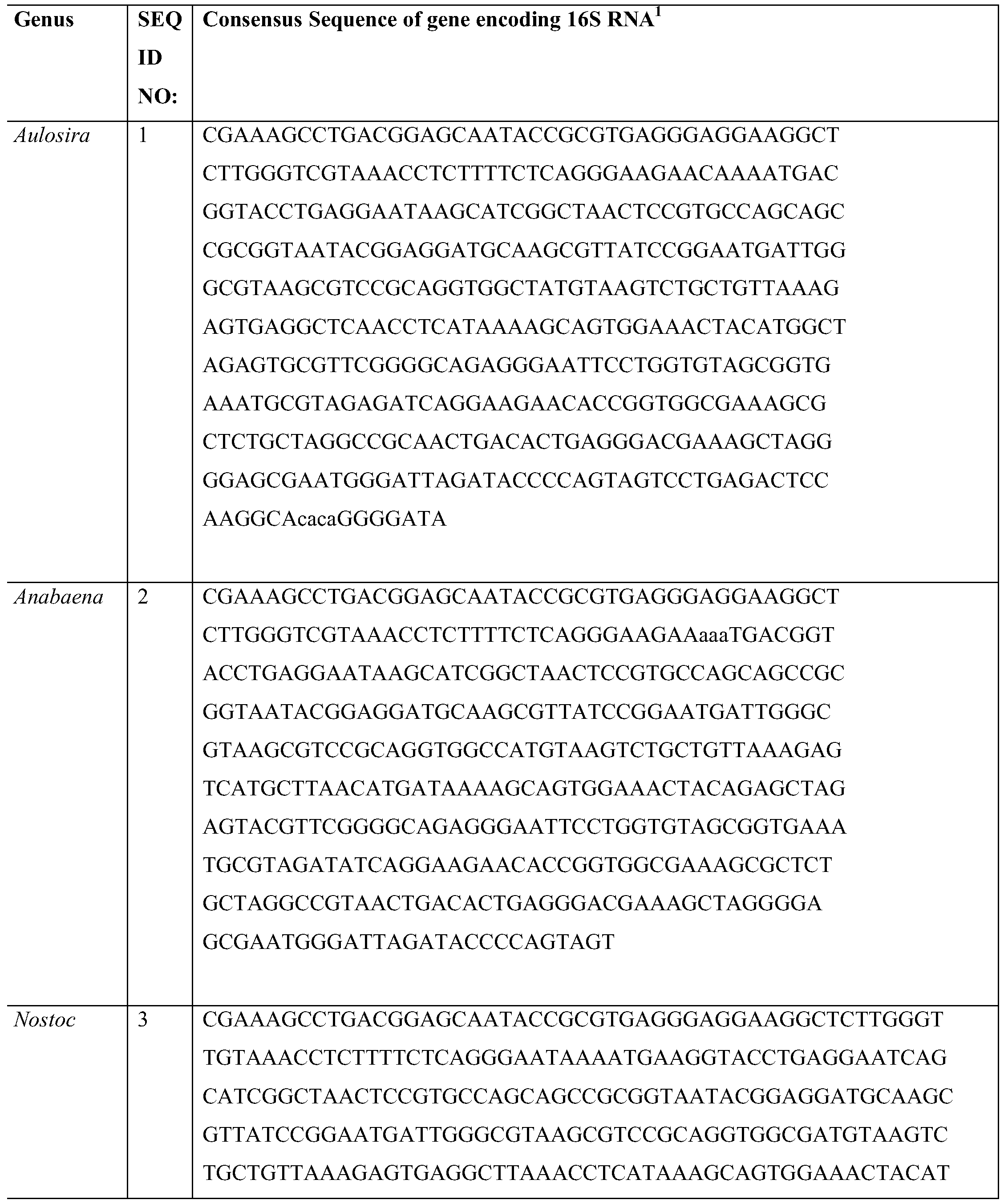
ID
NO:
CGCTAGAGTGCGTTCGGGGCAGAGGGAATTCCTGGTGTAGCGGTGAAAT
GCGTAGAGATCAGGAAGAACACCGGTGGCGAAGGCGCTCTGCTAGGCCG
CAACTGACACTGAGGGACGAAAGCTAGGGGAGCGAA
Tolypothrix 4 CGAAAGCCTGACGGAGCAATACCGCGTGAGGGAGGAAGGCTCTTGGGTTG
TAAACCTCTTTTCTCAGGGAAGAATTAAATGACGGTACCTGAGGAATAAGC
ATCGGCTAACTCCGTGCCAGCAGCCGCGGTAATACGGAGGATGCAAGCGTT
ATCCGGAATGATTGGGCGTAAAGCGTCCGCAGGTGGCTATGTAAGTCTGCT
GTTAAAGAATCTGGCTCAACCAGATAAAGGCAGTGGAAACTACATGGCTAG
AGTGCGTTCGGGGCAGAGGGGAATTTCCTGGTGTAGCGGTGAAATGCGTAG
AGATCAGGAGAACACCGGTGCGAAAGCGCTCTGCTAGGCCGCAACTGACAC
TGAGGGACGAAAGCTAGGGGAGCGAATGGGATTAGATACCCCAGTAGT
16S consensus sequences were generated by harvesting liquid cyanobacterial cultures, amplifying the 16S ribosomal region by PCR, gel-purifying the 16S band, and sequencing the resulting PCR product. Sequences are made up of many reads that were combined to generate a consensus sequence. Lower-case letters in the published sequences denote locations where variation was found in the base at that position such that it reduced confidence to below the set threshold.
[0021] A cyanobacterium useful in certain compositions and methods provided herein can also be obtained by isolation from terrestrial sources including, but not limited to soil and plants, as well as aquatic sources. One useful method for isolating cyanobacteria that can be used involves nutrient saturated glass fiber filters in combination with a broad spectrum beta-lactam antibiotic to isolate cyanobacteria (Ferris and Hirsch, Appl. Environ.
Microbio, 57(5): 1448-1452, 1991). Additional methods for obtaining cyanobacteria that use phototaxis and scored agar surfaces in the presence of certain antibiotics can also be used (Vaara et al. Appl. Environ. Microbiol. 38(5): 1011-4, 1979). Isolation methods including by not limited to those described by the aforementioned citations and references cited therein can also be used to obtain isolates from non-axenic cyanobacteria cultures to obtain cyanobacterium isolates that can be used in the methods and compositions provided
herein. In certain embodiments, the isolates are obtained from a non-axenic Nostoc commune UTEX B 1621 culture, a non-axenic Aulosira bohemensis UTEX B 2947 culture, a non-axenic Anabaena cylindrica UTEX B 1611 culture, and a non-axenic Tolypothrix distorta UTEX 424 culture.
[0022] Variants of any of the aforementioned cyanobacteria can also be used in compositions and methods provided here. In certain embodiments, the cyanobacteria variants are variants that have been induced by mutagenesis and selected for one or more useful traits. Mutagenesis techniques include, but are not limited to use of alkylating agents, intercalating agents, transposons, and the like. Cyanobacteria variants can be screened and then selected for useful traits that include, but are not limited to, increased phototaxis, changes in genome copy number, increased protein production, or altered pigment expression. Variants can also be obtained where the cyanobacteria have been genetically transformed with a heterologous transgene. Methods for transforming cyanobacteria that have been disclosed (Chaurasia, et al., J Microbiol Methods. 73(2): 133- 41, 2008) can be used to obtain such variants.
[0023] Seeds treated with compositions provided herein can be used to improve a variety of monocot plant growth characteristics including, but not limited to, plant biomass, grain yield, lateral root growth, lateral root hair growth, growth under nitrogen limiting conditions, and/or nitrogen uptake. In certain embodiments, the improvement in the monocot plant growth characteristic is in comparison to the growth characteristic of a monocot plant obtained from an untreated monocot plant seed. In certain embodiments, the improvement in the monocot plant growth characteristic is in comparison to the growth characteristic of a monocot plant that has been treated with a topical application of cyanobacteria. In certain embodiments, the improvement in the monocot plant growth characteristic is in comparison to the growth characteristic of a monocot plant that has been treated with a topical application of a cyanobacterial mixture of a Nostoc commune UTEX B 1621 culture, a Aulosira bohemensis UTEX B 2947 culture, a Anabaena cylindrica UTEX B 1611 culture, and a Tolypothrix distorta UTEX 424 culture. In certain embodiments, the improvement in the monocot plant growth characteristic is in comparison to the growth characteristic of a monocot plant obtained from a monocot plant
seed treated with a cyanobacterial mixture of a Nostoc commune UTEX B 1621 culture, a Aulosira bohemensis UTEX B 2947 culture, a Anabaena cylindrica UTEX B 1611 culture, and a Tolypothrix distorta UTEX 424 culture. In certain embodiments, monocot seeds are treated with a composition having: (i) Aulosira sp. and Anabaena sp.; (ii) Aulosira sp.; or (iii) Aulosira sp. and Tolypothrix sp. In certain embodiments, monocot seeds are treated with a composition having: (i) Aulosira sp., Anabaena sp., and Tolypothrix sp., or (ii) Nostoc sp. In certain embodiments, monocot seeds are treated with a composition having Aulosira sp., Anabaena sp., Tolypothrix sp., and Nostoc sp. In certain embodiments, the Aulosira sp., Anabaena sp., Nostoc sp., and/or Tolypothrix sp. used in the composition can be characterized by having at least about 95%, 97%, 98%, 99%, 99.5%, 99.7%, 99.9%, or 100% sequence identity across the entire length of SEQ ID NO: l, SEQ ID NO:2, SEQ ID NO:3, and/or SEQ ID NO:4. In certain embodiments, the Aulosira sp., Anabaena sp., Nostoc sp., and/or Tolypothrix sp. used in the composition can be characterized by having at least about 95%, 97%, 98%, 99%, 99.5%, 99.7%, 99.9%, or 100% sequence identity across the entire length of SEQ ID NO: l, SEQ ID NO:2, SEQ ID NO:3, or SEQ ID NO:4. In certain embodiments, monocot seeds are treated with a composition having: (i) an Aulosira bohemensis sp. and a Tolypothrix distorta sp.; (ii) an Aulosira bohemensis sp.; (iii) an Aulosira bohemensis sp. and an Anabaena cylindrica sp.; (iv) an Aulosira bohemensis sp., an Anabaena cylindrica sp., and a Tolypothrix distorta sp.; or (v) & Nostoc commune sp. In certain embodiments, the cyanobacteria used in the composition can be characterized by having at least about 95%, 97%, 98%, 99%, 99.5%, 99.7%, 99.9%, or 100% sequence identity across the entire length of SEQ ID NO: l, SEQ ID NO:2, SEQ ID NO:3, and/or SEQ ID NO:4. Representative examples of cyanobacteria that can be used in the compositions and methods provided herein that are characterized by having at least about 95%, sequence identity across the entire length of SEQ ID NO: l, SEQ ID NO:2, SEQ ID NO:3, and/or SEQ ID NO:4 include, but are not limited to, one or more of the cyanobacteria provided in Table 3. Representative examples of cyanobacteria that can be used in the compositions and methods provided herein also include, but are not limited to, combinations of the cyanobacteria provided in Tables 1 and 3. In any of the aforementioned embodiments, the monocot plant or monocot seed can be a rice, a corn, a sorghum, a turfgrass, a biofuel crop seed, a forage crop, a wheat, a hay, or a millet plant seed. In certain embodiments, the turfgrass seed is a bentgrass, bermudagrass, bluegrass,
buffalograss, fescue, ryegrass, or other turfgrass seed. In certain embodiments, the forage crop seed is a hay, ryegrass, oat, or other forage crop seed. In certain embodiments, the biofuel crop seed is a Miscanthus, switchgrass, or other biofuel crop seed.
Table 3. Representative Cyanobacteria having 16S RNA Sequences with significant sequence identity to SEQ ID NO: l, 2, 3, and/or 4

% Accession1 Collection2 Location
American
Anabaena variabilis Type Culture Manassas, ATCC 29413 96% NC_007413.1 Collection Virginia, USA
Culture
Nodularia spumigena collection of Bratislava, CCY9414 96% CP007203.2 yeasts Slovakia
Pasteur
Culture
Nostoc sp. PCC 7107 95% NC_019676.1 Collection Paris, France
University of
Helisinki
Cyanobacterial
Culture Helsinki,
Anabaena sp. 90 95% NC_019427.1 Collection Finland
Isolates having at
least 95% sequence 16S
identity to Anabaena sequence %
cylindrica 16S SEQ ID identity to
NO:2 SEQ ID NO:2
Pasteur
Anabaena cylindrica Culture
PCC 7122 97% NC_019771.1 Collection Paris, France
Pasteur
Calothrix sp. PCC Culture
7507 99% NC_019682.1 Collection Paris, France
Pasteur
Nostoc punctiforme Culture
PCC 73102 97% NC_010628.1 Collection Paris, France
Pasteur
Culture
Nostoc sp. PCC 7120 96% NC_003272.1 Collection Paris, France
Pasteur
Cylindrospermum Culture
stagnale PCC 7417 97% NC_019757.1 Collection Paris, France
Sequence Culture Identity NCBI Culture Collection
% Accession1 Collection2 Location
Pasteur
Culture
Nostoc sp. PCC 7107 95% NC_019676.1 Collection Paris, France
American
Anabaena variabilis Type Culture Manassas, ATCC 29413 96% NC_007413.1 Collection Virginia, USA
Culture
Nodularia spumigena collection of Bratislava, CCY9414 96% NZ_CP007203.1 yeasts Slovakia
University of
Helsinki
Cyanobacterial
Culture Helsinki,
Anabaena sp. 90 95% NC_019427.1 Collection Finland
Nostoc azollae 0708 96% NC_014248.1 None N/A
Culture
Nodularia spumigena collection of Bratislava, CCY9414 96% CP007203.2 yeasts Slovakia
Isolates having at
least 95% sequence 16S
identity to Nostoc sequence %
commune 16S SEQ ID identity to
NO: 3 SEQ ID NO:3
Pasteur
Cylindrospermum Culture
stagnale PCC 7417 97% NC_019757.1 Collection Paris, France
Pasteur
Calothrix sp. PCC Culture
7507 99% NC_019682.1 Collection Paris, France
Pasteur
Culture
Nostoc sp. PCC 7107 95% NC_019676.1 Collection Paris, France
Pasteur
Culture
Nostoc sp. PCC 7120 96% NC_003272.1 Collection Paris, France
Sequence Culture Identity NCBI Culture Collection
% Accession1 Collection2 Location
American
Anabaena variabilis Type Culture Manassas, ATCC 29413 96% NC_007413.1 Collection Virginia, USA
Pasteur
Anabaena cylindrica Culture
PCC 7122 97% NC_019771.1 Collection Paris, France
Pasteur
Nostoc punctiforme Culture
PCC 73102 97% NC_010628.1 Collection Paris, France
Isolates having at
least 95% sequence 16S
identity to sequence %
Tolypothrix distorta identity to
16S SEQ ID NO:4 SEQ ID NO:4
Culture
Nodularia spumigena collection of Bratislava, CCY9414 96% NZ_CP007203.1 yeasts Slovakia
Pasteur
Calothrix sp. PCC Culture
7507 99% NC_019682.1 Collection Paris, France
Culture
Nodularia spumigena collection of Bratislava, CCY9414 96% CP007203.2 yeasts Slovakia
Pasteur
Cylindrospermum Culture
stagnale PCC 7417 97% NC_019757.1 Collection Paris, France
Pasteur
Anabaena cylindrica Culture
PCC 7122 97% NC_019771.1 Collection Paris, France
Pasteur
Nostoc punctiforme Culture
PCC 73102 97% NC_010628.1 Collection Paris, France
Pasteur
Culture
Nostoc sp. PCC 7120 96% NC_003272.1 Collection Paris, France
Sequences of the whole genomes or a selected chromosome of the indicated strains that contain the 16S RNA encoding sequences can be obtained from the
National Center Biotechnology Information National Center for Biotechnology Information (NCBI) with the indicated accession numbers via the internet at the world wide web site "ncbi.nlm.nih.gov/nuccore." The NCBI is in the National Library of Medicine, Building 38A, Bethesda, MD 20894.
American Type Culture Collection (ATCC) isolates can be accessed via the internet at the World Wide Web site "atcc.org." The address for the ATCC is 10801 University Boulevard Manassas, VA 20110 USA.
Culture Collection of Yeasts (CCY) isolates can be accessed via the internet at the world wide web site "ccy.sk." The address for the CCY is Institute of Chemistry, Slovak Academy of Sciences, Diibravska cesta 9, 845 38 Bratislava, Slovakia. Pasteur Culture collection of Cyanobacteria (PCC) isolates can be accessed via the internet at the http address "cyanobacteria.web.pasteur.fr/." The address for the PCC is Collections des Cyanobacteries, Institut Pasteur, 28, rue du Docteur Roux, 75724 PARIS Cedex 15, FRANCE.
[0024] Any method of measuring the growth characteristic can be employed. Typically, the biomass, grain yield, and the like can be assessed by determining the mass of plant material obtained, the mass of seeds obtained, or the number of seeds and a per plant or per unit area (e.g., per acre or hectare) basis. Lateral root growth and lateral root hair growth can be determined by methods that include, but are not limited to, direct counts of lateral roots and lateral root hairs, by image analysis of root systems, and/or by determining wet or dry weights of the lateral roots and lateral root hairs. As used herein, the phrase "lateral root" refers to a root that originates from a primary or nodal root. As used herein, the phrase "lateral root hair" refers to a root hair that originates from a lateral root.
[0025] Seeds treated with compositions provided herein can be used to improve monocot plant growth under nitrogen limiting conditions and/or to improve nitrogen uptake by monocot plants. As used herein, the phrases "nitrogen limiting conditions" or "a suboptimal amount of nitrogen fertilizer is used" refer to conditions where plant growth or yield can be increased upon supplementing the plant growth medium (e.g., soil, synthetic rooting mixes, hydroponic liquids, flooded fields, and the like) with exogenous
nitrogen or by improving the availability of nitrogen already present in the plant growth medium. In certain embodiments where nitrogen fertilizer is not used or where a suboptimal amount of nitrogen fertilizer is used, compositions having: (i) Aulosira sp. and Anabaena sp.; (ii) Aulosira sp.; or (iii) Aulosira sp. and Tolypothrix sp. can be used. In certain embodiments where a suboptimal amount of nitrogen fertilizer is used, where less than an equivalent of 70 lbs/acre of nitrogen, or where between about 0, 5, 10, 15, 20, or 25 to 50, 60, 70, 80, 100, 120, 150, or 200 lbs/acre of nitrogen are used, compositions having: (i) Aulosira sp.; (ii) Aulosira sp.; and Tolypothrix sp.; (iii) Aulosira sp., Anabaena sp., and Tolypothrix sp.; or (iv) Nostoc sp. can be used. In such embodiments, the Aulosira sp., Anabaena sp., Nostoc sp., and/or Tolypothrix sp. used in the composition can be characterized by having at least about 95%, 97%, 98%, 99%, 99.5%, 99.7%, 99.9%, or 100% sequence identity across the entire length of SEQ ID NO: l, SEQ ID NO:2, SEQ ID NO:3, or SEQ ID NO:4, respectively. In certain embodiments where nitrogen fertilizer is not used, where a suboptimal amount of nitrogen fertilizer is used, where less than an equivalent of 75 lbs/acre of nitrogen, or where between about 0, 5, 10, 15, 20, or 25 to 50, 60, or 70 lbs/acre of nitrogen are used, rice seeds are treated with a composition having: (i) an Aulosira sp., and a Tolypothrix sp.; (ii) an Aulosira sp; (iii) an Aulosira sp. and an Anabaena sp.; (iv) an Aulosira sp., an Anabaena sp., and a Tolypothrix sp.; or (v) a Nostoc sp. In certain embodiments where nitrogen fertilizer is not used, where a suboptimal amount of nitrogen fertilizer is used, where less than an equivalent of 190 lbs/acre of nitrogen, or where between about 0, 5, 10, 15, 20, 25, 50 to 80, 90, 100, 125, 150, 175, 180, or 190 lbs/acre of nitrogen are used, corn seeds are treated with a composition having: (i) Aulosira bohemensis and Tolypothrix distorta; (ii) Aulosira bohemensis; (iii) Aulosira bohemensis and Anabaena cylindrica; (iv) an Aulosira bohemensis, an Anabaena cylindrica sp., and a Tolypothrix distorta sp.; or (v) a Nostoc commune sp. In certain embodiments where nitrogen fertilizer is not used, where a suboptimal amount of nitrogen fertilizer is used, where less than an equivalent of 110 lbs/acre of nitrogen, or where between about 0, 5, 10, 15, 20, 25, 50 to 80, 90, 100, or 110 lbs/acre of nitrogen are used, wheat seeds are treated with a composition having: (i) Aulosira bohemensis and Tolypothrix distorta; (ii) Aulosira bohemensis; (iii) Aulosira bohemensis and Anabaena cylindrica; (iv) an Aulosira bohemensis, an Anabaena cylindrica sp., and a Tolypothrix distorta sp.; or (v) a Nostoc commune sp. In certain
embodiments, improvements in monocot plant growth or monocot plant yield obtained by seed treatments with cyanobacterial compositions provided herein under any of the aforementioned nitrogen limiting conditions can be at least about 3%, 4%, 9%, 10%, 15%, or 20% in comparison to an untreated control monocot plant or can be about 3%, 4%, 5%, 10%), to about 15%), 18%, 20%, 30%>, or 40% in comparison to an untreated control monocot plant. In certain embodiments, improvements in monocot plant growth or monocot plant yield under any of the aforementioned nitrogen limiting conditions with a cyanobacterial seed treatment provided herein can be at least about 3%, 4%, 9%, or 10% in comparison to an untreated control monocot plant or can be about 3%, 4%, 5%, to about 10%, 15%, 18%, or 25% in comparison to a monocot plant subjected to a topical treatment of the cyanobacteria.
[0026] Nitrogen uptake by plants obtained from seeds treated with the cyanobacterial compositions provided herein can be improved under nitrogen limiting conditions and under conditions where nitrogen is not limiting. Nitrogen uptake can be determined by a variety of methods that include, but are not limited to, isotopic and non-isotopic methods that have been described (Sandrock et a. Hort. Sci. 40(3):665, 2005; Norman et al. Soil Sci. Soc. Am. J. 56: 1521-1527. 1992). In certain embodiments, improvements in nitrogen uptake by monocot plants obtained by seed treatments with cyanobacterial compositions provided herein under any of the aforementioned nitrogen limiting conditions can be at least about 3%, 4%, 5%, 10%, 20%, 40%, 50% or 60% in comparison to an untreated control monocot plant or can be about 3%, 4%, 5%, 10%, to about 15%, 18%, 20%, 40%, 60%, or 70% in comparison to an untreated control monocot plant. In certain embodiments, improvements in nitrogen uptake under any of the aforementioned nitrogen limiting conditions with a cyanobacterial seed treatment provided herein can be at least about 3%, 4%, 9%, or 10% in comparison to an untreated control monocot plant or can be about 3%), 4%), 5%), to about 10%, 15%, 20%, 30%, or 40% in comparison to a monocot plant subjected to a topical treatment of the cyanobacteria. In any of the aforementioned embodiments, the monocot plant or monocot seed can be a rice, a corn, a sorghum, a turfgrass, a biofuel crop, a forage crop, a wheat, a hay, or a millet plant or seed. In certain embodiments, the turfgrass seed is a bentgrass, bermudagrass, bluegrass, buffalograss, fescue, ryegrass, or other turfgrass seed. In certain embodiments, the forage crop seed is a
hay, ryegrass, oat, or other forage crop seed. In certain embodiments, the biofuel crop seed is a Miscanthus, switchgrass, or other biofuel crop seed.
[0027] Compositions used to treat monocot plant seeds can comprise (i) at least one cyanobacterium species; and (ii) an agriculturally acceptable adjuvant, an agriculturally acceptable excipient, or a combination thereof. In certain embodiments, the composition will provide about 1, 2, 4, or 5 milligrams to about 50, 100, 200, 300, 400, or 500 milligrams per seed of the cyanobacterium species. In certain embodiments where more than a single cyanobacterium species is used, a total of about 1, 2, 4, or 5 milligrams to about 50, 100, 200, 300, 400, or 500 milligrams per seed of the collected group of cyanobacterium species is provided. Ratios of the cyanobacteria within the composition can be varied. In certain embodiments, equal parts of each cyanobacterium species can be provided in the composition. In certain embodiments, a 3: 1 : 1 : 1 mixture by mass of Nostoc sp., Aulosira sp., Anabaena sp., and Tolypothrix sp., respectively, can be used. In certain embodiments, ratios with a range of about 1 : 1, 0.5: 1 to 0.3: 1, 0.2: 1 or about 1 :0.5, to 1 :0.3, or 1 :0.2 of (i) an Aulosira sp., and a Tolypothrix sp.; or (ii) an Aulosira sp. and an Anabaena sp. can be used. In certain embodiments, ratios of about 1 : 1 : 1 of an Aulosira sp., an Anabaena sp., and a Tolypothrix sp. can be used. In certain embodiments, any of the aforementioned ratios are used to provide a total of about 1, 2, 4, or 5 milligrams to about 50, 100, 200, 300, 400, or 500 milligrams per seed of the collected group of cyanobacterium species.
[0028] Agriculturally acceptable adjuvants used in the compositions can include, but are not limited to, one or more insecticides, fungicides, safeners, and combinations thereof. Such adjuvants can be selected for an absence of bacteriocidal, bacteriostatic, or bacterio-inhibitory activities that would reduce the effectiveness of the cyanobacteria provided in the composition. In certain embodiments, the adjuvants can include one or more of a carbamate, an organophosphate, a neonicotinoid, or a pyrethroid insecticide. In certain embodiments, the fungicide can include one or more of an azole, strobilurin, or metalaxyl compounds. Useful azole fungicides include, but are not limited to, difenoconazole, prothioconazole, and tebuconazole compounds. Useful strobilurin fungicides include, but are not limited to, kresoxim-methyl, azoxystrobin, trifloxystrobin,
fluoxastrobin, picoxystrobin, pyraclostrobin, dimoxystrobin, pyribencarb, metominostrobin, orysastrobin, enestrobin, pyraoxystrobin and pyrametostrobin compounds. Useful metalaxyl fungicides include, but are not limited to, metalaxyl and mefenoxam.
[0029] Agriculturally acceptable excipients used in the compositions can include, but are not limited to, one or more bulking agents, binding agents, colorants, emulsifiers, oils, tackifiers, trace elements, and /or extending agents. Useful bulking agents include, but are not limited to, peat, wood flour, calcium carbonate, lime, diatomaceous earth, forms of clay such as bentonite and kaolin, and combinations thereof. Useful binding agents can be water soluble polymers and/or waxes. Binding agents that are used can include, but are not limited to, polyvinyl acetate, polyvinyl alcohol, polyvinyl pyrrolidone, polyurethane, methyl cellulose, carboxymethyl cellulose, hydroxylpropyl cellulose, sodium alginate, polyurethane, polyacrylate, casein, gelatin, pullulan, polyacrylamide, polyethylene oxide, polystyrene, styrene acrylic copolymers, styrene butadiene polymers, poly(N- vinylacetamide), and combinations thereof. Waxes used as binders can include, but are not limited to, waxes such as carnauba wax, paraffin wax, polyethylene wax, bees wax, and polypropylene wax. Emulsifiers can be either ionic or non-ionic agents. Emulsifiers that can be used include, but are not limited to, lecithin, polysorbates, polyethylene glycols, derivatives thereof, and the like. Oils that can be used include, but are not limited to, silicon, animal, plant, or mineral oils and mixtures thereof. In certain embodiments, an exogenous tackifier can be added to the composition. However, content of an exogenous tackifier can be reduced in certain embodiments and in comparison to exogenous tackifier content of a standard microbial seed inoculant. In certain embodiments, the composition can also contains at least one element selected from the group consisting of iron, boron, manganese, zinc, molybdenum, copper, cobalt, salts thereof, and combinations thereof. Extenders are materials that provide for improvements in the viability of cyanobacteria on the seed either pre or post planting. Useful extenders include, but are not limited to, compounds such as trehalose, sucrose, glycerol, sorbitol, and combinations thereof. Liquid seed treatment inoculums containing various microorganisms and extenders comprising one or more of trehalose, sucrose, glycerol or sorbitol at about 5% to about 50% by weight/volume and related methods where a partially desiccated liquid inoculant
product for application to seeds is prepared are described in US Patent No. 8,020,343 and can be adapted to use with the cyanobacteria compositions provided herein. US Patent No. 8,020,343 is incorporated herein by reference in its entirety. Other liquid seed treatment compositions that can be adapted for use with the cyanobacteria compositions provide herein can comprise sucrose, sorbitol, or a combination thereof at about 5% to 60% weight/volume, mineral oil or silicon oil at about 0.15% to about 3% weight, and an emulsifying agent selected from the group consisting of lecithin and polysorbate and are described in US Patent No. 8,551,913. US Patent No. 8,551,913 is incorporated herein by reference in its entirety. Exopolysaccharides (EPS) produced by the cyanobacteria or by other bacteria can also be used as agriculturally acceptable excipients in the compositions provided herein. In certain embodiments, the EPS can be provided in the composition by simply adding fermentation broths, filtrates, supematants, purified fractions, partially purified fractions, and the like that are obtained from cyanobacterial or other bacterial cultures. Without seeking to be limited by theory, such EPS can improve water retention and/or desiccation tolerance of cyanobacteria in the compositions provided herein by slowing the desiccation process. It has been reported that bacterial EPS can help bacteria adapt to variable hydration conditions (Or et al. Advances in Water Resources, 30 (2007), pp. 1505-1527; Redmile-Gordon et al., Soil Biology & Biochemistry 72 (2014) 163el71). In certain embodiments, exopolysaccharides obtained from sources other than cyanobacterial or other bacterial cultures that include, but are not limited to, fungal or yeast sources can be used either alone or in combination with the aforementioned cyanobacterial or bacterial cultures as agriculturally acceptable excipients in the compositions provided herein. Furthermore, the aforementioned reductions in content of exogenous tackifier can be achieved in certain embodiments by using such EPS in the as agriculturally acceptable excipients in the compositions provided herein. Seed coating equipment and associated techniques used to coat the seeds include, but are not limited to, drum coaters, fluidized beds, rotary coaters, side vended pan, tumble mixers, and spouted beds.
[0030] Unless otherwise defined, all technical and scientific terms used herein have the same meaning as commonly understood by one of ordinary skill in the art to which this disclosure pertains. In the case of inconsistencies between the present disclosure and the
issued patents, applications, and references that are cited herein, the present disclosure will prevail.
[0031] The following examples are offered by way of illustration and not by way of limitation.
Examples
EXAMPLE 1. Microbial biomass production
[0032] Nostoc commune UTEX B 1621, Anabaena cylindrica UTEX B 1611, Aulosira bohemensis UTEX B 2947, and Tolypothrix distorta UTEX 424 were maintained under constant 105 microMol photons*m"2*sec_1 shaded cool white fluorescent light on sterile BG11 plates. BG11 media has been described (Rippka Archiv fur Mikrobiologie 87, Issue 1, pp 93-98, 1972) and is commercially available (Sigma- Aldrich, St. Louis, MO). Plates were re-streaked onto fresh plates as colonies appeared using a microbiological loop under sterile conditions. For amplification, biomass from plates was transferred into several autoclaved 250 ml Erlenmeyer flasks containing 100 ml sterile BG11 by swishing a sterile microbiological loop containing microbial biomass (obtained from the plates) in the liquid media. The Erlenmeyer flasks were stoppered with autoclaved foam stoppers.
[0033] The 250 ml Erlenmeyer flasks containing monocultures were shaken at 120 rpm on an orbital shaker in constant 40 microMol photons*m" 2 *sec" 1 cool white fluorescent light at 22 °C until cultures reached translucent green cell density. The entirety of four 250 ml Erlenmeyer flasks with the same species of cyanobacteria, containing 100 ml of BG11 each, was then transferred to autoclaved tubular 4 L flasks containing 3.5 L sterile BG11. The 4 L bubble flasks were mixed by aeration through an autoclaved bubble tube connected to an aquarium pump. A filter made of autoclaved cotton fibers was placed in the tubing line to maintain sterility. An autoclaved foam stopper with a hole for the air- in port was used to seal the 4 L flasks. The culture was supplied with constant 45 microMol photons*m" 2 *sec" 1 cool white fluorescent light at 22 O C.
[0034] Upon reaching translucent green cell density, 2 L culture from the 4 L bubble flasks was transferred to a 20 L Pyrex carboy containing 14 L sterile BG11 (for a total
culture volume of 16 L). The 4 L bubble flask was replenished with 2 L sterile BG11 to allow for additional 20 L inoculations as necessary. Monocultures growing in 20 L carboys were diluted by half with fresh sterile BG11 as necessary to maintain dense, translucent green cultures. As necessary, upon dilution with fresh BG11, excess culture was transferred to plastic 20 L carboys that were washed with antibacterial soap and sterilized with ethanol. These cultures were also supplied with constant 45 microMol photons*m"2*sec_1 at 22 °C.
[0035] Harvesting of cyanobacterial monocultures began by settling monocultures growing in 20 L carboys for 2-4 hours (total settling time depended on time it takes individual carboys to settle). After settling, clear supernatant was siphoned off using autoclaved plastic tubing. A total of 1-6 L of each monoculture remained per 20 L carboy after settling. Settled cultures were then pulse blended in an Oster blender for less ~5 seconds. Cultures were then centrifuged at 6,000 x g for 10 minutes in either a 6 x 50 ml benchtop centrifuge or a 6 x 1 L floor centrifuge. Centrifuge size was chosen based upon total biomass required for subsequent plant treatments. Each vessel was decanted after centrifugation, and biomass pellets were combined into a sterilized beaker. Total wet weight biomass was determined by measuring the weight of the beaker before and after the addition of biomass. Biomass cyanobacterial mixtures were prepared by mixing biomass paste of each monoculture by weight with the other members of the cyanobacterial mixture to give the prescribed ratio. Biomass paste was then diluted to a working volume with sterile Millipore water, giving a known working biomass concentration.
EXAMPLE 2. Corn Seed Coating
[0036] Two cyanobacterial application rates were used to coat corn seeds: 1 and 4 mg per seed. A control was also created with no cyanobacteria applied. Cyanobacterial biomass was prepared by harvesting excess liquid Nostoc cyanobacterial monoculture, centrifuging, and removing the supernatant. The culture was centrifuged in twelve 50 ml Falcon tubes for 10 min at 6000 x g. The biomass pellets were then diluted with a small amount of Nanopure™ water (Thermo Fischer Scientific, Inc. USA), harvested and combined into one tube. The cyanobacterial culture was then homogenized by blending on
a pulse setting in a kitchen blender for less than five seconds. As little blending as possible was used to prevent unnecessary cell damage. After homogenization, the biomass was spun for 10 min at 6000 x g to remove any remaining liquid. Cyanobacterial biomass was added to individual 15 ml falcon tubes as a paste. Biomass was calculated by subtracting the weight of the tube and paste from the weight of the tube only (determined at beginning of experiment). The 0, 1 , and 4 mg per seed application rates were diluted with Nanopure™ water to a total volume of 12 ml before coating. Six replicates of each application rate were prepared. Four were used in seed coating and two served as backups in case there were unforeseen issues with coating.
[0037] Two corn varieties, DKC 59-43 and DKC 63-43 (DeKalb varieties from Monsanto, St. Louis, MO. USA) were coated with 1 and 4 mg per seed of Nostoc commune cyanobacteria (prepared as above) using Hege™ 1 1 liquid seed treater. All seeds received a mixture of 0.064 mg per seed of the fungicide Maxim™ and 0.046 mg per seed of the binder Flo Rite™ 1 197 with inert colorant Color Coat Red. Each cyanobacterial treatment was performed in duplicate, with one subset receiving Cruiser™ seed-applied insecticide and one subset receiving no insecticide. The chemicals were added to the Falcon™ tubes (Thermo Fisher Scientific Inc, Waltham, MA, USA) containing the cyanobacteria (previous paragraph) and diluted to a volume of 12 ml with Nanopure™ water before coating. Coating was performed in 3 applications of 4 ml per application. Between coatings, seeds were allowed to dry on a cookie sheet at room temperature for four hours. Drying between applications was done to prevent early germination.
Table 1 : Seed coating subgroups for corn trials
Nostoc
Group Seed Amount Cruiser™
(mg)
1 DKC 59-43 0 +
2 DKC 59-43 0 -
3 DKC 59-43 1 +
4 DKC 59-43 1 -
5 DKC 59-43 4 +
6 DKC 59-43 4 -
7 DKC 63-43 0 +
8 DKC 63-43 0 -
Nostoc
Group Seed Amount Cruiser™
(mg)
9 DKC 63-43 1 +
10 DKC 63-43 1 -
11 DKC 63-43 4 +
12 DKC 63-43 4 -
[0038] In each subset of corn seeds, two hundred seeds were coated in batch with a given cyanobacterial amount (0, 1, and 4 mg per seed), laid out onto a single layer onto cookie sheets, and allowed to dry at room temperature in a well-ventilated area overnight between the second and third applications. In total 2,400 seeds were coated, 800 of which were controls.
[0039] DKC 59-43 and DKC 63-43 were successfully coated with Nostoc commune UTEX B 1621.
EXAMPLE 3. Germination and root hair formation
[0040] Seeds from Table 1 of Example 2 were germinated and images of the roots were captured daily for one week. There was found to be a dramatic increase in the formation of lateral root hairs in seedlings obtained from seeds treated with 4 mg of cyanobacteria (Figure 1).
EXAMPLE 4. Seed Treatment of High Performance Corn Varieties
[0041] Cyanobacterium Mixture A, Mixture B, and Mixture C were prepared essentially as described in Example 1. Mixture A comprises: Nostoc commune UTEX B1621 alone. Mixture B was a 3: 1 :1 : 1 mixture of Nostoc commune UTEX B 1621, Anabaena cylindrica UTEX B 1611, Aulosira bohemensis UTEX B 2947, and Tolypothrix distorta UTEX 424. Mixture C was a 1 : 1 : 1 mixture of Aulosira bohemensis UTEX B 2947, Anabaena cylindrica UTEX B 1611, and Tolypothrix distorta UTEX 424. About 4 mg of each cyanobacterial mixture was applied per seed. A control was also created with no cyanobacteria applied. Cyanobacterial biomass was prepared by harvesting excess liquid Nostoc commune UTEX B 1621, Aulosira bohemensis UTEX B 2947, Anabaena cylindrica UTEX B 1611, and Tolypothrix distorta UTEX 424 cyanobacterial
monocultures, centrifuging, and removing the supernatant. The culture was centrifuged in twelve 50 ml Falcon tubes for 10 min at 6000 x g. The biomass pellets were then diluted with a small amount of Nanopure™ water, harvested and combined into one tube. The cyanobacterial culture was then homogenized by blending on a pulse setting in a kitchen blender for less than five seconds. As little blending as possible was used to prevent unnecessary cell damage. After homogenization, the biomass was spun for 10 min at 6000 x g to remove any remaining liquid. Cyanobacterial biomass was added to individual 15 ml falcon tubes as a paste. Biomass was calculated by subtracting the weight of the tube and paste from the weight of the tube only (determined at beginning of experiment).
EXAMPLE 5: Greenhouse testing of Cyanobacterium treated corn seed
[0042] A greenhouse trial will be performed with seed from two elite corn hybrids (Monsanto, St. Louis, MO, USA) with 110 day relative maturities will be coated with three different cyanobacterial mixtures. Mixture A will be the same coating as one of the cyanobacterial mixtures tested above: Nostoc commune UTEX B1621 alone. Mixture B will be a 3: 1 : 1 : 1 mixture of Nostoc commune UTEX B 1621, Anabaena cylindrica UTEX B 1611, Aulosira bohemensis UTEX B 2947, and Tolypothrix distorta UTEX 424. Mixture C will be a 1 : 1 : 1 mixture of Aulosira bohemensis UTEX B 2947, Anabaena cylindrica UTEX B 1611, and Tolypothrix distorta UTEX 424. All cyanobacterial mixtures will be applied at a rate of 4 mg cyanobacterial mixture per seed.
[0043] During the trial, seeds coated with Mixture A, Mixture B, Mixture C, and a control with BG 11 media only (no cyanobacteria) seed coating (Table 2) will be grown for 8-10 weeks in an automated greenhouse in Research Triangle Park. Plants will be grown in ~2 gallon plastic pots in potting soil. They will be watered in four chemical nitrogen regimes: 2mM, 4mM, 6mM and 8mM. Plants will be shuffled in the greenhouse daily to remove position effects. Physiological parameters that include, but are not limited to: chlorophyll content, biomass, stem diameter and leaf formation will be measured every 24 hours. It is anticipated that seeds coated with Mixture A, Mixture B, or Mixture C will provide corn plants with improved growth characteristics when compared to corn plants obtained from control seeds with BG 11 seed coating.
Table 2: Corn Plant Treatments 1

Table 2 shows the Mixture A, B, C treatments down the left side, nitrogen dosages along the top (mM), and number of plants tested with each Mixture and at each dosage. A total of 416 plants are included in this experiment.
[0044] In addition to the greenhouse trial, seeds coated with Mixture A, Mixture B, Mixture C, and no cyanobacterial mixture will be planted in nutrient-rich gel and grown for 4-12 weeks. The plants will be monitored for changes in root morphology daily using an automated root analysis platform. Changes in root morphology observed will be quantified and reported. Parameters measured include, but are not limited to: root hair formation, lateral root frequency, root biomass, and root depth. It is anticipated that seeds coated with Mixture A, Mixture B, and/or Mixture C will provide corn plants with increased root hair formation, lateral root frequency, root biomass, and/or root depth when compared to corn plants obtained from control seeds with BG 11 seed coating.
EXAMPLE 6. Cyanobacterial treatment of rice and measurement of biomass accumulation and total nitrogen uptake in green house studies
[0045] All rice experiments were carried out at the University of Arkansas Agriculture
Extension. Treatments were blinded. Two varieties of rice, CL 152 (Pureline) and XL 753
(hybrid) were planted in a greenhouse. The plants were treated with topical application of two concentrations (equating to 500 g/acre and lOOOg/acre) of cyanobacterial mixture which consisted of a 3: 1 : 1 : 1 mixture by weight of Nostoc commune UTEX B 1621,
Aulosira bohemensis UTEX B 2947, Anabaena cylindrica UTEX B 1611, and Tolypothrix distorta UTEX 424 respectively. A 3: 1 : 1 : 1 mixture of Nostoc commune UTEX B 1621, Aulosira bohemensis UTEX B 2947, Anabaena cylindrica UTEX B 1611, and Tolypothrix distorta UTEX 424 respectively were maintained and harvested essentially as described in Example 1. Plants were fertilized with three levels of chemical nitrogen (0, 75 and 150 lbs/acre) in the form of Agrotain™ (Koch Agronomic Services, LLC, Wichita, KS, USA) treated urea with NBPT urease inhibitor. Plants with no added cyanobacteria served as the control. Plants were harvested at half heading and dried. Total nitrogen uptake and biomass accumulation were measured.
[0046] Across both rice varieties and all chemical nitrogen fertilizer rates, statistically significant improvements in biomass accumulation and nitrogen uptake were observed (Figure 2, shows biomass accumulation in the Pureline). There was no statistical significance between the two cyanobacteria application rates, meaning they were both effective in improving biomass.
EXAMPLE 7. Cyanobacterial treatment of rice by treatment of flooded fields or by seed treatment in field tests
[0047] A 3: 1 : 1 : 1 mixture of Nostoc commune UTEX B 1621, Aulosira bohemensis UTEX B 2947, Anabaena cylindrica UTEX B 1611, and Tolypothrix distorta UTEX 424 respectively were maintained and harvested essentially as described in Example 1. Biomass was applied to rice plants at the time of permanent flood establishment by pouring 5 containers containing 1/5 of the total dose into the field with care being taken to distribute the applications as evenly as possible. The plots were 16' x 5'. The cyanobacterial mixture was applied evenly at ~3 foot intervals across a 16 foot plot.
[0048] Rice seed coating was carried out using a 3: 1 : 1 : 1 mixture of Nostoc commune UTEX B 1621, Aulosira bohemensis UTEX B 2947, Anabaena cylindrica UTEX B 1611, and Tolypothrix distorta UTEX 424 respectively, harvested as above. The cyanobacterial mixture was then diluted to a working concentration of 0.2 g biomass/ml liquid. Seed coating was carried out in a in a Hege™ 11 Seed Coater. A total of 1 kg of rice seed was coated with the cyanobacterial biomass mixture. Rice is planted at 100 lbs/acre, so 1 kg of
rice seed covers 0.022 acres. With a desired coating rate of 500 g cyanobacterial mixture per acre and a cyanobacterial mixture diluted to 0.2 g biomass/ml cyanobacterial mixture, a total of 55 ml cyanobacterial mixture was used. This cyanobacterial mixture was applied in -20 ml aliquots, and seeds were allowed to dry before applying additional cyanobacterial mixture. After all coating was performed, seeds were spread out into a single layer and allowed to dry overnight at room temperature in a well-ventilated area.
[0049] One rice cultivar (Pureline CL 152) was grown in three chemical nitrogen fertilizer rates (0, 75, and 150 lbs/acre) in 80 ft dam-blocked plots. Fertilizer was applied as AgroTain™ (Koch Agronomic Services, LLC, Wichita, KS, USA) treated urea with NBPT Urease Inhibitor. Rice was planted on April 24, 2014 at the Pinetree Research Station near Colt, AR, USA using direct-seeding, delayed flood techniques. When the permanent flood was established the topical applications of cyanobacterial mixtures were added to the 0 and 75 lbs/acre nitrogen plots. Five topical cyanobacterial application rates were used (0, 50, 250, 500, and lOOOg/acre cyanobacterial mixture) for each nitrogen application rate. For the seed coating application, the cyanobacteria were applied at the time of coating and were grown in 0, 75, and 150 lbs/acre nitrogen. It is estimated that the seed coating application was equivalent to a topical application rate of about 500g/acre of the cyanobacterial mixture. Upon reaching full maturity, rice was harvested and yield and total nitrogen uptake were measured. Total above ground biomass was collected from a 1 m section of the first bordered row at 50% heading to determine total N uptake based on published methods (Norman et al. Seasonal accumulation and partitioning of nitrogen- 15 in rice. Soil Sci. Soc. Am. J. 56: 1521-1527. 1992). Following maturity, plots were allowed to dry to <20% moisture and were harvested using a plot combine. Plot weights and moistures were adjusted to 12.5% and extrapolated to provide a yield estimate. Comparison of cyanobacteria rates within preflood N rates was completed to determine the potential benefit of cyanobacteria under various N management strategies. Statistical analysis was conducted using a standard ANOVA and means were separated using Fisher's protected LSD at the a=0.05 level where appropriate. Table 3 shows two application methods tested (Column 1), and various cyanobacteria application rates (Column 2). Application method A is topical application in the field at time of flood establishment. Application method B was a seed coating applied to the seeds as outlined
above. Topical application rates below 500 g/acre were tested for application method A, but improvements observed there were not statistically significant. The field test results summarized in Table 4. Yield is reported in absolute terms (Column 3) and relative to the baseline (Column 4). The most dramatic yield effect (a 22.2% increase) was observed with the seed treatment method. Increases in yield were positively correlated to Total Nitrogen Uptake.
Table 3. Field test results of topical application (Method A) and seed treatment
(Method B)

Table 4. Summary of Field Test Data

EXAMPLE 8. Identification of active components of cyanobacterial mixture in greenhouse experiments
[0050] A greenhouse trial in rice was started in which the concentration of the individual components that comprise the cyanobacterial mixture used in the previous
examples (Nostoc commune UTEX B 1621, Aulosira bohemensis UTEX B 2947, Anabaena cylindrica UTEX B 1611, and Tolypothrix distorta UTEX 424) were provided in different combinations and at various concentrations as shown in Table 4.
Table 4. Cyanobacteria Product treatment list containing the composition of the individual bacteria within each treatment and the total biomass of cyanobacteria applied to each treatment.
Total
Set Treatment Nostoc Aulosira Anabaena Tolypothrix Nitrogen
Biomass g/pot g/pot g/pot g/pot g/pot g/pot
Positive
1 0.049 0.014 0.014 0.014 0.94 0.091 Control
Positive
2 0.049 0.014 0.014 0.014 0 0.091 Control
Positive
3 0.013 Control 0.007 0.002 0.002 0.002 0.94
Positive
4 0.013 Control 0.007 0.002 0.002 0.002 0
Negative
5 0 0 0 0 0.94 0 Control
Negative
6 0 0 0 0 0 0 Control
N-3 7 0.049 0 0 0 0.94 0.049
N-3 8 0 0.014 0 0 0.94 0.014
N-3 9 0 0 0.014 0 0.94 0.014
N-3 10 0 0 0 0.014 0.94 0.014
N-3 11 0.049 0 0 0 0 0.049
N-3 12 0 0.014 0 0 0 0.014
N-3 13 0 0 0.014 0 0 0.014
N-3 14 0 0 0 0.014 0 0.014
N-2 15 0.049 0.014 0 0 0.94 0.063
N-2 16 0.049 0 0.014 0 0.94 0.063
N-2 17 0.049 0 0 0.014 0.94 0.063
N-2 18 0.049 0.014 0 0 0 0.063
N-2 19 0.049 0 0.014 0 0 0.063
N-2 20 0.049 0 0 0.014 0 0.063
N-2 21 0 0.014 0.014 0 0.94 0.028
N-2 22 0 0.014 0 0.014 0.94 0.028
N-2 23 0 0.014 0.014 0 0 0.028
N-2 24 0 0.014 0 0.014 0 0.028
N-2 25 0 0 0.014 0.014 0.94 0.028
N-2 26 0 0 0.014 0.014 0 0.028
N-l 27 0.049 0.014 0.014 0 0.94 0.077
N-l 28 0.049 0.014 0 0.014 0.94 0.077
Total
Set Treatment Nostoc Aulosira Anabaena Tolypothrix Nitrogen
Biomass
N-l 29 0.049 0 0.014 0.014 0.94 0.077
N-l 30 0.049 0.014 0.014 0 0 0.077
N-l 31 0.049 0.014 0 0.014 0 0.077
N-l 32 0.049 0 0.014 0.014 0 0.077
N-l 33 0 0.014 0.014 0.014 0.94 0.042
N-l 34 0 0.014 0.014 0.014 0 0.042
[0051] Cultures were maintained and harvested as above, and cyanobacterial mixtures were prepared as above. One rice variety was planted (Pureline CL 152), as results obtained from Greenhouse Trial I (Example 6) showed similar performance for both rice varieties. Two nitrogen application rates (0 and 75 lbs/acre) were applied in the form of Agrotain™ (Koch Agronomic Services, LLC, Wichita, KS, USA) treated urea with NBPT urease inhibitor. Trials were established in the greenhouse in June of 2014 in sealed pots containing a Captina silt loam soil obtained from the Arkansas Agricultural Research and Extension Center near Fayetteville, AR. Soils were amended with P and K fertilizer to ensure that no nutrients other than N were limiting rice growth. The cultivar used in the trial was CL 152, which represents one of the more commonly grown pureline cultivars grown in Arkansas. Pots planted to CL 152 were thinned to six plants per pot which would represent the standard seeding rate for this cultivar. Nitrogen rates included in the trial were an untreated control and 75 lb N/acre (suboptimal). Fertilizer was applied to a dry soil and a permanent flood was established when the rice had reached the 4-leaf growth stage. Roughly 3 days following establishment of a permanent flood, cyanobacteria were applied in rates and combinations outlined in Table 4. The experimental design used for this experiment was a randomized complete block design with a full factorial arrangement of 2 N rates x 17 cyanobacteria products replicated 5 times. Rice was allowed to grow until 50% heading at which time the entire above ground biomass was harvested from each pot and dried at 60° C until the biomass reached a constant weight. Following drying, the biomass was ground to pass through a 2 mm sieve and subjected to dry combustion techniques to determine total N concentration. Total N uptake was evaluated using a simple one-way ANOVA to determine if there was a significant influence of cyanobacteria product within a N rate. Biomass accumulation was measured when plants reached 50% heading. Mixtures containing Aulosira and Anabaena (Table 5; treatment 23), Aulosira alone (Table 5; treatment 12), and Aulosira and Tolypothrix (Table 5;
treatment 24), showed the highest improvement in nitrogen uptake when no nitrogen was provided. Treatment with Nostoc and Tolypothrix (Table 5; treatment 20) also provided a statistically significant improvement in nitrogen uptake relative to the negative control.
[0052] In the suboptimal N treatment, where 75 lb N/acre was applied, the differences between cyanobacteria products and the untreated control were not as great as when no N fertilizer was added. The LSD0.05 to compare cyanobacteria rates within the 75 lb N/acre rate was 0.04569 g N/pot. However, six of the cyanobacteria treatment combinations exhibited total N uptake values greater than that of the untreated control indicating that even under conditions where N fertilizer was applied these cyanobacteria products were able to continue supplying N to the rice plant thereby increasing its overall total N uptake. These products were treatments 8, 22, 33, 7, 17 and 10. Of those treatments, 8 (Aulosira alone and 22 (Aulosira and Tolypothrix) had the highest total N uptake of any cyanobacteria treatment.
[0053] Although this trial was not taken to yield, this data would indicate the potential for yield increases due to the application of certain sub-combinations of the 4 strain cyanobacteria cyanobacterial mixture (Nostoc commune UTEX B 1621, Aulosira bohemensis UTEX B 2947, Anabaena cylindrica UTEX B 1611, and Tolypothrix distorta UTEX 424), especially where N application rates were suboptimal.
Table 5. Total N Uptake with various cyanobacterial mixture compositions
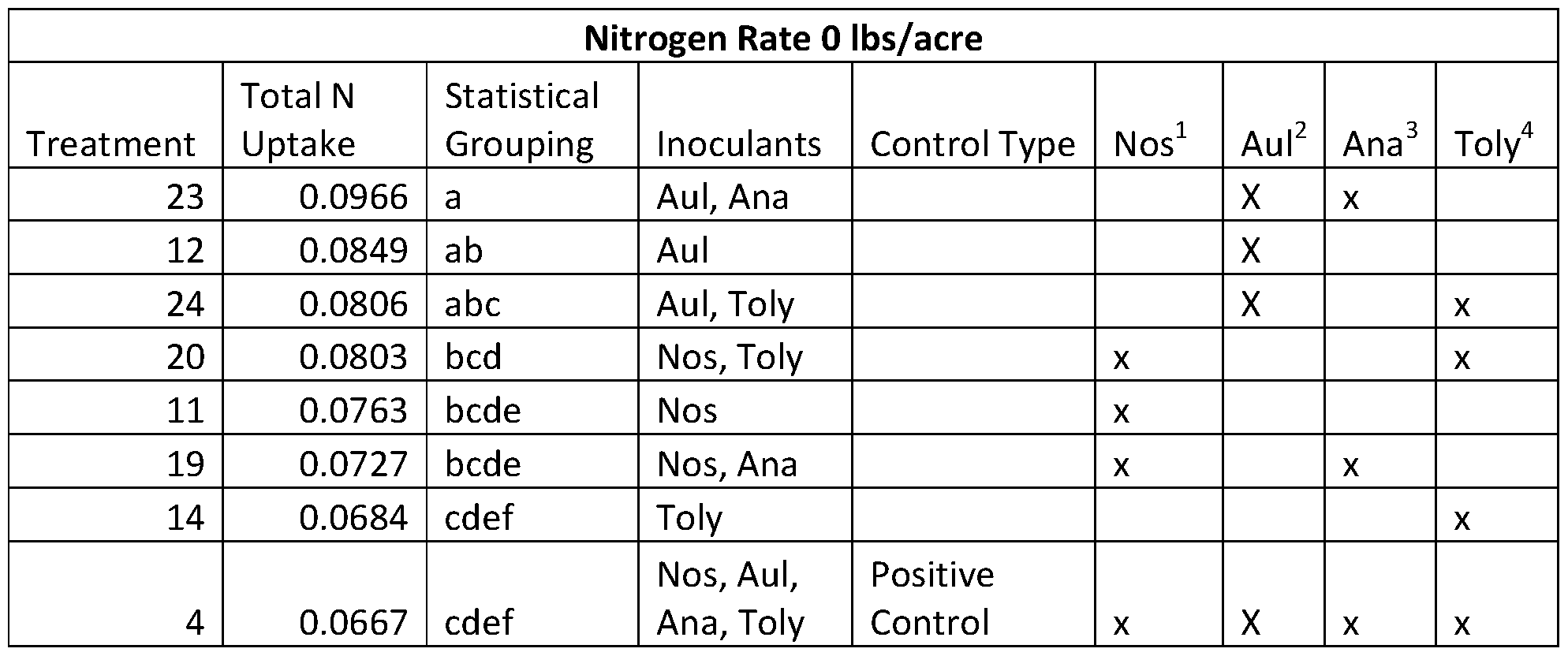
Total N Statistical
Treatment Uptake Grouping Inoculants Control Type Nos1 Aul2 Ana3 Toly4
Aul, Ana,
34 0.0666 cdef Toly X X X
18 0.0661 def Nos, Aul X X
Nos, Aul,
30 0.0624 def Ana X X X
Nos, Aul,
31 0.0624 def Toly X X X
13 0.061 def Ana X
Negative
6 0.061 def None Control
26 0.06 def Ana, Toly X X
Nos, Ana,
32 0.0565 ef Toly X X X
Nos, Aul, Positive
2 0.0518 f Ana, Toly Control (4x) X X X X
Nitrogen Rate 75lbs/acre
Total N Statistical
Treatment Uptake Grouping Inoculants Control Type Nos Aul Ana Toly
8 0.2128 a Aul X
22 0.2064 a Aul, Toly X X
Aul, Ana,
33 0.2014 ab Toly X X X
7 0.2014 ab Nos X
17 0.1938 abc Nos, Toly X X
10 0.193 abc Toly X
25 0.1917 abed Ana, Toly X X
Nos, Aul,
28 0.1914 abed Toly X X X
21 0.1906 abed Aul, Ana X X
15 0.1892 abed Nos, Aul X X
Negative
5 0.188 abed None Control
Nos, Aul,
27 0.1879 abed Ana X X X
Nos, Aul, Positive
3 0.1729 abed Ana, Toly Control (lx) X X X X
9 0.1655 abed Ana X
16 0.1538 bed Nos, Ana X X
Nitrogen Rate 0 lbs/acre
Total N Statistical
Treatment Uptake Grouping Inoculants Control Type Nos1 Aul2 Ana3 Toly4
Nos, Ana,
29 0.1503 cd Toly X X X
2947; Ana3= Anabaena cylindrica UTEX B 1611; and Toly4= Tolypothrix distorta
UTEX 424.
EXAMPLE 9: Greenhouse testing of Cyanobacterium treated corn seed
[0054] A greenhouse trial was performed with seed from two elite corn hybrids (Monsanto, St. Louis, MO, USA) with 110 day relative maturities. These were coated with three different cyanobacterial mixtures. Mixture A was the same coating as one of the cyanobacterial mixtures tested above: Nostoc commune UTEX B1621 alone. Mixture B was a 3:1 : 1 : 1 mixture of Nostoc commune UTEX B 1621 , Anabaena cylindrica UTEX B 1611, Aulosira bohemensis UTEX B 2947, and Tolypothrix distorta UTEX 424. Mixture C was a 1 :1 : 1 mixture of Aulosira bohemensis UTEX B 2947, Anabaena cylindrica UTEX B 1611, and Tolypothrix distorta UTEX 424. All cyanobacterial mixtures were applied at a rate of 4 mg cyanobacterial mixture per seed
[0055] During the trial, seeds coated with Mixture A, Mixture B, Mixture C, and a control with BG 11 media only (no cyanobacteria) seed coating (Table 2) will be grown for 10 weeks in an automated greenhouse in Research Triangle Park. Plants were grown in ~2 gallon plastic pots in potting soil. They were watered and nitrogen fertilizer will be applied at four levels: 2mM, 4mM, 6mM and 8mM. Plants were shuffled in the greenhouse daily to remove position effects. Physiological parameters that include, but are not limited to: chlorophyll content, biomass, stem diameter and leaf formation were measured every 24 hours. It was anticipated that seeds coated with Mixture A, Mixture B, or Mixture C will provide corn plants with improved growth characteristics when compared to corn plants obtained from control seeds with BG 11 seed coating.
Table 6.

[0056] Table 6 shows the Mixture A, B, C treatments down the left side, nitrogen dosages along the top (mM), and number of plants tested with each Mixture and at each dosage. A total of 416 plants are included in this experiment.
[0057] Germination levels for treated seeds were the same as untreated. Untreated plants had the expected response to nitrogen deficiency- lower levels of biomass, more yellowing, lower height, etc. Treated plants in all Mixtures showed more increases in biomass than reductions, as evidenced in Figure 3.
[0058] In addition to the greenhouse trial, seeds coated with Mixture A, Mixture B, Mixture C, and no cyanobacterial mixture were planted in nutrient-rich gel and grown for 8 weeks. The plants were monitored for changes in root morphology daily using an automated root analysis platform. Changes in root morphology observed werequantified and reported. Parameters measured include, but are not limited to: root hair formation, lateral root frequency, root biomass, and root depth. It was anticipated that seeds coated with Mixture A, Mixture B, and/or Mixture C will provide corn plants with increased root hair formation, lateral root frequency, root biomass, and/or root depth when compared to corn plants obtained from control seeds with BG 11 seed coating.
[0059] Two different fertilizer levels were tested, 2mM and 8mM. Germplasm 2 had the strongest positive response to the treatment, showing increases in biomass, branching, density and symmetry of roots. The results are depicted in Figure 4.
[0060] The breadth and scope of the present disclosure should not be limited by any of the above-described exemplary embodiments, but should be defined only in accordance with the following claims and their equivalents.
Claims
1. A treated monocot plant seed that has been at least partially coated with a composition comprising: (i) at least one cyanobacterium species; and (ii) an agriculturally acceptable adjuvant, an agriculturally acceptable excipient, or a combination thereof.
2. The treated monocot plant seed of claim 1, wherein the monocot plant seed is selected from the group consisting of a rice seed, a corn seed, a sorghum seed, a turfgrass seed, a wheat seed, a biofuel crop seed, a forage crop seed, and a millet seed.
3. The treated monocot plant seed of claim 2, wherein the turfgrass seed is a bentgrass, bermudagrass, bluegrass, buffalograss, fescue, or ryegrass seed.
4. The treated monocot plant seed of claim 2, wherein the forage crop seed is a hay, ryegrass, or oat seed.
5. The treated monocot plant seed of claim 2, wherein the biofuel crop seed is a Miscanthus or switchgrass seed.
6. The treated monocot plant seed of claim 1, wherein the cyanobacterium species are characterized by having a gene encoding a 16S RNA that has at least 95%, 97%, 98%>, 99%, 99.5%, 99.7%, 99.9%, or 100% sequence identity across the entire length of SEQ ID NO: l, SEQ ID NO:2, SEQ ID NO:3, and/or SEQ ID NO:4.
7. The treated monocot plant seed of claim 1, wherein the cyanobacterium are characterized by having a gene encoding a 16S RNA that has at least 95%>, 97%>, 98%>, 99%, 99.5%, 99.7%, 99.9%, or 100% sequence identity across the entire length of SEQ ID NO: l and/or SEQ ID NO:4.
8. The treated monocot plant seed of claim 1, wherein the cyanobacterium species is or are of the order Nostocales.
9. The treated monocot plant seed of claim 1, wherein the composition comprises one, two, three, or four cyanobacterium species that are members of the family Nostocaceae and/or at least one cyanobacterium species that is a member of the family
Microchaetaceae.
10. The treated monocot plant seed of claim 9, wherein the member or members of the family Nostocaceae are selected from the group consisting of a Nostoc sp., an Aulosira sp., an Anabaena sp., and wherein the member the family Microchaetaceae is a Tolypothrix sp.
11. The treated monocot plant seed of claim 9, wherein the member or members of the family Nostocaceae are selected from the group consisting of a Nostoc commune UTEX B 1621 culture, an Aulosira bohemensis UTEX B 2947 culture, an Anabaena cylindrica UTEX B 1611 culture, isolate(s) therefrom, and a variant thereof and wherein the member or members of the family Microchaetaceae are selected from the group consisting of a Tolypothrix distorta UTEX 424 culture, isolate(s) therefrom, and a variant thereof.
12. The treated monocot plant seed of claim 9, wherein the member or members of the family Nostocaceae are characterized by having a gene encoding a 16S R A that has at least 95%, 97%, 98%, 99%, 99.5%, 99.7%, 99.9%, or 100% sequence identity across the entire length of SEQ ID NO: l, SEQ ID NO:2, or SEQ ID NO:3, and wherein the member or members of the family Microchaetaceae are characterized by having a gene encoding a 16S RNA that has at least 95%, 97%, 98%, 99%, 99.5%, 99.7%, 99.9%, or 100% sequence identity across the entire length of SEQ ID NO:4.
13. The treated monocot plant seed of claim 9, wherein the member or members of the family Nostocaceae are characterized by having a gene encoding a 16S RNA that has at least 95%, 97%, 98%, 99%, 99.5%, 99.7%, 99.9%, or 100% sequence identity across the entire length of SEQ ID NO: l and wherein the member or members of the family Microchaetaceae are characterized by having a gene encoding a 16S RNA that has at least 95%, 97%, 98%, 99%, 99.5%, 99.7%, 99.9%, or 100% sequence identity across the entire length of SEQ ID NO:4.
14. The treated monocot plant seed of claim 1, wherein the cyanobacteria are any one of:
(i) Aulosira sp. and Tolypothrix sp.; (ii) Aulosira sp. and Anabaena sp.; (iii) Aulosira sp.; (iv) Aulosira sp., Anabaena sp., and Tolypothrix sp., or (v) Nostoc sp.
15. The treated monocot plant seed of claim 1, wherein the cyanobacteria are characterized by having a gene encoding a 16S R A that has at least 95%, 97%, 98%, 99%, 99.5%, 99.7%, 99.9%, or 100% sequence identity across the entire length of: (i) SEQ ID NO: l;
(ii) SEQ ID NO: l and SEQ ID NO:2; (iii) SEQ ID NO:l and SEQ ID NO:4; or (iv) SEQ ID NO:3 and SEQ ID NO:4.
16. The treated monocot plant seed of claim 1, wherein the seed is a corn seed and wherein lateral root hair growth in a seedling obtained from the treated corn seed is increased in comparison to lateral root hair growth in a seedling obtained from an untreated control corn seed.
17. The treated monocot plant seed of claim 1, wherein the seed is a rice seed and wherein biomass, grain yield, and/or nitrogen uptake of a plant obtained from the treated rice seed is increased in comparison to biomass, grain yield, and/or nitrogen uptake of a plant obtained from an untreated control rice seed.
18. The treated monocot plant seed of claim 1, wherein the agriculturally acceptable adjuvant comprises an insecticide, a fungicide, a safener, and combinations thereof.
19. The treated monocot plant seed of claim 18, wherein the insecticide is selected from the group consisting of a carbamate, an organophosphate, a neonicotinoid, a pyrethroid, and combinations thereof.
20. The treated monocot plant seed of claim 19, wherein the neonicotinoid insecticide is selected from the group consisting of thiamethoxam, imidacloprid, clothianidin, nitenpyram, nithiazine, thiacloprid, and combinations thereof.
21. The treated monocot plant seed of claim 1, wherein exogenous tackifier content is reduced in comparison to exogenous tackifier content of a standard microbial seed inoculant.
22. The treated monocot plant seed of claim 1, wherein the composition contains at least one element selected from the group consisting of iron, boron, manganese, zinc, molybdenum, copper, cobalt, salts thereof, and combinations thereof.
23. The treated monocot plant seed of any one of claims 1 to 22, wherein: (i) the cyanobacterium is not associated with the plant seed in nature; (ii) the composition comprises at least two cyanobacterium species that are not associated with the plant seed in nature; (iii) the composition comprises at least two cyanobacterium species that are not associated with one another in nature; or (iv) the composition comprises an exopolysaccharide (EPS).
24. The treated monocot plant seed of any one of claims 1 to 22, wherein the composition has been lyophilized or has been dried upon the surface of the seed.
25. The treated monocot plant seed of any one of claims 1 to 22, wherein the composition comprises about 1 milligram to about 500 milligrams per seed of the cyanobacterium species.
26. A method of improving lateral root hair growth in a corn seedling comprising exposing a corn seed to an effective amount of a composition comprising: (i) at least one cyanobacterium species; and (ii) an agriculturally acceptable adjuvant or an agriculturally acceptable excipient and allowing the seed to germinate, wherein lateral root hair growth in a seedling obtained from the corn seed exposed to the composition is increased in comparison to lateral root hair growth a seedling obtained from a control corn seed that was not exposed to the composition.
27. The method of claim 26, wherein the exposing comprises applying the composition to the seed by an either in furrow application or by a soil drench application.
28. The method of claim 26, wherein the exposing comprises applying the composition to a surface of the seed to obtain a seed that is at least partially coated with the composition, by an in furrow application, by a soil drench application, or any combination thereof.
29. A method of improving plant growth in a monocot plant comprising exposing a seed to an effective amount of a composition comprising: (i) at least one cyanobacterium species; and (ii) an agriculturally acceptable adjuvant, an agriculturally acceptable excipient, or combination thereof and allowing the seed to germinate, wherein growth of a monocot plant obtained from the seed exposed to the composition is increased in comparison to growth of a monocot plant obtained from a control monocot plant seed that was not exposed to the composition.
30. The method of claim 29, wherein the monocot plant seed is selected from the group consisting of a rice seed, a corn seed, a sorghum seed, a turfgrass seed, a wheat seed, a biofuel crop seed, a forage crop seed, and a millet seed.
31. The method of claim 30, wherein the turfgrass seed is a bentgrass, bermudagrass, bluegrass, buffalograss, fescue, or ryegrass seed.
32. The method of claim 30, wherein the forage crop seed is a hay, ryegrass, or oat seed.
33. The method of claim 30, wherein the biofuel crop seed is a Miscanthus or switchgrass seed.
34. The method of claim 30, wherein the plant growth is improved under conditions where nitrogen is limiting.
35. The method of claim 30, wherein the exposing comprises applying the composition to a surface of the seed to obtain a seed that is at least partially coated with the composition.
36. The method of claim 30, wherein nitrogen fertilizer is not used.
37. The method of claim 30, wherein a suboptimal amount nitrogen fertilizer is used.
38. The method of claim 30, wherein less than about 100, 150, or 200 lb/acre of nitrogen fertilizer is used.
39. A method of improving biomass, grain yield, and/or nitrogen uptake in a monocot plant comprising exposing a monocot seed to an effective amount of a composition comprising: (i) at least one cyanobacterium species; and (ii) an agriculturally acceptable adjuvant, an agriculturally acceptable excipient, or combination thereof and allowing the seed to germinate, wherein biomass, grain yield, and/or nitrogen uptake in a monocot plant obtained from the monocot seed exposed to the composition is increased in comparison to biomass, grain yield, and/or nitrogen uptake in a monocot plant obtained from a control monocot seed that was not exposed to the composition.
40. The method of claim 39, wherein the monocot plant seed is selected from the group consisting of a rice seed, a corn seed, a sorghum seed, a turfgrass seed, a wheat seed, a biofuel crop seed, a forage crop seed, and a millet seed.
41. The method of claim 40, wherein the turfgrass seed is a bentgrass, bermudagrass, bluegrass, buffalograss, fescue, or ryegrass seed.
42. The method of claim 40, wherein the forage crop seed is a hay, ryegrass, or oat seed.
43. The method of claim 40, wherein the biofuel crop seed is a Miscanthus or switchgrass seed.
44. A method of improving biomass, grain yield, and/or nitrogen uptake in a rice plant comprising exposing an rice seed to an effective amount of a composition comprising: (i) at least one cyanobacterium species; and (ii) an agriculturally acceptable adjuvant, an agriculturally acceptable excipient, or combination thereof and allowing the seed to germinate, wherein biomass, grain yield, and/or nitrogen uptake in a rice plant obtained
from the rice seed exposed to the composition is increased in comparison to biomass, grain yield, and/or nitrogen uptake in a rice plant obtained from a control rice seed that was not exposed to the composition.
45. The method of claim 44, wherein the exposing comprises applying the composition to a surface of the seed to obtain a seed that is at least partially coated with the composition.
46. The method of claim 44, wherein nitrogen fertilizer is not used.
47. The method of claim 44, wherein a suboptimal amount of nitrogen fertilizer is used.
48. The method of claim 44, wherein less than about 150 lb/acre of nitrogen fertilizer is used.
49. A method of obtaining a monocot plant seed that provides for improved growth in a monocot plant obtained from the seed comprising applying a composition comprising: (i) at least one cyanobacterium species; and (ii) an agriculturally acceptable adjuvant, an agriculturally acceptable excipient, or combination thereof to at least one surface of the seed to obtain a seed that is at least partially coated with the composition, wherein growth of a monocot plant obtained from the treated monocot plant seed is increased in comparison to growth in a monocot plant obtained from an untreated control monocot plant seed.
50. The method of claim 49, wherein the monocot plant seed is selected from the group consisting of a rice seed, a corn seed, a sorghum seed, a turfgrass seed, a wheat seed, a biofuel crop seed, a forage crop seed, and a millet seed.
51. The method of claim 50, wherein the turfgrass seed is a bentgrass, bermudagrass, bluegrass, buffalograss, fescue, or ryegrass seed.
52. The method of claim 50, wherein the forage crop seed is a hay, ryegrass, or oat seed.
53. The method of claim 50, wherein the biofuel crop seed is a Miscanthus or switchgrass seed.
54. A method of obtaining a corn seed that provides for improved lateral root hair growth in a seedling obtained from the corn seed comprising applying a composition comprising: (i) at least one cyanobacterium species; and (ii) an agriculturally acceptable adjuvant, an agriculturally acceptable excipient, or combination thereof to at least one surface of the seed to obtain a seed that is at least partially coated with the composition, wherein lateral root hair growth in a seedling obtained from the treated corn seed is increased in comparison to lateral root hair growth a seedling obtained from an untreated control corn seed.
55. A method of obtaining a rice seed that provides for improved biomass, grain yield, and/or nitrogen uptake in a rice plant obtained from the rice seed comprising applying a composition comprising: (i) at least one cyanobacterium species; and (ii) an agriculturally acceptable adjuvant, an agriculturally acceptable excipient, or combination thereof to at least one surface of the seed to obtain a seed that is at least partially coated with the composition, wherein biomass, grain yield, and/or nitrogen uptake in a rice plant obtained from the treated rice seed is increased in comparison to biomass, grain yield, and/or nitrogen uptake in a rice plant obtained from an untreated control rice seed.
56. The method of any one of claims 26 to 55, wherein the composition is lyophilized.
57. The method of any one of claims 26 to 55, wherein the composition is applied as a liquid or slurry.
58. The method of any one of claims 26 to 55, wherein the composition is dried upon the surface of the seed.
59. The method of any one of claims 26 to 55, wherein the composition comprises about 1 milligram to about 500 milligrams per seed of the cyanobacterium species.
60. The method of any one of claims 26 to 55, wherein the cyanobacterium are characterized by having a gene encoding a 16S RNA that has at least 95%, 97%, 98%>, 99%, 99.5%, 99.7%, 99.9%, or 100% sequence identity across the entire length of SEQ ID NO: l, SEQ ID NO:2, SEQ ID NO:3, and/or SEQ ID NO:4.
61. The method of any one of claims 26 to 55, wherein the cyanobacterium are characterized by having a gene encoding a 16S RNA that has at least 95%, 97%, 98%, 99%, 99.5%, 99.7%, 99.9%, or 100% sequence identity across the entire length of SEQ ID NO: l and/or SEQ ID NO:4.
62. The method of any one of claims 26 to 55, wherein the cyanobacterium species is or are of the order Nostocales.
63. The method of any one of claims 26 to 55, wherein the composition comprises one, two, three, or four cyanobacterium species that are members of the family Nostocaceae and/or at least one cyanobacterium species that is a member of the family
Microchaetaceae.
64. The method of claim 63, wherein the member or members of the family Nostocaceae are characterized by having a gene encoding a 16S RNA that has at least 95%, 97%, 98%, 99%, 99.5%, 99.7%, 99.9%, or 100% sequence identity across the entire length of SEQ ID NO: l, SEQ ID NO:2, or SEQ ID NO:3, and wherein the member or members of the family Microchaetaceae are characterized by having a gene encoding a 16S RNA that has at least 95%, 97%, 98%, 99%, 99.5%, 99.7%, 99.9%, or 100% sequence identity across the entire length of SEQ ID NO:4.
65. The method of claim 63, wherein the member or members of the family Nostocaceae are characterized by having a gene encoding a 16S RNA that has at least 95%, 97%, 98%, 99%, 99.5%, 99.7%, 99.9%, or 100% sequence identity across the entire length of SEQ ID NO: l and wherein the member or members of the family Microchaetaceae are characterized by having a gene encoding a 16S RNA that has at least 95%, 97%, 98%,
99%, 99.5%, 99.7%, 99.9%, or 100% sequence identity across the entire length of SEQ ID NO:4.
66. The method of claim 63, wherein the member or members of the family Nostocaceae are selected from the group consisting of a Nostoc sp., an Aulosira sp., an Anabaena sp., and wherein the member of the family Microchaetaceae is a Tolypothrix sp.
67. The method of claim 63, wherein the member or members of the family Nostocaceae are selected from the group consisting of a Nostoc commune UTEX B 1621 culture, an Aulosira bohemensis UTEX B 2947 culture, an Anabaena cylindrica UTEX B 1611 culture, isolate(s) therefrom, and a variant thereof and wherein the member or members of the family Microchaetaceae are selected from the group consisting of a Tolypothrix distorta UTEX 424 culture, isolate(s) therefrom, and a variant thereof.
68. The method of any one of claims 26 to 55, wherein the cyanobacteria are any one of:
(i) Aulosira sp. and Tolypothrix sp.; (ii) Aulosira sp. and Anabaena sp.; (iii) Aulosira sp.; (iv) Aulosira sp., Anabaena sp., and Tolypothrix sp.; or (v) Nostoc sp.
69. The method of any one of claims 26 to 55, wherein the cyanobacteria are characterized by having a gene encoding a 16S R A that has at least 95%, 97%, 98%, 99%, 99.5%, 99.7%, 99.9%, or 100% sequence identity across the entire length of: (i) SEQ ID NO: l;
(ii) SEQ ID NO: l and SEQ ID NO:2; (iii) SEQ ID NO:l and SEQ ID NO:4; (iv) SEQ ID NO: l, SEQ ID NO:2, and SEQ ID NO:3; or (v) SEQ ID NO:4.
70. The method of any one of claims 26 to 55, wherein the cyanobacteria are any one of: (i) Aulosira bohemensis sp., and a Tolypothrix distorta; (ii) Aulosira bohemensis; (iii) Aulosira bohemensis and Anabaena cylindrica; (iv) Aulosira bohemensis, Anabaena cylindrica, and Tolypothrix distorta; or (v) Nostoc commune.
71. The method of any one of claims 26 to 55, wherein the agriculturally acceptable adjuvant comprises an insecticide, a fungicide, a safener, and combinations thereof.
72. The method of claim 71, wherein the insecticide is selected from the group consisting of a carbamate, an organophosphate, a neonicotinoid, a pyrethroid, and combinations thereof.
73. The method of claim 72, wherein the neonicotinoid insecticide is selected from the group consisting of thiamethoxam, imidacloprid, clothianidin, nitenpyram, nithiazine, thiacloprid, and combinations thereof.
74. The method of any one of claims 26 to 55, wherein: (i) the cyanobacterium is not associated with the plant seed in nature; (ii) the composition comprises at least two cyanobacterium species that are not associated with the plant seed in nature; (iii) the composition comprises at least two cyanobacterium species that are not associated with one another in nature; or (iv) the composition comprises an exopolysaccharide (EPS).
Applications Claiming Priority (2)
| Application Number | Priority Date | Filing Date | Title |
|---|---|---|---|
| US201562144677P | 2015-04-08 | 2015-04-08 | |
| US62/144,677 | 2015-04-08 |
Publications (2)
| Publication Number | Publication Date |
|---|---|
| WO2016164819A2 true WO2016164819A2 (en) | 2016-10-13 |
| WO2016164819A3 WO2016164819A3 (en) | 2016-11-24 |
Family
ID=57073399
Family Applications (1)
| Application Number | Title | Priority Date | Filing Date |
|---|---|---|---|
| PCT/US2016/026777 Ceased WO2016164819A2 (en) | 2015-04-08 | 2016-04-08 | Cyanobacterium treated monocot plant seeds and related methods |
Country Status (1)
| Country | Link |
|---|---|
| WO (1) | WO2016164819A2 (en) |
Cited By (3)
| Publication number | Priority date | Publication date | Assignee | Title |
|---|---|---|---|---|
| EP3424328A1 (en) * | 2017-07-04 | 2019-01-09 | Newpek S.A. De C.V. | A bacterial inoculating formulation based on a microorganism consortium of genus calothrix sp. to increase yield and quality of vegetable crops, the method for manufacturing the formulation and uses thereof |
| FR3074801A1 (en) * | 2017-12-11 | 2019-06-14 | Agro Innovation International | USE OF PHYCOBILIPROTEINS OR AN EXTRACT CONTAINING AS FERTILIZER |
| US20230217933A1 (en) * | 2022-01-13 | 2023-07-13 | Biodel Ag Inc. | Use of cyanobacteria as a cover crop |
-
2016
- 2016-04-08 WO PCT/US2016/026777 patent/WO2016164819A2/en not_active Ceased
Cited By (6)
| Publication number | Priority date | Publication date | Assignee | Title |
|---|---|---|---|---|
| EP3424328A1 (en) * | 2017-07-04 | 2019-01-09 | Newpek S.A. De C.V. | A bacterial inoculating formulation based on a microorganism consortium of genus calothrix sp. to increase yield and quality of vegetable crops, the method for manufacturing the formulation and uses thereof |
| FR3074801A1 (en) * | 2017-12-11 | 2019-06-14 | Agro Innovation International | USE OF PHYCOBILIPROTEINS OR AN EXTRACT CONTAINING AS FERTILIZER |
| WO2019115921A1 (en) * | 2017-12-11 | 2019-06-20 | Agro Innovation International | Use of phycobiliproteins or an extract containing same as fertilizer |
| US11440855B2 (en) | 2017-12-11 | 2022-09-13 | Agro Innovation International | Use of phycobiliproteins or an extract containing same as fertilizer |
| US20230217933A1 (en) * | 2022-01-13 | 2023-07-13 | Biodel Ag Inc. | Use of cyanobacteria as a cover crop |
| WO2023137352A1 (en) * | 2022-01-13 | 2023-07-20 | Biodel Ag Inc. | Use of cyanobacteria as a cover crop |
Also Published As
| Publication number | Publication date |
|---|---|
| WO2016164819A3 (en) | 2016-11-24 |
Similar Documents
| Publication | Publication Date | Title |
|---|---|---|
| AU2002227228B2 (en) | Bacterial inoculants for enhancing plant growth | |
| US9732007B2 (en) | Methods and compositions for increasing the amounts of phosphorus available for plant uptake from soils | |
| CN111432631A (en) | Endophytic plant composition and method for improving plant traits | |
| AU2002227228A1 (en) | Bacterial inoculants for enhancing plant growth | |
| CN116622581B (en) | Bacillus bailii HM-3 and application thereof | |
| UA119885C2 (en) | METHODS AND COMPOSITIONS FOR CONTROL OF MAIZE BEETLE | |
| CN103250594B (en) | Degradable seedling-raising pot preventing and treating root-knot nematodes and preparation method thereof | |
| CN115380786B (en) | Planting method for increasing flavor of Yujing No. 37 rice | |
| CN107404836A (en) | Using microbes to increase plant yield gains | |
| CN106305793A (en) | Compound bacterial manure used for prevention and control of cotton verticillium wilt and the preparation method thereof | |
| CN105994379B (en) | Actinomycete-based seed coating agent and preparation method and coating method thereof | |
| US20190090411A1 (en) | Cyanobacterium treated dicot plant seeds and related methods | |
| KR101615873B1 (en) | A novel strain of alcaligenes faecalis and a use of the same | |
| CN113755395B (en) | Rosa vietnamensis RL-WG62 strain for promoting rice salt-tolerant growth and application thereof | |
| CN109414022B (en) | Compositions and methods for improving plant development | |
| US20190090410A1 (en) | Cyanobacterium treated monocot plant seeds and related methods | |
| WO2025049309A1 (en) | Endophyte combinations for improving plant and algae productivity and stress tolerance | |
| WO2016164813A2 (en) | Cyanobacterium treated dicot plant seeds and related methods | |
| CN117751933A (en) | A kind of pesticide composition containing Cyclobutrifluram and its application | |
| CN111727972B (en) | 5% metalaxyl-fludioxonil-pyrimethanil composition and suspended seed coating agent thereof | |
| HUE025718T2 (en) | Isoflavonoid compounds and use thereof | |
| CN115968909A (en) | A biochar-based bactericidal preparation for tobacco black shank and its preparation method and application | |
| CN116555043A (en) | A kind of Streptomyces albicans capable of preventing and treating pepper blight and its application | |
| CN116179418B (en) | Fecal sphingobacterium for preventing and controlling root-knot nematode disease and its application | |
| JPH0639370B2 (en) | Organic composition |
Legal Events
| Date | Code | Title | Description |
|---|---|---|---|
| 121 | Ep: the epo has been informed by wipo that ep was designated in this application |
Ref document number: 16777422 Country of ref document: EP Kind code of ref document: A2 |
|
| NENP | Non-entry into the national phase |
Ref country code: DE |
|
| 32PN | Ep: public notification in the ep bulletin as address of the adressee cannot be established |
Free format text: NOTING OF LOSS OF RIGHTS PURSUANT TO RULE 112(1) EPC (EPO FORM 1205A DATED 07/02/2018) |
|
| 122 | Ep: pct application non-entry in european phase |
Ref document number: 16777422 Country of ref document: EP Kind code of ref document: A2 |