WO2016165655A1 - 杂环并咪唑类化合物、其药物组合物及其制备方法和用途 - Google Patents

杂环并咪唑类化合物、其药物组合物及其制备方法和用途 Download PDF

Info

Publication number
WO2016165655A1
WO2016165655A1 PCT/CN2016/079489 CN2016079489W WO2016165655A1 WO 2016165655 A1 WO2016165655 A1 WO 2016165655A1 CN 2016079489 W CN2016079489 W CN 2016079489W WO 2016165655 A1 WO2016165655 A1 WO 2016165655A1
Authority
WO
WIPO (PCT)
Prior art keywords
compound
formula
preparation
cancer
nitrogen
Prior art date
Legal status (The legal status is an assumption and is not a legal conclusion. Google has not performed a legal analysis and makes no representation as to the accuracy of the status listed.)
Ceased
Application number
PCT/CN2016/079489
Other languages
English (en)
French (fr)
Inventor
樊兴
秦继红
Current Assignee (The listed assignees may be inaccurate. Google has not performed a legal analysis and makes no representation or warranty as to the accuracy of the list.)
Shanghai Huilun Life Science & Technology Co Ltd
Original Assignee
Shanghai Huilun Life Science & Technology Co Ltd
Priority date (The priority date is an assumption and is not a legal conclusion. Google has not performed a legal analysis and makes no representation as to the accuracy of the date listed.)
Filing date
Publication date
Application filed by Shanghai Huilun Life Science & Technology Co Ltd filed Critical Shanghai Huilun Life Science & Technology Co Ltd
Priority to US15/567,359 priority Critical patent/US10174023B2/en
Priority to CN201680020160.XA priority patent/CN107428757B/zh
Priority to EP16779630.9A priority patent/EP3284743B1/en
Priority to KR1020177031194A priority patent/KR102286526B1/ko
Priority to RU2017139884A priority patent/RU2686314C1/ru
Priority to CA2983040A priority patent/CA2983040C/en
Priority to JP2018505516A priority patent/JP6610975B2/ja
Priority to AU2016249437A priority patent/AU2016249437B2/en
Priority to ES16779630T priority patent/ES2927959T3/es
Publication of WO2016165655A1 publication Critical patent/WO2016165655A1/zh
Anticipated expiration legal-status Critical
Ceased legal-status Critical Current

Links

Classifications

    • CCHEMISTRY; METALLURGY
    • C07ORGANIC CHEMISTRY
    • C07DHETEROCYCLIC COMPOUNDS
    • C07D471/00Heterocyclic compounds containing nitrogen atoms as the only ring hetero atoms in the condensed system, at least one ring being a six-membered ring with one nitrogen atom, not provided for by groups C07D451/00 - C07D463/00
    • C07D471/02Heterocyclic compounds containing nitrogen atoms as the only ring hetero atoms in the condensed system, at least one ring being a six-membered ring with one nitrogen atom, not provided for by groups C07D451/00 - C07D463/00 in which the condensed system contains two hetero rings
    • C07D471/04Ortho-condensed systems
    • AHUMAN NECESSITIES
    • A61MEDICAL OR VETERINARY SCIENCE; HYGIENE
    • A61KPREPARATIONS FOR MEDICAL, DENTAL OR TOILETRY PURPOSES
    • A61K31/00Medicinal preparations containing organic active ingredients
    • A61K31/33Heterocyclic compounds
    • A61K31/395Heterocyclic compounds having nitrogen as a ring hetero atom, e.g. guanethidine or rifamycins
    • A61K31/435Heterocyclic compounds having nitrogen as a ring hetero atom, e.g. guanethidine or rifamycins having six-membered rings with one nitrogen as the only ring hetero atom
    • A61K31/4353Heterocyclic compounds having nitrogen as a ring hetero atom, e.g. guanethidine or rifamycins having six-membered rings with one nitrogen as the only ring hetero atom ortho- or peri-condensed with heterocyclic ring systems
    • A61K31/437Heterocyclic compounds having nitrogen as a ring hetero atom, e.g. guanethidine or rifamycins having six-membered rings with one nitrogen as the only ring hetero atom ortho- or peri-condensed with heterocyclic ring systems the heterocyclic ring system containing a five-membered ring having nitrogen as a ring hetero atom, e.g. indolizine, beta-carboline
    • AHUMAN NECESSITIES
    • A61MEDICAL OR VETERINARY SCIENCE; HYGIENE
    • A61KPREPARATIONS FOR MEDICAL, DENTAL OR TOILETRY PURPOSES
    • A61K31/00Medicinal preparations containing organic active ingredients
    • A61K31/33Heterocyclic compounds
    • A61K31/395Heterocyclic compounds having nitrogen as a ring hetero atom, e.g. guanethidine or rifamycins
    • A61K31/495Heterocyclic compounds having nitrogen as a ring hetero atom, e.g. guanethidine or rifamycins having six-membered rings with two or more nitrogen atoms as the only ring heteroatoms, e.g. piperazine or tetrazines
    • A61K31/496Non-condensed piperazines containing further heterocyclic rings, e.g. rifampin, thiothixene or sparfloxacin
    • AHUMAN NECESSITIES
    • A61MEDICAL OR VETERINARY SCIENCE; HYGIENE
    • A61KPREPARATIONS FOR MEDICAL, DENTAL OR TOILETRY PURPOSES
    • A61K31/00Medicinal preparations containing organic active ingredients
    • A61K31/33Heterocyclic compounds
    • A61K31/395Heterocyclic compounds having nitrogen as a ring hetero atom, e.g. guanethidine or rifamycins
    • A61K31/495Heterocyclic compounds having nitrogen as a ring hetero atom, e.g. guanethidine or rifamycins having six-membered rings with two or more nitrogen atoms as the only ring heteroatoms, e.g. piperazine or tetrazines
    • A61K31/50Pyridazines; Hydrogenated pyridazines
    • A61K31/5025Pyridazines; Hydrogenated pyridazines ortho- or peri-condensed with heterocyclic ring systems
    • AHUMAN NECESSITIES
    • A61MEDICAL OR VETERINARY SCIENCE; HYGIENE
    • A61KPREPARATIONS FOR MEDICAL, DENTAL OR TOILETRY PURPOSES
    • A61K31/00Medicinal preparations containing organic active ingredients
    • A61K31/33Heterocyclic compounds
    • A61K31/395Heterocyclic compounds having nitrogen as a ring hetero atom, e.g. guanethidine or rifamycins
    • A61K31/495Heterocyclic compounds having nitrogen as a ring hetero atom, e.g. guanethidine or rifamycins having six-membered rings with two or more nitrogen atoms as the only ring heteroatoms, e.g. piperazine or tetrazines
    • A61K31/505Pyrimidines; Hydrogenated pyrimidines, e.g. trimethoprim
    • A61K31/519Pyrimidines; Hydrogenated pyrimidines, e.g. trimethoprim ortho- or peri-condensed with heterocyclic rings
    • A61K31/52Purines, e.g. adenine
    • AHUMAN NECESSITIES
    • A61MEDICAL OR VETERINARY SCIENCE; HYGIENE
    • A61PSPECIFIC THERAPEUTIC ACTIVITY OF CHEMICAL COMPOUNDS OR MEDICINAL PREPARATIONS
    • A61P35/00Antineoplastic agents
    • CCHEMISTRY; METALLURGY
    • C07ORGANIC CHEMISTRY
    • C07DHETEROCYCLIC COMPOUNDS
    • C07D477/00Heterocyclic compounds containing 1-azabicyclo [3.2.0] heptane ring systems, i.e. compounds containing a ring system of the formula:, e.g. carbapenicillins, thienamycins; Such ring systems being further condensed, e.g. 2,3-condensed with an oxygen-, nitrogen- or sulphur-containing hetero ring
    • C07D477/02Preparation
    • CCHEMISTRY; METALLURGY
    • C07ORGANIC CHEMISTRY
    • C07DHETEROCYCLIC COMPOUNDS
    • C07D487/00Heterocyclic compounds containing nitrogen atoms as the only ring hetero atoms in the condensed system, not provided for by groups C07D451/00 - C07D477/00
    • C07D487/02Heterocyclic compounds containing nitrogen atoms as the only ring hetero atoms in the condensed system, not provided for by groups C07D451/00 - C07D477/00 in which the condensed system contains two hetero rings
    • C07D487/04Ortho-condensed systems

Definitions

  • the present invention relates to heterocyclic imidazole derivatives, processes for their preparation, and pharmaceutical compositions containing the same, and their use as therapeutic agents and as poly(ADP-ribose) polymerase (PARP) inhibitors.
  • PARP poly(ADP-ribose) polymerase
  • Chemotherapeutic drugs and ionizing radiation therapy are two common methods of treating cancer. Both treatments induce DNA single-strand and/or double-strand breaks to produce cytotoxic effects, and the target tumor cells die due to chromosome damage.
  • An important consequence of responding to DNA damage signals is that the cell cycle regulatory site signal is activated to protect cells from mitosis in the event of DNA damage and to avoid cell damage. In most cases, tumor cells have a high rate of proliferation while exhibiting signal defects at the cell cycle regulatory site. Therefore, it can be inferred that there is a specific DNA repair mechanism in tumor cells, which can quickly respond to and repair chromosomal damage associated with proliferation regulation, thereby freeing itself from the cytotoxic effects of some therapeutic drugs and maintaining continued survival.
  • the effective concentration of the chemotherapeutic drug or the therapeutic radiation intensity can counteract these DNA repair mechanisms and ensure the killing effect on the target tumor cells.
  • tumor cells can be tolerant to treatment by enhancing their DNA damage repair mechanisms, allowing them to survive deadly DNA damage.
  • it is usually necessary to increase the dose of the therapeutic drug or increase the radiation intensity, which will adversely affect the normal tissues in the vicinity of the lesion, thereby causing serious adverse reactions during the treatment, thereby increasing the number of patients. Treatment risk.
  • increasing tolerance will reduce the therapeutic effect, so it can be inferred that by modulating the DNA damage signal repair mechanism, the cytotoxicity of the DNA damage agent can be improved in a tumor cell-specific manner.
  • PARPs Poly(ADP-ribose) polymerases characterized by polyadenosine diphosphate-ribosylation activity constitute a superfamily of 18 nuclear ribozymes. This polyadenosine diphosphate-ribosylation regulates the catalytic activity and protein interaction of the protein of interest, and for many bases This biological process is regulated, including DNA repair, cell death, and genomic stability.
  • PARP-1 activity accounts for approximately 80% of total cellular PARP activity, and together with its closest counterpart, PARP-2, becomes a member of the PARP family with the ability to repair DNA damage.
  • PARP-1 can rapidly detect and directly bind to DNA damage sites, and then induce a variety of proteins required for DNA repair, thereby repairing DNA damage.
  • PARP-2 can replace PARP-1 to repair DNA damage. Studies have shown that the expression of PARPs in solid tumors is generally enhanced compared to normal cells.
  • tumors for DNA repair-related gene deletions such as BRCA-1 or BRCA-2
  • BRCA-1 or BRCA-2 show extreme sensitivity to PARP-1 inhibitors, suggesting that PARP inhibitors are used as single agents.
  • the DNA damage repair mechanism is the main mechanism for tumor cells to respond to chemotherapy drugs and ionizing radiation therapy, PARP-1 is considered to be an effective target for exploring new cancer treatment methods.
  • PARP inhibitors Early development of PARP inhibitors was developed using niacinamide, a NAD as a PARP catalyzed substrate, as a template. These inhibitors act as competitive inhibitors of NAD and compete with NAD for the catalytic site of PARP, thereby preventing the synthesis of poly(ADP-ribose) chains.
  • the absence of poly(ADP-ribosylation) modification of PARP could not be dissociated from the DNA damage site, which would cause other proteins involved in the repair to enter the injury site, and thus could not perform the repair process.
  • the presence of PARP inhibitors ultimately results in the death of damaged DNA cells.
  • NAD which is consumed as a PARP catalytic substrate, is essential for the process of cell synthesis of ATP. Therefore, at high PARP activity levels, intracellular NAD levels are significantly decreased, which in turn affects intracellular ATP levels. Due to insufficient ATP content in the cells, cells cannot achieve ATP-dependent programmed death and can only turn to the special apoptotic process of necrosis. During the process of necrosis, a large number of inflammatory factors are released, which can cause toxic effects on other organs and tissues.
  • PARP inhibitors can also be used to treat a variety of diseases associated with this mechanism, including neurodegenerative diseases (such as Alzheimer's disease, Huntington's disease, Parkinson's disease), diabetes, ischemia or ischemia-reperfusion Concurrent diseases such as myocardial infarction and acute renal failure, circulatory diseases such as septic shock, and inflammatory diseases such as chronic rheumatism.
  • neurodegenerative diseases such as Alzheimer's disease, Huntington's disease, Parkinson's disease
  • diabetes ischemia or ischemia-reperfusion Concurrent diseases such as myocardial infarction and acute renal failure
  • circulatory diseases such as septic shock
  • inflammatory diseases such as chronic rheumatism.
  • AZD2281 (structured as follows) developed by AstraZeneca has been approved by the US FDA in December 2014 for treatment indications.
  • Related patent applications are WO2002036576 and WO2006021801.
  • the present invention relates to a compound having a structure represented by the general formula (I), and has found that a compound having such a structure exhibits an excellent effect and effect.
  • One of the objects of the present invention is to provide a novel heterocyclic imidazole compound represented by the formula (I) or a pharmaceutically acceptable salt thereof.
  • Another object of the present invention is to provide a process for producing the above heterocyclic imidazole compound or a pharmaceutically acceptable salt thereof.
  • a third object of the present invention is to provide an intermediate for producing the above heterocyclic imidazole compound or a pharmaceutically acceptable salt thereof.
  • a fourth object of the present invention is to provide a process for producing an intermediate of the above heterocyclic imidazole compound or a pharmaceutically acceptable salt thereof.
  • a fifth object of the present invention is to provide an application of the intermediate for the preparation of the compound of the above formula (I) and derivatives thereof.
  • a sixth object of the present invention is to provide a pharmaceutical composition comprising the above heterocyclic imidazole compound or a pharmaceutically acceptable salt thereof as an active ingredient.
  • a seventh object of the present invention is to provide a pharmaceutical use of the above heterocyclic imidazole compound or a pharmaceutically acceptable salt thereof.
  • a heterocyclic imidazole compound according to the first aspect of the present invention which is a compound represented by the formula (I) or a pharmaceutically acceptable salt thereof:
  • R is hydrogen, halogen, C 1 -C 6 alkoxy or C1-C6 haloalkyl
  • One of X, Y, and Z is nitrogen, and the rest is hydrocarbon or one of X, Y, and Z is hydrocarbon, and the rest is nitrogen;
  • M is nitrogen or CR 1 ;
  • R 1 is hydrogen, oxygen, C 1 -C 6 alkyl or C 1 -C 6 haloalkyl.
  • the present invention provides a compound of the formula (I), wherein:
  • R is hydrogen, fluorine, methoxy or trifluoromethyl
  • One of X, Y, and Z is nitrogen, and the rest is hydrocarbon or one of X, Y, and Z is hydrocarbon, and the rest is nitrogen;
  • M is nitrogen or CR 1 ;
  • R 1 is hydrogen, oxygen, methyl or trifluoromethyl.
  • the heterocyclic imidazole compound of the formula (I) is 4-(3-(piperazin-1-carbonyl)benzyl)pyridazine-1 (2H)- Ketone compounds and pharmaceutically acceptable salts thereof.
  • the compound of the formula (I) of the present invention is selected from the following compounds (1) to (21):
  • the compound represented by the above formula (I) is in the form of a tautomer, an enantiomer, a diastereomer, a mesomer, a racemate, and a mixture thereof.
  • the compound represented by the formula (I) is a pharmaceutically acceptable derivative.
  • the compound of the formula (I) of the present invention may exist in the form of a pharmaceutically acceptable salt.
  • a method for producing a compound represented by the formula (I) as a second aspect of the invention has the following reaction formula:
  • R, X, Y, Z and M are as defined above;
  • R 2 is a hydroxyl group, a halogen, a diimidazolium-1-yl group; the specific steps are as follows:
  • the intermediate (V) is condensed with the azine-based carboxylic acid derivative (VI) to form a compound of the formula (I).
  • the intermediate (V) is prepared by the following steps:
  • Step 1) a monoprotected piperazine is subjected to a nucleophilic substitution reaction with an amino group, a nitro-substituted heterocyclic halogenate to obtain an intermediate (II);
  • Step 4) removing the amine protecting group from the intermediate (IV) to obtain the intermediate (V);
  • P is an amine-based protecting group, one of X, Y and Z is nitrogen, the remainder being hydrocarbon or X, Y, Z, one of which is hydrocarbon and the remainder being nitrogen;
  • M is nitrogen or CR 1;
  • R 1 is hydrogen, oxygen, methyl or trifluoromethyl.
  • the compound represented by the pyridazinecarboxylic acid derivative (VI) is as follows:
  • the compound represented by the intermediate V is as follows:
  • the condensing agent used in the condensation reaction is selected from the group consisting of 1,1 '-carbonyldiimidazole, 1-ethyl-(3-dimethylaminopropyl) carbodiimide salt Acid salt, 2-(7-azobenzotriazole)-N,N,N',N'-tetramethylurea hexafluorophosphate, benzotriazole-N,N,N',N '-Tetramethylurea hexafluorophosphate.
  • the solvent used in the condensation reaction is selected from the group consisting of dichloromethane, ethyl acetate, dimethyl sulfoxide, tetrahydrofuran, dimethylformamide, dimethylacetamide, N-A. Pyrrolidone, acetone.
  • an inorganic or organic base is added to the condensation reaction.
  • the organic base is selected from the group consisting of triethylamine, diethylamine, diisopropylethylamine, piperidine.
  • intermediate (III) is cyclized by reaction with sodium nitrite, acetic anhydride, trifluoroacetic anhydride, trimethyl orthoformate or an azide compound to provide intermediate (IV).
  • intermediate (III) is cyclized by reaction with acetic anhydride, trifluoroacetic anhydride, trimethyl orthoformate or sodium azide to provide intermediate (IV).
  • One of X, Y, and Z is nitrogen, and the rest is hydrocarbon or one of X, Y, and Z is hydrocarbon, and the rest is nitrogen;
  • M is nitrogen or CR 1 ;
  • R 1 is hydrogen, oxygen, alkyl, alkoxy or haloalkyl.
  • X and Z are nitrogen
  • Y is hydrocarbon or X is nitrogen
  • Y and Z are hydrocarbons or Z is nitrogen
  • X and Y are hydrocarbons or Y is nitrogen
  • X and Z is hydrocarbon.
  • R 1 is hydrogen, oxygen, C 1 -C 6 alkyl or C 1 -C 6 haloalkyl.
  • R 1 is hydrogen, oxygen, C 1 -C 3 alkyl or C 1 -C 3 haloalkyl.
  • R 1 is hydrogen, oxygen, methyl or trifluoromethyl.
  • the compound represented by the intermediate (V) is as follows:
  • Step 1) Uniprotective piperazine undergoes nucleophilic substitution with a heterocyclic halide containing an amino group or a nitro group Reaction to give intermediate (II);
  • Step 4) The intermediate (IV) is stripped of the amine protecting group to give the intermediate (V).
  • P is an amine protecting group, one of X, Y and Z is nitrogen, the remainder being hydrocarbon or X, Y, Z one of which is hydrocarbon and the rest being nitrogen; M is nitrogen or CR 1 ; R 1 is hydrogen , oxygen, methyl or trifluoromethyl.
  • intermediate (III) is cyclized by reaction with acetic anhydride, trifluoroacetic anhydride, trimethyl orthoformate or sodium azide to provide intermediate (IV).
  • a pharmaceutical composition according to a sixth aspect of the present invention which comprises a therapeutically effective amount of a compound of the formula (I) or a pharmaceutically acceptable salt thereof, and one or more pharmaceutically acceptable carrier materials, Forming agent and / or diluent.
  • the pharmaceutical composition is formulated into a tablet, a capsule, an aqueous suspension, an oily suspension, a dispersible powder, a granule, a lozenge, an emulsion, a syrup, a cream, an ointment, a suppository or an injection.
  • the compound represented by the formula (I) exists in a free form.
  • the use of the seventh aspect of the present invention is the use of the compound of the above formula (I) or a pharmaceutically acceptable salt thereof for the preparation of a medicament for treating a disease which is ameliorated by inhibition of PARP activity.
  • the pharmaceutical composition for the preparation of a medicament for treating a disease which is improved by inhibition of PARP activity.
  • the disease improved by inhibition of PARP activity is vascular disease, septic shock, ischemia sexual injury, neurotoxicity, hemorrhagic shock, inflammatory disease, multiple sclerosis, neurodegenerative disease or diabetes.
  • the literature Cantoni et al. Biochim. Biophys. Acta, 1989, 1014: 1-7) and Liaudet et al. (Proc. Natl. Acad. Sci. USA, 97(3), 2000, 97(3): 10203-10208) are provided. A study of the relationship between the above diseases and PARP activity.
  • the seventh aspect of the invention there is the use of the compound of the formula (I) for the preparation of an adjuvant for the treatment of tumors.
  • the seventh aspect of the invention there is the use of the compound of the formula (I) or a pharmaceutically acceptable salt thereof for the preparation of an auxiliary medicament for the treatment of tumors.
  • the pharmaceutical composition for the preparation of an auxiliary drug for cancer treatment.
  • the seventh aspect of the invention there is the use of the compound of the formula (I) for the preparation of a medicament for cancer chemotherapy or a potentiating radiotherapy.
  • the use of the seventh aspect of the present invention is the use of the compound of the above formula (I) or a pharmaceutically acceptable salt thereof for the preparation of a medicament for cancer chemotherapy or a potentiating radiotherapy.
  • the pharmaceutical composition for the preparation of a medicament for cancer chemotherapy or a potentiating radiotherapy.
  • the compound of the formula (I) is used in the preparation of a medicament for the treatment of individualized cancer which lacks homologous recombination (HR)-dependent DNA double-strand break (DSB) repair Applications.
  • the pharmaceutical composition for the preparation of a medicament for the treatment of individualized cancer which lacks homologous recombination (HR)-dependent DNA double-strand break (DSB) repair.
  • the homologous recombination (HR)-dependent DNA double-strand break repair pathway of the cancer is defective.
  • the cancer contains one or more cancer cells that are reduced or lost relative to normal cells by the ability of homologous recombination (HR)-dependent repair of DNA double-strand breaks.
  • HR homologous recombination
  • the cancer has a BRCA-1 or BRCA-2 deficiency, a mutant phenotype.
  • the cancer is a BRCA-1 or/and BRCA-2 deficient, mutated cancer.
  • the cancer is breast cancer, ovarian cancer, pancreatic cancer, prostate cancer, rectal cancer, colon cancer or liver cancer.
  • biochemical level enzyme activity assays were employed to determine the activity of various compounds of the invention on PARP enzymes.
  • PARP is a post-transcriptional modification enzyme. DNA damage can activate the enzyme.
  • the catalytic process of PARP in vivo is mainly an NAD-dependent poly(ADP-ribose) process.
  • the substrate is mainly some nuclear proteins including PARP. Hestone is one of them.
  • the present invention measures PARP activity by measuring the degree of Histone poly(ADP-ribose) coated with PARP in a 96-well plate under the action of NAD, and accordingly determines the PARP activity after PARP inhibitor action, thereby evaluating The extent to which this class of compounds inhibits PARP activity.
  • C 1 -C 6 alkyl means a saturated monovalent hydrocarbon group having a linear or branched portion and having 1 to 6 carbon atoms.
  • examples of such groups include, but are not limited to, methyl, ethyl, propyl, isopropyl, n-butyl, isobutyl, and t-butyl.
  • C 1 -C 6 haloalkyl means a compound formed by partially or completely replacing a hydrogen atom in a saturated monovalent hydrocarbon group having 1 to 6 carbon atoms in a straight or branched chain portion.
  • C 1 -C 6 alkoxy refers to a saturated monovalent hydrocarbon group having a straight or branched chain portion bonded to an oxygen atom and having 1 to 6 carbon atoms. These include, but are not limited to, methoxy, ethoxy, propoxy, isopropoxy, n-butoxy, isobutoxy, tert-butoxy.
  • enantiomer refers to a stereoisomer that is in a mirror image relationship.
  • diastereomer refers to a stereoisomer in which the molecule has two or more chiral centers and the molecules are in a non-mirrored relationship.
  • formational isomer refers to an isomer of an organic molecule produced by the rotation of a single bond.
  • tautomer refers to the phenomenon in which the structure of certain organic compounds produces a balance between two functional isomers, and the corresponding isomer becomes a tautomer.
  • meso-form refers to an optically inactive compound formed by atoms having asymmetry in the molecule but having symmetry.
  • racemate refers to an equimolar mixture of an optically active chiral molecule and its enantiomer.
  • metabolite and metabolite precursor or prodrug refers to a substance produced or consumed by a metabolic process; a prodrug is a compound obtained by chemically modifying a drug, which is inactive in vitro and is converted into an organism or human body. The original drug plays a potent effect.
  • derivative refers to a more complex product derived from the substitution of an atom or group in a compound with another atom or group.
  • terapéuticaally effective amount refers to any amount that achieves the desired biological response.
  • halogen and halo refer to F, Cl, Br, I.
  • “Pharmaceutical composition” refers to the mixing of one or more of the compounds of the invention with other chemical ingredients, such as a pharmaceutically acceptable carrier.
  • the purpose of the pharmaceutical composition is to facilitate the administration to the animal.
  • “Pharmaceutically acceptable carrier” refers to an inactive ingredient in a pharmaceutical composition that does not cause significant irritation to the organism and does not interfere with the biological activity and properties of the administered compound, such as, but not limited to, calcium carbonate, calcium phosphate, various Sugar (eg lactose, mannitol, etc.), starch, cyclodextrin, magnesium stearate, cellulose, magnesium carbonate, acrylic polymer or methacrylic acid polymer, gel, water, polyethylene glycol, propylene glycol, B Glycol, castor oil or hydrogenated castor oil or polyethoxylated hydrogenated castor oil, sesame oil, corn oil, peanut oil and the like.
  • the aforementioned pharmaceutical composition may include, in addition to a pharmaceutically acceptable carrier, an adjuvant which is commonly used in medicine, for example, an antibacterial agent, an antifungal agent, an antimicrobial agent, a quality agent, a tone.
  • an adjuvant which is commonly used in medicine, for example, an antibacterial agent, an antifungal agent, an antimicrobial agent, a quality agent, a tone.
  • the present invention discloses a compound and the use of the compound as a poly(ADP-ribose) polymerase inhibitor, and those skilled in the art can refer to the content of the present application to appropriately improve the process parameters. Special need It is to be understood that all such alternatives and modifications are obvious to those skilled in the art and are considered to be included in the present invention.
  • the method and the application of the present invention have been described by the preferred embodiments, and it is obvious that the method and application described herein may be modified or appropriately modified and combined without departing from the scope of the present invention. The technique of the present invention is applied.
  • the structural formula of the compound is determined by nuclear magnetic resonance (NMR) or/and mass spectrometry (MS).
  • NMR shift ( ⁇ ) is given in units of 10 -6 (ppm).
  • the solvent was determined to be deuterated methanol, deuterated dimethyl sulfoxide, deuterated chloroform, and the internal standard was tetramethylsilane.
  • the known starting materials of the present invention can be synthesized by or according to methods known in the art or can be purchased directly from commercially available products.
  • Step 1 Preparation of 4-(6-amino-5-nitropyridin-2-yl)piperazine-1-carbonate tert-butyl ester
  • Step 2 Preparation of 4-(5,6-diaminopyridin-2-yl)piperazine-1-carbonate tert-butyl ester
  • Step 3 Preparation of 4-(1H-[1,2,3]triazolo[4,5-b]pyridin-5-yl)piperazine-1-carbonate tert-butyl ester
  • Step 5 Preparation of 2-fluoro-4-((3-oxoisobenzofuran-1(3H)-ylidene)methyl)phenyl cyanide
  • EtOAc EtOAc m.
  • tetrahydrofuran 330 mL
  • tetrahydrofuran 330 mL
  • tetrahydrofuran 330 mL
  • tetrahydrofuran 330 mL
  • -Fluoro-5-formylbenzene cyanide 20.9 g, 0.14 mol
  • Step 7 4-(3-(4-(1H-[1,2,3]triazolo[4,5-b]pyridin-5-yl)piperazine-1-carbonyl)-4-fluorobenzyl Preparation of pyridazine-1 (dihydro)-one
  • Step 1 Preparation of 4-(2-methyl-1hydro-imidazo[4,5-b]pyridin-5-yl)piperazine-1-carbonate tert-butyl ester
  • Step 3 4-(4-Fluoro-3-(4-(2-methyl-1hydro-imidazo[4,5-b]pyridin-5-yl)piperazine-1-carbonyl)benzyl)indole Preparation of azine-1 (dihydro)-one
  • a compound (2) is obtained by a condensation reaction of the compound h with the compound f by a method similar to the preparation of the compound (1) in the step 7 of the first embodiment: 4-(4-fluoro-3-(4-(2-methyl-1) Hydrogen-imidazo[4,5-b]pyridin-5-ylpiperazin-1-carbonyl)benzyl)pyridazine-1(dihydro)-one (26 mg, yield 32%).
  • MS (ESI) m/z: [M+H] + 498.
  • Step 1 Preparation of 4-(2-trifluoromethyl-1hydro-imidazo[4,5-b]pyridin-5-yl)piperazine-1-carbonate tert-butyl ester
  • Trifluoroacetic anhydride (1.16 g, 5.5 mmol) was added to a solution of compound b (1.47 g, 5 mmol) in trifluoroacetic acid (30 mL), and the mixture was warmed to reflux.
  • MS (ESI) m/z: [M+H] + 372.
  • Step 3 4-(4-Fluoro-3-(4-(2-trifluoromethyl)-1hydro-imidazo[4,5-b]pyridin-5-yl)piperazine-1-carbonyl)benzyl Preparation of pyridazine-1(dihydro)-one
  • the compound (3) is obtained by a condensation reaction of the compound j with the compound f by the method similar to the preparation of the compound (1) in the step 7 of the first embodiment: 4-(4-fluoro-3-(4-(2-methyl-1) Hydrogen-imidazo[4,5-b]pyridin-5-ylpiperazin-1-carbonyl)benzyl)pyridazine-1(dihydro)-one (38 mg, yield 41%).
  • MS (ESI) m/z: [M+H] + 552.
  • Step 1 Preparation of 4-(1H-Imidazo[4,5-b]pyridin-5-yl)piperazine-1-carbonate tert-butyl ester
  • Step 3 4-(3-(4-(1H-Imidazo[4,5-b]pyridin-5-yl)piperazine-1-carbonyl)-4-fluorobenzyl)pyridazine-1 (II Preparation of hydrogen)-ketone
  • a compound (4) is obtained by a condensation reaction of the compound 1 with the compound f by the method similar to the preparation of the compound (1) in the first step of the first embodiment: 4-(3-(4-(1H--imidazo[4,5- b] Pyridin-5-yl)piperazine-1-carbonyl)-4-fluorobenzyl)pyridazine-1(dihydro)-one (25 mg, yield 31%).
  • MS (ESI) m/z: [M+H] + 484.
  • Step 1 Preparation of 4-(2-oxo-2,3-dihydro-1hydro-imidazo[4,5-b]pyridin-5-yl)piperazine-1-carbonate tert-butyl ester
  • Step 3 4-(4-Fluoro-3-(4-(2-oxo-2,3-dihydro-1hydro-imidazo[4,5-b]pyridin-5-yl)piperazine-1 Of carbonyl-benzyl)benzyl)pyridazine-1(dihydro)-one
  • a compound (5) is obtained by a condensation reaction of the compound n with the compound f by the method similar to the preparation of the compound (1) in the step 7 of the first embodiment: 4-(4-fluoro-3-(4-(2-oxo-2) , 3-dihydro-1 hydrogen-imidazo[4,5-b]pyridin-5-ylpiperazin-1-carbonyl)benzyl)pyridazine-1(dihydro)-one (32 mg, yield 36 %).
  • MS (ESI) m/z: [M+H] + 500.
  • Step 1 Preparation of 4-(4-amino-5-nitropiperidin-2-yl)piperazine-1-carbonate tert-butyl ester
  • Step 2 Preparation of 4-(4,5-diaminopiperidin-2-yl)piperazine-1-carbonate tert-butyl ester
  • Step 3 Preparation of 4-(3-hydro-imidazo[4,5-c]pyridin-6-yl)piperazine-1-carbonate tert-butyl ester
  • Step 5 4-(3-(4-(3H-Imidazo[4,5-c]pyridin-6-yl)piperazine-1-carbonyl)-4-fluorobenzyl)pyridazine Preparation of -1 (dihydro)-one
  • a compound (6) is obtained by a condensation reaction of the compound r with the compound f by the method similar to the preparation of the compound (1) in the first step of the first embodiment: 4-(3-(4-(3H--imidazo[4,5- c] Pyridin-6-yl)piperazine-1-carbonyl)-4-fluorobenzyl)pyridazine-1(dihydro)-one (16 mg, yield 20%).
  • MS (ESI) m/z: [M+H] + 484.
  • Step 1 Preparation of 4-(5-amino-6-nitropiperidin-3-yl)piperazine-1-carbonate tert-butyl ester
  • Step 2 Preparation of 4-(5,6-diaminopiperidin-3-yl)piperazine-1-carbonate tert-butyl ester
  • Step 3 Preparation of 4-(3-hydro-imidazo[4,5-b]pyridin-6-yl)piperazine-1-carbonate tert-butyl ester
  • Step 5 4-(3-(4-(hydrogen-imidazo[4,5-b]pyridin-6-yl)piperazine-1-carbonyl)-4-fluorobenzyl)pyridazine-1 (two Preparation of hydrogen)-ketone
  • a compound (7) is obtained by a condensation reaction of compound v with compound f by the method similar to the preparation of the compound (1) in the first step of the first embodiment: 4-(3-(4-(3H--imidazo[4,5- b] Pyridin-6-yl)piperazine-1-carbonyl)-4-fluorobenzyl)pyridazine-1(dihydro)-one (16 mg, yield 22%).
  • Step 2 Preparation of 4-(4-amino-5-nitropyrimidin-2-yl)piperazine-1-carbonate tert-butyl ester
  • Step 3 Preparation of 4-(4,5-diaminopiperidin-2-yl)piperazine-1-carbonate tert-butyl ester
  • Step 4 Preparation of 4-(7-hydrogen-indol-2-yl)piperazine-1-carbonate tert-butyl ester
  • Step 6 Preparation of 4-(3-(4-(7-hydrogen-indol-2-yl)piperazine-1-carbonyl)-4-fluorobenzyl)pyridazine-1(dihydro)-one
  • the compound (8) is obtained by a condensation reaction of the compound a' with the compound f by the method similar to the preparation of the compound (1) in the step 7 of the first embodiment: 4-(3-(4-(7-hydrogen-indol-2-yl)) Piperazine-1-carbonyl)-4-fluorobenzyl)pyridazine-1(dihydro)-one (88 mg, yield 74%). MS (ESI) m/z: 495 [M+1] + .
  • Step 1 Preparation of 3-(1,3-dioxo-2,3-dihydro-1hydro-indol-2-yl)benzene cyanide
  • a compound c' is produced by hydrolysis of the compound b': 3-((4-oxo-3,4-dihydropyridazin-1-yl)methyl Benzoic acid (28 g, yield 55%).
  • Step 3 4-(3-(4-(2-Carbonyl-2,3-dihydro-1hydro-imidazo[4,5-b]pyridin-5-yl)piperazine-1-carbonyl)benzyl Preparation of pyridazine-1 (dihydro)-one
  • the compound (9) is obtained by a condensation reaction of the compound c' with the compound n by the method similar to the preparation of the compound (1) in the first step of the first embodiment: 4-(3-(4-(2-carbonyl-2, 3-) Hydrogen-1 hydrogen-imidazo[4,5-b]pyridin-5-ylpiperazin-1-carbonyl)benzyl)pyridazine-1(dihydro)-one (37 mg, yield 46%).
  • a compound (10) is obtained by a condensation reaction of the compound c' with the compound d by the method similar to the preparation of the compound (1) in the first step of the first embodiment: 4-(3-(4-(1)-[1,2,3 Triaz [4,5-b]pyridin-5-ylpiperazin-1-carbonyl)-benzyl)pyridazine-1(dihydro)-one (41 mg, yield 52%).
  • the compound (11) is obtained by a condensation reaction of the compound c' with the compound h by the method similar to the preparation of the compound (1) in the step 7 of the first embodiment: 4-(3-(4-(2-methyl-1 hydrogen-imidazole) And [4,5-b]pyridin-5-ylpiperazin-1-carbonyl)benzyl)pyridazine-1(dihydro)-one (34 mg, yield 45%).
  • the compound (12) is obtained by a condensation reaction of the compound c' with the compound j by the method similar to the preparation of the compound (1) in the step 7 of the first embodiment: 4-(3-(4-(2-trifluoromethyl)-1) Hydrogen-imidazo[4,5-b]pyridin-5-ylpiperazin-1-carbonyl)benzyl)pyridazine-1(dihydro)-one (36 mg, yield 42%).
  • a compound (13) is obtained by a condensation reaction of the compound c' with the compound 1 by the method similar to the preparation of the compound (1) in the first step of the first embodiment: 4-(3-(4-(1H--imidazo[4,5] -b] Pyridin-5-yl)piperazine-1-carbonyl)benzyl)pyridazine-1(dihydro)-one (48 mg, yield 58%).
  • Step 5 Preparation of 2-methoxy-5-((3-oxoisobenzofuran-1(3H)-ylidene)methyl)benzene cyanide
  • a compound h' was obtained by reacting the compound g' with dimethyl 3-oxo-1,3-dihydrobenzifuryl-1-yl phosphite by a similar method to the preparation of compound e in the first step of Example 1.
  • 2-Methoxy-5-((3-oxoisobenzofuran-1(3H)-ylidene)methyl)phenyl cyanide (795 mg, yield 67%).
  • Step 7 4-(3-(4-(1H-Imidazo[4,5-b]pyridin-5-yl)piperazine-1-carbonyl)-4-methoxybenzyl)pyridazine-1 Preparation of (dihydro)-ketone
  • the compound (14) is obtained by a condensation reaction of the compound i' with the compound 1 by the method similar to the preparation of the compound (1) in the first step of the first embodiment: 4-(3-(4-(1H--imidazo[4,5] -b] Pyridin-5-yl)piperazine-1-carbonyl)-4-methoxybenzyl)pyridazine-1(dihydro)-one (77 mg, yield 49%).
  • Step 4 Preparation of 5-formyl-2-trifluoromethylphenyl cyanide
  • Step 5 Preparation of 2-trifluoromethyl-5-((3-oxoisobenzofuran-1(3H)-ylidene)methyl)phenyl cyanide
  • compound n' is obtained by reacting compound m' with dimethyl 3-oxo-1,3-dihydrobenzifuryl-1-yl phosphite: 2-trifluoromethyl-5-((3- Oxoisobenzofuran-1 (3H)-ylidene)methyl)benzonitrile (721 mg, yield 69%).
  • Step 6 Preparation of 2-trifluoromethyl-5-((4-oxo-3,4-dihydropyridazin-1-yl)methyl)benzoic acid
  • the compound o' 2-trifluoromethyl-5-((4-oxo-3,4-dihydropyridazine) was prepared by the hydrolysis of the compound n' by the method similar to the preparation of the compound f in the step 6 of Example 1. -1-yl)methyl)benzoic acid (678 mg, yield 86%). MS (ESI) m/z: 349[M+1] + .
  • Step 7 4-(3-(4-(1H-Imidazo[4,5-b]pyridin-5-yl)piperazine-1-carbonyl)-4-trifluoromethylbenzyl)pyridazine- Preparation of 1(dihydro)-one
  • a compound (15) is obtained by a condensation reaction of the compound o' with the compound 1 by a method similar to the preparation of the compound (1) in the first step of the first embodiment: 4-(3-(4-(1H--imidazo[4,5] -b] Pyridin-5-yl)piperazine-1-carbonyl)-4-trifluoromethylbenzyl)pyridazine-1(dihydro)-one (65 mg, yield 53%).
  • a compound (16) is obtained by a condensation reaction of the compound o' with the compound d by the method similar to the preparation of the compound (1) in the first step of the first embodiment: 4-(3-(4-(1H-[1,2,3 Triaz [4,5-b]pyridin-5-yl)piperazine-1-carbonyl)-4-trifluoromethylbenzyl)pyridazine-1(dihydro)-one (70 mg, yield 57%) ).
  • the compound (17) is obtained by a condensation reaction of the compound o' with the compound n by the method similar to the preparation of the compound (1) in the first step of the first embodiment: 4-(3-(4-(2-oxo-2,3-) Dihydro-1 hydrogen-imidazo[4,5-b]pyridin-5-yl)piperazine-1-carbonyl)-4-trifluoromethylbenzyl)pyridazine-1(dihydro)-one (67 mg , yield 53%).
  • the compound (18) is obtained by a condensation reaction of the compound i' with the compound r by the method similar to the preparation of the compound (1) in the first step of the first embodiment: 4-(3-(4-(3H--imidazo[4,5] -c]pyridine-6-yl)piperazine-1-carbonyl)-4-methoxybenzyl)pyridazine-1(dihydro)-one (54 mg, yield 34%).
  • a compound (19) is obtained by a condensation reaction of the compound o' with the compound r by the method similar to the preparation of the compound (1) in the first step of the first embodiment: 4-(3-(4-(hydrogen)-imidazo[4,5 -c] Pyridin-6-yl)piperazine-1-carbonyl)-4-methoxybenzyl)pyridazine-1(dihydro)-one (46 mg, yield 46%).
  • the compound (20) is obtained by a condensation reaction of the compound o' with the compound v by the method similar to the preparation of the compound (1) in the first step of the first embodiment: 4-(3-(4-(3H--imidazo[4,5] -b]pyridine-6-yl)piperazine-1-carbonyl)-4-trifluoromethylbenzyl)pyridazine-1(dihydro)-one (37 mg, yield 41%).
  • a compound (21) is obtained by a condensation reaction of the compound i' with the compound v by the method similar to the preparation of the compound (1) in the first step of the first embodiment: 4-(3-(4-(3H--imidazo[4,5] -b]pyridine-6-yl)piperazine-1-carbonyl)-4-methoxybenzyl)pyridazine-1(dihydro)-one (66 mg, yield 42%).
  • Poly ADP ribosylation of nuclear proteins is post-translational in response to DNA damage.
  • PARP the full name is poly ADP-ribose polymerase, catalyzes the binding of poly(ADP-ribose) to adjacent nuclear proteins in the presence of NAD, thereby triggering a DNA repair mechanism via the base-cleaving repair pathway.
  • Trevigen's HT Universal Chemiluminescent PARP Assay Kit measures the level of binding of this biotinylated ADP-ribose to histones.
  • 20X PARP buffer The 20X PARP buffer was diluted 20-fold with deionized water to give a 1X buffer which was used to dilute the recombinant PARP enzyme, PARP Cocktail and the test compound.
  • 10X PARP Cocktail 1X PARP Cocktail was prepared as follows: 10X PARP Cocktail 2.5 ⁇ l/well, 10X activated DNA 2.5 ⁇ l/well, 1X PARP buffer 20 ⁇ l/well.
  • PARP Enzyme carefully dilute the recombinase with 1X PARP buffer only before use. The diluted enzyme solution should be used as soon as possible, and discarded if not used.
  • Strep-HRP The Strep-HRP was diluted 500 times with a 1X Strep dilution to obtain a 1X solution only prior to use.
  • Chemiluminescent Substrate The same volume of PeroxyGlow A and B solutions were mixed to obtain a horseradish peroxidase substrate only prior to use.
  • reaction solution in the well is aspirated and the residual liquid is patted on a paper towel.
  • the plate was then rinsed 4 times with PBS solution containing 0.1% Triton X-100, 200 ⁇ l per well, and the residual liquid was patted on a paper towel.
  • reaction solution in the well is aspirated and the residual liquid is patted on a paper towel.
  • the plate was then rinsed 4 times with PBS solution containing 0.1% Triton X-100, 200 ⁇ l per well, and the residual liquid was patted on a paper towel.
  • the readings in each well need to be converted to inhibition rates.
  • the inhibition rate of a compound can be calculated using the following formula:
  • Positive control well readings are positive well readings, meaning 100% activity of the enzyme; negative control well readings are negative positive well readings, meaning enzyme 0%; activity X is the reading for each concentration of each sample.
  • Preferred compounds of the invention have significant inhibitory activity against the inhibition of PARP-1 enzyme proliferation.
  • MDA-MB-436 One tumor cell, MDA-MB-436, was provided by Huiyuan Biotechnology (Shanghai) Co., Ltd., all of which passed the detection of mycoplasma.
  • L15 Complete Cell Culture Medium L15 medium containing 10% fetal calf serum and 100 U penicillin and 100 ⁇ g/ml streptomycin.
  • test compound was formulated into a 60 mM mother liquor in DMSO, and stored in a -80 ° refrigerator.
  • the test compound mother liquor was diluted with DMSO to a series of gradient concentration solutions including 6 mM, 2 mM, 0.6 mM, 0.2 mM, 60 ⁇ M, 20 ⁇ M.
  • the prepared gradient concentration solution of the test compound is diluted 100-fold with the complete cell culture solution under sterile conditions only before the start of the experiment.
  • the gradient concentration of the test compound includes 60 ⁇ M, 20 ⁇ M, 6 ⁇ M, 2 ⁇ M, 0.6 ⁇ M, 0.2 ⁇ M, this is a 2 ⁇ compound solution that can be used to treat cells.
  • the above (1) to (21) compound and the control compound AZD2281 mother liquor were diluted with DMSO to a series of gradient concentration solutions including 20 ⁇ M, 2 ⁇ M, 0.2 ⁇ M, 0.02 ⁇ M, 0.002 ⁇ M, 0.0002 ⁇ M.
  • the prepared gradient concentration solution of the test compound was diluted 100-fold with the complete cell culture solution under sterile conditions.
  • the gradient concentration of the positive compound included 200 nM, 20 nM, 2 nM, 0.2 nM, 0.02 nM. 0.002 nM, this is a 2 x compound solution that can be used to treat cells.
  • Cell viability can be calculated using the following formula:
  • the processed data will be subjected to non-linear regression analysis using GraphPad Prism 5 analysis software to obtain a dose-response curve, and the half-killing concentration (ED 50 ) of the test compound to MDA-MB-436 cells was calculated.
  • Example compound number ED 50 (MDA-MB-436)/ ⁇ M (1) >25 (2) >25 (3) >25 (4) 0.7 (5) >25 (6) 18 (7) >25 (8) 1.4 (9) >25 (10) >25 (11) >25 (12) >25 (13) 0.7 (14) 6.8 (15) twenty three (16) >25 (17) >25 (18) >25 (19) >25 (20) >25
  • the nude mice were subcutaneously inoculated with human breast cancer MDA-MB-436 cells or human breast cancer MX-1 or human pancreatic cancer CAPAN-1, and after the tumors were grown to 100-200 mm 3 , the animals were randomly grouped (D0).
  • the dosage and administration schedule are shown in Table 1.
  • the tumor volume was measured 2-3 times a week, the rats were weighed, and the data were recorded.
  • the tumor volume (V) is calculated as:
  • T/C(%) (TT 0 )/(CC 0 )X 100
  • T and C are the tumor volumes at the end of the experiment; T 0 and C 0 are the tumor volumes at the beginning of the experiment.
  • Dosage Dosing frequency Day of administration
  • Tumor inhibition rate Compound (4) oral 30 mg / kg Once a day 14 consecutive days 191% AZD2281 oral 30 mg / kg Once a day 14 consecutive days 83%
  • Some of the preferred compounds of the present invention have significant anticancer activity against the human breast cancer MDA-MB-436 xenograft model.
  • Dosage Dosing frequency Day of administration Tumor inhibition rate Compound (4) oral 50 mg / kg Once a day 21 consecutive days 193% AZD2281 oral 50 mg / kg Once a day 21 consecutive days 13%
  • Dosage Dosing frequency Day of administration
  • Tumor inhibition rate Compound (4) oral 50 mg / kg Once a day 21 consecutive days 128% AZD2281 oral 50 mg / kg Once a day 21 consecutive days 57%
  • Some of the preferred compounds of the present invention have significant anticancer activity against the human pancreatic cancer CAPAN-1 xenograft model.

Landscapes

  • Chemical & Material Sciences (AREA)
  • Organic Chemistry (AREA)
  • Health & Medical Sciences (AREA)
  • Life Sciences & Earth Sciences (AREA)
  • Medicinal Chemistry (AREA)
  • Pharmacology & Pharmacy (AREA)
  • Animal Behavior & Ethology (AREA)
  • General Health & Medical Sciences (AREA)
  • Public Health (AREA)
  • Veterinary Medicine (AREA)
  • Epidemiology (AREA)
  • Chemical Kinetics & Catalysis (AREA)
  • General Chemical & Material Sciences (AREA)
  • Nuclear Medicine, Radiotherapy & Molecular Imaging (AREA)
  • Molecular Biology (AREA)
  • Pharmaceuticals Containing Other Organic And Inorganic Compounds (AREA)
  • Nitrogen Condensed Heterocyclic Rings (AREA)

Abstract

本发明涉及一类杂环并咪唑类衍生物、其制备方法及其在医药上的应用。具体的,本发明涉及一种通式(Ⅰ)所示的新的杂环并咪唑类衍生物、其制备方法及含有该衍生物的药物组合物以及其作为治疗剂特别是作为聚(ADP-核糖)聚合酶(PARP)抑制剂的用途。

Description

杂环并咪唑类化合物、其药物组合物及其制备方法和用途 技术领域
本发明涉及杂环并咪唑类衍生物、其制备方法以及含有该衍生物的药物组合物、以及其作为治疗剂和作为聚(ADP-核糖)聚合酶(PARP)抑制剂的用途。
背景技术
化疗药物和电离辐射治疗是治疗癌症的两种常用方法。这两种治疗方法均会诱发DNA单链和/或双链断裂进而产生细胞毒性作用,目标肿瘤细胞由于染色体损伤从而死亡。作为响应DNA损伤信号的一个重要结果是细胞周期调控位点信号被激活,其目的在于保护细胞在DNA损伤的情况下不进行有丝分裂从而避免细胞损伤。在大多数情况下,肿瘤细胞在表现出细胞周期调控位点信号缺损的同时具有很高的增值率。因此可以推断,肿瘤细胞中存在特定的DNA修复机制,可以快速响应并修复与增殖调节相关的染色体损伤,从而使其自身幸免于一些治疗药物的细胞毒性作用并保持继续存活。
在临床应用中,化疗药物的有效浓度或治疗辐射强度可以对抗这些DNA修复机制,保证对目标肿瘤细胞的杀伤效果。然而,肿瘤细胞通过增强其DNA损伤修复机制能够对治疗产生耐受作用,使之从致命的DNA损伤中存活下来。为了克服产生的耐受性,通常需要增加治疗药物的剂量或提高辐射强度,这一做法将对病灶附近的正常组织产生不利影响,从而使治疗过程中伴有严重的不良反应,进而加大了治疗风险。同时,不断增加的耐受性将会降低治疗效果,因此可以推断,通过对DNA损伤信号修复机制的调节,能够以肿瘤细胞特异性的方式实现对DNA损伤药剂的细胞毒性的提高。
以聚腺苷二磷酸-核糖基化活性为特征的PARPs(Poly(ADP-ribose)polymerases),构成了18种细胞核酶核细胞质酶的超家族。这种聚腺苷二磷酸-核糖基化作用可以调节目的蛋白的催化活性和蛋白质间相互作用,并且对许多基 本生物过程进行调控,包括DNA修复,细胞死亡,基因组稳定性也与之相关。
PARP-1活性约占总的细胞PARP活性的80%,它和与其最相近的PARP-2共同成为PARP家族中具备修复DNA损伤能力的成员。作为DNA损伤的感应器和信号蛋白,PARP-1可以快速检测并直接结合至DNA损伤位点,之后诱导聚集DNA修复所需的多种蛋白,进而使DNA损伤得以修复。当细胞中的PARP-1缺乏时,PARP-2可以替代PARP-1实现DNA损伤的修复。研究表明,与正常细胞相比,PARPs蛋白在实体瘤中的表达普遍增强。此外,对于DNA修复相关基因缺失(如BRCA-1或BRCA-2)的肿瘤(如乳腺肿瘤和卵巢癌),表现出对PARP-1抑制剂的极端敏感,这表明PARP抑制剂作为单剂在治疗这种被成为三阴性乳腺癌方面的潜在用途。同时,由于DNA损伤修复机制是肿瘤细胞应对化疗药物和电离辐射治疗产生耐受作用的主要机制,因此PARP-1被认为是探索新的癌症治疗方法的一个有效靶点。
早期开发设计的PARP抑制剂是以作为PARP催化底物的NAD的烟酰胺作为模板,开发其类似物。这些抑制剂作为NAD的竞争性抑制剂,与NAD竞争PARP的催化位点,进而阻止聚(ADP-核糖)链的合成。没有聚(ADP-核糖基化)修饰下的PARP无法从DNA损伤位点解离下来,将导致其他参与修复的蛋白质无法进入损伤位点,进而不能执行修复过程。因此,在细胞毒性药物或辐射的作用下,PARP抑制剂的存在使DNA受损的肿瘤细胞最终死亡。
此外,作为PARP催化底物而被消耗的NAD,是细胞合成ATP过程中必不可少的,因此,在高PARP活性水平下,细胞内的NAD水平会显著下降,进而影响胞内的ATP水平。由于细胞内的ATP含量不足,细胞无法实现ATP依赖的程序化死亡过程,只能转向坏死这一特殊凋亡过程。在坏死的过程中,大量的炎症因子会被释放出来,从而对其他器官和组织产生毒性作用。因此,PARP抑制剂也可以用于治疗与这一机制有关的多种疾病,包括神经退行性疾病(如老年痴呆症,亨廷顿舞蹈症,帕金森病),糖尿病,缺血或缺血再灌注过程中的并发疾病,如心肌梗死和急性肾衰竭,循环系统疾病,如感染性休克,及炎症性疾病,如慢性风湿病等。
目前临床在研的PARP抑制剂一共有14个,其中阿斯利康公司开发的AZD2281(结构式如下)已于2014年12月经美国FDA批准上市,治疗适应症 为对铂类试剂化疗敏感的晚期卵巢癌患者。相关专利申请为WO2002036576和WO2006021801。
Figure PCTCN2016079489-appb-000001
尽管目前已公开了一系列的PARP抑制剂,但仍需要开发新的具有更好药效、更优药代动力学性质和更低毒性的化合物。经过不懈努力,本发明涉及具有通式(Ⅰ)所示的结构的化合物,并发现具有此类结构的化合物表现出优异的效果和作用。
发明内容
本发明的目的之一在于提供一种如通式(Ⅰ)所示的新的杂环并咪唑类化合物或其药学上可接受的盐。
本发明的目的之二在于提供上述杂环并咪唑类化合物或其药学上可接受的盐的制备方法。
本发明的目的之三在于提供一种制备上述杂环并咪唑类化合物或其药学上可接受的盐的中间体。
本发明的目的之四在于提供一种制备上述杂环并咪唑类化合物或其药学上可接受的盐的中间体的制备方法。
本发明的目的之五在于提供一种所述中间体用于制备上述通式(Ⅰ)所示化合物及其衍生物的应用。
本发明的目的之六在于提供一种以上述杂环并咪唑类化合物或其药学上可接受的盐作为活性成分的药物组合物。
本发明目的之七在于提供一种上述杂环并咪唑类化合物或其药学上可接受的盐在药物中的应用。
作为本发明第一方面的杂环并咪唑类化合物,其为通式(Ⅰ)所示的化合物或其药学上可接受的盐:
Figure PCTCN2016079489-appb-000002
其中,通式(Ⅰ)中:
R为氢、卤素、C1-C6烷氧基或C1-C6卤代烷基;
X、Y、Z其中一个为氮,其余为碳氢或者X、Y、Z其中一个为碳氢,其余为氮;
M为氮或CR1
R1为氢、氧、C1-C6烷基或C1-C6卤代烷基。
进一步优选地,本发明提供的结构如通式(Ⅰ)所示的化合物,其中:
R为氢、氟、甲氧基或者三氟甲基;
X、Y、Z其中一个为氮,其余为碳氢或者X、Y、Z其中一个为碳氢,其余为氮;
M为氮或CR1
R1为氢、氧、甲基或三氟甲基。
在本发明的一个具体实施方案中,一种通式(Ⅰ)所示的化合物,其中R为氢、卤素、C1-C3烷氧基或C1-C3卤代烷基。
在本发明的一个具体实施方案中,一种通式(Ⅰ)所示的化合物,其中R为氢、氟、甲氧基或三氟甲基。
在本发明的一个具体实施方案中,一种通式(Ⅰ)所示的化合物,其中X和Z为氮,Y为碳氢或者X为氮,Y和Z为碳氢或者Z为氮,X和Y为碳氢或Y为氮,X和Z为碳氢。
在本发明的一个具体实施方案中,一种通式(Ⅰ)所示的化合物,其中R1为氢、氧或C1-C6烷基或C1-C6卤代烷基。
在本发明的一个具体实施方案中,一种通式(Ⅰ)所示的化合物,其中R1为氢、氧或C1-C3烷基或C1-C3卤代烷基。
在本发明的一个具体实施方案中,一种通式(Ⅰ)所示的化合物,其中R1为氢、氧或甲基或三氟甲基。
在本发明的一个优选实施例中,所述通式(Ⅰ)的杂环并咪唑类化合物为4-(3-(哌嗪-1-羰基)苄基)呔嗪-1(2氢)-酮类化合物以及其可药用盐。
最优选地,本发明通式(Ⅰ)所示的化合物选自如下化合物(1)~(21):
Figure PCTCN2016079489-appb-000003
Figure PCTCN2016079489-appb-000004
Figure PCTCN2016079489-appb-000005
所述通式(Ⅰ)所示的化合物为互变异构体、对映异构体、非对映异构体、内消旋体、外消旋体及其混合物形式。
所述通式(Ⅰ)所示的化合物为药学可接受的衍生物。
本发明所述通式(Ⅰ)所示的化合物可以以药学上可接受的盐的形式存在。作为本发明第二方面的通式(Ⅰ)所示的化合物的制备方法,其反应式如下:
Figure PCTCN2016079489-appb-000006
其中,R、X、Y、Z和M的定义如上述所述;R2为羟基、卤素、二咪唑-1- 基;其具体步骤如下:
中间体(Ⅴ)与呔嗪类羧酸衍生物(Ⅵ)发生缩合反应,生成通式(Ⅰ)所示的化合物。
在本发明的一个具体实施方案中,中间体(Ⅴ)由如下步骤制备:
步骤1):单保护的哌嗪与含有氨基、硝基取代的杂环卤代物发生亲核取代反应,得到中间体(Ⅱ);
步骤2):中间体(Ⅱ)发生催化氢化还原硝基,得到中间体(Ⅲ);
步骤3):中间体(Ⅲ)通过与乙酸酐、三氟乙酸酐、原甲酸三甲酯、羰基二咪唑或叠氮化合物发生环合反应,得到中间体(Ⅳ);
步骤4):中间体(Ⅳ)脱除胺基保护基,得到中间体(Ⅴ);
其反应式如下:
Figure PCTCN2016079489-appb-000007
其中,P为胺基保护基,X、Y、Z其中一个为氮,其余为碳氢或者X、Y、Z其中一个为碳氢,其余为氮;
M为氮或CR1
R1为氢、氧、甲基或三氟甲基。
在本发明的一个具体实施方案中,一种通式(Ⅰ)所示的化合物,其中X和Z为氮,Y为碳氢或者X为氮,Y和Z为碳氢或者Z为氮,X和Y为碳氢或Y为氮,X和Z为碳氢。
在本发明的一个具体实施方案中,一种通式(Ⅰ)所示的化合物,其中R1为氢、氧、C1-C6烷基或C1-C6卤代烷基。
在本发明的一个具体实施方案中,一种通式(Ⅰ)所示的化合物,其中R1为氢、氧、C1-C3烷基或C1-C3卤代烷基。
在本发明的一个具体实施方案中,一种通式(Ⅰ)所示的化合物,其中R1 为氢、氧、甲基或三氟甲基。
优选地,所述呔嗪类羧酸衍生物(Ⅵ)所示的化合物如下:
Figure PCTCN2016079489-appb-000008
优选地,所述中间体Ⅴ所示的化合物如下:
Figure PCTCN2016079489-appb-000009
在本发明的一个具体实施方案中,所述缩合反应中使用的缩合剂选自1,1'-羰基二咪唑、1-乙基-(3-二甲基氨基丙基)碳二亚胺盐酸盐、2-(7-偶氮苯并三氮唑)-N,N,N',N'-四甲基脲六氟磷酸酯、苯并三氮唑-N,N,N',N'-四甲基脲六氟磷酸酯。
在本发明的一个具体实施方案中,所述缩合反应中使用的溶剂选自二氯甲烷、乙酸乙酯、二甲亚砜、四氢呋喃、二甲基甲酰胺、二甲基乙酰胺、N-甲基吡咯啉酮、丙酮。
在本发明的一个具体实施方案中,所述缩合反应中加入无机碱或有机碱。
在本发明的一个具体实施方案中,所述有机碱选自三乙胺、二乙胺、二异丙基乙胺、哌啶。
在本发明的一个具体实施方案中,中间体(Ⅲ)通过与亚硝酸钠、乙酸酐、三氟乙酸酐、原甲酸三甲酯或叠氮化合物发生环合反应,得到中间体(Ⅳ)。
在本发明的一个具体实施方案中,中间体(Ⅲ)通过与乙酸酐、三氟乙酸酐、原甲酸三甲酯或叠氮化钠发生环合反应,得到中间体(Ⅳ)。
作为本发明第三方面的制备上述通式(Ⅰ)所示杂环并咪唑类化合物的中间 体,其为以下结构式(V)所示的化合物:
Figure PCTCN2016079489-appb-000010
其中,中间体(V)中:
X、Y、Z其中一个为氮,其余为碳氢或者X、Y、Z其中一个为碳氢,其余为氮;
M为氮或CR1
R1为氢、氧、烷基、烷氧基或卤代烷基。
在本发明的一个具体的实施方案中,X和Z为氮,Y为碳氢或者X为氮,Y和Z为碳氢或者Z为氮,X和Y为碳氢或者Y为氮,X和Z为碳氢。
在本发明的一个具体的实施方案中,R1为氢、氧、C1-C6烷基或C1-C6卤代烷基。
在本发明的一个具体的实施方案中,R1为氢、氧、C1-C3烷基或C1-C3卤代烷基。
在本发明的一个具体的实施方案中,R1为氢、氧、甲基或三氟甲基。
具体优选地,所述中间体(Ⅴ)所示的化合物如下:
Figure PCTCN2016079489-appb-000011
作为本发明第四方面的上述中间体(Ⅴ)的制备方法,其中,中间体(Ⅴ)由如下步骤制备:
步骤1):单保护的哌嗪与含有氨基、硝基取代的杂环卤代物发生亲核取代 反应,得到中间体(Ⅱ);
步骤2):中间体(Ⅱ)发生催化氢化还原硝基,得到中间体(Ⅲ);
步骤3):中间体(Ⅲ)通过与亚硝酸钠、乙酸酐、三氟乙酸酐、原甲酸三甲酯或叠氮化合物发生环合反应,得到中间体(Ⅳ);
步骤4):中间体(Ⅳ)脱除胺基保护基,得到中间体(Ⅴ)。
其反应式如下:
Figure PCTCN2016079489-appb-000012
其中,P为胺基保护基,X、Y、Z其中一个为氮,其余为碳氢或者X、Y、Z其中一个为碳氢,其余为氮;M为氮或CR1;R1为氢、氧、甲基或三氟甲基。
本发明的一个具体实施方案中,中间体(Ⅲ)通过与乙酸酐、三氟乙酸酐、原甲酸三甲酯或叠氮化钠发生环合反应,得到中间体(Ⅳ)。
本发明第五方面的中间体(Ⅴ)用于制备上述通式(Ⅰ)所示的化合物或其药学上可接受的盐的应用。
作为本发明第六方面的药用组合物,包含构成活性成分的治疗有效量的通式(Ⅰ)所示的化合物或其药学上可接受的盐和一种或多种药用载体物质、赋形剂和/或稀释剂。
所述的药物组合物制成片剂、胶囊剂、水性混悬剂、油性混悬剂、可分散的粉剂、颗粒剂、锭剂、乳剂、糖浆剂、乳膏剂、软膏剂、栓剂或注射剂。
所述的药物组合物中,所述通式(Ⅰ)所示的化合物以游离形式存在。
作为本发明第七方面的应用,其中是所述通式(Ⅰ)所示的化合物或其药学上可接受的盐在制备治疗因PARP活性抑制而改善的疾病药物中的应用。
作为本发明第七方面的应用,其中是所述药物组合物在制备治疗因PARP活性抑制而改善的疾病药物中的应用。
其中,所述因PARP活性抑制而改善的疾病为血管疾病、脓毒性休克、缺血 性损伤、神经毒性、出血性休克、炎性疾病、多发性硬化症、神经退化性疾病或糖尿病。文献Cantoni等(Biochim.Biophys.Acta,1989,1014:1-7)和Liaudet等(Proc.Natl.Acad.Sci.U.S.A.,97(3),2000,97(3):10203-10208)提供了上述疾病与PARP活性之间关系的研究情况的研究。
作为本发明第七方面的应用,其中是所述通式(Ⅰ)所示的化合物在制备用于肿瘤治疗的辅助药物中的应用。
作为本发明第七方面的应用,其中是所述通式(Ⅰ)所示的化合物或其药学上可接受的盐在制备用于肿瘤治疗的辅助药物中的应用。
作为本发明第七方面的应用,其中是所述药物组合物在制备用于癌症治疗的辅助药物中的应用。
作为本发明第七方面的应用,其中是所述通式(Ⅰ)所示的化合物在制备用于癌症化疗的药物或强化放疗药物中的应用。
作为本发明第七方面的应用,其中是所述通式(Ⅰ)所示的化合物或其药学上可接受的盐在制备用于癌症化疗的药物或强化放疗药物中的应用。
作为本发明第七方面的应用,其中是所述药物组合物在制备用于癌症化疗的药物或强化放疗药物中的应用。
作为本发明第七方面的应用,其中是所述通式(Ⅰ)所示的化合物在制备缺乏同源重组(HR)依赖性的DNA双链断裂(DSB)修复的个体化癌症治疗的药物中的应用。
作为本发明第七方面的应用,其中所述通式(Ⅰ)所示的化合物或其药学上可接受的盐在制备缺乏同源重组(HR)依赖性的DNA双链断裂(DSB)修复的个体化癌症治疗的药物中的应用。
作为本发明第七方面的应用,其中是所述药物组合物在制备缺乏同源重组(HR)依赖性的DNA双链断裂(DSB)修复的个体化癌症治疗的药物中的应用。
作为优选地,所述的癌症的同源重组(HR)依赖性的DNA双链断裂修复途径是缺陷的。
其中,作为优选地,所述癌症含有一种或多种相对于正常细胞通过同源重组(HR)依赖性的DNA双链断裂修复的能力而减低或丧失的癌细胞。
作为优选地,所述癌症具有BRCA-1或BRCA-2缺陷、突变表型。其中进 一步优选地,所述癌症为BRCA-1或/和BRCA-2缺陷、突变的癌症。
作为优选地,所述癌症为乳腺癌、卵巢癌、胰腺癌、前列腺癌、直肠癌、结肠癌或肝癌。
为了检验本发明提供的化合物对于PARP酶的作用水平,采用生化水平酶活性测试来确定本发明的各种化合物对PARP酶的活性。
PARP是一种转录后修饰酶,DNA损伤可以激活该酶,PARP在体内的催化过程主要是一种NAD依赖的poly(ADP-ribose)过程,其底物主要是包括PARP在内的一些核蛋白,histone为其中一种,本发明通过测定PARP在NAD作用下对包被于96孔板中Histone poly(ADP-ribose)程度,测定PARP活性,相应地测定PARP抑制剂作用后PARP活性,从而评价该类化合物对PARP活性的抑制程度。
具体实施方式
以下结合实施例用于进一步描述本发明,但这些实施例并非限制着本发明的范围。
本发明实施例中未注明具体条件的实验方法,通常按照常规条件,或按照原料或商品制造厂商所建议的条件。未注明具体来源的试剂,为市场购买的常规试剂。
除非有相反陈述,下列用在说明书和权利要求中的术语具有下述含义。
本发明中,术语“C1-C6烷基”是指具有直链或支链部分并含有1至6个碳原子的饱和一价烃基。此类基团的实例包括但不限于甲基、乙基、丙基、异丙基、正丁基、异丁基和叔丁基。
术语“C1-C6卤代烷基”是指直链或支链部分并含有1至6个碳原子的饱和一价烃基中氢原子部分或全部被卤素原子取代形成的化合物。
术语“C1-C6烷氧基”是指氧原子相连的直链或支链部分并含有1至6个碳原子的饱和一价烃基。包括但不限于甲氧基、乙氧基、丙氧基、异丙氧基、正丁氧基、异丁氧基、叔丁氧基。
术语“对映异构体”是指互为镜像关系的立体异构体。
术语“非对映异构体”是指分子具有两个或多个手性中心,并且分子间为非镜像关系的立体异构体。
术语“构象异构体”是指有机分子由单键旋转而产生的异构体。
术语“互变异构体”是指某些有机化合物的结构在两种官能团异构体间产生平衡互相转换的现象,相应的异构体成为互变异构体。
术语“内消旋体”是指分子内含有不对称性的原子,但因具有对称因素而形成的不旋光性化合物。
术语“外消旋体”是指一种具有旋光性的手性分子与其对映体的等摩尔混合物。
术语“代谢产物和代谢产物前体或前药”是指通过代谢过程产生或消耗的物质;前药是指药物经化学结构修饰得到的化合物,在体外没有活性,在生物体或人体内转化为原来的药物而发挥药效。
术语“衍生物”是指化合物中的原子或基团被其他原子或基团取代而衍生的较复杂的产物。
术语“治疗有效量”是指实现所需生物反应的任意量。
术语“卤素”和“卤代”是指F、Cl、Br、I。
“药物组合物”指将本发明中的化合物中的一个或多个与别的化学成分,例如药学上可接受的载体,混合。药物组合物的目的是促进给药给动物的过程。
“药用载体”指的是对有机体不引起明显的刺激性和不干扰所给予化合物的生物活性和性质的药物组合物中的非活性成分,例如但不限于:碳酸钙、磷酸钙、各种糖(例如乳糖、甘露醇等)、淀粉、环糊精、硬脂酸镁、纤维素、碳酸镁、丙烯酸聚合物或甲基丙烯酸聚合物、凝胶、水、聚乙二醇、丙二醇、乙二醇、蓖麻油或氢化蓖麻油或多乙氧基氢化蓖麻油、芝麻油、玉米油、花生油等。
前述的药物组合物中,除了包括药学上可接受的载体外,还可以包括在药(剂)学上常用的辅剂,例如:抗细菌剂、抗真菌剂、抗微生物剂、保质剂、调色剂、增溶剂、增稠剂、表面活性剂、络合剂、蛋白质、氨基酸、脂肪、糖类、维生素、矿物质、微量元素、甜味剂、色素、香精或它们的结合等。
本发明公开了一种化合物及该化合物作为聚(ADP-核糖)聚合酶抑制剂的应用,本领域技术人员可以借鉴本申请内容,适当改进工艺参数实现。特别需要 指出的是,所有类似的替换和改动对本领域技术人员来说是显而易见的,它们都被视为包括在本发明。本发明的方法及应用已经通过较佳实施例进行了描述,相关人员明显能在不脱离本发明内容、精神和范围内对本文所述的方法和应用进行改动或适当变更与组合,来实现和应用本发明技术。
下面结合实施例,进一步阐述本发明:
制备实施例
化合物的结构式通过核磁共振(NMR)或/和质谱(MS)来确定的。NMR位移(δ)以10-6(ppm)的单位给出。测定溶剂为氘代甲醇、氘代二甲亚砜、氘代氯仿,内标为四甲基硅烷。
MS的测定用液质联用质谱仪(生产商:岛津,型号:LCMS-2020)
本发明的已知的起始原料可以采用或按照本领域已知的方法来合成,或可从市售产品中直接购得。
实施例1
化合物(1):4-(3-(4-(1氢-[1,2,3]三唑[4,5-b]吡啶-5-基)哌嗪-1-羰基)-4-氟苄基)呔嗪-1(二氢)-酮的制备,具体反应式如下:
Figure PCTCN2016079489-appb-000013
步骤1:4-(6-氨基-5-硝基吡啶-2-基)哌嗪-1-碳酸叔丁酯的制备
将溶有化合物单叔丁氧羰基保护哌嗪(1.86g,10mmol)的二甲基甲酰胺(10mL)中加入6-氯-3-硝基-2-氨基吡啶(1.91g,11mmol)和二异丙基乙基胺(1.55g,12mmol),室温反应8小时后减压除去溶剂,残余物经快速柱层析分离 (二氯甲烷:甲醇=50:1)得到白色固体化合物a:4-(6-氨基-5-硝基哌啶-2-基)哌嗪-1-碳酸叔丁酯(2.72g,收率84%)。MS(ESI)m/z:[M+H]+=324。
步骤2:4-(5,6-二氨基吡啶-2-基)哌嗪-1-碳酸叔丁酯的制备
将10%钯碳(259mg)加入溶有化合物a(2.59g,8mmol)的甲醇(20mL)溶液中,常温下氢化7小时,过滤,残余物经快速柱层析分离(二氯甲烷:甲醇=10:1)得到黄色固体化合物b:4-(5,6-二氨基哌啶-2-基)哌嗪-1-碳酸叔丁酯(2.25g,收率93%)。MS(ESI)m/z:[M+H]+=294。
步骤3:4-(1氢-[1,2,3]三唑[4,5-b]吡啶-5-基)哌嗪-1-碳酸叔丁酯的制备
在一个溶有化合物b(1.76g,6mmol)的乙酸溶液(30mL)中加入亚硝酸钠(0.42g,6mmol),升温至回流,反应8小时后冷却,减压除去溶剂,残余物经快速柱层析分离(二氯甲烷:甲醇=10:1)得到淡黄色固体化合物c:4-(1氢-[1,2,3]三唑[4,5-b]吡啶-5-基)哌嗪-1-碳酸叔丁酯(1.64g,收率90%)。MS(ESI)m/z:[M+H]+=305。
步骤4:5-(哌嗪-1-基)-1氢-[1,2,3]三唑[4,5-b]哌啶的制备
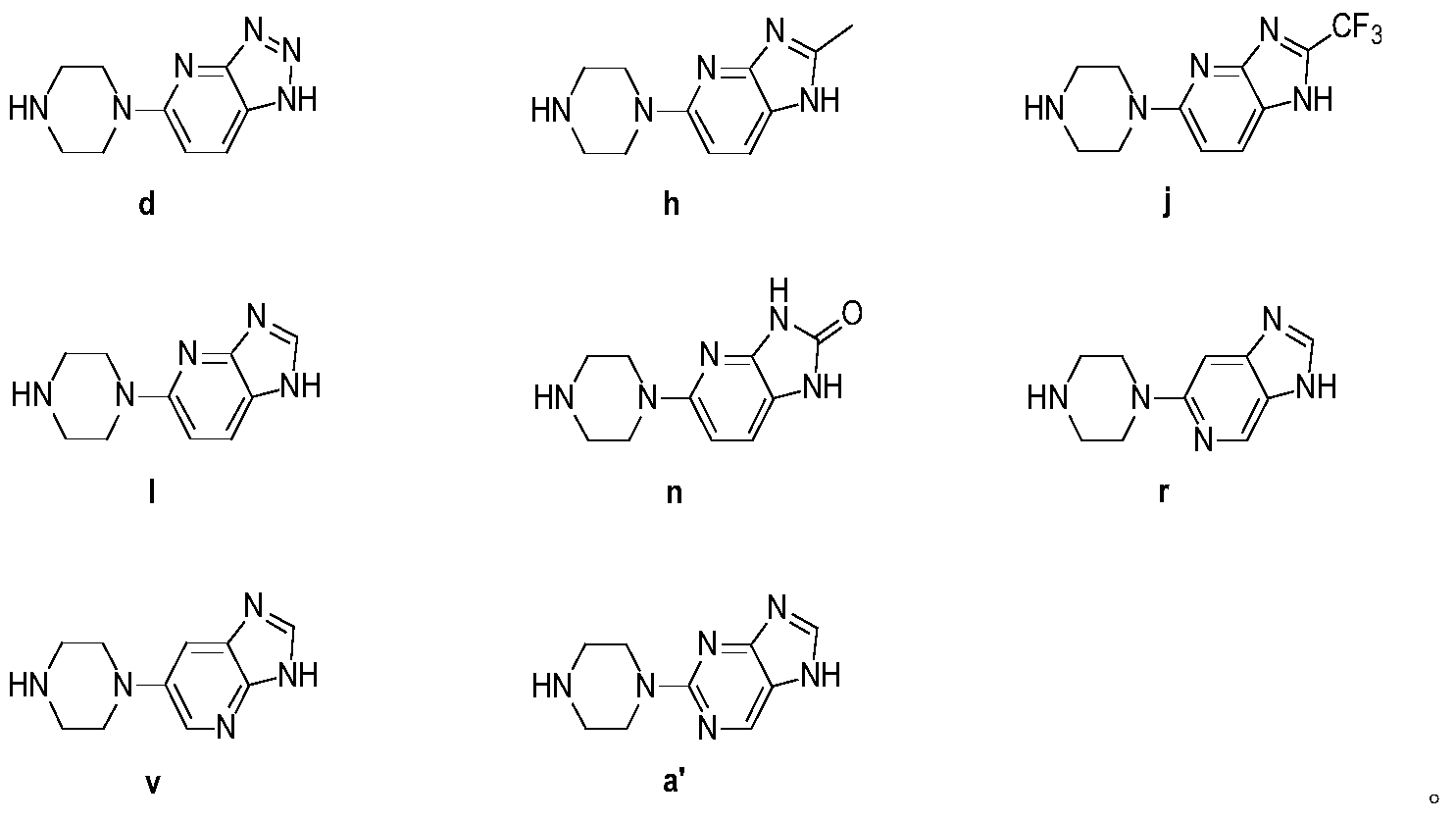
在一个溶有化合物c(1.52g,5mmol)的二氯甲烷溶液(10mL)中加入三氟乙酸(2.28g,20mmol),室温反应8小时后减压除去溶剂,残余物用二氯甲烷(20mL)溶解,加入碳酸氢钠直至pH=8,浓缩除去溶剂,残余物经快速柱层析分离(二氯甲烷:甲醇=10:1)得到淡黄色固体化合物d:5-(哌嗪-1-基)-1氢-[1,2,3]三唑[4,5-b]哌啶(0.87g,收率86%)。MS(ESI)m/z:[M+H]+=205。
步骤5:2-氟-4-((3-氧代异苯并呋喃-1(3氢)-亚基)甲基)苯氰的制备
冰浴下,在一个溶有甲醇钠(61.8g,1.14mol)的无水甲醇溶液(1L)中缓慢加入亚磷酸二甲酯(97mL,1.06mol)。保持反应体系温度低于5℃,20分钟内缓慢滴加2-羧基苯甲醛(135g,0.9mol)。上述反应体系逐渐升至室温,并在半小时内逐渐滴加甲基磺酸(81.6mL,1.26mol)。减压除去溶剂后,残余物用水(600mL)稀释,并用二氯甲烷(500mL)萃取三次。合并有机相,并用水(100mL)萃取两次,有机相用无水硫酸镁干燥。减压除去溶剂得到淡黄色固体化合物3-氧代-1,3-二氢苯并异呋喃-1-基亚磷酸二甲酯,未经纯化直接投入下一步反应。将溶有上步反应未经纯化的化合物3-氧代-1,3-二氢苯并异呋喃-1-基亚磷酸二甲酯(35g,0.14mol)的四氢呋喃溶液(330mL)中加入2-氟-5-甲酰基苯氰(20.9g, 0.14mol),体系降温至15℃,30分钟内缓慢滴加三乙胺(19.5mL,0.14mol)。上述反应体系逐渐升至室温,减压除去溶剂,残余物用水(250mL)打浆,过滤得到白色固体化合物e:2-氟-4-((3-氧代异苯并呋喃-1(3氢)-亚基)甲基)苯氰(37.2g,收率96%)。
步骤6:2-氟-5-((4-氧代-3,4-二氢呔嗪-1-基)甲基)苯甲酸的制备
在一个溶有化合物e(37g,0.14mol)的水溶液(200mL)中加入13N氢氧化钠溶液(50mL),升温至90℃搅拌1小时。将上述反应体系降至70℃后加入水合肼(100mL,2mol),保持该温度搅拌18小时。反应液冷却至室温,使用8N的盐酸调节上述体系至pH=4,过滤,滤饼依次用水(60mL)洗涤两次,乙醚(50mL)洗涤三次,真空干燥得到白色固体化合物f:2-氟-5-((4-氧代-3,4-二氢呔嗪-1-基)甲基)苯甲酸(30.1g,收率77%)。MS(ESI)m/z:[M+H]+=299。
步骤7:4-(3-(4-(1氢-[1,2,3]三唑[4,5-b]吡啶-5-基)哌嗪-1-羰基)-4-氟苄基)呔嗪-1(二氢)-酮的制备
在一个溶有化合物f(50mg,0.17mmol)的二甲基甲酰胺溶液(5mL)中加入化合物d(49mg,0.24mmol)、2-(7-偶氮苯并三氮唑)-N,N,N',N'-四甲基脲六氟磷酸酯(77mg,0.2mmol)和三乙胺(70mg,0.7mmol),室温搅拌过夜。浓缩除去溶剂,残余物经快速柱层析分离(二氯甲烷:甲醇=10:1)得到白色固体化合物(1):4-(3-(4-(1氢-[1,2,3]三唑[4,5-b]吡啶-5-基)哌嗪-1-羰基)-4-氟苄基)呔嗪-1(二氢)-酮(16mg,收率20%)。MS(ESI)m/z:[M+H]+=485。1H NMR(300MHz,DMSO-d6):δ12.57(s,1H),8.24-8.12(m,2H),7.96-7.74(m,1H),7.89-7.81(m,3H),7.43-7.38(m,2H),7.26-7.21(m,1H),7.05-6.99(m,1H),4.32(s,2H),3.73(br,6H),3.57(br,2H)。
实施例2
化合物(2):4-(4-氟-3-(4-(2-甲基-1氢-咪唑并[4,5-b]吡啶-5-基)哌嗪-1-羰基)苄基)呔嗪-1(二氢)-酮的制备,具体反应式如下:
Figure PCTCN2016079489-appb-000014
步骤1:4-(2-甲基-1氢-咪唑并[4,5-b]吡啶-5-基)哌嗪-1-碳酸叔丁酯的制备
在一个溶有化合物b(1.47g,5mmol)的乙酸溶液(30mL)中加入乙酸酐(0.56g,5.5mmol),升温至回流,反应8小时后冷却,减压除去溶剂,残余物经快速柱层析分离(二氯甲烷:甲醇=10:1)得到淡黄色固体化合物g:4-(2-甲基-1氢-咪唑并[4,5-b]吡啶-5-基)哌嗪-1-碳酸叔丁酯(0.73g,收率46%)。MS(ESI)m/z:[M+H]+=318。
步骤2:2-甲基-5-(哌嗪-1-基)-1氢-咪唑并[4,5-b]吡啶的制备
采用实施例1步骤4制备化合物d类似的方法,通过化合物g与三氟乙酸发生脱除保护基反应制得化合物h:2-甲基-5-(哌嗪-1-基)-1氢-咪唑并[4,5-b]吡啶(320mg,收率82%)。MS(ESI)m/z:[M+H]+=218。
步骤3:4-(4-氟-3-(4-(2-甲基-1氢-咪唑并[4,5-b]吡啶-5-基)哌嗪-1-羰基)苄基)呔嗪-1(二氢)-酮的制备
采用实施例1步骤7制备化合物(1)类似的方法,通过化合物h与化合物f发生缩合反应制得化合物(2):4-(4-氟-3-(4-(2-甲基-1氢-咪唑并[4,5-b]吡啶-5-基)哌嗪-1-羰基)苄基)呔嗪-1(二氢)-酮(26mg,收率32%)。MS(ESI)m/z:[M+H]+=498。1H NMR(300MHz,DMSO-d6):δ12.55(s,1H),8.23-8.12(m,2H),7.96-7.75(m,1H),7.89-7.80(m,3H),7.44-7.38(m,2H),7.27-7.22(m,1H),7.06-6.98(m,1H),4.33(s,2H),3.72(br,4H),3.56(br,4H),2.63(s,3H)。
实施例3
化合物(3):4-(4-氟-3-(4-(2-三氟甲基)-1氢-咪唑并[4,5-b]吡啶-5-基)哌嗪-1-羰基)苄基)呔嗪-1(二氢)-酮的制备,具体反应式如下:
Figure PCTCN2016079489-appb-000015
步骤1:4-(2-三氟甲基-1氢-咪唑并[4,5-b]吡啶-5-基)哌嗪-1-碳酸叔丁酯的制备
在一个溶有化合物b(1.47g,5mmol)的三氟乙酸溶液(30mL)中加入三氟乙酸酐(1.16g,5.5mmol),升温至回流,反应8小时后冷却,减压除去溶剂,残余物经快速柱层析分离(二氯甲烷:甲醇=10:1)得到淡黄色固体化合物i:4-(2-三氟甲基-1氢-咪唑并[4,5-b]吡啶-5-基)哌嗪-1-碳酸叔丁酯(0.69g,收率37%)。MS(ESI)m/z:[M+H]+=372。
步骤2:5-(哌嗪-1-基)-2-三氟甲基-1氢-咪唑并[4,5-b]吡啶的制备
采用实施例1步骤4制备化合物d类似的方法,通过化合物i与三氟乙酸发生脱除保护基反应制得化合物j:5-(哌嗪-1-基)-2-三氟甲基-1氢-咪唑并[4,5-b]吡啶(269mg,收率78%)。MS(ESI)m/z:[M+H]+=272。
步骤3:4-(4-氟-3-(4-(2-三氟甲基)-1氢-咪唑并[4,5-b]吡啶-5-基)哌嗪-1-羰基)苄基)呔嗪-1(二氢)-酮的制备
采用实施例1步骤7制备化合物(1)类似的方法,通过化合物j与化合物f发生缩合反应制得化合物(3):4-(4-氟-3-(4-(2-甲基-1氢-咪唑并[4,5-b]吡啶-5-基)哌嗪-1-羰基)苄基)呔嗪-1(二氢)-酮(38mg,收率41%)。MS(ESI)m/z:[M+H]+=552。1H NMR(300MHz,DMSO-d6):δ12.59(br,1H),8.25(d,1H,J=8.1Hz),7.98-7.89(m,3H),7.87-7.80(m,2H),7.45-7.38(m,2H),7.26-7.20(m,1H),6.92(d,1H,J=9.0Hz),4.33(s,2H),3.73(br,2H),3.63(br,2H),3.46(br,4H)。
实施例4
化合物(4):4-(3-(4-(1氢-咪唑并[4,5-b]吡啶-5-基)哌嗪-1-羰基)-4-氟苄基) 呔嗪-1(二氢)-酮的制备,具体反应式如下:
Figure PCTCN2016079489-appb-000016
步骤1:4-(1氢-咪唑并[4,5-b]吡啶-5-基)哌嗪-1-碳酸叔丁酯的制备
在一个溶有化合物b(1.47g,5mmol)的原甲酸三甲酯溶液(6g)中加入对甲苯磺酸(86mg,0.5mmol),升温至回流,反应8小时后冷却,减压除去溶剂,残余物经快速柱层析分离(二氯甲烷:甲醇=10:1)得到淡黄色固体化合物k:4-(1氢-咪唑并[4,5-b]吡啶-5-基)哌嗪-1-碳酸叔丁酯(0.73g,收率48%)。MS(ESI)m/z:[M+H]+=304。
步骤2:5-(哌嗪-1-基)-1氢-咪唑并[4,5-b]吡啶的制备
采用实施例1步骤4制备化合物d类似的方法,通过化合物k与三氟乙酸发生脱除保护基反应制得化合物l:5-(哌嗪-1-基)-1氢-咪唑并[4,5-b]吡啶(307mg,收率73%)。MS(ESI)m/z:[M+H]+=204。
步骤3:4-(3-(4-(1氢-咪唑并[4,5-b]吡啶-5-基)哌嗪-1-羰基)-4-氟苄基)呔嗪-1(二氢)-酮的制备
采用实施例1步骤7制备化合物(1)类似的方法,通过化合物l与化合物f发生缩合反应制得化合物(4):4-(3-(4-(1氢-咪唑并[4,5-b]吡啶-5-基)哌嗪-1-羰基)-4-氟苄基)呔嗪-1(二氢)-酮(25mg,收率31%)。MS(ESI)m/z:[M+H]+=484。1H NMR(300MHz,DMSO-d6):δ12.61(br,1H),8.27-8.24(m,1H),8.16(s,1H),8.00-7.97(m,1H),7.93-7.82(m,4H),7.45-7.39(m,2H),7.28-7.22(m,1H),6.83-6.80(m,1H),4.34(s,2H),3.73(br,2H),3.58(br,2H),3.42(br,4H)。
实施例5
化合物(5):4-(4-氟-3-(4-(2-氧代-2,3-二氢-1氢-咪唑并[4,5-b]吡啶-5-基)哌嗪-1-羰基)苄基)呔嗪-1(二氢)-酮的制备,具体反应式如下:
Figure PCTCN2016079489-appb-000017
步骤1:4-(2-氧代-2,3-二氢-1氢-咪唑并[4,5-b]吡啶-5-基)哌嗪-1-碳酸叔丁酯的制备
在一个溶有化合物b(1.47g,5mmol)的无水四氢呋喃溶液(20mL)中加入羰基二咪唑(1.62g,10mmol),升温至回流,反应8小时后冷却,减压除去溶剂,残余物经快速柱层析分离(二氯甲烷:甲醇=10:1)得到淡黄色固体化合物m:4-(2-氧代-2,3-二氢-1氢-咪唑并[4,5-b]吡啶-5-基)哌嗪-1-碳酸叔丁酯(1.24g,收率78%)。MS(ESI)m/z:[M+H]+=320。
步骤2:5-(哌嗪-1-基)-1氢-咪唑并[4,5-b]吡啶-2(3氢)-酮的制备
采用实施例1步骤4制备化合物d类似的方法,通过化合物m与三氟乙酸发生脱除保护基反应制得化合物n:5-(哌嗪-1-基)-1氢-咪唑并[4,5-b]吡啶-2(3氢)-酮(331mg,收率79%)。MS(ESI)m/z:[M+H]+=220。
步骤3:4-(4-氟-3-(4-(2-氧代-2,3-二氢-1氢-咪唑并[4,5-b]吡啶-5-基)哌嗪-1-羰基)苄基)呔嗪-1(二氢)-酮的制备
采用实施例1步骤7制备化合物(1)类似的方法,通过化合物n与化合物f发生缩合反应制得化合物(5):4-(4-氟-3-(4-(2-氧代-2,3-二氢-1氢-咪唑并[4,5-b]吡啶-5-基)哌嗪-1-羰基)苄基)呔嗪-1(二氢)-酮(32mg,收率36%)。MS(ESI)m/z:[M+H]+=500。1H NMR(300MHz,DMSO-d6):δ12.58(br,1H),10.97(br,1H),10.39(br,1H),8.28-8.26(m,1H),7.99-7.96(m,1H),7.92-7.81(m,2H),7.46-7.42 (m,1H),7.39-7.37(m,1H),7.27-7.20(m,1H),7.11(d,1H,J=8.4Hz),6.36(d,1H,J=8.4Hz),4.33(s,2H),3.73(br,2H),3.40(br,2H),3.26-3.21(br,4H)。
实施例6
化合物(6):4-(3-(4-(3氢-咪唑并[4,5-c]吡啶-6-基)哌嗪-1-羰基)-4-氟苄基)呔嗪-1(二氢)-酮的制备,具体反应式如下:
Figure PCTCN2016079489-appb-000018
步骤1:4-(4-氨基-5-硝基哌啶-2-基)哌嗪-1-碳酸叔丁酯的制备
采用实施例1步骤1制备化合物a类似的方法,通过化合物单叔丁氧羰基保护哌嗪与2-氯-5-硝基-4-氨基吡啶发生亲核取代反应制得化合物o:4-(4-氨基-5-硝基哌啶-2-基)哌嗪-1-碳酸叔丁酯(1.1g,收率86%)。MS(ESI)m/z:[M+H]+=324。
步骤2:4-(4,5-二氨基哌啶-2-基)哌嗪-1-碳酸叔丁酯的制备
采用实施例1步骤2制备化合物b类似的方法,通过化合物o发生催化氢化反应制得化合物p:4-(4,5-二氨基哌啶-2-基)哌嗪-1-碳酸叔丁酯(0.9g,收率97%)。MS(ESI)m/z:[M+H]+=294。
步骤3:4-(3氢-咪唑并[4,5-c]吡啶-6-基)哌嗪-1-碳酸叔丁酯的制备
采用实施例4步骤1制备化合物k类似的方法,通过化合物p与原甲酸三甲酯发生环合反应化合物q:4-(3氢-咪唑并[4,5-c]吡啶-6-基)哌嗪-1-碳酸叔丁酯(0.6g,收率82%)。MS(ESI)m/z:[M+H]+=304。
步骤4:6-(哌嗪-1-基)-3氢-咪唑并[4,5-c]吡啶的制备
采用实施例1步骤4制备化合物d类似的方法,通过化合物q与三氟乙酸发生脱除保护基反应制得化合物r:6-(哌嗪-1-基)-3氢-咪唑并[4,5-c]吡啶(279mg,收率75%)。MS(ESI)m/z:[M+H]+=204。
步骤5:4-(3-(4-(3氢-咪唑并[4,5-c]吡啶-6-基)哌嗪-1-羰基)-4-氟苄基)呔嗪 -1(二氢)-酮的制备
采用实施例1步骤7制备化合物(1)类似的方法,通过化合物r与化合物f发生缩合反应制得化合物(6):4-(3-(4-(3氢-咪唑并[4,5-c]吡啶-6-基)哌嗪-1-羰基)-4-氟苄基)呔嗪-1(二氢)-酮(16mg,收率20%)。MS(ESI)m/z:[M+H]+=484。1H NMR(300MHz,DMSO-d6):δ12.57(s,1H),12.35(s,1H),8.54(s,1H),8.25(d,1H,J=7.8Hz),8.09(s,1H),7.98-7.80(m,3H),7.42-7.37(m,2H),7.26-7.20(m,2H),6.76(s,1H),4.33(s,2H),3.75(br,2H),3.50(br,2H),3.39(br,4H)。
实施例7
化合物(7):4-(3-(4-(3氢-咪唑并[4,5-b]吡啶-6-基)哌嗪-1-羰基)-4-氟苄基)呔嗪-1(二氢)-酮的制备,具体反应式如下:
Figure PCTCN2016079489-appb-000019
步骤1:4-(5-氨基-6-硝基哌啶-3-基)哌嗪-1-碳酸叔丁酯的制备
采用实施例1步骤1制备化合物a类似的方法,通过化合物单叔丁氧羰基保护哌嗪与5-溴-2-硝基-3-氨基吡啶发生亲核取代反应制得化合物s:4-(5-氨基-6-硝基哌啶-3-基)哌嗪-1-碳酸叔丁酯(0.7g,收率82%)。MS(ESI)m/z:[M+H]+=324。
步骤2:4-(5,6-二氨基哌啶-3-基)哌嗪-1-碳酸叔丁酯的制备
采用实施例1步骤2制备化合物b类似的方法,通过化合物s发生催化氢化反应制得化合物t:4-(5,6-二氨基哌啶-3-基)哌嗪-1-碳酸叔丁酯(0.52g,收率91%)。MS(ESI)m/z:[M+H]+=294。
步骤3:4-(3氢-咪唑并[4,5-b]吡啶-6-基)哌嗪-1-碳酸叔丁酯的制备
采用实施例4步骤1制备化合物k类似的方法,通过化合物t与原甲酸三甲酯发生环合反应化合物u:4-(3氢-咪唑并[4,5-b]吡啶-6-基)哌嗪-1-碳酸叔丁酯(0.36g,收率73%)。MS(ESI)m/z:[M+H]+=304。
步骤4:6-(哌嗪-1-基)-3氢-咪唑并[4,5-b]吡啶的制备
采用实施例1步骤4制备化合物d类似的方法,通过化合物u与三氟乙酸发生脱除保护基反应制得化合物v:6-(哌嗪-1-基)-3氢-咪唑并[4,5-b]吡啶(126mg,收率82%)。MS(ESI)m/z:[M+H]+=204。
步骤5:4-(3-(4-(3氢-咪唑并[4,5-b]吡啶-6-基)哌嗪-1-羰基)-4-氟苄基)呔嗪-1(二氢)-酮的制备
采用实施例1步骤7制备化合物(1)类似的方法,通过化合物v与化合物f发生缩合反应制得化合物(7):4-(3-(4-(3氢-咪唑并[4,5-b]吡啶-6-基)哌嗪-1-羰基)-4-氟苄基)呔嗪-1(二氢)-酮(16mg,收率22%)。MS(ESI):m/z 484[M+1]+.1H NMR(300MHz,DMSO-d6):δ12.59(s,1H),8.25-8.20(m,3H),7.98-7.79(m,3H),7.51-7.45(m,1H),7.42-7.37(m,3H),7.26-7.20(m,1H),4.33(s,2H),3.78(br,2H),3.55-3.47(m,2H),3.19-3.14(m,2H),3.03(br,2H)。
实施例8
化合物(8):4-(3-(4-(7氢-嘌呤-2-基)哌嗪-1-羰基)-4-氟苄基)呔嗪-1(二氢)-酮的制备,具体反应式如下:
Figure PCTCN2016079489-appb-000020
步骤1:2-氯-5-硝基-4-氨基嘧啶的制备
将溶有2,4-二氯-5-硝基嘧啶(500mg,2.5mmol)的四氢呋喃(10mL)中加入碳酸氢钠(238mg,2.8mmol)和氨水(0.3mL),55℃反应2小时后减压除去溶剂,残余物经快速柱层析分离(二氯甲烷:甲醇=100:1)得到白色固体化合物w:2-氯-5-硝基-4-氨基嘧啶(0.47g,收率84%)。MS(ESI)m/z:[M+H]+=175。
步骤2:4-(4-氨基-5-硝基嘧啶-2-基)哌嗪-1-碳酸叔丁酯的制备
采用实施例1步骤1制备化合物a类似的方法,通过化合物单叔丁氧羰基保 护哌嗪与化合物w发生亲核取代反应制得化合物x:4-(4-氨基-5-硝基嘧啶-2-基)哌嗪-1-碳酸叔丁酯(0.61g,收率87%)。MS(ESI)m/z:[M+H]+=325。
步骤3:4-(4,5-二氨基哌啶-2-基)哌嗪-1-碳酸叔丁酯的制备
采用实施例1步骤2制备化合物b类似的方法,通过化合物x发生催化氢化反应制得化合物z:4-(4,5-二氨基哌啶-2-基)哌嗪-1-碳酸叔丁酯(0.26g,收率76%)。MS(ESI)m/z:[M+H]+=295。
步骤4:4-(7氢-嘌呤-2-基)哌嗪-1-碳酸叔丁酯的制备
采用实施例4步骤1制备化合物k类似的方法,通过化合物y与原甲酸三甲酯发生环合反应化合物z:4-(3氢-咪唑并[4,5-b]吡啶-6-基)哌嗪-1-碳酸叔丁酯(0.36g,收率73%)。MS(ESI)m/z:[M+H]+=305。
步骤5:2-(哌嗪-1-基)-7氢-嘌呤的制备
采用实施例1步骤4制备化合物d类似的方法,通过化合物z与三氟乙酸发生脱除保护基反应制得化合物a’:2-(哌嗪-1-基)-7氢-嘌呤(141mg,收率74%)。MS(ESI)m/z:[M+H]+=205。
步骤6:4-(3-(4-(7氢-嘌呤-2-基)哌嗪-1-羰基)-4-氟苄基)呔嗪-1(二氢)-酮的制备
采用实施例1步骤7制备化合物(1)类似的方法,通过化合物a’与化合物f发生缩合反应制得化合物(8):4-(3-(4-(7氢-嘌呤-2-基)哌嗪-1-羰基)-4-氟苄基)呔嗪-1(二氢)-酮(88mg,收率74%)。MS(ESI)m/z:485[M+1]+.1H NMR(300MHz,DMSO-d6):δ12.78(s,1H),12.57(s,1H),8.72(s,1H),8.26-8.24(m,1H),8.12(s,1H),7.98-7.96(m,1H),7.91-7.87(m,1H),7.84-7.80(m,1H),7.45-7.41(m,1H),7.39-7.37(m,1H),7.25-7.21(m,1H),4.32(s,2H),3.81-3.79(m,2H),3.72-3.65(m,4H),3.28-3.26(m,2H)。
实施例9
化合物(9):4-(3-(4-(2-羰基-2,3-二氢-1氢-咪唑并[4,5-b]吡啶-5-基)哌嗪-1-羰基)苄基)呔嗪-1(二氢)-酮的制备,具体反应式如下:
Figure PCTCN2016079489-appb-000021
步骤1:3-(1,3-二氧代-2,3-二氢-1氢-茚-2-基)苯氰的制备
冰浴下,在一个溶有异苯并呋喃-1(3氢)-酮(51g,0.38mol)和三氰基苯甲醛(52g,0.39mol)的丙酸乙酯溶液(200mL)中在40分钟内缓慢加入溶有25%甲醇钠的甲醇溶液(320mL)。保持反应体系温度低于30℃,上述反应体系逐渐升至室温并加热至回流1小时,继续加入甲醇(100mL)并在回流状态下搅拌1小时。将上述反应体系冷却至室温减压除去溶剂后,残余物用水(1L)稀释并过滤。滤饼用乙醚(200mL)洗涤三次,使用醋酸(110mL)将化合物酸化。过滤,滤饼用水(100mL)洗涤后得到红色固体化合物b’:3-(1,3-二氧代-2,3-二氢-1氢-茚-2-基)苯氰(69g,收率94%)。
步骤2:3-((4-氧代-3,4-二氢呔嗪-1-基)甲基)苯甲酸的制备
采用实施例1步骤6制备化合物f类似的方法,通过化合物b’发生水解反应制得化合物c’:3-((4-氧代-3,4-二氢呔嗪-1-基)甲基)苯甲酸(28g,收率55%)。MS(ESI)m/z:281[M+1]+
步骤3:4-(3-(4-(2-羰基-2,3-二氢-1氢-咪唑并[4,5-b]吡啶-5-基)哌嗪-1-羰基)苄基)呔嗪-1(二氢)-酮的制备
采用实施例1步骤7制备化合物(1)类似的方法,通过化合物c’与化合物n发生缩合反应制得化合物(9):4-(3-(4-(2-羰基-2,3-二氢-1氢-咪唑并[4,5-b]吡啶-5-基)哌嗪-1-羰基)苄基)呔嗪-1(二氢)-酮(37mg,收率46%)。MS(ESI)m/z:482[M+1]+.1H NMR(300MHz,DMSO-d6):δ12.58(br,1H),10.95(br,1H),10.37(br,1H),8.27-8.24(m,1H),7.97-7.80(m,3H),7.42-7.35(m,3H),7.26-7.23(m,1H),7.11-7.09(m,1H),6.34(d,1H,J=8.7Hz),4.35(s,2H),3.69-3.47(m,4H),3.24-3.14(m,4H)。
实施例10
化合物(10):4-(3-(4-(1氢-[1,2,3]三唑[4,5-b]吡啶-5-基)哌嗪-1-羰基)-苄基)呔嗪-1(二氢)-酮的制备的制备,具体反应式如下:
Figure PCTCN2016079489-appb-000022
采用实施例1步骤7制备化合物(1)类似的方法,通过化合物c’与化合物d发生缩合反应制得化合物(10):4-(3-(4-(1氢-[1,2,3]三唑[4,5-b]吡啶-5-基)哌嗪-1-羰基)-苄基)呔嗪-1(二氢)-酮(41mg,收率52%)。MS(ESI)m/z:467[M+1]+.1H NMR(300MHz,DMSO-d6):δ12.53(s,1H),8.21-8.10(m,2H),7.93-7.71(m,1H),7.87-7.80(m,3H),7.41-7.35(m,3H),7.24-7.20(m,1H),7.02-6.96(m,1H),4.30(s,2H),3.71(br,6H),3.55(br,2H)。
实施例11
化合物(11):4-(3-(4-(2-甲基-1氢-咪唑并[4,5-b]吡啶-5-基)哌嗪-1-羰基)苄基)呔嗪-1(二氢)-酮的制备的制备,具体反应式如下:
Figure PCTCN2016079489-appb-000023
采用实施例1步骤7制备化合物(1)类似的方法,通过化合物c’与化合物h发生缩合反应制得化合物(11):4-(3-(4-(2-甲基-1氢-咪唑并[4,5-b]吡啶-5-基)哌嗪-1-羰基)苄基)呔嗪-1(二氢)-酮(34mg,收率45%)。MS(ESI)m/z:480[M+1]+.1H NMR(300MHz,DMSO-d6):δ12.52(s,1H),8.21-8.10(m,2H),7.94-7.72(m,1H),7.87-7.77(m,3H),7.41-7.34(m,3H),7.26-7.21(m,1H),7.03-6.97(m,1H),4.31(s,2H),3.71(br,4H),3.52(br,4H),2.61(s,3H)。
实施例12
化合物(12):4-(3-(4-(2-三氟甲基)-1氢-咪唑并[4,5-b]吡啶-5-基)哌嗪-1-羰基)苄基)呔嗪-1(二氢)-酮的制备的制备,具体反应式如下:
Figure PCTCN2016079489-appb-000024
采用实施例1步骤7制备化合物(1)类似的方法,通过化合物c’与化合物j发生缩合反应制得化合物(12):4-(3-(4-(2-三氟甲基)-1氢-咪唑并[4,5-b]吡啶-5-基)哌嗪-1-羰基)苄基)呔嗪-1(二氢)-酮(36mg,收率42%)。MS(ESI)m/z:534[M+1]+.1H NMR(300MHz,DMSO-d6):δ12.56(br,1H),8.22(d,1H,J=8.1Hz),7.95-7.87(m,3H),7.83-7.76(m,3H),7.42-7.36(m,2H),7.22-7.17(m,1H),6.91(d,1H,J=9.0Hz),4.30(s,2H),3.72(br,2H),3.61(br,2H),3.42(br,4H)。
实施例13
化合物(13):4-(3-(4-(1氢-咪唑并[4,5-b]吡啶-5-基)哌嗪-1-羰基)苄基)呔嗪-1(二氢)-酮的制备的制备,具体反应式如下:
Figure PCTCN2016079489-appb-000025
采用实施例1步骤7制备化合物(1)类似的方法,通过化合物c’与化合物l发生缩合反应制得化合物(13):4-(3-(4-(1氢-咪唑并[4,5-b]吡啶-5-基)哌嗪-1-羰基)苄基)呔嗪-1(二氢)-酮(48mg,收率58%)。MS(ESI)m/z:466[M+1]+.1H NMR(300MHz,DMSO-d6):δ12.57(br,1H),12.50(br,1H),8.23(d,1H,J=7.6Hz),8.00(s,1H),7.96-7.93(m,1H),7.88-7.72(m,3H),7.40-7.34(m,3H),7.25-7.24(m,1H),6.79-6.73(m,1H),4.33(s,2H),3.68-3.38(m,8H)。
实施例14
化合物(14):4-(3-(4-(1氢-咪唑并[4,5-b]吡啶-5-基)哌嗪-1-羰基)-4-甲氧基苄基)呔嗪-1(二氢)-酮的制备,具体反应式如下:
Figure PCTCN2016079489-appb-000026
步骤1:3-溴-4-甲氧基苯甲酸甲酯的制备
在一个溶有4-甲氧基苯甲酸甲酯(1.5g,9mol)的水溶液(10mL)中于室温下缓慢加入溴酸钾(251mg,1.5mmol)和液溴(722mg,4.5mmol)。保持反应体系温度低于30℃搅拌2.5小时。将上述反应体系加入甲基叔丁基醚(25mL),萃取后有机相用饱和食盐水洗涤,干燥浓缩所得残余物经快速柱层析分离(石油醚:乙酸乙酯=10:1)得到白色固体化合物d’:3-溴-4-甲氧基苯甲酸甲酯(2.1g,收率95%)。
步骤2:3-氰基-4-甲氧基苯甲酸甲酯的制备
在一个溶有化合物d’(1.1g,4.4mol)的二甲基甲酰胺溶液(10mL)中加入氰化亚铜(1.2g,13.22mmol)。加热至140℃搅拌6小时。将上述反应体系冷却后加入乙酸乙酯(25mL),萃取后有机相用饱和食盐水洗涤,干燥浓缩所得残余物经快速柱层析分离(石油醚:乙酸乙酯=10:1)得到白色固体化合物e’:3-氰基-4-甲氧基苯甲酸甲酯(662mg,收率79%)。
步骤3:5-(羟甲基)-2-甲氧基苯氰的制备
在一个溶有化合物e’(1g,5.2mol)的四氢呋喃溶液(25mL)中加入硼氢化锂(0.45g,20.7mmol)。室温下搅拌过夜。将上述反应体系干燥浓缩,所得残余物经快速柱层析分离(石油醚:乙酸乙酯=2:1)得到白色固体化合物f’:5-(羟甲基)-2-甲氧基苯氰(845mg,收率100%)。
步骤4:5-甲酰基-2-甲氧基苯氰的制备
在一个溶有化合物f’(845mg,5.2mol)的二氯甲烷溶液(50mL)中加入(1,1,1- 三乙酰基)-1,1-二氢-1,2-苯碘酰-3(1氢)-酮(2.6g,6.2mmol)。室温下搅拌2小时。将上述反应体系干燥浓缩,所得残余物经快速柱层析分离(石油醚:乙酸乙酯=3:1)得到白色固体化合物g’:5-甲酰基-2-甲氧基苯氰(845mg,收率100%)。
步骤5:2-甲氧基-5-((3-氧代异苯并呋喃-1(3氢)-亚基)甲基)苯氰的制备
采用实施例1步骤5制备化合物e类似的方法,通过化合物g’与3-氧代-1,3-二氢苯并异呋喃-1-基亚磷酸二甲酯发生反应制得化合物h’:2-甲氧基-5-((3-氧代异苯并呋喃-1(3氢)-亚基)甲基)苯氰(795mg,收率67%)。
步骤6:2-甲氧基-5-((4-氧代-3,4-二氢呔嗪-1-基)甲基)苯甲酸的制备
采用实施例1步骤6制备化合物f类似的方法,通过化合物h’发生水解反应制得化合物i’:2-甲氧基-5-((4-氧代-3,4-二氢呔嗪-1-基)甲基)苯甲酸(318mg,收率63%)。MS(ESI)m/z:311[M+1]+
步骤7:4-(3-(4-(1氢-咪唑并[4,5-b]吡啶-5-基)哌嗪-1-羰基)-4-甲氧基苄基)呔嗪-1(二氢)-酮的制备
采用实施例1步骤7制备化合物(1)类似的方法,通过化合物i’与化合物l发生缩合反应制得化合物(14):4-(3-(4-(1氢-咪唑并[4,5-b]吡啶-5-基)哌嗪-1-羰基)-4-甲氧基苄基)呔嗪-1(二氢)-酮(77mg,收率49%)。MS(ESI)m/z:496[M+1]+.1H NMR(300MHz,DMSO-d6):δ12.55(br,1H),8.23(d,1H,J=7.6Hz),8.19(s,1H),7.95(d,1H,J=8.4Hz),7.88-7.80(m,3H),7.39-7.31(m,1H),7.16-7.15(m,1H),7.01(d,1H,J=8.4Hz),6.80(d,1H,J=9.2Hz),4.24(s,2H),3.73(s,3H),3.70-3.69(m,2H),3.56-3.54(m,2H),3.37-3.36(m,2H),3.18-3.16(m,2H)。
实施例15
化合物(15):4-(3-(4-(1氢-咪唑并[4,5-b]吡啶-5-基)哌嗪-1-羰基)-4-三氟甲基苄基)呔嗪-1(二氢)-酮的制备,具体反应式如下:
Figure PCTCN2016079489-appb-000027
步骤1:3-溴-4-三氟甲基苯甲酸甲酯的制备
在一个溶有3-溴-4-三氟甲基苯甲酸(4.1g,15.4mol)的甲醇溶液(30mL)中于室温下缓慢加入浓硫酸(1mL)。反应加热至60℃搅拌6小时。冷却至室温,将上述反应体系加入乙酸乙酯(25mL),萃取后有机相用饱和食盐水洗涤,干燥浓缩所得残余物经快速柱层析分离(石油醚:乙酸乙酯=10:1)得到白色固体化合物j’:3-溴-4-三氟甲基苯甲酸甲酯(4.2g,收率96%)。
步骤2:3-氰基-4-三氟甲基苯甲酸甲酯的制备
采用实施例14步骤2制备化合物e’类似的方法,通过化合物j’发生氰基化反应制得化合物k’:3-氰基-4-三氟甲基苯甲酸甲酯(1.6g,收率64%)。MS(ESI)m/z:230[M+1]+
步骤3:5-(羟甲基)-2-三氟甲基苯氰的制备
采用实施例14步骤3制备化合物f’类似的方法,通过化合物k’发生还原反应制得化合物l’:5-(羟甲基)-2-三氟甲基苯氰(1.2g,收率87%)。MS(ESI)m/z:202[M+1]+
步骤4:5-甲酰基-2-三氟甲基苯氰的制备
采用实施例14步骤4制备化合物g’类似的方法,通过化合物l’发生还原反应制得化合物m’:5-甲酰基-2-三氟甲基苯氰(1.3g,收率96%)。MS(ESI)m/z:200[M+1]+
步骤5:2-三氟甲基-5-((3-氧代异苯并呋喃-1(3氢)-亚基)甲基)苯氰的制备
采用实施例1步骤5制备化合物e类似的方法,通过化合物m’与3-氧代-1,3-二氢苯并异呋喃-1-基亚磷酸二甲酯发生反应制得化合物n’:2-三氟甲基-5-((3- 氧代异苯并呋喃-1(3氢)-亚基)甲基)苯氰(721mg,收率69%)。
步骤6:2-三氟甲基-5-((4-氧代-3,4-二氢呔嗪-1-基)甲基)苯甲酸的制备
采用实施例1步骤6制备化合物f类似的方法,通过化合物n’发生水解反应制得化合物o’:2-三氟甲基-5-((4-氧代-3,4-二氢呔嗪-1-基)甲基)苯甲酸(678mg,收率86%)。MS(ESI)m/z:349[M+1]+
步骤7:4-(3-(4-(1氢-咪唑并[4,5-b]吡啶-5-基)哌嗪-1-羰基)-4-三氟甲基苄基)呔嗪-1(二氢)-酮的制备
采用实施例1步骤7制备化合物(1)类似的方法,通过化合物o’与化合物l发生缩合反应制得化合物(15):4-(3-(4-(1氢-咪唑并[4,5-b]吡啶-5-基)哌嗪-1-羰基)-4-三氟甲基苄基)呔嗪-1(二氢)-酮(65mg,收率53%)。MS(ESI)m/z:534[M+1]+.1H NMR(300MHz,DMSO-d6):δ12.57(s,1H),8.24(d,1H,J=0.8Hz),8.23(s,1H),7.96-7.80(m,4H),7.73(d,1H,J=8.0Hz),7.54(d,1H,J=8.0Hz),7.50(s,1H),6.77(d,1H,J=8.4Hz),4.42(s,2H),3.82-3.77(m,1H),3.68-3.62(m,1H),3.59-3.52(m,2H),3.36-3.29(m,2H),3.19-3.10(m,2H)。
实施例16
化合物(16):4-(3-(4-(1氢-[1,2,3]三唑[4,5-b]吡啶-5-基)哌嗪-1-羰基)-4-三氟甲基苄基)呔嗪-1(二氢)-酮的制备,具体反应式如下:
Figure PCTCN2016079489-appb-000028
采用实施例1步骤7制备化合物(1)类似的方法,通过化合物o’与化合物d发生缩合反应制得化合物(16):4-(3-(4-(1氢-[1,2,3]三唑[4,5-b]吡啶-5-基)哌嗪-1-羰基)-4-三氟甲基苄基)呔嗪-1(二氢)-酮(70mg,收率57%)。MS(ESI)m/z:535[M+1]+.1H NMR(300MHz,DMSO-d6):δ12.57(s,1H),8.24(d,1H,J=7.2Hz),8.17(d,1H,J=8.8Hz),7.95-7.81(m,3H),7.74(d,1H,J=8.0Hz),7.55(d,1H,J=8.0Hz),7.51(s,1H),6.98(d,1H,J=9.6Hz),4.42(s,2H),3.80-3.62(m,4H),3.50-3.46(m,2H),3.36-3.30(m,2H)。
实施例17
化合物(17):4-(3-(4-(2-氧代-2,3-二氢-1氢-咪唑并[4,5-b]吡啶-5-基)哌嗪-1-羰基)-4-三氟甲基苄基)呔嗪-1(二氢)-酮的制备,具体反应式如下:
Figure PCTCN2016079489-appb-000029
采用实施例1步骤7制备化合物(1)类似的方法,通过化合物o’与化合物n发生缩合反应制得化合物(17):4-(3-(4-(2-氧代-2,3-二氢-1氢-咪唑并[4,5-b]吡啶-5-基)哌嗪-1-羰基)-4-三氟甲基苄基)呔嗪-1(二氢)-酮(67mg,收率53%)。MS(ESI)m/z:550[M+1]+.1H NMR(300MHz,DMSO-d6):δ12.57(s,1H),10.95(s,1H),10.37(s,1H),8.23(d,1H,J=7.2Hz),7.94-7.80(m,3H),7.73(d,1H,J=8.0Hz),7.54(d,1H,J=8.0Hz),7.47(s,1H),7.09(d,1H,J=8.0Hz),6.33(d,1H,J=8.0Hz),4.42(s,2H),3.70-3.64(m,1H),3.64-3.59(m,1H),3.42-3.25(m,2H),3.14-3.08(m,4H)。
实施例18
化合物(18):4-(3-(4-(3氢-咪唑并[4,5-c]吡啶-6-基)哌嗪-1-羰基)-4-甲氧基苄基)呔嗪-1(二氢)-酮的制备,具体反应式如下:
Figure PCTCN2016079489-appb-000030
采用实施例1步骤7制备化合物(1)类似的方法,通过化合物i’与化合物r发生缩合反应制得化合物(18):4-(3-(4-(3氢-咪唑并[4,5-c]吡啶-6-基)哌嗪-1-羰基)-4-甲氧基苄基)呔嗪-1(二氢)-酮(54mg,收率34%)。MS(ESI)m/z:496[M+1]+.1H NMR(300MHz,DMSO-d6):δ12.55(s,1H),8.56(s,1H),8.23(s,1H),8.22(s,1H),7.93(d,1H,J=8.0Hz),7.87-7.77(m,3H),7.31(d,1H,J=8.0Hz),7.15(s,1H), 7.00(d,1H,J=8.0Hz),6.82(s,1H),4.23(s,2H),3.71(br,5H),3.47-3.46(m,2H),3.32-3.18(m,4H)。
实施例19
化合物(19):4-(3-(4-(3氢-咪唑并[4,5-c]吡啶-6-基)哌嗪-1-羰基)-4-三氟甲基苄基)呔嗪-1(二氢)-酮的制备,具体反应式如下:
Figure PCTCN2016079489-appb-000031
采用实施例1步骤7制备化合物(1)类似的方法,通过化合物o’与化合物r发生缩合反应制得化合物(19):4-(3-(4-(3氢-咪唑并[4,5-c]吡啶-6-基)哌嗪-1-羰基)-4-甲氧基苄基)呔嗪-1(二氢)-酮(46mg,收率46%)。MS(ESI)m/z:534[M+1]+.1H NMR(300MHz,DMSO-d6):δ12.57(s,1H),8.55(s,1H),8.24(d,1H,J=8.0Hz),8.17(s,1H),7.95-7.72(m,5H),7.55(d,1H,J=8.0Hz),7.48(s,1H),6.80(s,1H),4.43(s,2H),3.81-3.79(m,1H),3.78-3.77(m,1H),3.68-3.64(m,2H),3.49-3.46(m,2H),3.17-3.12(m,2H)。
实施例20
化合物(20):4-(3-(4-(3氢-咪唑并[4,5-b]吡啶-6-基)哌嗪-1-羰基)-4-三氟甲基苄基)呔嗪-1(二氢)-酮的制备,具体反应式如下:
Figure PCTCN2016079489-appb-000032
采用实施例1步骤7制备化合物(1)类似的方法,通过化合物o’与化合物v发生缩合反应制得化合物(20):4-(3-(4-(3氢-咪唑并[4,5-b]吡啶-6-基)哌嗪-1-羰基)-4-三氟甲基苄基)呔嗪-1(二氢)-酮(37mg,收率41%)。MS(ESI)m/z:534[M+1]+.1H NMR(300MHz,DMSO-d6):δ12.57(s,1H),8.47(s,1H),8.24(s,1H), 8.22(s,1H),7.95-7.73(m,5H),7.55(d,1H,J=8.0Hz),7.50(s,1H),7.49(s,1H),4.43(s,2H),3.85-3.82(m,1H),3.73-3.70(m,1H),3.20-3.19(m,4H),2.98(m,2H)。
实施例21
化合物(21):4-(3-(4-(3氢-咪唑并[4,5-b]吡啶-6-基)哌嗪-1-羰基)-4-甲氧基苄基)呔嗪-1(二氢)-酮的制备,具体反应式如下:
Figure PCTCN2016079489-appb-000033
采用实施例1步骤7制备化合物(1)类似的方法,通过化合物i’与化合物v发生缩合反应制得化合物(21):4-(3-(4-(3氢-咪唑并[4,5-b]吡啶-6-基)哌嗪-1-羰基)-4-甲氧基苄基)呔嗪-1(二氢)-酮(66mg,收率42%)。MS(ESI)m/z:496[M+1]+.1H NMR(300MHz,DMSO-d6):δ12.55(s,1H),8.37(s,1H),8.23(s,1H),8.21(s,1H),7.94-7.76(m,3H),7.49(s,1H),7.31(d,1H,J=8.0Hz),7.15-7.12(m,1H),7.00(d,1H,J=8.0Hz),6.93(s,1H),4.23(s,2H),3.77(s,3H),3.76(br,2H),3.23-3.13(m,4H),3.05-2.97(m,2H)。
生物学评价
例1PARP酶活性测定实验
实验原理:
核蛋白的多聚ADP核糖化是发生在DNA损伤应答时的翻译后。PARP,全称是聚腺苷二磷酸核糖聚合酶,在有NAD存在时,催化多聚(ADP-核糖)连接到临近的核蛋白上,从而引发经由碱基切补修复通路的DNA修复机制。Trevigen公司生产的HT Universal Chemiluminescent PARP Assay Kit能够测量出这种被生物素标记的ADP-核糖与组蛋白的结合水平。
试剂与耗材
1.HT Universal Chemiluminescent PARP Assay Kit with Histone-coated Strip Wells,美国Trevigen,货号:4676-096-K。
2.读板仪,美国Perkin Elmer,EnVision Multilabel Plate Reader。
溶液与缓冲液
1.洗液 含有0.1%Triton X-100的PBS溶液。
2. 20X PARP缓冲液 用去离子水将20X PARP缓冲液稀释20倍即得到1X缓冲液,该缓冲液被用来稀释重组PARP酶,PARP Cocktail和被测试化合物。
3. 10X PARP Cocktail按照以下方法配制1X PARP Cocktail:10X PARP Cocktail 2.5μl/well,10X活化DNA 2.5μl/well,1X PARP缓冲液20μl/well。
4.PARP Enzyme仅在使用前,用1X PARP缓冲液小心稀释重组酶,稀释好的酶溶液要尽快使用,未用完的要废弃掉。
5.Strep-HRP仅在使用前,用1X Strep稀释液稀释Strep-HRP 500倍得到1X溶液。
6.化学发光底物仅在使用前,将相同体积的PeroxyGlow A和B溶液混合均匀得到辣根过氧化物酶的底物。
实验方法
化合物配制
1.用DMSO将10mM各被测化合物母液稀释至10μM,1μM。
2.仅在实验开始前,将溶解在DMSO中的每个化合物的梯度浓度溶液用1XPARP缓冲液稀释20倍,得到5X的化合物溶液,即可用来进行检测,阳性对照(POSITIVE)和阴性对照(NEGATIVE)孔为1X PARP缓冲液(DMSO含量5%),其中,采用AZD2281(Olaparib,阿斯利康制药公司)作为对照化合物。
操作步骤
1.每孔加入50μl 1X PARP缓冲液润湿组蛋白,在室温孵育孔板30分钟,然后将孔里的1X PARP缓冲液吸出,并在纸巾上将残留液体拍干净。
2.根据化合物(1)至(21)及对照化合物AZD2281,将稀释好的5X化合物溶液加入对应的孔中,每孔10μl,阳性对照(POSITIVE)和阴性对照(NEGATIVE)孔为1X PARP缓冲液(DMSO含量5%)。
3.用1X PARP缓冲液将PARP酶稀释至每15μl溶液含有0.5Unit,然后在除了阴性对照孔以外的其他孔加入15μl酶溶液,阴性对照孔只加入1X PARP缓冲液,室温孵育孔板10分钟。
4.继续加入25μl的1X PARP Cocktail到每个孔中。
5. 27℃孵育孔板60分钟。
6.孵育结束后,将孔里的反应液吸出,并在纸巾上将残留液体拍干净。接着用含有0.1%Triton X-100的PBS溶液冲洗孔板4遍,每次每孔用200μl,并在纸巾上将残留液体拍干净。
7.接下来,在每孔中加入稀释好的1X Strep-HRP溶液,然后在27℃孵育孔板60分钟。
8.孵育结束后,将孔里的反应液吸出,并在纸巾上将残留液体拍干净。接着用含有0.1%Triton X-100的PBS溶液冲洗孔板4遍,每次每孔用200μl,并在纸巾上将残留液体拍干净。
9.洗板结束后,将相同体积的PeroxyGlow A和B溶液混合均匀,每孔加入100μl,立即放入读板仪记录化学发光信号。
数据处理
每孔中的读数需要被转换成抑制率。化合物的抑制率可以使用下列公式计算得出:
Figure PCTCN2016079489-appb-000034
注:阳性对照孔读数为positive孔读数,意义为酶100%活性;阴性对照孔读数为negative孔读数,意义为酶0%;活性X为每个样品各个浓度的读数。
表1化合物对PARP-1酶的抑制活性
实施例化合物的编号 IC50(PARP)/nM
(1) 2
(2) 9
(3) 6
(4) 1
(5) 1
(6) 3
(7) 8
(8) 11
(9) 2
(10) 5
(11) 17
(12) 10
(13) 1
(14) 4
(15) 2
(16) 7
(17) 6
(18) 13
(19) 8
(20) 2
(21) 15
对照化合物AZD2281 8
结论:本发明优选化合物对PARP-1酶的抑制增殖具有明显的抑制活性。
例2细胞增殖抑制测定实验
下面的实验用于在体外条件下测定本发明所述化合物对三阴性表型的乳腺癌细胞株MDA-MB-436细胞的增殖抑制活性。
试剂与耗材
1. 1株肿瘤细胞,MDA-MB-436,由辉源生物科技(上海)有限公司提供,均通过了支原体检测。
2.L15培养液,美国Invitrogen,货号:11415-064。
3.胎牛血清,美国Hyclone,货号:CH30160.03。
4.青霉素-链霉素液体,美国Invitrogen,货号:15140-122。
5.DMSO,美国Sigma,货号D4540。
6. 96孔细胞培养板,美国Corning,货号:3610。
7.CellTiter-Glo Luminescent Cell Viability Assay,美国Promega,货号:G7571。
8.读板仪,美国Perkin Elmer,EnVision Multilabel Plate Reader。
细胞培养液
1.L15完全细胞培养液:含有10%胎牛血清和100U青霉素和100μg/ml链霉素的L15培养液。
实验方法
化合物配制
1.用DMSO将个待测化合物配制成60mM的母液,-80°冰箱分装保存。用DMSO将待测化合物母液稀释至一系列的梯度浓度溶液,这些浓度包括6mM,2mM,0.6mM,0.2mM,60μM,20μM。
2.仅在实验开始前,在无菌条件下将配制好的待测化合物梯度浓度溶液用完全细胞培养液稀释100倍,此时,待测化合物的梯度浓度包括60μM,20μM,6μM,2μM,0.6μM,0.2μM,此为2×化合物溶液,即可用来处理细胞。
3.用DMSO将上述(1)至(21)化合物及对照化合物AZD2281母液稀释至一系列的梯度浓度溶液,这些浓度包括20μM,2μM,0.2μM,0.02μM,0.002μM,0.0002μM。在实验开始前,在无菌条件下将配制好的待测化合物梯度浓度溶液用完全细胞培养液稀释100倍,此时,阳性化合物的梯度浓度包括200nM,20nM,2nM,0.2nM,0.02nM,0.002nM,此为2×化合物溶液,即可用来处理细胞。
操作步骤
1.化合物处理前一天将细胞接种在96孔细胞培养板中。接种密度为:8000细胞/50μl/孔。
2.第二天,将配制好的2×化合物溶液按照化合物排列图加入到细胞培养板中,每孔加入50μl。
3.轻轻震荡细胞板,将其放置在37℃培养箱中继续培养120小时。
4.孵育结束后按照CellTiter Glo试剂说明书要求在细胞板中加入配制好的试剂,充分混匀后室温避光孵育10分钟。
5.将细胞板放入读板仪进行分析,设定读取化学发光并记录数据。
数据处理
每孔中的读数需要被转换成细胞存活率。细胞存活率可以使用下列公式计算得出:
Figure PCTCN2016079489-appb-000035
处理后的数据将用GraphPad Prism 5分析软件来做非线性回归分析,得到剂量效应曲线,并计算出待测化合物对MDA-MB-436细胞的半数杀伤浓度(ED50)。
表2化合物对MDA-MB-436细胞的增殖抑制活性
实施例化合物的编号 ED 50(MDA-MB-436)/μM
(1) >25
(2) >25
(3) >25
(4) 0.7
(5) >25
(6) 18
(7) >25
(8) 1.4
(9) >25
(10) >25
(11) >25
(12) >25
(13) 0.7
(14) 6.8
(15) 23
(16) >25
(17) >25
(18) >25
(19) >25
(20) >25
(21) >25
对照化合物AZD2281 >25
结论:本发明的部分优选化合物对MDA-MB-436细胞的增殖具有明显的抑制活性。
例3测试本发明化合物对小鼠的抑瘤实验
下面的实验用于在体内条件下评价并比较本发明所述化合物单用对人乳腺癌细胞株MDA-MB-436移植瘤、人乳腺癌细胞株MX-1移植瘤或人胰腺癌细胞株CAPAN-1移植瘤的疗效。
受试化合物
实施例化合物(4)
实验动物
BALB/cA-nude裸小鼠,6-7周,♀,购自上海斯莱克实验动物有限责任公司。合格证号:SCXK(沪)2012-0002。饲养环境:SPF级。
实验步骤
裸小鼠皮下接种人乳腺癌MDA-MB-436细胞或者人乳腺癌MX-1或者人胰腺癌CAPAN-1,待肿瘤生长至100-200mm3后,将动物随机分组(D0)。给药剂量和给药方案见表1。每周测2-3次瘤体积,称鼠重,记录数据。肿瘤体积(V)计算公式为:
V=1/2×a×b2
其中a、b分别表示长、宽。
T/C(%)=(T-T0)/(C-C0)X 100
其中T、C为实验结束时的肿瘤体积;T0、C0为实验开始时的肿瘤体积。
表3化合物在人乳腺癌MDA-MB-436裸小鼠移植瘤模型上的给药剂量、给药方案和抑瘤疗效结果
化合物 给药途径 给药剂量 给药频率 给药天数 抑瘤率
化合物(4) 口服 30毫克/公斤 1天1次 连续14天 191%
AZD2281 口服 30毫克/公斤 1天1次 连续14天 83%
结论:本发明的部分优选化合物单独给药对人乳腺癌MDA-MB-436移植瘤模型具有明显的抗癌活性。
表4化合物在人乳腺癌MX-1裸小鼠移植瘤模型上的给药剂量、给药方案和抑瘤疗效结果
化合物 给药途径 给药剂量 给药频率 给药天数 抑瘤率
化合物(4) 口服 50毫克/公斤 1天1次 连续21天 193%
AZD2281 口服 50毫克/公斤 1天1次 连续21天 13%
结论:本发明的部分优选化合物单独给药对人乳腺癌MX-1移植瘤模型具有明显的抗癌活性。
表5化合物在人胰腺癌CAPAN-1裸小鼠移植瘤模型上的给药剂量、给药方案和抑瘤疗效结果
化合物 给药途径 给药剂量 给药频率 给药天数 抑瘤率
化合物(4) 口服 50毫克/公斤 1天1次 连续21天 128%
AZD2281 口服 50毫克/公斤 1天1次 连续21天 57%
结论:本发明的部分优选化合物单独给药对人胰腺癌CAPAN-1移植瘤模型具有明显的抗癌活性。

Claims (26)

  1. 杂环并咪唑类化合物,其为通式Ⅰ所示的化合物或其药学上可接受的盐:
    Figure PCTCN2016079489-appb-100001
    其中,通式Ⅰ中,
    R为氢、卤素、C1-C6烷氧基或C1-C6卤代烷基;
    X、Y、Z其中一个为氮,其余为碳氢或者X、Y、Z其中一个为碳氢,其余为氮;
    M为氮或CR1
    R1为氢、氧、烷基、烷氧基或卤代烷基。
  2. 根据权利要求1所述的通式Ⅰ所示的化合物,其中:
    R为氢、卤素、C1-C3烷氧基或C1-C3卤代烷基。
  3. 根据权利要求1至2中任一项所述的通式Ⅰ所示的化合物,其中:
    R为氢、氟、甲氧基或三氟甲基。
  4. 根据权利要求1至3中任一项所述通式Ⅰ所示的化合物,其中:
    X为氮,Y和Z为碳氢或者Z为氮,X和Y为碳氢或者Y为氮,X和Z为碳氢或者X和Z为氮,Y为碳氢。
  5. 根据权利要求1至4中任一项所述的通式Ⅰ所示的化合物,其中:
    R1为氢、氧、C1-C6烷基或C1-C6卤代烷基。
  6. 根据权利要求1至5中任一项所述通式Ⅰ所示的化合物,其中:
    R1为氢、氧、C1-C3烷基或C1-C3卤代烷基。
  7. 根据权利要求1至6中任一项所述的通式Ⅰ所示的化合物,其中:
    R1为氢、氧、甲基或三氟甲基。
  8. 根据权利要求1至7中任一项所述的通式Ⅰ所示的化合物,其中,所述通式Ⅰ所示的化合物为选自如下化合物1~21或其药学上可接受的盐:
    Figure PCTCN2016079489-appb-100002
    Figure PCTCN2016079489-appb-100003
    Figure PCTCN2016079489-appb-100004
  9. 一种制备权利要求1至8中任一项所述的通式Ⅰ所示的化合物或其药学上可接受的盐的方法,其反应式如下:
    Figure PCTCN2016079489-appb-100005
    其中,R、X、Y、Z和M的定义如权利要求1所述;R2为羟基、卤素或二咪唑-1-基;具体步骤如下:
    中间体Ⅴ与呔嗪类羧酸衍生物Ⅵ发生缩合反应,生成通式Ⅰ所示的化合物。
  10. 根据权利要求9所述通式Ⅰ所示的化合物的制备方法,其中,所述的呔嗪类羧酸衍生物Ⅵ所示的化合物如下:
    Figure PCTCN2016079489-appb-100006
  11. 根据权利要求9至10中任一项所述的通式Ⅰ所示的化合物的制备方法,其中,所述缩合反应中使用的缩合剂选自1,1'-羰基二咪唑、1-乙基-(3-二甲基氨基丙基)碳二亚胺盐酸盐、2-(7-偶氮苯并三氮唑)-N,N,N',N'-四甲基脲六氟磷酸酯、苯并三氮唑-N,N,N',N'-四甲基脲六氟磷酸酯。
  12. 一种制备权利要求1至8中任一项所述的通式Ⅰ所示的杂环并咪唑类化合物或其药学上可接受的盐的中间体,所述中间体的结构式如下:
    Figure PCTCN2016079489-appb-100007
    其中,中间体Ⅴ中,
    X、Y、Z其中一个为氮,其余为碳氢或者X、Y、Z其中一个为碳氢,其余为氮;
    M为氮或CR1
    R1为氢、氧、烷基、烷氧基或卤代烷基。
  13. 根据权利要求12所述的中间体,其中,中间体Ⅴ中,
    X和Z为氮,Y为碳氢或者X为氮,Y和Z为碳氢或者Z为氮,X和Y为碳氢或者Y为氮,X和Z为碳氢;
    R1为氢、氧、甲基或三氟甲基。
  14. 根据权利要求12或13所述的中间体,其中,所述的中间体结构选自如下化合物:
    Figure PCTCN2016079489-appb-100008
  15. 药用组合物,其中所述药物组合物包含治疗有效量的权利要求1至8任一项所述的通式Ⅰ所示化合物或其药学上可接受的盐和一种或多种药学可接受的载体物质和/或赋形剂。
  16. 根据权利要求15所述的药物组合物,其中所述的药物组合物制成片剂、胶囊剂、水性混悬剂、油性混悬剂、可分散的粉剂、颗粒剂、锭剂、乳剂、糖浆剂、乳膏剂、栓剂或注射剂。
  17. 根据权利要求15所述的药物组合物,所述的通式Ⅰ所示化合物以游离形式存在。
  18. 一种如权利要求1至8中任一项所述的通式Ⅰ所示的化合物或其药学上可接受的盐或如权利要求15至17任一项所述的药物组合物在制备治疗因PARP活性抑制而改善的疾病药物中的应用。
  19. 根据权利要求18所述应用,所述的因PARP活性抑制而改善的疾病为血管疾病、脓毒性休克、缺血性损伤、神经毒性、出血性休克、炎性疾病、多发性硬化症、神经退行性疾病或糖尿病。
  20. 一种如权利要求1至8中任一项所述的通式Ⅰ所示的化合物或其药学上可接受的盐、或如权利要求15至17任一项所述的药物组合物在制备用于癌症治疗的辅助药物中的应用。
  21. 一种如权利要求1至8中任一项所述的通式Ⅰ所示的化合物或其药学上可接受的盐、或如权利要求15至17任一项所述的药物组合物在制备用于癌症治疗的化疗药物或强化放疗药物中的应用。
  22. 根据权利要求20至21中任一项所述的应用,其中,所述的癌症是同源重组依赖性的DNA双链断裂修复途径缺陷的。
  23. 根据权利要求20至21中任一项所述的应用,其中,所述的癌症包含一种或多种相对于正常细胞通过同源重组依赖性的DNA双链断裂修复的能力降低或丧失的癌细胞。
  24. 根据权利要求20至21中任一项所述的应用,其中,所述的癌症为具有BRCA1或BRCA2缺陷、突变表型的癌症。
  25. 根据权利要求20至21中任一项所述的应用,其中,所述的癌症为BRCA1或/和BRCA2缺陷、突变的癌症。
  26. 根据权利要求20至21中任一项所述的应用,其中,所述的癌症为乳腺癌、卵巢癌、胰腺癌、前列腺癌、直肠癌、结肠癌或肝癌。
PCT/CN2016/079489 2015-04-17 2016-04-15 杂环并咪唑类化合物、其药物组合物及其制备方法和用途 Ceased WO2016165655A1 (zh)

Priority Applications (9)

Application Number Priority Date Filing Date Title
US15/567,359 US10174023B2 (en) 2015-04-17 2016-04-15 Heterocyclic-imidazole compounds, pharmaceutical compositions thereof, preparation method therefor and use thereof
CN201680020160.XA CN107428757B (zh) 2015-04-17 2016-04-15 杂环并咪唑类化合物、其药物组合物及其制备方法和用途
EP16779630.9A EP3284743B1 (en) 2015-04-17 2016-04-15 Heterocyclic-imidazole compounds, pharmaceutical compositions thereof, preparation method therefor and use thereof
KR1020177031194A KR102286526B1 (ko) 2015-04-17 2016-04-15 헤테로시클릭-이미다졸계 화합물, 그 약물 조성물 및 그 제조방법과 용도
RU2017139884A RU2686314C1 (ru) 2015-04-17 2016-04-15 Гетероциклические имидазольные соединения, способ их получения и их применение
CA2983040A CA2983040C (en) 2015-04-17 2016-04-15 Heterocyclic-imidazole compounds, pharmaceutical compositions thereof, preparation method therefor and use thereof
JP2018505516A JP6610975B2 (ja) 2015-04-17 2016-04-15 複素環イミダゾール類化合物、その医薬組成物及びその調製方法と用途
AU2016249437A AU2016249437B2 (en) 2015-04-17 2016-04-15 Heterocyclic-imidazole compounds, pharmaceutical compositions thereof, preparation method therefor and use thereof
ES16779630T ES2927959T3 (es) 2015-04-17 2016-04-15 Compuestos de imidazol heterocíclicos, composiciones farmacéuticas de los mismos, método de preparación de los mismos y uso de los mismos

Applications Claiming Priority (2)

Application Number Priority Date Filing Date Title
CN2015101889652 2015-04-17
CN201510188965.2A CN106146492A (zh) 2015-04-17 2015-04-17 杂环并咪唑类化合物、其药物组合物及其制备方法和用途

Publications (1)

Publication Number Publication Date
WO2016165655A1 true WO2016165655A1 (zh) 2016-10-20

Family

ID=57125643

Family Applications (1)

Application Number Title Priority Date Filing Date
PCT/CN2016/079489 Ceased WO2016165655A1 (zh) 2015-04-17 2016-04-15 杂环并咪唑类化合物、其药物组合物及其制备方法和用途

Country Status (10)

Country Link
US (1) US10174023B2 (zh)
EP (1) EP3284743B1 (zh)
JP (1) JP6610975B2 (zh)
KR (1) KR102286526B1 (zh)
CN (2) CN106146492A (zh)
AU (1) AU2016249437B2 (zh)
CA (1) CA2983040C (zh)
ES (1) ES2927959T3 (zh)
RU (1) RU2686314C1 (zh)
WO (1) WO2016165655A1 (zh)

Cited By (2)

* Cited by examiner, † Cited by third party
Publication number Priority date Publication date Assignee Title
WO2018068715A1 (zh) * 2016-10-14 2018-04-19 上海汇伦生命科技有限公司 抗肿瘤杂环并咪唑类化合物的药用盐
WO2024032529A1 (zh) * 2022-08-12 2024-02-15 上海汇伦医药股份有限公司 一种蛋白降解剂及其制备方法和其在药学上的应用

Families Citing this family (5)

* Cited by examiner, † Cited by third party
Publication number Priority date Publication date Assignee Title
CN108250196B (zh) * 2016-12-29 2022-12-30 上海汇伦医药股份有限公司 (哌嗪-1-基)-1氢-咪唑并杂芳环化合物的制备方法
CN112142726B (zh) * 2019-06-27 2024-01-09 上海汇伦医药股份有限公司 一种抗肿瘤药物盐酸盐水合物晶型
CN114075143A (zh) * 2020-08-21 2022-02-22 吉林汇康制药有限公司 一种奥拉帕利及其中间体的制备方法
CN116672345A (zh) * 2022-02-22 2023-09-01 上海汇伦医药股份有限公司 Parp抑制剂和细胞毒性剂的联合产品及其用途
CN121426806B (zh) * 2025-12-31 2026-04-17 中国科学院杭州医学研究所 一种parg小分子降解剂及其制备方法和应用

Citations (4)

* Cited by examiner, † Cited by third party
Publication number Priority date Publication date Assignee Title
CN1473154A (zh) * 2000-10-30 2004-02-04 ������ҩ�����޹�˾ 2,3-二氮杂萘酮衍生物
CN101048399A (zh) * 2004-08-26 2007-10-03 库多斯药物有限公司 4-杂芳基甲基取代的酞嗪酮衍生物
CN102898378A (zh) * 2012-11-16 2013-01-30 江苏先声药业有限公司 一类酞嗪酮衍生物及其应用
CN104003940A (zh) * 2014-06-16 2014-08-27 华东理工大学 2,4-二氟-5-(酞嗪酮-1-甲基)-苯甲酰哌嗪类化合物及其用途

Family Cites Families (6)

* Cited by examiner, † Cited by third party
Publication number Priority date Publication date Assignee Title
PL1633724T3 (pl) * 2003-03-12 2011-10-31 Kudos Pharm Ltd Pochodne ftalazynonu
JP2008510783A (ja) * 2004-08-26 2008-04-10 クドス ファーマシューティカルズ リミテッド 4−ヘテロアリールメチル置換フタラジノン誘導体
UY30639A1 (es) * 2006-10-17 2008-05-31 Kudos Pharm Ltd Derivados sustituidos de 2h-ftalazin-1-ona, sus formas cristalinas, proceso de preparacion y aplicaciones
ES2548353T3 (es) * 2006-12-28 2015-10-15 Abbvie Inc. Inhibidores de poli(ADP-ribosa)polimerasa
US8466150B2 (en) * 2006-12-28 2013-06-18 Abbott Laboratories Inhibitors of poly(ADP-ribose)polymerase
CN104140426B (zh) * 2013-05-07 2017-02-01 上海汇伦生命科技有限公司 嘧啶并咪唑类化合物、其药物组合物及其制备方法和用途

Patent Citations (4)

* Cited by examiner, † Cited by third party
Publication number Priority date Publication date Assignee Title
CN1473154A (zh) * 2000-10-30 2004-02-04 ������ҩ�����޹�˾ 2,3-二氮杂萘酮衍生物
CN101048399A (zh) * 2004-08-26 2007-10-03 库多斯药物有限公司 4-杂芳基甲基取代的酞嗪酮衍生物
CN102898378A (zh) * 2012-11-16 2013-01-30 江苏先声药业有限公司 一类酞嗪酮衍生物及其应用
CN104003940A (zh) * 2014-06-16 2014-08-27 华东理工大学 2,4-二氟-5-(酞嗪酮-1-甲基)-苯甲酰哌嗪类化合物及其用途

Non-Patent Citations (7)

* Cited by examiner, † Cited by third party
Title
31 December 2013 (2013-12-31), "STN Search System", XP055428454, Database accession no. 1508023-88-8 *
DATABASE CA 10 January 2014 (2014-01-10), "STN Search System", XP055428448, Database accession no. 1516685-98-5 *
DATABASE CA 13 January 2014 (2014-01-13), "STN Search System", XP055428446, Database accession no. 1518040-48-6 *
DATABASE CA 17 January 2014 (2014-01-17), "STN Search System", XP055428443, Database accession no. 1522851-03-1 *
DATABASE CA 19 October 2010 (2010-10-19), "STN Search System", XP055428457, Database accession no. 1246554-37-9 *
DATABASE CA 5 February 2014 (2014-02-05), "STN Search System", XP055428437, Database accession no. 1537872-20-0 *
See also references of EP3284743A4 *

Cited By (4)

* Cited by examiner, † Cited by third party
Publication number Priority date Publication date Assignee Title
WO2018068715A1 (zh) * 2016-10-14 2018-04-19 上海汇伦生命科技有限公司 抗肿瘤杂环并咪唑类化合物的药用盐
AU2017342887B2 (en) * 2016-10-14 2020-06-25 Shanghai Huilun Life Science & Technology Co., Ltd Pharmaceutical salt of antitumor heterocyclic imidazole compound
US10874667B2 (en) 2016-10-14 2020-12-29 Shanghai Huilin Life Scinece & Technology Co., Ltd. Pharmaceutical salt of antitumor heterocyclic imidazole compound
WO2024032529A1 (zh) * 2022-08-12 2024-02-15 上海汇伦医药股份有限公司 一种蛋白降解剂及其制备方法和其在药学上的应用

Also Published As

Publication number Publication date
ES2927959T3 (es) 2022-11-14
CN107428757B (zh) 2020-12-15
JP2018517763A (ja) 2018-07-05
KR20170139036A (ko) 2017-12-18
EP3284743B1 (en) 2022-07-06
CN106146492A (zh) 2016-11-23
CA2983040A1 (en) 2016-10-20
US10174023B2 (en) 2019-01-08
CA2983040C (en) 2019-10-29
AU2016249437A1 (en) 2017-12-07
KR102286526B1 (ko) 2021-08-06
JP6610975B2 (ja) 2019-11-27
EP3284743A1 (en) 2018-02-21
AU2016249437B2 (en) 2019-06-20
RU2686314C1 (ru) 2019-04-25
CN107428757A (zh) 2017-12-01
EP3284743A4 (en) 2018-04-25
US20180111927A1 (en) 2018-04-26

Similar Documents

Publication Publication Date Title
CN107428757B (zh) 杂环并咪唑类化合物、其药物组合物及其制备方法和用途
US9566277B2 (en) Methods of using phthalazinone ketone derivatives
JP5820081B2 (ja) ポリ(adp−リボース)ポリメラーゼ阻害剤
TWI527800B (zh) 作為聚(二磷酸腺苷酸-核醣)聚合酶(parp)之抑制劑之1-(芳基甲基)喹唑啉-2,4(1h,3h)-二酮及其應用
CN104981468B (zh) 苯并咪唑‑2‑哌嗪杂环类化合物、其药物组合物及其制备方法和用途
CN104140426B (zh) 嘧啶并咪唑类化合物、其药物组合物及其制备方法和用途
CN109790169A (zh) 具有作为usp30抑制剂活性的氰基吡咯烷衍生物
EP3626718A1 (en) Five- and six-membered aza-aromatic compound, preparation method therefor, pharmaceutical composition, and application
CN106146504B (zh) 一种杂环并咪唑类化合物、其药物组合物及其制备方法和用途
EP4003337B1 (en) Aryl hydrocarbon receptor activators
JP2019534272A (ja) 抗腫瘍性複素環イミダゾール系化合物の医薬塩
JP2018087173A (ja) 悪性脳腫瘍治療薬
CN104230897B (zh) 苯并咪唑-2-哌嗪杂环类化合物、其药物组合物及其制备方法和用途
CN104230898B (zh) 苯并咪唑-2-哌嗪杂环类化合物、其药物组合物及其制备方法和用途
KR20170115315A (ko) 신규한 헤테로사이클릭 유도체 및 이들의 용도

Legal Events

Date Code Title Description
121 Ep: the epo has been informed by wipo that ep was designated in this application

Ref document number: 16779630

Country of ref document: EP

Kind code of ref document: A1

ENP Entry into the national phase

Ref document number: 2983040

Country of ref document: CA

Ref document number: 2018505516

Country of ref document: JP

Kind code of ref document: A

WWE Wipo information: entry into national phase

Ref document number: 15567359

Country of ref document: US

NENP Non-entry into the national phase

Ref country code: DE

ENP Entry into the national phase

Ref document number: 20177031194

Country of ref document: KR

Kind code of ref document: A

WWE Wipo information: entry into national phase

Ref document number: 2017139884

Country of ref document: RU

ENP Entry into the national phase

Ref document number: 2016249437

Country of ref document: AU

Date of ref document: 20160415

Kind code of ref document: A