WO2016166755A1 - Compositions comprising carotenoids and use thereof - Google Patents
Compositions comprising carotenoids and use thereof Download PDFInfo
- Publication number
- WO2016166755A1 WO2016166755A1 PCT/IL2016/050389 IL2016050389W WO2016166755A1 WO 2016166755 A1 WO2016166755 A1 WO 2016166755A1 IL 2016050389 W IL2016050389 W IL 2016050389W WO 2016166755 A1 WO2016166755 A1 WO 2016166755A1
- Authority
- WO
- WIPO (PCT)
- Prior art keywords
- alternatively
- acid
- microalgae
- fatty acids
- dry weight
- Prior art date
- Legal status (The legal status is an assumption and is not a legal conclusion. Google has not performed a legal analysis and makes no representation as to the accuracy of the status listed.)
- Ceased
Links
Classifications
-
- A—HUMAN NECESSITIES
- A61—MEDICAL OR VETERINARY SCIENCE; HYGIENE
- A61K—PREPARATIONS FOR MEDICAL, DENTAL OR TOILETRY PURPOSES
- A61K31/00—Medicinal preparations containing organic active ingredients
- A61K31/33—Heterocyclic compounds
- A61K31/335—Heterocyclic compounds having oxygen as the only ring hetero atom, e.g. fungichromin
- A61K31/336—Heterocyclic compounds having oxygen as the only ring hetero atom, e.g. fungichromin having three-membered rings, e.g. oxirane, fumagillin
-
- A—HUMAN NECESSITIES
- A61—MEDICAL OR VETERINARY SCIENCE; HYGIENE
- A61K—PREPARATIONS FOR MEDICAL, DENTAL OR TOILETRY PURPOSES
- A61K31/00—Medicinal preparations containing organic active ingredients
- A61K31/045—Hydroxy compounds, e.g. alcohols; Salts thereof, e.g. alcoholates
-
- A—HUMAN NECESSITIES
- A61—MEDICAL OR VETERINARY SCIENCE; HYGIENE
- A61K—PREPARATIONS FOR MEDICAL, DENTAL OR TOILETRY PURPOSES
- A61K31/00—Medicinal preparations containing organic active ingredients
- A61K31/185—Acids; Anhydrides, halides or salts thereof, e.g. sulfur acids, imidic, hydrazonic or hydroximic acids
- A61K31/19—Carboxylic acids, e.g. valproic acid
- A61K31/20—Carboxylic acids, e.g. valproic acid having a carboxyl group bound to a chain of seven or more carbon atoms, e.g. stearic, palmitic, arachidic acids
-
- A—HUMAN NECESSITIES
- A61—MEDICAL OR VETERINARY SCIENCE; HYGIENE
- A61K—PREPARATIONS FOR MEDICAL, DENTAL OR TOILETRY PURPOSES
- A61K31/00—Medicinal preparations containing organic active ingredients
- A61K31/185—Acids; Anhydrides, halides or salts thereof, e.g. sulfur acids, imidic, hydrazonic or hydroximic acids
- A61K31/19—Carboxylic acids, e.g. valproic acid
- A61K31/20—Carboxylic acids, e.g. valproic acid having a carboxyl group bound to a chain of seven or more carbon atoms, e.g. stearic, palmitic, arachidic acids
- A61K31/201—Carboxylic acids, e.g. valproic acid having a carboxyl group bound to a chain of seven or more carbon atoms, e.g. stearic, palmitic, arachidic acids having one or two double bonds, e.g. oleic, linoleic acids
-
- A—HUMAN NECESSITIES
- A61—MEDICAL OR VETERINARY SCIENCE; HYGIENE
- A61K—PREPARATIONS FOR MEDICAL, DENTAL OR TOILETRY PURPOSES
- A61K31/00—Medicinal preparations containing organic active ingredients
- A61K31/185—Acids; Anhydrides, halides or salts thereof, e.g. sulfur acids, imidic, hydrazonic or hydroximic acids
- A61K31/19—Carboxylic acids, e.g. valproic acid
- A61K31/20—Carboxylic acids, e.g. valproic acid having a carboxyl group bound to a chain of seven or more carbon atoms, e.g. stearic, palmitic, arachidic acids
- A61K31/202—Carboxylic acids, e.g. valproic acid having a carboxyl group bound to a chain of seven or more carbon atoms, e.g. stearic, palmitic, arachidic acids having three or more double bonds, e.g. linolenic
-
- A—HUMAN NECESSITIES
- A61—MEDICAL OR VETERINARY SCIENCE; HYGIENE
- A61K—PREPARATIONS FOR MEDICAL, DENTAL OR TOILETRY PURPOSES
- A61K36/00—Medicinal preparations of undetermined constitution containing material from algae, lichens, fungi or plants, or derivatives thereof, e.g. traditional herbal medicines
- A61K36/02—Algae
- A61K36/03—Phaeophycota or phaeophyta (brown algae), e.g. Fucus
-
- A—HUMAN NECESSITIES
- A61—MEDICAL OR VETERINARY SCIENCE; HYGIENE
- A61P—SPECIFIC THERAPEUTIC ACTIVITY OF CHEMICAL COMPOUNDS OR MEDICINAL PREPARATIONS
- A61P29/00—Non-central analgesic, antipyretic or antiinflammatory agents, e.g. antirheumatic agents; Non-steroidal antiinflammatory drugs [NSAID]
-
- A—HUMAN NECESSITIES
- A61—MEDICAL OR VETERINARY SCIENCE; HYGIENE
- A61P—SPECIFIC THERAPEUTIC ACTIVITY OF CHEMICAL COMPOUNDS OR MEDICINAL PREPARATIONS
- A61P3/00—Drugs for disorders of the metabolism
- A61P3/08—Drugs for disorders of the metabolism for glucose homeostasis
- A61P3/10—Drugs for disorders of the metabolism for glucose homeostasis for hyperglycaemia, e.g. antidiabetics
-
- A—HUMAN NECESSITIES
- A61—MEDICAL OR VETERINARY SCIENCE; HYGIENE
- A61P—SPECIFIC THERAPEUTIC ACTIVITY OF CHEMICAL COMPOUNDS OR MEDICINAL PREPARATIONS
- A61P35/00—Antineoplastic agents
-
- A—HUMAN NECESSITIES
- A61—MEDICAL OR VETERINARY SCIENCE; HYGIENE
- A61P—SPECIFIC THERAPEUTIC ACTIVITY OF CHEMICAL COMPOUNDS OR MEDICINAL PREPARATIONS
- A61P39/00—General protective or antinoxious agents
- A61P39/06—Free radical scavengers or antioxidants
-
- A—HUMAN NECESSITIES
- A61—MEDICAL OR VETERINARY SCIENCE; HYGIENE
- A61K—PREPARATIONS FOR MEDICAL, DENTAL OR TOILETRY PURPOSES
- A61K2300/00—Mixtures or combinations of active ingredients, wherein at least one active ingredient is fully defined in groups A61K31/00 - A61K41/00
Definitions
- the present invention is directed to microalgae extract and microalgae dried biomass compositions including but not limited to, extracts comprising carotenoids and/or fatty acids.
- Microalgae grow in either marine or freshwater systems. They are unicellular species which exist individually, or in chains or groups. Microalgae are capable of performing photosynthesis, and are primary producers in the oceans that convert water and carbon dioxide to biomass and oxygen. Microalgae species produce unique products such as carotenoids, antioxidants, fatty acids, enzymes, polymers, peptide, toxins and sterols.
- Diatoms are microalgae, composed of a cell wall made primarily of silica and are mainly photo synthetic.
- Major pigments of diatoms are chlorophylls a and c, beta-carotene, fucoxanthin, diatoxanthin and diadinoxanthin.
- Therapeutic supplements from micro-algae comprise an important market in which compounds such as ⁇ -carotene, astaxanthin, polyunsaturated fatty acid (PUFA) such as docosahexaenoic acid (DHA) and eicosapentaenic acid (EPA,) and polysaccharides such as ⁇ - glucan dominate.
- PUFA polyunsaturated fatty acid
- DHA docosahexaenoic acid
- EPA eicosapentaenic acid
- Fucoxanthin is a carotenoid that exhibits anticancer, antioxidant, anti-diabetic, anti- obesity and ant i- inflammatory properties.
- microalgae biomass comprising high levels of fucoxanthin, alone or combined with additional carotenoids and/or fatty acids of nutraceutical value.
- the present invention provides microalgae extract compositions exhibiting high levels of carotenoids, specifically fucoxanthin, and essential fatty acids together with low saccharide levels.
- a composition comprising a microalgae extract comprising: fucoxanthin and fatty acids, wherein monosaccharides and disaccharides constitute less than 0.7% by dry weight of the microalgae extract.
- the extract comprises glucose, said glucose constitutes less than 0.1% by dry weight of the microalgae extract.
- a ratio between the fucoxanthin and the monosaccharides and disaccharides is at least 4: 1.
- the fucoxanthin and the fatty acids constitute more than 2% and more than 30% by dry weight of said microalgae extract, respectively.
- the microalgae extract further comprises one or more carotenoids selected from diadinoxanthin, diatoxanthin and ⁇ -carotene, or isomers thereof.
- said fatty acids are selected from the group consisting of: saturated fatty acids, mono-unsaturated fatty acids, poly-unsaturated fatty acids, trans fatty acids or any combinations thereof.
- said saturated fatty acids are one or more fatty acids selected from the group consisting of: butyric acid, caproic acid, capric acid, lauric acid, myristic acid, pentadecenoic acids, heptadecenoic acid, stearic acid, behenic acid, lignoceric acid, or isomers thereof.
- said mono-unsaturated fatty acids are one or more fatty acids selected from the group consisting of: myristoleic acid, palmitoleic acid, oleic acid, docosenic acid, or isomers thereof.
- said poly-unsaturated fatty acids are one or more fatty acids selected from the group consisting of: eicosapentaenic acid (EPA), linoleic acid, alpha linolenic acid, gamma linolenic acid, docosapentaenic acid, docosahexaenic acid (DHA), or isomers thereof.
- EPA eicosapentaenic acid
- linoleic acid alpha linolenic acid
- gamma linolenic acid docosapentaenic acid
- DHA docosahexaenic acid
- composition comprising microalgae extract comprising: fucoxanthin, one or more carotenoids selected from diadinoxanthin, diatoxanthin and ⁇ -carotene or isomers thereof, palmitoleic acid, eicosapentaenic acid (EPA), archidonic acid, and docosahexaenic acid (DHA) or isomers thereof.
- said fucoxanthin constitutes more than 2% by dry weight of said microalgae extract.
- said fucoxanthin constitutes more than 3% by dry weight of said microalgae extract.
- said fucoxanthin constitutes more than 9% by dry weight of said microalgae extract.
- said palmitoleic acid constitutes more than 18% by dry weight of said microalgae extract.
- said eicosapentaenic acid constitutes more than 20% by dry weight of said microalgae extract.
- said archidonic acid constitutes more than 1% by dry weight of said microalgae extract, archidonic acid, said DHA constitutes more than 0.2% by dry weight of said microalgae extract.
- iodine constitutes less than 0.2 ppm by dry weight of said microalgae extract.
- heavy metals constitutes less than 10 ppm by dry weight of the microalgae extract.
- said microalgae extract is obtained from microalgae selected from the group consisting of: Phaeodactylum tricornutum, Navicula pelliculosa, Amphora, Isochrysis aff. Galbana, Odontella aurita, Nitzscia closterium, Cylindrotheca closterium, Chaetoseros sp., and Emiliania huxleyi or a combination thereof.
- composition comprising microalgae dried biomass comprising more than 1.6% fucoxanthin by dry weight.
- monosaccharides and disaccharides constitute less than 2.7% by dry weight of the microalgae dried biomass.
- FIG. 1- High- Performance Liquid Chromatography with Diode- Array Detection (HPLC- DAD) chromatogram of P. tricornutum microalgae biomass recorded at 450 nm.
- FIG. 2 HPLC-DAD chromatogram of P. tricornutum microalgae extract recorded at 450 nm.
- the invention provides microalgae extract compositions comprising high levels of one or more carotenoids and/or fatty acids. In some embodiment, the invention provides microalgae extract compositions comprising high levels of one or more carotenoids and/or fatty acids and low saccharide levels.
- the present invention is based in part on the finding that the microalgae extracts of the invention has a unique composition which is advantageous for various fields and applications. As demonstrated hereinbelow, the microalgae extracts of the invention exhibit high fucoxanthin levels and extremely low saccharide levels.
- the microalgae extract or any formulation thereof may be used as a nutritional supplement, a pharmaceutical composition and/or cosmetic composition.
- the microalgae extract may be incorporated in dry formulations of nutritional supplements and packaged in gel capsules, tablets, sachets and the like.
- the product may be useful in a liquid form for cosmetic preparations or packaging in soft capsules.
- microalgae means any unicellular, photo synthetic microorganism.
- the microalgae extract is extracted from diatom microalgae.
- the microalgae extract is extracted from P. tricornutum.
- the microalgae extract is extracted from Navicula pelliculosa.
- the microalgae extract is extracted from Amphora.
- the microalgae extract is extracted from Isochrysis off. Galbana.
- the microalgae extract is extracted from Odontella aurita.
- the microalgae extract is extracted from Nitzscia closterium.
- the microalgae extract is extracted from Cylindrotheca closterium. In one embodiment, the microalgae extract is extracted from Chaetoseros sp. In one embodiment, the microalgae extract is extracted from Emiliania huxleyi.
- the microalgae is a wild type microalgae. In another embodiment, the microalgae is a genetically modified microalgae.
- the microalgae extract refers to materials extracted from microalgae. In one embodiment, microalgae can be harvested prior to extraction by any conventional means including, but not limited to filtration, air flotation and centrifugation.
- the extraction is carried out by any means known in the art.
- the extraction is a mechanical extraction.
- the extraction is carried out by using an organic solvent.
- the organic solvent is at least partially miscible in water.
- Non-limiting example of solvents that are miscible in water include methanol, ethanol, propanol, isopropanol, n-propanol, other alcohols containing 4 carbons or less, acetone, ketones containing 4 carbons or less, cyclic ethers such as dioxane and tetrahydrofuran, water miscible ethers such as diethyl ether, other oxygen-containing organic molecules having a ratio of carbon to oxygen atoms of about 4: 1 or less and acetonitrile, or combination thereof.
- the organic solvent is immiscible in water.
- Non- limiting examples of organic solvent that are immiscible in water include alkanes such as hexane, pentane, heptane, octane, esters such as ethyl acetate, butyl acetate, ketones such as methyl ethyl ketone (MEK), methyl isobutyl ketone (MIBK), aromatics such as toluene, benzene, cyclohexane, tetrahydrofuran, haloalkanes such as chloroform, trichloroethylene and ethers such as diethyl ether, or combinations thereof.
- alkanes such as hexane, pentane, heptane, octane
- esters such as ethyl acetate, butyl acetate
- ketones such as methyl ethyl ketone (MEK), methyl isobutyl ketone (MIB
- polar solvent means a solvent that tends to interact with other compounds or itself through acid-base interactions, hydrogen bonding, dipole-dipole interactions, or by dipole- induced dipole interactions.
- Non-limiting examples of polar solvents include: ethanol, propylene glycol, butylene glycol, methanol, glycerol, propanol, butanol, dipropylene glycol, pentylene glycol, hexylene glycol, dimethyl formamide, acetonitrile, dimethyl sulfoxide, dichloro methane, ethyl acetate, tetrahydrofuran, formic acid, acetic acid and acetone.
- the extraction is performed with a combination of at least two solvents.
- the carotenoid-containing microalgae extract is in the form of an oleoresin, for example.
- oleoresin refers to a lipid extract of a carotenoid- containing material from microalgae.
- the extraction is carried out by using supercritical fluid-CC (SCF-C02) as known in the art.
- supercritical fluid-CC refer to C0 2 at a temperature (e.g., 40-60° C.) and pressure above its critical point, where distinct liquid and gas phases do not exist.
- supercritical fluid-CC can effuse through solids like a gas, and dissolve materials like a liquid.
- the extraction is carried out by using SCF-CO2 and a co-solvent.
- the co-solvent is selected from ethanol, acetone, methanol, and any combination thereof.
- an extraction by a solvent is carried out following the SCF-C02 extraction.
- the extraction with a solvent is a liquid-liquid extraction.
- the solvent is a polar solvent.
- the solvent is selected from the group consisting of: ethanol, methanol, acetone, hexane and heptane.
- the extraction by a solvent is followed by a second extraction by a second solvent.
- the second solvent is a polar solvent.
- liquid-liquid extraction also known as solvent extraction and partitioning, refers to an extraction of a substance from one liquid into another liquid phase.
- solvent extraction also known as solvent extraction and partitioning, refers to an extraction of a substance from one liquid into another liquid phase.
- substances are separated based on their relative solubilities in two different immiscible liquids (solvents), such as for a non-limiting example water and an organic solvent.
- solvents such as for a non-limiting example water and an organic solvent.
- the extraction is carried out by using supercritical fluid-CC (SCF-C02), followed by an extraction by a polar solvent, such as ethanol to enrich the ethanol extracted mass, which is followed by a second extraction with a second polar solvent (e.g., ethanol, ketone, ester, etc.).
- SCF-C02 supercritical fluid-CC
- a polar solvent such as ethanol to enrich the ethanol extracted mass
- second polar solvent e.g., ethanol, ketone, ester, etc
- the microalgae extract comprises fucoxanthin in an amount of more than 1.7% or alternatively more than 1.8%, or alternatively more than 1.9%, or alternatively more than 2%, or alternatively more than 3%, or alternatively more than 4%, or alternatively more than 4%, or alternatively more than 5%, or alternatively more than 6%, or alternatively more than 7%, or alternatively more than 8%, or alternatively more than 9%, or alternatively more than 10%, or alternatively more than 11%, or alternatively more than 12%, or alternatively more than 13%, or alternatively more than 14%, by dry weight.
- Each possibility represents a separate embodiment of the present invention.
- the microalgae extract comprises fucoxanthin in an amount of more than 2% by dry weight. In another embodiment, the microalgae extract comprises fucoxanthin in an amount of between 3% and 15% by dry weight.
- dry weight refers to the weight of the dry material.
- the microalgae extract comprises fucoxanthin and other carotenoids. In one embodiment, the microalgae extract comprises fucoxanthin and ⁇ -carotene or isomers thereof. In one embodiment, the microalgae extract comprises fucoxanthin and diadinoxanthin or isomers thereof. In one embodiment, the microalgae extract comprises fucoxanthin and diatoxanthin or isomers thereof.
- the microalgae extract further comprises fatty acids.
- the fatty acids constitute more than 40%, or alternatively more than 45%, or alternatively more than 50%, or alternatively more than 55%, or alternatively more than 60%, or alternatively more than 70%, or alternatively more than 75%, or alternatively more than 80%, or alternatively more than 85% or alternatively more than 90% or alternatively more than 95% by dry weight of the microalgae extract.
- fatty acids constitute more than 40%, or alternatively more than 45%, or alternatively more than 50%, or alternatively more than 55%, or alternatively more than 60%, or alternatively more than 70%, or alternatively more than 75%, or alternatively more than 80%, or alternatively more than 85% or alternatively more than 90% or alternatively more than 95% by dry weight of the microalgae extract.
- the fatty acids are selected from the group consisting of: saturated fatty acids, unsaturated fatty acids, trans fatty acids and any combinations thereof.
- the fatty acids are selected from the group consisting of: saturated fatty acids, mono-unsaturated fatty acids, poly-unsaturated fatty acids, trans fatty acids or any combinations thereof.
- a level of the saturated fatty acids in the microalgae extract is at least 5, 6, 7 or 8 folds lower than a level the saturated fatty acids in macro-algae extracts.
- the saturated fatty acids constitute more than 8%, or alternatively more than 9%, or alternatively more than 10%, or alternatively more than 11%, or alternatively more than 12%, or alternatively more than 13%, or alternatively more than 14%, or alternatively more than 15%, or alternatively more than 16% by dry weight of the microalgae extract.
- Each possibility represents a separate embodiment of the present invention.
- the saturated fatty acids constitute less than 8%, or alternatively less than 9%, or alternatively less than 10%, or alternatively less than 11%, or alternatively less than 12%, or alternatively less than 13%, or alternatively less than 14%, or alternatively less than 15%, or alternatively less than 16%, or alternatively less than 20%, or alternatively less than 25% by dry weight of the microalgae extract.
- the saturated fatty acids constitute less than 10% by dry weight of the microalgae extract. In one embodiment, the saturated fatty acids constitute less than 15% by dry weight of the microalgae extract.
- the saturated fatty acids constitute between 5-20%, or alternatively between 5-18%, or alternatively between 6-18%, or alternatively between 7-18%, or alternatively between 5-15%, or alternatively between 5-10% by dry weight of the microalgae extract.
- each possibility represents a separate embodiment of the present invention.
- the unsaturated fatty acids constitute more than 30%, or alternatively more than 35%, or alternatively more than 40%, or alternatively more than 45%, or alternatively more than 46%, or alternatively more than 50%, or alternatively more than 54%, or alternatively more than 55%, or alternatively more than 56% by dry weight of the microalgae extract.
- the unsaturated fatty acids constitute between 40-70%, or alternatively between 45-60%, or alternatively between 50-70%, or alternatively between 50-65%, or alternatively between 50- 60%, or alternatively between 55-65% by dry weight of the microalgae extract.
- each possibility represents a separate embodiment of the present invention.
- the poly-unsaturated fatty acids constitute more than 15%, or alternatively more than 16%, or alternatively more than 17%, or alternatively more than 18%, or alternatively more than 19%, or alternatively more than 20%, or alternatively more than 21%, or alternatively more than 22%, or alternatively more than 23%, or alternatively more than 24% , or alternatively more than 25% , or alternatively more than 26%, or alternatively more than 27% , or alternatively more than 28%, or alternatively more than 29%, or alternatively more than 30%, or alternatively more than 31%, or alternatively more than 32% by dry weight of the microalgae extract.
- Each possibility represents a separate embodiment of the present invention.
- the poly-unsaturated fatty acids constitute more than 20% by dry weight of the microalgae extract. In one embodiment, the poly-unsaturated fatty acids constitute more than 25% by dry weight of the microalgae extract. In one embodiment, the poly-unsaturated fatty acids constitute between 15-50%, or alternatively between 15-40%, or alternatively between 20- 40%, or alternatively between 25-40%, or alternatively between 20-35%, or alternatively between 25-35% by dry weight of the microalgae extract. Each possibility represents a separate embodiment of the present invention.
- the mono-unsaturated fatty acids constitute more than 10%, or alternatively more than 11%, or alternatively more than 12%, or alternatively more than 13%, or alternatively more than 14%, or alternatively more than 15%, or alternatively more than 16%, or alternatively more than 17%, or alternatively more than 18%, or alternatively more than 19%, or alternatively more than 20% by dry weight of the microalgae extract.
- the mono-unsaturated fatty acids constitute more than 15% by dry weight of the microalgae extract. In one embodiment, the mono-unsaturated fatty acids constitute more than 18% by dry weight of the microalgae extract.
- the mono-unsaturated fatty acids constitute between 10-30%, or alternatively between 12-30%, or alternatively between 15-30%, or alternatively between 10-28%, or alternatively between 10-25%, or alternatively between 15-28%, or alternatively between 15- 25% by dry weight of the microalgae extract.
- each possibility represents a separate embodiment of the present invention.
- the trans fatty acids constitute more than 3%, or alternatively more than 3.5%, or alternatively more than 4%, or alternatively more than 4.5%, or alternatively more than 5%, or alternatively more than 5.5%, or alternatively more than 6%, or alternatively more than 6.5% by dry weight of the microalgae extract.
- the trans fatty acids constitute more than 5% by dry weight of the microalgae extract. In one embodiment, the trans fatty acids constitute more than 6% by dry weight of the microalgae extract.
- the trans fatty acids constitute between 3-15%, or alternatively between 4-15%, or alternatively between 3-10%, or alternatively between 3-9%, or alternatively between 4-10%, or alternatively between 4-9%, or alternatively between 5-9% by dry weight of the microalgae extract.
- Each possibility represents a separate embodiment of the present invention.
- the saturated fatty acids are one or more fatty acids selected from the group consisting of: butyric acid, caproic acid, capric acid, lauric acid, myristic acid, pentadecenoic acids, palmitic acid (PA), heptadecenoic acid, stearic acid, behenic acid, lignoceric acid, or isomers thereof.
- the mono-unsaturated fatty acids are one or more fatty acids selected from the group consisting of: myristoleic acid, palmitoleic acid, oleic acid, docosenic acid, or isomers thereof.
- the poly-unsaturated fatty acids are one or more fatty acids selected from the group consisting of: eicosapentaenic acid (EPA), linoleic acid, alpha linolenic acid, gamma linolenic acid, docosapentaenic acid, docosahexaenic acid (DHA), or isomers thereof.
- EPA eicosapentaenic acid
- linoleic acid alpha linolenic acid
- gamma linolenic acid docosapentaenic acid
- DHA docosahexaenic acid
- the microalgae extract further comprises palmitoleic acid or isomers thereof, wherein the palmitoleic acid constitutes more than 5%, or alternatively more than 8%, or alternatively more than 10%, or alternatively more than 11%, or alternatively more than 12%, or alternatively more than 13%, or alternatively more than 14%, or alternatively more than 15%, or alternatively more than 16%, or alternatively more than 17%, or alternatively more than 18%, or alternatively more than 19%, or alternatively more than 20%, or alternatively more than 21%, or alternatively more than 22% by dry weight of the microalgae extract.
- palmitoleic acid constitutes more than 5%, or alternatively more than 8%, or alternatively more than 10%, or alternatively more than 11%, or alternatively more than 12%, or alternatively more than 13%, or alternatively more than 14%, or alternatively more than 15%, or alternatively more than 16%, or alternatively more than 17%, or alternatively more than 18%, or alternatively more
- the microalgae extract further comprises eicosapentaenic acid (EPA) or isomers thereof, wherein said eicosapentaenic acid constitutes more than 1.5% or alternatively more than 2%, or alternatively more than 3%, or alternatively more than 4%, or alternatively more than 5%, or alternatively more than 6%, or alternatively more than 7%, or alternatively more than 7.5%, or alternatively more than 10%, or alternatively more than 11%, or alternatively more than 12%, or alternatively more than 13%, or alternatively more than 14%, or alternatively more than 15%, or alternatively more than 16%, or alternatively more than 17%, or alternatively more than 18%, or alternatively more than 19%, or alternatively more than 20%, or alternatively more than 21%, or alternatively more than 22%, or alternatively more than 23%, or alternatively more than 24%, or alternatively more than 25%, by dry weight of the microalgae extract.
- EPA eicosapentaen
- the microalgae extract further comprises archidonic acid (AA) or isomers thereof, wherein said AA constitute more than 0.1% or alternatively more than 0.2%, or alternatively more than 0.5%, or alternatively more than 0.6%, or alternatively more than 0.7%, or alternatively more than 0.9%, or alternatively more than 1%, or alternatively more than 1.5%, or alternatively more than 2%, or alternatively more than 2.5%, or alternatively more than 3% by dry weight of the microalgae extract.
- AA archidonic acid
- the microalgae extract further comprises archidonic acid (AA) or isomers thereof, wherein said AA constitute more than 0.1% or alternatively more than 0.2%, or alternatively more than 0.5%, or alternatively more than 0.6%, or alternatively more than 0.7%, or alternatively more than 0.9%, or alternatively more than 1%, or alternatively more than 1.5%, or alternatively more than 2%, or alternatively more than 2.5%, or alternatively more than 3% by dry weight of the microal
- the microalgae extract further comprises docosahexaenic acid (DHA) or isomers thereof, wherein said DHA constitute more than 0.1% or alternatively more than 0.15%, or alternatively more than 0.2%, or alternatively more than 0.3% by dry weight of the microalgae extract.
- DHA docosahexaenic acid
- the microalgae extract further comprises palmitic acid (PA) or isomers thereof, wherein said PA constitute more than 5% or alternatively more than 6%, or alternatively more than 7%, or alternatively more than 8%, or alternatively more than 8.5% by dry weight of the microalgae extract.
- PA palmitic acid
- the microalgae extract comprises: fucoxanthin and fatty acids.
- the weight to weight ratio of the fucoxanthin to the fatty acids in the extract ranges between 1: 10 and 1:30. In some embodiments, the weight to weight ratio of the fucoxanthin to the fatty acids ranges between 1: 10 and 1:20.
- the extract comprises fucoxanthin and unsaturated fatty acids.
- the weight to weight ratio of the fucoxanthin to the unsaturated fatty acids in the extract ranges between 1:5 and 1:30, 1:5 and 1:20, 1: 10 and 1:30 or 1: 10 and 1:20.
- the unsaturated fatty acids comprises monounsaturated fatty acids and polyunsaturated fatty acids.
- the weight to weight ratio of the fucoxanthin to the mono and poly unsaturated fatty acids in the extract ranges between 1:5 and 1:30, 1:5 and 1:20, 1: 10 and 1:30 or 1: 10 and 1:20. In some embodiments, the weight to weight ratio of the fucoxanthin to the polyunsaturated fatty acids of the extract ranges between 1:3 and 1:30, 1:3 and 1:20, 1:3 to 1: 15, 1:3 to 1: 10, 1:4 and 1:30, 1:4 and 1:20, 1:4 to 1: 15, 1:4 to 1:10, 1:5 and 1:30, 1:5 and 1:20, 1:5 to 1: 15 or 1:5 and 1: 10.
- the weight to weight ratio of the fucoxanthin to the mono-unsaturated fatty acids of the extract ranges between 1:3 and 1:30, 1:3 and 1:20, 1:3 to 1: 15, 1:3 to 1: 10, 1:4 and 1:30, 1:4 and 1:20, 1:4 to 1:15, 1:4 to 1: 10, 1:5 and 1:30, 1:5 and 1:20, 1:5 to 1: 15 or 1:5 and 1: 10.
- the invention provides a composition comprising microalgae extract comprising: fucoxanthin, palmitoleic acid, eicosapentaenic acid (EPA), archidonic acid (AA), gamma linolenic acid, docosahexaenic acid (DHA) and palmitic acid (PA) or isomers thereof.
- the invention provides a composition comprising microalgae extract comprising: fucoxanthin, one or more carotenoids selected from diadinoxanthin, diatoxanthin and ⁇ -carotene or isomers thereof, palmitoleic acid, eicosapentaenic acid (EPA), archidonic acid (AA), gamma linolenic acid, docosahexaenic acid (DHA) and palmitic acid (PA) or isomers thereof.
- microalgae extract comprising: fucoxanthin, one or more carotenoids selected from diadinoxanthin, diatoxanthin and ⁇ -carotene or isomers thereof, palmitoleic acid, eicosapentaenic acid (EPA), archidonic acid (AA), gamma linolenic acid, docosahexaenic acid (DHA) and palmitic acid (PA) or isomers thereof.
- the fucoxanthin constitutes more than 1 %, or alternatively more than 1.5%, or alternatively more than 1.6%, or alternatively more than 1.7%, or alternatively more than 1.8%, or alternatively more than 1.9%, or alternatively more than 2%, or alternatively more than 3%, or alternatively more than 4%, or alternatively more than 5%, or alternatively more than 6%, or alternatively more than 7%, or alternatively more than 8%, or alternatively more than 9%, or alternatively more than 10%, or alternatively more than 11%, or alternatively more than 12%, or alternatively more than 13%, or alternatively more than 14%, by dry weight of said microalgae extract.
- Each possibility represents a separate embodiment of the present invention.
- the palmitoleic acid and/or isomers thereof constitute more than 5%, or alternatively more than 8%, or alternatively more than 10%, or alternatively more than 11%, or alternatively more than 12%, or alternatively more than 13%, or alternatively more than 14%, or alternatively more than 15%, or alternatively more than 16%, or alternatively more than 17%, or alternatively more than 18%, or alternatively more than 19%, or alternatively more than 20%, or alternatively more than 21%, or alternatively more than 22% by dry weight of the microalgae extract.
- Each possibility represents a separate embodiment of the present invention.
- the microalgae extract comprises: the fucoxanthin and the palmitoleic acid and/or isomers thereof.
- the weight to weight ratio of the fucoxanthin to the palmitoleic acid in the extract ranges between 2: 1 and 1: 10, 2: 1 and 1:5, 2: 1 and 1:2, 1: 1 and 1: 10, 1: 1 and 1:5, 1: 1 and 1:2, 1:2 and 1: 10, or 1:2 and 1:5.
- Each possibility represents a separate embodiment of the present invention.
- the eicosapentaenic acid (EPA) and/or isomers thereof constitute more than 1.5% or alternatively more than 2%, or alternatively more than 3%, or alternatively more than 4%, or alternatively more than 5%, or alternatively more than 6%, or alternatively more than 7%, or alternatively more than 8%, or alternatively more than 10%, or alternatively more than 11%, or alternatively more than 12%, or alternatively more than 13%, or alternatively more than 14%, or alternatively more than 15%, or alternatively more than 16%, or alternatively more than 17%, or alternatively more than 18%, or alternatively more than 19%, or alternatively more than 20%, or alternatively more than 21%, or alternatively more than 22%, or alternatively more than 23%, or alternatively more than 24%, or alternatively more than 25% by dry weight of the microalgae extract.
- EPA eicosapentaenic acid
- the microalgae extract comprises: the fucoxanthin and the EPA.
- the weight to weight ratio of the fucoxanthin to the EPA in the extract ranges between 2: 1 and 1: 10, 2: 1 and 1:5, 2:1 and 1:2, 1:1 and 1: 10, 1: 1 and 1:5, 1: 1 and 1:2, 1:2 and 1: 10, 1:2 and 1:8, 1:2 and 1:7, or 1:2 and 1:6.
- the weight to weight ratio of the fucoxanthin to the EPA in the extract ranges between 1:2 and 1:8.
- the archidonic acid (AA) and/or isomers thereof constitute more than 0.1% or alternatively more than 0.2%, or alternatively more than 0.5%, or alternatively more than 0.6%, or alternatively more than 0.7%, or alternatively more than 0.9%, or alternatively more than 1%, or alternatively more than 1.5%, or alternatively more than 2%, or alternatively more than 2.5%, or alternatively more than 3% by dry weight of the microalgae extract.
- AA archidonic acid
- the archidonic acid (AA) and/or isomers thereof constitute more than 0.1% or alternatively more than 0.2%, or alternatively more than 0.5%, or alternatively more than 0.6%, or alternatively more than 0.7%, or alternatively more than 0.9%, or alternatively more than 1%, or alternatively more than 1.5%, or alternatively more than 2%, or alternatively more than 2.5%, or alternatively more than 3% by dry weight of the microalgae extract.
- Each possibility represents a separate embodiment of the present invention.
- the extract comprises fucoxanthin and archidonic acid (AA) and/or isomers thereof.
- the weight to weight ratio of the fucoxanthin to the AA in the extract ranges between 4:1 and 1:2, 3:1 and 1:2, 2:1 and 1:2, 1:1 and 1:2, 1.5:1 and 1:1.5, 4:1 and 1:1, 3:1 and 1:1, 2:1 and 1:1, or 1.5:1 and 1:1.
- the weight to weight ratio of the fucoxanthin to the AA in the extract ranges between 2:1 and 1:1.
- the weight to weight ratio of the fucoxanthin to the AA in the extract ranges between 1.5:1 and 1:1.
- DHA and/or isomers thereof constitute more than 0.1% or alternatively more than 0.15%, or alternatively more than 0.2%, or alternatively more than 0.24%, or alternatively more than 0.3% by dry weight of the microalgae extract.
- the microalgae extract comprises: fucoxanthin and DHA.
- the weight to weight ratio of the fucoxanthin to the DHA in the extract ranges between 10:1 and 1:1, 8:1 and 1:1, 7:1 and 1:1, 6:1 and 1:1, 5:1 and 1:1, 4:1 and 1:1, 10:1 and 2:1, 8:1 and 2:1, 7:1 and 2:1, 6:1 and 2:1, 5:1 and 2:1, 4:1 and 2:1, 10:1 and 3:1, 8:1 and 3:1, 7:1 and 3:1, 6:1 and 3:1, 5:1 and 3:1, or 4:1 and 3:1.
- the weight to weight ratio of the fucoxanthin to the DHA in the extract ranges between 6:1 and 2:1.
- the weight to weight ratio of the fucoxanthin to the DHA in the extract ranges between 5:1 and 3:1.
- the PA and/or isomers thereof constitute more than 5% or alternatively more than 6%, or alternatively more than 7%, or alternatively more than 8%, or alternatively more than 8.5% by dry weight of the microalgae extract.
- Each possibility represents a separate embodiment of the present invention.
- the microalgae extract comprises: fucoxanthin and PA.
- the weight to weight ratio of the fucoxanthin to the PA in the extract ranges between 2:1 and 1:10, 2:1 and 1:8, 2:1 and 1:7, 2:1 and 1:6, 2:1 and 1:5, 2:1 and 1:4, 1:1 and 1:10, 1:1 and 1:8, 1:1 and 1:7, 1:1 and 1:6, 1:1 and 1:5, 1:1 and 1:4, 1:2 and 1:10, 1:2 and 1:8, 1:2 and 1:7, 1:2 and 1:6, 1:2 and 1:5, 1:2 and 1:4, 1:3 and 1:10, 1:3 and 1:8, 1:3 and 1:7, 1:3 and 1:6, or 1:3 and 1:5.
- the weight to weight ratio of the fucoxanthin to the PA in the extract ranges between 1:3 and 1:5. In some embodiments, the weight to weight ratio of the fucoxanthin to the PA in the extract ranges between 1:2 and 1:6.
- iodine constitutes less than 0.2 parts per million (ppm) by dry weight of the microalgae extract. In one embodiment of the invention, iodine constitutes less than 0.5 parts per million (ppm) by dry weight of the microalgae extract.
- heavy metals e.g., mercury, lead, cadmium, arsenic etc.
- heavy metals constitute less than 10 ppm or less than 5 ppm by dry weight of the microalgae extract.
- monosaccharides and disaccharides constitute less than 1%, 0.9%, 0.8%, 0.7%, 0.6%, 0.5%, 0.4%, 0.3%, 0.2%, 0.1%, 0.05% of the microalgae extract.
- monosaccharides and disaccharides constitute less than 0.1% of the microalgae extract.
- the microalgae extract is substantially free of monosaccharides and disaccharides.
- a microalgae extract substantially free of monosaccharides and disaccharides comprises 0.7%, 0.6%, 0.5%, 0.4%, 0.3%, 0.2%, 0.1% or less monosaccharides and disaccharides by dry weight.
- a microalgae extract substantially free of monosaccharides and disaccharides comprises 0.7% or less monosaccharides and disaccharides by dry weight.
- a microalgae extract substantially free of monosaccharides and disaccharides comprises 0.1% or less monosaccharides and disaccharides by dry weight.
- the weight to weight ratio of the fucoxanthin to the monosaccharides and disaccharides is at least 4: 1, at least 5: 1, at least 7: 1, at least 10: 1, or at least 20: 1.
- glucose constitutes less than 1%, 0.9%, 0.8%, 0.7%, 0.6%, 0.5%, 0.4%, 0.3%, 0.2%, 0.1%, 0.05% of the microalgae extract.
- glucose constitutes less than 0.1% of the microalgae extract.
- the microalgae extract is substantially free of glucose.
- a microalgae extract substantially free of glucose comprises 0.5%, 0.4%, 0.3%, 0.2%, 0.1% or less glucose by dry weight.
- a microalgae extract substantially free of glucose comprises 0.1% or less glucose by dry weight.
- the weight to weight ratio of the fucoxanthin to the glucose is at least 5: 1, at least 7: 1, at least 10: 1, at least 20:1, at least 30: 1, at least 40: 1, or at least 50: 1.
- the weight to weight ratio of fucoxanthin to glucose, in the extract ranges between 10: 1 and 100: 1, 10: 1 and 50: 1, 10: 1 and 40: 1, 10: 1 and 30: 1, 20:1 and 100: 1, 20: 1 and 50: 1, 20: 1 and 40: 1, or 20: 1 and 30: 1.
- Each possibility represents a separate embodiment of the present invention.
- the weight to weight ratio of fucoxanthin to glucose, in the extract ranges between 20: 1 and 40: 1. In some embodiments, the weight to weight ratio of fucoxanthin to glucose, in the extract, is at least 20: 1. [075] In some embodiment, sugar constitutes less than 1%, 0.9%, 0.8%, 0.7%, 0.6%, 0.5%, 0.4%, 0.3%, 0.2%, 0.1%, 0.05% of the microalgae extract. Each possibility represents a separate embodiment of the present invention. In some embodiments, the weight to weight ratio of the fucoxanthin to the sugar ranges between 2: 1 and 10: 1, 2.5: 1 and 10: 1, 3: 1 and 10: 1, 4: 1 and 10: 1, or 5: 1 and 10: 1. In some embodiments, the weight to weight ratio of fucoxanthin to saccharides is at least 2: 1, 2.5: 1, 3: 1, 4:1, 5: 1, or 10: 1.
- saccharides constitute less than 2%, 1.5%, 1%, 0.9%, 0.8%, 0.7%, 0.6%, 0.5%, 0.4%, 0.3%, 0.2%, 0.1%, 0.05% of the microalgae extract.
- saccharides constitute less than 2%, 1.5%, 1%, 0.9%, 0.8%, 0.7%, 0.6%, 0.5%, 0.4%, 0.3%, 0.2%, 0.1%, 0.05% of the microalgae extract.
- the weight to weight ratio of fucoxanthin to saccarides, in the extract ranges between 2: 1 and 10: 1, 2.5: 1 and 10: 1, 3:1 and 10:1, 4: 1 and 10: 1, or 5: 1 and 10: 1. In some embodiments, the weight to weight ratio of fucoxanthin to saccharides is at least 2: 1, 2.5: 1, 3: 1, 4: 1, 5: 1, or 10: 1.
- saccharide refers to a carbohydrate which is a polyhydroxy aldehyde or ketone, or derivative thereof.
- saccharide encompasses monosaccharides, disaccharides, oligosaccharides and polysaccharides, or derivatives thereof. Monosaccharides, or simple sugars, consist of a single polyhydroxy aldehyde or ketone unit.
- monosaccharide refers to the basic unit of carbohydrates. Non-limiting examples of monosaccharides include: mannose, glucose (dextrose), fructose, galactose, xylose, and ribose.
- glucose refers to a monosaccharide having the chemical formula, C 6 Hi206, which is also known as D-glucose or dextrose.
- disaccharide refers to carbohydrates composed of two monosaccharides. Non-limiting examples of disaccharides include: sucrose, lactose and maltose. Oligosaccharides typically contain from 2 to 10 monosaccharide units joined in glycosidic linkage. Polysaccharides (glycans) typically contain more than 10 such units.
- sacgar generally refers to mono-, di- or oligosaccharides.
- the invention provides a composition comprising microalgae extract comprising fucoxanthin, wherein the extract is substantially free of monosaccharides and disaccharides. In one embodiment, the invention provides a composition comprising microalgae extract comprising: fucoxanthin and fatty acids, wherein the extract is substantially free of monosaccharides and disaccharides. In one embodiment, the invention provides a composition comprising microalgae extract comprising: fucoxanthin and fatty acids, wherein monosaccharides and disaccharides constitute less than 0.1% by dry weight of the microalgae extract.
- the invention provides a composition comprising microalgae extract comprising: fucoxanthin, palmitoleic acid, eicosapentaenic acid (EPA), archidonic acid (AA), gamma linolenic acid, docosahexaenic acid (DHA) and palmitic acid (PA) or isomers thereof, wherein the extract is substantially free of monosaccharides and disaccharides.
- microalgae extract comprising: fucoxanthin, palmitoleic acid, eicosapentaenic acid (EPA), archidonic acid (AA), gamma linolenic acid, docosahexaenic acid (DHA) and palmitic acid (PA) or isomers thereof, wherein the extract is substantially free of monosaccharides and disaccharides.
- the invention provides a composition comprising microalgae extract comprising: fucoxanthin, one or more carotenoids selected from diadinoxanthin, diatoxanthin and ⁇ -carotene or isomers thereof, palmitoleic acid, eicosapentaenic acid (EPA), archidonic acid (AA), gamma linolenic acid, docosahexaenic acid (DHA) and palmitic acid (PA) or isomers thereof, wherein the extract is substantially free of monosaccharides and disaccharides.
- microalgae production comprising: fucoxanthin, one or more carotenoids selected from diadinoxanthin, diatoxanthin and ⁇ -carotene or isomers thereof, palmitoleic acid, eicosapentaenic acid (EPA), archidonic acid (AA), gamma linolenic acid, docosahexaenic
- the microalgae are grown in a defined culture medium.
- a suitable culture medium is any medium known in the art that support the viability and growth of the microalgae.
- the culture medium comprises a nitrogen source selected from the group consisting: nitrate (NO3), ammonium (NH 4 + ) and urea (CH4N2O) or a combination thereof.
- the culture medium comprises urea.
- the medium comprises less than about 0.5 gram/liter urea.
- the medium comprises between 0.3 gram/liter to 0.8 gram/ liter urea.
- the medium comprises between 0.5 gram/liter to 1 gram/ liter urea.
- the medium comprises between 1 gram/liter to 2 gram/ liter urea. In one embodiment, the medium comprises between 0.5 gram/liter to 3 gram/ liter urea. In one embodiment, the microalgae use the urea as a nitrogen source. In one embodiment, the microalgae use the urea as a sole source of nitrogen. [081] In one embodiment, the culture medium comprises phosphate. In one embodiment, the medium comprises less than 0.1 gram/liter phosphate. In one embodiment, the medium comprises between 0.05 to 0.5 gram/liter phosphate. In one embodiment, the medium comprises between 0.5 to 2 gram/liter phosphate. In one embodiment, the medium comprises more than 2 gram/liter phosphate.
- the culture medium comprises a salt selected from the group consisting: sodium chloride (NaCl), Magnesium Sulfate (MgS04), Magnesium Chloride (MgC12), Calcium Chloride (CaC12) or a combination thereof.
- the medium comprises less than 5-30 gram/liter NaCl.
- the medium comprises between 8 to 27 gram/liter NaCl.
- the medium comprises between 1 to 5 gram/liter NaCl.
- the medium comprises between 5 to 10 gram/liter NaCl.
- the medium comprises less than 27 gram/liter NaCl.
- the medium is substantially free of silica.
- a medium substantially free of silica comprises less than 0.01 gram/liter silica, or alternatively less than 0.05 gram/liter silica, or alternatively less than 0.1 gram/liter silica, or alternatively less than 0.5 gram/liter silica.
- microalgae biomass refers to any living or recently dead biological cellular material derived from microalgae.
- the microalgae biomass is obtained from microalgae cell culture.
- the microalgae biomass is a harvested biomass.
- the microalgae biomass is a dried product of microalgae cells.
- the biomass may be harvested by any conventional means including, but not limited to filtration, air flotation and centrifugation. Additionally, dried biomass may be produced by various process known in the art. Non-limiting examples of drying techniques which are commonly used include: drum drying, rotary drying, freeze drying, solar drying, and spray drying.
- “Drum drying” refers to a method used for drying out microalgae into a film or paste using a large rotating drum that slowly applies heat.
- “Rotary drying” is much like drum drying except that an air pump is used to alter the pressure in order to evaporate water.
- Freeze drying refers to a dehydration process which works by freezing the subject material and then reducing the surrounding pressure and adding enough heat to allow the frozen water in the material to sublime directly from the solid phase to the gas phase.
- “Solar drying” refers to a method which uses glass and lenses to focus and trap heat from the sun.
- “Spray drying” refers to a method of producing a dry powder from a liquid or slurry by rapidly drying with a hot gas.
- one or more stabilizers are added to the biomass prior to obtaining a dried biomass in order to stabilize the Fucoxanthin content of the biomass.
- the stabilizers are antioxidants.
- the stabilizers are lipophilic antioxidants. Non-limiting examples of antioxidants include: vitamin C, Ascorbyl palmitate, vitamin E, and rosemary oil.
- stabilizers are added to the biomass, such that the stabilizer constitute between 0.1% and 5% by weight of the biomass prior to drying.
- the stabilizers are added following the extraction process.
- stabilizers are added to the microalgae extract, such that the stabilizer constitute between 0.1% and 5% by weight of the microalgae extract.
- Vitamin E and/or Ascorbyl palmitate which are both lipophilic materials, may be added to the microalgae extract.
- the present invention provides in some embodiments, a composition comprising microalgae dried biomass comprising more than 0.5%, more than 0.6%, more than 0.7%, more than 0.8%, more than 0.9%, more than 1%, more than 1.1%, more than 1.2%, more than 1.3%, more than 1.5%, more than 1.6%, more than 1.7%, more than 1.8%, more than 1.9%, more than 2%, more than 2.1%, more than 2.2%, more than 2.3%, more than 2.4% or more than 2.5% fucoxanthin by dry weight, said microalgae is cultured in a photobioreactor.
- a photobioreactor Each possibility represents a separate embodiment of the present invention.
- the term "photobioreactor” refers to a device or system used to support a biologically active environment for the mass (e.g., above 100 Liter) cultivation and/or production of microorganisms capable of performing photosynthesis, such as microalgae.
- the photobioreactor supplies a specifically controlled environment, allowing utilization of a light source (e.g., sun light) for autotrophic growth of the microorganisms.
- Autotrophic growth refers to the capability of an organism to synthesize its own food from inorganic substances, using light or chemical energy.
- the invention provides a composition comprising microalgae dried biomass comprising more than 1% fucoxanthin by dry weight.
- the invention provides a composition comprising microalgae dried biomass comprising more than 1.1%, or alternatively more than 1.2%, or alternatively more than 1.3%, or alternatively more than 1.4%, or alternatively more than 1.5%, or alternatively more than 1.6%, or alternatively more than 1.7%, or alternatively more than 1.8%, or alternatively more than 1.9%, or alternatively more than 2% fucoxanthin by dry weight.
- Each possibility represents a separate embodiment of the present invention.
- fucoxanthin constitutes at least 1%, or alternatively at least 1.2%, at least 1.3%, at least 1.4%, at least 1.5%, at least 1.6%, at least 1.7%, at least 1.8%, at least 1.9%, at least 2% by dry weight of the microalgae dried biomass.
- Each possibility represents a separate embodiment of the present invention.
- the microalgae dried biomass comprises fucoxanthin and other carotenoids. In one embodiment, the microalgae dried biomass comprises fucoxanthin and ⁇ - carotene or isomers thereof. In one embodiment, the microalgae dried biomass comprises fucoxanthin and diadinoxanthin or isomers thereof. In one embodiment, the microalgae dried biomass comprises fucoxanthin and diatoxanthin or isomers thereof.
- the microalgae dried biomass further comprises fatty acids.
- the fatty acids constitutes more than 5%, or alternatively more than 6%, or alternatively more than 7%, or alternatively more than 8%, or alternatively more than 9%, or alternatively more than 10%, or alternatively more than 11%, or alternatively more than 12%, or alternatively more than 13%, or alternatively more than 14% by dry weight of the microalgae dried biomass.
- Each possibility represents a separate embodiment of the present invention.
- the saturated fatty acids constitute more than 4%, or alternatively more than 5%, or alternatively more than 6%, or alternatively more than 7%, or alternatively more than 8%, or alternatively more than 9% by dry weight of the microalgae dried biomass.
- the saturated fatty acids constitute less than 4%, or alternatively less than 5%, or alternatively more than 6%, or alternatively less than 7%, or alternatively less than 8%, or alternatively less than 9% by dry weight of the microalgae dried biomass.
- Each possibility represents a separate embodiment of the present invention.
- Each possibility represents a separate embodiment of the present invention.
- the saturated fatty acids constitute between 2 and 10%, 3 and 10%, 4 and 10%, 5 and 10%, 2 and 8%, 3 and 8%, 2 and 6%, or 3 and 6% by dry weight of the microalgae dried biomass.
- each possibility represents a separate embodiment of the present invention.
- the unsaturated fatty acids constitute more than 4%, or alternatively more than 5%, or alternatively more than 6%, or alternatively more than 7%, or alternatively more than 8%, or alternatively more than 9% by dry weight of the microalgae dried biomass.
- the unsaturated fatty acids constitute between 4% and 20%, between 4% and 15%, between 4% and 10%, between 5% and 20%, between 5% and 15%, between 5% and 10%, between 6% and 20%, between 6% and 15%, between 6% and 10%, between 7% and 20%, between 7% and 15%, or between 7% and 10 by dry weight of the microalgae dried biomass.
- the unsaturated fatty acids constitute between 4% and 20%, between 4% and 15%, between 4% and 10%, between 5% and 20%, between 5% and 15%, between 5% and 10%, between 6% and 20%, between 6% and 15%, between 6% and 10%, between 7% and 20%, between 7% and 15%, or between 7% and 10 by dry weight of the microalgae dried biomass.
- each possibility represents a separate embodiment of the present invention.
- the poly-unsaturated fatty acids constitute more than 1%, or alternatively more than 2%, or alternatively more than 3%, or alternatively more than 3.5%, or alternatively more than 4%, or alternatively more than 4.5% by dry weight of the microalgae dried biomass.
- the poly-unsaturated fatty acids constitute between 1% and 10%, 1% and 7%, 1% and 6%, 1% and 5%, 2% and 10%, 2% and 7%, 2% and 6%, 2% and 5%, 3% and 10%, 3% and 7%, 3% and 6%, 3% and 5% by dry weight of the microalgae dried biomass.
- the polyunsaturated fatty acids constitute between 3% and 5% by dry weight of the microalgae dried biomass.
- the mono-unsaturated fatty acids constitute more than 0.5%, or alternatively more than 1%, or alternatively more than 1.5%, or alternatively more than 2%, or alternatively more than 3%, or alternatively more than 3.5%, or alternatively more than 4%, or alternatively more than 4.5% by dry weight of the microalgae dried biomass.
- Each possibility represents a separate embodiment of the present invention.
- the mono-unsaturated fatty acids constitute between 1% and 10%, 1% and 7%, 1% and 6%, 1% and 5%, 2% and 10%, 2% and 7%, 2% and 6%, 2% and 5%, 3% and 10%, 3% and 7%, 3% and 6%, or 3% and 5% by dry weight of the microalgae dried biomass.
- the mono-unsaturated fatty acids constitute between 3% and 5% by dry weight of the microalgae dried biomass.
- the trans fatty acids constitute more than 0.4%, or alternatively more than 0.5%, or alternatively more than 0.6%, or alternatively more than 0.7%, or alternatively more than 1%, or alternatively more than 1.5%, or alternatively more than 2%, or alternatively more than 2.5%, or alternatively more than 3% by dry weight of the microalgae dried biomass.
- the trans fatty acids constitute between 0.4% and 3%, 0.4% and 2%, 0.4% and 1.5%, 0.4% and 1%, 0.5% and 3%, 0.5% and 2%, 0.5% and 1.5%, or 0.5% and 1% by dry weight of the microalgae dried biomass.
- each possibility represents a separate embodiment of the present invention.
- the trans fatty acids constitute between 0.5% and 1% by dry weight of the microalgae dried biomass.
- the microalgae dried biomass further comprises one or more carotenoids selected from diadinoxanthin, diatoxanthin and ⁇ -carotene or isomers thereof.
- the microalgae dried biomass comprising fucoxanthin further comprises palmitoleic acid and/or isomers thereof.
- the palmitoleic acid and/or isomers thereof constitute more than 1.5%, or alternatively more than 2%, or alternatively more than 2.5%, or alternatively more than 3% by dry weight of the microalgae dried biomass.
- the microalgae dried biomass comprising fucoxanthin further comprises eicosapentaenic acid and/or isomers thereof.
- the eicosapentaenic acid and/or isomers thereof constitute more than 1% or alternatively more than 1.5%, or alternatively more than 2%, or alternatively more than 3%, or alternatively more than 3.5%, or alternatively more than 3.6%, or alternatively more than 3.7%, or alternatively more than 4% by dry weight of the microalgae dried biomass.
- eicosapentaenic acid and/or isomers thereof constitute more than 1% or alternatively more than 1.5%, or alternatively more than 2%, or alternatively more than 3%, or alternatively more than 3.5%, or alternatively more than 3.6%, or alternatively more than 3.7%, or alternatively more than 4% by dry weight of the microalgae dried biomass.
- the microalgae dried biomass comprising fucoxanthin further comprises archionic acid and/or isomers thereof.
- the AA and/or isomers thereof constitute more than 0.1% or alternatively more than 0.01%, or alternatively more than 0.02%, or alternatively more than 0.03%, or alternatively more than 0.04%, or alternatively more than 0.05%, or alternatively at least 0.06 by dry weight of the microalgae dried biomass.
- the microalgae dried biomass comprising fucoxanthin further comprises archidonic acid (AA) and/or isomers thereof.
- the archionic acid and/or isomers thereof constitute about 0.2% - 0.5%, or alternatively more than 0.2%- 0.4%, or alternatively about 0.3%, by dry weight of the microalgae dried biomass.
- each possibility represents a separate embodiment of the present invention.
- the microalgae dried biomass comprising fucoxanthin further comprises DHA and/ or isomers thereof.
- DHA and/ or isomers thereof constitute more than 0.05%, or alternatively more than 0.9%, or alternatively more than 0.10%, or alternatively more than 0.11%, or alternatively more than 0.12%, or alternatively more than 0.13%, or alternatively more than 0.14 % , or alternatively more than 0.15 % , or alternatively more than 0.16% by dry weight of the microalgae dried biomass.
- DHA and/ or isomers thereof constitute more than 0.05%, or alternatively more than 0.9%, or alternatively more than 0.10%, or alternatively more than 0.11%, or alternatively more than 0.12%, or alternatively more than 0.13%, or alternatively more than 0.14 % , or alternatively more than 0.15 % , or alternatively more than 0.16% by dry weight of the microalgae dried biomass.
- the microalgae dried biomass comprising fucoxanthin further comprises PA and/ or isomers thereof.
- the PA and/ or isomers thereof constitute more than 1% or alternatively more than 1.1%, or alternatively more than 1.2%, or alternatively more than 1.3%, or alternatively more than 1.4%, or alternatively at least 1.5%, or alternatively at least 2%, or alternatively at least 3%, by dry weight of the microalgae dried biomass.
- PA and/ or isomers thereof constitute more than 1% or alternatively more than 1.1%, or alternatively more than 1.2%, or alternatively more than 1.3%, or alternatively more than 1.4%, or alternatively at least 1.5%, or alternatively at least 2%, or alternatively at least 3%, by dry weight of the microalgae dried biomass.
- the invention provides a composition comprising microalgae dried biomass comprising: fucoxanthin, one or more carotenoids selected from diadinoxanthin, diatoxanthin and ⁇ -carotene or isomers thereof, palmitoleic acid, eicosapentaenic acid (EPA), archidonic acid (AA), gamma linolenic acid, docosahexaenic acid (DHA) and palmitic acid (PA) or isomers thereof.
- fucoxanthin one or more carotenoids selected from diadinoxanthin, diatoxanthin and ⁇ -carotene or isomers thereof
- palmitoleic acid eicosapentaenic acid (EPA), archidonic acid (AA), gamma linolenic acid, docosahexaenic acid (DHA) and palmitic acid (PA) or isomers thereof.
- EPA eicosapent
- the microalgae dried biomass comprises less than 5%, 4.5%, 4%, 3.5%, 3%, 2.9%, 2.8%, 2.7%, 2.6% monosaccharides and disaccharides.
- Each possibility represents a separate embodiment of the present invention.
- the microalgae dried biomass comprises less than 5%, 4.5%, 4%, 3.5%, 3%, 2.9%, 2.8%, 2.7%, 2.6% glucose. Each possibility represents a separate embodiment of the present invention. In one embodiment, the microalgae dried biomass comprises less than 2.7% glucose. [0112] In one embodiment, the microalgae dried biomass comprises less than 5%, 4.5%, 4%, 3.5%, 3%, 2.9%, 2.8%, 2.7%, 2.6% sugars. Each possibility represents a separate embodiment of the present invention.
- iodine constitutes less than 0.3 ppm by dry weight of the microalgae dried biomass.
- heavy metals e.g., mercury, led, cadmium, arsenic, etc.
- mercury, led, cadmium, arsenic, etc. constitute less than 0.5 ppmby dry weight of the microalgae dried biomass.
- each of the verbs, "comprise,” “include” and “have” and conjugates thereof, are used to indicate that the object or objects of the verb are not necessarily a complete listing of components, elements or parts of the subject or subjects of the verb.
- Phaeodactylum microalgae were maintained in a defined artificial seawater medium which was developed from a growth medium (JONES, R. F., H. L. SPEER, AND W. KURY. 1963) used for the culture of the red alga Porphyridium omentum.
- This modified salt-water medium contains per liter of H 2 0: 27 gram (g) of NaCl, 6.6 g of MgS04-7H 2 0, 5.6 g of MgCl 2 * 6H 2 0, 1.5 g of CaCl 2 - 2H 2 0, 1.0 g of KN0 3 , 0.07 g of KH 2 P04, 0.04 g of NaHC0 3 , 1 ml of "iron stock solution” (18.6 g of Na 2 EDTA and 2.4 g of FeCl 3 6H 2 0/liter, pH 7), and 1 ml of "microelements" stock solution (40 mg of ZnCl 2 , 600 mg of H 3 B0 3 , 15 mg of CoCl 2 -6H 2 0, 40 mg of CuCl 2 -2H 2 0, 488 mg of MnCl 2 A4H 2 0, and 37 mg of (NH4)6Mo0 24 - 4H 2 0 per liter).
- Phaeodactylum microalgae were cultivated at 20°C. Air, supplemented with 2% C02, was bubbled to maintain the culture pH at 7.5+0.5. The culture was harvested upon reaching a minimum biomass of 3.5 gram/Liter.
- Fucoxanthin reference standard (fucoxanthin, Lot: CDX-00006296-010 obtained from Chromadex, USA with standard purity of 98.9% (HPLC) solution was prepared by diluting with methanol at a concentration of 50 ppm. This solution was well mixed and filtered through a 0,22 ⁇ PVDF syringe filter before analysis by HPLC (injected in triplicate). Fucoxanthin, fucoxanthin isomers, and other carotenoids were identified in the analysis based on the retention time of the compounds in the chromatograms and the corresponding absorbance spectrum.
- P. tricornutum microalgae were cultivated for 3 days, on day 3, nitrogen was added in the form of KNO3 or urea (CH4N2O) alternatively.
- the content of fucoxanthin was determined by HPLC on three time points. Result show that when cells are grown in the presence of 0.5 g/liter urea the percent of fucoxanthin by dry weight of the biomass (also referred to as dry weight %/DW) is increased.
- P. tricornutum microalgae were cultivated and harvested.
- the biomass was extracted by four alternative methods: ethanol extraction, SCF-C02 extraction, SCF-C02 and 2% ethanol extraction and SCF-C02 followed by ethanol extraction (2 stages extraction).
- the contents of resulting extracts were compared to a control macro -algae (see table 4).
- fucoxanthin The content of fucoxanthin was determined in five samples of Phaeodactylum tricornutum. Fucoxanthin, its isomers and other carotenoids were quantified by HPLC. The analyzed samples include: Biomass sample and 10% fucoxanthin oleoresin: NX2677.
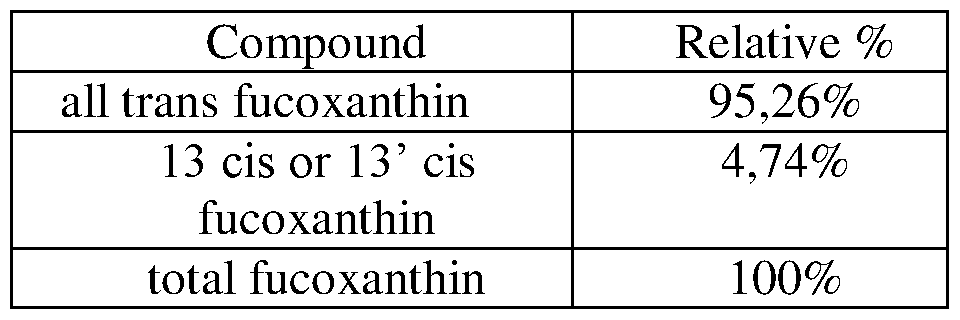
- Fucoxanthin minor isomer presented in the chromatogram is tentatively identified as 13- cis or 13'-cis. This affirmation is done on basis of retention times and UV-vis absorption spectra. According to scientific literature cis isomers of carotenoids show an additional ⁇ peak about 330 nm (Crupi et al., 2013). This peak represents about 5% of total fucoxanthin in the sample, as summarized in table 6.
- P. tricornutum microalgae were cultivated and harvested.
- Table 7a summarizes the dry biomass content of the P. tricornutum microalgae, the content of oleoresin obtained from the P. tricornutum microalgae, and the content of oleoresin obtained from macro-algae.
- an oleoresin obtained from P. tricornutum contains 19.06 % eicosapentaenic acid (EPA), 2.38 % archidonic acid (AA), and 13.4 % palmitic acid (PA). Further, caprylic acid and capric acid constitute less than 0.02 and 0.05 of the content of the oleoresin obtained from P. tricornutum.
- the saturated fatty acids constitute 90.85% of the macro-algae extract and only 8.64% of the microalgae extract
- fat content of an oleoresin obtained from macro-algae contains mostly caprilyc acid (48.17% from dry weight) and capric acid (42.32 % from dry weight), wherein unsaturated fatty acids constitute only 0.55% of the dry weight.
- P. tricornutum microalgae were cultivated and harvested. Vitamin C was added to the resulting biomass to constitute 1% by weight of the biomass. Alternatively, rosemary oil was added to the resulting biomass to constitute 0.3% by weight of the biomass. The percentage of Fucoxanthin was determined prior to drying the biomass, in the dry biomass and 7 days post drying of the biomass. Table 8 presents a comparison of Fucoxanthin content of a biomass treated with vitamin C, rosemary oil or for an untreated biomass. Results demonstrate that Fucoxanthin is stabilized when either Vitamin C or rosemary oil are added to the biomass. Notably, in the presence of both vitamin C as well as rosemary oil reduction in Fucoxanthin in time (see last column).
- Vitamin C 1.72 1.77 -3.0% 1.52 11.1%
Landscapes
- Health & Medical Sciences (AREA)
- Life Sciences & Earth Sciences (AREA)
- Chemical & Material Sciences (AREA)
- Medicinal Chemistry (AREA)
- Public Health (AREA)
- General Health & Medical Sciences (AREA)
- Veterinary Medicine (AREA)
- Animal Behavior & Ethology (AREA)
- Pharmacology & Pharmacy (AREA)
- Epidemiology (AREA)
- Engineering & Computer Science (AREA)
- Biotechnology (AREA)
- Natural Medicines & Medicinal Plants (AREA)
- General Chemical & Material Sciences (AREA)
- Chemical Kinetics & Catalysis (AREA)
- Nuclear Medicine, Radiotherapy & Molecular Imaging (AREA)
- Organic Chemistry (AREA)
- Diabetes (AREA)
- Mycology (AREA)
- Microbiology (AREA)
- Alternative & Traditional Medicine (AREA)
- Medical Informatics (AREA)
- Botany (AREA)
- Endocrinology (AREA)
- Obesity (AREA)
- Hematology (AREA)
- Bioinformatics & Cheminformatics (AREA)
- Rheumatology (AREA)
- Pain & Pain Management (AREA)
- Toxicology (AREA)
- Biochemistry (AREA)
- Emergency Medicine (AREA)
- Acyclic And Carbocyclic Compounds In Medicinal Compositions (AREA)
- Medicines Containing Plant Substances (AREA)
- Nutrition Science (AREA)
- Food Science & Technology (AREA)
- Polymers & Plastics (AREA)
- Oil, Petroleum & Natural Gas (AREA)
- Micro-Organisms Or Cultivation Processes Thereof (AREA)
- Pharmaceuticals Containing Other Organic And Inorganic Compounds (AREA)
Abstract
Description




Claims
Priority Applications (9)
| Application Number | Priority Date | Filing Date | Title |
|---|---|---|---|
| KR1020177032160A KR20170134685A (en) | 2015-04-13 | 2016-04-13 | Compositions Containing Carotenoids and Uses Thereof |
| JP2017553172A JP2018512432A (en) | 2015-04-13 | 2016-04-13 | Compositions containing carotenoids and uses thereof |
| US15/564,162 US20180078521A1 (en) | 2015-04-13 | 2016-04-13 | Compositions comprising carotenoids and use thereof |
| CN201680027090.0A CN107847535A (en) | 2015-04-13 | 2016-04-13 | Composition comprising carotenoid and application thereof |
| IL254897A IL254897B (en) | 2015-04-13 | 2016-04-13 | Mixtures containing carotenoids and their uses |
| IL293920A IL293920A (en) | 2015-04-13 | 2016-04-13 | Mixtures containing carotenoids and their uses |
| AU2016248041A AU2016248041A1 (en) | 2015-04-13 | 2016-04-13 | Compositions comprising carotenoids and use thereof |
| EP16779711.7A EP3283089B1 (en) | 2015-04-13 | 2016-04-13 | Compositions comprising carotenoids and use thereof |
| US17/582,513 US20220142965A1 (en) | 2015-04-13 | 2022-01-24 | Compositions comprising carotenoids and use thereof |
Applications Claiming Priority (4)
| Application Number | Priority Date | Filing Date | Title |
|---|---|---|---|
| US201562146469P | 2015-04-13 | 2015-04-13 | |
| US62/146,469 | 2015-04-13 | ||
| US201662292421P | 2016-02-08 | 2016-02-08 | |
| US62/292,421 | 2016-02-08 |
Related Child Applications (2)
| Application Number | Title | Priority Date | Filing Date |
|---|---|---|---|
| US15/564,162 A-371-Of-International US20180078521A1 (en) | 2015-04-13 | 2016-04-13 | Compositions comprising carotenoids and use thereof |
| US17/582,513 Continuation US20220142965A1 (en) | 2015-04-13 | 2022-01-24 | Compositions comprising carotenoids and use thereof |
Publications (1)
| Publication Number | Publication Date |
|---|---|
| WO2016166755A1 true WO2016166755A1 (en) | 2016-10-20 |
Family
ID=57125715
Family Applications (1)
| Application Number | Title | Priority Date | Filing Date |
|---|---|---|---|
| PCT/IL2016/050389 Ceased WO2016166755A1 (en) | 2015-04-13 | 2016-04-13 | Compositions comprising carotenoids and use thereof |
Country Status (8)
| Country | Link |
|---|---|
| US (2) | US20180078521A1 (en) |
| EP (1) | EP3283089B1 (en) |
| JP (1) | JP2018512432A (en) |
| KR (1) | KR20170134685A (en) |
| CN (1) | CN107847535A (en) |
| AU (1) | AU2016248041A1 (en) |
| IL (2) | IL293920A (en) |
| WO (1) | WO2016166755A1 (en) |
Cited By (4)
| Publication number | Priority date | Publication date | Assignee | Title |
|---|---|---|---|---|
| CN107188797A (en) * | 2017-05-23 | 2017-09-22 | 集美大学 | A kind of method that palmitic acid is extracted in the ballstone algae from ocean |
| CN107200684A (en) * | 2017-05-23 | 2017-09-26 | 集美大学 | A kind of method that myristic acid is extracted in the ballstone algae from ocean |
| JP2021520343A (en) * | 2018-04-04 | 2021-08-19 | アルガテクノロジーズ リミテッドAlgatechnologies Ltd. | Compositions containing fucoxanthin and its use in reducing intracellular fat accumulation |
| US12331025B2 (en) | 2019-02-26 | 2025-06-17 | Fraunhofer-Gesellschaft zur Förderung der angewandten Forschung e. V. | Method for obtaining fucoxanthin and fatty acids from the biomass of algae |
Families Citing this family (5)
| Publication number | Priority date | Publication date | Assignee | Title |
|---|---|---|---|---|
| KR102093820B1 (en) * | 2018-09-11 | 2020-03-26 | 한국과학기술연구원 | Method for mass production of Phaeodactylum fraction |
| US20230010722A1 (en) * | 2019-10-17 | 2023-01-12 | The Regents Of The University Of California | Biologically-derived fatty acids and polymers |
| CN111205179B (en) * | 2020-01-09 | 2022-07-19 | 青岛科海生物有限公司 | Method for comprehensively extracting EPA and fucoxanthin from Phaeodactylum tricornutum |
| US20240083843A1 (en) | 2021-01-14 | 2024-03-14 | Yeda Research And Development Co. Ltd. | Methods of producing vitamin d |
| CN116042406B (en) * | 2023-02-28 | 2025-02-14 | 中国科学院青海盐湖研究所 | A high-yield palmitoleic acid accumulating Nitzschia algae and its application |
Citations (5)
| Publication number | Priority date | Publication date | Assignee | Title |
|---|---|---|---|---|
| WO2006077433A1 (en) | 2005-01-21 | 2006-07-27 | Promar As | Sunscreen compositions comprising carotenoids |
| US20110111038A1 (en) | 2008-05-01 | 2011-05-12 | Nutraceuticals International Llc | Process for producing a stable concentrated dietary supplement and supplement produced thereby |
| WO2012047120A1 (en) | 2010-10-06 | 2012-04-12 | Photonz Corporation Limited | Heterotrophic microbial production of xanthophyll pigments |
| US20150044737A1 (en) | 2012-03-16 | 2015-02-12 | Fermentalg | Production of docosahexaenoic acid and/or eicosapentaenoic acid and/or carotenoids in mixotrophic mode by nitzschia |
| EP3116518A1 (en) | 2014-03-14 | 2017-01-18 | Greenaltech S.L. | Extract from microalgae comprising fucoxanthin, fucoxanthinol and fatty acids, process for its production and applications thereof |
Family Cites Families (6)
| Publication number | Priority date | Publication date | Assignee | Title |
|---|---|---|---|---|
| JPWO2009130895A1 (en) * | 2008-04-22 | 2011-08-11 | 日本水産株式会社 | Process for producing fucoxanthin and microalgae used therefor |
| CN101735178A (en) * | 2008-11-17 | 2010-06-16 | 北京绿色金可生物技术股份有限公司 | Method for purifying fucoxanthin |
| WO2011058773A1 (en) * | 2009-11-10 | 2011-05-19 | 株式会社サウスプロダクト | Oil-based composition |
| KR102056506B1 (en) * | 2012-04-27 | 2019-12-16 | 가부시키가이샤 가네카 | Method for producing composition containing fucoxanthin |
| FR3008422B1 (en) * | 2013-07-12 | 2017-11-17 | Fermentalg | DECOUPLE CELL CULTURE PROCESS |
| JP2015231975A (en) * | 2014-06-10 | 2015-12-24 | 株式会社日本触媒 | Fucoxanthin extracted from microalga |
-
2016
- 2016-04-13 IL IL293920A patent/IL293920A/en unknown
- 2016-04-13 CN CN201680027090.0A patent/CN107847535A/en active Pending
- 2016-04-13 EP EP16779711.7A patent/EP3283089B1/en active Active
- 2016-04-13 AU AU2016248041A patent/AU2016248041A1/en not_active Abandoned
- 2016-04-13 JP JP2017553172A patent/JP2018512432A/en active Pending
- 2016-04-13 WO PCT/IL2016/050389 patent/WO2016166755A1/en not_active Ceased
- 2016-04-13 US US15/564,162 patent/US20180078521A1/en not_active Abandoned
- 2016-04-13 KR KR1020177032160A patent/KR20170134685A/en not_active Withdrawn
- 2016-04-13 IL IL254897A patent/IL254897B/en unknown
-
2022
- 2022-01-24 US US17/582,513 patent/US20220142965A1/en not_active Abandoned
Patent Citations (5)
| Publication number | Priority date | Publication date | Assignee | Title |
|---|---|---|---|---|
| WO2006077433A1 (en) | 2005-01-21 | 2006-07-27 | Promar As | Sunscreen compositions comprising carotenoids |
| US20110111038A1 (en) | 2008-05-01 | 2011-05-12 | Nutraceuticals International Llc | Process for producing a stable concentrated dietary supplement and supplement produced thereby |
| WO2012047120A1 (en) | 2010-10-06 | 2012-04-12 | Photonz Corporation Limited | Heterotrophic microbial production of xanthophyll pigments |
| US20150044737A1 (en) | 2012-03-16 | 2015-02-12 | Fermentalg | Production of docosahexaenoic acid and/or eicosapentaenoic acid and/or carotenoids in mixotrophic mode by nitzschia |
| EP3116518A1 (en) | 2014-03-14 | 2017-01-18 | Greenaltech S.L. | Extract from microalgae comprising fucoxanthin, fucoxanthinol and fatty acids, process for its production and applications thereof |
Non-Patent Citations (12)
| Title |
|---|
| BENAVIDES ET AL.: "Productivity and biochemical composition of P. tricornutum (Bacillariophyceae) cultures grown outdoors in tubular photobioreactors and open ponds", BIOMASS AND BIOENERGY, vol. 54, 2013, pages 115 - 122, XP028567981, DOI: 10.1016/j.biombioe.2013.03.016 |
| BENAVIDES, ANA M. SILVA ET AL.: "Productivity and biochemical composition of Phaeodactylum tricornutum (Bacillariophyceae) cultures grown outdoors in tubular photobioreactors and open ponds.", BIOMASS AND BIOENERGY, vol. 54, 18 April 2013 (2013-04-18), pages 115 - 122, XP028567981, Retrieved from the Internet <URL:https://www.researchgate.net/profile/Giuseppe_Torzillo/publication/257421321_Productivity_and_biochemical_composition_of_Phaeodactylum_triconutum_(Bacillariophyceae)_cultures_grown_outdoors_in_tubular_photobioreactors_and_open_ponds/links/550810f30cf26ff55f7fcd3c.pdf> [retrieved on 20160718] * |
| BOROWITZKA: "High-value products from microalgae-their development and commercialisation", JOURNAL OF APPLIED PHYCOLOGY, vol. 25, no. 3, 2013, pages 743 - 756, XP055203653, DOI: 10.1007/s10811-013-9983-9 |
| CHEOL-HO PAN ET AL., APPL BIOCHEM BIOTECHNOL, vol. 166, 2012, pages 1843 - 1855 |
| GUIL-GUERRERO, JOURNAL OF FOOD BIOCHEMISBY, vol. 25, 2001, pages 57 - 76 |
| KANDA ET AL.: "Extraction of Fucoxanthin from Raw Macroalgae excluding Drying and Cell Wall Disruption by Liquefied Dimethyl Ether", MARINE DRUGS, vol. 12, no. 5, 2014, pages 2383 - 2396, XP055589074, DOI: 10.3390/md12052383 |
| MICHALAK ET AL.: "Algal extracts: Technology and advances", ENGINEERING IN LIFE SCIENCES, vol. 14, no. 6, 2014, pages 581 - 591, XP055365467, DOI: 10.1002/elsc.201400139 |
| SANG MIN KIM ET AL.: "A Potential Commercial Source of Fucoxanthin Extracted from the Microalga", APPLIED BIOCHEMISTRY AND BIOTECHNOLOGY; PART A: ENZYME ENGINEERING AND BIOTECHNOLOGY, vol. 166, no. 7, 2012, pages 1843 - 1855, XP035042483, DOI: 10.1007/s12010-012-9602-2 |
| SANG MIN KIM ET AL.: "Fucoxanthin as a major carotenoid in Isochrysis off. galbana: Characterization of extraction for commercial application", JOURNAL OF THE KOREAN SOCIETY FOR APPLIED BIOLOGICAL CHEMISTRY, vol. 55, no. 4, 2012, pages 477 - 483, XP055049996, DOI: 10.1007/s13765-012-2108-3 |
| See also references of EP3283089A4 |
| SONG XIA ET AL.: "Production, Characterization, and Antioxidant Activity of Fucoxanthin from the Marine Diatom Odontella aurita", MARINE DRUGS, vol. 11, no. 7, 2013, pages 2667 - 2681, XP055519743, DOI: 10.3390/md11072667 |
| ZHAO, PEIPEI ET AL.: "Silicon enhances the growth of Phaeodactylum tricornutum Bohlin under green light and low temperature.", SCIENTIFIC REPORTS4, vol. 4, no. 3958, 4 February 2014 (2014-02-04), pages 1 - 10, XP055323768, Retrieved from the Internet <URL:http://www.nature.com/articles/srep03958?WT.ec_id=SREP-631-20140211> [retrieved on 20160718] * |
Cited By (6)
| Publication number | Priority date | Publication date | Assignee | Title |
|---|---|---|---|---|
| CN107188797A (en) * | 2017-05-23 | 2017-09-22 | 集美大学 | A kind of method that palmitic acid is extracted in the ballstone algae from ocean |
| CN107200684A (en) * | 2017-05-23 | 2017-09-26 | 集美大学 | A kind of method that myristic acid is extracted in the ballstone algae from ocean |
| CN107188797B (en) * | 2017-05-23 | 2020-08-28 | 集美大学 | A kind of method for extracting palmitic acid from marine coccus algae |
| CN107200684B (en) * | 2017-05-23 | 2021-04-20 | 集美大学 | A kind of method for extracting myristic acid from marine coccus algae |
| JP2021520343A (en) * | 2018-04-04 | 2021-08-19 | アルガテクノロジーズ リミテッドAlgatechnologies Ltd. | Compositions containing fucoxanthin and its use in reducing intracellular fat accumulation |
| US12331025B2 (en) | 2019-02-26 | 2025-06-17 | Fraunhofer-Gesellschaft zur Förderung der angewandten Forschung e. V. | Method for obtaining fucoxanthin and fatty acids from the biomass of algae |
Also Published As
| Publication number | Publication date |
|---|---|
| EP3283089A4 (en) | 2018-12-12 |
| IL254897A0 (en) | 2017-12-31 |
| EP3283089B1 (en) | 2022-03-16 |
| EP3283089A1 (en) | 2018-02-21 |
| US20220142965A1 (en) | 2022-05-12 |
| US20180078521A1 (en) | 2018-03-22 |
| AU2016248041A1 (en) | 2017-11-16 |
| CN107847535A (en) | 2018-03-27 |
| JP2018512432A (en) | 2018-05-17 |
| KR20170134685A (en) | 2017-12-06 |
| IL293920A (en) | 2022-08-01 |
| IL254897B (en) | 2022-07-01 |
Similar Documents
| Publication | Publication Date | Title |
|---|---|---|
| US20220142965A1 (en) | Compositions comprising carotenoids and use thereof | |
| Mendes et al. | Supercritical CO2 extraction of γ-linolenic acid and other lipids from Arthrospira (Spirulina) maxima: Comparison with organic solvent extraction | |
| Billakanti et al. | Enzyme-assisted extraction of fucoxanthin and lipids containing polyunsaturated fatty acids from Undaria pinnatifida using dimethyl ether and ethanol | |
| Derwenskus et al. | Pressurized extraction of unsaturated fatty acids and carotenoids from wet Chlorella vulgaris and Phaeodactylum tricornutum biomass using subcritical liquids | |
| Mazzutti et al. | Supercritical fluid extraction of Agaricus brasiliensis: Antioxidant and antimicrobial activities | |
| Praveenkumar et al. | Breaking dormancy: an energy-efficient means of recovering astaxanthin from microalgae | |
| Balasubramanian et al. | Factors affecting cellular lipid extraction from marine microalgae | |
| Machmudah et al. | Supercritical fluids extraction of valuable compounds from algae: Future perspectives and challenges | |
| Lin et al. | Lutein in specific marigold flowers and microalgae | |
| Morón-Ortiz et al. | Ultrasound-assisted extraction of carotenoids from phytoene-accumulating Chlorella sorokiniana microalgae: Effect of milling and performance of the green biosolvents 2-methyltetrahydrofuran and ethyl lactate | |
| Sun et al. | A simple and efficient strategy for fucoxanthin extraction from the microalga Phaeodactylum tricornutum | |
| Zhou et al. | Microwave-assisted extraction of lipids, carotenoids, and other compounds from marine resources | |
| WO2000005395A1 (en) | Method for obtaining fatty acids from biomass by combined in-situ extraction, reaction and chromatography using compressed gases | |
| CN102041166A (en) | Method for extracting krill oil with high phosphatide content from Antarctic krills | |
| Valerio Filho et al. | Extraction of fatty acids and cellulose from the biomass of algae Durvillaea antarctica and Ulva lactuca: An alternative for biorefineries | |
| Bong et al. | A study of fatty acid composition and tocopherol content of lipid extracted from marine microalgae, Nannochloropsis oculata and Tetraselmis suecica, using solvent extraction and supercritical fluid extraction | |
| JT et al. | A critical look into different salt removal treatments for the production of high value pigments and fatty acids from marine microalgae Chlorella vulgaris (NIOT-74) | |
| CN102007216A (en) | Process for production of fucoxanthin, and microalga for use in the process | |
| Basily et al. | Exploration of using the algal bioactive compounds for cosmeceuticals and pharmaceutical applications | |
| López-Rodríguez et al. | Assessment of multi-step processes for an integral use of the biomass of the marine microalga Amphidinium carterae | |
| Catchpole et al. | Extraction of lipids from fermentation biomass using near-critical dimethylether | |
| Achour et al. | Pressurized liquid extraction for the recovery of carotenoids and functional compounds from green and orange Dunaliella salina biomasses | |
| CN106753775B (en) | A kind of extraction method of Antarctic krill oil with high astaxanthin and its ester content | |
| Sereti et al. | Green extraction of carotenoids and oil produced by Rhodosporidium paludigenum using supercritical CO2 extraction: Evaluation of cell disruption methods and extraction kinetics | |
| WO2011058773A1 (en) | Oil-based composition |
Legal Events
| Date | Code | Title | Description |
|---|---|---|---|
| 121 | Ep: the epo has been informed by wipo that ep was designated in this application |
Ref document number: 16779711 Country of ref document: EP Kind code of ref document: A1 |
|
| WWE | Wipo information: entry into national phase |
Ref document number: 15564162 Country of ref document: US Ref document number: 254897 Country of ref document: IL |
|
| ENP | Entry into the national phase |
Ref document number: 2017553172 Country of ref document: JP Kind code of ref document: A |
|
| NENP | Non-entry into the national phase |
Ref country code: DE |
|
| REEP | Request for entry into the european phase |
Ref document number: 2016779711 Country of ref document: EP |
|
| ENP | Entry into the national phase |
Ref document number: 20177032160 Country of ref document: KR Kind code of ref document: A |
|
| ENP | Entry into the national phase |
Ref document number: 2016248041 Country of ref document: AU Date of ref document: 20160413 Kind code of ref document: A |