WO2016171217A1 - 水性分散体、塗膜及び塗装物品 - Google Patents
水性分散体、塗膜及び塗装物品 Download PDFInfo
- Publication number
- WO2016171217A1 WO2016171217A1 PCT/JP2016/062651 JP2016062651W WO2016171217A1 WO 2016171217 A1 WO2016171217 A1 WO 2016171217A1 JP 2016062651 W JP2016062651 W JP 2016062651W WO 2016171217 A1 WO2016171217 A1 WO 2016171217A1
- Authority
- WO
- WIPO (PCT)
- Prior art keywords
- aqueous dispersion
- group
- fluoropolymer
- coating film
- acrylic
- Prior art date
- Legal status (The legal status is an assumption and is not a legal conclusion. Google has not performed a legal analysis and makes no representation as to the accuracy of the status listed.)
- Ceased
Links
Classifications
-
- C—CHEMISTRY; METALLURGY
- C09—DYES; PAINTS; POLISHES; NATURAL RESINS; ADHESIVES; COMPOSITIONS NOT OTHERWISE PROVIDED FOR; APPLICATIONS OF MATERIALS NOT OTHERWISE PROVIDED FOR
- C09D—COATING COMPOSITIONS, e.g. PAINTS, VARNISHES OR LACQUERS; FILLING PASTES; CHEMICAL PAINT OR INK REMOVERS; INKS; CORRECTING FLUIDS; WOODSTAINS; PASTES OR SOLIDS FOR COLOURING OR PRINTING; USE OF MATERIALS THEREFOR
- C09D133/00—Coating compositions based on homopolymers or copolymers of compounds having one or more unsaturated aliphatic radicals, each having only one carbon-to-carbon double bond, and at least one being terminated by only one carboxyl radical, or of salts, anhydrides, esters, amides, imides, or nitriles thereof; Coating compositions based on derivatives of such polymers
- C09D133/04—Homopolymers or copolymers of esters
- C09D133/14—Homopolymers or copolymers of esters of esters containing halogen, nitrogen, sulfur or oxygen atoms in addition to the carboxy oxygen
-
- C—CHEMISTRY; METALLURGY
- C08—ORGANIC MACROMOLECULAR COMPOUNDS; THEIR PREPARATION OR CHEMICAL WORKING-UP; COMPOSITIONS BASED THEREON
- C08K—Use of inorganic or non-macromolecular organic substances as compounding ingredients
- C08K3/00—Use of inorganic substances as compounding ingredients
- C08K3/18—Oxygen-containing compounds, e.g. metal carbonyls
- C08K3/20—Oxides; Hydroxides
-
- C—CHEMISTRY; METALLURGY
- C08—ORGANIC MACROMOLECULAR COMPOUNDS; THEIR PREPARATION OR CHEMICAL WORKING-UP; COMPOSITIONS BASED THEREON
- C08K—Use of inorganic or non-macromolecular organic substances as compounding ingredients
- C08K5/00—Use of organic ingredients
- C08K5/16—Nitrogen-containing compounds
- C08K5/29—Compounds containing one or more carbon-to-nitrogen double bonds
-
- C—CHEMISTRY; METALLURGY
- C08—ORGANIC MACROMOLECULAR COMPOUNDS; THEIR PREPARATION OR CHEMICAL WORKING-UP; COMPOSITIONS BASED THEREON
- C08L—COMPOSITIONS OF MACROMOLECULAR COMPOUNDS
- C08L27/00—Compositions of homopolymers or copolymers of compounds having one or more unsaturated aliphatic radicals, each having only one carbon-to-carbon double bond, and at least one being terminated by a halogen; Compositions of derivatives of such polymers
- C08L27/02—Compositions of homopolymers or copolymers of compounds having one or more unsaturated aliphatic radicals, each having only one carbon-to-carbon double bond, and at least one being terminated by a halogen; Compositions of derivatives of such polymers not modified by chemical after-treatment
- C08L27/12—Compositions of homopolymers or copolymers of compounds having one or more unsaturated aliphatic radicals, each having only one carbon-to-carbon double bond, and at least one being terminated by a halogen; Compositions of derivatives of such polymers not modified by chemical after-treatment containing fluorine atoms
-
- C—CHEMISTRY; METALLURGY
- C08—ORGANIC MACROMOLECULAR COMPOUNDS; THEIR PREPARATION OR CHEMICAL WORKING-UP; COMPOSITIONS BASED THEREON
- C08L—COMPOSITIONS OF MACROMOLECULAR COMPOUNDS
- C08L33/00—Compositions of homopolymers or copolymers of compounds having one or more unsaturated aliphatic radicals, each having only one carbon-to-carbon double bond, and only one being terminated by only one carboxyl radical, or of salts, anhydrides, esters, amides, imides or nitriles thereof; Compositions of derivatives of such polymers
-
- C—CHEMISTRY; METALLURGY
- C08—ORGANIC MACROMOLECULAR COMPOUNDS; THEIR PREPARATION OR CHEMICAL WORKING-UP; COMPOSITIONS BASED THEREON
- C08L—COMPOSITIONS OF MACROMOLECULAR COMPOUNDS
- C08L33/00—Compositions of homopolymers or copolymers of compounds having one or more unsaturated aliphatic radicals, each having only one carbon-to-carbon double bond, and only one being terminated by only one carboxyl radical, or of salts, anhydrides, esters, amides, imides or nitriles thereof; Compositions of derivatives of such polymers
- C08L33/04—Homopolymers or copolymers of esters
- C08L33/06—Homopolymers or copolymers of esters of esters containing only carbon, hydrogen and oxygen, which oxygen atoms are present only as part of the carboxyl radical
- C08L33/08—Homopolymers or copolymers of acrylic acid esters
-
- C—CHEMISTRY; METALLURGY
- C08—ORGANIC MACROMOLECULAR COMPOUNDS; THEIR PREPARATION OR CHEMICAL WORKING-UP; COMPOSITIONS BASED THEREON
- C08L—COMPOSITIONS OF MACROMOLECULAR COMPOUNDS
- C08L33/00—Compositions of homopolymers or copolymers of compounds having one or more unsaturated aliphatic radicals, each having only one carbon-to-carbon double bond, and only one being terminated by only one carboxyl radical, or of salts, anhydrides, esters, amides, imides or nitriles thereof; Compositions of derivatives of such polymers
- C08L33/04—Homopolymers or copolymers of esters
- C08L33/14—Homopolymers or copolymers of esters of esters containing halogen, nitrogen, sulfur, or oxygen atoms in addition to the carboxy oxygen
-
- C—CHEMISTRY; METALLURGY
- C09—DYES; PAINTS; POLISHES; NATURAL RESINS; ADHESIVES; COMPOSITIONS NOT OTHERWISE PROVIDED FOR; APPLICATIONS OF MATERIALS NOT OTHERWISE PROVIDED FOR
- C09D—COATING COMPOSITIONS, e.g. PAINTS, VARNISHES OR LACQUERS; FILLING PASTES; CHEMICAL PAINT OR INK REMOVERS; INKS; CORRECTING FLUIDS; WOODSTAINS; PASTES OR SOLIDS FOR COLOURING OR PRINTING; USE OF MATERIALS THEREFOR
- C09D127/00—Coating compositions based on homopolymers or copolymers of compounds having one or more unsaturated aliphatic radicals, each having only one carbon-to-carbon double bond, and at least one being terminated by a halogen; Coating compositions based on derivatives of such polymers
- C09D127/02—Coating compositions based on homopolymers or copolymers of compounds having one or more unsaturated aliphatic radicals, each having only one carbon-to-carbon double bond, and at least one being terminated by a halogen; Coating compositions based on derivatives of such polymers not modified by chemical after-treatment
- C09D127/12—Coating compositions based on homopolymers or copolymers of compounds having one or more unsaturated aliphatic radicals, each having only one carbon-to-carbon double bond, and at least one being terminated by a halogen; Coating compositions based on derivatives of such polymers not modified by chemical after-treatment containing fluorine atoms
-
- C—CHEMISTRY; METALLURGY
- C09—DYES; PAINTS; POLISHES; NATURAL RESINS; ADHESIVES; COMPOSITIONS NOT OTHERWISE PROVIDED FOR; APPLICATIONS OF MATERIALS NOT OTHERWISE PROVIDED FOR
- C09D—COATING COMPOSITIONS, e.g. PAINTS, VARNISHES OR LACQUERS; FILLING PASTES; CHEMICAL PAINT OR INK REMOVERS; INKS; CORRECTING FLUIDS; WOODSTAINS; PASTES OR SOLIDS FOR COLOURING OR PRINTING; USE OF MATERIALS THEREFOR
- C09D133/00—Coating compositions based on homopolymers or copolymers of compounds having one or more unsaturated aliphatic radicals, each having only one carbon-to-carbon double bond, and at least one being terminated by only one carboxyl radical, or of salts, anhydrides, esters, amides, imides, or nitriles thereof; Coating compositions based on derivatives of such polymers
- C09D133/04—Homopolymers or copolymers of esters
- C09D133/06—Homopolymers or copolymers of esters of esters containing only carbon, hydrogen and oxygen, the oxygen atom being present only as part of the carboxyl radical
- C09D133/062—Copolymers with monomers not covered by C09D133/06
- C09D133/066—Copolymers with monomers not covered by C09D133/06 containing -OH groups
-
- C—CHEMISTRY; METALLURGY
- C09—DYES; PAINTS; POLISHES; NATURAL RESINS; ADHESIVES; COMPOSITIONS NOT OTHERWISE PROVIDED FOR; APPLICATIONS OF MATERIALS NOT OTHERWISE PROVIDED FOR
- C09D—COATING COMPOSITIONS, e.g. PAINTS, VARNISHES OR LACQUERS; FILLING PASTES; CHEMICAL PAINT OR INK REMOVERS; INKS; CORRECTING FLUIDS; WOODSTAINS; PASTES OR SOLIDS FOR COLOURING OR PRINTING; USE OF MATERIALS THEREFOR
- C09D143/00—Coating compositions based on homopolymers or copolymers of compounds having one or more unsaturated aliphatic radicals, each having only one carbon-to-carbon double bond, and containing boron, silicon, phosphorus, selenium, tellurium, or a metal; Coating compositions based on derivatives of such polymers
- C09D143/04—Homopolymers or copolymers of monomers containing silicon
-
- C—CHEMISTRY; METALLURGY
- C09—DYES; PAINTS; POLISHES; NATURAL RESINS; ADHESIVES; COMPOSITIONS NOT OTHERWISE PROVIDED FOR; APPLICATIONS OF MATERIALS NOT OTHERWISE PROVIDED FOR
- C09D—COATING COMPOSITIONS, e.g. PAINTS, VARNISHES OR LACQUERS; FILLING PASTES; CHEMICAL PAINT OR INK REMOVERS; INKS; CORRECTING FLUIDS; WOODSTAINS; PASTES OR SOLIDS FOR COLOURING OR PRINTING; USE OF MATERIALS THEREFOR
- C09D175/00—Coating compositions based on polyureas or polyurethanes; Coating compositions based on derivatives of such polymers
- C09D175/04—Polyurethanes
-
- C—CHEMISTRY; METALLURGY
- C09—DYES; PAINTS; POLISHES; NATURAL RESINS; ADHESIVES; COMPOSITIONS NOT OTHERWISE PROVIDED FOR; APPLICATIONS OF MATERIALS NOT OTHERWISE PROVIDED FOR
- C09D—COATING COMPOSITIONS, e.g. PAINTS, VARNISHES OR LACQUERS; FILLING PASTES; CHEMICAL PAINT OR INK REMOVERS; INKS; CORRECTING FLUIDS; WOODSTAINS; PASTES OR SOLIDS FOR COLOURING OR PRINTING; USE OF MATERIALS THEREFOR
- C09D5/00—Coating compositions, e.g. paints, varnishes or lacquers, characterised by their physical nature or the effects produced; Filling pastes
- C09D5/02—Emulsion paints including aerosols
-
- C—CHEMISTRY; METALLURGY
- C09—DYES; PAINTS; POLISHES; NATURAL RESINS; ADHESIVES; COMPOSITIONS NOT OTHERWISE PROVIDED FOR; APPLICATIONS OF MATERIALS NOT OTHERWISE PROVIDED FOR
- C09D—COATING COMPOSITIONS, e.g. PAINTS, VARNISHES OR LACQUERS; FILLING PASTES; CHEMICAL PAINT OR INK REMOVERS; INKS; CORRECTING FLUIDS; WOODSTAINS; PASTES OR SOLIDS FOR COLOURING OR PRINTING; USE OF MATERIALS THEREFOR
- C09D5/00—Coating compositions, e.g. paints, varnishes or lacquers, characterised by their physical nature or the effects produced; Filling pastes
- C09D5/16—Antifouling paints; Underwater paints
- C09D5/1656—Antifouling paints; Underwater paints characterised by the film-forming substance
- C09D5/1662—Synthetic film-forming substance
-
- C—CHEMISTRY; METALLURGY
- C08—ORGANIC MACROMOLECULAR COMPOUNDS; THEIR PREPARATION OR CHEMICAL WORKING-UP; COMPOSITIONS BASED THEREON
- C08L—COMPOSITIONS OF MACROMOLECULAR COMPOUNDS
- C08L2201/00—Properties
- C08L2201/10—Transparent films; Clear coatings; Transparent materials
-
- C—CHEMISTRY; METALLURGY
- C08—ORGANIC MACROMOLECULAR COMPOUNDS; THEIR PREPARATION OR CHEMICAL WORKING-UP; COMPOSITIONS BASED THEREON
- C08L—COMPOSITIONS OF MACROMOLECULAR COMPOUNDS
- C08L2205/00—Polymer mixtures characterised by other features
- C08L2205/03—Polymer mixtures characterised by other features containing three or more polymers in a blend
Definitions
- the present invention relates to an aqueous dispersion, a coating film and a coated article.
- Fluorine-containing seed polymer using acrylic monomer as a monomer for seed polymerization is based on the weather resistance, chemical resistance, solvent resistance, heat resistance, and antifouling properties of the included fluoropolymer. Utilizing the processability, transparency, adhesion, and film-forming properties of coalescence, it is used in a wide range of industrial fields such as the automotive industry, semiconductor industry, chemical industry, paints, etc. as raw materials for various products or coating film forming components of paints. ing.
- Patent Document 1 describes a fluorine-containing copolymer aqueous dispersion having a hydroxyl group and a fluorine-containing copolymer aqueous coating composition in which a water-dispersible polyisocyanate compound is dispersed in water.
- the fluorinated copolymer aqueous dispersion is an acrylic acid alkyl ester having an alkyl group having 1 to 18 carbon atoms and / or an alkyl group having a carbon number of 1 to 1.
- Patent Document 2 discloses an acrylic acid alkyl ester having an alkyl group having 1 to 18 carbon atoms and / or methacrylic acid having an alkyl group having 1 to 18 carbon atoms in the presence of 100 parts by weight of vinylidene fluoride polymer particles. It is obtained by emulsion polymerization in an aqueous medium of 5 to 95 parts by weight of a monomer mixture containing an alkyl ester and, if necessary, an ethylenically unsaturated compound copolymerizable with these monomers. A fluoropolymer aqueous dispersion characterized by a particle size of 0.05 to 3 ⁇ m is described.
- Patent Document 3 discloses that at least one monomer selected from the group consisting of acrylic acid esters and methacrylic acid esters, unsaturated carboxylic acids, and hydrolyzable silyl groups, using fluoropolymer particles as seed particles.
- Patent Document 4 has (a) an emulsion of an organic synthetic resin, (b) a coupling agent, and (c) a group other than the organic synthetic resin (a) and capable of reacting with the coupling agent (b).
- a resin composition for a low-contamination water-based paint comprising an organic compound for hydrophilization is described, and reactive ⁇ , ⁇ such as methyl acrylate in the presence of fluoropolymer particles as an organic synthetic resin emulsion.
- An emulsion of a fluorine-containing seed polymer obtained by seed polymerization of a monomer having an unsaturated group is described.
- Patent Document 5 discloses (A) vinylidene fluoride containing, as a structural unit, at least one fluoroolefin unit selected from the group consisting of a tetrafluoroethylene unit, a hexafluoropropylene unit, and a chlorotrifluoroethylene unit, and a vinylidene fluoride unit.
- an aqueous dispersion containing a fluorine-containing seed polymer that can form a coating film that is excellent in solvent resistance, antifouling property, and adhesion to a substrate is not known.
- the present invention aims to provide an aqueous dispersion capable of forming a coating film excellent in solvent resistance, antifouling property (dirt wiping property), and adhesion to a substrate. To do.
- the present invention is an aqueous dispersion comprising composite polymer particles, a polyisocyanate compound and water,
- the composite polymer particles are composed of a fluoropolymer (A) and an acrylic polymer (B), and either one or both of the fluoropolymer (A) and the acrylic polymer (B) contain a hydroxyl group and a hydrolyzable silyl group. It is an aqueous dispersion characterized by the above.
- the fluoropolymer (A) preferably contains at least one fluoroolefin unit selected from the group consisting of vinyl fluoride, vinylidene fluoride, tetrafluoroethylene, hexafluoropropylene, and chlorotrifluoroethylene.
- the acrylic polymer (B) preferably contains a hydroxyl group-containing (meth) acrylic acid ester unit and a hydrolyzable silyl group-containing unsaturated monomer unit.
- the acrylic polymer (B) preferably contains an acrylic ester unit, a methacrylic ester unit, an unsaturated carboxylic acid unit, a hydroxyl group-containing (meth) acrylic ester unit and a hydrolyzable silyl group-containing unsaturated monomer unit.
- the composite polymer particles preferably have a glass transition temperature of 0 to 70 ° C.
- the aqueous dispersion preferably contains 0.5 to 5.0 equivalents of a polyisocyanate compound with respect to 1 equivalent of a hydroxyl group contained in the fluoropolymer (A) and the acrylic polymer (B).
- the aqueous dispersion preferably further contains a film forming aid.
- the aqueous dispersion is preferably an aqueous paint.
- This invention is also a coating film characterized by being obtained from the above-mentioned aqueous dispersion.
- the present invention also provides a coated article obtained by coating the above-mentioned aqueous dispersion on a substrate.
- the present invention is also a fluorine-containing coating film characterized by having a siloxane bond and a urethane bond.
- the present invention provides a step of preparing a solution by dissolving or dispersing a polyisocyanate compound and a film-forming aid in a solvent, and an aqueous dispersion containing a fluoropolymer (A) and an acrylic polymer (B). It is also the manufacturing method characterized by including the process to add.
- the aqueous dispersion contains composite polymer particles and water, and the composite polymer particles are composed of a fluoropolymer (A) and an acrylic polymer (B), and the fluoropolymer (A) and the acrylic polymer. It is preferable that any one or both of (B) contain a hydroxyl group and a hydrolyzable silyl group.
- the aqueous dispersion of the present invention Since the aqueous dispersion of the present invention has the above-described configuration, it can form a coating film excellent in solvent resistance, antifouling property, and adhesion to a substrate.
- the antifouling property as is apparent from the evaluation method employed in the examples described later, draws a line with oily red, black, and blue magic on the coating film, left for 24 hours at room temperature, and then ethanol. When wiping with gauze soaked in, the characteristic that the said line can be wiped off easily is said.
- the coating film of this invention is equipped with the said structure, it is excellent in solvent resistance, antifouling property, and adhesiveness with a base material.
- the aqueous dispersion of the present invention contains composite polymer particles, a polyisocyanate compound and water.
- the composite polymer particles are composed of a fluoropolymer (A) and an acrylic polymer (B), and either one or both of the fluoropolymer (A) and the acrylic polymer (B) contain a hydroxyl group and a hydrolyzable silyl group. It is characterized by doing. Since the aqueous dispersion of the present invention contains composite polymer particles composed of a polymer containing a hydroxyl group and a hydrolyzable silyl group, it is excellent in solvent resistance, antifouling property, and adhesion to a substrate. A coating film can be formed. If either the hydroxyl group or the hydrolyzable silyl group is missing, an excellent coating film cannot be formed.
- the composite polymer particles preferably contain the fluoropolymer (A) and the acrylic polymer (B) in the same particle.
- the fluoropolymer (A) and the acrylic polymer (B) may be chemically bonded or may not be bonded.
- the hydroxyl group and the hydrolyzable silyl group only need to contain either the fluoropolymer (A) or the acrylic polymer (B).
- One polymer contains a hydroxyl group, and the other polymer is hydrolysable.
- a silyl group may be contained.
- the acrylic polymer (B) preferably contains a hydroxyl group and a hydrolyzable silyl group.
- the hydroxyl group is a group represented by —OH but does not include a hydroxyl group constituting a part of a carboxy group (—COOH).
- the hydrolyzable silyl group has a general formula: A group represented by —SiX 1 n X 2 3-n (X 1 is a C 1-10 alkoxy group, X 2 is H or a C 1-10 alkyl group, and n is an integer of 1 to 3). Preferably there is.
- the hydrolyzable silyl group needs to undergo a cross-linking reaction between silyl groups in the composite particle, so the reactivity is better, the hydrolyzable silyl group is More preferably, it is —Si (OCH 3 ) n X 2 3-n or —Si (OC 2 H 5 ) n X 2 3-n , and —Si (OCH 3 ) 3 or —Si (OC 2 H 5 ) 3 is more preferable.
- the mass ratio (A / B) of the fluoropolymer (A) to the acrylic polymer (B) is preferably 90/10 to 10/90, and preferably 80/20 to 20/80. More preferably, it is 70/30 or less, more preferably 30/70 or more, and particularly preferably 50/50 or more.
- the mass ratio (A / B) is within the above range, it is possible to form a coating film that is more excellent in solvent resistance, antifouling property, and adhesion to the substrate. If the amount of the fluoropolymer (A) is too large, the antifouling property of the coating film is improved, but the film forming property of the coating film may be lowered. When there are too many acrylic polymers (B), the film-forming property of a coating film will improve, but there exists a possibility that the antifouling property of a coating film may fall.
- the fluoropolymer (A) preferably contains a fluoroolefin unit.
- fluoroolefin examples include tetrafluoroethylene (TFE), hexafluoropropylene (HFP), perfluoro (alkyl vinyl ether) (PAVE),
- Perfluoroolefins such as chlorotrifluoroethylene (CTFE), vinyl fluoride (VF), vinylidene fluoride (VdF), trifluoroethylene, trifluoropropylene, hexafluoroisobutene, 2,3,3,3-tetrafluoro
- CTFE chlorotrifluoroethylene
- VF vinyl fluoride
- VdF vinylidene fluoride
- trifluoroethylene trifluoropropylene
- hexafluoroisobutene 2,3,3,3-tetrafluoro
- Non-perfluoroolefins such as propene, 1,3,3,3-tetrafluoropropene, and 1,1,3,3,3-pentafluoropropene are exemplified.
- perfluoro (alkyl vinyl ether) examples include perfluoro (methyl vinyl ether) (PMVE), perfluoro (ethyl vinyl ether) (PEVE), perfluoro (propyl vinyl ether) (PPVE), and the like.
- a functional group-containing fluoroolefin can also be used as the fluoroolefin.
- fluoroolefin examples include iodine-containing monomers such as perfluoro (6,6-dihydro-6-iodo-3-oxa-1 described in JP-B-5-63482 and JP-A-62-12734. Periodinated vinyl ethers such as -hexene) and perfluoro (5-iodo-3-oxa-1-pentene) can also be used.
- the fluoroolefin is preferably at least one selected from the group consisting of vinyl fluoride, vinylidene fluoride, tetrafluoroethylene, hexafluoropropylene, and chlorotrifluoroethylene.
- the fluoroolefin is more preferably vinylidene fluoride and at least one selected from the group consisting of tetrafluoroethylene, hexafluoropropylene and chlorotrifluoroethylene.
- the fluoropolymer (A) may contain a non-fluorinated monomer unit copolymerizable with the fluoroolefin in addition to the fluoroolefin unit.
- non-fluorine monomers copolymerizable with the fluoroolefin include olefins such as ethylene, propylene, and isobutylene, vinyl ether monomers, allyl ether monomers, vinyl ester monomers, acrylics, and the like. And monomers based on methacrylic monomers and methacrylic monomers.
- the fluoropolymer (A) preferably includes a vinylidene fluoride unit as the fluoroolefin unit because it can form a coating film that is more excellent in solvent resistance, antifouling property, and adhesion to the substrate.
- the vinylidene fluoride unit is preferably 50 mol% or more with respect to all the polymerized units constituting the fluoropolymer (A). 70 mol% or more, more preferably 95 mol% or less.
- the fluoropolymer (A) includes VdF / TFE / CTFE copolymer, VdF / TFE copolymer, VdF / TFE / HFP copolymer, VdF / CTFE copolymer, VdF / HFP copolymer, and PVdF.
- VdF / TFE / CTFE 40 to 99/1 to 50/0 to 30 (mol%)
- VdF / TFE 50 to 99/1 to 50 ( Mol%)
- VdF / TFE / HFP 45 to 99/0 to 35/5 to 50 (mol%)
- VdF / CTFE 40 to 99/1 to 30 (mol%)
- VdF / HFP 50 to More preferably, it is at least one selected from the group consisting of 99/1 to 50 (mol%).
- the acrylic polymer (B) preferably contains at least an acrylic monomer unit.
- the acrylic monomer is preferably a (meth) acrylic acid ester.
- (meth) acrylic acid means acrylic acid or methacrylic acid.
- the acrylic polymer (B) preferably contains an acrylic ester unit or a methacrylic ester unit because it can form a coating film that is more excellent in solvent resistance, antifouling property, and adhesion to the substrate. More preferably, it contains an acrylate unit and a methacrylate unit.
- the total amount constituting the acrylic polymer (B) is preferably 64 to 99.8% by mass and more preferably 74 to 95.5% by mass with respect to the body unit.
- the (meth) acrylic acid ester is preferably an alkyl alkyl ester having an alkyl group having 1 to 10 carbon atoms or an alkyl methacrylate having an alkyl group having 1 to 10 carbon atoms.
- Examples of the (meth) acrylic acid ester include methyl acrylate, ethyl acrylate, n-propyl acrylate, isopropyl acrylate, n-butyl acrylate, methyl methacrylate, n-propyl methacrylate, ethyl methacrylate, n-butyl methacrylate, isopropyl methacrylate,
- Examples include (meth) acrylic acid alkyl esters such as 2-ethylhexyl acrylate, 2-ethylhexyl methacrylate, cyclohexyl acrylate, and cyclohexyl methacrylate.
- the (meth) acrylic acid ester is preferably at least one selected from the group consisting of methyl methacrylate, n-butyl acrylate, 2-ethylhexyl methacrylate, and cyclohexyl methacrylate.
- the acrylic polymer (B) preferably contains a hydroxyl group-containing monomer unit because it can form a coating film that is more excellent in solvent resistance, antifouling properties, and adhesion to the substrate. More preferably, it comprises at least one hydroxyl group-containing monomer unit selected from the group consisting of (meth) acrylic acid esters and hydroxyl group-containing alkyl vinyl ethers, and the hydroxyl group-containing (meth) acrylic acid is used as the hydroxyl group-containing monomer unit. More preferably, it contains an ester unit.
- the hydroxyl group-containing monomer unit can form a coating film that is more excellent in solvent resistance, antifouling property, and adhesion to a substrate, all monomers constituting the acrylic polymer (B)
- the amount is preferably 0.1 to 40% by mass, more preferably 0.8 to 31% by mass, still more preferably 4 to 23% by mass, and more preferably 4 to 18% by mass with respect to the unit. It is particularly preferred.
- hydroxyl group-containing alkyl vinyl ether examples include 2-hydroxyethyl vinyl ether, 3-hydroxypropyl vinyl ether, 2-hydroxypropyl vinyl ether, 2-hydroxy-2-methylpropyl vinyl ether, 4-hydroxybutyl vinyl ether, 4-hydroxy-2-methylbutyl.
- examples thereof include vinyl ether, 5-hydroxypentyl vinyl ether, 6-hydroxyhexyl vinyl ether, 2-hydroxyethyl allyl ether, 4-hydroxybutyl allyl ether, and glycerol monoallyl ether.
- at least one selected from the group consisting of 4-hydroxybutyl vinyl ether and 2-hydroxyethyl vinyl ether is preferable.
- hydroxyl group-containing (meth) acrylic acid ester examples include 2-hydroxyethyl methacrylate (2-HEMA), 2-hydroxyethyl acrylate (2-HEA), 3-hydroxypropyl methacrylate, 3-hydroxypropyl acrylate, 2-hydroxypropyl Methacrylate, 2-hydroxypropyl acrylate, 4-hydroxybutyl acrylate, 4-hydroxybutyl methacrylate, 2-hydroxybutyl acrylate, 2-hydroxybutyl methacrylate, 6-hydroxyhexyl acrylate, 6-hydroxyhexyl methacrylate, etc. , At least one selected from the group consisting of HEMA and HEA is preferred.
- the hydroxyl group-containing (meth) acrylic acid ester unit can form a coating film that is more excellent in solvent resistance, antifouling property, and adhesion to the substrate, all of the acrylic polymer (B) is formed.
- the amount is preferably from 0.1 to 40% by weight, more preferably from 0.8 to 31% by weight, and even more preferably from 4 to 23% by weight, based on the monomer unit. It is particularly preferable that the content is% by mass. If the hydroxyl group-containing (meth) acrylic acid ester unit is too much, the transparency of the coating film may be impaired, and if it is too small, the coating film becomes soft and the antifouling property and solvent resistance may be impaired.
- the acrylic polymer (B) contains a hydrolyzable silyl group-containing unsaturated monomer unit because it can form a coating film that is more excellent in solvent resistance, antifouling property, and adhesion to the substrate. It is preferable.
- the acrylic polymer (B) The content is preferably from 0.1 to 5% by mass, more preferably from 0.5 to 3% by mass, based on the total monomer units. If the amount of the hydrolyzable silyl group-containing unsaturated monomer unit is too large, the transparency of the coating film may be impaired. If the amount is too small, the solvent resistance and substrate adhesion of the coating film may be impaired.
- the acrylic polymer (B) preferably contains an unsaturated carboxylic acid unit because it can form a coating film that is more excellent in solvent resistance, antifouling property, and adhesion to the substrate.
- unsaturated carboxylic acid examples include acrylic acid, methacrylic acid, vinyl acetic acid, crotonic acid, cinnamic acid, 3-allyloxypropionic acid, 3- (2-allyloxyethoxycarbonyl) propionic acid, itaconic acid, itaconic acid monoester Maleic acid, maleic acid monoester, maleic anhydride, fumaric acid, fumaric acid monoester, vinyl phthalate, vinyl pyromellitic acid, undecylenic acid and the like.
- acrylic acid methacrylic acid, vinyl acetic acid, crotonic acid, itaconic acid, maleic acid, maleic acid monoester, At least one selected from the group consisting of fumaric acid, fumaric acid monoester, 3-allyloxypropionic acid, and undecylenic acid is preferred.
- the unsaturated carboxylic acid unit can form a coating film that is more excellent in solvent resistance, antifouling property, and adhesion to the substrate, all monomer units constituting the acrylic polymer (B)
- the content is preferably 0.1 to 10% by mass, and more preferably 1 to 5% by mass.
- the acrylic polymer (B) can form a coating film that is more excellent in solvent resistance, antifouling property, and adhesion to the substrate, the hydroxyl group-containing (meth) acrylic acid ester unit and hydrolyzable silyl More preferably, it contains a group-containing unsaturated monomer unit.
- the acrylic polymer (B) can form a coating film that is more excellent in solvent resistance, antifouling properties, and adhesion to the base material, it is an acrylic ester unit, a methacrylic ester unit, an unsaturated carboxylic acid. More preferably, it contains a unit, a hydroxyl group-containing (meth) acrylic acid ester unit and a hydrolyzable silyl group-containing unsaturated monomer unit.
- the ratio (mass%) of the acrylic ester unit, methacrylic ester unit, unsaturated carboxylic acid unit, hydroxyl group-containing (meth) acrylic ester unit and hydrolyzable silyl group-containing unsaturated monomer unit was 0 to 40 / It is preferably 42 to 90/1 to 5/1 to 31 / 0.5 to 3.
- the composite polymer particles preferably have an acid value of 1 to 20, more preferably 1 to 10, and still more preferably 7 or more. If the acid value is too high, the adhesion and antifouling properties of the coating film may be inferior. Without the acid value, the stability of the emulsion may be inferior.
- the composite polymer particles preferably have a hydroxyl value of 1 to 40, more preferably 5 to 30. If the hydroxyl value is too high, the transparency of the coating film may be inferior. The hydroxyl value and the acid value can be calculated from the amount of each monomer used to synthesize the composite polymer particles.
- the composite polymer particles preferably have a glass transition temperature (Tg) of 0 to 70 ° C, more preferably 10 to 60 ° C, and even more preferably 20 to 50 ° C. If the glass transition temperature is too low, the antifouling property of the coating film may be impaired, and if it is too high, the film forming property of the coating film may be deteriorated.
- Tg glass transition temperature
- the composite polymer particles preferably have a particle size of 50 to 300 nm, and more preferably 50 to 250 nm.
- the composite polymer particles are obtained by subjecting the fluoroolefin to aqueous dispersion polymerization to obtain an aqueous dispersion containing fluoropolymer (A) particles.
- an acrylic monomer is added in the aqueous dispersion containing the fluoropolymer (A) particles. It can manufacture suitably by the manufacturing method including the process of seed-polymerizing to fluoropolymer (A) particle
- the composite polymer particles are obtained by subjecting the fluoroolefin to aqueous dispersion polymerization to obtain an aqueous dispersion containing fluoropolymer (A) particles, and in the aqueous dispersion containing fluoropolymer (A) particles,
- the acrylic monomer is preferably obtained by a production method including a step of seed polymerization of fluoropolymer (A) particles.
- aqueous dispersion polymerization and the seed polymerization are carried out in the presence of a non-reactive anionic surfactant, a reactive anionic surfactant, a non-reactive nonionic surfactant, a reactive nonionic surfactant, etc., if desired. You can also.
- the aqueous dispersion of the present invention contains a polyisocyanate compound.
- a polyisocyanate compound derived from at least one isocyanate selected from the group consisting of xylylene diisocyanate (XDI) and bis (isocyanate methyl) cyclohexane (hydrogenated XDI, H6XDI), hexamethylene diisocyanate Selected from the group consisting of blocked isocyanate compounds based on (HDI), polyisocyanate compounds derived from hexamethylene diisocyanate (HDI), polyisocyanate compounds derived from isophorone diisocyanate (IPDI), and water-dispersible polyisocyanate compounds. At least one compound is preferred.
- the polyisocyanate compound is particularly preferably a water-dispersible polyisocyanate compound.
- polyisocyanate compound from at least one isocyanate selected from the group consisting of xylylene diisocyanate (XDI) and bis (isocyanate methyl) cyclohexane (hydrogenated XDI, H6XDI) (hereinafter also referred to as isocyanate (i)).
- XDI xylylene diisocyanate
- i hydrogenated XDI, H6XDI
- isocyanate (i) an induced polyisocyanate compound
- the adhesion between the coating film obtained from the aqueous dispersion and glass or polyethylene terephthalate becomes more excellent. .
- polyisocyanate compound (I) examples include an adduct obtained by addition polymerization of the isocyanate (i) and a trihydric or higher aliphatic polyhydric alcohol, and an isocyanurate structure (nurate) comprising the isocyanate (i). And a biuret composed of the above-mentioned isocyanate (i).
- adduct examples include the following general formula (1):
- R 1 represents an aliphatic hydrocarbon group having 3 to 20 carbon atoms
- R 2 represents a phenylene group or a cyclohexylene group
- k is an integer of 3 to 20.
- R 1 in the general formula (1) is a hydrocarbon group based on the above trivalent or higher aliphatic polyhydric alcohol, more preferably an aliphatic hydrocarbon group having 3 to 10 carbon atoms, and 3 to 6 carbon atoms.
- the aliphatic hydrocarbon group is more preferable.
- R 2 is a phenylene group
- a 1,2-phenylene group o-phenylene group
- a 1,3-phenylene group m-phenylene group
- a 1,4-phenylene group p-phenylene group
- R 2 in general formula (1) is the same phenylene group, or two or more may be mixed.
- R 2 is a cyclohexylene group, it may be any of 1,2-cyclohexylene group, 1,3-cyclohexylene group, and 1,4-cyclohexylene group.
- R 2 in general formula (1) is the same cyclohexylene group, or two or more may be mixed.
- the k is a number corresponding to the valence of a trihydric or higher aliphatic polyhydric alcohol. K is more preferably an integer of 3 to 10, and still more preferably an integer of 3 to 6.
- the isocyanurate structure has the following general formula (2) in the molecule:
- isocyanurate structure includes a trimer obtained by the trimerization reaction of the isocyanate, a pentamer obtained by the pentamerization reaction, and a heptamer obtained by the heptamization reaction. Among them, the following general formula (3):
- the isocyanurate structure is preferably a trimer of at least one isocyanate selected from the group consisting of xylylene diisocyanate and bis (isocyanatomethyl) cyclohexane.
- the biuret is represented by the following general formula (4):
- R 2 has the general formula (1) is the same as R 2 in.
- the polyisocyanate compound (I) includes, among others, at least one isocyanate selected from the group consisting of the above adducts, that is, xylylene diisocyanate and bis (isocyanatomethyl) cyclohexane, and a trihydric or higher aliphatic polyhydric alcohol. Are preferably obtained by addition polymerization.
- the polyisocyanate compound (I) is an adduct of the isocyanate (i) and a trihydric or higher aliphatic polyhydric alcohol
- the trihydric or higher aliphatic polyhydric alcohol is specifically glycerol.
- Trimethylolpropane TMP
- 1,2,6-hexanetriol trimethylolethane
- 2,4-dihydroxy-3-hydroxymethylpentane 1,1,1-tris (bishydroxymethyl) propane
- 2,2 -Trihydric alcohols such as bis (hydroxymethyl) butanol-3
- tetrahydric alcohols such as pentaerythritol and diglycerol
- pentahydric alcohols such as arabit, ribitol, and xylitol (pentit)
- sorbitol, mannitol, galactitol, allozulcit etc.
- hexahydric alcohol (hexit) That.
- trimethylolpropane and pentaerythritol are particularly preferable.
- the xylylene diisocyanate (XDI) used as a component of the adduct is 1,3-xylylene diisocyanate (m-xylylene diisocyanate), 1,2-xylylene diisocyanate (o-xylylene diisocyanate), 1 1,4-xylylene diisocyanate (p-xylylene diisocyanate), among which 1,3-xylylene diisocyanate (m-xylylene diisocyanate) is preferable.
- the bis (isocyanatemethyl) cyclohexane (hydrogenated XDI, H6XDI) used as a component of the adduct includes 1,3-bis (isocyanatemethyl) cyclohexane, 1,2-bis (isocyanatemethyl) cyclohexane, 1, 4-bis (isocyanatomethyl) cyclohexane can be mentioned, among which 1,3-bis (isocyanatomethyl) cyclohexane is preferred.
- An adduct is obtained by addition polymerization of at least one isocyanate selected from the group consisting of xylylene diisocyanate and bis (isocyanatomethyl) cyclohexane and an aliphatic polyhydric alcohol having three or more valences as described above. .
- R 3 represents a phenylene group or a cyclohexylene group
- R 3 represents a phenylene group or a cyclohexylene group
- TMP methylolpropane
- the phenylene group or cyclohexylene group represented by R 3 in the general formula (5) is as described for R 2 in the general formula (1).
- polyisocyanate compound (I) having an isocyanurate structure examples include Takenate D121N (Mitsui Chemicals, H6XDI Nurate, NCO content 14.0%), Takenate D127N (Mitsui Chemicals, Inc.) H6XDI nurate, H6XDI trimer, NCO content 13.5%) and the like.
- the aqueous dispersion has a sufficient pot life (pot life).
- the blocked isocyanate those obtained by reacting a polyisocyanate compound derived from hexamethylene diisocyanate (hereinafter also referred to as polyisocyanate compound (II)) with a blocking agent are preferable.
- polyisocyanate compound (II) for example, an adduct obtained by addition polymerization of hexamethylene diisocyanate and a trihydric or higher aliphatic polyhydric alcohol, an isocyanurate structure (nurate structure) composed of hexamethylene diisocyanate, And biuret which consists of hexamethylene diisocyanate can be mentioned.
- Examples of the adduct include the following general formula (6):
- R 4 represents an aliphatic hydrocarbon group having 3 to 20 carbon atoms.
- K is an integer of 3 to 20).
- R 4 in the general formula (6) is a hydrocarbon group based on the above trivalent or higher aliphatic polyhydric alcohol, more preferably an aliphatic hydrocarbon group having 3 to 10 carbon atoms, and 3 to 6 carbon atoms. The aliphatic hydrocarbon group is more preferable.
- the k is a number corresponding to the valence of a trihydric or higher aliphatic polyhydric alcohol. K is more preferably an integer of 3 to 10, and still more preferably an integer of 3 to 6.
- the isocyanurate structure has the following general formula (2) in the molecule:
- isocyanurate structure includes a trimer obtained by the trimerization reaction of the isocyanate, a pentamer obtained by the pentamerization reaction, and a heptamer obtained by the heptamization reaction. Among them, the following general formula (7):
- trimer represented by these is preferable.
- the biuret is represented by the following general formula (8):
- a compound having active hydrogen is preferably used.
- the compound having active hydrogen for example, at least one selected from the group consisting of alcohols, oximes, lactams, active methylene compounds, and pyrazole compounds is preferably used.
- the blocked isocyanate is obtained by reacting a polyisocyanate compound derived from hexamethylene diisocyanate with a blocking agent, and the blocking agent includes alcohols, oximes, lactams, and active methylene compounds. And at least one selected from the group consisting of pyrazole compounds.
- the trihydric or higher aliphatic polyhydric alcohol is specifically Glycerol, trimethylolpropane (TMP), 1,2,6-hexanetriol, trimethylolethane, 2,4-dihydroxy-3-hydroxymethylpentane, 1,1,1-tris (bishydroxymethyl) propane , Trihydric alcohols such as 2,2-bis (hydroxymethyl) butanol-3; tetrahydric alcohols such as pentaerythritol and diglycerol; pentahydric alcohols such as arabit, ribitol and xylitol (pentit); Lactitol, allozulcit It includes hexavalent alcohols (hexites) or the like is.
- trimethylolpropane and pentaerythritol are particularly preferable.
- the adduct is obtained by addition polymerization of hexamethylene diisocyanate and the above trivalent or higher aliphatic polyhydric alcohol.
- Specific examples of the compound having active hydrogen to be reacted with the polyisocyanate compound (II) include alcohols such as methanol, ethanol, n-propanol, isopropanol, methoxypropanol; acetone oxime, 2-butanone oxime, and cyclohexanone.
- Oximes such as oximes; lactams such as ⁇ -caprolactam; active methylene compounds such as methyl acetoacetate and ethyl malonate; pyrazole compounds such as 3-methylpyrazole, 3,5-dimethylpyrazole, 3,5-diethylpyrazole, etc. And one or more of these can be used.
- active methylene compounds and oximes are preferable, and active methylene compounds are more preferable.
- Duranate 17B-60PX (Asahi Kasei Chemicals Corporation), Coronate 2507 (Nippon Polyurethane Industry Co., Ltd.), Coronate 2513 (Nippon Polyurethane Industry Co., Ltd.), Coronate 2515 (Nippon Polyurethane Industry Co., Ltd.), Sumidur BL- 3175 (manufactured by Sumika Bayer Urethane Co., Ltd.), LuxateHC1170 (manufactured by Olin Chemicals), LuxateHC2170 (manufactured by Olin Chemicals) and the like.
- polyisocyanate compound (III) a polyisocyanate compound derived from hexamethylene diisocyanate (HDI) (hereinafter also referred to as polyisocyanate compound (III)) can be used.
- polyisocyanate compound (III) what was mentioned above as polyisocyanate compound (II) is mentioned.
- polyisocyanate compound (III) examples include Coronate HX (manufactured by Nippon Polyurethane Industry Co., Ltd., isocyanurate structure of hexamethylene diisocyanate, NCO content 21.1%), Sumijour N3300 (Sumika Bayer Urethane Co., Ltd.) Made, hexamethylene diisocyanate isocyanurate structure), Takenate D170N (Mitsui Chemicals, hexamethylene diisocyanate isocyanurate structure), Sumidur N3800 (manufactured by Sumika Bayer Urethane Co., Ltd., hexamethylene diisocyanate isocyanurate structure) Prepolymer type) and the like.
- Coronate HX manufactured by Nippon Polyurethane Industry Co., Ltd., isocyanurate structure of hexamethylene diisocyanate, NCO content 21.1%
- Sumijour N3300 Sanika Bayer Urethane Co.
- polyisocyanate compound a polyisocyanate compound derived from isophorone diisocyanate (IPDI) (hereinafter also referred to as polyisocyanate compound (IV)) can be used.
- IPDI isophorone diisocyanate
- IV polyisocyanate compound
- polyisocyanate compound (IV) examples include an adduct obtained by addition polymerization of isophorone diisocyanate and a trihydric or higher aliphatic polyhydric alcohol, an isocyanurate structure (nurate structure) composed of isophorone diisocyanate, and Biuret made of isophorone diisocyanate can be mentioned.
- R 5 represents an aliphatic hydrocarbon group having 3 to 20 carbon atoms.
- R 6 represents the following general formula (10):
- R 5 in the general formula (9) is a hydrocarbon group based on the above trivalent or higher aliphatic polyhydric alcohol, more preferably an aliphatic hydrocarbon group having 3 to 10 carbon atoms, and 3 to 6 carbon atoms. The aliphatic hydrocarbon group is more preferable.
- the k is a number corresponding to the valence of a trihydric or higher aliphatic polyhydric alcohol. K is more preferably an integer of 3 to 10, and still more preferably an integer of 3 to 6.
- the isocyanurate structure has the following general formula (2) in the molecule:
- isocyanurate structure examples include a trimer obtained by a trimerization reaction of isophorone diisocyanate, a pentamer obtained by a pentamerization reaction, a heptamer obtained by a heptamerization reaction, and the like. Among them, the following general formula (11):
- the isocyanurate structure is preferably a trimer of isophorone diisocyanate.
- the biuret is represented by the following general formula (12):
- R 6 has the general formula (9) in the same as R 6 in.
- the polyisocyanate compound (IV) is preferably at least one selected from the group consisting of the adduct and the isocyanurate structure. That is, the polyisocyanate compound (IV) is selected from the group consisting of an adduct obtained by addition polymerization of isophorone diisocyanate and a trihydric or higher aliphatic polyhydric alcohol, and an isocyanurate structure composed of isophorone diisocyanate. It is preferable that it is at least one kind.
- polyisocyanate compound (IV) is an adduct of isophorone diisocyanate and a trihydric or higher aliphatic polyhydric alcohol
- specific examples of the trihydric or higher aliphatic polyhydric alcohol include glycerol and trimethylol.
- TMP Propane
- 1,2,6-hexanetriol trimethylolethane, 2,4-dihydroxy-3-hydroxymethylpentane, 1,1,1-tris (bishydroxymethyl) propane, 2,2-bis ( Trivalent alcohols such as hydroxymethyl) butanol-3; tetravalent alcohols such as pentaerythritol and diglycerol; pentavalent alcohols such as arabit, ribitol, and xylitol (pentit); hexavalents such as sorbitol, mannitol, galactitol, and allozulcit Alcohol (hexit) etc. It is. Of these, trimethylolpropane and pentaerythritol are particularly preferable.
- Adducts suitably used in the present invention can be obtained by addition polymerization of isophorone diisocyanate and a trihydric or higher aliphatic polyhydric alcohol as described above.
- R 7 represents the following general formula (10):
- TMP adduct body of isophorone diisocyanate represented by the said General formula (10).
- isocyanurate structures made of isophorone diisocyanate examples include Desmodur Z4470 (manufactured by Sumika Bayer Urethane Co., Ltd., NCO content 11%).
- a water-dispersible polyisocyanate compound can also be used as the polyisocyanate compound.
- the water-dispersible polyisocyanate compound is a polyisocyanate compound that can form an aqueous dispersion when stirred in an aqueous medium.
- Examples of such water-dispersible polyisocyanate compounds include (1) a mixture of a hydrophobic polyisocyanate and a polyisocyanate having a hydrophilic group, and (2) a hydrophilic group having no hydrophobic polyisocyanate and an isocyanate group. And (3) polyisocyanate having a hydrophilic group, and the like.
- the hydrophilic group means an anionic group, a cationic group or a nonionic group.
- the water-dispersible polyisocyanate compound is particularly preferably a polyisocyanate having a hydrophilic group.
- the hydrophobic polyisocyanate has no hydrophilic group.
- 1,4-tetramethylene diisocyanate, ethyl (2,6-diisocyanate) hexanoate, 1,6-hexamethylene diisocyanate Aliphatic diisocyanates such as 1,2, dodecamethylene diisocyanate, 2,2,4- or 2,4,4-trimethylhexamethylene diisocyanate; 1,3,6-hexamethylene triisocyanate, 1,8-diisocyanate-4 -Aliphatic triisocyanates such as isocyanatomethyloctane and 2-isocyanatoethyl (2,6-diisocyanate) hexanoate; 1,3-bis (isocyanatomethylcyclohexane), 1,4-bis (isocyanatomethylcyclohexane) ), 1,3-diisocyanate Cyclohexane, 1,4-diisocyanatocyclo
- polyisocyanate having a hydrophilic group examples include polyethers, polyesters, polyurethanes, vinyl polymers, alkyd resins, fluororesins, and silicon resins having a hydrophilic group and an isocyanate group.
- polyethers polyesters, polyurethanes, vinyl polymers, alkyd resins, fluororesins, and silicon resins having a hydrophilic group and an isocyanate group.
- a polyether or vinyl polymer having a hydrophilic group and an isocyanate group is preferable, and a polyether having a hydrophilic group and an isocyanate group is more preferable.
- These polyisocyanates having a hydrophilic group can be used alone or in combination of two or more.
- Examples of commercially available polyisocyanates having a hydrophilic group include Bihijoule XP 2700 (manufactured by Sumika Bayer Urethane Co., Ltd.).
- the content of the polyisocyanate compound in the aqueous dispersion is such that the equivalent ratio (NCO / OH) of the isocyanate group (NCO) in the polyisocyanate compound to the hydroxyl group (OH) contained in the composite polymer particles is 0.1 to 5. It is preferably 0 equivalent, more preferably 0.5 to 5.0 equivalent, still more preferably 0.5 to 3.0 equivalent, and 1.0 to 2.0 equivalent. Particularly preferred.
- the polyisocyanate compound is a water-dispersible polyisocyanate compound
- the curability of the aqueous dispersion of the present invention and the coating film appearance and durability of the cured coating film are further improved.
- the equivalent ratio (NCO / OH) of the isocyanate group (NCO) in the water-dispersible polyisocyanate compound to the hydroxyl group (OH) contained in the composite polymer particles is 0.1 to 5.
- a range of 0 equivalents is preferred, a range of 0.3 to 3.0 equivalents is more preferred, a range of 0.3 to 2.0 equivalents is still more preferred, and a range of 0.5 to 1.5 equivalents is particularly preferred.
- the aqueous dispersion of the present invention contains composite polymer particles and the water-dispersible polyisocyanate compound, and those obtained by dissolving or dispersing them in water can be mentioned.
- an aqueous resin composition obtained by water-dispersing composite polymer particles and an aqueous dispersion of a water-dispersible polyisocyanate compound or a water-dispersible polyisocyanate compound diluted with a solvent Etc. water-dispersible polyisocyanate composition
- a stirring method for example, there is a method using various stirrers, and if it is a small amount, it can be easily and uniformly mixed by simple stirring using a stirring bar or the like. It is preferable to use a stirrer because a large amount of water-based paint can be prepared in a short time.
- the mixing ratio of the aqueous resin composition obtained by water-dispersing the composite polymer particles and the water-dispersible polyisocyanate composition can provide a cured coating film excellent in adhesion, hot water-resistant adhesion and solvent resistance. Therefore, a mixture in which the equivalent ratio (NCO / OH) of the isocyanate group (NCO) in the water-dispersible polyisocyanate compound to the hydroxyl group (OH) in the composite polymer particle is 0.1 to 5.0 equivalents. A ratio is preferable, and a mixing ratio of 0.3 to 3.0 equivalents is more preferable. The smaller the amount of the water-dispersible polyisocyanate composition used, the better the antifouling property of the coating film.
- the mixing ratio of the aqueous resin composition obtained by water-dispersing the composite polymer particles and the water-dispersible polyisocyanate composition is preferably as low as possible from the viewpoint of improving antifouling properties. Is preferably 15% by mass or less, more preferably 10% by mass or less, based on the solid content of the aqueous dispersion of the composite polymer particles.
- the mixing ratio is such that the equivalent ratio (NCO / OH) of the isocyanate group (NCO) in the water-dispersible polyisocyanate compound and the hydroxyl group (OH) in the composite polymer particle is 0.1 to 3.0 equivalents.
- the mixing ratio is preferably 0.3 to 2.0 equivalents, more preferably 0.5 to 1.5 equivalents.
- the aqueous dispersion further contains water.
- water In addition to water, you may contain organic solvents, such as alcohol, glycol ether, and ester.
- the aqueous dispersion may contain 10 to 60% by mass of composite polymer particles.
- the aqueous dispersion preferably further contains a film forming aid.
- the film forming aid include a film forming aid having no active hydrogen, such as dipropylene glycol dimethyl ether (DPGDME), diethyl diglycol (DEDG), and diethyl adipate (ADE).
- the active hydrogen is a hydrogen atom contained in a hydroxyl group, an amino group or the like, and reacts with the polyisocyanate compound to lose its activity. Therefore, a film-forming auxiliary having a functional group containing this is not preferable.
- aqueous dispersion is advantageous in that a coating film having excellent transparency is obtained, it is preferable that the aqueous dispersion does not contain a component that impairs transparency, such as a pigment and a filler.
- the aqueous dispersion can be suitably used as an aqueous paint.
- the water-based paint is preferably a water-based clear paint.
- Conventionally known methods and conditions can be adopted as a method for coating the aqueous dispersion. For example, a method of forming a coating film by applying a coating method such as spray coating, roll coating, flow coating, roller, brush, gravure / screen printing, etc. on a substrate, followed by drying at 5 to 200 ° C. It is done. By such a method, it is possible to form a coating film that is more excellent in solvent resistance, antifouling property, and adhesion to a substrate.
- the coating film characterized by being obtained from the above-mentioned aqueous dispersion is excellent in solvent resistance, antifouling property, and adhesion to the substrate.
- the present invention is also a fluorine-containing coating film characterized by having a siloxane bond and a urethane bond.
- the fluorine-containing coating film is preferably a fluorine-containing clear coating film. Since the said fluorine-containing coating film has the said characteristic, it is excellent in solvent resistance, antifouling property, and adhesiveness with a base material. It can be confirmed by a total reflection measurement method (ATR) that the fluorine-containing coating film has a siloxane bond and a urethane bond.
- ATR total reflection measurement method
- the said fluorine-containing coating film can be manufactured from the above-mentioned aqueous dispersion, for example.
- the present invention provides a step of preparing a solution by dissolving or dispersing a polyisocyanate compound and a film-forming aid in a solvent, and an aqueous dispersion containing a fluoropolymer (A) and an acrylic polymer (B). It is also the manufacturing method characterized by including the process to add. After preparing a solution containing the polyisocyanate compound and the film-forming aid in advance, it is added to an aqueous dispersion containing the fluoropolymer (A) and the acrylic polymer (B), so that solvent resistance, antifouling property, and An aqueous dispersion capable of obtaining a coating film that is more excellent in adhesion to the substrate can be prepared.
- the aqueous dispersion contains composite polymer particles and water, and the composite polymer particles are composed of a fluoropolymer (A) and an acrylic polymer (B), and the fluoropolymer (A) and the acrylic polymer. It is preferable that any one or both of (B) contain a hydroxyl group and a hydrolyzable silyl group.
- the polyisocyanate compound, the film-forming aid, and the composite polymer particles are preferably the same as the respective components contained in the aqueous dispersion of the present invention described above.
- the above production method is suitable as a method for producing the above-described aqueous dispersion of the present invention.
- water As a solvent for dissolving or dispersing the polyisocyanate compound and the film-forming aid, water is preferable.
- the present invention also provides a coated article obtained by coating the above-mentioned aqueous dispersion on a substrate.
- a transparent base material is preferable.
- the transparent substrate include plastic substrates such as polyethylene terephthalate, acrylic resin, polycarbonate resin, and fluororesin, glass, and other articles that require transparency.
- plastic substrates such as polyethylene terephthalate, acrylic resin, polycarbonate resin, and fluororesin, glass, and other articles that require transparency.
- the resulting coating film is excellent in solvent resistance and antifouling property, and Excellent adhesion.
- the coated article can be used in a wide range of applications.
- electrical products microwave oven, toaster, refrigerator, washing machine, hair dryer, TV, video, amplifier, radio, electric kettle, rice cooker, radio cassette, cassette deck, compact disc player, video camera, personal computer, etc.
- Interior and exterior air conditioner indoor units, outdoor units, air outlets and ducts, air conditioners such as air purifiers and heaters, lighting fixtures such as fluorescent lamps, chandeliers, reflectors, furniture, machine parts, decorative items , Combs, eyeglass frames, natural fibers, synthetic fibers (threads and woven fabrics obtained from them), office equipment (telephones, facsimiles, copiers (including rolls), photographs, overhead projectors, actual projectors, watches , Slide projector, desk, bookshelf, locker, book Interior / exterior of shelves, chairs, bookends, electronic white boards, etc., automobiles (wheels, door mirrors, moldings, door knobs, license plates, handles, instrument panels, etc.), or kitchen utensils (range
- Average particle size measuring device Microtrack UPA manufactured by HONEYWELL Measurement method: The emulsion to be measured by the dynamic light scattering method was diluted to a measurable concentration with pure water to obtain a sample, which was measured at room temperature. The number average diameter of the obtained data was defined as the particle diameter.
- NMR analysis It measured with the following measuring apparatuses and measurement conditions.
- MFR Melt flow rate
- Tg Glass transition temperature
- Solvent resistance test A clear coating, which will be described later, was applied onto a PET with a bar coater and dried at 20 ° C. for 7 days to prepare a test plate. The coating film surface of this test plate was wiped off with a nonwoven fabric impregnated with methyl ethyl ketone (MEK). The wiping operation was performed until 100 round trips were completed. After the completion of this test, after drying, the film was evaluated as “ ⁇ ” when no dissolution or swelling of the coating film or reduction in gloss was observed, and “X” when dissolution or swelling of the coating film or reduction in gloss was observed.
- MEK methyl ethyl ketone
- Adhesion test A clear coating, which will be described later, was applied onto a PET with a bar coater and dried at 20 ° C. for 7 days to prepare a test plate.
- a cross-cut tape peeling test was performed on the coating film of the test plate according to JIS D0202-1988. Using cellophane tape (“CT24”, manufactured by Nichiban Co., Ltd.), the film was adhered to the film with the belly of the finger and then peeled off. Judgment is represented by the number of squares that do not peel out of 100 squares.
- MMA methyl methacrylate
- n-BA butyl acrylate
- AA acrylic acid
- 2-HEMA 2-hydroxyethyl methacrylate
- SiMA 3-methacryloxypropyltriethoxysilane
- APS ammonium persulfate
- reaction solution is cooled to room temperature to complete the reaction, and 12.5 g of a 50 mass% solution of polyoxyethylene (12) lauryl ether (nonion 1) is added, and the pH is adjusted to 7 to 8 using an aqueous ammonia solution.
- aqueous dispersion of composite polymer particles was obtained (solid content concentration 51.2% by mass).
- the average particle diameter of the obtained composite polymer particles was 190 nm.
- Synthesis example 2 According to Table 1, an aqueous dispersion of composite polymer particles was synthesized. 975 g of an aqueous dispersion of fluoropolymer (A-1), 44.6 g of 28.0% by weight aqueous solution of anion 1 as a surfactant, 183 g of methyl methacrylate (MMA), 1.9 g of butyl acrylate (n-BA), acrylic An aqueous dispersion of composite polymer particles was obtained in the same manner as in Synthesis Example 1 except that 1.9 g of acid (AA) and 25.0 g of a 50 mass% solution of nonion 1 were used (solid content concentration 51.0). mass%). The average particle diameter of the obtained composite polymer particles was 170 nm.
- Synthesis example 3 According to Table 1, an aqueous dispersion of composite polymer particles was synthesized.
- the aqueous composite polymer particles were prepared in the same manner as in Synthesis Example 1 except that 250.8 g of methyl methacrylate (MMA), 58.0 g of 2-hydroxyethyl methacrylate (2-HEMA), and 3.1 g of acrylic acid (AA) were used.
- a dispersion was obtained (solid content concentration 51.0% by mass).
- the average particle diameter of the obtained composite polymer particles was 170 nm.
- Example 1 After adding water to the aqueous dispersion of composite polymer particles obtained in Synthesis Example 1 and adjusting the solid content concentration to 50% by mass, as a film-forming aid for 100 parts by mass of the solid content of the aqueous dispersion 10 parts by weight of diethyl adipate was added with stirring and mixed with a stirrer for 30 minutes, and 1 part by weight of 10% aqueous solution of Adecanol UH-420 (manufactured by ADEKA) as a viscosity modifier and BYK028 (manufactured by BYK Chemie) as a defoaming agent. ) 0.1 part by mass was added in order with stirring and mixed for 30 minutes with a stirrer.
- Adecanol UH-420 manufactured by ADEKA
- BYK028 manufactured by BYK Chemie
- Comparative Example 1 In the same manner as in Example 1, except that the aqueous dispersion of composite polymer particles obtained in Synthesis Example 2 was used instead of the aqueous dispersion of composite polymer particles obtained in Synthesis Example 1, a clear paint was obtained. Got. Using this clear paint, a solvent resistance test, a magic stain resistance test, an adhesion test and a transparency test were conducted in the same manner as in Example 1. The results are shown in Table 2.
- Comparative Example 2 In the same manner as in Example 1 except that the aqueous dispersion of composite polymer particles obtained in Synthesis Example 3 was used instead of the aqueous dispersion of composite polymer particles obtained in Synthesis Example 1, a clear paint was obtained. Got. Using this clear paint, a solvent resistance test, a magic stain resistance test, an adhesion test and a transparency test were conducted in the same manner as in Example 1. The results are shown in Table 2.
- Synthesis example 4 An aqueous dispersion of composite polymer particles was synthesized according to Table 3.
- a surfactant 22.3 g of anionic 1 28.0% by weight aqueous solution, 167 g of methyl methacrylate (MMA), 121 g of butyl acrylate (n-BA), 15.6 g of 2-hydroxyethyl methacrylate (2-HEMA), 3-methacrylic acid Roxypropyltriethoxysilane (SiMA) 3.1 g Acrylic acid (AA) 7.5 g
- Nonionic 1 50 mass% solution was the same as Synthesis Example 1 except that 12.5 g was used.
- a dispersion was obtained (solid content concentration 51.0% by mass). The average particle diameter of the obtained composite polymer particles was 190 nm.
- Synthesis example 5 An aqueous dispersion of composite polymer particles was synthesized according to Table 3.
- the surfactant 22.3 g of 28.0% by weight aqueous solution of anion 1, 245 g of methyl methacrylate (MMA), 44 g of butyl acrylate (n-BA), 15.6 g of 2-hydroxyethyl acrylate (2-HEA), 3-methacrylic acid
- the composite polymer particles were synthesized in the same manner as in Synthesis Example 1 except that 3.1 g of loxypropyltriethoxysilane (SiMA), 7.5 g of acrylic acid (AA), and 12.5 g of a 50 mass% solution of nonion 1 were used.
- An aqueous dispersion was obtained (solid content concentration 51.0% by mass).
- the average particle diameter of the obtained composite polymer particles was 190 nm.
- Synthesis Example 6 An aqueous dispersion of composite polymer particles was synthesized according to Table 3. 975 g of an aqueous dispersion of fluoropolymer (A-1), 22.3 g of 28.0% by weight aqueous solution of anion 1 as a surfactant, 154 g of methyl methacrylate (MMA), 15.5 g of butyl acrylate (n-BA), 2 -9.4 g of hydroxyethyl methacrylate (2-HEMA), 1.9 g of 3-methacryloxypropyltriethoxysilane (SiMA), 7.5 g of acrylic acid (AA), 12.5 g of 50% by mass solution of nonion 1 Except for the above, an aqueous dispersion of composite polymer particles was obtained in the same manner as in Synthesis Example 1 (solid content concentration 51.0% by mass). The average particle diameter of the obtained composite polymer particles was 190 nm.
- Example 2 The same operation as in Example 1 was conducted except that 10 parts by mass of diethyldiglycol (DEDG) was used as a film-forming aid. The results are shown in Table 4.
- DEDG diethyldiglycol
- Example 3-5 The same operation as in Example 1 was carried out except that the composite polymer particles shown in Table 4 were used.
- Tables 1 and 3 show calculated values of acid value (mgKOH / g) and hydroxyl value (mgKOH / g) of the composite polymer particles.
- Acid value ⁇ number of moles of acrylic acid (AA) used ⁇ ⁇ ⁇ ratio of acrylic acid (AA) in acrylic polymer (mass%) ⁇ ⁇ ⁇ molecular weight of KOH (56.1) ⁇ ⁇ 1000/100 ⁇ composite Ratio of acrylic polymer in polymer particles (mass%) ⁇
- Hydroxyl value ⁇ number of moles of 2-hydroxyethyl methacrylate (2-HEMA) and 2-hydroxyethyl acrylate (2-HEA) used ⁇ ⁇ ⁇ 2-hydroxyethyl methacrylate (2-HEMA) and 2- Hydroxyethyl acrylate (2-HEA) ratio (mass%) ⁇ ⁇ ⁇ KOH molecular weight (56.1) ⁇ ⁇ 1000/100 ⁇ ⁇ Acrylic polymer ratio in composite polymer particles (mass%) ⁇
Landscapes
- Chemical & Material Sciences (AREA)
- Organic Chemistry (AREA)
- Life Sciences & Earth Sciences (AREA)
- Engineering & Computer Science (AREA)
- Materials Engineering (AREA)
- Wood Science & Technology (AREA)
- Medicinal Chemistry (AREA)
- Health & Medical Sciences (AREA)
- Chemical Kinetics & Catalysis (AREA)
- Polymers & Plastics (AREA)
- Dispersion Chemistry (AREA)
- Paints Or Removers (AREA)
- Application Of Or Painting With Fluid Materials (AREA)
- Compositions Of Macromolecular Compounds (AREA)
- Polymerisation Methods In General (AREA)
Abstract
耐溶剤性、防汚性、及び、基材との密着性に優れる塗膜を形成することができる水性分散体を提供する。複合重合体粒子、ポリイソシアネート化合物及び水を含む水性分散体であって、上記複合重合体粒子は、フルオロポリマー(A)とアクリルポリマー(B)とからなり、フルオロポリマー(A)及びアクリルポリマー(B)のいずれか一方又は両方が、水酸基及び加水分解性シリル基を含有することを特徴とする水性分散体である。
Description
本発明は、水性分散体、塗膜及び塗装物品に関する。
アクリル系単量体をシード重合用の単量体とする含フッ素シード重合体は、含まれるフッ素重合体の耐候性、耐薬品性、耐溶剤性、耐熱性、防汚性と、アクリル系重合体の加工性、透明性、密着性、造膜性を活かし、各種の製品の原料、あるいは塗料の塗膜形成成分として、自動車工業、半導体工業、化学工業、塗料等の広い産業分野において使用されている。
特許文献1には、水酸基を有する含フッ素系共重合体水性分散液および水分散可能なポリイソシアネート化合物が水に分散されてなる含フッ素共重合体水性塗料用組成物が記載されており、含フッ素系共重合体水性分散液として、含フッ素系重合体の粒子100重量部の存在下に、アルキル基の炭素数が1~18のアクリル酸アルキルエステルおよび/またはアルキル基の炭素数が1~18のメタクリル酸アルキルエステルならびにこれらのエステルとの共重合が可能なエチレン性不飽和単量体を含有している単量体混合物10~400重量部を水性媒体中において乳化重合して得られるものが記載されている。
特許文献2には、フッ化ビニリデン系重合体粒子100重量部の存在下に、アルキル基の炭素数が1~18のアクリル酸アルキルエステルおよび/またはアルキル基の炭素数が1~18のメタクリル酸アルキルエステル、ならびに必要に応じてこれら単量体と共重合可能なエチレン系不飽和化合物を含有する単量体混合物5~95重量部を水性媒体中で乳化重合して得られ、かつ重合体平均粒子径が0.05~3μmであることを特徴とするフッ素系重合体水性分散液が記載されている。
特許文献3には、含フッ素重合体の粒子をシード粒子とし、アクリル酸エステル及びメタクリル酸エステルからなる群より選択される少なくとも一種の単量体、不飽和カルボン酸類、並びに、加水分解性シリル基含有単量体をシード重合して得られる重合体粒子(A)と、アジリジン基、カルボジイミド基及びオキサゾリン基からなる群より選択される少なくとも1種の基を有する架橋剤(B)とからなることを特徴とする組成物が記載されている。
特許文献4には、(a)有機合成樹脂のエマルション、(b)カップリング剤、および(c)前記有機合成樹脂(a)以外でかつ前記カップリング剤(b)と反応し得る基を有する親水化用有機化合物からなる低汚染型水性塗料用樹脂組成物が記載されており、有機合成樹脂のエマルションとして、含フッ素重合体の粒子の存在下に、アクリル酸メチル等の反応性α,β-不飽和基を有する単量体をシード重合して得られる含フッ素シード重合体のエマルションが記載されている。
特許文献5には、(A)構造単位としてテトラフルオロエチレン単位、ヘキサフルオロプロピレン単位およびクロロトリフルオロエチレン単位よりなる群から選ばれる少なくとも1種のフルオロオレフィン単位ならびにフッ化ビニリデン単位を含むフッ化ビニリデン系重合体と、(B)該フッ化ビニリデン系重合体(A)と相溶性の(メタ)アクリル酸エステル単位、該フッ化ビニリデン系重合体(A)と非相溶性の(メタ)アクリル酸エステル単位および加熱により架橋可能な架橋性基を有する(メタ)アクリル系単量体単位を含む架橋性アクリル系重合体(B)とからなるアクリル-フッ素複合重合体粒子が記載されている。
しかしながら、耐溶剤性、防汚性、及び、基材との密着性に優れる塗膜を形成することができる含フッ素シード重合体を含む水性分散体は知られていない。
本発明は、上記現状に鑑み、耐溶剤性、防汚性(汚れ拭き取り性)、及び、基材との密着性に優れる塗膜を形成することができる水性分散体を提供することを目的とする。
本発明は、複合重合体粒子、ポリイソシアネート化合物及び水を含む水性分散体であって、
上記複合重合体粒子は、フルオロポリマー(A)とアクリルポリマー(B)とからなり、フルオロポリマー(A)及びアクリルポリマー(B)のいずれか一方又は両方が、水酸基及び加水分解性シリル基を含有することを特徴とする水性分散体である。
上記複合重合体粒子は、フルオロポリマー(A)とアクリルポリマー(B)とからなり、フルオロポリマー(A)及びアクリルポリマー(B)のいずれか一方又は両方が、水酸基及び加水分解性シリル基を含有することを特徴とする水性分散体である。
上記フルオロポリマー(A)は、フッ化ビニル、ビニリデンフルオライド、テトラフルオロエチレン、ヘキサフルオロプロピレン、及び、クロロトリフルオロエチレンからなる群より選択される少なくとも1種のフルオロオレフィン単位を含むことが好ましい。
アクリルポリマー(B)は、水酸基含有(メタ)アクリル酸エステル単位及び加水分解性シリル基含有不飽和単量体単位を含むことが好ましい。
アクリルポリマー(B)は、アクリル酸エステル単位、メタクリル酸エステル単位、不飽和カルボン酸単位、水酸基含有(メタ)アクリル酸エステル単位及び加水分解性シリル基含有不飽和単量体単位を含むことが好ましい。
上記複合重合体粒子は、ガラス転移温度が0~70℃であることが好ましい。
上記水性分散体は、フルオロポリマー(A)及びアクリルポリマー(B)が含有する水酸基1当量に対して、0.5~5.0当量のポリイソシアネート化合物を含むことが好ましい。
上記水性分散体は、更に、造膜助剤を含むことが好ましい。
上記水性分散体は、水性塗料であることが好ましい。
本発明は、上述の水性分散体から得られることを特徴とする塗膜でもある。
本発明は、上述の水性分散体を基材に塗装することにより得られることを特徴とする塗装物品でもある。
本発明は、シロキサン結合及びウレタン結合を有することを特徴とする含フッ素塗膜でもある。
本発明は、ポリイソシアネート化合物及び造膜助剤を溶媒に溶解又は分散させることにより溶液を調製する工程、及び、フルオロポリマー(A)及びアクリルポリマー(B)を含む水性分散体に、上記溶液を添加する工程を含むことを特徴とする製造方法でもある。
上記製造方法において、上記水性分散体は、複合重合体粒子及び水を含み、上記複合重合体粒子は、フルオロポリマー(A)とアクリルポリマー(B)とからなり、フルオロポリマー(A)及びアクリルポリマー(B)のいずれか一方又は両方が、水酸基及び加水分解性シリル基を含有することが好ましい。
本発明の水性分散体は、上記構成を備えることから、耐溶剤性、防汚性、及び、基材との密着性に優れる塗膜を形成することができる。
上記防汚性とは、後述する実施例で採用した評価方法から明らかであるとおり、塗膜に対して油性の赤、黒、青のマジックで線を引き、室温にて24時間放置後、エタノールを染み込ませたガーゼで拭き取った場合に、上記線を容易に拭き取ることができる特性をいう。
上記防汚性とは、後述する実施例で採用した評価方法から明らかであるとおり、塗膜に対して油性の赤、黒、青のマジックで線を引き、室温にて24時間放置後、エタノールを染み込ませたガーゼで拭き取った場合に、上記線を容易に拭き取ることができる特性をいう。
本発明の塗膜は、上記構成を備えることから、耐溶剤性、防汚性、及び、基材との密着性に優れる。
以下、本発明を具体的に説明する。
本発明の水性分散体は、複合重合体粒子、ポリイソシアネート化合物及び水を含む。
上記複合重合体粒子は、フルオロポリマー(A)とアクリルポリマー(B)とからなり、フルオロポリマー(A)及びアクリルポリマー(B)のいずれか一方又は両方が、水酸基及び加水分解性シリル基を含有することを特徴とする。本発明の水性分散体は、水酸基及び加水分解性シリル基を含有するポリマーから構成される複合重合体粒子を含むことから、耐溶剤性、防汚性、及び、基材との密着性に優れる塗膜を形成することができる。水酸基及び加水分解性シリル基のいずれかが欠けると、優れた塗膜を形成できない。
上記複合重合体粒子は、フルオロポリマー(A)とアクリルポリマー(B)とを同一粒子内に含有していることが好ましい。フルオロポリマー(A)とアクリルポリマー(B)とが同一粒子内に存在している場合、両者は化学的に結合していてもよいし、結合していなくてもよい。
水酸基及び加水分解性シリル基は、フルオロポリマー(A)又はアクリルポリマー(B)のいずれかが含有していればよく、一方のポリマーが水酸基を含有しており、もう一方のポリマーが加水分解性シリル基を含有していてもよい。製造が容易である点で、アクリルポリマー(B)が水酸基及び加水分解性シリル基を含有していることが好ましい。
本明細書において、上記水酸基は、-OHで示される基であるが、カルボキシ基(-COOH)の一部を構成する水酸基を含まない。
上記加水分解性シリル基としては、一般式:
-SiX1 nX2 3-n(X1はC1-10のアルコキシ基、X2はH又はC1-10のアルキル基、nは1~3の整数を表す。)で示される基であることが好ましい。
塗膜の耐溶剤性向上の観点から上記加水分解性シリル基が複合粒子中でシリル基同士の架橋反応する必要があるため、その反応性は高い方がよく、上記加水分解性シリル基は、-Si(OCH3)nX2 3-n又は-Si(OC2H5)nX2 3-nであることがより好ましく、-Si(OCH3)3又は-Si(OC2H5)3であることが更に好ましい。
-SiX1 nX2 3-n(X1はC1-10のアルコキシ基、X2はH又はC1-10のアルキル基、nは1~3の整数を表す。)で示される基であることが好ましい。
塗膜の耐溶剤性向上の観点から上記加水分解性シリル基が複合粒子中でシリル基同士の架橋反応する必要があるため、その反応性は高い方がよく、上記加水分解性シリル基は、-Si(OCH3)nX2 3-n又は-Si(OC2H5)nX2 3-nであることがより好ましく、-Si(OCH3)3又は-Si(OC2H5)3であることが更に好ましい。
上記複合重合体粒子において、フルオロポリマー(A)とアクリルポリマー(B)との質量比(A/B)が90/10~10/90であることが好ましく、80/20~20/80であることがより好ましく、70/30以下であることが更に好ましく、30/70以上であることが更に好ましく、50/50以上が特に好ましい。質量比(A/B)が上記範囲内にあると、耐溶剤性、防汚性、及び、基材との密着性により一層優れる塗膜を形成することができる。フルオロポリマー(A)が多すぎると塗膜の防汚性は向上するが塗膜の造膜性が低下する恐れがある。アクリルポリマー(B)が多すぎると塗膜の造膜性は向上するが、塗膜の防汚性が低下する恐れがある。
フルオロポリマー(A)は、フルオロオレフィン単位を含むことが好ましい。上記フルオロオレフィンとしては、例えば、テトラフルオロエチレン(TFE)、ヘキサフルオロプロピレン(HFP)、パーフルオロ(アルキルビニルエーテル)(PAVE)、
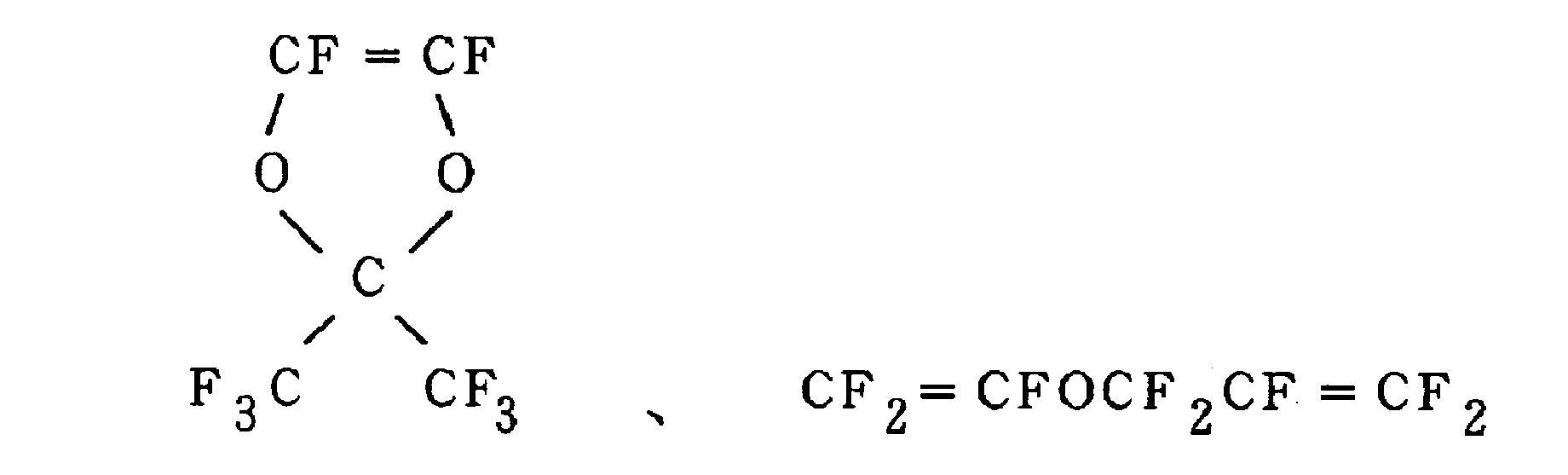
などのパーフルオロオレフィン;クロロトリフルオロエチレン(CTFE)、フッ化ビニル(VF)、ビニリデンフルオライド(VdF)、トリフルオロエチレン、トリフルオロプロピレン、ヘキサフルオロイソブテン、2,3,3,3-テトラフルオロプロペン、1,3,3,3-テトラフルオロプロペン、1,1,3,3,3-ペンタフルオロプロペンなどの非パーフルオロオレフィンが挙げられる。パーフルオロ(アルキルビニルエーテル)としては、パーフルオロ(メチルビニルエーテル)(PMVE)、パーフルオロ(エチルビニルエーテル)(PEVE)、パーフルオロ(プロピルビニルエーテル)(PPVE)などが挙げられる。
また、上記フルオロオレフィンとして、官能基含有フルオロオレフィンも使用できる。
上記官能基含有フルオロオレフィンとしては、例えば、一般式:
CX3 2=CX4-(Rf)m-Y1
(式中、Y1は-OH、-COOM2、-SO2F、-SO3M2(M2は水素原子、NH4基またはアルカリ金属)、カルボン酸塩、カルボキシエステル基、エポキシ基またはシアノ基;X3およびX4は同じかまたは異なりいずれも水素原子またはフッ素原子;Rfは炭素数1~40の2価の含フッ素アルキレン基若しくは含フッ素オキシアルキレン基、または炭素数2~40のエーテル結合を含有する2価の含フッ素アルキレン基若しくは含フッ素オキシアルキレン基;mは0または1)で示される化合物が挙げられる。
上記官能基含有フルオロオレフィンとしては、例えば、一般式:
CX3 2=CX4-(Rf)m-Y1
(式中、Y1は-OH、-COOM2、-SO2F、-SO3M2(M2は水素原子、NH4基またはアルカリ金属)、カルボン酸塩、カルボキシエステル基、エポキシ基またはシアノ基;X3およびX4は同じかまたは異なりいずれも水素原子またはフッ素原子;Rfは炭素数1~40の2価の含フッ素アルキレン基若しくは含フッ素オキシアルキレン基、または炭素数2~40のエーテル結合を含有する2価の含フッ素アルキレン基若しくは含フッ素オキシアルキレン基;mは0または1)で示される化合物が挙げられる。
上記官能基含有フルオロオレフィンの具体例としては、例えば、

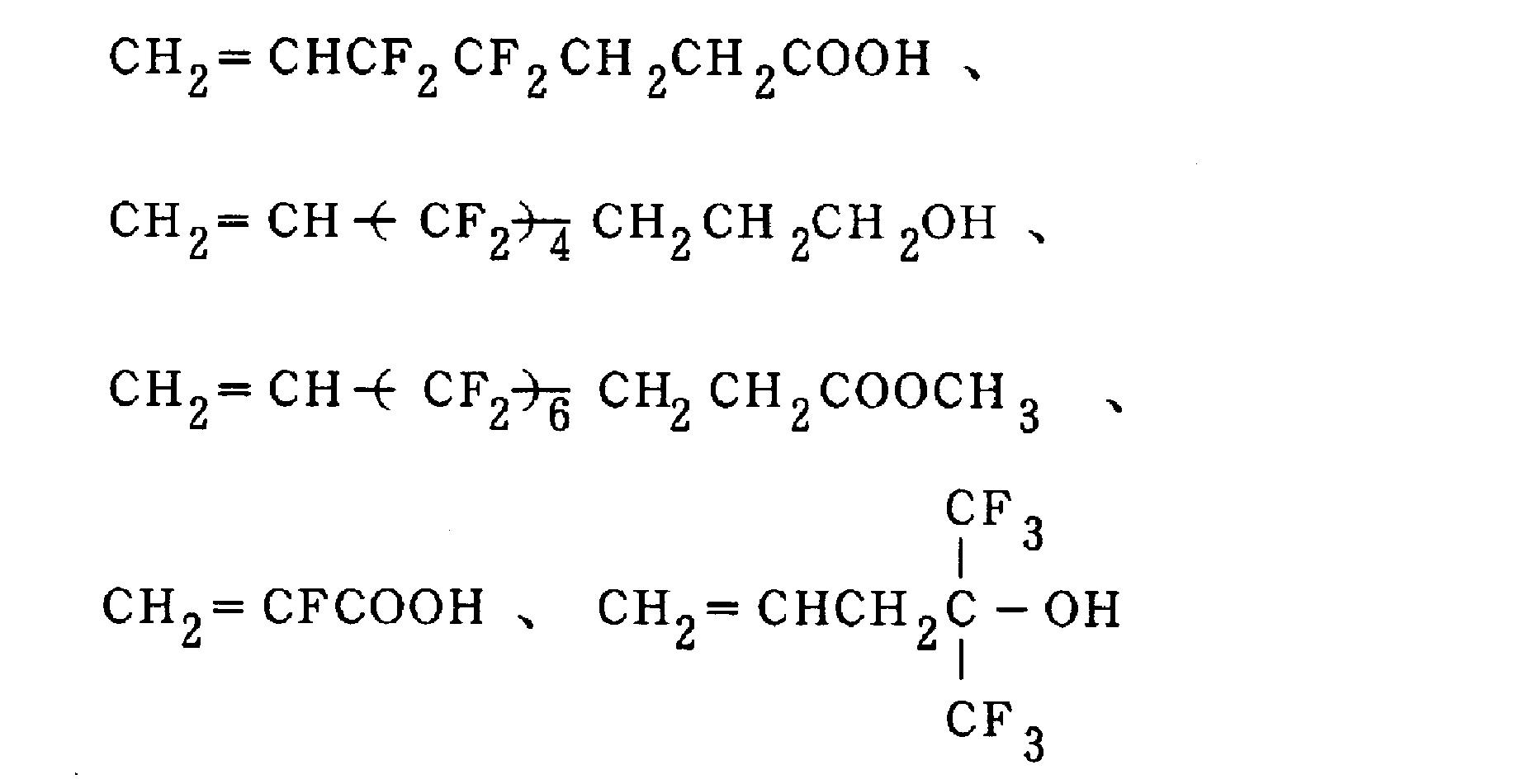
等が挙げられる。
上記フルオロオレフィンとして、ヨウ素含有モノマー、例えば、特公平5-63482号公報や特開昭62-12734号公報に記載されているパーフルオロ(6,6-ジヒドロ-6-ヨード-3-オキサ-1-ヘキセン)、パーフルオロ(5-ヨード-3-オキサ-1-ペンテン)などのパーフルオロビニルエーテルのヨウ素化物も使用できる。
なかでも、上記フルオロオレフィンとしては、フッ化ビニル、ビニリデンフルオライド、テトラフルオロエチレン、ヘキサフルオロプロピレン、及び、クロロトリフルオロエチレンからなる群より選択される少なくとも1種であることが好ましい。
また、上記フルオロオレフィンとしては、ビニリデンフルオライドと、テトラフルオロエチレン、ヘキサフルオロプロピレン及びクロロトリフルオロエチレンからなる群より選択される少なくとも1種と、であることがより好ましい。
フルオロポリマー(A)は、上記フルオロオレフィン単位の他に、フルオロオレフィンと共重合可能な非フッ素系単量体単位を含んでいてもよい。上記フルオロオレフィンと共重合可能な非フッ素系単量体としては、例えば、エチレン、プロピレン、イソブチレンなどのオレフィン類、ビニルエーテル系単量体、アリルエーテル系単量体、ビニルエステル系単量体、アクリル系単量体、メタクリル系単量体などが挙げられる。
フルオロポリマー(A)は、耐溶剤性、防汚性、及び、基材との密着性により一層優れる塗膜を形成することができることから、フルオロオレフィン単位として、ビニリデンフルオライド単位を含むことが好ましい。アクリルポリマー(B)との相溶性の観点からは、フルオロポリマー(A)は、ビニリデンフルオライド単位が、フルオロポリマー(A)を構成する全重合単位に対して50モル%以上であることが好ましく、70モル%以上であることがより好ましく、95モル%以下であることが好ましい。
フルオロポリマー(A)としては、VdF/TFE/CTFE共重合体、VdF/TFE共重合体、VdF/TFE/HFP共重合体、VdF/CTFE共重合体、VdF/HFP共重合体、及び、PVdFからなる群より選択される少なくとも1種であることが好ましく、VdF/TFE/CTFE=40~99/1~50/0~30(モル%)、VdF/TFE=50~99/1~50(モル%)、VdF/TFE/HFP=45~99/0~35/5~50(モル%)、VdF/CTFE=40~99/1~30(モル%)、及び、VdF/HFP=50~99/1~50(モル%)からなる群より選択される少なくとも1種であることがより好ましい。
アクリルポリマー(B)は、少なくともアクリルモノマー単位を含むことが好ましい。上記アクリルモノマーとしては、(メタ)アクリル酸エステルであることが好ましい。
本明細書において、「(メタ)アクリル酸」はアクリル酸又はメタクリル酸を意味する。
アクリルポリマー(B)は、耐溶剤性、防汚性、及び、基材との密着性により一層優れる塗膜を形成することができることから、アクリル酸エステル単位又はメタクリル酸エステル単位を含むことが好ましく、アクリル酸エステル単位及びメタクリル酸エステル単位を含むことがより好ましい。
本明細書において、単に「(メタ)アクリル酸エステル」「アクリル酸エステル」「メタクリル酸エステル」と記載した場合には、水酸基又は加水分解性シリル基を有するアクリルモノマーを含まない。
上記(メタ)アクリル酸エステル単位は、耐溶剤性、防汚性、及び、基材との密着性により一層優れる塗膜を形成することができることから、アクリルポリマー(B)を構成する全単量体単位に対して、合計で、64~99.8質量%であることが好ましく、74~95.5質量%であることがより好ましい。
上記(メタ)アクリル酸エステルとしては、アルキル基の炭素数が1~10のアクリル酸アルキルエステル、又は、アルキル基の炭素数が1~10のメタクリル酸アルキルエステルが好ましい。上記(メタ)アクリル酸エステルとしては、たとえば、メチルアクリレート、エチルアクリレート、n-プロピルアクリレート、イソプロピルアクリレート、n-ブチルアクリレート、メチルメタクリレート、n-プロピルメタクリレート、エチルメタクリレート、n-ブチルメタクリレート、イソプロピルメタクリレート、2-エチルへキシルアクリレート、2-エチルヘキシルメタクリレート、シクロヘキシルアクリレート、シクロヘキシルメタクリレートなどの(メタ)アクリル酸アルキルエステルが挙げられる。
上記(メタ)アクリル酸エステルとしては、メチルメタクリレート、n-ブチルアクリレート、2-エチルへキシルメタクリレート、及び、シクロヘキシルメタクリレートからなる群より選択される少なくとも1種が好ましい。
アクリルポリマー(B)は、耐溶剤性、防汚性、及び、基材との密着性により一層優れる塗膜を形成することができることから、水酸基含有単量体単位を含むことが好ましく、水酸基含有(メタ)アクリル酸エステル及び水酸基含有アルキルビニルエーテルからなる群より選択される少なくとも1種の水酸基含有単量体単位を含むことがより好ましく、水酸基含有単量体単位として、水酸基含有(メタ)アクリル酸エステル単位を含むことが更に好ましい。
上記水酸基含有単量体単位は、耐溶剤性、防汚性、及び、基材との密着性により一層優れる塗膜を形成することができることから、アクリルポリマー(B)を構成する全単量体単位に対して、0.1~40質量%であることが好ましく、0.8~31質量%であることがより好ましく、4~23質量%であることが更に好ましく、4~18質量%であることが特に好ましい。
上記水酸基含有アルキルビニルエーテルとしては、2-ヒドロキシエチルビニルエーテル、3-ヒドロキシプロピルビニルエーテル、2-ヒドロキシプロピルビニルエーテル、2-ヒドロキシ-2-メチルプロピルビニルエーテル、4-ヒドロキシブチルビニルエーテル、4-ヒドロキシ-2-メチルブチルビニルエーテル、5-ヒドロキシペンチルビニルエーテル、6-ヒドロキシヘキシルビニルエーテル、2-ヒドロキシエチルアリルエーテル、4-ヒドロキシブチルアリルエーテル、グリセロールモノアリルエーテル等が挙げられる。重合反応性が優れる点で、4-ヒドロキシブチルビニルエーテル、及び、2-ヒドロキシエチルビニルエーテルからなる群より選択される少なくとも1種が好ましい。
上記水酸基含有(メタ)アクリル酸エステルとしては、2-ヒドロキシエチルメタクリレート(2-HEMA)、2-ヒドロキシエチルアクリレート(2-HEA)、3-ヒドロキシプロピルメタクリレート、3-ヒドロキシプロピルアクリレート、2-ヒドロキシプロピルメタクリレート、2-ヒドロキシプロピルアクリレート、4-ヒドロキシブチルアクリレート、4-ヒドロキシブチルメタクリレート、2-ヒドロキシブチルアクリレート、2-ヒドロキシブチルメタクリレート、6-ヒドロキシヘキシルアクリレート、6-ヒドロキシヘキシルメタクリレート等が挙げられ、なかでも、HEMA及びHEAからなる群より選択される少なくとも1種が好ましい。
上記水酸基含有(メタ)アクリル酸エステル単位は、耐溶剤性、防汚性、及び、基材との密着性により一層優れる塗膜を形成することができることから、アクリルポリマー(B)を構成する全単量体単位に対して、0.1~40質量%であることが好ましく、0.8~31質量%であることがより好ましく、4~23質量%であることが更に好ましく、4~18質量%であることが特に好ましい。上記水酸基含有(メタ)アクリル酸エステル単位は、多すぎると塗膜の透明性を損なうおそれがあり、少なすぎると塗膜がやわらかくなり防汚性、耐溶剤性を損なうおそれがある。
アクリルポリマー(B)は、耐溶剤性、防汚性、及び、基材との密着性により一層優れる塗膜を形成することができることから、加水分解性シリル基含有不飽和単量体単位を含むことが好ましい。
上記加水分解性シリル基含有不飽和単量体としては、
CH2=CHCOO(CH2)3Si(OCH3)3、
CH2=CHCOO(CH2)3Si(CH3)(OCH3)2、
CH2=CHCOO(CH2)3Si(OC2H5)3、
CH2=CHCOO(CH2)3Si(CH3)(OC2H5)2、
CH2=C(CH3)COO(CH2)3Si(OCH3)3、
CH2=C(CH3)COO(CH2)3Si(CH3)(OCH3)2、
CH2=C(CH3)COO(CH2)3Si(OC2H5)3、
CH2=C(CH3)COO(CH2)3Si(CH3)(OC2H5)2、
CH2=C(CH3)COO(CH2)2O(CH2)3Si(OCH3)3、
CH2=C(CH3)COO(CH2)2(CH2)3Si(CH3)(OCH3)2、
CH2=C(CH3)COO(CH2)11Si(OCH3)3、
CH2=C(CH3)COO(CH2)11Si(CH3)(OCH3)2
等が挙げられる。
CH2=CHCOO(CH2)3Si(OCH3)3、
CH2=CHCOO(CH2)3Si(CH3)(OCH3)2、
CH2=CHCOO(CH2)3Si(OC2H5)3、
CH2=CHCOO(CH2)3Si(CH3)(OC2H5)2、
CH2=C(CH3)COO(CH2)3Si(OCH3)3、
CH2=C(CH3)COO(CH2)3Si(CH3)(OCH3)2、
CH2=C(CH3)COO(CH2)3Si(OC2H5)3、
CH2=C(CH3)COO(CH2)3Si(CH3)(OC2H5)2、
CH2=C(CH3)COO(CH2)2O(CH2)3Si(OCH3)3、
CH2=C(CH3)COO(CH2)2(CH2)3Si(CH3)(OCH3)2、
CH2=C(CH3)COO(CH2)11Si(OCH3)3、
CH2=C(CH3)COO(CH2)11Si(CH3)(OCH3)2
等が挙げられる。
上記加水分解性シリル基含有不飽和単量体単位は、耐溶剤性、防汚性、及び、基材との密着性により一層優れる塗膜を形成することができることから、アクリルポリマー(B)を構成する全単量体単位に対して、0.1~5質量%であることが好ましく、0.5~3質量%であることがより好ましい。上記加水分解性シリル基含有不飽和単量体単位は、多すぎると塗膜の透明性を損なうおそれがあり、少なすぎると塗膜の耐溶剤性、基材密着性を損なうおそれがある。
アクリルポリマー(B)は、耐溶剤性、防汚性、及び、基材との密着性により一層優れる塗膜を形成することができることから、不飽和カルボン酸単位を含むことが好ましい。
上記不飽和カルボン酸としては、アクリル酸、メタクリル酸、ビニル酢酸、クロトン酸、桂皮酸、3-アリルオキシプロピオン酸、3-(2-アリロキシエトキシカルボニル)プロピオン酸、イタコン酸、イタコン酸モノエステル、マレイン酸、マレイン酸モノエステル、マレイン酸無水物、フマル酸、フマル酸モノエステル、フタル酸ビニル、ピロメリット酸ビニル、ウンデシレン酸などがあげられる。なかでも、単独重合性が低く単独重合体ができにくい点、カルボキシル基の導入を制御しやすい点から、アクリル酸、メタクリル酸、ビニル酢酸、クロトン酸、イタコン酸、マレイン酸、マレイン酸モノエステル、フマル酸、フマル酸モノエステル、3-アリルオキシプロピオン酸、及び、ウンデシレン酸からなる群より選択される少なくとも1種が好ましい。
上記不飽和カルボン酸単位は、耐溶剤性、防汚性、及び、基材との密着性により一層優れる塗膜を形成することができることから、アクリルポリマー(B)を構成する全単量体単位に対して、0.1~10質量%であることが好ましく、1~5質量%であることがより好ましい。
アクリルポリマー(B)は、耐溶剤性、防汚性、及び、基材との密着性により一層優れる塗膜を形成することができることから、水酸基含有(メタ)アクリル酸エステル単位及び加水分解性シリル基含有不飽和単量体単位を含むことがより好ましい。
アクリルポリマー(B)は、耐溶剤性、防汚性、及び、基材との密着性により一層優れる塗膜を形成することができることから、アクリル酸エステル単位、メタクリル酸エステル単位、不飽和カルボン酸単位、水酸基含有(メタ)アクリル酸エステル単位及び加水分解性シリル基含有不飽和単量体単位を含むことが更に好ましい。
アクリル酸エステル単位、メタクリル酸エステル単位、不飽和カルボン酸単位、水酸基含有(メタ)アクリル酸エステル単位及び加水分解性シリル基含有不飽和単量体単位の比(質量%)は、0~40/42~90/1~5/1~31/0.5~3であることが好ましい。
上記複合重合体粒子は、酸価が1~20であることが好ましく、1~10であることがより好ましく、7以上であることが更に好ましい。酸価が高すぎると塗膜の密着性や防汚性が劣るおそれがある。酸価が無いとエマルジョンの安定性が劣るおそれがある。
上記複合重合体粒子は、水酸基価が1~40であることが好ましく、5~30であることがさらに好ましい。水酸基価が高すぎると塗膜の透明性が劣るおそれがあり、無いと架橋できないおそれがある。
上記水酸基価及び上記酸価は、上記複合重合体粒子を合成するために使用した各モノマーの量から計算することができる。
上記複合重合体粒子は、水酸基価が1~40であることが好ましく、5~30であることがさらに好ましい。水酸基価が高すぎると塗膜の透明性が劣るおそれがあり、無いと架橋できないおそれがある。
上記水酸基価及び上記酸価は、上記複合重合体粒子を合成するために使用した各モノマーの量から計算することができる。
上記複合重合体粒子は、ガラス転移温度(Tg)が0~70℃であることが好ましく、10~60℃であることがより好ましく、20~50℃であることがさらに好ましい。ガラス転移温度が低すぎると、塗膜の防汚性を損なうおそれがあり、高すぎると塗膜の造膜性が悪くなるおそれがある。
上記複合重合体粒子は、粒子径が50~300nmであることが好ましく、50~250nmであることがより好ましい。
上記複合重合体粒子は、上記フルオロオレフィンを水性分散重合して、フルオロポリマー(A)粒子を含む水性分散体を得る工程、上記フルオロポリマー(A)粒子を含む水性分散体中で、アクリルモノマーをフルオロポリマー(A)粒子にシード重合する工程を含む製造方法により、好適に製造することができる。すなわち、上記複合重合体粒子は、上記フルオロオレフィンを水性分散重合して、フルオロポリマー(A)粒子を含む水性分散体を得る工程、上記フルオロポリマー(A)粒子を含む水性分散体中で、少なくとも上記アクリルモノマーを、フルオロポリマー(A)粒子にシード重合する工程を含む製造方法により得られたものであることが好ましい。
上記水性分散重合及び上記シード重合は、所望により、非反応性アニオン界面活性剤、反応性アニオン界面活性剤、非反応性ノニオン界面活性剤、反応性ノニオン界面活性剤等の存在下に実施することもできる。
本発明の水性分散体は、ポリイソシアネート化合物を含む。
上記ポリイソシアネート化合物としては、キシリレンジイソシアネート(XDI)及びビス(イソシアネートメチル)シクロヘキサン(水素化XDI、H6XDI)からなる群より選択される少なくとも1種のイソシアネートから誘導されるポリイソシアネート化合物、ヘキサメチレンジイソシアネート(HDI)に基づくブロックイソシアネート化合物、ヘキサメチレンジイソシアネート(HDI)から誘導されるポリイソシアネート化合物、イソホロンジイソシアネート(IPDI)から誘導されるポリイソシアネート化合物、及び、水分散性ポリイソシアネート化合物からなる群より選択される少なくとも1種の化合物が好ましい。上記ポリイソシアネート化合物としては、水分散性ポリイソシアネート化合物であることが特に好ましい。
上記ポリイソシアネート化合物として、キシリレンジイソシアネート(XDI)及びビス(イソシアネートメチル)シクロヘキサン(水素化XDI、H6XDI)からなる群より選択される少なくとも1種のイソシアネート(以下、イソシアネート(i)ともいう。)から誘導されるポリイソシアネート化合物(以下、ポリイソシアネート化合物(I)ともいう。)を用いた場合、上記水性分散体から得られる塗膜とガラス又はポリエチレンテレフタレートとの密着性が、より優れたものになる。
上記ポリイソシアネート化合物(I)としては、例えば、上記イソシアネート(i)と3価以上の脂肪族多価アルコールとを付加重合して得られるアダクト、上記イソシアネート(i)からなるイソシアヌレート構造体(ヌレート構造体)、及び、上記イソシアネート(i)からなるビウレットを挙げることができる。
上記ポリイソシアネート化合物(I)としては、例えば、上記イソシアネート(i)と3価以上の脂肪族多価アルコールとを付加重合して得られるアダクト、上記イソシアネート(i)からなるイソシアヌレート構造体(ヌレート構造体)、及び、上記イソシアネート(i)からなるビウレットを挙げることができる。
上記アダクトとしては、例えば、下記一般式(1):

(式中、R1は、炭素数3~20の脂肪族炭化水素基を表す。R2は、フェニレン基又はシクロヘキシレン基を表す。kは、3~20の整数である。)で表される構造を有するものが好ましい。
上記一般式(1)中のR1は、上記3価以上の脂肪族多価アルコールに基づく炭化水素基であり、炭素数3~10の脂肪族炭化水素基がより好ましく、炭素数3~6の脂肪族炭化水素基が更に好ましい。
上記R2がフェニレン基である場合、1,2-フェニレン基(o-フェニレン基)、1,3-フェニレン基(m-フェニレン基)、及び、1,4-フェニレン基(p-フェニレン基)のいずれであってもよい。中でも、1,3-フェニレン基(m-フェニレン基)が好ましい。また、上記一般式(1)中の全てのR2が同じフェニレン基であってもよく、2種以上が混在していてもよい。
上記R2がシクロヘキシレン基である場合、1,2-シクロヘキシレン基、1,3-シクロヘキシレン基、及び、1,4-シクロヘキシレン基のいずれであってもよい。中でも、1,3-シクロヘキシレン基が好ましい。また、上記一般式(1)中の全てのR2が同じシクロヘキシレン基であってもよく、2種以上が混在していてもよい。
上記kは、3価以上の脂肪族多価アルコールの価数に対応する数である。上記kとして、より好ましくは3~10の整数であり、更に好ましくは3~6の整数である。
上記一般式(1)中のR1は、上記3価以上の脂肪族多価アルコールに基づく炭化水素基であり、炭素数3~10の脂肪族炭化水素基がより好ましく、炭素数3~6の脂肪族炭化水素基が更に好ましい。
上記R2がフェニレン基である場合、1,2-フェニレン基(o-フェニレン基)、1,3-フェニレン基(m-フェニレン基)、及び、1,4-フェニレン基(p-フェニレン基)のいずれであってもよい。中でも、1,3-フェニレン基(m-フェニレン基)が好ましい。また、上記一般式(1)中の全てのR2が同じフェニレン基であってもよく、2種以上が混在していてもよい。
上記R2がシクロヘキシレン基である場合、1,2-シクロヘキシレン基、1,3-シクロヘキシレン基、及び、1,4-シクロヘキシレン基のいずれであってもよい。中でも、1,3-シクロヘキシレン基が好ましい。また、上記一般式(1)中の全てのR2が同じシクロヘキシレン基であってもよく、2種以上が混在していてもよい。
上記kは、3価以上の脂肪族多価アルコールの価数に対応する数である。上記kとして、より好ましくは3~10の整数であり、更に好ましくは3~6の整数である。
上記イソシアヌレート構造体は、分子中に、下記一般式(2):

で表されるイソシアヌレート環を1個又は2個以上有するものである。
上記イソシアヌレート構造体としては、上記イソシアネートの三量化反応により得られる三量体、五量化反応により得られる五量体、七量化反応により得られる七量体等を挙げることができる。
中でも、下記一般式(3):
上記イソシアヌレート構造体としては、上記イソシアネートの三量化反応により得られる三量体、五量化反応により得られる五量体、七量化反応により得られる七量体等を挙げることができる。
中でも、下記一般式(3):
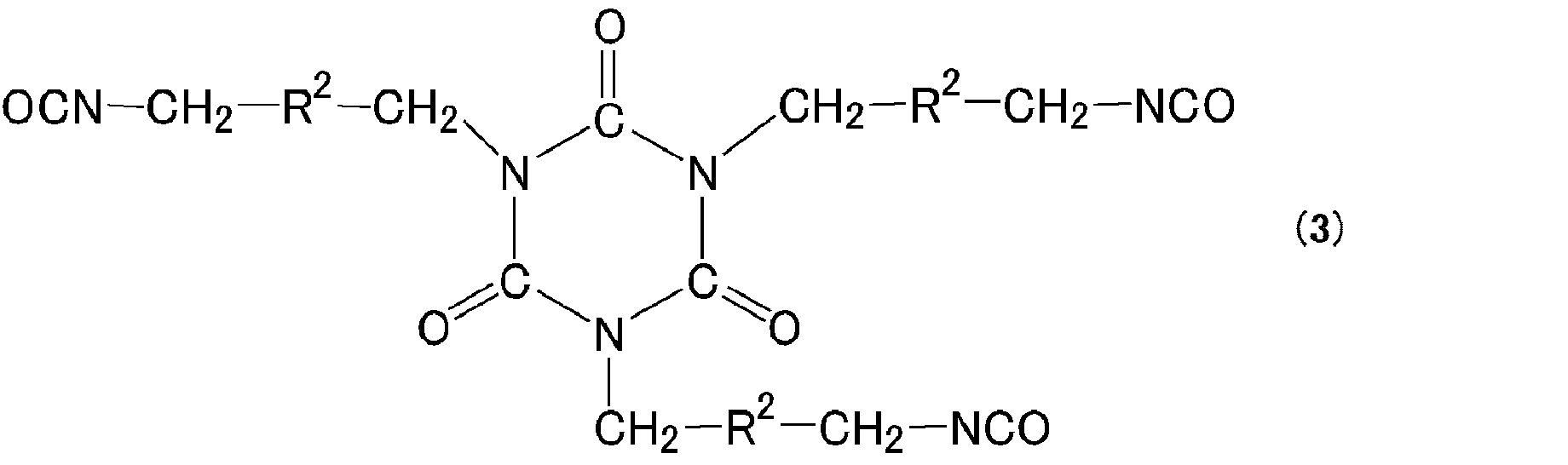
(式中、R2は、一般式(1)中のR2と同じである。)で表される三量体が好ましい。すなわち、上記イソシアヌレート構造体は、キシリレンジイソシアネート及びビス(イソシアネートメチル)シクロヘキサンからなる群より選択される少なくとも1種のイソシアネートの三量体であることが好ましい。
上記ビウレットは、下記一般式(4):

(式中、R2は、一般式(1)中のR2と同じである。)で表される構造を有する化合物であり、上記イソシアヌレート構造体を得る場合とは異なる条件下で、上記イソシアネートを三量化することにより、得ることができる。
上記ポリイソシアネート化合物(I)としては、中でも、上記アダクト、すなわち、キシリレンジイソシアネート及びビス(イソシアネートメチル)シクロヘキサンからなる群より選択される少なくとも1種のイソシアネートと、3価以上の脂肪族多価アルコールと、を付加重合して得られるものであることが好ましい。
上記ポリイソシアネート化合物(I)が、上記イソシアネート(i)と3価以上の脂肪族多価アルコールとのアダクトである場合、該3価以上の脂肪族多価アルコールとしては、具体的には、グリセロール、トリメチロールプロパン(TMP)、1,2,6-ヘキサントリオール、トリメチロールエタン、2,4-ジヒドロキシ-3-ヒドロキシメチルペンタン、1,1,1-トリス(ビスヒドロキシメチル)プロパン、2,2-ビス(ヒドロキシメチル)ブタノール-3等の3価アルコール;ペンタエリスリトール、ジグリセロール等の4価アルコール;アラビット、リビトール、キシリトール等の5価アルコール(ペンチット);ソルビット、マンニット、ガラクチトール、アロズルシット等の6価アルコール(ヘキシット)等が挙げられる。中でも、トリメチロールプロパン、ペンタエリスリトールが特に好ましい。
また、上記アダクトの構成成分として用いられるキシリレンジイソシアネート(XDI)としては、1,3-キシリレンジイソシアネート(m-キシリレンジイソシアネート)、1,2-キシリレンジイソシアネート(o-キシリレンジイソシアネート)、1,4-キシリレンジイソシアネート(p-キシリレンジイソシアネート)が挙げられるが、中でも、1,3-キシリレンジイソシアネート(m-キシリレンジイソシアネート)が好ましい。
また、上記アダクトの構成成分として用いられるビス(イソシアネートメチル)シクロヘキサン(水素化XDI、H6XDI)としては、1,3-ビス(イソシアネートメチル)シクロヘキサン、1,2-ビス(イソシアネートメチル)シクロヘキサン、1,4-ビス(イソシアネートメチル)シクロヘキサンが挙げられるが、中でも、1,3-ビス(イソシアネートメチル)シクロヘキサンが好ましい。
キシリレンジイソシアネート及びビス(イソシアネートメチル)シクロヘキサンからなる群より選択される少なくとも1種のイソシアネートと、上記のような3価以上の脂肪族多価アルコールと、を付加重合することにより、アダクトが得られる。
上記アダクトとして、具体的には、例えば下記一般式(5):

(式中、R3は、フェニレン基又はシクロヘキシレン基を表す。)で表わされる化合物、すなわち、キシリレンジイソシアネート及びビス(イソシアネートメチル)シクロヘキサンからなる群より選択される少なくとも1種のイソシアネートと、トリメチロールプロパン(TMP)と、を付加重合することにより得られるポリイソシアネート化合物を挙げることができる。
上記一般式(5)中のR3で表されるフェニレン基又はシクロヘキシレン基については、上記一般式(1)におけるR2について述べたとおりである。
上記一般式(5)中のR3で表されるフェニレン基又はシクロヘキシレン基については、上記一般式(1)におけるR2について述べたとおりである。
上記一般式(5)で表されるポリイソシアネート化合物の市販品としては、タケネートD110N(三井化学株式会社製、XDIとTMPとのアダクト、NCO含有量11.8%)、タケネートD120N(三井化学株式会社製、H6XDIとTMPとのアダクト、NCO含有量11.0%)等が挙げられる。
上記ポリイソシアネート化合物(I)が、イソシアヌレート構造体である場合の具体例としては、タケネートD121N(三井化学株式会社製、H6XDIヌレート、NCO含有量14.0%)、タケネートD127N(三井化学株式会社製、H6XDIヌレート、H6XDIの3量体、NCO含有量13.5%)等が挙げられる。
上記ポリイソシアネート化合物として、ヘキサメチレンジイソシアネート(HDI)に基づくブロックイソシアネート(以下、単にブロックイソシアネートともいう。)を用いることにより、上記水性分散体が充分なポットライフ(可使時間)を有するものとなる。
上記ブロックイソシアネートとしては、ヘキサメチレンジイソシアネートから誘導されるポリイソシアネート化合物(以下、ポリイソシアネート化合物(II)ともいう。)をブロック化剤で反応させて得られるものが好ましい。
上記ポリイソシアネート化合物(II)としては、例えば、ヘキサメチレンジイソシアネートと3価以上の脂肪族多価アルコールとを付加重合して得られるアダクト、ヘキサメチレンジイソシアネートからなるイソシアヌレート構造体(ヌレート構造体)、及び、ヘキサメチレンジイソシアネートからなるビウレットを挙げることができる。
上記ブロックイソシアネートとしては、ヘキサメチレンジイソシアネートから誘導されるポリイソシアネート化合物(以下、ポリイソシアネート化合物(II)ともいう。)をブロック化剤で反応させて得られるものが好ましい。
上記ポリイソシアネート化合物(II)としては、例えば、ヘキサメチレンジイソシアネートと3価以上の脂肪族多価アルコールとを付加重合して得られるアダクト、ヘキサメチレンジイソシアネートからなるイソシアヌレート構造体(ヌレート構造体)、及び、ヘキサメチレンジイソシアネートからなるビウレットを挙げることができる。
上記アダクトとしては、例えば、下記一般式(6):

(式中、R4は、炭素数3~20の脂肪族炭化水素基を表す。kは、3~20の整数である。)で表される構造を有するものが好ましい。
上記一般式(6)中のR4は、上記3価以上の脂肪族多価アルコールに基づく炭化水素基であり、炭素数3~10の脂肪族炭化水素基がより好ましく、炭素数3~6の脂肪族炭化水素基が更に好ましい。
上記kは、3価以上の脂肪族多価アルコールの価数に対応する数である。上記kとして、より好ましくは3~10の整数であり、更に好ましくは3~6の整数である。
上記一般式(6)中のR4は、上記3価以上の脂肪族多価アルコールに基づく炭化水素基であり、炭素数3~10の脂肪族炭化水素基がより好ましく、炭素数3~6の脂肪族炭化水素基が更に好ましい。
上記kは、3価以上の脂肪族多価アルコールの価数に対応する数である。上記kとして、より好ましくは3~10の整数であり、更に好ましくは3~6の整数である。
上記イソシアヌレート構造体は、分子中に、下記一般式(2):
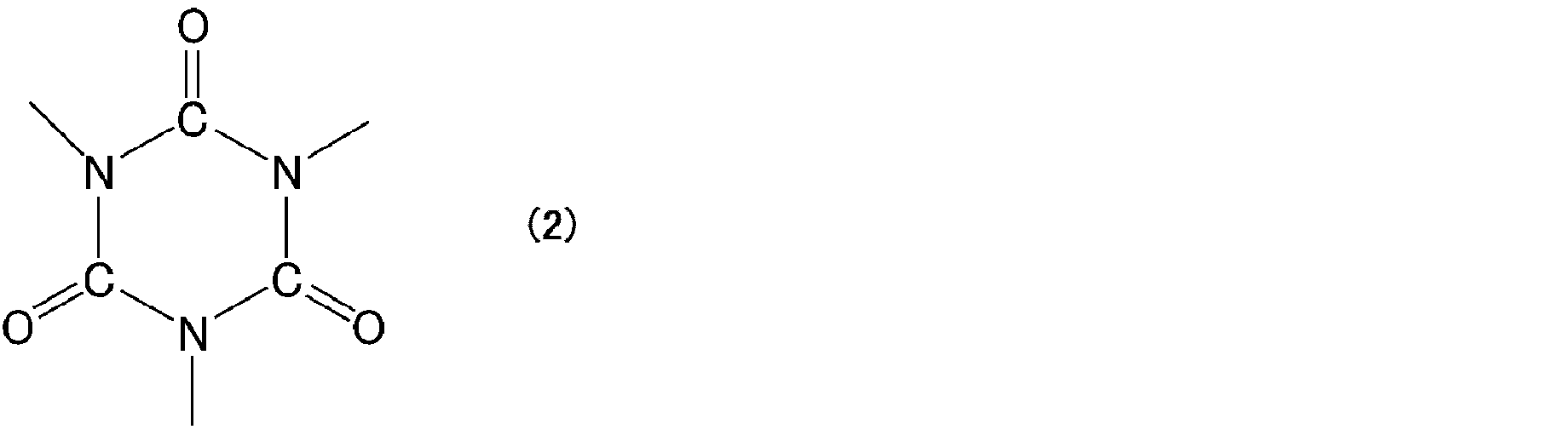
で表されるイソシアヌレート環を1個又は2個以上有するものである。
上記イソシアヌレート構造体としては、上記イソシアネートの三量化反応により得られる三量体、五量化反応により得られる五量体、七量化反応により得られる七量体等を挙げることができる。
中でも、下記一般式(7):
上記イソシアヌレート構造体としては、上記イソシアネートの三量化反応により得られる三量体、五量化反応により得られる五量体、七量化反応により得られる七量体等を挙げることができる。
中でも、下記一般式(7):

で表される三量体が好ましい。
上記ビウレットは、下記一般式(8):

で表される構造を有する化合物であり、上記イソシアヌレート構造体を得る場合とは異なる条件下で、ヘキサメチレンジイソシアネートを三量化することにより、得ることができる。
上記ブロック化剤としては、活性水素を有する化合物を用いることが好ましい。上記活性水素を有する化合物としては、例えば、アルコール類、オキシム類、ラクタム類、活性メチレン化合物、及び、ピラゾール化合物からなる群より選択される少なくとも1種を用いることが好ましい。
このように、上記ブロックイソシアネートがヘキサメチレンジイソシアネートから誘導されるポリイソシアネート化合物をブロック化剤で反応させて得られるものであり、上記ブロック化剤は、アルコール類、オキシム類、ラクタム類、活性メチレン化合物、及び、ピラゾール化合物からなる群より選択される少なくとも1種であることが好ましい。
上記ブロックイソシアネートを得るためのポリイソシアネート化合物(II)が、ヘキサメチレンジイソシアネートと3価以上の脂肪族多価アルコールとのアダクトである場合、該3価以上の脂肪族多価アルコールとしては、具体的には、グリセロール、トリメチロールプロパン(TMP)、1,2,6-ヘキサントリオール、トリメチロールエタン、2,4-ジヒドロキシ-3-ヒドロキシメチルペンタン、1,1,1-トリス(ビスヒドロキシメチル)プロパン、2,2-ビス(ヒドロキシメチル)ブタノール-3等の3価アルコール;ペンタエリスリトール、ジグリセロール等の4価アルコール;アラビット、リビトール、キシリトール等の5価アルコール(ペンチット);ソルビット、マンニット、ガラクチトール、アロズルシット等の6価アルコール(ヘキシット)等が挙げられる。中でも、トリメチロールプロパン、ペンタエリスリトールが特に好ましい。
ヘキサメチレンジイソシアネートと、上記のような3価以上の脂肪族多価アルコールとを付加重合することにより、上記アダクトが得られる。
ヘキサメチレンジイソシアネートと、上記のような3価以上の脂肪族多価アルコールとを付加重合することにより、上記アダクトが得られる。
上記ポリイソシアネート化合物(II)と反応させる、活性水素を有する化合物としては、具体的には、メタノール、エタノール、n-プロパノール、イソプロパノール、メトキシプロパノール等のアルコール類;アセトンオキシム、2-ブタノンオキシム、シクロヘキサノンオキシム等のオキシム類;ε-カプロラクタム等のラクタム類;アセト酢酸メチル、マロン酸エチル等の活性メチレン化合物;3-メチルピラゾール、3,5-ジメチルピラゾール、3,5-ジエチルピラゾール等のピラゾール化合物等が挙げられ、これらの1種又は2種以上を用いることができる。
中でも、活性メチレン化合物、オキシム類が好ましく、活性メチレン化合物がより好ましい。
中でも、活性メチレン化合物、オキシム類が好ましく、活性メチレン化合物がより好ましい。
上記ブロックイソシアネートの市販品としては、デュラネートK6000(旭化成ケミカルズ株式会社製、HDIの活性メチレン化合物ブロックイソシアネート)、デュラネートTPA-B80E(旭化成ケミカルズ株式会社製)、デュラネートMF-B60X(旭化成ケミカルズ株式会社製)、デュラネート17B-60PX(旭化成ケミカルズ株式会社製)、コロネート2507(日本ポリウレタン工業株式会社製)、コロネート2513(日本ポリウレタン工業株式会社製)、コロネート2515(日本ポリウレタン工業株式会社製)、スミジュールBL-3175(住化バイエルウレタン株式会社製)、LuxateHC1170(オリン・ケミカルズ社製)、LuxateHC2170(オリン・ケミカルズ社製)等が挙げられる。
上記ポリイソシアネート化合物として、ヘキサメチレンジイソシアネート(HDI)から誘導されるポリイソシアネート化合物(以下、ポリイソシアネート化合物(III)ともいう。)を用いることもできる。ポリイソシアネート化合物(III)としては、ポリイソシアネート化合物(II)として上述したものが挙げられる。
ポリイソシアネート化合物(III)の具体例としては、コロネートHX(日本ポリウレタン工業株式会社製、ヘキサメチレンジイソシアネートのイソシアヌレート構造体、NCO含有量21.1%)、スミジュールN3300(住化バイエルウレタン株式会社製、ヘキサメチレンジイソシアネートのイソシアヌレート構造体)、タケネートD170N(三井化学社製、ヘキサメチレンジイソシアネートのイソシアヌレート構造体)、スミジュールN3800(住化バイエルウレタン株式会社製、ヘキサメチレンジイソシアネートのイソシアヌレート構造体プレポリマータタイプ)等が挙げられる。
上記ポリイソシアネート化合物として、イソホロンジイソシアネート(IPDI)から誘導されるポリイソシアネート化合物(以下、ポリイソシアネート化合物(IV)ともいう。)を用いることもできる。
上記ポリイソシアネート化合物(IV)としては、例えば、イソホロンジイソシアネートと3価以上の脂肪族多価アルコールとを付加重合して得られるアダクト、イソホロンジイソシアネートからなるイソシアヌレート構造体(ヌレート構造体)、及び、イソホロンジイソシアネートからなるビウレットを挙げることができる。
上記アダクトとしては、例えば、下記一般式(9):

(式中、R5は、炭素数3~20の脂肪族炭化水素基を表す。R6は、下記一般式(10):

で表される基である。kは、3~20の整数である。)で表される構造を有するものが好ましい。
上記一般式(9)中のR5は、上記3価以上の脂肪族多価アルコールに基づく炭化水素基であり、炭素数3~10の脂肪族炭化水素基がより好ましく、炭素数3~6の脂肪族炭化水素基が更に好ましい。
上記kは、3価以上の脂肪族多価アルコールの価数に対応する数である。上記kとして、より好ましくは3~10の整数であり、更に好ましくは3~6の整数である。
上記一般式(9)中のR5は、上記3価以上の脂肪族多価アルコールに基づく炭化水素基であり、炭素数3~10の脂肪族炭化水素基がより好ましく、炭素数3~6の脂肪族炭化水素基が更に好ましい。
上記kは、3価以上の脂肪族多価アルコールの価数に対応する数である。上記kとして、より好ましくは3~10の整数であり、更に好ましくは3~6の整数である。
上記イソシアヌレート構造体は、分子中に、下記一般式(2):
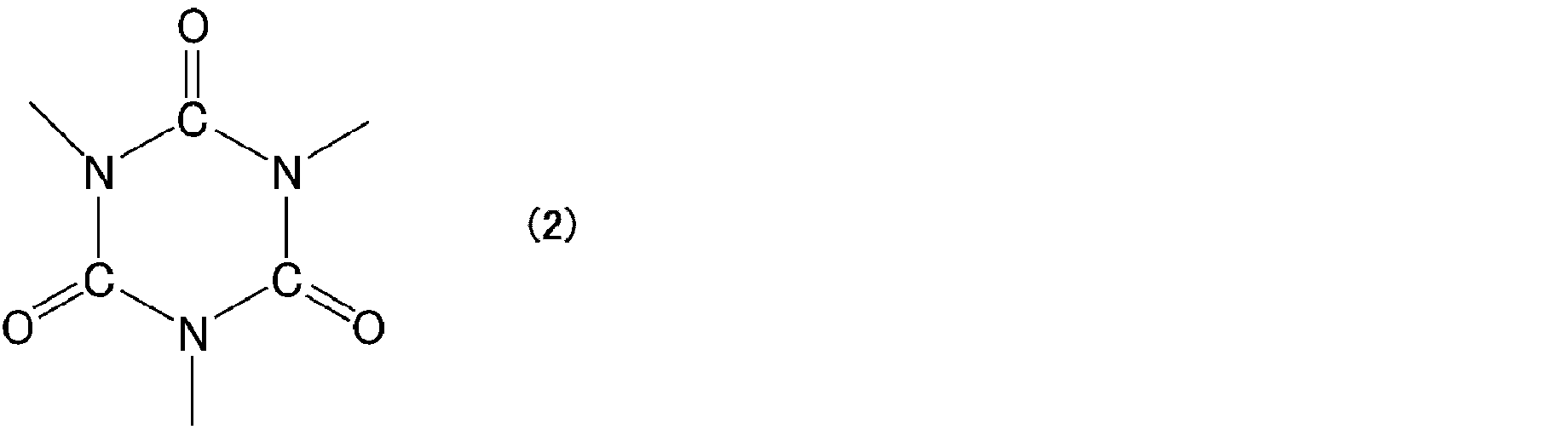
で表されるイソシアヌレート環を1個又は2個以上有するものである。
上記イソシアヌレート構造体としては、イソホロンジイソシアネートの三量化反応により得られる三量体、五量化反応により得られる五量体、七量化反応により得られる七量体等を挙げることができる。
中でも、下記一般式(11):
上記イソシアヌレート構造体としては、イソホロンジイソシアネートの三量化反応により得られる三量体、五量化反応により得られる五量体、七量化反応により得られる七量体等を挙げることができる。
中でも、下記一般式(11):

(式中、R6は、一般式(9)中のR6と同じである。)で表される三量体が好ましい。すなわち、上記イソシアヌレート構造体は、イソホロンジイソシアネートの三量体であることが好ましい。
上記ビウレットは、下記一般式(12):

(式中、R6は、一般式(9)中のR6と同じである。)で表される構造を有する化合物であり、上記イソシアヌレート構造体を得る場合とは異なる条件下で、イソホロンジイソシアネートを三量化することにより、得ることができる。
上記ポリイソシアネート化合物(IV)としては、中でも、上記アダクト及び上記イソシアヌレート構造体からなる群より選択される少なくとも1種であることが好ましい。すなわち、上記ポリイソシアネート化合物(IV)は、イソホロンジイソシアネートと、3価以上の脂肪族多価アルコールと、を付加重合して得られるアダクト、及び、イソホロンジイソシアネートからなるイソシアヌレート構造体からなる群より選択される少なくとも1種であることが好ましい。
上記ポリイソシアネート化合物(IV)が、イソホロンジイソシアネートと3価以上の脂肪族多価アルコールとのアダクトである場合、該3価以上の脂肪族多価アルコールとしては、具体的には、グリセロール、トリメチロールプロパン(TMP)、1,2,6-ヘキサントリオール、トリメチロールエタン、2,4-ジヒドロキシ-3-ヒドロキシメチルペンタン、1,1,1-トリス(ビスヒドロキシメチル)プロパン、2,2-ビス(ヒドロキシメチル)ブタノール-3等の3価アルコール;ペンタエリスリトール、ジグリセロール等の4価アルコール;アラビット、リビトール、キシリトール等の5価アルコール(ペンチット);ソルビット、マンニット、ガラクチトール、アロズルシット等の6価アルコール(ヘキシット)等が挙げられる。中でも、トリメチロールプロパン、ペンタエリスリトールが特に好ましい。
イソホロンジイソシアネートと、上記のような3価以上の脂肪族多価アルコールと、を付加重合することにより、本発明で好適に用いられるアダクトが得られる。
本発明で好ましく用いられるアダクトとして、具体的には、例えば下記一般式(13):

(式中、R7は、下記一般式(10):
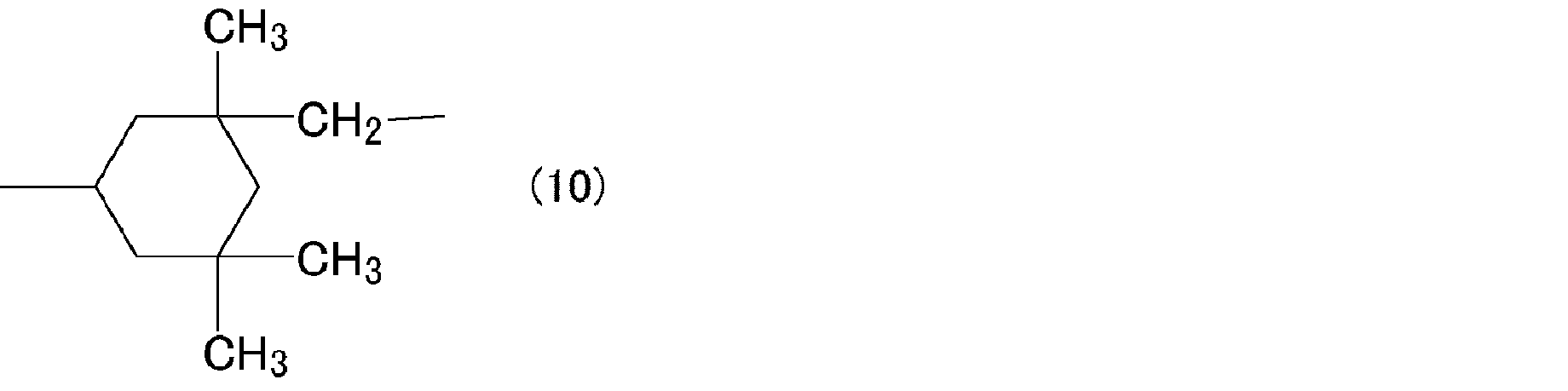
で表される基である。)で表される化合物、すなわち、イソホロンジイソシアネートとトリメチロールプロパン(TMP)とを付加重合することにより得られるポリイソシアネート化合物を挙げることができる。
上記一般式(10)で表されるポリイソシアネート化合物(イソホロンジイソシアネートのTMPアダクト体)の市販品としては、タケネートD140N(三井化学株式会社製、NCO含有量11%)等が挙げられる。
イソホロンジイソシアネートからなるイソシアヌレート構造体の市販品としては、デスモジュールZ4470(住化バイエルウレタン株式会社製、NCO含有量11%)等が挙げられる。
上記ポリイソシアネート化合物として、水分散性ポリイソシアネート化合物を用いることもできる。上記水分散性ポリイソシアネート化合物とは、水性媒体中に加えて攪拌したときに水分散体を形成しうるポリイソシアネート化合物をいう。このような水分散性ポリイソシアネート化合物としては、例えば、(1)疎水性ポリイソシアネートと親水性基を有するポリイソシアネートとの混合物、(2)疎水性ポリイソシアネートとイソシアネート基を有さず親水性基を有する分散剤との混合物、(3)親水性基を有するポリイソシアネートのみ等が挙げられる。なお、本発明において、親水性基とはアニオン性基、カチオン性基又はノニオン性基をいう。上記水分散性ポリイソシアネート化合物としては、親水性基を有するポリイソシアネートであることが特に好ましい。
前記疎水性ポリイソシアネートとは、親水性基を有さないものであり、例えば、1,4-テトラメチレンジイソシアネート、エチル(2,6-ジイソシアナート)ヘキサノエート、1,6-ヘキサメチレンジイソシアネート、1,12-ドデカメチレンジイソシアネート、2,2,4-または2,4,4-トリメチルヘキサメチレンジイソシアネート等の脂肪族ジイソシアネート;1,3,6-ヘキサメチレントリイソシアネート、1,8-ジイソシアナート-4-イソシアナートメチルオクタン、2-イソシアナートエチル(2,6-ジイソシアナート)ヘキサノエート等の脂肪族トリイソシアネート;1,3-ビス(イソシアナートメチルシクロヘキサン)、1,4-ビス(イソシアナートメチルシクロヘキサン)、1,3-ジイソシアナートシクロヘキサン、1,4-ジイソシアナートシクロヘキサン、3,5,5-トリメチル(3-イソシアナートメチル)シクロヘキシルイソシアネート、ジシクロヘキシルメタン-4,4’-ジイソシアネート、2,5-ジイソシアナートメチルノルボルナン、2,6-ジイソシアナートメチルノルボルナン等の脂環族ジイソシアネート;2,5-ジイソシアナートメチル-2-イソシネートプロピルノルボルナン、2,6-ジイソシアナートメチル-2-イソシネートプロピルノルボルナン等の脂環族トリイソシアネート;m-キシリレンジイソシアネート、α,α,α’α’-テトラメチル-m-キシリレンジイソシアネート等のアラルキレンジイソシアネート;m-またはp-フェニレンジイソシアネート、トリレン-2,4-ジイソシアネート、トリレン-2,6-ジイソシアネート、ジフェニルメタン-4,4’-ジイソシアネート、ナフタレン-1,5-ジイソシアネート、ジフェニル-4,4’-ジイソシアネート、4,4’-ジイソシアナート-3,3’-ジメチルジフェニル、3-メチル-ジフェニルメタン-4,4’-ジイソシアネート、ジフェニルエーテル-4,4’-ジイソシアネート等の芳香族ジイソシアネート;トリフェニルメタントリイソシアネート、トリス(イソシアナートフェニル)チオホスフェート等の芳香族トリイソシアネート;前記のジイソシアネート又はトリイソシアネートのイソシアネート基同士を環化二量化して得られるウレトジオン構造を有するポリイソシアネート;前記のジイソシアネート又はトリイソシアネートのイソシアネート基同士を環化三量化して得られるイソシアヌレート構造を有するポリイソシアネート;前記のジイソシアネート又はトリイソシアネートを水と反応させることにより得られるビュレット構造を有するポリイソシアネート;前記のジイソシアネート又はトリイソシアネートを二酸化炭素と反応させて得られるオキサダイアジントリオン構造を有するポリイソシアネート;アロファネート構造を有するポリイソシアネートなどが挙げられる。これらの中でも、緻密な架橋塗膜を形成し、硬化塗膜の耐アルコール性をより向上することができることから、イソシアヌレート構造を有するポリイソシアネートが好ましい。
上記親水性基を有するポリイソシアネートとしては、例えば、親水性基及びイソシアネート基を有するポリエーテル、ポリエステル、ポリウレタン、ビニル重合体、アルキド樹脂、フッ素樹脂、シリコン樹脂等が挙げられる。これらの中でも、水分散性が良好であることから、親水性基とイソシアネート基とを有するポリエーテル又はビニル重合体が好ましく、親水性基とイソシアネート基を有するポリエーテルがより好ましい。これらの親水性基を有するポリイソシアネートは、単独で用いることも2種以上併用することもできる。
親水性基を有するポリイソシアネートの市販品としては、バイヒジュール XP 2700(住化バイエルウレタン株式会社製)等が挙げられる。
上記水性分散体におけるポリイソシアネート化合物の含有量は、ポリイソシアネート化合物中のイソシアネート基(NCO)と複合重合体粒子が含有する水酸基(OH)の当量比(NCO/OH)が0.1~5.0当量であることが好ましく、0.5~5.0当量であることがより好ましく、0.5~3.0当量であることが更に好ましく、1.0~2.0当量であることが特に好ましい。
上記ポリイソシアネート化合物が水分散性ポリイソシアネート化合物の場合の配合量としては、本発明の水性分散体の硬化性及び硬化塗膜の塗膜外観や耐久性がより向上することから、また、防汚性を向上させる観点から、水分散性ポリイソシアネート化合物中のイソシアネート基(NCO)と、複合重合体粒子が含有する水酸基(OH)との当量比(NCO/OH)が、0.1~5.0当量の範囲が好ましく、0.3~3.0当量の範囲がより好ましく、0.3~2.0当量の範囲が更に好ましく、0.5~1.5当量の範囲が特に好ましい。
本発明の水性分散体は、複合重合体粒子と、上記水分散性ポリイソシアネート化合物を含有するもので、これらを水に溶解又は分散させたものが挙げられる。これらを混合する方法としては、例えば、複合重合体粒子を水分散して得られる水性樹脂組成物に、水分散性ポリイソシアネート化合物の水分散体や水分散性ポリイソシアネート化合物を溶媒で希釈したもの等(水分散性ポリイソシアネート組成物)を添加し、攪拌する方法等が挙げられる。攪拌方法としては、例えば、各種の攪拌機を使用する方法があり、少量ならば攪拌棒等を用いた簡便な攪拌でも、容易に均一に混合することができる。攪拌機を使用することは、短時間で多量の水性塗料を調製できることから好ましい。
上記複合重合体粒子を水分散して得られる水性樹脂組成物と上記水分散性ポリイソシアネート組成物との混合比率は、密着性、耐温水密着性及び耐溶剤性に優れる硬化塗膜を得られることから、上記水分散性ポリイソシアネート化合物中のイソシアネート基(NCO)と上記複合重合体粒子中の水酸基(OH)の当量比(NCO/OH)が、0.1~5.0当量となる混合比率であることが好ましく、0.3~3.0当量となる混合比率であることがより好ましい。
上記水分散性ポリイソシアネート組成物の使用量は、少ないほど塗膜の防汚性を向上させる。
上記複合重合体粒子を水分散して得られる水性樹脂組成物と上記水分散性ポリイソシアネート組成物との混合比率は、防汚性を向上させる観点から少ないほど良く、上記水分散性ポリイソシアネート化合物の配合量は、上記複合重合体粒子の水分散体の固形分に対して、15質量%以下が好ましく、10質量%以下がより好ましい。
上記水分散性ポリイソシアネート化合物中のイソシアネート基(NCO)と上記複合重合体粒子中の水酸基(OH)の当量比(NCO/OH)が、0.1~3.0当量となる混合比率であることが好ましく、0.3~2.0当量となる混合比率であることがより好ましく、0.5~1.5当量となる混合比率であることが更に好ましい。
上記水分散性ポリイソシアネート組成物の使用量は、少ないほど塗膜の防汚性を向上させる。
上記複合重合体粒子を水分散して得られる水性樹脂組成物と上記水分散性ポリイソシアネート組成物との混合比率は、防汚性を向上させる観点から少ないほど良く、上記水分散性ポリイソシアネート化合物の配合量は、上記複合重合体粒子の水分散体の固形分に対して、15質量%以下が好ましく、10質量%以下がより好ましい。
上記水分散性ポリイソシアネート化合物中のイソシアネート基(NCO)と上記複合重合体粒子中の水酸基(OH)の当量比(NCO/OH)が、0.1~3.0当量となる混合比率であることが好ましく、0.3~2.0当量となる混合比率であることがより好ましく、0.5~1.5当量となる混合比率であることが更に好ましい。
上記水性分散体は、更に、水を含む。水に加えて、アルコール、グリコールエーテル、エステル等の有機溶媒を含有してもよい。
上記水性分散体は、10~60質量%の複合重合体粒子を含むことができる。
上記水性分散体は、更に、造膜助剤を含むことが好ましい。上記造膜助剤としては、ジプロピレングリコールジメチルエーテル(DPGDME)、ジエチルジグリコール(DEDG)、アジピン酸ジエチル(ADE)等の活性水素を持たない造膜助剤が挙げられる。活性水素とは、水酸基やアミノ基などに含まれる水素原子のことでポリイソシアネート化合物と反応し活性を失うため、これを含む官能基を有する造膜助剤は、好ましくない。
上記水性分散体に、必要に応じ、顔料、凍結防止剤、充填剤、消泡剤、レベリング剤、レオロジー調整剤、pH調整剤、防腐剤、紫外線吸収剤、酸化防止剤、つや消し剤、潤滑剤、防藻剤等を添加してよい。しかしながら、上記水性分散体は、透明性に優れる塗膜が得られる点でも有利なことから、顔料、充填剤等の透明性を損なう成分を含まないことが好ましい。
上記水性分散体は、水性塗料として好適に利用できる。上記水性塗料は、水性クリア塗料であることが好ましい。上記水性分散体を塗装する方法としては従来公知の方法と条件が採用できる。例えば、基材にスプレーコーティングやロールコーティング、フローコーティング、ローラー、刷毛、グラビア・スクリーン印刷などによる塗装などの塗装方法により塗布して塗膜を形成した後、5~200℃で乾燥する方法が挙げられる。このような方法によって、耐溶剤性、防汚性、及び、基材との密着性により一層優れる塗膜を形成することができる。
上述の水性分散体から得られることを特徴とする塗膜は、耐溶剤性、防汚性、及び、基材との密着性に優れる。
本発明は、シロキサン結合及びウレタン結合を有することを特徴とする含フッ素塗膜でもある。上記含フッ素塗膜は、含フッ素クリア塗膜であることが好ましい。上記含フッ素塗膜は、上記特徴を有することから、耐溶剤性、防汚性、及び、基材との密着性に優れる。
含フッ素塗膜がシロキサン結合及びウレタン結合を有することは、全反射測定法(ATR)により確認することができる。
上記含フッ素塗膜は、例えば、上述の水性分散体から製造することができる。
含フッ素塗膜がシロキサン結合及びウレタン結合を有することは、全反射測定法(ATR)により確認することができる。
上記含フッ素塗膜は、例えば、上述の水性分散体から製造することができる。
本発明は、ポリイソシアネート化合物及び造膜助剤を溶媒に溶解又は分散させることにより溶液を調製する工程、及び、フルオロポリマー(A)及びアクリルポリマー(B)を含む水性分散体に、上記溶液を添加する工程を含むことを特徴とする製造方法でもある。上記ポリイソシアネート化合物及び上記造膜助剤を含む溶液をあらかじめ調製した後、フルオロポリマー(A)及びアクリルポリマー(B)を含む水性分散体に添加することで、耐溶剤性、防汚性、及び、基材との密着性により一層優れる塗膜を得ることができる水性分散体を調製できる。
上記製造方法において、上記水性分散体は、複合重合体粒子及び水を含み、上記複合重合体粒子は、フルオロポリマー(A)とアクリルポリマー(B)とからなり、フルオロポリマー(A)及びアクリルポリマー(B)のいずれか一方又は両方が、水酸基及び加水分解性シリル基を含有することが好ましい。上記ポリイソシアネート化合物、上記造膜助剤及び上記複合重合体粒子は、それぞれ、上述した本発明の水性分散体が含む各成分と同様のものが好ましい。上記製造方法は、上述した本発明の水性分散体を製造する方法として好適である。
上記ポリイソシアネート化合物及び上記造膜助剤を溶解又は分散させる溶媒としては、水が好ましい。
本発明は、上述の水性分散体を基材に塗装することにより得られることを特徴とする塗装物品でもある。
上記基材としては、特に限定されないが、透明基材が好ましい。透明基材の具体例としては、例えば、ポリエチレンテレフタレート、アクリル樹脂、ポリカーボネート樹脂、フッ素樹脂等のプラスチック基材や、ガラス、その他、透明性の要求される物品等が挙げられる。なかでも、特にガラス又はポリエチレンテレフタレートからなる基材に、上述の水性分散体を塗布して塗膜を形成させた場合、得られる塗膜が耐溶剤性及び防汚性に優れる上、基材との密着性にも優れる。
上記塗装物品は、幅広い用途で使用可能である。例えば、電気製品(電子レンジ、トースター、冷蔵庫、洗濯機、ヘアードライヤー、テレビ、ビデオ、アンプ、ラジオ、電気ポット、炊飯機、ラジオカセット、カセットデッキ、コンパクトディスクプレーヤー、ビデオカメラ、パーソナルコンピューターなど)の内外装、エアーコンディショナーの室内機、室外機、吹き出口およびダクト、空気清浄機、暖房機などのエアーコンディショナーの内外装、蛍光燈、シャンデリア、反射板などの照明器具、家具、機械部品、装飾品、くし、めがねフレーム、天然繊維、合成繊維(糸状のもの、およびこれらから得られる織物)、事務機器(電話機、ファクシミリ、複写機(ロールを含む)、写真機、オーバーヘッドプロジェクター、実物投影機、時計、スライド映写機、机、本棚、ロッカー、書類棚、いす、ブックエンド、電子白板など)の内外装、自動車(ホイール、ドアミラー、モール、ドアのノブ、ナンバープレート、ハンドル、インスツルメンタルパネルなど)、あるいは厨房器具類(レンジフード、流し台、調理台、包丁、まな板、水道の蛇口、ガスレンジ、換気扇など)の塗装用として、間仕切り、バスユニット、シャッター、ブラインド、カーテンレール、アコーディオンカーテン、壁、天井、床などの屋内塗装用として、外装用としては外壁、手摺り、門扉、シャッターなどの一般住宅外装、ビル外装など、窯業系サイジング材、発泡コンクリートパネル、コンクリートパネル、アルミカーテンウォール、鋼板、亜鉛メッキ鋼板、ステンレス鋼板、塩ビシート、PETフィルム、ポリカーボネート、アクリルフィルムなどの建築用外装材、サイジング材、窓ガラス、テント、太陽電池バックシート、太陽電池フロントシートその他に広い用途を有する。
つぎに本発明を実施例をあげて説明するが、本発明はかかる実施例のみに限定されるものではない。
実施例の各数値は以下の方法により測定した。
(1)平均粒子径
測定装置:HONEYWELL社製のマイクロトラックUPA
測定方法:動的光散乱法
測定する乳濁液を純水で計測可能な濃度に希釈して試料とし、室温にて測定を行った。得られたデータの個数平均径を粒子径とした。
測定装置:HONEYWELL社製のマイクロトラックUPA
測定方法:動的光散乱法
測定する乳濁液を純水で計測可能な濃度に希釈して試料とし、室温にて測定を行った。得られたデータの個数平均径を粒子径とした。
(2)粒子数
計算方法:(1)で求めた平均粒子径と固形分含有量から、重合体比重を1.8として計算した。
計算方法:(1)で求めた平均粒子径と固形分含有量から、重合体比重を1.8として計算した。
(3)NMR分析:
以下の測定装置及び測定条件により、測定した。
NMR測定装置:VARIAN社製
1H-NMR測定条件:400MHz(テトラメチルシラン=0ppm)
19F-NMR測定条件:376MHz(トリクロロフルオロメタン=0ppm)
以下の測定装置及び測定条件により、測定した。
NMR測定装置:VARIAN社製
1H-NMR測定条件:400MHz(テトラメチルシラン=0ppm)
19F-NMR測定条件:376MHz(トリクロロフルオロメタン=0ppm)
(4)分子量分析:
昭和電工社製Shodex GPC-104を使用し、標準ポリスチレン換算の重量平均分子量および数平均分子量を求めた。
測定条件
キャリア:テトラヒドロフラン
流速:0.6ml/min
カラム温度:40℃
試料:測定する樹脂の3%THF溶液
昭和電工社製Shodex GPC-104を使用し、標準ポリスチレン換算の重量平均分子量および数平均分子量を求めた。
測定条件
キャリア:テトラヒドロフラン
流速:0.6ml/min
カラム温度:40℃
試料:測定する樹脂の3%THF溶液
(5)メルトフローレート(MFR)値
安田精機製作所社製Dyniscoメルトインデックステスターを用い、約6gの樹脂を250℃±0.5℃に保たれた0.376インチIDシリンダーに投入し、5分間放置して温度が平衡状態に達した後、10Kgのピストン荷重のもとで直径0.0825インチ、長さ0.315インチのオリフィスを通して押し出した同時期に採取する3回の平均値とした。単位はg/10分。
安田精機製作所社製Dyniscoメルトインデックステスターを用い、約6gの樹脂を250℃±0.5℃に保たれた0.376インチIDシリンダーに投入し、5分間放置して温度が平衡状態に達した後、10Kgのピストン荷重のもとで直径0.0825インチ、長さ0.315インチのオリフィスを通して押し出した同時期に採取する3回の平均値とした。単位はg/10分。
(6)ガラス転移温度(Tg)値
メトラー・トレド社製DSC(示差走査熱量測定)装置DSC822eを用い、測定した。
測定条件(1st Run、2nd Run)
測定温度範囲:-50℃~80℃
昇温速度:20℃/min
雰囲気:Air
メトラー・トレド社製DSC(示差走査熱量測定)装置DSC822eを用い、測定した。
測定条件(1st Run、2nd Run)
測定温度範囲:-50℃~80℃
昇温速度:20℃/min
雰囲気:Air
(7)耐溶剤性試験
PET上に後述するクリア塗料をバーコーターで塗布し、20℃で7日間乾燥して試験板を作成した。この試験板の塗膜表面をメチルエチルケトン(MEK)を含浸させた不織布で拭き取った。拭き取り操作は100回往復が終了するまで行った。この試験の終了後乾燥させた後に、塗膜の溶解または膨潤、光沢低下が認められない場合は○、塗膜の溶解または膨潤、光沢低下が認められた場合は×とした。
PET上に後述するクリア塗料をバーコーターで塗布し、20℃で7日間乾燥して試験板を作成した。この試験板の塗膜表面をメチルエチルケトン(MEK)を含浸させた不織布で拭き取った。拭き取り操作は100回往復が終了するまで行った。この試験の終了後乾燥させた後に、塗膜の溶解または膨潤、光沢低下が認められない場合は○、塗膜の溶解または膨潤、光沢低下が認められた場合は×とした。
(8)マジック汚染性試験
PET上に後述するクリア塗料をバーコーターで塗布し、20℃で7日間乾燥して試験板を作成した。この試験板の塗膜に対して油性の赤、黒、青のマジックで線を引き、室温にて24時間放置後、エタノールを染み込ませたガーゼで拭き取り、マジック汚染性を評価した。完全に除去できたものを○、一部除去されるものの完全には除去できないものを△、殆ど除去できないものを×とした。
PET上に後述するクリア塗料をバーコーターで塗布し、20℃で7日間乾燥して試験板を作成した。この試験板の塗膜に対して油性の赤、黒、青のマジックで線を引き、室温にて24時間放置後、エタノールを染み込ませたガーゼで拭き取り、マジック汚染性を評価した。完全に除去できたものを○、一部除去されるものの完全には除去できないものを△、殆ど除去できないものを×とした。
(9)密着性試験
PET上に後述するクリア塗料をバーコーターで塗布し、20℃で7日間乾燥して試験板を作成した。この試験板の塗膜に対してJIS D0202-1988に準処して碁盤目テープ剥離試験を行った。セロハンテープ(「CT24」、ニチバン社製)を用い、指の腹でフィルムに密着させた後剥離した。判定は、100マスの内、剥離しないマス目の数で表した。
PET上に後述するクリア塗料をバーコーターで塗布し、20℃で7日間乾燥して試験板を作成した。この試験板の塗膜に対してJIS D0202-1988に準処して碁盤目テープ剥離試験を行った。セロハンテープ(「CT24」、ニチバン社製)を用い、指の腹でフィルムに密着させた後剥離した。判定は、100マスの内、剥離しないマス目の数で表した。
(10)透明性試験
ガラス板上に後述するクリア塗料をバーコーターで塗布し、20℃で7日間乾燥して試験板を作成した。この試験板の塗膜について目視により透明性を判定した。透明なものを○、不透明なものを×とした。
ガラス板上に後述するクリア塗料をバーコーターで塗布し、20℃で7日間乾燥して試験板を作成した。この試験板の塗膜について目視により透明性を判定した。透明なものを○、不透明なものを×とした。
(11)塗膜中の官能基の測定方法
得られた試験板をサーモフィッシャーサイエンティフィック社製 Nicolet6700を用いてATR法により測定し、塗膜の赤外吸収スペクトルを得た。
得られたスペクトルを解析することで、各結合の存在を同定した。ピーク位置は、シロキサン結合は、1100~1000cm-1付近、ウレタン結合は、1700~1740cm-1付近、フッ素炭素結合は、1200~1100cm-1付近に注目し、それらのピーク形状も考慮し判別した。
得られた試験板をサーモフィッシャーサイエンティフィック社製 Nicolet6700を用いてATR法により測定し、塗膜の赤外吸収スペクトルを得た。
得られたスペクトルを解析することで、各結合の存在を同定した。ピーク位置は、シロキサン結合は、1100~1000cm-1付近、ウレタン結合は、1700~1740cm-1付近、フッ素炭素結合は、1200~1100cm-1付近に注目し、それらのピーク形状も考慮し判別した。
合成例1
温度計、滴下ロート、還流管および攪拌機を備えたセパラブルフラスコに、固形分濃度45.6質量%に調整した共重合組成がVdF/TFE/CTFE=72.1/14.9/13.0(モル%)のフルオロポリマー(A-1)の水性分散液696.5gと、界面活性剤として化合物アニオン1(ポリオキシアルキレン 多環フェニルエーテル・サルフェート・アンモニウム塩)の28.0質量%水溶液22.3g、イオン交換水130gを添加し、30分間攪拌後、加熱し内温を75℃まで昇温した。
温度計、滴下ロート、還流管および攪拌機を備えたセパラブルフラスコに、固形分濃度45.6質量%に調整した共重合組成がVdF/TFE/CTFE=72.1/14.9/13.0(モル%)のフルオロポリマー(A-1)の水性分散液696.5gと、界面活性剤として化合物アニオン1(ポリオキシアルキレン 多環フェニルエーテル・サルフェート・アンモニウム塩)の28.0質量%水溶液22.3g、イオン交換水130gを添加し、30分間攪拌後、加熱し内温を75℃まで昇温した。
ここに、アクリルモノマーとして、メチルメタクリレート(MMA)246.5g、ブチルアクリレート(n-BA)42.3g、アクリル酸(AA)7.5g、2-ヒドロキシエチルメタクリレート(2-HEMA)15.6g、3-メタクリロキシプロピルトリエトキシシラン(SiMA)3.1gの混合液と、過硫酸アンモニウム(APS)の1質量%水溶液29.5gをそれぞれ滴下ロートより、先ほどのフルオロポリマー(A-1)の水性分散液に攪拌しながら、2時間かけて滴下し重合を進めた。その後、反応溶液を室温まで冷却して反応を終了し、ポリオキシエチレン(12)ラウリルエーテル(ノニオン1)の50質量%溶液を12.5g加え、アンモニア水溶液を用いてpHを7~8に調製し、複合重合体粒子の水性分散液を得た(固形分濃度51.2質量%)。得られた複合重合体粒子の平均粒子径は190nmであった。
合成例2
表1に従い複合重合体粒子の水性分散液を合成した。フルオロポリマー(A-1)の水性分散液を975g、界面活性剤としてアニオン1の28.0質量%水溶液44.6g、メチルメタクリレート(MMA)183g、ブチルアクリレート(n-BA)1.9g、アクリル酸(AA)1.9g、ノニオン1の50質量%溶液を25.0gを用いた以外は、合成例1と同様にして複合重合体粒子の水性分散液を得た(固形分濃度51.0質量%)。得られた複合重合体粒子の平均粒子径は170nmであった。
表1に従い複合重合体粒子の水性分散液を合成した。フルオロポリマー(A-1)の水性分散液を975g、界面活性剤としてアニオン1の28.0質量%水溶液44.6g、メチルメタクリレート(MMA)183g、ブチルアクリレート(n-BA)1.9g、アクリル酸(AA)1.9g、ノニオン1の50質量%溶液を25.0gを用いた以外は、合成例1と同様にして複合重合体粒子の水性分散液を得た(固形分濃度51.0質量%)。得られた複合重合体粒子の平均粒子径は170nmであった。
合成例3
表1に従い複合重合体粒子の水性分散液を合成した。メチルメタクリレート(MMA)250.8g、2-ヒドロキシエチルメタクリレート(2-HEMA)58.0g、アクリル酸(AA)3.1gを用いた以外は、合成例1と同様にして複合重合体粒子の水性分散液を得た(固形分濃度51.0質量%)。得られた複合重合体粒子の平均粒子径は170nmであった。
表1に従い複合重合体粒子の水性分散液を合成した。メチルメタクリレート(MMA)250.8g、2-ヒドロキシエチルメタクリレート(2-HEMA)58.0g、アクリル酸(AA)3.1gを用いた以外は、合成例1と同様にして複合重合体粒子の水性分散液を得た(固形分濃度51.0質量%)。得られた複合重合体粒子の平均粒子径は170nmであった。
実施例1
合成例1で得られた複合重合体粒子の水性分散体に水を加え固形分濃度が50質量%となるよう調整した後に、水性分散体の固形分100質量部に対して造膜助剤としてアジピン酸ジエチルを10質量部を攪拌しながら加え30分間攪拌機で混合し、粘度調整剤としてアデカノールUH-420(ADEKA社製)の10%水溶液を1質量部と消泡剤としてBYK028(ビックケミー社製)0.1質量部を順に攪拌しながら加え攪拌機で30分間混合した。次にこの混合物の20質量部に対して、親水性基含有ポリイソシアネートとしてバイヒジュール XP 2700(住化バイエルウレタン株式会社製)を1.18質量部加え攪拌機で5分間混合し、クリア塗料を得た。このクリア塗料を用いて、耐溶剤性試験、マジック汚染性試験、密着性試験及び透明性試験を行った。結果を表2に示す。
合成例1で得られた複合重合体粒子の水性分散体に水を加え固形分濃度が50質量%となるよう調整した後に、水性分散体の固形分100質量部に対して造膜助剤としてアジピン酸ジエチルを10質量部を攪拌しながら加え30分間攪拌機で混合し、粘度調整剤としてアデカノールUH-420(ADEKA社製)の10%水溶液を1質量部と消泡剤としてBYK028(ビックケミー社製)0.1質量部を順に攪拌しながら加え攪拌機で30分間混合した。次にこの混合物の20質量部に対して、親水性基含有ポリイソシアネートとしてバイヒジュール XP 2700(住化バイエルウレタン株式会社製)を1.18質量部加え攪拌機で5分間混合し、クリア塗料を得た。このクリア塗料を用いて、耐溶剤性試験、マジック汚染性試験、密着性試験及び透明性試験を行った。結果を表2に示す。
比較例1
合成例1で得られた複合重合体粒子の水性分散体の代わりに、合成例2で得られた複合重合体粒子の水性分散体を用いた以外は、実施例1と同様にして、クリア塗料を得た。このクリア塗料を用いて、実施例1と同様にして、耐溶剤性試験、マジック汚染性試験、密着性試験及び透明性試験を行った。結果を表2に示す。
合成例1で得られた複合重合体粒子の水性分散体の代わりに、合成例2で得られた複合重合体粒子の水性分散体を用いた以外は、実施例1と同様にして、クリア塗料を得た。このクリア塗料を用いて、実施例1と同様にして、耐溶剤性試験、マジック汚染性試験、密着性試験及び透明性試験を行った。結果を表2に示す。
比較例2
合成例1で得られた複合重合体粒子の水性分散体の代わりに、合成例3で得られた複合重合体粒子の水性分散体を用いた以外は、実施例1と同様にして、クリア塗料を得た。このクリア塗料を用いて、実施例1と同様にして、耐溶剤性試験、マジック汚染性試験、密着性試験及び透明性試験を行った。結果を表2に示す。
合成例1で得られた複合重合体粒子の水性分散体の代わりに、合成例3で得られた複合重合体粒子の水性分散体を用いた以外は、実施例1と同様にして、クリア塗料を得た。このクリア塗料を用いて、実施例1と同様にして、耐溶剤性試験、マジック汚染性試験、密着性試験及び透明性試験を行った。結果を表2に示す。
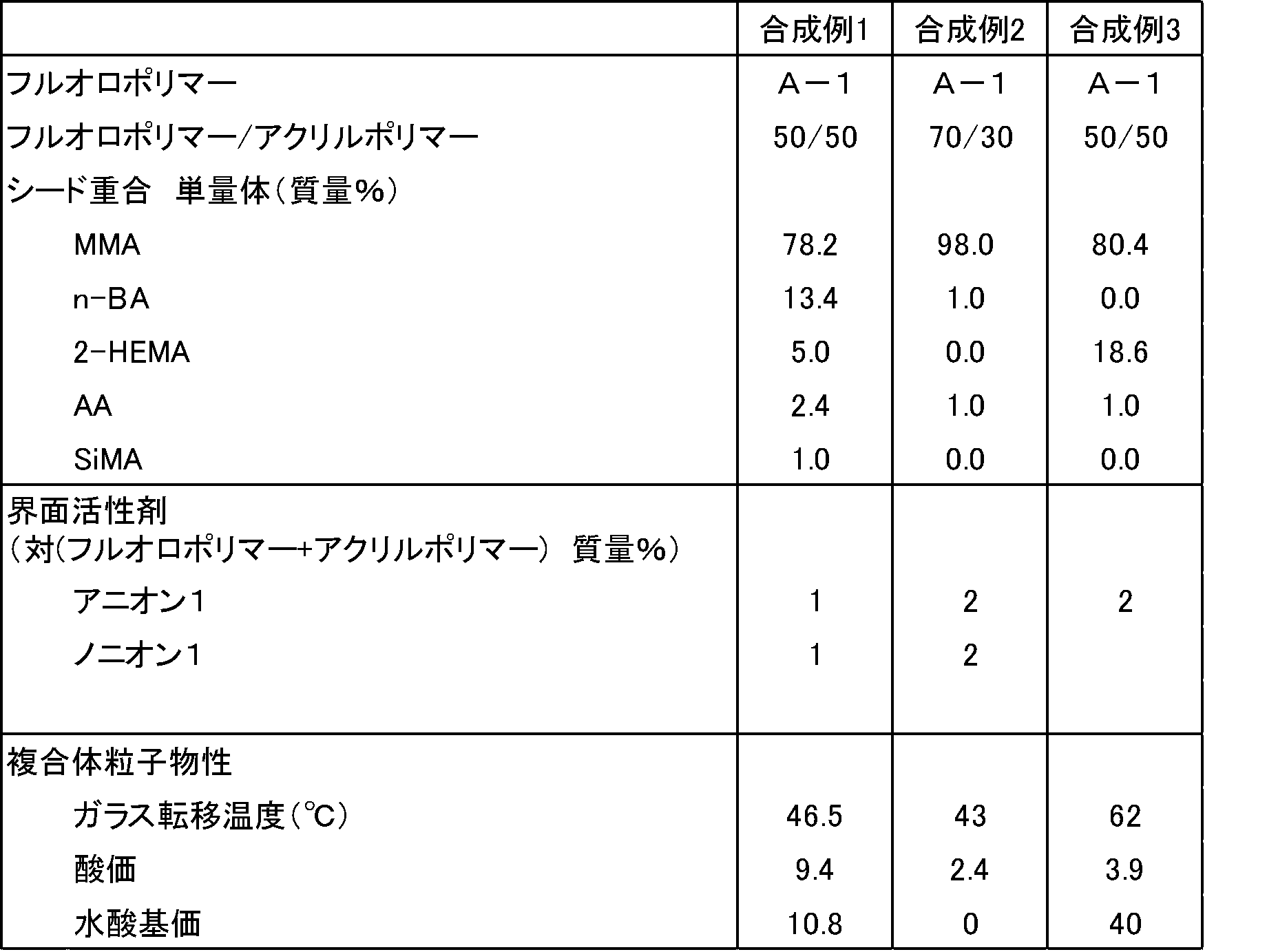
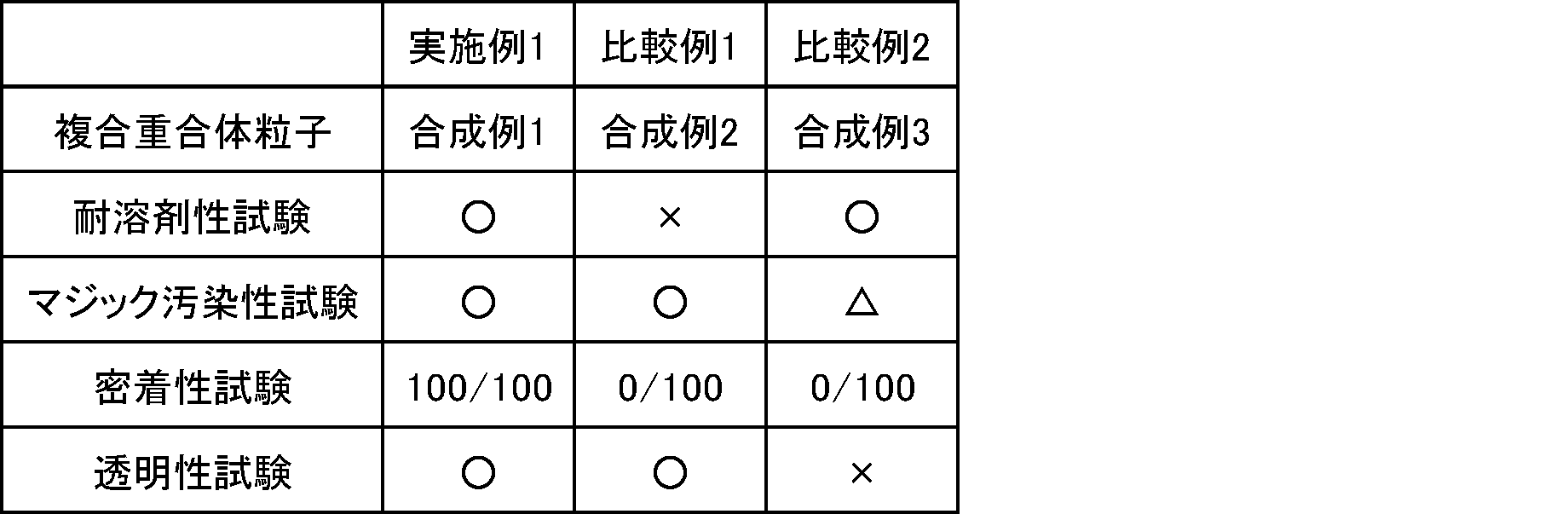
合成例4
表3に従い複合重合体粒子の水性分散液を合成した。界面活性剤としてアニオン1の28.0質量%水溶液22.3g、メチルメタクリレート(MMA)167g、ブチルアクリレート(n-BA)121g、2-ヒドロキシエチルメタクリレート(2-HEMA)15.6g、3-メタクリロキシプロピルトリエトキシシラン(SiMA)3.1gアクリル酸(AA)7.5g、ノニオン1の50質量%溶液を12.5gを用いた以外は、合成例1と同様にして複合重合体粒子の水性分散液を得た(固形分濃度51.0質量%)。得られた複合重合体粒子の平均粒子径は190nmであった。
表3に従い複合重合体粒子の水性分散液を合成した。界面活性剤としてアニオン1の28.0質量%水溶液22.3g、メチルメタクリレート(MMA)167g、ブチルアクリレート(n-BA)121g、2-ヒドロキシエチルメタクリレート(2-HEMA)15.6g、3-メタクリロキシプロピルトリエトキシシラン(SiMA)3.1gアクリル酸(AA)7.5g、ノニオン1の50質量%溶液を12.5gを用いた以外は、合成例1と同様にして複合重合体粒子の水性分散液を得た(固形分濃度51.0質量%)。得られた複合重合体粒子の平均粒子径は190nmであった。
合成例5
表3に従い複合重合体粒子の水性分散液を合成した。界面活性剤としてアニオン1の28.0質量%水溶液22.3g、メチルメタクリレート(MMA)245g、ブチルアクリレート(n-BA)44g、2-ヒドロキシエチルアクリレート(2-HEA)15.6g、3-メタクリロキシプロピルトリエトキシシラン(SiMA)3.1g、アクリル酸(AA)7.5g、ノニオン1の50質量%溶液を12.5gを用いた以外は、合成例1と同様にして複合重合体粒子の水性分散液を得た(固形分濃度51.0質量%)。得られた複合重合体粒子の平均粒子径は190nmであった。
表3に従い複合重合体粒子の水性分散液を合成した。界面活性剤としてアニオン1の28.0質量%水溶液22.3g、メチルメタクリレート(MMA)245g、ブチルアクリレート(n-BA)44g、2-ヒドロキシエチルアクリレート(2-HEA)15.6g、3-メタクリロキシプロピルトリエトキシシラン(SiMA)3.1g、アクリル酸(AA)7.5g、ノニオン1の50質量%溶液を12.5gを用いた以外は、合成例1と同様にして複合重合体粒子の水性分散液を得た(固形分濃度51.0質量%)。得られた複合重合体粒子の平均粒子径は190nmであった。
合成例6
表3に従い複合重合体粒子の水性分散液を合成した。フルオロポリマー(A-1)の水性分散液を975g、界面活性剤としてアニオン1の28.0質量%水溶液22.3g、メチルメタクリレート(MMA)154g、ブチルアクリレート(n-BA)15.5g、2-ヒドロキシエチルメタクリレート(2-HEMA)9.4g、3-メタクリロキシプロピルトリエトキシシラン(SiMA)1.9g、アクリル酸(AA)7.5g、ノニオン1の50質量%溶液を12.5gを用いた以外は、合成例1と同様にして複合重合体粒子の水性分散液を得た(固形分濃度51.0質量%)。得られた複合重合体粒子の平均粒子径は190nmであった。
表3に従い複合重合体粒子の水性分散液を合成した。フルオロポリマー(A-1)の水性分散液を975g、界面活性剤としてアニオン1の28.0質量%水溶液22.3g、メチルメタクリレート(MMA)154g、ブチルアクリレート(n-BA)15.5g、2-ヒドロキシエチルメタクリレート(2-HEMA)9.4g、3-メタクリロキシプロピルトリエトキシシラン(SiMA)1.9g、アクリル酸(AA)7.5g、ノニオン1の50質量%溶液を12.5gを用いた以外は、合成例1と同様にして複合重合体粒子の水性分散液を得た(固形分濃度51.0質量%)。得られた複合重合体粒子の平均粒子径は190nmであった。
実施例2
造膜助剤としてジエチルジグルコール(DEDG)を10質量部用いた以外は実施例1と同様に行った。結果を表4に記す。
造膜助剤としてジエチルジグルコール(DEDG)を10質量部用いた以外は実施例1と同様に行った。結果を表4に記す。
実施例3~5
表4記載の複合重合体粒子を用いたこと以外は、実施例1と同様に実施した。
表4記載の複合重合体粒子を用いたこと以外は、実施例1と同様に実施した。
表1、3には、複合重合体粒子の酸価(mgKOH/g)及び水酸基価(mgKOH/g)の計算値を示した。
酸価={使用したアクリル酸(AA)のモル数}×{アクリルポリマー中のアクリル酸(AA)の割合(質量%)}×{KOHの分子量(56.1)}×1000/100{複合重合体粒子中のアクリルポリマーの割合(質量%)}
水酸基価={使用した2-ヒドロキシエチルメタクリレート(2-HEMA)や2-ヒドロキシエチルアクリレート(2-HEA)のモル数}×{アクリルポリマー中の2-ヒドロキシエチルメタクリレート(2-HEMA)や2-ヒドロキシエチルアクリレート(2-HEA)の割合(質量%)}×{KOHの分子量(56.1)}×1000/100×{複合重合体粒子中のアクリルポリマーの割合(質量%)}


含フッ素塗膜の製造工程
アルミ板上に前述実施例1~5のクリア塗料をバーコーター(No.24)で塗布し、20℃で7日間乾燥して試験板を作成した。
得られた塗膜を「(11)塗膜中の官能基の測定方法」に従って測定したところ、シロキサン結合、ウレタン結合、フッ素炭素結合を有することが確認された。
アルミ板上に前述実施例1~5のクリア塗料をバーコーター(No.24)で塗布し、20℃で7日間乾燥して試験板を作成した。
得られた塗膜を「(11)塗膜中の官能基の測定方法」に従って測定したところ、シロキサン結合、ウレタン結合、フッ素炭素結合を有することが確認された。
Claims (13)
- 複合重合体粒子、ポリイソシアネート化合物及び水を含む水性分散体であって、
前記複合重合体粒子は、フルオロポリマー(A)とアクリルポリマー(B)とからなり、フルオロポリマー(A)及びアクリルポリマー(B)のいずれか一方又は両方が、水酸基及び加水分解性シリル基を含有する
ことを特徴とする水性分散体。 - フルオロポリマー(A)は、フッ化ビニル、ビニリデンフルオライド、テトラフルオロエチレン、ヘキサフルオロプロピレン、及び、クロロトリフルオロエチレンからなる群より選択される少なくとも1種のフルオロオレフィン単位を含む請求項1記載の水性分散体。
- アクリルポリマー(B)は、水酸基含有(メタ)アクリル酸エステル単位及び加水分解性シリル基含有不飽和単量体単位を含む請求項1又は2記載の水性分散体。
- アクリルポリマー(B)は、アクリル酸エステル単位、メタクリル酸エステル単位、不飽和カルボン酸単位、水酸基含有(メタ)アクリル酸エステル単位及び加水分解性シリル基含有不飽和単量体単位を含む請求項1、2又は3記載の水性分散体。
- 複合重合体粒子は、ガラス転移温度が0~70℃である請求項1、2、3又は4記載の水性分散体。
- フルオロポリマー(A)及びアクリルポリマー(B)が含有する水酸基1当量に対して、0.5~5.0当量のポリイソシアネート化合物を含む請求項1、2、3、4又は5記載の水性分散体。
- 更に、造膜助剤を含む請求項1、2、3、4、5又は6記載の水性分散体。
- 水性塗料である請求項1、2、3、4、5、6又は7記載の水性分散体。
- 請求項1、2、3、4、5、6、7又は8記載の水性分散体から得られることを特徴とする塗膜。
- 請求項1、2、3、4、5、6、7又は8記載の水性分散体を基材に塗装することにより得られることを特徴とする塗装物品。
- シロキサン結合及びウレタン結合を有することを特徴とする含フッ素塗膜。
- ポリイソシアネート化合物及び造膜助剤を溶媒に溶解又は分散させることにより溶液を調製する工程、及び、
フルオロポリマー(A)及びアクリルポリマー(B)を含む水性分散体に、前記溶液を添加する工程を含む
ことを特徴とする製造方法。 - 前記水性分散体は、複合重合体粒子及び水を含み、前記複合重合体粒子は、フルオロポリマー(A)とアクリルポリマー(B)とからなり、フルオロポリマー(A)及びアクリルポリマー(B)のいずれか一方又は両方が、水酸基及び加水分解性シリル基を含有する請求項12記載の製造方法。
Priority Applications (5)
| Application Number | Priority Date | Filing Date | Title |
|---|---|---|---|
| EP16783238.5A EP3287491B1 (en) | 2015-04-21 | 2016-04-21 | Aqueous dispersion, coating film, and coated article |
| CN201680022720.5A CN107531971A (zh) | 2015-04-21 | 2016-04-21 | 水性分散体、涂膜和涂装物品 |
| US15/568,300 US10787587B2 (en) | 2015-04-21 | 2016-04-21 | Aqueous dispersion, coating film, and coated article |
| CN202310094600.8A CN115948011A (zh) | 2015-04-21 | 2016-04-21 | 水性分散体、涂膜和涂装物品 |
| EP19170744.7A EP3536744A1 (en) | 2015-04-21 | 2016-04-21 | Aqueous dispersion, coating film, and coated article |
Applications Claiming Priority (2)
| Application Number | Priority Date | Filing Date | Title |
|---|---|---|---|
| JP2015-087124 | 2015-04-21 | ||
| JP2015087124 | 2015-04-21 |
Publications (1)
| Publication Number | Publication Date |
|---|---|
| WO2016171217A1 true WO2016171217A1 (ja) | 2016-10-27 |
Family
ID=57144048
Family Applications (1)
| Application Number | Title | Priority Date | Filing Date |
|---|---|---|---|
| PCT/JP2016/062651 Ceased WO2016171217A1 (ja) | 2015-04-21 | 2016-04-21 | 水性分散体、塗膜及び塗装物品 |
Country Status (5)
| Country | Link |
|---|---|
| US (1) | US10787587B2 (ja) |
| EP (2) | EP3287491B1 (ja) |
| JP (2) | JP6103107B2 (ja) |
| CN (3) | CN115948011A (ja) |
| WO (1) | WO2016171217A1 (ja) |
Cited By (1)
| Publication number | Priority date | Publication date | Assignee | Title |
|---|---|---|---|---|
| EP3580288A4 (en) * | 2017-02-08 | 2020-09-30 | Akzo Nobel Coatings International B.V. | COATING COMPOSITION, PROCESS FOR ITS PREPARATION AND CORRESPONDING USE |
Families Citing this family (7)
| Publication number | Priority date | Publication date | Assignee | Title |
|---|---|---|---|---|
| CN108299586A (zh) * | 2018-02-07 | 2018-07-20 | 宝鸡文理学院 | 一种高稳定性氟化改性超疏水涂层及其制备方法和应用 |
| WO2019189390A1 (ja) * | 2018-03-30 | 2019-10-03 | ダイキン工業株式会社 | 水性分散体、塗膜及び塗装物品、並びに、水性分散体の製造方法 |
| CN113874581B (zh) * | 2019-06-07 | 2023-04-28 | 三井化学株式会社 | 涂层剂及层叠体 |
| KR20220025744A (ko) * | 2019-06-25 | 2022-03-03 | 알케마 인코포레이티드 | 하이브리드 관능성 플루오로중합체 |
| CN112266755A (zh) * | 2020-09-29 | 2021-01-26 | 乐凯胶片股份有限公司 | 水性涂料、粘结涂层、太阳能电池背板和太阳能电池 |
| JP7523372B2 (ja) * | 2021-01-22 | 2024-07-26 | 信越ポリマー株式会社 | 導電性高分子分散液、導電性積層体及びその製造方法 |
| JP7760280B2 (ja) * | 2021-08-23 | 2025-10-27 | 三井化学株式会社 | 耐低級アルコール性付与コート材、積層体、パーティションおよび抗菌性部材 |
Citations (6)
| Publication number | Priority date | Publication date | Assignee | Title |
|---|---|---|---|---|
| JPH07228814A (ja) * | 1994-02-18 | 1995-08-29 | Asahi Glass Co Ltd | 硬化性塗料用組成物 |
| JPH11106451A (ja) * | 1997-10-01 | 1999-04-20 | Hitachi Chem Co Ltd | グラフト共重合体及び塗料 |
| WO2003002660A1 (en) * | 2001-06-28 | 2003-01-09 | Daikin Industries, Ltd. | Aqueous emulsion resin compositions |
| JP2009155500A (ja) * | 2007-12-27 | 2009-07-16 | Sakai Silk Screen:Kk | 防汚用塗料組成物及び付着防止体 |
| JP2012031260A (ja) * | 2010-07-29 | 2012-02-16 | Nippon Synthetic Chem Ind Co Ltd:The | 活性エネルギー線硬化型樹脂組成物、及びそれを用いてなるコーティング剤組成物、並びに硬化塗膜 |
| JP2013510768A (ja) * | 2009-11-12 | 2013-03-28 | ダウ コーニング コーポレーション | 被覆ファブリック製品 |
Family Cites Families (46)
| Publication number | Priority date | Publication date | Assignee | Title |
|---|---|---|---|---|
| JPS6212734A (ja) | 1985-03-28 | 1987-01-21 | Daikin Ind Ltd | 新規フルオロビニルエ−テルおよびそれを含む共重合体 |
| JPH0826275B2 (ja) * | 1988-08-10 | 1996-03-13 | ダイキン工業株式会社 | 付着防止剤及び付着防止方法 |
| US5349003A (en) | 1988-09-20 | 1994-09-20 | Japan Synthetic Rubber Co., Ltd. | Aqueous fluorine-containing polymer dispersion and aqueous dispersion containing fluorine-containing polymer and water-soluble resin and/or water dispersible resin |
| JPH03281664A (ja) * | 1990-03-30 | 1991-12-12 | Dainippon Ink & Chem Inc | 硬化性樹脂組成物 |
| JPH05271606A (ja) * | 1992-03-27 | 1993-10-19 | Japan Synthetic Rubber Co Ltd | コーティング組成物および施工方法 |
| JPH07228816A (ja) * | 1994-02-18 | 1995-08-29 | Asahi Glass Co Ltd | 硬化性塗料用樹脂組成物 |
| JPH07228817A (ja) * | 1994-02-18 | 1995-08-29 | Asahi Glass Co Ltd | フッ素系塗料用組成物 |
| JP3239645B2 (ja) * | 1994-10-24 | 2001-12-17 | ダイキン工業株式会社 | 含フッ素系重合体水性分散液 |
| JPH08283616A (ja) * | 1995-04-19 | 1996-10-29 | Central Glass Co Ltd | 水性フッ素樹脂塗料 |
| JPH08290107A (ja) * | 1995-04-25 | 1996-11-05 | Kansai Paint Co Ltd | 磁器タイル及び目地部の塗装工法 |
| JPH1129348A (ja) * | 1997-05-14 | 1999-02-02 | Daikin Ind Ltd | コンクリート形成用組成物 |
| JPH1112423A (ja) * | 1997-06-26 | 1999-01-19 | Toagosei Co Ltd | 高耐候性シーリング材組成物 |
| JP3521054B2 (ja) * | 1997-08-27 | 2004-04-19 | セントラル硝子株式会社 | 粉体塗料用組成物 |
| JP3271567B2 (ja) * | 1997-11-18 | 2002-04-02 | ダイキン工業株式会社 | 合成樹脂水性分散組成物 |
| JP2000265156A (ja) * | 1999-03-11 | 2000-09-26 | Toagosei Co Ltd | シーリング材組成物 |
| JP2000345136A (ja) * | 1999-06-04 | 2000-12-12 | Toagosei Co Ltd | シーリング材組成物 |
| CA2380403C (en) * | 1999-07-30 | 2009-12-08 | Ppg Industries Ohio, Inc. | Cured coatings having improved scratch resistance, coated substrates and methods related thereto |
| JP2001072928A (ja) | 1999-09-01 | 2001-03-21 | Daikin Ind Ltd | 低汚染型水性塗料用樹脂組成物 |
| WO2002010237A1 (fr) * | 2000-07-27 | 2002-02-07 | Asahi Glass Company, Limited | Dispersion aqueuse de fluoropolymere |
| JP3956664B2 (ja) * | 2000-10-19 | 2007-08-08 | 大日本インキ化学工業株式会社 | 水分散性ポリイソシアネート組成物、水性硬化性組成物及びその応用 |
| EP1331257A4 (en) | 2000-10-20 | 2004-06-09 | Daikin Ind Ltd | AQUEOUS FLUOROCOPOLYMER COATING COMPOSITION |
| JP4826008B2 (ja) * | 2000-10-31 | 2011-11-30 | 旭硝子株式会社 | 水性塗料用組成物 |
| JP4724918B2 (ja) * | 2000-12-14 | 2011-07-13 | 旭硝子株式会社 | 含フッ素共重合体の水性分散体 |
| JP2002188052A (ja) * | 2000-12-21 | 2002-07-05 | Asahi Glass Co Ltd | フッ素系共重合体の水性塗料用組成物 |
| JP4540876B2 (ja) * | 2001-04-10 | 2010-09-08 | 中国塗料株式会社 | 硬化性組成物、塗料組成物、その塗膜およびその用途 |
| JP2003165955A (ja) * | 2001-09-21 | 2003-06-10 | Kanegafuchi Chem Ind Co Ltd | 上塗り塗料用硬化性樹脂組成物およびそれを塗布してなる塗装物。 |
| EP1474453B1 (en) * | 2002-02-15 | 2007-07-25 | PPG Industries Ohio, Inc. | Waterborne film-forming compositions containing alternating copolymers of isobutylene type monomers |
| WO2004072197A1 (ja) * | 2003-02-13 | 2004-08-26 | Daikin Industries, Ltd. | 含フッ素水性塗料用組成物 |
| JP2004250560A (ja) * | 2003-02-19 | 2004-09-09 | Nippon Yushi Basf Coatings Kk | 水系塗料組成物 |
| JP2005248157A (ja) * | 2003-12-05 | 2005-09-15 | Daikin Ind Ltd | 常温硬化性水性組成物 |
| WO2005071006A1 (en) * | 2004-01-22 | 2005-08-04 | Dow Corning Corporation | A composition having improved adherence with an addition-curable material and composite article incorporating the composition |
| JP4639656B2 (ja) * | 2004-06-18 | 2011-02-23 | ダイキン工業株式会社 | 汚れの除去性に優れたフィルム |
| TWI317746B (en) | 2004-07-02 | 2009-12-01 | Eternal Chemical Co Ltd | Optical film capable of absorbing ultraviolet light |
| JP5069462B2 (ja) * | 2006-12-25 | 2012-11-07 | パナソニック株式会社 | 撥水・撥油性樹脂組成物及び塗装品 |
| JP5047670B2 (ja) * | 2007-04-06 | 2012-10-10 | 株式会社カネカ | 硬化性樹脂組成物および該硬化性樹脂組成物を塗布してなる塗装物 |
| JP2008255260A (ja) * | 2007-04-06 | 2008-10-23 | Kaneka Corp | 硬化性樹脂組成物および該硬化性樹脂組成物を塗布してなる塗装物 |
| JP2009155499A (ja) * | 2007-12-27 | 2009-07-16 | Sakai Silk Screen:Kk | 防汚用塗料組成物及び付着防止体 |
| JP2010144127A (ja) * | 2008-12-22 | 2010-07-01 | Daikin Ind Ltd | 塗料用組成物、被覆物品及び被覆物品の製造方法 |
| WO2011087095A1 (ja) * | 2010-01-15 | 2011-07-21 | 旭硝子株式会社 | 加水分解性シリル基含有含フッ素重合体の製造方法および加水分解性シリル基含有含フッ素重合体含有組成物 |
| JP5786279B2 (ja) * | 2010-04-12 | 2015-09-30 | 旭硝子株式会社 | 風力発電機のブレードの表面塗布用塗料組成物、ならびに風力発電機のブレードおよびその製造方法 |
| WO2012043580A1 (ja) | 2010-09-27 | 2012-04-05 | ダイキン工業株式会社 | アクリル-フッ素複合重合体粒子 |
| WO2013047880A1 (ja) | 2011-09-30 | 2013-04-04 | ダイキン工業株式会社 | 組成物、及び、塗装物品 |
| CN104245863B (zh) * | 2012-04-17 | 2018-08-14 | 阿科玛股份有限公司 | 水性氟聚合物玻璃涂料 |
| JP2014058612A (ja) * | 2012-09-17 | 2014-04-03 | Kansai Paint Co Ltd | 耐候性塗料組成物、及び耐候性塗膜を有する塗装物品の形成方法 |
| JPWO2015020107A1 (ja) * | 2013-08-09 | 2017-03-02 | 旭硝子株式会社 | 粉体塗料の製造方法、塗装物品およびその製造方法、ならびにカルボキシ基含有フッ素樹脂の製造方法 |
| JP5882969B2 (ja) | 2013-10-01 | 2016-03-09 | Jsr株式会社 | 塗料用組成物、塗料及び塗装体の製造方法 |
-
2016
- 2016-04-21 EP EP16783238.5A patent/EP3287491B1/en active Active
- 2016-04-21 WO PCT/JP2016/062651 patent/WO2016171217A1/ja not_active Ceased
- 2016-04-21 CN CN202310094600.8A patent/CN115948011A/zh active Pending
- 2016-04-21 JP JP2016085307A patent/JP6103107B2/ja active Active
- 2016-04-21 CN CN201680022720.5A patent/CN107531971A/zh active Pending
- 2016-04-21 US US15/568,300 patent/US10787587B2/en active Active
- 2016-04-21 EP EP19170744.7A patent/EP3536744A1/en active Pending
- 2016-04-21 CN CN201911152795.7A patent/CN110951351A/zh active Pending
- 2016-09-12 JP JP2016177962A patent/JP6249066B2/ja active Active
Patent Citations (6)
| Publication number | Priority date | Publication date | Assignee | Title |
|---|---|---|---|---|
| JPH07228814A (ja) * | 1994-02-18 | 1995-08-29 | Asahi Glass Co Ltd | 硬化性塗料用組成物 |
| JPH11106451A (ja) * | 1997-10-01 | 1999-04-20 | Hitachi Chem Co Ltd | グラフト共重合体及び塗料 |
| WO2003002660A1 (en) * | 2001-06-28 | 2003-01-09 | Daikin Industries, Ltd. | Aqueous emulsion resin compositions |
| JP2009155500A (ja) * | 2007-12-27 | 2009-07-16 | Sakai Silk Screen:Kk | 防汚用塗料組成物及び付着防止体 |
| JP2013510768A (ja) * | 2009-11-12 | 2013-03-28 | ダウ コーニング コーポレーション | 被覆ファブリック製品 |
| JP2012031260A (ja) * | 2010-07-29 | 2012-02-16 | Nippon Synthetic Chem Ind Co Ltd:The | 活性エネルギー線硬化型樹脂組成物、及びそれを用いてなるコーティング剤組成物、並びに硬化塗膜 |
Non-Patent Citations (1)
| Title |
|---|
| See also references of EP3287491A4 * |
Cited By (1)
| Publication number | Priority date | Publication date | Assignee | Title |
|---|---|---|---|---|
| EP3580288A4 (en) * | 2017-02-08 | 2020-09-30 | Akzo Nobel Coatings International B.V. | COATING COMPOSITION, PROCESS FOR ITS PREPARATION AND CORRESPONDING USE |
Also Published As
| Publication number | Publication date |
|---|---|
| EP3287491B1 (en) | 2019-10-09 |
| CN115948011A (zh) | 2023-04-11 |
| JP6103107B2 (ja) | 2017-03-29 |
| EP3287491A4 (en) | 2018-09-26 |
| CN110951351A (zh) | 2020-04-03 |
| EP3287491A1 (en) | 2018-02-28 |
| JP6249066B2 (ja) | 2017-12-20 |
| JP2016204662A (ja) | 2016-12-08 |
| US20180118969A1 (en) | 2018-05-03 |
| US10787587B2 (en) | 2020-09-29 |
| JP2017020042A (ja) | 2017-01-26 |
| EP3536744A1 (en) | 2019-09-11 |
| CN107531971A (zh) | 2018-01-02 |
Similar Documents
| Publication | Publication Date | Title |
|---|---|---|
| JP6249066B2 (ja) | 水性分散体、塗膜及び塗装物品 | |
| JP4144355B2 (ja) | 含フッ素系共重合体水性塗料用組成物 | |
| CN111183167B (zh) | 封端多异氰酸酯组合物及其应用 | |
| JP5534998B2 (ja) | 塗料組成物及び塗膜形成方法 | |
| WO2017115804A1 (ja) | 水性塗料組成物および塗膜形成方法 | |
| CN104159944A (zh) | 清漆涂料组合物 | |
| WO2019102925A1 (ja) | ブロックイソシアネート組成物、および、コーティング剤 | |
| JP7152655B2 (ja) | 水性分散液、塗膜及び塗装物品 | |
| CN105229096B (zh) | 水性涂料用组合物、水性涂料用套装及具有涂膜的物品 | |
| EP3778714B1 (en) | Aqueous dispersion, coating film, coated article, and method for producing aqueous dispersion | |
| JP7243051B2 (ja) | ポリイソシアネート組成物およびそれを用いた塗料組成物 | |
| JP2016079265A (ja) | 航空機内装用の水性塗料用組成物および航空機内装材 | |
| JP2015196762A (ja) | 塗料組成物 | |
| JP3000580B2 (ja) | 硬化性樹脂組成物 | |
| JP7069653B2 (ja) | ポリイソシアネート組成物およびそれを用いた二液型塗料組成物 | |
| JP2982228B2 (ja) | 上塗り塗装方法 | |
| JP7259204B2 (ja) | ポリイソシアネート組成物およびそれを用いた塗料組成物 | |
| JP2015086303A (ja) | 紫外線・近赤外線遮断塗料組成物及び紫外線・近赤外線遮断透明開口部材 | |
| JP2021147575A (ja) | 水性分散液、塗料組成物、塗膜及び塗装物品 | |
| JP2005036024A (ja) | 水性塗料 | |
| JP2025165116A (ja) | 含フッ素塗料用組成物、及び、塗装物品 | |
| JP3111464B2 (ja) | 上塗り塗装方法 | |
| WO2015087920A1 (ja) | 塗料組成物 | |
| JP2015067783A (ja) | 含フッ素重合体溶液の製造方法、および含フッ素塗料組成物の製造方法 | |
| JP2023013133A (ja) | 塗料組成物及び塗装物品 |
Legal Events
| Date | Code | Title | Description |
|---|---|---|---|
| 121 | Ep: the epo has been informed by wipo that ep was designated in this application |
Ref document number: 16783238 Country of ref document: EP Kind code of ref document: A1 |
|
| REEP | Request for entry into the european phase |
Ref document number: 2016783238 Country of ref document: EP |
|
| WWE | Wipo information: entry into national phase |
Ref document number: 15568300 Country of ref document: US |
|
| NENP | Non-entry into the national phase |
Ref country code: DE |