WO2016175208A1 - 防汚性組成物、防汚性シート、及び防汚性シートの製造方法 - Google Patents
防汚性組成物、防汚性シート、及び防汚性シートの製造方法 Download PDFInfo
- Publication number
- WO2016175208A1 WO2016175208A1 PCT/JP2016/063071 JP2016063071W WO2016175208A1 WO 2016175208 A1 WO2016175208 A1 WO 2016175208A1 JP 2016063071 W JP2016063071 W JP 2016063071W WO 2016175208 A1 WO2016175208 A1 WO 2016175208A1
- Authority
- WO
- WIPO (PCT)
- Prior art keywords
- antifouling
- component
- formula
- antifouling composition
- sheet
- Prior art date
- Legal status (The legal status is an assumption and is not a legal conclusion. Google has not performed a legal analysis and makes no representation as to the accuracy of the status listed.)
- Ceased
Links
Images

Classifications
-
- C—CHEMISTRY; METALLURGY
- C09—DYES; PAINTS; POLISHES; NATURAL RESINS; ADHESIVES; COMPOSITIONS NOT OTHERWISE PROVIDED FOR; APPLICATIONS OF MATERIALS NOT OTHERWISE PROVIDED FOR
- C09D—COATING COMPOSITIONS, e.g. PAINTS, VARNISHES OR LACQUERS; FILLING PASTES; CHEMICAL PAINT OR INK REMOVERS; INKS; CORRECTING FLUIDS; WOODSTAINS; PASTES OR SOLIDS FOR COLOURING OR PRINTING; USE OF MATERIALS THEREFOR
- C09D183/00—Coating compositions based on macromolecular compounds obtained by reactions forming in the main chain of the macromolecule a linkage containing silicon, with or without sulfur, nitrogen, oxygen, or carbon only; Coating compositions based on derivatives of such polymers
- C09D183/04—Polysiloxanes
-
- C—CHEMISTRY; METALLURGY
- C09—DYES; PAINTS; POLISHES; NATURAL RESINS; ADHESIVES; COMPOSITIONS NOT OTHERWISE PROVIDED FOR; APPLICATIONS OF MATERIALS NOT OTHERWISE PROVIDED FOR
- C09D—COATING COMPOSITIONS, e.g. PAINTS, VARNISHES OR LACQUERS; FILLING PASTES; CHEMICAL PAINT OR INK REMOVERS; INKS; CORRECTING FLUIDS; WOODSTAINS; PASTES OR SOLIDS FOR COLOURING OR PRINTING; USE OF MATERIALS THEREFOR
- C09D5/00—Coating compositions, e.g. paints, varnishes or lacquers, characterised by their physical nature or the effects produced; Filling pastes
- C09D5/16—Antifouling paints; Underwater paints
- C09D5/1656—Antifouling paints; Underwater paints characterised by the film-forming substance
- C09D5/1662—Synthetic film-forming substance
- C09D5/1675—Polyorganosiloxane-containing compositions
-
- B—PERFORMING OPERATIONS; TRANSPORTING
- B01—PHYSICAL OR CHEMICAL PROCESSES OR APPARATUS IN GENERAL
- B01J—CHEMICAL OR PHYSICAL PROCESSES, e.g. CATALYSIS OR COLLOID CHEMISTRY; THEIR RELEVANT APPARATUS
- B01J21/00—Catalysts comprising the elements, oxides, or hydroxides of magnesium, boron, aluminium, carbon, silicon, titanium, zirconium, or hafnium
- B01J21/02—Boron or aluminium; Oxides or hydroxides thereof
- B01J21/04—Alumina
-
- B—PERFORMING OPERATIONS; TRANSPORTING
- B01—PHYSICAL OR CHEMICAL PROCESSES OR APPARATUS IN GENERAL
- B01J—CHEMICAL OR PHYSICAL PROCESSES, e.g. CATALYSIS OR COLLOID CHEMISTRY; THEIR RELEVANT APPARATUS
- B01J21/00—Catalysts comprising the elements, oxides, or hydroxides of magnesium, boron, aluminium, carbon, silicon, titanium, zirconium, or hafnium
- B01J21/06—Silicon, titanium, zirconium or hafnium; Oxides or hydroxides thereof
- B01J21/063—Titanium; Oxides or hydroxides thereof
-
- B—PERFORMING OPERATIONS; TRANSPORTING
- B01—PHYSICAL OR CHEMICAL PROCESSES OR APPARATUS IN GENERAL
- B01J—CHEMICAL OR PHYSICAL PROCESSES, e.g. CATALYSIS OR COLLOID CHEMISTRY; THEIR RELEVANT APPARATUS
- B01J23/00—Catalysts comprising metals or metal oxides or hydroxides, not provided for in group B01J21/00
- B01J23/06—Catalysts comprising metals or metal oxides or hydroxides, not provided for in group B01J21/00 of zinc, cadmium or mercury
-
- B—PERFORMING OPERATIONS; TRANSPORTING
- B01—PHYSICAL OR CHEMICAL PROCESSES OR APPARATUS IN GENERAL
- B01J—CHEMICAL OR PHYSICAL PROCESSES, e.g. CATALYSIS OR COLLOID CHEMISTRY; THEIR RELEVANT APPARATUS
- B01J27/00—Catalysts comprising the elements or compounds of halogens, sulfur, selenium, tellurium, phosphorus or nitrogen; Catalysts comprising carbon compounds
- B01J27/06—Halogens; Compounds thereof
- B01J27/08—Halides
- B01J27/10—Chlorides
-
- B—PERFORMING OPERATIONS; TRANSPORTING
- B01—PHYSICAL OR CHEMICAL PROCESSES OR APPARATUS IN GENERAL
- B01J—CHEMICAL OR PHYSICAL PROCESSES, e.g. CATALYSIS OR COLLOID CHEMISTRY; THEIR RELEVANT APPARATUS
- B01J31/00—Catalysts comprising hydrides, coordination complexes or organic compounds
- B01J31/16—Catalysts comprising hydrides, coordination complexes or organic compounds containing coordination complexes
- B01J31/22—Organic complexes
-
- B—PERFORMING OPERATIONS; TRANSPORTING
- B01—PHYSICAL OR CHEMICAL PROCESSES OR APPARATUS IN GENERAL
- B01J—CHEMICAL OR PHYSICAL PROCESSES, e.g. CATALYSIS OR COLLOID CHEMISTRY; THEIR RELEVANT APPARATUS
- B01J37/00—Processes, in general, for preparing catalysts; Processes, in general, for activation of catalysts
- B01J37/04—Mixing
-
- B—PERFORMING OPERATIONS; TRANSPORTING
- B32—LAYERED PRODUCTS
- B32B—LAYERED PRODUCTS, i.e. PRODUCTS BUILT-UP OF STRATA OF FLAT OR NON-FLAT, e.g. CELLULAR OR HONEYCOMB, FORM
- B32B23/00—Layered products comprising a layer of cellulosic plastic substances, i.e. substances obtained by chemical modification of cellulose, e.g. cellulose ethers, cellulose esters, viscose
- B32B23/04—Layered products comprising a layer of cellulosic plastic substances, i.e. substances obtained by chemical modification of cellulose, e.g. cellulose ethers, cellulose esters, viscose comprising such cellulosic plastic substance as the main or only constituent of a layer, which is next to another layer of the same or of a different material
- B32B23/06—Layered products comprising a layer of cellulosic plastic substances, i.e. substances obtained by chemical modification of cellulose, e.g. cellulose ethers, cellulose esters, viscose comprising such cellulosic plastic substance as the main or only constituent of a layer, which is next to another layer of the same or of a different material of paper or cardboard
-
- B—PERFORMING OPERATIONS; TRANSPORTING
- B32—LAYERED PRODUCTS
- B32B—LAYERED PRODUCTS, i.e. PRODUCTS BUILT-UP OF STRATA OF FLAT OR NON-FLAT, e.g. CELLULAR OR HONEYCOMB, FORM
- B32B27/00—Layered products comprising a layer of synthetic resin
- B32B27/06—Layered products comprising a layer of synthetic resin as the main or only constituent of a layer, which is next to another layer of the same or of a different material
- B32B27/10—Layered products comprising a layer of synthetic resin as the main or only constituent of a layer, which is next to another layer of the same or of a different material of paper or cardboard
-
- B—PERFORMING OPERATIONS; TRANSPORTING
- B32—LAYERED PRODUCTS
- B32B—LAYERED PRODUCTS, i.e. PRODUCTS BUILT-UP OF STRATA OF FLAT OR NON-FLAT, e.g. CELLULAR OR HONEYCOMB, FORM
- B32B27/00—Layered products comprising a layer of synthetic resin
- B32B27/16—Layered products comprising a layer of synthetic resin specially treated, e.g. irradiated
-
- B—PERFORMING OPERATIONS; TRANSPORTING
- B32—LAYERED PRODUCTS
- B32B—LAYERED PRODUCTS, i.e. PRODUCTS BUILT-UP OF STRATA OF FLAT OR NON-FLAT, e.g. CELLULAR OR HONEYCOMB, FORM
- B32B27/00—Layered products comprising a layer of synthetic resin
- B32B27/30—Layered products comprising a layer of synthetic resin comprising vinyl (co)polymers; comprising acrylic (co)polymers
- B32B27/302—Layered products comprising a layer of synthetic resin comprising vinyl (co)polymers; comprising acrylic (co)polymers comprising aromatic vinyl (co)polymers, e.g. styrenic (co)polymers
-
- B—PERFORMING OPERATIONS; TRANSPORTING
- B32—LAYERED PRODUCTS
- B32B—LAYERED PRODUCTS, i.e. PRODUCTS BUILT-UP OF STRATA OF FLAT OR NON-FLAT, e.g. CELLULAR OR HONEYCOMB, FORM
- B32B27/00—Layered products comprising a layer of synthetic resin
- B32B27/30—Layered products comprising a layer of synthetic resin comprising vinyl (co)polymers; comprising acrylic (co)polymers
- B32B27/304—Layered products comprising a layer of synthetic resin comprising vinyl (co)polymers; comprising acrylic (co)polymers comprising vinyl halide (co)polymers, e.g. PVC, PVDC, PVF, PVDF
-
- B—PERFORMING OPERATIONS; TRANSPORTING
- B32—LAYERED PRODUCTS
- B32B—LAYERED PRODUCTS, i.e. PRODUCTS BUILT-UP OF STRATA OF FLAT OR NON-FLAT, e.g. CELLULAR OR HONEYCOMB, FORM
- B32B27/00—Layered products comprising a layer of synthetic resin
- B32B27/30—Layered products comprising a layer of synthetic resin comprising vinyl (co)polymers; comprising acrylic (co)polymers
- B32B27/306—Layered products comprising a layer of synthetic resin comprising vinyl (co)polymers; comprising acrylic (co)polymers comprising vinyl acetate or vinyl alcohol (co)polymers
-
- B—PERFORMING OPERATIONS; TRANSPORTING
- B32—LAYERED PRODUCTS
- B32B—LAYERED PRODUCTS, i.e. PRODUCTS BUILT-UP OF STRATA OF FLAT OR NON-FLAT, e.g. CELLULAR OR HONEYCOMB, FORM
- B32B27/00—Layered products comprising a layer of synthetic resin
- B32B27/32—Layered products comprising a layer of synthetic resin comprising polyolefins
-
- B—PERFORMING OPERATIONS; TRANSPORTING
- B32—LAYERED PRODUCTS
- B32B—LAYERED PRODUCTS, i.e. PRODUCTS BUILT-UP OF STRATA OF FLAT OR NON-FLAT, e.g. CELLULAR OR HONEYCOMB, FORM
- B32B27/00—Layered products comprising a layer of synthetic resin
- B32B27/36—Layered products comprising a layer of synthetic resin comprising polyesters
-
- B—PERFORMING OPERATIONS; TRANSPORTING
- B32—LAYERED PRODUCTS
- B32B—LAYERED PRODUCTS, i.e. PRODUCTS BUILT-UP OF STRATA OF FLAT OR NON-FLAT, e.g. CELLULAR OR HONEYCOMB, FORM
- B32B27/00—Layered products comprising a layer of synthetic resin
- B32B27/36—Layered products comprising a layer of synthetic resin comprising polyesters
- B32B27/365—Layered products comprising a layer of synthetic resin comprising polyesters comprising polycarbonates
-
- B—PERFORMING OPERATIONS; TRANSPORTING
- B32—LAYERED PRODUCTS
- B32B—LAYERED PRODUCTS, i.e. PRODUCTS BUILT-UP OF STRATA OF FLAT OR NON-FLAT, e.g. CELLULAR OR HONEYCOMB, FORM
- B32B27/00—Layered products comprising a layer of synthetic resin
- B32B27/40—Layered products comprising a layer of synthetic resin comprising polyurethanes
-
- B—PERFORMING OPERATIONS; TRANSPORTING
- B32—LAYERED PRODUCTS
- B32B—LAYERED PRODUCTS, i.e. PRODUCTS BUILT-UP OF STRATA OF FLAT OR NON-FLAT, e.g. CELLULAR OR HONEYCOMB, FORM
- B32B9/00—Layered products comprising a layer of a particular substance not covered by groups B32B11/00 - B32B29/00
-
- C—CHEMISTRY; METALLURGY
- C08—ORGANIC MACROMOLECULAR COMPOUNDS; THEIR PREPARATION OR CHEMICAL WORKING-UP; COMPOSITIONS BASED THEREON
- C08L—COMPOSITIONS OF MACROMOLECULAR COMPOUNDS
- C08L83/00—Compositions of macromolecular compounds obtained by reactions forming in the main chain of the macromolecule a linkage containing silicon with or without sulfur, nitrogen, oxygen or carbon only; Compositions of derivatives of such polymers
- C08L83/04—Polysiloxanes
- C08L83/08—Polysiloxanes containing silicon bound to organic groups containing atoms other than carbon, hydrogen and oxygen
-
- C—CHEMISTRY; METALLURGY
- C09—DYES; PAINTS; POLISHES; NATURAL RESINS; ADHESIVES; COMPOSITIONS NOT OTHERWISE PROVIDED FOR; APPLICATIONS OF MATERIALS NOT OTHERWISE PROVIDED FOR
- C09D—COATING COMPOSITIONS, e.g. PAINTS, VARNISHES OR LACQUERS; FILLING PASTES; CHEMICAL PAINT OR INK REMOVERS; INKS; CORRECTING FLUIDS; WOODSTAINS; PASTES OR SOLIDS FOR COLOURING OR PRINTING; USE OF MATERIALS THEREFOR
- C09D183/00—Coating compositions based on macromolecular compounds obtained by reactions forming in the main chain of the macromolecule a linkage containing silicon, with or without sulfur, nitrogen, oxygen, or carbon only; Coating compositions based on derivatives of such polymers
-
- C—CHEMISTRY; METALLURGY
- C09—DYES; PAINTS; POLISHES; NATURAL RESINS; ADHESIVES; COMPOSITIONS NOT OTHERWISE PROVIDED FOR; APPLICATIONS OF MATERIALS NOT OTHERWISE PROVIDED FOR
- C09D—COATING COMPOSITIONS, e.g. PAINTS, VARNISHES OR LACQUERS; FILLING PASTES; CHEMICAL PAINT OR INK REMOVERS; INKS; CORRECTING FLUIDS; WOODSTAINS; PASTES OR SOLIDS FOR COLOURING OR PRINTING; USE OF MATERIALS THEREFOR
- C09D183/00—Coating compositions based on macromolecular compounds obtained by reactions forming in the main chain of the macromolecule a linkage containing silicon, with or without sulfur, nitrogen, oxygen, or carbon only; Coating compositions based on derivatives of such polymers
- C09D183/04—Polysiloxanes
- C09D183/08—Polysiloxanes containing silicon bound to organic groups containing atoms other than carbon, hydrogen, and oxygen
-
- C—CHEMISTRY; METALLURGY
- C09—DYES; PAINTS; POLISHES; NATURAL RESINS; ADHESIVES; COMPOSITIONS NOT OTHERWISE PROVIDED FOR; APPLICATIONS OF MATERIALS NOT OTHERWISE PROVIDED FOR
- C09D—COATING COMPOSITIONS, e.g. PAINTS, VARNISHES OR LACQUERS; FILLING PASTES; CHEMICAL PAINT OR INK REMOVERS; INKS; CORRECTING FLUIDS; WOODSTAINS; PASTES OR SOLIDS FOR COLOURING OR PRINTING; USE OF MATERIALS THEREFOR
- C09D7/00—Features of coating compositions, not provided for in group C09D5/00; Processes for incorporating ingredients in coating compositions
- C09D7/40—Additives
-
- C—CHEMISTRY; METALLURGY
- C09—DYES; PAINTS; POLISHES; NATURAL RESINS; ADHESIVES; COMPOSITIONS NOT OTHERWISE PROVIDED FOR; APPLICATIONS OF MATERIALS NOT OTHERWISE PROVIDED FOR
- C09D—COATING COMPOSITIONS, e.g. PAINTS, VARNISHES OR LACQUERS; FILLING PASTES; CHEMICAL PAINT OR INK REMOVERS; INKS; CORRECTING FLUIDS; WOODSTAINS; PASTES OR SOLIDS FOR COLOURING OR PRINTING; USE OF MATERIALS THEREFOR
- C09D7/00—Features of coating compositions, not provided for in group C09D5/00; Processes for incorporating ingredients in coating compositions
- C09D7/40—Additives
- C09D7/60—Additives non-macromolecular
- C09D7/61—Additives non-macromolecular inorganic
-
- C—CHEMISTRY; METALLURGY
- C09—DYES; PAINTS; POLISHES; NATURAL RESINS; ADHESIVES; COMPOSITIONS NOT OTHERWISE PROVIDED FOR; APPLICATIONS OF MATERIALS NOT OTHERWISE PROVIDED FOR
- C09D—COATING COMPOSITIONS, e.g. PAINTS, VARNISHES OR LACQUERS; FILLING PASTES; CHEMICAL PAINT OR INK REMOVERS; INKS; CORRECTING FLUIDS; WOODSTAINS; PASTES OR SOLIDS FOR COLOURING OR PRINTING; USE OF MATERIALS THEREFOR
- C09D7/00—Features of coating compositions, not provided for in group C09D5/00; Processes for incorporating ingredients in coating compositions
- C09D7/40—Additives
- C09D7/60—Additives non-macromolecular
- C09D7/63—Additives non-macromolecular organic
-
- B—PERFORMING OPERATIONS; TRANSPORTING
- B01—PHYSICAL OR CHEMICAL PROCESSES OR APPARATUS IN GENERAL
- B01J—CHEMICAL OR PHYSICAL PROCESSES, e.g. CATALYSIS OR COLLOID CHEMISTRY; THEIR RELEVANT APPARATUS
- B01J2531/00—Additional information regarding catalytic systems classified in B01J31/00
- B01J2531/30—Complexes comprising metals of Group III (IIIA or IIIB) as the central metal
- B01J2531/31—Aluminium
-
- B—PERFORMING OPERATIONS; TRANSPORTING
- B01—PHYSICAL OR CHEMICAL PROCESSES OR APPARATUS IN GENERAL
- B01J—CHEMICAL OR PHYSICAL PROCESSES, e.g. CATALYSIS OR COLLOID CHEMISTRY; THEIR RELEVANT APPARATUS
- B01J2531/00—Additional information regarding catalytic systems classified in B01J31/00
- B01J2531/40—Complexes comprising metals of Group IV (IVA or IVB) as the central metal
- B01J2531/46—Titanium
-
- B—PERFORMING OPERATIONS; TRANSPORTING
- B01—PHYSICAL OR CHEMICAL PROCESSES OR APPARATUS IN GENERAL
- B01J—CHEMICAL OR PHYSICAL PROCESSES, e.g. CATALYSIS OR COLLOID CHEMISTRY; THEIR RELEVANT APPARATUS
- B01J31/00—Catalysts comprising hydrides, coordination complexes or organic compounds
- B01J31/02—Catalysts comprising hydrides, coordination complexes or organic compounds containing organic compounds or metal hydrides
- B01J31/04—Catalysts comprising hydrides, coordination complexes or organic compounds containing organic compounds or metal hydrides containing carboxylic acids or their salts
-
- B—PERFORMING OPERATIONS; TRANSPORTING
- B01—PHYSICAL OR CHEMICAL PROCESSES OR APPARATUS IN GENERAL
- B01J—CHEMICAL OR PHYSICAL PROCESSES, e.g. CATALYSIS OR COLLOID CHEMISTRY; THEIR RELEVANT APPARATUS
- B01J31/00—Catalysts comprising hydrides, coordination complexes or organic compounds
- B01J31/16—Catalysts comprising hydrides, coordination complexes or organic compounds containing coordination complexes
- B01J31/22—Organic complexes
- B01J31/2204—Organic complexes the ligands containing oxygen or sulfur as complexing atoms
- B01J31/2208—Oxygen, e.g. acetylacetonates
-
- B—PERFORMING OPERATIONS; TRANSPORTING
- B32—LAYERED PRODUCTS
- B32B—LAYERED PRODUCTS, i.e. PRODUCTS BUILT-UP OF STRATA OF FLAT OR NON-FLAT, e.g. CELLULAR OR HONEYCOMB, FORM
- B32B2255/00—Coating on the layer surface
- B32B2255/10—Coating on the layer surface on synthetic resin layer or on natural or synthetic rubber layer
-
- B—PERFORMING OPERATIONS; TRANSPORTING
- B32—LAYERED PRODUCTS
- B32B—LAYERED PRODUCTS, i.e. PRODUCTS BUILT-UP OF STRATA OF FLAT OR NON-FLAT, e.g. CELLULAR OR HONEYCOMB, FORM
- B32B2255/00—Coating on the layer surface
- B32B2255/12—Coating on the layer surface on paper layer
-
- B—PERFORMING OPERATIONS; TRANSPORTING
- B32—LAYERED PRODUCTS
- B32B—LAYERED PRODUCTS, i.e. PRODUCTS BUILT-UP OF STRATA OF FLAT OR NON-FLAT, e.g. CELLULAR OR HONEYCOMB, FORM
- B32B2255/00—Coating on the layer surface
- B32B2255/26—Polymeric coating
-
- B—PERFORMING OPERATIONS; TRANSPORTING
- B32—LAYERED PRODUCTS
- B32B—LAYERED PRODUCTS, i.e. PRODUCTS BUILT-UP OF STRATA OF FLAT OR NON-FLAT, e.g. CELLULAR OR HONEYCOMB, FORM
- B32B2255/00—Coating on the layer surface
- B32B2255/28—Multiple coating on one surface
-
- C—CHEMISTRY; METALLURGY
- C08—ORGANIC MACROMOLECULAR COMPOUNDS; THEIR PREPARATION OR CHEMICAL WORKING-UP; COMPOSITIONS BASED THEREON
- C08G—MACROMOLECULAR COMPOUNDS OBTAINED OTHERWISE THAN BY REACTIONS ONLY INVOLVING UNSATURATED CARBON-TO-CARBON BONDS
- C08G77/00—Macromolecular compounds obtained by reactions forming a linkage containing silicon with or without sulfur, nitrogen, oxygen or carbon in the main chain of the macromolecule
- C08G77/04—Polysiloxanes
- C08G77/14—Polysiloxanes containing silicon bound to oxygen-containing groups
-
- C—CHEMISTRY; METALLURGY
- C08—ORGANIC MACROMOLECULAR COMPOUNDS; THEIR PREPARATION OR CHEMICAL WORKING-UP; COMPOSITIONS BASED THEREON
- C08G—MACROMOLECULAR COMPOUNDS OBTAINED OTHERWISE THAN BY REACTIONS ONLY INVOLVING UNSATURATED CARBON-TO-CARBON BONDS
- C08G77/00—Macromolecular compounds obtained by reactions forming a linkage containing silicon with or without sulfur, nitrogen, oxygen or carbon in the main chain of the macromolecule
- C08G77/04—Polysiloxanes
- C08G77/22—Polysiloxanes containing silicon bound to organic groups containing atoms other than carbon, hydrogen and oxygen
- C08G77/24—Polysiloxanes containing silicon bound to organic groups containing atoms other than carbon, hydrogen and oxygen halogen-containing groups
-
- C—CHEMISTRY; METALLURGY
- C08—ORGANIC MACROMOLECULAR COMPOUNDS; THEIR PREPARATION OR CHEMICAL WORKING-UP; COMPOSITIONS BASED THEREON
- C08K—Use of inorganic or non-macromolecular organic substances as compounding ingredients
- C08K3/00—Use of inorganic substances as compounding ingredients
- C08K3/18—Oxygen-containing compounds, e.g. metal carbonyls
- C08K3/20—Oxides; Hydroxides
- C08K3/22—Oxides; Hydroxides of metals
- C08K2003/2227—Oxides; Hydroxides of metals of aluminium
-
- C—CHEMISTRY; METALLURGY
- C08—ORGANIC MACROMOLECULAR COMPOUNDS; THEIR PREPARATION OR CHEMICAL WORKING-UP; COMPOSITIONS BASED THEREON
- C08K—Use of inorganic or non-macromolecular organic substances as compounding ingredients
- C08K3/00—Use of inorganic substances as compounding ingredients
- C08K3/18—Oxygen-containing compounds, e.g. metal carbonyls
- C08K3/20—Oxides; Hydroxides
- C08K3/22—Oxides; Hydroxides of metals
- C08K2003/2296—Oxides; Hydroxides of metals of zinc
-
- C—CHEMISTRY; METALLURGY
- C08—ORGANIC MACROMOLECULAR COMPOUNDS; THEIR PREPARATION OR CHEMICAL WORKING-UP; COMPOSITIONS BASED THEREON
- C08K—Use of inorganic or non-macromolecular organic substances as compounding ingredients
- C08K5/00—Use of organic ingredients
- C08K5/0091—Complexes with metal-heteroatom-bonds
Definitions
- the present invention relates to an antifouling composition, an antifouling sheet having an antifouling layer formed from the antifouling composition, and a method for producing the same.
- a molded product such as a mirror, a glass container, or a glass decorative article does not adhere to an obstacle such as water droplets or dirt.
- the surface of such a molded product is provided with water repellency and antifouling properties by coating with a film made of an antifouling substance, or by applying an antifouling sheet. Yes.
- Patent Document 1 discloses a substrate such as glass by a laminate having a base layer formed of an inorganic compound and a water-repellent film that covers the surface of the base layer and is formed of a fluorine-containing compound.
- a water-repellent film-coated article coated with a material is disclosed.
- the water-repellent coated article described in Patent Document 1 has a water-repellent film formed from a fluorine-containing compound, it is not preferable from the viewpoint of environmental protection.
- the antifouling sheet is often used outdoors, etc., and the weather resistance deteriorates due to exposure outdoors for a long period of time, for example, cracks occur in the antifouling layer, and There is a problem that the appearance of the surface of the antifouling layer is deteriorated due to progress, and a problem that the antifouling property of the antifouling layer is deteriorated by long-term outdoor exposure.
- the antifouling layer imparting water repellency and antifouling properties is also required to have a good surface condition and curability.
- the present invention relates to an antifouling composition that can be a material for forming an antifouling layer having a good surface state and curability and having excellent weather resistance, and an antifouling layer formed from the antifouling composition It aims at providing the antifouling sheet
- an antifouling composition comprising a tetrafunctional silane compound having a specific structure, a trifunctional silane compound having a specific structure, and a specific type of metal catalyst can solve the above problem.
- the headline and the present invention were completed. That is, the present invention provides the following [1] to [18].
- R 2 represents an alkyl group having 1 to 3 carbon atoms.
- R 3 represents an alkyl group having 1 to 6 carbon atoms, and
- X 2 represents a halogen atom. If R 3 and X 2 there are a plurality, the plurality of R 3 and X 2 are either identical to one another or may be different.
- q represents an integer of 0 to 3.
- a trifunctional silane compound (B) represented by: An antifouling composition comprising a metal catalyst (C) that contains one or more metal atoms selected from titanium, aluminum, and zinc, and that does not require light irradiation for exhibiting catalytic action.
- a metal catalyst (C) that contains one or more metal atoms selected from titanium, aluminum, and zinc, and that does not require light irradiation for exhibiting catalytic action.
- Component (C) is titanium alkoxide, titanium chelate, titanium acylate, aluminum acetoacetate complex, aluminum acetylacetonate complex, zinc-chromium oxide, zinc-aluminum oxide, zinc-aluminum-chromium oxidation
- the component (D) includes one or more selected from the group consisting of hydrochloric acid, phosphoric acid, acetic acid, formic acid, sulfuric acid, methanesulfonic acid, odoric acid, p-toluenesulfonic acid, and trifluoroacetic acid
- the antifouling composition according to [10] The antifouling composition according to [10].
- the antifouling sheet according to the above [12] which has the antifouling layer on a substrate.
- R 3 represents an alkyl group having 1 to 6 carbon atoms
- X 2 represents a halogen atom. If R 3 and X 2 there are a plurality, the plurality of R 3 and X 2 are either identical to one another or may be different.
- q represents an integer of 0 to 3.
- a trifunctional silane compound (B) represented by: A step of preparing an antifouling composition comprising a metal catalyst (C) that contains one or more metal atoms selected from titanium, aluminum, and zinc and that does not require light irradiation for the expression of a catalytic action ( 2): Step of applying the antifouling composition onto a substrate or a release material and drying to form an antifouling layer [18] An antifouling sheet obtained by the production method according to [17] above .
- an antifouling composition that can be a material for forming an antifouling layer having good surface condition and curability and excellent weather resistance, and an antifouling formed from the antifouling composition.
- An antifouling sheet having a fouling layer and a method for producing the same can be provided.
- the antifouling composition of the present invention comprises a tetrafunctional silane compound (A) represented by the formula (a), a trifunctional silane compound (B) represented by the formula (b), titanium, aluminum, And a metal catalyst (C) that contains one or more metal atoms selected from zinc and does not require light irradiation in order to exhibit catalytic action.
- the antifouling composition of the present invention preferably further contains an acid catalyst (D), and contains other additives other than the components (A) to (D) as long as the effects of the present invention are not impaired. May be.
- the antifouling layer formed from the antifouling composition of the present invention has a good surface state and curability and is excellent in weather resistance.
- the condensation reaction between the silane compounds in the antifouling composition proceeds to form a polymer, whereby an antifouling layer is formed.
- the present inventors have obtained a polymer obtained by the reaction between silane compounds.
- the present inventors have found that an antifouling layer having excellent weather resistance can be obtained by minimizing the presence of uncondensed points remaining in the antifouling layer immediately after formation. . More specifically, in order to initiate the condensation reaction between the silane compounds, the alkoxy groups in the components (A) and (B) (OR 1 in the formula (a), and the formula ( It is necessary for OR 3 ) in b) to react with water to be eliminated and substituted with a hydroxyl group. Therefore, the alkyl groups (R 1 in formula (a) and R 3 in formula (b)) of the alkoxy group in component (A) and component (B) are alkyl groups having a specific carbon number.
- the present inventors further controlled the carbon number of the alkyl group (R 2 in the formula (b)) in the unit derived from the component (B) to be more curable by controlling it within a specific value range. It was found that an antifouling layer having excellent crack suppressing effect and water repellency maintaining effect can be obtained.
- each component contained in the antifouling composition of the present invention will be described.
- the antifouling composition of the present invention contains a tetrafunctional silane compound (A) represented by the following formula (a).
- A tetrafunctional silane compound represented by the following formula (a).
- R 1 represents an alkyl group having 1 to 6 carbon atoms
- X 1 represents a halogen atom.
- R 1 and X 1 there are a plurality the plurality of R 1 and X 1 are also identical to each other or may be different.
- p represents an integer of 0 to 4.
- (A) component may be comprised from the compound which consists of only 1 type, and may be comprised from 2 or more types of compounds represented by the said Formula (a).
- Examples of the alkyl group that can be selected as R 1 include a methyl group, an ethyl group, an n-propyl group, an isopropyl group, an n-butyl group, an s-butyl group, an isobutyl group, a t-butyl group, an n-pentyl group, Examples thereof include an n-hexyl group, a neopentyl group, and a methylpentyl group.
- a methyl group, an ethyl group, and an n-propyl group are preferable, and a methyl group and an ethyl group are more preferable.
- the alkyl group that can be selected as R 1 may be either linear or branched, but is preferably linear.
- the halogen atom that can be selected as X 1 is preferably a chlorine atom, a bromine atom, or an iodine atom, and more preferably a chlorine atom.
- the component (A) preferably includes a silane compound in which p in the formula (a) is 4.
- the antifouling composition of the present invention contains a trifunctional silane compound (B) represented by the following formula (b) together with the tetrafunctional silane compound (A) represented by the formula (a).
- R 2 represents an alkyl group having 1 to 3 carbon atoms.
- R 3 represents an alkyl group having 1 to 6 carbon atoms, and
- X 2 represents a halogen atom. If R 3 and X 2 there are a plurality, the plurality of R 3 and X 2 are either identical to one another or may be different.
- q represents an integer of 0 to 3.
- (B) component may be comprised from the compound which consists of only 1 type, and may be comprised from 2 or more types of compounds represented by the said Formula (b).
- the alkyl group that can be selected as R 2 has 1 to 3 carbon atoms. When carbon number of the said alkyl group exceeds 4, the curability of the antifouling layer formed from the antifouling composition obtained, the water repellency maintenance effect, and the crack suppression effect are inferior. Further, as the carbon number of the alkyl group increases, the resulting antifouling composition is likely to gel, and the surface state of the antifouling layer formed from the antifouling composition tends to deteriorate.
- the alkyl group that can be selected as R 2 include a methyl group, an ethyl group, an n-propyl group, and an isopropyl group. From the viewpoint of curability of the antifouling layer, a methyl group and an ethyl group are preferable, and more preferable From the viewpoint of obtaining a crack suppressing effect, a methyl group is more preferable.
- the alkyl group that can be selected as R 3 and the halogen atom that can be selected as X 2 are the same as the alkyl group that can be selected as R 1 and the halogen atom that can be selected as X 1 in the above formula (a). Can be mentioned. In addition, you may use the trifunctional silane type compound represented by said formula (b) individually or in combination of 2 or more types.
- the component (B) preferably includes a trifunctional silane compound in which q in the formula (b) is 3.
- the antifouling composition of the present invention has a mixing ratio (molar ratio) [(A) / (B)] of the tetrafunctional silane compound (A) and the trifunctional silane compound (B) (A).
- the total amount of the non-condensation points derived from the component (B) and the component (B) can be reduced, and from the viewpoint of exhibiting a more excellent crack suppression effect, it is preferably 0.01 to 10.00.
- the compounding ratio (molar ratio) [(A) / (B)] of the tetrafunctional silane compound (A) and the trifunctional silane compound (B) is small, the tetrafunctional (A) component Since the blending amount is reduced, the number of reaction points that may become uncondensed points after the reaction can be suppressed, and the number of uncondensed points remaining in the resulting antifouling layer can be suppressed. . On the other hand, if the value of the blending ratio (molar ratio) [(A) / (B)] is too small, the reaction rate between the increased component (A) and component (B) may begin to decrease.
- the blending ratio (molar ratio) [(A) / (B)] is more preferably 0.05 or more and 8.00 or less, and still more preferably 0.10 or more and 7.00 or less.
- the blending ratio (molar ratio) [(A) / (B)] is preferably from the viewpoint of obtaining a more excellent crack suppression effect.
- the blending ratio (molar ratio) [(A) / ( B)] is preferably at least 0.10, more preferably at least 0.20, even more preferably at least 0.45, even more preferably at least 0.75, even more preferably at least 0.90, and From the viewpoint of obtaining a more excellent crack suppression effect, it is preferably 7.00 or less, more preferably 5.00 or less, still more preferably 3.00 or less, and even more preferably 2.50 or less.
- the antifouling composition of the present invention contains a metal catalyst (C) that contains one or more metal atoms selected from titanium, aluminum, and zinc, and that does not require light irradiation to exhibit catalytic action.
- the “metal catalyst that does not require light irradiation for the expression of catalytic action” means light irradiation for expressing the catalytic action for the condensation reaction between the component (A) and the component (B). It refers to a metal catalyst that does not require.
- the antifouling layer contains a photocatalyst, for example, the photocatalyst itself is a solid substance, so that the water repellency is reduced due to an increase in surface roughness, or the water repellency is reduced due to the hydrophilicity imparting effect of the photocatalyst
- problems such as a decrease in durability due to acceleration of hydrolysis of the polymer of the silane compound occur.
- the condensation reaction between the component (A) and the component (B) is effectively accelerated, and the antifouling layer formed from the antifouling composition is cured. Can be improved.
- the antifouling composition containing (C) component with (A) component and (B) component hardening reaction can be advanced also at comparatively low temperature (130 degrees C or less). Therefore, even in the case of forming an antifouling layer formed from the antifouling composition on a substrate having low heat resistance such as vinyl chloride, the antifouling layer even at a low temperature that can suppress the thermal shrinkage of the substrate. Can be formed.
- the titanium-based catalyst may be a compound other than a photocatalyst containing a titanium atom, and examples thereof include titanium alkoxide, titanium chelate, titanium acylate, and the like. Titanium hydroxide, acetate, carbonate, sulfuric acid Salts, nitrates, chlorides, and the like may be used. Examples of the titanium alkoxide include titanium tetraisopropoxide, titanium tetranormal butoxide, titanium butoxide dimer, titanium tetra-2-ethylhexoxide, and the like.
- titanium chelate examples include titanium acetylacetonate such as titanium diisopropoxybis (acetylacetonate) and titanium tetraacetylacetonate; titanium ethylacetoacetate such as titanium diisopropoxybis (ethylacetoacetate); Titanium triethanolamate such as propoxybis (triethanolaminate); titanium tetraoctylene glycolate, titanium dioctyloxybis (octylene glycolate), titanium di-2-ethylhexoxybis (2-ethyl-3- And titanium octylene glycolate such as hydroxy hexoxide); titanium lactate, titanium lactate ammonium salt and the like.
- titanium acylate examples include polyhydroxy titanium stearate.
- the aluminum catalyst may be a compound other than a photocatalyst containing an aluminum atom, and examples thereof include an aluminum acetoacetate complex and an aluminum acetylacetonate complex.
- aluminum acetoacetate complexes include diisopropoxy aluminum monooleyl acetoacetate, monoisopropoxy aluminum bis oleyl acetoacetate, monoisopropoxy aluminum monooleate monoethyl acetoacetate, diisopropoxy aluminum monolauryl acetoacetate, Examples thereof include isopropoxyaluminum monostearyl acetoacetate, diisopropoxyaluminum monoisostearyl acetoacetate, monoisopropoxyaluminum mono-N-lauroyl- ⁇ -alanate monolauryl acetoacetate, and aluminum trisacetylacetonate.
- aluminum acetylacetonate complexes include monoacetylacetonate aluminum bis (isobutyl acetoacetate) chelate, monoacetylacetonate aluminum bis (2-ethylhexyl acetoacetate) chelate, monoacetylacetonate aluminum bis (dodecylacetoacetate) Chelate, monoacetylacetonate aluminum bis (oleyl acetoacetate) chelate, and the like.
- the zinc-based catalyst may be any compound other than a photocatalyst containing a zinc atom, such as zinc-chromium oxide, zinc-aluminum oxide, zinc-aluminum-chromium oxide, zinc-chromium-manganese oxide, Examples thereof include zinc-iron oxide and zinc-iron-aluminum oxide.
- titanium chelate is preferable, titanium ethyl acetoacetate, titanium acetylacetonate or titanium octylene glycolate is more preferable, titanium ethyl acetoacetate is further preferable, and titanium diisopropoxybis (ethyl acetoacetate) is more preferable. Further preferred.
- Content of (C) component in antifouling composition is a viewpoint which improves the sclerosis
- it is preferably 0.010 to 50.000 mol%, more preferably 0.100 with respect to 100 mol% in total of the components (A) and (B).
- the amount is preferably 1.000 to 3.000 mol%.
- the antifouling composition of the present invention preferably further contains an acid catalyst (D) from the viewpoint of further improving the curability of the antifouling layer formed from the antifouling composition.
- an acid catalyst (D) By containing the acid catalyst (D) in the antifouling composition, the hydrolysis of the reactive functional group of the component (A) and the component (B) is promoted, and the polycondensation reaction between the silane compounds is more enhanced. An antifouling layer which is promoted and has excellent curability can be formed.
- the acid catalyst (D) is not particularly limited as long as it has a function of promoting the hydrolysis of the reactive functional groups of the components (A) and (B), but is formed from an antifouling composition.
- it is 0.001 to 1.000 mol%, more preferably 0.005 to 0.500 mol%, still more preferably 0.010 to 0.100 mol%, still more preferably 0.001 mol%. 020 to 0.070 mol%.
- the antifouling composition may contain other additives as long as the effects of the present invention are not impaired.
- other additives include a resin component, a curing agent, an anti-aging agent, a light stabilizer, a flame retardant, a conductive agent, an antistatic agent, and a plasticizer.
- the content of each of these additives is preferably 0 to 20% by mass, more preferably 0 to 10% by mass, still more preferably 0 to 5% by mass, and still more based on the total amount of the antifouling composition.
- the content is preferably 0 to 2% by mass.
- the total content of the component (A), the component (B), and the component (C) in the antifouling composition is preferably based on the total amount of the antifouling composition (solid content: 100% by mass). Is 50% by mass or more, more preferably 65% by mass or more, still more preferably 80% by mass or more, still more preferably 90% by mass or more, and preferably 99.9% by mass or less, more preferably 99.0%. It is below mass%.
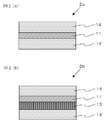
- FIG. 1 is a cross-sectional view of an antifouling sheet having a substrate, which is one of the embodiments.
- seat which has a base material the antifouling sheet
- FIG. 2 is a cross-sectional view of an antifouling sheet not having a substrate, which is one of the embodiments.
- the antifouling sheet having no base material for example, as shown in FIG. 2A, the antifouling sheet 2a has a configuration in which the antifouling layer 11 is sandwiched between two release materials 14 and 14 ′. Is mentioned. Moreover, it is good also as the antifouling sheet
- the antifouling layer of the antifouling sheet of the present invention is formed from the above-described antifouling composition of the present invention.
- the thickness of the antifouling layer is preferably from 0.001 to 40 ⁇ m, more preferably from the viewpoint of an antifouling sheet having a large water repellency and having excellent water repellency that allows water droplets to slide down instantaneously.
- the thickness is 0.005 to 25 ⁇ m, more preferably 0.01 to 15 ⁇ m, still more preferably 0.05 to 5 ⁇ m.
- Examples of the base material used in the antifouling sheet of the present invention include a paper base material, a resin film or sheet, a base material obtained by laminating a paper base material with a resin, and the like. You can choose.
- Examples of the paper constituting the paper substrate include thin paper, medium quality paper, high quality paper, impregnated paper, coated paper, art paper, sulfuric acid paper, glassine paper and the like.
- Examples of the resin constituting the resin film or sheet include polyolefin resins such as polyethylene and polypropylene; polyvinyl chloride, polyvinylidene chloride, polyvinyl alcohol, ethylene-vinyl acetate copolymer, ethylene-vinyl alcohol copolymer, and the like.
- polyester resin such as polyethylene terephthalate, polybutylene terephthalate, polyethylene naphthalate; Polystyrene; Acrylonitrile-butadiene-styrene copolymer; Cellulose triacetate; Polycarbonate; Polyurethane; Acrylic modified polyurethane, etc. And urethane resin.
- the base material obtained by laminating a paper base material with a resin include laminated paper obtained by laminating the paper base material with a thermoplastic resin such as polyethylene.
- a resin film or sheet is preferable, a film or sheet made of a polyester resin is more preferable, and a film or sheet made of polyethylene terephthalate (PET) is still more preferable.
- a base material with a primer layer in which a primer layer is provided on the surface of the base material described above may be used from the viewpoint of improving the adhesion with the antifouling layer or the weathering layer described later.
- a component which comprises a primer layer a polyester-type resin, a urethane type resin, a polyester urethane type resin, an acrylic resin etc. are mentioned, for example, These resin may be used individually or in combination of 2 or more types. .
- the base material with a weather resistant layer which provided the weather resistant layer which further consists of a polymeric ultraviolet absorber on the surface of the above-mentioned base material or the base material with a primer layer (weather resistant layer and You may use a primer layer between the base materials).
- the polymer ultraviolet absorber has a structure in which an ultraviolet absorption skeleton is covalently bonded in a polymer structure, and preferably has a weight average molecular weight of 5,000 or more, more preferably 10,000 or more. is there.
- the base material used by this invention is a resin film or a sheet
- corrugation Surface treatment such as chemical conversion may be applied.
- the oxidation method is not particularly limited, and examples thereof include a corona discharge treatment method, a plasma treatment method, chromic acid oxidation (wet), flame treatment, hot air treatment, and ozone / ultraviolet irradiation treatment.
- corrugated method For example, a sandblasting method, a solvent processing method, etc. are mentioned. These surface treatments are appropriately selected according to the type of the substrate, but the corona discharge treatment method is preferred from the viewpoint of improving the adhesion with the antifouling layer and the operability.
- the thickness of the substrate is appropriately set according to the use of the antifouling sheet, but is preferably 10 to 250 ⁇ m, more preferably 15 to 200 ⁇ m, and still more preferably 20 to 150 ⁇ m from the viewpoints of handleability and economy. It is.
- the base material used in the present invention further contains an ultraviolet absorber other than the above-described polymer ultraviolet absorber, a light stabilizer, an antioxidant, an antistatic agent, a slip agent, an antiblocking agent, a colorant and the like. May be.
- a release sheet that has been subjected to a double-sided release process a release sheet that has been subjected to a single-sided release process, or the like is used, and examples include those in which a release agent is applied to a base material for the release material.
- the base material for the release material include a paper base material, a resin film or sheet, and a base material obtained by laminating a paper base material with a resin, which can be used as the base material of the antifouling sheet of the present invention.
- the release agent examples include rubber elastomers such as silicone resins, olefin resins, isoprene resins, and butadiene resins, long chain alkyl resins, alkyd resins, and fluorine resins.
- the thickness of the release material is not particularly limited, but is preferably 10 to 200 ⁇ m, more preferably 25 to 150 ⁇ m.
- the adhesive constituting the adhesive layer can be appropriately selected according to the use of the antifouling sheet.
- the pressure sensitive adhesive include acrylic pressure sensitive adhesive, urethane pressure sensitive adhesive, silicone pressure sensitive adhesive, rubber pressure sensitive adhesive, polyester pressure sensitive adhesive, and UV curable pressure sensitive adhesive. These pressure-sensitive adhesives may be used alone or in combination of two or more.
- the thickness of the pressure-sensitive adhesive layer is not particularly limited, but is preferably 1 to 100 ⁇ m, more preferably 5 to 80 ⁇ m.
- the method for producing an antifouling sheet of the present invention includes the following steps (1) and (2).
- Process (1) following formula (a) Formula (a): Si (OR 1 ) p (X 1 ) 4-p [In the formula (a), R 1 represents an alkyl group having 1 to 6 carbon atoms, and X 1 represents a halogen atom. When R 1 and X 1 there are a plurality, the plurality of R 1 and X 1 are also identical to each other or may be different. p represents an integer of 0 to 4.
- R 2 represents an alkyl group having 1 to 3 carbon atoms.
- R 3 represents an alkyl group having 1 to 6 carbon atoms, and
- X 2 represents a halogen atom. If R 3 and X 2 there are a plurality, the plurality of R 3 and X 2 are either identical to one another or may be different.
- q represents an integer of 0 to 3.
- a trifunctional silane compound (B) represented by: A step of preparing an antifouling composition comprising a metal catalyst (C) that contains one or more metal atoms selected from titanium, aluminum, and zinc and that does not require light irradiation for the expression of a catalytic action ( 2): A step of applying the antifouling composition onto a substrate or a release material and drying to form an antifouling layer
- the antifouling composition of this invention melt
- the solvent include methanol, ethanol, propanol, butanol, isopropyl alcohol, methyl ethyl ketone, methyl isobutyl ketone, ethyl acetate, toluene and the like.
- the coating method include spin coating, spray coating, bar coating, knife coating, roll knife coating, roll coating, blade coating, die coating, and gravure coating.
- the drying temperature is preferably 10 to 130 ° C, more preferably 20 to 120 ° C, still more preferably 40 to 110 ° C, and still more preferably 50 to 95 ° C.
- a release material may be further laminated on the formed antifouling layer in order to protect the surface of the antifouling layer during storage.
- the antifouling sheet 1b in FIG. 1 (b) or the antifouling sheet 2b in FIG. 2 (b) is obtained by laminating the adhesive layer formed on another release material on the formed antifouling layer. Such an antifouling sheet with an adhesive layer can also be produced.
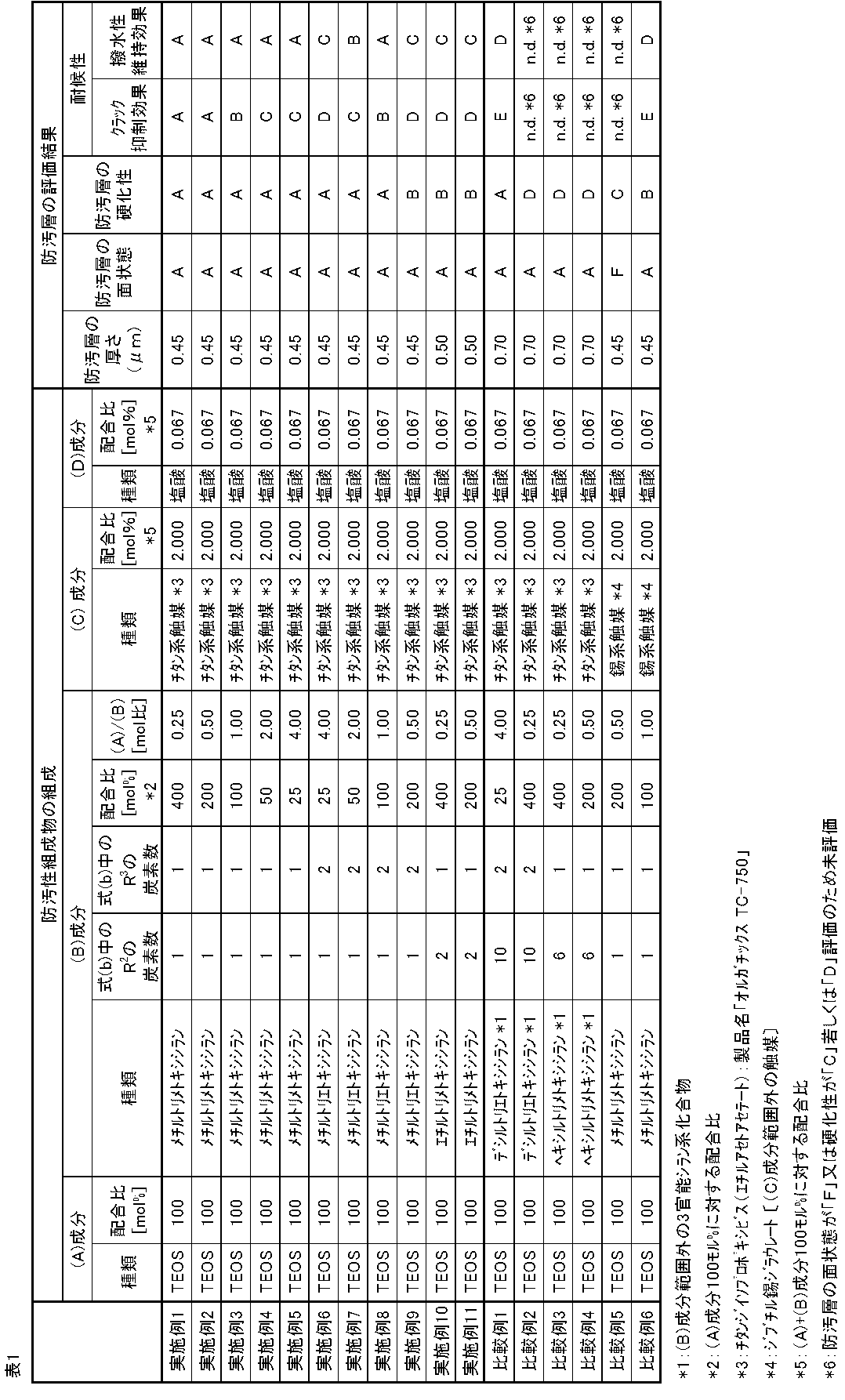
- Examples 1 to 11 and Comparative Examples 1 to 6 Preparation of antifouling composition
- Compound (A) and component (B) are blended in the types and blending ratios shown in Table 1 (effective ingredient ratio, mol%), diluted by adding ethanol, and active ingredient concentration A 1.8M solution was obtained.
- component was further mix
- ⁇ Metal catalyst> "Titanium catalyst”: manufactured by Matsumoto Fine Chemical Co., Ltd., trade name “Orgatechs TC-750", titanium diisopropoxybis (ethyl acetoacetate).
- “Tin-based catalyst” dibutyltin dilaurate.
- ⁇ Acid catalyst> "Hydrochloric acid”: 0.01M hydrochloric acid.
- ⁇ Thickness of antifouling layer> The thickness of the antifouling layer was measured with a spectroscopic ellipsometer (manufactured by JA Woollam, trade name “M-2000”).
- ⁇ Stain condition of antifouling layer> The surface of the antifouling layer of the antifouling sheet prepared in Examples and Comparative Examples was visually observed, and the surface state of the antifouling layer was evaluated according to the following criteria. A: Transparent. F: Not transparent.
- the surface condition evaluation of the antifouling layer was “F”, it cannot be used, so the following evaluations regarding “weather resistance of the antifouling layer” (“crack suppression effect” and “repellency”) Evaluation of “aqueous maintenance effect” was not performed.
- ⁇ Curability of antifouling layer> The antifouling layer after rubbing the surface of the antifouling layer of the antifouling sheet produced in Examples and Comparative Examples 20 times with a finger was visually observed, and the curability of the antifouling layer was evaluated according to the following criteria. . -A: A change was not seen compared with before rubbing with a finger. B: Discolored slightly white, but acceptable. C: Discolored white. -D: The antifouling layer could not be formed because the coating film made of the antifouling composition was not cured.
- ⁇ Weather resistance of antifouling layer> (Exposure treatment conditions)
- a xenon (Xe) lamp was used by using a weather resistance tester (product name: “Super Xenon Weather Meter SX75”) manufactured by Suga Test Instruments Co., Ltd.
- a weather resistance tester product name: “Super Xenon Weather Meter SX75” manufactured by Suga Test Instruments Co., Ltd.
- the antifouling layers formed from the antifouling compositions of Examples 1 to 11 had good surface conditions and curability. Moreover, it was confirmed that the crack suppression effect and the water repellency maintenance effect when exposed under the above exposure treatment conditions are also excellent.
- the antifouling layer formed from the antifouling compositions of Comparative Examples 1 and 6 had good surface condition and curability, but was effective in suppressing cracks and maintaining water repellency when exposed under the above exposure conditions. Was inferior. Further, the antifouling layers formed from the antifouling compositions of Comparative Examples 2 to 4 resulted in poor curability.
- the antifouling sheet having these antifouling layers cannot withstand use, and the crack suppression effect and the water repellency maintaining effect when exposed under the above exposure treatment conditions are not evaluated.
- the antifouling layer formed from the antifouling composition of Comparative Example 5 resulted in poor surface condition and curability. Therefore, the antifouling sheet having the antifouling layer of Comparative Example 5 is judged not to withstand use, and the crack suppression effect and the water repellency maintaining effect when exposed under the above exposure treatment conditions are evaluated. Absent.
- the antifouling layer formed from the antifouling composition of the present invention has a good surface state and curability, and also has a crack suppressing effect and water repellency maintenance under the conditions that are assumed to be exposed outdoors for a long period of time. Excellent effect. Therefore, the antifouling sheet of the present invention having the antifouling layer is, for example, windshield glass for buildings, automobile windows, vehicles, aircraft, ships, etc., water tanks, ship bottom windows, marine organisms attached to the ship bottom.
- Prevention film to prevent adhesion of objects such as water drops and dirt on the surface of molded products such as prevention films, road panels such as sound barriers, mirrors installed in bathrooms, glass containers, glass decorations, etc.
- Suitable as a dirty sheet more suitable when used in an environment where it is exposed to sunlight outdoors for a long time, such as windshield glass for automobiles, vehicles, aircraft, ships, etc. It is.
Landscapes
- Chemical & Material Sciences (AREA)
- Organic Chemistry (AREA)
- Engineering & Computer Science (AREA)
- Materials Engineering (AREA)
- Chemical Kinetics & Catalysis (AREA)
- Life Sciences & Earth Sciences (AREA)
- Wood Science & Technology (AREA)
- Inorganic Chemistry (AREA)
- Health & Medical Sciences (AREA)
- Medicinal Chemistry (AREA)
- Polymers & Plastics (AREA)
- Paints Or Removers (AREA)
- Laminated Bodies (AREA)
- Application Of Or Painting With Fluid Materials (AREA)
- Coating Of Shaped Articles Made Of Macromolecular Substances (AREA)
- Silicon Polymers (AREA)
Abstract
Description
このような成形品の表面に対して、防汚性物質からなる皮膜で被覆することで、若しくは、防汚性シートを貼付することで、撥水性や防汚性を付与することが行われている。
例えば、特許文献1には、無機化合物より形成されてなる下地層と、当該下地層の表面を被覆し、フッ素含有化合物より形成されてなる撥水膜とを有する積層体によって、ガラス等の基材を被覆した撥水膜被覆物品が開示されている。
また、防汚性シートは、一般的に屋外等で使用されることが多く、長期間、屋外で暴露されることによる耐候性の低下、例えば、防汚層にクラックが発生し、当該クラックの進行により防汚層表面の外観が悪化するといった問題や、長期間の屋外暴露によって防汚層の防汚性が低下するといった問題がある。更に、撥水性や防汚性を付与する防汚層には、層の面状態や硬化性が良好であることも要求される。
すなわち、本発明は、下記[1]~[18]を提供する。
[1]下記式(a)
式(a):Si(OR1)p(X1)4-p
〔式(a)中、R1は、炭素数1~6のアルキル基を表し、X1は、ハロゲン原子を表す。R1及びX1が複数存在する場合、複数のR1及びX1は、互いに同一でも、異なっていてもよい。pは0~4の整数を表す。〕
で表される4官能シラン系化合物(A)、
下記式(b)
式(b):R2Si(OR3)q(X2)3-q
〔式(b)中、R2は、炭素数1~3のアルキル基を表す。R3は、炭素数1~6のアルキル基を表し、X2は、ハロゲン原子を表す。R3及びX2が複数存在する場合、複数のR3及びX2は、互いに同一でも、異なっていてもよい。qは0~3の整数を表す。〕
で表される3官能シラン系化合物(B)、並びに、
チタン、アルミニウム、及び亜鉛から選ばれる1種以上の金属原子を含有し、触媒作用発現のために光照射を必要としない金属触媒(C)を含む、防汚性組成物。
[2](A)成分と(B)成分との配合比(モル比)〔(A)/(B)〕が、0.01以上10.00以下である、上記[1]に記載の防汚性組成物。
[3]式(b)中、R3がメチル基である、上記[1]又は[2]に記載の防汚性組成物。
[4](A)成分と(B)成分との配合比(モル比)〔(A)/(B)〕が、0.05以上5.00以下である、上記[3]に記載の防汚性組成物。
[5]式(b)中、R3がエチル基である、上記[1]又は[2]に記載の防汚性組成物。
[6](A)成分と(B)成分との配合比(モル比)〔(A)/(B)〕が、0.10以上7.00以下である、上記[5]に記載の防汚性組成物。
[7](C)成分の含有量が、(A)成分及び(B)成分の合計100モル%に対して、0.010~50.000モル%である、上記[1]~[6]のいずれかに記載の防汚性組成物。
[8](C)成分が、チタンアルコキシド、チタンキレート、チタンアシレート、アルミニウムのアセトアセテート錯体、アルミニウムのアセチルアセトネート錯体、亜鉛-クロム酸化物、亜鉛-アルミニウム酸化物、亜鉛-アルミニウム-クロム酸化物、亜鉛-クロム-マンガン酸化物、亜鉛-鉄酸化物、及び亜鉛-鉄-アルミニウム酸化物から選ばれる1種以上を含む、上記[1]~[7]のいずれかに記載の防汚性組成物。
[9]防汚性組成物の全量100質量%に対する、(A)成分、(B)成分、及び(C)成分の合計含有量が50質量%以上である、上記[1]~[8]のいずれかに記載の防汚性組成物。
[10]更に酸触媒(D)を含む、上記[1]~[9]のいずれかに記載の防汚性組成物。
[11](D)成分が、塩酸、リン酸、酢酸、ギ酸、硫酸、メタンスルホン酸、臭酸、p-トルエンスルホン酸、及びトリフルオロ酢酸からなる群より選ばれる1種以上を含む、上記[10]に記載の防汚性組成物。
[12]上記[1]~[11]のいずれかに記載の防汚性組成物から形成されてなる防汚層を有する、防汚性シート。
[13]基材上に前記防汚層を有する、上記[12]に記載の防汚性シート。
[14]前記防汚層が、2枚の剥離材で挟持された構成を有する、上記[12]に記載の防汚性シート。
[15]更に粘着剤層を有する、上記[12]~[14]のいずれかに記載の防汚性シート。
[16]前記防汚層の厚さが40μm以下である、上記[12]~[15]のいずれかに記載の防汚性シート。
[17]下記工程(1)及び(2)を有する、防汚性シートの製造方法。
工程(1):下記式(a)
式(a):Si(OR1)p(X1)4-p
〔式(a)中、R1は、炭素数1~6のアルキル基を表し、X1は、ハロゲン原子を表す。R1及びX1が複数存在する場合、複数のR1及びX1は、互いに同一でも、異なっていてもよい。pは0~4の整数を表す。〕
で表される4官能シラン系化合物(A)、
下記式(b)
式(b):R2Si(OR3)q(X2)3-q
〔式(b)中、R2は、炭素数1~3のアルキル基を表す。R3は、炭素数1~6のアルキル基を表し、X2は、ハロゲン原子を表す。R3及びX2が複数存在する場合、複数のR3及びX2は、互いに同一でも、異なっていてもよい。qは0~3の整数を表す。〕
で表される3官能シラン系化合物(B)、並びに、
チタン、アルミニウム、及び亜鉛から選ばれる1種以上の金属原子を含有し、触媒作用発現のために光照射を必要としない金属触媒(C)を含む、防汚性組成物を調製する工程
工程(2):当該防汚性組成物を基材又は剥離材上に塗布し、乾燥して防汚層を形成する工程
[18]上記[17]に記載の製造方法により得られる、防汚性シート。
本発明の防汚性組成物は、式(a)で表される4官能シラン系化合物(A)、式(b)で表される3官能シラン系化合物(B)、並びに、チタン、アルミニウム、及び亜鉛から選ばれる1種以上の金属原子を含有し、触媒作用発現のために光照射を必要としない金属触媒(C)を含む。
なお、本発明の防汚性組成物は、更に酸触媒(D)を含むことが好ましく、本発明の効果を損なわない範囲において、(A)~(D)成分以外のその他の添加剤を含有してもよい。
防汚性組成物中のシラン系化合物同士の縮合反応が進行し、重合体となることで防汚層が形成されるが、本発明者らは、シラン系化合物同士の反応により得られる重合体の構造について、形成直後の防汚層中に残存している(A)成分及び(B)成分に由来の単位中の未反応のアルコキシ基(式(a)中のOR1、及び式(b)中のOR3)並びに前記アルコキシ基が加水分解した未縮合のシラノール基の存在(以下、両者を合わせて単に「未縮合点」ともいう。)が、長期間の屋外暴露によって徐々に反応して硬化収縮を起こすことによって、防汚層に歪が発生してクラックの発生及び進行を促進するものと推測した。
より具体的には、当該シラン系化合物同士の縮合反応が開始するためには、反応開始時に(A)成分及び(B)成分中のアルコキシ基(式(a)中のOR1、及び式(b)中のOR3)が水と反応して脱離し、水酸基に置換される必要がある。そこで、(A)成分及び(B)成分中のアルコキシ基が有するアルキル基(式(a)中のR1、及び式(b)中のR3)を特定の炭素数を有するアルキル基とすることで、当該反応が促進されて未縮合点が少ない架橋密度の高い防汚層が形成されると考えた。そして、当該アルキル基の炭素数を制御することで長期間の屋外暴露後においてもクラックの発生及び進行を抑制(以下、単に「クラック抑制効果」ともいう。)し、また、暴露前後における撥水性の低下が少ない(以下、単に「撥水性維持効果」ともいう。)防汚層を得られることを見出した。
以下、本発明の防汚性組成物に含まれる各成分について説明する。
本発明の防汚性組成物は、下記式(a)で表される4官能シラン系化合物(A)を含む。
式(a):Si(OR1)p(X1)4-p
〔式(a)中、R1は、炭素数1~6のアルキル基を表し、X1は、ハロゲン原子を表す。R1及びX1が複数存在する場合、複数のR1及びX1は、互いに同一でも、異なっていてもよい。pは0~4の整数を表す。〕
なお、(A)成分は、1種のみからなる化合物から構成されていてもよく、上記式(a)で表される2種以上の化合物から構成されていてもよい。
R1として選択し得るアルキル基は、直鎖及び分岐鎖のいずれであってもよいが、直鎖であることが好ましい。
なお、上記の式(a)で表されるシラン系化合物は、単独で又は2種以上を組み合わせて用いてもよい。
また、(A)成分としては、前記式(a)中のpが4であるシラン系化合物を含むことが好ましい。
本発明の防汚性組成物は、前記式(a)で表される4官能シラン系化合物(A)と共に、下記式(b)で表される3官能シラン系化合物(B)を含む。
式(b):R2Si(OR3)q(X2)3-q
〔式(b)中、R2は、炭素数1~3のアルキル基を表す。R3は、炭素数1~6のアルキル基を表し、X2は、ハロゲン原子を表す。R3及びX2が複数存在する場合、複数のR3及びX2は、互いに同一でも、異なっていてもよい。qは0~3の整数を表す。〕
なお、(B)成分は、1種のみからなる化合物から構成されていてもよく、上記式(b)で表される2種以上の化合物から構成されていてもよい。
当該アルキル基の炭素数が4を超えると、得られる防汚性組成物から形成される防汚層の硬化性、撥水性維持効果、及びクラック抑制効果が劣る。また、当該アルキル基の炭素数が増加するほど、得られる防汚性組成物がゲル化し易く、当該防汚性組成物から形成される防汚層の面状態も悪化する傾向にある。
R2として選択し得るアルキル基としては、メチル基、エチル基、n-プロピル基、イソプロピル基が挙げられ、防汚層の硬化性の観点からメチル基、エチル基が好ましく、また、より良好なクラック抑制効果を得る観点からメチル基がより好ましい。
なお、上記の式(b)で表される3官能シラン系化合物は、単独で又は2種以上を組み合わせて用いてもよい。
また、(B)成分としては、前記式(b)中のqが3である3官能シラン系化合物を含むことが好ましい。
本発明の防汚性組成物は、チタン、アルミニウム、及び亜鉛から選ばれる1種以上の金属原子を含有し、触媒作用発現のために光照射を必要としない金属触媒(C)を含む。
なお、本明細書において、当該「触媒作用発現のために光照射を必要としない金属触媒」とは、(A)成分と(B)成分との縮合反応に対する触媒作用を発現するために光照射を必要としない金属触媒のことを指す。例えば、酸化チタン(TiO2)や酸化亜鉛(ZnO)等の、光照射により電子と正孔を生成することで酸化反応及び還元反応を引き起こすといった、触媒作用発現のために光照射が必要とされる、一般に光触媒と呼ばれるものは除かれる。
なお、防汚層が光触媒を含有する場合には、例えば、光触媒自体が固形物であるため表面粗さが大きくなることによる撥水性の低下や、光触媒の親水性付与効果による撥水性の低下、並びにシラン系化合物の重合体の加水分解を促進することによる耐久性の低下といった問題が生じる虞がある。
これらの特定の種類の金属触媒(C)を含むことで、(A)成分と(B)成分との縮合反応を効果的に促進させ、防汚性組成物から形成される防汚層の硬化性を向上させることができる。
また、(A)成分及び(B)成分と共に(C)成分を含む防汚性組成物とすることで、比較的低温下(130℃以下)でも硬化反応を進行させることができる。そのため、塩化ビニル等の耐熱性が低い基材上に当該防汚性組成物から形成した防汚層を形成する場合においても、基材の熱収縮を抑え得るほどの低温下でも、防汚層を形成することができる。
チタンアルコキシドとしては、例えば、チタンテトライソプロポキシド、チタンテトラノルマルブトキシド、チタンブトキシドダイマー、チタンテトラ-2-エチルヘキソキシド等が挙げられる。
チタンキレートとしては、例えば、チタンジイソプロポキシビス(アセチルアセトネート)、チタンテトラアセチルアセトネート等のチタンアセチルアセトネート;チタンジイソプロポキシビス(エチルアセトアセテート)等のチタンエチルアセトアセテート;チタンジイソプロポキシビス(トリエタノールアミネート)等のチタントリエタノールアミネート;チタンテトラオクチレングリコネート、チタンジオクチロキシビス(オクチレングリコネート)、チタンジ-2-エチルヘキソキシビス(2-エチル-3-ヒドロキシヘキソキシド)等のチタンオクチレングリコネート;チタンラクテート、チタンラクテートアンモニウム塩等が挙げられる。
チタンアシレートとしては、例えば、ポリヒドロキシチタンステアレート等が挙げられる。
アルミニウムのアセトアセテート錯体としては、例えば、ジイソプロポキシアルミニウムモノオレイルアセトアセテート、モノイソプロポキシアルミニウムビスオレイルアセトアセテート、モノイソプロポキシアルミニウムモノオレエートモノエチルアセトアセテート、ジイソプロポキシアルミニウムモノラウリルアセトアセテート、ジイソプロポキシアルミニウムモノステアリルアセトアセテート、ジイソプロポキシアルミニウムモノイソステアリルアセトアセテート、モノイソプロポキシアルミニウムモノ-N-ラウロイル-β-アラネートモノラウリルアセトアセテート、アルミニウムトリスアセチルアセトネート等が挙げられる。
アルミニウムのアセチルアセトネート錯体としては、例えば、モノアセチルアセトネートアルミニウムビス(イソブチルアセトアセテート)キレート、モノアセチルアセトネートアルミニウムビス(2-エチルヘキシルアセトアセテート)キレート、モノアセチルアセトネートアルミニウムビス(ドデシルアセトアセテート)キレート、モノアセチルアセトネートアルミニウムビス(オレイルアセトアセテート)キレート等が挙げられる。
チタン系触媒としては、チタンキレートが好ましく、チタンエチルアセトアセテート、チタンアセチルアセトネート又はチタンオクチレングリコネートがより好ましく、チタンエチルアセトアセテートが更に好ましく、チタンジイソプロポキシビス(エチルアセトアセテート)がより更に好ましい。
防汚性組成物中の(C)成分の含有量は、防汚性組成物から形成される防汚層の硬化性を向上させる観点、及び、比較的低温下(130℃以下)でも硬化反応を進行させ得る防汚性組成物とする観点から、(A)成分及び(B)成分の合計100モル%に対して、好ましくは0.010~50.000モル%、より好ましくは0.100~30.000モル%、更に好ましくは0.150~20.000モル%、より更に好ましくは0.300~10.000モル%、より更に好ましくは0.500~6.000モル%、より更に好ましくは1.000~3.000モル%である。
本発明の防汚性組成物は、防汚性組成物から形成される防汚層の硬化性をより向上させる観点から、更に酸触媒(D)を含むことが好ましい。
防汚性組成物中に酸触媒(D)を含有することで、(A)成分及び(B)成分が有する反応性官能基の加水分解が促進され、シラン系化合物同士の縮重合反応がより促進され、硬化性に優れた防汚層を形成することができる。
酸触媒(D)としては、(A)成分及び(B)成分の反応性官能基の加水分解を促進させる作用を有する成分であれば特に制限はないが、防汚性組成物から形成される防汚層の硬化性をより向上させる観点から、塩酸、リン酸、酢酸、ギ酸、硫酸、メタンスルホン酸、臭酸、p-トルエンスルホン酸、及びトリフルオロ酢酸からなる群より選ばれる1種以上を含むことが好ましく、塩酸を含むことがより好ましい。
防汚性組成物中の(D)成分の含有量は、防汚性組成物から形成される防汚層の硬化性をより向上させる観点から、(A)成分及び(B)成分の合計100モル%に対して、好ましくは0.001~1.000モル%、より好ましくは0.005~0.500モル%、更に好ましくは0.010~0.100モル%、より更に好ましくは0.020~0.070モル%である。
防汚性組成物には、上述の(A)~(D)成分以外に、本発明の効果を損なわない範囲において、その他の添加剤を含有していてもよい。
その他の添加剤としては、例えば、樹脂成分、硬化剤、老化防止剤、光安定剤、難燃剤、導電剤、帯電防止剤、可塑剤等が挙げられる。
これらの添加剤のそれぞれの含有量は、防汚性組成物の全量に対して、好ましくは0~20質量%、より好ましくは0~10質量%、更に好ましくは0~5質量%、より更に好ましくは0~2質量%である。
なお、防汚性組成物中の(A)成分、(B)成分、及び(C)成分の合計含有量は、当該防汚性組成物の全量(固形分100質量%)に対して、好ましくは50質量%以上、より好ましくは65質量%以上、更に好ましくは80質量%以上、より更に好ましくは90質量%以上であり、また、好ましくは99.9質量%以下、より好ましくは99.0質量%以下である。
本発明の防汚性シートは、上述の本発明の防汚性組成物から形成されてなる防汚層を有するものであれば、特に制限されない。
<防汚性シートの構成>
図1は、本実施態様の一つである、基材を有する防汚性シートの断面図である。
基材を有する防汚性シートとしては、例えば、図1(a)に示すような、基材12上に、防汚層11を有する防汚性シート1aが挙げられる。
また、図1(b)に示すような、基材12の防汚層11を有する面とは反対側の面上に、更に粘着剤層13及び剥離材14を設けた防汚性シート1bとしてもよい。
なお、この防汚性シート1a、1bの防汚層11上には、保存時の防汚層の保護のために、更に剥離材を設けてもよい。
基材を有しない防汚性シートとしては、例えば、図2(a)に示すような、防汚層11が2枚の剥離材14、14’で挟持された構成を有する防汚性シート2aが挙げられる。
また、図2(b)に示すような、防汚層11と剥離材14’との間に、更に粘着剤層13を設けた防汚性シート2bとしてもよい。
本発明の防汚性シートが有する防汚層は、上述の本発明の防汚性組成物から形成されてなる。当該防汚層の厚さとしては、水滴の滑落加速度が大きく、水滴を瞬時に滑落させ得る優れた撥水性を有する防汚性シートとする観点から、好ましくは0.001~40μm、より好ましくは0.005~25μm、更に好ましくは0.01~15μm、より更に好ましくは0.05~5μmである。
本発明の防汚性シートで用いる基材としては、例えば、紙基材、樹脂フィルム又はシート、紙基材を樹脂でラミネートした基材等が挙げられ、防汚性シートの用途に応じて適宜選択することができる。
紙基材を構成する紙としては、例えば、薄葉紙、中質紙、上質紙、含浸紙、コート紙、アート紙、硫酸紙、グラシン紙等が挙げられる。
樹脂フィルム又はシートを構成する樹脂としては、例えば、ポリエチレン、ポリプロピレン等のポリオレフィン樹脂;ポリ塩化ビニル、ポリ塩化ビニリデン、ポリビニルアルコール、エチレン-酢酸ビニル共重合体、エチレン-ビニルアルコール共重合体等、エチレン-メタクリル酸共重合体のビニル系樹脂;ポリエチレンテレフタレート、ポリブチレンテレフタレート、ポリエチレンナフタレート等のポリエステル系樹脂;ポリスチレン;アクリロニトリル-ブタジエン-スチレン共重合体;三酢酸セルロース;ポリカーボネート;ポリウレタン、アクリル変性ポリウレタン等のウレタン樹脂等が挙げられる。
紙基材を樹脂でラミネートした基材としては、上記の紙基材を、ポリエチレン等の熱可塑性樹脂でラミネートしたラミネート紙等が挙げられる。
これらの基材の中でも、樹脂フィルム又はシートが好ましく、ポリエステル系樹脂からなるフィルム又はシートがより好ましく、ポリエチレンテレフタレート(PET)からなるフィルム又はシートが更に好ましい。
プライマー層を構成する成分としては、例えば、ポリエステル系樹脂、ウレタン系樹脂、ポリエステルウレタン系樹脂、アクリル系樹脂等が挙げられ、これらの樹脂は、単独で又は2種以上を組み合わせて用いてもよい。
また、本発明で用いる基材として、上述の基材の表面上又はプライマー層付き基材の表面上に、更に高分子紫外線吸収剤からなる耐候層を設けた耐候層付き基材(耐候層と基材との間にプライマー層を有していてもよい)を用いてもよい。当該高分子紫外線吸収剤としては、紫外線吸収骨格がポリマー構造内に共有結合している構造を有するものであり、重量平均分子量が5,000以上のものが好ましく、より好ましくは10,000以上である。
酸化法としては、特に限定されず、例えば、コロナ放電処理法、プラズマ処理法、クロム酸酸化(湿式)、火炎処理、熱風処理、オゾン・紫外線照射処理等が挙げられる。
また、凹凸化法としては、特には限定されず、例えば、サンドブラスト法、溶剤処理法等が挙げられる。
これらの表面処理は、基材の種類に応じて適宜選定されるが、防汚層との密着性向上の観点、及び操作性の観点から、コロナ放電処理法が好ましい。
なお、本発明で用いる基材には、更に、上述の高分子紫外線吸収剤以外の紫外線吸収剤、光安定剤、酸化防止剤、帯電防止剤、スリップ剤、アンチブロッキング剤、着色剤等が含有されていてもよい。
本発明で用いる剥離材としては、両面剥離処理をされた剥離シートや、片面剥離処理された剥離シート等が用いられ、剥離材用の基材上に剥離剤を塗布したもの等が挙げられる。
剥離材用の基材としては、例えば、本発明の防汚性シートが有する基材として使用し得る、紙基材、樹脂フィルム又はシート、紙基材を樹脂でラミネートした基材等が挙げられる。
剥離剤としては、例えば、シリコーン系樹脂、オレフィン系樹脂、イソプレン系樹脂、ブタジエン系樹脂等のゴム系エラストマー、長鎖アルキル系樹脂、アルキド系樹脂、フッ素系樹脂等が挙げられる。
剥離材の厚さは、特に制限ないが、好ましくは10~200μm、より好ましくは25~150μmである。
本発明の防汚性シートが粘着剤層を有する場合、当該粘着剤層を構成する粘着剤としては、防汚性シートの用途に応じて適宜選択することができる。
具体的な粘着剤としては、例えば、アクリル系粘着剤、ウレタン系粘着剤、シリコーン系粘着剤、ゴム系粘着剤、ポリエステル系粘着剤、紫外線硬化型粘着剤等が挙げられる。
これらの粘着剤は、単独で又は2種以上を組み合わせて用いてもよい。
粘着剤層の厚さは、特に制限はないが、好ましくは1~100μm、より好ましくは5~80μmである。
本発明の防汚性シートの製造方法は、下記工程(1)及び(2)を有する。
工程(1):下記式(a)
式(a):Si(OR1)p(X1)4-p
〔式(a)中、R1は、炭素数1~6のアルキル基を表し、X1は、ハロゲン原子を表す。R1及びX1が複数存在する場合、複数のR1及びX1は、互いに同一でも、異なっていてもよい。pは0~4の整数を表す。〕
で表される4官能シラン系化合物(A)、
下記式(b)
式(b):R2Si(OR3)q(X2)3-q
〔式(b)中、R2は、炭素数1~3のアルキル基を表す。R3は、炭素数1~6のアルキル基を表し、X2は、ハロゲン原子を表す。R3及びX2が複数存在する場合、複数のR3及びX2は、互いに同一でも、異なっていてもよい。qは0~3の整数を表す。〕
で表される3官能シラン系化合物(B)、並びに、
チタン、アルミニウム、及び亜鉛から選ばれる1種以上の金属原子を含有し、触媒作用発現のために光照射を必要としない金属触媒(C)を含む、防汚性組成物を調製する工程
工程(2):当該防汚性組成物を基材又は剥離材上に塗布し、乾燥して防汚層を形成する工程
当該溶媒としては、例えば、メタノール、エタノール、プロパノール、ブタノール、イソプロピルアルコール、メチルエチルケトン、メチルイソブチルケトン、酢酸エチル、トルエン等が挙げられる。
塗布方法としては、例えば、スピンコート法、スプレーコート法、バーコート法、ナイフコート法、ロールナイフコート法、ロールコート法、ブレードコート法、ダイコート法、グラビアコート法等が挙げられる。
ただし、本発明の防汚性組成物は、130℃以下と比較的低温下でも硬化反応を進行させることができ、塩化ビニル等の耐熱性の低い基材を用いた場合に、当該基材の熱収縮を抑制することができる。
そのため、上記観点、及び生産性の観点から、乾燥温度としては、好ましくは10~130℃、より好ましくは20~120℃、更に好ましくは40~110℃、より更に好ましくは50~95℃である。
なお、形成した防汚層上に、保存時の防汚層の表面の保護のために、更に剥離材を積層してもよい。
更に、形成した防汚層上に、別の剥離材上に形成した粘着剤層を貼り合わせることで、図1(b)の防汚性シート1bや図2(b)の防汚性シート2bのような、粘着剤層付きの防汚性シートを製造することもできる。
(1)防汚性組成物の調製
表1に示す種類及び配合比(有効成分比、モル%)で(A)成分及び(B)成分を配合し、エタノールを加えて希釈し、有効成分濃度1.8Mの溶液を得た。当該溶液に(D)成分を更に配合して1分間攪拌し、攪拌後、15分間静置した。
次いで、表1に示す種類及び配合比(有効成分比、モル%)で(C)成分を配合して、防汚性組成物の溶液を調製した。
(2)防汚性シートの作製
基材として、片面にプライマー層が設けられたポリエチレンテレフタレート(PET)フィルム(帝人デュポンフィルム株式会社製、製品名「テトロンフィルムHB3」、厚さ50μm)のプライマー層上に、更に耐候層として高分子紫外線吸収剤(一方社油脂工業株式会社製、製品名「ULS-935LH」)をバーコートにより厚さ5μmで塗工した耐候層付き基材を用いた。
当該耐候層付き基材の耐候層上に、上記のとおり調製した防汚性組成物の溶液を、マイヤーバーを用いて、塗布して塗膜を形成した。
次いで、当該塗膜を80℃で2分間乾燥し、表1に示す厚さの防汚層を有する防汚性シートを作製した。
<4官能シラン系化合物>
・「TEOS」:テトラエトキシシラン、前記式(a)中、p=4、R1=エチル基(炭素数:2)である4官能シラン系化合物。
<3官能シラン系化合物>
・「メチルトリメトキシシラン」:前記式(b)中のq=3、R2=メチル基(炭素数:1)、R3=メチル基(炭素数:1)である3官能シラン系化合物。
・「メチルトリエトキシシラン」:前記式(b)中のq=3、R2=メチル基(炭素数:1)、R3=エチル基(炭素数:2)である3官能シラン系化合物。
・「エチルトリメトキシシラン」:前記式(b)中のq=3、R2=エチル基(炭素数:2)、R3=メチル基(炭素数:1)である3官能シラン系化合物。
・「デシルトリエトキシシラン」:前記式(b)中のq=3、R2=n-デシル基(炭素数:10)、R3=エチル基(炭素数:2)である3官能シラン系化合物。
・「ヘキシルトリメトキシシラン」:前記式(b)中のq=3、R2=n-ヘキシル基(炭素数:6)、R3=メチル基(炭素数:1)である3官能シラン系化合物。
<金属系触媒>
・「チタン系触媒」:マツモトファインケミカル株式会社製、商品名「オルガチックス TC-750」、チタンジイソプロポキシビス(エチルアセトアセテート)。
・「錫系触媒」:ジブチル錫ジラウレート。
<酸触媒>
・「塩酸」:0.01M塩酸。
防汚層の厚さは分光エリプソメーター(J.A.Woollam社製、商品名「M-2000」)にて測定した。
<防汚層の面状態>
実施例及び比較例で作製した防汚性シートの防汚層の表面を目視で観察し、以下の基準により、防汚層の面状態を評価した。
A:透明であった。
F:透明ではなかった。
なお、防汚層の面状態の評価が「F」であったものについては、使用に耐え得るものではないため、下記「防汚層の耐候性」に関する評価(「クラック抑制効果」及び「撥水性維持効果」の評価)は行っていない。
実施例及び比較例で作製した防汚性シートの防汚層の表面を指で20回擦った後の防汚層を目視で観察し、以下の基準により、防汚層の硬化性を評価した。
・A:指で擦る前と比べて変化は見られなかった。
・B:少し白く変色したが、許容できる程度である。
・C:白く変色した。
・D:防汚性組成物からなる塗膜が硬化せずに、防汚層が形成できなかった。
なお、防汚層の硬化性の評価が「C」及び「D」であったものについては、使用に耐え得るものではないため、以下の「防汚層の耐候性」に関する評価(「クラック抑制効果」及び「撥水性維持効果」の評価)は行っていない。
(暴露処理条件)
実施例及び比較例で作製した防汚性シートの防汚層に、スガ試験機株式会社製の耐候性試験機(製品名:「スーパーキセノンウェザーメーター SX75」)を用いて、キセノン(Xe)ランプにより60W/m2の強度で太陽光の全波長領域に近似した光を、下記条件下で照射した。
・合計暴露時間:1,000時間
・43℃、100%RH(相対湿度)雰囲気
・2時間あたり18分間降雨条件
当該長期間、屋外で暴露された場合を想定した条件で暴露処理した実施例及び比較例で作製した防汚性シートについて、以下の評価を行った。
目視及びVeeco社製の光干渉表面形状粗さ測定システム(製品名:「Wyko NT-1100」、顕微鏡による観察)により、上記暴露処理条件によって暴露した後の防汚性シートの防汚層表面を観察して、クラック抑制効果を評価した。
・A:目視及び顕微鏡観察ともにクラックが確認されなかった。
・B:目視ではクラックが確認できないが、顕微鏡観察ではクラックが確認された。
・C:目視で僅かにクラックが確認された。
・D:目視でクラックが確認されたが、E評価(比較例1相当)より抑制されていた。
・E:目視で比較例1と同程度の明確なクラックが確認された。
協和界面科学株式会社製の全自動接触角測定装置(製品名:「DM-701」)を用いて、1,000時間暴露前後の防汚性シートの防汚層表面について、水2μLに対する接触角の差を測定し、撥水性維持効果を評価した。上記暴露処理条件による暴露前後における水接触角の低下が小さいほど、撥水性維持効果に優れる。
・A:暴露前後における接触角の低下が20°以下であった。
・B:暴露前後における接触角の低下が20°越え25°以下であった。
・C:暴露前後における接触角の低下が25°越え30°以下であった。
・D:暴露前後における接触角の低下が30°越えであった。
一方、比較例1及び6の防汚性組成物から形成した防汚層は、面状態及び硬化性が良好であったが、上記暴露処理条件により暴露した際のクラック抑制効果及び撥水性維持効果が劣る結果となった。また、比較例2~4の防汚性組成物から形成した防汚層は、硬化性が劣る結果となった。そのため、これらの防汚層を有する防汚性シートは、使用に耐え得るものではないと判断し、上記暴露処理条件により暴露した際のクラック抑制効果及び撥水性維持効果について評価を行っていない。
また、比較例5の防汚性組成物から形成した防汚層は、面状態及び硬化性が劣る結果となった。そのため、比較例5の防汚層を有する防汚性シートは、使用に耐え得るものではないと判断し、上記暴露処理条件により暴露した際のクラック抑制効果及び撥水性維持効果について評価を行っていない。
そのため、当該防汚層を有する本発明の防汚性シートは、例えば、建築用窓ガラス、自動車用窓ガラス、車両、航空機、船舶等の風防ガラス、水槽、船底窓、船底への海中生物付着防止用フィルム、防音壁等の道路用パネル、浴室等に設置された鏡、ガラス容器、ガラス装飾品等の成形品の表面に、水滴や汚れ等の視界を妨げるものの付着を防止するための防汚性シートとして好適であり、自動車用窓ガラス、車両、航空機、船舶等の風防ガラス等の、長期間、屋外で太陽光に暴露される環境下で用いられる用途に用いられる場合に、より好適である。
11 防汚層
12 基材
13 粘着剤層
14、14’ 剥離材
Claims (18)
- 下記式(a)
式(a):Si(OR1)p(X1)4-p
〔式(a)中、R1は、炭素数1~6のアルキル基を表し、X1は、ハロゲン原子を表す。R1及びX1が複数存在する場合、複数のR1及びX1は、互いに同一でも、異なっていてもよい。pは0~4の整数を表す。〕
で表される4官能シラン系化合物(A)、
下記式(b)
式(b):R2Si(OR3)q(X2)3-q
〔式(b)中、R2は、炭素数1~3のアルキル基を表す。R3は、炭素数1~6のアルキル基を表し、X2は、ハロゲン原子を表す。R3及びX2が複数存在する場合、複数のR3及びX2は、互いに同一でも、異なっていてもよい。qは0~3の整数を表す。〕
で表される3官能シラン系化合物(B)、並びに、
チタン、アルミニウム、及び亜鉛から選ばれる1種以上の金属原子を含有し、触媒作用発現のために光照射を必要としない金属触媒(C)を含む、防汚性組成物。 - (A)成分と(B)成分との配合比(モル比)〔(A)/(B)〕が、0.01以上10.00以下である、請求項1に記載の防汚性組成物。
- 式(b)中、R3がメチル基である、請求項1又は2に記載の防汚性組成物。
- (A)成分と(B)成分との配合比(モル比)〔(A)/(B)〕が、0.05以上5.00以下である、請求項3に記載の防汚性組成物。
- 式(b)中、R3がエチル基である、請求項1又は2に記載の防汚性組成物。
- (A)成分と(B)成分との配合比(モル比)〔(A)/(B)〕が、0.10以上7.00以下である、請求項5に記載の防汚性組成物。
- (C)成分の含有量が、(A)成分及び(B)成分の合計100モル%に対して、0.010~50.000モル%である、請求項1~6のいずれか1項に記載の防汚性組成物。
- (C)成分が、チタンアルコキシド、チタンキレート、チタンアシレート、アルミニウムのアセトアセテート錯体、アルミニウムのアセチルアセトネート錯体、亜鉛-クロム酸化物、亜鉛-アルミニウム酸化物、亜鉛-アルミニウム-クロム酸化物、亜鉛-クロム-マンガン酸化物、亜鉛-鉄酸化物、及び亜鉛-鉄-アルミニウム酸化物から選ばれる1種以上を含む、請求項1~7のいずれか1項に記載の防汚性組成物。
- 防汚性組成物の全量100質量%に対する、(A)成分、(B)成分、及び(C)成分の合計含有量が50質量%以上である、請求項1~8のいずれか1項に記載の防汚性組成物。
- 更に酸触媒(D)を含む、請求項1~9のいずれか1項に記載の防汚性組成物。
- (D)成分が、塩酸、リン酸、酢酸、ギ酸、硫酸、メタンスルホン酸、臭酸、p-トルエンスルホン酸、及びトリフルオロ酢酸からなる群より選ばれる1種以上を含む、請求項10に記載の防汚性組成物。
- 請求項1~11のいずれか1項に記載の防汚性組成物から形成されてなる防汚層を有する、防汚性シート。
- 基材上に前記防汚層を有する、請求項12に記載の防汚性シート。
- 前記防汚層が、2枚の剥離材で挟持された構成を有する、請求項12に記載の防汚性シート。
- 更に粘着剤層を有する、請求項12~14のいずれか1項に記載の防汚性シート。
- 前記防汚層の厚さが40μm以下である、請求項12~15のいずれか1項に記載の防汚性シート。
- 下記工程(1)及び(2)を有する、防汚性シートの製造方法。
工程(1):下記式(a)
式(a):Si(OR1)p(X1)4-p
〔式(a)中、R1は、炭素数1~6のアルキル基を表し、X1は、ハロゲン原子を表す。R1及びX1が複数存在する場合、複数のR1及びX1は、互いに同一でも、異なっていてもよい。pは0~4の整数を表す。〕
で表される4官能シラン系化合物(A)、
下記式(b)
式(b):R2Si(OR3)q(X2)3-q
〔式(b)中、R2は、炭素数1~3のアルキル基を表す。R3は、炭素数1~6のアルキル基を表し、X2は、ハロゲン原子を表す。R3及びX2が複数存在する場合、複数のR3及びX2は、互いに同一でも、異なっていてもよい。qは0~3の整数を表す。〕
で表される3官能シラン系化合物(B)、並びに、
チタン、アルミニウム、及び亜鉛から選ばれる1種以上の金属原子を含有し、触媒作用発現のために光照射を必要としない金属触媒(C)を含む、防汚性組成物を調製する工程
工程(2):当該防汚性組成物を基材又は剥離材上に塗布し、乾燥して防汚層を形成する工程 - 請求項17に記載の製造方法により得られる、防汚性シート。
Priority Applications (5)
| Application Number | Priority Date | Filing Date | Title |
|---|---|---|---|
| KR1020177029986A KR102602313B1 (ko) | 2015-04-30 | 2016-04-26 | 방오성 조성물, 방오성 시트, 및 방오성 시트의 제조 방법 |
| US15/569,602 US20180298231A1 (en) | 2015-04-30 | 2016-04-26 | Antifouling composition, antifouling sheet and method for producing antifouling sheet |
| JP2017515556A JP6263313B2 (ja) | 2015-04-30 | 2016-04-26 | 防汚性組成物、防汚性シート、及び防汚性シートの製造方法 |
| CN201680022762.9A CN107960086A (zh) | 2015-04-30 | 2016-04-26 | 防污性组合物、防污片、及防污片的制造方法 |
| EP16786485.9A EP3290487B1 (en) | 2015-04-30 | 2016-04-26 | Antifouling composition, antifouling sheet and method for producing antifouling sheet |
Applications Claiming Priority (2)
| Application Number | Priority Date | Filing Date | Title |
|---|---|---|---|
| JP2015093135 | 2015-04-30 | ||
| JP2015-093135 | 2015-04-30 |
Publications (1)
| Publication Number | Publication Date |
|---|---|
| WO2016175208A1 true WO2016175208A1 (ja) | 2016-11-03 |
Family
ID=57198846
Family Applications (1)
| Application Number | Title | Priority Date | Filing Date |
|---|---|---|---|
| PCT/JP2016/063071 Ceased WO2016175208A1 (ja) | 2015-04-30 | 2016-04-26 | 防汚性組成物、防汚性シート、及び防汚性シートの製造方法 |
Country Status (7)
| Country | Link |
|---|---|
| US (1) | US20180298231A1 (ja) |
| EP (1) | EP3290487B1 (ja) |
| JP (1) | JP6263313B2 (ja) |
| KR (1) | KR102602313B1 (ja) |
| CN (1) | CN107960086A (ja) |
| TW (1) | TWI690570B (ja) |
| WO (1) | WO2016175208A1 (ja) |
Cited By (5)
| Publication number | Priority date | Publication date | Assignee | Title |
|---|---|---|---|---|
| WO2017057402A1 (ja) * | 2015-09-28 | 2017-04-06 | リンテック株式会社 | 防汚性シートの製造方法 |
| WO2017057403A1 (ja) * | 2015-09-28 | 2017-04-06 | リンテック株式会社 | 防汚性シートの製造方法 |
| WO2018003810A1 (ja) * | 2016-06-29 | 2018-01-04 | リンテック株式会社 | 防汚性組成物溶液、及びその製造方法 |
| JP2018172646A (ja) * | 2017-03-31 | 2018-11-08 | 住友化学株式会社 | 組成物 |
| JP2020172583A (ja) * | 2019-04-10 | 2020-10-22 | ナノ・グラス・コート・ジャパン株式会社 | 帯電防止用コーティング組成物 |
Families Citing this family (1)
| Publication number | Priority date | Publication date | Assignee | Title |
|---|---|---|---|---|
| CN109111124A (zh) * | 2018-09-12 | 2019-01-01 | 江苏世泰实验器材有限公司 | 一种防粘连盖玻片及其制备方法 |
Citations (3)
| Publication number | Priority date | Publication date | Assignee | Title |
|---|---|---|---|---|
| JP4957926B2 (ja) * | 2009-01-16 | 2012-06-20 | 株式会社九州ハイテック | 化学床保護用可撓性付与常温硬化型無機質コーティング剤 |
| JP2013129724A (ja) * | 2011-12-21 | 2013-07-04 | Nitto Denko Corp | 防汚層付粘着テープ |
| JP2016044533A (ja) * | 2014-08-21 | 2016-04-04 | 株式会社小田畳商会 | 難燃性畳及びその製造方法 |
Family Cites Families (9)
| Publication number | Priority date | Publication date | Assignee | Title |
|---|---|---|---|---|
| JPS62275170A (ja) * | 1986-05-23 | 1987-11-30 | Matsushita Electric Works Ltd | コ−テイング材の製法 |
| TWI388876B (zh) * | 2003-12-26 | 2013-03-11 | Fujifilm Corp | 抗反射膜、偏光板,其製造方法,液晶顯示元件,液晶顯示裝置,及影像顯示裝置 |
| DE102005027789A1 (de) * | 2005-06-15 | 2006-12-21 | Nano-X Gmbh | Alkalistabile Sol-Gel-Beschichtung |
| US20090297799A1 (en) * | 2005-06-22 | 2009-12-03 | Takayoshi Nakasone | Antifouling printing sheet |
| JP2009084476A (ja) * | 2007-10-01 | 2009-04-23 | Koshin Chemical Kk | コーティング用組成物及びその製造方法、並びに該コーティング用組成物からなる塗膜 |
| JP5124496B2 (ja) * | 2008-02-01 | 2013-01-23 | 富士フイルム株式会社 | 親水性部材 |
| WO2010143645A1 (ja) * | 2009-06-12 | 2010-12-16 | 石原産業株式会社 | 常温硬化性近赤外線遮蔽コーティング剤及びそれを用いた近赤外線遮蔽膜並びにその製造方法 |
| JP2010285574A (ja) | 2009-06-15 | 2010-12-24 | Konica Minolta Holdings Inc | 撥水膜被覆物品、建築用窓ガラス及び車両用窓ガラス |
| US9028603B2 (en) * | 2011-06-09 | 2015-05-12 | The Research Foundation Of State University Of New York | Anti-fouling coating compositions and methods for preventing the fouling of surfaces |
-
2016
- 2016-04-26 EP EP16786485.9A patent/EP3290487B1/en active Active
- 2016-04-26 KR KR1020177029986A patent/KR102602313B1/ko active Active
- 2016-04-26 WO PCT/JP2016/063071 patent/WO2016175208A1/ja not_active Ceased
- 2016-04-26 JP JP2017515556A patent/JP6263313B2/ja active Active
- 2016-04-26 US US15/569,602 patent/US20180298231A1/en not_active Abandoned
- 2016-04-26 CN CN201680022762.9A patent/CN107960086A/zh active Pending
- 2016-04-28 TW TW105113282A patent/TWI690570B/zh active
Patent Citations (3)
| Publication number | Priority date | Publication date | Assignee | Title |
|---|---|---|---|---|
| JP4957926B2 (ja) * | 2009-01-16 | 2012-06-20 | 株式会社九州ハイテック | 化学床保護用可撓性付与常温硬化型無機質コーティング剤 |
| JP2013129724A (ja) * | 2011-12-21 | 2013-07-04 | Nitto Denko Corp | 防汚層付粘着テープ |
| JP2016044533A (ja) * | 2014-08-21 | 2016-04-04 | 株式会社小田畳商会 | 難燃性畳及びその製造方法 |
Non-Patent Citations (1)
| Title |
|---|
| See also references of EP3290487A4 * |
Cited By (8)
| Publication number | Priority date | Publication date | Assignee | Title |
|---|---|---|---|---|
| WO2017057402A1 (ja) * | 2015-09-28 | 2017-04-06 | リンテック株式会社 | 防汚性シートの製造方法 |
| WO2017057403A1 (ja) * | 2015-09-28 | 2017-04-06 | リンテック株式会社 | 防汚性シートの製造方法 |
| JPWO2017057402A1 (ja) * | 2015-09-28 | 2017-10-05 | リンテック株式会社 | 防汚性シートの製造方法 |
| JPWO2017057403A1 (ja) * | 2015-09-28 | 2017-10-05 | リンテック株式会社 | 防汚性シートの製造方法 |
| WO2018003810A1 (ja) * | 2016-06-29 | 2018-01-04 | リンテック株式会社 | 防汚性組成物溶液、及びその製造方法 |
| JPWO2018003810A1 (ja) * | 2016-06-29 | 2018-10-11 | リンテック株式会社 | 防汚性組成物溶液、及びその製造方法 |
| JP2018172646A (ja) * | 2017-03-31 | 2018-11-08 | 住友化学株式会社 | 組成物 |
| JP2020172583A (ja) * | 2019-04-10 | 2020-10-22 | ナノ・グラス・コート・ジャパン株式会社 | 帯電防止用コーティング組成物 |
Also Published As
| Publication number | Publication date |
|---|---|
| EP3290487A1 (en) | 2018-03-07 |
| JP6263313B2 (ja) | 2018-01-17 |
| JPWO2016175208A1 (ja) | 2017-09-21 |
| TWI690570B (zh) | 2020-04-11 |
| TW201704389A (zh) | 2017-02-01 |
| EP3290487B1 (en) | 2022-08-31 |
| CN107960086A (zh) | 2018-04-24 |
| KR20170140199A (ko) | 2017-12-20 |
| KR102602313B1 (ko) | 2023-11-14 |
| EP3290487A4 (en) | 2019-01-09 |
| US20180298231A1 (en) | 2018-10-18 |
Similar Documents
| Publication | Publication Date | Title |
|---|---|---|
| JP6263313B2 (ja) | 防汚性組成物、防汚性シート、及び防汚性シートの製造方法 | |
| JP6111004B1 (ja) | 防汚性組成物、防汚性シート、及び防汚性シートの製造方法 | |
| JP6007355B1 (ja) | 防汚性組成物、及び防汚性シート | |
| KR102583351B1 (ko) | 방오성 시트의 제조 방법 | |
| JP6389582B1 (ja) | 撥液性組成物、撥液性シート及びそれらの製造方法 | |
| JP6431247B2 (ja) | 防汚性組成物溶液、及びその製造方法 | |
| JP6645094B2 (ja) | 防汚性シートの製造方法 | |
| KR102580475B1 (ko) | 방오성 시트의 제조 방법 | |
| JP6635582B2 (ja) | 防汚性シートの製造方法 |
Legal Events
| Date | Code | Title | Description |
|---|---|---|---|
| 121 | Ep: the epo has been informed by wipo that ep was designated in this application |
Ref document number: 16786485 Country of ref document: EP Kind code of ref document: A1 |
|
| ENP | Entry into the national phase |
Ref document number: 2017515556 Country of ref document: JP Kind code of ref document: A |
|
| REEP | Request for entry into the european phase |
Ref document number: 2016786485 Country of ref document: EP |
|
| ENP | Entry into the national phase |
Ref document number: 20177029986 Country of ref document: KR Kind code of ref document: A |
|
| WWE | Wipo information: entry into national phase |
Ref document number: 15569602 Country of ref document: US |
|
| NENP | Non-entry into the national phase |
Ref country code: DE |